E2150
v3
Public Disclosure Authorized
GEF SHANGHAI AGRICULTURAL AND
NON-POINT POLLUTION REDUCTION
PROJECT
ENVIRONMENTAL MANAGEMENT PLAN
Public Disclosure Authorized
(EMP)
Public Disclosure Authorized
EAST CHINA NORMAL UNIVERSITY
AUGUST 20, 2009
Public Disclosure Authorized
EMP on GEF Shanghai Agricultural and Non-point Pollution Reduction Project
CONTENTS
1 INTRODUCTION ............................................................................................................................1
1.1 PROJECT BACKGROUND ..................................................................................................................1
1.2 OBJECTIVES OF THE EMP................................................................................................................2
1.3 ORGANIZATION OF THE EMP...........................................................................................................2
2 OVERVIEW OF PROJECT...............................................................................................................3
2.1 COMPONENTS OF THE PROJECT .......................................................................................................3
2.2 CONSTRUCTION SCALE AND MAIN ECONOMICAL TECHNICAL INDEXES..........................................3
2.2.1 COMPONENT 1-A ....................................................................................................................3
2.2.2 COMPONENT 1-B ....................................................................................................................4
2.2.3 COMPONENT 1-C ....................................................................................................................5
2.2.4 COMPONENT 2-A ....................................................................................................................6
2.2.5 COMPONENT 2-B ....................................................................................................................8
2.2.6 COMPONENT 3............................................................................................................................9
3 ENVIRONMENTAL STANDARDS ................................................................................................10
3.1 ENVIRONMENTAL QUALITY STANDARD........................................................................................10
3.1.1 ENVIRONMENTAL QUALITY STANDARD FOR SURFACE WATER.........................................10
3.1.2 AMBIENT AIR QUALITY STANDARD.....................................................................................11
3.1.3 ENVIRONMENTAL QUALITY STANDARD FOR NOISE ...........................................................11
3.1.4 STANDARD OF ASSESSMENT FOR SEDIMENT .......................................................................12
3.2 POLLUTANTS DISCHARGE STANDARD ...........................................................................................12
3.2.1 WASTEWATER DISCHARGE STANDARD ...............................................................................12
3.2.2 DISCHARGE STANDARD FOR SEDIMENT ..............................................................................14
3.2.3 EMISSION STANDARD FOR NOISE.........................................................................................15
3.2.4 EMISSION STANDARD FOR WASTE GAS ...............................................................................15
4
ENVIRONMENTAL IMPACTS & MITIGATION MEASURES ...........................................18
4.1 COMPONENT 1 AND 2.....................................................................................................................18
4.2 COMPONENT 3...............................................................................................................................36
5 ENVIRONMENTAL MANAGEMENT ..........................................................................................38
5.1 ENVIRONMENTAL SUPERVISION INSTITUTIONS AND MANAGEMENT PLAN.....................................38
5.1.1 ENVIRONMENTAL SUPERVISION INSTITUTIONS AND RESPONSIBILITY ..............................38
5.1.2 ENVIRONMENTAL SUPERVISION PLAN ................................................................................39
5.2 ENVIRONMENTAL MANAGEMENT INSTITUTIONS AND MANAGEMENT PLAN..................................42
5.2.1 ENVIRONMENTAL MANAGEMENT INSTITUTIONS ARRANGEMENT AND RESPONSIBILITY.42
5.2.2 ENVIRONMENTAL MANAGEMENT PLAN..............................................................................47
5.3 RISKS AND HIDDEN DANGER.........................................................................................................48
6 ENVIRONMENTAL MONITORING PLAN .................................................................................52
6.1 THE OBJECTIVES OF ENVIRONMENTAL MONITORING ....................................................................52
i
EMP on GEF Shanghai Agricultural and Non-point Pollution Reduction Project
6.2 MONITORING INSTITUTIONS ..........................................................................................................52
6.3 MONITORING PROGRAM................................................................................................................52
6.3.1 ENVIRONMENT MONITORING PROGRAM IN CONSTRUCTION PHASE.................................52
6.3.2 ENVIRONMENTAL MONITORING PROGRAM IN OPERATION PHASE ..................................58
6.4 ESTIMATION OF THE ENVIRONMENTAL MO NITORING COST ..........................................................68
7 ESTIMATION AND FUNDING SOURCE OF ENVIRONMENT MANAGEMENT COSTS ..69
7.1 TOTAL WORKS INVESTMENT.........................................................................................................69
7.2 PROJECT ENVIRONMENTAL PROTECTION INVESTMENT .................................................................69
8 STAFF TRAINING ...........................................................................................................................71
9 INFORMATION MANAGEMENT ................................................................................................72
9.1 INFORMATION EXCHANGE.............................................................................................................72
9.2 INFORMATION RECORDING SYSTEM..............................................................................................72
9.3 REPORTING MECHANISM...............................................................................................................72
10 SUMMARY EMP OF THE COMPONENTS...............................................................................74
10.1 COMPONENT 1-A.........................................................................................................................74
10.1.1 ABSTRACT OF EMP ............................................................................................................74
10.1.2 ABSTRACT OF MONITORING PLAN......................................................................................79
10.2 COMPONENT 1-B.........................................................................................................................81
10.2.1 ABSTRACT OF EMP ............................................................................................................81
10.2.2 ABSTRACT OF MONITORING PLAN......................................................................................84
10.3 COMPONENT 1-C.........................................................................................................................86
10.3.1 ABSTRACT OF EMP ............................................................................................................86
10.3.2 ABSTRACT OF MONITORING PLAN......................................................................................90
10.4 COMPONENT 2-A ......................................................................................................................92
10.4.1 ABSTRACT OF EMP ............................................................................................................92
10.4.2 ABSTRACT OF MONITORING PLAN......................................................................................95
10.5 COMPONENT 2-B.........................................................................................................................97
10.5.1 ABSTRACT OF EMP ............................................................................................................97
10.5.2 ABSTRACT OF MONITORING PLAN....................................................................................100
10.6 COMPONENT 3...........................................................................................................................102
10.6.1 ABSTRACT OF EMP ..........................................................................................................102
10.6.2 ABSTRACT OF MONITORING PLAN ..................................................................................105
10.6.3 ABSTRACT OF INVESTIGATING PLAN...............................................................................106
FIGURE: LOCATIONS OF GEF SHANGHAI AGRICULTURAL AND NON-POINT
POLLUTION REDUCTION PROJECT .........................................................................................108
ii
EMP on GEF Shanghai Agricultural and Non-point Pollution Reduction Project
1 INTRODUCTION
1.1 PROJECT BACKGROUND
Shanghai is the most economically developed and the most populated city in China.
At the end of 2007, Shanghai had a population of 18 million across its 6340.5 km2 of
land. The suburban area beyond the outer ring is an important production base for
agriculture and industry of Shanghai. N, P and organic matters discharged to water
bodies in suburban area account for 60-70%, mainly from agriculture and animal
husbandry, agricultural chemicals and surface runoffs including rain runoff and
farmland irrigation water drainage, livestock and poultry manure and untreated
industrial and domestic wastewater are the major causes for eutrophication of water
bodies. Non-point pollution has become a major form of pollution for the water
environment of Shanghai. Contaminated surface waters draining into Huangpu River
and Yangtze River impose an adverse impact on the two rivers that we cannot afford
to neglect. As the municipal drinking water source protection area upstream Huangpu
River suffers from increasingly heavier contamination of water in recent years, the
development of the higher-quality new Qingcaosha municipal drinking water source
has to be accelerated. To reduce land-based pollution of offshore waters of Yangtze
River Estuary, improve natural and ecological environment of Shanghai, and
eliminate the conflicts between agricultural and non-point pollution in Shanghai and
its objective of becoming an environment-friendly city, Shanghai Municipal
Government cooperates with the World Bank, the PIU of GEF, to seek a feasible new
approach to pollution reduction in relation to the non-point pollution in suburban
areas where the economy experience ongoing growth, and to find solutions for
difficulties in regional economic growth and urbanization.
In November 2007, GEF approved the Shanghai Agricultural and Non-Point Pollution
Reduction Project (SANPRP). The Ministry of Finance of China entered into the
Shanghai GEF Project Preparation Grant (PPG) Agreement on June 24, 2008. The
project is invested in jointly by Shanghai Municipal Government and GEF and
implemented by Shanghai Municipal Government. The project consists of a series of
environmental protection demonstration components aiming at mitigating agricultural
and non-point pollution, reducing pollutants discharged via runoffs into Huangpu
River and Yangtze River, and protecting and improving water environment.
The EMP was prepared based on the GEF SANPRP Environmental Impact Report
and feasibility study reports of sub-projects. The EMP, as a separate document,
involves the implementation plan for environmental protection in construction and
operation phases of the Project, and provides a code of conduct and working
framework for environmental pollution mitigation solutions and environment
monitoring.
1
EMP on GEF Shanghai Agricultural and Non-point Pollution Reduction Project
1.2 OBJECTIVES OF THE EMP
Environmental impact assessment is mainly intended to identify potential
environmental impact factors in construction and operation of the Project and predict
the levels of impacts by means engineering analysis, prediction and assessment. It
also proposes and develops a series of technically feasible, financially sustainable and
practical environmental solutions. The EMP assures proper implementation of
measures in respect of environmental solutions, environment monitoring and
environment management organization to be used in construction and operation of the
Project, thereby avoiding, reducing and controlling adverse impact of the Project on
the environment, and put forwards action plans for implementing these environmental
impact mitigation measures.
1.3 ORGANIZATION OF THE EMP
The ensuing chapters of this report deal with the following topics:
* Overview of Project
* Environmental Standard
* Environmental Impact & Mitigation Measures
* Environmental Management Plan
* Environmental Monitoring Plan
* Budget Estimate and Source of Funds
* Staff Training
* Information Management
* Summary of Environmental Management Plan
2
EMP on GEF Shanghai Agricultural and Non-point Pollution Reduction Project
2 OVERVIEW OF PROJECT
2.1 COMPONENTS OF THE PROJECT
GEF Shanghai agricultural and non-point pollution reduction project consists of four
components as shown below:
Component 1: Livestock Waste Management Technology Demonstration.
Component 2: Wetland Demonstration for Pollution Reduction.
Component 3: Integrated Agricultural Pollution Reduction Techniques
Component 4: Project Management and Dissemination.
For main components of the Project, see Table 2.1.
Table 2.1 The Main Components of the Project
Components Main
Contents
Livestock Waste Management on Large Farm (Jinshan Dairy Farm)
Component 1
(Component 1-A
Livestock Waste
Livestock Waste Management on Medium Farm (Chongming Dairy Farm)
Management
(Component 1-B
Technology
Demonstration
Integrated Livestock and Agricultural Waste Management (Qianwei Village)
(Component 1-C
Wetland Demonstration for Pollution Reduction
Component 2
(Component 2-A
Wetland Demonstration
Qingpu Village Wetland Sewage Treatment System
for Pollution Reduction
(Component 2-B
Component 3
Integrated Agricultural Pollution Reduction Techniques
Integrated Agricultural
Scientific Application of Agricultural Chemicals (insecticides and
Pollution Reduction
pesticides)
Techniques
Scientific Application of Agricultural Chemicals (insecticides and
pesticides)
Component 4
Project Management and Dissemination
Project Management and Replication Strategy Development and Monitoring and Evaluation
Dissemination
Training and Dissemination
2.2 CONSTRUCTION SCALE AND MAIN ECONOMICAL TECHNICAL INDEXES
2.2.1 COMPONENT 1-A
Owner is Shanghai Bright Holstan Co., Ltd. The project is located at the existing site of
Livestock Waste Management on Large Farm (Jinshan Dairy Farm) in the Jinshan
Modern Agricultural Park, Langxia Town, Jinshan District, Shanghai.
The project will produce biogas through pre-treatment and anaerobic digestion of cow
wastes, silage leachate and wastewater from milking stall rinsing and cooling sprinklers
generated each day by 5,000 cows in the dairy farm, and use the purified biogas to
3
EMP on GEF Shanghai Agricultural and Non-point Pollution Reduction Project
generate electricity with the cogeneration units fueled by biogas; the residual heat from
cogeneration units is used for heating anaerobic feeds; the liquid fraction from
bio-digester will be discharged into the municipal sewer network after treatment at the
wastewater treatment station reconstructed to the discharge standard of Jinshan Langxia
Wastewater Treatment Co., Ltd., and the sludge is shipped to organic fertilizer plant and
turned into organic fertilizer for sale.
The project mainly consists of civil works and plant works. The civil works include
anaerobic reactor, biogas storage tank, power generation building, slurry storage pool and
reconstructing wastewater treatment station. The plant works include power generation
units, grid connection system and pipeworkThe main economical technical indexes of
Component 1-A are shown in Table 2.2.
Table 2.2 The Main Economical Technical Indexes of Component 1-A
No. Item
Unit
Economical
Technical
index
1
Total covered area
m2 2460
2
Total floor area of new buildings
m2 820
3
Total covered area of structures
m2 740
4 Road
m2 400
5 Greening
m2 500
6 Treatment
capacity
t/d
270
7 Construction
phase
month
17
8
Total works investment
Million RMB
36.0002
9
Total cost unit price
RMB /t
37.77
10 Operating cost unit price
RMB /t
14.27
2.2.2 COMPONENT 1-B
Owner is Shanghai Shenye Dairy Cooperative. The project is located at Chongming
Dairy Farm, Beiliuyao Section, Chongming Modern Agricultural Park. The park is
included into Chongming overall development plan. The project covers a total land area
of 18,750 m2. The farm now has a stock of 1,600 cows.
The project plans to build the Eastern Chongming Livestock Waste Treatment Center that
produces 6,000t solid organic fertilizers and 10,500t liquid organic fertilizers (the center
to be under management of Shanghai Shenye Dairy Farm). The project mainly includes
the dry livestock waste treatment system and the livestock farm livestock wastewater
treatment and transfer system.
In the project, the total floor area of new buildings is 7,075 m2, with volume of structures
being 2,130 m3, fermentation workshop being 4,000 m2 and on-farm liquid fraction from
bio-digester transfer pipeline being 3,000 m. The main economical technical indexes of
Component 1-B are shown in Table 2.3.
4
EMP on GEF Shanghai Agricultural and Non-point Pollution Reduction Project
Table 2.3 The Main Economical Technical Indexes of Component 1-B
Economical
No. Item
Unit
Technical index
1 Total covered area
m2 18750
2 Total floor area of new buildings
m2 7075
3 Volume of structures
m3 2130
4 Road and paved surface
m2 2500
5 Greening
m2 1600
6 Dispose of Wet dung
t/d
49.3
7 Construction
phase
month
9
8 Total works investment
Million RMB
6.449
2.2.3 COMPONENT 1-C
Owner is Chongming ShuxinTown Qianwei Village Committee. The project is located at
Eco-farming Demonstration Zone, Qianwei Ecological Village, to the north of the
east-west axis of the village, between Jing'er Road and Jingsi Road, and to the north of
Wei'er Road.
The project consists of two independent sub-systems: the multiple agricultural
wastes-based biogas-fueled power generation and nutrients recovery sub-system, and the
straw gasification-based power generation and biomass briquetting sub-system. The two
sub-systems are inter-adjusted in operation to ensure stability of energy supply.
The project coves a land area of 6,900 m2 (90m×60m+50m×30m), including 5,400 m2 for
the multiple agricultural wastesbased biogas-fueled power generation and nutrients
recovery sub-system (90m×60m), and 1,500 m2 for the straw gasification-based power
generation and biomass briquetting sub-system (50m×30m).
After the Project is completed, the 600 m3 biogas plant completed in 1993 with
investment of RMB2.66 million Yuans and having an annual output of 150 m3 biogas will
be removed. Residuals in the biogas digester will be used as raw materials of organic
fertilizers, construction wastes will be disposed of according to requirements of the
Construction Wastes Management Office, and the original site will be prepared and
afforested.
The main economical technical indexes of Component 1-C are shown in Table 2.4.
Table 2.4 The Main Economical Technical Indexes of Component 1-C
Economical
No. Item
Unit
Technical index
1
Total covered area
m2 6900
2
Buildings covered area
m2 2620
3
Volume of structures
m3 2600
4
Power generation capacity
kwh
940000
5 Biogas
m3/d 2138
6
Output of solid organic fertilizer
t/a
1801
5
EMP on GEF Shanghai Agricultural and Non-point Pollution Reduction Project
7
Output of liquid organic fertilizers
t/a
11093
8 Construction
phase
mouth
8
9
Total works investment
Million RMB
20.72
10
Annual profit
Million RMB/a
1.06
11
Phase of return on investment
year
20
2.2.4 COMPONENT 2-A
(1) Project Owner
Shanghai International Automobile City Newanting Joint Development Co., Ltd.
(2) Project Location
The River Network Wetland Demonstration Area is situated northwest of the planned
North Suburban Wetland, encompassing the area confined by Lianqihe, Gujing and
Miaojing, sized around 667407.34 m2.
(3) Situation of the Rivers Dredging
A. River Dredging and Its Function
In the range of the dredging project there are main rivers, like Miaojing River, Gujing
River and Shenzhaijing River, as well as some natural creeks, all of which are governed
by the Town. These rivers have now the principal functions of flood control and drainage,
and provision of agricultural and fisheries water. In the future after the completion of the
river regulation, apart from the current functions, new functions will be added such as
wetland and landscape, thus becoming a model project of river-network and wetland
construction. Table 2.5 lists the present situation of the rivers.
Table 2.5 The Present Situation of the Rivers.
Length
Wide
Area of the Rivers
River
Beginning and End
m
m
ha
Miaojing Gujing
Lianqi
river
1104
1015
1.7
Gujing
Lianqi river - Miaojing
783
813
1
Shenzhaijing
Miaojing - Lianqi river
487
811
0.54
Natural creeks
2405
7-15
3
Total
6.24
B. Present situation of river bed material
According to the heavy metal content sampling analysis and the sediment toxic leaching
test done on the bottom sludge dredged from Miaojing River, Shenzhaijing River and
Gujing River, the contents of heavy metals do not exceed the requirements in "Control
standards for pollutants in sludge from agricultural use" GB4284-84, and the
6
EMP on GEF Shanghai Agricultural and Non-point Pollution Reduction Project
concentration of leach solution are not exceeded the concentration limits of hazardous
components (Identification standard hazardous wastes- leaching toxicity identification
GB5085.3-2007), therefore, these bottom sludge dredged are not hazardous wastes and
can be used for agricultural use or forestry purposes.
C. Total Earthwork Volume of River Dredging
According the estimation of the project feasibility study report, the total earthwork
volume of the connection and dredging will be 99,200 m3. (See Table 2.6)
Table2.6Total Earthwork Volume of River Dredging and Connection
River
Length of the
Earthwork Volume of
Earthwork Volume of
Connection (m)
the Connection (m3)
the Dredging (m3)
Gujing
72.5
3290
13430
Shenzhaijing /
/
7046
Miaojing /
/
41590
Natural creeks
192.5
7277
26567
Total 265 10567
88633
(4). Description of the Project
The project consists of the following two aspects:
A. To form river network wetland by means of eco-restoration to restore functions
of river network wetland.
This part includes 3 aspects: base repair, construction of vegetation buffer zone and
connection of river system.
Basement Repair
Construction of Vegetation Buffer Zone:
Connection of River System
Arrangement of works: The watercourse trend and layout are maintained "as is" in
principle. In line with the water system planning requirements in the area, the three
planned watercourses are widened towards both sides of the centerlines, with original
trends and curves maintained unchanged if possible. Other natural watercourses are all
maintained as they are now, except necessary interconnection is made.
B. To construct artificial wetlands to treat rural domestic sewage
It is recommended that the project adopts a reed - grit vertical underflow constructed
7
EMP on GEF Shanghai Agricultural and Non-point Pollution Reduction Project
wetland system with the area 120 m2, consisting mainly of substrate, plants and water
distribution system. For wastewater treatment process of the project, see Fig. 2-1:
Sewage Grille tank Compound constructed wetland bed Discharge
Fig.2.1 Process Flow Diagram of Sewage Treatment
The main economical technical indexes of Component 2-A are shown in Table 2.7.
Table 2.7 The Main Economical Technical Indexes of Component 2-A
No. Item
Unit
Economical
Technical
index
1 Earthwork
dredging
m3 99,200
2 watercourse
dredging
m
2,577
3 Watercourse
interconnection
m
265
4 Slope
vegetation
m2 47,264
5 Constructed
wetland
m2 120
6
Designed total wastewater
m3/d 12
7
Total works investment
Million RMB
9.88
2.2.5 COMPONENT 2-B
Project Owners are Liantang Town Government and Jinze Town Government, Qingpu
District. The project is located at Jintian Village, Qianwan Village and Beiwangbang
Village of Liantang Town; and Xiezhuang Village of Jinze Town, Qingpu District. The
service area of the project covers all households of the foregoing four natural villages.
The project consists of wastewater treatment plants (WWTPs) separately constructed in
five natural villages, including collection pipeline work and wastewater and sludge
treatment facilities, with a total treatment capacity of 502 m3/d. With the required effluent
quality met, WWTPs will be constructed to demonstrate advanced technology, low
treatment cost and reliable operation and help improve water environment of river and
other water bodies.
The project would adopt the wastewater treatment process shown below:
WastewaterGrillCollecting tankLift pumpCompound filter tank
Settling tankWater distribution wellActivated biofilterDischarge
Fig.2.2 Process Flow Diagram of Sewage Treatment
The main economical technical indexes of Component 2-B are shown in Table 2.8.
8
EMP on GEF Shanghai Agricultural and Non-point Pollution Reduction Project
Table 2.8 The Main Economical Technical Indexes of Component 2-B
No. Item
Unit
Economical
Technical
index
1 Total
works
investment Million
11.3966
RMB
2
Designed Total Wastewater
m3/d 502
3
Designed Quality of
Discharge standards of Class
Effluent
1B (GB 18918-2002)
2.2.6 COMPONENT 3
3 core demonstration bases are selected and constructed. The project includes Jinshan
Langxia Modern Agricultural Park (A), Qingpu Zhujiajiao Production Base (B) and
Chongming Changjiang Farm (C).
The foregoing bases are located within the Huangpu River Municipal Drinking Water
Protection Area, Chongming Biological Island and Taihu Lake Drainage Area,
respectively. They are key agricultural production zones involving environmental and
resource protection in Shanghai. Chongming Changjiang Farm is a pilot for modern
agriculture; Qingpu Taihu Lake Rim has a stringent demand on water quality; Jinshan
Langxia is a district-level Modern Agricultural Park which accommodates a large dairy
farm and focuses on farming-animal husbandry combination and resource recycling.
The project will further irradiate from the 3 core demonstration bases to the entire
outskirts of Shanghai.
9
EMP on GEF Shanghai Agricultural and Non-point Pollution Reduction Project
3 ENVIRONMENTAL STANDARDS
3.1 ENVIRONMENTAL QUALITY STANDARD
3.1.1 ENVIRONMENTAL QUALITY STANDARD FOR SURFACE WATER
According to the environmental impact reports of sub-projects and opinions of
environment authorities on standards to which the environmental impact assessment of
the Project is subject, the standards applicable to surface water of Component s are listed
in Table 3.1 and Table 3.2.
Table 3.1 Environment Quality Standard for Surface Water(GB3838-2002)
mg/Lexcept pH
No. Parameter
II
III
IV
V
1 pH
69 69 69 69
2 DO
6
(5 (3 (2
3 CODCr
15
20
30
40
4 BOD5
3
4
6
10
5 NH3-N
0.5
1.0
(1.5
2.0
6 TP
0.1
0.2
0.3
0.4
Table 3.2 Executive Standard for Surface Water
Executive
Components River
Standard
(GB3838-2002)
Hongqiaogang river
V
Component 1-A
Epidemic prevention river (Moat)
V
Liuxiao river
III
Component 1-B
Moat III
Component 1-C
Open ditch
III
Miaojing river
IV
Component 2-A
Gujing river
IV
Shenzhaijing river
IV
Beiwangbang village river
II
Jintian village river
II
Component 2-B
Qianwan village river
II
Xiezhuang village river
II
Jinshan Langxia Pilot Base Huigaojing
river
III
Qingpu Zhujiajiao Pilot Base
Mojiacun river
II
Changjiang Farm Pilot Base
Zhi River
III
10
EMP on GEF Shanghai Agricultural and Non-point Pollution Reduction Project
3.1.2 AMBIENT AIR QUALITY STANDARD
According to the environmental impact reports of Components and opinions of
environment authorities on standards to which the environmental impact assessment of
the Project is subject, the standards applicable to ambient air of Components are listed in
Table 3.3 and Table 3.4.
Table 3.3 Ambient Air Quality StandardGB3095-1996 mg/m3
Grade Sampling
Time TSP PM10 SO2 NO2
Annual
average 0.08 0.04 0.02 0.04
1st
Daily
average 0.12 0.05 0.05 0.08
Standard
Hourly average
0.15 0.12
Annual
average 0.20 0.10 0.06 0.08
2nd
Daily
average 0.30 0.15 0.15 0.12
Standard
Hourly average
0.50 0.24
Table3.4 Executive Standard for Ambient Air Quality
Components
Executive StandardGB3095-1996
Component 1-A
1st Standard
Component 1-B
1st Standard
Component 1-C
1st Standard
Component 2-A
1st Standard
Component 2-B
1st /2nd Standard
3.1.3 ENVIRONMENTAL QUALITY STANDARD FOR NOISE
The standards applicable to noise of Components are listed in Table 3.5 and Table 3.6.
Table3.5 Environmental Quality Standard for Noise (GB3096-2008) Leq(A):dB
Standard Value
Standard Value
Grade
Grade
Daytime Nighttime
Daytime Nighttime
0 50 40 3 65 55
1 55 45 4 70 55
2 60 50
Table3.6 Executive Environmental Quality Standard for Noise
Components Executive
Standard (GB3096-2008)
Component 1-A
Grade I
Component 1-B
Grade I
Component 1-C
Grade I
Component 2-A
Grade II
Component 2-B
Grade I
11
EMP on GEF Shanghai Agricultural and Non-point Pollution Reduction Project
3.1.4 STANDARD OF ASSESSMENT FOR SEDIMENT
The Class II standard defined in Environmental Quality Standard for Soils (GB15618
1995) is used for assessment on river sediment removal involved in the Project, see Table
3.7.
Table3.7 Executive Standard of Assessment for Sediment
Environmental
Standard
Pollutant
Unit Standard
Value
Factor
Reference
Parameter
Copper mg/kg 100
Environmental
Lead mg/kg 350
quality standard for
Chromium mg/kg
250
soils GB15618
Soil
Zinc mg/kg 300
1995
Cadmium mg/kg
0.60
Grade II
Arsenic mg/kg
30
Mercury mg/kg
1.0
The analysis on heavy metal content of removed bottom sediments of watercourses is as
per the Solid Waste - Extraction Procedure for Leaching Toxicity (HJ/T299-2007).
If any hazardous component of the leaching solution of a solid waste prepared as per
HJ/T299 exceeds the concentration limit specified in the table Table3.8, such solid waste
is considered hazardous waste with leaching toxicity characteristics.
Table3.8 Standard Values for Determination of Leaching Toxicity (HJ/T299-2007)
S/N
Hazardous Component
Concentration Limit of
Analysis Method
Hazardous Component in
Leaching Solution(mg/L)
1
Lead(total lead)
5
ICP-AES, ICP-MS, etc.
2
Cadmium(total cadmium)
1
ICP-AES, ICP-MS, etc.
3
Copper (total copper)
100
ICP-AES, ICP-MS, etc.
4
Zinc(total zinc)
100
ICP-AES, ICP-MS, etc.
5 Mercury(total
mercury)
0.1
ICP-MS
3.2 POLLUTANTS DISCHARGE STANDARD
3.2.1 WASTEWATER DISCHARGE STANDARD
For the wastewater discharge standards applicable to the present EA, please see Tables
3.9, 3.10 and 3.11. According to the zoning of receiving water bodies involved in the
Project, the wastewater discharge standards applicable to works adjacent to the project
area are listed in Table 3.12 and 3.13.
12
EMP on GEF Shanghai Agricultural and Non-point Pollution Reduction Project
Table3.9 Discharge Standard of Pollutants for Municippal Wastewater Treatment
Plant (GB18918-2002) (mg/L)
Standard
Class I
Class II
Class III
Parameter
A
B
BOD5
10 20 30 60
CODCr 50
60
100
120
Petroleum 1
3
5
15
NH3-N 58 8(15) 25(30) -
TN 15
20
-
-
SS
10 20 30 50
Vegetable and animal oils
1
3
5
20
TP 0.5
1
3
5
Table3.10 Shanghai Integrated Sewage Discharge Standard (DB31/199-1997)
mg/L
Standard
The Allowable Didcharge Limited Concentration
for Second Class of Pollutants
Parameter
Class I
Class II
BOD5 20
30
CODCr 100
100
Petroleum 5
10
NH3-N 10
15
SS 70
150
Vegetable and animal oils
10
15
Table3.11 Executive Standard of Wastewater Discharge during Construction Phase
Standard
Standard Limited Valuemg/L
Pollutant
Components
Reference
CODCr BOD5
Petroleum
NH3-N SS
Component
100 30 10 15 150
1-A
Integrated
Component
Sewage
100 20 5 10 70
1-B
Discharge
Component
Wastewater
Standard in
100 20 5 10 70
1-C
Shanghai
Component
(DB31/199-
100 30 10 15 150
2-A
1997)
Component
100 20 5 10 70
2-B
13
EMP on GEF Shanghai Agricultural and Non-point Pollution Reduction Project
Table3.12 Executive Standard for Wastewater Discharge during Operation Phase
Standard Limited Valuemg/L
Standard
Pollutants
Components
Reference
Petrol
CODcr
BOD5
NH
eum
3-N SS
TP
Discharge
Component
100 30 5
25
(30)
30 5
Standard of
2-A
Pollutants for
Municippal
Wastewater
Treatment
Component
20 60 3
8(15)
20 1
Plant
2-B
Waste
(GB18918-
2002)
water
Discharge
Standard for
Municipal
Sewerage
Component
500 300 20 40 400 8
System
1-A
DB31/425-2
009
3.2.2 DISCHARGE STANDARD FOR SEDIMENT
In addition to the environmental quality standard for soils, the Control Standard for
Pollutants in Sludge from Agricultural Use is also used for river sediment removal to
control disposal and discharge of sludge from river sediment removal (details see Table
3.13).
Table3.13 Control Standards of Pollutants in Sludge for Agricultural Use (GB 4284-84)
Standard Limited Value(mg/kg dried sludge)
Standard
Pollutant
Parameter
Reference
Acidic Soil
Neutral and Basic Soil
(pH<6.5)
(pH6.5)
Cadmium and
5 20
its compounds
Mercury and its
5 15
compounds
Lead and its
Control
300 1000
compounds
Standards of
Chromium and
Pollutants in
600 1000
its compounds
Sediment Sludge for
Arsenic and its
Agricultural
75 75
compounds
Use (GB
Copper and its
4284-84)
250 500
compounds
Zinc and its
500 1000
compounds
Nickel and its
100 200
compounds
14
EMP on GEF Shanghai Agricultural and Non-point Pollution Reduction Project
3.2.3 EMISSION STANDARD FOR NOISE
The noise emission standards applicable during construction and operation of the Project
are shown in Table 3.14 and 3.15.
Table3.14 Executive Emission Standard for Noise during Construction Phase
Standard
Pollutant
Factors Standard
Limited
Value
dB(A)
Reference
Cubic meter of
Daytime 75
earth and stone
Nighttime 55
Noise limits for
Daytime 85
Piling
construction
Nighttime Ban
Noise
Leq
site (GB
Daytime 70
Construction
12523-2008)
Nighttime 55
Daytime 65
Fitting
Nighttime 55
Table3.15 Executive Emission Standard for Noise during Operation Phase
Standard
Standard Limited Value
Pollutant
Factors Components
Reference
dB(A)
Component
Daytime 65
1A
Nighttime 55
Component
Daytime 55
Standard of Noise
1B
Nighttime 45
at Boundary of
Component
Daytime 55
Noise
Industrial
Leq
1C
Nighttime 45
Enterprises
Component
Daytime 60
(GB12348-2008)
2A
Nighttime 50
Component
Daytime 55
2B
Nighttime 45
3.2.4 EMISSION STANDARD FOR WASTE GAS
Waste gas emission standards applicable during construction of the Project are
shown in Table3.16.
Table3.16 Executive Emission Standard for Waste Gas during Construction Phase
Pollutant
Standard Limited Value
Pollutant Standard
Reference Parameter
(mg/m3)
Integrated Emission
Concentration
NO2 0.15
Waste
Standard of Air Pollutants,
limited value of
gas
GB16297-1996
fugitive emission
PST
5.0
15
EMP on GEF Shanghai Agricultural and Non-point Pollution Reduction Project
According to the State Environmental Protection Administration and the National
Development and Reform Commission jointly issued the Circular on Strengthening
Management of Environmental Impact Assessment on Biomass-Fueled Power Generation
Projects (HF [2006] No. 82), the flue gas emission in biogas-based power generation
projects is subject to the maximum allowable emission concentration for air pollutants
emitted by gas-fired boilers defined in the Emission Standard for Air Pollutants from
Boilers (DB31/387-2007), see Table 3.17. The executive emission standards for odor
during operation phase are shown in Table 3.18.
Table 3.17 Emission Standard for Air Pollutants from Boilers (DB31/387-2007)
Maximum allowable emission concentration
No.
Pollutants
Unit
for air pollutants emitted by gas-fired boilers
1 SO2
mg/m3
50
2 NOx mg/m3
200
3 Smoke mg/m3
30
Table3.18 Executive Emission Standard for Odor during Operation Phase
Pollutant
Pollutant Standard
Reference Component
Standard Limited Value
Parameter
Discharge standard of
pollutants for livestock
Component 1-B
Odor
70
and poultry breeding
(GB18596-2001)
Concentration
Odor 10
limited value
Odor
Component 1-C
NH3-N 1(
of in-organizing
mg/m3)
Emission standards for
H2S 0.0
emission
3(mg/m3)
odor Pollutants
Odor 20
(GB14554-93)
Component 1-A
Component 2-A
NH3-N 1.5(mg/m3)
Component 2-B
H2S
0.06(mg/m3)
Nitrogen oxide contained in exhaust gas of generator units shall meet the Stage II limit
(7.0 g/kW.h) provided in Limits and measurement methods for exhaust pollutants from
positive ignition (P.I.) engines of vehicles and vehicles equipped with P.I. engines
GB14762-2002, sulfur dioxide to meet Class II standard defined in Integrated Emission
Standard of Air Pollutants GB16297-1996, and these Standards are listed in Table 3.19
and Table 3.20.
16
EMP on GEF Shanghai Agricultural and Non-point Pollution Reduction Project
Table3.19 Limits and measurement methods for exhaust pollutants from positive
ignition (P.I.) engines of vehicles and vehicles equipped with P.I. engines
GB14762-2002
Pollutant
Limits for Exhaust Pollutants from Positive Ignition NG Engine g/(kw·h)
NOx 7
Table3.20 Integrated Emission Standard of Air PollutantsGB16297-1996
Rate of Maximum Allowable Emission (kg/h)
Concentration of Maximum
Pollutant
Allowable Emission (mg/m3)
Height of Exhaust Stackm
Class II
15 3.0
SO2 1200
20 5.1
17
EMP on GEF Shanghai Agricultural and Non-point Pollution Reduction Project
4 ENVIRONMENTAL IMPACTS & MITIGATION MEASURES
4.1 COMPONENT 1 AND 2
TABLE 4.1 Construction Phase
POTENTIAL
IMPLEMENTAT
SUPERVISION
PROPOSED MITIGATION MEASURES
IMPACTS
ION ENTITY
ENTITY
Component 1
Spoil, building garbage, building materials (sand and cement) would generate dust to pollute air in
the process of handling, stacking and mixing, so that TSP is increased, in particular in windy days.
Following measures shall be adopted:
"Shanghai Dust Pollution Control Management Methods" should be strictly enforced. Spoil
generated in road excavation should be frequently watered in fine and windy days. Construction
Phase shall be shortened as far as possible and dust shall be timely removed. In transportation,
SEPB /Jinshan
watering or covering shall be conducted to prevent dust pollution.
DEPB
(Component 1-A)
Dust
Sand, cement and other building materials easy to produce dust should be put in appropriate
places with wind boards and isolated wall installed; cement should be put in warehouse. Dust
Contractor
SEPB
prevention bag shall be installed when unloading bulk cement.
/Chongming
CEPB
Vehicles entered on to the construction site should have their speed limited. Road surface shall
(Component 1-B,
be maintained clean and wet to reduce dust.
1-C)
Construction site management shall be strengthened. When choosing construction units, PIA
shall consider the quality of construction unit. Environmental impact mitigation measures shall
be included in the contractwhich shall be under strict supervision and inspection from the
beginning to the end.
In transportation, spoil, building garbage, building materials (sand and cement) shall be covered.
18
EMP on GEF Shanghai Agricultural and Non-point Pollution Reduction Project
POTENTIAL
IMPLEMENTAT
SUPERVISION
PROPOSED MITIGATION MEASURES
IMPACTS
ION ENTITY
ENTITY
A certain amount of diesel machinery and vehicles will be employed in construction and tail gas
emissions will cause air pollution. Good quality diesel machinery of sufficient combustion shall
be chosen and operated in places as far as possible away from residential areas and other
Waste gas
sensitive points.
Similar transport vehicle emission mitigation measures shall be adopted. Vehicles of inadequate
combustion causing heavy pollution should be repaired before use.
The construction process (such as land excavation and open caisson construction, etc.) will
SEPB /Jinshan
produce a lot of mud water. Sedimentation tanks of different sizes shall be installed according
DEPB
(Component 1-A)
to mud water volume. Water on the upper level of the tank can be discharged into rivers
Wastewater
nearby as ordinary wastewater. Sediment shall be treated regularly as solid wastes and should
Contractor
SEPB
not be put together with domestic garbage.
/Chongming
CEPB
Component 1-B,
1-C)
Low-noise construction machinery and equipment should be chosen as far as possible. Simple
noise barriers should be set up when construction area is quite close to sensitive areas.
SEPB /Jinshan
In the construction Phase, construction noise should be strictly controlled and it is required to
DEPB
meet the requirements in GB12523-2008. No high-noise operations could be performed from
(Component 1-A)
22:00 to 6:00. In case night operation is required by technology, application to the local
Noise
Contractor
SEPB
environmental protection department for approval shall be made before operation to be carried
/Chongming
out. Prior-notice shall be given to gain forgiveness of the masses.
CEPB
In order to reduce noise impact on the environment in the operation of equipment, sound
Component 1-B,
insulation measures shall be adopted in civil works and surrounding environment shall be
1-C)
considered in the civil works design.
19
EMP on GEF Shanghai Agricultural and Non-point Pollution Reduction Project
POTENTIAL
IMPLEMENTAT
SUPERVISION
PROPOSED MITIGATION MEASURES
IMPACTS
ION ENTITY
ENTITY
Construction of this project will produce a certain amount of spoil and building garbage. PIA
should, in accordance with the requirements set in the "Management and Regulation of the
Shanghai Municipality Regarding Disposal of Building Garbage and Engineering Spoil", apply
SCAESAB
Spoil and
to the Shanghai Municipal Spoil Management Department for approval of its building garbage
/Jinshan
building
and spoil disposal plan prior to the commencement of construction. Do accordingly after
Contractor
DCAESAB
garbage
approval.
(Component 1-A)
In case toxic and hazardous wastes are produced, construction should be suspended and the EP
and health department contacted timely. Construction can be restarted after safety measures
SCAESAB
are adopted.
/Chongming
CCAESAB
Construction of the project requires a certain amount of construction staff. Contractors will
(Component 1-B,
often provide necessary facilities within the temporary work area for construction workers in
1-C)
Residential
order to complete the project on quality and time. Thus, a certain amount of domestic wastes
Contractor
wastes
will be produced. PIA must contact with sanitation department for timely removal of wastes.
Contractor is required to carry out education for construction workers, who shall develop
civilized construction, creating a clean and hygiene environment for work and living.
If project buildings or structures are constructed on the original greening area, this will have
SCAESAB
impact on greening, which shall be addressed in accordance with provisions of the "Shanghai
/Jinshan
DCAESAB
Municipal Afforestation and Green Land Administration Regulation". Trees within construction
(Component 1-A)
area should be transplanted. In order to ensure the survival rate of trees, the construction unit
Greening
Contractor
shall engage green professionals to be responsible for this work.
SCAESAB
After the completion of the project, greening shall be restored as far as possible to minimize the
/Chongming
CCAESAB
adverse impact on green space and trees.
(Component 1-B,
1-C)
20
EMP on GEF Shanghai Agricultural and Non-point Pollution Reduction Project
POTENTIAL
IMPLEMENTAT
SUPERVISION
PROPOSED MITIGATION MEASURES
IMPACTS
ION ENTITY
ENTITY
Road excavation shall have an impact on traffic. Before construction, the consent of the traffic
SEPB /Jinshan
management department should be obtained. Excavation site shall set up isolation binder or
DEPB
(Component 1-A)
Social impact
board. Persons on duty shall be arranged at the crossroads to direct traffic to guard against the
(traffic and
occurrence of traffic accidents.
Contractor
SEPB
immigrant, etc.
Construction of this project does not involve the issue of resettlement and immigrant.
/Chongming
CEPB
Component 1-B,
1-C)
Construction should be stopped and the site should be blocked off immediately once any cultural
Jinshan cultural
relics are found, to prevent artificial damage, timely report should be sent to local protection
relic bureau
(Component 1-A)
department of cultural relics, and protection measures should be taken with the decision from
Protection of
Chongming
cultural relics
government.
Contractor
cultural relic
bureau
Component 1-B,
1-C)
Environmental
Independent environmental supervision engineers should supervise the whole process of the
Management
entire project.
Demand of civilized construction is asked for the contractor during the bidding process. when
Contractor PMO
call for tender and tender, auditing and manage the technique measures and non- technique
measures of the contractor.
Civilized construction (contractor, workers). The training system includes training of professional
Staff Training
health and safety regulations and contingency plan.
Contractor PMO
Component 2
21
EMP on GEF Shanghai Agricultural and Non-point Pollution Reduction Project
POTENTIAL
IMPLEMENTAT
SUPERVISION
PROPOSED MITIGATION MEASURES
IMPACTS
ION ENTITY
ENTITY
Spoil, building garbage, building materials (sand and cement) would generate dust to pollute air in
the process of handling, stacking and mixing, so that TSP is increased, in particular in windy days.
Following measures shall be adopted:
"Shanghai Dust Pollution Control Management Methods" should be strictly enforced. Spoil
generated in road excavation should be frequently watered in fine and windy days. Construction
Phase shall be shortened as far as possible and dust shall be timely removed. In transportation,
watering or covering shall be conducted to prevent dust pollution.
Sand, cement and other building materials easy to produce dust should be put in appropriate
Dust
places with wind boards and isolated wall installed; cement should be put in warehouse. Dust
prevention bag shall be installed when unloading bulk cement.
SEPB /Jiading
DEPB
Vehicles entered on to the construction site should have their speed limited. Road surface shall
(Component 2-A)
be maintained clean and wet to reduce dust.
Contractor
Construction site management shall be strengthened. When choosing construction units, PIA
SEPB /Qingpu
DEPB
shall consider the quality of construction unit. Environmental impact mitigation measures shall
Component 2-B)
be included in the contractwhich shall be under strict supervision and inspection from the
beginning to the end.
A certain amount of diesel machinery and vehicles will be employed in construction and tail gas
emissions will cause air pollution. Good quality diesel machinery of sufficient combustion shall
be chosen and operated in places as far as possible away from residential areas and other
Waste gas
sensitive points.
Similar transport vehicle emission mitigation measures shall be adopted. Vehicles of inadequate
combustion causing heavy pollution should be repaired before use.
22
EMP on GEF Shanghai Agricultural and Non-point Pollution Reduction Project
POTENTIAL
IMPLEMENTAT
SUPERVISION
PROPOSED MITIGATION MEASURES
IMPACTS
ION ENTITY
ENTITY
The construction process (such as land excavation and open caisson construction, etc.) will produce a
lot of mud water. Sedimentation tanks of different sizes shall be installed according to mud water
Wastewater
volume. Water on the upper level of the tank can be discharged into rivers nearby as ordinary
wastewater.
SEPB /Jiading
Low-noise construction machinery and equipment should be chosen as far as possible. Simple
DEPB
noise barriers should be set up when construction area is quite close to sensitive areas.
(Component 2-A)
In the construction Phase, construction noise should be strictly controlled and it is required to
SEPB /Qingpu
meet the requirements in GB12523-2008. No high-noise operations could be performed from
DEPB
Noise
22:00 to 6:00. In case night operation is required by technology, application to the local
Component 2-B)
environmental protection department for approval shall be made before operation to be carried
Contractor
out. Prior-notice shall be given to gain forgiveness of the masses.
Construction of this project will produce a certain amount of spoil and building garbage. PIA
SCAESAB
should, in accordance with the requirements set in the "Management and Regulation of the
/Jiading
Shanghai Municipality Regarding Disposal of Building Garbage and Engineering Spoil",
DCAESAB
apply to the Shanghai Municipal Spoil Management Department for approval of its building
(Component 2-A)
garbage and spoil disposal plan prior to the commencement of construction. Do accordingly
Spoil
after approval.
SCAESAB
In case toxic and hazardous wastes are produced, construction should be suspended and the EP
/Qingpu
and health department contacted timely. Construction can be restarted after safety measures
DCAESAB
(Component 2-B)
are adopted.
Bed mud in
Sedimentation tanks shall be installed near by. Water on the upper level of the tank can be
SCAESAB
dredging
discharged into rivers while the sediment mud can be used as farmland or for greening if the test
Contractor
/Jiading
shows that it is in conformity with the agricultural use standard. Otherwise it should be treated
DCAESAB
regularly as solid wastes and should not be put together with domestic wastes.
(Component 2-A)
23
EMP on GEF Shanghai Agricultural and Non-point Pollution Reduction Project
POTENTIAL
IMPLEMENTAT
SUPERVISION
PROPOSED MITIGATION MEASURES
IMPACTS
ION ENTITY
ENTITY
Construction of the project requires a certain amount of construction staff. Contractors will
often provide necessary facilities within the temporary work area for construction workers in
Residential
order to complete the project on quality and time. Thus, a certain amount of domestic wastes
SCAESAB
wastes
will be produced. PIA must contact with sanitation department for timely removal of wastes.
/Jiading
Contractor is required to carry out education for construction workers, who shall develop
DCAESAB
civilized construction, creating a clean and hygiene environment for work and living.
(Component 2-A)
If project buildings or structures are constructed on the original greening area, this will have
SCAESAB
impact on greening, which shall be addressed in accordance with provisions of the "Shanghai
/Qingpu
Municipal Afforestation and Green Land Administration Regulation". Trees within construction
DCAESAB
Greening
area should be transplanted. In order to ensure the survival rate of trees, the construction unit
(Component 2-B)
shall engage green professionals to be responsible for this work.
After the completion of the project, greening shall be restored as far as possible to minimize the
adverse impact on green space and trees.
Water Plant
River dredging will affect the growth of original water plant. Invading of foreign water plant
shall be avoided.
SCAESAB
Blocking-up of If dredging must block-up of rivers, prior consent of water authority must be obtained.
/Jiading
rivers
Pay attention to the climate and adopt precaution measures of flood control. Keep a smooth
DCAESAB
drainage of fields.
(Component 2-A)
Blocking up of rivers would affect fields' irrigation. This should be informed to the related
organizations and farmers to gain their forgiveness.
Road excavation shall have an impact on traffic. Before construction, the consent of the traffic
SEPB /Jiading
management department should be obtained. Excavation site shall set up isolation binder or
DEPB
Social impact
board. Persons on duty shall be arranged at the crossroads to direct traffic to guard against the
(Component 2-A)
(traffic and
occurrence of traffic accidents.
Contractor
immigrant, etc.
Construction of this project does not involve the issue of resettlement and immigrant.
SEPB /Qingpu
DEPB
Component 2-B)
24
EMP on GEF Shanghai Agricultural and Non-point Pollution Reduction Project
POTENTIAL
IMPLEMENTAT
SUPERVISION
PROPOSED MITIGATION MEASURES
IMPACTS
ION ENTITY
ENTITY
Construction should be stopped and the site should be blocked off immediately once any cultural
Jiading cultural
relics are found, to prevent artificial damage, timely report should be sent to local protection
relic bureau
(Component 2-A)
Protection of
department of cultural relics, and protection measures should be taken with the decision from
cultural relics
government.
Qingpu cultural
relic bureau
Component 2-B)
Environmental
Independent environmental supervision engineers should supervise the whole process of the
Management
entire project.
Demand of civilized construction is asked for the contractor during the bidding process. when
PMO
call for tender, auditing and manage the technique measures and non- technique measures of the
contractor.
Civilized construction (contractor, workers). The training system includes training of professional
Staff Training
PMO
health and safety regulations and contingency plan.
25
EMP on GEF Shanghai Agricultural and Non-point Pollution Reduction Project
TABLE 4.2 Operation Phase
POTENTIAL
IMPLEMENTATION SUPERVISI
PROPOSED MITIGATION MEASURES
IMPACTS
ENTITY
ON ENTITY
Component 1-A
Choose low-noise equipment with noise level being generally lower than 70 dB (A). Install
them at suitable places.
Noise generated
Choose low-noise submersible pumps, whose noise level is less than ordinary water pumps.
by pumps,
Noise level of water pump is an important parameter and should be taken into consideration.
mixers, grinders
Low-frequency noise produced when pump is operating can be absorbed by special materials.
and generators
Sound-insulation of pumping room can effectively reduce noise.
Noise generated by dynamic imbalance of rotating parts of machinery can be adjusted. Noise
SEPB
produced by mechanical and pipe vibration can be solved by adding vibro-damping mount, the
Shanghai Bright
/Jinshan
use of damping materials and cladding measures. Noise silencers shall be installed to
Holstan Co., Ltd
DEPB
eliminate noise generated by inlet and outlet gas. Silence louvers shall be adopted at air ports.
Lubricants and acoustic enclosures can be used to control noise generated by gear friction.
Choose low-noise generating set and adopt sound-absorb, silence and insulation measures with
anti-vibration measures being adopted on the base. Generator room shall adopt sound
insulation measures. Noise within the room shall reach the stipulation of health prevention
and workers there shall adopt preventive measures.
Noise at plant boundary shall meet Class 3 standard defined in Emission Standard
for Industrial Enterprises Noise at Boundary GB12348-2008.
26
EMP on GEF Shanghai Agricultural and Non-point Pollution Reduction Project
POTENTIAL
IMPLEMENTATION SUPERVISI
PROPOSED MITIGATION MEASURES
IMPACTS
ENTITY
ON ENTITY
Dust produced in the cut of feed, dry of residues and organic fertilizers could be collected by
dust collection devices.
Waste gas
Hydrogen sulfide contained in biogas can be purified by desulfurization devices.
Follow the "livestock Emission Standards" to control the concentration of odor and plant trees
in the factory boundary to insulate sound and adsorb odor.
Preventive separation shall be arranged in accordance with the requirements of EIA.
Protective area shall be fully greened and set up greenbelt. Planning and construction of
houses, schools, hospitals and other sensitive buildings within in the health preventive area are
strictly prohibited.
SEPB
Stacking, transporting and processing must be strictly managed.
/Jinshan
Dust-removal measures must be adopted in the workshop producing dust. Operators there
Ditto
DEPB
must have preventive devices.
The air pollutants from biogas combustion will be emitted by 20 m high exhaust stack.
Noise at plant boundary shall meet Class 3 standard defined in Emission Standard for Industrial
Enterprises Noise at Boundary GB12348-2008.
The concentration of hydrogen sulfide, ammonia and odor at plant boundary shall meet Class II
standard defined in Emission standards for odor pollutants GB14554-93.
Nitrogen oxide contained in exhaust gas of generator units must meet the Stage II limit provided
in Limits and measurement methods for exhaust pollutants from positive ignition (P.I.) engines
of vehicles and vehicles equipped with P.I. engines GB14762-2002, sulfur dioxide to meet Class
II standard defined in Integrated Emission Standard of Air Pollutants GB16297-1996.
27
EMP on GEF Shanghai Agricultural and Non-point Pollution Reduction Project
POTENTIAL
IMPLEMENTATION SUPERVISI
PROPOSED MITIGATION MEASURES
IMPACTS
ENTITY
ON ENTITY
Sewage treatment equipment should be strictly managed to ensure that devices are in normal
Environment of
working status and to ensure that the water discharged meets the standard.
surface water
Domestic sewage such as cloth-washing waste water can not be directly discharged into the
river or dumped at will.
In order to reduce non-point pollution, fertilizer application and excessive fertilization shall not
SEPB
be performed before rain.
/Jinshan
Discharging Sewage and livestock wastes in to farm moat is strictly prohibited.
Ditto
DEPB
Rain water after sedimentation can be discharged into the farm moat.
After expansion of capacity, the wastewater treatment facilities shall suffice to treat
liquid fraction from bio-digester and other wastewater produced in the Project, with
pollutants contained in the effluent to comply with the Discharge Standard for
Municipal Sewerage System. Wastewater is treated by Jinshan Langxi Wastewater
Treatment Plant (WWTP).
Solid waste
Residues of sumps and sludge from sedimentation tanks must be regularly collected. Solid
residues
wastes shall be treated by the sanitation department in time.
Sulfur from biogas desulfurization devices and discarded desulfuration agent must be collected
SEPB
for disposal by a qualified organization.
Ditto
/Jinshan
It is prohibited to stack livestock wastes at any place in the pasture and disposed in sewage pit.
DEPB
Domestic garbage shall be collected and treated in time by sanitation department.
The analysis on heavy metal content of sludge dewatered from WWTP is as per the
Solid Waste - Extraction Procedure for Leaching Toxicity (HJ/T299-2007).
The training system includes training of professional health and safety regulations and contingency
Staff Training
plan.
Ditto PMO
28
EMP on GEF Shanghai Agricultural and Non-point Pollution Reduction Project
POTENTIAL
IMPLEMENTATION SUPERVISI
PROPOSED MITIGATION MEASURES
IMPACTS
ENTITY
ON ENTITY
Component 1-B
Noise generated
Choose low-noise equipment with noise level being generally lower than 70 dB (A). Install
by pumps,
them at suitable places.
mixers and
Choose low-noise submersible pumps, whose noise level is less than ordinary water pumps.
grinders
Noise level of water pump is an important parameter and should be taken into consideration.
Noise generated by dynamic imbalance of rotating parts of machinery can be adjusted. Noise
Shanghai Shenye
SEPB/
produced by mechanical and pipe vibration can be solved by adding vibro-damping mount, the
Dairy Cooperative
Chongming
use of damping materials and cladding measures. Noise silencers shall be installed to
CEPB
eliminate noise generated by inlet and outlet gas. Silence louvers shall be adopted at air ports.
Lubricants and acoustic enclosures can be used to control noise generated by gear friction.
Pump room shall adopt sound insulation measures. Noise within the room shall reach the
stipulation of health prevention and workers there shall adopt preventive measures.
29
EMP on GEF Shanghai Agricultural and Non-point Pollution Reduction Project
POTENTIAL
IMPLEMENTATION SUPERVISI
PROPOSED MITIGATION MEASURES
IMPACTS
ENTITY
ON ENTITY
Dust produced in the cut of feed, dry of residues and organic fertilizers could be collected by
Ambient air
dust collection devices.
Cow dung will be naturally dried in shed and odor will escape. Ventilation should be
strengthened, and the location of drying sheds shall be rationally arranged.
Follow the "livestock Emission Standards" to control the concentration of odor and plant trees
in the factory boundary to insulate sound and adsorb odor.
SEPB/
Preventive separation shall be arranged in accordance with the requirements of EIA.
Ditto
Chongming
Protective area shall be fully greened and set up greenbelt. Planning and construction of
CEPB
houses, schools, hospitals and other sensitive buildings within in the health preventive area are
strictly prohibited.
Stacking, transporting and processing must be strictly managed.
Dust-removal measures must be adopted in the workshop producing dust. Operators there
must have preventive devices.
Wastewater
Domestic sewage such as cloth-washing waste water can not be directly discharged into the
river or dumped at will.
Storage tank and pipelines for liquid organic fertilizers should be strictly managed to prevent
land and river from leakage pollution.
SEPB/
In order to reduce non-point pollution, fertilizer application and excessive fertilization shall not
Ditto
Chongming
be performed before rain.
CEPB
Reservoir tank must be covered to prevent inflow of storm water and spill of liquid organic
fertilizer.
Discharging Sewage and livestock wastes in to farm moat is strictly prohibited.
Rain water after sedimentation can be discharged into the farm moat.
30
EMP on GEF Shanghai Agricultural and Non-point Pollution Reduction Project
POTENTIAL
IMPLEMENTATION SUPERVISI
PROPOSED MITIGATION MEASURES
IMPACTS
ENTITY
ON ENTITY
Solid waste
It is prohibited to stack livestock wastes at any place in the pasture and disposed in sewage pit.
SEPB/
residues
Domestic garbage shall be collected and treated in time by sanitation department.
Ditto
Chongming
CEPB
The training system includes training of professional health and safety regulations and contingency
Staff Training
Ditto PMO
plan.
Component 1-C
Noise generated
Choose low-noise equipment with noise level being generally lower than 70 dB (A). Install
by pumps,
them at suitable places.
mixers, grinders
Choose low-noise submersible pumps, whose noise level is less than ordinary water pumps.
and generators
Noise level of water pump is an important parameter and should be taken into consideration.
Low-frequency noise produced when pump is operating can be absorbed by special materials.
Sound-insulation of pumping room can effectively reduce noise.
Chongming
Noise generated by dynamic imbalance of rotating parts of machinery can be adjusted. Noise
ShuxinTown
SEPB/
produced by mechanical and pipe vibration can be solved by adding vibro-damping mount, the
Qianwei Village
Chongming
use of damping materials and cladding measures. Noise silencers shall be installed to
Committee
CEPB
eliminate noise generated by inlet and outlet gas. Silence louvers shall be adopted at air ports.
Lubricants and acoustic enclosures can be used to control noise generated by gear friction.
Choose low-noise generating set and adopt sound-absorb, silence and insulation measures with
anti-vibration measures being adopted on the base. Generator room shall adopt sound
insulation measures. Noise within the room shall reach the stipulation of health prevention
and workers there shall adopt preventive measures.
31
EMP on GEF Shanghai Agricultural and Non-point Pollution Reduction Project
POTENTIAL
IMPLEMENTATION SUPERVISI
PROPOSED MITIGATION MEASURES
IMPACTS
ENTITY
ON ENTITY
Ambient air
Dust produced in the cut of feed, dry of residues and organic fertilizers could be collected by
dust collection devices.
Hydrogen sulfide contained in biogas can be purified by desulfurization devices.
Plant trees in the factory boundary to insulate sound and adsorb odor.
SEPB/
Stacking, transporting and processing of livestock wastes and stalks must be strictly managed.
Ditto
Chongming
Offensive smell generated from processing workshops shall be emitted by means of ventilation
CEPB
devices.
Dust-removal measures must be adopted in the workshop producing dust. Operators there
must have preventive devices.
The air pollutants from biogas combustion will be emitted by an exhaust stack.
Wastewater
Sewage treatment equipment should be strictly managed to ensure that devices are in normal
working status and to ensure that the water discharged meets the standard.
Domestic sewage such as cloth-washing waste water can not be directly discharged into the
river or dumped at will.
Storage tank and pipelines for liquid organic fertilizers should be strictly managed to prevent
SEPB/
land and river from leakage pollution.
Ditto
Chongming
In order to reduce non-point pollution, fertilizer application and excessive fertilization shall not
CEPB
be performed before rain.
Reservoir tank must be covered to prevent inflow of storm water and spill of liquid organic
fertilizer.
Discharging sewage and livestock wastes in to farm moat is strictly prohibited.
Rain water after sedimentation can be discharged into the farm moat.
32
EMP on GEF Shanghai Agricultural and Non-point Pollution Reduction Project
POTENTIAL
IMPLEMENTATION SUPERVISI
PROPOSED MITIGATION MEASURES
IMPACTS
ENTITY
ON ENTITY
Solid waste
Residues of sumps and sludge from sedimentation tanks must be regularly collected. Solid
residues
wastes shall be treated by the sanitation department in time.
SEPB/
Sulfur from biogas desulfurization devices and discarded desulfuration agent must be collected
Ditto
Chongming
for disposal by a qualified organization.
CEPB
It is prohibited to stack livestock wastes at any place in the pasture and disposed in sewage pit.
Domestic garbage shall be collected and treated in time by sanitation department.
The training system includes training of professional health and safety regulations and contingency
Staff Training
Ditto PMO
plan.
Component 2-A
Environment of
Sewage treatment equipment should be strictly managed to ensure that devices are in normal
surface water
working status and to ensure that tail water meets the secondary discharge standard described in
"Shanghai General Waste Water Discharge Standard".
Shanghai International
Domestic sewage such as cloth-washing waste water can not be directly discharged into the Automobile City
SEPB/
river or dumped at will.
Newanting United
Jiading DEPB
Be sure to keep smooth current of rivers. Discharging untreated sewage into river is strictly Development Co., Ltd.
prohibited.
Be sure that water plant is under orderly control to prevent foreign water plant from invading.
Greening and
Strengthen protection of greening landscape along the rivers.
SEPB/
Vegetation
Finalize measures of soil and water conservation.
Ditto
Jiading DEPB
Protect vegetation such as reed on wetland.
Sediments
Regularly monitor sediments of rivers.
Ditto Ditto
33
EMP on GEF Shanghai Agricultural and Non-point Pollution Reduction Project
POTENTIAL
IMPLEMENTATION SUPERVISI
PROPOSED MITIGATION MEASURES
IMPACTS
ENTITY
ON ENTITY
Civilized construction (contractor, workers). The training system includes training of professional
Staff Training
Ditto PMO
health and safety regulations and contingency plan.
Component 2-B
Environment of
Sewage treatment equipment should be strictly managed to ensure that devices are in normal Liantang Town
surface water
working status and to ensure that water discharged meets the standard.
Government and Jinze SEPB/
Domestic sewage such as cloth-washing waste water can not be directly discharged into the Town Government,
Qingpu
river or dumped at will.
Qingpu District,
DEPB
Shanghai
SEPB/
Small volume of offensive smell generated from rural sewage treatment stations shall be emitted
Ambient air
Ditto
Qingpu
by means of ventilation devices.
DEPB
Choose low-noise equipment with noise level being generally lower than 70 dB (A). Install
them at suitable places.
Noise
Choose low-noise submersible pumps, whose noise level is less than ordinary water pumps.
Noise level of water pump is an important parameter and should be taken into consideration.
Low-frequency noise produced when pump is operating can be absorbed by special materials.
SEPB/
Sound-insulation of pumping room can effectively reduce noise.
Ditto
Qingpu
Noise generated by dynamic imbalance of rotating parts of machinery can be adjusted. Noise
DEPB
produced by mechanical and pipe vibration can be solved by adding vibro-damping mount, the
use of damping materials and cladding measures. Noise silencers shall be installed to
eliminate noise generated by inlet and outlet gas. Silence louvers shall be adopted at air ports.
Lubricants and acoustic enclosures can be used to control noise generated by gear friction.
34
EMP on GEF Shanghai Agricultural and Non-point Pollution Reduction Project
POTENTIAL
IMPLEMENTATION SUPERVISI
PROPOSED MITIGATION MEASURES
IMPACTS
ENTITY
ON ENTITY
Solid waste
Residues of sumps and sludge from sedimentation tanks must be regularly collected. Solid
SEPB/
residues
wastes shall be treated by the sanitation department in time.
Ditto
Qingpu
Domestic garbage shall be collected and treated in time by sanitation department.
DEPB
The training system includes training of professional health and safety regulations and contingency
Staff Training
Ditto PMO
plan.
35
EMP on GEF Shanghai Agricultural and Non-point Pollution Reduction Project
4.2 COMPONENT 3
TABLE 4.3 Mitigation Measures for the Component 3
Environment
Mitigation Measures
Responsibility
Responsibility
Impact
for
for
Implementation Supervision
In the areas of 3 core demonstration bases:
Regularly check application of organic
fertilizers;
Reduce use of chemical fertilizers and
prevent N and P from contaminating
surface waters;
Regularly sample and analyze soils,
check for improvement of soil fertility;
Regularly check crops for pests and use
low-toxicity pesticides;
Shanghai
SEPB/
Use physical entrapping, reasonable
Agricultural
Jinshan DEPB
Surface water
pesticide application and other green
Technology
Qingpu DEPB
control techniques;
Extension and
Chongming
In order to reduce non-point pollution,
Service Center
CEPB
fertilizer application and excessive
fertilization shall not be performed
before rain.
In order to prevent loss of pesticides
and contaminate surface water,
pesticides application shall not be
performed before rain.
Regularly monitor surface waters,
including COD, NH3-N and TP.
Reduce use of chemical fertilizers to
prevent soil deterioration.
SEPB/
Reasonably apply organic fertilizers to
Jinshan DEPB
Soil
Ditto
Qingpu DEPB
improve soil fertility and soil structure.
Chongming
Use highly-efficient, low-toxic and
CEPB
low-residual pesticides.
Reasonably use pesticides to reduce
ecological impact.
Train village cadres, farmers and
pesticide distributors to make them
familiar with chemicals that may pose
SEPB/
adverse effects to the environment,
Jinshan DEPB
Ecological
recommend proper sprinkling methods
Ditto
Qingpu DEPB
environment
and equipments;
Chongming
Use pesticides with low half-life
CEPB
residuals;
Use diverse pest control techniques
(agricultural/physical, biological and
chemical) to ensure that pests will not
develop resistance to pesticides
Train village cadres, farmers and
SEPB/
Occupational
pesticide distributors;
Jinshan DHB
Ditto
and Health
Effective equipments and operating
Qingpu DHB
procedures;
Chongming
36
EMP on GEF Shanghai Agricultural and Non-point Pollution Reduction Project
Wear PPEs, including long-sleeved
CHB
clothes, face mask, gloves, trousers and
boots;
Sprinkling methods under static wind
conditions;
Safe storage and lockup of
chemicals;and,
Safe disposal methods of chemicals
packaging and wastes.
Below are measures to mitigate
potential environment risks arising from use
of pesticides:
Train village cadres, farmers and
pesticide distributors to make them
familiar with chemicals that may pose
adverse effects to the environment,
recommend proper sprinkling methods
and equipments.
SEPB/
Have village cadres to oversee
Jinshan DHB
Environmental
sprinkling process to ensure that no
Ditto
Qingpu DHB
risks
toxic chemicals are sprinkled at
Chongming
adjacent potable water sources.
CHB
Buy and use reliable and safe sprinkling
equipments;
Use pesticides with low half-life
residuals; and
Use diverse pest control techniques
(agricultural/physical, biological and
chemical) to ensure that pests will not
develop resistance to pesticides;
37
EMP on GEF Shanghai Agricultural and Non-point Pollution Reduction Project
5 ENVIRONMENTAL MANAGEMENT
5.1 ENVIRONMENTAL SUPERVISION INSTITUTIONS AND MANAGEMENT
PLAN
5.1.1 ENVIRONMENTAL SUPERVISION INSTITUTIONS AND RESPONSIBILITY
The environmental supervision institutions are set up in four levels:
(1) At municipal level: Establish Shanghai Project Coordination Team consisting of
representatives from Shanghai Development and Reform Commission, Shanghai
Environmental Protection Administration, Shanghai Finance Bureau and Shanghai
Agricultural Commission. Under the team is the Shanghai GEF Project Management
Office.
(2) At district/county level: Establish task forces at Qingpu District, Jiading District,
Jinshan District and Chongming County, respectively. The task forces consist of
representatives from the environment administration, agricultural commission and water
affairs bureau at the same level.
(3) At village/town level: Establish village/town task forces.
(4) PIU: Each PIU sets up an environment oversight team.
Table 5.1 Environmental Supervision Institution and Responsibility
Environmental
Responsibility for Supervision
Supervision Agency
Shanghai Project
Examine and oversee implementation of annual work plan of the
Coordinition Group
Project; provide municipal policies and guidance;
Shanghai PMO
Provide supports for preparation and implementation of the
Project as assistants of the Coordination Team;
District/County
Oversee progress of project implementation, and in particular
Working Group
monitor and oversee environment;
Provide assistance in implementing the annual work plan;
Provide policy support and guidance;
Coordinate and help solve disputes arising from project
implementation.
Township/Town
Oversee progress of project implementation, and in particular
Working Group
monitor and oversee environment;
Coordinate and help solve disputes arising from project
implementation.
Project
Be responsible for project implementation activities, including
Implementation
environmental monitoring and oversight;
Agencies
Regularly report to supervising authorities
38
EMP on GEF Shanghai Agricultural and Non-point Pollution Reduction Project
5.1.2 ENVIRONMENTAL SUPERVISION PLAN
5.1.2.1 Environmental Supervision Plan during Construction Phase
Table 5.2 Environmental Supervision Plan during Construction Phase
Project Supervision
Agency
Supervision
Items
1. To monitor and inspect restoration of the environment and the land & vegetation temporary occupied in
construction.
2. Oversee and inspect implementation of dust and noise control measures;
Shanghai Environmental
3. To monitor and inspect if the treatment and discharge of domestic sewage and oil-bearing sewage produced
Protection Bureau(SEPB),
in construction sites are in line with environmental protection requirements;
Jinshan District
4. To monitor and inspect the implementation of environmental protection measures to mitigate
Component 1-A
Environmental Protection
disturbances caused by project construction.
Bureau (DEPB) Shanghai
5. To monitor and inspect if construction machinery and equipment comply with environmental protection
Bright Holstein Animal
requirement.
Husbandry Ltd.
6. Check whether warnings are erected at working sites.
7. To monitor and inspect the implementation of mitigation measures put forward in the EIA form and the
Environmental Protection Agency approval document.
1. To monitor and inspect restoration of the environment and the land & vegetation temporary occupied in
construction.
2. Oversee and inspect implementation of dust and noise control measures;
3. To monitor and inspect if the treatment and discharge of domestic sewage and oil-bearing sewage produced
Chongming DEPB,
in construction sites are in line with environmental protection requirements;
Component 1-B
Shanghai Shenye Dairy
4. To monitor and inspect if construction machinery and equipment comply with environmental protection
Cooperative
requirement.
5. Check whether warnings are erected at working sites.
6. To monitor and inspect the implementation of mitigation measures put forward in the EIA form and the
Environmental Protection Agency approval document.
1 Check whether settling tank is provided for civil works and whether discharge meets standards;
SEPB, Chongming DEPB, 2To monitor and inspect if the cleaning, transporting and piling of sludge are in line with the environmental
Component 1-C
Qianwei Village Shuxin
Town
protection requirement
3To monitor and inspect the realization of measures to protect water environment on the project
39
EMP on GEF Shanghai Agricultural and Non-point Pollution Reduction Project
construction site.
4. To monitor and inspect the protection of natural environment on the project construction site.
5. To monitor and inspect the implementation of environmental protection measures to mitigate
disturbances caused by project construction
6. To monitor and inspect if construction machinery and equipment comply with environmental protection
requirement.
7. Check whether warnings are erected at working sites.
8. To monitor and inspect restoration of the environment and the land & vegetation temporary occupied in
construction.
9. To monitor and inspect the implementation of mitigation measures put forward in the EIA form and the
Environmental Protection Agency approval document.
1. To monitor and inspect bed mud dredging, if sedimentation tanks are installed and if it reaches
discharging standard.
2. To monitor and inspect if the cleaning, transporting and piling of sludge are in line with the
environmental protection requirement.
3. To monitor and inspect the realization of measures to protect water environment on the project
construction site.
4. To monitor and inspect the protection of natural wetland on the project construction site.
SEPB, Jiading DEPB,
Component 2-A
5. To monitor and inspect the implementation of environmental protection measures to mitigate
New Anting Company
disturbances caused by project construction.
6. To monitor and inspect if construction machinery and equipment comply with environmental protection
requirement.
7. To monitor and inspect greening, vegetation and water plant and if there is a risk of foreign water plant
invading.
8. To monitor and inspect restoration of the environment and the land & vegetation temporary occupied in
construction.
1. Check whether settling tank is provided for civil works and whether discharge meets standards;
SEPB, Qingpu DEPB,
2. Oversee and inspect whether construction wastes and spoils are removed, transported and
Liantang Town and
stored in compliance with environmental protection requirements.
Beiwangbang Village,
3. To monitor and inspect the realization of measures to protect water environment on the project construction
Component 2-B
Qianwei Village and
site.
Jintian Village; Jinze Town 4. To monitor and inspect the protection of natural environment on the project construction site.
and Xiezhuang and
5. To monitor and inspect the implementation of environmental protection measures to mitigate
Luotianbang Village
disturbances caused by project construction.
6. To monitor and inspect if construction machinery and equipment comply with environmental protection
40
EMP on GEF Shanghai Agricultural and Non-point Pollution Reduction Project
requirement.
7. Check whether warnings are erected at working sites.
8. To monitor and inspect restoration of the environment and the land & vegetation temporary occupied in
construction.
5.1.2.2 Environmental Supervision Plan during Operation Phase
Table 5.3 Environmental Supervision Plan during Operation Phase
Responsibility for
Components
Supervision Items
Supervision
To monitor and inspect implementation of control measures on offensive smell and noise pollution
during the operation Phase;
To monitor and inspect if the production and application of organic fertilizer are in line with
environmental protection requirements;
Component
SEPB/
To monitor and inspect if liquid biogas storage and application are in line with environmental
1-A
Jinshan DEPB
protection requirements and if it pollutes water environment nearby farm land applied with liquid
biogas;
To monitor and inspect the implementation of mitigation measures put forward in the EIA form and the
Environmental Protection Agency approval document. Emphasis shall be put on the inspection of the
implementation of measures on protecting Hongqiao Port.
Component
SEPB/
Ditto. Emphasis shall be put on the inspection of the implementation of measures on protecting Liuxiao
1-B
Chongming CEPB
River.
Component
SEPB/
The same as Component 1-A. To monitor and inspect implementation of environmental protection
1-C
Chongming CEPB
measures regarding electricity generated by crop stalks.
To monitor and inspect specially if water quality of rivers meets the state stipulated standard.
Component,
SEPB/
To monitor and inspect if the measures to protect river network wetland and landscape along rivers are
2-A
Jiading DEPB
finalized.
To monitor and inspect if the water out of the artificial wetland meets the state stipulated standard.
41
EMP on GEF Shanghai Agricultural and Non-point Pollution Reduction Project
To monitor and inspect the variation of biological diversity including plant diversity and animal
diversity on the river network wetland area.
To monitor and inspect if there are biological invading on water plant and slope vegetation.
To monitor and inspect if water quality of rivers meets the state stipulated standard.
To monitor and inspect implementation of control measures on offensive smell and noise pollution
SEPB/
during the operation Phase.
Component, 2-B
To monitor and inspect if the projects operating process is in the normal operation status including if
Qingpu DEPB
the volume of sewage treatment meets the design standard.
The focus of monitoring and inspection shall be put on the water quality from the artificial/constructed
wetland to see if it reaches the state stipulated discharge standard.
5.2 ENVIRONMENTAL MANAGEMENT INSTITUTIONS AND MANAGEMENT PLAN
5.2.1 ENVIRONMENTAL MANAGEMENT INSTITUTIONS ARRANGEMENT AND RESPONSIBILITY
Environment management items in the construction phase are greatly different from that in the operation phase. The former is temporary and
will be ended upon acceptance check of the project, while the latter is of long-term nature and is complicated, and so long as the project is
operating, it is necessary to continue management. Therefore, independent organizations should be separately set up for each phase to be
responsible for due management. After the end of the construction phase, the corresponding management institution shall be revoked and the
management institutions for the operation phase shall start to work. According to the specific circumstances of the work, there will be a
transition phase. Table 5.4 and Table 5.5 list the environmental management institutions in construction phase and operation phase respectively.
42
EMP on GEF Shanghai Agricultural and Non-point Pollution Reduction Project
Table 5.4 List of Environmental Management Institutions in Construction Phase
Nature of
Persons & Quality
Components
Management
Requirements Responsibility
Institution
1. According to project plans, draw up detailed management plans. Inspect according to the
plan and make necessary amendments in accordance with the progress of the project;
Component
No conflict of interest 2 to 4 persons, with 2. The person in charge of management shall report to the project leader weekly on the results of
1-A
with the project and
appropriate
environmental management and put forward solutions targeted to the potential environmental
independent of the
qualifications and issues found in the inspection;
construction unit
experience
3. According to the plan, tour and check the implementation of mitigation measures regarding
environmental impact and be responsible for arrangement of monitoring items to be
performed according to the plan;
4. Report to higher authorities on a monthly basis inspection and monitoring results and opinions
about issues settled on the spot.
Component
Ditto
1 ~ 3 persons with
1-B
appropriate
Ditto
qualifications and
experience
Component
1 ~ 3 persons with
1-C
Ditto
appropriate
Ditto
qualifications and
experience
Component
Ditto
1 ~ 2 persons with
Ditto
2-A
appropriate
qualifications and
experience
43
EMP on GEF Shanghai Agricultural and Non-point Pollution Reduction Project
5 ~ 7 persons with
Component
Ditto
appropriate
Ditto
2-B
qualifications and
experience
Table 5.5 List of Environmental Management Institutions in Operation Phase
Nature of
Persons & Quality
Project
Management
Requirements
Responsibility
Institution
Be responsible for working out environmental protection management system and monitor its
2-4 persons,
implementation:
including at least
disseminate and organize the enforcement of national strategies, policies, decrees and
one full-time person. regulations relating environmental protection and do a good job in environmental protection in
An environmental
coordination with local environmental protection department;
management
implement environmental management systems of all kinds set up by the competent
institution mainly
department of higher-level;
composed of
inspect regularly environmental protection equipment maintenance to ensure their normal
Component
environment
operation. Monitor the implementation of measures about environmental protection put forward
1-A
management
in the EIA;
representatives
lead and organize environmental monitoring in the project operation Phase and build
authorized by leaders
monitoring files;
of PIA
register emissions of pollutants, and monitor operation conditions of environmental protection
facilities;
investigate and settle pollution incidents and pollution disputes;
carry out environmental protection education, technical training and academic exchange
activities, improve the quality of staff, extend and use advanced technology and experience.
44
EMP on GEF Shanghai Agricultural and Non-point Pollution Reduction Project
Component
1-2 persons
Ditto
Ditto
1-B
1-2 persons
Component
Institution at village
including one
Ditto
1-C
level
village carder
2-3 persons
Be responsible for working out environmental protection management system and monitor its
including one
implementation:
village carder
disseminate and organize the enforcement of national strategies, policies, decrees and
regulations relating environmental protection and protect river network natural wetland and
artificial wetland ;
implement environmental management systems of all kinds set up by the competent
Component
Institution composed
department of higher-level;
2-A
of New Anting
lead and organize monitoring of water environment in the project operation Phase and build
Company
monitoring files;
register emissions of pollutants, and monitor operation conditions of environmental protection
facilities;
lead and organize investigation of biological diversity in the project operation Phase and build
investigation files;
carry out environmental protection education, technical training and academic exchange
activities, improve the quality of staff, extend and use advanced technology and experience.
1-2 persons
Component
Institution at village
including one
The same as those for Component 1-A.
2-B
level
village carder
Environmental
Be responsible for working out environmental protection management system and monitor its
Jinshan
management
implementation:
Langxia
institution at pilot base 1-2 persons from
disseminate and organize the enforcement of national strategies, policies, decrees and
45
EMP on GEF Shanghai Agricultural and Non-point Pollution Reduction Project
Pilot Base
level each
base,
regulations relating environmental protection and do a good job in environmental protection of
A
including one base
the pilot base in coordination with local environmental protection unit, agriculture commission
leader
and other competent departments;
Qingpu
implement environmental management systems of all kinds set up by the competent
Zhujiajiao
department of higher-level;
Pilot Base
lead and organize environmental monitoring in the pilot base and build monitoring files;
B
register application of chemical, organic, and compound fertilizers, and pesticide; and monitor
the application practice;
Changjiang
carry out environmental protection education, technical training and academic exchange
Farm
activities, improve the quality of staff, extend and use advanced technology and experience about
Pilot Base
pest control.
C
46
EMP on GEF Shanghai Agricultural and Non-point Pollution Reduction Project
5.2.2 ENVIRONMENTAL MANAGEMENT PLAN
In the phase of construction and operation, the project will give rise to some adverse
effects to the environment. Corresponding measures shall be adopted respectively
according to the characteristics of the environmental impacts in the construction and
operation phases to minimize these impacts to an acceptable level. In order to ensure
environmental mitigation measures can effectively play their roles, it is necessary to
prepare environmental management plans for each component for the construction and
operation phase respectively.
(1) Management of Project Contractors:
Select qualified contractor with good reputation to ensure that the environmental
management plan can be effectively implemented;
Contractor and construction supervision unit must receive training on
environmental protection and environmental management;
Measures to mitigate environmental impact during construction must be
included in the bidding documents of contractor. Related agreements and
commitments shall be written in the construction contract.
Contractor is required to monitor its environmental activities and record the
same in files. Project Management Office and the construction supervision
group shall monitor and review these records.
Contractor shall have job posts for environment staff. There staff shall
undertake environmental management task after receiving training.
During the construction phase, contractors shall communicate and negotiate with
local masses where the project is located. Every construction unit shall set up a
notice board to make open the project overview and construction activities, and
contact person and phone number. They shall accept public monitoring,
complaints and suggestions about the construction activities.
(2) Environmental Management during the Construction Phase
An independent environmental supervisor should be recruited by the PMO to supervise
the whole process of the project, especially on the implementation of pollution control
measures.
The construction company should have a staff managing the environmental issues such as
the implementation of pollution control measures and coordination with neighborhoods
and environmental supervisor.
(3) Environmental Management during the Operation Phase
The main environmental management contents of the sludge treatment project may
47
EMP on GEF Shanghai Agricultural and Non-point Pollution Reduction Project
include the following aspects:
Develop the operation management system, establish the environmental goal and
index responsible system, clarify and implement the responsibilities of all shifts
and positions and link them with the reward and punishment system.
Compile the operation specification of all operation positions, and specify the
operation contents, operation methods, control indexes, safety notices, failure
treatment, etc.
The environmental protection management must receive the pre-job training of
professional technologies and skills before the project is started, and can get on
duty only after they pass the exams, and are regularly assessed.
To ensure the normal operation of the treatment project, establish the equipment
regular maintenance and repairing system.
Establish the environmental management archives system, regularly summarize the
implementation of the environmental management plan, arrange and file the daily
environmental monitoring and analysis data for the convenience of review and
assessment, and find new problems, sum up experience and better embody the
performance of environmental management.
Environmental greening and beautification should be enhanced.
5.3 RISKS AND HIDDEN DANGER
1Explosion and Deflagration
Component 1-A and 1-C involves production, storage and use of biogas, a flammable
and explosive gas. These procedures are exposed to certain risks and hazards. In these
areas, smoking and fire are strictly prohibited, and fire hydrants, fire control facilities and
lightning arrester are required in accordance with the national standards on fire safety.
The fire and explosion emergency plan must be developed, and regular fire drill is
required. The probability of explosion and deflagration is very low if employees always
keep fire safety in mind.
2Disastrous weather
Disastrous weather, such as typhoon, rainstorm and prolonged rain, poses potential
dangers to irrigation of liquid organic fertilizers, including the possibility of overflowing
the storage tank to contaminate soils and rivers. The breakage of delivery pipes may also
cause similar pollution. Thus an emergency response plan should be developed to tackle
disastrous weather. The storage tank of liquid organic fertilizers should be large enough
to take into account disastrous weather.
(3) Risk Prevention Measures
48
EMP on GEF Shanghai Agricultural and Non-point Pollution Reduction Project
Strictly observe the Design Code for Biogas Works at Large-scale Livestock and
Poultry Production Farms. Biogas must go through purification systems before entry
into the storage tank. Biogas treated in purification systems must meet the following
criteria: Methane content is above 55%, and H2S content is below 20mg/m3.
Arrangements and layouts in production facilities must follow applicable rules and
regulations of the country on fire and explosion prevention. Reserve sufficient clear
space between equipments, and provide fire fighting access as required;
Use technologically advanced, safe and reliable equipments as much as possible, and
provide necessary safety and health facilities in workshops as per applicable
standards of the country;
Reliable sealing techniques must be used for equipments, pipes and fittings, so as to
assure a fully sealed environment in digester, storage tank and conveyance process to
prevent biogas leak;
The gas storage tank must be designed as per the Safety and Technical Supervision
Regulations for Pressure Vessel, and be equipped with relief valves to eliminate the
over-pressure hazards;
For materials that may generate static electricity in workplaces exposed to explosion
or fire hazards, take preventive measures against industrial static electricity;
Provide a fire telephone line in the central control room and the fire watch room to
ensure proper communication in emergencies;
Near the anaerobic digestion tank, provide emergency cabinets, first aid kits,
protective masks and clothing, goggles, rubber gloves earplugs and other necessary
supplies.
Increase the safety awareness and develop rules and regulations on environmental
protection.
(4) Safety Management and Emergency Plan
Provide education and trainings for employees to enable them to identify and avoid
hazards.
Strictly follow the environmental accident reporting procedures; immediately report
to the government or competent authorities upon detection of any environmental
accident, without any concealment or omissions;
49
EMP on GEF Shanghai Agricultural and Non-point Pollution Reduction Project
Put in place environmental protection and rescue measures. Setup a leadership team
to direct rescue efforts on the scene of accidents, identify causes immediately,
develop response and rescue actions and use all resources available to control the
pollution accidents to prevent further spreading.
If biogas leaks and causes fires, immediately report to fire agents and local
government and request emergency rescue services. Set up an emergency rescue
leadership team composed of firefighters, medical personnel, project technicians and
plant leaders to centrally direct fire fighting, and evacuate adjacent people to safe
places according to fires and wind direction. Provide first aids to injured people.
If the liquid fraction from biodigester treatment facilities fail, the liquid fraction from
bio-digester must be bypassed to the emergency pond and held there until these
treatment facilities all properly repaired. Then transfer slurry from emergency pond
to the treatment facilities gradually. The emergency pond shall at least be able to hold
a two-day output of liquid fraction from bio-digester. The emergency pond shall be
covered to prevent rain and properly treated to prevent leak and seepage. The
emergency pond shall be placed higher than the ground level around, with a catch
drain provided around to prevent entry of runoff and storm water;
The Owner shall develop an emergency plan, arrange emergency response personnel
to receive trainings and emergency drills, provide safety and health education for
workers, and provide people in adjacent areas with education on prevention of
environmental risks and accidents, emergency trainings and regular release of
relevant information.
Keep records of emergencies and accidents and maintain a filing and reporting
system under management by a specially designated department.
(5) Emergency Plan and Its Particulars
For the emergency plan and its particulars, see the Table 5.6
Table 5.6 The Emergency Plan and Its Particulars
S/N
Item
Description and Requirements
1
Emergency plan area
Targets exposed to hazards: Plant area, storage tank
area and environmental protection targets;
2 Emergency
organization Emergency organizations and personnel of the
and personnel
factory and the local area;
3 Classified
emergency Define the levels of emergency and classify
response
response procedures;
4 Emergency
response
Emergency facilities, equipments and devices;
supplies
50
EMP on GEF Shanghai Agricultural and Non-point Pollution Reduction Project
5 Reporting
and
Define the reporting, communication and
communication methods
notification methods in emergencies as well as
traffic assurance and control measures;
6 Environment
monitoring, Assign a professional team to monitor the scene of
emergency rescue and
accident, assess the nature, parameters and
control measures
consequences of the accident and provide a basis
for decision makers
7 Emergency
testing,
Accident scene, adjacent areas, fire control area;
protection measures, leak
control and pollution removal measures, and
removal measures and
relevant equipments;
equipments
8 Emergency
evacuation, Regulations over pollutant exposure of people on
exposure control and
the scene of accident or in areas adjacent to the
evacuation plan
factory or other affected areas, evacuation plan and
rescue, medical treatment and public health;
9 Closing
procedures
and Define the emergency closing procedures;
restoration measures for
Deal with aftermath of accident on the scene;
emergencies
restoration measures;
Cancellation of emergency alert in adjacent areas
and restoration measures ;
10
Emergency training plan Arrange employees to participate in trainings and
drills after the emergency plan is developed;
11
Public education and
Provide public education and trainings and release
information disclosure
relevant information in adjacent areas of the
factory;
51
EMP on GEF Shanghai Agricultural and Non-point Pollution Reduction Project
6 ENVIRONMENTAL MONITORING PLAN
6.1 THE OBJECTIVES OF ENVIRONMENTAL MONITORING
For comprehensive and timely mastery of trend of pollution in the project construction
and operation Phase, understanding of the impact arising from the project construction on
the environmental quality changes and influence range on the place where the project is
located, it is a must to conduct environment monitoring and report facts in time to the
competent departments, thus providing a scientific basis for environmental management.
6.2 MONITORING INSTITUTIONS
Environmental monitoring in the construction and operation Phase involves air, offensive
smell, noise and surface water, etc. It is suggested to ask qualified institutions within
districts concerned to do the job.
6.3 MONITORING PROGRAM
According to the results of predicated environmental impact and the characteristics of
pollutants emission of the demonstration projects, sound environment, ambient air,
surface water environment and soil shall be monitored respectively. Monitoring factors
shall be decided based on the pollution characteristic factors adopted in the engineering
analysis. Monitoring and analysis shall adopt methods set in the "Environmental
Monitoring Technical Specifications" issued by the State Environmental Protection
Bureau with assessment standard following the national standard identified in the EIA.
Environmental monitoring programs for the construction Phase and operation Phase are
as shown in the following.
6.3.1 ENVIRONMENT MONITORING PROGRAM IN CONSTRUCTION PHASE
52
EMP on GEF Shanghai Agricultural and Non-point Pollution Reduction Project
Table 6.1 Environment Monitoring Program for Component 1-A during Construction Phase
MONITORING
ENVIRONMENTAL
POLLUTANT
MONITORING
UNIT PRICE
IMPLEMENTATION MONITORING SUPERVISION
POINTS AND
TOTAL COST
ELEMENT
PARAMETER
FREQUENCY
(RMB/PIECE)
AGENCY
AGENCY
AGENCY
QUANTITY
RMB
1 time/quarter
Construction
1day/time
4,480Yuan/
Dust
TSP
140
Point, 2 points
2 times/day
two years
2 years
1 time/quarter
Factory
3,840
1day/time
Noise
Boundary, 2
Leq dB(A)
120
Yuan/two
2 times/day
points
years
A licensed
2 years
Contractor
monitoring
SEPB/Jinshan
COD
1 time/quarter
Hongqiao Port
Cr,
13200
unit
DEPB
Surface
BOD
1day/time
Moat
5,
550
Yuan/two
Water
NH
2 times/day
3 points
3-NTP
years
Water
Coliform
2 years
Quality
1,120
Construction
Outlet of
1 time/quarter
SS, petroleum
140
Yuan/two
Wastewater
sedimentation
2 years
years
tank
20,000
Traffic and sampling
10,000
Yuan/two
years
Total
4.264 Yuan/two years
53
EMP on GEF Shanghai Agricultural and Non-point Pollution Reduction Project
Table 6.2 Environment Monitoring Program for Component 1-B during Construction Phase
Monitoring
Environmental
Pollutant
Monitoring
Unit Price
Total Cost
Implementation Monitoring Supervision
Points and
Element
parameter
Frequency
RMB/Piece
RMB
Agency
Agency
Agency
Quantity
1 time/quarter
Construction
1day/time
Dust
TSP
140 2240Yuan
point, 2 points
2times/day
1 years
Quarterly
Factory
1day/time
Noise
Boundary, 2
Leq dB(A)
120 1,920Yuan
Twice/day
points
1 years
COD,
Quarterly
A licensed
SEPB/
Surface
Liuyao River
BOD,
1day/time
550 6600Yuan
Contractor
monitoring
Chongming
Water
Moat
NH3-NTP
once/day
unit
CEPB
Water
Coliform
1 years
Quality
Quarterly
Outlet of
Construction
SS,
1day/time
sedimentation
140 560Yuan
Wastewater
petroleum
Twice/day
tank
1years
Fertilizer
Organic
applying point of
Soil
matter, TN, Twice /year1 year
250
1500Yuan
feed field
TP,K
3 points
Traffic and sampling
10,000
10,000Yuan
Total
22,820Yuan
54
EMP on GEF Shanghai Agricultural and Non-point Pollution Reduction Project
Table 6.3 Environment Monitoring Program for Component 1-C during Construction Phase
Monitoring
Environmental
Pollutant
Unit Price
Total Cost
Implementation
Monitoring
Supervision
Points And
Monitoring Frequency
Element
Parameter
RMB/Piece
RMB
Agency
Agency
Agency
Quantity
Construction
1 time/quarter1day/time
Dust
TSP
140 2,240Yuan
Point, 2 points
Twice/day1 years
Factory Boundary,
1 time/quarter,1day/time
Noise
Leq dB(A)
120 1,920Yuan
2 points
Twice/day1 years
CODCr,
1 time/quarter1day/time
Surface
BOD
Open ditch
5,
Twice/day
550 2,200Yuan
Water
NH3-NTP
A licensed
SEPB/
1 years
Water
Coliform
Contractor
monitoring
Chongming
Quality
unit
CEPB
Construction
Outlet of
1time/quarter
SS, petroleum
140 560Yuan
Wastewater
sedimentation
1 years
tank
Fertilizer applying Organic
Soil
point of feed field matter, TN, Twice /year1 year
250
1,500Yuan
3 points
TPK
Traffic and
10,000
10,000
sampling
Yuan
Total
18,420Yuan
55
EMP on GEF Shanghai Agricultural and Non-point Pollution Reduction Project
Table 6.4 Environment Monitoring Program for Component2-A in Construction Phase
Environmental
Monitoring
Monitoring
Unit Price EMP Budget in Responsibility for Monitoring Responsibility
Monitoring Frequency
Element
Location
Parameters
(RMB/Time)
RMB
Implementation
Agency
of Supervision
Factory Boundary,
1 time/quarter,1day/time
Noise
Leq
120 3840
2 points
2 times/day, two years
Construction site,
1 time/quarter,1day/time
Dust
TSP
140 4480
two points
2 times/day, two years
River accepting
CODCr, BOD5, 2 time/year ,1day/time
Surface water water, two points,
NH
550 44000
3-N, TP
A licensed
two years
Water
Coliform
SEPB/Jiading
Contractor
monitoring
quality
DEPB
Outlet of
unit
Construction
1 time/quarter,1day/time
sedimentation
SS, , Petroleum,
140 2240
wastewater
tank, two points,
once/day, two years
Pb,Cd,Cu,Zn,Hg
Sedimentation
and toxicity
Sediments
2 time/year, two years
3000
12000
tank
characteristic
leaching
Traffic and sampling
, two year
10000/year
20000
Total
46900
56
EMP on GEF Shanghai Agricultural and Non-point Pollution Reduction Project
Table 6.5 Environment Monitoring Program for Component 2-B during Construction Phase
Monitoring
Monitoring
Unit Price EMP Budget in Responsibility for
Responsibility
Environmental Element
Monitoring Frequency
Monitoring
Location
Parameters
(RMB/Time)
RMB
Implementation
of Supervision
Agency
Factory
1 time/quarter,1day/time
Noise
Boundary, 2 Leq
120 1920
2 times/day, one year
points
Construction
1 time/quarter,1day/time
Dust
TSP
140 2240
site, two points
2 times/day, one year
A licensed
SEPB/Qingpu
River accepting CODCr, BOD5,
Contractor
1 time/quarter,1day/time
monitoring unit DEPB
Surface water water, two
NH3-N, TP
550 4400
one year
Water
points,
Coliform
quality
Outlet of
Construction
1 time/quarter,1day/time
sedimentation
SS, Petroleum,
140 1120
wastewater
once/day, one year
tank, two points,
Traffic and sampling
, one year
10000/year
10000
Total
19680
57
EMP on GEF Shanghai Agricultural and Non-point Pollution Reduction Project
6.3.2 ENVIRONMENTAL MONITORING PROGRAM IN OPERATION PHASE
Table 6.6 Environment Monitoring Program for Component 1-A during Operation Phase
Monitoring
Environmental
Pollutant
Monitoring
Unit Price
Total Cost
Implementation Monitoring
Supervision
Points and
Element
Parameter
Frequency
(RMB/Piece
RMB
Agency
Agency
Agency
Quantity
1 time /summer
Odor and Factory Boundary,
Odor, H2S,
1day/time
1200 4,800Yuan
Dust
2 points
NH3, TSP
4 samples/day1
Waste
year
gas
Outlet of flue gas
1 time/quarter,
A licensed
Burning
for Engine and
Smoke, SO2,
1 day/time,
24,000
SEPB/Jinshan
1500
PIA
monitoring
flue gas
Exhaust stack
NOx
4 samples/day,
Yuan
DEPB
unit
1 year
2 times/a,
Factory Boundary,
1 day/time,
Noise
Leq dB(A)
120 480
Yuan
2 points
2 times/day,
1 year
COD
2 times/a,
Hongqiao Port
Cr,
Surface
BOD
1 day/time,
3300 Yuan
Moat
5,
550
Water
NH
1 time/day,
A licensed
Water
3 points
3-NTP
Coliform
1 year
monitoring
SEPB/Jinshan
Quality
unit
DEPB
PIA
Tail
Outlet of the
CODCr,
1 time/ quarter
550
4400 Yuan
water
wastewater
BOD5,
treatment station
NH3-NTP
58
EMP on GEF Shanghai Agricultural and Non-point Pollution Reduction Project
raw wastewater
Coliform
Pb,Cd,Cu,Zn,
Hg
Sludge
Concentration
Sludge
1 time/ quarter
3000 12000Yuan
dewatered
and toxicity
characteristic
leaching
10,000
Traffic and sampling
10,000
Yuan
Total
5.898Yuan/1
year
59
EMP on GEF Shanghai Agricultural and Non-point Pollution Reduction Project
Table 6.7 Environment Monitoring Program for Component 1-B during Operation Phase
Monitoring
Unit Price
Environmental
Pollutant
Total Cost
Implementation Monitoring Supervision
Points and
Monitoring Frequency
(RMB/
Element
parameter
RMB
Agency
Agency
Agency
Quantity
Piece
Factory Boundary, 2
Odor, H
Once /summer1day/time
Odor
2S,
1200 9,600Yuan
points
NH3
4samples/day2 years
Twice/a,
Factory
1 day/time,
Noise
Boundary, 2
Leq dB(A)
120 960Yuan
Twice/day,
points
2 years
3 Rivers adjacent
Twice/a,
COD
Surface
Cr,BOD5,
to fertilization
1 day/time,
NH
550
A licensed
SEPB/
Water
3-NTP
points;
once/day,
6600Yuan
Coliform
PIA
monitoring
Chongming
Water
2 years
unit
CEPB
Quality
Liquid
Liquid fraction
Quarterly,
COD
fraction
from biodigester
Cr,BOD5,
1 day/time,
NH
550
from
storage tank
3-NTP
once/day,
8800Yuan
Coliform
biodigester
Raw wastewater
2 years
Fertilizer
Organic
applying point of
Soil
matter, TN,
Twice/a, 2 years
250
3,000Yuan
feed field 3
TP ,K
points
Traffic and sampling
10,000
20,000 Yuan
48,960Yuan/t
Total
wo years
60
EMP on GEF Shanghai Agricultural and Non-point Pollution Reduction Project
Table 6.8 Environment Monitoring Program for Component 1-C during Operation Phase
Monitoring
Environmental
Pollutant
Monitoring
Unit Price
Total Cost
Implementati
Monitoring
Supervision
Points And
Element
Parameter
Frequency
(RMB/Piece
RMB
on Agency
Agency
Agency
Quantity
1 time /summer
Odor and Boundary, 2
Odor, H2S, NH3,
1day/time
1200 9,600Yuan
Dust
points
TSP
4 samples/day2
years
Waste
gas
1 time/quarter,
A licensed
Burning
Outlet of flue
Smoke, SO2,
1 day/time,
48,000
SEPB/Chong
1500
PIA
monitoring
flue gas
gas
NOx
4 samples/day,
Yuan
ming CEPB
unit
2 years
2 times/a,
Factory
1 day/time,
Noise
Boundary, 2
Leq dB(A)
120 960
Yuan
2 times/day,
points
2 years
3 Rivers
2 times/a,
CODCr,BOD5,
Surface
adjacent to
1 day/time,
NH3-NTP
550 6600Yuan
Water
fertilization
1 time/day,
A licensed
Coliform
Water
points;
2 years
monitoring
SEPB/
Quality
unit
Chongming
PIA
CEPB
Liquid
Liquid fraction CODCr,BOD5,
1 time/quarter,
550 8,800
Yuan
fraction
from
NH3-NTP
1 day/time,
from
biodigester
Coliform
1 time/day,
biodigester
61
storage tank
EMP on GEF Shanghai Agricultural and Non-point Pollution Reduction Project
Raw
2year
wastewater
Fertilizer
applying point Organic matter,
Soil
2 time/a, 2 years
250
3,000Yuan
of feed field
TN, TP ,K
3 points
20,000
Traffic and sampling
10,000
Yuan
Total
96,960Yuan/two
years
62
EMP on GEF Shanghai Agricultural and Non-point Pollution Reduction Project
Table 6.9 Environment Monitoring Program for Component 2-A during Operation Phase
EMP
Environmental
Monitoring
Unit Price
Responsibility for Monitoring
Monitoring Location
Frequency
Budget in
Element
Parameters
Responsibility
RMB/Time
Implementation
Agency
RMB
of Supervision
Miaojing,
International
Gujing
CODCr, BOD5,
2 times /year,
Automobile City
A licensed
SEPB/Jiading
Surface water
NH
1day/time
550 3300
Newanting United monitoring
Shenzhaijing
3-N, TP
DEPB
Coliform
one year
Development Co., unit
Three points
Ltd
Miaojing,
Pb,Cd,Cu,Zn,Hg
Gujing
Concentration and
Sediments
toxicity
Once/year 3000
9000
Ditto Ditto
Ditto
Shenzhaijing,
characteristic
3 points
leaching
Traffic and
one
year
10000
10000
Ditto
Ditto
Ditto
sampling
Total
22300
63
EMP on GEF Shanghai Agricultural and Non-point Pollution Reduction Project
Table 6.10 Environment Monitoring Program for Component 2-B during Operation Phase
Responsibility
Monitoring
Monitoring
Unit Price
EMP Budget in
Monitoring
Responsibility
Environmental Element
Monitoring Frequency
for
Location
Parameters
RMB/Time
RMB
Agency
of Supervision
Implementation
Factory
Noise
Boundary,
Leq
Twice per yeartwo years
120
5760
12 points
Factory
Odor
Once in summer,
Odor
Boundary, 12
700 16800
Liantang Town
concentration
two years
points
Government
,
and Jinze Town A licensed
SEPB/Qingpu
Government,
River accepting CODCr, BOD5,
monitoring unit DEPB
1 time/quarter,1day/time
Qingpu
Surface water water, six
NH3-N, TP,
550 13200
two year
District,
points,
Water
Coliform
Shanghai
quality
CODCr, BOD5,
Outlet of tail
1 time/quarter,1day/time
Tail water
NH
550 26400
water, six points
3-N, TP,
once/day, two years
Coliform
Traffic and sampling
two years
10000
20000
Total
82160
64
EMP on GEF Shanghai Agricultural and Non-point Pollution Reduction Project
Table 6.11 Environment Monitoring Program for Integrated Agricultural Pollution Reduction Techniques
EMP
Responsibility
Environmental
Monitoring
Monitoring
Monitoring
Unit Price
Monitoring Responsibility
Pilot Bases
Budget in
for
Element
Location
Parameters
Frequency
(RMB/Time)
Agency
of Supervision
RMB
Implementation
Shanghai
COD
Twice/year,
Agricultural
A licensed
Huigaojing
Cr, BOD5,
SEPB/Jinshan
Surface water
NH
1day/time
550 3300
Technology
monitoring
1 point
3-N, TP,
DEPB
Jinshan
Coliform
three years
Extension and unit
Langxia
Service Center
Soil fertility
Organic matter
Twice/year
Soil
monitoring points
250 15000 Ditto Ditto Ditto
TN,TP,K
Three years
10 points
Mojiacun River
CODCr, BOD5,
Twice/year,
SEPB/Qingpu
Surface water 1 point
NH3-N, TP
550 3300 Ditto Ditto
1day/time
DEPB
Qingpu
Coliform
three years
Zhujiajiao
Soil fertility
Organic matter
Twice/year
Soil
monitoring points
250 15000 Ditto Ditto Ditto
TN,TP,K
three years
10 points
COD
Twice/year,
SEPB/
Zhi river,
Cr, BOD5,
Surface water
NH
1day/time
550 3300 Ditto Ditto
Chongming
Chongming
1 point
3-N, TP,
Coliform
three years
CEPB
Changjiang
Farm
Soil fertility
Organic matter
Twice/year
Soil
monitoring points
250 15000 Ditto Ditto Ditto
TN,TP,K
three years
10 points
Traffic and
Three
years
15000
45000
sampling
Total
99900
65
EMP on GEF Shanghai Agricultural and Non-point Pollution Reduction Project
Table 6.12 Environment Investigating Program for Integrated Agricultural Pollution Reduction Techniques
Investigation
EMP
Investigation
Investigating
Unit Price
Investigating
Pilot Bases
Investigating Item
Parameters
Budget in
Responsibility
Element
Frequency
Responsibility
(RMB/Time)
for
Agency
(kg/mu)
RMB
of Supervision
Implementation
Jinshan Langxia
Formula fertilization
special for rice
Shanghai
Application
Eix times per year,
Agricultural
A licensed
Qingpu
Application of Formula fertilization Volume
AC(City,
3day/time
Technology
investgating
Zhujiajiao
Organic Fertilizer
Jinshan)
special for vegetables
two years
Extension and unit
Commodity organic
Service Cent
Chongming
fertilizers
Changjiang
Farm
Nitrogen fertilizer
Application of
Application
Phosphate fertilizer
Eix times per year,
Chemical
Volume
12000/time
144,000
Ditto
Ditto
Ditto
Fertilizer
Inorganic compound
3day/time
fertilizer
two years
Crop Stalks Back
Reach to 80%
Two times per year,
Ditto
Ditto
Ditto
to Field
Medium toxic
Eix times per year,
pesticides
Application of
3day/time
Ditto
Ditto
Ditto
Pesticide
Application
Low toxic pesticides Volume,
two years
Application of Frequency-Vibration
Ditto
Ditto
Ditto
type killing la
green preventive
mp
technology
Sex attractant
Insect-catching
board
66
EMP on GEF Shanghai Agricultural and Non-point Pollution Reduction Project
Spraying devices
Green fertilizer and
crop rotation
Rice
Crop Output
Two times per year,
Crop Output
Ditto Ditto Ditto
Vegetables
Output
Four times per year
Traffic
two years
48000/year
96,000
Total
240,000
67
EMP on GEF Shanghai Agricultural and Non-point Pollution Reduction Project
6.4 ESTIMATION OF THE ENVIRONMENTAL MO NITORING COST
The Owner shall pay relevant costs of environment monitoring at the rates specified by
the municipal government. The Owner and the monitoring entity should enter into
relevant agreement or contract. The environment monitoring must be done by external
independent environment monitoring station, and the monitoring expenses should be
included into the project cost.The estimation of the environmental monitoring cost during
the construction phase is shown in Table 6.13, and the estimation of the environmental
monitoring cost during the operation phase is shown in Table 6.14. The estimation of the
environmental monitoring costs during the construction phase and the operation phase are
about RMB 150,520 and RMB 409,260 respectively.
Table 6.13 The Estimation of the Environmental Monitoring Cost during the
Construction Phase
Components First
year Second year
Source of
RMB
RMB
funds
Component 1-A
21,320 21,320
Owner
Component 1-B
22,820 /
Owner
Component 1-C
18,420 /
Owner
Component 2-A
23,480 23,480
Owner
Component 2-B
19,680 /
Owner
Total
105,720 44,800
Table 6.14 The Estimation of the Environmental Monitoring Cost during the
Operation Phase
Components
First year
Second year
Third year
Source of
RMB
RMB
RMB
funds
Component 1A
58,980 / /
Owner
Component 1B
24,480 24,480 /
Owner
Component 1C
48,480 48,480 /
Owner
Component 2A
22,300 / /
Owner
Component 2B
41,080 41,080 /
Owner
Component 3
33,300
33,300 33,300
Owner
Total
228,620 145,340 33,300
68
EMP on GEF Shanghai Agricultural and Non-point Pollution Reduction Project
7 ESTIMATION AND FUNDING SOURCE OF ENVIRONMENT
MANAGEMENT COSTS
The GEF SANPRP environment management cost is included into the project budget as a
special fund for environment management.
7.1 TOTAL WORKS INVESTMENT
According to estimation, the total investment of this project is RMB 324.691 million, or
USD 49.953 million converted on the basis of the exchange rate of 1: 6.5 between US
dollar and Renminbi. The total investment for the demonstration project of livestock
wastes treatment technology is estimated as RMB 64.185 million (USD 9.8746 million
equivalent). The total investment for the wetland wastewater treatment system project is
estimated as RMB 23.489 million (USD 3.6137 million equivalent). The total investment
estimation of the components is shown in Table 7.1.
Table 7.1 Total Investment Estimation of the Components
Components
Total Investment Estimation
Million RMB
Million USD
Component 1-A
36
5.538
Component 1-B
7.465
1.148
Component 1-C
20.72
3.188
Component 2-A
9.88
1.52
Component 2-B
13.609
2.094
Total 87.674 13.488
7.2 PROJECT ENVIRONMENTAL PROTECTION INVESTMENT
Investment in project environment investment includes two parts: Investment in
mitigation works and environment management cost. The total environment management
cost of GEF SANPRP is RMB2,980,000 (equivalent to USD458,462). Total investment
in mitigation works is RMB5,773,200 (equivalent to USD888,184). The two parts
amount to RMB8,753,200 (equivalent to USD1,346,646). The environmental
management expenses budget is shown in Table 7.2, and the investment budget of the
environmental engineering measures is shown in Table 7.3.
69
EMP on GEF Shanghai Agricultural and Non-point Pollution Reduction Project
Table7.2 Environmental Management Cost Estimation of the Components
Cost Estimation
Components
RMB
USD
Component 1-A
700,000
107,692
Component 1-B
300,000
46,154
Component 1-C
600,000
92,308
Component 2-A
380,000
58,462
Component 2-B
500,000
76,923
Component 3
500,000
76,923
Total 2,980,000 458,462
Table7.3 Investments of the Components on Environmental Engineering Measures
Total Investment
Components
RMB USD
Component 1-A
1,077,500
165,769
Component 1-B
70,000
10,769
Component 1-C
372,000
57,231
Component 2-A
3,840,000
590,769
Component 2-B
413,700
63,646
Total 5,773,200 888,184
70
EMP on GEF Shanghai Agricultural and Non-point Pollution Reduction Project
8 STAFF TRAINING
To assure smooth and efficient environment management, trainings should be provided
for employees on relevant expertise and skills. In addition to introducing importance of
the Project to all employees, the trainings specific to working positions should be
provided. Environment management training and experience exchange are recommended
once a year. Training plan should be developed for each sub-project. Table 8.1 lists the
training plan for environment protection personnel.
Table 8.1 Training Programme for Environmental Protection Staff
Total Cost
Components Phase
Content
of
Training Staff
Training
Time (RMB)
Construction Environmental
Once before
4
10.000Yuan
Phase
management
implementation
Component
1-A
Environmental
Once/year,
Operation
management, environment
5
Phase
2days
54,000Yuan
protection and monitoring
Construction Environmental
Once before
2
5,000Yuan
Phase
management
implementation
Component
1-B
Environmental
Once/year,
Operation
management, environment
2
Phase
1 day
10,000Yuan
protection and monitoring
Construction Environmental
Once before
2
5,000Yuan
Phase
management
implementation
Component
1-C
Environmental
Once/year,
Operation
management, environment
3
Phase
1 day
15,000Yuan
protection and monitoring
Construction Environmental
Once before
2
5,000 Yuan
Phase
management
implementation
Component
2-A
Environmental
Once/year,
Operation
management, environment
3
Phase
1 day
5,000 Yuan
protection and monitoring
Construction Environmental
Once before
5
5,000Yuan
Phase
management
implementation
Component
2-B
Environmental
Once/year,
Operation
management, environment
10
Phase
1 day
10,000Yuan
protection and monitoring
Component
Environmental
12
Twice per year, 30,000Yuan
3
management
2day/time
Environment
15
Twice per year, 40,000Yuan
investigating and
2day/time
monitoring
Total
194,000Yuan
71
EMP on GEF Shanghai Agricultural and Non-point Pollution Reduction Project
9 INFORMATION MANAGEMENT
9.1 INFORMATION EXCHANGE
The EMP requires that there are necessary information exchanges among the departments
and posts instituted by the PMO, owner, contractor, and operator. Meanwhile, it requires
that relevant information should be reported to the outside (such as the related sides, the
publics, etc.).
Internal information exchanges can be conducted through various means like meetings,
internal reports, but there must be one formal meeting every month and all the
information exchanges should be recorded and put into files. External information
exchanges should be conducted once every half year or every one year and the
information exchanges with the coordinating units must be recorded and put into files.
9.2 INFORMATION RECORDING SYSTEM
A perfect recording system must be established to ensure the effective operation of the
environmental management system and recording on the following aspects must be kept:
Requirements of laws and regulations;
Environmental pollutant parameter and relevant environmental impact;
Training
Examining, checking and maintaining activities
Data monitoring
Effectiveness of rectifying and preventive measures
Examination and approval
Assessment
Other important information.
9.3 REPORTING MECHANISM
The contractor, operator, monitoring unit, environmental supervision engineers and the
PMO should record the progress the implementation of the project, the implementation of
EMP, and the result of monitoring and report it on time to the relevant departments. The
reporting consists of the following aspects:
The project environmental supervision engineer will record in great detail on a
monthly basis the implementation of EMP and submit the weekly and monthly
records in time to the project owner and the municipal project office. The weekly and
monthly reports should contain the implementation of the environmental protection
72
EMP on GEF Shanghai Agricultural and Non-point Pollution Reduction Project
measures, and progress of environmental monitoring and the data monitored.
The contractor and operator will record in great detail the progress of the project and
the implementation of EMP on a quarterly basis and report it in time to the PMO and
the EPB concerned.
The monitoring unit, after completing the entrusted monitoring tasks, will submit in
time the monitoring report to the contractor (operator) and environmental supervision
engineer.
The PMO will send the project progress report to Shanghai EPB in time. The project
progress report prepared by the PMO (such as the monthly, quarterly and annual
reports) must contain the content of the progress of EMP, such as the progress and
effect of the implementation of EMP, in particular, the results of environmental
monitoring.
In case incidents in serious violation of regulations on environmental protection
should occur, the environmental supervision engineer and the PMO will report them
to the local competent department of environmental protection. If necessary, the
incidents will be reported to higher authorities.
The EMP implementation report of the project must be submitted to the World Bank
before March 31, the next year. The report may contain generally the following
aspects:
(1) The implementation of the training plan;
(2) The progress of the project;
(3) The implementation of the environmental protection measures of the project;
(4) The progress of environmental monitoring and the major monitored results;
(5) If there are complaints from the public, the content of the complaints, the ways to
solve the problems and the degree of satisfactions of the public will be recorded.
(6) EMP implementation plan for next year.
73
EMP on GEF Shanghai Agricultural and Non-point Pollution Reduction Project
10 SUMMARY EMP OF THE COMPONENTS
10.1 COMPONENT 1-A
10.1.1 ABSTRACT OF EMP
TABLE 10.1 SUMMARY OF EMP FOR COMPONENT 1-A
Construction Stage
Monitoring
Potential
EMP Budget Responsibility for Responsibility for
Monitoring
Monitoring
Mitigation Measures
Indicators/
Impact
in RMB
Implementation
Supervision
Frequency
Location
Parameters
Strictly implement "Shanghai Dust Pollution
Control Management Method";
Water along the transport routes and materials easy to
produce dust;
Materials should be put in appropriate places with
covers or shall be watered to reduce dust;
In transportation, covering shall be conducted to
prevent overflow or dust;
Construction
Dust
4480
Contractor
SEPB/Jinshan DEPB
TSP
1 time/quarter
Vehicles entered on to the construction site should
Point
have their speed limited. Road surface shall be
maintained clean and wet to reduce dust.
It is prohibited to use air compressor to remove dust
on vehicles and equipment;
Within 30 days after the project is put into operation,
the construction unit should level the construction site
and remove soil, and piled materials.
Waste water collection tank, oil separator and
sedimentation tank shall be set up in the equipment
SS,Petroleum
Outlet of
washing area and waste water shall go into the waste
BOD
sedimentation
Wastewater
water collection tank.
14320 Contractor SEPB/Jinshan
DEPB
1 time/quarter
tank
Sedimentation tanks shall be set up for the treatment
NH3-N, CODCr,
Hongqiao Port
of mixed rain water, mud water and accumulated
TPColiform
Moat
water on the site up to the standard before
74
EMP on GEF Shanghai Agricultural and Non-point Pollution Reduction Project
discharging.
Regularly monitor surface waters;
Vehicles and equipment needs maintenance and repair
to make them reach related standard.
High-noised construction operation is prohibited from
10:00 at night to 6:00 in the morning.
Factory
Noise
Choose low-noise equipment and regularly repair and 3840
Contractor
SEPB/Jinshan DEPB
Leq
1 time/quarter
boundary
maintain construction machinery;
For a strong-noise structure, such as room for
generators, sound- insulation should be considered
in the building design.
Mud on the wheels of vehicles must be cleaned in
time.
No garbage buried pit shall be set up on the
construction site.
Spoil and building garbage produced in the
construction should be handled in accordance with
"Management and Regulation of the Shanghai
Solid Wastes
- Contractor
SEPB/Jinshan
DEPB
-
- -
Municipality Regarding Disposal of Building
Garbage and Engineering Spoil".
In case toxic and hazardous wastes are produced,
construction should be suspended and the EP and
health department shall be contacted in time.
Construction can be restarted after safety measures
are adopted.
Wanton felling of trees shall be prohibited in the
construction period
Ecological
Adopt soil and water conservation mitigation
- Contractor
SEPB/Jinshan
DEPB
-
- -
Impact
measures
Restore vegetation and plant trees after the
completion of project.
Strengthen hygiene and safety of dormitories of
construction workers and provide simple medical
Shanghai Health
Public Health conditions
- Contractor
Bureau/Jinshan District
- - -
and Safety
Strengthen education and training on prevention of
Health Bureau
infectious diseases.
Construction activities shall be well planned to
Social Impact
reduce impact on public service facilities and
- Contractor
SEPB/Jinshan
DEPB
-
- -
residents.
Cultural Relics
In case cultural relics are found, protect the site and
-
Contractor SEPB/Jinshan
DEPB
-
-
-
75
EMP on GEF Shanghai Agricultural and Non-point Pollution Reduction Project
report the case to the local department concerned.
Independent environmental supervision engineers
should supervise the whole process of the entire
project.
Environmental
Demand of civilized construction is asked for the 60000 Contractor PMO
Management
contractor during the bidding process. when call for
tender and tender, auditing and manage the technique
measures and non- technique measures of the
contractor.
Civilized construction (contractor, workers). The
Staff Training
training system includes training of professional 10000 Contractor PMO
health and safety regulations and contingency plan.
Operation Stage
Monitoring
Potential
EMP Budget Responsibility for Responsibility for
Monitoring
Monitoring
Mitigation Measures
Indicators/
Impact
in RMB
Implementation
Supervision
Frequency
Location
Parameters
It is prohibited to discharge livestock wastes and
washing waste water into the farm moat.
After expansion of capacity, the wastewater treatment
facilities shall suffice to treat liquid fraction from
bio-digester and other wastewater produced in the
a. Hongqiao
Project, with pollutants contained in the effluent to
Port
comply with the Discharge Standard for Municipal
NH
a.& b
b Moat
Shanghai Bright
3-N,, CODCr,
Waste Water
Sewerage System. Wastewater is treated by Jinshan
7700
SEPB/Jinshan DEPB
TP BOD
2 time/a
c Outlet of the
5
Langxi Wastewater Treatment Plant (WWTP).
Holstan Co., Ltd.
Coliform
c: 1
wastewater
time/quarter
treatment
Prevent leakage of pipelines;
station, raw
Rain water and sewage shall be separated, so as the
wastewater
clean water and waste water;
Do a good job in seepage control in livestock farm,
sewage storage area and livestock wastes treatment
area.
Noise at the plant boundary shall be in conformity
with category III standard of "Noise Standard for
Industrial Enterprises Boundary "(GB12348-2008).
Shanghai Bright
Factory
Noise
480
SEPB/Jinshan DEPB
Leq
2 time/year
Choose low-noise equipment and install sound
Holstan Co., Ltd.
Boundary
insulation and sound elimination devices.
Plant trees along the plant boundary.
Waste gas
Biogas generated by anaerobic digestion shall be 28800 Shanghai
Bright
SEPB/Jinshan
DEPB
Odor,
H2S, NH3 1
time/summer Factory
76
EMP on GEF Shanghai Agricultural and Non-point Pollution Reduction Project
collected for desulfurization and dehydration
Holstan Co., Ltd.
TSP,
Smoke,
Boundary
treatment;
SO2,NOx
Dust generating process such as grinding, drying shall
be treated using bag-room
Structures smelling odor shall strengthen ventilation;
Plant trees along the plant boundary;
Hydrogen sulfide contained in the biogas shall
undergo desulfurization treatment.
Health preventive separation distance shall be 300
meters. Protective area shall be fully greened and set
up greenbelt.
The air pollutants from biogas combustion will be
emitted by 20 m high exhaust stack.
Pretreatment workshops and other odor sources shall
be provided with sealing, odor collection and other
measures. The extracted odor shall be emitted at
height after deordorization.
Dust-removal measures must be adopted in the
workshop producing dust. Operators there must
have preventive devices.
The concentration of hydrogen sulfide, ammonia and
odor at plant boundary shall meet Class II standard
defined in Emission standards for odor pollutants
GB14554-93.
Nitrogen oxide contained in exhaust gas of generator
units must meet the Stage II limit provided in Limits
and measurement methods for exhaust pollutants
from positive ignition (P.I.) engines of vehicles and
vehicles equipped with P.I. engines GB14762-2002,
sulfur dioxide to meet Class II standard defined in
Integrated Emission Standard of Air Pollutants
GB16297-1996.
Sulfur from biogas desulfurization devices and
discarded desulfuration agent must be collected for
Shanghai Bright
Solid Wastes
disposal by a qualified organization.
12000
SEPB/Jinshan DEPB
-
-
-
Holstan Co., Ltd.
It is prohibited to stack livestock wastes at any place
in the pasture and disposed in sewage pit.
77
EMP on GEF Shanghai Agricultural and Non-point Pollution Reduction Project
Solid wastes shall be collected and disposed by
category.
The analysis on heavy metal content of
sludge dewatered from WWTP is as per
the Solid Waste - Extraction Procedure
for Leaching Toxicity (HJ/T299-2007).
Production workors, management staff should receive
necessary qualification inspection and
Shanghai Bright
Training
pre-professional technical training. The training
54000
PMO
Holstan Co., Ltd.
system includes training of professional health and
safety regulations and contingency plan.
78
EMP on GEF Shanghai Agricultural and Non-point Pollution Reduction Project
10.1.2 ABSTRACT OF MONITORING PLAN
TABLE 10.2 SUMMARY OF MONITORING PLANS FOR COMPONENT1-A
RESPONSIBILITY
MONITORING
EMP BUDGET
MONITORING
MONITORING
MONITORING
RESPONSIBILITY
POTENTIAL IMPACT
FOR
LOCATION
IN RMB
AGENCY
PARAMETERS
FREQUENCY
OF SUPERVISION
IMPLEMENTATION
Construction Phase
1 time/quarter,
Construction site,
4,480 Yuan/two
Dust
TSP
2 time/ day
two points
years
2 years
Hongqiao Port
BOD
13200Yuan/two
5, NH3-N,
Surface water
Moat
A licensed
COD
1 time/quarter,
Water
years
Cr,TP
Contractor
SEPB/Jinshan
3 points
monitoring
Coliform
1 time/ day
quality
DEPB
Construction
Outlet of
1,120 Yuan/two
unit
2 years
SS, Petroleum,
Wastewater
sedimentation tank
years
1 time/quarter,
Factory boundary,
3,840 Yuan/two
Noise
Leq
2 time/ day
two points
years
2 years
Traffic and sampling
20,000 Yuan/two years
Operation phase
a. Hongqiao Port
A licensed
SEPB/Jinshan
Water
Surface
Shanghai Bright
BOD
b Moat
3300Yuan/year
monitoring
5, CODCr, TP
2 times/year
DEPB
quality
water
Holstan Co., Ltd
NH
3 points
unit
3-N, Coliform
79
EMP on GEF Shanghai Agricultural and Non-point Pollution Reduction Project
Outlet of the
wastewater
BOD
Tail water
4400Yuan/year
5, CODCr, TP 1 time/ quarter
treatment station,
NH3-N, Coliform
raw wastewater
Factory boundary,
Noise
480Yuan/year Leq
2
times/year
two points
1 time /summer
Factory boundary,
4,800
Odor, H
1day/time
Odor and Dust
2S,
two points
Yuan/year
NH3,TSP
4 samples/day1
year
A licensed
Waste
Shanghai Bright
monitoring
gas
Holstan Co., Ltd
1 time /quarter,
Outlet of flue gas
unit
Burning flue
Smoke, SO
1 day/time,
for engine and
24,000 Yuan
2,NOx
gas
4 samples/day,
exhaust stack
1 year
Pb,Cd,Cu,Zn,Hg,
Concentration
1 time/quarter,
Sludge Sludge
dewatered
12000Yuan Ditto Ditto
and toxicity
characteristic
one years
leaching
Traffic and sampling
10,000 Yuan
Total
101,620Yuan/three years
80
EMP on GEF Shanghai Agricultural and Non-point Pollution Reduction Project
10.2 COMPONENT 1-B
10.2.1 ABSTRACT OF EMP
TABLE 10.3 SUMMARY OF EMP FOR COMPONENT 1-B
Construction Stage
Monitoring
Potential
EMP Budget Responsibility for Responsibility
Monitoring
Monitoring
Mitigation Measures
Indicators/
Impact
in RMB
Implementation
for Supervision
Frequency
Location
Parameters
Strictly implement "Shanghai Dust Pollution Control
Management Method";
Water along the transport routes and materials easy to produce
dust;
Materials should be put in appropriate places with covers or
shall be watered to reduce dust;
In transportation, covering shall be conducted to prevent
overflow or dust;
SEPB/
Construction
Dust
2400 Contractor
TSP 1
time/quarter
Vehicles entered on to the construction site should have their
Chongming CEPB
Point
speed limited. Road surface shall be maintained clean and wet to
reduce dust.
It is prohibited to use air compressor to remove dust on
vehicles and equipment;
Within 30 days after the project is put into operation, the
construction unit should level the construction site and remove
soil, and piled materials.
Waste water collection tank, oil separator and sedimentation
tank shall be set up in the equipment washing area and waste
SS, Petroleum ,
Liuyao River
water shall go into the waste water collection tank.
BOD
Moat
SEPB/
Wastewater
Sedimentation tanks shall be set up for the treatment of mixed
6320 Contractor
NH3-N,
1 time/quarter
Outlet of
rain water, mud water and accumulated water on the site up to
Chongming CEPB
CODcr,
sedimentation
the standard before discharging.
TP;Coliform
tank
Regularly monitor surface waters,
Vehicles and equipment needs maintenance and repair to make
SEPB/
Factory
Noise
them reach related standard.
1920 Contractor
Leq 1
time/quarter
Chongming CEPB
boundary
High-noised construction operation is prohibited from 10:00 at
81
EMP on GEF Shanghai Agricultural and Non-point Pollution Reduction Project
night to 6:00 in the morning.
Choose low-noise equipment and regularly repair and
maintain construction machinery;
For a strong-noise structure, such as room for generators,
sound- insulation should be considered in the building design.
Mud on the wheels of vehicles must be cleaned in time.
No garbage buried pit shall be set up on the construction site.
Spoil and building garbage produced in the construction should
be handled in accordance with "Management and Regulation of
the Shanghai Municipality Regarding Disposal of Building
SEPB/
Solid Wastes
- Contractor
- -
-
Garbage and Engineering Spoil".
Chongming CEPB
In case toxic and hazardous wastes are produced, construction
should be suspended and the EP and health department shall be
contacted in time. Construction can be restarted after safety
measures are adopted.
Wanton felling of trees shall be prohibited in the construction
period
Ecological
SEPB/
- Contractor
- -
-
Impact
Adopt soil and water conservation mitigation measures
Chongming CEPB
Restore vegetation and plant trees after the completion of
project.
Strengthen hygiene and safety of dormitories of construction
Shanghai Health
Public Health workers and provide simple medical conditions
Bureau/Chongmin
- Contractor
- -
-
and Safety
Strengthen education and training on prevention of infectious
g County Health
diseases.
Bureau
Construction activities shall be well planned to reduce impact on
SEPB/
Social Impact
- Contractor
- -
-
public service facilities and residents.
Chongming CEPB
In case cultural relics are found, protect the site and report the
SEPB/
Cultural Relics
- Contractor
case to the local department concerned.
Chongming CEPB
Independent environmental supervision engineers should
supervise the whole process of the entire project.
Environmental
Demand of civilized construction is asked for the contractor Contractor
PMO
Management
during the bidding process, when call for tender, auditing and
manage the technique measures and non- technique measures of
the contractor.
Civilized construction (contractor, workers). The training
Staff Training
system includes training of professional health and safety 5000 Contractor PMO
-
-
-
regulations and contingency plan.
Operation Stage
Potential
EMP Budget Responsibility for Responsibility
Monitoring
Monitoring
Monitoring
Mitigation Measures
Impact
in RMB
Implementation
for Supervision
Indicators/
Frequency
Location
82
EMP on GEF Shanghai Agricultural and Non-point Pollution Reduction Project
Parameters
It is prohibited to discharge livestock wastes and washing waste
a.& b
water into the farm moat. These shall be collected and used as
2 time/a
liquid organic fertilizer after anaerobic treatment;
c: 1 time/quarter a. Rivers
Liquid fraction from bio-digester is revered as liquid fertilizer to
b. Liquid
farmlands.
NH
fraction from
Do not irrigate before rain and prevent leakage of pipelines;
Shanghai Shenye SEPB/
3-N,, CODcr,
Wastewater
15400
TP BOD
biodigester
Cover the storage tank to prevent overflow;
Dairy Cooperative
Chongming CEPB
5,
Coliform
storage tank,
Rain water and sewage shall be separated, so as the clean water
raw
and waste water;
wastewater
Do a good job in seepage control in livestock farm, sewage
storage area and livestock wastes treatment area.;
Regularly monitor surface waters;
Noise at the plant boundary shall be in conformity with the
standard of "Noise Standard for Industrial Enterprises Boundary
"(GB12348-2008).
Shanghai Shenye SEPB/
Factory
Noise
960
Leq 2
time/year
Choose low-noise equipment and install sound insulation and
Dairy Cooperative
Chongming CEPB
Boundary
sound elimination devices.
Plant trees along the plant boundary.
Dust generating process shall be treated using bag-room
SEPB/
Factory
Odor and Dust
Structures smelling odor shall strengthen ventilation;
9600 Ditto
Odor, H
Plant trees along the plant boundary;
Chongming CEPB
2S, NH3 1
time/summer
Boundary
Health preventive separation distance shall be 500 meters.
It is prohibited to stack livestock wastes at any place in the
SEPB/
Solid Wastes
pasture and disposed in sewage pit.
- Ditto
- -
-
Chongming CEPB
Solid wastes shall be collected and disposed by category.
Ditto
Fertilizer
Follow-up monitoring and management shall be conducted on
SEPB/
Organic matters,
application
Soil
farmland applied with liquid fraction from biodigester organic
3000
2 time/year
Chongming CEPB
TN, TP,K
point on feed
fertilizer and solid organic fertilizer.
field
Production workors, management staff should receive necessary
Ditto
Training
10000
PMO
qualification inspection and pre-professional technical training.
83
EMP on GEF Shanghai Agricultural and Non-point Pollution Reduction Project
10.2.2 ABSTRACT OF MONITORING PLAN
TABLE 10.4 SUMMARY OF MONITORING PLANS FOR COMPONENT 1-B
Potential
EMP Budget in
Responsibility for
Monitoring
Monitoring
Monitoring
Responsibility of
Monitoring Location
Impact
RMB yuan
Implementation
Agency
Parameters
Frequency
Supervision
Construction Phase
Construction site, two
Dust
2240 TSP
Quarterly
points
Outlet of
SS, Petroleum,
sedimentation tank
BOD
Wastewater
7160
5, NH3-N,
Quarterly
Liuyao River,Moat
A licensed
CODcr,TP
SEPB/Chongming
Contractor
3 points
monitoring unit
Coliform
CEPB
Factory boundary, two
Noise
1920 Leq
Quarterly
points
Fertilizer application
Organic matters,
Twice per
Soil
1500
point on feed field
TN, TP,K
year, 1 year
Traffic and
10000
sampling
Operation phase
a:3 Rivers adjacent to
fertilization points;
NH
a.:Twice per
Shanghai Shenye
A licensed
3-N, CODcr, TP,
SEPB/Chongming
Wastewater b:Liquid fraction from
15400
BOD
year
Dairy Cooperative
monitoring unit
5,
CEPB
biodigester , raw
Coliform
b: Quarterly
wastewater
84
EMP on GEF Shanghai Agricultural and Non-point Pollution Reduction Project
Factory boundary, two
Twice per
Noise
960
Leq
points
year
Odor and
Factory boundary, two
Once per year
9600
Odor, H
Dust
points
2S, NH3
(Summer)
Shanghai Shenye
A licensed
Fertilizer application
Twice per
SEPB/Chongming
Dairy Cooperative
monitoring unit
Organic matters,
Soil
point on feed field.3
3000
yeartwo
CEPB
TN, TP, K
points
years
Traffic and
20000
sampling
Total
71,780 Yuan/three years
85
EMP on GEF Shanghai Agricultural and Non-point Pollution Reduction Project
10.3 COMPONENT 1-C
10.3.1 ABSTRACT OF EMP
TABLE 10.5 SUMMARY OF EMP FOR COMPONENT 1-C
Construction Stage
Monitoring
Potential
EMP Budget Responsibility for
Responsibility
Monitoring
Monitoring
Mitigation Measures
Indicators/
Impact
in RMB
Implementation
for Supervision
Frequency
Location
Parameters
Strictly implement "Shanghai Dust Pollution Control
Management Method";
Water along the transport routes and materials easy to
produce dust;
Materials should be put in appropriate places with covers
or shall be watered to reduce dust;
In transportation, covering shall be conducted to prevent
SEPB/
overflow or dust;
Construction
Dust
2240 Contractor
Chongming
TSP 1
time/quarter
Vehicles entered on to the construction site should have
Point
CEPB
their speed limited. Road surface shall be maintained clean
and wet to reduce dust.
It is prohibited to use air compressor to remove dust on
vehicles and equipment;
Within 30 days after the project is put into operation, the
construction unit should level the construction site and
remove soil, and piled materials.
Waste water collection tank, oil separator and
sedimentation tank shall be set up in the equipment
washing area and waste water shall go into the waste water
SS, Petroleum,
Open ditch
collection tank.
SEPB/
BOD,
Outlet of
Wastewater
Sedimentation tanks shall be set up for the treatment of 2760 Contractor
Chongming
1 time/quarter
NH3-N, CODCr,
sedimentation
mixed rain water, mud water and accumulated water on the
CEPB
TP, Coliform
tank
site up to the standard before discharging.
Regularly monitor surface waters;
Noise
Vehicles and equipment needs maintenance and repair to
1920
Contractor SEPB/
Leq 1
time/quarter
Factory
86
EMP on GEF Shanghai Agricultural and Non-point Pollution Reduction Project
make them reach related standard.
Chongming
boundary
High-noised construction operation is prohibited from
CEPB
10:00 at night to 6:00 in the morning.
Choose low-noise equipment and regularly repair and
maintain construction machinery;
For a strong-noise structure, such as room for generators,
sound- insulation should be considered in the building
design.
Mud on the wheels of vehicles must be cleaned in time.
No garbage buried pit shall be set up on the construction
site.
Spoil and building garbage produced in the construction
should be handled in accordance with "Management and
SEPB/
Solid Wastes
Regulation of the Shanghai Municipality Regarding
- Contractor Chongming
- - -
Disposal of Building Garbage and Engineering Spoil".
CEPB
In case toxic and hazardous wastes are produced,
construction should be suspended and the EP and health
department shall be contacted in time. Construction can be
restarted after safety measures are adopted.
Wanton felling of trees shall be prohibited in the
construction period
SEPB/
Ecological
- Contractor Chongming
- - -
Impact
Adopt soil and water conservation mitigation measures
Restore vegetation and plant trees after the completion of
CEPB
project.
Strengthen hygiene and safety of dormitories of
Shanghai Health
construction workers and provide simple medical
Bureau/
Public Health conditions
- Contractor Chongming
- - -
and Safety
Strengthen education and training on prevention of
County Health
infectious diseases.
Bureau
SEPB/
Construction activities shall be well planned to reduce
Social Impact
- Contractor Chongming
- - -
impact on public service facilities and residents.
CEPB
SEPB/
Cultural
In case cultural relics are found, protect the site and report
- Contractor Chongming
- - -
Relics
the case to the local department concerned.
CEPB
After the Project is completed, the existing biogas plant
Retirement of will be removed. Residuals in the biogas digester will be
SEPB/
old digestion used as raw materials of organic fertilizers, construction
- Contractor Chongming
tank
wastes will be disposed of according to requirements of the
CEPB
Construction Wastes Management Office, and its site will
87
EMP on GEF Shanghai Agricultural and Non-point Pollution Reduction Project
be prepared and afforested.
Independent environmental supervision engineers should
supervise the whole process of the entire project.
Environmental Demand of civilized construction is asked for the Contractor PMO
Management
contractor during the bidding process. When call for
tender, auditing and manage the technique measures and
non- technique measures of the contractor.
Civilized construction (contractor, workers). The training
Staff Training
system includes training of professional health and safety 5000 Contractor
PMO -
-
-
regulations and contingency plan.
Operation Stage
Monitoring
Potential
EMP Budget
Responsibility for
Responsibility for
Monitoring
Monitoring
Mitigation Measures
Indicators/
Impact
in RMB
Implementation
Supervision
Frequency
Location
Parameters
It is prohibited to discharge livestock wastes and washing
waste water into the farm moat. These shall be collected
and used as liquid organic fertilizer after anaerobic
treatment;
a. rivers
Liquid fraction from bio-digester is revered as liquid
Chongming
b . Liquid
fertilizer to farmlands.
a.
ShuxinTown
NH
SEPB/
3-N,, CODcr,
fraction from
Wastewater
Do not irrigate before rain and prevent leakage of
15440
TP
2 time/a
Chongming CEPB
pipelines;
Qianwei Village
BOD
b:
biodigester
5, Coliform
Cover the storage tank to prevent overflow;
Committee
1 time/quarter
storage tank,
Rain water and sewage shall be separated, so as the clean
raw wastewater
water and waste water;
Do a good job in seepage control in livestock farm, sewage
storage area and livestock wastes treatment area.
Noise at the plant boundary shall be in conformity with
category I of the standard of "Noise Standard for Industrial
Factory
Enterprises Boundary "(GB12348-2008).
SEPB/
Noise
960 Ditto
Leq 2
time/year
Boundary,
Choose low-noise equipment and install sound insulation
Chongming CEPB
2 points
and sound elimination devices.
Plant trees along the plant boundary.
Biogas generated by anaerobic digestion shall be collected
for desulfurization and dehydration treatment;
Dust generating process shall be treated using bag-room
Odor, H
1 Period/summer, Factory
SEPB/
2S, NH3
Waste gas
Structures smelling odor shall strengthen ventilation;
57600 Ditto
TSP ,Smoke,
1 time/day,
Boundary,
Plant trees along the plant boundary;
Chongming CEPB
SO
2 years
2 points
Health preventive separation distance shall be 500 meters.
2,NOx
The air pollutants from biogas combustion will be emitted
by an exhaust stack.
88
EMP on GEF Shanghai Agricultural and Non-point Pollution Reduction Project
Sulfur from biogas desulfurization devices and discarded
desulfuration agent must be collected for disposal by a
qualified organization.
SEPB/
Solid Wastes
- Ditto
- - -
It is prohibited to stack livestock wastes at any place in the
Chongming CEPB
pasture and disposed in sewage pit.
Solid wastes shall be collected and disposed by category.
Fertilizer
Follow-up monitoring and management shall be conducted
SEPB/
Organic matters,
application
Soil
on farmland applied with liquid fraction from biodigester
3000 Ditto
2 time/year
Chongming CEPB
TN, TP. K
point on feed
organic fertilizer and solid organic fertilizer.
field
Production workors, management staff should receive
necessary qualification inspection and pre-professional
Training
technical training. The training system includes training of
15000 Ditto
PMO
professional health and safety regulations and contingency
plan.
89
EMP on GEF Shanghai Agricultural and Non-point Pollution Reduction Project
10.3.2 ABSTRACT OF MONITORING PLAN
TABLE 10.6 SUMMARY OF MONITORING PLANS FOR COMPONENT 1-C
RESPONSIBILITY
POTENTIAL
MONITORING
EMP BUDGET
MONITORING
MONITORING
MONITORING RESPONSIBILITY OF
FOR
IMPACT
LOCATION
IN RMB
AGENCY
PARAMETERS
FREQUENCY
SUPERVISION
IMPLEMENTATION
Construction Phase
Construction site, two
Dust
2,240Yuan TSP
points
a., BOD
a. Open ditch
5
NH
Wastewater
b. Outlet of
2,760Yuan
3-N,
Contractor
Quarterly
COD
sedimentation tank
cr,TP ,Coliform
A licensed
SEPB/Chongming
b. SS, petroleum
monitoring unit
CEPB
Factory boundary, two
Noise
1,920Yuan
Leq
points
Fertilizer applying
Organic matter, TN,
Soil
point of feed field,
1,500Yuan
Twice /year
TP,K
3 points
Traffic and
10,000
Yuan
sampling
Operation phase
Chongming
A licensed
SEPB/Chongming
ShuxinTown
Wastewater
a:3 Rivers adjacent to
15400
monitoring unit
NH
a.Twice per
CEPB
Qianwei Village
3-N, CODcr, TP,
fertilization points;
BOD5,
year
b:Liquid fraction from
Coliform
b: Quarterly
90
EMP on GEF Shanghai Agricultural and Non-point Pollution Reduction Project
biodigester , raw
wastewater
Committee
Factory boundary, two
Twice per
Noise
960 Yuan
Leq
points
year
Odor and Factory boundary, two
Odor, H
Once per year
9,600 Yuan
2S,
Dust
points
NH3,TSP
(Summer)
Waste
Chongming
gas
ShuxinTown
A licensed
Qianwei Village
monitoring unit
Burning
Outlet of flue gas
48,000 Yuan
Committee
Smoke, SO
flue gas
2,NOx 1
time/quarter
Fertilizer application
Organic matters,
Twice per
Soil
point on feed field.3
3000
TN, TP,K
year
points
Traffic and
20,000
Yuan
sampling
Total
115,380 Yuan/three years
91
EMP on GEF Shanghai Agricultural and Non-point Pollution Reduction Project
10.4 COMPONENT 2-A
10.4.1 ABSTRACT OF EMP
TABLE 10.7 SUMMARY OF EMP FOR COMPONENT 2-A
Construction Stage
Monitoring
Potential
EMP Budget Responsibility for Responsibility for
Monitoring
Monitoring
Mitigation Measures
Indicators/
Impact
in RMB
Implementation
Supervision
Frequency
Location
Parameters
Materials should be put in appropriate places with
covers or shall be watered to reduce dust;
SEPB/Jiading
Construction
Dust
4480 Contractor
TSP 1time
/quarter
In transportation, covering shall be conducted to
DEPB
point
prevent overflow or dust.
a.Miaojing,
Sedimentation tank shall be set up for sludge waste
SS, Petroleum,
Gujing,
water in dredging area. Water on the upper level can
SEPB/Jiading
NH
a. 1time/year
Shenzhaijing,
Wastewater
6600 Contractor
3-N,, CODcr,
be discharged after sedimentation of slurry.
DEPB
TP
b.1time/quarter
b.Outlet of
Regularly monitor surface waters;
BOD5, Coliform
sedimentation
tank
Vehicles and equipment needs maintenance and repair
to make them reach related standard;
SEPB/Jiading
Construction site
Noise
3840 Contractor
Leq 1time
/quarter
Simple sound barrier shall be installed when
DEPB
boundary
construction is taking nearby residential area.
As for the sediment mud, if the toxic leaching test
(Identification standard hazardous wastes- leaching
Pb,Cd,Cu,Zn,Hg
toxicity identification (GB5085.32007) shows that
Concentration
SEPB/Jiading
Sedimentation
Sediments
it conforms to the agricultural use requirements, it can 16000 Contractor
and
toxicity 1time /quarter
be used for farmland or afforestation. As for the mud,
DEPB
tank
if the test finds that its toxicity exceeds the limitation,
characteristic
it should be deemed as solid waste and committed to
leaching
qualified unit for disposal.
Solid wastes shall be moved in time according to
SEPB/Jiading
Solid Wastes
- Contractor
- - -
related regulations to avoid secondary pollution.
DEPB
Ecological
SEPB/Jiading
Wanton felling of trees shall be prohibited in the
-
Contractor
- - -
Impact
DEPB
92
EMP on GEF Shanghai Agricultural and Non-point Pollution Reduction Project
construction period
Adopt soil and water conservation mitigation
measures
Restore vegetation and plant trees after the
completion of project.
Strengthen hygiene and safety of dormitories of
construction workers and provide simple medical
Shanghai Health
Public Health
Bureau/Jiading
conditions
- Contractor
- - -
and Safety
District Health
Strengthen education and training on prevention of
Bureau
infectious diseases.
Construction activities shall be well planned to reduce
SEPB/Jiading
Social Impact
- Contractor
- - -
impact on public service facilities and residents.
DEPB
In case cultural relics are found, protect the site and
SEPB/Jiading
Cultural Relics
- Contractor
- - -
report the case to the local department concerned.
DEPB
Independent environmental supervision engineers
should supervise the whole process of the entire
project.
Environmental
Demand of civilized construction is asked for the Contractor
PMO
Management
contractor during the bidding process. When call for
tender, auditing and manage the technique measures
and non- technique measures of the contractor.
Civilized construction (contractor, workers). The
Staff Training
training system includes training of professional 5000 Contractor PMO
health and safety regulations and contingency plan.
Operation Stage
Monitoring
Potential
EMP Budget Responsibility for Responsibility
Monitoring
Monitoring
Mitigation Measures
Indicators/
Impact
in RMB
Implementation
for Supervision
Frequency
Location
Parameters
Shanghai
Be sure to keep smooth current of rivers.
International
Discharging untreated sewage into river is strictly
NH
Miaojing,
River Surface
Automobile City SEPB/Jiading
3-N,, CODcr,
prohibited. Be sure that water plant is under orderly
3300
TP, BOD
2 time /year
Gujing,
Water
Newanting United DEPB
5,
control. Regularly monitor water quality of rivers
Coliform
Shenzhaijing
Development Co.,
accepting tail water.
Ltd.
Strengthen management and prevent foreign plant
SEPB/Jiading
Water Plant
- PIA
- -
-
invading.
DEPB
Strengthen protection of greening landscape along the
Slope Greening rivers.
SEPB/Jiading
and Artificial
- Ditto
- -
-
Finalize measures of soil and water conservation.
DEPB
Wetland
Protect vegetation such as reed on wetland.
93
EMP on GEF Shanghai Agricultural and Non-point Pollution Reduction Project
Be sure of the normal operation of artificial
wetland and the artificial wetland of underflow type is
in good working conditions.
SEPB/Jiading
Wastewater
Ditto
Regularly monitor water quality of outlet to ensure
DEPB
that tail water reaches discharge standard before going
to Miaojing river.
Cd,Cu,Zn,Hg,
Concentration and
Miaojing,
SEPB/Jiading
Sediments
Regularly monitor sediments of rivers.
9000
Ditto
toxicity
1 time/year
Gujing,
DEPB
characteristic
Shenzhaijing
leaching
Management staff should receive necessary
qualification inspection and pre-professional technical
Training
training. The training system includes training of
5000 Ditto
PMO
professional health and safety regulations and
contingency plan.
94
EMP on GEF Shanghai Agricultural and Non-point Pollution Reduction Project
10.4.2 ABSTRACT OF MONITORING PLAN
TABLE 10.8 SUMMARY OF MONITORING PLANS FOR COMPONENT 2-A
Construction Phase
Environmental
Monitoring
Unit Price
EMP Budget Responsibility for
Monitoring
Responsibility
Monitoring Location
Monitoring Frequency
Element
Parameters
RMB/Time
in RMB
Implementation
Agency
of Supervision
Factory Boundary, 2
1 time/quarter,1day/time
A licensed
SEPB/Jiading
Noise
Leq
120
3840
Contractor
points
2 times/day, two years
monitoring unit DEPB
Construction site, two
1 time/quarter,1day/time
Dust
TSP
140
4480
Ditto
Ditto
Ditto
points
2 times/day, two years
CODcr, BOD5,
River accepting water,
1 time/year,1day/time
Surface water
NH
550
4400
Ditto
Ditto
Ditto
two points,
3-N, TP
two years
Coliform
Construction
Outlet of sedimentation
1 time/quarter,1day/time
SS, Petroleum
140
2240
Ditto
Ditto
Ditto
wastewater
tank, two points
once/day, two years
Pb,Cd,Cu,Zn,Hg,
Concentration and
Sediments
Sedimentation tank
toxicity
2 time/year, two years
3000
12000
Ditto
Ditto
Ditto
characteristic
leaching
Traffic and sampling
Two year
10000/year
20000
Total
46960
95
Operation Phase
EMP on GEF Shanghai Agricultural and Non-point Pollution Reduction Project
Environmental
Monitoring
Unit Price
EMP Budget Responsibility for
Monitoring
Responsibility
Monitoring Location
Monitoring Frequency
Element
Parameters
RMB/Time
in RMB
Implementation
Agency
of Supervision
Shanghai
Miaojing Creek,
CODcr, BOD
International
5,
Gujing Creek,
2 time/year,1day/time
Automobile City A licensed
SEPB/Jiading
Surface water
NH3-N, TP
550 3300
Shenzhaijing Creek,
one year
Newanting Joint
monitoring unit DEPB
Coliform
three points
Development Co.,
Ltd
Pb,Cd,Cu,Zn,Hg,
Miaojing,Gujing,
Concentration and
1 time/year,
Sediments
Shenzhaijing,
toxicity
3000 9000 Ditto Ditto Ditto
1 year
3points
characteristic
leaching
Traffic and sampling
One year
10000
10000
Ditto
Ditto
Ditto
Total
22300
Total Estimate
69260
96
EMP on GEF Shanghai Agricultural and Non-point Pollution Reduction Project
10.5 COMPONENT 2-B
10.5.1 ABSTRACT OF EMP
TABLE 10.9 SUMMARY OF EMP FOR COMPONENT 2-B
Construction Stage
Monitoring
Potential
EMP Budget Responsibility for Responsibility
Monitoring
Monitoring
Mitigation Measures
Indicators/
Impact
in RMB
Implementation
for Supervision
Frequency
Location
Parameters
Strictly implement "Shanghai Dust Pollution
Control Management Method";
Water along the transport routes and materials easy to
produce dust;
Materials should be put in appropriate places with
covers or shall be watered to reduce dust;
In transportation, covering shall be conducted to
Construction
SEPB/
prevent overflow or dust;
Point
Dust
2240 Contractor Qingpu
TSP 1
time/quarter
Vehicles entered on to the construction site should have
(2 points on
DEPB
their speed limited. Road surface shall be maintained
average)
clean and wet to reduce dust.
It is prohibited to use air compressor to remove dust
on vehicles and equipment;
Within 30 days after the project is put into operation,
the construction unit should level the construction site
and remove soil, and piled materials.
Waste water collection tank, oil separator and
sedimentation tank shall be set up in the equipment
River accepting
washing area and waste water shall go into the waste
waste water (2
water collection tank.
SEPB/
SS, Oil, BOD,
points on
Wastewater
Sedimentation tanks shall be set up for the treatment of
5620 Contractor Qingpu
NH3-N, CODcr, TP, 1 time/quarter
average)
mixed rain water, mud water and accumulated water on
DEPB
Coliform
Outlet of
the site up to the standard before discharging.
sedimentation
Regularly monitor surface waters;
tank
Mud on the wheels of vehicles must be cleaned in time.
SEPB/
Solid Wastes
- Contractor
- -
-
No garbage buried pit shall be set up on the
Qingpu
97
EMP on GEF Shanghai Agricultural and Non-point Pollution Reduction Project
construction site.
DEPB
Spoil and building garbage produced in the
construction should be handled in accordance with
"Management and Regulation of the Shanghai
Municipality Regarding Disposal of Building Garbage
and Engineering Spoil".
In case toxic and hazardous wastes are produced,
construction should be suspended and the EP and
health department shall be contacted in time.
Construction can be restarted after safety measures are
adopted.
Noise
Vehicles and equipment needs maintenance and repair
1920 Contractor SEPB/ Leq 1
time/quarter
Factory
to make them reach related standard.
Qingpu
boundary
High-noised construction operation is prohibited from
DEPB
(2 points on
10:00 at night to 6:00 in the morning.
average)
Simple sound barrier shall be set up when construction
is taking nearby residential area.
Wanton felling of trees shall be prohibited in the
construction period
SEPB/
Ecological
Adopt soil and water conservation mitigation
- Contractor
Qingpu
- -
-
Impact
measures
DEPB
Restore vegetation and plant trees after the completion
of project.
Strengthen hygiene and safety of dormitories of
construction workers and provide simple medical
Shanghai Health
Public Health
Bureau/Qingpu
- Contractor
- -
-
and Safety
conditions
District Health
Strengthen education and training on prevention of
Bureau
infectious diseases.
Construction activities shall be well planned to reduce
impact on public service facilities and residents. Road
SEPB/
Social Impact
excavation will affect road traffic and persons on duty
- Contractor
Qingpu
- -
-
shall be arranged at the crossroads to direct traffic to
DEPB
guard against the occurrence of traffic accidents.
SEPB/
Cultural
In case cultural relics are found, protect the site and
- Contractor
Qingpu
- -
-
Relics
report the case to the local department concerned.
DEPB
Independent environmental supervision engineers
Environmental should supervise the whole process of the entire Contractor
PMO
Management
project.
Demand of civilized construction is asked for the
98
EMP on GEF Shanghai Agricultural and Non-point Pollution Reduction Project
contractor during the bidding process. When call for
tender, auditing and manage the technique measures
and non- technique measures of the contractor.
Civilized construction (contractor, workers).The
Staff Training
training system includes training of professional health 5000 Contractor PMO
and safety regulations and contingency plan.
Operation Period
Monitoring
Potential
EMP Budget Responsibility for Responsibility for
Monitoring
Monitoring
Mitigation Measures
Indicators/
Impact
in RMB
Implementation
Supervision
Frequency
Location
Parameters
Be sure of the normal operation of sewage pump
Liantang Town
station and the constructed wetland of underflow type
Government and
is in good working conditions.
SEPB/
SS, Oil, BOD,
River accepting
Jinze Town
Wastewater
Regularly monitor water quality of outlet to ensure that
39600
Qingpu
NH
2 time/year
waste water and
Government,
3-N, CODcr, TP,
tail water reaches discharge standard before going to
DEPB
Coliform
tail water outlet
Qingpu District,
river accepting waste water. Regularly monitor water
Shanghai
quality of rivers accepting tail water.
Choose low-noise equipment; Install sound insulation
SEPB/
Station
Noise
and sound elimination devices;
5760 Ditto
Qingpu
Leq 2
time
/year
Boundary,
Plant trees along the plant boundary.
DEPB
Small volume of offensive smell generated from
sewage treatment stations shall be emitted by means of
SEPB/
Once in
Station
Odor
ventilation system on the roof. Pay attention to well
16800 Ditto
Qingpu
Odor
summer,
Boundary,
ventilation;
DEPB
Plant trees.
Residues of grille and sludge from sedimentation tanks
must be regularly collected.
Solid wastes shall be treated by the sanitation
SEPB/
department in time.
Solid Wastes
- Ditto Qingpu
- -
-
Filler of artificial filtration tank shall be replaced
DEPB
regularly and shall be regarded as solid wastes and sent
for disposal by qualified unit to avoid secondary
pollution.
Management staff should receive necessary
qualification inspection and pre-professional technical
Training
training. The training system includes training of
10000 Ditto
PMO
professional health and safety regulations and
contingency plan.
99
EMP on GEF Shanghai Agricultural and Non-point Pollution Reduction Project
10.5.2 ABSTRACT OF MONITORING PLAN
TABLE 10.10 SUMMARY OF MONITORING PLANS FOR COMPONENT 2-B
Construction Phase
Environment
Monitoring
Monitoring
Monitoring Frequency
EMP Budget
Responsibility
Monitoring
Responsibility
al Element
Locatio
Parameters
in RMB
for
Agency
of Supervision
Implementation
1 time/quarter,1day/time
A licensed
SEPB/Qingpu
Factory Boundary,
Noise
Leq
2 times/day, one year
1920
Contractor
monitoring
DEPB
2 points
unit
Construction site,
1 time/quarter,1day/time
Fly dust
TSP
2240 Ditto Ditto
Ditto
two points
2 times/day, one year
River accepting
CODCr, BOD5,
1 time/quarter,1day/time
Surface water
water, two points,
NH3-N, TP
one year
4400
Ditto
Ditto
Ditto
Coliform
Outlet of
1 time/quarter,1day/time
Construction
sedimentation tank, SS, Petroleum
once/day, one year
1120
Ditto
Ditto
Ditto
wastewater
two points
Traffic and
one year
10000
sampling
Total
19680
Operation Phase
Environmental
Monitoring
Monitoring
Monitoring Frequency
EMP Budget
Responsibility
Monitoring
Responsibility
Element
Locatio
Parameters
in RMB
for
Agency
of Supervision
Implementation
Odor
Factory Boundary, Odor concentration
Once in summer, two years
16800
Liantang Town
A licensed
SEPB/Qingpu
100
EMP on GEF Shanghai Agricultural and Non-point Pollution Reduction Project
12 points
Government and
monitoring
DEPB
Jinze Town
unit
Government,
Qingpu
District,
Shanghai
Factory Boundary,
Noise
Leq
Twice per yeartwo years
5760
Ditto
Ditto
Ditto
12 points
COD
1 time/quarter,1day/time
River accepting Cr, BOD5,
Surface water
NH
2 times/day, one year
13200
Ditto
Ditto
Ditto
water, six points
3-N, TP
Coliform
COD
1 time/quarter,1day/time
Outlet of tail water,
Cr, BOD5,
Tail water
NH
once/day, two years
26400
Ditto
Ditto
Ditto
six points
3-N, TP
Coliform
Traffic and
two years
20000
Ditto
Ditto
Ditto
sampling
Total
82160
Total Estimate
101840
101
EMP on GEF Shanghai Agricultural and Non-point Pollution Reduction Project
10.6 COMPONENT 3
10.6.1 ABSTRACT OF EMP
Table 10.11 EMP Summary Table for Integrated Agricultural Pollution Reduction Techniques
Implementation Stage
Potential
Mitigation Measures
EMP Budget
Responsibility
Responsibility
Monitoring
Monitoring
Impacts/
RMB
for
for
Indicators/
Frequency
Issues
Implementation
Supervision
Parameters
Surface water
Regularly check application of organic
9900 Shanghai SEPB/
CODCr, BOD5,
Twice per
fertilizers;
Agricultural
Jinshan DEPB
NH
year
3-NTP
Reduce use of chemical fertilizers and
Technology
Qingpu DEPB
Coliform
Three years
prevent N and P from contaminating
Extension and
Chongming
surface waters;
Service Center
CEPB
Regularly sample and analyze soils, check
for improvement of soil fertility;
Regularly check crops for pests and use
low-toxicity pesticides;
Use physical entrapping, reasonable
pesticide application and other green
control techniques;
In order to reduce non-point pollution,
fertilizer application and excessive
fertilization shall not be performed before
rain.
In order to prevent loss of pesticides and
contaminate surface water, pesticides
102
EMP on GEF Shanghai Agricultural and Non-point Pollution Reduction Project
application shall not be performed before
rain.
Regularly monitor surface waters,
including COD, BOD,NH3-N ,TP and
Coliform.
Soil
Reduce use of chemical fertilizers to
45000 Ditto Ditto
Organic matter, Twice per
prevent soil deterioration.
TN, TP, K
year
Reasonably apply organic fertilizers to
Three years
improve soil fertility and soil structure.
Use highly-efficient, low-toxic and
low-residual pesticides.
Reduce use of chemical fertilizers to
prevent soil deterioration.
Reasonably apply organic fertilizers to
improve soil fertility and soil structure.
Use highly-efficient, low-toxic and
low-residual pesticides.
Ecological
Reasonably use pesticides to reduce
Ditto Ditto
environment
ecological impact.
Train village cadres, farmers and pesticide
distributors to make them familiar with
chemicals that may pose adverse effects
to the environment, recommend proper
sprinkling methods and equipments;
Use pesticides with low half-life
residuals;
Use diverse pest control techniques
(agricultural/physical, biological and
chemical) to ensure that pests will not
develop resistance to pesticides
103
EMP on GEF Shanghai Agricultural and Non-point Pollution Reduction Project
Train village cadres, farmers and pesticide
Ditto SEPB/
distributors;
Jinshan DHB
Effective equipments and operating
Qingpu DHB
procedures;
Chongming
Wear PPEs, including long-sleeved
CHB
Occupational
clothes, face mask, gloves, trousers and
and Health
boots;
Sprinkling methods under static wind
conditions;
Safe storage and lockup of chemicals;and,
Safe disposal methods of chemicals
packaging and wastes.
Below are measures to mitigate potential
- Ditto
SEPB/
environment risks arising from use of pesticides:
Jinshan DEPB
Train village cadres, farmers and pesticide
distributors to make them familiar with
Qingpu DEPB
chemicals that may pose adverse effects to
Chongming
the environment, recommend proper
CEPB
sprinkling methods and equipments.
Have village cadres to oversee sprinkling
process to ensure that no toxic chemicals
Environmental
are sprinkled at adjacent potable water
risks
sources.
Buy and use reliable and safe sprinkling
equipments;
Use pesticides with low half-life residuals;
and
Use diverse pest control techniques
(agricultural/physical, biological and
chemical) to ensure that pests will not
develop resistance to pesticides;
104
EMP on GEF Shanghai Agricultural and Non-point Pollution Reduction Project
10.6.2 ABSTRACT OF MONITORING PLAN
Table 10.12 Environment Monitoring Program for Integrated Agricultural Pollution Reduction Techniques
EMP
Responsibility
Environmental
Monitoring
Monitoring
Unit Price
Monitoring Responsibility
Pilot Bases
Monitoring Location
Budget in
for
Element
Parameters
Frequency
(RMB/Time)
Agency
of Supervision
RMB
Implementation
Shanghai
SEPB/Jinshan
Jinshan Langxia;
Huigaojing; Mojiacun CODCr, BOD5,
Twice/year,
Agricultural
DEPB/ Qingpu
A licensed
Qingpu
Surface water
River;
NH3-N, TP,
1day/time
550 9900
Technology
DEPB/
monitoring unit
Zhujiajiao;
Zhi river;
Coliform
three years
Extension and
Chongming
Chongming
3 points
Service Center
CEPB
Changjiang
Soil fertility
Organic matter
twice/year
Farm
Soil
monitoring points
250 45000 Ditto Ditto Ditto
TN,TP, K
three years
30 points
Traffic and
three
years
15000
45000
sampling
Total
99900
105
EMP on GEF Shanghai Agricultural and Non-point Pollution Reduction Project
10.6.3 ABSTRACT OF INVESTIGATING PLAN
Table 10.13 Environment Investigating Program for Agricultural Non-point Pollution Control Technology Demonstration
Investigation
EMP
Responsibility
Pilot
Investigation
Investigating
Unit Price
Investigating Responsibility
Investigating Item
Parameters
Budget in
for
Bases
Element
Frequency
(RMB/Time)
Agency
of Supervision
(kg/mu)
RMB
Implementation
Jinshan
Formula fertilization
Langxia;
special for rice
Shanghai
Qingpu
Application
Eix times per year,
Agricultural
A licensed
Zhujiajiao; Application of
Formula fertilization
Volume
AC(City,
3day/time
Technology
investgating
Chongming Organic Fertilizer special for vegetables
Jinshan)
Changjiang
two years
Extension and
unit
Farm
Commodity organic
Service Center
fertilizers
Nitrogen fertilizer
Application of
Application
Eix times per year,
Phosphate fertilizer
12000/time
144,000
Chemical
Volume
3day/time
Ditto Ditto Ditto
Fertilizer
Inorganic compound
two years
fertilizer
Crop Stalks Back
Reaching 80% Two times per year,
Ditto
Ditto
Ditto
to Field
Medium toxic
Eix times per year,
Application of
pesticides
Application
Ditto Ditto Ditto
Pesticide
Volume,
3day/time
Low toxic pesticides
two years
Application of
Frequency-Vibration
Ditto Ditto Ditto
green preventive type killing lamp
technology
Sex attractant
Insect-catching board
Spraying devices
106
EMP on GEF Shanghai Agricultural and Non-point Pollution Reduction Project
Green fertilizer and
crop rotation
Rice Crop
Output
Crop Output
Two times per year,
Ditto Ditto Ditto
Vegetables
Output
Four times per year
Traffic
Two years
48000/year
96,000
Total
240,000
107
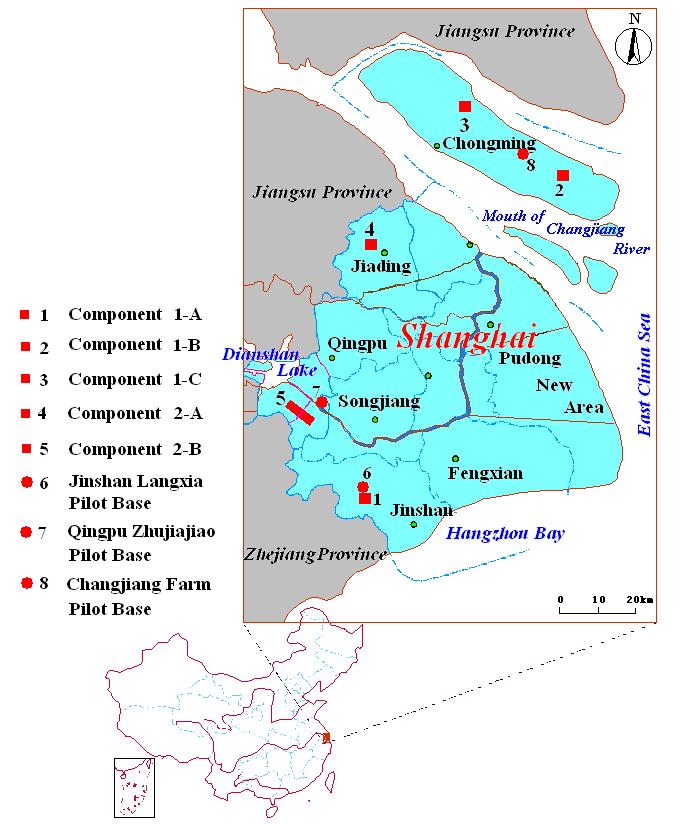
EMP on GEF Shanghai Agricultural and Non-point Pollution Reduction Project
Figure: Locations of GEF Shanghai Agricultural and Non-point
Pollution Reduction Project
108