E2150
v13
GEF SHANGHAI AGRICULTURAL AND NON-POINT POLLUTION REDUCTION
PROJECT
Public Disclosure Authorized
INTEGRATED AGRICULTURAL POLLUTION
REDUCTION TECHNIQUES
PEST MANAGEMENT PLAN (PMP)
Public Disclosure Authorized
Public Disclosure Authorized
Public Disclosure Authorized
EAST CHINA NORMal UNIVERSITY
AUGUST 20, 2009
GEF SANPRP Integrated Agricultural Pollution Reduction Techniques - Pest Management Plan
CONTENTS
1 FOREWORD .......................................................................................................................................1
1.1 NECESSITY OF PROJECT................................................................................................................... 1
1.2 OBJECTIVES OF PROJECT................................................................................................................. 1
1.3 PROJECT IMPLEMENTATION BASES ................................................................................................. 1
1.3.1 Basis of Selection.............................................................................................................2
1.3.2 Names of Bases................................................................................................................2
1.4 CONCEPT OF INTEGRATED PEST MANAGEMENT (IPM) ................................................................... 2
2 INTRODUCTION OF PROJECT DEMONSTRATION BASES ...................................................4
2.1 SHANGHAI JINSHAN MODERN AGRICULTURAL PARK DEMONSTRATION BASE .............................. 5
2.2 QINGPU DISTRICT ZHUJIAJIAO PRODUCTION BASE ......................................................................... 5
2.3 CHONGMING CHANGJIANG FARM DEMONSTRATION BASE ............................................................ 6
3 PEST MANAGEMENT METHODS.................................................................................................8
3.1 PEST OCCURRENCE AND PREDICTION ............................................................................................ 8
3.2 AGRICULTURAL AND PHYSICAL APPROACHES TO PEST CONTROL .................................................. 9
3.3 BIOLOGICAL APPROACHES TO PEST CONTROL............................................................................. 10
3.4 CHEMICAL APPROACHES TO PEST CONTROL................................................................................ 10
3.4.1 Non-insecticide Chemical Approaches ..........................................................................10
3.4.2 Overall Use of Insecticides ............................................................................................10
3.5 OVERALL ASSESSMENT ON PEST MANAGEMENT PRACTICES ....................................................... 10
4 NATIONAL AND SHANGHAI POLICIES ON PLANT PROTECTION AND INTEGRATED
PEST MANAGEMENT (IPM)............................................................................................................ 11
5 RECOMMENDED IPM APPROACHES .......................................................................................12
5.1 PURPOSES ..................................................................................................................................... 12
5.2 RECOMMENDED IPM APPROACHES............................................................................................... 12
5.2.1 Agricultural and Physical Approaches ...........................................................................12
5.2.2 Biological Approaches ...................................................................................................13
5.2.3 Chemical Approaches.....................................................................................................13
6 PESTICIDE MANAGEMENT.........................................................................................................14
6.1 IPM FOR MAIN CROPS .................................................................................................................. 14
6.1.1 Objectives.......................................................................................................................14
6.1.2 Principles........................................................................................................................14
6.1.3 Actions ...........................................................................................................................14
i
GEF SANPRP Integrated Agricultural Pollution Reduction Techniques - Pest Management Plan
6.2 PRINCIPLE OF INSECTICIDE SELECTION ........................................................................................ 16
6.3 RECOMMENDED INSECTICIDES ..................................................................................................... 16
6.4 POTENTIAL ENVIRONMENTAL, OCCUPATIONAL AND HEALTH RISKS AND MITIGATION MEASURES .
..................................................................................................................................................... 20
6.4.1 Potential Environmental Risks and Mitigation Measures ..............................................20
6.4.2 Potential Occupational/Health Risks and Mitigation Measures.....................................20
7 PEST MANAGEMENT ORGANIZATION SETUP AND MANAGEMENT OBJECTIVES ...22
7.1 PEST MANAGEMENT ORGANIZATION SETUP ................................................................................. 22
7.2 MANAGEMENT OBJECTIVES.......................................................................................................... 22
7.2.1 Enhance Awareness of Policy Enforcement ..................................................................22
7.2.2 Enhance Plant Protection Facilities at Lower Levels.....................................................23
7.3 TRAINING AND HR DEVELOPMENT .............................................................................................. 23
7.4 TRAINING FARMERS..................................................................................................................... 23
8 PROJECT MONITORING AND ASSESSMENT..........................................................................25
8.1 ITEMS TO MONITORED DURING PROJECT IMPLEMENTATION.......................................................... 25
8.2 ITEMS TO BE MONITORED DURING SUPERVISION ......................................................................... 25
8.3 MONITORING AND SUPERVISION PLAN.......................................................................................... 25
8.3.1 Monitoring of Pest Management....................................................................................25
8.3.2 Supervision Plan.............................................................................................................25
8.3.3 Duties .............................................................................................................................25
8.3.4 Professional Technology Request ..................................................................................26
8.3.5 Budget ............................................................................................................................26
ii
GEF SANPRP Integrated Agricultural Pollution Reduction Techniques - Pest Management Plan
ABBREVIATIONS, ACRONYMES
AND UNITS
AS Aqueous
Solutions
ATESC
Agro-Technology Extension and Service Center
COD
Chemical Oxygen Demand
D/C District/County
EC Emulsifiable
Concentrate
FAO
Food and Agriculture Organization of the United Nations
GB State
Standard
GEF
Global Environment Facility
IPM
Integrated Pest Management
ME Microemulsion
Mu
A unit of area, Chinese acre (=0.0667 hectare)
NH3-N Ammonia
Nitrogen
PMO
(Shanghai) Project Management Office
PMP
Pest Management Plan
SANPRP
Shanghai Agriculture and Non-point Pollution Reduction Project
TP Total
Phosphorus
WDG
Water Dispersible Granule
WP Wettable
Powders
i
GEF SANPRP Integrated Agricultural Pollution Reduction Techniques - Pest Management Plan
1 Foreword
1.1 Necessity of Project
The present use of pesticides in Shanghai suburban areas poses some problems, where
improvements are required, when compared with other regions in the country. First, a
very large quantity of pesticides is used in Shanghai, both in total consumption and
the dosage per unit area. Second, the mix of pesticides is unreasonable. Insecticides
are used excessively, high in quantity but low in efficiency, causing extinction of
natural enemies in the field, compromise of natural control, and increase in pesticide
resistance of pests and weeds. Third, the decentralized crop production adds to
difficulties in management. Fourth, the out-of-date pesticide application techniques
and equipments result in non-point source pollution and contaminate air, soils and
water bodies. In addition, there also exists low availability of technical guidance.
Therefore, it is necessary to implement the comprehensive agricultural pollution
reduction technology demonstration project.
1.2 Objectives of Project
The project has two specific objectives: The first is to set up three core demonstration
bases for agricultural production sized 8,730 Mu in total, in order to create beneficial
agricultural ecological cycles. The pest management component includes:
(1) Pesticide consumption per unit area is more than 10% below the municipal
average;
(2) The penetration rate of green control techniques reaches 100%;
(3) The moderately toxic pesticides used drop from the current 58% to below 40%;
(4) Environment-friendly
pesticides used increase to over 90%; and
(5) The mix of pesticides is further optimized.
The other objective is to promote the integrated control technology for agricultural
non-point pollution, in which the pest management component includes improvement
in pesticide efficiency and green control skills, and reduction in environmental
pollution due to pesticide loss.
Impermanent and demonstrate technologies at core demonstration bases via point and
sphere integration, extend beyond the core demonstration bases, improve the fertilizer
and pesticide efficiency in suburban agricultural production and environment friendly
control technologies, and reduce environmental pollution caused by loss of chemical
fertilizers, pesticides and agricultural organic wastes.
1.3 Project Implementation Bases
1
GEF SANPRP Integrated Agricultural Pollution Reduction Techniques - Pest Management Plan
1.3.1 Basis of Selection
(1) Located within the Huangpu River municipal drinking water protection area,
Chongming Eco-Island and Taihu Lake drainage area, a key agricultural
production region in Shanghai involving environment and resource protection;
(2) Crop production has a big weight in the demonstration area, with a stable
structure of crops and due supports from local governments; and
(3) Farmers within the project areas have a strong desire for new agricultural
technologies and are expected to be capable of following the technical
specifications required.
1.3.2 Names of Bases
For the foregoing reasons, three agricultural production core demonstration bases will
be set up. The Chongming Changjiang Farm is an integrated modern agriculture pilot;
the Qingpu District Taihu Lake Rim is demanding on water quality; Jinshan Langxia
is a modern agricultural park of the district, the home to a large-sized cow farm and
focusing on mixed farming and recycling of resources. The names of these bases are
listed below (see Chapter 2 for details):
(1) Shanghai Jinshan Modern Agricultural Park Demonstration Base;
(2) Qingpu District Zhujiajiao Production Base; and
(3) Chongming Changjiang Farm Demonstration Base;
1.4 Concept of Integrated Pest Management (IPM)
Integrated Pest Management (IPM) is a pest control strategy in agriculture. It is
implemented in three closely related stages: prevention, monitoring and suppression.
The strategy uses a series of interactive control approaches, such as agricultural,
physical, ecological and chemical approaches. It is a management method involving
ecology, aiming at effectively reducing or eliminating the use of pesticides and thus
reducing pollution of chemicals to the natural environment and ecological
environment.
This project supports IPM and involves the following aspects:
(1) Managing and keeping pests below the level that causes economic damages,
other than eliminating all pests;
(2) Keeping total pests at low levels using non-chemical approaches as much as
possible; and
(3) If pesticides must be used, the pesticides selected and the methods used should
be such that the adverse effects on beneficial organic substances, human and
ecological environment are minimized. Therefore, the Pest Management Plan is
necessary for this project.
2
GEF SANPRP Integrated Agricultural Pollution Reduction Techniques - Pest Management Plan
The Pest Management Plan will help promote use of biological and environmental
management approaches to pest control and reduce reliance on synthetic pesticides.
3
GEF SANPRP Integrated Agricultural Pollution Reduction Techniques - Pest Management Plan
2 Introduction of Project Demonstration Bases
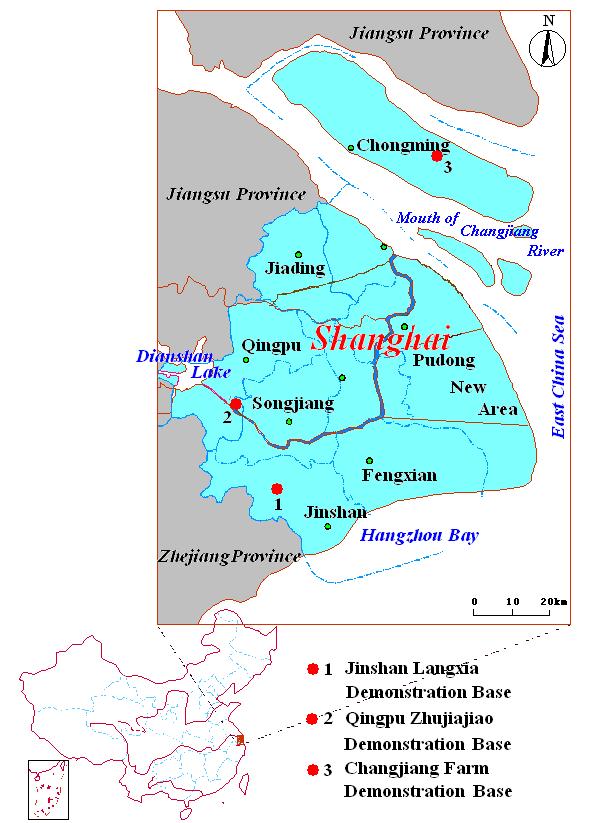
Three agricultural production core demonstration bases will be established in Jinshan,
Qingpu and Chongming for the comprehensive agricultural pollution reduction
technology demonstration project, located at Shanghai Jinshan Modern Agricultural
Park Demonstration Base, Qingpu District Zhujiajiao Production Base and
Chongming Changjiang Farm Demonstration Base respectively. For their geographic
locations in Shanghai, see Fig. 2.1 below:
Fig. 2.1 Locations of Agricultural Production Core Demonstration Bases in Jinshan,
Qingpu and Chongming
4
GEF SANPRP Integrated Agricultural Pollution Reduction Techniques - Pest Management Plan
2.1 Shanghai Jinshan Modern Agricultural Park Demonstration Base
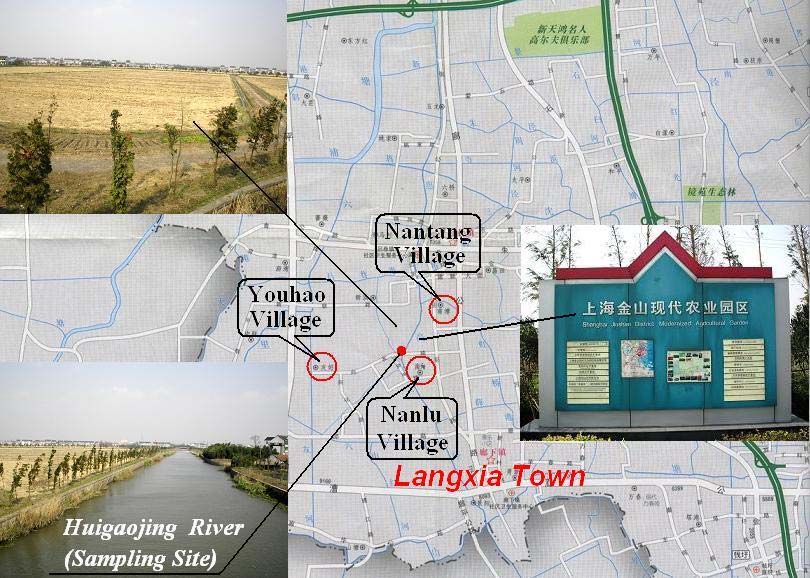
Shanghai Jinshan Modern Agricultural Park Demonstration Base covers an area of
2,400 Mu, distributed in Nanlu Village, Nantang Village, Youhao Village and No. 7
Jinshan Yinlong Farm, Langxia Town, Jinshan District, with the main crops being rice,
wheat and vegetables. Fig. 2.2 shows the location of Shanghai Jinshan Modern
Agricultural Park Demonstration Base.
Fig. 2.2 Schematic of Shanghai Jinshan Modern Agricultural Park Demonstration
Base
Shanghai Jinshan Modern Agricultural Park Demonstration Base is situated Langxia
Town, Jinshan District. Huigao Creek flows across the middle of the base and
northward into the Jueshi Port. According to the water environment plan of Shanghai,
Huigao Creek falls into Class III function area. The sampling and measurement of
surface water of Huigao Creek (see Fig. 2.2 for locations of sampling points) resulted
in 29.92mg/L in CODCr, 1.03mg/L in NH3-N and 0.220mg/L in TP. NH3-N meets
Class III standard defined in the Environmental Quality Standards for Surface Water
(GB3838-2002). CODCr and TP comply with Class IV standard.
2.2 Qingpu District Zhujiajiao Production Base
Qingpu District Zhujiajiao Production Base covers an area of 2,630 Mu, distributed in
Wangjin Village, Xinsheng Village and Zhangma Village, Zhujiajiao Town, with main
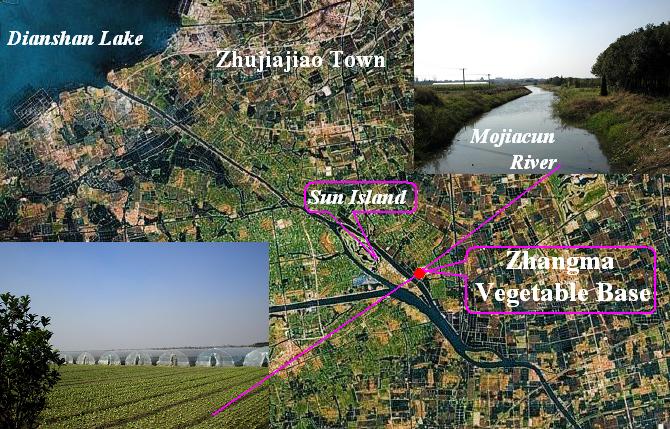
crops being rice, wheat and vegetables. Fig. 2.3 shows the location of the Zhangma
Village Vegetable Base in the Zhujiajiao Production Base.
5
GEF SANPRP Integrated Agricultural Pollution Reduction Techniques - Pest Management Plan
Fig. 2.3 Schematic of Zhangma Village Vegetable Base in Qingpu District
Zhangma Village Vegetable Base is 146 Mu in size, extending from Shentai Road to
the Yuejin River (East-West), and from Mojiacun River to Shizi Road (North-South).
Sun Island Parking Lot is cloated south of Shizi Road. It is easily accessible from
outside.
Zhangma Village Vegetable Base is within the municipal drinking water protection
area upstream Huangpu River. The water system around provides a direct access to
the upstream watercourse of Huangpu River. The base is in close proximity to Sun
Island nature protected area, closest to upstream water of Hungpu River among the
demonstration bases in Qingpu. The surface water quality sampling and determination
at the water intake of the base (where Mojiacun River and Yuejin River meets; see Fig.
2.3) resulted in 14.86mg/L in CODCr, 0.22 mg/L in NH3-N and 0.188mg/L in TP.
CODCr and NH3-N meets Class II standard defined in the Environmental Quality
Standards for Surface Water (GB3838-2002). TP complies with Class III standard.
Zhangma Village Vegetable Base in Qingpu District mainly produces water bamboo,
greengrocery, cauliflower and other vegetables. Most rain fed vegetables are planted
in greenhouses.
2.3 Chongming Changjiang Farm Demonstration Base
Chongming Changjiang Farm Demonstration Base covers an area of 3,700 Mu,
distributed in No. 3 Pingdong Unit and No. 7 Qianjiang Unit of Changjiang Farm,
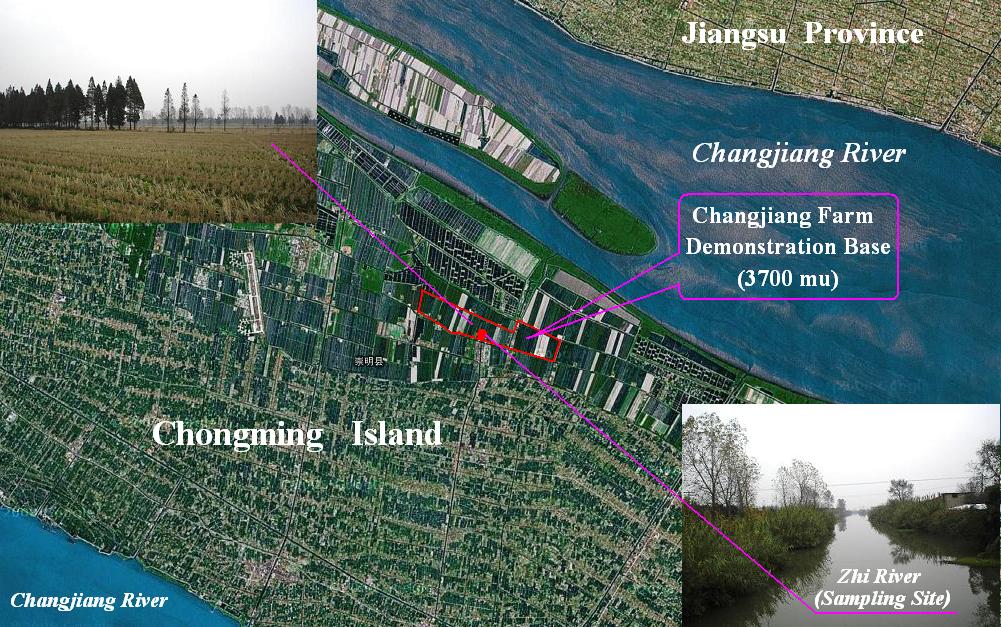
with main crops being rice and wheat, two harvests a year. Fig. 2.4 shows the
geographic location of Chongming Changjiang Farm Demonstration Base.
6
GEF SANPRP Integrated Agricultural Pollution Reduction Techniques - Pest Management Plan
Fig. 2.4 Schematic of Chongming Changjiang Farm Demonstration Base
Chongming Changjiang Farm Demonstration Base is situated at east central
Chongming, with Zhihe River flowing across the middle, and connected with
Huandao Canal N-S. According to the water environment function zoning of
Shanghai, the base falls into Class III water quality area. The sampling and
measurement of surface water of Zhihe River (see Fig. 2.4 for locations of sampling
points) resulted in 17.27 mg/L in CODCr, 1.16 mg/L in NH3-N and 0.126mg/L in TP.
NH3-N meets Class IV standard defined in the Environmental Quality Standards for
Surface Water (GB3838-2002); CODCr and TP meet Class III standard.
7
GEF SANPRP Integrated Agricultural Pollution Reduction Techniques - Pest Management Plan
3 Pest Management Methods
3.1 Pest Occurrence and Prediction
According to statistics, there are about 36 million Mu of pest-affected areas in
Shanghai in a year, with control actions taken for about 42 million Mu.
Pests and diseases that pose major harms to cereal crops in Shanghai include the rice
stripe disease, a rice viral disease caused by virus transmission by Laodelphax
Striatellus, which in serious circumstances may cause massive rice underproduction or
even zero output.
According to the sample surveys and virus-carrying rate determinations on
overwintering generation of Laodelphax Striatellus conducted by district and county
plant protection authorities under central organization of the Municipal Agricultural
Technology Center at 36 villages (or towns) in Shanghai, in the 576 fields surveyed,
547 fields carried Laodelphax Striatellus, accounting for 94.97% of the surveyed total,
and the disease was detected in all types of fields surveyed (wheat fields, rape fields,
green manure fields, weed fields and stubbly fields).
According to the survey results, there were 13,600 pieces of Laodelphax Striatellus
per Mu in Shanghai with a range of 1,80055,200 pieces, the worst case being
434,000 pieces. From the distribution of Laodelphax Striatellus, weed fields carried
the most pests, followed by wheat fields, green manure fields, stubbly fields and rape
fields in sequence. By geological locations, the largest number of pests per Mu
occurred in Jinshan Distrct, averaging 52,500 pieces and the worst case being 434,000
pieces. Qingpu and Chongming were both below 10,000 pieces.
The average virus-carrying rate was 16.68%, up by 3.75 percentage points when
compared with the 12.93% last year, far exceeding the occurrence limit of 12%. The
worst cases occurred in Nanhui District (31.5%), Qingpu District (12.50%),
Chongming County (19.60%) and Jinshan District (10.01%).
Cnaphalocrocis medinalis Guenee and Nilaparvata lugens Stal are the two major
migratory pests in Shanghai. Massive spread of Cnaphalocrocis medinalis Guene has
occurred each year since 2003, and Nilaparvata lugens Stal entered another cycle of
massive spread in 2005.
In recent years, Shanghai has taken effective agricultural and chemical control actions,
which mitigate natural occurrences of phralidid caterpillers. However, due to weather
conditions and pesticide resistance, the rice borers still pose a major hazard in
Shanghai.
The major barley and wheat pests and diseases in Shanghai include gibberellic disease,
powdery mildew and aphids. The affected area reaches 1.8 million Mu in a year.
Sclerotinia sclerotiorum de Bary is a major disease on rape in Shanghai. The main
factors impacting the disease include resistance varieties, bacteria sources, planting
management and weather conditions from full bloom to one week before harvest of rape.
8
GEF SANPRP Integrated Agricultural Pollution Reduction Techniques - Pest Management Plan
Main pests and diseases having a major effect on agricultural economy in Shanghai
suburban areas are shown in Table 3.1:
Table 3.1 Main Pests and Diseases on Crops in Shanghai Suburban Areas
Crop Major
Pests/Diseases
Rice stripe disease
Rice
Cnaphalocrocis medinalis
Guenee
Nilaparvata lugens Stal
Rice borer
Gibberellic disease
Wheat
Powdery mildew
Aphids
Rape Sclerotinia
sclerotiorum
de
Bary
Vegetable
Asparagus caterpillar
Spodoptera litura Fabricius
Plutella xylostella
Aphids
Cabbage worm
3.2 Agricultural and Physical Approaches to Pest Control
Agricultural and physical approaches to pest control available for famers include:
(1) Tillage measures, including deep-burying of rice straws and vegetable crop
residuals to prevent growth of pest eggs, and deep ploughing immediately after
rice harvest to prevent growth of rice borers;
(2) Regular rotation of rain-fed crops to eliminate habitats of soil pests;
(3) Regular rotation of rain-fed and wet crops to eliminate habitats of soil pests;
(4) Rice straw and residual management to prevent aggregation of pests and their
eggs on straws and residuals;
(5) Removal and burning of vegetable leaves and crop branches and leaves affected
by pests, diseases and pest eggs;
(6) Deep-water
irrigation
of
rice fields to control soil pest eggs and pupas of rice and
other pests;
(7) Use attractant boxes to entrap vermes and caterpillars;
(8) Use light traps to entrap phototactic vegetable pests; and
(9) Manually remove pest eggs, caterpillars and larvae in pest peak season.
9
GEF SANPRP Integrated Agricultural Pollution Reduction Techniques - Pest Management Plan
3.3 Biological Approaches to Pest Control
Biological approaches and conventional practices of farmers include:
(1) Improving crops' capability of pest resistance; and
(2) Use target intercrops to keep pests away from the primary crops.
3.4 Chemical Approaches to Pest Control
3.4.1 Non-insecticide
Chemical
Approaches
Non-insecticide chemicals are usually used to control particular pests on some crops,
such as sugar-vinegar mixture used to attract and entrap pests in vegetable
greenhouses, which can be combined with light traps at the initial stage.
3.4.2 Overall Use of Insecticides
Pesticide is the major form of chemical pest control approaches. 2007 statistics show
that, in Shanghai, the grain cropland consumption of pesticides (effective content
equivalent) was 9.66kg/hm2 (or 644.27g/Mu), and vegetable field consumption of
pesticides (effective content equivalent) was 7.74kg/hm2 (or 516g/Mu). Grain
cropland insecticides, fungicides and herbicides are about 3.2:1.2:1, compared with
1:1:2 in developed countries, while the vegetable field pesticides account for 45.1%.
The moderately and low toxic pesticides used in grain croplands are 6:4, while low
toxic pesticides take up over 95% in terms of vegetables and other industrial crops. In
addition, the pesticide application equipments and out-of-date and pesticide efficiency
is low.
3.5 Overall Assessment on Pest Management Practices
Researches conducted in project preparation revealed the following problems in pest
management practices in the project areas:
(1) Reliance on chemical control approaches, in particular for large-area single crops,
such as rice and wheat;
(2) Excessive use of pesticides;
(3) Unreasonable use and management of pesticides and other agrochemicals;
(4) Environmentally
unsafe
disposal of chemicals their packages;
(5) Weak enforcement of laws and regulations governing labels and sale of
agrochemicals;
(6) Poor understanding of integrated pest management among promotion agencies,
chemicals distributers and farmers; and
(7) Poor awareness of safety in pesticide use.
10
GEF SANPRP Integrated Agricultural Pollution Reduction Techniques - Pest Management Plan
4 National and Shanghai Policies on Plant Protection and Integrated
Pest Management (IPM)
The national and Shanghai policies on plant protection and IPM include:
Administrative Regulations of the People's Republic of China on Pesticides
(issued on May 8, 1997 by Order No. 216 of the State Council.)
Rules on Implementation of the Administrative Regulations on Pesticides
(adopted at the executive meeting of the Ministry of Agriculture held on April 27,
1999, issued by Order No. 20 of the Ministry of Agriculture of the People's
Republic of China, and implemented on July 23, 1999; Amended by Order No. 18
of the Ministry of Agriculture on July 27, 2002; amended by Order No. 38 of the
Ministry of Agriculture on July 1, 2004; amended by the Decisions on
Amendment to the <Rules on Implementation of the Administrative Regulations>
issued by the Ministry of Agriculture on December 8, 2007)
Administrative Regulations on Pollution-free Agricultural Products (jointly
issued by the Ministry of Agriculture and the General Administration of Quality
Supervision, Inspection and Quarantine of the People's Republic of China, 2002)
Green Food-Pesticide Application Guideline (NY/T393-2000)
Standard for Safety Application of Pesticides (GB4285-89)
Standard for Safety Application of Pesticides (GB8321.2-1999)
Determination of Organophosphorus Pesticide Residues in Foods (GB/T
5009.20-2003)
Regulations of Shanghai Municipality on Trading and Use of Pesticides (issued
by Order No. 17 of the People's Government of Shanghai Municipality on
November 7, 1995; amended and reissued by Order No. 54 of the People's
Government of Shanghai Municipality on December 19, 1997)
Interim Regulations of Shanghai Municipality on Safety Supervision of Edible
Agricultural Products (issued by Order No. 105 of the People's Government of
Shanghai Municipality on July 23, 2001; amended by the Decision on
Amendment to the <Interim Regulations of Shanghai Municipality on Safety
Supervision of Edible Agricultural Products> issued by the People's Government
of Shanghai Municipality on July 3, 2004)
11
GEF SANPRP Integrated Agricultural Pollution Reduction Techniques - Pest Management Plan
5 Recommended IPM Approaches
5.1 Purposes
To use low toxic environment-friendly pesticides, prevent use of highly toxic
chemicals;
To reduce sales of chemicals labeled improperly or inadequately to farmers;
To promote application safety and management of chemical;
To promote understanding, awareness and application of IPM;
To reduce environmental pollution caused by unreasonable use of pesticides; and
To reduce occupational hazards and health risks in use of pesticides.
5.2 Recommended IPM Approaches
5.2.1 Agricultural and Physical Approaches
Tillage measures, including deep-burying of rice straws and vegetable crop
residuals to prevent growth of pest eggs, and deep ploughing immediately after
rice harvest to prevent growth of rice borers.
Regular rotation of rain-fed crops to eliminate habitats of soil pests; such as
vegetables-horse bean-vegetables.
Regular rotation of rain-fed and wet crops to eliminate habitats of soil pests.
Plough and flood fields promptly after harvest of summer crops to effectively
eliminate Laodelphax Striatellus sources.
Remove weeds in fields, along field borders, and along trenches and roads, in
order to deteriorate habitats of Laodelphax Striatellu, reduce bridging hosts and
cut off host chains.
Centralized rice cultivation. Centralized and consecutive rice nurseries to prevent
Laodelphax Striatellus development, and demonstrate and promote physical
control measures, including fly nets.
Plough and flood in spring; Plough using medium-sized tractors and flood fields
in the pupation period (from later March to early May) of phralidid caterpillar, so
as to eliminate overwintering pests.
Rice straw and residual management to prevent aggregation of pests and their
eggs on straws and residuals.
Remove and burn vegetable leaves and crop branches and leaves affected by pests,
diseases and pest eggs.
Use attractants to entrap vermes and caterpillars (e.g. for greenhouse vegetables).
Use light traps to entrap phototactic vegetable pests.
Manually remove pest eggs, caterpillars and larvae in pest peak season.
12
GEF SANPRP Integrated Agricultural Pollution Reduction Techniques - Pest Management Plan
5.2.2 Biological
Approaches
Improve crop varieties to enhance their pest resistance.
Use proper intercrops to divert pests from primary cash crops.
Cultivate and protect animals that feed on crop pests, and fully utilize such
animals as frogs and spiders.
5.2.3 Chemical
Approaches
Chemical approaches must follow the principles listed below:
Use suitable and cost effective non-insecticide chemicals to control pests, such as
sugar-vinegar mixture used to attract and entrap pests in vegetable greenhouses.
Use highly-efficient, low-toxic and low-residual pesticides.
Promote control techniques posing low toxicity to people, poultry and livestock,
leaving low residuals to agricultural products, and causing little pollution to
environment; such techniques include: using low-toxic and low residual
pesticides; applying pesticides before transplanting rice shoots; effectively and
promptly apply low-concentration pesticides to control pests when the density of
pests exceeds the critical line, and assure pesticide application within the optimal
period; Maintain a safety interval between applications of pesticides.
Use safe equipments (e.g. knapsack sprayer) to increase efficiency of pesticides
and effectiveness of control.
Promote and train on safe use of pesticides (e.g. wearing PPEs and how to apply
pesticides under static wind conditions).
Safe storage of chemicals (beyond the reach of children and isolated from foods).
Reasonably dispose of chemical wastes and used containers.
13
GEF SANPRP Integrated Agricultural Pollution Reduction Techniques - Pest Management Plan
6 Pesticide Management
6.1 IPM for Main Crops
6.1.1 Objectives
To control pests and reduce use of pesticides, the project sets out the following IPM
objectives:
(1) To reduce pesticide consumption per unit area to more than 10% below the
municipal average;
(2) To improve green control techniques, and raise the penetration rate of green
control techniques to 100%;
(3) To increase percentage of moderately toxic pesticides from the current 58% to
below 40%, and increase that of environment-friendly pesticides used to over
90%;
(4) To further optimize the mix of pesticides, improve efficiency of pesticides;
reduce environmental pollution due to loss of pesticides.
(5) To eliminate intoxication accidents due to unsafe management or storage or
unreasonable disposal of wastes.
(6) Residual pesticides in agricultural products meet WHO and national standards.
(7) To maintain agricultural biodiversity and establish eco-agricultural model.
6.1.2 Principles
Value and enhance pest forecast, promote green control techniques; apply agricultural
approaches, and then physical and biological approaches, and at last chemical
approaches.
Enhance and provide accurate forecast of pests; the agricultural technology centers at
municipal, district and county levels shall all provide farmers with timely information,
including control objectives, appropriate control time, techniques and pesticides.
Such information should be provided 7-10 days before control measures are taken, so
as to guide farmers to control at appropriate time and improve the control results.
Promote upgraded pesticide equipments, improve pesticide utilization efficiency and
mitigate environmental pollution.
6.1.3 Actions
(1) Agricultural Control Measures
Seed selection and cultivation: Remove inferior seeds and fine seeds. It is a vital
method to improve crop resistance to pests and reduce use of pesticides;
14
GEF SANPRP Integrated Agricultural Pollution Reduction Techniques - Pest Management Plan
Rotation of crops to avoid pest development;
Plant intercrops, such as intercropping tomato, cabbage and pepper to reduce
aphids migration;
Select reasonable planting seasons to reduce pest damages to crops;
Tillage measures, including deep-burying of rice straws and vegetable crop
residuals to prevent growth of pest eggs, and deep ploughing immediately after
rice harvest to prevent growth of rice borers.
Deep-plough the fields after harvest of rain-fed crops to avoid growth of pests in
upper layers of soils and winterkill dormient pests.
Apply fertilizers properly and maintain timely irrigation and drainage; apply a
large quantity of basal fertilizers to reduce use of nitrogeneous and phosphatic
fertilizers, and increase the use of calcium to enhance crops' resistance to pests;
Reasonable irrigation and drainage management can effectively control pests.
Improve tillage and weed control to reduce pests; and
Clean soils: Remove affected leaves and plants from croplands to reduce pests.
(2) Physical Control Measures
Use fly nets during vegetable cultivation to protect vegetables from pests, wind,
rain and sunlight and maintain a proper humidity; Use greenhouse techniques.
Entrap and kill pests: Use yellow traps to entrap cabbage butterfly and aphids, kill
moths and beetles using frequency vibration lights and black light lamps, and
entrap moths using sugar-vinegar solution.
Demonstrate green control techniques in project areas that help reduce use of
pesticides, update pesticide application equipments, and pay due attention to
integration of different techniques.
Establish pest detection and reporting points in projects area, systemically
monitor pest occurrences, and connect with Shanghai Agricultural Pests Early
Warning System. Realize automatic collection, enquiry, statistics and analysis of
monitoring results and disease/insect pest projection/warning; provide online
expert diagnosis and consultation for farmers and technicians; improve the
accuracy of monitoring and warning of the network system. Propose proper
control opinions.
(3) Biological
Control
Measures
Use natural energies, such as frogs;
Use sex attractants to kill pests.
(4) Chemical Control Measures
Combination of pesticides and other control measures is an effective and cost efficient
method to improve control results and assure increase in output of agricultural
products. High-quality pesticides low in or free of toxicity to people and animals, and
safe to crops, can effectively control pests. Important pesticide-based control
15
GEF SANPRP Integrated Agricultural Pollution Reduction Techniques - Pest Management Plan
approaches are described below:
Prohibit use of extremely or highly toxic and high-residual pesticides;
Use different pesticides to control different pests as appropriate;
Apply pesticides at optimal time in line with pest development;
Apply pesticides in an appropriate quantity in line with pest development;
Mix or alternate pesticides as appropriate according to specific conditions; and
Fully follow requirements on safety in the harvest period (GB4285-89).
6.2 Principle of Insecticide Selection
In principle, the pesticides used by the beneficiary should be recommended by the
Agricultural Technology Extension and Service Center, and the purchase, storage and
use of pesticides should comply with applicable laws of China and meet standards
acceptable to the World Bank. The pesticides used must comply with the World Bank
OP4.09 guidelines, which include the following criteria to ensure that the pesticides
used:
Have negligible adverse impacts on health of people;
Are effective against target species;
Have minimal effect on non-target species and natural environment, therefore, the
methods, time and frequency of pesticide application must have a minimal
damage to the natural enemies of pests;
Take into account the need to prevent the development of resistance to pests;
In addition, records should be kept throughout the process of pesticide application,
including the target land parcels, type and quantity of pesticide, time and results
of application, and final output of crops.
6.3 Recommended Insecticides
During implementation of the project, the use of pesticides must be combined with
agricultural, physical and biological approaches to pest control. The use of pesticides
must follow the principles of safety, effectiveness and cost efficiency. The pesticides
used must be efficient, low in toxicity and free of or low in residuals. Table 6.1 lists
pesticides recommended for the project.
Table 6.1 Pesticides Recommended for the Project
Crop
S/N
Main Pests
Recommended Low Toxic Chemical
Insecticide
1 Rice
borer,
200 g/l Rynaxypyr SC
Rice
Cnaphalocrocis medinalis
Guenee
2
Rice planthopper
25% Buprofezin WP
3 Cnaphalocrocis
medinalis
2.2% Avermectins EW
Guenee
16
GEF SANPRP Integrated Agricultural Pollution Reduction Techniques - Pest Management Plan
Crop
S/N
Main Pests
Recommended Low Toxic Chemical
Insecticide
4 Cnaphalocrocis
medinalis
16000 IU/mg Bacillus thuringiensis
Guenee
WP
5
Striped rice borer
25% Avermectin · Chlorpyrifos, E.C.
6
Rice planthopper
10% Imidacloprid WP
7
Rice stripe disease, rice
2% Ningnanmycin AS
seedling blight
8
Sheath blight
15% Validamycin A soluble powder
9
Sheath blight
300 g /l Difenoconazole.
Propiconazole
10 Wheat aphids
10% Imidacloprid WP
Wheat 11 Wheat aphids
25% pymetrozine WP
12 Wheat gibberellic disease
25% polyketide WP
13 Cabbage
worm,
150 g/L Indoxacarb SC
Asparagus caterpillar,
Plutella xylostella
14 Asparagus caterpillar
2.2% metol avermectin benzoate ME
15 Asparagus caterpillar
10 bn PIB/ml Autographa californica
Vegetable
nuclear polyhedrosis virus SC
16 Asparagus caterpillar
30bn PIB/g Asparagus caterpillar
nuclear polyhedrosis virus WDG
17 Spodoptera
litura
20bn PIB/g Spodoptera litura Fabricius
Fabricius
nuclear polyhedrosis virus WDG
18 Plutella
xylostella,
10% chlorfenapyr SC
Vegetable
Asparagus caterpillar
19 Asparagus caterpillar
3% metol Avermectin benzoate ME
20 American Blotch
75% cyromazine WP
21 Aphids
70%
ImidaclopridWDG
22 Cabbage worm
40% phoxim EC
23 Asparagus caterpillar
1.5% metol Avermectin benzoate EC
24 Asparagus caterpillar
240 g/L methoxyfenozide SC
25 Asparagus caterpillar
50 g/L lufenuron EC
26 Plutella xylostella, thrips
25 g/L spinosyns
27 Snail
Metaldehyde
granules
Gourd downy mildew,
anthracnose, early blight
of tomato, late blight,
cauliflower downy
28 mildew, Cucumber
250 g/L azoxystrobin SC
powdery mildew, scab,
gummy stem blight,
downy mildew, capsicum
anthracnose, blights, etc.
29 Cucumber downy mildew 50% dimethomorph WP
30 Tomato, capsicum and 8% Ningnanmycin AS
tobacco virus diseases
31 Cucumber
downy
52.5% famoxadone · cymoxanil WJ
mildew, capsicum blights
17
GEF SANPRP Integrated Agricultural Pollution Reduction Techniques - Pest Management Plan
Crop
S/N
Main Pests
Recommended Low Toxic Chemical
Insecticide
32 Tomato and Cucumber
400 g/L pyrimethanil SC
grey mildew
33 Bean powdery mildew,
400 g/L flusilazole EC
Cucumber scab
Table 6.2 list other pest control methods for main crops.
18
GEF SANPRP Integrated Agricultural Pollution Reduction Techniques - Pest Management Plan
Table 6.2 Other Pest Control Methods for Main Crops
Crop
Agricultural & Physical Approaches
Biological Approaches
Plough and clean stubbles. Plough
and flood fields promptly after
harvest of summer crops to
effectively eliminate Laodelphax
Striatellus sources.
Remove weeds in fields, along field
borders, and along trenches and
roads, in order to deteriorate habitats
of Laodelphax Striatellu, reduce
bridging hosts, cut off host chains and
mitigate diseases.
Delay the rice seedling as
appropriate. Ensure seedling of
direct-seedling rice after full harvest
of summer crops in the same area as
much as possible. Avoid the
Promote pest-resistance
migration of the first-generation of
Rice
species, protect and use
Laodelphax Striatellus to the rice
natural enemies.
fields.
Centralized and consecutive rice
nurseries to prevent Laodelphax
Striatellus development.
demonstrate and promote physical
control measures, including fly nets,
to protect rice sprouts from virus
transmission by Laodelphax
Striatellus.
Plough and flood in spring; Plough
using medium-sized tractors and
flood fields to eliminate
overwintering pests.
Kill moths using frequency vibration
lights and black light lamps.
Estimate and forecast pests.
Pay due attention to weed control,
eliminate overwintering bacteria
sources and pest sources, remove
weeds along croplands, control
chemical nitrogenous fertilizer,
Promote pest-resistance
increase phosphatic and potassic
Wheat
species, protect and use
fertilizers and organic fertilizer.
natural enemies.
Conduct cropland system
investigation and large field survey to
acquire accurate information on pest
development and wheat growth.
Estimate and forecast pests.
Vegetable Estimate and forecast pests;
Use natural enemies of
19
GEF SANPRP Integrated Agricultural Pollution Reduction Techniques - Pest Management Plan
Use sex attractants to kill pests;
pests.
Use pest killing lamps to entrap
moths and pests.
6.4 Potential Environmental, Occupational and Health Risks and
Mitigation Measures
6.4.1 Potential Environmental Risks and Mitigation Measures
The main potential environmental risks in use of pesticides in the project are
described below:
Water quality deterioration and increased pesticide in the potential aquatic lives
caused by pesticide residuals;
Water contamination caused by pesticide sprinkling and chemical leaks at
adjacent potable water resources;
Use of pesticides may affect non-target species (e.g. bees and birds);
Pests become resistant to pesticides due to continuous and excessive use of some
pesticides; and
Soil contamination caused by pesticide residuals.
Below are measures to mitigate potential environment risks arising from use of
pesticides:
Train village cadres, farmers and pesticide distributors to make them familiar
with chemicals that may pose adverse effects to the environment, recommend
proper sprinkling methods and equipments.
Have village cadres to oversee sprinkling process to ensure that no toxic
chemicals are sprinkled at adjacent potable water sources.
Buy and use reliable and safe sprinkling equipments;
Use pesticides with low half-life residuals; and
Use diverse pest control techniques (agricultural/physical, biological and
chemical) to ensure that pests will not develop resistance to pesticides;
6.4.2 Potential Occupational/Health Risks and Mitigation Measures
Main potential occupational/health risks arising from use of pesticides are listed as
follows:
Pesticide vapor is inhaled into lung to cause nausea and vomit, if the operator
does not wear gas mask when handling concentrated chemicals and/or sprinkling
pesticides;
Chemicals leak to cause skin damage, if the operator does not wear PPEs when
sprinkling or handling chemicals; and
Chemicals leak to contaminate potable water when sprinkled adjacent to water
20
GEF SANPRP Integrated Agricultural Pollution Reduction Techniques - Pest Management Plan
sources.
The mitigation measures for the foregoing potential occupational/health risks are
listed below:
Train village cadres, farmers and pesticide distributors, including:
Chemicals likely to cause occupational/health hazards;
Recommend handling and sprinkling methods;
Effective equipments and operating procedures;
Wear PPEs, including long-sleeved clothes, face mask, gloves, trousers and
boots
Sprinkling
methods
under
static wind conditions;
Safe storage and lockup of chemicals; and
Safe disposal methods of chemicals packaging and wastes.
Experts from the agricultural technology extension and service center or the plant
protection and quarantine station provide regular trainings and accept oversight
by government authorities.
21
GEF SANPRP Integrated Agricultural Pollution Reduction Techniques - Pest Management Plan
7 Pest Management Organization Setup and Management Objectives
7.1 Pest Management Organization Setup
The pest management organization is three-tiered:
(1) At municipal level: Establish Shanghai Project Coordination Team consisting of
representatives from Shanghai Development and Reform Commission, Shanghai
Environmental Protection Administration, and Shanghai Agricultural
Commission. Under the team is the Shanghai GEF Project Management Office.
(2) At district/county level: Establish task forces at Qingpu District, Jinshan District
and Chongming County, respectively. The task forces consist of representatives
from the environment administration, agricultural commission and agricultural
technology center at the same level.
(3) Implementing Entity: Shanghai Jinshan Modern Agricultural Park in Langxia
Town, Jinshan District; Qingpu District Zhujiajiao Production Base; Chongming
Changjiang Farm.
7.2 Management Objectives
7.2.1 Enhance Awareness of Policy Enforcement
Enhance the awareness of enforcing pest management policies by project
implementation, particularized as follows:
Reduce daily use rate of chemical insecticides within the project;
Prohibit use of unregistered pesticides within the project;
Prohibit use of highly toxic pesticides (WTO I) within the project; substitute low
toxic pesticides within the projects.
Implement rules of the Food and Agriculture Organization of the United Nations
(FAO) on restrictions, distribution and application of pesticides (or equivalent
Chinese regulations);
Implement FAO guidelines on pesticide packaging and storage (or equivalent
Chinese regulations);
Implement FAO guidelines on pesticide labeling and application (or equivalent
Chinese regulations);
Implement FAO guidelines on disposal of waste pesticides and packages (or
equivalent Chinese regulations);
If no guidelines equivalent to FAO's are available in China, the project should
immediately make available such guidelines;
In addition, governments at district/country, village and town levels are encouraged to
promote and support IPM approaches through discussions and project implementation
(in particular long-term benefits).
22
GEF SANPRP Integrated Agricultural Pollution Reduction Techniques - Pest Management Plan
7.2.2 Enhance Plant Protection Facilities at Lower Levels
Enhance plant protection facilities at lower levels through project implementation,
particularized as follows:
(1) Train plant protection experts at district/county level, promotion personal at
village/town level and farmers.
(2) Plant protection personnel understand and are able to use IPM approaches and
farmers have a good understanding of IPM approaches in project
implementation.
(3) Through project implementation, strengthen plant protection relations between
the municipality, districts/countries, towns and villages, and promote
implementation of the Pest Management Plan.
7.3 Training and HR Development
During implementation of the project, a series of training sessions will be provided for
technicians at district/county level and at village/town level, key farmers and refresher
trainees; prepare and provide training materials, including audiovisual materials, films
and multimedia; allow technicians more time to visits farmers, build agricultural
promotion and demonstration points, construct activity and teaching centers, and lend
agricultural technique books and magazines.
7.4 Training Farmers
(1) Timetable and Content of Training
Training farmers are intended to improve farmers' capability in safe and cost-efficient
pest control, including identifying pests, making proper control decisions and take
proper control actions.
Each famer receives 1-2 training sessions a year, and held relevant training sessions
(about 1-day) during pest development each year, including:
Characteristics of pests and damages to crops caused by different pests;
Natural enemies of main pests;
Field sampling methods;
Control measures, including agricultural, physical, biological and chemical
approaches in IPM methodology;
Safe storage of chemicals, treatment and disposal of chemical wastes and
containers; and
Chemicals application methods and PPE requirements;
(2) Possible Trainers
23
GEF SANPRP Integrated Agricultural Pollution Reduction Techniques - Pest Management Plan
Farm leaders and demonstration households;
Villages and towns assigned training tasks, extension and service bodies at
district/county and municipal levels; and
Chemicals suppliers
24
GEF SANPRP Integrated Agricultural Pollution Reduction Techniques - Pest Management Plan
8 Project Monitoring and Assessment
8.1 Items to Monitored during Project Implementation
Implementation area of IPM owners;
Modes of pesticide use;
Crop output;
Changes in the agricultural ecosystem; and
Other indicators.
The foregoing monitoring activities must be conducted on sampled farmers in each
district/county project demonstration base by personnel at the district/county-level
agricultural technology extension and service centers (D/C ATESCs). The World
Bank representatives should help D/C ATESCs to establish a proper monitoring
system and sampling procedures early, and provide trainings on implementation of the
monitoring system and analysis.
8.2 Items to Be Monitored during Supervision
The following items should be monitored externally during visit of the World Bank
supervision delegation.
Pesticide registration;
Use of Class I pesticides;
Release of policies; and
Implementation of local monitoring procedures and assistance in result analysis.
8.3 Monitoring and Supervision Plan
8.3.1 Monitoring of Pest Management
The monitoring work should be conducted jointly by D/C ATESCs, PMO and the
owner. Any pest detected must be immediately reported and handled.
8.3.2 Supervision Plan
PMO is responsible for regular monitoring. ATESCs are responsible for supervision
and control in pest peak season.
8.3.3 Duties
ATESCs at all levels are responsible for guiding, supervising, monitoring and
providing trainings on IPM. PMO and stakeholders are responsible for promptly
detecting and reporting pest development and performing requests consistent with the
IPM plan.
25
GEF SANPRP Integrated Agricultural Pollution Reduction Techniques - Pest Management Plan
8.3.4 Professional Technology Request
ATESCs at all levels are responsible for providing plant protection technologies and
approaches.
8.3.5 Budget
Pest management should be included into day-to-day management of the PMO. The
budget for pest management must be incorporated into the overall administration costs
of ATESCs and the costs of reasonable pesticide use, forecast, reporting and
monitoring, training and promotion and management.
26