|
Request for CEO endorsement/Approval Project Type: the GEF Trust Fund |

Submission Date: April 22, 2008
Re-submission Date:
|
Expected Calendar | |
|
Milestones |
Dates |
|
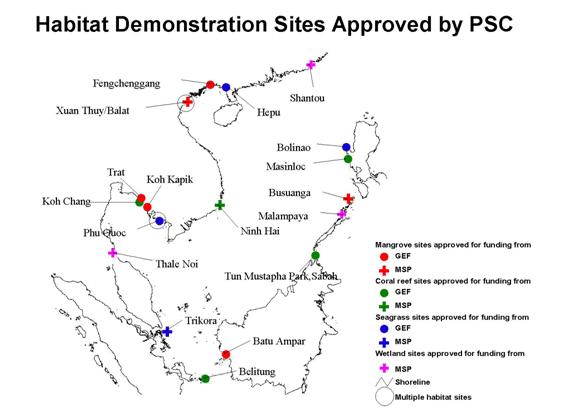
Work Program (for FSP) |
NA |
|
GEF Agency Approval |
June 2008 |
|
Implementation Start |
July 2008 |
|
Mid-term Review (if planned) |
July 2009 |
|
Implementation Completion |
June 2011 |
part i: project Information
GEFSEC Project ID: 3187
gef agency Project ID:
Country(ies): Viet Nam
Project Title: Demonstration of Sustainable Management of Coral Reef Resources in the Coastal Waters of Ninh Hai District, Ninh Thuan Province, Viet Nam
GEF Agency(ies): , ,
Other Executing partner(s): Institute of Oceanography, Viet Nam
GEF Focal Area(s): , , ,
GEF-4 Strategic program(S): IW Strategic Programme 1
Name of parent program/umbrella project: N/A
A. Project framework (Expand table as necessary)
|
Project Objective: The objective of the project is to demonstrate integrated management of regionally significant coral reef and seagrass habitats connected to the South China Sea for the prevention of future ecosystem degradation and sustainable utilization of coastal resources at the site. The project aims to establish a marine protected area (MPA) for the effective management of 1,070 ha of coral reef, including a total 40 ha of seagrass, at Ninh Hai through the establishment of a cross-sectorial and participatory management scheme, integrated management plan, and demarcation. | ||||||||
Project Components |
Indicate whether Investment, TA, or STA** |
Expected Outcomes |
Expected Outputs |
GEF Financing* |
Co-financing* |
Total ($) | ||
($) |
% |
($) |
% | |||||
|
1. Improving area management through cross-sectorial and participatory approaches |
TA |
Management framework established and the management capacity improved |
Institutional arrangement for cross-sectorial management, integrated management plan, demarcation, enforcement and surveillance of regulations and legislation, rehabilitation of damaged habitats through the participatory approach, habitat monitoring system |
218,565 |
43 |
292,842 |
57 |
511,407 |
|
2. Pilot project on alternative measures for sustainable income-generation for the local community |
TA |
Unsustainable exploitation of natural resources reduced Sustainable livelihoods of local people developed |
Alternative measures for sustainable income-generation ex. eco-tourism, aquaculture |
87,200 |
30 |
201,824 |
70 |
289,024 |
|
3. Capacity Building and awareness raising |
TA |
Knowledge and skills for the management of coral reef habitats increased |
Awareness raising materials, training workshop on sustainable use and professional skills, exchange of information and experience |
60,445 |
92 |
5,395 |
8 |
65,840 |
|
4. Project management |
40,690 |
58 |
28,225 |
42 |
68,915 | |||
|
Total Project Costs |
406,900 |
528,286 |
935,186 | |||||
* List the $ by project components. The percentage is the share of GEF and Co-financing respective to the total amount for the component.
** TA = Technical Assistance; STA = Scientific & technical analysis.
B. Financing Plan Summary For The Project ($)
|
Project Preparation* |
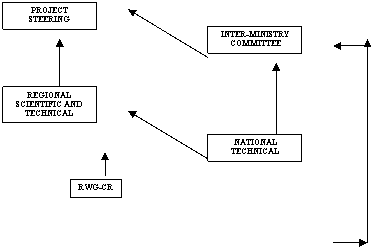
Project |
Agency Fee |
Total at CEO Endorsement |
For the record: Total at PIF | |
| GEF |
N/A |
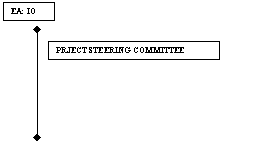
406,900 |
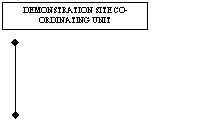
40,690 |
447,590 |
447,590 |
| Co-financing |
N/A |
528,286 |
528,286 |
528,286 | |
|
Total |
N/A |
935,186 |
40,690 |
975,876 |
975,876 |
* Please include the previously approved PDFs and PPG, if any. Indicate the amount already approved as footnote here and if the GEF funding is from GEF-3. Provide the status of implementation and use of fund for the project preparation grant in Annex D.
C. Sources of confirmed Co-financing, including co-financing for project preparation for both the PDFs and PPG.
(expand the table line items as necessary)
|
Name of co-financier (source) |
Classification |
Type |
Amount ($) |
%* |
|
Nui Chua National Park |
Provincial government |
Cash |
376,009 |
71% |
|
Ninh Thuan Department of Science & Technology |
Provincial government |
Cash |
19,430 |
4% |
|
Ninh Thuan Sub-department of Fisheries Protection |
Provincial government |
Cash |
22,152 |
4% |
|
Various national and provincial agencies and local communities |
Government and NGOs |
In-kind |
110,695** |
21% |
|
Total Co-financing |
528,286 |
100% | ||
* Percentage of each co-financier’s contribution at CEO endorsement to total co-financing.
** An amendment was made from approved PIF based on the expressed co-financing amount.
D. GEF Resources Requested by Focal Area(s), Agency(ies) or Country(ies)
|
GEF Agency |
Focal Area |
Country Name/ Global |
(in $) | |||
|
Project Preparation |
Project |
Agency Fee |
Total | |||
|
Total GEF Resources |
||||||
* No need to provide information for this table if it is a single focal area, single country and single GEF Agency project.
E. Project management Budget/cost
Cost Items |
Total Estimated person weeks |
GEF($) |
Other sources ($) |
Project total ($) |
Local consultants* |
465 |
40,690 |
21,720 |
62,410 |
International consultants* |
0 |
0 |
0 |
0 |
Office facilities, equipment, vehicles and communications** |
0 |
4,505 |
4,505 | |
|
Travel** |
0 |
2,000 |
2,000 | |
|
Total |
40,690 |
28,225 |
68,915 |
* Provide detailed information regarding the consultants in Annex C.
** Provide detailed information and justification for these line items.
f. Consultants working for technical assistance components:
Component |
Estimated person weeks |
GEF($) |
Other sources ($) |
Project total ($) |
Local consultants* |
155 |
21,000 |
87,515 |
108,515 |
International consultants* |
0 |
|||
Total |
21,000 |
87,515 |
108,515 |
* Provide detailed information regarding the consultants in Annex C.
G. describe the budgeted m&e plan:
Indicative Monitoring and Evaluation Work plan and corresponding Budget
|
Type of M&E activity |
Objective |
Responsible Parties |
Budget US$ |
Verification and Time frame |
|
Project Steering Committee and inception meeting |
Confirm with project team goals and objectives and agree on M&E processes and responsibilities; establish quality assurance mechanism by project team, IA and EA and provide briefing on reporting requirements. Make necessary decisions on project implementation start up. |
UNEP EA/IO PSC DSCU |
US $6,000 |
PSC meeting minutes submit by DSCU to IA/EA immediately following PSC meeting |
|
Biological Survey for MPA |
Establish biological baseline for MPA utilizing available data and identify any gaps of data necessary for project monitoring purposes; |
DSCU External expert(s) |
US $ 20,000 |
Expert(s) will conduct the survey and submit survey report to DSCU upon completion of tasks |
|
Socio-economic Survey around MPA |
Establish socio-economic baseline around MPA |
DSCU External expert(s) |
US $ 9,200 |
Expert(s) will carry out the survey and submit report to DSCU upon completion of tasks |
|
Biological monitoring of selected coral reefs |
Monitor impact of project activities on coral reef and seagrass ecosystems |
DSCU External expert(s) |
US $ 19,005 |
Expert(s) and DSCU will prepare at least two monitoring reports during the project lifetime and submit them to steering committee |
|
Socio Economic monitoring |
Monitor improvement of fishing practices |
DSCU External expert(s) |
US $ 12,800 |
Expert(s) and DSCU will prepare periodic monitoring reports and submit them to steering committee |
| APR and PIR |
Report of EA to IA on progress of project implementation |
UNEP EA/IO |
None |
Annually submitted by EA to UNEP (UNEP to GEF) |
|
Progress Reports (every 6 months) |
PSC/DSCU report to EA/IA on progress of project implementation |
UNEP EA/IO PSC DSCU |
None |
Submitted to UNEP by the end of 7th month and 13th month |
|
Financial report (Quarterly) |
Report of financial status to IA |
UNEP EA/IO DSCU |
None |
EA submits to UNEP every 3 months |
|
Annual Financial Audit |
Conduct financial audit annually |
UNEP EA/IO DSCU External auditor |
None |
EA submits to UNEP by the end of the 13th month (annual) |
|
Mid-term and final meeting to measure project progress |
SC and Stakeholder meeting to discuss mid-term evaluation and make adjustment of project implementation (see below MTE and TE) |
UNEP EA/IO PSC DSCU Stakeholders |
US$8,000 |
Meeting report from EA to UNEP |
|
Medium Term Review (MTE) |
Evaluation of project progress and recommendations to PSC/IA/EA on future implementation |
UNEP EA/IO PSC DSCU |
US$2,000 |
|
|
Final External Evaluation |
Conduct comprehensive evaluation of the project implementation |
UNEP (managed by EOU) EA/IOPSC DSCU External evaluator |
US$7,500 |
At the end of project implementation (3 months before project completion) |
|
Terminal Report |
Final project implementation report |
UNEP EA/IO PSC DSCU External evaluator |
None |
EA submits to UNEP at the end of project implementation |
|
Financial Audit |
Audit financial status of project |
UNEP EA/IO DSCU External auditor |
None |
EA submits to UNEP at the end of project implementation |
|
TOTAL indicative COST Excluding project team staff time and travel expenses |
US $ 84,505 |
part ii: project justification
A. describe the project rationale and the expected measurable global environmental benefits:
1. Vietnam, with more than 3,200 km of mainland and island coasts facing the South China Sea and Gulf of Thailand, is an important reservoir of tropical marine biodiversity, sharing strong biogeographic affinities with neighboring countries at the global biodiversity centre. Coral reefs, mangroves and seagrasses are important habitats in coastal waters of Vietnam, playing important roles as reservoirs of biodiversity, for fisheries and tourist development in the coastal zone.
2. Despite the importance of coastal and marine environments in Vietnam, coastal habitats have not been properly managed. Like most countries in the Southeast Asian region, burgeoning human populations in coastal areas threatens the ecological integrity of many coastal and marine areas in Vietnam. Many coral reef areas have been degraded through over-exploitation, destructive fishing practices, coastal development, tourism, and pollution. This degradation and loss of coastal habitats in Vietnam has local, national, regional and global implications, and is the focus of concerted efforts by inter-governmental, government and non-government organizations. Escalating degradation of these habitats has become a pressing national issue with far reaching environmental and socio-economic consequences.
3. The proposed demonstration site in Ninh Hai District, in the coastal zone of south-central Vietnam, consists of some 1,070 ha of coral reefs with 40 ha of seagrass beds. It received its high-ranking in the prioritisation analysis of potential demonstration sites under the framework of the UNEP-GEF South China Sea Project (SCS) because of its diverse fringing coral reefs and seagrass beds, which function as a nationally and regionally important spawning and nursery area for sea turtles. Many mainland fringing coral reefs are already significantly degraded in Vietnam and other countries bordering the South China Sea. Only several mainland turtle spawning and growing sites remain in the region. The coral reefs and seagrass beds of the area are also considered as important refugia(spawning and/or feeding grounds) for regional significant fish species such as mackerel Scomberomorus sp. and tuna Auxis sp.
4. Ninh Hai is one of the few remaining sites in Vietnam where coastal and marine habitats are still in good condition. The area was previously designated as Nui Chua Nature Reserve (1997-2003), mainly focusing on the conservation of dry forests and primates on land. In 2003, the status of the nature reserve was upgraded to the Nui Chua National Park; and its conservation interest was extended to marine components. Although the conservation of coastal and marine habitats was not the major interest of the nature reserve until 2003, previous conservation activities on land provided a certain degree of protection to the marine environment, as the landscape and water courses are mostly undisturbed, and future land-based development threats are restricted.
5. The coastal and marine habitats in Ninh Hai, however, face various anthropogenic threats such as: over-fishing; destructive and illegal harvesting of coastal and marine resources; collection of live corals and mining; and siltation. These threats have not been effectively addressed to date due to the a lack of an integrated management plan for the site, mainly as a result of limited financial and human resources. There is a strong need for immediate interventions to address such threats and their root-causes.
6. It should be also noted that there are very few remaining opportunities nationally or regionally to develop adjacent marine and terrestrial protected areas–conferring high importance to the present proposal. The small local human population of several thousand people is composed mostly of fishing families residing in coastal villages. They have shown notable motivation towards conservation and sustainable development.
Background
7. This proposed medium-sized project has been developed and is proposed in accordance with a regional agreement made by the Intergovernmental Steering Committee of UNEP/GEF project entitled Reversing Environmental Degradation Trends in the South China Sea and Gulf of Thailand (SCS Project) launched in 2002. The SCS Project was developed and implemented on the basis of Transboundary Diagnostic Analysis (TDA) and a draft Strategic Action Programme (SAP) for the South China Sea prepared between 1996 and 1999. The overall goals of the SCS Project are: “to create an environment at the regional level, in which collaboration and partnership in addressing environmental problems of the South China Sea, between all stakeholders, and at all levels is fostered and encouraged; and to enhance the capacity of the participating governments to integrate environmental consideration into national development planning.”
8. To attain the overall goal, the SCS Project aims to address the priority environmental problems of the South China Sea marine basin, identified in the TDA, through further elaboration of the draft regional SAP and the provision of models of sustainable use through initiation of demonstration activities in the priority habitats. It is hoped that active replication of these activities and translocation of successful management models will be achieved through mechanisms established in the project for the exchange of information and examples of good practice. By focusing on sites for which regional priority is high, the project aims to meet the double objective of conserving globally significant biological diversity whilst at the same time developing, testing and refining interventions and management actions that can be applied more widely throughout the region.
9. The three components of the SCS Project are: i) Habitat Degradation and Loss, ii) Over Exploitation of Fisheries in the Gulf of Thailand, and iii) Land-based Pollution. The first component “Habitat Degradation and Loss” addresses four priority habitats, namely i) mangrove, ii) coral reef, iii) seagrass, and iv) wetlands[1]. These habitats were identified as being the highest priority in the region due to ongoing rates of degradation and their regional and global significance. The seven (7) participating countries, namely Cambodia, China, Indonesia, Malaysia, Philippines, Thailand and Vietnam, agreed that these should be priority focal areas during initial SAP implementation.
10. During the third meeting of the inter-governmental Project Steering Committee, held in Manila, March 2004 participating governments agreed to the selection and funding of 11 habitat demonstration sites through the project budget, to seek GEF MSP funding for an additional 7 priority sites, and to nominate at least one nationally funded site from each country for inclusion in the network established through this project. The proposed Ninh Hai site in Ninh Thuan province, Viet Nam is included among the seven sites for which GEF MSP funding is sought.
11. The SCS Project has undertaken a transparent, scientific and objective regional procedure to characterise, rank and select demonstration sites based on environmental and socio-economic criteria and indicators that were discussed and agreed at the regional level. To achieve maximum impact from a limited number of interventions, the Project Steering Committee adopted a three-step regional procedure to prioritise and select demonstration sites. Full details of this procedure are contained in the reports of the Regional Working Group meetings on the project website (www.unepscs.org) but it may be outlined as follows:
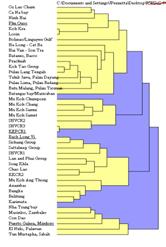
Step1. A cluster analysis was conducted to review the similarities and differences of all proposed sites, using data and information assembled at the national level that described the physical and biological characteristics of the systems under consideration. This analysis was used to group sites of high degrees of similarity within which priority could be determined.
Step2. The Regional Working Group on Coral Reefs developed a set of criteria and indicators with an associated numerical scoring system, encompassing environmental and socio-economic characteristics;
Step3. The proposed sites were scored according to the agreed system and ranked within each cluster. Rank order was considered to represent regional priority.
12. A total of 136 potential demonstration sites (26 mangrove sites, 43 coral reef sites, 26 seagrass sites, and 41 wetland sites) were initially nominated by, the governments of participating countries. Ranking of the sites was based on two matrices; one of environmental indicators of biodiversity at the species and system levels, transboundary significance, and area of the site; and the second of socio-economic indicators that included indicators of the reversibility of the threats, the extent of stakeholder involvement or potential for involvement in management and the willingness of partners to provide co-financing. Only environmental indicators were used in the cluster analysis but both sets were used in determining rank within each cluster.
13. The Ninh Hai coral reef site in Ninh Thuan province, Viet Nam ranked as the second most important site overall, and second in terms of its biological and environmental significance. Interventions at the other three highly-ranked sites are being funded through the existing South China Sea Project[2]. Rich aquatic biodiversity found in Ninh Hai and imminent threats to its coral reef habitats have resulted in this high ranking among the 43 potential demonstration sites.
14. Because of the rich biodiversity, as well as its social and economic circumstances such as its importance in national priority, the reversibility of current threats and level of direct stakeholder involvement, Ninh Hai was highly ranked among a number of potential demonstration sites nominated by the SCS participating countries. The proposed project site covers the area designated as Nui Chua National Park in 2003.
15. The proposed project will be implemented within the framework of the SCS Project. Lessons learnt from all demonstration projects will be disseminated and exchanged both nationally and regionally utilizing the regional framework for information and experience exchange developed by the SCS Project[3].
Site Information
16. The Ninh Hai district coastal area belonging to Ninh Thuan Province, south-central Vietnam is located at 11o 72’-11o58’ N to 109o22’-109o12’ E. Most of the adjacent coastal land in the area, extending to the peaks of the coastal range, forms part of the Nui Chua National Park. Environment and resource management initiatives within this National Park mainly focus on forest conservation; and have only recently been extended to include marine components.
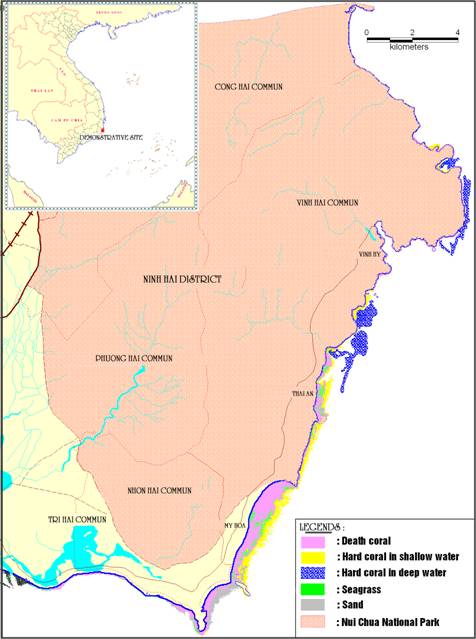
17. Approximately 1,070 ha of coral reefs and 40 ha of seagrass beds are found in Ninh Hai coastal waters. Coral reefs are distributed along 30 km of the district’s shoreline, and sustain rich biodiversity. The site is located near the centre of a major “upwelling” area on Vietnam’s coast. The cooler waters from upwelling reduce the threat of coral bleaching and associated biodiversity degradation caused by high sea temperatures in Summer.
18. Some 307 reef-building coral species in 54 scleractinian genera, 3 species of seagrass, 190 species of macro-algae, 147 species of reef-associated fishes, 115 species of molluscs, 24 species of crustaceans, 13 species of echinoderms and 22 species of polychaetes were recorded in recent years in Ninh Hai waters. Cover of living corals at 6 locations surveyed in 2002 ranged from 16.3 to 55.9 %, with a mean value of 36.9 ± 13.5 %.
19. The reefs support a large number of new distribution records for Vietnam, some of which are considered to be globally uncommon or rare. These coral communities show considerable differences in species composition and community structure from those of further north and south, thus provide a high degree of complementarity in development of an integrated, representative national and regional MPA network. The reefs also support coral populations of regional significance in terms of maintenance and replenishment, notably the species-rich Montipora assemblages. Thus, the area is considered as a potential source in transporting larvae to other areas in the South China Sea.
20. The marine waters comprise a diverse array of habitats such as coral reefs and seagrass beds and the beaches are one of the most important mainland nesting sites of global/regional endangered sea turtles such as Chelonia mydas, Eretmochelys imbricata and Caretta caretta. Some other species including the giant clams Tridacna squamosa and Tridacna crocea, and top shell Trochus niloticus are also listed at nationally and regionally endangered level.
21. The reefs in the area are home for regional transient fish species such as mackerel Scomberomorus sp. and tuna Auxis sp. and are considered as spawning and/or feeding grounds of these migratory species who annually migrate from March to August. Annual total fish landings from the site is estimated between 100 – 150 tonnes per year.
Current Use
22. Exploitation of marine resource is important for the economy of the region. Socio-economic surveys conducted in 2002 indicated that some 29.8 % of households depend on fisheries. The households are mainly in Vinh Hy, Thai An and My Hoa villages of Vinh Hai Commune, and My Tan and My Hiep villages of Nhon Hai Commune. Fishing in the area is largely small-scale in nature, using simple fishing gears or methods due to the small engine size of the fishing boats. Fishing activities are mostly conducted in shallow water areas of less than 30m , consequently increasing the pressure on marine resources and habitats at the site.
23. Mechanisms for the management of the area’s natural resources are complicated. Nui Chua National Park, upgraded from the national reserve to National Park in 2003 incorporates a marine component of 7,352 ha. However, due to a lack of management capacity, management mainly focuses on terrestrial area of the park. The marine component has been managed by the Sub-department of Fisheries Protection under the Ninh Thuan Department of Fisheries. Due to staff shortages and a low operational budget, the sub-department has insufficient capacity to manage the area.
24. Several activities have taken place at the site over the past 7 years with support from international, national and provincial agencies. These include: sea turtle conservation; coral reef surveys; public awareness raising on marine conservation. Currently, there are two stations operating for the protection of sea turtles with the involvement of local volunteers. Two stations have also been established at Thai An (Vinh Hai Commune) and My Hiep (Nhon Hai Commune) to protect coral reefs and marine resources.
Threats and root-causes
25. Although the condition of coral reefs and seagrass beds remain relatively good, these habitats are under increasing pressure and subject to damage from a wide range of human activities and natural causes such as:
26. Over-fishing: Many commercial species are under the increasing pressure of over-fishing. Although the fishing capacity of small-scale fishing boats is not high, there is a significant cumulative pressure from large-scale commercial fishing boats coming from both in and outside the province, averaging between 10-20 fishing boats per day/night during the fishing season of April–August. Introduction of advanced fishing technology, including hookah air diving for catching juvenile lobsters for aquaculture and the use of fluorescent lights to attract pelagic fish and cephalopod species for capture by purse seine and jig methods has raised concerns for the sustainability of economically important marine resources at the site.
27. Destructive and illegal harvesting: Destructive harvesting methods, such as cyanide to stun fish and dynamite fishing take place at the site. Anchoring on coral reefs also causes the damage.
28. Collection of live corals and mining: Although these activities have been reduced during recent years, they still take place at the site. Live corals, mainly branching corals Acropora and Pocillopora are collected for the souvenir trade by some fishermen from Thai An and Vinh Hy villages (Vinh Hai Commune) and from adjacent villages in the province and neighboring province (Khanh Hoa). Mining of dead coral blocks takes place to supply local limekilns for cement production. These activities continue to damage and degrade reefs in the area.
29. Siltation: Construction of two new fishing ports at My Tan village of Nhon Hai Commune and Ninh Chu, and annual dredging of deepening channels, have generated sediments which have impacted on the coral reefs around the construction sites.
30. Others: Predation by crown-of-thorns seastars (COTS), pollution from the mainland and shrimp farming are other threats to coral reefs and the marine environment. Outbreaks of COTS have occurred further north, and local control measures may need to be introduced as priority.
The causal-chain analysis carried out during the development of project concept identified the following root causes of the above threats:
31. Weak area management: Lack of an effective and integrated area management plan; lack of collaboration among relevant government offices and community participation; lack of proper regulations and low enforcement of relevant regulations and management capacity.
32. Lack of public awareness and capacity for the coastal resources conservation and management: knowledge and awareness of the value and importance of coastal and marine ecosystems and its sustainable utilization are low among local communities but also among provincial managers and decision-makers. Local resource managers have limited capacity and lack the tools required to make informed decisions on coral reef conservation and management.
33. Lack of alternative income generation options made low income fishermen to overly depend on coastal and marine resources.
34. These threats and root causes are not currently being addressed.
Overall Goal of Project
35. The overall goal of the proposed project is to reduce environmental stress on transboundary water body of the South China Sea and Gulf of Thailand, through the further elaboration of the draft Strategic Action Programme and the implementation of a network of demonstration activities at sites of regional and global significance.
Project Objectives
36. This proposed project aims to demonstrate measures to reduce the stress on regionally significant coral reef and seagrass habitats connected to the South China Sea through conserving critical marine biodiversity, preventing ecosystem degradation and promoting sustainable utilisation of marine and coastal resources of Ninh Hai waters.
37. To demonstrate the measure, the project will establish Ninh Hai as a marine protected area (MPA). Effective management of coral reefs at Ninh Hai will be achieved by developing an integrated management plan that is based on cross-sectorial and participatory management and demarcation.
38. More specifically, this demonstration project aims to attain the following benefits:
Ecosystem benefit: protection of coral reef and associated habitats;
Transboundary benefits: conservation of spawning and nursery grounds for fish and other marine animals of transboundary significance; and
Local benefits: increased alternative opportunities for sustainable income-generation.
39. As a demonstration project operated under the umbrella of the SCS Project, it will be implemented in close collaboration with other demonstration projects developed under the SCS Project; and lessons learnt from each project will be exchanged and disseminated nationally and regionally through the SCS Project framework for information and experience exchange[4].
Expected Project Outcomes
40. The anticipated outcome of this proposed project is the conservation of coastal and marine ecosystems within the established marine protected area (MPA). This outcome will contribute to national and regional biodiversity conservation goals. The established MPA will be an important link to the development of national MPA network in Viet Nam. The MPA will act as a national and regional model for the development of similar community-based MPAs elsewhere.
Outcome 1: Improved area management through cross-sectorial and participatory approaches
41. Coordinating mechanisms among a wide range of relevant stakeholders for the management of coastal and marine resources and ecosystems is successfully established. Diverse local stakeholders will play a leading role to ensure their ownership of and commitment to project implementation. At the inception stage, the coordinating mechanisms will be flexible enough to make some adjustment to maintain the active involvement of local communities so the ‘momentum’ can be kept even after the completion of demonstration project. Three sub-demonstration sites will be managed with active participation of local communities, tourism sector, Border Army, and the National Park management office.
42. Integrated management plan for sustainable use of coastal and marine resources will be developed and/or updated, based on comprehensive data and information obtained from the surveys and monitoring during project implementation. Database will be created and regularly updated. The usage of data is not limited to this project but will be used for broader sustainable development of the district. Improved management capacity of the Sub-department of Fisheries Protection and Nui Chua National Park office and local communities will enhance the effective management of area’s coastal and marine resources thus effectiveness of management of coastal and marine ecosystems and environment quality in MPA will be increased. In parallel, activities such as reforestation and solid waste management will minimise negative impacts from the land based activities to marine habitats.
Outcome 2: Pressure to coral reef ecosystems derived from unsustainable livelihoods is reduced
43. Pressure on the ecosystem of Ninh Hai waters will be reduced due to improvement of the livelihoods of local people by sustaining fishing from MPA core zones, aquaculture and sustainable tourism on coral reefs. Alternative livelihood options are designed and implemented to improve economic situation of the coastal communities while reducing pressure on ecosystems.
Outcome 3: Knowledge and skills for the management of coral reef habitats are increased
44. Training and awareness raising campaign will increase stakeholder awareness on coastal and marine conservation and their positive contribution to the conservation efforts expected. Local managers and park staff will participate in on-the-job training activities and capacity building workshops on planning, management, stakeholder communication, and biodiversity and socio-economic monitoring. Information dissemination and lessons learnt sharing will be encouraged both at national and regional levels as part of the SCS Framework for Regional Dissemination of Experiences.
Outputs and Activities
Provisional outputs and activities to achieve the expected outcomes are:
Component 1: Improving Area Management through Cross-sectorial and Participatory approaches
1.1Institutional arrangements for cross-sectorial management established
45. Institutional arrangements for cross-sectorial management will be established to ensure the participation of all relevant stakeholders. The Project Steering Committee (PSC) will be established under the leadership of the Vice-Chairman of Ninh Thuan Provincial People Committee (PPC) with its provisional members from the Institute of Oceanography (IO), National Focal Point for Coral Reefs and relevant local government agencies.
46. Institute of Oceanography (IO), project’s executing agency, will invite experts to form an Advisory Group (AG). The AG includes legal, economic, and social experts, marine ecologists and scientists from different areas, provincial tourism departments, NGOs and representatives from the local communities.
47. The Demonstration Site Co-ordinating Unit (DSCU) will be appointed by IO to execute demonstration activities and will be supervised by the PSC. The DSCU will be composed of a site manager appointed from IO and two provincial collaborators from the Department of Science and Technology.
1.2. Integrated Management Plan including zoning plan will be developed and adopted
48. The IO will appoint expert teams to carry out marine biodiversity and fisheries assessments. The teams will gather existing scientific data and information to assess the current status of coastal and marine ecosystems to identify area’s highly important species for conservation and productivity of coral reefs and seagrasses, socio-economic condition of local communities for integrated management and zoning plan.
49. The teams will also assist in developing a community-based monitoring program and provide advice on biodiversity-related issues in the MPA planning process of the project area. Data and information of socio-economic conditions of local communities including living condition, gender, employment, population, utilizations of resources, etc at the project site will be collected as baseline information.
50. Based on the biophysical and socio-economic analysis, a detailed zoning plan and integrated management will be prepared for the stakeholder review. The stakeholder consultation meeting will be organized by the Ninh Thuan PPC to receive their feedback and to seek their cooperation in its implementation. Both zoning plan and integrated management plan aim to achieve optimal outcomes for biodiversity conservation, replenishment of fish stocks, and improved socio-economic condition of local communities. Upon approval, plans and the guideline for the integrated management plan will be published and necessary regulations will be adapted according to the plans.
1.3 Demarcation established and enforcement of relevant regulations implemented with communities participation
51. Demarcation, zoning for sustainable use of coastal and marine resources, will be established and enforcement of relevant regulations implemented. Local communities will play a key role in surveillance and enforcement of system in partnership with project’s DSCU and agencies such as Nui Chua National Park, Ninh Thuan Sub-Department of Fisheries Protection, and Border Army.
52. This activity will develop a cooperation mechanism between different stakeholders and other agencies in conserving marine habitats and other related resources of the area. On-the-ground collaboration among different stakeholders will develop three or four sub-sites (models) near the shore which will be managed by different stakeholders. One small site may be managed by tourism companies, one by village communities and one by Nui Chua National Park, while the Sub-Department of Fisheries Protection (Sub-DOFP) will manage deeper surrounding waters. The boundary of some restricted areas (full protection) will be marked and managed by authorities who are responsible for its protection.
53. Lessons learnt from implementation of this management system will be shared at local, national and international forums providing potential replication opportunity to some other areas in Vietnam and in elsewhere.
1.4 Rehabilitation of some damaged environment implemented with community participation
54. Through the implementation of project, some of the damaged coral reefs and coastal forest will be rehabilitated. The forest along the coast of the buffer zone of Nui Chua National Park will be replanted in order to reduce run-off to surrounding waters. Damaged reefs will be rehabilitated with technical support from the scientific institutions and with the involvement of local volunteers and park staff. Annual campaigns to collect adults crown thorn starfish at “hotspot” reefs will be conducted. Training workshops and campaigns for the local community to clean up the beaches will also be implemented.
1.5 Monitoring system of coral reefs and seagrass beds habitats and annual monitoring established
55. The monitoring systems will be established to assess and meet the requirements of successful management programs over the medium-long term. Biological and socio-economic indicators and locations for the monitoring will be identified and community-based monitoring program for coral reefs and seagrass beds will be developed. Area’s ecological changes will be monitored throughout the project implementation and annual monitoring reports and recommendation will be submitted to PMB for necessary adjustment of management plan.
Component 2: Pilot Projects on Sustainable Income-Generation Options
2.1 Pilot projects on diverse sustainable income-generation options established and implemented
56. The project will assist in the development of economic schemes to support diverse Income Generation Option (IGO) pilot projects to reduce pressure to the area’s ecosystems while improving the livelihoods of local people. The activities include; marine aquaculture (lobsters, sea cucumbers, seaweeds) and ecotourism (souvenirs made from local products, locally based-ecotourism). The training for the local communities and technical supports will be provided to raise capacity of local participants for the changes. The project team will work with local stakeholders within the Demo site to select and design IGO pilot project
2.2 Sustainable Financial Strategy will be developed for MAP
57. Also, the team will collaborate with key stakeholders (provincial government, local communities, private sector) to prepare the Sustainable Financing Strategy (ex. tourism user fee) for the MPA which will feed into the development of the final MPA management plan. Strategy may explore possibility of future community development fund with a proportion of resources generated through the tourism user fee .
Component 3: Capacity Building and Awareness Raising
3.1 Public awareness raising materials prepared and disseminated
58. Environment awareness specialist will be recruited to lead the development and implementation of the environmental awareness activities in the MPA that enhance understanding and commitment of stakeholders. Awareness raising materials will be prepared and disseminated.
3.2 Training workshops on sustainable use of coral reefs and seagrass beds resources targeting policy-makers, government officials and community representatives convened
59. A series of training workshops targeted for local policy-makers and government officials and community representatives to enhance understanding of integrated natural resource management, develop skills and knowledge to manage demonstration site will be conducted. The training will help to raise environmental awareness of participants and will strengthen their commitment and involvements to the project implementation
3.3Training workshops on professional skills on coral reefs and seagrass beds management conducted
60. The key staffs for the project implementation will receive training to develop practical skills to successfully manage and operate demonstration sites. The participants will be selected from Nui Chua National Park, Sub-Department of Fisheries Protection and volunteers from local communities.
3.4 Exchange of information and experience with other relevant habitats management sites established
61. To support active information sharing and exchange, project website will be established both in Vietnamese and in English. A national conference/workshop on marine projected areas will be organized and invite managers from other marine protected areas in Vietnam to present and share information. Under the SCS framework for Regional Coordination, Dissemination of Experiences, and Personnel Exchange between Sites, personnel exchange between SCS demonstration sites and information and experience sharing will be encouraged.
B. Describe the consistency of the project with national priorities/plans:
Country Eligibility
62. Viet Nam is eligible for GEF funding in the International Waters focal area in accordance with paragraph 9(b) of Instrument for the Establishment of the Restructured Global Environment Facility which enables the fund to be available for those countries eligible to borrow from the World Bank and receive technical assistance grants from UNDP where a relevant convention does not exist.
Country Drivenness
63. The Vietnamese government has demonstrated a growing commitment to the field of environmental protection and fisheries resources management. The existing laws and decrees related to natural resources and environment protection are as follows:
· National Biodiversity Action Plan (1995);
· Environmental and Fisheries Resources Protection Laws (2003); and
· Sustainable Development Strategies (2001-2010).
64. The proposed project site is one of the prioritized areas for nature conservation in Vietnam. Given the national and regional importance of these assets, the Government of Vietnam has listed Nui Chua National Park as a priority site in the National Biodiversity Action Plan approved by Vietnamese Prime Minister in 1995. The area is also proposed as a potential marine protected area.
65. Nui Chua National Park was originally designated as Nui Chua Nature Reserve to conserve dry forests and primates in 1997. When the reserve was gazetted as National Park in 2003, its protected area was extended to marine components, including the coral reefs. The importance of the area’s marine biodiversity has been recognized not only by the government, but also by the international organizations such as the WWF and the World Bank. The WWF Indochina, for example, identified Nui Chua National Park as an important and a high priority area for marine biodiversity conservation and completed a rapid ecological assessment report in 2003[5] and recently launched a project to protect the marine areas and improve livelihoods area community.
66. Given national priority for the Ninh Hai district and the national commitment to the coastal and marine habitats conservation, the Government of Viet Nam and National Coral Reef Committee nominated the site as one of the potential demonstration sites to improve coral reef habitat management during the demonstration site nomination and prioritization processes of the SCS Project.
67. With regard to the Sustainable Development Strategies at a local level, the local governments plan to develop the area as an eco-tourism site of the province. Some of the proposed activities have been already approved and others are under their approvals.
68. As seen above, this proposed project is strongly linked with, and has received support from, the existing national initiatives of Viet Nam. The proposed project will mutually benefit ongoing national and local initiatives; while it aims to meet appropriate GEF strategies and to increase regional/global benefits.
C. Describe the consistency of the project with gef strategies and strategic programs:
69. The proposed project is consistent with strategic objective IW-2, “to catalyze transboundary action addressing water concerns.” More specifically, the project addresses the implementation of policy, legal, instrumental reforms and stress-reducing demonstration as a contribution to the implementation of inter-governmentally approved draft SAP. The project will be implemented as a contribution to the IW strategic programme 1: Restoring and sustaining coastal and marine fish stocks and associated biological diversity. Under the strategic programme, expected outcome is increased coverage of marine protected areas and this project will contribute to presenting a result of increased area of marine protected area.
D. Outline the Coordination with other related initiatives:
70. As a demonstration project designed and implemented in accordance with the over-arching strategy of UNEP/GEF SCS Project and the Strategic Action Programme, the benefits and lessons learned from the proposed project will be replicated and disseminated through the Framework for Regional Coordination, Dissemination of Experiences, and Personnel Exchange between Sites.[6] The SCS framework provides opportunities for regional exchange including exchange of personnel between sites, training courses and workshops based on the demonstration sites, and publication and dissemination of technical reports and public awareness materials both in print and on the Internet. Under the existing Framework, the project will work closely with other coral reef and seagrass habitat sites of regional importance such as Belitung in Indonesia, Masinloc in the Philippines, Mu Koh Chang in Thailand, Tun Mustapha Park, Sabah, in Malaysia (coral reef sites), Bai Bon, Phu Quoc Island in Vietnam, Cape Bolinao in the Philippines, Hepu in China, and Trikora Beach in Indonesia (seagrass sites) to enable exchange of information and experience under the SCS Project.
71. Furthermore, it is intended to exchange lessons learned from Ninh Hai demonstration project with other SCS demonstration sites in different habitats in Vietnam such as a wetland and mangrove demonstration site in Red River Mouth. The development of models for management and sustainable use of coral reef is considered as one of the focuses in the Coral Reef National Action Plan and the expectation for the lessons to be learnt from this project is very high. Recently, WB/GEF project in supporting Hon Mun Marine Protected Area Management Board in improving management effectiveness. A number of lessons learnt from this project would be helpful for implementing coral reef management and establishment of MPA at the Ninh Hai site. Sites such as Cu Lao Cham MPA and Con Dao National Park, which have practiced management with the support of DANIDA and UNDP/GEF and Viet Nam Government will be the additional candidates for exchanging information and experience. At the same time, further, the replication opportunity will be enhanced among the Vietnam Marine Protected Area network mechanism. During the last years government officials of Ninh Thuan Province and Nui Chua National park have been involved in information exchange and capacity building made by the MPA network of Viet Nam.
72. Anticipated lessons learnt from this demonstration project include: modalities regarding community participation in the protection of the marine and coastal environment including the process of establishing and running inter-sectoral management; awareness raising; advocacy and capacity building to facilitate active participation in the design and implementation of the conservation plan; design of environmentally sustainable economic activities focusing on aquaculture with less pressure to the environment and ecotourism. All lessons learnt will be, of course, shared not only at regional level, but also at local and national levels and will be made available more widely through the SCS Project website. Collaboration with other demonstration projects under the framework of the SCS Project and other domestic and regional sites could mutually benefit each other by sharing information and experiences, will be ensured through the necessary coordination provided by:
· Vietnam National Committees on Coral Reef and Seagrass, as well as other relevant habitats committees, and National Technical Working Group at a national level; and
· Regional Working Groups on Coral Reef and Seagrass, as well as those of other relevant habitats, and Regional Scientific and Technical Committee at a regional level.
E. Describe the incremental reasoning of the project:
Baseline Scenario
73. During the last 4 years, the area has received various kinds of support from local governments, Institute of Oceanography and international organizations (WWF, UNEP) in working towards marine biodiversity conservation. Conservation of turtle nesting places in the area has been implemented since 2000 with support from Indo-China WWF. These activities have rescued babies and adults turtles and enhanced awareness of local communities on marine conservation. Biodiversity conservation, mainly focusing on coral reefs, has been conducted since 2001 with supports from Indo-China WWF, International Coral Reef Action Network (ICRAN) and Provincial People’s Committee (PPC).
74. A general management zoning plan generated from these works was approved by Ninh Thuan PPC. Two small community-based management (30 ha. in Vinh Hai and 15 ha. in Nhon Hai Commune) have been established and managed by local communities with technical supports provided from Ninh Thuan Department of Science and Technology and Ninh Thuan Sub-department of Fisheries Protection. There has been significant involvement of the local stakeholders in regular consultation in developing the MPA. Awareness of these communities about the importance of marine conservation for the sustainability of their livelihoods has been primarily improved during the last few years.
75. However, despite these achievements, significant challenges and gaps remain. For example, the site faces a lack of adequate scientific data and information, which is necessary for the development of integrated management plan, a lack of cooperation mechanisms among local and national government agencies and concerned organizations in managing marine resources, insufficient awareness and education of local stakeholders, a lack of alternative income generation and a lack of capacity for effective management.
76. Without the support from GEF to develop the proposed demonstration project, the Vietnamese Government may endeavor to meet its responsibility in management of marine habitats and their resources in Ninh Hai area. There has already been some support from Provincial Government and NGOs during the last four years, and this is expected to continue to some degree in the forthcoming period. The support to date has mainly focused on improving infrastructure, maintenance of patrolling boats, staff salaries and some public awareness raising activities in the National Park. A small budget for marine biodiversity assessment of Nui Chua National Park approved by Provincial Government will be a source for implementing some scientific research in the next few years. Capacity building for staff of Nui Chua National Park on monitoring of marine ecosystems and resources (Reefcheck methodology) will be implemented through training workshops with support from Indo-China WWF since 2005. However, current possible approach will not provide the comprehensive integrated management that are cross-sectroal in nature thus will not enough to fully address the observed problems needless to say the root-causes of the identified threats causing degradation of marine habitats, and depletion of area’s coastal and marine resources.
Alternative Scenario
77. National and local government agencies believe that creating the marine protected area as a demonstration site in Ninh Hai district offers great opportunities to conserve area’s high quality, diverse coral reefs and seagrass beds and to protect the nesting site for sea turtles. With the adjacent terrestrial protected area, there are excellent opportunities for improving livelihoods of the local communities, and for effective co-management with the strong support of the local governments and village communities, Vietnamese government and concerned organizations. The proposed project will provide an opportunity to develop and implement comprehensive integrated management plan and build solid foundation for cross-sectoral approach to the marine and coastal resource management.
78. Working towards sustainable management of marine resources in the area, national and local governments in collaboration with local communities, relevant private sector and other related stakeholders are actively seeking an alternative development scenario, in which the sustainable use of coral reefs and associated habitats, and surrounding area’s economic development can be attained simultaneously. The proposed project addresses the root causes of current and future degradation and loss of marine habitats with precautionary principle through: (1) establishing an integrated management plan for the area; (2) awareness raising and capacity building among relevant stakeholders; and (3) promoting alternative income generation options for local communities in order to reduce pressures on the environment and resources in the area. (See Annex 1 for Project Logframe)
F. Indicate risks, including climate change risks, that might prevent the project objective(s) from being achieved and outline risk management measures:
79. The first risk is the change of development plan in the province and district. Ninh Hai is going through under the rapid development and the area is defined as one of the provincial’s priority development areas for 2004-2010. Economic concerns may intervene or even overwrite conservation efforts during and after the life of the project. To mitigate this risk, the project is designed to conduct socio-economic survey as well as biological survey. Then, integrated area management plan will be developed incorporating economic development of areas including providing alternative livelihood options for surrounding communities whose lives are depended on marine and coastal resources. The project’s steering committee includes all the relevant stakeholders and chaired by high level provincial officials (PPC) making sure of the commitment of the governments to the project. (risk level-low)
80. The second risk relates to the sustainability of project after the completion, particular concern is the lacks of sustainable funding for effectively maintaining its conservation effort. In order to minimize this risk, the project will conduct substantial training to build capacity of national park staffs, government officers and local community to monitor and enforce regulations which will be created or reviewed along with the adoption of integrated management plan and zoning plans. At the end of the project, it is expected that the capacity of stakeholders who will be involved in the conservation will be strengthened as well as awareness for the conservation and sustainable resource usages will be higher than pre-project thus less destructive activities for the area’s coastal and marine ecosystems. The design and development of ecotourism may provide an opportunity for additional income generation such as conservation fees for protected areas. Annual allocation from national and provincial budget would be expected following adoption of MPA at Ninh Hai district to maintain outcomes of the Medium Size Project. (risk level–medium)
81. Last risk is that the coastal ecosystems in Ninh Hai may be impacted by natural disasters such as typhoon or bleaching and outbreak of crown thorn seastars. Zoning for conservation should consider these potential impacts that may or may not be related with Climate change at macro and micro level. Zoning for conservation should consider there potential impacts. The detailed zoning plan will provide information for policy makers and planners to minimize these negative impacts and help them make decisions based on scientific information.
G. explain how cost-effectiveness is reflected in the project design:
82. The proposed project has been developed to be implemented as a part of a total of 24 habitat demonstration projects under the umbrella of the SCS Project. The GEF approved medium sized demonstration projects under the umbrella of the SCS project are directly linked among them and with the other demonstration sites, will have a synergistic effect on all project activities, and provide very good returns for a modest investment (US$ 2.8 million) when compared to the development costs of seven independent projects, each with its own start up, development, and monitoring costs. The SCS project finalized economic valuation of coastal habitats based on the results of the economic valuation and cost-benefit analysis, the conservation approach is considered to be more economically beneficial to local community. Also this project aims to establish alternative livelihoods options and management frameworks that are designed to be sustainable and cost-effective.
part iii: institutional coordination and support
Stakeholder identification
83. Stakeholders identified during the project preparation include those from government sectors, private sectors, local communities, NGOs and research institutes as the following.
84. In Viet Nam, decision making and authorization with regard to the planning and management of socio-economic activities of district is at provincial level. Therefore, the Ninh Thuan Provincial People’s Committee (PPC), the highest decision-making body in the province, is one of the essential stakeholders for designing and implementing the proposed project. The Department of Science and Technology is authorized by PPC as a focal point of the proposed demonstration site project and is responsible for the management of environment and natural resources. In addition, other provincial departments will be involved with diverse responsibilities such as funding, policy making, project implementation, as well as enforcement of law and regulation. These include the Department of Fisheries (DOF), Sub-Department of Fisheries Protection, Department of Agriculture and Rural Development (DOARD), Department of Trade and Tourism (DOTT), Border Army and Marine Police.
85. The focal point at a district level is the Ninh Hai district People Committee with its Department of Economy and Department of Agriculture and Rural Development. The office of Fisheries and Agriculture Promotion, an auxiliary organizations at the district level, receives funds from the provincial government for providing training, transferring techniques, experimenting management models to improve community living standards, will be also involved.
86. The most important agency for natural resources and environmental management in the district is the Office of Nui Chua National Park with 32 staffs. The Park office manages 37,023 ha of land including 29,673 ha of natural forest and 7,350 ha of the buffer zone, and marine component is 7,352 ha. During the project preparation meetings at provincial and district levels, it was noted that the park office will play a significant role for the project implementation and sustainability of project outcomes beyond the life of the project. The park office receives funds from national and provincial governments for activities such as reforestation at the park and community development in the buffer zone.
87. Some private sectors such as Hoan Cau Resort and EMESCO company will be involved in the development of eco-tourism model. With the anticipation of provincial development plan which will directed for tourism development, the numbers of tourism operators will be increased near future thus it is critical to encourage private sectors’ involvement into the project to obtain their supports for community involvement in the eco-tourism activities to maximize the benefits to the society and to minimize the negative environmental impacts in MPA.
88. Local communities whose livelihoods are rely on their surrounding environment and natural resources are the key stakeholders of the project as their socio-economic activities have great impacts on marine and coastal ecosystems. The degradation of those ecosystems will affect negatively to their lives from the consequence of unsustainable resources use. Representatives from local communities at target sites will be selected from different socio-economic groups as woman, farmer and youth associations for their involvement of the project implementation.
89. World Wildlife Fund (WWF)-Indochina have been playing significant roles in conservation and awareness enhancement under the framework of national program on marine conservation and sea turtle conservation. Other local and international NGOs will also be invited as appropriate, in particular, education, training and information and personnel exchanges. Especially, IUCN has executed successfully Hon Mun Marine Protected Areas under the support of WB/GEF. The Project Management Board will invite this organisation for technical advice and experience exchange during implementation.
90. Research and academic institutions will be key organization for collection and analysis of scientific information which will be the baseline for developing integrated management and zoning plan. Institute of Oceanography (IO), for example, has two decades of research experience in the proposed project area that their technical capacity will best be utilized for the project.
91. Vietnam Ministry of Natural Resources and Environment is the Focal Ministry of UNEP GEF/SCS project. The National Project Steering Committee of the SCS Project was established. Along with other concerned ministries, it has played key role for the preparation and development of this proposed project. The SCS’s National PSC has already decided to include the chairperson of the Project Steering Committee of Ninh Hai MSP project as a new member of National PSC. The Focal Ministry and National PSC assumes supervisory responsibility for Ninh Hai MSP project. Furthermore, MPA network operated by Former Ministry of Fisheries (recently Ministry of Agriculture and Rural Development) should be a key leading agency in developing policy, capacity building and technical advice for establishing and managing MPA at Ninh Hai.
Institutional coordination and support
92. The proposed project is designed in accordance with the agreement made by the Inter-governmental Steering Committee of the UNEP/GEF SCS Project. The Government of Vietnam, inter alia, Vietnam Environment Protection Agency (VEPA) under Ministry of Natural Resources and Environment is committed to the implementation of the proposed project in line with its commitment to participate in the other activities of the SCS Project. The Institute of Oceanography (IO), Executing Agency of this proposed project, is the specialized executing agency of the SCS Project for the Vietnamese coral reef component, hence ensuring close linkage with the SCS Project management framework.
93. Reporting to and receiving guidance from the Regional Working Group on Coral Reef and Seagrass meetings and other relevant meetings/workshops such as Regional Scientific and Technical Committee meetings of the SCS project will ensure the inter-linkage between the proposed project and other demonstration projects implemented under the SCS Project.
94. At the local level, Ninh Thuan Department of Science and Technology (DOST) is a key institution committed to the implementation of the proposed project. It is anticipated that the The Ninh Thuan DOST will function as the key organisation for coordination and collaboration among provincial agencies in implementing activities of the proposed project.
95. The Project Co-ordination Unit (PCU) of the SCS Project located in Bangkok will play a key role in providing technical support for all demonstration projects developed under its framework including this proposed project. The project will also receive scientific advice from the Vietnam National Committees on Coral Reef and Seagrass, as well as those of other habitats, the National Technical Working Group, the Regional Working Groups on relevant habitats, and the Regional Scientific and Technical Committee as appropriate, which are all established and functional under the SCS Project.
96. Collaboration with other demonstration projects under the framework of the SCS Project and other domestic and regional sites, which could mutually benefit each other by sharing information and experiences, will be ensured through the necessary coordination provided by:
Vietnam National Committees on Coral Reef and Seagrass, as well as other relevant habitats, and National Technical Working Group at a national level; and
Regional Working Groups on Coral Reef and Seagrass, as well as those of other relevant habitats, and Regional Scientific and Technical Committee at a regional level.
97. A personnel exchange programme between the demonstration sites developed as a part of the SCS Project will further support the collaboration among demonstration sites.
98. Close collaboration with approved project on development of the buffer zone of Nui Chua National Park, which covers a large area of the proposed project and together with some planned projects at provincial level are also planned. These projects will share their objectives in terms of aiming at establishing sustainable coastal resource management, alternative income generation options, community-based and collaborative management, public awareness raising and capacity building.
Proposed Project Management Framework
99. The Institute of Oceanography (IO), as the Executing Agency (EA) of the proposed project, has an initial responsibility of project execution under the supervision and monitoring of the Implementing Agency (UNEP). The IO will provide necessary operational guidance for the project design and execution, prepare and submit progress and financial reports to UNEP, and coordinate project management groups and stakeholders including national and local authorities, Project Steering Committee (PSC), Advisory Group (DG) and the Demonstration Site Coordinating Unit (DSCU), UNEP and GEF.
100. The IO, as the Specialized Executive Agency of Coral Reefs (SEA-CR) sub-component of the SCS Project, will be also responsible for bridging and ensuring the close communication and collaboration between the proposed project and key elements of the SCS Project. Such activities include: consultation with Vietnam National Coral Reef Committee; information sharing and collaboration with other national committees on mangrove, seagrass, wetland, land based-pollution and fisheries, either directly or through the National Technical Working Group (NTWG); exchanging lessons learnt with other demonstration sites at the occasions of Regional Working Group Meetings for Coral Reefs sub-component (RWG-CR) and other regional meetings of the SCS project and national meetings/conferences on Marine Protected Areas or sustainable coastal resource management.
101. At the provincial level, Project Steering Committee (PSC) will be established in order to ensure the cross-sectoral institutional arrangement and participatory management. PSC will be chaired by vice-chairman of Ninh Thuan Provincial People’s Committee (PPC) with its provisional members from Institute of Oceanography (IO), National Focal Point of Coral Reefs and relevant local government agencies (Department of Science and Technology, Department of Natural Resources and Environment, Department of Trade and Tourism, Department of Rural Development and Agriculture, Department of Fisheries, Department of Police, Nui Chua National Park and Sub-department of Fisheries Protection) PSC will meet regularly in every 6 month.
102. Demonstration Site Co-ordinating Unit (DSCU) will be established at Ninh Thuan province and hosted by Ninh Thuan Department of Science and Technology (DOST). DSCU will be responsible for day-to-day project operation and reports to PSC. DSCU execute project activities, correspondences with relevant project stakeholders. It is anticipated that experts from both IO and Ninh Thuan DOST will join the DSCU either as project staff. It is beneficial for the project to bring both institutes to actively commit themselves for the project management. It is expected that DOST will support the implementation of the project not only by providing an office space and administrative supports, but also by strengthening collaboration and partnership among all stakeholders through its leadership.
103. An Advisory Group (AG) including several technical and scientific experts will be established and provided necessary scientific and technical advice to the DSCU.
104. The relationship between IA (UNEP), EA (IO), PSC, DSCU and AG, as well as relevant key elements of SCS project, is shown in Annex 9.
part iv: explain the alignment of project design with the original PIF:
GEF approved PIF is attached and fully compatible with the project design of the MSP. The co-financing table was amended to reflect the expressed co-financing amounts.
part v: Agency(ies) certification
|
This request has been prepared in accordance with GEF policies and procedures and meets the GEF criteria for CEO Endorsement. | |
|
Maryam Niamir-Fuller, Director, UNEP Division of Global Environment Facility Coordination
GEF Agency Coordinator |
Takehiro Nakamura Senior Programme Officer, International Waters Project Contact Person |
|
Date: April 22, 2008 |
Tel. +254-20-762-3886 and Email:takehiro.nakamura@unep.org |
|
Name & Signature GEF Agency Coordinator |
Project Contact Person |
|
Date: (Month, Day, Year) |
Tel. and Email: |

ANNEXES
Annex A: Project Logframe
Annex B: Responses to Project Reviews
Annex C: consultants to be hired for the project
Annex D: Monitoring & Evaluation Plan
Annex E: Map and Detailed Information on Coral Reef Resources in Ninh Hai District
Annex F: Threats to Coral Reefs and Seagrass Beds in Ninh Hai District
Annex G: Causal Chain Analysis of Problems observed in Ninh Hai District
Annex H: Implementation Plan
Annex J: Proposed Project Management Structure
Annex K: Information on Proposed Executing Agency
Annex L: Framework for Regional Coordination, Dissemination of Experiences, and Personnel Exchange between Sites: UNEP/GEF/SCS/PCS.3/3
Annex M: Provisional List of SCS Demonstration Sites
Annex N: Site Characterisation and Site Selection in the Coral Reef Sub-component of SCS Project
Annex A: Project Results Framework
|
Overall Goal |
Assumption | ||
|
To reduce environmental stress on transboundary waterbody of the South China Sea and Gulf of Thailand |
|||
|
Project Objectives |
Objectively Verifiable Indicators |
Means of Verification |
Assumptions |
|
To demonstrate integrated management of regionally significant coral reefs and seagrass beds habitats connected to the South China Sea and Gulf of Thailand for prevention of future ecosystems degradation and sustainable utilisation of coastal resources in the site. |
Ø Effective coral reefs management of a total of 1,070 ha, including a total of 40 ha of seagrass beds; and lessons learnt shared nationally and regionally, in particular through information and experience exchanged framework of the UNEP/GEF South China Sea Project |
Ø Project annual progress and final reports, based on field verifications |
|
|
Outcomes |
Objectively Verifiable Indicators |
Means of Verification |
Assumptions |
|
1. Management of the site is improved |
Ø MPA established within 36 months of project implementation [baseline: no MPA properly established] Ø An integrated management plan discussed in cross-sectoral and participatory manner, and agreed among relevant stakeholders within 16 months. [BL: no integrated management plan existing] Ø The uncontrolled coral mining on land and seabed entirely stopped by the end of the project. [BL: the extent of the current coral mining activities will be determined during the first six months of the project] Ø Dynamite fishing reduced 100% within 24 months and other destructive fishing reduced [BL: In first 6 mo, socio-economic baseline study of fishing patterns will be carried out to determine the targets on this indicator] |
Ø Government gazette Ø Approval of the management plan by the steering committee and reflected in the PSC minutes; Ø Field verification through the protected area monitoring system; Ø Biological and socio-economic baseline survey reports. Ø Reports from the biological and socio-economic monitoring. |
Active participation of relevant and selected stakeholders, in particular community participation; and scientific baseline information on habitats reflected in the development and implementation of the Integrated Management Plan. |
|
2. Pressure to coral reef ecosystems derived from unsustainable livelihoods of local people is reduced |
Ø Livelihood with less pressure to coral reef ecosystems adopted and maintained for at least 50 local households at the end of the project as demonstration of sustainable livelihood options. [BL:30% of 4,674 households depended on their livelihood by exploiting marine resources.] |
Report of socio-economic and biological baseline survey Project annual progress and final reports |
Buy in by local households to change their socio-economic patterns |
|
3. Knowledge and skills for the management of coral reef habitats are increased |
Ø Knowledge and skills among local stakeholders increased/improved through training. At least 50% of national park staff and 2 representatives from local government agencies and each community receive targeted training by the end of the project and surveys demonstrate use of acquired skills. [BL: Very limited capacity existing, but the exact baseline should be determined through the pre-training needs assessment.] |
Result of training needs assessment. Project annual progress and final reports describing beneficiaries use acquired skills |
Active participation of different stakeholders |
|
Outputs |
Objectively Verifiable Indicators |
Means of Verification |
Assumptions |
|
Component 1: Introducing Cross-sectoral and Participatory Management | |||
|
1.1. Institutional arrangements for cross-sectoral management established which ensures all relevant stakeholders participation, i.e. Project Steering Committee (PSC) and Advisory Group (AG) |
Ø Consultation meetings with stakeholders including provincial authorities, private sector and local communities convened and attended by majority of members (3 meetings, within 18 months). Ø PSC established (within 6 months and every 6 months onward: 5 meetings with adequate participation). Ø AG established (within 3 months and every 3 months onward: 12 meetings with adequate participation and proper documentation) |
Ø Records of PSC and AG meetings Ø Local government reports on activities and budget |
Ø Representatives from relevant government agencies, private sectors and local communities will be selected. |
|
1.2. Integrated Management Plan including zoning plan for sustainable use of coral reef resources, guidelines and relevant regulations are prepared in a participatory manner and adopted |
Ø Marine habitats and resources and socio-economic condition of local communities of the area are assessed and published (within 12 months) Ø Integrated Management Plan, guidelines and relevant regulations adopted and implemented (within 12 months) Ø Community and stakeholders consultation meetings convened (2 meetings) |
Ø Survey reports and detailed zoning plan developed and published Ø Plan, guidelines and regulations adopted Ø Records of meetings Ø Records of activities |
Ø Involvement of stakeholders and local communities emphasized during planning and development of integrated management plan |
|
1.3. Demarcation (zoning for sustainable use of coastal and marine resources) established and enforcement of relevant regulations implemented with community participation |
Ø Boundary of zones established and relevant regulations well publicised (within 8 months) Ø Community participation to the implementation of the plan; number of community people involved in the enforcement of relevant regulations (2 teams, 20 local volunteers, within 36 months) Ø Dynamite fishing stopped (within 24 months, reduced by 100 %) and other destructive fishing reduced at least by 50 % (within 36 months) |
Ø Records of activities Ø Records of illegal fishing |
Ø Zoning plan and regulations are feasible. Ø Suitable management models of coral reefs will be developed in accordance with integrated management plan at the site |
|
1.4. Rehabilitation of some damaged environment implemented with community participation (reforestation; rehabilitation of a damaged reef; and solid waste clean up) |
Ø The forest along the coast of the buffer zone of Nui Chua National Park replanted (1,427 ha, from 2003 – 2007) Ø Rehabilitation of a selected damaged reef (1 ha, within 3 years) including annual collection of adults of crown of thorn starfish implemented (3 times, within 3 years); campaigns with local stakeholder involvement Ø Training workshops and campaigns with involvement of local community to clean up the beaches implemented (3 times, within 3 years) |
Ø Records of area and cover of the forest replanted Ø Report of rehabilitation of coral reef, records of number of crown of thorn starfish collected. Ø Records of workshops and campaigns |
Ø Environment quality in coastal waters in the site will be enhanced through reforestation and rehabilitation. |
|
1.5. Monitoring of habitats and resources of coral reefs and seagrass beds established |
Ø Biological and socio-economic indicators and locations for monitoring identified (within 6 months) Ø Community-based program for monitoring of coral reefs and seagrass beds developed (1st monitoring within 6 months; 3 times during the project) Ø Annual monitoring reports published (1st issue within 9 months; 3 issues during the project) Ø Recommendations submitted to PMB for revision of management plan (during implementing phase of the project) |
Ø Program documents Ø Annual monitoring reports Ø Recommendations submitted to PSC |
Ø Recommendations based on scientific research will ensure the proper development and revision of integrated management plan |
|
Component 2: Pilot Projects on Sustainable Income-Generation Options | |||
|
2.1 Pilot projects on diverse sustainable income-generation options (IGO) developed and demonstrated |
Ø Needs assessment for IGO implemented including consultation meetings with local communities (within 9 months) Ø Pilot projects including several aquaculture (lobsters, seaweeds, abalones and sea cucumbers) and ecotourism developed (within 12 months) and implemented (2nd and 3rd years) Ø Training workshops for sustainable income-generation options for local communities implemented; number of training workshops; number and type of participants (representative from communes, villages, women union, farming and fishing union and youth union) Ø At least 100 households adopted (within 24 months) and 50 households maintained sustainable income-generation options at the end of the project |
Ø Needs assessment report Ø Reports of pilot projects Ø Records of training workshops |
Ø Appropriate needs assessment and active involvement of local communities Ø Number and types of pilot project subject to IGO needs assessment |
|
2.2 development of Sustainable Financial Strategy for MPA |
Ø Sustainable Financial Strategy developed for MPA and included in final MAP management plan |
Ø MAP management plan with Sustainable Financing Strategy |
Ø Sustainable Financing options are available and identified |
|
Component 3: Capacity Building and Awareness Raising | |||
|
3.1 General public awareness raising materials are prepared and disseminated |
Ø Awareness raising materials prepared and disseminated (100 posters, 20 copies of video and 1,000 leaflets; first issue within 12 months, every year) |
Ø Awareness raising materials and distribution records |
|
|
3.2 Training workshops on awareness raising on sustainable use of coral reefs and seagrass beds resources targeting policy-makers, government officials and community representatives are convened |
Ø Training courses/materials developed (within 12 months) Ø Training workshops convened (15 staffs from local government agencies and 15 representatives from local communities: 3 workshops) Ø Knowledge for sustainable use of coral reefs and seagrass beds resources increased (self-evaluation by training workshop participants at the end of the workshops) |
Ø Training courses/materials Ø Records of training workshops including trainees self-evaluation |
Ø Number and types of training workshops are subject to the targets |
|
3.3 Training workshops on professional skills on coral reefs and seagrass beds management are convened |
Ø Training courses/materials developed (within 18 months) Ø Training workshops targeting those who are in charge of coral reefs and seagrass beds management convened (12 staffs from provincial agencies and 20 local community volunteers: 3 workshops). Ø Professional skills for the use of coral reefs and seagrass beds management increased (self-evaluation by training workshop participants at the end of the workshops) |
Ø Training courses/materials Ø Records of training workshops including trainees self evaluation |
Ø Number and types of training workshops are subject to the targets |
|
3.4 Exchange of information and experience with other relevant habitats management sites implemented |
Ø Project website established (within 6 months) and maintained (both in Vietnamese and English) A national conference/training workshop on marine protected areas organized (30 participants, within 24 months) Ø Exchange of information and experience with selected national coral reefs and other relevant habitats management sites (4 missions during the project: 3 people each) Ø Participation to the regional personnel exchange programme with other habitats demonstration sites under the framework of UNEP/GEF South China Sea Project Ø Participation and contribution to the regional training workshops on coral reefs and other relevant habitats management (4 people: 2 people each for 2 training workshops) |
Ø Website Ø Record of personnel exchange Ø Mission reports |
|
Annex B: Responses to Project Reviews (from GEF Secretariat and GEF Agencies, and Responses to Comments from Council at work program inclusion and the Convention Secretariat and STAP at PIF)
|
Comments GEF Secretariat on PIF |
Responses to comments |
|
PROJECT IDENTIFICATION COMMENTS |
|
|
The proposed project can strengthen the Vietnam Marine Protected Areas Network and thereby contribute to the protection of coral reefs in the region. |
We agree. |
|
The project design largely replicates the Hon Mun MPA project in neighboring Nha Trang (GEF ID # 0004), successfully implemented by WB and executed by IUCN with the involvement of the Vietnam Institute of Oceanography, suggested to execute the present project. Please cf the Hon Mun MPA project website at http://www.nhatrangbaympa.vnn.vn/index_en.htm. Further preparation of the present proposal should built on the experiences and lessons from Hon Mun. |
The current request for CEO approval is based on the Hon Mun experiences, and it is referred to in section “Outline the Coordination with Other Related Initiative” (paragraph 72)..... |
|
Coordination with other SCS demonstration projects ensured. Coordination with other MPA projects linked to the national MPA network appears weak. IUCN should be consulted and involved as a key agent in this process. |
The Institute of Oceanography will ensure close collaboration with IUCN and the Viet Nam MPA network. Please also see section “Institutional Coordination and Support” (paragraph 92) which indicates the coordination with the MPA network in Viet Nam. |
|
The PIF identifies a number of major risks and describes an approach to mitigation measures to be included in the project design. A further threat to the coral reef and seagrass habitats is the nutrient over-enrichment from land-based sources linked to the strong current development of the Vietnamese economy. This risk, largely beyond the control of the project, should be taken into account during the preparation of the project. |
Although the comment is noted, the proposed project site is assessed to receive limited impacts by economic development and no strong impacts from land-based activities due to no large rivers along the Ninh Hai coast. However, during the implementation of the project, this issue will be taken into consideration, particularly when the integrated area management plan is developed. |
|
The GEF involvement provides leverage to the national resources and linkage to regional experience, Knowledge and coordination. |
We note the comment. |
|
Items to consider at time of CEO Endorsement. |
|
|
- Inclusion of the Ninh Hai MPA into the Vietnam MPA Network |
Please see section “Institutional Coordination and Support” which outlines the linkage with the Vietnamese MPA network. |
|
- Coordination with other MPA activities in Vietnam |
Same as the above. |
|
- Financial sustainability |
We note the comments for further consideration in implementing the project. Additional note referring to the provision of government budget for MPA operation is made in paragraph 82. |
|
- Thorough inclusion of the experiences from the completed GEF MPA project in Hon Mun, Nha Trang |
Please see section Institutional Coordination and Support on the inclusion of the Hon Mun experiences into the proposed project. |
|
- Consideration of nutrient over-enrichment as risk |
As discussed above, we do not agree that there is nutrient over-enrichment issue in the site. However, possible future nutrient issues will be considered during the project implementation as required |
Annex c: consultants to be hired for the project
|
Position Titles |
$/ person week |
Estimated person weeks |
Tasks to be performed |
|
For Project Management |
|||
|
Project Coordinator |
350 |
155 |
Coordinating related stakeholders in implementing the project; undertake tracking of the overall project implementation indicators; Preparation of progress reports to be submitted through the executing agency to the steering committee and UNEP. |
|
Site coordinator |
250 |
155 |
Coordination of local actions on the site; undertaking the tracking of local site indicators; reporting to the Project Coordinator on the site activities implementation. |
|
Demo site assistant |
100 |
155 |
Assist the work of the project and site coordinators; making administrative assistant for the operation of the project, assist the executing agency in preparing financial reports |
|
For Technical Assistance |
|||
| Local |
700 |
51 |
Development of methodologies for applied research and ecological monitoring for the protected areas |
|
700 |
51 |
Preparation of a draft management plan for the entire project area and pilot site, to be reviewed by the steering committee as well as the local authorities. | |
|
700 |
51 |
Carry out socio-economic analysis of the local sites; develop alternative and supplementary livelihoods for these sites in lieu of the actions that have negative impacts on the ecosystem quality; and develop a mechanism to make the alternative livelihood financially sustainable. | |
| International |
Annex d: Monitoring and Evaluation Plan
Overall success of project will be monitored using the following outcome indicators:
Outcome 1 Management of the site is improved
Ø . MPA established and an integrated management plan discussed in cross-sectoral and participatory manner, and agreed among relevant stakeholders.
Baseline: No MPA has properly established and integrated management plan does not exist.
ØThe uncontrolled coral mining on land and seabed entirely stopped by the end of the project.
Baseline: socio-economic and biological baselines survey will be conducted in the first six months of the project implementation to determine the extent of current coral mining activities
Ø Dynamite fishing is entirely stopped and other destructive fishing reduced.
Baseline: socio-economic and biological survey will determine the baseline the current fishing practice.
Outcome 2: Pressure to coral reef ecosystems derived from unsustainable livelihoods of local people is reduced
Ø Livelihood with less pressure to coral reef ecosystems adopted and maintained at least 50 local households at the end of the project.
Baseline: 30% of 4674 households depended on their livelihood by exploiting marine resources.
Outcome 3: Knowledge and skills for the management of coral reef habitats are increased
Ø Knowledge and skills among local stakeholder increased/improved through training. At least 50% of national park staff and 2 representatives from local government agencies and each community receive targeted training by the end of the project.
Baseline: Very limited capacity existing in the site, but the exact baseline situation will be determined through the pre-training need assessment.
During the first six months of the project implementation, the above-indicators, end-of-the project targets, mid-term targets and baselines will be confirmed with the stakeholders in the site. The relevant budget is presented in the M&E budget in Table G. In the same table responsible parties for monitoring these indicators are identified.
Table 1: Indicators for Evaluating Whether Project Management Unit and Steering Committee are Effectively and Operational
|
Indicator |
Means of Verification |
|
Half-yearly and annual activity and progress reports are prepared in a timely and satisfactory manner |
Arrival of reports to UNEP |
|
Half-yearly disbursement plans and half-year and annual financial reports are prepared in a timely and satisfactory manner. |
Arrival of reports to UNEP |
|
Targets, outputs, and outcomes are achieved as specified in the annual work plans. |
Semi annual and Annual progress reports |
|
Deviations from the annual work plans are corrected promptly and appropriately. |
Work plans, minutes of PSC meetings |
|
Disbursements are made on a timely basis, and procurement is achieved according to the procurement plan. |
IMIS system at UNEP and Bank Account statements of executing agency |
|
Audit reports and other reviews show sound financial practices. |
Audit statements |
|
Provincial Steering Committee (PSC) is tracking implementation progress and project impact, and providing guidance on annual workplans and fulfilling TOR. |
Minutes of PSC meetings |
|
PSC is providing policy guidance, especially on achievement of project impact. |
Minutes of PSC meetings |
Table 2: Monitoring, Reporting and Evaluation Responsibilities
This table summarizes the responsibilities of the project management entities regarding monitoring and reporting.
|
UNEP |
Demonstration Site Co-ordinating Unit (DSCU) |
Executing Agency (EA: IO) |
Advisory Group (AG) |
Project Steering Committee (PSC) |
|
Monitor the agreed M&E plan Review half-yearly progress and annual summary progress reports, financial reports and copies of all substantive reports from EA and provide timely feedback to EA. Task manager to attend and participate in selected meetings of the Steering Committee. Task Manager to conduct supervision missions with member(s) of the EA to selected project sites and identify implementation problems and suggest remedies to Steering Committee. Managed the Mid-term review (Task Manager) Engage and prepare terms of reference for independent M&E consultants to conduct the terminal evaluation (EOU). |
Implement the M&E plan and establish reporting guidelines for all partners in the project and ensure that they meet reporting dates and provide reports of suitable quality Prepare half-yearly progress reports and annual summary progress reports for UNEP, and forward substantive and financial reports, with supporting documentation as appropriate, in a timely manner to UNEP through EA. Carry out a programme of regular visits to project sites to supervise activities, and pay special attention to those sites with serious implementation problems Participate in MTE and TE |
Review half-yearly progress reports, annual summary progress reports and all substantive reports and outputs and use them to annually review the progress of work in the project as a whole Advise DSCU on implementation problems that emerge, and on desirable modifications to the workplan for the succeeding year. Monitor progress in the capacity-building aspects of the project, and advise the DSCU on steps to enhance this aspect of the project Submit half-yearly progress reports and annual summary progress reports, financial reports, with supporting documentation as appropriate, in a timely manner to UNEP, UNEP/GEF/SCS/PCU, RWG-CR and NTWG Participate in MTE and TE |
Review half-yearly progress reports, annual summary progress reports and all substantive reports and outputs and use them to annually review the progress of work in the project as a whole Advise DSCU on implementation problems that emerge, and on desirable modifications to the workplan for the succeeding year. Monitor progress in the capacity-building aspects of the project, and advise the DSCU on steps to enhance this aspect of the project Participate in MTE and TE |
Review half-yearly progress reports, annual summary progress reports, quarterly financial reports and all substantive reports, and provide policy guidance to the project on any matters arising from these reports Assist the DSCU in developing linkages with other projects, thus ensuring the wider impact of project work Provide overall guidance for the project implementation. Participate in MTE and TE |
Notes for Table 2:
§ The Demonstration Site Co-ordinating Unit consists of: Site Manager from Institute of Oceanography and two collaborators from Ninh Thuan Department of Science and Technology
§ The Advisory Group consists of: Technical experts from Ninh Thuan PPC, Ninh Thuan Provincial Departments, Institute of Oceanography, NGOs and local communities
§ The Project Steering Committee consists of: Vice-Chairperson of Ninh Thuan PPC, leaders of The Institute of Oceanography and Provincial Departments, National Coral Reef Focal Point
Table 3: Monitoring and Progress Reports
This table describes the key content required in the bi-annual progress reports and quarterly financial reports.
|
Report |
Format and Content |
Timing |
Responsibility |
|
Progress Reports |
|||
|
Semi-annual Progress Reports |
|||
|
Document the completion of planned activities, and describe progress in relation to the annual operating/work plan. Review any implementation problems that impact on performance Summary of problems and proposed action Provide adequate substantive data outcomes for inclusion in consolidated project half-yearly and annual progress reports Highlights of achievements |
Reports will use standard UNEP Progress Report format. The project logframe will be attached to each report and progress reported against outcome and output indicators. |
Half-yearly, within 30 days of end of each reporting period, |
DSCU and IO |
|
Consolidated Annual Summary Progress Reports |
|||
|
Presents a consolidated summary review of progress in the project as a whole, in each of its activities and in each output Provides summary review and assessment of progress under each activity set out in the annual workplan, highlighting significant results and progress toward achievement of the overall work programme Provides a general source of information, used in all general project reporting |
Reports will use a standard format to be developed following the UNEP Progress Report model The project logframe will be attached to each report and progress reported against outcome and output indicators. A consolidated summary of the half-yearly reports Summary of progress and of all project activities Description of progress under each activity and in each output Review of delays and problems, and of action proposed to deal with these Review of plans for the following period, with report on progress under each heading |
Yearly, within 45 days of end of the reporting period |
DSCU and IO |
|
The Project Implementation Review (PIR) reports |
Per GEFSEC requirements in the UNEP format |
At the end of each fiscal year (end of June after project has been under implementation for one year) |
UNEP Task Manager With input from EA |
|
Financial Reports |
|||
|
Co-financing Reports Report on co-financing that has been provided to project as originally estimated in project proposal approved by GEF |
Use Annex as found in project document with supporting documentation of realized cofinancing |
Annual |
DSCU and IO |
|
Quarterly Financial Reports Details project expenses and disbursements |
Standardized UNEP format as found in project document Disbursements and expenses in categories and format as set out in standard UNEP format, together with supporting documents as necessary |
Quarterly |
DSCU and IO |
|
Summary Financial Reports |
(Standardized UNEP) |
DSCU and IO | |
|
Consolidates information on project expenses and disbursements |
Disbursements and expenses by category. Requirement for coming period: request for cash advance. |
Half-yearly, within 30 days of end of period |
|
|
Financial Audits |
External Auditor | ||
| Annual audit |
Audit of accounts for project management and expenditures |
Annual |
Annex E: Map and Detailed Information on Coral Reef Resources in Ninh Hai District
A. Map of Ninh Hai District

B. Site description
Area: The preliminary surveys have recorded about 1,070 ha of coral reefs in Ninh Hai coastal waters. Reefs extend for more than 30 km of shoreline.
Environment:
Ninh Thuan is considered as the province having the driest climate in Vietnam. Mean annual temperature is 27 oC, ranging from 24.7 in January to 28 oC in May. The rainy season is from September to November and dry season occurs from December to August. Annual mean rainfall amounts to less than 800 mm. Mean annual humidity is 71 - 75 %. The temperature on the sea surface peaks at 30.2 oC in Spring and drops to 27 oC in Autumn. Salinities range from 33 to 34.6 ppt. Hydrological characteristics of the water column have alimony phenomena during the upwelling period (from June to August). Tidal regime of the area is characterized by semi-diurnal cycles. Tidal amplitudes range from 1.2 to 2.3 m during flood tide (June - July and November - December), and 0.5 m during ebb tide (March - April and August - September). Wave height peaks at 8 m in the northeast monsoon and 5 m in southwest monsoon. There is a North-south tidal current along the shoreline with mean flow ranging from 20 - 30 cm/s on the bottom and 40 cm/s in the surface. There is a permanent longshore current on the continental shelf in the two distinct monsoons. The current is Northeastly during the southwest monsoon and Southwestly during the northeast monsoon. A permanent current at the depth of 80 - 140 m from north to south around the year with mean velocities being 0.7 - 1.1 miles/h during December - March and 0.5 - 1.0 mile/h during June - September.
Habitat(s):
Fringing coral reefs with seagrass beds are developed along much of the coast. Reef building is extensive at some places, with a typically wide intertidal reef flat (500 m width) and wide subtidal reef platform (> 1 km). This area is one of very few mainland areas in Vietnam with typical coastal fringing reef structures of other Indo-West Pacific countries (Vo & Hodgson 1997). It is estimated that there are some 1,070 ha of coral reefs and 30 ha of seagrass beds in Ninh Hai district, Ninh Thuan Province, offering great opportunities for ecologically sustainable use. Several beaches are an important nesting site for marine turtles, one of the last such sites remaining on the Vietnam mainland.
Some 307 reef-building scleractinian coral species in 54 genera, 3 species of seagrass, 190 species of macro-algae, 147 species of reef-associated fishes, 115 species of molluscs, 24 species of crustaceans, 13 species of echinoderms and 22 species of polychaetes were recorded in recent years in Ninh Hai waters. Cover of living corals at 6 study reefs in 2002 ranged from 16.3 to 55.9 %, with a mean value of 36.9 ± 13.5 %.The reefs were generally in good to excellent condition.
Present use:
The total population in the area belonging to Vinh Hai and Nhon Hai Communes is 24,151 people of 4,674 households. Annual population growth between villages ranged from 1.5 to 1.8. Ratio of people at labour age of each village ranged from 40 to 50 % with mean value being 45 %. Economic conditions among the villages are highly different. Number of poor households (with income less than 80,000 VND per month per person) in the area was relatively high, with mean value ranging from 10 % (Nhon Hai Commune) to 20 % (Vinh Hai Commune) and mostly concentrated in the families lacking labour resources, agriculture-land, operating investment budget and using traditional exploitation of marine resources. The percentage of households exploiting marine resources was 29.8 %, mostly concentrated in Vinh Hy, Thai An, My Hoa villages (Vinh Hai Commune) and My Tan, My Hiep villages (Nhon Hai Commune).
Marine resource exploitation has played an important role in the economy of the area. Fishing gears are changed depending on seasons and activities. However, hookah air diving, light fishing, hook and line, fixed net ”Luoi Dang”, net fishing and gleaning on tidal flats are the main fishing activities in this area. Current Management regime:
Management mechanisms of natural resources of the area are complicated. Nui Chua Nature Reserve has been converted to National Park, as approved by the Prime Minister in 2003, with the area of the Park extended to incorporate a marine component of 7,352 ha. At present, the management system of the area is the responsibility of two agencies. Management of Nui Chua National Park is mainly focused on terrestrial component.
The Sub-department of Fisheries Protection under Ninh Thuan Department of Fisheries is responsible for the marine component. Because of a lack of staff, management facilities and low operational budget, the Sub-department has insufficient capacity to manage the area.. Local stakeholders, such as Vinh Hai - Nhon Hai Communes and Army Border Station, have become involved in preventing destructive fishing practices during the last 5 years, and the collaboration will be further developed for management of coral reefs and marine resources in the waters of the area.
With the twin aims of conserving the outstanding biodiversity and establishing ecologically sustainable multiple use of coral reefs and other marine resources in the area, some projects have already been conducted, with funding from international, national and provincial agencies. The project ”Biodiversity Conservation” has been conducted since 2000, with the contributions of WWF, Institute of Oceanography and Ninh Thuan Department of Science, Technology and Environment. Within the framework of the ”Biodiversity Conservation” project, numerous activities such as sea turtle conservation, study of coral reefs, and raising public awareness on marine conservation, have been carried out. At present, there are two stations to protect sea turtles in the area, with the involvement of local volunteers. A zoning scheme and model for community-based management of coral reefs and marine resources was approved by the Provincial People’s Committee for implemention and management. Two stations are established at Thai An (Vinh Hai Commune) and My Hiep (Nhon Hai Commune) for protecting coral reefs and marine resources.
Local stakeholders have become actively involved in management of coral reefs. Fishermen volunteers from Vinh Hai Commune and local authorities have been trained and participated in coral reef monitoring team. The establishment of the local monitoring team through training workshops has improved knowledge and awareness of local communities in environment protection and conservation. The Involvement of local stakeholders and communities in management of coral reefs at Vinh Hai - Nhon Hai Communes is vital to the long-term future. ICRAN has also supported development of community based management in this target site, using lessons learned from the demonstration site at Apo islands (the Philippines).
Annex F: Threats to Coral Reefs and Seagrass Beds in Ninh Hai District
Although coral reefs and seagrass beds in Ninh Hai district remain in good condition, supporting high levels of biodiversity and providing valuable sustenance to local people, these habitats are under increasing pressure and subject to increasing damage from a wide range of human and natural impacts. Dyanmite, cyanide fishing and collecting live corals for souvenirs have been occurring in the area and are considered as likely causes of local-scale degradation of coral reefs. Predation of corals by crown-of-thorns seastars, pollution from the mainland and shrimp farming may cause serious problems to coral reefs and the marine environment in future. The increasing use of the area by numerous fishing boats from outside the area will increase pressure on the marine environment, through overfishing and use of destructive fishing methods and anchoring on coral reefs. A fishing port at My Tan village with primary fish processing facilities will pose a high threat to the marine environment and living resources because of pollution. Major threats can be categorized as the following:
1. Overfishing
Most fishing boats in this area have less than 45 horse power (hp) and are manly fishing in the shallow waters of less than 30 m depth. Fishing pressure has been increasing while fishing catch per unit effort has decreased during the last decade. Fishing boats from nearby locations both in and outside the province visit the area, averaging 10 - 20 fishing boats per day/night during April - August of the year. Hookah air diving with or without poisons has been commonly used in the area during the last decade to catch live groupers and lobsters and these animals have been over-exploited. In recent years, post-settlement and juvenile lobster have been harvested by the local hookah divers to provide ‘seeds’ for lobster culture-cages. Lobsters caught are often under-sized and lobster stocks are seriously over-exploited. Squid fishing involves the use of fluorescent lights which attract squid at night. This method is very efficient and has been responsible for long-term depletion of stocks in the area.
Other marine resources on coral reefs are also heavily exploited and many commercially-important species have been overfished and are now rare, endangered or critically endangered locally. Trumpet triton Charonia tritonis, top shells Trochus niloticus and T. maculatus, and abalones Haliotis spp. have become very rare and were almost absent on the reefs. The commercially valuable groups of large food fishes Serranidae (e.g. Plectropomus, Epinephelus, Cephalopholis spp.), Lethrinidae (Lethrinus spp.) and Lutjanidae (Lutjanus spp.) were both highly depauperate and of low relative abundance and sizes, reflecting the intense fishing pressure. Data collected in 2001 and 2002 from 12 transects showed no commercial fish at the size range > 20 cm long. Density of commercial fish including groupers, snappers, sweetlips, emperors at any size were recorded in very low numbers, ranging from 0.5 - 2.0 individuals per 500 m2.
2. Destructive harvesting
Dynamite fishing has been controlled and seemed to have been stopped for many years. Information from local fishermen indicated that no local fishermen used dynamite, but that this fishing activity was sometimes conducted by outside fishermen.
The use of poisons to catch the fish around the area by local fishermen has been completely stopped for many years. However, cyanide fishing is still conducted by outside fishermen in this area. Information from local fishermen confirmed that fishermen from other locations in the province and nearby provinces, such as Khanh Hoa, have visited the area during April - August and that they use cyanide to catch live groupers and ornamental fish.
3. Construction and dredging
Sediments generated by operation of Ninh Chu fishing port have caused a big problem to coral reefs and the environment around this area. Construction of a new fishing port building at My Tan village - Nhon Hai Commune and dredging of a deep channel have generated sediments posing serious impacts to adjacent reefs located very close to the construction area.
Annex G: Causal Chain Analysis of Problems observed in Ninh Hai District
|
|
|
| |||||||
![]() | ||||||||
| ||||||||
Annex H: Implementation Plan
|
Activities |
Year 2008 |
Year 2009 |
Year 2010 |
Year 2011 | ||||||||
|
3rd |
4th |
1st |
2nd |
3rd |
4th |
1st |
2nd |
3rd |
4th |
1st |
2nd | |
|
Component 1: Improving Area Management through Cross-sectoral and Participatory approaches |
||||||||||||
|
1.1. Institutional arrangements for cross-sectoral management |
||||||||||||
|
1.1.1. Formal establishment of the Management Board by the Chairman of the Provincial People's Committee and organisation of annual meetings for policy and planning decisions |
||||||||||||
|
1.1.2. Formation of the Management Advisory Group and organisation of annual meetings |
||||||||||||
|
1.1.3. Mid-term and final meetings to evaluate implementation and success of the project of the Management Advisory Group |
||||||||||||
|
1.2. Development of Integrated Management Plan with involvement of local communtities |
||||||||||||
|
1.2.1. Surveys on biodiversity, fisheries production and socio-economic conditions |
||||||||||||
|
1.2.1.1. Surveys on biodiversity and resource use of coral reefs |
||||||||||||
|
1.2.1.2. Surveys on fisheries production |
||||||||||||
|
1.2.1.3. Surveys on socio-economic |
||||||||||||
|
1.2.2. Preparation and Adoption of Integrated Management Plan |
||||||||||||
|
1.2.2.1. Development of draft management plan |
||||||||||||
|
1.2.2.2. Review of draft by local/district stakeholders |
||||||||||||
|
1.2.2.3. Revision of draft and submission to the Management Board for review and approval |
||||||||||||
|
1.2.2.4. Formal approval of the management plan at the Provincial level |
||||||||||||
|
1.2.2.5. Publication of maps, guideline, management plan |
||||||||||||
|
1.2.2.6. Getting agreement on project of national level |
||||||||||||
|
1.2.2.7. Expansion GIS database for management purpose |
||||||||||||
|
1.3 Demarcation, enforcement and surveillance at the project site with involvement of local communities |
||||||||||||
|
1.3.1. Management plan of sub demosite involving local community, private sectors |
||||||||||||
|
1.3.2. Zoning/demarcation |
||||||||||||
|
1.3.3. Participatory preparation of regulation |
||||||||||||
|
1.3.4. Enforcement & surveillance with involvement of local community (patrolling, petrol, allowance, boat,…) |
||||||||||||
|
1.3.5. Guideline for sustainable uses (fishing, tourism) |
||||||||||||
|
1.4 Rehabilitation of some damaged environment implemented with community participation |
||||||||||||
|
1.4.1. Training professional skill for transplatation of coral reefs |
||||||||||||
|
1.4.2. Rehabilitation trials at a damaged reef |
||||||||||||
|
1.4.3. Annual collection of adults of crown of thorn starfish |
||||||||||||
|
1.4.4. Reforestation funded by Nui Chua National Park (for 3 years) |
||||||||||||
|
1.5 Establishment of coral reefs and seagrass beds habitats monitoring system; annual monitoring and re-assessment of ecological change in the end of the project |
||||||||||||
|
1.5.1. Scientific and community-based monitoring of key indicators at selected reefs |
||||||||||||
|
1.5.2. Monitoring on fisheries production |
||||||||||||
|
1.5.3. Monitoring on socio-economic |
||||||||||||
|
1.5.4. Re-assessment of ecological change of biodiversity and resources |
||||||||||||
|
Component 2: Pilot Projects on Sustainable Income-generation Options |
||||||||||||
|
2.1 Demonstration of pilot projects on diverse sustainable income-generation options |
||||||||||||
|
2.1.1. Development of sustainable lobster culture |
||||||||||||
|
2.1.2. Development of sea cucumber culture |
||||||||||||
|
2.1.3. Development of seaweed culture |
||||||||||||
|
2.1.4. Development of local made souvenir products |
||||||||||||
|
2.1.5. Development of local based-ecotourism models |
||||||||||||
|
2.1.6. Establishment of mechanism for maintenance of local based-ecotourism |
||||||||||||
|
2.1.6. Ninh Thuan Provincial budget support annually for Income Generation Options |
||||||||||||
|
2.1.7. Developing alternative income generation for communities in buffer zone of Nui Chua NP |
||||||||||||
|
2.2 Promoting sustainable local livelihoods |
||||||||||||
|
2.2.1. pigs cultivation |
||||||||||||
|
2.2.2. Poultries cultivation |
||||||||||||
|
2.2.3. Local made souvenir products |
||||||||||||
|
2.2.4. Dvelopment of local traditional products |
||||||||||||
|
Component 3: Capacity Building and Awareness Raising |
||||||||||||
|
3.1 Preparation and dissemination of public awareness raising materials |
||||||||||||
|
3.1.1. General public awareness raising materials prepared and disseminated |
||||||||||||
|
3.1.2. Seminar for awareness enhancement |
||||||||||||
|
3.2 Training workshops on sustainable use of coral reefs and seagrass beds resources targeting policy-makers, government officials and community representatives |
||||||||||||
|
3.2.1. Training workshop for policy-makers |
||||||||||||
|
3.2.2. Training workshop for government officials |
||||||||||||
|
3.2.3. Training workshop for community representatives |
||||||||||||
|
3.3 Training workshops on professional skills on coral reefs and seagrass beds management |
||||||||||||
|
3.3.2. Training professional skill of diving for Demosite staff |
||||||||||||
|
3.3.2. Training professional skills of monitoring of coral reefs and seagrass beds for the staff of Nui Chua NP, Ninh Thuan Sub-DOFP and local community volunteers |
||||||||||||
|
3.3.3. Training English professional skills in communication for Demosite staff |
||||||||||||
|
3.4 Exchange of information and experience with other relevant habitats management sites |
||||||||||||
|
3.4.1. Establishment and maintaining the website of the project |
||||||||||||
|
3.4.2. National Conference on MPAs/sustainable coastal resource management |
||||||||||||
|
3.4.3. National visits to existing pilot MPAs |
||||||||||||
|
3.4.4. Information exchange with UNEP/GEF/SCS project |
||||||||||||
|
4.4.5. Regional training workshops on coral reefs and other relevant habitats management |
||||||||||||
|
Component 4: Project Management |
||||||||||||
|
4.1. Project coordination and administration |
||||||||||||
|
4.2. Mid-term review and terminal evaluation |
||||||||||||
Annex J: Proposed Project Management Structure
GEF UNEP/GEF/SCS PROJECT VIET NAM
![]() | |||||||||
![]() | |||||||||
![]() | |||||||||
| |||||||||
![]() | |||||
![]() | |||||
![]() | |||
![]() |
|
local Executing Agencies
Reporting and Information flow
Lines of responsibility
Notes:
§ Project Steering Committee will be Chaired at the level of Governor/Vice-Governor – Chair/Vice-Chair of the Provincial People's Committee
§ Project Steering Committee meets nationally every 6 months – Policy & Planning
§ Advisory Group meets at least every quarter - Operations
Annex K: Information on Proposed Executing Agency
The Institute of Oceanography (IO) was established in 1922 with its headquarters in Nha Trang and two offices in Hai Phong and Ha Noi. The institute has over 200 staffs from various fields including research, support and administrative personnel. The Institute of Oceanography is under the Vietnamese Academy of Science and Technology (VAST). Core funding is received from the VAST for the operation of specific research activities. In addition, the institute has been granted permission to undertake other specific commissioned research and educational activities.
The institute is instrumental in the initiation of MPA systems in Vietnam and in the development of a comprehensive proposal for a large DANIDA Program which is to support the establishment of a series of MPAs along the entire coast line of Vietnam. The institute has also provided inputs to the establishment, biodiversity analysis and provision of management recommendations for two other protected areas that comprise substantial marine areas including coral reefs. These sites are in Ninh Thuan Province and in Con Dao National Park in the south of the country.
In addition, IO plays a pivotal role in Vietnam for the following global networks:
The IO has undertaken research and consulting activities for clients including UNEP, ICLARM, WWF and FAO and has been supported by over 10 different national government agencies that recognise the importance of the Institute’s work. In addition, the education activities of the IO attract over 100,000 visitors to the Institute on an annual basis. The IO was authorized by Ministry of Education and Training for Ph.D education on hydrobiology and ichthyology.
As a government institution, these activities, which are legally and financially autonomous from government research grants, are subject to annual government audit to ensure that funds are handled in a clear and transparent manner. In this sense the Institute is commercially accountable for any agreement that they enter into.
Annex L: Framework for Regional Coordination, Dissemination of Experiences, and Personnel Exchange between Sites: UNEP/GEF/SCS/PCS.3/3 Annex 8
BackgroundThe overall goals of the project are:
· To create an environment at the regional level, in which collaboration and partnership in addressing environmental problems of the South China Sea, between all stakeholders, and at all levels is fostered and encouraged; and
· To enhance the capacity of the participating governments to integrate environmental considerations into national development planning.
During the preparation and approval of the original project budget, funds were allocated from the GEF grant to pay for the costs associated with exchanging knowledge and experience between personnel in each country engaged in the various activities of the project. A total of just in excess of one million US$ is currently allocated to training and exchange of personnel on a regional basis (Annex 1).
Following the approval of the Project Steering Committee during its second meeting in Hanoi, Viet Nam, December 2001 an intern programme was initiated to provide junior personnel from the focal Ministries with hands on experience of project design and management, the organisation and conduct of regional meetings, and experience of the United Nations System, through secondment to the Project Co-ordinating Unit.
This document outlines the elements of a proposed system for regional co-ordination, dissemination of experiences and exchange of personnel between and amongst the demonstration sites. The aim is to contribute to the strengthening of the regional and national infrastructure, and to upgrade the regional and national capacity in protecting the marine and coastal environment and rational use of marine resources.
It is proposed that the existing elements, of the management framework for the overall project, both regional and national, be utilised in co-ordinating and managing regional exchange and dissemination of experiences amongst the wider South China Sea network of institutions and individuals.
This document was presented to the fourth meeting of the Regional Scientific and Technical Committee for their consideration and recommendation to the Project Steering Committee. The Committee examined the document in some detail and following discussion approved the content for consideration by the Project Steering Committee (paragraph 9.2.2 of document UNEP/GEF/SCS/ RSTC.4/3). Subsequently during their deliberations the committee noted the need for further elaboration as follows:
12.3 It was noted further that the mechanisms for management of transboundary and multiple habitat sites were not clearly spelled out in the document on regional co-ordination of the demonstration site activities. The committee noted that such mechanisms needed to be elaborated by the Project Director in consultation with members and included in the document prior to its consideration by the Project Steering Committee.
This document incorporates the proposed additions as required by the Regional Scientific and Technical Committee.
The Project Steering Committee during its deliberations on the content of the document recommended further additions and amendments, which were considered during the adoption of the meeting report. The following text represents the final agreements of the Project Steering Committee.
FRAMEWORK FOR REGIONAL CO-ORDINATION OF DEMONSTRATION SITE ACTIVITIES
Overall Co-ordination of Demonstration Site Activities
Under the general management framework for the UNEP/GEF project entitled “Reversing Environmental Degradation Trends in the South China Sea and Gulf of Thailand”, national activities are co-ordinated within components by national committees or sub-committees and between components by the National Technical Working Group. The Inter-Ministry Committee, the highest level of national co-ordination is responsible for co-ordination between government ministries and departments of the overall activities conducted under the project.
It is proposed that:
· The Specialised Executing Agencies with responsibility for developing individual demonstration site proposals continue to co-ordinate with other related activities at the national level through the appropriate national committee or sub-committee;
· The National Technical Working Group retains oversight of all demonstration site activities conducted in each country, both those funded through the GEF grant and those funded by other means.
In the case of demonstration sites that are accepted under two or more subcomponents the National Technical Focal Point shall have overall responsibility for the execution of activities with the individual focal points from each SEA having responsibility for those components and or activities directly related to the habitat under their responsibility.
At the regional level the appropriate Regional Working Group shall be given responsibility for co-ordination of activities at all demonstration sites within each component and the RWG shall continue to report to, and be advised by, the Regional Scientific and Technical Committee regarding overlap, potential collaboration and/or synergy that might be foreseen between the demonstration sites in each component.
In the case of sites encompassing activities in two or more of the habitats each Regional Working Group shall have responsibility for oversight of the relevant activities and the national focal points for each sub-component shall be responsible for reporting progress to their respective Regional Working Group. The national focal points from the SEAs responsible for each habitat component or set of activities at joint sites shall prepare joint reports that shall be transmitted by the National Technical Focal Point to the annual meetings of the Regional Scientific and Technical Committee.
Site Level Management
Each demonstration site shall have a clearly identified, Demonstration Site Manager whose responsibility will be to report to the SEA and the national committee on activities being conducted at the site, and through the SEA to the NTWG. The Focal Ministries and Chairpersons of the NTWG may wish to give consideration to including the demonstration site managers in each country as full members of the NTWG.
The Demonstration Site Manager should have responsibility for managing the activities at the demonstration site, under the direction of an appropriate management body[7] that shall be clearly identified in the management framework for each demonstration site. Specifically the Demonstration Site Manager shall take responsibility for:
· Executing the implementation plan based on the demonstration site proposal prepared by the respective Specialised Executing Agency (SEA) and the subsequent decisions of the management body;
· Planning, and managing on a day to day basis the demonstration activities identified in the implementation plan, including annual work plan and timetables;
· Financial responsibility for the approved budget within clearly defined limits set by the management body;
· Responsibility for execution of the activities in accordance with the work plan and timetable and schedule of expenditures, initially defined by the demonstration site proposal and amended from time to time by the management body;
· Reporting on activities and outcomes, to the management body, the focal point of the SEA, and the National Technical Focal Point according to an agreed schedule;
· Preparing inputs to the six-monthly expenditure reports, six monthly progress reports and cash advance requests to be submitted to the Project Co-ordinating Unit (PCU), through the focal point of the responsible SEA;
· Preparing and submitting to the PCU, through the focal point of the SEA, technical reports in accordance with the defined outputs of the demonstration site; and
· Attending such national and regional meetings as shall be determined on an individual basis.
The Management body shall have ultimate authority and responsibility for the conduct of activities at the demonstration site. The composition of this body, its terms of reference and powers shall be clearly defined in a set of terms of reference that shall form part of the demonstration site proposal.
In addition to the tasks and responsibilities listed in the MoUs between UNEP and the SEA, the focal point of the Specialised Executing Agency in consultation with the national committee and/or sub-committee, shall provide scientific and technical advice and guidance to the management body regarding the execution of demonstration site activities.
The Focal Point shall also be responsible for liaison:
· Between the Demonstration Site Manager and the PCU regarding dissemination of experiences, and personnel exchange between sites;
· Between the Demonstration Site Manager and the National Technical Working Group, and Regional Working Group for the sub-component concerned.
Framework for the Management of Transboundary Sites
In the case of those sites where identified activities are to be executed on both sides of a national boundary by the respective authorities, specific management arrangements will be developed involving central and local government authorities the appropriate Specialised Executing Agencies responsible for oversight of project execution in each country, and the individual, local executing agencies. Such arrangements shall include:
· Mechanisms and/or arrangements for joint consultation between the relevant authorities and institutions in each country;
· Mechanisms for regular exchange of personnel and cross border training of project personnel;
· Clearly defined financial arrangements in each country that allow for uninterrupted flow of funds at the national level; and
· Clearly defined processes involving the Project Co-ordinating Unit as facilitator to ensure consensus of all parties at all stages of project execution.
The Project Co-ordinating Unit will facilitate the development of the joint management arrangements during finalisation of the demonstration site proposals and will maintain an oversight and facilitation role during execution of the activities until such time as all parties agree that this is no longer necessary.
FRAMEWORK FOR REGIONAL DISSEMINATION OF EXPERIENCES DERIVED
FROM THE DEMONSTRATION site ACTIVITIES
The project document suggests that three possible modes of dissemination of information and experiences will be employed:
· Exchange of personnel between sites;
· Training courses and/or workshops based on the demonstration sites;
· Publication and dissemination of technical reports and or public awareness materials as appropriate.
These three modalities should be developed in stages and the exchange programme should be initiated within six months of the first demonstration sites coming into operation.
It is further suggested that training courses be developed and implemented in conjunction with the proposed International Waters Regional Learning Centre from mid 2005 onwards and that a draft programme of such courses and publications be prepared for consideration by the fourth meeting of the Project Steering Committee.
Exchange of Personnel between Demonstration Sites
In order to strengthen the effective operation of the existing national and regional infrastructure, and to effectively upgrade the national and regional capacity in protecting the marine and coastal environment, it is proposed to “exchange” personnel between the demonstration sites, and between the participating countries.
Objectives of the exchange programme
The objectives of the programme of personnel exchange are to:
· Contribute to upgrading national and regional capacity in the protection of the marine and coastal environment and rational use of marine and coastal resources through strengthening individual capacity to effectively manage those resources;
· Maximise the possibility of experiences at one demonstration site being successfully transferred to other sites and/or other countries.
a) Number of exchange personnel at any one site
The maximum number of exchange personnel that can be accommodated at any one site, at any one time, shall be defined in the demonstration site proposal and should reflect the conditions at the site, and the financial allocations.
The Demonstration Site Manager in consultation with the country focal point and the management body shall define the proposed programme of activities that will be provided at the site for exchange personnel over a defined time frame of between two and six months. These programmes will be reviewed by the national committee and the Regional Working Group concerned at which time other focal points may indicate potential interest in sending personnel, either from another existing demonstration site, or from a potential site to participate in this programme.
b) Qualifications of exchange Personnel
The exchange personnel should have:
· Appropriate qualifications and experience such that they can benefit from the experiences provided;
· An adequate command of written and spoken English and/or the local language used at the demonstration site;
· The support of their superior officers in applying the experience and knowledge gained upon their return to his or her own country.
c) Selection of exchange personnel
The following procedures will be followed in selecting individuals into the programme:
· The Demonstration Site Manager in consultation with the country focal point and the management body shall define the proposed programme of activities that will be provided at the site for exchange personnel over a defined time frame of between two and six months;
· The proposed programme is reviewed by the national committee and forwarded to the Regional Working Group concerned for their clearance and consideration of possible nominees;
· Nominations are called for from the National Technical Focal Points and Chairs of the National Committees for the appropriate habitat sub-components;
· The National Technical Working Group approves the nominations and indicates their priority and the National Technical Focal Point forwards the nominations to the PCU;
· Nominations are compiled by the PCU and circulated together with recommendations to the members of the appropriate RWG and the National Technical Focal Points who shall approve within a specified time frame on a no objections basis the proposals;
· The Project Director will circulate the final list of approved names and sites to the National Technical Focal Points.
d) Duration of Exchange
The duration of exchange personnel shall be from 2 to 6 months.
e) Financial arrangements
In order to maximise the numbers of the personnel participating in the programme, and to ensure that there are minimal financial incentives to participating in the programme it is proposed that:
· Individuals will continue to receive their salary from their local employer and will not be paid a “salary” whilst on exchange, rather some or all of the following allowances may be paid from the GEF grant;
· Where accommodation is not provided "free" on-site by the host organisation, an accommodation allowance will be paid from the GEF grant at a rate reflecting local costs and conditions of service of those employed at the demonstration site;
· An allowance for food and essential incidental expenses will be paid in accordance with a scale agreed between the Demonstration Site Manager and the PCU at the time that the site is selected for inclusion in the programme[8];
· Costs of travel to and from the demonstration site will be met from the GEF grant;
· [Costs of medical and other insurance will be met by the employer of the individual participating in the exchange programme and will neither be the responsibility of the United Nations Environment Programme nor of the Institution/organisation running the demonstration site.][9]
Annex 12: Provisional List of SCS Demonstration Sites
|
Demonstration Sites |
Country |
Ecosystem |
Type |
| Batu Amper |
Indonesia |
Mangrove |
SCS |
|
Busuanga |
Philippines |
Mangrove |
MSP |
| Fangchenggang |
China |
Mangrove |
SCS |
| Koh Kapik |
Cambodia |
Mangrove |
SCS |
|
Trat Province |
Thailand |
Mangrove |
SCS |
|
Belitung |
Indonesia |
Coral |
SCS |
| Masinloc |
Philippines |
Coral |
SCS |
| Mu Koh Chang |
Thailand |
Coral |
SCS |
|
Ninh Hai |
Vietnam |
Coral |
MSP |
|
Tun Mustapha Park, Sabah |
Malaysia |
Coral |
SCS |
|
Bai Bon, Phu Quoc Island |
Vietnam |
Seagrass |
SCS |
|
Cape Bolinao |
Philippines |
Seagrass |
SCS |
| Hepu |
China |
Seagrass |
SCS |
|
Trikora Beach (Bintan Is) |
Indonesia |
Seagrass |
MSP |
|
Malampaya |
Philippines |
Wetland |
MSP |
|
Shantou |
China |
Wetland |
MSP |
|
Thale Noi |
Thailand |
Wetland |
MSP |
|
Xuan Thuy/Balat |
Vietnam |
Wetland/Mangrove |
MSP |
![]() |
Note: PSC stands for the SCS Project Steering Committee
Annex L: Site Characterisation and Site Selection in the Coral Reef Sub-component of SCS Project
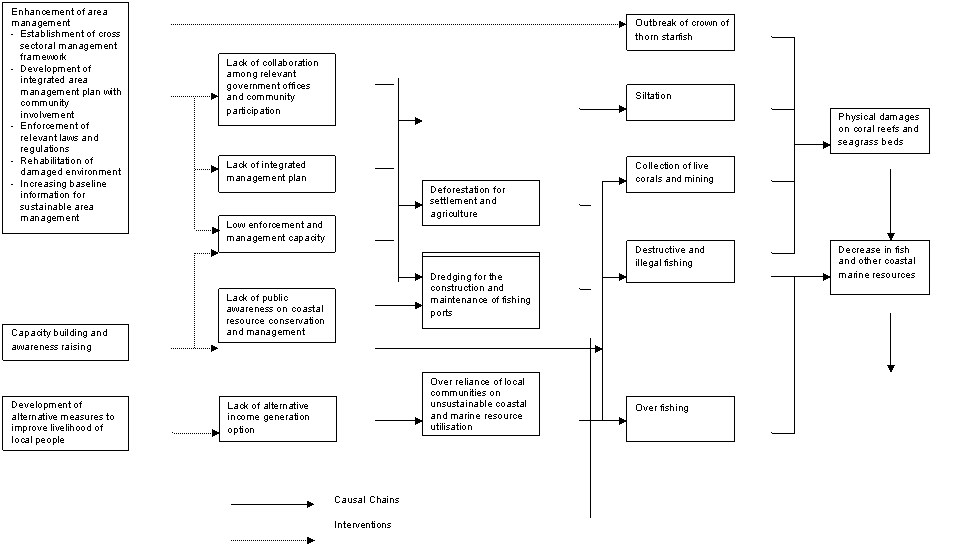
Purpose of the demonstration sites
The primary purpose of the demonstration sites selected under this project is to demonstrate actions, which either “reverse” environmental degradation or will demonstrate methods of reducing degradation trends if adopted and applied at a wider scale. In the case of coral reefs in the South China Sea marine basin, the major cause of the degradation is destructive use of coral reef resources. Therefore the demonstration activities will focus on proper management of coral reef resources at specific sites, with the aim of transferring successful practices and experiences to other, similar sites.
The types of demonstration sites selected within the coral reef sub-component of the project will be designed to illustrate sustainable use of coral reefs in the region, in particular in the priority areas identified during the preparatory phase (first 2 years) of the project. To date seventeen demonstration site proposals have been prepared by the national coral reef committees (or working groups) encompassing a wide range of different demonstration activities, including:
· Enhancing capacity for monitoring and research, at Phu Quoc islands, Nihn Hai, and Koh Tunsay;
· Community-based management, at Belitung, Mu Koh Samui, Mu Koh Angthong;
· Establishing marine protected areas or sanctuaries, at Batangas Bay, Calamianes Island Group;
· Sustainable tourism, at Mu Koh Angthong, Mu Koh Chang;
· Sustainable financing/alternative livelihood, at Masinloc, Zambales, Anda-Bolinao-Bani-Alaminos;
· Legal instrument and law enforcement, at Belitung, Mu Koh Angthong;
· Pilot activities on restoration of coral reefs, at Koh Tunsay, Mu Koh Samui.
The proposed demonstration activities involve different organisations and different groups of people, including government agencies, local governments and organisations, non-governmental organisations, local communities, media, and civil society, in designing and executing the proposed activities.
Characterising Potential Demonstration Sites
At its first meeting the Regional Working Group on Coral Reefs (RWG-CR) discussed and agreed upon an ideal list of data and information, which should be assembled for all potential demonstration sites (UNEP, 2002a). National Committees or sub-committees working under the direction of the national focal point then proceeded to identify potential sites, and to assemble the required data and information. It soon became apparent that an ideal listing of data that could be used as the basis for criteria and indicators to prioritise sites could not be assembled for all potential demonstration sites due to the unavailability of data sets from certain locations or for certain parameters. The finally agreed set of data and information which the regional working group agreed to use in the subsequent selection procedures represent a compromise between available data sets and the ideal set (UNEP, 2002b).
A first step in comparing data and information on a regional basis involved the use of a cluster analysis to determine the relationships, in terms of the similarity and difference between all sites. Whilst all countries have determined national priorities for conservation and sustainable use of their coral reef systems these priorities have been, determined independently, within each country resulting in priorities, which do not necessarily reflect regional priorities, nor do they necessarily include consideration of transboundary issues, nor regional and global significance. By conducting a cluster analysis using an identical set of data and information from all countries (Table 1) regional comparability in the subsequent prioritisation process is assured.
Comparing Similarity and Difference
The Regional Scientific and Technical Committee considered the process of determining regional priorities for action and recommended a three step process (UNEP, 2002c) as follows:
· Data and information for the site to be assembled by the national committees, (or working groups) from the participating countries, based on the regionally agreed format;
· Conduct a cluster analysis to determine similarity and difference between all potential sites;
· Determine regional priority on the basis of a rank score according to a prior agreed, sets of criteria and indicators.
In deciding upon the use of a cluster analysis to group similar sites the RSTC recognised that the available funds were unlikely to be sufficient to support interventions at all sites identified by the National Committees and Sub-committees. By grouping sites with similar characteristics and selecting sites from the groups the interventions could be chosen to maximise the range of biological diversity represented around the margins of the South China Sea.
Table 1 Uniform data set for coral reef potential demonstration sites used in determining similarity and difference between sites.
|
Site Name |
Hard coral species |
live coral cover (%) |
No. of algae spp. |
No. of crustacean species |
No. of echinoderm species |
No. of coral reef fish species |
Other ecosystem |
No. of endangered and threatened species |
|
Viet Nam | ||||||||
| Cu Lao Cham |
131 |
33.9 |
122 |
84 |
4 |
178 |
1 |
4 |
| Nha Trang bay |
351 |
26.4 |
55 |
69 |
27 |
222 |
2 |
3 |
| Con Dao |
250 |
23.3 |
84 |
110 |
44 |
202 |
2 |
4 |
| Phu Quoc |
89 |
42.2 |
98 |
9 |
32 |
135 |
2 |
3 |
| Ninh Hai |
197 |
36.9 |
190 |
24 |
13 |
147 |
1 |
4 |
| Ca Na bay |
134 |
40.5 |
163 |
46 |
26 |
211 |
1 |
3 |
|
Ha Long - Cat Ba |
170 |
43 |
94 |
25 |
7 |
34 |
2 |
4 |
|
Hai Van - Son Tra |
129 |
50.5 |
103 |
60 |
12 |
132 |
1 |
4 |
| Bach Long Vi |
99 |
21.7 |
46 |
16 |
8 |
46 |
M |
2 |
|
Philippines | ||||||||
| Batanes, Basco |
M |
55.00 |
41 |
M |
M |
86 |
1 |
3 |
|
Bolinao/Lingayen Gulf |
199 |
40.00 |
224 |
M |
M |
328 |
2 |
4 |
|
Masinloc, Zambales |
M |
33.00 |
57 |
M |
M |
249 |
2 |
4 |
|
Batangas bay/Maricaban |
290 |
48.00 |
141 |
M |
M |
155 |
2 |
4 |
|
Puerto Galera, Mindoro |
267 |
33.00 |
75 |
M |
M |
333 |
2 |
5 |
|
El Nido, Palawan |
305 |
40.00 |
129 |
M |
M |
480 |
2 |
5 |
|
Thailand | ||||||||
|
Mu Koh Chumporn |
120 |
55 |
M |
304 |
21 |
106 |
4 |
5 |
| Mu Koh Chang |
130 |
40 |
43 |
250 |
20 |
113 |
4 |
6 |
|
Mu Koh Ang Thong |
110 |
55 |
7 |
136 |
21 |
106 |
4 |
1 |
| Mu Koh Samui |
140 |
40 |
7 |
136 |
21 |
106 |
4 |
5 |
| Mu Koh Samet |
41 |
35 |
38 |
134 |
11 |
74 |
4 |
5 |
| Sichang Group |
90 |
20 |
40 |
304 |
11 |
86 |
4 |
2 |
|
Sattaheep Group |
90 |
33 |
40 |
304 |
15 |
75 |
4 |
2 |
|
Lan and Phai Group |
72 |
18 |
40 |
304 |
15 |
75 |
2 |
2 |
| Chao Lao |
80 |
30 |
33 |
123 |
12 |
105 |
2 |
3 |
| Prachuab |
74 |
40 |
18 |
106 |
16 |
162 |
2 |
4 |
| Koh Tao Group |
79 |
45 |
7 |
136 |
21 |
106 |
2 |
4 |
| Song Khla |
12 |
20 |
2 |
M |
M |
30 |
2 |
2 |
| Koh Kra |
80 |
40 |
M |
M |
M |
80 |
1 |
2 |
| Losin |
90 |
40 |
M |
M |
M |
90 |
1 |
2 |
|
Indonesia | ||||||||
| Anambas |
206 |
M |
26 |
24 |
25 |
128 |
3 |
2 |
|
Bangka |
126 |
M |
M |
25 |
23 |
169 |
3 |
2 |
|
Belitung |
164 |
38.46 |
M |
10 |
35 |
170 |
3 |
2 |
| Karimata |
192 |
M |
M |
15 |
15 |
200 |
3 |
2 |
|
Malaysia | ||||||||
|
Batu Malang, Pulau Tioman |
96 |
62.6 |
3.8 |
M |
M |
123 |
1 |
4 |
|
Pulau Lang Tengah |
86 |
41.3 |
3.1 |
M |
M |
117 |
2 |
4 |
|
Pulau Lima, Pulau Redang |
96 |
46.3 |
10 |
M |
M |
113 |
1 |
4 |
|
Teluk Jawa, Palau Dayang |
80 |
38.4 |
11.9 |
M |
M |
156 |
1 |
4 |
|
Tun Mustapha, Sabah |
252 |
M |
69 |
M |
45 |
375 |
4 |
4 |
|
Cambodia | ||||||||
| KKCR2 |
67 |
29.3 |
M |
M |
1 |
51 |
2 |
M |
| SHVCR1 |
34 |
23.1 |
M |
M |
14 |
6 |
3 |
M |
| SHVCR2 |
23 |
58.1 |
3 |
M |
M |
51 |
3 |
M |
| SHVCR3 |
70 |
M |
M |
M |
14 |
42 |
3 |
M |
| KEPCR1 |
67 |
41 |
M |
M |
14 |
51 |
3 |
1. M |
Clustering sites. Figure 1 presents the dendrogram resulting from a cluster analysis of the data presented in Table 1 using the Clustan6 software. Four clusters of sites are apparent, the lower cluster consisting of a grouping of outlying sites that for various reasons are somewhat distinct from the remainder of the set. The proposed demonstrations sites were divided by the RWG-CR into 3 groups.
Figure 1 Graphic result of cluster analysis.

FINALISATION OF RANK SCORES AND INDICATORS
Biological Indicators. At the same time that the group agreed on the data and information required to characterise the sites an initial discussion regarding the criteria and indicators that could be used as a mechanism for scaling transboundary, national, regional, and global significance was undertaken. Criteria and indicators were initially identified for the criteria covering indicators of environmental and biological diversity and agreement reached regarding the application of rank scores that could be applied objectively to the data from each site. The outcome of this process is presented in Table 2 in which the original 43 potential demonstration sites have been aggregated into groups and ranked in descending order of priority based on the rank score for environmental and biological diversity indicators.
Rank Scores. Social and economic criteria and indicators were also reviewed and discussed, and the rank scores agreed, covering such elements as the reversibility of current threats, national priority, level of direct stakeholder involvement in the current management regime, soco-economic values, and potential for co-financing support. The outcome is presented in Table 3. The RGW-CR recognised that many of these parameters could not be measured objectively without the detailed investigations and consultations required to prepare a full proposal hence scoring based on this set of parameters was only conducted for those sites for which demonstration site proposals had been prepared and discussed with local stakeholders. In deciding upon the proportion of the final score that should be assigned to an individual proposal the RWG-CR agreed that since the environmental and biological parameters were more objective and easily verifiable, greater weight should be assigned to this category of criteria and indicators than to the social and economic criteria. It was agreed that the two groups of scores should be combined in the ratio 70:30 respectively and the final rank score is presented in Table 4.
.Table 2 Coral reef ranking scores for environmental indicators.
|
Site Name |
Hard coral genera |
Hard coral species |
live coral cover (%) |
% algae cover |
No. of coral reef fish genera |
No. of coral reef fish species |
other ecosystem |
No. Migratory species |
Tourism |
cross boundary fishing |
No.of endangered and threatened species |
Area |
Ranking scores |
|
First Cluster | |||||||||||||
|
Ninh Hai |
6 |
8 |
4 |
3 |
7 |
4 |
5 |
3 |
5 |
5 |
10 |
20 |
80 |
|
Mu Koh Chang |
6 |
4 |
4 |
3 |
9 |
4 |
10 |
10 |
5 |
5 |
6 |
10 |
76 |
|
Mu Koh Chumporn |
4 |
4 |
6 |
3 |
9 |
4 |
10 |
10 |
5 |
0 |
6 |
10 |
71 |
|
Mu Koh Samui |
6 |
4 |
4 |
3 |
9 |
4 |
10 |
10 |
5 |
0 |
6 |
10 |
71 |
|
Ca Na bay |
6 |
4 |
4 |
3 |
7 |
4 |
2.5 |
3 |
5 |
5 |
7.5 |
10 |
61 |
|
Batangas |
8 |
10 |
4 |
2 |
9 |
4 |
5 |
6 |
5 |
0 |
3 |
3 |
59 |
|
Cu Lao Cham |
4 |
6 |
4 |
3 |
5 |
4 |
2.5 |
3 |
5 |
5 |
10 |
6 |
57.5 |
|
Koh Tao Group |
6 |
2 |
4 |
3 |
9 |
4 |
5 |
10 |
5 |
0 |
3 |
6 |
57 |
|
Mu Koh Samet |
1 |
2 |
4 |
3 |
7 |
2 |
10 |
10 |
5 |
0 |
6 |
6 |
56 |
|
Phu Quoc |
4 |
2 |
6 |
3 |
5 |
4 |
5 |
3 |
5 |
5 |
7.5 |
6 |
55.5 |
|
Prachuab |
4 |
2 |
4 |
3 |
9 |
4 |
5 |
10 |
5 |
0 |
3 |
6 |
55 |
|
Ha Long - Cat Ba |
6 |
6 |
6 |
3 |
3 |
2 |
5 |
3 |
5 |
5 |
10 |
54 | |
|
Bolinao/Lingayan |
8 |
6 |
2 |
1 |
9 |
6 |
5 |
3 |
5 |
0 |
3 |
4 |
52 |
|
Hai Van - Son Tra |
6 |
6 |
8 |
3 |
9 |
4 |
2.5 |
3 |
0 |
0 |
10 |
51.5 | |
|
Batu Malang, Pulau Tioman |
6 |
2 |
6 |
3 |
9 |
4 |
2.5 |
3 |
5 |
5 |
3 |
3 |
51.5 |
|
Pulau Lang Tengah |
6 |
2 |
4 |
3 |
9 |
4 |
5 |
3 |
5 |
0 |
3 |
3 |
47 |
|
Teluk Jawa, Palau Dayang |
4 |
2 |
4 |
2 |
9 |
4 |
2.5 |
3 |
5 |
5 |
3 |
3 |
46.5 |
|
SHVCR2 |
2 |
6 |
3 |
2 |
7.5 |
10 |
5 |
5 |
6 |
46.5 | |||
|
Pulau Lima, Pulau Redang |
6 |
2 |
4 |
2 |
9 |
4 |
2.5 |
3 |
5 |
0 |
3 |
3 |
43.5 |
|
Losin |
4 |
2 |
4 |
3 |
7 |
2 |
2.5 |
6 |
5 |
0 |
3 |
3 |
41.5 |
|
Batanes, Basco |
1 |
6 |
2 |
5 |
2 |
2.5 |
6 |
5 |
5 |
3 |
3 |
40.5 | |
|
Koh Kra |
4 |
2 |
4 |
3 |
5 |
2 |
2.5 |
6 |
5 |
0 |
3 |
3 |
39.5 |
|
KEPCR1 |
2 |
4 |
2 |
2 |
7.5 |
10 |
0 |
5 |
3 |
35.5 | |||
|
SHVCR3 |
2 |
2 |
2 |
2.5 |
10 |
5 |
5 |
28.5 | |||||
|
Second Cluster | |||||||||||||
|
Mu Koh Ang Thong |
4 |
4 |
6 |
3 |
9 |
4 |
10 |
10 |
5 |
0 |
3 |
6 |
64 |
|
Belitung |
8 |
6 |
4 |
5 |
4 |
7.5 |
3 |
5 |
0 |
3 |
10 |
55.5 | |
| Anambas |
8 |
8 |
3 |
5 |
4 |
7.5 |
3 |
0 |
5 |
3 |
6 |
52.5 | |
| Karimata |
8 |
6 |
5 |
4 |
7.5 |
3 |
0 |
5 |
3 |
10 |
51.5 | ||
| Chao Lao |
6 |
2 |
4 |
3 |
5 |
4 |
5 |
10 |
5 |
0 |
3 |
3 |
50 |
| Sichang Group |
4 |
2 |
2 |
3 |
5 |
2 |
10 |
6 |
5 |
0 |
3 |
6 |
48 |
| SHVCR1 |
2 |
2 |
3 |
2 |
7.5 |
10 |
5 |
5 |
10 |
46.5 | |||
|
Sattaheep Group |
4 |
2 |
4 |
3 |
5 |
2 |
10 |
6 |
0 |
0 |
3 |
6 |
45 |
| KKCR2 |
2 |
4 |
2 |
2 |
5 |
10 |
5 |
5 |
10 |
45 | |||
|
Bangka |
6 |
4 |
5 |
4 |
7.5 |
3 |
5 |
0 |
3 |
6 |
43.5 | ||
|
Lan and Phai Group |
1 |
2 |
2 |
3 |
5 |
2 |
5 |
6 |
5 |
0 |
3 |
6 |
40 |
| Song Khla |
1 |
2 |
2 |
3 |
1 |
2 |
5 |
6 |
0 |
0 |
3 |
3 |
28 |
| Bach Long Vi |
4 |
2 |
2 |
3 |
1 |
2 |
0 |
3 |
0 |
5 |
5 |
0 |
27 |
|
Third Cluster | |||||||||||||
|
El Nido, Palawan |
10 |
8 |
4 |
2 |
9 |
8 |
7.5 |
6 |
5 |
5 |
6 |
10 |
80.5 |
|
Tun Mustapha, Sabah |
10 |
8 |
2 |
7 |
6 |
7.5 |
6 |
5 |
5 |
3 |
10 |
69.5 | |
| Nha Trang bay |
8 |
10 |
2 |
3 |
9 |
4 |
5 |
3 |
5 |
5 |
7.5 |
6 |
67.5 |
| Con Dao |
6 |
8 |
2 |
3 |
5 |
4 |
5 |
3 |
5 |
5 |
10 |
10 |
66 |
| Puerto Galera |
10 |
8 |
4 |
2 |
9 |
6 |
2.5 |
6 |
5 |
0 |
6 |
3 |
61.5 |
| Macinloc |
3 |
2 |
2 |
9 |
4 |
5 |
6 |
5 |
5 |
3 |
6 |
50 | |
|
Table 3 Coral Reef ranking scores for social economic indicators. |
|
Fishing impact |
develp impact |
coral mining |
land-based pollution |
natural impact |
national priority |
skakeh involve |
Socio-eco value |
co-financing |
Comm. involve. |
transbound manage |
Scores | |
|
First Cluster |
||||||||||||
| Nihn Hai |
3 |
3 |
3 |
5 |
3 |
0 |
5 |
3 |
15 |
15 |
0 |
55 |
| Mu Koh Chang |
1 |
1 |
5 |
1 |
1 |
5 |
5 |
5 |
15 |
15 |
15 |
69 |
|
Mu Koh Chumporn |
1 |
1 |
5 |
1 |
1 |
3 |
5 |
5 |
15 |
15 |
0 |
52 |
| Samui |
1 |
1 |
5 |
1 |
1 |
1 |
5 |
5 |
15 |
15 |
0 |
50 |
| Batangas |
3 |
3 |
3 |
3 |
3 |
3 |
3 |
3 |
5 |
15 |
0 |
44 |
| Phu Quoc |
1 |
3 |
5 |
3 |
3 |
1 |
1 |
5 |
10 |
10 |
15 |
57 |
|
Anda bolinanao-bani-Alaminos |
3 |
3 |
3 |
3 |
3 |
3 |
5 |
5 |
5 |
15 |
0 |
48 |
|
Batu Malang, Pulau Tioman, Pahang |
3 |
1 |
3 |
3 |
3 |
3 |
3 |
5 |
5 |
10 |
0 |
39 |
|
Pulau Lang Tengah |
5 |
5 |
5 |
5 |
3 |
1 |
3 |
3 |
5 |
15 |
0 |
50 |
| KEPCR1 |
1 |
5 |
3 |
3 |
5 |
5 |
5 |
5 |
5 |
15 |
5 |
57 |
|
Second Cluster | ||||||||||||
|
Mo Koh Angthong |
3 |
3 |
5 |
3 |
1 |
0 |
3 |
5 |
15 |
10 |
0 |
48 |
|
Belitung |
5 |
3 |
5 |
3 |
5 |
3 |
3 |
5 |
5 |
10 |
0 |
47 |
| KKCR2 |
3 |
5 |
3 |
5 |
5 |
5 |
3 |
3 |
5 |
10 |
5 |
52 |
|
Third Cluster | ||||||||||||
| Tun Mustapha |
3 |
3 |
5 |
3 |
3 |
5 |
3 |
5 |
10 |
15 |
15 |
70 |
|
Masinloc, Zambales |
3 |
3 |
5 |
3 |
2 |
3 |
5 |
3 |
15 |
15 |
0 |
57 |
|
Table 4 Overall Rank scores for demonstration site proposals. |
|
Site Name |
Environ. rank Score |
Socio-econ. Score |
Total score |
|
First Group | |||
| Mu Koh Chang |
76 |
69 |
73.9 |
| Ninh Hai |
80 |
55 |
72.5 |
|
Mu Koh Chumporn |
71 |
52 |
65.3 |
| Mu Koh Samui |
71 |
50 |
64.7 |
| Phu Quoc |
55.5 |
57 |
55.9 |
| Batangas |
59 |
44 |
54.5 |
|
Bolinao/Lingayan |
52 |
48 |
50.8 |
|
Batu Malang, Pulau Tioman |
51.5 |
39 |
47.7 |
|
Pulau Lang Tengah |
47 |
50 |
47.9 |
| KEPCR1 |
35.5 |
57 |
41.9 |
|
Second Cluster | |||
|
Mu Koh Ang Thong |
64 |
48 |
59.2 |
|
Belitung |
55.5 |
47 |
52.9 |
| KKCR2 |
45 |
52 |
47.1 |
|
Third Cluster | |||
|
Tun Mustapha, Sabah |
69.5 |
70 |
69.6 |
| Macinloc |
50 |
57 |
52.1 |
[1] The SCS Project focuses its activities on five coastal wetland types, namely: estuaries (including deltas), lagoons, intertidal mudflats, peat swamps, and non-peat swamps.
[2] See Annex 13: Site Characterisation and Site Selection in the Coral Reef Sub-component of the SCS Project
[3] See Annex 11: Framework for Regional Coordination, Dissemination of Experiences, and Personnel Exchange between Sites (UNEP/GEF/SCS/PCS.3/3 Annex 8)
[4] See Annex 11: Framework for Regional Coordination, Dissemination of Experiences, and Personnel Exchange between Sites (UNEP/GEF/SCS/PCS.3/3 Annex 8)
[5] Reef building corals and coral communities of Nui Chua National Park, Ninh Thuan, Vietnam: Rapid Ecological Assessment of Biodiversity. April 2003. (WWF Indochina: Ref. HD-39)
[6] See Annex 11 (Framework for Regional Coordination, Dissemination of Experiences, and Personnel Exchange between Sites: UNEP/GEF/SCS/PCS.3/3 Annex 8) and Annex 12 (Provisional List of SCS Demonstration Sites)
[7] The management body might be a duly constituted committee of local government, or a single Executing Agency or a body formed from representatives of all stakeholders depending upon the nature of the activities and the particular management framework adopted at each site.
[8] The rates of this allowance will be site specific reflecting local costs.
[9] The Project Steering Committee agreed that each National Technical Focal Point would investigate the costs of obtaining appropriate medical insurance in the home countries and the Project Director agreed to investigate further alternatives, prior to the finalisation of this clause. The PSC did agree however that the individuals selected should receive an allowance that would enable them to purchase appropriate medical insurance since the existing government schemes in many countries were inadequate and would not cover the costs of medical treatment in another country.