E2267
V2
Arab Republic of Egypt
Ministry of State for Environmental Affairs
Egyptian Environmental Affairs Agency
Public Disclosure Authorized
Public Disclosure Authorized
Alexandria Integrated Coastal Zone Management
Project (AICZMP)
Environmental and Social Impact Assessment
Public Disclosure Authorized
DRAFT FINAL
Revision Date: October 20th 2009
Public Disclosure Authorized
EEAA
AICZMP-ESIA
CURRENCY EQUIVALENTS
Exchange Rate Effective {20 October 2009}
US$1 = EGP 5.47
i
EEAA
AICZMP-ESIA
TABLE OFCONTENTS
_Toc242783859
LIST OF TABLES ........................................................................................................................................................... IV
LIST OF FIGURES ...........................................................................................................................................................V
ABREVIATIONS............................................................................................................................................................. VI
CHAPTER 1 BACKGROUND......................................................................................................................................... 1
INTRODUCTION ................................................................................................................................................................. 1
PURPOSE OF THE REPORT ................................................................................................................................................. 1
RATIONALE OF THE PROPOSED PROJECT .......................................................................................................................... 2
SCOPE OF THE ESIA ......................................................................................................................................................... 3
CHAPTER 2 POLICY, LEGAL AND REGULATORY FRAMEWORK ................................................................... 4
INTRODUCTION ................................................................................................................................................................. 4
NATIONAL POLICY AND LEGAL MANDATES ..................................................................................................................... 4
WORLD BANK REQUIREMENTS......................................................................................................................................... 5
EEAA REQUIREMENTS..................................................................................................................................................... 7
RELEVANT LEGISLATION TO THE PROJECT ACTIVITIES...................................................................................................... 7
National Environmental legislation............................................................................................................................. 7
INSTITUTIONAL FRAMEWORK AND MANAGEMENT ARRANGEMENTS................................................................................ 8
Partnership Arrangements........................................................................................................................................... 8
Institutional and implementation arrangements .......................................................................................................... 8
International and regional environmental legislation ................................................................................................. 9
CHAPTER 3 PROJECT DESCRIPTION ..................................................................................................................... 11
INTRODUCTION ............................................................................................................................................................... 11
PROJECT OBJECTIVES ..................................................................................................................................................... 11
PROJECT COMPONENTS ................................................................................................................................................... 12
Component (1): Planning, Institutional Capacity and Monitoring ........................................................................... 12
Component (2): Pollution Reduction. ........................................................................................................................ 13
Phasing of Implementation of the Proposed Package ............................................................................................... 32
Component (3): Project Management and Monitoring and Evaluation. ................................................................... 33
CHAPTER 4 : DESCRIPTION OF THE ENVIRONMENT....................................................................................... 34
LAKE MARIOUT BACKGROUND ...................................................................................................................................... 34
CURRENT SYSTEM CONFIGURATION AND STATUS OF THE LAKE .................................................................................... 35
LAKE MARIOUT WATER QUALITY.................................................................................................................................. 36
INFLUENTS TO THE MAIN BASIN..................................................................................................................................... 37
Regional Geology ...................................................................................................................................................... 40
Air Quality ................................................................................................................................................................. 42
CLIMATE......................................................................................................................................................................... 45
Temperature .............................................................................................................................................................. 45
Winds ......................................................................................................................................................................... 45
Cloud cover and Sunshine ......................................................................................................................................... 46
FLORA ............................................................................................................................................................................ 48
SOLID AND HAZARDOUS WASTE MANAGEMENT IN ALEXANDRIA.................................................................................... 49
Solid waste................................................................................................................................................................. 49
Hazardous waste........................................................................................................................................................ 50
SOCIO-ECONOMIC CONDITIONS....................................................................................................................................... 51
ii
EEAA
AICZMP-ESIA
Population next to Lake Mariout ............................................................................................................................... 51
Fishermen Community............................................................................................................................................... 52
Fisheries and Aquatic Resources............................................................................................................................... 55
CHAPTER 5 POTENTIAL ENVIRONMENTAL AND SOCIAL IMPACTS .......................................................... 58
GENERAL........................................................................................................................................................................ 58
ANTICIPATED POSITIVE IMPACTS ................................................................................................................................... 58
ANTICIPATED NEGATIVE IMPACTS ................................................................................................................................. 60
Analysis of Impacts .................................................................................................................................................... 60
SOCIO-ECONOMIC IMPACTS ............................................................................................................................................ 64
Impacts on fishermen community .............................................................................................................................. 64
Other socio-economic impacts................................................................................................................................... 65
CHAPTER 6 : ANALYSIS OF ALTERNATIVES....................................................................................................... 66
1. PROJECT ALTERNATIVES ............................................................................................................................................ 66
The "no project" option ............................................................................................................................................ 66
2. FOCUS OF INTERVENTION ........................................................................................................................................... 66
3. CONCEPTUAL INTERVENTION ALTERNATIVES ............................................................................................................ 66
Treating only point source (industrial) pollution ...................................................................................................... 66
Reusing wastewater for landscaping ......................................................................................................................... 67
4. POLLUTION REDUCTION PROJECTS ALTERNATIVES.................................................................................................... 67
5. SELECTING A SINGLE INTERVENTION VERSUS PACKAGE INTERVENTION ..................................................................... 68
Comparison Criteria.................................................................................................................................................. 68
Outline of the alternative Packages........................................................................................................................... 71
CHAPTER 7 ENVIRONMENTAL AND SOCIAL MANAGEMENT PLAN ........................................................... 75
INTRODUCTION ............................................................................................................................................................... 75
INSTITUTIONAL ARRANGEMENTS ................................................................................................................................... 75
Management Setup .................................................................................................................................................... 75
Specific Project Arrangements .................................................................................................................................. 77
ENVIRONMENTAL MANAGEMENT CAPACITY.................................................................................................................. 78
SUMMARY OF IMPACTS AND MITIGATION MEASURES .................................................................................................... 79
MONITORING MEASURES ................................................................................................................................................ 84
COST ESTIMATES AND SOURCES OF FUNDS ..................................................................................................................... 85
CHAPTER 8 : PUBLIC CONSULTATION AND DISCLOSURE ACTIVITIES..................................................... 87
INTRODUCTION ............................................................................................................................................................... 87
REGULATIONS AND REQUIREMENTS ............................................................................................................................... 87
METHODOLOGY.............................................................................................................................................................. 87
Consultative Session .................................................................................................................................................. 88
REFERENCES................................................................................................................................................................. 94
ANNEXES ........................................................................................................................................................................ 98
ANNEX 1: WORLD BANK SAFEGUARD POLICY ISSUES ................................................................................................... 98
ANNEX 2: FISHERIES IN LAKE MARIOUT ...................................................................................................................... 103
ANNEX 3: PARTICIPANTS LIST IN PUBLIC CONSULTATION............................................................................................. 105
ANNEX 4: ALEXANDRIA CZM MAP ............................................................................................................................. 110
ANNEX 5: LIST OF PREPARERS ..................................................................................................................................... 111
iii
EEAA
AICZMP-ESIA
LIST OF TABLES
Table 1: World Bank Safeguard Operational Policies and their applicability to AICZM ..............................5
Table 2: Water quality indices of the various basins of Lake Mariout (Helmy, 2005)................................16
Table 3: Tentative time frame for the construction schedule for the In-Lake Wetland..............................22
Table 4: The Hydraulic Characteristics of Al Qalaa Drain .........................................................................24
Table 5: The expected reduction of pollution at both aerobic & anaerobic conditions..............................26
Table 6: Timeframe for implementation of In-Stream Biofilm Approach....................................................28
Table 7: Average Water Quality in Lake Mariout .......................................................................................37
Table 8: Pollution loads of influents to the lake (t/d) .................................................................................38
Table 9: Average water quality in Drains Discharging to Main Basin.......................................................38
Table 10: Pollution concentration of influents to the lake (mg/l) ................................................................39
Table 11: Air quality in El Max area ...........................................................................................................42
Table 12: H2S concentration recorded at different location surrounding the source of flux area of Lake
Maryout during August 2003. (from Said, 2003)........................................................................................43
Table 13: Mean values of heavy metals ( g/m3) in aerosols at Abis area (from Shalaby, 2004).............44
Table 14: Dioxins and Furans in air and soil in Abbis area .......................................................................44
Table 15: Monthly temperatures in Alexandria ..........................................................................................45
Table 16: Meteorological Information in the Study Area during 2002. ......................................................46
Table 17: Comparison between Lake Mariout and other northern lakes in Egypt ....................................56
Table 18: Annual fish catch from Lake Mariout .........................................................................................56
Table 19: Overall Environmental Impact Assessment Matrix ....................................................................63
Table 20: Effectiveness of Different Solutions to Major Threats to the Main Basin Lake Mariout ...........69
Table 21: Solution Suitability......................................................................................................................70
Table 22: Potential Financial Sustainability ...............................................................................................70
Table 23: Suitability of individual components versus integrated package ...............................................71
Table 24: Mitigation Measures and Associated Institutional and Financial Responsibilities.....................81
Table 25: Continuous Monitoring Program ................................................................................................84
Table 27: Outcomes of the Public Consultation Session...........................................................................89
iv
EEAA
AICZMP-ESIA
LIST OF FIGURES
Figure 1: Complementarities of the proposed project with other on-going activities.................................11
Figure 2: Schematic of a substrate-free CW with horizontal surface flow .................................................15
Figure 3: Sketch of Qalaa Drain System....................................................................................................17
Figure 4: Preliminary Layout of the Proposed In-Lake Engineering Wetland ...........................................18
Figure 5: Surrounding Walls.......................................................................................................................19
Figure 6: Lemnaceae is a family of flowering plants (also known as the duckweed family) .....................20
Figure 7: Ideal Plug-Flow Systems for Combined Duckweed-based Wastewater Treatment and Protein
Production. .................................................................................................................................................20
Figure 8: Location for Biofilm Application in Qalaa Drain ..........................................................................24
Figure 9: Schematic diagram illustrating the implementation of one section of the proposed Instream
Biofilm System at Al Qalaa Drain .............................................................................................................25
Figure 10: The proposed implementation of different sections of in stream Biofilm system along Al
Qalaa drain .................................................................................................................................................26
Figure 11: Typical Float Mounted Aerato...................................................................................................29
Figure 12: Area of Intervention for Reed Removal ....................................................................................31
Figure 13: An early map, published in 1882 clearly showing Lake Mariut ................................................34
Figure 14: Surface Area of Lake Mariut 1972 2007................................................................................35
Figure 15: The Basins of Lake Mariout ......................................................................................................36
Figure 16: Yearly prevailing Wind rose ......................................................................................................48
Figure 17: Percentage representation of stakeholders..............................................................................88
v
EEAA
AICZMP-ESIA
ABREVIATIONS
AFD
French Agency for Development
AICZM
Alexandria Integrated Coastal Zone Management
ALAMIM
Alexandria Lake Mariout Integrated Management
ASDCO
Alexandria Sanitary Drainage Company
B.C. Before
Christ
BOD
Biological Oxygen Demand
BP Best
Practice
CAA Competent
Administrative
Authority
CEDARE
The Center for Environment and Development for the Arab Region and Europe
CEO
Chief Executive Officer
cm Centimetre
COD
Chemical Oxygen Demand
Cr Chrome
Cu Copper
CW Constructed
Wetland
CZM
Coastal Zone Management
DO Dissolved
Oxygen
DRI
Drainage Research Institute
EA Environmental
Assessment
EEAA
the Egyptian Environmental Affairs Agency
EGP Egyptian
Pound
EIA
Environmental Impact Assessment
EIB
European Investment Bank
ESMP
Environmental and Social Management Plan
EMU Environmental
Management
Unit
EPAP
Egypt Pollution Abatement Project
ESIA
Environmental and Social Impact Assessment
ETP
East Waste Water Treatment Plant
FRP
Fiber Reinforced Polymer
GAFRD
General Authority for Fish Resources Development
GDCZM
General Directory for Coastal Zone Management
GEF
Global Environment Facility
GOE
Government of Egypt
HP Horse
Power
HRT Hydraulic
Retention
Time
ICZM
Integrated Coastal Zone Management
IWLEARN
International Waters Learning Exchange and Resource Network
JBIC
Japan Bank for International Cooperation
JICA
Japan International Cooperation Agency
Kg Kilogram
Km Kilo
Meter
Km2
Square kilometre
vi
EEAA
AICZMP-ESIA
kW Kilo
Watt
kWh Kilo
Watt
hour
M
Meter
M&E
Monitoring and Evaluation
M3 Cubic
meter
M3/d
Cubic meters per day
MALR
Ministry of Agriculture and Land Reclamation
MAP
Mediterranean Action Plan
Mg/l
Milligram per liter
mm Millimetre
MSEA
Ministry of State for Environmental Affairs
MWRI
Ministry of Water Resources and Irrigation
N
Nitrogen
NCICZM
National Committee for Integrated Coastal Zone Management
NGO
Non Governmental Organisation
NH4 Ammonia
Ni Nickel
NO3 Nitrates
O2 Oxygen
OP Operation
Policy
P
Phosphorous
Pb Lead
PIT Project
Implementation
Team
PM10 Particulate
Matter
PMU Project
Management
Unit
ppm Part
per
million
PRP
Pollution Reduction Project
PRP
Pollution Reduction Project
PSC
Project Steering Committee
PWG
Project Working Group
Qrt Quarter
RBO
Regional Branch Office
RPF
Resettlement Policy Framework
Sec Second
SFD
Social Fund for Development
SMAP
Short and Medium term priority environmental Action Program
T
Ton
TSS
Total Suspended Solids
UNEP
United Nations Environment Programme
US$
United States Dollar
WB
The World Bank
WTP
West Waste Water Treatment Plant
WWTP
Waste Water Treatment Plant
vii
EEAA
AICZMP-ESIA
Zn Zinc
viii
EEAA
AICZMP-ESIA
chapter 1 Background
Introduction
The countries of the Mediterranean Sea basin face a variety of shared environmental problems that are trans-
boundary in nature. The coastal areas around the Mediterranean are heavily populated and are undergoing a
dramatic process of development.
In 2003 the Mediterranean countries adopted the Strategic Action Program for the Conservation of
Mediterranean Marine and Coastal Biological Diversity that identifies priority actions and targets to protect
fragile ecosystems and reduce damage to natural habitats.
Degradation of water quality due to land-based pollution is a major problem in the Mediterranean coastal
areas. The Strategic Action Plan for the Mediterranean1 has identified several "hot spots and sensitive areas"
on the northern coast of Egypt, which for several decades have been experiencing a continuous increase in
population, development, and environmental degradation. Two of these "hot spots" are located in Alexandria,
namely El-Mex Bay and Abu-Qir Bay
The Government of Egypt, represented by the Egyptian Environmental Affairs Agency (EEAA) is currently
preparing the Alexandria Integrated Coastal Zone Management Project (AICZM) which has the following
main objectives:
a. to supply a strategic framework and immediate small- scale investments to reduce the load of land-
based sources of pollution entering the Mediterranean Sea in the hot spots" of El Mex Bay and Lake
Mariout; and
b. to protect/restore globally significant coastal heritage and ecosystem processes by supporting the
Government of Egypt's efforts to develop and implement a National Coastal Zone Management Plan.
This proposed project is developed with assistance from the World Bank (through a grant from the Global
Environment Facility (GEF)), which continues to provide support to the Government of Egypt for improving
its environmental management capabilities and to demonstrate the value added of an integrated and
participatory approach to coastal zone management for sustainable development. The project is partially
blended with the ongoing Second Egypt Pollution Abatement Project (EPAP II) implemented by the Egyptian
Environmental Affairs Agency (EEAA), with the aim of reducing industrial pollution in two hot spots in
Egypt, namely Alexandria (primarily Lake Mariout) and Greater Cairo. The proposed project builds upon the
successful collaboration both in terms of policy work and project investments (EPAP I and EPAP II) over the
past several years, based on a comprehensive approach linking technical, environmental, social and economic
considerations.
Purpose of the Report
The Alexandria Coastal Zone Management project is expected to have important positive environmental
impacts with the objective of contributing to a reduction in the load of land-based sources of pollution
entering the Mediterranean Sea, especially from Lake Mariout, through the hot spots of El-Mex Bay and
Alexandria. Accordingly, the project is classified as an environmental Category B according to both EEAA
1 The Mediterranean countries have also worked together to set priorities related to these transboundary
problems and have jointly agreed on what interventions are needed to address such priorities through two
Strategic Action Programs (SAPs): (a) The Strategic Action Program to Address Pollution from Land-Based
Activities (SAP MED); and (b) The Strategic Action Program for the Conservation of Mediterranean Marine
and Coastal Biological Diversity (SAP BIO). The two Strategic Action Programs are aimed at: (i) reducing
land-based sources of marine pollution (SAP-MED) and (ii) protecting the biodiversity and living resources
of the Mediterranean, as well as their habitats (SAP-BIO).
1
EEAA
AICZMP-ESIA
guidelines and the World Bank's Operation Policy on Environmental Assessment (OP 4.01), requiring
Environmental Screening Form (B) or partial assessment prior to construction activities respectively.
The project activities will not cause conversion or degradation of natural habitats and there will not be a need
for any mitigation measures as anticipated project activities will not lead to adverse impacts towards natural
habitats. On the contrary, project activities are expected to result in an improvement in biodiversity
conservation in the lake ecosystem. However, scope of assessment of natural habitats will be covered as part
of the environmental assessment process discussed in this report.
The main purpose of this ESIA is to investigate potential impacts of the proposed main intervention projects
on both the environment as well as the community living around near Lake Mariout.
Rationale of the Proposed Project
The city of Alexandria lies on the southern Mediterranean cost with a population of about 4 million
inhabitants. It occupies an area of about 300 square km, with an increasing demand for new land for
development, including planned development of vacant land around Lake Mariout.
Lake Mariout is now considered a major source of pollution to the Mediterranean Sea through El Mex Bay...
It is one of the major sources of conveyance of land based pollution to the El-Mex Bay. The Lake has no
direct connection to the sea and its surface is maintained at 2.8 m below mean sea level by pumping water
from the lake to the Mediterranean Sea at El-Mex Bay. The Lake Mariout receives polluted water from three
major sources on a daily basis:
· Industrial effluents: Various industries discharge directly their effluents into the Lake or El Mex Bay.
The pollutants brought by the industries include high Biochemical Oxygen Demand (BOD) and
Chemical Oxygen Demand (COD) and heavy metals.
· Domestic effluents: Two wastewater treatment plants discharge their primary treated effluents into
the Lake Mariout. The total discharge of primary treated sewage is about 916,000m3/day. The East
Waste Water Treatment Plant (ETP) releases effluents into Dayer-El-Matar drain which then empties
into the Lake. Additionally, Lake Mariout receives effluent that is discharged directly from the West
Waste Water Treatment Plant (WTP).
· Drainage water from agriculture: The Lake receives an important part of agricultural drainage water
coming from secondary drains and agricultural activities upstream, bringing pesticides, nutrients
(phosphate, nitrogen compounds, sulphate, etc) along with organic matter from animal farming and
domestic wastewater of nearby villages.
As a consequence of the environmental degradation, sewage and industrial wastewater, in addition to the
inflow of nutrient-rich agricultural drainage water, Lake Mariout has changed from being the most productive
fisheries resource of the four major Egyptian brackish water lakes, to the least productive in a couple of
decades.
The proposed project will use a two pronged approach to sustainable coastal zone management including the
use of institutional strengthening measures and pollution reduction interventions. The project will also pilot
innovative and low-cost technologies for pollution reduction originating from agricultural drainage water and
rural domestic wastewater, partially responsible for the severe eutrophication problem in the Lake basins. The
project will complement other on-going projects, each addressing a different source of pollution. The other set
of interventions include the EPAPII sub-projects on industrial pollution and the Government upgrade of the
East and West Waste Water Treatment Plants for domestic pollution as part of the Alexandria City
Development Strategy. The project will thus treat more diffuse non-point sources of pollution originating
from rural and agricultural areas while the other interventions target point source pollution.
2
EEAA
AICZMP-ESIA
Given the scale of the environmental degradation in Alexandria, the project in itself may only contribute
marginally to the reduction of pollution ultimately entering the Mediterranean Sea. However, its main
advantage and value added reside in its catalytic function to trigger consensus building, awareness raising and
institutional strengthening on sustainable coastal management using pilot investment interventions as a
platform to bring all stakeholders closer on the issue2. The project will address the continued fragmented
approach to coastal zone management in and around Alexandria area and the lack of consensus around the
future of the lake by consulting a wide range of stakeholders with conflicting interests and supporting the
mainstreaming of coastal zone management principles into land use or urban planning in Alexandria.
Scope of the ESIA
The proposed project is composed of 3 components. These are:
· Component (1), Institutional Capacity and Monitoring (US$ 1.982 million)
· Component (2): Pollution Reduction (US$ 4.625 million)
· Component (3): Project Management and Monitoring and Evaluation (US$ 0.543 million).
Since components (1) and (3) do not include any construction works or physical activities that may result in
direct environmental impacts, the study will focus on component (2) with its planned interventions. However,
a brief description of both components (1) and (2) will be presented,.
A pre-feasibility study for Component (2) was conducted and it included the main proposed physical
interventions for dealing with the remediation of the main basin which represent the main scope of this
Environmental and Social Impact Assessment. The proposed interventions are in the form of an integrated
package that is composed of the following applications:
· Engineered wetland for Lake Mariout
· In-stream wetland
· In-stream biofilm
· Aeration system
This study aims to develop an Environmental impact Assessment for the main intervention, Integrated
Package, with the objective of mitigation of any potential negative environmental or social impacts and
preparing an Environmental and Social Management Plan (ESMP).
.
2 EEAA, MWRI, MALR and Alexandria Governorate...etc
3
EEAA
AICZMP-ESIA
Policy, legal and regulatory framework
Introduction
The Integrated Environmental and Social Assessment for the project must meet a number of policy and legal
requirements associated with the environment, social issues and resettlement. The World Bank safeguard
policies and the Egyptian Environmental Protection Law No. 4/1994 (amended by Law 9/2009), Law No.
48/1982 concerning the protection of River Nile, canals and drains, and detailed requirements for conducting
EA as defined in Law 4/1994 have been complied with during the course of project preparation and will also
be complied with during project implementation.
National Policy and Legal Mandates
Responsibilities for environmental protection in Egypt are dispersed among a number of Ministries and
Governorates and can be classified in the following three categories: (a) the national environmental
organization represented by the MSEA, the Egyptian Environmental Affairs Agency (EEAA) and its eight
Regional Branch Offices (RBOs) which are charged with overall monitoring and regulatory coordination; (b)
institutions with specific operational functions which are performed by environment units in line ministries,
and by Environmental Management Units (EMUs) in the Governorates; and (c) institutions with environment
support role (mostly universities and research institutes). One of the functions of the EEAA Alexandria RBO
is to monitor wastes from inland Nile fleets and coastal waters.
Water quality legislation in Egypt is governed by two main Laws: Law No. 48/1982 for protection of the river
Nile and waterways from pollution; and Law 4/1994 on Environmental Protection. The Law No. 48/1982
regulates the discharge of wastewater into the River Nile and other waterways whereas the Law No. 4 of 1994
on the protection of the environment constitutes the main legislative body in the field of environment to
formulate the general policy and prepare the necessary plans for the protection and promotion of the
environment. The Law No. 4 of 1994 provides for the use of environmental management mechanisms, which
include command and control measures such as the setting of appropriate standards, the application of the
polluter pays principle (through the implementation of penalties and fines) and the use of environmental
impact assessments (EIAs).
Although EEAA is responsible for the environment countrywide, Law 4/1994 retained most of the enforcing
authority for inland waters with the Ministry of Water Resources and Irrigation (MWRI) and the Ministry of
Interior. As EEAA is responsible for inspections regarding compliance with environmental and occupational
health and safety regulations, it has to manage water quality in coordination with the MWRI and the Ministry
of Health and Population.
On a more local level, MWRI is responsible for controlling the water level in the lake Mariout through a
balancing of the El-Mex pumping station with the influents to the lake. On the other hand, the General
Authority for Fish Resources Development (GAFRD), under the Ministry of Agriculture and Land
Reclamation (MALR), is responsible for the management of fish resources in the lake including aquaculture.
The Government of Egypt's program and policy on environmental management is based on:
· A strong commitment towards controlling industrial discharges, and stricter monitoring of all that
may influence the quality of drinking water.
· Air pollution abatement and consistent monitoring of air pollution levels in large cities.
· Environmental impact assessment studies for all projects, and prohibition of any project that may
negatively impact the environment, especially near tourism development areas and coastal zones.
· Rapid implementation and monitoring of programs, environmental laws, regulations and
international environmental protection protocols and conventions.
4
EEAA
AICZMP-ESIA
· A program for the management of national marine coastal zones as part of the Second National
Environmental Action Plan developed in 2002 and covering the period 2002-2017.
· The preparation of a national strategy on sustainable development by the National Committee on
Sustainable Development established in 2006.
· The preparation of a solid waste management master plan in 2007 that estimated the cost of
upgrading the current solid waste management systems, and proposed a detailed governorate-by-
governorate assessment.
Concerning Coastal Zone Management in Egypt, Law No. 4/1994 for the environment (as amended by Law
9/2009) includes articles defining the coastal zones (art. 39) and the Integrated Coastal Zone Management
(art. 40 & 48). Integrated management of coastal areas has been defined as "a process by which all concerned
authorities participate in coordinating their work in order to preserve the environment of the coastal areas."
The amended law also assigns to the Minister of State for Environment, a coordinating role with the relevant
agencies/stakeholders to achieve the water protection and integrated coastal zone management objectives.
Specifically, the EEAA was given the authority to "participate with the concerned agencies and ministries in
the preparation of a National Integrated Coastal Zone Management Plan for the Mediterranean Sea and Red
Sea coasts". The executive regulations of the amended law are expected to establish a Governorate level
Coastal Zone Management (CZM) Committee. The Alexandria CZM Committee is projected to be in place
before project implementation.
With this mandate, the EEAA through its General Department for Coastal Zone Management has initiated the
coordination of the Integrated Coastal Zone Management (ICZM) planning, in which the first step was to
establish the National Committee for Integrated Coastal Zone Management (NCICZM). A Ministerial Decree
establishing the NCICZM was issued in 1994 with subsequent amendments. The function of the Committee is
not only to draw up a consistent policy and strategy for future development, but also to resolve conflicts
between different users. The National Committee includes top rank representatives of all concerned
ministries, NGOs and major stakeholders.
On a local level, in conformity with Law no. 124 of 1983, the General Authority for Fish Resources
Development established the Lake Mariout Development Committee. The tasks of the Committee are to plan,
supervise and implement development programs for the Lake and to make field visits to the Lake to detect
any violation. Due to its limited mandate, membership and representation, its role has been limited to regulate
fish catch, develop fish production and protect the interests of the fishermen community. It includes members
from Universities, NGOs, research centers, Alexandria governorate local council, General Organization for
Sanitary Drainage, EEAA and fishermen association.
World Bank Requirements
World Bank requirements for ESIA's are laid down in the Operational Policy for Environmental
Assessment (OP 4.01). Further guidelines are presented in the Environmental Assessment
Sourcebook (1991) and updates thereof. Other relevant standards that would potentially be
applicable are shown in the following table.
Table 1: World Bank Safeguard Operational Policies and their applicability to AICZM
No. Policy Policy
Justification
triggered
5
EEAA
AICZMP-ESIA
No. Policy Policy
Justification
triggered
1
OP 4.01 Environmental Assessment
Yes
The project is classified as an environmental
Category B requiring partial assessment
All environmental and social impacts of AICZM
are adequately examined
AICZM will have significant positive impact on
the Lake Mariout and Mex Bay
AICZM is not likely to have significant negative
environmental impacts on its area of influence
2
OP 4.12: Involuntary Resettlement
No
Resettlement is not expected from any of the
project activities. No land take is anticipated and
no potential restriction of access to socio-
economic resources is foreseen from Component
(2), as no fishing is practiced in Qalaa drain nor in
the area designated for the in-Lake wetland since
it is most polluted and avoided by fishermen.
Impact from Component (1) is also nonexistent,
as the implementation of the plan itself is beyond
the scope/duration of the project. Furthermore, a
set of checks and balances is built into project
design, including: (i) representation of civil
societies organization in the National Committee
on Coastal Zone Management, as well as in the
Project Steering Committee; and the plan to hold
public consultation workshops during the
preparation of the coastal zone management plan.
3
OP 4.11: Cultural Property
No
None of the interventions will affect any known
archaeological sites.
4
OP 4.20: Indigenous People
No
No indigenous people are present in project areas
5
OP 4.09: Pest Management
No
AICZM will not affect pest management by any
way
6
OP 4.04: Natural Habitats
No
The project activities will not cause conversion or
degradation of natural habitats. There will not be
a need for any mitigation measures as anticipated
project activities will not lead to adverse impacts
towards natural habitats. On the contrary, project
activities are expected to result in an
improvement in biodiversity conservation in the
lake ecosystem. As the project is expected to have
a positive impact with regards to natural habitats,
the policy is triggered. However, scope of
assessment of natural habitats will be covered as
part of the environmental assessment process.
7
OP 4.36: Forestry
No
No forest areas exist
8
OP 4.37: Safety of Dams
No
AICZM does not involve construction of dams,
and not depending on any dams
9
OP 7.50: Projects on International
No
This is applicable to water bodies that form a
Waterways
boundary between two states or any other water
body that is a part of these boundary water
bodies. OP 7.50 is not applicable to this project.
10
OP 7.60: Projects in Disputed Areas
No
This policy introduces specific requirements for
loans in areas disputed by more than one country.
This is not applicable to the AICZM.
6
EEAA
AICZMP-ESIA
EEAA Requirements
The EEAA sets guidelines for Environmental Impact Assessments, reviews EIA for different activities
and recommends approval / refusal of the proposed projects as part of the licensing procedures for
any new activity or development. An EIA is required as part of the licensing procedures for any new
project or expansion of existing activities. The EEAA classifies projects into three categories:
· Category A projects likely to have minor environmental impact. The developer applies to the
CAA before construction works are initiated with an Environmental Screening Form "A".
· Category B projects that may result in significant environmental impact. The developer applies
to the CAA before construction works are initiated with an Environmental Screening Form "B".
· Category C projects requiring complete EIA due to their potential impacts.
The Environmental law No.4 of 1994 (amended by Law 9/2009) and its Executive Regulations No. 338 of
1995 (currently being amended) provides that the new projects as well as the expansion of existing facilities
shall assess the environmental impact statement before issuing them.
The competent administrative bodies or the donor's permission send a copy of the environmental impact
assessment report to EEAA for an opinion and put proposals to be implemented during the project
establishment.
EEAA must report to the competent administrative authority or the donor of the license in this assessment
during a maximum period of 30 days from the date of receipt of report, it is considered that not to respond is
approval of the assessment.
Relevant legislation to the project activities
There are many laws, regulations and decisions related to the project either during the construction phase or
during the operation, the relevant international laws has also been revised depending on models for
environmental impact assessment of EEAA.
National Environmental legislation
· Environmental law No. 4 of 1994 that amended by Law No. 9 of 2009
· The Executive Regulations stated by Prime Minister Decree No. 338 of 1995, and amended by decree
No.1741/2005
· Law 102 of 1983 States the requirements for management of natural protectorates
· Law 124 of 1983 about the marine life
· Law 48 of 1982 for the protection of the Nile River and its tributaries and groundwater pollution
· Law 93 of 1962, amended by the Minister of Housing Decree 44/2000; sets limits for reuse of treated
wastewater in agricultural purposes and Sets limits for effluent discharges to the public sewer.
· Law 57 of 1978, Minister of Housing Decree No.206/1979 Concerning eliminating ponds and pits.
· Law 12 of 2003 for the protection of workers and occupational safety and health of workers
amending Act 137 for the year 1981 and its implementing decisions.
· Decision of the Head of State in the protection of the air pollution from the Ministry of Health No.
864 of 1969
· Guideline to basics and procedures of environmental impact assessment issued by the EEAA in the
second edition in January 2009 and contains a model for the evaluation of environmental projects
7
EEAA
AICZMP-ESIA
· Environmental impact assessment guidelines for urban development projects issued by EEAA in
January 2005
Institutional framework and Management Arrangements
Partnership Arrangements
The project will be implemented as part of the GEF-World Bank-UNEP Strategic Partnership for the
Mediterranean Sea Large Marine Ecosystem (LME), which will support capital investments, economic
instruments, implementation of policy reforms, and strengthening of public institutions and public
participation. This Partnership will be accomplished through two complimentary components: the Regional
Technical Assistance project or Regional Component, implemented by UNEP and executed by the
Mediterranean Action Plan (MAP), its regional centers, and various partners (FAO, GWP, UNESCO,
UNIDO, WWF), and the investment Fund managed by the World Bank. The project will cooperate with the
UNEP Regional Component of the Partnership to enhance awareness and replication, given that the Director
of the CZM Department in EEAA is the focal point for the PAP/RAC-MAP in Egypt.
Several donors are active in supporting environmental projects in Egypt. In fact, EPAP II project, with which
this proposed project is partially blended, is a multi-donor project with contribution from the European
Investment Bank (EIB), the Japan Bank for International Cooperation (JBIC, currently JICA), the French
Agency for Development (AFD), with technical assistance provided, in part, by the Government of Finland.
The Bank's team is in constant contact with the donors active in the sector to ensure that there is a common
understanding and agreement as to the measures that are needed to improve the coordination related to coastal
zone management. In addition, the Bank has established a close relationship with the Center for Environment
and Development for the Arab Region and Europe (CEDARE) as the project builds on the Alexandria Lake
Mariout Integrated Management project (ALAMIM) funded under the EU SMAP III (Short and Medium term
priority environmental Action Program). The ALAMIM project is implemented by CEDARE and aims to
promote the integrated development of the Lake Mariout and its activities.
Institutional and implementation arrangements
The EEAA is the agency responsible for overall project implementation. Together with the Governorate of
Alexandria, the EEAA will also lead the coordination work with other implementing agencies, including the
MWRI and the MALR. The institutional arrangements have been designed to ensure a multi-sector and
participatory approach to sustainable Coastal Zone Management and to build on the technical expertise and
comparative advantage of the different agencies. Synergies and cross-fertilization with the EPAP II PMU staff
at EEAA will be ensured.
A number of steps have been included in project design to address potential conflicts from project
interventions. These measures include the participation of the Lake Mariout Development Committee in the
Project Steering Committee and the assignment of a social specialist and an environmental specialist in the
EEAA PMU to review and monitor the social and environmental safeguards. The management (and assets) of
the investment component will be transferred from the EEAA to the relevant agency/ministry after project
completion to ensure long-term sustainability. To that effect, an inter-agency agreement was prepared and
will have to be signed between EEAA and each of the relevant implementing agencies as a condition of
effectiveness.
The proposed implementation arrangements are as follows:
A Project Management Unit (PMU) for the proposed project will be put in place. In order to build on the
significant expertise gained in EEAA from the implementation of the EPAPI and EPAPII, the Director of the
PMU for EPAP II in EEAA will serve as the PMU Director for the proposed project. However, given that the
8
EEAA
AICZMP-ESIA
EPAPII is still under implementation, the PMU will be reinforced by hiring three new staff: (i) a technical
manager: (ii) a financial manager; and (iii) a procurement specialist. This will ensure that the GEF project
PMU can continue to oversee the project implementation, even after the EPAP II closure date in 2012. In
order to draw on the experience accumulated by EEAA in the area of sustainable coastal zones management,
the project will be technically anchored in the General Department for Coastal Zone Management in EEAA.
The head of the General Department will ultimately be responsible for the technical aspects related to CZM
and in particular for the preparation of the Alexandria CZM plan. The technical staff in the PMU will also
include staff from the Alexandria EEAA RBO who will have a significant role in overseeing the monitoring
of the water quality in the El-Mex bay as well as progress related to the project interventions. In order to
reflect the interests of all stakeholders in the proposed interventions, the PMU will contract and pay out of the
project funds (i) a Social specialist, (ii) a M&E specialist and (iii) a Communication specialist on a part-time
or task basis. The PMU will have the overall technical and fiduciary responsibility of the project. The PMU
will be responsible for the preparation of tender documents, receiving and evaluating bids, managing
contracts, supervising works and consultants, and prepare progress reports.
Project Working Groups (PWG) will be formed in each implementing agencies (MWRI and MALR). The
PMU will work with a relevant agency to coordinate the implementation of the project's interventions, the
MWRI for the in-stream biofilm and in-stream aerators, and the Ministry of Agriculture and Land
Reclamation for in-lake wetland and reed removal (Component 2 of the project). These working groups will
include technical specialists from the relevant Ministries in order to ensure ownership during project
implementation and sustainability of the interventions upon project completion. The implementing agencies
will ultimately be responsible for the preparation of the technical specifications of the bidding documentation
together with the PMU Procurement specialist as well as the evaluation, contracting, construction supervision
and reporting tasks. The technical specialists from the implementing agencies will be financed and appointed
by the relevant Ministries.
The management of the investment infrastructure will be transferred from EEAA to the relevant
agency/ministry after project completion. Close coordination with the Governorate of Alexandria is essential
as the Governorate will facilitate the provision of information and data related to the fulfilment of the project
outputs and provide feedback on the annual work plans and progress reports.
A Project Steering Committee (PSC) will be established to provide oversight and direction to the project
including the Annual Work Plans. The PSC will include representatives of all agencies involved in
implementation directly or which have a legal stake in project outcomes or implementation including EEAA;
the Governorate of Alexandria; the MWRI: the MALR; a member of the Lake Mariout Development
Committee which represents the interest of the fishermen community; and a member from the civil society
organizations. The PMU Director, the representative of the Alexandria RBO and the PMU CZM Technical
Manager will represent EEAA in the PSC. The Committee will be chaired by the CEO of EEAA. The PSC
will meet quarterly to review progress and propose any remedial actions if necessary.
The National Committee for Integrated Coastal Zone Management will provide scientific advice and inputs
into the preparation of the Alexandria Coastal Zone Management Plan serving as a scientific and advisory
body in particular for Component (1) during the preparation stage. The Committee will approve and adopt the
final version of the Alexandria ICZM Plan upon receipt of a draft by the PSC. The Committee may also
provide scientific and advisory inputs on any aspects of the project components if requested by the PSC.
The Operations Manual and the Inter-Agency Agreement between the EEAA and the relevant agencies spell
out the implementation arrangements and roles and responsibilities of each agency.
International and regional environmental legislation
The Egyptian Government has ratified multilateral environmental agreements on biodiversity and natural
resources, oceans and seas, hazardous materials and chemicals, atmosphere and air pollution, and health and
workers safety. The following list provides the multilateral agreements relevant to the project activities:
9
EEAA
AICZMP-ESIA
· The convention for the protection of the Mediterranean Sea against pollution(Barcelona) and its
amendments and protocol regarding pollution from land-based sources which lists the substances of
which discharge is prohibited, and the factors which should be taken into account in order to
eliminate pollution from these substances. It also lists substances for which discharge is subject to
authorization by the competent national authorities. This authorization must take particular account of
the characteristics and composition of the waste, the characteristics of the elements in the waste in
terms of harmfulness, the characteristics of the place where the waste is discharged and the marine
environment it is entering, the techniques available to manage the waste, as well as possible damage
to marine ecosystems and its effect on sea water usage.
· Convention on Wetlands of International Importance Especially as Water Fowl Habitat (RAMSAR
1971)
· Convention Relative to the Preservation of Fauna and Flora in their Natural State
· International Plant Protection Convention
· African Convention on the Conservation of Nature and Natural Resources
· Protocol to Amend the Convention on Wetlands of International Importance Especially as Water
Fowl Habitat
· Convention on International Trade in Endangered Species of Wild Flora and Fauna (CITES)
· Convention on the Conservation of Migratory Species of Wild Animals (Bonn 1983)
· Convention on Biological Diversity (1992)
· Convention Concerning the Protection of the World Cultural and Natural Heritage
· Protocol Concerning Mediterranean Specially Protected Areas
· Protocol Concerning Specially Protected Areas and Biological Diversity in the Mediterranean
· United Nations Convention on the Law of the Sea
· Agreement Relating to the Implementation of Part XI of the United Nations Conventions on the Law
of the Sea of 10 December 1982
· Agreement for the Implementation of the Provisions of the United Nations Convention on the Law of
the Sea relating to the Conservation and Management of Straddling Fish Stocks and Highly Migratory
Fish Stocks
· Convention on the Prevention of Marine Pollution by Dumping of Wastes and Other Matters (Paris,
1974)
· Protocol to the Convention on the Prevention of Marine Pollution by Dumping of Wastes and Other
Matter, 1972
· Convention Concerning Prevention and Control of Occupational Hazards Caused by Carcinogenic
Substances and Agents
· Protocol on the Prevention of Pollution of the Mediterranean Sea by Trans boundary movements of
Hazardous Wastes and their Disposal
· Basel Convention on the Control of Trans boundary movements of Hazardous Wastes and Their
Disposal
· Amendment to the Basel Convention on the Control of Trans boundary movements of Hazardous
Wastes and Their Disposal
· Bamako Convention on the Ban of the Import into Africa and the Control of Trans boundary
Movement and Management of Hazardous Wastes within Africa
· Stockholm Convention on Persistent Organic Pollutants (POPs)
10
EEAA
AICZMP-ESIA
Project description
Introduction
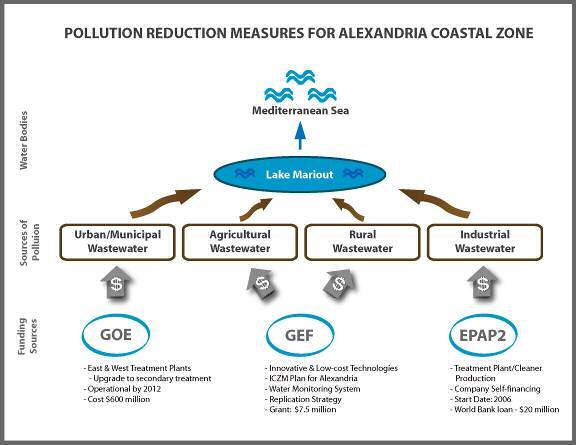
As mentioned earlier, the proposed project will complement other on-going projects, each
addressing a different source of pollution. The other set of interventions include the EPAPII sub-
projects on industrial pollution and the Government upgrade of the East and West Waste Water
Treatment Plants for domestic pollution. The proposed project will therefore focus on treating non-
point sources of pollution originating mainly from rural and agricultural areas while the other
interventions target point source pollution as shown in the figure below.
Figure 1: Complementarities of the proposed project with other on-going activities
Project Objectives
The Alexandria Coastal Zone Management project is expected to have important and positive environmental
impacts with an objective of contributing to a reduction in the load of land-based sources of pollution entering
the Mediterranean Sea, especially from Lake Mariout, through the hot spots of El-Mex Bay and Alexandria.
The project will develop a master plan for the management of coastal zones of Alexandria including Lake
Mariout, and through the implementation of innovative pilot-level low-cost investments in pollution
reduction. Accordingly, it is not expected that significant impacts would be generated through the
implementation of the project.
11
EEAA
AICZMP-ESIA
The main objective of the project is to improve the institutional mechanisms for sustainable coastal zone
management in Alexandria in particular to reduce land-based pollution to the Mediterranean Sea.
The proposed key outcome indicators of success are:
· The ICZM plan is officially adopted and the institutional mechanisms for implementation are
successfully implemented;
· The pollution load entering the Mediterranean Sea through Lake Mariout is reduced by at least 5%.
Project components
Component (1): Planning, Institutional Capacity and Monitoring
This component is intended to help increase the institutional capacity of the relevant agencies involved in the
management of Lake Mariout, in particular, and the coastal zone in Alexandria, in general. These agencies
include all those responsible for the direct implementation of the project, i.e the EEAA, the Governorate of
Alexandria, the MWRI, the MALR and the Lake Mariout Development Committee. The integrated
management of this vital resource is contingent upon:
(i)
Identifying the roles and responsibilities of the various stakeholders, through compiling
available studies, assessing the needs and capabilities of each of these stakeholders, through
focus group surveys and building consensus amongst those stakeholders, through stakeholder
consultation workshops.
(ii)
Developing a management plan for the Lake that takes into account the interests of the
various groups in an integrated manner, and studying the impact of various scenarios through
a water quality and hydraulic modelling of the lake and the various possible activities.
(iii)
Raising the capacity of the various stakeholders toward the optimal management of the Lake,
through training workshops and ICZM study tour for a representative group (a six-day study
tour for 10 participants).
(iv)
Ensuring the sustainability of the developed ACZM Plan through providing the main players
(EEAA, Alexandria RBO, and Alexandria Governorate) with the tools required to achieve
this goal, in terms of maps, GIS capabilities, computers and printers/plotters, water quality
monitoring equipment, and water quality management and data analysis software.
The expected outcome is an increased capacity by the various relevant entities to manage the coastal zones in
and around Alexandria in an integrated, participatory and sustainable manner, including planning, consensus
building, and monitoring. The outputs for this component will include:
(i)
a master plan for the management of the coastal zones of Alexandria including Lake Mariout
(the "Alexandria Coastal Zone Management (ACZM) Plan"), and
(ii)
the development of a water quality monitoring network to assess impact of project
interventions including a modeling activity for El-Mex bay, which can be used to estimate the
overall project impact on the Mediterranean..
The recommendations of the ACZM Plan will be reflected in the future land use plan for the city of
Alexandria. The Project Management Unit will prepare drafts of the ACZM Plan which will be reviewed by
the Project Steering Committee. The final draft will be approved by the National Committee on ICZM and a
Ministerial decree will be issued to officially adopt it. This component will finance:
a) consultancy services including public consultation workshops and master plan dissemination and
b) procurement of goods (computers, printers, water monitoring equipment, etc.).
This component will be implemented by the EEAA in close collaboration with the Governorate of
Alexandria.
12
EEAA
AICZMP-ESIA
The overall objectives of the ACZM Plan to be developed under this component shall be guided by the on-
going activities in Egypt related to coastal zone management as well as the principles of the Barcelona
Convention Protocol on Integrated Coastal Zone Management for the riparian Mediterranean countries to
which Egypt is committed. Under Article 5 of the Barcelona Convention, the objectives of integrated coastal
zone management are to:
(a) facilitate, through the rational planning of activities, the sustainable development of coastal zones
by ensuring that the environment and landscapes are taken into comment in harmony with
economic, social and cultural development;
(b) preserve coastal zones for the benefit of current and future generations;
(c) ensure the sustainable use of natural resources, particularly with regard to water use;
(d) ensure preservation of the integrity of coastal ecosystems, landscapes and geomorphology;
(e) prevent and/or reduce the effects of natural hazards and in particular of climate change, which can
be induced by natural or human activities;
(f) achieve coherence between public and private initiatives and between al decisions by the public
authorities, at the national, regional and local levels, which affect the use of the coastal zone.
It may be difficult at this early stage to foresee with great detail what the ACZM Plan would entail, especially
in the face of the complex institutional and administrative landscape related to lake management in Egypt.
Nonetheless, deriving from international experiences in the development of similar plans, a CZM plan would
typically include sections covering the following key areas:
(i)
the legislative framework and the overall regional and national contexts within which the plan is
developed,
(ii)
an overview of the overall coastal zone management program in the area,
(iii)
definition of the coastal zone boundary and a description of key activities influencing the
development of the coastal zone,
(iv)
institutional measures, guidelines and standards that govern the decision making related to
development in the coastal zone (this could be divided into several sub-sections covering the
relevant issues, such as water quality, marine ecology, wetlands, aquaculture, archaeology, data
management, public awareness & dissemination...etc),
(v)
description of the implementation arrangements including the assignment of roles and
responsibilities for the implementation and monitoring of a set of short, medium, and long term
measures, and
(vi)
an overview of the key agencies and stakeholders involved and their relevance to the
implementation of the plan.
Component (2): Pollution Reduction.
The expected outcome is a reduction in the land-based source of pollution entering the Lake Mariout and
subsequently the Mediterranean Sea through pilot pollution reduction measures. This will entail the
implementation of a package of pollution reduction measures, to be implemented on a pilot basis, to reduce
the pollution load entering the Lake Mariout, especially the nutrients (Nitrogen and Phosphorous), as well as
the oxygen depleting substances, such as the biological oxygen demand (BOD) and the chemical oxygen
demand (COD). This will, in turn, reduce the pollution load entering into the Mediterranean from the Lake
water through El-Mex pumping station.
13
EEAA
AICZMP-ESIA
It should be emphasized that the proposed project is complimentary to other on-going projects, each
addressing a different source of pollution (e.g. East & West Sewerage Treatment Plants; Innovative and low
costs technologies under the ICZM Plan for Alexandria; and EPAP II project.
The interventions considered to achieve the desired results fall under four major groups, namely:
1. Increasing DO level in the Qalaa Drain (the agricultural drain is mostly responsible for the BOD,
COD, and nutrient load to Lake Mariout) through installation of a set of aerators in the Qalaa
drains aeration.
2. Use of in-stream Bio-film for pollutant treatment in Qalaa Drain
3. a small scale engineered in-lake wetland located at the outfall of the Qalaa drain over 30 feddans3
as minimum area required for this application
4. reed removal in the lake to improve water circulation and self-cleaning capacity of the Lake.
This package is expected to bring a reduction of approximately 15 % of the COD load currently reaching the
El Mex Bay. The proposed package, when added to the implementation of the upgrading projects of
Alexandria WWTPs could make this reduction reach 50% of the current load.
The presence of the biofilm is likely to avail nitrogen in the form usable by the duckweeds, and will afford to
clear reeds in selected channels in the basin (selected based on hydrodynamic modelling).
The reduction of load resulting from the upgrading of the East Wastewater Treatment Plant could make the
final effluent from the Qalaa drain of reasonable quality (less than 50 mg/l), and a higher conversion of NH4
to NOs.
At least a similar improvement is expected in terms of BOD reduction. Since the base information concerning
the nutrients reaching the bay is not consistent, it was not possible to estimate the percentage reduction of
nutrients reaching the bay. It should be noted that this level of reduction of COD/BOD in the effluent to El-
Mex Bay and the partial recovery of the Lake's ecosystem, brings Egypt substantially closer to achieving its
regional commitments concerning discharges to the Mediterranean.
Further discussion of the applied technologies under this component will follow.
Planned Interventions under Component 2
In this section, the proposed interventions under component 2 are described. It has to be noted that further
studies will be conducted to refine these interventions however given the pre-feasibility studies conducted
earlier, it has been concluded that the proposed interventions should be adequate to achieve the desired
outputs within the overall project objectives if implemented in an integrated package approach.
The proposed package is composed of 4-intervention applications:
1. In-Lake Wetland
2. In-Stream
Biofilm
3. In-Stream
aeration
4. Reeds
removal
This integrated package represents a total approach to the pollution carried by the Qalaa drain including
COD/BOD and nutrients, as well as the larger scope of improving the basin's sediments.
The package of interventions is designed to use the nutrients conveyed by the Qalaa drain and valorise them
in a marketable product (1.25 ton/day NH4-N, and 2.29 ton/day NO3-N). Though nutritive salts will not be
eliminated fully, with the change in conditions, they will benefit of phytoplankton rather than hydrophytes,
helping the lake to recover its ecosystem, and gradually improve the assimilative capacity of the lake.
3 3 1 feddan = 4200 square meters
14
EEAA
AICZMP-ESIA
The expected reduction in COD load of the interventions in the Qalaa stream would be of 50%, out of a base
load of 98 tons/day. Based on a total load of 315 tons/day received by the basin, the total load will decrease
to 266 tons/day, and the expected reduction represents approximately 15% of the total load. The COD load
reaching the Mex bay through the pumping station will be of 189 tons/day. This will represent a reduction of
15 % of the COD load currently reaching the bay (224 tons/day).
The reduction in COD/BOD load and the diversion of nutrients from the lake, together with the improved
water circulation in the lake resulting from reed removal will have a positive impact on the Lake's
Biodiversity. It will permit endemic biota to begin to occupy its niche within the Lake's ecosystem.
In addition, this will improve the assimilative capacity of the lake by at least 25 % in a short term basis (or
36% as opposed to the current 29%) As the situation improves, this improvement could reach more than 50
%. The Lake's assimilative capacity could thus reach 43%. in the near future. An average increase of the self-
cleaning capacity to 40% will mean that the effluents to the bay through the Mex pumping station will be of
160 tons per day or almost 70% of the load currently reaching the bay.
The following is a description of each intervention independently.
Intervention 1: In-Lake Wetland
Theory:
Natural processes have always cleansed water as it flowed through rivers, lakes, streams, and wetlands.
Enhanced lagoon systems actively promote natural aquatic processes. They have the capability to convert
waste nutrients into benign and easily harvested forms. They can provide efficient, consistent and economical
wastewater treatment with the added potential for resource recovery. The availability of low-cost land allow a
more extensive, low-energy treatment processes can be, especially for final treatment of effluent, and provide
a cost-effective alternative to capital intensive treatment plants.
Engineered wetlands are now used to improve the quality of point and non-point sources of water pollution,
including storm water runoff, domestic wastewater, agricultural wastewater, and coal mine drainage. For
some wastewaters, engineered wetlands could provide a stand-alone treatment. For others, they are one
component in a sequence of treatment processes. In such case, similar to the case in hand, engineered
wetlands follow primary or secondary domestic sewage effluent.
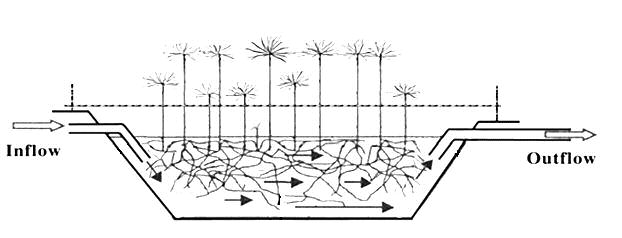
Figure 2: Schematic of a substrate-free CW with horizontal surface flow
The incorporation of aquaculture into wastewater treatment to reclaim nutrients and release clean effluent has
proved successful in many parts of the world. Purification levels have reached those attained by the best
alternative treatment methods.
15
EEAA
AICZMP-ESIA
Selected Location for the In-Lake Wetland:
The Main Basin (originally 6000 feddan) has the lowest water quality indices as shown in the Tables below. It
has the lowest dissolved oxygen (1.3 mg/l), the highest Sulphides content (5.93 mg/l). It has been dissected by
roads, canals and land reclamation. This situation decreased the basin surface area, impacted the water
circulation and created stagnation in many locations.
Table 2: Water quality indices of the various basins of Lake Mariout (Helmy, 2005).
Salinity
Turbidity
COD
DO
N03-N
N02-N
Sulphides
Site pH
mg/l
TU
mg/l
mg/l
ppm
ppm
mg/l
Main
7.5 292
0.76 51.11
1.3 12.55 0.07 5.93
Northwest
7.9 713
0.35 180.2
4.2 22.67 0.28
3.2
Fishery
7.9 833
0.35 45.83 5 27.1 1.68
3.6
Southwest
7.5 820
0.25 295.8
4.9 0.25 1.2
1.2
The Main Basin also receives three major sources of pollution. The Alexandria West Wastewater Treatment
Plants (WWTP, an overloaded primary treatment plant) discharges its effluent in the Northern part of the lake.
From the South it receives effluent from the Omoum Drain (Agriculture Drain) that continues almost
uninterrupted till the Mex Pump Station. In the Southern Eastern side, comes the Qalaa drain (agriculture
drain) that receives the effluent of Alexandria East Wastewater Treatment Plant (EWTP, an overloaded
primary treatment plant), see Figure 3.
16
EEAA
AICZMP-
ESIA
Ne
N w El
E -
l M
- anhsh
s i
h a
i WT
W P
Dr
D in
i ki
k n
i g Wat
a er Ca
C nal
a
Dri
r nki
k n
i g Wat
a e
in
r Dr
D ai
a n
ra
D
d
re
d
Amlak Drain upstream reach
Amlak Drain upstream reac
oa
ltu
oa
l
in
u
l
R
in
ra
in
ric
D
r
D
g
ra
r
Eas
a t WWTP
i
t
A
D
re
f
u
t
i
ona
k
a
o
k
D
ad
ar
la
r
na
o
lty
r
na
m
rt
l
rt
e
m
u
e
o
R
A
ca
I
nt
irp
i
r
al
F
ke M
A
WWTP Effl
f ue
u nt
l
t
u
a
L
y
r
i
cu
a
g
n
Kal
a a
l a
a Dr
D a
r in
i
A
ilw
i
Br
B an
a ch
c Kal
a a
l a
a Dr
D a
r in
i
a
x A
a
x
Kalaa P. S.
r
R
Kalaa P. S.
l
e
D
A
a r
h a
i
r
o
Z t
a
Ca
e
C
n
Gon
o et
o
e Zah
a r
h an
a Al
A Bah
G
a r
h ee
e
Figure 3: Sketch of Qalaa Drain System
17
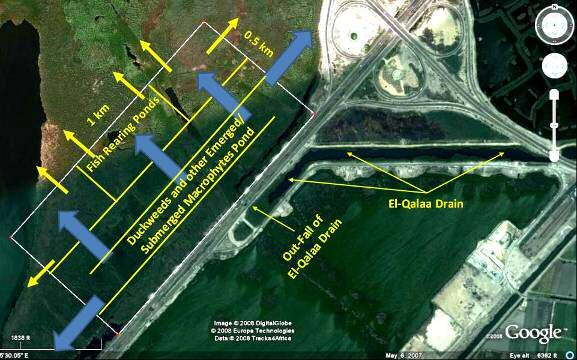
EEAA
AICZMP-ESIA
The north-western side of the main basin, where the Mex Pump Station is located, is in much better
shape because of the better water quality of influents reaching it, Omoum Drain and seepage from
Nubaria Canal and because of a higher water circulation, as opposed to the eastern part suffering from
stagnation.
The Southern-Eastern part of the main basin suffers from high load of BOD, COD, TSS and nutrients.
Although the discharge at this point ranges from 900,000to 1,300,000m3/day depending on the source
of data, stagnation in addition to pollutants gave the chance to hydrophytes to invade this part of the
lake, which magnify stagnation.
Based on the previously mentioned facts, the most suitable location for the engineering wetland has
been selected to be the East-Southern part of the lake at the outfall of El-Qalaa drain (Figure 4). This
aims to neutralize the negative impact of pollutants entering the lake, to utilize the high nutrients input
and increase the dissolved oxygen, directly and indirectly, and improve the water quality entering the
other parts of the lake.
Figure 4: Preliminary Layout of the Proposed In-Lake Engineering Wetland
Conceptual Design:
An area of approximately 30 feddans has been chosen for the proposed wetland construction. The area
will be facing the Qalaa Drain out-fall, and will be cleared from vegetation (reeds), excavated to
depths of 2 m and surrounded by earthen/rock walls to isolate this part from the lake. The excavated
material will be used for Dikes formation. Bucket dredgers, or similar devices, will be used for such
operations4.
4 Although the humic state of the sediments should not allow this use, it is assumed that the
sediments are not in this state for the 0.8 to 1.0 m depth of excavation needed in this context.
18




EEAA
AICZMP-ESIA
This area will be then subdivided into a number of Plug-Flow units where duckweeds will be
transplanted. It was suggested to include duckweed in the treatment system to play the role of
macrophytes
The out flow from the plug-flow units will be diverted to feed fish ponds stocked with tilapias and
silver carp. Other aquatic reeds and fish species can be tested in order to optimize the removal
capacity of this engineered wetland.
The outer surrounding walls of the area allocated to duckweed transplantation will be built with non
bounded stones and maintain a height below the maximum permissible level of the lake indicated by
the Ministry of Water Resources and Irrigation. A stainless-steel or plastic netting fence shall be used
to cover the remaining height to 50 cm above the maximum lake level. Such precautions to insure that
no retardation, due to the effect of vegetation growth, of the water flow coming out from the Qalaa
Drain and the water level is within the safe limits set-out by the Ministry of Water Resources and
Irrigation for Lake Mariout.
The walls surrounding the fish ponds (Figure 5) will be earthen and most of its material will be from
the dredging of the area allocated to the Engineered Wetland to maintain the 2 m water depth.
S
S
N F
F
P
W
M
P
W
Figure 5: Surrounding Walls
Benefits of using Duckweeds
Duckweed ponds can be qualified as secondary or tertiary treatment. It is reported that removal rates
can rise up to 75% and 80% for suspended solids and BOD respectively, while it also may ensure
effective precipitation (and thus removal) of heavy metals when preceded by sedimentation to remove
suspended solids (up to 6570%) and a large part of the organic matter (3045% of BOD), which is
comparable to the current case. Removal efficiencies of over 90 % for BOD, over 74 % for nutrients
and 99.78 % for faecal coliforms were reported in other country experience from having a duckweed
covered sewage lagoon (Figure 6).
19
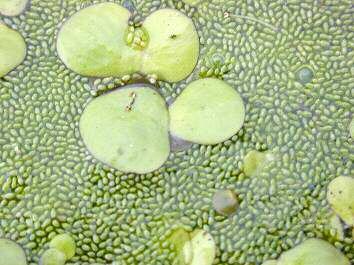
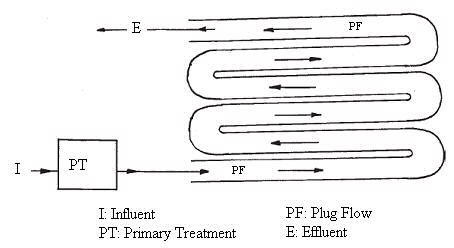
EEAA
AICZMP-ESIA
Figure 6: Lemnaceae is a family of flowering plants (also known as the duckweed family)
Duckweed treatment systems can either be, designed and operated as plug-flow, or batch systems. The
plug-flow (continuous flow through) design is more suitable treatment option for larger wastewater
flows originating from communities and urban areas such as in the case presented in this report, as it
ensures an improved and more continuous distribution of the nutrients (Figure 7). It also enhances the
contact surface between wastewater and floating plants, thereby, minimizing short-circuiting.
Moreover, a narrow, channel-like design allows easier access to the water surface for operation and
maintenance work.
Figure 7: Ideal Plug-Flow Systems for Combined Duckweed-based Wastewater Treatment
and Protein Production.
Since Lemnaceae (duckweeds) are very sensitive to water current, a floating bamboo or plastic
containment grid system is recommended to prevent the plants from drifting to the shore by the action
of wind and water current.
Reduction of Pollutants of Concern:
Engineered Wetlands, especially those based on Duckweed, have a great potential for renovating
effluent from a wide variety of sources including municipal sewage treatment plants, intensive
20
EEAA
AICZMP-ESIA
livestock industries (including aquaculture), abattoirs and food processing plants. The system could
effectively address all pollutants of concern. However, the actual reduction depends on a system
design that facilitates the correct combination of organic loading rate, water depth and hydraulic
retention time.
Pathogen removal is of utmost importance in case of effluent reuse as well as for duckweed use as a
fodder crop. Duckweed ponds perform well due to the intense duckweed cover preventing sunlight
penetration in the water column. The inclusion of tertiary maturation is recommended in case
pathogen reduction has not yet reached World Health Organization guidelines. To ensure acceptable
pathogen removal and treatment efficiency, comparatively long retention times in the range of 20 to
25 days are postulated for duckweed (plug-flow) systems. However, although in the current case
Qalaa drain is mostly anaerobic and allow the survival of pathogens, these are not expected to require
such long HRT since the closest discharge of municipal sewage is at least 7 km upstream of the drain
outfall to the Basin
Time Frame for Implementation
The major issues that should precede implementation is the dissolution of the very high uncertainties
resulting from the lack of reliable data on the water quality and circulation patterns within Lake
Mariout. To ensure the proper design of any intervention, such data should be available to designers.
Construction and making the system fully operational may take one year subject to budget
availability. Table 3 presents the tentative time frame envisaged for the In-Lake Engineering Wetland
option.
Sustainability
The rapidly growing and small floating aquatic plants of the botanical family of Lemnaceae are
capable of accumulating nutrients and minerals from wastewater. The latter are finally removed from
the system as the plants are harvested from the pond surface. Because of their comparatively high
productivity and nutritional value, particularly their high content of valuable protein, they provide an
excellent feed supplement for animals such as fish or poultry.
A uniform income should thus be generated which should contribute to the sustainability of the
proposed system. The generated income has the potential to cover total financial costs, and will cover
the operation cost. Integrating other production units, e.g. fish farming, will generate additional
income.
Duckweed holds the potential to create a financial incentive for controlled wastewater collection in
both rural and urban areas and, therefore, improve sanitary conditions. This increases the potential for
replication of the project.
When duckweed biomass is used for animal production, the generation of income and nutritional
improvement appear as possible side-benefits from the wastewater treatment process. Thus, the full
potential of duckweed aquaculture lies in its combined use in the fields of sanitation, food production
and income generation.
21
EEAA
AICZMP-ESIA
Table 3: Tentative time frame for the construction schedule for the In-Lake Wetland
Duration
Year 1
Year 2
Task Name
Days
1
2
3
4
5
6
7
8
9
10
11
12
1
2
3
4
5
6
7
8
9
10
11
12
Field Investigation Stage*
Lake water and sediment quality
36
Assessment
Qalaa Drain water quality assessment
24
Water circulation model and Ecological
240
survey
Survey works
15
Design of in-lake Wetland system
45
Participatory Approach Stage*
Local Governorate
15
Stakeholder awareness
30
Pre-construction group meetings
15
Wetland Construction Phase
Dikes
180
Earth works for drain outfall
60
Gates general
60
Weir and screen
30
Reeds transplanting
20
floating plants placing
20
Floating frames system
7
Steel works for screen and weir
14
Pine timber blocks (0.2*0.2*3m)
15
Fixed water level ruler system
7
*Intermitted activities covering all the period specified by the activity.
22
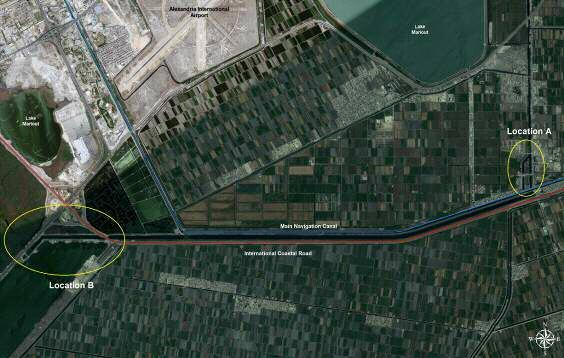
EEAA
AICZMP-
ESIA
Intervention 2: In-stream Biofilm
Theory:
The in-stream biofilm approach is considered to remove or reduce the organic pollutants by
adapting the severely polluted segments of the drains to act as large plug-flow anaerobic/aerobic
biofilm reactors in which bacterial culture will be intensified. This is to be achieved by hanging
submerged plastic packing media in a staggered manner at three-dimensions in a chosen segment
of the drain. This will form small channels of water allowing for good contact between pollutants
and biomass attached to the packing media. The packing media will be hanged in the segment of
the drain by a mesh of wires fixed at both sides of the drain. The bacterial growth on the biofilm
occurs naturally based on the conditions of the medium in which the biofilm is applied (aerobic,
anaerobic, or anoxic), and could be accelerated by inoculation.
Selected Location
Certain aspects and parameters are considered when choosing a restricted location of Al Qalaa
Drain and need to be verified /updated before the actual implementation of the project. These
aspects are illustrated below:
,,
The selected segment of the drain is preferred to be lined where the lining makes no
aggressions on the drains. Lining of the drains allows also for proper implementation of
the proposed approach (application of packing media in many segments of the drain)
,,
The cross-section of the drain segment should be uniform along the selected reach. This
would cause the velocity to be uniform along the reach.
,,
The selected reach is preferred where the drain is not surrounded by a residential area.
This decreases the chances for aggression of solid waste discharges, and improves
accessibility to the drain banks required for construction and maintenance, as well as
performance monitoring.
,,
Possibilities of more industrial wastewater to be discharged to the drain, e.g. through the
ETP, containing toxic chemicals, not treatable through the ETP process, might inhibit the
biological process. It is therefore preferable to apply the biofilm at a distance from the
ETP to allow chemicals, if any, to be fixed in the drain's bottom sediments.
Accordingly, a specific location for applying the in-stream biofilm approach has been selected
and it lies at the height of Qalaa Pumping station (Location "A" shown in Figure 8). The drain in
this location is conveyed to two branches, and each branch is of about 400 m length.
23
EEAA
AICZMP-
ESIA
Figure 8: Location for Biofilm Application in Qalaa Drain
Conceptual Design:
The main hydraulic characteristics and water quality parameters of Al Qalaa Drain that are
considered during the conceptual design of the In Stream Biofilm treatment system are illustrated
below. Table 4 presents the hydraulic characteristics of El Qalaa Drain in terms of flow, velocity,
cross-section parameters as per MWRI's records related to the Qalaa drain upstream the pumping
station5.
Table 4: The Hydraulic Characteristics of Al Qalaa Drain
Parameter Values
Flow (m3/d)
· SOGREAH N° 1740798/ FCN May 2008
915,790
· El Qalaa Pump station data Sep 2008 ( MWRI)
1,296,000
Bed width (m)
6
Bed level - above sea level (m)
-8.10
water level - above sea level (m)
-6.20
Water depth (m)
1.90
Bank width (m)
8.00
Bank level - above sea level (m)
-1.50
Side slope (3:2)
1.50
Bank width at bank level (m)
25.80
Water width at surface (m)
11.7
Water cross-section area (m2)
16.815
Available cross-section area for the packing media (0.50 m
13.44
above bed level) (m2)
Average velocity (m/sec)
·
SOGREAH N° 1740798/ FCN May 2008
0.63
·
MWRI
0.89
The main constraints that are considered prior for the proposed design of the in-stream biofilm
approach for Al Qalaa drain are summarized as follows:
5 It is assumed that the drain conserves the same characteristics, at the height of the
pumping station. However, this assumption will need to be confirmed during the feasibility
stage.
24




EEAA
AICZMP-
ESIA
1. The short length of the drain segment available for applying the approach (400m *2),
with minimal preparatory investments, since the other possible location will need larger
preparatory investments;
2. Dynamic flow variation (916,000 1,300,000 m3/d).
3. Possibilities of reduction in pollutants concentration due to expected improved
performance of the WWTP discharging to the drain (upgrading of the WWTP to be
secondary treatment). This will in general improve the conditions of the drain, but will
decrease the treatment efficiency of the proposed scheme. This is consequently reflected
in % reduction of total load and a higher cost per unit of pollution reduced.
Packing media: One meter length of corrugated collecting pipes for drainage water (used for
sub-drains, 3 inch PVC is selected to be the packing media for the case of Al Qalaa Drain. The
packing media will be packed in steel-bars box-frame/FRP (fiber reinforced polymers) units of
dimensions 0.5*1.0*1.0 m. Two steel cables will be fixed in the side slopes of the drain to hang
the units. These cables will be used in hanging the units containing the carrier material and it will
represent one section of interventions of in-stream biofilm.
Two steel cables fixed in
the side slopes to hang
the units contain the
carrier material
Water Flow
Biofilm
Biofilm
Steel/FRP frame
box filled with
carrier material
Biofilm carriers
Figure 9: Schematic diagram illustrating the implementation of one section of the
proposed Instream Biofilm System at Al Qalaa Drain
The in-stream biofilm system is designed to be applied in 500 sections along the selected segment
of Al Qalaa Drain. Figure 10 Illustrates the general arrangement of these sections). The
implementation of these 500 sections may well be carried out using occupancy ratio of 75% or
50%. In these cases, the units of the pipes will be designed according to the dimensions of the
drain cross section to have 75 or 50 % occupancy of the cross section.
25










EEAA
AICZMP-
ESIA
One section of In Stream Biofilm
O2
O2
Nitrification
BOD
O2
Numbers of In Stream Biofilm sections in series
Figure 10: The proposed implementation of different sections of in stream Biofilm
system along Al Qalaa drain
The proposed occupancy ratios are easier in construction and maintenance and they have less
hydraulic resistance and losses. The main disadvantage of such scenarios is that they require an
increased length of segments of the pipes to be used.
.A very careful hydraulic assessment of the drain is required before the actual implementation of
this intervention.
Reduction of Pollutants of Concern
The pollution reduction of this proposed in-stream biofilm system will depend mainly on the
oxygen condition created in the drain after the interventions. The system has the possibility to
work dynamically /simultaneously under aerobic and anaerobic conditions, although at different
efficiencies. High removal efficiency is expected under aerobic conditions (DO > 1 -1.5 mg/l)
however under anaerobic condition reduction would still be expected, but at a much lower level.
Practically, and given the flexibility that the system provides, the performance of the system will
fall within the range specified by the extreme (aerobic-anaerobic) conditions presented in the
Table below.
These calculations are based on the data available on current load of the Qalaa Drain. With the
expected improvement resulting from the upgrading of the WWTP, the removal rates and thus the
efficiency are expected to decrease. The magnitude of decrease can, however, hardly be
estimated, given the lack of data on the current material balance of the drain.
Table 5: The expected reduction of pollution at both aerobic & anaerobic conditions
(75%)
(50%)
Item
Occupancy
Occupancy
Anaerobic condition
Removal rate for each section (Kg COD/day)
1.9 - 11
1.3 7.3
Total removal rate for 500 sections (T COD/day)
0.95 5.5
0.65 3.7
Total removal rate for 500 sections (T /year)
347-2000
237-1350
Removal efficiency*
(%)
1 - 6
0.7 - 4
Aerobic condition
26
EEAA
AICZMP-
ESIA
Removal rate for each section (Kg COD/day)
86 - 150
57 - 100
Total removal rate for 500 sections (T COD/day)
43 - 75
29 - 50
Total removal rate for 500 sections (`000 T/year)
15.7- 27.4
10.6- 18.25
Removal efficiency*
(%)
44 - 77
29 - 51
* Removal efficiencies are calculated based on the Pollutants Loads (t/d) provided by
(SOGREAH N° 1740798/ FCN May 2008).
Time Frame for Implementation
The in-stream biofilm intervention can be implemented according to the following procedure:
Survey works
Drain water quality assessment (Detailed assessment of water
quality parameters)
Hydraulic characterization of the location/s of application including
velocity, flow and detailed cross section description (bed, side
slopes, water depth, berm level, etc.)
Allocating sampling units to assess the kinetics of the approach
under both aerobic and anaerobic conditions
In-stream Biofilm Construction
Monitoring and Evaluation that includes ;
o
Water quality parameters ( TSS, COD, BOD, NH4, P, DO, pH)
o
Hydraulic parameter (water level and total heading up due to
the backing media, clogging, etc.)
o
Biofilm characteristics ( TSS, VSS, biomass activity test)
Table 6 illustrates the time frame for implementing the in-stream Biofilm approach according to
the procedures mentioned previously.
27
EEAA
AICZMP-
ESIA
Table 6: Timeframe for implementation of In-Stream Biofilm Approach
Duration
Task Name
Qrt 1
Qrt 2
Qrt 3
Qrt 4
Qrt 5
Day
Field Investigation Stage
Survey works
30
Drain water quality Assessment
60
Hydraulic characterization of the
60
location/s of application
Allocating sampling units to assess the
90
kinetics of the approach under both
aerobic and anaerobic conditions
Design of in-stream biofilm
60
Public Awareness Stage
Local Governorate awareness
30
Stakeholder awareness
30
Pre-construction group meetings
30
In-stream Biofilm Construction
Site preparation (Enhancing drain
90
profile)
Fence construction
90
Manufacturing of packing media in
90
unit sections
Manufacturing of screen and other
90
supporting materials (cables , etc)
Installation of packing media in phases
90
(100 section in each phase)
Monitoring and Evaluation
180
Sustainability
The system is flexible and can cope with variations in operation conditions (system could self
adjust from aerobic to anaerobic and even to anoxic conditions and vice versa according to
changing contextual conditions). The system flexibility is extended to cope with any variations in
the performance of both the eastern and western WWTPs. In case of plant performance is
improved and accordingly the pollution load is decreased in the drain then biofilm species could
be shifted from one type to another according to upcoming variation in water quality. The system
could work anaerobically in case of high organic loads while in case of improving the plant
performance the system could work then as tertiary treatment either for ammonia oxidation or
even to perform de-nitrification process.
28
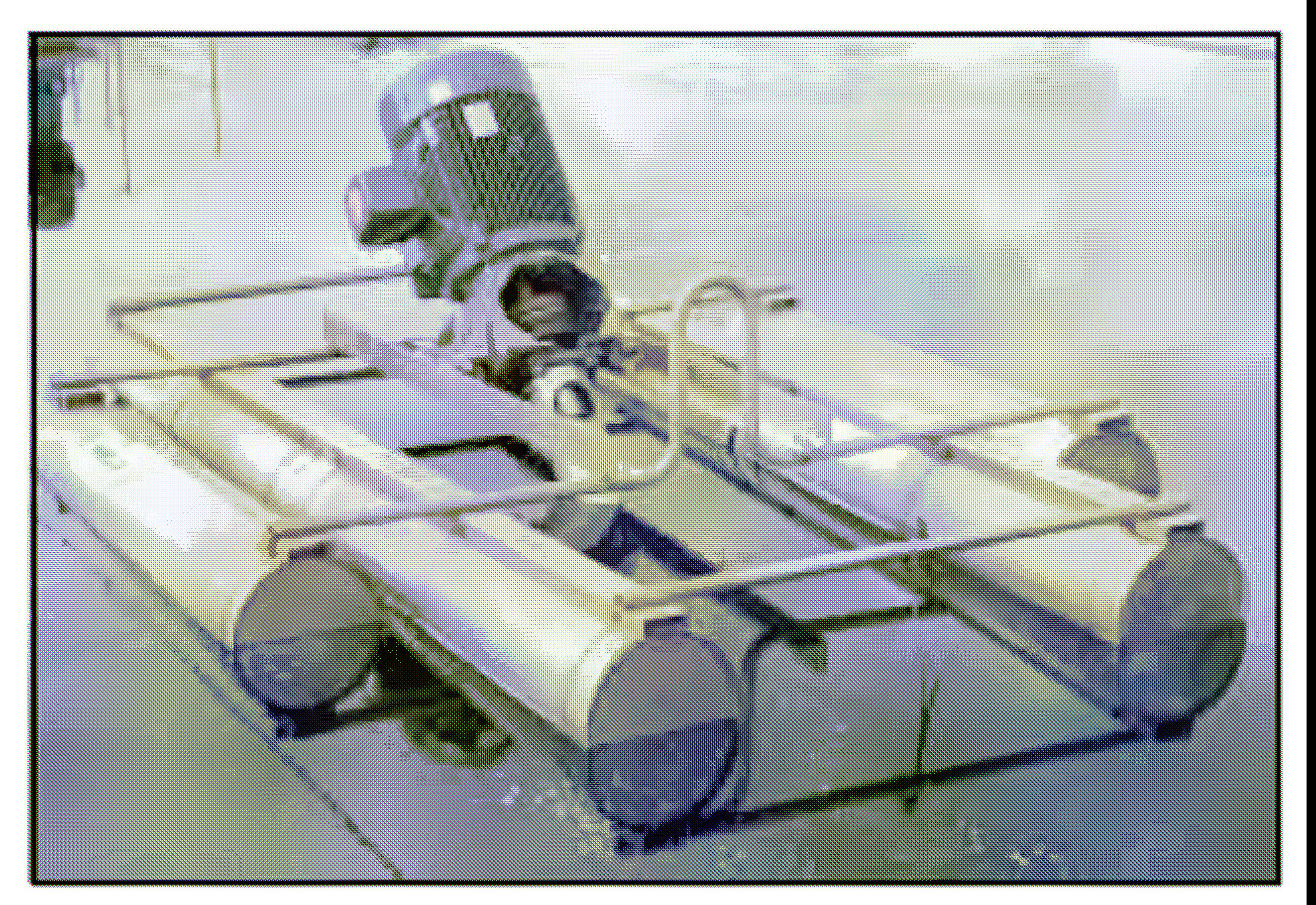
EEAA
AICZMP-
ESIA
Intervention 3: In Stream Electric powered Aeration
Theory
This application is utilized to increase the DO which will improve the drain conditions and thus
self purification. It also helps in the consumption of COD/BOD as well as the conversion of NH4
to NO3.
Location
The chosen location for this application is responding to a number of factors. The primary
objective being to raise the DO in the drain, the reaches of the drain with the lowest DO level are
expected to have the highest assimilation efficiency. Moreover, because the equipment is costly
and requires electric power, it needs to be located in a secured site close to a source of power.
Two locations seem to fulfill these criteria, the ETP and the Qalaa pump station (Location "A" of
Figure 8). Finally, if aeration is coupled with the biofilm application, it needs to be located right
in its upstream. Accordingly, Location "A" has been chosen.
Technical Description
Aerators utilized for wastewater treatment are readily available on the market. The one selected
be energy efficient in a way that converts the least amount of energy into the maximum amount
of aeration and mixing. The aerator selected should also be of a simple design, to insure low cost
of maintenance. In order to insure a high assimilation of oxygen, all aeration will takes place
below the water surface and optimal bubble hang time. A compact and mobile, and accordingly
self-contained, will be used to allow the needed flexibility for location adjustment, if needed.
Figure 11: Typical Float Mounted Aerato
The unit proposed is mounted on a stainless steel floating platform and has a stainless steel shaft
and a large sub-surface propeller, as shown in the figure above. It is assumed that the unit would
be of 50 HP (37.5 kW).
The specifications of the selected system ensure a transfer of 1 kg O2/kWh. The selected size of
50 HP thus transfers 37 kg of O2/hour or 888 per day. The actual intake depends on a number of
29
EEAA
AICZMP-
ESIA
factors including the base level of DO and the size of bubbles and their hang time. The location
and shaft angle will be selected to maximize intake. However, if a mildly conservative rate of
transfer of 50% is used, this will result in an intake of 444 kg O2/ aerator.
Reduction of Pollutants of Concern
The daily flow of Qalaa Drain is between 900,000 and 1,200,000 m3/d depending on the source.
Sources agree that the DO level is +/- 0.5 ppm. A single aerator6 could substantially improve this
level by about 0.3 to 0.5 ppm.
Time Frame for Implementation
Survey of proper locations, stream velocity, DO concentration and accessibility as well as
concept refinement should take place during the feasibility stage. All design and shop drawings
should be ready for producing the modules within 2 months. The manufacturing time will depend
on the number of modules, which will be installed along the stream, but is preliminarily estimated
to be of 4 months.
Parts assembly and fitting should be tested before installation at the site. Module testing for
proper balancing and rotation shall be carried out to insure proper rotation before implementation.
Installation time would also be sensitive to the number of modules to be installed. However,
according to the above it could start as early as 6 months after the start of the implementation
phase.
Intervention 4: Reed Removal
Reed removal will potentially improve water circulation in the basin, thus both improving its
aeration and entraining some of the deteriorated sediments. The second order effect of both direct
impacts will be to improve the basin's self cleaning capacity to a rate higher than the current 29%
and 56% for COD and BOD respectively. Although, it is impossible to predict the improvement
at a reasonable accuracy given the current level of data concerning current circulation patterns
and the lack of a modeling tool for the basin, any alternative recommended will be expected to
better perform if coupled with an in-lake reed removal component. It is therefore considered a
base intervention.
6 For actual design, smaller strategically positioned aerators will be considered.
30
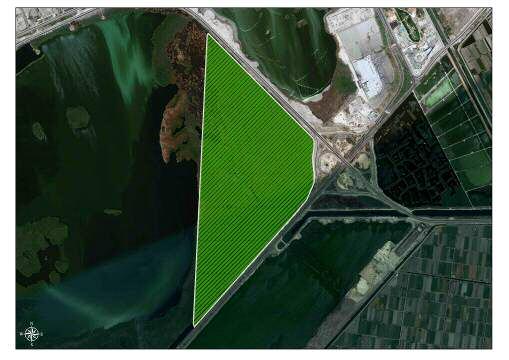
EEAA
AICZMP-
ESIA
Figure 12: Area of Intervention for Reed Removal
31
EEAA
AICZMP-
ESIA
Phasing of Implementation of the Proposed Package
Within the proposed package described above it is proposed to start implementation with one set
of 500 sections of biofilm and accompanying aerators, in Location A, monitor its performance,
and take the following steps accordingly. Although, it is expected that not less than 500 sections
will be needed, it is recommended to implement this set in phases of 100 sections to allow for
needed mid-way adjustments.
It is also proposed to construct a small pilot in-lake wetland. The area is proposed to be limited to
a few feddans. This will play two roles. First, monitoring of its influent, its effluent and its
production rate will generate important information to direct the following investments.
Moreover, since Duckweed is newly introduced to Egypt, therefore it could represent a
demonstration for a subsequent up-scaling. Starting with a small pilot, will also be useful in
addressing resolve the potential institutional conflict in the lake, which could be easier to manage
after an initial success of duckweed production and marketing.
After one year of operation, i.e. two years within the project implementation phase, the above
system should have reached steady state. Based on the monitoring of performance, potential
additional treatment investments could be:
· An extension in biofilm/aerators modules; and/or
· Additional aeration.
32
EEAA
AICZMP-
ESIA
Component (3): Project Management and Monitoring and Evaluation.
The expected outcome is the completion of a M&E system and the documentation of the project
results for the purpose of up-scaling and replication. The outputs of this component include
1. a project monitoring system with measurable indicators; and
2. documentation of project's progress and results, dissemination of lessons learned
from the project and adoption of a replication strategy.
This component entails supporting the Project Management Unit (PMU) currently associated with
the EPAP II to carry out the various activities related to the project implementation. The
Monitoring function under component 3 applies to all project interventions including evaluation
and reporting whereas the Monitoring function in component 1 is only intended to monitor the
water quality of Lake Mariout and the Mediterranean Sea.
In addition, the monitoring equipments are different for each component and require a different
set of skills for their operation. This component includes hiring of local and/or international
consultants to:
(a) support the PMU, especially as related to technical, financial management and
procurement, on a part-time basis,
(b) assist the PMU in the development and implementation of the necessary
monitoring and evaluation framework, including data analysis and reporting as
related to pollution loads to Lake Mariout and to El-Mex bay, and
(c) assist the PMU to develop the necessary information dissemination strategy to
follow-up on the project's progress and to disseminate lessons learned.
The vehicle for the latter is likely to be national workshops, as well as the participation in the
GEF's International Waters Learning Exchange and Resource Network (IWLEARN) programs.
33
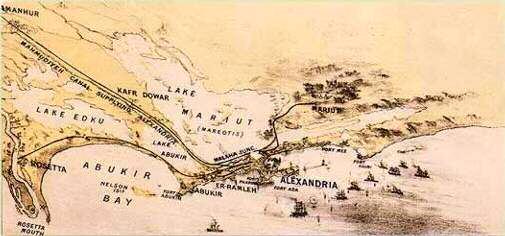
EEAA
AICZMP-
ESIA
: Description of the environment
Lake Mariout Background
Lake Mariout has been subject to major modifications, most of which are either direct human
interventions or indirectly result from such interventions. Human activities have put the lake to a
wide variety of uses some of which are benign, including fishing. However, these uses are not
always consistent as the Lake has also been used for discharging of primary treated sewage and
industrial wastes. The lake environment was continuously subjected to quality degradation due to
human pressure as well as land reclamation reducing the area of the Lake. In 1801, the original
area was probably in excess of 700 km2 (Figure 13).
Figure 13: An early map, published in 1882 clearly showing Lake Mariut
Because of railway and road construction isolating parts of the lake, the cessation of
annual Nile flood after building the Aswan High Dam, and land reclamation which started
early in the 20th Century before it became a state policy in its second half, the area of
the lake is now less than 65 km2.
Figure 14 represents the evolution of Lake Mariout since 1972 till 2007.
34
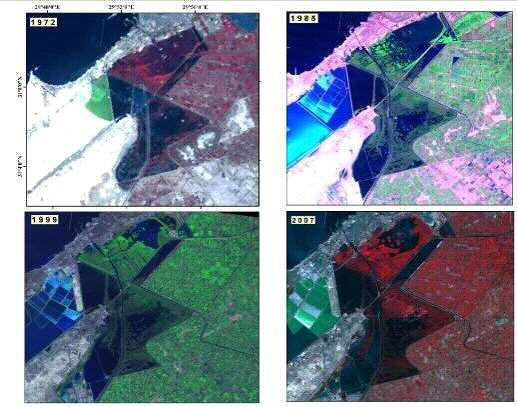
EEAA
AICZMP-
ESIA
Source: National Authority for Remote Sensing and Space Science, personal communication
Figure 14: Surface Area of Lake Mariut 1972 2007
The direct result of the dynamic and continuous change of the Lake configuration is that the
relevance of historical data as inputs to potential interventions is questionable. Accordingly, the
following section attempts to collate the most recent data available to provide a reliable,
although by nature approximate, basis for this report.
Current System Configuration and Status of the Lake
Lake Mariout is an intermediate stage of discharge of multiple land based sources to the El-Mex
Bay. Water level in the lake is managed by pumping the water to the sea, as there is no strait
connecting the lake to the Mediterranean. The fact that domestic sewage, industrial, and
agricultural waste are discharged continuously to the lake makes this pumping station essential
to maintain water level at 1.88 2.0 m below sea level.7
7 An important result of the existence of the pumping station as a regulator of water level is
that the change of influents to the lake is possible without creating undesired imbalances
affecting the surrounding activities
35
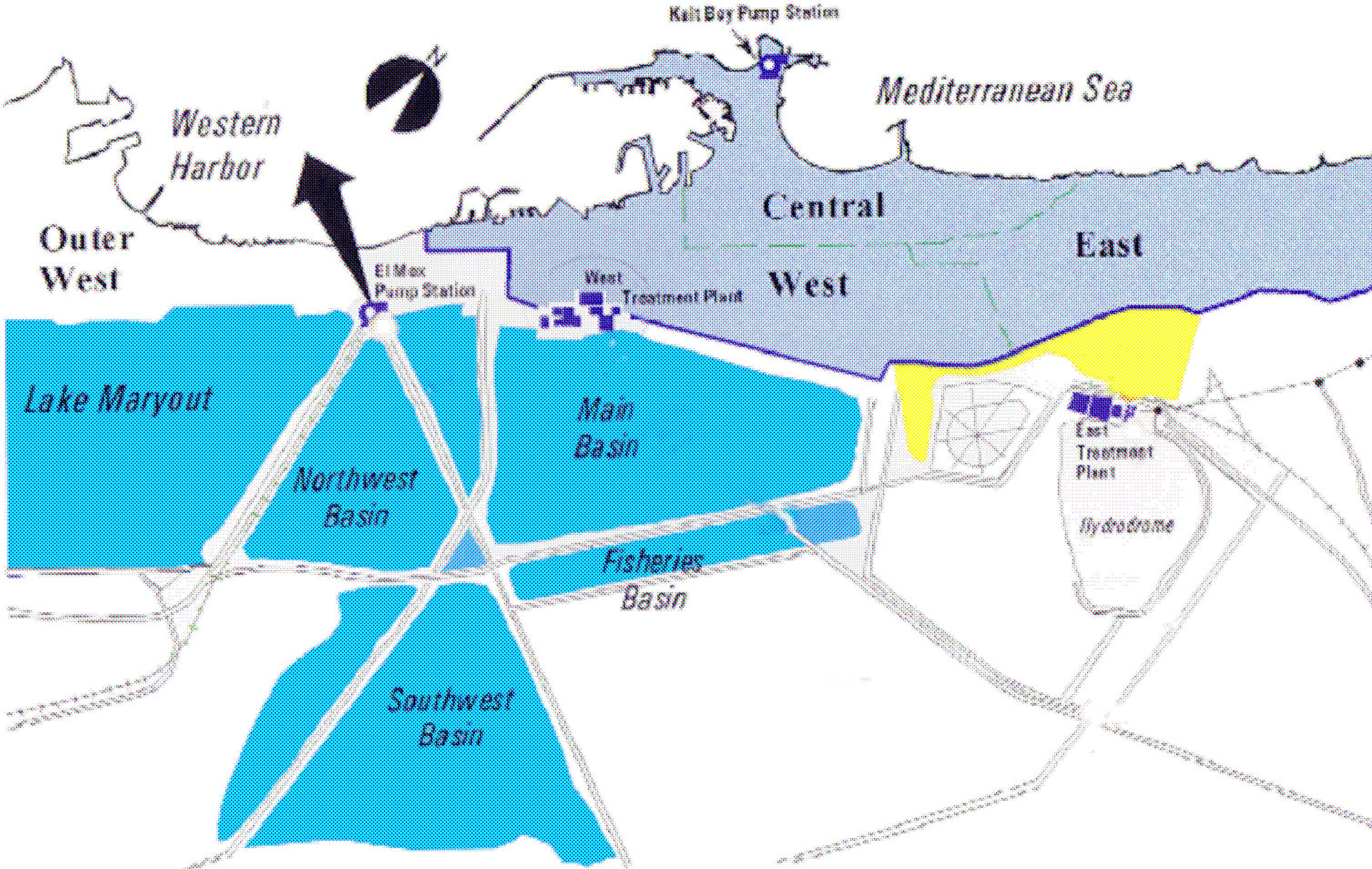
EEAA
AICZMP-
ESIA
* Source: Comprehensive Strategic Development Plan for Lake Mariout Zone
Figure 15: The Basins of Lake Mariout
As Shown in Figure 15, the lake currently consists of five basins:
1. The main basin (21 km2) with an average depth of 1.2 meters;
2. The northwest basin (10.5 km2) with an average depth of 1.25 meters;
3. The fishery basin (4.2 km2) with an average depth of 1.35 meters;
4. The southwest basin (21 km2) with an average depth of 0.5 meters; and
5. The west basin (8.4 km2) with an average depth of 0.6 meters.
The water quality of the different basins of has been analyzed by the Lake Mariout
Rehabilitation Component of the Comprehensive Development Plan for Lake Mariout.
The water quality of the basins was reported as follows:
Lake Mariout Water Quality
The concentration of dissolved oxygen in all the basins is less the 5 mg/l, which is not in
compliance with the limits set by the Law 48/1982 for non fresh water bodies. However, the
lowest DO value was recorded in the Main Basin.
Total heavy metals concentration in the water of the Main Basin is also considerably high
reaching over 12 mg/l as compared to 1 ppm for the law limit. Iron is the dominant metal in
water with a concentration of 10.2 mg/l. Other heavy metals concentrations in water mainly Ni,
Cu, Zn, Cr, Pb are relatively moderate.
36
EEAA
AICZMP-
ESIA
Table 7: Average Water Quality in Lake Mariout
Sampling
site
Limits
Main
Northwest
South
Fisheries
West & Southwest
Parameters
pH 7-8.5
7.47 7.88 7.8 7.87
7.5
DO >5
1.3 4.2 3.3
4.95
4.9
Turbidity 50
TU 0.76
0.35
0.1
0.35
0.25
* Source: Comprehensive Strategic Development Plan for Lake Mariout Zone
The sediment quality was also analyzed by the Lake Mariout Rehabilitation Component. Heavy
metals analyses showed the highest concentrations of manganese, iron, zinc and copper in the
Main Basin.
It is clear from the above the Main Basin is the most polluted basin of the Lake. It is also
physically apparent in that water reeds cover about 75% of the basin area. Moreover, the basin
sediments are a constant source of contamination to the basin's water. Due to the accumulation
of contaminants, poor oxygenation, stagnation and fermentation of biological materials, the
basin's sediments are permanently in a colloidal state. This impairs the sediment capability to
assimilate pollutants and neutralize their impact on the surrounding ecosystem. The sediments
rather seep their historical pollution load to the water, based on the solubility of each compound,
rendering the water body above the sediment always saturated with pollutants.
Influents to the Main Basin
The Main Basin is fed from different water sources. These include precipitation and seepage of
ground water from surrounding fields, resulting from the lower water level controlled by the El-
Mex Pumping Station. However, major sources are Alexandria 2 Wastewater treatment plants
and 2 major agricultural drains.
Until the eighties most of the domestic sewage and industrial wastewater were discharged
directly into the Mediterranean Sea form a number of outfalls along the coast of Alexandria.
Pollution of beaches and the inshore waters caused severe impact on Alexandria as a summer
holiday city. This made the local authorities decide to divert these discharges, of untreated raw
sewage mixed with industrial discharges, into Lake Mariout Main Basin. Major deterioration of
the Basin occurred at that time, and Main Basin became highly eutrophic and polluted with
various chemicals.
Later, two primary treatment plants were built and started operation in the nineties. The quality
of water reaching the Main Basin improved, but the Main Basin Ecosystem did not recover. The
current Self Cleaning capacity of the water body has been deduced through a simple mass
balance of pollution loads entering the lake and the water quality data available for the El Mex
pumping station8, to be 39 %, 29% and 56% of TSS, COD and BOD respectively. Although it is
clear that the deteriorated ecosystem of the lake is not capable to handle the wastewater with all
8 Sogreah Consultant, 2008. Baseline Conditions, August 2008. Alexandria Integrated Coastal Zone
Management Sub-Program (AICZM) of the Egyptian, Pollution Abatement Project (EPAP II), Global
Environmental Facility fund (ID #2602), pp. 37
37
EEAA
AICZMP-
ESIA
the soluble organics still being discharged into the lake. Self cleaning of the lake has a major role
to play in the improvement of the quality of effluent to the El-Mex Bay.
The Main basin receives the primary treated wastewater from the Alexandria West Treatment
Plant (WTP), amounting to 400,000. m3/day. The agricultural drains discharging to the Main
Basin of the Lake are the Omoum and Qalaa Drains. The Qalaa drain conveys primary treated
effluent of Alexandria East Treatment Plant (ETP), in addition to agricultural drainage and
untreated municipal wastewater discharge from rural settlements through a number of secondary
and tertiary drains as presented in figure 4 below. The total flow to the Basin from Qalaa Drain
falls within the range of 900,000. to 1,250,000. m3/day depending on the source9.
On the other hand, the Omoum drain ( 4,000,000. m3/day) flow is mainly agricultural drainage
water in addition to minor quantities of untreated sewage discharged along the drain. There are
numerous surface water connections between the basins and the drains. These connections include
large openings, smaller cuts or breaches in the dykes and small box or pipe culverts. The main
pollutants in the agricultural drains are organic materials reaching the drains from domestic and
industrial sources; nutrients from application of fertilizers and discharge of untreated domestic
wastewater; heavy metals as a result of industrial discharges or impurities in fertilizers; salts from
the percolating irrigation water enriched through evaporation; and pathogens from disposal of
human sanitary waste. The results of analysis of water quality of the main drains, discharging
directly or indirectly to the Main Basin, are summarized in table 4 below.
The dissolved oxygen in all the drains is lower than the permissible limits in Law 48/1982, which
requires that the dissolved oxygen in non fresh water bodies be at least 5 mg/l. However, Omoum
Drain has clearly a much higher level of DO compared to different reaches of Qalaa drains,
including secondary drains discharging to it, represented in the table above by El Amlak Drain.
Table 8: Pollution loads of influents to the lake (t/d)
TDS
TSS COD BOD
P
NH4-N N03-N Sources
WTP
-
67 117 44 -
-
- ASDCO
El Qalaa drain
1.413 110 98
73 1,03 1,25
2,29 DRI,
2005/2006
Oumoum drain
15.54 155 84 277 1,71 8,37
3,98 Nagy
The north-western side of the main basin, where the Mex Pump Station is located, is in much
better shape because of the better water quality of influents reaching it, Omoum Drain and
seepage from Nubaria Canal and because of a higher flow, as opposed to the eastern part
suffering from stagnation.
The Southern-Eastern part of the main basin suffers from high load of BOD, COD and TSS as
shown in the following Tables, stagnation though the discharge is at least 900,000 m3/day and
low salinity that gave chance to hydrophytes to invade this part of the lake.
Table 9: Average water quality in Drains Discharging to Main Basin
9 SOGREAH report, MWRI respectively
38
EEAA
AICZMP-
ESIA
Sampling
Amlak drain
Qalaa
Qalaa
Qalaa
Omoum
site
Limits
(discharging
outfall
drain
PS
drain
Parameters
to Qalaa)
pH 7-8.5
7.16
7.34
7.6
7.64
8.18
DO >
5
0.54
0.43
1.8
0.01
4.5
Turbidity 50
TU 4.1
2.5 0.3
0.2 0.2
Table 10: Pollution concentration of influents to the lake (mg/l)
NH
N0
TDS
TSS COD
BOD
P
4-
3-
Discharges
N
N
Source
mg/l
mg/l
mg/l
mg/l
mg/l
m3/d
mg/l
mg/l
WWTP
410325
164
284
108
ASDCO
DRI, 2005/
El Qalaa drain
1543 120 107 80 1,13 1,37
2,5
915790
2006
Oumoum
3700 37 20 66 0,4 2,0
0,9
Nagy
drain
4200000
39
EEAA
AICZMP-
ESIA
Regional Geology
Studies on the geology and geomorphology of the north-western Mediterranean coastal
region of Egypt were reviewed by Helmy (2005). According to these studies, the entire
northern region of the Egyptian western desert is covered by sedimentary formations,
which range in age from lower Miocene to Holocene.
The Holocene formation is formed of beach deposits, sand dune accumulations, wadi
fillings, loamy deposits, lagoonal deposits and limestone crusts. The beach deposits are
composed of loose calcareous oolitic sand with some quartz grains and shell fragments.
The sand dune accumulations are in the form of either coastal or inland dunes. The
coastal dunes are composed of snow-white, coarse calcareous oolitic sand, while the
inland dunes are of reddish colour and finer sand. The wadi fill comprises lime gravel
and fine alluvia. The loamy deposits are fine sandy loam intermixed with gravels.
Lagoonal deposits are present in the depressions between ridges and are composed of
gypsum intermixed with sand and alluvium. The limestone crusts are developed on the
exposed limestone surfaces.
The Pleistocene formation is formed of white and pink limestones. The white limestones
are in the form of exposed ridges stretching parallel to the coast. They are composed of
white calcareous oolitic sandy limestones, yielding Pleistocene microfossils, echinoid
spines, calcareous algae and shell fragments. The pink limestones are composed of
pinkish white oolitic sand, yielding Pleistocene micro-fauna.
The Pliocene formation is represented by creamy limestones which are marly and sandy
in subsurface. They are partly exposed in some localities. The Miocene formation
includes two divisions. These are collectively known as the "Marmarica Limestone". The
Lower Miocene type is formed of sandy limestones, shales and marles and is known as
the "Moghrs Formation". The Middle Miocene type is represented by limestones and
dolostones with intercalations of clays, sandstones and siltstons.
Limestone Region of the Northwestern Delta
The deltaic coast west of Abu Qir Bay is characterized by a morphologic structure different from
that to the east. This part of the coast is formed from successive chains of oolitic limestone;
between them are low valleys. The limestone chains themselves appear as ridges about 120 ft.
above sea level. The region has five subdivisions:
i) The coastal range is comprised of white sand dunes mainly consisting of
limestone particles. There are several ideas on how the dunes were formed.
Some people consider them to be coastal dunes formed at a time when the
Egyptian coast was completely dry. Others attribute to them a marine origin. The
width of the coastal range is about 400 m2.
ii) Wadi
Mariout
extends to the south of the coastal range at five meters above sea
level or less. The wadi is covered by a thick limestone soil (derived from the
bordering ranges) sometimes more than five meters deep. There are different
theories about how the wadi was formed: whether from crustal movements or an
old lake.
iii) The Al- Max-Abu Suwayr range falls to the south of Wadi Mariout. It has a width
of between 200 and 400 m. and its height is 36 m. The range slopes abruptly
40
EEAA
AICZMP-
ESIA
toward Wadi Mariout in the north and toward the Mallahat Mariout Depression in
the south. The formation of this range is attributed in part to the influence of the
wind. It was originally formed from remnants of sea shells and calcined sand
particles fused by rain and evaporation. During the rainy season, rains loaded
with diluted carbonic acid dissolve the calcium carbonate so it becomes
bicarbonate; in the dry season this settles between the sand particles and
solidifies.
iv) Some geologists think that the western tip of the Max-Suwayr range was
subjected to limited folding which uplifted the bottom of the Mallahat Mariout.
Depression and separated from it the far western sector. Evidence of this is the
gypsum formations (called Wadi Al-Gibs, i.e., gypsum) which are mounds of
saline deposits six meters above sea level. These forms to the period between
12,000 and 10,000 B.C., when sea level was lower and aridity prevailed. The
depression of Mallahat Mariout lies between the central and southern ranges. It
was previously an extension of Lake Mariout.
v) The range of Gabal Mariout (also called Al-Batn and Al-Qarn) forms the southern
boundary of the depression; it is 35 m above sea level, and in the northeast
reaches 51 m. although it is only 30 m height in the north- west. The width of the
range is between 300 and 400 m to the south of the range, the raised plains of
Mariout extend as far as the Miocene plateau.
Sandford and Arkell have summarized their opinions concerning these ranges: "The
remarkable ridges of lime sand oolitic limestone west of Alexandria, separated by
parallel valleys, afford a perplexing geological problem, but on the whole there is much
to support the view that they were formed by wind action along a receding shore line; a
new dune area is forming between the ridge nearest the sea and the present storm
beach".
It is possible that the shape of Lake Mariout (broad in the east with an arm extending to
the west) is attributable to its location at the convergence of deltaic formations with the
region of oolitic limestone chains. The influence of the delta is apparent in the eastern
lake which is broad and shallow, while the western part is clearly influenced by the
morphology of the western coast.
Sand Dunes and the Northern Coast of the Delta
Sand dunes are the main geomorphic feature in the greatest part of the deltaic coast
east of Abu Qir Bay. Most of the sand dunes along the coast are low and narrow. They
do not exceed a few meters above sea level, and their widths range between 500 and
1500 m three parallel lines of dunes stretch from the sea towards the interior. The outer
line is about 50 m wide and consists of sand and silt mixed with some marine formations
brought by seawater during high tide.
Lake Mariout
Lake Mariout is different from the other Northern lakes in that it is a closed lake. It is also
in a unique region characterized by the presence of limestone barriers. The lake is
impounded between one of those barriers and the delta.
41
EEAA
AICZMP-
ESIA
It is important to distinguish between Lake Mariout and the Mariout Depression. The lake
does not occupy the whole depression; it covers only 23,690 feddans, or about 12.7% of
the depression. The lake is broadest in the middle. It has no bays or bogs. A western
arm of the lake extends to the southwest, along a hollow between the El-Mex-Abu
Suwayr range in the north and Mariout ranges. The width of this 35 km long arm is from
two to five kilometres. It is known as the of Mallahat Mariout depression. This arm is now
cut off from the rest of the lake by the railway line built in 1858, and has become a group
of shallow lagoons. The water level of these lagoons is high in winter and low in the
summer, at which time a layer of white salt is left behind. The western end of Mariout is
no longer covered by water; some halophytic shrubs and grasses grow in it.
The central section of the western arm is nearly always dry, but covered with layers of
salt. The lower eastern end is always covered with salt water. There are no islands in
Lake Mariout because it is far from the old deltaic branches and because the lake has
shrunk to occupy only the lowest section of its basin. Some time in the past, there were
eight islands in the lake. Now they are part of the surrounding land surface. The most
famous lands were Al-Sharan, Tall Al-Ghazal, Tall Al-Gabarti, and Tall al-Hanash3.
Mallahat Mariout has three islands at present.
Lake Mariout was fed by the Canopic branch, as was Lake Edku to the east of it, but in
the 12th century that branch filled with silt and the connection of the lake with the Nile
was cut. Thereafter Lake Mariout formed a number of insignificant stagnant pools whose
level was related only to local winter rains. The lake gradually became a salt lake
because of increased evaporation and because of sea inundation twice in the early 19th
century (first in 1801, then in 1807).
The lake since 1892 has been fed by drainage canals. In order to keep the lake at a
level of -3 m., excess water is pumped into the sea by El-Mex Pumping Station, created
for this purpose. It can be said that today's is partly a Lake Mariout creation of Nile
drainage.
Air Quality
The nearest air quality monitoring station to the project area is El Mex monitoring station.
The station used automatic monitoring equipment for flu gases (sulphur dioxide, nitrogen
dioxide, particulate matter less than 10 micron "PM10" and particulate matter as black
smoke). The following table shows the published results of the this station.
Table 11: Air quality in El Max area
Month SO2
NO2
BS PM10
Permissible
Day ĩg/m3
150 150 150 150
limits
Year ĩg/m3
60
-
60
70
Average daily January 2006
30
73
67
-
Average daily February 2006
38
40
160
-
42
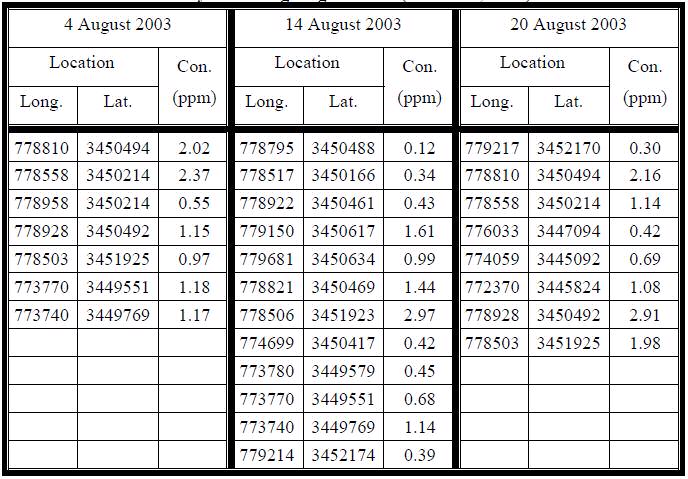
EEAA
AICZMP-
ESIA
Average yearly 2005
26.3 31.7 30.8 56.9
Source: EIMP annual reports for 2005 and monthly reports for January and February 2006
EIMP recorded two days of exceeding the limits for sulphur dioxide in El Max area
during the year of 2005. An increased concentration of BS was recorded in February.
In other older studies in the area (Said, 2003) hydrogen sulfide (H2S) levels were recorded
around the lake. It varied according to the location as well as the sampling day (Table 12). H2S
emissions may have resulted mainly from Qalaa drain just about the southern entrance of the city
of Alexandria.
Table 12: H2S concentration recorded at different location surrounding the source of
flux area of Lake Maryout during August 2003. (from Said, 2003)
A more recent report of Shalaby (2004), it recorded levels of metals in suspended particulate
matter (aerosols) at Abis (among areas studied) in air samples collected at different sites
downwind from the old municipal solid waste dump site. The results obtained are shown in Table
13.
In a different report (Shalaby and Saleh, 2004), dioxins and furans were determined in air and soil
samples at Abbis area adjacent to the lake where the main solid waste dumpsite of the city of
Alexandria was located. Results in Table 14 show that dioxin was found in air samples while both
of them were found in the soil samples. The study also included determination of those pollutants
43
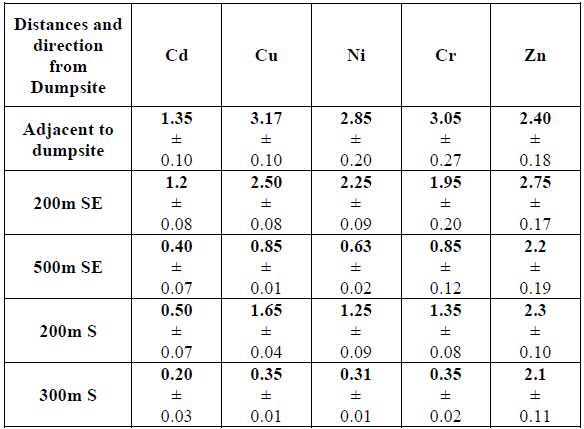
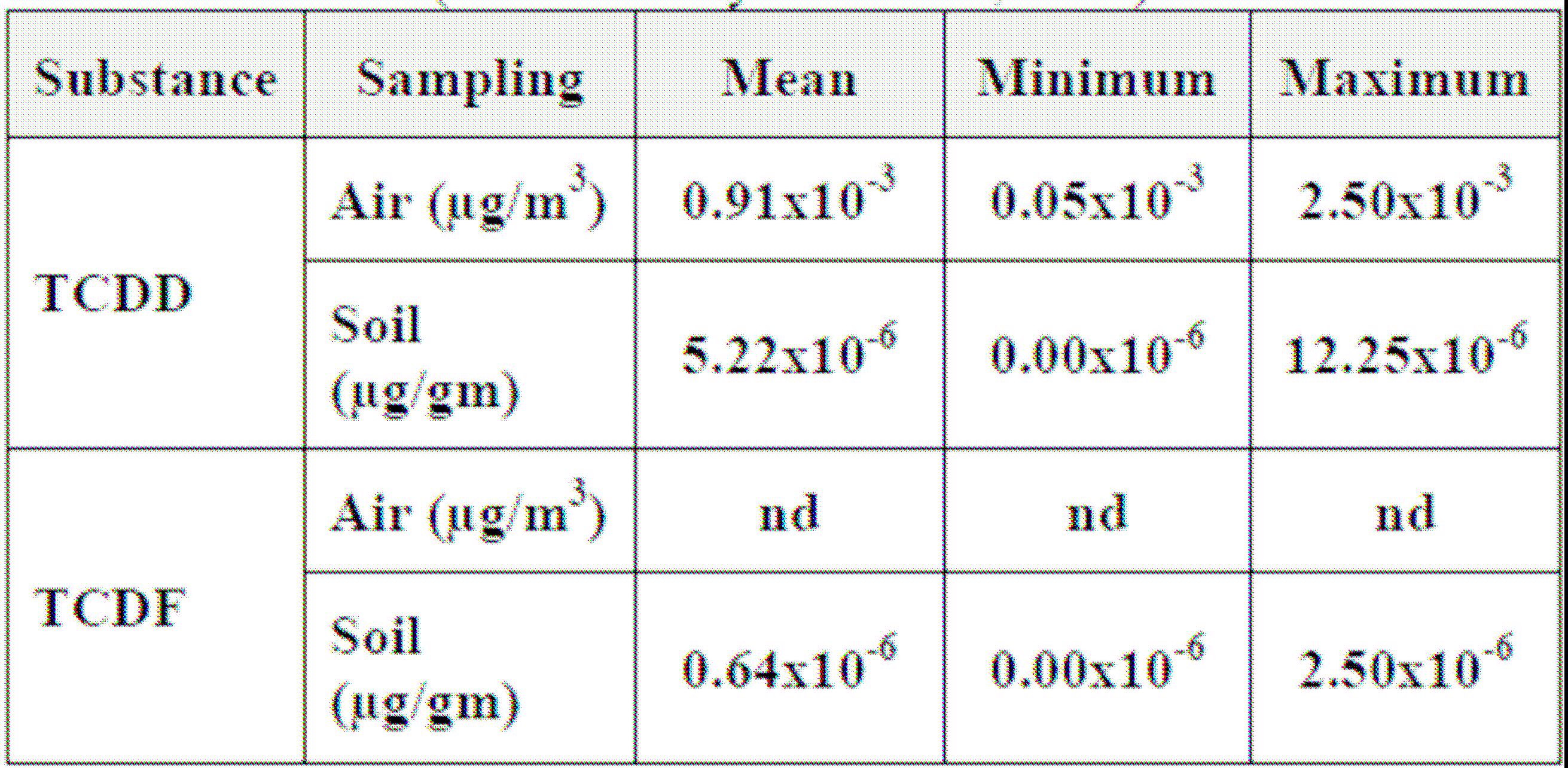
EEAA
AICZMP-
ESIA
in the growing plants. The uncontrolled fires, as a result of self-ignition were attributed to the
emissions of those pollutants.
Table 13: Mean values of heavy metals ( g/m3) in aerosols at Abis area (from Shalaby,
2004)
Table 14: Dioxins and Furans in air and soil in Abbis area
(from Shalaby and Saleh, 2004)
nd= not detected
TCDD: 2,3,7,8-tetrachlorodibenzo-p-dioxin
TCDF: 2,3,7,8-tetrachlorodibenzo-furan
44
EEAA
AICZMP-
ESIA
Climate
The climate in Alexandria is influenced by the Mediterranean Sea. The city has a warm
dry climate with steady breezes from the sea that keep temperatures moderate in
summer. The prevailing wind direction is from the north and northwest.
Temperature
The following table shows the monthly temperatures around the year:
Table 15: Monthly temperatures in Alexandria
Month
Temperature (°C)
Maximum Minimum Average
January 19
9.5
14
February 19.5
10
15
March 21.5
11.5
17.5
April 24
14
19
May 26.5
16.5
21.5
June 29.5
21
25.5
July 30
22.5
26.5
August 30.5
23
27
September 30 21.5 26
October 27.5
18
23
November 25 15.5
20.5
December 20.5 11.5 16
Annual 25.5
17.5
21
Winds
The following table shows the monthly wind speed and the direction of prevailing wind:
Table 4-3: Monthly wind speed and direction in Alexandria
Month
Wind
Direction Speed
(km/hr)
January South
west
14.5
February West
14.5
March
West north west
14.5
45
EEAA
AICZMP-
ESIA
April North
west 14.5
May North
north
west 13
June North
west 13
July North
west 14.5
August North
west
14.5
September North
north
west
13
October North
11
November North
11
December South
west
14.5
Annual North
west
13
Cloud cover and Sunshine
The variation of cloud in winter gives a maximum in the early morning because of the existence
of low sheet type Stratus cloud. This cloud normally dissolves after sunrise. There is a second
maximum in the afternoon because of the development of Cumulus cloud. In summer the
maximum cloud cover occurs in the afternoon, while in the evening the sky is nearly clear.
The amount of solar energy received per unit area is now generally recognized at the background
for quantitative analysis of most of the micro-climatic phenomena of the lower atmosphere. There
is no difference in sunshine duration from place to place along the coast, or from year to year.
Cloudiness is greater near the coast than inland. Strong radiation prevails from March till the end
of September, with a peak in June-July. November, December and January are relatively cloudy.
Relative Humidity and Rainfall
The monthly mean of relative humidity in 2005 is given in Table 16. The lower values are
recorded in autumn, due to the hot waves, which invade the area during this season. The rainfall
ranges from 180 to 250 mm/year, with most of the precipitation occurring in January (about 120
mm). The maximum daily rainfall in the area is 10-12 mm.
Wind Speed
Prevailing wind speed is shown in Table 16. The prevailing wind speed ranged between 2-4 m/s
all over the year. However, summer had a higher wind speed than the other three seasons. The
analysis of monthly wind roses has indicated that the prevailing wind direction is northerly to
north-westerly direction.
Table 16: Meteorological Information in the Study Area during 2002.
46
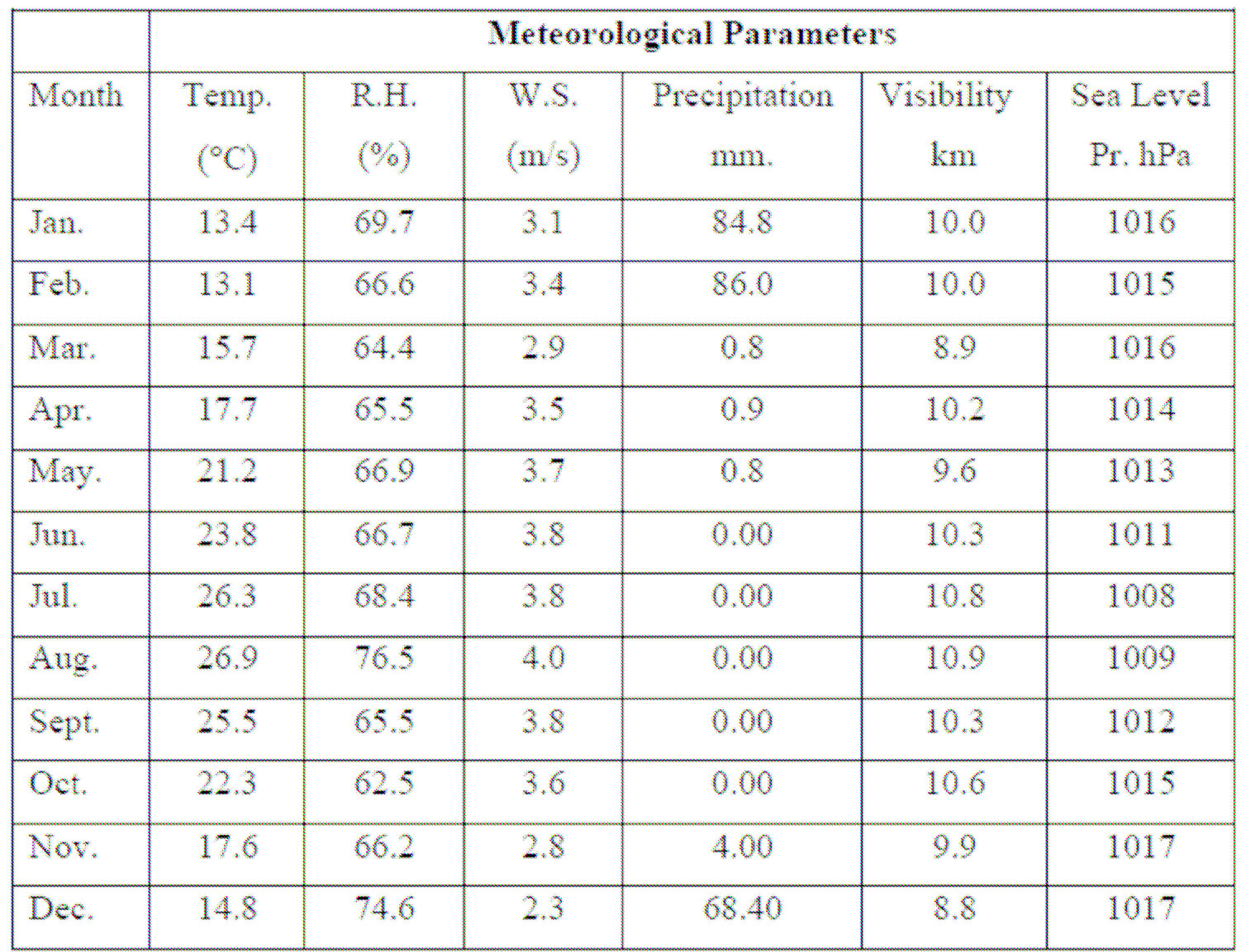
EEAA
AICZMP-
ESIA
Source: http://www.underground.com/history/airport/HEAX/...../DailyHistory.html
Seasonal and Yearly Average Wind Roses at Alexandria:
The prevailing wind of Alexandria comes from Northwest. The metrological data collected from
IGSR station shows that the highest frequency wind was 33 % along the year 2002 blown from
the North-Northwest direction. The least of wind was in the direction north, northeast being
0.92%.
The data collected from IGSR station is plotted as wind roses and these are shown in Figure 16.
Wind roses of the four seasons (autumn, spring, summer and winter, respectively) reveal different
speeds for the different directions. The strongest windblown is in summer as average, when the
wind comes from the most directions with high speed. The strong wind is in summer from the
north to north west. While the weakest wind in the year is in spring and autumn. This creates a
nice weather in summer because it decreases the moisture content of the air and reduces the risk
of condensation, thus, the air temperature is decreased. The wind of this season comes from
Northwest only. In spring, the Khamasin wind blows carrying sand and dust, its rate is 13% of the
spring wind. The calm weather is 5.5% of the year 2002.
The prevailing wind affects the houses by losing the heat and reducing the humidity and rain
penetration. Raising ground temperature, reducing humidity and transport sand and dust
recognizes the effect of Khamasin wind.
47
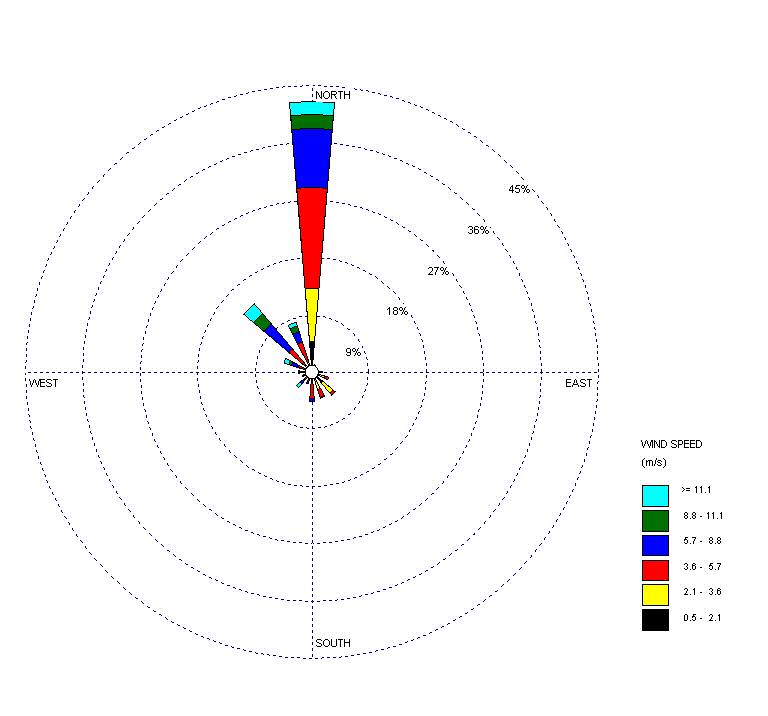
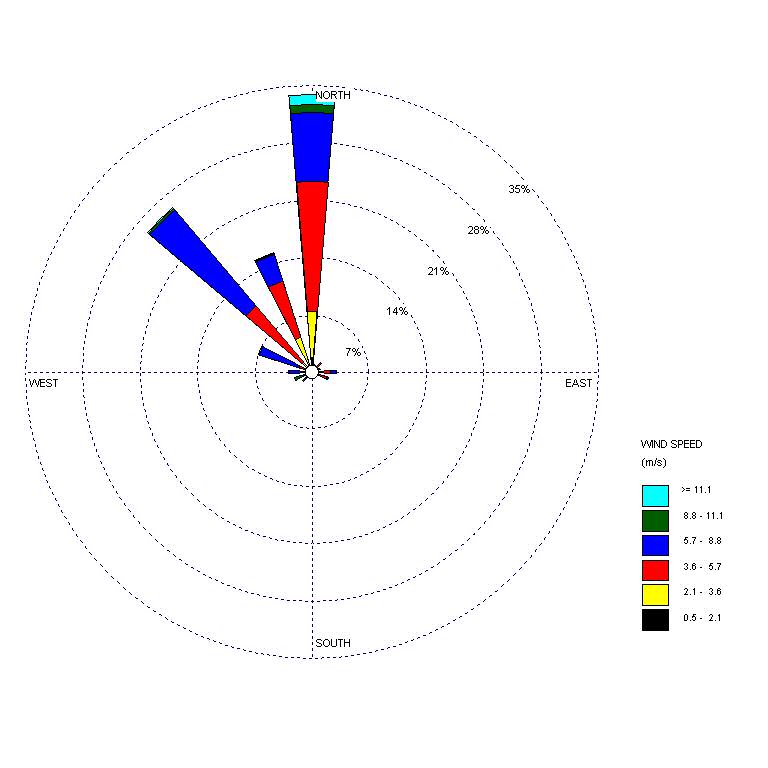
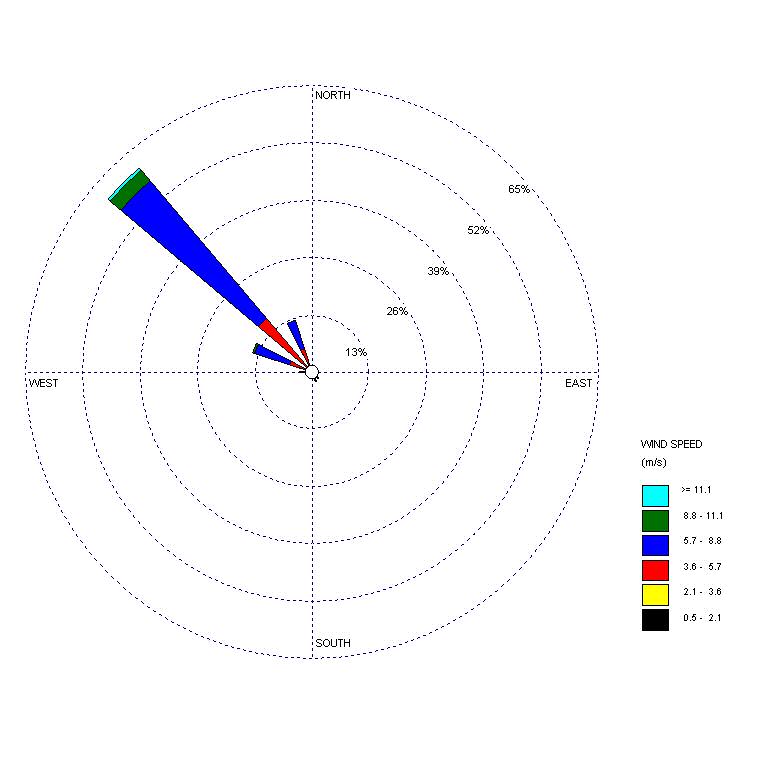
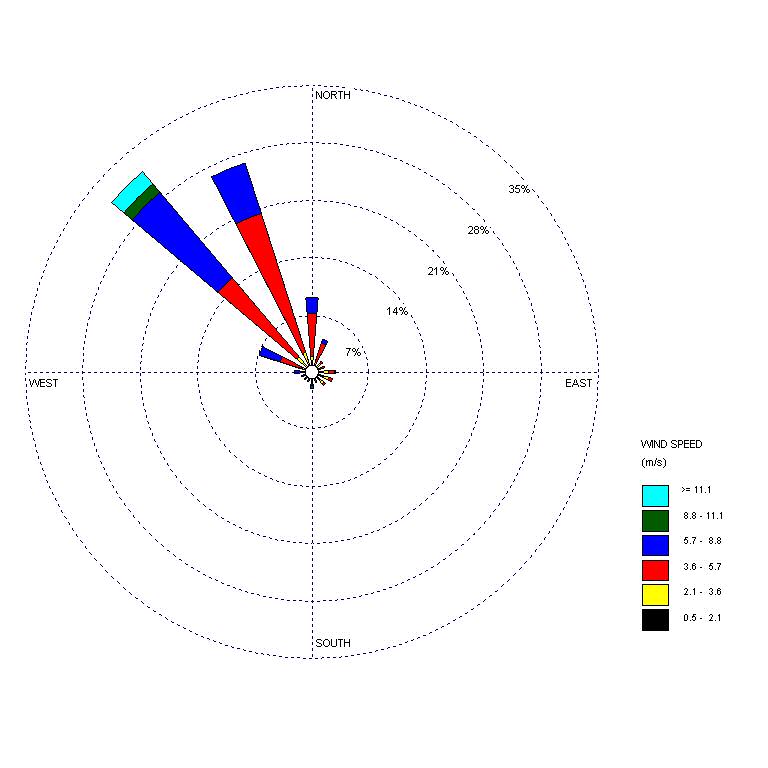
EEAA
AICZMP-
ESIA
Winter Season
Spring Season
Summer Season
Autumn Season
Figure 16: Yearly prevailing Wind rose
Flora
The vegetation associated with Mariout Lake comprises communities of both aquatic and
terrestrial habitats (Tadros and Atta, 1958a). In the aquatic habitat Phragmites australis grows
luxuriantly and densely in the shallow water (30-50 cm depth). Inwards, in deeper water, an
almost pure population of Eichhornia crassipes is present, and in still deeper parts there are
submerged communities of Potamogeton pectinatus associated with Ceratophyllum demersum
and Lemna gibba.
Towards the shore of the lake, the soil is saline and halophytic vegetation prevails. The vegetation
of this terrestrial habitat can be distinguished into distinct zones. In the submerged soil is a
community dominated by Scirpus tuberosus associated with S. litoralis and Typha domingensis.
T. domingensis dominates a zone close to that of Phragmites australis and passes gradually into a
S. tuberosus community which merges, as the level of the ground increases so that it become less
liable to flooding, into a community dominated by either Salicornia herbacea or by Juncus
rigidus. S. herbacea gradually diminishes and is replaced by Salicornia fruticosa which passes
gradually to a typical Salicornia fruticosa-Limoniastrum monopetalum zone. The Juncus rigidus
48
EEAA
AICZMP-
ESIA
community, on the other hand, is replaced by a community codominated by Salicornia fruticosa-
Suaeda salsa which passes gradually to a typical S. fruticosa-Limoniastrum monopetalum type. In
both situations the ground becomes very dry and saline and a Halocnemum strobilaceum
community replaces that of Salicornia-Limoniastrum. On the elevated border of the dry saline
beds of the western extension of Lake Mariout is a community dominated by Salsola tetrandra
associated with Atriplex halimus, Frankenia revoluta, Limoniastrum monopetalum, Limonium
pruinosum and Sphenopus divaricatus.
In the less saline stands of this community Pituranthos tortuosus, Thymelaea hirsuta,
Trigonella maritime and other non-halophytic species may grow. This community has
also certain affinities with the non-halophytic communities. The Salsola tetrandra zone
gradually gives way to a community whose principal constituents are Limoniastrum
monopetalum and Lycium europaeum. Associate species include Asphodelus
microcarpus, Bassia muricata, Carthamus glaucus, Cutandia dichotoma, Echinops
spinosissimus, Filago spathulata, Helianthemum lippii, Ifloga spicata, Launaea
nudicaulis, Noaea mucronata, Picris radicata, Plantag albicans, Reaumuria hirtella,
Salvia lanigera and Suaeda pruinosa.
Recent studies showed that the water quality and the biodiversity in the lake has been
considerably deteriorated due to the discharged of domestic (partially treated or untreated) and
industrial waste directly and indirectly to the lake. This has resulted in severe eutrophication to
the lake, especially the main basin. Even if secondary treatment is applied, none of the treatment
scenarios are expected to significantly alter the nutrients or metal concentration entering the lake
from sources other than sewage, the large amounts of raw wastewater from squatters along the
contributing drains, the excessive concentration of metals currently in the industrial wastes
accompanied with wastewater, and the relatively low removal rates for metals and nutrients
achieved by primary or even secondary treatment of any of the wastewater management scenarios
are not expected to be changed significantly from the existing situation with respect to water and
sediment or eutrophication
Solid and hazardous waste management in Alexandria
Solid waste
Solid waste activities in the Alexandria Governorate are managed by the French Operator
Onyx, contracted by the Governorate. The scope of work includes:
· Daily collection of domestic waste from households, markets, shops and roads to be
transported to the municipal landfill.
· Removal of construction debris up to 1 ton/location
· Clean up of streets and roads
· Provision of and regular emptying of waste bins in pubic roads
· General housekeeping for beaches, gardens, squares, and other public areas
· Collection and treatment of medical wastes
· Collection of industrial solid wastes
· Rehabilitation, operation and maintenance of compost plants
· Construction, operation and maintenance of the municipal landfill
· Clean up and treatment of the three old dumpsites (Abis, Zayateen and Amreya).
49
EEAA
AICZMP-
ESIA
The contract excludes the clean-up of unused lands outside the urban area and
waterways. It also excludes the collection and treatment of aqueous and hazardous
wastes.
The new municipal landfill is located in El Hammam area, about 40 km. west of
Alexandria city. Two composting plants are operating in Alexandria, i.e. the Montaza
and Abis Composting Plants. The main composition of municipal solid waste is plastic,
paper/cardboard, glass, ferrous metals, bones, rags, aluminium and organic material.
The American Chamber of Commerce has conducted a study on solid waste
management in Egypt in 2000. The amount of municipal solid waste generated in
Alexandria in the year 1997 is about 4,761 tons per day. This amount breaks down to
about 3,648 t/d from urban areas and 1,113 t/d from rural areas.
Hazardous waste
The Nasreya Hazardous Waste Treatment Centre located south of Borg El Arab road is
the only hazardous waste treatment and disposal facility in Alexandria. The centre
started operations in 2005 and occupies a surface area of 37 feddans. The capacity of
the landfill was designed based on the existing demand of the Alexandria Governorate.
The centre consists of the following facilities:
· Hazardous waste landfill for inorganic waste
· Physical-chemical treatment
· Storage facility for organic waste.
The wastes typically received at the landfill are:
· Filter cakes from galvanic processes
· Insoluble metal salts like hydroxides, sulphides, sulphates, carbonates and
phosphates
· Inorganic wastes from ceramic industry containing harmful heavy metals
· Ash from power stations
· Inert oxides
· Metallurgical slag
· Foundry sand
· Asbestos waste
· Dry solid heavy metal waste
· Contaminated soil, mainly inorganic contaminants
· Empty dry packages contaminated with any of the above material
The landfill does not accept cyanides mercury, explosives, radioactive waste, flammable,
oxidizing, reactive, organic waste, domestic or hospital waste.
The solidification-stabilisation process is used when the solubility of certain components
(e.g. heavy metals) exceeds the landfill criteria.
Inorganic hazardous waste in liquid or sludge form is processed in the physical-chemical
treatment plant.
50
EEAA
AICZMP-
ESIA
Socio-economic conditions
The project aims to improve the water quality of the Lake Mariout, which will ultimately result in
improving fish production. This section describes the existing socio-economic conditions of
fishermen communities in the area.
Population next to Lake Mariout
According to a previous study conducted in the area neighbouring the Lake, three main social
groups are identified, namely: fishermen, poorer communities and scattered land divisions.
The fishermen community as a whole forms the poorest and most disadvantaged group in the
target area. The fishermen communities are mainly located in inaccessible areas from land, as the
infrastructure is limited or non-existent. The problems in reaching these communities with
services and interventions have developmental, economic and social impacts. Fishing cannot be
carried out throughout the year, and in the idle periods they lack alternative employment
opportunities. Their socioeconomic development is limited.
In Egypt fishing activities are carried out almost entirely by males. Women are only concerned
with helping the fishermen in preparations for their trips and in helping them to handle the caught
of the fish. In rare cases, women are involved in small scale fish trading or retailing. In Lake
Mariout, further degradation of water quality and fish production is significantly affecting
people's livelihoods. Fishermen rely both on the fishery and vegetation to support their living, as
fishing is the main source of income for the majority of fishermen. Vegetation is used for feeding
livestock, making fuel for cooking, and as thatching for living quarters. The fishing community in
Lake Mariout is comprised of approximately 6,000 fishermen and consists of a regulated
hierarchical structure.
This hierarchical structure consists of a head fisherman for the entire Lake and a head fisherman
for each of the four basins. Each fisherman and/or family has fishing rights assigned specified
areas and are not free to fish anywhere in the lake. Estimates say that the number of fishermen
utilizing the main basin exceeds 1,500. Most fishermen live in an area called "Maawa El
Sayadeen" (Fishermen shelter).
In a study carried out by SFD shows that 61.85% of the population is aged between 15 - 55 years.
This is considered as the typical range for employment. It is evident that the unemployment rate
among those eligible for work is high. The more fortunate residents who are working have very
low income and are only involved in small/trivial marginal vocations (hand crafts, support staff in
local governmental agencies, carpentry, and labour for nearby factories.
Other demographical characteristics were also specified, namely:
· High illiteracy rates (especially that of females).
· Poor health services and high mortality rates.
· High crime rates Tendency to marry young and have large families, as stated before.
Some poorer communities such as Naga' El Arab with a total population of 17,608 inhabitants,
are directly exposed to Lake Mariout. The area started to be inhabited in the early fifties, when
they filled parts of the Lake and kept expanding by building informal shelters and buildings. Most
of them used to fish in the Lake and manufacture/maintain fishing boats.
51
EEAA
AICZMP-
ESIA
Fishermen Community
The fishermen community around Lake Mariout is mainly occupied in fishing, with small
percentages of the population working as manual workers and others being employed in seasonal
jobs. This was confirmed by a socio economic study that was conducted recently (WADI, EU
project 2006-2008), on households in the area of Abbis and especially in Bab El Abid settlement
and which place fishing at 59.2% followed by some informal jobs (19.7%) within the area.
Interviews revealed that not all fishermen have permanent residence around the lake, but that
some reside in Gheit-El-Enab, Qabbary and Metras and that the majority live in scattered,
unplanned villages. Research into their ancestry showed that they are of various geographical
origins and not only from Alexandria as might be assumed. In terms of the length of residence
period in the area, a survey indicated that 63.7% of the inhabitants lived in the area for more than
21 years, followed by 26% who have resided in the area from 10 to 20 years, while only 10.4%
have lived there for less than 10 years.
Generations that followed the earlier migrants to the lake inherited the fishing profession and
handed it down one generation after the other. The skills of the fishermen community are
therefore limited to fishing and other trades around the small scale fishing industry (repairing
boats, fishing nets etc.). Few, if any other skills are present among the population, a fact that is
confirmed by their inability to change profession even during times when fish catch decreases
sharply, substantially affecting their income.
A study showed that more than half (54 %) of the sample are from 22 to 40 years old, while
26.7% are from 41 to 60 years old and the rest of the population are from 18 to 21 years old
(5.2%) and over 61 years old (14.1%). The sample had a mean age of 40.26 years ą15.45. Nearly
two thirds of the samples (61.5%) were females and the rest were males.
The fishermen community suffers from high levels of socio economic stress. The population
lives in unsuitable housing, with more than one family often sharing rooms together, and are
unable to secure better housing due to the low return that they gain from fishing. Their low
income, which results in part from the low fish catch and increasing pressure on the lake, is
further compounded by pollution, spread of reeds and water plants and decreasing water levels
The impact of decreasing income on the socio economic situation of fishermen communities
include the delay of marriage age and the lowering of living standards. The age of marriage,
which used to be in the twenties for both men and women when fish catch was more abundant,
has risen to 30-35 years. Older fishermen recall that their income in the past was more profitable
than the salaries they would gain in steady employment in the jobs open to individuals with their
skills. Yet today, many of these same fishermen now want their children to get an education and
abandon the fishing profession.
Despite this, school drop out rates areas among these communities continues to be high as young
men search for employment in menial jobs and the cost of education for others, and girls in
particular, is prohibitive. Like other poor communities therefore, the fishermen around the lake
find themselves in a cycle of poverty, where the low level of education among the community
prevents them from obtaining higher paid jobs that require the ability to read and write, and
where economic pressure forces families to take their children out of school thereby not allowing
them to complete their education. Therefore, while a review of the educational status of the
population reveals that illiteracy is prevalent among the population at 91.1% and that only 5.9%
could read and write, unless action is taken to encourage education in among the population in the
52
EEAA
AICZMP-
ESIA
area, current drop out rates are unlikely to improve the educational status of the fishermen
communities around Lake Mariout in the near future.
Fish catch in the lake has continued to decline over the past three decades. Fish caught on the
lake is sold in two wholesale-markets daily; the first starts at 6 am and the second at 8 am.
Wholesale merchants buy the lots and distribute them all over the country in ice boxes.
Fishermen are aware of the development of the lake throughout the past five decades and that
parts of the lake were filled in the fifties to reclaim agricultural land. At that time the government
donated 5 feddans, a home and some farm animals to each fisherman as compensation for their
losses. This was particularly true for those who lost their homes after the construction of the
"hydrodrome".
From the fishermens' point of view, low fish catch is compounded by the Fishing Law, passed in
1926. The law, which allows for government interference in their fishing activities, regulates and
sets limits on fishing gear, the size of net openings etc. While the law is meant to conserve and
increase fish in the lakes, rivers and seas, the continuing decline in fish catch per fisherman
renders inhabitants of the area skeptical about its efficiency.
A major issue that fishermen are negatively affected by is obtaining fishing permits and licensing
their boats. In 2000, the Fisheries Department canceled permits for 1300 fisherman for various
reasons. Their union claims that there are now only 1200 registered fisherman and there are 4000
outstanding applications. The authorities however deny giving any more permits to control the
fishing in the area since the fishing quota has been over-exceeded. This situation has led to the
spread of unlawful fishing activities that subject the fisherman to a fine of EGP 500 in addition to
confiscating fishing gear. A further major complaint that fishermen suffer from is the
overcharging that fishermen chiefs (Shiekhs) demand in exchange for getting them fishing
permits.
In terms of housing conditions, the total number of houses in the area is estimated to be 1,236
while the total population is estimated at 6,792 persons. Streets in the area surrounding Lake
Mariout are irregular and narrow. Since they are unpaved, they are muddy, full of refuse and
animal excreta from the animals raised by the community and also have wastewater collection as
well as sewage overflow. All houses are made of bricks, closely packed together, and consist of
one or two floors at the most. The conditions of housing in the Lake Mariout area are very poor.
Houses with cement floors constitute 71.4% of the total, those paved 19.1% and those with dirt
floors 9.5 %. Housing is characterized by overcrowding where the crowding index for 64.3% of
houses ranged from 2-4 person/room and 35.7% have 5 and more person/room, with mean value
of 4.28ą2.17 person/room. The majority (95.2%) of houses were inadequately ventilated with
windows area representing less than 15 % of the total room area. In terms of facilities in homes
and food hygiene, the majority of the sample (92.86%) did not have a separate place to prepare
food and all cooking activities took place in the living room which is sometimes used also as a
bedroom. About 33.3% use gas stoves, while only 4.8% have refrigerators. The majority of the
sample (85.7%) had private bathroom, while 11.9% use shared bathrooms.
The impact of housing conditions on the population's health is clear: about 25% of the inhabitants
of houses composed of one room had scabies, followed by 10.9% of those composed of two
rooms; while 20% of the sample living in houses composed of three rooms suffered from Teniea
and more than one third (37.6%) of inhabitants living in houses with two rooms suffered from
lice, compared to none of those who lived in three rooms.
53
EEAA
AICZMP-
ESIA
It was observed that almost all houses included in the sample had electrical connections but the
lighting of the houses was inadequate for 90.4 % of the sample. The houses of the area are also
lacking in natural lighting due to the narrow streets and buildings which are stacked close to each
other. Regarding water supply in the area, the main sources of water used by the inhabitants in
Lake Mariout area are public taps (47.63%). Half (50 %) of the families store water in clean
covered containers and only 4.8% store it in uncovered containers.
The main type of sewage system in the area is the latrine (88.1%), while sewers were found only
in 11.9% of the houses in the sample. Disposal is done by dumping into the lake (92.8%) while
4.8% is dumped into the public sewage and 2.4% is dumped in the open ducts in the streets.
These practices lead to cross-contamination of water supplies through leaking drainage pipes or
direct contamination of water sources by untreated sewage overflow from latrines, cesspools or
septic tanks.
There is no solid waste management system in the area, and waste is collected in open baskets
and dumped into the lake (90.5%). A small percentage of the families (9.5%) dump their refuse in
the street. Improper refuse collection and disposal arrangements attract insects, particularly flies
of which the house fly and blowfly are the most common, and mosquitoes. It was reported by the
dwellers that there were also many rodents and animals including dogs, and cats. Many insects
and small animals have an important effect on hygiene and public health because of their ability
to transmit diseases. Several species of mosquitoes are known transmitters of encephalitis,
malaria, filariasis, dengue fever and yellow fever.
A study10 on the socio economic and health status of residents around the lake analysed how lake
pollutants affect the health of the inhabitants of Lake Mariout area. The study revealed that
residents are affected by high levels of pollution from the lake's water, air pollutants and the food
they consume. The amount of discharged organic matter in the lake is about 23,000 to 30,000
m3/day. The lake is also highly polluted by nitrite, phosphate and silica as well as heavy metals
such as cadmium, nickel, cooper, lead and chromium which come from the waste that factories in
the area dump into it. Fish, which is the basic food of the population in the Lake Mariout area,
and the most affordable for these limited income communities, is therefore contaminated with
heavy metals, putting the health of fishermen communities severely at risk. Several of health
disorders are related to consumption of contaminated fish which was estimated to have frequency
of 2.97ą2.5 times/week and 77.7% of the sample used to eat fish more than once/week.
The lake inhabitants have a past history of bronchial asthma (6.7%), hypertension for 5.9% and
3.7% suffered from bronchitis. There are numerous factors involved in bronchial asthma such as
the poor ventilation, overcrowding, and poor hygiene. In addition, the dwellers of the area are
exposed to air pollution through their inhalation of hydrogen sulfide, generated from the
decomposition of organic matters discharged to the lake combined with the low oxygen level that
is a characteristic of the main basin in the locations near to the sanitary wastewater outfalls.
Hydrogen sulfide produces shortness of breath as it irritates the respiratory tract and lead to
different type of respiratory disorders.
Finally, parasitic diseases, which find a haven in the organic waste and the high level of water
plants, are common in Lake Mariout. Their effect on the health status of the inhabitants of Lake
10~Amel Ibrahim Ahmed. 1997, "A Study on the Relationship between some Environmental Factors and the Health
Conditions of the Inhabitants of Lake Mariut Area", M.Sc. Thesis, Environmental Studies Dept., IGSR, Alexandria
University
54
EEAA
AICZMP-
ESIA
Mariout area is clear, as they suffer from parasitic infections including: A. lumbricoid, Schistosoa
mansoni, E. histolytica, Glambia and T. trichura, as well as lower infection of Schistosoma
haematobium, E. vermicularis and Trichostrongylus in addition to toxoplasmosis. The parasitic
snails of the S. hematubium and S. mansoni have been detected in the lake, the latter have a high
prevalence among the fishermen of Lake Mariout. The dwellers of the lake Mariout area are
therefore exposed to pollutants directly by inhalation or indirectly through consuming
contaminated fish and their life around the lake also makes them vulnerable to a number of
parasitic infections. Further, Lake Mariout inhabitants are also liable to schistosomal infection
due to their work as fishermen.
Most dwellers of the area (76.2%) depend on folk remedies rather than contacting health centers
or asking for professional medical advice. Herbal treatments and infusions are dominant (63.6%)
and 23.8% of the dwellers use the boiled afta grass in treating stomachache, renal colic, and
cough, while boiled green mint was used by 6.2% for the same complains. 14.4% of the
population use non-herbal folk remedy such as honey and nigella oil for cough, inhaled
"neshowk" powder for headache, boiled herbs for dyspnea, application of wool bandage and
boiled oiler paper for joint pain, application of local kohle for eye redness and finally using of
palabiaa as suppositories in treating of piles.
Around 69.6% of the individuals living in area were able to identify the different types and causes
of environmental problems in terms of low cleansing level, water pollution of the lake, poor
sewage treatment system, and presence of insects. But 30.4% of them were not aware of their
poor environment and perceive it as normal circumstances. On the other hand 74.1% of them did
not relate health problems with environmental pollutants and while 65.9% of the dwellers
approved that the construction of a proper sewage system will solve the environmental problem
of the area, 1.5% wanted to leave the area and 6.7% thought that there is nothing that could be
done to improve the health and environmental situation.
Fishermen perceptions of causes for the Lake deterioration are mainly due to low water level
(35%), sewage disposal (35%) and both previous causes (25%). The majority of the interviewed
persons determined that the government is responsible for the deterioration of the lake (58%) and
with far lower percentages, they blamed the fisheries authority, residents of the area and
industries as secondary causes for Lake problems.
The following are specific recommendations the fishermen suggested for the development of the
lake area:
· Removing reeds and aquatic plants and opening channels in heavily vegetated areas,
· Stopping all filling activities,
· Ensuring that families are given fair compensation in case of their resettlement due to
highway construction projects,
· Issuing fishing permits only to those fishermen who have been resident in the area for a
long time,
· Providing health care centers in accessible areas, and
· Providing the community with soft loans for improving their fishing equipment.
Fisheries and Aquatic Resources
By comparison, Lake Mariout is one of four freshwater/brackish water lakes in the Nile Delta
near the shore of the Mediterranean Sea. The relative areas, in hectares (ha), and fish production,
55
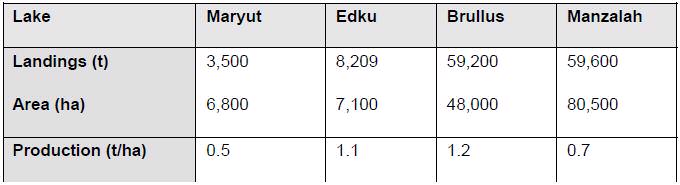
EEAA
AICZMP-
ESIA
in metric tons (t), for Lake Mariout and the other four lakes, as reported by GAFRD, are as
follows:
Table 17: Comparison between Lake Mariout and other northern lakes in Egypt
Both Lake Mariout and Lake Manzalah are adjacent to large urban populations, whereas Lakes
Edku and Burullus are adjacent to lower-density agricultural communities and are consequently
less affected by domestic and industrial pollution and subject to somewhat less intensive fishing
pressure. The production on the more urbanized lakes (Mariout and Manzalah) is on the order of
half of the production of the other lakes.
Several types of fishing gear are used for Lake Mariout commercial fishing activities,
depending on the target species. In the Main Basin, where the water is turbid, the trammel net is
the type of gear most widely used, and tilapia is the main target species. In the Fisheries Basin,
where the water is clearer, both trammel nets and submerged traps are used. In the Northwest and
Southwest basins, the most common gear type consists of very elaborate barrier traps made of
dried phragmites stems, with removable traps placed at intervals along the barrier. Trammel nets
are normally used for tilapia at the edge of patches of vegetation, to catch fish that have strayed
away from the grassy stands where they feed and obtain shelter. Catfish are caught with baited
long-lines or larger wire mesh traps in all basins. One of the major problems of such practices is
the widespread of reeds (phragmites) making the available area for fishing even less. The fishing
authorities are making efforts to convince the fishermen to use wire cages instead.
A program to increase the minimum net mesh size might be favourably received. Given the rigid,
hierarchically organized social structure of the fishery, it seems plausible that a gradual stepwise
introduction of fisheries management regulations might work to help the fishery recover.
Ultimately, a policy to reduce the level of fishing effort will be necessary to improve the lives of
the fishermen and their families that remain in the sector. That can only be achieved through a
massive program of refraining, along with financial subsidies to ease the adjustment of the
thousands of people who must inevitably leave the fisheries sector over the next period.
The deteriorating status of the Lake has resulted in diminishing fish catch as shown in Table 18,
negatively impacting the living conditions for the inhabitants around the Lake and diversion of
fishermen to menial jobs.
Table 18: Annual fish catch from Lake Mariout
Year
Production (Ton)
Year
Production (Ton)
1986 8,800 1996 3,976
1987 8,100 1997 4,489
56
EEAA
AICZMP-
ESIA
1988 7,770 1998 4,521
1989 3,500 1999 5,235
1990 1,900 2000 6,378
1991 2,200 2001 6,200
19,92 3,500 2002 5,303
1993 3,990 2003 4,861
1994 3,516 2004 5,100
1995 3,466
Source: General Authority for Fish Resources Development Statistics (2004)
Silting of the lake bottom and the proliferation of Phragmites and other water reeds are two
processes continuously decreasing the volume of fish rearing habitat. Wastewater discharge into
the lake since 1988 substantially decreased the fishery by creating areas where water quality does
not support commercially important species of fish, if at all.
Most of the brackish and less tolerant high-valued fish such as Mugil cephalus, Labeo niloticus,
Bagrus bajad, Lates niloticus, and Barbus bynni, decreased or completely disappeared from the
lake. On the other hand, Tilapia spp. Flourished and has come to represent about 90 % of the
total yield in recent years. Also Clarius gariepinus production increased from 900 tons in 1996 to
2,341 tons in 2000. The predominance of Tilapia and increase of Clarius gariepinus production
in Lake Mariout is due to their high tolerance to marginal environmental conditions, in terms of
oxygen concentrations, high nutrient loading, and variation in salinity.
Another significant factor contributing to the depressed status of the fishery is excessive fishing
pressure throughout most of the lake. This seems to result, at least partially, from the decreased
yield unable to meet the needs of small-scale commercial fishing which remains an important
economic activity on the lake.
One of the methods through which the fishermen had tried to adapt to the changing conditions is
fishing with cages. Fishermen make these cages from reeds and hence spread the rhizomes of the
plant over relatively large areas. Accordingly, this practice unintentionally created an additional
problem as it helps reed proliferation.
57
EEAA
AICZMP-
ESIA
potential environmental and social impacts
General
This section presents an analysis of the potential positive and negative impacts of the proposed
project activities. In evaluating the potential impacts of the project, the checklists provided in the
Environmental Assessment Sourcebook of the World Bank (Technical Paper Number 140,
Volume II: Sectoral Guidelines, 1991) were used. The following sections list the main impacts
identified.
Anticipated Positive Impacts
The Global benefits expected from the project include:
· reducing trans-boundary pollution from Lake Mariout to the Mediterranean Sea. The
reduction of nutrients (nitrogen, phosphorous) and oxygen demanding substances (COD,
BOD) at El Mex bay represents global benefits in terms of an improved water quality
flowing into the international waters of the Mediterranean Sea.
· improving Lake Mariout's biodiversity. Once important for its high value fish species
(e.g. Mugil cephalus, Labeo niloticus, Bagrus bajad), the water quality has drastically
deteriorated during the last two decades. Currently, the lake is dominated by less valuable
fish (Tilapia) and about 60 percent of its surface is covered by weeds and aquatic
plants11. The reduction of COD, BOD, and nutrient loads from the lake and the improved
water circulation resulting from reed removal are expected to improve the lake's
biodiversity, helping endemic biota to begin to re-occupy its niche within the lake's
ecosystem.
Local benefits include:
· Potential sales of duckweeds. In addition to removing nutrients from water, duckweeds
have also economic use as feed for fish, chicken, and ducks (Landolt and Kandeler,
1987), or organic manure (Culley et al., 1981). World Bank (2009) estimates that
duckweeds generate a total protein yield of 20 t/feddan per year and their lowest price on
the market is US$735/t. On a total pilot area of 30 feddans, the potential sales value of
duckweeds would be about US$441,000 per year.
· Improved air quality. The package is expected to improve water quality in Qalaa drain
and Lake Mariout, which might lead to improved air quality by reducing the noxious
smell in the vicinity of the lake. The lack of information does not allow the estimation of
this benefit. It should be noted however that most air pollution is due to emissions of
traffic and industry, rather than the lake itself. Thus, even in lack of estimates, we can
assume that the benefit of improving air quality due to the GEF interventions is small.
· Increase in fish production. It is assumed that sufficient improvements in water quality
through the reduction of COD, BOD, nutrient load, and heavy metals would increase both
the fish catch and its quality for consumption. It is assumed that the interventions
increase the fish catch by 1 percent annually compared to the baseline scenario, the
11 Based on discussions with the Fisheries Department of the Ministry of Agriculture, the
Fishermen Association and the Fishermen Syndicate.
58
EEAA
AICZMP-
ESIA
present value of the additional fish catch would be US$480,000; a 5 percent increase
would generate US$680,000, and 10 percent increase would generate US$1.4 million.
The following is discussion on each of the project's component's expected impacts.
Component (1): Planning, Institutional Capacity and Monitoring
Although this component has no direct impact on the environment, yet its indirect positive
impacts are obvious. Strengthening the management and institutional capacity of the relevant
agencies that are responsible for managing Lake Mariout will ensure that improvement programs
for the Lake will be properly implemented and continuously monitored. This will be achieved
through various capacity building programs as well as procurement of necessary hardware and
software that will allow the entities responsible for the management of the coastal zones in and
around Alexandria to be able to better coordinate and integrate their activities in a way that
should result in improvement of the overall environmental.
The expected outputs of this component which are the master plan for management of the coastal
zones of Alexandria and the establishment of the water quality monitoring network for the Lake
Mariout are key elements of the sustainability of any environmental improvement program as
well as a safeguarding measure that prevents unsustainable practices to take place within or
around the coastal zones of Alexandria.
Component (2): Pollution Reduction
This component with its proposed intervention will result in improving the water quality of Lake
Mariout. Although it is determined that the interventions under this component will be
implemented as demonstration or pilot projects, the pre-feasibility studies expect some
improvement in the Lake water quality.
This improvement will affect positively the aquatic environment of Lake Mariout with an
anticipated increase in the fish yield which in-turn will improve the livelihood of the fishermen
community utilizing the Lake as their main economic resource
The expected positive impacts of Component 2 can be summarized as follows:
-
improvement of Lake Mariout water quality by reducing at least 5% of the pollution
levels
-
The fish yield is expected to increase due to the improvement of water quality
-
Application of low-cost technologies as pilot projects provides a chance for scaling-up
the project in the future to achieve more significant water quality improvement
-
The interventions can be demonstrated as an appropriate model for replication in other
polluted lakes in Egypt
-
Reed removal will allow fishermen to have better access to fishing grounds and will
remove a major source of problems in the Lake
Component (3): Project Management, Monitoring and Evaluation
59
EEAA
AICZMP-
ESIA
The completion of the comprehensive monitoring and evaluation scheme for the project ensures
the timely delivery of the entire project's activities. This will have an indirect positive
environmental impact due to the assurance of the smooth implementation of the project and
monitoring the progress of each of the project intervention programs.
Anticipated Negative Impacts
The following environmental receptors are the ones relevant to the project activities and they will
be used to assess the environmental impacts of the different activities on each of them.
-
Air
-
Soil
-
Water Bodies
-
Aquatic Ecosystem
-
Terrestrial Ecosystem
-
Noise
The assessment of negative impacts is based on a quantitative assessment ranging from 1-4 where
"4" is high impact and "1" is neutral or negligible impacts. The assessment will be conducted
against the following attributes:
Reversibility of the impact: irreversible being more significant.
Direct or indirect impacts: direct impacts being more significant.
Geographical zone of impact: regional impacts being more significant than local impacts
Duration of the impact: permanent impact being more significant than short term
Probability of Occurrence: The higher the likeliness of occurrence the more significant
the impact is
Severity of the impact: More severe impacts (such as loss of habitats) are more
significant.
Cumulative nature of the impact: ~The cumulative impacts are more severe than single
effect impacts
The decision for impact evaluation is based on the following rules:
· If any of the attributes is ranked "High", the overall impact is significant
· For an impact to score as "Neutral" or no impact, all attributes has to be ranked as
"Neutral"
· For the rest of rules, an impact is evaluated based on the dominant ranking.
· In case of a tie, the higher rank prevails (e.g. if the number of attributes ranked as "Low"
equals the number of attributes ranked as "Moderate", the overall impact is considered of
"Moderate" significance.
Analysis of Impacts
Impacts during Construction
Both components (1) and (3) have no physical interventions and there are no anticipated negative
impacts associated with them.
Component (2) is mainly an environmental improvement intervention that aims at reducing
pollution levels in Qalaa drain and the Main Basin of Lake Mariout. The technologies used are
simple and do not include sophisticated equipment or use of any chemicals or hazardous
60
EEAA
AICZMP-
ESIA
materials. However, an assessment of some of the impacts that might be associated with the
construction and operation of the proposed interventions will ensure achieving the desired goals
and minimize the risks of negative results.
Transportation of construction materials and personnel: The main adverse impacts associated
with transportation are air pollution and increased noise levels. The impacts are expected to be
temporary and will end by the completion of the construction activities. It impacts on air quality
and noise levels are ranked as "Low".
Storage of construction materials: This environmental aspect may result in polluting soils and
adversely affecting the terrestrial ecosystem within the storage area. However, since the
construction materials used are not including any hazardous materials in addition to the absence
of any sensitive habitats in the vicinity, therefore the impacts on soil and terrestrial Ecosystems
are considered "Low".
Use of heavy machinery: The use of machinery during construction of the in-lake wetland may
cause disruption of aquatic and terrestrial ecosystems, pollution of the lake water, degrade air
quality and increase noise levels. Since this aspect is limited to the construction period and all the
impacts are reversible after completion of construction works, the impacts are expected to be
"Low".
Temporary storage of excavated contaminated sediments: Deepening of the lake will result
in big volumes of excavated sediments (sludge) that may be contaminated with different
pollutants including heavy metals. The excavated sludge if improperly stored will be considered
as hazardous wastes that may result in land contamination which in turn may cause future health
risks if these lands are cultivated. The risks associated with this aspect are considered high due to
the severity of the impact and the difficulty in reversing it. The impact is ranked "High".
Disposal of excavated contaminated sediments/sludge: The improper disposal of the
contaminated sludge may allow uncontrolled usage of this sludge in agricultural activities, thus
causing health risks. The risks associated with this aspect are difficult to reverse and the severity
is significant therefore the impact is ranked "High".
Temporary storage of contaminated reeds: The removed reeds from the lake will need to be
temporarily stored before deciding on their final destination. Some parts of the reeds may have
accumulated pollutants, including heavy metals, over the past years. The storage of the removed
reeds on clean soils may result in land contamination and disruption of terrestrial ecosystems. The
overall impact is ranked "Low".
Disposal of contaminated reeds: As explained earlier, reeds might be contaminated with several
pollutants. Improper disposal of contaminated reeds whether by burning, dumping or
uncontrolled recycling will have moderate negative impacts on air, soil and terrestrial ecosystems.
The overall impact is ranked "Moderate".
Introduction of alien aquatic plant species: Duckweeds are proposed to be introduced as part of
the engineered in-lake wetland to take part in the pollution reduction in the lake. The duckweed is
not naturally occurring in the lake and is considered alien to the lake aquatic ecosystem which
might be disrupted. Since duckweed is a common aquatic plant species and it will be introduced
in small sections of the lake, it is not expected that there will be significant negative impacts on
the aquatic ecosystem of the lake. However, due to some concerns regarding this plant whether it
exists on the national level or not, the overall impact is ranked "Moderate".
61
EEAA
AICZMP-
ESIA
Impacts during Operation
Maintenance of the in-stream biofilm: The PVC pipes used as part of the in-stream biofilm
intervention as well as the associated parts will need periodical maintenance and cleaning. The
parts that will be removed or cleaned will contain pollutants that are accumulated from the
treatment process. If cleaning or disposal of the contaminated parts takes place improperly on
soils or water bodies, this will result in soil contamination and pollution of water bodies. Since
these parts will accumulate pollutants and need special care during maintenance or final disposal,
the overall impact is ranked as "Moderate".
Removal of duckweeds: The duckweeds will need to be removed periodically as part of the
maintenance of the natural treatment system. Duckweeds will contain pollutants that are
absorbed and bio-accumulated by the plants. Storage and disposal of the duckweeds after removal
will have negative impacts on air (if burnt), soil and terrestrial ecosystem. It is also possible to
reuse the duckweeds as animal fodder, however, if they are contaminated with pollutants that may
result in serious health risks. The overall impact is ranked as "High"
Use of electrically driven aerators: The chosen aerators to be installed will utilize electrical
energy. Electricity generation in Egypt is mostly dependent on combustion of fossil fuels that
results in air pollution. Since the impacts of this environmental aspect are in-direct and minimal,
the overall impact is considered "Low".
62
EEAA
AICZMP-ESIA
Table 19: Overall Environmental Impact Assessment Matrix
Environmental Receptors Affected
Activity
Environmental Aspects
s
t
em
t
r
i
al
s
t
em
&
l
e
s
t
i
c
y
s
y
s
y
t
h
al
a
c
t
r
i
l
t
e
r
r
es
i
s
e
al
et
er
p
odi
qua
co
er
co
af
v
Ai
So
Wa
B
A
E
T
E
No
He
S
O
Im
Impacts during Construction
Transportation of materials and personnel
L
N
N
N
N
L
L
L
Installation of In-Stream Biofilm
Storage of construction material on drain sides
N
L
N
N
L
N
N
L
Use of heavy machinery
L
N
N
N
N
L
L
L
Temporary storage of excavated contaminated
N
H
N
N
M
N
M
H
sediments
Dredging
Disposal of excavated contaminated sediments/sludge
N
H
N
N
H
N
M
H
Degradation of water quality
N
N
L
L
N
N
L
L
Disruption of aquatic ecosystems
N
N
N
M
N
N
N
M
Use of heavy machinery
L
N
N
N
N
L
L
L
Disruption of aquatic ecosystems
N
N
N
M
N
N
N
M
Removal of Reeds
Temporary storage of contaminated reeds
N
L
N
M
L
N
N
L
Disposal of contaminated reeds
M
M
N
N
M
N
M
M
Introduction of alien aquatic plant species
N
N
N
M
N
N
N
M
Construction of In-Lake wetland
Impacts during Operation
Maintenance of the in-stream biofilm
Cleaning and disposal of biofilm parts
N
L
L
N
N
N
N
L
Maintenance of In-Lake wetland
Removal, recycle or disposal of duckweeds
L
L
N
L
L
N
H
H
Use of electrically driven aerators
Consumption of fossil-based energy
L
N
N
N
N
N
N
L
N:
Neutral or Negligible
L:
Low
M:
Moderate
H:
High
63
EEAA
AICZMP-
ESIA
Socio-economic impacts
The proposed project with its 3 components aims at improving the lake management schemes as
well as reducing the environmental pollution in the lake.
Impacts on fishermen community
Although the expected pollution reduction in the lake is not expected to be higher than 5%, yet
this small improvement will result, on the long run, in increasing the fish yield and decreasing the
health risks associated with fishermen activities in the lake.
It is anticipated that due to the improvement in the lake water quality, fishermen can sell their
catches at higher price because of the possibility to have higher market value fish.
The project has also included in its structure the recruitment of a social development expert who
is mandated to provide guidance to the project to implement activities that will involve the
fishermen in the project during its different stages with the vision of ensuring buy-in and
contributing to the improvement of the fishermen's socio-economic activities.
During operation, it is not expected to interrupt or prohibit any fishing activities close to the
planned in-lake wetland due to the fact that fishermen are not currently accessing the main basin
for fishing due to the dense vegetation covering that basin. Besides, the proposed location for the
in-lake wetland is at the most polluted spot in the main basin at the effluent of Qalaa Drain, where
no fishing takes place. As for Qalaa drain, it is not considered as a fishing zone due to the high
pollution levels that exist in its waters. These facts have been confirmed during the public
consultation where fishermen determined that that the majority of fishing activities currently take
place in the fisheries basin. They also determined that the main basin, where the project physical
interventions will take place, is not currently used for fishing activities. On the contrary,
fishermen requested to initiate the project activities as soon as possible and to expand the area of
intervention especially concerning reeds removal to allow them to have access to the main basin.
The drains are not a source of revenue and none of the pollution reduction activities on
the drain would result in any land take nor would interfere with any of the economic
activities of the residents.
Finally it has been concluded that since the project's physical interventions are taking place inside
the Lake and Qalaa drain, no land take will be needed and consequently no resettlement is
anticipated.
In terms of the long term possible socio economic impacts of developing the Integrated
Coastal Zone Management Plan, the project does include a set of checks and balances to
ensure that social impacts, especially on marginalized groups, from the plan
implementation is minimized, through the following:
(i) The National Committee on Coastal Zone Management Plan, which provides
the ultimate oversight on coastal zone management issues in Egypt, including
the endorsement of the development of the Integrated Coastal Zone
64
EEAA
AICZMP-
ESIA
Management Plan, includes representatives from nongovernmental
organizations
(ii) The Project Steering Committee includes a representative from the Lake
Mariout Development Committee, which represents the interests of the local
communities, in particular the fishermen community during project
implementation; as well as representatives from the civil society.
(iii) Financing for the project's first component will include "public consultation
workshops and master plan dissemination", which will ensure that the views and
interests of the civil society agencies are well represented.
Other socio-economic impacts
Improving the overall environmental conditions of the lake is expected to encourage investments
around the lake which in turn may reflect positively on the surrounding poor communities.
65
EEAA
AICZMP-
ESIA
: analysis of Alternatives
In this chapter, a discussion of the project alternatives is presented. Each alternative has been
carefully assessed and the justification for selection of preferred alternatives is demonstrated.
1. Project Alternatives
The "no project" option
The "no project" option meant failing to recognize that there is an urgent need to support the
GOE in its effort to improve its coastal zone management. A "no project" approach would have
meant a continued fragmented approach to coastal zone management in and around Alexandria
area, little consideration for biodiversity conservation and ecosystem issues, limited investments
specifically targeting more diffuse upstream agricultural drainage water and rural domestic
wastewater, reduced capacity to monitor water quality in and around Alexandria on a regular
basis, limited participation of local communities and relevant stakeholders and foregoing the
skills and information to replicate the piloted technology at a larger scale. This alternative is
therefore rejected.
2. Focus of Intervention
The main focus of Alexandria Integrated Coastal Zone Management Project (AICZMP) is to
reduce pollutant loads discharged by El-Mex Pumping Station to the bay and hence to the
Mediterranean Sea. Several projects have been suggested and the "Pre-Feasibility Analysis for
ACZMP Pollution Reduction Measures" studied several alternatives according to technical,
financial and organizational factors to achieve this goal.
Based on several criteria it has been decided that the main basin of Lake Mariout is the main
contributor to the pollution of El Mex bay. Although the main basin of the lake receives
pollutants from several sources and drains, the Qalaa drain is the source that affects the most of
this basin. The Qalaa drain has a high concentration of pollution and given the directions of water
flow to El-Mex pumping station; it is considered the highest contributor to the whole lake
deterioration. Accordingly the proposed interventions focus on the point of discharge of this drain
to the lake main basin.
3. Conceptual Intervention Alternatives
Treating only point source (industrial) pollution
One of the technical options for the pollution reduction measures involves building a centralized
industrial wastewater treatment plant for a group of tanneries that pollute El Mex Bay. This
alternative is discounted because it provides a disincentive both for the group of tanneries to pay
for the pollution they are ultimately causing and disincentive for other firms that wish to improve
their environmental performance, through borrowing money from the EPAP II project.
Ultimately, the tanneries as well as industries that currently discharge industrial effluents into the
66
EEAA
AICZMP-
ESIA
lake will have to comply with the Egyptian legislations concerning discharge on water bodies,
Until this happens, an immediate action is needed to improve the current status of the lake.
Reusing wastewater for landscaping
The option of diverting part of the primary wastewater from the West Treatment Plant currently
being discharged to the basin, through reusing the water for landscaping, has also been
considered. Although this would significantly reduce the load of urban domestic waste pollution
that enters the Lake, it will not address the removal of nutrients, essentially originating from
agricultural drainage water as well as rural wastewater. In addition, there will be a need to pump
and store significant quantities of water which is practically complicated and the costs involved
with such an operation would be excessive and with questionable financial sustainability.
4. Pollution Reduction Projects Alternatives
Alternative Pollution Reduction Projects (PRPs) take into consideration the on-going efforts
which address an important part of the pollution load reaching the main basin. They are therefore
mainly addressing the residual flows of agricultural run-off in addition to municipal wastewater
including that generated by smaller towns and villages in the area and discharged to the drain,
which could be partially treated, poorly treated or not treated at all.
The categories of pollutants to be addressed in the influent steam are BOD/COD as well as
nutrients. However, their actual concentrations could vary, based on effectiveness of Municipal
Wastewater treatment as well as their normal seasonal variability (both for Wastewater and run-
off) and time trends resulting from population increase and the normal time lag before adequate
measures are taken to address it. Accordingly, the sensitivity of the PRP to variation in flows,
concentrations and loads should therefore be within reasonable bounds.
The land surrounding the water system under consideration is fully occupied either by
agricultural fields or by human settlements. It is therefore imperative, in order to reduce as much
as possible the impacts on human activities that the PRPs be located within the boundaries of the
water bodies composing the system under consideration (the main basin and the drains
discharging in it, including their tributaries)
Sustainability is a major concern for the PRPs. This will be reflected in two important additional
criteria:
· The PRP should be moving the ecological system to a better equilibrium, i.e. improvements
should not be of a temporary nature and are most likely not to be reversed with time; and
· PRPs with high operational costs should, as much as possible, be avoided.
Sustainability could also be reflected in having a clear and stable institutional owner which will
be engaged in both the implementation and operation phase of the PRP.
67
EEAA
AICZMP-
ESIA
5. Selecting a single intervention versus package intervention
A set of pollution reduction intervention projects is considered and reviewed independently
against a multi-criteria analysis technique. The interventions considered fall under three major
groups, namely:
1. increase DO level in the Drain through aeration ( two approaches were
proposed),
2. use of Bio-film for pollutant treatment (which also falls under two major
possibility for operation, aerobic and anaerobic) and;
3. applying Engineering Wetland practices (either in-stream or in-lake).
In addition, improving the water circulation in the basin through reed removal is already
considered as a base intervention.
As a conclusion of several studies, the following interventions are proposed:
a) In-Stream Biofilm (aerobic/anaerobic)
b) In-Stream Aeration (electric/solar )
c) Constructed
Wetland
(In-Stream/In-Lake)
The following sections evaluate each single pollution reduction intervention. It is however likely
that none of the alternatives considered will independently address the Qalaa pollution load due to
the limitations inherent in each application. The need for a package of interventions has been
therefore determined. However, in order to outline the recommended package, the proposed
interventions are systematically compared in the following sections.
Comparison Criteria
All alternatives generated comply with the location criterion (to be inside the water bodies, due to
lack of land to acquire for their implementation), as well as the sustainability of their impact on
the ecological system, given continuous operation.
In terms of sensitivity to concentrations, the biofilm, and in-stream wetland are seen to be
flexible, while aeration is easily adjustable. On the other hand, the benefits envisaged from the in-
lake wetland are highly sensitive to the inflow of availabEGP nutrients.
Concerning reasonable operational costs, all alternatives comply with this criterion, except the
electric powered aerators. As it was seen in the relevant section, aeration is imperative and use of
renewable energy for aeration is subject to site constraints.
Because of the importance of both aeration, to maximize performance, and the in-lake wetland,
for cost recovery reasons, none of the options are excluded based on their non-compliance with
the original criteria.
Further comparison between alternatives is performed below according to multiple criteria
analysis. Changing the water circulation pattern, to improve self-purification of the basin, is
another key input to improve the quality of Lake Mariout which is addressed by the reed removal,
already to be taken as a base but not independently sustainable, intervention. Therefore it will not
show in the comparison below.
68
EEAA
AICZMP-
ESIA
Effectiveness
Elevated level of BOD, COD, TSS, nutritive salts and ammonia are the major threat to the
environmental quality of Lake Mariout. Decreasing the pollution load reaching the Main Basin
through Qalaa drain is the focus of the potential PRPs. Irrespective of other criteria, the proposed
intervention should substantially contribute to the reduction of this pollution load.
The alternatives are compared first according to effectiveness, or the potential to substantially
reduce the Qalaa pollution load, and subsequently according to the following criteria.
· Technical Ease of Implementation
· Investment Costs
· Financial Sustainability
· Institutional Clarity
· Potential Suitability as a "Pilot" based on potential for scalability in the same site
and/or replicability in other sites.
Alternatives Compared
Based on a detailed study of each independent intervention, the following table presents the
effectiveness of each on the main pollution parameters identified.
Table 20: Effectiveness of Different Solutions to Major Threats to the Main Basin Lake
Mariout
Hazard/Threat
High
High
High
Nutririve
Average
Impact on
COD/BOD
Ammonia
Salts
In-Stream Biofilm
5
3
1
3.0
(aerobic)
In-Stream Biofilm
1
1
1
1.0
(anaerobic)
In-Stream Wetland
1
1
1
1.0
In-Lake Wetland
3
4
3
3.3
In-Stream Areation
2
1
1
1.3
(natural)
In-Stream Areation
4
1
4
3.0
(electric)
1=Low 5= High
Biofilm operated in anaerobic conditions cannot address the pollution load carried by the Qalaa
drain to the Basin. Moreover, because of site constraints, in-stream aeration based on renewable
energy, can only marginally contribute to reducing BOD/COD at the utmost but are not able to
contribute enough aeration to oxidize ammonia.
Finally, because of design constraints, the in-stream wetland, although effective in its own
context has a limited contribution to the reduction of this pollution load. These two alternatives
cannot be relied upon for substantial improvement of the quality of Qalaa drain. However, as they
69
EEAA
AICZMP-
ESIA
are effective in their own right, and are seen to exhibit good cost effectiveness, they are therefore
taken further in the comparison, while the anaerobic biofilm is excluded.
The following table compares between the remaining potential interventions. They are all highly
suitable as pilot projects, both in terms of replicability and scalability, except for the naturally
driven aeration and the in-stream wetland which do not have the potential of up-scaling in the
site. The locations in which they can be applied are limited.
Table 21: Solution Suitability
Impact
Technical Ease
Financial
Institutional
Suitability
of
Sustainability
Clarity
as a
Solutions
Implementation
Potential
"Pilot"
In-Stream Biofilm (aerobic)
3
3
5
5
4.0
In-Stream Aeration (electric )
4
1
5
5
3.75
In-Stream Aeration (natural)
4
3
5
3
3.75
In-Stream Wetland
3
3
5
3
3.5
In-Lake Wetland
3
3
3
5
3.5
1=Low 5= High
Similarly, most of them have their technical issues such as sensitivity to initial conditions, which
require high technical inputs in the design stage, and their need for adjustments along their life
time according to changing conditions. Aeration options are exceptions to this general
characteristic. Although naturally driven aerators are sensitive to the stream flow, its velocity is
not expected to decrease. Moreover, the extremely low operation costs of this alternative make
adjustments a trivial issue. Adjustments for electric powered aerators are based on simple DO
measurements. Together with accumulated experience in relation to their operation, this makes
them technically superior to the other alternatives in respect.
The biofilm, in-stream wetland and aeration options are characterized by their institutional clarity.
The in-lake wet land, on the other hand, could face initial institutional conflicts for large scale
implementation utilizing a large portion of the basin. Moreover, the overlapping responsibility of
MWRI and MALR could be manageable if addressed as early as the feasibility stage.
Although, as clarified in Table 22, the in-lake wetland has the highest potential for cost recovery,
the size of investment required for its full implementation as a treatment option is prohibitive.
Although the biofilm and the in-stream wetland options have a limited potential for cost recovery,
their limited running costs increases its potential for financial sustainability. As expected, the
electric powered aeration characterized by high operating costs and the lack of substantial cost
recovery options, scores very low on financial sustainability. In terms of financial sustainability,
the in-stream wetland and the naturally driven aeration are superior in terms of low capital
investments and low O&M costs.
Table 22: Potential Financial Sustainability
Economic Impact
Possibility
Capital
Running
of Cost
Average
Solutions
Cost
Cost
Recovery
70
EEAA
AICZMP-
ESIA
In-Stream Biofilm
3
4
2
3.0
(aerobic)
In-Stream Aeration
2
1
1
2.0
(electric)
In-Stream Aeration
4
4
1
3.0
(natural)
In-Stream Wetland
4
4
1
3.0
In-Lake Wetland
1
3
5
3.0
1=Low 5= High
Outline of the alternative Packages
It is to be noted that the natural aeration and the in-stream wetland are comparable with other
options relative to all criteria except for effectiveness which is mainly related to the context in
which they are considered. The main package to be considered will thus be composed of the
biofilm with needed, or additional, aeration and the in-lake wetland.
At face value, the In-stream aerobic biofilm seems to be superior to the other options. However,
the fact that the drain is currently anaerobic would mean that aeration is needed to provide the
adequate aerobic conditions. The higher costs of this package still provide a reasonable cost per
ton of COD removed. However, the high running costs of aeration if not coupled with a serious
cost recovery component might put the whole investment at risk of reverting to the substantially
lower efficiency of operation under anaerobic conditions. The high potential for income
generation represented by the duckweed crop should be thus integrated within a larger package.
The reliance on oxidation of ammonia and the extensive use of biofilm for de-nitrification might
be effective in protecting the basin for the load of nutrients it now receives. However, when seen
in the context of an alternative use of these nutrients to generate a steady stream of income, it is a
waste of a valuable resource typically characterizing selecting treatment for disposal when a
recycling option is available.
By integrating the Bio-Film, the Aeration and the in-lake wetland techniques better results are
expected. The synergetic effect of the In-Stream Bio-film and the In-Stream Aeration will give
the In-Lake Engineered Wetland a medium water quality permitting the latter to initiate its own
ecological cycle that will permit the cultivation of duckweeds that will in its turn absorb the
nutritive salts, oxygenate the effluent and share enormously in the cost recovery and running cost
of the other components of the project. The combination of Duckweed production, even without
taking fish production into account12, generates considerable income that will enable continuous
operation, management monitoring and improvements. Depending on the actual revenues, it
might even be utilized to support replication in other locations suffering from similar problems.
Table 23: Suitability of individual components versus integrated package
Impact
Financial
Institutional
Suitability
Technical Ease of
Sustainability
Clarity
as a
Implementation
Solutions
Potential
"Pilot"
12 Fish production could also add to this stream of income. It might, however, be more
problematic to direct it to cost recovery as it represents the local community source of
livelihood.
71
EEAA
AICZMP-
ESIA
In-Stream Biofilm (aerobic)
3
3
5
5
4.0
In-Stream Aeration (electric )
4
1
5
5
3.75
Biofilm/aeration 3
1
5
5
3.5
In-Lake Wetland
3
3
3
5
3.5
Integrated Package
3
3
4
5
3.75
1=Low 5= High
As shown in the Table 23, the integrated package reflects the superiority of its constituting
components. The necessity to package aeration with the biofilm is considered first, and is seen to
decrease the financial sustainability potential of the biofilm if considered alone. This is, however,
corrected for the integrated package when the potential of cost recovery from duckweeds is
included. Moreover, because of the smaller area required for the wetland in an integrated
package, it is expected that the potential conflicts will be more manageable. The actual
configuration of recommended package depends on the available investment budget discussed in
the next section
Tailoring to Budget Constraints
The budget available for the PRP's is EGP 22.5 Million after deducting costs for studies, and
contingencies with the assumption of no government contributions..
Three main components that need to be implemented within this ceiling are:
1.
Integrated Biofilm/aerator to consume COD/BOD; and
2.
In-lake wetland to consume nutrients, and provide crucial income for cost
recovery.
3.
Reed removal, to improve water circulation (and thus in-lake aeration and
sediment improvement.
Within the given budget constraints, major trade-offs are envisaged between these three
components. However, some physical and financial requirements constrain these trade-offs.
a) There is a need to avail nutrients in NO2/NO3 before they reach the in-lake wet land, i.e.
ammonia oxidation needs to be almost completed; accordingly
b) The larger part of the COD/BOD in the stream needs to be consumed; and
c) The only source of revenue potential utilized for cost recovery is related to the
marketable products grown in the wetland.
Since the consumption of the COD/BOD relies on the level of performance of the biofilm in
aerobic conditions. The uncertainty resulting from the wide range of possible performance
represents a major driver of the potential PRP package. Moreover, an in-lake wetland of a big
scale cannot be implemented as part of this package.
Different iterations of the budget allocations to different components of the package are described
below.
Package 1
Assuming biofilm works with high efficiency (COD removal rate of 75% for one set of 500
sections)
72
EEAA
AICZMP-
ESIA
· One set of biofilm and one set of aerators (at the direct down stream of the ETP, or in
Location A), EGP 11.35 M
· One set of aerators in subsequent location (A or B respectively ) to oxidize ammonia,
(as needed since could be oxidized naturally if no high oxygen demand exist), EGP
1.85 M max
· Reed removal to improve water circulation in the basin, LE3.5 M
· Downscaled instream wetland, EGP 5.8 M ( or approx 48 feddans)
This package addresses all needed functions at a reasonable level, and ensures substantial cost
recovery. The risk involved in selecting this package is related to the uncertainty of the actual
efficiency of the biofilm. This risk is, however, partially mitigated by the expected improvement
of COD load in Qalaa drain resulting from ETP upgrading. The lack of information about the
relative contribution of the ETP to the current load limits the possibility of improvement
estimation. The improvement of the ETP effluent might indicate that at least 30% improvement
of the Qalaa drain quality could be expected. However, this might also be partially balanced by an
increase in effluents from population centers not served by the treatment plant.
Package 2
Assuming biofilm works with minimal efficiency (COD removal rate of 43% for one set of 500
sections), it will need to be replicated to reach an efficiency comparable to that achieved in the
high efficiency case. The efficiency of the second set assumes a lower rate of removal resulting
from its influent's lower pollution concentration achieved by the first set.
.
· Two sets of biofilm with aerators (in both the direct downstream of the ETP and
Location A), EGP 22.7
In this least performance case, the budget could be exhausted without including the Reed
removal, the potential need for additional aeration, and the in-lake wetland. This package thus
cannot achieve the functions it should play in an integrated system. The improvement of the
quality of Qalaa influent in terms of oxygen consumption demand is likely to naturally increase
the DO level in the basin. However, the continuous flow of nutrients to the basin and the
stagnation characterizing it will provide for its consumption by the dominant rooted vegetation.
Moreover, the lack of cost recovery potential could be detrimental to the sustainability of the
intervention.
Within the given budget constraint, the potential for a high COD removal (of 75%) can only be
achieved based on the max/max performance of the biofilm/aerators package. It is therefore
imperative to rebalance the investments as proposed.
Package 3
In this package, a middle ground is sought. It still assumes that the first set of biofilm operates at
the min/min efficiency, and that the additional biofilm sections have a lower efficiency than the
first set.
Given the high running costs of operation, especially that of the electric powered aerators (EGP
85,000 per 50HP aerator), the whole system could collapse without a serious cost recovery
73
EEAA
AICZMP-
ESIA
option. Although this needs to be confirmed at the feasibility study phase, 30 feddans seem to
represent the minimum area required for the In-Lake wetland. This area is potentially translated
to a yearly sales of EGP 2.4 M, which could cover its running costs as well as those of the
package of biofilm/aerators. It will, however, not cover depreciation. This option thus takes this
area as an additional constraint.
A marginal reduction of the portion removed of the existing rooted vegetation in the south-eastern
corner of the basin from 25 % to 20% is needed to insure a proper balance of the budget allocated
for different components, as described below.
1. A budget is allocated for 625 sections of biofilm together with required aerators, EGP
14.2 M
· One additional set of aerators to oxidize ammonia, (as needed since could be
oxidized naturally if no high oxygen demand exist), EGP 1.85 M max
· Downscaled reed removal to improve water circulation in the basin, LE2.8M
· A minimum area of in-lake wetland (30 feddans), EGP 3.65
If additional aeration is not needed, the budget reserved for it could be redirected to any of the
other components.
This option is expected to approach 50% reduction of COD, with the biofilm's at min/min
performance, is likely to avail nitrogen in the form usable by the duckweeds, and will afford to
clear reeds in selected channels in the basin (selected based on hydrodynamic modeling).
The reduction of load resulting from the ETP upgrading could make the final effluent from the
Qalaa drain of reasonable quality (less than 50mg/l), and a higher conversion of NH4 to NO3
(being currently in the drain of 1.37 and 2.5 mg/l respectively). This should be consumed by the
wetland duckweeds, expected to recover yearly recurrent costs.
Selected Package for Intervention
Although Package #1 achieves the required performance, it has the risk that actual performance
of the biofilm/aerator packages be at the lower range. Rationally, the need to increase the number
of sections is much easier to address than discarding useless, or even harmful13, investments.
Accordingly, package #3 is recommended to be studied in the feasibility stage.
13 The over-performance of the biofilm could reduce nutrients available to the wetland, thus
reducing its cost recovery potential.
74
EEAA
AICZMP-
ESIA
Environmental and social management Plan
Introduction
The principal purpose of the Environmental and Social Management Plan (ESMP) is to present a
set of mitigation, monitoring, and institutional measures to be taken during planning and design,
construction, operation and maintenance of the various project components and activities
associated with potential negative environmental or social impacts. The objective of these
measures is to eliminate adverse environmental and social impacts, offset them, or reduce them to
acceptable levels.
Institutional Arrangements
Management Setup
This Project is implemented through the coordinated efforts of four Ministries/Agencies:
· Egyptian Environmental Agency Authority (EEAA),
· Governorate of Alexandria,
· Ministry of Water Resources and Irrigation (MWRI); and
· Ministry of Agriculture and Land Reclamation (MALR).
EEAA is the executing agency ultimately responsible for the overall project implementation, and
for leading the coordination activities with the other implementing agencies according to their
specific roles and responsibilities.
A Project Steering Committee (PSC) will be established to provide oversight and direction to the
project. Amongst the main responsibilities of the Steering Committee are to:
· Review, discuss and approve the Annual Work Plans prepared by the PMU;
· Review, discuss and approve the investment plans and O&M plans for sub-components
(2) related to the pollution reduction measures;
· Review drafts of the Alexandria ICZM plan before submission of a final draft for
endorsement to the National Steering Committee on ICZM; and
· Review and discuss implementation progress and propose any remedial actions if
necessary.
The National Steering Committee for Integrated Coastal Zone Management which was
reinstated in December 2007 will provide scientific advice and inputs into the preparation of the
Alexandria Integrated Coastal Zone Management Plan serving as a scientific and advisory body
in particular for Component (1) during the preparation stage. The Committee, however, will
approve the final version of the Alexandria ICZM Plan upon receipt of a draft by the PSC. The
Committee may also provide scientific and advisory inputs on any other aspects of the project
components if requested by the PSC.
Within the project's context, a Project Management Unit (PMU) will be established and staffed
with the needed expertise required to manage and operate the project. The relevant positions to
the execution of the PMU are listed below:
75
EEAA
AICZMP-
ESIA
PMU Director. The PMU Director will be responsible for managing staff and overseeing the day-
to-day activities of the PMU in its management of the implementation of the Project. The
Director will report directly to the CEO of EEAA, which will facilitate resolution of any internal
delays to implementation.
Procurement Specialist. The Procurement Specialist will be responsible for overseeing all
aspects of the procurement process for contracts financed by the project. With respect to the
procurement of the main component of the Project (component 2), the Procurement Specialist
will work closely with the Implementing Agencies and the Project Implementation Teams (PIT)
carrying out the engineering designs and bid documents. S/He will be providing support during
the contracting phases as well as during construction supervision. The Procurement specialist of
the EPAP II PMU will provide support to the Project PMU in order to ensure appropriate
procurement and contract management at early stages of the project and to assist in capacity
building of the PMU. In addition to the current procurement capacity of the EPAP II PMU, an
external consultant with extensive procurement experience will be included as part of an overall
technical assistance contract to the PMU.
Environment Specialist. The environmental specialist will address the environmental safeguards
requirements of the World Bank and of the Egyptian Environmental Affairs Agency. Given the
EEAA experience with safeguards, EEAA will not need to secure external consulting support in
this area. The environment specialist will be assigned by EEAA on a part-time basis to monitor
the implementation of the site specific Environmental and Social Management Plans (ESMP).
Specifically, the environmental specialist will monitor the implementation of the environmental
mitigation measures, monitoring plan, and institutional/training requirements of the ESMP, and
will be responsible for environmental reporting responsibility within the PMU.
Coastal Zone Management Specialist. The head of the GDCZM Unit in EEAA will be in charge
of all the CZM aspects in the Project and will oversee and lead the day-to-day work of two other
staff members with technical expertise in CZM, including one staff from the Alexandria RBO.
The CZM specialist and his technical team will work closely with the other PMU members in
particular the M&E specialist and will provide technical inputs into the bidding documents when
relevant. Each specialist will be working on a full time basis.
Social Specialist. A Social Specialist will be contracted and paid under the project funds on a
part-time basis by EEAA to ensure a participatory approach to M&E and to monitor the
implementation of the social mitigation measures as part of the site-specific ESMP and will be
responsible for the social reporting within the PMU.
Communications Specialist. A Communications Specialist will be contracted and paid under the
project funds on a part-time basis by EEAA to increase public awareness about the project, draft a
Communication & Replication Strategy (including a media strategy & dissemination workshop)
and prepare dissemination materials (brochures, website, etc...).
The PMU staff will be financed by the Government, as a project counterpart contribution, and
will report to the CEO of EEAA.
76
EEAA
AICZMP-
ESIA
Specific Project Arrangements
The following describes more specifically the roles and responsibilities of the different parties
in managing the different project components.
Component 1 Planning, Institutional Capacity and Monitoring: This component is under
the direct responsibility of the EEAA. The PMU will coordinate the activities of the
implementing agencies and other key stakeholders. Specifically, the Director of the PMU for
EPAP II in EEAA will serve as the PMU Director for this proposed GEF project. The PMU will
have the overall technical and fiduciary responsibility of the project.
The technical aspects of the project will fall under the responsibility of the General Department
for Coastal Zone Management in EEAA who will have to work in close tandem with the PMU
Director and staff. The head of the GDCZM will be the technical manager in the PMU. The
technical staff in the PMU will include staff working in the Coastal Zone Management Unit in
EEAA, as well as staff from the Alexandria RBO. The latter will be working on the project while
physically located in Alexandria. These technical specialists will be responsible for following up
on the consultant's work for Component (1), related to the preparation, review and adoption of
the Alexandria ICZM plan.
The PMU will be responsible for acquiring the necessary monitoring equipment, the water quality
management and data analysis software as well as the maps and GIS capabilities based on
technical specifications. The PMU procurement specialist will work with the consulting firms in
charge of purchasing the water monitoring equipment.
Component 2 Pollution Reduction Measures: This component will be under the
responsibility of the EEAA which will coordinate the project activities with the implementing
agencies i.e. the MWRI and the MALR according to their mandate and specific responsibilities.
The PMU at EEAA will contract a relevant agency to coordinate the implementation of the
Component (2), under MWRI for the in-stream bio-film and in-stream aerators, and under the
Ministry of Agriculture and Land Reclamation for in-lake wetland and reed removal. To ensure
that proper attention is given to project implementation,
Project Working Groups will be established within the two Ministries/agencies. Initially, the
Project Working Groups will be responsible for the coordination and review of the consultant's
work that will be hired for this component to carry out the final feasibility study and final design
and tender documents. The PWGs will be ultimately responsible for preparation of the technical
specifications of the bidding documentation together with the PMU Procurement specialist, as
well as the evaluation, contracting, construction supervision and reporting tasks. The PWG will
be financed and appointed by the relevant Ministries/agencies and will include technical
specialists.
The PWGs will be responsible for the day-to-day implementation of their project and be
required to work closely with the EEAA PMU by providing regular reports and documentation.
Component 3 Project Management and Monitoring and Evaluation: This component will
be under the responsibility of EEAA, including the Alexandria EEAA RBO. The Alexandria
EEAA Regional Branch Office (RBO) will collect water quality data from project interventions.
77
EEAA
AICZMP-
ESIA
The monitoring and evaluation function is a critical element of Component 3 which includes the
elaboration of a Replication Strategy as part of the M&E Evaluation scheme. To that effect, a
M&E specialist will be contracted and paid under the project funds on a part-time basis by the
EEAA. In coordination with the PMU staff involved in Project implementation, the M&E
specialist will be responsible for developing a M&E evaluation scheme and for preparing periodic
reports (Project progress reports, including reporting progress on general implementation and
progress against agreed indicators).
Environmental Management Capacity
The Egyptian Environmental Affairs Agency (EEAA): is the competent authority in
Egypt responsible for coordinating and implementing environmental projects and
initiatives nation wide. EEAA has a long experience in implementing project with
international institutions. The ongoing EPAP II project has strong linkages to the
proposed project and will provide management support to the implementation of the
ACZMP. EEAA and its RBO's have gained high technical skills and they have strong
institutional capacity to coordinate, supervise and implement any of the proposed
measure in the ESMP.
The Ministry of Water Resource and Irrigation (MWRI): is the national competent
authority responsible for all water management issues including policy making, initiation
of water management projects, implementation and supervision of new and/or
rehabilitation projects related to fresh water bodies or irrigation canals/drains. MWRI
has the advantage of having both the competent technical staff and the laboratories that
are equipped with advanced water and soil analysis equipment that can be used in
conducting some of the proposed environmental monitoring activities.
In addition, MWRI has executed several projects in cooperation with international
organisations, including WB which makes it familiar with the standards of reporting and
delivery requirement.
The Ministry of Agriculture and Land Reclamation (MALR): the General Authority for
Fish Resources Development (GAFRD) under MALR is the officially responsible body for
managing Lake Mariout. GAFRD has got adequate capacity to carry out some of the
proposed mitigation measures determined in the ESMP, however, strong coordination
efforts with EEAA and MWRI will be needed. At least one of the proposed Project
Working Groups (PWG) should be led by GAFRD to ensure close coordination with
different ESMP activities. In addition to the In-Lake Wetland and Reed Removal
interventions, GAFRD's role in communicating with the fishermen community is
unavoidable.
Relevant capacity building for GAFRD's can be in the form of training on communication
strategies, socio-economic aspects of the fishermen community, environmental
regulations and management structure in Egypt.
78
EEAA
AICZMP-
ESIA
Governorate of Alexandria: given the importance of Lake Mariout to the Alexandria
residents, Alexandria Governorate through its EMU, may play an important role in
providing media coverage of the project activities and seeking public consensus on the
proposed interventions as well as keeping the public well informed. Although the EMU is
regularly receiving training from the EEAA RBO in Alexandria, it is necessary to provide
training for the EMU staff on environmental monitoring activities and the legal mandates
of the EMU under the Egyptian environmental regulations.
Summary of Impacts and Mitigation Measures
Potential negative environmental and social impacts that have been identified and ranked as
"High", "Moderate" or "Low" in Chapter 5 of this report are discussed and in order to eliminate
or reduce the environmental and social impacts identified due to the project activities, it is
recommended to adopt and implement a series of mitigation measures as follows:
1. Minimise disruption of aquatic ecosystems during construction
Impacts during construction are resulting mainly from the dredging activities. Given the colloidal
and humus state of the sediments, it may not be possible to use mechanical dredgers. Vacuum
dredging, can be used after reed clearance. In all cases, it is important that the use of dredgers is
restricted to the area chosen to be deepened. This area should be properly marked for instance by
a sort of floating platforms.
2. Properly handle excavated sediments during dredging
Prior to deciding the handling method for the excavated sediments resulting from deepening of
areas of the lake and drain, sampling and analysis of specimens of the sediments should take
place to determine whether they contain heavy metals or other types of pollutants. Following so,
the feasibility study that will be conducted in later stages should quantify the amounts of
sediments that will be dredged.
Representative sampling technique should be used. Analysis of the samples should take place in
officially accredited laboratories.
Given the limitation of available land surrounding the project area to store and dry the sediments,
the most appropriate method is to reuse the dredged material in constructing the walls that will
surround the fish roaring area.
The residual quantities of the sediments can be re-used as soil conditioner for landscaping and
establishing green areas.
3. Properly handle reeds after removal
The quantities of reeds to be removed needs to be determined. Representative samples of
the reeds should be analysed to ensure they are free of pollutants especially heavy metals.
The sampling and analysis of the reeds will be undertaken by MALR utilising MWRI's
technical expertise and capacity with no expected additional funds needed.
79
EEAA
AICZMP-
ESIA
Once confirmed that reeds are free from pollutants, stored and dried, they can be recycled
for a useful use (e.g. chopped and sold as animal fodder). This measure can be sponsored
by EEAA in cooperation with the Social Fund for Development to assist members from
the fishermen community to own and operate shredders through a micro financing
scheme. The feasibility study that will be prepared in later stages of the project should
determine the economic feasibility of such project and assess available markets for the
chopped reeds.
In a similar manner to the reeds handling, the harvested duckweeds can be recycled into a
fish fodder after ensuring that they are free from pollutants and heavy metals.
4. Improve livelihood of fishermen community
A comprehensive socio-economic study should be conducted to explore means of
contribution of the project to the improvement of the livelihood of the fishermen
community. Development of some small scale socio economic projects could be
suggested to involve the fishermen in the project activities. The social development
specialist contracted by the PMU will be responsible to conduct such study and the PMU
will take necessary actions to implement the recommendations.
The following table lists the mitigation measures and the associated institutional and
financial arrangements.
80
EEAA
AICZMP-ESIA
Table 24: Mitigation Measures and Associated Institutional and Financial Responsibilities
Environmental/Social
Environmental/Social
Proposed Mitigation
Responsibility
Timeframe
Cost (US$)
Aspect(s)
Impact(s)
Measure(s)
Implementation
Monitoring
Transportation of
Air Pollution
Only vehicles which
Contractor in
PMU
Whenever materials
None
materials and personnel
pass the legal
coordination with
or personnel are
environmental tests for
MWRI
transported to project
exhaust are allowed to
site
have access to the site.
Drivers to be provided
Health and Safety
with Safe Driving
Instructions
Embedded in
H&S signs and gear
works
should be available on
contract
site
Storage of construction
Land contamination
Dedicate specific area
Contractor in
PMU
During initial phases
Embedded in
material on drain sides
for storage of
coordination with
of mobilization
works
construction material
MWRI
contract
and restrict access to it
by installing proper
fences
Use of heavy machinery
Noise
Provide H&S
Contractor in
PMU
Continuous during
Embedded in
in dredging
equipment for workers
coordination with
dredging
works
Disruption of the
and site visitors
MALR
contract
ecosystem
Properly mark the areas
Water pollution
that will require dredging
None
Restrict access of
equipment to the areas
where no dredging is
required
Embedded in
works costs
81
EEAA
AICZMP-ESIA
Responsibility
Temporary storage of
Land contamination
Designate specific area
Contractor in
PMU
Continuous during
Embedded in
excavated contaminated
Solid wastes causing
for temporary storage
coordination with
dredging
works costs
sediments
health risks
of excavated sediments
MALR
Included in
Conduct a feasibility
the final
study for utilizing the
PMU in
feasibility
PMU
sediments.
coordination with
study of the
MALR
proposed
interventions
Disposal of excavated
Solid wastes causing
Sign contract with
Contractor in
PMU
During temporary
Embedded in
contaminated
health risks
waste collection
coordination with
storage and before
works costs
sediments/sludge
contractor to properly
MALR
end disposal
dispose of the
sediments
storage and disposal of
Solid wastes causing
Conduct Sampling and
PMU
PMU
Before harvesting of
Included in
reeds and duckweeds
health risks
Analysis for the
reeds or duckweeds
the final
removed reeds and
feasibility
duckweeds
study of the
proposed
Conduct a feasibility
interventions
PMU in
PMU
study to find out best
coordination with
way to utilize the
MALR
harvested reeds and
duckweeds.
Embedded in
Designate area for
works
temporary storage of
Contractor in
PMU
contract
reeds before final
coordination with
disposal
MALR
Cleaning and disposal of
Solid wastes causing
Sign contract with
MWRI
PMU
During the routine
To be
biofilm parts
health risks
waste collection
maintenance
determined
company to remove and
during the
properly dispose of the
feasibility
82
EEAA
AICZMP-ESIA
Responsibility
un-used materials
studies.
Aerators consumption of
Indirect air pollution
Purchase energy
PMU in
PMU
During procurement
Embedded in
fossil-based energy
efficient aerators
coordination with
procurement
MWRI
costs
Introduction of alien
Disruption of ecosystem
A native plant that can
PMU in
PMU
Before construction
Included in
aquatic plant species
provide similar
coordination with
of in-lake wetland
the final
functions as the
MALR
feasibility
duckweeds should be
study of the
researched and utilised
proposed
interventions
Interaction with fishermen
Lack of participation
Involve fishermen in
PMU
PMU
During project
15,000 (from
community
threatening the
project activities
construction and
the project
sustainability of the
especially in reeds
during harvesting of
budget)
project
removal and harvesting
the aquatic plants
of the aquatic plants
(duckweeds)
Total Estimated Costs (US$)
15,000
83
EEAA
AICZMP-
ESIA
Monitoring measures
The following table presents a fully fledged environmental monitoring program that
needs to be implemented throughout the project's life time.
Table 25: Continuous Monitoring Program
Parameter Location
(**) Number
of
frequency Responsible Costs
Samples
Organization
US$ **
Physical parameters:
· Effluent of west
·
Depth
treatment plant
One sample at
monthly
MWRI/
None
·
Temperature
· Qalaa Drain outfall
each location
MALR/Alex
·
Transparency
· in the course of
RBO
·
Salinity
Nobareya Canal
·
Conductivity
· in the course of El-
·
Dissolved
Omoum drain
oxygen (DO
· at the central part of
mg/l)
the main basin.
·
Oxygen
· At the northern
saturation
corner of the main
(DO%)
basin
·
pH
Bacteriological
· Effluent of west One sample at
monthly MWRI/
None
parameters
treatment plant
each location
MALR/Alex
·
Total coliforms
· Qalaa Drain outfall
RBO
·
Faecal coliforms
· in the course of
·
Faecal
Nobareya Canal
streptococci
· in the course of El-
Omoum drain
· at the central part of
the main basin.
· At the northern
corner of the main
basin
Eutrophication
Parameters
None
·
Nitrate
·
Effluent of west Representative
monthly
MWRI/
·
Nitrite
treatment plant
Samples to be
MALR/Alex
·
Ammonia
·
Qalaa Drain outfall
quantified by
RBO
·
Total nitrogen
·
in the course of sampling
·
Phosphate
Nobareya Canal
agency
·
Total
·
in the course of El-
phosphorus
Omoum drain
·
Silicates
·
at the central part
·
Total suspended
of the main basin.
solids
·
At the northern
·
Chlorophyll a
corner of the main
·
BOD5
basin
·
COD
·
Oil and grease
·
Heavy metals
Bottom sediments:
None
·
TOC
·
Qalaa Drain outfall
Representative
Annual
Alex
·
Heavy metals
·
in the course of Samples to be
RBO/MWRI
84
EEAA
AICZMP-
ESIA
Parameter Location
(**) Number
of
frequency Responsible Costs
Samples
Organization
US$ **
(Cr, Al, Fe, Cu,
Nobareya Canal
quantified by
Pb, Zn, As, Ni
·
in the course of El-
sampling
and Hg).
Omoum drain
agency
·
at the central part
of the main basin.
·
At the northern
corner of the main
basin
Tissue of Fish
(Tilapia)
The Main basin
Representative
Half
MALR
None
Heavy metals:
Samples to be
Annual
(Cr, Al, Fe, Cu, Pb,
Fisheries basin
quantified by
Zn, As, Ni and Hg).
sampling
agency
Excavated Sediments
Temporary storage site
Representative
Once after
Alex
None
Heavy metals:
Samples to be
the
RBO/MWRI
(Cr, Al, Fe, Cu, Pb,
quantified by
sediments
Zn, As, Ni and Hg).
sampling
dry out
agency
Removed reeds
Temporary storage site
Representative
Once after
Alex
None
Heavy metals:
Samples to be
the
RBO/MALR
(Cr, Al, Fe, Cu, Pb,
quantified by
removed
Zn, As, Ni and Hg).
sampling
reeds dry
agency
out
Duckweeds (or other
Temporary storage site
Representative
After the
Alex
None
aquatic plants used
Samples to be
plants dry
RBO/MALR
in CW)
quantified by
out
Heavy metals:
sampling
(Cr, Al, Fe, Cu, Pb,
agency
Zn, As, Ni and Hg).
(*) The location of sampling could be changed based on the final feasibility study
(**) Component 1 in the project will include procurement of monitoring equipment which will
be utilized by the PMU and partner agencies.
Cost estimates and Sources of funds
The sources of funds for the implementation of the ESMP will mainly be from the
project's operations budget. The main cost elements associated with the implementation
of the ESMP can be categorized as follows:
1. Manpower
In order to implement the ESMP, a part-time environmental consultant should be
recruited. The duties and responsibilities will include monitoring the implementation
of the mitigation measures, recording any environmental violations and most
importantly recording and analysing the environmental monitoring data. The
periodical environmental reports as stated in the above tables will be included in the
85
EEAA
AICZMP-
ESIA
periodical project progress report that should be submitted to the donor agencies as
agreed upon.
In addition, a social development consultant will be recruited to conduct periodical
social studies and enhance the socio-economic aspects of the project.
The cost associated with is element of the ESMP is embedded in the overall project
staffing budget.
2. Sampling
and
Analysis
Equipment
Component (1) of the project has allocated funds for procurement of monitoring
equipment. Therefore the costs will not show as part of this ESMP. The analysis of
the results will be undertaken in MWRI laboratories at minimal administrative costs.
3. Implementation of mitigation measures
Most of these costs will be estimated during the preparation of the final feasibility
study of the project. However, any associated costs related to construction will be
part of the works contract.
The total estimated cost to implement mitigation measures during construction and
operation is $15,000 to be funded from the project's overall budget and specifically
from Component 2.
86
EEAA
AICZMP-
ESIA
: public consultation and disclosure activities
Introduction
The primary purpose of this provision is to protect the interests of affected communities.
Therefore, the ESIA process includes consultation and disclosure of information to key
stakeholders involved in and/or affected by the AICZMP.
The objectives of consultation and disclosure are to ensure that all stakeholders and
interested parties, are fully informed of the proposed project, and have the opportunity to
express their views and opinions regarding the potential impacts that might affected their
livelihood.
Regulations and Requirements
Consultation with the public has become recently one of the mandatory requirements to
projects classified as Category C according to the amended Egyptian Environmental Law
(Law 4/1994). Although the proposed project is classified as Category B under the Egyptian
environmental classification system which does not require conducting public consultation,
EEAA has decided to proceed with this process due to the importance of the subject and the
interests of the different stakeholders in the project area , Lake Mariout.
On the other hand, the World Bank requires that affected groups and NGOs must be
consulted as part of the environmental assessment of projects as stated in the Bank's
Operational Policy (OP) 4.01 Environmental Assessment and other key documents. The
World Bank manuals (e.g. Participation Sourcebook, BP4.01 and OP4.01 for Environmental
Assessment, OD4.20 for involving NGOs, BP17.50 about disclosure of information are taken
into account.
Methodology
The first stage of consultation with the public started by identifying stakeholder groups
and affected communities by the proposed project. In the initial phases of the project
design, several in-depth meetings and interviews were conducted with key stakeholders
such as:
·
partner government institutions
·
academia and scientific community in Alexandria
·
Environmental and developmental NGO's representing different interests in the
project area or in Alexandria in general
·
Foreign assistance institutions with previous experience in the project area or
similar projects
87
EEAA
AICZMP-
ESIA
·
Fishermen community
During this initial stage, the stakeholders were informed about the project concept and
preliminary ideas concerning the project interventions. Inputs from stakeholders were
considered throughout the developing the project's main elements and components.
Once the project concept and preliminary approaches have been developed, the draft ESIA
was prepared and a call for public attendance to a consultation session was announced and
publicised in a widely spread news paper as well as individual invitations which were sent out
to key identified stakeholders.
A draft non-technical executive summary was prepared and shared with the stakeholders
prior to the consultation session. The summary was available in both Arabic and English
languages and were posted on EEAA website to ensure reaching out to as many
stakeholders as possible.
The process of conducting the public consultation was led by EEAA and a presentation
about the project and its background was prepared and presented in the public consultation
session and copies of the Draft ESIA were ready to be sent out to interested participants
Following the public consultation session, the disclosure of the ESIA will be published on the
World Bank info-shop for wider distribution.
Consultative Session
On September 30th, 2009, the public consultation session was held at one of Alexandria
hotels. Representatives of the civil society, competent governmental authorities as well as
technical consults participated effectively in the discussions.
The following figure shows the percentage representation of the different stakeholders in the
consultative session.
Alex
Governorate;
7%
Academia; 9%
NGO; 18%
Media; 5%
Government;
61%
Figure 17: Percentage representation of stakeholders
88
EEAA
AICZMP-
ESIA
The main outcomes from the public consultation session demonstrated that there is a very
high level of interest in the project area, Lake Mariout, as well as in the proposed
interventions and the degree of expected improvement from the project's activities.
All participants have expressed deep concern about the deteriorated environmental
conditions of Lake Mariout and the causes of these problems. Several attempts and
suggestions concerning improving the situation was proposed and discussed among the
participants as well as EEAA team.
The socio-economic conditions of the fishermen community also gained a lot of attention
from the attendants, especially from NGO's, who urged the project to involve the fishermen
community in implementing the project activities to ensure buy-in as well finding
opportunities to improve their livelihoods through small scale projects associated with the
proposed interventions.
Due to the fact that there are many institutions involved in utilizing Lake Mariout in different
ways, the dominant discussions were concerned about the level of contribution of each
institution to the environmental problems in the Lake and the role that each can play to
improve the current conditions. The need for coordination and cooperation between the
different institutions in managing the lake was stressed upon due to some conflicting
activities that need to be coordinated in order to avoid further deterioration of the lake
environmental conditions.
A discussion about the environmental and social impacts of each intervention also indicated
that the positive impacts are more likely to dominate whereas negative impacts are minimal
due to the fact that the interventions aim at improving the environmental conditions and the
nature of the project being a demonstration and pilot activity.
The conclusions drawn from this consultation stage can be summarized as shown in the
following table:
Table 26: Outcomes of the Public Consultation Session
Key Issue(s)
Comments
Disposal of primary treated
Primary treated wastewater is causing degradation of water quality in
wastewater from ETP and WTP
the Lake and resulted in increase of the reeds which obstructs fishing
into Lake Mariout as a main cause
activities as well as worsening water circulation hence deteriorating
for polluting the Lake and
water quality
decreasing fish resources
More than EGP 1 Billion are invested to upgrade the ETP and about
EGP 2 Billion to upgrade the WTP into secondary treatment with
sludge treatment.
The secondary treated wastewater will be of better quality which
makes disposing it into the Lake and eventually to the Mediterranean
Sea to be considered as wasting valuable resources and draining the
investments that have been made available.
There are different possibilities of using the secondary treated
wastewater for irrigating green areas in the newly developed tourism
89
EEAA
AICZMP-
ESIA
Key Issue(s)
Comments
and entertainment areas (such as golf courses, gardens and
landscapes) or in irrigating new reclaimed desert lands, or to be used
for industrial purposes for a fee which recovers part of the initial
investments and generates income to maintain the ETP and WTP. So
the option of avoiding disposal of secondary treated wastewater into
the Lake is valid and has to be considered.
If the water quality in the Lake continues to be polluted from other
sources than municipal sewage (mainly agricultural drainage and
industrial effluents) then the investments in upgrading the ETP and
WTP will be wasted.
There is a need for major investments to pump, store and distribute
treated wastewater to potential beneficiaries. Feasibility of such
alternatives should be carefully studied. Meanwhile, the only
alternative is to dispose the treated wastewater into the Lake
There are activities that are taking place in the Lake that impacts the
ETP and WTP such as the intension of establishing a river passenger
or cargo terminal in one of the drains. This may cause flooding in
major parts of Alexandria.
The contribution of industrial pollution to the Lake is minor (0.5%)
compared to the agricultural drainage and municipal sewage drainage.
Lake water balance
The water balance in the Lake is critical. The Ministry of Water
Resources and Irrigation is concerned by the incoming flows to the
Lake and any activities that may affect the water balance in the Lake.
Coordination is needed with both the GAFRD and the wastewater
company prior to any actions or projects that may affect the flow of
water into the Lake.
In case there is increase in the quantity of treated sewage disposed
into the lake, the Omoum drain will not be able to accommodate such
quantities.
El-Mex pump station can not handle extra quantities of incoming flows
as it is not possible to expand the station due to existence of fishermen
settlements nearby the station. The ground water table level has
increased to an alarming level and actions are needed to deal with this
threat.
Land-filling of the Lake
The major threat to Lake Mariout is not just pollution, but the rapid
urbanisation and formal and informal land-filling the Lake for different
purposes such as real estate development or commercial activities.
Efforts should be focused on stopping land-filling of the Lake as it has
caused significant degradation not only to the environment but mostly
to the livelihood of fishermen community.
Source of Pollution of Lake
ASDCO is currently upgrading the ETP and WTP into secondary
90
EEAA
AICZMP-
ESIA
Key Issue(s)
Comments
Mariout
treatment and sludge treatment. This will improve significantly the
quality of domestic sewage currently disposed into the Lake.
MWRI should re-consider the current drainage canals which currently
contribute largely to polluting the Lake water.
EEAA is working closely with industries to stop or treat their effluents,
eventually reaching the Lake, through the EPAP II.
Sediments removal, storage and
Excavated sediments might be contaminated with heavy metals.
disposal
Sampling and analysis are required to decide best ways to utilize
those sediments.
A method used in some private sector fisheries in Edko is to clear the
wet area from all plants, suck the water out and allow the bottom to be
exposed to the sun. This way the sediments will be freed from any
contaminants and undesired plant roots or seeds. Documentation of
this method and the results are not currently available but the project is
welcomed to conduct a field visit.
The sediments can be used as soil conditioner for green landscapes.
Another alternative is to develop artificial islands inside the Lake using
the excavated sediments.
Reeds removal will not cause disturbance to the sediments because
they are mostly floating.
Measures such as using geo-textile curtains can be used to avoid
transfer of pollutants to other areas of the lake.
Reeds removal, temporary storage Most of the reeds in the lake are not rooted deeply in the lake's
and disposal
bottom; therefore the removal should not require heavy equipment and
will not require a lot of time.
The proposed project is not designed to remove all the reeds in the
Main Basin (4600 feddans) but will be a pilot project that will require
only 30 feddans at this stage.
More resources will be needed to remove the reeds from the entire
Main Basin.
Reeds removal will improve the water circulation and hence the water
quality will improve
Reeds can be temporary stored in the lake by piling each removed
feddan of reeds on other reed-covered areas.
Studies should be conducted to identify the best way for utilizing the
removed reeds. In all cases, open burning of reeds is not allowed, and
land-filling should be a last option.
The possibility of using the removed reeds as bio fuel should be
investigated
91
EEAA
AICZMP-
ESIA
Key Issue(s)
Comments
Sampling and analysis of the reeds should take place prior to recycling
to identify if it contains heavy metals
Eco System
It is not currently known whether the proposed aquatic plant to be used
in the in-lake wetland (duckweeds) is native or alien to the Egyptian
ecological system. If the plant proved to be alien, it is not
recommended to introduce such alien species to the Lake ecosystem
as the impacts will not be possible to control.
Consideration should be given to fish reproduction grounds during
reeds removal as some areas might be currently used by fish to lay
eggs
The improvement in the Lake water quality will allow introduction of
more economically valuable fish species that can improve the
economic conditions of the fishermen
The lake should restore its ecosystem once it is back to its original
physical status, i.e. the Lake water should be salty or more brackish
than it is now
The impact of having the Lake be more of salty nature is negative on
the surrounding agricultural lands. Careful studies should be done
before suggesting restoration of the lake into its original status due to
the de-facto development surrounding the Lake.
Socio-economy
The fishermen community is currently suffering from high illiteracy
rates, poor health conditions and deteriorating economical conditions
due to:
·
decrease in the fish resources due to different reasons
·
rapid increase in land-filling parts of the Lake which has
decreased the areas that were used as fishing grounds
·
increase in the reed covered area in the Lake due to the
nutrient-rich effluent, thus restricting fishing in the Main Basin
to very limited areas and periods of the year.
·
Fish might be contaminated and thus decreasing its
economical value and posing health risks
Fishing activities are currently taking place in the "1000-Feddan" basin
and not the Main Basin.
The interventions proposed and the area designated for the in-lake
wetland is not currently being used by the fishermen as fishing
grounds due to the high pollution levels and the density of the reeds.
The fishermen are willing and eager to participate in the project
activities especially in removing reeds and guarding the proposed in-
lake wetland
It is recommended to start this proposed project as soon as possible
92
EEAA
AICZMP-
ESIA
Key Issue(s)
Comments
in order to achieve positive results
Several studies have been made and there is a need to start
implementation
Actions should be taken to stop land-filling parts of the Lake
The representation of the NGO's and community in the public
consultation should increase in the future because they are the ones
mostly affected by the different projects
Dwellers around the Lake need to be involved in the project activities
or to include them in benefiting from the project by raising their
awareness, improve their skills and possibly be involved in recycling
the harvested reeds and other aquatic plants
Aeration
Aeration is a must to increase dissolved Oxygen in the drains and the
Lake waters. However, alternative aeration methods (such as tubular
air diffusion) should be considered due to its effectiveness.
In Stream Bio-Film and In-Lake
Both technologies are well known and they are famous for natural
wetlands
treatment of organic pollutants.
The in-lake wetland technology has been implemented successfully in
Lake Manzallah and therefore it is expected to have good results in
Lake Mariout
Environmental Monitoring
Continuous monitoring of Lake and Sea water quality is needed in
order to ensure improvements and to scientifically determine the
sources of pollution and the actions needed to be taken.
Coordination and Cooperation
Lake Mariout needs special attention and high level coordination
between different Government Authorities such as fisheries, EEAA,
ASDCO, NWRI and Alexandria Governorate
Sustainability of the Project
The sustainability of any intervention in the Lake should be considered
after the project life time.
93
EEAA
AICZMP-
ESIA
REFERENCES
· Alaerts, G. J., Md. M. Rahman, and P. Kelderman. 1996. Performance analysis of a full-
scale duckweed-covered sewage lagoon. Wat. Res. Vol. 30, No. 4: 843-852.
· Alexandria Development Project, Integrated Environmental and Social Impact
Assessment (IESIA) HASKONING NEDERLAND ENVIRONMENT B.V. Final
Report June 21, 2007, page 61.
· Arceivala, S.J. 1998. Wastewater treatment for pollution control. Tata McGraw-Hill,
New Delhi, India.
· Biological Wastewater Treatment in Warm Climate Region, IWA publishing, 2005.
· Culley, D.D., and E.A. Epps. 1973. Use of duckweeds for waste water treatment and
animal feed. J. Water Pollut. Control Fed. 45:337-347.
· Culley, D.D., E.Rejmankova, J. Kvet, and J.B. Frey. 1981. Production, vascular aquatic
plants Eichhornia crassipes and Lemna gibba.
(Lemnaceae) in aquacuture, waste
management, and animal feeds. J. World Maric. Soc. 12:2749.
· D. S. El Monayeri, N. N. Atta b, S. El Mokadem, and E. H. EL Gohary, Enhacment of
Bilbeas Drain Water Quality Using Submerged Biofilter (SBS), Eleventh International
Water Technology Conference, IWTC11 2007 Sharm El-Sheikh, Egypt.
· Dinges, R. 1982. Natural systems for water pollution control. Van Nostrand Reinhold.
New York.
· Edwards,P., 1990. General discussion on wastewater-fed aquaculture, p.281-291. In
P.Edwards and R.S.V. Pullin(eds) Wastefed aquaculture, Proceedings of the International
Seminar on Wastewater Reclamation and Reuse for Aquaculture, Calcutta, India,6-9
December 1988 xxix+296.
· Enhancement of the Self-Purification in the West Bank Drains (Muheit and Rahawy
Drains), Phase I Conception, April 2006, Water Quality Unit (WQU), Ministry of Water
Resources and Irrigation (MWRI), Egypt.
· Enhancement of the Self-Purification in the West Bank Drains (Muheit and Rahawy
Drains), Phase II Pilot-study Implementation, August 2006, Water Quality Unit (WQU),
Ministry of Water Resources and Irrigation (MWRI), Egypt.
· Enhancement of the Self-Purification in the West Bank Drains (Muheit and Rahawy
Drains), Phase III Biological Evaluation, Guide lines for full-scale implementation, June
94
EEAA
AICZMP-
ESIA
2007, Water Quality Unit (WQU), Ministry of Water Resources and Irrigation (MWRI),
Egypt.
· Gijzen, H. J., and M. Khondker. January 1997. An overview of the ecology, physiology,
cultivation and applications of duckweed. Inception Report. Annex 1. Literature Review.
Duckweed Research Project (DWRP). Dhaka, Bangladesh. pp. 53.
· Gijzen, H.J., and S. Veenstra. 2000. Duckweed based wastewater treatment for rational
resource recovery and reuse. p. 83100. In E.J. Olguin, G. Sanchex, and E.J. Hernandez
(ed.) Environmental biotechnology and clean bioprocesses. Taylor and Francis, London.
· Integrated Wastewater Treatment and Aquaculture Production. A report for the Rural
Industries Research and Development Corporation by Martin S Kumar and Michael
Sierp, May 2003, RIRDC Publication No 03/026, RIRDC Project No SAR-16A.
· K. Gopakumar. K ., Ayyappan. S., and Jena J. K. 2000. Present Status Of Integrated Fish
Farming In India And Wastewater Treatment Through Aquaculture Proceedings of the
National Workshop on Wastewater Treatment and Integrated Aquaculture, Edited,
Kumar M.S. SARDI Aquatic Sciences 17-19th September 1999. ISBN 073085253
9.pp22-37.
· KoĻ rner, S., and J.E. Vermaat. 1998. The relative importance of Lemna gibba L.,
bacteria and algae for the nitrogen and phosphorus re moval in duckweed-covered
domestic waste water. Water Res. 34: 32:36513661.
· KoĻ rner, S., G.B. Lyatuu, and J.E. Vermaat. 1998. The influence of Lemna gibba L. on
the degradation of organic material in duck-reed-covered domestic waste water. Water
Res. 32:30923098.
· Kumar. M., 2000. Linkage Between Wastewater Treatment and Aquaculture; Initiatives
by the South Australian Research Development Institute (SARDI) Proceedings of the
National Workshop on Wastewater Treatment and Integrated Aquaculture, Edited,
Kumar M.S. SARDI. Aquatic Sciences 17-19th September 1999. ISBN 073085253 9.
· Landolt, E., and R. Kandeler. 1987. The family of Lemnaceae - A monographic study:
Phytochemistry, Physiology, Application, and bibliography. In Biosystematic
Investigations in the Family of Duckweeds (Lemnaceae). Veroeffentlichungen des
Geobotanischen Institutes der ETH, Stiftung Ruebel, Zuerich. Vol. 4, No. 95: pp. 638.
· Landolt, E., and R. Kandeler. 1987. The family of Lemnaceae--A monographic study.
Vol. 2. Stiftung RuĻ bel 95. VeroĻ ffentlichungen des Geobotanischen Institutes der ETH
ZuĻ rich.
95
EEAA
AICZMP-
ESIA
· Mandi, L. 1994. Marrakesh waste water purification experiment using vascular aquatic
plants Eichhornia crassipes and Lemna gibba. Water Sci. Technol. 29:283287.
· Metcalf and Eddy, Inc. 1991. Wastewater engineering Treatment, disposal, and reuse. 3rd
Edition. McGraw-Hill, New York.
· Moussa MS, Salem S and El Gammal H (2006). Enhancement of the self-purification in
the West Bank Drains, Egypt. The 2nd International Conference of Environmental
Research Division on Environmental Science and technology, Egypt 2006, September 4-
6, 2006, National Research centre (NRC).
· Moussa MS, Salem S and El Gammal H (2007). Innovative Approach for Enhancement
of Self-purification in the Drains (Case-study, Egypt). The IWA International Conference
on Water Management and Technology Applications in Developing Countries,
MALAYSIA 14-16 May 2007.
· Oron, G., D. Porath, and H. Jansen. 1987. Performance of duckweed species Lemna
gibba on municipal waste water for effluent renovation and protein production.
Biotechnol. Bioeng. 29:258268.
· Pre-Feasibility Analysis for ACZMP Pollution Reduction Measures, Environics,
march 2009
· Reed, S.C., E.J. Middlebrooks, and R.W. Crites. 1988. Natural systems for waste
management and treatment. McGraw-Hill, New York.
· Ryther.J.H., 1990. Wastewater treatment through aquaculture: A review of
experimentation undertaken in the United States, with discussion of its wider
implications, p.201-208. In P.Edwards and R.S.V. Pullin(eds) Wastefed aquaculture,
Proceedings of the International Seminar on Wastewater Reclamation and Reuse for
Aquaculture, Calcutta, India,6-9 December 1988 xxix+296.
·
Saber A. El-Shafai, Fatma A. El-Gohary, Fayza A. Nasr, N. Peter van der Steen and
Huub J.Gijzen. 2002. Nutrient recovery from domestic wastewater using a UASB-
duckweed ponds system. Wasteval, project is a co-operation between the Water Pollution
Control Department (NRC, Egypt), Wageningen University and UNESCO-IHE Institute
for Water Education, The Netherlands.
· Sabine KoĻ rner, Jan E. Vermaat, and Siemen Veenstra, 2003. The Capacity of Duckweed
to Treat Wastewater: Ecological Considerations for a Sound Design. J. Environ. Qual.
32:15831590 (2003).
96
EEAA
AICZMP-
ESIA
· Shelef, G., and K. Kanarek. 1995. Stabilisation ponds with re-circulation. Water Sci.
Technol. 31:389397.
· Smith, M.D. and Moelyowati, I (2001) Duckweed based wastewater treatment (DWWT):
design guidelines for hot climates. Water Science and Technology. 43: 291299.
· Smith, M.D., and I. Moelyowati. 2001. Duckweed based wastewater treatment (DWWT):
Design guidelines for hot climates. Water Sci. Technol. 43:291299.
· Taylor, H.D., R.K.X. Bastos, H.W. Pearson, and D.D. Mara. 1995. Drip irrigation with
waste stabilisation pond effluents: Solving the problem of emitter fouling. Water Sci.
Technol. 12:417424.
· Vermaat, J.E., and K.M. Hanif. 1998. Performance of common duckweed species
(Lemnaceae) and the waterfern Azolla filiculoides on different types of waste water.
Water Res. 32:25692576.
· Willett, D., Rutherford, B., Morrison, C. and Knibb, W. (2003) Tertiary treatment of Ayr
municipal wastewater using bioremediation: a pilot study. Report to the Burdekin Shire
Council and the Burdekin Rangelands Reef Initiative. Queensland Department of Primary
Industries. 14pp.
· Zirschky, J., and S.C. Reed. 1988. The use of duckweed for waste water treatment. J.
Water Pollut. Control Fed. 60:12531258.
97
EEAA
AICZMP-
ESIA
ANNEXES
Annex 1: World Bank Safeguard Policy Issues
1.
The Alexandria Coastal Zone Management project has an overarching objective
to deliver a strategic framework and immediate small-scale investments to contribute
towards a reduction in the load of land-based sources of pollution entering the
Mediterranean Sea, especially through the hot spots of El-Mex Bay, from Lake Mariout.
The proposed project will consist of the following three components, to be implemented
within a timeframe of five years: Component (1): Planning and Institutional Capacity:
The outputs include (i) a master plan for the management of coastal zones of Alexandria
including Lake Mariout, (ii)
establishment of a multi-stakeholder Lake Mariout
Management Committee to address the sustainability of the pollution reduction measures
including cost recovery and any other issues encountered during implementation of the
project, and (iii) development of a water quality monitoring network for Lake Mariout.
Component (2): Pollution Reduction: The output is the completion of one or more low-
cost innovative pollution reduction measures such as engineered wetland or in-stream
treatment among others. Component (3): Monitoring and Evaluation: The outputs include
(i) water monitoring network with measurable indicators; and (ii) documentation and
dissemination of lessons learned from the project.
Environmental Aspects
2.
The project is classified as an environmental Category B according to the World
Bank's Operation Policy on Environmental Assessment (OP 4.01) and as a result, an
environmental and social impact assessment framework (ESIAF) is being developed by an
independent third party consultant, according to Terms of Reference approved by the Bank.
The ESIAF will include an assessment of potential impacts of the proposed project and the
likely significance of such impacts and recommend mitigation measures. The ESIAF will
include a generic environmental and social management plan (ESMP) relevant to potential
project interventions, which will then be used as a guide for the preparation of site-specific
ESMPs that will be a part of the contractor's bidding documents. The generic ESMP will
include--for construction and operation--potential environmental and social impacts,
mitigation measures, and institutional responsibility for implementing and monitoring the
recommended mitigation measures, capacity building and training requirements, and a cost
estimate for implementation. Additionally from a Project Preparation Grant, consulting firms
hired by EEAA carried out several studies including Monitoring and Baseline Studies;
Strategic Environmental Assessment for the project, Pre-Feasibility Studies for
Demonstration Projects, Pre-Feasibility Analysis for Pollution Reduction Measures; Lake
Mariout and El-Mex Bay Environmental Improvement Master Plan; and Institutional Report.
Results and recommendations from these studies will be taken into account in the
preparation of the ESIAF, as relevant.
3.
Lake Mariout does not have a direct connection to the Mediterranean Sea, but
rather through some Bays, one of them being the El-Mex Bay. It receives water from
different sources including canals, drains, sea locks, underground water, and also directly
from the East and West Treatment Plants. Lake Mariout is one of the major sources of
98
EEAA
AICZMP-
ESIA
conveyance of land-based pollution to the Mediterranean Sea, through El-Mex Bay. From
Lake Mariout, El-Mex Bay receives untreated pollutants--sewage waters, municipal and
industrial wastes, agriculture--affecting water quality and sediments. Additionally, the
Alexandria tanneries complex with about 40 small private tanneries and one public
tannery discharge their waste effluents to a stormwater line, which discharges directly to
El-Mex Bay. It is estimated that the combined waste effluents (characterized by high
levels of TSS, COD, BOD, Sulphide and Chromium) from all the tanneries located in this
complex and reaching El-Mex Bay has an average flow of about 3200 m3/d. In order to
maintain the lake surface below the sea level, water from the polluted lake is pumped to
the Mediterranean Sea at El-Mex Bay. The main pollutant loads to El-Mex Bay come
from the outflow of El-Mex pumping station and from the tanneries. Water pollution in
Lake Mariout is caused by industrial waters, municipal/domestic waters, and agriculture
with the following characteristics: industrial waters containing high COD and heavy
metals; agricultural effluents containing nutrients and organic matter; and municipal/
domestic effluents containing primary treated effluents discharge from the two
wastewater treatment plants. There are two main drains entering the Lake--El-Qalaa and
El-Oumoum. El-Qalaa drain receives effluent from the East Treatment Plant, raw
wastewater, and irrigation drainage and agriculture runoff. El-Oumoum drain receives
agricultural drainage (including pesticides and various nutrients) along with organic
matter from animal farming and domestic wastewater. Additionally, Lake Mariout
receives effluent that is discharged directly from the West Treatment Plant. Domestic
sewage, industrial and agricultural waste are discharged continuously into the Lake,
thereby further deteriorating its status and resulting in diminishing and harmful fish
(containing heavy metals), impacting the living and socio-economic conditions of the
inhabitants around the Lake.
4.
The net environmental impact of the project will be positive as it is expected that
proposed project interventions will lead towards the restoration and rehabilitation of the
lake ecosystem, improve water quality and biodiversity conservation, and improve
environmental conditions for inhabitants around the lake. The environmental issues that
may require attention would be related to Component 2 of the project dealing with civil
works due to pollution reduction interventions. Site-specific environmental and social
management plan (ESMP) for each intervention--meant to eliminate adverse
environmental and social impacts--will be prepared and included in the bidding
documents for contractors.
5.
The project is considering various pollution reduction interventions to reduce the
pollution load entering the Lake Mariout, especially the nutrients (Nitrogen and
Phosphorous), as well as the oxygen depleting substances, such as the biochemical
oxygen demand (BOD) and the chemical oxygen demand (COD). This will, in turn,
reduce the pollution load of these priority pollutants entering into the Mediterranean from
the Lake water through El-Mex pumping station. The proposed project is complimentary
to other on-going projects, each addressing a different source of pollution. The pollution
reduction measures being considered will be based on clear criteria covering
environmental effectiveness to substantially reduction pollution load; technical ease of
99
EEAA
AICZMP-
ESIA
implementation; investment costs; financial sustainability; institutional clarity; and,
suitability as pilot based on potential for scalability in the same site and/or replicability in
other sites. The project has identified the following selection of possible interventions for
implementation. However the final selection of interventions and locations will be
confirmed during implementation.
In-stream/drain biofilm: considered to remove or reduce organic pollutants by
adapting the severely polluted segments of the drains/streams to act as large plug-
flow anaerobic/aerobic biofilm reactors in which bacterial culture will be
intensified. This option is highly effective in polluted drains (El-Qalaa Drain) and
causes a decrease in BOD/COD levels;
In-stream/drain aeration: considered to increase the level of dissolved oxygen in
the El-Qalaa Drain (the agricultural drain most responsible for the BOD, COD,
and nutrient load to Lake Mariout). Two approaches were studied, namely, in-
stream aeration through available renewable energy; and in stream electric
powered aeration. It should be noted that El-Qalaa drain's annual pollution load to
Lake Mariout;
Reed removal: considered to improve water circulation in the basin, thus both
improving aeration and entraining some deteriorated sediments. Removing the
weeds would contribute to restoring the ecosystem of the Lake and its self-
cleaning capacity and preserving the fish variety and bio-diversity per the PDO.
In particular, original species could be re-introduced in the Lake);
In-lake wetland: considered for its capacity to remove many persistent organic
compounds such as nitrogen and phosphorous. Duckweed will be used for their
capacity to neutralize the load of BOD, COD, suspended solids, nitrogen and
phosphorous, with an adequate retention time, depth and water flow. This option
provides efficient, consistent and economical wastewater treatment.
6.
It was determined in the preliminary analysis that individual pollution reduction
measures would not be sufficient to achieve the optimal targets of pollution reduction.
Instead, a "package" of intervention is required, whereby a synergy of these individual
measures is ensured for a maximum, all around, performance. Some expected outcomes
will be a reduction in BOD/COD load, diversion of nutrients from the lake, improved
water circulation in the lake resulting from reed removal, thereby resulting in positive
impact on the lake's biodiversity. It will also lead to an improvement in the assimilative
capacity of the lake as well as an increase in its self-cleaning capacity.
7.
Monitoring indicators will be built into each subproject intervention and will
focus on measuring compliance with related standards and permits, including health and
safety for construction workers. Special attention will be paid during construction works
to chance findings of objects of archaeological or cultural value. As required, works will
be suspended immediately if cultural objects are found, and the contractor will inform the
relevant authorities before proceeding.
Institutional setup for ESMP implementation
100
EEAA
AICZMP-
ESIA
8.
The main implementing agency for the project is the Egyptian Environmental
Affairs Agency (EEAA). The Project Management Unit (PMU) that was established for
EPAP II under EEAA will also serve as the PMU for the proposed project--with the
hiring of additional technical staff. A part-time environmental and a part-time social
specialist will be hired by the PMU. The environmental specialist will be responsible for
oversight of both the Bank and Egyptian environmental safeguards requirements. He/she
will also be responsible for monitoring implementation of the site-specific ESMPs,
especially of the environmental mitigation measures, monitoring plan, and
institutional/training requirements of the ESMP, and will be responsible for
environmental reporting within the PMU. The part-time social specialist will ensure a
participatory approach to M&E and monitor the implementation of the social mitigation
measures as part of the site-specific ESMP and will be responsible for social reporting
within the PMU. The Coastal Zone Management Unit in EEAA will act as the Technical
Secretariat of the project and will prepare the annual work plans. The work plans will be
reviewed by the Alexandria Coastal Zone Management Committee which is expected to
be established pending the revisions of Law 4/1994 for the environment (as amended by
Law 9 for the year 2009).
9.
Although EEAA is responsible for overall project implementation, the PMU at
EEAA will contract the relevant agencies to coordinate the implementation of
Component 2, dealing with pollution reduction measures (subprojects) with the Ministry
of Water Resources and Irrigation (MWRI) for in-stream biofilm and in-stream aerators;
and with the Ministry of Agriculture and Land Reclamation (MALR) for in-lake wetland
and reed removal. Additionally, project implementation teams (PITs) will be established
within the two ministries/agencies to ensure proper implementation. Consequently, the
management of the investment component (pollution reduction measures) and equipment
will be transferred from EEAA to the relevant agency after project completion (expected
in 2015).
Reporting on ESMP
The part-time environmental and social specialists of the PMU will be responsible for
environmental and social reporting on implementation of the ESMP. Their inputs will be
included in the quarterly reports that the PMU will prepare and submit to the Bank.
Additionally, the PMU with input from the M&E specialist will prepare a chapter on
implementation of the ESMP as part of their project mid-term report. A draft of this
report will be available before the Bank's mid-term review mission.
Disclosure of ESIAF
In accordance with World Bank policy and guidelines, public consultation is being
undertaken with key stakeholders and their concerns are taken into account during
preparation of the ESIAF. Consultations are also being undertaken with various
stakeholders during preparation of the component for developing a master plan on coastal
zone management for Alexandria and Lake Mariout. The executive summaries of the
101
EEAA
AICZMP-
ESIA
ESIAF will be translated into Arabic and disclosed at the World Bank's Infoshop and in-
country in easily accessible places to the public, including the websites of EEAA and
other government agencies, before project appraisal.
102
EEAA
AICZMP-
ESIA
Annex 2: Fisheries in Lake Mariout
Lake Mariout is one of four brackish water lakes in the Nile Delta near the shore of the
Mediterranean Sea. The fish of Lake Mariout are essential to the well-being and livelihood of
about 7,000 fishers and their families (EEAA, 2009). Figure A9-1 illustrates the trend of fish
catch over a 90-year period, based on available statistics. Until the mid-1970s, Lake Mariout was
highly productive, contributing no less than 75 percent of the national fish catch. In 1974, fish
catch attained its peak level of 17,000t. Since the beginning of 1980s, fish production decreased
progressively, mainly due to the discharge of industrial waste and sewage from Alexandria into
the lake and, to a less extent, to overfishing. As a result, fish catch dropped to 5,000 t in 2007, or
about 70 percent of the mid-1970s level. Nowadays, fish production in Lake Mariout is 0.5 t/ha of
lake, which is lower than that in the other brackish lakes in Nile Delta, namely Edku (1.1 t/ha),
Burollus (1.2 t/ha), and Manzala (0.7 t/ha).
Total Fish catch/T on
18,000
16,000
14,000
12,000
10,000
8,000
6,000
4,000
2,000
-
1910
1920
1930
1940
1950
1960
1970
1980
1990
2000
2010
Figure 18: Fish Catch in Lake Mariout
The decrease in fish catch was accompanied by a change in fish composition over time. Most of
the brackish high value fish (e.g. Mugil cephalus, Labeo niloticus, and Bagrus bajad) almost
disappeared from the lake. They were replaced by other less valuable fish such as Tilapia, which
now accounts for about 75 percent of the total yield. The dominance of Tilapia and increase of
Clarius gariepinus production in Lake Mariout are due to their high tolerance to marginal
environmental conditions, in terms of oxygen concentrations, high nutrient loading, and salinity
variation.
Consumption of fish from Lake Mariout is considered a health hazard. Amr et al.14 (2005) found
that the levels of heavy metals in fish samples from the Main Basin were higher than those in
water samples, and recommended to reduce fish consumption from this basin until heavy metals
14 Amr, H.M., El-Tawila, M.M., Ramadan, M.H.M. 2005. Assessment of pollution levels in fish and water
of main basin, Lake Mariout. The Journal of the Egyptian Public Health Association (JEPHAss.), Vol. 80,
No. 1,2.
103
EEAA
AICZMP-
ESIA
reach acceptable levels. El-Rayis15 (2005) also found elevated concentrations of heavy metals in
the main basin and concluded that the basin is a dangerous source for health-hazard fish.
15 El-Rayis, O. 2005. Impact of man's activities on a closed-fishing lake, Lake Mariout in
Egypt, as case study. In: Mitigation and Adaptation Strategies for Global Change 10: 145-157
104
EEAA
AICZMP-
ESIA
Annex 3: Participants list in public consultation
"
"
-
zz
-z
z
zz / / z
-
z-z z- -
/
z-z
z-
-
z- zz -
/
-
z-
-
/
z- z -
/
z-
105
EEAA
AICZMP-
ESIA
z-
z
-z
z- z
)
--
(
z-
-
z-
. .
-
z-z z
-
/
z-z - z -
-
z- -z z -
-
z-
-z
-
z-z- --
-
z-z -
-
z-
z
z-
-
/
z-z -
106
EEAA
AICZMP-
ESIA
/
z- z z -
/
z-
-
/
z-
/
z- -z z
z-z z
z-
/
z- z -z
/
z-z
z
/
z
z- - --
-
/
z-z
zz
/
z-
- z
. .
z-
-
107
EEAA
AICZMP-
ESIA
/
z-
z- z- -
/
z z
/
/
z
-
/
-
-
/
-
-
/
-
-
/
-
-
/
-
-
-
/
-
-
/
z-
z
108
EEAA
AICZMP-
ESIA
z-z-
-
/
z-z- - z
z
z- z
-
z-z z-
z- z
z-z - zz
z-
-
z-
/
-
z-z - z
109
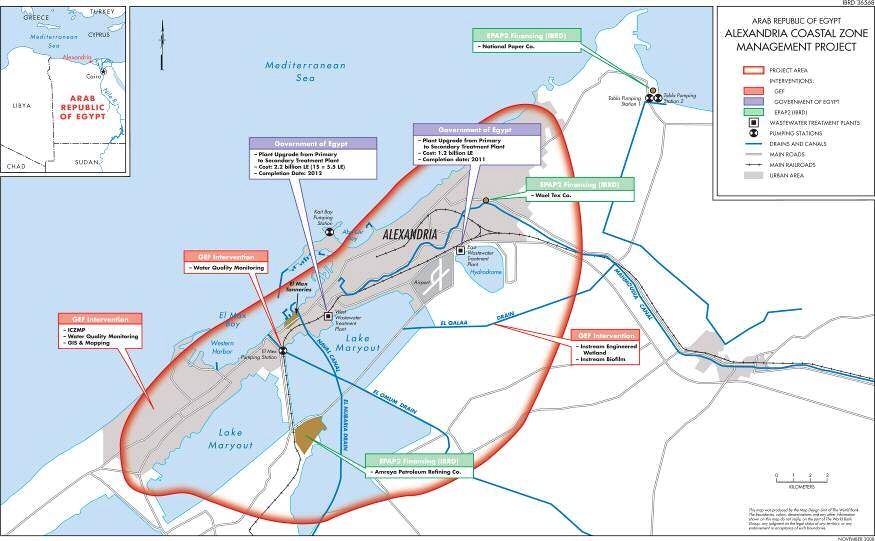
EEAA
AICZMP-ESIA
Annex 4: Alexandria CZM Map
110
EEAA
AICZMP-
ESIA
Annex 5: List of Preparers
Ihab M. Shaalan
Team Leader, EIA Specialist
Fakhry Abdel Khalik Environmental Scientist
Ayman Khalifa Water & Sanitation Specialist
Mohamed El-Akrat
Civil Engineer
Ahmed Aboul-Magd
Mechanical Engineer
111