E2267
V1
Arab Republic of Egypt
Ministry of State for Environmental Affairs
Public Disclosure Authorized
Egyptian Environmental Affairs Agency
Public Disclosure Authorized
Alexandria Integrated Coastal Zone Management
Project (AICZMP)
Public Disclosure Authorized
Environmental and Social Impact Assessment
Executive Summary
DRAFT FINAL
Revision Date: October 20th, 2009
Public Disclosure Authorized
CURRENCY EQUIVALENTS
(Exchange Rate Effective {20 October 2009})
US$1 = EGP 5.47
TABLE OF CONTENTS
INTRODUCTION 1
Purpose of the Report
1
Rationale of the Proposed Project
1
POLICY, LEGAL AND REGULATORY FRAMEWORK
3
Institutional framework and Management Arrangements
3
Project Description
3
SOCIO-ECONOMIC CONDITIONS
6
POTENTIAL ENVIRONMENTAL AND SOCIAL IMPACTS
7
Anticipated Negative Impacts
8
Socio-economic impacts
10
ENVIRONMENTAL AND SOCIAL MANAGEMENT PLAN
10
Institutional Arrangements
11
Summary of Impacts and Mitigation Measures
11
PUBLIC CONSULTATION
16
ABREVIATIONS
AFD
French Agency for Development
AICZM
Alexandria Integrated Coastal Zone Management
ALAMIM
Alexandria Lake Mariout Integrated Management
ASDCO
Alexandria Sanitary Drainage Company
B.C. Before
Christ
BOD
Biological Oxygen Demand
BP Best
Practice
CAA Competent
Administrative
Authority
CEDARE
The Center for Environment and Development for the Arab Region and Europe
CEO
Chief Executive Officer
cm Centimetre
COD
Chemical Oxygen Demand
Cr Chrome
Cu Copper
CW Constructed
Wetland
CZM
Coastal Zone Management
DO Dissolved
Oxygen
DRI
Drainage Research Institute
EA Environmental
Assessment
EEAA
the Egyptian Environmental Affairs Agency
EGP Egyptian
Pound
ESIA
Environmental and Social Impact Assessment
EIB
European Investment Bank
ESMP
Environmental and Social Management Plan
EMU Environmental
Management
Unit
EPAP
Egypt Pollution Abatement Project
ESIA
Environmental and Social Impact Assessment
ETP
East Waste Water Treatment Plant
FRP
Fiber Reinforced Polymer
GAFRD
General Authority for Fish Resources Development
GDCZM
General Directory for Coastal Zone Management
GEF
Global Environment Facility
GOE
Government of Egypt
HP Horse
Power
HRT Hydraulic
Retention
Time
ICZM
Integrated Coastal Zone Management
IWLEARN
International Waters Learning Exchange and Resource Network
JBIC
Japan Bank for International Cooperation
JICA
Japan International Cooperation Agency
Kg Kilogram
Km Kilo
Meter
Km2
Square kilometre
kW Kilo
Watt
kWh Kilo
Watt
hour
M
Meter
M&E
Monitoring and Evaluation
M3 Cubic
meter
M3/d
Cubic meters per day
MALR
Ministry of Agriculture and Land Reclamation
MAP
Mediterranean Action Plan
Mg/l
Milligram per liter
mm Millimetre
MSEA
Ministry of State for Environmental Affairs
MWRI
Ministry of Water Resources and Irrigation
N
Nitrogen
NCICZM
National Committee for Integrated Coastal Zone Management
NGO
Non Governmental Organisation
NH4 Ammonia
Ni Nickel
NO3 Nitrates
O2 Oxygen
OP Operation
Policy
P
Phosphorous
Pb Lead
PIT Project
Implementation
Team
PM10 Particulate
Matter
PMU Project
Management
Unit
ppm Part
per
million
PRP
Pollution Reduction Project
PRP
Pollution Reduction Project
PSC
Project Steering Committee
PWG
Project Working Group
Qrt Quarter
RBO
Regional Branch Office
RPF
Resettlement Policy Framework
Sec Second
SFD
Social Fund for Development
SMAP
Short and Medium term priority environmental Action Program
T
Ton
TSS
Total Suspended Solids
UNEP
United Nations Environment Programme
US$
United States Dollar
WB
The World Bank
WTP
West Waste Water Treatment Plant
WWTP
Waste Water Treatment Plant
Zn Zinc
AICZMP ESIA
EEAA
Introduction
The Government of Egypt, represented by the Egyptian Environmental Affairs Agency (EEAA)
is currently preparing the Alexandria Integrated Coastal Zone Management Project (AICZM)
which has the following main objectives:
a. to supply a strategic framework and immediate small- scale investments to reduce the
load of land- based sources of pollution entering the Mediterranean Sea in the hot spots
of El Mex Bay and Lake Mariout; and
b. to protect/restore globally significant coastal heritage and ecosystem processes by
supporting the Government of Egypt's efforts to develop and implement a National
Coastal Zone Management Plan.
This proposed project is developed with assistance from the World Bank (through a grant from
the Global Environment Facility (GEF)) which continues to provide support to the Government
of Egypt for improving its environmental management capabilities and to demonstrate the value
added of an integrated and participatory approach to coastal zone management for sustainable
development. The project is partially blended with the ongoing Second Egypt Pollution
Abatement Project (EPAP II) implemented by the Egyptian Environmental Affairs Agency
(EEAA), which aims at reducing industrial pollution in two hot spots in Egypt, namely
Alexandria (primarily Lake Mariout) and Greater Cairo.
Purpose of the Report
The Alexandria Integrated Coastal Zone Management Project is expected to have important
positive environmental impacts with the objective of contributing to a reduction in the load of
land-based sources of pollution entering the Mediterranean Sea, especially from Lake Mariout,
through the hot spots of El-Mex Bay and Alexandria.
The main purpose of this ESIA is to investigate potential impacts of the proposed main
intervention projects on both the environment as well as the community living around near Lake
Mariout.
Rationale of the Proposed Project
Lake Mariout is now considered a major source of pollution to the Mediterranean Sea through El
Mex Bay. It is one of the major sources of conveyance of land based pollution to the El-Mex Bay.
Lake Mariout receives polluted water from three major sources on a daily basis:
· Industrial effluents: Various industries discharge directly their effluents into the Lake or
El Mex Bay.
· Domestic effluents: Two wastewater treatment plants discharge their primary treated
effluents into the Lake Mariout.
· Drainage water from agriculture: The Lake receives an important part of agricultural
drainage water coming from secondary drains and agricultural activities upstream,
bringing pesticides, nutrients along with organic matter from animal farming and
domestic wastewater of nearby villages.
1
AICZMP ESIA
EEAA
As a consequence of the environmental degradation, Lake Mariout has changed from being the
most productive fisheries resource to the least productive in a couple of decades.
The proposed project will use a two pronged approach to sustainable coastal zone management
including:
a) Use of institutional strengthening measures and
b) Pollution reduction interventions.
Given the scale of the environmental degradation in Alexandria, the project in itself may only
contribute marginally to the reduction of pollution ultimately entering the Mediterranean Sea.
However, its main advantage and value added reside in its catalytic function to trigger consensus
building, awareness raising and institutional strengthening on sustainable coastal management
using pilot investment interventions as a platform to bring all stakeholders closer on the issue.
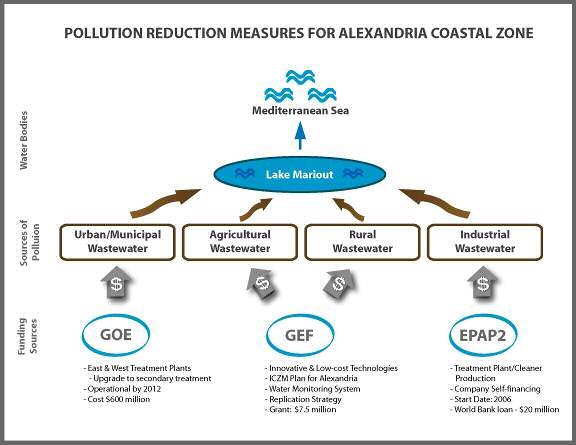
Besides, the project provides complimentarity with the two other ongoing related activities,
namely the EPAP II project, and the Government of Egypt's project to upgrade the East and West
Wastewater Treatment Plants in Alexandria. This is shown graphically in the Fig. 1.
Figure 1: Complementarities of the proposed project with other on-going activities
2
AICZMP ESIA
EEAA
Policy, legal and regulatory framework
The Integrated Environmental and Social Assessment for the project must meet a number of
policy and legal requirements associated with the environment, social issues and resettlement.
The World Bank safeguard policies and the Egyptian Environmental Protection Law No. 4/1994
(amended by Law 9/2009), Law No. 48/1982 concerning the protection of River Nile, canals and
drains, and detailed requirements for conducting EA as defined in Law 4/1994 have been
complied with during the course of project preparation and implementation.
Concerning Coastal Zone Management in Egypt, Law No. 4/1994 for the environment (as
amended by Law 9/2009) includes articles defining the coastal zones (art. 39) and the Integrated
Coastal Zone Management (art. 40 & 48). The amended law also assigns to the Minister of State
for Environment, a coordinating role with the relevant agencies/stakeholders to achieve the water
protection and integrated coastal zone management objectives. Specifically, the EEAA was given
the authority to "participate with the concerned agencies and ministries in the preparation of a
National Integrated Coastal Zone Management Plan for the Mediterranean Sea and Red Sea
coasts".
Institutional framework and Management Arrangements
EEAA is the agency responsible for overall project implementation. Together with the
Governorate of Alexandria, the EEAA will also lead the coordination work with other
implementing agencies, including the MWRI and the MALR. The institutional arrangements have
been designed to ensure a multi-sector and participatory approach to sustainable Coastal Zone
Management and to build on the technical expertise and comparative advantage of the different
agencies. Synergies and cross-fertilization with the EPAP II PMU staff at EEAA will be ensured.
Project Description
The main objective of the project is to improve the institutional mechanisms for sustainable
coastal zone management in Alexandria in particular to reduce land-based pollution to the
Mediterranean Sea.
The proposed key outcome indicators of success are:
· The AICZM plan is officially adopted and the institutional mechanisms for
implementation are successfully implemented;
· The pollution load entering the Mediterranean Sea through Lake Mariout is reduced by at
least 5%.
The proposed project is composed of 3 components. These are:
Component (1): Planning, Institutional Capacity and Monitoring
This component is intended to help increase the institutional capacity of the relevant agencies
involved in the management of Lake Mariout, in particular, and the coastal zone in Alexandria, in
general. The outputs for this component will include:
(i)
a master plan for the management of the coastal zones of Alexandria including
Lake Mariout (the "Alexandria Coastal Zone Management (AICZM) Plan"), and
3
AICZMP ESIA
EEAA
(ii)
the development of a water quality monitoring network to assess impact of
project interventions including a modeling activity for El-Mex bay..
The recommendations of the ACZM Plan will be reflected in the future land use plan for the city
of Alexandria.
Component (2): Pollution Reduction.
The expected outcome is a reduction in the land-based source of pollution entering the Lake
Mariout and subsequently the Mediterranean Sea through pilot pollution reduction measures. This
will entail the implementation of a package of pollution reduction measures, to be implemented
on a pilot basis,
The proposed interventions should be adequate to achieve the desired outputs within the overall
project objectives if implemented in an integrated package approach which is composed of:
1. In-Lake Wetland
2. In-Stream
Biofilm
3. In-Stream
aeration
4. Reeds
removal
The following is a brief description of each intervention independently.
Intervention 1: In-Lake Wetland
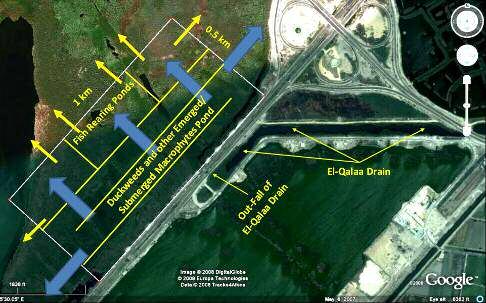
The most suitable location for the engineering wetland has been selected to be the East-Southern
part of the lake at the outfall of El-Qalaa drain (Figure 2). This aims to neutralize the negative
impact of pollutants entering the lake, to utilize the high nutrients input and increase the dissolved
oxygen, directly and indirectly, and improve the water quality entering the other parts of the lake.
Figure 2: Preliminary Layout of the Proposed In-Lake Engineering Wetland
4
AICZMP ESIA
EEAA
Conceptual Design:
An area of approximately 30 feddans has been chosen for the proposed wetland construction. The
area will be facing the Qalaa Drain out-fall, and will be cleared from vegetation (reeds),
excavated to depths of 2 m and surrounded by earthen/rock walls to isolate this part from the lake.
This area will be then subdivided into a number of Plug-Flow units where duckweeds will be
transplanted. Duckweed ponds can be qualified as secondary or tertiary treatment.
Intervention 2: In-stream Biofilm
The in-stream biofilm approach is considered to remove or reduce the organic pollutants
by adapting the severely polluted segments of the drains to act as large plug-flow
anaerobic/aerobic biofilm reactors in which bacterial culture will be intensified.
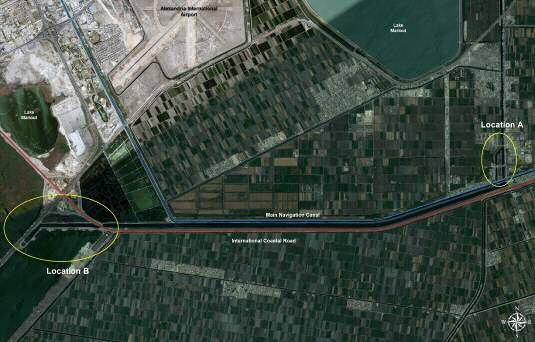
A specific location for applying the in-stream biofilm approach has been selected and it lies at the
height of Qalaa Pumping station (Location "A" shown in Figure 3).
Figure 3: Location for Biofilm Application in Qalaa Drain
Conceptual Design:
Packing media: One meter length of corrugated collecting pipes for drainage water (used for sub-
drains, 3 inch PVC is selected to be the packing media for the case of Al Qalaa Drain. The in-
stream biofilm system is designed to be applied in 500 sections along the selected segment of the
Qalaa Drain
Intervention 3: In Stream Electric powered Aeration
This application is utilized to increase the dissolved oxygen which will improve the drain
conditions and thus self purification. It also helps in the consumption of COD/BOD as well as
the conversion of ammonia into nitrates. The aerators selected will be energy efficient in a way
that converts the least amount of energy into the maximum amount of aeration and mixing. The
5
AICZMP ESIA
EEAA
chosen location for this application is upstream at Location "A" by the Qalaa pump station to
ensure to raise the DO in the drain.
Intervention 4: Reed Removal
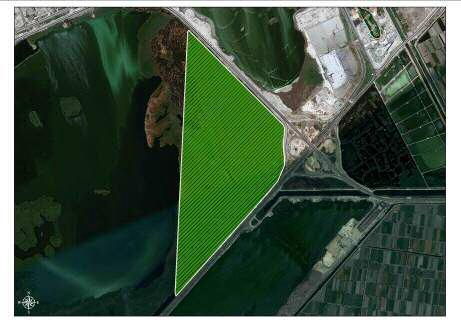
Reed removal is considered a base intervention that will potentially improve water circulation in
the basin, thus both improving its aeration and entraining some of the deteriorated sediments.
Figure 4: Area of Intervention for Reed Removal
Component (3): Project Management and Monitoring and Evaluation.
The expected outcome is the completion of a M&E system and the documentation of the project
results for the purpose of up-scaling and replication. The outputs of this component include
1. a project monitoring system with measurable indicators; and
2. documentation of project's progress and results, dissemination of lessons learned
from the project and adoption of a replication strategy.
This component entails supporting the Project Management Unit (PMU) currently associated with
the EPAP II to carry out the various activities related to the project implementation.
Socio-economic conditions
The fishermen community as a whole forms the poorest and most disadvantaged group in the
target area. They are mainly located in inaccessible areas from land, as the infrastructure is
limited or non-existent. The problems in reaching these communities with services and
interventions have developmental, economic and social impacts. Fishing cannot be carried out
6
AICZMP ESIA
EEAA
throughout the year, and in the idle periods they lack alternative employment opportunities. The
main demographical characteristics specified are:
· High illiteracy rates (especially that of females).
· Poor health services and high mortality rates.
· High crime rates Tendency to marry young and have large families
The following are specific recommendations the fishermen suggested for the development of the
lake area:
· removing reeds and aquatic plants and opening channels in heavily vegetated areas,
· Stopping all filling activities,
· Ensuring that families are given fair compensation in case of their resettlement due to
highway construction projects,
· Issuing fishing permits only to those fishermen who have been resident in the area for a
long time,
· Providing health care centers in accessible areas, and
· Providing the community with soft loans for improving their fishing equipment.
potential environmental and social impacts
The Global benefits expected from the project include:
· reducing trans-boundary pollution from Lake Mariout to the Mediterranean Sea.
· improving Lake Mariout's biodiversity.
Local benefits include:
· Potential sales of duckweeds
· Improved air quality
· Increase in fish production
Component (1): Planning, Institutional Capacity and Monitoring
Although this component has no direct impact on the environment, yet its indirect positive
impacts are obvious. Strengthening the management and institutional capacity of the relevant
agencies that are responsible for managing Lake Mariout will ensure that improvement programs
for the Lake will be properly implemented and continuously monitored.
Component (2): Pollution Reduction
This component with its proposed intervention will result in improving the water quality of Lake
Mariout. Although it is determined that the interventions under this component will be
implemented as demonstration or pilot projects, the pre-feasibility studies expect some
improvement in the Lake water quality.
The expected positive impacts of Component 2 can be summarized as follows:
-
improvement of Lake Mariout water quality by reducing at least 5% of the pollution
levels
-
The fish yield is expected to increase due to the improvement of water quality
7
AICZMP ESIA
EEAA
-
Application of low-cost technologies as pilot projects provides a chance for scaling-up
the project in the future to achieve more significant water quality improvement
-
The interventions can be demonstrated as an appropriate model for replication in other
polluted lakes in Egypt
-
Reed removal will allow fishermen to have better access to fishing grounds and will
remove a major source of problems in the Lake
Component (3): Project Management, Monitoring and Evaluation
The completion of the comprehensive monitoring and evaluation scheme for the project ensures
the timely delivery of the entire project's activities. This will have an indirect positive
environmental impact due to the assurance of the smooth implementation of the project and
monitoring the progress of each of the project intervention programs.
Anticipated Negative Impacts
Impacts during Construction
Both components (1) and (3) have no physical interventions and there are no anticipated negative
impacts associated with them.
Component (2) is mainly an environmental improvement intervention that aims at reducing
pollution levels in Qalaa drain and the Main Basin of Lake Mariout. The technologies used are
simple and do not include sophisticated equipment or use of any chemicals or hazardous
materials. However, an assessment of some of the impacts that might be associated with the
construction and operation of the proposed interventions will ensure achieving the desired goals
and minimize the risks of negative results.
The following table summarize the potential negative impacts resulting from Component (2) and
their impact rating.
8
AICZMP ESIA
EEAA
Table 1: Overall Environmental Impact Assessment Matrix
Environmental Receptors Affected
Activity
Environmental Aspects
s
t
em
t
r
i
al
s
t
em
&
l
e
s
t
i
c
y
s
y
s
y
t
h
al
a
c
t
r
i
l
t
e
r
r
es
i
s
e
al
et
er
p
odi
qua
co
er
co
af
v
Ai
So
Wa
B
A
E
T
E
No
He
S
O
Im
Impacts during Construction
Transportation of materials and personnel
L
N
N
N
N
L
L
L
Installation of In-Stream Biofilm
Storage of construction material on drain sides
N
L
N
N
L
N
N
L
Use of heavy machinery
L
N
N
N
N
L
L
L
Temporary storage of excavated contaminated
N
H
N
N
M
N
M
H
sediments
Dredging
Disposal of excavated contaminated sediments/sludge
N
H
N
N
H
N
M
H
Degradation of water quality
N
N
L
L
N
N
L
L
Disruption of aquatic ecosystems
N
N
N
M
N
N
N
M
Use of heavy machinery
L
N
N
N
N
L
L
L
Disruption of aquatic ecosystems
N
N
N
M
N
N
N
M
Removal of Reeds
Temporary storage of contaminated reeds
N
L
N
M
L
N
N
L
Disposal of contaminated reeds
M
M
N
N
M
N
M
M
Introduction of alien aquatic plant species
N
N
N
M
N
N
N
M
Construction of In-Lake wetland
Impacts during Operation
Maintenance of the in-stream biofilm
Cleaning and disposal of biofilm parts
N
L
L
N
N
N
N
L
Maintenance of In-Lake wetland
Removal, recycle or disposal of duckweeds
L
L
N
L
L
N
H
H
Use of electrically driven aerators
Consumption of fossil-based energy
L
N
N
N
N
N
N
L
N:
Neutral or Negligible
L:
Low
M:
Moderate
H:
High
9
Socio-economic impacts
The proposed project with its 3 components aims at improving the lake management schemes as
well as reducing the environmental pollution in the lake. Although the expected pollution
reduction in the lake is not expected to be high, yet any small improvement will result, on the
long run, in increasing the fish yield and decreasing the health risks associated with fishermen
activities in the lake.
As revealed in the public consultation and previous interviews with fishermen, the main basin,
where the project is located, is not currently considered as fishing grounds for the fishermen due
to the density of the reeds in that basin in addition to the high pollution levels in the shallow
waters in the proposed project site. The fishermen actually requested that the implementation of
the project starts as soon as possible due to the expected positive impacts of the interventions.
As for Qalaa drain, no fishing is taking place in the drain due to the high levels of pollutions in its
waters. Generally, the drains are not a source of revenue and none of the pollution
reduction activities on the drain would result in any land take nor would interfere with
any of the economic activities of the residents.
In terms of the long term possible socio economic impacts of developing the Integrated
Coastal Zone Management Plan, the project does include a set of checks and balances to
ensure that social impacts, especially on marginalized groups, from the plan
implementation is minimized, through the following:
(i) The National Committee on Coastal Zone Management Plan, which provides
the ultimate oversight on coastal zone management issues in Egypt, including
the endorsement of the development of the Integrated Coastal Zone
Management Plan, includes representatives from nongovernmental
organizations
(ii) The Project Steering Committee includes a representative from the Lake
Mariout Development Committee, which represents the interests of the local
communities, in particular the fishermen community during project
implementation; as well as representatives from the civil society.
(iii) Financing for the project's first component will include "public consultation
workshops and master plan dissemination", which will ensure that the views and
interests of the civil society agencies are well represented.
Environmental and social management Plan
The principal purpose of the Environmental and Social Management Plan (ESMP) is to present a
set of mitigation, monitoring, and institutional measures to be taken during planning and design,
construction, operation and maintenance of the various project components and activities
associated with potential negative impacts. The objective of these measures is to eliminate
adverse environmental and social impacts, offset them, or reduce them to acceptable levels.
10
Institutional Arrangements
Management Setup
This Project is implemented through the coordinated efforts of four Ministries/Agencies:
· Egyptian Environmental Agency Authority (EEAA),
· Governorate of Alexandria,
· Ministry of Water Resources and Irrigation (MWRI); and
· Ministry of Agriculture and Land Reclamation (MALR).
EEAA is the executing agency ultimately responsible for the overall project implementation, and
for leading the coordination activities with the other implementing agencies according to their
specific roles and responsibilities.
A Project Steering Committee (PSC) will be established to provide oversight and direction to the
project
The National Steering Committee for Integrated Coastal Zone Management will provide
scientific advice and inputs into the preparation of the Alexandria Integrated Coastal Zone
Management Plan serving as a scientific and advisory body in particular for Component (1)
during the preparation stage.
Within the project's context, a Project Management Unit (PMU) will be established and staffed
with the needed expertise required to manage and operate the project. Furthermore, an
Environmental Specialist will be assigned by the EEAA on a part-time basis to address the
environmental safeguards issues related to the project and oversee the implementation of the
ESMP.
Summary of Impacts and Mitigation Measures
Potential negative environmental and social impacts that have been identified and ranked as
"High", "Moderate" or "Low" are presented It is recommended to adopt and implement a
series of mitigation measures as follows:
11
Table 2: Mitigation Measures and Associated Institutional and Financial Responsibilities
Environmental/Social
Environmental/Social
Proposed Mitigation
Responsibility
Timeframe
Cost (US$)
Aspect(s)
Impact(s)
Measure(s)
Implementation
Monitoring
Transportation of
Air Pollution
Only vehicles which
Contractor in
PMU
Whenever materials
None
materials and personnel
passes the legal
coordination with
or personnel are
environmental tests for
MWRI
transported to project
exhaust are allowed to
site
have access to the site.
Drivers to be provided
Health and Safety
with Safe Driving
Instructions
Embedded in
H&S signs and gear
works
should be available on
contract
site
Storage of construction
Land contamination
Dedicate specific area
Contractor in
PMU
During initial phases
Embedded in
material on drain sides
for storage of
coordination with
of mobilization
works
construction material
MWRI
contract
and restrict access to it
by installing proper
fences
Use of heavy machinery
Noise
Provide H&S
Contractor in
PMU
Continuous during
Embedded in
in dredging
equipment for workers
coordination with
dredging
works
Disruption of the
and site visitors
MALR
contract
ecosystem
Properly mark the areas
Water pollution
that will require dredging
None
Restrict access of
equipment to the areas
where no dredging is
required
Embedded in
works costs
Temporary storage of
Land contamination
Designate specific area
Contractor in
PMU
Continuous during
Embedded in
12
Responsibility
excavated contaminated
Solid wastes causing
for temporary storage
coordination with
dredging
works costs
sediments
health risks
of excavated sediments
MALR
Included in
Conduct a feasibility
the final
study for utilizing the
PMU in
feasibility
PMU
sediments.
coordination with
study of the
MALR
proposed
interventions
Disposal of excavated
Solid wastes causing
Sign contract with
Contractor in
PMU
During temporary
Embedded in
contaminated
health risks
waste collection
coordination with
storage and before
works costs
sediments/sludge
contractor to properly
MALR
end disposal
dispose of the
sediments
storage and disposal of
Solid wastes causing
Conduct Sampling and
PMU
PMU
Before harvesting of
Included in
reeds and duckweeds
health risks
Analysis for the
reeds or duckweeds
the final
removed reeds and
feasibility
duckweeds
study of the
proposed
Conduct a feasibility
interventions
PMU in
PMU
study to find out best
coordination with
way to utilize the
MALR
harvested reeds and
duckweeds.
Embedded in
Designate area for
works
temporary storage of
Contractor in
PMU
contract
reeds before final
coordination with
disposal
MALR
Cleaning and disposal of
Solid wastes causing
Sign contract with
MWRI
PMU
During the routine
To be
biofilm parts
health risks
waste collection
maintenance
determined
company to remove
during the
and properly dispose of
feasibility
the un-used materials
studies.
13
Responsibility
Aerators consumption of
Indirect air pollution
Purchase energy
PMU in
PMU
During procurement
Embedded in
fossil-based energy
efficient aerators
coordination with
procurement
MWRI
costs
Introduction of alien
Disruption of ecosystem
A native plant that can
PMU in
PMU
Before construction
Included in
aquatic plant species
provide similar
coordination with
of in-lake wetland
the final
functions as the
MALR
feasibility
duckweeds should be
study of the
researched and utilised
proposed
interventions
Interaction with
Lack of participation
Involve fishermen in
PMU
PMU
During project
15,000 (from
fishermen community
threatening the
project activities
construction and
the project
sustainability of the
especially in reeds
during harvesting of
budget)
project
removal and harvesting
the aquatic plants
of duckweeds
Total Estimated Costs (US$)
15,000
14
The following table presents a fully fledged environmental monitoring program that
needs to be implemented throughout the project's lifetime.
Table 3: Continuous Monitoring Program
Parameter
Location (**)
Number of
frequency Responsible Costs
Samples
Organization
US$ **
Physical parameters:
· Effluent of west
MWRI/
·
Depth
treatment plant
One sample at
monthly
MALR/Alex
None
·
Temperature
· Qalaa Drain outfall
each location
RBO
·
Transparency
· in the course of
·
Salinity
Nobareya Canal
·
Conductivity
· in the course of El-
·
Dissolved
Omoum drain
oxygen (DO
· at the central part of
mg/l)
the main basin.
·
Oxygen
· At the northern
saturation
corner of the main
(DO%)
basin
·
pH
Bacteriological
· Effluent of west One sample at
monthly MWRI/
None
parameters
treatment plant
each location
MALR/Alex
·
Total coliforms
· Qalaa Drain outfall
RBO
·
Faecal coliforms
· in the course of
·
Faecal
Nobareya Canal
streptococci
· in the course of El-
Omoum drain
· at the central part of
the main basin.
· At the northern
corner of the main
basin
Eutrophication
MWRI/
Parameters
MALR/Alex
None
·
Nitrate
·
Effluent of west Representative
monthly
RBO
·
Nitrite
treatment plant
Samples to be
·
Ammonia
·
Qalaa Drain outfall
quantified by
·
Total nitrogen
·
in the course of sampling
·
Phosphate
Nobareya Canal
agency
·
Total
·
in the course of El-
phosphorus
Omoum drain
·
Silicates
·
at the central part
·
Total suspended
of the main basin.
solids
·
At the northern
·
Chlorophyll a
corner of the main
·
BOD5
basin
·
COD
·
Oil and grease
·
Heavy metals
Bottom sediments:
None
·
TOC
·
Qalaa Drain outfall
Representative
Annual
Alex
·
Heavy metals
·
in the course of Samples to be
RBO/MWRI
(Cr, Al, Fe, Cu,
Nobareya Canal
quantified by
Pb, Zn, As, Ni
·
in the course of El-
sampling
and Hg).
Omoum drain
agency
·
at the central part
15
Parameter
Location (**)
Number of
frequency Responsible Costs
Samples
Organization
US$ **
of the main basin.
·
At the northern
corner of the main
basin
Tissue of Fish
(Tilapia)
The Main basin
Representative
Half
MALR
None
Heavy metals:
Samples to be
Annual
(Cr, Al, Fe, Cu, Pb,
Fisheries basin
quantified by
Zn, As, Ni and Hg).
sampling
agency
Excavated Sediments
Temporary storage site
Representative
Once after
Alex
None
Heavy metals:
Samples to be
the
RBO/MWRI
(Cr, Al, Fe, Cu, Pb,
quantified by
sediments
Zn, As, Ni and Hg).
sampling
dry out
agency
Removed reeds
Temporary storage site
Representative
Once after
Alex
None
Heavy metals:
Samples to be
the
RBO/MALR
(Cr, Al, Fe, Cu, Pb,
quantified by
removed
Zn, As, Ni and Hg).
sampling
reeds dry
agency
out
Duckweeds (or other
Temporary storage site
Representative
After the
Alex
None
aquatic plants used
Samples to be
plants dry
RBO/MALR
in CW)
quantified by
out
Heavy metals:
sampling
(Cr, Al, Fe, Cu, Pb,
agency
Zn, As, Ni and Hg).
(*) The location of sampling could be changed based on the final feasibility study
(**) Component 1 in the project will include procurement of monitoring equipment which will
be utilized by the PMU and partner agencies.
Public Consultation
The first stage of consultation with the public started by identifying stakeholder groups
and affected communities by the proposed project. In the initial phases of the project
design, several in-depth meetings and interviews were conducted with key stakeholders.
A draft non-technical executive summary was prepared and shared with the stakeholders
prior to the consultation session. The summary was available in both Arabic and English
languages and were posted on EEAA website to ensure reaching out to as many
stakeholders as possible.
On September 30th, 2009, the public consultation session was held at one of Alexandria
hotels. Representatives of the civil society, competent governmental authorities as well as
technical consults participated effectively in the discussions.
The main outcomes from the public consultation session demonstrated that there is a very
high level of interest in the project area, Lake Mariout, as well as in the proposed
interventions and the degree of expected improvement from the project's activities.
16
All participants have expressed deep concern about the deteriorated environmental
conditions of Lake Mariout and the causes of these problems. Several attempts and
suggestions concerning improving the situation was proposed and discussed among the
participants as well as EEAA team.
The socio-economic conditions of the fishermen community also gained a lot of attention
from the attendants, especially from NGO's, who urged the project to involve the fishermen
community in implementing the project activities to ensure buy-in as well finding
opportunities to improve their livelihoods through small scale projects associated with the
proposed interventions.
A discussion about the environmental and social impacts of each intervention also indicated
that the positive impacts are more likely to dominate whereas negative impacts are minimal
due to the fact that the interventions aim at improving the environmental conditions and the
nature of the project being a demonstration and pilot activity.
17