Request for CEO endorsement/Approval
Project Type: Full-sized Project
the GEF Trust Fund

Request
for CEO endorsement/Approval
Project
Type: Full-sized Project
the
GEF
Trust Fund
Submission Date: 19th Dec. ‘07
Re-submission Date: 13th Feb. ‘08
Expected
Calendar Milestones Dates Work
Program (for FSP) 15
June 2007 GEF
Agency Approval June
2008 Implementation
Start Sep
2008 Mid-term
Review (if planned) Sep
2010 Implementation
Completion Aug
2013
GEFSEC Project ID:
gef agency Project ID:
Country(ies): Regional Mediterranean (12 countries): Albania, Algeria, Bosnia and Herzegovina, Croatia, Egypt, Lebanon, Libya, Morocco, Montenegro, Syria, Tunisia and Turkey. The Palestinian Authority also participates in the project
Project Title: Strategic Partnership for the Mediterranean Sea Large Marine Ecosystem – Regional Component: Implementation of agreed actions for the protection of the environmental resources of the Mediterranean Sea and its coastal areas
Other Executing partner(s): UNEP/MAP-MEDU, MEDPOL and its associated RACs (CP/RAC, SPA/RAC, PAP/RAC and INFO/RAC); UNESCO/HP; WWF; GWP-Med; MIO-ECSDE; FAO, GFCM, WB, METAP
GEF Focal Area(s): Full-sized ProjectInternational Waters, Full-sized ProjectPersistent Organic Pollutants
GEF-4 Strategic program(S): IW SP-1; IW SP-2; IW SP-3; POPs SP-2
Name of parent program/umbrella project: Strategic Partnership for the Mediterranean Large Marine Ecosystem
Project framework
|
Project Objective: To promote and induce harmonized policy, legal and institutional reforms and fill the knowledge gap aimed at reversing marine and coastal degradation trends and living resources depletion, in accordance with priorities agreed by the countries in the SAP MED and SAP BIO and to prepare the ground for the future implementation of the ICZM Protocol. |
||||||||
Project Components |
Indicate whether Investment, TA, or STA** |
Expected Outcomes |
Expected Outputs |
GEF Financing* |
Co-financing* |
Total ($)
|
||
($) |
% |
($) |
% |
|||||
|
1. Component 1. Integrated approaches for the implementation of SAPs and NAPs: ICM, IWRM, and management of coastal aquifer |
Technical assistance; Scientific & Technical Analysis |
Regional legislation addressing ICZM, IWRM and aquifer managements as mechanisms to protect the Mediterranean from biodiversity loss and pollution from land based sources; Regional and National institutions strengthened for ICZM and IWRM; Stress reduction measures achieved through ICZM, IWRM and management of aquifers and monitored at water-body level; Sustainable financing opportunities established; Increased scientific knowledge concerning the management of aquifers and groundwater.
|
Regional Action Plans for Coastal aquifers drafted, for eco-hydrogeological management, land degradation and protection of priority coastal wetlands, for IWRM; ICZM NAPs drafted in 2 countries, ICZM Plans to demonstrate, IWRM plans drafted for 2 countries, IRBM plans for 2 water bodies; COED assessments for a min. of 2 countries, Coastal aquifer and land management approaches developed and implemented at 3 demo sites and eco-hydrogeology applications for management and protection of coastal wetlands, Transboundary IWRM introduced in 6 water bodies, Min of 24 ICZM/IWRM related institutions strengthened, Case study for harmonizing national institutional arrangements and legislation with ICZM Protocol, 15 juridical practitioners trained; Stress Reduction; Methodology for selection, implementation and sustainable financing of pilot ICZM projects will be drafted and distributed; Scientific assessments. |
3,220,000 |
25,84 |
9,237,700 |
74,16 |
12,457,700 |
|
2. Component 2. Pollution from land based activities: implementation of SAP MED and related NAPs |
Technical assistance;
Scientific & Technical Analysis |
Increased capacity of basin countries to implement policies and strategies that address SAP MED and the NAPs priorities; Increased knowledge of countries and donors on innovative technology to reduce pollution and increased scientific knowledge; Stress reduction measures achieved through demonstration projects and monitored at water-body level; Initiation of NAP/NIP implementation for the ESM of equipment, stocks and wastes contaminated with PCBs in national electricity companies of Mediterranean countries
|
Min of 5 National legal and policy documents drafted incorporating the SAP-MED; Implementation initiated for a minimum of 8 NAP priorities; Management plans/guidelines developed and applied for the reduction of pollution from land-based sources; ELV (and EQS) in all countries; Guidelines for pollution reduction in all countries; Plans of action for permitting, compliance and inspection systems in 8 countries; Environmentally sound technology (TEST-MED) applied to 8 demonstration enterprises; Assessment riverine fluxes of nutrients; Pilot projects (9) implemented; 5 countries with strengthened legislative and regulatory frameworks for the management of POPs; 5 countries with strengthened capacity for enforcement and disposal; Demonstration projects implemented in 5 countries, with 877.7 tons of PCB’s removed and disposed. |
4,400,000 (including UNIDO sub-comp) |
45,28 |
5,316,500 (including UNIDO sub-comp) |
54,72 |
9,716,500 |
|
3. Component 3. Conservation of biological diversity: implementation of SAP BIO and related NAPs |
Technical assistance; Scientific & Technical Analysis |
Creation of an ecologically coherent MPA network in the Mediterranean region; Adoption of the ecosystem approach to fisheries management and the application of targeted interventions to reduce by catch and other unsustainable fishing practices |
Regional Coordination Unit (RCU) for MPAs established; Implementation of projects/tools /technologies for biodiversity conservation; Area under protection to be increased by 10%, from 9 732 600 hectares to 10,705,860 hectares; Ecosystem approach mainstreamed into fisheries management policies and activities: 4 sub-regional and 5 national policy reforms and management reforms to incorporate EAF drafted; Implementation of projects/tools /technologies for biodiversity conservation; National policy/legislative reforms drafted for all countries; By catch of iconic and vulnerable species reduced by 75 %; Unsustainable fishing practices reduced by a minimum of 90 % at regionally prioritized sites in 7 countries covering 30,000 ha. |
800,000 |
4,59 |
16,031,600 |
95,24 |
16,831,600 |
|
4. Component 4. Project Co-ordination, Replication and Communication Strategies, Management and M&E |
|
Effective project management of the regional component established and coordination and synergy between the Regional Project and the Investment Fund components of the Strategic Partnership; Replication and communication mechanisms are designed and implemented for RPs under the LME Partnership, with results communicated and disseminated; Involvement of all key stakeholders in the project activities and SAP implementation process. |
Project Management: PMU, SPSC, SPCG, SPB established and functional; Work plan adopted and implemented. Project Co-ordination: PMU, SPSC, SPCG, SPB meetings; All countries have established inter-ministry committees; Identification and design of sub-projects under the Investment Fund component reflect systematic interactions within the context of the coordination mechanisms of the Regional Project component Replication Strategy: Project Replication team established with ToRs; Accessibility of information: data via the web-portal, meetings, workshops held; Potential Replication Projects (PRPs) identified, including their funding mechanisms; Replication Potential assessment completed with scored Replication Projects; Replication potential catalysed at the national level: PRPs have a specific section with complete data sets and strategy for their replication. Communication Strategy: Printed material regarding the project activities disseminated to the general public; Number of public events; Magazine designed, on-line and updated; Number and success of campaigns to the general pubic; Effective national inter-ministry coordination through the establishment of inter-ministry committees in all countries; NGO/CBO’s present and participate in: stakeholder consultation meetings, advisory bodies, managing/decision making bodies of the project, and monitoring and evaluation activities; NGO involvement plan published and all stakeholders have a copy early in project implementation |
3,190,000 |
37,41 |
5,336,400 |
62,59 |
8,526,400 |
|
5. Project management |
1,281,000 |
67,74 |
626,000 |
32,82 |
1,907,000 |
|||
|
Total Project Costs |
12,891,000 |
|
36,548,200 |
|
49,439,200 |
|||
B. Financing Plan Summary For The Project ($)
|
|
Project Preparation* |
Project |
Agency Fee |
Total at CEO Endorsement |
For the record: Total at PIF |
|
GEF |
700,000 |
12,891,000 |
1,233,190 |
14,824,190 |
|
|
Co-financing |
1,258,500 |
36,548,200 |
|
37,806,700 |
|
|
Total |
1,958,500 |
49,439,200 |
1,233,190 |
52,630,890 |
|
*
Please include
the previously approved PDFs and PPG, if any. Indicate the amount
already approved as footnote here and if the GEF
funding is from GEF-3.
Provide the
status of implementation and use of fund for the project preparation
grant in Annex D.
C. Sources of confirmed Co-financing, including co-financing for project preparation for both the PDFs and PPG.
|
Co-financing sources |
||||
|
Name of Co-financier (source)/Sub-Component |
Classification |
Type |
Amount $ |
% |
|
Italian Ministry for the Environment, Land and Sea/PDF-B Phase |
Government |
Cash & in kind |
292,500 |
0,77 |
|
Executing agencies/PDF-B Phase |
UN cooperating agencies and Supporting organization |
In kind |
966,000 |
2,55 |
|
Italian Ministry for the Environment, Land and Sea/Sub-Component 1.1 |
Government |
Cash |
600,000 |
1,58 |
|
Italian Government/ Sub-Components 2.2 TEST |
Government |
Cash |
600,0001 |
1,58 |
|
Croatia – Ministry of Culture/Component 3 - BD |
Government |
In kind |
250,000 |
0,66 |
|
Syria - Ministry of Local Administration and Environment/BD-Component 3 |
Government |
In kind |
250,000 |
0,66 |
|
Albania - Ministry Environment, Forests and Waters Administration/Component 3 - |
Government |
In kind |
100,000 |
0,26 |
|
Libya - Environmental General Committee/Component3 |
Government |
In kind |
250,000 |
0,66 |
|
Bosnia and Herzegovina Ministry of Foreign Trade and Economic Relations//Component3 |
Government |
In kind |
250,000 |
0,66 |
|
France/FFEM – Ministry of Ecology and Sustainable Development/Component 3 “existing MPAs” |
Government |
Cash |
1,820,0002 |
4,81 |
|
Government of Spain/Spanish Agency for International Cooperation /Component 3 “new MPAs” |
Government/National Institutions |
Cash |
2,520,0003
|
6,66 |
|
Algeria - Ministry for Territory and Environment/Regional Component |
Government |
In kind |
1,000,000 |
2,64 |
|
Syria - Ministry of Local Administration and Environment/ Regional Component and BD |
Government |
In kind |
1,000,000 |
2,64 |
|
Morocco - Ministry for Territory, Water and Environment/ Regional Component |
Government |
In kind |
1,000,000 |
2,64 |
|
Tunisia – Ministry for the Environment and sustainable Development/Regional Component |
Government |
In kind |
1,000,0004 |
2,64 |
|
Libya – Environment General Authority/Regional Component and Biodiversity |
Government |
In kind |
1,000,000 |
2,64 |
|
Bosnia and Herzegovina - Ministry of Foreign Trade and Economic Relations/ Regional Component and Biodiversity |
Government |
In kind |
1,000,000 |
2,64 |
|
Croatia – Ministry of Environmental Protection, Physical Planning and Construction/Regional Component |
Government |
In kind |
2,500,0005 |
6,61 |
|
Turkey – Ministry of Environment and Forestry/ Regional Component |
Government |
In kind |
1,000,000 |
2,64 |
|
Montenegro – Ministry of Tourism and Environmental Protection/ Regional Component |
Government |
In kind |
800,0006 |
2,11 |
|
Egypt – Ministry of State of Environmental Affairs/ Regional Component |
Government |
In kind |
1,000,000 |
2,64 |
|
Albania - Ministry Environment, Forestry and Water Administration/Regional Component and BD |
Government |
In kind |
700,000 |
1,85 |
|
FFEM for Sub-Component 1.1 |
Government |
Cash |
1,333,0007 |
3,52 |
|
CP/RAC/Sub-Component 2.3 POPs |
Co-executing Agency |
50% Cash and 50% in kind |
400,000 |
1,05 |
|
SPA/RAC - Component 3 |
Co-executing Agency |
Cash and in kind |
600,000 |
1,58 |
|
INFO RAC/Sub-Components 4.2 and 4.3 |
Co-executing Agency |
In kind |
343,200 |
0,90 |
|
PAP/RAC/ Sub-Component 1.2 |
Co-executing Agency |
In kind
|
75,200 |
0,19 |
|
PAP-RAC/ Sub-Component 1.2 |
Co-executing Agency |
Cash/In kind |
152,000 |
0,40 |
|
Mediterranean Trust Fund / Sub-Component 4.1/ Activity 4.1.4 Sustainable Financial Mechanism |
Multilateral Agency |
Cash (82%) and in-kind |
120,000 |
0,31 |
|
Mediterranean Trust Fund/Sub-Components 2.1 Policy |
Multilateral Agency |
Cash (82%) and in kind |
910,000 |
2,40 |
|
Mediterranean Trust Fund/Sub-Components 2.3 POPs |
Multilateral Agency |
Cash |
1,300,000 |
3,43 |
|
European Commission – DG Environment – Component 3
|
EU |
Cash
|
2,765,0008 |
7,31 |
|
MAVA Foundation/ Component 3 |
Foundation |
Cash |
2,450,000 |
6,48 |
|
European Space Agency/ Sub-Component 1.1 |
International organization |
In kind |
450,000 |
1,19 |
|
World Bank / Sub-Component 4.1/ Activity 4.1.3 Coordination Group |
International Organization |
In kind |
370,000 |
0,97 |
|
LUND University (Sweden)/ Sub-Component 1.1 |
National Institution |
In kind |
200,000 |
0,52 |
|
Regional Government of Sicily Region, Italy/Sub-Components 4.2 and 4.3 |
National Institution |
Cash |
1,049,3009 |
2,77 |
|
Spanish Geological survey/Component 1.1 |
National Institution
|
In-kind
|
100,000
|
0,26 |
|
Palestinian National Authority – Environment Quality Authority//Regional Component |
National Authority |
In kind |
1,000,000 |
2,64 |
|
GWP-Med/Sub-Component 1.3IWRM |
NGOs |
Cash |
1,000,000 |
2,64 |
|
MIO-ECSDE/Component 4.1/ Activity 4.1.10 |
NGO |
Cash |
150,000 |
0,39 |
|
Demonstration enterprises/Counter parts Sub-Components 2.2 TEST |
Private sectors/National institutions |
In kind |
150,500 |
0,39 |
|
Basel Convention//Sub-Component 2.3 POPs |
Secretariat |
Mainly cash |
250,000 |
0,66 |
|
UNESCO/Sub-Component 1. 1 |
UN Cooperating Agency |
Cash |
440,000 |
1,16 |
|
FAO-TCP/ Sub-Component 1.1 |
UN Cooperating Agency |
In kind |
300,000 |
0,79 |
|
UNIDO/ Sub-Components 2.2TEST |
UN Agency / Co-executing Agency and Government |
In kind |
200,000 |
0,52 |
|
FAO/GFCM/ Sub-Component 3.1 and 3.2 |
UN Cooperating Agency / Co-executing Agency |
In kind |
800,000 |
|
|
2,11 |
||||
|
UNEP-MAP/Sub-Component 4.1/Activity 4.1.1 |
UN Cooperating Agency |
In kind |
250,000 |
0,66 |
|
UNEP-MAP/Sub-Component 4.1/ Activities 4.1.1, 4.1.2, 4.1.3, 4.1.5, 4.1.6, 4.1.7, 4.1.8 |
UN Cooperating Agency |
Cash |
750,000 |
1,98 |
|
Total including PDF-B
|
|
|
37,806,700
|
|
NB The adjustment of the total amount of co-financing depends on the USD/Euro rate because some co-financing amounts are in Euros.
D. GEF Resources Requested by Focal Area(s), Agency(ies) or Country(ies)
|
GEF Agency |
Focal Area |
Country Name/ Global |
(in $) |
|||
|
Project Preparation |
Project |
Agency Fee |
Total |
|||
|
UNEP |
IW |
Regional Mediterranean |
700,000 |
8,991,000 |
872,190
|
10,563,190 |
|
UNEP |
POPs |
Regional Mediterranean |
0 |
2,900,000 |
261,000
|
3,161,000 |
|
UNIDO |
IW |
Regional Mediterranean |
0 |
1,000,000 |
100,000
|
1,100,000 |
|
Total GEF Resources |
700,000 |
12,891,000 |
1,233,190 |
14,824,190 |
||
No need to provide information for this table if it is a single focal area, single country and single GEF Agency project.
E. Project management Budget/cost –
Cost Items |
Total Estimated person weeks |
GEF($) |
Other sources ($) |
Project total ($) |
Project Management Unit*(Project staff salaries) |
720 |
1,281,000 |
276,000 |
1,557,000 |
Local consultants** |
0 |
0 |
0 |
0 |
International consultants** |
0 |
0 |
0 |
0 |
Office facilities, equipment, vehicles and communications10 |
|
0 |
250,000 |
250,000 |
|
Travel11 |
0 |
100,000 |
100,000 |
|
|
Total |
720 |
1,281,000 |
626,000 |
1,907,000 |
**The Project Management Unit consists in: a Project Manager full time, a Mediterranean Marine and Coastal Expert supporting (80% of time) the project Manager and providing (20% of time) expertise for the Sub-Components, a coordinator for TEST activity (lead by UNIDO) and a Financial Assistant.
** Detailed information regarding the consultants in Annex C.
f. Consultants working for technical assistance components:
Component |
Estimated person weeks |
GEF($) |
Other sources ($) |
Project total ($) |
Local consultants* |
3,446 |
981,200 |
1,289,200 |
2,270,400 |
International consultants* |
2,769 |
2,969,700 |
2,379,000 |
5,348,700 |
Total |
6,215 |
3,950,900 |
3,668,200 |
7,619,100 |
* Provide detailed information regarding the consultants in Annex C.
describe the budgeted m&e plan:
Monitoring and Evaluation Work Plan and corresponding budget12
For full detailed Monitoring and Evaluation Plan see Annex E. Monitoring and Evaluation Plan
|
Activity/Reporting |
Time/Frequency |
Responsible Partner(s) |
Budget USD13 |
|
|
|
|
|
GEF |
Other |
|
Inception Workshop |
Within the first two months of project start up |
PMU; co-executing agencies; SP Focal Points; UNEP/MAP, UNEP, UNIDO, FAO, GEF, WB |
58,000
|
0 |
|
Inception report |
Immediately following the IW/Steering Committee |
PMU and all executing/co-executing agencies14 |
4,000
|
0 |
|
Measurement of initial baseline and means of verification for project indicators |
Start, middle and end of the project |
PMU and all executing/co-executing agencies |
30,000
|
0 |
|
Project Implementation Plan (PIP) review of work-plan, timetable and budget. |
Project Commencement |
PMU UNEP, UNIDO, FAO WB |
0 |
15,000 |
|
Annual Project Report (APR)
|
Annually |
PMU, executing/co-executing agencies and WB |
0 |
0 |
|
Project Implementation Review (PIR) |
Annually |
UNEP, UNIDO, FAO UNEP-MAP |
0 |
0 |
|
Half-yearly Progress Reports (HPR) including activity and demonstration reports from each partner |
Half-yearly |
PMU, executing/co-executing agencies and WB |
0 |
20,000 |
|
SP Steering Committee meetings and reports |
Annually |
PMU, SPSC, UNEP, UNIDO, FAO and WB |
213,000 |
35,000
|
|
SP Co-ordination Group meetings and reports |
Annually |
PMU, SPCG and WB |
0 |
160,000 |
|
Inter-agency (IA) meetings and reports |
Annually |
PMU; executing/co-executing agencies; |
0 |
35,000 |
|
Periodic Thematic Reports, Technical Reports and Project publications |
To be determined by the PMU, SPPSP, UNEP and co-executing agencies |
Executing/co-executing agencies |
0 |
38,000 |
|
SP Focal Point reports on country activities including minutes of inter-ministry committee meetings. |
Annually |
SP National Focal Points |
0 |
0 |
|
Independent Mid-term Project Evaluation |
Mid-point of project implementation phase |
UNEP, UNIDO, FAO
|
45,000
|
0 |
|
Mid-Term Stocktaking meeting |
Mid-point of project implementation phase |
PMU, SPSC, UNEP, UNIDO, FAO and WB |
0 |
71,000 |
|
Final Independent Project Evaluation |
End of project implementation |
UNEP, UNIDO, FAO
|
45,000
|
0 |
|
Terminal Report |
At least one month prior to project termination |
PMU, Executing/co-executing agencies, WB |
20,000
|
0 |
|
Lessons learned and demonstration reports |
Annually |
PMU Executing/co-executing agencies, WB |
55,000
|
0 |
|
Quarterly financial reports |
Quarterly |
UNEP-MAP |
40,000
|
0 |
|
Audit |
Annually |
UNEP-MAP |
40,000
|
0 |
|
TOTAL INDICATIVE COST Excluding project team staff time and UNEP staff and travel expenses |
550,000 |
374,000
|
||
part ii: project justification
describe the project rationale and the expected measurable global environmental benefits:
The Mediterranean Sea Large Marine Ecosystem and its biodiversity are under increasing threat due to pollution from land based sources - particularly nutrients, uncontrolled coastal development, over-extraction of freshwater along coastal areas (including aquifers and groundwater) and unregulated and unsustainable fishing. These threats are transboundary in nature, and need to be addressed through concerted actions of the littoral countries. Population pressure is at the origin of most of these threats. The population of the Mediterranean region has almost doubled since 1970, with greatest densities in the coastal zone, compounded by growing tourism, which represents an additional stress on coastal resources. Urban growth rates are high with predictions that for southern and eastern Mediterranean countries population will shift from predominantly rural to urban. Currently, 42 percent of the coastal zone is under artificial land cover and it is projected that half the coastal zone will be covered by roads, ports, airports and industrial and power facilities by 2025.
Recognizing the need to protect the Mediterranean Sea and preserve its immense value in terms of livelihoods and economic growth, all the riparian States and the EU launched in 1975 an Action Plan for the Protection and Development of the Mediterranean Basin (MAP) - the first Regional Seas Programme of UNEP, and signed the Barcelona Convention for the Protection of the Mediterranean Sea against Pollution. As a result of the work carried out by MAP and its Regional Activity Centers (RACs) over the years, knowledge of the environmental status of the Mediterranean Sea among member states of the Contracting Parties, intergovernmental and non-governmental organizations has been greatly improved and a large number of activities for the protection of the marine environment have been implemented. As a result of the pressures described in the previous paragraph, the state of the environment in the Mediterranean has, unfortunately, not improved substantially and in some cases it has even deteriorated. In response, MAP with the financial support of GEF, in 1997, initiated a comprehensive regional effort aimed at identifying and accelerating the key reforms and investments necessary to reverse negative trends, and move towards sustainability. In little over 6 years, a full Transboundary Diagnostic Analysis for the Mediterranean Sea (TDA-MED) was prepared and agreed upon by the Contracting Parties to the Barcelona Convention, followed by the adoption of two Strategic Action Programs (SAPs) to address main transboundary concerns: land based pollution (SAP MED), and loss of biodiversity (SAP BIO)15.
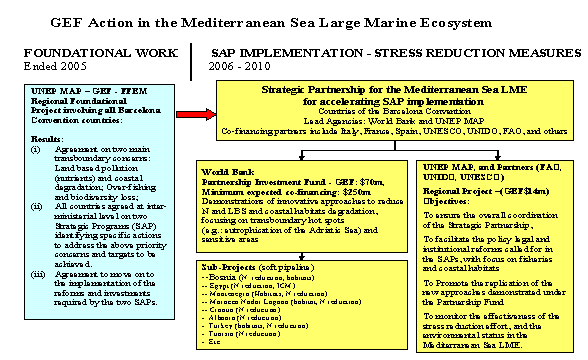
The Mediterranean countries, recognized that there is a need for a coordinated and innovative approach for the implementation of policy reforms, priority interventions and investments that address transboundary pollution and biodiversity conservation priorities identified in the two SAPs and the NAPs. Accordingly, they have agreed on a collective effort for the protection of the environmental resources of the Mediterranean, the Strategic Partnership for the Mediterranean Sea Large Marine Ecosystem, led by UNEP and the World Bank, co-funded by the GEF and involving other relevant agencies, IFIs and bilateral and multilateral donors. The Partnership will serve as a catalyst in leveraging policy/legal/institutional reforms as well as additional investments for reversing degradation of the Mediterranean Sea Basin, with its coastal habitats and marine living resources. The Strategic Partnership, following the model of the GEF Black Sea Basin Strategic Partnership for Nutrient Reduction, consists of two complementary components (see Figure 1):
a Regional Component: “Implementation of agreed actions for the protection of the environmental resources of the Mediterranean Sea and its coastal areas” led by UNEP, and the object of the present proposal, and
the “Investment Fund for the Mediterranean Sea Large Marine Ecosystem Partnership” led by the World Bank and already approved by the GEF Council in August 2006.
The Partnership will stimulate and further enhance the implementation at the Mediterranean level of Global Conventions and initiatives such as the CBD and GPA, Regional Conventions and instruments such as the Barcelona Convention and the Mediterranean Action Plan as well as the SAPs and NAPs in individual countries.
Figure 1: Presentation of GEF Action in the Mediterranean Sea Large Marine Ecosystem
This regional approach to the implementation of the SAPs and NAPs has a number of important advantages, which include: the implementation of regional plans of action to protect the coastal zone from pollution and biodiversity loss; the transfer of knowledge and skills between countries, the application of best practices; the adoption of policy reforms throughout the region; and the replication of successful pilot demonstrations implemented under the Investment Fund and/or the regional project to achieve regional objectives. Full stakeholder ownership and participation will strengthen as a consequence of the recognition that each is doing its part to contribute to a wider regional cause. A regional framework also provides a better mechanism for cooperation with diverse partners, for example the EU that has a significant role to play as a political driver for action and co-financier for investments. An overall strategic approach incorporating a comprehensive suite of actions and investments is a more cost-effective vehicle to demonstrate benefits than a series of individual projects. Such a strategic approach will also help to promote action over a specified and shorter period so that more tangible results can be achieved in a shorter timeframe.
In the absence of this proposed GEF intervention, the implementation of priority actions identified in the NAPs will most likely be delayed in the majority of participating countries due to deficiencies in funding. Governments would be likely to pay only marginal attention to the implementation of the SAPs within their financially constrained development programs. Such delays have been noted among the lessons learned in previous international waters projects. Without a coordinated regional approach to the implementation of NAPs, there will be limited exchange of information, sharing of resources, technical and financial knowledge and reduced potential for the beneficial replication of demonstration activities. In addition, the integration of NAPs in the national development plans and the availability of fund from the project would support the national environmental authority efforts to keep the environmental project in front of the list of national development priorities.
The long-term goal of the Strategic Partnership (SP), with its two components the Investment Fund and Regional Component is a) to facilitate countries for the full implementation of the SAPs and NAPs thus reducing pollution from land-based sources and preserving the biodiversity and ecosystems of the Mediterranean from degradation, in line with MDG/WSSD Environmental targets, b) the leveraging of long-term financing, and c) to ensure through the Barcelona Convention and MAP systems the sustainability of activities initiated within the project beyond its specific lifetime.
The objective of the Mediterranean Sea LME Strategic Partnership is to leverage reforms and catalyze investments that address transboundary pollution reduction and marine and coastal biodiversity conservation priorities identified in the SAPs for the Mediterranean basin.
The objective of the Investment Fund is to accelerate the implementation of transboundary pollution reduction and biodiversity conservation measures in priority hotspots and sensitive areas of selected countries of the Mediterranean basin that would help achieve the SAP MED and SAP BIO targets, and is further detailed in the Investment Fund project documentation.16
The objective of the proposed Regional Component is to promote and induce harmonized policy, legal and institutional reforms and fill the knowledge gap aimed at reversing marine and coastal degradation trends and living resources depletion, in accordance with priorities agreed by the countries in the SAP MED and SAP BIO and to prepare the ground for the future implementation of the ICZM Protocol. Accordingly, the Regional Component focuses on: i) the facilitation of policy, institutional and legal reforms for the protection of biodiversity and reducing pollution from land based sources consistent with the provisions of the two SAPs; ii) providing assistance to countries in advancing their ICZM and IWRM plans (including the management of aquifers) with emphasis on the protection of biodiversity and the prevention of pollution from land based sources, iii) ensuring the effective involvement of all stakeholders in the Regional Component and NAP implementation; iv) executing a number of demonstration projects that address biodiversity protection, pollution from land-based sources and enhanced application of ICZM, IWRM and management of aquifers;
It should be noted that the Regional Component is also responsible for the overall Co-ordination, Communication and Replication of the Strategic Partnership (both IF and RC components) with the following objectives: i) the design and application of a replication and a communication strategy resulting in concrete replicable projects both identified and financed; ii) providing a mechanism for the long-term sustainable financing of the SAPs and NAPs; iii) ensuring systematic linkages between both components, and overall monitoring and evaluation of the SP; and iv) ensure ownership at the level of the Contracting Parties to the Barcelona Convention and MAP and ensuring the sustainability of the SP beyond the life-span of the project.
The logical frameworks for the Strategic Partnership Regional Component are detailed in Annexes B-1 and B-2 respectively. Full details of project objectives and activities are presented in Annex F and Annex G presents details the participating countries in project activities and demonstrations locations.
In order to ensure a coordinated approach to the implementation of SAP-MED, SAP-BIO and the NAPs, numerous actions are required in terms of appropriate legal, policy and institutional reforms, on a national and regional level. These reforms will address the reduction of pollution from land-based sources (SAP-MED), the conservation of biological diversity (SAP-BIO) and the integrated coastal zone management of the Mediterranean (ICM, IWRM and the management of coastal aquifers and groundwater), and provide support to the countries for the adoption and ratification of the ICM Protocol to the Barcelona Convention. These reforms provide the foundation for successful implementation and long-term sustainability of the activities and demonstration projects to be undertaken through the Partnership by both the Regional project, and the Investment Fund. Inter-ministerial committees will be established in all countries and will monitor and support all activities within the project. A minimum of 20 national/sub-regional policy documents will be drafted in total (for pollution reduction, MPA management and creation, EAF, ICM, IWRM and management of aquifers and groundwater) based on identified policy gaps. Regional legislation will be drafted and presented for adoption to the CoP, to include: a Regional Action Plan on Coastal Aquifers; Regional plan for eco-hydrogeological management, land degradation mitigation and protection of priority coastal wetlands; Regional Action Plan for IWRM. National institutions in particular will be strengthened in all countries, and will apply numerous new tools, techniques and guidelines that will assist in the implementation of project activities and future NAP implementation. Related to integrated management of the coastal zone these will include COED, SEA, the ICARM approach and eco-hydrogeology applications for management and protection of coastal wetlands. Regarding pollution from land-based sources tools and guidelines will include ELV (and EQS), application of EST, guidelines for pollution reduction (PCBs, phosphogypsum wastes, tannery effluents, the recycling of lubricating oil and lead batteries) guidelines for marine litter management and plans of action for permitting, compliance and inspection systems. Regarding biodiversity this will include the establishment of a Regional Co-ordinating Unit for MPA management and a MPA monitoring framework, to include the implementation of tools/guidelines for the management of MPA’s, fisheries plans will be developed and implemented to integrate EAF and biodiversity conservation in the Fisheries Research Institutes and management organizations and implementation of a methodology for by-catch reduction.
In addition to the projects activities, 33 demonstration/pilot projects, plus about 20 NGO Small Grant projects will be implemented during the projects life-span, resulting in overall decrease in stress reduction to the Mediterranean LME. It must be noted that the aim of the present project is not to implement all the actions that would be necessary to reduce the stress to the Mediterranean environment, whose costs have been estimated in many hundreds of millions, but to act as a catalyst, by demonstrating new replicable approaches to address identified priority transboundary concerns. SAP-MED identifies 101 hotspots of which 75 are located in the participating countries. A minimum of 25% of these hotspots will be directly improved as a result of the demonstration projects, with indirect benefits (replication of demonstrations, policy/institutional/legal reforms and improved integrated management) to over 50% of all hotspots. In terms of pollution reduction (Cd, Hg, Pb, Cr, BOD, total nitrogen and PCBs) overall stress reduction achieved is small compared to the total from the Mediterranean (about 1% or less), due to the small number of demonstrations. However it should be noted that the major sources of these elements will be reduced by 50-100% at the demonstration sites, and using Lebanon as an example this will result in a 50% reduction in the total source of Cd for the country (2.06 tons/yr)17. Regarding MPAs in the Mediterranean the aim of project activities is to increase the total surface area of MPAs by 17% (from 9,732,600 to 11,412,600 hectares) which will include habitats of species of global significance. In addition demonstrations for the reduction of by catch of iconic and vulnerable species will be reduced by 75% in the two demonstration areas (covering an area of 2,000 ha), which is recorded to be as high as 50% for trawlers. Unsustainable fishing practices (i.e. dynamite and poison fishing, Saint Andrew Cross), which have been identified in many national reports as the most important threat to biodiversity in their national waters, will be reduced by 90% at priority sites in 7 countries (covering an area of 30,000 ha). Demonstrations related to land degradation, the management of aquifers and groundwater will result in 20,000 hectares of land (0.4% of the total area of coastal aquifers) directly impacted by intervention for 6 countries (coastal urban, coastal plains/agriculture, and upper watersheds) addressing LBS, coastal salinization, through coastal sedimentation and siltation, flooding, wetland sedimentation. This will result in 10,000,000 m3 of water saved through wastewater treatment and re-use, and 100,000 direct beneficiaries (land users) and 20,000 of indirect beneficiaries (administration, marine resources, tourism). Also demonstrations related to ICM and IWRM will result in 45,000 ha coastal zone managed through application of ICM and IWRM.
It should be stressed that one component of the project addresses stakeholder participation. In addition to the involvement of countries (through the CoP, Steering Committee and inter-ministerial Committees) a NGO Involvement Plan will ensure that all NGO’s and CBO’s participate effectively in all project activities. This, in partnership with the activities related to the Information and Communication Strategy is expected to be a key element in achieving greater awareness of the processes and results of the project; greater acceptance and ownership of the processes and their products; increased quality of the outputs (policy documents, project results, products and outcomes); strengthened stakeholder participation and partnership building in the implementation of the project; and increased potential for the replication of the partnership and targeted activities. The GEF Small Grant Program modality (SGPMED) in particular, will promote grassroots action to address the environmental concerns reflected in the SAP-BIO and SAP-MED and coordinated action among NGOs and community-based organizations (CBOs) in the countries bordering the Mediterranean.
The project proposes an innovative and co-ordinated approach to replication, through the development of a tailored replication strategy, which will ensure wide replication of project demonstrations within the Strategic Partnership (both the Regional Component the Investment Fund components). It is estimated that 20% of the 53 demonstration/pilot projects will be replicated during the life-span of the project, with resulting further stress reduction in the Mediterranean LME.
Describe the consistency of the project with national priorities/plans:
The countries of the Mediterranean participated and agreed upon a Transboundary Diagnostic Analysis, and based on this agreed upon two Strategic Actions Plans for Pollution (SAP MED) and Biodiversity (SAP BIO). The aim of the Regional Component and the Investment Fund of the SP for the Mediterranean LME is to implement some of the priority actions identified in the two SAPs and their related NAPs. The participating countries through the Contracting Parties of the Barcelona Convention have formally endorsed and approved both SAPs and based on them they have developed their own NAPs which are now ready for implementation. These NAPs were developed in close consideration to each countries national plans and are therefore complementary. Regarding the activities to address Persistent Organic Pollutants (POPs) the project activities address NIP priorities regarding POPs disposal.
Describe the consistency of the project with gef strategies and strategic programs:
The Regional Component (RC) of the Strategic Partnership “Implementation of agreed actions for the protection of environmental resources of the Mediterranean Sea and its coastal areas” was prepared to conform to the specifications of GEF International Waters Focal Area strategy. Sub-Component 2.3 of the proposed project is also designed for consistency with GEF Persistent Organic Pollutants (POPs) Focal Area strategy.
The project is in line with the GEF 4 IW Strategic Objective (SOs) 2: “To catalyze transboundary action addressing water concerns”. The project results will include the adoption of regional and national reforms in all participating countries, and the implementation of approximately 31 innovative pilot demonstration approaches on stress reduction of transboundary waters identified as priorities in the TDA-MED, SAPs and NAPs. The project will also complement the Investment Fund (IF) component of the Strategic Partnership (implemented by the World Bank), by ensuring overall coordination and, regional replication of the innovative approaches demonstrated by the IF sub-projects.
The project is specifically in line with three Strategic Programmes, 1, 2 and 3. Component 1. Integrated approaches for the implementation of the SAPs and NAPs: ICZM, IWRM and management of coastal aquifer; is particularly in line with the Strategic Programme 3: Balancing overuse and conflicting uses of water resources in surface and groundwater basins that are transboundary in nature. Three sub-components will address IWRM, ICZM and the management of coastal aquifers, with several common demonstrations to establish the important link for overall intergration on water resource management.
Activities within Component 2 of the project that aim to reduce land-based pollution through the implementation of national policy, legal, institutional reforms consistent with agreed transboundary action programs (SAP-MED and the NAPs) and the implementation of innovative demonstration projects, through the RC and IF components of the SP, are in line with Strategic Program 2: Reducing Nutrient Over-Enrichment and Oxygen Depletion from Land-Based Pollution of Coastal Waters in LMEs Consistent With the GPA.
Strategic Program 1: Restoring and Sustaining Coastal and Marine Fish Stocks and Associated Biological Diversity, is addressed within Sub-Component 3.2: Promote the sustainable use of fisheries resources through the application of ecosystem-based management approaches. This sub-component focuses on policy, legal, and institutional reforms for meeting WSSD targets for sustainable fisheries, ecosystem approaches to habitat restoration and conservation (including marine protected areas) and also includes a number of demonstration projects.
Component 2. Pollution from land-based activities, including persistent organic pollutants: implementation of SAP-MED and related NAPS, includes the sub-component 2.3 Environmentally Sound Management of equipment, stocks and wastes containing or contaminated by PCBs in national electricity companies of Mediterranean countries, which falls under the Persistent Organic Pollutant (POPs) focal area, the main Strategic Objective: “to reduce and eliminate production, use and releases of POPs”, Strategic Programme 2: “Partnering in investments needed for NIP implementation to achieve impacts in POPs reduction and elimination”. In the NIPs, national electric companies are identified as the principal holders of this equipment, stocks and waste and so represent the initial focus for work to eliminate PCBs. Activities aim to provide strengthened institutional and legal frameworks for implementation of ESM of PCBs, improve the management programme of PCBs and facilitate the implementation of NIPs through demonstration projects, provide technical capacity building and increase awareness for ESM of PCBs equipment and for the national PCB phase-out and disposal programs. In particular demonstrations in five countries will result in reduced POPs use and releases through phase-out and destruction in an environmentally sound manner, and the application of best available techniques/best environmental practices.
All the above mentioned GEF SOs are directly or indirectly related to a number of Global Conventions, namely the Basel Convention on the control of Transboundary Movements of Hazardous Wastes and their Disposal, the United Nations Convention to Combat Desertification, the Rotterdam Convention on the Prior Informed Consent Procedure for Certain Hazardous Chemicals and Pesticides in International Trade and the Stockholm Convention on Persistent Organic Pollutants.
Outline the Coordination with other related initiatives:
Several activities and initiatives have been undertaken in the Mediterranean by governments, intergovernmental, non-governmental and scientific organizations. The most relevant and important ones are described in the following paragraphs:
In November 2005, at the summit to celebrate the 10th Anniversary of the Euro-Mediterranean process, the partners committed to “endorse a feasible timetable to de-pollute the Mediterranean Sea by 2020, while providing appropriate financial resources and technical support to implement it, using the Mediterranean Strategy for Sustainable Development and exploring possible areas for co-operation in this regard with UNEP”. This initiative has been given the name Horizon 2020 (see Box 1).
BOX
1. The Horizon 2020 initiative (launched
in the framework of the Euro-Mediterranean process of the European
Commission) The
aim of the initiative is to reduce the level of pollution of the
Mediterranean region by identifying and tackling the most
significant pollution sources by the year 2020. The de-pollution
initiative will operate within existing processes and institutions.
It will support and enhance previously agreed actions and give new
impetus to efforts to reduce pollution of the Mediterranean region. In
addition there are a number of secondary aims that will contribute
to the achievement of the overall goal such as increase co-operation
between the various parties involved in protecting the Mediterranean
and keep political attention focused on the environmental objective
of reducing pollution of the Mediterranean. The
Horizon 2020 will be based on existing and developing policy
instruments, the most significant being a) the EU environmental
policies and measures, namely in the field of water quality and
management, b) the Barcelona Convention and MAP, c) the
Mediterranean Strategy for Sustainable Development (MSSD) which has
been developed and adopted by the contracting parties to the
Barcelona Convention and d) the Mediterranean Component of the EU
Water Initiative which is the EU contribution to the achievements of
the water-related Millenium Development Goals. In
the first five year work programme the initiative will concentrate
on a limited number of sectors, namely industrial emissions,
municipal waste, particularly urban waste water. It will develop a
pipeline of projects in conjunction with the World Bank and the EIB
that will address significant pollution threats to the region
Reference should also be made to the Mediterranean Component of the EU Water Initiative as well as to efforts to improve the management of the many transboundary basins and aquifers of SE Europe by introducing IWRM practices (the Athens Declaration Process). A number of these waters flow into the Mediterranean and have a significant impact on coastal ecosystems and water quality. Boxes 2 and 3 below summarize these processes.
BOX
2. The Athens Declaration Process (Jointly
coordinated by the Government of Greece and the World Bank) The
Athens Declaration Process was launched during the major
International Conference on Sustainable Development for Lasting
Peace: Share Waters, Shared Future, Shared Knowledge, 6-7 May 2003,
Athens, Greece. The process aims to assist countries of the region,
in cooperation with relevant stakeholders, to draft IWRM and water
use efficiency plans for major river basins, including a range of
complementary interventions in individual river and lake basins,
with a coordination mechanism to allow for the exchange of
information and experience among activities. The entire program is a
building block of the Mediterranean Component of the European Union
Water Initiative.
The
Athens Declaration of May 2003 has four Recommendations for Action:
(1) Diplomacy for Environment and Sustainable Development; (2)
Southeastern Europe Transboundary River Basin and Lake Basin
Management Programme; (3) Mediterranean Shared Aquifers Management
Programme; and (4) Assessment of Regional and National Frameworks to
Implement Integrated Water Resources Management.
Recommendations
2, 3 and 4 build on the implementation process of the European Union
Water Framework Directive and complement, and draw lessons from, the
ongoing GEF Danube River Basin Programme and the Lake Ohrid
Conservation Project, among others.
BOX
3. The Mediterranean Component of the EU Water Initiative (MED EUWI) (led
by the Government of Greece) MED
EUWI is an integral part of the overall EU Water Initiative
coordinated by the European Commission. It aims to:
- assist in the design of
better, demand driven and output oriented water related programmes;
- facilitate improved
coordination of water programmes and projects, targeting more
effective use
of existing funds and the
mobilization of new financial resources; and
- enhanced cooperation for
proper project implementation. MED
EUWI, announced during WSSD in Johannesburg, gives particular
emphasis to Mediterranean and SE European priorities. Integrated
water resources management, with an emphasis on the management of
transboundary water bodies, is a defined priority theme of MED EUWI.
The current project will constitute a pilot for enhancing the MED
EUWI objectives in the SE European region. Political
commitment for the development of MED EUWI has been expressed in
various forums, inter
alia the EU Informal
Council of Environment Ministers (May 2003, Athens and December
2003, Brussels), the 5th Pan-European Ministerial Conference of the
“Environment for
Europe” process
(May 2003, Kiev); the Euro-Mediterranean Meeting of the Ministers of
Foreign Affairs (May 2003, Crete and June 2004, Dublin) and three
meetings of the North African Ministers Council on Water (February
and October 2003, April 2004, Cairo). The process
is facilitated by a MED EUWI Secretariat within Global Water
Partnership – Mediterranean.
At their Eleventh Ordinary Meeting, the Contracting Parties to the Barcelona Convention and its Protocols recommended giving high priority to “promoting the management of marine protected areas” and marine sites containing sensitive, threatened or rare habitats with a view to strengthening the network of marine protected areas in the region. This Med-MPA Project (Box 4) that receives funding from the European community through the SMAP Programme and is coordinated by RAC/SPA, is aimed at assisting the Mediterranean countries to strengthen the conservation and sustainable management of coastal biological diversity. Other MPA-related initiatives include the following.
EC Natura 2000.
Emerald Network: a de facto extension of Natura 2000 to non-Community eastern Mediterranean counties that designates ‘areas of special conservation interest’ (ASCIs) was launched by the Council of Europe as part of its work under the Bern Convention;
EuroParc is the umbrella organization for Europe’s protected areas. It unites national parks, regional parks, nature parks and biosphere reserves in 38 countries with the common aim of protecting Europe's unique variety of wildlife, habitats and landscapes.
Pan-European Ecological Network (PEEN) essentially links core Natura 2000 and Emerald Network areas physically through the restoration or preservation of corridors.
The Network of Managers of Marine Protected Areas in the Mediterranean (MEDPAN) is an EU Programme (2005–2007) coordinated by WWF-France. It brings together 23 partners from 11 countries around the shores of the Mediterranean, of which 6 are European (France, Italy, Greece, Malta, Slovenia and Spain) and 5 are from non-European countries (Morocco, Tunisia, Algeria, Croatia, and Turkey), to manage more than 20 marine protected areas and to work towards the creation of several new sites. The basic aim of the network is to facilitate exchanges among Mediterranean marine protected areas to improve MPA management efficiency.
BOX
4. Med-MPA Project
The
Med-MPA project is being implemented in the following countries:
Algeria,
Cyprus, Israel, Malta, Morocco, Syria and Tunisia
and has the goal of strengthening the effectiveness of MPA networks
The
project aims to foster concrete action, within the context of the
priorities that identified at national and regional scales and thus
help countries to discharge certain of their obligations under the
Barcelona Convention's Protocol on Protected Areas and the
Convention on Biological Diversity. Furthermore,
the project is permitting management plans to be devised for sites
chosen from among the most precious in the Mediterranean. All these
chosen sites appear on the Directory of Mediterranean protected
areas instituted by the SPA Protocol. Some of these sites are also
listed by UNESCO within the framework of the Biosphere Programme.
Within the Mediterranean, various fisheries management projects have been implemented with FAO technical support. These include the Mediterranean Fish Cooperation: COPEMED (Morocco, Algeria and Tunisia), EastMed (Egypt, Lebanon, Syria, Turkey and Israel), AdriaMed (Albania, Bosnia, Croatia, Montenegro and Slovenia) and MedSudMed (Libyan and Tunisia). Activities being carried out through these organizations are typically aimed at improving fisheries statistics (regarding catch, effort and landings), the conduct of some biological investigations and capacity-building efforts at national and sub-regional levels.
Several international agencies are active in the Mediterranean basin, such as UNEP, UNEP-GPA, UNDP, FAO, UNESCO, WWF, UNIDO, METAP, GWP, the EC and the World Bank. However, many of these interventions are fragmented with the focus being more on diagnostic and planning activities than on physical investments. The scope of many such initiatives is limited to a sector or sub-sector and investments are constrained by the lack of adequate financing from both public and private sectors.
Science will continue to contribute throughout the project implementation, as for example in the case of coastal aquifers, where UNESCO will apply newly developed methodologies for coastal vulnerability mapping of aquifers in selected sites, and the production of GIS maps, essential to assess the current status of aquifers in terms of their exploitation and contamination. Other scientific studies will include the assessment riverine fluxes of nutrients to the Mediterranean, ecological and GIS-based maps for MPA’s and field surveys related to by-catch and unsustainable fishing practices. All of which will assist in the implementation of policy, legislation and institutional reforms and the demonstration projects. The science based RAC’s are have co-developed many of the activities, based on their history of research in the Mediterranean. Close linkages with MEDPOL’s Monitoring Programme will ensure that stress reduction to the Mediterranean will be monitored, and involves research institutes in all participating countries. National scientific institutions in each of the participating countries has already been identified and integrated into the projects activities. These include Italian universities which will develop GIS based aquifer vulnerability maps as tools to invent and monitor the sources and the risks of LBS contamination of the coastal aquifers; the Spanish Geological Survey (IGME) for the implementation of eco-hydrogeology applications for management and protection of coastal wetlands.
Additionally, two very important on-going scientific projects have been contacted and have accepted to collaborate with and provide data to the Regional Component of the SP:
The first project is “MOON” (Mediterranean Ocean Observing Network) which covers the whole Mediterranean with 21 participating Institutes and Universities. Its main objectives are to “consolidate and expand the Mediterranean Sea concerted monitoring and forecasting systems, and ensure full integration to the overall operational oceanography global ocean European capacity”, and “increase the quality of, and harmonize user-oriented operational products, identify new customers and further develop the market for operational oceanographic products, co-operate with UNEP-MAP and other relevant bodies acting at regional level” (for more details, see www.moon-oceanforecasting.eu/)
The second project is “Adricosm” (ADRIatic sea integrated COastal areaS and river basin Management system pilot project) launched in October 2001 in the framework of the Adriatic-Ionian Initiative. This project has similar objectives to the previous but it is basically limited to the Adriatic Sea. In its project document it is stated that “ADRICOSM has been also designed to be consistent with the international directives defined in the UNESCO-IOC Coastal Global Ocean Observing System (C-GOOS) and the UNEP-Mediterranean Action Plan Integrated Coastal Areas and River Management Program. (for more details, see www.bo.ingv.it/adricosm/)
The GEF SP for the Mediterranean LME will closely coordinate with those of the activities and programmes described above which are still going on and build on those, which have been terminated. For example an important link has already been established with the most important of those activities, namely the Horizon 2020 initiative. It has been agreed that the European Commission, which is responsible for this activity, will be part of the GEF SP Steering Committee, thus ensuring close contacts, linkages and synergies between the two. On the other hand, it has been agreed that the European Investment Bank (EIB) which has a similar role in Horizon 2020 as the one that the World Bank has (through the Investment Fund) in the GEF SP, will participate to the SP Coordination Group. The CG’s role is to examine all projects submitted to the IF, check whether they fall within SAPs and NAPs priorities and if not make suggestions for improvements before they enter the WB pipeline. The participation of the EIB to this group will ensure coordination of actions between EIB and WB on bankable projects thus avoiding duplications and enhancing economies of scale.
Finally it should be stressed that the projects activities are executed by a numbers of partners (including UN organizations and NGO’s) who are actively executing or involved in the majority of key projects and initiatives in the Mediterranean region, thus ensuring good overall coordination. These include GWP-MED, responsible for the Integrated Water Resources Management (IWRM) activities, UNESCO-IHP executing the coastal aquifer activities, UNIDO to apply its TEST Method (Transfer of Environmentally Sound Technology) to the Mediterranean, etc.
Describe the incremental reasoning of the project:
The GEF Incremental Costs analysis requires a consideration of the baseline and additional costs associated with achieving ‘domestic’ benefits (i.e., those accruing to the participating countries) and global environmental benefits (i.e., those accruing beyond the jurisdiction of the participating countries). The regional scope of this project presents methodological difficulties in assessing costs that are normally calculated in a purely national context. As with any legitimate GEF project, the benefits arising from this project will accrue at global, regional and national scales. The purpose of this analysis is to attempt to segregate the costs of project activities benefiting conditions and resources in coastal areas under national jurisdiction, on the one hand, and the costs of project activities that provide additional (incremental) benefits in the form of reduced stress and improved conditions in international waters areas beyond the individual jurisdictions of the participating countries. This analysis also provides justification for the incremental costs by assessing the incremental benefits and showing, where possible, that these outweigh the incremental costs of the project.
Global Benefits
Assessing the global benefits of a GEF project necessitates, in the first instance, a consideration of the comparative environmental importance, from a global perspective, of the region or area covered by the project, together with an understanding of the extent to which the project reduces environmental loss or degradation. This reduction in environmental degradation represents the predominant environmental benefit of the project at all scales. Partitioning the total benefit at global, regional and national scales poses problems in the context of incremental cost calculations because, in many cases, the benefits cannot be valued in purely monetary terms and, furthermore, predicting the distribution of benefits among geographical areas is profoundly difficult. In the context of international waters, however, interventions addressing transboundary environmental issues and concerns are considered to be wholly incremental.
This project comprises two major foci: first, the prevention of pollution in the Mediterranean Sea (implementation of SAP-MED); and second, measures to enhance the preservation of biodiversity in this same enclosed Sea. In addressing those two foci, the project adopts a combination of holistic and sectoral (for technical/methodological reasons) approaches. The first component comprises integrated approaches for the implementation of both SAPs and their NAPs through ICZM, IWRM and Management of Coastal Aquifers and provides mutual support to the two major foci. The second and third components address them separately with targeted activities for each of them. The fourth component addresses Project coordination, management and M&E, including replication and communication strategies and NGOs involvement plan. The Mediterranean Sea is universally recognized as the most enclosed marginal sea. Within its catchment lay the oldest cradles of modern civilization, Egypt, Greece and Rome. Today, it contains diverse social and cultural entities, including the countries of North Africa, the eastern Mediterranean, the Balkans and South-Eastern member states of the European Union. The importance of the Mediterranean Sea to the economies of these countries, whether for transportation or the recovery of resources, is indisputable. It is clear from the number and scale of GEF projects in Mediterranean countries that the social, political and environmental importance of the region is already well-recognized. The pilot project on POPs is a direct contribution of Mediterranean Countries to the global efforts to reduce the adverse impacts on health and environment of POPs.
Baseline Activities and Costs
At a national level all the countries of the region have sought, over the last decade, to strengthen their national capacity for sound and sustainable management of the marine environment. Following the past emphasis on assessment of problems, significant experience has been built up at a national level. In some instances, however, countries have been unable to devote sufficient resources internally to developing such capacity; hence the stage of development varies widely from country to country.
Strictly, baseline activities in the region are of two types. The first type comprises activities undertaken by the participating countries predominantly for national purposes to improve the social and environmental conditions that offer social and economic benefit. The second type comprises contemporary activities being undertaken by international agencies and supported by a wide variety of donor institutions, both bilateral and multilateral, in which the developing countries of the Mediterranean participate. An effort has been made in the text of the project brief and in the estimation of baseline costs to identify and segregate these two types of baseline activity. The primary reason for such segregation is to ensure that there is a specific allocation of baseline costs to issues of national action directed primarily at obtaining domestic benefits. International projects support not only the acquisition of domestic benefits to the participating countries but also a variety of regional and global benefits in engendering the introduction of uniform and effective management and surveillance mechanisms throughout the developing world.
Incremental Costs
In addition to the estimation of incremental costs, an effort is made to determine and distinguish between any additional domestic benefits provided by the project as distinct from those accruing in areas beyond individual national jurisdictions. Such projections of benefit are fraught with difficulty as noted above. Therefore, frequently it is only possible to examine the likely scale of incremental benefits accruing from project activities as a means of providing justification for the incremental costs and the investment of GEF financing.
Domestic Benefits
The domestic benefits accruing from this GEF alternative project comprise improvements in the condition of the environment under national jurisdictions and the enhancement of national capacities to manage and control the adverse environmental impacts of economic activities. Those components of the project directed towards enhanced management of land-based activities to reduce the entry of contaminants into the sea will yield major domestic benefits because the receiving coastal area is closest to the sources. The project components devoted to SAP-BIO implementation will have domestic benefits largely limited to the economic and social benefit accruing from increased biological diversity in coastal areas under national jurisdiction. Nevertheless, to the extent that such biodiversity enhancements align with international aspirations adopted from global perspectives, some of these benefits could be claimed as incremental. In large part, the capacity-building activities within the project will result primarily in domestic benefits to the participating countries. Nevertheless, to the extent that such national capacity-building enables improved coordination among national actions to protect and enhance the marine environment of the Mediterranean as a whole, there will exist incremental benefits. In relation to land-based source control, these incremental benefits will accrue at the regional level whilst greater harmonization of interventions directed towards biodiversity protection and enhancement can be argued to accrue at both regional and global levels.
Incremental Benefits
The present project adds significantly to the ‘regional baseline’ enabling the countries to accelerate the implementation of the two Strategic Action Programs, that on land-based activities and that on biodiversity. Timely implementation of these two SAPs is unlikely to occur in the absence of a GEF intervention, since the level of funding currently available for regional coordinated action is insufficient to address all aspects of these programs.
The incremental benefits of this project will accrue both to the international waters of the region and international waters beyond the Mediterranean. In the case of stress associated with contaminants derived from land-based activities, the greatest incremental benefits will be regional. Biodiversity preservation in the Mediterranean also constitutes an incremental benefit in the context of contemporary international initiatives. Incremental benefits of project interventions aimed at biodiversity enhancements fall into two categories: those relating to the mitigation of transboundary environmental impacts, such as loss of fish spawning and nursery habitats that serve as a source of propagules for fisheries elsewhere in the region or as habitat for endangered species; and those resulting from adoption of a harmonized regional approach to interventions.
All activities within the proposed project have been based on the priorities identified in the two strategic action plans for the Mediterranean engendered through the Barcelona Convention. Thus, there exists a basis of regional coordination in the selection of priorities for action included in the project. This enhances the probability that the incremental benefits of project activities are maximized and that GEF support will be devoted both to supporting the region in promulgating collective action towards regional priorities. The fact that these priority concerns fall within the two of the priorities for international action, namely land-based sources and [biodiversity], provides an automatic alignment with global priorities as represented by the international waters and biodiversity focal areas of the GEF portfolio.
The value of a regional approach to the harmonization of actions is demonstrated in part by the following example in relation to land-based sources of pollution. All countries have some form of water quality and discharge aspirations, often reflecting in part the comparative importance of pollution as a problem within a national context. In cases where a country having low importance from the perspective of the total pollutant loading of the Mediterranean imposes stricter standards than a country that is a major source of contaminants they place themselves at economic disadvantage whilst contributing little to the maintenance of the health of the Mediterranean Sea environment. Harmonization of standards within the region results in more effective interventions by riparian states, greater equity in economic costs and benefits, and will yield enhanced incremental benefits.
The activities proposed within the POPs sub-component have been based on concrete assessment of the state-of-the-art of PCBs management in the region and its impacts on health and environment, especially the marine environment. The incremental benefits are seen in the reduction of levels of PCBs in marine ecosystem e.g. food chain and sediments, the reduction of transboundary movement of PCBs at regional and global levels and building harmonized regional capacities to the environmental sound management of PCBs . Without GEF’s financial support, the region would probably maintain the current practice of long term storage of PCBs contaminated oils and equipments without any environmental protection and inappropriate disposal of contaminated metals and oils. Postponing the establishment of an harmonized management plan for the treatment of contaminated equipment increases the risks of new environmental contamination and of human exposure. PCBs still in use in electrical equipment are at risk of release through fires in electrical equipment; those off-line can release PCBs through leaks and spills. Stocks that are not well protected can be accessed by people wishing to utilize the oils; cases have been documented in various countries of PCB-contaminated oils being used as an “industrial hand cleaner” and for cooking. Repeated exposure to even small quantities of PCBs can cause damage to the liver and neurological and immune systems. Inadequate handling of PCBs can also lead to emissions of other toxic substances, including dioxins and furans, that are POPs regulated under the Stockholm Convention.
Indicate risks, including climate change risks, that might prevent the project objective(s) from being achieved and outline risk management measures:
The regional component of the Strategic Partnership represents an opportunity to implement a coordinated approach to the implementation of the two SAPs and country NAPs that will assist in the implementation of priority actions and remove the institutional, financial and technical barriers to investments. The major risks of the project can be summarized as the following:
Political willingness to adopt the necessary institutional, policy and legislative reforms and to sustain project programs and initiatives beyond the life of the GEF intervention.
During the life-span of the GEF project it is essential that participating countries collaborate together, with partners and commit themselves to project activities, in particular the adoption and incorporation of necessary policy and legislative reforms into their framework for the SAP and NAP implementation.. Fortunately the countries of the Mediterranean have a long history of collaboration, through the Barcelona Convention and the activities of MAP and its RACs. The TDA for the Mediterranean, SAP-MED, SAP-BIO and NAPs were all undertaken in collaboration with countries and have been officially adopted by the contracting parties to the Barcelona Convention. Endorsement letters have been received from countries for the PDF-B phase of the project and all proponent countries expressed their full support for this GEF initiative during the 2004 Stocktaking Meeting on the development of the GEF Strategic Partnership for the Mediterranean Large Marine Ecosystem. In order to ensure political willingness several measures have been undertaken. The project activities have been developed in consultation with countries, and in addition the NAP priorities are on existing national sectoral development plans, which have been agreed upon by the national authorities (including timeframes for implementation) using a participatory approach with the involvement of all stakeholders. Therefore the NAPs are part of each national authorities agreed development plan, and assuming that these are not changed the priority actions of the NAPs will be implemented beyond the life-span of the GEF project. Also active participation of countries is ensured throughout the projects implementation through the following mechanism: the Steering Committee meetings, the involvement of SP Focal Points, Interministerial Committees and their meetings, the Country Support Programme, and overall involvement through MAP Focal points and meetings. Therefore the level of risk can be regarded as low.
Effective participation and active involvement of all stakeholders in project execution.
In order to ensure effective participation of all stakeholders in project execution a number of measures have been taken during the project development. Stakeholder participation has been designed an integral part of each component, with provisional lists of stakeholders already identified, and a Stakeholder Involvement Plan drafted. In addition a separate component specifically focus’s on NGO (including CBOs) participation in the project which will contribute significantly to the overall transparency of SAP implementation and enhancing the levels of commitment by civil society and other stakeholders while promoting effective public access to environmental information and public participation in environmental decision-making in the Mediterranean region. The participation of civil society organizations (with a focus on NGO networks) is expected to be a key element in achieving greater awareness of the processes and results of the project; greater acceptance and ownership of the processes and their products; increased quality of the outputs (policy documents, project results, products and outcomes); strengthened stakeholder participation and partnership building in the implementation of the project; and increased potential for the replication of the partnership and targeted activities. The GEF Small Grant Program modality (SGPMED) in particular, will promote grassroots action to address the environmental concerns reflected in the SAP-BIO and SAP-MED and coordinated action among NGOs and community-based organizations (CBOs) in the countries bordering the Mediterranean. Therefore the level of risk can be regarded as low.
Effective Project Co-ordination
The geographic extent of the Mediterranean Sea basin (3,800 km wide and with a coastal length of 46,000 km) and the diversity of activities in this project poses risks to the effective participation and active involvement of all stakeholders in project execution. This will present a challenge to effective project coordination. Measures, however have been taken to ensure strong linkages with civil society, professional bodies, and relevant government bodies established in all project components through MAP and the Barcelona Convention will suffice to minimize this risk.
The level of risk during project implementation is therefore low with the possible exceptions of potential territorial disputes and/or economic crises. If this occurs during the project, activities and demonstrations sites in affected areas will be changed. Alternative options for sites have already been discussed for demonstrations in consultation with countries in order to minimize this risk.
The overall cost-effectiveness of the project has been designed including the following elements.
The aim of the project is to create an enabling framework for the implementation of the two Strategic Actions plans described earlier and the National Action Plans, all endorsed by the countries and included within their national plans. Therefore this project builds upon all previous agreements, has full country ownership, and is also recognized as the mechanism towards the further implementation of the Barcelona Convention. In addition to the projects activities, 32 demonstration/pilot projects, plus about 20 NGO Small Grant projects will be implemented during the projects life-span, resulting in overall decrease in stress reduction to the Mediterranean LME. It must be noted that the aim of the present project is not to implement all the actions that would be necessary to reduce the stress to the Mediterranean environment, but to act as a catalyst, by demonstrating new replicable approaches to address identified priority transboundary concerns. SAP-MED identifies 101 hotspots of which 75 are located in the participating countries. A minimum of 25% of these hotspots will be directly improved as a result of the demonstration projects, with indirect benefits (replication of demonstrations, policy/institutional/legal reforms and improved integrated management) to over 50% of all hotspots. The project proposes an innovative and co-ordinated approach to replication, through the development of a tailored replication strategy, which will ensure wide replication of project demonstrations within the Strategic Partnership (both the Regional Component the Investment Fund components). It is estimated that 20% of the 52 demonstration/pilot projects will be replicated during the life-span of the project, with resulting further stress reduction in the Mediterranean LME.
In addition a regional approach to the implementation of the SAPs and NAPs has a number of cost-effective advantages, in terms of the implementation of a number of regional plans of action to protect the coastal zone from pollution and biodiversity loss, the transfer knowledge and skills between countries, to apply best practice, to promote the adoption of policy reforms throughout the region and to enhance the replication of successful pilot projects to achieve regional objectives. This overall strategic approach incorporating a comprehensive suite of actions and investments is a more cost-effective and higher impact vehicle to demonstrate benefits than a series of individual projects. Such a strategic approach will also help to promote action over a specified and shorter period so that more tangible results can be achieved in a shorter timeframe.
The Mediterranean Action Plan (MAP) has been working in the region with countries and all stakeholders for the protection and Development of the Mediterranean Sea Basin for the last thirty years and therefore is the most important mechanism in terms of ensuring successful execution of project activities, co-ordination amongst all countries and stakeholders, and long term ownership of the projects results and further implementation of the SAPs and NAPs. Partnering with MAP are a number of co-executing agencies, including, UN and non-UN organizations and NGO’s together composing of the key organizations working in the region. Activities have thus all been designed to compliment and use as a foundation all key projects and initiatives in the region as described in the Project Document.
Finally this project falls under the Strategic Partnership for the Mediterranean LME, complemented by the World Bank Investment Fund. This is proven as the most cost effective approach to the execution of a series of actions dealing with institutional, policy and legislative reforms coupled with huge investments towards achieving stress reduction in the region.
part iii: institutional coordination and support
Project Implementation Arrangement:
Three basic management and coordination structures will be created for the duration of the project: a Project Management Unit (PMU), a Strategic Partnership Project Steering Committee (SPSC), and a Coordination Group (SPCG). All three structures have specific responsibilities and tasks within the project with important linkages between them.
A Program Management Unit (PMU) will be established and personnel will be recruited by UNEP/MAP as defined in the Implementation Arrangements (see below). The PMU will comprise a Project Manager full time, a Mediterranean Marine and Coastal Expert supporting (80% of time) the project Manager and providing (20% of time) expertise for the Sub-Components, and will include a Financial Assistant.
Activities of the PMU will include the following:
to closely follow the implementation of project activities, handle day-to-day project issues and requirements, coordinate them and ensure a high degree of transnational and inter-institutional collaboration (international and regional organizations and donors).
to organize of SPSC, SPCG and interagency meetings, and any other ad-hoc meetings that may be required,
to finalize project and meeting reports i.e. annual project reports, half-yearly progress reports and expense reports. It will also assist the GEF Independent Office of Evaluation in preparing the mid-term and final evaluations of the project. The PMU will report to the other three management and co-ordination structures set up within the project, namely the SPSC, and the CG;
to ensure that through the numerous M&E related activities (see Annex E for full details) an adaptive management approach is adopted to the implementation of the project;
the development of environmental status indicators, in collaboration with all executing and co-executing agencies, reflecting SAP targets and agreements, which will be identified at the beginning of the project along with specific arrangements for their long-term monitoring during and beyond the lifespan of the project (with the support of MAP).
Strategic Partnership Project Steering Committee (SPSC)
The Strategic Partnership Project Steering Committee (SPSC) will act as the main policy body overseeing project execution and will meet annually. The SPSC will comprise SP national focal points from all GEF-eligible countries, representatives of the implementing agencies (UNEP and the WB), representatives of the executing agency (UNEP/MAP), the GEF Secretariat, FAO and UNIDO, the co-executing agencies (FAO/GFCM, UNESCO, MEDPOL, METAP, SPA/RAC, PAP/RAC, INFO/RAC, CP-RAC, WWF, MIO-ECSDE) and the EU, the Project Manager, the President of the Bureau of Contracting Parties to the Barcelona Convention, major donors (France, Italy, Spain) and one NGO representing a network of NGOs in the Mediterranean. The SPSC will be co-chaired by the President of the Bureau of the Barcelona Convention and the Coordinator of UNEP/MAP.
The presence of SP Focal Points from the participating countries will ensure continuous ownership and national level support. The SP Focal Points will be identified by the respective governments and will bring to the SPSC the perspectives of each country and views of the GEF and MAP Focal Points respectively.18
The participation of the EU in the SC is important because it will represent the non GEF-eligible Mediterranean countries while ensuring links and coordination with existing EU initiatives such as the “2020 Initiative for de-polluting the Mediterranean” adopted in the framework of the Euro-Mediterranean Partnership.
The presence in the SPSC of the President of the Barcelona Convention Contracting Parties and the UNEP/MAP Coordinator will ensure that both the Barcelona Convention and MAP are at the heart of the Strategic Partnership. It will also ensure that Contracting Parties are the beneficiaries of all the activities in the same way that these Contracting Parties have benefited from previous GEF initiatives in the area.
Specific functions of the Project Steering Committee will include:
Review of the recommendations of the Investment Fund Advancement Report, including project ideas identified by the World Bank and the Coordination Group (see below) and the review of the status of Investment Fund Demonstration Projects that will include results indicators and the status of replication activities at national level.
Annual reviews of status reports submitted by each partner to the regional project and the summary status report of the regional project prepared by the PMU. The latter will focus specifically on progress in achieving: replication at the regional level; the use of targets and indicators; satisfactory overall coordination of activities in the Mediterranean region; and measures adopted in response to previous recommendations of the SPSC.
The SPSC will be responsible for the periodic review of the partnership project’s performance, assisted by an independent evaluator (TOR to be defined) who will carry out an annual assessment of progress in the Strategic Partnership and report to the SPSC. The SPSC is responsible for endorsing any changes to the work plan or budget that are deemed necessary and is also responsible for ensuring that the Strategic Partnership remains on target with respect to projected outputs.
While UNEP and the WB will be fully accountable to the GEF for all project activities and related matters, the Strategic Partnership will require a strong coordination mechanism. This will be engendered through the SPSC.
Strategic Partnership Coordination Group (SPCG)
The Coordination Group will be responsible for the overall coordination of the Strategic Partnership, in particular ensuring effective exchanges and synergy between the regional component and the investment fund. Its membership will comprise:
The MAP Coordinator (chair);
Representatives of the GEF Secretariat (IW and POPs );
The Project Manager of the regional project of the SP;
Representatives from the FAO and UNIDO
A representative of INFO/RAC responsible for the Replication and Communication Strategy
A representative of the UNEP/GEF Coordination Office;
World Bank-GEF Regional Coordinators (ECA and MENA); and
World Bank Task Managers.
In addition to the World Bank Task Managers responsible for Fund projects, project personnel and representatives of participating countries, external experts and co-executing agency representatives will be invited to attend meetings depending on the matters under consideration.
The Coordination Group will monitor the linkages between the two components, so that potential synergies can be exploited. It will also ensure that consistency with agreed rules, targets, and indicators is achieved. It will oversee the design and implementation of replication strategies and provide advice on the IF pipeline.
One of the main tasks of the CG will be the review of ideas and opportunities for projects under the IF. Exchanges on project ideas will occur informally among agencies, particularly the World Bank and UNEP MAP. The results of these exchanges will then be consolidated and the recommendations presented annually to the CG by the World Bank, including priorities based on replication potential and the eligibility criteria established for the IF. The CG will discuss, and make its recommendations regarding IF pre-pipeline and project concepts. Such recommendations, as well as the minutes of exchanges at partnership level, will be attached as a mandatory annex to the proposal (concept) submitted to the GEF for approval together with the WB response.
Another key role of the CG will be the review of the regional replication strategies of IF projects and the monitoring of the basin-wide replication activities. In this context, the CG will be particularly supported by INFO-RAC19, the partner responsible for the design and organization of regional replication activities. INFO-RAC will prepare, in consultation with the World Bank, reports on replication to be presented to CG meetings. The CG will be expected to provide relevant feedback and guidance.
In addition, the CG will review, and approve for submission to the SC, the following advancement reports:
Advancement Reports of the Investment Fund and the status report of demonstration projects under implementation;
Status reports submitted by each partner in the regional project; and
Annual Project (APR) and Half-yearly progress reports (HPR) of the regional project.
The CG will meet at least once a year at the MAP office in Athens, preferably in conjunction with regular MAP meetings of the parties but in advance of annual SPSC meetings. The CG will maintain regular communication via teleconference, and meet on an ad-hoc basis wherever required.
Strong co-ordination between the two components of the Strategic Partnership is essential to the success of the Partnership, and has been noted to be inadequate in previous partnerships. Therefore to ensure the WB involvement in the partnership, a budget is allocated to the WB for personnel and expenses for their participation in SPSC, SPCG and M&E activities and in particular their contribution to the Replication and Communication Strategy of the SP20
The role of the executing partners and how each agency and executing partners will undertake the project.
The Implementing agency of the Project is UNEP while the Executing Agency is the Coordinating Unit for the Mediterranean Action Plan (MEDU-MAP) and its associated Regional Activity Centers (RACs): Cleaner Production (CP RAC); Specially Protected Areas (SPA RAC); Priority Actions Programme (PAP RAC); and Information (INFO RAC). The Food and Agriculture Organization of the United Nations (FAO) and the United Nations Industrial Development Organization (UNIDO) are GEF Executive Agencies with Expanded Opportunities, and will therefore receive funding for their corresponding activities directly from GEFSEC.
The Co-executing Agencies to the Project are:
the General Fisheries Commission for the Mediterranean (GFCM);
the United Nations Educational, Scientific and Cultural Organization International Hydrological Programme (UNESCO/HP);
the World Wide Fund for Nature, Mediterranean Programme Office (WWF/MedPO);
the Global Water Partnership - Mediterranean (GWP-Med);
the Mediterranean Information Office for Environment, Culture and Sustainable Development (MIO-ECSDE);
the WB Mediterranean Environmental Technical Assistance Program (METAP)
Representatives of the implementing agencies, representatives of the executing agencies and co-executing agencies will participate to the Steering Committee in order to discuss the main policy of the project.
Standard Project monitoring and evaluation will be conducted in accordance with established UNEP, UNIDO, FAO and GEF procedures (see Monitoring and Evaluation Plan).
part iv: explain the alignment of project design with the original PIF:
No PIF was submitted for the project. UNEP submitted the Project Brief and the Executive Summary for the GEF project “Strategic partnership for the Mediterranean Sea Large Marine ecosystem – Regional Component: Implementation of agreed actions for the protection of the environmental resources of the Mediterranean Sea and its coastal area”, which were approved by the GEF Council in June 2007.
The project structure, implementation and execution arrangements and activities in the current documentation for submission are all in line with the previously submitted and approved Project Brief and Executive Summary. Minor changes have been made to project activities including two additional demonstrations to Sub-Component 3.1 Conservation of Coastal and Marine Diversity through the Development of a Mediterranean MPA Network which are a Demonstration project in Morocco to develop and implement an Ecosystem Based management (EBM) Plan and a Demonstration project in Libya in making an environmental and economic case for a system of C&MPAs.
In addition the UNIDO Transfer of Environmentally Sound Technology sub-component 2.2 (see UNIDO project document) has now three participating countries (Tunisia, Morocco, Egypt) whereas previously included Lebanon, and its co-financing of activities has reduced from 1,400,000 US$ to 950,500 US$.
Changes in the current submission relate to the securing of co-financing letters for the project. The total co-financing of the project design has increased up to 37,708,500 USD (including PDF-B phase) instead of 30,865,700 USD as previously submitted. This includes participating country co-financing for 13,1 million US$. Additional co-financing has also been secured for the biodiversity component of the project, which was unable to secure GEF funding through the Resource Allocation Framework (RAF). This includes:
Co-financing from the French Ministry of Ecology and Sustainable Development to reinforce and build up a network of the marine protected areas of the Mediterranean Sea with an amount of EUR 1.265.000.
The European Commission proposed to support the biodiversity activities in the Mediterranean in the framework of the Thematic Programme for Environment and Sustainable Management of Natural Resources - the Action to support implementation of the Barcelona Convention’s Protocol concerning Specially Protected areas and Biological Diversity in the Mediterranean” with an amount of EUR 1.920.000.
Co-financing from the Spanish Agency for International Cooperation for the Marine Protected areas activities in the Mediterranean Sea with an amount of EUR 1.750.000.
MAVA Foundation expressed its interest on Marine Protected Areas activities in particular on marine and fresh conservation with a financial support of EUR 1.700.000.
part v: Agency(ies) certification
|
This request has been prepared in accordance with GEF policies and procedures and meets the GEF criteria for CEO Endorsement. |
|
|
Maryam Niamir-Fuller Director Division of Global Environment Facility (GEF) Coordination UNEP PO Box 30552 Nairobi, Kenya Room P-205 email: maryam.niamir-fuller@unep.org tel: (254 20) 762-4166 fax: (254 20) 762-4041
Name & Signature GEF Agency Coordinator |
Virginie Hart Task Manager, International Waters UNEP Division of GEF Coordination P.O. BOX 30552 00100, Nairobi, Kenya
Project Contact Person |
|
Tel. and Email: Tel: +254 20 762 4527 E-mail: virginie.hart@unep.org |
|
|
Mr. Dmitri Piskounov, Managing Director Programme Development and Technical Cooperation Division United Nations Industrial Development Organization (UNIDO) Vienna International Centre P.O. Box 300 A-1400 Vienna, Austria
Name & Signature GEF Agency Focal Point |
Pablo Huidobro Chief, Water Management Unit United Nations Industrial Development Organization (UNIDO) Vienna International Centre P.O. Box 300 A-1400 Vienna, Austria
Project Contact Person |
|
Date: December 21, 2007 |
Tel. and Email: Tel: +431 26026 3068 P.Huidobro@unido.org |
Annex A: Project Results Framework
Logframe Matrix for the Strategic Partnership
|
Results |
Objectively Verifiable Indicators |
Means of Verification |
Critical Assumptions and Risks |
|
Long-term Goal: To reverse the trend of water quality and biodiversity degradation in the Mediterranean.
|
By end of 10 years Impact:
In line with MDG/WSSD Environmental targets |
|
|
|
Outcomes |
|
|
|
|
Integrated Mediterranean Seas large marine eco-system (LME) preservation & protection program implemented.
|
By end of 5 years:
|
|
|
|
Outputs |
|
|
|
|
A. Investment Fund Implemented
|
1.1 Selection criteria, sector priorities and identification/preparation mechanism established and operational;
1.2 IF Demonstration projects identified, funded, implemented, evaluated and reported;
|
|
|
|
B. Regional Component Implemented
|
4.1 Demonstrations (approx. 31) implemented and monitored for stress reduction over the period of the project (see M&E).
5.1 Assessments (aprox. 6) undertaken related to coastal aquifers, nutrient fluxes, MPA’s, by-catch and unsustainable fishing practices |
|
|
|
C. SP Coordination Group established & operational
|
|
|
|
|
|
|
|
|
|
|
|
|
|
|
|
|
|
|
9.1 Long-term Barcelona Convention and MAP based public/private strategic framework in place |
|
|
Logframe Matrix for the Regional Component of the Strategic Partnership
|
Component Outcomes |
Objectively Verifiable Indicators |
Means of Verification |
Critical Assumptions and Risks |
|
Objective: To promote and induce harmonized policy, legal and institutional reforms and fill the knowledge gap aimed at reversing marine and coastal degradation trends and living resources depletion, in accordance with priorities agreed by the countries in the SAP MED and SAP BIO and to prepare the ground for the future implementation of the ICZM Protocol. |
Key Indicators:
Key SR Indicators to include:
Unsustainable fishing practices reduced by 90% at priority sites (covering 30,000 ha) |
Legal, policy and institutional reforms endorsed or in the process of endorsement, monitored through the Barcelona Convention mechanisms |
National and local governments continuously support the preparation and implementation of relevant strategies, NAPs and demo projects |
|
Component Outcomes |
Objectively Verifiable Indicators |
Means of Verification |
Critical Assumptions and Risks |
|
|
|||
|
Component 1: Integrated approaches for the implementation of Saps and NAPs: ICZM, IWRM and Management of Coastal Aquifers. |
|||
|
1. Regional legislation addressing ICZM, IWRM and aquifer managements as mechanisms to protect the Mediterranean from biodiversity loss and pollution from land based sources.
|
1.1 Regional legislation drafted and presented to the CoP for adoption:
|
|
|
|
2. Regional and National institutions strengthened for ICZM and IWRM. |
2.1 Sub-regional/National Plans drafted and applied in demonstration areas:
2.2. New tools and guidelines developed and applied in demonstration areas:
2.3 Min of 24 ICZM/IWRM related institutions strengthened.
2.4 Case study for harmonizing national institutional arrangements and legislation with ICZM Protocol. 15 juridical practitioners trained on implications of national ratification of the Protocol.
|
|
National and local governments continuously support the preparation and implementation of relevant strategies, NAPs and demo projects. |
|
3. Stress reduction measures achieved through ICZM, IWRM and management of aquifers and monitored at water-body level. |
3.1 Minimum of 3 joint ICZM, IWRM and aquifer and land management demonstrations implemented, disseminated and analyzed for their replicability.
3.2 Stress Reduction:
|
|
Cooperation of National and local governments. |
|
4. Sustainable financing opportunities established. |
|
Assessment reports and funding mechanisms |
Cooperation of countries and donors. |
|
5. Increased scientific knowledge concerning the management of aquifers and groundwater. |
5.1. Scientific assessments:
Assessment of land degradation in the context of ICZM.
|
|
-countries’ cooperation and support in facilitating vulnerability mapping filed survey, data collection and capacity building. |
|
Component 2: Pollution from land based sources, including Persistent Organic Pollutants: Implementation of SAP MED and related NAPs |
|||
|
6. Increased capacity of basin countries to implement policies and strategies that address SAP MED and the NAPs priorities.
|
6.1 National legal and policy documents drafted (min. of 5) incorporating the SAP-MED priorities and in process of adoption by the countries.
6.2. Implementation initiated for a minimum of 8 NAP priorities in participating countries as a result of project activities and pilot projects, and monitored though Barcelona Convention mechanisms.
6.3. Management plans/guidelines developed and applied for the reduction of pollution from land-based sources.
|
ELV and EQS approved by national authorities; |
|
|
7. Increased knowledge of countries and donors on innovative technology to reduce pollution and increased scientific knowledge.
|
7.1. Environmentally sound technology (TEST-MED) applied to 8 demonstration enterprises resulting in the reduction of pollution loads from industrial hot spots in accordance with SAP objectives, their results widely disseminated and analyzed for their replicability.
7.2 Assessment riverine fluxes of nutrients to the Mediterranean.
|
Contact with target enterprises to verify ISO certification; Communication/Revisit the target enterprises to check production results and monitoring figures. |
Enterprises will apply for ISO certification. |
|
8. Stress reduction measures achieved through demonstration projects and monitored at water-body level. |
8.1 Pilot projects (9) implemented, widely disseminated and analyzed for their replicability, resulting in 50% pollution reduction at the demonstration sites of:
50% of lubricating oil and lead batteries recycled at demonstration sites
8.2 Application of TEST in 8 demonstration enterprises (in 4 countries) resulting in:
Reduction of min 30% pollution loads at the demonstration enterprises.
|
|
Cooperation of National and local governments, institutions and industry in project activities |
|
9. Initiation of NAP/NIP implementation for the ESM of equipment, stocks and wastes contaminated with PCBs in national electricity companies of Mediterranean countries |
9.1 Five countries with strengthened administrative capacity, including chemicals management administration within the central government;
9.2 Five countries with strengthened legislative and regulatory frameworks for the management of POPs;
9.3 Five countries with strengthened capacity for enforcement and disposal;
9.4 Demonstration projects implemented in five countries, with 877.7 tons of PCB’s removed and disposed.
|
|
The legislative agencies of the participating countries will collaborate and participate actively in the activities related to the regulatory-legal framework;
Cooperation with NIP coordinators |
|
Component 3: Conservation of biological diversity: Implementation of SAP BIO and related NAPs. |
|||
|
10. Countries have the capacity to conserve regionally important coastal and marine biodiversity through the creation of an ecologically coherent MPA network in the Mediterranean region.
|
10.1 Regional Coordination Unit (RCU) for MPAs established and methodologies for MPA management and creation agreed.
10.2 Implementation of projects/tools /technologies for biodiversity conservation:
10.3 Area under protection to be increased by 10%, from 9 732 600 hectares to 10,705,860 hectares
|
Workshop reports. |
|
|
11. Countries have the capacity to utilize coastal and high seas resources through the adoption of the ecosystem approach to fisheries management and the application of targeted interventions to reduce by catch and other unsustainable fishing practices |
11.1 National policy/legislative reforms drafted for all countries:
11.2 Implementation of projects/tools /technologies for biodiversity conservation:
11.3 By catch of iconic and vulnerable species reduced by 75 %.
11.4 Unsustainable fishing practices reduced by a minimum of 90 % at regionally prioritized sites in 7 countries covering 30,000 ha.
|
Workshop reports. |
|
|
Component 4: Project Coordination, Replication and Communication strategies, Management and M&E21 |
|||
|
12. Effective project management of the regional component established and coordination and synergy between the Regional Project and the Investment Fund components of the Strategic Partnership. |
12.1 Project Management:
12.2 Project Co-ordination:
|
|
Effective communication/ collaboration with the PMU and all the implementing agencies |
|
13. Replication and communication mechanisms are designed and implemented for RPs under the LME Partnership, with results communicated and disseminated
|
13.1 Replication Strategy for the RC
13.2 Communication Strategy:
Number and success of campaigns to the general pubic (including civil society interest groups).
|
|
|
|
14. Involvement of all key stakeholders in the project activities and SAP implementation process .
|
14.1 Effective national inter-ministry coordination through the establishment of inter-ministry committees in all countries
14.2 NGO/CBO’s present and participate in: stakeholder consultation meetings, advisory bodies, managing/decision making bodies of the project, and monitoring and evaluation activities.
14.3 NGO involvement plan published and all stakeholders have a copy early in project implementation
|
Media coverage.
|
Stakeholder Involvement Plan implemented successfully.
|
Annex B: Responses to Project Reviews (from GEF Secretariat and GEF Agencies, and Responses to Comments from Council at work program inclusion and the Convention Secretariat and STAP at PIF)
a) Council (July 2007)
Comments from the GEF Council |
Response |
|
France: Taking into account the threats on the marine ecosystems of the Mediterranean Sea, this project aiming at reduction of land-based pollution is particularly relevant. The expected investments funded by the World Bank, following the framework of the regional component funded by the GEF must enhance synergies between the actions the coastal states implement and thus it must contribute significantly to the reduction of land-based pollution.
This project is related with a regional component (PAS BIO) aiming at strengthen marine protected areas in Mediterranean Sea, funded by the FGEF, the Spanish co-operation and private funds.
Favorable opinion |
No response required
|
b) GEF Secretariat (January 2008)
Comments from the GEF Council |
Response |
|
The total co-financing, increased since the WP entry is different than the submitted within the Request for CEO Endorsement; the agency was asked to re-submit with corrected total figure.
|
The final correct total co-financing is USD 36,548,200, excluding PDF-B Phase. USD 35,597,700 is for the UNEP led activities and USD 950,500 for the UNIDO led activities (see UNEP and UNIDO project documents) All documents have been updated accordingly. |
|
POPs COMPONENT - LG - 10 Jan 2008
1) The desirability for explicit endorsement by the participating countries of the PCB component was discussed on numerous occasions. In fact this was a condition set for WP inclusion but after discussions with UNEP at the time of WPI it was agreed that such endorsements from the focal points would be requested only at CEO endorsement. Recent discussions in the POPs task force regarding coordination of regional initiatives and national projects indicate that this is certainly needed.
|
The endorsement letters from participating countries were submitted to GEFSEC in December 2007 (Annex P). Laurent Granier has been informed accordingly.
|
|
POPs COMPONENT - LG - 10 Jan 2008 2) It would be helpful to find in the project document a statement relative to the financial arrangements with the CP/RAC. In light of Stockholm COP-3 discussions and decision on regional centres, I would think it necessary to state explicitly that no overheads or other PSC are charged by the Centre, so that in fact 100% of the GEF resources reach the eligible participating countries.
|
Text added to clarify that no overheads or other PSC are charged by the Centre (Annex F: page 123, para Strategy of Implementation; Med LME Umbrella Project: page 36, para 136). |
|
POPs COMPONENT - LG - 10 Jan 2008
3) Please detail coordination with ongoing GEF funded PCB projects (e.g. in Morocco and Tunisia), as well as articulation of the regional project with planned activities of GEF agencies in Lebanon and Egypt (both planned for PIF approval in 2009).
|
Text added to clarify coordination with PCB projects (Annex F: page 123, para Strategy of Implementation; Med LME Umbrella Project: page 36, para 135). |
GEF Secretariat (April 2007)
Recommendationby program manager |
Response |
Location(s) of amendments |
|
Spain has been added to the donors and to the Steering Committee.
|
Med LME Umbrella Project Document: page 43, para.151; page 59, para 239 Annex E: page 1 – section 1.1 (1st para.) |
|
The PMU responsibilities has been updated to include the development of environmental status indicators (reflecting SAP targets and agreements) during the inception period, their presentation at the Inception Meeting and their long-term monitoring.
|
Med LME Umbrella Project Document: page 43 para 159 Annex E: page 1 – section 1.1 (objective iv); page 2 – section 1.1 (last para.); page 6 (last para.); page 22 (text above Table E-5) |
|
"The total co-finance is 29,607,200 USD of which the secured amount is 23,720,500 USD". |
N/A |
|
Additional text to Component 4.2 added to clarify that the project will have a website according to IW LEARN criteria (and gives web address). Text already mentions that it will participate to IW LEARN initiatives, including biannual conferences. |
Med LME Umbrella Project Document: page 47, para 194 section 4.2.1 |
|
See below |
|
|
POPs Component (Granier 6th April 07) |
Response |
Location(s) of amendments |
|
More information is provided on NAPs and NIPs and their operational links and on other international and national related projects. Although the countries’ endorsements already received indeed cover all components of the Project, including PCBs, additional and specific endorsement will be asked for the PCB component. UNIDO’s position is that the project should not be split between two agencies . As UNIDO was not involved in the concept and preparation of the project UNIDO agrees that the project should be run by MEDPOL. Nevertheless, while MEDPOL will execute the POPs component of the project, UNIDO will closely follow its progress.
|
Annex F, pages 111-113 |
|
Within the Executive summary, the section summarizing the POPs activities has been expanded to reflect the percentage of the project. |
Med LME Umbrella Project: Page 35 section 2.3
|
|
Log-frame has been revised with visible indicators Results section within the project Brief and executive summary has been expanded
Incremental Costs section has been amended |
Med LME Umbrella Project: Page 37, Component 2 Results
Annex B: Page B-7/8, point 9
Annex A: Page 3/A-10/A |
|
From 2,9 million USD POPs allocation, 200,000 USD have been taken for Replication Strategy (Sub-Component 4.3) and 250,000 USD for Project Management (Sub-Component 4.1)". This has been clarified in the documents. |
|
|
The Multilateral Trust Fund should read Mediterranean Trust Fund. This has been corrected.
|
|
|
Any demonstrations within the project (e.g. servicing, maintenance, storage and disposal operations) would be required to meet appropriate local and international environmental standards and incorporate suitable safeguards. The project will take advice on these from local and international authorities (for example follow country procedures on Environmental Impact Assessment) and also seek advice from other similar GEF supported projects. Suitable conditions, specifications and safeguards will be incorporated in any commercial tendering exercises. International transboundary movements of PCB wastes as part of disposal operations will be required to be compliant with relevant international rules, standards and guidelines for such hazardous wastes.
|
|
|
The appropriate management of POPs is one of the important issues of the SAP to which countries are committed. The POP’s component of the various NAPs have been prepared by MEDPOL and CP/RAC on the basis of a comprehensive inventory and management plans agreed upon by the Contracting Parties of the Barcelona Convention in 2005. Medpol has already done similar operations which? MED POL is in charge of the follow up to the implementation of the SAP and the NAPs and CP/RAC is also involved to the management of hazardous wastes making use of BATs and BEPs. The execution of this component by MED POL in cooperation with CP/RAC will therefore facilitate the implementation of the countries’ commitments under the Barcelona Convention and, indirectly, the Stockholm Convention. |
|
|
M&E Plan expanded, and will be finalized (including baselines) for during the inception phase of the project. A more detailed framework plan of implementation of the activities is prepared according to the countries’ capabilities and the status of preparation of NIPs. |
|
|
The percentage of PCBs to be disposed as a result of the project vis-à-vis the total PCBs is calculated |
Annex F, section 2.3, chapter “Objectives/outputs”, page 117 |
|
Sustainability prospects and stakeholder involvement are analyzed more in detail.
|
Annex F, section 2.3, chapters “Risks and sustainability” and “Stakeholder involvement” |
|
More detailed information on the countries’ specific circumstances related to the project is provided. |
Annex F, section 2.3, chapter “State of the art of the implementation of ESM of PCBs in the targeted countries”, page 114 |
|
The proposed institutional and coordination arrangements were re-arranged and simplified taking into account the existence of a Steering Committee for the whole project. National Focal Points are expected to collate information on other projects and share it with the members of the Steering Committee. |
Annex F, section 2.3, chapter “Institutional coordination and support”, page 126 |
|
Table 1 of the project Brief has been updated for all Conventions |
Med LME Umbrella Project: page 23 (Table 1) |
|
Reference has been included.
|
Annex F, section 2.3, chapter “Background”, page 111 |
|
Information was outdated, is in fact banned in EU and reference has been removed. |
Med LME Umbrella Project: page 9, para 36 |
|
Documents were based on August 2006 version of POPs strategic objectives. All documents have been revised based on Feb. 2007 Strategic Objective document to include both Strategic Objectives 1 and 2 |
Med LME Umbrella Project: page 21, Fit to GEF Strategies and Strategic Programs
|
C ) Review by expert from STAP Roster (September 2006)
|
REVIEWER’S COMMENTS |
RESPONSE |
AMENDMENT LOCATION |
|
1.1.1. Assessment of the scientific basis of the project The scientific basis is generally speaking well-covered and sufficient information and knowledge on the dynamics, functioning and structure of the ecosystems covered is available due to the fact that the project build on former experience. A weak point and scientifically debatable issue is the text concerning the impact of climate change on the studied ecosystem (paragraph 22-25). It is extremely important that this environmental factor is taken into consideration as is done in the project proposal. However, the assumption is here made that the projected global sea rise of 5 mm/year can be transposed on the Mediterranean Basin. In my opinion, this is not evident. If the desertification in this region continues, which is a likely assumption, then the amount of water lost through evaporation could be far in excess than the quantity of water needed to balance the loss that is able to pass trough the extremely narrow Straight of Gibraltar. In other words it is possible that the level of the Mediterranean will be decreasing instead of increasing. Equally linked with climate change is the important factor of increasing salinity. The Mediterranean is already more saline than the Atlantic. Increased evaporation in combination with the significantly increased amount of salts in domestic and industrial waste water could become a major ecological threat (e.g. directly or indirectly by causing stratification). The part on the climate change should hence be altered taking in consideration the above and underlining the complexity. Sufficient information on the hydrological regime, landuse practices, drainage, groundwater and population dynamics is available |
The Reviewer raises an important scientific question regarding the final effect and impact of Climate Change in the Mediterranean. Although the project does not deal with Climate Change per se, we believed it was important to mention a few facts regarding CC and its possible effects in the Mediterranean area. The reviewers are correct that a number of serious uncertainties exist in this respect.
We have, therefore, added a paragraph that discusses those uncertainties and moderates our previous discussion on CC impacts in the area |
Med LME Umbrella Project: Paragraphs 22-26:
It should be noted however, that although global warming seems to be well-established and global sea level rise as well, the response of various regions to that forcing is still a big unknown. It has been shown, for example, that global warming is not a unimodal phenomenon but rather a multimodal one with differing responses in different areas. In this respect it is interesting to note that during the period from 1960 to 1980 while global warming was evident on a global scale, the Mediterranean Sea’s temperature at surface was decreasing. The complexity of positive and negative feedback mechanisms within the climate system and the weaknesses of present regional climatic models should result in a cautious approach of the various prediction scenaria. This need for cautiousness applies of course to the discussion of the previous paragraphs as well. Nevertheless, there is no doubt that climate change will have an impact in the Mediterranean as well and therefore this is an issue to follow closely in the coming years.
|
|
1.2. To what extents will technological innovations be used to support the project?
The project does not encompass the use or development of really novel technology. |
Although we do not take the reviewer’s comment as a negative one but rather as a comment on the nature of the project, we do believe that TEST is a very successful and innovative technology, which will be applied for the first time in the Mediterranean area. |
|
Annex c: consultants to be hired for the project
|
Position Titles |
$/ person week |
Estimated person weeks |
Tasks to be performed |
|
For Technical Assistance |
|
|
|
|
Local |
|
|
|
|
National Groundwater consultants (12 posts, one for each country) Sub-Component 1.1 |
625 (GEF) |
192 |
Provide national data information and liaison and technical guidance and support active country participation on coastal aquifer management in the country. |
Regional Groundwater Consultants (3)Sub-Component 1.1 |
750 (GEF) |
96 |
Provide technical guidance and secure active country participation on coastal aquifer management in the respective sub-regions |
|
Regional experts Sub-Component 1.2 |
750 (GEF ) |
28 |
National Consultant to assist preparation of a National case study on implications of ratification of ICZM Protocol on relevant national legislation |
|
Regional consultant Sub-Component 1.2 |
750 (GEF and Co-financing money) |
136 |
Consultant to demonstrate use of Cost of Environmental Degradation (COED) Assessment as an ICM tool in a selected Mediterranean country |
|
Regional experts Sub-Component 1.2 |
750 (GEF and Co-financing money) |
35 |
Coordinate and harmonize the implementation of the ICM component with other components' activities in demo projects |
|
Junior Regional expert Sub-Component 2.1 |
750 (GEF and Co-financing money) |
53 |
To prepare training course for at least 30 inspectors |
|
National Coordinators Sub-Component 2.2 |
500 only co-financing |
470 |
Supervise, evaluate, and coordinate national experts activities and reporting |
|
Financial/EMA experts Sub-Component 2.2 |
500 GEF |
36 |
|
|
CPA experts |
500 GEF |
14 |
Prepare follow-up activities for initiation of CP measures at participating industries. |
|
National consultants to implement PCBs phase-out and disposal programmes Sub-Component 2.3
|
800 (GEF and Co-financing money) |
88 |
Review and reforming institutional and legal frameworks for implementation of ESM of PCBs; Technical capacity for ESM of PCBs equipment; Awareness of importance of ESM of PCBs equipment and National capacity to implement PCBs phase-out and disposal programs. |
|
National Technical Advisor Sub-Component 2.3 |
750 (GEF and Co-financing money) |
20 |
Providing training opportunities for maintenance and servicing personnel in best-practices for environmentally sound maintenance and servicing; Providing training in risk assessment and precautionary planning for the phase-out of in-service equipment containing or contaminated with PCBs; Providing training in the management of disposal operations; Preparation of a monitoring system for the management and disposal of POPs operations in Arabic countries. |
|
Regional experts for the financial sustainability of regional and national MPA networks Sub-Component 3.1 |
800 |
132 |
Identification of financial needs and opportunities to create a new MPA; Analyze existing financial tools to allow sustaining newly created MPAs; Planning alternative (or complementary) financial mechanisms to support new MPAs; Elaboration of a business plan to determine the capacity and amount of money needed to run MPAs and to set priorities for income and expenditure; Preparation of a study (6-12 month) to assess the financing mechanisms; Organization of one training seminar for MPAs managers; Definition of recommendations and guidance. |
|
Regional experts for MPAs Sub-Component 3.1 |
800 only co-financing |
125 |
To assist the communities of small scale fishermen; To assist the relevant authorities in making an environmental and economic case for a system of C&MPAs; Preparation of a marine and coastal biodiversity assessment; Preparation of economic costs and benefits of the identified system of MPAs; Definition of an economic value of identified low-impact sustainable tourism activities. |
|
Expertise for improving MPA management Sub-Component 3.1 |
900 only co-financing |
205 |
Organization of 2 training visits in existing MPAs; Staff exchanges; One regional training course (20 people, 2 weeks) to introduce MPA managers and practitioners from selected countries on MPA selection, creation and management issues; One regional training course (20 people, 2 weeks) to specialise managers on fisheries conservation aspects of MPAs management
|
|
Expertise for improving MPA management Sub-Component 3.1 |
900 only co-financing |
280 |
Organizing local workshops on planning and zoning the MPA to reach the intended specific objectives and goals, to launch: legal establishment of boundaries; zoning; detailed site planning (by zones); regulation of activities (by sectors of activity) day-to-day management (including monitoring and sustainability economic aspects); mechanisms to review and revise management; technical assistance: starting from existing experience in well-working MPAs around the Mediterranean, giving advice to new MPA staff to define and develop objectives and goals specific to the selected area to become a MPA. |
|
Regional expert to ensure the financial sustainability of regional and national MPA networks Sub-Component 3.1 |
1.000 only co-financing |
52 |
Identify financial needs and opportunities to create a new MPA; Analyze existing financial tools to allow sustaining newly created MPAs; Planning alternative (or complementary) financial mechanisms to support new MPAs. |
|
Fisheries Technical Advisor Sub-Component 3.2 |
800 (GEF) |
117 |
Provide technical and administrative support as well as the necessary direction and technical advice for the execution of the FAO activities to achieve the objectives of the MoU. |
|
Media Events Specialist Sub-Component 4.2 |
1.500 only co-financing |
66 |
Provide advice and support for all media events activities to be developed within the two components of the INFO/RAC GEF LME Project: Information & Communications and Replication; Plans, designs and organises media events as required, ensuring participation of key stakeholders/partners; Plans, designs and organises media events training activities, as single or joint initiatives; Contributes to the identification of the best channels of production/dissemination of media events and other audiovisual packages produced; Supports the design and the organization of the Project filming and dissemination of audiovisuals as well as any related preparatory IC activity; Supports the collection/selection/preparation of media articles/documents; Supports the identification of the best channels of dissemination of the media events material produced; Supports the preparation media events project documents for external funding as needed; Maintains national and international IC contacts, compiling and updating an electronic list; Provides technical support during project audiovisual activities; Helps and provides assistance to IC Project Manager with any other IC need as required; Supports new partnerships, projects and activities as opportune; Provides support and contribute to the design, planning, development and implementation of all Project activities by actively coordinating with Project Manager and other INFO/RAC consultants; Sets up, manages, organises and updates a specific folder in the shared area of the server containing all the digital products/correspondence of his/her work; Sets up, manages, organises and updates a specific list of his/her work contacts; Attends meetings and goes on mission(s) when needed/requested and provides subsequent trip reports including recommendations for follow-up activities; Prepares and submit weekly activity memos (WAMs), six-monthly and annual Activity Reports, including materials for a press review; Ensures the above-mentioned tasks are carried out professionally using the principles of sustainable working partnership with key stakeholders maintaining a balanced view and sensitive attitude towards different countries and partners, their needs and constraints, and cultural norms across MAP.
|
|
Audiovisual Operations Assistant Sub-Component 4.2 |
1,500 (co-finance) |
47 |
Provide advice and operations support for all audiovisual activities to be developed within the two components of the INFO/RAC GEF LME Project: Information & Communications and Replication; Assists with the logistics related to the organization of audiovisual production; Assists with the organization of INFO/RAC team productions - keeping records on dates, destination/duration of the productions; Supports the operational launching, follow-up and related activities of the project audiovisual productions; Maintains national and international IC operational contacts, compiling and updating an electronic list; Provides technical support during project IC activities; Helps and provides assistance to IC Project Manager with any other IC need as required; Provides support and contribute to the design, planning, development and implementation of all Project activities by actively coordinating with Project Manager and other INFO/RAC consultants; Sets up, manages, organises and updates a specific folder in the shared area of the server containing all the digital products/correspondence of his/her work; Sets up, manages, organises and updates a specific list of his/her work contacts; Attends meetings and goes on mission(s) when needed/requested and provides subsequent trip reports including recommendations for follow-up activities; Prepares and submit weekly activity memos (WAMs), six-monthly and annual Activity Reports, including materials for a press review; Ensures the above-mentioned tasks are carried out professionally using the principles of sustainable working partnership with key stakeholders maintaining a balanced view and sensitive attitude towards different countries and partners, their needs and constraints, and cultural norms across MAP.
|
|
Graphic and Web Designer Sub-Component 4.2 |
1,650 (GEF money) |
61 |
Provides graphics & design for all IC and Media Project activities in support of the implementation of the two components of the GEF LME Project to be developed by INFO/RAC: Information & Communications and Replication; Prepares graphic & design of publications and information material; Prepares graphics & design of website and website(s) content; Acts as Web Master of Project website(s); Proposes the contents and the graphic design of IC material such as brochures, stand(s), poster(s) to be used by all Project Partners for official events; Proposes identification and creation of Project logo(s) and brand(s); Takes care of the setting up, graphic, logistic, as well as technical aspects related to the organisation of events, conferences, meetings, etc; Efficiently manages and keeps regularly updated the Project WebSite(s)/Intranet/CMS(s); Provides opportune insights and ideas to improve Project internal and external performance on graphic related issues; Helps and provides assistance to INFO/RAC consultants with any other graphic need as required; Provides support and contribute to the design, planning, development and implementation of all Project activities by actively coordinating with Project Manager and other INFO/RAC consultants; Plans, design and implements new partnerships, projects and activities as opportune; Identifies and explores emerging funding opportunities for the further development of the Project; Sets up, manages, organises and updates a specific folder in the shared area of the server containing all the digital products/correspondence of his/her work; Sets up, manages, organises and updates a specific list of his/her work contacts; Attends meetings and goes on mission(s) when needed/requested and provides subsequent trip reports including recommendations for follow-up activities; Prepares and submit weekly activity memos (WAMs), six-monthly and annual Activity Reports, including materials for a press review; Ensures the above-mentioned tasks are carried out professionally using the principles of sustainable working partnership with key stakeholders maintaining a balanced view and sensitive attitude towards different countries and partners, their needs and constraints, and cultural norms across MAP.
|
|
Multimedia Project Specialist Sub-Component 4.2 |
1,450 (GEF and co-financing) |
70 |
Provide advice and support for all multimedia activities to be developed within the two components of the INFO/RAC GEF LME Project: Information & Communications and Replication; Manages, organises and updates the on line data-bases of the Project; Supports the design and the organization of the Project filming and dissemination of audiovisuals as well as any related preparatory IC activity; Supports the design and the organization of the production and the revision of the Project web site text and document contents; Supports the collection/selection/preparation of media articles/documents; Supports the identification of the best channels of dissemination of the multimedia material produced; Supports the preparation media project documents for external funding as needed; Monitors international IC events to analyze and evaluate environmental activities; Maintains national and international IC contacts, compiling and updating an electronic list; Provides technical support during project meeting(s); Helps and provides assistance to IC Project Manager with any other IC need as required; Supports new partnerships, projects and activities as opportune; Provides support and contribute to the design, planning, development and implementation of all Project activities by actively coordinating with Project Manager and other INFO/RAC consultants; Sets up, manages, organises and updates a specific folder in the shared area of the server containing all the digital products/correspondence of his/her work; Sets up, manages, organises and updates a specific list of his/her work contacts; Attends meetings and goes on mission(s) when needed/requested and provides subsequent trip reports including recommendations for follow-up activities; Prepares and submit weekly activity memos (WAMs), six-monthly and annual Activity Reports, including materials for a press review; Ensures the above-mentioned tasks are carried out professionally using the principles of sustainable working partnership with key stakeholders maintaining a balanced view and sensitive attitude towards different countries and partners, their needs and constraints, and cultural norms across MAP.
|
|
ICT Specialist Sub-Component 4.2 |
1,450 (GEF money) |
70 |
Performs ICT activities in support of the implementation of the two components of the GEF LME Project to be developed by INFO/RAC: Information & Communications and Replication; Provides technical guidance and input to the design and implementation of the ICT Platform, data collection, database, monitoring & updating and others activities as required; Provides guidance and support to the technical activities of any staff, sub-contractors, consultants and/or partners involved in the development of ICT Project components or related activities; Supports the preparation of ICT project documents for external funding as required; Supports the preparation of the terms of reference for consultants to be involved in ICT initiatives as needed; Efficiently manages and keeps regularly updated the Project WebSite(s)/Intranet/CMS(s); Provides opportune insights and ideas to improve Project internal and external performance on ICT related issues; Helps and provides assistance to INFO/RAC consultants with any other ICT need as required; Provides technical support during meeting(s), ensures proper ICT set up and puts in place local networks through cable and Wi-Fi systems; Provides support and contribute to the design, planning, development and implementation of all Project activities by actively coordinating with Project Manager and other INFO/RAC consultants; Supports new partnerships, projects and activities as opportune; Sets up, manages, organises and updates a specific folder in the shared area of the server containing all the digital products/correspondence of his/her work; Sets up, manages, organises and updates a specific list of his/her work contacts; Attends meetings and goes on mission(s) when needed/requested and provides subsequent trip reports including recommendations for follow-up activities; Prepares and submit weekly activity memos (WAMs), six-monthly and annual Activity Reports, including materials for a press review; Ensures the above-mentioned tasks are carried out professionally using the principles of sustainable working partnership with key stakeholders maintaining a balanced view and sensitive attitude towards different countries and partners, their needs and constraints, and cultural norms across MAP.
|
|
Translation service consultant Sub-Component 4.2 |
1,500 (Co-financing) |
40 |
Provides translation and document preparation support in 4 languages (ITA, EN, FR, Arab) for all Project material produced as required in support of the implementation of the two components of the GEF LME Project to be developed by INFO/RAC: Information & Communications and Replication; Provides translation support for the production of all documents, studies, report to be developed within the INFO/RAC GEF project components; Provides translation support for the organization of Project meetings, workshops, conferences, seminars and IC events; Provides translation support for the production and the revision of the web site text and document contents; Assists with the collection/selection/preparation of articles/dossiers/contributions; Provides translation support and supports the launching, follow-up and moderating activities of on-line events/activities; Provides translation support for the development and dissemination of newsletter(s); Provides translation support and assists with the preparation of documents/projects for additional external co-funding as needed; Provides support and contribute to the design, planning, development and implementation of all Project activities by actively coordinating with Project Manager and other INFO/RAC consultants; Ensures the above-mentioned tasks are carried out professionally using the principles of sustainable working partnership with key stakeholders maintaining a balanced view and sensitive attitude towards different countries and partners, their needs and constraints, and cultural norms across MAP.
|
|
Financial/Legal Assistant Consultant Sub-Component 4.2 |
1,500 (Co-financing |
60 |
Provide advice and support for all financial/legal activities in support of the implementation of the two components of the GEF LME Project to be developed by INFO/RAC: Information & Communications and Replication; Ensures correctness and smoothness in INFO/RAC accounting operations on the basis of regulations and established practices; Ensures that obligating documents are prepared and payments made in line with financial/Legal regulations; Prepares any other report/documentation needed for internal/external financial/Legal reporting; Monitors and reports on the use of resources, and checks and alerts on any discrepancy; Prepares financial/legal statements or responds to queries on use of resources against specific projects; Provides responses on fund management aspects to the Director, the Project Manager and to External Auditors; Helps and provides assistance to INFO/RAC consultants with any other financial/legal need as required; Provides financial/legal technical support during meeting(s); Provides financial/legal support and contribute to the design, planning, development and implementation of all Project activities by actively coordinating with Project Manager and other INFO/RAC consultants; Supports new partnerships, projects and activities as opportune; Sets up, manages, organises and updates a specific folder in the shared area of the server containing all the digital products/correspondence of his/her work; Sets up, manages, organises and updates a specific list of his/her work contacts; Attends meetings and goes on mission(s) when needed/requested and provides subsequent trip reports including recommendations for follow-up activities; Prepares and submit weekly activity memos (WAMs), six-monthly and annual Activity Reports, including materials for a press review; Ensures the above-mentioned tasks are carried out professionally using the principles of sustainable working partnership with key stakeholders maintaining a balanced view and sensitive attitude towards different countries and partners, their needs and constraints, and cultural norms across MAP.
|
|
|
|
|
|
International |
|
|
|
|
Senior Project Advisor Sub-Component 1.1 |
1,500 (GEF money) |
103 |
Provide technical support for the implementation of the Sub-Component 1.1 - Aquifers |
|
Senior Policy/Institutional Sub-Component 1.1 |
1,500 (GEF money) |
20 |
Will provide guidance on policy and institutional issues at regional, domestic and project level, and provide technical support and guidance for the implementation of the Sub-Component 1.1. - Aquifers |
International Legal ConsultantSub-Component 1.1
|
1,500 (GEF money) |
13 |
Policy reform activity of the sub-component with relevant mechanisms, protocols and framework and regional Mediterranean centers. |
|
Senior Advisor Sub-Component 1.2
|
1,500 (GEF money) |
8 |
To prepare and present the Outline for National ICM Strategies and National Action Plans (NAPs)
|
|
International Consultant(s) to support preparation of ICM National Strategies NAP Sub-Component 1.2 |
1,500 (GEF and co-financing ) |
44 |
To prepare and finalize ICM Strategies and NAP in three selected countries |
|
International Expert Sub-Component 1.2 |
1,500 (GEF money) |
14 |
Preparation of a national case study on implications of ratification of ICZM Protocol on relevant National legislation, with recommendations for preparation of respective studies by other participating countries
|
|
International Consultant Sub-Component 1.2 |
1,500 (GEF and co-financing) |
55 |
To assist developing/strengthening of coastal legislation in the Mediterranean (notably national Coastal Laws) with special emphasis on WRM and BD protection
|
|
International Consultants on ICAM Sub-Component 1.2 |
1,500 (GEF and co-financing) |
77 |
Team Members to participate in preparation of ICM Plan for a for a transboundary demo area of high environmental sensitivity |
|
International Consultant on ICAM Sub-Component 1.2 |
1,500 (GEF and co-financing) |
75 |
To participate as Team Leader in preparation of ICM Plan for a wetland-marine demo area of high biodiversity value. |
|
International Consultant Sub-Component 1.2 |
1,500 (GEF money) |
4 |
Effective implementation and Sustainable Financing of ICM Projects; To prepare and finalize a Methodological Framework |
|
International Consultant on Water Resource Management Sub-Component 1.3 |
1,500 only co-financing |
6 |
To prepare background documents for Training course for responsible within national and local institutions dealing with biodiversity protection and water resources management |
|
International Senior Expert Sub-Component 1.3 |
2,000 only co-financing |
37 |
Country Assessments and Country Dialogues and Catalytic Actions for IWRM; Catalyzing actions and building of capacity for national IWRM planning in two (2) countries and provision of ad-hoc support to two (2) more countries.
|
|
Expert in transboundary local action Sub-Component 1.3 |
2,000 (GEF and co-financing) |
37 |
Assessment and Interventions for IWRM Planning at the transboundary level; Development of Integrated River Basin Management (IRBM) in globally important river basins and adjacent coastal areas; Preparation of a list of transboundary bodies and water issues suitable for the implementation of pilot projects;. |
|
Expert in Euro-Mediterranean and South-Eastern Europe Water issues Sub-Component 1.3 |
1,500 (GEF money) |
27 |
Preparation of meeting; Preparation of an action plan for integrated water resources management in the Mediterranean that embodies. |
|
Expert in country assessments Sub-Component 1.3 |
2,000 (GEF and co-financing) |
40 |
Preparation of assessments for 15 transboundary water bodies. |
|
TEST Expert (Regional Coordinator) Sub-Component 2.2 |
3000 co-financing |
92 |
|
|
EMA-EMS Experts Sub-Component 2.2 |
3000 GEF |
12 |
Deliver seminars to identified industries |
|
EST-SES experts Sub-Component 2.2 |
3000 GEF |
36 |
|
|
Sectorial Experts Sub-Component 2.2 |
3000 GEF |
12 |
Support in selecting best financial mechanisms for the implementation of the selected EST options |
|
Project Evaluator Sub-Component 2.2 |
3000 GEF |
8 |
The evaluator will consider the effectiveness, relevance, impact, and sustainability of the project, and identify the factors that will have facilitated or impeded the achievement of the project objectives. |
|
Sustainable Finance Expert Sub-Component 4.1 |
1,700 GEF Money |
182 |
Ensure the preparation of policy briefs on current financial practices/instruments and necessary changes; Ensure the preparation of guidelines for public sector investment and private sector participation in environmental financing; Support the WB SP team in highlighting NAP priorities in ongoing WB country dialogue; Prioritize the interventions in economic terms listed in three NAPs; Organize national and regional training workshops. |
|
Expert on assessment of the magnitude of riverine inputs of nutrients into the Mediterranean Sea Sub-Component 2.1 |
2,300 (GEF and co-financing) |
30 |
Build up a data base coupled with a GIS system on rivers in the Med; Prepare a report on the magnitudes of riverines nutrients inputs into the Med; Provide assistance to national authority and MEDPOL to organize workshops and prepare reports. |
|
Experts in policy reforms Sub-Component 2.1 |
2,000 GEF Money |
15 |
Assess the state of the art of the institutional and legal of pollution control of industrial effluents; Propose a draft policy reforms to improve the status of pollution control; Provide assistance to national authority and MEDPOL to organize workshops and prepare reports. |
|
Consultant to assess the national and regional Emission Limit Values (ELVs) Sub-Component 2.1 |
2,000 (GEF and co-financing) |
40 |
Development of ELVs for major industrial sectors and pollutants in the Mediterranean region; to introduce ELV and EQS in the legislation of countries for all substances include in the SAP targets; to propose changes in the institutional framework of the GEF-eligible countries to ensure the proper use of the ELV. |
|
Consultants for technical activities for facilitation of policy and legislation reforms for pollution control Sub-Component 2.1 |
2,000 GEF Money |
125 |
Facilitate the transfer of know how; to improve the legislative and institutional framework; to prepare and to implement guidelines; to prepare and to implement Pilot Projects; Develop database.
|
|
Consultants for policy reforms for PCBs Sub-Component 2.3 |
2,500 (GEF and co-financing) |
28 |
Review and improve existing legal, regulatory and administrative instruments; Agree on technical standards for reporting, analysis and labeling; Develop or upgrade reporting and registration schemes and national databases; Agree on ESM standards for PCB equipment in use and in storage awaiting disposal; Develop and agree on norms and standards for the assessment and environmentally sound remediation of sites contaminated by PCBs. |
|
Consultants for technical issues for PCBs Sub-Component 2.3 |
2,200 (GEF and co-financing) |
72 |
Select sites and establish pilot facilities; Conducting risk-based assessment of in-service equipment containing or contaminated by PCBs; Developing precautionary phase-out plans; Defining costs and incremental costs; disposal of obsolete equipments. |
|
Junior consultant to support to Sustainable Finance, Replication and Coordination Functions of the Strategic Partnership Sub-Component 4.1 |
1,500 only co-financing |
130 |
Support World Bank interface with and participation in the SP replication activities, in cooperation with MAP INFO-RAC; Review and identify RC pilot projects with potential for scaling up and/or replication via the IF or with other funding sources; Contributing to the design of IF projects with respect to replication and dissemination strategies, and stakeholder engagement; Support World Bank actions directed towards SP resource mobilization; Provide general support to the WB SP coordination; Prepare presentations on a half-yearly basis on the IF program of projects identified for funding; Support the Bank by facilitating systematic linkages with activities and programs of other donors and agencies; Represent the SP at relevant regional and global events. |
|
Technical-Policy Training Expert Sub-Component 2.3 |
1,500 (GEF and co-financing) |
14 |
Providing training opportunities for maintenance and servicing personnel in best-practices for environmentally sound maintenance and servicing; Providing training in risk assessment and precautionary planning for the phase-out of in-service equipment containing or contaminated with PCBs; Providing training in the management of disposal operations; Preparation of a monitoring system for the management and disposal of POPs operations in Arabic countries. |
|
External expertise for training and studies for existing Med Protect Areas Sub-Component 3.1 |
1,200 only co-financing |
166 |
Development of innovative training tools; Training for existing MPA managers; |
|
Technical expertise for improving MPA management and monitoring system Sub-Component 3.1 |
1,250 only co-financing |
200 |
Marine baseline biodiversity assessment of the area; Socio-economic analysis of overall tourism’s relationship with diving activities in the area; Development of protocols among the diving clubs for the creation of a “Responsible Diver” flag and logo; Development of guidelines for scuba diving activities; Development of guidelines for other recreational activities; Development of a zoning map; To identify an MPA of a EU country; To establish the contact between such a management team and the relevant authority and management team/technicians; To organize meetings between the two teams; To assist the relevant authorities/management team and technicians in developing guidelines for the management of fisheries activities in the MPA; to develop a feasibility study for a Mediterranean MPA observatory; Define and create the framework and the operational structure of the observatory; Organization of one 3 days regional seminar; Rapid assessment of the effectiveness of MPA management at sub-regional level; Elaboration of a baseline assessment of ecological and socio-economic characteristics; Definition of the objectives and the scope of a monitoring system for all Croatian MPAs; Development of a simple centralized database |
|
International Consultants for identifying and planning of new MPAs to extend the regional network and enhance its ecological representiveness Sub-Component 3.1 |
1,800 only co-financing |
333 |
Establishment of priority activities needed to create MPAs; Preparation of a rapid preliminary assessment in order to elaborate an Implementation Strategy; Visiting 8 countries to survey national demands and needs; To examine, the present national situation to create new MPAs; Identification of possible partnership at the international and national level, to provide an adequate institutional framework to the participatory mechanisms; Technical Assistance to provide criteria to selecting a marine site to become a MPA; Ecological survey for reviewing and summarizing (at national or sub-national level) the existing biophysical and ecological information in the area; Ecological study (at national or sub-national level) to fill gaps in environmental knowledge- establishing a preliminary description of marine areas; for all important aspects; Technical assistance for achieving environmental studies; Ecological study in three demonstration areas to fill gaps in environmental knowledge - establishing a quantitative description of the marine area to be protected, as well as surrounding areas, by assessing; Fishery study (in three demonstration areas) to fill gaps in fisheries knowledge- establishing a preliminary description of small-scale fishery in the area, by assessing in the field all (or part of) the following aspects; a technical expertise is to be developed in the 3 MPA-sites; Preparation of a legal framework to create SPAMIs in high seas already exists to facilitate the collaboration between experts and international and national institutions of neighboring countries to meet, discuss and eventually propose one or more among these three areas as SPAMI; Training courses and Capacity building to create new MPAs in the Mediterranean region; a bibliographic review; Publication of a methodological monographs |
|
Consultants for legal governance Sub-Component 3.1 |
1,500 only co-financing |
133 |
Analyzing existing national (or sub-national) and site-specific (local) laws and rules to protect marine habitats, species and area; identifying existing gaps in legislation and level of compliance and proposing updates of legislation to fill in identified gaps; analyzing existing national (or sub-national) conservation and/or fisheries policies in which, including MPA systems; clarifying competencies at national (and sub-national) level regarding the management of littoral areas; establishing the institutional framework for managing marine areas at the national and sub-national level, and their capabilities (in terms of budget and opportunities); proposing coordination mechanisms among sectors at the national level (within an ICZM scheme) to ensure appropriate management of ongoing MPAs; training to support governance of MPAs in the region more effective; Organization of training sessions to facilitate exchange of data and experience between the MPAs managers and national stakeholders; Preparation of two seminars; Publication in 3 languages of a user’s guide intended to the MPAs managers, on the “Legal aspects of MPAs in the Mediterranean region.
|
|
International Consultant on Ecosystem Approach to Fisheries Sub-Component 3.2
|
(GEF) |
16 |
Preparation of a technical document on new fisheries-based MPAs in international waters (High Seas): Enhanced collaboration of riparian countries for the creation of up to 3 SPAMIs in international waters. |
|
International Consultant on Ecosystem Approach to Fisheries Sub-Component 3.2
|
1,250 (GEF) |
13 |
Preparation of a technical document on the development of legal and management reforms to ensure the long-term limitation of fishing impacts on biodiversity and marine ecosystems in four countries (Tunisia, Turkey, Croatia, Montenegro): Overall fishing impacts on biodiversity and marine ecosystems are greatly reduced over the long-term. |
|
International Consultant on Ecosystem Approach to Fisheries Sub-Component 3.2
|
1,250 (GEF) |
16 |
Develop and implement demonstrable solutions to bycatch mitigation for protected / endangered species of fish and invertebrates and for iconic vertebrate species in three countries (Morocco, Algeria and Turkey): by-catch mortality on sharks, marine mammals, sea turtles and sea birds is significantly reduced.
|
|
International Consultant on Ecosystem Approach to Fisheries Sub-Component 3.2
|
1,250 (GEF) |
12 |
Preparation of a technical document on the implementation of a biodiversity conservation and ecosystem approach into fisheries research and management in four countries (Tunisia, Turkey, Croatia, Montenegro): integration of ecosystem and environmental considerations in effective fisheries management policy . |
|
International Consultant on Ecosystem Approach to Fisheries Sub-Component 3.2
|
1,250 (GEF) |
19 |
Preparation of a technical document on risk assessment to priorities regional threats to vulnerable fish and fisheries interactions with iconic species in five countries (Morocco, Tunisia, Egypt, Turkey, Algeria, priority will be given to the 3 countries involved in 3.2.2.2: Turkey, Algeria and Morocco): to assess the scale and drivers for the bycatch on vulnerable species (sharks, certain invertebrates, cetaceans, monk seals, sea turtles and seabird populations). 1 or 2 fishing metiers per country to be identified and targeted.”
|
|
International Consultant on Ecosystem Approach to Fisheries Sub-Component 3.2
|
1,250 (GEF) |
22 |
Preparation of a technical document on the identification of significant fishing impacts in areas of particular vulnerability in five countries (Morocco, Tunisia, Egypt, Turkey, Algeria). The impact of towed gears on critical bottom habitats, forbidden fishing practices and protected species significant by-catch identified and mitigation approaches develolped with the support of stakeholders. |
|
Information and Communication Project Expert Sub-Component 4.2
|
2,100 only co-financing |
238 |
Information and Communication activities and Multimedia relations at regional and national level for ensuring support to the implementation of the two components of the GEF LME Project; Plans, coordinates and provides strategic inputs for the implementation of the information and communication activities of the Project; Supervises and contributes to the design, production and maintenance of the web site and document contents; Supports the collection/selection/preparation of media articles/documents; relations with Media at local and regional level; Identifies and paves the way for the use of the best channels of dissemination of the IC material produced; Provides support and contribute to the design, planning, development and implementation of all Project activities by actively coordinating with Project Manager and other INFO/RAC consultants; Plans, design and implements new partnerships, projects and activities as opportune; Identifies and explores emerging funding opportunities for the further development of the Project
|
|
Management of the Information and Replication Su-Component 4.2 and 4.3 |
1,900 only co-financing |
258 |
Overall management of the two components of the GEF LME Project to be developed by INFO/RAC-MAP: Information & Communications and Replication In particular: Plans, coordinates and provides strategic inputs for the implementation of the activities of the Project |
|
Partnerships and Institutional Relations Manager Sub-Components 4.2 and 4.3 |
1,063 only co-financing |
104 only co-financing |
Plans, coordinates and provides strategic inputs for the implementation of the institutional activities of the Project, in particular provides technical guidance Acts as focal point for INFO/RAC GEF Project components at local, national and regional level; Manage, develops and maintain institutional relations with Public Administrations in order to support the development and contribute to the success of the IC and Replication activities; Promotes new and challenging partnership/collaboration at regional/national/local level as opportune; Keeps abreast on any new funding possibilities linked to INFO/RAC GEF Project activities at local and regional level; Provides support and contribute to the design, planning, development and implementation of all Project activities by actively coordinating with Project Manager and other INFO/RAC consultants; Plans, design and implements new partnerships, projects and activities as opportune;
|
|
Information and communication project officer Sub-Component 4.2 |
1,063 |
104 |
Provides assistance and support to Project and System Design Manager for the implementation of the two components of the GEF LME Project to be developed by INFO/RAC: Information & Communications and Replication
|
|
Partnerships and Institutional Relations expert Sub-Component 4.2 |
2,000 only co-financing |
245 |
Ensuring support to the implementation of the two components of the GEF LME Project; Plans, coordinates and provides strategic inputs for the implementation of the institutional activities of the Project; Acts as focal point for INFO/RAC GEF Project components at local, national and regional level; maintain institutional relations with Public Administrations in order to support the development and contribute to the success of the IC and Replication activities; Promotes new and challenging partnership/collaboration at regional/national/local level as opportune; Keeps abreast on any new funding possibilities linked to INFO/RAC GEF Project activities at local and regional level; Provides support and contribute to the design, planning, development and implementation of all Project activities by actively coordinating with Project Manager and other INFO/RAC consultants; Plans, design and implements new partnerships, projects and activities as opportune; Identifies and explores emerging funding opportunities for the further development of the Project; Activity Reports, including materials for a press review; Ensures the above-mentioned tasks are carried out professionally using the principles of sustainable working partnership with key stakeholders maintaining a balanced view and sensitive attitude towards different countries and partners, their needs and constraints, and cultural norms across MAP. |
|
Information and Communication Project expert Sub-Component 4.2 |
2,000 only co-financing |
245 |
Multimedia relations at regional and national level for ensuring support to the implementation of the two components of the GEF LME Project to be developed by INFO/RAC: Information & Communications and Replication; Plans, coordinates and provides strategic inputs for the implementation of the information and communication activities of the Project; Supervises and contributes to the design, production and maintenance of the web site and document contents; Supports the collection/selection/preparation of media articles/documents; Manages relations with Media at local and regional level; Identifies and paves the way for the use of the best channels of dissemination of the IC material produced; Provides support and contribute to the design, planning, development and implementation of all Project activities by actively coordinating with Project Manager and other INFO/RAC consultants; Plans, design and implements new partnerships, projects and activities as opportune; Identifies and explores emerging funding opportunities for the further development of the Project; Sets up, manages, organises and updates a specific folder in the shared area of the server containing all the digital products/correspondence of his/her work; Sets up, manages, organises and updates a specific list of his/her work contacts; Attends meetings and goes on mission(s) when needed/requested and provides subsequent trip reports including recommendations for follow-up activities; Prepares and submit weekly activity memos (WAMs), six-monthly and annual Activity Reports, including materials for a press review; |
|
Project expert Assistant Sub-Component 4.2 |
1,500 only co-financing |
47 |
Provides assistance and support to Project and System Design Manager, organizes and updates files, contacts and the on line data-bases of the Project; Supports the collection/selection/preparation of IC material; Provides support for keeping communication lines, cooperation and coordination; Assists in coordinating the work with other INFO/RAC Project consultants and Project Partners; Assists in assessing the progress of the Project and in the preparation of Documents, Progress Reports, Final Documents and others related documents as required; Assists and provide support for the promotion of the Project and for the strengthening of its IC and Replication activities; Assist in monitoring and evaluating the INFO/RAC Project activities; Assists in designing and implementing new partnerships, projects and activities as opportune; Assists in the Identification of emerging funding opportunities for the further development of the Project; Assist and contribute to the organization of the workshops, meetings and conferences included in the Project Document; Provides support and contribute to the design, planning, development and implementation of all Project activities by actively coordinating with Project Manager and other INFO/RAC consultants
|
Annex d: status of implementation of project preparation activities and the use of funds
explain if the ppg objective has been achieved through the ppg activities undertaken.
During the PDF-B phase of the project UNEP/MAP, the RACs, FAO, UNIDO and the co-executing agencies (UNESCO, MIO-ESCDE, GFCM, GWP-MED, MEDPOL and METAP) worked in collaboration to develop the current complimentary activities proposed for the Regional Component of the Strategic Partnership, that address priorities identified in the SAPs and NAPs, and to complement their own ongoing work in the Mediterranean.
The PDF-B activities had two main objectives:
(i) Allow the detailed design of this component of the full project, including relevant process – stress reduction indicators;
(ii) Assist the countries to reach consensus at the inter-ministerial level on their needs for reforms and the commitments emerging from each country’s National Action Plan and SAP BIO National Action Plans, National Biodiversity Strategy and Action Plans (NBSAPs) and other relevant protected areas planning documents.
In terms of the first objective, this has been fully achieved and has resulted the Project Brief and Executive Summary for the Project were finalized along with the following
Detailed Log-frame
Incremental Costs Analysis of the project activities
Detailed Monitoring and Evaluation Plan (including process and stress result indicators with preliminary baseline data),
Stakeholder involvement plan,
NGO Involvement Plan
Detailed activities and demonstrations and their execution arrangement,
Work plan and timetable for project activities,
ICZM Policy Brief and Country Reports
Nomination of the National Strategic Partnership Focal Points
An analysis of Mediterranean Countries' Needs For Legal, Policy And Institutional Reforms To Strengthen The Management Of Existing Marine Protected Areas
A Review of existing financial constraints and measures and proposal for a UNEP/GEF programme on strengthening sustainable environmental financial mechanism for the implementation of the NAPS
Regarding the second objective, the project activities have been developed in line with SAP and NAP priorities and was achieved through the work of all co-executing agencies and co-ordination with all countries and stakeholders. It should be noted that a Project Steering Committee was originally planned but was not conducted.
describe if any findings that might affect the project design or any concerns on project implementation.
The project has been designed involving all participating countries, executing agencies and major stakeholders. The risks of the project have previously been discussed. The Strategic Partnership (that is UNEP Regional Component and WB Investment Fund) involves a large number of executing agencies. Their continued commitment to the execution of the project is therefore key to the overall success in achieving the projects objectives, along with need to ensure that all activities and executed in a complementary way and analyzed for their overall results, with continuous exchange of lessons learned throughout execution. Otherwise no major concerns have been identified.
provide detailed funding amount of the ppg activities and their implemtation status in the table below:
|
Project Preparation Activities Approved |
Implement-tion Status |
GEF Amount ($) |
Co-financing ($) |
|||
|
Amount Approved |
Amount Spent To-date |
Amount Committed |
Uncommitted Amount* |
|||
|
Component I. Facilitation of policy and legislative reforms (UNEP/MAP through MED POL, CP/RAC, REMPEC and SPA/RAC).
|
Complete |
100,000 |
65,035 |
65,035 |
0 |
203,000 |
Component II. Replication Strategies (UNEP/MAP – WORLD BANK). |
Completed |
30,000 |
10,000 |
10,000 |
0 |
80,000 |
|
Component III. Technical Assistance Sub-Category 1. Implementation of the SAP MED and related NAPs (pollution reduction strategies). (UNEP/MAP through MED POL and CP/RAC, UNIDO, ICS-UNIDO, UNEP/GPA, METAP). |
Complete |
115,000 |
10,000
|
10,000 |
0 |
95,000
|
|
Sub-Category 2. Implementation of the SAP BIO and related NAPs (biodiversity protection strategies). (UNEP/MAP, SPA/RAC. FAO/GFCM, IUCN, EIFAC, WWF). |
On going |
70,000 |
52,500 |
70,000 |
0 |
140,000 |
|
Sub-Category 3. Implementation of the SAP Bio elated to the conservation and sustainable management of vulnerable or endangered fish and invertebrates, (FAO/GFCM, SPA/RAC). |
Ongoing |
55,000 |
41,250 |
55,000 |
0 |
38,000 |
|
Sub-Category 4. Regional Strategies to manage and protect coastal aquifers. (UNESCO). |
Ongoing |
55,000 |
42,682 |
55,000 |
0 |
185,000 |
|
Sub-Category 5. Regional Integrated Water Resources Management (IWRM) (UNEP/MAP, GWP, METAP) |
Completed |
50,000 |
50,000 |
50,000 |
0 |
60,000 |
|
Sub-Category 6. Regional Integrated Coastal Management (UNEP/MAP through PAP/RAC, METAP) |
Completed |
50,000 |
50,000 |
50,000
|
0 |
85,000 |
|
Component IV. Overall Coordination and Monitoring Arrangements for the Strategic Partnership - The Project Steering Committee- Coordination Group
|
Ongoing |
175,000 |
274,603 |
334,965 |
0 |
372,500 |
|
Total |
|
700,000 |
596,070 |
700,000 |
0 |
1,258,500 |
1 400,000 euros for the “Establishment of an African Investment Monitoring Network: design and test of survey methodology”
2 Letter states 1,265,000 EUR
3 Letter states 1,750,000 EUR
4 Includes 100,000 USD committed to Component 1.1 (see UNESCO letter 12/12/07)
5 Includes 100,000 USD committed to Component 1.1 (see UNESCO letter 12/12/07)
6 Includes 100,000 USD committed to Component 1.1 (see UNESCO letter 12/12/07)
7 Letter states 900,000 EUR
8 Letter states 2,000,000 EUR
9 Letter states 800,000 EUR
10 UNEP/MAP will put office facilities, equipments and communications (telephones, fax, internet) at disposal for the project for an annually amount of 50,000 USD
11 UNEP/MAP will co-finance consultants/ staff (Project Management and Project Management Assistant) travels in order to take part to the SP Steering Committee, Coordination Group meetings, technical meetings and all the other meeting if needed.
12 See Annex E. Monitoring and Evaluation Plan for full details
13 Excluding Project team salaries
14 FAO, WWF, UNESCO UNIDO, SPA/RAC, PAP/RAC, CP/RAC, GWP-MED, MIO-ECSDE, METAP, UNEP-MAP MEDPOL
15 The TDA-MED identified the major sources of transboundary pollution and hotspots and provided a foundation for interventions at national and regional level that would benefit both the individual countries and the basin as a whole. Decline in biodiversity, fisheries, and seawater quality, along with human health risks and the loss of groundwater dependent coastal ecosystems were identified as the major environmental concerns of the basin. The TDA-MED was used as a basis for the preparation of two Strategic Action Programs (SAPs): the Strategic Action Program to address pollution from land-based activities (SAP-MED) and the Strategic Action Program for the Conservation of Mediterranean Marine and Coastal Biological Diversity (SAP-BIO). The SAP-MED and SAP-BIO outline the specific targets and activities agreed by the member countries to address the Mediterranean Sea environmental degradation and formed the basis for the formulation of the countries National Action Plans (NAPs), finalized and endorsed by the Contracting Parties in 2005.
16 Approved by the GEF Council in August 2006
17 In addition significant stress reduction will be achieved through the Investment Fund sub-projects
18 During the present PDF-B Phase of the project, letters have been sent to all GEF Operational Focal Points asking them to appoint national Focal Points for the SP. A complete list of SP focal points for all participating countries is now available.
19 INFO-RAC will be responsible, among others, for the design and implementation of the Partnership website, in collaboration with IW LEARN’s tools and web based resources relating to IW Strategic Partnerships (Black Sea, African Fisheries, East Asian Seas Pollution , and the Mediterranean, see also below Sub-component 4.2)
20 See the budget for further details
21 The activities under Component 4 are aimed to provide support to both the Regional Component and Investment Fund of the Strategic Partnership

 (for)
(for)