


Report on the First Tuna Data
Workshop (TDW1)
23rd 27th October 2006
SPC Headquarters
Noumea
New Caledonia
0
In Memorandum
This report is dedicated to Barre Karre.
(Former Licensing and Information Executive Manager,
PNG).
We recognise the positive contributions Barre made
to this workshop, especially in the final session,
`Workshop Recommendations'.
Barre passed away in January 2007.
May he rest in Peace.
Report on the First Tuna Data Workshop
Peter Williams
Tim Lawson
Deirdre Brogan
Colin Millar
Emmanuel Schneider
Peter Sharples
With special appreciation to the staff at SPC who played a major role in the
background administration of the workshop especially Kay Parry, Helene Ixeko,
Sylvie Sirot, Stephanie Chuvand, Christine Nguyen, Sonja Savea and Nathalie
Lenormand.
Contents
1. Background ............................................................................................................... 2
1.1
Introduction......................................................................................................... 2
1.2
The Oceanic Fisheries Management Project....................................................... 2
1.3
Data-reporting Obligations to the WCPFC......................................................... 3
2. Objectives................................................................................................................... 4
3. Workshop Design ...................................................................................................... 4
3.1
Regional Template and National Procedures Document .................................... 4
3.2
Workshop Structure ............................................................................................ 5
4. Workshop Content.................................................................................................... 6
4.1
Why Collect Data ?............................................................................................. 6
4.2
Types of Data collected ...................................................................................... 7
4.3
How data are collected........................................................................................ 8
4.3.1
Considerations in tuna data collection systems ..................................................... 9
4.3.2
Problems in data collection systems.................................................................... 10
4.3.3
Solutions to Problems in data collection systems................................................ 10
4.4
Best Practices in Managing data ....................................................................... 11
4.5
Dissemination of data ....................................................................................... 12
5. Recommendations from the Workshop ................................................................ 14
6. Assessment of Workshop........................................................................................ 14
7. References................................................................................................................ 15
APPENDICES ................................................................................................................. 16
Appendix I Workshop Agenda............................................................................................... 16
Appendix II Workshop Participants List................................................................................ 17
Appendix III List of reasons to collect data and the composite ranking of the TOP 10
most important reasons to collect Tuna Data .................................................. 21
Appendix IV List of problems encountered in Tuna Fishery Data Collection and the
composite ranking of the TOP 10 most important problems........................... 22
Appendix V A list of potential solutions to problems in Tuna Data Collection .................... 24
Appendix VI Assessment of the Workshop by Participants .................................................. 34
Appendix VII - Data-related provisions of the WCPF Convention .......................................... 37
1
1. Background
1.1
Introduction
The Oceanic Fisheries Programme (OFP) of the Secretariat of the Pacific Community
(SPC) hosted the First Tuna Data Workshop (TDW1) for National Tuna Data
Coordinators from Pacific Island Countries and Territories, at SPC headquarters in
Noumea, New Caledonia, 23rd27th of October 2006. The following sections provide
background information to explain why there was a need for such a workshop.
Subsequent sections will outline the workshop design, content and outcomes.
1.2
The Oceanic Fisheries Management Project
The Scientific Assessment and Monitoring Enhancement Component is one element
of the Global Environment Facility's (GEF) much larger Oceanic Fisheries
Management Project (OFMP). That project is funded by GEF with the United Nations
Development Fund assuming the role of Implementing Agency. The project is being
executed by the Fisheries Forum Agency (FFA) in partnership with the SPC and the
International Union for the Conservation of Nature (IUCN).
The OFMP has two overarching objectives:
1. Information and Knowledge to improve the understanding of the
transboundary oceanic fish resources and related features of the Western
and Central Pacific Ocean (WCPO) Warm Pool Large Marine Ecosystem;
and
2. Governance to create regional institutional arrangements, and reform,
realign and strengthen national arrangements for the conservation and
management of transboundary oceanic fishery resources.
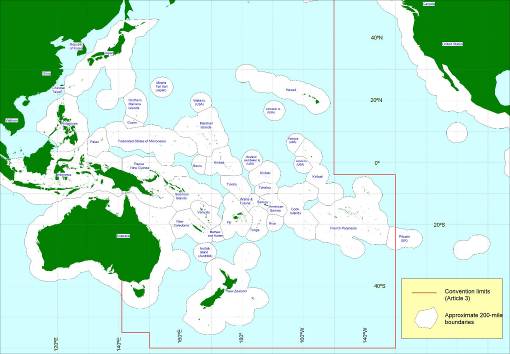
The OFMP was instigated through the combined initiative of 15 governments within
the WCPO region (Figure 1); Cook Islands, Federated States of Micronesia, Fiji,
Kiribati, Marshall Islands, Nauru, Niue, Palau, Papua New Guinea, Samoa, Solomon
Islands, Tonga, Tokelau, Tuvalu and Vanuatu.
Component 1, the Scientific Assessment and Monitoring Enhancement Component is
aimed at providing improved scientific information and knowledge on the oceanic
transboundary fish stocks and related ecosystem aspects of the Western Tropical
Pacific Warm Pool Large Marine Ecosystem and at strengthening the national
capacities of the Pacific Small Island Developing States (SIDS) in these areas.
For a long time, these countries (along with other Pacific Island Countries and
Territories - PICTs) have recognized that they are collectively the custodians of one of
the largest marine ecosystems in the world (the warm pool large marine ecosystem
LME Figure 1b), within which resides the world's largest tuna resource.
Approximately one half of the worlds total tuna catch is taken from this region, with
catches consistently increasing over the past three decades (Figure 1c) and surpassing
2 million tonnes per annum in recent years.
2
For some time these countries have had concerns over the sustainability of this
resource which represents one of the only significant natural resources in the region
and which is one of the most economically important resources for these countries.
Most PICTs are characterised as developing countries with limited resources and for
some, tuna fishing access fees constitute as much as 40% of total government
revenue. The long term economic and social aspirations of many of these countries
rely heavily on the long term sustainability of the tuna resource.
Figure 1 The Western and Central Pacific Fisheries Commission Convention Area and the
approximate EEZ boundaries of Pacific Island Countries and Territories.
1.3
Data-reporting Obligations to the WCPFC
The main impetus for convening the First Tuna Data Worskshop (TDW1) relates to the
establishment of the Western Central Pacific Fisheries Commission (WCPFC) in 2003 and the
obligation for members and cooperating non-members of the Commission (CCMs) to provide
tuna fishery data on annual basis, as specified in the Convention (FFA, 2004).
References to Tuna Fishery data provisions in respect of the Commission include:
Appendix VII (of this report) contains the data-related provisions extracted from the
WCPF Convention (FFA, 2004).
Recommendations SC1ST1 and SC1ST2 in Annex 7 of Anon (2005a) describes
the details of scientific data to be provided to the Commission, at this stage. It should
be noted that the details of provision of several types of data to the Commission have
yet to be considered. These data include, Observer data, Port sampling data,
Unloadings data and Gear and Vessel attributes data;
Attachment D of Anon (2005b) provides guidelines for annual reporting to the
Commission's Scientific Committee (SC) and the Technical and Compliance
Committee (TCC).
3
2.
Objectives
Sub-component 1.1 `Fishery Monitoring, Coordination and Enhancement' of the GEF project
was designed to improve and develop Pacific SIDS ability to monitor the scientific aspects of
their oceanic fisheries activities. While many of these countries do have monitoring
programmes in place, not all are currently able to provide data in the quantity and quality
required by the Commission.
A major objective of this GEF sub-component is to establish a data template which when
properly adhered to by countries will ensure they meet their monitoring objectives. It is
expected that this data template will evolve over time, along with the Commission data
requirements and therefore there will be a continuous need to inform, distribute, up-date and
gain feedback from countries regarding this data template. This will be done through
workshops, in-country visits and short attachments at SPC. TDW-1 was the first workshop
with these ideals in mind.
Specific objectives of the workshop were identified as -
Describe Tuna Fishery Data Collection, Management and Dissemination systems
"Share experiences" in the collection, management and dissemination of tuna fishery
data
Introduce the concept of the "Regional Template" on Data Collection, Management
and Dissemination
Establish the "National Procedures" document on Data Collection, Management and
Dissemination
"Requireme
"Requirem nts" to co
to
llect
co
da
llect ta
da
Da
D ta c
a
o
ta c llec
o
t
llec io
i n
o
Fe
F edba
d ck m
ck echan
m
i
echan sms
s
systems
m
(e.g. Qua
(e.g. Qu lity Co
l
ntrol)
ity Co
Dat
Da a ma
a
n
ma age
a ment
systems
Nati
a onal d
ti
at
a a
t
a
hold
hol in
i g
n s
Dat
a a d
a iss
i emination
syst
y ems
(usi
(us ng the data)
i
Output
Outp to users o
ut
f
to users o data
Figure 2. Simplistic diagram showing the relationships between Data collection, management and
dissemination systems
3.
Workshop Design
3.1
Regional Tuna Data Template Document and National Procedures
Document
The `Regional Tuna Data Template Document' broadly outlines the best practices for
establishing and maintaining procedures which will support in-country tuna data
4
systems. The document includes specific guidelines to help countries put together a
`National Tuna Data Procedures Document' through which they can show that they
have both reflected on and put in place each of the components of a comprehensive
tuna data system. These national documents will furthermore serve as resource
material for statistics staff who wish to improve their understanding about their
countries tuna data system as well as their individual tasks and responsibilities to the
system. The `National Tuna Data Coordinator' from each country will be the main
author of these national documents; however SPC will also contribute to the
document during in-country visits and attachment training. The workshop was an
opportunity to inaugurate these documents. Also, a number of the exercises were
carried out in a manner so that the outputs could feed straight into certain sections of
the `National Tuna Data Procedures Documents'.
3.2
Workshop Structure
One of the main problems faced in designing the workshop was in catering for the
different levels of experience and diversity in work background amongst the
participants. Some participants were new-comers to tuna fisheries while others had a
number of years experience and therefore possessed a greater depth of knowledge that
could be drawn on during the workshop. There was also the need to present the basic
concepts used in tuna fishery data collection, management and dissemination systems
and this could only be done with formal presentations.
The workshop was therefore structured along the following lines, bearing in mind the
need to satisfy the objectives of the workshop
Each session was introduced with a presentation covering the main points of
the topic for that session. Where relevant, the theory and main requirements
with respect to that topic were covered in the presentation, with examples
taken from experiences in the region's tuna fishery data systems. Presentations
were put together to ensure they did not exceed 30 minutes and therefore avoid
the one-way involvement of facilitators;
After most presentations, there was a short period allocated for
questions/comments in plenary;
After some presentations, participants were asked to break-out into one of five
groups to undertake an exercise related to the session. The aim of the group
sessions was not only to complete the exercise, but by discussing experiences
within each country, participants were able to learn what was happening
elsewhere in the region, relate problems in their own country with what was
happening elsewhere, and gain an appreciation of how other countries dealt
with these problems. The exercises were designed so that the outcomes could
be formalized for dissemination, but also, the discussion provided improved
knowledge to participants. The facilitators moved around the groups to ensure
the objectives of the exercise were clear and they also provided
background/experiences from a regional point of view. The make-up of the
groups was undertaken prior to the meeting and was done in such a way that
experienced participants were mixed with in-experienced participants and
participants with similar fisheries (e.g. purse seine fisheries) were grouped
together. After most group sessions, the workshop would briefly reconvene in
plenary to discuss the main outcomes of the discussions.
5
In addition to the group sessions, after most presentations, participants were
required to undertake an individual (country) exercise, designed so that the
results would feed directly into the National Procedures Documents.
Three sessions (two afternoons and one morning) were set aside for
participants to update the National Procedures Documents with information
provided in the Regional Template, presentations and from the exercises.
A CD containing the workshop documents (including the Regional Template
Document), the workshop presentations and exercises, and the regional
standard data collection forms was provided to each participant at the close of
the meeting.
4.
Workshop Content
The workshop was structured into sessions dealing the "WHY", "WHAT" and
"HOW" of tuna fishery data collection, best practices in managing data, and finally,
an introduction to disseminating tuna fishery data. The detail of presentations made
and exercises undertaken in each session are available in several MS Powerpoint
(PPT) and MS Word files on CDs provided to each participant. The agenda of the
Workshop can be found in Appendix I and the list of participants can be found in
Appendix II. The consolidated outcomes of key exercises undertaken by participants
have been included in APPENDICES IIIV.
The following sections provide a brief summary of each session, including the
significant issues raised during discussions.
4.1
Why Collect Data ?
This session dealt with the reasons for collecting tuna fishery data and was addressed
by two main presentations on the following topics :
Data obligations to the WCPFC
o [TDW-1 (P2.1) Data obligations to the WCPFC.ppt]
o [TDW-1 (P2.1b) Data obligations to the WCPFC.ppt]
Data requirements at the National Level
o [TDW-1 (P2.4) National data req.ppt]
In describing the obligations to the WCPFC and the national requirements for data,
there were two additional presentations on the role of both the OFP and FFA in
regional data collection, management and dissemination [TDW-1 (P2.2) OFP role
in data.ppt and TDW-1 (P2.3) FFA role in data.ppt, respectively].
Participants were asked to break into their groups to consider and discuss ("share
experiences") the national requirements for collecting tuna fishery data in their
countries, and then specify any other reasons for collecting data in their countries that
were not listed in the presentation. Appendix III contains the list of reasons for
collecting data from a national point of view reasons highlighted in "red" represent
the additions suggested by participants after group discussions.
6
Participants were also asked to conduct two exercises on an individual country basis
(i) rank the top ten reasons for collecting data, according to their understanding of
national requirements, and (ii) complete a worksheet relating `National Legislation'
(Marine Acts, etc.) to tuna data requirements in their country. The output of the
second exercise would feed directly into their respective national tuna fishery data
procedures document.
The consolidated result of the top ten ranking of reasons for collecting data (at the
national level) appear in the right-hand column of the table in Appendix III. In
discussion prior to the ranking exercise, it was noted that the ranking may be different
depending on the different work focuses within each country. However, the
consolidated ranking produced from this exercise was generally considered to be what
would be expected.
4.2
Types of Data collected
This session provided an overview of the types of data collected in tuna fisheries
throughout the region, and was addressed by three presentations on the following
topics :
The type and function of tuna data collected throughout the region
o [TDW-1 (P3.1) Types of data.ppt]
The role of the SPC/FFA Data Collection Committee (DCC)
o [TDW-1 (P3.2) Role of the DCC.ppt]
Minimum data standards WCPFC function
The main characteristics for each data type collected, brief mention of the protocol
and the required coverage of each data type were briefly described in the first
presentation. In summing up the first presentation, two slides showing the current
level of coverage of the main tuna fishery data types were presented (Figures 3 and 4).
The main concerns with respect to data collection at this point are
The coverage of Unloadings data in both the purse seine and longline fisheries
are poor;
The coverage of Logsheet data for the longline fishery is low, mainly due to
the poor coverage of distant-water vessels fishing on the high seas.
Participants were asked to break into their groups to consider and discuss ("share
experiences") the types of data collected in their countries and whether there were
other types of data collected that should be included.
In a subsequent discussion in plenary, it was noted that logsheets tended to be
completed by captains while on-board vessels in the purse-seine fishery, but that
logsheets for some longline vessels were completed on return to port by fishing
company staff, which sometimes resulted in transcription problems and this was
difficult to verify. This situation was an example of the need for appropriate
instructions, stressing the obligations on fishing companies in stipulating exactly how,
and who, should fill out logsheets in the tuna fisheries throughout the region.
7
Participants were asked (individually) to test their knowledge through an exercise
handout asking specific questions on the two main types of data collection (logsheets
and unloadings) in their country. The output from this exercise was then to be
incorporated into their respective National Procedures document.
100.0%
Logsheet (%)
1,400,000
Unloadings (%)
Observer (%)
1,200,000
80.0%
Total Catch Estimate (right axis)
1,000,000
60.0%
800,000
600,000
40.0%
400,000
20.0%
200,000
0.0%
0
1955
1960
1965
1970
1975
1980
1985
1990
1995
2000
2005
Figure 3. Estimated annual coverage of data provided for the tropical WCPO purse seine fishery
100.0%
Logsheet (%)
90,000
Unloadings (%)
80,000
Observer (%)
80.0%
Total Catch Estimate (right axis)
70,000
60,000
60.0%
50,000
40,000
40.0%
30,000
20.0%
20,000
10,000
0.0%
0
1950
1955
1960
1965
1970
1975
1980
1985
1990
1995
2000
2005
Figure 4. Estimated annual coverage of data provided for offshore and domestic longline fisheries
based in Pacific Island countries
4.3
How data are collected
This session provided an overview of how data are collected in tuna fisheries
throughout the region, and was addressed by three presentations on the following
topics :
Considerations in tuna data collection systems
o [TDW-1 (P4.1) Considerations in data collection.ppt]
Problems in collecting data
o [TDW-1 (P4.2.1) Problems in data collection.ppt]
Potential solutions to the problems in collecting data
o [TDW-1 (P4.2.2) Solutions to problems in data collection.ppt]
8
4.3.1 Considerations in tuna data collection systems
It was recognized that there are comprehensive resource material and training courses
available for some types of data collection (port sampling and observers), and that
these are generally covered by dedicated regional workshops and specific in-country
training. However, it was also recognized that some work is probably required to
develop more training and resource material for other types of data, specifically those
compiled by the fishing companies (e.g. logsheets and unloadings data).
A checklist to ensure the systematic establishment (or review) of tuna fishery data
collection systems was suggested. The following should be covered in the design or
review of any tuna fishery data collection system. ( indicates items suggested for
inclusion in conditions for fishing access) :
1. Obligations for collecting the data
2. Functions of data to be collected are described
3. Protocols/methods for collection are described submission
4. Reference to data collection forms to be used
5. Required "Coverage" of the data
6. Resources and training required are available (e.g. where does funding come from)
7. Schedule for the provision of the data
8. Consequences for non-compliance in collection and provision of data
9. Contact points for the data
Who records the data
Who provides the data (e.g. Fishing Company representative)
Who receives the data (Fisheries Division staff member)
The respective liaison points in regards to problems with data
Procedures for liaison with respect to problems with data
10. Quality Control Procedures (in the data collection system; e.g. audit/reviews)
11. Feedback mechanisms from data management (mechanisms/procedures for data
management staff to liaise with data collection staff for e.g. on data quality
issues)
12. Data security issues in data collection (addressing both Fisheries Division and
Fishing Companies concerns)
13. Mechanism for integrating/sharing data collection systems with other countries
In group discussions after the presentation, Participants were asked to consider any
other items that should be included on the checklist (these have been highlighted in
red above). Participants were also asked to consider the items marked for inclusion in
the conditions for fishing access, and consider what problems they envisaged in
applying the checklist to their data collection systems.
As a further exercise that would lead to completing relevant sections in their National
procedures documents, Participants were asked to individually review their country's
legal provisions for data collection and indicate whether items (in the checklist) have
been adequately covered or not.
9
4.3.2 Problems in data collection systems
Specific problems encountered in tuna fishery data collection systems were listed
under the following categories :
Problems inherent in the type of data collected
Logistical problems
Competency problems
Compliance problems
Resource problems (Human, Financial and Equipment)
Management Problems
In breakout group discussions, Participants were asked to discuss ("share
experiences") on the problems in data collection in their country, using the problems
listed in the presentation as a guide. They were asked to suggest other problems
experienced in their country that were not in the list proposed in the presentation, or
elaborate further on problems listed in the presentation.
Appendix IV contains a table of the problems (by category) encountered in collecting
data from a national point of view the problems highlighted in "red" represent the
additions suggested by participants after the group discussions. It was noted that the
list of problems compiled may not be complete, since all of the region's data
collection community was not represented at this workshop. However, the group felt
that the list covered the main problems experienced in the region at the moment, and
provided a useful reference in conveying the difficulties faced in their work to
relevant third parties.
Participants were asked (individually) to rank the top ten problems in data collection
systems in their country, and the consolidated result appears in the right-hand column
of the table in Appendix IV. The most significant problems at the moment are
Poor reporting by fishing vessels, for reasons related to either the lack of compliance
or competency on behalf of the fishing vessel
Lack of human resources within national fisheries offices to undertake the necessary
data collection and management work
Logistical problems in obtaining data collected outside their country (e.g. data
collected in ports in other countries)
4.3.3 Solutions to Problems in data collection systems
In this session, participants were asked to consider any potential solutions for each
problem identified in the previous session (see Section 4.3.2) in their respective
breakout groups. This session in particular generated considerable discussion and was
very informative, according to participants.
The facilitators of the workshop compiled a composite list of potential solutions to
each problem listed from the deliberations of the groups. The list of solutions for each
problem was provided to participants and has been included in the report of the
workshop (Appendix V). It was acknowledged that the list of potential solutions was
10
not necessarily complete, but the list, as it stood, would still be very useful as a
reference and guide to updating the National Procedures document and to resolving
problems in data collection throughout the region.
4.4
Best Practices in Managing data
This session provided an overview of data management in tuna fisheries throughout
the region and was addressed by four presentations on the following topics :
Why "Data Management" is important
o [TDW-1 (P5.1) Why data mgmt important.ppt]
Components of Managing data
o [TDW-1 (P5.2) Components of Mgmt of data.ppt]
Data Quality Systems
o [TDW-1 (P5.3) Data Quality Systems.ppt]
Coverage of Data
o [TDW-1 (P5.4) Coverage of data.ppt]
The first presentation provided a general definition of Data Management and why
Data Management is important. The presentation introduced the concept of "Best
Practice", described each component of "Best Practice", and the consequences of
"Best Practice" in Data Management.
The second presentation provided a description of each component that should be
included in a Tuna Fishery Data Management System
Data Registry System
Data (hard-copy) Filing System
Integrated Database System
Data Quality Control
Data Archiving system
Data Security
Participants were asked to (individually) cross-check each component with what
exists in their country's data management system where components do not
currently exist, they were asked to describe why it would be difficult to implement, if
it could not be introduced in the coming year. The output from this exercise was then
to be included in the National Procedures Documents.
The third presentation provided an introduction to Data Quality Systems. It listed the
reasons why Data Quality Control is important and covered what would be expected
in Quality Control procedures in the data collection systems used by (i) Fishing
Companies and (ii) Fisheries Division staff. The presentation also covered the Quality
Control procedures that should be expected in the Data Management Systems of
fisheries offices in the region.
As with the previous exercise, Participants were asked to (individually) cross-check
the Quality Control procedures for data collection and management (suggested in the
presentation) with what exists in their country's systems where procedures do not
currently exist, they were asked to describe why it would be difficult to implement, if
11
it could not be introduced in the coming year. The output from this exercise was then
to be included in the National Procedures Documents.
The fourth presentation provided an introduction to Data Coverage. The presentation
explained what is meant by "Coverage" and why is it important to know what the
coverage of data is. It introduced the concept of "Base" data used to determine
"coverage", described some of the problems experienced in determining coverage and
the pros and cons of several methods available to determine coverage.
It was recommended that countries consider establishing a "Base" data that will
(unconditionally) represents 100% coverage of fishing activity, and that the "Annual
Fishing Trip and Port Visit Log" has been designed to specifically determine coverage
of other types of data. It was noted that Vessel Monitoring System (VMS) data, once
fully implemented throughout the range of regional tuna fisheries, will also provide an
invaluable source for determining coverage.
With respect to coverage, Participants were asked to (individually) undertake an
exercise covering the following:
Provide an approximate level of coverage for each data type collected in their
country, and indicate whether it matched the recommended levels for coverage;
Indicate what are the current hindrances to increasing the levels of coverage in their
country;
Indicate the ways where they could improve on the levels of coverage;
Indicate other methods of determining coverage not mentioned in the presentation;
Indicate the "Base" data collection (with respect to coverage) they use, or would
consider implementing to determine coverage; (bearing in mind the resources
required and potential problems in doing so, and what compliance measures need to
be introduced to collect these data)
As with the other exercises in this session, the output was then to be included in the
National Procedures Documents.
4.5
Dissemination of data
This session provided an introduction to the dissemination of data in tuna fisheries
throughout the region and was addressed by two presentations on the following
topics:
Data Dissemination Management
o [TDW-1 (P6.1) Dissemination mgmt.ppt]
Tools to facilitate the dissemination of data
o [TDW-1 (P6.2) Tools of dissemination.ppt]
The first presentation provided a general definition of data dissemination and listed
the major outputs from tuna fishery data (the "requirements" for data dissemination).
The presentation suggested a means of managing the data dissemination process
through the establishment of a "schedule/plan" for data dissemination. It described the
importance of a schedule/plan as "Best practice", the components required in a
schedule/plan, the categories (or types) of dissemination you might find for tuna
fishery data and provided a basic example of what a schedule/plan might look like.
12
The components required in a dissemination schedule/plan were identified as
Categorisation for each type of dissemination (e.g. reports see below)
Details of the data to be disseminated
Whether or not authorisation to disseminate is required
Deadlines for data processing
Procedures for producing the disseminated data
Who prepares the disseminated data (responsibility)
Date when the disseminated data are required
Who receives the disseminated data
Procedures for filing and recording each instance of dissemination
It was acknowledged that the list of categories for dissemination proposed at this stage
may not be complete, but should satisfy most countries requirements
Briefs for Fishing Access Negotiations
Annual provision of data to the WCPFC (SC and TCC)
Annual Fisheries Division Reports
Fishing Industry reports
Data for Regional Stock Assessments
Data for Regional Compliance Coordination
Reports for other government departments
Reports / Data for ad hoc requests
Reports to review performance of data collection staff
Quarterly Fisheries Newsletters
Quarterly Advisory Committee briefs
Reports to the Economics Department
In the exercise following the presentation, Participants were asked to (individually)
cross-check each category for dissemination of data relevant to their country. In the
coming year, it is hoped that countries will begin to fill in the details of components in
each dissemination category in their National Procedures Document.
A presentation was made on the "tools" available to countries for preparing data in a
form to disseminate. The reasons why tools are needed were listed, and then tools that
have been developed by the OFP over the years to facilitate the preparation of data for
dissemination, were described.
It was noted that "Data Dissemination" was not covered to the extent necessary at this
workshop since it is important to ensure the data collection and management systems
are functioning well before meaningful information can be produced in data
dissemination systems. In this regard, "Data Dissemination" will be the main focus of
the next workshop.
13
5.
Recommendations from the Workshop
The wrap-up session of the workshop presented the opportunity for participants to put
forward any recommendations for future work and highlight significant issues with
respect to tuna data. The following were recommendations proposed by participants:
1. The workshop provided an excellent mechanism for sharing experiences on
problems, and providing solutions related to tuna fishery data systems, and
that this type of workshop had not previously been catered for. It was hoped
that the opportunity for this type of discussion would continue in some form
in the future;
2. The workshop recognized the importance of having representatives from
distant-water fishing nations involved in this process and recommended they
be invited to future workshops;
3. The next workshop should include the "auditing" of data systems as a major
focus;
4. The next workshop should include a session where each country makes a
presentation, which would include a description of their data collection and
management systems, a list of the problems they have experienced in their
data collection and management systems, and an update on the status of their
National Procedures document. (The Workshop conveners should propose a
standard reporting format);
5. Wherever possible, strong emphasis on providing the necessary management
support in enforcing licensing conditions should be communicated both
regionally and nationally;
6. There were concerns on whether countries could adequately cover the
required level of human resources for the increasing regional data collection
and management requirements, and these concerns should be formally
communicated both regionally and nationally.
Several other suggestions for topics at the next workshop were suggested in the
questionnaire (see APPENDIX VI).
6.
Assessment of Workshop
The workshop did not aim to assess the performance of each participant but hoped to
gain a basic indication by informally evaluating the participants understanding of the
principles presented during the week, the general involvement of participants in group
and plenary discussions, and the progress made on the National Procedures document.
A questionnaire was also designed to obtain an indication of the usefulness of the
workshop through feedback from the participants on their assessment of key
objectives (the results are in Appendix VI). Based on the results of the questionnaire,
the informal comments from participants and observations from the facilitators, the
workshop accomplished its objectives. The participants attending the meeting had a
wide level of experience, but all indicated that they could take something away from
the workshop. The facilitators noted that all participants were keen to be involved and
14
there wasn't any absenteeism throughout the week. Also, significantly, there weren't
any negative responses to the questionnaire. The length of the workshop (4.5 days)
was considered appropriate as participants worked hard and by the end of the week
had, in the opinion of the facilitators, reached the point where further work might
have proved disadvantageous.
Some time was spent in the selection of members from each group to ensure there was
a good mix of experience and in-experience, but also that similar and contrasting
experiences would be present. The group discussions proved to be very successful,
and in some instances the facilitators let discussions proceed longer than planned
when critical issues where being discussed.
Taking into account the feedback from participants and a review of the workshop by
facilitators, the following points should be considered for future workshops:
Ideally, the timing of the next workshop (TDW2) should be in the first
quarter of 2008. This provides a sufficient gap between TDW1, and
corresponds to the period when preparation of annual catch estimates for the
2007 calendar year is undertaken, which could be the subject of a session at
TDW2.
Consideration could also be given to holding TDW2 back-to-back with the
next Data Collection Committee (DCC7) meeting.
Beyond TDW2, there may be a need to find a mechanism for countries to
convene to "share experiences" in problems encountered in data collection and
what steps are needed to resolve them.
There should be consideration of using the OFP's web site to provide material
describing generic tuna fishery data collection, management and dissemination
systems, and to also document current issues in data collection, management
and dissemination throughout the region. For example, the material presented
at TDW1 should be made available on the web site, including text to indicate
that any use of this material is cited as being sourced from the OFP;
The group sessions proved to be very useful and should be repeated in the
future;
Consider having better resource material available (perhaps producing the
resource material from TDW1 as a formal document/manual).
7.
References
Forum Fisheries Agency (FFA). (2004). Convention on the Conservation and Management of
Highly Migratory Fish Stocks in the Western and Central Pacific Ocean.
Anon. (2005a). Report Of The First Regular Session Of The Scientific Committee Of The
Commission For The Conservation And Management Of Highly Migratory Fish
Stocks In The Western And Central Pacific Ocean (SC2). Noumea, New Caledonia 8
to 19th August 2005.
Anon. (2005b). Report of the Second Regular Session o of the Commission for the
Conservation and Management of Highly Migratory Fish Stocks in the Western and
Central Pacific Ocean. Pohnpei, Federated States of Micronesia. 1618 December
2005.
15
APPENDICES
Appendix I Workshop Agenda
FIRST TUNA DATA WORKSHOP (TDW-1)
23-27 October 2006
Noumea, New Caledonia
PROVISIONAL AGENDA
AGENDA ITEM 1
OPENING OF THE WORKSHOP
1.1 Welcome
address
1.2 Adoption
of
agenda
1.3 Workshop
arrangements
1.4
Purpose of the Workshop and expected outputs
AGENDA ITEM 2
WHY DO WE NEED TO COLLECT DATA?
2.1
Data obligations to the WCPFC
2.2
OFP's role in regional data collection, management and dissemination
2.3 FFA's role in regional data collection, management and dissemination
2.4
Data requirements at the National Level
AGENDA ITEM 3
TYPES OF DATA COLLECTED
3.1
The type and function of tuna data collected throughout the region
3.2
The role of the SPC/FFA Data Collection Committee (DCC)
3.3
Minimum data standards WCPFC function
AGENDA ITEM 4
HOW DATA ARE COLLECTED
4.1
Considerations in tuna data collection systems
4.2
Problems in collecting data
4.2.1 Problems in collecting data
4.2.2 Potential solutions to the problems in collecting data
AGENDA ITEM 5
BEST PRACTICES IN MANAGING DATA
5.1
Why "Data Management" is important
5.2
Components of Managing data
5.3
Data Quality Systems
5.4
Coverage of Data
AGENDA ITEM 6
DISSEMINATING DATA
6.1
Data Dissemination Management
6.2
Tools to facilitate the dissemination of data
AGENDA ITEM 7
CLOSE OF MEETING
16
Appendix II Workshop Participants List
FIRST TUNA DATA WORKSHOP (TDW-1)
23-27 October 2006
Noumea, New Caledonia
LIST OF PARTICIPANTS
Cook Islands
Pamela Maru
p.maru@mmr.gov.ck
Ministry of Marine Resources
P.O. Box 85
Rarotonga
Cook Islands
Tel. 682 28730/28722/28721
Fax. 682 29721
Federated States of
Micronesia
Steven Retalmai
stevenr@mma.fm
National Oceanic Resource
Management Authority (NORMA)
PO Box PS122
FM 96941 Palikir Pohnpei
Tel. 691 3202700
Fax. 691 3202383
Fiji
Jone Amoe
jamoe@mff.net.fj /
Ministry of Fisheries and Forestry
fishfinderfj@gmail.com
Neomai Ravitu
nravitu@mff.net.fj /
Fisheries Department
neomai_r@hotmail.com
P.O. Box 2214
Govt. Buildings, Suva
Fiji
Tel. 679 3301011 or 3301611
French Polynesia
Cédric Ponsonnet
cedric.ponsonnet@peche.gov.pf
Service de la Pêche
Cellule
Statistique
B.P. 20
98 713 Tahiti - Polynésie française
Tel. 689 50 25 50
Fax. 689 43 49 79
Guam
Tom Flores, Jr.
thomasfloresjr@yahoo.com
Dept. Of Agriculture, Fisheries
Section
192 Dairy Road
Mangilao, GUAM 96913
USA
Tell. (671) 735-395516
Fax. (671) 734-6570
Kiribati
Tamuera Tebao
tamuerat@mfmrd.gov.ki
Ministry of Fisheries and Marine
Resources Development
Fisheries Division
P.O. Box 64
Bairiki, Tarawa
Kiribati
Tel. 686 21099/21502
Fax. 686 21120
17
Marshall Islands
Berry Muller
bmuller@mimra.com
Marshall Islands Marine Resources
Authority
Box 860
Majuro
Marshall
Islands
96960
Tel. 692 6258262
Fax. 692 6255447
Nauru
Karlick Agir
karlick.agir@naurufisheries.com.nr Nauru Fisheries and Marine
Resources Authority
PO Box 449
Aiwo District
Nauru
Tel. 674 4443733
Fax. 674 4443812
New Caledonia
Regis Etaix-Bonnin
regis.etaix-bonnin@gouv.nc Marine
Marchande
Julie Mounier
julie.mounier@gouv.nc
PO Box 36
Noumea
98845
New Caledonia
Tel. 687 27 26 26
Fax. 687 28 72 86
Niue
Department of Agriculture, Forestry
& Fisheries
Vanessa Marsh
fisheries3@mail.gov.nu
PO Box 74
niuefisheries@yahoo.com
Alofi
Tel. 683 4302
Fax. 683 4079
Palau
Kathy Sisior
katzpma@palaunet.com Oceanic
Fisheries
Management
Section
Bureau of Marine Resources
Government of Palau
PO Box 117
Koror
Palau
Tel. 680 488-3125
Fax. (680) 488-3555
Papua New Guinea
Barre Karre
bkare@fisheries.gov.pg National
Fisheries
Authority
Luanah Koren
lkoren@fisheries.gov.pg Port
Moresby
Donna Asi
dasi@fisheries.gov.pg Papua
New
Guinea
Rosemary Simon
rsimon@fisheries.gov.pg
Tel. 675 3090444
Fax. 675 3202061
Philippines
egarvilles@yahoo.com
National Fisheries Research and
Development (NFRDI)
Elaine Garvilles
Bureau of Fisheries and Aquatic
Resources (BFAR)
940 Quezon Avenue
Quezon City 1103
Phillipines
Tel. 632 372 5063; 632 3737414
Fax. 632 372 5063
Samoa
Ueta Faasili Jr
faasilijr@gmail.com
Ministry of Agriculture and Fisheries
18
samoa_albacore@gmail.com
PO Box 1874
Apia
Samoa
Tel. 685 20369/23863/20005
Solomon Islands
Robert Maneiria
rmaneiria@yahoo.com
Department of Fisheries and Marine
Resources
Ministry of Natural Resources
PO Box G3
Honiara
Solomon
Islands
Tel. 677 38694 / 39139
Tel. 677 38730
Fax. 677 38730 or 677 38106
Tokelau
Feleti Tulafono
tofeleti@yahoo.co.nz
Natural Resources and Environment
pfelete@gmail.com
Unit (Department)
Fakaofo
Tokelau
Tel. 690 3134
Fax. 690 3133
Tonga
Tala'ofa Loto'ahea
talaofal@tongafish.gov.to
Ministry of Fisheries
PO Box 871
Nukualofa
Kingdom of Tonga
Tel. 676 21399
Fax. 676 23891
Tuvalu
Falasese Tupau
ffavms@tuvalu.tv
Fisheries Department
Ministry of Natural Resources
Development
Private Mail Bag
Funafuti
Tuvalu
Tel. 688 20143
Fax. 688 20151
Vanuatu
Tony Taleo
ttaleo@gmail.com
Fisheries Department
VMB
9045
Port
Vila
Vanuatu
Tel.678 23119
Fax.678 23641
Mobile : 55560
Wallis Et Futuna
speche@wallis.co.nc
Bruno Mugneret
Service de l'Economie rurale et de la
Pêche
AKAAKA
BP 19
98600 Mata'Utu Uvea
SECRETARIAT OF THE
PACIFIC COMMUNITY
Tim Lawson
timl@spc.int
B.P. D5
Peter Williams
peterw@spc.int
Noumea
Deirdre Brogan
deirdreb@spc.int
New Caledonia
Peter Sharples
peterbs@spc.int
Tel. 687 262000
Colin Millar
colinm@spc.int
Fax. 687 263818
19
Emmanuel Schneiter
emmanuels@spc.int
FORUM FISHERIES
AGENCY
Lara Manarangi-Trott
Email : lara.marangi-trott@ffa.int
PO Box 629
Honiara
Solomon
Islands
Tel. 677 21124
Fax. 677 23995
20
Appendix III List of reasons to collect data and the composite
ranking of the TOP 10 most important reasons to collect Tuna Data
Management of the National Tuna Fishery
RANK
1. Provide an accurate historical perspective of the fishery
5
2. Aid decision-making to ensure the maximum sustainable exploitation of
their fishery
1
3. Establish appropriate management measures
2
4. Account for access to the fishery
5. Inform and advise stakeholders in the fishery
8
6. Provides input to local EAFM
7. Helps in the development of the local Tuna Management Plan
8. Ensures regional data obligations are met
7
9. Determines human and equipment resource needs
10. Account for recreational and subsistence activity
Monitoring, Control and Surveillance
RANK
1. Identify IUU fishing
2. Ensure licensed vessels are not fishing in restricted areas
3. Ensure vessels are compliant with respect to regulations set out in the
conditions of licensing
5
4. Cross-validation of different types of data to ensure compliance
5. Identify undesirable fishing practices
6. Cooperation amongst member countries with respect to MCS
7. Adequate procedures to cover MCS
Resource Monitoring
RANK
1. Monitor trends in catches and catch rates
3
2. Monitor trends in areas fished
9
3. Monitor trends in species composition of the catch
10
4. Monitor trends in catch of species of special interest
5. Monitor changes in local biomass (through analyses)
6. Monitor changes in fishing practices and the effectiveness of the fishing
gear
7. Monitor trends in local consumption
Economic and Social Considerations
RANK
1. Determine appropriate access fee levels (e.g. license fees)
2. Determine feasibility of establishing/expanding the national fishing fleet
4
3. Monitor trends in value of the catch (market prices)
4. Determine the minimum economic criteria necessary for a fishing vessel to
enter the domestic fishery
5. Determine the economic returns (e.g. value of the catch) from the fishery
for National GDP purposes
6. Determine whether there needs to be infrastructure changes (e.g. expansion
of port facilities, air/sea freight, processing plants, etc.)
7. Determine Environmental Impacts
8. Local employment benefits (i.e. crewing lists)
9. Social impacts (i.e. civil disorder, economic benefits)
10. Determine economic impacts of whale depredation on small-scale longline
fleets
11. Compilation of information to attract investors to the fishery
12. Inform the public / raise awareness with the public (e.g. students)
21
Appendix IV List of problems encountered in Tuna Fishery Data
Collection and the composite ranking of the TOP 10 most important
problems.
Problem
RANK
LG There has never been any intention to collect some categories of
data (...although it would be important and useful to do so)
LG Obtaining support (from senior/junior staff) within the
Fisheries Division for data collection
LG Problems for field staff in having access to fish to sample -
6
o legal problems preventing port samplers from interrupting
the unloading process
o fish packed and unloaded in crates
o physically getting sampling staff to vessel unloading in
bay/lagoon
o the unloading process is too fast to allow sampling
o Vessel too small to consider embarking an observer
LG Getting observers to/from ports in other countries for
embarkation / disembarkation
LG Submission of data procedures difficult to adhere to (i.e.
offices closed when vessel arrives)
LG Equipment failure (VMS, Fax machine, etc.)
LG Occupational Health and Safety (OHS) issues that may prevent
field staff from performing their duties
LG Data Collection from vessels that are unloading in ports of
4=
other countries
CT Non-reporting, mis-reporting and under-reporting (Vessel/fishing
3
company).
CT Field staff have not adhered to instructions for collecting data
CT Problems in the provision of data (data have been collected but
have not been correctly provided for data
management/dissemination i.e. the data have been lost due to
poor procedures)
CT Writing on data collection forms is illegible
CT Language
barrier
CT Fishers lack education / feedback (i.e. species ID guides)
CT Confidence of data collectors to carry out their duties
CP Non-reporting, mis-reporting and under-reporting by fishing
1
vessels
CP Poor legislation makes compliance difficult
8
CP Difficulty getting cooperation from fishing company/vessel with
respect to the work required by port samplers, observers and
inspectors
CP Tardy provision of data
9
22
Problem
RANK
CP Vessel captain, crew and fishing company are not aware of their
responsibilities with respect to data collection
CP There is little or no liaison possible with the fishing
company/vessel with respect to data collection
CP No follow-up attempted for non-compliance with data collection
7
CP Lack of understanding of international/regional obligations
RS Inadequate number of staff to cover data collection duties
2
RS Inadequate number of staff to cover data management duties
4=
RS Inadequate funds to cover operational costs of data collection
and management
RS High volume of data means it is impractical to process data
(cost-benefit)
RS Field equipment are not available
RS Computers or software are not available
RS Data collection forms not available or the wrong version
RS Data collection staff are not adequately trained
RS Over-worked staff, due to taking on additional duties
10
RS Inadequate pool of candidates to select from (in recruitment
process)
RS Retention of skilled staff
RS Inadequate opportunities for training/up-skilling
RS Lack of data collection and management procedures / manuals
MG Political
interference
MG Lack of good leadership
MG Lack of consideration for compensation for over-time
MG Inappropriate or incorrect matching of staff to job profile
(i.e. inappropriate recruitment process)
MG Inappropriate work ethics (e.g. accepting bribes)
MG Lack of internal coordination/cooperation (for example, between
a provincial office and the central office)
23
Appendix V A list of potential solutions to problems in Tuna Data
Collection
Logistical Problems (S4.2.1)
Potential Solutions (S4.2.2)
1. There has never been any
·
Review relevancy of data collection by incorporating
intention to collect some
it into some sort of data collection documentation
categories of data
·
Highlight the need for data collection as a regional
(...although it would be
and international obligation
important and useful to do
·
Liaise with relevant agencies/companies to arrange for
so)
data sharing (fill in gaps)
·
For historical data, may come in handy at a later date
·
Review DCC meeting report to keep up to date with data
collection issues.
·
Consider whether to collect, based on obligations and
utility to individual country
2. Obtaining support (from
·
Staff recruitment could be an option
senior/junior staff) within
·
Staff collaboration and team work at all levels
the Fisheries Division for
·
Meet with relevant staff to explain importance of data
data collection
collection work
·
Highlight the need for data collection as a regional
obligation and an international obligation
·
Use regional resources (regional experts, training
aids, etc.) to highlight the importance of data
collection work
·
Provide incentives i.e promotion, increased salary,
awards, etc.
·
Acquire staff who are willing to collect data.
·
Staff awareness on the importance of data collection
·
Communication skills are necessary to obtain buy-in by
staff, need to incorporate them into the process such
as in-house training, workshops, and TRAVEL
OPPORTUNITIES
·
Regular feedback to staff on data coverage targets and
achievements
·
Increase operational funding
·
Permit to agree to port sampling activities
·
Review institutional structure and job profiles, to
include sufficient resources and responsibilities for
the task at hand
3. Problems for field staff
·
Modify/improve Regulations !
in having access to fish to
·
Incorporate into agreements.. need to ensure that your
sample -
access agreement and your laws are in line so they
don't contradict
legal problems
·
Ensure problem is properly documented and brought to
preventing port
the attention of senior staff immediately before/when
samplers from
access agreement is up for renewal.
interrupting the
·
unloading process
Modify sampling process and educate unloadings agents
/ vessel owners (for crew) in the benefits of teamwork
to overcome unloading hiccups (speed process)
·
Take advantage of the development of Port State
standards and procedures by the Commission to review
and suggest solutions
fish packed and
·
Observer data can be refereed to or have the observers
unloaded in crates
on board to incorporate fish sampling on board before
processing and packing.
·
Work in pairs while placing fish on a table (but
additional problem of handling of fish
·
Identify bottle neck in the unloading process.
·
Take a hard stance... don't certify it
24
Logistical Problems (S4.2.1)
Potential Solutions (S4.2.2)
·
Comply with our regulations
·
Request advice from SPC or other agencies who have
experience in setting up sampling programmes.
·
Change venue of sampling for e.g. in Niue, it is
physically getting
possible to sample fish at Niue Fish Processing
sampling staff to
Factory and not at the wharf
vessel unloading in
·
Use observers to collect samples
bay/lagoon
·
Restrict unloadings only to a designated port.
·
Develop infrastructure to encourage unloadings in
port.
·
Buy a boat!
·
Develop regulations to put onus on companies to ensure
samplers get to vessel before unloading/transshipping
can start
·
Consider using random sub-sampling instead of sampling
the unloading process
the entire catch
is too fast to allow
·
Try and encourage unloadings by species
sampling
·
Request advice from SPC or other agencies who have
experience is setting up sampling programmes.
·
Enact and enforce regulations to allow sampling
·
Use two samplers instead of one
·
Educate unloading staff in speed advantages of
teamwork
·
Consider using another type of data collection (e.g.
Vessel too small to
port sampling)
consider embarking an · Leave one crew onshore (the cook) and add the observer
observer
·
Use electronic (video / VMS ) monitoring
·
Length Requirements on size of vessel
4. Getting observers to/from ·
Set up formal arrangement with other countries with
ports in other countries for
respect to using national observers in their country
embarkation / disembarkation · Develop MOUs between PICTs
·
Inform vessels that they need to adhere to the
agreements to wait for observers
·
Cater for these situations in access agreements
·
Need to ensure that the other country ensures that the
vessel remains..
·
Observer arrangement between different countries needs
to be in place
·
Penalties if a country lets a boat leave
·
Regional Corporation with good network.
·
Designated ports for observer embarkation, outside of
which, if vessel wants to fish it must pay full costs
of travel, accommodation, observer salaries and ample
extra penalty traveling allowances
·
Good forward planning
·
Investigate the applicability of cooperation through
the Niue Treaty, in particular through Niue Subsidiary
Agreements as a means to facilitate cooperative
agreements between your country and other countries
·
Watch the development of the Commission Regional
Observer Programme that will have to grapple with this
interjurisdictional issue, as well as the Commissions
port State procedures and regulations that are under
development
7. Submission of data
·
Enforce unloading within government working hours
procedures difficult to
·
Suggest using the postal system to provide data not
adhere to (i.e. offices
ideal usually
closed when vessel arrives)
·
Restrict the period of authorized unloadings not
ideal BUT perhaps along the lines of outside of this
25
Logistical Problems (S4.2.1)
Potential Solutions (S4.2.2)
period vessel must provide penalty fee sufficient to
attract suitable sampling staff to make themselves
available outside of designated hours
·
Announce in advance (eg 12h) the schedules of the
unloadings
·
Increase the personnel if the cost is not prohibitory
·
Review and improve data procedures.
·
Fax/email copies and mail the originals
·
This is a problem with the company not informing the
government of an incoming boat. Perhaps a solution
would be not to certify the catch.
·
Increase the time-frame for the submission of the data
·
Design regulations to suit
8. Equipment failure (VMS,
·
Power back up systems
Fax machine, etc.)
·
Regular back ups of data bases
·
Impose a requirement to undertake regular maintenance
review of the equipment by an authorised company
(modify the regulation accordingly)
·
Ensure support services are in place
·
Have back up systems in place
·
Require that they report every 30 minutes, or in an
agreed upon timely fashion, if VMS isn't working
·
Design regulations to suit
9. Occupational Health and
·
Introduce required OHS procedures/documentation if not
Safety (OHS) issues that may
already in place.
prevent field staff from
·
Work with relevant government services to ensure OHS
performing their duties
issues are catered for in the work place of fisheries
field staff
·
Follow-up by the inspection according to national OHS
legislation
·
Liaise with relevant agencies e.g. Ports Authority,
Marine Safety Authority to ensure health and safety of
licensed vessels. Teamwork.
·
Assign staff appropriate for the job. Need to ensure
that the vessel adheres to standard safety standards.
·
Need to ensure that the environment the observer is
put on is fine... there are some observers that may get
threats
·
Insurance cover and backup officer
·
Importance for crews as well as sampling staff
10. Data Collection from
·
Establish an arrangement for data sharing under
vessels that are unloading
bilateral/multilateral agreements
in ports of other countries
·
Networking amongst other coastal states (member
countries) to ensure data sharing
·
Use the RFMOs (e.g. WCPFC, FFA, SPC) to facilitate
data sharing
·
Develop MOUs between respective countries
·
Investigate the applicability of cooperation through
the Niue Treaty, in particular through Niue Subsidiary
Agreements as a means to facilitate cooperative
agreements between your country and other countries
·
Watch the development of the Commission Regional
Observer Programme that will have to grapple with
this interjurisdictional issue, as well as the
Commissions port State procedures and regulations
·
The Commission is also considering arrangements to
facilitate the sharing of data between members of the
Commission if adopted, in theory a country should
be able to get access to all data relating to their
flag vessels, relating to vessels unloading in their
ports, relating to vessels operating in areas under
their national jurisdiction whether legal or IUU.
26
Logistical Problems (S4.2.1)
Potential Solutions (S4.2.2)
VMS information could also potentially be shared
between members of the Commission through this
mechanism
Competency Problems (S4.2.1)
Potential Solutions (S4.2.2)
1. Non-reporting, mis-reporting
·
Inform them of consequences incurred and enforce
and under-reporting
the regulations that govern the provision of
(Vessel/fishing company).
accurate reporting.
·
Training
·
Improve enforcement procedures e.g. fines,
penalties.
·
Provide more awareness initially. If that doesn't
work, perhaps fine them or suspend their license.
·
Better liaison / teamwork between data collection
and enforcement staff
·
Consequences of non-compliance with reporting
requirements should be a condition of the license,
and text to this effect should be included as part
of the documentation that a vessel is required to
have on board at all times and to furnish on
request (see FFA MTCs)
·
Consider having workshop sessions for industry on
an annual basis (or two years) to provide
information arising from the data that they supply
(national and regional); to reinforce why data is
important; to revisit where coverage and quality
of data is at to work collaboratively with
industry to improve systems and address problems
2. Field staff have not adhered to ·
Induction training
instructions for collecting data
·
Ongoing training
·
Disciplinary action if needed
·
Carry out refresher courses.
·
Carry out staff appraisals
·
Restructuring and reassignment of staff
·
Provide regular feedback on the quality of their
data
·
Effective supervision
·
Replacement if incapable for doing his/her job
·
Piecework and/or significant portion of income in
form of bonus for good data
3. Problems in the provision of
·
Basic training to undertake data management,
data (data have been collected but
processing, and creation of database
have not been correctly provided
·
Data collected by Fishing Companies/Vessels : Data
for data management/dissemination
quality control (coverage) will show where data
i.e. the data have been lost due
have not been provided
to poor procedures)
·
A Data Registry system will show where data have
been received but not processed.
·
Review/Provide data collection and management
procedures, if none are in place.
·
Review data collection system with staff
regularly.
·
If problem is with the fishers, report may have to
be sent back to be rewritten for clarity.
·
Good management and organization.
·
More funds to increase staff with proper training
for the management and dissemination of data
·
Improve procedures receipts (accountability) for
data along the chain penalties for non-adherence
·
Back-ups and procedures for securing and storing
27
Competency Problems (S4.2.1)
Potential Solutions (S4.2.2)
data when they are received through to entry,
verification and long-term storage
4. Writing on data collection
·
Liaison with Fishing Companies/Vessels, reminding
forms is illegible
them of their obligation to provide quality data
(condition of licensing)
·
Seek clarification from captains/agents/companies.
·
Provide guidelines/procedures if none are in
place.
·
Provide training where necessary
·
Do not accept illegible forms; give them back to
the fisher immediately if submitted by hand.
·
Immediate action (i.e. unloading forms not filled
properly
5. Language barrier
·
Liaison with Fishing Companies/Vessels, reminding
them of their obligation to provide quality data
(condition of license)
·
Impose a qualification minimum for the agents
·
Provide translated data collection forms,
instructions and training aids
·
Provisions in licensing conditions for English
speaking crew onboard.
·
Agents and companies to have interpreters.
·
Company to make known to the Captain the terms and
regulations (license and reporting of data)
6. Fishers lack education /
·
Providing Fishing Companies with a list of
feedback (i.e. species ID guides)
training resources available to ensure the
provision of quality data.
·
Example data collection forms (filled out)
·
Request training resources from regional agencies
to facilitate the work in national agencies to
collect quality data from fishing companies
·
Fisheries officers issue manuals to company and
explain to captains the use of ID Guide.
·
Observers participate in educating the captains
7. Confidence of data collectors
·
Improve confidence through training courses
to carry out their duties
·
Improve confidence through industry liaison
(informing industry of their responsibilities with
respect to allowing field staff to collect data)
·
Improve confidence by providing necessary
legislation to allow field staff to perform their
duties
·
Restructuring and reassignment of staff
·
More training attachments and practical workshops
·
Managers ensuring that they give their support to
data collectors
Compliance Problems (S4.2.1)
Potential Solutions (S4.2.2)
1. Non-reporting, mis-reporting and
·
Establish and implement enforcement procedures
under-reporting by fishing vessels
i.e. fines, license suspension that
specifically deal with these problems
·
Strict vetting process of license
applications, non-renewable of licenses.
·
Cancel their license
·
Bring the vessel's attention to the fact that
you have evidence that they are mis-reporting
etc.
·
Assess reporting and if not complying refer to
28
Compliance Problems (S4.2.1)
Potential Solutions (S4.2.2)
enforcement
·
Stiff penalties well advertised and adhered
to so that consequences not treated lightly
·
Consequences of non-compliance with reporting
requirements should be a condition of the
license, and text to this effect should be
included as part of the documentation that a
vessel is required to have on board at all
times and to furnish on request (see FFA MTCs)
·
Consider having workshop sessions for industry
on an annual basis (or two years) to provide
information arising from the data that they
supply (national and regional); to reinforce
why data is important; to revisit where
coverage and quality of data is at to work
collaboratively with industry to improve
systems and address problems
2. Poor legislation makes
·
Review legislation with support from ministers
compliance difficult
and directors concerned (FFA can assist in
this regard)
·
Improve the legislation to guarantee the
authority of the agents of collection and to
impose the obligation
·
Amend legislations, regulations and policies.
·
Ensure there is a staff meeting immediately
prior to all fishing access agreements.
Include one member of the data collection and
management section
·
Need to amend the legislation so it becomes
specific to a case
·
Ensure data collection procedures are easily
enforceable
3. Difficulty getting cooperation
·
Establish good working relationship (through
from fishing company/vessel with
liaison)
respect to the work required by
·
Make this noted under their licensing terms
port samplers, observers and
and conditions and make no hesitation in
inspectors
enforcing penalties
·
Consider having workshop sessions for industry
on an annual basis (or two years) to provide
information arising from the data that they
supply (national and regional); to reinforce
why data is important; to revisit where
coverage and quality of data is at to work
collaboratively with industry to improve
systems and address problems
4. Tardy provision of data
·
Ensure there are clear schedules for the
provision of each type of data (as a condition
of license)
·
Enforce the regulations or penalties which
address this
·
Educate industry on necessity of data
collection
·
Document the dates of provision of data (from
the data registry system) and make the company
aware of the problem either before or during
access agreements.
·
Consult and enforce compliance with respect to
data collection
5. Vessel captain, crew and fishing
·
Make them aware of their responsibility via
company are not aware of their
meetings with fisheries liaison staff and said
responsibilities with respect to
company
data collection
·
Training
·
Enhance awareness on importance of data and
29
Compliance Problems (S4.2.1)
Potential Solutions (S4.2.2)
how data can be used to aid fishing practices
·
Provide resource material
·
Ensure fishing companies fulfil their
responsibilities to comply to the terms of the
fishing agreement.
·
Don't believe this excuse easily
6. There is little or no liaison
·
With senior fisheries division presence,
possible with the fishing
approach the fishing company to establish a
company/vessel with respect to data
good basis for liaison (regular meetings,
collection
etc.)
·
Inform and explain to the fishing company the
requirement for quality data
·
Use industry association as communication
links.
·
Establish link upon renewal of license
·
Have regular stakeholder meetings for exchange
of ideas.
7. No follow-up attempted for non-
·
Try and address the issue as soon as it arises
compliance with data collection
·
Establish procedures to ensure there are
mechanisms to ensure regular follow-up
·
Assign responsibilities to specific staff
members with respect to checking and liaising
with fishing companies with respect to non-
compliance
·
Provide training to fisheries division staff,
where necessary
·
Modify procedures to make control effective
·
Improve in-house policies, procedures and
management
·
Internal problems - need to stress awareness
and importance of compliance.
·
In-house issue (address at management level)
·
More in-house teamwork awareness training
8. Lack of understanding of
·
Notify people concerned
international/regional obligations
·
Inform them of their obligations,
responsibilities
·
Training
·
Ask SPC and FFA to visit all countries to make
them more aware if this is a continual problem
·
On a country level, need to stress awareness
and data obligations.
·
Provide resource material
Resource Problems (S4.2.1)
Potential Solutions (S4.2.2)
1. Inadequate number of staff ·
Staff recruitment (more staff)
to cover data collection
·
Reduce data coverage, if it does not impact on the
duties
requirements of the data to be collected
·
If the need for the data is important, inform the
users and senior staff of the problem (they should
then act to resolve it).
·
Seek funds
·
Delegate duties out to other staff
·
Consider "multi-skilling" by cross-training with
other agencies to provide staff available to do the
necessary work
·
Put more onus for data collection and submission on
industry. Staff should be used more for the receipt
and management of data (excludes sampling data)
30
Resource Problems (S4.2.1)
Potential Solutions (S4.2.2)
2. Inadequate number of staff ·
Staff recruitment (more staff)
to cover data management
·
If the need for the data is important, inform the
duties
users and senior staff of the problem (they should
then act to resolve it).
·
Seek funds
·
Consider "multi-skilling" by cross-training with
other agencies to provide staff available to do the
necessary work
·
Build cost of managing data into license fees.
·
Consider use of 3rd party (e.g.: OFP) for some data
management services
3. Inadequate funds to cover
·
Find alternative sources of funding
operational costs of data
·
Regular audit checks to identify fund mismanagement
collection and management
·
Consider cost cutting BUT don't deprofessionalise
these staff in the process
·
Develop proposal clearly stating the need for data
collection/management (with possible assistance from
regional agencies)
·
Seek funding from external sources e.g. RFMOs / WCPFC
·
Propose redirection of license fees to the dept from
the financial agency
·
Build cost of managing data into license fees.
·
Specific data collection and management fees for sole
use in this work
4. High volume of data means
·
Outsource data processing and management (e.g.
it is impractical to process
regional agencies - SPC)
data (cost-benefit)
·
Target the more important requirements in data and
reduce collection where necessary
·
Review and improve data management practices
·
Hire more staff
·
Seek funds - both international and regional
·
Review the use of ORC(?) software
·
Seek more possible funding
·
Justify at management level the importance and need
of recruiting additional staff
·
Harmonise data management processes (regionally)
where this may help e.g.: common database with
universal support
5. Field equipment are not
·
Liaise with regional agencies with respect to
available
availability of equipment
·
Create proposals for funding assistance.
·
Seek funds
·
Build cost of field equipment into license fee
6. Computers or software are
·
Develop a proposal clearly stating the need and
not available
expected use of the equipment (Create proposals for
funding assistance)
·
Seek funding (e.g. internal funding sources, US MLT
PDF, WCPFC (in particular the Japanese Trust Fund and
Special Requirements Fund activities), regional
agencies such as SPC and FFA.)
7. Data collection forms not
·
Regularly liaise with regional agencies (SPC) with
available or the wrong
respect to the version of the forms
version
·
Have a schedule for follow-up
·
Keep up-to-date with the DCC Meeting Reports
8. Data collection staff are
·
Inform senior staff of the need for training (tied to
not adequately trained
quality data)
·
Liaise with regional agencies with respect to the
provision of training and training resources
·
Impose minimum qualifications
·
Training and training resources
31
Resource Problems (S4.2.1)
Potential Solutions (S4.2.2)
9. Over-worked staff, due to
·
Inform senior staff of the problem
taking on additional duties
·
Inform regional agencies of the problem (where
relevant)
·
Seek funds
·
Provide incentives - bonuses, longer leave days, etc.
·
Hire more staff
·
Consider delegating some duties of the "over-worked"
staff to other staff.
·
Establish a comfortable vessel staff ratio
·
Educate senior staff on importance of data so that
these data staff resources remain at high priority in
their budgeting and management decisions
10. Inadequate pool of
·
Widen recruitment coverage
candidates to select from (in · Recruit from other member countries
recruitment process)
·
Hire best candidate (that may not be qualified) then
train them/provide them with educational
opportunities to be qualified for the job.
·
Ensure selection criteria are appropriate, then
select carefully
·
If appropriate staff remain hard to get then consider
longer and more comprehensive than usual training
11. Retention of skilled
·
Inform senior staff
staff
·
Improve incentives (increase pay, bonuses, travel
opportunities, educational opportunities, promotion
opportunities, etc.)
·
Training and education of other staff members
12. Inadequate opportunities
·
Consider assistance provided by regional agencies
for training/up-skilling
(RFMOs)
·
Take advantage of workshops of SPC/FFA, etc. if local
opportunities are not available.
13. Lack of data collection
·
Inform senior staff of problem
and management procedures /
·
Formal proposal to regional agencies (RFMOs)
manuals
·
Develop training procedures/ manuals
·
The outcome of the workshop will provide the
procedures manual
·
SPC to provide
Management Problems (S4.2.1)
Potential Solutions (S4.2.2)
1. Political interference
·
Develop policies, regulations, and legislations
·
Develop regulations/conditions to minimize the
possibilities of political interference (e.g. automatic
cancellation of the license if data provision
obligations are not respected)
·
Provide awareness to those in power that their impact of
interference is interfering with the mission of the
organization.
·
Take to Commission to back up process (in international
circumstances)
·
Transparency of activities to voting public wherever
possible
·
Promotion of importance of these activities to voting
public
2. Lack of good leadership
·
Training and development of staff
·
Performance measures
·
Provide awareness to your leader that their actions ay
not be having a positive effect with the mission of the
organization.
32
Management Problems (S4.2.1)
Potential Solutions (S4.2.2)
3. Lack of consideration
·
Review and improve
for compensation for over-
·
Reduce overtime hours by developing overtime policies
time
e.g. shift work, time off
·
Identify additional funds
·
Consider compensation. This ensures a better working
and more dedicated staff.
·
Put the onus on industry to submit data during working
hours.
·
Fund adequate numbers of sampling staff through
licensing fees.
·
Consider piecework payments
4. Inappropriate or
·
Staff performance reviews
incorrect matching of staff
·
Improve screening procedures in recruitment.
to job profile (i.e.
·
Human resource development
inappropriate recruitment
·
process)
Identify the competences required and impose a minimal
qualification at the time of recruitment
·
Provide staff the opportunity to move to a more
appropriate job.
·
Identify the skills the staff member has and suggest to
them or through management a job change.
5. Inappropriate work
·
Promote transparent and accountable regimes.
ethics (e.g. accepting
·
Independent audits for all systems e.g. on licensing.
bribes)
·
For serious offences like bribes, suspension or firing
may be necessary. For less serious offences, counseling
and monitoring may be options to consider.
·
In-house issue (management to look into)
·
Hardline taken necessary to set examples; i.e.: no
tolerance
6. Lack of internal
·
Enhance communication between all parties.
coordination/cooperation
·
Improve coordination and cooperative efforts with
(for example, between a
regular meetings.
provincial office and the
·
Provide more awareness to parties involves
central office, or between
(documentation, workshops, etc.).
customs, ports authority,
·
maritime surveillance and
Strong understanding/cooperation between central and
fisheries department)
provincial office responsibilities must be clearly
defined
·
Take advantage of consideration of Port State procedures
being considered by the Commission
·
Talk to your superiors about ways to facilitate the
greater involvement of people working in other agencies
in regional and subregional opportunities eg maritime
surveillance officers attending TCC meetings, customs
being involved in providing advice for port state
procedure developments
33
Appendix VI Assessment of the Workshop by Participants
In order to get an indication of the usefulness of the workshop through feedback from the participants on
their assessment of key objectives, a questionnaire was prepared and distributed at the end of the
workshop. The results from the questionnaire also provide ideas for future work with member countries
and how we can improve the content and structure of future workshops. There was no requirement to
identify name or country on the questionnaire, keeping it anonymous and therefore stimulating frank
responses.
The questionnaire contained 10 statements requiring a response in one of the following categories : 1-
Strongly agree; 2-Agree; 3-Uncertain; 4-Disagree; 5-Strongly disagree. Participants were also asked
to include any comments and/or suggestions for each question. There were two additional questions that
required comments only. The following Table contains a summary of the responses from 19 countries
completing the questionnaire (one participant had to leave Noumea early due to connecting flights).
STATEMENT
Questionnaire
COMMENTS / SUGGESTIONS
category
1
2
3
4 5
1.
The overall structure of
14 5
Straightforward, simple, easy to
WORKSHOP was useful
understand; all sessions thoroughly
covered
Not exactly relevant to our local office
work, but the concept can be adapted and
used in our work
Good for different skill levels amongst
participants
Well structured
Very useful as questions, presentations
and exercises help a lot in producing the
national procedures manual
.. helps to convey importance of data
collection and dissemination to the
WCPFC
2.
The time allocated to the
9 9 1
.. more time for discussion ...
components of the workshop was
appropriate
3.
The workshop conveyed the
13 5 1
Excellent coverage (Interactive group
message intended (i.e. it met with
discussion sessions) !
my understanding of what was to be
Loud and clear very good
achieved)
Very well conveyed
Agree... assistance from the more
experienced participants was helpful also
.. more of this kind of worksup can
improve our knowledge on the
importance of data collection ...
4.
The Group Discussions Sessions
10 7 2
Excellent. Group discussions facilitate the
were useful
participation of different countries
sharing experiences was a wonderful
opportunity
Good to hear about the different
situations in member countries. Good
placement (allocation) of group
participants similar situations
We learn from each other's problems and
34
STATEMENT
Questionnaire
COMMENTS / SUGGESTIONS
category
1
2
3
4 5
suggest solutions
Agree, but more time would be good ...
5.
The Exercises provided were useful
9 10
Specific exercises covers the
presentations
Very useful assisting in drafting the
respective sections of procedures
document
Most exercises were useful mostly in
terms of compliance, enforcement
6.
I/We learnt as much as intended
12 7
.. more, in some circumstances ...
from the workshop
7.
I/We intend to apply some of the
10 5 4
We will certainly do arrange for an [in-
points highlighted and taken from
house] meeting to initiate this...
the workshop back at the office
... will have this document available for
implementation...
We will try to apply all of them
8.
I/We will pass on what was learnt
12 7
We will certainly do arrange for an [in-
to others (e.g. through, for example,
house] meeting to initiate this...
in-house training)
No problem in passing on work
experiences but will do so for
enhancement of others skills and
knowledge
9.
I/We will use the presentations on
11 7 1
We will certainly do arrange for an [in-
the CD (will you need other
house] meeting to initiate this...
training material ? specify in the
... especially for completion of national
comments column)
procedures document no other
materials required ...
10. The Concept of the National
19
We will certainly do arrange for an [in-
Procedures document and the
house] meeting to initiate this...
Regional Template is a very good
Very good in getting undocumented
idea...
procedures `documented'
A great way to get data collection
procedures formulated in-country
It becomes a catalyst to improve data
management/collection procedures in
country, and improve the skills of those
who manage the data
Excellent document !! I think this can be
used [applied] as a local document for
any fisheries data collected
35
STATEMENT
COMMENTS
What do you think the
Data Quality being able to identify incorrect data. Problem/Solution work strategies ...
topic of the next
Follow-up on procedures development and implementation, looking further into Commission
workshop should focus
requirements
on ?
Data dissemination procedures as indicated. Exchange of ideas and problems in data collection
systems by presentations from individual countries in future meetings as suggested by Samoa
Data checking, analysis, verification
Include enhancing cooperation amongst countries
In-house training/attachment in TUFMAN; software training (including statistical analysis)'
dissemination data training
Dissemination; Confidentiality/Security
Development standards for data collection systems; demonstration of TUFMAN
How to tell the quality of data collection
Check the implementation of the solutions/methods [to problems in data collection] identified in
this workshop; encourage feedback from participants (in line with this point)
Review progress on points raised in this workshop
Presentation of National Procedures document by countries
Training of personnel on using TUFMAN software
Problems on data collection at the National level and possible solutions
Complete the National templates and implement the programme, then in the 2nd workshop,
participants will report on the problems in the implementation
Any other comments ?
Excellent workshop. Not too overloaded so exercises cab be worked on and discussions
A job very successfully done, from planning through to conducting the workshop, Well done !
TDW-1 Coordinators must keep a close check to ensure the procedures documents get
implemented as we have a strong feeling that most of the issues discussed here may not be
changed due to the way things are currently happening
Very good, enjoyed the workshop. Need a follow-up workshop and need further financial
assistance
Very useful, clearly highlighted the importance of data collection, management and
dissemination of information. This will assist a lot in the organization of my duties and staff.
Best if two participants from member countries attend the workshop in the future.
The workshop overall was very successful as to its relevancy in developing the procedures
document required for the collection of data in my country
Consider that more detailed workshop documents to be sent to member countries prior to the
meeting
Thank you very much for your hard effort and hopefully there will be another workshop in the
coming year
Increase country presentations and participation in discussions; follow-up workshops; cheaper
hotel rates ...
Very useful and hope another will be held in the future ...
.. this workshop made me very aware of problems throughout the Pacific and hopefully some
solutions that we discussed, I can use. I'll probably use the template provided and ideas
presented as a local territory document ..
36
Appendix VII - Data-related provisions of the WCPF Convention
General principle for conservation and management of highly migratory fish stocks
Article 5 (i): In order to conserve and manage highly migratory fish stocks in the Convention
Area in their entirety, the members of the Commission shall, ...collect and share, in a timely
manner, complete and accurate data concerning fishing activities on, inter alia, vessel
position, catch of target and non-target species and fishing effort, as well as information
from national and international research programmes;
Framework for data under the WCPF Convention:
Members
Commission
- provide data and other
- compiles and
information
disseminates
(Article 23 (2))
(Article 10(1))
In accordance with UN Fish Stocks Agreement, Annex I
(which shall form an integral part of the WCPF
Convention))
Members obligations in respect of data
Article 23 (2) Each member shall...
a) provide annually to the Commission statistical, biological and other data and
information in accordance with Annex I of the [UN Fish Stocks] Agreement and, in
addition, such data and information as the Commission may require;
b) provide to the Commission in the manner and at such intervals as may be required by
the Commission, information concerning its fishing activities in the Convention Area,
including fishing areas and fishing vessels in order to facilitate the compilation of
reliable catch and effort statistics;
c) provide to the Commission at such intervals as may be required information on steps
taken to implement the conservation and management measures adopted by the
Commission.
(3) The members of the Commission shall keep the Commission informed of the measures
they have adopted for the conservation and management of highly migratory fish stocks in
areas within the Convention Area under their national jurisdiction. The Commission shall
circulate periodically such information to all members.
(4) Each member of the Commission shall keep the Commission informed of the measures it
has adopted for regulating the activities of fishing vessels flying its flag which fish in the
Convention Area. The Commission shall circulate periodically such information to all
members.
Functions of the Commission in respect of data:
Article 10(1):
37
d) adopt standards for collection, verification and for the timely exchange and reporting
of data on fisheries for highly migratory fish stocks in the Convention Area in
accordance with Annex I of the [UN Fish Stocks] Agreement, which shall form an
integral part of this Convention;
e) compile and disseminate accurate and complete statistical data to ensure that the
best scientific information is available, while maintaining confidentiality, where
appropriate;
Justification for the role of SPC-OFP as data contractor to the Commission:
Article13
1. The Commission, taking into account any recommendation of the Scientific Committee,
may engage the services of scientific experts to provide information and advice on the fishery
resources covered by this Convention and related matters that may be relevant to the
conservation and management of those resources. The Commission may enter into
administrative and financial arrangements to utilize scientific services for this purpose. In
this regard, and in order to carry out its functions in a cost-effective manner, the
Commission shall, to the greatest extent possible, utilize the services of existing regional
organizations and shall consult, as appropriate, with any other fisheries management,
technical or scientific organization with expertise in matters related to the work of the
Commission.
3. In carrying out their work, the scientific experts may:
(a) undertake the collection, compilation and dissemination of fisheries data according to
agreed principles and procedures established by the Commission, including procedures and
policies relating to the confidentiality, disclosure and publication of data;
UN Fish Stocks Agreement, Annex I
· Specifies the data to be collected
Basic Fishery Data
Vessel Data and Information
· Outlines principles to ensure accurate and complete data are obtained
(see text below)
38
AGREEMENT FOR THE IMPLEMENTATION OF THE PROVISIONS OF THE UNITED NATIONS
CONVENTION ON THE LAW OF THE SEA OF 10 DECEMBER 1982 RELATING TO THE
CONSERVATION AND MANAGEMENT OF STRADDLING FISH STOCKS AND HIGHLY
MIGRATORY FISH STOCKS UN FISH STOCKS AGREEMENT)
ANNEX I: STANDARD REQUIREMENTS FOR THE COLLECTION AND SHARING OF DATA
Article 1
General principles
1. The timely collection, compilation and analysis of data are fundamental
to the effective conservation and management of straddling fish stocks and
highly migratory fish stocks. To this end, data from fisheries for these
stocks on the high seas and those in areas under national jurisdiction are
required and should be collected and compiled in such a way as to enable
statistically meaningful analysis for the purposes of fishery resource
conservation and management.
These data include catch and fishing effort statistics and other fishery-
related information, such as vessel-related and other data for
standardizing fishing effort. Data collected should also include
information on non-target and associated or dependent species. All data
should be verified to ensure accuracy. Confidentiality of non-aggregated
data shall be maintained. The dissemination of such data shall be subject
to the terms on which they have been provided.
2. Assistance, including training as well as financial and technical
assistance, shall be provided to developing States in order to build
capacity in the field of conservation and management of living marine
resources. Assistance should focus on enhancing capacity to implement data
collection and verification, observer programmes, data analysis and
research projects supporting stock assessments. The fullest possible
involvement of developing State scientists and managers in conservation
and management of straddling fish stocks and highly migratory fish stocks
should be promoted.
Article 2
Principles of data collection, compilation and exchange
The following general principles should be considered in defining the
parameters for collection, compilation and exchange of data from fishing
operations for straddling fish stocks and highly migratory fish stocks:
(a) States should ensure that data are collected from vessels flying their
flag on fishing activities according to the operational characteristics of
each fishing method (e.g., each individual tow for trawl, each set for
long-line and purse-seine, each school fished for pole-and-line and each
day fished for troll) and in sufficient detail to facilitate effective
stock assessment;
(b) States should ensure that fishery data are verified through an
appropriate system;
(c) States should compile fishery-related and other supporting scientific
data and provide them in an agreed format and in a timely manner to the
relevant subregional or regional fisheries management organization or
arrangement where one exists. Otherwise, States should cooperate to
exchange data either directly or through such other cooperative mechanisms
as may be agreed among them;
(d) States should agree, within the framework of subregional or regional
fisheries management organizations or arrangements, or otherwise, on the
specification of data and the format in which they are to be provided, in
accordance with this Annex and taking into account the nature of the
stocks and the fisheries for those stocks in the region. Such
organizations or arrangements should request non-members or non-
participants to provide data concerning relevant fishing activities by
vessels flying their flag;
(e) such organizations or arrangements shall compile data and make them
available in a timely manner and in an agreed format to all interested
States under the terms and conditions established by the organization or
arrangement; and
(f) scientists of the flag State and from the relevant subregional or
regional fisheries management organization or arrangement should analyse
the data separately or jointly, as appropriate.
39
Article 3
Basic fishery data
1. States shall collect and make available to the relevant subregional or
regional fisheries management organization or arrangement the following
types of data in sufficient detail to facilitate effective stock
assessment in accordance with agreed procedures:
(a) time series of catch and effort statistics by fishery and fleet;
(b) total catch in number, nominal weight, or both, by species (both
target and non-target) as is appropriate to each fishery. [Nominal weight
is defined by the Food and Agriculture Organization of the United Nations
as the live-weight equivalent of the landings];
(c) discard statistics, including estimates where necessary, reported as
number or nominal weight by species, as is appropriate to each fishery;
(d) effort statistics appropriate to each fishing method; and
(e) fishing location, date and time fished and other statistics on fishing
operations as appropriate.
2. States shall also collect where appropriate and provide to the relevant
subregional or regional fisheries management organization or arrangement
information to support stock assessment, including:
(a) composition of the catch according to length, weight and sex;
(b) other biological information supporting stock assessments, such as
information on age, growth, recruitment, distribution and stock identity;
and
(c) other relevant research, including surveys of abundance, biomass
surveys, hydro-acoustic surveys, research on environmental factors
affecting stock abundance, and oceanographic and ecological studies.
Article 4
Vessel data and information
1. States should collect the following types of vessel-related data for
standardizing fleet composition and vessel fishing power and for
converting between different measures of effort in the analysis of catch
and effort data:
(a) vessel identification, flag and port of registry;
(b) vessel type;
(c) vessel specifications (e.g., material of construction, date built,
registered length, gross registered tonnage, power of main engines, hold
capacity and catch storage methods); and
(d) fishing gear description (e.g., types, gear specifications and
quantity).
2. The flag State will collect the following information:
(a) navigation and position fixing aids;
(b) communication equipment and international radio call sign; and
(c) crew size.
Article 5
Reporting
A State shall ensure that vessels flying its flag send to its national
fisheries administration and, where agreed, to the relevant subregional or
regional fisheries management organization or arrangement, logbook data on
catch and effort, including data on fishing operations on the high seas,
at sufficiently frequent intervals to meet national requirements and
regional and international obligations. Such data shall be transmitted,
where necessary, by radio, telex, facsimile or satellite transmission or
by other means.
Article 6
Data verification
States or, as appropriate, subregional or regional fisheries management
organizations or arrangements should establish mechanisms for verifying
fishery data, such as:
(a) position verification through vessel monitoring systems;
(b) scientific observer programmes to monitor catch, effort, catch
composition (target and non-target) and other details of fishing
operations;
(c) vessel trip, landing and transshipment reports; and
(d) port sampling.
40
Article 7
Data exchange
1. Data collected by flag States must be shared with other flag States and
relevant coastal States through appropriate subregional or regional
fisheries management organizations or arrangements. Such organizations or
arrangements shall compile data and make them available in a timely manner
and in an agreed format to all interested States under the terms and
conditions established by the organization or arrangement, while
maintaining confidentiality of non-aggregated data, and should, to the
extent feasible, develop database systems which provide efficient access
to data.
2. At the global level, collection and dissemination of data should be
effected through the Food and Agriculture Organization of the United
Nations. Where a subregional or regional fisheries management organization
or arrangement does not exist, that organization may also do the same at
the subregional or regional level by arrangement with the States
concerned.
41