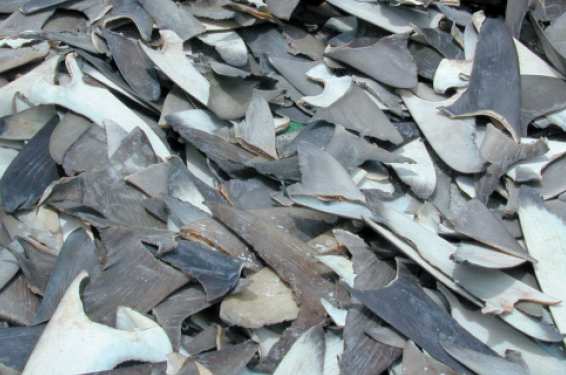
Addressing Shark Finning in FFA
Member Countries: Issues and
Considerations
November 12, 2006
Mike A. McCoy
GILLETT, PRESTON AND ASSOCIATES INC.
2
ACRONYMS AND ABBREVIATIONS
CITES
Convention on International Trade in Endangered Species
CPCs
Contracting Parties, Cooperating non-Contracting Parties, Entities
or Fishing Entities
DWFN
Distant Water Fishing Nation
EEZ
Exclusive Economic Zone
ENGO
Environmental non-Governmental Organization
FAO
Food and Agriculture Organisation of the United Nations
FFA
Forum Fisheries Agency
FSM
Federated States of Micronesia
kg
kilograms
IATTC
Inter-American Tropical Tuna Commission
ICCAT
International Commission for the Conservation of Atlantic Tunas
IOTC
Indian Ocean Tuna Commission
IPOA
International Plan of Action (sharks)
IUCN
International Union for the Conservation of Nature
NAFO
Northwest Atlantic Fisheries Organisation
NOAA
National Oceanographic and Atmospheric Administration
NPOA
National plan of Action (sharks)
PICs
Pacific Island member countries of FFA
RFMO
Regional Fisheries Management Organization
RSW
Refrigerated seawater
SCRS
Scientific Committee on Research and Statistics
TAL
Tropical Albacore fishery
TDL
Tropical Deep Longline fishery
TSL
Tropical Shallow Longline fishery
WCPFC Convention Convention on the Conservation and Management of Highly
Migratory Fish Stocks in the Western and Central Pacific Ocean
WCPO
Western and Central Pacific Ocean
TABLE OF CONTENTS
SUMMARY
4
INTRODUCTION
8
PART 1 BACKGROUND
11
1 The Basis for Shark Fin Demand in Commerce
11
2 Shark Fin Demand and Commercial Fishing in the WCPO
12
2.1 Relative Importance of Shark Fins from Pacific Island Countries
14
3 The Shark Finning Issue Worldwide
16
4 Impetus for Management Action
17
PART 2 SHARK FINNING BAN IMPLICATIONS FOR FFA PACIFIC ISLAND
MEMBERS
20
5 International Legislative Responses to the Finning Issue
20
6 RFMO Approaches to Control of Shark Finning in Tuna Fisheries
21
6.1 Significant Issues in the Existing RFMO Approach
21
7 Current Pacific Island Management Approaches to Shark Finning and Shark
Fishing
24
7.1 Relevant Information on Shark-related Fishery Management in FFA Member
Countries
24
7.2 Pacific Island Fishing Industry Concerns on Shark Finning
26
8. Potential Consequences for Pacific Island FFA Member Countries of
Implementing a Shark Finning Ban by the WCPFC
27
8.1 Summary of Available Information on Shark-related Commercial Activity in FFA
Member Countries
27
8.2 Potential Consequences for the Fishing Industry
29
8.3 Potential Consequences for Fisheries Management in FFA Member Countries
37
9. Potential Consequences for FFA Members of Not Implementing a Shark Finning
Ban
37
10. Conclusions
38
APPENDIX 1 Membership in Regional Fisheries Management Organizations
40
APPENDIX 2 Comparison of RFMO Approaches
42
References
45
4
SUMMARY
Basis for shark fin demand Increased demand in last 20 years for shark fins has been
in commerce
driven by (1) social and political reforms in China that have
not discouraged consumption of shark fin soup as in the
past, (2) relaxation of trade restrictions between Hong Kong
and China that have made it easier and more profitable to
process shark fins in China that are originally exported to
Hong Kong from worldwide sources, and (3) economic
expansion in China, including Hong Kong that has created
an expanded middle class more able to afford high priced
delicacies such as shark fin soup.
Relative importance of
Available Hong Kong trade data from 1998 representing
shark fins from FFA
about 50 percent of total shark fin trade worldwide indicates
Member Countries
that the "Oceania" category represented about 3.4% of
imports into Hong Kong by weight during that year. Of the
seven countries listed in this category, Australia was by far
the largest source of imports. Other areas with significant
exports were Fiji, Samoa, and "U.S. Oceania" (assumed to
be mainly American Samoa).
Impetus for and
Much of the impetus for imposing bans on shark finning has
international legislative
originated with ENGOs. Legislation banning finning now
responses to shark finning
exists in the U.S., Australia, Brazil, Costa Rica, Ecuador, and
the European Union. In the Pacific Islands, the laws of Palau
are the most encompassing, banning the possession of
sharks or any shark body parts onboard foreign fishing
vessels in the Palau EEZ.
RFMO approaches to shark The adoption of a binding recommendation by ICCAT
Finning
concerning shark conservation including a ban on finning
was preceded by four years of discussion and the adoption
of several preliminary non-binding resolutions, including
those to provide information on shark catches and
recommending conducting stock assessments on those
species most commonly caught as bycatch.
The validity of the provision that fins onboard total no more
than 5 percent of sharks onboard is being re-evaluated and
discussed in ICCAT and IATTC.
Only the IATTC binding resolution suggests that parties
"should establish a national plan of action for sharks". ICCAT
and IOTC do not address NPOAs in their shark conservation
recommendations.
ICCAT and IOTC recommendations are specific that parties
shall consider appropriate assistance to developing CPCs for
the collection of data on their shark catches. A similar
provision by IATTC say sit will consider assistance to
developing CPC for collection of data on shark catches,
5
presumably not just catches of the flag state.
Current FFA member
Cook Islands and Vanuatu ban shark finning as a result of
country management
their membership or being a cooperating non-party in one or
approaches to shark
more of the RFMOs. Australia bans shark fisheries in all its
finning
fisheries through domestic law or regulation, as well as being
a member of IOTC. Marshall Islands and Palau have
completed draft NPOAs for sharks.
Pacific Island fishing
In the short term a ban on finning will adversely affect vessel
industry concerns
and/or crew revenue. In the longer term, there is some
concern that finning bans may be only a precursor to
banning all bycatch of sharks and encourage those who
seek a ban on longline fishing.
Shark finning-related
Fiji and PNG are the countries with the greatest commercial
commercial activity in
activity related to shark fins. The 2005 declared value of
Pacific Island FFA member shark fins exported from PNG was US$1.33 million. An
countries
estimate of the overall value of the shark fin market in Fiji is
about US$29 million. FAO statistics rank New Zealand 9th in
the world in shark product exporting countries, at about the
same level as the U.S.
Trends in shark fin
Demand will continue to rise alongside China's economic
demand and utilization
development, unless the popularity of shark fin soup falls. In
the absence of controls placed on fishing, it is likely that
more targeted shark fisheries will develop. It may be that
abundant and fecund blue shark (Prionace glauca)
populations are able to sustain current fishing pressure, but
the resilience of other species is unknown.
Estimates of finning rates
Using observer data from Pacific Island countries held at
and volumes in Pacific
SPC, it is estimated that in the tropical shallow longline
Island longline fisheries
fishery about 11 sharks are finned for every tonne of tuna
caught; about 3.5 sharks are finned per tonne of tuna in the
tropical deep longline fishery, and 4 sharks per tonne of tuna
caught in the tropical albacore fishery.
Using assumptions on dressed shark weights for species
most commonly caught in the Pacific Island longline
fisheries, it is estimated that these rates result in 25 kg of
(wet) shark fin valued at $600 per tonne of tuna in the
tropical shallow longline fishery, 8 kg of fins worth $200 in
the tropical deep longline fishery, and 9 kg of fins worth $225
in the tropical albacore longline fishery.
Potential consequences
It is estimated that the financial losses to domestic PIC fleets
for the Pacific Island
from the inability to fin sharks would be on the order of $8.2
fishing industry of a shark
to $9.6 million. This represents about 6 to 7 percent of the
finning ban
total $137 million value of the longline catch by FFA Pacific
Island member countries in 2005.
Other potential consequences could include:
· Increased value of fin portion of directed shark fisheries,
and a potential switch of vessels in the tuna fishery to
6
targeting sharks if allowed by authorities
· Schemes to collect fins from tuna targeting vessels at
sea to bypass controls placed on finning
· Reduced use of ports by foreign transshipping longline
vessels which would not want to be scrutinized by
authorities enforcing a ban.
Potential consequences
If a ban on shark finning was adopted by the WCPFC that
for Pacific Island fisheries
mirrored language in the other three RFMOs, WCPFC
management of a shark
members could be required to do the following:
finning ban
1. Report all data for catches of sharks by the flag state,
likely to the Scientific Committee.
2. Take necessary measures to require that their fishermen
fully utilize their entire catches of sharks.
3. Require vessels to have onboard fins that total no more
than a percentage (currently 5 percent) of the weight of
sharks onboard.
4. Take the necessary measures to ensure compliance with
the (5) percent ratio through certification, monitoring by
an observer, or other appropriate measures. This would
not be necessary if members required fins and carcasses
to be offloaded together at the point of first landing.
5. Encourage the release of live sharks, especially
juveniles, to the extent possible, that are caught
incidentally and are not used for food and/or subsistence.
6. Where possible, undertake research to identify shark
nursery areas.
Potential consequences of
An increase in the pressure on FFA members and continued
not implementing a shark
pressure on WCPFC as a whole can be expected from
finning ban
ENGOs that desire a ban on shark finning.
The U.S. will likely rely on both formal and informal
diplomatic efforts to convince FFA member countries to
adopt a ban. The U.S. Shark fin Prohibition Act requires that
the U.S. government "seek agreements calling for an
international ban on shark-finning and other fishing practices
adversely affecting sharks... through the appropriate
regional fishery management bodies".
Protracted discussions could see the emergence of regional
or worldwide efforts to boycott fisheries that are perceived to
be not acting responsibly by continuing to allow shark
finning. If such boycotts eventuate, it is more likely to come
from ENGO sources than through government trade
sanctions.
Conclusions
Understandably, with many other issues to contend with,
there has not been much attention paid to shark finning by
fisheries administrators in the Pacific Islands. They will have
to address this issue at some point, as a shark finning ban
has already been adopted by other RFMOs and is now on
the agenda of WCPFC.
7
The impetus for adoption of a shark finning ban by WCPFC
will continue, with ENGOs and the U.S. providing most of the
pressure to do so within the WCPFC context.
The three RFMOs have not taken identical paths to adoption
of shark conservation measures, with the ICCAT example
being the most deliberate. The ICCAT case may offer some
guidance to FFA members uncomfortable with enacting a
ban now and accepting the management tasks required.
The FFA Pacific Island member countries that would be most
adversely affected by a ban on shark finning are Fiji and
Papua New Guinea, with the financial impact being the
greatest in the former.
The foregone revenue from shark finning to domestic fleets
in these two countries, while relatively small in comparison to
the overall value of the catch, will place additional financial
hardships on vessel owners and operators already
concerned with increasing costs of operation, including
higher fuel and air freight prices.
8
INTRODUCTION
Background to the Study
The subjects of sharks and shark finning have been on the fisheries management
agenda in Pacific Island countries for a relatively short period. The activities leading up
to and subsequent adoption of the Food and Agriculture Organization's Code of Conduct
for Responsible Fisheries (1995) and International Plan of Action-Sharks (2000) have
been two of the more visible activities that have brought the subject to the fore in recent
years.
Beginning in late 2005, discussions were held during meetings of the Western and
Central Pacific Fisheries Commission (WCPFC) on the possibility of the Commission
adopting a statement that would address shark conservation and include shark finning1.
The U.S., then and now not yet a member of WCPFC, circulated a document identical or
similar to one that they had strongly supported in the Inter American Tropical Tuna
Commission and which that organization had adopted the previous June.
At the last meeting of the WCPFC Commission in late 2005, it was decided that due to
the substantial work required before considering action on shark conservation, including
shark finning, the matter would be deferred until the upcoming third regular session of
the Commission.
FFA determined that the decision taken to defer provided the opportunity to undertake a
detailed study of the issues associated with shark finning. This would enable further
discussion among FFA members and an examination of the potential consequences for
member countries adopting or rejecting a shark finning ban, should such an action be
proposed.
As a result, FFA hired a consultant to undertake what was essentially a desk study
addressing shark finning in the Pacific Islands. The objectives of the study were to (1)
determine to the degree possible the current situation with regards to shark finning in
commercial tuna fisheries in Pacific Island countries, and (2) examine the implications of
the possible implementation or rejection of a ban on shark finning by the WCPFC. This
report is the result of that study.
Purposes of the Study
The purposes of this study as described in the consultant's terms of reference are to
provide advice to FFA Members on:
a) Shark fining practices in the WCPO, including quantification of the removal of
shark fins and the discarding of carcasses, and the increased incentive to exploit
shark species as a result of the expansion of shark fin markets;
b) The potential impacts on FFA Members of implementing measures that
prevent the removal of shark fins where carcasses are dumped;
c) The potential impacts on FFA Members of not implementing measures that
prevent the removal of shark fins where carcasses are dumped; and
1 The WCPFC Convention applies to shark species listed as highly migratory in Annex 1 of the United
Nations Convention on the Law of the Sea.
9
d) The applicability of individual FFA Member county NPOA-Sharks to the issue
of the removal of shark fins where the carcass is dumped.
Methodology
As noted, this report is the result of what was primarily a desk study. Travel was
undertaken to Manila from 4-8 August, 2006 to present the project to FFA
representatives gathered to attend the Western and Central Pacific Fisheries
Commission's Scientific Committee meeting. The trip afforded an opportunity and to
meet with FFA country representatives to elicit available shark finning-related
information. A brief side-trip was also taken to Palau from 9-12 August to interview
government officials, dive tour operators, ENGOs and longline fishing industry
representatives. Palau was chosen as an important venue for research because of its
stringent ban on shark finning and possession of sharks by foreign fishing vessels within
its Exclusive Economic Zone.
Organization of the Report
The report is divided into two main sections: a background section that provides
information useful to further understanding of the use and market for shark fins, and an
explanation of how market demand applies to PIC fisheries.
The second section addresses the implications for PICs of a shark finning ban.
International legislative responses to the shark finning issue are reviewed, followed by
the approach taken by RFMOs.
The second section also describes current PIC management approaches to sharks and
shark finning, as well as setting out the concerns of some operators in PIC domestic
fleets.
Within section two, potential consequences for PICs in implementing a shark finning ban
by the WPFC are presented. The first part describes possible impacts, including financial
impacts, on the domestic longline fishing industry. The second describes the
consequential actions from a finning ban that might be required of PIC fisheries
management.
The potential consequences for PICs of not implementing a shark finning ban are then
analyzed. A final section draws some conclusions from the information presented.
Terminology and Abbreviation Usage
A list explaining the use of acronyms and abbreviations appears at the beginning of this
report. The use of the term shark finning ban rather than shark finning measure
throughout the report is intentional, because measure might be seen to be one of a
hierarchy of terms applying to binding or non-binding agreements by RFMOs.
All values quoted in dollars are in U.S. dollars unless otherwise specified. Quantities
expressed in tonnes are metric tonnes. Use of the term "Pacific Island countries" or
PICs refers to Pacific Island FFA member countries except when stated otherwise.
10
Acknowledgements
In spite of the fact that the subject of shark finning can be somewhat of a sensitive issue
in some PICs, the consultant was accorded cooperation by those government fisheries
officials, vessel operators and industry representatives contacted in person and by
telephone. Representatives of ENGOs and the dive tour industry in Palau were open
and articulate in explaining the reasons for their concerns over shark fishing. Thanks
are due to all those contacted, in particular Michael Batty of FFA, Nannette Malsol of
Palau's Bureau of Marine Resources, Peter Ward from the Australian Bureau of Rural
Sciences, and Matthew Hooper of the New Zealand Ministry of Fisheries.
11
PART 1 BACKGROUND
1 The Basis for Shark Fin Demand in Commerce
Shark fins have been described as one of the most expensive fish products in the world
(Vannuccini 1999). They serve but one culinary purpose: the source of the primary
ingredient in shark fin soup, a delicacy that is consumed by Chinese and east Asian
communities, primarily in east Asia and but also worldwide2.
Chinese references point to records of the consumption of shark fin soup in China as far
back as the Sung dynasty, 960-1279. By the 14th century shark fin soup was established
as a traditional component of formal banquets (Clarke 2003). Literature on the subject
generally ascribes the historical use of shark fin soup (along with other specialties such
as birds' nest soup) to the quest by emperors and noblemen to locate exotic and health
promoting food. One interpretation of the high value placed on the product comes from
the fact that only a small quantity of the main ingredient can be obtained from a large
fish. As such, the fins were said to be noble and precious, qualities that made them fit for
the tables of emperors (Rose 1996). Over time, consumption of shark fin soup evolved
to where it was served in China mainly at dinner parties, weddings or banquets to
express the host's respect for his guests. According to Vannuccini (1999) the benefits of
shark fin as documented by old Chinese medical books include rejuvenation, appetite
enhancement, nourishing to blood, beneficial to vital energy, kidneys, lungs, bones and
many other parts of the body.
Shark fin soup is not made from the entire fin, but rather uses the ceratotrichia (usually
referred to in English as fin needles or fin noodles). The needles consist of the slender
golden colored fibers that lie between the cartilage within the fins found in many (but not
all) species of shark. These fin needles run in parallel and radial to the fin base,
supporting the web of cartilage within the fin itself.
The southern provinces of mainland China, primarily Guangdong and Fujian, are said to
have been the centers of shark fin culinary development where the technique was
developed of removing the fibers to produce "chi pian" or fin cakes used in the
production of the soup (Clarke 2003). Since the needles do not have any flavor
themselves, chicken stock or other ingredients are added to impart flavor to the soup.
The needles are separated from the cartilage during a laborious process that involves
cleaning and skinning of raw fins, boiling, removing fin ray membranes, bleaching, and
drying in multiple and differentiating steps which produce a variety of final product forms.
The most important traits of ceratotrichia in valuing shark fin from different species are
their thickness and length. Shark fins that yield long, thick fin needles are those that
command the highest prices (McCoy and Ishihara 1999).
During the Maoist era in China during the twentieth century, the consumption of shark fin
soup was limited as officials frowned upon its use and viewed it as an elitist food.
Beginning with China's reform policies instituted in 1986, changes took place removed
2 The Chinese communities in such places as Thailand and in North America (primarily New York, San
Francisco and Vancouver) also represent considerable (if unquantified) groups of consumers that provide
markets for shark fin outside of Asia.
12
this stigma and consequently increased the volume and manner of consumption that
have affected trade in shark fin that has continued until the present.
The reforms in China also allowed the establishment of shark fin processing operations
in southern China, making it possible for Hong Kong to both avail itself of cheaper labor
for fin processing and open up new markets, particularly in the booming southern China
region. The Hong Kong economy also greatly expanded during this period resulting in a
greater popularization of shark fin soup. One author described the Hong Kong situation
in the mid-1990s:
Whereas shark fin used to be a high-priced delicacy found in only expensive
shark fin restaurants, there are now many smaller restaurants specializing in
shark fin soup, and importing and processing their own shark fins. This
popularization of shark fin has made shark fin soup more accessible as it is now
possible to eat shark fin soup at a more reasonable price and during more casual
occasions; in the past, shark fin was consumed by those of lower economic
status only during formal banquets (Parry-Jones 1996)3.
Since the 1990s, continued economic expansion in mainland China has resulted in a
larger middle class that has also increased the demand for shark fin. This demand has
been transmitted to existing fisheries by traditional fin dealers and others. Attractive
prices have in turn fueled increases in the targeting of sharks, primarily for their fins. In
many cases there is a discarding of the carcass at sea and retention of the fins only, a
practice referred to as "shark finning".
2 Shark Fin Demand and Commercial Fishing in the WCPO
At least one author well-versed in the current shark fin trade has stated that it is likely the
volume of whole sharks landed by fishing vessels around the world once provided
sufficient fins to supply the fin markets of east Asia and east Asian communities
worldwide (Watts 2003).
That whole sharks landed by fishing vessels once provided sufficient fins to supply key
markets is debatable, at least in the last 40 to 50 years in an era of industrial longlining
in the WCPO. Shark fins have been collected through finning on tuna longline vessels in
the WCPO for many years. Up until recently in many Pacific Island ports it was not
uncommon to see drying shark fins hanging from the rigging of Asian longliners that did
not retain shark carcasses and had obtained the fins through finning4.
Up until the last 10 years or so the income from shark fins obtained through finning
formed a traditional portion of the crew's remuneration, often characterized as a bonus
or spending money for periods ashore. Increased demand resulting in higher fin prices
have no doubt encouraged the finning of sharks that might otherwise have been struck
off as either a nuisance or danger to fishermen onboard. The high fin prices have also
3 It should be recognized that there are numerous levels of quality in the ingredients preparation, and
presentation of shark fin soup. A bowl of soup can be purchased for as little as $5 in some restaurants, with
various flavorings added. At more exclusive restaurants, the cost (and presumably the quality) could easily
be fifteen to twenty times that figure.
4 Such fins, while still collected, are often now placed out of sight onboard longliners in port. This may be
because of sensitivities towards the issue of longlining, but also because it may invite thievery given their
current value.
13
altered the manner in which revenue is distributed in some fleets, contributing a greater
percentage to vessel revenue and less to crew bonuses than in the past.
Fins are typically sold in sets taken from the same shark. The primary fin set consists of
the dorsal fin, both pectoral fins, and the lower lobe of the caudal fin. The upper lobe of
the caudal is usually not retained, because in most species it does not contain the
ceratotrichia required for the end product. Other, smaller fins can also be retained and
are sold at a lower price as `chips'.
The increase in demand began in the mid-1980s as noted above. It has resulted in many
diverse sources of shark fins serving the markets in Hong Kong, Singapore, mainland
China and elsewhere. The fisheries supplying these markets are geographically and
technologically varied, and can be characterized as:
· fisheries directed at sharks, mostly gillnet or longline fisheries,
· bycatch from other fisheries such as tuna longline, tuna purse seine, and shrimp
and groundfish trawling, and
· Artisanal fisheries using relatively unsophisticated fishing gear
For vessels operating in these categories, sharks can be:
· stored onboard whole with fins attached,
· partially processed onboard with head, guts discarded, fins removed and the
resultant trunk and fins valuable in commerce retained, or
· discarded at sea with only the fins valuable in commerce retained.
The first category describes the situation that is most likely to occur in small-scale
artisanal fisheries, for example small-scale gill net fisheries where the catch is simply
taken onboard rolled into the net with which it was captured and dealt with ashore.
Except where required by law or regulation, it is usually not the practice to store whole
sharks onboard larger vessels such as industrial longliners because too much valuable
space in the fish hold is used.
The second category describes what happens to some (but not necessarily all) of the
catch by shark targeting and tuna-targeting fleets.
The third category, finning, takes place in tuna-targeting longline and purse seine
fisheries due to a combination of two major factors:
(1) there is increasing demand for shark fins, and
(2) the economics of catching and transporting fish products (including sharks)
often make it impractical/undesirable to retain more than the fins onboard.
The limited storage onboard many tuna-targeting longline vessels makes it
uneconomical to retain anything other than the fins from most sharks. Fins are by far the
most valuable part of the shark, and low prices or non-existent markets for shark meat
discourage further retention.
Even if markets could be found for shark meat, certain biological characteristics make it
unlikely that tuna vessels would take the time to properly handle and store sharks caught
14
by longline. Unlike teleosts, sharks have a large amount of urea in their meat as a result
of possessing a more primitive kidney system. When a shark dies, urea is converted to
ammonia. Proper handling and storage to preserve good quality meat onboard takes
time, and at least for now the returns do not justify the expense for most species. Even
on those large, distant-water longline vessels with sufficient storage space, only shortfin
mako shark trunks are retained as that is the one species with a market value high
enough to justify the freezing, storage, and handling required to bring the catch to
market5.
Trends in shark fin demand and utilization are important to identify in considering fishery
management responses. An author who has studied the shark fin trade extensively in
Hong Kong and elsewhere has been quoted as anticipating the following trends for the
shark fin trade:
Consumers: demand will continue to rise alongside China's economic
development, unless the popularity of shark fin soup falls
Producers: in the absence of controls placed on fishing, it is likely that more
targeted shark fisheries will develop
Species: it may be that abundant and fecund blue shark (Prionace glauca)
populations are able to sustain current fishing pressure, but the resilience of
other species is unknown (CITES 2006)
2.1 Relative Importance of Shark Fins from Pacific Island Countries
Once fins from sharks enter commerce, government statistics and available data do not
differentiate between species, even though biological differences between species as
well as morphometric differences play a large role in determining fin price.
Overall, it is believed that the total contribution of shark fins from the Pacific Islands has
been marginally significant in world trade, and much smaller than that from other
geographic regions. One source estimated the volume of dried shark fins from "Oceania"
to Hong Kong at about 105 metric tons in the first 11 months of 1998 (Figure 1), or about
3.4% of total Hong Kong imports for that period (McCoy and Ishihara, 1999).
5 The practice (sometimes referred to as high grading) of discarding a portion of the catch for economic
reasons is also sometimes employed with the target species; for example when smaller tuna retained during
the early stages of a trip are discarded to make room for larger or better quality fish later.
15
Figure 1 Hong Kong Imports of Dried Shark Fin
By Geographic Region, Jan. Nov. 1998
)
s 800
n 700
t
o
600
t
r
i
c
500
e 400
(
m 300
r
t
s 200
o
p 100
I
m
0
sia
sia
erica
A
erica
frica
E
A
A
cean
S
E
id-East
ceania
m
O
orth Am
N
South Am
Indian O
Source: Hong Kong Agriculture and Fisheries Department, unpublished data
Cited in McCoy and Ishihara (1999)
Hong Kong is the most important market in world trade for dried fins but is by no means
the only one. Singapore is also important because of its geographic location and large
ethnic Chinese population.
Taiwan is a significant market for wet (i.e. frozen) fins produced by local and distant
water Taiwanese fishing fleets.
Of the seven countries contained in the Oceania category in Hong Kong statistics,
Australia was by far the largest source of imports during the period with 53 metric tons or
50% of the total. Figure 2 depicts the relative volumes from the various countries
comprising the Oceania category in Hong Kong statistics.
Figure 2. Hong Kong Imports of Dried Shark Fin from Oceania,
JanuaryNovember 1998
)
s 60
n 50
t
o
40
t
r
i
c
e 30
20
(
m
10
r
t
s
o
0
p
I
m
US
W.
Australia Solomon
Fiji
New
Papua
Oceania
Samoa
Islands
Zealand
New
Guinea
Units: metric tons; Figures are rounded to nearest metric ton
Source: Hong Kong Agriculture and Fisheries Department, unpublished data, cited in McCoy
and Ishihara (1999)
16
Figure 2 is represents only dried shark fins, and not "wet" or frozen fins usually landed
by Taiwanese or domestic longliners in the Pacific Islands. Pacific Island countries that
may be significant sources of wet fins include Fiji, PNG, Marshall Islands, and (in the
past) Solomon Islands. These wet fins may be exported frozen to Taiwan as is done by
the shark targeting fleet in PNG, or partially processed onshore as might be the case in
Fiji, and sent to markets including Hong Kong.
Recent estimates of world trade in shark fins in 2000 put the figure of the trade
worldwide at 11,602 tonnes, and Hong Kong's portion of that trade at around 6,800
tonnes or 59% (Clarke et al. 2006)6.
3 The Shark Finning Issue Worldwide
With little scientific data on the levels of shark finning worldwide, most of the information
on shark finning available to the general public in developed countries is contained in
popular literature, much of which is used to drive efforts to ban finning. In much of this
literature it is often difficult to separate the issue of finning from that of shark
management in general.
Information and awareness campaigns, usually conducted by well-funded environmental
groups, often fail to make the distinction between shark conservation in general, the
management of sustainable shark fisheries, and the specific finning issue. Finning can
be presented in such a way as to taint all rational fisheries management arguments
concerning sharks, and this can cause problems for fisheries managers.
One way to describe finning in an international tuna management context is to view the
practice as:
increasing overall shark mortality by expanding the opportunities to retain only
the most valuable portions of the animal in situations where it might otherwise be
avoided or struck off the line before landing.
In the press and elsewhere the practice of finning is often linked to wastage and
described as a wasteful practice7. Minimizing waste in fisheries is a prominent feature of
the FAO Code of Conduct for Responsible Fisheries developed in 1995, and the concept
has been adopted as relevant in the subsequent FAO International Plan of Action for
Sharks (IPOA).
A second, often more extreme linkage is made by some ENGOs between shark finning
and animal cruelty. Examples of such linkage can be found in the statements on the
worldwide websites of various shark and animal welfare groups: "the brutal business of
shark finning" (Sea Shepherd Society); "horrible death for a magnificent creature" (Shark
Friends); "wasteful and often cruel practice (Shark Trust) and so on. This connection can
also find its way into legislative interpretations. In New Zealand, for example, it is not
6 This figure represents fins in a dried state, and is based on national customs statistics and adjusted for
observed underreporting for Mainland China, Hong Kong, Singapore, Taiwan and Japan relative to Hong
Kong as an importer.
7 It is seldom noted in the popular literature and information concerning finning that waste in fisheries
originates as an economic issue, and finding economic uses for discards doesn't necessarily solve the
management problem. In fact, it can exacerbate it.
17
illegal to fin dead sharks under current fishery regulations but it is illegal to fin a live
shark under New Zealand's Animal Welfare Act.
The countries in Asia that serve as markets for shark fin have recently been the targets
of publicity campaigns by ENGOs in Asia which are focused on educating the consumer
and campaigning against the consumption of shark fin soup. These continuing efforts
are gaining momentum in several of the shark fin consuming countries, notably
Singapore and China (Hong Kong).
WildAid, one of the more prolific and financially well-endowed groups engaged in anti-
shark fin efforts, has enlisted the assistance of movie stars such as Jackie Chan in Hong
Kong to campaign against the consumption of shark fin soup. Most recently, WildAid
introduced a Chinese basketball star in the U.S., Yao Ming, as well as a Chinese pop
singer as their spokespersons in China campaigning against the consumption of shark
fin soup8.
It is the position of WildAid and some others engaged in efforts to reduce or eliminate
consumption of shark fin that the key to success is self-restraint practiced by consumers.
These groups believe that finning bans will not work and that the way to stop finning and
reduce shark mortality in general is to approach it from the demand, as opposed to
supply, side.
There has been some success in these campaigns in Asia. In June, 2006 Hong Kong
Disneyland removed shark fin soup from its menus at the theme park. A few months
later, Hong Kong University decided to discontinue serving shark fin soup at official
functions and banquets sponsored by the University.
One of the reasons, given in private and usually not in public pronouncements, by
groups and individuals engaged in the campaigns to reduce demand is that unless
consumer attitudes are changed and demand is eliminated or significantly weakened,
finning bans may only initially reduce supply. This will result in the commodity becoming
even more valuable, expanding illegal fisheries and attracting criminal activity9.
4 Impetus for Management Action
An important point for fisheries managers in the Pacific Islands to consider is that unlike
the controls placed on tuna fishing in the WCPO10, the impetus for banning shark finning
in the WCPO and elsewhere has rarely come from fisheries management personnel. A
review of the brief history of anti-shark finning campaigns and a perusal of the existing
popular literature and information disseminated by those groups engaged in anti-shark
finning campaigns reveals an approach that should not be ignored.
There has been a close working relationship and linkage between some shark
specialists and others engaged in shark research with conservation and environmental
8 While this activity was given publicity in many western countries, it was more or less ignored in mainland
China, and Yao Ming was criticized in China by those who did comment as being insensitive to his own
culture.
9 It is recognized that some criminal elements are already present in shark fin commerce, usually lower in
the supply chain where there can be strong competition for fins from fleets based in some locations. Murders
or attempted murders reportedly linked to shark fin commerce have been reported in South Africa, Honolulu,
Fiji, and San Francisco in recent years.
10 Examples are the early limits on purse seining by the Nauru Group and current FFA approaches to effort
limitation, as well as the negotiation of the UN Fish Stocks Agreement and the WCPFC Convention itself.
18
non-governmental organizations (ENGOs). Both groups have a desire to ban finning and
better manage and control shark fishing, with some wanting to curtail such fishing all
together. These partnerships, in the case of shark finning, tend to bypass fisheries
management agencies and rely on public sentiment to galvanize lawmakers to adopt
legislation banning shark finning.
An example of this strategy is the marshalling of public anti-finning sentiment during the
late 1990s that culminated in banning of shark finning in Hawaii and elsewhere
throughout the US where it was not already prohibited. Whereas ENGOs and activist
shark specialists joined forces and succeeded in getting shark finning outlawed on all
U.S. fleets and within the U.S. EEZ by 2001, fishery managers were generally reactive to
the issue, rather than pro-active in many cases.
In the U.S. case, pressure from well-financed ENGOs was exerted in the media, through
lobbyists and environmental groups in Washington DC and elsewhere that resulted in
the passage of a very strong law, the U.S. Shark Finning Prohibition Act. This law,
among other provisions, requires the U.S. National Marine Fisheries Service to initiate
discussion with other nations to develop international agreements on shark finning and
shark catch data collection (NOAA 2005).
These two potent forces, shark specialists and ENGOs, can apply pressure directly to
governments in the developed world which then in turn react nationally (as in the U.S.
case), and internationally. On the international level, efforts have culminated at the Food
and Agriculture Organisation of the United Nations (FAO) with its adoption in 1999 of an
IPOA to serve as a guide to individual countries in the formulation of National Plans of
Action for sharks (NPOA). The IPOA directs NPOAs to implement the relevant sections
of the FAO Code of Conduct for Responsible Fisheries and "minimize waste and
discards from shark catches", and suggests doing so by "requiring the retention of
sharks from which fins are removed" (FAO 2006).
Further efforts by ENGOs are manifested in attempts to get governments to agree to
place certain shark species on lists of protected species covered by the Convention on
International Trade in Endangered Species (CITES) and elsewhere.
A notable effort that further illustrates the ability of local ENGOs to sway public policy is
the situation in Palau. There, efforts by ENGOs and the Palau-based local dive tourist
industry resulted in passage of the most stringent anti-shark finning and anti-shark
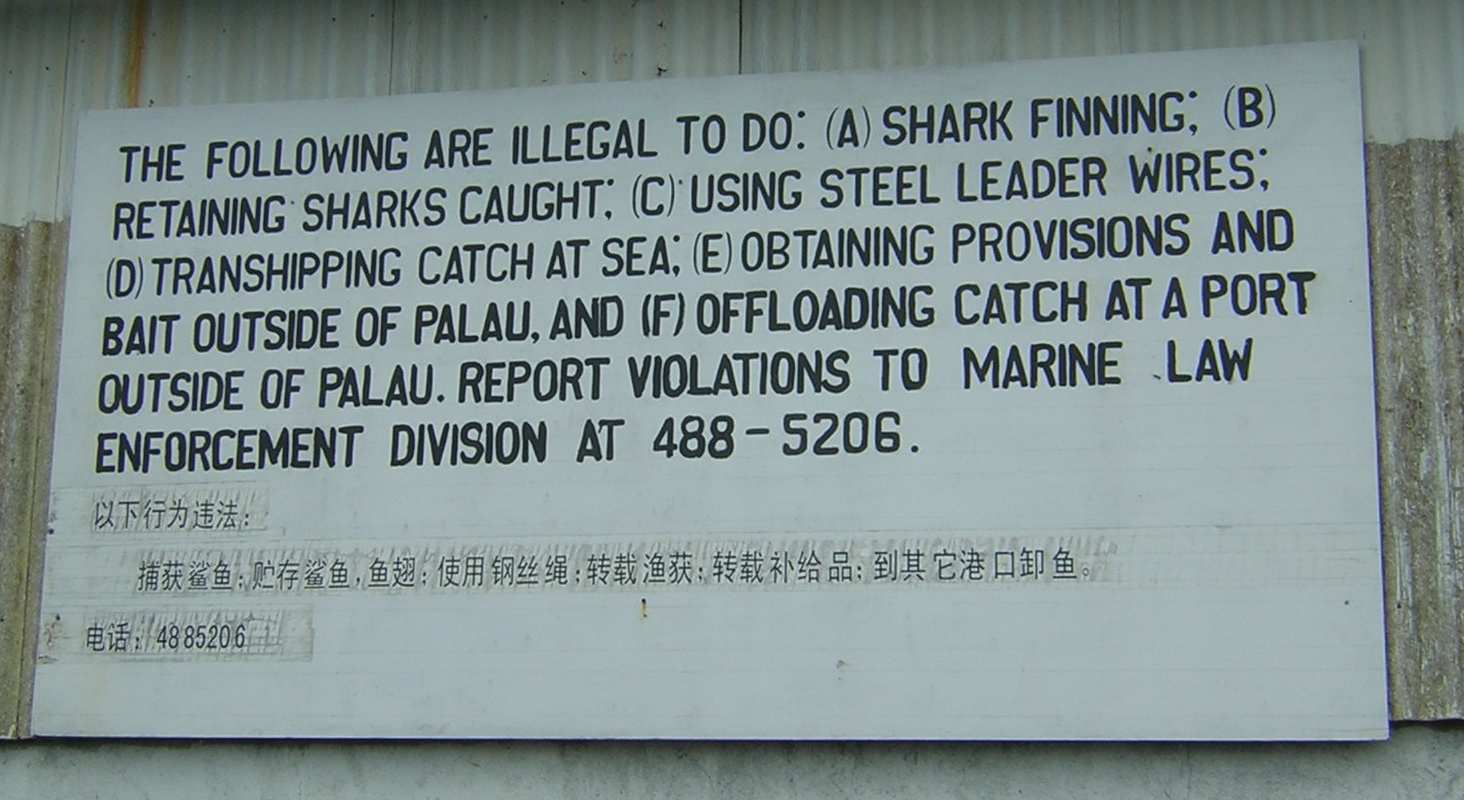
fishing laws in the Pacific (and perhaps anywhere). Figure 3 shows a billboard posted at
the wharf where longline vessels offload. The billboard was required to be posted by the
fishing company as one the settlement terms resulting from a court case against one of
the company's vessels for possession sharks. The company was required to post a
similar billboard in the Bahasa Indonesia language.
ENGOs in Palau continued their activities after the passage of these laws with much
broader goals in mind. One created a "Palau Shark Sanctuary Fund" with the stated
objective of achieving a declaration by Palau that would establish all waters within
Palau's EEZ as a World Shark Sanctuary. This ENGO and others promote Palau Shark
Week for dive tourists, while another conducts "Project S.A.V.E." (Shark Awareness
Visitor Education).
The acceptance by governments of efforts by ENGOs to globally ban the practice of
shark finning has not been universal, however. Many countries continue to allow the
practice, and even where nominally banned through membership in an RFMO,
government policy tends to reflect more deliberate approaches. For example, a
statement by Japan to a reservation on a shark finning resolution passed by the
19
International Union for the Conservation of Nature at the 2004 World Conservation
Congress in Bangkok, Thailand. At that meeting, as part of their objection the Japanese
Ministry of Foreign Affairs provided the following statement for the record:
The key point of (the) shark conservation issue is that fishery activities that only
target shark fins are deteriorating shark resources. We have to recognize that a
ban on finning without identifying species and areas with a real problem will
never lead to a real conservation and management of shark resources.
Figure 3 Billboard at Malakal Fish Wharf
20
PART 2 SHARK FINNING BAN IMPLICATIONS FOR FFA PACIFIC ISLAND
MEMBERS
Sharks are acknowledged to present formidable obstacles to fisheries managers, either
in directed fisheries or as bycatch. As noted by FAO (2006), sharks are known to have a
close stock-recruitment relationship, long recovery times in response to overfishing and
complex spatial structures. Conservation and management of sharks is also impaired by
the lack of accurate data on catch, effort, discards, and trade data, as well as limited
information on the biological parameters of many species and their identification.
For a variety of reasons, sharks have not received much attention from most Pacific
Island fishery managers when focusing on industrial tuna fisheries. The value of shark
landings by tuna-targeting vessels has historically been far below that of target tuna
species and attention has naturally been focused on the target catch which, for many
PICs, is directly linked to levels of access fees paid by distant water fishing nations
(DWFNs). When faced with a multitude of priorities relating to the target tuna catch, it is
not surprising that often understaffed fisheries departments have not focused extensively
on the collection of catch, bycatch, discard and landing data for sharks, all of which are
necessary to enable informed management decisions. There are exceptions, with Papua
New Guinea standing out as one FFA member country that has a shark management
plan in place with a total allowable catch. PNG compiles data on exports of sharks and
shark fins by a directed fishery but does not apply the same scrutiny to domestic
longliners targeting tuna.
Likewise, the subject of shark finning has not been the focus of most fisheries
departments in the Pacific Island region. It is known that several countries, Solomon
Islands being one, licenses shark fin exporters. Others however, such as the Marshall
Islands and FSM, do not require export data to be declared and essentially have no hard
data on the value or volume of shark fins exported.
5 International Legislative Responses to the Finning Issue
The mainly ENGO-led campaign against shark finning over the last ten years or so has
resulted in responses from national governments, RFMOs and other management
bodies that have been nothing short of remarkable.
Legislation or regulatory measures to ban shark finning has now been adopted by the
U.S. and Australia, as well as by Brazil, Costa Rica, Ecuador, and the European Union.
In the Pacific Islands region, one of the more extreme sets of measures taken by any
country has been that taken by Palau. In September, 2003, the President of Palau
signed a comprehensive law passed by that country's legislature that prohibits foreign
fishing vessels in Palau's waters from fishing for sharks, or possessing onboard sharks
or any parts of sharks, including fins. The law also bans the use of wire leaders (traces)
in longline gear.
As described above, the impetus for Palau's legislative stance on the issue of shark
finning (and on foreign vessels capturing or possessing sharks) stems primarily from the
ENGOs and private sector promoting the importance of tourism, including dive tourism,
in the Palau economy. Although pelagic sharks caught incidentally to longline fishing in
21
the Palau Exclusive Economic Zone (EEZ) are usually not those viewed by dive tourists,
the country's strong tourism sector wants to project the image of the country as
containing a pristine oceanic environment. Publicity given Palau's anti-shark fishing and
anti-shark finning laws, as well as a public burning of confiscated fins in 2004 has helped
promote eco-tourism in the country, according to dive tour operators interviewed in
August, 2006 as part of the research for this study.
6 RFMO Approaches to Control of Shark Finning in Tuna Fisheries
In the current management environment surrounding implementation of the Convention
on the Conservation and Management of Highly Migratory Fish Stocks in the Western
and Central Pacific Ocean (WCPFC Convention), the approaches taken to shark finning
by other regional fisheries management organizations (RFMOs) are of major interest to
FFA member countries.
There are three other RFMOs involved with the management of tuna fisheries that have
recently addressed the issue of shark conservation, including the subject of finning: the
Inter-American Tropical Tuna Commission (IATTC), the International Commission for the
Conservation of Atlantic Tunas (ICCAT), and the Indian Ocean Tuna Commission
(IOTC). Each of these bodies has adopted either a resolution (IATTC and IOTC) or
recommendation (ICCAT) on the conservation of sharks that includes clauses aimed at
curtailing and eliminating the practice of shark finning11.
A list of member countries and cooperating non-members of these three organizations is
shown in Appendix 1. The three RFMOs adopting controls over shark finning represent a
total of 58 countries (including the EU as one member). Of these, 13 are either current
members or observers of the WCPFC Commission12.
It is perhaps not surprising that given some of the overlapping membership in the three
organizations which have already addressed the issue and the fact that each has as its
mandate the management of tuna fisheries, the adopted resolutions and
recommendations are very similar in their wording. Appendix 2 provides a comparison
between the relevant language contained in the documents addressing shark
conservation that have been adopted by the RFMOs.
6.1 Significant Issues in the Existing RFMO Approach
6.1.1 Steps Taken Prior to Adoption of Controls
In considering possible courses of action for FFA member countries in the WCPFC on
the subject of shark conservation and shark finning, it is useful to review the steps taken
by one RFMO prior to adoption of controls over shark finning.
11 A fourth RFMO that does not manage tuna but which has adopted control over shark finning in 2004 is the
Northwest Atlantic Fisheries Organisation (NAFO).
12 Australia, Canada, China, Chinese Taipei, Cook Islands, European Community, France, Indonesia,
Japan, Korea, Philippines, United States, and Vanuatu.
22
ICCAT was the first of the three bodies to act on the subject of shark conservation,
adopting its recommendation on the final day of its meeting in November, 2004. The
IATTC resolution13 was subsequently adopted in June, 2005. The IOTC resolution was
likewise adopted in 2005, but the exact date is not clear.
The adoption of the ICCAT binding recommendation concerning the conservation of
sharks was preceded by at least four years of discussion on the subject of sharks, and
the adoption of earlier and related resolutions14.
· In 2000, the ICCAT Standing Committee on Research and Statistics
recommended ICCAT take the lead in conducting stock assessments for 3
species of shark
· In 2001, ICCAT adopted a non-binding resolution on sharks. This included
measures for improved data collection for pelagic sharks, and directed that stock
assessments for shortfin mako and blue sharks be conducted in 2004. Other
aspects provided for the release of incidentally caught live sharks and the
minimization of waste and discards (both of which appear in the 2004
recommendation).
· In 2003, a further resolution was adopted that required ICCAT parties to (1)
provide the Bycatch Working Group with information on shark catches, effort by
gear type, landings, and trade of shark products, and (2) fully implement an
NPOA in accordance with the FAO IPOA for sharks.
· In June, 2004 stock assessments were conducted by the Subcommittee on
Bycatch for two species of sharks.
· The recommendation was then formulated and adopted in November, 2004
(NOAA 2005)
It does not appear that the other two RFMOs, IATTC and IOTC, have taken the more
deliberate approach as did ICCAT. There may have been general agreement in the
former two organizations that since key parties agreed to the approach in ICCAT, they
would not object to similar wording in the RFMOs that followed ICCAT's lead.
6.1.2 Analysis of Certain Provisions Contained in Resolutions and
Recommendations
The adopted resolutions and recommendation of the three RFMOs contain certain
provisions that should be examined carefully.
Research directives: It is believed that as shown above, only ICCAT preceded the
adoption of its recommendation with steps intended to better define the conservation
and management problems addressed. The IATTC resolution directs the Commission to
provide preliminary advice on stock status of key shark species and propose a research
plan for a comprehensive assessment of these stocks. The IOTC resolution directs its
Scientific Committee (in collaboration with the Working Party on Bycatch) to do likewise.
13 In IATTC, resolutions are binding, recommendations are non-binding. Both are approved by consensus
(Meltzer 2005a).
14 In ICCAT resolutions are non-binding. Binding Recommendations are adopted by a simple majority vote
with a quorum of two-thirds of Contracting Parties, and enter into force 6 months later (Meltzer 2005b).
23
The "5 percent" debate: Each RFMO requires that fins onboard a vessel should not total
more than 5 percent of the weight of sharks onboard, up to the point of first landing. This
number, 5 percent, has and continues to be a subject of debate within and outside the
RFMOs concerned15. The 5 percent limit has its origins in the U.S. management of its
own longline fisheries on the East Coast of the United States. In 1993 the use of 5
percent as a measure of the weight of the fins compared to dressed carcasses onboard
was introduced in a Fisheries Management Plan on the basis of a very small sample of
just one species, sandbar shark, Carcharhinus plumbeus (Cortes and Neer 2005)16.
Some fishing industry representatives have argued that the number should be higher
than 5 percent on the basis of the species, sizes and manner of dressing sharks. In the
U.S. this argument is made for directed shark fisheries, while in other countries it is
made for sharks that are captured as bycatch in tuna fisheries. Concerns of some
industry representatives of having to meet the 5 percent figure as a measure include (1)
the potential for significant financial loss and (2) exposure to prosecution if 5 percent is
not an accurate depiction of fin-to-body weight representative of the catch in a particular
fishery.
ENGOs are concerned that increasing the number above 5 percent will enable more
sharks to be killed for their fins, and some ENGOs have argued that the number should
actually be lowered. It is noteworthy that each of the RFMO resolutions and
recommendation contains a clause that this aspect should be reviewed, during 2005 in
the case of IOTC and 2006 for IATTC and ICCAT.
Interestingly, there is little information available on the specific situation where carcasses
are retained in a frozen condition while fins are dried. In this situation, the weight of fins
at 5 percent of the weight of carcasses onboard would represent more sharks than
simply those onboard.
The banning of the use of wire traces/leaders: Only the IOTC resolution contains a
provision suggesting that wire traces be included in research to make fishing gears more
selective. Some vessel captains claim that the use of wire traces is to minimize the loss
of large tuna that can cut monofilament leaders when entangled under the gill plate.
Conversations with a vessel operator and an SPC Masterfisherman during the research
for this study indicate that, while wire traces can increase the numbers of sharks landed
by minimizing the times when the trace or leader is severed, some of the newer
monofilament lines used as trace material can have a similar effect. It should also be
pointed out that hook type is a factor in the retention of sharks on longlines as well. An
experiment in the Atlantic using circle hooks to minimize turtle bycatch has had the
unintended consequence of increasing shark catch (A. Bolton, pers. comm.).
Reference to NPOA: Only the IATTC resolution makes reference to parties establishing
a national plan of action for the conservation and management of shark stocks in
accordance with the FAO IPOA17. Even though the IATTC wording is qualified that
15During October, 2006 the EU is considering a Spanish request to increase the amount to 6.5 percent to
account for species and sizes of sharks landed, while a coalition of ENGOs, the UK-based Shark Alliance is
urging a reduction to 2 percent. Part of the argument has to do with the basis of the measurement, i.e.
dressed or whole sharks. According to a press release from the Shark Alliance, the European Parliament
rejected the EU Fisheries Committee's recommendation to increase the percentage, but it is now up to the
European Commission to determine which percentage is used (Shark Alliance 2006).
16 According to observer data held at SPC, this shark is only rarely captured in pelagic longline fisheries in
the WCPO.
17 There are 14 Pacific Island countries that are members of FAO: Cook Islands, Federated States of
Micronesia, Fiji, Kiribati, Marshall Islands, Nauru, Niue, Palau, Papua New Guinea, Samoa, Solomon
Islands, Tonga, Tuvalu and Vanuatu.
24
parties "should establish..." rather than shall establish, the inclusion of such wording
appears to raise the NPOA to a higher standard through its presence in the resolution.
There are two reasons why such a reference may be inappropriate. First, the IPOA is
clearly voluntary (paragraph 10) and, as is stated in the IPOA, is a plan of action. There
may be more appropriate ways for members to set out their goals for the management
and conservation of sharks and the manner in which they can be achieved. Second, the
FAO itself has identified a need to address deficiencies and enhance effectiveness of
the plan. A consultation was held in late 2005 to address these concerns and the subject
is set to be considered at the 2007 meeting of the Committee on Fisheries (FAO 2006b).
Collection of data on shark catches: Both ICCAT and IOTC are specific that they shall
consider appropriate assistance to developing CPCs for the collection of data on their
shark catches. The IATTC provision says it will consider assistance to developing CPCs
for collection of data on shark catches, presumably not just catches of the CPC flag
state.
7 Current Pacific Island Management Approaches to Shark Finning and
Shark Fishing
Attempts to elicit information on management approaches to shark finning by FFA
member countries during the course of this study resulted in a relatively wide range of
attitudes, policies, and legal approaches to the subject of shark fishing but few actual
prohibitions of shark finning.
Only four of the seventeen FFA member countries prohibit shark finning in their tuna
fisheries by either statute or virtue of their membership in one of the three RFMOs that
have passed a recommendation or resolution banning the practice:
· Vanuatu is a member or Contracting Party in all three RFMOs that have passed
binding recommendations or resolutions banning shark finning.
· Cook Islands is a Cooperating non-Party in IATTC, and also makes it is a license
condition of licensed longline vessels that if they catch sharks and wish to keep
the shark fins, the carcass must also be retained (NOAA 2005)
· Palau has stringent prohibitions against possession of any sharks or shark parts
onboard foreign vessels in their EEZ as has been noted above.
· Australia bans shark finning in all its fisheries (Ward, pers. comm.)
7.1 Relevant Information on Shark-related Fishery Management in FFA Member
Countries
The following summarizes additional relevant information on the management of shark
fisheries, shark bycatch, and shark finning in FFA member countries.
Australia: Completed a Shark Assessment Report in 2001 and a National Plan of
Action, Sharks in 2004. In line with the implementation of the Shark-plan,
management measures have been put in place in the longline sector to minimise
25
shark bycatch, prevent indiscriminate finning and to encourage full utilisation of
landed shark catch. Mandatory measures take effect through conditions placed
on relevant fishing permits issued by the Australian Fisheries Management
Authority (P. Ward, pers. comm.).
Cook Islands: No further information at this time
FSM: The law does not allow the targeting of sharks in fishing operations and
fishery administrators accept the use of wire traces or leaders as prima facie
evidence of such targeting.
Fiji: No further information at this time, although there is one report of a ban on
wire traces in the fishery.
Kiribati: No further information at this time
Marshall Islands: A draft NPOA was completed in late 2003 by a consultant
funded by FAO.
Nauru: No further information at this time
New Zealand: Manages most shark and ray species with substantial commercial
catches within the quota management system based on individual transferable
quotas (ITQ). All key shark bycatch species of New Zealand tuna longline
fisheries were introduced into the quota management system on 1 October 2004.
Strict reporting requirements apply. Key highly migratory shark species have
catch limits in place in New Zealand fisheries waters. Catch limits in New
Zealand fisheries waters are set at levels to provide only for bycatch of other
fisheries. New Zealand commissions research to assess shark populations. The
age and growth of key shark bycatch species (blue, mako and porbeagle sharks)
has been contracted. This information will assist in determining sustainable catch
levels. New Zealand is preparing a National Plan of Action for sharks. This plan
will be finalized in 2006. Finning of live sharks in New Zealand fisheries waters is
illegal under New Zealand's Animal Welfare Act. New Zealand recognizes that
landing only the fins of sharks is wasteful. New Zealand considers that the Quota
Management System will provide strong incentives to reduce the practice of only
landing the fins of shark bycatch. Catches are being monitored to determine
whether this is the case. (M. Hooper, pers. comm.).
Niue: No further information at this time.
Palau: Draft NPOA for sharks completed by a consultant in 2004.
Papua New Guinea: A domestic directed shark fishery exists in Papua New
Guinea and has been governed by a shark management plan since 2002 that
allows 9 vessels to be licensed with a Total Allowable Catch (TAC) of 2,000
tonnes (Kumoru 2003).
Samoa: No further information at this time
Solomon Islands: No further information at this time
Tokelau: Foreign fishing vessels licensed to fish in the Tokelau EEZ do so
under New Zealand requirements. No further information at this time
Tonga: Tonga does not encourage targeting of sharks in longline fisheries.
(Sione V. Matoto, pers. comm.)
Tuvalu: No further information at this time.
26
Vanuatu: No further information at this time.
7.2 Pacific Island Fishing Industry Concerns on Shark Finning
The concerns of some in the Pacific Islands tuna longline industry can be described as
both short and long term18. An immediate concern of some vessel operators in the two
FFA countries with the largest domestic fleets (Fiji and Papua New Guinea) regarding
potential banning of shark finning is the loss of revenue from shark fins which has
traditionally gone to either the crew or the vessel owner.
Vessel operators who allow crew to retain income from shark fins likely set pay scales
for their crew on the basis of this additional income, and loss of this source would have
financial implications for those operators. One operator in Fiji estimated that such
income could represent up to 30 percent of crew salaries when significant shark catches
are experienced.
These figures could vary considerably between ports in the Pacific Islands depending on
the circumstances at each port. Ex-vessel prices are often highest where there are
larger volumes produced by more vessels based or calling at a particular port (such as
Suva or Levuka). These ports usually have multiple buyers creating competition that can
drive up prices. There may also be some intermediate processing being done at ports
with larger volumes that change the economics for traders and may allow higher prices
to be paid. Price is also partly determined by onward transportation costs. Those ports
with expensive freight connections to Hong Kong, Singapore and elsewhere in Asia
could offer lower prices than ports with good freight services to those areas19.
Loss of this income to crew would require vessel operators to adjust wages upwards,
something that may not be practical in the current economic environment where fuel and
air freight prices have risen and are not expected to decline.
Vessel operators who use the revenue to offset vessel expenses would also be
squeezed, as overall catch revenue would be reduced. Either way, it is felt by those
queried that the loss of such revenue will exacerbate an already tenuous financial
situation in the industry.
In Palau, some shore-based operators that cater to foreign longliners offloading there
are concerned that the current stringent laws relating to possession of sharks and shark
body parts discourages vessels from offloading or being based in the country. This in
turn has a negative effect on business and exports. These operators suggest that a
relaxation of the current law to allow something like 5 percent of fins equal to sharks
onboard would be a benefit to the economy of Palau.
This sentiment was echoed by two tuna longline vessel operators contacted in PNG and
Fiji. According to these operators, measures to reduce shark catches would be
welcomed by the industry. At present the lack of controls over shark finning can result in
18 Information was obtained by telephone interviews with vessel operators in Fiji and Papua New Guinea, as
well as informal queries made on behalf of this study during an FFA/SPC fishing industry workshop held in
Fiji during September, 2006.
19 An additional factor that may contribute to ex-vessel prices in some ports that are higher than might be
expected given world market conditions is that some traders reportedly use the export of shark fins as a
means to repatriate capital and avoid currency controls. In this situation they may be willing to out-bid
competitors for the purchase of shark fins if the perceive an opportunity for benefits other than from the
shark fins themselves.
27
crews targeting sharks for their own financial benefit, even when the revenue is
supposed to be applied to vessel expenses. They are faced, however, with the problem
that if a ban on finning was to go into effect there would be insufficient space onboard to
store whole sharks and the target catch. This could lead to attempts to hide fins,
resulting in exposure of operators to enforcement penalties.
There is also some concern that in the medium to longer term the strong impetus
provided by success in the banning of shark finning will carry over and reinforce ongoing
efforts at (1) banning the capture of sharks entirely, either as bycatch or in directed
fisheries, leading to (2) banning longlining entirely.
These concerns are not unfounded. Efforts aimed at reducing the capture of sharks
through the use of new technology are already well underway in the developed
countries. The most recent winner of the "Smart Gear" competition sponsored by the
Worldwide Fund for Nature (WWF) was an idea to place small magnets above baited
hooks that would repel sharks entirely from longlines.
Likewise, efforts to attempt a worldwide moratorium on longlining spearheaded by some
of the more extreme ENGOs20 have been underway for some time and included bringing
the issue before the United Nations during the Informal Consultative Process on the Law
of the Sea, in June, 2005. Dive and eco-tour operators in Palau interviewed in August,
2006 are all in agreement that the efforts resulting in the banning of the possession of
sharks and shark fins by longline vessels in Palau is only a first step towards eliminating
all longlining in the Palau EEZ.
8. Potential Consequences for Pacific Island FFA Member Countries of
Implementing a Shark Finning Ban by the WCPFC
There are two major areas of potential impact to FFA members if a shark finning ban
was to be adopted by the WCPFC. Major impacts would be felt in some countries by (1)
the fishing industry, including those engaged in the shark fin business onshore and (2)
fisheries management authorities with domestic longline fleets in the form of flag state
enforcement requirements.
In order to better understand these impacts, it is useful to briefly review the available
information on the relative importance of shark fins from Pacific Island countries in world
trade, and summarize known commercial activity in FFA member countries
8.1 Summary of Available Information on Shark-related Commercial Activity in
FFA Member Countries
The following summarizes additional relevant information on commercial activity
involving shark fins in those FFA member countries that can be useful in assessing
impacts of implementing measures to ban finning.
FSM: No further information at this time
Fiji: There are currently 63 domestic-based longline vessels licensed in Fiji
which can fish in Fiji's EEZ. An additional 74 longliners are based in Fiji but do
20 An "extreme" ENGO is defined here as one that is known by the author to use or disseminate information
on Pacific Island tuna fisheries selectively and sometimes out of context to further their goals.
28
not operate in the EEZ. Most or all of these vessels participate in shark finning to
some degree, as the market is very active. There are currently five companies
engaged in the processing of shark fins in Fiji, with the number of employees
ranging from 5 to 20. Some of these firms have been engaged in business for a
relatively long time and deal in other commodities such as beche de mer. Most
are Asian or of Asian origin. The sources of fins for these companies are (1)
domestic-based longline vessels, and (2) vessels offloading at the cannery in
Levuka. Only a small amount of the overall supply is thought to be provided by
local artisanal and village-based fisheries. An estimation of the overall annual
value of the shark fin market in Fiji is F$50 million. (A. Turanganivalu, pers.
comm.)
Kiribati: There are reportedly 3 exporters of shark fins in the country, but
volumes and sources of fins, i.e. artisanal or industrial fisheries, are not known.
Marshall Islands: Although there appear to be at least three shark fin exporters
purchasing fins from longliners based in Majuro and purse seiners transshipping
in the harbor, the Marshall Islands Marine Resources Authority does not maintain
records on this activity and export values and volumes are unknown.
Nauru: No further information at this time
New Zealand: In FAO statistics, New Zealand ranked 9th in the world in shark
product exporting countries with 4 percent of the world total, about the same as
the U.S.21 (Lack and Sant 2006).
Niue: During the early phases of operation of their shore-based fish processing
plant, it was required for longliners to offload shark trunks from sharks taken in
the fishery. This was apparently done without a firm export market for trunks and
resulted in the search for such markets, assumedly because of a growing
inventory of shark trunks ashore.
Papua New Guinea: Export data indicates an average of about 131 tonnes of
frozen shark fin and 10 tons of dried shark fin were exported during 2001-2005.
Sources of the frozen shark fin is said to be the directed fishery, while dried shark
fin represents bycatch from domestic longliners, and village artisanal production.
In 2005, the declared export value of frozen and dried shark fins combined was
US$1.328 million (L. Kumoru, pers. comm.).
Samoa: The manager of the largest longlining company in Apia claims he does
not get involved with shark fin and leaves it up to the individual skippers and
crews to dispose of them (M. Batty, pers. comm.)
Solomon Islands: Several shark fin exporters are licensed by the Department of
Fisheries and Marine Resources. Honiara is known by some distant water purse
seine crews as a good place to sell fins because of the high prices (S. Retalmai,
pers. comm.).
Tokelau: No further information at this time
Tonga: There are two or three shark fin buyers/exporters in Nuku'alofa, but only
one is consistent. Two companies have conducted export trials with sharks.
(Sione V. Matoto, pers. comm.)
Tuvalu: No further information at this time
21 Taiwan with about 20 percent of the world's total, and Spain with 13 percent were #1 and #2, respectively.
29
Vanuatu: There is one local shark fin buyer in Vanuatu who also deals in beche
de mer. At the village level there is full utilization of sharks. There is one small-
scale artisanal operator based in Santo that targets sharks for fins and teeth,
giving the carcasses to villagers. (W. Naviti, pers. comm.)
8.2 Potential Consequences for the Fishing Industry
The concerns of the Pacific Island fishing industry of a finning ban are cited in section
7.2 as both short and long term. Among PICs, Papua New Guinea with 25 to 40
domestic tuna longliners active at any one time and Fiji with over 60 such vessels have
the largest fleets and would be the countries most affected. Very few (if any) other PICs
would be adversely affected.
It is assumed that the vessels in PNG and Fiji, most of which deliver fresh fish preserved
either in ice or refrigerated seawater (RSW) would not be in a position to retain the vast
majority of captured sharks onboard in order to comply with requirements of finning bans
as adopted by the three RFMOs discussed above. The reasons for this inability or
unwillingness to retain sharks include:
· Limited fish hold space
· Need for special handling22
· Potential for tainting the higher value tuna catch (particularly for blue sharks)
· Lack of market ashore for some species (particularly blue sharks)
The consequences to the fishing industry would be primarily financial. There are two
aspects to the financial consequences enacting a finning ban. First are the reductions in
revenue from shark fin to vessels and/or crews in the affected fisheries. The second
aspect is the impact on shark fin dealers and processors in the countries concerned.
The second category, the consequences for shark fin dealers and processors on
revenue, employment and overall operations, is not possible to address here because of
the lack of financial information regarding their operations. Obviously there would be
some impacts to dealers and processors of a finning ban, as the volume of shark fins
available for purchase would be lessened. Some comments can be made, however, on
the potential financial consequences to fishing operations.
The following sections estimate potential financial impacts to fishing operations using
certain assumptions that are explained.
22 There are several reasons for this. Live sharks, particularly large ones, can be dangerous to bring
onboard. Because sharks contain high quantities of urea which turns to ammonia, the catch must be quickly
bled and stored. One of the species with the highest urea content is the blue shark, the shark most
commonly captured as bycatch in tuna and swordfish longline fisheries.
30
8.2.1 Estimated Rates of Finning in Pacific Island FFA Member Countries
Using existing onboard fishery observer data held at the Oceanic Fisheries Programme
of the Secretariat of the Pacific Community, an attempt was made to quantify the level of
finning in Pacific Island countries (including activity in high seas areas) that might be
forgone if a finning ban were to be put in place.
For this exercise, the observer database was queried to extract information on the fate of
sharks observed on longline vessels during the period 1995-2005. Only Pacific Island
observer data was used to get a more accurate picture of domestic and domestic-based
fleets. The fate of sharks listed in the data collected by observers fall into 8 categories:
· Retained
· Escaped
· Discarded trunk, fins retained
· Discarded, undesirable species
· Discarded, struck off
· Discarded, shark damage
· Discarded, difficult to land
· Discarded, other reason
For the purposes of this study, the analysis concentrated on the numbers of sharks
caught, retained, and finned (trunks discarded but fins retained). There is no information
if retained sharks were kept with fins on or as trunks and fins.
The data were separated into three fisheries: tropical deep longline fishery (TDL),
tropical shallow longline fishery (TSL), and tropical albacore longline fishery (TAL). The
countries represented in the tropical fisheries are Palau, FSM, Marshall Islands, Kiribati,
Papua New Guinea, and Solomon Islands. Tropical deep and shallow fisheries were
separated by number of hooks between floats: those trips with less than 10 hooks
between floats were characterized as shallow, while those with more than 10 hooks
between floats fell into the tropical deep fishery category. The remaining countries (such
as Fiji) represented albacore fisheries23.
The observer data for trips from which this shark data was obtained was then queried to
obtain the total observed target (tuna) catch. These two data sets, finned sharks and
total tuna catch for each of the three fisheries were then compared to obtain the number
of sharks finned per tonne of tuna caught.
The results show that in the TSL, about 11 sharks were finned for every tonne of tuna
caught. In the TDL, the number is about 3.5 sharks finned for every tonne of tuna. For
the TAL (which has less observer coverage than the other two) about 4 sharks are
finned per tonne of tuna caught, according to the observer data.
The greater number of sharks caught per tonne of tuna in the TSL is not surprising.
Studies such as Moloney (2005) and Williams (1998) have identified the TSL as one
where there a greater volume and diversity of bycatch, including sharks. Additionally in
23 It is recognized that on occasion longline fleets in some countries such as PNG also target albacore.
31
that fishery the number of hooks between floats is more representative of Taiwanese
(and some Chinese) fishing techniques that include setting the line in a manner that
maximizes the catching of sharks as well as the target tuna.
Throughout all data sets for the three fisheries examined, blue sharks are the most
common sharks caught, as well as the species most often finned. Tables 1 through 3
show the number of sharks by species retained and finned as well as the percentage
finned by species in each of the fisheries examined24.
In the TSL the results as shown in Table 1 are consistent with other studies in that the
majority of sharks finned are blue sharks, a species with very limited value if trunks are
retained. According to these observer data, fins retained (finned only and trunks and fins
retained combined) for the three major species caught were blue (95 percent) silky (95
percent) and oceanic whitetip (98 percent).
In the TDL shown in Table 2, about one third as many sharks are finned per tonne of
tuna caught as in the tropical shallow fishery. Blue sharks also represent the species
with the largest number and percentage finned.
Table 3 describes the species retained and finned in the TAL. Observer data in this
fishery show that the shallow longline fishery fins about 2.77 times more sharks by
number per tonne of tuna caught than this fishery.
24 Recall that in addition to the retained and finned categories, there are other fate categories as shown in
the bulleted list above.
32
Table 1 Number of Sharks Retained and Finned by Species, Tropical
Shallow Longline Fishery
PCT
NUMBER
SPECIES
NUMBER
RETAINED
FINNED
FINNED
FINNED
PER
TONNE OF
TUNA
BLUE SHARK
3473
382
2926
84
6.44
SILKY SHARK
2443
1355
981
40
2.16
OCEANIC WHITETIP
51
SHARK
777
366
393
0.86
SHARKS (UNIDENTIFIED)
549
281
142
26
0.31
GREY REEF SHARK
193
138
43
22
0.09
BIGEYE THRESHER
190
56
106
56
0.23
SHORT FINNED MAKO
169
72
81
48
0.18
THRESHER SHARKS NEI
134
13
99
74
0.22
CROCODILE SHARK
111
23
12
11
0.03
PELAGIC THRESHER
89
42
43
48
0.09
LONG FINNED MAKO
50
25
18
36
0.04
SILVERTIP SHARK
32
24
5
16
0.01
WHITETIP REEF SHARK
18
14
4
22
0.01
HAMMERHEAD SHARKS
17
6
9
53
0.02
BLACKTIP REEF SHARK
13
11
2
15
0.00
MAKO SHARKS
13
0
11
85
0.02
BLACKTIP SHARK
8
8
0
0
0.00
THRESHER
8
1
7
88
0.02
GALAPAGOS SHARK
6
5
1
17
0.00
TIGER SHARK
5
0
5
100
0.01
GREAT WHITE SHARK
2
2
0
0
0.00
BIGEYE SAND SHARK
1
0
0
0
0.00
TOTAL
8301
2824
4888
59%
10.76
Source: SPC Observer Data, Pacific Islands only
33
Table 2 Number of Sharks Retained and Finned by Species, Tropical
Deep Longline Fishery
NUMBER
SPECIES
NUMBER
RETAINED
FINNED
PCT
FINNED
FINNED PER
TONNE
OF TUNA
BLUE SHARK
5961
207
5341
90
1.76
SILKY SHARK
2719
859
1708
63
0.56
BIGEYE THRESHER
1212
40
1002
83
0.33
OCEANIC WHITETIP SHARK
985
275
672
68
0.22
PELAGIC THRESHER
748
36
620
83
0.20
SHORT FINNED MAKO
645
88
508
79
0.17
LONG FINNED MAKO
295
8
241
82
0.08
THRESHER SHARKS NEI
285
3
54
19
0.02
SHARKS (UNIDENTIFIED)
180
11
15
8
0.00
CROCODILE SHARK
164
10
26
16
0.01
BLACKTIP SHARK
151
42
104
69
0.03
SILVERTIP SHARK
99
8
24
24
0.01
GALAPAGOS SHARK
91
41
46
51
0.02
TIGER SHARK
91
50
28
31
0.01
THRESHER
72
0
59
82
0.02
BLACKTIP REEF SHARK
35
0
29
83
0.01
GREY REEF SHARK
34
4
21
62
0.01
MAKO SHARKS
34
0
23
68
0.01
GREAT WHITE SHARK
32
10
20
63
0.01
HAMMERHEAD SHARKS
26
6
18
69
0.01
SCALLOPED HAMMERHEAD
11
0
2
18
0.00
BRONZE WHALER SHARK
10
2
8
80
0.00
COOKIE CUTTER SHARK
3
0
0
0
0.00
DOG FISHES
3
0
0
0
0.00
WHITETIP REEF SHARK
1
0
0
0
0.00
TOTAL
13,887
1,700
10,569
76
3.49
34
Table 3 Number of Sharks Retained and Finned by Species, Tropical
Albacore Longline Fishery
SPECIES
NUMBER
FINNED
NUMBER
RETAINED FINNED
PCT
PER
FINNED
TONNE OF
TUNA
BLUE SHARK
5613
437
4821
86
2.53
OCEANIC WHITETIP SHARK
1625
334
1233
76
0.65
SILKY SHARK
919
213
626
68
0.33
SHORT FINNED MAKO
652
396
221
34
0.12
BLACKTIP SHARK
280
167
98
35
0.05
SHARKS (UNIDENTIFIED)
221
16
54
24
0.03
LONG FINNED MAKO
103
57
26
25
0.01
BIGEYE THRESHER
101
19
34
25
0.02
GREY REEF SHARK
78
17
54
69
0.03
SILVERTIP SHARK
76
0
64
84
0.03
PELAGIC THRESHER
65
5
25
38
0.01
MAKO SHARKS
62
25
28
45
0.01
HAMMERHEAD SHARKS
58
36
19
33
0.01
TIGER SHARK
57
7
33
58
0.02
THRESHER SHARKS NEI
50
6
18
36
0.01
BLACKTIP REEF SHARK
49
0
39
80
0.02
CROCODILE SHARK
14
0
0
0
0.00
SMOOTH HAMMERHEAD
8
1
6
75
0.00
COOKIE CUTTER SHARK
7
0
0
0
0.00
GREAT HAMMERHEAD
7
0
7
100
0.00
SANDBAR SHARK
7
0
6
86
0.00
SCALLOPED HAMMERHEAD
6
0
6
100
0.00
BRONZE WHALER SHARK
4
1
3
75
0.00
THRESHER
4
3
1
25
0.00
SEAL SHARK / BLACK
SHARK
3
1
0
0
0.00
GALAPAGOS SHARK
2
0
2
100
0.00
BIGNOSE SHARK
1
0
0
0
0.00
GREAT WHITE SHARK
1
0
1
1
0.00
TOTAL
10,073
1741
7425
74
3.89
8.2.2 Estimated Financial Consequences of a Finning Ban to the Fishing
Industry
In order to determine the loss of fin revenue in the three fisheries above, certain
information is required that is currently unavailable. Since fins are priced by weight, the
first requirement is an average whole or processed (trunk) shark weight that would
enable fin weight to be roughly calculated. Obviously since finned shark bodies are
discarded, this information is not available. Retained shark trunks could be used; it is
best done by species, since shark fin size and value can vary by species. Because there
is a range of forms in which fins can be marketed, knowledge of the manner in which fins
35
are sold (e.g. as fin sets, wet or dried, etc.) and an estimate of price at the location(s)
where fins are purchased is essential.
None of the above detailed information required to determine fin revenue on the basis of
the observer data presented is available to this study. If any estimates are to be made,
one must use estimates and assumptions that are deemed to be at least reasonable.
A very rough estimate of fin value can be made using an assumption of a weight of 45
kg for dressed trunks (headed and gutted). This is deemed reasonable for narrow bodied
sharks such as blue and silky sharks, two of the most predominant species that are
finned. Using the currently acceptable ratio of fin to trunk weight of 5 percent, an
estimate of (wet) fin weight for finned sharks of 2.25 kg is made for the three fisheries for
which observer data is available.
Using these parameters, the (wet) weight of fins from sharks that are finned per tonne of
target tuna catch for each fishery would be:
· Tropical shallow longline: 25 kg
· Tropical deep longline: 8 kg
· Tropical albacore longline: 9 kg
Fin prices for wet fins, ex-vessel, in countries where domestic vessels are based can be
applied to the fin weights above to obtain a rough approximation of the value per tonne
of tuna caught in a particular fishery.
For example, if ex-vessel prices are $25 per kg, vessels in the TSL might be obtaining
upwards of $600 for every tonne of tuna caught. A vessel getting the same price but
using deep set longline gear would be getting around one-third as much, or $200. A
vessel in the TAL would be getting slightly more, around $225 for every tonne of tuna.
As described above the ex-vessel prices for what may be fins of identical quality can
vary considerably between ports and dealers within ports depending on several factors.
Extrapolations to country-wide catch data are even more tenuous, since it is not clear
how much shallow, deep or tropical albacore longline contributes to the overall tuna
catch by domestic flag fleets in individual PICs.
For this reason it is left to individual PICs to determine which fisheries or gear types are
represented by overall tuna longline catch, obtain local ex-vessel fin prices, confirm the
form in which fins are retained and sold, and utilize the above observer data to roughly
estimate the potential value to their industry of fins obtained through finning.
The ranges of the ex-vessel values of shark fins obtained through finning in FFA
countries can be expected to be large. In Cook Islands, for example, assuming that all
longline catch of 2,431 tonnes shown in the 2004 SPC Tuna Yearbook was done
targeting albacore (not necessarily the case) and using the per tonne shark fin values
above, the value of fins would be on the order of $550,000. In Fiji, on the other hand,
using the same parameters and 2004 Yearbook catch, the ex-vessel value of fins
obtained from finning would be about $3.75 million.
It is emphasized that these figures are based on sparse observer data and assumptions
for shark weights and fin price that cannot be easily validated. Nevertheless, the
methodology provides a guide and subsequent estimated revenue figures can provide at
least some indication of the magnitude of the situation in particular countries.
36
8.2.3 Estimated Value of Fins from Finning in FFA Pacific Island Member
Countries
As noted, detailed breakdowns of the level of participation in each of the three fisheries
are not available for PICs with domestic longline fleets. Despite this lack of information, a
very rough estimate can be made of the total volume of shark fins by choosing what is
thought to be a reasonable number to represent the number of sharks finned per tonne
of tuna based on information in the three fisheries. Given the finning numbers for the
three fisheries and the configuration of the various domestic fleets in PICs, a reasonable
range is thought to be around 5 to 6 sharks finned (11.25 to 13.5 kg of shark fin) per
tonne of tuna caught. At the price used in the example above, $25 per kg, this would
result in a value of $281 to $330 per tonne of longline tuna caught.
Applying the per ton value figure to a total longline tuna catch of about 29,000 tonnes for
PICs (SPC 2005) gives an estimated landed value of shark fins from finning of from $8.2
million to $9.6 million25. This would be approximately 6 to 7 percent of the total value of
longline tuna catch by fleets of PICs of about $137 million26.
8.2.4 Other Potential Consequences
It is assumed that a finning ban will, in the short term, reduce the amounts of fins
contributed by PICs to international trade. This could drive up the price of fins and have
several potential consequences:
· Financially benefit directed shark fisheries by increasing the fin portion of
their catch value
· Encourage vessels with only marginal returns in the tuna fishery to target
sharks, if allowed by domestic authorities
· Result in schemes to collect fins from vessels at sea to bypass controls
placed on finning27
· Result in reduced use of ports by foreign transshipping longline vessels
who would not want to be scrutinized by authorities enforcing a ban28
25 For comparison and to get an idea of the order of magnitude of this estimated value for the PICs, the
value of shark fins sold by the Hawaii longline fleet in 1998, two years prior to the U.S. shark finning ban
went into effect, was estimated at from $950,000 to $1,140,000. The estimated ex-vessel value of shark fins
landed in Hawaii, Guam, and American Samoa that year was $4.2 to $5.3 million (McCoy and Ishihara
1999).
26 Catch values calculated use prices in Williams and Reid (2006). They are applied to longline catch by
species shown in the SPC Tuna Yearbook 2004 for Cook Islands, FSM, Fiji, PNG, Samoa, Solomon Islands,
Tonga and Vanuatu.
27 This is, in fact, what happened in one case in the U.S. after their finning ban went into effect. One case a
U.S. flag vessel was caught on the fishing grounds with a cargo of fins that had been collected from other
vessels to avoid detection of finning.
28 This is what has happened in Guam, where use of the port by Taiwanese vessels has dropped off
significantly since one Taiwanese longliner was prosecuted for possession of fins under the U.S. Shark
Finning Prohibition Act.
37
8.3 Potential Consequences for Fisheries Management in FFA Member Countries
If a ban on shark finning was adopted by the WCPFC in a document addressing shark
conservation, and if the language in that document mirrored language in the other three
RFMOs, WCPFC members could be required to do the following:
· Report all data for catches of sharks by the flag state, likely to the Scientific
Committee.
· Take necessary measures to require that their fishermen fully utilize their entire
catches of sharks.
· Require vessels to have onboard fins that total no more than a percentage
(currently 5 percent) of the weight of sharks onboard.
· Take the necessary measures to ensure compliance with the (5) percent ratio
through certification, monitoring by an observer, or other appropriate measures.
This would not be necessary if members required fins and carcasses to be
offloaded together at the point of first landing.
· Encourage the release of live sharks, especially juveniles, to the extent possible,
that are caught incidentally and are not used for food and/or subsistence.
· Where possible, undertake research to identify shark nursery areas.
The fisheries management consequences for FFA members as a result of adoption of a
prohibition on shark finning by the WCPFC would depend to a degree on the type of
document that is adopted. In the case of the other three RFMOs, documents that are
binding on parties and cooperating non-parties were adopted.
Further potential consequences of adopting a shark finning ban are outlined in section
7.2 above that details Pacific Island fishing industry concerns.
9. Potential Consequences for FFA Members of Not Implementing a Shark
Finning Ban
The reviews above of the shark finning issue worldwide as well as the description of the
sources of impetus for management action show that in the event of a failure to
implement a shark finning ban in upcoming WCPFC deliberations, one could expect an
increase of the pressure on FFA members, and continued pressure on WCPFC as a
management body to act in the near future.
This pressure will come from two sources: the ENGOs active in the region, including
those who are admitted as observers to WCPFC, and the U.S. The former will likely use
continued publicity and pressure on politicians to keep the issue in front of the public.
In particular, efforts will likely accelerate and continue to list various species of sharks on
CITES lists, and curtail trade in shark fins from those species29.
29 The Convention on International Trade in Endangered Species of Fauna and Flora, CITES, was
established to remedy a situation where international trade was endangering the survival of certain species.
Species can be listed in one of three appendices according to the degree of threat trade poses to their
existence.
38
The U.S. will likely rely on both formal and informal diplomatic efforts, given that the U.S.
Sharkfin Prohibition Act requires that the U.S. government:
· Seek agreements calling for an international ban on shark-finning and other
fishing practices adversely affecting these species through the United Nations,
the Food and Agriculture Organization's Committee on Fisheries, and
appropriate regional fishery management bodies
· Urge other governments involved in fishing for or importation of shark or shark
products to fulfill their obligations to collect biological data, such as stock
abundance and by-catch levels, as well as trade data, on shark species as called
for in the 1995 Resolution on Cooperation with FAO with Regard to study on the
Status of Sharks and By-Catch of Shark Species, and
· Urge other governments to prepare and submit their respective National Plan of
Action for the Conservation and Management of Sharks to the 2001 session of
the FAO Committee on fisheries, as set forth in the International plan of Action
for the Conservation and Management of Sharks.
Protracted discussions could see the emergence of regional or worldwide efforts to
boycott fisheries that are perceived to not be acting responsibly by continuing to allow
shark finning. If such boycotts eventuate, it is more likely to come from ENGO sources
than through government trade sanctions. The possibility of these efforts taking place
are not as remote as one might think, particularly in countries that serve as secondary
markets for Pacific Island tuna: the U.S. and Australia.
In international fora such as the International Union for the Conservation of Nature
(IUCN) and CITES there is already a fair degree of sentiment growing that most
countries have failed to live up to obligations to enact and follow an NPOA for sharks. It
can be expected that this issue will be taken up at the 2007 FAO Committee on
Fisheries meeting (CITES 2006).
10. Conclusions
Understandably, with many other issues to contend with, there has not been much
attention paid to shark finning by fisheries administrators in the Pacific Islands. Several
FFA member countries have, however, banned the practice on their domestic fleets by
virtue of their membership in other RFMOs with one, Palau, banning it completely within
its EEZ.
The impetus for adoption of a shark finning ban by WCPFC will continue, with ENGOs
and the U.S. providing most of the pressure to do so within the WCPFC context.
Following the lead of the other three RFMOs managing tuna, a ban will likely be included
in a more generalized document addressing shark conservation as a whole.
The three RFMOs have not taken identical paths to adoption of shark conservation
measures, with the ICCAT example being the most deliberate. The ICCAT case may
offer some guidance to FFA members uncomfortable with enacting a ban now and
accepting the management tasks required.
Some subjects, primarily the five percent provision are still the subject of debate and are
currently being studied and discussed by two of the other RFMOs.
39
The PICs that would be most adversely affected by a ban on shark finning are Fiji and
Papua New Guinea, with the financial impact being the greatest in the former. The
foregone revenue from shark finning to domestic fleets in these two countries, while
relatively small in comparison to the overall value of the catch will place additional
financial hardships on vessel owners and operators already concerned with increasing
costs of operation, including higher fuel and air freight prices.
40
APPENDIX 1 Membership in Regional Fisheries Management
Organizations
(Members and Observers of WCPFC in bold italics)
M= member (IATTC), (IOTC)
CNP= Cooperating non-Party (IATTC) (IOTC)
CFE= cooperating fishing entity (IATTC)
CP= Contracting Party (ICCAT)
CP, E, or FE = Cooperating Parties, Entities or Fishing Entities (ICCAT)
COUNTRY
IATTC
ICCAT
IOTC
M
CNP
CP
CP,E
M
CNP
CFE
, FE
1. Australia
X
2. Barbados
X
3. Belize
X
X
4. Brazil
X
5. Canada
X
X
6. China
X
X
X
7. Chinese Taipei
X
X
8. Comoros
X
9. Cook Islands
X
10. Costa Rica
X
11. Croatia
X
12. Ecuador
X
13. El Salvador
X
14. Eritrea
X
15. European Community
X
X
X
16. FSM
17. Fiji
18. France
X
19. Ghana
X
20. Guatemala
X
21. Guinea
X
22. Guyana
X
23. Honduras
X
24. Iceland
X
25. India
X
26. Indonesia
X
27. Iran
X
28. Japan
X
X
X
29. Kenya
X
30. Kiribati
31. Korea
X
X
X
32. Libya
X
33. Madagascar
X
34. Malaysia
X
41
35. Marshall Islands
36. Mauritius
X
37. Mexico
X
38. Namibia
X
39. Nauru
40. Netherlands Antilles
X
41. New Zealand
42. Nicaragua
X
43. Niue
44. Norway
X
45. Oman
X
X
46. Pakistan
X
47. Palau
48. Panama
X
49. Papua New Guinea
50. Peru
X
51. Philippines
X
X
52. Russia
X
53. Samoa
54. Seychelles
X
55. Solomon Islands
56. South Africa
X
X
57. Spain
X
58. Sri Lanka
X
59. Sudan
X
60. Syria
X
61. Thailand
X
62. Tokelau
63. Tonga
64. Trinidad & Tobago
X
65. Turkey
X
66. Tuvalu
67. United Kingdom &
X
X
Overseas Terr.
68. United States
X
X
69. Vanuatu
X
X
X
70. Venezuela
X
42
APPENDIX 2 Comparison of RFMO Approaches
Parallel provisions are placed horizontally. Numbers refer to numbered paragraphs in the source documents.
IATTC (Resolution) June, 2005
ICCAT (Recommendation) 2004
IOTC (Resolution) 2005
1. Each Party and co-operating non-party,
cooperating fishing entity or regional economic
integration organization (collectively CPCs)
should establish and implement a national plan
of action for conservation and management of
shark stocks, in accordance with the FAO
International Plan of Action for the
Conservation and Management of Sharks
1. Contracting Parties, Cooperating non-
1. Contracting Parties, Cooperating non-
Contracting Parties, Entities or Fishing Entities
Contracting Parties (CPCs) shall annually
(CPCs) shall annually report Task I and Task II
report data for catches of sharks, in
data for catches of sharks, in accordance with
accordance with IOTC data reporting
ICCAT data reporting procedures, including
procedures, including available historical data.
available historical data.
2. In 2006, the IATTC, in cooperation with
2. In 2006 the Scientific Committee (in
scientists of CPCs and, if possible, the
collaboration with the Working party on
Western and Central Pacific Fisheries
Bycatch) provide preliminary advice on the
Commission, shall provide preliminary advice
stock status of key shark species and propose
on the stock status of key shark species and
a research plan and timeline for a
propose a research plan for a comprehensive
comprehensive assessment of these stocks.
assessment of these stocks.
3. CPCs shall take the measures necessary to
2. CPCs shall take the necessary measures to
3. CPCs shall take the necessary measures to
require that their fishers fully utilize any
require that their fishermen fully utilize their
require that their fishermen fully utilize their
retained catches of sharks. Full utilization is
entire catches of sharks. Full utilization is
entire catches of sharks. Full utilization is
defined as retention by the fishing vessel of all
defined as retention by the fishing vessel of all
defined as retention by the fishing vessel of all
parts of the shark excepting head, guts, and
parts of the shark excepting head, guts and
parts of the shark excepting head, guts and
skins, to the point of first landing
skins, to the point of first landing.
skins, to the point of first landing
43
4. CPCs shall require their vessels to have
3. CPCs shall require their vessels to have
4. CPCs shall require their vessels to not have
onboard fins that total no more than 5% of the
onboard fins that total no more than 5% of the
onboard fins that total more than 5% of the
weight of sharks onboard, up to the point of
weight of sharks onboard, up to the point of
weight of sharks onboard, up to the first point
first landing. CPCs that currently do not require first landing. CPCs that currently do not require of landing. CPCs that currently do not require
fins and carcasses to be offloaded together at
fins and carcasses to be offloaded together at
fins and carcasses to be offloaded together at
the point of first landing shall take the
the point of first landing shall take the
the point of first landing shall take the
necessary measures to ensure compliance
necessary measures to ensure compliance
necessary measures to ensure compliance
with the 5% ration through certification,
with the 5% ration through certification,
with the 5% ratio through certification,
monitoring by an observer, or other
monitoring by an observer, or other
monitoring by an observer, or other
appropriate measures.
appropriate measures.
appropriate measures.
5. The ratio of fin-to-body weight of sharks
4. The ratio of fin-to-body weight of sharks
5. The ratio of fin-to-body weight of sharks
described in paragraph 4 shall be reviewed by
described in paragraph 3 shall be reviewed by
described in paragraph 4 shall be reviewed by
the Working Group on Stock Assessment and
the SCRS and reported back to the
the scientific committee and reported back to
reported back to the Commission in 2006 for
Commission in 2005 for revision, if necessary.
the Commission in 2006 for revision, if
revision, if necessary.
necessary.
6. Fishing Vessels are prohibited from
5. Fishing Vessels are prohibited from
6. Fishing vessels are prohibited from retaining
retaining on board, transshipping, landing or
retaining on board, transshipping, landing or
on board, transshipping or landing any fins
trading in any fins harvested in contravention
trading in any fins harvested in contravention
harvested in contravention of this Resolution.
of this Resolution.
of this Recommendation.
7. In fisheries for tunas and tuna-like species
6. In fisheries that are not directed at sharks,
7. In fisheries that are not directed at sharks,
that are not directed at sharks, CPCs shall
CPCs shall encourage the release of live
CPCs shall encourage the release of live
encourage the release of live sharks,
sharks, especially juveniles, to the extent
sharks, especially juveniles and pregnant
especially juveniles, to the extent practicable,
possible, that are caught incidentally and are
sharks, to the extent possible that are caught
that are caught incidentally and are not used
not used for food and/or subsistence.
incidentally and are not used for food and/or
for food and/or subsistence.
subsistence.
7. In 2005, the SCRS shall review the
assessment of shortfin mako sharks (Isurus
oxyrinchus) and recommend management
alternatives for consideration by the
Commission, and reassess blue shark
(Prionace glauca) and shortfin mako no later
than 2007.
8. CPCs shall, where possible, undertake
8. CPCs shall, where possible, undertake
8. CPCs shall, where possible, undertake
research to identify ways to make fishing gears research to identify ways to make fishing gears research to identify ways to make fishing gears
more selective.
more selective.
more selective (such as the implications of
avoiding the use of wire traces).
44
9. CPCs are encouraged, where possible, to
9. CPCs are encouraged, where possible, to
9. CPCs are encouraged, where possible, to
conduct research to identify shark nursery
conduct research to identify shark nursery
conduct research to identify shark nursery
areas.
areas.
areas.
10. The Commission shall consider
10. The Commission shall consider
10. The Commission shall consider
appropriate assistance to developing CPCs for
appropriate assistance to developing CPCs for
appropriate assistance to developing CPCs for
the collection of data on shark catches.
the collection of data on their shark catches.
the collection of data on their shark catches.
11. Each CPC shall annually report data for
catches, effort by gear type, landing and trade
of sharks by species, where possible, in
accordance with IATTC reporting procedures,
including available historical data, CPCs shall
send to the IATTC Secretariat, by May 1, at
the latest, a comprehensive annual report of
the implementation of this Resolution during
the previous year.
12. Paragraphs 2-11 of this resolution apply
11. This recommendation applies only to
11. This resolution applies only to sharks
only to sharks caught in association with
sharks caught in association with fisheries
caught in association with fisheries managed
fisheries managed by IATTC.
managed by ICCAT.
by the IOTC.
12. This provision to apply without prejudice to
many artisanal fisheries which traditionally do
not discard carcasses.
45
References
CITES (2006) Minutes of technical workshop on the conservation and management of
sharks. Document prepared by the intersessional Shark Working Group of the Animals
Committee. Twenty-second meeting of the Animals Committee, Lima Peru, 7-13 July
2006.
Clarke, S.C. (2003) Quantification of the trade in shark fins. PhD thesis, Faculty of
Science, University of London
Clarke, S.C., Murdoch K. McAllister, E.J. Milner-Gulland, G.P. Kirkwood, Catherine G.J.
Michielsens, David J. Agnew, Ellen K. Pikitch, Hideki Nakano and Mahmood S. Shivji.
Global estimates of shark catches using trade records from commercial markets.
Ecology Letters (2006) vol. 9, pages 1115-1126.
Cortes, E. and Julie A. Neer (2005) Preliminary reassessment of the validity of the 5%
fin to carcass weight ratio for sharks. Col. Vol. Sci. Pap. ICCAT, 59(3), pages 1025-
1036, International Convention for the Conservation of Atlantic Tunas, Madrid.
FAO (2006) FAO website, International Plan of Action for the Conservation and
Management of Sharks, www.fao.org
FAO (2006b) Report of the FAO expert consultation on the implementation of the FAO
International Plan of Action for the Conservation and Management of Sharks. Rome, 6-8
December 2005. FAO Fisheries Report No. 795, Rome. 24 pages.
Kumoru, L. (2003) National Shark Longline Plan, 2002. Updated 27/02/03. National
Fisheries Authority, Port Moresby.
Lack, M. and Glenn Sant (2006) World shark catch, production and trade 1990-2003.
Traffic Oceania and Department of the Environment and Heritage, Australia, 29 pages.
McCoy, M.A. and H. Ishihara (1999) The socio-economic importance of sharks in the
U.S. flag areas of the western and central Pacific. Administrative Report AR-SWR-99-01,
U.S. National Marine Fisheries Service, Honolulu
Meltzer, E. (2005a) IATTC Summary. Department of Fisheries and Oceans, Canada,
http://www.dfo-mpo.gc.ca/fgc-cgp/documents/meltzer/IATTCfinal.pdf
Meltzer, E. (2005b) ICCAT Summary. Department of Fisheries and Oceans, Canada.
http://www.dfo-mpo.gc.ca/fgc-cgp/documents/meltzer/ICCATfinal.pdf
Moloney, B. (2005) Estimates of the mortality of non-target species with an initial focus
on seabirds, turtles, and sharks. Working Paper EB WP-1, First meeting of the Scientific
Committee of the Western and Central Pacific Fisheries Commission, Noumea, New
Caledonia, August, 2005
NOAA (2005) Report to Congress pursuant to the Shark Finning Prohibition Act of 2000
(Public Law 106-557). Prepared by National Marine Fisheries Service, U.S. Department
of Commerce, National Oceanic and Atmospheric Administration
Parry-Jones, R. (1996). TRAFFIC report on shark fisheries and trade in Hong Kong. In:
Phipps, M.J. (Comp.) TRAFFIC East Asia report on shark fisheries and trade in the east
Asia region. TRAFFIC-East Asia, Taipei.
Rose, D.A. (1996) An overview of world trade in sharks and other cartilaginous fishes,
TRAFFIC International, Cambridge
46
Shark Alliance (2006) European Parliament votes against serious threat to shark
populations. Press release 28 September 2006. Shark Alliance, www.sharkalliance.org
SPC (2004) Tuna fishery yearbook, 2004, Tim Lawson, (Ed.) South Pacific Commission,
Noumea and Western and Central Pacific Fisheries Commission, Pohnpei.
Vannuccini, S. (1999) Shark utilization, marketing and trade. FAO Fisheries Technical
Paper 389, Rome.
Watts, S (2003) Shark finning, unrecorded wastage on a global scale. WildAid, San
Francisco, California. 16 pages.
Williams, P. (1998) Shark and related species catch in tuna fisheries of the tropical
western and central Pacific Ocean. Case Study, FAO Technical Working Group meeting
on the conservation and management of sharks, Tokyo, 23-27 April, 1998.
Williams, P. and Chris Reid, Overview of tuna fisheries in the Western and Central
Pacific Ocean, including economic conditions--2005. WCPFC-SC2-2006/GN WP-1.
Second meeting of the Scientific Committee of the Western and Central Pacific Fisheries
Commission, Manila, Philippines, 7-18 August, 2006