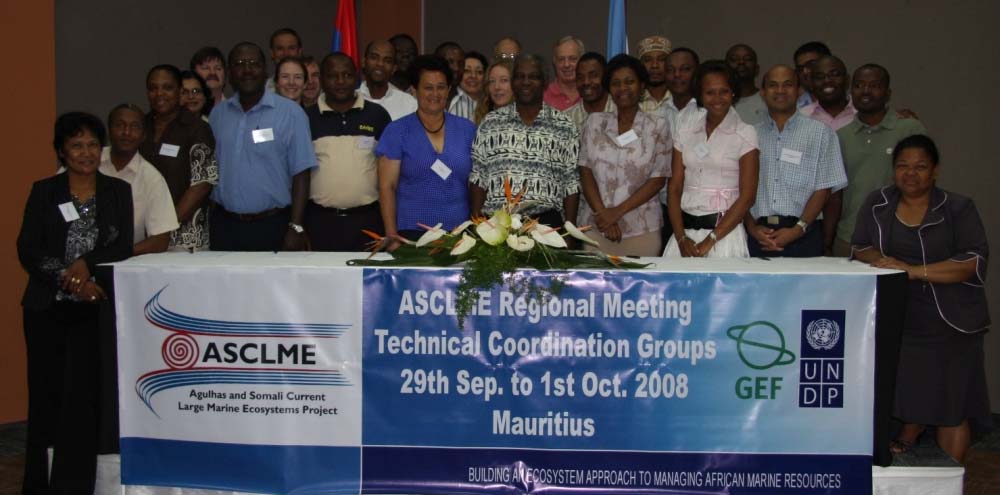


ASCLME Regional Meeting of Technical Coordination Groups
29 September 1 October 2008
La Plantation, Mauritius
Proceedings
Proceedings of the ASCLME Regional Meeting of Technical Coordination Groups
Contents
DAY ONE
1. Opening session
1
2. Introduction to the ASCLME Project
2
3. Session 1. Review of national requirements for input into the ASCLME Project
4
4. Session 2. ASCLME cruises
5
DAY TWO
5. Session 3: Capacity building and training
9
6. Session 4: Data and information management
10
DAY THREE
7. Update
14
8. Breakaway group work
15
9. Session 5: Marine Ecosystem Diagnostic Analysis (MEDA) Structure
19
10. Session 6: Discussion of individual projects
20
11. Next steps
21
ANNEX I: Provisional agenda for the workshop
23
ANNEX II: List of Participants
26
ANNEX III: List of Acronyms
28
i
Proceedings of the ASCLME Regional Meeting of Technical Coordination Groups
Proceedings
DAY
ONE 29
September
2008
Opening at 9:15 am
1. Opening Session
Dr David Vousden (Director, ASCLME Project) welcomed the Honorable Lormus Bundhoo (Minister
of Environment and National Development), Dr Mitrasen Bhikajee (Director of the Mauritius
Oceanographic Institute), Mr Roland Alcindor (Head of Environment Programme, UNDP Mauritius)
and participants from eight countries, to the first regional meeting for the Technical Coordination
Groups of the Agulhas and Somali Current Large Marine Ecosystem Project (ASCLME).
Dr Mitrasen Bhikajee welcomed all members present. He acknowledged the amount of work that the
steering committee had put into the formulation of this project to its realisation within a short period
of time. He highlighted the lack of scientific information within the Western Indian Ocean region
needed to advise the proper management of marine ecosystems.
Mr Alcindor highlighted the importance of the ASCLME project and this first meeting of the
Technical Coordination Groups for the project. Understanding current systems is important for the
people living in the coastal areas, especially for activities such as fishing. Less than 50% of the
species in the large marine ecosystems have been documented and the long-term sustainability of
these resources is also uncharted. The ASCLME project therefore aims to acquire scientific data to
support ecosystem-based management. The organised cruises on the U.N. Flagged Research Vessel,
Dr Fridtjof Nansen, would provide information for a Transboundary Diagnostic Analysis that would
help raise critical issues that will require joint actions by the governments of the region. He
highlighted that this project would provide opportunities for the scientists from the countries in the
region to participate in cruises.
The Honorable Lormus Bundhoo welcomed the representatives of UNDP, Director of the Mauritius
Oceanography Institute, ASCLME PCU members and all participants to the 1st regional meeting for
the Technical Coordination Groups of the ASCLME Project. He strongly encouraged this regional
effort and thanked all the delegates. He highlighted the importance of this event where delegates from
eight countries are meeting to discuss the implementation of this project. He mentioned that the data
collected from the Dr Fridtjof Nansen cruises and those data compiled during the TDA processes
would establish a good baseline. He wished the participants effective delivery of results. The 64
identified Large Marine Ecosystems (LMEs) of the world's oceans have sizable fisheries (94% of the
world's total), and perform other important ecosystem functions such as nursery sites for
economically important fish species. About 160 million people residing in the countries of the
Western Indian Ocean Region are directly affected by what happens in these LMEs as they depend on
resources from the sea. They are not spared from environmental concerns, especially important for the
Small Island Developing States (SIDS) and their fisheries resources. With regards to food security, the
Honorable Minister emphasised that more than 50% of protein sources in countries like the Seychelles
and Comoros come from fisheries. The Convention on Biological Diversity (CBD) has also adopted
an ecosystem approach an important aspect of LMEs. Implementation of LME principles to
sustainably tap our natural marine resources is considered pivotal to further sustainable development.
The vision of Mauritius was clearly spelt out as adopting an ecosystem-based approach for sustainable
development, and thus, there is a dire need to know what we have as a baseline. With these
1
Proceedings of the ASCLME Regional Meeting of Technical Coordination Groups
observations, the Honorable Lormus Bundhoo declared the first ASCLME Regional Meeting of
Technical Coordination Groups open.
Dr Vousden expressed his special thanks to the Honorable Minister for his time and presence. This is
a clear demonstration of Mauritian determination and understanding of the objectives of the Project on
which the participants have embarked. He mentioned that this project would build the foundation for
decision-making and management of LMEs in the African region, including the island states. Dr
Vousden introduced the objectives of this meeting, which are to familiarise the Technical
Coordination Groups (COGs) with the ASCLME Project, and establish a shared understanding of the
critical role of the COGs in ASCLME Project activities, towards the development of national Marine
Ecosystem Diagnostic Analyses, a Transboundary Diagnostic Analysis and Strategic Action
Programme for the region.
Nomination and adoption of chair
Dr Magnus Ngoile was nominated as the Chair of the workshop and invited the members to
introduce themselves.
Dr Ngoile briefed the delegates on the agenda for Day 1 to 3 as follows:
Day 1 Introduction to the project and detailed discussion of cruise coordination
Day 2 Detailed discussion of Data and Information management and capacity building
Day 3 Marine ecosystem diagnostic analyses and logistics
It was noted that:
1.
Tomorrow at lunch time a group photo would be taken.
2.
One representative from Seychelles would join the workshop later.
3.
One representative from Tanzania would join the workshop tomorrow.
Further, Dr Ngoile provided a brief history of the preparations and development of the project
and acknowledged Dr David Laroche for his exceptional input and commitment.
2. Introduction to the ASCLME project
Presentation by Dr Vousden; a review of the objectives and an update on ASCLME Project
implementation. LINK TO THE PRESENTATION ON ASCLME.ORG [4.3 Megabytes]
The main project details were noted as follows:
PARTICIPATING COUNTRIES: Comoros, Kenya, Madagascar, Mauritius, Mozambique,
Seychelles, South Africa, Tanzania (plus Somalia where possible)
FUNDING:
GEF = US$12.2 Million.
Co-funding = US$20 Million
TIMEFRAME: 5 Years, until mid-2012
The project objective is to undertake an environmental baseline assessment of the Agulhas and
Somali Current Large Marine Ecosystems with a view to developing a Transboundary
Diagnostic Analysis (TDA) and Strategic Action Programme (SAP).
2
Proceedings of the ASCLME Regional Meeting of Technical Coordination Groups
The four main outcomes of the project were noted as follows:
1. Information captured for development of the Transboundary Diagnostic Analysis (TDA).
2. Long-term data collection, management and distribution mechanisms established.
3. A Strategic Action Programme (SAP) and associated sustainability mechanisms adopted
for an LME approach.
4. LME coordination, communication and participation mechanisms established.
He further highlighted the progress made to date:
Set up of PCU (Grahamstown linked to SAIAB/ACEP)
Recruitment of Administrative and Technical Staff/Consultants
Rationalisation of Project Components and Activities
Organisation of the Inception/Steering Committee meetings, which inter alia
i) Adopted/approved the realigned Components and Activities of the ASCLME Project
ii) Adopted/approved the updated Budget and Work-plans
iii) Confirmed field-work priorities
Launch of ASCLME website (in 3 languages)
Update of ASCLME Chapters on LME website
Implementation of ASCLME National Mechanisms (National launches of the
ASCLME and nomination of COG members)
Successful completion of 1st Training Programme on cruise activities (Agulhas
countries)
First cruise (East Madagascar) on-going and first leg (near completion)
Dr Vousden also highlighted the project's national and regional structure:
· Each of the countries has an ASCLME National Focal Point
· Each country has set up a national Coordination Group (COG) consisting of:
o Cruise coordinator
o Data and Information Coordinator
o Capacity Building Coordinator
· The National Coordination Groups have Terms of Reference to guide them
He then summarised the principal national COG inputs to ASCLME Project delivery as
follows:
· Coordinate with the ASCLME Project and other Projects at the national level on:
o Research Cruise Planning & Implementation
o Capacity Building & Training
o Data & Information Management
· Coordinate the development of a national Marine Ecosystem Diagnostic Analysis
(MEDA)
· Participate in the development of the TDA and SAP
3
Proceedings of the ASCLME Regional Meeting of Technical Coordination Groups
Discussion
Reference was made to the fact that the 2008 cruise schedule was proceeding well and that the first
Ecosystem Assessment training session was held in Cape Town in mid-2008, which was noted to be a
success.
Responding to a query, it was clarified that the development of the TDAs and SAPs, and the
associated structures and mechanisms necessary to achieve this are not part of a prescriptive process;
that representatives have to feel that the project belongs to them, and they should tell the committee
how best they can coordinate the project in their respective countries. He further added that the role of
the Project Coordination Unit (PCU) is to provide guidance in all matters pertaining to Project
delivery and not to enforce specific requirements. He emphasised that a GEF Project of this nature is
not `written in stone' and needs to be dynamic in its actions and deliveries in order to specifically
achieve some of the more general requirements stated in the Project Document. In this context, the
Project need not restrict itself to addressing the TDA rigidly in terms of the 5 modules (Fish and
Fisheries; Productivity; Ecosystem Health and Pollution; Socioeconomics; Management and
Governance) as identified in the terms of reference for the National COGs but that they should use
these for guidance. The Project will attempt to present a TDA and SAP for each of the LMEs in a
modular manner wherever possible but it is clear that the first three modules tend to deal more with
the science of the ecosystem (i.e. the TDA) whereas the second two are more related to its
management and governance needs and thus to the SAP.
The Chairman suggested that it depended on the delegates to fine-tune the logistics for the collection
of the data/information on the 5 identified modules of the LMEs. He further requested that by the end
of this meeting, delegates should have a good understanding of the project.
3. Session 1: Review of national requirements for input into the ASCLME Project
Lucy Scott presented a review of national requirements for input into the ASCLME Project
including country structures and an overview of the Marine Ecosystem Diagnostic Analysis
(MEDA), Transboundary Diagnostic Analysis (TDA) and Strategic Action Programme (SAP)
LINK TO THE PRESENTATION ON ASCLME.ORG [5.6 Megabytes]
Ms Scott highlighted the requirements for the implementation of the Large Marine Ecosystem
Approach through a GEF-Funded Project:
· Development of a TDA (Transboundary Diagnostic Analysis focusing on the
Ecosystem Approach)
· Negotiation and adoption of a SAP (Strategic Action Programme) that includes
Adaptive Management practices
Ms Scott elaborated on the structure of the national MEDA, as well as the regional TDA and
SAP along with the linkages between them.
The in-country inputs to the Marine Ecosystem Diagnostic Analyses (MEDA) will require the
following steps:
4
Proceedings of the ASCLME Regional Meeting of Technical Coordination Groups
· Regional Meeting of COG representatives to discuss & agree on MEDA structure and
development process
· In-country contractual and administrative arrangements
· Capture of existing data on Productivity, Fish and Fisheries and Ecosystem Health and
Pollution status (into a Causal Chain Analysis and Prioritisation) as well as inputs from
the cruise data
· Assessment of existing Socioeconomic concerns and Governance Mechanisms (Root
Causes to Solutions)
· Annexes (Indicator & Monitoring Work Programme; Capacity Building and Training
Work Programme)
· Assistance and input to additional project studies
· Draft and Adoption of MEDA at National Level
Ms Scott further made reference to the administration and logistics of MEDA development a
subject which will be presented for discussion later in the programme of events.
Discussion
Responding to a query on what would be a country's needs in terms of finance to deliver MEDA,
the Chairman advised that it would be better to discuss and adopt all of the scientific endeavours
and requirements through broad thinking and then narrow these down based on priorities and
budget available.
Dr Vousden pointed out that he would be giving a more specific presentation on national budgets
and support from the PCU for delivery of the MEDA and for national support to the TDA process.
The discussions that emerged highlighted the need to continue with the monitoring and assessment
as established by national and regional programmes in support of the SAP even after the initial
MEDA and TDA process were implemented and complete, as these would need to be updated
regularly in support of adaptive management and governance mechanisms and policy reviews.
4. Session 2: ASCLME Cruises
The following main features of the ASCLME cruises, presented by Dr Bornman, were noted:
LINK TO THE PRESENTATION ON ASCLME.ORG [7.6 Megabytes]
· Cruise plans 2008; 2009; 2010
· Scientific activities & participation
· Outcomes and deliverables
· Training and capacity building
· Cruise planning requirements
· Items for discussion at the Regional Forum
Dr Bornman elaborated on the 2008 overall cruise plan and the 2008 cruise schedule.
The scientific activities related to the ecosystem-based approach which are going to be carried
out onboard the vessel will cover the following topics:
5
Proceedings of the ASCLME Regional Meeting of Technical Coordination Groups
· Environmental stations
o Physical oceanography
o Chemical oceanography
o Biological oceanography
· Acoustic surveys to identify fish stocks, abundance and distributions
· Pelagic and demersal trawls: Biodiversity assessment of fish, crustaceans and other
invertebrates
· Bathymetric survey: Multibeam echosounder survey to develop detailed bathymetric
map of the seafloor
· Bird and mammal survey: Opportunistic study of bird & mammals
· Genetic and isotope samples of fish and zooplankton (samples will be collected and the
analysis will be done in land-based laboratories)
· Remote sensing
Deliverables from cruises were defined as follows:
· Cruise reports
· Data reports
· Electronic inventories
· Scientific publications in peer-reviewed international journals
· Training and capacity building
In relation to planning for future cruises the requirements are:
· Cruises to be planned
2009 URGENT. The 2009 cruises will mainly cover the Somali Large Marine
Ecosystem (SCLME), excluding the Somali coast.
o 2010
· Discuss and reach agreement on:
o Area of operation
o Research needs (gaps)
o Scientific work plan
o Scientific expertise/training required
· National Cruise Coordinators
o National COG
o National scientists
o Regional Cruise Coordinator
o PCU
Training and capacity building for ship-based research will include:
1. Training preceding cruises
· For 2008: 2 trainees from each of the following countries: South Africa, Mozambique,
Madagascar, Mauritius and Seychelles received their training in Cape Town preceding
the current cruises, which cover mainly the Agulhas Current Large Marine Ecosystem
· For 2009: 2 trainees from Tanzania, Kenya, Somalia and Comoros will receive their
training by June, 2009. Location for the training is Cape Town
6
Proceedings of the ASCLME Regional Meeting of Technical Coordination Groups
2. Training on board Dr Fridtjof Nansen
· Scientists from the region will have an opportunity to join the cruises, including
students who may receive hands-on training onboard the research vessel.
3. Oceanographic equipment
· Each participating country will receive a set of oceanographic equipment to assist them
with continuation of the oceanographic research to monitor the conditions of the
marine environment in the region.
The following items were noted and discussed during the regional coordination forum:
· Vessels needed to complement Dr Fridtjof Nansen
· Study areas planning the cruise tracks
· Date and timing of expeditions
· In-situ instrumentation Deployment of instrumentation
· International participation in cruises
· Opportunities for ship-based training
· Use of global information resources
Discussion
It was noted that all the suggested scientific measurements were being done for the first time in the
targeted areas of Western Indian Ocean and with the involvement of regional scientists.
In response to a query on data being collected in the past by people from other regions of the
world, it was suggested that there is a need to track those data for comparative purposes. It was
further suggested and recommended that repatriation of such data be done through a request by
UNDP to relevant organisations.
It was further suggested that progress of these scientific cruises should be tracked through having
regular submissions and archiving of the national datasets, and also requesting national
governments to support these activities through co-funding mechanisms.
On the number of trainees from participating countries, it was clarified that there could possibly be
more than 2 trainees from each country in one training session. However, it is important that the
countries identify the trainees and communicate their needs through the cruise coordinators early
enough. MSc and PhD students could potentially be involved in data collection. Although the GEF
no longer supported post-graduate education of this sort, this did not prevent the Project or the
countries from seeking funding from elsewhere. In the event that some countries lack the required
number of trainees, their positions could be covered by trainees from other countries.
Dr Vousden drew attention to the fact that a considerable amount of additional co-funding had
been attracted by the unique nature of these cruises into uncharted and unfamiliar waters,
particularly from organisations such as NOAA, which had provided well in excess of $0.5 million
in equipment, ships and expertise. The meeting advised the PCU to acknowledge such co-
financing in order to attract even more support. This issue was recommended to be forwarded to
7
Proceedings of the ASCLME Regional Meeting of Technical Coordination Groups
the Steering Committee. Mention was also made to acknowledge other support services, which
may not necessarily be equipment.
The Chairman suggested that there might be more work to be done at the level of cruise
organisation in an effort to save time and maximise data collection.
Regarding the coverage of Aldabra, it was clarified that it might be possible to include this region
if the ship route is flexible and the timing would permit it. Reference was made to the Seychelles
Coastguard, who have particularly expressed an interest in any data that could be collected from
their southern islands, including Aldabra, as they are very short of information for these waters.
It was noted that delegates from respective countries could also request that the ship spend more
time in their waters; however, this will require co-funding mechanisms either from national
budgets or development partners' support.
It was also noted that it might be possible to accommodate extra trainees during training sessions
in Cape Town; however, this will be at the discretion of the training institution.
The Chairman requested the cruise coordinators meet and discuss appropriate issues and notice
was taken regarding the need for better online communications among coordinators.
8
Proceedings of the ASCLME Regional Meeting of Technical Coordination Groups
Proceedings
DAY
TWO 30
September
2008
Day 2 of the meeting started at 08h50
The Chairman welcomed the new members and asked them to introduce themselves. The Chairman
then summarised the presentations and discussions from Day 1.
5. Session 3: Capacity Building and Training
Dr Warwick Sauer addressed the objectives for the development of the national training plans and the
requirements for the training plan.
· Capacity Building and Training (CB&T) focal point in support of TDA and SAP development
for the ASCLME
o National capacity building and training (CB&T) Institution
o National data and information synthesis and management (CB&T) representative
o Background to the Regional CB&T Working Group for the ASCLME
· Timelines, including who, what and where of capacity building and training
· The proposed outline for the ASCLME national training plan for each country:
o Overall objectives and general principles of the ASCLME Training Programme
o Inventory of current educational capacity activities in the respective country
o National needs and capacity for meeting them (Training to what effect?)
o Proposed National training and capacity building Action Plan incorporated into the
MEDA
o Regional and international linkages and support
o Proposed start-up training projects and activities
o Work plan and budget estimates (incorporation into both national and regional SAPs)
Discussion
The participants acknowledged that the proper focus for the development of the CB&T at national
level was thoroughly addressed. However, it was pointed out that the method of selection of trainees
is an important aspect and can make a significant difference in the achievement of outcomes.
The meeting proposed that training in marine science and management has to be one focal area for the
training activities. Marine ecosystems are traditionally managed by sectors and ASCLME aims at
promoting an integrated approach ecosystem-based management of marine and coastal resources in
the Western Indian Ocean. Thus, the challenge here is to identify the needs of training both fisheries
managers as well as less obvious stakeholders such as foresters, officers dealing with tourism and
mid-level managers/directors of the various sectors.
The need to consider language differences and translation, including translations of MEDA
documents, was noted by the PCU and the respective countries' representatives. It was also suggested
that responsibility for translation should rest with the Project and not with countries, as this would be
the most effective method to ensure consistent and official communication.
9
Proceedings of the ASCLME Regional Meeting of Technical Coordination Groups
There was a general discussion about the language barriers and one proposal was to have dedicated
courses in English for some of the French and Portuguese speaking countries to allow them to engage
more widely with the regional and global scientific fraternity.
It was also advised that the Project and the countries should reflect on the courses already held and
planned and other training needs assessments that have been conducted, and review this in the context
of the LME approach.
6. Session 4: Data and information management
Ms Scott introduced the data management requirements for the ASCLME in general and the
objectives of this session in particular. LINK TO THE PRESENTATION ON ASCLME.ORG [11 MB]
The presentation covered:
· Objectives: To collect and integrate coastal and offshore data for LMEs at national level.
· ASCLME requirements and regional context
· Priority activities
· National and regional coordination (drivers)
· Data & information management framework for discussion
· Next steps
The meeting received information on projects that will provide/contribute to the collection of data and
information at national and regional levels.
South West Indian Ocean Fisheries Project:
Mr Harrison Ong'anda presented the South West Indian Ocean Fisheries Project (SWIOFP) databases
and approach to data management. LINK TO THE PRESENTATION ON ASCLME.ORG [733 KB]. He stated the
following 3 objectives of SWIOFP:
1. To identify and study exploitable offshore fish stocks within the SWIO, more specifically, to
determine existing fishing pressure on these stocks and to investigate the role of environmental
influences on the life histories, seasonal variability and health of stocks in order to differentiate
between environmental and anthropogenic impacts.
2. To develop institutional and human capacity through training and career opportunities.
3. To develop a regional fisheries management structure and associated harmonised legislation in
collaboration with the SWIOFP.
The implementation of the SWIOF Project is divided into three phases:
Phase 1: The initial 12-18 months focus on:
· Collection and analysis of relevant existing data, and setting up a regional database.
· Synergise with the ASCLME project (oceanographic and productivity data).
10
Proceedings of the ASCLME Regional Meeting of Technical Coordination Groups
· Develop data collection and analysis procedures and commence training and capacity
building.
· A data-gap analysis, to assist in developing work plans for component-based sampling at
sea to collect new data.
Phase 2: (18-24 months)
· This phase involves intense shipboard sampling to collect data identified in the gap-
analysis. Research cruises and observers on commercial ships will survey areas presently
fished, and areas with possible untapped resources.
Phase 3: (24-36 months)
· This phase is set aside for data analysis and preparation of a Transboundary Diagnostic
Analysis (TDA) and Strategic Action Plans (SAP). Adoption of the TDA and SAP will
mandate future regional research, management, governance processes and investment
within an ecosystem framework.
Nairobi Convention Clearinghouse Mechanism (CHM):
Mr Farid Anasse presented the Nairobi Convention Clearinghouse Mechanism (CHM) and
information sharing system on the Eastern African coastal and marine environment. LINK TO THE
PRESENTATION ON ASCLME.ORG [17 MB] He elaborated on the following points:
· Introduction to the Nairobi Convention CHM & information sharing system
· Implementation of the Nairobi Convention CHM & information sharing
· Objectives of the Clearinghouse Mechanism
· Themes of the Nairobi Convention Clearinghouse Mechanism
· Services and outputs of the Nairobi Convention CHM
· Nairobi Convention Clearinghouse activities
· The regional and national Clearinghouse Mechanism
Ocean Data and Information Management in Africa: the Role of ODINAFRICA:
Dr Desiderius Masalu introduced the "Ocean Data and Information Management in Africa: the Role
of ODINAFRICA". LINK TO THE PRESENTATION ON ASCLME.ORG [5.1 MB] He stated the following objectives
of ODINAFRICA:
· Establishment of National Oceanographic Data (and Information) Centres
· Networking of NODCs in Africa
· Training in marine data and information management
· Development of catalogues of marine data and literature for Africa
· Development of products such as marine atlases and data CDs
· Improvement of communication infrastructure (including internet access)
The implementation of ODINAFRICA has undergone the following phases:
· 1989-1996 RECOSCIX-WIO, a regional network for the exchange and sharing of scientific
literature
11
Proceedings of the ASCLME Regional Meeting of Technical Coordination Groups
· 1997-1999 ODINAFRICA-I also known as ODINEA, a pilot project with focus involving
seven African countries (Kenya, Madagascar, Mauritius, Mozambique, Seychelles, South
Africa, Tanzania)
· 2000-2003 ODINAFRICA-II comprised 20 countries: Benin, Cameroon, Comoros, Cote
d'Ivoire, Gabon, Ghana, Guinea, Kenya, Madagascar, Mauritania, Mauritius, Morocco,
Mozambique, Nigeria, Senegal, Seychelles, South Africa, Tanzania, Togo and Tunisia. The
achievements were as follows:
o NODCs established in all institutions
o Librarians and data managers trained
o Equipment and software provided
o Communication improved
o Networking initiated
o Products are coming out of the centres
· 2004-2008 ODINAFRICA-III, An Integrated Ocean Observation and Service Network for
Africa and linked NODCs/DNAs to data streams and to the end-users/stakeholders
· Proposed ODINAFRICA-IV, focused on integrated data and information products and services
for the management of oceans and coastal zones in Africa. The overall goal of ODINAFRICA-
IV is to promote the sustainable management of marine and coastal resources, as well as
reducing the risks of ocean related hazards, based on sound scientific knowledge.
Discussion
It was noted that a great deal of data, relevant to the ASCLME project, was already available in the
two databanks, namely The Nairobi Convention Clearinghouse Mechanism and information sharing
system on Eastern African coastal and marine environment and ODINAFRICA data centres. The
participants suggested looking into these two data systems and using existing information as the
starting point for data and information gathering for the ASCLME Project in the region. However, the
process of extracting the information from these databases should not compromise detail. The
extraction/compilation of the existing data should not be restricted to these two systems but also
include others such as WIOFish.
It was suggested that the ASCLME needs a strong policy on the publication of data from cruises to
ensure that publications are written up and that data are archived appropriately. The meeting was
informed that such policy exists and all scientists going on the research cruises are required by
contract to publish.
It was agreed that Data and Information Working Groups would address these issues within their work
programme under the philosophy of looking at existing national arrangements and working out an
integrated plan to support the ASCLME data and information collection processes.
A question was raised about who coordinates the development and delivery of the MEDAs. The
Project Director responded that the D&I Coordinators would have the key coordinating role for the
production of the MEDA in each country, supported regionally by the Project D&I Coordinator in the
PCU.
12
Proceedings of the ASCLME Regional Meeting of Technical Coordination Groups
The issue of data repatriation and management of newly collected data by the Nansen expeditions
would be properly addressed under appropriate guidelines related to ownership and publications. The
need to manage both existing and newly collected data sets through the Nansen expedition, with
respect to respective countries' sensitivities and the need for publications, was highlighted. Scientists
interested in using the data would need to get appropriate permission from the country as well as from
the ASCLME Project. Joint publications would be encouraged.
The Chairman highlighted the need to have specific meetings where the scientists who have
participated in the cruises would meet and plan the joint publication of the results. The first such
meeting is planned for August 2009.
The Chairman concluded the day by calling on the Coordinators for Data and Information and
the Coordinators for Training and Capacity Building to meet separately and discuss the
specifics under their respective themes.
13
Proceedings of the ASCLME Regional Meeting of Technical Coordination Groups
Proceedings
DAY
THREE
1 October 2008
Day 3 of the meeting started at 08h50
7. Update:
The Chairman provided a brief update on two major topics:
7.1 Capacity Building and Training
a) Emphasis on the need to be focused and thorough on the training needs at the national level.
b) The need to focus the training and capacity building on ecosystem-based management was
highlighted. Marine ecosystems are traditionally managed by sectors. ASCLME is promoting
an ecosystem-based, integrated approach. Thus the challenge is to identify the needs for
training multi-sector managers, including stakeholders in fisheries, agriculture, forestry,
tourism and even foreign affairs.
c) The plan and topics were reviewed and enriched with the addition of two points related to
consideration of language and translation: the need for translations of MEDA documents was
agreed and the PCU will undertake the responsibility for translation.
7.2 Data and information management
In light of the two existing databanks (ODINAFRICA & Nairobi Convention CHM), ASCLME
would look into the two data systems and use these existing systems to help inform the data and
information gathering process in the region. Some of the questions that provoked discussion
included "How much information is needed? Is there information for each country and what trends
does it show?" The various frameworks for data and information at regional levels were noted. It
was agreed that the Data and Information Working Groups would address a framework for D&I
management for the ASCLME Project within the context of existing D&I management
mechanisms and attempt to coordinate and integrate with them rather than duplicating regional
efforts. The whole issue of data repatriation and management, especially from the Dr Fridtjof
Nansen cruises, was discussed with respect to guidance on ownership and publications. The need
to respect, manage and publish those data, and the mechanisms for the Project collecting the data
for the participating countries was emphasised. It was also suggested to address the need to ask for
permission pertaining to the use/publication of data. Attention was drawn to the Data and
Information Management Guidelines produced by ASCLME, which were for discussion by the
D&I coordinators in a break-away group, with further input requested at the national levels when
they returned to their countries.
Discussion then focused on the fact that some scientists were not able or willing to publish
existing data (in the region) either due to financial or time constraints, or simply lack of
experience and know-how. This provides ASCLME with the challenge of assisting publication of
both newly collected data and existing (historical) data. Training in publishing and joint
publications would be encouraged. Note was also made of the need to be very strategic with data
collection and organisation of meetings to discuss potential publications both at national and
14
Proceedings of the ASCLME Regional Meeting of Technical Coordination Groups
regional levels. The ASCLME will be facilitating the first such meeting at the WIOMSA
conference in 2009. The ODINAFRICA Project Manager stated that, in their experience, focused
working meetings tend to be productive and provide an effective use of resources.
8. Breakaway group work:
The National Coordinators met in groups according to their respective themes as follows:
· Data and Information Management,
· Capacity Building and Training, and
· Cruise Coordination.
Feedback from the breakaway sessions was presented in plenary.
8.1 Cruise Coordination, planning & timing:
(a) 2009 Cruise
· East Africa Current Survey (Kenya, Tanzania, Mozambique with 4, 3 and 1 environmental
lines, respectively)
· Comoros Basin Survey (4-5 environmental lines & moorings)
(b) 2010 Cruise
· 60 days available on R/V Dr Fridtjof Nansen
o
West Madagascar Shelf
o
Mozambique Shelf
o
Fill data gaps
· 20 days on Nansen for research on seamounts
· 60 days on FRS Algoa
o
Natal Bight
o
Agulhas Bank
· 3 - 6 day training cruise
(c) Cruise planning requirements were identified:
· Cruises to be planned
o
2009 - URGENT
o
2010
· Discuss and agree on:
o
Area of operation (cruise tracks)
o
Research needs (gaps)
o
Scientific work plan
o
Scientific expertise/training required
· National Cruise Coordinators
o
National COG
o
National scientists
o
Regional Cruise Coordinator
o
PCU
(d) Appropriate training and capacity building requirements were identified:
Training cruises
o
ASCLME training programme
15
Proceedings of the ASCLME Regional Meeting of Technical Coordination Groups
o
Large research ships & coastal craft
o
Oceanography & fisheries
o
2008: 2 trainees from South Africa, Mozambique, Madagascar, Mauritius and
Seychelles. Location: Cape Town
o
2009: 2 trainees from Tanzania, Kenya, Somalia and Comoros. Location: Cape
Town
· On-board training on Dr Fridtjof Nansen
o
ASCLME Research Cruises
o
Scientists from region
Oceanographic equipment
Proceedings of these discussions are reflected in the Next Steps (below)
8.2 Training and capacity building
The group agreed to;
· Work with the focal points and coordinators of the other themes of each country.
· All correspondence from each group to be copied to all members of the COG.
In terms of appointing someone to collect the information:
· Agreed to draft TORs and advertise tender (all countries) translated into the appropriate
language, for the procurement of a consultant.
· That the COG and PCU would make the final choice.
The following were noted:
In terms of 2009 training requirements:
· To hold the 2009 training course in Cape Town.
· Comoros mentioned that the requests for nomination of students for 2008 required them to
be able to speak English.
· This caused language issues to be addressed and it was agreed to ask the training
institution (MARE, UCT) to look into possibilities for training in French and Portuguese.
· Course outline to be sent to all members for comment once any feedback from the first
training course had been incorporated.
· People trained last year may be able to accompany the ship if space allows.
· Cruise planning must be carried out with training in mind in terms of data collected versus
data needs (i.e. specific training needs to be matched to specific data collection by senior
scientists).
· The D&I group should provide training needs for GIS and remote sensing.
If required for the MEDA development, countries would forward any urgent training requests for
2009.
Training Plan framework:
· Minor changes were suggested.
· A copy of the BENEFIT training plan would be sent to all.
16
Proceedings of the ASCLME Regional Meeting of Technical Coordination Groups
General:
A request was made that all documentation on the web be translated into Portuguese and French.
The PCU noted that in most instances this had been done but would re-check to make sure.
8.3 Data and Information (D&I)
Background
· In support of the development of the Marine Ecosystem Diagnostic Analysis (MEDA), TDA and
SAP, the Project needs a plan to ensure appropriate management of data and information.
· Each country, coordinated by the ASCLME Technical Coordination Group (COG), principally the
Data and Information Coordinator, should develop a national data management plan to feed into
the ASCLME Project.
· The national plan should incorporate national mechanisms for data management and national data
centres and nodes archiving of data in national data centres is essential to ensure long-term
sustainability beyond the life of the Project.
· Networks and systems implemented by the Nairobi Convention, ODINAFRICA (IOC/UNESCO),
and SWIOFP should be incorporated into the plan to be used as necessary.
Items discussed:
· Timing and deliverables of preparation activities; development of plans in preparation for
MEDA development
· Data/information guidelines and agreements including publications
· Points of discussion for the regional forum
A) Timing and deliverables of preparation activities; development of plans in preparation for
MEDA development
· There was discussion on the development of national and regional data management plans.
· It was decided that a regional framework/guidelines be discussed first, based on
ASCLME/CHM/IOC/UNESCO discussions, and national plans be drawn up afterwards. Decisions
on activities and timing are reflected in Table 1 below.
· It was decided that the timing proposed here be reviewed in light of the overall ASCLME plan,
and then shared with D&I coordinators to confirm dates.
· Timing needs to take into account national strategies (e.g. SWAP in Madagascar).
· It was agreed to meet with IOC/UNESCO and UNEP Nairobi Convention Secretariat to discuss
the appropriate regional framework.
B) Data / information guidelines and agreements, including publications
· The cruise data agreement was reviewed (Appendix to the 2008 Nansen sailing orders).
· It was queried whether the data agreement had been signed-off by the countries.
· It was established that the sailing orders (including the data agreement) had gone through the focal
points of each of the countries participating in the 2008 cruises, but that the agreement had not
been formally signed by countries.
· Kenya asked if the agreement was relevant to countries not participating in the 2008 Expedition
the response was `yes, as comments will be relevant to agreements for future cruises'.
17
Proceedings of the ASCLME Regional Meeting of Technical Coordination Groups
· There was general agreement that there were no obvious problems with the cruise data agreement,
but additional comments will be sent to the ASCLME PCU by 31 October 2008.
· Regarding the ASCLME Principles and Guidelines document, D&I coordinators wanted some
more time to reflect on this and agreed to reconvene after the presentations the next day (2
October), and in the meantime, to solicit comments (IOC/UNESCO) and UNEP-Nairobi
Convention Secretariat and to ask them to join the meeting. Final comments on the broader
document would be sent to PCU of the ASCLME before 3 November 2008.
C) Points of discussion for the regional forum
· The group felt that they should address intra-regional training, for example specialists from Kenya
going to Mozambique to assist them with data management.
Table 1. D&I activities and timing
Responsibility
Proposed Deadline
1 Overall ASCLME D&I plan (regional)
Second meeting of D&I coordinators
D&I coordinators, IOC/UNESCO,
2 October 2008
UNEP
Drafting of regional plan
ASCLME PCU, D&I coordinators,
December 2008
CHM, IOC/UNESCO, SWIOFP
and others
Review of regional plan (including TOC for
D&I coordinators with SC and
Dec 2008 Jan 2009
National Data management plan)
COGs
2 Data
agreements
Data management agreement for the ASCLME
D&I coordinator with SC and in-
31 October 2008
Cruise
country consultation
Data management Principles and Guidelines for D&I coordinator with SC and in-
First comments
the ASCLME Project reviewed
country consultation
2 October, final by
3 November 2008
3 National data & information management
plans (annex to the MEDA)
Review of Table of Contents of National Data
D&I coordinators with ASCLME
January 2009
& information management plan
PCU
National Data & information management plan
D&I coordinator with in-country
9 February 2009
developed and causal chain analysis draft v0
consultation and PCU
National Data & information management plan
D&I coordinator with in-country
27 February 2009
developed draft v1
consultation and PCU
4 Third meeting of D&I coordinators
D&I coordinators (and other COG
9 February 2009
Grahamstown
members if necessary) with
Presentation and review of National Plans
ASCLME PCU
Working meeting for the MEDA
5 days (provisionally will be confirmed)
18
Proceedings of the ASCLME Regional Meeting of Technical Coordination Groups
9. Session 5: Marine Ecosystem Diagnostic Analysis (MEDA) Structure
Dr Vousden gave a presentation on the MEDA LINK TO THE PRESENTATION ON ASCLME.ORG [2 MB] during
which he addressed the following topics:
· The ASCLME regional approach, including the Transboundary Diagnostic Approach
(TDA) and Strategic Action Programme (SAP)
· The ecosystem approach
· Adaptive management approach with respect to status of ecosystems and sustainability
· Definitions of TDA (factual document) and SAP (negotiable document).
· Development of regional TDAs
· Structure of regional TDA, emphasising its dynamic nature
· Summary of linkages between the national MEDA and the regional TDA & SAP
· Structure of the national MEDA
· Explanation of performance indicators
o Process adoption of pollution control legislation
o Stress Reduction construction of pollution reduction facilities such as sewage
treatment plants
o Ecosystem status verification by measurement of resultant improvements to the
ecosystem
· Independent project studies
o Coastal Livelihoods Assessment
o Cost-Benefit Analysis
o Policy & Governance Assessment
o Coastal Habitat Assessment (including RS/GIS)
o Communications Strategy (community engagement, distance learning, information
sharing, media outreach)
· In-country steps:
Step 1:
Regional Meeting of COG representatives to discuss and agree on MEDA
structure and development process (i.e. the current meeting in progress)
Step 2:
In-country contractual and administrative arrangements
Step 3:
Capture of existing data on Productivity, Fish and Fisheries and Ecosystem
Health and Pollution status (into a Causal Chain Analysis and Prioritisation)
Step 4:
Assessment of existing Socioeconomic concerns and Governance Mechanisms
(Root Causes to Solutions)
Step 5:
Annexes (Indicator & Monitoring Work Programme; Capacity Building and
Training Work Programme)
Step 6:
Assistance and input to additional project studies
Step 7:
Draft and Adoption of MEDA at National Level
·
ASCLME Project Support to Countries for MEDA Development
·
Administration and logistics of MEDA development
19
Proceedings of the ASCLME Regional Meeting of Technical Coordination Groups
Discussion
The issue of overlap of activities among currently ongoing sister projects was raised. It was also noted
that close collaboration of different working groups from these projects will enhance effectiveness and
identify gaps for complementarity. It was suggested that an adaptive approach be adopted.
In response to a question by David Vousden on whether it is acceptable for the countries for the PCU
to channel funding through UNDP or if there is need to contract the focal institutions directly, it was
noted that it would be best through UNDP, as direct contracting would cost more. However, it was
clear that there were different mechanisms available for each country and some mechanisms would
not be acceptable to all. Dr Vousden agreed to discuss this with UNOPS and to get back to the
countries on the preferred method of contracting.
Regarding presentation of timelines for getting jobs done, it was agreed that the PCU and the
respective coordinators within each country will come up with appropriate timelines.
It was resolved that Lucy Scott would follow up with the COGs regarding timelines, and that David
Vousden would follow up with COGs and focal points regarding contracts.
10. Session 6: Discussion of individual projects
10.1 Coastal Livelihoods Filling the gaps and addressing issues not covered in the other
projects (Sauer).
o
Artisanal fishing
o
Economics
o
Social issues
The coastal livelihood project was divided into several sectors. Institutional arrangements were
also discussed as follows:
o
Project coordinated through the PCU
o
PCU to appoint a Regional Coordinator for the project
o
Country D&I representatives responsible for the project within each country
o
PCU, Regional Co-ordinator and country D&I representatives to decide on an
information system
o
Information system could be designed around current databases in the region
o
PCU, Regional Co-ordinator and country D&I representatives draw up a TOR
for collection of information in each country
o
National consultants nominated by the national COG and PCU, responsible for
collation of information
o
Information is captured nationally (possibly offline) and uploaded to the
regional system (extended bibliography)
o
Country consultants produce country reports, which are drafted as per MEDA
and TDA requirements
The following outputs were outlined:
o
Templates for all available literature
o
Collection of available literature, set up to assist the production of the MEDAs,
National Action Plans (NAPs), TDA and SAP
20
Proceedings of the ASCLME Regional Meeting of Technical Coordination Groups
o
Short-term progress report from each country
o
Summary report (as per MEDA) requirements, including literature summary,
Identification of Key Issues, Knowledge Gaps and Recommendations for each
country
o
Assistance as required, to the development of the MEDAs, National Action
Plans (NAPs), TDA and SAP
10.2 Communications and distance learning strategy
It was noted that NGOs, private sectors and other concerned stakeholders have to be engaged.
Movies, radio programmes and brochures have been tried in the past; however, ASCLME
would like to reach maximum people and DLIST is an important part of the communications
strategy.
It was suggested that desktop work detailing the approaches used to date on the
engagement/participation of stakeholders, including an evaluation of their effectiveness in
communicating with the people in the region, be carried out to help guide ASCLME's effort in
communications.
It was agreed that the COGs present their comments/concepts for consideration to the Steering
Committee meeting.
11. Next steps
The following were discussed and suggested as the next steps:
· Data and Information Management
o Comments on cruise data agreement (annex to sailing orders) 31 October
o Final comments on ASCLME Principles and Guidelines for data management 3
November
o First draft of a regional D&I plan 14 Nov (later revised to 24 November to take
cruise consultation into account); to be reviewed by COGs by 28 November.
o Liaise with PCU D&I Coordinator regarding logistics and workshops/working
groups to deliver first stage of MEDA (identification of National Areas of Concern)
November
o D&I workshop to discuss Causal Chain development and national data and
information management plans (Grahamstown possible location) February 2009
o ASCLME to enter into dialogue with NCCHM and ODINAFRICA over Data
Sharing and long-term support on-going and important.
· Cruise Coordination
o Cruise Plan 2009. Feedback from Coordinators by 1 Dec
o Training Plan for 2009. 2nd week in January. Training Course planned in mid-
2009). UCT-MARE to be informed of decision ASAP (formally by end of October
2008)
o Countries finalise plan for in-country ecosystem monitoring (equipment, training,
etc) 1 December 2008
· Capacity Building and Training
o Finalise template for training plan by 30 Nov 2008
21
Proceedings of the ASCLME Regional Meeting of Technical Coordination Groups
o Essential training requirements for 2009 Details by 31 Jan 2009
o Design ToR for collection of information for the training plan 31 Jan 2009
o Appoint Training Plan Specialist/Developer 1 May 2009
o Training Plan completed for inclusion in MEDA by mid-2010
o Cruise Plan 2009. Feedback from Coordinators by 1 Dec
o Training Plan for 2009. 2nd week in January. Training course planned in mid-
2009). UCT-MARE to be informed of decision to use them again ASAP (formally
by end of October 2008)
Having no pending issues, the Project Director, Dr David Vousden, thanked all respective participants
for their valuable time and contributions.
The Chairman thanked all the delegates for their active participation through 100% attendance even
though the lead-in time for invitations and arrangements was very short. This was viewed as a great
and serious commitment to the project.
A vote of thanks was given by Seychelles: "On behalf of all my colleagues, I am very thankful; we are
entering our new home and we have a long way to go".
The Project Director thanked Mrs Marie-Ange and UNDP for all their support in convening the
meeting and ensuring that it was a success. He also thanked all the ASCLME PCU team members and
the participants and the Chairman, Magnus Ngoile. He also expressed his sincere thanks to the
Minister of Environment and National Development of Mauritius and our Mauritian colleagues.
The meeting closed at 18h00.
22
Proceedings of the ASCLME Regional Meeting of Technical Coordination Groups
ANNEX 1: PROVISIONAL AGENDA FOR THE WORKSHOP
ASCLME Regional Meeting of Technical Coordination Groups
29 September 1 October 2008
La Plantation, Mauritius
Provisional Agenda
Day 1: Monday 29 September
Time
Introduction and Cruise Coordination
Presenter
Facilitator
Coffee/tea and lunch breaks will be announced during the course of the day
08h30 Registration
09h00 Welcome and opening address
David Vousden (ASCLME), Mitrasen Bhikajee (MOI, Mauritius)
Nomination and adoption of chair
09h20 Introduction to the ASCLME project
David Vousden
10h00 Introduction to the workshop and discussion of the agenda
Magnus Ngoile
Session 1: Review of National requirements for input into the ASCLME
David Vousden
Project including country structures and an overview of the Marine Ecosystem
Magnus
Ngoile
and Lucy Scott
Diagnostic Analysis, TDA and SAP process
Tommy Bornman
Session 2: Cruises
and Johann
Lutjeharms
Introduction - objectives for this meeting
Plans for 2008 and future cruises
Scientific themes and scientific participation
Training and the selection of trainees
Requirements for cruise planning in the future
Items for discussion at the Regional forum
18h30 Evening function: icebreaker
23
Proceedings of the ASCLME Regional Meeting of Technical Coordination Groups
Day 2: Tuesday 30 September
Time Data & information management and capacity building
Presenter
Facilitator
Coffee/tea and lunch breaks will be announced during the course of the day
08h30
Session 3: Capacity building and training
Magnus
Ngoile
Introduction - objectives for this meeting
Warwick Sauer
National training plan development
Requirements for training plan development
Session 4: Data and information management
Introduction to data management for the ASCLME, and the objectives of this
Lucy Scott
meeting
SWIOFP databases and data management
Harrison
Onganda
Nairobi Convention Clearinghouse Mechanism
Farid
Anasse
ODINAFRICA
Desiderius
Masalu
Information/data movement on the ASCLME Project
Lucy Scott
Guidelines and principles for data management - document
Lucy Scott
Collecting information on projects (project tracking)
Repatriation of data from international programmes to national institutions
Data and information products (papers, charts, digital and online)
24
Proceedings of the ASCLME Regional Meeting of Technical Coordination Groups
Day 3: Wednesday 1 October
Time Marine Ecosystem Diagnostic Analyses (MEDA)
Coffee/tea and lunch breaks will be announced during the course of the day
08h30
Update of Proceedings
Breakaway by coordinators (CC, CB&T, D&I)
Session 5: Marine Ecosystem Diagnostic Analyses (MEDA): structure
Cause and effect analysis
Root causes and solutions
Breakaway by country to develop ecosystem themes
Session 6: Marine Ecosystem Diagnostic Analysis (MEDA): logistics
Summary of MEDA discussions
Discussion of independent projects
A: Coastal livelihoods
B: Communications and distance learning strategy
Next steps: Review of timing and deliverables
Wrap-up
Thanks and closing
25
Proceedings of the ASCLME Regional Meeting of Technical Coordination Groups
Annex II. List of Participants
Country Name
Institution
Contact
details
Head, GIS Department - Ministry of Agriculture
Tel: +269 3327068
Comoros
Mr ANASSE Farid
Fishery & Environment
Email: farid_anasse@yahoo.fr
Tel: +269 3330307
Ms ALI M'CHANGAMA
Technical Advisor Ministry of Agriculture Fishery
Email: najalim@gmail.com or
Comoros
Nadjat
and Environment
najat_cheikh@yahoo.fr
National Focal Point of Coral Reef Network in the
Tel: 269 333712
Comoros
Mr SOIFA Ahmed Soilihi
Indian Ocean
Email: soifamed@yahoo.fr
Kenya
Mr ONGANDA Harrison
KMFRI-Kenya National Oceanographic Data Centre
Email: honganda@kmfri.co.ke
Kenya
Dr MWASI Shem
MOI University of Environmental Studies
Email: smwasi@africaonline.co.ke
Kenya
Dr MAGORI Charles
KMFRI-Research Marine & Coastal
Email: cmagori@kmfri.co.ke
Mr RAKOTOARIJAONA
Directeur des Informations environnementales, Office
Tel: +261 3207322 10
Madagascar
Jean Roger
National pour l'Environnement
Email: jroger@pnae.mg
Ms RAZANOELISOA
Chef Départemental Formation à l'IHSM - Univesité
Madagascar
Jacqueline
Tuléare Email:
jrazanoelisoa@yahoo.fr
Ms RAZAFINDRAINIBE
Service d'Appuii àla Gestion de l'Environnement
Email: hajanirina.sage@blueline.mg or
Madagascar
Hajanirina
(SAGE), National Focal Point of ASCLME
hajaniry@yahoo.fr
Dr (Mrs) APPADOO
Tel: +230 4541041 Ext.1406;
Mauritius
Chandani
Senior Lecturer, University of Mauritius
Email: chandani@uom.ac.mu
Mauritius
Mr Bhagooli Ranjeet
University of Mauritius (Rapporteur)
Email: rbhagooli@gmail.com
Tel: +230 4274434;
Mauritius
Mr MUSSAI Prakash
(MOI) Mauritius Oceanographic Institute
Email: pmuissai@moi.intnet.mu
Tel: +258824922690;
Email: eandre01@hotmail.com;
Mozambique
Mr ANDRE Emidio Raul
Instituto de Investigacao Pesquera
dee@moziip.com
Tel: +258824711260;
Email: avelinolanga@yahoo.com or
Mozambique
Mr LANGA Avelino
Lecture/VEM - School of Marine and Coastal Science avelino.langa@uem.mz
Email: objacoe@hotmail.com;
Mozambique
Mr COSSA Obadias
Mse Oceanography (INAHINA)
ocossa@inahina.gov.mz
Tel: (Mobile) +248521592; Office: 248
Administrator, Fishing Vessel Manager, Seychelles
670300;
Seychelles Mrs
GEORGES Kethsia
Fishing Authority
Email: kgeorges@sfa.sc
Tel: (Mobile) +248514182; Office: 248
Research Officer, Seychelles Centre for Marine
323494;
Seychelles Ms
ETIENNE
Michelle Research & Technology, Marine Parks Authority
Email: m.etienne@scmrt-mpa.sc
Tel: (Mobile) +248 517223; Office 248
Administration & Human Resource Manager,
225114/224085;
Seychelles
Ms BETSY Christelle
Seychelles Centre for Marine Research & Technology Email: c.betsy@scmrt-mpa.sc
Mr KHANYILE Jimmy
(MCM) Marine and Coastal Management, Capacity
Tel: +27(0)214023401; 27 (0)834337652;
South Africa
Phumlani
Building
Email: Jkhanyile@deat.gov.za
26
Proceedings of the ASCLME Regional Meeting of Technical Coordination Groups
(MCM) Marine & Coastal Management, Scientific
Tel: +27216023198;
South Africa
Ms DU PLESSIS Shaz
Coordinator Research Ships
Email: sharon@deat.gov.za
Tel: +27834729159;
South Africa
Dr HERMES Juliet
SAEON/MCM
Email: juliet@saeon.ac.za
ASCLME
PCU
Dr VOUSDEN David
ASCLME
Email: davidvousden@aol.com
ASCLME
Tel: +27 82886 7654;
PCU
Ms SCOTT Lucy
ASCLME
Email: L.Scott@ru.ac.za
ASCLME
Tel: +27 82774 1337;
PCU
Prof SAUER Warwick
Rhodes University
Email: w.sauer@ru.ac.za
ASCLME
Tel: +27 4662 9899
PCU / ACEP
Dr BORNMAN Tommy
ACEP/ASCLME
Email: T.Bornman@ru.ac.za
ASCLME
PCU
Dr NGOILE Magnus
ASCLME
Email: mngoile@simbanet.net
Advisor to
Tel: +27 21650 3279;
ASCLME
Prof. LUTJEHARMS
Email: jre@mweb.co.za;
PCU
Johann
Prof., University of Cape Town
johann@ocean.uct.ac.za
Advisor to
ASCLME
PCU
Mr LAROCHE David
Email:dal1727@myvermont.com
University of Dar-es-Salaam, Institute of Marine
Tanzania
Dr MASALU Desiderius
Science Email:
masalu@ims.udsm.ac.tz
University of Dar-es-Salaam, Faculty of Aquatic
Tanzania
Dr LUGOMELA Charles
Sciences
Email:lugomela@uccmail.co.tz
Tanzania
Dr KANGWE Juma
Email:jumakangwe@yahoo.com
27
Proceedings of the ASCLME Regional Meeting of Technical Coordination Groups
Annex III. List of Acronyms
Acronym Full
Name
ACEP
African Coelacanth Ecosystem Programme
ADCP
Acoustic Doppler Current Profiler
ALTICORE
Value added Altimetry in Coastal Regions
ASCLME
Agulhas and Somali Current Large Marine Ecosystems
BCLME
Benguela Current Large Marine Ecosystem
BENEFIT
Benguela Environment Fisheries Interaction Training Programme
CI Conservation
International
CoML
Census of Marine Life
CTD Conductivity,
Temperature and Depth recorder
EAME
Eastern African Marine Ecoregion (WWF)
EEZ
Exclusive Economic Zone
EU European
Union
FAO
Food and Agricultural Organization (UN)
GEF
Global Environmental Facility (UN)
GIS
Geographic Information Systems
GODAR
Global Ocean Data Rescue and Archaeology
GOOS
Global Ocean Observing System
IOC
Intergovernmental Oceanographic Commission
IOTC
Indian Ocean Tuna Commission
IUCN
International Union for the Conservation of Nature
IUU
Illegal Unregulated and Unreported fishing
LME Large
Marine
Ecosystem
MEDA
Marine Ecosystem Diagnostic Analysis
MPA Marine
Protected
Area
NAP National
Action
Programme
NEPAD
New Partnership for Africa's Development
NOAA
National Oceanic and Atmospheric Administration (USA)
ODINAFRICA Ocean Data and Information Network for Africa (IOC/UNESCO)
RS Remote
Sensing
SAP Strategic
Action
Programme
SWIOFP
South West Indian Ocean Fisheries Project
TDA
Transboundary Diagnostic Analysis
UNDP
United Nations Development Programme
UNEP
United Nations Environment Programme
UNESCO
United Nations Educational, Scientific and Cultural Organization
WIO Western
Indian Ocean
WIO-LaB
Addressing Land-based Activities in the Western Indian Ocean
WIOMSA
Western Indian Ocean Marine Science Association
28