



United Nations
Environment Programme
Chemicals
Europe
Eur
REGIONAL REPORT
ope
RBA PTS REGIONAL REPOR
Regionally
Based
T
Assessment
of
Persistent
Available from:
UNEP Chemicals
11-13, chemin des Anémones
CH-1219 Châtelaine, GE
Switzerland
Phone : +41 22 917 1234
Fax : +41 22 797 3460
Substances
E-mail: chemicals@unep.ch
December 2002
http://www.chem.unep.ch
UNEP Chemicals is a part of UNEP's Technology, Industry and
Printed at United Nations, Geneva
GE.03-00167January 2003500
Economics Division
UNEP/CHEMICALS/2003/3
G l o b a l E n v i r o n m e n t F a c i l i t y
UNITED NATIONS
ENVIRONMENT
PROGRAMME
CHEMICALS
Regional y Based Assessment
of Persistent Toxic Substances
Armenia, Austria, Azerbaijan, Belarus, Belgium, Bulgaria, Czech
Republic, Denmark, Estonia, Finland, Georgia, Germany, Hungary,
Ireland, Latvia, Liechtenstein, Lithuania, Luxembourg, Netherlands,
Norway, Poland, Republic of Moldova, Romania, Russian Federation,
Slovakia, Sweden, Switzerland, Ukraine, United Kingdom of Great
Britain and Northern Ireland
EUROPE
REGIONAL REPORT
DECEMBER 2002
GLOBAL ENVIRONMENT FACILITY
This report was financed by the Global Environment Facility (GEF) through a global project with co-
financing from the Governments of Australia, France, Sweden, Switzerland and the United States of
America
This publication is produced within the framework of the Inter-Organization Programme for the Sound
Management of Chemicals (IOMC)
This publication is intended to serve as a guide. While the information provided is believed to be
accurate, UNEP disclaim any responsibility for the possible inaccuracies or omissions and
consequences, which may flow from them. UNEP nor any individual involved in the preparation of
this report shall be liable for any injury, loss, damage or prejudice of any kind that may be caused by
any persons who have acted based on their understanding of the information contained in this
publication.
The designations employed and the presentation of the material in this report do not imply the
expression of any opinion whatsoever on the part of the Secretariat of the United Nations of UNEP
concerning the legal status of any country, territory, city or area, or of its authorities, or concerning
the delimitation of its frontiers or boundaries.
The Inter-Organization Programme for the Sound Management of Chemicals (IOMC), was established in
1995 by UNEP, ILO, FAO, WHO, UNIDO and OECD (Participating Organizations), following
recommendations made by the 1992 UN Conference on Environment and Development to strengthen
cooperation and increase coordination in the field of chemical safety. In January 1998, UNITAR formally
joined the IOMC as a Participating Organization. The purpose of the IOMC is to promote coordination of
the policies and activities pursued by the Participating Organizations, jointly or separately, to achieve the
sound management of chemicals in relation to human health and the environment.
Material in this publication may be freely quoted or reprinted but acknowledgement is requested together with a
reference to the document. A copy of the publication containing the quotation or reprint should be sent to
UNEP Chemicals.
UNEP
CHEMICALS
UNEP Chemicals11-13, chemin des Anémones
CH-1219 Châtelaine, GE
Switzerland
Phone: +41 22 917 8170
Fax:
+41 22 797 3460
E-mail: chemicals@unep.ch
http://www.chem.unep.ch
UNEP Chemicals is a part of UNEP's Technology, Industry and Economics Division
ii
TABLE OF CONTENTS
PREFACE ....................................................................................................................................................... VI
EXECUTIVE SUMMMARY............................................................................................................................VII
1.
INTRODUCTION ................................................................................................................................... 1
1.1.
BACKGROUND................................................................................................................................ 1
1.2.
OVERVIEW OF THE RBA PTS PROJECT ..................................................................................... 1
1.2.1. Objectives ............................................................................................................................1
1.2.2. Results..................................................................................................................................2
1.3.
METHODOLOGY ............................................................................................................................. 2
1.3.1. Regional
divisions................................................................................................................2
1.3.2. Management
structure..........................................................................................................2
1.3.3. Data
processing....................................................................................................................2
1.3.4. Project
funding.....................................................................................................................3
1.4.
SCOPE OF THE EUROPEAN REGIONAL ASSESSMENT........................................................... 3
1.4.1. Introduction..........................................................................................................................3
1.4.2. Omissions/weaknesses.........................................................................................................3
1.4.3.
Other European Assessment projects...................................................................................4
1.5.
GENERAL DEFINITIONS OF CHEMICALS.................................................................................. 5
1.5.1.
Persistent Toxic Substances.................................................................................................5
1.5.2. Pesticides..............................................................................................................................5
1.5.3. Industrial
Chemicals ............................................................................................................8
1.5.4. Unintended
by-products.......................................................................................................9
1.5.5.
Other PTS of emerging concern in Europe..........................................................................9
1.6.
PHYSICAL SETTING ..................................................................................................................... 15
1.6.1. Physical/geographical
description of the terrestrial Europe ..............................................15
1.6.2.
Climate and meteorology...................................................................................................16
1.6.3. European
freshwater
environments....................................................................................16
1.6.4. European
marine
environment...........................................................................................17
1.7.
PATTERNS OF DEVELOPMENT/SETTLEMENT....................................................................... 18
1.8.
REFERENCES ................................................................................................................................. 19
2.
SOURCES OF PTS ............................................................................................................................... 22
2.1.
BACKGROUND INFORMATION TO PTS SOURCES................................................................ 22
2.2.
DATA COLLECTION AND QUALITY CONTROL ISSUES....................................................... 22
2.2.1. Introduction........................................................................................................................22
2.2.2. Emission
inventories..........................................................................................................22
2.2.3. Conceptual
approach..........................................................................................................23
2.3.
PESTICIDES.................................................................................................................................... 24
2.3.1. Aldrin .................................................................................................................................24
2.3.2. Chlordane...........................................................................................................................24
2.3.3. DDTs..................................................................................................................................25
2.3.4. Dieldrin ..............................................................................................................................25
2.3.5. Endrin.................................................................................................................................25
2.3.6. Heptachlor..........................................................................................................................25
2.3.7. Hexachlorobenzene............................................................................................................25
2.3.8. Mirex..................................................................................................................................26
2.3.9. Toxaphene..........................................................................................................................26
2.4.
INDUSTRIAL CHEMICALS .......................................................................................................... 26
iii
2.4.1. Polychlorinated
biphenyls..................................................................................................26
2.5.
UNINTENDED BY-PRODUCTS ................................................................................................... 27
2.5.1. Dioxins
and
furans .............................................................................................................27
2.6.
OTHER PTS OF EMERGING CONCERN IN EUROPE ............................................................... 28
2.6.1. Brominated
flame
retardants..............................................................................................28
2.6.2. Lindane
(-HCH) ...............................................................................................................28
2.6.3. Organic
mercury ................................................................................................................29
2.6.4. Organic
tin .........................................................................................................................29
2.6.5. Pentachlorophenol..............................................................................................................29
2.6.6.
Polycyclic aromatic hydrocarbons.....................................................................................30
2.6.7.
Short chain chlorinated paraffins .......................................................................................32
2.6.8. Hexabromobiphenyl...........................................................................................................34
2.7.
CONLUSIONS................................................................................................................................. 34
2.8.
REFERENCES ................................................................................................................................. 35
3.
ENVIRONMENTAL LEVELS, TOXICOLOGICAL AND ECOTOXICOLOGICAL
CHARACTERISATION ....................................................................................................................... 37
3.1.
LEVELS AND TRENDS ................................................................................................................. 37
3.1.1. Introduction........................................................................................................................37
3.1.2. Air ......................................................................................................................................37
3.1.3. References..........................................................................................................................41
3.1.4. Deposition ..........................................................................................................................43
3.1.5.
Snow and ice ......................................................................................................................45
3.1.6. Aquatic
ecosystems............................................................................................................45
3.1.7. Terrestrial
ecosystems........................................................................................................59
3.1.8. Hot
spots ............................................................................................................................67
3.1.9. Conclusions........................................................................................................................72
3.2.
ECOTOXICOLOGY OF PTS OF REGIONAL CONCERN .......................................................... 74
3.2.1. Introduction........................................................................................................................74
3.2.2.
Overview of harmful effects ..............................................................................................74
3.2.3.
Mechanisms of harmful effects..........................................................................................74
3.2.4.
Ecotoxicological effects on the particular types of biota...................................................77
3.2.5.
Ecotoxicological databases and laboratory and field studies.............................................79
3.2.6. Data
gaps............................................................................................................................80
3.2.7. References..........................................................................................................................81
3.3.
HUMAN EFFECTS OF PTS OF REGIONAL CONCERN............................................................ 85
3.3.1. Introduction........................................................................................................................85
3.3.2.
Overview of harmful effects ..............................................................................................86
3.3.3.
National and regional human health effects reports...........................................................88
3.3.4. Conclusions........................................................................................................................90
3.3.5. References..........................................................................................................................90
3.4.
HUMAN EXPOSURE TO PTS COMPOUNDS IN REGION III EUROPE ............................... 92
3.4.1. Introduction........................................................................................................................92
3.4.2. PCBs ..................................................................................................................................93
3.4.3. PCDD/Fs ............................................................................................................................95
3.4.4. HCB ...................................................................................................................................99
3.4.5.
Polybrominated diphenyl ethers.......................................................................................100
3.4.6. Conlusions........................................................................................................................100
3.4.7. References........................................................................................................................101
4.
ASSESSMENT OF MAJOR PATHWAYS OF CONTAMINANTS TRANSPORT......................... 103
4.1.
GENERAL FEATURES ................................................................................................................ 103
iv
4.2.
REGION SPECIFIC FEATURES.................................................................................................. 104
4.3.
OVERVIEW OF EXISTING MODELLING PROGRAMMES AND PROJECTS ...................... 104
4.3.1. Introduction......................................................................................................................104
4.3.2. Steady
state
models..........................................................................................................104
4.3.3. Dynamic
models ..............................................................................................................105
4.4.
EMEP/MSCE-POP MODEL A MODEL USED IN THE REGION .......................................... 107
4.4.1. Introduction......................................................................................................................107
4.4.2. Benzo(a)pyrene
(B(a)P) ...................................................................................................108
4.4.3.
-HCH ..............................................................................................................................111
4.4.4. Polychlorinated
biphenyls................................................................................................113
4.4.5. Hexachlorobenzene
(HCB) ..............................................................................................114
4.4.6. PCDDs/Fs ........................................................................................................................116
4.5.
EXPERIMENTAL EVIDENCE FOR LONG-RANGE TRANSPORT (LRT) ............................. 118
4.6.
CONCLUSIONS ............................................................................................................................ 120
4.7.
REFERENCES ............................................................................................................................... 121
5.
PRELIMINARY ASSESSMENT OF THE REGIONAL CAPACITY AND NEED
TO MANAGE PTS ............................................................................................................................. 123
5.1.
INTRODUCTION.......................................................................................................................... 123
5.2.
MONITORING CAPACITY ......................................................................................................... 123
5.2.1. Introduction......................................................................................................................123
5.2.2.
Existing regional monitoring programmes ......................................................................124
5.2.3. Local
monitoring..............................................................................................................125
5.3.
EXISTING REGULATION AND MANAGEMENT STRUCTURES ......................................... 125
5.3.1. International .....................................................................................................................125
5.3.2. Regional ...........................................................................................................................125
5.4.
WHITE PAPER ON THE COMMISSION ON A NEW CHEMICALS POLICY IN EUROPE .. 127
5.4.1. National............................................................................................................................128
5.5.
STATUS OF ENFORCEMENT .................................................................................................... 128
5.6.
ALTERNATIVES OR MEASURES FOR REDUCTION............................................................. 128
5.7.
TECHNOLOGY TRANSFER ....................................................................................................... 131
5.8.
IDENTIFICATION OF NEEDS .................................................................................................... 132
5.9.
CONCLUSIONS ............................................................................................................................ 134
5.10.
REFERENCES ............................................................................................................................... 134
CONCLUSIONS .............................................................................................................................................. 134
ANNEX I ..................................................................................................................................................... 143
v
PREFACE
The production of this report was made possible through a co-operation of many regional experts, EC, regional
government and institutions.
Number of project: GF/CP/4030-00-20, Number of subproject: GF/XG/4030-00-86
Implementation: Masaryk University, Brno, Czech Republic
The project manager for this study was Prof. Dr. Ivan Holoubek, RECETOX TOCOEN & Associates, Brno, Czech
Republic.
Regional Team: Ruth Alcock (UK), Eva-Brorström-Lundén (SE), Anton Kocan (SK), Valeryj Petrosjan (RU), Ott Roots
(EE), Victor Shatalov (RU)
Team of regional experts: Zarema Amirova (RU), Aake Bergman (SE), Andreas Beyer (GE), Ludk Bláha (CR), Peter
Bureaul (GE), Peter Coleman (UK), Pavel Cupr (CR), Sergey Dutchak (RU), Jan Duyzer (NL), Jerzy Falandysz (PL),
Christine Fuell (HELCOM), Emanuel Heinisch (GE), Irena Holoubková (CR), Kevin Jones (UK), Antonius Kettrup
(GE), Jií Kohoutek (CR), Svetlana Koroleyva (RU), Michal Krzyzanowski (WHO-Europe), Roland Kubiak (GE),
Gerhard Lammel (GE), Andre Lecloux (B/EUROCHLOR), Miroslav Machala (CR), Alexander Malanichev (RU),
Michael McLachlan (GE), Janina Lulek (PL), Anna Palm (SE), Andy Sweetman (UK), Dick van de Meent (NL),
Martin van den Berg (NL), Jan Vanderbroght (GE), John Vijgen (D), Peter Weiss (AT), Sabine Wenzel (GE)
In 2000, The United Nations Environmental Program asked this Regional Team to participate in a global
assessment of PTS, in particular to produce a report on PTS in the European region. This document is intended
to meet that request. The report is one of twelve, which make up the global assessment.
The authors are grateful to the all reviewers for their critiques and advice.
Ivan Holoubek
RECETOX / TOCOEN & Associates
Kamenice 126/3
625 00 Brno
Czech Republic
holoubek@recetox.muni.cz
The preparation of this report and meeting of Regional team and Technicals Workshops were also partly covered by
EUROCHLOR/CEFIC; Masaryk University Brno, CR; TOCOEN, s.r.o. Brno, CR and Czech-Moravian Cement, a.s., CR.
vi
EXECUTIVE SUMMMARY
1. INTRODUCTION
There is a need for a scientifically-based assessment of the nature and scale of the threats to the environment
and its resources posed by persistent toxic substances that will provide guidance to the international community
concerning the priorities for future remedial and preventive action. The assessment will lead to the
identification of priorities for intervention, and through application of a root cause analysis will attempt to
identify appropriate measures to control, reduce or eliminate releases of PTS, at national, regional or global
levels.
The objective of the project is to deliver a measure of the nature and comparative severity of damage and
threats posed at national, regional and ultimately at global levels by PTS. This will provide the GEF with a
science-based rationale for assigning priorities for action among and between chemical related environmental
issues, and to determine the extent to which differences in priority exist among regions.
The project relies upon the collection and interpretation of existing data and information as the basis for the
assessment. No research will be undertaken to generate primary data, but projections will be made to fill
data/information gaps, and to predict threats to the environment. The proposed activities are designed to obtain
the following expected results:
1.
Identification of major sources of PTS at the regional level;
2.
Impact of PTS on the environment and human health;
3.
Assessment of trans-boundary transport of PTS;
4.
Assessment of the root causes of PTS related problems, and regional capacity to manage these
problems;
5.
Identification of regional priority PTS related environmental issues; and
6.
Identification of PTS related priority environmental issues at the global level.
The outcome of this project will be a scientific assessment of the threats posed by persistent toxic substances to
the environment and human health. The activities to be undertaken in this project comprise an evaluation of the
sources of persistent toxic substances, their levels in the environment and consequent impact on biota and
humans, their modes of transport over a range of distances, the existing alternatives to their use and remediation
options, as well as the barriers that prevent their good management.
2. SOURCES OF PTS
Persistent Toxic Substances (PTS) can be introduced into the environment via numerous sources and activities.
Point and diffuse sources include releases from industrial and domestic sites, traffic, waste disposal operations
such as incinerators and landfills. Secondary sources include the spreading of sludge on land and remobilisation
of previously deposited compounds from soils and water bodies. Some sources are capable of regulation (such
as industrial point sources) while other diffuse emissions represent unregulated and/or difficult to regulate
inputs (fugitive releases from landfills, domestic open burning of waste).
During the last decade a large amount of progress has been made in the production of atmospheric emission
inventories of several PTS compounds within Europe. However there is still a lack of comparability in
inventories produced by various organisations for the same compound group and this reduces transparency
when comparing or compiling inventories. Improved emission inventories for PTS have become increasingly
important as emission or source driven fate models for regional and global scales are developed. Inventories
serve as useful information for decision makers in order to reduce the impact of these pollutants on the
environment.
Source inventories represent a crucial step in developing appropriate risk control strategies for PTS using an
inventory of releases to air, water or land it is possible to rank sources in order of importance and so target
source reduction measures effectively and incorporate effective risk reduction measures.
During the last two decades there has been a growing interest within environmental research community to
understand the fluxes, behaviour, fate, and effects of PTS compounds. Various studies and assessments of PTS
vii
in the environment have been carried out by several international organisations, such as United Nations
Environmental Programme (UNEP), the United Nations Economic Commission for Europe (UN ECE), the
World Health Organisation (WHO), the Nordic Council of Ministers, the Paris and Oslo Commissions, the
Helsinki Commission, and the Great Lakes Commission, as well as the Arctic Monitoring and Assessment
Programme (AMAP).
Conlusions
· Within the Region as a whole there is a large amount of data relating to industrial point source
emissions to the atmosphere. Sources to air of well studied compounds such as PAHs, PCBs, and
PCDDs/Fs are generally well characterised and inventories have been calculated and updated regularly
via EMEP. Due to restrictions on the manufacturing and more stringent control of releases, emissions
from primary sources have been declining during the last 20 years. Understanding of secondary source
inputs and the potential for environmental recycling of individual compounds continues to be limited
and few measurements are available.
· Obsolete stocks of pesticides represent a potential source of PTS material particularly within the
Central European Countries and Newly Independent States. Exact quantities and components of the
stockpiled wastes are unknown at present but quantities are thought to be in excess of 80 000 t.
· For the compounds of emerging concern (e.g. PBDEs, chlorinated parrafins) emission sources to all
environmental compartments are very poorly characterised, few formal inventories have been
established and there is limited understanding of the principal contemporary source categories. For
PBDEs, evidence of increasing concentrations in human tissues from Sweden would suggest that
emissions into the Region have been rising during the last 20 years.
· Unlike sources to air, sources to land and water are very poorly quantified for all the PTS compounds.
· Prioritization of sources inputs within the Region as a whole highlight that the following compounds
represent ongoing releases in the Region which are of most concern with respect the environment and
health:
-
Hexachlorobenzene (HCB)
-
PCBs
-
PCDD/Fs
-
PCP
-
PBDEs
-
Short chain chlorinated paraffins
3. ENVIRONMENTAL LEVELS, TOXICOLOGICAL AND ECOTOXICOLOGICAL
CHARACTERISATION
3.1 Levels and trends
The first part of this chapter deals with the environmental levels and trends. The relative spatial and temporal
variations in environmental concentrations of PTSs are briefly described. The following sections describe
ecotoxicology, toxicology and human exposure to PTS in Region III.
Conclusions
· Region III has a lot of information concerning to environmental levels of PTS, but geographic
distribution of the available data is not equal for all parts of Region, better situation is in some
countries of EU and Central Europe.
· Very good and traditional monitoring system concerning also PTS exists (EN ECE EMEP, OSPAR,
HELCOM) which are oriented to air and deposition (EMEP), seas (OSPAR, HELCOM); some new are
ongoing (Caspic Sea, Black Sea). As far as rivers, the monitoring is realised mainly based on the
national level, but a lot of multinational or regional activities already exist (Rhine, Danube).
· The measurements of PTS levels in some other compartments such as lakes, soils or vegetation is
partly performed based on the international programmes (IM EMEP), national monitoring programmes
(soils) or pilot or research projects (biota, lakes). Human exposure is measured and studied on the
European levels (activities WHO Europe) and very frequently on the national levels.
viii
· Although monitoring indicates that the loads of some hazardous substances have been reduced
considerably over the past ten years especially in the Baltic Sea region, problems still persist.
Comprehensive knowledge about the impact of most available chemicals, and their combinations, on
human health and the environment is still lacking.
· The increasing number of these man-made substances is a matter of concern and calls for the
application of the precautionary principle. On the other hand other seas, such as Black or Caspic still
have a lot of heavily contaminated sites, where petroleum hydrocarbons and phtalates are the dominant
organic contaminants of the Caspian Sea. Only traces of persistent organochlorines were detected in the
Caspian seals (highest section of the food web). But also the level of contamination of the Caspian Sea
decreased significantly during the last 10 years.
· The loads of many substances have been reduced by at least 50 % since the late 1980s - mainly due to
the effective implementation of environmental legislation, the substitution of hazardous substances
with harmless or less hazardous substances, and technological improvements.
· In former communistic countries reductions have been mainly due to fundamental socio-economic
changes.
· The organochlorinated pesticides (OCPs) are no longer in use, have never been used, or have even been
banned within the Region III. But one serious problem that remains is that in some countries various
obsolete pesticides still remain in temporary storage awaiting suitable disposal.
· Polychlorinated biphenyls (PCBs) are no longer produced or used in new ways. Inventories are still
being carried out in CEECs. Following an analysis of the legislative situation throughout the CEE part
of Region, and the current uses, stockpiles and releases of PCBs measures have been proposed to
ensure their safe handling and to reduce releases of PCBs from existing equipment.
· As a results of former production, long time and widespread use and also long-range transport from
other part of Globe, OCPs, PCBs, PCDDs/Fs and PAHs and also some newer PTS are found in all
environmental compartments including remote high mountain European sites, but principially the
decreasing trends are observed.
· In this context, it is important to remember that a lot of countries of Region, such as the UK, Germany
and others have a long industrial history, involving combustion activity in the form of wood and coal
burning. For example in the UK, over 65 million ton of coal was being burned each year nationally in
the 1850s. The smelting of metals and the production of iron and steel also have a long history in the
UK and Europe, processes known to have significant PCDDs/Fs emissions. It is important to remember
that the history of PCDDs/Fs environmental inputs/burdens in the UK and Europe may therefore not be
mirrored in other regions of the world.
· Several studies reported that air PCDDs/Fs levels are declining in urban/industrialized centres. These
trends are observed in Western Europe and are believed to be largely due to emission abatement actions
taken in the early nineties. The decline of PCDDs/Fs levels in the atmosphere resulted in a decrease of
these compounds in "atmospherically impacted" media such as vegetation, cow´s milk and meat
products. Moreover, the human dietary intake of dioxins and furans dropped by almost a factor of 2
within the past 7 years.
· Analyses showed a decrease in the concentrations of the PAH compounds in the particle-phase in the
ambient air during the second part of 80´s. This is a result of that the cars equipped with catalyst
engines became a mandatory 1991. Also improvement of the fuel and the increased use of district
heating, contribute to this trend. As far as the last 10 years, and the annual average concentrations of
PAHs seem to stagnate due to a permanent increase of motorized traffic on the one hand and a better
combustion technology and an increase in the use of natural gas for domestic heating on the other hand.
· Relatively worse situation can be observed in the towns in the former communistic countries, where the
number of cars dramatically increased after the political changes. The same problems have all larger
cities in CEE countries after the political changes extremely high increase of town traffic and
decreasing contribution from former industrial sources as the result of falling-off of production.
3.2 Ecotoxicology of PTS of regional concern
This chapter describes the effects in organisms other than humans, which have been proved for region Europe
III by means of special research. The term "ecotoxicology" will be used to discuss the effects of persistent toxic
substances (PTS) on both the aquatic and terrestrial biota.
Conclusions
ix
· Analysis of the observed ecotoxicological effects of PTS on birds, mammals and fish in Europe has
shown, that although a wide number of laboratory and manipulated in situ studies with various
organisms and effects were conducted and are documented in the literature, one has to carefully and
critically evaluate these data.
· On one hand, the controlled laboratory toxicological studies with individual compounds or carefully
prepared mixtures usually allow clear dose-response causality between chemical exposure and
observed effects to be defined.
· On the other hand, laboratory tests alone seldom adequately describe what is likely to occur in the
environment. The often complex and subtle effects of chronic, low-level environmental exposure to
PTS are less well understood.
· In the environment, the universal exposure of organisms to low levels of a wide range of chemical
contaminants makes it extremely difficult to ascribe an observed effect to any particular one of them.
There is also the possibility that, in the environment, toxic substances in combination may act
additively, antagonistically or synergistically.
· PTS can act via different mechanisms and cause various adverse effects in wildlife. Mechanisms
causing ecotoxicological effects include non-specific toxicity (narcosis) and more specific mechanisms,
such as aryl-hydrocarbon receptor (AHR) mediated toxicity, steroid receptor dependent effects,
metabolic activations, immune suppression and neurotoxicity.
· The assessment of priority of PTS, included in the list of the Stockholm Convention, has been
performed by scoring them on the basis of data, available in the Region Europe-III.
· The second group of ecotoxicants, which were mentioned in the Stockholm Convention, was also
scored.
3.3 Human effects of PTS of regional concern
Many environmental epidemiological studies indicate that correlations do exist between chemical
contamination and observed human health effects. To evaluate critically the adverse effects of individual PTS,
it is necessary to compare data derived from experiments with the laboratory animals, the results of
epidemiological studies due to accidental or occupational exposure, as well as the effects observed for
,,average" population.
It is very difficult to elucidate cause and effect relationships between human exposure to low levels of a PTS in
the environment and the particular adverse health effects, not least because of the broad range of chemicals to
which humans are exposed at any one time. The measurable residues of PCBs, dioxins and various
organochlorine pesticides present in human tissues around the world and contamination of food, including
breast milk, is also the worldwide phenomenon.
Evidence for low-level effects of PTS on humans are more limited than those for wildlife but are consistent
with effects reported both in exposed wildlife populations and in laboratory experiments on animals. This is
why the data from ,,hot-spot" accidental events or occupational exposures can help to formulate the safety
values for PTS. Trying to elucidate the toxicological effects of PTS, one has always to remember about many
confounding factors affecting human health (life style, dietary habits), which are often very poorly evaluated.
Concluding the general introduction, it is worthwhile to mention, that WHO came to the conclusion, that
,,where levels of some PTS in breast milk approach or slightly exceed tolerable levels, breast feeding should not
be discouraged since the demonstrated significant benefits of this practice greatly outweigh the small
hypothetical risk that POPs may pose". This conclusion has been supported by the report of AMAP, the authors
of which suggest that consideration should be given to developing dietary advice to promote the use of less-
contaminated traditional food items, which will also maintain nutritional benefits.
Conclusions
· Analysis of the results of environmental epidemiological studies shows, that correlations do exist
between the chemical contamination of air, water and soil and human health. To elucidate the particular
effects of individual toxicants (genotoxicity, estrogenic effects, carcinogenicity, neurotoxicity,
immunotoxicity, etc.) it is important to compare the above mentioned results with the data, obtained
from experiments with the laboratory animals.
x
· The assessment of priority PTS, included in the list of the Stockholm Convention, has been performed
by scoring them on the basis of data, available in the Region Europe-III.
· The second group of toxicants, which were mentioned in the Stockholm Convention, was also scored.
3.4 Human exposure to PTS compounds in Region III Europe
The persistent bioaccumulative properties of PTS substances means, that they have the capacity to transfer
through terrestrial and aquatic foodchains and accumulate in human lipids. As omnivores we occupy a top
position in terrestrial and aquatic foodchains and as a result consume a high proportion of food in which
persistent lipophilic compounds will have effectively biomagnified. Once ingested, PTSs sequester in body
lipids, where they equilibrate at roughly similar levels on a fat-weight basis between adipose tissue, serum, and
breast milk.
It is possible to document three distinct types of human exposure to PTS compounds:
High-dose acute exposure: typically results from accidental fires or explosions involving electrical
capacitors or other PCB-containing equipment, or high dose food contamination.
Mid-level chronic exposure is predominantly due to the occupational exposure, and, in some cases,
also due to the proximity of environmental storage sites or high consumption of a PTS-contaminated
dietary source, such as fish or other marine animals.
Chronic, low-dose exposure is characteristic for the general population as a consequence of the
existing global background levels of PTSs with variations due to diet, geography, and level of
industrial pollution. Low level and population-wide effects are more difficult to study. People are
exposed to multiple PTSs during their lifetime and all individuals today carry detectable levels of a
range of PTSs in their body lipids.
Over the last 10-15 years as interest in exposure to these compounds has increased there have been numerous
surveys of both typical `background' levels in the population and also small surveys of occupationally exposed
individuals whose body lipids contain elevated concentrations.
Compounds are most often monitored in human milk, serum and adipose although milk monitoring is far more
widely practiced due to the relative ease of sample collection. Milk not only provides evidence of maternal
exposure to contaminants, it also provides information to assess risk to breast-fed infants. Contaminants in
breast milk for example increase with maternal age and decrease with the number and duration of lactation
periods (e.g. TCDD levels in breast milk decrease roughly 25% after each successive breast-fed child). The
most popular compounds for analysis include the OC pesticides and PCBs.
Numerous analyses have now been made of PCBs in samples of human milk from the general population
within the region. Countries with a long history of human tissue sampling - from the early 1980s - include the
Netherlands, Sweden and Germany. Within the Central European Countries, Slovakia, the Czech Republic and
Poland also have a sizeable database of information spanning the last 10-15 years. Standardized collection and
analytical protocols now exist for analysing many PTS compounds in breast milk in these countries in addition
to tissue banking facilities. For example, between 1986 and 1997 over 3 500 milk samples were analysed in
Germany for a range of organochlorine compounds. Far fewer analyses of human samples have been made for
PCDD/Fs, principally due to the high cost. As a general rule, travelling eastwards within the Region, the
number and size of data sets for all compounds reduces significantly.
Evidence from market basket surveys of principal foods and food groups suggest that exposure to many of the
classical PTS compounds via food is very similar throughout the Region. This is also supported by the
extensive movement of food products throughout Europe providing many consumers with a `European'
average food basket of produce. To a large extent personal choices in food preferences will ultimately control
our intake of persistent compounds throughout life. Since aquatic foodchains are subject to a greater loading of
many pollutants than terrestrial ones, individuals who consume fish and seafood obtain an appreciable
proportion of their annual intake via this route. For example, fishermen on the east coast of Sweden who have
eaten fatty Baltic fish (herring and salmon) almost daily were found to have roughly twice the blood levels of
DDT, PCBs and dioxins than people with a more average fish intake.
European exposure to dioxins via food has declined considerably during the last decades. This is due to
successful efforts that have led to the reduction of many known dioxin sources. Today the estimated intake by
the European population of PCDDs/Fs and non-ortho PCBs, expressed as WHO-TEQs, is 1.2-3.0 pg.kg-1
xi
bw.day-1. Since the 80´s various tolerable daily intake ,,recommendations" have been used, and for many
population groups, such as new-borns and high fish consumers, these recommendations have been exceeded,
and still are. Recently a tolerable weekly intake (TWI) of dioxins, furans and non-ortho PCBs, corresponding to
14 pg WHO-TEQ.kg-1 bw, was set by the EU Scientific Committee on Food (SCF).
The SCF has, as of 2002, established maximum limit values for dioxins and furans in consumer food on the
European market in order to reduce the overall dioxin contamination of the food-chain, and the exposure of the
European population. The goal is to have a 25 % decline in the exposure by year 2006. The WHOPDDDs/Fs-TEQ
maximum limits, based so far on the concentrations of PCDDs/Fs only, are set for foods such as meat, fish,
poultry, dairy products and oil and fats and range from 0.75-6 pg.g-1 lipid. With one exception the
WHOPDDDs/Fs-TEQ maximum limit is set on lipid basis, namely for fish. For fish the EU limit is 4 WHOPDDDs/Fs-
TEQ.g-1 fresh weight.
The absolute and relative contributions of PCDDs/Fs and non-ortho and mono-ortho PCBs to the total WHO-
TEQs of six foods chicken, beef, butter, human milk, salmon and cod liver from Northern Europe, were
determined and compared to the current EU limit values. For all foods studied, PCBs contribute to more than
50 % to the total WHO-TEQ. For cod liver the contribution of PCBs to the total WHO-TEQ is high at more
than 80 %. Sum TEQ levels in the salmon and cod liver reflects the relatively highly contaminated aquatic
food-chain.
Conclusions
· In summary, human exposure to PTS compounds in dominated by intake via terrestrial and aquatic
food products which have high lipid content and have been subject to bioaccumulation within
agricultural foodchains e.g. milk, meat, eggs and fish, (particularly oily and/or long-lived species).
Exposure is generally well characterized and quantified for PCBs and PCDD/Fs and a range of
organchlorine pesticides. The vast majority of adult exposure will be below current WHO guideline
values. Individuals exceeding the guideline value will be dominated by subsistence fishermen and their
families, individuals who consume several meals of oily fish each week in addition to those consuming
locally produced foods in the vicinity of an on-going source of contamination.
· Human lipid concentrations of well characterized compounds such as PCBs and PCDD/Fs have been
declining significantly in recent years throughout the Region at a rate of approximately 5% per year
since the early 1990s. This decline coincides with European restrictions on the manufacture and release
of these compounds into the environment and in particular, into the atmosphere. For some PTS
compounds of emerging concern such as PBDEs, there is some evidence of increasing trends in human
breast milk during the last 20 years.
· Breast-fed infants represent a distinct sub-group of the population whose exposure to PCDD/Fs and
Dioxin-like PCBs will exceed current guideline values based on bodyweight for the first few months of
life. In view of the significant declining trends in TEQ concentrations in breast milk over the last 20
years, WHO strongly recommend that breast feeding is encouraged and promoted for the child benefit.
4. ASSESSMENT OF MAJOR PATHWAYS OF CONTAMINANTS TRANSPORT
As many persistent toxic substances are semivolatile, their atmospheric transport can occur either in the gas
phase or in the particle phase of the atmosphere. Due to their low vapour pressure, PTSs tend to partition
mainly into organic carbon containing media, such as soil, sediment, biota or aerosols. However, their volatility
is often high enough to allow for long-range transport in a way that has been described as the "grasshopper
effect". This means that the chemical is trapped in an organic phase without being degraded, and is then
released back into the atmosphere, allowing for a short transport, after which it is trapped again and the
procedure continues until the chemical is ultimately degraded. This "grasshopper effect" allows persistent
chemicals of low vapour pressure to be transported long distances to areas where they have never been used,
which is of concern both for ethical and environmental reasons. Transboundary movement may also be possible
via large water bodies, where chemicals of low water solubility can be transported a long way via water
particles and suspended sediment material or chemicals with high water solubility can be very effectively
transported in the dissolved state. Migrating fish could also contribute to this phenomenon.
Regardless of in which medium a chemical is being transported, what ultimately determines a chemical's
potential of long-range transport and thus transboundary movement are its partitioning properties in
combination with the nature of the environmental media in or between which the transport occurs. Therefore,
xii
crucial in order to achieve an adequate description of a chemical's movement, is to create a picture, which
accurately describes the possible transport pathways that a chemical substance can undergo. This is a
complicated task, since the complexity of the environment cannot be underestimated. As a first approach, the
environment can however be divided into basic units, or compartments, which might include air with aerosols,
water with water particles, soil, sediment and vegetation, or other significant media. The aim is then to achieve
a description of transport processes and to derive a full picture of the movement of chemicals within the region
being assessed.
Today, most PTS are banned and not "primarily" emitted in the European region. Transboundary air transport
has been shown to be important for the occurrence of these chemicals in northern Europe. Atmospheric
deposition is an important pathway for PTS to both aquatic and terrestrial ecosystems. The cold climate in the
northern part of the region may favour the deposition of the PTSs. Environmental compartments, such as
vegetation, soil and sediments, will act as reservoirs for PTSs. In this region, contaminated sites, so-called "hot
spots", will also constitute as significant reservoirs for PTSs. PTSs may be re-emitted back from the ecosystem
to the atmosphere and be transported both within and from the region into the Arctic areas (grasshopper effect).
Conclusions
· Transboundary transport is important for the occurrence of PTS in the European region. Atmospheric
transport processes are important pathways for PTS to both aquatic and terrestrial ecosystems.
· The evidence of LTR in the region has been investigated both with measurements and modelling.
· An integrated monitoring/modelling approach is applied for assessment of PTS contamination in the
European region. This approach includes arrangement of superstation network, model assessment of
contamination levels and national measurement campaigns. In modelling activities accumulation in
the compartments other than atmosphere is important.
· At present there exist a lot of multicompartment PTS transport models both steady-state and dynamic
describing PTS fate in the environment. In the framework of LRTAP Convention the EMEP/MSCE-
POP model is used for assessment of PTS contamination in the region.
· Modelling activities are useful for evaluation of PTS redistribution between various environmental
compartments, long-term trends of environmental contamination, spatial distribution of
concentrations in different media (atmosphere, soil, seawater, vegetation) and transboundary
transport.
· Some PTS possess very high long-range transport potential and hemispheric/global scale is reasonable
for them to assess European contamination. The hemispheric version of EMEP/MSCE-POP model
indicates the ability of some PTS to transport to and from the European region.
· PTS often possess very high long-range transport potential and hemispheric/global scale is reasonable
to assess European contamination. The results of EMEP/MSCE-POP model indicate the ability of
some PTS such as PCBs, PCDDs/Fs, -HCH.
5. PRELIMINARY ASSESSMENT OF THE REGIONAL CAPACITY AND NEED TO MANAGE PTS
Region III has 29 countries, 22 from them signed and 8 already ratified SC. Many countries of the Region also
signed (24 from 36 which signed this Protocol in that time) and ratified (11 from 12) the Aarhus Protocol to the
Convention on Long-Range Transboundary Air Pollution on POPs.
The production and use of PCBs and OCPs are restricted or banned with very few exceptions. Air, water, soils,
plants and foods are legally protected against hazardous substances in the Region. The PTS inventories of
releases to air, water, land and products are ongoing process. Few countries has complex emission inventory
based on the measurement of real emission factors, all countries based on EMEP and CORINAIR activities are
using the European Atmospheric Emission Guidebook for annual inventory, but lack of actual inventories exist
as far as water and land releases and the products contents of PTS. The most "open" problem is PTS by-
products such as PCDDs/Fs, PAHs, HCB. Also the inventory of obsolete pests is on the acceptable level. The
evidence of PTS hot spots is still problem in CEECs.
Conclusions
· The production and use of PCBs and OCPs are restricted or banned with very few exceptions. Region
has legal, economical and political capacity for solution of PTS environmental problems mainly based
on the EU strategy and co-operation between EU and accession countries.
xiii
1. INTRODUCTION
1.1.
BACKGROUND
The introduction of xenobiotic chemicals that are generally referred to as "persistent toxic substances" (PTS)
into the environment and their resulting effects is a major issue that gives rise to concerns at local, national,
regional and global scales. Many of the substances of greatest concern are organic compounds characterised by
persistence in the environment, resistance to degradation, and acute and chronic toxicity. In addition, many are
subject to atmospheric, aquatic or biological transport over long distances and are thus globally distributed,
detectable even in areas where they have never been used. The lipophilic character of these substances causes
them to be incorporated and accumulated in the tissues of living organisms leading to body burdens that pose
potential risks of adverse health effects. Toxic chemicals, which are less persistent but for which there are
continuous releases resulting in essentially persistent exposure of biota, raise similar concerns. The persistence
and bioaccumulation of PTS may also result in an increase over time of concentrations in consumers at higher
trophic levels, including humans.
A sub-group of the persistent toxic substances are the "persistent organic pollutants" (POPs) identified by the
international community for immediate international action1. These chemicals have serious health and
environmental effects, which may include carcinogenicity, reproductive impairment, developmental and
immune system changes, and endocrine disruption, thus posing a threat of lowered reproductive success and in
extreme cases possible loss of biological diversity.
1.2.
OVERVIEW OF THE RBA PTS PROJECT
Following the recommendations of the Intergovernmental Forum on Chemical Safety2, the UNEP Governing
Council decided in February 1997 (Decision 19/13 C) that immediate international action should be initiated to
protect human health and the environment through measures which will reduce and/or eliminate the emissions
and discharges of an initial set of twelve persistent organic pollutants (POPs). Accordingly an
Intergovernmental Negotiating Committee (INC) was established with a mandate to prepare an international
legally binding instrument for implementing international action on certain persistent organic pollutants. To
date three3 sessions of the INC have been held. These series of negotiations have resulted in the adoption of the
Stockholm Convention in 2001. The initial 12 substances fitting these categories that have been selected under
the Stockholm Convention include: aldrin, endrin, dieldrin, chlordane, DDT, toxaphene, mirex, heptachlor,
hexachlorobenzene, PCBs, dioxins and furans. Besides these 12, there are many other substances that satisfy
the criteria listed above for which their sources, environmental concentrations and effects are to be assessed.
Persistent toxic substances can be manufactured substances for use in various sectors of industry, pesticides, or
by-products of industrial processes and combustion. To date, their scientific assessment has largely
concentrated on specific local and/or regional environmental and health effects, in particular "hot spots" such as
the Great Lakes region of North America or the Baltic Sea. In response to the long-range atmospheric transport
of PTS, instruments such as the Convention on Long-Range Trans-boundary Air Pollution (LRTAP) under the
auspices of the UN Economic Commission for Europe (UNECE) have been developed. The Basel Convention
regulates the trans-boundary movement of hazardous waste, which may include PTS. Some PTS are covered
under the recently adopted Rotterdam Convention on the Prior Informed Consent Procedure for Certain
Hazardous Chemicals and Pesticides in International Trade. FAO has initiated a process to identify and
manage the disposal of obsolete stocks of pesticides, including PTS, particularly in developing countries and
countries with economies in transition.
1.2.1. Objectives
There is a need for a scientifically-based assessment of the nature and scale of the threats to the environment
and its resources posed by persistent toxic substances that will provide guidance to the international community
1
The initial twelve POPs are: aldrin, chlordane, DDT, dieldrin, endrin, heptachlor, hexachlorobenzene, mirex, toxaphene,
polychlorinated biphenyls, dioxins and furans.
2
Conclusions of the IFCS sponsored Experts Meeting on POPs and final Report of the ad hoc working group on POPs, Manila, 17-
22 June 1996, "Persistent Organic Pollutants: Considerations for Global Action".
3
At the time of the submission of the project proposal, October 1999.
1
concerning the priorities for future remedial and preventive action. The assessment will lead to the
identification of priorities for intervention, and through application of a root cause analysis will attempt to
identify appropriate measures to control, reduce or eliminate releases of PTS, at national, regional or global
levels (Annex D).
The objective of the project is to deliver a measure of the nature and comparative severity of damage and
threats posed at national, regional and ultimately at global levels by PTS. This will provide the GEF with a
science-based rationale for assigning priorities for action among and between chemical related environmental
issues, and to determine the extent to which differences in priority exist among regions.
1.2.2. Results
The project relies upon the collection and interpretation of existing data and information as the basis for the
assessment. No research will be undertaken to generate primary data, but projections will be made to fill
data/information gaps, and to predict threats to the environment. The proposed activities are designed to obtain
the following expected results:
1) Identification of major sources of PTS at the regional level;
2) Impact of PTS on the environment and human health;
3) Assessment of trans-boundary transport of PTS;
4) Assessment of the root causes of PTS related problems, and regional capacity to manage these
problems;
5) Identification of regional priority PTS related environmental issues; and
6) Identification of PTS related priority environmental issues at the global level.
The outcome of this project will be a scientific assessment of the threats posed by persistent toxic substances to
the environment and human health. The activities to be undertaken comprise an evaluation of the sources of
persistent toxic substances, their levels in the environment and consequent impact on biota and humans, their
modes of transport over a range of distances, the existing alternatives to their use and remediation options, as
well as the barriers that prevent their good management.
1.3.
METHODOLOGY
1.3.1. Regional divisions
To achieve these results, the globe is divided into 12 regions namely: Arctic, North America, Europe,
Mediterranean, Sub-Saharan Africa, Indian Ocean, Central and North East Asia (Western North Pacific), South
East Asia and South Pacific, Pacific Islands, Central America and the Caribbean, Eastern and Western south
America, Antarctica. The twelve regions were selected based on obtaining geographical consistency while
trying to reside within financial constraints.
1.3.2. Management structure
The project is managed by the project manager situated at UNEP Chemicals in Geneva, Switzerland. Each
region is controlled by a regional coordinator assisted by a team of approximately 4 persons. The co-ordinator
and the regional team are responsible for promoting the project, the collection of data at the national level and
to carry out a series of technical and priority setting workshops for analysing the data on PTS on a regional
basis. Besides the 12 POPs from the Stockholm Convention, the regional team selects the chemicals to be
assessed for its region with selection open for review during the various workshops undertaken throughout the
assessment process. Each team writes the regional report for the respective region.
1.3.3. Data processing
Data is collected on sources, environmental concentrations, human and ecological effects through
questionnaires that are filled at the national level. The results from this data collection along with presentations
from regional experts at the technical workshops, are used to develop regional reports on the PTS selected for
analysis. A priority setting workshop with participation from representatives from each country results in
priorities being established regarding the threats and damages of these substances to each region. The
2
information and conclusions derived from the 12 regional reports will be used to develop a global report on the
state of these PTS in the environment.
The project is not intended to generate new information but to rely on existing data and its assessment to arrive
at priorities for these substances. The establishment of a broad and wide- ranging network of participants
involving all sectors of society was used for data collection and subsequent evaluation. Close cooperation with
other intergovernmental organizations such as UNECE, WHO, FAO, UNPD, World Bank and others was
obtained. Most have representatives on the Steering Group Committee that monitors the progress of the project
and critically reviews its implementation. Contributions were garnered from UNEP focal points, UNEP POPs
focal points, national focal points selected by the regional teams, industry, government agencies, research
scientists and NGOs.
1.3.4. Project funding
The project costs approximately US$4.2 million funded mainly by the Global Environment Facility (GEF) with
sponsorship from countries including Australia, France, Germany, Sweden, Switzerland and the USA. The
project runs between September, 2000 to April, 2003 with the intention that the reports be presented to the first
meeting of the Conference of the Parties of the Stockholm Convention projected for 2003/4.
Results from the project will be used by the GEF and other funding agencies to provide priorities for future
remedial action to reduce or eliminate these substances from the environment. In addition, the project will
provide support to international conventions such as the Rotterdam Convention, the UNECE LRTAP
Convention, the Regional Seas Agreement and the Stockholm Convention. It will present opportunities for
bilateral or multilateral action, network building and co-operation within and between regions and stimulate
research through the identification of data gaps.
1.4.
SCOPE OF THE EUROPEAN REGIONAL ASSESSMENT
1.4.1. Introduction
Europe is the largest chemical-producing region in the world, accounting for 38 % of the total; Western Europe
alone accounts for 33 % (UN ECE, 1997; EEA 1998). Chemical production and use provide 2 % of Europe´s
GDP and 7 % of its employment.
The number of existing chemicals on the market is large, but the exact number is unknown. Over 100 000 were
registered in the European Inventory of Existing Commercial Chemical Substances (EINECS) in 1981, but
current estimates of marketed chemicals varies widely, from 20 000 to as many as 70 000. Little is known
about the toxicity of about 75 % of these chemicals. Of the existing chemicals, some have been selected for risk
assessment by various international conventions or bodies. The increasing interest is focused on the chemical
properties of persistent and bioaccumulative chemicals and most of the activities involve the development of
substance risk profiles.
1.4.2. Omissions/weaknesses
The numerous data that have been used to estimate PTS emissions and human exposure levels are only of
limited comparability (Liem and van Zorge, 1995).
Over the last 40 years of continuous determination of organochlorine pesticides (OCPs) and polychlorinated
biphenyls (PCBs) in environmental samples, the analytical procedures have been changing according to the
developments in the analysis of trace substances. Unfortunately, comparisons between contemporary analytical
results and older data can be questionable because of differences in the analytical procedures. The authors of
various reports and papers have used different formats for the presentation of their material and often such
important data as the number of samples, date of sampling and limit of detection, have been ommitted(Kocan et
al., 1994a, b; Schutz et al. 1998).
Consequently, some of the data presented in this study should be treated as indicating general levels and trends
in environmental contamination and human exposure to PCBs and certain OCPs. Where possible, trends and
other evaluations given in this report will include qualifying information to allow a better insight into the
validity and comparability of the data.
3
Analytical uncertainty will largely influence the comparisons between the estimated dioxin emissions for the
several countries. However, reported values should be regarded as best available estimates so far (Liem and van
Zorge, 1995).
Based on the published data, no clear indication of substantial differences in dioxin levels of common sources
can be noted. Some differences exist in food consumption patterns between the selected countries and some
differences occur in the selection of foods likely to contribute to the total dioxin intake. Obviously, these
differences are not reflected in the intakes that have been estimated for the different background exposures in
the selected countries.
1.4.3. Other European Assessment projects
A number of regional organisations have already conducted assessments of persistent toxic substances. Where
they exist, the present project will rely on these assessments which include the Quality Status of the North East
Atlantic completed by the Oslo and Paris Commission, the State of the Arctic Environment completed by the
Arctic Monitoring and Assessment Programme, the State of the Marine Environment of the Baltic of the
Helsinki Commission, and the work accomplished in the European Union through the Dangerous Substances
Directive.
1.4.3.1. The Convention on Long-Range Trans-boundary Air Pollution (LRTAP)
In the European region, in addition to EU Directives and regional initiatives, countries, which are members of
EU and newly associated states, are guided by a number of regional and international treaties (EEA, 1998;
HELCOM, 2000; OSPAR, 2000).
Regionally the most important one is The Convention on Long-Range Trans-boundary Air Pollution (LRTAP),
adopted in 1979 under the auspices of the United Nations Economic Commission for Europe (UNECE) covers
Europe and North America. This Convention includes measures for eliminating or restricting use, reducing
consumption and unintentional emissions or contamination, eliminating waste and improving the management
of chemicals. The POPs Protocol of this Convention includes 16 pollutants 12, which are on the list of SC
plus chlordecone, hexabromobiphenyl, hexachlorocyclohexanes and polycyclic aromatic hydrocarbons.
Based on the decisions of Steering Body of CLRTAP and WHO Europe, the new evaluation of some POPs
from the list of POPs Protocol and some new candidate substances is developed.
1.4.3.2. OSPAR Convention
The 1992 OSPAR Convention for the Protection of the Marine Environment of the North-East Atlantic requires
that Contracting Parties shall `take all possible steps to prevent and eliminate pollution and shall take the
necessary measures to protect the maritime area against the adverse effects of human activities so as to
safeguard health and to conserve marine ecosystems and, when practicable, restore marine areas which have
been adversely affected'.
To provide a basis for such measures, Contracting Parties are required to undertake and publish at regular
intervals joint assessments of the quality status of the marine environment and of its development, for the
maritime area covered by the Convention. These assessments should also evaluate the effectiveness of
measures taken or planned for the protection of the marine environment, and identify priorities for action
(Article 6 of and Annex IV to the OSPAR Convention).
1.4.3.3. HELCOM activities with regard to hazardous substances including POPs
The first Helsinki Convention was signed in 1974 by the then seven Baltic coastal states and entered into force
on 3 May 1980. In the light of political changes, and developments in international environmental and maritime
law, a new convention was signed in 1992 by all the states bordering on the Baltic Sea and the European
Community. After ratification the Convention entered into force on 17 January 2000. The Convention covers
the whole of the Baltic Sea area including inland waters as well as the water of the sea itself and the seabed.
Measures are also taken in the whole catchment area of the Baltic Sea to reduce land-based pollution.
The Helsinki Commission adopted in its 19th Meeting (26 March 1998) the HELCOM Recommendation 19/5
concerning the HELCOM Objective with regard to Hazardous Substances. The HELCOM Objective with
regard to hazardous substances is to prevent pollution of the Convention Area by continuously reducing
discharges, emissions and losses of hazardous substances towards the target of their cessation by the year 2020,
4
with the ultimate aim of achieving concentrations in the environment near background values for naturally
occurring substances and close to zero for man-made synthetic substances. Hazardous substances are
substances that are toxic, persistent and liable to bioaccumulate, or otherwise give reason for concern - by
influencing the hormone or immune systems (HELCOM).
1.5.
GENERAL DEFINITIONS OF CHEMICALS
1.5.1. Persistent Toxic Substances
The twelve persistent organic pollutants (POPs) from the Stockholm Convention are separated into three
groups, pesticides, industrial compounds and unintended by-products. One compound belongs to more than one
group, hexachlorobenzene. It belongs to all three groups, pesticides (fungicide), industrial compounds (by-
product) and unintended by-products. The regional specific PTS are also defined. Besides the twelve
substances selected under the Stockholm Convention (aldrin, endrin, dieldrin, chlordane, DDT, heptachlor,
mirex, toxaphene, hexachlorobenzene, PCBs, dioxins and furans), the following substances have also been
included in this assessment: atrazine, polybrominated diphenyl ethers, lindane, organic mercury, organic tin,
pentachlorophenol, polyaromatic hydrocarbons, short chain chlorinated paraffins, hexabromobiphenyl,
phthalates, nonylphenols and tert-octylphenol.
1.5.2. Pesticides
1.5.2.1. Aldrin
Chemical Name: 1,2,3,4,10,10-Hexachloro-1,4,4a,5,8,8a-hexahydro-1,4-endo,exo-5,8-dimethano-naphthalene
(C12H8Cl6).
CAS Number: 309-00-2
Properties: Solubility in water: 27 µg.l-1 at 25°C; vapour pressure: 2.3 x 10⁻⁵ mm Hg at 20°C; log KOW: 5.17-
7.4.
Discovery/Uses: It has been manufactured commercially since 1950, and used throughout the world up to the
early 1970s to control soil pests such as corn rootworm, wireworms, rice water weevil, and grasshoppers. It has
also been used to protect wooden structures from termites.
Persistence/Fate: Readily metabolized to dieldrin by both plants and animals. Biodegradation is expected to be
slow and it binds strongly to soil particles, and is resistant to leaching into groundwater. Aldrin was classified
as moderately persistent with half-life in soil and surface waters ranging from 20 days to 1.6 years.
Toxicity: Aldrin is toxic to humans; the lethal dose for an adult has been estimated to be about 80 mg.kg-1 body
weight. The acute oral LD50 in laboratory animals is in the range of 33 µg.g-1 body weight for guinea pigs to
320 mg.kg-1 body weight for hamsters. The toxicity of aldrin to aquatic organisms is quite variable, with
aquatic insects being the most sensitive group of invertebrates. The 96-h LC50 values range from 1-200 µg.l-1
for insects, and from 2.2-53 µg.l-1 for fish. The maximum residue limits in food recommended by FAO/WHO
varies from 0.006 mg.kg-1 milk fat to 0.2 mg.kg-1 meat fat. Water quality criteria between 0.1 to 180 µg.l-1 have
been published.
1.5.2.2. Chlordane
Chemical Name: 1,2,4,5,6,7,8,8-Octachloro-2,3,3a,4,7,7a-hexahydro-4,7-methanoindene (C10H6Cl8).
CAS Number: 57-74-9
Properties: Solubility in water: 56 µg.l-1 at 25°C; vapour pressure: 0.98 x 10⁻⁵ mm Hg at 25 °C; log KOW: 4.58-
5.57.
Discovery/Uses: Chlordane appeared in 1945 and was used primarily as an insecticide for control of
cockroaches, ants, termites, and other household pests. Technical chlordane is a mixture of at least 120
compounds. Of these, 60-75% are chlordane isomers, the remainder being related to endo-compounds including
heptachlor, nonachlor, diels-alder adduct of cyclopentadiene and penta/hexa/ octachlorocyclopentadienes.
Persistence/Fate: Chlordane is highly persistent in soils with a half-life of about 4 years. Its persistence and
high partition coefficient promotes binding to aquatic sediments and bioconcentration in organisms.
5
Toxicity: LC50 from 0.4 mg.l-1 (pink shrimp) to 90 mg.l-1 (rainbow trout) have been reported for aquatic
organisms. The acute toxicity for mammals is moderate with an LD50 in rat of 200-590 mg.kg-1 body weight
(19.1 mg.kg-1 body weight for oxychlordane). The maximum residue limits for chlordane in food are, according
to FAO/WHO between 0.002 mg.kg-1 milk fat and 0.5 mg.kg-1 poultry fat. Water quality criteria of 1.5 to 6
µg.l-1 have been published. Chlordane has been classified as a substance for which there is evidence of
endocrine disruption in an intact organism and possible carcinogenicity to humans.
1.5.2.3. DDTs (Dichlorodiphenyltrichloroethane)
Chemical Name: 1,1,1-Trichloro-2,2-bis-(4-chlorophenyl)-ethane (C14H9Cl5).
CAS Number: 50-29-3.
Properties: Solubility in water: 1.2-5.5 µg.l-1 at 25°C; vapour pressure: 0.2 x 10⁻⁶ mm Hg at 20°C; log KOW:
6.19 for pp'-DDT, 5.5 for pp'-DDD and 5.7 for pp'-DDE.
Discovery/Use: DDT appeared for use during World War II to control insects that spread diseases like malaria,
dengue fever and typhus. Following this, it was widely used on a variety of agricultural crops. The technical
product is a mixture of about 85% pp'-DDT and 15% op'-DDT isomers.
Persistence/Fate: DDT is highly persistent in soils with a half-life of up to 15 years and of 7 days in air. It also
exhibits high bioconcentration factors (in the order of 50 000 for fish and 500 000 for bivalves). In the
environment, the product is metabolized mainly to DDD and DDE.
Toxicity: The lowest dietary concentration of DDT reported to cause egg shell thinning was 0.6 mg.kg-1 for the
black duck. LC50 of 1.5 mg.l-1 for large mouth bass and 56 mg.l-1 for guppy have been reported. The acute
toxicity of DDT for mammals is moderate with an LD50 in rat of 113-118 mg.kg-1 body weight. DDT has been
shown to have an estrogen-like activity, and possible carcinogenic activity in humans. The maximum residue
level in food recommended by WHO/FAO range from 0.02 mg.kg-1 milk fat to 5 mg.kg-1 meat fat. Maximum
permissible DDT residue levels in drinking water (WHO) is 1.0 µg.l-1.
1.5.2.4. Dieldrin
Chemical Name: 1,2,3,4,10,10-Hexachloro-6,7-epoxy-1,4,4a,5,6,7,8,8a-octahydroexo-1,4-endo-5,8-dimethano-
naphthalene (C12H8Cl6O).
CAS Number: 60-57-1
Properties: Solubility in water: 140 µg.l-1 at 20°C; vapour pressure: 1.78 x 10⁻⁷ mm Hg at 20°C; log KOW: 3.69-
6.2.
Discovery/Uses: It appeared in 1948 after World War II and used mainly for the control of soil insects such as
corn rootworms, wireworms and catworms.
Persistence/Fate: It is highly persistent in soils, with a half-life of 3-4 years in temperate climates, and
bioconcentrates in organisms. The persistence in air has been estimated in 4-40 hrs.
Toxicity: The acute toxicity for fish is high (LC50 between 1.1 and 41 mg.l-1) and moderate for mammals (LD50
in mouse and rat ranging from 40 to 70 mg.kg-1 body weight). However, a daily administration of 0.6 mg.kg-1 to
rabbits adversely affected the survival rate. Aldrin and dieldrin mainly affect the central nervous system but
there is no direct evidence that they cause cancer in humans. The maximum residue limits in food
recommended by FAO/WHO varies from 0.006 mg.kg-1 milk fat and 0.2 mg.kg-1 poultry fat. Water quality
criteria between 0.1 to 18 µg.l-1 have been published.
1.5.2.5. Endrin
Chemical Name: 3,4,5,6,9,9-Hexachloro-1a,2,2a,3,6,6a,7,7a-octahydro-2,7:3,6-dimethanonaphth[2,3-b]oxirene
(C12H8Cl6O).
CAS Number: 72-20-8
Properties: Solubility in water: 220-260 µg.l-1 at 25 °C; vapour pressure: 2.7 x 10⁻⁷ mm Hg at 25°C; log KOW:
3.21-5.34.
Discovery/Uses: It has been used since the 50s against a wide range of agricultural pests, mostly on cotton but
also on rice, sugar cane, maize and other crops. It has also been used as a rodenticide.
6
Persistence/Fate: Is highly persistent in soils (half-lives of up to 12 years have been reported in some cases).
Bioconcentration factors of 14 to 18 000 have been recorded in fish, after continuous exposure.
Toxicity: Endrin is very toxic to fish, aquatic invertebrates and phytoplankton; the LC50 values are mostly less
than 1 µg.l-1. The acute toxicity is high in laboratory animals, with LD50 values of 3-43 mg.kg-1, and a dermal
LD50 of 5-20 mg.kg-1 in rats. Long term toxicity in the rat has been studied over two years and a NOEL of 0.05
mg.kg-1 bw.day-1 was found.
1.5.2.6. Heptachlor
Chemical Name: 1,4,5,6,7,8,8-Heptachloro-3a,4,7,7a-tetrahydro-4,7-methanoindene (C10H5Cl7).
CAS Number: 76-44-8
Properties: Solubility in water: 180 µg.l-1 at 25°C; vapour pressure: 0.3 x 10⁻⁵ mm Hg at 20°C; log KOW: 4.4-
5.5.
Production/Uses: Heptachlor is used primarily against soil insects and termites, but also against cotton insects,
grasshoppers, and malaria mosquitoes. Heptachlor epoxide is a more stable breakdown product of heptachlor.
Persistence/Fate: Heptachlor is metabolised in soils, plants and animals to heptachlor epoxide, which is more
stable in biological systems and is carcinogenic. The half-life of heptachlor in soil is in temperate regions 0.75
2 years. Its high partition coefficient provides the necessary conditions for bioconcentrating in organisms.
Toxicity: The acute toxicity of heptachlor to mammals is moderate (LD50 values between 40 and 119 mg.kg-1
have been published). The toxicity to aquatic organisms is higher and LC50 values down to 0.11 µg.l-1 have been
found for pink shrimp. Limited information is available on the effects in humans and studies are inconclusive
regarding heptachlor and cancer. The maximum residue levels recommended by FAO/WHO are between 0.006
mg.kg-1 milk fat and 0.2 mg.kg-1 meat or poultry fat.
1.5.2.7. Hexachlorobenzene
Chemical Name: Hexaclorobenzene (C6Cl6).
CAS Number: 118-74-1
Properties: Solubility in water: 50 µg.l-1 at 20°C; vapour pressure: 1.09 x 10⁻⁵ mm Hg at 20°C; log KOW: 3.93-
6.42.
Discovery/Uses: It was first introduced in 1945 as fungicide for seed treatments of grain crops, and used to
make fireworks, ammunition, and synthetic rubber. Today it is mainly a by-product in the production of a large
number of chlorinated compounds, particularly lower chlorinated benzenes, solvents and several pesticides, but
this problem does not already exist in Europe. HCB is emitted to the atmosphere in flue gases generated by
waste incineration facilities and metallurgical industries.
Persistence/Fate: HCB has an estimated half-life in soils of 2.7-5.7 years and of 0.5-4.2 years in air. HCB has a
relatively high bioaccumulation potential and long half-life in biota.
Toxicity: Many of the available acute and chronic aquatic toxicity studies failed to demonstrate effects at or
below the solubility limit, but based on validated long-term studies for fish, crustaceans and algae, a 90 days
study on the freshwater fish O. Mykiss revealed the lowest NOEC of 3.7 µg.l-1. The acute toxicity of HCB is
low with LD50 values of 3.5 mg.kg-1 for rats. Mild effects of the [rat] liver have been observed at a daily dose of
0.25 mg.kg-1 bw. HCB is known to cause liver disease in humans (porphyria cutanea tarda) and has been
classified as a possible carcinogen to humans by IARC.
1.5.2.8. Mirex
Chemical Name: 1,1a,2,2,3,3a,4,5,5a,5b,6-Dodecachloroacta-hydro-1,3,4-metheno-1H-cyclobuta-[cd]pentalene
(C10Cl12).
CAS Number: 2385-85-5
Properties: Solubility in water: 0.07 µg.l-1 at 25°C; vapour pressure: 3 x 10⁻⁷ mm Hg at 25°C; log KOW: 5.28.
Discovery/Uses: The use in pesticide formulations started in the mid 1950s largely focused on the control of
ants. It is also a fire retardant for plastics, rubber, paint, paper and electrical goods. Technical grade
7
preparations of mirex contain 95.19% mirex and 2.58% chlordecone, the rest being unspecified. Mirex is also
used to refer to bait comprising corncob grits, soya bean oil, and mirex.
Persistence/Fate: Mirex is considered to be one of the most stable and persistent pesticides with a half-life in
soils of up to 10 years. Bioconcentration factors of 2 600 and 51 400 have been observed in pink shrimp and
fathead minnows, respectively. It is capable of undergoing long-range transport due to its relative volatility
(VPL = 4.76 Pa; H = 52 Pa.m -3.mol-1).
Toxicity: The acute toxicity of Mirex for mammals is moderate with an LD50 in rat of 235 mg.kg-1 and dermal
toxicity in rabbits of 80 mg.kg-1. Mirex is also toxic to fish and can affect their behaviour (LC50 (96 hr) from 0.2
to 30 mg.l-1 for rainbow trout and bluegill, respectively). Delayed mortality of crustaceans occurred at 1 µg.l-1
exposure levels. There is evidence of its potential for endocrine disruption and possibly carcinogenic risk to
humans.
1.5.2.9. Toxaphene
Chemical Name: Polychlorinated bornanes and camphenes (C10H10Cl8).
CAS Number: 8001-35-2
Properties: Solubility in water: 550 µg.l-1 at 20°C; vapour pressure: 3.3 x 10⁻⁵ mm Hg at 25°C; log KOW: 3.23-
5.50.
Discovery/Uses: Toxaphene has been in use since 1949 as a nonsystemic insecticide with some acaricidal
activity, primarily on cotton, cereal grains fruits, nuts and vegetables. It was also used to control livestock
ectoparasites such as lice, flies, ticks, mange, and scab mites. The technical product is a complex mixture of
over 300 congeners, containing 67-69% chlorine by weight.
Persistence/Fate: Toxaphene has a half life in soil from 100 days up to 12 years. It has been shown to
bioconcentrate in aquatic organisms (BCF of 4 247 in mosquito fish and 76 000 in brook trout).
Toxicity: Toxaphene is highly toxic in fish, with 96-hour LC50 values in the range of 1.8 µg.-1 in rainbow trout
to 22 µg.l-1 in bluegill. Long term exposure to 0.5 µg.l-1 reduced egg viability to zero. The acute oral toxicity is
in the range of 49 mg.kg-1 body weight in dogs to 365 mg.kg-1 in guinea pigs. In long term studies NOEL in rats
was 0.35 mg.kg-1 bw.day-1, LD50 ranging from 60 to 293 mg.kg-1 bw. For toxaphene exists a strong evidence of
the potential for endocrine disruption. Toxaphene is carcinogenic in mice and rats and is of carcinogenic risk to
humans, with a cancer potency factor of 1.1 mg.kg-1.day-1 for oral exposure.
1.5.3. Industrial Chemicals
1.5.3.1. Polychlorinated biphenyls
Chemical Name: Polychlorinated biphenyls (C12H(10-n)Cln, where n is within the range of 1-10).
CAS Number: Various (e.g. for Aroclor 1242, CAS No.: 53469-21-9; for Aroclor 1254, CAS No.: 11097-69-
1);
Properties: Water solubility decreases with increasing chlorination: 0.01 to 0.0001 µg.l-1 at 25°C; vapour
pressure: 1.6-0.003 x 10⁻⁶ mm Hg at 20°C; log KOW: 4.3-8.26.
Discovery/Uses: PCBs were introduced in 1929 and were manufactured in different countries under various
trade names (e.g., Aroclor, Clophen, Phenoclor). They are chemically stable and heat resistant, and were used
worldwide as transformer and capacitor oils, hydraulic and heat exchange fluids, and lubricating and cutting
oils. Theoretically, a total of 209 possible chlorinated biphenyl congeners exist, but only about 130 of these are
likely to occur in commercial products.
Persistence/Fate: Most PCB congeners, particularly those lacking adjacent unsubstituted positions on the
biphenyl rings (e.g., 2,4,5-, 2,3,5- or 2,3,6-substituted on both rings) are extremely persistent in the
environment. They are estimated to have half-lives ranging from three weeks to two years in air and, with the
exception of mono- and di-chlorobiphenyls, more than six years in aerobic soils and sediments. PCBs also have
extremely long half-lives in adult fish, for example, an eight-year study of eels found that the half-life of
CB153 was more than ten years.
Toxicity: LC50 for the larval stages of rainbow trout is 0.32 µg.l-1 with a NOEL of 0.01 µg.l-1. The acute toxicity
of PCB in mammals is generally low and LD50 values in rat of 1 g.kg-1 bw. IARC has concluded that PCBs are
8
carcinogenic to laboratory animals and probably also for humans. They have also been classified as substances
for which there is evidence of endocrine disruption in an intact organism.
1.5.4. Unintended by-products
1.5.4.1. Dioxins and furans
Chemical Name: PCDDs (C12H(8-n)ClnO2) and PCDFs (C12H(8-n)ClnO) may contain between 1 and 8 chlorine
atoms. Dioxins and furans have 75 and 135 possible positional isomers, respectively.
CAS Number: Various (2,3,7,8-TetraCDD: 1746-01-6; 2,3,7,8-TetraCDF: 51207-31-9).
Properties: Solubility in water: in the range 0.43 0.0002 ng.l-1 at 25°C; vapour pressure: 2 0.007 x 10⁻⁶ mm
Hg at 20°C; log KOW: in the range 6.60 8.20 for tetra- to octa-substituted congeners.
Discovery/Uses: They are by-products resulting from the production of other chemicals and from the low-
temperature combustion and incineration processes. They have no known use.
Persistence/Fate: PCDDs/Fs are characterized by their lipophilicity, semi-volatility and resistance to
degradation (half life of TCDD in soil of 10-12 years) and to long-range transport. They are also known for
their ability to bio-concentrate and biomagnify under typical environmental conditions.
Toxicity: The toxicological effects reported refers to the 2,3,7,8-substituted compounds (17 congeners) that are
agonist for the AhR. All the 2,3,7,8-substituted PCDDs and PCDFs plus coplanar PCBs (with no chlorine
substitution at the ortho positions) show the same type of biological and toxic response. Possible effects include
dermal toxicity, immunotoxicity, reproductive effects and teratogenicity, endocrine disruption and
carcinogenicity. At the present time, the only persistent effect associated with dioxin exposure in humans is
chloracne. The most sensitive groups are fetus and neonatal infants.
Effects on the immune systems in the mouse have been found at doses of 10 ng.kg-1 bw.day-1, while
reproductive effects were seen in rhesus monkeys at 1-2 ng.kg-1 bw.day-1. Biochemical effects have been seen
in rats down to 0.1 ng.kg-1 bw.day-1. In a re-evaluation of the TDI for dioxins, furans (and planar PCB), the
WHO decided to recommend a range of 1-4 TEQ pg.kg-1 bw, although more recently the acceptable intake
value has been set monthly at 1-70 TEQ pg.kg-1 bw.
1.5.5. Other PTS of emerging concern in Europe
1.5.5.1. Atrazine
Chemical Name: 2-Chloro-4-(ethlamino)-6-(isopropylamino)-s-triazine (C10H6Cl8).
CAS Number: 19-12-24-9
Properties: Solubility in water: 28 mg/L at 20°C; vapour pressure: 3.0 x 10⁻⁷ mm Hg at 20°C; log Kow: 2.34.
Discovery/Uses: Atrazine is a selective triazine herbicide used to control broadleaf and grassy weeds in corn,
sorghum, sugarcane, pineapple, christmas trees, and other crops, and in conifer reforestation plantings. It was
discovered and introduced in the late 50's. Atrazine is still widely used today because it is economical and
effectively reduces crop losses due to weed interference.
Persistence/Fate: The chemical does not adsorb strongly to soil particles and has a lengthy half-life (60 to >100
days). Atrazine has a high potential for groundwater contamination despite its moderate solubility in water.
Toxicity: The oral LD50 for atrazine is 3090 mg/kg in rats, 1750 mg/kg in mice, 750 mg/kg in rabbits, and
1000 mg/kg in hamsters. The dermal LD50 in rabbits is 7500 mg/kg and greater than 3000 mg/kg in rats.
Atrazine is practically nontoxic to birds. The LD50 is greater than 2000 mg/kg in mallard ducks. Atrazine is
slightly toxic to fish and other aquatic life. Atrazine has a low level of bioaccumulation in fish. Available data
regarding atrazine's carcinogenic potential are inconclusive.
1.5.5.2. Polybrominated diphenyl ethers (PBDEs)
Chemical Name: Polybrominated diphenyl ethers (C12H(10-n)BrnO, where n = 1-10). As in the case of PCBs the
total number of congeners is 209, with a predominance in commercial mixtures of the tetra-, penta- and octa-
substituted isomers.
9
CAS Number: Various (PeBDE: 32534-81-9; OBDE: 32536-52-0; DeBDE: 1163-19-5)
Properties: Solubility in water: 0.9 ng.l-1 at 25°C (PeBDE); vapour pressure: 3.85 x 10⁻³ to <10-7 mm Hg at 20-
25 °C; log KOW: 4.28 - 9.9.
Discovery/Uses: Since the 1960s, three commercial PBDE formulations are in production. The
pentabrominated product is used principally to flame retard polyurethane foams in furniture, carpet underlay
and bedding. Commercial octa is a mixture of hexa- (10-12%), hepta- (44-46%), octa- (33-35%) and
nonabromodiphenyl (10-11%) ethers. It is used to flame retard a wide variety of thermoplastics and is
recommended for injection moulding applications such as high impact polystyrene (HIPS). The deca product (a
single congener) is used predominantly for textiles and denser plastics such as housings for a variety of
electrical products in particular TVs and computers.
Persistence/Fate: Data on environmental fate, although limited, suggest that biodegradation is not an important
degradation pathway, but that photodegradation may play a significant role. They have already been found in
high concentrations in marine birds and mammals from remote areas. The half-lives of PBDE components in rat
adipose tissue vary between 19 and 119 days, the higher values being for the higher brominated congeners.
Toxicity: The available data suggest that the lower (tetra- to hexa-) PBDE congeners are likely to be
carcinogens, potential endocrine disruptors, and/or neurodevelopmental toxicants. Studies in rats with
commercial PeBDE indicate a low acute toxicity via oral and dermal routes of exposure, with LD50 values > 2
000 mg.kg-1 bw. In a 30-day study with rats, effects on the liver could be seen at a dose of 2 mg.kg-1 bw.day-1,
with a NOEL at 1 mg.kg-1 bw.day-1. The toxicity to Daphnia magna has also been investigated and LC50 was
found to be 14 µg.l-1 with a NOEC of 4.9 µg.l-1. DecaBDPO was not toxic to the sediment organism
Lumbriculus varigatus at the highest dose tested, 5 000 mg.kg-1 dry sediment (Krueger et al., 2001a,b,c) in
ether 2 or 5% total organic carbon. DBDPO was not toxic to earthworm reproduction at the highest dose
tested, 4 910 mg.kg-1 dry soil (Aufderheide et al., 2001). The 28 Day EC50 for survival and the 56 Day EC50
for reproduction were both > 4 910 mg.kg-1 dry soil. The NOEC for survival and reproduction was 4 910
mg.kg-1 dry soil. Further, earthworms did not absorb DBDPO. DBDPO was also not toxic when tested in six
terrestrial plant species (soybean, ryegrass, onion, corn, cucumber and tomato) at the highest dose tested, 6 250
mg.kg-1 dry soil (Porch and Krueger, 2001). No effects were observed on emergence, survival, or growth on
any of the six plant species tested, and the NOEC was 6 250 mg.kg-1, the highest dose tested. They are
intensively tested, but in general data on toxicology is still limited, they potential endocrine disrupting
properties were not confirn in both in vivo and in vitro. There are concerns over the health effects of exposure.
1.5.5.3. Lindane (-HCH)
Chemical Name: 1,2,3,4,5,6-Hexachlorocyclohexane (mixed isomers) (C6H6Cl6).
CAS Number: 608-73-1 (-HCH, lindane: 58-89-9).
Properties: -HCH: solubility in water: 7 mg.l-1 at 20°C; vapour pressure: 3.3 x 10⁻⁵ mm Hg at 20°C; log KOW:
3.8.
Discovery/Uses: There are two principle formulations: "technical HCH", which is a mixture of various isomers,
including -HCH (55-80%), -HCH (5-14%) and -HCH (8-15%), and "lindane", which is essentially pure -
HCH. Historically, lindane was one of the most widely used insecticides in the world. Its insecticidal
properties were discovered in the early 1940s. It controls a wide range of sucking and chewing insects and has
been used for seed treatment and soil application, in household biocidal products, and as textile and wood
preservatives.
Persistence/Fate: Lindane and other HCH isomers are relatively persistent in soils and water, with half lives
generally greater than 1 and 2 years, respectively. HCH are much less bioaccumulative than other
organochlorines because of their relatively low liphophilicity. On the contrary, their relatively high vapour
pressures, particularly of the -HCH isomer, determine their long-range transport in the atmosphere.
Toxicity: Lindane is moderately toxic for invertebrates and fish, with LC50 values of 20-90 µg.l-1. The acute
toxicity for mice and rats is moderate with LD50 values in the range of 60-250 mg.kg-1. Lindane resulted to have
no mutagenic potential in a number of studies but an endocrine disrupting activity.
1.5.5.4. Organic mercury
Chemical Name: The main compound of concern is methyl mercury (HgCH3).
10
CAS Number: 22967-92-6
Properties: Solubility in water: 0.1 g.l-1 at 21°C (HgCH3Cl) and 1.0 g.l-1 at 25ºC (Hg(CH3)2); vapour pressure:
8.5 x 10⁻³ mm Hg at 25°C (HgCH3Cl); log KOW: 1.6 (HgCH3Cl) and 2.28 (Hg(CH3)2).
Production/Uses: There are many sources of mercury release to the environment, both natural (volcanoes,
mercury deposits, and volatilization from the ocean) and human-related (coal combustion, chlorine alkali
processing, waste incineration, and metal processing). It is also used in thermometers, batteries, lamps,
industrial processes, refining, lubrication oils, and dental amalgams. Methyl mercury has no industrial uses; it is
formed in the environment by methylation of the inorganic mercurial ion mainly by microorganisms in the
water and soil.
Persistence/Fate: Mercury released into the environment can either stay close to its source for long periods, or
be widely dispersed on a regional or even world-wide basis. Not only are methylated mercury compounds
toxic, but highly bioaccumulative as well. The increase in mercury as it rises in the aquatic food chain results in
relatively high levels of mercury in fish consumed by humans. Ingested elemental mercury is only 0.01%
absorbed, but methyl mercury is nearly 100% absorbed from the gastrointestinal tract. The biological half-life
of mercury is 60 days.
Toxicity: Long-term exposure to either inorganic or organic mercury can permanently damage the brain,
kidneys, and developing fetus. The most sensitive target of low level exposure to metallic and organic mercury
following short or long term exposures appears to be the nervous system.
1.5.5.5. Organic tin
Chemical Name: Organotin compounds comprise mono-, di-, tri- and tetrabutyl and triphenyl tin compounds.
They conform to the following general formula (n-C4H9)nSn-X and (C6H5)3Sn-X, where X is an anion or a
group linked covalently through a hetero-atom.
CAS Number: 56-35-9 (TBTO); 76-87-9 (TPTOH)
Properties: Solubility in water: 4 mg.l-1 (TBTO) and 1 mg.l-1 (TPTOH) at 25°C and pH 7; vapour pressure: 7.5
x 10-7 mm Hg at 20°C (TBTO) 3.5 x 10⁻⁸ mmHg at 50ºC (TPTOH); log KOW: 3.19 - 3.84. In sea water and
under normal conditions, TBT exists as three species in seawater (hydroxide, chloride, and carbonate).
Discovery/Uses: They are mainly used as antifouling paints (tributyl and triphenyl tin) for underwater
structures and ships. Minor identified applications are as antiseptic or disinfecting agents in textiles and
industrial water systems, such as cooling tower and refrigeration water systems, wood pulp and paper mill
systems, and breweries. They are also used as stabilizers in plastics and as catalytic agents in soft foam
production. It is also used to control the shistosomiasis in various parts of the world.
Persistence/Fate: Under aerobic conditions, TBT takes 1 to 3 months to degrade, but in anaerobic soils may
persist for more than 2 years. Because of the low water solubility it binds strongly to suspended material and
sediments. TBT is lipophilic and tends to accumulate in aquatic organisms. Oysters exposed to very low
concentrations exhibit BCF values from 1 000 to 6 000.
Toxicity: TBT is moderately toxic and all breakdown products are even less toxic. Its impact on the
environment was discovered in the early 1980s in France with harmful effects in aquatic organisms, such as
shell malformations of oysters, imposex in marine snails and reduced resistance to infection (e.g. in flounder).
Molluscs react adversely to very low levels of TBT (0.06-2.3 ug.l-1). Lobster larvae show a nearly complete
cessation of growth at just 1.0 ug.l-1 TBT. In laboratory tests, reproduction was inhibited when female snails
exposed to 0.05-0.003 ug.l-1 of TBT developed male characteristics. Large doses of TBT have been shown to
damage the reproductive and central nervous systems, bone structure, and the liver bile duct of mammals.
1.5.5.6. Pentachlorophenol (PCP)
Chemical Name: Pentachlorophenol (C6Cl5OH).
CAS Number: 87-86-5.
Properties: Solubility in water: 14 mg.l-1 at 20°C; vapour pressure: 16 x 10-5 mm Hg at 20°C; log KOW: 3.32
5.86.
Discovery/Uses: It is used as insecticide (termiticide), fungicide, non-selective contact herbicide (defoliant)
and, particularly as wood preservative. It is also used in anti-fouling paints and other materials (e.g. textiles,
11
inks, paints, disinfectants and cleaners) as inhibitor of fermentation. Technical PCP contains trace amounts of
PCDDs and PCDFs
Persistence/Fate: The rate of photodecomposition increases with pH (t1/2 100 hr at pH 3.3 and 3.5 hr at pH 7.3).
Complete decomposition in soil suspensions takes >72 days, other authors reports half-life in soils of 23-178
days. Although enriched through the food chain, it is rapidly eliminated after discontinuing the exposure (t
1/2 =
10-24 h for fish).
Toxicity: It has been proved to be acutely toxic to aquatic organisms and have certain effects on human health,
at the time that exhibits off-flavour effects at very low concentrations. The 24-h LC50 values for trout were
reported as 0.2 mg.l-1, and chronic toxicity effects were observed at concentrations down to 3.2 µg.l-1.
Mammalian acute toxicity of PCP is moderate-high. LD50 oral in rat ranging from 50 to 210 mg.kg-1 bw have
been reported. LC50 ranged from 0.093 mg.l-1 in rainbow trout (48 h) to 0.77-0.97 mg.l-1 for guppy (96 h) and
0.47 mg.-1 for fathead minnow (48 h).
1.5.5.7. Polyaromatic hydrocarbons (PAHs)
Chemical Name: PAHs is a group of compounds consisting of two or more fused aromatic rings.
CAS Number:
Properties: Solubility in water: 0.00014 -2.1 mg.l-1 at 25ºC; vapour pressure: from 0.0015 x 10⁻⁹ to 0.0051 mm
Hg at 25°C; log KOW: 4.79-8.20
Discovery/Use: Most of these are formed during incomplete combustion of organic material and the
composition of PAHs mixture varies with the source(s) and also due to selective weathering effects in the
environment.
Persistence/Fate: Persistence of the PAHs varies with their molecular weight. The low molecular weight PAHs
are most easily degraded. The reported half-lives of naphthalene, anthracene and benzo(e)pyrene in sediment
are 9, 43 and 83 hours, respectively, whereas for higher molecular weight PAHs, their half-lives are up to
several years in soils/sediments. The BCFs in aquatic organisms frequently range between 100-2 000 and it
increases with increasing molecular size. Due to their wide distribution, environmental pollution by PAHs has
aroused global concern.
Toxicity: The acute toxicity of low PAHs is moderate with an LD50 of naphthalene and anthracene in rat of 490
and 18 000 mg.kg-1 body weight respectively, whereas the higher PAHs exhibit higher toxicity and LD50 of
benzo(a)anthracene in mice is 10mg.kg-1 body weight. In Daphnia pulex, LC50 for naphthalene is 1.0 mg.l-1, for
phenanthrene 0.1 mg.l-1 and for benzo(a)pyrene is 0.005 mg.l-1. The critical effect of many PAHs in mammals
is their carcinogenic potential. The metabolic action of these substances produces intermediates that bind
covalently with cellular DNA. IARC has classified benz[a]anthracene, benzo[a]pyrene, and dibenzo[a,h]-
anthracene as probable carcinogenic to humans. Benzo[b]fluoranthene and indeno[1,2,3-c,d]pyrene were
classified as possible carcinogens to humans.
1.5.5.8. Short chain chlorinated paraffins (SCCPs)
Chemical Name: Polychlorinated alkanes (CxH(2x-y+2)Cly), in the case of SCCPs alkanes with C10-13. They are
manufactured by chlorination of liquid n-alkanes or paraffin wax and contain from 30 to 70% chlorine. The
products are often divided in three groups depending on chain length: short chain (C10 C13), medium (C14
C17) and long (C18 C30) chain lengths. Only the SCCPs are usually considered as priority substances.
CAS Number: 85535-84-8
Properties: They are largely depending on the chlorine content. Based on the EU risk assessment, these are the
values for SCCPs: water solubility: 150 to 470 µg.l-1 at 20°C; vapour pressure: 1.6 x 10⁻⁴ mm Hg (0.021 Pa) at
40°C (with predicted range for C10-30% chlorine to C13-70% chlorine of 3.3 x 10⁻⁴ to 6.0 x 10⁻⁸ mm Hg at
20°C); log KOW: in the range from 4.39 to 8.69.
Discovery/Uses: The largest application of CPs is as a plasticizer, where only MCCPs are used generally in
conjunction with primary plasticizers such as certain phthalates in flexible PVC. The chlorinated paraffins also
impart a number of technical benefits, of which the most significant is the enhancement of flame retardant
properties and extreme pressure lubrication.
Persistence/Fate: CPs may be released into the environment from improperly disposed metal-working fluids or
polymers containing chlorinated paraffins. Loss of chlorinated paraffins by leaching from paints and coatings
12
may also contribute to environmental contamination. Short chain CPs with less than 50 % chlorine content
seem to be degraded under aerobic conditions. The medium and long chain products are degraded more slowly.
CPs are bioaccumulated and both uptake and elimination are faster for the substances with low chlorine
content.
Toxicity: The acute toxicity of CPs in mammals is low with reported oral LD50 values ranging from 4 - 50 g.kg-
1 bw, although in repeated dose experiments, effects on the liver have been seen at doses of 10 100 mg.kg-1
bw.day-1. Short-chain and mid-chain grades have been shown, in laboratory tests, to show toxic effects on fish
and other forms of aquatic life after long-term exposure. The NOEC identified in the EU risk assessment for the
most sensitive aquatic species tested was 5 µg l-1.
1.5.5.9. Hexabromobiphenyl (HxBB)
Chemical Name: Hexabromobiphenyl (C12H4Br6 ).
CAS Number: 59536-65-1
Properties: Solubility in water: 0.6 µg.l-1 at 25°C; vapour pressure: 10-7 mm Hg at 20°C; log KOW: 6.39.
Discovery/Uses: The production of polybrominated biphebyls (PBBs) began in 1970. HxBB was used as a fire
retardant mainly in thermoplastics for constructing business machine housing and industrial (e.g. motor
housing) and electrical (e.g. radio and TV parts) products. Smaller amounts were used as a fire retardant in
coating and lacquers and in polyurethane foam for auto upholstery.
Persistence/Fate: HxBB is strongly adsorbed to soil and sediments and usually persist in the environment.
HxBB resists both chemical and biological degradation. HxBB has been found in several sediment samples
from the estuaries of large rivers and has been identified in edible fish.
Toxicity: Few toxicity data are available from short-term tests on aquatic organisms. The LD50 values of
commercial mixtures show a relatively low order of acute toxicity (LD50 range from > 1 to 21.5 g.kg-1 body
weight in laboratory rodents). Oral exposure of laboratory animals to PBBs produced body weight loss, skin
disorders, and nervous system effects, and birth defects. Humans exposed through contaminated food
developed skin disorders, such as acne and hair loss. PBBs exhibit endocrine disrupting activity and possible
carcinogenicity to humans.
1.5.5.10.Phthalates
Chemical Name: They encompass a wide family of compounds. Dimethylphthalate (DMP), diethylphthalate
(DEP), dibutylphthalate (DBP), benzylbutylphthalate (BBP), di(2-ethylhexyl)phthalate (DEHP)(C24H38O4) and
dioctylphthalate (DOP) are some of the most common.
CAS Nos.: 84-74-2 (DBP), 85-68-7 (BBP), 117-81-7 (DEHP).
Properties: The physico-chemical properties of phthalic acid esters vary greatly depending on the alcohol
moieties. Solubility in water: 9.9 mg.l-1 (DBP) and 0.3 mg.l-1 (DEHP) at 25°C; vapour pressure: 3.5 x 10⁻⁵
(DBP) and 6.4 x 10⁻⁶ (DEHP) mm Hg at 25°C; log KOW: 1.5 to 7.1.
Discovery/Uses: They are widely used as plasticizers, insect repellents, solvents for cellulose acetate in the
manufacture of varnishes and dopes. Vinyl plastic may contain up to 40% DEHP.
Persistence/fate: They have become ubiquitous pollutants, in marine, estuarine and freshwater sediments,
sewage sludges, soils and food. Degradation (t1/2) values generally range from 1-30 days in soils and
freshwaters.
Toxicity: The acute toxicity of phthalates is usually low: the oral LD50 for DEHP is about 25-34 g.kg-1,
depending on the species; for DBP reported LD50 values following oral administration to rats range from 8 to
20 g.kg-1 body weight; in mice, values are approximately 5 to 16 g.kg-1 body weight. In general, DEHP is not
toxic for aquatic communities at the low levels usually present. In animals, high levels of DEHP damaged the
liver and kidney and affected the ability to reproduce. There is no evidence that DEHP causes cancer in humans
but they have been reported as endocrine disrupting chemicals. The EPA proposed a Maximum Admissible
Concentration (MAC) of 6 µg.l-1 of DEHP in drinking water.
1.5.5.11.Nonylphenols (NPs) and tert-octylphenol (t-OP)
Chemical Name: NP: C15H24O; OP: C14H22O.
13
CAS Number: 25154-52-3 (NP).
Properties: Solubility in water: 6.3 µg.l-1 (NP) at 25°C; vapour pressure: 7.5 x 10⁻⁴ mm Hg at 20°C (NP); log
KOW: 4.5 (NP) and 5.92 (OP).
Discovery/Uses: NP and OP are the starting material in the synthesis of alkylphenol ethoxylates (APEs), first
used in the 60s. These compounds are highly effective cleaning agents or surfactants that have been widely
used in a number of industrial sectors including textiles, pulp and paper, paints, adhesives, resins and protective
coatings. Alkylphenols can also be used as plasticisers, stabilizers for rubbers, lube oil additives, and the
alkylphenol phosphite derivatives can be used as UV stabilisers in plastics.
Persistence/Fate: NP and OP are the end degradation products of APEs under both aerobic and anaerobic
conditions. Therefore, the major part is released to water and concentrated in sewage sludges. NPs and t-OP are
persistent in the environment with half-lives of 30-60 years in marine sediments, 1-3 weeks in estuarine waters
and 10-48 hours in the atmosphere. Due to their persistence they can bioaccumulate to a significant extent in
aquatic species. However, excretion and metabolism is rapid.
Toxicity: NP and OP have acute toxicity values for fish, invertebrates and algae ranging from 17 to 3 000 µg.l-1.
In chronic toxicity tests the lowest NOEC are 6 µg.l-1 in fish and 3.7 µg.l-1 in invertebrates. The threshold for
vitellogenin induction in fish is 10 µg.l-1 for NP and 3 µg.l-1 for OP (similar to the lowest NOEC). Alkylphenols
are endocrine disrupting chemicals also in mammals.
1.5.5.12.Organolead compounds
Chemical Name: Alkyllead compounds may be confined to tetramethyllead (TML, Pb(CH3)4) and
tetraethyllead (TEL, Pb(C2H5)4).
CAS Number: 75-74-1 (TML) and 78-00-2 (TEL).
Properties: Solubility in water: 17.9 mg.l-1 (TML) and 0.29 mg.l-1 (TEL) at 25°C; vapour pressure: 22.5 and
0.15 mm Hg at 20°C for TML and TEL, respectively; log KOW.
Discovery/Uses: Tetramethyl and tetraethyllead are widely used as "anti-knocking" additives in gasoline. The
release of TML and TEL are drastically reduced with the introduction of unleaded gasoline in late 70's in USA
and followed by other parts of the world. However, leaded gasoline is still available which contribute to the
emission of TEL and to a less extent TML to the environment.
Persistence/Fate: Under environmental conditions such as in air or in aqueous solution, dealkylation occurs to
produce the less alkylated forms and finally to inorganic lead. However, there is limited evidence that under
some circumstances, natural methylation of lead salts may occur. Minimal bioaccumulations were observed for
TEL in shrimps (650x), mussels (120x) and plaice (130x) and for TML in shrimps (20x), mussels (170x), and
plaice (60x).
Toxicity: Lead and lead compounds has been found to cause cancer in the respiratory and digestive systems of
workers in lead battery and smelter plants. However, tetra-alkyllead compounds have not been sufficiently
tested for the evidence of carcinogenicity. Acute toxicity of TEL and TML are moderate in mammals and high
for aquatic biota. LD50 (rat, oral) for TEL is 35 mg Pb.kg-1 and 108 mg Pb.kg-1 for TML. LC50 (fish, 96hrs) for
TEL is 0.02 mg.kg-1 and for TML is 0.11 mg.kg-1.
1.5.5.13.Chlordecone
Chemical Name: Decachlorooctahydro-1,3,4-methene-2H-cyclobuta(cd)pentalen-2-one (C10Cl10O). Also
known as Kepone.
CAS Number: 143-50-0
Properties: Solubility in water: 7.6 mg.l-1 at 25°C; vapour pressure: < 3 x 10⁻⁵ mm Hg at 20°C; log KOW: 4.50.
Discovery/Uses: Chlordecone is released to the atmosphere as a result of its manufacture and use as an
insecticide. Chlordecone also occurs as a degradation product of the insecticide Mirex. As a fungicide against
apple scab and powdery mildew former use and to control the colorado potato beetle, rust mite on non-bearing
citrus, and potato and tobacco were worm on gladioli and other plants. Chlordecone was formerly registered for
the control of rootborers on bananas. Non-food uses included wireworm control in tobacco fields and bait to
control ants and other insects in indoor and outdoor areas.
14
Persistence/Fate: The estimated half-life in soils is between 1-2 years, whereas in air is much higher, up to 50
years. It will not be expected to hydrolyse, biodegrade in the environment. Also direct photodegradation is not
significant similarly as evaporation from water. General population exposure to chlordecone occurs mainly
through the consumption of contaminated fish and seafood.
Toxicity: Workers who were exposed to high levels of chlordecone over a long period (more than one year)
showed harmful effects on the nervous system, skin, liver, and male reproductive system. These workers were
probably exposed mainly through touching chlordecone, although they may have inhaled or ingested some as
well. Animal studies with chlordecone have shown effects similar to those seen in people, as well as harmful
kidney effects, developmental effects, and effects on the ability of females to reproduce. There are no studies
available on whether chlordecone is carcinogenic in people. However, studies in mice and rats have shown that
ingesting chlordecone can cause liver, adrenal gland, and kidney tumors. Very highly toxic for some species
such as Atlantic menhaden, sheepshead minnow or donaldson trout with LC50 between 21.4 56.9 µg.l-1.
1.5.5.14.Endosulfan
Chemical Name: 6,7,8,9,10,10-Hexachloro-1,5,5a,6,9,9a-hexahydro-6,9-methano-2,4,3-benzo-dioxathiepin-3-
oxide (C9H6Cl6O3S).
CAS Number: 115-29-7.
Properties: Solubility in water: 320 µg.l-1 at 25°C; vapour pressure: 0.17 x 10⁻⁴ mm Hg at 25°C; log KOW: 2.23-
3.62.
Discovery/Uses: Endosulfan was first introduced in 1954. It is used as a contact and stomach insecticide and
acaricide in a great number of food and nonfood crops (e.g. tea, vegetables, fruits, tobacco, cotton) and it
controls over 100 different insect pests. Endosulfan formulations are used in commercial agriculture and home
gardening and for wood preservation. The technical product contains at least 94% of two pure isomers, - and
-endosulfan.
Persistence/Fate: It is moderately persistent in the soil environment with a reported average field half-life of 50
days. The two isomers have different degradation times in soil (half-lives of 35 and 150 days for - and -
isomers, respectively, in neutral conditions). It has a moderate capacity to adsorb to soils and it is not likely to
leach to groundwater. In plants, endosulfan is rapidly broken down to the corresponding sulphate, on most
fruits and vegetables, 50% of the parent residue is lost within 3 to 7 days.
Toxicity: Endosulfan is highly to moderately toxic to bird species (Mallards: oral LD50 31 - 243 mg.kg-1) and it
is very toxic to aquatic organisms (96-hour LC50 rainbow trout 1.5 µg.l-1). It has also shown high toxicity in rats
(oral LD50: 18 - 160 mg.kg-1, and dermal: 78 - 359 mg.kg-1). Female rats appear to be 45 times more sensitive
to the lethal effects of technical-grade endosulfan than male rats. The -isomer is considered to be more toxic
than the -isomer. There is a strong evidence of its potential for endocrine disruption.
1.6.
PHYSICAL SETTING
1.6.1. Physical/geographical description of the terrestrial Europe
Europe forms little more than 7 per cent of the land surface of the Earth. It is the second smallest continent,
being nearly 30 per cent larger than Oceania, but less than a quarter of the size of Asia. Region III covers round
the three quarters of this area.
A characteristic feature of Europe is the Alpine ridge, a permanent divide in the continent for climate, history
and trade. The plains are home to most economic and social activities; the so-called "cradle" of European
welfare and power.
This complex and fragmented geography and geology has to a large extent driven Europe's history and its
political and territorial complexity. Geography and geology have contributed significantly to the political
subdivisions found in Europe today, as well as to the conflicts and changes which have occurred and continue
to influence the configuration of European countries and regions.
Europe has a rich and varied nature and wildlife, despite the extent of modification to which the natural
environment has been subjected. The trends however, give cause for concern: valued ecosystems everywhere
15
are facing stress and decline, the list of endangered species continues to lengthen and for many species there is
a lack of information. Due to the high level of public awareness and concern in Europe, there is a realisation of
the need to complement an essentially defensive approach, based on the protection, with new policies
designated to create or restore nature and wildlife in Europe (for example Natura 2002).
1.6.2. Climate and meteorology
The complex and fragmented structure of Europe contributes to the variable meteorological and climatological
conditions: from the Mediterranean in the south, through temperate oceanic in the west and temperate
continental in the east to boreal in the north. These principal types contain many subdivisions linked to altitude
(eg, Alpine climate), position and aspect in plains or valleys and the distance from the sea. Temporal variations
of climate have also influenced historical and economic development.
Region III lies across three climatic zones:
1) the circumpolar zone - the northern tip of Scandinavia, the Svalbard archipelago and northern
Iceland;
2) the subtropical zone - the area south of the Alps, Dinaric Alps and Balkans;
3) the temperate zone - warm in the central south and west, and cool further north especially in eastern
Scandinavia and Finland.
The climatic features of Europe also change in an easterly direction: the greater the distance from the Atlantic,
the more the climate becomes continental (ie, drier, with greater seasonality and diurnal temperature regimes).
The influence of the Atlantic is strongly felt owing to the warm North Atlantic Current or Drift originating
from the Gulf Stream which reaches the shores of Western Europe beyond 45°N (mainly on the coast of
Ireland, Britain and Norway, as well as all the way to the Russian island of Novaya Zemlya). Thanks to this
current, the whole area experiences a positive temperature anomaly in winter which gradually decreases south
and eastwards across the continent.
1.6.3. European freshwater environments
1.6.3.1. Rivers
In comparison to its land area, Europe has the longest coastline of all the continents. European rivers discharge
a total of 3,100 km3 of fresh water to the sea each year, this is about 8 per cent of total world discharge. About
70 European rivers have a catchment area exceeding 10 000 km2. The three largest rivers in Europe, the Volga,
the Danube and the Dnepr, drain one quarter of the continent, but are only small by world standards, their
catchments ranking 14th, 29th and 48th, respectively. The 31 largest European rivers, all of which have
catchments exceeding 50,000 km2, drain approximately two thirds of the continent.
The Volga and the Ural which flow south and the Kura, which flows east drain into the Caspian Sea while the
Dnepr and the Don drain south into the Black Sea (Table 1.1). The largest river to discharge into the Black Sea
is the Danube, which has its catchments in 16 countries of central Europe and the Balkans. The main rivers to
discharge into the Baltic Sea are the Neva, the Wisla, the Oder, and the Neman. Ten rivers with catchments
larger than 50 000 km2, drain into the Atlantic and the North Sea with the Rhine and the Elbe being the largest.
Table 1.1: European main rivers
River
Mean discharge [km3.yr] Length
[km]
Volga 230
3
530
Danube 205
2
850
Dnepr 52
2
270
Don 38
1
870
Severnaja Dvina
148
740
Pechora 129
1
810
Neva 79
75
Ural -
2
540
Wisla 31
1
050
Kura 18
1
360
16
1.6.3.2. Lakes
There are more than 500,000 natural lakes larger than 0.001 km2 (1 ha) in Europe; of these about 80-90 per cent
are small with a surface area between 0.01 and 0.1 km2; only about 16 000 have a surface area exceeding 1
km2. Three quarters of the lakes are located in Norway, Sweden, Finland, and the Karelo-Kola part of the
Russian Federation.
Nineteen natural lakes larger than 400 km2 are found in Sweden, Finland, Estonia and the north-western part of
the Russian Federation, and three in Central Europe Lake Balaton, Lac Leman, and Bodensee (Table 1.2).
Table 1.2: Large European lakes
1.1.1.1.1.1
Natural
Country Area
Mean depth
Maximum depth
lake
[km2]
[m]
[m]
Ladoga Russia 17.670 51 258
Onega Russia 9.670
30 120
Vänern Sweden 5.670 27 106
Peipus Estonia,
Russia
3.570
23 47
Vättern Sweden 1.912 39 128
Vygozero Russia
1.285 7
24
Saimaa Finland 1.147 12 82
Mälaren Sweden 1.140 13 61
Ilmen Russia 1.124
3 10
Beloye Russia 1.120 4 20
1.6.4. European marine environment
1.6.4.1.The Baltic Sea
The Baltic Sea covers 415 266 square kilometres, while its catchment extends over an area about four times as
the sea itself. Thirteen countries lie within the catchment area of the Baltic Sea. Maritime transport of goods
between the Baltic States plays an essential role and over 500 million tonnes of cargo are transported across the
Baltic Sea each year (HELCOM, 2001).
The Baltic Sea is almost totally enclosed by land, and only connected to the North Sea by a narrow and shallow
straits around Denmark and Sweden. This limits the exchange of water with the open sea. It typically takes
about 25-30 years for all the water in the Baltic Sea to be replaced. The inflow of water from the North Sea is
the main source of oxygen for the deep waters of the Baltic Proper, and is very significant for nutrient cycles..
Nearly 85 million people inhabit the Baltic Sea catchment area (15 million people live within 10 kilometres of
the coast). Population density varies from over 500 inhabitants per square kilometre in the urban areas of
Poland, Germany and Denmark to less than 10 inhabitant per square kilometre in the northern areas of Finland
and Sweden. A remarkably large part (60-70%) of the territory is agricultural land in Germany, Denmark and
Poland. Forests Wetlands and lakes constitute from 65 to 90% of the catchment area in Estonia, Finland, Russia
and Sweden.
The environmental quality of the Baltic Sea is largely influenced by the input of pollutants particularly
excessive nutrients and hazardous substances.
1.6.4.2. North and Norwegian Seas - OSPAR region
The North Sea is a biologically rich and productive region. The densely populated, highly industrialized
countries bordering it conduct major fishing activities, carry out oil and gas offshore activities, extract sand and
gravel, use it for dumping dredged material and for pipelines and cables. The North Sea is one of the most
frequently traversed sea areas of the world and two of the world's largest ports are situated on the North Sea
coast. In addition, the coastal zone is used intensively for recreation.
Healthy ecosystems provide both goods and services to humanity. The intensive and sometimes conflicting
uses of the North Sea cause a number of problems in relation to a healthy ecosystem and to securing its
sustainable use. The effects of hazardous substances, eutrophication, and ecological effects of fisheries
comprise the most important issues.
17
The North Sea is very productive, due in part to large inputs of nutrients leading to high primary production,
the basis for all food chains. The intricate webbing of the food chains in the North Sea makes the ecosystem
durable, yet vulnerable to major alternations such as overexploitation of single species, which can be
deleterious.
1.6.4.3. The Black Sea
The Black Sea is the world´s largest land-locked inland sea (Bakan and Büyükgüngör, 2000). It has a surface
area of 4.2*105 km2 and an average depth of 1 240 m (Fillman et al., 2002).. The hydrographic regime is
characterized by low salinity surface water of river origin overlying high salinity deepwater of Mediterranean
origin. The north-western area is subject to the discharge of large rivers (the Danube, Dnieper and Dniestr). The
sea´s only link to other seas is with the Mediterranean through the Bosphorus (which is the world´s narrowest
strait, with an average width of 1.6 km, depth of 36 m and a total length of 31 km), the Sea of Marmara and the
Dardanells. To the north, the Black Sea is connected with Sea of Azov through the shallow Kerch Strait, which
has a depth of less than 20 m. The Black Sea is surrounded by six countries located in Europe and Asia.
Although only these six countries surround it, the total catchment area draining into the Black Sea covers a vast
area of the European continent, being over five times the size of the sea itself and includes parts of 21 countries
(EEA, 1995). At least 171 milion people live in the Black Sea basin and about 81 milion of these live in the
Danube basin alone. Almost one third of continental Europe drains into it and, during the last 30 years, the
Black Sea environment has surffered a catastrophic degradation from the waterborne waste from 17 countries.
1.6.4.4. The Caspian Sea
The Caspian Sea is the largest land-locked sea in the world, which is surrounded by the five countries of
Azerbaijan, Kazakhstan, Turkmenistan, Iran and Russia. The area of the Sea is 371 000 km2. Another
peculiarity deals with the fact that this watershed lies 28 m below the sea level. It has five main inlet rivers but
no outlets and acts as a reservoir for watersheds in the region (Kajiwara et al., 2002).
1.7.
PATTERNS OF DEVELOPMENT/SETTLEMENT
Population is a key element in the human impact on the environment. Population growth is often held to be the
root cause of environmental problems, but the interaction between population, economic development and
environmental change are too complex to support this conclusion. Other important factors, such as
distributional patterns, migration and living standards, have a major role affecting the impact of population on
natural resources and the environment.
The European population reached about 680 million people in 1990, which represented 12.8 per cent of the
world`s population. Historical trends can be examined by using UN statistics (Table 1.3), which provide
historical data for Europe (excluding the European part of the former USSR) and for all the former USSR`s
share of world population declined from 7 to 5 per cent and is expected to decline further to 4 per cent by 2025.
The total population for Europe and the former USSR is projected to reach 966.8 million in 2025 (Europe`s
Environment, EEA, 1995).
Table 1.3: Population (1960-1990) and population projection (2020) (Europe`s Environment, EEA, 1995)
Country 1960 1990
2020
Austria
7 048
7 712
8 248
Belarus
8 056
10 259
Belgium
9 119
9 967
10 535
Bulgaria
7 867
8 991
8 842
CSFR ( former )
13 654
15 662
16 549
Denmark
4 581
5 140
5 279
Estonia
1 216
1 583
1 656
Finland
4 430
4 982
5 228
Germany
72 674
79 365
74 964
Hungary
9 984
10 553
10 459
Ireland
2 832
3 503
3 309
Latvia
2 129
2 687
2 743
Lithuania
2 779
3 731
4 101
Luxemborg
315
382
410
Moldova
2 885
4 362
18
Country 1960 1990
2020
Netherlands
11 487
14 952
17 410
Norway
3 581
4 246
4 862
Poland
29 561
38 180
43 322
Romania
18 407
23 207
25 901
Russian Federation
117 534
148 041
Soviet Union ( former )
214 335
281 344
307 635
Sweden
7 480
8 566
9 467
Switzerland
5 362
6 712
7 538
Ukraine
41 869
51 839
United Kingdom
52 373
57 411
62 080
Migration inside Europe has historically been characterised by long-term movements from less developed to
more prosperous regions. Eastern Europe has experienced considerable migration in the post-war period. Until
1989, Latvia had the highest population growth in all of Europe, due to movements from Russia, Belarus and
Ukraine.
The complex links between population, the environment and economic development are still not fully
understood. The trends in three important indicators fertility, life expectancy and living standards across the
various regions of the world may provide important insights for assessing future trends.
1.8.
REFERENCES
Alcock, R. E., Sweetman, A. J., Jones, K. C. (2001): A congener specific PCDD/F emissions inventory for the UK: do current estimates account for the
measured atmospheric burden? Chemosphere, 43, 183-194.
Alcock, R. E. Gemmil R., Jones, K. C. (1999): Improvements to the UK PCDD/F and PCB atmospheric emission inventory following an emissions
measurement programme. Chemosphere, 38, 759-770.
Alcock, R. E., McLachlan, M. S. Johnston, A. E., Jones, K. C. (1998): Further studies on environmental trends of PCDD/Fs in the UK and evidence for
their presence in the environment prior to 1900. Environ. Sci. Technol.,32, 1580-1587.
Agency for Toxic Substances and Disease Registry. Toxicological profile for alpha-, beta-, gamma- and delta-hexachlorocyclohexane. Atlanta, GA, US
Public Health Service, 1989.
Agency for Toxic Substances and Disease Registry (ATSDR). Toxicological Profile for Toxaphene. U.S. Public Health Service, U.S. Department of
Health and Human Services, Altanta, GA. 1990.
Agency for Toxic Substances and Disease Registry. Toxicological profile for chlordane. Atlanta, GA, US Public Health Service, 1989.
Aufderheide, J., Kendall, T., Nixon, W. (2001): Effect of decabromodiphenyl oxide on the survival and reproduction of the earthworm, Eisenia fetida.
Study No. 46540. ABC Laboratories, Inc., Columbia, Missouri.
Axenfeld, F., Münch, J., Pacyna, J. M., Duiser, J. A., Veldt, C. (1989): Emissionsdatenbasis für die Spurenelemente As, Cd, Hg, Pb, Zn und für Spezielle
Organische Verbindungen g-HCH (Lindan), HCB, PCB und PAK. Umweltforschungsplan des Bundesministers für Umwelt Naturschutz und
Reaktorsicherheit. Luftreinhaltung. Forschungsbericht 104 02 588. Dornier, Juli 1989.
Bailey, R.E. (1998): Global emissions of PAHs and PCDD/Fs from uncontrolled waste burning and accidental fires. Report to the Chlorine Chemistry
Council.
Bakan, G., Büyükgüngör, H. (2000): The Black Sea, Mar. Pollut. Bull. 41, 24-43
Berdowski, J. J. M., Baas, J., Bloos, J. P. J., Visschedijk, A. J. H., Zandveld, P. Y. J. (1997): The European Emission Inventory of Heavy Metals and
Persistent Organic Pollutants. Umweltforschungsplan des Bundesministers für Umwelt, Naturschutz und Reaktorsicherheit. Luftreinhaltung.
Forschungsbericht 104 02 672/03. TNO, Apeldoorn, The Netherlands.
Breivik, K., J. Pacyna, Munch, J. (1999): Use of a-, - and -hexachlorocyclohexane in Europe 1970-1996. Sci Tot Environ. 151-163.
Bremle, G. (1997): Polychlorinated biphenyls (PCBs) in a river ecosystem. PhD Thesis. Dept. Ecol., Chem. Ecol. and Ecotoxicol., Lund University,
Lund, Sweden.
Broker, G., P. Bruckman, Gliwa, H. (1999): Study of Dioxin Sources in North Rhine-Westphalia. Chemosphere, 38, 1913-1924.
Country Report on POPs Current Situation in Latvia and Problems to be solved. Paper presented at the UNIDO Workshop in Trieste, 2000.
Danish Ministry of Environment and Energy, Danish Cooperation for Environment in Eastern Europe, Estonian Ministry of Environment. 2000.
Assistance in Implementing of the Disposal of PCBs/PCTs Directive in Estonia. Strategic Report.
Dekoning, P., Karmaus, W. (2000) PCB Exposure in utero and via Breast Milk. A review. J. Exp. Anal. Environ. Epidem. 10, 285-293.
Duiser, J.A., Veldt, C. (1989): Emissions into the atmosphere of polyaromatic hydrocarbons, polychlorinated hydrocarbons, polychlorinated biphenyls,
lindane and hexachlorbenzene in Europe. TNO-Report 89-036. Apeldoorn, Netherlands.
Eduljee, G. H., Dyke, P. (1996). An updated inventory of potential PCDD and PCDF emission sources in the UK. Sci Tot Environ, 177, 303-321.
EEA (1995): Europe´s Environment. D. Stanners, P. Bourdeau. The Dobris Assessment. Copenhagen, 712 pp.
Environment Agency 1997. A review of Dioxin releases to land and water within the UK. Environment Agency R&D Publication 3.
19
Estonian Environmental Monitoring 1996 (1998): (Ed. O. Roots and R. Talkop) Ministry of the Environment of Estonia, Estonian Environment
Information Centre, Tallinn, 168 p.
European Rivers and Lakes (1994): Assessment of their Environmental State, EEA Environmental Monographs 1, Danish Ministry of Environment and
Energy, 122p.
European Dioxin Inventory. http://www.europa.eu.int/comm/environment/dioxin/stage1/overview.pdf
Falandysz, J., Florek A., Stranddberg, L., Strandberg, B., Berqvist P.-A., Rappe C. (1997): PCDDs and PCDFs in Biota from the Southern part of the
Baltic Sea. Organohalogen Compounds 32, 167-171.
Fedorov, L. A. ( ): POPs in the former Soviet Union. Environ Poll 105, 283-287.
Fillman, G., Readman, J. W., Tolosa, I., Bartocci, J., Villeneuve, J.-P., Cattini, C., Mee, L. D. (2002): Persistent organochlorine residues in sediments
from the Black Sea. Mar. Pollut. Bull. 122-133.
HELCOM (2001): Fourth Periodic Assessment of the State of the Environment of the Baltic Marine Area, 1994-1998. Baltic Sea Environment
Proceedings No. 82.
HELCOM (2001): The pesticides selected for immediate priority action. A compilation and evaluation of the information given by the Contracting
Parties with the focus on use and legislation. Submitted by the Co-ordinator of the Project Team on Hazardous Substances Christine Füll (October
2001). http://www.helcom.fi/a/hazardous/Final_Pesticide_Report.PDF
HELCOM (2001): Polychlorinated Biphenyls (PCBs). A compilation of information, derived from HELCOM Recommendations, EU-Directives, UN-
ECE-LRTAP, UNEP and OSPAR, and analysis of appropriate measures aiming at safe handling and reduction of releases of PCB from PCB-
containing equipment in use. Submitted by the Co-ordinator of the HELCOM Project Team on Hazardous Substances Christine Füll (May 2001).
http://www.helcom.fi/a/hazardous/PCB_Guidance_on_Measures.PDF
HELCOM (2001): Polychlorinated Biphenyls (PCB). A compilation and evaluation of the information given by the Contracting Parties with the focus on
legislative situation, current uses, stockpiles and releases. Working Document. Update: July 2001. Submitted by the Co-ordinator of the Project
Team on Hazardous Substances Christine Füll. http://www.helcom.fi/a/hazardous/PCB_CP_answers_working.PDF
HELCOM (2001): The Implementation of the 1988 Ministerial Declaration on the Protection of the Marine Environment of the Baltic Sea Area with
regard to Hazardous Substances. A final overall conclusion including the new goals. Submitted by the Co-ordinator of the HELCOM Project Team
on Hazardous Substances Christine Füll (May 2001). http://www.helcom.fi/a/hazardous/MD_50_New_Conclusion_Report.PDF
HELCOM (2001): The specific conditions in the Baltic Sea Region to be taken into account when selecting and prioritising hazardous substances for
priority action. Submitted by Finland and WWF (March 2001). http://www.helcom.fi/a/hazardous/Specific_Conditions1.PDF
HELCOM (2002): The Down Stream User Approach a possibility for data collection. Submitted by WWF and the Project-Coordinator on Hazardous
Substances (March 2002). http://www.helcom.fi/a/hazardous/downstream_user_update_March_02.PDF
HELCOM (2002): Take off for the Environment; Review the Impact from Using Industrial Chemicals. Invest in less hazardous products. Editor:
HELCOM, Finland. Text and idea: Torbjörn Lindh, Swedish National Chemicals Inspectorate. June 2002, Internet version.
http://www.helcom.fi/land/Hazardous/investinlesshazardousproducts.pdf
HELCOM (2002): Guidance document on Dioxins, presented by Finland (June 2002). http://www.helcom.fi/land/Hazardous/dioxins.pdf
HELCOM (2002): Draft Guidance Document on short-chained chlorinated paraffins (SCCP). Presented by Sweden.
http://www.helcom.fi/land/Hazardous/sccp.pdf
HELCOM (2002): Draft Guidance Document on nonylphenol/nonylphenol-ethoxylates
(NP/NPE).
Presented
by
Sweden.
http://www.helcom.fi/land/Hazardous/npnpe.pdf
Hobbs, S. J., Howe, P. D., Dobson, S. (1993): Environmental Hazard Assessment: Pentachlorophenol. UK Department of the Environment Report.
Holoubek, I, Shatalov, V., Dutchak, S. (2001): Hexachlorocyclohexanes in the Central and Eastern European Countries in the comparison with other part
of the world-the results from European measurements and modelling programmes. TOCOEN REPORT No. 179
Holoubek, I et al., (2000): Persistent, Bioaccumulative and Toxic Chemicals in Central and Eastern European Countries - State-of-the-art Report.
TOCOEN REPORT No. 150a
Howsam, M., Jones, K. C. (1998): Sources of PAHs in the Environment. Handbook of Environmental Chemistry Volume 3. Springer-Verlag.
International Programme on Chemical Safety (IPCS). 1984. Chlordane. Environmental Health Criteria 34
International Programme on Chemical Safety (IPCS). 1984. Mirex. Environmental Health Criteria 44
International Programme on Chemical Safety (IPCS). 1984. Heptachlor. Environmental Health Criteria 38.
International Programme on Chemical Safety (IPCS). 1989. DDT and its derivatives. Environmental Health Criteria 93.
International Programme on Chemical Safety (IPCS). 1987. Pentachlorophenol. Environmental Health Criteria 71.
International Programme on Chemical Safety (IPCS). 1989. Aldrin and Dieldrin. Environmental Health Criteria 91.
International Programme on Chemical Safety (IPCS). 1991. Lindane. Environmental Health Criteria 124.
International Programme on Chemical Safety (IPCS). 1992. Endrin. Environmental Health Criteria 130.
International Programme on Chemical Safety (IPCS). 1993. Polychlorinated biphenyls and terphenyls. Environmental Health Criteria 140.
International Programme on Chemical Safety (IPCS). 1994. Polybrominated biphenyls. Environmental Health Criteria 154.
International Programme on Chemical Safety (IPCS). 1996. Chlorinated paraffins. Environmental Health Criteria 181.
International HCH and Pesticides FORUM, Poznan, Poland from 20-22 March 2001. (Holoubek personal communication).
20
Kajiwara, N., Niimi, S., Watanabe, M., Ito, Y., Takahashi, S., Tanabe, S., Khuraskin, L. S., Miyzaki, N. (2002): Organochlorine and organotin
compounds in Caspian Sea in 2000. Environ. Pollut. 117, 391-402.
Kocan, A., Petrik, J., Drobna, B., Chovancova, J. (1994a): Levels of PCBs and some organochlorine pesticides in the human population of selected areas
of the Slovak Republic. I. Blood. Chemopshere 29, 2315-2325.
Kocan, A., Petrik, J., Drobna, B., Chovancova, J. (1994b): Levels of PCBs and some organochlorine pesticides in the human population of selected areas
of the Slovak Republic. II. Adipose tissue. Organohalogen Compounds 21, 147-151.
Krueger, H., Kendall, T., Jaber, M. (2001a): Decabromodiphenyl ether: A prolonged sediment toxicity test with Lumbriculus variegates using spiked
sediment with 2% or 5% Organic Carbon. Final Report Nos. 439A-113, 439A-114. Wildlife International, Ltd. Easton, MD.
Krueger, H., Kendall, T., Jaber, M. (2001b): Decabromodiphenyl ether: a prolonged sediment toxicity test with Lumbriculus variegates using spiked
sediment with 2% total organic carbon. Final Report. Project Number: 439A-113. Wildlife International, LTD., Easton, MD.
Krueger, H., Kendall, T., Jaber, M. (2001c): Decabromodiphenyl ether: a prolonged sediment toxicity test with Lumbriculus variegates using spiked
sediment with 5% total organic carbon. Final Report. Project Number: 439A-114. Wildlife International, LTD., Easton, MD.
Li, Y.-F. (1999): Global technical hexachlorocyclohexane usage and its contamination consequences in the Environment: From 1948 to 1997. Sci. Total
Environ., 232 (3), 121-158.
Liem, A. K. D., van Zorge, J. A. (1995): Dioxins and related compounds: status and regulatory aspects. Environ. Res. Pollut. Res. 2, 46-56.
Pacyna, J. M. et al. 1999: Technical Report. Appendix 1 to the Executive Final Summary Report. Environmental Cycling of Selected Persistent Organic
Pollutants (POPs) in the Baltic Region (Popcycling-Baltic project) Contract No. ENV4-CT96-0214. CD-Rom.
Peters et al., 1998 Organohalogen Compounds, pp. 439-442, 1998.
Porch, J., Krueger, H. (2001): Decabromodiphenyl oxide (DBDPO): A toxicity test to determine the effects of the test substance on seedling emergence
of six species of plants. Final Report. Project Number: 439-101. Wildlife International, LTD., Easton, MD.
Quass, U., Fermann, M., Broker, G. (1995): Quantification of relevant industrial sources of dioxins and furans. North Rhine Westphalia State
Environment Agency Interim Report.
RIVO (The Netherlands Institute for Fisheries Research) 2000. Workshop on PBDEs Global Distribution of PBDEs. Proceedings of a Workshop, June
200, Ijmuiden, The Netherlands.
Schutz, D., Moy, G. G., Käferstein, F. K. (1998): GEMS/FOOF International Dietary Survey: Infant Exposure to Certain Organochlorine Contaminants
from Breast Milk A Risk Assessment. In Food Safety Issues, WHO/FSF/ FOS/98.4. 1-31.
Spigarelli, J. L., Going, J. E. Li, R. (1986): Hexachlorobenzene levels in multimedia environmental samples from selected chemical production plants,
pp. 155-169, 'Hexachlorobenzene: Proceedings of an International Symposium' (Eds. Morris, C. R. & Cabral, J. P. R.), IARC Scientific
Publications, No. 77, 1986, International Agency for Research on Cancer, Lyon.
TemaNord 2000. Assessment of the Sources, Atmospheric Fluxes, Environmental Cycling, Effects and Sinks of Persistent Organic Compounds.
Proceeding of and International Workshop April 1998.
UNEP Chemicals 1999. Dioxin and Furan inventories National and Regional Emissions of PCDD/Fs
Wild, S. R., Jones, K. C. (1995): Polynuclear aromatic hydrocarbons in the UK environment: A preliminary source inventory and budget. Environ
Pollution, 88, 91-108.
Wormgoor, J.W. (1995): Sources of dioxin emissions into the air in Western Europe. TNO-Report.
Porch, J., Krueger, H. (2001): Decabromodiphenyl oxide (DBDPO): A toxicity test to determine the effects of the test substance on seedling emergence
of six species of plants. Final Report. Project Number: 439-101. Wildlife International, LTD., Easton, MD.
21
2. SOURCES
OF
PTS
2.1.
BACKGROUND INFORMATION TO PTS SOURCES
Persistent Toxic Substances (PTS) can be introduced into the environment via numerous sources and activities.
Point and diffuse sources include releases from industrial and domestic sites, traffic, waste disposal operations
such as incinerators and landfills. Secondary sources include the spreading of sludge on land and remobilisation
of previously deposited compounds from soils and water bodies. Some sources are capable of regulation (such
as industrial point sources) while other diffuse emissions represent unregulated and/or difficult to regulate
inputs (fugitive releases from landfills, domestic open burning of waste).
During the last decade a large amount of progress has been made in the production of atmospheric emission
inventories of several PTS compounds within Europe. However there is still a lack of comparability in
inventories produced by various organisations for the same compound group and this reduces transparency
when comparing or compiling inventories. Improved emission inventories for PTS have become increasingly
important as emission or source driven fate models for regional and global scales are developed. Inventories
serve as useful information for decision makers in order to reduce the impact of these pollutants on the
environment.
Source inventories represent a crucial step in developing appropriate risk control strategies for PTS using an
inventory of releases to air, water or land it is possible to rank sources in order of importance and so target
source reduction measures effectively and incorporate effective risk reduction measures.
2.2.
DATA COLLECTION AND QUALITY CONTROL ISSUES
2.2.1. Introduction
During the last two decades there has been a growing interest within environmental research community to
understand the fluxes, behaviour, fate, and effects of PTS compounds (Holoubek et al., 1993). Various studies
and assessments of PTSs in the environment have been carried out by several international organisations, such
as United Nations Environmental Programme (UNEP), the United Nations Economic Commission for Europe
(UN ECE), the World Health Organisation (WHO), the Nordic Council of Ministers, the Paris and Oslo
Commissions, the Helsinki Commission, and the Great Lakes Commission, as well as the Arctic Monitoring
and Assessment Programme (AMAP).
2.2.2. Emission inventories
The approach on how emission inventories are being established varies dependent on the compound of interest.
A critical element in compiling useful baseline series of information on PTS sources is the quality of the data
used. The uncertainties, whether due to a general lack of proper data or methodological errors, result in varying
emission data quality.
A further source of uncertainly is the tendency to use emission factors measured under steady state operating
conditions and to treat measurements outside this `ideal' window as outliers. Improving and updating emissions
monitoring databases is clearly key to improving inventory estimates.
Obviously, the extrapolations involved with emission estimates are high and at a national level the risk of over-
or under-estimating use for a given year is high. Uncertainties in usage are further amplified when this data is
used as the basis for annual emissions to different media.
EMEP represents an important focal point for an integrated programme of monitoring and evaluating the long-
range transport of substances in Europe. This is particularly important for establishing compliance of the Parties
to the Convention on Long Range Transboundary Air Pollution (LRTAP) with their Protocol obligations.
In 1991 the UN ECE Task Force on Emission Inventories was established to help developed the procedures and
methodologies for emission estimation and reporting for various persistent air pollutants. An Atmospheric
Emission Inventory Guidebook is currently being prepared within this Task Force. The Guidebook is organised
in the form of chapters, each representing various categories, subcategories, or even activities that generate
emission of atmospheric pollutants. The guidebook also includes information on main groups of PTSs (POPs)
(Holoubek et al., 1993; Parma et al.,1995).
22
2.2.3. Conceptual approach
For some well-studied PTS, notably PCDD/Fs and PCBs it has been noted that the flux to air, calculated from a
knowledge of known anthropogenic source, fails to account for the corresponding deposition flux. This
highlights the potential that inventories are incomplete and significant sources are missing. The recycling of
compounds between the air/soil and air/water offers an alternative possibility and highlights the significance of
secondary re-suspension and emissions.
Despite the improvements in inventory estimates a number of issues remain unresolved.
Inadequate characterisation of known emission sources
Greater understanding of the potential for recycling from environmental sinks
Incorporate trans-boundary processes into national emission estimates to highlight the potential impact
of these inputs
Potential for releases of PTS from stockpiled compounds
2.2.3.1. Obsolete stocks
Obsolete pesticides are old, out-dated, pesticides, unused for various reasons and stockpiled as a kind of waste
or waiting to be waste and include large quantities of banned organochlorine compounds that are highly
persistent in the environment, such as Dieldrin, Endrin, HCH, DDT and others. Dealing with obsolete stocks is
a global problem. The world total is estimated to be over 500 000 tons. (Poznan, 2001). While exact quantities
are unknown, large stockpiles also exist in Central Eastern European Countries (CEEC) and the Newly
Independent States (NIS).
To combat the problem of obsolete pesticides a further accumulation of obsolete pesticide stocks has to be
prevented. Inventories of obsolete pesticide stocks have to be carried out, followed by a safe and
environmentally sound disposal of bulk quantities of obsolete pesticides. Historical changes in the NIS and
CEEC caused that together with the advent of market economy the further accumulation of expired or obsolete
pesticides has come to a halt. But these countries still have not solved the problem of safe storage for these
pesticides, they have only poor information concerning the quantity and they are lacking the technical and/or
financial resources for the safe disposal.
Inventories on obsolete pesticides are nearly finished in the Baltic States and Poland. Many International
Organisations are working on the issue of unwanted and expired pesticide stocks. These include FAO, UNEP
Chemicals, WHO, IUNIDO, industry and NGOs. The problem in Central and Eastern Europe is particularly
severe as highlighted in the Table 2.1 below. Within CEE countries there are few special sites for dangerous
materials or incinerators in which these types of hazardous mixed wastes could be safety burnt. The risks
associated with large-scale storage of compounds poses a particular environmental risk. The principal
uncertainly in terms of these obsolete stocks is characterisation in terms of PTS content. Little is known of the
composition of the waste material and is must be recognised that within the `cocktail' of possible chemicals,
PTS substances will be present in unknown amounts.
Table 2.1: Obsolete pesticides in the CEE countries
Country
Waste in Tons
Others: soil, water
Remarks
Azerbaijan 20
000
Armenia Incomplete
information
Toxicological studies and proof of serious health
considerable stocks of
effects
obsolete pesticides
Belarussia
6 000 -7 000
Bulgaria 4
391
Measurements of OCPs in water and soil are/were
Overstocking, forbidding and
performed
restricting the usage
Czech Republic
The main part of obsolete
The levels of HCHs, DDTs, HCB and many others in
pests was destroyed in early
the air, water, sediments, soils, biota and human are
90` s.
regularly monitored
Estonia
DDT 5 654 kg
The levels of OCPs are measured mainly in marine
HCB 140 kg
ecosystem
HCH 2 055 kg
Eastern Germany
Several 100 000s
Large scale soil pollution
Leaching from big dump sites into groundwater
(former)
23
Country
Waste in Tons
Others: soil, water
Remarks
Georgia 400
High groundwater concentrations in wells and in
2 000 (report 1999)
rivers
Hungary
Ideas for inventory presented
49.000 tons soil?
The levels of OCPs are measured in various matrices
and start up of pilot project
including ecotoxicological testing
Latvia
1 480
Includes DDT 170t
HCH 155 t
Lithuania
2 000-4 500
Includes DDT 80t
HCH 24 t
Moldavia 6
600
Poland 50-60
000
Direct spread from bunkers to
Measurements of OCPs in water, sediments, soils,
in bunkers
surrounding soil and threat to
biota and human were/are performed
160 000 stored in the
groundwater
former producers area
Romania
In 1995 the amount of
Big chemical plants from
The pesticides are stored in 709 different storage
obsolete pesticides were
Bacau, Râmnicu Vâlcea,
points all over the country
1166.59 tonnes
Craiova, Pitesti, Turda
The POPs identified in these stockpiles are
(512.19 t - forbidden, 568.2 t
Toxaphene, Heptachlor, DDT and Lindan
- expired, 86.2 t - non-
Measurements of OCPs in water and soil are/were
identified)
performed
Russian Federation
17-20 000
former production at 23
factories
Slovenia 350-400
Measurements
of
OCPs and other pests in water,
sediments, soils and human were/are performed
Slovak Republic
Ideas for inventory presented
The levels of OCPs and other pests were/are measured
and start up of pilot project
in water, sediments, soils, biota including man
Ukraine
15 000
Large regional diffuse soil
pollution
The EU Directive on the disposal of PCBs/PCTs, 96/59/EC, requires that measured are taken to ensure safe
disposal of used PCB, to avoid release of the compounds and breakdown products into the environment. This
specific compound group will be summarised later in section 2.5.
2.3.
PESTICIDES
2.3.1. Aldrin
Aldrin is an organochlorine pesticides and has been manufactured commercially since 1950, and used
throughout the world up to the early 1970s. A major use of aldrin was as a soil insecticide. Hence, aldrin-
treated soil was an important source of aldrin and its reaction product dieldrin in the environment.
Within the Region, no emission measurements have been reported for air and soil. Emissions to water have
been estimated in Germany.
2.3.2. Chlordane
Chlordane is not produced in Europe (IARC, 1979). Both the amounts of chlordane produced and used have
decreased considerably in recent years. It is a versatile, broad spectrum, contact insecticide and is used mainly
for non-agricultural purposes (primarily for the protection of structures, but also on lawn and turf, ornamental
trees, and drainage ditches)
Entry into the atmosphere occurs mainly through aerial applications of dusts and sprays, soil erosion by the
wind, and volatilisation from soil and water. In spite of its very low mobility in soil, chlordane may be a low-
level source of contamination in groundwater when applied by subsurface injection. Chlordane can be
dissipated from surface water by volatilisation, sorption to bottom and suspended sediments and particulates,
and uptake by aquatic organisms. Chlordane is not produced in Europe.
Within the Region, no emission measurements have been reported.
24
2.3.3. DDTs
DDT was widely used during the Second World War to protect the troops and civilians from the spread of
malaria, typhus and other vector borne diseases. Following this, DDT was widely used on a variety of
agricultural crops and for the control of disease vectors as well. It is still being produced and used for vector
control. Growing concern about adverse environmental effects, especially on wild birds, led to severe
restrictions and bans in many developed countries in the early 1970s. DDT is still used to control mosquito
vectors of malaria in numerous countries. Many pesticide companies have been involved with DDT production.
By 1991, only Enichem Synthesis (Italy), Hindustan Insecticides (India) and P.T Montrose Pesticido Nusantara
(Indonesia) were listed by UN Environment Programme (UNEP) as basic producers. There is no continuous
record of world production of DDT, and estimates of usage vary widely. UNEP suggested that world
consumption between 1971 and 1981 was 68,800 tonnes per year. From 1950 to 1970, more than 20,000 tonnes
of DDT were used annually in the Soviet Union (former USSR).
DDT has also been detected in virtually all organochlorine monitoring programs and is generally believed to be
ubiquitous throughout the global environment (IPCS 1989).
Within the Region, emission data is limited to a single estimate of releases to water (150 kg) in Poland
(HELCOM 1998).
2.3.4. Dieldrin
Dieldrin is the principal reaction product of aldrin, an important soil insecticide. As a product it is used mainly
for the protection of wood and structures against attack by insects and termites and in industry against termites,
wood borers, and textile pests (moth-proofing). It acts as a contact and stomach poison. Dieldrin is no longer
used in agriculture. It has been used as a residual spray and as a larvacide for the control of several insect
vectors of disease. Such uses are no longer permitted in a number of countries (IPCS 1989). Dieldrin is no
longer used in agriculture in Europe.
Within the Region, emission data is limited to a single estimate (2.3 kg) of point source industrial discharges to
surface water in the UK (Environment Agency 2001).
2.3.5. Endrin
Endrin is an organochlorine insecticide, which has been used since the 1950s against a wide range of
agricultural pests, mostly on cotton but also on rice, sugar-cane, maize, and other crops. It is also used as a
rodenticide. Since the early 1950s, endrin was made in the USA by Shell and Velsicol and in the Netherlands
by Shell. Its use has been banned in many countries and severely restricted in others. Shell discontinued
manufacture of endrin in 1982; it is still manufactured in Mexico (IPCS 1984). Its use has been banned
throughout Europe.
Within the Region, emission data is limited to a single estimate (0.078 kg) of point source industrial discharges
to surface water in the UK (Environment Agency 2001).
2.3.6. Heptachlor
Heptachlor is a non-systemic stomach and contact insecticide, used primarily against soil insects and termites.
It has also been used against cotton insects, grasshoppers, some crop pests and to combat malaria. Heptachlor is
metabolised in animals to heptachlor epoxide, whose toxicity is similar to that of heptachlor, and which may
also be stored in animal fat. The use of heptachlor has been banned in Cyprus, Ecuador, the EU, Portugal,
Singapore, Sweden, Switzerland and Turkey. Its use is severely restricted in Argentina, Israel, Austria, Canada,
Czechoslovakia, Denmark, Finland, Japan, New Zealand, Philippines, USA and USSR. The chemical
properties of heptachlor (low water solubility, high stability, and semi-volatility) favour its long-range
transport, and heptachlor and its epoxide have been detected in arctic air, water and organisms.
Within the Region, no emission measurements have been reported.
2.3.7. Hexachlorobenzene
Hexachlorobenzene (HCB) is a fungicide that was first introduced in 1945 for seed treatments of grain crops.
HCB is also a by-product of the manufacture of industrial chemicals including carbon tetrachloride,
perchlorethylene, trichloroethylene and pentachlorbenzene. It is a known impurity in several pesticide
formulations, including pentachlorophenol and dicloram and may be present as an impurity in others. HCB may
25
still be found in the food chain from its former use as a pesticide, however, the main source of release into the
environment is now probably as a by-product of certain industrial processes such as aluminium smelting and
some older technologies of production of perchloroethylene and vinyl chloride monomer. Some aluminium
smelters use hexachloroethane (HCE) gas to remove hydrogen gas from the molten aluminium before it
solidifies. However, HCE gas can form HCB in the smelter. Manufacture of vinyl chloride monomer and
volatile halocarbons is known to produce HCB as a by-product. Another potential source of HCB is the usage
of pentachlorophenol (PCP), which can be contaminated with HCB during manufacture, and the electrolytic
production of magnesium and aluminium.
The use of HCB in such applications was discontinued in many countries in the 1970s owing to concerns about
adverse effects on the environment and human health. HCB was also a by-product of the manufacture of
industrial chemicals including carbon tetrachloride, perchlorethylene, trichloroethylene and pentachlorbenzene,
this problem aready does not exist in main countries of the Region. It is a known impurity in several pesticide
formulations, including pentachlorophenol and dicloram and may be present as an impurity in others.
Currently, the principal sources of HCB in the environment are estimated to be the manufacture of chlorinated
solvents (probably only in some older technologies in CEECs), the manufacture and application of HCB-
contaminated pesticides, and inadequate incineration of chlorine-containing wastes (Bailey 2001). A substantial
portion of HCB measured in the atmosphere is thought to come from volatilisation of "old" HCB on the soil
from past contamination. It should be noted that only a small fraction of the HCB generated as a by-product
may be released, depending on the process technology and waste- disposal practices employed. For example,
according to the US Toxic Chemical Release Inventory (TRI), releases of HCB from the ten largest processing
facilities were 460 kg, most of this to air, compared with almost 542 000 kg transferred offsite as waste.
Within the Region, emission estimates for releases to air have been estimated for each country via EMEP
(1995). Total emissions to air within the region have been estimated to be over 8 200 t.
2.3.8. Mirex
Mirex began to be used in pesticide formulations in the mid 1950s. The insecticidal use of mirex has been
largely focused on the control of the imported fire ant Solenopsis saevissima richteri, in southeastern USA.
Mirex, under the name Dechlorane, is also used as a fire retardant in plastics, rubber, paint, paper, and electrical
goods, and as a smoke-generating compound, when combined with zinc oxide and powered aluminium. Little
information is also available on worldwide production and use, but patents for the use of mirex exist in several
countries including Belgium, the Federal Republic of Germany, the Netherlands, and the United Kingdom in
the mid-1970s.
Within the Region, no emission measurements have been reported.
2.3.9. Toxaphene
Toxaphene (or camphechlor) is a mixture of over 670 chemicals, including chlorinated camphene (ATSDR
1990). The principal use of toxaphene in the past was for pest control on cotton crops in North America and its
use increased as the use of DDT was phased out. It was also used to control pests in livestock and poultry, and
on other field crops. All uses were banned in 1990. Toxaphene has been measured in many environmental
media around the world. Because of the large variability in total toxaphene data, few reliable conclusions can
be drawn about trends or geographic differences in toxaphene concentrations. Toxaphene was used in Estonia
until 1984 and prohibited in Latvia in March 2000.
Limited use of Toxaphene has been carried out within the region. Within the Region, no emission
measurements have been reported.
2.4.
INDUSTRIAL CHEMICALS
2.4.1. Polychlorinated biphenyls
Polychlorinated biphenyls (PCBs) are complex mixtures of chlorinated hydrocarbons that have been used
extensively since the 1930s. They are industrial products or by-products formed via industrial processes.
PCBs enter water mainly from discharge points of industrial and urban wastes into rivers, lakes, and coastal
waters. On account of their low water solubility, it is expected that most of the PCBs discharged will be
26
adsorbed by sediment at the bottom of rivers or lakes and transport will be mainly via waterborne particles.
PCBs in soil, derive from particulate deposition (often concentrated in urban areas), wet deposition, the use of
sewage sludge as a fertilizer, and leaching from landfill sites. The EU Directive on the disposal of PCBs/PCTs,
96/59/EC, requires that measures are taken to ensure safe disposal of used PCB, to avoid release of the
compounds and breakdown products into the environment.
Within the Region, releases to air have been estimated for each country via EMEP (1995; 1998). Total
emissions to air within the region have been estimated to be over 74 t. Emissions to water are predicted to be
large, although there is a paucity of estimates within the Region as a whole. No data has been reported on
emissions to land.
New PCBs inventory in Poland suggests that roughly 35-50 % of capacitors and 1 % of transformers contain
PCBs still in use in Poland (Falandysz and Szymczyk, 2001). An estimated total amount of PCB contaminated
oil in stock or service is up to 17 500 t, i. e. 3 500-5 000 t in capacitors, 3 000 t in transformers, and 8 000-
9 500 t on other electromagnetic equipment such as breaker switches, choking coils, measuring transformers,
starters, voltage regulators or other machinery.
The up-to-date facilities for safe disposal of PCBs wastes are non- existent in Poland similarly as in other CEE
countries.
2.5.
UNINTENDED BY-PRODUCTS
2.5.1. Dioxins and furans
Polychlorinated dibenzodioxins (PCDDs), polychlorinated dibenzofurans (PCDFs) constitute a complex group
of persistent environmental chemicals. They are ubiquitous in the environment and are formed as trace amounts
of undesired impurities in the manufacture of other chemicals such as chlorinated phenols, PCBs and others.
They are also unwanted by-products of a wide range of manufacturing processes including smelting, bleaching
of paper pulp and the manufacturing of some herbicides and pesticides. In terms of dioxin release into the
environment, solid waste incinerators with inadequate clean-up technologies have been targeted as important
contributors to total emissions to air.
Considerable effort has been expended in the UK and Western Europe to try and quantify and rank PCDD/F
primary sources and emissions to the environment, principally the atmosphere, so that cost-effective source
reduction measures can be taken (e.g. UNEP 1999; Eduljee and Dyke, 1996; Duarte-Davidson et al., 1997;
Alcock et al., 1998 EU, 2000) The majority of the are based on TEQ with the most recent on a congener-
specific basis (Alcock et al., 2001). Within CEC countries, limited information exists in Czech Republic,
Slovakia, Poland and Slovenia and there is a lack of information in others (Holoubek et al., 2000; Falandysz et
al., 1997). Unlike air, very limited information is available on the sources of dioxins entering surface waters.
Dioxins enter water mainly from discharge points of industrial and urban wastes into rivers, lakes, and coastal
waters. A European assessment of releases to water concluded that release estimates were so uncertain that
further research and data collection are essential to quantify releases. The UK has attempted to estimate
emissions to water but was not able to quantify releases due to the limited amount of emission factors available
(Environment Agency 1997). While not quantified, total releases to water are likely to be significantly less than
releases to land and air.
Unlike air, there has been limited attempts to define inputs of dioxins to land. Dioxins in soil, derive from
particulate deposition (often concentrated in urban areas), wet deposition, the use of sewage sludge as a
fertilizer, and leaching from landfill sites. Soils, landfills and contaminated sediments have been identified as
an important reservoir source of dioxins i.e. containing material which is not newly generated but concentrated
from other sources. Total releases to land in the UK was estimated to be between 1 500 and 12 000 I-TEQ g per
year. (Environment Agency 1997), a value significantly higher than emission to air. The majority of TEQ was
contained within material for landfill. A European assessment of releases to land concluded that release
estimates were so uncertain that further research and data collection were essential to verify the scale of
releases from different source sectors. Sectors, which have a high potential for release include, chemical and
pesticide production and use, accidental fires, disposal of MSW to landfill and the non-ferrous metal industry.
There have been an increasing number of observations, which appear to indicate that dioxins may have been
present in the environment for considerably longer than the onset of the chlorine industry (eg. Kjeller et al.,
27
1991; Alcock et al., 1998; Silk et al., 1997), and that they may be formed through non-anthropogenic activities.
For example, studies at Lancaster University have detected the presence of PCDD/Fs in environmental samples
collected and stored from the late-1800s (Alcock et al., 1998) and believe this is consistent with the emission of
trace quantities of PCDD/Fs from combustion of coal/wood and/or metal smelting activities prior to the
development of the `Chlorine Industry' during this century. Results are highly consistent with reports of
PCDD/Fs in Mississippi clay, German kaolinite and Australian sediments. Taken together, these studies
provide a strong indication that PCDD/Fs are formed by natural processes. There is little doubt that the vast
majority of PCDD/Fs are formed through anthropogenic activity, however an unquantified amount may be
formed via natural processes and this could have consequences for dioxin inventory estimates
Within the Region, releases to air have been estimated for each country via EMEP (1995; 1998). Total
emissions to air have been estimated to be over 7 t. Estimates of emissions to water have not been made due to
the lack of emission factor information. Emissions of PCDD/Fs to soils have been reported for the following
countries Austria, Ireland, Luxembourg, Norway, Netherlands, Sweden, Switzerland and the UK (EU-DGXI
1994; Environment Agency 1997). Estimates to soil are between 4 and 30 times greater than emissions to air in
countries where both estimates are reported.
The use of highly contaminated Brazilian citrus pulp as a component of cow´s feed resulted in an increase of
the dioxin body burden in humans in 2 Länders of Germany (1998), which is not tolerable under the aspect of
preventive health care and exposure of breast-fed babies (Vieth et al., 2002). An effective control of samples of
human origin, food and also of feed is a necessary precondition for an early detection of an avoidable additional
body burden and a successful strategy to prevent additional dioxin input.
2.6.
OTHER PTS OF EMERGING CONCERN IN EUROPE
2.6.1. Brominated flame retardants
Polybrominated diphenyl ethers (PBDEs) represent important additive flame retardants with numerous uses
within industrial and domestic electronic equipment and textiles. PBDEs are similar in behaviour
(hydrophobic, lipophilic, thermally stable) to the well studied contaminants PCBs. Growing evidence suggests
that PBDEs are widespread global environmental pollutants and that they are capable of bioaccumulation in
foodchains.
Three commercial PBDE formulations are in production. The penta- product is used principally to flame retard
polyurethane foams in furniture, carpet underlay and bedding. Demand has decreased significantly in Europe in
the last 10 years although global demand is continuing to climb with the vast majority 97% (8290 tonnes) used
in North America in 1999. Production in Europe was estimated to be 210 tonnes in 1999. The deca- product
consists predominantly of a single congener, BDE 209. Global demand was 54800 tonnes in 1999 (Renner
2000) with the majority (44%) consumed in North America, compared to only 14% throughout the whole of
Europe. Deca- is used predominantly for textiles and denser plastics such as housings for a variety of electrical
products in particular TVs and computers. Commercial octa- is a mixture of hexa- (10-12%), hepta- (44-46%),
octa- (33-35%) and nonabromodiphenyl (10-11%) ethers. It is used to flame retard a wide variety of
thermoplastics and is recommended for injection moulding applications such as high impact polystyrene
(HIPS).
Despite several years of increasing interest in these compounds, our understanding of the principal
environmental sources remains limited. Reservoirs of commercial mixtures associated with products have not
been broadly quantified on a national scale and possible release to different environmental compartments
remains uncertain. A preliminary emission inventory for PBCE-47 releases to air has been estimated for the UK
(Alcock et al., 2002). Total estimated annual emissions of 13.8 kg are dominated by releases form furniture,
carpets, vehicles, incineration of waste and secondary steel production.
No data is available for other countries.
2.6.2. Lindane (-HCH)
The importance of technical HCH as insecticide in general and Lindane in specific is declining in Europe.
While in a period from 1970 to 1979 HCH made up around 13% of the insecticides used in Europe, it was
reduced to fewer than 5% in the period of 1991 to 1996 (BREIVIK ET AL. 1999). However, there is a large
regional variance in the use of insecticides depending on the latitude (less in the north and more in southern
28
parts of Europe) and the crops grown (cereals and soya requiring relatively less insecticides than, for example,
maize, rape and further rice and cotton).
Estimates of -HCH use and emissions in European countries for every year from 1970 to 1996 were made by
J. Pacyna et al. (1999). According to these estimates total -HCH emission in Europe decreased by 3.5 between
1970 and 1996. Its physicochemical properties suggest that it is predominantly gaseous at moderate
temperatures and volatilisation will be an important route of dissipation to the atmosphere, particularly in high
temperature conditions. Lindane enters water from direct application from use in agriculture and forestry, from
precipitation and, to a lesser extent, from occasional contamination of wastewater from manufacturing plants.
Within the Region, releases to air have been estimated for each country via EMEP (1996; 1998) and via NAEI
(1999) in the UK. Total emissions to air within the region have been estimated to be over 85 t. Estimates of
emissions to water and soil, have not been reported.
2.6.3. Organic mercury
Mercury is a naturally occurring metal, which has several forms. It combines with carbon to form organic
mercury compounds. The most common of these, methylmercury, is produced mainly by anaerobic
microorganisms in water and soil. More mercury in the environment can increase the amounts of
methylmercury that these microorganisms produce. Importantly, in terms of exposure, methylmercury builds up
in the tissues of fish with larger and older fish tending to have the highest levels. Methyl mercury may be
volatised or emitted into the air from combustion sources such as incinerators and power plants. Municipal
solid-waste incinerators and coal-burning power plants are both substantial sources of methyl mercury, the
latter because mercury is a contaminant in coal. When mercury is emitted to air it occurs in one of several
different forms, and the emissions of each of these species can be estimated individually. Three species of
mercury are identified 1) Hg0 un-reactive gaseous elemental Hg, 2) Hg-p attached to particulate material and
RGM reactive gaseous mercury (includes both inorganic and organic forms normally in the Hg2+ oxidised
form). Although inventories have estimated inputs of these constituents estimates of associated methylmercury
formation have not been made.
On the basis of the limited data available, it appears that the most significant mercury emissions are those to air
from combustion activities (particularly coal-fired power stations), primary metals production and the chlor-alkali
industry (OSPAR 2000).
Within the Region, no data has been reported for emissions to air, water and soil.
2.6.4. Organic tin
Organic tin compounds comprise mono-, di-, tri- and tetrabutyl and triphenyl tin compounds and their impact
on the environment is well known. Tributyl tin compounds are considered to be the most hazardous of all tin
compounds and several studies in various parts of the world oceans have been demonstrated including shell
malformations of oysters, imposex in marine snails, reduced resistance to infection in flat fish and effects on
the human immune system. The main primary source of tributyl tin is leaching from sea ship hulls. Related
activities that cause emissions of tributyl tin compounds are sea ship traffic, docking activities and dumping of
dredged material. In addition sources include industrial discharges from production/formulation of all organic
tin compounds, atmospheric deposition of organic tin compounds, tributyl tin compounds used for wood
conservation: application, leaching, dumping of conserved wood as waste, antiseptic or disinfecting use of
tributyl tin compounds and disposal of harbour sediments contaminated with organic tin compounds (OSPAR
2000). The issue of tributyl tin compounds has been widely discussed by the OSPAR Working Group on Inputs
into the Marine Environment (INPUT). Organic tin compounds are on the OSPAR List of Chemicals for
Priority Action.
Within the Region, no data has been reported for emissions to air and soil. Estimated inputs of tributyl tin to
water have been reported for Belgium, Denmark, Germany, The Netherlands, Norway, Sweden and the UK
(OSPAR 2000) totalling 68 t.
2.6.5. Pentachlorophenol
Because of their broad pesticidal efficiency spectrum and low cost, PCP and its salts have been widely used as
algicides, bactericides, fungicides, herbicides, insecticides, and molluscicides with a variety of applications in
the industrial, agricultural, and domestic fields. Its salt, sodium pentachlorophenate (C6Cl5NaO NaPCP), is
29
used for similar purposes and readily degrades to PCP. World production of PCP is estimated to be of the order
of 30 000 tonnes per year. Since 1991, EU legislation has limited the use and application of PCP-based
products in order to minimise human exposure (EC 91/179/EEC). The relatively high volatility of PCP and the
water solubility of its ionised form and release into the environment from a number of diffuse sources have led
to widespread contamination of the environment with this compound.
The identified main sources of PCP, NaPCP and PCPL into the environment are:
· Production of PCPL from PCP;
· Treatment of wood (sapstain control agent);
· Impregnation of heavy-duty textiles and fibres (fungicide);
· Use and disposal of PCP, NaPCP and PCPL treated wood and textiles (including imported goods);
· Contaminated sites (former PCP production and wood preservation plants) and treatment of
contaminated soil and groundwater;
· Natural sources or burning processes.
Because of its high vapour pressure, PCP easily evaporates from treated wood surfaces, and the loss may be as
high as 3080% a year (WHO, 1987). Volatilisation from water to air is pH dependent, and only the non-
ionised form seems to be volatile (WHO, 1987). Although PCP is ubiquitous, there is little information on its
concentrations in ambient air (WHO, 1987) Emissions, discharges and losses of PCP and NaPCP are likely
from wood in use most of which will have been treated with PCP in the past. Volatilisation can be an
important source of loss of PCP from water and soil surfaces as well as from PCP-treated materials. In
particular higher temperatures can increase this process significantly.
Within the Region, limited data has been reported for emissions to air and soil. Emissions of PCP to air in the
UK have been estimated to be 482 t, the vast majority of which (89%) is associated with volatilisation of
treated wood (NETCEN 1999). Estimated inputs of pentachlorophenol to water have been reported for
Germany 14 kg (HELCOM 1998) and the UK of 10 kg (Environment Agency 2001).
2.6.6. Polycyclic aromatic hydrocarbons
The polycyclic aromatic hydrocarbons (PAHs) are a group of compounds consisting of molecules containing 3
or more fused benzene rings, although bicyclic compounds are often included in the term (e.g. USEPA 16
PAHs). PAH compounds are toxic and bioconcentrate in invertebrates in the aquatic environment. Vertebrates
are able to metabolise PAHs, however the resultant metabolites are reactive compounds and some of these are
carcinogenic.
Combustion sources are thought to account for over 90% of the environmental burden of PAHs. In particular
stationary point sources account for around 90% of these inputs (Howsam and Jones 1998). Inputs to the
atmosphere are dominated by emissions associated with residential heating (coal, wood, oil and gas burning)
and industrial processes such as coke manufacture Non-combustion processes such as the production and use of
creosote and coal-tar (and the remediation of sites contaminated with these substances), though poorly
quantified, are potentially very significant primary and secondary sources. The significance of these inputs may
be set to increase within Europe as legislative restrictions on emissions from combustion processes continue to
be enacted.
Few comprehensive, large scale inventories of PAH sources of estimates of their emissions have been
compiled, Howsam and Jones (1998) having compiled a representative cross section of these. An indicative
overview of sources and sub-sources of PAHs is shown in table 2.2.
30
Table 2.2: Indicative overview of sources and sub-sources of PAHs (from OSPAR 2001)
NOSE
Sources
Discharges to
Emissions to air
Codes4
water
Agricultural Activities
110.03 On field burning of stubble/straw
X
XX
Transport and infra structure
201 Road
transport
XX
XX
202.03 Inland
waterways
X X
202.04 Maritime
Activities
X
X
202.05 Air
traffic
XX
Building materials
105.16 Construction and demolition (use of creosote treated timber)
XX
X
Households
101.07 Other equipments (domestic combustion of wood, oil, coal and
X XX
peat)
Small and medium industrial activities (SME)
Industrial activities (IPPC)
101 Combustion processes (Power generation)
X
XX
104.07/ Manufacture of pulp, paper and paper products, publishing and
XX
105.07 printing (combustion of wood)
104.09/ Manufacture of chemicals, chemical products and man-made fibres
XX
105.09
104.12 Manufacture of basic metals and metal products (Carbide
(X) XX
production)
105.01.21/ Wood preservation without solvents/ Preservation of wood with
X XX
107.04.06 solvents (creosote and carbolineum treated timber)
105.12.01 Coke oven furnaces (door leakage and extinction)
X
X
105.12.03 Pig
iron
tapping
(X)
(X)
105.12.08 Smelters of Iron and Steel
X
XX
105.12.11 Rolling
mills
(X)
(X)
105.12.21/ Aluminium production
XX
XX
15.12.22
105.12.41/ Ferro alloy Industry
X
XX
105.12.42
105.12.91 Building and repairing of ships
X
X
105.13.05 Anode
production
X
XX
106 Extraction and distribution of fossil fuels and geothermal energy
XX5 (X)
(prod. water and cutting)
Waste disposal
109.02 Waste water treatment
X
XX
109.03 Waste incineration and pyrolysis (incl. cable burning)
X
XX
109.04 Open burning of Agricultural wastes (except stubble burning
(X)
(X)
109.05 Cremation
(X)
109.06 Solid waste disposal on land (Land fill activities)
(X)
Contaminated land/sediments
Sediments
in
lakes and rivers
(X)
Contaminated sites and soils
(X)
XX major, X medium, (X) minor - Importance is indicated based on `Background document concerning the identification of
anthropogenic sources of PAH emissions as a basis for making decisions on measures'. Norwegian Pollution Control Authorities,
1997.
4
The NOSE codes refers to EUROSTAT `Proposal for NOSE amendments', January 1999.
31
Time trend analysis using a variety of depositional media (sediment cores, polar ice and peat) has shown that
developed countries have succeeded in reducing PAH emissions from a wide range of sources through
technological applications and legislation in addition to a marked shift away from the use of coal and coal
products. Nations undergoing rapid industrialisation may well prove to be an increasingly significant source of
PAH in global terms as their populations continue to grow as the number of mobile and industrial sources
increase.
A growing body of work on PAHs is addressing questions on the emissions of derivatives of the parent PAH
the alkyl PAHs - which have been known for some time to constitute a large proportion of emissions form
combustion sources.
Within the Region, releases to air have been estimated for each country (EMEP 1995; EMEP 1998; OSPAR
2001). Total emissions to air within the region have been estimated to be over 385 t. Estimates of emissions to
water have been made by OSPAR (2001) for Belgium, Denmark, Finland, Germany, the Netherlands, Norway,
Sweden and the UK. No data is reported for inputs to soils.
2.6.7. Short chain chlorinated paraffins
Chlorinated paraffins, complex mixtures of straight chain chlorinated hydrocarbon molecules with a range of
chain lengths (short C10-13, intermediate C14-17 and long C18-30) and degrees of chlorination (between 40 - 70 %
weight basis) were first produced as extreme pressure additives around 1930. Over 200 commercial
formulations with a range of physical and chemical properties exist which make them useful in a wide range of
applications, such as secondary plasticizers in PVC and other plastics (C14-17), extreme pressure additives (all
chain lenghts), flame retardants (all chain lenghts), sealants (all chain lenghts) and paints (all chain lenghts).
In 1985, the estimated world production of chlorinated paraffins was 300 000 tonnes (WHO 1996). The
widespread uses of chlorinated paraffins probably provide the major source of environmental contamination.
Chlorinated paraffins may be released into the environment from improperly disposed metal-working fluids
containing chlorinated paraffins or from polymers containing chlorinated paraffins. Loss of chlorinated
paraffins by leaching from paints and coatings may also contribute to environmental contamination. The
potential for loss during production and transport is expected to be less than that during product use and
disposal.
About 4 % of the European consumption of chlorinated paraffins is estimated to be C10-13, 84% C14-17 and 12%
C20-30 (Euro Chlor, 1996).
The 1999 EU Risk Assessment Report on C10-13 chloroalkanes reported that as of 1996 SCCPs were being
manufactured, under a variety of trade names, by two companies in the EU (In 1992/93 there were five
producers). Total annual production, based on 1994 Euro-Chlor figures, was estimated at less than or equal to
15 000 tonnes per year. This figure dropped to less than 3 000 tonnes in 2001. The EU Assessment identified
and described the following applications for SCCPs: metal working, rubber, paints, sealants, leather, textiles
and other unspecified uses. Table 2.3 is excerpted from the EU Assessment (Euro-Chlor, 1995 in European
Commission, 2000).
Table 2.3: Applications for SCCPs in 1994
Application
Quantity used
Percentage of total use
[tonnes.year-1]
Metal working
9,380
71.02%
Rubber 1,310
9.91%
Paints 1,150
8.71%
Sealants 695
5.26%
Leather 390
2.95%
Textiles 183
1.40%
Others 100
0.75%
Total 13
208
100%
The total annual sales (by two companies) dropped to 2 700 tonnes per year in 2001. Table 2.3a is provided by
Euro-Chlor, 2002.
32
Table 2.3a: Applications for SCCPs in 2001
Application
Quantity used
Percentage of total use
[tonnes.year-1]
Metal working
457
16.87%
Textiles & Rubber
975
35.97%
Paints 358
13.22%
Sealants 324
11.95%
Leather 0
0.00%
Others 594
21.91%
Total 2
709
100.00%
As indicated in Table 2.3, the largest uses of SCCPs were in the metal working industry, generally in
lubricating or cutting oils used in both ferrous and non-ferrous applications. Common applications for SCCP-
based cutting oils include grinding, polishing, honing, cutting, drilling, stamping, drawing and broaching. This
emissive use has been drastically reduced in 2001, as shown in Table 2.3a.
Risk assessment and risk management showed a need for regulating the Short Chained Chlorinated Paraffins
(SCCPs) and restrict their use in main fields of current applications. OSPAR and the EUProgramme on
Existing Chemicals suggested these measures and legislation has been issued by the EU-Commission
(Directive 2002/45/EC, banning the use of SCCPs in metalworking fluids and fat-liquoring of leather).
The widespread, numerous contemporary uses of chlorinated paraffins result in the major source of
environmental contamination, particularly to the aquatic environment. They may be released into the
environment from improperly disposed metal-working fluids containing chlorinated paraffins or from polymers
containing chlorinated paraffins. Loss of chlorinated paraffins by leaching from paints and coatings may also
contribute to environmental contamination. The potential for loss during production and transport is expected
to be less than that during product use and disposal. It is believed that 50% of the chlorinated paraffins
produced in the world have carbon chain lengths of between 14 and 17 and a chlorine content of between 45
and 52%.
The EU Assessment identifies sources having potential for releases of SCCPs to water, air and soil. These
sources include production sites for SCCP, production sites for the formulation of metal working fluids and
leather finishing agents, metal working, rubber working and leather finishing plants.It also presents estimates of
releases to air and water from the production and use of SCCPs. The estimates are made mostly using
emissions factors. Uses are metal working (formulation and use), rubber formulations, paints and sealants, and
leather and textile applications. Summary data estimate total release from both production and use to air in the
EU is 393.9 kg.year-1; and to water 1,784 tons.year-1. The largest estimated releases are associated with metal
working applications (formulation and use). The EU Assessment cautions, that these estimates are uncertain
due to the many assumptions made in their calculation. The figures should be largely lower in 2001 with the
drastic reduction of sales, especially in emissive applications.
In the EU risk assessment, emissions from articles are also discussed and products that may contain and emit
SCCPs are described as including:
· Flame retardants in rubber (proportion 1-10%), with applications mostly in high density conveyor belts.
Belts may also be recycled into other products at the end of their life.
· Plasticisers in paints and other coatings; also to improve water resistance, chemical resistance and
nonflammability. Mostly industrial/specialist applications; used in proportions of 1-10% in paints.
· Additives in sealing compounds in building, automotive and industrial applications. The leachability
and volatility of short chain length chlorinated paraffins over the lifetime of the sealant (typically 20
years) was reported to be low.
· Leather - as a fat liquoring agent, usually applied to moist dressed leather in the form of an emulsion
this application has ceased in 2001.
33
· Textiles - SCCPs used mostly in backcoating operations for sail cloths, industrial protective clothing,
lorry tarpaulins,etc.
The EU Assessment concludes that product scenarios posing greater than negligible risk to consumers include
use of metal working fluids and exaggerated wearing of leather garments that have been treated with SCCPs.
The OSPAR Report considered different products containing SCCP to be potential sources of emissions, and
that this could be the case not only during production and use, but also when the articles become waste and are
sent to landfill. SCCPs were also identified as a possible source of polychlorinated biphenyls (PCBs) and
polychlorinated naphthalenes (PCNs) formation via incineration of wastes (CSTEE 1998; in OSPAR, 2001).
An estimate was given of annual emissions of 9 tons a year in Europe from surfaces with paint containing
SCCP (ibid). Other products that are potential sources of SCCP emissions include: rubber, textiles, sealants
and polymers.
Within the Region, no data has been reported for emissions to air and soil. Estimated inputs of short chain
paraffins to water have been reported for Germany at 74 t (OSPAR 2000).
2.6.8. Hexabromobiphenyl
Within Europe, a mixture of highly brominated PBBs (mainly hexabromobiphenyl) called Bromkal 80-9 D was
produced in Germany until mid- 1985. Technical grade decabromobiphenyl (Adine 0102) was known to be
produced in France up to the late 1980s. As far as is known, there is no current production of PBBs within
Northern Europe and no emission data has been reported.
2.7.
CONLUSIONS
· Within the Region as a whole there is a large amount of data relating to industrial point source
emissions to the atmosphere. Sources to air of well studied compounds such as PAHs, PCBs, and
PCDDs/Fs are generally well characterised and inventories have been calculated and updated regularly
via EMEP. Due to restrictions on the manufacturing and more stringent control of releases, emissions
from primary sources have been declining during the last 20 years. Understanding of secondary source
inputs and the potential for environmental recycling of individual compounds continues to be limited
and few measurements are available.
· Obsolete stocks of pesticides represent a potential source of PTS material particularly within the Central
Euopean Countries and Newly Independent States. Exact quantities and components of the stockpiled
wastes are unknown at present but quantities are thought to be in excess of 80 000 t.
· For the compounds of emerging concern (e.g. PBDEs, short chain chlorinated paraffins) emission
sources to all environmental compartments are very poorly characterised, few formal inventories have
been established and there is limited understanding of the principal contemporary source catagories. For
PBDEs, evidence of increasing concentrations in human tissues from Sweden would suggest that
emissions into the Region have been rising during the last 20 years.
· Unlike sources to air, sources to land and water are very poorly quantified for all the PTS compounds.
· Prioritization of sources inputs within the Region as a whole highlight that the following compounds
represent ongoing releases in the Region which are of most concern with respect the environment and
health:
- Hexachlorobenzene
- PCBs
- PCDD/Fs
- PCP
- PBDEs
- Short chain chlorinated paraffins
34
2.8.
REFERENCES
Agency for Toxic Substances and Disease Registry (1989): Toxicological profile for alpha-, beta-, gamma- and delta-hexachlorocyclohexane. Atlanta,
GA, US Public Health Service.
Agency for Toxic Substances and Disease Registry (ATSDR) (1990): Toxicological Profile for Toxaphene. U.S. Public Health Service, U.S. Department
of Health and Human Services, Altanta, GA.
Agency for Toxic Substances and Disease Registry (1989): Toxicological profile for chlordane. Atlanta, GA, US Public Health Service.
Alcock, R. E., Sweetman, A. J., Jones, K. C. (2001): A congener specific PCDD/F emissions inventory for the UK: do current estimates account for the
measured atmospheric burden? Chemosphere 43, 183-194.
Alcock, R. E., Gemmil, R., Jones, K. C. (1999): Improvements to the UK PCDD/F and PCB atmospheric emission inventory following an emissions
measurement programme. Chemosphere 38, 759-770.
Alcock, R. E., McLachlan, M. S. Johnston, A. E. Jones, K. C. (1998): Further studies on environmental trends of PCDD/Fs in the UK and evidence for
their presence in the environment prior to 1900. Environ. Sci. Technol. 32, 1580-1587.
Anonymous (1999): Unpublished Draft Report of the risk assessment of alkanes, C 14-17, chloro. UK Draft in the framework of the EU existing
chemicals programme as of June 1999.
Axenfeld, F., Münch, J., Pacyna, J. M., Duiser, J. A., Veldt, C. (1989): Emissionsdatenbasis für die Spurenelemente As, Cd, Hg, Pb, Zn und für Spezielle
Organische Verbindungen g-HCH (Lindan), HCB, PCB und PAK. Umweltforschungsplan des Bundesministers für Umwelt Naturschutz und
Reaktorsicherheit. Luftreinhaltung. Forschungsbericht 104 02 588. Dornier, Juli 1989.
Bailey, R. E. (2001): Global hexachlorobenzene emissions. Chemosphere 43, 167-182.
Bailey, R. E. (1998): Global emissions of PAHs and PCDD/Fs from uncontrolled waste burning and accidental fires. Report to the CCC.
Berdowski, J. J. M., Baas, J., Bloos, J. P. J., Visschedijk, A. J. H., Zandveld, P. Y. J. (1997): The European Emission Inventory of Heavy Metals and
Persistent Organic Pollutants. Umweltforschungsplan des Bundesministers für Umwelt, Naturschutz und Reaktorsicherheit. Luftreinhaltung.
Forschungsbericht 104 02 672/03. TNO, Apeldoorn, The Netherlands.
Breivik, K., Pacyna, J. M., Munch, J. (1999): Use of a-, - and -hexachlorocyclohexane in Europe 1970-1996. Sci. Tot. Environ. 151-163.
Bremle, G. (1997): Polychlorinated biphenyls (PCBs) in a river ecosystem. PhD Thesis. Dept. Ecol., Chem. Ecol. and Ecotoxicol., Lund University,
Lund, Sweden.
Broker, G., Bruckman, P., Gliwa, H. (1999): Study of Dioxin Sources in North Rhine-Westphalia. Chemosphere, 38, 1913-1924.
Country Report on POPs Current Situation in Latvia and Problems to be solved. (Roots Personal communication)
Danish Ministry of Environment and Energy (2000): Danish Cooperation for Environment in Eastern Europe, Estonian Ministry of Environment. 2000.
Assistance in Implementing of the Disposal of PCBs/PCTs Directive in Estonia. Strategic Report.
Duiser, J. A., Veldt, C. (1989): Emissions into the atmosphere of polyaromatic hydrocarbons, polychlorinated hydrocarbons, polychlorinated biphenyls,
lindane and hexachlorbenzene in Europe. TNO-Report 89-036. Apeldoorn, Netherlands.
Eduljee, G. H., Dyke, P. (1996): An updated inventory of potential PCDD and PCDF emission sources in the UK. Sci. Tot. Environ. 177, 303-321.
Environment Agency (1997): A review of Dioxin releases to land and water within the UK. Environment Agency R&D Publication 3.
European Dioxin Inventory. http://www.europa.eu.int/comm/environment/dioxin/stage1/overview.pdf
Euro Chlor (1999): Chlorinated Paraffins Sector Group. Personal communication (Email dated 18/08/99).
Fedorov, L. A. ( ): POPs in the former Soviet Union. Environ Poll 105, 283-287.
Falandysz, J., Florek, A., Stranddberg, L., Strandberg, B., Berqvist, P.-A., Rappe, C. (1997): PCDDs and PCDFs in Biota from the Southern part of the
Baltic Sea. Organohalogen Compounds 32, 167-171.
Falandysz, J., Szymczyk, K. (2001): Data on the manufacture, use, inventory and disposal of polychlorinated biphenyls (PCBs) in Poland. Pol. J.
Environ. Stud. 10, 189-193.
Hobbs, S. J., Howe, P. D., Dobson, S. (1993): Environmental Hazard Assessment: Pentachlorophenol. UK Department of the Environment Report.
Holoubek, I. Kocan, A., Holoubkova, I., Kohoutek, J., Falandysz, J., Roots, O., Hilscherova, K. (2000): Persistent, Bioaccumulative and Toxic Chemicals
in Central and Eastern European Countries - State-of-the-art Report. TOCOEN REPORT No. 150b, http://recetox.muni.cz/
Holoubek, I., Kohoutek, J., Machalek, P., Dvorakova, I., Bretschneider, B., Mitera, J., Bures, V., Fara, M. (2000): The emission inventory of POPs
(PAHs, PCBs, PCDDs/Fs, HCB) in the Czech Republic. Organohalogen Compounds 46, 51-55.
Holoubek, I., Kohoutek, J., Machalek, P. (2001): The emission inventory of PAHs, PCBs, PCDDs/Fs and HCB in the Czech Republic. Joint EMEP
Workshop on Emissions and emission factor estimates and TFEIP combustion and industry expert panel. 21-23/11/2001, Moscow, Russia.
Holoubek, I, Shatalov, V Dutchak, S. (2001): Hexachlorocyclohexanes in the Central and Eastern European Countries in the comparison with other part
of the world-the results from European measurements and modelling programmes TOCOEN REPORT No. 179, http://recetox.muni.cz/
Howsam, M., Jones, K. C. (1998): Sources of PAHs in the Environment. Handbook of Environmental Chemistry Volume 3. Springer-Verlag.
International Programme on Chemical Safety (IPCS) (1984): Chlordane. Environmental Health Criteria 34
International Programme on Chemical Safety (IPCS) (1984): Mirex. Environmental Health Criteria 44
International Programme on Chemical Safety (IPCS) (1984): Heptachlor. Environmental Health Criteria 38.
International Programme on Chemical Safety (IPCS) (1989): DDT and its derivatives. Environmental Health Criteria 93.
35
International Programme on Chemical Safety (IPCS) (1987): Pentachlorophenol. Environmental Health Criteria 71.
International Programme on Chemical Safety (IPCS) (1989): Aldrin and Dieldrin. Environmental Health Criteria 91.
International Programme on Chemical Safety (IPCS) (1991): Lindane. Environmental Health Criteria 124.
International Programme on Chemical Safety (IPCS) (1992): Endrin. Environmental Health Criteria 130.
International Programme on Chemical Safety (IPCS) (1993): Polychlorinated biphenyls and terphenyls. Environmental Health Criteria 140.
International Programme on Chemical Safety (IPCS) (1994): Polybrominated biphenyls. Environmental Health Criteria 154.
International Programme on Chemical Safety (IPCS) (1996): Chlorinated paraffins. Environmental Health Criteria 181.
International HCH and Pesticides FORUM, Poznan, Poland from 20-22 March 2001. (Holoubek personal communication).
Kakareka, S.: Joint EMEP Workshop on Emissions and emission factor estimates and TFEIP combustion and industry expert panel. 21-23/11/2001,
Moscow, Russia. + Unpublished data.
Li, Y.-F. (1999): Global technical hexachlorocyclohexane usage and its contamination consequences in the Environment: From 1948 to 1997. Sci. Total
Environ. 232 (3), 121-158.
NETCEN1999.UK emissions of air pollutant, http://www.aeat.co.uk/netcen/airqual/naei/annreport/annrep99
OSPAR 2000. OSPAR Background Document on Organic Tin Compounds.
Pacyna, J. M. et al. 1999: Technical Report. Appendix 1 to the Executive Final Summary Report. Environmental Cycling of Selected Persistent Organic
Pollutants (POPs) in the Baltic Region (Popcycling-Baltic project) Contract No. ENV4-CT96-0214. CD-Rom.
Peters et al., 1998 Organohalogen Compounds, pp. 439-442, 1998.
Poremski, H.-J., Wiandt, S., Knacker. T. (1999): Chlorinated Paraffins - a further POP to consider?
Quass, U., Fermann, M., Broker, G. (1995): Quantification of relevant industrial sources of dioxins and furans. North Rhine Westphalia State
Environment Agency Interim Report.
RIVO (The Netherlands Institute for Fisheries Research) 2000. Workshop on PBDEs Global Distribution of PBDEs. Proceedings of a Workshop, June
200, Ijmuiden, The Netherlands.
TemaNord (2000): Assessment of the Sources, Atmospheric Fluxes, Environmental Cycling, Effects and Sinks of Persistent Organic Compounds.
Proceeding of and Internationla Workshop April 1998.
Tsibulsky, V. (2001): MSC-E contribution to the HM and POP emission inventories. Polycyclic aromatic hydrocarbon emission inventories and emission
expert estimates EMEP MSC East, Moscow, Russia, Technical Note 7/2001, June 2001.
UNEP Chemicals (1999): Dioxin and Furan inventories National and Regional Emissions of PCDD/Fs.
Vieth, B., Albrecht, M., Bruns-Weller, E., Fürts, P., Heinrich-Hirsh, B., Knoll, A., Link, B., Malisch, R., Mayer, R., Piechotowski, I., Mathar, I. (2002):
Contamination of feeding stuff possible association with increase of PCDDs/Fs concentration in human samples? Organohalogen Comp.57,65-68.
Wild, S. R., Jones K. C. (1995): Polynuclear aromatic hydrocarbons in the UK environment: A preliminary source inventory and budget. Environ
Pollution, 88, 91-108.
Wormgoor, J.W. (1995): Sources of dioxin emissions into the air in Western Europe. TNO-Report.
36
3. ENVIRONMENTAL
LEVELS, TOXICOLOGICAL AND
ECOTOXICOLOGICAL CHARACTERISATION
3.1.
LEVELS AND TRENDS
3.1.1. Introduction
The first part of this chapter deals with the environmental levels and trends. The relative spatial and temporal
variations in environmental concentrations of PTSs are briefly described. The following sections describe
ecotoxicology, toxicology and human exposure to PTS in Region III.
3.1.2. Air
3.1.2.1. Regional programmes
Air is an important transport medium for PTS in general. Reporting ambient air concentrations reflects the
concentration during the sampling period but, due to rapid transport and fast mixing of pollutants in air, PTS
concentrations will change quite rapidly
Heavy metals and persistent organic pollutants (POPs) were included in EMEP's monitoring programme in
1999. However, by 1995, co-operation concerning heavy metals and POPs between EMEP and other
international programs was extended. This co-operation included the establishment of a database and collection
of already available data on POPs among the participants. A number of countries have been reporting POPs
within the EMEP area in connection with different national and international programmes such as HELCOM,
AMAP, OSPARCOM, MEDPOP.
Few of the sites have reported data for POPs to date (see Table 3.1-3.2). The stations are generally located
distant from local emission sources in order to be representative for a larger region (Figure 3.1).
Table 3.1: List of monitoring stations included in the POP data base.
Country
Station codes
Station name
Location
Height above sea
Lat. Long.
(m)
Belgium BE0004R
Knokke
51o21'N 3o20'E
0
Czech Republic
CZ0003R
Kosetice
49o35'N 15o05'E
534
Iceland IS0091R
Stórhöfdi 63o24'N 20o17'W
118
Ireland IE0002R
Turlough
Hill
53o02'N 6o24'W
420
Netherlands NL0009R
Kollumerwaard 53o20'N 6o17'E
0
Norway
NO0042G Spitsbergen,
Zeppelinfjell
78o54'N 11o53'E
474
NO0099R Lista
58o06'N 6o34'E
13
Table 3.2: General information about sampling and analysis of POPs in air in 1999
Analytical
Country Sites POPs
Sampling
period
Sampler methods
Czech.
Rep
CZ0003R
PAHs, PCBs, DDTs, HCHs, 24 hrs every week
High volume
GC-MS
HCB
Iceland
IS0091R
PCBs, pesticides
15d
High volume
Norway NO0042G
PAH, pesticides, HCHs, HCB, 48h
High volume
GC-MS
PCBs
-HCH, -HCH, HCB
NO0099R
48h
High volume
GC-MS
GC-MS: Gas chromatography with mass spectrometry
37
$
NO42
$ FI96
SE97
$ SE2
$
$
DE9
NO99
CZ3
IS91
$ $
DE1
$
Augsburg
Hazelrig $
g
$
Lancaster
air
precipitation
soil
vegetation
Figure 3.1: Location of monitoring stations, which have reported data to the EMEP heavy metal and POP
database
Table 3.3: General information about sampling and analysis of POPs in air in 1999
Analytical
Country Sites POPs
Sampling
period
Sampler methods
Czech. Rep
CZ0003R
PAHs, PCBs, DDTs, HCHs, HCB
24 hrs every week
High volume
GC-MS
Iceland
IS0091R
PCBs, pesticides
15d
High volume
Norway NO0042G
PAH, pesticides, HCHs, HCB, PCBs
48h
High volume
GC-MS
-HCH, -HCH, HCB
NO0099R
48h
High volume
GC-MS
GC-MS: Gas chromatography with mass spectrometry
Figures 3.2 and 3.3 show temporal trends for -HCH and -HCH in air at 6 stations. The concentration level of
-HCH at the Norwegian stations is relatively high compared to the other stations, but decreasing. This is
probably due to higher input of technical HCH at high latitudes (EMEP, 2000; Breivik et al., 1999).
100
140
90
120
)
80
3
)
70
CZ3
/
m
100
CZ3
g
60
FI96
FI96
IS91
80
IS91
50
NO42
NO42
-HCH (pg/m3
40
60
NO99
a
-HCH (p
NO99
30
m
l
pha
SE2
40
SE2
a
20
a
m
g
20
10
0
0
1992
1993
1994
1995
1996
1997
1998
1999
1992
1993
1994
1995
1996
1997
1998
1999
Figure 3.2: Annual weighted means Figure 3.3: Annual weighted means for -
for -HCH during 1992-1999 HCH during 1992-1999
Benzo(a)pyrene (also other PAHs) is rapidly destroyed by UV. In the absence of local sources, therefore, a
pronounced seasonal trend is to be expected, which is seen especially for CZ03 (Figure3.4). Data for PTS have
been reported only from countries around the North and Baltic Seas, in the Arctic and from the Czech Republic.
Figure 3.4: Concentrations of benzo(a)pyrene in air+aerosol at two EMEP-stations, 1999.
1
CZ3
NO42
)
0.1
)
P (ng/m3
B(a
0.01
0.001
1
2
3
4
5
6
7
8
9
10
11
12
Month
38
3.1.2.2. Subregional programmes
3.1.2.2.1.EU
Results for dioxins in air are available for only eight Member States (Table 3.4) (Buckley-Golder et al., 1999).
Table 3.4 shows that the concentrations in ambient air range from below 1 fg I-TEQ.m-3 to several hundred fg
I-TEQ.m-3. The extremely high concentration of 14 800 fg ITEQ.m-3 was measured in the Panteg area of
Pontypool in South Wales, which is very close (~150 m) to an industrial waste incinerator.
Table 3.4: Summary of ambient air concentrations (fg TEQ.m-3) and deposition [pg TEQ.m-2.d-1] from EU
Member States
Ambient Air
Deposition
Unspecified Urban
Rural
Contaminated
Urban
Rural
Austria 1.3-587
Belgium
86-129 70-125
<1-12 <1-3.1
Germany 2-812
<1-464
Luxembourg
54-77
30-64
Netherlands
4-99
9-63
6-140
Sweden 5.4-53.7 <1-29
UK
0-810
1-24 14,800
<1-312
0-517
In several countries strong seasonal trends have been determined for ambient air concentrations. A typical
seasonal trend is displayed in Figure 3.5 for the cities of Augsburg and Burgkirchen in southern Germany.
The cause for these variations is not fully understood: whereas in some regions additional combustion
activities, such as heating of private homes, might be responsible for higher emissions, other authors find that
meteorological conditions, with more frequent inversion layers and lower mixing heights in the air column,
might explain the differences.
Ambient Air - Southern Germany
100
A
80
B
60
Q/m³
40
fg I-TE
20
0
4
4
5
5
94
94
95
95
96
96
S94
S94
F9
F9
S95
S95
F9
F9
93/
93/
Su94
Su94
Su94
94/
94/
Su95
Su95
95/
95/
Su95
Su95
Su95
W
W
W
W
W
W
Figure 3.5: Seasonal trend of ambient air concentrations of dioxin in southern Germany. Median concentrations
obtained from the networks around the MSWIs at Augsburg and Burgkirchen (n=223)
3.1.2.2.2.Baltic region
Concentrations of HCHs in air from the Baltic Sea drainage basin, specifically Southern Norway, were
measured as early as 1981 (Oehme and Manø, 1984). A few years later, Bidleman et al. (1987) reported
concentrations of HCHs in air in southern Sweden. A total of 337 measured concentration values for the
western atmospheric compartment were aggregated and are shown in Agrell et al. (2001) together with the
calculated concentration time trends. The seasonal pattern of measured air concentrations at the coastal stations
in Lista, Norway were shown (Haugen et al. 1998) and Rörvik, Sweden (Brorström-Lundén, 1995; 1996).
39
3.1.2.3. National programmes and measurements
Extensive monitoring of PTS in the Region was/is done as part of each countries commitment to the United
Nations Economic Commission for Europe's (UNECE) POPs Protocol to the 1979 Geneva Convention on
Long Range Transboundary Air Pollution (Peters et al., 1999).
Retrospective analysis of archived air filters have confirmed declining concentrations of PCBs since the early
1960s - 1970s in rural UK air. (Figure 3.6).
Figure 3.6: PCB concentrations detected in the archived air filters (two rural sites) and on herbage collected
annually and stored at Rothamsted Experimental Station
Within the PHARE Project EU/93/AIR/22 "Local Studies of Air Quality in the Cities of Bratislava and Kosice.
National Needs Assessment of Air Pollution" PCBs, HCB, DDTs, PCDDs/Fs concentrations were measured in
24-hr ambient air samples collected around Slovakia in 1996/97 (8-times at 20 sampling sites involving urban,
industrial, agricultural, and background areas).
Concentrations of tetrachlorobenzenes, pentachlorobenzene, hexachlorobenzene and -, -, - and -HCH in
air and deposition were measured at three different contaminated sites in Greppin, Roitzsch (both near
Bitterfeld) and Leipzig (Germany) during five time intervals of 14 days in the summer months of 1998 (Popp et
al., 2000).
DDTs, HCHs, CHLs, HCB and PCB concentrations were determined on monthly intervals in ambient air
samples collected in city of Gdask (Poland) in 1991-92 (Falandysz et al., 1998). Ambient air levels of OCCs
were studied in the Gulf of Riga (Estonia) (Roots, 1996).
Atmospheric concentrations of PCBs (indicator congeners) were measured every week from 1992 to 1995 in
Lista, a coastal station in Southern Norway (Haugen et al., 1999). No obvious concentration decrease could be
observed during the 4 years.
PCBs in the lower atmosphere were studied on the regional and rural levels round the Baltic region (Backe et
al., 2000; Agrell et al. (1999); Bremle and Larsson (1998); Brorström-Lundén et al. (1994). Comparison PCB
data from various studies is complicated because of the various quantification techniques and reporting
conventions used by different laboratories. Comparison of the data suggests that PCB levels in Southern
Norway are rather high, namely, in the range of concentrations reported in recent years for urban areas in the
UK and Germany.
Air samples were collected along a transect from the city of Stockholm urban area (Sweden) to the open coastal
area of the Baltic Sea for determination of PAHs and PCDDs/Fs (Broman et al., 1991). The investigation area
is, of course, also affected by long-range transport of PAHs and PCDDs/Fs primarily from European countries.
Some measurements of PCDDs/Fs in ambient air were also done in Poland, in city of Krakow (Grochowalski et
al., 1995, 1997) or in Prague and some other towns in the Czech Republic (Holoubek et al., 2000) or Slovakia
(Kocan et al., 2000).
Several studies have been made of urban air contamination by various PTS (UK, Germany). The first project
was performed in early 90´s withmeasurements focused on PAHs (London, Manchester and Cardiff, Stevenage
- Halsall et al., 1993, 1994, 1999; Smith, 1999; west London - Beak et al., 1992). Extensive studies have been
undertaken throughout most of the European continent including a variety of differing ambient environments in
Germany, Austria, Netherlands, Belgium and Scandinavia.
40
The latest PAH, nitro-PAH and oxy-PAH study (particle-phase) in ambient air was sampled in the Helsinki
area (Finland) by ZTV in the early 1990s (1993 - 1994) (Sandell et al., 1999; Tuominen, 1990), urban, an
industrial, rural and residential areas in Flanders (Wauters and Lenelle, 1999). Analyses showed a decrease in
the concentrations of the PAH compounds in the particle-phase in the ambient air during the second part of
80´s.
In comparison with OCPs and PCBs, PAH concentrations in the atmosphere show a seasonal fluctuation with
higher values in winter and lower in summer, which trend was the same as was observed in Middle European
regional background observatory in Kosetice, South part of Czech Republic (See Figure 3.4) (Vana et al., 1997,
2001, Holoubek et al., 2002).
Also ambient air measurements of newer types of POPs have been established. (see Lee at al., 2002a and Lee et
al., 2002b for details). The results from are summarized in Table 3.5.
Table 3.5: The median values and range of determined levels of PCNs and PBDEs in UK pg.m-3
Site
PCNs PBDEs
Site
Mean Range
Mean Range
Hazelrigg 111
30.5-309
Hazelrigg 12
2.8-37
Chilton 85.0
31.2-184 Chilton 11
3.4-33
Mace
Head
3.1 0.2-11
3.1.3. References
Agrell, C., Larsson, P., Okla, L., Bremle, G., Johansson, N., Klavins, M., Roots, O., Zelechowska, A.: Atmospheric and river input of PCBs, DDTs and
HCHs to the Baltic Sea. A Systems analysis of the Baltic Sea (Ed. by F.Wulff, L. Rahm and P. Larsson), Ecological studies v. 148, Springer Verlag,
2001, pp. 149 175.
Alcock R. E., McLachlan, M. S., Johnston, A. E., Jones, K. C. (1998): Evidence for the presence of PCDD/Fs in the environment prior to 1900 and
further studies on their temporal trends. Environ. Sci. Technol. 32, 1580-1587.
Alcock, R. E., Gemmil, R., Jones, K. C. (1999): Improvements to the UK PCDD/F and PCB atmospheric emission inventory following an emissions
measurements programmes. Chemosphere 38, 759-770.
Alcock, R., E., Jones, K. C. (1996): Dioxins in the environment: a review of trend data. Environ. Sci. Technol. 33, 3133-3143.
Backe, C., Larsson, P., Okla, L. (2000): Polychlorinated biphenyls in the air of southern Sweden - spatial and temporal variation. Atmos. Environ. 34,
1481 1486.
Beck, E.-M. (1999): Ambient Air Concentrations of Polycyclic Aromatic Hydrocarbons in Germany. Fresenius Envir. Bull. 8, 602 608.
Bidleman et al. (1987
Breivik, B., Pacyna, J. M., Munch, J. (1999): Use of -, - and -hexachlorocyclohexane in Europe 1970-1996. Sci. Total Environ. 239, 151-163.
Broman, D., Näf, C., Zebühr, Z. (1991): Long-term High- and Low-Volume Air Sampling of Polychlorinated Dibenzo-p-dioxins and Dibenzofurans and
Polycyclic Aromatic Hydrocarbons along a Transpect form urban to Remote Areas on the Swedish Baltic Coast. Environ. Sci. Technol., 25,
Brorstrm-Lunden, E. (1995): Measurements of semivolatile organic compounds in air and deposition. Ph.D. Thesis. Dept. Anal. Mar. Chem., Chalmers
University of Technology, Gteborg, Sweden.
Brown, J. R., Field, R. A., Goldstone, M. E., Lester, J. N., Perry, R. (1996): Polycyclic Aromatic Hydrocarbons in Central London Air during 1991 and
1992. Sci. Total Environ. 177, 73 84.
Buckley-Golder, D., Coleman, P., Davies, M., King, K., Petersen, A., Watterson, J., Woodfield, M., Fiedler, H., Hanberg, A. (1999): Compilation of EU
Dioxin Exposure and Health Data. Summary Report. EU DG Environment. CR 97/322/3040/DEB/Ei, October 1999.
Coleman, P. J., Lee, R. G. M., Alcock, R. E., Jones, K. C. (1997): Observations on PAH, PCB and PCDD/F trends in UK urban air, 1991-1995. Environ.
Sci. Technol. 31, 2120-2124.
Currado, G., Harrad, (2000): Factors influencing atmospheric concentrations of polychlorinated biphenyls in Birmingham, UK. Environ. Sci. Technol.
34, 78-82.
Dyke, P. H., Stratford, J. (2002): Changes to the TEF schemes can have significant impacts on regulation and management of PCDD/F and PCB.
Chemosphere 47, 103-116.
EMEP (1998): EMEP Expert Meeting on Measurements of Persistent Organic Pollutants (POPs) in Air and Precipitation. Lillehamer, Norway, 11-14
November 1997. Proceedings ed. By A. Lukewille, NILU, EMEP/CCC-Report 8/98.
Falandysz, J., Brudnowska, B., Iwata, H., Tanabe, S. (1998): Seasonal concentrations of PCBs and organochlorine pesticides (OCs) in the ambient air in
the city of Gdask, Poland. Organohalogen Compounds, 39, 219-222.
Fiedler, H., Rappolder, M., Knetsch, G., Basler, A. (2002): The German dioxin database: PCDD/PCDF concentrations in the environment spatial and
temporal trends. Organohalogen Compounds, 57, 37-41.
Friesel, P., Sievers, S., Fiedler, H., Gras, B., Lau, G., Reich, T., Rippen, G., Schacht, U., Vahrenholt, F. (1996): Dioxin mass balance for the city of
Hamburg, Germany, part 4: follow-up study trends of PCDDs/Fs fluxes. Organohalogen Compounds 28, 89-94.
41
Gevao, B., Hamilton-Taylor, J., Jones, K. C. (1998): Polychlorinated biphenyls and polycyclic aromatic hydrocarbon deposition to and exchange at the
air-water interface of Esthwaite Water, a small lake in Cumbria, UK. Environ. Pollut. 102, 63-75.
Grochowalski, A., Wybraniec, S., Chraszcz, R. (1995): Determination of PCDDDs/PCDFs in ambient air from Cracow city, Poland. Organohalogen
Compounds 24, 153-156.
Grochowalski, A., Chraszcz, R. (1997): PCDD/F levels in suspended particulate matter in ambient air from the Krakow city, Poland. Organohalogen
Compounds 32, 76-80.
Halsall, C., Burnett, V., Davis, P., Jones, P., Pettit, C., Jones, K. C. (1993): PCBs and PAHs in UK urban air. Chemosphere 26, 2185-2197.
Halsall, C. J., Coleman, P. J., Davis, B. J., Burnet, V., Waterhouse, K.S., Harding-Jones, P., Jones, K. C. (1994): Polycyclic Aromatic Hydrocarbons in
U.K. Air. Environ. Sci. Tech., 28,
Hiester, E. Bruckmann, P., Bohm, R., Eynck, P., Gerlach, A., Mulder, W., Ristow, H. (1997): Pronounced decrease of PCDDs/Fs burden in ambient air.
Chemosphere 34, 1231-1243.
Holoubek, I., Caslavsky, J., Korinek, P., Staffova, K., Kohoutek, J., Hrdlicka, A. (1996): Project TOCOEN. The fate of selected organic pollutants in the
environment. Part XXVIII. Levels of PAHs and some halogenated POPs in ambient air in Czech Republic. Polycyc. Arom. Compds. 9, 159-167.
Holoubek, I., Kocan, A., Holoubkova, I., Hilscherova, K., Kohoutek, J., Falandysz, J., Roots, O. (2000): Persistent, Bioaccumulative and Toxic
Chemicals in the Central and Eastern European Countries - State-of-the-Art Report. The 2nd version. TOCOEN REPORT No. 150a, May 2000.
RECETOX - TOCOEN & Associates, Brno, Czech Republic. Internet: http://recetox.chemi.muni.cz/.
Haugen, J.-E., Wania, F., Ritter, N., Schlabach, M. (1998): Hexachlorocyclohexanes in air in Southern Norway. Temporal variation, source allocation,
and temperature dependence. Environ. Sci. Technol. 32, 217-224.
Haugen, J.-E., Wania, F., Lei, Y. D. (1999): Polychlorinated biphenyls in the atmosphere of Southern Norway. Environ. Sci. Technol. 33, 2340-2345.
Johansson, N., Hanberg, A., Bergek, S., Tysklind, M. (2001): PCBs in sealants is influencing the levels in indor air, D2001
Jones, K. C., Duarte-Davidson, R., Cawse, P. A. (1995): Changes in the PCB concentration of United Kingdom air between 1972 and 1992. Environ. Sci.
Tech. 29,
Kaupp, H., Dörr, G., Hippelein, M., McLachlan, M. S., Hutzinger, O. (1996): Baseline contamination assessment for a new resource recovery facility in
Germany. Part IV: Atmospheric concentration of polychlorinated biphenyls and hexachlorobenzene. Chemosphere 32, 2029-2042.
Kocan, A., Petrik, J., Jursa, S., Chovancova, J., Drobna, B. (2001): Environmental contamination with polychlorinated biphenyls in the area of their
manufacture in Slovakia, Chemosphere 43, p. 595-600.
Kocan A. (2001): Country report on POPs: current situation in the Slovak Republic and problems to be solved. In: ICS proceedings of POPs and
Pesticides Contamination Remediation Technologies and Clean Technologies for the Reduction and Elimination of POPs, ICS-UNIDO, Trieste, Italy, p.
291-302.
König, J., Theisen, J., Günther, W.J., Liebl, K. H., Büchen, M. (1993): Ambient air levels of polychlorinated dibenzofurans and dibenzo(p)dioxins at
different sites in Hessen. Chemosphere, 26, 851 861.
Larsson, P., Okla, L. (1989): Atmospheric transport of chlorinated hydrocarbons to Sweden in 1985 compared to 1973. Atmos. Environ. 23, 1699-1711.
Lee, R. G. et al. (1998): Measurement and modelling of the diurnal cycling of PCBs and PAHs. Environ. Sci. Technol. 32, 2172-2179.
Lee, R. G., Jones, K. C. (1999a): Gas-particle partitioning of atmospheric PCDD/Fs: measurements and observations on modelling. Environ. Sci.
Technol., 33, 3596-3604.
Lee, R. G., Jones, K. C. (1999b): The influence of meteorology and air masses on daily atmospheric PCB and Pad concentrations at a UK location..
Environ. Sci. Technol., 33, 705-712.
Lee, R. G. M., Thomas, G. O., Jones, K. C. (2002a): Polychlorinated naphthalenes and DLPCBs atmospheric concentrations of PCNs at two UK sites.
Organohalogen Compounds 58, 101-104.
Lee, R. G. M., Thomas, G. O., Jones, K. C. (2002b): Atmospheric concentrations of PBDEs in Western Europe, Organohalogen Compounds 58, 193-196.
Liem, A. K., Furst, P., Rappe, C. (2000): Exposure of populations to dioxins and related compounds. Food Additive Contam. 17, 241-259.
Lohmann, R., Jones, K. C. (1998): Dioxins and furans in air and deposition: A review of levels, behaviour and processes. Sci. Total Environ. 219, 53
81.
Lohman et al., (2000): A comparative study of gas-particle partitioning of PCDD/Fs, PCBs and PAHs. Environ. Sci. Technol., 34, 4943-4951.
Moche W., Thanner G.: Ambient air concentrations of dioxins in Austrian Conurbations.
Moche, W., Thanner, G. (2002): Ambient air monitoring of PCDD/F and PCB in Austria. Organohalogen Compounds 57, 5-6.
Oehme, M., Manø, S. 1984
Oehme, M., Haugen, J., Schlabach, M. (1994): Ambient air levels of persistent organochlorines in spring 1992 at Spitzbergen and the Norwegian
Mainland. Comparison with 1984. Results and Quality control measures. Sci. Total Environ.
Peters, A. J., Coleman, P., Jones, K. C. (1999): Organochlorine Pesticides in UK Air. Organohalogen Compounds 41, 447-451.
Popp, P., Brüggemann, L., Keil, P., Thuss, U., Weiss, H. (2000): Chlorobenzenes and hexachlorocyclohexanes (HCHs) in the atmosphere of Bitterfeld
and Leipzig (Germany). Chemosphere 41, 849-855.
Phare (1997): Project EU/93/AIR/22 Local Studies of Air Quality in the Cities of Bratislava and Kosice National Needs Assessment of Air Pollution.
Rocha, T. A. P., Horvath, H., Oliviera, J. A. B. P., Duarte, A. C. (1999): Trends in Alkanes and PAHs in Airborne Particulate Matter from Oporto and
Vienna: Identification and Comparison. Sci. Total Environ. 236, 231 236.
Roots, O. (1996): Toxic chloroorganic compounds in the ecosystem of the Baltic Sea. Ministry of the Environment of Estonia. Environment Information
Centre (EEIC). Tallinn, Estonia, 144 pp.
42
Sandell, E., Kiviranta, A., Tuominen, J., Aatnio, P. (1999): Concentration Levels of Polycyclic Aromatic Hydrocarbons (PAHs) in Ambient Air in
Finland. Fresenius Envir. Bull. 8, 567 - 575.
Smith, D. J. T. (1999): Concentrations, trends and profiles of polycyclic aromatic hydrocarbons in the UK atmosphere. Fresenius Envir. Bull, 8, 557-566.
Stenhouse, I., Moncur, J., Kocan, A., Violova, A. (1998): Dioxin levels in the ambient air in Slovakia, Organohalogen Compounds 39, 77-80.
Tuominen 1990
Vana, M., Pacl, A., Pekarek, J., Smitka, M., Holoubek, I., Honzak, J., Hruska, J. (1997): Quality of the natural environment in the Czech Republic at the
regional level. Results of the Kosetice Observatory. CHI Prague, 102 pp.
Vana, M., Holoubek, I., Pacl, A., Pekarek, J., Smrckova, V., Machalek, P., Helesic, J., Seda, Z., Adamec, V., Janouch, M., Honzak, J., Ansorgova, A.,
Kohoutek, J., Holoubkova, I., Shatalov, V., Dutchak, S., Fottova, D., Hruska, J., Hofman, J., Andel, P. (2001): Quality of the Natural Environment in
the Czech Republic at the Regional Level. Results of the Kosetice Observatory. CHMI Praha, 189 p., ISBN 80-85813-88-2.
Wauters, E., Lenelle, I. (1999): PAH measurements in Belgium: Experience and concentration levels. Fresenius Environ. Bull. 8, 629-637.
3.1.4. Deposition
3.1.4.1. Regional programmes
Today, the PTS sampling stations for deposition measurements operated in Europe are few and mostly found
around the North Sea as well as in the Czech Republic. Data from these stations are routinely reported to
EMEP, OSPARCOM and HELCOM. The location of the sampling stations is given in figure 3.1.
Table 3.6: General information about sampling of POPs in precipitation in 1999 reporting to EMEP-database
Country
Sites
POPs
Sampling period
Sampler equipment*
Belgium
BE0004R
Pesticides, HCHs
Monthly
Wet only sampler
Czech. Rep
CZ0003R
PAHs,
PCBs,
Every event
Wet only sampler
DDTs, HCHs, HCB
Iceland IS0091R
PCBs,
pesticides,
15d Bulk
sampler
HCHs, HCB
Ireland IE0002R
Pesticides,
HCHs,
Monthly Bulk
sampler
PCBs
Netherland NL0091R -HCH
Monthly Bulk
sampler
Norway NO0099R
-HCH,
-HCH, Monthly Bulk
sampler
HCB
Sweden
Se 2
PAHs,
PCBs,
Monthly Bulk
sampler
DDTs, HCHs, HCB
* The two collection principals, bulk or wet-only sampling, are used for deposition measurements
PCBs, DDTs, HCHs and PAHs in precipitation and their calculated deposition are evaluated with respect to
temperature, latitude and sampling-site etc.. No significant decreasing trends in the deposition fluxes of the
measured POPs was found at the Swedish West Coast between 1996 - 2000.
3.1.4.2. Baltic region
Sampling of PCBs, DDTs and HCHs was carried out continuously during 1991/92 at 16 sampling stations
around the Baltic Sea (Agrell et al., 2001). The deposition fluxes of the POPs were calculated from the
concentrations in rain. Overall, the variation in the PCB deposition was small between the stations. The median
values varied between 1.2 to 5.6 ng.m-2.d-1. Variability between stations was larger for the pesticides, about 10
times for DDTs and 25 times for HCHs, with median values of 0.15 ng.m-2.d-1 and 1.30 ng.m-2.d-1, respectively.
Brorström-Lundén (1995) found higher deposition fluxes of HCHs and PCBs over the Skagerak during 1990-
1994, compared to the Baltic Sea (PCBs 10-15 ng.m-2.d-1 and of HCHs 5-15 ng.m-2.d-1 (, and -HCH, Table
3-14). Higher deposition of HCHs was also found by Hilbert and Poulsen (1992) in a study in Denmark in
1990.
A study of spatial and temporal variations of the PCBs concentrations in precipitation was also carried out in a
region of southern Sweden (Backe et al., 2002). The PCBs concentration ranged between 1.18 and 81.4 ng.l-1.
No seasonal trends in PCB concentration in precipitation were found.
43
3.1.4.3. National programs and measurements
In Lithunia the deposition of benzo(a)pyrene (BaP) to soil and vegetation, with special emphasis on the forest
ecosystem have been investigated (Milukaite, 1998). The average annual flux generally increased from year to
year, except for 1993. The estimated the total annual flux of BaP to Lithuania, ranged from 624 kg in 1993 to
2574 kg in 1995.
Bulk deposition of PAHs and PCDDs/Fs have been measured in UK (Toxic Organic Micropollutants Survey
(TOMPS)), (Halsall et al., 1995). The annual average of PAH deposition in Manchester and Cardiff during
1991/92 was 5.2 and 4.1 µg.m-2.d-1 respectively. Urban fluxes are generally higher compared to rural locations
(EMEP data (Gevao et al., 1998)) reflecting a) importance of the urban centre as a source of PAH and b) the
large decline in many atmospheric PAH species moving away from urban areas.
PCDD/F (2,3,7,8-isomers) annual median flux for Manchester and Cardiff was 1.42 and 1.01 µg.m-2.d-1,
respectively (Halsall et al., 1995. Hiester et al. (1993) collected monthly bulk deposition samples from Nov
1991 to Oct 1992 and reported a mean annual PCDD/F flux of 1.52, 0.38 and 0.78 µg.m-2.d-1 for the German
cities Düsseldorf, Cologne and Dortmund respectively. Similar to the UK study, the PCDD profile was
dominated by the hepta- and octa-dioxins.
Previous precipitation measurements reported mostly the concentration of the POPs in water. Rain samples
were analysed in Germany in the early 1980s (Georgii and Schmitt, 1983). The total concentration of PAHs
were 1.8 µg.l-1 in Frankfurt am Main in February, 1981. Lower values were measured by Levsen et al. (1981) in
Hannover (600 ng.l-1), Leuenberger et al., (1988), in a rural site in Switzerland (490 ng.l-1) and Quaghebeur et
al. (1983) in Belgium (140 ng.l-1). Recently, a study of the seasonal variation of the concentrations of PAHs in
precipitation has been carried out at a rural site by Lake Balaton, Hungary, (Kiss et al., 1997, 2001).
Despite the extensive investigations on the PAH content of atmospheric precipitation and aerosol samples all
over the world the availability of data from Eastern Europe is limited for background monitoring programme in
South Bohemia (Vana, Holoubek et al., 2001) or some studies (Kiss et al., 1997; Simkova et al., 1996).
3.1.4.4. References
Agrell, C., Larsson, P., Okla, L., Bremle, G., Johansson, N., Klavins, M., Roots, O., Zelechowska, A.: Atmospheric and river input of PCBs, DDTs and
HCHs to the Baltic Sea. A Systems analysis of the Baltic Sea (Ed. by F.Wulff, L. Rahm and P. Larsson), Ecological studies v. 148, Springer Verlag,
2001, pp. 149 175.
Backe, C., Larsson, P., Agrell, C. (2002): Spatial and temporal variation of PCBs in precipitation in southern Sweden. Sci. Total Environ. 285, 117-132.
Brorstrm-Lunden, E. (1995): Measurements of semivolatile orgaganic compounds in air and deposition. Ph.D. Thesis. Dept. Anal. Mar. Chem.,
Chalmers University of Technology, Gteborg, Sweden.
EMEP (1998): EMEP Expert Meeting on Measurements of Persistent Organic Pollutants (POPs) in Air and Precipitation. Lillehamer, Norway, 11-14
November 1997. Proceedings ed. By A. Lukewille, NILU, EMEP/CCC-Report 8/98.
Georgii, H. W., Schmitt, G. (1983): Precipitation scavenging, dry deposition, resuspension. In: Pruppachern H. R., Semonin, R. G., Slinn, W. G. N.
(Eds.), Proc. Int. Conf., Vol. 1. Elsevier, New York, pp. 395-402.
Gevao, B., Hamilton-Taylor, J., Jones, K. C. (1998): PCB and PAH deposition to and exchange at the air-water interface of Estwite Water, a small lake in
Cumbria, UK. Environ. Pollution, 102, 63 75.
Halsall, C. J., Coleman, P. J., Jones, K. C. (1995): Atmospheric deposition of polychlorinated dibenzo-p-dioxins/dibenzofurans (PCDD/Fs) and
polycyclic aromatic hydrocarbons (PAHs) in two UK cities. Chemosphere, 35, 1919 1931
Kiss, G., Gelencser, A., Krivacsy, Z., Hlavay, J. (1997): Occurrence and determination of organic pollutants in aerosol, precipitation, and sediment
samples collected at Lake Balaton. J. Chromatogr. A774, 349-361.
Kiss, G., Varga-Puchony, Z., Tolnai, B., Varga, B., Gelensér, A., Krivascy, Z., Hlavay, J. (2001): The seasonal changes in the concentrations of PAHs in
precipitation and aerosol near Lake Balaton, Hungary. Environ. Pollut. 114, 55-61.
Larsson, P., Okla, L. (1989): Atmospheric transport of chlorinated hydrocarbons to Sweden in 1985 compared to 1973. Atmos. Environ. 23, 1699-1711.
Levsen, K., Behnert, S., Winkeler, H. D. (1991): Organic compounds in precipitation. Fresenius J. Anal. Chem. 340, 665-671.
Leuenberger, C., Czuczwa, J., Heyerdahl, E., Giger, W. (1988): Aliphatic and polycyclic aromatic hydrocarbons in urban rain, snow and fog. Atmos.
Environ. 22, 695-701.
McLachlan, M. Untersuchung der atmosphärischen belastung, des weiträumiges transports und des verbleibs von PCDD/F und coplanaren biphenylen in
ausgewählten gebieten Deutschlands. Schlussbericht, Universität Bayreuth.
Milukaite, A. (1998): Flux of Benzo(a)pyrene to the ground surface and its distribution in the ecosystem. Water, Air, and Soil Pollut. 105, 471-480.
Milukaite, A., Mikelinskiene, A. (Lithuania) (1998): The influence of meteorological and physico-chemical factors on benzo(a)pyrene washout from the
atmosphere. Proceedings of EUROTRAC Symposium ´98.
Quaghebeur, D., De Wulf, E., Ravelingien, M. C., Janssens, G. (1983): Polycyclic aromatic hydrocarbons in rainwater. Sci. Total Environ. 32, 35-54.
44
Roots O. (1996): Toxic chloroorganic compounds in the ecosystem of the Baltic Sea. Ministry of the Environment of Estonia. Environment Information
Centre (EEIC). Tallinn, Estonia, 144 pp.
Simkova, I., Votava, J., Laibrtova, J. (1996): Concentration of PAHs in rain water in the Prachatice. Hygiena 41, 139-146.
Vana M., Pacl A., Pekarek J., Smitka M., Holoubek I., Honzak J., Hruska J. (1997): Quality of the natural environment in the Czech Republic at the
regional level. Results of the Kosetice Observatory. CHI Prague, 102 pp.
Vana, M., Holoubek, I., Pacl, A., Pekarek, J., Smrckova, V., Machalek, P., Helesic, J., Seda, Z., Adamec, V., Janouch, M., Honzak, J., Ansorgova, A.,
Kohoutek, J., Holoubkova, I., Shatalov, V., Dutchak, S., Fottova, D., Hruska, J., Hofman, J., Andel, P. (2001): Quality of the Natural Environment in
the Czech Republic at the Regional Level. Results of the Kosetice Observatory. CHMI Praha, 189 p., ISBN 80-85813-88-2.
Van Lieshout, L-. Desmedt, M., Roekens, E., De Fre, R., Van Cleuvenbergen R., Wevers, M. (2001): Deposition of dioxins in Flanders (Belgium) and a
proposition for guide values. Atmos. Environ. 35, 83-90.
Van Noort, P. C. M., Wondergem, E. (1985): Scavenging of airborne polycyclic aromatic hydrocarbons by rain. Environ. Sci. Technol. 19, 1044-1048.
3.1.5. Snow and ice
Snow and ice influence the deposition and fate of PTS in cold regions. Due to their high porosity, falling
snowflakes have been proposed to be more effective at scavenging atmospheric particles than rain. In addition,
large specific surface area of ice crystals enhances the adsorption of gaseous hydrophobic contaminants from
the atmosphere.
PAHs, PCBs and HCHs are found in all snow samples collected in remote high mountain European sites.
Despite the predominance of atmospheric mechanisms for the transport of these compounds to these high-
altitude sites, their concentrations in snow do not exhibit parallel geographic distributions. Thus, PAHs are
found in higher amounts in the Tatra and Caledonian mountains, PCBs in the Alps and HCHs in the Alps and
Pyrenees.
For example, snow cores were collected in the catchment area of five remote mountain lakes in Europe (Carrera
et al., 2001) PAHs were found in higher amounts in the Tatra and Caledonian mountains, PCBs are higher in
the Alps and HCHs are higher in the Alps and Pyrenees.
3.1.5.1. References
Carrera, G., Fernández, P., Vilanova, R. M., Grimalt, J. (2001): Persistent organic pollutants in snow from European high mountain areas. Atmos.
Environ. 35, 245 - 254.
3.1.6. Aquatic ecosystems
3.1.6.1. Introduction
Inputs of POPs to the hydrological cycle are principially via discharges of sewage and industrial effluents,
urban runoff, leachates from solid waste landfill sites, atmsopheric deposition and of increasing concern,
agricultural runoff (Scrimshaw and Lester, 1996).
3.1.6.2. Seas
3.1.6.2.1.Introduction
Many organic substances are released to the marine environment. Many of them are degraded rather
effectively, while more persistent compounds may be distributed over large areas and accumulate in organisms.
Most of the PTS are made up of several hundreds or even thousands of individual compounds. This complicates
the presentation of analytical results since these can represent the whole mixture or one or several individual
compounds. Furthermore these results can be related to different matrices, for example wet weight, dry weight
or lipid weight. Additionally variations in the composition of the matrix can influence the result, for example
the number of particles in the air or water, the organic carbon content of the sediment and the lipid content of
the tissue. The absence of information on these factors limits the extent to which data from different sources
can be compared.
3.1.6.2.2.North Sea, Norwegian Sea OSPAR region
In sediments DDD is the major component of the DDT derivatives; but data are usually reported as total DDT.
Comparison with EACs is difficult because only an EAC for DDE is available. The available data however,
have not revealed any locations with significantly elevated concentrations. As HCB is hydrophobic
concentrations in the relatively few sea water samples analysed are in the ng.l-1 range or below the detection
limit.
45
Dieldrin has no known use today but previous usage may still affect the environment. Data from Regions I and
II indicate low and decreasing concentrations in the marine environment. Triazines, such as atrazine and
simazine, are still being used in some applications and are still detected in sea water, the highest levels are
observed along the coast.
Concentrations of PCBs in ocean water are generally very low and this makes reliable quantification difficult.
Concentrations of PCBs in filtered ocean water are usually reported to be in the low pg.l-1 range.
Information on dioxin levels in the Convention area is scarce, but a few point source emissions have been well
studied, such as in Frierfjorden in Region II. Comparison of measurements for surface sediments shows that
dioxin concentrations seem ten to twenty times lower in samples from the Barents Sea than in samples from the
northern North Sea.
Lindane is also more watersoluble than most of the other chlorinated hydrocarbons discussed in this report, and
a major input is via rivers from the application areas. There are indications of a slight decrease in the riverine
input of lindane to the Irish Sea. In water, lindane concentrations are higher in the southern North Sea and the
German Bight than in the north-western North Sea. The highest concentrations exceed the EAC (0.5 5 ng.l-1).
Concentrations of -HCH ranged from 0.1 to 0.7 ng.l-1 (mean value 0.28 ng.l-1), and -HCH from 0.1 to 4.0
ng.l-1 (mean value 1.1 ng.l-1).
Both the atmospheric and aquatic pathways of PAHs to the maritime area are important. Information on
riverine inputs is very limited. Emissions of PAHs from North Sea riparian states have been estimated at 7 000 t
in 1990. Atlantic sea water concentrations range from 0.3 ng.l-1 for individual, more water-soluble, lower
molecular weight PAHs (two and three ring compounds) to less than 0.001 ng.l-1 for the high molecular weight
PAHs (five or more ring compounds). Higher concentrations were generally found in coastal and estuarine
samples with total PAH concentrations ranging from not detectable to 8 500 ng.l-1.
Polybrominated diphenyl ethers (PBDEs), especially those with four to six bromine atoms, are found in biota
and sediments in the marine environment far from known sourcesFew data available on chlorinated paraffin
concentrations in the Convention area. Sediment from river mouths was found to contain up to 10 ng.g-1 dw,
fish samples from the North Sea have been shown to contain up to 100 ng.g-1 ww. A recent EU risk assessment
for short-chained chlorinated paraffins with a high degree of chlorination identified a need to limit the exposure
of aquatic organisms to local emissions associated with metalworking applications.
3.1.6.2.3.Baltic Sea
The general concentration trend in the Baltic Proper suggests an increase of PCB concentrations from the early
1970s and onwards (ICES, 2000). This is an apposing trend to the decreasing concentration trends for PCBs in
biota from the Baltic Proper (HELCOM, 1996; Roots et al, 1996, 1999).
Gulf of Finland, a sub-basin of the Baltic Sea was found to be severely polluted, with PCDDs/Fs
concentrations as high as 101 000 pg.g-1 dw and 479 pg TEQ.g-1 dw. One of the industrial processes where
PCDDs/Fs are formed as by-products, is the synthesis of chlorophenols (Isosaari et al., 2002a,b; Korhonen et
al., 2002). In Finland, chlorophenols were manufactured in 1939-1984, and used as a wood preservative Ky 5
(mainly 2,3,4,6-tetrachlorophenol). The chemical plant was situated next to the Kymijoki River, which
discharges into the Gulf.
Highest PAHs concentrations, up to 35.2 ng.g-1 dw, have been found in the southern most Baltic Sea (Gulf of
Gdansk, Lübeck Bay, Mecklenburg Bay, Arkona Basin). Somewhat elevated concentrations were observed
from the eastern Gulf of Finland as well as from the northern Gulf of Bothnia (up to 17.0 ng.g-1 dw and 20.9
ng.g-1 dw, respectively).
The down-core PAH concentrations in general show peak concentrations in the 1970s and early 1980s,
thereafter decreasing somewhat. In the sediment cores from Mecklenburg Bight, Southern Baltic Sea,
increasing PAH concentrations were detected between 6 and 10 cm (between 1945 and 1965) reflecting a
higher anthropogenic influence during that time (Witt and Trost, 1999; Dannenberger, 1996; Dannenberger and
Lerz, 1996; 1998).
Organotin compounds, mainly tributyltin (TBT), are still regularly used as antifoulants on large-sea going
vessels.. Organotin compounds are found in sediments as tri- (TBT), di- (DBT) and monobutyltin (MBT), of
which DBT and MBT are brake down products of TBT.
46
The highest concentration of organotin is typically found in sediments from harbours, port channels, near
shipyards and along ship lanes. In several locations the majority of butyltin compounds were present as TBT,
which suggests recent exposure of the localised aquatic environment to TBT.
For polybrominated diphenylethers (PBDE), dioxins and furans information in Baltic Sea sediments is very
limited. A few Swedish results reveal that dioxins and furans are present in Baltic sediments in the
concentrations level of few pg.g-1 (Kjeller and Rappe 1995, de Wit et al., 1990).
The long term monitoring of DDTs, PCBs, HCB and HCHs in biota samples that has been carried out in the
Baltic since the 1970s has been used to verify the models. Interestingly, these unique temporal trends do not
support the model. Concentrations decrease at a similar rate both in the warmer south as in the colder north.
(Bignert et al. 1998). Many authors consider the Baltic herring (Clupea harengus membras L.) to be a good
indicator of the Baltic Sea ecosystem pollution by PBTs (Roots, 1996; Falandysz, 1984; Falandysz et al.,
1997d, f). Its role as a bioindicator is currently increasing.
The concentrations of DDTs and PCBs in herring muscle are highest in southern Baltic Proper and decrease
to the north and west and are similar in the Kattegat and the Bothnian Bay. Concentrations vary between 61-
710 ng.g-1 lw for DDTs and between 120-2 800 ng.g-1 lw for PCBs (Figure 3.7).
Figure 3.7:
Spatial distribution in
concentrations of PCBs in herring muscle.
Lowest concentration is found outside the
Estonian coast [120 ng.g-1 l.w.] and highest
near the Polish coast [2 800 ng.g-1 l.w.]
The temporal trend for DDTs in herring is decreasing over the entire period. The longest time series, going
back to the late 1960s-early 1970s show decreasing concentrations by about 7% per year in herring from
southern Bothnian Sea and by 11-12% per year in both herring and guillemot egg from the Baltic Proper
(Figures 3.8 and 3.9).
The dioxin concentrations, expressed as the TEQ value, in 7 pools of herring muscle along the Finnish coast
vary between 165 and 329 pg.g-1 l.w. (Vartiainen et al., 1997). The highest concentrations were found in the
inner part of the Gulf of Finland. Corresponding value on a wet weight basis was 2.9-24 pg.g-1. The highest wet
weight concentrations were found in samples comprising fat specimens of high age from the Bothnian Sea and
the Gulf of Finland. found in the Finnish material is probably mainly explained by the higher age classes
analysed.
Figure 3.8: Concentrations of
DDTs (ng.g-1 l.w.) in muscle tissue
of herring (1972-1998); a) southern
Bothnian Sea, b) the southern Baltic
Proper and c) in guillemot egg
(1968-1998) from the central Baltic
Proper. The 95% confidence interval
for the annual geometric mean is
given. The significant log linear
47
regression line for the trend is
indicated.
a)
b)
c)
600
25
25
500
20
20
400
15
15
300
10
10
200
5
5
100
0
0
0
72
77
82
87
92
97
72
77
82
87
92
97
68
73
78
83
88
93
98
a)
b)
c)
d)
5.5
5.5
1.2
1.2
5.0
5.0
Figure 3.9: Concentrations of DDTs
1.0
1.0
4.5
4.5
(ng.g-1 l.w.) in fish samples (1980-98);
4.0
4.0
cod liver in a) the Baltic Proper, b) the
.8
.8
3.5
3.5
Kattegat; perch muscle in c) Gulf of
3.0
3.0
.6
.6
Bothnia and d) the Baltic Proper. The
2.5
2.5
95% confidence interval for the annual
2.0
2.0
.4
.4
geometric mean is given. The significant
1.5
1.5
log linear regression line for the trend is
1.0
1.0
.2
.2
indicated.
.5
.5
.0
.0
.0
.0
80
85
90
95
80
85
90
95
80
85
90
95
80
85
90
95
The European otter (Lutra lutra) is a widespread species on the Euroasian continent. Since the 1950s some
European otter populations have declined dramatically. Many different explanations for the decline had been
presented: e.g habitat destruction and direct or indirect influences of eutrophication, acidification and toxic
chemicals. In the beginning of 1980s, PCBs were suggested to be an important reason for the otter population
decline. Based on the results of various studies, PCBs seemed to be an important agent for the explanation of
the otter decline and the present distribution in Europe (see Table 3.7).
Table 3.7: PCBs and DDTs concentrations in otter (Lutra lutra) muscle tissues [µg.g-1] (Sjasen et al., 1997)
Area N
Sampling
year
PCBs
DDTs
Mean (range)
Mean (range)
Norway 23
1970s
17
1.7
1.6 - 30
0.18 - 5.9
Sweden
53
1970s
120
4.1
4.7 - 970
ND - 27
UK 14
53
18.5
ND - 300
ND - 85
Denmark 16
16
0.9
7.5 - 60
0.39 - 1.88
Czech Republic
8
130
48
19 - 260
Spain 21
100
4.4 - 1 000
Latvia 8
1991-2
2.3
0.22
0.4 - 10
0.028 - 0.76
Austria/Czech Republic
11
1990-4
381 (12.7)2
(4.2 - 130.0)1
(1.3 - 130.0)2
1 (Gutleb and Kranz, 1998), measured value, geometric mean and range
2 (Gutleb and Kranz, 1998), level calculated by described model, geometric mean and range
3.1.6.2.4.The Black Sea
Concentrations of DDTs, HCHs and PCBs in Black Sea fish and mammals are high by comparison with those
reported for other regional seas (Tanabe et al., 1997a,b).
The extent of contamination of the Black Sea by selected organochlorines compounds has been assessed
through the analysis of surficial sediments taken from throughout the region (Filman et al., 2002).
Concentrations of HCHs at sites influenced by the Danube delta are among the highest recorded on a global
basis (up to 40 ng.g-1 dw). The ratio between the - and -isomers was relatively low indicating contamination
through the use of lindane.
The highest concentrations of hydrocarbons were detected in the Danube, Dnieper, and Dniester River
Estuaries and other point sources of pollution located offshore Romania and Bulgaria where oil production and
refining is carried out (i.e., Constantza, Varna). The concentrations of PAHs in the SPM of the Danube,
Dnieper and Dniester Estuaries (ca. 1 600 pg.l-1) are higher than in other estuaries of the western Mediterranean
(ca. 560 pg.l-1).
The vertical profiles of PAHs and UCMs show maximum in surficial waters and two submaxima at the biomass
and redox cline where the composition of PAHs is modified attributable to bacterial processes, there is an
enrichment referred to POC. The large portion of anoxic conditions in the water column leads to a better
preservation of hydrocarbons through the water column than in well- oxygenated seas allowing a large portion
of PAHs to reach the sediments.
3.1.6.2.5.Caspian Sea
PCBs, OCPs and organotin compounds were determined in blubber and liver of Caspian seals (Phoca caspica)
found stranded on the coast of the Caspian Sea an outbreak of canine distemper virus (CDV) in 2000 (Kajiwara
et al., 2002).
Among organochlorines analyzed, DDTs were the most dominant contaminants. Caspian seals collected in
2000 during the epizootic had higher concentrations of organochlorines than healthy individuals sampled in
1998. However, the blubber layer was generally thinner in the seals collected in 2000 than those in the previous
surveys. Although compositions of organochlorine pesticides in seals suggested that the contamination status in
the Caspian Sea is improving, the levels found in Caspian seals in 2000 were comparable to those in other
marine mammals that have suffered from epizootics. This implies that the present status of contamination found
in Caspian seals poses a risk of immunosuppression.
3.1.6.2.6.References
Agrell, C., Larsson, P., Okla, L., Bremle, G., Johansson, N., Klavins, M., Roots, O., Zelechowska, A. (2001): Atmospheric and river input of PCBs,
DDTs and HCHs to the Baltic Sea. A Systems analysis of the Baltic Sea (Ed. by F.Wulff, L. Rahm and P. Larsson), Ecological studies v. 148, Springer
Verlag, 2001, pp. 149 175.
Alcock, R.E., Boumphrey, R., Malcolm, H. M., Osborn, D., Jones, K. C. (2002): Temporal and spatial trends PCB congeners in UK eggs. Ambio 31,
202-206.
Anonymus (2000): Data from the Swedish Contaminant Monitoring Programme.
Bergek, S., Bergqvist P.-A., Hjelt, M., Olsson, M., Rappe, Ch. Roos, A., Zook, D. (1992): Concentrations of PCDDs and PCDFs in Seals from Swedish
Waters. Ambio, 21,
49
Bignert, A., Olsson, M., Persson, W., Jensen, S., Zakrisson, S., Litzén, K., Eriksson, U., Häggberg, L., Alsberg, T. (1998): Temporal trends of
organochlorines in Northern Europe, 1967-1995. Relation to global fractionation, leakage from sediments and international measures. Environ. Pollut. 99,
177-198.
Blanz, T., Schulz, D. E., Emeis, K. C., Petrick, G., Duinker, J. D. (1999): Chlorobiphenyls in suspension and sediment of the Southern Baltic Sea: a mass
balance calculation since the onset of PCB-production. Continental Shelf Res. 19, 891-910.
Brominated Flame retardants - Substance Flow Analysis and Assessment of Alternatives, Danish Environmental Protection Agency, Report No. 494,
1999.
Dannenberger, D. (1996): Chlorinated microcontaminants in surface sediments of the Baltic Sea investigations in the Belt Sea, the Arkona Sea and the
Pomeranian Bight. Mar. Pollut. Bull. 32, 772-781.
Dannenberger, D.. Lerz, A. (1996): Polychlorinated biphenyls (PCBs) and organochlorine pesticides in sediments of the Baltic and Coastal waters of
Mecklenburg-Vorpommern. German J. Hydrogr. 48, 5-26.
Dannenberger, D., Lerz, A. (1998): Chlorinated hydrocarbons in river sediments of Mecklenburg-West Pomeranian patterns, levels and regional
distribution. Acta Hydrochim. Hydrobiol. 26, 263-271.
de Boer, J., Wester, P. G., Rodriguez, D. P., Lewis, W. E., Boon, J. P. (1998): Organohalogen Compounds, Vol 35 (383-386).
De Wit, C. (2000): Brominated Flame retardants, Swedish Environmental Protection Agency Report 5065, Stockholm, Sweden.
EEA (1995): Europe´s Environment. D. Stanners, P. Bourdeau. The Dobris Assessment. Copenhagen, 712 pp.
Echéll, J., Jonsson, P., Meili, M., Carman, R. 2000. Storm influence on the accumulation and lamination of sediments in deep areas of the nortwestern
Baltic Proper. Ambio 29, 238-245.
Elmgren, R. (2001): Understanding human impact on the Baltic ecosystem: changing views in recent decades. Ambio 30, 222-231.
Equipe Cousteau (1993): The Danube... for whom and for what ? France, 220 pp.
EU Draft Risk Assessment biphenylether, octabromo derivative, Environment (UK/F) Aug 1999.
EU Draft Risk Assessment bis(pentabromophenylether), Environment (UK/F) Aug 1999.
EU Draft Risk Assessment hexabromocyclododecane, (S) March 1999.
EU Draft Risk Assessment of 4-NP and NP (UK) Aug 1999.
Falandysz J. (1984): Organochlorine pesticides and PCB in herring from the southern Baltic, 1981. Z. Lebesm. Unter. Forsch. 179, 20-23.
Falandysz, J. (1994): The use of pesticides and their levels in food in Eastern Europe: The example of Poland. Chapter 26, 247-256. In Contaminants in
the Environment. A multidisciplinary assessment of risks to man and other organisms. A. Renzoni, N. Mattei, L. Lari. MC Fossi (red.) CRC Press, 1994,
Boca Raton.
Falandysz J., Dembowska A., Strandberg L., Strandberg B., Berqvist P.-A., Rappe C. (1997d): Congener-specific data of PCBs in some species of fish
from the Gulf of Gdansk, Baltic Sea. Organohalogen Compounds 32, 358-363.
Falandysz J., Danisiewicz DD., Strandberg L., Strandberg B., Berqvist P.-A.,Rappe C. (1997f): Pentachlorobenzene, HCB and DDTs in apelagic food
chain in the Baltic Sea. Organohalogen Compounds 32, 370-373.
Falandysz, J., Trzosiska, A., Szefer, P., Warzocha, J., Draganik, B. (2000b): The Baltic Sea: especially southern and eastern regions. W Seas at The
Millenium: An Environmental Evaluation. Vol. I. Regional Chapters: Europe, The Americas and West Africa. C.R.C. Sheppard (editor), Elsevier Science
Ltd. pp. 99-120.
Fillman, G., Readman, J. W., Tolosa, I., Bartocci, J., Villeneuve, J.-P., Cattini, C., Mee, L. D. (2002): Persistent organochlorine residues in sediments
from the Black Sea. Mar. Pollut. Bull. 122-133.
Guinan, J., Charlesworth, M., Service, M., Oliver, T. (2001): Sources and geochemical constraints of PAHs in sediments and mussels of two Northern
Irish Sea-loughs. Mar. Pollut. Bull. 42, 1073-1081.
Håkanson, L., Jonsson, P., Jonsson, B., Martinsen, K., 1988. Distribution of chlorinated organic substances from pulp mills. Wat. Sci. Tech., 20, 2536.
HELCOM 1996. Third Periodic Assessment of the State of the Marine Environmnet of the Baltic Sea, 1989-93; Background document. Balt. Sea
Environ. Proc. No. 64B.
Isosaari, P., Hankaanpää, H., Mattila, J., Kiviranta, H., Verta, M., Salo, S., Vartiainen, T. (2002a): Amounts and sources of PCDDs/Fs in the Gulf of
Finland. Organohalogen Compounds 56, 195-198.
Isosaari, P., Hankaanpää, H., Mattila, J., Kiviranta, H., Verta, M., Salo, S., Vartiainen, T. (2002b): Spatial distribution and temopral accumulation of
polychlorinated dibenzo-p-dioxins, dibenzofurans and biphenyls in the Gulf of Finland. Environ. Sci. Technol. 36, 2560-2565.
Jonsson, P., Rappe, C., Kjeller, L.-O., Kierkegaard, A., Håkanson, L., Jonsson, B. (1993): Pulp mill related polychlorinated organic compounds in Baltic
Sea sediments. Ambio 22, 3743.
Jonsson, P., Eckhéll, J., Larsson, P. (2000): PCB and DDT in laminated sediments from offshore and archipelago areas of the NW Baltic Sea. Ambio 29,
268-276.
Kajiwara, N., Niimi, S., Watanabe, M., Ito, Y., Takahashi, S., Tanabe, S., Khuraskin, L. S., Miyzaki, N. (2002): Organochlorine and organotin
compounds in Caspian Sea in 2000. Environ. Pollut. 117, 391-402.
Kannan, K., Falandysz, J. (1997): Butyltin Residues in Sediment, Fish, Fish-Eating Birds, Harbour Porpoise and Human Tissues from the Polish Coast of
the Baltic. Mar.Poll. Bull. 34, 203-207.
Kankaanpää, H. T. (1996): Analysis of the ICES-HELCOM sediment baseline study samples for EOX gives more evidence of natural organohalogen
production in the Baltic Sea. ICES CM 1996/R:1. ICES Annual Science Conference, 84th statutory meeting 27 September to 4 October, 1996, Reykjavik,
Iceland.
50
Kankaanpää, H. (1997): Sedimentation, distribution, sources and properties of organic halogen material in the Gulf of Finland. Monorgraphs of the
Boreal Environment Research, No. 6.
Kankaanpää, H. T., Laurén , M. A., Saares, R. J., Heitto, L. V., Suursaar, Û. K. (1997): Distribution of halogenated organic material in sediments from
anthropogenic and natural sources in the Gulf of Finland catchment area. Environ. Sci. Technol. 31(1), 96-104.
Kirekegaard, A., Sellström, U., Bignert, A., Olsson, M., Asplund, L., Jansson, B., de Wit, C. 1999. Temporal Trends of a Polybrominated Diphenyl Ehter
(PBDE), a Methoxylated PBDE, and Hexabromocyclododecane (HBCD) in Swedish Biota. In: Organohalogen compounds, 40, 367-370.
Kiviranta, H., Vartiainen, T., Parmanne, R., Hallikainen, A., Ruokojärvi, P., Koistinen, J. (2002): PCDD/Fs in Baltic herring in the Gulf of Finland
during the 1990´s. Organohalogen Compounds. 57, 153-156.
Kjeller, L.-O., Rappe, C. (1995): Time trends in levels, patterns and profiles for polychlorinated dibenzo-p-dioxins, dibenzofurans, and biphenyls in a
sediment core from the Baltic proper. Environ. Sci. Technol., 29, 346-355.
Korhonen, M., Verta, M., Salo, S., Kankaanpää, H., Kiviranta, H., Vartiainen, T. (2002): The deposition and sedimentation of PCDD/Fs in the Gulf of
Finland. Organohalogen Compounds, 57, 317-320.
Law R. J., Allchin C. R. (1994): Hexachlorocyclohexanes in seawater in the English Channel 1989 - 1993, Following the Loss of MV Perintis. Mar.
Pollut. Bull. 28, 704 706.
Markager, S., Nielsen, T. G., Carstensen, J., Conley, D., Dahl, K., Hansen, J., Henriksen, P., Josefson, A., Larsen, M.M., Pedersen, B., Rasmussen, B.,
Strand, J., Aertebjerg, G., Fossing, H., Lauersen, J.S., Hertel, O., Skov, H., Svendsen, L.M., Cleemann, M., Pritzl, G. (1999): Marine områder. Status
över miljötilstanden i 1998. NOVA 2003. Faglig rapport fra DMU, nr 290. Miljö- og Energiministeriet, Danmarks Miljöundersögelser. 164 pp.
Meili, M., Jonsson, P., Carman, R. (2000): PCB in coastal sediments of the Baltic Sea along gradients of eutrophication revealed by stable isotopes (
15N, (13C). Ambio 29, 282-287.
Naes, K., Oug, E. (1997): Multivariete approach to distribution patterns and fate of PAHs in sediments from smelter-affected Norwegian fjords and
coastal waters. Environ. Sci. Technol. 31, 1253-1258.
Naes, K., Oug, E. (1998): The distribution and environmental relationships of PAHs in sediment from Norwegian smelter-affected fjords. Chemosphere
36, 561-576.
Olsson , M., Bignert, A., Eckhéell, J., Jonsson, P. (2000): Comparison of temporal trends (1940s-1990s) of DDT and PCB in Baltic sediment and biota in
relation to eutrophication. Ambio 29, 195-201.
OSPAR documents SEBA 00/10/3 (Status of Reporting on the Discharge of the Most Harmful Chemicals from the Offshore Industry) and OIC 01/4/2
(Examination by OIC of the Draft OSPAR Background Document on Nonylphenols and Nonyl Phenol Ethoxylates (NP/NPEs).
Organohalogen Compounds Volume 47 (2000)
Palm, H., Lammi, R. (1995): Fate of pulp mill organochlorines in the Gulf of Bothnia sediments. Environ. Sci. Technol. 29 (7), 1722-1727.
Risk Reduction Strategy (Council Regulation (EEC) 793/93, Brussels, 03.01.2000.
Risk Assessment Reports with Conclusion (i)´s for Human Health, Doc. ECB4/11/00_tm100_hh, June 22, 2000.
Risk Reduction Strategy Meeting (Council Regulation (EEC) 793/93), Doc Env/D/720194/00.
Risk Assessment Doc.ECB4/09/99_Add 1. TM II´99.
Roots O. (1996): Toxic chloroorganic compounds in the ecosystem of the Baltic Sea. Ministry of the Environment of Estonia. Environment Information
Centre (EEIC). Tallinn, Estonia, 144 pp.
Sapota, G. (1999): Chlorinated hydrocarbons in sediments of the Gdansk Basin. Institute of Meteorology and Water Management- Maritime Branch
Gdynia. Mimeo pp. 5.
Sellström, U. (1999): Determination of Some Polybrominated Flame Retardants in Biota, Sediment and Sewage Sludge. Doctorial Dissertation,
Environmental Chemistry, Stockholm University, Sweden.
Sellström, U., Kierkegaard, A., de Wit, C., Jansson, B. (1998): Environ. Toxicol. Chem. 17 (6),
Sellström, U., Lindberg, P., Häggberg, L. de Wit, C. (2001): Bromerade flamskyddsmedel funna i ägg av pilgrimsfalkar (Falco peregrinus) häckande i
sverige, Rapport utgiven av Svenska Naturskyddsföreningen i samarbete med TCO-Utveckling AB.
Scrimshaw, M. D., Lester, J. N. (1996): The occurrence and effects of organic micropollutants in salt marsh sediments with reference to the UK Essex
Coast: a review. Environ. Technol. 17, 951-964.
Sjasen T., Ozolins J., Greyerz E., Olsson M. (1997): The otter (Lutra lutra) situation in Latvia and Sweden related to PCB and DDT levels. Ambio 26,
196-201.
Södergren, A., Adolfsson-Erici, M., Bengtsson, B.-E., Jonsson, P., Lagergren, S., Rahm, L., Wulff, F. (1993): Bleached Pulp Mill Effluents - Fate and
Effects in the Baltic Sea. Swedish Environmental Protection Agency Report 4047, 150 p.
Strandberg, B., Strandberg, L., van Bavel, B., Bergqvist, P.-A., Broman, D., Falandysz, J., Näf, C., Papakosta, O, Rolff, C., Rappe, C. (1998a):
Concentrations and spatial variations of cyclodienes and other organochlorinaes in herring and perch trom the Baltic Sea. Sci. Total Environ. 215 (1), 68-
93.
Strandberg, L., Strandberg, B., Bergqvist, P.-A., Rappe, C., Falandysz, J. (1998b): PCBs and organochlorine pesticides in breast muscle of white-tailed
sea eagles Haliaeetus albicilla breeding in Poland. Organohalogen Compounds 39, 453-456.
Tanabe, S., Madhusree, B., Ozturk, A. A., Tatsukawa, R., Miyazaki, N., Ozdamar, E., Aral, O., Samsun, O., Ozturk, B. (1997a): Persistent
organochlorine residues in harbour porpoise (Phocoena phocoena) from the Black Sea. Mar. Pollut. Bull. 34, 338-347.
Tanabe, S., Madhusree, B., Ozturk, A. A., Tatsukawa, R., Miyazaki, N., Ozdamar, E., Aral, O., Samsun, O., Ozturk, B. (1997b): Isomer specific analysis
of polychlorinated biphenyls in harbour porpoise (Phocoena phocoena) from the Black Sea. Mar. Pollut. Bull. 34, 712-720.
Tyler A. O., Millward G. E., Jones P. H., Turner A. (1994): PCDD and PCDF in sediments from U.K. Estuaries. Estuarine, Coastal and Shelf Science 39,
1 13.
51
van Zeijl, H. (1997). Report of the results of the one-off DIFFCHEM survey. OSPAR SIME 1997.
Van Yoest, R., Van Eck, G. T. M. (1993): Historical input and behaviour of hexachlorobenzene, polychlorinated biphenyls and polycyclic aromatic
hydrocarbons in two dated sediment cores from the Scheldt estuary, SW Netherlands, Mar. Chem. 44, 95-103.
Voorspoels, S., De Mey, T., Covaci, A., Schepens, P. (2002): Levels of selected PBDEs in benthic organisms from the Belgian Continental Shelf and the
Scheldt estuary. Organohalogen Compounds 56, 417-420.
Witt, G. (1995): Polycyclic aromatic hydrocarbons in water and sediment of the Baltic Sea. Mar. Pollut. Bull., 31, 237-248.
Woodhead, R. J., Law, R. J., Matthiessen, P. (1999): Polycyclic aromatic hydrocarbons in surface sediments around England and Wales, and their
possible biological significance. Mar. Pollut. Bullet. 38, 773-790.
3.1.6.3. Freshwaters rivers and lakes
3.1.6.3.1.Introduction
On of the most important environmental goals today is to decrease eutrophication (Söderström et al., 2000).
However, it has been suggested that reduced eutrophication causes an increased availability and exposure of
pollutants to biota in aquatic environments and there is a need for more knowledge about the processes
involved. Higher concentration of PCBs on particles in the oligotrophic lake was related to high biomass of
diatoms with high lipid content. Eutrophication results in lower volatilization compared to the oligotrophic
lake.
Many regional rivers have extensive meadows which are flooded at high water (Elbe, Rhine, Oder, Danube).
River sediment is brought into the wetlands by the flooding, causing pollution of these areas with compounds
that are transported by the river. POPs and heavy metals are typical types of pollutants that are strongly
represented in the wetlands. Due to very high density of industrial and agricultural sources of pollution near to
the main regional rivers, most river sediments are highly contaminated with various pollutants. At high flood,
sediment is remobilised from the river bed and transported downstream. The mechanism of self-cleaning will
remove most of the contaminated material from the river bed in the future. In contrast, material deposited in the
meadow will not be removed at high flood, because in summer vegetation stabilises the young sediments. The
soil profiles from these rivers floodplains therefore show the history of flood event and past sediment pollution.
Additionally, atmospheric inputs might contribute to their contamination.
High mountain lakes are some of the remote areas under potential stress by PTS (Vilanova et al., 2002). These
lakes can be defined as those situated above the timberline receiving their waters through atmospheric fallout.
Their ecological and environmental value is high because they have often support unique species of plant and
animal communities. They are often the headwater catchments of water supplies and excellent sensors of
environmental change for entire mountain environments.
Remote mountain lakes are excellent indicators of pollutant deposition and its effects as they are not influenced
by direct forms of disturbance such as land-use change and wastewater point. Furthermore, geological and
climatic factors combined with shallow soils and high relief results in their being more sensitive and vulnerable
to such pollutants. The sediments records of mountain lakes are known to provide reliable archives of
atmospherically deposited pollutants (Rose et al., 1999) while the ability to produce sediment core chronologies
using radionuclides (e.g., 210Pb,137Cs, 241Am) allows the date of depositional events and the rate of any recorded
change to be calculated.
3.1.6.3.2.River Elbe
Monitoring the actual concentrations of chemicals in Germany was a part of activities of German
Environmental Speciman Bank (ESB)..This sampling is performed routinely in River Elbe and River Rhine as
limnic ecosystems.
Investigations of sediments and fish (bream) along the river Elbe have shown that the eastern sampling sites
(Prossen, Dresden) have been heavily contaminated by HCB, DDT metabolites, PCBs and octachlorostyrene
(OCS). This observation is probably a result of the considerable pollution of the River Elbe by industrialized
areas (e.g. Pardubice, Neratovice, Usti) in the CR. Furthermore, sediments at the station Dresden are highly
contaminated because they were strongly subjected to effluents of a pulp mill and chemical industries until
1991. Elevated levels of HCH isomers in bream muscles and livers were observed downstream between Aken
and Heinrichsberg due to the influxes of the rivers Mulde and Saale as well as discharges from pesticide plants
located in Magdeburg.
PCBs were the major organochlorine contaminants (70 %) in breams of a typical industrialized area (Saarland)
in contrast to agricultural areas of East-Germany, where DDT metabolites were the dominant pollutants (80 %).
52
This is caused by the continued application of DDT in former GDR after DDT has been banned in Western
Europe.
Biomonitoring was also used in Germany for determination of others pesticides from the PTS list such as
dieldrin which was determined in eels from North Bavarian rivers (LAU Erlangen) or from Hamburg waters in
1995/96 (Götz et al., 1998).
On the other hand, similarly as in other countries of Region III, there are only a few data for toxaphene residues
in Germany for monitoring purposes. Toxaphene congeners were determined in eels from river Main in Lower
Frankonia 1995 (LUA Erlangen) and in eels from the river Elbe as well as in eels from Schwarze Elster, Mulde
und Saale (1998/99) (ARGE ELBE).
The same set of data as for DDT or HCB in Germany are available also for PCBs (measurements of PCB
congeners in unfiltrated surface water of the rivers Elbe, Schwarze Elster and Mulde, in sedimented suspended
matter from the rivers Elbe, Schwarze Elster, Mulde and Saale, Rhine and Berlin river system; in breams, eels
from these sites etc. (Heinisch and Kettrup, 2001; ARGE ELBE and LAU Halle/Saale).
As far as HCHs, especially in the region of production devices as well as landfills the ballast isomers are to be
found mostly in greater amounts, whereas in the regions of application the percentage of -HCH predominates.
These relationships are demonstrated by the distribution in Berlin waters. The water of the Berlin river system
is especially suitable for such a demonstration because e.g. the Teltowkanal (TK) is strongly influenced by an
enterprise, which produced lindane upto 1989. Other surface waters, e.g. the Tegeler See and the
Niederneuendorfer See are completely free of such influences and show exclusively HCH loads due to
applications (allotment gardens, agriculture).
A lot of very useful results from German ESB were published during recent years (Marth et al., 1999). Results
of ten years of experience in the determination of chlorinated hydrocarbons in herring gull eggs collected in the
North and Baltic Seas, were published by Marth et al. (2000). POPs concentrations in bream livers from the
River Elbe between 1993 1997 were also presented (Marth et al., 2001).
One from the first papers, which summarized the determination of PCBs and organochlorine pesticides in water
and sediments in former Czechoslovakia, was published by Nondek and Frolikova (1991). During 1987-90,
water and sediment samples taken from more than 200 localities (streams and reservoirs) were analysed. From
this time, the determination of water and sediment quality is determined as a part of an international programme
"Project Elbe"..The main sources of PCBs were Skoda car factory at Mlada Boleslav and an industrial dump
site upstream of Mlada Boleslav. The contamination of Sumava Lakes was described as a result of atmospheric
transport to non-industrialised areas. The lakes are located in South-West Bohemia, far from industrial sources,
in a natural park at an altitude of 1 028 - 1 096 m a.s.l.
Concentrations of PCBs were described as Delor 103 and Delor 106 and they are summarised together with
HCB, lindane and DDE for all three sampling sites in the Table 3.8
Table 3.8: Concentrations of PCBs and other OCCs in bottom sediments from rivers Labe and Jizera and from
Sumava Lakes, 1989 [ng.g-1]
Sampling site (numbers of site)
HCB
-HCH
DDE
PCBs (low as PCBs (high as
Delor 103)
Delor 106)
Elbe River (15), 1989
< 1 - 440
ND
< 5 - 205
< 20 - 1 800
50 - 1 900
Jizera River (10), 1990
15 - 450
Sumava Lakes (3), 1986
0.8 - 2.0
0.5 - 1.8
1.0 - 1.6
15 - 40
Hincovo Pleso (High Tatras, 0.9 2.4 1.2
15
Slovakia)
3.1.6.3.3.River Rhine
The River Rhine is polluted by many different types of industrial and municipal waste water as well as
diffusive inputs from superficial runoff. Some tributaries like Aare, Neckar, Main, Mosel and Ruhr add further
quantities of inorganic and organic compounds to the river, so that the highest concentrations were regularly
found in the lower Rhine (Brauch, 1993).
A large amount of pesticides were produced in the Rhine basis area, because many chemical plants are located
along the river Rhine. In the past there have been a number of isolated incidents of organic chemical pollution.
53
A vivid example of this was a spill of endosulfan in 1969 and the Sandoz storehouse fire in 1986, which had
severe ecological consequences.
Little is known about the pesticide pollution in the river Rhine before 1985. Concentrations were relatively low
(regularly below 0.1 µg.l-1 per individual pesticide) and did not provoke special attention.
Compared to the data of 1986, pesticide concentrations in the river Rhine were much lower in 1987 and 1988.
After the Sandoz "shock" (Nov. 1986) the input of highly polluted waste waters effluents from pesticide
production sites into the river Rhine was stopped or strongly reduced. It may be concluded that for the period
1986 to 1988 point pollution of individual pesticides from wastewater effluents was the dominant pathway for
entering the river. Within that period and afterwards a lot of measures were taken to reduce pesticide discharges
by wastewater treatment and/or closing production sites in the Rhine basin area.
Superficial runoff was now the dominant entering pathway for pesticides into the river Rhine. Seasonal
fluctuations of atrazine could still be observed each year in June and July. In contrast to earlier results the peak
concentrations were quite low.
3.1.6.3.4.River Danube
During the period of 1995 - 1997, the "Danube Pesticide Regional Study", a project supported by PHARE, was
completed (Bratanova et al., 1998). The data on the occurrence of pesticides in the water were collected from
10 of the Danube riparian countries: Germany, Austria, Slovakia, Hungary, Slovenia, Croatia, Bulgaria,
Romania, Moldova and Ukraine. The data from period of 1990 - 1995 were included in the study.
The most positive findings of pesticides (i.e. those over the detection limits of the respective methods) in the
Danube water relate to organochlorine pesticides (HCHs, HCB and DDT) and atrazine and its degradation
product desethylatrazine. Remarkably high levels and high proportion of positive samples have been found for
some chlorophenols.
DDT and lindane data from Romania exceeded by one to two orders of magnitude those from the other
countries. Some findings can be episodically high, for example mean concentration of DDT in Danube water
from Slovakia was 0.047 µg.l-1, but findings up to 0.26 µg.l-1 were reported (Veningerova et al., 1996). It is also
interesting that lindane and other HCH isomers were detected in two of the nine examined Danube tributaries,
both of them on the Romanian teritory (lindane - river Olt, 0.15 µg.l-1 and river Arges 0.25 µg.l-1 (Bujis et al.,
1992). This would indicate occasional unauthorized uses of organochlorine pesticides in some parts of the
region and also suggests Romania as one of the `hottest' spots for environmental contamination with
chlorinated pesticides in the Danube River basin.
Residues of HCB were detected quite frequently in the Danube River (35 % positive samples). Most of the
positive findings come from the Slovakian and Bulgarian part of the Danube. Data indicate that levels of DDT
in Bulgarian section of the Danube dropped considerably between the seventies and the nineties i.e. from 0.098
µg.l-1 in the seventies to below 0.001 µg.l-1 in the nineties. Levels of lindane in the Bulgarian part did not show
any pronounced decreasing trends. Data from the Slovakian part of the Danube indicate a drop off in DDT, -
and -HCH concentrations by about 50 % between early seventies and late eighties.
A flood disaster took place in all Moravian part of the Czech Republic in July 1997. Agricultural areas and
plenty of industrial and municipal landfills located along the River Morava and upstream of the Odra catchment
area were flooded. As a result many types of toxic substances including PTS could have entered the
surrounding environment. Also sediments from both rivers and its tributaries beds were washed out and re-
deposited over flooded areas releasing different toxic substances previously accumulated.
Danube Delta is the largest wetland in Europe (580 000 ha), situated in the southeast of Romania and northwest
of the Black Sea (Covaci et al., 2002). Data about the current contamination status of the lower Danube River
and Danube Delta are very scarce. For organic pollutants, no systematic measurements are done in water and
fish and thus, no data are available in the literature. Sediments collected in 1994 from the Danube Delta
(Winkels et al., 1998) did not contain measurable concentrations of PCBs (< 5 ng.g-1). Unfortunately, no
measurements of pesticides, the main organochlorine contaminants in Romania (Covaci et al., 2001), were done
at that time.
In 2000, PCBs and OCPs were measured in sediments collected at the mouth of the Danube Delta (Fillmann et
al., 2002) and it was found that the high concentrations associated with the Danube indicate that the river is a
major source of contamination to the Black Sea. In another study, PCBs and OCPs were measured in bird´s
eggs collected in 1997 from the Danube Delta (Aurigi et al., 2000). It was found that DDTs are the main
54
contaminants in all samples The aim of a recent study (Covaci et al., 2002) was to evaluate the occurrence of
important organic contaminants (PCBs, DDTs, HCHs, HCB, PBDEs) in biota (invertebrates, different species
of fish and cormorant tissues) collected from the Danube Delta.
In comparing samples colleted in 1982 and 1997, contaminant levels were lower in samples of 1997 than those
detected during the earlier survey. Such observation was expected since many chlorinated hydrocarbons have
been banned by many European and other countries in the past 10 years.
3.1.6.3.5.River Odra
The River Odra is a one of the biggest rivers flowing to the Baltic Sea with the river basin of 118,861 km2
(Protasowicki et al., 1999). Being the border river, it contains the contamination from Poland, Czech, and
Germany e.g. the municipal and industrial wastes from 20 Polish and German cities may be found there.
Because the river basin covers also a lot of the agricultural area, the subterranean waters feed it with noticeable
amounts of organic matter, harmful and toxic substances. Therefore the Odra waters on the length of 741.9 km
are below the 3rd class of purity, according to Polish standards, due to the amount of chemical, physical, and
biological contamination.
No systematic investigations of sediments and waters on the pollution level by regulated organic compounds,
i.e., polycyclic aromatic hydrocarbons (PAHs), polychlorinated biphenyls (PCBs), pesticides, volatile organic
compounds (VOCs), have been conducted in that region. However, the data concerning the content of these
compounds in the Baltic Sea, which can be considerably contaminated by the Odra River, have been recently
published. A flood disaster took place in south of Poland in July 1997 similarly as other countries of Central
Europe (Wolska et al., 1999).
The flood of 1997, as a result of flooding many cites, towns and villages along the Odra and ground water
waterlogging of over 500 000 ha of arable land, caused the increase of the contamination of the Odra waters
(Protasowicki et al., 1999)..
3.1.6.3.6.Russian rivers
The contribution of gross riverine organochlorine pesticide (OCPs) transport to estuaries of Russian seas and
Lake Bajkal was determined to help understand OCPs transboudary transfer and to provide a basis for
estimating Russia´s contribution to global pollution by these pesticides (Zhulidov et al., 2000). The official
OGNK/GSN data ranks sea/ocean/lake basins in the following order based upon the amounts of total OCPs
received from agricultural use: Eastern Arctic > Western Arctic > Pacific > Baltic > Caspian > Azov/Black >
Bajkal. A similar ranking was obtained using an independent set of data: Eastern Arctic > Pacific > Caspian >
Western Arctic > Baltic > Azov/Black. In terms of riverine flow-associated discharge of HCH isomers estuaries
of the Kara, Okhotsk and Beloye (White/Barents seas received more pesticides than other seas. No HCH was
discharged to estuaries of the Eastern Siberian and Bering seas. For DDT and its derivative (DDE), estuaries of
the Kara, Caspian, Okhotsk and Baltic Seas received the greatest amounts. During our study period (1988 -
1996), HCH transport was more prevalent in the majority of rivers reflecting both the official ban on the use of
DDT in the former Soviet Union and the greater popularity of HCH as a pesticide. In general, it appears that
Russian rivers play a significant role in OCP contamination of some estuaries of regional seas, especially those
of the eastern Arctic basin, such as the Kara Sea.
3.1.6.3.7.Britannia and Ireland
Trends in the concentrations of atrazine, lindane and simazine in the estuary of the River Thames between 1988
and 1997 were examined using linear regression methods to determine whether attempted reductions in
pesticide discharges had improved estuarine water quality (Power et al., 1999). Concentrations of all the studied
pesticides declined over the period, despite the influences of drought induced reductions in freshwater flow
from the Thames catchment. Measured concentrations in the Thames Estuary are now similar to those found in
other UK and European estuaries, suggesting that the Thames estuary is no longer of special concern.
PCDDs/Fs were detected in all sediment samples and the results provide a valuable data set for UK freshwaters
(Rose et al., 1994).. The general distribution was very wide because of the inclusion of contaminated and
background sites, but does reflect the overall frequency distribution of concentrations across England and
Wales.
In order places results potentially contaminated sites into context, a number of background sites were also
chosen for PCDDs/Fs analysis. If the background sites chosen are representative, the results suggest that in UK
rivers the total PCDDs/Fs background concentrations are < 1 000 pg.g-1, with a I-TEQ < 6 pg.g-1. Whilst the
55
homelogue group and contribution to I-TEQ profiles from these background sites do vary, most show the
predominance of OCDF/D and, to a lesser extent, HpCDD. Values are comparable to those found in UK soils
and to surface sediments in other parts of Europe. The results indicate that the background PCDDs/Fs total
concentrations in river sediment in England and Wales may originate primarily from direct deposition and
indirect catchment runoff of atmospherically derived PCDDs/Fs. In general, levels of PCDDs/Fs in river
sediments sampled were higher in industrial and urban areas.
3.1.6.3.8.Lakes
PAH concentrations detected in most central European Lakes are intermediate between contaminated sites near
to urban/industrial centres (values of thousand ng.g-1) and remote marine or lacustrine areas (a few hundred
ng.g-1). Lakes from Tatra Mountains have PAH levels similar or exceeding the concentrations reported for
sediments near to urban suggesting atmospheric transport of PAHs to these environments is very significant.
PCBs, HCHs, DDTs, HCB and endosulfans were measured in waters from three European remote mountain
lakes (Alps and Caledonian mountain from Region III and Pyrenee) (Vilanova et al., 2002). High HCHs
concentrations were measured in the Alps (and also in Pyrennes), which was among the highest recorded in
continental waters. Levels of other determined pollutants were low in comparison with other continental waters.
From determined HCHs, the most abundant isomer in Alpine lake was -HCH. These high levels of HCHs are
close to the highest concentrations described for lacustrine waters. These results are surprising for such remote
sites that only receive atmospheric input. The dominance of -isomer is in agreement with the accepted HCH
product in the present European legislation.
These trends were confirmed also by measurements of bulk deposition concentrations of PCBs, HCHs, HCB
and endosulfans in these remote European high mountains areas. The compounds of present use in agriculture,
namely endosulfans and -HCH, exhibit large differences in mean deposition fluxes between the evaluated
sites. In contrast, the compounds whose use is now banned exhibit a more uniform geographic distribution of
deposition fluxes for -HCH, PCBs and HCB (Carrera et al., 2002).
PCDDs/Fs were measured in 16 sections of sediment core from a freshwater lake in rural England (Green et al.,
2001), Esthwaite Water, Cumbria, U.K. (54°21´N, 3°00´W). Local industries such as mining, quarrying,
charcoal burning, and iron smelting appear to have had a minor impact on the PCDDs/Fs deposition in the lake.
Since 1900, two major peaks in PCDDs/Fs input to the lake were evident. The first, reaching a maximum in the
1930s, had an unusual homologue pattern dominated by high molecular weight PCDFs, and the source of this
input is unknown. The second, with a maximum in the 1970s, is in keeping with previously reported time
trends for Europe and North America. Pre-1900, the TCDD/F isomer pattern was dominated by dimerization
products of 2,4-dichlorophenol. Despite detailed knowledge of the catchment and of industry in the surrounding
area, the identity of some sources and the contribution of other known sources remain unclear for each era.
The historical trends in the concentrations of toxaphene, its component homologue groups, and individual
chlorobornane congeners, were determined in a dated sediment core from a mountain lake, Lochbagar, in
Scotland, U.K., representing the first such profiles outside of North America (Rose et al., 2001). Toxaphene has
been neither used nor produced in the U.K., and while some production was undertaken in France and Germany
(1955 - 1990, main production in the early 1980s (Saleh, 1991), much of this was exported to Eastern Europe
and Cuba (Heinish et al., 1994). Therefore, Lochnagar and its sediment record are ideally placed to monitor the
long-range transport and historical deposition of this pollutant to an area of Europe remote from any direct
treatment.
The profile of total toxaphene showed a bimodal distribution with maxima in the mid-1970s and early 1990s
unlike the unimodal PCB profile (maximum 1973) in the same core. The earlier toxaphene peak shows
agreement with the U.S. source curve and therefore may correspond to modelled global patterns while the later
peak may be due to long-range transport from eastern and southern Europe or from still lower latitudes.
Sediment toxaphene concentrations (14 ng.g-1 dry wt (dw) at surface; 40 ng.g-1 dw at maximum) and
accumulation rates (surface 0.42 ng cm-2 yr-1; maximum 1.6 ng cm-2 yr-1) were considerably higher than levels
in untreated sites in the Great Lakes region and the Canadian Arctic and are equivalent to those reported for the
Great Lakes themselves where there have been additional riverine inputs.
The sediment record of total PCBs was also studies for the same Lochnagar sediment core. PCB concentrations
begin to increase in levels dated to the mid-1930s and undergo a large increase during the 1960s. This increase
56
coincides very well with the known production of PCBs in the U.K. (Harrad et al., 1994; Gevao et al., 1997;
Kidd et al., 1995). PCB profiles in dated sediment cores collected in remote lakes in Northern Finland (68 - 69°
N) also show post-1950 deposition of PCBs with maximum in the 1970s (Vartianen et al., 1996). A peat core
from an ombrotropic bog in northwest England also showed maximum PCBs in slices dated to the late 1960s
and an approximately 50% decline in concentrations between 1970 and 1990 (Sanders et al., 1992).
PCDDs/Fs were detected in sediments from the 17th to 19th Century onwards with toxic equivalents (I-TEQ)
below 1 pg.g-1. Sediments at this time were dominated by OCDD in Herrenwieser See, comparable with results
from 8000-year-old marine sediments and 19th Century sediments from Green Lake (New York).
The contamination of various Estonian water bodies with PAHs has been studied since 1972 (Veldre and
Karlova, 2002). and demonstrated that Estonian small lakes were not highly polluted with BaP.
3.1.6.3.9.Freshwater biota
The use of bioindicators and bioaccumulators is very common in various POPs monitoring and research
programmes and studies.
Example of these types of studies concerning to the determination of indicator and DL PCBs was done by
Gregor and Hajslova (1998). Following samples of pooled fish (fillets, skin removed) collected in autumn 1997
were analysed: (i) barbel caught in Elbe river, locality Hrensko - close to the German border; yellow eel, from
the same sampling site; roach caught in Skalica river, locality downstream from Rozmital and roach caught in
Skalice river upstream from Rozmital.
12 years ago, a serious pollution incident by Delor 103 (Czechoslovakia name of PCBs- containing technical
PCBs mixture with 48 %, w/w, chlorine) occurred at the locality Rozmital. Observed values indicate continuing
high PCBs input at sampling sites downstream from Rozmital. Ten-fold higher total TEQs were found in fish
living here compared to that collected upstream. Concentrations of non-ortho and mono-ortho substituted PCBs
determined in barbel from Elbe river even exceeded values reported for some freshwater fish (pike-perch,
perch) collected in seriously polluted Rhine, Meuse and their side-rivers. Hence, considering results obtained
for barbel from Czech part of Elbe, may be assigned among the strongest PCB-contaminated waters in Europe.
High levels of dioxins and dioxin-like PCBs in eel from Dutch freshwater were reported in a screening of
Dutch fishery products (van Leeuwen et al., 2002). To protect the Dutch citizens from the intake of high levels
of dioxins by consumption of contaminated eel, a Dutch maximum residue limit (MRL) for eel was set at 8 pg
PCDDs/Fs-TEQ.g-1 ww. Anticipating the new European MRL for dioxins and furans in fish (4 g PCDDs/Fs-
TEQ.g-1 ww), an extensive survey was carried out on PCB and dioxin contamination of eel from the
Netherlands.
Levels in farmed and imported eel are significantly lower those in the highest wild eel samples and none of
farmed and imported eel (mostly farmed) exceed the EU MRL. The current MRL only accounts for the
PCDDs/Fs-TEQ whereas for these samples PCBs are the main contributing compounds (61-97 %) to the total
dioxin toxicity (total TEQ). In this respect, the EU MRL does not satisfy for protection of consumers.
3.1.6.3.10.References
Augiri, S., Focardi, S., Hulea, D., Renzoni, A. (2000): Organochlorine contamination in bird's eggs from the Danube Delta. Environ. Poll. 109, 61 67.
Bignert, A., Gothberg, A., Jensen, S., Litzen, K., Udsjo, T., Olsson, M., Reuthergardh, L. (1993): The need for adequate biological sampling in
ecotoxicological investigations: a retrospective study of twenty years pollution monitoring. Sci. Total Environ. 128, 121-139.
Bratanova, Z., Kovacicova, J., Gopina, G. (1998): A review of existing data on the occurence of pesticides in water of the river Danube and its tributaries.
Fresenius Envir. Bull. 7, 495-501.
Brauch, H. J.: Pesticides in the River Rhine. Acta hydrochim. hydrobiol. 21 (1993) 3
Carrera, G., Fernandéz, P., Grimalt, J. O., Ventura, M., Camarero, L., Catalan, J., Nickus, U., Thies, H., Psenner, R. (2002) : Atmospheric deposition of
organochlorine compounds to remote high high mountain lakes of Europe. Environ. Sci. Technol. 36, 2581-2588.
Chovanec, A., Vogel, W. R., Lorbeer, G., Hanus-Illnar, A., Seif, P. (1994): Chlorinated Hydrocarbons, PAHs, and Heavy Metals in Sediments and
Aquatic Mosses of Two Upper Austrian Rivers. Chemosphere, 29, 2117 2133.
Covaci, A., Hurab, C., Schepens, P. (2001): Selected persistent organochlorine pollutants in Romania. Sci. Total Environ. 280, 143-152.
Covaci, A., Gheorghe, A., Hulea, O., Schepens, P. (2002): Levels of organochlorinated pollutants (PCBs, OCPs and PBDEs) in biota from the Danube
Delta, Romania. Organohalogen Compounds, 59.
Dannenberger, D., Lerz, A. (1999): Occurrence and Transport of Organic Micro-contaminants in Sediments of the Odra River Estuarine System. Acta
Hydrochim. Hydrobiol. 5, 303-307.
Falandysz, J., Brudnowska, B., Iwata, H., Tanabe, S. (1998): Polychlorinated biphenyls (PCBs) and organochlorine pesticides (OCs) in water of the
Vistula River at the Kiezmark site, Poland. Organohalogen Compounds, 39, 215-218.
57
Falandysz, J., Brudnowska, B., Iwata, H., Tanabe, S. (1999): Organochlorine pesticides and polychlorinated biphenyls in the Vistula River water (in
Polish). Roczn. Panstw. Zakl. Hig., 50, 123-130.
Fernandez, P., Vilanova, R. M., Grimalt, J. O. (1999): Sediment fluxes of polycyclic aromatic hydrocarbons in European high attitude mountain lakes.
Environ. Sci. Technol. 33, 3716-3722.
Fernandez, P., Rose, N. L., Vilanova, R. M., Grimalt, J. O. (2002): Spatial and temporal comparison of polycyclic aromatic hydrocarbons and spheroidal
carbonaceous particles in remote European lakes. Water, Air and Soil Pollution: Focus 2, 261-274.
Fillmann, G., Readman, J. W., Tolosa, I., Bartocci, J., Villeneuve, J.-P., Cattini, C., Mee, L. D. (2002): Persistent organochlorine residues in sediments
from the Black Sea. Mar. Pollut. Bull. 44, 122-133.
Gevao, B., Hamilton-Taylor, J., Jones, K. C. (1998): Polychlorinated biphenyl and polycyclic aromatic hydrocarbon deposition to and exchange at the
air-water interface of Esthwaite Water, a small lake in Cumbria, UK. Environ. Pollut. 102, 63-75.
Götz, R., Bauer, O. H., Friesel, P., Roch, K. (1998): Organic trace compounds in the water of the River Elbe near Hamburg. Chemosphere 36 (2103-
2118).
Green, N. J. L., Jones, J. L., Jones, K. C. (2001): PCDD/F Deposition Time Trend to Esthwaite Water, U.K., and Its Relevance to Source. Environ. Sci.
Technol. 35, 2882 2888.
Gregor, P., Hajslova, J. (1998): Planar PCBs in selected freshwater fish from Czech Republic. Organohalogen Compounds 39, 249-252.
Grimalt, J. O., Fernandez, P., Berdie, L., Vilanova, R. M., Catalan, J., Psenner, R., Hofer, R., Appleby, P. G., Rosseland, B. O., Lien, L., Massabuau, J.
C., Battarbee, R. W. (2001): Selective Trapping of Organochlorine Compounds in Mountain Lakes of Temperate Areas. Environ. Sci. Technol. 35, 2690-
2697.
Hajslova, J., Schoula, R., Kocourek, V., Holadova, K., Poustka, J., Kohoutkova, J., Svobodova, Z. (1997): Polychlorinated biphenyls and other persistent
chlorinated contaminants in fish as indicators of pollution of aquatic ecosystem in Czech Republic. Toxicol. Environ. Chem. 59, 279-291.
Heinisch, E., Kettrup, A., Holoubek, I., Langstädtler, L., Podlesakova, E., Svobodova, Z., Wenzel, S. (1997): Persistente organische Verbindugen in
Nahrugsketten 7 von Bayern und Tschechien. Teil 2. Aquatische Systeme. GSF-Berichte 11/97, Munich, FRG, 318 s.
Hilscherova, K., Ansorgova, A., Holoubek, I. (2001): Distribution of polycyclic aromatic hydrocarbons among different compartments of river system.
Toxicol. Environ. Chem. 80, 95-116.
Holoubek, I. (1993): Soil and sediment contamination by persistent organic pollutants in the Moravian and Slovakian parts of the Danube catchment area
and some Bohemian sites in the Elbe catchment area. Land Degradation and Rehabilitation. 4, 333-337.
Holoubek, I., Caslavsky, J., Helesic, J., Vancura, R., Kohoutek, J., Kocan, A., Petrik, J., Chovancova, J. (1994): Project TOCOEN - The fate of selected
organic pollutants in the environment. Part XXI. The contents of PAHs, PCBs, PCDDs/Fs in sediments from Danube river catchment area. Toxicol.
Environ. Chem. 43, 203-215.
Holoubek, I., Machala, M., Staffova, K., Helesic, J., Ansorgova, A., Schramm, K.-W., Kettrup, A., Giesy, J. P., Kannan, K., Mitera, J. (1998): PCDDs/Fs
in sediments from Morava river catchment area. DIOXIN 98, Stockholm, Sweden, 17-21/08/98. Organohalogen Compounds. 39, 261-266.
Jüttner, I., Henkelmann, B., Schramm, K.-W., Steinberg, C. E. W., Winkler, R., Kettrup, A. (1997): Occurrence of PCDD/F in Dated Lake Sediments of
the Black Forest, Southwestern Germany. Environ. Sci. Tech. 31,
Kocan, A., Petrik, J., Drobna, B., Chovancova, J., Jursa, S., Pavuk, M., Kovriznych, J., Langer, P., Bohov, P., Tajtakova, M., Suchanek, P. (1999): The
environmental and human load in the area contaminated with polychlorinated biphenyls. Prepared by Institute of Preventive and Clinical Medicine,
Bratislava, Slovakia for Ministry of the Environment, Slovakia, February, 240 pp.
Lindell, M. J., Bremle, G., Broberg, O., Larsson, P. (2001): Monitoring of persistent organic pollutants (POPs): examples from Lake Vättern, Sweden.
Ambio 30, 545-551.
Maldonado, C., Bayona, J. M., Bodineau, L. (1999): Sources, distribution, and water coloumn processes of aliphatic and polycyclic aromatic
hydrocarbons in the North-western Black Sea Water. Environ. Sci. Technol. 33,
Marth, P., Schramm, K.-W., Henkelmann, B., Wolf, A., Oxynos, K., Schmitzer, J.,Kettrup, A. (1999): Die Rolle der Umweltprobenbank in der
Umweltüberwachung am Beispiel von chlorierten Kohlenwasserstoffen in ausgewählten Matrizes. UWSF - Z.
Umweltchem. Ökotox. 11, 89-97.
Marth, P., Martens, D., Schramm, K.-W., Schmitzer, J., Oxynos, K., Kettrup, A. (2000): Environmental specimen banking. Herring gull eggs and breams
as bioindicators for monitoring long-term and spatial trends of chlorinated hydrocarbons. Pure Appl. Chem. 72, 1027-1034.
Marth, P., Martens, D., Schramm, K.-W., Schmitzer, J., Oxynos, K., Kettrup, A. (2001): The German Environmental Specimen Bank: application in trend
monitoring of chlorinated hydrocarbons. In: Pesticides and Wildlife (Ed.: J. J. Johnston). Washington: American Chemical Society, ACS Symposium
Series 771, 68-81.
Müller, A., Wessels, M. (1999): The Flood in the Odra River 1997 Impact of Suspended Solids on Water Quality. Acta Hydrochim. Hydrobiol. 5, 316-
320.
Nondek, L., Frolikova, N. (1991): Polychlorinated biphenyls in the hydrosphere of Czechoslovakia. Chemosphere 23, 269-280.
Power, M., Attrill, M. J., Thomas, R.,M. (1999): Trends in agricultural pesticide (atrazine, lindane, simazine) concentrations in the Thames Estuary.
Environ Pollut. 104 31 39.
Protasowicki, M., Niedwiecki, E., Ciereszko, W., Perkowska, A., Meller, E. (1999): The Comparison of Sediment Contamination in the Area of Estuary
and the Lower Course of the Odra Before and After the Flood of Summer 1997. Acta Hydrochim. Hydrobiol. 5, 338-342.
Roots, O. (1996): Toxic chloroorganic compounds in the ecosystem of the Baltic Sea. Ministry of the Environment of Estonia. Environment Information
Centre (EEIC). Tallinn, Estonia, 144 pp.
Rose, C. L., McKay, W. A., Ambidge, P. F. (1994): PCDD and PCDF Levels in River Systems in England and Wales, UK. Chemosphere, 29, 1279
1292.
Rose, C. L., McKay, W. A. (1996): PCDDs and PCDFs in selected UK lake and reservoir sites - concentrations and TEQs in sediment and fish samples.
The Science of the Total Environment 177, 43 56.
58
Rose, N. L., Backus, S., Karlsson, H., Muir, D. C. G. (2001): An Historical Record of Toxaphene and Its Congeners in a Remote Lake in Western
Europe. Environ. Sci. Technol. 35, 1312 1319.
Rose, N. L., Rippey, B. (2002): The historical record of PAH, PCB, trace metal and fly-ash particle deposition at a remote lake in north-west Scotland.
Environ. Pollut. 117, 121-132.
Söderström, M., Nylund, K., Järnberg, U., Lithner, G., Rosen, G., Kylin, H. (2000): Seasonal variations of DDT compounds and PCBs in a eutrophic and
an oligotrophic lake in relation to algal biomass. Ambio 29, 230-237.
Van Leeuwen, S. P. J., Traag, W. A., Hoogenboom, L. A. P., de Boer, J. (2002): Dioxins, furans and dioxin-like PCBs in wild, farmed, imported and
smoked eel from the Netherlands. Organohalogen Compounds, 57, 217-220.
Veldre, I., Karlova, S. (2000): Content of benzo(a)pyrene in Estonian small lakes in the 1970s. Proc. Estonian Acad. Sci., Biology, Ecology, 49, 344-351.
Vilanova, R., Fernandez, P., Martinez, C., Grimalt, J. O. (2001): Organochlorine pollutants in remote mountain lake waters. J. Environ. Qual. 30, 1286-
1295
Winkels, H. J., Kroonenberg, S. B., Lychagin, M. Y., Marin, G., Rusakov, G. V., Kasimov, N. S. (1998): Geochronology of priority pollutants in
sedimentation zones of the Volga and Danube delta in comparison with the Rhine delta. Appl. Geochem. 13, 581-591.
Witter, B., Francke, W., Franke, S., Knauth, H.-D., Miehlich, G. (1998): Distribution and mobility of organic micropollutants in River Elbe floodplains.
Chemosphere 37, 63-78.
Wolska, L., Wardencki, W., Wiergowski, M., Zygmunt, B., Zabiegata, B., Konieczka, P., Poprawski, L., Biernat, J. F., Namiesnik, J. (1999): Evaluation
of Pollution Degree of the Odra River Basin with Organic Compounds after the 1997 summer Flood - General Comments. Acta Hydrochim. Hydrobiol.
5, 343-349.
Zhulidov, A. V., Headley, J. V., Pavlov, D. F., Robarts, R. D., Korotova, L. G., Vinnikov, Y. Y., Zhulidova, O. V.: Riverine fluxes of the persistent
organochlorine pesticides hexachlorcyclohexane and DDT in the Russian Federation. Chemosphere, Vol. 41(2000) 829 - 841
3.1.7. Terrestrial ecosystems
3.1.7.1. Introduction
Soils are natural sinks for persistent and lipophilic compounds, which adsorb to the organic carbon of the soil
and, once adsorbed, remain relatively immobile (Buckley-Golder et al., 1999). Soils can receive inputs of
environmental pollutants via different pathways of which the most important are: atmospheric deposition,
application of sewage sludge or composts, spills, erosion from nearby contaminated areas. The concentrations
in soil tend to reflect the baseline contamination of a region. Thus, urban areas exhibit higher concentrations
than rural.
3.1.7.2. Regional and subregional activities
Most data are available for dioxin concentrations in soils, as a number of intensive surveys have been carried
out. In almost all countries a broad range of dioxin concentrations was detected, as illustrated in Table 3-60,
with the lowest concentrations below 1 pg I-TEQ.g-1 d.m. and the highest around 100 pg I-TEQ.g-1 d.m. In the
Netherlands, most soil samples have been taken in the neighbourhood of municipal solid waste incinerators,
where concentrations up to 252 pg I-TEQ.g-1 d.m. have been detected.
The highest concentrations reported are shown in the last column of Table 3.9. As the extent of measurement
programmes varies considerably from one country to another, it is not possible to identify any individual
country with dioxin concentrations in soils, which are significantly higher or lower than any other.
Table 3.9: Summary of dioxin concentrations in soil from EU Member States [pg TEQ.g-1 d.m.]
Other
types
Forest
Pasture
Arable
Rural
Contamin.*
Austria
<1-64
1.6-14
332
Belgium
2.7-8.9
2.1-2.3
Finland
>90,000
Germany
10-30 <1-30 <1-25 1-5
30,000
Ireland <1-8.6 4.8 <1-13
Luxembourg 1.8-20
6.0
1.4
The
Netherlands
2.2-16
98,000
Sweden
<1
11,446
United
Kingdom
<1-87
<1-20
1,585
* maximum measured concentration at contaminated sites
59
Contemporary soil samples from 46 sites across the UK and 12 sites in Norway have been analysed for a range
of PCBs congeners (Lead et al., 1997, Meijer et al., 2002). Results show spatial differences, in terms of
concentration and congener profile. The difference is partly caused by an increased proportion of the mid-
molecular weight congeners in the samples from Norway. The soils from southern Norway and the UK
contained similar amounts of PCBs per unit area; those from northern Norway contained lesser amounts.
3.1.7.3. National monitoring programmes
Many monitoring and research projects which focused on soil contamination of PTS were performed during
last ten years in CEE countries (Sáka et al., 2000; Holoubek et al., 1994; Podlesáková et al., 1998).
Background values for heavy metals, PAHs and PCBs in the soils of Bulgaria were determined (Atanasov et al.,
2001). Also soil samples from arable and forest areas in South Bulgaria were also collected and analysed for
the presence of priority organic pollutants (PAHs, PCBs, OCPs) (Shegunova et al, 2001). The main pesticides
found were DDE, DDD and DDT. Similarly, the assessment of the quality of contaminated soils in Romania,
was given by Dumitru (2001). PAHs were determined in moldovian soils (Teyrytze et al., 2001).
The levels of HCH in soils of the Slovak Republic were described by Schlosserova (1993). Few, very broad
campaigns (1984, 1987-89) were performed (1 711 samples of soils and agricultural products). The value of
latter campaign showed that the contents of HCHs had decreased about thirty times in comparison to the
samples studied in years 1986-89 (Table 3-65).
3.1.7.4. Soil contamination - research projects and pilot studies
Soil samples were collected in 1994 from various sites in a former Soviet army base localised near the town of
Swinoujscie in the north-western corner of Poland and the possible contamination with PCBs was investigated
(Falandysz et al, 1997). Elevated concentrations of PCBs in soil in a former military grounds were observed in
US base in Veitnam and in the surroundings of many former Soviet army bases in Poland, former
Czechoslovakia, former GDR and former Soviet Union.
Surface soil and sediment samples collected from the cities of Krakow, Katowice and Chorzow city in southern
part of Poland in 1993 - 1994 were analysed for residue levels of hexachlorobenzene (HCB), isomers of
hexachlorocyclohexane (-, -, -HCH), and DDT and its metabolites (DDD and DDE), chlordane compounds
(CHLs) and polychlorinated biphenyls (PCBs) in order to evaluate their concentrations and distribution
(Falandysz et al., 2000). Soil from the city of Katowice is relatively more polluted mainly by PCBs, but also by
the other organochlorines. Both the soil in the cities of Krakow and Katowice are more polluted by
organochlorines than soil from many other places in Poland.
In 1983/4 on the territory of the former GDR 260 000 ha of forests were treated with high amounts of
DDT/lindane preparations from aircraft to combat the black-arched moth (Lymanthria monacha). Before that,
in 1975 a stepwise ban for DDT was passed, which mainly worked well. The levels of DDTs and also the
percentage of the parent substance DDT usually decreased after banning. Other border-crossing co-treatments
have been registered in the former Czechoslovakia, now the Czech Republic. The Table 3.10 describes higher
levels DDTs residues with high percentages of DDT in soil samples from the boundary mountain and
decreasing levels if we are coming from the former neighbour, the former GDR towards the inner parts of
Czech Republic and south border mountains (Sumava Mountains). DDTs residues and the percentage of the
parent substance are particularly low in the south of the Czech Republic, in the Sumava Mountains as well as in
the area of CHMI/TOCOEN regional background observatory Kosetice.
Table 3.10: DDTs and percentages of the parent substance DDT in soil samples from the Czech Republic
[ng.g-1]
Sampling site
DDT
DDE
DDD
DDTs
% DDT in
References
DDTs*
Mumlava, Krkonose, 1 190 m, 1995
33
8
na
41
80
Holoubek et al., 1996;
Pudlava, Krkonose, 1 140 m, 1995
179
70
na
249
72
Paseracky chodnicek, 1 310 m, 1995
99
36
na
135
73
Jedlova, Luzicke hory, 710 m, 1995
302
84
na
386
78
Lesna, Krusne hory, 800 m, 1995
2 390
795
na
3 185
75
60
Sampling site
DDT
DDE
DDD
DDTs
% DDT in
References
DDTs*
Nacetin, Krusne hory, 710 m, 1995
4 013
1 164
na
5 177
78
Usti nad Labem, M, 1995
1 133
1
1
1 135
100
Podlesakova, 1996
Teplice, M, 1995
1 207
146
256
1 609
75 (89)
Karlovy Vary, M, 1995
398
122
36
556
72 (77)
Sokolov, M, 1995
522
209
40
771
68 (71)
Cheb, M, 1995
264
167
25
456
58 (61)
Kladno, M, 1995
63
53
7
123
51 (54)
Praha, M, 1995
1 044
1 054
1
2 099
49 (50)
Mnisek pod Brdy, M, 1995
651
245
4
900
72 (73)
Pribram, M, 1995
28
31
1
60
47 (47)
Boubin, Sumava, 1995
11
7
na
18
61
Holoubek et al., 1996
Cesky Krumlov, M, 1995
1
1
1
3
33 (50)
Podlesakova, 1996
Prachatice, M, 1995
1
1
1
3
33 (50)
Kosetice, 1995
0.2
9
0.2
1.3
15
Vana et al., 2001
M maximal value from 5 60 samples
* number without parantheses original number of Heinisch and Kettrup, in parantheses - DDTs DDT + DDE same values for all samples from
various authors
The measurements of PCBs and OCPs content in soil samples from Slovakia were part of very unique study
concerning the environmental and human population load in anarea contaminated with PCBs (Kocan et al.,
1999). As far as soil contamination see more details in the Chapter Hot spots. A summary of results from
measurements of soil samples is described in the Table 3.11.
Table 3.11: Summary of concentrations of PCBs and OCPs in soils [ng.g-1 d.w.]. Study of environmental and
human exposure load in the area contaminated with PCBs (Kocan et al., 1999)
Pollutants
Dumps (n=6)
Producers of precoated gravel (n=8)
District Michalovce (n=11)
District Stropkov ( n=4)
PCBs
170 - 8 600
43 - 53 000 000
1.5 - 28
3.6 - 9.2
HCB
< 0.2 - 3.9
< 0.2 - 8.9
0.028 - 3.7
0.57 - 5.1
DDT + DDE
< 0.009 - 1 080
1.1 20
0.65 - 51
1.5 - 490
Very complex review of contemporary information on the concentrations, burdens and fate of PAHs was
published by Maliszewska-Kordybach (1999).
Mean contents of PAHs in urban soils are within the range of about 1 000 - 3 000 ng.g-1 but values of 30 000 to
50 000 ng.g-1 were found in some locations. The average PAHs level in rural European soils is rather uniform
with median values of about 300 - 400 ng.g-1.
The evaluation the content of PAHs in arable soils in Poland with special focus on the agricultural areas
exposed to anthropogenic stress was performed as a part of country-wide Agricultural Soils Monitoring
Programme in the years 1995 - 1997 (Maliszewska-Kordybach and Terelak, 1998).
Concentrations of selected PTS (PCBs, HCHs, DDTs, HCB) in soil from different Romanian locations (Covaci
et., 2001). Soil samples from Iassy were compared with soil samples collected from different locations all over
Romania, which includes various types of sites (rural, urban, industrial and near waste incineration facilities,
plus one near OLTCHIM factory). A comparison of concentrations of POPs in soils from different types of
sites revealed that highest concentrations were found near industrial sites, especially near an organochlorine
producing factory (OLTCHIM Rm. Vilcea). Except for DDTs, all POPs were significantly higher than in other
locations,. Even after more than 10 years from the DDT ban, DDTs concentrations in soil were significantly
higher at rural sites, sometimes close to the actual tolerance limits for agricultural purposes.
61
3.1.7.5. High-mountain ecosystems, using of needles as a bioindicator
Many recent studies have used vegetation which bioaccumulates organic pollutants for monitoring studies
(Larsen et al., 1985; Reischl et al., 1989; Moser et al., 1991; Kylin 1994; Simonich and Hites, 1995).
Vegetation has been used to indicate ubiquitous pollutant contamination levels. In order to determine the
general contamination level of cities, countries, and continents, many samples from variety of locations are
required in order to minimise the effect of point sources and overcome the inherent variability of samples from
the same size. Vegetation integrates contamination over time, and vegetation samples are much easier to collect
than air samples, especially in remote locations. Vegetation has been used to identify point sources of organic
pollutants, to determine regional contamination within cities, countries, and continents, and to determine the
global contamination of organic pollutants (Simonich and Hites, 1995).
As biomonitors are also frequently used the outer waxy surfaces of pine needles, kale or grass, which absorb
atmospheric lipophilic pollutants and serve as an excellent monitoring system for many of PTS (Buckley-
Golder et al., 1999; Weiss et al., 1998, 2000; Calamari et al., 1991, 1994; Simonich et Hites, 1995; Holoubek et
al., 2000). The advantage of biomonitors, such as pine needles, is that they are widely spread over Europe and
samples can be easily obtained. As there is a database of measurements taken from a wide range of locations
over long periods of time, the analytical results from different locations or years can be compared. However, a
linear correlation between PTS concentrations in pine needles, or any other vegetation, and the high volume
samplers or deposition samples cannot be established. The concentrations in biomonitors reflect the ambient air
concentrations during the time of exposure (growth period) of the plant. With pine needles, accumulating
effects over several years can be determined.
Vegetation has been used by many countries to monitor ambient air concentrations. The use of these
biomonitors was found useful for both routine programmes on a long-term basis and to identify potential
hotspots around point sources of emissions. The use of kale was successfully implemented around a steel
producing plant in Luxembourg, where mean concentrations up to 106 pg I-TEQ.g-1 d.m. were detected; in
Germany 12.6 pg I-TEQ.g-1 d.m. were determined close to combustion sources. In Austria, spruce needles were
used as biomonitors: the background concentrations were in a very narrow range between 0.3 and 1.9 pg I-
TEQ.g-1 d.m. Normally, baseline concentrations were around 0.5 pg I-TEQ.g-1 d.m. in rural areas and around 1-
1.7 pg I-TEQ.g-1 d.m. in urban areas. Studies from Bavaria and Hesse in Germany reported that mean dioxin
concentrations in pine needle ranged from 0.53 to 1.64 pg I-TEQ.g-1 d.m. However, in the neighbourhood of the
Brixlegg copper reclamation plant in Austria, between 51 and 86 pg I-TEQ.g-1 were determined. In Welsh Rye
grass, which is typically exposed for four weeks during the summer, concentrations were between 0.5 and 1 pg
I-TEQ.g-1 d.m. However, as mentioned above, a linear correlation between dioxin concentrations in vegetation
and the high volume air samplers or deposition samples cannot be established.
Selected PTS compounds (PAHs, PCBs, OCPs, PCDDs/Fs) are monitored in the air, soils and needles from
sampling sites located in Czech boundary high-mountain ecosystems (Holoubek et al., 1994c, 1998a, b),
similarly also in Poland (Migaszewski, 1999).
A series of papers by Kylin and co-workers (Kylin et al., 1994; Strachan et al., 1994; Eriksson et al., 1989;
Jensen et al., 1992) has outlined the use of Scots pine (P. Sylvestris L.) needles to determine the regional
contamination of organochlorines in Europe. Calamari et al. (1994) used pine needles to determine regional
contamination of DDT, HCHs and HCB in Europe. Persistent organochlorine compounds (OCPs, PCBs,
PCDDs/Fs) in spruce needles from Western Finland (Sinkkonen et al., 1995). Reischl et al.(1987) have reported
on somewhat higher concentrations in spruce needles collected from a rural area in Northern Bavaria. The
study of the pathway of benzo(a)pyrene (BaP) migration from bulk deposition to soil and vegetation, with
special emphasis on the forest ecosystem, was performed in Lithunia (Milukaite, 1998). 25 remote forest sites
from all over Austria and located far away from settlements, factories and public roads were investigated
(Weiss et al., 1998, 2000). All sites in the Alps are located several hundred meters above the bottom of the
valley. Three exposed alpine mountains sites situated at one slope but at different altitudes (altitude profile)
were included to investigate the influence of altitude on the concentrations detected (Weiss et al., 1996; 1998a;
Horstmann and McLachlan, 1998). Scots pine (Pinus sylvestris L.) bark samples were collected at two field
sites (Neuglobsow, Rösa) and in different years between 1987 and 1996 in the east of Germany (Schulz et al.,
1999).
62
3.1.7.6. Terrestrial wildlife
An important part of the programme the German Environmnetal Specimen Bank is focused on the terrestrial
ecosystems especially in the areas of the national parks of mud flats in Schelswig-Holstein and Lower Sacony
(North Sea) and the areas of Sarland and the Halle/Leipzig/Bitterfeld as urban-industrialized regions (Kettrup et
al., 2002). Soil samples, earthworms (Lumbricus terrestris and Allolobophora longa), and deer livers
(Capreolus capreolus) as well as in city dove eggs (Columbia livia f. domestica) were analysed for the PTS
under list of SC contents in these model regions.
In suburban Warsaw the concentrations of organochlororine insecticides and PCBs were measured in eggs,
brains, livers, carcasses and stomac contents (wet weight) and lipids of house sparrow (Passer domesticus) and
tree sparrow (Passer montanus) nestlings in 1988 - 1989, and in 1995 only in brains of mature and one-year
birds (Niewiadowska et al., 1998). It was widely used in years 1955 - 1975 to fight against the Colorado beetle.
It was banned from retail trade in 1971 and withdrawn from use by 1974.
3.1.7.7. Cow´s milk
Cows' milk has been used by several countries as a biomonitor for ambient air contamination around potential
dioxin point sources. Based on experiences from The Netherlands and Germany, cows' milk concentrations
around 1 to 3 pg I-TEQ.g-1 fat should be considered as background for highly industrialised and densely
populated countries. Both countries have set upper limits for the marketing of cows' milk, which are at 5 and 6
pg I-TEQ.g-1 fat, respectively. The German regulation states that if dioxin concentrations above 3 pg I-TEQ.g-1
fat are detected, such concentrations should not be considered as background; a nearby dioxin source should be
identified and, if possible, eliminated. In view of these experiences and guidelines, the numbers in Table 3.12
show data from hotspots that have been identified and subsequently monitored in Austria. The case of the
Brixlegg copper reclamation plant in Austria revealed a severe problem for the farmers in the neighbourhood.
In Austria, it was more than five years before the dioxin concentrations returned to background levels. The
surveys performed in Ireland were designed to obtain a general overview on concentrations in cows' milk and
did not target any point source. All concentrations were very low, based on general European data for dairy
products.
Table 3.12: Summary cows' milk concentrations as biomonitors around potential dioxin point-sources from EU
Member States [pg TEQ.g-1 fat]
Austria
Ireland
Source
Copper reclamation plant
General surveys, no point source
Range 5-69.5
0.13-1.5
To assess the presence of PCDDs/Fs in the Irish environment, the Environmental Protection Agency (EPA) of
Ireland conducted a study on the levels of PCDD/Fs in cow's milk in 1995 (Hamm et al., 2001). It was found
that I-TEQs in Irish cow's milk samples from so-called background stations were lower than other European
countries.
When comparing the PCDD/F TEQs of the Irish cow's milk samples from the current study with those of 1995,
it can be seen that the low PCDD/F level found in 1995 is confirmed by the year-2000 data. As can be seen
from Table 3.13, the range of values is even slightly lower in the background samples from 2000. I-TEQs are
used for comparison since the older data were calculated by using I-TEFs. Compared to recent cow's milk data
from other European countries (e.g. France, Germany, Spain) dioxin levels of Irish cow's milk are still in the
lowest range. The same seems to be true for the total TEQ when including the dioxin-like PCBs.
Table 3.13: Comparison of the 1995 and 2000 PCDD/F data of Irish cow's milk from background locations
Year of
Minimum
Maximum
Median
Mean
sampling
[pg I-TEQ.g-1 fat]
[pg I-TEQ.g-1 fat]
[pg I-TEQ.g-1 fat]
[pg I-TEQ.g-1 fat]
1995 (n=20)
0.14
0.50
0.21
0.23
2000 (n=24)
0.09
0.35
0.20
0.20
63
3.1.7.8. Sewage sludge
In Austria and Germany, sewage sludge for application in agriculture has to be analysed for dioxins and comply
with legal limit values. These countries have established a maximum permissible concentration of 100 pg I-
TEQ per g dry matter for sewage sludge applied to agricultural land. Additional data were available from
Denmark, and the UK. As can be seen from Table 3.14, in general, the concentrations ranged from below 1 pg
I-TEQ.g-1 d.m. to around 200 pg I-TEQ.g-1 d.m, with levels in Germany reaching over 1 000 pg TEQ.g-1 d.m.
Average concentrations of dioxin in sewage sludge are quite similar for each country, lying between 15 and 40
pg I-TEQ.g-1 d.m. These findings indicate that similar sources are responsible for the contamination in sludge.
The results, mainly from Germany and Sweden, revealed that "normal" effluents from households, especially
from washing machines, could explain these results. Additional inputs can originate from dishwashers but also
run-off from streets and from roofs. Industrial inputs, where untreated effluents enter the municipal sewer
systems, can cause very high contamination in sewage sludge. In such cases, more than 1 000 pg I-TEQ.g-1
d.m. has been detected.
Table 3.14: Summary of sewage sludge concentrations from EU Member States [pg TEQ.g-1 d.m.]
Country
Austria Denmark Germany Sweden UK
Range 8.1-38
0.7-55
0.7-1,207 0.02-115 9-192
Average 14.5
21
20-40
20
3.1.7.9. References
Alcock, R. E., McLachlan, M. S., Johnston, A. E., Jones, K. C. (1998): Evidence for the Presence of PCDD/Fs in the Environment Prior to 1900 and
Further Studies on Their Temporal Trends. Environ. Sci. Technol., 32, 1580 1987.
Atanassov, I., Terytze, K., Atanassov, A. (2001): Background values for heavy metals, PAHs a PCBs in the soils of Bulgaria. In: International Workshop
on Contaminated Soils and Sites: Assessment of the Quality of Contaminated Soils and Sites in Central and Eastern European Countries (CEEC) and
New Independent States (NIS). 30/09-02/10/2001, Sofia, Bulgaria, p. 16-17.
Buckley-Golder et al., (1999) Compilation of EU Dioxin Exposure and Health Data summary report. Report produced for European Comission DG
Environment. Reoprt No. AAET/EEQC/0016
Calamari, D., Bacci, E., Focardi, S., Gaggi, C., Morosini, M., Vighi, M. (1991): Role of Plant Biomass in the Global Environmental Partitionin of
Chlorinated Hydrocarbons. Environ. Sci. Technol. 1991, 25, 1489 1495.
Calamari, D., Tremolada, P., Di Guardo, A., Vighi, M. (1994): Chlorinated hydrocarbons in pine needles in Europe: Fingerprint for the past and recent
use. Environ. Sci. Technol. 28, 429-434
Calamari, D., Tremolada, P., Notariani, V. (1995): Relationship between Chlorinated Hydrocarbons in Vegetation and Socioeconomic Incidences on
Global Scale. Environ. Sci. Technol. 1995, 29, 22672272.
Cousins, I. T, Kreibich, H., Hudson, L. E., Lead, W. A., Jones. K. C. (1997): PAHs in soils: contemporary UK data and evidence for potential
contamination problems caused by exposure of samples to laboratory air. Science Tot. Environ. 203,141-156.
Covaci, A., Hura, C., Schepens, P. (2001): Selected persistent organochlorine pollutants in Romania. Sci. Total Environ. 280, 143-152.
Cox, E. A., Creaser, C. S. (1994): Determination of polychlorinated biphenyls, polychlorinated dibenzo-p-dioxins and polychlorinated dibenzo furans in
UK soils. HMIP. 2nd Technical Report. Crown Copyright.
Dumitru, M. (2001): Assessment of the quality of contaminated soils in Romania. In: International Workshop on Contaminated Soils and Sites:
Assessment of the Quality of Contaminated Soils and Sites in Central and Eastern European Countries (CEEC) and New Independent States (NIS).
30/09-02/10/2001, Sofia, Bulgaria, p. 19-20.
Eriksson, G., Jensen, S., Kylin, H., Strachan, W. M. J. (1989): The pine needle as a monitor of atmospheric pollution. Nature 341, 42-44.
Falandysz J., Kawano M., Wakimoto T. (1997): Polychlorinated biphenyls (PCBs) contamination of soil in a former Soviet army base in Poland.
Organohalogen Compounds 32, 172-177.
Falandysz J., Brudnowska B., Kawano M., Wakimoto T. (2000): Polychlorinated Biphenyls and Organochlorine Pesticides in Soils and Sediments from
cities of Krakow, Chorzow and Katowice in southern Poland. Arch. Environm. Contam. Toxicol. (submitted).
Hermanson, M. H., Hites, R. A. (1990): PCBs in tree bark. Environ. Sci. Technol. 24, 666-671.
Hamm, S., Fuchs, J., Post, M., Grümping, R. , Maulshagen, A. (2001): Levels of PCDDs/Fs and dioxin-like PCBs in Irish cow´s milk. Dioxin 2001
Holoubek, I., Houskova, L., Seda, Z., Holoubkova, I., Kott, F., Korinek, P., Caslavsky, J., Bohacek, Z., Bezacinsky, M., Mikes, C., Horak, M., Kocan,
A., Petrik, J. (1990a): Project TOCOEN. The fate of selected organic compounds in the environment - Part I. Introduction. Toxicol. Environ. Chem. 29,
9-17.
Holoubek, I., Houskova, L., Seda, Z., Holoubkova, I., Korinek, P., Bohacek, Z., Caslavsky, J. (1990b): Project TOCOEN. The fate of selected organic
compounds in the environment - Part IV. Soil, earthworms and vegetation 1988. Toxicol. Environ. Chem. 29, 73-83.
Holoubek, L., Houskova, L., Seda, Z., Kalacek, J., Stroufova, Z., Vancura, R., Holoubkova, I., Korinek, P., Bohacek, Z., Caslavsky, J., Kubena, O.,
Vrtelka, V., Vala, J. (1991): Project TOCOEN. The fate of selected organic compounds in the environment - Part V. The model source of PAHs.
Preliminary study. Toxicol. Environ. Chem. 29, 251-260.
64
Holoubek I., Seda Z., Houskova L., Kalacek J., Stroufova Z., Vancura R., Kocan A., Petrik J., Chovancova J., Bilikova K., Holoubkova I., Zemek A.,
Korinek P., Matousek M., Mikulikova R., Vavrova M. (1992): Project TOCOEN. The fate of selected organic pollutants in the environment. Part X. The
PCBs, PCDDs and PCDFs in Soils from Czechoslovakia Preliminary Study. Toxicol. Environ. Chem. 36, 105-114.
Holoubek I., Caslavsky J., Vancura R., Dusek L., Kohoutek J., Kocan A., Petrik, J., Chovancova J., Dostal P. (1994a): Project TOCOEN. The fate of
selected organic pollutants in the environment. Part XXII. The contents of PAHs, PCBs, PCDDs/Fs in soil from surroundings of Brno municipal waste
incinerator. Toxicol. Environ. Chem. 43, 217-228.
Holoubek, I., Caslavsky, J., Helesic, J., Kocan, A., Petrik, J., Chovancova, J., Drobna, B., Korinek, P., Bohacek, Z., Holoubkova, I., Kalackova., L.,
Kalacek, J., Vancura, R., Seda, Z., Dusek, L., Matlova, L., Kohoutek, J., Staffova, K., Zemek, A. (1994b): TOCOEN Project. Centr. Eur. J. Publ. Hlth.
2(2), 122-129.
Holoubek I., Caslavsky J., Vancura R., Kocan A., Chovancova J., Petrik J., Drobna B., Cudlin P., Triska J. (1994): Project TOCOEN. The fate of selected
organic pollutants in the environment. Part XXIV. The content of PCBs and PCDDs/Fs in high-mountain soils. Toxicol. Environ. Chem. 45, 189-197.
Holoubek I., Triska J., Cudlin P., Caslavsky J., Schramm K.-W., Kettrup A., Kohoutek J., Cupr P., Schneiderova E. (1998): Project TOCOEN. The fate
of selected organic pollutants in the environment. Part XXXI. The occurrence of POPs in high mountain ecosystems of the Czech Republic. Toxicol.
Environ. Chem. 66, 17-25.
Holoubek I., Triska J., Cudlin P., Schramm K.-W., Kettrup A., Jones K. C., Schneiderova E., Kohoutek J., Cupr P. (1998): Project TOCOEN. The fate of
selected organic pollutants in the environment. Part XXXIII. The occurence of PCDDs/Fs in high-mountain ecosystems of the Czech Republic.
Organohalogen Compounds 39, 137-144.
Holoubek, I., Korinek, P., Seda, Z., Schneiderova, E., Holoubkova, I., Pacl, A., Triska, J., Cudlin, P. (2000): The use of mosses and pine needles to detect
atmospheric persistent organic pollutants at the local and regional scale. Environ. Pollut. 109, 283-292.
Holoubek, I., Ansorgova, A., Shatalov, V., Dutchak, S., Kohoutek, J. (2001): Regional background monitoring of PBT compounds. The comparison of
the results from measurements and monitoring. Environ. Sci. Pollut. Res. 8, 201-211.
Holoubek, I., Ansorgova, A., Kohoutek, J., Holoubkova, I., Vana, M., Pacl, A., Pekarek, J., Smrckova, V. (2001): Regional background monitoring of
persistent, bioaccumulative and toxic compounds in Central Europe - I: Overview of 12 years of TOCOEN Project. Meteorological Journal, 4, 3-18.
Iwata H., Tanabe S., Ueda K., Tatsukawa R. (1995): Persistent organochlorine residues in air, water, sediments, and soils from the Lake Baikal Region,
Russia. Environ. Sci. Technol. 29, 792-801.
Jensen, S., Ericsson, G., Kylin, H., Strachan, W. M. J. (1992): Atmospheric pollution by persistent organic compounds: monitoring with pine needles.
Chemosphere 24, 229-245.
Joneck M., Prinz R. (1993): Inventur organischer Schadstoffe in Boden Bayerns. GLA, Fachberichte 9, Munchen, 1-156.
Jones K. C. et al. (1989): Organic contaminants in Welsh soils, polynuclear aromatic hydrocarbons. Environ. Sci. Technol. 23, 540-550.
Kawano M., Brudnowska B., Falandysz J., Wakimoto T. (2000): Polychlorinated biphenyls and organochlorine pesticides in soils in Poland (in Polish).
Roczn Panstw. Zakl. Hig. (in press).
Kocan A., Zemek A., Popl M. (1991): Determination of 2,3,7,8-tetrachlorodibenzo-p-dioxin in soil in the presence of large excess of chlorinated
hydrocarbons. Collect. Czech Chem. Commun. 56, 1221-1217.
Kocan A., Zemek A. (1990): In Proceedings of DIOXIN 90, 10-14/09/90, Bayreuth, Germany, 621-623.
Kocan A., Petrik J., Drobna B., Chovancova J., Jursa S., Pavuk M., Kovriznych J., Langer P., Bohov P., Tajtakova M., Suchanek P. (1999a): The
environmental and human load in the area contaminated with polychlorinated biphenyls. Prepared by Institute of Preventive and Clinical Medicine,
Bratislava, Slovakia for Ministry of the Environment, Slovakia, February, 240 pp.
Kocan, A., Petrik, J., Chovancova, J., Jursa, S., Drobna, B. (1999b): Environmental contamination following PCB manufacture in Eastern Slovakia.
Organohalogen Compounds 43, 105-109.
Krauss M., Wilcke W., Zech W.: Polycyclic Aromatic Hydrocarbons and Polychlorinated Biphenyls in Forest Soils: Depth distribution as Indicator of
Different Fate. Environ. Poll. 110 (2000) 79 - 88.
Kylin, H. (1994): Airborne Lipophilic Pollutants in Pine Needles. Doctoral Disertation. Environmental Chemistry, Wallenberg Laboratory Stockholm
University, Stockholm, Sweden.
Kylin, H., Grimvall, E., Ostman, C. (1994): Environmental monitoring of PCBs using pine needles as passive samplers. Environ. Sci. Technol. 28, 1320-
1324.
Larsen, B. R., Lokke, H., Rasmussen, L. (1985): Accumulation of chlorinated hydrocarbons in moss from artificial rainwater. Oikos 46, 423-429.
Lead, W. A., Steinnes, E., Jones, K. C. (1996): Atmospheric deposition of PCBs to moss (Hylocomium splendens) in Norway between 1977 and 1990.
Environ. Sci. Technol., 30, 524-530.
Lead, W. A., Steinnes, E., Bacon, J. R., Jones, K. C. (1997): Polychlorinated biphenyls in UK and Norwegian soils: spatial and temporal trends. Sci.
Total Environ., 193, 229-236.
Maliszewska-Kordybach B. (1999): Persistent organic contaminants in the environment: PAHs as a case study. In: Ph. Baveye et al. (eds.), Bioavailibility
of Organic Xenobiotics in the Environment, Kluwer Academic Publisher. The Netherlands, 3-34.
Maliszewska-Kordybach B., Terelak H. (1998): Evaluation of the content of polycyclic aromatic hydrocarbons (PAHs) in arable soils in Poland.
Conference: Persistent Organic Pollutants; their sources and environmental cycling at national, regional and global scale. Lancaster, UK, 28-29 April.
Manz, M., Wenzel, K.-D., Dietze, U., Schüürmann, G. (2001): Persistent organic pollutants in agricultural soils of Central Germany. Sci. Total Environ.,
277, 187-198.
Meijer, S. N., Steiness, E., Ockenden, W. A., Jones, K. C. (2002): Influence of environmental variables on the spatial distribution of PCBs in Norwegian
and UK soils: implications for global cycling. Environ. Sci. Technol., 36, 2146-2153.
Migaszewski, Z. M. (1999): Determining organic compound ratios in soils and vegetation of the Holy Cross Mts., Poland. Water, Air, and Soil Pollution
11, 123-138.
65
Milukaite, A. (1998): Flux of Benzo(a)pyrene to the ground surface and its distribution in the ecosystem. Water, Air, and Soil Pollut. 105, 471-480.
Moser, T. J., Baker, R., Tingey, D.T., (Eds.) (1991): Ecological exposure and effects of airborne toxic chemicals: an overview. US EPA Report No.
600/3-91/001. US EPA, Environmental research Laboratory, Corvallis, OR 97 333, March 1991
Nemecek J., Podlesakova E., Firyt P. (1994): Soil contamination in Northern Bohemia by organic xenobiotics. Rostlinna Vyroba 40, 113-121.
Nemecek J., Podlesakova E., Pastuszkova M. (1996): Proposed soil limits for persistent organic xenobiotic substances. Rostlinna Vyroba 42, 49-53.
Nemecek J., Podlesakova E., Pastuszkova M. (1997): Some specific features of the contamination of soils of the Czech Republic with persistent organic
xenobiotic substances. Rostlinna Vyroba 43, 365-370.
Niewiadowska, A., Barkowska, M., Juricova, Z., Literak, I., Pinowski, J., Pinowska, B., Romanowski, J. (1998): Chlorinated aromatic hydrocarbons in
the brains of sparrows (Passer domesticus, P. montanus) from suburban areas of Warsaw. Proc. Latvian Acad. Sci., Section B, Vol.52. Supplement.
Oehme, M., Mano, S., Thomas, W. (1985): Quantitative determination of sub-ppb traces of polychlorinated compounds and pesticides in moss samples.
Fresenius Z. Anal. Chem. 321, 655-659.
Pinowski J., Niewiadowska A., Juricova Z., Literak I., Romanowski J.(1999): Chlorinated aromatic hydrocarbons in the brains and lipids of sparrows
(Passer domesticus and Passer montanus) from rural and suburban areas near Warshaw. Bull. Environ. Contam. Toxicol. 63, 736-743.
Podlesakova E. Nemecek J. (1993): Background Levels and Contamination limits of POPs in the Soils of the Czech Republic. In: Proceedings of
TOCOEN Conference, Znojmo, CR, 132 - 135.
Podlesakova E., Nemecek J. (1995): Retrospective Monitoring and Inventory of Soil Contamination in Relation to Systematic Monitoring. Environ.
Monitor. Assess. 34, 121- 125.
Podlesakova E., Nemecek J., Halova G. (1996): Soil Contamination Criteria Used in the Czech Republic. In: Proc. 9th Conference of the International
Soil Conservation Organisation (ISCO), Bonn, Germany, in print.
Podlesakova E., Nemecek J., Halova G. (1995a): Non-point Contamination and Pollution of Soils with Persistent Hazardous Substances in Reference to
Water Pollution. In: Proceedings of IAWQ Conference, Praha - Brno, 13 - 18.
Podlesakova E., Nemecek J., Vacha R. (1995b): Contamination and Pollution of Soils in the Czech Republic. In: Proceedings of Third International
Conference on the Biogeochemistry of Trace Elements, Paris, France, May 1995.
Reischl, A., Reissinger, M., Hutzinger, O., (1989): Organic Micropollutants and Plants. Ecological Studies. Vol. 77, Ch. 3-B (E.-D. Schultze, O. L.
Lange, R. Oren, Eds.). Springer-Verlag Berlin Heidelberg.
Safe, S., Brown, K. W., Donnelly, K. C,. Anderson, C. S., Markiewicz, K. V., McLachlan, M. S., Reischl, A., Hutzinger, O. (1992): PCDDs/Fs
associated with wood- preserving chemical sites: Biomonitoring with pine needles. Environ. Sci. Technol. 26, 394-396.
Sanka, M. (2001): Program of soil monitoring and register of contaminated sites: their role as database sources in state administration and for setting the
limit values in soil. In: International Workshop on Contaminated Soils and Sites: Assessment of the Quality of Contaminated Soils and Sites in Central
and Eastern European Countries (CEEC) and New Independent States (NIS). 30/09-02/10/2001, Sofia, Bulgaria, p. 9-10.
Schlosserova, J. (1995): Evaluation of hexachlorocyclohexane residues in different localities of the Slovak Republic. In: International HCH and
halogenated pesticides Forum, 122-129.
Schulz, H., Popp, P., Huhn, G., Stärk, H.J., Schüürmann, G. (1999): Biomonitoring of airborne inorganic and organic pollutants by mean of pine tree
barks. I. Temporal and spatial variations. Sci. Total. Environ. 232 (1999) 49-58.
Shegunova, P., Atanassov, I., Terytze, K. (2001): Priority organic pollutants in soils of Bulgaria. In: International Workshop on Contaminated Soils and
Sites: Assessment of the Quality of Contaminated Soils and Sites in Central and Eastern European Countries (CEEC) and New Independent States (NIS).
30/09-02/10/2001, Sofia, Bulgaria, p. 49-50.
Simonich, S. L., Hites, R. A. (1995): Organic pollutant accumulation in vegetation. Environ. Sci. Technol. 29, 2905-2914.
Sinkkonen, S., Raitio, H., Paasivirta, J., Rantio, T., Lahtiperä, M., Mäkelä, R. (1995a): Concentrations of persistent Organochlorine Compounds in
Spruce Needles from Western Finland. Chemosphere, 30, 14151422.
Sinkkonen, S., Rantio, T., Vattulainen, A., Aitola, J.-P., Paasivirta, J., Lahtipera, M. (1995b): Chlorohydrocarbons, PCB congeners, polychlorodioxins,
furans and dibenzothiophenes in pine needles in the vicinity of a metal reclamation plant. Chemosphere 30, 2227-3339.
Strachan, W. M. J., Eriksson, G., Kylin, H., Jensen, S. (1994): Organochlorine compounds in pine needles: methods and trends. Environ. Toxicol. Chem.
13, 443-451.
Tremolada, P., Burnett, V., Calamari, D., Jones, K. C. (1996): Spatial distribution of PAHs in UK atmosphere using pine neddles. Environ. Sci. Technol.
30, 3570-3577.
Tebay R. H., Welp G., Brummer G. W. (1993): Gehaltean polycyklishen aromatischen Kohlenwasserstoffen (PAK) und deren Verteilungsmuster in
unterschiedlich belasteten Boden. Z. Pfl. Ernnahr. Bodenkunde 156, 1-10.
Terytze, K., Tarita, A., Müller, J. (2001): PAHs in soils of the Republic of Moldova. In: International Workshop on Contaminated Soils and Sites:
Assessment of the Quality of Contaminated Soils and Sites in Central and Eastern European Countries (CEEC) and New Independent States (NIS).
30/09-02/10/2001, Sofia, Bulgaria.
Vana, M., Pacl, A., Pekarek, J., Smitka, J., Holoubek, I., Honzak, J., Hruska, J. (1997): Quality of the natural environment in the Czech Republic at the
regional level. Results of the Kosetice Observatory. Czech Hydrometeorological Institute, Prague, CR.
Vana, M., Holoubek, I., Pacl, A., Pekarek, J., Smrckova, V., Machalek, P., Helesic, J., Seda, Z., Adamec, V., Janouch, M., Honzak, J., Ansorgova, A.,
Kohoutek, J., Holoubkova, I., Shatalov, V., Dutchak, S., Fottova, D., Hruska, J., Hofman, J., Andel, P. (2001): Quality of the Natural Environment in
the Czech Republic at the Regional Level. Results of the Kosetice Observatory. CHMI Praha, 189 p., ISBN 80-85813-88-2.
Vikelsøe, J. (2002): Dioxins in Danish soil. Organohalogen Compounds 57, 373-376.
Wagrowski, D. M., Hites, R. A. (1997): PAHs accumulation in urban, suburban, and rural vegetation. Environ. Sci. Technol. 31, 279-282.
66
Weiss, P., Lorbeer, G., Scharf, S. (1998): Persistent Organic Pollutants in Remote Austrian Forests. ESPR - Environ. Sci. & Pollut. Res., Special Issue
No. 1, 46-52.
Weiss, P., Lorbeer, G., Scharf, S. (2000): Regional aspects and statistical characterisation of the load with semivolatile organic compounds at remote
Austrian forest sites. Chemosphere 40, 1159-1171.
3.1.8. Hot spots
3.1.8.1. Introduction
The sources and environmental levels of the PTSs in the countries of Central and Eastern Europe are broadly
described in the State-of-the-Art Report (Holoubek et al., 2000). The first complex descriptions of the state of
environmental pollution with PTS types of compounds in Central and Eastern European countries (CEECs),
was prepared by Heinisch et al. (1994,1997a,b,c).
Special attention must be given to obsolete PTS pesticides. This problem poses the greatest danger to the
environment and people, which is brought about by `chemization' of agriculture in the CEE countries. Many of
the CEE countries have no special sites for the storage of hazardous waste or installations in which these types
of chemicals could be safely disposed of by combustion or non-combustion processes. In Poland, the stockpile
of obsolete pesticides is estimated to be about 60 000 tonnes about 10 000 t in tombs, 25 000 t in storehouses
and about 25 000 t at farms round the country (Stobiecki, 1998). The 1996 inventory of banned organochlorine
pesticides stockpiles in Bulgaria showed about 35 t, which is relative high quantity for the small territory of
Bulgaria (Tasheva, 1998). There are 15 000 t or 22 000 000 t stockpiles in Ukraine mostly containing pesticides
(Kundiev, 1997). The situation with obsolete organochlorine pesticides might be similar in other CEE
countries.
3.1.8.2. Former USSR
Highest levels of atmospheric air pollution with polycyclic aromatic hydrocarbons (PAHs) are found in cities
where the world`s largest aluminium and steel plants are located: Shelekhov, Novokyznetsk, Bratsk,
Magnitogorsk, Nizny Tagil, Krasnoyarsk, Chelyabinsk and some others, where the PAH content in the air
amounts to 5 15 ng.m-3 (Kurlyansky, 1997). By the data (Milyaev, 1997), total emissions of benzo(a)pyrene
in Russia in 1991 and 1992 were 174.863 (t.y-1) and 89.408 (t.y-1) respectively.
Ten thousands of tonnes of DDT and HCH were used in the USSR in the period of 1950s-80s. DDT was being
used even almost 20 years after its ban (Fedorov, 1999; Fedorov and Yablokov, 1999, Kundiev, 1997).
The pollution by dioxins and dioxin-like compounds are especially serious in the cities of (1) former chemical
weapons production (Novocheboksarsk, Volgograd, Dzerdzinsk, Chapaevsk, Berezniki, Novomoscowsk, etc.),
(2) former PCB production and capacitors filled with PCBs (Dzerdzinsk, Novomoscowsk, Serpukhov, etc.),
and (3) the manufcture of organochlorine pesticides (Ufa, Chapaevsk, Volgograd, Novocheboksarsk,
Dzerdzinsk, Vulnary, etc.) (Fedorov, 1999; Fedorov and Yablokov, 1999).
In Russia, PCBs were produced from 1939 to 1989-1993 mainly at plants "Orgsteklo" (Dzerdzinsk) and "
Orgsynthesis" (Novomoscowsk) under three trademarks: Sovol (a mixture of tetra- and pentachlorinated PCBs
used as a plasticiser in paints and varnishes, total 1939-1993 production was 52 500 t; Sovtol (Sovol mixed
with 1,2,4-trichlorobenzene mostly in a ratio of 9:1, then called Sovtol-10, used in transformers, total 1939-
1990 production 57 000 t) and TCB (mixed isomers of trichlorobiphenyl used in capacitors, total 1968-1990
production 70 000 t (AMAP, Report, 2000).
It was shown that the most contaminated are the Central, Ural and North-Western Russian economic regions.
Ufa, Shchelkovo, Noginsk, Chapayevsk and Dzerzhinsk (where chemical plants using chlorophenols operate)
are characterized by increased dioxin levels in the environment (Danilina, 1997). It was estimated that in 1995
dioxin emissions in the areas of Chapayevsk, Dzersinsk and Ufa were 740 g, 480 g and 900 g respectively
(Kurlyanski, 1997). Dioxin air pollution may have other sources. High dioxin concentrations were observed in
workmen´s settlement in Chapaevsk and other sites outside of plant. The origins of this dioxin contamination
are most likely atmospheric transport and deposition from the plant territory. High PCB levels were found in
soil samples taken in 1988 the vicinity of a capacitor plant in Serpuchov: 2 km to the north from the plant
concentration was up to 35.7 ppm, and at 0,3 km to the south - up to 11 000 ppm. There is a serious dioxin
pollution of water sources in the towns, including Belaya River with tributaries in Ufa, Chapayevka River in
Chapayevsk (and the Volga) and others.
67
The main source of dioxin contamination in Ufa is the plant Khimprom. For 55 years of the plant operation
several chloroorganic products containing dioxins as by-products have been manufactured at large scale 2,4-
D, 2,4,5-trichlorphenol (TCP) and other chlorophenols. In 1964-1967, there was the production of butyl ester of
2,4,5- trichlorophenoxyacetic acid (50-60 tons per month). During the production 128 cases of chloracne at
workers were observed. Industrial buildings where these chemicals were produced still exist and they remain
hazardous in terms of dioxin pollution. ly. Samples of technical 2,4,5-TCP contained up to 0.65 ppm of 2,3,7,8-
TCDD. Such a long period of producing dioxin hazardous products resulted in pollution of the Khimprom plant
territory. Soil samples from the plant territory contain dioxin from 0.4 to 10 ppb including the soil at the depth
of several meters. The highest pollution was found in the samples taken near a chlororganic waste incinerator
that had been a source of dioxin emission for a long time. The territory of the industrial waste landfill site is an
area of extreme pollution. Thus in bottom sediment of the pond formed by ground waters from the plant and
landfill site territory the concentration of 200 ppb was found. Analyses of human milk samples taken in towns
villages of the region showed the highest levels in samples from Ufa and from neighbouring (about 100 km)
Blagoveshchensk (25.9-27.1 pg TEQ.g-1). This is most probably due to transfer of pollution from the chemical
plants to the town. Increased PCDDs/Fs level in milk samples from Iglinsky and Sterlitamaksky (21.9 and 26.7
pg TEQ.g-1) districts are accounted for by their location in the vicinity of industrial centres.
3.1.8.3. PCBs in Slovakia
PCBs called Delor (Delotherm, Hydelor) were produced in the Chemko chemical plant in Strazske (Michalovce
District) in eastern Slovakia from 1959 to 1984. Officially 21 482 tonnes of PCBs were produced: 9 869 tonnes,
i.e. 46 percent, was exported mainly to former East Germany and the rest, i.e. 11 613 t was used inside former
Czechoslovakia [Kocan et al. 1998]. There was an attempt to manufacture polychlorinated terphenyls in
Chemko. About 35 t were produced of which about 30 t were used at glue production for furniture industry.
It has been estimated that in addition to the amount produced about 1,600 t of PCB waste were generated
during the production. A part of the Chemko PCB waste entered the environment mainly via the factory
effluent canal causing the contamination of the Laborec River and Zemplinska Sirava Lake. Another part could
lie at a Chemko landfill site in a form of contaminated soil mixed with miscellaneous production waste. The
rest, that is about 1,000 t, is stored in store-houses situated on the territory of the factory including lots of drums
that were collected in 1992 in a forest area above the Chemko factory. There is an ongoing project dealing with
the non-combustion disposal of the waste PCB formulations are still used in Slovakia in closed systems.
According to questionnaires sent in 1997 to PCB users, the PCBs are used only in power capacitors which are
located at transformer and switchgear units. Up to 1,000 t of PCBs could be encased in power capacitors that
are still in use or disabled and stored at their users.
Analyses showed that highest PCB levels were found in a muddy part of an effluent canal flowing from the
Chemko factory (mean 3,000 ppm, dry weight). No doubt that polluted effluent canal emptying into the
Laborec River has caused its contamination (3.9 ppm behind vs 0.052 ppm in front of the confluence). The
Zemplinska Sirava Lake (33.5 km2 in surface area) that is partly filled from the Laborec contained several
hundred times higher PCB levels if compared with a similar lake in a control area (1.7 to 3.1 ppm vs 0.007 to
0.01 ppm). The control area was the Stropkov district about 60 km upwind and upstream far from Chemko in
Strazske. Based on those findings, one can estimate that many tonnes of PCBs are still adsorbed in the
sediments of the effluent canal, Zemplinska Sirava and Laborec (Kocan et al. 1999, 2001, Petrik et al. 2001b).
Samples were taken from an upper soil layer near the disposal sites of the PCB manufacturer (Chemko),
agricultural fields in the districts of Michalovce (polluted area) and Stropkov (control area), and at several
plants around Slovakia preparing gravel coated with asphalt formerly using PCBs in their heat-exchangers.
PCB levels in the soil samples taken from the agricultural fields near some towns and villages were
considerably lower (on average 0.008 ppm) than those taken from the neighbourhood of the disposal sites and
plants mixing asphalt and gravel. Those plants are often situated close to quarries, i.e. in mountains on rocky
ground, have been preparing asphalted gravel to be used for road construction. It is known that because of the
untightness in heat-exchanging systems filled with PCBs hundreds of tonnes of PCBs leaked from those
systems. PCB concentrations peaked at 53 000 ppm in a soil sample taken under one of the heat-exchangers.
However, high PCB levels were also observed in agricultural (35 and 38 ppm) or forest soil (3.9 and 7.5 ppm)
taken near those plants. As soil from the vicinity of the major Chemko landfill site, which could be
contaminated by air transported particles only, contained increased PCB levels (0.4 to 5.8 ppm), it is likely that
this dump may contain large quantities of PCBs. Similarly PCB waste might be present in the municipal dump
68
of Michalovce (district town) since increased PCB concentrations were found in a sample collected close to the
dump (0.17 ppm) (Kocan et al. 1999, 2001).
Likewise the sediment, fish from the Michalovce waters contained much higher PCB levels than those from the
control area. The maximum lipid adjusted value peaked even at 900 ppm. It was confirmed that predatory
fishes are more exposed than fishes feeding on plankton or benthic food. It was observed that the environmental
pollution of the Michalovce District with PCBs has reflected in the exposure of forest and field wildlife, as
well.
Higher PCB content found in some foods available in the polluted district of Michalovce in particular that come
from locally raised animals has evidently caused increased exposure of the human population of that district.
Average PCB concentration of 4.2 ppm in blood lipids taken from the human general population living in the
Michalovce District was 3.5-times higher than that in the control Stropkov area (1.2 ppm). People eating foods
coming from animals kept on small family farms at their houses and fed mainly with local feed contained
significantly higher PCB levels in their blood serum lipids. While an average of 8.6 ppm was found in the
blood lipids of former Chemko workers, blood lipids of fishermen consuming fish from Laborec and
Zemplinska Sirava contained 11.2 ppm on average (the max value was 60 ppm; the highest level found in the
blood lipids of a fisherman outside the study was 230 ppm).
Within the 2nd round of the WHO-coordinated exposure study on the levels of PCBs, PCDDs and PCDFs in
human milk running in 1993 it was shown that PCB content in samples coming from the area of former PCB
production in Slovakia and an area of PCB application (paint industry) in the Czech Republic were 3--25-times
higher than levels in samples from other European countries. Dioxin levels were similar to the European
average although PCDF contribution was dominating because of high PCB exposure (WHO/ECEH 1996).
3.1.8.4. Spolana Neratovice in the Czech Republic
The chemical factory of Spolana Neratovice is situated approximately 25 km north of Prague at the Elbe River.
It produced in the period 1965-68 the chlorine herbicide 2,4,5-T and chlorinated phenols. A part of 2,4,5-T was
even exported to the USA and was applied as the component of "Agent Orange" within the Vietnam war.
During production due to equipment failures, a huge amount of dioxins (in particular, the most toxic 2,3,7,8-
TCDD) was formed and former factory buildings containing products, intermediates, installations, etc.
currently belong to the most dioxin-contaminated sites on the globe. Moreover, soil in the factory is highly
contaminated with organochlorine pesticides produced there, as well. The 2,4,5-T and chlorophenols
production was stopped in 1968 when about 80 cases of occupational diseases developed (55 workers were
hospitalized mainly with severe chloracne manifestations and porphyria) (Pazderova-Vejlupkova et al., 1981,
Pelclova et al., 2001).
Chemical analysis proved an extremely high degree of contamination of waste products stored in production
buildings, building walls and floors, air, soil and ground water. The highest concentration of dioxins (over 24
ppm of 2378-TCDD) was measured in the residues of chemical substances. It is assumed that there are tons of
that waste stored in the buildings. The immediate toxic impact of dioxins in the air of the contaminated
buildings was proven by a rabbit experiment in the 1970s. Rabbits in cages were located in the buildings to be
exposed only to dioxin-contaminated air. The rabbits started to died on the 7th day of the experiment. Autopsy
showed a significant damage of the liver, lung and kidney.
The Spolana factory including some of the dioxin-contaminated buildings were flooded in 2002 and one can
expect dioxin release into agricultural fields and Elbe River and its sediment. The extent of environmental
contamination will be mapped in detail. In addition, a start will be made to produce a definitive long term
solution for the dioxin-contaminated buildings and soil in their vicinity in Spolana Neratovice (Zemek and
Kocan, 1991, Kocan et al., 1991).
3.1.8.5. Bitterfeld
Besides the Buna-Werke, the chemical enterprise Chemiekombinat Bitterfelf (CKB) was the most important
production and processing site of organochlorine substances in the former GDR. In 1980s, not only di-, tri- and
tetrachloromethane and trichloroethane were produced in amounts of 10 000-20 000 t.y-1, but also 73 000 t
technical HCHs were synthesized in 1967-1982 and processed to 5 500 t of lindane. In the same period,
estimated 50 000 t DDT were synthesized at the CKB. Especially problemat was the yield of very high amounts
of waste products like hexa- and pentachloroethane and the "ballast isomers" -, -, - and -HCH. These
persistent and toxic substances were disposed of in former brown coal mines.
69
This procedure has led to environmental burdens because not only in the immediate vicinity of the CKB, but
also in the river Mulde, directly influenced by the CKB, partially up to the present DDT and HCH may be
found in the sediments and fishes. Comparisons with two other rivers from the region have been documented in
Heinisch et al. (2001).
Time series of the course of DDTs and HCHs contents in monthly sediment samples of the rivers Mulde, Saale
and Elbe in Saxony-Anhalt are shown in Table 3.15.
Table 3.15: Sediment contents of DDTs and HCHs in monthly collected sediment samples from the rivers
Mulde, Saale and Elbe, Saxony-Anhalt (arithmetic means of all samples per year)
Contents of DDTs [ppb]
Contents of HCHs [ppb]
Year
Mulde/
Elbe/
Saale/
Mulde/
Elbe/
Saale/
Dessau
Magdeburg
Gr. Rosenb.
Dessau
Magdeburg
Gr. Rosenb.
1994
4
840
305 100 410 40 20
1995
1
590
290 90 855 230 15
1996
2 170
485
75
1 356
10
< 5
1997
445 225 70 235 20 <
5
1998
835 275 80 965 30 10
1999 1
040
285
65
970
25
10
DDTs = DDT + DDE + DDD (2,4´ isomers); - + - + - + - + -HCH
Especially the aquatic sediment represents a sink and slowly flowing source for the substances. The presence of
partially strongly enhanced HCH and DDT concentrations in the vicinity of the CKB could be found in
earthworms (Lumbricus terrestris), city dove eggs (Colomba livia), deer livers (Capreolus capreolus) and pine
shoots (Pinus sylvestris) as late as in the ninetees.
3.1.8.6. References
AMAP Report (2000): PCB in the Russian Federation: Inventory and proposals for priority actions, Oslo, No. 3, 27p
Amirova, Z. K., Kruglov, E. ., Loshkina, E. A., Chalilov, R. R. (1997): The PCDD/PCDFs content in foods, the evaluation of daily intake from foods
and the body burden levels of these compounds according to the examination results in the Republic Bashkortostan. Organohal. Comp. 32, 315-319.
Amirova, Z. K., Basharova, G. R. (1997): Sex ratio in the population of Ufa (RB) and in the offspring of people, exposed to 2,3,7,8-TCDD from 2,4,5-T
plant in 1965-1967 (second and third generation). Organohal. Comp. 33, 322-326.
Amirova, Z. K., Kruglov, E. A., Loshkina, E. A., Chalilov, R. R. (1998): PCDD/PCDFs levels in blood, human milk and adipose tissue in general
population of Ufa, Bashkortostan. Organohal. Comp. 38, 105-108.
Amirova, Z., Kruglov, E., Loshkina, E., Khalilov, R. (1999): PCDD/Fs Levels in Blood and Human Milk from Urban and Rural Areas of Bashkortostan,
Russia. Organohal. Comp. 44, 75-78.
Amirova, Z., Kuramshina, N., Kruglov, E. (1999): Environmental picture of PCDD/Fs pollution of receiving environments and representatives of natural
ecosystems in impact, buffer and background areas. Organohal. Comp. 44, 33-40.
Amirova, Z., Amerkhanov, K., Kruglov, E., Loshkina, E., Khalilov, Strong, R. (1999): PCDD/Fs pollution in the territory of a chemical plant as an after
effect of 2,4,5-T and TCP production. Organohal. Comp. 44, 299-302.
Amirova, Z., Kruglov, E., Sibiryak, S., Simonova, N., Amerkhanov, K. (1999): Remote Consequences of PCDD/Fs Exposure in Subcohort of Highly
Exposed Workers of Phenoxyherbicide Production in the City of Ufa. Organohal. Comp. 44, 357-360.
Fedorov L.A. (1993): Ecological problems in Russia caused by dioxin emissions from chemical industry. Chemosphere, 27, 1-3, 91 95.
Fedorov, L. A. (1999): Persistent organic pollutants: Russian Reality. Organochlorine compounds, 43, pp. 491 494.
Fedorov, L. A. Yablokov, A. V. (1999): Pesticides the toxic blow against the biophere and man, Moscow, Nayka Publishers, 462 p. (in Russian).
Heinisch, E., Kettrup, A., Wenzel-Klein, B. (eds.) (1994): Schadstoffatlas Osteuropa. Okologisch-chemische undokotoxikologische Fallstudien uber
organische Spuren-stoffe und Schwermetalle in Ost-Mitteleuropa. Ecomed, Landsberg/Lech. 337 p.
Heinisch, E., Kettrup, A., Holoubek, I., Matousek, J., Podlesakova, E., Hecht, H., Wenzel, S. (1997a): Persistente organische Verbindugen in
Nahrugsketten 7 von Bayern und Tschechien. Teil 1: Terrestrische Systeme. GSF-Berichte 10/97, Munich, FRG, 371 p.
Heinisch, E., Kettrup, A., Holoubek, I., Langstädtler, M., Podlesakova, E., Svobodova, Z., Wenzel, S. (1997b): Persistente organische Verbindugen in
Nahrugsketten 7 von Bayern und Tschechien. Teil 2. Aquatische Systeme. GSF-Berichte 11/97, Munich, FRG, 318 p.
Heinisch, E., Kettrup, A., Holoubek, I., Wenzel, S. (1997c): Persistente organische Verbindugen in Nahrugsketten 7 von Bayern und Tschechien. Teil 3:
Persistente organische Verbindugen in Unteren Teil der Troposphäre in Bayern und Tschechien Zusammenhänge von Emission und Kontamination.
GSF-Berichte 12/97, Munich, FRG, 189 p.
70
Holoubek, I., Dusek, L., Matlova, L., Caslavsky, J., Patterson, D. G., Turner, W. E., Pokorny, B., Bencko, V., Hajslova, J., Kocourek, V., Schoula, R.,
Kocan, A., Chovancova, J., Petrik, J., Drobna, B. (1995): The fate of selected organic compounds in the environment Part XXVI. The contents of PCBs
and PCDDs/Fs in human fat in Czech and Slovak Republics. Organohalogen compounds 26, 257 - 260.
Holoubek, I., Kocan, A., Holoubkova, I., Hilscherova, K., Kohoutek, J., Falandysz, J., Roots, O. (2000): Persistent, Bioaccumulative and Toxic
Chemicals in the Central and Eastern European Countries - State-of-the-Art Report. The 2nd version. TOCOEN REPORT No. 150a. RECETOX -
TOCOEN & Associates, Brno, Czech Republic; Internet: http://recetox.chemi.muni.cz/.
Kocan, A., Petrik, J., Chovancova, J., Neubauerova, L., Bezacinsky, M. (1991): PCDD, PCDF and PCB levels in stack emissions from Czecho-Slovak
waste burning facilities, Chemosphere 23, 1473-1480.
Kocan, A., Zemek, A., Popl, M. (1991): Determination of 2,3,7,8-tetrachlorodibenzo-p-dioxin in soil in the presence of large excess of chlorinated
hydrocarbons. Coll.Czech.Chem.Commun. 56, 1221-1227.
Kocan, A., Petrik, J., Drobna, B., Chovancova, J. (1994a): Levels of PCBs and some organochlorine pesticides in the human population of selected areas
of the Slovak Republic. I. Blood. Chemosphere 29, 2315-2325.
Kocan, A., Petrik, J., Drobna, B., Chovancova, J. (1994b): Levels of PCBs and some organochlorine pesticides in the human population from selected
areas of the Slovak Republic. Part II. Adipose tissue. Organohalogen Compounds 21, 147-151.
Kocan, A., Drobna, B., Petrik, J., Chovancova, J., Patterson, Jr. D. G., Needham, L. L. (1995a): The levels of PCBs and selected organochlorine
pesticides in humans from selected areas of the Slovak Republic. Part III. Milk. Organohalogen Compounds 26, 186-192.
Kocan, J. Chovancova, J., Drobna, B., Uhrinova, H. (1995b): Chlorinated Aromatic Compounds in the Human Organisms from Selected Model Areas in
the Slovak Republic (Pilot Study) [Final Report]. Institute of Preventive and Clinical Medicine, Bratislava (in Slovak).
Kocan, A., Patterson, Jr. D. G., Petrik, J., Turner, W.E., Chovancova, J., Drobna, B. (1996): PCDD, PCDF and Coplanar PCB Levels in Blood from the
Human Population of the Slovak Republic. Organohalogen Compounds 30, 137-140.
Kocan, A., Drobna, B., Chovancova, J., Kocan, J., Petrik, J., Szabova, E. (1998): The Burden of the Environment and Human Population in an Area
Contaminated with PCBs (1st year project report), MOE SR, Bratislava, February, 113 pp (in Slovak).
Kocan, A., Stenhouse, I.A. (1999): Polychlorinated dibenzo-p-dioxins and dibenzofurans in the ambient air of selected areas of Slovakia. In: Ovzdusie
´99, Masarykova univerzita, Brno, p. 69-72 (in Slovak).
Kocan, A., Petrik, J., Drobna, B., Chovancova, J., Jursa, S., Pavuk, M., Kovriznych, J., Langer, P., Bohov, P., Tajtakova, M., Suchanek, P. (1999): The
Burden of the Environment and Human Population in an Area Contaminated with PCBs (2nd year project report), MOE SR, Bratislava, February, 216 pp
(in Slovak).
Kocan, A. (2000): PCBs and dioxins in Slovakia. In: Proceedings of the Subregional Workshop on Identification and Management of PCBs and
Dioxins/Furans. UNEP Chemicals, Geneva, p. 149-154.
Kocan, A., Petrik, J., Jursa, S., Chovancova, J., Drobna, B. (2001): Environmental contamination with polychlorinated biphenyls in the area of their
manufacture in Slovakia, Chemosphere 43, p. 595-600.
Kocan, A. (2001): Country report on POPs: current situation in the Slovak Republic and problems to be solved. In: ICS proceedings of POPs and
Pesticides Contamination Remediation Technologies and Clean Technologies for the Reduction and Elimination of POPs, ICS-UNIDO, Trieste, Italy, p.
291-302.
Kruglov, E. A., Amirova, Z. K., Loshkina, E. A. (1995): Dioxin and dibenzofuran levels in the blood of the workers 28 years after occupational exposure
to dioxin-dangerous 2,4,5-T. Organohal. Comp. 169-171.
Kruglov, E., Amirova, Z., Loshkina, E. (1996): PCDDs and PCDFs in snow coat of an industrial city and as a result of oil incineration at accident place.
Organohal. Comp. 26, 228-232.
Lengyelova, H., Miskovic, P., Korony, S. (1991): In: Proceedings ,,Xenobiotics in foodstuff". Dom techniky ZSVTS Kosice, p. 82-84. (in Slovak).
Maistrenko, V. N., Kruglov, E. A., Amirova, Z. K., Chamitov, R. Z. (1998): Polychlorinated dioxins and dibenzofurans levels in the environment and
food from the Republic of Bashkortostan, Russia. Chemosphere 37, 1699-1708.
Pazderova-Vejlupkova, J., Nemcova, M., Pickova, J., Jirasek, L., Lukas, E. (1981): The development and prognosis of chronic intoxication by
teatrachlorodibenzo-p-dioxin in men. Arch. Environ. Hlth. 36, 5-11.
Pelclova D., Fenclova Z., Urban P., Lukas E., Prochazka B., Rappe C., Preiss J., Kocan A., Vejlupkova J. (2001): Biochemical, neuropsychological, and
neurological abnormalities following 2,3,7,8-tetrachlorodibenzo-p-dioxin (TCDD) exposure. Arch. Environ. Health 56, 493-500.
Petrik, J., Chovancova, J., Kocan, A., Holoubek, I. (1991): Project TOCOEN. The fate of selected organic pollutants in the environment. VIII. PCBs in
human adipose tissues from different regions of Slovakia. Toxicol.Environ.Chem. 34, 13-18.
Petrik, J. (1998): Polychlorinated biphenyls and selected organochlorine pesticides in Slovakia's ambient air. In: Ovzdusie '98, UPKM, Bratislava, p.
248-252 (in Slovak).
Petrik, J., Drobna, B., Kocan, A., Chovancova, J., Pavuk, M. (2001a): Polychlorinated biphenyls in human milk from Slovak mothers. Fresenius Environ.
Bull. 10, 342-348.
Petrik, J., Kocan, A., Jursa, S., Drobna, B., Chovancova, J., Pavuk, M. (2001b): Polychlorinated biphenyls in sediments in Eastern Slovakia. Fresenius
Environ. Bull. 10, 375-380.
Proceedings of the Subregional Meeting on Identification and Assessment of Releases of POPs, St.Petersburg, Russian Federation, 1 4 July, 1997,
IOMC, UNEP Chemicals , 332 p.:
Milyaev, V.: Inventory Taking and Effect Assessment of POPs in Russia and some CIS Countries, pp. 253 262.
Roots, O.: POPs Releases in the Baltic Sea Region, pp. 263 266.
Kundiev, Y.: State of Affairs in Ukraine and other CIS Countries, pp. 295 305.
Danilina, A.: Main Implementation Results of the Federal "Dioxins" Target Programme, pp. 239 252.
71
Kurlyandsky, B.: Top-Rated Pollutants in Russian Federation, pp. 235 238.
Shushkin, A.: Detection of POPs Emissions in the Waters of St. Petersburg and Leningrad Region, 285 294.
Ryan, J., Schecter, A., Amirova, Z. (1997): Russian phenoxy herbicide production workers: exposure to and elimination of dioxins. Organohal. Comp.
33, 390-393.
Shaltiene, Z., Brukstiene, D., Rugzyte, A. (2001): Contamination of Soil by PAHs in some urban areas. CPS: envchem/0102001, 9p.(
http://preprint.chemweb.com/envchem/0102001
Stenhouse I., Moncur J., Kocan A., Violova A. (1998): Dioxin levels in the ambient air in Slovakia, Organohalogen Compounds 39, 77-80.
Szokolay A., Gorner F., Rosival L., Uhnak J. Madaric A. (1970): Results of the observation of residues of some chloroorganic pesticides in milk fat and
eggs. Agriculture 8, 714-720.
Tuomisto, J., Hagmar, L. (1999): Environmental Health in the Baltic Region Pesticides and POPs. Scand. J.Work. Environ. Health, v.25, suppl 3, 65
71.
WHO/ECEH (1996). Levels of PCBs, PCDDs and PCDFs in Human Milk. 2nd round of WHO-coordinated exposure Studies. Environmental Health in
Europe No. 3, 121 pp.
Zemek, A., Kocan, A. (1991): 2,3,7,8-tetrachlorodibenzo-p-dioxin in soil samples from a trichlorophenol-producing plant. Chemosphere 23, 1769-1776.
3.1.9. Conclusions
Region III has a wealth of information concerning environmental levels of PTS, but geographic distribution of
the available data is not equal for all parts of Region, with a better situation is in some countries of the EU and
Central Europe.
Very good and traditional monitoring systems concerning PTS exists (EN ECE EMEP, OSPAR, HELCOM)
which are oriented to air and deposition (EMEP), seas (OSPAR, HELCOM); some new are ongoing (Caspic
Sea, Black Sea). As far as rivers, monitoring is mainly conductedon the national level, but a lot of multinational
or regional activities already exist (Rhine, Danube).
The measurements of PTS levels in some other compartments such as lakes, soils or vegetation is partly
performed based on the international programmes (IM EMEP), national monitoring programmes (soils) or pilot
/research projects (biota, lakes). Human exposure is measured and studied on the European levels (activities
WHO Europe) and very frequently on the national levels.
Although monitoring indicates that the loads of some hazardous substances have been reduced considerably
over the past ten years especially in the Baltic Sea region, problems still persist. Comprehensive knowledge
about the impact of most available chemicals, and their combinations, on human health and the environment is
still lacking. The increasing number of these man-made substances is a matter of concern and calls for the
application of the precautionary principle. On the other hand seas such as Black or Caspic still have a lot of
heavily contaminated sites where petroleum hydrocarbons and phtalates are the dominant organic contaminants
of the Caspian Sea. Only traces of persistent organochlorines were detected in the Caspian seals (highest
section of the food web). Levels of contamination of the Caspian Sea have decreased significantly during the
last 10 years.
The loads of many substances have been reduced by at least 50 % since the late 1980s - mainly due to the
effective implementation of environmental legislation, the substitution of hazardous substances with harmless
or less hazardous substances, and technological improvements.
In former communist countries reductions have been mainly due to fundamental socio-economic changes.
The OCPs are no longer in use, have never been used, or have even been banned within the Region III. But one
serious problem that remains is that in some countries various obsolete pesticides still remain in temporary
storage awaiting suitable disposal.
Polychlorinated biphenyls (PCBs) are no longer produced or used in new ways. Inventories are still being
carried out in CEECs. Following an analysis of the legislative situation throughout the CEE part of Region, and
the current uses, stockpiles and releases of PCBs measures have been proposed to ensure their safe handling
and to reduce releases of PCBs from existing equipment.
As a results of former production, long time and widespread use and also long-range transport from other part
of the Globe, OCPs, PCBs, PCDDs/Fs and PAHs and also some newer PTS are found in all environmental
compartments including remote high mountain European sites, but principially decreasing trends are observed.
In this context, it is important to remember that a lot of countries of Region, such as the UK, Germany and
others have a long industrial history, involving combustion activity in the form of wood and coal burning. For
example in the UK, over 65 million ton of coal was being burned each year nationally in the 1850s. The
72
smelting of metals and the production of iron and steel also have a long history in the UK and Europe,
processes known to have significant PCDDs/Fs emissions. It is important to remember that the history of
PCDDs/Fs environmental inputs/burdens in the UK and Europe may therefore not be mirrored in other regions
of the world.
Several studies reported that air PCDDs/Fs levels are declining in urban/industrialized centres. These trends are
observed in Western Europe and are believed to be largely due to emission abatement actions taken in the early
nineties. The decline of PCDDs/Fs levels in the atmosphere resulted in a decrease of these compounds in
"atmospherically impacted" media such as vegetation, cow´s milk and meat products. Moreover, human dietary
intake of dioxins and furans dropped by almost a factor of 2 within the past 7 years.
Analyses showed a decrease in concentrations of PAH compounds in the particle-phase in ambient air during
the second part of 80´s. This is a result of cars equipped with catalyst engines becoming mandatory after 1991.
Also improvements to fuel and the increased use of district heating, contribute to this trend. As far as the last 10
years, the annual average concentrations of PAHs seem to stagnate due to a permanent increase of motorized
traffic on the one hand and a better combustion technology and an increase in the use of natural gas for
domestic heating on the other.
Relatively worse situations can be observed in the towns in the former communist countries, where the number
of cars dramatically increased after the political changes. The same problems are apparent inall larger cities in
CEE countries after the political changes an extremely high increase of town traffic and decreasing
contributions from former industrial sources as the result of declining production.
73
3.2.
ECOTOXICOLOGY OF PTS OF REGIONAL CONCERN
3.2.1. Introduction
This chapter describes the effects in organisms other than humans, which have been proved for Region III
Europe by means of special research. The term "ecotoxicology" will be used to discuss the effects of persistent
toxic substances (PTS) on both the aquatic and terrestrial biota. This approach is well correlated with the
definitions given to "ecotoxicology" during the last 25 years. For example, it has been stated by Truhaut
(1977), that ecotoxicology is the branch of science concerned with the study of toxic effects, caused by natural
and synthetic pollutants, to the constituents of ecosystems in an integrated context. Moriarty (1983) pointed out
that ecotoxicology is the natural extension from toxicology, the science of poisons on individual organisms, to
the ecological effects of pollutants. Jorgensen (1990) was considering ecotoxicology as the science of toxic
substances in the environment and their impact on living organisms. Landis and Yu (1995) have defined
ecotoxicology as the branch of science dealing with the study of the impacts of pollutants upon the structure
and function of ecological systems (from molecular to ecosystem). Hoffman (1995) was considering
ecotoxicology as the science of predicting effects of potentially toxic agents on natural ecosystems and non-
target species.
3.2.2. Overview of harmful effects
As a consequence of persistence and high bioaccumulation potential, PTS can accumulate to relatively high
levels in biota even at low environmental exposures e.g. for the Great Lakes (Swain et al., 1992) and Lake
Baikal (Lebedev et al., 1998; Poliakova et al., 2000). In the aquatic environment the primary root of initial
entry into the food chain is through active uptake of PTS-contaminated particulate matter by filter-feeders and
plankton (Thomann et al., 1992) and at higher trophic levels dietary uptake is more important than direct
absorption (UN-ECE, 1994).
Deposition and degradation processes and the bioavailability of PTS are less well understood. However it is
known that PTS can be absorbed through plant surfaces. In particular, pine needles have been found to be
useful indicators of atmospheric contamination by organochlorine ecotoxicants (Eriksson et al., 1989). For
HCB, HCH and toxaphene, indications are that the air/plant/animal contaminant pathway is the major route
taken by these compounds into the arctic terrestrial food chain (Thomas et al., 1992).
Since the results of manipulated toxicity tests can significantly differ from the ecological reality we will discuss
only results based preferentially on reported field studies and observations. Indoing so, we will bear in mind,
that in some cases adverse (or non-physiological/irregular) effects are observed in the field, but the
links/correlations between these effects and chemical contamination are complicated and are hard to be
evaluated as a causal/specific/selective result of contamination (especially with respect to particular single
chemicals or group of chemicals). In many situations no particular chemical is often identified as responsible
for the observed effect.
3.2.3. Mechanisms of harmful effects
The most important known adverse effects of PTS in biota other than human include:
Reproductive impairment and other endocrine-dependent effects;
Neurobehavioral toxicity;
Genotoxicity and carcinogenicity;
Immunotoxicity
The majority of adverse effects observed in the field relates to vertebrate animals (fish, birds, mammals). On
the other hand, laboratory evidence as well as the target toxicity of pesticides directly implicate significant
adverse effects in other biota (invertebrates, algae, plants, bacteria). Suprisingly, there is a significant lack of
information concerning the ecological consequencies of PTS toxicity to organisms belonging to the lower
levels of trophic chains (primary producers algae, plants, bacteria).
74
3.2.3.1. Nonspecific toxicity (narcosis)
Simple, nonspecific toxicity is a characteristic of all organic chemicals that can traverse a biological membrane
(Lipnick, 1993). All organisms bacteria, plants, invertebrates, and vertebrates can exibit narcotic effects
when exposed to organic chemicals, and such responses have been found in laboratory experiments.The actual
mechanism of action is not known, the two leading theories being the ,,membrane swelling" and the ,,protein
pocket" (Abernethy et al., 1988). The universality of narcotic effect is reinforced by the fact that specifically
acting chemicals, such as pesticides, often exibit narcosis in nontarget species, but in much higher
concentrations than those of specific effects. Narcosis is mostly affected by hydrophobicity of the compounds
e.g. while the LC50s of can vary by six orders of magnitude being 1-10 mM for small fish and invertebrates
(McCarty et al., 1992).
Practically, all priority PTS exibit polar narcosis; additions of halogen (Cl, Br) atoms usually increases
hydrophobicity and thus narcotic toxicity. In addition to direct acute mortality, chemicals causing narcosis were
shown to decrease long term survival, development and growth, and reproduction. Chronic effects typically
occur at levels about an order of magnitude below those of acute effects (McCarty and Mackay, 1993; Zeeman,
1995; Zeeman et al., 1995).
3.2.3.2. Specific (receptor-mediated) toxicity
The actions of chemicals with specific mechanisms of toxicity, as is often the case with pesticides and other
PTS, can include interactions with receptors in various parts of biota.
3.2.3.2.1.Receptors in nervous system
DDT is understood to act on the nerve axon by binding to a receptor associated with the sodium or the
potassium gate in the membrane of axon (Kapoor et al., 1972; Coats et al., 1977). Several other insecticides
(cyclodienes, toxaphene, lindane) interact with the -aminobutyric acid (GABA) receptor in the nervous system
(Pong et al., 1982; Mellin et al., 1983). It has been also reported that neurotoxicants may interfere with normal
behaviour in organisms that may be exposed to greater risks of predation or be unable to hunt for food (Morgan
and Kiceniuk, 1991).
3.2.3.2.2.Inhibition of enzymes
Several herbicides act as photosynthetic inhibitors. Atrazine competitively inhibit photosynthesis through
binding to the plasto-quinone receptor site in the D-1 protein of the photosyntetic complex (Fuerst and Norman,
1991; Devine et al., 1993). Methyl mercury salts inhibit the activities of NAD-dependent malate dehydrogenase
isolated from various plants (Cucumis sativus L., Triticum aestivum L., Solanum tuberosum) much more
efficient than the other organomercury compounds (Milaeva et al., 1999). They also inhibit the respiratory
chain terminal enzyme cytochrom c oxidase isolated from Russian sturgeon (Asipenser gueldenstaedti B.) in
Caspian Sea (Milaeva et al., 1999). It has been shown recently that organotin salts may act as noncompetitive
inhibitors towards the activity of L-lactate: NAD oxidoreductase (lactate dehydrogenase), isolated from the
liver of Russian sturgeon (Asipenser gueldenstaedti B.) in Caspian sea (Kolyada et al., 2001).
3.2.3.3. Reproductive and other endocrine/hormone-dependent effects in wildlife
The potential effects of so-called endocrine disrupting compounds (EDCs) on the endocrine system have
recently gained much attention and have been reviewed (Vos et al., 2001). It has been suggested that many
different adverse health endpoints in wildlife, animals and in humans are or may be associated with exposure to
a variety of EDCs, both anthropogenic and natural in origin. Several agencies have proposed definitions to
describe what is actually ment by an endocrine disrupting chemical. The definition proposed by a workshop
held at Weybridge, UK in 1996 (European Commission, 1996) was as follows: ,,An endocrine disrupter is
defined as an exogenous substance that causes adverse health effects in an intact organism, or its progeny,
consequent to changes in endocrine function".
Direct evidence for hormonal modulators has been obtained in mammals (Nelson, 1974), birds (Turner and
Eliel, 1978) and fish (Thomas and Smith, 1993). Although invertebrates have some steroid hormones (ecdyson,
molting hormone), information is lacking on xenobiotic-steroid receptor interactions.
In vertebrates, reproduction is controlled by several hormones secreted by the hypothalamus-pituitary-gonadal
(HPG) axis. Xenobiotics can affect multiple targets within the HPG axis including synthesis of hormones,
posttranslational modifications, excretion, transport, competition or block at the receptor precise cites and
mechanisms of action of particular chemicals. Embrios are extremely sensitive to estrogens (or xenoestrogens)
75
with steroidal activity during the critical in the early life-history cycle. Jobling et al. (1996) have shown that
like estrogen, the toxic compounds regulate the activity of estrogen-responsive genes by binding to estrogen
receptors and cause changes in the sexual characteristics of individuals. They disrupt the hormonal systems,
affecting sex organ development, behavior and fertility. The effects are not necesserily apparent immediately,
but they may become manifest later when the offspring reaches sexual maturity (Fry, 1995).
For invertebrates the best example of endocrine disruption effect is that of tributyl tin (TBT) compounds used
in antifouling paints and causing in areas of heavy boat traffic imposex (the imposition of male characteristics
on females, e.g., penis or vas deferens) in many species of marine snails. Studies performed in Europe include
the experimental observations of imposex in dogwhelk (Nucella lappilus) from British and French coastal
waters (Bryan and Gibbs, 1991; Huet et al., 1996) and common whelk (Buccinum undatum) from Danish
waters (Strand, 1998) and Eastern Scheldt-North Sea (Mensink et al., 1998). This phenomenon is held
responsible for global declines in populations of several species. TBT ecotoxicants are considered to inhibit
cytochrom P450 dependent aromatase (CYP19) responsible for conversion of testosteron to estradiol. Apart
from the imposex in marine snails, effects in other invertebrates are poorly documented.
Several PTS (particularly derivatives of DDT and PCBs with lower chlorine content) interact with estrogen
receptor (ER) and the binding remains longer than with estradiol. Some of PTS were shown to bind to other
than estrogen receptor. For example, o,p'- DDT was found to interact with progesteron receptor or progestin
membrane receptor and atrazine has been shown to bind to the androgen receptor (Korach and MacLachlan,
1995). However, non-estrogen steroid actions of xenobiotic compounds have received relatively little attention.
The antiestrogenic activity of several PTS has been reported. Mechanisms include "hormonal blocking" action
(binding to estrogen receptor, but without induction of effects) or enhanced clearance of steroids (due to
induction of cytochrom P450 by AHR-active PCBs or PCDDs/PCDFs), or disruption of second messenger
systems such as cAMP, calcium and others (Thomas, 1989).
3.2.3.4. AHR-mediated toxic responses
Most of the actions of PTS-like PCDDs, PCDFs and planar PCBs can be ascribed to the consequences of an
initial binding to what has become known as the aryl hydrocarbon receptor (AHR), although this binding
protein is now more properly termed a ligand activated transcription factor. This binding brings to the multiple
changes in gene transcription leading to increases in biotransformation enzymes, modulation of cell cycling
proteins and other responses. Inappropriate gene expression resulting from the high affinity binding and long-
term occupancy of the receptor may be the basis of the toxicity. However, although the mechanisms of early
molecular changes are well understood, the relationship between changes in gene regulation and observed
toxicity are still unresolved.
It has become apparent that the sequence of events from dioxins binding to gene transcription involves other
transcription factors, chaperons (such as HSP90) and regulatory proteins. The net result is the association of
dioxin-AHR with another factor, the AHR nuclear translocator (AHRNT), in the nucleus followed by binding
of the complex to dioxin responsive regulatory elements (DREs) in enhancer regions upstream of particular
genes. Downstream activation of promoter regions then occurs with production of mRNA from the genes. Most
of the molecular events for transcription of the CYP1A1 gene have been elucidated. For other genes the
sequence of events is far less clear but probably occurs in a similar manner and the number of known AHR-
regulated genes is still increasing (Fisher et al., 1989). While several PAHs also act through AHR, they were
not clearly demonstrated to have comparative toxic effects, probably as a result of their greater rates of
metabolic clearance.
Specific effects of dioxins and related compounds include the body weight loss, immunosuppression, edema,
dermal toxicity, developmental and reproductive toxicity, neurobehavioral toxicity, liver and endocrine
toxicity, alterations in lipid metabolism and gluconeogenesis, modulation of responsiveness to hormones and
growth factors, alterations of circulating levels of hormones, thymic atrophy, cancer, tumor promotion and
induction of various enzyme activities that are associated with induction of cytochrome P4501A1 (Poland and
Knutson, 1982).
3.2.3.5. Immunotoxicity
Immunosuppression may be one of the most sensitive and relevant environmental threats posed by PTS. It has
been shown in numerous studies, that various ecotoxicants can supress immune system function.
76
PCB mixtures were shown to alter several morphologic and functional aspects of the immune systems, such as
loss of thymic cortical lymphocytes, reduction of germinal center size, reduction of leucocyte and T-limphocyte
counts, altered reactivity of immune system, reduced antibody production against patogens, reduced skin
reactivity. Defects in the macrophage and natural-killer cell activities resulted in increased susceptibility to
normally tolerated bacterial, viral and parasitic infections. These effects have been reproduced in birds, fishes,
rodents and non-human primates (Descotes, 1988; Dunier, 1994; Tryphonas et al., 1995).
Dioxins, namely TCDD is probably one of the most widely known immunotoxic xenobiotics. Immunotoxicity
is expressed as lymphoid tissue depletion, functional alteration in immune responsiveness, and increased
susceptibility to infectious diseases. Prenatal exposure to TCDD is more immunosuppressive than comparable
effects in adults, namely due to toxicity to developing T-cells in thymus (Descotes, 1988; Wong et al., 1992;
Dunier, 1994). The immunotoxicity of TCDD depends on AHR; generation of primary antibody response
appears to be particularly sensitive (Birnbaum, 1994).
Several other PTS of regional concern including organotin ecotoxicants and derivatives of heavy metals have
been shown to be immunotoxic in many different species (Zeeman and Brindley, 1981; Anderson and Zeeman,
1995; Bernier et al., 1995).
3.2.4. Ecotoxicological effects on the particular types of biota
3.2.4.1. Birds
The first ecotoxicological effects were observed in the Netherlands in the 1960s incormorants due to aldrin and
dieldrin contamination. These were followed by more detailed field studies,performed in seven colonies of
cormorants in the Rhine and Meuse estuaries (Van Hattum et al., 1993; Dirksen et al., 1995).
Intensive field studies have been performed in the Rhine, Meuse and Schelde estuaries (Murk et al., 1994;
Bosveld et al., 1995 and 1999) with eight colonies of common terns in Belgium and Netherlands. In Study 1
researchers were looking for in ovo exposure to PTS (in terms of TEQs) and effects on hatchlings. Study 2 has
been devoted to postnatal exposure and effects on development chicks.
The principal conclusions made on the basis of these field studies are:
The Rhine and Meuse sedimentation areas are among the most highly contaminated in the world;
The ecotoxicological effects of PTS on cormorants are substantial, but no significant effects observed on
common terns;
Cormorants and common terns are not threatened on the national and international levels;
Effects are most significant in sedimentation areas, where the population of fish is the highest.
Weak estrogenic activities of DDT derivatives and PCB mixtures ("hormonal mimics") were observed in vivo,
including feminizing effects at male gull embryos, reptiles, as well as laboratory rodents (Bulger and Kupfer,
1985; Nelson, 1974; Fry and Toon, 1981).
It has been observed (Luoma, 1992) that male sea gulls may ignore nesting colonies, and females may pair and
nest together as a consequence of modified behavior by estrogenic chemicals such as DDT, DDE, dioxins,
PCBs, and alkylphenols. It has been found by Kelce et al. (1995) that some of these toxicants can also block
androgen receptor-mediated processes, and in doing so, act as androgen receptor antagonists.
Bergeron et al. (1994) provided a straightforward demonstration of PCBs acting in birds as xenobiotic
estrogens. Eggs of the red-eared slider turtle (Trachemys scripta) were exposed to either different
concentrations of PCBs, or the hormone, estradiol-17. Because this species displays temperature-dependent
sex determination, researchers could manipulate the sexes of hatchlings by controlling incubation temperatures.
There are also many well known examples of bird populations that have been affected by PTS exposure with
decreased or retarded egg production, increased embryo mortality, egg-shell thinning, embryonic deformities,
growth retardation and reduced hatchling success being among the effects reported (Han and Stone, 1997).
Developmental toxicity of dioxins and related compounds with embryo lethalities was observed in several bird
species: chicken, ring-necked pheasant, turkey, eastern bluebird, mallard duck, domestic duck, golden eye,
herring gull, black headed gull (Brunstrom, 1988). Besides mortality of embryos, structural malformations were
reported in fish-eating water birds (Peterson and Walker, 1992; Ludwig et al., 1993; Peterson et al., 1993,
Giesy et al., 1994). In several fish-eating birds, dioxins and related ecotoxicants have interfered with the
77
turnover of vitamin A and thyroid hormone levels (Hakansson et al., 1992; Lans et al., 1993). However, the
toxicological relevance of this mechanism of action should be validated. Exposure of birds to dioxins and PCBs
showed incidence of hemorrhagies, indicating interactions with the hepatic vitamine K cycle. Since
2,2`,4,4`,5,5`-HxCB (extremely weak AHR agonist) was more potent than TCDD, a nonAHR mechanism
seems to be involved (Bouwman et al, 1992; Ivens et al., 1993).
It has been also shown, that in birds, the LOAEL based on egg dose is 240 pg.g-1 for chicken embryo mortality
(Spitsbergen et al., 1991), cardiovascular malformations in chicken (Cheung et al., 1981) or embryo mortality
in double crested cormorants is less than 100 pg.g-1 egg (Ludwig et al., 1993; Giesy et al., 1994).
The clear relation between decreased egg-shell thickness, as determined in bird of pray, and DDE has been
obtained in some of the European regions (Bergman, 2002).
3.2.4.2. Mammals
Exposure levels of PCBs, determined as internal doses and range of effects on reproduction among seals, otters
and mink including fetotoxicity, teratogenicity and endocrine mediated effects are accepted as effects in these
wildlife species living in certain more polluted areas. However, some other lesswell established effects were
apparent that could be attributed to PCBs such as immunotoxicological effects and neurobehavioral effects.
PCB effects observed in wildlife are due to exposure to `weathered PCB', which means that the composition of
the PCB congeners is verydifferent from the composition in the PCB productsas manufactured (Bergman,
2002).
Both DDT and PCBs are transformed to what we may regard as traditional lipophilic and persistent
compounds. Hence methylsulfonyl-DDE is one of those compounds, an extremely potent toxicant for the
adrenal in which it induces cell necrosis in the cortex zona fasciculate. It is reasonable to believe that the
hypertrophic growth of the adrenals observed in grey seals from Baltic Sea is due to this DDE metabolite.
Depending on their structure, some of the rapidly metabolized PCB-congeners are transformed to more
persistent metabolites, PCB methylsulfones (MeSO2-PCBs). These are compounds with only slightly lower
lipophilicity than the parent compound but for the majority of all MeSO2-PCBs their reactivity is lowered by
the introduction of the methylsulfonyl group in the molecule. Consequenly, we have a new group of persistent
compounds potentially causing toxic effects in species with high enough levels of the metabolites. It was shown
(Brandt et al., 1992), that 3-methylsulphonyl-DDE and various nonplanar PCBs which form up to 10% of total
concentrations of parental compounds within the body, have strong adrenocorticolytic effect causing also the
necrosis of zona fasciculata in mice at the levels comparable to the concentrations found in seal blubber (3-6
µg.g-1 the highest concentrations ever found in wildlife!).
Reproductive failure in various mammals species due to exposure to dioxin-like compounds were characterized
by reduced fertility, reduced litter size, effects on the gonads of females, alterations in menstrual and estrus
cycles (Morrissey and Schwetz, 1989; Peterson et al., 1993). However, the most sensitive sign is embrio
mortality (Peterson and Walker, 1992). Reproductive failure in the common seal population inhabiting the
western part of Dutch Wadden Sea was attributed to PCBs after feeding experiments demonstrated that a diet of
naturally PCB-contaminated fish had a detrimental effect on the seals` reproduction (Reijnders, 1986).
Decreased growth is generally observed in all classes of vertebrates that possess AHR after exposure to dioxin-
like compounds, either experimentally or in contaminated food. The response tends to be more apparent in
mammals, possibly because presence of edema in birds and fish masks the reduction in body tissue mass.
Thymic hypoplasia, subcutaneous edema and decreased fetal growth were reported for mammals in several
papers (Couture et al., 1990; Peterson et al., 1993).
It has been shown also, that in-utero and lactational exposure to dioxins causes postnatal alterations in
neurobehavioral and male reproductive functions in rhesus monkey and rats, including reduced anogenital
distance, delayed time to testis decent, reduction in sex organ weights, decreased daily sperm production,
decreased ejaculated sperm numbers, feminization of sexual behavior (Mably et al., 1992a,b,c; Peterson et al.,
1993; Gray et al., 1996).
Subchronic levels of DDT impaired the immune response of mice (Banerjee, 1987), aldrin and dieldrin reduced
mouse resistance to viral infection, chlordane and heptachlor were found to affect animal`s developing immune
systems and lindane affected macrophage activity in vitro as well as reducing experimental animal`s resistance
to infection (Barnett et al., 1994). Laboratory studies have also shown that immune system function can be
impaired by PCDDs (Holsapple et al., 1991), PCBs (Tryphonas et al., 1991) and HCB (Barnett et al.,
78
1987).Studies with seals from Baltic Sea fed with PCB-contaminated fish suggest alterations in immune system
by contaminants in the fish (Ross et al., 1995).
Several organochlorine pesticides, such as HCB, mirex, lindane, chlordane,dieldrin and DDT with metabolites
have been demonstrated to affect resistance to infections in vertebrates (Descotes, 1988; Wong et al., 1992;
Dunier, 1994; Thomas, 1995). In rodents PCP interferes with phagotic activity and reduces antibody production
(Wong et al., 1992).
In a literature review (Wren, 1991) many laboratory experiments with mink and ferrets are described which
demonstrate a direct cause and effect relationshiip between PCB exposure and immune disfunction,
reproductive failure, enzyme induction, increased kit mortality, deformities, organ enlargements and adult
mortality. Declines in European otter populations have also been attributed to environmental exposure to PCBs
and other organochlorines (Mason, 1989; Olsson and Sandegren, 1991).
3.2.4.3. Fish
There are several studies in Europe of ecotoxicological effects on fish. In particular, researchers have seen
extreme disturbances of reproduction in different regions and among several fish species including perch,
burbot, cod and salmon. Although the mechanisms for these disturbances are unproven, it is probable that one
or more PTS are involved (Alsberg et al, 1993).
It has been shown also for various fish species, that PCP interferes with phagotic activity and reduces antibody
production (Wong et al., 1992). The LOAELs for malformations in trout were in the same range as that for
blue-sac syndrome associated mortality 40-55 pg TCDD.g-1 egg (Spitsbergen et al.,1991; Walker, 1991).
Developmental toxicity of PCDDs and related compounds was observed in several fish species, characterized
by pericardial and yolk-sac edema, subcutaneous hemorrhages, craniofacial malformations and other effects
culminated in death (Spitsbergen et al.,1991; Walker, 1991).
It has been shown in Great Britain (Purdom et al., 1994; Harries et al., 1996, 1997; Jobling et al., 1998;
Routledge et al., 1998; Mattiesen et al, 1998; Allen et al., 1999), Sweden (Sandstrom et al., 1997; Andersson et
al., 1998; Larsson et al., 1999) and Netherlands (Janssen et al., 1997) that various fish species rainbow trout,
roach, flounder and perch have elevated blood vitellogenin and in some cases testicular abnormalities, intersex
(up to 100%), ovotestis (up to 20%) and decreased turnover of steroids. The authors have concluded that
sewage effluents, containing xenoestrogens, are responsible for the effects.
Inhibition of spawning in female species of sand goby has been observed in UK and the authors (Waring et al.,
1996) believe that diluted sewage sludge is the main reason to explain this observation. Andersson et al. (1998)
and Sandstrom et al. (1997) have concluded in their studies, that the reduced plasma sex hormone levels,
reduced gonad growth and delayed sexual maturity for various fish species in Sweden are due to chlorinated
organic chemicals, particularly from the bleached kraft pulp mill effluents.
It is important to mention the results of semi-field Dutch studies (Besselink et al., 1998), showing the reduced
vitamin A levels in flounder due to ecotoxicological effects of PAHs, as well as the observation of the
decreased fecundity for the Baltic Sea cod, which has been explained by the authors (Petersen et al, 1997) due
to the effects of lipophilic xenobiotics.
3.2.4.4. Plants
Most of the data available are dealing with the compounds (polychloroolefines, chloroacetic acids, etc.), which
are not considered in this document.
3.2.5. Ecotoxicological databases and laboratory and field studies
3.2.5.1. Important reviews
Barnett, J. B., Rodgers, K. E. (1994): Pesticides, in ,,Immunotoxicology and Immunopharmacology", 2nd Ed., (eds. Dean J.H. et al.), Raven Press Ltd.,
N.-Y., 191-211.
Di Gulio, R. T., Benson, W. H., Sanders, B. M., Van Veld, P. A. (1995): Biochemical mechanisms: Metabolism, adaptation, and toxicity, in
Fundamentals of Aquatic Toxicology. Effects, Environmental Fate and Risk Assessment, 2nd Ed., Rand G.M., Ed., Taylor and Francis, Washington, DC.
Ecotoxicological Risk Assessment of the Chlorinated Organic Chemicals (1998): eds. Cary J. et al., SETAC special publication.
European Commission, Report of the proceedings (1996): EUR 17549, European workshop on the impact of endocrine modulators on human health and
wildlife, Weybridge, UK.
79
Hoffman, D. J., Rattner, B. A., Burton, G. A., Jr., Cairns, J., Jr. (1995): Handbook of Ecotoxicology. CRC Press, Boca Raton, FL.
Holsapple, M. P., Snyder, N. K., Wood, S. C., Morris, D. L. (1991): A review of 2,3,7,8-TCDD-induced changes in immunocompetence, Toxicology, 69,
219-255.
Jones, N. J., Parry, J. M. (1992): The detection of DNA adducts, DNA base changes and chromosome damage for the assessment of exposure to
genotoxic pollutants. Aquat. Toxicol. (AMST) 22, 323-344.
Jorgensen, S. E. (1992): Modelling in Ecotoxicology. Elsevier, New York.
Landis, W. G., Yu M.-H. (1995): Introduction to Environmental Toxicology, Lewis Publishers, Boca Raton, FL.
Newman, M. C. (1998): Fundamentals of Ecotoxicology, Ann Arbor Press, Chelsea, MI.
Shugart, L. R. (1995): Environmental genotoxicology, in "Fundamentals of Aquatic Toxicology. Effects, Environmental Fate, and Risk Assessment", 2nd
ed., Rand G.M., Ed., Taylor and Francis, Washington, DC.
Truhaut, R. (1977): Ecotoxicology: Objectives, principles and perspectives. Ecotoxicol. Environ. Saf., 1, 151-173.
Vos et al. (2001): Health Effects of Endocrine-Disrupting Chemicals on Wildlife, with Special Reference to the European Situation. Crit. Rev. Toxicol.,
30(1), 71-133.s
Walack, H. W., Bakker, D. J., Brandt, I., Brostrom-Lundén, E., Brouwer, A., Bull, K. R., Gough, C., Guardans, R., Holoubek, I., Jansson, B., Koch, R.,
Kuylenstierna, J., Lecloux, A., Mackay, D., McCutcheon, P., Mocarelli, P., Taalman, R.D.F., (1998): Controlling persistent organic pollutants what
next? Environ. Toxicol. Pharmacol., 6, 143-175.
3.2.6. Data gaps
To assess the priority of PTS for the particular regions the scoring for various PTS, included in the list of
priority ecotoxicants in the Stockholm Convention, has been performed and the results are given in the Table
3.16.
Table 3.16:
Scoring by matrix
Substances Ecotoxicological
Data gaps
effects
Aldrin 1
It is difficult to point out ecotoxicological effects of these compounds
since their effects, as indicated in toxicological experiments or through
Chlordane 1
accidents are hidden behind the effects observed for the PTS present at
Dieldrin 1
the highest concentrations and/or the effects of the most toxic compounds
Endrin 1
Heptachlor 1
Hexachlorbenzene 2
Mirex 0
Toxaphene No
data
DDT 1+
There are enough data to describe the fate and effects for these
ecotoxicants and to make temporal and geographical comparison for
PCBs 2
Dioxins 2
Furans 2
The second group of ecotoxicants, which has been mentioned in the documents of the Stockholm Convention
was scored and the results of this scoring are given in Table 3.17.
Table 3.17:
Scoring by matrix
Ecotoxicant Ecotoxicological
Data gaps
effect
Atrazine
1
There are enough data to describe the fate and effects for these
ecotoxicants and to make temporal and geographical comparison
HCH 1
80
Scoring by matrix
Ecotoxicant Ecotoxicological
Data gaps
effect
PCP
1
for.
Organolead compounds
1
Organomercury
2
compounds
Organotin compounds
2
PAHs
2
Chlordecone
0
The data are controversial and more research is needed for these
ecotoxicants to make certain conclusions .
Endosulphan 0
Nonylphenols 0
Octylphenols 0
Phtalates 0
Chlorinated paraffins
1
The intensive research is still needed to make any conclusions on
the effects of these ecotoxicants, but detailed assessment is a
PBDEs 1
possible to find in EU Risk Assessment.
Conclusions
Analysis of the observed ecotoxicological effects of PTS on birds, mammals and fish in Europe has shown, that
although a wide number of laboratory and manipulated in situ studies with various organisms and effects were
conducted and are documented in the literature, one has to carefully and critically evaluate these data. On one
hand, the controlled laboratory toxicological studies with individual compounds or carefully prepared mixtures
usually allow clear dose-response causality between chemical exposure and observed effects to be defined. On
the other hand, laboratory tests alone seldom adequately describe what is likely to occur in the environment.
The often complex and subtle effects of chronic, low-level environmental exposure to PTS are less well
understood. In the environment, the universal exposure of organisms to low levels of a wide range of chemical
contaminants makes it extremely difficult to ascribe an observed effect to any particular one of them. There is
also the possibility that, in the environment, toxic substances in combination may act additively,
antagonistically or synergistically.
PTS can act via different mechanisms and cause various adverse effects in wildlife. Mechanisms causing
ecotoxicological effects include non-specific toxicity (narcosis) and more specific mechanisms, such as aryl-
hydrocarbon receptor (AHR) mediated toxicity, steroid receptor dependent effects, metabolic activations,
immune suppression and neurotoxicity.
The assessment of priority of PTS, included in the list of the Stockholm Convention, has been performed by
scoring them on the basis of data, available in the Region Europe-III (Table 3.16). The second group of
ecotoxicants, which were mentioned in the Stockholm Convention, was also scored (Table 3.17).
3.2.7. References
Abernethy, S.G., Mackay, D., McCarty, L.S. (1988): "Volume fraction" correlation for narcosis in aquatic organisms: the key role of partitioning.
Environ. Toxicol. Chem. 7:469-481.
Allen, Y., Matthiesen, P., Haworth, S., Thain, J.E., Fesist, S. (1999). Survey of estrogenic activity in United Kingdom estuarine and coastal waters
and its effects on gonadal development of the flounder Plathychtis flesus. Environ. Toxicol. Chem. 18:1791-1800.
Anderson, D.P., Zeeman, M. (1995): Immunotoxicology in fish. In: Rand, G. (editor): Fundamentals of aquatic toxicology: effects, fate and risk
assessment. Taylor and Francis, Washington, DC, p. 371-404.
Andersson, T., Forlin, T., Herdig, J., Larson, A. (1988): Physiological disturbances in fish living in coastal water polluted with bleached pulp mill
effluents. Can. J. Fish Aquat. Sci. 45:1525-1546
Banerjee, B. (1987): Effects of sub-chronic DDT exposure on humoral and cell-mediated immune responses in albino rats, Bull. Environ. Contam.
Toxicol., 39, 827-834.
Barnett, J. B, Barfield, L., Walls, R., Joyner, R., Owens, R., Soderburg, L. S. F. (1987): The effects of in utero exposure to HCB on the developing
immune response of BALB/c mice, Toxicol. Lett., 39, 263-274.
81
Barnett, J. B., Rodgers, K. E. (1994): Pesticides, in ,,Immunotoxicology and Immunopharmacology", 2nd Ed., eds. Dean J.H. et al., Raven Press Ltd.,
N.-Y., 191-211.
Bergeron, J. M., Crews, D., McLachlan, J. A. (1994): PCBs as environmental estrogens: Turtle sex determination as a biomarker of environmental
contamination. Environ. Health Perspect. 102, 780-781.
Bergman, A. (2002): Reflections on exposure to PTS risks of toxic effects, Report at the Meeting of experts in 2nd TW GEF-UNEP project
(Goteborg, February, 2002).
Bernier, J., Brousseau, P., Tryphonas, H., Krzystyniak, K., Fournier, M. (1995): Immunotoxicity of selected heavy metals pertinet to Great Lakes
contamination. Environ. Health. Perspect. 103:23-34.
Besselink, H.T., Flipsen, E.M.T.E., Eggsen, M.L., Vethaak, A.D., Koeman, J.H., Brower, A. (1998): Alterations in plasma and hepatic retinoid
levels in flounder (Platichthys flesus) after chronic exposure to contaminated harbor sludge in a mesocosm study. Aquat. Toxicol. 42, 271-285.
Birnbaum, L.S. (1994): The mechanisms of dioxin toxicity: relationship to risk assessment. Environ. Health. Perspect. 102:157-167
Bosveld, A. T. C., Gradener, J., Murk, A. J., Brouwer, A., van Kampen, M., Evers, E. H. G., van den Berg, M. (1995): Effects of PCDDs, PCDFs and PCBs in
Common Tern (Sterna hirundo) breeding in estuarine and coastal colonies in The Netherlands and Belgium. Env. Toxicol. Chem. 14, 99-115.
Bosveld, A. T. C., Nieboer, R., de Bont, A., Mennen, J., Murk, A. J., Feyk, L. A., Giesy, J. P., van den Berg, M. (2000): Biochemical and developmental effects of
dietary exposure to PCB 126 and PCB 153 in Common tern chicks (Sterna hirundo). Environ. Tox. Chem. 19, 719-730.
Bouwman, C.A., Seinen, W., Koppe, J.G., van den Berg, M. (1992): Effects of 2,3,7,8-tetrachlorodibenzo-p-dioxin or 2,2´,4,4´,5,5´-
hexachlorobiphenyl on vitamin K-dependent blood coagulation in female germ free WAG/Rij-rats. Toxicology 72:109-120.
Brandt, I., Lonsson, C-J, Lund, B.O. (1992): Comparative studies on adrenocorticolytic DDT-metabolites. Ambio 21:602-605.
Brunstrom, B. (1988): Sensitivity of embryos from duck, goose, herring gull, and various chicken breeds to 3,3´,4,4´-tetrachlorobiphenyl. Poultry
Sci. 67:52-57.
Bryan, G. W., Gibbs, P. E. (1991): Impact of low concentrations of tributyltin on marine organisms; in Metal Ecotoxicology. Concepts and
Applications, Newman M.C. and McIntosh A.W., Eds., Lewis Publishers, Chelsea, MI.
Bulger, W.H., Kupfer, O. (1985): Estrogenic activity of pesticides and other xenobiotics on the uterus and male reproductive tracts. In: Thomas, J.,
Korach, K.S., McLachlan, J.A. (eds.): Endocrine toxicology. Raven Pr., New York, p. 1-32.
Cheung, M.O., Gilbert, E.F., Peterson, R.E. (1981): Cardiovascular teratogenicity of 2,3,7,8-tetrachlorodibenzo-p-dioxin in the chick embryo.
Toxicol. Appl. Pharmacol. 61:197-204.
Coats, J.R., Metcalf, R.L., Capoor, I.P. (1977): Effective DDT analogues with altered aliphatic moieties. Isobutanes and chloropropanes. J. Agric.
Food Chem. 25:859-868.
Couture, L.A., Abbott, B.D., Birnbaum, L.S. (1990): A critical review of the developmental toxicity and teratogenicity of 2,3,7,8-tetrachlorodibenzo-
p-dioxin: recent advances toward understanding the mechanism. Teratology 42:619-627.
Descotes, J. (1988): Immunotoxicity of chemicals. In: Descotes, J. (ed.): Immunotoxicology of drugs and chemicals. Elsevier, Amsterdam, NL.
Devine, M.D., Duke, S.O., Fedtke, C. (1993): Physiology of Herbicide Action. PTR Prentice Hall, Englewood Cliffs, NJ. p 129.
Di Gulio, R. T., Benson, W. H., Sanders, B. M., Van Veld, P. A. (1995): Biochemical mechanisms: Metabolism, adaptation, and toxicity, in
Fundamentals of Aquatic Toxicology. Effects, Environmental Fate and Risk Assessment, 2nd Ed., Rand G.M., Ed., Taylor and Francis, Washington,
DC.
Dirksen, S., Boudewijn, T. J., Slager, L. K., Mes, R. G., Van Schaick, M. J., De Voogt, P. (1995): Reduced breeding success of cormorants (Phalacrocorax carbo
sinensis) in relation to persistent organochlorine pollution of aquatic habitats in The Netherlands. Environ Pollut 88, 119-32
Duffus J.H. (1980): Environmental Toxicology, John Wiley and Sons, New York
Dunier, M. (1994): Modulators of fish immune response models for environmental toxicology-biomarkers immunostimulators. In: Stolen, J.S.,
Fletcher, T.C. (eds.) Modulators of fish immune responses. SOS, Fair Haven, NY, p. 123-139.
Eriksson, G., Jensen, S., Kylin, H., Strachan, W. (1989): The pine needle as a monitor of atmospheric pollution, Nature, 341, 42-44.
European Commission (1996): Report of the proceedings, EUR 17549, European workshop on the impact of endocrine modulators on human health
and wildlife, Weybridge, UK.
Fisher, J. M., Jones, K. W., Whitlock, J. P. (1989): Activation of transcription as a general mechanism of 2,3,7,8-TCDD action, Mol. Carcinogen., 1,
216-221.
Fry, D.M. (1995): Reproductive effects in birds exposed to pesticides and industrial chemicals. Environ. Health Perspect. (Suppl. 7), 103, 165-171.
Fry, D.M., Toon, C.K. (1981): DDT-induced feminization of gull embryos. Science, 213, 922-924.
Fuerst, E.P., Norman, M.A. (1991): Interactions of herbicides with photosynthetic electron transport. Weed Sci, 39, 458-464.
Giesy, J.P., Ludwig, J.P., Tillit, D.E. (1994): Embryolethality and deformities in colonial, fish-eating, water birds of the Great Lakes region:
assessing causality. Environ. Sci Technol., 28, 128A-135A.
Gray, L.E., Kelce, W.R., Monosson, E., Ostby, J.S., Birnbaum, L.S. (1996): TCDD alters sex differentiation in male rats and hamsters: reduced
ejaculated and epididymal sperm numbers and sex accessory gland weights in offspring with normal adrogenic status. Toxicol. Appl. Pharmacol.,
131, 108-118.
Hakansson, H., Manzoor, E., Ahlborg, U.G. (1992): Effects of technical PCB preparatons and fractions of thereof on vitamin A levels in the mink
(Mustela vison). Ambio, 21, 588-590.
Harries, J.E., Sheahan, D.A., Jobling, S., Matthiessen, P., Neall, P., Routledge, E., Rycroft, R., Sumpter, J.P., Taylor, T. (1996): A survey of
estrogenic activity in U.K. inland waters. Environ. Toxicol. Chem. 15, 1993-2002.
82
Harries, J.E., Sheahan, D.A., Jobling, S., Matthiessen, P., Neall, P., Sumpter, J.P. Taylor, T., Zaman, N. (1997): Estrogenic activity in five U.K.
rivers detected by measurement of vetellogenesis in caged male trout. Environ. Toxicol. Chem. 16, 534-542.
Hinton, D. E., Lauren, D. J. (1990): Liver structural alterations accompanying chronic toxicity in fishes: potential biomarkers of exposure, in
Biomarkers of Environmental Contamination, McCarthy J.F. and Shugart L.R., Eds., Lewis Publishers, Boca Raton, FL.
Hoffman, D. J., Rattner, B. A., Burton, G. A., Jr., Cairns, J., Jr. (1995): Handbook of Ecotoxicology. CRC Press, Boca Raton, FL.
Holsapple, M. P., Snyder, N. K., Wood, S. C., Morris, D. L. (1991): A review of 2,3,7,8-TCDD-induced changes in immunocompetence,
Toxicology, 69, 219-255.
Huet, M., Paulet, Y.M., Glémarec, M. (1996): Tributyltin (TBT) pollution in the coastal waters of west Brittany as indicated by imposex in Nucella
lapillus. Mar. Environ. Res. 41, 157-167.
Ivens, I.A., Loser, E., Rinke, M., Schmidt, U., Mohr, U. (1993): Sobchronic toxicity of 2,3,7,8-tetrachlorodibenzo-p-dioxin in rats. Toxicology, 83,
181-201.
Janssen, P.A.H., Lambert, J.G.D., Vethaak, A.D., Goos, H.J.T. (1997): Environmental pollution causes elevated concentratoins of estrogens and
vitellogenin in the female flounder, Platichthys flesus (L.). Aquat. Toxicol. 39, 195-214.
Jobling, S., Sheahan, D., Osborn, J. A., Mattiesen, P., Sumpter, J. P. (1996): Inhibition of testicular growth in rainbow trout exposed to estrogenic
alkylphenolic chemicals. Environ. Toxicol.Chem. 15, 194-202.
Jobling, S., Tyler, C.R., Nolan, M., Sumpter, J.P. (1998): The identification of estrogenic effects in wild fish. R&D Technical Report W119,
Environmenta Agency, Bristol, U.K.
Jones, N. J., Parry, J. M. (1992): The detection of DNA adducts, DNA base changes and chromosome damage for the assessment of exposure to
genotoxic pollutants. Aquat. Toxicol. (AMST) 22, 323-344.
Jorgensen, S. E. (190): Modelling in Ecotoxicology. Elsevier, New York.
Kapoor, I.P., Metcalf, R.L., Hirwe, A.S., Lu, P.Y, Coats, J.R., Nystrom, R.F. (1972): comparative metabolism of DDT, methylchlor, and ethoxychlor in
mouse, insects and in a model ecosystem. J. Agric. Food. Chem., 20, 1-6.
Kelce, W. R., Stone, C. R., Laws, S. C., Gray, L. E., Kemppeinen, J.A., Wilson, E. M. (1995): Persistent DDT metabolite p,p'-DDE is a potent androgen
receptor antagonist. Nature 375, 581-585.
Kerkvilet, N.I. (1995): Immunological effects of chlorinated dibenzo-p-dioxins. Environ. Health Perspect. 103, 47-53.
Kolyada, M. N., Pimenov, Y. N., Berberova, N. T., Milaeva, E. R., Kharitonashvili, E. V., Petrosyan V. S. (2001): Effect of methyltin trichloride on
the activity of lactate dehydrogenase, Russ. Chem. Bull. 50, 1485-1487.
Korach, K.S., MacLachlan, J.A. (1995): Techniques for detection of estrogenicity. Environ. Health Perspect. 103, Suppl. 7, 5-8.
Korrick S., Altshul L., Revich B. et al. (1998): "Dioxin'99, Organohalogen Compounds", 38, 231-233.
Landis, W. G., Yu M.-H. (1995): Introduction to Environmental Toxicology. Lewis Publishers, Boca Raton, FL.
Lans, M.C., Klasson-Wehler, E., Willemsen, M., Meussen, E., Safe, S., Brower, A. (1993): Structure dependent, competitive interaction of hydroxy-
biphenyls, dibenzo-p-dioxins and dibenzofurans with human transthyretin. Chem. Biol. Interact. 88, 7-21.
Larsson, D.G.J., Adolfsson-Erici, M., Parkkonen, J., Pettersson, M., Berg, A.H., Olsson, P.-E., Forlin, L. (1999): Ethinylestradiol - and undesired
fish contraceptive ? Aquatic Toxicol. 45, 91-97.
La Via, M. F., Hill, R. B., Jr. (1971): Principles of Pathobiology, Oxford University Press, N.Y.
Lebedev, A. T., Poliakova, O. V., Karakhanova, N. K., Petrosyan, V. S., Renzoni A. (1998): The contamination of birds with organic pollutants in
the Lake Baikal region. Sci. Tot. Environ., 212, 153-162.
Lipnick, R.L. (1993): Baseline toxicity QSAR models: a means to assess mechanism of toxicity for aquatic organisms and mamals. In: Gorsuch,
J.W. et al. (eds.): Vol. 2, Environmental Toxicology and Risk Assessment. ASTM, Philadelphia, PA, STP 1216, p. 610-619.
Ludwig, J.P., Giesy, J.P., Summer, C.L., Bowerman, W., Heaton, S., Auelrich, R., Bursian, S., Auman, H.J., Jones, P.D., Williams, L.L., Tillitt, D.E.,
Gilbertson, M. (1993): A comparison of water quality criteria in the Great Lakes basin based on human or wildlife health. J. Great Lakes Res., 19, 789-
807.
Luoma, J. R. (1992): New effect of pollutants: Hormone mayhem, New York Times, 24.05.1992
Mably, T.A., Bjerbe, D.L., Moore, R.W., Fitzpatrick, A., Peterson, R:E. (1992a): In utero and lactational exposure of male rats to 2,3,7,8-
tetrachlorodibenzo-p-dioxin. III. Effects on spermatogenesis and reproductive capability. Toxicol. Appl. Pharmacol. 114, 118-126.
Mably, T.A., Moore, R.W., Goy, R.W., Peterson, R.E. (1992b): In utero and lactational exposure of male rats to 2,3,7,8-tetrachlorodibenzo-p-dioxin.
II. Effects on sexual behavior and the regulation of luteinizing hormone secretion in adulthood. Toxicol. Appl. Pharmacol. 114, 108-117.
Mably, T.A., Moore, R.W., Peterson, R.E. (1992c): In utero and lactational exposure of male rats to 2,3,7,8-tetrachlorodibenzo-p-dioxin. I. Effects
on androgenic status. Toxicol. Appl. Pharmacol. 114, 97-107.
Mason, C. F. (1989): Water pollution and otter distribution, Lutra, 2, 97-131.
McCarty, L.S., Mackay, D., Smith, A.D., Ozburn, G.W., Dixon, D.G. (1992): Residue-based interpretation of toxicity and bioconcentration QSARs
from aquatic bioassays: neutral narcotic organics. Environ. Toxicol. Chem. 11, 917-930.
McCarty, L.S., Mackay, D. (1993): Enhancing ecotoxicological modeling and assessment: body residues and modes of toxic action. Environ. Sci.
Technol. 27, 1719-1728.
Mathiessen, P., Allen, Y., Allchin, C.R., Feist, S.W., Kirby, M.F., Law, R.J., Scott, A.P., Thain, J.E., Thomas K.V. (1998): Estrogenic endocrine
disruption in flounder (Platichthys flesus L.) from U.K. estuarine and marine waters. Sci. Ser. Tech. Rep., CEFAS, Lowestoft (107). pp. 48.
Mellin, T.N., Bursch, R.D., Wang, C.C. (1983): Postsynaptic inhibition of invertebrate neuromuscular transmission by avermectin B1a.
Neuropharmacology 22, 89-96.
83
Mensink, B.P., Van Hattum, B.G.M., Vethaak, A.D., Boon, J.P. (1997): The development of imposex in relation to organotin contamination in the
common whelk, Buccinum undatum. Field obser vations in the Eastern Scheldtt and experimental exposure in a laboratory study. Netherlands
Institute for Sea Research. NIOZ-Report 1996-3.
Milaeva, E. R., Osipova, V. P., Pimenov, Y. T., Berberova, N. T., Tyurin, V. Y., Kharitonashvili, E. V., Petrosyan, V. S. (1999): Organomercuric
compounds as inhibitors of NAD-dependent malate dehydrogenase of phytic origin, Toxicol.Vestn. (Russian), N6, 13-17.
Milaeva, E. R., Osipova, V. P., Pimenov, Y. T., Berberova, N. T., Tyurin, V. Y., Kharitonashvili, E. V., Petrosyan, V. S. (1999): Effect of
organomercuric compounds on cytochrom oxidase activity in the liver of Russian sturgeon (Asipenser Gueldenstaedti B.), Toxicol.Vestn. (Russian),
N3, 17-22.
Morgan, M.J., Kiceniuk, J.W. (1991): Recovery of foraging behaviour of Atlantic salmon exposed to a simulated commercial pplicaton of
fenitrothion. Environ. Chem. Toxicol. 10, 961-965.
Moriarty, F. (1983): Ecotoxicology: the study of pollutants in ecosystems, AP, London.
Morrissey, R.E., Schwetz, B.A. (1989): Reproductive and developmental toxicity in animals. In: Kimbrough, R.D., Jensen, A.A. (edss): Halogenated
biphenyls, terphenyls, naphthalenes, dibenzodioxins, and related products. 2nd ed., Elsevier, Amsterdam, NL, p. 195-225.
Murk, A. J., Bosveld, A. T. C., Barua, A., van den Berg, M., Brouwer, A. (1994): Effects of polyhalogenated aromatic hydrocarbons (PHAHs) on biochemical
parameters in chicks of the common tern (Sterna hirundo). Aquat. Toxicol. 30, 91-115.
Nelson, J.A. (1974): Effects of dichlorodiphenyltrichloroethane (DDT) analogs and polychlorinated biphenyl (PCP) mixtures on 17-beta-[3H]
estradiol binding to rat uterine receptor. Biochem. Pharmacol. 23, 447-451.
Newman, M. C. (1998): Fundamentals of Ecotoxicology, Ann Arbor Press, Chelsea, MI.
Olsson, M., Sandegren, F. (1991): Otter survival and toxic chemical implications for otter conservation programmes, in Proc. V Internat. Otter
Colloquium, Habitat 6, eds. Reuther C. and Rochert C., Hankensbuttel, Germany, 191-200.
Peakall, D. (1992): Animal biomarkers as pollution indicators, Chapman and Hall, London.
Petersen, G.I., Gerup, J., Nilsson, L., Larsen, J.R., Schneider, R. (1997): Body burdens of lipophilic xenobiotics and reproductive success in Baltic
cod (Gadus morhua, L.) ICES CM, 1997/U:10.
Peterson, R.E., Walker, M.K. (1992): Effects on aquatic and terrestrial organisms. Current views on the impact of dixoins and furans on human
health and the environment. Session V: Ecotoxicological aspects. Proceedings of the Toxicology Forum, 1992, Nov 9-11, Berlin, Germany, p. 383-
399.
Peterson, R.E., Theobald, H.M., Kimmel, G.L. (1993): Developmental and reproductive toxicity of dioxins and related compounds: cross-species
comparison. CRC Crit. Rev. Toxicol. 23, 283-335.
Poland, A., Knutson, J.C. (1982): 2,3,7,8-tetrachlorodibenzo-p-dioxiin and related halogenated aromatic hydrocarbons: examination of the
mechanism of toxicity. Annu. Rev. Pharmacol. Toxicol. 22, 517-554.
Poliakova, O. V., Lebedev, A. T., Petrosyan, V. S., Hanninen, O., Renzoni, A., Savva, D., Walker, C. (2000): Accumulation of persistent organic
pollutants in the food chain of lake Baikal, Toxicol.Environ.Chem., 75, 235-243.
Pong, S.S., DeHaven, R., Wang, C.C. (1982): A comparative study of avermectin B1a and other modulators of the gamma-aminobutyric acid
receptor-chloride ion channel complex. J. Neurosci. 2, 966-971.
Purdom, C.E., Hardiman, P.A., Bye V.J. et al. (1994): Estrogenic effects of effluents from sewage treatment works. Chem. Ecol. 8, 275-285.
Reijnders, P. J. H. (1986): Reproductive failure in common seals feeding on fish from polluted coastal waters, Nature, 324, 456-457.
Ross, P.S., de Swart, R.L., Reijnders, P.J.H., Van Loveren, H., Vos, J.G., Osterhaus, A.D.M.E. (1995): Contaminant-related suppression of delayed-
type hypersenisitivity and antibody responses in harbour seals fed herring from the Baltic Sea. Environ. Helath. Perspect. 103, 162-167.
Routledge, E.J., Sheanan, D., Desbrow, C., Brighty, G.C., Waldock, M., Sumpter, J. (1998): Identification of estrogenic chemicals in STW Effluent
2. In vivo responses in trout and roach. Environ. Sci. Technol. 32, 1559-1565.
Sanstrom, O., Forlin, L., Grahn, O., Lander, L., Larsson, A., Lindesjoo, E. (1997): Environmental impact of individual organism responses in fish
populations exposed to pulp mill effluents. In: Proceedings of 3rd International Conferencee on Environmental Fate and Effects of Pulp and Paper
Mill Effluents. November 1997, Rotorua, New Zealand.
Shugart, L. R. (1988): Quantification of chemically induced damage to DNA of aquatic organisms by alkaline unwiding assay. Aquat.Toxicol.
(AMST) 13, 43-52.
Shugart, L. R. (1995): Environmental genotoxicology, in "Fundamentals of Aquatic Toxicology. Effects, Environmental Fate, and Risk
Assessment", 2nd ed., Rand G.M., Ed., Taylor and Francis, Washington, DC.
Spitsbergen, J.M., Walker, M.K., Olson, J.R., Peterson, R.E. (1991): Pathologic alterations in early life stages of lake trout, Salvelinus namaycush,
exposed to 2,3,7,8-tetrachlorodibenzo-p-dioxin as fertilized eggs. Aquat. Toxicol. 19, 41-72.
Strand, J. (1998): Widespread occurence of imposex in the sublittoral whelks Buccinum undatum and Neptunea antiqua in the Danish waters.
Abstract 3C/P060. SETAC-Europe 8th Annual Meeting, 14-18 April, 1998, Bordeaux, France, p. 229.
Swain, T., Colborn, T., Bason, C., Howarth, R., Lamey, L., Palmer, B., Swackhamer, D. (1992): Ch.22 "Exposure and effects of airborn
contamination" in "The Great Waters Program Report", US EPA.
Thomann, R. V., Connolly, J. P., Parkerton, T. F. (1992): An equilibrium model of organic chemical accumulation in aquatic food webs with
sediment interaction, Environ. Toxicol. Chem., 11, 615-629.
Thomas, D. J., Tracy, B., Marshall, H., Norstrom, R. J. (1992): Arctic terrestrial system contamination, Sci. Tot. Environ., 122, 135-164.
Thomas, P.T. (1989): Effects of Arochlor 1254 and cadmium on reproductive endocrine function and ovarian growth in Atlantic croaker. Mar.
Environ. Res. 28, 499-503.
Thomas, P.T., Smith, J. (1993): Binding of xenobiotics to the estrogen receptor of spotted seatrout. Mar. Environ. Res. 35, 147-151.
84
Thomas, P.T. (1995): Pesticide-induced immunotoxicity: are Great Lakes residents at risk? Environ. Health Perspect. 103, 55-61.
Truhaut, R. (1977): Ecotoxicology: Objectives, principles and perspectives. Ecotoxicol. Environ. Saf., 1, 151-173.
Tryphonas, H., Luster, M. I., Schiffman, G., Dawson, L. L., Hodgen, M., Germolec, D., Hayward, S., Bryce, F., Loo, J. C. K., Mandy, F., Arnold, D.
(1991): Effect of chronic exposure of PCB (Aroclor 1254) on specific and non-specific immune parameters in the rhezus (Maccaca mulatta)
monkey, Fund. Appl. Toxicol., 16, 773-786.
Turner, R.T., Eliel, L.P. (1978): o,p´-DDT as an estrogen: an evaluation of its ability to compete with 3-H-estradiol for nuclear estrogen receptor
sites in quail oviduct. Bull. Environ. Contam. Toxicol. 19, 139-142.
UN-ECE (1994): State of knowledge report of the UN-ECE task force on persistent organic pollutants for the UN-ECE Convention on long-range
transboundary air pollution.
Van Hattum, B., Leonards, P., Burgers, I., Van der Horst, B. (1993): Microverontreinigingen in organismen uit de Nieuwe Merwede en de Dortse Biesbosch.
Report E-92/22, Institute for Environmental Studies.Vrije Universiteit, Amsterdam, The Netherlands.
Vos, J.G., Dybing, E., Greim, H.A., Ladefoged, O., Lambré, C., Tarazona, J.V., Brandt, I., Vethaak, A.D. (2000): Health effects of endocrine-disrupting
chemicals on wildlife, with special reference to the European situation. Crit. Rev. Toxicol. 30(1), 71-133.
Walack, H. W., Bakker, D. J., Brandt, I., Brostrom-Lundén, E., Brouwer, A., Bull, K. R., Gough, C., Guardans, R., Holoubek, I., Jansson, B., Koch, R.,
Kuylenstierna, J., Lecloux, A.,. Mackay, D., McCutcheon, P., Mocarelli, P., Taalman, R. D. F. (1998): Controlling persistent organic pollutants what
next ? Environ. Toxicol. Pharmacol. 6, 143-175.
Wong, S., Fournier, M., Coderre, D., Banska, W., Krzystyniak, K. (1992): Environmental immunotoxicology. In: Peakall, D. (ed.): Animal
biomarkers as pollution indicators. Chapman and Hall, London, UK, pp. 167.
Wren, C. D. (1991): Cause-effect linkages between chemicals and populations of mink (Mustela vision) and otter (Lutra canadiensis) in the Great
Lakes basin, J. Toxicol.Environ. Health, 33, 549-586.
Zeeman, M., Brindley, W.A. (1981): Effects of toxic agents upon fish immune systems: a review. In: Sharma, R.P. (ed.). Vol. II, Immunologic
considerations in toxicology. CRC Press, Boca Raton, FL, p. 1-60.
Zeeman, M. (1995): Ecotoxicity testing and estimation methods developed under Section 5 of the Toxic Substances Control Act (TSCA). In: Rand,
G. (ed.): Fundamentals of aquatic toxicology, effects, environmental fate, and risk assessment. 2nd ed., Taylor and Francis, Washington, D.C., p. 703-
715.
Zeeman, M., Auer, C.M., Clements, R.G., Nabholtz, J.V., Boethling, R.S. (1995): USEPA regulatory perspectives on the use of QSAR for new and
existing chemical evaluations. SAR QSAR Environ. Res. 3, 179-202.
3.3.
HUMAN EFFECTS OF PTS OF REGIONAL CONCERN
3.3.1. Introduction
Many environmental epidemiological studies indicate that correlations do exist between chemical
contamination and observed human health effects. To evaluate critically the adverse effects of individual PTS,
it is necessary to compare data derived from experiments with the laboratory animals, the results of
epidemiological studies due to accidental or occupational exposure, as well as the effects observed for
,,average" population.
As it was pointed out in Chapter 3.2, it is very difficult to elucidate cause and effect relationships between
human exposure to low levels of a PTS in the environment and the particular adverse health effects, not least
because of the broad range of chemicals to which humans are exposed at any one time. The measurable
residues of PCBs, dioxins and various organochlorine pesticides present in human tissues around the world
(Thomas and Colborn, 1992) and contamination of food, including breast milk, is also the worldwide
phenomenon (WHO, 1996)
Evidence for low-level effects of PTS on humans are more limited than those for wildlife but are consistent
with effects reported both in exposed wildlife populations and in laboratory experiments on animals (UN-ECE,
1994). This is why data from ,,hot-spot" accidental events or occupational exposures can help to formulate
safety values for PTS. Trying to elucidate toxicological effects of PTS, one has always to remember themany
confounding factors affecting human health (life style, dietary habits), which are often very poorly evaluated.
Concluding the general introduction, it is worthwhile to mention that WHO (1996) came to the conclusion, that
,,where levels of some PTS in breast milk approach or slightly exceed tolerable levels, breast feeding should not
be discouraged since the demonstrated significant benefits of this practice greatly outweigh the small
hypothetical risk that POPs may pose". This conclusion has been supported by the report of AMAP (1997), the
authors of which suggest that consideration should be given to developing dietary advice to promote the use of
less-contaminated traditional food items, which will also maintain nutritional benefits.
85
3.3.2. Overview of harmful effects
Since 1775, when British physician Persival Pott discovered, that soot is responsible for skin cancer in
chimney-sweeps, many examples have been collected showing the toxicological effects of harmful chemicals
on human health. These effects will firstly be classified and later some examples of adverse health effects of
PTS of regional concern will be considered.
3.3.2.1. Genotoxic effects
Toxic compounds and their products may damage genetic materials such as chromosomes or DNA and because
of this can be discussed in terms of "genotoxicity".
Di Gulio et al. (1995) discussed the possibility for toxicants to produce single or double strand breaks. Shugart
(1995) has shown that xenobiotics and their metabolites may bind covalently to a base or, less frequently, to
another portion of DNA molecule to form the molecular adduct.
Jones and Parry (1992) came to the conclusion that due to chromosome breakage the expected diploid
chromosome number (2N) can be disrupted and result in a deviation from the usual number of chromosomes
(aneuploidy) or structural aberrations in chromosomes. Toxicants that cause chromosome damage in living
cells are classified as clastogenic. All of these genotoxic effects can have mutagenic (causing mutations),
carcinogenic (causing cancer), and teratogenic (causing developmental malformations) consequences.
Within the group of various methods available to assess genotoxicity (flow cytometry, combined with
fluorescence; 32P-labeling method and others) the estimation of DNA breakage and its correlation with
exposure to genotoxic contaminants is widely used. Particularly, an alkaline unwinding assay to estimate the
degree of single-strand breakage has been described by Shugart (1988).
3.3.2.2. Estrogenic effects
Current knowledge on the effects of environmental xenoestrogens on the male reproductive health has been
reviewed recently (Toppari et al., 1996), and has shown that at present there is an almost complete lack of
exposure data in humans to support such an association.
It has been suggested recently (e.g. Garcia-Rodriguez et al, 1996), that falling human sperm counts, the
increasing incidence of certain reproductive abnormalities in humans such as spermatogenic dysfunction,
maldescent of testes, malformations of the penis and testicular cancer, as well as breast cancer in women, may
be linked to the chronic exposure to low levels of the hormone-mimicking chemicals (including various PTS).
In one of the earlier studies Balash et al., (1987) demonstrated that Chlordane disturbed spermatogenesis and
damaged the testes of mice. Peterson et al. (1992) described experiments in which in utero and lactational
exposure to 2,3,7,8-TCDD delayed testis descent, reduced the weight of sex organs, inhibited spermatogenesis
and demasculinized male rat sexual behaviour. Gray (1992) also described the adverse impacts on rodent
neuroendocrine and hypothalamic sex differentiation and the production of anatomical malformations resulting
from perinatal exposure to estrogenic pesticides, PCDDs and PCBs.
Brouwer et al. (1995) demonstrated the wide range of neurobehavioral, reproductive and endocrine alterations
observed in experimental animals following in utero and lactational exposure to PCBs and PCDDs/Fs. There
were also subtle changes observed in neurodevelopmental and thyroid hormone parameters in human infants at
background human body burdens. Consequently, in assessing effects linked to the presence of PTS in the
environment, the full range of toxic endpoints should be considered including the more subtle and complex
chronic effects.
It was found recently (Meerts et al., 1998), that halogenated bisphenol A derivatives, chlorinated and
brominated phenols, benzenes and diphenyl ethers also give rise to profound thyroid hormone system
modulating effects. This information, which was originally derived from studies on PCBs, PCDDs and PCDFs
("traditional contaminants"), can be applied as tools to discover, or predict the activity of "new contaminants"
such as PBDEs/PCDEs and other halogenated compounds.
3.3.2.3. Carcinogenicity
It has been known for more than thirty years that cancer is a result of heritable change in cells, where the toxic
compounds (carcinogens) modify a gene or its normal relation to other genes which result in neoplasia -
hyperplasia, caused, at least, in part, by an intrinsic heritable abnormality in the involved cells (La Via and Hill,
86
1971). The recent important publication, edited by Kitchin (1998), summarized information on the effects of
various chemicals on cancer, published previously in many important books (first of all, in the regular IARC
monographs on the evaluation of the carcinogenic risks to humans).
In one of the recent monographs of IARC (1997) it was concluded that TCDD should be considered as a
definite human carcinogen. Committee on Carcinogenicity (Department of Health, 1998) agreed that TCDD is
a potent carcinogen in laboratory animals, but suggested, that the information from the most heavily
occupationally exposed cohorts was showing, at most, only a weak carcinogenic effect in these individuals. It
therefore concluded there were insufficient epidemiological and toxicological data on TCDD to propose a
casual link with cancer in humans, but it would be prudent to consider TCDD as a "probable weak human
carcinogen".
Breast cancer in women appears to be rising in many countries and pathogenesis of breast cancer has been
linked with exposure to hormone disrupting chemicals (Davis et al., 1993). There were several studies (Falck et
al., 1992; Wolff et al., 1993; Dewailly et al., 1994) supporting this hypothesis with observations of higher
levels of DDE and PCBs both in mammary adipose tissue and plasma. However, the situation became
controversial, when Krieger et al. (1994), Key and Reeves (1994), and Safe (1997) have performed much larger
studies and, after producing a statistical summary of results from these studies, concluded that itis unlikely that
DDT in the environment is increasing the risk of breast cancer, and that for PCBs there is no evidence of such
an association.
3.3.2.4. Neurotoxicity
Developmental toxicology is a rapidly evolving area of environmental toxicology. Much of this progress stems
from the observation, that there are periods of enhanced sensitivity to chemical toxicity during the early life-
stages of the organisms, when both structural malformations and persistent functional changes can be induced.
With regard to neurotoxicity, a period of extreme sensitivity seems to occur when the developing brain enters a
phase of rapid growth, i.e. the so-called "brain growth spurt". Depending on the species examined, this period
takes place either during mid-late gestation, around term or in the early post-natal period. In humans, this
sensitive period begins during the third trimester of pregnancy and continues throughout the first two years of
life..
It has been observed (Eriksson et al., 1992, 1996, 1997) that a single low-dose exposure at 10th day post partum
may result in persistent changes in spontaneous behaviour (hyperactivity) and learning ability at adult age in
mice and rats. These behavioural changes were correlated with persistent changes in the expression of
cholinergic receptor subtypes. However, following dosing at 3rd or 20th day post partum, no corresponding
effects were observed at comparative doses. Various PTS such as DDT (a neurotoxicant by design) and some
PCBs induce this type of neurotoxicity, while other PCBs seem to lack activity at corresponding doses.
Organomercury compounds (particularly, methyl and ethyl derivatives), unlike inorganic mercury salts and
mercury vapor, have characteristic features of neurointoxication (Sarafian and Verity, 1991). The characteristic
features of poisoning with organomercury toxicants are the persistence of neurological symptoms (the so-
called "Minamata desease", due to the first observation of the methylmercury adverse effects on human health
in the region of Minamata Bay in Japan) (Mottet N.K. et al., 1998).
Organolead compounds (tetramethyl and tetraethyl lead) were traditionally used as antiknock additives to
gasoline, but after discovering of their adverse effects on human health, particularly, on the nervous system,
they are step by step eliminated from use. The most toxic lead containing species, like organic derivatives of
mercury (RHg+) and tin (R Sn+), are the cations R Pb+ (Gong et al., 1995; Audesirk et al., 1995), which are
3
3
formed in the environment due to biometylation of inorganic salts of lead and in organisms because of
tetraalkyllead metabolism.
3.3.2.5. Immunotoxicity
Several epidemiological studies have been carried out to assess changes in the human immune system from
pesticide exposure. Although pesticide-induced immunosuppression may increase people's susceptibility to
infectious and parasitic deseases, these deseases are so prevalent among low-income populations, and
malnutrition and unsanitary conditions are so widespread, that distinguishing any greater susceptibility due to
immune deficiencies is difficult (Repetto and Baliga, 1996). However, it has been shown (Broughton et al.,
1990), that patients chronically exposed to Chlordane demonstrated clinical and immunological symptoms
87
highly suggestive of immune pathology and probably the Chlordane/ Heptachlor-induced autoimmune disorder.
Nearly identical immunological results were found in the patients exposed to pentachlorophenol as fungicide
(McConnachie and Zahalsky, 1991).
3.3.2.6. Enzyme dysfunction and substrate pool shifts
Toxicants can have significant effects on enzymes and these effects are used routinely as biomarkers. For
example, it has been shown by Peakall (1992) that PCBs may interfere with heme synthesis, possibly by
inhibiting uroporphyronogen decarboxylase or by P-450 generation of oxyradicals that oxidize porphyrinogens.
3.3.2.7. General cytotoxicity and histopathology
The studies of toxicological effects at the cell, tissue and organ level of organization have been carried out quite
intensively and this is why the histopathological biomarkers are used very widely.
3.3.2.8. Necrosis
Pathological alterations of cells, tissues, or organs (lesions) indicate exposure to toxicants and suggest
mechanism of action. Cytotoxicity (toxicity causing cell death) may be reflected in a tissue or target organ as
necrosis (cell death from disease or injury). Pyknosis, the most obvious evidence of necrosis, involves the cell
nucleus.
3.3.2.9. Inflammation
It has been shown, that inflammation is a response to cell injury or necrosis that isolates and destroys the
offending agent or damaged cells. For example, hepatic necrosis due to toxicant action can be accompanied by
inflammation (Hinton and Lauren, 1990).
3.3.3. National and regional human health effects reports
The incidence of mass intoxication of 80 workers at one of the plants producing 2,4,5-T in Czechoslovakia
happened in 1965-68. A ten year study has been performed for this incidence (Pazderova-Vejlupkova J. et al.,
1981; Holoubek et al., 2000). Firstly, it was shown that 2,3,7,8-TCDD was the cause of intoxication (dioxin has
been found in the final product and on the walls of the plant, but the results have never been published).
Secondly, it has been observed that most of the 55 exposed workers developed chloracne and 11 manifested
porhyria cutanea tarda. Half of the patients suffered from metabolic disturbances, i.e. pathologically elevated
lipids with abnormalities in the lipoprotein spectrum. 40% of the patients had pathological changes in the
glucose tolerance test. More than 30% had biochemical deviations indicative of a mild liver lesion. Histological
examination revealed light steatosis, or periportal fibrosis, or activation of Kupffer cells. In 17 persons
symptoms of nervous system focal damage existed, with predominance of peripheral neuron lesion of the lower
extremities. The majority of patients suffered from various psychological disorders. By 1981, when these
results were published, two patients died of bronchogenic lung carcinoma; one - of liver cirrhosis; one - of
rapidly developed, extremely unusual type of atherosclerosis precipu cerebri.
Another example of the long-term effects of high-level accidental releases of dioxins has been described
recently by Mocarelli et al. (1996). The sadly famous accident in Seveso (Italy) had as one of the endpoints the
female-skewed sex ratio in births about eight years after, which can be directly related to the dioxin exposure.
Swedish investigations have reported that dietary intake of PCDDs/PCDFs and PCBs may be linked to
reductions in the population of natural killer cells (Svensson et al, 1993). These sells are believed to play a role
in the body's defense against viruses and tumors. However, none of the subjects in this study displayed any
signs of health impairment attributable to lowered number of natural killer cells.
Immune modulating effects have been detected in the Netherlands in people exposed to low-level
environmental concentrations of PTS. In particular, it has been shown (Weisglas-Kupertus ET al., 1995), that
certain immunologic aberrations were associated with pre- and post-natal exposure of Dutch infants to PCDDs
and PCBs. Although their data did not indicate that these aberrations caused any more illness among the
infants, they could persist and predict later difficulties such as immune suppression, allergy and autoimmune
disease.
88
In the Russian Federation there were at least, two ,,hot-spots", Chapayevsk (Samarskaya oblast`) and Ufa
(Bashkortostan Republic), in which big plants producing organochlorine products (primarily, PCBs and
pesticides) released large amounts of dioxin into the environment.
Epidemiological studies performed in Chapaevsk since 1969 untill 1998 (Korrick et al., 1998; Kluev et al,
2001; Revich, 2001) have shown that the workers of the plant were having chloracne, endocrine deseases,
hepatitis, suppressed quantities of spermatazoids, reduction of immunological tolerance, 17.5% death rate due
to malignant neoplasms. The typical cancers are of lung and larynx for men, and - of breast for women. Within
the population of the city the increased frequency of spontaneous aborting, late histozes, increased
concentrations of dioxins in human milk, high frequency of birth light in weight children, delay of boy`s genital
development, children`s congenital malformations and high content of hormons in boy`s blood.
The epidemiological studies performed in Ufa in 1966-67 (Goncharov et al., 1999; Kluev et al., 2001; Revich,
2001) have shown that the workers of the plant were having chloracne and many other deseases, including
increased frequency spontaneous abortion and genital disproportion of newborns with excess of girls over boys.
In Slovakia the effects of organic xenobiotics in human placentas on allergic sensitization of newborns were
studied (Reichrtova et al., 1998). The statistically significantly higher concentrations of 17 out of 21 PTS under
the investigation have been shown in the placental samples collected from the industrialized region if compared
to the rural one. Parallel, the increase in the total immunoglobulin E level in the ambilical blood samples
gothered from industrial region was found, evoked possibly by organic xenobiotics. External placental
parameters differed as well.
The exposure of infants to PCBs and OCPs (HCB, HCH, DDT) from human milk has been studied in Poland
(Czaja et al., 1997). 462 human milk samples from Warsaw and various regions of the country were analyzed.
The EDI values for PCBs averaged 2.8 µg.kg-1 bw.d-1, which exceed the reference values of 1 µg.kg-1 bw.d-1
(FDA US) or 0.6 µg.kg-1 bw.d-1 (National Food Agency of Denmark). As to the OCPs levels, it was shown that
higher concentrations of HCB and DDT were observed from the more industrialized regions of the country.
The study in Russia of the dynamics (over 1.5 years and 3 years) of latent pathological effects to the nervous
system, caused by small doses of organomercury compounds (25 persons were fed meat and diary foodstuffs
containing 1-10 ng.g-1 of EtHgX for 2-3 months), showed an increase in complaints indicating pathology of
hypothalamic structures in brain, and a reduction in complaints concerned with the pathology of peripheral
nervous system (Mukhtarova, 1977).
Data gaps
To assess the priority of PTS for the particular regions the scoring for various PTS, included in the list of
priority toxicants in the Stockholm Convention, has been performed and the results are given in Table 3.18.
Table 3.18:
Scoring by matrix
Toxicant Toxicological
Data gaps
effects
Hexachlorbenzene 1
There are enough data to describe the fate and effects for
these substances and to make temporal and geographical
PCBs
1
comparison for
Dioxins/furans
1
Aldrin/endrin 0
It is difficult to point out toxicological effects of the
compounds since their effects, as indicated in
Chlordane 0
toxicological experiments are hidden behind the effects
DDT 0
observed for the PTS present at the highest
concentrations and/or the effects of the most toxic
Dieldrin 0
compounds
Heptachlor 0
Mirex 0
Toxaphene
No data
Intensive research is needed
89
The second group of toxicants, which has been mentioned in the documents of the Stockholm Convention, was
scored and the results of this scoring are given in Table 3.19.
Table 3.19:
Scoring by matrix
Toxicant Toxicological
effect
Data
gaps
Atrazine
1
There are enough data to describe the fate and effects for
these substances and to make temporal and geographical
Organolead
2
comparison for.
compounds
Organomercury
1
compounds
PAHs 2
PCP 1
HCH
0
The data are controversial and more research is needed
for these pollutants to make certain conclusions.
Chlordecone 0
Endosulphan 0
Nonylphenols 0
Octylphenols 0
Phtalates 0
Organotin
No data
compounds
The intensive research is needed to make any conclusions
on the effects of these substances.
Chlorinated
1
paraffins
The intensive research is still needed to make any
conclusions on the effects of these ecotoxicants, but
PBDEs 1
detailed assessment is a possible to find in EU Risk
Assessment.
3.3.4. Conclusions
Analysis of the results of environmental epidemiological studies shows that correlations do exist between the
chemical contamination of air, water, soil and human health. To elucidate the particular effects of individual
toxicants (genotoxicity, estrogenic effects, carcinogenicity, neurotoxicity, immunotoxicity, etc.) it is important
to compare the above mentioned results with the data obtained from experiments with laboratory animals. The
assessment of priority PTS, included in the list of the Stockholm Convention, has been performed by scoring
them on the basis of data, available in the Region Europe-III (Table 3.18). The second group of toxicants,
which were mentioned in the Stockholm Convention, was also scored (Table 3.19).
3.3.5. References
AMAP (1997): Arctic pollution issues: a state of the Arctic environment report, AMAP, Oslo, Norway..
Audesirk, T., Shugarts, D., Cabell-Kluch, L., Wardle, K. (1995): The effect of trietyllead on the development of luppocampal neurons, Cell. Biol.
Toxicol. 11, 1-7.
Balash, K. J., Al-Omar, M. A., Latif, B. M. A. (1987): Effect of chlordane on testicular tissues of Swiss mice, Bull. Environ. Contam. Toxicol. 39, 434-
442.
Bergman, A. (2002): Reflections on exposure to PTS risks of toxic effects, Report at the Meeting of experts in 2nd TW GEF-UNEP project
(Goteborg, February, 2002).
Broughton, A., Trasher, J. D., Madison, R. (1990): Chronic health effects and immunological alterations associated with exposure to pesticides,
Comments in Toxicology, 4, 59-71.
Brouwer, A., Reijnders, P. J. H., Koeman, J. H. (1989): PCB-contaminated fish induce vitamin A and thyroid hormone deficiency in the common seal,
Aquat. Toxicol. 15, 99-106.
Brouwer, A., Ahlborg, U. G., Van den Berg, M., Birnbaum, L. S., Boersma, E. R., Bosveld, B., Denison, M. S., Gray, L. E., Hagmar, L., Holene, E.,
Huisman, M., Jacobson, S. W., Jacobson, J. L., Koopman-Esseboom, C., Koppe, J. G., Kulig, B. M., Morse, D. C., Muckle, G., Peterson, R. E., Sauer, P.
J. J., Seegal, R. F., Smits van Prooije, A. E., Touwen, B. C. L., Weisglas-Kuperus, N., Winneke, G. (1995). Functional aspects of developmental toxicity
of polyhalogenated aromatic hydrocarbons in experimental animals and human infants, Europ. J. Pharmacol. (Environ. Toxicol.) 293, 1-40.
90
Czaja, K., Ludwicki, J. K., Goralczyk, K., Strucinski, P. (1997): Exposure of of infants to PCBs and OCPs from mother's milk, Organohalogen
compounds, 38,109-112; Organochlorine pesticides, HCB and PCBs in human milk in Poland, Bull. Environ. Contam. Toxicol., 59, 407-413.
Davis, D. L., Bradlov, H. L., Wolff, M., Woodruff, T., Hoel, D. G., Anton-Culver, H. (1993): Medical hypotesis: xenoestrogenes as preventable causes of
breast cancer, Environ. Health Perspect., 101, 372-377.
Department of Health (1998): COC statement on 2,3,7,8-TCDD: consideration of 1997 IARC monograph.
Dewailly, E., Dodin, S., Verreault, R., Ayotte, P., Sauve, L., Morin, J., Brisson, J., 1994. High organochlorine body burden in women with estrogen
receptor-positive breast cancer, J. Nat. Cancer Inst., 86, 232-234.
Di Gulio, R. T., Benson, W.,H., Sanders, B. M., Van Veld, P. A. (1995): Biochemical mechanisms: Metabolism, adaptation, and toxicity, in
Fundamentals of Aquatic Toxicology. Effects, Environmental Fate and Risk Assessment, 2nd Ed., Rand G.M., Ed., Taylor and Francis, Washington,
DC.
Eriksson, P. (1992): Neuroreceptor and behavioral effects of DDT and pirethroids in immature and adult mammals, in "The vulnerable brain and
environmental risks", Isaakson R.L., Jensen K.F., eds., Plenum Press, NY, vol.2, pp.235-251.
Eriksson, P. (1997): Developmental neurotoxicity of environmental agents in the neonate, Neurotoxicology, 18, 719-726.
Eriksson, P., Fredriksson, A. (1996): Developmental neurotoxicity of four ortho-substituted PCBs in the neonatal mouse, Environ. Toxicol. Pharmacol.,
1, 155-165.
Falck, F., Ricci, A., Wolff, M. S., Godbold, J., Deckers, P. (1992): Pesticides and PCBs residues in human breast lipids and their relation to breast cancer,
Arch. Environ. Health, 47, 143-146.
Garcia-Rodriguez, I. R., Garcia-Martin, M., Nogueras-Ocana, M, Luna-dell-Castillo, J., Espigares Garcia, M., Ola, N., Lardella-Claret, P. (1996):
Exposure to pesticides and cryptochidism: geographical evidence of a possible association, Environ. Health Perspect., 104, 1090-1095.
Goncharov, N. P. et al., 1999. Organohalogen compounds, 42, 61-65.
Gong, Z., Little, A., El-Fawal, H., Evans, H. L. (1995): Trimetyllead neurotoxicity in rats, Arc. Hig. Rada Toksicol., 46, 381-385.
Gray, L. E. (1992): Chemical-induced alterations of sexual differentiation: a review of effects in humans and rodents, in ,,Chemically-induced alterations
in sexual and functional development: the wildlife/human connection",eds.Colborn T. and Clement C, Princeton, NJ, pp. 203-230.
Hinton, D. E., Lauren, D. J. (1990): Liver structural alterations accompanying chronic toxicity in fishes: potential biomarkers of exposure, in
"Biomarkers of Environmental Contamination", McCarthy J.F., Shugart L.R.,Eds., Lewis Publishers, Boca Raton, FL.
Holoubek I., Kocan A., Holoubkova I., Hilscherova K., Kohutek J., Falandysz J., Roots O. (2000a), Persistent, Bioaccumulative and Toxic Chemicals in
Central and Eastern European Countries - State-of-the-art Report, TOCOEN REPORT No. 150a.
IARC (1997): IARC monographs on evaluation of carcinogenic risk to human, vol. 69, PCDDs and PCDFs, Lyon, France.
Jones, N. J., Parry, J. M. (1992): The detection of DNA adducts, DNA base changes and chromosome damage for the assessment of exposure to
genotoxic pollutants. Aquat. Toxicol. (AMST) 22, 323-344.
Key, T., Reeves, G. (1994): Organochlorines in the environment and breast cancer, Brit. Med. J., 308, 1520-1521.
Kitchin, K. T., ed. (1998): "Carcinogenecity: nesting, predicting and interpreting chemical effects", Marcel Dekker Inc., New York - Basel, 936 pp.
Kluev, N. A., Kurlyandsky, B. A., Revich, B. A., Filatov, B. N. (2001): Dioxins in Russia, Moscow.
Korrick, S. et al. (1998): Organohalogen Compounds, 38, 231-233.
Krieger, N., Wolff, M. S., Hiatt, R. A., Rivera, M., Vogelman, J., Orentreich, N. (1994): Breast cancer and serum organochlorines a prospective study
among white, black and Asian women, J. Nat. Cancer Inst., 86, 589-599.
La Via, M. F., Hill, R. B., Jr. (1971): Principles of Pathobiology, Oxford University Press, N.Y.
McConnachie, P. R., Zahalsky, A. C. (1991): Immunological consequences of exposure to pentachlorphenol, Archives Environ. Health, 46, 249-253.
Mocarelli, P., Brambilla, P., Gertoux, P. M., Patterson, D. G., Needham, L. L. (1996): Change in sex ratio with exposure to dioxin, The Lancet, 348, 409.
Mukhtarova, N. D. (1977): Gigiena Truda Prof. Zabol., 3, 4-7.
Pazderova-Vejlupkova, J., Nemcova, M., Pickova, J., Jirasek, L., Lukas, E. (1981): The development and prognosis of chronic intoxication by TCDD in
men, Arch. Environ. Health, 36, 5-11.
Peterson, R. E., Moore, R. W., Mably, T. A., Bjerke, D. L., Goy, R. W. (1992): Male reproductive system ontogeny: effects of perinatal exposure to
2,3,7,8-TCDD, in ,,Chemically-induced alterations in sexual and functional development: the wildlife/human connection", eds. Colborn T., and Clement
C, Princeton, NJ, pp.175-193.
Reichrtova, E., Prachar, V., Palkovicova, L., Ciznar, P. (1998): Effect of organic zenobiotics in human placentas on allergic sensitization of newborn,
Toxicol. Lett. Supplem., 1/95, 203.
Repetto, R., Baliga, S. S. (1996): Pesticides and the immune system: the public health risks, World Resources Institute, Washington, DC.
Revich, B. A. (2001): Contamination of the environment and population health, Moscow.
Ritter, L., Soloman, K. R., Forget, J., Stemeroff, M., O`Leary, C. (1995): Persistent organic pollutants, an assessment report on DDT, Aldrin, Dieldrin,
Endrin, Chlordane, Heptachlor, Hexachlorbenzene, Mirex, Toxaphene, Polychlorinated biphenyls, Dioxins and Furans, Report N PCS/95.38 for IPCS
withinthe framework of IOMC.
Roots, O. (1996): Toxic organochlorine compounds in the ecosystem of Baltic Sea. Ministry of Environment of Estonia, Tallinn, 144pp.
Safe, S. H. (1997): Is there an association between an exposure to environmental estrogens and breast cancer? Environ. Health Perspect., 105, 675-678.
Sarafian, T., Verity, M. A. (1991): Advances in mercury toxicology. Eds. Suzuki T., Imura N., Clarkson T.W., Plenum Press, NY, pp.209-222.
91
Shugart,. L. R. (1988): Quantification of chemically induced damage to DNA of aquatic organisms by alkaline unwiding assay. Aquat.Toxicol. (AMST)
13, pp.43-52.
Shugart, L. R. (1995): Environmental genotoxicology, in "Fundamentals of Aquatic Toxicology. Effects, Environmental Fate, and Risk Assessment", 2nd
ed., Rand G.M., Ed., Taylor and Francis, Washington, DC.
Svensson, B. G., Hallberg, T., Nillson, A., Akesson, B., Scutz, A., Hagmar, L. (1993): Immunological competence and liver function in subjects
consuming fish with organochlorine contaminants, Organohalogen compounds, 13, 175-178.
Thomas, K. B., Colborn, T. (1992): Organochlorine endocrine disrupters in human tissue, in ,,Chemically-induced alterations in sexual and functional
development: the wildlife/human connection", eds. Colborn T. and Clement C., Princeton, New Jersey, pp.365-394.
Toppari, J., Larsen, J. C., Christiansen, P., Giwercman, A., Grendjean, P., Guilleette, L. J., Jegou, B., Jensen, T. K., Jouannet, P., Kieding, N., Leffers, H.,
McLachlan, J. A., Meyer, O., Muller, J., Rajpert-De Meyts, E., Scheike, T., Sharpe, R., Sumpter, J., Skakkebaek, N. E. (1996): Male reproductive health
and environmental xenoestrogens, Environ. Health Perspect., 104, 741-803.
UN-ECE (1994): State of knowledge report of the UN-ECE task force on persistent organic pollutants for the UN-ECE Convention of LRTAP.
Weisglas-Kuperus, N., Sas, T. C. J., Koopman-Esseboom, C., van der Zwan, C. W., de Ridder, M. A. J., Keishuizen, A., Hooijkaas, H, Sauer, P. J. J.
(1995): Immunological effect of background prenatal and postnatal exposure to dioxins and PCBs in Dutch infants, Pediatr. Res., 36, 468-473.
WHO (1996): Persistent organic pollutants, WHO, Geneva.
Wolff, M. S., Toniolo, P. G., Lee, E. W., Rivera, M., Dubin, N. (1993): Blood levels of organochlorine residues and risk of breast cancer, J. Nat. Cancer
Inst., 85, 648-652.
3.4.
HUMAN EXPOSURE TO PTS COMPOUNDS IN REGION III EUROPE
3.4.1. Introduction
The persistent bioaccumulative properties of PTS substances means, that they have the capacity to transfer
through terrestrial and aquatic foodchains and accumulate in human lipids. As omnivores we occupy a top
position in terrestrial and aquatic foodchains and as a result consume a high proportion of food in which
persistent lipophilic compounds will have effectively biomagnified. Once ingested, PTSs sequester in body
lipids, where they equilibrate at roughly similar levels on a fat-weight basis between adipose tissue, serum, and
breast milk.
It is possible to document three distinct types of human exposure to PTS compounds:
High-dose acute exposure: typically results from accidental fires or explosions involving electrical capacitors or
other PCB-containing equipment, or high dose food contamination.
Mid-level chronic exposure is predominantly due to the occupational exposure, and, in some cases, also due to
the proximity of environmental storage sites or high consumption of a PTS-contaminated dietary source, such
as fish or other marine animals.
Chronic, low-dose exposure is characteristic for the general population as a consequence of the existing global
background levels of PTSs with variations due to diet, geography, and level of industrial pollution. Low level
and population-wide effects are more difficult to study. People are exposed to multiple PTSs during their
lifetime and all individuals today carry detectable levels of a range of PTSs in their body lipids.
Over the last 10-15 years as interest in exposure to these compounds has increased there have been numerous
surveys of both typical `background' levels in the population and also small surveys of occupationally exposed
individuals whose body lipids contain elevated concentrations.
Compounds are most often monitored in human milk, serum and adipose although milk monitoring is far more
widely practiced due to the relative ease of sample collection. Milk not only provides evidence of maternal
exposure to contaminants, it also provides information to assess risk to breast-fed infants. Contaminants in
breast milk for example increase with maternal age and decrease with the number and duration of lactation
periods (e.g. TCDD levels in breast milk decrease roughly 25% after each successive breast-fed child). The
most popular compounds for analysis include the OC pesticides and PCBs.
Numerous analyses have now been made of PCBs in samples of human milk from the general population
within the region. Countries with a long history of human tissue sampling - from the early 1980s - include the
Netherlands, Sweden and Germany. Within the Central European Countries, Slovakia, the Czech Republic and
Poland also have a sizeable database of information spanning the last 10-15 years. Standardized collection and
analytical protocols now exist for analysing many PTS compounds in breast milk in these countries in addition
to tissue banking facilities. For example, between 1986 and 1997 over 3500 milk samples were analysed in
Germany for a range of organochlorine compounds. Far fewer analyses of human samples have been made for
92
PCDD/Fs, principally due to the high cost. As a general rule, travelling eastwards within the Region, the
number and size of data sets for all compounds reduces significantly.
Evidence from market basket surveys of principal foods and food groups suggest that exposure to many of the
classical PTS compounds via food is very similar throughout the Region. This is also supported by the
extensive movement of food products throughout Europe providing many consumers with a `European'
average food basket of produce. To a large extent personal choices in food preferences will ultimately control
our intake of persistent compounds throughout life. Since aquatic foodchains are subject to a greater loading of
many pollutants than terrestrial ones, individuals who consume fish and seafood obtain an appreciable
proportion of their annual intake via this route. For example, fishermen on the east coast of Sweden who have
eaten fatty Baltic fish (herring and salmon) almost daily were found to have roughly twice the blood levels of
DDT, PCBs and dioxins than people with a more average fish intake.
European exposure to dioxins via food has declined considerably during the last decades (Lindström et al.,
2002). This is due to successful efforts that have led to the reduction of many known dioxin sources. Today the
estimated intake by the European population of PCDDs/Fs and non-ortho PCBs, expressed as WHO-TEQs, is
1.2-3.0 pg.kg-1 bw.day-1. Since the 80´s various tolerable daily intake ,,recommendations" have been used, and
for many population groups, such as new-borns and high fish consumers, these recommendations have been
exceeded, and still are. Recently a tolerable weekly intake (TWI) of dioxins, furans and non-ortho PCBs,
corresponding to 14 pg WHO-TEQ.kg-1 bw, was set by the EU Scientific Committee on Food (SCF).
The SCF has, as of 2002, established maximum limit values for dioxins and furans in consumer food on the
European market in order to reduce the overall dioxin contamination of the food-chain, and the exposure of the
European population. The goal is to have a 25 % decline in the exposure by year 2006. The WHOPDDDs/Fs-TEQ
maximum limits, based so far on the concentrations of PCDDs/Fs only, are set for foods such as meat, fish,
poultry, dairy products and oil and fats and range from 0.75-6 pg.g-1 lipid. With one exception the
WHOPDDDs/Fs-TEQ maximum limit is set on lipid basis, namely for fish. For fish the EU limit is 4 WHOPDDDs/Fs-
TEQ.g-1 fresh weight.
The absolute and relative contributions of PCDDs/Fs and non-ortho and mono-ortho PCBs to the total WHO-
TEQs of six foods chicken, beef, butter, human milk, salmon and cod liver from Northern Europe, were
determined and compared to the current EU limit values. For all foods studied, PCBs contribute to more than
50 % to the total WHO-TEQ. For cod liver the contribution of PCBs to the total WHO-TEQ is high at more
than 80 %. Sum TEQ levels in the salmon and cod liver reflects the relatively highly contaminated aquatic
food-chain.
The yearly average dioxin levels in Belgian cow´s milk show a clear decreasing trend from 3.1 pg TEQ.g-1 fat
(range 1.3-5.1, n=8) in 1994 to 1.1 pg TEQ.g-1 fat (range 0.5-1.9, n=29) in 2001. In 2000 the background dioxin
level in cow´s milk had reached 48 % of the 1995 level (Table 3.20).
Table 3.20: Recent background levels [pg WHO-TEQ.g-1 fat] for European dairy products
Country Product
PCDDs/Fs
Non-ortho
PCBs
References
Belgium
Raw milk, 2001, n=29
1.15
1.65
Van Cleuvenbergen et al., 2002
Pasteurized milk, 2001, n=35
1.11*
1.14*
Focant et al., 2001
Cheese, 2000-2001, n=15
0.93*
1.16*
FIS, 2002
The Netherlands
Milk-butter-cheese, 1999, n=6**
0.64*
0.69*
Freijer et al., 2001
Raw milk, 1998-1999, n=12
0.64*
0.87*
Germany
Milk-dairy products, 1998, n=26
0.77*
1.55*
First, 2001
Various European Butter, 1998, n=8
0.72*
0.94*
Santillo et al., 2001
countries
Cheese, 2000-2001, n=15
0.65*
0.85*
FIS, 2002
* lower bound value (< LOQ=0); ** composite samples
3.4.2. PCBs
The main source of PCB exposure to the general population is through food, particularly animal fats and fish.
During the past 20 years, many thousands of samples of different foodstuffs have been analysed for PCB
93
contamination throughout the Region, in particular fish, meat, and milk. Typical contemporary levels for the
most important PCB-containing food items are animal fat, 20-240 ng.g-1; cow's milk, 5-200 ng.g-1; butter, 0-80
ng.g-1; fish, 10-500 ng.g-1, on a fat basis. Certain fish species (eel) or fish products (fish liver and fish oils)
contain much higher levels, up to 10 µg.g-1. Vegetables, cereals and fruits typically contain low concentrations
of <10 ng.g-1. PCBs in human adipose tissue and breast milk contain relatively high concentrations of mainly
the higher chlorinated PCBs, such as PCB 118, PCB 153, PCB 138 and PCB 180.
PCB residues in the adipose tissue of the general population in industrialized countries range from less than 1
up to 5 µg.g-1, on a fat basis. Average concentrations of total PCBs in human milk fat are in the range of 0.5-1.5
µg.g-1 fat, depending on the donor's residence, life-style, and the analytical methods used. For example, women
who live in heavily industrialized, urban areas, or who consume a lot of fish, especially from heavily
contaminated waters, may have higher PCB concentrations in their breast milk. An overview of tissue
concentrations of PCBs within the Region is given in the Table 3.21 below.
Table 3.21: PCBs in human tissues [ng.g-1]
Country N
Media
Year of
Mean Range Comments
References
collection
Armenia
Austria
13
M
1992-93
381
Urban (Sum 6 PCBs)
Liem and Theelen 1997
21
M
1992-93
303
Rural (Sum 6 PCBs)
13
M
1992-93
449
Industrial (Sum 6 PCBs)
Azerbaijan
Belarus
Belgium
8
M
1992-93
275
Brabant (Sum 6 PCBs)
Liem and Theelen 1997
20
M
1992-93
306
Liege (Sum 6 PCBs)
6
M
1992-93
260
Brussels (Sum 6 PCBs)
9
M
1992-93
-
Flanders (Sum 6 PCBs)
200
B
1999
550
460-664
Flanders women
Covaci et al
Bulgaria
Czech Republic 63 M
1985
2
830
standard commercial
Holoubek et al.,
mixture Delor 106
11
M
1992-3
532
Kladno (Sum 6 PCBs)
Liem and Theelen 1997
11
M
1992-3
1 068
Uherske(Sum 6 PCBs)
17
M
1993-94
940
Holoubek et al., 2000
292 M
1994
1
600
385 M
1995
1
400
295 M
1996
900
61
A
1996-9
21-309 pg g
TEQ
84 A
1993-4
3
570
Ng/g
(138+153+180
x
1.7)
20 A
1995
5
785
Ng/g
(138+153+180
x
1.7)
31 A
1996-7
3
803
Ng/g
(138+153+180
x
1.7)
Denmark
48
M
1992-3
209 ng g
7 cities (Sum 6 PCBs)
Liem and Theelen 1997
Estonia
M
1984
0.12
0.006-0.017 mg kg wet wt
Roots,
Finland
10
M
1992-3
189
Helsinki (Sum 6 PCBs)
Liem and Theelen 1997
24
M
1992-3
133
Kuopio (Sum 6 PCBs)
Georgia
Germany
69
M
1984/85
750
Holoubek et al., 2000
94
Country N
Media
Year of
Mean Range Comments
References
collection
68 M
1990/91
630
10
M
1992-3
380
Berlin (Sum 6 PCBs)
Liem and Theelen 1997
246
M
1995-97
550
118-1810
Schade and Heinzow 1998
Hungary
20
M
1992-3
61
Budapest (Sum 6 PCBs)
Liem and Theelen 1997
10
M
1992-3
45
Scentes (Sum 6 PCBs)
Ireland
Latvia
Lichtenstein
Lithuania
12
M
1992-3
361
Palanga (Sum 6 PCBs)
Liem and Theelen 1997
12 M
1992-3
287
Anykshchiai (Sum 6
PCBs)
Luxemburg
Netherlands
195
M
1990-92
409
(Sum 6 PCBs)
Liem and Theelen 1997
104 M
1992-3
273
102-606 20
regions
Norway
10
M
1992-3
273
Tromso (Sum 6 PCBs)
10
M
1992-3
265
Hamer (Sum 6 PCBs)
Poland
277 A
1989-92
860
36000
max
Holoubek et al., 2000
158 M
0.02
0.001-0.32 More
industrialised
areas
(mg l)
199 M
0.03
0.002-0.19 Less
industrialised
areas
(mg l)
Moldova
Romania
Russian F.
1 M 1992-3
197
Arkhankelsk(Sum 6
Liem and Theelen 1997
PCBs)
1
M
1992-3
102
Karhopol (Sum 6 PCBs)
Slovakia
50
M
1993-4
785
6 PCBs
Kocan et al., 1995
Sweden
192
B
1996
160
20-780
PCB-153 only
Rylander et al., 1997
Switzerland
Ukraine
5
M
1992-3
264
Kiev (Sum 6 PCBs)
Liem and Theelen 1997
5
M
1992-3
191
Kiev (Sum 6 PCBs)
UK
57 M
1990-91
232
6
PCBs
Wales
Duarte-Davidson et al.,
1992
20 M
1992-3
129
Birmingham (Sum 6 Liem and Theelen 1997
PCBs)
23
M
1992-3
131
Glasgow (Sum 6 PCBs)
75
A
1990-91
788
242-1794
Welsh
Duarte Davidson et al.,
1994
Liem and Theelen 1997 Dioxins: Chemical Exposure and Risk Assessment (PhD Thesis) all data ng.g-1 lipid
3.4.3. PCDD/Fs
Human background exposure to PCDDs and PCDFs predominantly occurs through the diet, with food of
animal origin being the major source. It is estimated that more than 95% of human exposure to dioxins is
through the food supply importantly, past and present human exposure to PCDD/Fs and PCBs results primarily
from their transfer along the pathway: atmospheric emissions air deposition terrestrial/aquatic food chains
human diet.
95
Information is available throughout the Region concerning which components of the diet contribute most to
exposure for `typical consumers', namely lipid-rich foods such as milk, dairy products, meat and fish.
Concentrations of PCDD/Fs in these products are themselves a complex function of many variables.
Ultimately, however, they are controlled by concentrations in the diet of the animal (i.e. vegetation, feed,
sediment etc), which itself will be controlled by levels in the surrounding environment (i.e. the air, water, soil).
The European Commission initiated a study to collect information on concentrations of dioxin-like PCBs in
food, feed and in environmental samples on a Europe-wide scale (Hosseinpour et al., 2002). Samples have been
taken Europe-wide between April and October 2001 on a product-oriented approach representing 8 European
regions. 231 compound samples were prepared from ~ 2 600 individual samples, representing 42 different types
of products including meat and meat products, milk and milk products, eggs, fish and fish oil, cereals, oil seeds,
vegetables, vegetable oils, feed stuff, fruits, further plant products and bone- and blood meal. With respect to
the dry matter based samples, all matrices were below the 0.1 pg WHO-PCB-TEQ.g-1 d.m. with the exception
of some green crop samples included in the feed stuff category.
Information from food surveys in industrialized countries indicates a daily intake of PCDDs and PCDFs in the
order of 50-200 pg I-TEQ.person-1.day-1, or 1-3 pg I-TEQ.kg-1 bw.day-1 for a 60 kg adult. If dioxin-like PCBs
are also included, the daily total TEQ intake can be a factor of 2-3 higher. Data from Germany shows a
decrease of around 64% in mean PCDDs/Fs levels in blood lipid from 1988-1996. Measurements from Sweden
for human milk also show a large reduction in levels of around 65% from the early 1970s to the mid-1980s.
Compared to adults, the daily TEQ intake of PCDDs/Fs and PCBs for breast fed babies is 1-2 orders of
magnitude higher. The latest WHO field study showed higher mean levels of PCDDs/Fs and PCBs in human
milk in industrialized areas (10-35 pg I-TEQ.g-1 milk fat) and lower levels in developing countries (< 10 pg I-
TEQ.g-1 milk fat) (WHO 1998).
Although human exposure to PCDDs/Fs and PCBs has generally declined in Europe (see Table 3-89) over
recent years, the general reductions in the TDI limit value mean that a proportion of the population continues to
exceed the current TDI. Concern surrounding human exposure to persistent compounds revolves around
exposure in early childhood, and breast-fed infants are the sub-group of the population where exceedance of
the limit is greatest. The diet and hence the pollutant exposure of infants are very different than adults: as long
as the child is breast-fed, its mothers milk is the sole source of compound intake. Concentrations of
contaminants in milk can be significant, since it has a relatively high fat content and derives from an individual
who has accumulated compound via food intake over decades. Per kilogram of body weight, we are exposed to
a greater amount of pollutants in the first few months of life than at any later stage. It is questionable if this has
an impact in terms of adverse effects and research is underway to attempt to elucidate this.
The most recent data from a study in the UK followed the consumption of human milk by 48 infants over an
eight-month period to give estimates of the mean consumption of human milk by nursing infants between 2 and
10 months of age (see Table 3.21).
Table 3.21: Estimated mean dietary intakes of PCDD/Fs and PCBs from human milk by breast-fed infants (data
from MAFF, 1997)
Age
Mean consumption milk
Mean intakes [pg TEQ.kg-1 bw.day-1]
[months]
[g.kg-1 bw day]
PCDD/Fs PCBs PCDDFs+PCB
2 160
112 58
170
3 140
100 51
150
4 124
88 45
130
5 103
73 37
110
6 79
56 29
84
7 63
44 23
67
8 42
30 15
45
10 37
26
13
39
96
Multiplication of milk consumption databy average levels of PCDD/Fs and PCBs in human milk samples
collected in 1993-94 gave estimated intakes from human milk of 170 pg TEQ.kg-1 B.W.day-1 at age 2 months.
This fell to 39 pg TEQ.kg-1.day-1 at 10 months of age, due to an increased bodyweight and the move to a mixed
diet. Clearly these values are considerably in excess of the current TDI
Table 3.22: Dioxins in human tissues throughout the Northern European Region [as pg TEQ.g-1]
Country n Media
Year
of
Mean Range Comments References
collection
Austria
13 M 1992-3 10.7
Urban
Liem and Theelen 1997
21 M 1992-3 10.9
Rural
13 M 1992-3 14
Industrial
Belgium
8
M
1992-3
20.8
Brabant
20 M 1992-3 27.1
Liege
6 M 1992-3 26.6
Brussels
9 M 1992-3 34.4
Flanders
200 B 1999
48
44-54
Flanders
Covaci et al., 2001
women
Czech
10 M 1992-3 12.1
Kladno
Holoubek et al., 2000
Republic
13 M 1992-3 18.4
Uh.
Hradiste
7 M 1999 29.1
Uh.
Hradiste
15 M 1999
21.4
Praha
27 A ?
35.7 13.9-92
Denmark
48
M
1992-3
15.2
7 cities
Liem and Theelen 1997
4 M 1992-3 17.1
?
M
1995
16.7
Hilbert et al., 1996
Estonia
? M 1991
13.5-21.4
Mussalo-Lindstom
1995
? M 1993 14.4
Urban
Vartiainen et al., 1997
? M 1993 12.4
Rural
Finland
10 M 1992-3 21.5
Helsinki
Liem and Theelen 1997
24 M 1992-3 12
Kuopio
? M 1986-87
16-17.9
Mussalo-Lindstom
1995
37 M 1995
34
Urban
Vartiainen et al., 1997
33 M 1995
20
Rural
Germany
10 B 1988
46.3
Holoubek et al., 2000
102 B 1989
40.8 11.6-93.6
44 B 1992
26
12-61
70 B 1993
21.7 10.3-49
134 B 1994
19.1 5.2-44
180 B 1996
15.6 16.5-70
10
M
1992-3
16.5
Berlin
Liem and Theelen 1997
185
M
1990
27
Schecter et al., 1991
112
M
1992-3?
30
10-72
Beck et al., 1994
Hungary
20 M 1992-3 8.55
Budapest Holoubek et al., 2000
10 M 1992-3 7.8
Scentes
Netherlands
10
M
1988
34.3
31-40
Liem et al., 1995
104 M 1992-3 23.5 8.4-63.1 20
regions Liem and Theelen 1997
176 M 1992-3 30.2
Rotterdam
97
Country n Media
Year
of
Mean Range Comments References
collection
Norway
10 M 1992-3 10.1
Tromso
10 M 1992-3 9.3
Hamer
Lithuania
12 M 1992-3 16.6
Palanga
12 M 1992-3 14.4
Anykshchiai
Russia
23
M
1990
12
Siberia
Schecter et al., 1991
1 M 1992-3 15.2
Arkhankelsk
Liem and Theelen 1997
1 M 1992-3 5.9
Karhopol
?
M
1993
16.4
Urban
Vartiainen et al., 1997
44
B
1997
45.5
Ufa
Amirova and Kruglov
1 B 1998 14.8
Angarsk Amirova et al., 2002
11 B 1998
27.7
Sayansik
8 B 1998 24
Irkutsk
15
B
2000
37.8
Ufa
Amirova and Kruglov, 2001
Slovakia
10 M 1992-3 15.1
Michalovce Liem and Theelen 1997
10 M 1992-3 12.6
Nitra
30 B ?
20
Holoubek et al., 2000
2 B ?
75
Chemko
Co
Sweden
? M 1987
20.8-23.8
Mussalo-Lindstom
1995
Ukraine
5 M 1992-3 11
Kiev
Liem and Theelen 1997
5 M 1992-3 13.3
Kiev
20 M 1992-3 17.9
Birmingham
23 M 1992-3 15.2
Glasgow
(Sum
WHO Breast milk monitoring
Since the mid-1980s, the WHO Regional Office for Europe, in collaboration with other international
organisations and national institutions, has coordinated a comprehensive programme on possible health risks of
PCBs and PCDDs/Fs, especially in infants, due to exposure through contaminated breast milk, and aiming to
prevent and control environmental exposure to these chemicals (Van Leeuwen and Malish, 2002). International
exposure studies on levels of these contaminants in breast milk were of special interest for this programme. The
first WHO-coordinated exposure study took place in 1987-1988, the second round in 1992-1993 and the most
recent in 2001-2002.
The third round of the WHO-coordinated exposure study was organised in order to collect data on more
countries, including those beyond the European region, and was organised with the co-operation with IPCS and
GEMS Food. The results of this round show that, in general, variation between countries is much higher that
within countries. In some countries specific sites of contamination could be identified. As far as evaluated
region III, industrialised countries like the Netherlands, show relatively high levels of PCDDs/Fs (median
values range about 12-18 pg WHO-TEQ.g-1 fat). Low PCDDs/Fs levels have been found in Bulgaria, Hungary
and Ireland (median values range about 6-7 pg WHO-TEQ.g-1 fat). Elevated levels of dioxin-like PCBs were
found in human milk from Ukraine, Russia and the Czech Republic (median values range about 15-20 pg
WHO-TEQ.g-1 fat). Low dioxin=like PCBs (< 4 pg WHO-TEQ.g-1 fat) were found in pooled samples from
Hungary (Table 3.23).
Table 3.23: Levels of PCDDs/Fs and dioxin-like PCBs in human milk (2001-2002) [pg WHO-TEQ.g-1 fat]
Country
PCDDs/Fs PCBs
Number of
pools
median range median range
Bulgaria
6.14 5.08-7.11
4.21 3.74-4.70
3
98
Czech Republic
7.78
7.44-10.73 15.24
14.32-28.48 3
Finland 9.44 9.35-9.52
5.85 5.66-6.03
2
Hungary
6.79 5.26-7.46
2.87 2.38-4.24
3
Ireland 6.91 6.19-8.54
4.66 2.72-5.19
3
Norway 7.30 7.16-7.43
8.08 6.56-9.61
2
Romania
8.86 8.37-12.00
8.06 8.05-8.11
3
Russia 8.88 7.46-12.93
15.68
13.38-22.99
4
Slovak Republic
9.07
7.84-9.87
12.60
10.72-19.49
4
Sweden 9.58 -
9.71 -
1
The
Netherlands
18.27 17.09-21.29
11.57 10.90-13.08
3
Ukraine 10.04 8.38-10.16
19.95 14.10-22.00
3
Temporal trends in levels of PCDDs/Fs in human milk for countries participating in the current study as well as
in one of the previous rounds confirmed that the declining trend continues. On average, the decline between the
levels found in 2nd round in 1993 and those found in current study is about 40 %. In addition, levels of
indicator PCBs in human milk vary widely between the countries, with lowest levels in Ireland and Bulgaria
(median values 34 and 42 pg WHO-TEQ.g-1 fat, respectively), and highest levels in Slovak and Czech Republic
(median values 443 and 502 pg WHO-TEQ.g-1 fat, respectively) (Table 3.24).
Table 3.24: Levels of indicator PCBs in human milk (2001-2002) [ng.g-1 fat]
Country
Sum indicator PCBs
median range
Bulgaria 42
32-52
Czech Republic
502
496-1 009
Finland 91
84-98
Hungary 34
29-59
Ireland 61
41-64
Norway 119
106-132
Romania 173
165-198
Russia 138 83-311
Slovak Republic
443
331-621
Sweden 146
-
The Netherlands
191
178-210
Ukraine 136
102-148
3.4.4. HCB
Owing to its persistence and lipophilicity, HCB is present at low levels in the fatty tissues of virtually all
members of the general population. Mean levels in adipose tissue of the human general population in various
countries range from tens to hundreds of ng.g-1 wet weight (IPCS 1997). In general, concentrations of HCB in
breast milk in various countries or regions range widely, and appear to be related to the degree of
industrialization and/or urbanization within the survey area. Results of most studies on the levels of HCB in
foods and human tissues over time indicate that exposure of the general population to HCB declined from the
1970s to the mid-1990s in many locations. Based on representative levels of HCB in air, water and food, the
total intake of HCB by adults in the general population is estimated to be between 0.0004 and 0.003 ng.g-1 body
weight per day. This intake is predominantly from the diet. Owing to the presence of HCB in breast milk, mean
intakes by nursing infants have been estimated to range from < 0.018 to 5.1 ng.g-1 body weight per day in
various countries.
99
Table 3.25: Levels of HCB in breast milk [ng.g-1 lipid] (Holoubek et al., 2000)
Country n Media
Year of
Mean Range
Comments
collection
Poland 277
A 1989-92 0.31 9
max
158
M
0.002
0.0002-0.01
More
industrialised
areas (mg l)
199
M
0.002
0.0002-0.02
Less
industrialised
areas (mg l)
Slovakia S
1992
5.4 0.16-23 ng.g-1
UK
3.4.5. Polybrominated diphenyl ethers
Some persistent pollutants have not shared the overall decline in concentrations seen in recent years for PCBs,
PCDDs/Fs and OC pesticides. Brominated fame retardants came into general use in the 1970s, when the
`classic' pollutants were being phased out. Data from Sweden sounded the first alarm about the potential for
breast-milk contamination from PBDEs. In the Swedish study, archived samples collected between 1972 and
1997 were analysed for the presence of PBDEs to get an overall summed total of PBDEs in milk (see Figure
3.29 below). Levels of these compounds in human milk in Sweden shows an exponential rise in concentrations
throughout 1980s. A single congener, 2,2´,4,4´-tetra-BDE (BDE-47) was the major component (60-70%), and
was present at approximately 2.3 ng.g-1 lipid in 1997.
At present there are no other European data to confirm these trends in human tissues. The BgVV in Germany is
launching a study (beginning 2002) aiming to supply up-to-date German data on the extent to which PBDEs are
present in human breast milk. This study aims to clarify how these substances reach the human body, whether a
diet without any animal products can improve the situation or whether the PBDE levels reflect general
environmental contamination irrespective of eating habits.
An assessment of polybrominated diphenyl ethers (PBDEs) in the breast milk of North American women
indicates that the body burden of Americans and Canadians is the highest in the world, 40 times greater than the
highest levels reported for women in Sweden (ES&T News September 2001). The levels of PBDEs in North
Americans appear to be doubling every two to five years as the Figure 3.10 below demonstrates. Only certain
PBDE isomers have been detected in breast milk, and the level detected in Sweden has fallen by 30% every two
years since 1997. The PBDE isomers/congeners detected in human breast milk are largely composed of tetra-,
penta- and hexaBDE congeners with a single isomer, 2,2',4,4'-TeBDE, generally contributing 50-70% of the
total. The predominant BDE congeners which were detected in human tissues, are the three ortho-para-(2,4-)
substituted congeners: 2,2´,4,4´-tetra-BDE (PBDE-47); 2,2´,4,4´,5-penta-BDE (PBDE-99); and 2,2´,4,4´,5,5´-
hexa-BDE (PBDE-153).
Figure 3.10: PBDEs in human milk: North America versus Europe
3.4.6. Conlusions
In summary, human exposure to PTS compounds in dominated by intake via terrestrial and aquatic food
products which have a high lipid content and have been subject to bioaccumulation within agricultural
foodchains e.g. milk, meat, eggs and fish (particularly oily and/or long-lived species). Exposure is generally
well characterized and quantified for PCBs and PCDD/Fs and a range of organchlorine pesticides. The vast
100
majority of adult exposure will be below current WHO guideline values. Individuals exceeding the guideline
value will be dominated by subsistence fishermen and their families, individuals who consume several meals of
oily fish each week in addition to those consuming locally produced foods in the vicinity of an on-going
sources of contamination.
Human lipid concentrations of well characterized compounds such as PCBs and PCDD/Fs have been declining
significantly in recent years throughout the Region at a rate of approximately 5% per year since the early
1990s. This decline coincides with European restrictions on the manufacture and release of these compounds
into the environment and in particular, into the atmosphere. For some PTS compounds of emerging concern
such as PBDEs, there is some evidence of increasing trends in human breast milk during the last 20 years.
Breast-fed infants represent a distinct sub-group of the population whose exposure to PCDD/Fs and Dioxin-like
PCBs will exceed current guideline values based on bodyweight for the first few months of life. In view of the
significant declining trends in TEQ concentrations in breast milk over the last 20 years, WHO strongly
recommend that breast feeding is encouraged and promoted for the child benefit.
3.4.7. References
Covaci A., Hura C., Schepens P. (2001): Selected Persistent Organic Pollutants in Romania. Sci. Total Environ. 280, 143-152.
Craan, A.G., Haines, D.A. (1998): Twenty-Five Years of Surveillance for Contamination in Human Breast Milk. Arch. Environ. Contam. Toxicol.35,
702-710.
Czaja, K.; Ludwicki, J.K.; Góralczyk, K.; Struciski, P. (1997): Effect of Age and Number of Deliveries on Mean Concentration of Organochlorine
Compounds in Human Breast Milk in Poland. Bull. Environ. Contam. Toxicol. 59, 407-413.
Czaja, K., Ludwicki J.K, Robson, M.G., Góralczyk, K., Struciski, P., Buckley, B. (2001): Concentration of Persistent Organochlorine Compounds in
the Placenta and Milk of the Same Women. in Persistent, Bioaccumulative and Toxic Chemicals I Fate and Exposure (Editors: Lipnick R.L., Hermens
J.L.M., Jones K.C. and Muir D.C.) ACS Symposium Series: 772; American Chemical Society, Washington DC, 284-291.
Dekoning, P., Karmaus, W. (2000): PCB Exposure in utero and via Breast Milk. A review. J. Exp. Anal. Environ. Epidem. 10, 285-293.
Frkovic, A., Zivcovi, A., Alebic-Jureti, A. (1996): Organochlorine Pesticide Residues and Polychlorinated Biphenyls in Human Milk From Northern
Adriatic Region (Croatia). Fresenius Envir. Bull. 5, 474-481.
Hamm, S., Rumé, N., Luthardt, P., Wampach, J., Grümping, R. (2002): Levels of PCDD/PCDFs in Luxemburish food of animal origin and in mother´s
milk. Organohalogen Compounds 57, 229-232.
Holoubek I., (2000): Polychlorinated Biphenyls (PCBs) World-Wide Contaminated Sites TOCOEN REPORT No.
173,
http://www.recetox.muni.cz/reports/TR173/p2.htm
Holoubek I., Kocan A., Holoubkova I., Hilscherova K., Kohutek J., Falandysz J., Roots O. (2000a): Persistent, Bioaccumulative and Toxic Chemicals in
Central and Eastern European Countries - State-of-the-art Report TOCOEN REPORT No. 150a http://www.recetox.muni.cz/PBTs/content.htm
Hosseinpour, J., Rottler, H., Joas, R., Potrykus, A., Schott, R. (2002): Dioxin-like PCL levels in feed and food from across the European Union.
Organohalogen Compounds 57, 77-79.
Kivaranta, H., Purkunen, R., Vartiainen, T. (1999): Levels and Trends of PCDD/Fs and PCBs in Human Milk in Finland. Chemosphere 38, 311-323.
Konishi, Y., Kuwabara, K., Hori, S. (2001): Continuous Surveillance of Organochlorine Compounds in Human Breast Milk from 1972 to 1998 in Osaka,
Japan. Arch. Environ. Contam. Toxicol. 40, 571-578.
Larsen, B. R., Turrio-Baldassarri, L., Nilsson, T., Iacovella, N., Di Domenica, A., Montagna, A., Facchetti, (1994): Toxic PCB Congeners and
Organochlorine Pesticides in Italian Human Milk. Ecotoxicol. Environ. Safety. 28, 1-13.
Lindström, G., Enwall, M., Becher, G., Karlsson, M., van Bavel, B. (2002): Levels of PCDD, PCDF, non-ortho PCB and mono-ortho PCB in chicken,
butter, beef, human milk, salmon and cod liver from Northern Europe compared to the current EU limit values for these types of foods. Organohalogen
Compounds, 57, 89-92.
Lulek J., Polaska A., Szyrwiska K., Szafran B. (2002): Levels of Selected Polychlorinated Biphenyls in Human Milk from Wielkopolska Region in
Poland. Fresenius Environ. Bull. in press
Norén, K., Meironyté, D. (2000): Certain Organochlorine and Organobromine Contaminants in Swedish Human Milk in Perspective of Past 20-30 Years.
Chemosphere 40, 1111-1123.
Schade, G., Heinzow, B., (1998): Organochlorine Pesticide and Polychlorinated Biphenyls in Human Milk of Mothers Living in Northern Germany:
Current Extent Contamination, Time Trend from 1986 to 1997 and Factors that Influence the Level of Contamination. Sci. Total Environ. 215, 31-39.
Schmid, P., Gujer, E., Zennegg, M., Studer, C. (2002): Temporal and spatial trends of PCDD/F levels in cow´s milk in Switzerland. Organohalogen
Compounds, 56, 489-490.
Schoula R., Hajslová J., Bencko V., Poustka J., Holadová K., Vizek V. (1996): Occurrence of Persistent Organochlorine Contaminants in Human Milk
Collected in Several Regions of Czech Republic. Chemosphere 33, 1485-1494.
Szyrwiska K., Lulek J. (2002): Exposure to specific PCB congeners and some chlorinated pesticides via breast milk in Wielkopolska region - submitted
to publication.
Van Cleuvenbergen, R., Mannaert, P., Van Durme, N., Vinkx, C., Goeyens, L. (2002): Spatiotemporal trends of PCDD/Fs in Belgian cow´s milk.
Organohalogen Compounds 56, 441-444.
Van Leeuwen, R. F. X., Malish, R. (2002): Results of the third round of the WHO-coordinated exposure study on the levels of PCBs, PCDDs and PCDFs
in human milk. Organohalogen Compounds, 56, 311-316.
101
102
4.
ASSESSMENT OF MAJOR PATHWAYS OF CONTAMINANTS
TRANSPORT
4.1.
GENERAL FEATURES
As many PTS compounds are semivolatile, their atmospheric transport can occur either in the gas phase or in
the particle phase of the atmosphere. Due to their low vapour pressure, PTS tend to partition mainly into
organic carbon containing media, such as soil, sediment, biota or aerosols. However, their volatility is often
high enough to allow for long-range transport in a way that has been described as the "grasshopper effect"
(Wania and Mackay 1993, 1996). This means that the chemical is trapped in an organic phase without being
degraded, and is then released back into the atmosphere, allowing for a short transport, after which it is trapped
again and the procedure continues until the chemical is ultimately degraded. This "grasshopper effect" allows
persistent chemicals of low vapour pressure to be transported long distances to areas where they have never
been used, which is of concern both for ethical and environmental reasons. Transboundary movement may also
be possible via large water bodies, where chemicals of low water solubility can be transported a long way via
water particles and suspended sediment material or chemicals with high water solubility can be very effectively
transported in the dissolved state. Migrating fish could also contribute to this phenomenon.
Regardless of the medium of chemical transport, what ultimately determines a chemical's potential of long-
range transport and thus transboundary movement are its partitioning properties in combination with the nature
of the environmental media in or between which such transport occurs. Therefore, in order to achieve an
adequate description of a chemical's movement, it is crucial to create a picture which accurately describes the
possible transport pathways that a chemical substance can undergo. This is a complicated task, since the
complexity of the environment cannot be underestimated. As a first approach, the environment can however be
divided into basic units, or compartments, which might include air with aerosols, water with water particles,
soil, sediment and vegetation, or other significant media. The aim is then to achieve a description of transport
processes and to derive a full picture of the movement of chemicals within the region being assessed. Figure 4.1
shows an example of how a general environment can be described and the direction of possible transport
processes that a chemical might undergo in that environment.
Aerosols
Air
Vegetation
Aquatic particles
Soil
Water
Sediment
Figure 4.1: Example of compartments and transport processes that can be included in a general description of
chemical movement in the environment.
103
4.2.
REGION SPECIFIC FEATURES
Today, most PTS are banned and not "primarily" emitted in the European region. Transboundary air transport
has been shown to be important for the occurrence of these chemicals in northern Europe. Atmospheric
deposition is an important pathway for PTSs to both aquatic and terrestrial ecosystems. The cold climate in the
northern part of the region may favour the deposition of the PTS.
Environmental compartments, such as vegetation, soil and sediments, will act as reservoirs for PTSs. In this
region, contaminated sites, so-called "hot spots", will also constitute as significant reservoirs . PTSs may be re-
emitted back from the ecosystem to the atmosphere and be transported both within and from the region into the
arctic areas (grasshopper effect, see above).
4.3.
OVERVIEW OF EXISTING MODELLING PROGRAMMES AND PROJECTS
4.3.1. Introduction
It is now increasingly accepted that successful management of chemicals in the environment requires
quantitative information on major sources, environmental concentrations, transport pathways and routes of
exposure to humans and wildlife. Essential also are assessments of risk as determined by the proximity of
measured concentrations or body residues to those at which effects are observed. This quantitative information
concerning chemical fate cannot be assembled from monitoring data alone, and is best captured in mass balance
models. As a result, environmental fate models are widely used to predict contaminant fate and behaviour
profiles and are becoming essential tools in the risk assessment process. The reliability of such models,
however, is paramount if they are to be used successfully. There has also been considerable interest in
developing screening models to cope with a range of geographical scales. Until recently much of the research
carried out into the fate and behaviour and the likely effects of contaminants in the environment was carried out
on a local scale. This usually involved an assessment of the impact of a single point source on the local vicinity.
However, as a result of the measurement of contaminants in areas remote from their sources e.g. the arctic there
has been increasing interest in the atmospheric transport of contaminants on a regional and global scale. Indeed
there has been a suggestion that remote areas such as the arctic may become sinks for semi-volatile
contaminants as they are preferentially deposited in cold climes where degradation processes are extremely
slow. It is therefore clear that for successful management of contaminants an understanding of their long-term
fate and ability to undergo long-range transport is required. As a result, there have been many international
meetings of expert groups to discuss these problems and protocols for the control of contaminants that undergo
long-range transport have been developed, e.g. UN ECE or UNEP. The fate and behaviour of contaminants
within the environment is an extremely complex issue. Development of predictive models requires an
understanding of the release of a contaminant (both quantity and emission route), its migration pathway through
a multi-media environment, the dynamics of inter-compartmental exchange (e.g. clearance rates) and its
ultimate fate. As the end use of such models is to protect humans or wildlife then ideally, these models need to
be linked to food-chain models that can be used to predict exposure.
4.3.2. Steady state models
The Mackay suite of fugacity based models are good examples of steady state mass balance models, with the
simple models relying on equilibrium partitioning and the more complex assuming that equilibrium is not
achieved between compartments. The Level I model describes how a given amount of chemical partitions itself
at equilibrium between six media; air, water, soil, bottom sediment, suspended sediment and fish. The area of
the unit world into which the chemical is added is 100 000 km2, which is about the size of England. Simple
models such as this require few input parameters and are able to provide a likely distribution pattern for the
chemical in a typical environment. However, this model obviously represents an oversimplification of the
environment. For example, reactivity is not taken into account. The Level II model structure is similar but
includes loss processes such as degradation. Moving up in complexity, and hence realism, is the ChemCan
model. ChemCan is a Level III model and, unlike Level I and Level II calculations, does not assume that the
compartments are in equilibrium, although the unit world is still at steady state. The model is divided into four
compartments; air, water soil and sediment. In order to improve the sophistication of the model, 12 intermedia
transport parameters are included which describe the ease of transfer of the chemical between compartments.
As a result, the data input requirements are higher, although the potential output is of a higher quality.
ChemCan divides Canada into regions - each complete with a geographical description, e.g. mean temperature,
percentage water coverage etc. Each region can be given defined emission data into air, water, soil or sediment
104
compartments (or a combination). Background emission data can also be included to simulate chemical input
from other regions. The output from the model provides a useful indication of the fate and behaviour of a
chemical in a defined environment. It can also provide information on the relative importance of chemical
loadings as a result of point sources, compared to advected input from neighbouring regions. TaPL3 is another
example of a Level III steady state fugacity based environmental fate model which is intended to evaluate the
persistence of chemicals and to assess potential for long-range transport in a mobile medium, either air or
water.
4.3.3. Dynamic models
Most dynamic models are highly complex and location specific such as the EUROS atmospheric transport
model developed by RIVM in the Netherlands and the EMEP (MSC-East) multi-media POP transport model
(see below).
The MPI-MCTM (multicompartment chemistry-transport model of the Max Planck Institute for Meteorology,
Hamburg) is designed to describe the environmental fate of semivolatile organic substances consistently with
the geospheric transports and transformations including their geographic distribution and temporal variability.
In the present state of model development it comprises atmosphere (3D), vegetation, soils and ocean (2D
distribution of single layer boxes, each). It is based on an atmospheric general circulation model (GCM). The
surface properties (vegetation and soil type distributions, land and sea ice, soil hydrological status) and the
large-scale atmospheric circulation patterns are well represented in GCMs. The atmosphere is a three phase
system (gas, particles, cloudwater), with the mass exchange between them being controlled by instantaneous
equilibria. Degradation is controlled by the hydroxyl and nitrate radical concentrations (3D fields varying with
time of day and month). Wet and dry deposition processes are considered for various types, each. Deposition of
the gaseous molecules to ground surfaces is described by fixed deposition velocities or by accounting for the
atmospheric and surface resistances. The soil is a multiphase system. The ocean is a single phase (neglecting
the hydrosol), two layer system (locally and seasonally varying depth of well-mixed surface layer). A 3D ocean
GCM will be coupled for the study of the environmental fate of substances, which on the long term might
accumulate in the ocean. The model accounts for first-order degradation processes in the compartments and
volatilization processes from the ground compartments into the atmosphere. The model is fully dynamic and
can be run either in a climatological mode (then generating its own but realistic climate) or simulating historic
climate (then driven by weather and sea surface observations).
There are few examples of dynamic fugacity based models. A primary emission driven fugacity model of the
historical fate, behaviour and distribution of PCBs in the UK environment has been developed (Sweetman et al.
2002). The model attempts to re-create the temporal release trend of PCBs over the last 40 years and to
replicate the observed historical trends in soils and sediments. One from the most known dynamic fugacity
based model is POPCYCLING-Baltic (Pacyna et a., 1999). Many very useful results from this model were
recently published for example the study by Breivik and Wania on the fate of HCHs in Northern Europe
(Breivik and Wania, 2002a,b).
Table 4.1 lists examples of currently existing modelling tools and descriptions of their field of application and
Table 4.2 lists of some currently existing models and examples of their fields of application.
Table 4.1: Examples of existing models and their fields of application
Model name
Description/Field of application
Reference
Global Models
Max Planck Institute for
MPI-MCTM
Multicompartmental chemistry transport model
Meteorology, Hamburg
Distribution model for the assessment of long-range transport and persistence of
ChemRange
Scheringer (1996, 1997)
chemicals
Multi-compartmental mass balance model for evaluation of fate in the global
Globo-POP
Wania & Mackay 1995
environment
Regional Models
Level I,II,III models
Initial fate assessment of chemicals, e.g. for comparative reasons
Mackay et al., 1992
EQC model
Level I, II, III models in one package
Mackay et al.,1996a,b,c
CalTox Regional
multi-media model
T McKone
Level III fugacity model containing site-specific parameters for the states of
ChemCAN
CEMC, Trent University
Canada
105
Model name
Description/Field of application
Reference
van de Meent 1993; EC
SimpleBox
Commonly used tool for risk assessment of chemicals within the European Union
1996
A generic, dynamic coastal zone fugacity model, which can be modified by the
CoZMo-POP
Wania et al., 2000b
user
TaPL3
Level III model especially aimed at calculating potential for long-range transport
Beyer et al., 2000
Adapted version of EUSES-SimpleBox aiming to evaluate long-range transport
ELPOS
Beyer & Matthies, 2001
potential and persistence of POPs
Dynamic 85-compartment model used for assessment of the fate of POPs in the
POPCYCLING-Baltic
Wania et al., 2000a
drainage basin of the Baltic Sea
EUROS
Eulerian transport model
RIVM
EUTREND
Lagrangian atmospheric transport model
RIVM
MSCE-POP multi-
Models for the assessment of POP fate within the EMEP region and at
Shatalov & Malanichev
compartment models
hemispheric scale
2000
BETR North America
Segmented multicompartmental model for North America
MacLeod et al., 2001
Local Models
ChemUK
Level IV UK scale multi-media model
Sweetman et al (2002)
MUM
Level III Urban 6-compartment model parameterized to Downtown Toronto
Diamond et al, 2001
CeStoc
Level III Urban 5-compartment model parameterized to centre of Stockholm
Palm, 2001
A water-air-sediment exchange model that can be applied to a lake-or river
QWASI
Mackay et al., 1983 a,b
system
GREAT-ER Riverine
catchment
model
(GIS based)
Unilever and friends
Table 4.2: Detailed information about model time-scales, spatial resolution and main field of application.
Model name
Time Scale
Spatially
Purpose Input
requirements
Media
resolved
(yes/no or
resolution)
MPI-MCTM
months/decades
300 km x 300
B,C,D,E,F
km
ChemRange
Globo-POP decades
zonally
divided D,E,F
Properties,
time-
air/water/soil/sediment
dependent emission
rates
Level I,II,III
steady state
Key properties
air/water/soil/sed/fish
models
EQC model
steady state
Key properties
air/water/soil/sed/fish
CalTox
B
air/water/soil/sediment/veg
ChemCAN
steady state
Properties, emission
air/water/soil/sediment/veg
rates
SimpleBox steady
state Nested A,B,C,D,F Properties,
emission air/water/soil/sediment/veg
rates
.
CoZMo-POP
decades
No
Properties, time-
air/water/soil/sediment/veg
dependent emission
rates
TaPL3
steady state
No
A,E,F
Key properties
air, water, soil, sediment,
fish
ELPOS
POPCYCLING-
decades Yes Properties,
time-
air/water/soil/sediment/veg
Baltic
dependent emission
rates
EUROS
EUTREND
MSCE-POP
multi-
compartment
models
BETR North
steady state
America
Sweet model
MUM
CeStoc steady
state
No B,D
properties, air/water/soil/sediment/urb
emissions
an film
QWASI
GREAT-ER
106
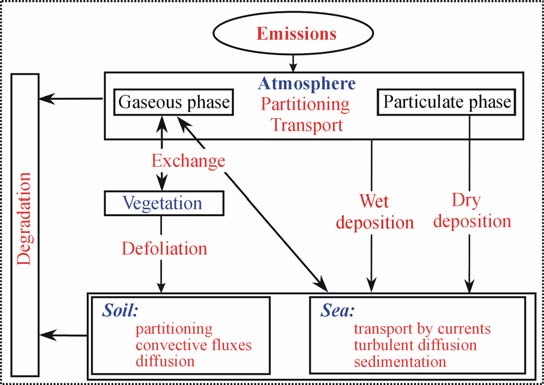
4.4.
EMEP/MSCE-POP MODEL A MODEL USED IN THE REGION
4.4.1. Introduction
For the systematic assessment of PTS contamination in the European region, a complex monitoring/modelling
approach is used. This approach includes the arrangement of a superstation network, model assessment of
contamination levels and national measurement campaigns. Apart from direct assessment of contamination
measurement data can be used for model verification and formulation.
The EMEP/MSCE-POP model is a multicompartment model describing processes in and exchange between
basic environmental compartments (atmosphere, soil, seawater, vegetation). The spatial resolution of the model
is 50 × 150 km.
Figure 4.2 presents the structure of the model showing environmental media and processes included.
Figure 4.2: Scheme of the multicompartment transport model MSCE-POP
Apart from atmospheric transport the model particularly takes into account the transport of pollutants by sea
currents. Vegetation is considered to describe their transport from vegetation to soil, and forest litter was
introduced as an intermediate media between vegetation and soil.
Model parameterizations have been elaborated for PAHs (B(a)P), HCHs (-HCH), PCBs, HCB, and PCDDs/Fs.
The structure of description for each pollutant is:
· Emissions (official EMEP data, expert estimates and emission prepared for modelling);
· Distribution of pollution between basic environmental media;
· Model assessment of environmental levels;
· Transboundary transport (for B(a)P).
At present there exists a modification of the model for evaluation of B(a)P transboundary transport by country-
to-country scheme with resolution 50 × 50 km.
In the model, atmosphere, soil, and sea are separated vertically into a number of layers to describe the vertical
transport of a pollutant in question. To describe the variability of soil and vegetation properties in the horizontal
direction the corresponding land-use and leaf area index information is taken into account.
Due to large accumulation capacities of the soil and sea compartments and the long periods required for
equilibrium to be established, long-term calculations have to be performed in order to achieve a correct
evaluation of POP environmental pollution levels. This can be illustrated by plots of long-term dynamics of
PCB accumulation in various media (Fig. 4.3) calculated for the period from 1970 to 2010 under the
assumption, that emissions from 1995 have remained on a constant level.
107
1800
1.2
1200
300
1500
1.0
1000
200
1200
0.8
800
0.6
600
100
900
0.4
400
0
600
0.2
200
Soil contents, t
-100
300
Air concentrations, 0.0
0
re-emision
-200
deposition
0
1970
1980
1990
1970
1980
1990
-300
air conc.
soil contents 1970
1980
1990
a emissions [t.y-1] b
air and soil c depositions over land [t.y-1]
Figure 4.3: Long-term dynamics of emissions (a), air concentrations and soil content (b), and re-emission and
particle deposition over land (c) for PCBs during the period from 1970 to 2010 under the assumption that
emissions have remained constant since 1995
Figure 4.3 shows that the contamination levels in soil are determined by a long-term process and can act as
secondary sources for PTSs for a long period of time.
The distribution of POPs between environmental compartments has been calculated and assessments of
environmental levels, transboundary transport have been carried out for the EMEP region (Shatalov et al.,
2000). Model calculations have been performed for the following POPs: PAHs (B(a)P), HCHs (-HCH), PCBs,
HCB, and PCDDs/Fs. At present the discrepancies between measured and calculated data for all the pollutants
considered are within an order of magnitude. The results are summarised below. More detailed information on
comparison of calculated data against measurements can be found in (Shatalov et al., 2000; Shatalov et al.,
2001). Detailed description of MSCE-POP model is published in MSC-E Report 4/2000 (vol.1) and in MSC-E
web site: www.msce@msceast.org.
4.4.2. Benzo(a)pyrene (B(a)P)
The percentage of the total environmental content of B(a)P for each media calculated for 1997 is shown in
Figure 4.4. Both terrestrial (soil and forest litter) and marine environments seem to accumulate B(a)P in
essential quantities. A large fraction of B(a)P is predicted to accumulate in forest litter which is conditioned by
filtration of B(a)P aerosol phase (which contains about 90% of the B(a)P present in the atmosphere) by forests.
About 30% of the B(a)P annually emitted in the region is predicted to be transported out of the EMEP region.
The spatial distribution of B(a)P contamination in different media has been calculated, see Figures 4.5 and 4.6.
The comparison of the spatial distributions of the air concentrations with the emissions shows good correlation.
Countries with high air concentrations are also characterised by high B(a)P concentrations in soil (Fig. 4.5a).
The model predicts high soil concentrations of B(a)P (30-60 ng.g-1) in Germany, Poland, the Czech Republic,
Slovakia, Belgium, the Netherlands, Luxembourg and in parts of the Ukraine and Russia.
108
Forest litter
45%
Air
0.13%
Soil
Sea
17%
38%
Figure 4. B[a]P redistribution between basic
compartments by 1997 calculated by EMEP/MSCE-
POP model using emission expert estimates
Figure 4.4: B(a)P redistribution between basic compartments by 1997 calculated by EMEP/MSCE-POP model
using emission expert estimates
0 - 0.01
0.01 - 10
0.01 - 0.1
10 - 50
0.1 - 0.5
50 - 100
0.5 - 1
100 - 200
1 - 3.9
200 - 711
a
b
Figure 4.5: a - B(a)P air concentrations [ng.m-3]; b - B(a)P emission in 1997 used in calculations, [g.km-2.y-1]
0.01 - 10
0.01 - 0.1
10 - 20
0.1 - 0.3
20 - 30
0.3 - 0.9
30 - 60
0.9 - 1.5
> 60
1.5 - 3
a - soil concentrations [ng.g-1] b - concentrations in sea [µg.m-3]
109
0.01 - 2
2 - 10
10 - 20
20 - 30
> 30
c - concentrations in vegetation [ng.g-1]
Figure 4.6: Spatial distribution of B(a)P contamination in main environmental compartments by 1997
The regions for which the model gave high concentrations of B(a)P in sea water (up to 3 µg.m-3) are located in
the Black Sea bordering Georgia, Russia and the Ukraine, in the Baltic Sea, and in the North Sea near Belgium
and Germany (Figure 4-6b). The concentration distribution in vegetation (Figure 4-6c) indicated high
concentrations of B(a)P in vegetation (above 10 ng.g-1) in Austria, Belgium, Bosnia and Herzegovina, Georgia,
Republic of Moldova, Romania, and Yugoslavia.
According to emission expert estimates, Poland, Russian Federation and the Ukraine make the greatest
contribution to European pollution of B(a)P (28, 91 and 18.6 t.y-1 respectively, which cover over 90% from
total European deposition). The distribution of deposition from these countries between other European
countries and regions (export charts) was constructed on the basis of calculations by EMEP/MSCE-POP model
for 1998, Figure 4.7.
Figure 4.7 shows that for Poland and Ukraine about half of their emissions of B(a)P is finally deposited in other
countries. This shows the role of transboundary transport in assessment of B(a)P contamination in the European
region.
a
b
c
Figure 4.7: Export charts for deposition from Poland (a), Russian Federation (b) and Ukraine (c) for 1998
calculated by EMEP/MSCE-POP model on the basis of expert estimates
110
Model calculations have also been used in order to estimate the contribution of B(a)P to other countries via
deposition These calculations allow us also to evaluate contributions of European countries to depositions to a
particular countries. Figure 4.8 presents this information (import charts) for the above three countries. It can be
seen that for these countries an essential part of deposition is caused by transboundary transport from other
European countries.
a
b
c
Figure 4.8: Import charts for deposition from Poland (a), Russian Federation (b) and Ukraine (c) for 1998
calculated by EMEP/MSCE-POP model on the basis of expert estimates
4.4.3. -HCH
Modelling of -HCH transport have been performed for the period from 1970 to 1997 with expert emission
estimates since the amount of official data available is very small.
The calculated distribution of -HCH contamination between environmental compartments in 1997 is presented
in Figure 4.9, where the percentage of total environmental content is given for each media.
Forest
litter
Soil
Air
16 %
11 %
0.04 %
Vegetation
0.12%
Sea
73 %
Figure 4.9: Redistribution of environmental pollution by -HCH between basic compartments by 1997
calculated by EMEP/MSC-E
The highest content of -HCH is fixed in seawater (about three fourths of the whole content). The content in
soil and forest litter constitutes together about one fourth of the total amount. The air and vegetation content of
-HCH seems to be minor. Thus the results from this calculation indicates that the marine environment plays an
appreciable role in -HCH long-range transport.
111
The spatial distributions of -HCH contamination in different media are presented in Figures 4.10 and 4.11. The
spatial distributions of -HCH in air show good correlation with the regions where emissions occurs.
0 - 0.01
0.01 - 0.1
0.1 - 1
1 - 3
3 - 5.5
a
b
Figure 4.10: a -HCH air concentrations [ng.m-3]; b -HCH emission in 1997 used in calculations, [g.km-2.y-1].
0.01 - 1
0.01 - 0.1
1 - 5
0.1 - 1
5 - 15
1 - 5
15 - 25
5 - 15
25 - 36
15- 48
a - soil concentrations [ng.g-1] b - concentrations in sea [µg.m-3]
0.01 - 5
5 - 10
10 - 100
100 - 200
200 - 493
c - concentrations in vegetation [ng.g-1]
Figure 4.11: Spatial distribution of -HCH contamination in main environmental compartments by 1997
As was the case for air concentrations, maximum soil concentrations for -HCH coincide with the maximum
emission region. The highest soil concentrations (1-36 ng.g-1) were estimated for Luxembourg and Belgium,
while slightly lower (5-15 ng.g-1) were estimated for Switzerland, the Netherlands, Germany and Austria.
The maximum seawater concentrations (up to 50 µg.m-3) were achieved in sea regions located close to major
emission sources. -HCH is entering seawater near emission sources and is then transported by sea currents up
to the northern coast of Scandinavia.
Maximum concentrations -HCH in vegetation (100-500 ng.g-1) were estimated for Luxembourg and Belgium.
Concentrations in Switzerland, the Netherlands, Ireland, Germany, the UK and Austria were in the range from
20 to 100 ng.g-1.
112
4.4.4. Polychlorinated biphenyls
Modelling of PCB transport was performed for the period from 1970 to 1998 with expert emission estimates.
We remark that the discrepancies between official data and emission expert estimates for majority of European
countries vary from 1% to 60% with exceptions for Hungary and the Netherlands.
The distribution of PCB contamination between different environmental compartments for 1998 is given in
Figure 4.12.
Forest litter
Figure 4.12: Redistribution of environmental pollution by
40 %
PCB between basic compartments by 1998 calculated by
EMEP/MSCE-POP model using emission expert estimates
Soil
Sea
29 %
31 %
The PCB mass distribution between main media shows that about 29% of total PCB contents in the
environment is contained in soil, 40% - in forest litter, and 31% - in seawater. Fractions of PCB in air and
vegetation are not shown in the diagram since their values are insignificant in comparison with other media. So,
for PCBs the main accumulating media is soil (since forest litter can be treated as the upper soil part). As seen
from calculation results re-emission from soils is essential for the description of PCB behaviour in the
environment. About 50% of annual emissions are transported outside the calculation domain, EMEP-region.
The spatial distribution of PCB contamination in different media has been estimated. Figure 4.13 shows the
PCB air concentration distribution (a) in comparison with that of the emissions (b).
a b
Figure 4.13: a - PCB air concentrations [ng.m-3]; b - PCB emission in 1998 used in calculations, [g.km-2.y-1]
Calculations made by EMEP/MSCE-POP model using emission expert estimates.
Figure 4.14 shows concentration levels of PCB in main environmental compartments other than atmosphere
(soil, sea, and vegetation).
113
a - soil concentrations [ng.g-1]
b - concentrations in sea [ng.m-3]
c - concentrations in vegetation [ng.g-1]
Figure 4.14: Spatial distribution of PCB contamination in main environmental compartments by 1998
Like in the case of air concentrations the maximum soil concentrations for PCB coincide with the maximum
emission region. Maximum soil concentrations were estimated in the middle part of Europe. However, soil
concentrations in some parts of the Scandinavian Peninsula were also relatively high. Possibly, such
concentrations can be explained by influence of forests. Similar to concentrations in soil, the estimated
maximum concentrations in vegetation (up to 270 ng.g-1) were found in the central part of Europe and in some
parts of the Scandinavian Peninsula. The maximum calculated seawater concentrations (up to 680 ng.m-3) were
achieved in sea regions located close to major emission sources.
Model reliability. At present the discrepancies between measured and calculated data for all the pollutants
considered are within an order of magnitude but in many cases are less. As an example, the results of the
comparison between measured and calculated concentrations in the lower atmospheric layer for PCB-153 are
presented (see Figure 4.15).
It can be seen that while measurements vary by two orders of magnitude, over 75% of comparisons are within a
factor of three. This is in an agreement with emission uncertainties. These results show that the model
reasonably reflects the spatial distribution of contamination. More detailed information on comparisons of
calculated data versus measurements can be found in (Shatalov et al., 2000, 2001).
100
measurement
calculation
3
10
m
pg/ 1
0
94
93
_
9
5
_
9
7
94
96
98
96
98
_94
95
42_
91_
91_
3
_97
9_
Z
t
e
r
_
94
E
SE2
SE2
O
I
96_
I
96_
F
F
I
S
I
S
C
as
D
97_91_
N
E
a
z
e
lr
igg
S
c
ania_92_
S
Lanc
H
Figure 4.15: PCB 153 mean annual air concentrations [pg.m-3]
4.4.5. Hexachlorobenzene (HCB)
Modelling was performed with expert emission estimates for the period from 1970 to 1998 since in present
the main aim of the research was investigation of long-term trends of HCB contamination.
114
Soil
Forest litter
Air
8 %
0.6 %
2.3 %
Vegetation
0.3 %
Sea
89 %
Figure 4.16: Redistribution of environmental pollution by HCB between basic compartments in 1998
The distribution of HCB between different environmental compartments is presented in Figure 4.16. This
distribution shows that more than 80% of total HCB content in the environment is contained in seawater. Thus,
HCB is mainly accumulated in the marine compartment. Further, according to the model calculations,
vegetation plays insignificant role in HCB long-range transport and accumulation in the environment. This
conclusion is also confirmed by measurement results (see Shatalov et al., 2001). Calculations show that more
than 80% of annual emissions are transported outside the calculation domain.
Here spatial distributions of HCB contamination of different media are characterised. Figure 4.17 shows the
HCB air concentration distribution (a) in comparison with emissions (b).
0.01 - 0.03
0.03 - 0.04
0.04 - 0.06
0.06 - 0.08
0.07 - 0.13
a b
Figure 4.17: a - HCB air concentrations [ng.m-3]; b - HCB emission in 1998 used in calculations [g.km-2.y-1]
Calculations made by EMEP/MSCE-POP model using emission expert estimates
The distribution of atmospheric concentrations of HCB over the European region is much more uniform than
for other considered pollutants. This is conditioned by high HCB persistence in the atmosphere (the
corresponding half-life is about 1.8 year) and, as a consequence, high ability to the long-range transport.
The concentration levels of PCB in soil and seawater are shown in Figure 4.18 (vegetation is not considered
since the content in this compartment is comparably small). A map of HCB concentration distribution in soil is
presented in Figure 4.18a. The comparison of this map with that of emission allows to draw a conclusion that
soil pollution levels are not defined by the emissions of the current year and they are formed in the process of
long-term accumulation.
The map of sea concentration distribution (Fig. 4.18b) shows that HCB is emitted both by European sources
and that there is an inflow to the calculation grid through its northern and western boundaries. Clearly, like to
the case of air concentrations the hemispheric model can essentially correct spatial distribution of HCB share
transported by sea currents to the EMEP region from outside. These results are preliminary and are to be
refined by usage of hemispheric version of the model.
115
0.01 - 0.05
0 - 2
0.05 - 0.08
2 - 5
0.08 - 0.1
5 - 10
0.1 - 0.2
10 - 15
0.2 - 0.35
15 - 37
a - soil concentrations [ng.g-1] b - concentrations in sea [ng.m-3]
Figure 4.18: Spatial distribution of HCB contamination in soil and seawater by 1998. Calculations by
EMEP/MSCE-POP model using emission expert estimates
Due to the high persistence and volatilization ability of some PTS, the may be transported from the European
region and will contribute to the contamination of other regions. The spatial distribution of HCB air
contamination from European sources over the Northern Hemisphere calculated by hemispheric version of
MSCE-POP model is exemplified in Figure 4.19 (Malanichev et al., 2002). The figure shows that European
sources can contribute to HCB air contamination in such remote regions as Asia, the Arctic and North America.
< 0.001
0.001 - 0.002
0.002 - 0.005
0.005 - 0.01
0.01 - 0.05
> 0.05
Figure 4.19: Spatial distribution of HCB air concentrations from European sources [ng.m-3]. Calculations made
by hemispheric version of MSCE-POP model for 1990.
4.4.6. PCDDs/Fs
Modelling of PCDDs/Fs transport was performed for the period from 1970 to 1999. Note that all the
calculations were made in I-TEQ.
The distribution of PCDDs/Fs contamination between environmental compartments in 1999 is presented in
Figure 4.20 which gives the percentage of total environmental content for each media.
116
Soil
75.6 %
Air
Vegetation
0.06 %
0.73 %
Sea
Forest litter
1.55 %
22.03 %
Figure 4.20: Redistribution of environmental pollution by PCDDs/Fs between basic compartments by 1999
This distribution shows that similar to the case of PCBs the main accumulating compartment for PCDDs/Fs is
soil. The calculations show that about 60% of PDCC/F annual emissions are transported outside the calculation
domain.
The spatial distributions of PCDD/F contamination of different media have been estimated. Figure 4.21 shows
PCDD/F air concentration distribution together with emission distribution for 1999.
0.01 - 1.5
0.001 - 0.2
1.5 - 5
0.2 - 1
5 - 10
1 - 2
10 - 20
2 - 5
20 - 50
5 - 10
a b
Figure 4.21: a PCDDs/Fs air concentrations [fg I-TEQ.m-3]; b PCDDs/Fs emission in 1999 used in
calculations [ng I-TEQ.m-2.y-1]
According to calculations, maximally polluted countries (with average concentration level above 20 fg.m-3) are
Czech Republic (concentration range is 12 52 fg.m-3), Switzerland (8 31 fg.m-3), Luxembourg (23 fg.m-3),
Belgium (10 27 fg.m-3), and Slovakia (10 28 fg.m-3).
Soil concentrations vary from 0 to 20 pg.g-1 (Fig. 4.22a). Maximally polluted countries (with average
concentration level above 10 pg.g-1) are Luxembourg (15 pg.g-1), Belgium (11 22 pg.g-1), the Netherlands (0.5
22 pg.g-1), and Germany (0.5 22 pg .g-1).
Seawater concentrations (Fig. 4.22b) range between 0.01 and 150 fg.l-1. Maximum concentrations (above 30
fg.l-1) are achieved in waters washing Belgium (66 159 fg.l-1), the Netherlands (18 159 fg.l-1), and Poland
(32 67 fg.l-1).
Maximum concentrations (with average concentration level above 10 pg.g-1) are found in the following
countries: Luxembourg (19 pg.g-1), Belgium (2 19 pg.g-1), and Czech Republic (4 19 pg.g-1).
117
0.01 - 1
0.01 - 1
1 - 2
1 - 10
2 - 5
10 - 20
5 - 10
10 - 20
20 - 50
50 - 150
a - soil concentrations [pg I-TEQ.g-1] b - concentrations in sea [fg I-TEQ.l-1]
0.01 - 1
1 - 3
3 - 5
5 - 10
10 - 17
c - concentrations in vegetation [pg I-TEQ.g-1]
Figure 4.22: Spatial distribution of PCDDs/Fs contamination in main environmental compartments in 1999
4.5.
EXPERIMENTAL EVIDENCE FOR LONG-RANGE TRANSPORT (LRT)
As previously discussed, atmospheric and multimedia transport models are useful tools for estimating the
potential of a chemical to be transported long distances. However, in order to provide experimental evidence,
measurements are required. Reliable experimental data that support model predictions for a number of POPs,
can encourage application of models to other substances. Lack of experimental data however, makes it
impossible to validate or evaluate model predictions.
Measurements of POPs have been carried out in areas in the European region far from any potential point
sources of the chemical. POPs have been detected in background and remote areas in Europe (See Chapter
Levels 3.1).
Detection of a substance at remote locations where it has never been used provides evidence for long-range
transport, since it means that the chemical has actually managed to get there in one way or another. However,
the precise analytical methods we possess today enable us to detect any substance almost anywhere and pure
detection may not necessarily be an evidence for high transport potential.
In order to obtain experimental evidence for the LRT potential of POPs in a particular region more extensive
investigations are required. For example, such an investigation could include sampling along a vertical (or
horizontal) transect in one or more environmental media with the aim to provide information on changes in
concentrations when moving away from identified point sources or larger source areas.
If concentrations decline quickly, then LRT is unlikely to occur, but if a shallow slope of the concentration
curve is obtained, then LRT might be an issue. For some compounds and media an increase in concentration
might even be possible when moving away from the source, due to the so-called "global fractionation effect",
118
which suggest that persistent low volatile substances are transported from temperate regions to regions with
colder climate (e.g. Simonich and Hites, 1995; Wania and Mackay, 1996).
Airborne concentrations of polychlorinated biphenyls (PCBs) and hexachlorobenzene (HCB) were measured by
using passive air samplers (SPMDs) along a latitudinal transect from the south of the UK to the north of
Norway during 1998-2000 (Meijer et al, in prep)
Spatial trends of the 1998-2000 data show a decrease in absolute sequestered amounts of the heavier PCBs with
increasing latitude / distance from the source area, whereas the lighter PCBs were more equally distributed
along the transect. However, relative sequestered amounts (expressed as % of total PCB) show a clear
latitudinal trend with the relative contribution of the lighter congeners increasing with increasing latitude,
providing evidence of latitudinal fractionation. Absolute amounts of HCB are increasing with increasing
latitude, suggesting this compound is undergoing cold condensation / grass hopping.
Similarly, the spatial variation of PCB concentrations in soil has recently been investigated along the same
transect mentioned above, but at 41 sampling stations evenly distributed from the southern UK to Bear Island
off the coast of northern Norway (Meijer et al., 2002). The results indicated that the relative concentrations of
more volatile PCBs (tri-and tetrachlorinated) increased with latitude, which supports the idea of global
fractionation and long-range transport of PCBs.
Grimalt et al. (2001) studied the variation of fish and sediment concentration of various organochlorine
compounds (OCs; e.g. PCBs, DDT, HCHs) in European mountain lakes. The study showed that concentrations
of less volatile organochlorines in fish and sediment increased with altitude, which was assigned the effect of a
decrease in temperature. These findings also support the theory of global fractionation and long-range transport.
Agrell et al (1999) found a negative relationship between latitude and concentration of POPs, such as PCBs, in
the atmosphere of the Baltic Sea area. This south to north gradient of semivolatile POPs could be the result of a
"regional distillation" process, where POPs used in the warmer climate regions of the Baltic (or further south,
in the equatorial region) are volatilised and driven by temperature gradients to colder areas.
Table 4.3 lists the modelled or measured indications for long-range transport of selected substances.
Table 4.3: List of modelled or measured indications for long-range transport of selected substances. Substances
in italic font have not been assessed. A: More than 10 times higher potential than DDT (LEQ >10) B:
1<LEQ<10 C: 0.1<LEQ<1 D: LEQ<0.1 LEQ = Long-Range Transport Equivalents; reference substance p,p'-
DDT
Substance
Air LRT Water LRT LRT potential Measurements
Main
References
potential
potential
(Expert
indicating LRT?
transport
(modelled)
judgement)
medium
(modelled)
Aldrin D C
No
water
Chlordane
C C
Yes
air,
water
Brorström-Lundén,
regular monitoring
DDTs C C
Yes
air,
water
Calamari,
1991,
Muir et al., 1995
Dieldrin
C
B
yes
water
Muir et al., 1995?
Endrin C B
yes
water
Heptachlor C
D
air
HCB A C
yes
air
Calamari,
1991,
Simonich & Hites,
1995
Mirex
A+
Toxaphene
B B
yes
air,
water
PCBs
B-C
C
yes
air
Iwata et al., 1993,
Muir et al., 1996;
Simonich & Hites,
1995
Dioxins B-C C
yes
air
119
Substance
Air LRT Water LRT LRT potential Measurements
Main
References
potential
potential
(Expert
indicating LRT?
transport
(modelled)
judgement)
medium
(modelled)
Furans B-C B-C
yes
air,water
HCHs
A-B
B
yes
air
Iwata et al., 1993;
Simonich & Hites,
1995
PCP B B
?
air,
water
PAHs C-D
B-C
yes
water
numerous...
Org. Mercury
?
Compunds
Org. tin
D no
compounds
Org. lead comp.
D
no
PBDE B-C
C
yes
air several...
Phthalates B-C C-D
?
air
Endosulphan C
B-C
no
water
Atrazine
D A
no
water
Chlordecone
Octylphenols
D no
Nonylphenols
D no
Chlorinated
B no
Paraffins
Main purpose of model: A: Ranking B: PECs C: Budgets D: Distribution E: TBT F: Persistence
4.6.
CONCLUSIONS
Transboundary transport is important for the occurrence of PTS in the European region. Atmospheric transport
processes are important pathways for PTS to both aquatic and terrestrial ecosystems.
The evidence of LTR in the region has been investigated both with measurements and modelling.
An integrated monitoring/modelling approach is applied for assessment of PTS contamination in the European
region. This approach includes arrangement of superstation network, model assessment of contamination levels
and national measurement campaigns. In modelling activities accumulation in the compartments other than
atmosphere is important.
At present there exist a lot of multicompartment PTS transport models both steady-state and dynamic
describing PTS fate in the environment (see Tables 4 1 and 4 2 above). In the framework of LRTAP
Convention the EMEP/MSCE-POP model is used for assessment of PTS contamination in the region.
Modelling activities are useful for evaluation of PTS redistribution between various environmental
compartments, long-term trends of environmental contamination, spatial distribution of concentrations in
different media (atmosphere, soil, seawater, vegetation) and transboundary transport.
Some PTS possess very high long-range transport potential and hemispheric/global scale is reasonable for them
to assess European contamination. The hemispheric version of EMEP/MSCE-POP model indicates the ability
of some PTS to transport to and from the European region.
PTS often possess very high long-range transport potential and hemispheric/global scale is reasonable to assess
European contamination. The results of EMEP/MSCE-POP model indicate the ability of some PTS such as
PCBs, PCDDs/Fs, -HCH.
120
4.7.
REFERENCES
Agrell, C., Okla, L., Larsson, P., Backe, C., Wania, F. (1999): Evidence of Latitudal Fractionation of Polychlorinated Biphenyl Congeners along the
Baltic Sea Region. Environ. Sci. Technol, 33, 1149-1156.
Berding, V., Matthies, M. (2002): European Scenarios for EUSES regional distribution model. Environ. Sci. & Pollut. Res. 9(3), 193-198.
Beyer, A, Matthies, M. (2001): Criteria for Atmospheric Long-range transport Potential and Persistense of Pesticides and Industrial Chemicals R &D
Project FKZ 299 65 402 E. Schmidt Verlag, Berlin, Germany
Beyer, A., Mackay, D., Matthies, M., Wania, F., Webster, E. (2000): Assessing long-range transport potential of persistent organic pollutants. Environ.
Sci. Technol. 34, 699-703.
Boeije, G.M., Vanrolleghem, P.A. and Matthies, (1997) A geo-referenced aquatic exposure prediction methodology for 'down the drain' chemicals. Wat.
Sci. Technol. 36, 251-258.
Breivik, K., Wania, F. (2002): Evaluating a model of the historical behavior of two hexachlorocyclohexanes in the Baltic Sea environment. Environ. Sci.
Technol. 36, 1014-1023.
Breivik, K., Wania, F.(2002): Mass budgets, pathways and equilibrium states of two hexa-chlorocyclohexanes in the Baltic Sea environment. Environ.
Sci. Technol. 36, 1024-1032.
Canadian Environmental Modelling centre (CEMC). 1996. ChemCan Program. Level III Fugacity Model of Regional Fate of Chemicals. Trent
University, Peterborough, Ontario, Canada
Clark, B, Henry, J. G., Mackay, D. (1995): Fugacity Analysis and Model of organic chemical fate in a sewage treatment plant. Environ. Sci. Technol. 31,
577-583.
Diamond, M. L., Priemer, D. A., Law, N. L. (2001): Developing a multimedia model of chemical dynamics in an urban area. Chemosphere 44, 1655-
1667.
EC (1996): EUSES the European System for the Evaluation of Substances. Institute Institute of Public Health and the Environment (RIVM), The
Netherlands
Grimalt, J. O., Fernandez, P., Beride, L, Vilanova, R. M., Catalan, J., Psenner, R., Hofer, R., Appleby, P. G., Rosseland, B. O., Lien, L., Massabuau, J.
C., Battarbee, R. W. (2001): Selective Trapping of Organochlorine Compounds in Mountain Lakes of Temperate Areas. Environ. Sci. Technol. 35, 2690-
2697.
Mackay, D., Joy, M., Paterson, S. (1983a): A quantitative water, air, sediment interaction (QWASI) fugacity model for describing the fate of chemicals in
lakes. Chemosphere 12, 981-997.
Mackay, D., Paterson, S., Joy, M. (1983b): A quantitative water, air, sediment interaction (QWASI) fugacity model for describing the fate of chemicals in
rivers. Chemosphere 12, 1193-1208.
Mackay, D., Paterson, S., Shiu, W. Y. (1992): Generic Models for Evaluating the Regional Fate of Chemicals. Chemosphere 24, 695-717.
Mackay, D., Di Guardo, A., Paterson, S., Kicsi, G., Cowan, C.E. (1996a): Assessing the fate of new and existing chemicals: a five-stage process.
Environ. Toxicol. Chem. 15, 1618-1626.
Mackay, D., Di Guardo, A., Paterson, S., Cowan, C. E. (1996b): Evaluating the environmental fate of a variety of types of chemicals using the EQC
model. Environ. Toxicol. Chem. 15, 1627-1637.
Mackay, D., Di Guardo, A., Paterson, S., Kicsi, G., Cowan, C. E., Kane, D. M. (1996c): Assessment of chemical fate in the environment using
evaluative, regional and local-scale models: illustrative application to chlorobenzenes and linear alkylbenzene sulfonates, Environ. Toxicol. Chem. 15,
1638-1648.
MacLeod, M., Woodfine, D.G., Mackay, D., McKone, T., Bennett, D., Maddalena, R. (2001): BETR North America: A regionally segmented multimedia
contaminant fate model for North America. ESPR 8 (3), 156 - 163.
Meijer, S. N., Steinnes E., Ockenden, W. A., Jones, K. C. (2002): Influence of Environmental Variables on the Spatial Distribution of PCBs in
Norwegian and U.K. Soils: Implications for Global Cycling. Environ. Sci. Technol. Published on Web, April 2002.
Meijer, S. N., Ockenden, W. A., Steinnes, E., Corrigan, B. P., Jones, K. C. (in prep): The use of semi-permeable membrane devices (SPMDs) to measure
spatial and temporal trends of POPs in European background air.
Pacyna J.M. et al., (1999): Technical Report. Appendix 1 to Executive Final Summary Report. Environmental Cycling of Selected Persistent Organic
Pollutants (POPs) in the Baltic Region (Popcycling-Baltic project). Contract No. ENV4-CT96-0214. CD-Rom.
Palm, A. (2001): The Environmental Fate of Polybrominated Diphenyl Ethers in the Centre of Stockholm Assessment Using a Multimedia Fugacity
Model. Master of Science Thesis, IVL B 1400. Can be downloaded from http://www.ivl.se
Scheringer, M. (1996): Persistence and spatial range as end-points of an exposure based assessment of organic chemicals. Environ. Sci. Technol. 30,
1652-1659.
Scheringer, M. (1997): Characterization of the environmental distribution and behaviour of organic chemicals by means of persistence and spatial range.
Environ. Sci. Technol. 31, 2891-2897.
Shatalov, V., Malanichev, A., Vulykh, N., Berg, T., Manø, S. (2001): Assessment of POP Transport and Accumulation in the Environment. EMEP/MSC-
E Report 4/2001.
Shatalov V, Malanichev, A. (2000): Investigation and assessment of POP transboundary transport and accumulation in different media. Part II. MSCE-E
EMEP Report 4/2000.
Simonich, S. L., Hites, R. A. (1995): Global distribution of persistent organochlorine compounds. Science 265, 1851-1854.
Sweetman, A. J., Cousins, I. T., Seth, R., Jones, K.C., Mackay, D. (2002): A dynamic Level IV multimedia environmental model: Application to the fate
of PCBs in the United Kingdom over a 40-year period. Environ. Toxicol. Chem., 21(5), 930-940.
121
Van de Meent, D. (1993): SimpleBox: A generic multimedia fate evaluation model. National Institute of Public Health and the Environment (RIVM).
Report no. 672720 001, Bilthoven, The Netherlands
Wania, F., Mackay, D. (1995): A global distribution model for persistent organic chemicals. Sci. Total Envir. (1995) 160/161, 211-232.
Wania, F, Mackay, D. (1996): Tracking the distribution of persistent organic pollutants. Environ. Sci. Technol., 30, 390A- 396A.
Wania, F, Mackay, D. (1993): Global fractionation and cold condensation of low volatility organo-chlorine compounds in polar regions. Ambio, 22, 10-
18.
Wania, F., Persson, J., Di Guardo, A., McLachlan, M S. (2000a): The POPCYCLING-Baltic Model. A Non-steady State Multicompartmental Mass
Balance Model of the Fate of Persistent Organic Pollutants in the Baltic Sea Environment. Norwegian Institute for Air Research (NILU 0R 10/2000).
Available at www.scar.utoronto.ca/~wania
Wania, F., Persson, J., Di Guardo, A., McLachlan, M. S. (2000b): CoZMo-POP A Fugacity-Based Multi-Compartmental Mass Balance Model of the
Fate of Persistent Organic Pollutants in the Coastal Zone, WECC Report 1/2000. Available at www.scar.utoronto.ca/~wania/
122
5.
PRELIMINARY ASSESSMENT OF THE REGIONAL CAPACITY AND
NEED TO MANAGE PTS
5.1.
INTRODUCTION
Region III has 29 countries, 22 of them signed and 8 already ratified SC. Many countries of the Region also
signed (24 from 36 which signed this Protocol in that time) and ratified (11 from 12) the Aarhus Protocol to the
Convention on Long-Range Transboundary Air Pollution on POPs.
The production and use of PCBs and OCPs are restricted or banned with very few exceptions. Air, water, soils,
plants and foods are legally protected against hazardous substances in the Region. The PTS inventories of
releases to air, water, land and products are an ongoing process. Few countries have complex emission
inventories based on the measurement of real emission factors, all countries based on EMEP and CORINAIR
activities are using the European Atmospheric Emission Guidebook for annual inventory, but lack of actual
inventories exist as far as water and land releases and the products contents of PTS. The most "open" problem
is PTS by-products such as PCDDs/Fs, PAHs, HCB. Also the inventory of obsolete pests is on the acceptable
level. The evidence of PTS hot spots remains a problem in CEECs.
5.2.
MONITORING CAPACITY
5.2.1. Introduction
The use of chemicals almost inevitably means that in many cases some portion of the used volumes ends up in
the environment. It is thus essential that the levels of some of these substances in the environment be measured
to check that the use does not result in concentrations that are unacceptable to human health or to the
environment.
A large number of measurements are being performed every year on environmental pollutants in monitoring
and survey type programs. To some extent these activities are harmonised in regional programmes, such as the
water quality (GEMS/WATER) and the marine programs for the Northeast Atlantic (OSPAR), but a lot remains
to be done in order to produce consistent and comparable results that may be used for a wide variety of
purposes e.g. emission controls, remediation, physical planning and regulatory purposes. Furthermore, many of
the data are neither publicly available nor accessible, which makes them useful only for limited purposes. This
situation is far from ideal and there is room for improvement. At present several new activities are being
initiated e.g. the water quality control programme in Europe under the Water Framework Directive.
A measurement is normally designed to answer a specific question and often the possibility to use the results
for other purposes are not considered. Measurements are often labour and instrument intensive and the results
are therefore expensive to obtain. It is thus essential that they can be used as effectively and as broadly as
possible. Measured data can be used for many purposes, e.g. to study:
· the emission strength of a specific source
· the distribution of such an emission
· the presence of a chemical in pristine or background areas
· the geographic distribution of a chemical
· temporal trends of a chemical in the environment
· specific exposure situations.
These are the most commonly expressed aims with monitoring programmes, but it should be kept in mind that
the data may also be used for a number of other purposes e.g. to determine the bioaccumulation,
biomagnification and other specific parameters of a chemical. The risk assessment of a chemical or chemicals
is also heavily dependent on existing exposure data and there is normally no time and few resources to start
new targeted measurements and the assessor has to rely on existing data.
The quality of the result of a measurement depends on a number of factors, both for the sample itself and for
the measurement. The major problem in sampling is obtaining "representative" samples. The quality of the
123
measurement is also influenced by a number of factors. The accuracy, which describes the difference between
the result and true value, is often difficult to determine, as the latter is not known. Repeatability (inter-
laboratory variation) and reproducibility (intra-laboratory variation) can be determined in calibration exercises.
Data produced within an individual monitoring program are often, but not always, comparable due to the design
of the program and calibrations performed within the program. Differences may occur over time as new
analytical methods or sampling techniques are introduced to the programme. Comparing data from different
programs is more difficult for a number of reasons. Different sample matrices (different fractions of a sediment,
different species, different ages etc) can make it almost impossible to compare results without extensive
investigations of the origin etc. of the data. Also different types of calculations (wet or dry weight basis, wet
weight or lipid weight basis, etc) may inadvertently make the results difficult to compare if not all the necessary
information for recalculations are available.
There is obviously room for increased harmonisation of measurements of chemicals in the environment.
Ongoing monitoring programmes are to some extent harmonised and data from e.g. national activities are often
fed into regional or global programmes an operation for which harmonisation is a prerequisite. Smaller
programmes and surveys may be less well planned and thus the results are often difficult to compare with those
from other, more systematic, investigations.
5.2.2. Existing regional monitoring programmes
· Since 1976, the Global Environment Monitoring System - Food Contamination Monitoring and
Assessment Programme, which is commonly known as GEMS/Food, has informed governments, the
Codex Alimentarius Commission and other relevant institutions, as well as the public, on levels and
trends of contaminants in food, their contribution to total human exposure, and significance with regard
to public health and trade. GEMS/Food-EURO made a major contribution to the preparation of the
book "Concern for Europe's Tomorrow", one of the most comprehensive surveys on environmental
health ever carried out in Europe. The book includes assessment of exposure to several important
chemical contaminants in food.
· The GEMS/Water programme is a multi-faceted water science programme oriented towards
understanding freshwater quality issues throughout the world. Major activities include monitoring,
assessment, and capacity building. The implementation of the GEMS/Water programme involves
several United Nations agencies active in the water sector as well as a number of organizations around
the world.
· The EMEP programme (Co-operative Programme for Monitoring and Evaluation of the Long-Range
Transmission of Air pollutants in Europe) has been established to regularly provide Governments and
subsidiary bodies under the LRTAP Convention with qualified scientific information to support the
development and further evaluation of the international protocols on emission reductions negotiated
within the Convention. The Aarhus Protocol on POPs was signed by 36 countries in 1979, among
which, many European countries, Canada and United States of America. The POPs protocol sets out
provisions for 16 persistent pollutants.
· The Convention on the Protection of the Marine Environment of the Baltic Sea Area was agreed in
1992. The governing body of the Convention is the Helsinki Commission - Baltic Marine Environment
Protection Commission - also known as HELCOM. The Commission publishes every five years a
"Periodic Assessment of the State of the Environment of the Baltic Marine Area" based on monitoring
activities going on in the area.
· The Convention for the Protection of the Marine Environment of the North-East Atlantic (OSPAR
Convention) was signed in 1992. In 1994 the OSPAR Commissions agreed to develop a new joint
monitoring programme for the maritime area of the Oslo and Paris Conventions and to update the Joint
Monitoring Programme of the Oslo and Paris Commissions and the Monitoring Master Plan of the
North Sea Task Force. The new joint monitoring programme is called the 'Joint Assessment and
Monitoring Programme (JAMP)'. The region covered by the monitoring programme is the North-East
Atlantic which, in turn, is divided in five regions: Arctic Waters (Region I), the Greater North Sea
(Region II), the Celtic Seas (Region III), the Bay of Biscay and Iberian Coast (Region IV) and the
Wider Atlantic (Region V). Persistent pollutants are measured to a varying extent in the different
regions. The most commonly represented are PCBs, tributyltin, mercury and PAHs. The Commission
has published an extensive Quality Status Report in 2000.
124
· The Caspian Environment Programme (CEP) is a regional programme developed for and by the five
Caspian Littoral States, Azerbaijan, Iran, Kazakhstan, Russia and Turkmenistan, aiming to halt the
deterioration of environmental conditions of the Caspian Sea and to promote sustainable development
in the area. Similarly at the region of Black Sea, a lot of research and monitoring projects, which cover
also PTS, was initiated (NATO, EC).
5.2.3. Local monitoring
A lot of measurements were done in countries such as UK, Sweden, Germany, the Netherlands, the Czech
Republic. On the other hand, a lot of countries mainly from the Eastern part of Region III (Moldova, Belarus,
Ukraine) have no ambient air measurements and limited information concerning other environmental
compartments. The main regional rivers such as Elbe, Rhine or Danube and their main tributaries are frequently
and regularly monitored, but a worse situation in the case of Russian and some other rivers, where alack of
information still exists. Lakes are very useful for trend analysis, the study of historical development of
contamination, but these topics are the subject of various research projects mainly. Soil contamination is also
determined mainly on the national level as typical local problems. In some cases, more complex projects
covering more than one country exist. For example, the study of spatial and temporal variation or
contamination of boarder regions (UK, Germany, Czech Republic), were performed during last ten years.
All countries of the region have some national programme concerning thestudy of human exposure and food
contamination. Of course, there are a lot of differences as far as the size and scopeof these programmes.
5.3.
EXISTING REGULATION AND MANAGEMENT STRUCTURES
5.3.1. International
Pollution issues are covered by several international agreements or arrangements that form an important focus
for political efforts aimed at reducing impacts of PTS contamination on the environment and its ecosystems in
the Region III. The following have particular relevance to the UNEP assessment of the Region III:
· Convention on Long-range Transboundary Air Pollution (CLRTAP), 1998
· Convention for the Protection of the Marine Environment of the North East Atlantic (OSPAR), 1992
· International Convention for the Prevention of Pollution from Ships, 1973, as modified by the Protocol
of 1978 (MARPOL 73/78)
· Rotterdam Convention on the Prior Informed Consent Procedure for Certain Hazardous Chemicals and
Pesticides in International Trade,
· Basel Convention on the Control of Transboundary Movements of Hazardous Wastes and their
Disposal
· Stockholm Convention on Persistent Organic Pollutants
· WHO Environmental Health Criteria
5.3.2. Regional
EC Directives relevant for the regional PTS Strategy:
· Council Directive 91/414/EEC provides the framework for the authorisation, the placing of plant
protection products on the market and its use in the European Union.
A working programme for all existing active substances, is set up by the Directive (Art. 8(2)). All active
substances on the market in Member States on 25 July 1993 must undergo a full evaluation verifying whether
they fulfil the obligations of Art. 5 and therefore can be listed in Annex I of the Directive. This list contains active
substances whose use in plant protection products is considered safe. Substances addressed proposed ban of
organotins as plant protection products non-inclusion of Quintozene and Lindane in Annex I.
· Council Directive 98/8/EC on placing on the market of biocides.
After full implementation of this Directive, all active substances have to be assessed and approved on the
Community level and all the biocidal products have to be authorised by the Member States. If the result of the
assessment is that an active substance can be used in a biocidal product, it will be put on a positive list
accompanied with the requirements on that use. Substances addressed PeCP, PAHs (creosote), TBT, Lindane
125
· Council Directive 79/117/EEC prohibiting the placing on the market and use of plant protection
products containing certain active substances.
Substances addressed DDT, Lindane, Aldrin, Chlordane, Dieldrin, Endrin, HCH, Hexachlorobenzene,
Camphechlor, Mercury.
· Council Directive 76/769/EEC on the approximations of the laws, regulations, and administrative
provisions of the Member States relating to restrictions on the marketing and use of certain dangerous
substances and preparations. According to Council Regulation 793/93/EEC on the systematic
evaluation and control of the risks of existing substances risk assessments are carried out and risk
reduction strategies are developed, possibly resulting in amendments under Council Directive
76/769/EEC.
National information on the import, production, stockpiling, use and export of substances is requested. Marketing
and use restrictions based on evaluation of risk as well as socio-economic considerations. 4 priority lists
(containing about 150 substances and identified Rapporteur Member States) have been established for carrying
out the risk assessment work under regulation no 793/93 (2001).
Substances addressed 9th amendment: 91/173/EEC: restricts use (with exceptions) of pentachlorophenol (PCP)
for wood preservation in concentrations greater than 0.1% by mass. 1999/51/EC: PCP and its salts and esters shall
not be used in concentrations equal to or greater than 0.1 % by mass in substances or preparations placed on the
market. Member States shall apply appropriate provisions as from 1st September 2000. The use of PCP, NaPCP
and PCPL will cease by the end of 2008 in all EU Member States. 94/60/EC: PAH (Creosote).
· 2000/76/EEC on waste incineration.
Emission limit values on emissions of particles and total organic matter from incineration of all type of waste.
This is of relevance when e.g. incinerating obsolete pesticides. Substances addressed e.g. PAH, PCDD/PCDF,
mercury.
· Directive 1999/31/EEC on the landfill of waste provides that only treated waste can be landfilled.
Provides measures, procedures and guidance to prevent or reduce pollution of surface waters, ground water, soil
and air from landfills of waste This could be of relevance when e.g. landfilling obsolete pesticides. Waste
containing HELCOM Hazardous substances needs appropriate treatment before landfilling; in particular relevant
for metals where there may be borderline cases.
· Council Directive 2000/60/EC of the European Parliament and of the council establishing a framework
for Community action in the field of water policy (Water Framework Directive).
This Directive contains provisions on measures aimed at progressively reducing (for priority substances) and at
ceasing or phasing out (for priority hazardous substances, within 20 years) discharges, emissions and losses as
well as identification of these priority substances and hazardous priority substances (emission inventories
according to Article 13(4)). This is the same objective as for Recommendation 19/5 substances. Of special
relevance to the work of the Project Team on Hazardous Substances are Article 1 (c) (...cessation of discharges,
emissions and losses of priority hazardous substances), Article 2 (29-31), Article 4 (a (iv)), Article 16 (Strategies
against pollution of water) and Annexes VIII-X). The EC has two years to propose control measures necessary to
reach the objectives for priority (hazardous) substances. These substances will have to be monitored as mandatory
parameters under the WFD. Non-compliance with the requirements of the WFD leads to penalties.
Substances addressed:
proposed priority hazardous substances: pentaBDPE, Cd, SCCPs, HCB, HCHs, Hg, NP/NPEs,
PAHs, Petachlorobenzene, Tributyltin compounds, Hexachlorobutadiene;
proposed possible priority hazardous substances: other brominated diphenylether (PBDP)
Dibutylphthalate and Diethylhexylphtalate, Pb, PsCP, Naphthalene, Anthracene, Atrazine,
Chlorpyrifos, Endosulfan, Trifluralin, Trichlorobenzenes, Octylphenols);
proposed other priority substances: Alachlor; Benzene; Chlorfenvinphos; Dichloromethane; 1,2-
Dichloromethane; Diuron; Isoproturon; Nickel; Simazine; Trichloromethane (also subject to
emission controls and quality standards in accordance with Article 16 of the Water Framework
Directive)
· Council Directive 76/464/EEC on pollution caused by certain dangerous substances discharged into the
aquatic environment of the Community.
Established two lists of substances classified as hazardous. List I identified 129 substances to be eliminated from
the environment because of their toxicity and their bioaccumulation. List II contained those, which have a
detrimental impact on the environment but which may be contained within a given area depending on the
characteristics and location of the area. The Directive required Member States to draw up authorisation limits for
126
emissions of substances on both lists and set up pollution programmes. The Directive set up a framework for the
elimination or reduction of discharges of dangerous substances to inland and coastal waters through six daughter
directives, which established emission limits for specific substances on List I of the Annex to the Directive.
· Council Directive 86/280/EEC on limit values and quality objectives for discharges of certain
dangerous substances included in List I of the Annex to Directive 76/464/EEC (Council Directive
76/464/EEC of 4 May 1976 on pollution caused by certain dangerous substances discharged into the
aquatic environment of the Community).
This Directive lays down, pursuant ot Article 6 of Directive 76/464/EEC, limit values for emission standards for
the substances referred to in Article 2 in discharges from industrial plants, quality objectives in the aquatic
environment, time limits for compliance, reference methods of measurement. It establishes a monitoring
procedure, requires Member States to cooperate and to draw up programmes to avoid or eliminate pollution
arising from the sources referred to in Article 5. The Directive applies to the waters referred to in Article 1 of
Directive 76/464/EEC, with the exception of ground water. Substances addressed: DDT, the Drins, PCP,
Hexachlorobenzene.
· Council Directive 80/68/EEC on the protection of ground water against pollution caused by certain
dangerous substances.
Replaces Article 4 of Council Directive 76/464/EEC. Its aim is to prevent the direct or indirect introduction of
substances in List I and limit the substances in List II of the Annex to groundwater supplies. It will become part
of the overall approach of the draft Community Water Policy Framework Directive.
· Council Directive 67/548/EEC concerning the classification and labelling of dangerous substances and
preparations.
Dangerous substances, which are placed on the market have to be labelled according to their classification in
Annex I of Directive 67/548/EEC, which in 2001, contains approximately 2350 existing and 214 new substances.
For dangerous substances not in Annex I, the manufacturer, distributor and importer is obliged to apply a
provisional classifications and labelling following the criteria in Annex VI of this directive. Substances addressed
2350 existing and 214 new substances.
· Council Directive 96/61/EC concerning integrated pollution prevention and control (IPPC).
The objective is to prevent or minimise air, water and soil pollution by emissions from industrial installations in
the Community, with a view to achieving a high level of environmental protection. This Directive requires the
assessment of chemicals used in certain production processes and certain conditions for the licensing of industrial
installations. In the context of the execution of the Directive so called BAT notes are elaborated laying down
requirements for progressive technologies. Such BAT notes are foreseen e.g. for PCB sources such as certain
combustion sources (for power generation and waste incineration) and production and processing of metals.
Article 15 (3) of the Directive requires Member States to inventory and supply data on principal emissions and
responsible sources, that is from all large facilities with one or more activities as mentioned in Annex I to this
Directive. According to this Article 15 the Commission decided on the implementation of an European Pollutant
Emission Register (EPER). Substances addressed e.g. PCP, HCB, HCH, PCDD + PCDF (dioxins and furans),
Organotin compounds, sectors, where hazardous substances are emitted: energy industries, production and
processing of metals, mineral industry, chemical industry and chemical installations for the production of basic
organic chemicals, basic inorganic chemicals or fertilisers, biocides, pharmaceuticals; pulp and paper industry,
textile pre-treatment and finishing, etc.
5.4.
WHITE PAPER ON THE COMMISSION ON A NEW CHEMICALS POLICY IN
EUROPE
Related activities aim to:
· Place more responsibility on down stream users of dangerous chemicals
· To phase out PTBs except for application for which a safe use can be demonstrated in an authorisation
procedure
· Establishing substitution as one of the guiding principles for the future EU chemicals policy
Enabling activities, as defined in the GEF Operational Strategy, represent a basic building block of GEF
assistance to developing countries and countries with economies in transition as far as the implementation of
Stockholm Convention. They are a means of fulfilling essential communication requirements to a Convention,
providing a basic and essential level of information to enable policy and strategic decisions to be made, or
assisting planning that identifies priority activities within a country. Countries thus enabled will have the
127
ability to formulate and direct sectoral and economy-wide programs to address global environmental problems
through cost-effective approaches within the context of national sustainable development efforts. Country-
driven enabling activities will normally qualify for full agreed costs funding from the GEF when they are
directly related to global environmental benefits and/or consistent with the guidance of a Convention. In the
interim period, developing countries and countries with economies in transition signatory to the Convention
will be eligible for funding for enabling activities. After entry into force of the Convention, the COP would
provide guidance on eligibility criteria.
The GEF's initial assistance will have two main components. The first component will cover the Preparation of
a National Implementation Plan (NIP) in each eligible country. The second component, Capacity Building
Support for Enabling Activities, will provide assistance to strengthen the ability of countries to implement a
systematic and participatory process for the preparation of the NIPs.
A GEF Implementing Agency or Executing Agency, selected by a country, will provide assistance for the
development and implementation of enabling activities, including submitting the funding proposal to the GEF
Secretariat on its behalf (World Bank, UNDP, UNEP, FAO, UNIDO, and regional development banks).
5.4.1. National
All countries of the Region have the legal framework for environmental protection in general, Laws on
chemicals and chemical products and adequate legislature concerning to PTS. The production and use of PCBs
and OCPs are restricted or banned with very few exceptions. Air, water, soils, plants and foods are legally
protected against hazardous substances in the Region.
5.5.
STATUS OF ENFORCEMENT
The countries of Region III should take all necessary steps to ensure that their national responsibilities and
arrangements to reduce contaminant inputs to the regional and global environment are fully implemented. If
these responsibilities and arrangements are not addressed in an appropriate manner, the justification for
recommending actions aimed at reducing transboundary contaminants with sources outside of the Region will
be accordingly diminished. There is a need for actions to clean up contaminants from heavily contaminated
regional hot spots such as former industrial and military sites which could support ongoing release and
emission of compounds into the environment. A control of primary source inputs strengthen the relative
importance of secondary recycling inputs will become more important and should be targeted for clean-up.
Levels of many contaminants in the Region have been deeclining based on decreasing emissions and releases
which are partly the results of long term strategies focused on reduction and elimination of emissions and
releases of hazardous chemicals, and partly the result of political and economic changes in Central and Eastern
European countries.
5.6.
ALTERNATIVES OR MEASURES FOR REDUCTION
It is generally accepted that newer pesticides are more expensive than older ones, particularly when the newer
ones are still protected by patents. Many of the encountered "POPs alternatives" are however by now also
rather old, resulting indevelopment costs beingalready recovered (Mörner, 1996). In certain applications, such
as termite protection, POP pesticides will nevertheless have a cost advantage through their long residual effect.
On the other hand, many of the identified non-POP pesticides are in fact more toxic than the POPs (PTS). In
general, the problem of POP pesticides is not apparent in Region III. The main part of these compounds have
never been used in the region or were banned many years ago in most countries. The problem is focussed on
obsolete pesticides in the Region, mainly in Central and Eastern Europe, where hundred thousands of tons of
old wastes with unquantified contents of organochlorine pesticides remainin various storage facilities.
Many countries of Region III have produced and all countries of Region have used the PCBs technical mixtures
in various forms. The production of PCBs and use of PCBs in the Western part of Region has been restricted
during the first part of the 1970´s. Adifferent situation existedin the former communistic countries, where this
ban was realised later in the first part of the 1980´s. As a result the present level of contamination of abiotic,
biotic and human samples in this part of the Region is higher (but with decreasing tendency). The use of
transformers and capacitors with lower contents of PCBs continues in the countries of CEE.
128
A lot of various technical alternatives of PCB use were developed and tested. For example, the common
chemical alternative to PCB in transformers is mineral oil with different additives or as the capacitor fluid is
most frequently used a mixture of various alkyl and aryl benzenes (Öberg, 1996). Also, alternatives to HCB
(pesticides, by-product and chemical product which was used in military pyrotechnics, aluminium smelting,
graphite electrode production, rubber industry) are intensively developed and used (Öberg, 1996).
Although many results from various measurements at potential sources of PCDDs/Fs have become available,
the data that are required to assess the contribution of these sources do in many cases still have a large margin
of uncertainty (Björndal, 1996). There are several possibilities for the control or prevention of PCDDs/Fs
release emissions. Measures for the reduction of PCDDs/Fs release focus on the substitution of relevant raw
and starting materials, process modifications (including maintenance and operational control) and on the
retrofitting of the existing plants. The following available measures, which may be implemented either
separately or in combination include:
· materials-related primary measures
· process-related primary measures
· measures in the waste gases
· waste gas purification techniques
· procedures for treating the residues.
Based on the preliminary prioritisation of PTS in Region III, it is possible to summarize that the regional
priorities are chemicals such as polychlorinated biphenyls, polybrominated diphenyl ethers, short chains
chlorinated paraffins or by products such polychlorinated dibenzo-p-dioxins and furans or polycyclic aromatic
hydrocarbons. The remaining pollutants from the basic list - mainly pesticides are at the present time mainly
local problems of obsolete pesticides, old stockpiles, etc. But regional transport of these pesticides such as
DDTs, HCHs, HCB through the air, waters or biota exists and also transport onto/out of region could be
important.
For the common regional strategy (including European part of Region IV), the basic approaches are done by the
European Community strategy for dioxins, furans and polychlorinated biphenyls (COMMUNICATION FROM
THE COMMISSION TO THE COUNCIL, THE EUROPEAN PARLIAMENT AND THE ECONOMIC AND
SOCIAL COMMITTEE: Community strategy for dioxins, furans and polychlorinated biphenyls (2001/C
322/02) (COM(2001) 593 final) ), which was adopted EU and which is a very useful tool for Accession
countries including all Commonwealth of New Independent States.
Over the past two decades the Commission has proposed wide ranging legislation aimed at directly or indirectly
reducing the release of these compounds into the environment, with the objective of reducing human exposure
and protecting human health and the environment. Recent exposure data show that measures introduced to
control dioxin releases have resulted in a substantial reduction in intake of these compounds: levels in humans
are decreasing since the mid eighties. Since 1995 this tendency is levelling out, even slightly rising levels have
been observed.
The enlargement of the European Union to include accession countries is likely to increase the average
exposure in EU. Indeed, the accession countries are likely to produce higher emissions than the EU at the
present time through variation in legislation and due to the vast abundance of worn industrial plants. They are
probably high contributors to the total dioxin emissions into the European environment. This puts an emphasis
on the need to ensure compliance with the relevant environmental legislation in the accession countries.
The objectives of the strategy are:
· To assess the current state of the environment and the ecosystem,
· To reduce human exposure to dioxins and PCBs in the short term and to maintain human exposure at
safe levels in the medium to long term,
· To reduce environmental effects from dioxins and PCBs.
129
The quantitative objective is:
· To reduce human intake levels below 14 picograms WHO-TEQ per kg bodyweight per week.
According to the "European dioxin emission inventory, Stage II" (LUA-NRW (1), 2001), launched by the
Commission, considerable improvement of the general situation concerning emissions to air during the last
decade has occurred which is due to comprehensive abatement measures carried out in the most industrialised
Member States. This improvement is reflected by decreasing dioxin concentrations in ambient air and declining
depositions. Furthermore, the above-mentioned report assessed the emission trend 1985-2005 and foresees that
for those industrial processes which are considered as the most relevant emission sources a 90 % reduction of
dioxin emissions to air will be nearly realised in 2005. This is to a large part due to the successes regarding
particular emission sources which already by 1985/1990 were targets of active dioxin-abatement policy.
In order to get a clearer insight and to be able to address the problem in an efficient way the Commission has
financed several studies and has proposed a number of Directives, which reduce the releases of dioxins and
PCBs into the environment thereby reducing human exposure to these compounds.
These Directives are focused on:
· Waste incineration
· Integrated pollution prevention and control (IPPC)
· The Seveso Directives on the control of major accident hazards
· Releases to water
· Restrictions on marketing and use of chemicals
· Shipment and disposal of PCB-containing waste
· Animal nutrition
Although a lot of progress has been achieved in reducing the releases of dioxins/PCBs in the environment, the
following facts have been stated:
· The target set in the 5th EAP will not be achieved: for the industrial sources a considerable emission
reduction has been attained (based on current trends and activities it is foreseen that the target set in the
5th EAP of a 90 % reduction will be nearly realised in 2005 compared to the levels in 1985) BUT, for
the non-industrial sources (domestic solid fuel burning, domestic waste burning, fires, etc.) the rate of
emission reduction is much lower. The relation between industrial and non-industrial sources is shifting
towards growing importance of non-industrial sources.
· One million tons of PCBs have been produced and used during the 20th century until their ban in 1985.
The main part of these products, which are highly resistant to degradation (> 30 years) and
bioaccumulable in fat of biota, is now spread in soils, sediments and the whole aquatic ecosystem
("historical pollution").
· Much equipment and material containing PCBs will be reaching in the coming years, if they have not
done so yet, their waste stage, and a correct disposal has to be ensured to avoid additional releases in the
environment.
Therefore, and in combination with the new elements described in the introduction, there is a need to further
address the problem in order to protect human health. To reduce human intake it is important to reduce the
levels in the food chain because food consumption is the most important route for human exposure (90 % of
total exposure). The most efficient way to reduce the levels in the food chain is to reduce the contamination in
the environment. This should be done by:
1. avoiding "new releases" in the environment;
2. addressing "historical pollution".
130
5.7.
TECHNOLOGY TRANSFER
Based on the EC Strategy to reduce the presence of dioxins and PCBs in the environment, all assessments have
stressed the urgent need to reduce the sources of environmental contamination with these compounds to the
lowest possible as the most appropriate way to reduce human exposure. Therefore, a set of actions has to be
identified for the short- to medium-term and for the long-term.
The set of the short- to medium-term (5 years) actions relates to hazard identification, risk assessment, risk
management, research, communication to the public and cooperation with third countries and international
organisations.
A. Hazard identification
Further identification of dioxin and PCB sources:
A complete inventory of sources and more knowledge on the share of the different dioxin sources is essential.
"The European dioxin emission inventory, Stage II", (LUA-NRW, 2001), launched by the Commission,
identified the need for further investigation or actions on specific sources. The Commission will therefore take
special activities in the following sectors:
· Hospital waste incinerators:
· Iron ore sintering
· Electric arc furnaces
· Non-ferrous metal industry
· Miscellaneous industrial sources such as secondary smelters for non-ferrous metals (aluminium,
copper), iron foundries (cupola furnaces), cement production.
· Non-industrial emission sources concerning the domestic solid fuel combustion, domestic waste burning
burning of animal carcasses
The Inventory of releases to land and water is still incomplete. Further research and data collection will be
carried out to verify the scale of releases from the source sectors which have a high potential for release. Not
just measurements on concentrations, but also further research on details of activity and processes will be
included.
B. Risk assessment
· Non dioxin-like PCBs
· Development of measurement methods
· Establishment of environmental indicators, including bio-indicators
C. Risk management
·
Prevention measures
·
Control of emissions
·
Control of the quality of the environment
D. Research
The Commission, member state and accession countries will encourage all types of research that will contribute
to reduce the impact of dioxins and PCBs. It will also bring together researchers across projects to exchange
information and will facilitate coordination among Member States (as a part of 6th Framework Programme). In
order to 1. Further identify measures to reduce the contamination; 2. Predict the effects of regulatory controls;
and 3. Be able to monitor the environment (both on ecotoxicological and epidemiological aspects) in the future
131
an integrated approach to research, thus ensuring value for money and appropriate coverage of the key issues is
needed.
E. Communication to the public
To allay public concern, to raise awareness and to inform the public, reliable, accurate, clear and
comprehensible information will be provided on activities of the Commission, on possible effects and risks, on
uncertainties, etc. To educate the public: the general public has not only to be informed, but has to play an
active role in the prevention of releases into the environment.
F. Cooperation with third countries and international organisations
Emissions in the accession countries are likely to be higher than in the EU. The Commission intends to launch a
project in order to identify important dioxin sources and to carry out measurements in the accession countries.
Cooperation with WHO is essential to avoid duplication of work and will continue in the future. As a
contracting party to several conventions in the field of dioxins and PCBs the Commission will continue
international cooperation on this subject.
An important part of the long-term strategy (10 years) will be a long-term preparation to 1. Further identify
source directed actions; and 2. Evaluate the efficacy of existing legislation. In order to implement the
"environment health" objectives in the 6th EAP a set of actions are identified which relates to data collection,
monitoring and surveillance and further identification of measures:
· Data collection on the level of dioxin/PCB contamination in air, water (sediment) and soil:
· Monitoring and surveillance of the level of dioxin/PCB contamination in air, water (sediment) and soil
· Identification of measures
Dioxins and PCBs are occupying a predominant situation in the consciousness of the European citizens because
these compounds are known to cause severe and far-reaching environmental and health effects. In spite of the
existing legislation and of the progress already achieved in reducing emissions and human exposure
deficiencies still remain. An integrated and systematic approach is missing. There is an urgent need for action
to further reduce emissions and avoid environmental and adverse health effects from dioxins and PCBs.
Therefore it is essential that the Commission adopt a strategy to reduce the presence of those compounds in the
environment, in feed and food, including short- to medium-term and long-term actions. Such an integrated
approach would have to guarantee that the dioxin and PCB problem is totally under control in 10 years. At that
point this strategy will have to be assessed and eventually revised to take account of the latest progress. The
results of this strategy could then be applied to reduce the presence of other persistent hazardous substances in
the environment.
5.8.
IDENTIFICATION OF NEEDS
Remaining gaps have been identified upon which an action plan may be developed. These gaps can be
classified as gaps in knowledge, gaps in legislation and gaps in implementation of Community legislation.
1. Gaps in knowledge:
Sources and inventories: regarding the emission sources data gaps still exist causing considerable
uncertainties of the emission estimates. The inventory of releases to land and water is not complete:
further research and data collection is needed to verify the scale of releases from the source sectors
which have a high potential for release.
Emissions in the accession countries: important dioxin and PCB sources should be identified in the
accession countries, which may be high contributors to the total dioxin and PCB emissions into the
European environment.
Monitoring programmes should be developed in order to control compliance with existing legislation
and to monitor the effects of this strategy, the state of the environment and the trends. These
programmes will be essential in order to further identify measures.
132
Measurement methods and standards: a necessary condition for effective control and monitoring
mechanisms is the availability of appropriate measurement methods and the comparability of data.
At present, methods for analyses of dioxins and dioxin-like PCBs are expensive and slow. Therefore
low-cost and fast methods have to be developed allowing to analyse in routinely manner a great
number of samples and provide quick, cheap, and reliable results on the presence of those
compounds in the environment, feed and food. In order to obtain comparable, consistent, reliable
and high quality measurement results it is necessary to implement a high quality measurement
standard at Community level.
Dioxin-like PCBs: measurement programmes performed in the past focused mostly on dioxins. Yet a
variety of other compounds probably having similar adverse health effects have been identified, the
so-called dioxin-like PCBs. The available database is insufficient to assess the current situation with
respect to dioxin-like PCBs. Therefore the Commission recently launched a study to collect
information on concentrations of dioxin-like PCBs in food, feed and in environmental samples across
Europe.
Risk assessment: the European Scientific Committee on Animal Nutrition (SCAN) adopted an opinion
on "Dioxins in feed" on 6 November 2000 and the Scientific Committee on Food (SCF) adopted an
opinion on "Risk assessment of dioxins and dioxin-like PCBs in food" on 22 November 2000. The
SCF updated its opinion on 30 May 2001 based on new scientific information available since the
adoption of the SCF opinion of 22 November 2000. However, for the non dioxin-like ("classical" or
"non-coplanar") PCBs which have another toxicological profile, which circulate more easily through
muscles and blood and affect directly the nervous system and brain development (namely for foetus
and young children) and which could be several orders of magnitude more concentrated than dioxins
in aquatic biota such as fish and shellfish a risk assessment should be carried out.
Public information is needed to inform the public, to allay public concern, to raise awareness about the
risks associated with exposure to these compounds and about the role they have to play to prevent
further contamination of the environment. It is also important to allow "self identification" of at-risk
groups.
Further research is needed on environmental fate and transport, ecotoxicology and human health,
agrofood
industry, source inventories, analytical aspects, decontamination measures and monitoring. The
most important gaps in knowledge concern: 1) transfer and degradation processes (a better
understanding and quantification of the fundamental transfer processes by which dioxins and PCBs
move between the different environmental media and of the degradation processes occurring within
these media is needed); 2) bio-accumulation and bio-magnification processes; 3) domestic incineration of
wood (there is an information deficit concerning the amount and the composition of wooden fuels
used for room heating and cooking purposes); 4) reservoir sources (the contribution to human
exposure, the behaviour and degradation processes and decontamination methods require
examination); 5) open uses of PCBs; 6) carry-over rates and transfer factors for dioxins and PCBs from
soil and feed to animal tissues and products (milk, eggs).
2. Gaps in legislation
Legislation in order to limit and control the presence of dioxins and PCBs in feed and food.
3. Gaps in implementation of the Community legislation
The PCB Directive has not been adequately implemented and several infringement cases have been
launched against Member States for failure to implement the obligations under this Directive. In the
case of PCBs there is currently a deadline of 2010 for destruction and disposal (pursuant to Council
Directive 96/59/EC on the disposal of PCBs and PCTs) of big equipment. However, Member States
are experiencing problems for establishing the mandatory inventories of PCB-containing equipment
and to prevent the illegal dumping and inadequate disposal of PCBs.
To secure better protection of human health and of the environment from the effects of dioxins and PCBs an
integrated and systematic approach is needed. Therefore the Commission proposes a strategy:
133
1) To reduce the presence of dioxins and PCBs in the environment;
2) To reduce the presence of dioxins and PCBs in feed and food.
This strategy aims to fill the identified gaps, to improve the link between data collection and a consistent
Community response system, to adjust the existing sectoral legislation in order to achieve the Environment
health objectives of the 6th EAP and to develop incentive measures promoting exchange of information and
experience between Member States. Full enforcement of existing Community legislation by the Member States
is a prerequisite to achieve the objectives pursued by this strategy. Furthermore the success of the strategy will
critically depend on the action taken at local and regional level by communities and Member States.
5.9.
CONCLUSIONS
The production and use of PCBs and OCPs are restricted or banned with very few exceptions. The region has
legal, economical and political capacity for solution of PTS environmental problems mainly based on the EU
strategy and co-operation between EU and accession countries.
5.10. REFERENCES
Björndal, H. (1996): PCDD/Fs Sources, emissions and measures. In: Alternatives to persistent organic pollutants. SNCI/SEPA, 4/96, Ch. 7, 181-201.
Mörner, J. (1996): Alternatives to POP pesticides for the protection of plants and building constructions. In: Alternatives to persistent organic pollutants.
SNCI/SEPA, 4/96, Ch. 2, 81-115.
Öberg, T. (1996): Replacement of PCBs and HCB the Swedish experience. In: Alternatives to persistent organic pollutants. SNCI/SEPA, 4/96, Ch. 4,
133-157.
CONCLUSIONS
This report summarises information concerning PTS sources, levels and effects in the Region III Europe.
Here the main results have been selected from previous chapters.
General Comments:
Most countries within the Region have the legal framework for environmental protection in general,
Laws on chemicals and chemical products and adequate legislature concerning to PTS;
The production and use of PCBs and OCPs are restricted or banned with very few exceptions. Air,
water, soils, plants and foods are legally protected against hazardous substances in the Region;
Although monitoring indicates that the loads of some hazardous substances have been reduced
considerably over the past ten years in all parts of Region, problems still persist;
As a result of former production, long term and widespread use and also long-range transport from
other parts of Globe, OCPs, PCBs, PCDDs/Fs and PAHs and also some newer PTS are found in all
environmental compartments including remote high mountain European sites. In general, decreasing
trends in concentrations are observed.
Limitations of presented data and information:
Comparisons between the present analytical results and available older data can be questionable
because:
134
· of differences in the analytical procedures;
· lower versus higher precision and accuracy;
· total PCBs or PCDDs/Fs versus congener specific analysis;
· different sampling and analytical methodology;
· different ways of calculation, expression of results;
· lack of the additional information concerning to the nature of the samples (biological parameters,
organic carbon contents, lipid contents;
Consequently, some of the data presented in this study should be treated as indicating general levels
and trends in environmental contamination and human exposure to PCBs and certain OCPs.
Lack of a European-scale PTS monitoring system.
Sources of PTS in the Region III:
Hotspots:
· old dumpsites or soil contaminated as a result of (bad) industrial practice (whole region);
· more problematic situations in the Central and Eastern part of Region, where particular hot spots
still exist (e.g. Neratovice, Bitterfeld, Strazske, Ufa, Chapaevsk) along with many old dumpsites;
· old technologies;
· flooded areas in the Central part and some others;
· territories of the former agricultural airfields (Russia, Ukraine, Moldova).
The relative contribution from hotspots to the current cycling fraction is unknown;
It's likely that diffuse sources (including LRTP) are often dominating.
Sources, inventories:
Within the Region as a whole there is a large amount of data relating to industrial point source
emissions to the atmosphere;
Sources to air of well studied compounds such as PAHs, PCBs, and PCDDs/Fs are generally well
characterised and inventories have been calculated and updated regularly via EMEP;
Due to restrictions on the manufacturing, more stringent control of releases and the substantial decrease
of industrial production in the CIS, emissions from primary sources have been declining during the last
20 years;
135
Understanding of secondary source inputs and the potential for environmental recycling of individual
compounds continues to be limited and few measurements are available;
Obsolete stocks of pesticides represent a potential source of PTS material particularly within the
Central European Countries and Newly Independent States;
Exact quantities and components of the stockpiled wastes are unknown at present but quantities are
thought to be in excess of 80 000 t;
The evidence of PTS hot spots is still a problem in CEECs;
For the compounds of emerging concern (e.g. PBDEs, chlorinated parrafins) emission sources to all
environmental compartments are very poorly characterised, few formal inventories have been
established and there is limited understanding of the principal contemporary source catagories;
Unlike sources to air, sources to land and water are very poorly quantified for all the PTS compounds;
Prioritization of sources inputs within the Region as a whole highlight that the following compounds
represent ongoing releases in the Region which are of most concern with respect the environment and
health:
· Hexachlorobenzene
· PCBs
· PCDD/Fs
· PeCP
· PBDEs
· Chlorinated paraffins
General strategy in Region III on unintentional emission of PTS:
Individual judgements rather than limits or guideline values;
Operating permits for 5 10 years;
Dioxin emission to air from MWI and other sources were reduced in many countries of EU during last
15 years;
Exposure limitation rather than limit values.
General strategy on POPs pesticides and industrial chemicals:
Ban;
136
General information to:
· The public including politicians;
· Industry;
· Agriculture.
Detailed information to consumers.
Levels:
Region III has a wealthof information concerning environmental levels of PTS, but geographic
distribution of the available data is not equal for all parts of Region. A better situation exists in some
countries of EU and Central Europe;
Monitoring system concerning PTS exists (UN ECE EMEP, OSPAR, HELCOM) which are oriented to
air and deposition (EMEP), seas (OSPAR, HELCOM); some new are ongoing (Caspic Sea, Black Sea);
As far as rivers, monitoring is mainly based on the national level, but a lot of multinational or regional
activities also exist (Rhine, Danube);
The measurements of PTS levels in some other compartments such as lakes, soils or vegetation is
partly performed on the international programmes (ICP IM, EMEP), national monitoring programmes
(soils) or pilot /research projects (biota, lakes); up to now different research projects are important for
data collection in this region;
Human exposure is measured and studied on the European levels (activities of WHO Europe) and very
frequently on the national levels;
Harmonisation of methods for sampling and analysis in the Region is initiated by different organisation
EU (for example PECO Projects) and EMEP etc.
The data could be divided into 3 groups:
DDTs, HCHs, HCB, PCBs, PAHs for which there is quite wide data availability, and at significant
concentrations;
heptachlor, chlordanes, aldrin, dieldrin, endrin, toxaphene, mirex for which there is limited data;
PCDDs/Fs for which there is wide data availability in some countries (mainly EU members) and for
some matrices (emissions, human samples, foods).
137
Ecotoxicological Effects:
Analysis of the observed ecotoxicological effects of PTS on birds, mammals and fish in Europe has
shown, that although a wide number of laboratory and manipulated in situ studies with various
organisms and effects were conducted and are documented in the literature, one has to carefully and
critically evaluate these data.
On one hand, the controlled laboratory toxicological studies with individual compounds or carefully
prepared mixtures usually allow to define clear dose-response causality between chemical exposure and
observed effects.
On the other hand, the laboratory tests alone seldom adequately describe what is likely to occur in the
environment.
The often complex and subtle effects of chronic, low-level environmental exposure to PTS are less well
understood.
In the environment, the universal exposure of organisms to low levels of a wide range of chemical
contaminants makes it extremely difficult to ascribe an observed effect to any particular one of them.
There is also the possibility that, in the environment, toxic substances in combination may act
additively, antagonistically or synergistically.
There are more chemicals to include for further research and possibly legislative measures depending
on their persistency and bioaccumulative properties without focusing too much on their toxicity.
The PBT criteria are useful for identification of "new" chemicals of concern but there is, in fact, a large
number of environmental pollutants for which data on their PBT characteristics are partly known and
still not used for prioritisation of research and legal actions.
Toxicological effects:
Analysis of the results of environmental epidemiological studies shows, that correlations do exist
between the chemical contamination of air, water and soil and human health.
To elucidate the particular effects of individual toxicants (genotoxicity, estrogenic effects,
carcinogenicity, neurotoxicity, immunotoxicity, etc.) it is important to compare the above mentioned
results with the data, obtained from experiments with the laboratory animals.
There are more chemicals to include for further research and possibly legislative measures depending
on their persistency and bioaccumulative properties without focusing too much on their toxicity.
138
Human exposure:
In summary, human exposure to PTS compounds is dominated by intake via terrestrial and aquatic food
products which have high lipid content and have been subject to bioaccumulation within agricultural
foodchains e.g. milk, meat, eggs and fish, (particularly oily and/or long-lived species) (WHO
GEMS/FOOD).
Exposure is generally well characterized and quantified for PCBs and PCDD/Fs and a range of
organochlorine pesticides; the vast majority of adult exposure will be below current WHO guideline
values.
Individuals exceeding the guideline value will be dominated by subsistence fishermen and their
families, individuals who consume several meals of oily fish each week in addition to those consuming
locally produced foods in the vicinity of an on-going source of contamination.
Human lipid concentrations of well characterized compounds such as PCBs and PCDD/Fs have been
declining significantly in recent years throughout the Region at a rate of approximately 5% per year
since the early 1990s.
This decline coincides with European restrictions on the manufacture and release of these compounds
into the environment and in particular, into the atmosphere.
For some PTS compounds of emerging concern such as PBDEs, there is some evidence of increasing
trends in human breast milk during the last 20 years.
Breast-fed infants represent a distinct sub-group of the population whose exposure to PCDD/Fs and
Dioxin-like PCBs will exceed current guideline values based on bodyweight for the first few months of
life.
In view of the significant declining trends in TEQ concentrations in breast milk over the last 20 years,
WHO strongly recommend that breast feeding is encouraged and promoted for the childs benefit.
Monitoring:
Selected PTS in air and deposition are frequently measured in the EMEP observatories;
Many measurements were and are currently carried out in countries such as UK, Sweden, Germany,
Netherlands, Czech Republic;
On the other hand, a lot of countries mainly from Eastern part of the Region III (Moldova, Belarus,
Ukraine) have no ambient air measurements and limited information concerning other environmental
compartments,;
139
The main regional rivers such as Elbe, Rhine or Danube and their main tributaries are frequently and
regularly monitored, but the situation is worse for Russian and some other rivers, where a lack of
information still exists;
Lake sediments and biota are very useful for trend analysis and the study of historical development of
contamination, but these topics are the subject of various research projects;
Soil contamination is determined mainly on the national level as specific local problems;
All countries within the region have some national programme concerning to the study of human
exposure and food contamination Differences exist in terms of the scope and size of these
programmes.
Trends:
Results of monitoring programmes and research projects have confirmed that environmental levels and
biotic contamination of industrial PTS such as PCDDs/Fs, PCBs or PAHs are declining in
urban/industrialized centres and also on the regional level;
These trends are observed in Western Europe and are believed to be largely due to emission abatement
actions taken in the early nineties;
These observed trends in the case of PAHs and PCDDs/Fs are the results of a lot of industrial changes
during recent decades (e.g. cars equipped with catalyst engines, improvement of the fuel and the
increased use of district heating, cleaner industrial technology ..);
Towns in the former communistic countries have not seen these changes, in particular a high number of
cars are still not equipped with the converters;
Larger cities in CEE countries all have similar problems after the political changes. These include an
extremely high increase of town traffic and decreasing contribution from former industrial sources as
the results of declining production.
Transport:
Transboundary transport is an important mechanism for the occurrence of PTS in the European region;
Atmospheric transport processes are important pathways for PTS to both aquatic and terrestrial
ecosystems;
The evidence of LTR in the region has been investigated both with measurements and modelling;
An integrated monitoring/modelling approach is applied for assessment of PTS contamination in the
European region;
140
This approach includes arrangement of a `superstation network', model assessment of contamination
levels and national measurement campaigns - a better cover of monitoring stations is however needed
and especial more data concerning to water and soils is essential for model validation;
At present there are numerous multicompartment PTS transport models - both steady-state and
dynamic - describing PTS fate in the environment which are used for assessment of PTS contamination
in the region;
Modelling activities are useful for evaluation of PTS redistribution between various environmental
compartments, long-term trends of environmental contamination, spatial distribution of concentrations
in different media (atmosphere, soil, seawater, vegetation) and transboundary transport;
Some PTS possess very high long-range transport potential and hemispheric/global scale is reasonable
to assess European contamination; the hemispheric version of EMEP/MSCE-POP model indicates the
ability of some PTS to transport to and from the European region.
Future topics:
We need integrated and systematic risk assessment and research and monitoring for new and existing
chemicals and their metabolites and products of degradation, because we have frequent lack of data
which are needed for comprehensive risk assessment;
Comprehensive knowledge about the impact of most available chemicals, and their combinations, on
human health and the environment is still lacking;
We have a frequent lack of sub regional, regional and global coordinated control measures;
There is a lack of data of environmental levels of new PTS which may be important for the Region, e.g.
PBDEs and SCCPs. We need to include "new" PTS in monitoring programmes. It is essential also for
assessment of transport processes and for model validation.
The following barriers were identified:
Lack of knowledge on PTS issues in some part of the Region (background information, health effects,
implications of conventions);
Systems in regional countries for PTS/chemicals information collection, handling storage and use;
More data on fate and transport of PTS in the region;
Regional and national inter-agency collaboration/cooperation in PTS management, including
information sharing;
Public participation in PTS management activities and opportunities for such involvement;
141
Public education concerning to PTS;
Knowledge on alternatives to PTS use, and few, if any, practical demonstrations of alternatives.
142
ANNEX I
Priority Setting
Scoring for Prioritising PTS for Sources, environmental Levels, Effects and Data Gaps
Region: III
SCORING BY MATRIX
Chemical Sources
Environmental Ecotoxicological
Human Effects
Data
Levels
Effects
gaps
Aldrin 0
0
1
0
0
Chlordane 0
0
1
0
1
DDTs 1
1
1+
0
0
Dieldrin 1
1
1
0
0
Endrin 0
0
1
0
0
Heptachlor 1
1
1
0
0
Hexachlorobenzene 2 2 2 1
1
Mirex 0
0
0
0
0
Toxaphene
1
1
No data
No data
2
PCBs 2
2
2
1
1
Dioxins 2
2
2
1
2
Furans 2
2
2
1
2
HCHs 2
2
1
0
1
PeCP 2
2
1
1
2
PAHs 2
2
2
2
2
Organic Mercury
1 1 2 1
2
Compounds
Organic Tin Compouds
1
1
2
No data
2
Organic Lead Compounds
1
1
1
2
1
PBDE 2
2
1
1
2
Phthalates -
-
-
-
-
Endosulphan
-
-
-
Atrazine 1
1
1
1
1
Chlordecone
-
-
-
Octylphenols
-
-
-
Nonylphenols
-
-
-
Short chain chlorinated
2 2 1 1
2
paraffins
143




United Nations
Environment Programme
Chemicals
Europe
Eur
REGIONAL REPORT
ope
RBA PTS REGIONAL REPOR
Regionally
Based
T
Assessment
of
Persistent
Available from:
UNEP Chemicals
11-13, chemin des Anémones
CH-1219 Châtelaine, GE
Switzerland
Phone : +41 22 917 1234
Fax : +41 22 797 3460
Substances
E-mail: chemicals@unep.ch
December 2002
http://www.chem.unep.ch
UNEP Chemicals is a part of UNEP's Technology, Industry and
Printed at United Nations, Geneva
GE.03-00167January 2003500
Economics Division
UNEP/CHEMICALS/2003/3
G l o b a l E n v i r o n m e n t F a c i l i t y