




United Nations
Environment Programme
Chemicals
Pacific Islands
REGIONAL REPORT
Regionally
Based
Assessment
of
Persistent
Available from:
UNEP Chemicals
11-13, chemin des Anémones
CH-1219 Châtelaine, GE
Switzerland
Phone : +41 22 917 1234
Fax : +41 22 797 3460
Substances
E-mail: chemicals@unep.ch
December 2002
http://www.chem.unep.ch
UNEP Chemicals is a part of UNEP's Technology, Industry and
Printed at United Nations, Geneva
Economics Division
GE.03-00161January 2003300
UNEP/CHEMICALS/2003/9
G l o b a l E n v i r o n m e n t F a c i l i t y
UNITED NATIONS
ENVIRONMENT
PROGRAMME
CHEMICALS
Regional y Based Assessment
of Persistent Toxic Substances
American Samoa, Cook Islands, Federated States of Micronesia, Fiji,
French Polynesia, Guam, Kiribati, Marshall Islands, Nauru, New
Caledonia, Niue, Northern Mariana Islands, Palau, Pitcairn Islands,
Samoa, Solomon Islands, Tokelau, Tonga, Tuvalu, Vanuatu, Wallis
and Futuna, Other US territories
PACIFIC ISLANDS
REGIONAL REPORT
DECEMBER 2002
GLOBAL ENVIRONMENT FACILITY
This report was financed by the Global Environment Facility (GEF) through a global project with co-
financing from the Governments of Australia, France, Sweden, Switzerland and the United States of
America.
This publication is produced within the framework of the Inter-Organization Programme for the Sound
Management of Chemicals (IOMC).
This publication is intended to serve as a guide. While the information provided is believed to be
accurate, UNEP disclaim any responsibility for the possible inaccuracies or omissions and
consequences, which may flow from them. UNEP nor any individual involved in the preparation of
this report shall be liable for any injury, loss, damage or prejudice of any kind that may be caused by
any persons who have acted based on their understanding of the information contained in this
publication.
The designations employed and the presentation of the material in this report do not imply the
expression of any opinion whatsoever on the part of the Secretariat of the United Nations of UNEP
concerning the legal status of any country, territory, city or area, or of its authorities, or concerning
the delimitation of its frontiers or boundaries.
The Inter-Organization Programme for the Sound Management of Chemicals (IOMC), was
established in 1995 by UNEP, ILO, FAO, WHO, UNIDO and OECD (Participating
Organizations), following recommendations made by the 1992 UN Conference on
Environment and Development to strengthen cooperation and increase coordination in the
field of chemical safety. In January 1998, UNITAR formally joined the IOMC as a Participating
Organization. The purpose of the IOMC is to promote coordination of the policies and
activities pursued by the Participating Organizations, jointly or separately, to achieve the
sound management of chemicals in relation to human health and the environment.
Material in this publication may be freely quoted or reprinted but acknowledgement is requested
together with a reference to the document. A copy of the publication containing the quotation or
reprint should be sent to UNEP Chemicals.
UNEP
CHEMICALS
UNEP Chemicals11-13, chemin des Anémones
CH-1219 Châtelaine, GE
Switzerland
Phone: +41 22 917 8170
Fax:
+41 22 797 3460
E-mail: chemicals@unep.ch
http://www.chem.unep.ch
UNEP Chemicals is a part of UNEP's Technology, Industry and Economics Division
ii
TABLE OF CONTENTS
PREFACE.................................................................................................................... VI
EXECUTIVE SUMMARY ..................................................................................... VIII
1
INTRODUCTION ...............................................................................................1
1.1
OVERVIEW OF THE RBA PTS PROJECT .............................................................................1
1.1.1 Objectives ...............................................................................................................................1
1.1.2 Results.....................................................................................................................................1
1.2 METHODOLOGY .....................................................................................................................2
1.2.1 Regional
Divisions..................................................................................................................2
1.2.2 Management
Structure............................................................................................................2
1.2.3 Data
Processing.......................................................................................................................2
1.2.4 Project
Funding.......................................................................................................................2
1.3
DEFINITIONS OF PTS CHEMICALS .....................................................................................2
1.3.1 -
Pesticides ..............................................................................................................................3
1.3.2
- Industrial compounds ...........................................................................................................6
1.3.3
- Unintended by-products .......................................................................................................6
1.3.4 -
Regional
specific ..................................................................................................................6
1.4
DEFINITION OF THE PACIFIC REGION ............................................................................10
1.5 PHYSICAL
SETTING .............................................................................................................10
1.5.1 Regional
Diversity ................................................................................................................10
1.5.2
The role of the ocean.............................................................................................................10
1.5.3
Geographical Variations: High Islands and Low Atolls.......................................................11
1.5.4 Population
Variations ...........................................................................................................11
1.5.5 New
health
concerns.............................................................................................................12
1.5.6 Fragile
economies .................................................................................................................13
2
SOURCE CHARACTERISATION.................................................................14
2.1 BACKGROUND
INFORMATION TO PTS SOURCES ........................................................14
2.1.1 Pesticides ..............................................................................................................................14
2.1.2
Polychlorinated Biphenyls (PCBs) .......................................................................................14
2.1.3 Organolead
Compounds .......................................................................................................14
2.1.4
Dioxins, furans and other unintentional byproducts.............................................................14
2.1.5 Organtin
Compounds ............................................................................................................15
2.1.6
Other PTS Chemicals............................................................................................................15
2.2
DATA COLLECTION AND QUALITY CONTROL ISSUES...............................................15
2.3
PRODUCTION, USE AND EMISSION..................................................................................15
2.3.1
Current Pesticide Use............................................................................................................15
2.3.2
Emissions of Unintentional Byproducts ...............................................................................15
2.3.3
Other PTS Chemicals............................................................................................................16
2.4 HOT
SPOTS .............................................................................................................................16
2.5 DATA
GAPS ............................................................................................................................17
2.6
SUMMARY OF THE MOST SIGNIFICANT REGIONAL SOURCES ................................17
2.7 CONCLUSIONS ......................................................................................................................17
iii
3
ENVIRONMENTAL LEVELS, TOXICOLOGY AND
ECOTOXICOLOGY PATTERNS ..................................................................19
3.1 LEVELS
AND
TRENDS .........................................................................................................19
3.1.1
ANALYSIS BY INDIVIDUAL PTS ...................................................................................19
3.1.2
PTS IN PICs BY SAMPLE TYPE .......................................................................................20
3.1.3 Trends ...................................................................................................................................24
3.2
TOXICOLOGY OF PTS OF REGIONAL CONCERN...........................................................24
3.2.1
Toxicology by Individual PTS and Toxicological Data in the Pacific Islands...............................25
3.3
ECOTOXICOLOGY OF PTS OF REGIONAL CONCERN...................................................28
3.4 DATA
GAPS ............................................................................................................................28
3.5 CONCLUSIONS ......................................................................................................................28
4
ASSESSMENT OF MAJOR PATHWAYS OF TRANSPORT....................30
4.1 INTRODUCTION ....................................................................................................................30
4.2
OVERVIEW OF EXISTING MODELLING PROGRAMMES AND PROJECTS ................30
4.2.1
General features / Regionally specific features ....................................................................30
4.3 ATMOSPHERE........................................................................................................................30
4.4 OCEANS ..................................................................................................................................31
4.5 FRESHWATER
AND
GROUNDWATER..............................................................................31
4.5.1
Local Water Discharges........................................................................................................31
4.5.2 River
Discharges...................................................................................................................31
4.5.3 Groundwater .........................................................................................................................31
4.6 BIO-TRANSPORT ...................................................................................................................32
4.6.1 Traditional
transport..............................................................................................................32
4.7 DATA
GAPS ............................................................................................................................32
4.8 CONCLUSIONS ......................................................................................................................32
4.9 RECOMMENDATIONS..........................................................................................................33
5
PRELIMINARY ASSESSMENT OF THE REGIONAL
CAPACITY AND NEEDS TO MANAGE PTS..............................................34
5.1 INTRODUCTION ....................................................................................................................34
5.2 MONITORING
CAPACITY....................................................................................................34
5.3
EXISTING REGULATIONS AND MANAGEMENT STRUCTURES .................................34
5.4
STATUS OF ENFORCEMENT...............................................................................................34
5.5
ALTERNATIVES OR MEASURES FOR REDUCTION.......................................................36
5.6 TECHNOLOGY
TRANSFER..................................................................................................36
5.7 IDENTIFICATION
OF
NEEDS ..............................................................................................36
6
FINAL RESULTS AND RECOMMENDATIONS........................................37
6.1 IDENTIFICATION
OF
BARRIERS........................................................................................37
6.2 IDENTIFICATION
OF
PRIORITIES......................................................................................37
6.2.1 Priority
PTS ..........................................................................................................................37
6.2.2 Priority
Needs .......................................................................................................................38
6.3
RECOMMENDATIONS FOR FUTURE ACTIVITIES..........................................................39
iv
ANNEX 1: REFERENCES .........................................................................................41
ANNEX II: LIST OF ACRONYMS..........................................................................43
ANNEX III: RESULTS FROM DATA COLLECTION ........................................44
ANNEX IV: SCORING OF CHEMICALS...............................................................53
v
PREFACE
Overview of the global project
The introduction of xenobiotic chemicals that are generally referred to as "persistent toxic substances" (PTS)
into the environment and resulting effects is a major issue that gives rise to concerns at local, national, regional
and global scales. Many of the substances of greatest concern are organic compounds characterised by
persistence in the environment, resistance to degradation, and acute and chronic toxicity. The lipophilic
character of these substances causes them to be incorporated and accumulated in the tissues of living organisms
leading to body burdens that pose potential risks of adverse health effects. There is a need for a scientifically-
based assessment of the nature and scale of the threats to the environment and its resources posed by persistent
toxic substances that will provide guidance to the international community concerning the priorities for future
remedial and preventive action.
The UNEP Governing Council in its decision 19/13C on POPs, concluded that international action is required
to reduce the risks to human health and the environment arising from the releases of the 12 specified POPs. The
Governing Council further identified the need to develop science-based criteria and a procedure for identifying
additional POPs as candidates for future international action and recognised the need to develop an instrument
that would take into account differing regional conditions.
The GEF/UNEP Regionally-Based Assessment of Persistent Toxic Substances project was developed in
response to these needs. The project has relied upon the collection and interpretation of existing data and
information as the basis for assessment. No research was undertaken to generate primary data, but projections
have been made to fill data/information gaps, and to predict threats to the environment. The proposed activities
were designed to obtain the following expected results:
i.
Identification of major sources of PTS at the regional level;
ii.
Impact of PTS on the environment and human health;
iii.
Assessment of transboundary transport of PTS (both within and between regions);
iv.
Assessment of the root causes of PTS related problems, and regional capacity to manage these
problems; and
v.
Identification of regional priority PTS related environmental issues.
The Pacific Islands Region is one of twelve covering the globe. Each region was tasked with contributing a report
on the priorities for PTS that pose a threat, and/or cause damage or deleterious environmental effects in the region.
This report, along with those from other regions will be used to derive a global report on the selected PTS.
The information contained in this report was originally assembled by a small Regional Team, working in
conjunction with a much wider network of Regional Experts. The initial findings of the Team were presented and
discussed at a Regional Technical Workshop, which was held in Apia, Samoa, 14-17 May 2002. The revised
draft report was then presented to a Regional Priority Setting Meeting in Nadi, Fiji, 27-30 August, 2002, and the
outcomes of that meeting are reflected in the contents of this report.
Composition of the Regional Team
The members of the Regional Team were chosen on the basis of the following criteria:
Each member should have extensive technical and scientific experience on PTS related subjects;
Each member should be recognised and respected in their country and in the sub-region as competent in the
PTS field;
The members should come from differing countries to represent a cross-section of the region;
Members should be selected to ensure that competence resides to undertake the writing of the various
chapters of the regional report including the chapter on regional capacity, the socio-economic profile and
root causes of PTS;
Each member should be accessible by email and have internet access;
Each member should have administrative and technical support of a recognised institution; and
Each member should be fluent in English.
The Team Members thus chosen, were as follows:
vi
Regional Coordinator
Dr Bruce Graham, Pollution Prevention Coordinator, South Pacific Regional Environment Programme
(SPREP), Apia, Samoa
Team Members
Prof. Bill Aalbersberg, Professor of Natural Products Chemistry, University of the South Pacific, Fiji
Ms Michelle Rogow, Environmental Engineer, Emergency Response Section, Region IX, US Environmental
Protection Agency, San Francisco, USA
Dr Pita Taufatofua, Deputy Director and Head of Research and Extension, Ministry of Agriculture & Forestry,
Tonga
Other
Prof. John Morrison of the University of Woolongong, NSW, Australia, was engaged to act as a Technical
Advisor to the Team, and to facilitate the regional meetings. Professor Morrison is BHP Professor of
Environmental Science, and Coordinator of the Oceans and Coastal Research Centre.
Acknowledgements
This work would not have been possible without the willing assistance from members of the Regional Network
who provided information on PTS chemicals within the region. The invaluable contributions from the
participants at the Regional Technical Workshop and the Regional Priority Setting Meeting are also gratefully
acknowledged.
Funds for the project were provided by the Global Environment Facility through UNEP Chemicals. We also
acknowledge financial support from the New Zealand Official Development Assistance programme, which
supported some of the SPREP input to this work.
vii
EXECUTIVE SUMMARY
INTRODUCTION
This report provides a regional review of the production, use, environmental impacts and environmental
transport of the group of chemicals know as persistent toxic substances (PTS). The introduction of these
chemicals into the environment and resulting effects is a major issue that gives rise to concerns at local,
national, regional and global scales. The report is intended as a scientifically-based assessment of the nature
and scale of the threats to the environment and its resources posed by past and present uses of persistent toxic
substances both within the region and beyond. It is intended to contribute to a global assessment of PTS that
will provide guidance to the international community concerning future priorities for national, regional and
global activities in this area.
For the purposes of this study, the Pacific Islands Region was defined as that area encompasing all of the
independent island states and territories within the Pacific Ocean, with the exception of Papua New Guinea.
The review was based on existing information only, and did not involve any original research. The information
for the review was assembled by a small Regional Team on the basis of information supplied from a wide range
of people throughout the region and beyond (the Regional Network).
PTS CHEMICALS OF INTEREST TO THE REGION
The chemicals included in this review were the 12 chemicals covered under the Stockholm Convention on
Persistent Organic Pollutants, plus several other PTS chemicals. The 12 Stockholm chemicals are aldrin,
chlordane, DDT, dieldrin, dioxins and furans, endrin, hexachlorobenzene, heptachlor, mirex, polychlorinated
biphenyls (PCBs) and toxaphene. Information was also obtained on endosulphan, hexachlorocyclohexanes
(HCH) , phthalate esters, polyaromatic hydrocarbons (PAHs), pentachlorophenol, and organolead, organotin
and organomercury compounds. Other chemicals considered for inclusion in the survey were, atrazine,
chlordecone, hexabromobiphenyl, polybrominated biphenyl ethers, chlorinated paraffins, octylphenols, and
nonylphenols. However, no data was found for any of these chemicals, although this does not preclude their
existence within the region.
SOURCES OF PTS
There is no manufacture in the region of any of the PTS chemicals covered in this report, although many of
them are known to have been used in the region. The current usage of PTS pesticides in the region is low, and
should be eliminated over the next 10 years or so. Existing stockpiles of PCBs and PTS pesticides should also
be eliminated over the next few years. There is no evidence of PCBs being actively used in the region although
small quantities are believed to still exist in a few in-use transformers. No information has been obtained on
the use or otherwise of organlead and organomercury compounds.
Numerous hot spots have been identified, consisting mainly of stockpiles of hazardous wastes and obsolete
chemicals, pesticides and transformer oils. Over 100 contaminated sites were identified, of which 54 were
assessed as needing major remediation work. These sites include PCBs, buried pesticides, pesticides storage,
timber treatment and rubbish dumps. Significant efforts will be required for remediation of these sites.
Generally, there is lack of data on the emissions of dioxins, furans and other complex organics from
combustion processes and other sources in the region. Some estimates of dioxin emission have been made for
some of the countries, on the basis of existing fuel use data.
ENVIRONMENTAL LEVELS
The amount of available data on environmental levels of PTS in the region is extremely limited. Of those
samples analysed, the majority have been environmental media (air, water, sediment and marine organisms
used as pollution indicators). Hardly any data exists for levels in humans (plasma, milk, fat). Drinking water
and food analyses are also very limited. Many Pacific Island countries appear to have had no PTS analyses
performed.
A large number of samples had detectable levels of PTS, owing both to local usage and global transport,
especially by wind currents. PTS were recorded in some samples for which there is no record that that
particular chemical was ever imported into that country. This could indicate either illegal entry or
environmental transport.
In general, concentrations are relatively low for most samples. There are a few samples, however, especially of
sediments from urban areas, that would lead to a classification as contaminated sites in developed countries,
and warrant remediation. There are also contaminated areas in Micronesia due to past military activities which
have impacted marine food samples.
viii
Overall the highest concentrations of PTS tend to have been found for DDT and its derivatives, especially in
Papua New Guinea and Solomon Islands where DDT is used to control malarial mosquitoes, and PCBs, which
have been used as electrical oil insulating material and often disposed of in a haphazard manner. Organolead
and organotin levels are also high in some areas, probably due to their use in gasoline and marine paints
respectively.
TOXICOLOGY
Toxicology of PTS in the Region is in its infancy. Very few toxicological or exposure investigations have been
conducted in the Pacific Islands and even fewer relate to PTS. The only body burden studies found in the
Region were conducted in Samoa in 1979 and the Northern Mariana Islands in 2000. Information from the
neighboring country of Papua New Guinea identified DDT in mothers' milk with one sample above 3 mg/kg
(ppm). This is notable because while most of these pesticides are no longer in use, DDT is still used for
malaria control in the Solomon Islands and Vanuatu.
In the absence of comprehensive human health studies and body burden data for this report, chemical
contamination in food sources was assessed, although this data is also very limited. Looking at some of the
more widely utilized PTS around the Region, gives an indication of the impact that use has had on food
sources. The highest levels of DDT in marine foods were found in Fiji shellfish, but once again, the sampling
was extremely limited. In Papua New Guinea, DDT levels in oysters were considerable. Consistent with use,
PCBs have been detected at notable levels in imported foods and in marine foods, especially in former United
States trust territories contaminated by electrical oil residues. In 1979, Samoan fish were found to have the
highest levels of HCHs and heptachlor in the Region. Unfortunately, it was a small sampling and there is no
recent data. Most lead and mercury levels were in the range found in developed countries (mean values around
200 µg/kg wet weight). This is surprising given the low levels of industry in these countries.
While toxicological studies in the Pacific Islands have been limited and human health risks have not yet been
effectively assessed, some data has been gathered, without identification of serious problems. More work is
needed to effectively assess the impact of PTS on human health in the Pacific Islands.
ECOTOXICOLOGY
Impacts from PTS to ecosystems of the Pacific could have a major impact on the economic base of the Pacific
Islands. Many of the Pacific Islands depend on fisheries, agriculture, timber and tourism. Each of these
industries could be heavy impacted by contamination of PTS. When ecosystems are impaired, natural
resources are reduced and economic impacts will follow. Because Pacific Island natural resources are finite
much care should be taken in preservation and impact mimimization.
While no published ecotoxicological data was found in the Pacific, the Regional Team has looked at some of
the work done on non-migratory sea-otters on the Pacific coast of the United States. One study (Jarman, et al,
1996), indicated that PCBs were found in higher concentrations in remote areas of Alaska (Aleutian Islands).
While local military sources may have contributed to these levels, there are also indications that transboundary
movement of PCBs has also contributed to the levels of PCBs found.
While there have been no specific transboundary studies in the Pacific Islands, there are a number of theories
that have been developed regarding transboundary movement of PTS in and out of the Pacific Region. Some of
these theories are supported by studies conducted in the surrounding continents and current work being carried
out relating to climate change issues.
TRANSPORT PATHWAYS
While there have been no specific transboundary studies in the Pacific Islands, there are a number of theories
that have been developed regarding transboundary movement of PTS in and out of the Pacific Region. Some of
these theories are supported by studies conducted in the surrounding continents and current work being carried
out relating to climate change issues.
Transport mechanisms in the Pacific include some typical means, as well as regionally specific features
including the freshwater lens under many islands, highly porous substrata, the possibility of significant
contributions from imported foodstuffs, and large fish movements contributing to PTS transport. Information
on contaminant concentration and pathways of transport in the Pacific Islands is rare.
As mentioned previously, some PTS substances, such as DDT are still in use in some Pacific Island Countries.
These substances may be contributing to more recent loading of PTS into the environment and transport out of
the Region. Extrapolations from other regions indicate that there may be transboundary movement of
contaminants into the Pacific Region and that there are a few special situations of major significance in this
ix
Region. More work on integrating environmental chemistry with other components of the Regional
contamination assessment is urgently required.
ASSESSMENT OF REGIONAL CAPACITY AND MANAGEMENT NEEDS
The Pacific Region currently has very limited capacity to manage PTS and assistance is needed in all areas.
This includes the need for increased monitoring capacity, improved regulations, management structures and
enforcement systems, and perhaps most of all far more people in the region with the skills' knowledge and
experience to implement and utilise all of the above. There are also significant needs in the area of technology
transfer, epsecially in relation to alternatives to the use of PTS and other possible reduction measures.
FINAL RESULTS AND RECOMMENDATIONS
The Priority PTS for the Pacific Islands region were identified on the basis of the available information
presented at the Regional Technical Meeting and confirmed by the Regional Priority Setting Meeting. A
ranking of the chemicals was produced by scoring each chemical against the guidelines provided by UNEP. It
should be noted though, that this scoring was only done for the categories of Source, Environmental Levels and
Data Gaps. No scores were give for human health or ecotoxicological effects because there was no relevant
data available from within the region. The results of this exercise indicate that DDT, PCBs, dioxins, furans,
PAHs and the organometallic PTS are considered to be the highest priority PTS for the region.
The regional meetings also identified other priority needs for the region, especially in terms of capacity
building. These included priority needs in education, training and community awareness and participation, and
requirements for chemical management systems, technology information and research. These requirements are
addressed in a series of recommendations which are given in Chapter 6 of this report.
x
1 INTRODUCTION
This report provides a regional review of the production, use, environmental impacts and environmental
transport of the group of chemicals know as persistent toxic substances (PTS). The review is based on existing
information only, and did not involve any original research. The information for the review was assembled by
a small Regional Team on the basis of information supplied from a wide range of people throughout the region
and beyond (the Regional Network). The recommendations given in the report on future needs and regional
priorities, were developed during a Regional Technical Workshop and a Regional Priority Setting Meeting.
1.1 OVERVIEW OF THE RBA PTS PROJECT
Following the recommendations of the Intergovernmental Forum on Chemical Safety, the UNEP Governing
Council decided in February 1997 (Decision 19/13 C) that immediate international action should be initiated to
protect human health and the environment through measures which will reduce and/or eliminate the emissions
and discharges of an initial set of twelve persistent organic pollutants (POPs). Accordingly an
Intergovernmental Negotiating Committee (INC) was established with a mandate to prepare an international
legally binding instrument for implementing international action on certain persistent organic pollutants. These
series of negotiations have resulted in the adoption of the Stockholm Convention in 2001. The initial 12
substances that have been selected under the Stockholm Convention are: aldrin, endrin, dieldrin, chlordane,
DDT, toxaphene, mirex, heptachlor, hexachlorobenzene, PCBs, dioxins and furans. Beside these 12, there are
many other substances that satisfy the criteria for persistent toxic substances for which their sources,
environmental concentrations and effects are to be assessed
Persistent toxic substances can be manufactured substances for use in various sectors of industry, pesticides, or
by-products of industrial processes and combustion. To date, their scientific assessment has largely
concentrated on specific local and/or regional environmental and health effects, in particular "hot spots" such as
the Great Lakes region of North America or the Baltic Sea.
1.1.1 Objectives
There is a need for a scientifically-based assessment of the nature and scale of the threats to the environment
and its resources posed by persistent toxic substances that will provide guidance to the international community
concerning the priorities for future remedial and preventive action. The assessment will lead to the
identification of priorities for intervention, and through application of a root cause analysis will attempt to
identify appropriate measures to control, reduce or eliminate releases of PTS, at national, regional or global
levels.
The objective of the project is to deliver a measure of the nature and comparative severity of damage and
threats posed at national, regional and ultimately at global levels by PTS. This will provide the GEF with a
science-based rationale for assigning priorities for action among and between chemical related environmental
issues, and to determine the extent to which differences in priority exist among regions.
1.1.2 Results
The project relies upon the collection and interpretation of existing data and information as the basis for the
assessment. No research was undertaken to generate primary data, but projections have been made to fill
data/information gaps, and to predict threats to the environment. The proposed activities were designed to
obtain the following expected results:
1. Identification of major sources of PTS at the regional level;
2. Impact of PTS on the environment and human health;
3. Assessment of transboundary transport of PTS;
4. Assessment of the root causes of PTS related problems, and regional capacity to manage these problems;
5. Identification of regional priority PTS related environmental issues; and
6. Identification of PTS related priority environmental issues at the global level.
The outcome of this project will be a scientific assessment of the threats posed by persistent toxic substances to
the environment and human health. The activities undertaken in this project comprise an evaluation of the
sources of persistent toxic substances, their levels in the environment and consequent impact on biota and
humans, their modes of transport over a range of distances, the existing alternatives to their use and remediation
options, as well as the barriers that prevent their good management.
1
1.2 METHODOLOGY
1.2.1 Regional Divisions
To achieve these results, the globe was divided into 12 regions namely: Arctic, North America, Europe,
Mediterranean, Sub-Saharan Africa, Indian Ocean, Central and North East Asia (Western North Pacific), South
East Asia and South Pacific, Pacific Islands, Central America and the Caribbean, Eastern and Western South
America, Antarctica. The twelve regions were selected based on obtaining geographical consistency while
trying to reside within financial constraints.
1.2.2 Management Structure
The project is directed by a project manager who is situated at UNEP Chemicals in Geneva, Switzerland. A
Steering Group comprising of representatives of other relevant intergovernmental organisations along with
participation from industry and the non-governmental community was established to monitor the progress of
the project and provide direction for the project manager. Each region was controlled by a regional coordinator
assisted by a team of approximately 4 persons. The co-ordinator and the regional team were responsible for
promoting the project, the collection of data at the national level and to carry out a series of technical and
priority setting workshops for analysing the data on PTS on a regional basis. Besides the 12 POPs from the
Stockholm Convention, the regional team selected the chemicals to be assessed for its region with selection
open for review during the various workshops undertaken throughout the assessment process. Each team wrote
the regional report for the respective region.
1.2.3 Data Processing
Data was collected on sources, environmental concentrations, human and ecological effects through
questionnaires that were filled at the national level. The results from this data collection along with
presentations from regional experts at the technical workshops, were used to develop regional reports on the
PTS selected for analysis. A priority setting workshop with participation from representatives from each
country resulted in priorities being established regarding the threats and damages of these substances to each
region. The information and conclusions derived from the 12 regional reports will be used to develop a global
report on the state of these PTS in the environment.
The project is not intended to generate new information but to rely on existing data and its assessment to arrive
at priorities for these substances. The establishment of a broad and wide- ranging network of participants
involving all sectors of society was used for data collection and subsequent evaluation. Close cooperation with
other intergovernmental organizations such as UNECE, WHO, FAO, UNPD, World Bank and others was
obtained. Most had representatives on the Steering Group Committee that monitored the progress of the
project and critically reviewed its implementation. Contributions were garnered from UNEP focal points,
UNEP POPs focal points, national focal points selected by the regional teams, industry, government agencies,
research scientists and NGOs.
1.2.4 Project Funding
The project cost approximately US$4.2 million funded mainly by the Global Environment Facility (GEF) with
additional sponsorship from countries including Australia, France, Germany, Sweden, Switzerland and the
USA. The project started in September, 2000 and is expected to end in April, 2003 with the intention that the
reports be presented to the first meeting of the Conference of the Parties of the Stockholm Convention
projected for 2003/4.
1.3 DEFINITIONS OF PTS CHEMICALS
The chemicals included in this review were the 12 chemicals covered under the Stockholm Convention on
Persistent Organic Pollutants (POPs), plus several other PTS chemicals. The 12 POPs are aldrin, chlordane,
DDT, dieldrin, dioxins and furans, endrin, hexachlorobenzene, heptachlor, mirex, polychlorinated biphenyls
(PCBs) and toxaphene. Information was also obtained on endosulphan, hexachlorocyclohexanes (HCH) ,
phthalate esters, polyaromatic hydrocarbons (PAHs), pentachlorophenol, and organolead, organotin and
organomercury compounds.
Other chemicals considered for inclusion in the survey were, atrazine, chlordecone, hexabromobiphenyl,
polybrominated biphenyl ethers, chlorinated paraffins, octylphenols, and nonylphenols. No data was found for
2
any of these chemicals, although this does not preclude their existence within the region. The potential for this
and the need for appropriate regional investigations, are discussed later in this report.
Definitions of each of the chemicals considered in the report are give below.
1.3.1 - Pesticides
1.3.1.1 Aldrin
Chemical Name: 1,2,3,4,10,10-Hexachloro-1,4,4a,5,8,8a-hexahydro-1,4-endo,exo-5,8-dimethanonaphthalene
(C12H8Cl6). CAS Number: 309-00-2
Properties: Solubility in water: 27 µg/L at 25°C; vapour pressure: 2.3 x 10⁻⁵ mm Hg at 20°C; log KOW: 5.17-
7.4.
Discovery/Uses: It has been manufactured commercially since 1950, and used throughout the world up to the
early 1970s to control soil pests such as corn rootworm, wireworms, rice water weevil, and grasshoppers. It has
also been used to protect wooden structures from termites.
Persistence/Fate: Readily metabolized to dieldrin by both plants and animals. Biodegradation is expected to be
slow and it binds strongly to soil particles, and is resistant to leaching into groundwater. Aldrin was classified
as moderately persistent with half-life in soil and surface waters ranging from 20 days to 1.6 years.
Toxicity: Aldrin is toxic to humans; the lethal dose for an adult has been estimated to be about 80 mg/kg body
weight. The acute oral LD50 in laboratory animals is in the range of 33 mg/kg body weight for guinea pigs to
320 mg/kg body weight for hamsters. The toxicity of aldrin to aquatic organisms is quite variable, with aquatic
insects being the most sensitive group of invertebrates. The 96-h LC50 values range from 1-200 µg/L for
insects, and from 2.2-53 µg/L for fish. The maximum residue limits in food recommended by FAO/WHO
varies from 0.006 mg/kg milk fat to 0.2 mg/kg meat fat. Water quality criteria between 0.1 to 180 µg/L have
been published.
1.3.1.2 Dieldrin
Chemical Name: 1,2,3,4,10,10-Hexachloro-6,7-epoxy-1,4,4a,5,6,7,8,8a-octahydroexo-1,4-endo-5,8-
dimethanonaphthalene (C12H8Cl6O). CAS Number: 60-57-1
Properties: Solubility in water: 140 µg/L at 20°C; vapour pressure: 1.78 x 10⁻⁷ mm Hg at 20°C; log KOW:
3.69-6.2.Discovery/Uses: It appeared in 1948 after World War II and used mainly for the control of soil insects
such as corn rootworms, wireworms and catworms.
Persistence/Fate: It is highly persistent in soils, with a half-life of 3-4 years in temperate climates, and
bioconcentrates in organisms. The persistence in air has been estimated in 4-40 hrs.
Toxicity: The acute toxicity for fish is high (LC50 between 1.1 and 41 mg/L) and moderate for mammals (LD50
in mouse and rat ranging from 40 to 70 mg/kg body weight). However, a daily administration of 0.6 mg/kg to
rabbits adversely affected the survival rate. Aldrin and dieldrin mainly affect the central nervous system but
there is no direct evidence that they cause cancer in humans. The maximum residue limits in food
recommended by FAO/WHO varies from 0.006 mg/kg milk fat and 0.2 mg/kg poultry fat. Water quality
criteria between 0.1 to 18 µg/L have been published.
1.3.1.3 Endrin
Chemical Name: 3,4,5,6,9,9-Hexachloro-1a,2,2a,3,6,6a,7,7a-octahydro-2,7:3,6-dimethanonaphth[2,3-b]oxi-
rene (C12H8Cl6O). CAS Number: 72-20-8
Properties: Solubility in water: 220-260 µg/L at 25 °C; vapour pressure: 2.7 x 10⁻⁷ mm Hg at 25°C; log KOW:
3.21-5.34Discovery/Uses: It has been used since the 50s against a wide range of agricultural pests, mostly on
cotton but also on rice, sugar cane, maize and other crops. It has also been used as a rodenticide.
Persistence/Fate: Is highly persistent in soils (half-lives of up to 12 years have been reported in some cases).
Bioconcentration factors of 14 to 18,000 have been recorded in fish, after continuous exposure.
Toxicity: Endrin is very toxic to fish, aquatic invertebrates and phytoplankton; the LC50 values are mostly less
than 1 µg/L. The acute toxicity is high in laboratory animals, with LD50 values of 3-43 mg/kg, and a dermal
LD50 of 5-20 mg/kg in rats. Long term toxicity in the rat has been studied over two years and a NOEL of 0.05
mg/kg bw/day was found.
3
1.3.1.4 Chlordane
Chemical Name: 1,2,4,5,6,7,8,8-Octachloro-2,3,3a,4,7,7a-hexahydro-4,7-methanoindene (C10H6Cl8). CAS
Number: 57-74-9
Properties: Solubility in water: 56 µg/L at 25°C; vapour pressure: 0.98 x 10⁻⁵ mm Hg at 25 °C; log KOW: 4.58-
5.57.
Discovery/Uses: Chlordane appeared in 1945 and was used primarily as an insecticide for control of
cockroaches, ants, termites, and other household pests. Technical chlordane is a mixture of at least 120
compounds. Of these, 60-75% are chlordane isomers, the remainder being related to endo-compounds including
heptachlor, nonachlor, diels-alder adduct of cyclopentadiene and penta/hexa/octachlorocyclopentadienes.
Persistence/Fate: Chlordane is highly persistent in soils with a half-life of about 4 years. Its persistence and
high partition coefficient promotes binding to aquatic sediments and bioconcentration in organisms.
Toxicity: LC50 from 0.4 mg/L (pink shrimp) to 90 mg/L (rainbow trout) have been reported for aquatic
organisms. The acute toxicity for mammals is moderate with an LD50 in rat of 200-590 mg/kg body weight
(19.1 mg/kg body weight for oxychlordane). The maximum residue limits for chlordane in food are, according
to FAO/WHO between 0.002 mg/kg milk fat and 0.5 mg/kg poultry fat. Water quality criteria of 1.5 to 6 µg/L
have been published. Chlordane has been classified as a substance for which there is evidence of endocrine
disruption in an intact organism and possible carcinogenicity to humans.
1.3.1.5 Heptachlor
Chemical Name: 1,4,5,6,7,8,8-Heptachloro-3a,4,7,7a-tetrahydro-4,7-methanoindene (C10H5Cl7). CAS
Number: 76-44-8
Properties: Solubility in water: 180 µg/L at 25°C; vapour pressure: 0.3 x 10⁻⁵ mm Hg at 20°C; log KOW: 4.4-
5.5.
Production/Uses: Heptachlor is used primarily against soil insects and termites, but also against cotton insects,
grasshoppers, and malaria mosquitoes. Heptachlor epoxide is a more stable breakdown product of heptachlor.
Persistence/Fate: Heptachlor is metabolised in soils, plants and animals to heptachlor epoxide, which is more
stable in biological systems and is carcinogenic. The half-life of heptachlor in soil is in temperate regions 0.75
2 years. Its high partition coefficient provides the necessary conditions for bioconcentrating in organisms.
Toxicity: The acute toxicity of heptachlor to mammals is moderate (LD50 values between 40 and 119 mg/kg
have been published). The toxicity to aquatic organisms is higher and LC50 values down to 0.11 µg/L have been
found for pink shrimp. Limited information is available on the effects in humans and studies are inconclusive
regarding heptachlor and cancer. The maximum residue levels recommended by FAO/WHO are between 0.006
mg/kg milk fat and 0.2 mg/kg meat or poultry fat.
1.3.1.6 Dichlorodiphenyltrichloroethane (DDT)
Chemical Name: 1,1,1-Trichloro-2,2-bis-(4-chlorophenyl)-ethane (C14H9Cl5). CAS Number: 50-29-3.
Properties: Solubility in water: 1.2-5.5 µg/L at 25°C; vapour pressure: 0.2 x 10⁻⁶ mm Hg at 20°C; log KOW:
6.19 for pp'-DDT, 5.5 for pp'-DDD and 5.7 for pp'-DDE.
Discovery/Use: DDT appeared for use during World War II to control insects that spread diseases like malaria,
dengue fever and typhus. Following this, it was widely used on a variety of agricultural crops. The technical
product is a mixture of about 85% pp'-DDT and 15% op'-DDT isomers.
Persistence/Fate: DDT is highly persistent in soils with a half-life of up to 15 years and of 7 days in air. It also
exhibits high bioconcentration factors (in the order of 50000 for fish and 500000 for bivalves). In the
environment, the product is metabolized mainly to DDD and DDE.
Toxicity: The lowest dietary concentration of DDT reported to cause egg shell thinning was 0.6 mg/kg for the
black duck. LC50 of 1.5 mg/L for largemouth bass and 56 mg/L for guppy have been reported. The acute
toxicity of DDT for mammals is moderate with an LD50 in rat of 113-118 mg/kg body weight. DDT has been
shown to have an estrogen-like activity, and possible carcinogenic activity in humans. The maximum residue
level in food recommended by WHO/FAO range from 0.02 mg/kg milk fat to 5 mg/kg meat fat. Maximum
permissible DDT residue levels in drinking water (WHO) is 1.0 µg/L.
1.3.1.7 Toxaphene
Chemical Name: Polychlorinated bornanes and camphenes (C10H10Cl8). CAS Number: 8001-35-2
4
Properties: Solubility in water: 550 µg/L at 20°C; vapour pressure: 3.3 x 10⁻⁵ mm Hg at 25°C; log KOW : 3.23-
5.50.
Discovery/Uses: Toxaphene has been in use since 1949 as a nonsystemic insecticide with some acaricidal
activity, primarily on cotton, cereal grains fruits, nuts and vegetables. It was also used to control livestock
ectoparasites such as lice, flies, ticks, mange, and scab mites. The technical product is a complex mixture of
over 300 congeners, containing 67-69% chlorine by weight.
Persistence/Fate: Toxaphene has a half life in soil from 100 days up to 12 years. It has been shown to
bioconcentrate in aquatic organisms (BCF of 4247 in mosquito fish and 76000 in brook trout).
Toxicity: Toxaphene is highly toxic in fish, with 96-hour LC50 values in the range of 1.8 µg/L in rainbow trout
to 22 µg/L in bluegill. Long term exposure to 0.5 µg/L reduced egg viability to zero. The acute oral toxicity is
in the range of 49 mg/kg body weight in dogs to 365 mg/kg in guinea pigs. In long term studies NOEL in rats
was 0.35 mg/kg bw/day, LD50 ranging from 60 to 293 mg/kg bw. For toxaphene exists a strong evidence of the
potential for endocrine disruption. Toxaphene is carcinogenic in mice and rats and is of carcinogenic risk to
humans, with a cancer potency factor of 1.1 mg/kg/day for oral exposure.
1.3.1.8 Mirex
Chemical Name: 1,1a,2,2a,3,3a,4,5,5a,5b,6-Dodecachloroacta-hydro-1,3,4-metheno-1H-cyclobuta[cd]penta-
lene (C10Cl12). CAS Number: 2385-85-5
Properties: Solubility in water: 0.07 µg/L at 25°C; vapour pressure: 3 x 10⁻⁷ mm Hg at 25°C; log KOW: 5.28.
Discovery/Uses: The use in pesticide formulations started in the mid 1950s largely focused on the control of
ants. It is also a fire retardant for plastics, rubber, paint, paper and electrical goods. Technical grade
preparations of mirex contain 95.19% mirex and 2.58% chlordecone, the rest being unspecified. Mirex is also
used to refer to bait comprising corncob grits, soya bean oil, and mirex.
Persistence/Fate: Mirex is considered to be one of the most stable and persistent pesticides, with a half-life is
soils of up to 10 years. Bioconcentration factors of 2600 and 51400 have been observed in pink shrimp and
fathead minnows, respectively. It is capable of undergoing long-range transport due to its relative volatility
(VPL = 4.76 Pa; H = 52 Pa m 3 /mol).
Toxicity: The acute toxicity of Mirex for mammals is moderate with an LD50 in rat of 235 mg/kg and dermal
toxicity in rabbits of 80 mg/kg. Mirex is also toxic to fish and can affect their behaviour (LC50 (96 hr) from 0.2
to 30 mg/L for rainbow trout and bluegill, respectively). Delayed mortality of crustaceans occurred at 1 µg/L
exposure levels. There is evidence of its potential for endocrine disruption and possibly carcinogenic risk to
humans.
1.3.1.9 Hexachlorobenzene (HCB)
Chemical Name: Hexachlorobenzene (C6Cl6) CAS Number: 118-74-1
Properties: Solubility in water: 50 µg/L at 20°C; vapour pressure: 1.09 x 10⁻⁵ mm Hg at 20°C; log KOW: 3.93-
6.42.
Discovery/Uses: It was first introduced in 1945 as fungicide for seed treatments of grain crops, and used to
make fireworks, ammunition, and synthetic rubber. Today it is mainly a by-product in the production of a large
number of chlorinated compounds, particularly lower chlorinated benzenes, solvents and several pesticides.
HCB is emitted to the atmosphere in flue gases generated by waste incineration facilities and metallurgical
industries.
Persistence/Fate: HCB has an estimated half-life in soils of 2.7-5.7 years and of 0.5-4.2 years in air. HCB has
a relatively high bioaccumulation potential and long half-life in biota.
Toxicity: LC50 for fish varies between 50 and 200 µg/L. The acute toxicity of HCB is low with LD50 values of
3.5 mg/g for rats. Mild effects of the [rat] liver have been observed at a daily dose of 0.25 mg HCB/kg bw.
HCB is known to cause liver disease in humans (porphyria cutanea tarda) and has been classified as a possible
carcinogen to humans by IARC.
5
1.3.2 - Industrial compounds
1.3.2.1 Polychlorinated biphenyls (PCBs)
Chemical Name: Polychlorinated biphenyls (C12H(10-n)Cln, where n is within the range of 1-10). CAS Number:
Various (e.g. for Aroclor 1242, CAS No.: 53469-21-9; for Aroclor 1254, CAS No.: 11097-69-1).
Properties: Water solubility decreases with increasing chlorination: 0.01 to 0.0001 µg/L at 25°C; vapour
pressure: 1.6-0.003 x 10⁻⁶ mm Hg at 20°C; log KOW: 4.3-8.26.
Discovery/Uses: PCBs were introduced in 1929 and were manufactured in different countries under various
trade names (e.g., Aroclor, Clophen, Phenoclor). They are chemically stable and heat resistant, and were used
worldwide as transformer and capacitor oils, hydraulic and heat exchange fluids, and lubricating and cutting
oils. Theoretically, a total of 209 possible chlorinated biphenyl congeners exist, but only about 130 of these are
likely to occur in commercial products.
Persistence/Fate: Most PCB congeners, particularly those lacking adjacent unsubstituted positions on the
biphenyl rings (e.g., 2,4,5-, 2,3,5- or 2,3,6-substituted on both rings) are extremely persistent in the
environment. They are estimated to have half-lives ranging from three weeks to two years in air and, with the
exception of mono- and di-chlorobiphenyls, more than six years in aerobic soils and sediments. PCBs also have
extremely long half-lives in adult fish, for example, an eight-year study of eels found that the half-life of
CB153 was more than ten years.
Toxicity: LC50 for the larval stages of rainbow trout is 0.32 µg/L with a NOEL of 0.01 µg/L. The acute toxicity
of PCB in mammals is generally low and LD50 values in rat of 1 g/kg bw. IARC has concluded that PCB are
carcinogenic to laboratory animals and probably also for humans. They have also been classified as substances
for which there is evidence of endocrine disruption in an intact organism.
1.3.3 - Unintended by-products
1.3.3.1 Polychlorinated dibenzo-p-dioxins (PCDDs) and Polychlorinated dibenzofurans (PCDFs)
Chemical Name: PCDDs (C12H(8-n)ClnO2) and PCDFs (C12H(8-n)ClnO) may contain between 1 and 8 chlorine
atoms. Dioxins and furans have 75 and 135 possible positional isomers, respectively. CAS Number: Various
(2,3,7,8-TetraCDD: 1746-01-6; 2,3,7,8-TetraCDF: 51207-31-9).
Properties: Solubility in water: in the range 0.43 0.0002 ng/L at 25°C; vapour pressure: 2 0.007 x 10⁻⁶ mm
Hg at 20°C; log KOW: in the range 6.60 8.20 for tetra- to octa-substituted congeners.
Discovery/Uses: They are by-products resulting from the production of other chemicals and from the low-
temperature combustion and incineration processes. They have no known use.
Persistence/Fate: PCDD/Fs are characterized by their lipophilicity, semi-volatility and resistance to
degradation (half life of TCDD in soil of 10-12 years) and to long-range transport. They are also known for
their ability to bio-concentrate and biomagnify under typical environmental conditions.
Toxicity: The toxicological effects reported refers to the 2,3,7,8-substituted compounds (17 congeners) that
are agonist for the AhR. All the 2,3,7,8-substituted PCDDs and PCDFs plus coplanar PCBs (with no chlorine
substitution at the ortho positions) show the same type of biological and toxic response. Possible effects include
dermal toxicity, immunotoxicity, reproductive effects and teratogenicity, endocrine disruption and
carcinogenicity. At the present time, the only persistent effect associated with dioxin exposure in humans is
chloracne. The most sensitive groups are fetus and neonatal infants.
Effects on the immune systems in the mouse have been found at doses of 10 ng/kg bw/day, while reproductive
effects were seen in rhesus monkeys at 1-2 ng/kg bw/day. Biochemical effects have been seen in rats down to
0.1 ng/kg bw/day. In a re-evaluation of the TDI for dioxins, furans (and planar PCB), the WHO decided to
recommend a range of 1-4 TEQ pg/kg bw, although more recently the acceptable intake value has been set
monthly at 1-70 TEQ pg/kg bw.
1.3.4 - Regional specific
1.3.4.1 Hexachlorocyclohexanes (HCH)
Chemical Name: 1,2,3,4,5,6-Hexachlorocyclohexane (mixed isomers) (C6H6Cl6). CAS Number: 608-73-1 (-
HCH, lindane: 58-89-9).
6
Properties: -HCH: solubility in water: 7 mg/L at 20°C; vapour pressure: 3.3 x 10⁻⁵ mm Hg at 20°C; log KOW:
3.8.
Discovery/Uses: There are two principle formulations: "technical HCH", which is a mixture of various
isomers, including -HCH (55-80%), -HCH (5-14%) and -HCH (8-15%), and "lindane", which is essentially
pure -HCH. Historically, lindane was one of the most widely used insecticides in the world. Its insecticidal
properties were discovered in the early 1940s. It controls a wide range of sucking and chewing insects and has
been used for seed treatment and soil application, in household biocidal products, and as textile and wood
preservatives.
Persistence/Fate: Lindane and other HCH isomers are relatively persistent in soils and water, with half lives
generally greater than 1 and 2 years, respectively. HCH are much less bioaccumulative than other
organochlorines because of their relatively low liphophilicity. On the contrary, their relatively high vapor
pressures, particularly of the -HCH isomer, determine their long-range transport in the atmosphere.
Toxicity: Lindane is moderately toxic for invertebrates and fish, with LC50 values of 20-90 µg/L. The acute
toxicity for mice and rats is moderate with LD50 values in the range of 60-250 mg/kg. Lindane resulted to have
no mutagenic potential in a number of studies but an endocrine disrupting activity.
1.3.4.2 Endosulfan
Chemical Name: 6,7,8,9,10,10-Hexachloro-1,5,5a,6,9,9a-hexahydro-6,9-methano-2,4,3-benzodioxathiepin-3-
oxide (C9H6Cl6O3S). CAS Number: 115-29-7.
Properties: Solubility in water: 320 µg/L at 25°C; vapour pressure: 0.17 x 10⁻⁴ mm Hg at 25°C; log KOW: 2.23-
3.62.
Discovery/Uses: Endosulfan was first introduced in 1954. It is used as a contact and stomach insecticide and
acaricide in a great number of food and nonfood crops (e.g. tea, vegetables, fruits, tobacco, cotton) and it
controls over 100 different insect pests. Endosulfan formulations are used in commercial agriculture and home
gardening and for wood preservation. The technical product contains at least 94% of two pure isomers, - and
-endosulfan.
Persistence/Fate: It is moderately persistent in the soil environment with a reported average field half-life of
50 days. The two isomers have different degradation times in soil (half-lives of 35 and 150 days for - and -
isomers, respectively, in neutral conditions). It has a moderate capacity to adsorb to soils and it is not likely to
leach to groundwater. In plants, endosulfan is rapidly broken down to the corresponding sulfate, on most fruits
and vegetables, 50% of the parent residue is lost within 3 to 7 days.
Toxicity: Endosulfan is highly to moderately toxic to bird species (Mallards: oral LD50 31 - 243 mg/kg) and it
is very toxic to aquatic organisms (96-hour LC50 rainbow trout 1.5 µg/L). It has also shown high toxicity in rats
(oral LD50: 18 - 160 mg/kg, and dermal: 78 - 359 mg/kg). Female rats appear to be 45 times more sensitive to
the lethal effects of technical-grade endosulfan than male rats. The -isomer is considered to be more toxic than
the -isomer. There is a strong evidence of its potential for endocrine disruption.
1.3.4.3 Pentachlorophenol (PCP)
Chemical Name: Pentachlorophenol (C6Cl5OH). CAS Number: 87-86-5.
Properties: Solubility in water: 14 mg/L at 20°C; vapour pressure: 16 x 10-5 mm Hg at 20°C; log KOW: 3.32
5.86.
Discovery/Uses: It is used as insecticide (termiticide), fungicide, non-selective contact herbicide (defoliant)
and, particularly as wood preservative. It is also used in anti-fouling paints and other materials (e.g. textiles,
inks, paints, disinfectants and cleaners) as inhibitor of fermentation. Technical PCP contains trace amounts of
PCDDs and PCDFs
Persistence/Fate: The rate of photodecomposition increases with pH (t1/2 100 hr at pH 3.3 and 3.5 hr at pH
7.3). Complete decomposition in soil suspensions takes >72 days, other authors reports half-life in soils of 23-
178 days. Although enriched through the food chain, it is rapidly eliminated after discontinuing the exposure
(t
1/2 = 10-24 h for fish).
Toxicity: It has been proved to be acutely toxic to aquatic organisms and have certain effects on human health,
at the time that exhibits off-flavour effects at very low concentrations. The 24-h LC50 values for trout were
reported as 0.2 mg/L, and chronic toxicity effects were observed at concentrations down to 3.2 µg/L.
Mammalian acute toxicity of PCP is moderate-high. LD50 oral in rat ranging from 50 to 210 mg/kg bw have
7
been reported. LC50 ranged from 0.093 mg/L in rainbow trout (48 h) to 0.77-0.97 mg/L for guppy (96 h) and
0.47 mg/L for fathead minnow (48 h).
1.3.4.4 Polycyclic Aromatic Hydrocarbons (PAHs)
Chemical Name: PAHs is a group of compounds consisting of two or more fused aromatic rings. CAS
Number:
Properties: Solubility in water: 0.00014 -2.1 mg/L at 25ºC; vapour pressure: from 0.0015 x 10⁻⁹ to 0.0051
mmHg at 25°C; log KOW: 4.79-8.20
Discovery/Use: Most of these are formed during incomplete combustion of organic material and the
composition of PAHs mixture vary with the source(s) and also due to selective weathering effects in the
environment.
Persistence/Fate: Persistence of the PAHs varies with their molecular weight. The low molecular weight
PAHs are most easily degraded. The reported half-lives of naphthalene, anthracene and benzo(e)pyrene in
sediment are 9, 43 and 83 hours, respectively, whereas for higher molecular weight PAHs, their half-lives are
up to several years in soils/sediments. The BCFs in aquatic organisms frequently range between 100-2000 and
it increases with increasing molecular size. Due to their wide distribution, the environmental pollution by PAHs
has aroused global concern.
Toxicity: The acute toxicity of low PAHs is moderate with an LD50 of naphthalene and anthracene in rat of 490
and 18000 mg/kg body weight respectively, whereas the higher PAHs exhibit higher toxicity and LD50 of
benzo(a)anthracene in mice is 10mg/kg body weight. In Daphnia pulex, LC50 for naphthalene is 1.0 mg/L, for
phenanthrene 0.1 mg/L and for benzo(a)pyrene is 0.005 mg/L. The critical effect of many PAHs in mammals is
their carcinogenic potential. The metabolic action of these substances produce intermediates that bind
covalently with cellular DNA. IARC has classified benz[a]anthracene, benzo[a]pyrene, and
dibenzo[a,h]anthracene as probable carcinogenic to humans. Benzo[b]fluoranthene and indeno[1,2,3-c,d]pyrene
were classified as possible carcinogens to humans.
1.3.4.5 Phthalates
Chemical Name: They encompass a wide family of compounds. Dimethylphthalate (DMP), diethylphthalate
(DEP), dibutylphthalate (DBP), benzylbutylphthalate (BBP), di(2-ethylhexyl)phthalate (DEHP)(C24H38O4) and
dioctylphthalate (DOP) are some of the most common. CAS Nos.: 84-74-2 (DBP), 85-68-7 (BBP), 117-81-7
(DEHP).
Properties: The physico-chemical properties of phthalic acid esters vary greatly depending on the alcohol
moieties. Solubility in water: 9.9 mg/L (DBP) and 0.3 mg/L (DEHP) at 25°C; vapour pressure: 3.5 x 10⁻⁵
(DBP) and 6.4 x 10⁻⁶ (DEHP) mm Hg at 25°C; log KOW: 1.5 to 7.1.
Discovery/Uses: They are widely used as plasticisers, insect repellents, solvents for cellulose acetate in the
manufacture of varnishes and dopes. Vinyl plastic may contain up to 40% DEHP.
Persistence/fate: They have become ubiquitous pollutants, in marine, estuarine and freshwater sediments,
sewage sludges, soils and food. Degradation (t1/2) values generally range from 1-30 days in soils and
freshwaters.
Toxicity: The acute toxicity of phthalates is usually low: the oral LD50 for DEHP is about 25-34 g/kg,
depending on the species; for DBP reported LD50 values following oral administration to rats range from 8 to
20 g/kg body weight; in mice, values are approximately 5 to 16 g/kg body weight. In general, DEHP is not
toxic for aquatic communities at the low levels usually present. In animals, high levels of DEHP damaged the
liver and kidney and affected the ability to reproduce. There is no evidence that DEHP causes cancer in humans
but they have been reported as endocrine disrupting chemicals. The EPA proposed a Maximum Admissible
Concentration (MAC) of 6 µg/L of DEHP in drinking water.
1.3.4.6 Organotin compounds
Chemical Name: Organotin compounds comprise mono-, di-, tri- and tetrabutyl and triphenyl tin compounds.
They conform to the following general formula (n-C4H9)nSn-X and (C6H5)3Sn-X, where X is an anion or a
group linked covalently through a hetero-atom. CAS Number: 56-35-9 (TBTO); 76-87-9 (TPTOH)
Properties: Solubility in water: 4 mg/L (TBTO) and 1 mg/L (TPTOH) at 25°C and pH 7; vapour pressure: 7.5
x 10-7 mm Hg at 20°C (TBTO) 3.5 x 10⁻⁸ mmHg at 50ºC (TPTOH); log KOW: 3.19 - 3.84. In sea water and
under normal conditions, TBT exists as three species in seawater (hydroxide, chloride, and carbonate).
8
Discovery/Uses: They are mainly used as antifouling paints (tributyl and triphenyl tin) for underwater
structures and ships. Minor identified applications are as antiseptic or disinfecting agents in textiles and
industrial water systems, such as cooling tower and refrigeration water systems, wood pulp and paper mill
systems, and breweries. They are also used as stabilizers in plastics and as catalytic agents in soft foam
production. It is also used to control the shistosomiasis in various parts of the world.
Persistence/Fate: Under aerobic conditions, TBT takes 1 to 3 months to degrade, but in anaerobic soils may
persist for more than 2 years. Because of the low water solubility it binds strongly to suspended material and
sediments. TBT is lipophilic and tends to accumulate in aquatic organisms. Oysters exposed to very low
concentrations exhibit BCF values from 1000 to 6000.
Toxicity: TBT is moderately toxic and all breakdown products are even less toxic. Its impact on the
environment was discovered in the early 1980s in France with harmful effects in aquatic organisms, such as
shell malformations of oysters, imposex in marine snails and reduced resistance to infection (e.g. in flounder).
Molluscs react adversely to very low levels of TBT (0.06-2.3 ug/L). Lobster larvae show a nearly complete
cessation of growth at just 1.0 ug/L TBT. In laboratory tests, reproduction was inhibited when female snails
exposed to 0.05-0.003 ug/L of TBT developed male characteristics. Large doses of TBT have been shown to
damage the reproductive and central nervous systems, bone structure, and the liver bile duct of mammals.
1.3.4.7 Organomercury compounds
Chemical Name: The main compound of concern is methyl mercury (HgCH3). CAS Number: 22967-92-6
Properties: Solubility in water: 0.1 g/L at 21°C (HgCH3Cl) and 1.0 g/L at 25ºC (Hg(CH3)2); vapour pressure:
8.5 x 10⁻³ mm Hg at 25°C (HgCH3Cl); log KOW: 1.6 (HgCH3Cl) and 2.28 (Hg(CH3)2).
Production/Uses: There are many sources of mercury release to the environment, both natural (volcanoes,
mercury deposits, and volatilization from the ocean) and human-related (coal combustion, chlorine alkali
processing, waste incineration, and metal processing). It is also used in thermometers, batteries, lamps,
industrial processes, refining, lubrication oils, and dental amalgams. Methyl mercury has no industrial uses; it is
formed in the environment by methylation of the inorganic mercurial ion mainly by microorganisms in the
water and soil.
Persistence/Fate: Mercury released into the environment can either stay close to its source for long periods, or
be widely dispersed on a regional or even world-wide basis. Not only are methylated mercury compounds
toxic, but highly bioaccumulative as well. The increase in mercury as it rises in the aquatic food chain results in
relatively high levels of mercury in fish consumed by humans. Ingested elemental mercury is only 0.01%
absorbed, but methyl mercury is nearly 100% absorbed from the gastrointestinal tract. The biological half-life
of mercury is 60 days.
Toxicity: Long-term exposure to either inorganic or organic mercury can permanently damage the brain,
kidneys, and developing fetus. The most sensitive target of low level exposure to metallic and organic mercury
following short or long term exposures appears to be the nervous system.
1.3.4.8 Organolead compounds
Chemical Name: Alkyllead compounds may be confined to tetramethyllead (TML, Pb(CH3)4) and
tetraethyllead (TEL, Pb(C2H5)4). CAS Number: 75-74-1 (TML) and 78-00-2 (TEL).
Properties: Solubility in water: 17.9 mg/L (TML) and 0.29 mg/L (TEL) at 25°C; vapour pressure: 22.5 and
0.15 mm Hg at 20°C for TML and TEL, respectively.
Discovery/Uses: Tetramethyl and tetraethyllead are widely used as "anti-knocking" additives in gasoline. The
release of TML and TEL are drastically reduced with the introduction of unleaded gasoline in late 70's in USA
and followed by other parts of the world. However, leaded gasoline is still available which contribute to the
emission of TEL and to a less extent TML to the environment.
Persistence/Fate: Under environmental conditions such as in air or in aqueous solution, dealkylation occurs to
produce the less alkylated forms and finally to inorganic lead. However, there is limited evidence that under
some circumstances, natural methylation of lead salts may occur. Minimal bioaccumulations were observed for
TEL in shrimps (650x), mussels (120x) and plaice (130x) and for TML in shrimps (20x) , mussels (170x), and
plaice (60x).
Toxicity: Lead and lead compounds has been found to cause cancer in the respiratory and digestive systems of
workers in lead battery and smelter plants. However, tetra-alkyllead compounds have not been sufficiently
tested for the evidence of carcinogenicity. Acute toxicity of TEL and TML are moderate in mammals and high
9
for aquatic biota. LD50 (rat, oral) for TEL is 35 mg Pb/kg and 108 mg Pb/kg for TML. LC50 (fish, 96hrs) for
TEL is 0.02 mg/kg and for TML is 0.11 mg/kg.
1.4 DEFINITION OF THE PACIFIC REGION
For the purposes of this report the Pacific Region was taken as the area between latitudes 23° N and 23° S of
the Equator and between longitudes 130° W and 120° E. of the International Dateline. It covers over 30 million
square kilometers of the Earth's surface, spreading from the Northern Marianas and Palau in the Northwest to
Pitcairn Islands in the Southeast. Papua New Guinea, the largest of the Pacific Island countries was not
included as part of the Region, although some of the data from that country has been included in the report for
comparative purposes. The region includes the 22 countries and territories listed in the table below, together
with the type of government operating in each:
Table 1.1: Countries and Territories Included in the Region
Countries
Type of Government
Countries
Type of Government
American Samoa
US territory
Northern Mariana Islands Self-governing
Cook Islands
Self-governing state
Palau
US compact association
Federated States of
Federation with US
Pitcairn Islands
British territory
Micronesia
compact of association
Fiji
Independent state
Samoa
Independent state
French Polynesia
French territory
Solomon Islands
Independent state
Guam
US territory
Tokelau
New Zealand territory
Kiribati Republic Tonga Kingdom
Marshall Islands
Republic with US
Tuvalu Independent
state
compact of association
Nauru Republic
Vanuatu
Independent Republic
New Caledonia
French territory
Wallis and Futuna
French territory
Niue Independant
state
Other1 US
territories
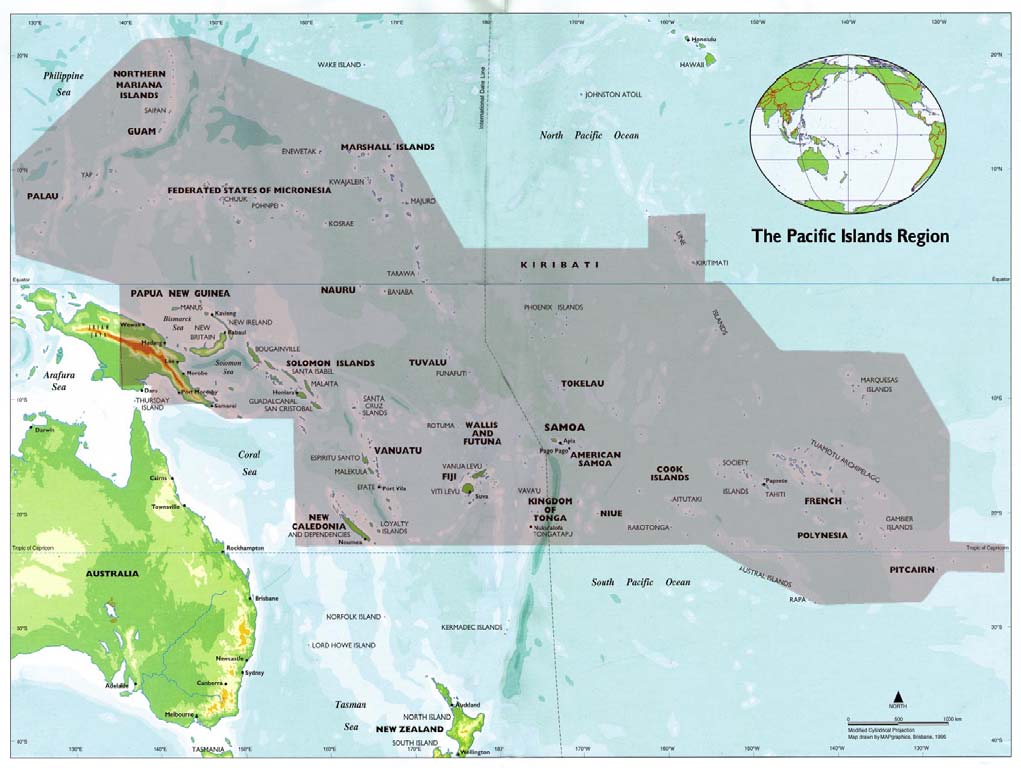
A map of the Pacific Islands region is given in Figure 1.
1.5 PHYSICAL SETTING
1.5.1 Regional Diversity
The Pacific Islands region is very diverse, and encompasses a wide variety of geographical features,
populations, cultures, economies and politics within its 22 Island countries. Most of the countries were
colonized until recently, and this has had lasting effects on the social, cultural, political and economic and
development status of each island state. The Pacific Islands often are considered as covering three sub-regions;
Melanesia (west), Polynesia (southeast) and Micronesia (north), based on their ethnic, linguistic and cultural
differences. The physical sizes, economic prospects, available natural resources and political developments
within these sub-regions suggest that the groupings are still useful, although not necessarily ethnically correct.
1.5.2 The role of the ocean
Spread over an area of 30 million square kilometers, more than 98 per cent of which consists of ocean, the
Pacific region is vast. This area is three times larger than either the USA or China. Of its 7500 islands, only
about 500 are inhabited. This isolation complicates administration, communication, marketing and export of
agricultural and fishing products and the provision of basic services in health, education and training. The
ocean, however, has played a positive role as a natural barrier against the spread of human and plant diseases
and pests, even though this situation is changing fast with modern communication and transport. The size of
the ocean, coupled with the spread of small islands proves to be of large economic value for fisheries
development, particularly because of the EEZs and the sale of fishing rights to DWFNs (Distant-Water Fishing
Nations) for the large Pacific tuna resource.
1
Johnston Atoll, Midway Island, Wake Island, Jarvis and Palmyra
10
The importance of the aquatic environment to the people of the Pacific cannot be overstated. The ocean is a
primary source of food and revenue for most nations in the region, and it is important that this not be adversely
affected by chemical contaminants.
Figure 1.: Map of the Pacific Islands
(The area shaded in grey is the region covered by the South Pacific Regional Environment Programme)
1.5.3 Geographical Variations: High Islands and Low Atolls
Information on land area, EEZs and populations is given in Table 1.2. As indicated, the region is
geographically diverse. For example, the Solomon Islands have a land area of 27,556 km2, while Nauru,
Pitcairn, Tokelau and Tuvalu are each smaller than 30 km2. Some countries and territories, such as Nauru and
Niue, consist of only one small island while others such as French Polynesia and the Federated States of
Micronesia, have more than a hundred islands each, which are spread out over enormous distances.
In terms of physical geography and natural resources, the Melanesian countries tend to be large, mountainous
and volcanic with rich soils, exploitable mineral deposits and plentiful marine resources, while the Polynesian
and Micronesian nations are smaller. Kiribati, Marshall Islands, Tokelau and Tuvalu consist of low-lying
atolls, only one or two metres above sea level. The smaller volcanic islands such as the Cook Islands, parts of
the Federated States of Micronesia, Tonga and Samoa, have some fertile land, but both living and non-living
natural resources are mainly confined to the ocean. This geography plays a major role in the development
problems of the islands. High islands have good soil for agriculture and generally adequate water resources,
while the low islands do not.
1.5.4 Population Variations
Just as varied as the geography of the Pacific Islands are the populations and demographic trends in the region,
with populations ranging between the extremes of Fiji (824,700) and Pitcairn Islands (47) in 2000. The
population of the Commonwealth of the Northern Mariana Islands (CNMI) has been growing annually at 5.5
11
per cent in recent years, while Niue's population is decreasing at a rate of 3.1 per cent. The total population of
the region was estimated at 2.8 million for 2000, and the current regional growth rate is 2.2 per cent. More than
half the region's population are juveniles. The generally small populations are affected by international
migration. For example, there are more Cook Islanders, Niueans, Tokelauans and Tuvaluans living overseas
than in their home countries.
The peoples of the Pacific Islands share a common voyaging tradition, with their societies evolving through
migration, but culturally they are very different, mainly due to their isolation. Although the region is home to
just 0.1 per cent of the world's population, it is home to one third of the world's languages, with over 700
spoken in Papua New Guinea alone. In terms of social organization and cultural practices, in Melanesia social
and political status are traditionally acquired through individual merit; in Polynesia they are the result of
descent; and in the atolls of Micronesia either descent or age customarily confer seniority. All Pacific Islanders
attach great cultural importance to land, and three out of four Islanders still live outside of urban areas.
Table 1.2: EEZs, Land Area and Population of Pacific Island Countries
Country EEZ
(km2)
Land Area (km2) Estimated
Population
(2001)
American Samoa
434,700
197
65,600
Cook Islands
1,830,000
240
18,900
FSM (Micronesia)
2.978,000
710
111,000
Fiji 1,290,000
18,272
820,200
French Polynesia
5,030,000
3265
237,500
Guam 218,000
541
157,700
Kiribati 3,550,000
690
85,900
Marshall Islands
2,131,000
180
57,700
Nauru 310,000
21
11,800
New Caledonia
1,230,891
19,103
221,000
Niue 390,000
259
1900
Northern Mariana Islands
777,000
471
78,800
Palau 629,000
460
19,500
Pitcairn 800,000
5
47
Samoa 120,000
2935
174,100
Solomon Islands
1,340,000
27,556
432,300
Tokelau 290,000
10
1500
Tonga 700,000
699
100,500
Tuvalu 900,000
26
10,100
Vanuatu 680,000
11,880
196,500
Wallis & Futuna
242,700
255
14,600
1.5.5 New health concerns
Social, economic and environmental factors, coupled with global changes, have had a significant impact on the
health and well-being of many island countries and territories within the region. These include a changing
global environment, the relative ease and availability of modern travel, and overpopulation. Over the last 30
years, changes in diet and lifestyle in the Pacific region have brought about an increase in health conditions
such as high blood pressure, diabetes, heart disease and drug and alcohol abuse. As a result of the lack of
access to basic, simple and affordable health services, there is now an increase of infectious diseases such as
diarrhoea, dengue, malaria, tuberculosis and pneumonia, and this is compounded by unsafe water supplies and
12
inadequate waste-disposal systems. Good progress has been made in education, health, social services, literacy,
and life expectancy, but there is certainly a need for further improvements, particularly in Melanesian countries
such as the Solomon Islands.
1.5.6 Fragile economies
Agriculture and fishing, whether commercial or subsistence, are the main activities for most of the region's
population, and the only source of exports for some. Limited markets and the overall decline of commodity
prices have affected the traditional production and export of copra and other coconut-based products. Countries
and territories with successful agricultural and mineral exports include Fiji (sugar and gold), Nauru
(phosphate), New Caledonia (nickel) and Tonga (squash). Timber is a major export commodity from the
Melanesian sub-region, but most of the profits go to companies based elsewhere. Fish exports, mainly tuna, are
of growing importance to many island countries and territories, with the commercial use of living marine
resources increasing to rival the combined value of the region's other renewable resources.
13
2 SOURCE
CHARACTERISATION
2.1 BACKGROUND INFORMATION TO PTS SOURCES
None of the PTS chemicals covered by this survey are manufactured in the region. However, many of them are
known to have been used in the past and some are still in use. Information on the various uses is summarised
below. Perhaps the biggest area of uncertainty is the past and current presence of PTS such as the phthalate
esters, PBDEs and nonylphenols in consumer and industrial products.
2.1.1 Pesticides
PTS pesticides have been used in the past throughout the region, although the level of usage has been generally
low by world standards. The primary uses were in crop production, termite control, general household and
public health applications and for vector control. Malaria is a significant problem in the Solomon Islands,
Vanuatu and New Caledonia. However, spraying for mosquitos is also practised in most others countries for
the control of dengue fever.
In 1994, the following PTS pesticides were listed in the Pacific Regional Agro-Pesticide Index
(ARSAP/CIRAD/SPC, 1994), as being available for sale and/or approved for use within the region:
Aldrin Solomon Islands
Atrazine Fiji, French Polynesia, New Caledonia and Tonga
Chlordane French Polynesia, Samoa
DDT - Solomon Islands
Dieldrin - Solomon Islands
Endosulphan Cook Islands, Federated States of Micronesia, French Polynesia, New Caledonia and Vanuatu
Heptachlor French Polynesia
Hexachlorocyclohexane (as Lindane) French Polynesia, Kiribati, New Caledonia and Solomon Islands
Organomercury compounds Solomon Islands (as phenylmercury acetate)
Organotin compounds French Polynesia, Guam, New Caledonia, Vanuatu and Wallis & Futuna (as
azocyclotin, cyhexatin and/or fenbutatin oxide)
Pentachlorophenol - Fiji
2.1.2 Polychlorinated Biphenyls (PCBs)
PCBs were almost universally used as transformer oils prior to the 1980s, and it can be assumed that this was
so throughout the Pacific region. Conversely, transformers and transformer oils imported in more recent times
are expected to be free of PCBs, although the only countries with specific import controls are the US and
French territories.
A recent survey by SPREP (Burns et al, 2000) identified significant stockpiles of old transformers and
transformer oils throughout the region, and some of these were shown to contain PCBs. The only exceptions
were some of the US territories, thanks to clean-up programmes carried out by the US Environmental
Protection Agency during the early 1990s. Similar programmes have been carried out in the French Territories
and Fiji.
Other possible sources of PCBs are old capacitors, lighting ballasts, hydraulic fluids and various building
products. However, there is no information available on previous uses within the region.
2.1.3 Organolead Compounds
Leaded petrol is the only known major source of organolead compounds in the region. Petrol sold in the
Pacific islands is sourced entirely from refineries outside the region and as a result, changes in the use of leaded
petrol tend to mirror developments in the supplier countries. Thus leaded petrol was phased out of the US
territories in the early 1980s and from most of the independent states during the 1990s.
2.1.4 Dioxins, furans and other unintentional byproducts
Dioxins and furans are formed as unintentional byproducts from most combustion processes, along with trace
amounts of PCBs, PAHs and hexachlorobenzenes. The possible sources include motor vehicles, oil-fired
power stations, industrial fuel use, rubbish burning and the combustion of trees, wood and other biomass.
14
There is no hard data available for dioxin and furan emissions within the Pacific region. However, this can be
estimated from fuel use information and other relevant data, as discussed in section 2.3.2 below.
2.1.5 Organtin Compounds
Organotin compounds have been widely used as anti-fouling coatings on the hulls of ships and boats. There is
no information available on the use of these chemicals within the region, but this seems highly likely. The
most significant uses would have been at the numerous small boat yards and boat repair facilities around the
region. This use of organotin compounds has now been prohibited in some parts of the world. However, the
international moves for a global ban have not yet been successful, and continued use should be expected
throughout most of the region.
It should also be noted that once organotin compounds have been applied to the hull of a vessel there is a
continuous slow release of the chemicals into the surrounding water. As a result, any vessels operating within
the region can act as a source of organotin compounds, if these have been used for treatment of the hull. This
can be a significant source of contamination in ports and harbours.
2.1.6 Other PTS Chemicals
There is no information available on the use within the region of chemicals such as the chlorinated paraffins,
polybrominated biphenyls and diphenyl ethers, or phthalate esters. Nor are there any established systems in the
region for obtaining this information. These chemicals are known to have been used in a wide variety of
industrial, commercial and consumer products but, as such, their presence in the products is usually not clearly
identified.
2.2 DATA COLLECTION AND QUALITY CONTROL ISSUES
Information for this part of the survey was obtained through direct enquiry to government agencies, and also
from the SPREP survey on Persistent Organic Pollutants in the Pacific (Burns et al, 2000). Data on fuel and
biomass consumption, which was used for dioxin estimates, was obtained from various national reports on
greenhouse gas emissions.
It should be noted that virtually all of this data is based on estimated quantities and should only be treated in a
semi-quantitative sense.
2.3 PRODUCTION, USE AND EMISSION
None of the PTS chemicals included in this survey are manufactured within the region.
2.3.1 Current Pesticide Use
The following PTS pesticides are currently used within the countries indicated:
Atrazine: Fiji (10 t/a), Tonga (10 kg/a), Vanuatu (25-30 kg/a)
Endosulphan: Fiji (2 t/a), Vanuatu (15-20 kg/a)
DDT is known to be used in the Solomon Islands for malaria control. Annual consumption is believed to be in
the order of 5 to 10 tonnes per year, although this has not yet been confirmed.
2.3.2 Emissions of Unintentional Byproducts
Dioxins, furans and other complex organics are produced in most combustion processes. No data is available
on the emissions of these chemicals within the region. However, some simple estimates of the order of the
emissions can be calcuated using published emission factors. The results are generally quoted in dioxin toxic
equivalents (TEQs), which provides a simple method of comparing the relative potential impacts of different
emission sources (UNEP Chemicals, 2001).
A preliminary assessment of dioxin emissions for Samoa was reported by Cable (2001). These estimates were
made using the emissions factors recommended by UNEP Chemicals, combined with local estimates for factors
such as petroleum fuel consumption, and biomass and rubbish burning. The work identified motor vehicle
emissions, rubbish burning and forest or scrub fires as the three most significant sources.
15
A rough estimate of dioxin emissions for some countries in the region has been made by SPREP (B Graham,
unpublished data), using information on fuel use and biomass combustion given in National Greenhouse Gas
Inventory reports. These reports were based on 1994 data so are now somewhat dated. However, the results
provide a useful first estimate of possible emission rates. The dioxin emissions were calculated using emission
factors recommended by UNEP Chemicals, with the results shown in the table below.
Table 2.1: Estimates of National Dioxin Emissions
Country Dioxin
emissions
(mg TEQ/yr)
Cook Islands
11
Federated States of Micronesia
84
Fiji 932
Kiribati 391
Marshall Islands
48
Nauru 9
Niue 1
Samoa 81
Solomon Islands
217
Tuvalu 47
Vanuatu 88
2.3.3 Other PTS Chemicals
There are no polychlorinated biphenyls currently being used in the Pacific Islands region (Burns et al, 2000).
Similarly organolead and organomercury compounds are believed to be no longer in use.
No information is available on the use or otherwise of other PTS chemicals, including organotin compounds,
chlorinated paraffins, polybrominated biphenyls and diphenyl ethers, and phthalate esters.
2.4 HOT SPOTS
PTS Hot Spots in the region are those where hazardous chemicals have been stored, used or disposed. The
existence of these sites has been known for many years. However, a detailed assessment of the problem was
only carried out in the late 1990s (Burns et al, 2000). This work was carried out in the Cook Islands, Federated
States of Micronesia, Fiji, Kiribati, Marshall Islands, Nauru, Niue, Palau, Samoa, Solomon Islands, Tonga,
Tuvalu and Vanuatu. The country visits were carried out by three specialist consultants with expertise in
chemical hazard management, contaminated site assessments and waste management and disposal.
The major stockpiles of hazardous wastes and obsolete chemicals identified in the survey were as follows:
Transformer oils potentially contaminated with PCBs
131 tonnes
Obsolete pesticides
63 tonnes
Timber treatment chemicals
11 tonnes
Old bitumen
330 tonnes
The stockpiles of transformer oils are distributed across all of the 14 countries, with the exception of Fiji. The
pesticide stockpiles include the following PTS chemicals:
Atrazine: Cook Islands (5kg), Fiji (14 kg)
Endosulphan: Fiji (4 kg)
DDT: Cook Islands (20 kg), Micronesia (3,300 kg), Palau (1,200 kg), Solomon Islands (5,500
kg), Vanuatu (900 kg)
Dieldrin: Cook Islands (80 kg)
Chlordane: Niue (0.5 kg)
Lindane: Cook Islands (21 kg)
16
Over 100 contaminated sites were also identified in the survey, of which 54 were assessed as needing major
remediation work. The types of contaminants and numbers of sites were as follows:
PCBs 3
sites
Buried pesticides
5 sites
Pesticide storage
13 sites
Timber treatment
4 sites
Oil-contaminated
21 sites
Rubbish dumps
18 sites
The figure given above for rubbish dumps only relates to the major dump sites within each country. There are
numerous other old sites throughout the region. In addition, there is widespread illegal dumping in streams and
estuaries, and rubbish dumping is also commonly used as a means of land reclamation. Most of these dumps
are potential hot spots for PTS contamination, and this is clearly illustrated by some of the environmental data
reported in Section 3. Sites used for industrial wastes, including those associated with military bases, are a
particular concern.
2.5 DATA GAPS
None of the above data provides a comprehensive coverage of PTS sources within the region. The most
significant areas where new or additional data is required are as follows:
· Emission estimates for dioxins and other unintentional byproducts
· The use of organotin compounds, especially in anti-fouling paints
· The use of PTS chemicals such as chlorinated paraffins, polybrominated biphenyls and diphenyl ethers,
and phthalate esters in consumer and industrial products
· Information on stockpiles and contaminated sites in countries and territories not already covered by the
SPREP survey
· Environmental assessments of the discharges from existing dump sites
2.6 SUMMARY OF THE MOST SIGNIFICANT REGIONAL SOURCES
The most significant sources of PTS in the region are currently the use of DDT in the Solomon Islands, the
stockpiles of PCBs and obsolete pesticides, and numerous contaminated sites. The use of DDT in the Solomon
Islands is expected to be phased out in accordance with the requirements of the Stockholm Convention. The
disposal of PCB stockpiles and a limited proportion of the obsolete pesticides are currently being addressed
under a SPREP/AusAID project. However additional funding is needed to deal with the remaining pesticides
and remediation of contaminated sites. Although numerous contaminated sites have been tentatively identified
throughout the region, there is a need for detailed testing and assessment of the risks involved and the need for
remediation of these sites.
It is difficult to assess the significance of the emissions of unintentional byproducts such as dioxins and furans,
although as a general principle, action should be taken at a national level to minimise these emissions. This
will be a requirement for those countries that become Parties to the Stockholm Convention, once it enters into
force.
2.7 CONCLUSIONS
There is no manufacture in the region of any of the PTS chemicals covered in this report, although many of
them are known to have been used in the region. The current usage of PTS pesticides in the region is low, and
should be eliminated over the next 10 years or so. Existing stockpiles of PCBs and PTS pesticides should also
be eliminated over the next few years. There is no evidence of PCBs being actively used in the region although
small quantities are believed to still exist in a few in-use transformers. No information has been obtained on
the use or otherwise of organlead and organomercury compounds.
Numerous hot spots have been identified, consisting mainly of stockpiles of hazardous wastes and obsolete
chemicals, pesticides and transformer oils. Over 100 contaminated sites were identified, of which 54 were
assessed as needing major remediation work. These sites include PCBs, buried pesticides, pesticides storage,
timber treatment and rubbish dumps. Significant efforts will be required for remediation of these sites.
17
Generally, there is lack of data on the emissions of dioxins, furans and other complex organics from
combustion processes and other sources in the region. Some estimates of dioxin emission have been made for
some of the countries, on the basis of existing fuel use data.
There is an urgent need to address the information gaps identified in section 2.5 above and in particular, to
establish systems for the collection and analysis of information on the presence of PTS chemicals in consumer
and industrial products. There is also a lack of data available from the French territories, not only on sources
but also on PTS distribution and fate.
18
3 ENVIRONMENTAL LEVELS, TOXICOLOGY AND ECOTOXICOLOGY
PATTERNS
3.1 LEVELS AND TRENDS
Concentrations in environmental samples were obtained for the 12 PTS currently covered under the Stockholm
Convention: hexachlorobenzene (HCB), chlordanes, heptachlor, aldrin, DDTs, mirex, dieldrin, endrin,
toxaphene, polychlorinated biphenyls (PCBs), dioxins and furans; as well as hexachlorocyclohexanes,
polyaromatic hydrocarbons (PAHs) and lead, tin and mercury. The latter three metals are classified as
persistent toxic substances in their organic forms. Almost all data from the region were for total metal
concentrations which were used as a proxy for organic lead, organic tin and organic mercury.
A majority of samples analysed have been environmental samples (air, water, sediment and marine organisms
used as pollution indicators). Hardly any data on levels in humans (plasma, milk, fat) are available. Drinking
water and food analyses are also very limited. Many Pacific countries appear to have had no PTS analyses
performed.
A large number of samples had detectable levels of PTS, owing both to local usage and global transport,
especially by wind currents. PTS were recorded in some samples for which there is no record that that
particular chemical was ever imported into that country. This could indicate either illegal entry or
environmental transport.
In general, concentrations are relatively low for most samples. There are a few samples, however, especially of
sediments from urban areas, that would lead to a classification as contaminated sites in developed countries,
and warrant remediation. There are also contaminated areas in Micronesia due to past military activities which
have impacted marine food samples.
Overall the highest concentrations of PTS tend to have been found for DDT and its derivatives, especially in
Papua New Guinea and Solomon Islands where DDT is used to control malarial mosquitoes, and PCBs, which
have been used as electrical oil insulating material and often disposed of in a haphazard manner. Organolead
and organotin levels are also high in some areas, probably due to their use in gasoline and marine paints
respectively.
An increasing amount of food consumed in the Pacific is imported. The levels of PTS in these food stuffs will
definitely need to be monitored. PCB concentrations in fish and some other foods in countries that export to
the Pacific, such as Australia and Asia, are quite high.
Levels are discussed below by PTS and also by sample type and country. All of the data referred to is given in
Appendix III, along with the relevant reference annotations.
3.1.1 ANALYSIS BY INDIVIDUAL PTS
3.1.1.1 Toxaphene and Mirex
These are rarely, if ever, used in the Pacific. No analyses for toxaphene have been reported. There are
appreciably more mirex analyses, but, except for one Fiji sediment analysis and a Guam contaminated site, all
levels have been below detection limits (Tables 1 and 4 of Appendix III).
3.1.1.2 Hexachlorobenzene (HCB)
Mainly used as an industrial chemical in other parts of the world. Nearly all concentrations in the Pacific were
below 1 ppb except for one Fiji sediment sample that contained 8 ppb (Table 1) and fish from a contaminated
site in Guam with 3 ppb (Table 4).
3.1.1.3 Heptachlor and Chlordanes (trans-chlordane, cis-nonachlor, cis-nonachlor and oxychlordane)
Two common pesticides found in many samples from the Pacific but always at low concentrations except for
chlordanes in fish from a contaminated site in Guam (Table 4).
3.1.1.4 Aldrin, Dieldrin and Endrin
Three other pesticides used in the Pacific. Few samples were analysed for endrin and rarely found at detectable
concentrations. Aldrin levels were also low, generally below 1 ppb. Dieldrin generally occurred at higher
19
concentrations, several above 1 ppb with one Fiji sediment containing 60 ppb (Table 1) and fish from a Guam
contaminated site at 4,600 ppb (Table 4).
3.1.1.5 DDTs (o,p'-DDT, p,p'-DDE, p,p'-DDD and p,p'-DDT)
DDT has been widely used as a pesticide throughout the Pacific and in Melanesia in mosquito eradication
efforts due to the presence of malaria. DDT and its environmental breakdown products are generally less toxic
to humans than many other pesticides but have been responsible for many environmental problems. DDT
showed the highest absolute concentrations of all the PTS pesticides with some samples reaching near the
acceptable limits for the sample type as defined by various international standards and exceeded in fish near a
Guam contaminated site (Tables 1-7).
3.1.1.6 Polychlorinated Biphenyls (PCBs)
This group of compounds is also present in many samples at significant concentrations. Although not generally
at the level of DDTs, the human effects of PCBs as carcinogens and endocrine system disrupters give rise for
concern. Concentrations near oil disposal sites can be quite high and the very high levels in sediments (Fiji,
PNG and especially Guam (Table 1)) and foods in Guam and Solomon Islands (Tables 4-6)warrant increased
monitoring. Dietary intake from imported foods may also be a concern.
3.1.1.7 Dioxins and Furans
These are very toxic substances created especially during incineration of plastics and other waste materials.
The analysis for these compounds is quite expensive and Pacific data are lacking.
3.1.1.8 Hexachlorocyclohexanes (HCHs), ,, and isomers
This is routinely included in most pesticides screening analyses and thus many values are available for the
Pacific islands. HCH isomers have been detected at significant levels in many samples (Tables 1-7).
3.1.1.9 Polyaromatic Hydrocarbons (PAHs)
PAHs have only been tested in fish in Guam and the concentrations are unexceptional (Table 6).
3.1.1.10 Organic Lead
Lead pollution is often related to heavy industrial activity. Thus the moderate levels in many Pacific samples is
surprising and may be due to lead additives in gasoline, as well as lead in plastics, paint and batteries. Very
high levels have been detected in sediments near a battery factory in Fiji (Tables 8a & 8b).
3.1.1.11 Organic Mercury
The data show values normally found in sediment and seafood samples that have not been contaminated by
pollution. (Tables 8a & 8b)
3.1.1.12 Organic Tin
This is often related to boat paint and thus values vary but are generally low except in harbours. Fiji and Saipan
have highly polluted sediment areas in their harbours (Table 8b).
3.1.2 PTS IN PICs BY SAMPLE TYPE
3.1.2.1 Sediments
It is difficult to determine "permissible" levels for sediment contamination. One guide is the required levels to
be achieved in the remediation of contaminated sites. These have been established in the USA (Ramamoorthy
and Ramamoorthy, 1997). Except for DDTs, PCBs and dieldrin, the values in Pacific island sediments are far
below these limits (Table 1). For one Fiji sample there was an anomalous high dieldrin concentration (60 ppb)
which is above the 30 ppb level for a residential soil. For DDTs the allowed level is 1880 ppb and a few
samples (Tonga, Solomon Islands) come close to this. The allowed PCB level is 93 ppb which has also been
almost reached by a PNG and Fiji sample and greatly exceeded by a sample from Guam and one from Saipan
(although a later study in Saipan at the same site failed to confirm this high result). Long et al. (1995)
estimated that adverse biological effects occur in biota exposed to sedimentary PCB levels exceeding 180 ng/g.
For metals the concentrations for randomly chosen samples are low but very high in lead and tin for
contaminated sites, such as near a battery factory in Fiji (11.6%) for lead, and Fiji and Guam for tin (Tables 8a
& 8b).
20
3.1.2.2 Soils
Soils have been analysed for PCBs at a contaminated site in Saipan and high levels found which required
remediation (Table 1). Three samples have been analysed for lead and mercury with high lead levels found in a
Guam sample (Table 8b).
3.1.2.3 Air
Occupational Health and Safety laws in several countries have maximum air levels for various PTS pesticides
which range between 100 and 1000 ng/m3. Concentrations are vastly lower than these limits for ambient air
samples from the Pacific (Table 2). It is nonetheless interesting to note the generally higher concentrations in
the Solomon Islands near continental land masses compared to more isolated islands, and the substantially
higher values for an isolated Northern hemisphere island compared to a Southern hemisphere one.
3.1.2.4 Water
The only reliable water values are from a recent study of a Saipan contaminated site, Guam well monitoring
data and a large-scale Japanese study of Asia and Oceania which analysed six water samples from Solomon
Islands (Table 3). These provide cause for concern as the highest values for HCHs (5.3 ng/L) and PCBs (1.1
ng/L in Solomon Islands and 32,000 ng/L in Saipan) exceed Australia, New Zealand (ANZ) standards for water
(4 ng/L and 1 ng/L, respectively). The high DDT value of 21 ng/L greatly exceeds the recommended ANZ
guideline of 1 ng/L. Heavy metals have not been widely tested except in Guam where some values are high for
lead.
3.1.2.5 Foods
There are no studies in the Pacific islands concerning the occurrence of dioxins and furans in foods. These are
also very expensive analyses as are those for toxaphenes, for which no data are available. The limited data for
the other PTS pesticides in drinking water and foods are presented in Tables 3 to 6 of Appendix III. Data are
also included for PAHs (polyaromatic hydrocarbons), another class of cancer-causing combustion byproducts.
It should be noted that the comments below are mainly for randomly sampled foods and do not include
contaminated fish from Orote Point, Guam, discussed in the previous section under PTS types. Also, the
"allowed" levels shown in Table 4 are for health effects based on unlimited consumption of fish with that level
of contamination. This will obviously be much lower than the allowed levels based on a "typical" diet. For a
more realistic indication of "levels of concern" it would be more approriate to refer to the general food criteria
shown in Table 5.
Aldrin and Dieldrin
Concentrations in the foods analysed in all locations except Guam range from below detection level to a
maximum of less than 5 parts per billion. Even these maximum values are well below maximum residue levels
established by the Codex Alimentarius Commission which range from 20-100 parts per billion depending on
the type of food. Fish samples at a contaminated site were as high as 4,600 ppb dieldrin at Orote Pt., Guam
(Table 4).
DDT
The use of DDT and its derivatives is mainly restricted to mosquito control in the Solomon Islands and Papua
New Guinea where malaria is present. DDTs have been detected in all food samples analysed in the Pacific.
Even the highest value (130 parts per billion in a meat sample from Papua New Guinea, Table 4) is
considerably lower than maximum recommended US levels. Papua New Guinea is the only country in which
reliable data on breast milk are available, with values between 60-3000 parts per billion (fat basis) being
obtained (Table 7). The highest value is more than double the maximum recommended US level.
Heptachlor
The use of heptachlor has been severely restricted and predominantly low concentrations have been reported
worldwide. This is also true in the Pacific islands, where even the highest value is less than one-tenth of the
maximum recommended level (Tables 3-7)
Hexachlorobenzene (HCB)
This was originally used as a fungicide but currently used in chemical manufacturing and emitted from
industrial processes. None of these uses seem to have been prevalent in the Pacific islands as detected
concentrations are very low, less than one part per billion (Tables 3, 4 & 7).
21
HCHs and Chlordanes
The sum of the isomers of both of these insecticides in most samples did not exceed 2 parts per billion except
for Solomon Island meat samples close to 10 parts per billion, which are still below what are considered
maximum allowed values in the US (Table 5).
Endrin and Mirex
Few samples have been analysed for these pesticides and the few results have been below the detection levels
(Tables 3-7).
PCBs
These compounds were mainly used in the past in transformer and capacitor oils. Contamination in most
countries leads to high values in fish (Table 6). National regulatory levels (e.g. in US, Australia) range from
500-5000 parts per billion. General levels in marine samples are much lower than this. However, recent
studies at sites where contaminated electrical equipment has been disposed show high levels of PCBs. In
populations whose diets consist of large amounts of fish, such levels could cause serious health problems.
Organometallics
Tables 8a and 8b show lead, mercury and tin concentrations that have been determined in various marine
samples. These data have usually been obtained in general surveys of environmental pollution. The use of
bivalves is problematic as while they are good accumulaors of heavy metals, different species do this to
differing extents.
Organolead
Worldwide mean lead concentrations (presumably wet weight) in fish, crustaceans and molluscs have been
reported by GEMS-Food (1987) to be between 200-250 parts per billion. On a dry weight basis this is above
1000 parts per billion.
The regional data (Tables 8a & 8b) show concentrations in this general range although recent values in Fiji
bivalves and Guam fish appear somewhat higher. There is also some indication of higher values in the late
1990s compared to the late 1980s. Given the lack of industrialization in these countries the source of the lead is
not clear. Fiji and Guam have significant per capita numbers of motor vehicles. In Fiji leaded petrol was used
until the late 1990s. A recent study of river mussels in Fiji has shown lead concentrations 10-20 times higher in
urban areas compared to rural ones.
Mercury
Like PCBs, mercury is usually found at the highest concentration in marine organisms. According to GEMS-
Food (1987) typical values for seawater fish from uncontaminated waters are around 180 parts per billion or
less, but higher in larger carnivorous species such as tuna. Molluscs and crustacea seldom exceed 100 parts per
billion. Again given that these values on a dry weight basis would be several times higher, the reported values
are in this range except for a few samples from Fiji and Guam which are higher (Tables 8a & 8b).
Tin
Tin is a contaminant mainly introduced into the marine environment through the use of tributyl tin in
antifouling paint on boats. It is not surprising then that concentrations are quite variable depending on the
marine environment. Extremely high level of organic tin compounds have been found in sediments in Suva
Harbour in Fiji (Table 8b) as well as associated changes in sexual organs in nearby bivalves (Maata, 1994).
3.1.2.6 Human Samples
Because of the general scarcity of this information, data from the 1970s have been included in Table 7 even
though not meeting the overall UNEP requirements for data quality and relevance. In a more recent 1993
study, ten samples were above the allowed Australian concentrations of DDT in cows milk (1250 ng/g) even
though, on average, concentrations were 33-50% of those found in less remote areas of the world (Table 7).
3.1.2.7 PTS in PICs by Country
Data reported for this project were requested to be restricted those obtained since 1990, and for which there was
good documentation of quality assurance. Data were sought from material published in the scientific literature,
from governments and from agencies known to be involved in this kind of work in the Pacific. Undoubtedly
there are other useful data that were not obtained.
Most data have been reported via university research at Guam and the University of the South Pacific and
through investigations of possible contaminated sites in Guam and Saipan.
22
American Samoa
A 1991 study for Pago Pago Harbor showed some elevated heavy metals and PCB values. A follow-up study is
currently in progress.
Cook Islands
No data reported.
Fiji
Several studies have been made of heavy metals that have detected hot spots of tin and lead. POPs studies are
limited.
Federated States of Micronesia
No data reported.
French Polynesia
Research institutes reported some lagoon monitoring data about 20 years old which detected very high levels of
pollution.
Guam
Extensive work is being undertaken to look at contamination near former military installations. High levels of
DDT, dieldrin, tin, lead and PCBs have been found, especially in fish. There is also regular water monitoring
which indicate these chemicals have not generally entered the groundwater at dangerous levels except for lead.
Kiribati
No data reported except for one heavy metal study from Kiritimati.
Marshall Islands
Again no data (except one air sample) could be obtained, but given the situation in other former US territories,
data from around military bases may exist but not be readily available.
Nauru
No data available.
New Caledonia
It is expected there has been much research performed on heavy metal pollution but none was obtainable.
Northern Marianas
Like Guam, potential contaminated sites are being studied, especially for PCB contamination, which has been
discovered at a site at Tanapag, Saipan.
Niue
No data reported.
Palau
No data reported.
Samoa
A few limited recent studies have not shown major contamination.
Solomon Islands
A few studies by Japanese researchers have shown generally low levels of PTS.
Tokelau
No data reported.
Tonga
Limited data. A USP study in 1994 found elevated DDTs in one sediment sample. A recent Australian study
of Nuku'alofa Lagoon showed generally low heavy metal and pesticide (non-POPs) levels.
23
Tuvalu
No data reported.
Vanuatu
Very limited data show low POPs in sediments and low heavy metals in bivalves.
3.1.3 Trends
Trends can either be temporal or spatial. Almost all data have been "one-off" analyses and there are no sites
that have been regularly monitored over a long period of time for PTS, so it is difficult to detect temporal
trends.
In terms of spatial trends some have been noted; for example, less contaminated air as one moves further from
the Asian land mass and from Northern to Southern hemisphere. Also, countries that still use DDT have higher
values than countries not needing it for malaria control. Sites near former US military bases are of concern for
PCB contamination. Also countries such as Fiji and Guam with more developed economies show a trend to
higher concentrations of industrial pollutants such as organic lead.
3.2 TOXICOLOGY OF PTS OF REGIONAL CONCERN
The science of toxicology seeks to characterize the health effects associated with exposure to various
chemicals, drugs or substances. Toxicology is a field of increasing specialization, with current methods
trending toward a characterization of the interaction between the toxic substance and the cellular system on a
molecular level.
Toxicologists apply knowledge taken from human exposure assessments, and the intrinsic hazard (potency)
posed by chemicals or drugs in arriving at estimates of human health risk. In many analyses, these estimates of
risk represent a discrete probability of an adverse health outcome derived from a specific exposure scenario.
Toxicology of PTS in the Region is in its infancy. Very few toxicological or exposure investigations have been
conducted in the Pacific Islands and even fewer relate to PTS. A wide variety of human health studies have
been conducted in the Marshall Islands and French Polynesia to assess the impact of ionizing radiation and to
mitigate putative effects from past exposures.
While the recent trend in human health risk assessment is towards assessment of body burden and the risk
associated therewith, there is very little data on human body burden of PTS in Pacific Islanders. The only body
burden studies found in the Region were conducted in Samoa in 1979 and the Northern Mariana Islands in
2000. Information on a body burden study conducted in the neighboring country of Papua New Guinea (not
included in Region IX) is also summarised in Appendix III and discussed below. That study identified DDT in
mothers' milk with one sample above 3 mg/kg (ppm). This is notable because while most of these pesticides
are no longer in use, DDT is still used for malaria control in the Solomon Islands and Vanuatu. Body burden
studies have not been conducted in these islands and needs to be addressed.
In the absence of comprehensive human health studies and body burden data for this report, chemical
contamination in food sources was assessed. There are limited data on the levels of contaminants in foods in
Pacific island countries. These have been generated for the most part by the three major universities in the
region, the University of the South Pacific, the University of Guam and the University of Papua New Guinea,
during studies on environmental pollution in which the indicator species studied are also consumed. There has
also been contaminant assessment in food sources associated with specific contaminated sites by government
agencies in the U.S. Pacific Islands.
The main contaminants studied have been persistent organochlorine pesticides, polychlorinated biphenyls
(PCBs), lead, mercury, tin and aflatoxins. Detectable levels of chlorinated pesticides and PCBs have been
found in marine food sources, including fish, shellfish and mollusks, although most sampling events have been
very limited, with fewer than 15 samples collected. While it is helpful to have this information, it must be
recognised that conclusions drawn from these studies are inherently limited.
Looking at some of the more widely utilized PTS around the Region, gives an indication of the impact that use
has had on food sources. The highest levels of DDT in marine foods were found in Fiji shellfish, but once
again, the sampling was extremely limited. In Papua New Guinea, where more comprehensive sampling has
occurred, DDT levels in oysters were considerable. Consistent with use, PCBs have been detected at notable
levels in imported foods and in marine foods, especially in former United States trust territories contaminated
by electrical oil residues.
24
In 1979, Samoan fish were found to have the highest levels of HCHs and heptachlor in the Region.
Unfortunately, it was a small sampling and there is no recent data.
Endrin and Mirex have not been sampled in food sources. Aflatoxins were found to occur in only about 5% of
peanut samples studied, a much lower incidence than reported in other tropical countries. About 1% of these
samples had levels above 100 µg/kg (ppb).
Most lead and mercury levels were in the range found in developed countries (mean values around 200 µg/kg
wet weight). This is surprising given the low levels of industry in these countries. Further work is required to
study levels in a wide variety of foods. It is also important to consider the high, known occurrence of ciguateric
toxins in fish. This undoubtedly is a more significant health and economic problem for Pacific countries
compared to other chemical contaminants.
While toxicological studies in the Pacific Islands have been limited and human health risks have not yet been
effectively assessed, some data has been gathered, without identification of serious problems. More work is
needed to effectively assess the impact of PTS on human health in the Pacific Islands. The following is a
discussion on the toxicity information, routes of exposure and notable data which has been gathered in the
Pacific Islands.
3.2.1 Toxicology by Individual PTS and Toxicological Data in the Pacific Islands
3.2.1.1 Toxaphene and Mirex
Toxaphene is an insecticide which has been banned in many countries, but does not appear to have been used in
the Pacific Islands. Breathing, eating, or drinking high levels of toxaphene could damage the lungs, nervous
system, and kidneys, and can even cause death. Toxaphene exposure can occur through injestion of
contaminated fish and shellfish.
Exposure to mirex and chlordecone occurs mainly from touching or eating soil or food that contains the
chemicals. At high levels, these chemicals may cause damage to the skin, liver, or nervous and reproductive
systems. Animal studies have shown that ingesting high levels of mirex can harm the stomach, intestine, liver,
kidneys, eyes, thyroid, and nervous and reproductive systems.
As noted in section 3.1.1.1, these substances are not prevalent in the Pacific. No studies were found which
analyzed for toxaphene in food sources. Mirex was analyzed in a small effort in Fiji and Tonga, all results
below detection limits. Unless source data is found which identifies these substances as being used in the
Pacific Islands or transported into the Pacific Islands, further assessment of food sources and body burden may
be unnecessary.
3.2.1.2 Hexachlorobenzene (HCB)
Exposure to hexachlorobenzene occurs primarily from eating low levels in contaminated food. The main health
effect from eating highly contaminated food is a liver disease. Other forms of exposure are inhalation and
dermal exposure. This substance may be reasonably expected to be a carcinogen.
A limited number of samples were analyzed for HCB in a variety of areas in the Pacific. While most of the
results were near detection limits, generally meat samples collected were found to be higher than marine life
samples, indicating larger impact on land, consistent with use. An exception to this was samples collected in a
neighboring island of similar environment, where levels of HCB were found up to 15 ng/g for oysters and 3.7
ng/g for taro. These levels indicate a concern regarding unrestricted consumption. HCB has been used
prevalently in the Pacific Islands. The use of HCB is evident in fat tested in PNG; with levels found up to 920
ng/g. While HCB does not appear to be manufactured in the region, which limits exposure in the workplace,
further testing of body burden in countries with HCB use should be conducted.
3.2.1.3 Heptachlor and Chlordanes (trans-chlordane, cis-nonachlor, cis-nonachlor and oxychlordane)
Exposure to heptachlor and heptachlor epoxide happens mostly from eating contaminated foods and milk, or
skin contact with contaminated soil. At high levels, they can cause damage to the nervous system. Exposure to
chlordane occurs mostly from eating contaminated foods, such as root crops, meats, fish and shellfish, or from
touching contaminated soil. High levels of chlordane can cause damage to the nervous system or liver.
Heptachlor levels in food sources of the Pacific Region were found to be up to 230 ng/g in Samoa Fish; levels
unsafe for unrestricted consumption. Samples taken of Tonga shellfish, PNG oysters and taro and Solomon
Island meat may also warrant restricted consumption. Consistent with fish sampling, Samoa breast milk was
found to have up to 900 ng/g of heptachlor.
25
Chlordanes were found at detectable levels in many samples, where analysed. Most notable is Solomon Island
meat, which was found at 6.1 ng/g, which is a level which would indicate a concern for unlimited consumption.
While heptachlor and chlordane have both been utilized in the region, heptachlor has been found in higher
concentrations in food sources and body burden studies. Therefore, further targeted studies on food sources
and breast milk should be conducted, especially in areas, like Samoa, where contaminated breast milk has
already been identified. Also, due to the nature of heptachlor and its susceptibility to breakdown into
heptachlor epoxide, that substance should also be included in further studies.
3.2.1.4 Aldrin, Dieldrin and Endrin
Exposure to aldrin and dieldrin happens mostly from eating contaminated foods, such as root crops, fish or
seafood. Aldrin and dieldrin build up in the body after years of exposure and can damage the nervous system.
Exposure to endrin can cause various harmful effects including death and severe central nervous system injury.
Swallowing very large amounts of endrin may cause convulsions and death in a few minutes or hours.
Exposure to high doses may result in headaches, dizziness, nervousness, confusion, nausea, vomiting, and
convulsions. No long-term health effects have been noted in workers.
Few food source and body burden samples were analysed for endrin and not found at detectable concentrations.
Aldrin and dieldrin in PNG oysters and taro were concerning and all land based food samples analysed for
dieldrin were at levels above unrestriction consumption. Sampling of Samoa breast milk, and PNG breast milk
and fat showed indications of aldrin. PNG fat was also found to have levels up to 2,110 ng/g for dieldrin.
While concerning levels of aldrin and dieldrin have not been found in food sources and body burden studies in
the region, further testing may be warranted, once additional source data is collected on these substances.
3.2.1.5 DDTs (o,p'-DDT, p,p'-DDE, p,p'-DDD and p,p'-DDT)
Exposure to DDT, DDE, and DDD happens mostly from eating contaminated foods, such as root crops and
leafy vegetables, meat, fish and poultry. At high levels, it can cause damage to the nervous system, causing
excitability, tremors, and seizures in people. These substances may be cancer causing.
DDT is the POPs which has been most widely analysed in food sources in the Pacific. Levels in Fiji and Tonga
shellfish, PNG oysters, fish, meat and taro, Solomon Island fish and meat were found at levels that may not be
considered safe for unrestricted consumption. DDT was sampled in both Samoa and in PNG, with detections
of up to 58,000 ng/g. Due to levels identified in these studies, additional DDT Studies (and its breakdown
products) should be conducted to determine body burden and risk to potentially exposed populations, especially
in areas where DDT is still in use.
3.2.1.6 Polychlorinated Biphenyls (PCBs)
Polychlorinated biphenyls are a mixture of chemicals which are no longer manufactured, but are still found in
the environment. Health effects that have been associated with exposure to PCBs include acne-like skin
conditions in adults and neurobehavioral and immunological changes in children. PCBs are known to cause
cancer in animals and are probable human carcinogens.
PCBs have been analysed in a number of different countries and in different food sources. Levels of concern
for unrestricted consumption have been found in Solomon Island fish, meat and crab/oyster, PNG fish, oyster
and meat, Guam molusc and fish. Due to the widespread use of PCBs and indications based on analytical
samples, more testing of flora and fauna is needed.
Foodstuffs testing around a PCB contaminated site in Saipan, yielded results that did not identify any concerns,
except for results obtained for landcrabs. An extensive sampling of blood serum (approximately 1100
individuals) was conducted in 2000 to assess potential impact of PCB exposure on the past and current
residents. In the study, it was found that the levels of PCBs in blood was, in general, below the US national
average, but utilizing information on exposure history, a putative link between consumption of contaminated
land crabs and PCB levels in serum has been identified. Currently, the Agency for Toxic Substances and
Disease Registry (ATSDR) is finalizing their public health assessment for this investigation.
Recently, in Guam, high levels of PCB contaminated fish were identified in a preliminary study and verified in
a more comprehensive study. While a fish consumption advisory has been issued, the impact of the
contaminated fish on residents which utilize the area for subsistence fishing is unquantified. Further
toxicological assessment at that site is necessary.
Dietary intake of PCBs from imported foods may also be a concern.
26
3.2.1.7 Dioxins and Furans
Exposure to chlorinated dibenzo-p-dioxins occurs mainly from eating food that contains the chemicals. One
chemical in this group 2,3,7,8-tetrachlorodibenzodioxin or 2,3,7,8-TCDD, has been shown to be very toxic in
animal studies. It causes effects on the skin and may cause cancer in people.
Exposure to chlorodibenzofurans (CDFs) occurs mainly by eating certain contaminated foods. In people,
exposure to CDFs is most likely to cause skin and eye irritation, and increased vulnerability to respiratory
infection and nervous system effects.
The analysis for these compounds is quite expensive and data from Pacific Island food or body burden has not
been identified. Preliminary studies of dioxin and furan impact to food sources and island populations need to
be conducted.
3.2.1.8 Hexachlorocyclohexanes (HCHs), ,, and isomers
Exposure to hexachlorocyclohexanes happens mostly from eating contaminated foods or by breathing
contaminated air in the workplace. Exposure to high levels of hexachlorocylclohexanes can cause blood
disorders, dizziness, headaches, seizures, and changes in the levels of sex hormones.
Most notable of detections of HCH were samples of Samoa fish, with levels of up to 320 ng/g. Samoa breast
milk and fat in PNG also showed indications of HCH use in the area. While HCH does not appear to be
manufactured in the region, limiting exposure in the workplace; further testing of body burden in countries with
HCH use should be conducted.
3.2.1.9 Polyaromatic Hydrocarbons (PAHs)
Exposure to polycyclic aromatic hydrocarbons usually occurs by breathing air contaminated by smoke or coal
tar, or by eating foods that have been grilled.
These substances have only been tested in fish in Guam and the concentrations are unexceptional. Since
burning of trash and green waste is common practice on in the Pacific Islands, PAHs are likely to be found in
some food sources and in body burden studies. More information needs to be gathered in these areas.
3.2.1.10 Organic Lead
Exposure to lead can happen from breathing workplace air or dust, eating contaminated foods, or drinking
contaminated water. Children can be exposed from eating lead-based paint chips or playing in contaminated
soil. Lead can damage the nervous system, kidneys, and reproductive system.
Testing of lead in indicator species, fish, and shellfish has been conducted in Fiji, Vanuatu, Tonga, Kiribati, and
Guam. The highest levels of lead in marine species were found in Fiji and appear to have correlation with
contaminated sediments. No independent studies of lead (and other PTS) have been found for Pacific fisheries.
Further testing of lead in food sources and body burden studies is necessary, especially in countries that still
utilize leaded fuels.
3.2.1.11 Organic Mercury
Exposure to mercury occurs from breathing contaminated air, ingesting contaminated water and food, and
having dental treatments. Mercury, at high levels, may damage the brain, kidneys and developing fetus.
Testing of mercury in indicator species, fish, and shellfish has been conducted in Fiji, Vanuatu, Tonga, Kiribati,
Guam, the Northern Mariana Islands, and the Solomon Islands. The highest levels of mercury were found in
Kiribati and the Solomon Islands. While canned tuna has been sampled in some Fiji studies, no independent
studies of mercury (and other PTS) have been done for Pacific fisheries. Further testing of mercury is
necessary, especially in Pacific fish stocks.
3.2.1.12 Organic Tin
Exposure to tin results mostly from eating food and breathing air that contains tin. Breathing or swallowing
organotin compounds can cause breathing problems and eye irritation and can interfere with the way the brain
and nervous system work. In severe cases, it can cause death. Exposure may also cause stomach aches,
anemia, and liver and kidney problems.
While organotin compounds have been used around the region and deposition of organotin is likely to have
occurred in ports with heavy vessel traffic, limited studies of the impact of organotin in the marine environment
of major ports of the region have been conducted. Studies in Guam have indicated fish with detectable and
consistent levels of tin. More analysis of organotin in marine food sources in heavy activity ports around the
region needs to be conducted.
27
3.2.1.13 Infrastructure and Resources
One of the main issues with assessment of impact of PTS on Pacific Island people is the lack of infrastructure
and resources to conduct sampling and manage information. Since there are few management systems to track
importation, use and disposal of PTS substances, there is little way of knowing where these substances may
have impacted populations and food sources. To assist with the toxicological assessment process, more focus
needs to be given to source identification, inventories and tracking systems for PTS importation, use and
disposal.
In addition, medical tracking resources are lacking. For example, some Pacific Island communities claim that a
cancer cluster exists within their village, but since there is no cancer or death registry, there is no way to know
whether the incidence of cancer is at normal or higher rates, or if there is a prevalence of a specific type of
cancer in their area. Much work is needed to assist in providing better health care in Pacific Island countries
and to establish systems for tracking illness, disease and death.
Another important resource need for the Pacific Islands is the development of risk based consumption tables for
Pacific Island diets and appropriate guidance on sampling of food sources to obtain appropriate data to utilize
the tables.
It is also important for the region to develop capacity to test for PTS contaminants. In addition to being able to
assess food sources for local consumption, international trade may require testing for PTS substances in food
import and export.
3.3 ECOTOXICOLOGY OF PTS OF REGIONAL CONCERN
Ecotoxicology, the study of the effect of toxics in ecosystems, is an important, although entirely neglected topic
in the Region. Impacts from PTS to ecosystems of the Pacific could have a major impact on the economic base
of the Pacific Islands. Many of the Pacific Islands depend on fisheries, agriculture, timber and tourism. Each
of these industries could be heavy impacted by contamination of PTS. When ecosystems are impaired, natural
resources are reduced and economic impacts will follow. Because Pacific Island natural resources are finite
much care should be taken in preservation and impact mimimization.
While no published ecotoxicological data was found in the Pacific, the Regional Team has looked at some of
the work done on non-migratory sea-otters on the Pacific coast of the United States. One study (Jarman, et al,
1996), indicated that PCBs were found in higher concentrations in remote areas of Alaska (Aleutian Islands).
While local military sources may have contributed to these levels, there are also indications that transboundary
movement of PCBs has also contributed to the levels of PCBs found.
Because there is no data in the Pacific and results of studies in the U.S. and Canada (Nordstrom etal, 1990,
Jarman et al, 1996) indicate that concentrations of dioxins and furans are distributed differently than other
chemicals in the marine mammal samples, specific studies for dioxins and furans in the Pacific flora and fauna
need to be conducted.
Currently there are a few studies that are commencing or ongoing in the area of ecotoxicology in the Pacific.
These studies are primarily associated with nature reserves, and include the following:
· University of Hawaii study on Midway/Sand Island (in coordination with USFWS)
· The US Fish and Wildlife Service has been studying and sampling monk seals on Tern Island. These
seals have been cohabitating with PCB contaminated transformers and have levels of PCBs in their
blubber.
3.4 DATA GAPS
The most significant area where data is lacking for the region is in toxicology and ecotoxicology. However,
there is also a need for much more information on environmental levels, and studies of distribution and fate.
There are particular concerns over those areas where PTS chemicals such as DDT are known to be still in use.
Information is also needed on the environmental consequences of the use of PTS chemicals such as the
phthalate esters in common consumer products.
3.5 CONCLUSIONS
The limited available data confirms the presence of those PTS chemicals known to have been used within the
region, and also indicates possible contributions from external sources. The highest concentrations have been
found not surprisingly, in areas directly affected by urban run-off or industrial activity. However, there is
28
insufficient data to give any meaningful picture of the extent of any impacts and the possible effects on human
health, or on other living species. There is a clear need for considerably more effort within the region in
environmental monitoring and research on the potential effects of these and other toxic chemicals.
29
4 ASSESSMENT OF MAJOR PATHWAYS OF TRANSPORT
4.1 INTRODUCTION
While there have been no specific transboundary studies in the Pacific Islands, there are a number of theories
that have been developed regarding transboundary movement of PTS in and out of the Pacific Region. Some of
these theories are supported by studies conducted in the surrounding continents and current work being carried
out relating to climate change issues.
Although there is little evidence, due to the lack of analytical information, there is an indication that PTS
contamination in the Pacific Region has been influenced by the surrounding regions. There is also the
possibility that due to the current presence and use of PTS in the Region, there could be some movement of
PTS out of the Region.
4.2 OVERVIEW OF EXISTING MODELLING PROGRAMMES AND PROJECTS
As mentioned above, there are no specific transboundary models for transport of PTS in the Pacific Region.
Some limited media specific modelling does exist, but supporting data is very limited. For the Pacific Islands,
there is minimal modelling apart from isolated pieces of work on movement of materials into groundwater and
some groundwater transport studies in Guam, Saipan, Nauru and Tarawa. There have also been studies
regarding the movement of radionuclides in and around the Marshall Islands and French Polynesia, although
there is no valid way to correlate these studies with PTS.
Data regarding Pacific Ocean currents has been collected and models are available to predict current patterns.
Once again, lack of data on concentration of PTS substances and their dispersion in the Pacific, hinders
modelling efforts for oceanic contaminant transport.
No know air modelling of specific PTS has been found but studies have been conducted using tracer materials
to track atmospheric transport from Asia to North America. As mentioned in more detail below, data is
currently being gathered for modelling of atmospheric transport across the Pacific.
4.2.1 General features / Regionally specific features
Generally, large land mass fate and transport models are not necessary applicable to the Pacific. On many
islands, there is minimal land mass and surface waters may be fresh, brackish or saline. Some islands have no
perennial surface water flows. On land, sources that penetrate the soil are often immediately transmitted to
near surface groundwater due to karst and volcanic geologic features. Atolls commonly have soils with large
particle size which limits their absorption capacity. High/continental islands have higher elevations, with high
organic content soils.
Temperature and salinity have an effect on the solubility of many of the POPs and the presence of soils with
high organic matter can also have an effect on concentrations and breakdown of POPs.
Near surface groundwater in the Pacific Islands may be brackish and have a hydrological connection to the
ocean. Therefore, contaminants may be mobilized swiftly from land to the surrounding ocean. In other cases,
fresh water lenses may impede movement of contaminants into the saline environment. Many point source
water discharges are directly into the ocean and air sources are often dispersed above the ocean.
Regional weather patterns have the potential to impact transport of PTS. Typhoons/cyclones with their strong
winds and heavy rains can transport contaminants across the Pacific into the ocean or other land masses in a
relatively short amount of time. Typhoon/cyclone conditions also affect oceans, increasing erosion and causing
some deposition on land. Contaminated particulate matter may be carried by winds and moved in colloidal
suspension.
4.3 ATMOSPHERE
While there is data regarding air currents in the Pacific, without data on PTS background and sources,
modelling is highly theoretical. Atmospheric transport and deposition data for PTS in the Region are limited to
information gained in the SEAREX Programme of the late 1980s, which collected data on the Marshall Islands
and American Samoa (and also New Zealand, to the south of the region). United States NOAA operates
weather stations in the US Pacific Islands and obtains general information on air currents in the Pacific.
Information from the Southern part of the region is very limited for the chemicals of interest in this project.
30
Primarily as a result of climate change issues and evidence of atmospheric deposition from Asia to North
America, there has been an increase in atmospheric transport and deposition studies in the Pacific Region. The
patterns of transport and deposition are of great significance, but are not well characterised. As a result, some
researchers have instituted studies to better understand the connections between materials transport and
processes in the Pacific Ocean and surrounding regions. Initial studies indicate that approximately one third of
aerosol deposition is believed to be deposited in the western North Pacific, primarily from Asian desert dusts.
While the initial focus of most of these studies is related to dust transport, with a better picture of PTS
contaminant concentration in Asia, these models may be able to be utilized to determine transport and
deposition of PTS into the Pacific Region.
The `grasshopper effect' also needs to be taken into account when assessing atmospheric transport in the
Pacific Region.
4.4 OCEANS
Generally, the ocean currents of the North Pacific flow clockwise, while the currents of the South Pacific flow
counterclockwise. Currents along the equator flow easterly and there are localized counterclockwise currents
in the Alaska Region. Therefore, the Pacific Islands are affected by waters that flow from the Americas, Asia
and Australia. There are also localized current systems that also effect transport of contaminants. El nino/la
nina weather systems also have a considerable impact on ocean currents and temperatures that may affect
transport of contaminants.
Although comprehensive sampling of sea water has not been identified for POPs in the Pacific Ocean, some
remote ocean values are available for PCB (20-280 pg/cm2/yr), DDT (1-21 pg/cm2/yr), HCB (4-290
pg/cm2/yr) and HCH (560-2600 pg/cm2/yr). Some sea water samples have been taken for lead and mercury in
Fiji. There is also some limited data produced for metals transported in sediments to the ocean. While this data
exists, it is not nearly enough to perform modelling of transport of contaminants in the Pacific Ocean.
Another indicator of contaminant concentration and potential for migration of PTS in the ocean is marine
bioindicator species and marine foods. The available data of accumulation of DDT, HCH, heptachlor, PCB,
lead and mercury in marine life in the Pacific suggests that marine waters may be conveying these substances.
4.5 FRESHWATER AND GROUNDWATER
4.5.1 Local Water Discharges
Wastewater discharge information has been collected in several locations in the Region, but only at centralized
treatment plants. This information includes flow and water quality, but comprehensive information on PTS
concentrations has not been gathered. While one can assume that each island has a number of point source
wastewater discharges, many islands also have wastewater discharges overland and subsurface due to lack of
infrastructure. Without data on the flow of these discharges and the presence and concentration of PTS in the
discharges, modelling is hypothetical and transboundary movement is difficult to quantify.
4.5.2 River Discharges
Some stream flow measurements are currently being collected in southern Guam and Palau, due to impending
developments. Historic stream flow data is available for FSM and the Mariana Islands. It is believed that
stream flow data is also being gathered in French Polynesia. For river discharges, with hydrological data being
deficient in many locations, mainly being found as one-off studies rather than full long-term integrated data
collection, the contaminant concentration and transport information is obviously incomplete.
In assessing contaminant transport via surface discharges, the effects of storm events, including erosion of
surface materials with high concentrations of organic material and fines need to be quantified.
In addition to stream discharges, the effects of overland flow (runoff) also need to be assessed for transport of
contaminants from land to surrounding waters. In a Guam study, lead in surface water runoff was found to be
at levels of concern for drinking water.
4.5.3 Groundwater
As mentioned above, groundwater on many of the Pacific islands is near surface, potentially brackish, and may
be hydrologically connected to the ocean. Groundwater on some islands has a fresh water lens, which can
minimise movement of light end contaminants. Deep groundwaters may be fresh, but due to overpumping and
31
effects of drawdown, salt water infiltration has occurred into many fresh water aquifers on Pacific Islands. The
United States Geological Survey (USGS) has done extensive groundwater modelling for drinking water
identification and protection on the US Pacific Islands. USGS also has historical groundwater information for
former US Trust Territories. Some groundwater information should be available from local water purveyors in
each of the Pacific Islands.
While groundwater quality, depth and flow may be available in many islands, monitoring of groundwater wells
for PTS has only occurred in a few places in the Pacific Islands. In Guam, chlordane, dieldrin, endrin,
heptachlor, heptachlor epoxide and mercury have been detected in public water supply wells at levels that
exceed regulatory drinking water standards. A similar programme of analysis has been in place on the
Northern Mariana Islands, but has not yielded detections of PTS in groundwater wells. This difference is most
likely caused by the extensive agricultural use of PTS chemicals in Guam.
As mentioned previously island geology impacts hydrologic flow. Many islands have fresh water springs and
seeps, which can convey contaminants into streams or the ocean. In one Guam study, nine springs were
assessed for contamination. Of the PTS, only dieldrin was found above safe levels for drinking water. In a
separate study of a PCB contaminated site, it appears that fresh water seeps are conveying PCBs from land into
the ocean, causing PCB contamination of fish in the area.
4.6 BIO-TRANSPORT
One regional concern, which has not yet been investigated, is the potential transport of contaminants through
the ocean in migratory marine life. While some studies have been conducted relating to accumulation of PTS
in sea otters, sea lions and polar bears outside of the Region, there appears to be no information on the PTS
accumulation in their food sources; mainly fish stocks which may be migrating through the Pacific Region.
Since Pacific fisheries not only feed many marine species, but many people around the world, specific studies
of accumulation of PTS in Pacific fish stocks need to be conducted.
4.6.1 Traditional transport
Historically, the Pacific Islands have been utilised by developed nations for military activities. They are also
potential recipients of substandard or excess materials from other countries. Stockpiles of old pesticides that
have been banned elsewhere are still being identified in countries of the Pacific. There is also recent evidence
that banned pesticides are being illegally transported to the Pacific Islands from Asia.
Aside from local subsistence food sources, many items are imported into Pacific Island countries from
neighboring larger countries. The north Pacific islands generally receive imported foods from Asia and the
United States, while south Pacific islands receive imported foods from Australia and New Zealand. The
importation of these foods and the concentration of PTS in imported food has not been assessed but has the
potential to be a significant contributor to the PTS loading in the Region and in human exposure.
4.7 DATA GAPS
In overview, it is clear that there is not enough information to conduct a qualitative or quantitative assessment
of the extent of transboundary movement of PTS chemicals within the region. While most PTS identified in
the Region are known to be in former or current use and environmental sampling appears to be consistent with
use, there is an indication that some substances identified have not actually been used within the region.
Importation of foods and unmonitored importation of PTS into the Region are also unquantified transboundary
movements.
Due to the lack of PTS related management systems, import/export information, use and concentration of PTS
in environmental media in the Pacific Islands, basic accounting for PTS in the Region is impossible. Air data,
which is suggested to be a primary source of transboundary movement is entirely lacking for the Pacific Island
Region. Therefore the equilibrium partitioning calculation, non-equilibrium calculations, atmospheric
concentrations to assess the extent of trans-regional PTS transport and site-specific regional models are not able
to be performed.
4.8 CONCLUSIONS
PTS pathways can be complex, with scale issues, varying media, biological system connections and the
complexity of considering a wide range of substance interactions. Since PTS are neutral organic compounds,
the transport through soils will be very dependent on the amount of organic material present in the soils.
32
Transport mechanisms in the Pacific include some typical means, as well as regionally specific features
including the freshwater lens under many islands, highly porous substrata, the possibility of significant
contributions from imported foodstuffs, and large fish movements contributing to PTS transport. Information
on contaminant concentration and pathways of transport in the Pacific Islands is rare.
As mentioned above, some PTS substances, such as DDT are still in use in some Pacific Island Countries.
These substances may be contributing to more recent loading of PTS into the environment and transport out of
the Region.
Extrapolations from other regions indicate that there may be transboundary movement of contaminants into the
Pacific Region and that there are a few special situations of major significance in this Region.
More work on integrating environmental chemistry with other components of the Regional contamination
assessment is urgently required.
4.9 RECOMMENDATIONS
Pacific Island countries have taken steps to limit the importation of hazardous wastes into their countries
through the implementation of the Waigani Convention, a regional version of the Basel Convention. Pacific
Island Countries should be encouraged to sign on to both the Waigani and the Stockholm Conventions.
More data on PTS in a variety of media, including air and oceans needs to be gathered in order to perform
reasonable modelling of PTS transboundary transport in the Pacific Region. Because of the complexity and
size of this Region, modelling should be conducted by experts in the field.
Data on PTS levels in Pacific fisheries needs to be collected. Migratory fish patterns need to be taken into
account in assessing whether fish and other marine life may be transporting PTS substances in and out of the
Region.
Management systems for tracking importation, use and disposal of PTS in the Region need to be implemented.
33
5 PRELIMINARY ASSESSMENT OF THE REGIONAL CAPACITY AND
NEEDS TO MANAGE PTS
5.1 INTRODUCTION
The sound management of toxic chemicals should be based around an effective system of regulatory controls,
and associated monitoring and enforcement. This requires a certain level of trained personnel, with ready
access to up-to-date information on chemical hazards, control systems and technologies, and alternatives.
The information provided in this section of the report gives a summary of the current capacity within the region
for meeting these requirements, and the additional inputs needed to achieve effective management systems.
The text is largely based on information provided by participants to the Regional Priority Setting Workshop,
and the recommendations developed therein.
5.2 MONITORING CAPACITY
There is limited capacity for monitoring PTS in the Region. Existing national facilities are available only in
some of the larger countries and some are owned by regional institutions. There are laboratories capable of
testing for some of the PTS in Fiji, Samoa, Tonga, New Caledonia, French Polynesia, and Guam. The
laboratories at universities generally have broader capabilities for PTS testing than those in other institutions.
Most of the remaining smaller countries rely entirely on sending samples to overseas laboratories, usually at
considerable expense. The French and US territories have somewhat easier access to laboratories in their
respective "parent" countries. For example, the US territories of American Samoa and Guam have effective
monitoring capacity as a result of requirements under local EPA as well as USEPA and other Federal Acts that
regulate pesticides, hazardous wastes and listed toxic chemicals. The US territories have adequate funding and
access to facilities for monitoring. However, generally there is a major limitation in lack of skilled technical
staff. This problem is not only in the territories but common throughout the region.
Most Pacific Island countries have limited means of controlling the importation of chemicals including PTS.
Tonga for example has Acts and Regulations for the manufacture and import of agricultural chemicals, but only
recently has there been a move to regulate importation of all other chemicals. Although there are three
laboratories capable of testing for PTS in Tonga, each one is testing only for chemicals related to their own
interest. For example, the Ministry of Agriculture laboratory tests only for pesticides, whereas the Water Board
laboratory tests only for chemicals related to the water supply. Most laboratories in the region need upgrading,
not only in overall quality of the facilities but also to extend the scope of the work into more demanding areas
such as residue analysis.
5.3 EXISTING REGULATIONS AND MANAGEMENT STRUCTURES
Most countries in the Region have regulations covering imports and use of pesticides including POPs.
However, all other chemicals including other PTS chemicals are mostly not controlled (Table 5.1) or in many
cases partly covered by regulations for other related areas such as Public health and Environment Acts. In
addition, the existing regulations are mostly outdated and do not cover aspects such as the proper disposal of
containers or excess and obsolete stocks. Throughout the region, there is lack of control on use of PTS
chemicals in consumer and industrial products. Also there is a general lack of the management and
administrative structures needed for proper control and enforcement of existing regulations. The French and US
territories are generally better off through the regulations, support and controls provided by the "parent" states.
It was recommended in the regional meetings that countries in the region should as a matter of urgency,
develop appropriate legislation and management systems. This should include: identifying sources; tracking
and management systems for hazardous and toxic chemicals, including occupational health and safety; and
appropriate labeling (including local languages) for PTS and other chemicals of regional concern, including
asbestos, dicofol, alaclor, adipate, cadmium, arsenic salts and paraquat.
5.4 STATUS OF ENFORCEMENT
Although most Pacific Island countries have regulations for import and use of pesticides, other PTS are mostly
not controlled. The lack of human and financial resources is a major factor in the poor enforcement of
regulations. Also, most of the existing regulations are outdated, so enforcement of these poses real problems
throughout the Region. Only two countries reported satisfactory to good levels of enforcement. Most countries
34
indicated poor levels of enforcement. Typically, for example; In Tonga the Pesticide Act of 1972 cannot
effectively control safe disposal of obsolete pesticides, PTS or any other chemical. The costs involved in
disposal of obsolete pesticides for example cannot be passed on to the owner of the chemical.
Increasing public awareness on chemicals and the hazards they present has been highlighted as being important
for improved enforcement of regulations. There is a need for greater involvement of communities in
monitoring, especially in reporting inappropriate local uses and poor management of chemicals. Research into
public perceptions and behaviour towards acceptance of legislation and good community information is needed.
New mechanisms need to be developed for improvement of regional cooperation in the whole area of chemical
management. There is also a need for improved chemical classifications to assist Customs Officers in import
controls. Illegal imports of chemicals, particularly pesticides, was reported as a significant problem in some
countries.
The Regional Priority Setting Meeting highlighted the need for countries of the region to base the management
of toxic chemicals around an effective system of regulatory controls, and associated monitoring and
enforcement that includes strong inter-sectoral collaboration between Agriculture, Customs, Quarantine,
Health, Environment and Education. This requires a certain level of trained personnel, with ready access to up-
to-date information on chemical hazards, control systems and technologies, and alternatives to chemical use.
Table 5.1 Summary of current Acts and Regulations for pesticides and other chemicals
Countries Acts/Regulations
Other
Chemicals
American Samoa
*
US Federal Laws/Regulations apply
Cook Islands
Yes
Environment Act 1994
FSM (Micronesia)
Yes
Fiji
Yes
Env., Public Health, Water and Seas Acts
French Polynesia
*
French Laws/ Regulations apply
Guam
Yes
US Federal Laws/Regulations apply
Kiribati Yes
Environment
Act
Marshall Islands
Yes
Regulations modeled after USEPA
Nauru No
None
New Caledonia
*
French Laws/Regulations apply
Niue Yes
None
N. Mariana Islands
Yes
Palau Yes
Pitcairn No
None
Samoa
Yes
Occupational Health and Safety Act
Solomon Islands
Yes
Public Health Act
Tokelau No
None
Tonga
Yes
Environment and Public Health Acts
Tuvalu
No
Government approval needed for any import
Vanuatu
Yes
Public Health Act and Environment Bill
Wallis & Futuna
*
French Laws/Regulations apply
(* Regulations in the US and French territories are largely determined by those of the "parent" state)
35
5.5 ALTERNATIVES OR MEASURES FOR REDUCTION
The use of alternatives to PTS pesticides within the region is being addressed through regulatory controls, and
also by the adoption of an integrated pest management (IPM) approach. This is being actively promoted
through FAO, national agriculture agencies, the South Pacific Commission, and other regional advisors.
DDT is still being used for malaria control in the Solomon Islands, and external help will most likely be needed
to assist the country in developing effective alternative methods.
The use of other PTS chemicals is largely determined by external suppliers who are currently not subject to any
significant levels of import controls. The region is highly dependant on overseas research for the identification
of alternatives and/or measures for reducing current usage rates.
5.6 TECHNOLOGY TRANSFER
As with alternatives, the region is highly dependant on external agencies for access to new and alternative
technologies. Another limiting factor is the relatively slow rate of economic and industrial development within
the region which limits the amount of finance available for investment in new plant and equipment.
5.7 IDENTIFICATION OF NEEDS
The Pacific Region currently has very limited capacity to manage PTS and assistance is needed in all areas.
This includes the need for increased monitoring capacity, improved regulations, management structures and
enforcement systems, and perhaps most of all far more people in the region with the skills' knowledge and
experience to implement and utilise all of the above. There are also significant needs in the area of technology
transfer, epsecially in relation to alternatives to the use of PTS and other possible reduction measures.
All of the above needs were identified during the Regional Priority Setting meeting and are addressed in more
detail in the following section of this report.
36
6 FINAL RESULTS AND RECOMMENDATIONS
6.1 IDENTIFICATION OF BARRIERS
Barriers to improved management of PTS in the Pacific Islands were one of the key points for discussion at
both the Regional Technical Meeting and the Regional Priority Setting Meeting for this project. The following
barriers were identified as a result of these discussions:
· Lack of knowledge on PTS issues at all levels in regional societies (background information, health
effects, implications of conventions);
· Lack of targeted, user-friendly information on PTS issues;
· Not enough trained personnel in the region for PTS management, and the need for much more
institutional strengthening in this area;
· Lack of in-country personnel capable of carrying out training in PTS issues;
· Lack of coverage of emerging new issues in existing educational curricula in the region;
· Lack of awareness of current training programmes relating to PTS use, impacts and management (e.g.,
USP, FSM, NUS);
· Lack of information for students on career opportunities in chemicals management;
· Failure of some governments to give higher education priority to training in emerging new issues such
as PTS impacts and management;
· Lack of formal involvement of the education sector in national programmes like PRS management;
· Lack of knowledge on human toxicology and ecotoxicology of PTS in the region;
· Poor systems in regional countries for PTS/chemicals handling, storage and use, and information
management;
· Lack of data on fate and transport of PTS in the region;
· Poor regional geographical coverage in available data on PTS concentrations;
· Lack of a regional information on existing chemicals/pesticide databases in the region;
· Poor regional and national inter-agency collaboration/cooperation in PTS management, including
information sharing;
· Lack of appropriate legislation in some countries, especially for non-pesticide PTS;
· Poor community response to existing legislation and education programmes;
· Lack of public participation in PTS management activities and opportunities for such involvement;
· Lack of knowledge on alternatives to PTS use, and few, if any, practical demonstrations of alternatives;
· Lack of donor support for community-based projects aimed at better PTS management;
· Political instability and interference.
6.2 IDENTIFICATION OF PRIORITIES
6.2.1 Priority PTS
The Priority PTS for the Pacific Islands were identified on the basis of the available information presented at
the Regional Technical Meeting and confirmed by the Regional Priority Setting Meeting. A ranking of the
chemicals was produced by scoring each chemical against the guidelines provided by UNEP. It should be
noted though, that this scoring was only done for the categories of Source, Environmental Levels and Data
Gaps. No scores were give for human health or ecotoxicological effects because there was no relevant data
available from within the region.
The results of this scoring are sumarised in Table 6.1, and the rationale for the scores is given in Appendix IV.
As shown in the table, DDT, PCBs, dioxins, furans, PAHs and the organometallic PTS were given the highest
overall scores.
It is therefore recommended that DDT, PCBs, dioxins furans, PAHs and the organometallic PTS be taken as the
top priority PTS in the Pacific Islands region based on existing knowledge.
It was also noted that there were other chemicals of particular concern in the region, especially arsenic,
asbestos, and paraquat. While none of these can be classified as PTS, it is recommended that these should also
be considered for future actions under any global, regional, or national programmes.
37
Table 6.1: Scoring for Prioritising PTS for Sources, Environmental Levels, Effects and Data gaps
Chemical
Sources
Env. Levels
Tox & Ecotox
Data Gaps
Effects
Aldrin 1
0
no
score
2
Chlordane 1
0
no
score
2
DDT 2
2
no
score
2
Dieldrin 1
1
no
score
2
Endrin 1
0
no
score
2
Heptachlor 1
0
no
score
2
HCB 1
0
no
score
2
Mirex 1
0
no
score
2
Toxaphene 0
0
no
score
2
PCBs 2
2
no
score
2
Dioxins 2
1
no
score
2
Furans 2
1
no
score
2
HCH 1
0
no
score
2
PCP 1
0
no
score
2
PAHs 2
1
no
score
2
Org. Mercury Compds.
1
2
no score
2
Org. Tin Compds.
2
2
no score
2
Org Lead Compds.
2
2
no score
2
PBDE 1
0
no
score
2
Phthalates 2
1
no
score
2
Endosulphan 1
0
no
score
2
Atrazine 1
0
no
score
2
Chlordecone 0
0
no
score
2
Octylphenols 0
0
no
score
2
Nonylphenols 0
0
no
score
2
Chlorinated Paraffins
0
0
no score
2
6.2.2 Priority Needs
Based on the recommendations and discussion at the Regional Priority Setting Meeting, the following priority
needs have been identified:
Priority Needs on Education, Training, Community Awareness and Participation
· There is a dramatic need for improved chemical awareness, particularly related to PTS, in the Pacific
Islands. Appropriate educational materials need to be developed, including information on environmental
and health impacts, and alternatives to the use of toxic chemicals. These materials should be prepared for
use in primary, secondary and tertiary education, for professional development programmes and for
relevant awareness campaigns for all levels of society. Such awareness campaigns should target
politicians, public servants, community-based organisations, primary and secondary industry.
· There is an urgent need to encourage all levels of society to participate in sustainable management of
chemicals and development of practical alternatives.
· There is an urgent need for the adjustment of funding mechanisms to sustain long-term awareness and
participation programmes for improved management of chemicals in the Pacific Islands.
· Since there is evidence of poor public acceptance of legislation and good community information on PTS
in some Pacific Island countries, an investigation is needed into public perceptions and behaviour in this
regard.
38
Priority Needs in Chemical Management Systems, Technology, Information and Research
· There is an urgent need for Pacific Island countries to develop appropriate legislation and management
systems (including software applications) to identify sources, track importation, sale, use, and disposal of
hazardous and toxic chemicals, including occupational health and safety, appropriate labelling and
language.
· Effective inter-sectoral collaboration (Agriculture, Customs, Quarantine, Health, Environment, Industry,
Education) is urgently needed in Pacific Island countries. This requires a certain level of trained personnel
with ready access to up-to-date information on chemical hazards, control systems and technologies, and
alternatives to chemicals use.
· There is a need to compile a statement of Pacific Island capacity to address PTS issues and a listing of
Pacific institutions/testing facilities with the capability for doing PTS analyses.
· Given the current dearth of information, there is an urgent need to establish integrated research programs
to generate Pacific Islands data on the transport, fate, and toxicology of PTS and related chemicals in key
ecosystems of the region.
· Given the regional desire to reduce the use of toxic chemicals, there is an urgent need for information on
alternative technologies and management systems that encourage and guide Pacific Islanders in the use of
non-chemical or less toxic alternatives, e.g., in control of disease vectors, agricultural pests and in various
industries. Promotion of the principles of sustainable development, increasing the use of cleaner
production and integrated pest management, and publication of release inventories are required.
6.3 RECOMMENDATIONS FOR FUTURE ACTIVITIES
The following recommendations were agreed at the Regional priority Setting meeting:
1.
In order to address the lack of chemical awareness in the Pacific Islands, a number of education and
awareness raising activities are required. These include:
· Formal courses in chemical impacts and management in primary, secondary and tertiary
institutions;
· Development of relevant curriculum and support materials;
· In-service training courses and practical demonstrative workshops for teachers and for relevant
professionals;
· Development of awareness campaigns targeting politicians, public servants, community-based
organisations, primary and secondary industry, highlighting the following points:
o hazards of household diffuse sources, especially rubbish burning,
o hazardous agricultural practices, e.g. burning of vegetation and pesticide use,
o alternative methods of waste disposal and pest control,
o other sources of PTS including motor vehicle emissions, oil-fired power stations and metal
smelting,
o positive traditional alternatives.
2.
In order to ensure that all levels of society participate in the sustainable management of chemicals and
the development of practical alternatives, all stakeholders must be involved in national implementation
processes, and incentives and feedback mechanisms need to be developed to encourage information
sharing within and between government departments, NGO's and community-based organisations.
3.
In order to ensure sustainability of education, awareness and participation initiatives relating to
chemical management in the Pacific Islands, adjustments are required in funding mechanisms. These
could include:
· Serial funding by donor agencies;
· Available funds being spread over longer time frames;
· Improved cooperative funding arrangements between governments, donors, regional organisations,
NGOs and CBOs.
4.
In order to enable Pacific Island countries to develop appropriate legislation and management systems
for source identification, safe handlig, use and disposal of hazardous and toxic chemicals, training
programs and technical assistance should be provided by regional and international organisations and
donor agencies.
5.
SPREP should develop and circulate to regional countries, a statement of regional capacity and
expertise to address PTS issues, and a list of Pacific Island institutions/testing facilities capable of PTS
39
analyses. In order to enhance this capacity, donor agencies should specifically support institutions
within the region to develop their capacity to carry out such analyses, such as through the establishment
of a Regional Technical Centre under the Stockholm Convention.
6.
Countries in the region should improve the management of toxic chemicals by ensuring they have in
place an effective system of regulatory controls, associated monitoring and enforcement, with strong
inter-sectoral collaboration (Agriculture, Customs, Quarantine, Health, Environment, Education) in
PTS work.
7.
Integrated research projects should be established as a matter of priority to generate information on the
transport, fate, transport and toxicology of PTS in key ecosystems in the Pacific Islands region,
including:
· body burden studies to establish human health effects of PTS;
· participating in WHO breast milk surveys;
· studies on dioxins and furans in Pacific flora and fauna; and,
· data on PTS concentrations in important Pacific foods, including fish.
8.
Activities to support the reduced use of hazardous and toxic substances in the Pacific Islands, are
required. These include promotion of the principles of sustainable development, increasing the use of
cleaner production and integrated pest management, and publication of release inventories. These
activities might include:
· appointment of a Cleaner Production Officer at SPREP;
· more international funding for such initiatives;
· dialogue with industry (especially multi-nationals) to support pilot clean production studies; and,
· research and dissemination of information on positive traditional knowledge and alternatives to
chemical use.
9.
A campaign to research and encourage the use of non-chemical or less toxic alternatives should be
developed internationally and the results implemented by regional countries for the control of pests,
diseases and vectors, and in other situations in the region where chemicals are currently used.
10.
An investigation into public perceptions and behaviour towards acceptance of legislation and good
community information on toxic chemicals should be initiated as soon as possible.
40
ANNEX 1: REFERENCES
Aalbersberg, W. and Thaman, B, (2001). Persistent organic pollutants (POPs) in Pacific Island Countries
(PICs). In Proceedings of the Sub-Regional Awareness Raising Workshop on the Prior Informed Consent
Procedure, Persistent Organic Pollutants, and the Basel and Waigani Conventions, 2-6 April 2001, Cairns,
Australia. UNEP Chemicals, Geneva, 2002.
AECOS (1991). A Preliminary Toxin Scan of Water, Sediment and Fish Tissue from Pago Pago Harbor in
American Samoa, unpublished report.
ANZECC, (1992). Australian water quality guidelines for fresh and marine waters. Australian and New
Zealand Environment and Conservation Council.
Atlas, E. & Giam, C.S. (1989). Sea-air exchange of high molecular weight synthetic organic compounds:
results from the SEAREX Program. In Chemical Oceanography (J.P. Riley, R. Chester & R.A. Duce, eds),
Vol. 10, pp. 340-378. Academic Press, London.
Burns, T., Graham, B., Munro, A, and Wallis, W., (2000). Management of Persistent Organic Pollutants in
Pacific Island Countries. South Pacific Regional Environment Programme (SPREP), Apia, Samoa.
Denton, G.R.W (2002). Personal communication.
Denton, G.R.W., Wood, H.R., Concepcion, L.P., Siegrist, H.G., Efflin, V.S., Narcis, D.K. and Pangelinan,
G.T. (1997). Analysis of In-Place Contaminants in Marine Sediments from Four Harbor Locations on Guam.
A Pilot Study. WERI Technical Report No. 81, 120pp.
Denton, G.R.W., Wood, H.R., Concepcion, L.P., Wood, V.S., Efflin and Pangelinan (1999). Heavy Metals,
PCBs and PAHs in Marine Organisms from Four Harbor Locations on Guam. A Pilot Study. WERI Technical
Report No. 87, 154pp.
Denton, G.R.W., Bearden, B.G., Concepcion, L.P., Siegrist, H.G., Vann, D.T. and Wood, H.R. (2001).
Contaminant Assessment of Surface Sediments from Tanapag Lagoon, Saipan. WERI Technical Report No.
93, 110pp.
Dougherty, G. (1988). Heavy Metal Concentrations in Bivalves in Fiji's Coastal Waters. Marine Pollution
Bulletin 19(2), 81-84.
D.S.I.R. (1991). Report to Lindsey Furness, Ministry of Lands, Survey & Natural Resources, Tonga, from
New Zealand Department of Scientific and Industrial Research. Analysis of Groundwaters for Pesticides and
Heavy Metals.
Fowler, B. (1991). Methods of Trace Chlorinated Pesticide Analysis in Environmental Samples at the Institute
of Natural Resources, University of the South Pacific, Laucala Campus, Suva, Fiji, December,1991.
Gangaiya, P., Brodie, J.E., Morrison, R.J. Base-line Study of the Vitogo River and Associated Environment,
Western Viti Levu, Fiji. UNEP Regional Seas Programme Reports and Studies No. 93, 27 pp. (also pub. As
SPREP Topic Review No. 28).
Global Environment Monitoring System (GEMS) (1987). Assessment of Chemical Contaminants in Food,
UNEP/FAO/WHO, 104pp.
Government of Western Samoa Public Works Department (1993). Apia Sewerage Project: Water Quality and
Biological Studies, unpublished report.
Guam Waterworks Authority (2000). (unpublished report).
Harrison, N., Gangaiya, P. and Morrison, R.J. (1996). Organochlorines in the Coastal Marine Environment
of Vanuatu and Tonga, Marine Pollution Bulletin, 32(7), 575-579.
IAS (1992). Report to Pacific Fishing Company, unpublished report.
Iwata, H., Tanabe, S., Sakai, N., Nishimura, A. and Tatsukawa, R. (1994). Geographical Distribution of
Persistent Organochlorines in Air, Water and Sediments from Asia and Oceania and their Implications for
Global Redistribution from Lower Latitudes, Environmental Pollution, 85, 15-33.
Kannan, K., Tanabe, S., Williams, R.J. and Tatsukawa, R. (1994). Persistent Organochlorine Residues in
Foodstuffs from Australia, Papua New Guinea and the Solomon Islands: Contamination Level and Human
Dietary Exposure, The Science of the Total Environment, 153, 29-49.
41
Kannan, K., Tanabe, S. and Tatsukawa, R. (1995). Geographical Distribution and Accumulation Features of
Organochlorine Residues in Tropical Asia and Oceania, Environ. Sci. Technol., 29, 2673-2683.
Kannan, K., Tanabe, S. and Tatsukawa, R. and Williams, R.J. (1995). Butyltin Residues in Fish from
Australia, Papua New Guinea and Solomon Islands. Intern. J. Environ. Anal. Chem., 61, 263-273.
Kannan, K., Tanabe, S., Iwata, H. and Tatsukawa, R. (1995). Butyltins in Muscle and Liver of Fish Collected
from Certain Asian and Oceanian Countries, Environmental Pollution, 90(3), 279-290.
Maata, M. (1994). TBTs in Fiji Marine Sediments, Ph.D. thesis, University of the South Pacific, Suva, Fiji.
Morrison, R.J., Harrison, N. and Gangaiya, P. (1996). Organochlorine Contaminants in the Estuarine and
Coastal Marine Environment of the Fiji Islands, Environmental Pollution, 83(2), 159-167.
Morrison, R.J., Gangaiya, P., Naqasima, M.R. and Naidu, R. (1997). Trace Metal Studies in the Great
Astrolabe Lagoon, Fiji, a Pristine Marine Environment. Marine Pollution Bulletin 34, 353-356.
Morrison, R.J. and Brown, P.L. (2000). Trace Metals in Shellfish from the Fanga'uta Lagoon System and
Nearby Waters, Tongatapu, Kingdom of Tonga, unpublished report.
Morrison, R.J. (2000). Heavy Metals in Sediments of Christmas Island, unpublished report.
Morrison, R.J., Narayan, S.P. and Gangaiya, P. (2001). Trace Element Studies in Laucala Bay, Suva, Fiji,
Marine Pollution Bulletin, in press.
Naidu, S.D., Aalbersberg, W.G.L., Brodie, J.E., Fuavao, V., Maata, M., Naqasima, M.R., Whippy, P.,
Morrison, R.J. (1991). Water Quality Studies on some Selected Pacific Lagoons. UNEP Regional Seas
Reports and Studies No. 136, UNEP, Nairobi, 99p.
Naidu, S.D. and Morrison, R.J. (1994). Contamination of Suva Harbour, Fiji, Marine Pollution Bulletin, 29,
126-130.
OSHA (Occupational Safety and Health Administration, US) standard. Eco-USA (1999). http://www.eco-
usa.net/toxics/html (29 May 2000).
Ramamoorthy, S. and Ramamoorthy S. (1997). Chlorinated organic compounds in the environment:
Regulatory and monitoring assessmenty. Lewis Publishers, Boca Raton, Florida.
Saipan Division of Environment Quality (1988). unpublished report.
Samoa German Crop Protection Project (1980). Pesticide Use and Regulation in Western Samoa,
unpublished report.
Siyali, D.S., Wilkey, I.S., Parkinson, A.D. (1974). Organochlorine pesticide residues in human fat samples
from Papua New Guinea. Papua New Guinea Med. J. 17(1): 111-115.
Spicer, P.E. and Kereu, R.K. (1993). Organochlorine Insecticide Residues in Human Breast Milk: A Survey of
Lactating Mothers from a Remote Area in Papua New Guinea, Bull. Environ. Contam. Toxicol., 50, 540-546.
Tamata, B. and Thaman, B. (2000). Water Quality in the Ports of Fiji. IASA Environ. Studies Report C103,
IAS, USP, 71pp.
USACE (1999). Remedial Investigation/Feasibility Study of Hospital Dump, Palmyra Atoll, USA, unpublished
report.
USEPA (2001). Heavy Metals and PCBs in Fish in the Vicinity of Orote Point, Guam, unpublished report.
USEPA (2001). Screening-Level PCB Multi-matrix Survey of Tanapag Village Areas, unpublished report.
US Navy (2000). Groundwater Study in Saipan, Northern Mariana Islands, unpublished report.
Vuki, M. (2001). Heavy Metals in Kai (Batissa violacea) in the Rewa River, unpublished results.
Western Samoa Water Authority (1996). National Water Resources Master Plan Study (Stage I), unpublished
report.
WHO (1993). Guidelines for drinking water quality. Volume 1 Recommendations. WHO, Geneva.
42
ANNEX II: LIST OF ACRONYMS
ANZECC
Australia and New Zealand Environment and Conservation Council
ATSDR
Agency for Toxic Substances and Disease Registry
CBO
Community-based
organisations
CP
Chlorinated
Paraffins
DDT
Dichlorodiphenyltrichloroethane
EEZ
Exclusive Economic Zone
FDA
Food and Drug Administration
FAO
Food and Agriculture Organization
FSM
Federated States of Micronesia
GEF
Global Environment Facility
GEMS
Global Environment Monitoring System
HCB
Hexachlorobenzene
HCH
Hexachlorocyclohexanes
IAS
Institute of Applied Sciences
NOAA
National Oceanographic and Atmospheric Administration
NUS
National University of Samoa
OSHA
Occupation Safety and Health Administration
PAHs
Polyaromatic
Hydrocarbons
PCBs
Polychlorinated
Biphenyls
PCDFs
Polychlorinated dibenzo-p-furans
PCDDs
Polychlorinated dibenzo-p-dioxins
PCPs
Pentachlorophenols
PICs
Pacific Island Countries
PNG
Papua New Guinea
POPs
Persistent Organic Pollutants
PRG
Preliminary
Remediation
Guideline (USEPA Superfund Region 9)
PTS
Persistent Toxic Substances
RBA
Regionally-based
Assessment
SPC
Secretariat for the Pacific Community
SPREP
South Pacific Regional Environment Programme
TBT
Tributyl
Tin
TEQ
Toxic
Equivalents
UNEP
United Nations Environment Program
USACE
United States Army Corps of Engineers
USEPA
United States Environmental Protection Agency
USGS
United States Geological Survey
USP
University of the South Pacific
WERI
Water and Environment Research Institute
WHO
World Health Organization
43
ANNEX III: RESULTS FROM DATA COLLECTION
Table 1: Chlorinated Pesticides and PCBs in Sediments (ng/g dry wt)
Location,
Year (samples)
HCB
HCHs Heptac
Aldrin Chlord
DDTs
Mirex
Dieldri
Endrin
PCBs
hlor
anes
n
Vanuatu sediment
<0.13 <0.10 <0.1-0.6 0.04 <0.1 <0.16-
<0.03 <0.01-
<0.02 <0.88
(3)a
0.40
0.96
Harrison et al, 1996
Tonga sediment (3)
<0.02 <0.20 0.07 <0.03 <0.1-2.3 0.3-
<0.05 <0.09-
<0.34 <0.8-
Harrison eta l, 1996
1024
0.43
18.3
Solomon Is. mixedb
- <0.3-2.2 -
-
0.5-3.9 9.3-750
- - -
1.1-5.0
(2)
Iwata eta al, 1992
Fiji sediment (23)
<0.01-
<0.06-
<0.03-
<0.01-
<0.06-
<0.12-
<0.04 <0.01-
<0.03-
<0.45-
Morrison et al, 1996
8.24
2.1
0.7
0.3
0.8
14
8.1
1.2
68.5
Fiji mixed (7)
<0.02-
<0.26-
<0.13-
<0.05-
<0.09-
0.5-27.5 <0.02-
<0.02-
<0.02-
-
Fowler, 1991
0.88
0.91
1.4
0.3
0.9
0.6
60
1.3
Guam sediment
-
- - - - - - - -
<0.05-
(138)
549
Denton et al, 1997
Samoa mixed (7)
- <0.03-
<0.1 <0.05 <0.1 0.17-
-
<0.01-
<0.02 0.16-
Govt of Samoa,
0.08
30.13
0.21
1.60
1993
Saipan sediment (6)
- - - - - - - - -
0-1529
Saipan DEQ, 1988
Saipan sediment
- - - - -
- - - -
<1-27.7
Denton et al, 2001
American Samoa
- - - - -
- - - -
<0.5-
sediment (6)
10.0
AECOS, 1991
Guam soil (5)
- - - - -
- - - -
3-44
Denton, 2002
No. Marianas
- - - - -
- - - -
<1.8x10
mixed (414)
6
USEPA, 2001d
Remediation
300 530 100 29 1,600
1,700 - 30 18,000
220
guidelinesc
Notes:
(a) Numbers in brackets indicate sample numbers
(b) Mixed = both soil and sediment samples
(c) Preliminary Remediation Guidelines, USEAP, Region 9
(d) Furans were also detected in one soil sample at 4 ng/g at this contaminated site
44
Table 2: Chlorinated Pesticides and PCBs in Air (ng/m3)
Location
Year
HCB HCHs Heptachlor Aldrin Chlordanes DDTs
Mirex Dieldrin Endrin
PCBs
(samples)
Solomon
- 0.26
-
-
0.25 1.3 -
-
- 2.3
Island (1)
Iwata et al,
1994
Marshall
0.1 0.27
-
-
0.01 0.005 - 0.008 -
0.1
Islands (1)
Atlas &
Giam, 1989
American
0.06 0.03
-
-
<0.001 0.002 -
0.001
-
0.01
Samoa (1)
Atlas &
Giam, 1989
"Acceptable"
4.2 6.3
1.5
39
19
20 -
30 1,100 3.4
levela
Notes:
(a) Preliminary Remediation Guidelines USEPA Region 9
45
Table 3: Chlorinated Pesticides and PCBs in Water (ng/L)
Location
Year
HCB HCHs Heptachlor Aldrin Chlordanes DDTs Mirex Dieldrin Endrin PCBs
(samples)
Solomon Is,
- 0.1-
- -
0.06-21.0
0.06-
- - -
<0.05-
surface water
5.3
21.0
1.1
(6)
Iwate et al,
1992
No. Marianas,
<0.25
salt water (25)
USEPA, 2000
Samoa, surface
- <10 <10
<3
<10 <10 - <3 - -
water (7)
West Samoa
WA, 1996
Guam
<0.05 <0.01 <0.01-0.02 <0.005-
<0.1-1.9 <0.01 - <0.02-
<0.01-
<0.1
groundwater
0.01
0.7
0.3
(100)
Guam WA,
2001
No. Marianas
<10-
<0.1-
groundwater
75
50
(20)
US Navy, 2000
Remediation
42 63
15
4
190 20 - 4.2 4 34
guidelinesa
Notes:
(a) Preliminary Remediation Guidelines USEPA Region 9
46
Table 4: Chlorinated Pesticides and PCBs in Marine Food (ng/g)
Location Food
Year (samples)
HCB
HCHs Heptac
Aldri
Chlor
DDTs Mirex Dieldr
Endri
PCBs
hlor
n
danes
in
n
Fiji shellfish (2)
<0.1-
<0.3-
<0.4-
<0.13 <0.5 5.0-52 <0.19 0.4-0.7 <0.5 <5.6
Morrison et al,
0.1
0.2
0.3
1994
Tonga shellfish (2)
<0.4 <0.8 1.0-2.3 <0.7 <0.7 2.1-2.2
<0.10 <0.1-
<0.5 <1.1
Harrison et al,
0.6
1994
Solomon Is. fish
<0.01-
0.2-1.6 <0.01 <0.1-
<0.01-
0.07-
-
0.1-2.5
-
1.2-11
(9)
0.05
0.5
2.1
0.83
Kannan et al, 1992
Solomon Is.
<0.01-
0.3-0.9 0.04-
<0.1-
<0.01-
0.3-1.4
-
0.1-0.7
-
5.9-16
crab/oyster (4)
0.05
0.15
2.1
0.8
Kannan et al, 1994
Guam mollusc (36)
- - - - - - - - -
1.2-47
Denton et al, 1997
Guam fish (59)
-
- - - - -
-
-
-
0.1-85
Denton et al, 1997
Solomon Is. fish
0.01-
0.23-
- 0.1-
0.11-
0.91-
- 0.1-
- 0.66-
(10)
0.06
1.9
1.0a
1.6
24
1.0b
15
Kannan et al, 1995
Samoa shellfish (4)
<0.1-
<0.01-
5.6-54
0.6-7.0
Govt of Samoa,
0.55
0.58
1993
Guam fish (30)
<0.10-
<0.01-
<0.5-
<0.9-
<20-
11-
<1.3-
<1.7-
<0.6-
26-
USEPA, 2001
3.3
8.1
2.0
5.3
22600
17900
140
4600
48
80160
Guam fish (49)
<0.18-
<0.01-
<0.12-
<0.1-
<0.01-
<0.01-
<0.01-
<0.11-
<0.13-
0.29-
USEPA, 2001
0.3
4.2
0.5
3.8
33.1
17.3
0.7
11.0
1.5
8348
"Acceptable"
1.8 2.3 0.32 - 8.4 8.6 - 0.18 88 1.5
levelsb
Notes:
(b) Sum of aldrin and dieldrin
(a) Agency for Toxic Substances and Disease Registry (ATSDR) unrestricted fish consumption limits
47
Table 5: Chlorinated Pesticides and PCBs in Non Marine Food (ng/g)
Location
Year
HCB HCHs Heptachlor Aldrin Chlordanes DDTs Mirex Dieldrin Endrin PCBs
(samples)
Solomon Is.
0.2-
7.5-
<0.01-0.02 <0.1-
0.2-6.1 24-29 - 2.2-4.3 - 45-
meat (2)
0.4
9.8
0.3
125
Kannan et al,
1994
PNG meat (2)
0.1 0.6-
0.04-0.15 <0.1-
0.3-0.7 4.4-
- 2.9-3.0 - 5.2-
Kannan et al,
2.2
1.0
130
17
1994
No. Marianas
<0.2
roots (18)
USEPA, 2001
"Allowable"
150 200 200
20
20
100 -
20
50 200
levelsa
Notes:
(a) FAO/WHO Codex Alimentarius
48
Table 6: PCBs and PAHs in Marine Food (ng/g wet wt.)
Location
Food Year
HC
HCH
Heptac
Aldr
Chlord
DDTs
Mire
Dield
Endri PCBs PAHs
(samples)
B
s
hlor
in
anes
x
rin
n
No. Mariana
20-24
clams (4)
USEPA, 2001
No. Mariana
17-23
fish (29)
USEPA, 2001
No. Mariana
1-960
crabs (100)
USEPA, 2001
No. Mariana
139-
crab (63)
492
USEPA, 2001
No. Mariana
20-24
clams (4)
USEPA, 2001
Guam fish (28)
27-
Denton et al,
6711
1999
Guam fish (53)
2-64
Denton et al,
1999
Samoa shellfish
1-119
(4)
Govt. of
Samoa, 1993
Am. Samoa
<0.1
fish (11)
AECOS, 1991
49
Table 7: Chlorinated Pesticides and PCBs in Human Samples (ng/g)
Location
Year
HCB HCHs Heptachlor Aldrin Chlordanes DDTs Mirex Dieldrin Endrin PCBs
(samples)
Samoa
- 20-90 40-900 60-100
-
50-
- - - -
breast milk
100
(10)
Samoa
GCPP,
1980
Samoa fat
- -
-
-
- 8,450-
- - - -
(14)
16,900
Samoa
GCPP,
1980
PNG breast
0 0
0 0-13.2 0 0-884
- 0 - -
milk
Hornabrook
et al, 1971
PNG fat
0-920 0-50
-
0-130
-
40-
- 0-2,110 - -
(69)
58,000
Siyali et al,
1973
PNG breast
0 0
0
0
0
60-
- 0 0 -
milk (41)
3,000
Spicer &
Kereru,
1993
50
Table 8a. PIC HEAVY METAL ANALYSES
Location & Reference
Substrate &
Level (Range, Median)
Unitsa
Sample Numbers
Pb Hg
Solomon Islands
sediment (12)
18.7 - 79.5
- ppm
DW
Naidu et al, 1991
53.1
Fiji
sediment (5)
0.03 - 0.08
<0.001
ppm WW
Tamata & Thaman, 2000
0.03
Fiji, contaminated site
sediment (5)
0.21 - 116,000
0.2 - 1.34
ppm DW
Naidu & Morrison, 1994
Fiji
sediment (6)
6.8 - 10
<0.2
ppm DW
Gangaiya et al, 1988
7.7
Fiji
sediment (7)
3 - 17
0.029 - 0.240
ppm DW
Morrison et al, 1997
5
0.034
Fiji
sediment (25)
3.32 - 13.25
0.061 - 0.185
ppm DW
Morrison et al, 2001
7.54
0.111
American Samoa
sediment (6)
25 - 54
0.02 - 0.09
ppm WW
AECOS, 1991
27
Fiji
sea water (35)
<10 - 19
<1 - 8.8
µg/L
Naidu et al, 1991
<10
1.0
Fiji
sea water (21)
<1 - 1.3
µg/L
Tamata & Thaman, 2000
<1
Fiji
sea water (36)
0.3 - 3.0
<2
µg/L
Morrison et al, 1997
0.6
American Samoa
saltwater (6)
0.052 - 0.062
<0.01 mg/L
AECOS, 1991
Guam
groundwater (100)
<1 - 30.7
<0.29 - 0.75
µg/L
Guam Water Authority,
2000
Northern Marianas
groundwater (20)
<0.5 - 4.7
<0.10
µg/L
US Navy, 2000
Fiji
Crassostrea mordax (32)
<0.5 - 5.48
<0.001 - 0.061
ppm WW
Naidu et al, 1991
0.63
0.017
Vanuatu
Anadara sp. (2)
<0.5 - 0.6
0.02 - 0.04
ppm WW
Naidu et al, 1991
Vanuatu
Crassostrea mordax (4)
0.72 - 0.94
0.01 - 0.04
ppm WW
Naidu et al, 1991
0.90
0.02
Kiribati
Anadara sp. (3)
0.2 - 0.5
<0.1 - 5.6
ppm WW
Naidu et al, 1991
0.2
5.5
Tonga
Gafrarium tumidum (5)
<0.50
0.022 - 0.191
ppm WW
Naidu et al, 1991
0.043
Fiji contaminated site
C. mordax (5)
5.6 - 12.7
0.55 - 0.95
ppm DW
Naidu & Morrison, 1994
Fiji
G. tumidum (20)
0.45 - 0.90
0.05 - 0.20
ppm DW
Gangaiya et al, 1988
0.60
0.10
Fiji
Anadara sp. (4)
<5
0.32 - 0.56
ppm DW
Morrison et al, 1997
0.34
Fiji
Anadara sp. (5)
2.9 - 4.6
0.037 - 0.099
ppm DW
Morrison et al, 2001
3.7
0.046
American Samoa
fish (11)
0.1- 7.9
<0.01 - 0.08
ppm WW
AECOS, 1991
2.1
0.03
"Acceptable" levels
soilsb 400
6.1
ppm
drinking
waterb 15 3.6 µg/L
shellfishc 2.0 0.5
ppm
Notes:
(a) WW = wet weight, DW = dry weight
(b) Preliminary Remediation Guidelines, USEPA Region 9
(c) Australia New Zealand Food Standards Code
51
Table 8b. PIC HEAVY METAL ANALYSIS (Con't.)
Location & Reference
Substrate &
Level (Range, Median)
Unita
Sample numbers
Pb Hg Sn
Fiji
sediment (22)
-
-
19 - 486
ppm DW
Maata, 1994
73
Northern Marianas
sediment (123)
0.2 - 121
7 - 2830
0.01 - 209
ppm DW
Denton et al, 2001
1.5
83
0.7
Guam
sediment (138)
0.02 - 1.29
10 - 2470
0.035 - 4.3
ppm DW
Denton et al, 1997
0.07
73
0.3
Tonga
sediment (8)
3 - 8
<0.005 - 0.04
<0.5
ppm DW
Morrison & Brown, 2000
6
0.02
Tonga
soil (3)
6 - 31
0.02 - 0.06
1 - 18
ppm DW
Morrison & Brown, 2000
9
0.06
Palymyra
soil (26)
<10 - 1620
<0.07 - 0.07
- ppm
DW
USACE, 1999
<10
Samoa
sediment (7)
1.1 - 12
0.001 - 0.069
0.04 - 1.4
ppm DW
Govt. of Samoa, 1993
Guam
soil (5)
3 - 620
0.05 - 0.40
- ppm
DW
Denton, 2002
Kiribati
sediment (21)
<2 - 7
-
<0.1 - 5.9
ppm DW
Morrison, 2000
<2
0.2
Palmyra
water (10)
<40 - 120
- -
µg/L
USACE, 1999
<40
Guam
Cheilinus sp.
0.13 - 0.24
- -
ppm
DW
Denton et al, 1999
fish (6)
0.16
Guam
Rhopalae sp.
-
0.06 - 0.38
- ppm
WW
Denton et al, 1999
ascidian (7)
0.12
Guam
fish1(28)
0.47 - 1.47
0.013 - 0.045
0.61 - 0.79
ppm WW
Denton et al, 1999
0.90
0.022
0.66
Guam
fish2 (17)
1.0 - 6.0
0.009 - 0.022
0.42 - 0.64
ppm WW
Denton et al, 1999
1.0
0.011
0.53
Fiji
canned tuna (15)
-
0.07 - 0.97
- ppm
WW
IAS, 1992
0.21
Fiji
canned tuna (13)
-
0.01 - 0.27
- ppm
WW
IAS, 1992
0.12
Solomon Islands
fish flesh (3)
-
-
0.2 - 1.4
ppm WW
Kannan et al, 1995
0.8
fish liver (2)
89 - 120
Tonga
shellfish (80)
<2
<2
<2
ppm DW
Morrison & Brown, 2000
Samoa
shellfish (4)
0.005 - 0.30
<0.002 - 0.03
0.13 - 0.45
ppm DW
Govt. of Samoa, 1993
Guam
fish (30)
0.16 - 6.01
<0.009 - 0.045
<0.42 - <0.79
ppm WW
USEPA, 2001
"Acceptable" levels
soilsb
400 6.1 180
ppm
drinking waterb
15 3.6
110
µg/L
Shellfishc
2.0 0.5 25
ppm
Notes:
(a) WW = wet weight, DW = dry weight
(b) Preliminary Remediation Guidelines, USEPA Region 9
(c) Australia New Zealand Food Standards Code
52
ANNEX IV: SCORING OF CHEMICALS
The Priority PTS for the Pacific Islands were identified on the basis of the available information presented at
the Regional Technical Meeting and confirmed by the Regional Priority Setting Meeting. A ranking of the
chemicals was produced by scoring each chemical against the guidelines provided by UNEP. It should be
noted though, that this scoring was only done for the categories of Source, Environmental Levels and Data
Gaps. No scores were give for human health or ecotoxicological effects because there was no relevant data
available from within the region. The results of this scoring are sumarised in Table 6.1, and the rationale for
the scores is given below.
Chemical
Sources
Env. Levels
Data Gaps
Aldrin
(1) Moderate past use
(0) Limited data but low
(2) Insufficent data
concentrations
for a full assessment
Chlordane
(1) Moderate past use, minor
(0) Limited data but low
(2) As above
stockiles
concentrations
DDT
(2) Current use in 2 PICs, plus
(2) Some concentrations near
(2) As above
known stockpiles and
upper tolerable levels
contaminated sites
Dieldrin
(1) Moderate past use, minor
(1) Limited data, with
(2) As above
stockpiles
moderate levels
Endrin
(1) Moderate past use
(0) Limited data but low
(2) As above
concentrations
Heptachlor
(1) Moderate past use
(0) Moderate data but low
(2) As above
concentrations
HCB
(1) Moderate past use
(0) Moderate data but low
(2) As above
concentrations
Mirex
(1) Moderate past use
(0) Moderate data but low
(2) As above
concentrations
Toxaphene
(0) No known use
(0) No data
(2) As above
PCBs
(2) Extensive past use, major
(2) Significant conentrations
(2) As above
stockpiles
near contaminated sites
Dioxins and
(2) Widespread production
(0) No data
(2) As above
Furans
from fuel and wood
combustion, rubbish burning
HCH
(1) Moderate past use, minor
(1) Extensive data, some
(2) As above
stockpiles
moderate to high levels
PCP
(1) Moderate past use
(0) No data
(2) As above
PAHs
(2) Widespread production
(1) Limited data, moderate
(2) As above
from fuel and wood combustion levels
Org. Mercury
(1) Moderate past use
(2) Significant levels near
(2) As above
Compds.
contaminated sites
Org. Tin Compds. (2) Continuing use
(2) Significant levels near
(2) As above
contaminated sites
Org Lead
(2) Extensive past use, mainly
(2) Signifcant levels near
(2) As above
Compds.
discontinued
contaminated sites
PBDE
(1) Assuemd past usage
(0) No data
(2) As above
Phthalates
(2) Assumed in current
(1) Limited data with
(2) As above
extensive use
moderate levels
Endosulphan
(1) Moderate past and current
(0) No data
(2) As above
use, stockpiles
Atrazine
(1) Moderate past and current
(0) No data
(2) As above
use, stockpiles
Chlordecone
(0) No known use
(0) No data
(2) As above
Octylphenols
(0) No known use
(0) No data
(2) As above
Nonylphenols
(0) No known use
(0) No data
(2) As above
Chlorinated
(0) No known use
(0) No data
(2) As above
Paraffins
53
54





United Nations
Environment Programme
Chemicals
Pacific Islands
REGIONAL REPORT
Regionally
Based
Assessment
of
Persistent
Available from:
UNEP Chemicals
11-13, chemin des Anémones
CH-1219 Châtelaine, GE
Switzerland
Phone : +41 22 917 1234
Fax : +41 22 797 3460
Substances
E-mail: chemicals@unep.ch
December 2002
http://www.chem.unep.ch
UNEP Chemicals is a part of UNEP's Technology, Industry and
Printed at United Nations, Geneva
Economics Division
GE.03-00161January 2003300
UNEP/CHEMICALS/2003/9
G l o b a l E n v i r o n m e n t F a c i l i t y