CONSOLIDATED AGRICULTURAL PROJECTS' MANAGEMENT UNIT,
FINANCED BY THE WORLD BANK (CAPMU WB)
REPORT
ON IMPLEMENTATION PROGRESS OF
PROJECTS MANAGED BY THE CAPMU
AS OF SEPTEMBER 30, 2007
Developed by CAPMU management
CHISINAU
October 2007
1
ACRONYMS AND ABBREVIATIONS
ACSA
Agency for Consultancy and Training in Agriculture
ALRC
Agency for Land Relations and Cadastre
BCO
Branch Cadastral Office
CAPMU
Consolidated Agricultural Projects Management Unit
CIS
Commonwealth of Independent States
DA
Development Agency
EIA
Environmental Impact Assessment
FAO
Food and Agriculture Organization of the United Nations
GIS
Geographical Information System
GOM
Government of Moldova
LFA
Logical Framework Approach
LPSP
Land Privatization Support Project (funded by USAID)
MAFI
Ministry of Agriculture and Food Industry
NGO
Non Governmental Organization
PFI
Participating Financial Institution
PM
Project Manager
RISPII
Rural Investment and Services Project II
SIDA
Swedish Development Agency
TCO
Territorial Cadastral Office
TL
Team Leader
USAID
US Agency for International Development
WB
World Bank
2
TABLE OF CONTENTS
RURAL INVESTMENT AND SERVICES PROJECT ........................................................................... 6
PROJECT OBJECTIVES ...............................................................................................................6
PROJECT COMPONENTS.............................................................................................................6
PROJECT IMPLEMENTATION PROGRESS ..................................................................................8
RURAL EXTENSION COMPONENT ..............................................................................................8
ACSA SERVICE PROVIDER NETWORK .................................................................................. 8
TRAINING PROGRAM.............................................................................................................. 8
SERVICES PROVIDED AND BENEFICIARIES........................................................................ 12
SPECIAL CONTRACTS .......................................................................................................... 13
DEVELOPING AND PUBLISHING INFORMATION MATERIALS.............................................. 14
PROMOTION ACTIVITIES ...................................................................................................... 16
AGRICULTURAL MARKETING ............................................................................................... 16
MONITORING AND EVALUATION.......................................................................................... 17
RURAL BUSINESS DEVELOPMENT COMPONENT....................................................................21
PROMOTION CAMPAIN ......................................................................................................... 22
BUSINESSES CREATION ...................................................................................................... 23
FINANCING RURAL BUSINESSES......................................................................................... 26
MANAGEMENT INFORMATION SYSTEM AND M&E .............................................................. 27
POST-CRATION SUPPORT TO RBS...................................................................................... 29
RURAL FINANCE COMPONENT .................................................................................................30
CREDIT LINE IMPLEMENTATION PROGRESS...................................................................... 30
STRENGTHNING THE SAVINGS AND CREDIT ASSOCIATIONS INDUSTRY......................... 37
MOLDOVA LAND RE-PARCELING PILOT PROJECT .................................................................40
INTRODUCTION .................................................................................................................... 40
DETAILED PLAN OF PROJECT ACTIVITES........................................................................... 41
AVIAN INFLUENZA CONTROL AND HUMAN PANDEMIC PREPAREDNESS AND RESPONSE
(AIHP) ............................................................................................................................................. 67
BACKGROUND ...........................................................................................................................67
OBJECTIVES OF THE PROJECT ................................................................................................67
PROJECT COMPONENTS...........................................................................................................68
PROJECT IMPLEMENTATION PROGRESS ................................................................................68
COMPONENT 1: ANIMAL HEALTH .............................................................................................68
ANIMAL DISEASE SURVEILLANCE & DIAGNOSIS ................................................................ 68
ANIMAL HPAI CONTROL AND OUTBREAK CONTAINMENT.................................................. 70
OTHER ACTIVITIES ............................................................................................................... 73
COMPONENT 2: HUMAN HEALTH..............................................................................................73
GENERAL CONTEXT ............................................................................................................. 73
HUMAN HEALTH CAPACITY BUILDING SUB-COMPONENT ................................................. 74
HUMAN HPAI TESTING SUB-COMPONENT .......................................................................... 76
HUMAN HEALTH SYSTEM RESPONSE SUB-COMPONENT.................................................. 78
COMPONENT 3: PUBLIC INFORMATION AND AWARENESS....................................................79
3
RENEWABLE ENERGY FROM AGRICULTURAL WASTES............................................................ 81
INTRODUCTION ..........................................................................................................................81
ACTIVITIES UNDER COMPONENT A..........................................................................................85
SELECTION OF SITES........................................................................................................... 85
SELECTION OF DISTRICTS................................................................................................... 85
IDENTIFICATION OF COMMUNITIES VISITED IN THE FIELD................................................ 86
INSTALLATION OF STRAW BATCH FIRED BOILERS ............................................................ 86
TECHNICAL ASSISTANCE..................................................................................................... 88
ACTIVITIES UNDER COMPONENT B..........................................................................................88
SELECTION OF AGRICULTURAL ENTERPRISES ................................................................. 88
PRODUCTION OF BIOMASS (BALED STRAW)...................................................................... 91
FINANCIAL INTERMEDIATION. CREATION OF BIOMASS CHAIN SUPPLY (IMPORTATION OF
BALING MACHINES) .............................................................................................................. 91
TECHNICAL ASSISTANCE..................................................................................................... 93
ACTIVITIES UNDER COMPONENT C..........................................................................................94
AGRICULTURAL POLLUTION CONTROL PROJECT ....................................................................101
SUMMARY OF PROJECT DEVELOPMENT OBJECTIVES ........................................................101
PROGRESS BY COMPONENTS................................................................................................103
ACTIVITIES UNDER RISP .....................................................................................................103
ACTIVITIES IN PILOT WATERSHED AREA...........................................................................106
STRENGTHENING NATIONAL POLICY, REGULATORY ENFORCEMENT AND NATIONAL
CAPACITY ............................................................................................................................108
PUBLIC AWARENESS AND REPLICATION STRATEGY .......................................................108
ANNEXES ......................................................................................................................................109
4
Rural Investments and Services
Project (RISP)
5
RURAL INVESTMENT AND SERVICES PROJECT
PROJECT OBJECTIVES
The Program objective, which remains unchanged, is to provide long-term support to
accelerate agricultural recovery and growth so that Moldova's agricultural and rural
sectors can play their full role in providing the underpinnings for future income growth
and poverty reduction.
Within this program objective, the project's second phase objective is to continue to
foster post-privatization growth in the agricultural sector by improving access of new
private farmers and rural businesses to what they need to succeed legal ownership
status, knowledge, know-how and finance, while building capacity of public and
private institutions to ensure sustainability of activities. The Phase II will build on
success achieved under the Phase I, by: (i) strengthening and expanding the rural
advisory services; (ii) improving business skills of the to-be entrepreneurs and
assisting with the legal registration of the new businesses; (iii) upgrading the financial
sector environment through a range of risk management measures, such as
supervision capacity building, and introduction of new lending instruments such as
leasing; (iv) increase the commercial banking sector outreach into rural areas; and
(v) developing a practical approach to reducing transaction costs in land markets.
PROJECT COMPONENTS
The project consists of four components and the necessary financing for project
management:
(a)
Rural Consulting Services;
(b)
Rural Business Development Services;
(c)
Rural Finance
Credit Line
Strengthening the SCA industry
(d)
Agricultural Land Re-parceling Pilot Projects;
(e)
Project Management.
6
The first two components provide predominantly technical assistance, while the third
component provides investment support along with the necessary technical
assistance to participating financial institutions, and technical assistance for
strengthening SCAs system and their supervision. The first three components are
closely linked, operating basing on synergy principles, with each dependent on the
others for successful outcomes.
7
PROJECT IMPLEMENTATION PROGRESS
AS OF SEPTEMBER 30, 2007
RURAL EXTENSION COMPONENT
ACSA SERVICE PROVIDER NETWORK
The ACSA Service Provider network was established basing on the public selection
contest organized and conducted during November 07 27, 2006. The minutes of
the final meeting of the Selection Committee (nr. 21 as of January 18, 2007) were
approved at the meeting of the Steering Committee from January 26, 2007.
For the implementation of the Rural Consulting Services Component of RISP II,
ACSA signed the Rural Consulting Services Contract with the Ministry of Agriculture
and Food Industry on February 19, 2007. Later, on March 2, 2007 ACSA signed, in
turn, advisory service provision contracts for 2007 with 11 Service Providers and
extended existing contracts with 24 Service Providers.
Therefore, ACSA network is currently consisting of 35 Service Providers. The total
number of ACSA network consultants is 423 people, from whom: 348 local
consultants and 70 regional consultants. In addition to that, 5 regional agricultural
marketing consultants are activating in the network (SP Soldanesti, SP Edinet, SP
Causeni, SP Hincesti and SP Calarasi).
In the first nine months of activity, 50 ACSA consultants, from whom 40 local and 10
regional consultants, terminated their service provision contracts for various reasons
such as: non-competitive salaries, finding another job, leaving abroad, personal
reasons. A part of Service Providers supplemented other teams and advertisements
for the remaining vacancies were published.
TRAINING PROGRAM
The professional training of all consultants remains one of the priorities of the
Executive Directorate of ACSA. Therefore, ACSA staff together with the staff of the
Rural Extension Services Unit (RESU) under the Ministry pf Agriculture and Food
Industry have drawn up the plan and schedule of trainings for 2007 at national level,
which has been approved by the Steering Committee at its meeting on January 26,
2007. In accordance with this plan, the following training programs were carried out
during the reporting period:
8
,,ACSA Concept and Contractual Arrangements in 2007" Module
A one-day seminar was organized for all ACSA project coordinators (35
coordinators). During this seminar, project coordinators were explained the concept
of ACSA, the structure of the consulting network, activities to be implemented,
activities reporting and planning, monitoring local consultants and other details
necessary for the adequate activity of SPs in 2007 according to contract. At this
seminar, the service provision contracts between 35 Service Providers and ACSA
Executive Directorate for 2007 in Romanian and English were signed. The seminar
was attended by CAPMU and Rural Extension Services Unit under the Ministry of
Agriculture and Food Industry representatives.
Viticulture Module
The training course on viticulture lasted for three days, 24 academic hours. It
consisted of 3 compartments and a completion conference. Training was attended by
19 regional and local consultants specialized in grape growing.
1. Planning agricultural businesses. The duration of this compartment was 8
academic hours. It included the following sub-compartments:
a. The structure and content of the thesis paper of the course which included
detailed discussions on the work itself, its sections and their size, etc;
b. Business plan and implementing the project. This sub-compartment included
issues like: ,,The need of planning agricultural businesses. Stages of planning.
The structure of the business plan", ,,Type of business projects, goals and
objectives. Description of agricultural activity of the business project.
Management and personnel", ,,Production. Output market and marketing
strategy", ,,Necessary and available financial resources. Threats and
opportunities". It was a practical and applied training course. Participants
were grouped in teams of 3-4 people. Each team developed a business plan
that was presented and discussed. All training participants received the
package of training materials on "Agricultural Business Planning" developed
purposefully to this end.
c. Presenting a business plan. A local consultant developed the thesis paper of
the course complying with requirements specified previously. The consultants
presented the printed version of the thesis paper. The thesis was presented in
PowerPoint. After the presentation, the author answered the questions of
participants. This presentation completed the first compartment of the training
9
and at the same time participants had the opportunity to get familiar with the
thesis paper identical in structure and size with those that they are supposed
to prepare and present in the future.
2.
Harmless food products and EUREPGAP certification. This compartment
included the following topics: ,,Presenting the EurepGAP System", "EurepGAP
system: 14 sections", ,,Sections: Using fertilizers, Crop protection, Harvesting,
Produce handling, Environmental issues. Course assessment". This compartment
had a duration of 8 hours. Training participants received a package of information
and training materials to be used in the day-to-day work.
3. Peculiarities of growing grapes in 2007. This compartment was focused on topics
related to establishing new grape plantations, crop varieties, producing quality
planting material for various areas, producing planting material and requirements
towards agricultural land used for this purpose. Technologies to be used for existing
plantations, operation of bearing plantations, plantation maintenance systems were
discussed. At the end of the course a completion conference was organized, were al
training participants, Valeriu Cebotari Head of division, State Agency ,,Moldova
Vin", Tudor Cazac vice director, Grape and Wine Institute were invited. Issues
related to sector development and the role of specialized consultants was discussed.
Participants manifested special interest towards subsidies for this sector, subsidy
conditions, the mechanism of preparing and submitting necessary documents to
receive state subsidies.
"Agricultural Economy" Module
The training program for the module "Agricultural economy" lasted 2 days or 16
academic hours. The training consisted of two compartments and a completion
conference. The training was attended by 35 ACSA regional consultants.
1) Planning agricultural business. Fees and taxes in agriculture. Duration 6
academic hours. This compartment had three sub-compartments:
a. Direct taxation, presented by Galina Spac, head of the Direct Taxes
Directorate, Main State Tax Inspectorate;
b. Local taxes and fees, presented by Igor Fondos, deputy head, Local Taxes
and Fees Directorate, Main State Tax Inspectorate;
c. Indirect taxes, presented by Igor Lazari, Main state fiscal inspector, Indirect
Taxes Directorate, Main State Tax Inspectorate.
10
2) The mechanism of funding the agricultural sector. The duration of the sub-
compartment 5 academic hours. It consisted of two sub-compartments.
a. The mechanism of distributing subsidies in the agricultural sector, presented
by Tudor Popa, head of Directorate, Ministry of Agriculture and Food Industry.
b. Investment projects for the rural area, where IFAD, RISP II, IREX etc. projects
were discussed.
The subsidy regulations and information on the mechanism of initiating, preparing
necessary materials and their submittal were prepared and distributed on electronic
and paper support to training participants.
The increased importance of economic issues in the package of services provided by
ACSA and the role of consultants specialized in agricultural economy were discussed
at the completion conference. The participants also discussed the need to involve
consultants in conducting seminars on subsidizing agricultural sector.
"Support and Facilities Provided to Agricultural Producers in 2007" seminar
ACSA organized a national seminar Support and Facilities provided to Agricultural
Producers in 2007 on March 20, 2007 at the request of the Ministry of Agriculture and
Food Industry. The seminar included the following subjects:
1) MAFI policies on ensuring agricultural land consolidation. Forms of support and
facilities provided to agricultural producers in 2007. This topic was presented by
Stefan Calancea, Deputy Minister of Agriculture and Food Industry;
2) The mechanism of distributing subsidies in the agricultural sector. Insuring
agricultural risks, presented by Tudor Popa, head of directorate, Ministry of
Agriculture and Food Industry and Valeriu Cebotari, head of directorate, State
Agency ,,Moldova Vin".
This seminar was attended by all ACSA project coordinators and heads of raion
agricultural directorates. This seminar is part of the information campaign for
agricultural producers on subsidy programs for the agricultural sector in 2007. That is
why the national seminar is going to be followed by 35 raion seminars and 350 local
seminars. To this end, information and training materials were developed and
distributed on electronic and paper support. About 4 thousand brochures developed
and published at the order of the MAFI are to be distributed under this program.
11
"Computer Literacy" Module
The plan of the training program "Computer Literacy" consists of 40 hours including
desk lessons and practical activities in the computer room of the Academy of
Economic Studies. 24 consultants attended this course.
"Extension Methodologies I" Module
This training module was organized and conducted for people who were recently
contracted. The duration of the course was 3 days and 43 ACSA consultants
attended it.
"Extension Methodologies II" Module
The training was organized for ACSA consultants that participated in the specialized
training course. The training involved 12 people and had a duration of 5 days.
"Labor Protection in SPs" Module
The module was designed for ACSA project coordinators. Training lasted for 3 days
(16 academic hours) and was finalized with a test on knowledge on labor protection
and safety acquired at the seminar. Participants received attendance certificates.
SERVICES PROVIDED AND BENEFICIARIES
Regional and local consultants provide consulting services according to the minimum
package of services stipulated in the standard contract. Consulting services are
designed to meet agricultural producers' needs basing on issues they inquire or are
identified by consultants.
Despite the fact that the contracts of consulting service provision was delayed with over
60 days and activities were financed with a delay of 70 days, ACSA network consultants
provided services to beneficiaries during the first six months. During January
September, ACSA network provided over 140 000 services, from which more than 2500
seminars, over 3000 round tables, about 18 000 field visits, over 110 000 verbal
consultations and 1300 written consultations. In addition to that, the consultant network
organized 3400 meetings and discussions (see Annex RAS 1).
A total of 260 000 agricultural producers and rural entrepreneurs benefited from ACSA
network services. The largest share of beneficiaries, approximately 60%, received
consultations in technological field, followed by marketing services (17 %), economic
issues (12 %) and legal services (11%). The number of beneficiaries and services
provided vary for different service providers depending on the number of consultants in
12
the team, their experience and training, how services are provided. On average, a
Service Provider offered 4 000 services to 7 600 beneficiaries (see Annex RAS 2).
The analysis of beneficiaries by mode of service provision reveals the fact that most
clients of the extension service, approximately 63%, benefited from group consultations,
20% from the total number of service provided, and 37% benefited from individual
consultations (80% from the total number of services provided).
SPECIAL CONTRACTS
During the reporting period, following identification of needs and interests of
agricultural producers, cooperation with experts from agricultural research and
education institutions, the departments and inspectorates of MAFI, financial
institutions and trading companies, Service Providers developed mini project
proposals.
Most Service Providers submitted 3-4 project proposals each, except SP Singerei,
SP Anenii Noi, and SP Orhei that submitted 6-7 proposals. SPs submitted a total of
168 mini-project proposals to ACSA. The proposals were to be reviewed and
prepared for the selection procedure.
It should be mentioned that as compared to previous years, the number of mini-
projects and special contracts on field crops has significantly decreased, while the
number of those on producing vegetables on protected and open field, growing
mushrooms, craftsmanship, rabbit breeding and pisciculture has increased.
As a result of the Executive Directorate of ACSA and field visits to determine the real
capacity of project proposals, 72 special service provision contracts were approved
for financing.
Special contracts are implemented by 30 out of 35 SPs since some project proposals
were not innovative and taking into consideration the long period of implementation.
8 SPs (Calarasi, Donduseni, Briceni, Straseni, Basarabeasca, Balti, Taraclia,
Comrat) had one special contract approved, SPs Orhei and Ocnita implement 4
special contracts and other SPs implement 2-3 contracts each.
Out of the total number of special contracts, 42 are on plant growing, 24 on animal
breeding and 6 are non-agricultural projects. By area of activity, special contracts
are classified as follows: plant cultivation 33 are on promotion of advanced
vegetable, fruit, berries growing techniques or elements thereof and respectively 2
and 7 are on growing flowers and mushrooms. Special contracts in the animal
breeding sector consist of cow (4 contracts), sheep (4 contracts), pig (2 contracts),
13
quail (2 contracts), rabbit and nutria (7 contracts), fish (3 contracts) breeding,
maintenance and reproduction techniques and beekeeping (2 contracts). Non-
agricultural activities are on craftsmanship (5 contracts) and rural tourism (1
contract), showing opportunities to create sustainable livelihoods in the rural area.
Since in autumn 2006 and in winter 2007 there was a long period with no
precipitations, and the air temperature was rather high for this period of the year,
MAFI authorized ACSA to inform and train agricultural producers on protection
measures to save bearing orchards and maintain the young ones. To this end, the
ACSA Executive Directorate, basing on four special service provision contracts,
organized in January-February 2007 together with specialists of national level and
researchers from specialized institutions seminars entitled "Peculiarities of Producing
Fruit and Berries in 2007". In turn, regional and local ACSA consultants organized
and conducted similar seminars in localities from the service area of the SP.
ACSA Executive Directorate together with Service providers, external consultants and
beneficiaries developed working plans for field visits in order to ensure a convincing
demonstration level of special activities through seminars or other training information
activities which are mandatory according to contractual provisions. The demand for
seeding and planting material, equipment and tools necessary to apply respective
technologies on demonstration plots have been identified. This allowed establishing
relationships with suppliers and purchasing necessary goods in due time.
By the end of September, all approved special contracts started training-information and
education activities for the beneficiaries from the servicing area of Service Providers. At
the same time, 53 special contracts have completed these activities, and the 16
remaining ones have to organize one seminar each in October.
It should be mentioned that during the reporting period, 104 seminars (out of 136
planned seminars) attended by 2500 beneficiaries were conducted. Information on
organized seminars was published in 68 articles in national, regional and local
newspapers, in 44 radio and 37 TV shows of national and regional level.
More details on implementation of special contracts by reporting date (October 1, 2007)
can be found in Annex RAS 3.
DEVELOPING AND PUBLISHING INFORMATION MATERIALS
Since the beginning of 2007, ACSA Executive Directorate published a practical guide
"Revenues and Expenditures in Agricultural Businesses in 2006" (circulation 200
copies) and a brochure "Forms of Support and Facilities Provided to Agricultural
14
Producers in 2007" (circulation - 4000 copies) were published. The published practical
guide is aiming at presenting to agricultural producers and entrepreneurs the
opportunities of streamlining decision making on planning sectors of production and
facilitating efficient use of working capital in order to achieve high production profitability
in 20 production sectors in Republic of Moldova. The brochure was published to inform
agricultural producers and rural entrepreneurs from Republic of Moldova on the
regulations of subsidizing priority agricultural sectors and how to obtain financial
proceeds allocated in the State Budget for 2007 as well as fiscal facilities and privileges
for the current year. Both informative materials were distributed free of charge to ACSA
consultants, MAFI, its subdivisions as well as Raion Agricultural Directorates, agricultural
producers and rural entrepreneurs for endowment and distribution.
During the reporting period ACSA worked with 4 teams of authors on the development of
future publications: "Poultry Breeding as a Business", Pig Breeding as a Business",
Potato Growing as a Business",
"Berry (gourd crops) Production".
The guidelines "Poultry Breeding
as a Business" is being edited and
prepared for publishing. The
guidelines "Pig Breeding as a
Business, which is to be published
at the end of September
beginning of October was
postponed for end of October
beginning of November since the term of the contract was not complied by the State
Enterprise for Research and Selection and Hybridization of Pigs "Moldsuinhibrid" and the
team of authors from this institution. The brochures on Potato Growing as a Business",
"Berry (gourd crops) Production" are under development work is carried out on
economic and technological expertise compartments. The financial resources allocated
for 2007 allow publishing of only 2 brochures (2 of them have been published). The
guidelines that are prepared to go to printing (develop the color sketch, technological,
economic and marketing sections, correction and editing etc.).
ACSA consultants access to new scientific, agricultural and investment
achievements
In order to familiarize ACSA consultants, rural producers and entrepreneurs with new
scientific and agricultural achievements, electronic information notes on the new
range of varieties and hybrids of recently homologated plants; reproduction of
15
mushroom biological material; reproduction of mushroom planting material; grain
crops behavior during drought and actions to improve affected surface area; access
to the guarantee fund and investments, obtaining financial sources from banking
institutions and national and international projects (third tranche of the Small and
Medium Enterprises Support and Development Program Government of Japan and
MET, TeleFood Project FAO-MAFI, SIFM, ProCredit, IMC Leasing, NFSCAs,
MicoInvest.
PROMOTION ACTIVITIES
During the reporting period, the promotion and dissemination of ACSA services and
activities were performed through the following promotion activities:
At local level: 61 articles in local newspapers were published, 24 features on local
radio stations and 18 broadcasts on local television were organized. SPs (Cahul,
Soldanesti, Riscani, Causeni, Cantemir, Stefan Voda, Calarasi, Singerei, Glodeni,
Criuleni) developed leaflets and information bulletins showing services and activities
carried out, composition of teams, etc.
At national level: ACSA organized 68 promotion activities, from which: 18 TV
features in ,,Curierul agricol", ,,Mesager", ,,Bastina" shows, 47 radio features on
national radio and 18 articles in national newspapers.
AGRICULTURAL MARKETING
During the reporting period, 5 regional marketing consultants working at the following
SPs - Causeni, Hincesti, Calarasi, Soldanesti, Edinet and the ACSA marketing
coordinator ensured ACSA network support to implementing agricultural marketing
activities.
During the semester, about 3840 beneficiaries received agricultural marketing
advisory services, and operative information was distributed to all 420 ACSA
consultants as well as producers and rural entrepreneurs in the serviced areas of all
35 Service Providers. During the reporting period, in cooperation with regional and
local consultants, 23 seminars, 63 round tables (for producers and potential acquisition
and processing companies), 46 informal marketing group meetings, 159 field visits (in
particular, marketing fresh fruits and vegetables) were organized and 1400 verbal
consultations and 165 written consultations were provided.
The subjects of advisory services were: the supply (suppliers and distributors) and
demand (agricultural producers and rural entrepreneurs) on purchasing inputs and
marketing outputs (wholesale and retail markets and processing), quality
16
requirements for planting and seeding material, output markets, prices on domestic
agricultural markets (including processing) and how to promote agricultural produce
within distribution and consumption chains. Some of the group activities implemented
by MRC: "Quality requirements and offers for purchasing sun flower seeds and corn
for seed", "Offers for procurement of drip irrigation systems for vegetable
plantations", "Marketing and markets for early vegetables cultivated in greenhouses
and solariums", "Using various packages for marketing fresh fruit and vegetables
within distribution and consumption networks", "Ensure quality of final production of
fresh fruit and vegetables for consumption".
Agricultural marketing consultants direct agricultural producers towards concluding
long-term contracts with processors and wholesalers to market output.
In order to provide information to agricultural producers, rural entrepreneurs and
traders on agricultural inputs and outputs, marketing services and output markets, a
website was produced "Agricultural Production", supplementing the ACSA web
page, representing the agricultural marketing information system which is
complementary to the ACSA web page. AMIS consists of a data base of over 4000
business units operating in the agricultural sector, by-weekly studies of 6 agricultural
domestic markets (128 agricultural products); data base on legal and normative acts
in the agricultural sector (53 titles); purchase, marketing, processing offers and
requests, etc.
The information system is regularly updated and during the reporting period, 70
proposals and 13 new requests for marketing, acquisition and processing of
agricultural output and inputs and 7 market studies were posted. The system was
officially launched on October 3 as public engine for search and information. The role
of agricultural marketing regional consultants (AMRC) from ACSA was decisive for
building and filling out the database, collection and posting of offers and requests in
the ACSA network.
MONITORING AND EVALUATION
To ensure successful project implementation, the monitoring and evaluation of activities
carried out by ACSA network is a very important tool. Monitoring is a continuous process
involving the staff of ACSA Executive Directorate, representatives of the Rural Extension
Service Unit under the Ministry of Agriculture and Food Industry. The goal of
monitoring and evaluation is to verify the activity of regional and local ACSA consultants
and assess project implementation progress.
The monitoring and evaluation of ACSA network activity in the first quarter was mainly
17
influenced by two factors: lack of financial resources until beginning of March (contracts
with Service Providers were signed on March 2, 2007) and lack of transportation ACSA
vehicle was damaged in a car accident on November 17, 2006. However, in the second
and thirds quarters, monitoring and evaluation activities were carried out according to the
working plan due to the purchase of a car for the Executive Directorate of ACSA and a
car for the Rural Extension Services Unit. That is why during the first nine months of
2007 the staff of ACSA Executive Directorate and the Rural Extension Services Unit
made joint field trips and monitored and evaluated 32 Service Providers (SP Leova, SP
Orhei, SP Stefan Voda, SP Cimislia, SP Criuleni, SP Cainari, SP Ungheni, SP Ialoveni,
SP Glodeni, SP Calarasi, SP Briceni, SP Nisporeni, SP Ocnita, SP Edinet, SP
Singerei, SP Donduseni, SP Soroca, SP Floresti, SP Straseni, SP Drochia, SP
Riscani, SP Telenesti, SP Taraclia, SP Hincesti, SP Falesti, SP Basarabeasca, SP
Soldanesti, SP Cantemir, SP Cahul, SP Balti, SP Causeni, SP Anenii Noi) with over
45% local consultants. The centers that had difficulties in complying with contractual
obligations and were not capable of settling some acute problems were visited several
times (SP Leova, SP Criuleni, SP Cimislia, SP Stefan Voda, SP Taraclia).
For a more objective evaluation of the activity of rural extension consultants, discussions
with regional and local consultants, representatives of local public administration
mayors, deputy mayors, secretaries and other employees of primarias and service
beneficiaries were held during monitoring visits. In addition to that the physical comfort
of offices, transparency, activity planning and execution as well as documentation were
examined on site.
Immediately after signing contracts for provision of services in 2007, the monitoring team
focused on evaluating the activity of the Service Provider ,,Local Development Agency"
from Leova, which, following the decision of the Selection Committee, was supposed
to improve its management. As a result, the founders of the organization
recommended a new coordinator, who was subsequently approved. This service
provider was visited several times in the second quarter as well.
ACSA Executive Directorate carried out a monitoring visit to SP Criuleni to offer
assistance in transferring local consultants from SP Dubasari that had their
consulting services contracts terminated, according to the decision of the Selection
Committee. As a result, 4 consultants continue to work as part of SP ,,Criul-Fermier"
and they seem to have integrated into the team. ACSA Executive Directorate visited
the consulting center from Criuleni several times to provide advisory support in
consultant team management.
18
Monitoring of other centers revealed that all consultants comply with the contractual
provisions on consulting activity, recording of services provided, ensuring information
materials and transparency of the activity its-self. However, the monitoring team
identified the following gaps:
(i) Inadequate registration of services provided in the record register,
(ii) Incorrect formulation of subjects of major importance to beneficiaries when
planning seminars and round tables,
(iii) Insufficient transparency of consulting activity,
(iv) Insufficient promotion and sale of information materials developed by ACSA.
Consultants are facing difficulties in marketing brochures published three-four years
ago by ACSA. This is explained by the fact that the brochures are obsolete, by
changes in trends for agricultural crops and animal breeding, by the possibility to
borrow the brochure for a short period of time. Nevertheless, the recently published
materials, i.e. on trade issues, are increasingly demanded by beneficiaries, which
shows that farmers have a continuous interest for market oriented agriculture.
It is beneficial that most consultants understood the efficiency of providing consulting
services to groups and tend to increase their number. At the same time, some
consultants still are not able to correctly identify issues facing serviced beneficiaries,
which is proved by some activity plans and avoiding seminar and round table
assessment.
A part of consultants should improve the transparency of their activity in localities
served. They should be more pro-active in promoting the Service Provider and ACSA
in the local mass media, posting information on visible places in village primarias,
etc.
The gaps identified were presented in the register of service recording and discussed
in detail in the presence of project coordinators with evaluated consultants. Deadlines
for improving the situation were established depending on the seriousness and
difficulty of making necessary changes. Monitoring teams also encouraged project
coordinators to permanently work with other consultants from the team and help in
solving problems.
In general, the quality of the activity of ACSA network consultants has improved as
well as service recording and planning. The areas of consulting have been diversified
and the accessibility of services has increased. Most offices are properly endowed
for service provision and their location is mainly adequate and accessible. There is
19
progress in ensuring transparency of activity and identifying target beneficiary groups
by area.
At this moment, the World Bank contracted expert, Nico van Wageningen, in close
cooperation with ACSA Executive Directorate and RESU staff are developing the
concept of the integrated monitoring and evaluation system for the activity of ACSA
consultants. The goal of the system is to have instantaneous and quick access to
information on the activities of regional and local consultants and to decrease the
time necessary for paper work and increase focus on working with beneficiaries of
rural extension services. The concept of the integrated monitoring systems is an on-
line database on activities implemented by regional and local consultants, their
beneficiaries, general information on localities where regional and local ACSA
centers are located, etc. and ensuring the possibility of enhancing and increasing the
information flow between local, regional and national consulting centers.
*** Any other additional information and source financial documents are available at
ACSA Executive Directorate and Service Providers offices.
20
RURAL BUSINESS DEVELOPMENT COMPONENT
The activities of the Rural Business Development Component (RBDC) are
implemented by the four DAs that implemented RISP I: Alliance for Cooperation in
Agriculture (ACA), Business Consulting Center (CCA), Rural Development Center
(RDC) and Mobile Expert Group in Agriculture (MEGA) which signed contracts with
the Ministry of Agriculture and Food Industry (MAFI). Their contracts contain detailed
terms of reference for activities planned under this component, including budget and
financing offered for the period September 2006 June 2010. According to the
Project Document, MAFI is responsible for the implementation of this component
while CAPMU is fully responsible for the coordination of the component. The DAs are
funded for the current phase of RISP according to the new financing mechanism,
based on results delivered, and is different from the first phase based on monthly
fixed payments. Thus DAs are stimulated to a greater extent to establish viable
businesses since a part of their financing is provided for post-creation support.
CAPMU developed a package of forms required by development officers (DOs) in
their work, including updates of forms used during RISP I. At the moment, 10
development teams are involved in the implementation of RBD Component: 3 teams
within ACA and MEGA and 2 teams within RDC and CCA respectively. Most DOs
have worked under RISP 1.
General information on outcomes of DAs activities for the reporting period is
presented in the table below, while more detailed information is presented in
Annexes RBD 1-23.
Table RBD 1. General Information
Indicator
Value
Development Agencies
4
Mobile teams
10
Number of villages where promotion took place
365
Number of participants to promotional meetings
7641
Number of project participation applications
315
Service provision contracts, active
254
Number of business plans developed
235
Businesses starting implementation of investment plan
183
from them:
Agricultural
(30%) 55
Non-agricultural
(70%) 127
Businesses in progress
37
Businesses registered with the support of DAs
21
21
Loan applications submitted
218
Loans disbursed for rural businesses
184
Loans approved, but not disbursed
2
Loan applications in processing by PFIs
14
Number of businesses benefiting from post-creation support
130
New jobs
633
PROMOTION CAMPAIN
In the third quarter of 2007 promotion activities were organized in 84 villages and
attended by 1766 people (Chart 1). Thus, the cumulative figures are showing that a
total of 7641 persons from 365 villages have been informed about the RISP second
phase activities and opportunities until now.
RDC organized most promotions in 153 villages having almost 3454 participants,
followed by CCA with 88 villages and 1699 participants. Thus, in the third quarter of
2007, RDC organized promotion campaigns in 34 villages, which is the highest
figure.
AD
Promotions Q III - 2007 Promotions Total
ACA
15
54
CCA
15
88
CDR
34
153
MEGA
20
70
Total
84
365
Most promotions were carried out in partnership with local public authorities, ACSA
national extension network consultants and savings and credit associations. These
promotions introduce the goal and objectives of the project, conditions of
participation, DAs' role in creating and supporting new businesses, funding
opportunities of investment projects, etc. All promotion meetings are accompanied by
distribution of information materials, including RISP II leaflets containing general
information on the project, the list of DAs and their contact information, the list of
project participating financial institutions (PFIs).
22
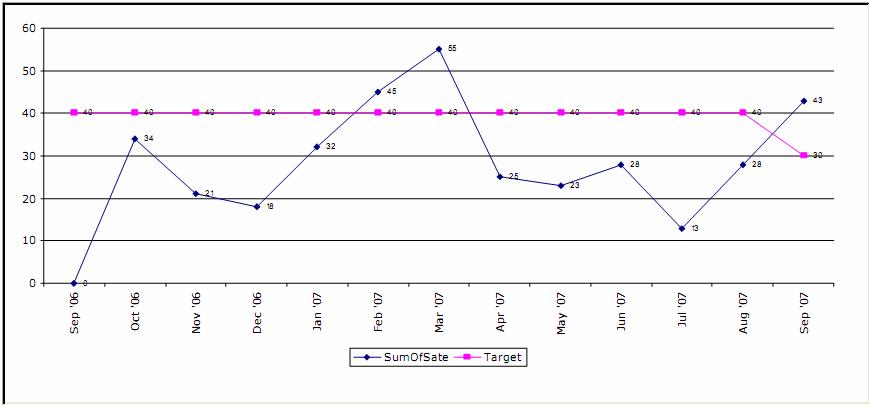
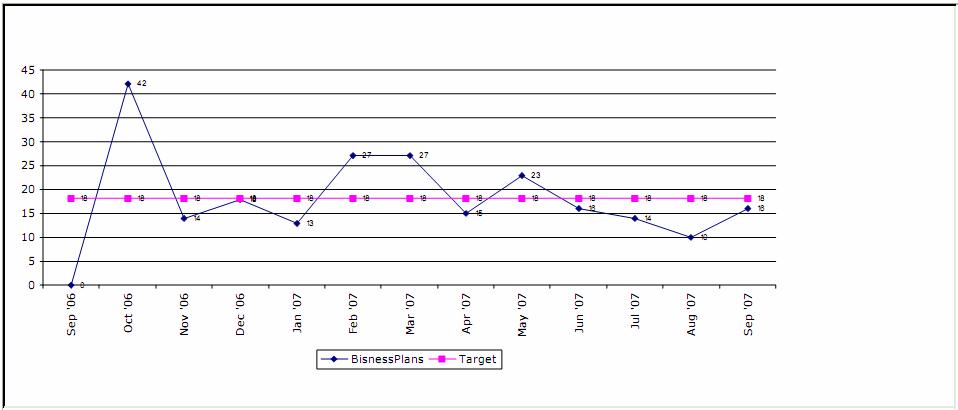
Chart RBD 1. Number of promotion activities
The number of promotion activities in the third quarter of 2007 was relatively constant
each month starting with an average of 13 villages in July and reaching 43 villages in
September. This is explained by the seasonality of agricultural works and DAs
focused their efforts on supporting business creation and intermediating lending from
participating financial institutions in the previous reporting period, which was very
active. An important source of information on project conditions are RISP I
beneficiaries. They can be considered an example for potential beneficiaries of RISP
II.
BUSINESSES CREATION
In July September 2007, the four DAs have managed to assist 40 RBs in
developing their business plans, this totaling to 235 RBs with their business plans
with DA assistance.
Chart RBD 2. Number of business plans developed
23
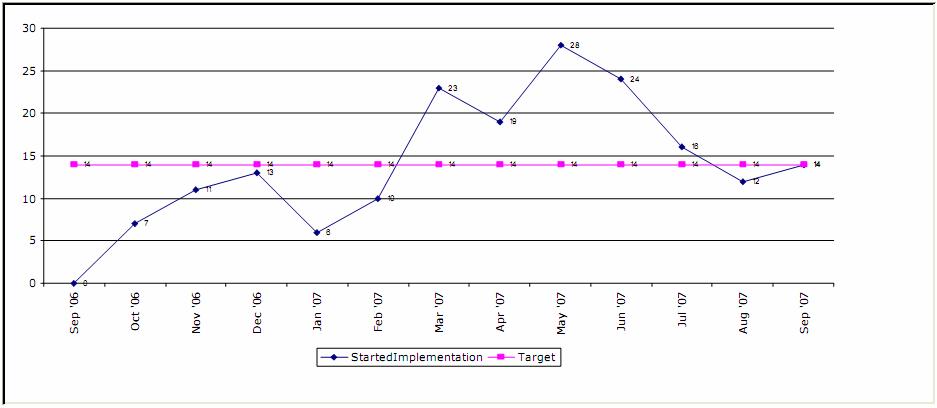
Therefore, 183 businesses established with the support of DAs started their
operational activity or implementation of investment plan as of September 30, 2007.
Out of them, 184 have received loans from PFIs and 5 started operational activity
only with their own resources. The total business investments of these 183
businesses amounted to 5,2 mil. $. Thus, the average investment made by
operational businesses by September 30, 2007 is approximately 28 thousand USD
MEGA has assisted in the creation of most of the RBS so far (62), followed by CCA
(87) and RDC (63). ACSA registered 42 businesses under this section.
Out of 183 businesses created, 171 are individual businesses, which represents
approximately 93% and only 12 are group businesses. To this end, group businesses
were considered businesses with 3 and more founders. This indicator, compared with
the one from 2006, is showing a gradual increase of the individual owned businesses
versus group ones.
Graph RBD 3. Number of operational businesses
The legal form of the businesses that commenced implementation of their business
plan is mostly Limited Liability Company (41%) and Sole Proprietorship (33%) and
peasant farms (21%). There is only one joint stock company and 8 patent holders.
As mentioned in the previous report, the number of patent holders is lessening as the
State policy in this filed is to limit this type of business organization.
The structure by the type of business is presented in Table RBD 2. The table below
shows a big share of businesses being non-agricultural (70%), which is matching
with one of the project trigger to have at least 1/3 of all new businesses created
engaged in off-farm activities.
24
From the agricultural businesses, a total of 55 at the end of the third quarter of 2007,
those with livestock production and crop production have the greatest weight, 12.6%
and respectively 14,8%. Together with those 5 agricultural services provision
business, agricultural businesses represent one third of total number of businesses
established by the project as compared to the previous quarter, when this indicator
was only 22%.
The chart in the Annex RBD 22 is showing a more simplified breakdown of rural
businesses by type of activity. As we can see in the table below, the non-agriculture
businesses are including processing (16%), transport companies (12%), personal
services (7%) and retail trade (16%). Half of the processing companies are food
processing companies (42%), followed by wood processing and wood items
manufacturing (21%), etc. It should be mentioned that the share of retail trade has
significantly decreased, from 39% in the first quarter to 16% in this quarter. This is a
positive trend since with the past two World Bank missions it was agreed that DAs
should make more efforts to keep retail trade businesses under 20% of total number
of businesses created with their support, and we have 5% of wholesale trade and
17% of retail trade businesses.
Hence, this indicator was decreased from 31% to 22%, even those the largest share
are retail trade businesses (16,9%, table RBD 2). A quarter of rural businesses being
involved in retail trade can be explained by rather small investments needed for this
specific activity compared with production or agricultural and non-agricultural goods.
And on the other hand, Moldovan rural population is still facing the problem of lacking
collateral when starting businesses that require attracting capital from commercial
banks. This problem is one of the main ones mentioned by DAs in their quarterly
reports.
25
Table RBD 2. Structure of RBs by area of activity
Number of
operational
Type of business
businesses
No.
%
Agriculture
Agricultural service activities
5
2.7
Crops production
27
14.8
Livestock production
23
12.6
Sub-total Agriculture
55
30.1
Non-agriculture
Pisciculture
2
1.1
Manufacture of food products and beverages
12
6.6
Clothing manufacturing
2
1.1
Wood processing and wood item manufacturing
3
1.6
Manufacturing rubber and plastic products
1
0.5
Manufacture of other non-metallic minerals
6
3.3
Processing metal products
1
0.5
Manufacture of electrical machinery and apparatus
1
0.5
Manufacture of furniture
2
1.1
Constructions
1
0.5
Retail trade
31
16.9
Sale, maintenance and repair of motor vehicles
9
4.9
Wholesale trade and commission trade
10
5.5
Hotels and restaurants
7
3.8
Land transport
20
10.9
Post and telecommunications
2
1.0
Supporting and auxiliary transport activities
1
0.5
Other service activities
11
6.0
Recreational, cultural and sporting activities
6
3.3
Sub-total non-agriculture
128
69.9
TOTAL
183
100.0
FINANCING RURAL BUSINESSES
In the third quarter of 2007, the DAs have signed 45 Service Agreements with the
beneficiaries. So far 218 credit applications were submitted to financial institutions
and 184 credits were already disbursed. 131 out of the credits disbursed are
provided from the RISP funds, 53 projects are financed from other sources.
As was mentioned above, 183 beneficiaries from the total number of contracts have
started the implementation of their Business Plans, elaborated in a joint effort with
the DOs. In 5 cases out of 183, the beneficiaries are starting the implementation of
their projects from their own sources, eventually considering accessing a loan at a
later stage.
26
All 183 businesses are located in 30 raions and one is in the municipality of Balti and
one in the municipality of Chisinau. The maximum number of businesses is in UTAG
(21 RBs), followed by Cahul, Orhei, Drochia and Glodeni with 14, 12, 11 and
respectively 10 RBs. These raions host almost one third of businesses created so far
(37%). If comparing regions by value of disbursed credits, then Drochia is the first on
the list with over 3.3 million lei disbursed in this raion, followed by URAG with over
3.1 million lei and then Orhei with 2,95 million lei. Leova and Anenii Noi are the most
passive in establishing businesses, where no business was created under RISP 2.
It should be mentioned that 143 out of 183 operational businesses have already
started to generate revenues. Also, 131 businesses were financed from RISP funds,
53 from other sources and 5 started implementation of the business plans from their
own resources. These 183 businesses created 633 jobs, which results in an average
of 3-4 jobs per business.
The following table is showing the breakdown of the service agreements by the level
of access to the financial resources:
Service agreements signed
254
Credit applications submitted
218
Loans disbursed
184
RISP loans
131
Loans provided from other sources
53
Credit applications still being assessed by PFIs
14
Credit applications rejected or withdrawn
18
Loans approved, not disbursed
2
If comparing the efforts of DAs in financial brokerage, we can mention MEGA with
64, RDC with 48, ACSA - 42 and CCA - 30 credits disbursed each so far.
MANAGEMENT INFORMATION SYSTEM AND M&E
The analysis of the progress in the implementation of the RBD Component is
managed by means of the database application. The DAs were provided with the
application files from the beginning of their assignment. The functionality of the
database includes data integrity check and the generation of the progress reports.
On a monthly basis CAPMU is receiving the updated database files from the DAs
and the information regarding the credits disbursed within the Rural Finance
27
Component from the Credit Line Directorate (CLD). The information is crosschecked
with the DAs and the CLD.
CAPMU is regularly maintaining and updating the database, providing a more
enhanced functionality, both for the DAs and the generation of reports.
An application for the Credit Line Directorate was developed in July. The application
was submitted the CLD in the second half of July. The person responsible for this
application at CLD was trained to use it. The application is functional for data
introduction, verification of accuracy of introduced data, generating reports and
diagrams and managing information on monitoring carried out by CLD staff. The
application will smooth the process of introducing data, the transfer of data between
CLD and CAPMU as well as reporting, including quarterly reporting, to the World
Bank. But, in order for this application to operate efficiently, CLD should make sure
that the person responsible for this application will become an expert in Access data
bases, and CAPMU will provide necessary assistance as requested.
Rural businesses established with the assistance of the project are monitored both
by DAs and CAPMU. Development Agencies are in charge of carrying out monitoring
visits to verify the performance of businesses created as compared to a set of
indicators, which proved to be very useful during the first phase of the project. Thus,
the frequency of monitoring visits depends on the risk category assigned by DAs to
each business as a result of the last monitoring visit. Therefore, businesses in the
low risk category are monitored after 6 months from the last visit, those in the high
risk category in two weeks from the last visit, etc. In the annex RBD 4a one may
see the structure of businesses by risk categories. A set of indicators are collected in
order to record data on employees, average salary by gender or age, average salary
before project participation, etc. (Annex RBD 4a)
When visiting revenue generating rural business, DA consultants also collect
financial data on the business such as sales, profit margin, taxes and fees, VAT, etc.
In annex RBD 4a cumulative data on employment and taxes and fees paid are
presented.
CAPMU is monitoring DAs by regularly and randomly organizing monitoring visits to
RBs created with the support of all DA consultants. The goal of these visits, in
addition to assessing created businesses, is to estimate the quality of assistance
28
provided by DA consultants, especially, post-creation assistance, but also the
accuracy of eligibility criteria for project participation.
POST-CRATION SUPPORT TO RBS
All four DAs have already started the post-creation support for the rural businesses
created. In the reported period 61 RBs have received post-creation assistance from
the DAs. The total number of businesses involved in DAs post creation support is
130 out of 183 operational businesses, each receiving 1 to 4 days of support
depending on the necessity. So, about 70% of the rural businesses that commenced
their operational activity have already asked for post-creation assistance. Most of the
support has been provided by MEGA with 163 days of post-creation so far. CCA and
ACA have provided 57 and 36 days respectively.
The breakdown of the post-creation support delivered to RBs during the third quarter
by category is as follows:
The category of the services
Nr. of days
ACA
CCA CDR MEGA
TOTAL
Legal issues
1
7
5
13
26
Finance/accounting
4
7
6
12
29
Management
1
5
3
12
21
Marketing/sales
4
5
4
14
27
Technologies
0
0
1
0
1
Total
10
24
19
51
104
As seen from the table above, out of 104 days of post-creation support, 51 were
provided by MEGA. By area, the most popular was financial and accounting
assistance, followed by marketing and legal assistance with 27 and 26 days each.
The technological area was required for only 1 post-creation assistance day. It could
be assumed that such a small number of days of technological support is not the
result of low demand from beneficiaries, but more due to the specialization of
development officers in 4 broad areas, but less in the technological one. In fact,
technological assistance and support is excellently provided by ACSA network.
29
RURAL FINANCE COMPONENT
CREDIT LINE IMPLEMENTATION PROGRESS
General data. In order to implement the Credit Line (CL) for funding and
development of eligible rural small and medium enterprises, on September 30, 2007,
the Credit Line Directorate re-credited and disbursed to Participating Financial
Institutions (PFIs) subsidiary loans amounting to 60,52 mln lei and 385,6 thousand
USD. These funds were allocated to finance 156 approved eligible sub-projects
valued at 79,99 mln lei and 482 thousand USD.
In compliance with PFIs data, the contribution of beneficiaries with their own
resources to the implementation of sub-projects constitutes about 64,44 mil. lei or
40,43% as compared to their total amount; the maximum requirement is 20%. The
integral estimated cost of approved sub-projects, including the contribution of the
beneficiary, co-financing by PFIs and CLD loan from CL resources is 159,36 mil. lei.
Disbursement of the CL and their use by PFIs is 43,50% lei equivalent of the total
value of the Credit Line, the share of sub-project committed funds is 57,27%. The
ratio of disbursed funds to funds for approved sub-projects is 75,96%.
The total amount reimbursed by PFIs is 440,7 thousand lei and 9,16 thousand USD,
which constitutes 0,73% and respectively, 2,38 of the disbursed amount.
Re-crediting rates. CLD re-crediting rates to PFIs for respective interest periods are
as follows:
Interest period
MDL
USD
01.02.06 30.07.06
12,45 %
01.08.06 31.01.07
11,00 %
6,55 %
01.02.07 31.07.07
14,05 %
6,37 %
01.08.07 31.01.08
11,77 %
6,38 %
The average commercial rate of re-financing final beneficiaries applied by PFIs on
sub-projects is 17,81%, varying from 15% to 20.5%. For USD tranches - 11,01%,
varying from 10,5% and respectively 11,5%.
Participating financial institutions. In the Project intermediary are 7 local banks
(PFIs):
1. MoldovaAgroindbank,
2. Fincombank,
3. Moldindconbank,
4. Victoriabank,
5. Mobiasbanca,
6. Banca Sociala,
30
7. Banca de Economii.
Data on the number of sub-projects approved by PFIs, disbursements and their
share:
Share of
PFIs
Sub-projects
Mln. lei
disbursements
approved
disbursed
by amount, %
MoldovaAgroindbank
47
12,78
19,59%
Fincombank
49
23,97
36,74%
Moldindconbank
21
9,99
15,31%
Victoriabank
19
8,09
12,40%
Mobiasbanca
16
8,42
12,90%
Banca Sociala
4
2,00
3,06%
Banca de Economi
0
0
0
Total
156
65,26
100%
Fincombank (FCB) has been the most active participating bank, approving 49 sub-
loans and integrally providing 45 sub-loans, followed by MoldovaAgroindbank (MAIB)
with 47 sub-loans approved and disbursed. Victoriabank (VB) has approved and
provided 17 sub-loans and Moldinconbank (MICB) 21 sub-loans approved and 19
integrally disbursed. Mobiasbanca - 16 sub-loans and Banca Sociala - 4 sub-loans,
while Banca de Economii has not started the lending activities, but submitted on sub-
loan for evaluation.
Fincombank has the highest share of disbursed resources from the total amount of
disbursements of 21.49 million lei (equivalent to 1.951 million USD), followed by
MoldovaAgroindbank with a total of 12,78 million lei (1.04 million USD). In turn,
Moldindconbank disbursed 9.99 million lei (0.68 million USD), and Mobiasbanca -
8.42 million lei (0.68 million USD), Victoriabank - 8,09 million lei (0.66 million USD)
and Banca Sociala - 2,0 million lei (0.16 million USD).
From the total amount of 156 sub-loans provided, 150 are provided in Moldovan Lei
and only 6 sub-loans are provided in USD, which shows a prudential approach of
beneficiaries to currency exchange risk, who usually don't have incomes in foreign
currency generated by exports.
The structure of sub-loans disbursed to PFIs by size:
Value
Nr. of loans
Amount
(mil. lei)
< 50,000 lei
6
0.22
50,000 250,000 lei
55
8.05
250,000 500,000 lei
47
17.21
500,000 1,000,000 lei
37
28.37
> 1,000,000 lei
11
11.41
31
The average size of sub-loans is approximately 550,1 thousand lei (equivalent to
44,7 thousand USD). The average value of disbursed sub-projects is 421,0 thousand
lei (equivalent to 34,2 thousand USD).
Structure of subsidiary loans by size
0,22 mil. Lei
11,41 mil. lei
8,05 mil. lei
0,34%
17,48%
12,34%
? 50,000 lei
50,001-250,000 lei
17,21 mil. lei
250,001 - 500,000 lei
26,37%
500,001-1,000,000 lei
28,37 mil. lei
? 1,000,001 lei
43,47%
The average loan size provided by MoldovaAgroindbank is MDL 272 thousand lei (22
thousand USD), which is the lowest as compared to the average of other
participating banks, demonstrating the bank' efforts in reaching the project' target to
finance small beneficiaries. Fincombank shows an average of 482 thousand lei (39
thousand USD) of the loan size, Victoriabank an average of 426 thousand lei (35
thousand USD), Mobiasbanca an average of 421 thousand lei (42 thousand USD),
Moldinconbank is showing 476 thousand lei (39 thousand USD), and for Banca
Sociala one average loan in the amount of 500 thousand lei (41 thousand USD)
respectively.
Type of activities. 56 of sub loans (36,82% of the total disbursements) finance trade
(construction or reconstruction of stores and procurement of equipment for trading);
33 sub-loans (17.38%) finance agricultural production and animal breeding, 23 sub-
loans (14,90% of the total disbursements) finance services; 15 sub-loans (11,21%)
finance catering services; 9 sub-loans (7,29%) finance trade and services; 6 sub-
loans (4,93%) finance construction materials manufacturing; 6 sub-loans (2,41%)
wood processing; 7 sub-loans (5,05%) financed other activities (building a
playground for children near the hotel, building a cafeteria for children, producing
ethereal oils and 2 sub-loans for manufacturing textiles and clothing).
32
Breakdown of sub-loans by sectors
of national economy (mil lei)
Construction
Wood production
and processing
materials
3.18
1.55
Others
3.26
Trade
Trade and
23.74
services; 4.70
Food
Industry
Agriculture
7.23
Services
11.20
9.60
Maturity of sub-loans
Maturity of sub-
Number of sub-
Amount (mln. lei)
%
loans
loans disbursed
" 1year
0
0
0
1 3 years
23
3,35
5,13
3 5 years
87
34,14
52,31
5 7 years
29
19,75
30,26
· 7 years
17
8,02
12,29
As shown on the chart above the biggest share of sub-loans 52.31% are provided
for a period of 3 to 5 years. 30.26% of sub-loans have maturity between 5 and 7
years and 12.29% of sub-loans have the maturity of 7 to 15 years. Only 5,13% of
sub-loans are provided for 1-3 years, which shows availability of own resources of
intermediary banks for short-term credits.
Regional distribution1. The sub-projects financed cover the whole country, with a
relatively uniform distribution by number of sub-loans financed. The share of the sub-
projects financed in the center is slightly higher 38.42% (MDL 25.07 million) in the
total. The Northern part covers 30.17% of the sub-loans (MDL 15.36 million), and
31.41% of the sub-loans finance the Southern region (MDL 20.50 million).
1 The distribution of rayons by region is as follows: North: Riscani, Rezina, Drochia, Donduseni,
Edinet, Soroca, Glodeni, Briceni, Balti, Singerei, Soldanesti, Floresti; Center: Orhei, Ungheni,
Nisporeni, Anenii-Noi, Dubasari, Criuleni, Telenesti: South: Cahul, Vulcanesti, Taraclia, Comrat,
Ceadir-Lunga, Hincesti, Leova, Causeni, Stefan-Voda, Cantemir, Cimislia
33
Breakdown of sub-loans by region
in million lei and % of the total number
South
North
20.5 mln lei
19.69 mln lei
31.41%
30.17%
Center
25.07 mln lei
38.42%
Number of sub-
Amount of sub-
Nr.
Raion
loans
loans (thousand lei)
1
Anenii-Noi
2
1187,2
2
Basarabeasca
-
-
3
Briceni
2
704,0
4
Cahul
6
3540,0
5
Cantemir
-
-
6
Calaras
4
2292,0
7
Causeni
3
2112,8
8
Cimislia
2
1120,0
9
Criuleni
1
528,0
10
Donduseni
3
1309,0
11
Drochia
11
5585,2
12
Dubasari
1
40,0
13
Edinet
7
2978,7
14
Falesti
4
1250,2
15
Floresti
1
96,0
16
Glodeni
3
292,0
17
Hincesti
2
1072,0
18
Ialoveni
8
4630,4968,0
19
Leova
1
832,0
20
Nisporeni
3
-
21
Ocnita
-
2064,0
22
Orhei
6
3005,2
23
Rezina
8
746,4
24
Riscani
17
380.8
25
Sangerei
2
-
26
Soroca
-
1824,0
27
Straseni
4
336,0
28
Soldanesti
3
-
29
Stefan Voda
-
2382,7
30
Taraclia
11
152,0
31
Telenesti
1
9021,0
32
Ungheni
17
1430,0
33
Mun. Chisinau
3
10379.76
34
UTA Gagauzia
20
34
Financing of first-time borrowers. One of the project objectives is to increase
access to rural finance to start-ups, thus it is required that minimum 30% of the Credit
Line resources are provided to the first-time borrowers. PFIs data show that at
present 47.44% of the credit line recourses are provided to first-time borrowers.
Other objectives. Due to project financing to sub-loans financed until now will be
created about 928 new jobs. It is important to mention that participation of women in
the establishment of the business in the rural area is increasing. So, 36.03% of
company managers financed by sub-loans are women.
Sub-loans monitoring. In order for PFIs to fulfill the conditions of the Subsidiary Loan
Agreements under the RISP project as well as for beneficiaries to use resources provided
according to destination, CLD performed monitoring of 90 (or 55%) sub-loans, from which
63 (or 40,4%) were visited. Within the monitoring of MoldovaAgroindbank sub-projects
carried out randomly, the credit files of 17 visited sub-projects were verified. 32 files
of Fincombank were verified, from which 19 sub-projects were visited. 14 files of
Victoriabank were monitored and 9 sub-projects were visited; 13 sub-projects of
Mobiasbanc were monitored and visited. Moldindconbank had 11 of its sub-projects
monitored and 7 visited. 3 sub-projects of Banca Sociala were visited and monitored.
Bank monitoring revealed that not all beneficiaries comply with procurement procedures,
in some cases PFIs disbursed lending to beneficiaries with delays. Also the environment
impact forms were not filled out properly, and in some cases the category of environment
impact was not determined appropriately. In most cases, C category, low impact, was
allotted, which does not require any remedy actions, when the B category should have
been assigned. Some PFIs did not open a roll-over account, which violates item 13 of
RCG on using the balance accumulated on roll-over accounts of sub-loans
reimbursed within 3 months. The outcomes of monitoring were disseminated to all
PFIs.
Re-credited loan records. With the purpose of complying with the requirement of
Law of Republic of Moldova nr.419-XVI from 22.12.2006 ,,On public debt, state
guarantees and re-crediting" for keeping the State Record on State Re-crediting,
ensuring monitoring and control of parties involved in re-crediting of state loan
resources as well as organizing recording of re-credit loans provided to banking
intermediaries, CLD opened in its registers separate accounting analytical and
synthetic accounts in compliance with accounting policy 2007. To avoid risks, the
35
accounts of the Credit Line are opened and serviced by the National Bank of
Moldova.
All inflows and outflows on analytical accounts (with distribution by currency) are
accounted for on a daily basis. Available resources in MDL and foreign currency in
the accounts of CLD are monitored. At the end of each reporting period (quarterly) all
economic-financial operations of CLD performed during the quarter on synthetic
accounts are summarized and all financial statements related to the activity of CLD
(including balance sheet) are generated in compliance with the National Accounting
Standards.
The Ministry of Finance receives quarterly information on re-crediting Credit Line
resources and the balance of PFI debt.
Report on PFI payments and debt under RISP II
as of 30.09.07
%
Currenc
Amount
Reimburse
reim
balance
nr. Name of PFI
y
approved
Paid
d
b
(debt)
12781200.0
12781200.0
1 MoldovaAgroindbank
MDL
16579000.00
0
0.00
0.00
0
22456261.0
22447506.0
2 Fincombank
MDL
30466844.00
0
8755.00
0.04
0
$
154000.00
123200.00
0.00
0.00
123200.00
3 Victoriabank
MDL
8985000.00 7108000.00
0.00
0.00 7108000.00
$
100000.00
80000.00
0.00
0.00
80000.00
4 Banca
Sociala
MDL
2500000.00 2000000.00
0.00
0.00 2000000.00
5 Moldindconbank
MDL
11916500.00 8541000.00
0.00
0.00 8541000.00
$
148000.00
118400.00
0.00
0.00
118400.00
6 Mobiasbanca
MDL
9537520.00 7630016.00
432000.00
5.66 7198016.00
$
80000.00
64000.00
9160.00 14.31
54840.00
7 Banca de Economii
MDL
0.00
0.00
0.00
0.00
0.00
60516477.0
60075722.0
30.09.2007
79984864.00
0
440755.00
0
482000.00
385600.00
9160.00
376440.00
Reporting. According to the provisions of the RCG, PFIs submit to CLD quarterly
progress reports on the quality of loan portfolios, reports on collecting and using
funds from the roll-over account and the reports on financing new eligible sub-
projects from the roll-over account prepared using the reporting forms set by CLD
and approved by IDA.
CLD also developed a series of analytical reports on using the resources of the
project (Report on PFI payments and debt, Report on PFI payment and debt on re-
36
financing sources, Report on registering loans provided, Report on recording
payment liabilities, List of monitored sub-projects, the schedule of amortization, the
schedule of interest payment).
Developing institutional capacities of the Rural Finance System
Under Part C2 of the Project "Developing institutional capacities of the Rural Finance
System", CLD together with CAPMU prepares training courses for PFI staff and
institutional capacity building aiming at enhancing lending procedures for investment
projects, agricultural projects and financial leasing.
Conclusions and Recommendations. PFIs mentioned several times that
beneficiaries want the maximum ceiling of sub-project amount to be increased and
that the amount of 100 thousand USD is too low.
Goods and services procurement procedures following local commercial practices
to allow selection without the mandatory requirement of at least three proposals for
small contracts up to 10 thousand USD equivalent (including goods with well known
prices, small acquisitions on the given territory, purchasing spare parts for
equipment, extending contracts, etc.).
In order to facilitate development of rural business activities other than trade, at the
recommendation of the World Bank, PFIs were informed that they are not
encouraged to fund trade companies starting with August 1, 2007 and aim at
lowering the share of these businesses to 20% (on reporting date, 41,7% of total
withdrawals from Credit Line were for trade business). Thus, funding to other rural
industrial sectors and new job creation, including in the agricultural sector, and other
rural activities and services will increase.
STRENGTHNING THE SAVINGS AND CREDIT ASSOCIATIONS INDUSTRY
The objective of this sub-component is to improve the legal, regulatory and
supervisory framework of the Savings and Credit Associations (SCA) industry, and
provide capacity building to the related institutions, primary the supervisory authority,
to ensure their long-term sustainability.
37
During the reporting period, activities on developing the new legal, regulatory and
supervision framework for the SCA industry were carried out. Also new activities on
building operational capacity of the new supervisory body were initiated.
The draft Law on SCAs
During the reporting period, the new Law on SCAs was published. The law comes
into effect on January 1, 2008, except its provisions on the central association, the
liquidity pool and the stabilization fund, which will become effective within 12 months
from the date the law comes into effect.
Prior to the law coming into effect, a range of normative acts necessary for its
enforcement need to be developed. In order to further support the process of
improving the legal framework regulating the activity of SCAs, the project will provide
assistance to developing these additional normative acts (for more details on
provided assistance please see under section on support to the new supervisory
authority).
Support to the new supervisory authority
During the reporting period, the National Commission for Financial Market (CNFM)
determined its structure and staffing (decision on approving the structure and
staffing, nr. 40/1 dated August 3, 2007, Official Bulletin nr. 117-126 from August 10,
2007). According to this decision, the function of regulation and supervision of SCA
activity will be carried out by the Department for collective investments and
microfinance. This Department is authorized to perform two different functions:
Directorate for regulation and authorization of collective investments and
microfinance, which will be regulating the activity of SCAs and the Directorate for
monitoring and control of collective investments and microfinance aiming at
overseeing the conformity of SCA operational activity to current legislation. This
department will have 12 people of staff.
During the ordinary World Bank supervision mission conducted during September 5-
15, 2007, several working meetings with the Management Board and specialists from
the department in charge of regulating and supervising the activity of SCAs of NCFM
were organized and cooperation aiming at enhancing the regulatory and supervision
framework of SCAs, their strengthening and long-term sustainability were discussed.
38
The NCFM, as a full successor of the former State Supervisory Body of the activity of
SCAs, is the institution in charge for the development of additional normative acts
necessary for the enforcement of the new Law on SCAs. During meetings between
specialists from the Department for Collective Investments and Microfinance,
CAPMU and the World Bank, priority acts and activities to be finalized by the end of
this year were identified. As a result, the Terms of Reference for two local
consultants assisting NCFM specialists on developing necessary normative acts in
October December 2007 were developed and agreed with the World Bank.
39
MOLDOVA LAND RE-PARCELING PILOT PROJECT
INTRODUCTION
The present report proposes details for the implementation of the project
Implementation of Land Re-Parceling Pilots in Six Villages, funded by the World
Bank and SIDA, the Swedish Development Agency. An international consulting firm
will assist Government of Moldova (GOM) with the implement land re-parceling pilot
projects in six villages in Moldova according to the Terms of Reference (ToR). The
specific objectives of the pilots are to
i.
test the demand and feasibility of land re-parceling with small landowners as
the primary target group;
ii.
use the pilot experience as the basis for designing a potential national-level
approach, including techniques, resource requirements and legislative
framework; and
iii.
assess the impact of re-parceling at the local level, including on land markets,
agricultural production, and equity.
The principal implementing agency of the project is the Ministry of Agriculture and
Food Industry (MAFI).
The technical assistance has been awarded to the consortium consisting of:
x Niras AB, Sweden, (leading partner),
x Terra Institute Ltd., USA
with sub-contractors:
x ACSA, National Agency for Rural Development, Moldova,
x Orbicon A/S, Denmark
The project period is 18 month from 1. August, 2007 31. January, 2009. The
inception period of the project has been the first three months of the project period (1.
August 31. October, 2007).
The project was launched during a short pre-project mission of the project manager
(PM) and team leader (TL) in the period 1. 4. July, 2007.
40
The first project mission took place in the period 27. August 5. September, 2007,
with the participation of the PM, TL and international land management expert.
DETAILED PLAN OF PROJECT ACTIVITES
INTRODUCTION
According to the Terms of Reference the project implementation will consist of 17
project activities / tasks (ToR, section F). These are:
1. Finalize the selection of six pilot communities and ensure that they meet the
selection criteria in the ToR (section D).
2. In cooperation with MAFI, establish the framework for a project steering
committee.
3. Assist GOM in identifying international best practice for developing
cooperation procedures for the project implementation (Between MAFI, other
government agencies and local government.
4. Develop an overall concept for how data from the land register of the ALRC
can be made available for the field work in the pilot locations.
5. Establish framework principles to ensure that there are no adverse
environmental impact from project activities.
6. Develop and carry out a training program.
7. Develop a public awareness campaign.
8. Assist the pilot communities to establish a local stakeholder committee in
each of the project sites, and ensure that they are integrated in the process.
9. Review and if necessary revise ownership maps for the baseline situation in
each village (prepare Plan 1).
10. Conduct preliminary investigations and prepare and disseminate area
development plans for each site.
11. Develop and put in place an approach for valuation of land in the project
areas.
12. Prepare and publish draft re-parceling design in each pilot village.
13. Prepare final re-parceling plans (Plan 2).
14. Develop and apply simplified procedures for registration and implementation
of agreements.
15. Assist local stakeholders and landowners in registration process and
obtaining of new land titles.
16. Organize two study tours in one western and one eastern European country
with successful experiences in land re-parceling / land consolidation.
41
17.
Describe implementation experiences and recommend national level
approach.
A project implementation plan has been elaborated during the inception period (see
annex LRPP 1). This work plan gives the timeline of project activities, staff
assignment and reporting.
The core activities of the field work of the project are (i) project activity 10
(preliminary investigations and development of area development plans in each pilot
site), (ii) project activity 12 (draft re-parceling design) and (iii) project activity 14
(registration and implementation of agreements) and project activity 15 (registration
and obtaining of new land titles). These activities follow the sequence of the project
implementation, from activity 10 to 12 and finally to 14/15. These are also the most
time consuming activities of the project (for details see below in sections Project
activity 10, 12, 14 and 15). This was for activities 10 and 12 not reflected very clear in
the work schedule prepared by Niras in the Technical proposal from January 2007. In
the newly elaborated project implementation plan (annex LRPP 1), these main
project activities are allocated more time than precious foreseen (5 month for activity
10, 5½ month for activity 12 and 5 month for the implementation part of activity
14/15).
PROJECT ACTIVITIES IMPLEMENTED DURING THE INCEPTION PERIOD
During the inception period (August October 2007) the project implementation has
been prepared. Main project activity has been activity 1) Finalize the selection of six
pilot communities and ensure that they meet the selection criteria in the ToR. In
addition project activities 2, 3 and 4, 6 have been implemented together with the
preparatory part of activity 6 (training program). Activity 7 (public awareness
campaign) has been launched during the inception period and will continue through-
out the project period (see the respective sections below). Activity 8 (assist in
establishing local stakeholder committee) has been implemented in the six pilot
communities during the first village project workshops in October 2007. Finally
activity 9 (preparation of ownership map Plan 1) and activity 10 (Preliminary
investigations and preparation of area development plans) were launched at the end
of the inception period (during the mission of the international experts in the period 7-
12 October, 2007).
42
The main result of the work during the inception period has been the final selection of
six pilot communities that seem to be well suitable for the purpose.
PROJECT ACTIVITIES
In the following sections of this chapter 2, each of the planned project activities (1-17)
will be described and explained in details. The main purpose is to turn the proposed
approach into operation and provide a practical guide for the implementation with
specified roles and contributions for the involved institutions and individuals.
Project activity 1: Finalization of the selection of pilot communities
The selection of 6 very suitable pilot communities is crucial for a successful
implementation of the project. This first project activity was started by MAFI before
the beginning of the project, 1. August, 2007.
Criteria and process for selection of pilot communities
The Terms of Reference for the project (section D) specifies 15 criteria of importance
for the selection of the six pilot communities. These are, not in order of priority:
1. Existence of family farms with potential for commercial farming and a desire
to form contiguous parcels and eventually enlarge the farms..
2. Fragmentation of parcels.
3. An existing land market (presence of both potential sellers and buyers).
4. Current and reliable land price information or a robust alternative for valuing
land.
5. Public land available (through sales and exchange) to catalyze the process.
6. A relatively small number of absentee owners.
7. A high level of completion of land reform / privatization and registration of land
ownership (on a national level, 85 % of rural properties registration is
expected to be completed by summer 2007).
8. A relatively high level of satisfaction among local landowners and
stakeholders with the privatization process and outcome.
9. Few land disputes and no problematic ones.
10. Soil with good potential for agricultural production.
11. Location within a designated economic growth area of the country (land re-
parceling can be linked to other development activities, including locations
participating in other RISP-II components).
12. Existence of digital cadastral maps and other thematic maps.
43
13. Plans / measures for sustainable local rural development and infrastructure
improvement.
14. Initiative and commitment from local government, including the willingness
and capacity of the Mayoralty Secretary to provide notary services for a
reduced fee.
15. Potential availability of local expertise in land re-parceling design and land
use planning (e.g. former staff of the USAID LPSP project or government
Planning Institute for Land Management).
Prior to the first mission of the project manager and the team leader during 1. 4.
July, 2007, the selection process was started by MAFI. The Council in each raion
was during the spring 2007 by MAFI invited to propose each three candidate
locations for the pilot communities of the project. According to MAFI, the raions were
asked to appoint the candidate communities based on the above mentioned criteria
in the ToR. Based on this, a list of 100 candidate communities was elaborated.
Subsequently and still prior to the project start, MAFI prepared a so-called "short-list"
of 17 villages based on the list of 100 villages / communities. A document was
prepared to try to show how these 17 communities meet the selection criteria.
During the July mission of the PM and TL the procedure for the finalization of the
selection process was agreed with MAFI.. The main steps agreed to do before the
first official project mission 27. August 5. September, 2007, were to:
Ensure an open and transparent selection process.
1. Add additional criteria for the selection.
2. Amend the so-called "short-list" with additional villages from the initial list of
the 100 villages in order to be sure to have enough good villages on the
shortlist before the final selection.
3. Collect more detailed information about the shortlisted villages.
4. Develop an evaluation method to rate the villages against the criteria.
5. Visit each of them to validate the collected information and (if necessary) add
additional information / description of the situation in the village.
44
Additional criteria
The PM and TL together with Mr. Horjan and Mr. Sevcenco and staff from ACSA
(sub-contractor) visited during 3. July, 2007, two of the 17 candidate villages on the
first shortlist; Opaci village and Tocuz village, both in Causeni raion, to get first hand
information and to validate the collected information on how these villages meet the
selection criteria. The team met with the mayor and staff at the Mayor's office in both
villages together with the agricultural director in Causeni raion and local farmers.
During this visit, it became clear to the contractor that it will be necessary to add an
additional criterion for the selection and also to collect more detailed information on
how the short-listed villages meet the criteria.
In Tocuz village it turned out that there is an unclear situation in relation to land
ownership / use of parcels. During the privatization, the villagers each were allocated
one parcel of arable land, one parcel of orchard and one parcel of vineyard.
However, the villagers decided to further sub-devide the parcels after species of
trees and type of grapes. This has resulted in the present situation where each
landowner use 3-4 parcels of orchard (e.g. apple, plum and pear) and 3-4 parcels of
vineyard. This was never registered on the cadastral maps and in the land register.
Before a land re-parceling project can begin in the village, it would be necessary to
register the actual situation with the high degree of fragmentation or alternatively to
agree with the villagers that they should go back to using the land parcels which they
have the title to. In Tocuz village around 800 hectares are affected by this problem. In
relation to the selection of pilot communities, such an unclear situation should be
avoided.
The collected information to assess to which degree the 17 already "short-listed"
villages meet the selection criteria did not indicate this serious situation. Therefore
more detailed information is necessary in form of a short description of the actual
situation in relation to unclear ownership to the land parcels.
During discussions in Opaci and Tocuz villages, it was confirmed to the contractor
that many villages in Moldova are dominated by big corporate farms that use (mainly
through lease agreements) from 300 2000 hectares or more, often in more than
one village. Development of private family farms, which are the main target group of
the land re-parceling project, is very difficult in villages dominated by such corporate
farms. Therefore an additional selection criteria has been added:
45
16. Absence of big corporate farms in the village
Method to rate the proposed villages against the criteria
It has been the intention of MAFI that the 6 pilot locations should be selected in
different geographical areas of Moldova in order to ensure that different rural
conditions are reflected in the project and also to spread project experiences to
different parts of the country. Therefore, it was the intention to select two villages in
the North, two in the Central and two in the South.
It is the assessment of the contractor that all the selection criteria are not equal
important for the selection of the best possible pilot communities (e.g. existence of
family farms with potential for commercial farming is more important than the
availability of a public land reserve, because it can be expected that many
landowners will be willing to sell their land since it is not important to them and they
are not engaged in farming activities).
The contractor has together with MAFI developed an evaluation sheet in order to be
able to evaluate to what extent the villages match the now 16 different selection
criteria. The candidate villages can score up to 100 points on 11 different issues. For
some issues in the interval 0-15 (the most important issues) for other issues in the
interval 0-10 and 0-5. The evaluation process has been carried out by the
established technical Working group (see section 3.2). It has been the intention to
make the evaluation as thorough and objective as possible but also taking into
consideration that limited time has been available. It was important for both the
contractor and MAFI to finalize the selection process during the first official mission of
the international experts (August-September 2007) in order to launch the project
activities in the field.
Finalization of the selection process
During July and August, the activities agreed on the July mission of the PM and TL
were carried out by MAFI together with ACSA. At the beginning of the first official
project mission of the international experts on 27. August, 2007, a second shortlist of
20 candidate villages had been prepared by MAFI and ACSA, who also had visited
the shortlisted villages to validate the collected information and to collect further
information when necessary.
46
The Technical Working Group of the project (see section 3.2) met on 29. August
2007, and evaluated the 20 villages shortlisted with the use of the above mentioned
evaluation sheet.
During the evaluation process, five villages were excluded from the shortlist, either
because of a) a large number of land disputes / geodetic errors and / or b) very large
number of absentee owners and / or c) lack of interest and commitment from local
government.
The 11 best villages were selected and visited again by the Technical Working Group
during four days of the mission. Finally the Technical Working Group made the final
evaluation and selected the six best villages on the 4. September 2007 and they
were confirmed by Minister Gorodenco at a meeting on 5. September, 2007. The
selected villages are:
x Busauca village, Rezina Raion (North)
x Sadova village, Calarasi Raion (Central)
x Bolduresti village, Nisporeni Raion (Central)
x Calmatui village, Hincesti Raion (Central)
x Opaci village, Causeni Raion (South)
x Baimaclia village, Cantemir Raion (South)
Project activity 2: In cooperation with MAFI, establish the framework for a
project steering committee.
- to be added
Project activity 3: Assist GOM in identifying international best practice for
developing cooperation procedures for the project implementation (Between
MAFI, other government agencies and local government.
- to be added
Project activity 4: Develop an overall concept for how data from the land
register of the NAGCC can be made available for the field work in the pilot
locations.
- to be added
47
Project activity 5: Establish framework principles to ensure that there are no
adverse environmental impact from project activities.
The main objective of the project is to contribute to the development of the
agricultural structures in the pilot sites through reduction of fragmentation of parcels,
enlargement of farm sizes and development of the family farms. All countries in
Western Europe have been through the same process since the end of World War II.
The result in most countries has been agricultural structures that are competitive in a
globalizing economy. However, a side-effect in many countries has been a decline in
valuable types of nature and loss of biodiversity.
It is very important to avoid that the re-parceling pilots can lead to a similar
development in the pilot villages. Framework principles will be established to ensure
that there are no adverse environmental impacts from project activities. The project
activity shall have as an output that the field teams in each village can prepare a brief
environmental impact assessment (EIA) as an integrated part of the project activities
in the pilot villages. This activity will be implemented together with the elaboration of
a community area development plan for each pilot (see project activity 10).
According to the ToR for the project and also the Technical proposal presented by
Niras (January 2007) it was foreseen that activity 5 was to be implemented during the
inception period. The EIA is closely related to the up-start of the field activities in the
six pilot sites, which has not started before at the end of the inception period.
Therefore, the activity will be implemented immediately after the inception period
between November 2007 and February 2008. An international EIA expert will
together with the TL be responsible for the activity, that will be carried out by each
field team together with project activity 10.
The international EIA expert will at the second training seminar in November 2007
(see section Project activity 6) provide training and guidelines / checklist for
assessment of the environmental impact of project activities. The expert will evaluate
and supervise the activities at a second mission scheduled for January 2008.
Project activity 6: Develop and carry out a training program.
A well prepared training program is an essential precondition for successful
implementation of land re-parceling projects in six villages in Moldova. According to
Terms of Reference (section F) task 6 of the project is to Develop and carry out a
program of training for Moldovan counterparts and team members. Again according
48
to Terms of Reference (section G), the training program is supposed to be developed
as part of Group 1 activities immediately after the Inception Period. The contractor
has however; develop the training program already during the Inception Period of the
project. This has made it possible to carry out the first training seminar immediately
after the recruitment / appointment of the six field teams in October 2007. The first
training seminar was held on 10. October, 2007, in connection with the project launch
workshop with a total of 60 participants.
The training program is based on international best practice for implementation of
land re-parceling / land consolidation pilot projects. The Food and Agriculture
Organization of the United Nations (FAO) has prepared training materials for land
consolidation pilot project. The training materials (text part and PowerPoint
presentations) are based on experiences from land consolidation pilot projects in
Lithuania and Armenia prepared by David Palmer, FAO Land Tenure Service, with
assistance from the team leader.
Concept and target group for training program
It is not the intention of the contractor to carry out a regular training needs
assessment (TNA) as part of the project. The reason for this is, that the contractor
(Orbicon) has experience in implementation of similar land re-parceling / land
consolidation projects and the connected training and capacity building from similar
projects in Lithuania, Armenia and Croatia.
The Ministry of Agriculture and Food Industry (MAFI) has expressed an interest in
extending the training program to involve not only the directly involved stakeholders
and institutions. The background for this is a wish from MAFI to train as many as
possible for the planned future scaling up of the pilot activities to a national land re-
parceling / land consolidation program.
Two different target groups have thus been identified for the training:
x Staff at institutions and counterparts directly involved in the implementation of
the six land re-parceling pilot projects.
x Staff from local and central Government not directly involved in
implementation in the six pilot locations (e.g. staff from Raion Agricultural
Departments in raions not selected for the pilots).
49
Training and supervision of directly involved stakeholders and counterparts
The training will be carried out through a combination of class room training and on-
going supervision of the field teams. The class room training will be given by the
international experts during 5 training seminars spread over the project period, each
time introducing the next activities of the field work.
The main target group for the training program is the six field teams, relevant staff of
MAFI, central and local staff of the ALRC and local Government (both at Raion and
village level). It is expected that 40 50 people directly involved in project
implementation will be trained during the project.
Objectives of training program for directly involved stakeholders and counterparts
The training shall give the field teams and MAFI the necessary skills to implement the
pilots. The training will give important contribution to capacity building in the field of
land re-parceling / land consolidation and can thus build the basis for a subsequent
national program for land re-parceling / consolidation (scaling up based on pilot
experiences).
The training seminars will also serve as an important part of teambuilding and
dissemination of experiences between the six field teams and the national level
experts (both from the contractor and MAFI).
Content of training program for directly involved stakeholders and counterparts
The main basis for the training program will be the FAO training materials mentioned
above. The FAO materials consist of 12 units (text part and PowerPoint for each
unit):
1. The general concept of land consolidation pilot projects.
2. Selection of a community for the pilot project.
3. Public awareness campaigns.
4. Inventory of cadastral and registration records at the start of the project ("plan
1").
5. Situational analysis and needs assessment.
6. Community area development planning.
7. Starting negotiations with landowners and other stakeholders.
8. Valuation of land parcels.
9. Draft re-allotment plan ("plan 2").
50
10. Finalization of re-allotment plan ("plan 2").
11. Registration and implementation of the signed agreements of transfer.
12. Results of the project.
In addition to the FAO materials the following issues will be covered in the class room
training:
1. The concept of voluntary and market based land re-parceling
2. Experiences with land re-parceling / land consolidation in Central and Eastern
European countries during the last 15 years.
3. Practical experiences from land consolidation pilot projects in Lithuania,
Armenia and Croatia.
4. Western European land consolidation practise.
5. Environmental impact assessment.
The training materials have been translated into Romanian language.
The class room training will be conducted through 5 training seminars spread over
the 18 month project period and each time introducing the up-coming activities of the
next period. According to the Project Implementation Plan (annex LRPP 1), the
training seminars are tentatively scheduled for:
1. Training seminar:
October 2007
2. Training seminar:
November 2007
3. Training seminar:
March 2008
4. Training seminar:
August 2008
5. Training seminar:
October 2008
Each seminar (except the first) will include classroom training, practical
demonstration (e.g. demonstration of landowner interviews and / or negotiations),
and a presentation of the status for the work and experiences from each of the six
teams.
First training seminar:
The first training seminar has been conducted on 10. October, 2007, immediately
after the recruitment of the field teams. During the first seminar and the connected
51
project launch workshop, the FAO training units 1-4 together with additional units 1-3
were the basis for the training.
Second training seminar:
The second training seminar will be conducted in November 2007. During the second
seminar FAO training units 3 and 4 will briefly be repeated. FAO units 5 and 6 will be
presented together with additional units 4 and 5. Cases from the six pilots will be
discussed.
Third training seminar:
The third training seminar is tentatively planned to be conducted in March 2008.
During the third seminar FAO training units 7-9 will be presented. Cases from the six
pilots will be discussed.
Fourth training seminar:
The fourth training seminar is tentatively planned to be conducted in August 2008.
During the fourth seminar FAO training unit 9 will be briefly repeated and unit 10 will
be presented. Cases from the six pilots will be discussed.
Fifth training seminar:
The fifth training seminar is tentatively planned to be conducted in October 2008.
During the fifth and final seminar FAO training units 11 and 12 will be presented.
Cases from the six pilots will be discussed.
On-going supervision of directly involved stakeholders and counterparts
A very important element in the proposed training and capacity building in relation to
the land re-parceling project will be on-going supervision of the six field teams.
Thorough supervision is an important precondition for successful project
implementation.
In the day to day work in the six pilot locations each team member will have a clear
line of communication with the project team (Moldovan team at national level and
international experts). The deputy team leader, Mr. Dumitru Sevcenco, will together
with MAFI (Mr. O. Horjan and Mr I. Botnarenco) be responsible for the daily work in
the pilot project locations. The international experts will visit the six pilot locations as
52
much as possible during the missions and give direct supervision to each of the local
teams during the different steps of the project.
The pilot experience will develop a training module for land re-parceling that will
serve as input for the preparation of a training program for the larger scale re-
parceling activity at national level envisaged in the Government Program for Farm
Consolidation.
Training and supervision of staff from institutions not directly involved in
implementation of the six pilots
Two special training seminars for staff of local and central Government not directly
involved in the implementation of the six pilots will be organized.
First training seminar:
The first training seminar for Government staff not directly involved in the pilot
activities is tentatively planned to be conducted in February 2008. The one day
seminar will 1) provide to the participants a comprehensive overview of the activities
of the land re-parceling project, 2) the first experiences from the pilots, 3)
experiences from similar pilot projects in other countries in Central and Eastern
Europe and 4) Western European experiences with land re-parceling / land
consolidation. An extract of FAO training materials will be used as well.
Second training seminar:
The second training seminar for Government staff not directly involved in the pilot
activities is tentative planned to be conducted in November 2008. The seminar will
disseminate experiences and results from the field activities in the six pilot locations
together with recommendation for the scaling up of the pilot experiences.
International experts involved in the implementation of the training program
The team leader will be overall responsible for implementation of the training
program and conduct most of the class room trainings. The international land
management expert, Mr. David Egiashvili, will be involved in the implementation of
the training program, mainly in relation to collecting data and information from the
Cadastral Agency and the registration and implementation of land re-parceling
agreements.
53
It is the proposal to involve extra international experts on topics where additional
expertise is necessary. These topics are mainly:
x Land valuation (Mr. Jan Thaysen, Orbicon)
x Environmental impact assessment (Ms. Karina Kitnaes, Orbicon)
x Community area development planning and registration and implementation
of land re-parceling agreements (additional input based on practical
experiences from FAO pilot project in Armenia by Mr. Vahagn Grigorian,
Armenia).
Project activity 7: Develop a public awareness campaign.
An important component in the initial stages of a land consolidation / re-parceling
project is to provide information to a wide range of institutions, stakeholders and
individuals about the project concept. The information will be targeted towards
different audiences as part of the project implementation:
x Communities and local authorities in potential pilot areas (as part of the
selection process)
x Communities and individuals in the 6 selected pilot sites
x Staff from relevant Government agencies and institutions.
Public awareness campaign during the selection of pilot sites
Information about the project has been an important part of the selection of six good
pilot sites (see section Project activity 1). Information about objective of the project,
expected outcome, main principles and selection criteria and process has been given
as part of the selection process during meetings with local government (at raion and
village level).
Project launch workshop
A project launch workshop was organized on 10. October, 2007, in the MAFI
conference hall in Chisinau with around 60 participants from MAFI, cadastral agency,
other Government institutions, the agricultural departments in raions with pilot
villages, from the pilot villages and staff of the contractor (including international
experts).
54
The purpose of the workshop was officially to launch the project and create
awareness about the project concept and expected outcome.
Project brochure
A project brochure has been prepared during the inception period of the project . The
main target group for the brochure is the local stakeholders (landowners, farmers,
villagers and other stakeholders). The brochure also serves as a short
comprehensive introduction to the project for all other interested groups. The
brochure provides information about project objective and concept, expected
outcome and timetable. It is available in both Romanian and English language.
Public awareness campaigns during implementation of the six land re-parceling pilots
Information to the six selected pilot communities is a crucial part of the project
implementation in order to ensure the local participation and interest in the pilots from
the beginning. The information will disseminate the above mentioned brochure
mainly be given through a series of four workshops in each of the pilot communities
(see Project Implementation Plan annex LRPP 1).
The first workshop in each pilot community was organized immediately after the
recruitment of the six field teams in October 2007. The international experts
participated in the first village in Sadova village on 11 October, 2007. All villagers,
landowners, stakeholders and local authorities were invited. This first village
workshop explained project objectives, expected project outcome, implementation
principles, and the sequences of the activities. The first village workshop launched
the first activities in the area, the preliminary investigation with elaboration of an area
development plan and interviews with landowners and other stakeholders (see
section Project activity 10).
The second workshop in each pilot community is tentatively scheduled for January
2008. Again, the international experts will participate in the workshop in the first
village. Main objectives are to present analysis of the collected data during the
preliminary investigation and a first draft of the area development plan.
The third workshop is tentatively scheduled for March 2008. The main purpose is to
present, discuss and hopefully reach consensus on the final area development plan
(finalize project activity 10). The workshop will also launch the negotiation phase
55
(individual landowner negotiations, valuation approach and finalization of the re-
allotment plan).
The fourth and final workshop in each pilot community is tentatively scheduled for
August September 2008 and will take place when the landowner negotiations have
been finalized. The main objective will be to present the final re-allotment plan and
inform about the subsequent registration and implementation of the agreed land
transactions.
In addition, the landowners will be informed individually about the project concept
during the landowner interviews as part of the preliminary investigation (see section
Project activity 10) and again during the detailed landowner negotiations (see section
Project activity 12).
Project activity 8: Assist the pilot communities to establish a local stakeholder
committee in each of the project sites, and ensure that they are integrated in
the process
The project implementation will be based on a participatory and bottom up approach.
Establishment of a local stakeholder committee in each pilot site is an important part
of the approach. The committee will in October or early November 2007 be elected at
the first (of four planned) workshops in each pilot village. The overall task of the
committee is to represent the general interest of the different types of landowners
and villagers in the re-parceling design process. The committee is, as mentioned, an
important part of the participatory and democratic approach and of the voluntary
concept. The committee will thus serve as a safeguard, monitoring the negotiation
and design process in each pilot site, to ensure that no-one is forced or put under
pressure to participate against their interest or wish.
The committee of landowners will take an active part in project implementation
mainly concerning more overall issues such as definition of sub-areas and design
goals for these (see section Project activity 12) and the valuation process (see
section Project activity 11). The main principles and "rules of the game" for the re-
parceling design will also be discussed and agreed upon with the committee.
56
Project activity 9: Review and if necessary revise ownership maps for the
baseline situation in each village (prepare Plan 1)
When dealing with an ownership situation, where several hundreds of landowners
(each with 3, 4 or more parcels) in each village will have the possibility of
participating in land re-parceling, it becomes essential to have the necessary tools to
collect, structure, analyze and display the needed data. The basic data on "who owns
what" can be provided by either the Territorial Cadastral Office (TCO) or by the
Agency for Land relations and Cadastre (ALRC). The intended cooperation with the
cadastre agency is described in section Project activity 4. It has been the experience
during the inception phase that the available cadastre and register information in the
villages (at the Primaria's office) is not updated in five of six villages since 1999.
Therefore, it is necessary to receive up-dated cadastral data (maps and register
data) from the cadastral agency.
In order to have a tool that provides the needed overview for the planning process,
and for the need of visualizing the situation for the landowners, it is necessary to
prepare owner maps Plan 1 - that are especially designed for the re-parceling
project. These maps are based on the cadastral map, but have been refined by the
use of different colors and / or patterns and serial numbers to identify the different
landowners. It will most likely be necessary to sub-divide the cadastral map for the
whole village into smaller geographical units in order to be able to identify the very
small plots and their owners.
It is expected to use local short-term mapping and GIS experts from the cadastral
agency (ALRC) to prepare the maps (Plan 1) before starting the preliminary
investigation (Project activity 10). It is the intention of the contractor to contract ALRC
to prepare the owner maps (Plan 1) for each of the six pilot villages. During the
landowner interviews as part of the preliminary investigation (see section Project
activity 10), each field team will verify the information on the map through the
interviews with the landowners. Final versions of Plan 1 will be prepared based on
this verification.
Project activity 10: Conduct preliminary investigations and prepare and
disseminate area development plans for each site
Project activity 10 is one of the most complex activities of the project with several
activities going on in the pilot villages at the same time. The two main elements are:
57
Interviews with individual landowners and stakeholders
x Elaboration of community area development plan
Figure 1 illustrates the combination of individual - and community interests.
1
Interest of
individual
landowners
3
4
Implementation
Area
through land re-
development
parcelling
plan
2
Community
project
measures for
local rural de-
velopment
Figure 1.
Interviews with landowners and other stakeholders
Based on the elaborated owner structure (register information and map Plan 1), the
local project team in each of the six pilot sites will interview the landowners and other
stakeholders (including leaseholders). The purpose of the interviews is to collect data
about the local agricultural structure (production data and user data) and to identify
the individual landowners initial interest in the land re-parceling project (willing to
participate or not, sell land, buy land, exchange land, lease land in or out). Since the
project concept is completely voluntary, it is most important to discuss and explain
the project concept with the individual landowners and observe their interest in
participation.
It will be a special challenge for the six local project teams in a relatively short time
period (November 2007 March 2008) to conduct several hundred interviews. In
practice, the landowners can be invited to the Primaria's office (local project office) in
order to reduce the time consume.
Output of the interviews will be a file on each landowner with register information
about the land parcels owned and initial wishes for the landowner's participation in
the project (filled in interview form). An interview form will be developed by the
contractor immediately after the project inception period. Thematic maps can be
prepared such as:
58
User maps (the user of each land parcel)
x Land mobility map (map indicating parcels that the owner is willing to sell or
exchange)
The preparation of the draft re-parceling design (see section Project activity 12) will
be based on the information collected during the landowner interviews.
Focus group discussions
As part of the participatory approach, a number (3-5) of focus groups will be
established in each of the six pilot sites comprising members of different categories
(e.g. women farmers, part-time farmers, subsistence farmers, commercial farmers,
etc.).
Group discussions are important supplements to interviews with individuals as
different (and sometimes dissenting) views on the same issue can be expressed by
different people and can be discussed subsequently by the entire group. The local
design teams should facilitate the discussions. Group discussions are also an
instrument to ensure influence from the weaker groups (e.g. women and subsistence
farmers) on the project design.
Community Area Development Plan
Elaboration of a community area development plan is an integrated part of the six
land re-parceling pilot projects. Land re-parceling in the Moldovan context is seen as
part of a broader rural development "package". The main target group of the project,
the smaller family farmers, is facing a large variety of problems. Re-parceling alone
(e.g. reduction of fragmentation and enlarged farm sizes) can not stand alone.
Elaboration of an area development plan for the pilot communities defines a local
rural development context in each of the pilot sites in which the land re-parceling
project will be implemented. The area development plans will be prepared over a
period of 5 months (October 2007 March 2008) in parallel with the landowner
interviews (see section Interviews with landowners and other stakeholders).
The community area development plan will be prepared in each of the pilot areas
during and after a series of three public workshops for the villagers and local leaders
(see section Project activity 7). The main focus will be on change of land use
(immediate changes and medium-long term changes). Elaboration of the plan is an
iterative process with the following steps:
59
Preparation of a plan that shows the current land use (baseline)
x Draft land use plan
x Final land use plan
It is the objective of the exercise through a participatory approach to seek and reach
consensus in the community about the proposed changes in the land use / area
development plan. The main tool for this is the above mentioned series of three
workshops, consultations with the Primaria's office and other local leaders and also
the input from the individual landowners and stakeholders from the conducted
interviews. The process will identify local obstacles for development and try to
address solutions to the problems, which will vary from community to community. A
few examples illustrate the range of possible local planning issues:
x Fragmentation of land parcels
x Too small farm sizes for cost-effective production
x Lack of infrastructure (rural roads and access to parcels from roads)
x Dysfunction of irrigation system
x Erosion problems
x Issues of nature and environmental protection
x Weak marketing of local agricultural problems
x Lack of cold storage facilities
x Need for enlargement of resident areas of the community
x Need for enlargement of the cemetery
x Others
The output of the project activity is the community area development plan with
immediate, medium- and long term measures for local development. The subsequent
land re-parceling projects will not fully implement the area development plan but they
will support the immediate changes of land use and try to re-structure the owner- and
user structure to the identified measures for local rural development.
Project activity 11: Develop and put in place an approach for valuation of land
in the project areas.
Valuation of the land in the pilot project areas is a core question in the
implementation of land re-parceling projects. The overall purpose of valuation is to
find the market price for each of the land parcels in the project area. The existence of
60
a land market is a precondition for application of valuation methods. If the land
market is weak (only one or very few potential buyers for each plot offered for sale)
the price can be negotiated for each land plot directly between the seller and the
buyer. This, however, is very time consuming and also has a limiting influence on the
outcome of the project. Detailed valuation method and procedures will be developed,
discussed and decided after the preliminary investigation (see section Project activity
10). The elected committee of stakeholders (see section Project activity 8) will
participate in the valuation process. It is also a possibility to contract local valuators
on a short-time basis. An international land valuation expert will participate in the
training program in relation to land valuation (see section Project activity 6) and
supervise the valuation in the pilot sites.
Project activity 12: Prepare and publish draft re-parceling design in each pilot
village
Elaboration of a draft re-parceling design will be done through detailed negotiations
with the involved landowners, farmers and other stakeholders and thus directly
continue project activity 10.
The preparation of the draft re-parceling design is scheduled for 5½ months of the
project period (March September 2008) (see annex LRPP 1). It is now the time to
discuss with each landowner in details his or her wishes for the project: Which land
parcels to sell, exchange or buy and subsequently in the best way for as many of the
landowners as possible, to discuss and develop the first draft of the re-parceling
design.
A method to make all the available information operational is for the local design
team to break down the project area into several sub-areas, each defined by natural
boundaries or land use in the field. Based on the above mentioned information, the
design team will, together with the committee of stakeholders, identify measures for
the re-parceling design in each of the sub-areas. Examples of such design measures
in sub-areas can be numerous and may include:
x To amalgamate land parcels for a commercial family farmer to buy (enlarged
farm size)
x Area for small peasant farms (reduction of fragmentation)
x Area with public interest (for example area for planting of trees to protect
against erosion).
61
The draft re-parceling design in each sub-area must be tightly coordinated with the
design in the rest of the sub-areas. The use of sub-areas will also allow the local
design team (three people) each to work on the draft design in different parts of the
community and in this way use the available human resources in the best possible
way.
The negotiations phase will be an open, transparent and democratic process, where
the local design team will pay the same interest to the wishes of all the landowners.
At a certain stage the design team will most likely realize, that it is not possible to
offer the optimal solution to each and every of the landowners and the design team
will have to make decisions whether to offer a certain solution to one or the other
landowner. Again, it is crucial that such decisions are legitimate and based on
objective criteria. The elected committee of stakeholders will be involved in the
definition of such "rules of the game". A normal principle in land re-parceling design is
that landowners whom will exchange land have a preference before landowners,
whom are "only" willing to buy. This is a tool to preserve the "land mobility" for as long
as possible and let as many landowners as possible benefit from the process.
The public land reserve, if available in the village, will be used to catalyze the
planning process. Based on the experiences in the pilot villages during the inception
period, it can be expected that several landowners in each of the six villages will be
interested in selling their land parcels during the project since they are not engaged
in farming activities. It is expected that the land mobility in the pilot villages mainly will
come from these sales and not so much from the limited public land reserve.
Project activity 13: Prepare final re-parceling plans (Plan 2).
The main output of the individual landowner negotiations is the final re-allotment plan
Plan 2. The final design contains the best possible solutions for the majority of
landowners based on the given pre-conditions and the landowners' voluntary
participation.
The final stages of the re-parceling design will address both the owner structure and
the user structure. The method will be to improve the owner structure as much as
possible and then subsequently try to complement the result by facilitating new lease
agreements or changes in existing lease agreements. If for example one farmer has
amalgamated a number of land parcels except one or a few parcels, where the
62
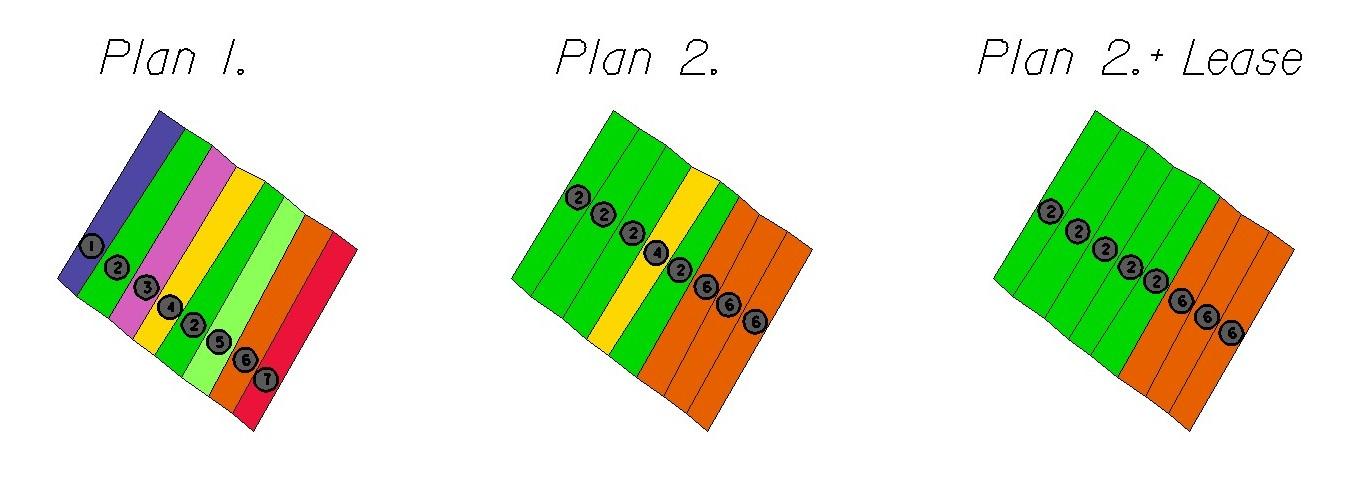
owner is neither willing to sell or exchange, he may be willing to consider to lease out
the parcel. The process is illustrated in figure 2.
Figure 2: Illustration of the design process
The individual negotiations with each of the landowners will be finalized during the
last negotiation phase (August September 2008). Each landowner will either sign a
land re-parceling agreement or decide not to participate in the project.
A concept for a land re-parceling agreement to be used in the project will be
developed latest at the beginning of the activity. Since the pilot projects are
implemented without special land consolidation / re-parceling legislation, the legal
status of such an agreement form is a declaration of intent. The form specifies the
participation of each owner including cadastral no. and size of land parcels sold and
purchased and also the amount of money, the owners will pay or receive. Based on
the total sum of agreement forms signed by the participating landowners, a summary
of agreements will be prepared to give an overview of the transactions in each re-
parceling pilot project together with the new owner map Plan 2. Based on the
agreement forms, signed by the participating landowners, the specified transactions
will be registered and implemented following the modified LPSP procedures (see
section Project activity 14).
Project activity 14: Develop and apply simplified procedures for registration
and implementation of agreements
The cadastral registration is one of the main outputs of every land re-parceling
project and the specific procedures are often different in various countries. In
Moldova there is an existing procedure according to the land code for normal sales
and purchases of immovable properties such as agricultural land. In an ordinary land
63
transaction in Moldova (non land re-parceling) there are different steps from the time
when an agreement is made between a seller and a buyer and until the buyer
receives a new title. Normally land transactions involve the participation of a notary.
A special simplified land registration procedure for multiple purchases and selling of
land was developed as part of the USAID funded Land Privatization Support project
(LPSP) between 2004 and 2006. The main purpose of the LPSP has been to correct
the errors that were made in registration of private immovable property during the
privatization program. During the LPSP program it became clear, that there was a
need for a simplified and cheaper transaction procedure in the situation of mass
purchase of land. For that reason a simplified land consolidation registration
procedure was developed within the frames of the existing land code. The two main
differences to the normal procedures are that in the LPSP procedure, more than one
seller typically will be on each contract, and that the notaries function is being taken
care of by the Primaria's office. A number of mass purchase consolidation projects
were implemented in several villages in Moldova with funding from the SPSP project.
In the re-parceling pilot project these so-called LPSP-procedures will be the
fundament for changing ownership of agricultural land plots. The project will try to
develop the simplified procedures further in order to make them cheaper and even
more flexible.
Project activity 15: Assist local stakeholders and landowners in registration
process and obtaining of new land titles
During the final stages of the project period (November 2008 February 2009) the
six local teams will based on the procedures developed under project activity 14 (see
section Project activity 14) assist the local landowners and stakeholders in the
registration of the land transactions agreed with the landowners individually (from
signing land re-parceling agreements). As an important outcome of the project, the
landowners will obtain new land titles to the parcels participating in the project.
Project activity 16: Organize two study tours in one western and one eastern
European country with successful experiences in land re-parceling / land
consolidation
Two study tours will be planned, each for a group of up to 12 people and each of the
duration of one week. The first study tour is tentatively planned for May 2008 and will
go to an Eastern European country with successful land consolidation / land re-
64
parceling pilot experiences. The first study tour will most likely go to Armenia or
Lithuania.
The second study tour is tentatively planned for September 2008 and will go to a
Western European country with a successful tradition for implementation of land
consolidation project under a national program. The second study tour is proposed
to go to Denmark. The purpose is to see land re-parceling / consolidation in various
contexts of agriculture and land use planning.
The idea is that the first study tour will be concentrated on pilot experiences from a
country with similar post-Soviet background as Moldova. The second study tour shall
give an impression of the longer term potentials in the Governments program of farm
consolidation. The aim is to develop into an instrument for re-organization of land
ownership and land use in order to facilitate a variety of needs in the development of
the agricultural sector and rural development in a broader context.
Project activity 17: Describe implementation experiences and recommend
national level approach
This is the activity where all experiences in the project will be documented and
expressed in a national approach to recommend further re-parceling activities (or turn
it down). The pilot experiences of the project will feed into the preparation of the next
steps of the Government Program for Farm Consolidation with recommendations for
future re-parceling procedures.
This project activity will be implemented in two phases, the first in March to May 2008
after the finalization of the preliminary investigations (project activity 10). The second
will be implemented as the last project activity in December 2008 February 2009.
The final project experiences will be disseminated at a final project workshop
tentatively planned for January 2009 at the end of the project period.
.
65
Avian Influenza Control and Human Pandemic
Preparedness and Response (AIHP)
66
Avian Influenza Control and Human Pandemic
Preparedness and Response (AIHP)
BACKGROUND
Outbreaks of Highly Pathogenic Avian Influenza (HPAI) began in several Southeast
Asian countries in 2003 and spread to Europe in 2005. Significantly for Moldova,
outbreaks in the neighboring Danube delta region of Romania and in the Crimea
peninsula of the Ukraine in 2005 obliged governments to cull (kill) poultry.
In November 2005, concerned governments, technical agencies, and donors met in
Geneva to plan an international response to the risks that Avian Influenza will harm
human health and cause large-scale economic losses. In January 12, 2006, the
World Bank's Board of Directors approved up to $US 500 million in financing for the
Global Program for Avian Influenza (GPAI) that will assist eligible countries. The
GPAI is an Adapted Program Loan (APL) that operates horizontally, across
countries. Also in January, governments and donors met in Beijing, China and
pledged $US 1.9 billion to the fight against Avian Influenza.
Moldova meets the criteria set in the GPAI document for a "country at risk". To date,
Moldova has not suffered an outbreak of Avian Influenza, though it is at significant
risk, since two nations on its borders, Ukraine and Romania, suffered outbreaks.
Moreover, the Government demonstrated its commitment to the fight against Avian
Influenza through policy statements, through preparation of formal plans, and
through expenditure and commitment of funds from the national budget.
Financing Agreement between the Republic of Moldova and the International
Development Association regarding assistance in financing the Avian Influenza
Control and Human Pandemic Preparedness & Response Project was signed on
June 16, 2006, ratified by the Parliament of Moldova on July 29, 2006 and
promulgated by the President of the Republic of Moldova on August 3, 2006. The
Project was declared effective by the International Development Association on
September 12, 2006.
OBJECTIVES OF THE PROJECT
The Project is part of the "Global Program for Avian Influenza Control and Human
Pandemic Preparedness and Response". The overall objective of the Project is to
minimize the threat posed to humans by HPAI. To achieve this, the Project will
67
support surveillance for outbreaks of such diseases, preparation for outbreaks, and
control of outbreaks among humans and animals.
PROJECT COMPONENTS
Component 1: Animal Health
1A Animal disease surveillance & diagnosis
1B Animal HPAI control and outbreak containment
1C Compensation Fund
Component 2: Human Health
2A Human health capacity building
2B Human HPAI testing
2C Human health system response
Component 3: Public Information and Awareness
Component 4: Implementation support and monitoring & evaluation
PROJECT IMPLEMENTATION PROGRESS
Component 1: Animal Health
ANIMAL DISEASE SURVEILLANCE & DIAGNOSIS
1. Migratory Bird Monitoring
Migratory birds, and particularly waterfowl, pose a major risk of spreading the H5N1
virus, the causative agent of Highly Pathogenic Avian Influenza (HPAI), from one
geographic area to others. Moldova lies along the Eastern European flyway, with
major spring and fall migrations of birds along the Prut and Dnjestr rivers. The
territory of Moldova needs to be considered in context of the passing emigrational
ways in Black Sea region, Eastern Europe and particularly in Ukraine.
Given the potential risk of H5N1 introduction into Moldova by migratory birds, it is
essential to obtain and maintain reliable and up-to-date information on the incidence
and characteristics of migratory bird presence in Moldova and to continue regular
monitoring. This entails, firstly, a concise and systematic compilation and
presentation of the information gathered during the past ten years, to be followed,
secondly, by a more comprehensive investigation of migratory bird behavior at
present (i.e., in 2007-2008).
68
In the middle of July, it was signed the contract (Contract nr. 2/C/2007/056630)
between the Ministry of Agriculture and Food Safety and the Institute of Zoology of
the Academy of Sciences of Moldova regarding the study of migratory birds in the
Republic of Moldova.
At the end of September, there were received the Initial Report on the inventory of
existing information on migratory birds (in Romanian and English), and the Draft
Report from the Institute of Zoology of the Academy of Sciences of Moldova.
x Initial Report contains general and introductive information about the migration
of birds in Republic of Moldova, the most important species that have been
observed on our territory.
x Draft Report contains information about:
- The aquatic birds and waders, their migrations and wintering on the
Republic of Moldova territory,
- Study methods of birds' migrations,
- Short abstract of birds' migration studies in Moldova,
- Importance of the birds' migration study results for the prophylaxis of Avian
Influenza.
2. Modernization of veterinary laboratories
To strengthen diagnostic capacity, the RCVD and its two satellite laboratories is in
the process of renovation. The main investments are in essential equipment
necessary to confirm the presence of HPAI in animals.
After the organized shopping for laboratory equipment acquisition (ELISA IMMUNO-
ANALYSER and MICROSCOPE) in June, it was selected the company for Elisa
Immuno-Analyser delivery (INTERMED SRL, from the Republic of Moldova). In
August, selected company delivered laboratory equipment at the Republican Center
for Veterinary Diagnosis (Elisa Reader DTX 880, Elisa Incubator Stat-fax 220,
Automatic Dozatron 10-100 mcl, Automatic Dozatron 100-1000mcl, Automatic
Dozatron 1-10 mcl).
Civil engineer selected for laboratory refurbishment, Ion Raileanu, elaborated the
Plan for Satellite Laboratory from Orhei reconstruction, the Plan for Satellite
Laboratory from Drochia reconstruction and the Plan for Central Laboratory
reconstruction and renovation. He calculated the approximate prices of these works
and presented them in his semi-annual Report:
69
- Satellite Laboratory renovation (Drochia) - $88 thousand;
- New module projection and construction (Drochia) - $146 thousand;
- Satellite Laboratory renovation (Cahul) - $196 thousand.
ANIMAL HPAI CONTROL AND OUTBREAK CONTAINMENT
The implementation of HPAI outbreak containment actions is supported and financed
by the project.
A real-time simulation exercise was prepared and took place in the period of August
6-10, 2007, in Anenii-Noi rayon, village Chetrosu and tried to involve all the state's
institutions that have responsibilities in the eradication of possible avian influenza
outbreaks in the country. The official opening of the seminar took place in Chisinau
and was chaired by the Ministry of Agriculture and Food Industry.
The Seminar and Simulation Exercise that took place in the Republic of Moldova was
necessary taking into consideration the geographical location that represents the
border between EU and Eastern European countries, mentioned in the European
legislation as third countries. In the international epidemiologic context, taking in
consideration the Avian Influenza Report, the central veterinary services from the
Republic of Moldova must demonstrate their abilities of rapidly intervene and control
an outbreak disease, contributing to the prevention of spread of Avian Influenza.
More than that, taking into consideration that it never faced this kind of
epidemiological situations there is the risk of not applying the legal provisions in force
and not involving all the decision making factors from the Republic of Moldova,
because most of the times it is considered that Avian influenza is in the strict
responsibility of the veterinarian , which constitutes a major error.
The simulation exercise of avian influenza was the only method to confirm that the
prophylaxis and fighting against Avian Influenza can be performed only by
accomplishing the whole complex of economic/organizational, sanitary and veterinary
special measures. This can be accomplished only by a common effort of all the
component ministries and institutions of the Republican Antiepidemic Extraordinary
Commission.
By the Avian Influenza Simulation Exercise in the Republic of Moldova the following
major objectives were followed:
x Establishing and knowledge of the participants about the central and district
Command Chain in the Republic of Moldova;
70
Knowledge by the participants of the legislative provisions in force on
diagnosis, surveillance and fighting of avian influenza;
x Inter-ministerial and inter-institutional collaboration on central, district and local
level;
x Training of the district and municipal chiefs epidemiologists so as to be able to
send forward the information and train all the territorial veterinary structures;
x Rapid intervention with active participation of the institutions and departments
that are part of the Republican Antiepidemic Extraordinary Commission and
District Antiepidemic Extraordinary Commission for preventing the disease
spread and preventing its transmission to the population;
x The ability in setting up the most efficient measures of avian influenza
eradication according to the actual European legislation;
x The transparency of actions and collaboration with the international forums in
order to gain trust and develop trade with member states of EU and with other
countries.
More than that, the participants of the simulation exercise had to prove their capacity
of:
x Analyzing the situation of a rapid change of the disease;
x Taking decisions on practical aspects on disease eradication measures as
depopulation of infected livestock, destruction of infected carcasses, cleaning
and disinfection procedures as well as strengthening the restrictions on
movement;
x Taking action and coordinate the eradication measures, control and
prevention of the disease together with other official institutions and private
organizations;
x Evaluating the control measures from the national legislation in force;
x Using the contingency plans as well as the operational manuals; this means
being familiar with the working procedures during outbreaks and using the
formulas created for disease notification, evaluation and compensations for
poultry livestock, sending the specimens for laboratory examinations,
restricting the measures etc.
71
For the first time, in Avian Influenza Simulation Exercise, on the territory of the
Republic, were implicated all ministries and institutions, excepting Ministry of Finance
and Ministry of Transport. Also took part European Union representatives. In Avian
Influenza simulation exercise took part chief-epidemiologists from all rayons and
cities from the country which is very important for: the instructive and demonstrative
character of the exercise, communication between districts, the application of the
same surveillance and control measures for avian influenza. The action was real!
Every step of the simulation exercise was carried out properly: the protection
equipment was used during the action (although the environment temperature
exceeded 39 degrease Celsius) birds were euthanized and incinerated, disinfections
were carried out, compensations were given to the owners, etc. Through this inter-
ministerial and inter-institutional collaboration were proved that Avian Influenza is not
only the responsibility of veterinaries, but it is a responsibility of all state institutions.
The participants, no matter their specialization, demonstrated a great interest to
acquire all the necessary knowledge for managing an Avian Influenza outbreak. The
participants were offered housing and food, which is an important aspect that should
not be neglected even if the evolution of such a disease is a "crises situation".
Between September, 26-27 took place an Avian Influenza Simulation Exercise
Workshop, organized by World Health Organization, Health Protection Agency and
World Bank.
General purpose of this simulation exercise workshop was:
x To fortify the level of preparedness in case of Avian Influenza outbreaks on
the territory of the Republic of Moldova.
x The objectives of this Avian Influenza Simulation Exercise Workshop were:
x To examine the way of interaction and communication among veterinary
sector, public health sector and other associated authorities;
x To examine Public and Animal Health components from the Contingent
Plans;
x To analyze the role and responsibilities of veterinary and public health sectors
in case of Avian Influenza outbreak;
x To examine the way of communication with mass-media and with the public
during Avian Influenza outbreak;
x To examine the methods of gathering information and supervision;
72
To examine the HPAI control methods.
At this simulation exercise workshop took part 47 participants from the country and 4
international experts:
John Simpson (Health protection Agency Centre for Emergency Preparedness
and Response),
Liz Turner (Health protection Agency Centre for Emergency Preparedness and
Response),
Hilary Moulsdale (Health protection Agency Centre for Emergency Preparedness
and Response),
Ana Paula Coutinho (Regional Office for Europe World Health Organization).
OTHER ACTIVITIES
In the middle of September, between September, 17-21, 2007, took place a working
visit in Ukraine. The aim of the visit was the Theoretical-Practical International
Conference on Poultry, which was unfolded in Sudac, Ukraine. The official trip took
place at the invitation of Poultry Association of Ukraine.
The most important tackling problems were:
x The level of Ukrainian poultry development;
x The major problems in poultry development;
x Avian Influenza monitorization programm in Ukraine;
x New methods of fighting against infectious diseases;
x New kinds of disinfectants and their usage (Ecocide-C);
x New kinds of vaccines in New Castle and Avian Influenza supervision, etc.
Component 2: Human Health
GENERAL CONTEXT
For successful implementation of the project objectives taking into considerations the
World Bank (WB) mission recommendations the following tasks were performed by
the national counterparts:
1. The composition of the rapid response team in compliance with WHO
recommendations was revised. In accordance with the NCPM order nr. 58
from 15.06.2007 two rapid response teams were established in the Chisinau
73
Municipality with the following composition: 1 epidemiologist, 1 epidemiologist
assistant, 1 disinfectionist, 1 disinfectionist assistant;
2. The list of the necessary equipment for rapid response team was established
and approved by the General Director of the NCPM;
3. The Terms of Reference (TORs) and Operating Guidelines for Rapid
Response Teams, based on WHO recommendations were prepared and
approved by the General Director of the NCPM;
4. The technical specifications for disinfectant product were revised and
approved;
5. The agreement for laboratory testing of suspected HPAI specimens with
WHO Reference laboratory in the UK was formalized.
HUMAN HEALTH CAPACITY BUILDING SUB-COMPONENT
A number of standard operating procedures (SOPs), as a key task and the
foundation for an adequate response of the public health care system to the threat of
HPAI were updated and elaborated by the team from the National Center for
Preventive Medicine (NCPM) and Component Coordinator (CC). In accordance with
the WB mission recommendations all national documents and guidelines for Human
cases of AI and Pandemic Preparedness before being presented to the Minister of
Health for formal approval were translated in English in order to be reviewed by an
international consultant in accordance with available international standards and
guidelines. The TORs for translator were prepared and the translator Ms. N. Culava
was engaged. She is responsible for the translation (English/Romanian and
Romanian/English) of the materials related to the regulatory system and Standard
Operating Procedures under Human health component and of other project's
documents as required by the project management. The translated English version of
these documents was sent to the WHO expert for reviewing.
The WB mission emphasized the necessity to conduct the simulation exercise of the
eventual outbreak of avian influenza. WHO supported technically and financially the
simulation exercise involving both vet and human health sides by contracting Health
Protection Agency (UK), which is collaborating with WHO on this issue. The desk-top
simulation exercise was held on 26-27 September, in Chisinau. The aim of the desk-
top simulation exercise was to enhance preparedness and capacity of Moldova to
face outbreaks of Highly Pathogenic Avian Influenza in animal and human
populations.
74
The objectives were the following:
1. Explore the interaction, co-ordination and communication between the
veterinary and health sectors and other associated authorities;
2. Explore animal and human health components of contingency plans;
3. Explore the roles and responsibilities of veterinary and health sectors during
an outbreak;
4. Explore media and public communications during an outbreak;
5. Explore the lines of communication between local and central authorities;
6. Explore data gathering and surveillance;
7. Explore the operational measures in containing an HPAI.
In accordance with the order nr. 369 d from 14.09.2007 43 participants attended
this event. There were the representatives from the following ministries and
institutions:
1. Ministry of Agriculture;
2. Ministry of Health;
3. National Centre of Preventive Medicine;
4. National Veterinary Centre;
5. Department of Emergency Situations from the Ministry of Internal Affairs;
6. Ministry of Environmental Protection;
7. Infectious Disease Hospital;
8. Primary Health Care;
9. Rayon Hospital;
10. Rayon Centre for Preventative Medicine;
11. Rayon State Veterinary Department;
12. Communicable Disease Consultants;
13. Republican Central Veterinary Laboratory;
14. National Viral Laboratory;
15. Head of Rayon.
The Component Coordinator (CC) has elaborated the TORs for a qualified logistic
company in event management. The ToRs were approved by the national
counterparts. The selection committee selected the company Age Quod Agis SRL
that provided logistical and administrative support in the organization of the
integrated desktop simulation exercise.
The representatives from the WHO, UNICEF, Health Protection Agency participated
as external observers in this simulation exercise. The WHO experts are preparing a
"lessons learned" document, which will be distributed to all ministries whose
representatives attended the exercise and to all participants in order to insure the
75
continuity of the initiated process of enhancing the preparedness and capacity of
Moldova to face outbreaks of Highly Pathogenic Avian Influenza in animal and
human populations.
The CC in close collaborations with national counterparts elaborated the TORs for an
International Consultant in Infection Control Practices and Clinical Management who
will be responsible for enhancing HPAI Prevention and Preparedness Capability
trough review and upgrade of the national documents and guidelines for Human
cases of AI and Pandemic Preparedness in accordance with available international
standards and guidelines, with focus on clinical management of possible human
cases of H5N1, field investigation readiness and practices, surveillance and alert
system, isolation practices in healthcare facilities, prevention of nosocomial infections
and waste management, correct use of personal protective equipment and other
infection control related actions including social distancing measures in the context of
outbreak preparedness. The TORs were approved by the national counterparts. The
CAPMU initiated the selection process.
Information technology system for surveillance
The new version of the Emergence Note 058 was translated in English and sent to
the WB Information technology (IT) expert for the preparation the bidding
documentation. The bidding documentations are being revised by the WB IT experts.
The TORs for the IT specialist were prepared and approved by the national
counterparts. Three candidates applied for this position. The selection committee
evaluated the files and after a detailed review the consideration has been given to Mr
M. Bortnic, who according to the documentation presented was the most experienced
applicant. In compliance with Project Operational Manual the contract must be signed
by the Minister of Health. The engaged IT specialist will be responsible for "Improved
Surveillance System" system design, including organizational reengineering
processes and system relevance to project stakeholders' needs and assuring that
development team(s) work in full capacity and in good cooperation with
institutional/government team(s) and project stakeholders.
HUMAN HPAI TESTING SUB-COMPONENT
The CAMPU initiated the selection process of a design company of Intensive Care
Unit and of the proposed new annex for HPAI diagnosis. Three companies have
presented the files in accordance with the TORs presented for the bidding process.
The selection committee selected the EuroprojectDesign company. Now the CAPMU
76
ask Bank's No Objection to select EuroprojectDesign company under CQ selection
and to ask for technical and financial proposals from them.
The national counterparts prepared and sent the official letter to the City Hall to ask
for an additional territory for a new module, because the existing one was not
sufficient for building and because there were underground high voltage electrician
lines on the proposed territory. When the real size of the available territory are
known, the counterparts will be able to prepare the technical specifications for
laboratory equipment in accordance with available space and be sure that this
equipment will fit in the special rooms.
The national laboratory specialists together with the CC are preparing the technical
specifications for all necessary laboratory equipment in accordance with WHO
mission recommendations.
In response to the National Viral Laboratory request to update them on the status of
global shipment project supported by WHO through World Courier WHO Local
country Office provided the following information in order to benefit from WHO
Influenza Global Shipment Project:
1. Contact the world Courier Headquarter and send the filled booking form.
Meanwhile a copy of the form should be sent to WHO Geneva and WHO
Country Office;
2. Collect and package the samples as indicated in the respective guidelines.
Important packing should be performed by a IATA certified person;
3. The National Centre of Preventive Medicine (through WHO Country Office)
has received the limited amount of PPE and necessary packing equipment to
pack the samples as per guidelines;
4. World Courier Romania through its local agent in Moldova (Quehenberger,
Moldova: +37322 52 44 27,
http://www.quehenberger-
hellmann.md/9426_EN.62E9D6912152821 will provide the remaining
necessary components of the package (dry ice and liquid nitrogen if needed),
will be responsible for filling the necessary forms per IATA guidelines and
also they are responsible for the shipment process to the WHO international
reference laboratory.
Two participants from the Republic of Moldova attended the training on "shipment of
biohazard samples in accordance with IATA regulations" in Russia, passed
successfully the exam and were IATA certificated.
77
HUMAN HEALTH SYSTEM RESPONSE SUB-COMPONENT
Personal Protective Equipment
The Personal Protective Equipment was supplied to the NCPM. The national
counterparts prepared the distribution list. In accordance with this list the PPE was
distributed to the rapid response teams, ICU and Virological Laboratory.
Disinfection Equipments for the rapid response teams
The technical specifications (TSs) for the disinfectant product were revised. It was
decided to procure 250 Kg or L of a disinfectant product for use by the rapid
response teams, 100 Kg or L for use in the National Viral Laboratory and 150 Kg or L
for use in the Infectious Diseases Hospital "T. Ciorba".
The approved version of the TSs was sent to CAMPU to initiate the procurement
process. CAMPU initiated it. Only one company presented the proposal that is why
the announcement will be re-advertised for the selection of new offers.
80 Manually Powered Backpack Pressure Sprayers with capacity 10-15 L and 80
One Hand Pressure Sprayers with capacity 2 L were procured. All the disinfection
equipments were provided to the NCPM by the SRL "Belnis". Two Manually Powered
Backpack Pressure Sprayers and two One Hand Pressure Sprayers were distributed
to the rapid response teams in each rayon in accordance with the Ministry of Health
distribution list.
Medical Services
Seasonal influenza vaccines for risk groups
It was decided to procure 18000 doses of the seasonal vaccine. Three companies
have presented the offering documentations in accordance with the technical
specifications presented for the bidding process. The Selection Committee revised
these proposals. The SRL "Dita Estfarm" was selected as a winner. The contract
between the SRL "Dita Estfarm" and CAMPU was signed. In accordance with this
contract these vaccines will be supplied to the NCPM no later than the end of
October.
Vehicle, equipment and consumables for 3 mobile Intense Care (IC)
ambulances
Three companies presented the offering documentations in accordance with the
technical specifications presented for the bidding process. The SRL "Rumeon" was
selected as a winner. The contract between the "Rumeon" and CAMPU was signed.
78
In accordance with this contract the delivery of these ambulances is expected by the
end of September 2007.
Laptop and Multimedia Projector
The TSs for Laptop and Multimedia Projector were prepared and approved by the
national counterparts. The CAPMU initiated the procurement process.
Component 3: Public Information and Awareness
On the basis of the contract signed between the Ministry of Health and UNICEF,
UNISEF started implementing the public information and awareness plan which
includes the main aspects related to prevention, preparedness and response to
highly pathogenic avian influenza in order to create awareness to public opinion of
the risks of HPAI (broadcasting of TV and radio ads, dissemination of flyers and
information bulletings among risk groups, training of target group at regional level
etc.)
79
RENEWABLE ENERGY FROM
AGRICULTURAL WASTES (REAW)
80
RENEWABLE ENERGY FROM AGRICULTURAL
WASTES
INTRODUCTION
The GEF/WB Renewable Energy from Agricultural Wastes (REAW) was declared
effective on 7 July, 2005, Grant Agreement being signed between the Consolidated
Agricultural Projects Management Unit, acting as an executing agency on behalf of
Republic of Moldova, and International Bank for Reconstruction and Development,
acting as an Implementing Agency of the Global Environment Facility, set fourth the
amount totaling $972,920 to be allocated from GEF Fund within a three years period.
The overall total of the REAW is as follows:
FINANCING PLAN (US$)
GEF PROJECT/COMPONENT
Project
972,920
PDF A*
25,000
SUB-TOTAL GEF
997,920
CO-FINANCING**
IBRD/IDA/IFC
Government
1,434,950
Bilateral
NGOs
Others
219,388
Sub-Total Co-financing:
1,654,338
Total Project Financing:
2,652,258
The ultimate goal of the REAW Project is to provide a foundation for a broad and
efficient use of biomass in substitution for imported fossil fuels (coal), acting as a
catalyst for the introduction and promotion of the use of primary agricultural wastes
(biomass) to fuel energy generation using efficient technologies.. Therefore, the
project will assist the Government of Moldova to:
i. Overcoming existing barriers to the update of biomass technologies by
providing examples of best practice (demonstration units) in the use of
biomass fuelled energy systems as a viable alternative to gas, oil and coal
and as a sustainable means of addressing the energy supply problems
facing rural communities and agro-enterprises. Demonstration systems
would be of a size, scale and cost appropriate for wide replication in rural
areas. This would be supported by access to information, technical
81
support and a fund to cover the incremental capital cost in installation of
biomass-fuelled systems;
ii. Encouraging development of straw bale market and further replication
among the agro-enterprises of the biomass production and selling, after
the project ends;
iii. Additional public buildings, but those implemented by the project,
switching to biomass heating system, in base of the learned lessons and
gathered results within the project progress;
iv. Reducing additional implementation costs persistent existence of which
are caused by the fact of brand new, untested and totally untrustworthy
technology in Moldova: renewable energy from agricultural wastes;
v.
Promote a broad public awareness campaign and replication strategy.
Based on that, the following Project components are:
A. Biomass Energy Demonstration Units
This component of the project will consist of installation and operation of biomass
fuelled heating systems in public buildings in rural communities and one
demonstration unit within the Biomass Center in Chisinau, capital of Moldova, with a
total capacity of 3,000 kW in 7-10 installations:
x Dismantling of existing systems;
x Construction work: preparation of boiler rooms, including preparation for
connection of building with heating system;
x Upgrade of the heating systems for compatibility with biomass based system;
x Supply and installation of new boiler plants on a turn-key basis.
This component will state the `Moldova's Reference Design' for biomass based
heating systems based upon an `average rural community' of about 1000 households
and 1200Ha of surrounding arable land. It will clearly demonstrate the reference
capacity of the sites; the modularity of the site components; the investment
requirements; the raw material treatment and logistics; the energy distribution
system; the cost and maintenance characteristics; the cost benefit analyses as well
as social-economic and environmental impact.
82
B. Biomass production and fuel cycle support
This component of the project is designated to construct and create a full biomass
chain supply, aiming to transfigure biomass agriculture wastes, often lost and into a
sustainable market product and a suitable thermal energy raw material.
The main scope of the component consists in continuation of biomass production,
even when the project will be finished. This will be achieved by a range of financial
measures provided by the project including:
x 7-10 grants accorded to selected best score agro-enterprises for biomass
equipment purchase;
x Financial lease arrangements which will allow to mitigate the high price
investment related to the biomass equipment procurement;
x Constant contract arrangements aiming to get together the buyer and the
seller of this specific product biomass material.
Shortly this component includes:
x Supply of baling and bale handling systems to agro-enterprises, according to
the bale module required, through grants and leasing arrangements. The
project will try provide in most of the cases the module size of 250kg or
above;
x Develop the commercial infrastructure to produce, promote, market and sell
biomass as an alternative heating source;
x To create a transaction based market for biomass fuel (straw) on the basis of
supply contracts for heating systems in rural communities;
x Leasing contract finalization between agro-enterprises and leasing company;
x Credit contracts development between financial institution and final
beneficiary;
x Contract finalization between agro-enterprises and local authorities for the
storage and supply of baled straw according to the required specification and
delivery schedules;
x Preparation of straw fuel storage facility near bye to the boiler house.
83
C. Public awareness, outreach and dissemination, information barriers removal
The overall outcome of this project component is to promote the project objective of
removing the existing barriers to extend the usage of renewable energy from
agricultural wastes in Moldova.
The program of measures to overcome the existing informational barriers together
with the demonstration sites implementation will include:
x Presentations at conferences, seminars, and training events including those
targeting and engaging the local governments and general public, and the
international community; This task will include also a considerable number of
local seminars targeting rural communities, involving training at boiler
demonstration sites.
x Promotion of baling systems and technology into other regions of Moldova
and an information campaign for rural communities applying for MSIF project
grants;
x Case studies to showcase the project will be published in targeted
publications for farmers;
x Participation in fairs at the `Mold-Expo' in Chisinau;
x Promotion through information and extension to agro-enterprises, mayors,
students (all levels), heating engineers, government officials and policy on
renewable energy (biomass);
x Regional debates & panel discussions;
x Advertising campaign - TV, radio;
x Info campaign for households, regional media campaign;
x Miss-perception & gaps identification surveys;
x Teaching Contract (professional lessons at sites); A specialist will be
appointed in a training of trainers program, provided to local school
teachers/professors in order to instruct them how to disseminate the
information among the students of the local schools, colleges, universities
and others educational institutions;
x Etc.
84
D. Project Management, audit, monitoring and evaluation activities
CAPMU as a Project Implementation Unit (PIU) will oversee the implementation of
the Project, disseminate project related information to stakeholders and be
responsible for contracting for the delivery of goods, works, and consultant services.
The project would raise environmental awareness in the project region and support
NGOs and local communities in promoting environmentally sustainable development
policies at the local and national level.
PROGRESS BY PROJECT COMPONENTS
ACTIVITIES UNDER COMPONENT A
SELECTION OF SITES
Based on the project's concept and objectives, the selection of villages to pilot and
replicate alternative technologies of heating energy production from agricultural
waste, was done in a few stages:
Stage I. Identification of districts to be included in the project;
Stage II. Selection of 30 communities potential beneficiaries;
Stage III. Selection of 10 communities for an in-depth study on the field;
Stage IY. Identification of the 5 villages to become pilot demonstrative sites.
SELECTION OF DISTRICTS
Based on the selection methodology, initially, at the first selection stage, the districts
where the pilot projects could be implemented were selected.
The districts selection was done using the following indicators:
a) Limited access of the districts' villages to the main gas networks in the next 3-
5 years
b) Geographic distribution of districts (North, South and Center)
Resulting from an analysis of the National Gasification Program till 2010 and the
evaluation of the extent of access to the main gas networks, 13 districts appropriate
for the pilot stage were identified. Therefore, for the North were selected the districts:
Faleshti, Glodeni, Edinets, Floreshti, Ryshcani, Syngerei, Soroca, for the Center
the districts Ungheni, Hynceshti, Teleneshti, for the South the districts Causheni,
Shtefan Voda, Cantemir, Leova.
85
IDENTIFICATION OF COMMUNITIES VISITED IN THE FIELD
At the third selection stage, from the list of 30 potential beneficiary communities, 10
communities were selected by a random method from all regions, for an in-depth
study on the field. Thus, the following villages were chosen for field study:
North: Cishcareni, district Singerei; Vasilcau, district Soroca; Navirnets, district
Faleshti; Recea, district Rishcani; Parcova, district Edinets; Viisoara District Edinet;
Limbenii Noi and Viishoara, district Glodeni.
Center: Boghenii Noi, district Ungheni; Boghiceni, district Hinceshti.
South: Antonesti, district Stefan Voda; Taraclia and Ursoaia, district Causeni.
It should be noted, that fewer villages were selected from the Center and the South
compared to the North, since at present the communities in those regions have a
greater access to gas main pipelines.
After in depth evaluation of above stated districts the following localities were drafted
as first in line:
x Lyceum from the village Taraclia, district C X úeni 290 points;
x Secondary school from the village Antone úti, district Stefan Vod 275
points;
x Lyceum from the village Cazaclia, UTA Gagauzia 220 points;
x Gimnazium from the village Parcova, district Edicne - 220 points;
x Gimnazium from the village Vii úoara, district Edine - 230 points;
x Gimnazium from the village Vii úoara, district Glodeni 230 points;
x Gimnazium from the village Boghenii Noi, district Ungheni 275 points;
The communities Cazaclia, district Ceadir Lunga, Parcova district Edinet, could be
included in the list of pilot villages in 2007 with a condition that they will make
additional investments in the objects proposed as pilot demonstration sites. Thus, in
the community Cazaclia, there is a need for the whole renovation of external heat
distribution networks, which have a length of about 100 meters.
INSTALLATION OF STRAW BATCH FIRED BOILERS
Finally the following villages were selected for project replication:
1. Chiscareni, Singerei district done (selected and replicated in January,
2006);
86
2. Antonesti, Stefan Voda district done (selected and replicated in January,
2007);
3. Taraclia, Causeni district done (selected and replicated in March, 2007);
4. Viisoara, Glodeni district done (selected and replicated in March, 2007);
5. Viisoara, Edinet district done (selected and replicated in April, 2007);
6. Boghenii Noi, Ungheni district done (selected and replicated in April, 2007).
For all above mentioned villages the Technical Design documents have been already
prepared and approved by all necessary authorities in accordance with Moldovan
construction and heating laws requirements in force.
A licensed company was selected to perform procurement and installation of all
equipment necessary for boilers to be installed. All the related works were performed.
The ICB for biomass boilers was also successfully conducted. The first boiler have
been installed in January 2006, the next 3 boilers have been installed during January
March, 2007, while the remaining in April, 2007. Thus all proposed boilers will be
installed according the stipulated implementation plan.
In order to ensure a wider replication of Biomass technologies for different types of
users (small, medium and large ones), it was been decided to install 4 different
energy capacity sites: up to 100 kW.
Thus, for heating season 2007 2008 the following demonstration units were
selected:
1. Village Antonesti, Stefan Voda district: (i) art school 80 kW capacity
biomass boiler, (ii) kindergarten 80 kW, (iii) post office and library in the
same building 80 kW;
2. Village Volintiri, Stefan Voda district: educational center 80 kW;
3. Villane Burlanesti, Edinet district: school and kindergarten with the same
heating system 300 kW.
The installation process was broken down in 3 activities
I.
Project technical design
1.
Stage I. Collection of inception data:<
1.Urbanizme certificate
2.Technical specification of thermal energy connection of schools
3.Technical condition for electric grid
4.Coordination of land for boiler placement; network pipes with sanitary body
5. Coordination of land for boiler placement; network pipes with ecology body
87
6.Certificate of State Agency for Metrology regarding the situation on environment
pollution
7.Topograph placement of site
2.
Stage II. Preparation of technical design document
1.Design of concrete base for boiler installation
2.Design of pipe network scheme
3.Electric grid
4.Automatization scheme
5.Fire security system
6.General Plan
7.Environmental protection
8.Budjet expenditures for installation
9.General memorandum
3.
Stage III. Coordination and state expertise of project:
1.Coordonation with Sanitary Agency
2.Coordonation with Ecology Agency
3.Coordonation with Fireguard Direction
4.Coordonation with local communal services
5.Coordonation with local architectural direction
6.State Expertise of the project
7.Construction authorization
TECHNICAL ASSISTANCE
The project provided training and capacity building through training seminars and
exchange of regional expertise. For that purpose well qualified experts from Biomass
Centre Kiev were invited to perform necessary training for designing experts,
Installation Company and local boiler operators.
This activity also included the management of each activity included in project,
particularly the reconstruction of boiler rooms and installations of the biomass boilers.
Training and technical instruction to equipment operators, in order to ensure
sustainable use and maintains of the respective biomass system (boilers and boiler
rooms).
ACTIVITIES UNDER COMPONENT B
SELECTION OF AGRICULTURAL ENTERPRISES
Stage 1
The first stage of the process of selection potential sites for implementation of the
"Biomass Project" started with identification enterprises by size. The selection
process and questioning has been performed through the 15 UAP business centers
supported by the regional Associations of Agricultural Producers. The first stage of
the selection process was based on the production area of the enterprises. Based on
88
this criterion, a number of 192 agricultural companies placed in "focus regions" that
have a production area over 700 hectares have been identified.
Stage 2
The second stage in the process of selection was pre-selection of a number of 30
agricultural companies placed in different zones that would be suitable for project
implementation.
A questionnaire based on a simple ranking, containing the following indicators has
been used for the process of pre-selection of the 30 agricultural companies:
x stable production and an area of over 300 Ha of cereals planted;
x equipment availability (combine harvesters, ag. Tractors);
x interest to produce and supply biomass;
x readiness to implement a project in cooperation with local authorities;
Based on this questionnaire, a number of 134 companies out of 192 have been
contacted by phone and questioned (some companies could not be contacted).
Based on the information collected, a number of 30 agricultural enterprises have
been selected for an in-depth study for identification of best potential pilot sites for
the "biomass" project (see Table).
Pre-selected companies for in-depth study
Area
Interest
Readine
Name of the
District
Locality
plante
to
ss to
enterprise
d with
produce
impleme
cereal
/ supply
nt a
s
biomass
project
1 LTD
"Logafat
Prim" Falesti
Navirnet
709
Yes
Yes
2 LTD
"
Danulischii" Glodeni
Danul
1200 Yes
Yes
3 LTD"Ustianul"
Glodeni
Ustia
350
Yes
Yes
4 LTD
"Hotin"
Glodeni
Limbenii Noi
320
Yes
Yes
5 LTD
"Agrobanic"
Glodeni
Iabloana
400
Yes
Yes
LTD
CuhAgro
Est
Glodeni
Viishoara
6 GAS
"Fintina
Rece" Riscani
Recea
750
Yes
Yes
7 LTD
"Rosiorii
Lux" Singerei
Chiscareni
700
Yes
Yes
8
II "Tofan si Co"
Singerei
Bilicenii
Vechi 385
Yes
Yes
9 LTD
"Radoianca"
Singerei
Radoaia
420
Yes
Yes
10 LTD"Audient
Agro" Singerei
Iazarenii
vechi 420
Yes
Yes
11 CA "Glia"
Cantemir
Pleseni
600
Yes
Yes
12 LTD "Bogatmos"
Causeni
Taraclia
1200 Yes
Yes
13 LTD "Guvest Agro" Causeni
Ukrainca
300
Yes
Yes
14 LTD "Post
Causeni
Ursoaia
500
Yes
Yes
Podagro"
15 LTD "CIP Agro"
Floresti
Prodanesti
600
Yes
Yes
89
16 LTD "Sergana"
Floresti
Ciutulesti
650
Yes
Yes
17 LTD "Gramvil Agro" Hincesti
Boghiceni
420
Yes
Yes
18 LTD
"Mingir
Agro" Hincesti
Mingir
400
Yes
Yes
19 LTD "Jeamtal"
Hincesti
Crasnoarmeisc 500
Yes
Yes
20 LTD "Valea
Leova
Tochile
400
Yes
Yes
Plopilor"
Raducani
21 LTD "Prietenia
Soroca
Slobozia
600
Yes
Yes
Agro"
Cremene
22 LTD
"Scripta
Prim" Soroca
Stoicani
320
Yes
Yes
23 LTD "Diojen"
Soroca
Badiceni
600
Yes
Yes
24 LTD "Crocmaz
Stefan Voda Crocmaz
500
Yes
Yes
Agro"
25 LTD "Focaro Agro" Stefan Voda Copceac
1300 Yes
Yes
26 LTD "Miturix Agro
Stefan Voda Ermoclia
550
Yes
Yes
27 LTD "Bebei Prim"
Stefan Voda Volentiri
1200 Yes
Yes
28 LTD "Zavoiul Mare Stefan Voda Antonesti
500
Yes
Yes
29 SA "Nistru Olanesti" Stefan Voda Olanesti
1458 Yes
Yes
30 LTD "Cosasul
Ungheni
Boghenii Noi
350
Yes
Yes
Verde"
18602
Stage 3
The third stage of the selection process was based on a more detailed study of the
pre-selected enterprises in order to identify and rank 10 enterprises the most suitable
for project implementation.
Indicator
Sub-indicator
Score
1
Combine harvesters
New/Western type
10
Old/Soviet type
5
Agricultural tractors New/western type
10
over 100 HP
Old/soviet type
5
Agricultural
Agricultural tractors New/western type
10
equipment
80HP or less
Old/soviet type
5
Baling equipment
Available
5
Intention to procure 2
2
Area under
300 hectares
2
cereals
Over 600 hectares
4
3
Use of biomass
Used for internal purposes / sold
5
Given away / burned
0
4
Good crop rotation practice
2
5
Leasing
Procurement of new equipment +
2
experience
Experience with 2KR Project ++
5
6
Payment
Experience in working with commercial banks 3
capacity
+
Procured equipment during the last two years 5
++
Proved experience with 2KR Project during the 7
last two years (financial documents
provided)+++
90
Based on the information obtained and using the criteria described in the Operational
manual the following ranking was obtained:
The best ranked enterprises
No
Name of the Enterprise
Cumulative
Ranking
score obtained
1
LTD "Logafat Prim"
60
I
2
CA "Glia"
55
II
3
LTD " Cuhagro Est"
53
III=
4
LTD "Bogatmos"
53
III=
5
LTD "Zavoiul Mare"
53
III=
6
LTD "Juden Agro"
53
III=
7
SA "Nistru Olanesti"
49
IV
8
LTD "Prietenia Agro"
45
V
9
LTD "Rosiorii Lux"
43
VI=
10
GAS "Fintina Rece"
43
VI=
Taking into consideration the parallel selection of sites: Chiscareni, Singerei district;
Antonesi, Stefan Voda district; Taraclia, Causeni district; Viisoara, Glodeni district;
Viisoara, Edinet district, Boghenii Noi, Ungheni district; Burlanesti, Edinet district and
Volintiri, Stefan Voda district the following agricultural enterprises were approved for
project participation:
LTD "Rosiorii Lux" Chiscareni, district of Singerei;
LTD "Zavoiul Mare" Antonesti, district of Stefan Voda;
LTD "Bogatmos" Taraclia, district of Causeni;
LTD "Cuhagro Est" Viisoara, district of Glodeni;
LTD "Juden Agro" Viisoara, district of Edinet;
PF "Rusu Mariana" Burlanesti, district of Edinet;
LTD "Focaro Agro" Copceac, Stefan Voda district.
PRODUCTION OF BIOMASS (BALED STRAW)
The project has contributed to production of approximate 1500 t of baled straw per
year as a distinctive market product.
The biomass was produced and stocked at the selected sites warehouses. The
project finalized the supply contracts between agro-enterprises and local authorities
for the storage and supply of baled straw, according to the required specification and
delivery schedules. The contract period was set for 7 years, including mutual
guarantees for both parties. Thus in all selected areas straw is not considered as an
agricultural waste anymore.
FINANCIAL INTERMEDIATION. CREATION OF BIOMASS CHAIN SUPPLY
(IMPORTATION OF BALING MACHINES)
Due to the project support, 5 baling machines were procured, four of them using
project financial intermediation mechanism:
91
1. LTD ,,Ro úiori-Lux", v. Chi ú Freni John Deer a second hand one, with the
guarantee of the German producer (2005).
2. LTD ,,Bogatmos", v. Taraclia PVP 35 produced in Serbia under the Claas
license. Beneficiary used the financial intermediation mechanism, created by
the project. The grant provided by the project covered 25% from the total cost
of the baler, rest of 75% are paid according to the leasing mechanism (3
years).
3. LTD "Zavoiul Mare", v. Antonesti. The beneficiary used the financial
intermediation mechanism, created by the project. The grant provided by the
project covered 25% from the total cost of the baler, rest of 75% are paid
according to the leasing mechanism (3 years).
4. LTD "Cuhagro Est", v. Viisoara, Glodeni. The beneficiary used the financial
intermediation mechanism, created by the project. The grant provided by the
project covered 25% from the total cost of the baler, rest of 75% are paid
according to the leasing mechanism (3 years).
5. LTD "Juden Agro", v. Viisoara, Edinet. Decided to refurbish their own existing
soviet type machine.
6. Peasant Farm "Rusu Mariana", village Burlanesti, Edinet. SIMPA Z 224/1
produced in Russia. The beneficiary used the financial intermediation
mechanism, created by the project. The grant provided by the project covered
25% from the total cost of the baler, rest of 75% are paid according to the
leasing mechanism (3 years).
7. LTD "Focaro Agro", village Copceac, Stefan Voda. They have their own
existing soviet type bailing machine.
In accordance with the Operational Manual a special Approval Committee was
created, which validated selection of beneficiaries:
Ministry of Ecology and
Head of Pollution
1. Mihai Iftodi
Natural Resources
Mitigation Department
2. Iurie Senic
Ministry of Agriculture and
Consultant Ecology and
Food Industry
Plant Protection
3. Natalia Agapi
Deputy Department of
Ministry of Finance
External Finance and
Public Dept
4. Liviu Gumovschi
Capmu
Executive Director CAPMU
5. Catanoi Andrei
Capmu
Project Manager
92
Grant funding by 30/06/2007:
Beneficiary
25 % for baling
Biomass Supply to
equipment
village
1. LTD ,,Rosiori-Lux", v. Chisc reni,
N/A*
65 000 MDL
350 t, baled straw
2. LTD ,,Bogatmos", v. Taraclia
45 000 MDL
26 000 MDL
150 t, baled straw
3. LTD "Zavoiul Mare", v. Antonesti.
30 000 MDL
82 500 MDL,
250 t baled straw
4. LTD "Cuhagro Est", v. Viisoara,
36 000 MDL,
30 000 MDL
Glodeni.
120 t baled straw
5. LTD "Juden Agro", v. Viisoara,
N/A**
36 000 MDL,
Edinet.
120 t baled straw
6. PF "Rusu Mariana" v. Burlanesti,
30 000 MDL
87 780 MDL,
Edinet
190 t baled straw
7. LTD "Focaro Agro" v. Copceac,
24 500 MDL
N/A***
Stefan Voda
70 t baled straw
* LTD ,,Rosiori-Lux" procured second-hand equipment, which is not eligible for World
Bank/GEF grant finance.
** LTD "Juden Agro", v. Viisoara, Edinet. Decided to refurbish their own existing
soviet type machine.
*** LTD "Focaro Agro", v. Copceac, Stefan Voda. They have their own existing soviet
type bailing machine.
TECHNICAL ASSISTANCE
The project offered a full integrated training program, regarding the technical side of
the problem, provided to the farmers that have beneficiated from project grant
program. This specific training program was build around of agricultural technology
issue: harvesting with minimal loss, storage and preservation, baling up and
preparation for sale, livestock usage, etc.
The project carried out a full integrated assessment in order to identify existing gaps
within the biomass chain supply. The assignment took under analyses:
1. BALING TECHNOLOGY
Correct approach
System integration
Straw recovery
Straw Baling System
Baling equipment: current situation
Perspective
2. BIG BALES HANDLING
Crop preparation and baling
Bale handling and transport
Rectangular bales
3. TRANSPORT AND STORAGE
Current situation
Correct approach
Baling of straw
Relevant recommendation for Moldova: used techniques
Relevant recommendation for Moldova: manpower required
93
Delivery to final user (Plant)
Conclusions
Complimentary to the above mentioned assessment the project developed the soft
for calculation the price of straw, which was proposed to be used for internal
management accounting of the selected enterprises. The soft includes:
1.STRAW AS A FUEL
Factors influencing the price of straw
Quality of straw
2. CALCULATION OF THE STRAW PRICE
The first part: Cost of production of straw
The second part: correlation between cost and price
Methods: per unit sold
Methods: residual claimant
ACTIVITIES UNDER COMPONENT C
Implementation of this component started after the installation of the first biomass
boiler in Chiscareni.
Thus the very implementation began on 27 of February, 2006 when the official
opening took place:
1. The opening was attended by the stakeholders involved in the project,
representatives of the Government, international experts, civil society/climate
change NGO's and mass media representatives.
2. Reportage was prepared. Interview took place with the key players of the
project and disseminated within all known national TV channels:
- National television M1
- Rdio National
- NIT channel
- ProTV
- EURO TV
- Newspaper "Moldova Suveran "
- Newspaper "Fermierul"
- Newspaper "Timpul".
During the period of January 2006 - June 30, 2007 the following public awareness
campaign and promotion activities was performed:
Design
- Producing and broadcasting of 4 audio spots (2 social, on environment efficiency
and 2 on economic efficiency in Romanian and Russian).
- Producing and broadcasting 4 video spots (2 social, on environment efficiency
and 2 on economic efficiency in Romanian and Russian)
94
- Producing and distribution documentary short (15-20 min.)
Printing
- Develop and publish information leaflets to present the project, 20000 copies,
format A4 (962 localities, 20 leaflets for each). The distribution will take place in
2007.
- Develop and produce promotion materials (calendar, handouts and brochures)
Fair presentation
- Exhibition: Farmer 2006;
- Exhibition: MoldEco 2006.
Project replication under MSIF (By March, 2007)
I stage, theoretical: Organization of thematic seminars in Chisinau for 100
representatives of local administration;
II stage, practical: Field trip where boilers are installed for above mentioned 100
representatives of local administration.
Seminars will include both descriptions of biomass straw technology and Carbon
Finance benefits, with participation of experts from Carbon Fund Unit.
During the period of January June 2007 were performed the following promotion
activities:
1. A short film about the "Renewable Energy from the Agricultural Waste
Project" has been made - as sample was the boiler from Chiscareni, Singerei
district, which has been broadcasted through 8 local TV stations totally 16
broadcasts;
2. Have been elaborated and distributed promotion materials (leaflets, CDs etc.)
to the all 900 mayoralties;
3. A television programme concerning the official opening of the site from
Antoneshti, Stefan Voda district has been made and were broadcasted
through National Television TVM (Bashtina), NIT (news) and EuroTV (news);
4. Also was distributed information concerning the opening of the site from
Antonesti and the project in general through the following local and national
press: ,,Moldova Suveran ", ,,Nezavisimaia Moldova", ,,Fermierul" as well as
supplement in local press members of Independent Association Press;
95
5. REAW Project has been presented within a seminar at the SIFM and at the
international seminar organised by Academy of Sciences from Moldova.
6. Promotion materials have been made in order to perform a massive
promotion campaign at the district counsels within mayors meetings.
7. During September 2007 in Chisinau and Balti municipalities have been
organized and carried out 3 seminars in cooperation with ,,Carbon Finance
Unit" on ,,Biomass usage in the rural area and development of the CDM
projects". At least 50 mayors from different raions have been invited and
attended the seminars. In the first part of the seminars presentations
concerning the benefits and the opportunities of the implementation of CDM
projects have been carried out as well as the objectives and results obtained
under the REAW project. In the second part of the seminars, the mayors have
been invited to visit the operating biomass boilers, especially from Chi ú Freni
village, raion Singerei and Antone úti village, Stefan Voda raion.
PROJECT OUTCOMES BY 30.09.2007
a. Demonstration of social and economic benefits of renewable energy, including
decreased operating costs
As it was projected, project beneficiaries (Chiscareni and Antonesti, so far) indicated
the lower operational cost of heating with a straw fuelled system in comparison with
coal.
Benefits have arisen from: supply side efficiency through the replacement of old and
inefficient coal boilers (less than 50% efficiency) with batch fired straw boilers (80%
efficiency); fuel switch cost savings and security of fuel supply.
Figures are clear relevant to this matter. Taking as a reference first two sites already
replicated under the Project (Chiscareni and Antonesti) the following savings were
registered:
Chiscareni.
This is the case if local budget would have provided 100% financing for coal
procurement equal to actual demand of coal for heating:
unit annual consumption unit price $US total $US
Coal tons
260
105
27 300
Straw tons
350
30
10 500
96
Savings: 16 800 $US.
The real price for good quality coal in 2006 was 180 $US but taking into
consideration local budget constrains, the Government procured low quality coal in
order to secure some budget savings.
In absence of project, in other words before the project was replicated (installation of
straw boiler), local budget had provided only 46% of actual need of coal for heating.
Hence, before the project, there were very "cold winters" for pupil, school being
heated below all acceptable temperature standards. Thus the following figures shows
real savings which were attained, plus the heat was provided at 100% demand,
according to all national standards, as soon as straw is used as a fuel:
unit annual consumption unit price $US total $US
Coal tons
120
105
12 600
Straw tons
350
30
10 500
Savings: 2 100 $US
In conclusion, estimates of the prime energy costs are US$17/Gcal for straw (US$ 30
per ton with energy content of 11.74 GJ/t) and US$38/Gcal for black coal (US$ 105/t
with energy content of 22.56 GJ/t). The significantly lower biomass fuel costs offset
the higher capital costs of a biomass system, in simple year-payback terms, over 3
seasons.
b. Identification of least expensive ,,local solutions" for production of biomass
systems
New economic activities have been created dealing with design, specification,
procurement, supply and maintenance of agricultural equipment and biomass fuel
and heating systems.
Implementation of the project has emerged local production of straw boilers.
The first boiler was procured from a Danish company (Passat Energi) produced in
Ukraine. This boiler was installed in Chiscareni.
Rest of the boilers through the international tender (WB ICB rules) was awarder to an
international consortium with Moldavian fiscal residence. This venture was
established by three parties: Local Moldavian industrial producer, French company
providing modern production facilities and Passat Energi, the Danish company which
contributed with the exclusive license for straw batch fired boiler. Hence local
production decreased project implementation cost with 25% per installation.
97
c. Encouraging development of straw bale market
Implementation of REAW project is the very first step in a biomass market
development in Moldova.
By 30.06.2007 the project has contributed to production of approx. 1500 t of baled
straw annually.
In absence of REAW project all above stated agricultural enterprises considered
straw as agricultural residue and flared it on their fields.
Transfiguring straw from waste into a market base product brought two types of
additional profits for agricultural enterprises which participated in the project:
1. Actual income from selling of baled straw;
2. Increase the production of straw, production cost of grains decrease
proportionally because a part of production cost of grains are included in
costs of straw production, thus these enterprises decreased wheat grains
production costs by 7-10%.
REAW project has demonstrated that within all these enterprises which were
selected within the project, straw became a valuable product with its own profit
margin for the business.
First contracts for straw marketing signed within the project, raised incomes by $USD
30 35 per ton of sold baled straw, have clearly demonstrated profitability of such
business.
d. Improvement in global and local air quality for a total capacity of 3,000 kWh
The project resulted environmental benefits through fuel switching from coal to straw,
a carbon neutral fuel; through the supply side technical efficiency of new technology
and from fuel in transport represented by the import by road of coal from the Ukraine
to Moldova. In addition there are marginal emissions abatements if straw is used in
biomass boilers, as N2O emissions can be avoided, which results from straw being
burnt on fields.
Combined fuel switch and efficiency savings produced by the project within
demonstration sites, already replicated conducted to the following global and local air
improvement:
98
Reduction of atmospheric pollutants emission
t/year
%
N2O
0,83
100,0
SO2
38,18
94,0
NOx
1,44
46,0
PM
40,29
98,2
Totally
375,33
13,0
Reduction of GHG emission
t/year
tCO2e/year
N2O
0,83
257
CO2
2794,94
2795
Total CO2 equivalence
3052
e. Decrease in dependence on fuel imports
Currently 96% of all fuel requirements are imported. The project impact on imports is
not significant, the significance is the movement to utilize a renewable resource for
public/private buildings with the same profiles as the implemented demonstrations
sites, on base of gained experience and success/lessons learned of the project.
2006-2007 is the most significant year from this point of view. Chiscareni and
Antonesti sites were the first schools in their regions which started the heating
season on time, rest of the schools being on delay of about a month due to the
problem of railway transportation of coal on the Ukrainian board.
f. Reduction in the field flaring of agricultural wastes
The average level of field burning amounts to about 70% of the annual straw yield of
one million tons. The project stimulated and demonstrated the use of new baling
technologies in Moldova and certainly had effect on the average perception of level
of use of agricultural wastes, in those villages were project was implemented.
Currently project contributed in avoiding of 1500 tons of straw to be flared on the
fields.
99
Agricultural Pollution Control
Project (APCP)
100
AGRICULTURAL POLLUTION CONTROL PROJECT
SUMMARY OF PROJECT DEVELOPMENT OBJECTIVES
The overall project development objective is to increase significantly the use of
mitigation measures by agro-industry and farmers and thereby reduce nutrient (N&P)
discharge from agricultural sources in Moldova to the Danube River and Black Sea.
In support of this objective, the project assists the Government of Moldova to: (i)
promote the adoption of mitigating measures by farmers and agro-industry for
reducing the nutrient loads entering the water bodies these measures would
include better management of household and livestock wastes in the villages, crop
nutrient management, planting of buffer strips and conservation tillage, as well as
dealing with wastewaters from agro-processing units; (ii) strengthen national policy,
regulatory enforcement and institutional capacity for agricultural nutrient pollution
control and organic farming; and (iii) promote a broad public awareness campaign
and replication strategy.
The APCP provides a mix of investments and policy related activities to mainstream
environmental concerns in the agriculture sector. The APCP has been implemented
in close association with the US$40 million IDA-funded Rural Investment and
Services Project (RISP)2 and harnesses the synergies between the two projects,
assisting farmer and agro-industry beneficiaries of RISP to put in place the mitigating
measures necessary to reduce nutrient discharge. The proposed project has also
assisted the Government of Moldova in harmonizing its legislative framework with
relevant European Union (EU) directives and in honoring its international
commitments to reduce nutrient loads to the Danube River and Black Sea. The
proposed APCP follows-on several other pilot projects addressing non-point source
pollution in agriculture that have been successfully launched in Bulgaria, Georgia and
Romania.
Project Global Environmental Objectives: The ultimate goal is to reduce the
discharge of nutrients into the Danube River and Black Sea through integrated land
and water management. Project activities are directly linked to the "Strategic Action
Plan for the Protection and Rehabilitation of the Black Sea" (BSSAP), formulated with
the assistance of the Global Environment Facility (GEF). BSSAP has identified
nutrient discharge from agricultural sources as the most serious problem facing the
Black Sea. The Project's objective of reducing non-point source pollution is
2 Negotiations between the Government of Moldova and the World Bank for an IDA credit of US25 million were
completed May 3, 2002.
101
consistent with OP No. 8, Water-body based Operational Program, which focuses
mainly on threatened water bodies and the most important trans-boundary threats to
their ecosystems.
The project has assisted Moldova to meet its international commitments to reduce
nutrient loads to the Danube River and the Black Sea from its territory. It is a
signatory to the Convention on Co-operation for the Protection and Sustainable Use
of the Danube River (Sofia, 1994) and a member of the International Commission for
the Protection of the Danube River (Danube Commission). Moldova has also signed
a number of international conventions on environmental protection and biodiversity
conservation, including the Convention on Protection and Use of Trans-boundary
Water Courses and International Lakes (Helsinki, 1992), the Convention on Wetlands
of International Importance especially as a habitat of aquatic birds (Ramsar, 1971),
the Convention on Biological Diversity (Rio de Janeiro, 1992), the Convention on the
Conservation of Migratory Species of Wild Animals (CMS) (Bonn, 1979) and the
Convention on Environmental Impact Assessment in Trans-boundary Context
(Espoo, 1991), the Convention on Conservation of European Wildlife and Natural
Habitats (Bern, 1997) and the Convention on International Trade in Endangered
Species of wild Fauna and Flora (CITES), Washington, March 3, 1973. In terms of
regional agreements, Moldova is party to (i) Statement on Lower Danube Green
Corridor signed by Bulgaria, Romania, Ukraine and Moldova, on 5 June, 2000, in
Bucharest, Romania; (ii) Protocol on the Establishing of the Trans-boundary
Biosphere Reserve of Danube Delta and Scientific Reserve "Prutul de Jos", signed
on 27 July, 2000 between Romania and Moldova.
The Project is to implement priority actions identified in the Black Sea/Danube
Strategic Partnership - Nutrient Reduction Investment Fund, Black Sea Strategic
Action Plan, Danube River Strategic Action Plan and Danube River Basin Pollution
Reduction Program supported by GEF. The Project's objective of reducing non-point
source nutrient pollution from agriculture is consistent with GEF Operational Program
Number 8, Waterbody Based Operational Program, which focuses "mainly on
seriously threatened water-bodies and the most important trans-boundary threats to
their ecosystems." Under the Program, priority is accorded to projects that are aimed
at "changing sector policies and activities responsible for the most serious root
causes or needed to solve the top priority trans-boundary environmental concerns."
The Project should provide an opportunity for the GEF to be a catalyst for actions to
bring about the successful integration of improved land and rational use of water
resources. GEF support will reduce costs and barriers to farmers and agro-
102
processors adopting improved and sustainable agricultural practices. It will help
develop mechanisms to move from demonstration level activities to operational
projects that reduce non-point nutrient pollution to the Danube River and Black Sea.
The project is an extension of the Rural Environmental Protection Project in Poland,
the Agricultural Research, Extension and Training (ARET) Project in Georgia and the
Agricultural Pollution Control Project (APCP) in Romania, that seek to reduce nutrient
flow from the agricultural sector to water bodies.
PROGRESS BY COMPONENTS
ACTIVITIES UNDER RISP
Grants to support RISP Credit Line:
The program started in March, 2004 and was completed in June, 2007. During this
period 93 RISP clients have benefited from APCP grant funds, including: 59 livestock
farms (pig, cattle and poultry farms); 18 farms for irrigation and soil protection
facilities; 9 crop production farms for soil protection facilities (shelterbelts;
windbreaks; grassed waterways; etc.); and 7 agro-processing enterprises for waste
waters treatment plants and appropriate storage facilities for secondary products and
residue. The committed sum totals 30,538,911 MDL (appx. 2.4 mln USD equivalent).
As of September June 30 around 81 % of the committed funds were disbursed.
Table 1
Moldova APCP
RISP-assisted projects by eligible category
(22.3.2004-30.9.2007)
Investment Amount
Category
(MDL)
Facilities
Committed
Disbursed
Recipient's
Total Cost
(Units)
(Grant)
(Grant)
Contribution
Livestock Farms
59
2 106 2439 18 072 277
1 928 567
22 991 006
Agro-industry
7
3 484 428
2 794 628
3 082 678
6 567 106
Irrigation & planting
18
5 693 006
3 716 426
3 585 677
9 278 683
Crop production
9
299 038
299 038
56 600
355 638
Total:
93
30 538 911 24 882 369
8 953 522
39 492 433
103
Table 2
Moldova APCP
RISP-assisted Livestock Farms
(22.3.2004-30.9.2007)
Investment Amount
Grant Recipient
Mitigation
(MDL)
Total
Status
Measure
Committed
Disbursed
Recipient's
Project
(%)
APCP
APCP
Contribution
Cost
(MDL)
1. Ltd.
Manure storage
695 090
208 527
30
"Miradera"
platform 530
m3
2. Farm
"Tiltu
Manure storage
551 442
165 432
30
Ludmila
platform 400
Nistor"
m3
3. Farm
"Spinu
Manure storage
478 570
328 856
30
Arsenie
platform - 515
Alexei"
m3
4.
Farm
Manure storage
368 889
295 111
30
"Deviza Ion
platform 380
Tudor"
m3
5. Farm
"Harea
Manure storage
368 889
368 889
26 200
395 089
100
Vadim Pavel" platform 380
m3
6. Farm
Manure storage
331 688
99 506
0
"Camilciu
platform 900
Nina
m3
Alexandrovn
a Comrat"
7. Farm "Vesca
Manure storage
272 167
217 733
0
Sergiu Ion"
platform 240
m3
Total:
3345
3 066 735
1 684 054
Construction of the most manure storage facilities is continuing therefore the data are
incomplete.
Table 3
Moldova APCP
RISP-assisted projects in crop production and irrigation systems
(22.3.2004-30.9.2007)
Investment Amount
Grant Recipient
Mitigation
(MDL)
Total
Status
Measure
Committed
Disbursed
Recipient's
Project
(%)
APCP
APCP
Contribution
Cost
(MDL)
1. Ltd.
"Terra
Irrigation; soil
603 765
181 130
871 132
1 474 897
45
Tiana"
protection
2. Ltd. "Caliconix" Irrigation; soil
434 959
347 968
180 716
615 675
65
protection
3. Farm
Irrigation; soil
276 380
276 380
7 485
283 865
100
"Zlatovcena
protection
Nina Ion"
104
4. Farm "Cebotari
Irrigation; soil
195 290
195 290
89 574
284 864
100
Feodor Mihail"
protection
5. Farm
"Burlescu
Irrigation; soil
195 111
195 111
57 975
253 086
100
Svetlana
protection
Vladimir"
6. Ltd
"Promar
Irrigation; soil
328 813
328 813
118 108
446 921
100
Tur"
protection
7. Ltd.
Irrigation; soil
186 902
93 451
435 292
622 194
30
"MerenCon"
protection
8. Farm
"Flocosu
Irrigation; soil
358 813
107 644
607 703
966 516
0
Petru"
protection
9. Ltd.
Irrigation; soil
605 000
181 500
443 932
1 048 932
0
"Rodin&Com"
protection
10. Farm
Irrigation; soil
329 494
98 848
13 462
342 956
0
"Ghilinschii
protection
Dumitru F."
11. Ltd. "Lavmar-
Irrigation; soil
324 286
-
95 718
420 004
0
Agro"
protection
12. Farm
Irrigation; soil
205 575
61 673
35 000
240 575
0
"P.Amoasii"
protection
Total:
4 044 388
2 067 808
2 956 097
7 000 485
59
Training: In 2007 establishing of the demonstration plots with environment-friendly
agricultural practices continued (under CSA) in those three regions of Moldova.
In this context, at "Vasile Buzimuga" Farm, situated in the central part of the country
(Calarasi district) the following works were conducted: every second row of the
orchard on 2.5 ha of land was sown with grass; perennial grass were planted on 4.5
ha of arable land; the soil in shelterbelts was loosened; and, the manure storage site
was identified and prepared for construction.
At the northern demonstration plot, provided by "Lelic Nicolaie" Farm, the
seasonal works will continue by the end of May. By that time, some grassed
waterways are expected to be installed. To date the abrupt lakeside that has been
subject to landslides several times has been leveled and covered with chernozem.
Perennial grass should be sown here.
At the southern plot, situated in Stefan Voda district, 43 walnut trees and 23
chestnuts were planted in 2007 instead of those that did not take root last year. A
crop rotation system was installed here and a source of electricity was made
available in order to use drip irrigation.
All these plots served for organizing 176 seminars and other training-informative
events with participation of 2 590 people of which 2 345 are farmers and 315 ACSA
regional service providers.
105
The training program for farmers, including seminars at the demonstration fields
would be launched in August-September. It has been decided that during one such
event information on the Code of Good Agricultural Practices published in June 2007
by the APCP PIU would be disseminated to the regional ACSA service providers.
As many as 5 regional seminars were organized for the farmers under the Training
Program. A total of 325 farmers participated in these seminars. Ninety percent of
interviewed said that the seminars were satisfactory and well organized.
ACTIVITIES IN PILOT WATERSHED AREA
Manure Management Practices:
To date three communal manure storage and handling facilities and 450 household
platforms have been established in the pilot area: Negrea in December 2004 and
Lapusna & Carpineni in November 2005. Another 22 household pits have been
constructed by farmers with their own resources in the Negrea comuna.
In Negrea, the local Farmers' Association contracted by the Mayor to handle
collection and field application, has continued to deliver well-segregated livestock
and other waste to the platform. Subsequently, another 500 tons of manure have
been hauled in 2007 and the mayor managed to sell 400 tons of composted material
at 150 lei/ton.
In Carpineni, the Mayor managed to collect at the communal platform 1 690 tons of
manure. Of this amount 15 tons were hauled by householders with their own
transportation means and the other amount by Vasile Rosca, a farmer from this
comuna. In return for his services, Vasile Rosca received composted material which
was spread onto his land. The Mayor also managed to hire two watchmen that
ensure segregation of wastes. So far, no formal decision related to concessioning of
manure storage facility have been reached due to the election campaign which has
closed recently. No progress has been registered either at the communal platform
from Lapusna for the same reason. On the other hand, four unauthorized dumping
pits were removed in the Carpineni comuna and the area adjacent to the communal
platform totaling 18 ha was put back into agricultural use.
Promotion of environment-friendly agricultural practices: According to the
contract signed in May 2007, the Soil Institute continued to implement the Program
for testing/demonstration of environment friendly agricultural practices. To date it
managed to purchase 10 units of laboratory equipment totaling 29 600 USD four of
106
which had been delivered and installed and ready for chemical analyses of the soil.
The other 6 should be delivered by September.
This year eight testing/demonstration plots with environment friendly agricultural
practices were established in the Negrea comuna and two in Pascani. The
observations showed that agro-technical measures used on treated fields reduced
soil erosion by 33-51% and run-offs by 17-52% when compared with the control
plots. Consequently, these can decrease nitrogen losses by 11-53% and phosphorus
by 20-47%. Additionally, nutrient losses by run-offs are 1.6 - 2.8 times less when
sowing catch crops between vine rows. Further experiments showed that using 80
t/ha of manure on lands could increase corn yield by 32.4%.
Based on the analyses to determine the moisture and nitrogen level on 5 200 ha of
land in 11 districts of Moldova, the Soil Institute provided recommendation for use of
nitrogen containing fertilizers during this season. This information and the given
recommendations have been disseminated through the MAFI, mass-media and
conducted seminars.
As to the nutrient management, the total area used in 2007 for promoting this good
agricultural practice constituted 5,454 ha of land with participation of farmers from the
Negrea, Floresti, Drochia and Donduseni districts.
Agro-forestry and wetland restoration: Another 12.5 ha of land have been planted
in the Carpineni comuna, 1 ha in Negrea and 6 ha in Sofia since January 2007. In
addition, farmers from the C rpineni, Mingir and Voinescu villages received in total
25,630 seedlings for gapping the old buffer strips and for planting new ones in the
Lapusnita floodplain. The following species of trees were planted: walnut, elm, willow
and poplar. Subsequently, 115.5 ha of buffer strips have been planted in the project
area since project launch. However, this year is the driest in the last 120 years of
recordkeeping and it will inevitably impact plantings. Additionally, due to this year
drought the issue of illegal grazing has become more acute and will definitely affect
the new plantings as well.
According to the Working plan for the current year, ICAS in collaboration with
"Moldsilva" Agency should rehabilitate 45.8 ha of forest. To date ICAS identified the
old trees to be replaced for rehabilitation purposes.
As to the wetland area, selection of the Company to repair the wooden and concrete
bridges is still under way, because the amount is too small to interest any bidders;
and, due to the election campaign the conflict related to drainage of some areas in
order for this to be turned into agricultural lands is frozen.
107
Water and Soil Quality Monitoring: On July 27, the World Bank gave "No
objection" to signing of the contract with the Hidrometeo Service on exceptional basis
and recently it has been signed by both parties. Collection of the water quality data in
the Lapusnita watershed has started and the Water Quality Evaluation Report should
be ready shortly. According to the Plan, 8 sampling sites previously used for surface
water quality monitoring were divided into 2 categories. Under the first category 5
sampling sites are remaining and all of them are located within the pilot area
including Lapusnita main stream (background section near village Lapusna,
control section near village Negrea and treated section near village Negrea) and
two tributaries (control watersheds "Balceana" and treated watersheds "Negrea").
Under the second category 3 sampling sites are remaining (reference section near
village Iurceni, first pollution section near village Pascani, and downstream section
near village Sarata-Rasesti). For the sampling sites under the first category the
sampling frequency is bi-monthly, but for the second category monthly. The
spectrum of water quality parameters to be monitored is the same for both categories
of the sampling sites and includes both chemical parameters (N_NH4, N_NO2,
N_NO3, TN, P_PO4, TP, SS, BOD) and microbiological (coli, TNG) ones.
As to the groundwater monitoring, it will remain as it was designed in the year 2006
and includes 9 existing shallow wells in the treated area and 8 shallow wells within
the control area. The sampling frequency is quarterly sampling from each well. The
parameters to be analysed are chemical (N_NH4, N_NO2, N_NO3, TN, P_PO4, TP)
and microbiological (coli, TNG).
STRENGTHENING NATIONAL POLICY, REGULATORY ENFORCEMENT AND
NATIONAL CAPACITY
Code of Good Agricultural Practices (GAP):
After an extensive revision process and following the approval by the main
stakeholders of the latest version of the Code of Good Agricultural Practices it was
finally published in July 2007. Around 500 copies of the CGAP were published and
the only language used was Romanian. It contains 108 pages of 60x84/16 size.
The CGAP was distributed to the farmers through the ACSA service providers.
PUBLIC AWARENESS AND REPLICATION STRATEGY
Due to some uncertainties, this contract has been retendered. Six companies
expressed their interest and only 4 were short-listed. The shortlist has been approved
by the Bank recently.
108
ANNEXES
109
Anex RAS 1
NUMBER OF SERVICES AND THEIR TYPE OF PROVISION
Verbal consultation
Written Consultation
Visits
Round tables
Meetings
Seminars
<
Service provider
TOTAL
techn
legal
market econ
techn legal
market econ
techn
legal
market econ
techn
legal
market econ
techn legal
market econ
techn legal
market econ
1 Anenii Noi
2910
721
1042
953
15
0
0
2
436
84
85
89
0
0
0
0
11
10
4
7
44
3
1
5
6422
2 Basarabeasca
706
242
128
74
129
10
17
9
248
7
11
8
38
13
6
7
50
13
8
9
19
3
2
3
1760
3 % O
i
4281
806
746
599
12
0
0
9
302
30
26
25
10
1
0
9
89
22
18
15
23
0
0
13
7036
4 Cahul
2186
189
588
235
82
3
1
2
634
7
30
11
79
2
4
3
33
4
11
1
64
1
0
6
4176
5 & inari
1541
349
526
245
12
0
1
2
342
20
36
19
11
4
5
12
42
24
25
9
53
3
1
15
3297
6 & Ora úi
1897
330
1043
334
0
0
0
2
377
15
50
63
0
5
13
3
49
14
17
11
45
3
4
20
4295
7 Cantemir
1757
355
461
264
0
0
0
0
599
19
21
31
3
6
60
15
33
12
12
23
137
14
0
25
3847
8 & X úeni
2053
406
888
594
10
1
0
2
427
20
17
24
3
0
3
8
28
13
19
15
87
0
5
23
4646
9 Cimi úlia
1250
410
568
434
0
0
0
0
257
38
28
21
27
14
6
9
38
22
18
16
68
13
0
2
3239
10 Comrat
1177
236
383
74
73
16
23
13
213
30
32
14
77
13
7
10
3
1
4
4
29
3
2
2
2439
11 Criuleni
2587
385
455
325
52
0
5
3
319
7
8
9
107
14
6
7
6
2
6
0
115
0
1
16
4435
12 Dondu úeni
1905
102
1061
265
1
2
1
2
475
5
25
17
4
1
1
3
65
9
14
12
66
1
2
20
4059
13 Drochia
1486
385
508
466
3
0
1
0
231
1
2
5
39
49
52
42
49
13
17
12
61
1
1
14
3438
14 Edine
1777
269
918
407
0
0
0
2
415
17
13
10
41
31
22
31
68
29
17
25
62
0
2
15
4171
15 ) le úti
951
150
159
152
0
0
0
0
430
34
56
57
35
7
7
12
25
12
14
15
66
1
1
17
2201
16 Glodeni
2511
798
858
907
28
1
4
12
264
47
80
52
2
16
2
4
41
28
26
27
84
4
0
44
5840
17 Hince úti
1968
476
791
569
26
2
7
4
197
43
48
44
37
26
23
34
26
21
12
21
49
2
3
13
4442
18 Ialoveni
3485
515
423
711
8
1
0
0
603
52
21
31
22
11
4
11
23
4
4
5
33
0
0
2
5969
19 Leova
1447
240
610
186
64
9
9
12
318
7
9
11
25
11
8
15
8
2
2
2
24
3
0
10
3032
20 Nisporeni
925
643
685
641
0
0
0
0
254
135
145
122
2
3
2
6
50
54
56
56
36
5
0
17
3837
21 Orhei
2079
451
645
394
26
1
0
1
556
12
21
21
4
53
38
46
29
18
19
26
62
3
2
16
4523
22 Ocni
a
1712
431
815
629
40
2
4
2
506
17
49
31
8
9
9
7
66
19
14
22
87
0
2
19
4500
23 Rezina
812
264
382
202
30
6
2
1
467
48
72
63
17
11
3
7
89
33
32
36
61
7
0
5
2650
24 Sîngerei
1899
311
546
211
8
0
1
0
734
58
71
59
14
7
26
15
38
7
6
10
40
4
3
13
4081
25 ù old ne úti
990
242
646
317
20
4
0
51
426
11
75
9
16
42
6
45
51
24
23
26
70
1
4
11
3110
26 Soroca
2774
464
807
350
1
0
0
0
290
5
0
2
160
70
62
80
108
18
24
21
20
4
0
12
5272
27 ù tefan Vod
2185
435
984
577
38
0
2
3
348
47
56
46
6
10
7
17
34
20
20
21
81
7
4
23
4971
28 Str úeni
827
407
302
278
6
4
4
2
403
4
3
6
55
50
37
30
78
34
32
30
50
3
1
11
2657
29 Taraclia
982
288
390
264
25
11
0
3
504
14
36
17
73
25
22
23
73
10
23
11
12
3
0
4
2813
30 Ungheni
1809
307
403
305
21
6
0
2
740
49
74
48
11
2
2
5
87
25
16
18
24
0
1
14
3969
31 Ceadîr Lunga
1405
555
728
328
33
22
7
15
264
103
147
111
74
39
31
34
9
5
3
8
21
4
2
11
3959
32 Briceni
1144
189
248
169
0
0
0
8
429
57
61
26
50
1
3
9
35
22
29
15
54
1
1
12
2563
33 Rî úcani
3366
290
539
389
41
0
4
10
482
1
1
0
1
2
1
0
69
14
10
14
37
6
1
10
5288
34 Telene úti
1310
261
417
184
62
10
3
35
466
52
25
12
134
57
31
39
87
33
17
18
18
1
0
7
3279
35 Flore úti
2536
346
366
320
9
0
0
0
484
13
16
9
12
21
13
25
70
20
25
29
65
2
1
28
4410
TOTAL
64630
13248
21059
13352
875
111
96
209
14440 1109 1450 1123
1197
626
522
623
1660
611
597
590
1867
106
47
478
140626
Annex RAS 2
FORM OF PROVISION AND NUMBER OF BENEFICARIES
s
ts
ovider
iciaries
iciaries
ite
<
itten
Verbal
Unit
Wr
Viz
Visits
Hours
ime client
Seminars
register
consultations
Beneficiaries
consultations
Beneficiaries
Round tables
Beneficiaries
Discussions
Beneficiaries
Beneficiaries
al benef
al benef
Service Pr
Repeat clien
Tot
according to list
One t
Tot
1 Anenii Noi
5626
4834
17
17
694
3425
0
0
32
159
53
1404
6422
6678
10811
9208
650
9839
2 Basarabeasca
1150
1168
165
175
274
937
64
578
80
353
27
484
1760
3493
3700
3010
680
3695
3 % O
i
6432
5557
21
21
383
1319
20
199
144
537
36
628
7036
6250
9315
7294
967
8261
4 Cahul
3198
2541
88
121
682
1885
88
834
49
187
71
1168
4176
6228
8221
5735
982
6736
5 & inari
2661
2446
15
40
417
1867
32
306
100
467
72
1132
3297
4769
6686
6043
407
6258
6 & Ora úi
3604
3372
2
2
505
1655
21
143
91
399
72
1269
4295
5600.5
7119
6594
243
6840
7 Cantemir
2837
3691
0
0
670
4301
84
1294
80
536
176
4526
3847
8341
14442
14338
105
14348
8 & X úeni
3941
3515
13
12
488
2807
14
135
75
538
115
1656
4646
6112
10193
7753
1004
8663
9 Cimi úlia
2662
2288
0
0
344
1600
56
620
94
503
83
2110
3239
5051
7092
6118
507
7121
10 Comrat
1870
1785
125
132
289
799
107
579
12
59
36
351
2439
3746
3799
3537
255
3705
11 Criuleni
3752
3529
60
58
343
1500
134
992
14
82
132
1573
4435
6898
8029
7490
303
7734
12 Dondu úeni
3333
3297
6
6
522
1854
9
121
100
544
89
1489
4059
5976
7376
7246
66
7311
13 Drochia
2845
2332
4
4
239
258
182
1256
91
393
77
1495
3438
5249
6456
4969
809
5738
14 Edine
3371
3140
2
2
455
2440
125
1533
139
812
79
1302
4171
6178
8843
8532
733
9229
15 ) le úti
1412
1373
0
0
577
1622
63
429
66
275
85
1219
2203
5039
5030
4848
208
4918
16 Glodeni
5074
4425
45
44
443
1415
24
190
122
461
132
1039
5840
6050
8255
7061
510
7574
17 Hince úti
3804
3445
39
39
332
1892
120
1488
80
494
67
1450
4442
5792
9287
8368
436
8808
18 Ialoveni
5134
4592
9
9
707
2507
48
441
36
260
35
842
5969
6478
9345
8160
605
8651
19 Leova
2483
2355
94
139
345
1809
59
660
14
69
37
615
3032
4003
5953
5391
299
5647
20 Nisporeni
2894
2679
0
0
656
2572
13
97
216
835
58
1156
3837
5379
7806
6877
462
7339
21 Orhei
3569
3340
28
113
610
3369
141
1550
92
623
83
1719
4523
6713
11165
10325
437
10714
22 Ocni a
3587
3401
48
49
603
1397
33
467
121
657
108
1916
4500
6168
8024
7326
351
7887
23 Rezina
1660
1627
39
48
650
2033
38
448
190
962
73
1593
2650
5902
6839
6597
117
6711
24 Sîngerei
2967
2730
9
24
922
3939
62
384
61
323
60
1156
4081
6553
9150
8143
527
8556
25 ù old ne úti
2195
2129
75
99
521
2537
109
1276
124
681
86
1686
3110
6305
8723
8036
340
8408
26 Soroca
4395
3541
1
1
297
1479
372
2459
171
736
36
858
5272
6463
11085
7373
1502
9074
27 ù tefan Vod
4181
3707
43
53
497
2084
40
380
95
479
115
1758
4971
6137
9100
6625
936
8461
28 Str úeni
1814
1686
16
16
416
1913
172
1718
174
710
65
1281
2657
5752
7906
6636
651
7324
29 Taraclia
1924
1888
39
51
571
2254
143
823
117
424
19
334
2813
5351
6142
5406
368
5774
30 Ungheni
2824
2665
29
29
911
3588
20
150
146
624
39
692
3969
6174
8450
7435
414
7748
31 Ceadîr Lunga
3016
2650
77
77
625
3018
178
2141
25
127
38
876
3959
6618
9362
8490
413
8889
32 Briceni
1750
1659
8
8
573
2862
63
479
101
552
68
1066
2563
4980
6959
6333
312
6626
33 Rî úcani
4584
3622
55
59
484
672
4
35
107
357
54
811
5288
5892
6607
4573
1020
5556
34 Telene úti
2172
2156
110
153
555
2481
261
2147
155
1174
26
700
3279
6970
8552
8363
147
8811
35 Flore úti
3568
3296
9
9
522
3226
71
751
144
904
96
1625
4410
6391
10671
9056
777
9811
TOTAL
112289
102461
1291 1610 18122 75316 2970 27103
3458
17296
2498 44979
140628 205679.5
286493
249289
18543
268765
Annex RAS 3
SPECIAL CONTRACTS IMPLEMENTED IN 2007
Name and
ract
Stage of
Nr.
nt Service provider
Object of contract
surname of the
village
Raion
Phone
execution
Co
beneficiary
Nisporeni, C Ora úi,
Peculiarities of producing fruit and
Fruit and berry producers from listed raions as stipulated in the list of
1
Rezina, Taraclia, Cidâr-
Finalized
berries in 2007
participants.
Lunga
Anenii Noi, Criuleni,
Peculiarities of producing fruit and
Fruit and berry producers from listed raions as stipulated in the list of
2
Finalized
Orhei, Stra úeni, Cahul
berries in 2007
participants.
& X ú
eni, Ialoveni,
Râ úcani, Edine , Ocni a,
Peculiarities of producing fruit and
Fruit and berry producers from listed raions as stipulated in the list of
3
Finalized
Glodeni, F le úti,
berries in 2007
participants.
Ungheni
Sângerei, Drochia,
Peculiarities of producing fruit and
Fruit and berry producers from listed raions as stipulated in the list of
4
Soroca, Flore úti,
Finalized
berries in 2007
participants.
ùold ne úti, Telene úti
AO"Centru-Prim-Agro"
Sweet pepper cultivation technology with
5
Gheorghe Sîrbu
s. Ro úcana
Anenii Noi
69212627
Finalized
Anenii Noi
drip irrigation
AO"Centru-Prim-Agro"
Cultivating mushrooms in adapted
59
Baraba ú Raisa
s. Bulboaca
Anenii Noi
(265) 48 0 14
Uder way
Anenii Noi
conditions
AO"Inform Agro-BS"
Breeding and reproducing rabbits in
6
Tudor Bordan
s. Ba úcalia
Basarabeasca
69213293
Finalized
Basarabeasca
household conditions
Centrul Ini iativelor
7
Modern technology of cultivating apricots
Iurii Toac
s.Glingeni
% iO
mob.79188702
Finalized
Private din B Oi
OO"Agroconsultant"
Tehnologia de cultivare a legumelor
8
Lilian Borodachi
s.Hlina
Briceni
(247) 67 2 45
Finalized
Briceni
ecologice în gospod ria Uneasc
Organic cultivation of vegetables in
9
AO"ASIA" Cahul
Dimov Iacob
com Cucoara
Cahul
(299) 51 5 04
Finalized
peasant farms
Breeding vegetable seedlings in
s.Taraclia de
69 AO"ASIA" Cahul
solariums and producing early
Mihail Vrabie
Cahul
(299) 78 4 55
Finalized
Salcie
vegetables
AO"Fermer Agroinform"
Establishing a mini-farm for pig
Griciniuc
10
s.Sadîc
Cantemir
mob.79286871
Finalized
Cantemir
reproduction
Alexandra
AO"Fermer Agroinform"
Bee keeping and reproduction
Cazacov
11
s.Haraghi ú
Cantemir
(273) 63 2 34
Finalized
Cantemir
technology
Georgeta
AO"Consult InfoAgro"
65
Milk cow breeding and reproduction
Braga Andrei
s. Cîrn eni
& inari
(277) 74 2 23
Under way
& inari
AO"Consult InfoAgro"
Cultivation of vegetables with drip
12
Iurii Cojocaru
s.Baimaclia
& inari
(277) 92 5 30
Finalized
& inari
irrigation
AO"Agroconsultant"
Growing vegetable seedlings in palletes
13
Iurie Iurcu
s.Buda
& Ora úi
(244) 61 3 61
Finalized
& Ora úi
and producing early vegetables
AO"Service Agroinform"
Cultivating mushrooms in adapted
14
Dumitru Margarint
s.Hajimus
& X ú
eni
(243) 58 2 56
Finalized
& X ú
eni
conditions
AO"Service Agroinform"
Strawberries cultivation in peasant
15
Iacob Mungiu
s. Plop- ùtiubei
& X ú
eni
(243) 59 2 18
Finalized
& X ú
eni
farms
Centrul de Informare úi
Constantin
16 Consultan ,,Dialog"
Fish breeding and growing in a pond
s.Baurci
Ciadîr Lunga
(291) 32 2 70
Finalized
Gaidarjî
Ciadîr-Lunga
Centrul de Informare úi
Cultivating mushrooms in adapted
Vladimir
17 Consultan ,,Dialog"
or.Ciadîr-Lunga
Ciadîr Lunga
(291) 21 2 17
Under way
conditions
Anastasov
Ciadîr-Lunga
Cultivating tomatoes in greenhouses
18 OO"Bugeack-Consult"
Andrei Bolgar
or.Comrat
Comrat
(298) 26 5 63
Finalized
with drip irrigation
AO"Criul-Fermier"
Growing carnations, chrythantemum and
19
Valentina Paladi
s.Cruclic
Criuleni
(248) 66 5 25
Under way
Criuleni
roses in greenhouses
AO"Criul-Fermier"
Onion production, processing and
20
Ion R bd u
s.M ú F Xi
Criuleni
(248) 64 3 78
Finalized
Criuleni
storage technology
AO"Criul-Fermier"
Establishing and maintaining a
72
Mihail Sclifos
or. Criuleni
Criuleni
(248) 22 0 60
În executare
Criuleni
productive varities nut plantation
OO"Agroconsultant"
Cultivating vegetables on protected soil
21
Vladimir Costa úco
s.Plop
Dondu úeni
(251) 71 3 42
Finalized
Dondu úeni
using drip irrigation
AO"Consult-Service"
Establishing a workshop for furniture
22
Josanu Sergiu
s.Chetrosu
Drochia
(252) 54 8 74
Finalized
Drochia
manufacturing in a peasant farm
AO"Consult-Service"
Cultivating vegetables on open fields
23
ùestovschi Ion
s.Nicoreni
Drochia
(252) 37 3 50
Finalized
Drochia
with micro-sprinkle irrigation
AO"Consult-Service"
Breeding and reproduction of Karacul
24
Dasc l Eugen
s. Drochia
Drochia
(252) 44 4 76
Under way
Drochia
sheep
63 AO"Agroext" Edine
Milk cow breeding and reproduction
Leonid Platon
s.Volodeni
Edine
(246) 61 2 63
Finalized
Establishing a mini-farm for rabbit
25 AO"Agroext" Edine
Eugen Buruian
com.Parcova
Edine
(246) 77 2 00
Finalized
reproduction
AO"Centrul de
Breeding and reproduction of Karacul
62 Consulta ie agricol din
Grigore Boub trîn
s.C line úti
) le úti
(259) 61 3 27
Under way
sheep
) le úti"
AO"Centrul de
Cultivating vegetables on open field with
26 Consulta ie agricol din
Eugen Ciobanu
s.Ilenu a
) le úti
(259) 68 1 77
Finalized
drip irrigation
) le úti"
OO Centrul local de
Cultivating mushrooms in adapted
27 extensiune "Tamir"
Valeriu Postolachi
s. V rv reuca
Flore úti
(250) 20 3 32
Finalized
conditions
Flore úti
OO Centrul local de
Producing fruit seedings with advanced
28 extensiune "Tamir"
Nistor Ixari
s.Sevirova
Flore úti
(250) 42 2 18
Finalized
biological qualities
Flore úti
OO Centrul local de
Breeding and reproduction of Karacul
58 extensiune "Tamir"
Ion Bogdan
s.R dulenii Vechi
Flore úti
(250) 46 3 78
Finalized
sheep
Flore úti
AO"Centrul de
Consultan iú
Strawberries cultivation in peasant
29
Ira Condrea
s.Du úmani
Glodeni
(249) 74 5 86
Finalized
ùcolarizare în
farms
Agricultur " Glodeni
AO"Centrul de
Consultan iú
Cultivating vegetable seedlings and
30
Vasilii Pogor
s.Hîjdieni
Glodeni
(249) 56 5 18
Finalized
ùcolarizare în
producing vegetables on protected soil
Agricultur " Glodeni
Breding and reproduction of rabbits in
31 AO"Hînce úti-Inform"
Mihail Dragomir
s.Bobeica
Hînce úti
(269) 56 6 17
Under way
households
Bee keeping and reproduction
32 AO"Hînce úti-Inform"
Vasile Sîrbu
s.Minjir
Hînce úti
(269) 76 6 97
Finalized
technology
Centrul de
Breding and reproduction of rabbits in
33 Extensiune"Agroinform"
Adrian Luca
or.Ialoveni
Ialoveni
mob. 69195611
Finalized
households
Ialoveni
Centrul de
34 Extensiune"Agroinform" Vegetable cultivation with drip irrigation
Mihail Cioar
s.Mile útii Mici
Ialoveni
(268) 68 4 07
Finalized
Ialoveni
Centrul de
66 Extensiune"Agroinform"
Milk cow breeding and reproduction
Ion Afanasie
s.Zîmbreni
Ialoveni
(268) 57 2 30
Under way
Ialoveni
Strawberries and fruit bushes cultivation
35 AO"Colina" Nisporeni
Sergiu Izba ú
s.Marinici
Nisporeni
(264) 44 4 63
Finalized
in peasant farms
Breeding and reproduction of rabbits in
36 AO"Colina" Nisporeni
Gheorghe Petic
s.Mile úti
Nisporeni
(264) 40 2 93
Finalized
households
OO"Centrul Teritorial
37 de extensiune NGO"
Cultivating potatoes with drip irrigation Alexandru Grinco com. Corestau i
Ocni a
(271) 94 1 67
Finalized
Ocni a
OO"Centrul Teritorial
Cultivating vegetables on open field with
38 de extensiune NGO"
Anatolii Gumeniuc
s.Rujni a
Ocni a
(271) 75 3 07
Finalized
sprinkle irrigation
Ocni a
OO"Centrul Teritorial
Wood processing and manufacturing
39 de extensiune NGO"
Leonid Munteanu
s.H G U i X
Ocni a
(271) 93 7 20
Under way
wood items
Ocni a
OO"Centrul Teritorial
70 de extensiune NGO"
Cow breeding and reproduction
Nicolai Galemba
s.Bîrnova
Ocni a
(271) 54 4 20
Finalized
Ocni a
AO"Agroinfo Service
Establish a mini-farm for quail
40
Nicolai ùova
s.Zahoreni
Orhei
(235) 50 6 77
Finalized
Orhei"
reproduction and breeding
AO"Agroinfo Service
Establishing and maintaining a
41
Dorin Zghibar
s.Morozeni
Orhei
(235) 57 3 01
Under way
Orhei"
productive varieties nut plantation
AO"Agroinfo Service
Breeding and reproduction of rabbits in
42
urcan Valeriu
s.Mitoc
Orhei
(235) 41 3 34
Finalized
Orhei"
households
AO"Agroinfo Service
Breeding and reproduction of Karacul
61
Valentin Creciun
s.Morozeni
Orhei
(235) 57 2 00
Under way
Orhei"
sheep
AO" Nistru AgriConsult" Sweet pepper cultivation technology with
43
Anatolii Soltan
s.Cuizovca
Rezina
(254) 46 3 64
Finalized
Rezina
drip irrigation
AO" Nistru AgriConsult"
Valeriu
64
Fish breeding and growing in a pond
s.Horodi úte
Rezina
(254) 92 4 80
Under way
Rezina
Burjacovschi
44 AO"Agroinform Rî úcani" Cultivating vegetables on protected land
Ion Ila úciuc
s.Aluni ú
Rî úcani
(256) 61 2 01
Finalized
Cultivating mushrooms in adapted
45 AO"Agroinform Rî úcani"
Tîbuleac Ion
or.Rî úcani
Rî úcani
(256) 28 8 45
Finalized
conditions
AO" Uniunea
Cultivating mushrooms in adapted
Gheorghe
46 Fermierilor Priva i din
s.Chi ú F reni
Sîngerei
(262) 41 2 90
Finalized
conditions
Turtureanu
Sîngerei"
AO" Uniunea
47 Fermierilor Priva i din
Fish breeding and growing in a pond
Teodor Bajura s.Bilicenii Vechi
Sîngerei
(262) 33 4 58
Finalized
Sîngerei"
Asocia ia ob úteasc
Cultivating mushrooms in adapted
48
Maria Codreanu
s.Recea
Str úeni
(237) 41 3 85
Under way
"Astagro" Str úeni
conditions
AO"
49 SORAGROINFORM"
Manufacturing items from willow twigs
Ala Ciumac
s.Egoreni
Soroca
(230) 93 8 83
Finalized
Soroca
AO"
71 SORAGROINFORM"
Rural tourism development
Mihail Zubatîi
s.Parcani
Soroca
mob. 069239231
Finalized
Soroca
AO"Agro Farmer
Wood processing and wood item
50
Ion Colin
s.Pohoarna
ùold ne úti
(272) 47 2 13
Finalized
Consult" ùold ne úti
manufacturing in rural conditions
AO"Agro Farmer
Establish a mini-farm for quail
51
Ion Laz r
s.Cotiujenii Mari
ùold ne úti
(272) 74 1 69
Finalized
Consult" ùold ne úti
reproduction and breeding
AO"Agro Farmer
Cultivating early vegetables with agril
67
Ion Burez
s.Zahorna
ùold ne úti
(272) 48 2 34
Finalized
Consult" ùold ne úti
application
AO"Agroasisten a"
Sheep breeding and reproduction in
60
Mihail Curmei
s.Fe úteli a
ùtefan Vod
(242) 44 4 54
Finalized
ùtefan Vod
households
AO"Agroasisten a"
Manufacturing folk costumes and
52
Galina M rinescu
s.Carahasani
ùtefan Vod
(242) 42 3 76
Finalized
ùtefan Vod
crafsmanship items
AO"Agroasisten a"
Ornamentary plants seedling production
53
Ruslan Dombrov
s.Tudora
ùtefan Vod
(242) 53 1 80
Under way
ùtefan Vod
in containers
AO"Agroconsultant"
Cultivating early vegetables in
54
Dmitrii Vinode
s.Musait
Taraclia
(294) 52 2 47
Finalized
Taraclia
greenhouses
ONG "PRESCONS
Cultivating seedlings and early
55
Anatolie Rabei
s.S Utenii Vechi
Telene úti
(258) 73 2 17
Finalized
AGRO Telene úti"
vegetables in greehouses
ONG "PRESCONS
Breeding and reproduction of rabbits in
Gheorghe
56
s. în reni
Telene úti
nu are
Finalized
AGRO Telene úti"
households
Trofimov
Centrul de Consultan
Establishing a mini-farm for reproducing
68
úi ùcolarizare în
Dumitru Cepoi
s.Bumb ta
Ungheni
(236) 44 5 07
Under way
pigs
Agricultur Ungheni
Centrul de Consultan
57
úi ùcolarizare în
Cultivating strawberries in tunnels
Victor Munteanu
s.Hristoforovca
Ungheni
(236) 69 2 36
Finalized
Agricultur Ungheni
Annex RBD 1
RURAL INVESTMENT AND SERVICES PROJECT
Rural Business Development Component
Cumulative figures of RISP as for 30/09/2007
Number of RBs and individuals having started to implement
183
business/action/investment plan
Number of RBs generating revenue
143
Number of RBs registered as legal entities with DA support
21
Number of applicants with final business plan
235
Number of credit applications submitted
218
Total number of credit disbursed
184
Number of created working places (at startup)
633
Monday, October 15, 2007
Page 1 of 1
RURAL INVESTMENT AND SERVICES PROJECT
Annex RBD 2
Rural Business Development Component
Cumulative figures as for 30/09/2007
(exchange rate for report (1 USD) is 13 MDL)
Nr
Indicator
Total to
Total to
Variation
31/08/2007
30/09/2007
31/08/2007 -
30/09/2007
1. Number of villages where information campaign was held
322
365
43
2. Number of people attending the public meetings
6744
7641
897
3. Number of applications for DA support
299
315
16
4. Less those rejected by DA and client
56
55
5. Sub-total (3-4)
243
260
17
6. of which applications in progress (5-7)
4
6
2
7. Service agreements signed
239
254
15
8. Agreements terminated by DA/client
32
34
2
9. remaining Service Agreements active (7-8)
207
220
13
Of the active Service agreements (in 9 above):
10. RBs started implementing their business/investment plans
169
183
14
11. In-progress (9-10)
38
37
Of those started implementing their business plans (in 10 above):
12. New businesses
91 ( 53.84 %)
97 ( 53.00 %)
6
13. Individual owned businesses
158 ( 93.49 %)
171 ( 93.44 %)
13
14. Group owned businesses
11 ( 6.508 %)
12 ( 6.557 %)
1
15. RBs involved in DA' post creation support (in 10 above)
88
130
42
15a. #Days of DA' post creation support (in 10 above)
212
280
68
16. RBs generating revenue (of those in 10 above)
122
143
21
17. RBs with final business plans with DA assistance
219
235
16
18. RBs registered as legal entity with DA assistance
21
21
19. Credit applications to Financial Institutions (FIs)
203
218
15
20. less those rejected or withdrawn
17
18
1
21. Remaining credit applications active (19-20)
186
200
14
Of the active credit applications:
22. Loans disbursed to RBs
170
184
14
23. Loans disbursed to operational RBs
164
178
14
24. Loans approved but not disbursed
1
2
1
25. Loan applications still being assessed by FIs (21-22-24)
15
14
Of the loans provided (in 22 above):
26. Loans provided from RISP funds
124
131
7
27. Loans provided from other sources
46
53
7
28. RBs without credit (of those in 10 above)
5
5
Of those started to implement their business plan (in 10 above) the activities are:
29. Agricultural
52 ( 30.76 %)
55 ( 30.21 %)
3
30. Non-agricultural
117 ( 69.23 %)
127 ( 69.78 %)
10
31. Jobs created (at start-up)
570
633
63
32. Average jobs created per RB (at start-up)
3
3
33. Total RBs costs of all RB (in 10 above)
$4,785,970
$5,157,372
$371,402
34. Average RB cost (in 10 above)
$28,319
$28,182
35. Total RBs costs (of those RBs receiving credit)
$4,952,114
$5,675,952
$723,838
36. of which: - credits
$2,766,373
$2,997,835
$231,462
37. - contribution of beneficiaries
$2,185,741
$2,678,118
$492,376
38. average loan per RB (in 22 above)
$16,273
$16,293
$20
Thursday, October 18, 2007
Page 1 of 1
RURAL INVESTMENT AND SERVICES PROJECT
Annex RBD 2
Rural Business Development Component
Cumulative figures as for 30/09/2007
(exchange rate for report (1 USD) is 13 MDL)
Nr
Indicator
Total to
Total to
Variation
30/06/2007
30/09/2007
30/06/2007 -
30/09/2007
1. Number of villages where information campaign was held
281
365
84
2. Number of people attending the public meetings
5875
7641
1766
3. Number of applications for DA support
270
315
45
4. Less those rejected by DA and client
53
55
2
5. Sub-total (3-4)
217
260
43
6. of which applications in progress (5-7)
2
6
4
7. Service agreements signed
215
254
39
8. Agreements terminated by DA/client
29
34
5
9. remaining Service Agreements active (7-8)
186
220
34
Of the active Service agreements (in 9 above):
10. RBs started implementing their business/investment plans
141
183
42
11. In-progress (9-10)
45
37
Of those started implementing their business plans (in 10 above):
12. New businesses
77 ( 54.60 %)
97 ( 53.00 %)
20
13. Individual owned businesses
131 ( 92.90 %)
171 ( 93.44 %)
40
14. Group owned businesses
10 ( 7.092 %)
12 ( 6.557 %)
2
15. RBs involved in DA' post creation support (in 10 above)
69
130
61
15a. #Days of DA' post creation support (in 10 above)
167
280
113
16. RBs generating revenue (of those in 10 above)
83
143
60
17. RBs with final business plans with DA assistance
195
235
40
18. RBs registered as legal entity with DA assistance
21
21
19. Credit applications to Financial Institutions (FIs)
179
218
39
20. less those rejected or withdrawn
14
18
4
21. Remaining credit applications active (19-20)
165
200
35
Of the active credit applications:
22. Loans disbursed to RBs
146
184
38
23. Loans disbursed to operational RBs
136
178
42
24. Loans approved but not disbursed
1
2
1
25. Loan applications still being assessed by FIs (21-22-24)
18
14
Of the loans provided (in 22 above):
26. Loans provided from RISP funds
111
131
20
27. Loans provided from other sources
35
53
18
28. RBs without credit (of those in 10 above)
5
5
Of those started to implement their business plan (in 10 above) the activities are:
29. Agricultural
46 ( 32.62 %)
55 ( 30.21 %)
9
30. Non-agricultural
95 ( 67.37 %)
127 ( 69.78 %)
32
31. Jobs created (at start-up)
484
633
149
32. Average jobs created per RB (at start-up)
3
3
33. Total RBs costs of all RB (in 10 above)
$3,987,964
$5,157,372
$1,169,408
34. Average RB cost (in 10 above)
$28,283
$28,182
35. Total RBs costs (of those RBs receiving credit)
$4,196,845
$5,675,952
$1,479,107
36. of which: - credits
$2,338,116
$2,997,835
$659,719
37. - contribution of beneficiaries
$1,858,729
$2,678,118
$819,388
38. average loan per RB (in 22 above)
$16,014
$16,293
$278
Thursday, October 18, 2007
Page 1 of 1
RURAL INVESTMENT AND SERVICES PROJECT
Annex RBD 3
Rural Business Development Component
Cumulative figures as for 30/09/2007
(exchange rate for report (1 USD) is 13 MDL)
Nr
Indicator
Total to
Total to
30/09/2007
31/08/2007
ACA
CCA
CDR
MEGA
Total
1. Number of villages where information campaign was held
322
54
88
153
70
365
2. Number of people attending the public meetings
6744
1123
1699
3454
1365
7641
3. Number of applications for DA support
299
58
87
63
107
315
4. Less those rejected by DA and client
56
6
32
3
14
55
5. Sub-total (3-4)
243
52
55
60
93
260
6. of which applications in progress (5-7)
4
2
1
0
3
6
7. Service agreements signed
239
50
54
60
90
254
8. Agreements terminated by DA/client
32
6
4
11
13
34
9. remaining Service Agreements active (7-8)
207
44
50
49
77
220
Of the active Service agreements (in 9 above):
10. RBs started implementing their business/investment plans 169
42
32
47
62
183
11. In-progress (9-10)
38
2
18
2
15
37
Of those started implementing their business plans (in 10
above):
12. New businesses
91 (
53.8 %)
23
15
16
43
97
13. Individual owned businesses
158 (
93.5 %)
37
31
46
57
171
14. Group owned businesses
11 (
6.5 %)
5
1
1
5
12
15. RBs involved in DA' post creation support (in 10 above)
88
20
26
31
53
130
15a. #Days of DA' post creation support (in 10 above)
212
24
57
36
163
280
16. RBs generating revenue (of those in 10 above)
122
30
29
39
45
143
17. RBs with final business plans with DA assistance
219
47
53
55
80
235
18. RBs registered as legal entity with DA assistance
21
4
5
4
8
21
19. Credit applications to Financial Institutions (FIs)
203
43
41
54
80
218
20. less those rejected or withdrawn
17
1
4
5
8
18
21. Remaining credit applications active (19-20)
186
42
37
49
72
200
Of the active credit applications:
22. Loans disbursed to RBs
170
42
30
48
64
184
23. Loans disbursed to operational RBs
164
42
27
47
62
178
24. Loans approved but not disbursed
1
0
1
0
1
2
25. Loan applications stil being assessed by FIs (21-
15
0
6
1
7
14
22-24)
Of the loans provided (in 22 above):
26. Loans provided from RISP funds
124
36
17
41
37
131
27. Loans provided from other sources
46
6
13
7
27
53
28. RBs without credit (of those in 10 above)
5
0
5
0
0
5
Of those started to implement their business plan (in 10 above) the activities
are:
29. Agricultural
52 (
31
17 %)
13
11
14
55 ( 30. %)
1
30. Non-agricultural
117 (
69 %)
25
19
36
47
127 ( 69. %)
4
31. Jobs created (at start-up)
570
162
92
213
166
633
32. Average jobs created per RB (at start-up)
3
4
3
5
3
3
33. Total RBs costs of all RB (in 10 above)
$4,785,970
$1,440,376
$840,445
$1,384,508
$1,492,043
$5,157,372
34. Average RB cost (in 10 above)
$28,319
$34,295
$26,264
$29,458
$24,065
$28,182
35. Total RBs costs (of those RBs receiving credit)
$4,952,114
$1,440,376
$1,324,833
$1,397,585
$1,513,158
$5,675,952
36. of which: - credits
$2,766,373
$775,716
$618,458
$737,538
$866,123
$2,997,835
37. - contribution of beneficiaries
$2,185,741
$664,660
$706,375
$660,047
$647,036
$2,678,118
38. average loan per RB (in 22 above)
$16,273
$18,469
$20,615
$15,365
$13,533
$16,293
Thursday, October 18, 2007
Page 1 of 1
RURAL INVESTMENT AND SERVICES PROJECT
Annex RBD 3
Rural Business Development Component
Cumulative figures as for 30/09/2007
(exchange rate for report (1 USD) is 13 MDL)
Nr
Indicator
Total to
Total to
30/09/2007
30/06/2007
ACA
CCA
CDR
MEGA
Total
1. Number of villages where information campaign was held
281
54
88
153
70
365
2. Number of people attending the public meetings
5875
1123
1699
3454
1365
7641
3. Number of applications for DA support
270
58
87
63
107
315
4. Less those rejected by DA and client
53
6
32
3
14
55
5. Sub-total (3-4)
217
52
55
60
93
260
6. of which applications in progress (5-7)
2
2
1
0
3
6
7. Service agreements signed
215
50
54
60
90
254
8. Agreements terminated by DA/client
29
6
4
11
13
34
9. remaining Service Agreements active (7-8)
186
44
50
49
77
220
Of the active Service agreements (in 9 above):
10. RBs started implementing their business/investment plans 141
42
32
47
62
183
11. In-progress (9-10)
45
2
18
2
15
37
Of those started implementing their business plans (in 10
above):
12. New businesses
77 (
54.6 %)
23
15
16
43
97
13. Individual owned businesses
131 (
92.9 %)
37
31
46
57
171
14. Group owned businesses
10 (
7.1 %)
5
1
1
5
12
15. RBs involved in DA' post creation support (in 10 above)
69
20
26
31
53
130
15a. #Days of DA' post creation support (in 10 above)
167
24
57
36
163
280
16. RBs generating revenue (of those in 10 above)
83
30
29
39
45
143
17. RBs with final business plans with DA assistance
195
47
53
55
80
235
18. RBs registered as legal entity with DA assistance
21
4
5
4
8
21
19. Credit applications to Financial Institutions (FIs)
179
43
41
54
80
218
20. less those rejected or withdrawn
14
1
4
5
8
18
21. Remaining credit applications active (19-20)
165
42
37
49
72
200
Of the active credit applications:
22. Loans disbursed to RBs
146
42
30
48
64
184
23. Loans disbursed to operational RBs
136
42
27
47
62
178
24. Loans approved but not disbursed
1
0
1
0
1
2
25. Loan applications stil being assessed by FIs (21-
18
0
6
1
7
14
22-24)
Of the loans provided (in 22 above):
26. Loans provided from RISP funds
111
36
17
41
37
131
27. Loans provided from other sources
35
6
13
7
27
53
28. RBs without credit (of those in 10 above)
5
0
5
0
0
5
Of those started to implement their business plan (in 10 above) the activities
are:
29. Agricultural
46 (
33
17 %)
13
11
14
55 ( 30. %)
1
30. Non-agricultural
95 (
67 %)
25
19
36
47
127 ( 69. %)
4
31. Jobs created (at start-up)
484
162
92
213
166
633
32. Average jobs created per RB (at start-up)
3
4
3
5
3
3
33. Total RBs costs of all RB (in 10 above)
$3,987,964
$1,440,376
$840,445
$1,384,508
$1,492,043
$5,157,372
34. Average RB cost (in 10 above)
$28,283
$34,295
$26,264
$29,458
$24,065
$28,182
35. Total RBs costs (of those RBs receiving credit)
$4,196,845
$1,440,376
$1,324,833
$1,397,585
$1,513,158
$5,675,952
36. of which: - credits
$2,338,116
$775,716
$618,458
$737,538
$866,123
$2,997,835
37. - contribution of beneficiaries
$1,858,729
$664,660
$706,375
$660,047
$647,036
$2,678,118
38. average loan per RB (in 22 above)
$16,014
$18,469
$20,615
$15,365
$13,533
$16,293
Thursday, October 18, 2007
Page 1 of 1
Annex RBD 4
RURAL INVESTMENT AND SERVICES PROJECT
Rural Business Development Component
Analysis of the quantitative progress of the RBDC 30/09/2007
I. RBDC Achievements according to the global target
Total target of RBDC
600 RBs
Total amount of months
46
Number of months till
30/06/2010
33
Target at
30/09/2007
182 RBs
II. RBDC Achievements acording to DAs targets
Target at
30/09/2007
45.5 RBs/DA (according to the agreements signed between MAFI and DA)
RISP at
Target la Level of
Project
Targets
30/09/2007 30/09/2007 fulfilment
global target
RBs started to implement business plans
183
182
100.55%
600
individuals
171
group
12
new businesses
97
300 at least
extensions
86
agricultural
55
non-agricultural
127
200 at least
Other indicators
Promotion activities
365
510
71.57%
900
Business plans
235
235
99.82%
833
Credit disbursed
184
235
78.16%
833
Post creation support
130
182
71.43%
600
Nr of days of post creation support
280
3,000
III. RBDC Achievements according to DAs targets per agency
Comparing with target at
30/09/2007
Target per
Targets
ACA
CCA
CDR
MEGA
Agency at
30/09/2007
RBs started to implement business plans
42
32
47
62
46
individuals
37
31
46
57
group
5
1
1
5
new businesses
23
15
16
43
extensions
19
17
31
19
agricultural
17
13
11
14
non-agricultural
25
19
36
47
Other indicators
Promotion activities
54
88
153
70
128
Business plans
47
53
55
80
59
Credit disbursed
42
30
48
64
59
Post creation support
20
26
31
53
46
Nr of days of post creation support
24
57
36
163
Thursday, October 18, 2007
Page 1 of 1
Annex RBD 4a
RURAL INVESTMENT AND SERVICES PROJECT
Rural Business Development Component
Qualitative indicators
30/09/2007
Nr
Indicator
ACA
CCA
CDR
MEGA
Total
1.Employment
Nr. of working places created (at startup)
162
92
213
166
633
Nr. of working places created adjusted acc. to last monitoring
155
96
226
192
669
Nr. of working places created at businesses monitored within
the last 12 months
81
27
70
128
306
Men
55
23
48
82
208 68%
Women
26
4
22
46
98 32%
Number of shareholders employed
33
19
17
24
93
Men
24
14
12
13
63 68%
Women
9
5
5
11
30 32%
Number of employees unemployed before
29
15
9
47
100
Average salary of employees per one RB
1,520
1,267
1,200
1,323
1,334
Men
1,523
1,225
1,433
1,320
1,371
Women
1,515
1,350
920
1,329
1,277
Average salary for one employed shareholder
1,977
1,612
1,927
1,583
1,741
Men
2,250
1,615
2,210
1,638
1,873
Women
1,540
1,600
1,360
1,510
1,500
Average salary before project
1,333
800
1,175
672
821
Men
2,500
800
1,333
628
909
Women
750
800
700
711
727
2. Business sustainability
Nr. of businesses monitored within the last 12 months
34
21
31
39
125
of those the level of risk at last monitoring visit:
Number of RBs with intensive care requirement
0
0
0
0
0
Number of RBs with high risk level
0
0
0
1
1
Number of RBs with medium risk level
3
1
1
3
8
Number of RBs with low risk level
31
20
30
35
116
Number of RBs with undefined risk level
0
0
0
0
0
3. Taxes
collected at businesses monitored within the last 12 months
VAT paid
22,500
164,000 117,000
0
303,500
Income taxes and local taxes paid
12,791
3,270
51,200
130,509
197,770
Social fund, income tax, pension fund, etc (from salaries) paid
75,216
8,276
84,700
0
168,192
4. Credit Information
Number of businesses with credit
42
30
48
64
184
of those
Number of RBs leaving project support as self-sustainable
0
0
0
0
0
Number of RBs with credit under service agreement with DA
42
30
48
64
184
Number of RBs failing their obligation to repay credit
0
0
0
0
0
Number of RBs seeking/obtaining second loan
0
0
0
0
0
Number of RBs requesting second time DA assistance (paid)
0
0
0
0
0
Tuesday, October 16, 2007
Page 1 of 1
Annex RBD 5
RURAL INVESTMENT AND SERVICES PROJECT
Rural Business Development Component
Cumulative figures as for 30/09/2007
Loans disbursed by Regions and Sources of Funding
Nr
Rayon
RISP
Other
Total
Sources
1 Balti
1
1
2 Basarabeasca
4
1
5
3 Briceni
5
1
6
4 Cahul
5
9
14
5 Calarasi
2
1
3
6 Cantemir
2
2
4
7 Causeni
4
1
5
8 Chisinau
1
1
9 Cimislia
3
1
4
10 Criuleni
1
1
11 Donduseni
3
1
4
12 Drochia
10
1
11
13 Dubasari
1
1
14 Edinet
12
2
14
15 Falesti
1
1
16 Floresti
4
4
17 Glodeni
5
4
9
18 Hincesti
8
8
19 Ialoveni
5
1
6
20 Nisporeni
1
1
21 Ocnita
1
1
22 Orhei
9
3
12
23 Rezina
3
3
24 Riscani
5
3
8
25 Singerei
4
4
26 Soldanesti
3
2
5
27 Soroca
2
1
3
28 Stefan Voda
4
1
5
29 Straseni
6
6
30 Taraclia
3
3
31 Telenesti
7
7
32 Ungheni
3
3
33 UTAG
8
13
21
Grand Total
131
53
184
Tuesday, October 16, 2007
Page 1 of 1
Annex RBD 6
RURAL INVESTMENT AND SERVICES PROJECT
Rural Business Development Component
Cumulative figures as for 30/09/2007
Amount of Loans disbursed by Regions and Sources of Funding, MDL
RISP
Other
Total
Sources
1 Balti
463,386
463,386
2 Basarabeasca
376,000
90,000
466,000
3 Briceni
1,702,000
562,500
2,264,500
4 Cahul
899,595
1,411,000
2,310,595
5 Calarasi
640,000
156,000
796,000
6 Cantemir
180,000
300,000
480,000
7 Causeni
1,180,000
50,000
1,230,000
8 Chisinau
633,600
633,600
9 Cimislia
1,405,000
300,000
1,705,000
10 Criuleni
200,000
200,000
11 Donduseni
779,500
100,000
879,500
12 Drochia
3,023,200
300,000
3,323,200
13 Dubasari
50,000
50,000
14 Edinet
1,570,800
200,000
1,770,800
15 Falesti
405,216
405,216
16 Floresti
300,000
300,000
17 Glodeni
1,432,128
835,000
2,267,128
18 Hincesti
1,055,000
1,055,000
19 Ialoveni
1,658,000
72,000
1,730,000
20 Nisporeni
340,000
340,000
21 Ocnita
260,000
260,000
22 Orhei
2,250,000
700,000
2,950,000
23 Rezina
625,000
625,000
24 Riscani
890,000
1,153,690
2,043,690
25 Singerei
319,530
319,530
26 Soldanesti
420,000
415,707
835,707
27 Soroca
120,000
200,000
320,000
28 Stefan Voda
430,000
40,000
470,000
29 Straseni
1,102,000
1,102,000
30 Taraclia
830,000
830,000
31 Telenesti
1,958,000
1,958,000
32 Ungheni
1,405,000
1,405,000
33 UTAG
1,705,000
1,478,000
3,183,000
Grand Total
29,825,039
9,146,813
38,971,852
Tuesday, October 16, 2007
Page 1 of 1
Annex RBD 7
RURAL INVESTMENT AND SERVICES PROJECT
Rural Business Development Component
Cumulative figures as for 30/09/2007
Rural Businesses Started Activity by Regions and Sources of Funding
RISP
Other
Without
Total
Sources
credits
1 Balti
1
1
2 Basarabeasca
4
1
5
3 Briceni
5
1
6
4 Cahul
5
9
14
5 Calarasi
2
2
6 Cantemir
1
2
3
7 Causeni
4
1
5
8 Chisinau
1
1
9 Cimislia
3
1
4
10 Criuleni
1
1
11 Donduseni
3
1
4
12 Drochia
10
1
11
13 Dubasari
1
1
14 Edinet
11
2
13
15 Falesti
1
1
16 Floresti
4
4
17 Glodeni
5
4
1
10
18 Hincesti
7
7
19 Ialoveni
5
1
6
20 Nisporeni
1
1
2
21 Ocnita
1
1
22 Orhei
9
3
12
23 Rezina
3
3
24 Riscani
5
2
1
8
25 Singerei
4
1
5
26 Soldanesti
3
2
5
27 Soroca
2
1
3
28 Stefan Voda
4
1
5
29 Straseni
6
6
30 Taraclia
3
3
31 Telenesti
7
7
32 Ungheni
2
1
3
33 UTAG
8
13
21
Grand Total
127
51
5
183
Tuesday, October 16, 2007
Page 1 of 1
Annex RBD 8
RURAL INVESTMENT AND SERVICES PROJECT
Rural Business Development Component
Cumulative figures as for 30/09/2007
Rural Businesses Started Activity by Types of Activity and Sources of Funding
RISP
Other
Without Total
Weight
Sources credits
Agriculture
1 Agricultural service activities
1
2
2
5
2.7%
2 Crops production
18
8
1
27
14.8%
3 Livestock production
16
7
23
12.6%
Total
Agriculture
35
17
3
55
30.1%
non-Agriculture
4
1
1
0.5%
5 Fishing
1
1
2
1.1%
6 Manufacture of food products and beverages
6
5
1
12
6.6%
7 Manufacture of wearing apparel; dressing and
2
2
1.1%
dyeing of fur
8 Manufacture of wood and wood products
2
1
3
1.6%
9 Manufacture of rubber and plastic products
1
1
0.5%
10 Manufacture of other non-metallic mineral
3
3
6
3.3%
11 Manufacture of fabricated metal products, except 1
1
0.5%
machinery and equipment
12 Manufacture of electrical machinery and
1
1
0.5%
apparatus n.e.c.
13 Manufacture of furniture; manufacturing n.e.c.
2
2
1.1%
14 Construction
1
1
0.5%
15 Retail trade
27
4
31
16.9%
16 Sale, maintenance and repair of motor vehicles
6
2
1
9
4.9%
and motorcycles; retail sale of automotive fuel
17 Wholesale trade and commission trade, except of 6
4
10
5.5%
motor vehicles and motorcycles
18 Hotels and restaurants
4
3
7
3.8%
19 Land transport
16
4
20
10.9%
20 Post and telecommunications
1
1
0.5%
21 Supporting and auxiliary transport activities;
1
1
0.5%
activities of travel agencies
22 Other business activities
2
2
1.1%
23 Other service activities
7
2
9
4.9%
24 Recreational, cultural and sporting activities
4
2
6
3.3%
Total
non-Agriculture
92
34
2
128
69.9%
Grand Total
127
51
5 183
100.0%
Note: This classification is accomplished according to CAEM Clasification (Classification of Activities of the Moldovan Economy) elaborated
by the Statistical Department
Tuesday, October 16, 2007
Page 1 of 1
RURAL INVESTMENT AND SERVICES PROJECT
Annex RBD 8a
Rural Business Development Component
Cumulative figures as for 30/09/2007
Rural Businesses Started Activity by Types of Activity (per DA)
ACA
CCA
CDR
MEGA
Total Weight
Agriculture
1 Agricultural service activities
1
2.4%
4
12.5%
5
2.7%
2 Crops production
8
19.0%
6
18.8%
8
17.0%
5
8.1%
27
14.8%
3 Livestock production
8
19.0%
3
9.4%
3
6.4%
9
14.5%
23
12.6%
Total
Agriculture
17 40.5%
13 40.6%
11 23.4%
14 22.6%
55
30.1%
non-Agriculture
4
1
1.6%
1
0.5%
5 Fishing
2
3.2%
2
1.1%
6 Manufacture of food products and
3
7.1%
3
9.4%
3
6.4%
3
4.8%
12
6.6%
7 Manufacture of wearing apparel; dressing
1
3.1%
1
2.1%
2
1.1%
and dyeing of fur
8 Manufacture of wood and wood products
2
4.8%
1
3.1%
3
1.6%
9 Manufacture of rubber and plastic products
1
1.6%
1
0.5%
10 Manufacture of other non-metallic mineral
1
2.4%
1
2.1%
4
6.5%
6
3.3%
products
11 Manufacture of fabricated metal products,
1
2.1%
1
0.5%
except machinery and equipment
12 Manufacture of electrical machinery and
1
3.1%
1
0.5%
apparatus n.e.c.
13 Manufacture of furniture; manufacturing
2
6.3%
2
1.1%
14 Construction
1
2.4%
1
0.5%
15 Retail trade
10 23.8%
3
9.4%
9
19.1%
9
14.5%
31
16.9%
16 Sale, maintenance and repair of motor
3
7.1%
1
3.1%
2
4.3%
3
4.8%
9
4.9%
vehicles and motorcycles; retail sale of
17 Wholesale trade and commission trade,
1
2.4%
1
3.1%
6
12.8%
2
3.2%
10
5.5%
except of motor vehicles and motorcycles
18 Hotels and restaurants
1
3.1%
3
6.4%
3
4.8%
7
3.8%
19 Land transport
2
4.8%
3
9.4%
4
8.5%
11 17.7%
20
10.9%
20 Post and telecommunications
1
1.6%
1
0.5%
21 Supporting and auxiliary transport activities;
1
3.1%
1
0.5%
activities of travel agencies
22 Other business activities
2
3.2%
2
1.1%
23 Other service activities
1
2.4%
4
8.5%
4
6.5%
9
4.9%
24 Recreational, cultural and sporting activities
1
2.4%
1
3.1%
2
4.3%
2
3.2%
6
3.3%
Total
non-Agriculture
25 59.5%
19 59.4%
36 76.6%
48 77.4%
128
69.9%
Grand Total
42 100%
32 100%
47 100%
62 100%
183
100%
Note: This classification is accomplished according to CAEM Clasification (Classification of Activities of the Moldovan Economy) elaborated
by the Statistical Department
Tuesday, October 16, 2007
RURAL INVESTMENT AND SERVICES PROJECT
Annex RBD 8b
Rural Business Development Component
Cumulative figures as for 30/09/2007
Rural Businesses (Started and the Pipeline) by Types of Activity (per DA)
ACA
CCA
CDR
MEGA
Total Weight
Agriculture
1 Agricultural service activities
1
2.3%
4
8.3%
2
2.6%
7
3.2%
2 Crops production
8
18.2%
8
16.7%
8
16.3%
7
9.1%
31
14.2%
3 Livestock production
9
20.5%
4
8.3%
3
6.1%
11 14.3%
27
12.4%
Total
Agriculture
18 40.9%
16 33.3%
11 22.4%
20 26.0%
65
29.8%
non-Agriculture
4
1
1.3%
1
0.5%
5 Fishing
2
2.6%
2
0.9%
6 Manufacture of food products and
4
9.1%
4
8.3%
3
6.1%
3
3.9%
14
6.4%
7 Manufacture of wearing apparel; dressing
1
2.1%
1
2.0%
2
0.9%
and dyeing of fur
8 Manufacture of wood and wood products
2
4.5%
1
2.1%
1
1.3%
4
1.8%
9 Manufacture of rubber and plastic products
1
1.3%
1
0.5%
10 Manufacture of other non-metallic mineral
1
2.3%
2
4.2%
1
2.0%
5
6.5%
9
4.1%
products
11 Manufacture of fabricated metal products,
1
2.0%
1
0.5%
except machinery and equipment
12 Manufacture of electrical machinery and
1
2.1%
1
0.5%
apparatus n.e.c.
13 Manufacture of furniture; manufacturing
2
4.2%
2
0.9%
14 Construction
1
2.3%
1
1.3%
2
0.9%
15 Retail trade
10 22.7%
9
18.8%
10
20.4%
11 14.3%
40
18.3%
16 Sale, maintenance and repair of motor
3
6.8%
1
2.1%
3
6.1%
3
3.9%
10
4.6%
vehicles and motorcycles; retail sale of
17 Wholesale trade and commission trade,
1
2.3%
2
4.2%
6
12.2%
2
2.6%
11
5.0%
except of motor vehicles and motorcycles
18 Hotels and restaurants
1
2.1%
3
6.1%
4
5.2%
8
3.7%
19 Land transport
2
4.5%
5
10.4%
4
8.2%
13 16.9%
24
11.0%
20 Post and telecommunications
2
2.6%
2
0.9%
21 Supporting and auxiliary transport activities;
1
2.1%
1
0.5%
activities of travel agencies
22 Other business activities
2
2.6%
2
0.9%
23 Other service activities
1
2.3%
4
8.2%
4
5.2%
9
4.1%
24 Recreational, cultural and sporting activities
1
2.3%
2
4.2%
2
4.1%
2
2.6%
7
3.2%
Total
non-Agriculture
26 59.1%
32 66.7%
38 77.6%
57 74.0%
153
70.2%
Grand Total
44 100%
48 100%
49 100%
77 100%
218
100%
Note: This classification is accomplished according to CAEM Clasification (Classification of Activities of the Moldovan Economy) elaborated by the Statistical Department
Tuesday, October 16, 2007
Page 1 of 1
Annex RBD 9
RURAL INVESTMENT AND SERVICES PROJECT
Rural Business Development Component
Cumulative figures as for 30/09/2007
Amount of credits Disbursed for Rural Businesses Started Activity by
Types of Activity and Sources of Funding
RISP
Other
Total
Sources
Agriculture
1 Agricultural service activities
100,000
183,000
283,000
2 Crops production
3,557,400
1,820,220
5,377,620
3 Livestock production
4,055,000
925,000
4,980,000
Total
Agriculture
7,712,400
2,928,220
10,640,620
non-Agriculture
4
30,000
30,000
5 Fishing
35,000
20,000
55,000
6 Manufacture of food products and
1,511,595
1,273,386
2,784,981
7 Manufacture of wearing apparel; dressing
717,128
717,128
and dyeing of fur
8 Manufacture of wood and wood products
280,000
150,000
430,000
9 Manufacture of rubber and plastic products
300,000
300,000
10 Manufacture of other non-metallic mineral
246,000
312,000
558,000
products
11 Manufacture of fabricated metal products,
120,000
120,000
except machinery and equipment
12 Manufacture of electrical machinery and
275,000
275,000
apparatus n.e.c.
13 Manufacture of furniture; manufacturing
505,216
505,216
14 Construction
330,000
330,000
15 Retail trade
6,532,000
583,000
7,115,000
16 Sale, maintenance and repair of motor
1,720,000
495,707
2,215,707
vehicles and motorcycles; retail sale of
17 Wholesale trade and commission trade,
1,591,500
1,452,500
3,044,000
except of motor vehicles and motorcycles
18 Hotels and restaurants
1,543,600
747,000
2,290,600
19 Land transport
3,275,000
435,000
3,710,000
20 Post and telecommunications
168,000
168,000
21 Supporting and auxiliary transport activities;
230,000
230,000
activities of travel agencies
22 Other business activities
60,000
60,000
23 Other service activities
954,600
60,000
1,014,600
24 Recreational, cultural and sporting activities
628,000
314,000
942,000
Total
non-Agriculture
20,962,639
5,932,593
26,895,232
Grand Total
28,675,039
8,860,813
37,535,852
Note: This classification is accomplished according to CAEM Clasification (Classification of Activities of the Moldovan Economy) elaborated
by the Statistical Department
Tuesday, October 16, 2007
Page 1 of 1
RURAL INVESTMENT AND SERVICES PROJECT
Annex RBD 10
Rural Business Development Component
Dynamic of Loans Disbursed
35
31
30
25
25
22
20
17
15
14
14
12
12
12
12
10
10
5
3
0
0
-
06
-
06
-
06
-
07
-
07
-
07
-
07
-
07
-
07
p
t
-
06
v
c
n
r
-
07
r
-
07
y
l
-
07
g
p
e
c
o
e
b
e
a
p
a
u
e
S
O
J
u
N
D
J
a
F
M
A
M
J
un
A
S
RURAL INVESTMENT AND SERVICES PROJECT
Annex RBD 11
Rural Business Development Component
Dynamic of Loan Applications Submitted
40
36
35
30
25
25
23
21
20
20
16
15
15
15
14
12
11
10
10
5
0
0
-
06
-
06
-
07
-
07
-
07
-
07
-
07
-
07
p
v
c
-
06
n
b
r
-
07
r
-
07
y
l
-
07
g
p
e
c
t
-
06
e
e
a
p
a
u
e
S
O
No
D
J
a
F
M
A
J
u
M
J
un
A
S
RURAL INVESTMENT AND SERVICES PROJECT
Annex RBD 12
Rural Business Development Component
Dynamic of Service Agreements Signed
60
55
50
40
30
30
27
22
20
19
17
18
15
14
15
12
10
10
0
0
'
06
'
06
'
06
'
07
'
07
'
07
'
07
'
07
'
07
p
t
'
06
v
c
n
r
'
07
r
'
07
y
n
l
'
07
g
p
e
c
o
e
b
e
a
p
a
u
e
S
O
J
u
N
D
J
a
F
M
A
M
J
u
A
S
Annex RBD 13
RURAL INVESTMENT AND SERVICES PROJECT
Rural Business Development Component
Nr of promotion activities versus target according to DAs contracts (2006-2010)
60
55
50
45
43
40
40
40
40
40
40
40
40
40
40
40
40
40
34
32
30
30
28
28
25
23
21
20
18
13
10
0
0
'
06
'
06
'
07
'
07
'
07
'
07
'
07
'
07
p
l
'
07
c
t
'
06
v
c
'
06
n
b
r
'
07
r
'
07
y
g
p
o
a
p
a
J
u
u
Se
O
N
De
J
a
F
e
M
A
M
J
un
A
Se
SumOfSate
Target
RURAL INVESTMENT AND SERVICES PROJECT
Annex RBD 14
Rural Business Development Component
Nr of business plans created versus target, according to DAs contracts (2006-2010)
45
42
40
35
30
27
27
25
23
20
18
18
18
18
1
18
18
18
18
18
18
18
18
18
16
16
15
15
14
14
13
10
10
5
0
0
'
06
'
06
'
07
'
07
'
07
'
07
'
07
'
07
p
l
'
07
c
t
'
06
v
c
'
06
n
b
r
'
07
r
'
07
y
g
p
o
a
p
a
J
u
u
Se
O
N
De
J
a
F
e
M
A
M
J
un
A
Se
BisnessPlans
Target
RURAL INVESTMENT AND SERVICES PROJECT
Annex RBD 15
Rural Business Development Component
Nr of loans disbursed versus target according to DAs contracts (2006-2010)
35
31
30
25
25
22
20
18
18
18
18
18
18
18
18
18
18
18
18
18
17
15
14
14
12
12
12
12
10
10
5
3
0
0
'
06
'
06
'
07
'
07
'
07
'
07
'
07
'
07
p
l
'
07
c
t
'
06
v
c
'
06
n
b
r
'
07
r
'
07
y
g
p
o
a
p
a
J
u
u
Se
O
N
De
J
a
F
e
M
A
M
J
un
A
Se
C reditsDisbursed
Target
RURAL INVESTMENT AND SERVICES PROJECT
Annex RBD 16
Rural Business Development Component
RBs started operational activity versus target according to DAs contracts (2006-2010)
30
28
25
24
23
20
19
16
15
14
14
14
14
14
14
14
14
14
14
14
14
14
1
13
12
11
10
10
7
6
5
0
0
'
06
'
06
'
07
'
07
'
07
'
07
'
07
'
07
p
l
'
07
c
t
'
06
v
c
'
06
n
b
r
'
07
r
'
07
y
g
p
o
a
p
a
J
u
u
Se
O
N
De
J
a
F
e
M
A
M
J
un
A
Se
StartedImplementation
Target
RURAL INVESTMENT AND SERVICES PROJECT
Annex RBD 17
Rural Business Development Component
Nr of loans disbursed by raions
Cumulative figures of RISP as for 30/09/2007
2 5
2 0
15
10
5
0
R ISP
Ot her
RURAL INVESTMENT AND SERVICES PROJECT
Annex RBD 18
Rural Business Development Component
Amount of Loans Disbursed by Regions and Sources of Funding, MDL
Cumulative figures of RISP as for 30/09/2007
3 50 0 0 00
3 00 0 0 00
2 50 0 0 00
2 00 0 0 00
150 0 0 00
100 0 0 00
50 0 00 0
0
R ISP
Ot her
RURAL INVESTMENT AND SERVICES PROJECT
Annex RBD 19
Rural Business Development Component
Structure of RISP loans by credit period
Cumulative figures of RISP as for 30/09/2007
c. 3 4 ye a rs
7 .6 %
b. 2 3 yea rs
26 .7%
d. 4 5 ye a rs
5 5 .0 %
a . < 2 ye a rs
0 .0 %
f. > 6 ye ars
e . 5 6 ye a rs
7.6%
3 .1%
RURAL INVESTMENT AND SERVICES PROJECT
Annex RBD 20
Rural Business Development Component
Structure of RISP loans by amount, MDL
Cumulative figures of RISP as for 30/09/2007
b. 50 000 - 100 000 M DL
32.1%
c. 100 000 - 250 000 M DL
29.0%
a. < 50 000 M DL
7.6%
e. > 500 000 M DL
d. 250 000 - 500 000 M DL
12.2%
19.1%
RURAL INVESTMENT AND SERVICES PROJECT
Annex RBD 21
Rural Business Development Component
Breakdown of Rural Businesses Started by Activity and Sources of Funding
Cumulative figures of RISP as for 30/09/2007
Agriculture: services
Fishing
Manufacture of food
products and
beverages
Repair and Sale of
motor vehicles
Wholesale trade
Other activities
Personal services,
incl. medical
Manufacturing of
nonfood products
Agriculture. Livestock
production
Transports
Agriculture. Crops
production
Retail trade
R ISP
Ot her
W i t hout
0
5
10
15
2 0
2 5
3 0
RURAL INVESTMENT AND SERVICES PROJECT
Annex RBD 22
Rural Business Development Component
Cumulative figures of RISP as for 30/09/2007
Breakdown of Rural Businesses Started by Activity (Number of RBs)
Agriculture:
Wholesale trade
services
5%
3%
Repair and Sale of
Fishing
Manufacture of food
motor vehicles
1%
products and
Retail trade
beverages
5%
16%
Agriculture. Crops
7%
production
Personal services,
14%
incl. medical
7%
Other activities
8%
Manufacturing of
Agriculture.
nonfood products
Transports
Livestock
9%
12%
production
13%
Annex RBD 22a
Breakdown of Rural Businesses Started by Activity (Investments' Ammounts)
Personal services,
incl. medical
Repair and Sale of
4%
motor vehicles
Agriculture:
6%
services
Manufacture of food
1%
products and
Fishing
Retail trade
0%
beverages
20%
7%
Manufacturing of
nonfood products
8%
Wholesale trade
8%
Agriculture. Crops
production
Other activities
14%
8%
Transports
11%
Agriculture.
Livestock
production
13%
Annex RBD 23
Subcategory:Breakdown of Manufacturing RBs (Number of Credits)
DL Manufacture of
DH Manufacture of
DA Manufacture of
electrical machinery DJ Manufacture roub
f ber and plastic
food products and
DB Manufacture of
and apparatus n.e.c.
fabricated metal
products
wearing apparel;
beverages
4%
products, except
4%
dressing and dyeing of
42%
machinery and
fur
equipment
7%
4%
DN Manufacture of
furniture;
manufacturing n.e.c.
7%
DD Manufacture of
wood and wood
products
11%
DI Manufacture of
other non-metallic
mineral products
21%
Annex RBD 23a
Subcategory:Breakdown of Manufacturing RBs (Credit amounts)
DL Manufacture of
DJ Manufacture of
DH Manufacture of electrical machinery
fabricated metal
rubber and plastic and apparatus n.e.c.
products, except
DA Manufacture of
products
5%
machinery and food products and
5%
equipment
beverages
DD Manufacture of
2%
48%
wood and wood
products
8%
DN Manufacture of
furniture;
manufacturing n.e.c.
9%
DI Manufacture of
other non-metallic
mineral products
DB Manufacture of
10% wearing apparel;
dressing and dyeing of
fur
13%
Annex LRPP 1
Moldova Land Re-parcelling pilot project - Project Implementation Plan (Preliminary Timeline of activites, staff assignments and reporting).
12 October 2007
Activities
Aug 07Sep 07 Oct 07 Nov 07Dec 07 Jan 08 feb 08 Mar 08 Apr 08 May 08 Jun 08 Jul 08 Aug 08 Sep 08 Oct 08 Nov 08Dec 08 Jan 09
Months
1
2
3
4
5
6
7
8
9
10
11
12
13
14
15
16
17
18
Simultanious activities in 6 pilot communities
1. Selection of six pilot communities
2. Establish framework for Steering Committee
3. Identification of best practices for co-operation between project stakeholders
4. Develop overall concept for access to land register and cadastre data, design system...
5. Establish framework principles for assessment of environmental impact
6. Develop and carry out training of counterparts and team members
7. Develop public awareness campaign
8. Assist in establishing local stakeholder committees
9. Review and revise ownership maps (prepare Plan 1)
10. Conduct preliminary investigations, prepare and disseminate area development plans
11. Develop and utilise an approach for valuation of land
12. Prepare and publish draft re-parceling design
13. Prepare final re-parceling plans (Plan 2)
14. Develop and apply simplified procedures for for registration and implementation of agreements
15. Assist local stakeholders and landowners in registration process and obtaining new land titles
16. Organise study tour
17. Describe implementation experience and recommend national level approach
Aug 07Sep 07 Oct 07 Nov 07Dec 07 Jan 08 feb 08 Mar 08 Apr 08 May 08 Jun 08 Jul 08 Aug 08Sep 08 Oct 08 Nov 08Dec 08 Jan 09
Months
1
2
3
4
5
6
7
8
9
10
11
12
13
14
15
16
16
16
Reporting / Workshops / Seminars / Milestones
Workshops at national level
1
6
Workshops in the pilot areas
2
3
4
5
Training Seminars
Inception Report (0) - Group I Report (1) - Group II Report (2) - Group III Report (3)
0
1
2
3
Bi-monthly Reports
Aug 07Sep 07 Oct 07 Nov 07Dec 07 Jan 08 feb 08 Mar 08 Apr 08 May 08 Jun 08 Jul 08 Aug 08Sep 08 Oct 08 Nov 08Dec 08 Jan 09
Months
1
2
3
4
5
6
7
8
9
10
11
12
13
14
15
16
16
16
Staff Assignment
Specialist
Name
Months Missions
Team Leader (International expert in Land Consolidation)
M. Hartvigsen
7.00
13
Land Management Expert (International Expert)
D. Egiashvili
4.25
10
Deputy Team Leader (Local expert)
D. Sevcencu
18.00
Project assistant / Office Manager / Interpreter
M. Gorgan
17.50
Expert in Land Valuation / Land Consolidation (Int. Expert)
J. Thaysen
0.75
3
Expert in Environmental Impact Assession (international expert) K. Kitneas
0.50
2
Community devevelopment and registration expert (int. expert)
V. Grigoryan
1.00
3
Project Manager and backstopping
B. Rosenqvist
7
Busauca Pilot Community - Acsa Consultant / Planner
16.00
Busauca Pilot Community - MAFI Planner
16.00
Busauca Pilot Community - Local Cadastral Engineer
8.00
Sadova Pilot Community - Acsa Consultant / Planner
16.00
Sadova Pilot Community - MAFI Planner
16.00
Sadova Pilot Community - Local Cadastral Engineer
10.00
Bolduresti Pilot Community - Acsa Consultant / Planner
16.00
Bolduresti Pilot Community - MAFI Planner
16.00
Bolduresti Pilot Community - Local Cadastral Engineer
10.00
Calmatui Pilot Community - Acsa Consultant / Planner
16.00
Calmatui Pilot Community - MAFI Planner
16.00
Calmatui Pilot Community - Local Cadastral Engineer
16.00
Opaci Pilot Community - Acsa Consultant / Planner
16.00
Opaci Pilot Community - MAFI Planner
16.00
Opaci Pilot Community - Local Cadastral Engineer
8.00
Baimaclia Pilot Community - Acsa Consultant / Planner
16.00
Baimaclia Pilot Community - MAFI Planner
16.00
Baimaclia Pilot Community - Local Cadastral Engineer
8.00
Community Development Expert - Natikonal (local) Expert
2.00
Workshops
(1) Inception at national level; (2) Pilot Projects site selected - introduction to local communities;
(3) Results of analysis phase and Selection of preferred scenario
(4) Mid-term: Final Development Plan, start of detailed land re-parceling negotiations;
(5) Final re-allotment plan presented and discussed with communities
(6) Final national workshop
Training Seminar for directly involved stakeholders and counterparts
Training Seminar for staff from central and local government not directly involved in the field work