CONSOLIDATED AGRICULTURAL PROJECTS MANAGEMENT UNIT
financed by the WORLD BANK (CAPMU)
REPORT
ON THE IMPLEMENTATION PROGRESS OF
PROJECTS MANAGED BY CAPMU
AS OF MARCH 31, 2008
Developed by CAPMU management
Chi "in u 2008
ACRONYMS AND ABBREVIATIONS
ACSA
National Agency for Rural Development
ALRC
Agency for Land Relations and Cadastre
BCO
Branch Cadastral Office
CAPMU
Consolidated Agricultural Projects management Unit
CIS
Commonwealth of Independent States
DA
Development Agency
EIA
Environmental Impact Assessment
FAO
Food and Agriculture Organization of the United Nations
FS
Frankfurt School of Finance & Management
GIS
Geographical Information System
GOM
Government of Moldova
LFA
Logical Framework Approach
LPSP
Land Privatization Support Project (funded by USAID)
MAFI
Ministry of Agriculture and Food Industry
NCFM
National Commission for Financial Market
NGO
Non Governmental Organization
NGO
Non Government Organisation
PFI
Participating Financial Institution
PM
Project Manager
RDC
Rural Development Centre
RFC
Rural Finance Corporation
RISPII
Rural Investment and Services Project II
SCA
Savings and credit association
SDC
Swiss Agency for Development and Cooperation
SIDA
Swedish Development Agency
TCO
Territorial Cadastral Office
TL
Team Leader
USAID
US Agency for International Development
WB
World Bank
- 2 -
TABLE OF CONTENTS
RURAL INVESTMENT AND SERVICES PROJECT .................................................................................................... 5
PROJECT IMPLEMENTATIONPROGRESS AS OF DECEMBER 31, 2007 ...............................................................6
RURAL EXTENSION COMPONENT...................................................................................................................6
ACSA SP NETWORK .................................................................................................................................. 6
TRAINING PROGRAM ............................................................................................................................... 6
PROVIDED SERVICES AND BENEFICIARIES ............................................................................................... 10
MONITORING AND EVALUATION ............................................................................................................ 10
SPECIAL CONTRACTS .............................................................................................................................. 12
DEVELOPMENT AND PUBLISHING OF INFORMATION MATERIALS ................................................................ 13
PROMOTION ACTIVITIES......................................................................................................................... 15
AGRICULTURAL MARKETING .................................................................................................................. 16
RURAL BUSINESS DEVELOPMENT COMPONENT........................................................................................... 18
PROMOTION CAMPAIGN ........................................................................................................................ 19
BUSIENSS CREATION .............................................................................................................................. 20
FINANCING OF RURAL BUSINESSES ......................................................................................................... 24
MANAGEMENT INFORMATION SYSTEM AND M&E ................................................................................. 25
POST-CRATION SUPPORT TO RBS............................................................................................................ 27
RURAL FINANCE COMPONENT ..................................................................................................................... 28
CREDIT LINE IMPLEMENTATION PROGRESS............................................................................................. 28
STRENGTHNING THE SAVINGS AND CREDIT ASSOCIATIONS INDUSTRY..................................................... 37
PILOT LAND RE-PARCELING COMPONENT .................................................................................................... 40
INTRODUCTION ..................................................................................................................................... 40
CURRENT IMPLEMENTED PROJECT ACTIVITIES ........................................................................................ 41
AVIAN INFLUENZA CONTROL AND HUMAN PANDEMIC PREPAREDNESS AND RESPONSE (AIHP)....................... 46
ANIMAL HEALTH COMPONENT .................................................................................................................... 46
BACKGROUND ....................................................................................................................................... 46
ANIMAL DISEASE SURVEILLANCE & DIAGNOSIS ....................................................................................... 46
ANIMAL HPAI CONTROL AND OUTBREAK CONTAINMENT ....................................................................... 50
HUMAN HEALTH COMPONENT .................................................................................................................... 50
GENERAL CONTEXT ................................................................................................................................ 50
A. HUMAN HEALTH CAPACITY BUILDING SUB-COMPONENT .................................................................... 50
B. HUMAN HPAI TESTING SUB-COMPONENT .......................................................................................... 51
C. HUMAN HEALTH SYSTEM RESPONSE SUB-COMPONENT ...................................................................... 53
RENEWABLE ENERGY FROM AGRICULTURAL WASTES ...................................................................................... 54
INTRODUCTION ........................................................................................................................................... 54
PROGRESS BY PROJECT COMPONENTS ........................................................................................................ 58
ACTIVITIES UNDER COMPONENT A ......................................................................................................... 58
ACTIVITIES UNDER COMPONENT B ......................................................................................................... 62
ACTIVITIES UNDER COMPONENT C ......................................................................................................... 68
AGRICULTURAL POLLUTION CONTROL PROJECT............................................................................................... 74
INTRODUCTION ........................................................................................................................................... 74
PROGRESS BY COMPONENTS....................................................................................................................... 75
RISP-RELATED ACTIVITIES ....................................................................................................................... 75
ACTIVITIES IN THE PILOT AREA ............................................................................................................... 76
STRENGTHENING NATIONAL POLICY, REGULATORY ENFORCEMENT AND NATIONAL CAPACITY ................ 78
PUBLIC AWARENESS AND REPLICATION STRATEGY ................................................................................. 78
YOUTH SOCIO-ECONOMIC EMPOWERMENT PROJECT ...................................................................................... 80
COMPONENT A. SUPPORT TO CIVIL SOCIETY INITIATIVES AND VILLAGE OUTREACH ................................. 81
COMPONENT B: INCLUSIVE BUSINESS DEVELOPMENT FOR YOUTH ECONOMIC EMPOWERMENT ............ 85
COMPONENT C: GENDER CAPACITY BUILDING AND MAINSTREAMING .................................................... 88
COMPONENT D: YOUTH DRIVEN PARTICIPATORY MONITORING AND EVALUATION ................................. 89
COMPONENT E: YOUTH REGIONAL FOCUS POINTS FOR GRANT MANAGEMENT AND AUDIT .................... 89
ANNEXES ......................................................................................................................................................... 91
- 4 -
RURAL INVESTMENT AND SERVICES PROJECT
PROJECT OBJECTIVES
The Program objective is to provide long-term support to accelerate agricultural recovery
and growth so that Moldova's agricultural and rural sectors can play their ful role in
providing the underpinnings for future income growth and poverty reduction.
Within this program objective, the project's second phase objective is to continue to foster
post-privatization growth in the agricultural sector by improving access of new private
farmers and rural businesses to what they need to succeed legal ownership status,
knowledge, know-how and finance, while building capacity of public and private institutions
to ensure sustainability of activities. The Phase II will build on success achieved under the
Phase I, by: (i) strengthening and expanding the rural advisory services; (ii) improving
business skills of the to-be entrepreneurs and assisting with the legal registration of the new
businesses; (iii) upgrading the financial sector environment through a range of risk
management measures, such as supervision capacity building, and introduction of new
lending instruments such as leasing; (iv) increase the commercial banking sector outreach
into rural areas; and (v) developing a practical approach to reducing transaction costs in land
markets.
PROJECT COMPONENTS
The project consists of four components and the necessary financing for project
management:
(a)
Rural Consulting Services;
(b)
Rural Business Development Services;
(c)
Rural Finance
Credit Line
Strengthening the SCA industry
(d)
Agricultural Land Re-parcelling Pilot Projects;
(e)
Project Management.
The first two components provide predominantly technical assistance, while the third
component provides investment support along with the necessary technical assistance to
participating financial institutions, and technical assistance for strengthening SCAs system
and their supervision. The first three components are closely linked, operating basing on
synergy principles, with each dependent on the others for successful outcomes.
PROJECT IMPLEMENTATIONPROGRESS AS OF DECEMBER 31, 2007
RURAL EXTENSION COMPONENT
ACSA SP NETWORK
The ACSA advisory network was created based on the public contest for selecting consultancy
Service Providers organized and held by a Selection Committee in the period of 02 22
November 2007. The minutes of the Selection Committee final session (nr. 22 from 17th of
January 2008) has been approved at the Observatory Council meeting from 23rd of January
2008.
With the purpose of implementing the component "Rural Consultancy Services" of the RISP
II Project, ACSA signed the Rural Advisory Service Agreement with the Ministry of Agriculture
and Food Industry. Eventually, on 31st of January, ACSA signed consultancy service contracts
for 2008 with 22 Service Providers and has extended the existent contracts with 12 Service
Providers.
According to the decision of the Service Providers Selection Committee ACSA rejected the project
proposal of SA Telenesti ,,Preconsagro" because of the failure of the latter to observe the
obligations according to the standard agreement. A repeated contest was announced in this
region in the period January 29- February 18, 2008. Based on the contest the Selection Committee
(Minutes No. 23 of February 20, 2008) selected the SP "Agrocons Inform" Telene "ti with which it
signed, on February 28, a consultancy service contract for a period of 10 months.
As of 01 March, the ACSA network consisted of 35 Service Providers. The total number of ACSA
network consultants is 425 people, of which 350 local consultants and 70 regional consultants.
Additionally, 5 regional ACSA consultants activate in the agricultural marketing (PS bold ne "ti, PS
Edine oe, PS C µ "eni, PS Hīnce "ti AND PS C ora "i).
TRAINING PROGRAM
The professional training of regional and local consultants for the year 2008 is a priority of
ACSA executive unit. A draft training plan was built for the year 2008 at the national level
(Annex RAS 1).
During the first quarter the following training programs have been organized and carried out:
The Module ,,ACSA Concept and Contractual Arrangements for 2008"
A one day seminar for all ACSA project coordinators (35 coordinators) has been organized.
Within this seminar, the project coordinators have been explained the ACSA concept, the
- 6 -
consultancy network structure, the objectives to be accomplished in the reference year,
activities to be implemented, the modality of reporting and planning activities, monitoring
local consultants and other details necessary according to the contract for an adequate
activity of a SP for 2008. Service providing contracts for 2008 have been signed at this
seminar between 34 Service Providers and the Executive Direction of ACSA in both
Romanian and English. Representatives of UCIMPA and USER participated in the seminar.
Seminar: Forms of agricultural support and facilities granted to the agricultural producers for
the year 2008, carried out on March 04, 2008, where the following subjects have been discussed:
(i)
Subsidies granted to agricultural producers at delivery of their own agricultural
production within the country. Taxes applied in agriculture in 2008, presented by
A.Litovcenco and P. Cebotari, employees of the Principal State Inspectorate.
(ii)
Agriculture risk insurance subsidies, presented by Vasile lungu, National Society
,,Moldasig".
(iii)
Stimulation of investments in the creation, recovery and modernization of the
technical-material basis of the seedlings growing sector and of the post-harvesting
processing of tobacco, presented by Petru Tarita, ,,Moldova Tutun" Agency.
(iv)
Compensation of energy related costs in irrigation, presented by Mihauil Pencov,
Deputy General Director ,,Apele Moldova" Agency
(v)
Subsidies in investments in the production of the tree planting materials and creation
of fruit and nut trees plantations. Stimulation in production of vegetables on
protected plots and procurement of machinery and equipment for irrigation.
Presented by Mihai Suvac, head of MAFI Department
(vi)
Support of promotion and development of organic agriculture
(vii)
Subsidies for phito-sanitary products (pesticides) and fertilizers (mineral fertilizers)
users. Presented by Iurie Malanciuc, head of MAFI Directorate
(viii)
Stimulation of investments in procurement of equipment and machineries for small
and medium processing enterprises for fruit and vegetables drying and freezing units
located in rural areas and for packing houses and refrigerators. Presented by Pintilie
Pirvan, Head of MAFI General Direction
(ix)
Stimulation of investments in procurement of agricultural technology and equipment
- 7 -
(x)
Stimulation of creation of technological machinery station. Presented by Petru
Tataru, head of MAFI direction
(xi)
Stimulation of investments in livestock-rearing sector recovery. Presented by
Vladimir Radionov, Head of MAFI Direction
Al ACSA project coordinators and heads of rayonal agriculture and food directorates
participated in the seminar. The seminar covering these subjects was to be organized and
carried out by the project coordinators together with agricultural directions representatives as
well as in rayon centres and villages where the consultants activate. The regulation and the
mechanism of initiation, preparation and submitting of necessary materials to the competent
authority with the purpose of receiving subsidies were prepared and distributed electronically
to all participants in the seminar.
Refreshment training
A training session was organized and carried out for the consultants specialized in livestock-
rearing.
The training took place in the period February 26- 28. The training session consisted of three
compartments and the final conference:
1) The policies of the Ministry of Agriculture and Food Industry in livestock-rearing
sector development. Duration 6 hours. This compartment included two sub-
compartments:
a. Current situation in the livestock-rearing sector. Possibilities and perspectives for
the development of the livestock sector.
b. Livestock sector financing. The subsidization mechanism.
2) Planning a business in livestock-rearing. Duration 8 hours. This compartment
included two sub-compartments:
a. Structure and contents of the specialized course paper, discussing in details the
papers, its compartments, the size of each compartment etc;
b. Business plan and project implementation. This sub-compartment included
questions like: ,,The need of planning the agricultural businesses.
Implementation stages. The structure of the business project", ,,The type, the
goal and the objectives of the business project. Description of agricultural
technologies involved in the business project. Management and staff",
- 8 -
"Production. The market and the marketing strategy", ,,Necessary and available
financial resources. Risks and opportunities". It was a practical-applicative
training. The audience was divided in teams of 3-4 people. Al the teams
developed a business plan which was later presented and discussed. All training
participants received a set of ,,Agricultural business planning" course materials,
developed with this purpose.
3) Use of modern animal production technologies in the EU countries. Duration- 6
hours. This compartment included two sub-compartments:
a. Family farms and their role. The size of family farms, the technology of labour
force use. Estimation of effective parameters, the food, maintenance and use
system.
b. EU requirements towards milk and diary production.
Final conference. At the end of the course the final conference was organized, to which the
participants in the training, as well as V. Radionov head of livestock rearing department of
the MAFI, V. Maciuc, docent, doctor in livestock rearing, N. Buc taru, university lecturer,
representatives of the firms specialized in providing the cattle rearing sector with breeds and
inputs from USA and Greece have been invited. A special interest was shown for the
subsidization of the sector, people eligible for subsidies, conditions of subsidization,
mechanism of preparation and submitting of the necessary documents in order to receive
state subsidies. The question of provision of the sector with breeds, seminal materials for the
artificial insemination of the cattle, as well as development of specialized course papers have
been discussed. 25 people participated in the training.
Economy module. Seminar:"Accounting procedures and aspects related to taxes applied to
farmer households". Duration of training - 2 days, 16 hours. The training session consisted of
two compartments and the finalizing conference:
1) Accounting procedures in farmer households. This compartment consisted of three
sub-components:
a. Types of accounting bookkeeping and identification of the users of the accounting
information. Normative and legal basis for the financial accounting. General
accounting rules. Primary documents and accounting ledgers. Financial reports.
2) Aspects related to taxes applied to farmer households. This compartment consisted of
three sub-compartments:
- 9 -
a. Tax system in the Republic of Moldova. Taxes generated by the state. Income tax.
Value added tax. Customs duties.
b. Local taxes. Real estate tax. Land tax. Land arrangement tax. Trade units
placement tax. Water tax.
c. Social insurance duties. Medical insurance. Income tax statement. Liability for
violation of tax regulations.
The growing importance of the accounting in agricultural units, the possibility of participation of
the farmer households in different technical assistance projects as well as the access to state
subventions have been discussed at the final conference.
35 regional consultants participated in the seminar.
PROVIDED SERVICES AND BENEFICIARIES
The consultancy services are provided by the regional and local consultants according to the
minimal set of services stipulated in the standard agreement. The consultancy services are
meeting the needs of agricultural producers based on the problems and questions approached
by them or identified by consultants based on cooperation relations and advisory support
provided to agricultural producers and rural entrepreneurs in their areas. The detailed
information on the provided services and on the number of beneficiaries is presented in Annexes
RAS 2 and RAS 3.
During the report period the ACSA network consultants provided over 52700 consultancy
services: about 1080 seminars, over 600 written consultancies, over 1200 round tables, about
7350 field trips and over 42000 oral consultancies. A Service Provider offered in average 1500
advisory services. During the reporting period about 97400 people benefited of ACSA services. A
Service Provider assisted in average 2785 beneficiaries of consultancy services in the report
period.
The structure of services provided by ACSA network in the same period consisted mainly of
verbal consultancies, which accounted for 82 per cent of the services. In most cases these
consultancies are provided individually. These services are followed by field trips, 13.9 per cent,
round tables - 2.3 per cent, seminars - 2 per cent and written consultancies - 1.2 per cent.
MONITORING AND EVALUATION
The monitoring and evaluation of the Service Providers is performed continuously and randomly
with the participation of the staff of ACSA executive unit, the staff of the Rural Extension Service
Unit of the Ministry of Agriculture and Food Industry and the Selection Committee of ACSA
- 10 -
Service providers. The purpose of monitoring and assessment is to verify the activity of the
regional and local ACSA consultants and to assess the progress of project implementation.
In January-March 2008 the ACSA Executive Unit, the Rural Extension Service Unit of MAFI and
the members of the Selection Committee of ACSA monitored 13 SP from the fol owing regions:
Telene "ti, Flore "ti, Anenii Noi, bold ne "ti, Leova, Cahul, Orhei, Str "eni, C ora "i, Cantemir,
Criuleni, Cimi "lia, and Soroca. As result of the PS monitoring visits certain objections regarding
the activity of the rural advisory centres and of the regional centres, as well as recommendations
and terms for their improvement have been defined.
The assessment and monitoring activities in the report period have been in line with the
execution of decisions of the SP Selection Committee and of the Observers Council on the
assets retrieval from Telene "ti ,,Preconsagro" SP, the project proposal of which was rejected,
followed by the selection of new SP (Flore "ti and Telene "ti) and the ordinary monitoring of the SP
Centres in their activities according to the standard agreement.
On the basis of the Decision of ACSA SP Selection Committee (Minutes No. 22 of January 17,
2008) and of the Observers Council (Minutes No. 13 of January 23, 2008), the project proposal of
,,Preconsagro" Telenesti SP was rejected due to its failure to observe the conditions of the
standard agreement, a repeated contest having been announced in this region in the period
January 29- February 18, 2008. On January 25 the members of ACSA Executive Unit and of the
Rural Extension Service Unit of the Ministry of Agriculture and Food Industry retrieved the assets
of the above mentioned SP, holding at the same time a work session with the SP and the LC,
informing them about the decision of not signing the contract and announcing a repeated
contest for this region.
After announcing the contest and presenting the project proposal from the new organization the
ACSA SP Selection Committee (Minutes No. 23 of February 20, 2008) selected the SP ,,Agrocons
Inform" Telene "ti, with which it earlier signed a consultancy services provision agreement for a
period of 10 months.
The Service provider for Floresti region changed its name and coordinator (the former SP
coordinator Tamir Flore "ti Mircea Tabarcea left abroad) and presented the project proposal to the
Selection Committee in November, including the same LC, electing Mr. Mihai Gutium (former 2
Regional SP Consultant Tamir) as the project coordinator and registering the new organization
Biotop NGO.
According to the decision of the Election Committee of ACSA service providers, the new
organizations selected for Floresti and Telenesti regions, Biotom NGO and Agrocons JV
- 11 -
correspondingly, have been assessed regarding their capacities to implement and to apply the
contract relations with ACSA. The contracting of these Service Providers was preceded by the
monitoring-evaluation visit of ACSA representatives and of the Rural Extension Service Unit of the
MAFI.
During the monitoring visits the capacity of the new centres was assessed regarding the
implementation of rural advisory services, availability and equipment of the rural and regional
advisory services, cooperation with the LPA, SP personal skills to ensure the adequate
management of the team of consultants, the skills of LC to provide advisory services on the basis
of the minimal set of ACSA services, recording of activities and financial management of the
project, transparency and way of information of beneficiaries about the activities and the
implementation project.
The monitoring visits to these centres (Flore "ti and Telene "ti) were repeated one month after
the signing of the agreement, the observance of contract obligations having been assessed. Both
SP and local consultants have been monitored during these visits. The satisfactory results and
performances at the beginning of the activity show the sustainability and the capacity of the SP
to implement the activities within ACSA.
The monitoring of the SP Centres Anenii Noi, bold ne "ti, Leova, Cahul, Orhei, Str "eni, C ora "i,
Cantemir, Criuleni, Cimi "lia, Soroca by ACSA Executive Unit and the Rural Extension Service Unit
of the MAFI aimed at assessing the SP activities in the reference period in the implementation of
the standard agreement.
During these monitoring visits, discussions with regional and local consultants, with the LPA
representatives and other municipality employees and directly with the beneficiaries of the
provided services were held regarding the implementation activities and the provided services.
At the same time the condition of the offices, the transparency, the accounting procedures, the
planning and the methods of activity execution as well as the general condition of documents
have been examined.
The monitoring of these centres showed that all consultants fulfilled the conditions of the
agreement regarding the advisory activity, the recording of the provided services, the provision
of information materials and the transparency of the activity itself.
SPECIAL CONTRACTS
Taking into account the demonstration method for the training and information materials
provided by the Advisory Service Providers, they perform a continuous activity of the new
- 12 -
mini-projects development. This is confirmed by the fact that all consultant teams presented
more or less such proposals. Total y for the implementation in 2008 121 mini-projects have
been received by the SP.
As agreed between the SP, the beneficiaries and the external consultants, the presented
proposals have been examined and the skills of the involved components have been
assessed. The Selection Committee as result of proposals assessment submitted for approval
and implementation 53 mini-projects by the end of January. On the basis of this decision the
corresponding contracts have been signed and due to the opportune financing and
performance of obligations the special service contracts were signed with the SP much
earlier than in the preceding years.
Though al the facts mentioned above create premises for an efficient activity for the
implementation of the corresponding technologies in due terms, with the participation of all
the parts involved in the territory the work load has been assessed, several activity plans
have been developed, potential external consultants have been cooperated with in focusing
on the accommodation of the demonstration objects, preparation of training materials and
possible organization of training and information activities within the special contracts that
can be implemented. At the same time negotiations have been held with the potential
providers of seeds, seedlings, irrigation equipment and other materials for the efficient
implementation of special contracts. As the received proposals were not convincing, the
implementation of projects from the USAID donation on the growing of vegetables and
berries, or as this subject had been approached earlier (even for the same vil age) or the SP
suspended its activity because of the reselection of the team for 6 SP (F le "ti, Ialoveni,
Nisporeni, Rezina, Sīngerei, Telene "ti) SC have not been approved for implementation this
year. 14 SP wil have to implement 1 SC each, 7 SP- 2 mini-projects, 3-7 SP and 4 SP
Soldanesti.
Of the total number of approved contracts 10 are related to growing of vegetables in open
fields and irrigated green houses, 8 will be dealing with the cultivation of mushrooms in
adapted conditions, 9 to the growing of decorative plants, 15 for different livestock rearing
activities (4 - cattle, 6 - sheep, 1 - swine; 4 - fish; 1 - bees), and 6 to handicraft development
in rural areas. The details of this subject are presented in Annex RAS 4.
DEVELOPMENT AND PUBLISHING OF INFORMATION MATERIALS
Through the information, methodological and advisory support provided to the agricultural
producers and entrepreneurs, the National Rural Development Agency (ACSA) facilitates the
- 13 -
access to information, advanced experience and training assistance for the Rural Extension
Network and contributes to the growing of efficiency and diversification of production, and
growth of income from the agricultural and non-agricultural activities of the agricultural
producers.
The development and publishing of the information materials is made from the RISP II
sources and the ACSA renewable fund. During the Ist quarter of 2008 ACSA carried out the
following activities:
Collection of proposals for the development and publishing of the information materials
The evaluation of previous editions and collection of opinions of the Regional and Local
Consultants of ACSA Service providers network determined the planning for development
and publishing in 2008 of 4 editions and practical guidelines: ,,Potatoes growing business",
,,The business of growing of vegetables in protected areas", ,,Pest and disease control in
vegetable plantations", ,,Pest and disease control in fruit plantations". By this moment, work
teams have been organized for the development of these guidelines, the structure has been
developed and responsibilities have been delegated to each author.
Information material publishing
At the beginning of 2008, ACSA in cooperation with MAFI
sections and departments published a booklet named
,,Forms of support and facilities granted to agricultural
producers in 2008" (3150 copies). This booklet was
published with the purpose of informing agricultural
producers and rural entrepreneurs from the Republic of
Moldova on the regulations of agricultural priority areas
subsidization and the possibilities of obtaining the financial
means from the State Budget for 2008, as well as the tax
facilities for this year.
Distribution of information materials published in 2007 and the beginning of 2008
During the Ist quarter of the activity, 1930 copies of information materials have been provided
for free to 35 SP (7 titles, ,,Swine rearing business", ,,Bee growing business", ,,Growing of fruits
and vegetables", ,,Rabbits and fur animals rearing business", ,,Fishing business", the booklet
,,Forms of support and facilities granted to agricultural producers for the year 2008" and the
- 14 -
guidelines ,,Use of fertilizers in sustainable agriculture"- purchased by ACSA for the SP
Centres).
With the purpose of promoting the access to information 2350 information materials have
been distributed for free (3 titles, ,,Swine rearing business", ,,Bee growing business", the
booklet ,,Forms of support and facilities granted to agricultural producers in 2008") to the
Sections and sub-sections of the MAFI, Rayonal Agricultural Directorates, Rayonal Councils,
National Federation of Moldovan Farmers, the Agricultural Producers Associations Union,
agricultural producers and rural entrepreneurs.
Within the Training and information program for veterinary doctors and local public
administration on measures of prevention and combating of avian flu organized by UNICEF,
ACSA distributed to for the rural areas for free about 1700 posters related to this subject
through the SP.
SP received for sale 7345 copies of information materials published at the end of 2007 and in
the past years. The income obtained from the sale of the information materials will form the
renewable ACSA fund- the financial source used exclusively for the development and
publishing of information materials and carrying out ACSA promotion activities.
Access of ACSA consultants to the new achievements in science and agriculture
With the purpose of providing and presenting the new achievements in science and
agriculture information notes on: new species and hybrids of plants assimilated recently for
production in the Republic of Moldova; the specifics of the agricultural fields seeding
campaign with spring cultures under the conditions of insufficient humidity at the soil level;
cutting and development of fruit trees, use of mineral fertilizers for autumn grains; use of
fertilizers for agricultural crops; obtaining financial sources from bank institutions and
national and international projects active in the country.
PROMOTION ACTIVITIES
The activities and the work performed by ACSA and the Service Providers centres with the
purpose of disseminating positive practices in agriculture and rural environment are
preceded by many promotion activities:
At the local level 18 articles have been published in the local press, 23 reports have been
broadcasted at the radio and 11 programs by the television. The SP (Cahul, Str "eni, Glodeni,
Rī "cani, Cantemir, C ora "i, Sīngerei, Briceni and Ocni oea). The promotion activities reflected
the performed services and activities, the structure of the team, the implementation of
- 15 -
agricultural projects, the achievements and results of the beneficiaries of the rural extension
service etc.
At the national level ACSA organized 25 promotion activities, among which: 8 television
spots within the programs ,,Curierul agricol", ,,Mesager", ,,Ba "tina", 14 radio reports at the
national radio and 3 articles in the national press.
Information materials and news are placed regularly on the ACSA web page; offers, requests,
market studies are sent and viewed daily on ,,Agricultural production" web page for the
beneficiaries accessing these information sources online.
AGRICULTURAL MARKETING
The activities in this compartment have been implemented in the report period by 5 regional
consultants in agricultural marketing (RMC), acting within SP C µ "eni, Hīnce "ti, C ora "i,
bold ne "ti, Edine oe and the coordinator within ACSA office.
During the Ist quarter the consultancy services in agricultural marketing had about 1708
beneficiaries, while operative information has been provided to all ACSA network
consultants, the about 5200 clients of the Agricultural Marketing Information System clients
as well as rural producers and entrepreneurs in the areas covered by the 35 Service
providers. During this period: 16 seminars, 17 round tables, 54 field trips have been
organized; 524 oral and 59 written consultancies have been provided.
On the basis of the activities of the regional consultants and of the national coordinator in
agricultural marketing the following activities have been performed:
-
22 informal groups and one agricultural marketing cooperative have been created;
-
Agricultural production sale contracts with the value of about 3319 thousand lei
(including primary phyto-technical production 1582 thousand lei, fruit production
421 thousand lei, vegetable production- 116 thousand lei, animals and animal
products 1120 thousand lei, other 80 thousand lei) have been mediated;
-
Production purchase contracts have been signed, with the value of about 3507
thousand lei (including agricultural inputs 1927 thousand lei, agricultural
equipment 1106 thousand lei, fuel and lubricants - 474 thousand lei);
-
109 proposals and 40 requests for the sale or purchase of production means and
agricultural products have been placed, viewed and sent to ACSA network,
beneficiaries from the rural area and users of the Agricultural Marketing Information
System;
- 16 -
-
6 market studies have been performed for about 128 agricultural products (7
reference agriculture markets from the Republic of Moldova Chi "in u, C µ "eni,
Leova, Hīnce "ti, Calara "i, bold ne "ti "i Edine oe), the information was placed and
viewed online in the Agricultural Marketing Information System.
The subjects of consultancy services and operative information in agricultural marketing
were related to: offers and requests for the purchase of production means and sale of
agricultural products, requirements for the seeding and planting materials, the markets, and
the access to investment funds, the dynamics and fluctuation of retail and wholesale sale-
purchase prices on domestic agricultural markets.
- 17 -
RURAL BUSINESS DEVELOPMENT COMPONENT
The activities of the Rural Business Development Component (RBDC) are implemented by
the four DAs that implemented RISP I: Alliance for Cooperation in Agriculture (ACA), Business
Consulting Centre (CCA), Rural Development Centre (RDC) and Mobile Expert Group in
Agriculture (MEGA) which signed contracts with the Ministry of Agriculture and Food
Industry (MAFI). Their contracts contain detailed terms of reference for activities planned
under this component, including budget and financing offered for the period September
2006 June 30, 2010. According to the Project Document, MAFI is responsible for the
implementation of this component while CAPMU is fully responsible for the coordination of
the component. The DAs are funded for the current phase of RISP according to the new
financing mechanism, based on results delivered, and is different from the first phase based
on monthly fixed payments. Thus DAs are stimulated to a greater extent to establish viable
businesses since a part of their financing is provided for post-creation support.
CAPMU developed a package of forms required by development officers (DOs) in their work,
including updates of forms used during RISP I. At the moment 10 development teams are
involved in the implementation of RBD Component: 3 teams within ACA and MEGA and 2
teams within RDC and CCA respectively. Most DOs have worked under RISP 1. General
information on outcomes of DAs activities for the reporting period is presented in the table
below, while more detailed information is presented in Annexes RBD 1-23.
Table RBD 1. General Information
Indicator
Value
Development Agencies
4
Number of villages where promotion took
540
Number of participants to promotional
11017
Number of project participation
428
Service provision contracts, active
360
Number of business plans developed
327
Businesses starting implementation of
245
From them:
Agricultural
(31%) 77
Non-agricultural
(69%) 168
Businesses registered with the support of
25
Loan applications submitted
295
Loans disbursed for rural businesses
259
Loans approved, but not disbursed
1
Loan applications in processing by PFIs
7
Number of businesses benefiting from
187
New jobs at start-up
813
- 18 -
PROMOTION CAMPAIGN
In the first quarter of 2008 promotion activities were organized in 72 villages and attended
by 1380 people. (Chart RBD 2) Thus, the cumulative figures are showing that a total of 11017
persons from 540 villages have been informed about the RISP second phase activities and
opportunities until now.
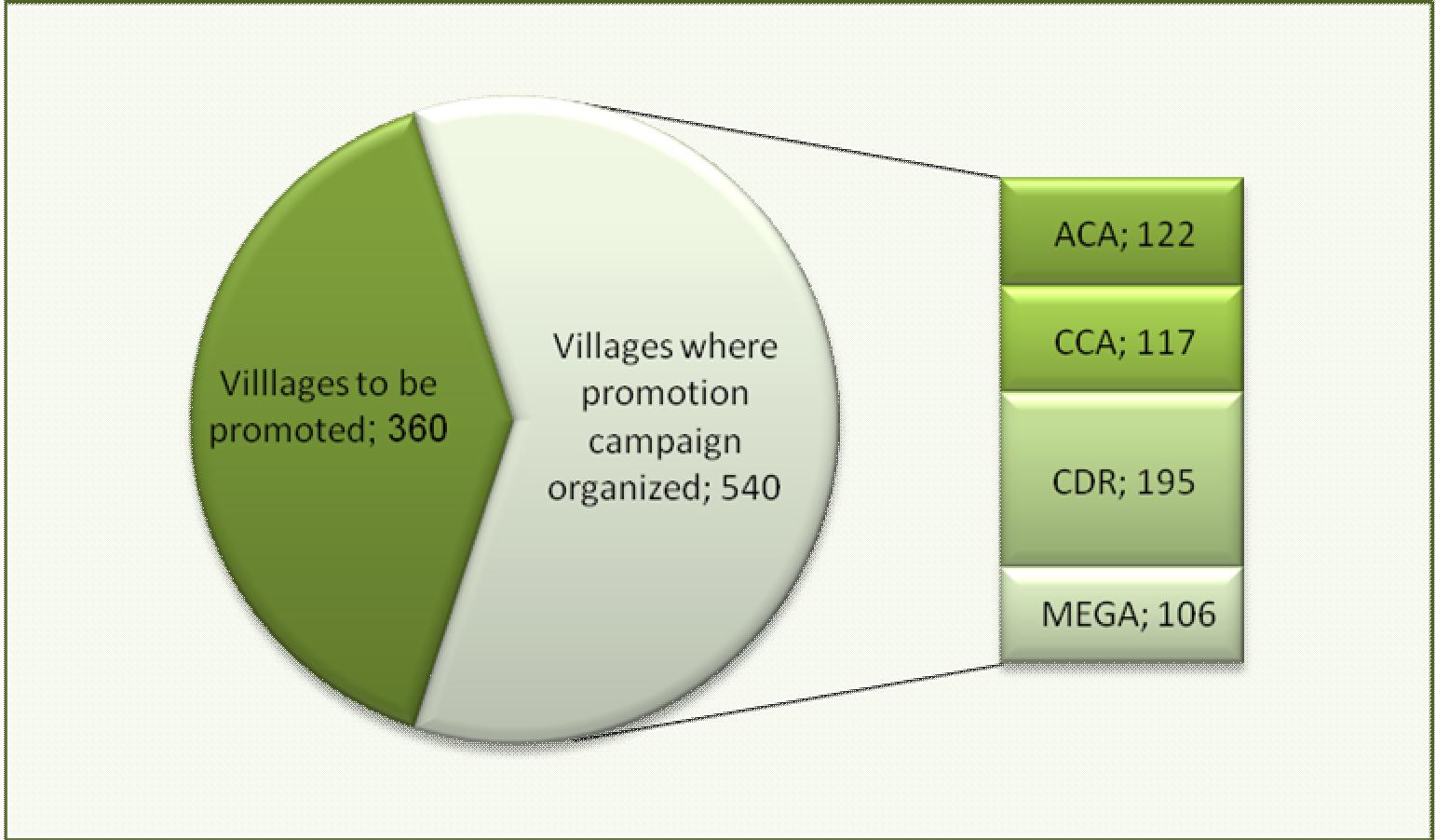
While other DAs have greater results in business creation, CDR organized most promotions
in 195 vil ages having more than 4382 participants. ACA, CCA and MEGA have organized
information meetings in 122, 117 and 106 vil ages respectively. (Chart RBD 1)
Chart RBD 1. Number of promotion activities by DAs
As project foresees that the promotion campaign will be held in a total of 900 vil ages of
Moldova, we can state that at March 31st, 2008 60% of the vil ages have already been
involved in this campaign.
Most promotions were carried out in partnership with local public authorities, ACSA national
extension network consultants and savings and credit associations. These promotions
introduce the goal and objectives of the project, conditions of participation, DAs' role in
creating and supporting new businesses, funding opportunities of investment projects, etc.
All promotion meetings are accompanied by distribution of information materials, including
RISP II leaflets containing general information on the project, the list of DAs and their
contact information, the list of project participating financial institutions (PFIs).
- 19 -
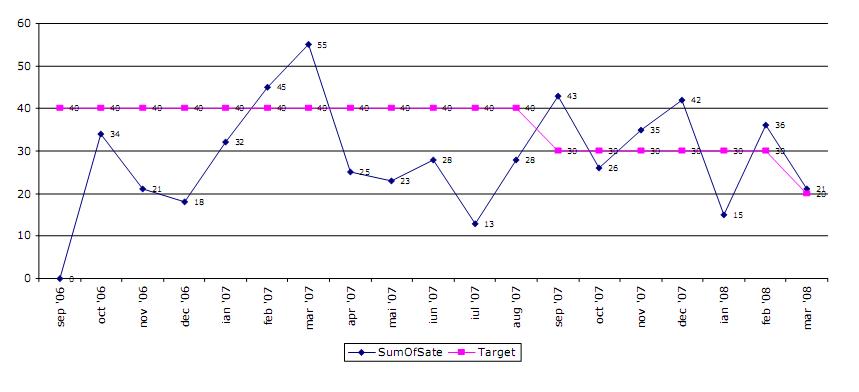
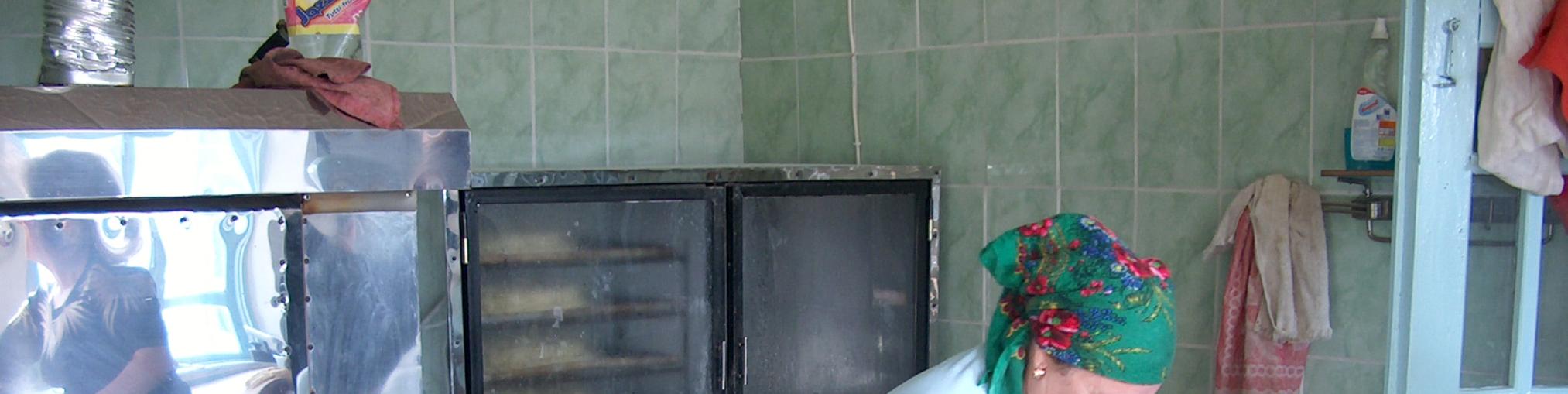
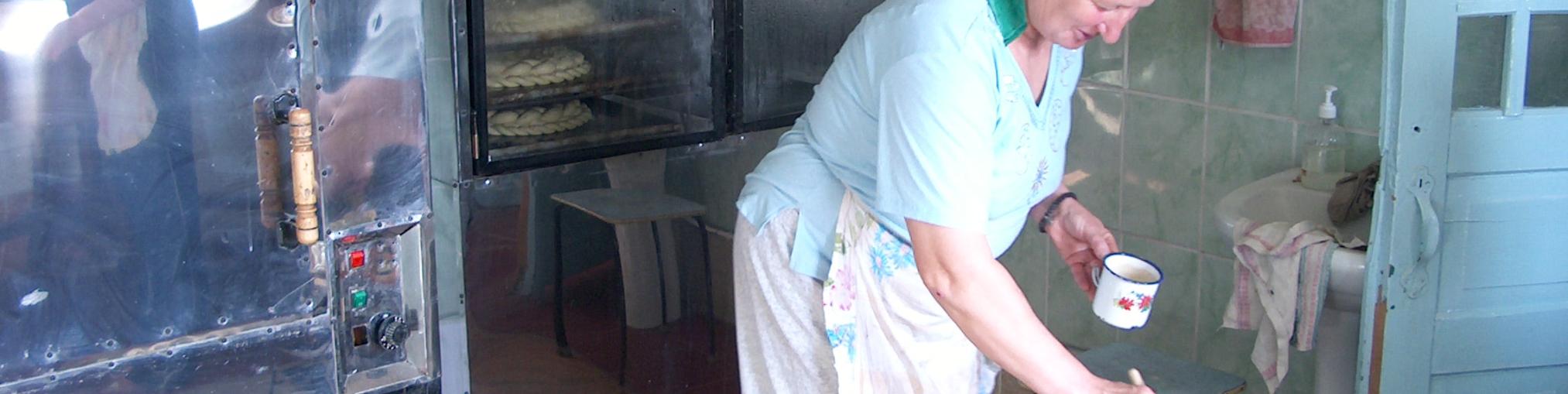
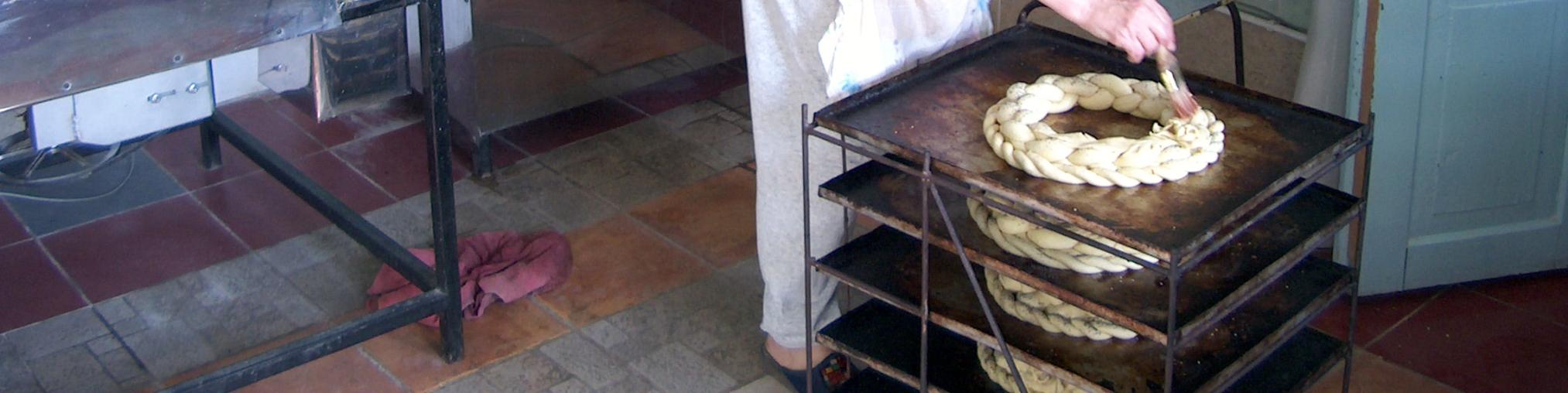
The number of promotion activities was very modest in the first quarter of 2008, (15), while
the reason for that was the limited number of working days during that period. On the
contrary, in February and March Das have managed to organize 57 information meetings,
with the main weight in February (36 villages).
An important source of information on project conditions are RISP I beneficiaries. They can
be considered an example for potential beneficiaries of RISP II.
Chart RBD 2. Number of promotion activities
BUSIENSS CREATION
During the first quarter 2008 the four DAs have managed to assist 44 RBs in developing their
business plans, this totalling to 327 RBs with their final business plans with DA assistance.
245 businesses established with
the support of DAs have started
their operational
activity/implementation of
investment plan as of March 31,
2008. Out of them, 239 have
received loans from PFIs and 6
started operating only with their
own resources. Overall, 259 RB
have received financing/credits
from the PFI and 8 of tem are
Bakery, Glodeni
still implementing the
investment plan, with operational activity to be started subsequently.
- 20 -
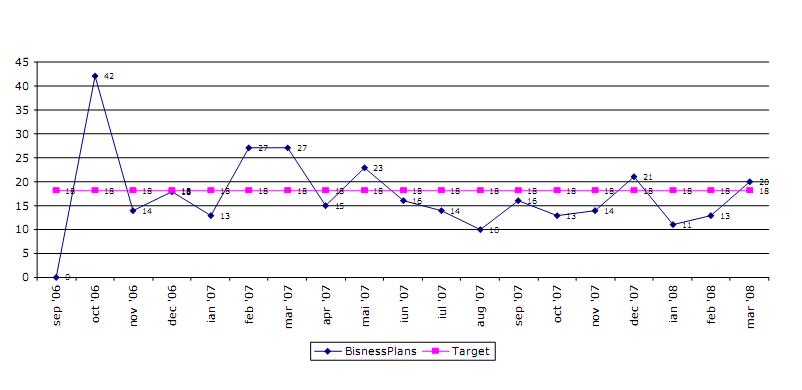
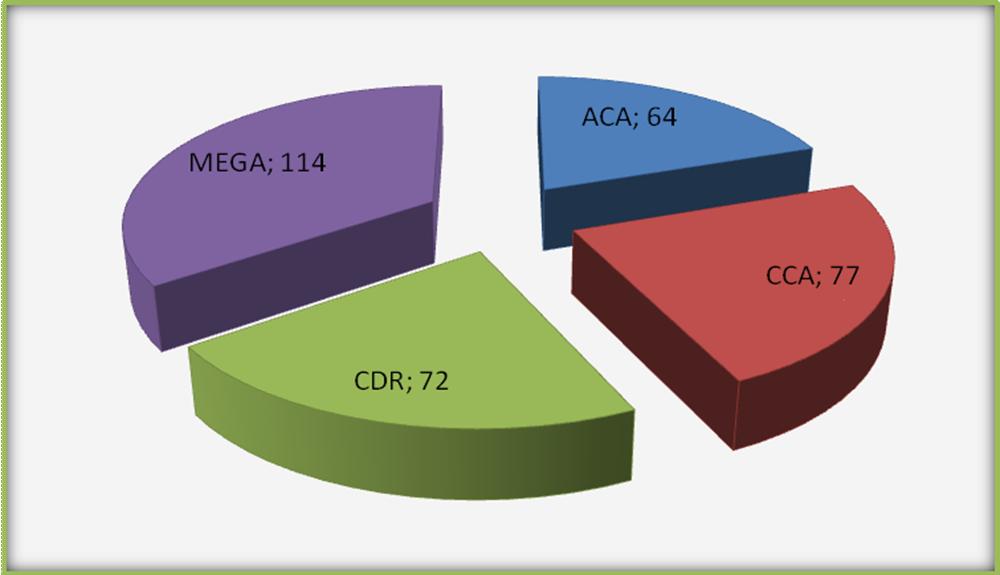
Chart RBD 3. Number of businesses with final business plans with DA assistance
The total business investments of these 245 businesses amounted to 7.5 mil. $. Thus, the
average investment made by operational businesses by March 31, 2008 is 27 000 $.
If referring to the amounts of credits disbursed to 259 RB, they are totalling a 4.1 mil. $, that
have been supplemented by the beneficiaries contribution in amount of apr. 3.4 mil. $. Thus,
the average loan disbursed to RB is 16 000 $. This is confirming somehow the status of small
business of the RB created with the support of the RISP, the target group of the project
being reached.
Chart RBD 4. Number of RB with final business plans by DA assistance
MEGA has assisted in the creation of
most of the RBS so far (114),
fol owed by CCA (77). For CDR and
ACA this figure is 72 and 64
respectively.
Out of 245 businesses created, 232
are individual businesses, which
represents approximately 94% and only 13 RB are group businesses. To this end, group
businesses were considered businesses with 3 and more founders. This indicator, compared
with previous period is showing an increase of the individual owned businesses versus group
ones.
- 21 -
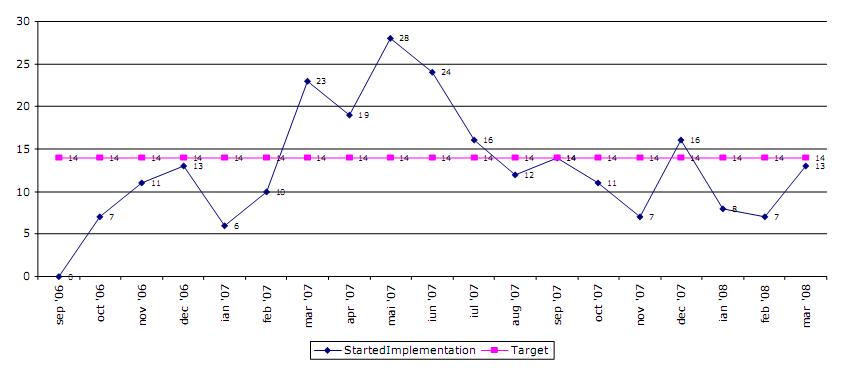
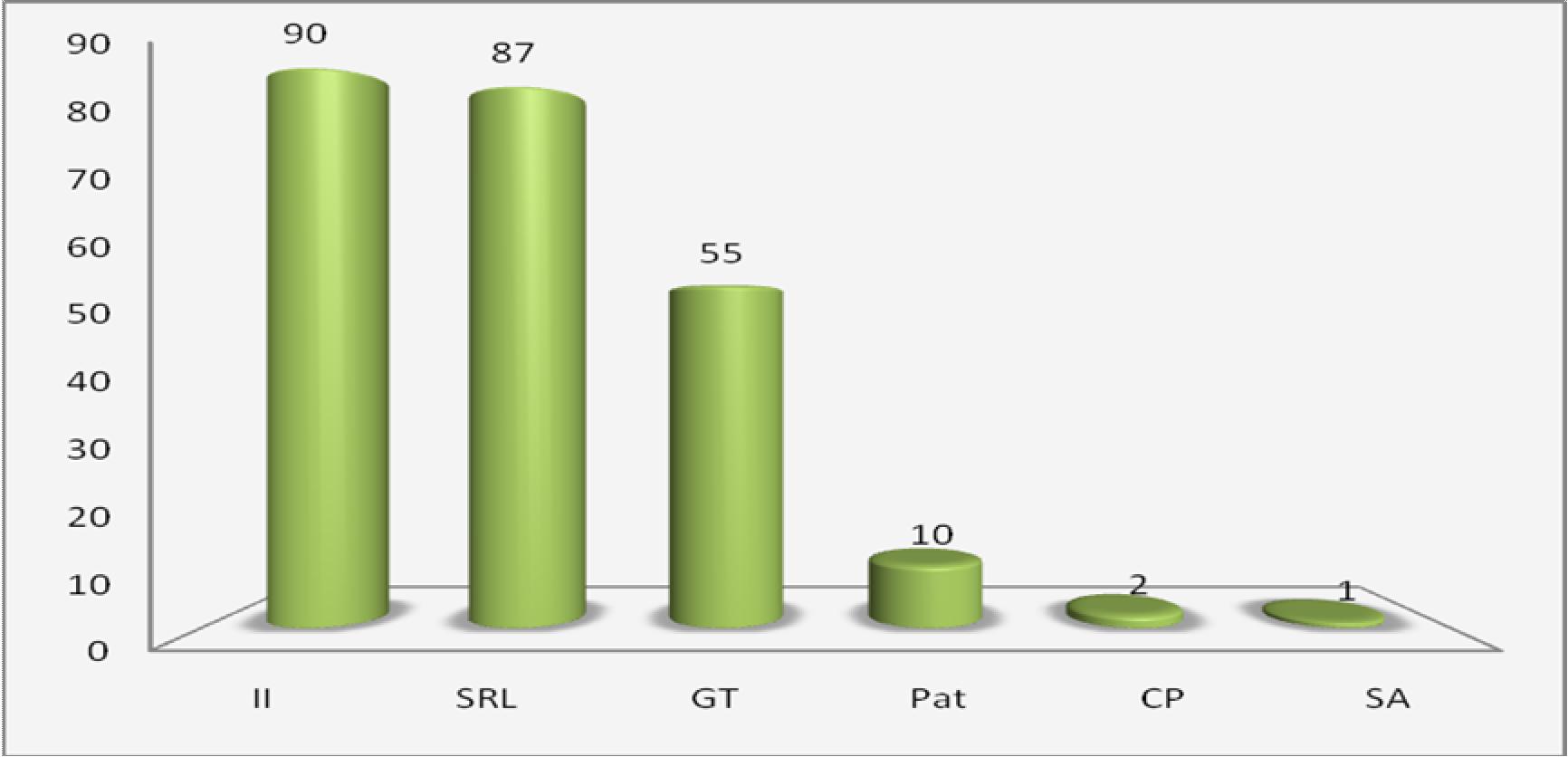
Chart RBD 3. Number of businesses started implementing business plan
The legal form of the businesses that commenced implementation of their business plan is
mostly Sole Proprietorship (90 RB) or Limited Liability Company (87 RB). These two types of
businesses represent a 72% from the total/ operational RB. They are followed by peasant
farms (55) or about 22% from the total. There is one single stock company, two production
cooperatives and 10 patent holders.
Chart RBD 6. Number of operational RB by legal form
- 22 -
The structure by the type of business, which started their operational activity, is presented
in Table RBD 2. The table below shows a big share of businesses being non-agricultural
(69%), which is matching with one of the project trigger to have at least 1/3 of al new
businesses created engaged in off-farm activities.
From the agricultural businesses (a total of 77), those with crop production have the
greatest weight, with a total of 38 RB, followed by livestock production (27 RB). The chart in
the Annex RBD 22 is showing a more simplified breakdown of Rural Businesses by type of
activity. As we can see, the categories of non-agriculture businesses are food processing
(7,5%), wood processing and furniture (4%) transport (11%), other services (5%). Almost half
of the manufacturing companies are food processing companies (40%), followed by
manufacture of other non-metal products (17%) and wood processing and furniture (14%
each). It is to be mentioned that the share of the RB involved in trade has decreases by 2.3
times comparing to the same period from the previous year, from 39% to 17%. This is
representing a positive trend, as during the last two Missions of the World Bank team as wel
as at the CAPMU Supervisory Board meeting the agreement has reached towards the
making efforts as to minimize the share of retail businesses, and setting a maximum limit for
them at 20% from the total. As of March 31st, 2008, RISP is registering a 3% of the RB
involved in wholesale trade and 17% - retail trade.
A quarter of rural businesses being involved in retail trade can be explained by rather small
investments needed for this specific activity compared with production or agricultural and
non-agricultural services. And on the other hand, Moldovan rural population is still facing
the problem of lacking collateral when starting businesses that require attracting capital
from the financial institutions. This problem is main one mentioned by the DAs in their
quarterly reports.
- 23 -
Table RBD 2. Structure of RB by type of activity
Type of business
No.
%
Agriculture
Agricultural service activities
12
4.9
Crops production
38
15.5
Livestock production
27
11.0
Sub-total Agriculture
77
31.4
Non-Agriculture
Fishing
2
0.8
Manufacture of food products and beverages
14
5.7
Manufacture of wearing apparel
2
0.8
Manufacture of wood and wood products
5
2.0
Manufacture of rubber and plastic products
1
0.4
Manufacture of other non-metallic mineral
6
2.4
Manufacture of fabricated metal products
1
0.4
Manufacture of electrical machinery and apparatus
1
0.4
Manufacture of furniture
5
2.0
Construction
1
0.4
Repair of home appliances
1
0.4
Retail trade
42
17.1
Sale, maintenance and repair of motor vehicles
14
5.7
Wholesale trade and commission trade
8
3.3
Hotels and restaurants
11
4.5
Land transport
27
11.0
Post and telecommunications
4
1.6
Supporting and auxiliary transport activities
1
0.4
Other service activities
2
0.8
Health and social work
1
0.4
Other services
12
4.9
Recreational, cultural and sporting activities
7
2.9
Sub-total Non-agriculture
168
68.6
TOTAL
245
100.0
FINANCING OF RURAL BUSINESSES
In the first quarter of 2008 the DAs have signed 48 Service Agreements with the
beneficiaries. So far 295 credit applications were submitted to Financial Institutions and 259
credits were already disbursed. 166 out of the credits disbursed are provided from the RISP
funds, 93 projects are financed from other sources.
As was mentioned above, 245 beneficiaries from the total number of contracts have started
the implementation of their Business Plans, elaborated in a joint effort with the DOs. In 6
cases out of 245, the beneficiaries are starting the implementation of their projects from
their own sources, eventual y considering accessing a loan at a later stage.
- 24 -



The 245 businesses are located in all rayons. The maximum number of businesses is in UTAG
(30 RBs), fol owed by Cahul (26), Edinet (16), Riscani (13), Drochia, Hince "ti "i Orhei with 12
RB respectively, Glodeni (11) and
Floresti (10). These rayons host more
than half (58%) of businesses created
so far. If comparing regions by value of
disbursed credits, then UTAG is the first
on the list with over 4.4 million lei
disbursed is followed by Drochia with
over 3.8 million lei and then Glodeni
and Cahul with apr. 3 million lei each.
It should be mentioned that 206 out of
Manufacturing furniture, Basarabeasca
245 operational businesses have
already started to generate revenues, creating thus 813 jobs, which results in an average of
3 jobs per RB.
The fol owing table is showing the breakdown of the service agreements by the level of
access to the financial resources:
Service agreements signed
360
Credit applications submitted
295
Loans disbursed
259
RISP loans
166
Loans provided from other sources
93
Credit applications still being assessed by PFI
7
Credit applications rejected or withdrawn
28
Loans approved but not disbursed
1
If comparing the efforts of DAs in financial brokerage, we can mention MEGA with 97 credits
disbursed each so far, CDR 66, ACA 50 and CCA - 46.
MANAGEMENT INFORMATION SYSTEM AND M&E
The analysis of the progress in the implementation of the RBD Component is managed by
means of the database application. The DAs were provided with the application files from
the beginning of their assignment. The functionality of the database includes data integrity
check and the generation of the progress reports.
- 25 -
On a monthly basis CAPMU is receiving the updated database files from the DAs and the
information regarding the credits disbursed within the Rural Finance Component from the
Credit Line Directorate (CLD). The information is crosschecked with the DAs and the CLD.
CAPMU is regularly maintaining and updating the database, providing a more enhanced
functionality, both for the DAs and the generation of reports.
An application for the Credit Line Directorate was developed in July 2007 and remitted to
DLC. CAPMU has provided the necessary training to the person in charge from CLD and wil
further provide the necessary assistance upon request. The application is functional for data
introduction, verification of accuracy of introduced data, generating reports and diagrams
and managing information on monitoring carried out by CLD staff. The application will
smooth the process of introducing data, the transfer of data between CLD and CAPMU as
well as reporting, including quarterly reporting to the World Bank. CAPMU.
Rural businesses established with the assistance of the project are monitored both by DAs
and CAPMU. Development Agencies are in charge of carrying out monitoring visits to verify
the performance of businesses created as compared to a set of indicators, which proved to
be very useful during the first phase of the project. Thus, the frequency of monitoring visits
depends on the risk category assigned by DAs to each business as a result of the last
monitoring visit. Therefore, businesses in the low risk category are monitored after 6 months
from the last visit, those in the high risk category in two weeks from the last visit, etc. In
the annex RBD 4a one may see the structure of businesses by risk categories. A set of
indicators are col ected in order to record data on employees, average salary by gender or
age, average salary before project, etc. (Annex RBD 4a)
When visiting revenue generating rural business, DA consultants also collect financial data
on the business such as sales, profit margin, taxes and fees, VAT, etc. For a better analysis of
the development of the rural businesses, we have introduced two new indicators: increase
in beneficiaries' income of the operational businesses and the volume of remittances
invested (annex 4b). In the annex RBD 4a one can see the cumulative indicators on
employment, taxes and fees paid.
CAPMU is monitoring DAs by regularly and randomly organizing monitoring visits to RBs
created with the support of al DA consultants. The goal of these visits, in addition to
assessing created businesses, is to estimate the quality of assistance provided by DA
consultants, especially, post-creation assistance, but also the accuracy of eligibility criteria
for project participation.
- 26 -
POST-CRATION SUPPORT TO RBS
All four DAs have already started the post-creation support for the Rural Businesses created.
The total number of businesses involved in DAs post creation support is 187 out of 245
operational, each receiving 1 to 5 days of support depending on the necessity. So, 76% of
the Rural Businesses that commenced their operational activity have already asked for the
assistance. Most of the support has been provided by MEGA with 337 days of post-creation
so far. CDR and CCA have provided 147 and 95 days respectively, and ACA - 31.
The breakdown of the post-creation support delivered to RBs by category is as follows:
The category of the services
Nr. of days
ACA
CCA
CDR
MEGA
TOTAL
Legal issues
6
44
33
77
160
Finance/accounting
13
15
47
81
156
Management
5
17
32
63
117
Marketing/sales
7
17
17
99
140
Technologic issues
0
2
18
17
37
Total
31
95
147
337
610
As shown in table above, out of 610 consulting days, 337 have been provided by MEGA,
representing more than 55% of the total. Four categories are most requested, with an
approximate equal distribution: legal issues, finance and accounting, management and sales
and marketing with 160, 156, 117 and 140 days respectively. The technological area was
required for only 37 post-creation assistance day. It could be assumed that such a small
number of days of technological support is not the result of low demand from beneficiaries,
but more due to the specialization of development officers in 4 broad areas, but less in the
technological one. In fact, technological assistance and support is excellently provided by
ACSA network.
- 27 -
RURAL FINANCE COMPONENT
CREDIT LINE IMPLEMENTATION PROGRESS
Loan IDA nr. 4157 MD, Credit Line 7 904 000 SDR (cumulative data)
General information. In the first quarter of the year 2008 with a view to implement the
Credit Line (CL) of the Project for financing and development of eligible small and medium
rural enterprises Credit Line Directorate (CLD) approved to Participating Financial
Institutions (PFIs) 16 sub-loans in the total amount of 8674.6 thousands lei and 244
thousands US Dollars, out of which 13 sub-loans were fully disbursed in the total amount of
5629.3 thousands lei and 195.2 thousands US Dollars.
Cumulative from the Credit Line were refinanced and disbursed subsidiary loans amounting
to 69.40 millions lei and 628.8 thousands US Dollars. These funds were allocated to finance
176 eligible sub-loans approved in the total amount of 89.69 millions lei and 786 thousands
US Dollars.
According to the PFI's information, the contribution of the beneficiaries for the
implementation of the sub-loans constitutes about 74.30 mil ions lei or 38.56% to the total
amount of the sub-loans minimum requirement being up to 20%. The total estimative cost
of the approved sub-loans that includes the beneficiary's contribution, co-financing of the
PFI and the loan from CLD from the LC resources constitutes 192.70 mil ions lei.
Disbursement of funds from the CL and its assimilation by PFIs constitutes 50.70% from the
total equivalent in lei of the Credit Line of the Loan; the share of the amount approved to be
financed constitutes 66.23%.
The ratio of the disbursed amount to the approved amount of the sub-loans constitutes
76.55%.
The total principal amount reimbursed by PFIs constitutes 1304.76 thousands lei and 64.00
thousands US Dollars that constitutes 1.88% and 10.18% of the disbursed amount
respectively.
One of the project objectives is to increase access to finance rural areas, thus, it is required
that minimum 30% of the Credit Line resources are provided to the first-time borrowers that
didn't benefit from the formal financial sector. According to the information of the PFIs
presented so far, 47.43% of the credit line recourses are provided to the first-time
borrowers, which have no previous experience of borrowing from the formal financial
sector.
- 28 -
Thanks to financing offered within the Project, at the moment about 1098 new working
places will be created with the help of the disbursed funds. It is important to mention that
the participation of women in the establishment of the business in the rural area is
increasing; therefore, 39.71% of the managers of sub-loans financed are women.
Interest rates for financing. The CLD interest rates for the Credit Line's resources for PFIs for
the interest rate periods described below include MF margins for administrative and
operating costs and cover the exchange rate risks. These interest rates for Subsidiary Loan
denominated in lei will be a variable (i.e., floating) interest rate based on the reference rate
which shall be equal to (i) for the revision at the beginning of each calendar year, the
average between the annual inflation rate projected by NBM for the current year and the
actual inflation rate of the preceding year; (ii) for the revision at the second half of the year,
the actual inflation during the first six months of the calendar year, plus the revised
projection for the remaining six months of the calendar year; for the loans denominated in
US Dol ars the interest wil be floating, equal to the reference rate of 6-month LIBOR US
Dollar rate and MF's margins. Thus, the interest rates are the following:
Interest period
MDL
USD
01.02.06 30.07.06
12,45 %
01.08.06 31.01.07
11,00 %
6,55 %
01.02.07 31.07.07
14,05 %
6,37 %
01.08.07 31.01.08
11,77 %
6,38 %
The average commercial interest rate for financing the final beneficiaries applied by PFIs to
the sub-loans in lei including the banks commercial margin for credit risks constitutes
17.84% having a range from 15% to 20.5%, and for the USD - 11.03% having a range
between 10.5% and 11.5% respectively.
Participating Financial Institutions. The following 7 local intermediary banks activate within
the Project, which are assuming all the credit risk regarding the on-lending of the funds to
the private beneficiaries:
1. MoldovaAgroindbank,
2. Fincombank,
3. Moldindconbank,
4. Victoriabank,
5. Mobiasbanc ,
6. Banca Social ,
7. Banca de Economii.
- 29 -
The banks mentioned above are Participating Financial Institutions for the revolving
resources; as well, Energbank was selected and added to the list.
Information regarding the sub-loans approved, disbursements and the share of the
amount disbursed from the Credit Line in table:
PFI
Number of the
Disbursed in
The share of the amount
approved loans
million lei
disbursed, %
MoldovaAgroindbank
55
15,67
20,60%
Fincombank
57
30,37
39,93%
Moldindconbank
24
11,51
15,13%
Victoriabank
20
8,20
10,78%
Mobiasbanc
16
8,31
10,93%
Banca Social
4
2,00
2,63%
Banca de Economii
0
0
0
Total
176
76,06
100%
Fincombank (FCB) is the most active bank that approved 57 sub-loans and provided 55 sub-
loans, being followed by MoldovaAgroindbank (MAIB) with 55 sub-loans approved and 54
disbursed. Victoriabank (VB) approved and disbursed 20 sub-loans, Moldindconbank (MICB)
24 sub-loans approved and 22 disbursed, Mobiasbanc - 16 sub-loans approved and
disbursed, Banca Social - 4 sub-loans approved and disbursed.
Fincombank has the largest share of the disbursed resources in the total amount of 30.37
millions lei (equivalent of the 2.871 millions US Dollars), followed by MoldovaAgroindbank in
the total amount of 15.67 millions lei (1.48 millions US Dollars). In turn, Moldindconbank
disbursed 11.51 millions lei (1.09 millions US Dollars), Mobiasbanc - 8.31 millions lei (0.78
million US Dollars), Victoriabank 8.20 millions lei (0.77 million US Dollars) and Banca
Social 2.0 millions lei (0.19 million US Dollars). The exchange rate US$/ MDL is 10.6.
Out of the total number of 176 sub-loans approved 165 sub-loans were approved in lei and
just 11 sub-loans in US Dollars; this fact denotes a prudent approach of the foreign exchange
rate risk by the beneficiaries, who, as a rule, does not have incomes in foreign currency from
the export of products.
1 Exchange rate US$ / MDL 10.6
- 30 -
The structure of PFIs disbursed sub-loans by size:
Value
Nr. of loans
Amount
(mil. lei)
< 50,000 lei
6
0.22
50,000 250,000 lei
61
8.98
250,000 500,000 lei
50
18.07
500,000 1,000,000 lei
49
37.55
> 1,000,000 lei
10
11.24
The average sub-loan size approved constitutes about 514 thousands lei (or equivalent of
48.49 thousands US Dollars), but the average sub-loan size disbursed constitutes about
443.0 thousands lei (equivalent of 41.79 thousands US Dollars).
The structure of sub-loans disbursed by size
" 50,000 lei
0.22 mil. lei
50,001-250,000 lei;
· 1,000,001 lei
0, 29%
8.98 mil. lei
11.24 mil. lei
11.81%
14.78%
250,001 - 500,000 lei
18.07 mil. lei
23.76%
500,001-1,000,000 lei;
37.55 mil. lei
49.37%
The average loan size provided by MoldovaAgroindbank constitutes 290 thousands lei (27.36
thousands US Dollars), which is the lowest one as compared to the average loans size of
other participating banks, demonstrating the bank's efforts in reaching the Project's target
to finance small beneficiaries. Fincombank shows an average of 528 thousands MDL that
constitutes 49.8 thousands US Dollars, Victoriabank 409 thousands lei (38.6 thousands US
Dollars), Mobiasbanc - 526 thousands lei (49.6 thousands US Dollars), Moldindconbank -
488 thousands lei (46 thousands US Dollars), Banca Social 500 thousands lei (47.2
thousands US Dollars).
- 31 -
The distribution by the branches of national economy:
Number of
Amount
Branches of the national economy
sub-loans
(mil. lei)
%
Trade
56
23.57
30.99
Services
33
16.22
21.32
Agriculture
39
12.36
16.25
Food processing
16
7.40
9.74
Trade and services
9
5.12
6.73
Production of construction materials
7
3.87
5.09
Production and processing of wood
6
1.55
2.04
Other
10
5.97
7.84
Total
176
76.06
100.00
The maturity of sub-loans granted to beneficiaries:
Number of sub-loans
Amount
Maturity of sub-loans
approved
(mil. lei)
%
G 1year
0
0
0
1 3 years
25
3.68
4.84
3 5 years
97
39.05
51,34
5 7 years
34
23.62
31.05
H 7 years
20
9.71
12.77
The biggest share of sub-loans 51.34% are provided by PFIs for medium term (MT) of 3 - 5
years, 31.05% of sub-loans - for long term (LT) having maturity between 5 - 7 years, 12.77%
of sub-loans - for long term (LT) with maturity higher than 7 years (i.e., from 7 to 15 years).
Just 4.87% of sub-loans granted for short term (ST) from 1 to 3 years, the fact that shows the
availability of PFIs own credit resources for short term.
The distribution of sub-loans by the country region2. Owing to the large network of
branches of PFIs, the sub-loans financed cover al the country regions, with a relatively
uniform distribution by number of sub-loans financed. The most active are the central
regions of the country having a share of 36.0% (27.39 millions lei) out of the total number of
sub-loans. The northern part of the country covers 35.43% out of the total number of sub-
loans (26.95 millions lei), and 28.57% of sub-loans are financed in the southern region of the
country (21.73 millions lei).
2 Distribution of rayons by region is as follows:
North: Riscani, Rezina, Drochia, Donduseni, Edinet, Soroca, Glodeni, Telenesti, Briceni, Balti, Singerei,
Soldanesti, Floresti.
Center: Orhei, Ungheni, Nisporeni, Anenii-Noi, Dubasari, Criuleni.
South: Cahul, Vulcanesti, Taraclia, Comrat, Ceadir-Lunga, Hincesti, Leova, Causeni, Stefan-Voda,
Cantemir, Cimislia.
- 32 -
The structure of sub-loans disbursed by country
regions in mil. lei and %
South
21.73 mil. lei
North
28.57%
26.95 mil. lei
35.43%
Center
27.38 mil. lei
36.00%
Distribution of sub-loans by rayons:
Number of sub-
Amount of sub-loans
Nr.
Name of rayon
loans
(thousand lei)
1
Anenii-Noi
3
1498.40
2
Basarabeasca
-
-
3
Briceni
3
1552.00
4
Cahul
7
3644.00
5
Cantemir
-
-
6
o ra "
4
2292.00
7
Cau "eni
3
2112.80
8
Cimi "lia
2
1120.00
9
Criuleni
1
528.00
10
Dondu "eni
3
1704.00
11
Drochia
12
6381.20
12
Dub sari
1
40.00
13
Edine oe
7
2978.70
14
&le "ti
6
2685.13
15
Flore "ti
4
420.27
16
Glodeni
3
809.70
17
Hānce "ti
2
1072.00
18
Ialoveni
8
4630.40
19
Leova
1
968.00
20
Nisporeni
3
832.00
21
Ocni oea
-
-
22
Orhei
6
2064.00
23
Rezina
8
3194.65
24
Rī "cani
19
5361.40
25
Sāngerei
4
500.80
26
Soroca
-
-
27
Str "eni
4
1662.40
28
bold ne "ti
5
1320.00
- 33 -
Number of sub-
Amount of sub-loans
Nr.
Name of rayon
loans
(thousand lei)
29
btefan Vod
-
-
30
Taraclia
11
2317.45
31
Telene "ti
1
152.00
32
Ungheni
19
10771.00
33
Mun. Chi "in u
3
1880.00
34
UTA Gagauzia
23
11570.34
Total
176
76062.64*
* the amount includes the equivalent of the sub-loans disbursed in US Dollars
Loan records and reports elaboration. With a view of ensuring the fulfil ment of the
requirements stipulated by the Law of the Republic of Moldova nr. 419-XVI dated
22.12.2006 ,,On the public debt, guarantees and public on-lending", for maintenance of the
State Register on the public on-lending ensuring monitoring and control of the participating
parties in on-lending from the public loan funds, likewise the organization of the evidence of
reflow loans granted to the financial intermediaries, CLD makes accounting in separate
analytical accounts opened in accordance with our Accounting Policies for the year 2008. In
order to avoid the risks, CLD accounts are maintained in the National Bank of Moldova.
Daily records are made for all the entrances and withdrawals in and out of the analytical
accounts (with the distribution by loan currency); also monitoring of the availability of MDL
and foreign currencies amounts in CLD's accounts. At the end of each quarter, the
generalization of all the economical-financial operations is made by CLD for all the
operations that were made during the quarter in the synthetic accounts by creating all the
reports related to the CLD's activity (including the balance sheet) in accordance with the
National Accounting Standards.
The reports on the on-lending resources of the CL and the balance of the PFIs debt are
presented quarterly to the Ministry of Finance, as well as other necessary information to
infill the "State Register on the state on-lending".
Information regarding the disbursements and balance of PFIs within the RISP II cumulative balance
as of 31.03.08
Nr.
Name of PFI
Currency
Amount
Amount
Amount
%
Balance
approved
disbursed
reimbursed
reimb.
(debt)
1
Moldova
lei
19820540.00
15670832.00
0.00
0.00
15670832.00
Agroindbank
2
Fincombank
lei
33781094.00
26487511.00
8755.00
0.03
26478756.00
$
458000.00
366400.00
0.00
0.00
366400.00
3
Victoriabank
lei
9285000.00
7348000.00
0.00
0.00
7348000.00
$
100000.00
80000.00
0.00
0.00
80000.00
- 34 -
Amount
Amount
Amount
%
Balance
Nr.
Name of PFI
Currency
approved
disbursed
reimbursed
reimb.
(debt)
4
Banca Sociala
lei
2500000.00
2000000.00
48000.00
2.40
1952000.00
5
Moldindconbank
lei
14766500.00
10261000.00
0.00
0.00
10261000.00
$
148000.00
118400.00
0.00
0.00
118400.00
6
Mobiasbanca
lei
9537520.00
7630016.00
1248000.00
16.36
6382016.00
$
80000.00
64000.00
64000.00
100.00
0.00
7
Banca de Economii
lei
0.00
0.00
0.00
0.00
0.00
31.03.2008
89690654.00
69397359.00
1304755.00
68092604.00
786000.00
628800.00
64000.00
564800.00
In accordance with the conditions of the Rural Investments Guidelines, PFIs present to the
CLD quarterly progress reports: (i) Report regarding the Quality of the sub-loans Portfolio, (ii)
Report regarding the Entrance and Use of the funds from the rol -over account, (i i) Report
regarding the financing of new eligible sub-loans from the roll-over account in accordance
with the reporting forms established by CLD and approved by the World Bank.
Furthermore, CLD elaborated a number of analytical reports regarding the use of funds
within the Project.
Financing of revolving funds accumulated from the principal amount and interest
reimbursement. With a view to ensure the continuity of the durable realizations of the
Project, following the accumulation of the interest and the reimbursement of the principal
amount by PFIs, after deduction of the necessary amounts for MF, the revolving funds were
formed and accumulated at the CLD accounts in NBM. Refinancing of the accumulated
funds is done at similar conditions of Project's CL. With the exception that the financing
share of a sub-loan is 100% of the eligible expenses, the maximum amount to one
beneficiary shall not exceed 250 000 US Dol ars, and the MF margin was reduced to 1.5%
(the margin for direct Loan resources constitutes 2%). Beginning October 26, 2007 from the
revolving funds were financed 3 sub-loans amounting to 4 575 thousands lei by
Moldindconbank, Fincombank financed 3 sub-loans amounting to 503 thousands lei and 38.8
thousands US Dollars, and Mobiasbanca financed 1 sub-loan amounting to 181 thousands
lei. The average maturity of the granted loans is 77 month.
The average interest rate applied by the PFIs to the final beneficiaries constitutes 16.89%,
including MF margin and the bank's commercial margin. 5 sub-loans financed from the
revolving funds are situated in the southern part of the country and 2 in the northern part.
Out of 7 sub-loans, 4 were allocated to the services sector, and 3 - to trade sector.
- 35 -
Institutional capacities development for rural finance system.
Within the part C2 of the Project ,,Institutional capacities development for rural finance
system" CLD in col aboration with CAPMU organized training for the PFIs employees for
strengthening the institutional capacities for improvement of the credit procedures of the
investments projects, projects in agriculture and financial leasing. Following the first round
of training, 14 persons were trained from PFIs (i.e., from Fincombank and Victoriabank) and
CLD. After the second round of training, 26 persons were trained from Moldindconbank,
Mobiasbanca and CAPMU. The next round of training is planned to take place in the last
week of May 2008.
Information regarding the refinancing of the funds within RISP1 project.
With a view to ensure the continuity of the Project RISP 1, CLD took over from the CAPMU
the balances of the sub-loans in the total amount of 179.87 millions lei and 50 thousands US
Dollars, granted at the initial phase of the Project implementation. From the direct
resources of the project, 1388 beneficiaries were financed.
In total, from credit resources within the RISP 1 project (direct and revolving resources) were
allocated through the PFIs 276.99 millions lei and 50 thousands US Dollars, including the
revolving funds amounting to 97.12 millions lei (265 sub-loans were financed by CLD from
the revolving funds available after deductions and transfers of the debt service payments
needed for the Loan in favor of MF).
On 31.03.08 the principal amount reimbursed by the PFIs constitutes 29.25 millions lei and
50.00 thousands US Dollars that constitutes 17.57% and 100.00% of the disbursed amounts
respectively. The balance of the PFIs principal amount on 31.03.08 constitutes 247.75
millions lei, the repayment period being extended respectively to the repayment schedule
and payment dates until the year 2022 (that includes the sub-loans disbursed from direct
and revolving resources of CLD).
- 36 -
Information regarding the amounts disbursed and reimbursed within the RISP 1 and RISP 2
projects:
The total
The
Currency
The total
The total
amount of sub-
The PFIs
number
Project
of the
amount of sub-
amount of sub-
loans
balance,
of sub-
sub-loans
loans approved
loans disbursed
reimbursed by
principal
loans
PFIs, principal
financed
RISP 1 direct
lei
179,874,954.00
179,874,954.00 26,489,770.80
153,385,183.97
1387
resources
$
50,000.00
50,000.00
50,000.00
0.00
1
RISP 1
lei
107,282,757.00
97,116,692.00
2,755,937.74
94,360,760.26
265
revolving
RISP 2
lei
89,690,654.00
69,397,359.00
1,304,755.00
68,092,604.00
165
direct
resources
$
786,000.00
628,800.00
64,000.00
564,800.00
11
RISP 2
lei
5,259,129.00
5,259,129.00
0.00
5,259,129.00
6
revolving
$
38,766.00
38,766.00
0.00
37,766.00
1
STRENGTHNING THE SAVINGS AND CREDIT ASSOCIATIONS INDUSTRY
The objective of this sub-component is to improve the legal, regulatory and supervisory
framework of the Savings and Credit Associations (SCA) industry, and provide capacity
building to the related institutions, primary the supervisory authority, to ensure their long-
term sustainability.
During the reporting period, continued the activities related to improvement of the legal,
regulatory and supervisory framework of SCA industry, building operational capacity of the
new supervisory body and some new activities on strengthening of operational capacities of
SCAs were initiated.
1. SUPORT TO THE NCFM FOR IMPOVEMENT OF THE LEGAL FRAMEWORK AND
STRENGTHENING OF REGULATORY AND SUPERVISORY CAPACITIES
In order to continue providing assistance to the NCFM to improve the legal framework
related to SCAs business activity and to strengthen the regulatory and supervisory capacities
of the supervisory body, during the reporting period was selected and contracted a local
consultant that will assist the staff of the NCFM during a 8-month period (March to October
2008) to improve and implement the new legal framework and help reform the SCAs
industry.
During this reporting period also started and continues the process of selection of an
international consultant to enhance the assistance provided to the NCFM. 11 consultants
applied for this position. A consultant was selected and negotiations related to contracting
terms are in progress.
- 37 -
Improvement of legal framework
The following activities and results are to be mentioned related to the improvement of the
legal framework:
a. Finalization and coordination of the draft Regulation on supervision of SCAs (RSSCA).
During January-March 2008, upon finalization, examination and approval of the
initial draft RSSCA by the NCFM, repeated examination of proposals and objections
of the SCA system stakeholders, certain improvements have been made to the draft,
including changing the draft's name into Financial Prudential Norms of SCAs (FPN).
The draft FPN has to be prepared to be submitted to the legal department and to
final approval by the NCFM, and after that, to the Ministry of Justice for
coordination and registration.
b. Improvement of the draft amendments to the National Accounting Standard 63,
Comments to NAS 63 and Chart of Accounts, as suggested by the Ministry of
Finance. The amendments cannot be approved before FPN are approved. Taking this
into account, as wel the suggestions of the MF, the NCFM wil send the
amendments' draft to RFC, MMA and NFSCA for commenting, upon which it will be
sent to Consultative Council of the MF for final examination and approval.
c. Examination of the final version of the draft Regulation on issuing the opinion on
state registration of SCAs. The draft Regulation has to be prepared to be commented
by the legal department, finally approved by the NCFM, coordinated and registered
with the Ministry of Justice.
d. Approval, publication and effectiveness of the Regulation on requirements towards
the administrators of SCAs (Decision of the NCFM no. 63/6 from 25/02/2007, Official
Monitor no. 37-39 from 22/02/2008.)
e. Approval, publication and effectiveness of the Regulation on assessment of SCA's
business plan (Decision of the NCFM no. 5/6 from 31/01/2008, Official Monitor no.
61-62 from 25/03/2008.)
In the next period, the priority tasks under this activity are: to finalize the development and
approval of other draft regulations, as well to initiate the amendment of the SCA Law and
development the Regulation on reorganization and liquidation of SCAs.
- 38 -
Strengthening of operational capacities of the NCFM
Additionally to the assistance in improving the legal and regulatory framework, the local
consultant actively supports the staff of the Department of Collective Investments and
Microfinance in their daily activities related to SCAs. Thus, during the reporting period the
local consultant performed also the following activities:
a. provided to the NCFM 3 trainings, each of them of 2 hours long, on specifics of
establishing and operating of SCAs and on the new Law on SCAs;
b. assisted in analyzing and analyzed together with the staff of the Department the
applications and reports received from SCAs;
c. participated in discussions and reviewing of other legal norms directly or indirectly
related to SCAs activity.
2. STRENGTHENING OF OPERATIONAL CAPACITIES OF SCAs
Also, during the reporting period, in cooperation with the Swiss Development Agency (SDC),
was set up a permanent training room with 15 computers. The equipped classroom will be
run by the Rural Development Centre (RDC) and serve as training centre for continuous
training of SCAs personnel on various topics.
The main outcome of this mutual project is expected to be 200 SCAs trained in basic
computer literacy and accounting software. It is expected that the basic computer training
will motivate them to purchase and/or start using computers in their SCAs to substitute for
large manual work being done at present. The most important outcome of software training
will be improved and timely loan and savings monitoring in the SCA, easier accounting and
reporting, improved job satisfaction of SCA accountants and therefore better staff retention.
- 39 -
PILOT LAND RE-PARCELING COMPONENT
INTRODUCTION
This report presents the details of the land re-parceling pilot project in six villages, financed
by the World Bank and SIDA.
Within the implementation of the agricultural land consolidation pilot project, launched on
August 01 (with the total duration of 18 months), the following actions have been
performed:
Pilot villages selection, observing the selection criteria defined in the terms of
reference;
Definition, in cooperation with the MAFI, of the Observers Committee establishment
and operation framework;
Identification of the best international cooperation practices with the purpose of
project implementation (between MAFI, agents, governmental institutions and local
public administration authorities);
Definition of a general concept on the use of Real Estate registry data, provided by
ASRFC, applicable in the practical activities in the pilot villages;
Definition of the framework principles that would ensure the harmlessness of
project activities for the environment;
Formation of the work group in each participating vil age, consisting of expert in re-
parceling, selected by the project, the cadastral engineer, the representative of the
Rayonal Agriculture and Food Directorate;
Providing an office at the Mayoralty for each local team, including equipment:
computer, printer and fax;
Organization of three training seminars for the experts involved in the agricultural
land consolidation process;
Development of a public awareness campaign: Participation in "Bastina" TV
program ;
Development of the public information panel;
- 40 -
Obtaining of cadastral maps from "Cadastru" state company: the graphical and the
legal part;
Verifying and revision of land property maps for the study of the current situation.
Election of the Observers Committee from the vil age, with the purpose of assisting
the implementation team, ensuring transparency in project implementation;
Interviewing agricultural land owners;
Collection of information necessary for the development of the plan of the village
and organization of the meeting with Mayoralty employees, counselors and other
stockholders interested in community development;
Development of the site development plan on the basis of proposals from the local
authorities, land owners and other stockholders;
Analysis of the data selected as result of land owners interviewing;
Development of simplified procedures related to land transactions.
CURRENT IMPLEMENTED PROJECT ACTIVITIES
Introduction
The basic activity in the report period was the activity No. 10: Performance of preliminary
investigations and disseminations of land development plans for each village. The major
project activity has two main components:
x Interviews with private land owners and land holders
x Development of community development plans
Project activity 5: Definition of framework principles to ensure the fact that the project
activities do not affect negatively the environment
It is important for the sustainable project development to ensure that the producers do not
impact the valuable nature types and do not cause the loss of biological diversity during the
preparation and eventual implementation of community development plans. The framework
principles have been defined in order to ensure that the project activities do not have
negative impacts on the environment.
- 41 -
The project experts have prepared an environment impact assessment (EIA) and presented
the EIA in relation to the project to all members of the local project teams, MAFI staff and
other partners.
Project activity 6: Training program development
The second (of five planned) training seminar for the persons directly involved in the project
and third parties took place on November 21, 2007, attended by about 50 participants.
The main goal of the second seminar was to build the capacities for the following project
activities:
x Land property map development Plan 1
x Conducting interviews with the land owners and land holders
x Preparation of community development plans
x EIA
The third training seminar was held in April 2008. The following project activities have been
approached:
x Land parcels pricing
x Development of a re-parceling design plan (based on detailed negotiations with the
landowners).
During the training seminars, each local team presented the project progress in pilot
communities by that moment.
Project activity 6: Public awareness campaign
A set of activities related to public awareness campaign have been conducted during the
report period:
x Continuous raise of the public awareness of project activities in the six pilot villages
x Preparation of booklets related to the project
x Project web page.
Continuous raise of public awareness in the six pilot villages
The daily project activities help at raising the awareness of the landowners and other local
landholders about the project activities. Many villagers have been informed in details about
the project while being interviewed about their interest in the latter and about their
- 42 -
willingness to participate. The individual interviews started with a short introduction of the
project for the landowner. During the interview, the re-parceling project officer discusses
with the interviewed person about how he or she could benefit of the project.
Another important activity in the report period is the preparation of community
development plans. In order to facilitate the development plans development, several
meetings have been organized with the landholders. These meetings have also been used
for the dissemination of information about the project and its activities.
Project booklets
A booklet of the project has been developed by the contractor together with MAFI in
January 2008. The target group are the landowners, farmers and other landholders in pilot
communities. The booklet will be available in the pilot villages and in the project office in
Chisinau starting with February 2008. The booklet will be available in Romanian and English.
Project web page
During the report period activities on project web page development have been
implemented. The web page is expected to be launched in May 2008.
Project activity 9: Revision and updating of land property maps (Plan 1)
Within the interviews with the land owners a set of problems related to land ownership right
registration have occurred. The most important types of problems related to ownership
right registration have been the following:
x Cases related to land inheritance
x Land reform/unregistered privatization.
The cause of problems related to land inheritance is the fact that the landowner according
to the register, is diseased, no other owner having been mentioned (often the inheritor of
the diseased owner). In Calmatui pilot village, 60 of the 634 identified owners are diseased.
The scale of the problem varies from one vil age to another, but it occurred in all six pilot
villages.
Another problem identified until now is that certain pilot villages hold land areas the land
property for which is not registered in the TCO and the parcels are not shown on the
cadastral map. However, the landowners have official documents proving the property right
of these parcels. The cause of this problem is that in certain villages the privatization
projects have been performed before the implementation of the National Land Privatization
- 43 -
Program. For example in Calmatui, 136 of 634 identified owners are not registered in the
official NAGCC registry.
Project activity 10: preliminary investigations and preparation and dissemination of
community development plans for each village
One of the most important project activities is the activity No. 10, which has two main
components:
x Interviewing of land owners
x Preparation of community development plans
Interviews with individual land owners and land holders
The interviewing of landowners has started in all the six pilot vil ages in November 2007. The
purpose of the interviews was the collection of the data on the local agricultural structure
(data on production and users) and identification of the initial interest of the individual land
owners in land re-parceling project (the willingness to participate, to sell the land, to buy
land, to exchange land or to offer it for lease).
Results of land owners interviews
Busauca
Sadova
Bolduresti
Calmatui
Opaci
Baimaclia
Number of parcels, total
3018
5922
6006
1757
5626
4204
Number of identified owners
708
1.319
1.786
634
1.762
1.048
Number of interviewed
owners
640
1.300
1400
476
1409
828
% interviewed owners
90.4 %
93.6 %
78.38 %
75 %
80 %
79 %
Average parcel size
0.5 ha
0.21 ha
0.29 ha
0.4 ha
0.6 ha
0.73 ha
No. owners participating in
the project
426
535
1022
286
589
540
% owners participating in the
60.2 %
40.6 %
57.2 %
45 %
33 %
52 %
project
Number of parcels offered
792
808
1692
227
829
830
for sale
Number parcels offered for
exchange
50
432
189
194
69
77
% owners who offer their
land for lease
8.62 %
0 %
46 %
90 %
26 %
24.8 %
% owners taking the land for
lease
0.4 %
0 %
0.2 %
0.3 %
1.4 %
0.7 %
% owners living in the village
86 %
90 %
89 %
95 %
87%
90 %
on a permanent basis
Public land (Mayoralty
14.78 ha
45 ha
46 ha
1.35 ha
19.02
7 ha
reserve)
- 44 -
Community development plans preparation
The second basic activity is the preparation of community development plans for each pilot
village. All plans have been developed by now.
Signing of consolidation agreements
The information obtained during the interviews is used for the signing of the consolidation
agreements. Thus, it is necessary first of all to meet the needs of the owners which are in the
best interest of the community and which lead to the extension of the owned land.
- 45 -
AVIAN INFLUENZA CONTROL AND HUMAN PANDEMIC
PREPAREDNESS AND RESPONSE (AIHP)
ANIMAL HEALTH COMPONENT
BACKGROUND
Outbreaks of Highly Pathogenic Avian Influenza (HPAI) began in several Southeast Asian
countries in 2003 and spread to Europe in 2005. Significantly for Moldova, outbreaks in the
neighbouring Danube delta region of Romania and in the Crimea peninsula of the Ukraine in
2005 obliged governments to cull poultry.
In November 2005, concerned governments, technical agencies, and donors met in Geneva
to plan an international response to the risks that Avian Influenza will harm human health
and cause large-scale economic losses. In January 12, 2006, the World Bank's Board of
Directors approved up to $US 500 mil ion in financing for the Global Program for Avian
Influenza (GPAI) that will assist eligible countries. The GPAI is an Adapted Program Loan
(APL) that operates horizontally, across countries. Also in January, governments and donors
met in Beijing, China and pledged $US 1.9 billion to the fight against Avian Influenza.
From this sum, Republic of Moldova benefits of $US 10.6 mln ($US 3.6 mln for Animal Health
Component).
All activities during January-March 2008 are divided in accordance with the Operational
Book as follows:
ANIMAL DISEASE SURVEILLANCE & DIAGNOSIS
MIGRATORY BIRD MONITORING
Migratory birds pose a potential threat of introducing highly pathogenic avian influenza
(HPAI) virus into the country's domestic poultry population, especially free-ranging backyard
poultry kept by households living near rivers, wetlands, watersheds and reservoirs that serve
as resting or breeding habitats for migratory birds. Two important migratory flyways cross
Moldova, along which wild birds migrate from their Central Asia and East European summer
habitats, to over wintering habitats along the shores of Black and Mediterranean Seas, and
in Africa.
The Project has funded a study carried out by the Institute of Zoology of the Academy of
Sciences of Moldova, which provides an excellent overview of the seasonal prevalence of the
- 46 -
various species of migratory birds that visit the country. The study indicates that of the 119
species of aquatic birds and waders from nine orders that migrate across Moldova, no less
than 12 species belong to the Anseriform family.
In spite of the need to monitor the prevalence and health status of migratory birds, an
activity that has been identified for Project support, there is presently no comprehensive
infrastructure in the country (e.g. wildlife service, wildlife NGOs, veterinary services, civil
society groups) that is able to do carry out such monitoring.
The Project requires a study to evaluate the feasibility of establishing a community-based
early warning (CBEW) network, comprising a civil society infrastructure, capable of
monitoring the health status of migratory birds in high-risk habitats, and to report unusual
die offs of such birds to their local veterinary authorities for investigation and diagnosis at a
regional or central veterinary laboratory. Such a network would comprise:
a) Incentives required to have villagers participate in CBEW,
b) The training requirements of village CBEW volunteers,
c) Mechanisms needed to report unusual wild bird deaths,
d) To identify lead trainers to instruct villagers on poultry bio security and personal bio
safety measures,
e) To develop a basic recording system of the prevalence of Anseriform bird species in
their area.
MODERNIZATION OF VETERINARY LABORATORIES
The ensuring of rapid diagnostic response of Republican Veterinary Diagnostic Centre (RVDC)
and Regional Veterinary Laboratories (RVL) in Drochia and Cahul should be achieved shortly.
Selected International Consultant on Laboratory Specifications and Training (Ieva Rodze)
visited Moldova between January 21-26, 2008 and it was sign the contract (contract amount
- 28,327 USD).
The specific objective for consultant activities is to ensure the effective functioning of the
animal health laboratory diagnostic system at the central and regional levels, based on:
1. procurement of laboratory equipment, supplies and incinerators,
2. training of selected laboratory staff in the use of such equipment,
3. advice on the design of the veterinary laboratories for suitable lay-out of equipment.
- 47 -
During the first visit to Moldova, the Consultant:
1. Assessed the actual situation in the RVDC in Chisinau and regional veterinary
laboratories in Drochia and Cahul (infrastructure, equipment, reagents, materials,
methods, personnel resources);
2. Reviewed the information contained in World Bank supervision mission reports that
include project progress layout and the updated project procurement plan;
3. Provided introductory information in Good Laboratory Practices and Bio-Safety
Standards to selected animal health laboratory personnel.
At the end of the visit, the Consultant elaborated the Initial Report, with details on
undertaken activities, conclusions and recommendations.
After Consultant's departure from Moldova, and from her home place, there were
elaborated and revised technical specifications on laboratory equipment for central and
regional laboratories.
List of Equipment
No
Equipment
Units
Expert Notes
Central Veterinary Laboratory
1 Freezer (-200C)
2
500l max
2 Refrigerator (+40C)
2
Virusology, Serology
3 Incubator with CO2
1
4 PCR hood
1
5 Laminar flow hood 1.5m class 11A
1
Serology
6 Laminar flow hood 1.1-1.2m class 11A
1
Bacteriology
7 Thermo mixer
1
8 Multistepping pipette, single or multi-channel
6
9 Only rotor 6-12/10-50, 22R
1
10 Water bath 5l capacity
1
Serology
11 Water purification station MiiQue
1
12 Regular incubator with processor
1
13 Drying oven, 50l
1
100-200l
14 Autoclave 75l-120l capacity
2
15 Incubator for incubation of embryos 200 units
1
16 Water distiller
2
5l/hour
17 Laboratory dish washer
1
18 Hermetic containers (3 electric)
+40C
19 Analytical balance
2
0,001
20 PH meter
2
21 Tissue culture inverted microscope
2
one with fluorescence detection
device
- 48 -
Microscope with fluorescence
22 Fluorescence microscope and adaptor
detection device (and photo
system for image capturing by
PC analyses package - it
Video system for image capturing and image
23
depends on procurement
analysis package for fluorescence microscope
1
estimated costs)
24 Incinerator with capacity of 500kg/day
1
25 Installation of incinerator
26 Microwave oven
1
Molecular biology
Regional Veterinary Laboratories
1 Freezer (-200C), 500-1000l
2
Horizontal, Necropsy
2 Refrigerator (+40C)
4
3 Refrigerator (+40C to -200C)
6
4 Multistepping pipette, single or multi-channel
2 - multi
6 - single
5 Centrifuge with rotors of 8-20ml
2
6 Water bath 5l capacity
2
7 Autoclave 75l-120l capacity
4
Automatic ELISA line with shaker, washer,
8 reader
2
9 PH meter
2
10 Analytical balance (0.01)
2+2
0.001; 0.01
11 Distilizator
2
12 Necropsy table
2
13 Oven, 100-250l
2
14 UV lamps
6
15 Gas stove
2+2
16 Fume cupboard (chemical)
2
Chemistry
17 Shaker
2
Chemistry
18 Laminar flow hood 2m class 11 A
2
19 Drying oven (+260C to +600C)
2
20 Thermo stat (+260C to +600C)
6
Office equipment for selected laboratories was delivered at the Republican Veterinary
Diagnostic Centre (6 computers, 6 printers, 2 laptops, 1 projector). They will be used for staff
trainings, and computers will be distributed among those three laboratories, two computers
for each laboratory (RVDC, Drochia, Cahul). Total amount - 18,390 USD
It was selected the company ("Bajura Com") for South Regional Laboratory Reparation and it
was signed the contract (contract amount 1,965,802 MDL).
The tender for company selection for North Regional Laboratory Projection was launched.
- 49 -
ANIMAL HPAI CONTROL AND OUTBREAK CONTAINMENT
It was selected the company ("Caliconix") for disinfection installations at the border
crossings (Lipcani, Otaci, Criva, Giurgiule "ti, Tudora, Briceni, Sculeni, Ungheni (disinfection
system for trains) ) and it was signed the contract (contract amount 928,257 MDL).
HUMAN HEALTH COMPONENT
GENERAL CONTEXT
The World Bank monitoring mission took place on 10-18 March 2008. The objectives of this
mission were the following: to carry out project supervision and to assist the project
management and implementing institutions in moving the implementation agenda. The
team met with Pr. Ion Ababi , Minister of Health, Mr. Sergiu Rata, Vice-minister of Health,
representatives of UNICEF and national counterparts. The team of national counterparts led
by Mr. I. Bahnarel, General Director of NCPM met regularly with mission to discuss the next
steps, which should be taken for implementation of the project activities.
Detailed technical notes were prepared by the mission and will be provided to the project
managing and implementing institutions.
The MB mission recommended updating the working plan using special template in order to
avoid any delays in implementation. The counterparts elaborated this plan and filled in with
data. The plan was sent to CAPMU.
A. HUMAN HEALTH CAPACITY BUILDING SUB-COMPONENT
REVIEW OF REGULATORY SYSTEM
The international consultant for reviewing the draft form of standard operating procedures
for adequate response of the health care system to the threat of HPAI with focus on clinical
management and infection control practices in healthcare facilities was recruited. The
contract was signed by the Minister of Health. The mission took place on 25-29 February
2008. The consultant reviewed all the guidelines elaborated by the national counterparts.
During the next mission he will submit the updated versions of these documents and will
discuss about all changes which should be made with the national counterparts to be in
compliance with WHO standards and guidelines. Next mission is scheduled for May 2008.
In accordance with his ToRs the consultant wil review and complete the fol owing
guidelines: "Intra-hospital and health facility infection control guidelines"; "Reporting
protocols"; "Patient management and clinical guidelines with therapeutic protocols for AI
- 50 -
patients"; "Recommendations for protection of persons involved in activities to control and
eradicate outbreaks of avian influenza with instruction for utilization of PPE equipment with
hand hygiene technique and respiratory protection"; "Guidelines for seasonal vaccination
and definition of risk groups for AI infection"; "The list of the necessary equipment for rapid
response team"; "The Terms of Reference (TORs) and Operating Guidelines for Rapid
Response Teams" and "The protocols for collecting, preserving and shipping specimens for
the diagnosis of avian influenza virus infection".
INFORMATION TECHNOLOGY SYSTEM FOR SURVEILLANCE
The pre-bidding meeting took place in the end of February 2008. Eight companies expressed
their interest to participate in the bidding process. The CAPMU opened bids for Improved
Surveillance System on 14 March. Three companies have presented the files in accordance
with the TORs. The selection committee began to evaluate the offers.
B. HUMAN HPAI TESTING SUB-COMPONENT
Taking into consideration WB mission recommendation to establish closer connections and
informational exchange opportunities between the project and similar investments projects
implemented by Cantacuzino Institute and to get acquainted with specifics of laboratory
construction, technological flows and ergonomics the group of Moldovan specialists (see the
list of participants below) visited the Cantacuzino Institute in February 2008. The dates of
the visit have been coordinated and agreed upon by the Director of the National Centre of
Preventive Medicine, Dr. Ion Bahnarel and the General Director of Cantacuzino Institute, Dr.
Dorel Lucian Radu. During the mission the specialists participated in a workshop organized
by the Virological Respiratory Laboratory on the following topics:
x Development plan of the Influenza laboratory with emphasis on space required
and list of necessary equipment. Staged approach for the biological safety level;
x Laboratory Quality Assurance Plan;
x Technical specification of the equipment recently procured by the EU PHARE and
USAID projects, available at the laboratory;
x Occupational health and safety standards;
x Functioning of the surveillance and informational flows between surveillance
unit and laboratory.
- 51 -
Also the participants explored the Standard Operation Procedures of Laboratory and the
techniques in use for seasonal influenza and H5N1 diagnosis and revised and updated the
layout for National Respiratory Laboratory.
The list of participants:
1. Prof. Spinu Constantin, Doctor, Vice-director, Department of virology, NCPM;
2. Dr. Cojocaru Radu, MD, Head of the laboratory of highly pathogenic infectious
diseases and control of bioterrorism;
3. Mr. Visotchi, General Director of the selected design company, architect;
4. Ursu Angelina, component coordinator.
During the reporting period Mr. Visotchi, architect met regularly with the laboratory staff
and component coordinator to discuss all the details related to the design of module for
avian influenza diagnosis. By the end of March the design company completed the design for
this module.
Also the Ministry of Health (MoH) approached the City Council to explore the possibility to
obtain the building permissions for construction of new module and for ICU renovation as an
urgent procedure. The MoH managed to get the urbanism certificates.
Mr. I. Raileanu, the hired engineer, is preparing the bidding document for the selection of
construction company for module.
The National Viral Laboratory conducted the shipment of seasonal influenza samples to
WHO Reference Laboratory in order to pilot the possible Avian Influenza Shipment. The
national counterparts sent the filled booking form to the world Courier Headquarter and a
copy of the form to WHO Geneva and WHO Country Office on March. The samples were
collected as indicated in the respective WHO guidelines and packed by R. Cojocaru, IATA
certified person. The process of sending was initiated on March 26 and on March 31 the
samples were collected by the World Courier local agent and sent to London. The national
counterparts received a confirmation that the samples were delivered to London on April 2.
The transportation cost was covered from the WHO Influenza Global Shipment Project.
For upgrading the institutional and staff capacity of the National Viral Laboratory the
national counterparts together with the component coordinator elaborated the ToRs for
international lab consultant. The consultant will review and upgrade the national documents
and guidelines for Human cases of AI and Pandemic Preparedness in accordance with
- 52 -
available international standards and guidelines, with focus on laboratory testing of avian
influenza and strengthen the laboratory capacities for avian influenza virus diagnosis by
ensuring the effective functioning of new module for molecular diagnosis of avian influenza
virus based on the procurement of laboratory equipment, supplies and furniture that are
appropriate and suitable to function and be used under local conditions.
The ToRs were approved by the national counterparts. CAPMU initiated the selection
process.
C. HUMAN HEALTH SYSTEM RESPONSE SUB-COMPONENT
STERILIZING CAR
The TSs for sterilizing car were elaborated and approved by the national counterpart.
CAPMU initiated the procurement process.
REPUBLICAN HOSPITAL FOR INFECTIOUS DISEASES
During the reporting period Mr. Visotchi, architect met regularly with the clinical staff and
component coordinator to discuss all the details related to the design of ICU. By the end of
March the design company completed the design for this unit. The international consultant
Simon Mardel has provided guidelines for architectural design of the ICU. Also he elaborated
the list of necessary equipment for the hospital. During his visit the consultant carried out a
training needs analysis (TNA) for different levels of health care system in clinical
management, (diagnostic, reporting and referrals and clinical use of antivirals, antibiotics
and other medical procedures), nosocomial infection control, decontamination practices
(hand hygiene, decontamination of re-useable instruments etc) and waste management and
from the results of the TNA will make appropriate recommendations, propose needs tailored
training packages. The consultant visited the Children's Hospital for Infectious Diseases and
recommended to procure specific medical equipment for pediatric emergency care.
Mr. I. Raileanu, the hired engineer, is preparing the bidding document for the selection of
construction company for ICU.
- 53 -
RENEWABLE ENERGY FROM AGRICULTURAL WASTES
INTRODUCTION
The GEF/WB Renewable Energy from Agricultural Wastes (REAW) was declared effective on
7 July, 2005, Grant Agreement being signed between the Consolidated Agricultural Projects
Management Unit, acting as an executing agency on behalf of Republic of Moldova, and
International Bank for Reconstruction and Development, acting as an Implementing Agency
of the Global Environment Facility, set fourth the amount total ing $972,920 to be al ocated
from GEF Fund within a three years period.
The overall total of the REAW is as follows:
FINANCING PLAN (US$)
GEF PROJECT/COMPONENT
Project
972,920
PDF A*
25,000
SUB-TOTAL GEF
997,920
CO-FINANCING**
IBRD/IDA/IFC
Government
1,434,950
Bilateral
NGOs
Others
219,388
Sub-Total Co-financing:
1,654,338
Total Project Financing:
2,652,258
The ultimate goal of the REAW Project is to provide a foundation for a broad and efficient
use of biomass in substitution for imported fossil fuels (coal), acting as a catalyst for the
introduction and promotion of the use of primary agricultural wastes (biomass) to fuel
energy generation using efficient technologies. Therefore, the project will assist the
Government of Moldova to:
I. Overcoming existing barriers to the update of biomass technologies by providing
examples of best practice (demonstration units) in the use of biomass fuelled energy
systems as a viable alternative to gas, oil and coal and as a sustainable means of
addressing the energy supply problems facing rural communities and agro-
enterprises. Demonstration systems would be of a size, scale and cost appropriate
for wide replication in rural areas. This would be supported by access to information,
- 54 -
technical support and a fund to cover the incremental capital cost in installation of
biomass-fuelled systems;
II. Encouraging development of straw bale market and further replication among the
agro-enterprises of the biomass production and selling, after the project ends;
III. Additional public buildings, but those implemented by the project, switching to
biomass heating system, in base of the learned lessons and gathered results within
the project progress;
IV. Reducing additional implementation costs persistent existence of which are caused
by the fact of brand new, untested and totally untrustworthy technology in
Moldova: renewable energy from agricultural wastes;
V. Promote a broad public awareness campaign and replication strategy.
Based on that, the following Project components are:
A. Biomass Energy Demonstration Units
This component of the project will consist of installation and operation of biomass fuelled
heating systems in public buildings in rural communities with a total capacity of 2,720 kW in
11 installations:
x Dismantling of existing systems;
x Construction work: preparation of boiler rooms, including preparation for
connection of building with heating system;
x Upgrade of the heating systems for compatibility with biomass based system;
x Supply and installation of new boiler plants on a turn-key basis.
This component will state the `Moldova's Reference Design' for biomass based heating
systems based upon an `average rural community' of about 1000 households and 1200Ha of
surrounding arable land. It will clearly demonstrate the reference capacity of the sites; the
modularity of the site components; the investment requirements; the raw material
treatment and logistics; the energy distribution system; the cost and maintenance
characteristics; the cost benefit analyses as well as social-economic and environmental
impact.
- 55 -
B. Biomass production and fuel cycle support
This component of the project is designated to construct and create a full biomass chain
supply, aiming to transfigure biomass agriculture wastes, often lost and into a sustainable
market product and a suitable thermal energy raw material.
The main scope of the component consists in continuation of biomass production, even
when the project will be finished. This will be achieved by a range of financial measures
provided by the project including:
x 6 grants accorded to selected best score agro-enterprises for biomass equipment
purchase;
x Financial lease arrangements which will allow to mitigate the high price investment
related to the biomass equipment procurement;
x Constant contract arrangements aiming to get together the buyer and the sel er of
this specific product biomass material.
Shortly this component includes:
x Supply of baling and bale handling systems to agro-enterprises, according to the bale
module required, through grants and leasing arrangements. The project will provide
in most of the cases the module size of 15 20 kg or above;
x Develop the commercial infrastructure to produce, promote, market and sell
biomass as an alternative heating source;
x To create a transaction based market for biomass fuel (straw) on the basis of supply
contracts for heating systems in rural communities;
x Leasing contract finalization between agro-enterprises and leasing company;
x Credit contracts development between financial institution and final beneficiary;
x Contract finalization between agro-enterprises and local authorities for the storage
and supply of baled straw according to the required specification and delivery
schedules;
x Preparation of straw fuel storage facility near bye to the boiler house.
- 56 -
C. Public awareness, outreach and dissemination, information barriers removal
The overall outcome of this project component is to promote the project objective of
removing the existing barriers to extend the usage of renewable energy from agricultural
wastes in Moldova.
The program of measures to overcome the existing informational barriers together with the
demonstration sites implementation will include:
x Presentations at conferences, seminars, and training events including those
targeting and engaging the local governments and general public, and the
international community; This task will include also a considerable number of local
seminars targeting rural communities, involving training at boiler demonstration
sites.
x Promotion of baling systems and technology into other regions of Moldova and an
information campaign for rural communities applying for MSIF project grants;
x Case studies to showcase the project will be published in targeted publications for
farmers;
x Participation in fairs at the `Mold-Expo' in Chisinau;
x Promotion through information and extension to agro-enterprises, mayors, students
(all levels), heating engineers, government officials and policy on renewable energy
(biomass);
x Regional debates & panel discussions;
x Advertising campaign - TV, radio;
x Info campaign for households, regional media campaign;
x Miss-perception & gaps identification surveys;
x Teaching Contract (professional lessons at sites); A specialist will be appointed in a
training of trainers program, provided to local school teachers/professors in order to
instruct them how to disseminate the information among the students of the local
schools, colleges, universities and others educational institutions, etc.
- 57 -
D. Project Management, audit, monitoring and evaluation activities
CAPMU as a Project Implementation Unit (PIU) wil oversee the implementation of the
Project, disseminate project related information to stakeholders and be responsible for
contracting for the delivery of goods, works, and consultant services. The project would raise
environmental awareness in the project region and support NGOs and local communities in
promoting environmentally sustainable development policies at the local and national level.
PROGRESS BY PROJECT COMPONENTS
ACTIVITIES UNDER COMPONENT A
SELECTION OF SITES
Based on the project's concept and objectives, the selection of villages to pilot and replicate
alternative technologies of heating energy production from agricultural waste, was done in a
few stages:
Stage I. Identification of districts to be included in the project;
Stage II. Selection of 30 communities potential beneficiaries;
Stage III. Selection of 10 communities for an in-depth study on the field;
Stage IY. Identification of the 5 vil ages to become pilot demonstrative sites.
Selection of districts
Based on the selection methodology, initial y, at the first selection stage, the districts where
the pilot projects could be implemented were selected.
The districts selection was done using the following indicators:
a) Limited access of the districts' vil ages to the main gas networks in the next 3-5
years
b) Geographic distribution of districts (North, South and Centre)
Resulting from an analysis of the National Gasification Program till 2010 and the evaluation
of the extent of access to the main gas networks, 13 districts appropriate for the pilot stage
were identified. Therefore, for the North were selected the districts: Faleshti, Glodeni,
Edinets, Floreshti, Ryshcani, Syngerei, Soroca, for the Centre the districts Ungheni,
Hynceshti, Teleneshti, for the South the districts Causheni, Shtefan Voda, Cantemir,
Leova.
- 58 -
Identification of communities visited in the field
At the third selection stage, from the list of 30 potential beneficiary communities, 10
communities were selected by a random method from all regions, for an in-depth study on
the field. Thus, the following villages were chosen for field study:
North: Cishcareni, district Singerei; Vasilcau, district Soroca; Navirnets, district Faleshti;
Recea, district Rishcani; Parcova, district Edinets; Viisoara District Edinet; Limbenii Noi and
Viishoara, district Glodeni.
Centre: Boghenii Noi, district Ungheni; Boghiceni, district Hinceshti.
South: Antonesti, district Stefan Voda; Taraclia and Ursoaia, district Causeni.
It should be noted, that fewer vil ages were selected from the Centre and the South
compared to the North, since at present the communities in those regions have a greater
access to gas main pipelines.
After in depth evaluation of above stated districts the following localities were drafted as
first in line:
x Lyceum from the vil age Taraclia, district C µ "eni 290 points;
x Secondary school from the vil age Antone "ti, district Stefan Vod 275 points;
x Lyceum from the vil age Cazaclia, UTA Gagauzia 220 points;
x Gymnasium from the vil age Parcova, district Edine oe - 220 points;
x Gymnasium from the vil age Vii "oara, district Edine oe - 230 points;
x Gymnasium from the vil age Vii "oara, district Glodeni 230 points;
x Gymnasium from the vil age Boghenii Noi, district Ungheni 275 points;
The communities Cazaclia, district Ceadir Lunga, Parcova district Edinet, could be included in
the list of pilot vil ages in 2007 with a condition that they will make additional investments in
the objects proposed as pilot demonstration sites. Thus, in the community Cazaclia, there is
a need for the whole renovation of external heat distribution networks, which have a length
of about 100 meters.
- 59 -
INSTALLATION OF STRAW BATCH FIRED BOILERS
As of March 31, 2008, the following villages were selected for project replication:
1. Chiscareni, Singerei district done (selected and replicated in January, 2006);
2. Antonesti, Stefan Voda district done (selected and replicated in January, 2007 and
March, 2008);
3. Taraclia, Causeni district done (selected and replicated in March, 2007);
4. Viisoara, Glodeni district done (selected and replicated in March, 2007);
5. Viisoara, Edinet district done (selected and replicated in April, 2007);
6. Boghenii Noi, Ungheni district done (selected and replicated in April, 2007);
7. Volintiri, Stefan Voda district done (selected and replicated in March, 2008);
8. Burlanesti, Edinet district done (selected and replicated in February, 2008).
In order to ensure a wider replication of Biomass technologies for different types of users
(small, medium and large ones), the project team decided to install 4 different energy
capacity sites: up to 100 kW.
Thus, for heating season 2007 2008 the following demonstration units were selected:
1. Vil age Antonesti, Stefan Voda district: (i) art school 80 kW capacity biomass boiler,
(ii) kindergarten 80 kW, (i i) post office and library in the same building 80 kW;
2. Vil age Volintiri, Stefan Voda district: educational centre 80 kW;
3. Villane Burlanesti, Edinet district: school and kindergarten with the same heating
system 300 kW.
For all above-mentioned villages the Technical Design documents have been already
prepared and approved by all necessary authorities in accordance with Moldovan
construction and heating laws requirements in force.
A licensed company was selected to perform procurement and installation of all equipment
necessary for boilers to be installed. All the related works were performed.
The ICB for biomass boilers was also successfully conducted. The first two boilers have been
installed in November - December 2006, the next 2 boilers have been installed during
January March, 2007, the next two boilers have been installed during April, 2007, the last 4
- 60 -
boilers (one large and 3 small units) have been installed during January March 2008. Thus,
all proposed boilers have been installed according the stipulated implementation plan.
During the heating seasons 2006 2008, 4 large biomass boilers have been operating in the
following villages: Antonesti village, Stefan Vod district; Chiscareni, Singerei district; Taraclia
Causeni district and Viisoara, Glodeni district. Beginning with the heating season 2008
2009, all of those 11-installed biomass boilers will be operable.
In the course of boilers operation, cleaning of the large boilers has been identified as
necessity, mostly due to the losses of time and heat during the cleaning of the fire chambers
from ashes. Thus, an experienced local consultant has designed the mechanism for boiler
cleaning, which would allow reducing the time such cleaning takes, resulting in lesser losses
of heat. By the end of February 2008, 3 of such mechanisms have been manufactured and
installed in the following villages:
1. s. Singerei, Chiscareni district;
2. s. Antonesti, Stefan Voda district;
3. s. Viisoara, Glodeni district.
The installation process was broken down in 3 activities
I. Project technical design
1. Stage I. Collection of inception data:<
1.Urbanizme certificate
2.Technical specification of thermal energy connection of schools
3.Technical condition for electric grid
4.Coordination of land for boiler placement; network pipes with sanitary body
5. Coordination of land for boiler placement; network pipes with ecology body
6.Certificate of State Agency for Metrology regarding the situation on environment
pollution
7.Topograph placement of site
2. Stage II. Preparation of technical design document
1.Design of concrete base for boiler instal ation
2.Design of pipe network scheme
3.Electric grid
4.Automatization scheme
5.Fire security system
6.General Plan
7.Environmental protection
8.Budjet expenditures for instal ation
9.General memorandum
- 61 -
3. Stage III. Coordination and state expertise of project:
1.Coordonation with Sanitary Agency
2.Coordonation with Ecology Agency
3.Coordonation with Fireguard Direction
4.Coordonation with local communal services
5.Coordonation with local architectural direction
6.State Expertise of the project
7.Construction authorization
TECHNICAL ASSISTANCE
The project provided training and capacity building through training seminars and exchange
of regional expertise. For that purpose well qualified experts from Biomass Centre Kiev were
invited to perform necessary training for designing experts, Installation Company and local
boiler operators.
This activity also included the management of each activity included in project, particularly
the reconstruction of boiler rooms and installations of the biomass boilers. Training and
technical instruction to equipment operators, in order to ensure sustainable use and
maintains of the respective biomass system (boilers and boiler rooms).
ACTIVITIES UNDER COMPONENT B
SELECTION OF AGRICULTURAL ENTERPRISES
Stage 1
The first stage of the process of selection potential sites for implementation of the "Biomass
Project" started with identification enterprises by size. The selection process and
questioning has been performed through the 15 UAP business centres supported by the
regional Associations of Agricultural Producers. The first stage of the selection process was
based on the production area of the enterprises. Based on this criterion, a number of 192
agricultural companies placed in "focus regions" that have a production area over 700
hectares have been identified.
Stage 2
The second stage in the process of selection was pre-selection of a number of 30 agricultural
companies placed in different zones that would be suitable for project implementation.
A questionnaire based on a simple ranking, containing the following indicators has been
used for the process of pre-selection of the 30 agricultural companies:
- 62 -
-
stable production and an area of over 300 Ha of cereals planted;
-
equipment availability (combine harvesters, ag. Tractors);
-
interest to produce and supply biomass;
-
readiness to implement a project in cooperation with local authorities;
Based on this questionnaire, a number of 134 companies out of 192 have been contacted by
phone and questioned (some companies could not be contacted). Based on the information
collected, a number of 30 agricultural enterprises have been selected for an in-depth study
for identification of best potential pilot sites for the "biomass" project (see Table).
Pre-selected companies for in-depth study
Area
Interest to
Readiness
Name of the
planted
produce /
to
enterprise
District
Locality
with
supply
implement
cereals
biomass
a project
1
LTD "Logafat Prim"
Falesti
Navirnet
709
Yes
Yes
2
LTD " Danulischii"
Glodeni
Danul
1200
Yes
Yes
3
LTD"Ustianul"
Glodeni
Ustia
350
Yes
Yes
4
LTD "Hotin"
Glodeni
Limbenii Noi
320
Yes
Yes
5
LTD "Agrobanic"
Glodeni
Iabloana
400
Yes
Yes
LTD CuhAgro Est
Glodeni
Viishoara
6
GAS "Fintina Rece"
Riscani
Recea
750
Yes
Yes
7
LTD "Rosiorii Lux"
Singerei
Chiscareni
700
Yes
Yes
8
II "Tofan si Co"
Singerei
Bilicenii Vechi
385
Yes
Yes
9
LTD "Radoianca"
Singerei
Radoaia
420
Yes
Yes
10
LTD"Audient Agro"
Singerei
Iazarenii vechi
420
Yes
Yes
11
CA "Glia"
Cantemir
Pleseni
600
Yes
Yes
12
LTD "Bogatmos"
Causeni
Taraclia
1200
Yes
Yes
13
LTD "Guvest Agro"
Causeni
Ukrainca
300
Yes
Yes
14
LTD "Post Podagro"
Causeni
Ursoaia
500
Yes
Yes
15
LTD "CIP Agro"
Floresti
Prodanesti
600
Yes
Yes
16
LTD "Sergana"
Floresti
Ciutulesti
650
Yes
Yes
17
LTD "Gramvil Agro"
Hincesti
Boghiceni
420
Yes
Yes
18
LTD "Mingir Agro"
Hincesti
Mingir
400
Yes
Yes
19
LTD "Jeamtal"
Hincesti
Crasnoarmeisc
500
Yes
Yes
20
LTD "Valea Plopilor"
Leova
Tochile Raducani
400
Yes
Yes
21
LTD "Prietenia Agro"
Soroca
Slobozia Cremene
600
Yes
Yes
22
LTD "Scripta Prim"
Soroca
Stoicani
320
Yes
Yes
23
LTD "Diojen"
Soroca
Badiceni
600
Yes
Yes
24
LTD "Crocmaz Agro"
Stefan Voda
Crocmaz
500
Yes
Yes
25
LTD "Focaro Agro"
Stefan Voda
Copceac
1300
Yes
Yes
26
LTD "Miturix Agro
Stefan Voda
Ermoclia
550
Yes
Yes
27
LTD "Bebei Prim"
Stefan Voda
Volentiri
1200
Yes
Yes
28
LTD "Zavoiul Mare
Stefan Voda
Antonesti
500
Yes
Yes
29
SA "Nistru Olanesti"
Stefan Voda
Olanesti
1458
Yes
Yes
30
LTD "Cosasul Verde"
Ungheni
Boghenii Noi
350
Yes
Yes
18602
- 63 -
Stage 3
The third stage of the selection process was based on a more detailed study of the pre-
selected enterprises in order to identify and rank 10 enterprises the most suitable for project
implementation.
Indicator
Sub-indicator
Score
1
Combine harvesters
New/Western type
10
Old/Soviet type
5
Agricultural equipment
Agricultural tractors over New/western type
10
100 HP
Old/soviet type
5
Agricultural tractors 80HP or New/western type
10
less
Old/soviet type
5
Baling equipment
Available
5
Intention to procure
2
2
Area under cereals
300 hectares
2
Over 600 hectares
4
3
Use of biomass
Used for internal purposes / sold
5
Given away / burned
0
4
Good crop rotation practice
2
5
Leasing experience
Procurement of new equipment +
2
Experience with 2KR Project ++
5
6
Payment capacity
Experience in working with commercial banks +
3
Procured equipment during the last two years ++
5
Proved experience with 2KR Project during the last two
7
years (financial documents provided)+++
Based on the information obtained and using the criteria described in the Operational
manual the following ranking was obtained:
The best ranked enterprises
Cumulative score
No
Name of the Enterprise
obtained
Ranking
1
LTD "Logafat Prim"
60
I
2
CA "Glia"
55
II
3
LTD " Cuhagro Est"
53
III=
4
LTD "Bogatmos"
53
III=
5
LTD "Zavoiul Mare"
53
III=
6
LTD "Juden Agro"
53
III=
7
SA "Nistru Olanesti"
49
IV
8
LTD "Prietenia Agro"
45
V
9
LTD "Rosiorii Lux"
43
VI=
10
GAS "Fintina Rece"
43
VI=
Taking into consideration the parallel selection of sites: Chiscareni, Singerei district;
Antonesi, Stefan Voda district; Taraclia, Causeni district; Viisoara, Glodeni district; Viisoara,
Edinet district, Boghenii Noi, Ungheni district; Burlanesti, Edinet district and Volintiri, Stefan
Voda district the following agricultural enterprises were approved for project participation:
1. LTD "Rosiorii Lux" Chiscareni, district of Singerei;
- 64 -
2. LTD "Zavoiul Mare" Antonesti, district of Stefan Voda;
3. LTD "Bogatmos" Taraclia, district of Causeni;
4. LTD "Cuhagro Est" Vi soara, district of Glodeni;
5. LTD "Juden Agro" Viisoara, district of Edinet;
6. PF "Rusu Mariana" Burlanesti, district of Edinet;
7. LTD "Focaro Agro" Copceac, Stefan Voda district;
8. LTD ,,Unvin-Agro" Boghenii Noi, Ungheni district.
PRODUCTION OF BIOMASS (BALED STRAW)
The project has contributed to production of approximate 1500 t of baled straw per year as
a distinctive market product.
The biomass was produced and stocked at the selected sites warehouses. The project
finalized the supply contracts between agro-enterprises and local authorities for the storage
and supply of baled straw, according to the required specification and delivery schedules.
The contract period was set for 7 years, including mutual guarantees for both parties. Thus
in all selected areas straw is not considered as an agricultural waste anymore.
FINANCIAL INTERMEDIATION. CREATION OF BIOMASS CHAIN SUPPLY (IMPORTATION OF BALING
MACHINES)
Due to the project support, 6 baling machines were procured, five of them using project
financial intermediation mechanism:
1. LTD ,,Rosiori-Lux", Chiscareni district, John Deer a second hand one, with the
guarantee of the German producer (2005).
2. LTD ,,Bogatmos", Taraclia, Causeni district PVP 35 produced in Serbia under the
Claas license. Beneficiary used the financial intermediation mechanism, created by
the project. The grant provided by the project covered 25% from the total cost of
the baler, rest of 75% are paid according to the leasing mechanism (3 years).
3. LTD "Zavoiul Mare", Antonesti, Stefan Voda district. The beneficiary used the
financial intermediation mechanism, created by the project. The grant provided by
the project covered 25% from the total cost of the baler, rest of 75% are paid
according to the leasing mechanism (3 years).
- 65 -
4. LTD "Cuhagro Est", Viisoara, Glodeni district. The beneficiary used the financial
intermediation mechanism, created by the project. The grant provided by the
project covered 25% from the total cost of the baler, rest of 75% are paid according
to the leasing mechanism (3 years).
5. LTD "Juden Agro", Viisoara, Edinet district. Decided to refurbish their own existing
soviet type machine.
6. Peasant Farm "Rusu Mariana", Burlanesti, Edinet district. SIMPA Z 224/1 produced
in Russia. The beneficiary used the financial intermediation mechanism, created by
the project. The grant provided by the project covered 25% from the total cost of
the baler, rest of 75% are paid according to the leasing mechanism (3 years).
7. LTD "Focaro Agro", Copceac, Stefan Voda district. PRF 145 produced in Belarus,
,,Agromash", Bobruisk. The beneficiary used the financial intermediation
mechanism, created by the project. The grant provided by the project covered 25%
from the total cost of the baler, rest of 75% are paid according to the leasing
mechanism (3 years).
8. LTD ,,Unvin-Agro", Boghenii Noi, Ungheni district. PVP-351 produced in Serbia. The
beneficiary used the financial intermediation mechanism, created by the project.
The grant provided by the project covered 25% from the total cost of the baler, rest
of 75% are paid according to the leasing/credit mechanism (3 years).
In accordance with the Operational Manual a special Approval Committee was created,
which validated selection of beneficiaries:
1. Mihai Iftodi
Ministry of Ecology and Natural Head of Pollution Mitigation
Resources
Department
2. Iurie Senic
Ministry of Agriculture and
Consultant Ecology and Plant
Food Industry
Protection
3. Natalia Agapi
Ministry of Finance
Deputy Department of External
Finance and Public Dept
4. Liviu Gumovschi
CAPMU
Executive Director CAPMU
5. Catanoi Andrei
CAPMU
Project Manager
Grant funding by 31/03/2008:
25 % for baling
Biomass Supply to
Beneficiary
equipment
village
1. LTD ,,Rosiori-Lux", Chiscareni,
Singerei district
N/A*
65 000 MDL
350 t, baled straw
2. LTD ,,Bogatmos", Taraclia,
Causeni district
26 000 MDL
45 000 MDL
150 t, baled straw
- 66 -
25 % for baling
Biomass Supply to
Beneficiary
equipment
village
3. LTD "Zavoiul Mare", Antonesti,
Stefan Voda district
30 000 MDL
82 500 MDL,
250 t baled straw
4. LTD "Cuhagro Est", Viisoara,
Glodeni district
30 000 MDL
36 000 MDL,
120 t baled straw
5. LTD "Juden Agro", Viisoara,
Edinet district
N/A**
36 000 MDL,
120 t baled straw
6. PF "Rusu Mariana", Burlanesti,
Edinet district
30 000 MDL
87 780 MDL,
190 t baled straw
7. LTD "Focaro Agro", Copceac,
Stefan Voda district
35 000 MDL
31 500 MDL
70 t baled straw
8. SRL ,,Unvin-Agro", Boghenii Noi,
Ungheni district
40 000 MDL
45 463 MDL
100 t baled straw
* LTD ,,Rosiori-Lux", Chiscareni. Procured second-hand equipment, which is not eligible for World Bank/GEF grant
finance.
** LTD "Juden Agro", Viisoara, Edinet. Decided to refurbish their own existing soviet type machine.
TECHNICAL ASSISTANCE
The project offered a full integrated training program, regarding the technical side of the
problem, provided to the farmers that have beneficiated from project grant program. This
specific training program was build around of agricultural technology issue: harvesting with
minimal loss, storage and preservation, baling up and preparation for sale, livestock usage,
etc.
The project carried out a full integrated assessment in order to identify existing gaps within
the biomass chain supply. The assignment took under analyses:
1. BALING TECHNOLOGY
Correct approach
System integration
Straw recovery
Straw Baling System
Baling equipment: current situation
Perspective
2. BIG BALES HANDLING
Crop preparation and baling
Bale handling and transport
Rectangular bales
3. TRANSPORT AND STORAGE
Current situation
Correct approach
Baling of straw
Relevant recommendation for Moldova: used techniques
Relevant recommendation for Moldova: manpower required
Delivery to final user (Plant)
Conclusions
- 67 -
Complimentary to the above-mentioned assessment the project developed the soft for
calculation the price of straw, which was proposed to be used for internal management
accounting of the selected enterprises. The soft includes:
1.STRAW AS A FUEL
Factors influencing the price of straw
Quality of straw
2. CALCULATION OF THE STRAW PRICE
The first part: Cost of production of straw
The second part: correlation between cost and price
Methods: per unit sold
Methods: residual claimant
ACTIVITIES UNDER COMPONENT C
Implementation of this component started after the installation of the first biomass boiler in
Chiscareni.
Thus, the very implementation began on 27 of February 2006 when the official opening took
place:
1. The opening was attended by the stakeholders involved in the project,
representatives of the Government, international experts, civil society/climate
change NGO's and mass media representatives.
2. Reportage was prepared. Interview took place with the key players of the project
and disseminated within all known national TV channels:
-
National television M1
-
Radio National
-
NIT channel
-
ProTV
-
EURO TV
-
Newspaper "Moldova Suveran "
-
Newspaper "Fermierul"
-
Newspaper "Timpul".
During the period of January 2006 March 31, 2008 the following public awareness
campaign and promotion activities was performed:
Design
Producing and broadcasting of 4 audio spots (2 social, on environment efficiency and 2
on economic efficiency in Romanian and Russian).
Producing and broadcasting 4 video spots (2 social, on environment efficiency and 2
on economic efficiency in Romanian and Russian)
- 68 -
Producing and distribution documentary short (15-20 min.)
Printing
Develop and publish information leaflets to present the project, 20000 copies, format
A4 (962 localities, 20 leaflets for each). The distribution will take place in 2007.
Develop and produce promotion materials (calendar, handouts and brochures)
Fair presentation
Exhibition: Farmer 2006;
Exhibition: MoldEco 2006.
Project replication under MSIF (By March, 2007)
I stage, theoretical: Organization of thematic seminars in Chisinau for 100 representatives of
local administration;
II stage, practical: Field trip where boilers are instal ed for above mentioned 100
representatives of local administration.
Seminars will include both descriptions of biomass straw technology and Carbon Finance
benefits, with participation of experts from Carbon Fund Unit.
As of 31 of March 2008 were performed the following promotion activities:
1. A short film about the "Renewable Energy from the Agricultural Waste Project" has
been made - as sample was the boiler from Chiscareni, Singerei district, which has
been broadcasted through 8 local TV stations totally 16 broadcasts;
2. Have been elaborated and distributed promotion materials (leaflets, CDs etc.) to the
all 900 mayoralties;
3. A television programme concerning the official opening of the site from Antoneshti,
Stefan Voda district has been made and were broadcasted through National
Television TVM (Bashtina), NIT (news) and EuroTV (news);
4. Also was distributed information concerning the opening of the site from Antonesti
and the project in general through the following local and national press: ,,Moldova
Suveran ", ,,Nezavisimaia Moldova", ,,Fermierul" as well as supplement in local
press members of Independent Association Press;
- 69 -
5. REAW Project has been presented within a seminar at the SIFM and at the
international seminar organised by Academy of Sciences from Moldova.
6. Promotion materials have been made in order to perform a massive promotion
campaign at the district counsels within mayors meetings. 9 seminars have been
carried out and about 250 mayors, school directors and other community
representatives have been attended.
7. During September 2007 in Chisinau and Balti municipalities have been organized and
carried out 3 seminars in cooperation with ,,Carbon Finance Unit" on ,,Biomass usage
in the rural area and development of the CDM projects". At least 50 mayors from
different raions have been invited and attended the seminars. In the first part of the
seminars presentations concerning the benefits and the opportunities of the
implementation of CDM projects have been carried out as well as the objectives and
results obtained under the REAW project. In the second part of the seminars, the
mayors have been invited to visit the operating biomass boilers, especially from
Chi " reni village, raion Singerei and Antone "ti village, Stefan Voda raion.
8. The project has successfully launched web site: www.biomass.md.
9. The draft of the book "Biomass and biomass use for energy purposes". The book will
be published by the end of May 2008.
PROJECT OUTCOMES BY 31.03.2008
a)
Demonstration of social and economic benefits of renewable energy, including decreased
operating costs
As it was projected, project beneficiaries (Chiscareni and Antonesti, so far) indicated the
lower operational cost of heating with a straw fuel ed system in comparison with coal.
Benefits have arisen from: supply side efficiency through the replacement of old and
inefficient coal boilers (less than 50% efficiency) with batch fired straw boilers (80%
efficiency); fuel switch cost savings and security of fuel supply.
Figures are clear relevant to this matter. Taking as a reference first two sites already
replicated under the Project (Chiscareni and Antonesti) the following savings were
registered:
- 70 -
Chiscareni.
This is the case if local budget would have provided 100% financing for coal procurement
equal to actual demand of coal for heating:
unit annual consumption unit price $US total $US
Coal
tons
260
105
27 300
Straw tons
350
30
10 500
Savings: 16 800 $US.
The real price for good quality coal in 2006 was 180 $US but taking into consideration local
budget constrains, the Government procured low quality coal in order to secure some
budget savings.
In absence of project, in other words before the project was replicated (installation of straw
boiler), local budget had provided only 46% of actual need of coal for heating. Hence, before
the project, there were very "cold winters" for pupil, school being heated below all
acceptable temperature standards. Thus the following figures shows real savings which were
attained, plus the heat was provided at 100% demand, according to all national standards, as
soon as straw is used as a fuel:
unit annual consumption unit price $US total $US
Coal
tons
120
105
12 600
Straw tons
350
30
10 500
Savings: 2 100 $US
In conclusion, estimates of the prime energy costs are US$17/Gcal for straw (US$ 30 per ton
with energy content of 11.74 GJ/t) and US$38/Gcal for black coal (US$ 105/t with energy
content of 22.56 GJ/t). The significantly lower biomass fuel costs offset the higher capital
costs of a biomass system, in simple year-payback terms, over 3 seasons.
b)
Identification of least expensive ,,local solutions" for production of biomass systems
New economic activities have been created dealing with design, specification, procurement,
supply and maintenance of agricultural equipment and biomass fuel and heating systems.
Implementation of the project has emerged local production of straw boilers.
The first boiler was procured from a Danish company (Passat Energi) produced in Ukraine.
This boiler was installed in Chiscareni.
Rest of the boilers through the international tender (WB ICB rules) was awarder to an
international consortium with Moldavian fiscal residence. This venture was established by
- 71 -
three parties: Local Moldavian industrial producer, French company providing modern
production facilities and Passat Energi, the Danish company which contributed with the
exclusive license for straw batch fired boiler. Hence local production decreased project
implementation cost with 25% per instal ation.
c)
Encouraging development of straw bale market
Implementation of REAW project is the very first step in a biomass market development in
Moldova.
By 31.03.2008 the project has contributed to production of approx. 1500 t of baled straw
annually.
In absence of REAW project all above stated agricultural enterprises considered straw as
agricultural residue and flared it on their fields.
Transfiguring straw from waste into a market base product brought two types of additional
profits for agricultural enterprises which participated in the project:
1. Actual income from selling of baled straw;
2. Increase the production of straw, production cost of grains decrease proportionally
because a part of production cost of grains are included in costs of straw production,
thus these enterprises decreased wheat grains production costs by 7-10%.
REAW project has demonstrated that within all these enterprises which were selected within
the project, straw became a valuable product with its own profit margin for the business.
First contracts for straw marketing signed within the project, raised incomes by $USD 30
35 per ton of sold baled straw, have clearly demonstrated profitability of such business.
d)
Improvement in global and local air quality for a total capacity of 2,720 kWh
The project resulted environmental benefits through fuel switching from coal to straw, a
carbon neutral fuel; through the supply side technical efficiency of new technology and from
fuel in transport represented by the import by road of coal from the Ukraine to Moldova. In
addition there are marginal emissions abatements if straw is used in biomass boilers, as N2O
emissions can be avoided, which results from straw being burnt on fields.
Combined fuel switch and efficiency savings produced by the project within demonstration
sites, already replicated conducted to the following global and local air improvement:
- 72 -
Reduction of atmospheric pollutants emission
t/year
%
N2O
0,83
100,0
SO2
38,18
94,0
NOx
1,44
46,0
PM
40,29
98,2
Totally
375,33
13,0
Reduction of GHG emission
t/year
tCO2e/year
N2O
0,83
257
CO2
2794,94
2795
Total CO2 equivalence
3052
e)
Decrease in dependence on fuel imports
Currently 96% of all fuel requirements are imported. The project impact on imports is not
significant, the significance is the movement to utilize a renewable resource for
public/private buildings with the same profiles as the implemented demonstrations sites, on
base of gained experience and success/lessons learned of the project.
2006-2007 is the most significant year from this point of view. Chiscareni and Antonesti sites
were the first schools in their regions which started the heating season on time, rest of the
schools being on delay of about a month due to the problem of railway transportation of
coal on the Ukrainian board.
f)
Reduction in the field flaring of agricultural wastes
The average level of field burning amounts to about 70% of the annual straw yield of one
million tons. The project stimulated and demonstrated the use of new baling technologies in
Moldova and certainly had effect on the average perception of level of use of agricultural
wastes, in those vil ages were project was implemented.
Currently project contributed in avoiding of 1500 tons of straw to be flared on the fields.
- 73 -
AGRICULTURAL POLLUTION CONTROL PROJECT
INTRODUCTION
The Agricultural Pollution Control Project (APCP) has been implemented at two levels:
At country level APCP in close association with the IDA credit-financed Rural Investment and
Services Project (RISP), which provides post privatization support to increase rural incomes
and living standards by promoting rural entrepreneurship, agricultural production, economic
diversification, and trade in the rural area.
The APCP provides the entrepreneurs/enterprises (individual farmers, farmer associations,
co-operatives and agricultural processors) who borrow under RISP with a GEF-funded
environmental addition to offset the incremental cost of mitigation measures for nutrient
reduction.
APCP also supports the promotion of environment-friendly agricultural practices through
developing of a countrywide public awareness and replication strategy that primarily
includes organization of national and regional workshops, field trips, visits, training,
publication in international agriculture and environmental journals and other such activities
as well as assists the Government of the Republic of Moldova in harmonizing its legislative
framework with relevant European Union (EU) directives, in particular Nitrate Directive, and
in honouring its international commitments to reduce nutrient loads to the Danube River
and Black Sea.
At a selected pilot watershed area in the Hincesti Raion (County) where activities include: (a)
provision of grants on a cost-sharing basis for the installation of improved manure storage
facilities and equipment for manure collection and application; (b) testing/demonstration of
environment-friendly agricultural practices; (c) shrub and tree planting program, including
protective belts along the Lapusna River as well as shelterbelts, windbreaks, buffer strips,
etc; (d) a wetlands management program; (e) the strengthening of capacity in Hincesti Judet
for monitoring water and soil quality and environmental requirements.
The project comprises four components:
(i) Promotion of mitigation measures for reducing nutrient load in the water body. This
component has been implemented at two levels: first, in close association with the
Rural Investment Services Project's components for business development, rural
support services and rural finance; second, in a pilot watershed area comprising part
- 74 -
of the Lapusna tributary of the Prut River, where an integrated watershed
management plan will be implemented
(ii) National Level Strengthening of Policy and Regulatory Capacity. The project
supports strengthening of the national legislative, regulatory and institutional
capacity of the government of Moldova in agricultural pollution control. It would
include assistance for harmonizing local and national legislation with EU's directives
on environmental pollution control, including the Nitrates Directive (91/676/EEC).
(iii) Public Awareness and Replication Strategy. A broad local and nationwide public
information campaign is undertaken to disseminate the benefits of proposed project
activities and achieve replicability of the same. At the local level, the main audience
is the direct stakeholders of the project (local and county officials, farmers,
community groups and NGOs).
(iv) Project Management Unit. A Project Management Unit has been established under
the umbrella of CAPMU. The GEF component provides support for hiring relevant
staff to implement APCP in close association with the RISP.
PROGRESS BY COMPONENTS
RISP-RELATED ACTIVITIES
GEF Environmental Mitigation Grants to support RISP Credit Line
This program was launched in March 2004 and completed in 2007 as there are no additional
funds available. The objective of this sub-component was to award GEF environmental
nutrient mitigation grants to the RISP clients. In the first quarter of 2008 the Project
Implementation Unit was continuing to monitor how the RISP clients use the APCP grants
received in the previous years. All monies are used being properly in line with the grant
agreements signed by every beneficiary.
To date a total of 93 sub-projects receiving RISP credits have received APCP grants for
environmental mitigation measures. The GEF grant funds committed in 2004 - 2007 (at
24/03/07) for these mitigation measures total about US$2.5 mln. Of the total of 93 sub-
projects approved to date, 59 are for livestock manure management, 9 for crop production,
18 for water use efficient irrigation technologies e.g. drip irrigation and 7 for establishing
waste water treatment plants in agro-industry to reduce the discharge of nutrients into
water bodies.
- 75 -
The project interventions allowed for the introduction of water use efficient irrigation
technologies on an area of 550 ha and the establishment of soil erosion control measures as
grassed water ways, forestry plantations and buffer strips on a total area of 234 ha. The
water treatment capacity established with the project support by the end 2007 was of 265
m3/day. The project interventions within this component allowed in the period (2006-2007),
proper management of about 36,000 t of manure that has been used for organic soil
fertilization. It has resulted in reduction of nutrients discharge into the water bodies of
about 191 t of nitrogen (N), 168 t of Phosphorous (P) and 383 t of Potassium (K); this amount
will increase and continue during the life of these investments.
ACTIVITIES IN THE PILOT AREA
Manure management system
To date three communal manure storage and handling facilities and 450 household
platforms have been established in the pilot area: Negrea in December 2004 and Lapusna &
Carpineni in November 2005. Every manure management system has been equipped with a
shredder, vacuum tanker, tractor with a trailer and manure spreader. Another 130
household pits have been constructed by farmers with their own resources in the entire
pilot area.
Under this component collection, haulage and storage of manure at those 3 communal
platforms has continued in the pilot area. During winter 2008 around 1000 tons of manure
was stored at the Negrea communal facility which makes 8,235 tons since project launch. Of
the amount stored in 2008 eight hundred tons was given to the Farmers' Association to be
applied on the land and 16 t was sold.
In Carpineni the mayor managed to collect 2,500 tons during winter-spring season. Of this
amount 300 t was brought by the farmers themselves. Presently, the Mayoralty is looking for
farmers interested in applying the resulting compost on their own lands. In the meantime,
four unauthorized dumping pits were removed in the Carpineni comuna and the area
adjacent to the communal platform totalling 18 ha was put back into agricultural use. It is
worth mentioning that following an extensive process the manure management system of
Carpineni was concessioned to a farmer.
In Lapusna the concessionaire managed to store at the communal platform 1,000 tons of
manure, of which 30 tons was delivered by the householders with their own transportation
means. This compost will be applied at wheat.
- 76 -
General y, since project started about 12,600 tons of manure was col ected, out of which
9,600 tons of composted manure were applied on the agricultural fields and about 2,050
tons of compost was sold for a price of 410,000 lei that have been used for covering part of
the costs of manure collection and processing. As a whole, between 2004 and 2007 the
manure management in the project area has contributed to the reduction of nutrient
discharge in water bodies by 914t of N, 800 t of P and 1800 t of K.
Promotion of environment-friendly agricultural practices
In the given period, the Soil Institute contracted to implement this program managed to
identify the plots for demo/testing environment friendly agricultural practices (size, crops,
location etc). Together with the farmers from the Negrea and Pascani comunas the season
works have been completed on these plots. This shall enable establishment of 12
demo/testing plots in the pilot area in 2008.
In addition, the nitrogen content and soil moisture were measured at 0-100 cm and 0-160
depth (at every 20 cm) on 118 fields in 6 districts as well as wheat was evaluated on 6 200 ha
of land. Based on this information some recommendations for use of nitrogen fertilizers in
2008 were prepared. This information would be disseminated through the Ministry of
Agriculture and Food Industry, mass media and various seminars.
As to the training and awareness activities, during this period 4 articles were prepared and
made public at various seminars and symposiums etc. In addition, 3 agricultural seminars
were organized.
Besides the Soil Institute's activities in the pilot watershed, ACSA has sown and planted trees
at the three demo/testing plots situated in the central, northern and southern parts of
Moldova. As to the training and awareness work, 48 regional seminars were conducted
during this period. Eight hundred sixteen people participated in these seminars including
mayors, farmers, agriculturists etc.
Agro-forestry practices and wetland restoration
As agreed during the last WB Mission, due to the existing climatic conditions, plantation
works will be carried out partly in April, and what is left in the fol owing autumn. For this
reason, the plots were identified and the soil prepared. The technological maps were also
prepared.
- 77 -
It is worth mentioning that under collaboration with Moldsilva Agency planting of seedlings
in the floodplain of the Lapusnita watershed was conducted on 25 ha of land.
As to the wetland area, ICAS together with the APCP PIU have met with the representatives
of Leova Administration and mayor from Sarata-Razesi in order to discuss the diversion of
drainage flow to the Prut river, avoiding negative impact on the wetlands, and agreed to the
community desire to invest in a diversion tunnel to achieve this objective. Moreover, the
specialists in flora and fauna have started their work intended to evaluate changes that have
occurred in the biodiversity of the wetland area.
Water and soil quality monitoring
In 2008 the Hidrometeo Institute has continued to take samples of water in the Lapusnita
watershed. Thus, 48 samples of surface water and 17 of underground water were taken.
These will help to evaluate the changes in the water quality, and the findings will be included
in the next Water Quality Evaluation Report.
STRENGTHENING NATIONAL POLICY, REGULATORY ENFORCEMENT AND NATIONAL CAPACITY
Code of Good agricultural Practices (CBPA):
Dissemination of the Code of Good Agricultural Practices through ACSA service providers is
continuing presently. This work is being carried out during systematic regional seminars
organized for the farmers interested in up taking environment-friendly agricultural practices.
The seminars/field trips are organized jointly by the ACSA and the Soil Institute.
As to organic farming, during the last World Bank Mission that took place in March 2008 it
was agreed to continue to support financially this sub-component and the Ministry of
Agriculture and Food Industry should prepare an actions plan according to which the money
would be disbursed.
PUBLIC AWARENESS AND REPLICATION STRATEGY
Fol owing an extensive selection process the Ecological Movement of Moldova has won the
competition. In the first quarter of 2008 the EMM managed to install informational panels at
the communal platforms of Negrea, Carpineni, Lapusna; elaborated, edited and placed the
posters "What is APCP" and "Organic waste management" at the mayoralties of Carpineni,
Lapusna and Negrea. Through these plotters/posters, the population of these communes
can have visual and textual information on the APCP and on such topics as manure
management and nutrient pollution. The material has an attractive layout and is written in
an accessible language. In addition, the Team had a meeting with the Hincesti Raion
- 78 -
Administration to inform on the needed support for the public awareness campaign to be a
success and a meeting with the Leova Hincesti Administration to talk about the importance
of the wetland area from this region.
- 79 -
YOUTH SOCIO-ECONOMIC EMPOWERMENT PROJECT
Overall project objective: The project objective is to enable disadvantaged rural and peri-
urban young women and men (ages 14-30) in selected regions to create / participate in
activities leading to their increased socio-economic empowerment, through inclusive
support for business creation and innovative, community-based service delivery.
YSEEP specific objectives
(i) increase the number of isolated and vulnerable youth (14-30) who adopt positive social
practices as a result of innovative social service delivery
(ii) strengthen the capacity of local public and private (NGOS/CBOs) youth-serving providers
and decision makers to reach out to the most vulnerable young women/girls and
men/boys and to address their needs and interests in a participatory and integrated
manner;
(iii) increase the number of viable micro-enterprises own by youth (18-30) who initially
faced both a lack of business development skills and exclusion from credit due to lack of
material assets for collateral
Direct beneficiaries:
Teenagers and young adults (14-30) from project selected regions, with a particular focus on
the most disadvantaged: youth from rural and small towns; youth from poor and vulnerable
households (including young parents); unemployed youth; youth who did not complete
secondary education.
Indirect beneficiaries:
-
Families of youth;
-
Communities (through less incentives for youth to engage in violent and risky
behaviours)
-
Central and local government (through potentials for economic returns - e.g. more
self employment opportunities for young people; potentials for reducing
expenditures - e.g. linked to juvenile delinquency, public health issues including the
prevention of youth alcoholism, etc.)
-
Civil society at local and community level working for and with youth.
- 80 -
Regional approach
The project promotes a strategy of integration and synergies of economic, social and
institutional approaches to youth inclusion which is fairly new to the Moldavian context.
Given that synergies are more likely to occur if there is geographical concentration, the
project will pilot this approach in a limited number of regions (rayons) of Moldova, taking
into account the following criteria: (a) illustrative geographic coverage (North, South and
Centre); and (b) synergies with UNICEF activities, particularly the establishment of regional
resource youth centres which will be critical for the integration of different project activities.
Agreed selected districts or rayons are the following: Drochia, Edinet , Donduseni, Falesti,
Soroca, Sīngerei, Balti, Ungheni, Calarasi, Orhei, Nisporeni, Anenii Noi, Capiueni, Cahul,
Basarabeasca, Comrat, Cantemir, Causeni.
COMPONENT A. SUPPORT TO CIVIL SOCIETY INITIATIVES AND VILLAGE OUTREACH
The following activities are carried out within this component:
(i)
a competitive program of grants which will be launched for all local NGOs
providing services to vulnerable youth
Collecting of narrative reports
For the 1st grant line beneficiaries, the statistical situation is the following: 3 intermediate
reports were received for the 3rd disbursement: YRC "Alianta intre generatii", YRC "IMPULS",
YRC "Zorile Nord". The managers from the above mentioned NGOs signed the amendments
to the contracts with CAMPU Executive Director that were extended till 30 June 2008. The
signed amendments were submitted to CAMPU.
For the 2nd grant line beneficiaries, the statistical situation is the following: 3 intermediate
reports were received for the 2nd disbursement: NGO "Juni " and "Clinica Salve", NGO
"PROMED", NGO "BENEFICUS'. The managers from the above mentioned NGOs signed the
amendments to the contracts with CAMPU Executive Director that were extended till 30
June 2008. The signed amendments were submitted to CAMPU.
During the reporting period the coordinator received several final reports on project
implementation according to the project proposals. Therefore, there were offered
recommendations and the final reports were collected from: NGO "Mihaela", Criuleni; NGO
"Golubca", Basarabeasca, NGO "Speranta", Cucoara, Cahul; YRC "Sansa", Varnita, Anenii Noi.
The remaining final progress reports will be collected during the 2nd and 3rd Quarter,
- 81 -
depending on the finalization of project activities according to the Action Plans from the
Project proposals and the funds received for the last disbursements.
Ongoing help desk support for the NGOs and Youth Resource Centres
During the reporting period, the project Coordinator provided ongoing help desk support to
1st and 2nd Grant Line beneficiaries in issues related to changes in activity plans, budget
revisions, final reporting, and challenges faced etc.
Particular attention was given to the YRC "Gura Ichelui" from Cosernita Vil age, as it
suspended its activities in November 2007 when the Centre was offered another location to
provide its activities and later on, the YRC's Project Coordinator left to work abroad.
A as response to the created situation the project coordinator with the approval of the
Deputy Minister Mr. Ceban issued a letter to the Mayor of Cosernita vil age with respect to
the YRC "Gura Ichelui". The importance of re-launching the YRC activities was emphasized.
The Mayor was requested to identify, together wit the village youngsters, a responsible
person to coordinate the YRC activities, as the current coordinator Mr. Stas Sajin will no
longer coordinate the center's activities. The local municipality was, therefore, requested to
identify a new coordinator within two weeks. The technical equipment, furniture and the
sport equipment shall be transferred to a new facility to be offered by the municipality. The
mayor was also requested to overview the activities of the YRC and mainly the updated
action plan of the activities to be carried out according to the project proposal and budget.
All listed activities have to be carried out within 3 weeks from the date of receiving the letter
(15/02/08), otherwise all equipment will be withdrawn and be offered to other YRC.
As a response to the issued letter, the Mayor of Cesernita Village delegated a new person to
take over the YRC activities and will ensure adequate facilities for the YRC.
The current YRC coordinator, Mr. Sajin had several meetings with the Project Coordinator,
one meting with the Deputy Minister and agreed to present the intermediate progress
report on YRC activities and help the newly appointed Project coordinator. The situation
remained uncertain at the end of the March. More field trips to the YRC "Gura Ichelui" will
be carried out to assess the situation and provide the best recommendations and solution
for the best of Cosernita youth.
- 82 -
3rdGrant Line Beneficiaries
This grant line foresees the provision of support to 60 Local Youth Councils with small grants
of 300-700 USD Dollars to carry out different youth activities in partnership with LPAs: active
citizenship, (STI, HIV/AIDS), IT, Mass-media and communication, environment protection,
etc.
The application form contains the following information: project title, types of activities,
information about the LYC, LYC members, and contact information of the adult coordinator.
Essays are also part of the application form, as they reflect the situation from the
community, the benefits of the proposed activities and the needed interventions to be done
in the community, potential beneficiaries and projects sustainability. The application form
has an action plan with monthly activities and a budget. The financial and material
contributions from the LPAs and other economic entities are also reflected. For an efficient
ad proper completion of the projects, the coordinator developed an application guideline. It
contains explanations of each step from the application form and priority areas to be
focused on.
The application forms and the guidelines were developed and approved by the World Bank.
The documents were disseminated through the existent information networks: CNRT,
CNTM, MET, UNICEF, CTJM, YRCs and NGOs from JSDF, to the LYCs e-mail addresses. The
deadline for collection of the applications was set up for: May 5, 2008. The application forms
will be assessed by the Project Technical members.
(ii)
technical assistance to Youth serving NGOs and training activities:
Strengthening capacities of the youth workers from the YRCs an NGOs financed by JSDF
and UNICEF
As continuity for the small grants provided to 25 YRCs and 26 NGOs during 2006-2008, the
project considered as priority to strengthen the capacities of the youth workers from these
institutions to ensure quality social services delivery based on the Guidelines for the
Minimum quality standards for the youth centres. Therefore, 50-60 youth workers from JSDF
YRCs and NGOs and UNICEF YRCs will benefit of trainings in: organizational development and
partnership, community mobilization and outreach activities, PR relations and
communication, project sustainability, internal Monitoring and Evaluation.
The terms of reference were developed and approved by the World Bank. The
announcement was placed in Logos Press and on MEY web page: www.edu.gov.md.
- 83 -
Companies that manifested interest in participating at the contest were: National Youth
Centre of Moldova (CNTM); National Youth Resource Centre (CNRT); YRC ,,DACIA". The
project is in the process of selection of an NGO to carry out these trainings.
Creation of 30 new Local Youth Councils
During the year 2008 the JSDF wil contribute the creation of new LYCs to increase the
existent network that counts more than 280 councils all over the country. The LYCs database
was assessed and the there identified the regions with no Local Youth Councils and with a
limited number of LYCs, less than 5. Letters were mailed to the Rayon Directorates for
Education, Youth and Sport from more than 20 rayons. The directorates were requested to
announce the communities about this initiative, through which the JSDF and the MEY will
select, on competitive basis, the initiative groups of young people to be trained on LYC
creation and the organization of a summer school for the newly created LYCs.
The selection will be done based on the application forms that will contain letters of support
from the LPAs and schools administration. The MEY and JSDF will overview the process of
creation 60 new LYCs. The JSDF with MEY support wil organize a training course and a
summer school for the initiative groups and the newly created LYCs.
The terms of reference were developed and approved by the World Bank. The
announcement was placed in Logos Press and on MEY web page: www.edu.gov.md.
Companies that manifested interest in participating at the contest were: National Youth
Resource Centre (CNRT); YRC ,,DACIA", YRC "FACLIA", IRFF ONLUS; Centre for Innovative
Education (CEI). The project is in the process of selection of an NGO to carry out these
trainings according the Action Plan for 2008.
(iii)
hot line services:
During the reporting period the Terms of Reference were developed for 2 hotlines:
professional orientation and social services and entrepreneurship. The TORs had been
developed, approved by the World Bank.
(iv)
outreach, promotion and communication:
The terms of reference for contracting a communication officer and a PR Agency were
developed and approved by the World Bank. The project is in the process of selecting a
communication officer and a PR agency to produce the following outputs:
YSEEP communication strategy;
- 84 -
National campaign on youth economic empowerment;
Publicity materials (brochures, leaflets, etc.)
TV and radio spots;
Press releases and articles;
Success stories;
Documentary movies on social and economic beneficiaries;
COMPONENT B: INCLUSIVE BUSINESS DEVELOPMENT FOR YOUTH ECONOMIC EMPOWERMENT
This Component focuses on the support to the creation and financing of self-employment
opportunities for vulnerable young people in the project selected regions.
Post creation assistance
During the post creation support the Development Agencies conducted 513 consultancies on
different topics. The majority of consultancies provided were carried out individually, at
beneficiaries' request at different stages of their activity. The most frequent consultancies
provided were on topics related to Marketing/Sales, Management and Finance / Accounting.
Beyond consultancy, the Development Officers conducted systematic monitoring of the
businesses.
During the post creation assistance the DAs conducted periodic monitoring of the businesses
created. During each monitoring visit the DAs evaluated the businesses, existing problems
and provided specific consultations to overcome challenges. Monitoring was an important
tool to ensure businesses viability and sustainability.
The beneficiaries' situation evaluated every year, therefore from the 143 businesses initially
created, 139 are active at the moment, which represents 97,2% from the total number of
enterprises. Almost all entrepreneurs developed their businesses, increased sales, created
new jobs and raised salaries as well as enhanced their technical capacities. 49 entrepreneurs
already reimbursed their bank loans and many of them already applied for new credits to
procure assets. The majority of created businesses are successfully running their activities
and this represents a sign of their sustainability.
The number of new working places created increased with 77 jobs compared to 277 working
places initially created and 354 at the moment. The majority of employed staff is youngsters,
namely 254 boys and 100 girls, compared to the year 2005 when there were 199 boys and
- 85 -
78 girls employed. The average salary per month constitutes 1340 MDL compared to 898
MDL in 2005
Concept paper on Country program for Youth Economic Empowerment.
The major objective of the new country program will be focused on: ,,Offering possibilities to
launch about 2000 new economic businesses in the rural areas of the country and create
about 6000 new working places that will therefore contribute to the reduction of youth
unemployment in rural areas. The new country program will offer favourable conditions to
attract the migrant youth (who left for working or education purposes) by offering real
investment opportunities in the national economy to offer them a better future. The program
impact: economic development and decrease of the consumption phenomenon within the
national economy".
The structure of the New Country Program will represent a double dimension to be fulfilled
through a range of complex activities aimed to achieve the proposed purpose:
I.
Development of preferential credit policy and taxation system for youth;
II.
Provision of assistance in promoting the self employment among youth aged (18-30)
through:
Ensuring access to education and information services, complemented by grants
for launching small businesses in rural areas;
Identifying, creating and implementing income generating activities;
Providing opportunities and equal chances for boys and girls, as well disabled
youth.
Priority actions within the new country program will focus on:
Opening training centres in Chisinau, Balti, Cahul;
Information campaigns;
Trainings for business development;
Introduction of a new curricula on "Entrepreneurship" in Schools, High-schools and
Vocational Education Schools;
Business incubators;
Preferential credits for youth;
Adjustment of the fiscal framework for young entrepreneurs;
- 86 -
Post assistance creation, monitoring & evaluation.
Direct Beneficiaries:
Girls and boys aged (18-30), with a particular focus on the most disadvantaged and
from rural and small towns
Youth from poor and vulnerable households (including young parents);
Victims of human trafficking;
Unemployed Youth;
Disabled youth;
Boys and girls that did not complete secondary level.
Indirect beneficiaries:
Local Communities and Local Public Administration
Program Cost
The estimative value of the proposed Country Program would constitute 10 000 000
Euro/USD. The financial resources could be attracted from the Donors' Community.
Expected impact:
National credit system developed and applied;
Increase of youth employment rate from the rural areas according to the National
Strategy on Employment;
Reduce youth unemployment rate, including migrants, trafficked persons and
disabled youth;
Inclusion of youth, migrants, disabled youth and trafficked persons in the labour
market;
Economic development at regional and local level through revenues from taxes in
the local State Budgets;
Reduction of labour force migration through economic opportunities at local level;
Remittances investment for the development of the national economy.
The Concept Paper for the National Program on Youth Economic Empowerment had been
submitted to the Ministry of Education and Youth and the Ministry of Economy and Trade
- 87 -
for revision. The concept paper had been translated into English and submitted to the World
Bank (Gloria Lacava) for the meeting with the Prime-minister Mr. Vasile Tarlev.
Meeting with the communication officers from UNICEF and UNION FENOSA
The project coordinator met Mrs. Botnaru (UNICEF) and Mrs. Hirbu (UNION FENOSA). These
two organizations are in the process of organizing a charity evening on the 22 February 2008
with the participation of Moldovan VIP. During this event a portraits auction was carried out
and the funds raised would go to economic component to be re-launched within the Youth
Socio-Economic Empowerment Project. It is important to mention that YSEEP wil re-
launched and 60 new economic businesses will be created with the financial support of the
USAID.
During the meeting, the project coordinator presented the economic component with the
latest achievements of the businesses created back in 2005 and monitored during 2 years
(2006-2007) by the Development Agencies. The information provided helped to better
understand the project target group, economic businesses created, types of activity, regions
of intervention, etc. The project coordinator also facilitated the arrangement of 2 field
interviews with 2 young entrepreneurs from Singerei and the PRO-TV crew. The 2 success
stories would be presented at the Charity Event to be held on 22 February 2008 and on the
PRO-TV news on 23 February.
Meting with Sergiu Harea, Chamber of Commerce and Industry
The project coordinator had a meeting with Mr. Harea, Chief of the department for
economic development, Chamber of Commerce and Industry. During the meeting the
coordinator presented the YSEEP activities from the economic component and the parties
discussed the possible collaboration as regards the development of the businesses created
back in 2005 and their promotion on the local and international market.
COMPONENT C: GENDER CAPACITY BUILDING AND MAINSTREAMING
During the reporting period the project coordinator drafted the TOR for an international
expert to provide the Training of Trainers on Gender issues. The main objectives of the TOT
would be to strengthen the local / national trainers' capacities in Gender issues and ensure
equal employment opportunities for girls/women and boys/men. Therefore, a Training of
approximately 20 local / national trainers is envisaged to be conducted. The TOR will be fine-
tuned and the procurement services of international consultancy services will be launched
during the first months of 2008, according to the project Action Plan.
- 88 -
COMPONENT D: YOUTH DRIVEN PARTICIPATORY MONITORING AND EVALUATION
The project envisages organizing 3 trainings for the representatives of the LPA, MEY,
National network of Youth Workers and youth leaders in mechanisms of participatory
monitoring and evaluation of the Youth Strategy and youth activities. The terms of reference
for the M&E expert were developed.
COMPONENT E: YOUTH REGIONAL FOCUS POINTS FOR GRANT MANAGEMENT AND AUDIT
The TOR for 5 regional experts in Monitoring & Evaluation of JSDF social projects was
developed. The regional consultants to be contracted wil ensure an efficient monitoring and
evaluation of the projects financed within the social component of the Youth Socio-Economic
Empowerment Project.
The regional consultants will be responsible for:
Fine-tuning the monitoring and evaluation system of the YRCs' activities and services
provision based on the Implementation Guide of the Minimum Quality Standards for
Youth Resource Centres;
Collecting all base line data and current indicators for the Monitoring & Evaluation
System;
Ensuring ongoing communication with projects' management, staff and beneficiaries as
well as participation in their activities and trainings to be held;
Conducting evaluation meetings with YRCs management based on the achievements of
the trainings held and minimum quality standards applied;
The terms of reference were developed, approved by the World Bank and paced in Logos
Press.
Beneficiaries' assessment of the economic and social component
The purpose of this beneficiary assessment is to evaluate the opinions of the young people
related to their participation in the programs and their satisfaction with the services offered,
as well as their perceptions on the prospects and the future of the YRCs / NGOs.
The Draft Questionnaire contains questions on: YRC / NGO beneficiaries; Youth Resource
Centre / NGO activities; Premises of the Youth Resource Centre / NGO; Working time of the
Youth Resource Centres / NGOs; General opinion of the Youth Resource Centre / NGO;
Technical equipment; Didactic materials; and Youth Centres' staff evaluation.
- 89 -
Presentation of the project results for October December 2007. Presentation and
approval of the Action Plan and the Budget for 2008 by the Project Coordination Council
The Coordination Council meeting was held on February 19, 2008. The following members
were present at the meeting: Mrs. Nina Lupan (Deputy Minister of Finance); Mr. Liviu
Gumovschi (Executive Director, CAPMU); Mrs. Larisa Lazarescu Spetetchi (Coordinator,
UNICEF); Mr. Tudor Robu (Deputy Head of Department for Cooperation with Development
Partners, Ministry of Economy and Trade).
The project coordinator presented the Project Progress Report form October December
2007. The Action Plan and Budget for 2008 were also presented, together wit the request for
budget reallocation. The proposed documents: Action Plan and the Budget for 2008 and the
Budget reallocations were approved by the project Coordination Council members.
- 90 -
ANNEXES
- 91 -
Annex RAS 1
PLAN OF ACSA NETWORK CONSULTANTS TRAINING ACSA, 2008
Training
Months
No.
session
0m/
No.
Name of the course
People
groups
duration,
days
1
2
3
4
5
6
7
8
9
10
11
12
days
1
Extension methodologies-1
36
3
3
108
III-IY
I
2
Extension methodologies-2
120
12
5
600
IY II-IY IY
III
II
II
II
II
II
3
Training of accountants
35
2
2
70
I-II
Training of coordinators in
4
subsidies
35
2
1
35
III
5
Specialized training
19
1
4
38
II
III
Animal rearing sector
Specialized training
6
29
2
2
203
I-II
II
Econom refresh
7
Basic training
30
1
13
390
III-IY
8
Quarterly coordinators'
35
1
4
140
III
II
II
IY
meetings
TOTAL
1485
NUMBER AND FORM OF SERVICES, ACSA NETWORK, Quarter 1, 2008
Annex RAS 2
Verbal consultancies
Written consultancies
Vizit
Visits e
Round tables
Meetings
Seminars
<
Service Provider
TOTAL
technical legal
market econ
techn legal
market econ tech
legal
market econ techn legal
market econ tech
legal
market econ techn legal
market econ
1 Anenii Noi
1124
299
435
340
2
0
0
0
115
40
27
36
0
0
0
0
0
0
0
0
48
1
0
7
2474
2 Basarabeasca
322
88
62
44
35
7
11
0
69
10
12
12
14
7
4
7
0
0
0
0
6
0
3
1
714
3 % O
i
1569
342
471
242
13
1
0
9
138
20
13
11
0
0
0
0
0
0
0
0
17
1
0
0
2847
4 Cahul
837
68
204
121
35
0
2
1
261
1
11
3
42
0
6
1
0
0
0
0
35
1
1
2
1632
5 &
inari
625
168
225
100
4
0
0
2
103
23
20
23
1
4
3
8
0
0
0
0
23
0
0
1
1333
6 & O ra śi
706
268
415
163
0
0
0
0
138
21
36
23
0
4
1
2
0
0
0
0
21
4
0
5
1807
7 Cantemir
581
198
192
124
0
0
0
0
178
12
11
10
0
0
17
4
0
0
0
0
34
6
0
10
1377
8 & X ś eni
814
168
369
239
30
1
0
0
180
13
20
17
3
0
0
4
0
0
0
0
39
3
16
3
1919
9 Cimi ślia
382
208
215
151
0
0
0
0
99
21
25
9
11
7
2
3
0
0
0
0
24
2
0
1
1160
10 Comrat
1000
261
253
84
50
0
4
2
105
12
26
6
34
3
1
6
1
0
0
0
3
0
0
0
1851
11 Criuleni
816
126
206
108
16
1
0
0
97
2
6
1
25
10
1
2
2
1
0
0
42
4
0
5
1471
12 Dondu śeni
478
53
420
93
2
0
0
12
173
6
24
21
1
0
1
2
0
0
0
0
25
1
1
13
1326
13 Drochia
459
140
195
170
1
0
0
0
72
1
1
0
20
25
28
20
0
0
0
0
26
1
0
2
1161
14 Edine
588
162
371
201
0
0
0
2
144
6
8
3
10
21
9
20
0
0
0
0
23
2
0
8
1578
15 ) le śti
272
54
55
92
0
0
0
0
181
22
22
22
11
2
2
2
2
0
0
0
25
0
0
1
765
16 Glodeni
751
233
317
306
11
0
3
10
88
35
41
28
0
2
0
3
0
0
0
0
40
2
0
4
1874
17 Hince śti
660
192
349
301
5
4
2
4
68
22
20
14
9
5
6
15
0
0
0
0
16
1
1
4
1698
18 Ialoveni
886
235
208
205
63
2
9
20
263
23
12
9
19
3
1
0
6
0
0
0
23
0
0
0
1987
19 Leova
540
149
313
114
15
1
8
4
115
7
4
2
9
6
2
7
0
0
0
0
23
3
0
4
1326
20 Nisporeni
285
394
249
236
2
0
0
0
105
79
84
92
0
0
0
0
0
0
0
0
10
1
0
9
1546
21 Orhei
838
189
275
158
0
0
0
0
198
7
8
5
3
23
19
30
0
0
0
0
23
2
0
1
1779
22 Ocni a
439
202
328
227
18
0
1
0
139
21
32
27
0
7
5
3
0
0
0
0
33
1
0
2
1485
23 Rezina
293
83
188
84
12
5
0
2
168
58
58
47
4
2
0
0
0
0
0
0
25
1
1
8
1039
24 Sīngerei
626
206
246
108
24
0
2
0
259
24
38
24
3
9
8
1
0
0
0
0
14
0
0
2
1594
25 ł old ne śti
404
108
335
130
9
0
0
16
170
5
37
6
8
18
3
28
0
0
0
0
26
0
0
3
1306
26 Soroca
1036
184
269
133
0
0
0
0
121
0
0
2
17
17
14
20
0
0
0
0
29
10
6
7
1865
27 ł tefan Vod
856
209
488
223
33
0
1
0
166
27
29
33
0
1
2
10
0
0
0
0
38
3
0
2
2121
28 Str śeni
255
140
113
100
0
7
6
9
138
1
1
1
26
23
18
17
0
0
0
0
29
2
0
4
890
29 Taraclia
316
75
168
67
11
4
0
1
362
23
41
15
72
48
39
47
0
0
0
0
39
0
0
16
1344
30 Ungheni
676
116
205
120
1
0
0
0
272
35
30
23
9
2
4
3
0
0
0
1
13
0
0
1
1511
31 Ceadīr Lunga
473
303
241
136
14
3
8
4
90
37
44
32
28
15
11
13
0
0
0
0
10
4
0
7
1473
32 Briceni
332
51
137
68
4
0
2
0
165
27
56
23
13
0
2
0
0
0
1
0
34
0
0
1
916
33 Rī ścani
1223
190
297
206
17
0
0
4
181
0
0
2
0
1
0
0
0
0
0
0
16
1
0
1
2139
34 Telene śti
127
29
54
19
1
0
0
4
51
6
5
1
20
6
4
3
0
0
0
0
5
0
1
5
341
35 Flore śti
610
100
97
65
0
0
0
0
130
5
7
4
4
10
3
11
0
0
0
0
16
0
1
1
1064
TOTAL
22199
5991
8965
5278 428
36
59
106 5302
652
809
587
416
281
216
292
11
1
1
1
853
57
31
141
52713
FORM OF PROVISION AND NUBER OF BENEFICIARIES, ACSA NETWORK, Quarter 1, 2008
Annex RAS 3
es
s
s
of
anci
es
e
t o
r
lt
ns
ble
list
<
n
ars
several
it
s
d only
eni
dat
nsu
ciaries
t
anci
ciaries
ciaries
ciaries
ssio
ciaries
ciaries
peopl
se
ciaries
efi
r
itte
Un
ry of
numbe
W
sul
efi
Visits
efi
efi
efi
efi
Hour
ding to the
es
Au v
t
imes
efi
vice Provider
Semin
ngur
Ben
con
Ben
Ben
Round ta
Ben
Discu
Ben
Ben
Total
cor
si
dressed
ben
Ser
ac
regist
Addr
once
Total
Ad
Verbal co
1 Anenii Noi
2198
1951
2
2
218
1090
0
0
0
0
56
745
2474
2460
4107
3544
244
3788
2 Basarabeasca
516
521
53
55
103
373
32
299
0
0
10
175
714
1338
1423
1113
310
1423
3 % O i
2624
2326
23
23
182
716
0
0
0
0
18
348
2847
2418
3768
3075
338
3413
4 Cahul
1230
1037
38
36
276
821
49
439
0
0
39
691
1632
2696
3344
2757
268
3024
5 &
inari
1118
1029
6
6
169
752
16
151
0
0
24
330
1333
1773
2388
2153
113
2268
6 & O ra śi
1552
1463
0
0
218
817
7
54
0
0
30
495
1807
2096
2937
2729
100
2829
7 Cantemir
1095
1382
0
0
211
1243
21
352
0
0
50
1309
1377
2455
4312
4286
26
4286
8 & X ś eni
1590
1475
31
41
230
1177
7
53
0
0
61
469
1919
2318
3472
2967
259
3215
9 Cimi ślia
956
853
0
0
154
733
23
260
0
0
27
513
1160
1744
2485
2223
136
2359
10 Comrat
1598
1403
56
67
149
337
44
285
1
14
3
82
1851
1871
2444
1840
420
2188
11 Criuleni
1256
1195
17
17
106
445
38
291
3
10
51
575
1471
2295
2596
2470
63
2533
12 Dondu śeni
1044
1038
14
13
224
754
4
49
0
0
40
851
1326
2128
2718
2691
14
2705
13 Drochia
964
826
1
1
74
74
93
652
0
0
29
409
1161
1946
2120
1854
215
1962
14 Edine
1322
1251
2
2
161
874
60
677
0
0
33
537
1578
2384
3503
2850
482
3341
15 ) le śti
473
416
0
0
247
623
17
113
2
25
26
340
765
1794
1653
1511
68
1517
16 Glodeni
1607
1415
24
24
192
636
5
41
0
0
46
483
1874
2086
2827
2445
154
2599
17 Hince śti
1502
1329
15
15
124
645
35
448
0
0
22
455
1698
1994
3075
2797
186
2892
18 Ialoveni
1534
1416
94
78
307
1006
23
98
6
67
23
183
1987
2479
3028
2663
180
2848
19 Leova
1116
1070
28
52
128
800
24
248
0
0
30
540
1326
1810
2812
2613
103
2710
20 Nisporeni
1164
1101
2
2
360
1520
0
0
0
0
20
529
1546
2051
3314
2991
161
3152
21 Orhei
1460
1412
0
0
218
1311
75
809
0
0
26
518
1779
2490
4148
3952
98
4050
22 Ocni a
1196
1094
19
20
219
622
15
215
0
0
36
680
1485
2038
2751
2514
117
2631
23 Rezina
648
629
19
19
331
1067
6
50
0
0
35
738
1039
2326
2538
2468
35
2503
24 Sīngerei
1186
1143
26
98
345
1507
21
139
0
0
16
535
1594
2489
3561
3942
146
3422
25 ł old ne śti
977
937
25
25
218
1137
57
720
0
0
29
596
1306
2395
3528
3306
113
3415
26 Soroca
1614
1464
0
0
123
699
68
511
0
0
52
845
1857
2329
3866
3054
413
3519
27 ł tefan Vod
1776
1619
34
34
255
1036
13
130
0
0
43
745
2121
2560
3770
3162
402
3564
28 Str śeni
608
549
22
22
141
652
84
816
0
0
35
597
890
2285
2891
2417
219
2636
29 Taraclia
626
698
16
11
441
905
206
345
0
0
55
233
1344
2142
2311
2073
119
2192
30 Ungheni
1117
1045
1
1
360
1448
18
142
1
45
14
359
1511
2298
3196
2912
149
3040
31 Ceadīr Lunga
1153
1019
29
29
203
1014
67
803
0
0
21
500
1473
2467
3520
3221
145
3365
32 Briceni
588
563
6
26
271
1273
15
119
1
10
35
709
916
2065
2845
2598
121
2700
33 Rī ścani
1916
1551
21
21
183
260
1
6
0
0
18
244
2139
2114
2479
1723
359
2082
34 Telene śti
229
229
5
5
63
324
33
232
0
0
11
237
341
854
1035
1022
75
1027
35 Flore śti
872
797
0
0
146
888
28
283
0
0
18
319
1064
1275
2472
2116
229
2287
TOTAL
42425
39246
629
745
7350
29579
1205
9830
14
171
1082
17914
52705
74263
103237
92052
6580
97485
Annex RAS 4
SPECIAL SERVICE PROVISION CONTRACTS APPROVED FOR IMPLEMENTATION IN 2008
First and last
Phone
Implementation
No
Service provider
Object of the contract
name of the
Village
Rayon
beneficiary
number
stage
AO"Centru-Prim-Agro"
Keeping and reproducing of cows for
1
Anenii Noi
milk production
Dumitru Baciu
s.Mereni
Anenii Noi
265 54 9 43
Under execution
AO"Centru-Prim-Agro"
Growing of early cabbage, using drip
2
Nicu Bejan
s.Puhaceni
Anenii Noi
265 75 2 98
Under execution
Anenii Noi
irrigation
3
AO"Centru-Prim-Agro"
Implementation of the technology of
Silvia Dugan
s.Speia
Anenii Noi
265 74 1 12
Under execution
Anenii Noi
vegetables growing on irrigated land
4
AO"Inform Agro-BS"
Growing of mushrooms in adapted
Valentina Plopa s.Sadaclia
Basarabeasca (297) 57 4 87
Under execution
Basarabeasca
conditions
5
Centrul Ini iativelor Private
Growing of oyster mushroom in adapted Alexandru Sīrbu s.Cubolta
Singerei
79405515
Under execution
din B Oi
conditions
6
Centrul Ini iativelor Private
Growing of champignons in adapted
din B Oi
conditions
Nicolaie Boico
s.M Undeni
% Oi
259 72 2 40
Under execution
OO"Agroconsultant"
Wood processing and production of
7
Briceni
wooden objects
Victor Buzila
s.Trebis X i
Briceni
(247) 41 5 05
Under execution
Keeping and reproducing of sheep in
8 AO"ASIA"
Cahul
farmer household
Ion Sava
s.Cucoara
Cahul
299-51-476 Under
execution
Growing of early cabbage using drip
9 AO"ASIA"
Cahul
irrigation
Ion Iorga
s.Vadul lui Isac Cahul
293 75 3 99
Under execution
AO"Fermer Agroinform"
Keeping and reproducing of swine in
10
Ion urcan
s.Baimaclia
Cantemir
273 43 2 09
Under execution
Cantemir
farmer household
11
AO"Fermer Agroinform"
Keeping and reproducing of Tigaie and
Ana Cioroi
s Costangalia
Cantemir
273 55 2 13
Under execution
Cantemir
Friza sheep
12
AO"Consult InfoAgro"
Growing and reproducing of fish in
Dumitru
s.Baimaclia
& inari
mob.
Under execution
& inari
ponds
Migaevschii
67143068
13
AO"Agroconsultant"
Growing of golden-daisy on protected
Stefanida
com.Sipoteni
& O ra śi
244 76 2 04
Under execution
& O ra śi
land
Susarenco
14
AO"Service Agroinform"
Growing of new species of roses
Valentina Burlacu
s.Zaim
& X ś eni
243 72 3 73
Under execution
& X ś eni
Centrul de Informare śi
15
Consultan ,,Dialog" Ciadīr-
Growing and reproduction of rabbits in
Petru Chiciuc
s.Djoltai
Ciadīr Lunga
291 75 3 09 Under execution
Lunga
farmer household
16 Centrul de Informare śi
Wood processing and production of
Dmitrii Cimpoie ś s.Tomai
Ciadīr Lunga
291 51 3 66 Under execution
First and last
Phone
Implementation
No
Service provider
Object of the contract
name of the
Village
Rayon
number
stage
beneficiary
Consultan ,,Dialog" Ciadīr-
wooden objects
Lunga
17
OO"Info-Agro-Consult"
Growing and sale of decorative flowers-
Vasile Popovschi s.Cenac
Cimi ślia
0241 25762 Under execution
Cimi ślia
tulips and bell flowers
Growing of cucumbers in green houses
18 OO"Bugeack-Consult"
using drip irrigation
Nicolai Pulucciu s.Congaz
Comrat
298 69 1 82
Under execution
Growing and diversification of fish in
19 AO"Criul-Fermier" Criuleni
ponds
Ilie Crudu
s.Zaicana
Criuleni
79420557
Under execution
20 AO"Criul-Fermier" Criuleni Creation of a mini-farm of rabbits growing Mihail
Simionov s.Doro
caia
Criuleni
248 45 2 92
Under execution
21 AO"Criul-Fermier" Criuleni
Growing of ornamental plants on
Valentina Dudu
s. Slobozia
Criuleni
248 74 5 61
Under execution
protected soil
Du śca
OO"Agroconsultant"
Wood processing and production of
Valeriu
22
Dondu śeni
wooden objects
Gandrabura
s Sc ieni
Dondu śeni
251 43 5 80
Under execution
23
AO"Consult-Service"
Keeping and reproducing of cows for
Vladimir Tincu
s.Sofia
Drochia
252 30 7 32
Under execution
Drochia
milk production
24 AO"Agroext" Edine
Growing of mushrooms in adapted
Petru
Dolganiuc s.Gordine śti
Edine
246 60 2 42
Under execution
conditions
Keeping and reproducing of sheep in
25 AO"Agroext" Edine
farmer household
Iurii Pascari
s.Rotunda
Edine
246 67 3 58
Under execution
OO Centrul local de
26
extensiune "Tamir"
Grafting of roses and production of
Ilei Spīnu
s.Varv reuca
Flore śti
250 24 2 57
Under execution
Flore śti
saplings in pots
AO"Centrul de
27
Consultan
ś
i łcolarizare
Growing of oyster mushroom in adapted Gheorghe Pogor s.Hījdieni
Glodeni
249 56 3 54
Under execution
īn Agricultur " Glodeni
conditions
AO"Centrul de
28
Consultan
ś
i łcolarizare
Keeping and reproduction of cows for
Ion Vasilos
s.Cajba
Glodeni
249 52 4 88
Under execution
milk
īn Agricultur " Glodeni
AO"Centrul de Consultan iś Wool processing and carpet production-
29 ł colarizare īn Agricultur "
national tradition
Parascovia Pasat s.Ustia
Glodeni
249 51 2 13
Under execution
Glodeni
Keeping and reproducing of sheep in
30 AO"Hīnce śti-Inform"
Veaceslav Bucur s.L pu śna
Hīnce śti
269 51 1 63
Under execution
farmer household
First and last
Phone
Implementation
No
Service provider
Object of the contract
name of the
Village
Rayon
number
stage
beneficiary
31
AO"Agen ia de dezvoltare
Keeping and reproducing of rabbits in
Boris Veringa
s.Covurlui
Leova
263 72 2 38
Under execution
local Leova"
home conditions
AO"Agen ia de dezvoltare
Growing of oyster mushrooms in
32
Timofei Didilic s.B iu śi
Leova
69587635
Under execution
local Leova"
adapted conditions
AO"Agen ia de dezvoltare
33
local Leova"
Growing of melon using seedlings
Semion Vlas
s.H Q ś enii
Noi Leova
263 92 8 41
Under execution
OO"Centrul Teritorial de
Establishment of a clothes production
Nina
34
extensiune NGO" Ocni a
workshop
ł eremetieva
s.H G U i X
Ocni a
271 76 3 37
Under execution
OO"Centrul Teritorial de
35
extensiune NGO" Ocni a
Growing and grafting of roses
Igor Gonciar
com.Corest X
i Ocni
a
271 94 0 53
Under execution
36
OO"Centrul Teritorial de
Growing of mushrooms in adapted
Alexandru
extensiune NGO" Ocni a
conditions
Bumacov
com.Lenc X i
Ocni a
69283364
Under execution
AO"Agroinfo Service
Establishment of a bee growing
37
Serghei
Mustea s.Cli śova
Orhei
235 52 8 01
Under execution
Orhei"
business
38 AO"Agroinform Rī ścani"
Growing of pinks, bell flowers and roses
Constantin Morari
or.Rī ścani
Rī ścani
256 28 7 93 Under execution
on protected plot
39 AO"Agroinform Rī ścani"
Growing and reproduction of fish in
Iurie Gorbatiuc
s.Aluni ś
Rī ścani
79682802 Under
execution
pods
Asocia ia ob śteasc
Keeping of Karacul sheep, processing
40
"Astagro" Str śeni
of milk and production of cheese
Victor Postica
s.Micleu śeni
Str śeni
264 92 3 22 Under execution
41
AO" SORAGROINFORM"
Onion growing on open field using drip
Victor Ciumac
s.B diceni
Soroca
69957216 Under
execution
Soroca
irrigation
AO" SORAGROINFORM"
Growing of early tomatoes in green
42
Soroca
houses using drip irrigation
Iulia Mutruc
s.Egoreni
Soroca
230 93 8 33 Under execution
43
AO" SORAGROINFORM"
Keeping and reproduction of rabbits in
Spoial Semion
s. łolcani
Soroca
230 71 3 88 Under execution
Soroca
farmer household
44
AO"Agro Farmer Consult"
Establishment of a coopery workshop
Grigore Movil
s.Chipe śca
ł old ne śti
272 60 4 08 Under execution
ł old ne śti
45
AO"Agro Farmer Consult"
Growing of bell flowers on protected soil
Valeriu Rusu
s.Clim X ii de
ł old ne śti
272 55 5 76 Under execution
ł old ne śti
Jos
First and last
Phone
Implementation
No
Service provider
Object of the contract
name of the
Village
Rayon
number
stage
beneficiary
46
AO"Agro Farmer Consult"
Growing of tomatoes on protected land
Andrei urcan
s.Dobru śa
ł old ne śti
272 48 2 76 Under execution
ł old ne śti
using drip irrigation
47
AO"Agro Farmer Consult"
Growing of tomatoes on open land
Lucia Ceban
s.Cotiujenii Mari
ł old ne śti
272 74 1 38 Under execution
ł old ne śti
using drip irrigation
AO"Agroasisten a" ł tefan
Growing of mushrooms in adapted
48
Vod
conditions
Eugen Moraru
s.Antone śti
łtefan Vod
242 48 2 76 Under execution
Production of decoration material
49
AO"Agroasisten a" ł tefan
through vegetal multiplication in farmer
Ruslan Dumbrov
s.Tudora
łtefan Vod
242 53 1 80 Under execution
Vod
household
AO"Agroconsultant"
Keeping and reproduction of fish in
50
Taraclia
ponds
Petru Morozov
s.Albota de Jos
Taraclia
294 54 2 94 Under execution
51
AO"Agroconsultant"
Keeping and reproduction of cows for
Calcev Dmitrii
s.Musait
Taraclia
294 52 3 24 Under execution
Taraclia
milk production
AO"Agroconsultant"
Growing of tomatoes and early cabbage
52
Taraclia
in green house
Fiodor Ap rece
s.Gīrtop
Taraclia
294 54 3 69 Under execution
Centrul de Consultan i ś
53
ł colarizare īn Agricultur
Keeping and reproduction of Karacul
ł tefan Ganea
s.Cornova
Ungheni
236 47 3 59 Under execution
Ungheni
sheep
Annex RBD 1
RURAL INVESTMENT AND SERVICES PROJECT
Rural Business Development Component
Cumulative figures of RISP as for 31/03/08
Number of RBs and individuals having started to implement
245
business/action/investment plan
Number of RBs generating revenue
206
Number of RBs registered as legal entities with DA support
25
Number of applicants with final business plan
327
Number of credit applications submitted
295
Total number of credit disbursed
259
Number of created working places (at startup)
813
14 aprilie 2008
Page 1 of 1
RURAL INVESTMENT AND SERVICES PROJECT
Annex RBD 2
Rural Business Development Component
Cumulative figures as for 31/03/08
(exchange rate for report (1 USD) is 13 MDL)
Nr
Indicator
Total to
Total to
Variation
31/12/07
31/03/08
31/12/07 - 31/03/08
1. Number of villages where information campaign was held
468
540
72
2. Number of people attending the public meetings
9637
11017
1380
3. Number of applications for DA support
377
428
51
4. Less those rejected by DA and client
60
64
4
5. Sub-total (3-4)
317
364
47
6. of which applications in progress (5-7)
5
4
7. Service agreements signed
312
360
48
8. Agreements terminated by DA/client
49
65
16
9. remaining Service Agreements active (7-8)
263
295
32
Of the active Service agreements (in 9 above):
10. RBs started implementing their business/investment plans
217
245
28
11. In-progress (9-10)
46
50
4
Of those started implementing their business plans (in 10 above):
12. New businesses
112 ( 51.61 %)
123 ( 50.20 %)
11
13. Individual owned businesses
204 ( 94.00 %)
232 ( 94.69 %)
28
14. Group owned businesses
13 ( 5.990 %)
13 ( 5.306 %)
15. RBs involved in DA' post creation support (in 10 above)
165
187
22
15a. #Days of DA' post creation support (in 10 above)
502
610
108
16. RBs generating revenue (of those in 10 above)
178
206
28
17. RBs with final business plans with DA assistance
283
327
44
18. RBs registered as legal entity with DA assistance
23
25
2
19. Credit applications to Financial Institutions (FIs)
254
295
41
20. less those rejected or withdrawn
26
28
2
21. Remaining credit applications active (19-20)
228
267
39
Of the active credit applications:
22. Loans disbursed to RBs
220
259
39
23. Loans disbursed to operational RBs
212
239
27
24. Loans approved but not disbursed
2
1
25. Loan applications still being assessed by FIs (21-22-24)
6
7
1
Of the loans provided (in 22 above):
26. Loans provided from RISP funds
146
166
20
27. Loans provided from other sources
74
93
19
28. RBs without credit (of those in 10 above)
5
6
1
Of those started to implement their business plan (in 10 above) the activities are:
29. Agricultural
64 ( 29.49 %)
77 ( 31.42 %)
13
30. Non-agricultural
153 ( 70.50 %)
168 ( 68.57 %)
15
31. Jobs created (at start-up)
736
813
77
32. Average jobs created per RB (at start-up)
3
3
33. Total RBs costs of all RB (in 10 above)
$5 774 240
$6 582 110
$807 870
34. Average RB cost (in 10 above)
$26 609
$26 866
$256
35. Total RBs costs (of those RBs receiving credit)
$6 534 815
$7 492 707
$957 892
36. of which: - credits
$3 575 585
$4 107 744
$532 159
37. - contribution of beneficiaries
$2 959 230
$3 384 963
$425 733
38. average loan per RB (in 22 above)
$16 253
$15 860
14 aprilie 2008
Page 1 of 1
RURAL INVESTMENT AND SERVICES PROJECT
Annex RBD 2a
Rural Business Development Component
Cumulative figures as for 31/03/08
(exchange rate for report (1 USD) is 13 MDL)
Nr
Indicator
Total to
Total to
Variation
29/02/08
31/03/08
29/02/08 - 31/03/08
1. Number of villages where information campaign was held
519
540
21
2. Number of people attending the public meetings
10666
11017
351
3. Number of applications for DA support
412
428
16
4. Less those rejected by DA and client
62
64
2
5. Sub-total (3-4)
350
364
14
6. of which applications in progress (5-7)
9
4
7. Service agreements signed
341
360
19
8. Agreements terminated by DA/client
53
65
12
9. remaining Service Agreements active (7-8)
288
295
7
Of the active Service agreements (in 9 above):
10. RBs started implementing their business/investment plans
232
245
13
11. In-progress (9-10)
56
50
Of those started implementing their business plans (in 10 above):
12. New businesses
117 ( 50.43 %)
123 ( 50.20 %)
6
13. Individual owned businesses
219 ( 94.39 %)
232 ( 94.69 %)
13
14. Group owned businesses
13 ( 5.603 %)
13 ( 5.306 %)
15. RBs involved in DA' post creation support (in 10 above)
180
187
7
15a. #Days of DA' post creation support (in 10 above)
572
610
38
16. RBs generating revenue (of those in 10 above)
193
206
13
17. RBs with final business plans with DA assistance
307
327
20
18. RBs registered as legal entity with DA assistance
25
25
19. Credit applications to Financial Institutions (FIs)
275
295
20
20. less those rejected or withdrawn
27
28
1
21. Remaining credit applications active (19-20)
248
267
19
Of the active credit applications:
22. Loans disbursed to RBs
238
259
21
23. Loans disbursed to operational RBs
227
239
12
24. Loans approved but not disbursed
2
1
25. Loan applications still being assessed by FIs (21-22-24)
8
7
Of the loans provided (in 22 above):
26. Loans provided from RISP funds
156
166
10
27. Loans provided from other sources
82
93
11
28. RBs without credit (of those in 10 above)
5
6
1
Of those started to implement their business plan (in 10 above) the activities are:
29. Agricultural
73 ( 31.46 %)
77 ( 31.42 %)
4
30. Non-agricultural
159 ( 68.53 %)
168 ( 68.57 %)
9
31. Jobs created (at start-up)
763
813
50
32. Average jobs created per RB (at start-up)
3
3
33. Total RBs costs of all RB (in 10 above)
$5 986 135
$6 582 110
$595 975
34. Average RB cost (in 10 above)
$25 802
$26 866
$1 063
35. Total RBs costs (of those RBs receiving credit)
$7 030 880
$7 492 707
$461 827
36. of which: - credits
$3 823 813
$4 107 744
$283 931
37. - contribution of beneficiaries
$3 207 067
$3 384 963
$177 896
38. average loan per RB (in 22 above)
$16 066
$15 860
14 aprilie 2008
Page 1 of 1
RURAL INVESTMENT AND SERVICES PROJECT
Annex RBD 3
Rural Business Development Component
Cumulative figures as for 31/03/08
(exchange rate for report (1 USD) is 13 MDL)
Nr
Indicator
Total to
Total to
31/03/08
29/02/08
ACA
CCA
CDR
MEGA
Total
1. Number of villages where information campaign was held
519
122
117
195
106
540
2. Number of people attending the public meetings
10666
2563
2012
4382
2060
11017
3. Number of applications for DA support
412
75
115
82
156
428
4. Less those rejected by DA and client
62
6
36
4
18
64
5. Sub-total (3-4)
350
69
79
78
138
364
6. of which applications in progress (5-7)
9
2
0
0
2
4
7. Service agreements signed
341
67
79
78
136
360
8. Agreements terminated by DA/client
53
13
12
12
28
65
9. remaining Service Agreements active (7-8)
288
54
67
66
108
295
Of the active Service agreements (in 9 above):
10. RBs started implementing their business/investment plans 232
46
42
62
95
245
11. In-progress (9-10)
56
8
25
4
13
50
Of those started implementing their business plans (in 10
above):
12. New businesses
117 (
50.4 %)
25
20
19
59
123
13. Individual owned businesses
219 (
94.4 %)
41
41
60
90
232
14. Group owned businesses
13 (
5.6 %)
5
1
2
5
13
15. RBs involved in DA' post creation support (in 10 above)
180
23
33
42
89
187
15a. #Days of DA' post creation support (in 10 above)
572
31
95
147
337
610
16. RBs generating revenue (of those in 10 above)
193
39
39
54
74
206
17. RBs with final business plans with DA assistance
307
64
77
72
114
327
18. RBs registered as legal entity with DA assistance
25
4
8
4
9
25
19. Credit applications to Financial Institutions (FIs)
275
51
60
71
113
295
20. less those rejected or withdrawn
27
1
8
5
14
28
21. Remaining credit applications active (19-20)
248
50
52
66
99
267
Of the active credit applications:
22. Loans disbursed to RBs
238
50
46
66
97
259
23. Loans disbursed to operational RBs
227
45
37
62
95
239
24. Loans approved but not disbursed
2
0
1
0
0
1
25. Loan applications still being assessed by FIs (21-
8
0
5
0
2
7
22-24)
Of the loans provided (in 22 above):
26. Loans provided from RISP funds
156
43
22
52
49
166
27. Loans provided from other sources
82
7
24
14
48
93
28. RBs without credit (of those in 10 above)
5
1
5
0
0
6
Of those started to implement their business plan (in 10 above) the activities
are:
29. Agricultural
73 (
31
18 %)
16
19
24
77 ( 31. %)
4
30. Non-agricultural
159 (
69 %)
28
26
43
71
168 ( 68. %)
6
31. Jobs created (at start-up)
763
180
117
284
232
813
32. Average jobs created per RB (at start-up)
3
4
3
5
2
3
33. Total RBs costs of all RB (in 10 above)
$5 986 135
$1 787 574
$1 209 030
$1 748 416
$1 837 091
$6 582 110
34. Average RB cost (in 10 above)
$25 802
$38 860
$28 786
$28 200
$19 338
$26 866
35. Total RBs costs (of those RBs receiving credit)
$7 030 880
$1 874 949
$1 933 674
$1 799 954
$1 884 130
$7 492 707
36. of which: - credits
$3 823 813
$1 065 716
$937 725
$989 488
$1 114 815
$4 107 744
37. - contribution of beneficiaries
$3 207 067
$809 233
$995 949
$810 467
$769 315
$3 384 963
38. average loan per RB (in 22 above)
$16 066
$21 314
$20 385
$14 992
$11 493
$15 860
14 aprilie 2008
Page 1 of 1
RURAL INVESTMENT AND SERVICES PROJECT
Annex RBD 3a
Rural Business Development Component
Cumulative figures as for 31/03/08
(exchange rate for report (1 USD) is 13 MDL)
Nr
Indicator
Total to
Total to
31/03/08
31/12/07
ACA
CCA
CDR
MEGA
Total
1. Number of villages where information campaign was held
468
122
117
195
106
540
2. Number of people attending the public meetings
9637
2563
2012
4382
2060
11017
3. Number of applications for DA support
377
75
115
82
156
428
4. Less those rejected by DA and client
60
6
36
4
18
64
5. Sub-total (3-4)
317
69
79
78
138
364
6. of which applications in progress (5-7)
5
2
0
0
2
4
7. Service agreements signed
312
67
79
78
136
360
8. Agreements terminated by DA/client
49
13
12
12
28
65
9. remaining Service Agreements active (7-8)
263
54
67
66
108
295
Of the active Service agreements (in 9 above):
10. RBs started implementing their business/investment plans 217
46
42
62
95
245
11. In-progress (9-10)
46
8
25
4
13
50
Of those started implementing their business plans (in 10
above):
12. New businesses
112 (
51.6 %)
25
20
19
59
123
13. Individual owned businesses
204 (
94.0 %)
41
41
60
90
232
14. Group owned businesses
13 (
6.0 %)
5
1
2
5
13
15. RBs involved in DA' post creation support (in 10 above)
165
23
33
42
89
187
15a. #Days of DA' post creation support (in 10 above)
502
31
95
147
337
610
16. RBs generating revenue (of those in 10 above)
178
39
39
54
74
206
17. RBs with final business plans with DA assistance
283
64
77
72
114
327
18. RBs registered as legal entity with DA assistance
23
4
8
4
9
25
19. Credit applications to Financial Institutions (FIs)
254
51
60
71
113
295
20. less those rejected or withdrawn
26
1
8
5
14
28
21. Remaining credit applications active (19-20)
228
50
52
66
99
267
Of the active credit applications:
22. Loans disbursed to RBs
220
50
46
66
97
259
23. Loans disbursed to operational RBs
212
45
37
62
95
239
24. Loans approved but not disbursed
2
0
1
0
0
1
25. Loan applications still being assessed by FIs (21-
6
0
5
0
2
7
22-24)
Of the loans provided (in 22 above):
26. Loans provided from RISP funds
146
43
22
52
49
166
27. Loans provided from other sources
74
7
24
14
48
93
28. RBs without credit (of those in 10 above)
5
1
5
0
0
6
Of those started to implement their business plan (in 10 above) the activities
are:
29. Agricultural
64 (
29
18 %)
16
19
24
77 ( 31. %)
4
30. Non-agricultural
153 (
71 %)
28
26
43
71
168 ( 68. %)
6
31. Jobs created (at start-up)
736
180
117
284
232
813
32. Average jobs created per RB (at start-up)
3
4
3
5
2
3
33. Total RBs costs of all RB (in 10 above)
$5 774 240
$1 787 574
$1 209 030
$1 748 416
$1 837 091
$6 582 110
34. Average RB cost (in 10 above)
$26 609
$38 860
$28 786
$28 200
$19 338
$26 866
35. Total RBs costs (of those RBs receiving credit)
$6 534 815
$1 874 949
$1 933 674
$1 799 954
$1 884 130
$7 492 707
36. of which: - credits
$3 575 585
$1 065 716
$937 725
$989 488
$1 114 815
$4 107 744
37. - contribution of beneficiaries
$2 959 230
$809 233
$995 949
$810 467
$769 315
$3 384 963
38. average loan per RB (in 22 above)
$16 253
$21 314
$20 385
$14 992
$11 493
$15 860
14 aprilie 2008
Page 1 of 1
Annex RBD 4
RURAL INVESTMENT AND SERVICES PROJECT
Rural Business Development Component
Analysis of the quantitative progress of the RBDC 31/03/08
I. RBDC Achievements according to the global target
Total target of RBDC
600 RBs
Total amount of months
46
Number of months till
30/06/10
27
Target at
31/03/08
266 RBs
II. RBDC Achievements acording to DAs targets
Target at
31/03/08
66.5 RBs/DA (according to the agreements signed between MAFI and DA)
RISP at
Target la Level of
Project
Targets
31/03/08
31/03/08 fulfilment
global target
RBs started to implement business plans
245
266
92.11%
600
individuals
232
group
13
new businesses
123
300 at least
extensions
122
agricultural
77
non-agricultural
168
200 at least
Other indicators
Promotion activities
540
680
79.41%
900
Business plans
327
344
95.04%
833
Credit disbursed
259
344
75.28%
833
Post creation support
187
266
70.30%
600
Nr of days of post creation support
610
3 000
III. RBDC Achievements according to DAs targets per agency
Comparing with target at
31/03/08
Target per
Targets
ACA
CCA
CDR
MEGA
Agency at
31/03/08
RBs started to implement business plans
46
42
62
95
67
individuals
41
41
60
90
group
5
1
2
5
new businesses
25
20
19
59
extensions
21
22
43
36
agricultural
18
16
19
24
non-agricultural
28
26
43
71
Other indicators
Promotion activities
122
117
195
106
170
Business plans
64
77
72
114
86
Credit disbursed
50
46
66
97
86
Post creation support
23
33
42
89
67
Nr of days of post creation support
31
95
147
337
14 aprilie 2008
Page 1 of 1
Annex RBD 4a
RURAL INVESTMENT AND SERVICES PROJECT
Rural Business Development Component
Qualitative indicators
31/03/08
Nr
Indicator
ACA
CCA
CDR
MEGA
Total
1.Employment
Nr. of working places created (at startup)
180
117
284
232
813
Nr. of working places created adjusted acc. to last monitoring
216
298
327
288
1 129
Nr. of working places created at businesses monitored within
the last 12 months
198
254
259
244
955
Men
127
99
143
172
541 57%
Women
71
155
116
72
414 43%
Number of shareholders employed
53
38
45
62
198
Men
38
28
31
42
139 70%
Women
15
10
14
20
59 30%
Number of employees unemployed before
37
13
17
74
141
Average salary of employees per one RB
1 735
1 581
1 365
1 259
1 401
Men
1 725
1 625
1 543
1 230
1 428
Women
1 748
1 508
1 180
1 309
1 362
Average salary for one employed shareholder
2 236
2 152
2 013
1 416
1 828
Men
2 738
2 209
2 115
1 429
1 933
Women
1 511
1 988
1 800
1 390
1 610
Average salary before project
1 375
936
1 325
652
782
Men
0
813
1 650
656
775
Women
1 375
1 100
1 000
648
789
2. Business sustainability
Nr. of businesses monitored within the last 12 months
42
35
54
78
209
of those the level of risk at last monitoring visit:
Number of RBs with intensive care requirement
0
0
0
0
0
Number of RBs with high risk level
0
0
0
0
0
Number of RBs with medium risk level
3
0
0
1
4
Number of RBs with low risk level
39
35
54
77
205
Number of RBs with undefined risk level
0
0
0
0
0
3. Taxes
collected at businesses monitored within the last 12 months
VAT paid
1 385 480
409 000
712 100
1 473 190
3 979 770
Income taxes and local taxes paid
399 686
68 800
649 720
183 163
1 301 369
Social fund, income tax, pension fund, etc (from salaries) paid
311 479
40 500
211 036
3 400
566 415
4. Credit Information
Number of businesses with credit
50
46
66
97
259
of those
Number of RBs leaving project support as self-sustainable
0
7
3
0
10
Number of RBs with credit under service agreement with DA
50
39
63
97
249
Number of RBs failing their obligation to repay credit
0
0
0
0
0
Number of RBs seeking/obtaining second loan
0
0
0
0
0
Number of RBs requesting second time DA assistance (payed)
0
0
0
0
0
14 aprilie 2008
Page 1 of 1
Annex RBD 4b
RURAL INVESTMENT AND SERVICES PROJECT
Rural Business Development Component
Monitoring data
31/03/08
Nr
Indicator
ACA
CCA
CDR
MEGA
Total
1.Remitances invested
Number of RB with remitances invested
14
10
15
15
54
Economies invested in RB, MDL
1 050 001
336 000
3 365 835
215 000
4 966 836
(Economies invested in RB, USD
80 769
25 846
258 910
16 538
382 064)
Economies as % of the investment
12%
11%
39%
9%
22%
2. Increase in beneficiaries' incomes
Number of RB having the indicator monitored
29
11
34
32
106
Breakdown of income' increase
15 % or less
8
4
19
4
35
between 16% and 25%
5
2
7
15
29
between 26% and 50%
10
2
8
13
33
between 51% and 100%
6
3
0
0
9
more than 100%
0
0
0
0
0
14 aprilie 2008
Page 1 of 1
Annex RBD 5
RURAL INVESTMENT AND SERVICES PROJECT
Rural Business Development Component
Cumulative figures as for 31/03/08
Loans disbursed by Regions and Sources of Funding
Nr
Rayon
RISP
Other
Total
Sources
1
Anenii Noi
1
1
2
Balti
1
1
3
Basarabeasca
4
3
7
4
Briceni
5
1
6
5
Cahul
11
15
26
6
Calarasi
2
1
3
7
Cantemir
3
2
5
8
Causeni
4
1
5
9
Chisinau
2
1
3
10 Cimislia
4
1
5
11 Criuleni
1
1
12 Donduseni
5
1
6
13 Drochia
12
1
13
14 Dubasari
1
1
15 Edinet
13
3
16
16 Falesti
2
2
4
17 Floresti
6
4
10
18 Glodeni
5
7
12
19 Hincesti
8
4
12
20 Ialoveni
7
1
8
21 Leova
4
4
22 Nisporeni
2
2
23 Ocnita
3
3
24 Orhei
10
2
12
25 Rezina
3
1
4
26 Riscani
5
7
12
27 Singerei
3
5
8
28 Soldanesti
5
2
7
29 Soroca
3
1
4
30 Stefan Voda
5
3
8
31 Straseni
6
6
32 Taraclia
3
3
33 Telenesti
7
7
34 Ungheni
4
4
35 UTAG
12
18
30
Grand Total
167
92
259
NOTE: 'Chisinau' refers to the villages which are part of the Chisinau municipality
14 aprilie 2008
Page 1 of 1
Annex RBD 6
RURAL INVESTMENT AND SERVICES PROJECT
Rural Business Development Component
Cumulative figures as for 31/03/08
Amount of Loans disbursed by Regions and Sources of Funding, MDL
RISP
Other
Total
Sources
1 Anenii Noi
800 000
800 000
2 Balti
463 386
463 386
3 Basarabeasca
376 000
260 000
636 000
4 Briceni
1 702 000
562 500
2 264 500
5 Cahul
1 294 595
1 795 000
3 089 595
6 Calarasi
640 000
156 000
796 000
7 Cantemir
310 000
300 000
610 000
8 Causeni
1 180 000
50 000
1 230 000
9 Chisinau
1 333 600
30 000
1 363 600
10 Cimislia
1 449 000
300 000
1 749 000
11 Criuleni
200 000
200 000
12 Donduseni
919 500
100 000
1 019 500
13 Drochia
3 543 200
300 000
3 843 200
14 Dubasari
50 000
50 000
15 Edinet
1 720 800
350 000
2 070 800
16 Falesti
536 416
698 951
1 235 367
17 Floresti
955 340
1 230 000
2 185 340
18 Glodeni
1 432 128
1 657 500
3 089 628
19 Hincesti
1 055 000
104 000
1 159 000
20 Ialoveni
2 718 000
72 000
2 790 000
21 Leova
730 000
730 000
22 Nisporeni
854 000
854 000
23 Ocnita
430 000
430 000
24 Orhei
2 330 000
400 000
2 730 000
25 Rezina
625 000
300 000
925 000
26 Riscani
890 000
1 773 690
2 663 690
27 Singerei
732 200
751 154
1 483 354
28 Soldanesti
1 520 000
415 707
1 935 707
29 Soroca
220 000
200 000
420 000
30 Stefan Voda
480 000
150 000
630 000
31 Straseni
1 102 000
1 102 000
32 Taraclia
830 000
830 000
33 Telenesti
1 958 000
1 958 000
34 Ungheni
1 605 000
1 605 000
35 UTAG
2 845 000
1 614 000
4 459 000
Grand Total
38 636 779
14 763 888
53 400 667
NOTE: 'Chisinau' refers to the villages which are part of the Chisinau municipality
14 aprilie 2008
Page 1 of 1
Annex RBD 7
RURAL INVESTMENT AND SERVICES PROJECT
Rural Business Development Component
Cumulative figures as for 31/03/08
Rural Businesses Started Activity by Regions and Sources of Funding
RISP
Other
Without
Total
Sources
credits
1 Balti
1
1
2 Basarabeasca
4
3
7
3 Briceni
5
1
6
4 Cahul
11
15
26
5 Calarasi
2
2
6 Cantemir
3
2
5
7 Causeni
4
1
5
8 Chisinau
2
1
3
9 Cimislia
4
1
5
10 Criuleni
1
1
11 Donduseni
5
1
6
12 Drochia
11
1
12
13 Dubasari
1
1
14 Edinet
13
3
16
15 Falesti
2
1
3
16 Floresti
6
4
10
17 Glodeni
5
5
1
11
18 Hincesti
8
4
12
19 Ialoveni
5
1
6
20 Leova
2
2
21 Nisporeni
2
1
3
22 Ocnita
1
1
23 Orhei
9
2
1
12
24 Rezina
3
1
4
25 Riscani
5
7
1
13
26 Singerei
4
1
5
27 Soldanesti
4
2
6
28 Soroca
3
1
4
29 Stefan Voda
4
3
7
30 Straseni
6
6
31 Taraclia
3
3
32 Telenesti
7
7
33 Ungheni
3
1
4
34 UTAG
12
18
30
Grand Total
154
85
6
245
NOTE: 'Chisinau' refers to the villages which are part of the Chisinau municipality
14 aprilie 2008
Page 1 of 1
Annex RBD 8
RURAL INVESTMENT AND SERVICES PROJECT
Rural Business Development Component
Cumulative figures as for 31/03/08
Rural Businesses Started Activity by Types of Activity and Sources of Funding
RISP
Other
Without Total
Weight
Sources credits
Agriculture
1 Agricultural service activities
7
3
2
12
4.9%
2 Crops production
23
14
1
38
15.5%
3 Livestock production
16
10
1
27
11.0%
Total
Agriculture
46
27
4
77
31.4%
non-Agriculture
4 Fishing
1
1
2
0.8%
5 Manufacture of food products and beverages
6
7
1
14
5.7%
6 Manufacture of wearing apparel; dressing and
2
2
0.8%
dyeing of fur
7 Manufacture of wood and wood products
3
2
5
2.0%
8 Manufacture of rubber and plastic products
1
1
0.4%
9 Manufacture of other non-metallic mineral
3
3
6
2.4%
10 Manufacture of fabricated metal products, except
1
1
0.4%
machinery and equipment
11 Manufacture of electrical machinery and
1
1
0.4%
apparatus n.e.c.
12 Manufacture of furniture; manufacturing n.e.c.
2
3
5
2.0%
13 Construction
1
1
0.4%
14 repair of personal and household goods
1
1
0.4%
15 Retail trade
32
10
42
17.1%
16 Sale, maintenance and repair of motor vehicles
10
3
1
14
5.7%
and motorcycles; retail sale of automotive fuel
17 Wholesale trade and commission trade, except of
4
4
8
3.3%
motor vehicles and motorcycles
18 Hotels and restaurants
4
7
11
4.5%
19 Land transport
21
6
27
11.0%
20 Post and telecommunications
2
2
4
1.6%
21 Supporting and auxiliary transport activities;
1
1
0.4%
activities of travel agencies
22 Other business activities (mainly focus on the
2
2
0.8%
business sector)
23 Health and social work
1
1
0.4%
24 Other service activities (mainly provided to
8
4
12
4.9%
private households)
25 Recreational, cultural and sporting activities
5
2
7
2.9%
Total
non-Agriculture
108
58
2
168
68.6%
Grand Total
154
85
6 245
100.0%
Note: This classification is accomplished according to CAEM Clasification (Classification of Activities of the Moldovan Economy) elaborated
by the Statistical Department
14 aprilie 2008
Page 1 of 1
RURAL INVESTMENT AND SERVICES PROJECT
Annex RBD 8a
Rural Business Development Component
Cumulative figures as for 31/03/08
Rural Businesses Started Activity by Types of Activity (per DA)
ACA
CCA
CDR
MEGA
Total
Weight
Agriculture
1 Agricultural service activities
1
2.2%
4
9.5%
2
3.2%
5
5.3%
12
4.9%
2 Crops production
8
17.4%
8
19.0%
12
19.4%
10
10.5%
38
15.5%
3 Livestock production
9
19.6%
4
9.5%
5
8.1%
9
9.5%
27
11.0%
Total
Agriculture
18
39.1%
16
38.1%
19
30.6%
24
25.3%
77
31.4%
non-Agriculture
4 Fishing
2
2.1%
2
0.8%
5 Manufacture of food products and
3
6.5%
4
9.5%
4
6.5%
3
3.2%
14
5.7%
6 Manufacture of wearing apparel; dressing
1
2.4%
1
1.6%
2
0.8%
and dyeing of fur
7 Manufacture of wood and wood products
2
4.3%
1
2.4%
2
2.1%
5
2.0%
8 Manufacture of rubber and plastic products
1
1.1%
1
0.4%
9 Manufacture of other non-metallic mineral
1
2.2%
1
1.6%
4
4.2%
6
2.4%
products
10 Manufacture of fabricated metal products,
1
1.6%
1
0.4%
except machinery and equipment
11 Manufacture of electrical machinery and
1
2.4%
1
0.4%
apparatus n.e.c.
12 Manufacture of furniture; manufacturing
2
4.8%
1
1.6%
2
2.1%
5
2.0%
13 Construction
1
2.2%
1
0.4%
14 repair of personal and household goods
1
1.1%
1
0.4%
15 Retail trade
10
21.7%
7
16.7%
12
19.4%
13
13.7%
42
17.1%
16 Sale, maintenance and repair of motor
4
8.7%
1
2.4%
4
6.5%
5
5.3%
14
5.7%
vehicles and motorcycles; retail sale of
17 Wholesale trade and commission trade,
1
2.2%
1
2.4%
4
6.5%
2
2.1%
8
3.3%
except of motor vehicles and motorcycles
18 Hotels and restaurants
1
2.4%
3
4.8%
7
7.4%
11
4.5%
19 Land transport
3
6.5%
4
9.5%
6
9.7%
14
14.7%
27
11.0%
20 Post and telecommunications
4
4.2%
4
1.6%
21 Supporting and auxiliary transport activities;
1
2.4%
1
0.4%
activities of travel agencies
22 Other business activities (mainly focus on the
2
2.1%
2
0.8%
business sector)
23 Health and social work
1
1.1%
1
0.4%
24 Other service activities (mainly provided to
1
2.2%
1
2.4%
4
6.5%
6
6.3%
12
4.9%
private households)
25 Recreational, cultural and sporting activities
2
4.3%
1
2.4%
2
3.2%
2
2.1%
7
2.9%
Total
non-Agriculture
28
60.9%
26
61.9%
43
69.4%
71
74.7%
168
68.6%
Grand Total
46 100%
42 100%
62 100%
95 100%
245
100%
RURAL INVESTMENT AND SERVICES PROJECT
Annex RBD 8b
Rural Business Development Component
Cumulative figures as for 31/03/08
Rural Businesses (Started and the Pipeline) by Types of Activity (per DA)
ACA
CCA
CDR
MEGA
Total
Weight
Agriculture
1 Agricultural service activities
1
1.9%
7
10.6%
2
3.0%
6
5.6%
16
5.5%
2 Crops production
10
18.9%
18
27.3%
15
22.7%
12
11.2%
55
18.8%
3 Livestock production
10
18.9%
4
6.1%
5
7.6%
9
8.4%
28
9.6%
4 Livestock production combined with crops
1
1.9%
1
0.3%
production
Total
Agriculture
22
41.5%
29
43.9%
22
33.3%
27
25.2%
100
34.2%
non-Agriculture
5 Fishing
2
1.9%
2
0.7%
6 Manufacture of food products and
3
5.7%
6
9.1%
4
6.1%
3
2.8%
16
5.5%
7 Manufacture of wearing apparel; dressing
1
1.5%
1
1.5%
2
0.7%
and dyeing of fur
8 Manufacture of wood and wood products
2
3.8%
3
4.5%
2
1.9%
7
2.4%
9 Manufacture of rubber and plastic products
1
0.9%
1
0.3%
10 Manufacture of other non-metallic mineral
1
1.9%
2
3.0%
1
1.5%
4
3.7%
8
2.7%
products
11 Manufacture of fabricated metal products,
1
1.5%
1
0.3%
except machinery and equipment
12 Manufacture of electrical machinery and
1
1.5%
1
0.3%
apparatus n.e.c.
13 Manufacture of furniture; manufacturing
2
3.0%
2
3.0%
2
1.9%
6
2.1%
14 Construction
1
1.9%
1
0.3%
15 repair of personal and household goods
1
0.9%
1
0.3%
16 Retail trade
10
18.9%
10
15.2%
12
18.2%
16
15.0%
48
16.4%
17 Sale, maintenance and repair of motor
4
7.5%
3
4.5%
4
6.1%
5
4.7%
16
5.5%
vehicles and motorcycles; retail sale of
18 Wholesale trade and commission trade,
1
1.9%
1
1.5%
4
6.1%
3
2.8%
9
3.1%
except of motor vehicles and motorcycles
19 Hotels and restaurants
1
1.5%
3
4.5%
8
7.5%
12
4.1%
20 Land transport
6
11.3%
4
6.1%
6
9.1%
18
16.8%
34
11.6%
21 Post and telecommunications
4
3.7%
4
1.4%
22 Supporting and auxiliary transport activities;
1
1.5%
1
0.3%
activities of travel agencies
23 Other business activities (mainly focus on the
2
1.9%
2
0.7%
business sector)
24 Health and social work
1
0.9%
1
0.3%
25 Other service activities (mainly provided to
1
1.9%
1
1.5%
4
6.1%
6
5.6%
12
4.1%
private households)
26 Recreational, cultural and sporting activities
2
3.8%
1
1.5%
2
3.0%
2
1.9%
7
2.4%
Total
non-Agriculture
31
58.5%
37
56.1%
44
66.7%
80
74.8%
192
65.8%
Grand Total
53 100%
66 100%
66 100%
10 100%
292
100%
Note: This classification is accomplished according to CAEM Clasification (Classification of Activities of the Moldovan Economy) elaborated by the Statistical Department
Annex RBD 9
RURAL INVESTMENT AND SERVICES PROJECT
Rural Business Development Component
Cumulative figures as for 31/03/08
Amount of credits Disbursed for Rural Businesses Started Activity by
Types of Activity and Sources of Funding
RISP
Other
Total
Sources
Agriculture
1 Agricultural service activities
605 000
233 000
838 000
2 Crops production
3 917 400
3 315 771
7 233 171
3 Livestock production
4 055 000
1 380 000
5 435 000
Total
Agriculture
8 577 400
4 928 771
13 506 171
non-Agriculture
4 Fishing
35 000
20 000
55 000
5 Manufacture of food products and
1 511 595
1 683 386
3 194 981
6 Manufacture of wearing apparel; dressing
717 128
717 128
and dyeing of fur
7 Manufacture of wood and wood products
340 000
150 000
490 000
8 Manufacture of rubber and plastic products
300 000
300 000
9 Manufacture of other non-metallic mineral
246 000
312 000
558 000
products
10 Manufacture of fabricated metal products,
120 000
120 000
except machinery and equipment
11 Manufacture of electrical machinery and
275 000
275 000
apparatus n.e.c.
12 Manufacture of furniture; manufacturing
505 216
313 000
818 216
13 Construction
330 000
330 000
14 repair of personal and household goods
30 000
30 000
15 Retail trade
7 507 200
1 288 000
8 795 200
16 Sale, maintenance and repair of motor
2 405 340
525 707
2 931 047
vehicles and motorcycles; retail sale of
17 Wholesale trade and commission trade,
1 431 500
1 452 500
2 884 000
except of motor vehicles and motorcycles
18 Hotels and restaurants
1 873 600
968 000
2 841 600
19 Land transport
5 259 000
715 000
5 974 000
20 Post and telecommunications
298 000
60 000
358 000
21 Supporting and auxiliary transport activities;
230 000
230 000
activities of travel agencies
22 Other business activities (mainly focus on
60 000
60 000
the business sector)
23 Health and social work
30 000
30 000
24 Other service activities (mainly provided to
1 154 600
276 000
1 430 600
private households)
25 Recreational, cultural and sporting activities
1 328 000
314 000
1 642 000
Total
non-Agriculture
25 867 179
8 197 593
34 064 772
Grand Total
34 444 579
13 126 364
47 570 943
Note: This classification is accomplished according to CAEM Clasification (Classification of Activities of the Moldovan Economy) elaborated
by the Statistical Department
14 aprilie 2008
Page 1 of 1
RURAL INVESTMENT AND SERVICES PROJECT
Annex RBD 10
Rural Business Development Component
Dynamic of Loans Disbursed
35
31
30
25
25
22
21
20
17
17
15
14
14
13
12
12
12
12
10
10
10
9
5
5
3
0
0
06
06
06
07
-
06
07
07
07
07
07
-
07
07
07
-
07
08
08
p-
t-
v
c
n-
b-
r
-
07
i
-
07
p-
t-
v
c
n-
b-
r
-
08
e
c
pr
iul-
e
c
s
o
de
i
a
f
e
ug-
ma
i
un-
o
i
a
-
a
ma
a
s
de
f
e
ma
31-
30-
31-
30 no
31-
31-
28-
31-
30
31-
30-
31-
30-
31-
30 no
31-
31-
29-
31-
RURAL INVESTMENT AND SERVICES PROJECT
Annex RBD 11
Rural Business Development Component
Dynamic of Loan Applications Submitted
40
36
35
30
25
25
23
21
20
20
20
16
15
15
15
15
14
13
12
11
11
10
10
10
8
5
0
0
-06
06
-07
-07
-07
-07
07
-08
p
i
-07
c
t
-06
v
c
-06
r
-07
r
-07
v
c
-07
r
-08
e
n-07
b
p
p
c
t
-07
e
n-08
b
s
e
d
a
e
a
un-07
ug
a
e
ma
-
i
ul
a
s
e
d
1-
1-
30-
31-o
30 no
31-
31-i
28-f
31
31-ma
30-
3
30-i
3
30-
31-o
30 no
31-
31-i
29-f
31-ma
RURAL INVESTMENT AND SERVICES PROJECT
Annex RBD 12
Rural Business Development Component
Dynamic of Service Agreements Signed
60
55
50
40
30
30
27
22
23
22
20
19
17
18
18
19
15
14
15
12
13
10
10
11
0
0
06
06
'
06
'
06
07
07
'
07
'
07
'
07
'
07
07
07
07
'
07
'
07
08
08
'
08
p '
v
c
n '
b '
r
i
l '07
p '
v
c
n '
b '
r
e
ct '
pr
a
iu
e
ct '
s
o
ug '
no
de
ia
fe
ma
a
m
iun
a
s
o
no
de
ia
fe
ma
Annex RBD 13
RURAL INVESTMENT AND SERVICES PROJECT
Rural Business Development Component
Nr of promotion activities versus target according to DAs contracts (2006-2010)
60
55
50
45
43
42
40
40
40
40
40
40
40
40
40
40
40
40
40
36
34
35
32
30
30
30
30
30
30
30
28
28
25
26
23
21
21
20
20
18
15
13
10
0
0
'06
'06
'06
'07
'07
'07
'07
'07
'07
p '06
t
v
c
n '07
b '07
r '07
i '07
t
r '08
pr
p '07
v
c
n '08
b '08
s
e
oc
ug
no
de
i
a
f
e
ma
a
ma
i
un '07
i
ul
a
s
e
oc
no
de
i
a
f
e
ma
SumOfSate
Target
RURAL INVESTMENT AND SERVICES PROJECT
Annex RBD 14
Rural Business Development Component
Nr of business plans created versus target, according to DAs contracts (2006-2010)
45
42
40
35
30
27
27
25
23
21
20
20
18
18
18
18
18
18
18
18
18
18
18
18
18
18
18
18
18
18
18
16
16
15
15
14
13
14
13
14
13
11
10
10
5
0
0
'06
'06
'06
'07
'07
'07
'07
'07
'07
p '06
t
v
c
n '07
b '07
r '07
i '07
t
r '08
pr
p '07
v
c
n '08
b '08
s
e
oc
ug
no
de
i
a
f
e
ma
a
ma
i
un '07
i
ul
a
s
e
oc
no
de
i
a
f
e
ma
BisnessPlans
Target
RURAL INVESTMENT AND SERVICES PROJECT
Annex RBD 15
Rural Business Development Component
Nr of loans disbursed versus target according to DAs contracts (2006-2010)
35
31
30
25
25
22
21
20
18
18
18
18
18
18
18
18
18
18
18
18
18
18
18
18
18
18
18
17
17
15
14
14
13
12
12
12
12
10
10
10
9
5
5
3
0
0
'06
'06
'06
'07
'07
'07
'07
'07
'07
p '06
t
v
c
n '07
b '07
r '07
i '07
t
r '08
pr
p '07
v
c
n '08
b '08
s
e
oc
ug
no
de
i
a
f
e
ma
a
ma
i
un '07
i
ul
a
s
e
oc
no
de
i
a
f
e
ma
CreditsDisbursed
Target
RURAL INVESTMENT AND SERVICES PROJECT
Annex RBD 16
Rural Business Development Component
RBs started operational activity versus target according to DAs contracts (2006-2010)
30
28
25
24
23
20
19
16
16
15
14
14
14
14
14
14
14
14
14
14
14
14
14
14
14
14
14
14
14
13
13
12
11
11
10
10
8
7
7
7
6
5
0
0
'06
'06
'06
'07
'07
'07
'07
'07
'07
p '06
t
v
c
n '07
b '07
r '07
i '07
t
r '08
pr
p '07
v
c
n '08
b '08
s
e
oc
ug
no
de
i
a
f
e
ma
a
ma
i
un '07
i
ul
a
s
e
oc
no
de
i
a
f
e
ma
StartedImplementation
Target
RURAL INVESTMENT AND SERVICES PROJECT
Annex RBD 17
Rural Business Development Component
Nr of loans disbursed by raions
Cumulative figures of RISP as for 31/03/08
35
30
25
20
15
10
5
0
i
i
ul
ir
u
n
et
ei
a
c
a
s
ti
va
i
ta
a
h
m
na
chia
i
n
er
oc
e
s
t
i
AG
C
si
d
c
e
s
ti
c
n
e
z
ina
g
T
riule
ro
E
Leo
O
R
or
en
U
e
nii No
e
as
a
nte
hi
C
D
F
l
o
re
i
n
S
t
r
a
s
e
ni
n
ab
C
C
Hin
S
S
el
A
T
ar
as
B
RISP
Other
RURAL INVESTMENT AND SERVICES PROJECT
Annex RBD 18
Rural Business Development Component
Amount of Loans Disbursed by Regions and Sources of Funding, MDL
Cumulative figures of RISP as for 31/03/08
5000000
4500000
4000000
3500000
3000000
2500000
2000000
1500000
1000000
500000
0
oi
l
ti
ni
i
i
r
a
i
n
ei
a
ni
N
a
ni
li
ni
sti
sti
sti
va
ita
na
ca
d
l
i
a
ni
AG
B
c
a
c
e
h
ul
e
le
e
eni
n
rhei
s
t
i
s
t
i
e
ri
a
em
c
h
ia
s
ari
T
a
d
i
n
et
l
e
deni
c
e
v
e
o
oreni
zi
g
er
se
n
i
i
O
U
e
as
B
C
l
aras
us
s
i
nau
r
iu
r
o
E
l
or
l
o
i
n
l
o
L
Oc
e
i
s
c
ani
Vo
r
a
hi
Fa
ene
C
D
ub
F
G
R
R
i
n
Soro
arac
ngh
ne
H
i
sp
T
ab
Ca
ant
Ca
C
Cimis
n
duse
D
I
a
S
l
dane
St
U
A
C
o
N
o
Tel
S
efan
s
ar
D
St
Ba
RISP
Other
RURAL INVESTMENT AND SERVICES PROJECT
Annex RBD 19
Rural Business Development Component
Structure of RISP loans by credit period
Cumulative figures of RISP as for 31/03/08
c. 3 4 years
9.6%
b. 2 3 years
25.7%
d. 4 5 years
a. < 2 years
55.7%
0.0%
f . > 6 years
e. 5 6 years
6.6%
2.4%
RURAL INVESTMENT AND SERVICES PROJECT
Annex RBD 20
Rural Business Development Component
Structure of RISP loans by amount, MDL
Cumulative figures of RISP as for 31/03/08
b. 50 000 - 100 000 MDL
29.9%
c. 100 000 - 250 000 MDL
29.9%
a. < 50 000 MDL
8.4%
e. > 500 000 MDL
d. 250 000 - 500 000 MDL
12.6%
19.2%
RURAL INVESTMENT AND SERVICES PROJECT
Annex RBD 21
Rural Business Development Component
Breakdown of Rural Businesses Started by Activity and Sources of Funding
Cumulative figures of RISP as for 31/03/08
Fishing
Wholesale trade
Manufacture of food
products and
beverages
Agriculture: services
Other activities
Repair and Sale of
motor vehicles
Personal services,
incl. medical
Manufacturing of
nonfood products
Agriculture. Livestock
production
Transports
Agriculture. Crops
production
Retail trade
RISP
Other
Without
0
5
10
15
20
25
30
35
RURAL INVESTMENT AND SERVICES PROJECT
Annex RBD 22
Rural Business Development Component
Cumulative figures of RISP as for 31/03/08
Breakdown of Rural Businesses Started by Activity (Number of RBs)
Manufacture of food
products and
beverages
Wholesale trade
6%
3%
Fishing
Agriculture:
Repair and Sale of
1%
services
motor vehicles
Retail trade
5%
6%
16%
Other activities
8%
Agriculture. Crops
production
16%
Personal services,
incl. medical
8%
Manufacturing of
Transports
nonfood products
Agriculture.
11%
9%
Livestock
production
11%
Annex RBD 22a
Breakdown of Rural Businesses Started by Activity (Investments' Ammounts)
Personal services,
incl. medical
5%
Wholesale trade
Agriculture:
6%
services
2%
Fishing
Retail trade
Repair and Sale of
0%
19%
motor vehicles
6%
Manufacture of food
products and
beverages
7%
Manufacturing of
nonfood products
7%
Agriculture. Crops
production
Other activities
15%
9%
Agriculture.
Livestock
Transports
production
13%
11%
Annex RBD 23
Subcategory:Breakdown of Manufacturing RBs (Number of Credits)
DL M anufac ture of
elec tric al mac hinery and
apparatus n.e.c .
DH M anufac ture of rubber
DB M anufac ture of
3%
and plas tic produc ts
DJ M anufac ture of
wearing apparel; dres s ing
fabric ated metal products ,
3 %
and dyeing of fur
exc ept mac hinery and
DA M anufacture of food
6%
equipment
products and beverages
3 %
4 0 %
DD M anufac ture of wood
and wood produc ts
1 4 %
DN M anufac ture of
furniture; manufac turing
n.e.c .
1 4 %
DI M anufac ture of other
non-metallic mineral
produc ts
1 7 %
Annex RBD 23a
Subcategory:Breakdown of Manufacturing RBs (Credit amounts)
DH M anufacture of rubber
DL M anufac ture of
and plas tic products
elec tric al mac hinery and
DJ M anufac ture of
5 %
apparatus n.e.c .
fabric ated metal produc ts,
4 %
exc ept mac hinery and
equipment
2%
DD M anufac ture of wood
DA M anufac ture of food
and wood produc ts
produc ts and beverages
8 %
4 8%
DI M anufacture of other
non-metallic mineral
produc ts
9 %
DB M anufac ture of
wearing apparel; dress ing
and dyeing of fur
1 1%
DN M anufac ture of
furniture; manufac turing
n.e.c .
1 3 %
Document Outline