




May, 2008
Edition
h t t p : / / w w w . g c l m e . o r go r g
ANGOLA - BENIN - CAMEROON - CONGO - CÔTE D'IVOIRE - DEMOCRATIC REPUBLIC OF CONGO - EQUATORIAL GUINEA - GABON - GHANA - GUINEA - GUINEA BISSAU - LIBERIA - NIGERIA - SAO TOME & PRINCIPE - SIERRA LEONE - TOGO
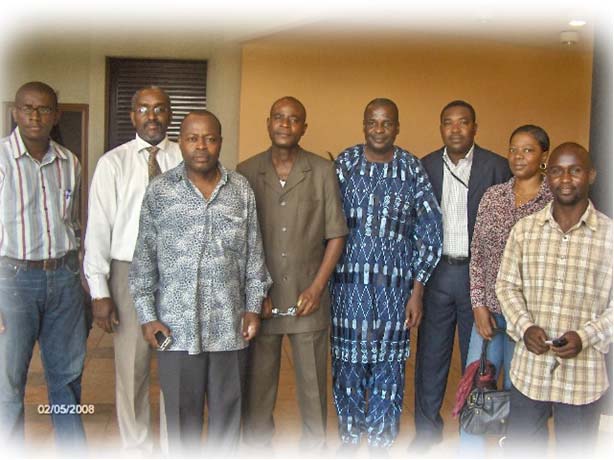
ANGOLAN DELEGATION TO LIBREVILLE, GABON,
26 APRIL - 2 MAY, 2008
Between 26 April and 2 May, 2008, a team from the GCLME
Regional Activity Center for Fisheries Resources in Angola
undertook a field mission to Congo, Democratic Republic of Congo
(DRC) and Gabon. The mission was a follow-up of the Sub regional
Workshop on the management of shared stock of Sardinella Angola,
Congo, Democratic Republic of Congo (DRC) and Gabon held in
Luanda, Angola from 5 to 7 September 2007.
After deliberations at the Workshop, the participants resolved that
gaps still exist in the knowledge of important aspects of basic ecology
of the main sardinela species in the four countries. Hence, the
need to study the Sardinella species in the countries since the small
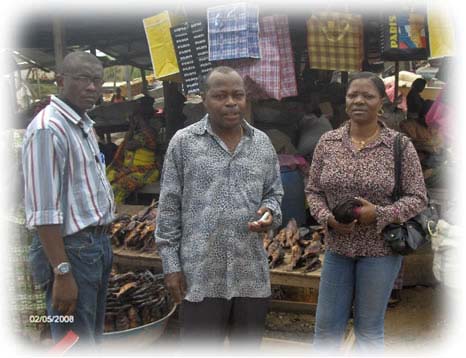
Visit to the Nomba Bridge which is the onloading
pelagic fisheries provide nearly half of the animal protein to the
site for fish sellers in Gabon.
people of the four countries and is an important source of
employment,often the only source of livelihood for the poorer population groups.
The objective of the mission was to setup a structure comprising of:
- a scientific working group which will be responsible for
carrying, accessing and coordinating research as well as making
recommendations for management.
- a coordinating committee which will be charged with
management and policy making for co-operative management
of the sardinella resources, and;
- a designated national focal point.
Results derived from the mission are expected to help in addressing
the need to prevent possible future over-exploitation and the shift of
Angolan delegation with officials of the Fisheries
Department, Gabon.
the sardinella stocks by promoting and facilitating effective
co-operation in research and management of fisheries for the
conservation and the optimal exploitation of the sardinella stocks
common to the four (4) countries, and finally to define and
develop measures for the conservation and the sustainable
management of this resource.
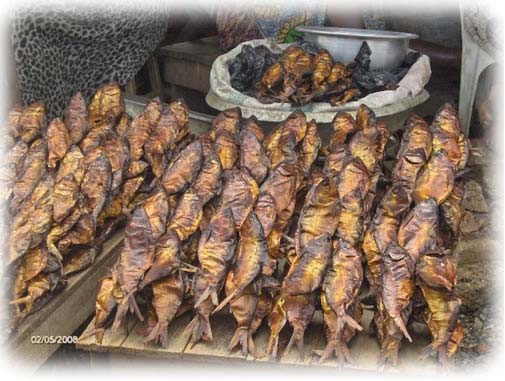
Dried fish unloaded at the Nomba Bridge.
1, Akosombo Road, Airport Residential Area, Accra
Tel : 021 781 225 / Fax : 021 781 226
E-mail : gclme@gclme.org - PMB CT 324 Accra, Ghanao r g
I G C C N e w s l e t t e r Page 2
May, 2008
35th Session of the Joint Group of Experts on the Scientific Aspects of Marine
Environmental Protection (GESAMP) GCLME-RCU, Accra, Ghana, 13-16 May, 2008
The 35th Session of Group of Experts on the Scientific
Aspects of Marine Environmental Protection (GESAMP)
was held at the Ken Sherman Conference Hall of the
Interim Guinea Current Commission (IGCC) in Accra,
Ghana from 13-16 May, 2008.
The mission of GESAMP is to provide authoritative,
independent, interdisciplinary scientific advice to
organizations and member Governments to support the
protection and sustainable use of the marine
environment.
At the Opening Ceremony of the Meeting which was
chaired by Michael Huber of Global Coastal Strategies,
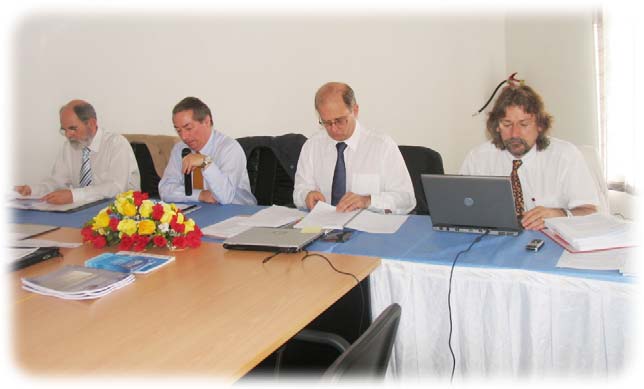
The High Table at the Opening Ceremony : (L-R) Dr. Miguel Palomares Australia, members were informed of their specific tasks
(IMO), Dr. Pablo Huidobro (UNIDO), Dr. Michael Huber (Global in planning of GESAMP activities
Coastal Strategies, Australia) and Dr. Tim Bowmer (TNO Chemistry,
The Netherlands).
Some of the planned activities are:
- Evaluation of the hazards of harmful substances carried by
ships (WG 1: IMO leading);
- Review of applications for 'active substances' to be used in
ballast water management systems (WG34: IMO leading);
- Development of activities in relation to deepwater
fisheries, fisheries habitat and related ecosystem concerns
(WG35: FAO leading);
- Development of an ecosystem approach to mariculture
(WG36: FAO leading);
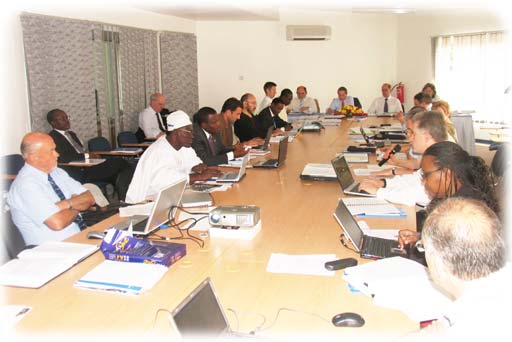
An overview of the Conference Hall during the Opening
Session.
- Expanded scientific review of mercury and its compounds
and threats to the marine environment (WG37: UNIDO
- Establishment of trends in global pollution in coastal
leading);
environments (IAEA leading)
- Atmospheric input of pollutants to the oceans (WG38:
WMO leading).
Dr. Pablo Huidobro (Project Manager) and Dr. Andrew
Hudson (UNDP-GEF; - 3rd-4th from left) with the
GCLME-RCU staff.
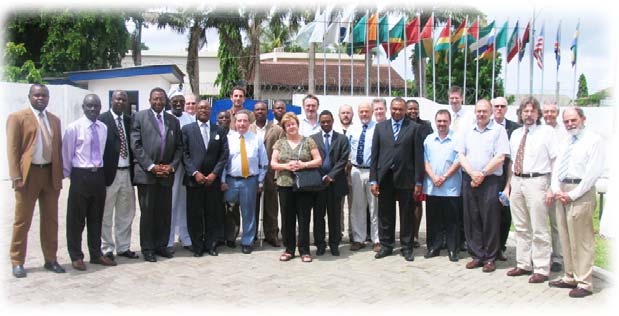
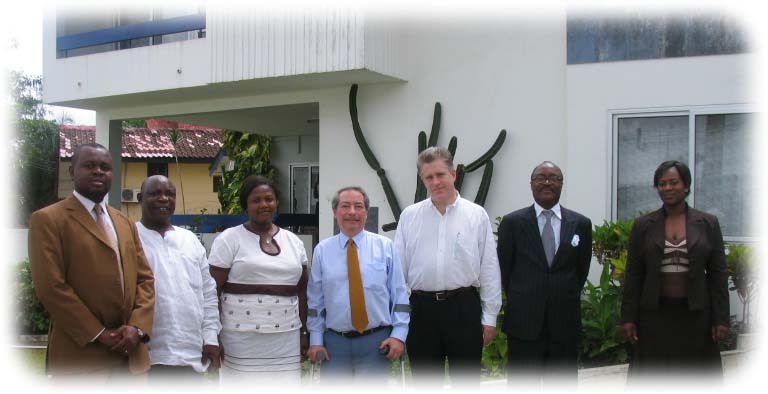
Group photograph of participants to the session.
C o p y r i g h t , I G C C , 2 0 0 8
I G C C N e w s l e t t e r Page 3
MAy, 2008
Improving Waste Water management in Coastal Cities, GCLME-RCU, Accra, Ghana,
26-31 May, 2008
The IGCC hosted a training of trainers in Accra organized by
the Environmental Protection Agency (EPA), Ghana under
the theme "Improving Municipal Wastewater Management in
Coastal Cities". The Training Workshop was organized in
collaboration with UNEP, UNDOALOS and UNESCO.
Similar Workshops are scheduled to be organized in Sekondi,
Takoradi and Kumasi, Ghana.
Discharge of untreated waste water into rivers, lagoons and
estuaries or directly into the ocean has been identified as one
of the most serious threats to the health of coastal populations
and sustainable coastal development worldwide.
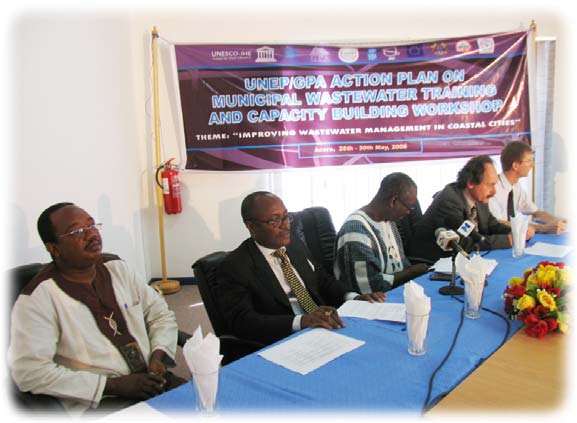
At the High Table (L-R): Mr. Amlalo, Director, EPA, Dr. Jacques
Abe, Officer-in-Charge, GCLME-RCU, Mr. Jonathan Allotey,
Executive Director, EPA, Dr. Erik de Ruyter Van Steveninck
and Diederik Rousseau of UNESCO-IHE, Netherlands.
The Opening Ceremony of the Workshop was chaired by Mr.
Jonathan Allotey, Executive Director, EPA who said that the
resources within the coastal area of Ghana were found within a
very fragile ecosystem. He said that degradation of the natural
resource has also increased and so has the incidence of coastal
erosion.
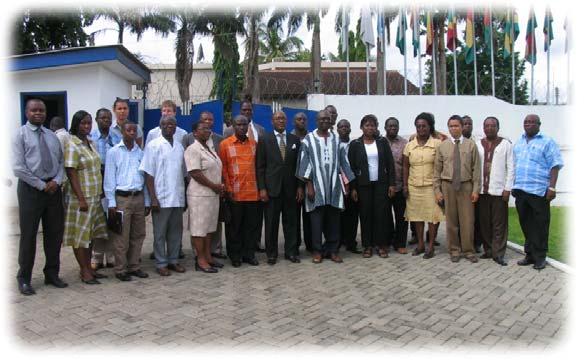
Group photograph of participants.
Mr. Allotey said it was in response to the threats to coastal and marine environment by land-based activities that in 2001,
governments of coastal nations, including Ghana, committed themselves to the implementation of the Global Programme of
Action as a way of ensuring improved governance of the marine and coastal environments.
As part of the interventions, therefore, he said Ghana started implementing policies on institutional capacity building,
education and awareness programmes, regulatory and socio-economic incentives.
Dr. Jacques Abe, Officer-In-Charge of GCLME-RCU stated a recent research conducted by GCLME industrial waste
management expert to assess the status of Industrial Waste Management and Identify Industrial Hotspots in the Region,
showed that municipal effluents are regularly discharged into
lagoons which finally end up in the sea. This has reduced the
lagoons to an anoxic state, unable to support any aerobic form
of life.
According to Dr. Abe, "time has come for us to reflect on how
we can work together to create a conducive environment for
regional cooperation and collaborative capacity building to
combat the depletion of living resources and also eliminate
threats to fish food security on which majority of our people
depend for economic benefits".
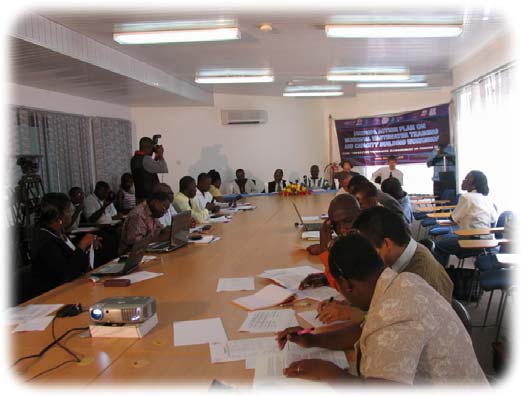
Technical session of the Workshop.
C o p y r i g h t , I G C C , 2 0 0 8
I G C C N e w s l e t t e r Page 4
May, 2008
'PROGRAMME REGIONAL D'OCEANOGRAPHIE PHYSIQUE EN AFRIQUE DE
L'OUEST' (PROPAO), 29 May, 2008
29 May, 2008 marked the Inauguration of the Physical Oceanography Project for West Africa (PROPAO) in Ghana. PROPAO
Ghana is the last to be installed among the six African countries involved in the project namely, Benin, Cote d'Ivoire, France,
Ghana, Nigeria and Togo.
The project is expected to improve the comprehension of the African Monsoon dynamics and of the impact of its variability
over associated rainfall, water resources, agriculture, food security, health and socio-economic development.
The PROPAO mainly addresses the following:
- Analysis and monitoring of the oceanic conditions in
the Gulf of Guinea, and principally along its northern
coasts (from Nigeria to Côte d'Ivoire);
- Influence of the surface oceanic conditions on the
variability of the monsoon flux;
- Impact of the oceanic and climatic conditions on
resources and coastal erosion;
- Establish a regional data bank of coastal oceanographic
measurements;
- Reinforce local capacities (link with universities).
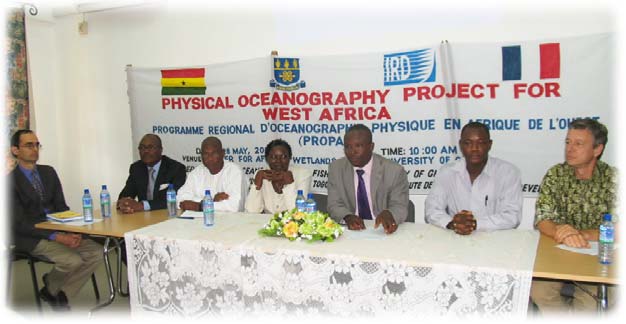
At the High Table (L-R) are: Rep. from French Embassy, Dr. J. Abe - OIC,
GCLME RCU, Mr. R. Djiman - RD, PROPAO, Ms. Valerie Lesbros from French
The programme as well, has links with other regional and Embassy, Vice Dean, Faculty of Science, Dr. G. Wiafe - H.O.D, Oceanography/
international programs like: PIRATA, AMMA, CLIV Fisheries and Mr. Bernard Bourles (IRD, France)
ARITACE, GOOSAFRICA, OOINAFRICA and GCLME.
The Inauguration Ceremony of the PROPAO was honored by the Dean of Faculty of Arts and Science of the University of
Ghana represented by his Vice as the Chairman of the occasion.
The Regional Director of PROPAO, Mr. Djiman Roger from Benin presented the Project to the participants. The programme
is expected to contribute in achieving one of the objectives of the AMMA/EGEE program, concerning the monitoring and
description of the coastal upwelling along the northern coasts of the Gulf of Guinea, and of its impacts on regional climate and
resources.
The PROPAO is being funded for three years (2007-2010) in the
framework of the "Fonds de Solidarite Prioritaire- Recherche
Interdisciplinaire et Participative entre les Ecosysteme, Ie Climat et
les Societes d'Afrique de l'Ouest" (FSP/RIPIECSA) of the French
Ministry of Foreign Affairs and coordinated to international level by the
"Agence Inter- Etablissements de Recherche pour Ie Developpement"
(AIRD).
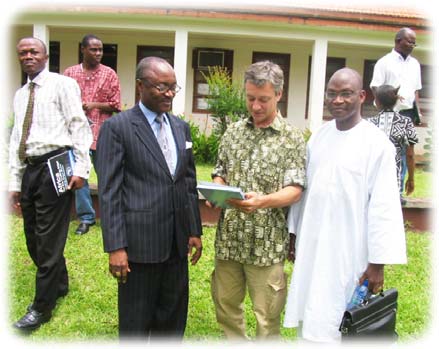
Dr. Abe presenting the TDA document to Dr. Bourles in
the presence of Mr. Djiman Roger.
The Officer In Charge of the GCLME Regional
Cordination Unit , Dr. Jacques Abe presented the GCLME
project and made available to participants GCLME folder
with DVD Rom containing global information on the
GCLME project. He also offered the TDA document to
the Department of Oceanography and Fisheries,
Univeristy of Ghana, Legon.
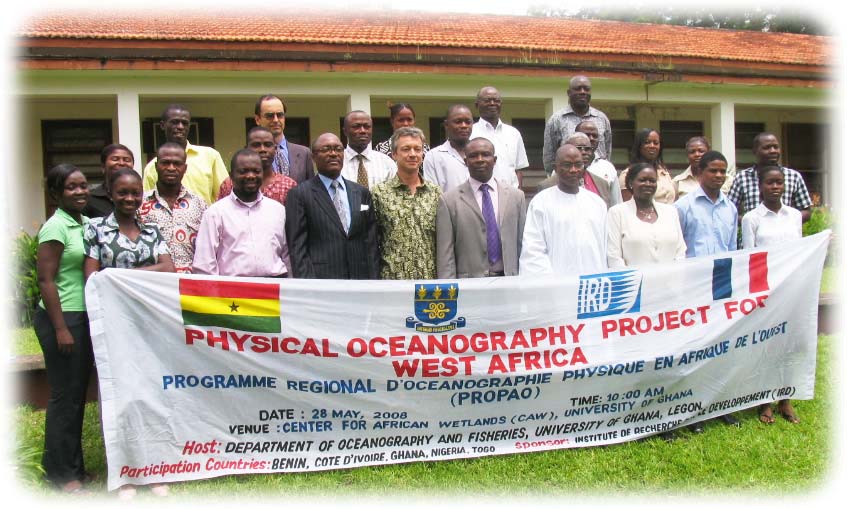
Group photograph of participants.
Edited by : K e l e c h i I h e m e j e Layout by : J o s h u a O k e c h u k u N d u b u i s i