GEF PROJECT BRIEF
1. Identifiers
Project Number
Implementing Agency Project Number not yet assigned
Combating living resource depletion and coastal area degradation
Project Title
in the Guinea Current LME through ecosystem-based regional
actions: Phase 1
Duration
Three years, beginning June 2004; phase 2 to be requested in
GEF-4
United Nations Development Programme (UNDP) /
Implementing Agencies
United Nations Environment Programme (UNEP)
Executing Agency
United Nations Industrial Development Organization (UNIDO)
Regional: Angola, Benin, Cameroon, Congo, Democratic
Republic of the Congo, Côte d'Ivoire, Gabon, Ghana, Equatorial
Requesting Countries
Guinea, Guinea, Guinea-Bissau, Liberia, Nigeria, Sao Tome and
Principe, Sierra Leone and Togo
The countries are eligible under paragraph 9(b) of the GEF
Instrument. The Strategic Action Programme is consistent with
Eligibility
the relevant provisions of regional and global Conventions
relating to International Waters to which the countries are
signatories and/or contracting parties.
GEF Focal Areas
International Waters with relevance to Biological Diversity
GEF Programming Framework OP #9: Integrated Land and Water Component
2. Summary:
This project proposal "Combating Living Resources Depletion and Coastal Area Degradation in the
Guinea Current LME through Ecosystem-based Regional Actions: Phase 1" has a primary focus on
the priority problems and issues identified by the 16 GCLME countries that have led to unsustainable
fisheries and use of other marine resources, as well as the degradation of marine and coastal
ecosystems by human activities. The long-term development goals of the project are: 1) recover and
sustain depleted fisheries; 2) restore degraded habitats; and 3) reduce land and ship-based pollution by
establishing a regional management framework for sustainable use of living and non-living resources
in the GCLME. Priority action areas include reversing coastal area degradation and living resources
depletion, relying heavily on regional capacity building. The project focuses on nine demonstration
projects, designed to be replicable and intended to demonstrate how concrete actions can lead to
dramatic improvements. Sustainability will derive from this improved capacity, strengthening of
national and regional institutions, improvements in policy/legislative frameworks, and the
demonstration of technologies and approaches that will lead to improved ecosystem status. The
priority problems of resource depletion, loss of biodiversity (including habitat loss and coastal
erosion), and land- and sea-based pollution are all addressed through the interventions proposed here.
The project has five main components with associated objectives identified by the root cause analysis
carried out during the project preparation process: i) Finalize SAP and develop sustainable financing
mechanism for its implementation; ii) Recovery and sustainability of depleted fisheries and living
marine resources including mariculture; iii) Planning for biodiversity conservation, restoration of
degraded habitats and developing strategies for reducing coastal erosion; iv) Reduce land and sea-
based pollution and improve water quality; and v) Regional coordination and institutional
sustainability. The activities to be undertaken will complement other projects in the region to provide
a strong foundation for the long-term sustainable environmental management of the GCLME. A
Transboundary Diagnostic Analysis (TDA) and preliminary Strategic Action Programme (SAP) have
been prepared, serving as the basis for preparation of this project proposal. The full Global
Environment Facility (GEF) project will update the TDA as part of a continuing process, and will
endorse a regionally agreed SAP, following clarification of some aspects of the environmental status
of the region, and initiate SAP implementation.
3. Costs and Financing (Million US $)
US$
GEF:
Project (Phase 1: GEF 3)
:
$12.133
PDF B
:
$ 0.637
Subtotal GEF
:
$12.770
Co-Financing *:
Governments (cash and in-kind)
$29.861
US
NOAA
:
$0.6
UNDP (in cash and kind)
:
$0.1
UNEP (in cash and kind)
:
$0.13
Norway
:
$2.085
**Private
Sector :
$0.6
Subtotal Co-financing
$33.871
:
Total Project Cost
$46.146
* Co-finance data represents total commitments over planned overall 5 year project time frame,
Phases 1 (3 yrs, GEF-3) and 2 (2 years, GEF-4).
4. Associated Financing (Million US $):
Government baseline *
:
$799.986
TOTAL : $846.l32
* Baseline data represents total commitments over planned overall 5 year project time frame, Phases 1
(3 yrs, GEF-3) and 2 (2 years, GEF-4).
** Discussions still ongoing with Oil Companies in Nigeria and other Private Sector Organizations for
co-funding of the Nigeria and Ghana demonstration projects. UNIDO-ICS will inform of its financial
contributions.
5. Operational Focal Point Endorsement(s):
Angola: Mrs. Armindo M. Gomes da Silva
29 September 2003
GEF Focal Point, Ministry of Energy and Water, Luanda
Benin: Mr. Pascal ZOUNVEOU YAHA, GEF OFP
12 August 2003
Ministere de l'Environnement, de l'Habitat et de l'Urbanisme,
Cotonou
Cameroon: Ms. Justin NANTCHOU NGOKO
12 September 2003
Ministry of Environment and Forestry, Yaounde
Congo: Mr. Joachim OKOURANGOULOU, Directeur Général de
4 August 2003
l'Environnement, Ministère de l'Economie Forestière et de
l'Environnement, Brazzaville
Congo Dem. Rep.: Mr. Vincent KASULU SEYA MAKONGA
15 August 2003
Directeur de Developpement Durable, Ministère des Affaires
Foncières, Environnement et Tourisme, Kinshasa/Gombe
Cote d'Ivoire: Mrs. Alimata KONE, Directress Adjoint
10 September 2003
Caisse Autonome d'Amortissement, Abidjan
Gabon: Mr. Chris MOMBO NZATSI, Directeur Général de
8 August 2003
l'Environnement, Ministère de l'Economie forestière, des
eaux, de la pêche, chargé de l'environnement et de la
ii
protection de la nature, Libreville
Ghana: Mr. Edward OSEI NSEKYIRE, Chief Director
31 July 2003
Ministry of Environment, Science and Technology, Accra
Guinea Bissau: Mme. Matilde da Conceicao Gomes Lopes
11 September 2003
Directrice Général de l'Environnement, Ministère des
Resources Naturelles et de l'Environnement
Guinea: Mme. Kadiatou N'DIAYE, GEF Focal Point
6 August 2003
Manager, National Environment Directorate, Conakry
Guinea Equatorial: HE Don Fortunato OFA MBA
09 April 2003
Ministro, Ministro de Pesca y Medio Ambiente, Malabo
Liberia: Mr. Fodee KROMAH, Executive Director
30 July 2003
GEF Focal Point, National Environmental Commission of
Liberia, Monrovia
Nigeria: Mr. Ayodele Adekunle OLOJEDE, GEF Focal Point
8 August 2003
Federal Ministry of Environment, Abuja
Sao Tome & Principe: Mr. Lourenco MONTEIRO DE JESUS
13 August 2003
GEF Focal Point, INDES, Sao Tome
Sierra Leone: Mr. Stephen Syril James JUSU, Director
12 August 2003
GEF Focal Point, Environment Protection Department
Ministry of Lands, Country Planning and the Environment,
Freetown
Togo: Mr. Yao Djiwomu FOLLY, Ing. Des Travaux des Eaux et
7 August 2003
Forets, Directeur de la Protection et du Controle de
l'Exploitation de la Flore, Ministère de l'Environnement et
des Ressources, Lome
6. IA Contact:
(a) Mr. Frank Pinto, Executive Coordinator UNDP/GEF
(b) Mr. Ahmed Djoghlaf, Director & Assistant Executive Director, UNEP/GEF Co-ordination
Office, UNEP, Nairobi, Tel: 254-20-624166; Fax: 254-20-624041; Email:
Ahmed.Djoghlaf@unep.org
iii
ACRONYMS
ACOPS
Advisory Committee for the Protection of the Seas
AfDB
African
Development
Bank
APR
Annual
Programme/Project
Report
BCLME Benguela
Current Large Marine Ecosystem
CBD
Convention
on
Biological
Diversity
CBO
Community
Based
Organization
CCLME
Canary Current Large Marine Ecosystem
CECAF
Fishery Committee for the Eastern Central Atlantic
CEDA
Centre for Environment and Development in Africa
COMARAF
Training
and
Research
for
the Integrated Development of African
Coastal
Systems
CPUE
Catch
per
Unit
Effort
CTA
Chief
Technical
Advisor
DIM
Data
and
Information
Management
EIA
Environmental
Impact
Assessment
EQO
Environmental
Quality
Objective
ESI
Environmental
Status
Indicator
FAO
Food and Agriculture Organization of the United Nations
FEDEN
Foundation for Environmental Development and Education in
Nigeria
GCC
Guinea
Current
Commission
GCLME
Guinea Current Large Marine Ecosystem
GEF
Global
Environment
Facility
GIS
Geographic
Information
System
GIWA
Global
International
Waters
Assessment
GOG-LME
Gulf of Guinea Large Marine Ecosystem
HAB
Harmful
Algal
Bloom
IA
Implementing
Agency
ICAM
Integrated
Coastal
Areas
Management
ICARM Integrated
Coastal
Area and River Basin Management
ICS-UNIDO
International Centre for Science and High Technology - UNIDO
ICZM
Integrated
Coastal
Zone
Management
IGCC
Interim
Guinea
Current
Commission
IMC
Inter-Ministerial
Committee
IMO
International
Maritime
Organization
IOC-UNESCO
Intergovernmental Oceanographic Commission of UNESCO
IUCN
The
World
Conservation
Union
IW:LEARN
International Waters (IW) Learning, Exchange and Resource
Network Program
LBA Land-Based
Activities
LME Large
Marine
Ecosystem
LOICZ
Land-Oceans Interactions in the Coastal Zone
M&E Monitoring
and
Evaluation
MOU Memorandum
of
Understanding
MPPI
Major Perceived Problems and Issues
NAP
National
Action
Plan
NEAP
National
Environmental
Action
Plan
NEPAD
The New Partnership for Africa's Development
NFP
National
Focal
Point
NGO
Non-governmental
Organization
NPA/LBA National
Programme
of Action/Land-Based Activities
NOAA
National
Oceanic
and
Atmospheric
Administration
iv
OP
Operational
Program
PCU
Project
Coordination
Unit
PDF
Project
Development
Facility
PI
Process
Indicator
PIR
Project
Implementation
Review
PPER
Project
Performance
and
Evaluation
Review
PSC
Project
Steering
Committee
RCU
Regional
Coordination
Unit
RPA/LBA
Regional Programme of Action/Land-Based Activities
SAP
Strategic
Action
Programme
TDA
Transboundary
Diagnostic
Analysis
UNDESA
United Nations Department of Economic and Social Affairs
TPR
Tri-Partite
Review
UNDP
United Nations Development Programme
UNEP
United Nations Environment Programme
UNESCO
United Nations Educational, Scientific and Cultural Organization
UNIDO
United Nations Industrial Development Organization
USAID
United States Agency for International Development
WACAF
West and Central African Action Plan
WHO
World
Health
Organization
WSSD
World
Summit
on
Sustainable
Development
v
TABLE OF CONTENTS
BACKGROUND AND CONTEXT BASELINE COURSE OF ACTION.......................2
INTRODUCTION........................................................................................................................2
GEF PROGRAMMING CONTEXT .....................................................................................8
REGIONAL PROGRAMMING CONTEXT ......................................................................12
NATIONAL PROGRAMMING CONTEXT ......................................................................15
SYSTEM BOUNDARIES ...................................................................................................16
MAJOR PERCEIVED PROBLEMS AND ISSUES ...........................................................16
RATIONALE AND OBJECTIVES (ALTERNATIVE COURSE OF ACTION) ...........20
PROJECT OUTCOMES/COMPONENTS ........................................................................22
END OF PROJECT SITUATION (EXPECTED RESULTS) ...........................................30
TARGET BENEFICIARIES ................................................................................................37
RISKS AND SUSTAINABILITY .........................................................................................38
GEF ELIGIBILITY ...............................................................................................................40
STAKEHOLDER PARTICIPATION..................................................................................40
PROJECT IMPLEMENTATION, INSTITUTIONAL FRAMEWORK AND
NATIONAL AND REGIONAL INSTITUTIONS ..............................................................41
INCREMENTAL COSTS AND PROJECT FINANCING................................................42
MONITORING AND EVALUATION.................................................................................43
LESSONS LEARNED AND TECHNICAL REVIEWS.....................................................46
LIST OF ANNEXES ..............................................................................................................47
ANNEX A INCREMENTAL COST ANALYSIS
48
ANNEX B
LOGFRAME MATRIX
81
ANNEX C
STAP ROSTER TECHNICAL REVIEW
102
vi
LIST OF FIGURES
Figure 1. Location map for the GCLME, indicating major currents .............................................2
Figure 2. Satellite productivity map of GCLME/ Benguela LME region..................................................... 3
Figure 3. Location map for the GCLME....................................................................................................... 3
Figure 4. Map of distribution of mangroves in the Niger Delta.................................................................... 4
Figure 5. MPPI to SAP Linkage ................................................................................................................. 21
Figure 6. SAP to Project Brief Linkage ...................................................................................................... 23
LIST OF TABLES
Table 1: Ongoing or planned GEF regional projects related to the GCLME ............................................ 10
Table 2. MPPIs and Their Impacts in the GCLME.................................................................................. 188
Table 3: Components and Phases of the Project ......................................................................................... 31
Table 4. Workplan and Timetable............................................................................................................... 34
Table 5: Summary of Project Financing (US$ million) ............................................................................. 42
Table 6: Summary of Baseline and Incremental Costs and Domestic Environmental Benefits .............. 433
Table 7. M&E Activities, Timeframes and Responsibilities ...................................................................... 45
1
BACKGROUND AND CONTEXT BASELINE COURSE OF ACTION
INTRODUCTION
1.
The shared transboundary waters off the coast of western Africa are defined by the Guinea
Current Large Marine Ecosystem (GCLME) that extends from Bissagos Island (Guinea Bissau) in the
north to Cape Lopez (Gabon) in the south. The oceanography of the waters of the Democratic Republic of
Congo, Republic of Congo and Angola is influenced to a considerable extent by the Guinea Current thus
giving ample justification for including the three countries in the Guinea Current Large Marine
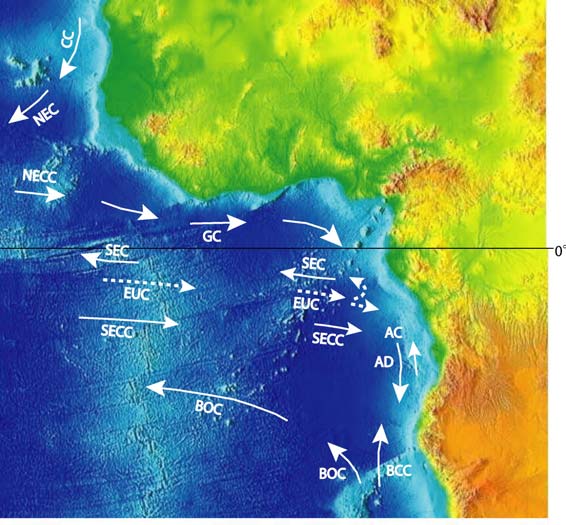
Ecosystem (GCLME). Figure 1 shows the area of the Project, along with the major oceanographic
features. The south equatorial current (SEC) forms a logical boundary between the Benguela Current
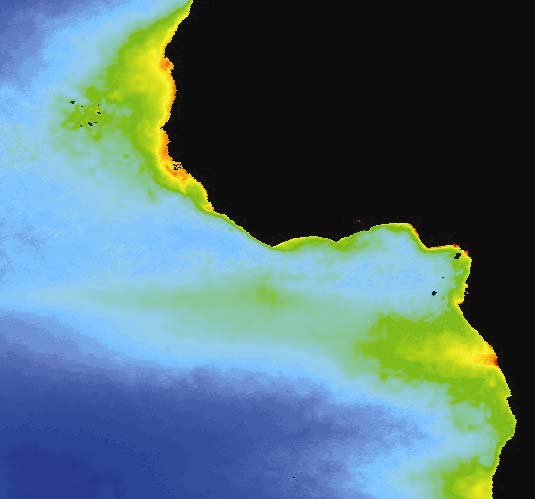
LME to the South and the GCLME to the north. A similar diagram based on averaged satellite-derived
ocean productivity estimates similarly demonstrates the SEC as the logical boundary between the two
LMEs.
Figure 1 : Location map for the GCLME, indicating major currents
2.
Therefore, the GCLME stretches from the coast of Guinea Bissau to Angola, covering sixteen
countries (Angola, Benin, Cameroon, Congo, Democratic Republic of the Congo, Côte d'Ivoire, Gabon,
Ghana, Equatorial Guinea, Guinea, Guinea-Bissau, Liberia, Nigeria, Sao Tome and Principe, Sierra
Leone and Togo: see Figure 3). It embodies some of the major coastal upwelling sub-ecosystems of the
world and is an important center of marine biodiversity and marine food production. Characterized by
distinctive bathymetry, hydrography, chemistry, and trophodynamics, the Guinea Current System
represents a Large Marine Ecosystem (LME) ranked among the most productive coastal and offshore
waters in the world with rich fishery resources, oil and gas reserves, precious minerals, a high potential
for tourism and serves as an important reservoir of marine biological diversity of global significance. The
Guinea Current therefore represents a distinct economic and food fish security source with the continuum
of coastal and offshore waters together with the associated near shore watersheds. Over-exploitation of
fisheries, pollution from domestic and industry sources, and poorly planned and managed coastal
developments and near-shore activities are, however, resulting in a rapid degradation of vulnerable
2
coastal and offshore habitats and shared living marine resources of the GCLME putting the economies
and health of the populace at risk (see Transboundary Diagnostic Analysis, Annex E).
Figure 2: Satellite productivity map of GCLME/ Benguela LME region
Figure 3: Location map for the GCLME
3
3.
The GCLME is rich in biodiversity. The fisheries resources of the ecosystem includes a diverse
assemblage of fishes including small pelagics, (sardinellas shad), large pelagics (tuna and billfish),
crustaceans and molluscs (shrimp, lobster, cuttlefish, and demersal species (sparids and croakers). The
presence of invertebrates such as intertidal molluscs (Anadara sp. Crassostrea g.,etc.), reptiles (turtles,
crocodiles), marine mammals such as the West African manatee (Trichechus senegalensis), and some
shark species demonstrate the variety of the species in the GCLME (World Bank Report, 1994). The
remarkable collection of migratory birds, millions of which seasonally visit the West African coast and
mainland regions, illustrates the importance of preserving and maintaining the existing wetlands in this
part of Africa (UNEP Regional Seas Reports and Studies No. 171). Large concentrations of seabirds are
found seasonally in and around Guinea Bissau: these include Larus genei, Geochelidon nilotica, Sterna
maxima lbididorsalis, etc. The Gulf of Guinea islands, near Principe and Sao Tome also have sizeable
sites with colonies of terns, noddies and boobies. It is because of this species diversity and fauna richness
that conservation and preservation policy has been or is being undertaken by some GCLME countries
through the creation and implementation of marine and coastal protected areas.
4.
The coastal area also includes important terrestrial flora. Mangroves, typically Rhizophora sp,
Conocarpus sp, Avicennia sp, Mitragyna inermis, Laguncularia sp, occur almost everywhere along the
coasts in the GCLME and are dominant in certain places, such as the Niger Delta of Nigeria which has
Africa's largest and the world's third largest mangrove forests (Figure 4). Mangrove forests provide the
nutritional inputs to adjacent shallow channel and bay systems that constitute the primary habitat of a
large number of aquatic species of commercial importance. The importance of mangrove areas as
spawning and breeding grounds for many transboundary fish species and shrimps is well known.
Presently the mangrove forests are under pressure from over-cutting (for fuel wood and construction
timber) and from other anthropogenic impacts (e.g. pollution), thereby jeopardising their roles in the
regeneration of living resources and as reservoirs of biological diversity (see TDA).
Figure 4: Map of distribution of mangroves in the Niger Delta
5.
The densely populated coastal region is heavily dependent upon the biological resources of the
GCLME. Approximately 40% of the region's 300 million people (more than 1/2 of the population of the
African continent) live in the coastal areas of the GCLME, many of whom are dependent on the lagoons,
4
estuaries, creeks and inshore waters surrounding them for their food security and well being. Rivers,
lagoons, and inshore and offshore waters of the GCLME serve as important sources of animal protein in
the form of fish and shellfish, as well as provide significant income through the coastal fisheries. The
Food and Agriculture Organization of the United Nations (FAO) estimates the total potential fisheries
yield of the entire region to be in the neighborhood of 7.8 million tons per year. The rich fishery
resources are of both local and transboundary importance with stocks supporting artisanal fisheries and
offshore industrial fisheries from many nations. Most of these straddling and migratory stocks have
attracted large commercial fishing fleets from around the world, especially from the former Soviet Union,
European Union, Eastern Europe, Republic of Korea, and Japan. This wealth of estuaries, deltas, coastal
lagoons and the nutrient-rich upwelling cold waters make a major contribution to the diversity of fish life
in the GCLME region with an estimated 239 fish species, including Sardinella aurita and maderensis,
Thunnus albacares, etc. as pelagic species; Arius sp., Pseudotolothus typus and senegalensis, Dentex sp.,
Octopus vulgaris, Cynoglossus sp., and others as demersal species. Pelagic tuna fishing also constitutes
an important industry in the GCLME region.
6.
These marine and coastal areas, including their upstream freshwater regions, are at present
affected by a number of anthropogenic activities: over-exploitation of fishery resources, impacts from the
land-based settlements and activities from industrial, agricultural, urban and domestic sewage run-off and
other mining activities such as oil and gas (in particular, off the coasts of Angola, Cameroon, Gabon and
Nigeria). The depletion of living resources, uncertainty in ecosystem status (including climate change
effects), deterioration of water quality, and loss of habitats (including coastal erosion) have been
identified as significant transboundary environmental problems in the GCLME region (see section on
major perceived problems and issues).
7.
The region's fish stocks are under threat from overfishing. Since the 1960s, the offshore
commercial fishing efforts have exerted extreme pressures on the resources, placing the fisheries at risk of
collapse. This is exacerbated by the presence of local industrial fleets, predominantly nationally owned or
part of joint ventures operating in each other's waters under bilateral agreements, as well as the existence
of a large artisanal sector with strong traditional roots and powerful social and political impacts. Pelagic
and demersal fisheries within the region are fully exploited with evidence showing that the landings of
many species are currently declining. The decline in fish availability in the subsistence sector has led to
the adoption of destructive fishing practices such as use of undersize meshes and blast fishing. Based on
present consumption patterns and population growth rates, most of the countries, especially the large
coastal cities of Lagos, Abidjan, Accra and Douala, will need significantly more fish by 2010 just to meet
domestic demand. Despite nutritional requirements and current population growth rates, the industrial
(commercial) fisheries sector in the countries surrounding the GCLME generally exports the trawl
fisheries products to generate foreign exchange, exacerbating the food security situation in the region.
Pressure on the coastal resources is therefore likely to increase significantly in the immediate future, but
Catch per Unit Effort (CPUE) is already exceeding sustainable yields in some countries (Ajayi, 1994, The
Status of Marine Fishery Resources of the Gulf of Guinea : In : Proc. 10th Session FAO, CECAF, Accra,
Ghana, 10-13 October 1994) while species diversity and average body total lengths of the most important
fish assemblages have declined. The GCLME project support from the GEF and other partners will assist
the region to meet the WSSD target for maintaining and restoring fish stocks to levels that can "on an
urgent basis and, where possible, no later than 2015" produce maximum sustained yields.
8.
Uncertainty in ecosystem status makes it impossible to manage the natural resources effectively.
Lack of national budget, inadequate regional capacity, and the general low socio-economic conditions in
much of the region are responsible for this uncertainty in ecosystem status. Ecosystem knowledge is not a
high priority in many of these countries; even if it were, capacity and institutions are lacking. The
possible effects of climate change are also unknown; lacking knowledge of climate change impacts,
effective management and establishment of sustainable development goals are clearly impossible.
5
9
Oil and other industrial activities have been identified as threats to the sensitive GCLME
environment. Some of the countries in the region are oil producers and a few (e.g., Angola, Cameroon,
Gabon and Nigeria) are net exporters. The increasing number of offshore platforms, pipelines, and
various export/import oil terminals means an inevitable exposure to oil pollution. According to the World
Bank (1995), oil producing companies in Nigeria Leone discharge an estimated 710 tons of oil yearly into
the coastal and marine environment. An additional 2100 tons originate annually from oil spills, on
average. The patterns of onshore-offshore winds and ocean currents mean that oil introduced from any of
the offshore or shore based petroleum activities translates easily into a regional problem. Most of the
countries also have important refineries on the coast, only a few of which have proper effluent treatment
plants, thereby adding to the threat of pollution from oil. Pipelines are at risk, given the unsettled coastal
populations in some of the countries, where frequent pipeline breaches have occurred.
10.
In addition to oil pollution, water quality in the coastal and marine areas is being degraded,
largely as a result of land-based activities such as agriculture. Agriculture is an important activity in all
the countries of the region. The use of chemical fertilisers and pesticides has markedly increased with the
development of commercial agriculture and the advent of large plantations and the need to improve food
production and protect human health against insect-borne diseases. Although organochlorine-based
pesticides are still used, awareness of their danger has spread so the majority of pesticides are now
organo-phosphorous and carbamate based. Run-off of these chemicals may reach surface or groundwater,
where they may persist for long periods. Inorganic, especially nitrate and phosphate-based, fertilisers are
being used on an increasing scale. Substantial quantities of nutrients originating from domestic and
agricultural effluents, which are used in primary production, are carried to the sea through river outflows.
It has been estimated that approximately 30% of fertilizers applied are actually utilised by the plants while
the remainder finds its way into the atmosphere or into surface waters. These nutrients, when coupled
with sewage pollution, are a serious threat increasing levels of eutrophication in near coastal waters and
especially to lagoons and causing harmful algal blooms. The lagoons, as sensitive and significant habitats
supporting biodiversity and inshore fisheries, are therefore being threatened by agricultural pollution.
These excess nutrients, other pollution and sediments are transported to the GCLME via the rivers in the
region, including the ten major rivers: Congo (Congo), Niger (Nigeria), Volta (Ghana), Wouri
(Cameroon), Comoe, and Bandama (Côte d'Ivoire).
11.
The physical destruction of coastal habitats, including critical wetlands, causes the loss of
spawning and breeding grounds for most living resources in coastal waters and the loss of the rich and
varied fauna and flora of the region including some rare and endangered species. Much of the destruction
is related to often-haphazard physical development, which exerts phenomenal pollution pressures on this
international body of water (WACAF Intersecretariat Co-ordination Meeting, Rome, 1993). Nearly all
major cities, agricultural plantations, harbours, airports, industries as well as other aspects of the socio-
economic infrastructure in the region are located at or near the coast. Results obtained during the Pilot
Phase GOG-LME Project showed that in Ghana, 55 percent of the mangroves and significant wetlands
around the greater Accra area have been decimated through pollution and overcutting. In Benin, the
figure is 45 percent in the Lake Nokoué area, in Nigeria, 33 percent in the Niger Delta, in Cameroon, 28
percent in the Wouri Estuary, and in Côte d'Ivoire, about 60 percent in the Bay of Cocody. Urbanization
and industrialization place increasing pressure on coastal habitats, both through direct physical pressure,
and indirectly through pollution and declining water quality.
12.
Alterations to river flow regimes from dam construction (for irrigation and power generation)
together with high wave action have led to severe coastal erosion problems, issues of which are expected
to be addressed in part in parallel GEF projects in the Volta and Niger River basins. These factors are
combining to cause displacements of structures, people and economies of coastal communities and urban
centres. Harbour construction activities have altered longshore current transport of sediments and in
6
many cases have led to major erosion and siltation problems. Erosion rates caused by port structures in
Liberia, Togo, Benin and Nigeria sometimes reach a staggering 15-25 m per year and threaten
infrastructure and services (Ibe and Quelennec, 1989). Actions to control erosion around these ports are
critically important to maintaining their vitality as sites for growing tourist, recreational, commercial, and
defence needs.
13.
Many of the water-related environmental threats identified in the region are transboundary in
nature. The GCLME Transboundary Diagnostic Analysis (Annex E), formulated by the countries, fully
lists the various transboundary environmental issues/problems, major root causes, transboundary impacts
and consequences and possible measures to contain the threats. Some of these threats are already cause
for concern. A few are already being addressed jointly between nations. Others are likely to grow in
importance with human population growth and increased urbanisation and industrialisation in the
stakeholder countries. These transboundary threats to ecosystem health are caused by human activities
and natural variations which are part of the ecosystems, and some threats could be mitigated through
efficient early warning systems.
14.
Many transboundary threats (e.g., untreated waste) are also of local (national) importance.
Actions in response to local pressures to reduce local impact will often serve also to reduce transboundary
impact. Other actions at national levels, if not integrated with actions of neighboring countries, may
merely displace the problem and even increase the overall transboundary impact. Other transboundary
threats are more widely distributed and may be of a cumulative nature.
15.
The sustainable use and management of the commonly shared resources of the GCLME poses a
great challenge to the bordering countries. Concerted actions by the sixteen participating nations are
absolutely essential to change present unsustainable use of these resources by introducing an ecosystem-
based assessment and management system for sustainable use and management of resources at risk. One
source of stress on the marine environment which is of growing international concern is the impact from
capture fisheries, hence the need to develop, promote, and implement ecologically sound assessment and
management practices in the marine fisheries sector so as to prevent loss of biodiversity and reduce
habitat degradation. Available data suggest that, in addition to the obvious catches of fish for human
needs, by catches have a significant ecological impact and cause mortality amongst finfish (particularly
the juveniles of commercial fish species), as well as amongst benthic invertebrates, marine mammals,
turtles and birds. These by-catches need to be controlled. Mariculture offers the possibility of providing
a food source that releases fishing pressure in the capture fisheries and provides livelihoods for rural
coastal areas when fishing effort is reduced. However ecologically unsound mariculture practices can
negatively impact wild resources. Development must proceed in a sound ecological manner to have
fishery and food security benefits.
16.
Recognizing the continuous negative changes in the health and productivity of the GCLME
shared waterbody resulting from human impact and appreciating that living marine resources and
pollutants in coastal and marine environments respect no political boundaries and few geographical ones,
the countries resolved to work together to address their common concerns through suitable management
options. Through various assessments carried out, the countries realized that the traditional sectoral
approach to management had failed in bringing about the needed changes in environmental and living
resource uses and resolved to adopt a holistic and multisectoral approach embodied in the large marine
ecosystem concept. In so doing, the countries, through the Committee of Ministers of the six-country
pilot phase Gulf of Guinea LME project with subsequent endorsement by the 10 new project countries,
sought the assistance of UNIDO, UNDP, UNEP and GEF in implementing an LME project to cover the
natural limits of the Guinea Current. The GEF made available two project preparation and development
facility grants (PDF-B) to enable countries to prepare the necessary analyses and reviews. In accordance
with the GEF Operational Strategy a Transboundary Diagnostic Analysis (TDA) and preliminary
7
Strategic Action Programme (SAP) were prepared through national and regional stakeholder
consultations.
17.
More specifically, the PDF project was responsible for:
· identifying overexploited fish stocks, biodiversity issues, degraded and threatened habitats, and
point and non-point pollution sources;
· undertaking a comprehensive review, synthesis, and analysis of existing data and information
concerning the sources and fate of transboundary pollution as a building block on which to design
appropriate actions;
· reviewing existing national and regional fisheries and environmental legislation relating to the
GCLME and its surrounding environment; and
· providing a framework to support an ecosystem-based approach for the assessment and
management of the GCLME fisheries and coastal zone based on scientific, institutional, legal, and
regulatory structure needed to achieve and sustain the marine resources of the GCLME.
GEF PROGRAMMING CONTEXT
18.
The programming context of this project is the GEF Operational Programme No. 9 "Integrated
Land and Water Multiple Focal Area". This OP lists as an expected outcome "the reduction of stress to
the international waters environment in selected parts of all five development regions across the globe
through participating countries making changes in their sectoral policies, making critical investments,
developing necessary programs and collaborating jointly in implementing ... water resources protection
measures (para 9.10)." The OP also states that "the goal is to help groups of countries utilise the full
range of technical, economic, financial, regulatory, and institutional measures needed to operationalize
the sustainable development strategies for international waters (para 9.2)."
19.
This project is thus in conformity with the GEF Operational Strategy and Operational
Programmes, in particular with the above-mentioned OP #9 - International Waters: Integrated Land and
Water Multiple Focal Area, where there is a focus on an integrated management approach to the
sustainable use of [land and] water resources on an area-wide basis. It will also have relevance to OP #2 -
Biodiversity in coastal and marine ecosystems, and specifically to aspects of eco-system management
including elements of: targeted research, information sharing, training, institutional-strengthening,
demonstrations, and outreach (or `extension').
20.
The GEF International Waters Operational Programme referred to above emphasizes the need to
introduce and practice ecosystem-based assessment and management action while supporting
"institutional building ... and specific capacity-strengthening measures so that policy, legal and
institutional changes can be enacted in sectors contributing to transboundary environmental degradation."
This project supports institutional capacity building for long-term regional cooperation as well as helping
to strengthen regional capacities in environmental management, monitoring of priority pollutants, public
awareness, and preservation of transboundary living resources.
21.
Under OP 9 several outputs from IW projects are envisaged. These include:
a.
a comprehensive transboundary environmental analysis identifying top priority multi-
country ecosystem-based resource and environmental concerns (already in hand);
b.
a strategic action programme consisting of expected baseline and additional actions
needed to implement an integrated approach to land and water resources assessment and
management (a draft is available; the SAP will be updated during the full project);
c.
documentation of stakeholder participation to determine expected baseline and additional
actions to be implemented as well as community involvement in the project; and
8
d.
implementation of measures related to integrated management of land and water
resources that have incremental costs and that can generate global environmental benefits
in several focal areas.
22
The project preparation process has addressed several of these issues (as indicated above). The
proposed project will satisfy all of the above points. Ministries of environment, ministries with control of
land and water resources, as well as new institutions created by the project will play a key role in the
implementation of project activities, thus enhancing capacity within the institutions as well as
complementing and strengthening existing national efforts to address environmental issues.
Implementation of the final SAP will assist in the systematic assessment and conservation of natural
resources and assist the countries in complying with their national and regional obligations under various
international conventions. At a global level, the project and its SAP will have molded disparate regional
and national activities into a coherent ecosystem-based assessment and management program for the
globally important resources of the GCLME.
23.
The present project also is consistent with the recent Draft GEF International Waters Focal Area-
Strategic Priorities in Support of WSSD Outcomes for FY 2003-2006. The document lists various
priorities, including:
Priority A. Catalyze financial resource mobilization for implementation of reforms and stress reduction
measures agreed through TDA-SAP or equivalent processes for particular transboundary systems
Priority B. Expand global coverage of foundational capacity building addressing the two key program
gaps and support for targeted learning.
Priority C. Undertake innovative demonstrations for reducing contaminants and addressing water
scarcity issues.
24.
The present project contributes significantly to the WSSD targets for 1) introducing ecosystem-
based assessment and management practices by 2010, and 2) recovering depleted fish stocks to maximum
sustainable yield levels by 2015. It will directly assist in addressing key International Waters gaps, with a
focus on ecosystem-based approaches to management of Large Marine Ecosystems (LMEs) that include
fisheries resources and habitat. The project will also assist in achieving the targets for these priorities for
addressing African Transboundary waters.
25.
This project also is consistent with the "Action plan to respond to the recommendations of the
Second GEF Assembly, the policy recommendations of the Third Replenishment, the Second Overall
Performance Study of the GEF and the World Summit on Sustainable Development" as discussed and
agreed at the May 2003 GEF Council Meeting. It is also consistent with the document "Strategic
Business Planning: Direction and Targets," also discussed and agreed at the May 2003 GEF Council
Meeting. The following internal specific targets are consistent with the GCLME project:
Under Strategic Priority IW-1:
(b) By 2006, GEF will have catalyzed a Strategic Partnership among African coastal nations,
implementing agencies, and global development partners aimed at reversing the depletion of fisheries
resources in the Large Marine Ecosystems (LMEs) of Sub-Saharan Africa as a contribution to WSSD POI
sustainable fisheries target.
Under Strategic Priority IW-2:
9
(a) By 2006, GEF will have increased by at least one-third the global coverage of representative
water bodies (an additional 9-10) with country-driven, science based joint management programs with
GEF assistance.
(c) By 2006, almost one-half of the 27 Large Marine Ecosystems (LMEs) located near developing
countries will have country-driven, ecosystem-based management programs developed with GEF
assistance that contribute to the WSSD POI "sustainable fisheries" target with a view to those programs
being under implementation by 2010.
26.
The GCLME project will both benefit and benefit from other GEF projects being undertaken in
the region and on the global level. Table 1 shows the ongoing GEF regional activities related in some
manner to the GCLME LME. Efforts will be made to ensure synergies among the projects and minimize
duplication of work, by setting aside funds in this project to achieve project integration for these GEF
activities. Examples of these projects include: A global GEF project on "reduction of environmental
impact from tropical shrimp trawling through the introduction of by-catch reduction technologies and
change of management" executed by FAO and implemented by UNEP is already assisting two countries
(Cameroon and Nigeria) in the GCLME region in minimizing the impacts on fisheries of use of wrong
mesh-sizes. The GCLME project would establish linkages with this GEF project in order that some of the
best practices and innovative techniques learned could be replicated in the other GCLME countries. For
coastal erosion, living resource management, conservation of biodiversity in coastal ecosystems and
community management close linkages and coordination with the Volta River GEF project as well as the
World Bank/GEF Coastal Biodiversity Management programme in Guinea Bissau and the World
Bank/GEF Coastal Zone Integrated Management Programme in Benin Republic will help assure
consistency in approaches, cohesiveness of GEF support and optimal use of GEF resources and avoid
duplication efforts in these countries. Strong linkages and coordination will also be achieved with other
upcoming GEF projects, through constant dialogue and communication, notably the World Bank/GEF
Strategic Partnership to promote the sustainable governance of fisheries in African countries and the
World Bank Guinea Coastal Zone Management programme. Under the World Bank "Strategic
Partnership" regional project, country-level investments in sustainable fisheries will be implemented in
concert with the GEF LME projects in Sub-Saharan countries. The initiative will work with the LME
projects (the GCLME for part of the West and Central Africa region) to support the coastal countries in
meeting the targets for sustainable fisheries set by the WSSD, including country-level monitoring,
surveillance and enforcement of national laws and regulations with regard to fisheries and other marine
and coastal resources. In essence, the "Strategic Partnership" would coordinate with and build upon the
GCLME project to facilitate collaboration between national players for country-level fisheries
investments and existing/planned sub-regional fisheries management bodies supported by GCLME
project.
Table 1: Ongoing or planned GEF IW, BD, POPs & MFA projects related to the GCLME
Project GEF
GEF
Countries Est'd. Est'd.
Total
Status
Focal
IA(s)
GEF
Co-
Financing
Area
Financing financing
Addressing
IW UNEP
Benin, $5.7 m.
$10.4 m.
$16.1 m.
Approved
Transboundary
Burkina Faso,
Concerns in the Volta
Côte d'Ivoire,
River Basin and its
Ghana, Mali
Downstream Coastal
and Togo
Area
Reduction of
IW UNEP
Cameroon, $4.8 m.
$4.4 m.
$9.2 m.
Approved
Environmental Impact
Nigeria (part
from Tropical Shrimp
of global)
10
Trawling through
Introduction of By-
catch Technologies and
Change of
Management
Reducing Reliance on
IW UNEP
Benin,
$3.4 m.
$4 m.
$7.4 m.
Pdf-b
Agricultural Pesticide
Guinea et al.
Use and Establishing a
Community Based
Pollution Prevention
System in the Senegal
and Niger River Basins
Development and
IW UNEP
Cote
d'Ivoire,
$0.75 m.
$0.97 m.
$1.72 m.
Approved
Protection of the
Ghana,
Coastal and Marine
Nigeria et al.
Environment in Sub-
Saharan Africa
Reversing Land and
IW UNDP/
Benin,
$13 m.
$16.7 m.
$29.7 m.
Approved
Water Degradation
WB
Cameroon,
Trends in the Niger
Cote d'Ivoire,
River Basin
Guinea,
Nigeria et al.
Reduction of
IW UNEP
Cote
d'Ivoire,
$6 m.
$7.5 m.
$13.5 m.
Pipeline
Environmental Impact
Ghana,
from Coastal Tourism
Nigeria
through Introduction of
Policy changes and
strengthening public-
private partnerships
Review of the Existing
IW UNEP
Guinea, TBD TBD TBD Pdf-a
Agreements on River
Nigeria,
Basins in West Africa
Benin,
and development of a
Cameroon,
regional water protocol
Cote d'Ivoire
Benin ICARM Coastal
BD
WB
Benin
$5 m.
$25 m
$30 m.
Pdf-b
Area Management
Control of Exotic
BD
UNDP
Cote d'Ivoire
$3 m.
$1.9 m.
$4.9 m.
Approved
Aquatic Weeds in
Rivers and Coastal
Lagoons to Enhance
and Restore
Biodiversity
Coastal Wetlands
BD
WB
Ghana
$7.2 m.
$1.1 m.
$8.3 m.
Approved
Management
Guinean Coastal Zone
BD
WB
Guinea
$5 m.
$25 m.
$30 m.
Pdf-b
Integrated Management
and Preservation of
Biodiversity
Coastal and
BD WB
Guinea-
$5.1 m.
$4.4 m.
$9.5 m.
Pdf-b
Biodiversity
Bissau
Management Program
Conservation of
BD UNEP
GCLME $0.75 m.
$0.75 m.
$1.5 m.
Pipeline
Marine Turtles and
countries
their Habitat in the
11
Atlantic Coast of
Africa
POPs Enabling
POPs UNEP
Benin,
$2 m.
----
$2 m.
Approved
Activity Preparation
Cameroon,
of National
Cote d'Ivoire,
Implementation Plan
Guinea
POPs Enabling
POPs UNIDO
Gabon,
$3.5 m.
----
$3.5 m.
Approved
Activity Preparation
Ghana,
of National
Guinea-
Implementation Plan
Bissau,
Liberia,
Nigeria,
Togo, Sao
Tome &
Principe
Enhancement and
MFA UNEP
Cameroon, TBD TBD TBD Pdf-a
Conservation of
Benin, Ghana
Ecosystem Functions
for River Basins and
Associated Coastal
Areas in Central Africa
Strategic Partnership IW WB
Countries
of
TBD TBD TBD PDF-b
for Sustainable
Sub-Saharan
Fisheries Management
Africa
in the LMEs of SSA
GRAND TOTALS
---- ----
----
$57.2 m.
$94.1 m.
$151.3 m. ----
REGIONAL PROGRAMMING CONTEXT
27.
The outstanding accomplishments of the Pilot-Phase GEF Gulf of Guinea Large Marine
Ecosystem (GOG LME) Project (1995 - 1999), as verified in Tri-Partite Review Reports and the Final In-
Depth Evaluation, are ample proof of the catalytic and defining roles that GEF incremental funding can
play. Some of the results achieved are included here. Annex K provides a more in-depth review of the
pilot phase.
· adoption of Ministerial level ACCRA DECLARATION(1998) aimed at institutionalising a new
ecosystem-wide paradigm consistent with GEF operational guidelines for joint actions in
environmental and living resources assessment and management in the Gulf of Guinea and
beyond;
· substantial progress in building regional and national water quality, productivity and fisheries
assessment and management capabilities based on standardised methodologies;
· planning and implementation of two co-operative surveys( first in the western gulf in July/
August, 1996 and second in the entire Gulf, in Feb/March, 1999) of demersal fish populations
conducted by the six countries . The data, albeit limited, have served already as the basis for
certain common national regulatory actions for the co-ordinated management of the fish stocks
of the Gulf;
· definition of regional effluent standards based on a detailed survey of industries and
recommendations made for the control and significant reduction of industrial pollution;
· deriving from the detailed industrial survey, a successful campaign for reduction, recovery,
recycling and re-use of industrial wastes based on the concept of the <<waste stock exchange
management system >> was launched in Ghana as a cost-effective waste management tool and
will be extended to other project countries;
12
· initiation of co-operative monitoring of the productivity of the LME using ships of opportunity.
The results give indications of the carrying capacity of the ecosystem which enables projections
on food security and by extension, social stability in the sub- region;
· preparation of coastal profiles for the six project countries, followed by the development of
national Guidelines for Integrated Coastal Areas Management (ICAM) and the preparation of
draft national ICAM plans which were in different stages of adoption by the end of the Pilot
Phase Project;
· establishment of cross-sectoral LME committees in the participating countries consistent with the
cross sectoral approach implied in integrated management;
· accelerating the creation of national and regional data-bases, using harmonised architecture, as
decision making support tools;
· facilitating the establishment of a functional non-governmental organisation (NGO) regional
network;
· promoting active grassroots and gender participation in discussion, decision-making and
interventions in environmental and resources management;
· active collaboration arrangements with other projects and organisations in the region;
· initiation of community-based mangrove restoration activities in all six project countries;
· successful completion of 41 training workshops with 842 participants ,416 in regional workshops
and 426 in National ICAM workshops resulting in the setting up of a regional network of over
500 contactable specialists linked by electronic mail; and
· development of a preliminary Transboundary Diagnostic Analysis (TDA) for the Gulf of Guinea.
28.
The Pilot Phase project, although limited to six countries, initiated the work of mitigating
pollution pressures on International Waters of the Gulf of Guinea and stemming the loss of biological
diversity and fisheries overexploitation by fostering regional co-operation predicated policies and
strategies as well as joint institutional mechanisms. An Executive Summary of the Final In-Depth
Evaluation is attached as Annex K.
29
Eager to preserve the gains of the pilot phase, the Ministers adopted "The Accra Declaration" (see
Annex L) which aimed at institutionalising a new ecosystem-wide paradigm consistent with the GEF
Operational Guideline for joint actions in the environmental and natural resources assessment and
management in the Gulf of Guinea. The Ministers called for initiation of a second phase of an expanded
project to include 10 additional countries to coincide with the natural limits of the Guinea Current Large
Marine Ecosystem. The Ministers also addressed a letter to the UNDP Administrator requesting him to
intervene with the GEF Secretariat for a substantial grant of US$ 20 million for an expanded Second
Phase Project (Annex M).
30.
The environmental goals of the project are consistent with of the Abidjan Convention for Co-
operation in the Protection, Management and Development of the Marine and Coastal Environment of the
West and Central African Region adopted in March 1981. The Abidjan Convention and its Protocol on
Cooperation in Combating Pollution in Cases of Emergency constitute the legal components of the West
and Central African (WACAF) Action Plan. The Convention expresses the decision of the WACAF
Region (from Mauritania to Angola at the time of adoption) to deal individually and jointly with common
marine and coastal environmental problems. The Convention also provides an important framework
through which national policy makers and resource managers can implement national control measures in
the protection and development of the marine and coastal environment of the WACAF Region. The
Emergency Protocol was designed with an orientation towards combating and operationally responding to
massive pollution in case of marine accidental oil and chemical spills.
31.
At its first meeting (Abidjan, 20-22 July, 1981), the newly constituted Steering Committee of the
Convention defined the following priorities:
13
· Development of oil spill contingency plans
· Combating coastal erosion
· Prevention, monitoring and control of marine pollution
· Rational development of coastal zones
· Capacity building particularly in the areas of documentation and legislation on coastal and
marine management.
32.
Since its entry into force in August 1984, Parties to the Abidjan Convention have, with UNEP's
assistance, undertaken a number of activities including:
· development of programmes for marine pollution prevention, monitoring and control in
cooperation with IMO, FAO, UNIDO, IOC-UNESCO, WHO, IAEA, etc.
· development of programmes for monitoring, controlling and combating coastal erosion
dominantly with UNESCO and UNDESA.
· development of national environmental impact assessment programmes for particular coastal
sites
· development of national environmental legislation in cooperation with FAO and IMO.
33.
As originally envisaged in the provisions of the Convention, the WACAF Regional Coordination
Unit, was to co-ordinate the implementation of the West and Central African Action Plan and was to
ensure the most efficient use of the regional sea through concerted actions by Member States and the
optimal utilisation of their shared living resources. It was to co-ordinate regional (as opposed to national)
development of the coastal and marine environment and to assist in the prevention and resolution of
disputes that might arise between and among the Parties to the Convention. However, lack of resources
for the Regional Coordination Unit (RCU) has adversely affected the implementation of the above-
mentioned projects.
34.
These weaknesses in the Abidjan Convention and its RCU are being addressed in a companion
project, "Implementation of the NEPAD Partnership Programme as it relates to land-based pollution in
the West and Central African -Regions as a contribution to the Abidjan Convention." This project,
submitted for funding to the Government of Norway by the Coordination Office of the Global Program of
Action for the Protection of the Marine Environment from Land-based Activities, will go hand-in-hand
with the present project to develop increased capacity in the region. This project has five major
components:
· COMPONENT 1: STRENGTHENED WEST & CENTRAL AFRICAN REGIONS (WACAF/RCU)
· COMPONENT 2: NATIONAL PROGRAMMES OF ACTION FOR THE PROTECTION OF THE MARINE
ENVIRONMENT FROM LAND-BASED ACTIVITIES (NPA)
· COMPONENT 3: INTEGRATED COASTAL AREA &-RIVER BASIN MANAGEMENT (ICARM)
· COMPONENT 4: PHYSICAL ALTERATIONS AND DESTRUCTION OF HABITATS (PADH)
· COMPONENT 5: COORDINATION AND SUPPORT
With a total budget of U.S. $2.075 million, this project complements the proposed GEF project by
addressing specific areas of the GEF project (IIg, IIIC, IVb, IVc, and Va).
35.
There is an encouraging history of co-operation between the countries bordering the GCLME
even if the results, outputs and impacts have been variable. Examples of collaborative activities under the
Abidjan Convention include "Control of Coastal Erosion in West and Central Africa (WACAF/3)",
"Manual on Methodologies for Monitoring Coastal Erosion in West and Central Africa (WACAF/6)",
"Assessment and Control of Pollution in the Coastal and Marine Environment of West and Central Africa
(WACAF/2 phases I and II)", and WACAF/11 on " Integrated Watersheds and Coastal Area Management
14
Planning and Development in West and Central African Region". The countries in the GCLME sub-
region also participated in the continent wide UNDP/UNESCO Regional Project (RAF/87/038) on
Training and Research for the Integrated Development of African Coastal Systems (COMARAF) and
have experience of joint programming in the context of the Fishery Committee for the Eastern Central
Atlantic (CECAF) under the aegis of FAO which has been trying to promote joint actions on living
resource evaluation and fishery statistics.
36.
Such activities have created a new awareness of mostly domestic issues and engendered a certain
sense of urgency on environmental matters. However, their overall impact has been impaired by a lack of
success in focusing on transboundary ecosystem-wide International Waters problems and the need to
strengthen environmental and resource stewardship at both national and regional levels. This lack of
focus has been exacerbated by the absence of a mechanism for funding incremental costs in the existing
Regional Seas Programmes, and a lack of resources for an effective co-ordination Secretariat. A
proposed strategy for revitalising both the Abidjan and Nairobi Conventions exists and was embodied in
the GEF funded Medium Sized Project implemented by Advisory Committee for the Protection of the
Seas (ACOPS) and which ended with a "Partnership Conference" in September 2002 on the sidelines of
the World Summit on Sustainable Development (Rio + 10 Conference) in South Africa. There is little
direct evidence that the strategy was successful.
37.
Most of the new projects in the region under GEF funding including those of its co-operating
Agencies (UNDP, World Bank and UNEP), such as the Canary and Benguela Currents LME Projects, the
Niger, Senegal and Volta River Basins Projects, the Congo Basin Data and Information Management
Project, the Control of Aquatic Weeds Project in Cote d'Ivoire, etc., have sought to draw attention to
current inadequacies of national and regional institutions and programmes to address the large scale and
complex transboundary problems that characterise International Waters. These institutions are
consequently helping, through Incremental funding, the countries involved in these projects to resolve
such problems by augmenting their capabilities and promoting collaboration to achieve regional
institutionalisation of joint mechanisms for comprehensive and durable ecosystem wide management.
NATIONAL PROGRAMMING CONTEXT
38.
The participating countries are at various stages of industrialization and various levels of socio-
economic development. The rapid economic development that has occurred in this region over the last
decade has taken place largely at the expense of the living marine resources and the environment. A
significant barrier to planning for more ecosystem-based and-sustainable modes of development has been
the absence of adequate ecological and economic evaluation of habitats and the goods and services they
provide, resulting in development decisions being made on the basis of short-term economic gains.
Numerous actions are taking place at the national and regional levels to address the environmental
problems that have resulted from the rapid pace of development and industrialization, which have
occurred over the last decade. Nigeria, for example, has a national mangrove reforestation programme,
and all countries have activities and programmes related to the conservation of significant biological
diversity including wetlands. Many of the actions at a national level are undertaken outside the
framework of integrated or coordinated joint programmes of action for the GCLME transboundary issues
resulting in either significant duplication and overlap, or no action at all.
39.
The lack of a regionally coordinated approach to preventive and remedial actions significantly
reduces their effectiveness, and recognizing this the countries bordering the GCLME have initiated a
number of joint programmes involving two or more countries within the region in the past including joint
programming in the context of the Fishery Committee for the Eastern Central Atlantic (CECAF) under
the aegis of FAO which has been trying to promote joint actions on living resource evaluation and fishery
15
statistics. The pilot phase Gulf of Guinea LME project further facilitated the strengthening of regional
collaboration among some of the countries. There is an encouraging history of co-operation between the
countries bordering the GCLME even if the results, outputs and impacts have been variable. Examples of
collaborative activities under the Abidjan Convention 1981 include "Control of Coastal Erosion in West
and Central Africa (WACAF/3)", "Manual on Methodologies for Monitoring Coastal Erosion in West and
Central Africa (WACAF/6)", "Assessment and Control of Pollution in the Coastal and Marine
Environment of West and Central Africa (WACAF/2 phases I and II)", and WACAF/11 on " Integrated
Watersheds and Coastal Area Management Planning and Development in West and Central African
Region".
40.
In the absence of a GEF intervention, it is probable that the present types of sectoral-based
interventions which have been demonstrated during the past twenty years as being ineffective in halting
the pace of environmental degradation will continue. Without a concerted ecosystem-based regional
approach to environmental management it is unlikely that the present rates of habitat degradation and
living marine resources depletion will be slowed. The likely consequence of such a scenario is the loss of
globally significant biological diversity during the next century, combined with collapse of fish stocks
and food security in the region.
41.
Unresolved territorial disputes are a source of sensitivity in the region. During the last several
years the countries have demonstrated a willingness to co-operate in matters relating to environmental
management, and there is an increasing recognition that the benefits resulting from co-operative
environmental management actions are not dependent on the resolution of such sensitive issues.
Recognizing the sensitivities of the area, however, it has been agreed that no activities shall be undertaken
under this project in disputed areas of the GCLME, nor shall issues of sovereignty be addressed directly
or indirectly through project activities.
SYSTEM BOUNDARIES
42.
The Guinea Current is the dominant feature of the shallow ocean off the coast of countries in
western Africa stretching from Guinea Bissau in the north to Angola in the south. The distinctive
bathymetry, hydrography, productivity and trophodynamics of this shallow ocean qualify it as a Large
Marine Ecosystem (LME) and is indeed recognised as one of the sixty-four LMEs delineated globally.
43.
The boundaries of the Guinea Current area can be defined geographically and oceanographically.
Geographically, the GCLME extends from approximately 12 degrees N latitude south to about 16 degrees
S latitude, and variously from 20 degrees west to about 12 degrees East longitude. From an
oceanographic sense, the GCLME extends in a north-south direction from the intense upwelling area of
the Guinea Current south to the northern seasonal limit of the Benguela Oceanographic Current (Figure
1). In an east-west sense, the GCLME includes the drainage basins of the major rivers seaward to the GC
front delimiting the GC from open ocean waters (a time- and space-variable boundary).
MAJOR PERCEIVED PROBLEMS AND ISSUES
44.
The process of developing the sixteen-country Transboundary Diagnostic Analysis and
preliminary Strategic Action Programme (TDA/SAP) included the formation of National committees in
each participating country to prepare comprehensive, country-based analyses of water-related
environmental problems and concerns. The assessments conducted included analyses of ecosystem-wide
issues of environmental and resource sustainability from the perspective of system: 1) productivity, 2)
16
fish and fisheries, 3) pollution and ecosystem health, 4) socio-economics, and 5) governance in an effort
to identify the most important transboundary natural resource management problems.
45.
The first drafts of the national reports were submitted and evaluated at the Stocktaking workshop
in May 2001, which prepared a comparative weighting of all identified major issues. On the basis of the
national reports, a Transboundary Diagnostic Analysis (TDA) was prepared, reviewed and updated by
country and regional experts in two subsequent meetings in April and June 2003. The results of the TDA
provide the scientific, technical and socio-economic bases for the choice of priority actions proposed in
this project and which served as the basis for development of a preliminary Strategic Action Programme
(SAP) that would provide greater long-term, system wide, environmental and socio-economic benefits to
the countries. Governments, NGO'S, economic sector operatives, the public and all other affected
stakeholders participated in TDA formulation thus fostering broad based involvement and support for the
project.
46.
The TDA identifies the regional priorities among water-related problems and concerns, their
socio-economic and sectoral root causes, and the extent to which the problems are transboundary in either
origin or effect. The four major transboundary environmental problems/issues (MPPI) identified in the
TDA are:
1.
Decline in GCLME fish stocks and unsustainable harvesting of living resources;
2.
Uncertainty regarding ecosystem status, integrity (changes in community composition,
vulnerable species and biodiversity, introduction of alien species) and yields in a highly
variable environment including effects of global climate change;
3.
Deterioration in water quality (chronic and catastrophic) from land and sea-based activities,
eutrophication and harmful algal blooms;
4.
Habitat destruction and alteration including inter-alia modification of seabed and coastal
zone, degradation of coastscapes, coastline erosion.
47.
Table 2 outlines the major transboundary elements of the four major perceived problems
identified in the GCLME, as well as their environmental and socio-economic impacts.
17
Table 2. MPPIs and Their Impacts in the GCLME
MPPI
Transboundary
Environmental Impacts
Socio-economic Impacts
Elements
I. Decline in GCLME fish · Loss of income from · Loss of biodiversity
· Reduced income
stocks and unsustainable
regional and global · Changes in food web
· Loss of employment
harvesting of living trade of marine products · Changes in community · Population migration
resources
· Region-wide decrease structure due to over- · Conflicts between user
in biodiversity of the
exploitation of one or
groups
marine living resources
more key species
· Loss of recreational
including the
· Increased vulnerability
opportunities
disappearance of high-
of commercially- · Decline in protein
quality critical natural
important species
· Loss of income from
resources
· Long-term changes in
regional and global
· Region-wide destructive
genetic diversity
trade in coastal
fishing techniques
· Stock reduction
products
degrading mangrove
· Loss of predators
habitats
· Habitat degradation
· Increasing catch effort
due to destructive
on pelagic species such
fishing technique
as tuna, sardinella
· Non-compliance with
the FAO Fisheries Code
of Conduct
· Region-wide pollution
II. Uncertainty regarding · The major causes of · Major change in
· Lost earnings
ecosystem status, integrity
climate change are ecosystem production
· Disruption of way of
(changes in community global
· Changed ocean
life
composition, vulnerable · Harvested fish species
currents
· Destruction of property
species and biodiversity,
are shared between · Changed ocean
and lives
introduction of alien countries
temperature structure
· Reduced crop yields
species) and yields in a · Exotic species have · Diminished role of
· Loss of tourism
highly variable
been introduced into the
ocean as co2 sink
environment including the
GCLME from other · Increased natural
effects of climate change
regions
hazards
· Increased droughts
· Changes in upwelling
frequency, location and
intensity
III. Deterioration in water · Many of the rivers · Reduced productivity
· Economic loss
quality (chronic and flowing into the
· Much altered
· Disruption of
catastrophic) from land GCLME are
biodiversity
communities
and sea-based activities,
transboundary
· Red tides and algal
· Increased sickness and
eutrophication and
· Sea-based pollution can
blooms
death
harmful algal blooms
be transported across · Invasion of water
· Aesthetic loss and lower
borders
weeds
quality of life
· Loss of regional tourism · Permanently changed
· Biodiversity loss
revenue
LME
· Reduced fishery yields
· Introduction of exotic · Loss of recreational
species.
value
· Eutrophication
· Population migration
· Bioaccumulation of
toxics
· Increased turbidity
18
IV. Habitat destruction · Marine living resources · Loss of spawning
· Loss of global heritage
and alteration including
are often migratory
breeding grounds
· Decimation of life
inter-alia modification of · Coastal zone habitats · Loss of rich and varied
support systems
seabed and coastal zone,
are the backbone for the
fauna and flora
· Forestry loss
degradation of
productivity of marine
including endangered
· Economic and aesthetic
coastscapes and coastal
and coastal habitats
species
loss
erosion
· The coastal habitats · Loss of CO2
· Increased pollution
provide feeding and
sequestration
· Increased flood and
nursery grounds to · Loss of pollution buffer
erosion risk
migratory species
· Loss of flood and storm · Loss of agricultural
· The coastal habitats are
surge protection
lands
accumulating
· Depletion of
· Loss of cultural heritage
transboundary pollution
mangroves
· Reduction in income
· Degradation of coastal · Loss of natural
from fisheries
habitats contribute to
productivity
· Loss of recreational
the overall decline of
areas
regional and global
biodiversity
· Impact to migratory
species and their
habitats
48.
The identified Root Causes of the four transboundary environmental problems include:
· Complexity of ecosystem and high degree of variability (resources and environment),
· Lack of an ecosystem-wide funded and coordinated assessment and management system
for the productivity of coastal and marine living resources of critical importance to the
nations bordering the GCLME,
· Inadequate capacity development (human and infrastructure) and training,
· Poor or ineffective legal framework at the regional and national levels; inadequate
implementation of national regulatory instruments; lack of regional harmonization of
regulations,
· Inadequate implementation of available regulatory instruments,
· Inadequate planning at all levels,
· Lack of regional agreements;
· Insufficient or inappropriate institutional structures;
· Insufficient public/stakeholder involvement,
· Inadequate financial mechanisms and support,
· Poverty,
· Insufficient financing mechanisms and support,
· Lack of political will;
· Inadequate monitoring, control, and surveillance; and
· Absence of economic instruments for sustainability of environmental interventions.
49.
The Transboundary Diagnostic Analysis provides more comprehensive information on the root
causes and sources of the problems identified above. This document gives an initial iteration of the
various actions and interventions to be taken under the headings of three overarching Ecosystem Quality
Objectives supported by concrete targets, which are given below, to address the major perceived problems
and issues through mitigation and/or elimination of the root causes.
19
RATIONALE AND OBJECTIVES (ALTERNATIVE COURSE OF ACTION)
50.
The overall development goals of this project are to 1) recover depleted fish stocks, 2) restore
degraded habitat, and 3) reduce land and ship-based pollution and 4) create an ecosystem-wide
assessment and management framework for sustainable use of living and non-living resources in the
GCLME. Priority action areas rely heavily on regional capacity building. Sustainability will derive from
this improved capacity, strengthening of national and regional institutions and improvements in
policy/legislative frameworks.
51.
The TDA identified the major perceived problems and issues (MPPI) in the region and then
analyzed the root causes based on this analysis. The preliminary SAP lists three overarching Ecosystem
Quality Objectives as a possible basis for long-term action to improve the GCLME environment. The
following EQOs with their associated targets serve as the priority areas of intervention in the GCLME
project:
1) Sustainable Fisheries
Preliminary
Targets
· Populations of threatened species stabilized and/or recovering by 2010
· Fish populations restored to levels of mid-1970s by 2015 (based on the quality of
available data)
· All commercially important fish species being fished sustainably with minimum by-catch
and habitat impacts by 2015.
2) High Quality Water to Sustain Balanced Ecosystem
Preliminary
Targets
· Reduce annual inputs of all priority land and sea-based pollutants to the marine
environment by at least 10% by 2015
· Measurably improve water quality in two priority coastal hotspots in each country by
2010
3) Balanced Habitats for Sustainable Ecology and Environment
Preliminary
Targets
· Zero net loss of mangroves by 2015
· Reduced areal coverage of eutrophied lagoons by 50% by 2015
· Measurably reduced coastal erosion at five sites by 2010
52.
Each of the three over-arching EQOs addresses more than one of the MPPIs identified in the
TDA. As such, implementing actions to achieve these EQOs will address the GCLME's MPPIs.
1) Achieve Sustainable Fisheries
Addresses the following MPPIs:
· Decline in GCLME fish stocks and non-optimal harvesting of living resources;
· Uncertainty regarding ecosystem status and yields in a highly variable environment including the
effects of global climate change;
·
Loss of biotic (ecosystem) integrity (changes in community composition, vulnerable species and
biodiversity, introduction of alien species, etc.).
20
2) High Quality Water to Sustain Balanced Ecosystem
Addresses the following MPPIs:
· Decline in GCLME fish stocks and non-optimal harvesting of living resources;
· Deterioration in water quality (chronic and catastrophic) due to pollution from land and sea-based
activities, eutrophication and harmful algal blooms;
· Habitat destruction and alteration including inter-alia modification of seabed and coastal zone,
degradation of coastscapes and coastline erosion;
· Loss of biotic (ecosystem) integrity (changes in community composition, vulnerable species and
biodiversity, introduction of alien species, etc.).
3) Balanced Habitats for Sustainable Ecology and Environment
Addresses the following MPPIs:
· Decline in GCLME fish stocks and non-optional harvesting of living resources;
· Deterioration in water quality (chronic and catastrophic) due to pollution from land and sea-based
activities, eutrophication and harmful algal blooms;
· Habitat destruction and alteration including inter-alia modification of seabed and coastal zone,
degradation of coastscapes and coastline erosion;
·
Loss of biotic (ecosystem) integrity (changes in community composition, vulnerable species and
biodiversity, introduction of alien species, etc.).
·
Figure 5. Map of linkages between Major Perceived Problems and Issues with the Areas of Intervention (EQOs) identified in the
SAP.
M P P I T O S A P L IN K A G E
M P P I
A R E A S O F
1 .
D E P L E T E D
IN T E R V E N T IO N
F IS H E R IE S
1 .
A C H IE V E
2 .
E C O S Y S T E M
S U S T A IN A B L E
U N C E R T A IN T Y
F IS H E R IE S
3 .
D E T E R IO R A T E D
2 .
H IG H Q U A L IT Y
W A T E R Q U A L IT Y
W A T E R F O R
B A L A N C E D
4 .
H A B IT A T
E C O S Y S T E M
D E S T R U C T IO N
3 .
B A L A N C E D H A B IT A T
5 .
L O S S O F B IO T IC
F O R S U S T A IN A B L E
IN T E G R IT Y
E C O L O G Y
53.
To satisfy the broad development goal and begin to achieve the identified EQOs with their
targets, the project has five major components:
1)
Finalize SAP and develop sustainable financing mechanism for its implementation
2)
Recovery and sustainability of depleted fisheries and living marine resources including
mariculture
21
3)
Planning for biodiversity conservation, restoration of degraded habitats and developing
strategies for reducing coastal erosion
4)
Reduce land and sea-based pollution and improve water quality
5)
Regional Coordination and Institutional Sustainability
54.
Each of the above components includes activities that will lead to the achievement of at least one
of the EQOs identified in the TDA and SAP, as follows:
Figure 6. Graphic linkages between the Areas of Intervention of the SAP (EQOs) and the Full Project
Components.
SAP TO PROBRIEF LINKAGE
AREAS OF INTERVENTION (EQOs)
PROJECT COMPONENTS
1) ACHIEVE
SUSTAINABLE
FISHERIES
1) SAP/SUSTAINABLE
FINANCING
2) HIGH QUALITY WATER FOR BALANCED
ECOSYSTEM
2) RECOVERY
OF
FISHERIES
3) BIODIVERSITY
3) BALANCED HABITAT FOR SUSTAINABLE
CONSERVATION/HABITATS
ECOLOGY
4) REDUCE
POLLUTION/IMPROVE
WATER QUALITY
5) REGIONAL COORDINATION
PROJECT OUTCOMES/COMPONENTS
55.
The project is divided into five major components reflecting the priority ranking determined at
the regional level by the Regional Scientific and Task Team. These five principal components offer the
greatest potential project benefits in terms of environmental protection from both national and
transboundary perspectives over the project's lifespan. The five principal components and their
associated objectives were developed for the project based on the areas of threats identified by the TDA,
and areas of intervention identified in the SAP. These major components have associated objectives,
activities and results, which are listed below in summary form.
56.
As a follow-on to the Pilot Phase GGLME project, this project is in the phase of early SAP
implementation. Clearly identified in the process leading to this phase has been the need for regional and
national demonstration projects to advance SAP implementation. A list of priority demonstration projects
was developed, and then the demonstrations were assigned either to a single country, or for regional
execution. The demonstration projects identified by this process are nine in number:
1. Fisheries: introduction and maintenance of an assessment and management system to
achieve and support the long-term sustainability of the Fish and Fisheries of this
ecosystem: regional execution
2. Environmental Information Management: regional execution
22
3. Marine productivity assessment: regional execution
4. Nypa Palm Clearance and Mangrove restoration: Nigeria
5. Waste Stock exchange management system: Ghana
6. Reduction of nutrient discharges: Togo
7. ICAM for Kribe-Limbe Lagoon: Cameroon
8. Low-cost protection from coastal erosion: Cote d'Ivoire
9. Protected area management: Benin
57.
These nine demonstration projects all address key issues identified during the Pilot Phase and
Preparatory Phase of the GCLME project. These demonstration projects are nested within the major areas
of intervention as described below. Each demonstration project has an associated budget, regional or
national management mechanism, and incremental cost analysis. Each demonstration project has
significant co-financing from various sources, including the private sector.
Demonstration Project
MPPI Addressed
EQO Addressed
Components
Fisheries: introduction and · Decline in GCLME
COMP. I: Finalize TDA,
maintenance of an
1) Sustainable Fisheries
fish stocks
SAP and NAPs
assessment and
· Uncertainty regarding
COMP. II: Recovery and
management system to
ecosystem status
Sustainability of Depleted
achieve and support the
Fisheries
long-term sustainability of
the Fish and Fisheries of
this ecosystem
management
Environmental
· Decline in GCLME
COMP. I: Finalize TDA,
Information Management
1) Sustainable Fisheries
fish stocks
SAP and NAPs
· Uncertainty regarding 2) High Quality Water to COMP. II: Recovery and
ecosystem status
Sustain Balanced
Sustainability of Depleted
· Deterioration in water Ecosystem
Fisheries
quality
COMP. III: Planning for
3) Balanced Habitats for
· Habitat destruction
biodiversity conservation;
Sustainable Ecology and
and alteration
restoration of degraded
Environment
habitats
COMP. IV: Reduce land-
and sea-based pollution
and improve water quality
COMP. V: Regional
coordination and
institutional stability
Marine productivity
· Decline in GCLME
COMP. I: Finalize TDA,
assessment
1) Sustainable Fisheries
fish stocks
SAP and NAPs
Uncertainty regarding
3) Balanced Habitats for COMP. II: Recovery and
ecosystem status
Sustainable Ecology and Sustainability of Depleted
· Habitat destruction
Environment
Fisheries
and alteration
Nypa Palm Clearance and · Uncertainty regarding
COMP. III: Planning for
Mangrove restoration
3) Balanced Habitats for
ecosystem status
biodiversity conservation;
Sustainable Ecology and
· Habitat destruction
restoration of degraded
Environment
and alteration
habitats
Waste Stock exchange · Deterioration in water
COMP. IV: Reduce land-
management system
2) High Quality Water to
quality Habitat
and sea-based pollution
Sustain Balanced
destruction and
and improve water quality
Ecosystem
alteration
23
alteration
Reduction of nutrient · Deterioration in water
COMP. IV: Reduce land-
discharges
2) High Quality Water to
quality Habitat
and sea-based pollution
Sustain Balanced
destruction and
and improve water quality
Ecosystem
alteration
3) Balanced Habitats for
Sustainable Ecology and
Environment
ICARM for Kribe-Limbe · Deterioration in water
COMP. II: Recovery and
Lagoon
3) Balanced Habitats for
quality Habitat
Sustainability of Depleted
Sustainable Ecology and
destruction and
Fisheries
Environment
alteration
COMP. III: Planning for
biodiversity conservation;
restoration of degraded
habitats
COMP. IV: Reduce land-
and sea-based pollution
and improve water quality
Low-cost protection from · Habitat destruction
COMP. III: Planning for
coastal erosion
3) Balanced Habitats for
and alteration
biodiversity conservation;
Sustainable Ecology and
restoration of degraded
Environment
habitats
Protected area
· Decline in GCLME
COMP. III: Planning for
management
3) Balanced Habitats for
fish stocks
biodiversity conservation;
Sustainable Ecology and
Uncertainty regarding
restoration of degraded
Environment
ecosystem status
habitats
· Deterioration in water
quality
· Habitat destruction
and alteration
Annex P provides more detailed written description of the Demonstration Projects.
COMPONENT I: FINALIZE TDA, SAP and NAPs AND DEVELOP SUSTAINABLE
FINANCING MECHANISMS FOR SAP/NAP IMPLEMENTATION
58. Objective:
Undertake strategic planning for concrete actions to develop sustainable fisheries,
restore habitats and improve water quality in the GCLME, including the formulation of economic
arrangements that will assure the sustainability of the action program.
59.
Subcomponents: Establish and maintain an ecosystem-wide pollution monitoring,
assessment, and management system.
Sub-Component: Fill data gaps and Update TDA
1.1 Identify and fill gaps for the TDA, including biodiversity, socio-economic conditions,
legal/regulatory review, stakeholder analysis, hot spots, contaminant levels, etc.
1.2 Fill gaps in regional pollution monitoring methods/standards/etc. e.g. by training and at-sea
demonstrations for contaminant levels in water, sediments, and biota (must be done to support
task 1.1 above)
24
1.3 Update TDA following filling of gaps
Sub-Component: SAP/NAP Finalization
1.4 Prepare and endorse National Action Plans (NAP) to fully operationalize SAP interventions at
national level in each GCLME country
1.5 Finalize and endorse regional Strategic Action Programme
Sub-Component: SAP Financing and Sustainability
1.6 Hold a donors' conference to mobilize commitments to SAP implementation
1.7 Formulate arrangements for sustainable financing of environmental management of the GCLME,
including economic instruments and incentives to promote preventive measures to decrease both
land and sea-based sources of pollution as well as adequate environmental and living marine
resources management in the region
60.
The activities under Component I focus on filling priority gaps in technical knowledge of the
transboundary problems in the GCLME, completing a concrete regional SAP, and formulating sustainable
financing arrangements. The TDA will be updated as part of this component. A targeted SAP will also be
developed and endorsed as a part of this component and commitments for its implementation will be
obtained. However, Component I cannot be viewed as an independent activity, as Components II through
V will support Component I by providing the institutional arrangements and the concrete actions required
to provide information, data, and guidance to the TDA and SAP. Component I as written above merely
establishes the overall framework for TDA/SAP/NAP development, but this process will be fed with
concrete outcomes from Components II through V below.
61. Outcomes:
· TDA updated and widely disseminated
· NAPs and Regional SAP developed and endorsed
· Commitments to SAP implementation obtained
· Sustainable financing arrangements formulated
· Economic instruments and incentives developed
COMPONENT II: RECOVERY AND SUSTAINABILITY OF DEPLETED FISHERIES AND
LIVING MARINE RESOURCES INCLUDING MARICULTURE
62. Objective: Establish an ecosystem-wide fisheries/LMR monitoring, assessment, and
management system, fill technical gaps in understanding the current status of fisheries and take actions to
aid in the recovery and sustainable use of living marine resources including development of mariculture
in the GCLME (to support the TDA and SAP process)
63.
Subcomponents:
2.1 Demonstrate regional stock assessment methods including regional surveys (Regional
Demonstration Project on Fisheries)
25
2.2 Identify best methods and estimates for maximum sustainable yields for dominant commercially
important fisheries species
2.3 Evaluate productivity with regards to its carrying capacity for living marine resources of the
ecosystem (Regional Demonstration Project on Productivity)
2.4 Develop Regional Agreements and Regional Fisheries Commission
2.5 Assess and draft modifications to the National Legal Frameworks to achieve sustainable fisheries
2.6 Develop Fisheries Management Plans for at least three fisheries
2.7 Assess existing coastal aquaculture and mariculture and determine environmentally sustainable
capacity for future development, including identification of investments and legislation for SAP
64.
Activities under this component focus on sustainable development of the GCLME fisheries and
living marine resources. Methods to assess regional stocks and evaluate productivity will be
demonstrated in order to gain a better understanding of the current status of the GCLME fisheries and
living marine resources. The legal capacity for addressing the problem of over-exploitation of fisheries
will be addressed through the drafting of modifications of national legal frameworks and the development
of regional agreements and establishment of a GCLME Commission. The development of coastal
aquaculture and mariculture will be facilitated through the identification of investments.
65. Outcomes:
· Regional surveys demonstrated and stock assessment mechanism developed
· Maximum sustainable yields estimated
· Capacity for conducting carrying capacity analyses developed and analyses conducted
· Regional agreements and Regional Fisheries Commission developed
· Modifications to National Legal Frameworks to achieve sustainable fisheries drafted
· Fisheries Management Plans developed for at least three fisheries
· Environmentally sustainable capacity for aquaculture and mariculture determined
COMPONENT III: PLANNING FOR BIODIVERSITY CONSERVATION, RESTORATION OF
DEGRADED HABITATS AND DEVELOPMENT OF STRATEGIES FOR REDUCING
COASTAL EROSION
66.
Objective: Undertake strategic planning for conserving biodiversity and integrated coastal
management, demonstrate activities to restore priority degraded habitats, and develop strategies for
reducing coastal erosion in the GCLME region (to support the TDA and SAP process)
67.
Subcomponents:
3.1 Develop Regional Biodiversity Action Plan, including Protected Areas based on Biodiversity
Action Plans (National Demonstration Project on Protected Areas)
3.2 Demonstrate restoration of priority mangrove areas (National Demonstration Project on
mangrove restoration)
26
3.3 Demonstrate use of Integrated Coastal Area and River Basin Management (ICARM) and assess
Physical Alteration and Destruction of Habitat (PADH) for habitat protection (National
Demonstration Project on ICARM)
3.4 Assess status of introduced species and their threats to the biodiversity of the GCLME region;
develop legal/regulatory mechanisms for their control
3.5 Perform gap analysis of national legislation and draft improvements to legislation regarding key
elements of biodiversity identified in the TDA, introduced species and habitats, etc.
3.6 Develop cost-effective mitigation strategies for restoring natural littoral sediment flow/budget for
protection of shorelines and critical coastal habitats, including studies, investments for SAP, and
legal/regulatory mechanisms (National Demonstration Project on shoreline erosion)
68.
The activities in this component focus on undertaking strategic planning for and taking actions to
conserve regional biodiversity and restore priority-degraded habitats. Under this component, a Regional
Biodiversity Action Plan will be developed identifying priority biodiversity areas of concern. Marine and
coastal biodiversity elements of already existing National Biodiversity Action Plans will be utilized to
avoid duplication. Priority mangrove areas, degraded critical habitats, will be restored as a national
demonstration project. The legal basis for combating introduced species and for conserving biodiversity
will be strengthened at the national level. Cost effective methods for addressing coastal erosion will be
developed.
69. Outcomes:
· Regional Biodiversity Action Plan developed
· Demonstration of restoration of priority mangrove areas completed
· Use of ICARM and PADH demonstrated
· Status of introduced species and their threats to the region's biodiversity assessed
· Modifications to national biodiversity laws drafted
· Mitigation strategies for restoring eroded coastal areas developed
COMPONENT IV: REDUCE LAND AND SEA-BASED POLLUTION AND IMPROVE WATER
QUALITY
70. Objective:
Develop strategic programmes for reducing land and sea-based sources of
transboundary pollution and enhance regional ability to address wastes, oil spills, and other major
marine pollution incidents (to support the TDA and SAP process).
71.
Subcomponents:
4.1 Facilitate development of regionally-integrated and consistent National Programmes of Action for
Land-Based Activities in the GCLME region, including updating inventories of pollution and
habitat hot spots
4.2 Develop and implement a Regional Programme of Action for Land-Based Activities in the
GCLME region
4.3 Develop and promote region-wide adoption of a protocol on LBA for the Abidjan Convention
4.4 Conduct a regional assessment of maritime pollution prevention measures, contingency planning,
and spill response capabilities
27
4.5 Develop regional systems for cooperation in cases of major marine pollution incidents (customs,
communications, response, liability, and compensation)
4.6 Facilitate process to reform legislation in selected countries to adopt and implement international
conventions (e.g., MARPOL, OPRC) as related to oil and gas activities
4.7 Strengthen, improve, and demonstrate methods to reduce nutrient influx to the marine
environment (National Demonstration Project on Nutrient Reduction)
4.8 Develop investment opportunities for the SAP to reduce ecosystem threats identified in the
updated TDA (National Demonstration Project on Waste Stock Exchange)
72.
The activities under this component focus on improving the regional ability to conduct strategic
planning for and undertake actions to address the major transboundary problem of land and sea-based
pollution and thereby improve water quality in the GCLME. This component will enhance national and
regional abilities to address land-based sources of pollution through the creation of strategic programmes
of action for implementation of the GPA at the national and regional level. The legal basis for addressing
land-based sources of pollution will be improved through the formulation and adoption of a Protocol on
Land-Based Activities for the 1981 Abidjan Convention. The regional ability to address marine-based
sources of pollution will be enhanced through a review of current pollution prevention measures and spill
response capabilities. Additionally, a regional system for cooperation in cases of marine pollution
incidents will be created. Investment opportunities for implementing priority SAP activities related to
land and sea-based sources of pollution will be developed.
73. Outcomes:
· Regional monitoring training and demonstrations conducted
· Regionally-integrated and consistent National Programmes of Action for Land-Based Activities
developed
· Regional Programme of Action for Land-Based Activities developed and implemented
· LBA Protocol for the Abidjan Convention developed and adopted
· Regional assessment of marine pollution prevention measures, contingency planning and spill
response capabilities completed
· Regional system for cooperation in cases of major marine pollution incidents created
· Legislative reforms in selected countries to adopt and implement international conventions
related to oil and gas activities facilitated
· Investment opportunities for the SAP to reduce ecosystem threats developed
COMPONENT V: REGIONAL COORDINATION AND INSTITUTIONAL SUSTAINABILITY
74. Objective:
Create a regional network with broad stakeholder participation and a sustainable
institutional structure for addressing identified threats in the GCLME, including the development of a
regional ecosystem commission and information system (this component will support the TDA and SAP
process by providing the institutional arrangements for carrying out the project).
75. Subcomponents:
5.1 Develop regional project coordination mechanisms
5.2 Develop effective Steering Committees
28
5.3 Establish Intersectoral/ Interministerial/ Ministerial Coordination
5.4 Identify, strengthen and involve stakeholders
5.5 Develop Ecosystem Information System (EIS) for GCLME, including cooperation with other
available regional EIS (Regional Demonstration Project on Environmental Information Systems)
5.6 Project Monitoring and Evaluation (M&E)
5.7 Develop regional coordination mechanism through the establishment of an Interim Guinea
Current Commission, followed by a full-time Commission
5.8 Provide capacity building for the IGCC
76.
This component will create a functioning network of institutions and individuals to address the
GCLME environmental issues and root causes; identify the process for evolving institutional
arrangements from the support of the GEF to ownership by Region; and develop strategies to sustain the
effective network of institutions and individuals to address the GCLME environmental issues and root
causes. The Programme Coordinating Unit (PCU) will be instrumental in coordinating the
implementation of all project activities as well as in securing the requisite amount of transnational and
cross-institutional collaboration (international and regional organizations and donors) necessary to the
success of the Project. It is envisaged that a Guinea Current Commission (GCC) would be constituted
and adopted by the countries during the process of completion of the full SAP. Recognizing that
negotiations leading to a legal entity such as the GCC will take time, the immediate creation of an Interim
Guinea Current Commission (IGCC) would be explored as soon as implementation of the full project
begins. The IGCC would have clearly defined roles and responsibilities to be described in the SAP. As
the IGCC matures, it will increasingly take leadership of the project and, eventually, the PCU of the
project will become the coordinating unit of the IGCC (later the GCC). The IGCC will be expected to
play the key role in updating, as necessary, the agreed SAP as the project is implemented. This updating
will be completed towards the end of the full project.
77.
Outcomes:
· Regional project coordination mechanism
· Steering Committee developed
· Intersectoral/ Interministerial/ Ministerial Coordination established in each country
· Stakeholders actively involved in project activities
· GCLME Environmental Information System established
· Project monitoring and Evaluation conducted
· Regional coordination mechanism developed
· Capacity developed for the IGCC
· GEF Process, Stress Reduction and Environmental Status Indicator Framework
END OF PROJECT SITUATION (EXPECTED RESULTS)
78.
The major expected results from completing the above five components and activities can be
summarized as follows:
29
· Improved institutional structure to address priority regional issues, including a Guinea
Current Commission, a Regional Fisheries Commission, and other regional and national
bodies for conducting effective regional interventions for fisheries and biodiversity
conservation and pollution prevention.
· Improved legal/management structure for addressing the priority regional issues, including a
Protocol on Land Based Activities for the Abidjan Convention, a regional Biodiversity
Action Plan, as well as legislative reforms for fisheries, land-based activities, and biodiversity
· Nine successful demonstration projects will serve as a basis for replication in the region and
outside the region, as concrete steps towards achieving agreed environmental quality
objectives.
· Nationally endorsed Strategic Action Program and NAPs with accompanying sustainable
financing plan will lead the way towards continued incremental improvement to the GCLME
based on a solid foundation of regional commitment and consensus
79.
In addition to the major expected results above, the project will also result in:
· Improved knowledge assessment and actions toward recovery and sustainability of the
current ecological status of the GCLME, including fish stocks and the priority transboundary
concerns
· Enhanced regional political and stakeholder commitment to address priority transboundary
problems through the development and preliminary implementation of a regional SAP
· Improved public participation in planning for and implementing activities to address the
priority transboundary problems in the GCLME
· Increased ability to sustainably harvest living marine resources in the GCLME through
improved legal basis, the development and implementation of fisheries monitoring,
assessment and management plans, strengthened institutional capacity, and the assessment of
mariculture carrying capacity
· Improved conservation of biodiversity and condition of priority habitats in the GCLME
region through the development of a Regional Biodiversity Action Plan, demonstration
projects, strengthened institutional capacity and an enhanced legal basis
· Enhanced regional capacity to mitigate eroded coastal areas
· Improved regional capacity to address land and sea-based pollution in the GCLME and
thereby improve water quality through coordination, strategic planning, demonstration
projects and an enhanced legal basis
· Effective coordination of project activities and preliminary SAP implementation through the
establishment of a Regional Coordination Unit, Steering Committee and the development of a
GCC
· Enhanced national and regional data and information acquisition, exchange and management
systems to support decision-making
80.
In order to achieve these results this project will be carried out in three major phases. First,
assessments will be conducted to more accurately determine the current ecological status of the GCLME
and its primary transboundary threats. This phase will be comprised of capacity building, assessments,
and reviews of existing knowledge, combined with judicious and limited filling-in of the major gaps in
knowledge and will result in an updated Transboundary Diagnostic Analysis. During the second phase,
the Strategic Action Programme will be finalized. This phase will include development of management
plans, agreements and strategies. The final phase of the project will include initial implementation of the
agreed-upon SAP. An important part of the project is the implementation of identified regional and
country demonstration projects that will facilitate early implementation of the SAP. It is understood that
a consolidated effort undertaken in these initial six countries selected for the national demonstration
projects will generate lessons that can be rapidly transferred and replicated throughout the region.
30
81.
The TDA/NAP/SAP process, when completed will include the formulation of National (part of
the NAP process) and Regional (part of the SAP process) Programmes of Action Land Based Activities.
These NPAs and the RPA therefore will not be developed as a separate process, but rather as part of the
TDA/NAP/SAP process. The SAP will fully assess the impact of economic growth in the region, map out
alternative development scenarios that protect global environmental resources, and enable the sixteen
member states to reach a consensus on priorities, targets, programmes, and projects to protect the shared
resources of the GCLME. The SAP will include an estimation of the required financial resources and a
strategy to mobilize these resources. GEF investment project proposals to implement selected
transboundary elements of the SAP will be prepared using the incremental cost approach. The SAP is
expected to play a key role in ensuring that global environmental benefits are provided in tandem with the
facilitation of sustainable and environmentally sound economic development in the area over the coming
decades. The process for the completion of the SAP will be designed to ensure that the SAP is action-
oriented, locally owned, government supported, sustainable, and responsive to the local conditions. This,
and the close attention to be paid to mobilizing resources for implementation of the SAP, will assure that
it is implemented and not stored on shelves.
82.
Leading to the completion and endorsement of the SAP, this Project will build on the concrete
activities of Components II through V to provide information, data, and facilitation to the TDA/NAP/SAP
process.
83.
Table 3 outlines under which phases of the project the different subcomponents and their
associated activities are included.
Table 3: Components and Phases of the Project
Component/Sub-Component Update
SAP
SAP
TDA
Develop-
Implemen-
ment
tation
I. Finalize SAP and develop sustainable financing mechanisms for its
implementation
Ia. Fill gaps in regional monitoring methods/standards/etc. by training and at-
sea demonstrations for contaminant levels in water, sediments, and biota.
Ib. Identify and fill gaps for the TDA, including biodiversity, socio-economic
conditions, legal/regulatory review, stakeholder analysis, hot spots,
contaminant levels, etc.
Ic. Update TDA following filling of gaps.
Id. Prepare and endorse National Action Plans.
Ie. Finalize and endorse regional Strategic Action Programme.
If. Hold a donors' conference to mobilize commitments to SAP
implementation.
Ig. Formulate arrangements for sustainable financing of environmental
management of the GCLME.
Ih. Develop and recommend economic instruments and incentives to promote
preventive measures to decrease both land and sea-based sources of pollution as
well as adequate environmental management in the region.
II. Recovery and sustainability of depleted fisheries and living marine resources
including mariculture. (supporting Component I)
IIa. Demonstrate regional stock assessment methods, including regional
surveys (Regional Demonstration Project)
IIb. Identify methods and estimates for maximum sustainable yields for
dominant commercially important fisheries species.
IIc. Evaluate productivity with regards to its carrying capacity for living
marine resources of the ecosystem (Regional Demonstration Project).
IId. Develop Regional Agreements and Regional Fisheries Commission
IIe. Assess and draft modifications to the national legal Frameworks to achieve
sustainable fisheries.
31
Component/Sub-Component Update
SAP
SAP
TDA
Develop-
Implemen-
ment
tation
IIf. Develop Fisheries Management Plans for at least three fisheries.
IIg. Assess existing coastal aquaculture and mariculture and determine
environmentally sustainable capacity for future development, including
identification of investments and legislation for SAP.
III. Planning for biodiversity conservation, restoration of degraded habitats and
development of strategies for reducing coastal erosion. (Supporting Component I)
IIIa. Develop Regional biodiversity Action Plan, including Protected Areas
based on Biodiversity Action Plans (National Demonstration Project).
IIIb. Demonstrate restoration of priority mangrove areas (National
Demonstration Project).
IIIc. Demonstrate use of Integrated Coastal Area and River Basin Management
(ICARM) and assess Physical Alteration and Destruction of Habitat (PADH)
for habitat protection (National Demonstration Project).
IIId. Assess status of introduced species and their threats to the biodiversity of
the GCLME region; develop legal/regulatory mechanisms for their control.
IIIe. Perform gap analysis of national legislation and draft improvements to
legislation regarding key elements of biodiversity identified in the TDA,
introduced species and habitats, etc.
IIIf. Develop cost-effective mitigation strategies for restoring natural littoral
sediment flow/budget for protection of shorelines and critical coastal habitats,
including studies, investments for SAP, and legal/regulatory mechanisms
(National Demonstration Proejct).
IV. Reduce land and sea-based pollution and improve water quality (supporting
Component I)
IVa. Facilitate development of regionally integrated and consistent National
Programmes of Action for Land-Based Activities, including updating
inventories of pollution and habitat hot spots.
IVb. Develop and implement a Regional Programme of Action for Land-
Based Activities.
IVc. Develop a protocol on LBA for the Abidjan Convention
IVd. Conduct a regional assessment of maritime pollution prevention
measures, contingency planning, and spill response capabilities.
IVe. Develop regional systems for cooperation in cases of major marine
pollution incidents (customs, communications, response, liability, and
compensation).
IVf. Facilitate process to reform legislation in selected countries to adopt and
implement international conventions (e.g., MARPOL< OPRC) as related to oil
and gas activities.
IVg. Strengthen, improve, and demonstrate methods to reduce nutrient influx
to the marine environment (national Demonstration Project).
IVh. Develop investment opportunities for the SAP to reduce ecosystem
threats identified in the updated TDA.
V. Regional coordination and institutional sustainability. (supporting Component
I)
Va. Develop a regional project coordination mechanism.
Vb. Develop effective Steering Committee.
Vc. Establish Intersectoral/Interministerial/Ministerial Coordination.
Vd. Identify, strengthen and involve stakeholders.
Ve. Develop Environmental Information System (EIS) for GCLME, including
cooperation with other available regional EIS (Regional Demonstration
Project).
Vf. Monitoring and Evaluation (M&E)
Vg. Develop regional coordination mechanism (an Interim Guinea Current
Commission, followed by a full-time Commission).
Vh. Provide capacity building for the IGCC.
32
84.
The project approach will thus extend the introduction of ecosystem-based assessment and
management from the areas adjacent to the countries that participated in the Pilot Phase, to the full extent
of the influence of the Guinea Current LME, from Guinea-Bissau in the northwest, to Angola in the
south. The proposed demonstration projects will contribute directly to the implementation of the Pilot
Phase Project modular approach to ecosystem: 1) productivity, 2) fish and fisheries and other living
resources, 3) pollution and ecosystem health, 4) socio-economics, and 5) governance. The projects will
also contribute and facilitate the NEPAD's Environmental Action Plan implementation as well as
contribute to the revitalization of the Abidjan Conventions by bringing harmonized environmental
management efforts in combination with economic development and poverty alleviation. The project will
maintain close linkages with mechanisms developed to address land and water-related environmental
issues in the major river basins draining to the LME (Volta, Niger) and the neighboring GEF International
Waters projects (Canary Current, Benguela Current). It will support the regional implementation of the
Global Programme of Action for Protection of the Marine Environment from Land-Based Activities,
relevant components of the Abidjan Convention and those of the Accra Ministerial Declaration.
85.
The Workplan for these Components and Activities is presented below in Table 4. A full
implementation plan will be developed by the staff of the Regional Coordination Unit immediately upon
beginning its operation and will be submitted to the project Steering Committee for adoption.
33
Table 4. Workplan and Timetable
Component / Sub-Component
PHASE 1
Year
1 Year
2 Year
3
I. Finalize SAP and develop sustainable financing mechanisms for its
implementation
Ia. Fill gaps in regional monitoring methods/standards/etc. by training and at-
sea demonstrations for contaminant levels in water, sediments, and biota.
Ib. Identify and fill gaps for the TDA, including biodiversity, socio-economic
conditions, legal/regulatory review, stakeholder analysis, hot spots,
contaminant levels, etc.
Ic. Update TDA following filling of gaps.
Id. Prepare and endorse National Action Plans.
Ie. Finalize and endorse regional Strategic Action Programme.
If. Hold a donors' conference to mobilize commitments to SAP
implementation.
Ig. Formulate arrangements for sustainable financing of environmental
management of the GCLME; Develop and recommend economic instruments
and incentives to promote preventive measures to decrease both land and sea-
based sources of pollution as well as adequate environmental management in
the region
II. Recovery and sustainability of depleted fisheries and living marine resources
including mariculture.
IIa. Demonstrate regional stock assessment methods, including regional
surveys (Regional Demonstration Project)
IIb. Identify methods and estimates for maximum sustainable yields for
dominant commercially important fisheries species.
IIc. Evaluate productivity with regards to its carrying capacity for living
marine resources of the ecosystem (Regional Demonstration Project).
IId. Develop Regional Agreements and Regional Fisheries Commission
IIe. Assess and draft modifications to the national legal Frameworks to achieve
sustainable fisheries.
IIf. Develop Fisheries Management Plans for at least three fisheries.
IIg. Assess existing coastal aquaculture and Mariculture and determine
environmentally sustainable capacity for future development, including
identification of investments and legislation for SAP.
34
Component / Sub-Component
PHASE 1
Year
1 Year
2 Year
3
III. Planning for biodiversity conservation, restoration of degraded habitats and
development of strategies for reducing coastal erosion.
IIIa. Develop Regional biodiversity Action Plan, including Protected Areas
based on Biodiversity Action Plans (National Demonstration Project).
IIIb. Demonstrate restoration of priority mangrove areas (National
Demonstration Project).
IIIc. Demonstrate use of Integrated Coastal Area and River Basin Management
(ICARM) and assess Physical Alteration and Destruction of Habitat (PADH)
for habitat protection (National Demonstration Project).
IIId. Assess status of introduced species and their threats to the biodiversity of
the GCLME region; develop legal/regulatory mechanisms for their control.
IIIe. Perform gap analysis of national legislation, and draft improvements to
legislation regarding key elements of biodiversity identified in the TDA,
introduced species and habitats, etc.
IIIf. Develop cost-effective mitigation strategies for restoring natural littoral
sediment flow/budget for protection of shorelines and critical coastal habitats,
including studies, investments for SAP, and legal/regulatory mechanisms
(National Demonstration Proejct).
IV. Reduce land and sea-based pollution and improve water quality
IVa. Facilitate development of regionally integrated and consistent National
Programmes of Action for Land-Based Activities, including updating
inventories of pollution and habitat hot spots.
IVb. Develop and implement a Regional Programme of Action for Land-Based
Activities.
IVc. Develop a protocol on LBA for the Abidjan Convention
IVd. Conduct a regional assessment of maritime pollution prevention
measures, contingency planning, and spill response capabilities.
IVe. Development of regional systems for cooperation in cases of major marine
pollution incidents (customs, communications, response, liability, and
compensation).
IVf. Facilitate process to reform legislation in selected countries to adopt and
implement international conventions (e.g., MARPOL< OPRC) as related to oil
and gas activities.
35
Component / Sub-Component
PHASE 1
Year
1 Year
2 Year
3
IVg. Strengthen, improve, and demonstrate methods to reduce nutrient influx
to the marine environment (national Demonstration Project).
IVh. Develop investment opportunities for the SAP to reduce ecosystem
threats identified in the updated TDA.
V. Regional coordination and institutional sustainability.
Va. Develop a regional project coordination mechanism.
Vb. Develop effective Steering Committee.
Vc. Establish Intersectoral/Interministerial/Ministerial Coordination.
Vd. Identify, strengthen and involve stakeholders.
Ve. Develop Environmental Information System (EIS) for GCLME, including
cooperation with other available regional EIS (Regional Demonstration
Project).
Vf. Monitoring and Evaluation (M&E)
Vg. Develop regional coordination mechanism (an Interim Guinea Current
Commission, followed by a full-time Commission).
Vh. Provide capacity building for the IGCC.
36
TARGET BENEFICIARIES
86.
The primary target beneficiary of this project is the population of the Guinea Current countries, in
particular the fishing communities with an emphasis on women (as reflected by the Stakeholding process). The
project will contribute to the reduction of poverty in the region, by providing a roadmap to sustainable coastal
riparian fisheries, and therefore to continued availability of a primary food source for the coastal population. The
coastal zone population should benefit from each of the success criteria, which are expected to be rehabilitation
of the fishery resources, sustainable aquaculture/mariculture, improved biodiversity protection, protected/restored
habitats, improved water quality, and reduced rates of coastal erosion. Successful implementation of the
GCLME should have direct benefits in terms of the improvement and protection of public health, of livelihoods
of the local communities, and of the general quality of the coastal zone. Through these achievements, tourists in
the region will enjoy clean and aesthetically pleasing recreational facilities. In the short-term, governments and
institutions will benefit from institutional strengthening as a result of networking, training programmes, the
provision of key items of equipment, and in particular from the development of GCLME SAP. Proper
environmental assessments and pre-investment studies should facilitate the release of vital credits for improving
waste management and for stimulating the development of key sectors.
87.
The direct recipients of the project objectives will be:
· People of the region
· Governments of the region;
· National Focal Points;
· regional scientific and technical organizations;
· national, local and municipal governments in cooperating countries;
· technical organizations, universities, research institutes and private sector organizations (tourism,
agriculture, fisheries, oil and gas industry, environmental consultancy firms, etc. in coastal states); and
· non-governmental organizations concerned with environmental management and conservation of natural
resources.
88.
The target beneficiaries will be:
· the resident population, and especially women, of the Guinea Current coastal zone, who will benefit from
enhanced fishery resources (both as food and income supply), improved water quality, recreational
opportunities (both at personal as well as income generating levels) and strengthened protection and
management of natural habitats, improved basic access to food, sustainable income and livelihoods, and
enhanced condition of and opportunities for women;
· fishermen whose livelihoods will benefit from the improved environmental quality as the result of the
reduced transport of pollutants to the sea following implementation of new policies and investments; in
addition, they will benefit from the sustainable management of the GCLME fisheries;
· regional tourists who visit the GCLME coastal zone and adjacent areas for a wide range of purposes;
· future generations of the human population both within and beyond region who will benefit from the
opportunities created by the conservation of biodiversity in the region - the present project enables the
present generations to respect the rights of future ones instead of transferring the consequences of
irrational development to them; and
· the world population at large will benefit through the direct contribution made to the improvement of an
important international water body and the demonstration effect which this project will have for other
regional seas.
37
RISKS AND SUSTAINABILITY
89.
The long-term success of regional-scale marine ecosystem management programs, such as the one
proposed here depend, inter alia, on the political willingness of the participating countries to cooperate, their
willingness to continue project programs and approaches after the life of the GEF intervention, and the extent to
which activities successfully engage system users of the resources that are the subject of intervention. For the
long-term sustainability of the GCLME Program, it will be necessary for governments to have a clear vision that
the benefits they will derive from the GCC and their own further investment in the project will be far greater than
the costs which would accrue to them if these mechanisms were not in place.
90.
In relation to political willingness, the level of project risk is seen as low/moderate in all of the countries.
It might well have been expected that civil strife in Congo Democratic Republic, cote d' Ivoire and Liberia would
have resulted in an uneven commitment of these countries to this project. This has not been the case, however.
Interministerial involvement on the part of Congo Democratic Republic, Cote d' Ivoire and Liberia have been
strong at every major meeting of the GCLME. There is a growing realization on the part of the countries that
ecosystem sustainability is inextricably linked to food production, tourism, sanitation, population movements, and
thus regional stability. The countries recognize that their ability to craft an integrated approach to the GCLME is
therefore crucial to the development and maintenance of regional stability. The explicit commitment made by the
sixteen countries through the contributions to the GEF MSP within the NEPAD environmental action plan in
raising political awareness in the region, as well as actions already undertaken at the country levels, are the best
indicators of the sound foundation for this project. Another strong indicator for regional commitment is regional
participation in other initiatives including UNEP regional seas programme West and Central African Action Plan,
the NEPAD coastal and marine environmental action plan and the FAO Central Eastern Atlantic Fisheries
Commission (CECAF).
91.
In addition to working closely with the regional initiatives discussed above, the present project will
maintain close linkages with mechanisms developed to address land and water-related environmental issues in the
major river basins draining into the LME (Volta, Niger) and the neighboring GEF International Waters projects
(Canary Current, Benguela Current). It will support the regional implementation of the Global Programme of
Action for Protection of the Marine Environment from Land-Based Activities, relevant components of the
Abidjan Convention and those of the Accra Ministerial Declaration.
92.
The risk of this GEF-initiated program and activities related to it ending after the life of the project are
also seen as low. Country completion of the TDA, a jointly undertaken interministerial exercise characterized by
strong cooperation and openness, led to the creation of the preliminary SAP. It is recognized that negotiations
necessary to create the permanent Guinea Current Commission will take some time, perhaps as long as the project
itself. Recognizing this, the countries have pledged themselves to immediately create the Interim Guinea Current
Commission (IGCC) that will have specified functions and responsibilities. The countries will seek to adopt,
through their appropriate national mechanisms, country specific policy/ institutional/legal reforms necessary to
implement the agreed-upon recommendations of the IGCC.
93.
Sustainability will also be enhanced by a progressive transfer of project leadership, overall project
management and outcome production directly to the country-formed IGCC and, later, the GCC. The IGCC and
eventually the GCC will assume the leadership role for the project as those institutions are formed and mature.
The existing PCU would at that time become the Commission core Secretariat, with additional staff resources
being provided by the countries themselves as deemed necessary by the Commission and the countries.
94.
As a further demonstration of the regional commitment, the third meeting of the Steering Committee of
GCLME, held in Abuja, Nigeria in June 2003, provided agreement on the following:
38
· The Meeting accepted the conclusions and recommendations of the 2nd Regional Technical and
Scientific Task Team Workshop, including the Project Brief, TDA, preliminary SAP and the Project
Budget, as modified during the Workshop and Meeting.
· The Meeting requested a one-page summary of the Interministerial Coordination process within each
country.
· The Meeting agreed that this GEF project will provide a basis for a sustainable Regional Coordination
Mechanism, for which the countries agreed to take financial responsibility at an appropriate time.
· The Meeting agreed that the Countries should proceed expeditiously towards a decision on the location of
the PCU and the Chairs of the Working Groups.
95.
The countries' ownership of the project is also shown by the endorsement of the GEF Project Brief. The
countries have committed significant financial resources in support of the project, including in-kind contributions.
The governments will also provide necessary scientific expertise to the GCLME Project from the national
organizations, at-sea facilities for data collection, ship time, and meeting space as required.
GEF ELIGIBILITY
96.
All 16 participating countries are eligible for GEF assistance under paragraph 9b of the Instrument for the
Restructured GEF. GEF's Operational Programme No. 9 "Integrated Land and Water Multiple Focal Area", states
that "the goal is to help groups of countries utilise the full range of technical, economic, financial, regulatory,
and institutional measures needed to operationalize the sustainable development strategies for international
waters. (para 9.2)" Further, this OP lists as an expected outcome "the reduction of stress to the international
waters environment in selected parts of all five development regions across the globe through participating
countries making changes in their sectoral policies, making critical investments, developing necessary programs
and collaborating jointly in implementing ... water resources protection measures (para 9.10)".
97. The
proposed
project will help the riparian countries of the GCLME to overcome institutional and other
barriers to collaboration. The proposed project coordinates among implementing agencies, regional development
banks, countries, and other stakeholders, and generates programmatic benefits for the global environment that
would not otherwise be achievable. GEF funds will support completion of the SAP. The process for completing
the SAP will involve international donors, national and local governmental institutions, industries, and other key
stakeholders that have important actions to take in restoring and protecting the GCLME environment.
STAKEHOLDER PARTICIPATION
98.
Stakeholder involvement has been recognized as an integral part of the development phase of the
GCLME Program and will continue to be emphasized during the implementation of the Program. The seed for
the GCLME Program was sown at the first Symposium of the Gulf of Guinea LME project in Abidjan, Cote
d'Ivoire in 1998 and later endorsed by the Council of Ministers meeting in June 1998 in Accra Ghana. This
endorsement paved the way for the development of a PDF Block B Grant Proposal to GEF, and its subsequent
approval and implementation in 2001 to 2003. In May 2001 the First Regional GCLME Stocktaking Workshop,
attended by approximately 100 stakeholders and regional and international experts, was held in Accra, followed
by a formal meeting of key stakeholders. The attendance and proceedings of this workshop are attached to this
document as Annex N.
99.
A stakeholder participation plan for the GCLME Program is attached as Annex F. It indicates how the
various stakeholders will be involved and at what stages. In order to attain sustainability, the activities are
designed to address interests of large groups of stakeholders, and a significant portion of the budget is designed
for this task. Major stakeholders in this project include: public sector, local government authorities, non-
governmental organizations, professionals, civil society and the public including fisher-folk.
39
PROJECT IMPLEMENTATION, INSTITUTIONAL FRAMEWORK AND NATIONAL AND REGIONAL INSTITUTIONS
100.
Project Implementation. This project will be jointly implemented by UNDP and UNEP. This
arrangement has been made in order to benefit from the comparative advantages of both organizations,
each of which has large GEF International Waters portfolios utilizing the TDA/SAP approach to the
protection and remediation of transboundary waterbodies. Specifically, UNDP will serve as IA for
components: II (all); III-B, D, F; V-A, B, C, D, F. UNEP will serve as IA for components: I (all); III-A,
C, E; IV (all); V-E, G, H. The resultant financial allocations for each agency, for Phase I, are as follows:
Implementing
Phase 1
Agency
UNDP $6,738,672
UNEP $5,394,410
Total
$12,133,082
101.
The United Nations Industrial Development Organization (UNIDO) will be the Executing Agency for the
project and in this capacity will seek to ensure that the sixteen GCLME countries work in concert with the
regions' other GEF projects, as well as other bilateral and multilateral donor agencies in the region to define and
address transboundary priority environmental issues within the framework of their existing responsibilities under
the Abidjan Convention and relevant components of NEPAD.
102. The host country for the PCU will be determined based on criteria adopted by the Project Steering
Committee. This process will begin once the Project Brief is accepted, and prior to the completion of the Project
Document.
103.
UNIDO, in consultation with UNDP and UNEP, will competitively recruit a full-time Chief Technical
Advisor and other Senior Project Staff consistent with standard UNDP/UNEP procedures. The CTA will
facilitate the successful execution of project activities. He/She will be responsible for the co-ordination of the
day-to-day project activities and will assist governments of participating countries to provide expeditiously their
respective inputs to the project.
104.
UNIDO will explore the possibility of developing an MOU with IW: LEARN to assist the GCLME in
accessing GEF LME experiences and information and for dissemination of lessons learned to the wider GEF
community. Under the MOU, IW: LEARN will develop a Technical Support Facility to provide knowledge
products and distance learning tools to serve the GCLME and other GEF IW projects in the region. Joint
Operational Agreements specifying workplan, sustainability, implementation and cost-sharing arrangements will
be developed as necessary for execution of identified joint pilot demonstration activities.
105.
UNEP will continue to support the GCLME project through the Secretariat of the Abidjan Convention
and the Chair of the Steering Committee of the Abidjan Convention. With regard to the Convention, UNEP will
ensure complementarity between the specific targets of the project and the wider objectives of the WACAF
Action Plan, especially as it concerns the updating of elements of the Abidjan Convention in line with recent
realities (e.g. new International Conventions, new memberships, etc) and the development of additional Protocols
in support of the Convention. UNEP and UNDP will, in addition, ensure effective liaison among the GCLME,
CCLME and BCLME Projects, which together provide coverage for the geographic area defined by the Abidjan
Convention. UNEP and UNDP will also be responsible for ensuring complementarity between, and leveraging
necessary inputs from, pertinent ongoing GEF, World Bank, UNDP, UNEP, bilateral and multilateral regional
and national projects within the GCLME, including those being executed by NGO's and the private sector.
40
106.
US-NOAA will contribute scientific and technical assistance to the project in partnership with UNIDO,
UNDP and UNEP. Participating US-NOAA staff will be sharing their considerable experience in ecosystem-
based assessment and management practices with key persons from the recipient countries.
107. Institutional arrangements for this project are presented as Annex I. This schematic illustrates the
participation of the Project Steering Committee, the Stakeholders, the PCU, and other parties in the Project.
108.
The Regional Project Steering Committee which was formed during the Block-B Process and consists of
one high-level official country representative from each of the sixteen countries, one representative each from AU
(STRC) and AfDB, US-NOAA, the Centre for Environment and Development in Africa, Benin, (CEDA) and the
Foundation for Environmental Development and Education in Nigeria (FEDEN) (representing NGO's, CBO's
and the Civil Society), and representatives of the Implementing/Executing Agencies (UNDP, UNEP, UNIDO),
will oversee the implementation of the full project. The Steering Committee will meet once a year to, inter alia,
constitute and define TOR's for regional and national Scientific/Technical Advisory Committees, define
modalities for setting up the country Inter-ministerial Committees, and formulate a Work Plan and Timetable for
the Activities scheduled during the year. There will also be a ministerial level, inter-agency and institutional
coordinating committee (Council of Ministers) which will meet annually to ensure that maximum use is made of
the combined resources of the agencies and institutions with associated projects and to minimize duplication of
effort. Participating agencies will include as invitees, among others, the signatories to the SAP.
109.
Project Co-ordination and Management are concerned with regional co-ordination of the implementation
of the project and related activities. Initial actions include: appointment of project staff; nomination of
Government representatives to the Project Steering Committee and convening of the first meeting to agree on the
framework master plan for project management and execution; appointment of National Focal Points to Chair the
National Inter-ministerial Steering Committees and initial country visits by the regional co-ordination staff to
meet with the National Steering Committees to prepare national workplans and budgets. In addition, particular
attention will be paid to establishing strong linkages with the GEF BCLME and GEF Volta Basin and Niger
Basin projects, among others.
110.
The country Inter-ministerial Committees, whose main task is to promote and give validity to the cross-
sectoral approach implied in the LME concept at the national level, will meet on an as-needed basis to be
informed of the work of the Regional Steering Committee, to review the progress of national Scientific/Technical
Advisory Committees charged with the implementation of project activities at the country level, and to facilitate
important country political level commitment to the implementation of the project including sourcing for donor
support.
111.
The composition and functioning of the regional and national Scientific/Technical Advisory Committees
is crucial to the success of the project. The demonstration projects for national execution in the six pilot phase
countries will be placed under the supervision of the national Inter-ministerial Committees while the 3 regional
demonstration projects will be ecosystem-wide, embracing all sixteen GCLME countries and guided by the
Regional Project Steering Committee. The Regional Project Steering Committee will also maintain oversight of
the implementation of the national demonstration projects.
112.
Direct and ongoing oversight of project activities will be the responsibility of the PCU, with a planned
transition of Steering Committee and Secretariat (PCU) to the IGCC and, upon ratification of a formal legal
mechanism, the GCC. The Staff of the PCU will be responsible for maintaining a regional "flavour" in all
country-level demonstration projects. The PCU will be comprised of a Chief Technical Advisor, four senior level
technical experts, and requisite administrative and secretarial support. Consultants will be retained as necessary
and priority will be given to the recruitment of consultants from the participating countries, as available.
41
INCREMENTAL COSTS AND PROJECT FINANCING.
113.
The overall cost of the project is US$46.146 million. GEF financing is in the amount US$12.133 million.
Co-finance from National Governments, private industry, US-NOAA ($600k), Partner UN Agencies, and the
Government of Norway ($2.084 million) are in the amount US$33.871 million. The amount disbursed within
each country will be dependent on a number of factors including competitive bidding for contracts and the
availability of qualified consultants required for specific project activities. Full details of the cost of the project,
including information related to the baseline, are to be found in Annex G.
Table 5: Summary of Project Financing (US$ million)
Project Components
Co-
Co-
GEF
financing
financing
PHASE I
Govts'
other source
1: Finalize SAP and develop sustainable
1,408,500 0
1,350,626
financing mechanisms for its
implementation.
2: Recovery and sustainability of depleted 5,235,532 645,200 2,353,230
fisheries and living marine resources
including mariculture.
3: Planning for biodiversity conservation,
9,994,900 45,200
2,175,912
restoration of degraded habitats and
development of strategies for reducing
coastal erosion.
4: Reduce land and sea-based pollution 11,846,110
1,826,050
1,727,778
and improve water quality.
5. Regional coordination and institutional 1,376,400
998,400
3,947,769
sustainability.
TOTALS
30,356,442
3,514,850
11,555,314
PDF (B)
637,000
UNIDO
577,766
Total Project Financing
30,356,442
3,514,850
12,770,082
114.
The incremental costs analysis is presented in summary in Table 6 below, and is based on the component
costs and the discussion contained in Annex A. Annex A discusses the baseline activities, the alternative scenario,
the domestic and global benefits of each, and provides the level of funding.
42
Table 6: Summary of Baseline and Incremental Costs and Domestic Environmental Benefits
Alternative
Component Baseline
(B)
(A)
Country co- Other co-
finance
finance
GEF Phase I
1: Finalize SAP and
develop sustainable
financing mechanisms for 7,076,000
9,835,126
1,408,500
0
1,350,626
i i
l
i
2: Recovery and
sustainability of depleted
fisheries and living marine
resources including
mariculture.
13,598,551
21,835,513
5,235,532
645,200
2,353,230
3: Planning for
biodiversity conservation,
restoration of degraded
habitats and development 552,266,237 564,482,249 9,994,900
45,200
2,175,912
4. Reduce land and sea-
based pollution and
improve water quality.
220,773,112 236,173,050 11,846,110
1,826,050
1,727,778
5. Regional coordination
and institutional
sustainability.
6,272,200
12,594,769
1,376,400
998,400
3,947,769
PDF-B
637,000
UNIDO
577,766
TOTAL PROJECT
$799,986,100 846,132,474 29,861,442
3,514,850
12,770,082
MONITORING AND EVALUATION
115.
Monitoring and Evaluation include a series of linked activities, including a complete Project Document,
Project Implementation Review (PIR), Tripartite Reviews, Annual and Quarterly Project Reports (and thence to
the GEF Project Implementation Review Process), Work Plan, and independent mid-term and final project
Evaluations (see Table 7). Monitoring and evaluation begins with preparation of the Project Document, complete
with logical framework matrix (LogFrame) developed according to strict M&E procedures, including clear
indicators of implementation progress and means of verification. This Project Brief includes the required
LogFrame matrix with progress indicators and verifiers.
116.
Project objectives, outcomes and emerging issues will be regularly reviewed and evaluated annually by
the PSC. Reporting (annual and quarterly) will be done in accordance with UNDP, UNEP and GEF rules and
regulations. The annual programme/project report (APR) is designed to obtain the independent views of the main
stakeholders of a project on its relevance, performance and the likelihood of its success. The APR form has two
parts. Part I asks for a numerical rating of project relevance and performance as well as an overall rating of the
project. Part II asks for a textual assessment of the project, focusing on major achievements, early evidence of
success, issues and problems, recommendations and lessons learned. The APR will be prepared by the Chief
Technical Adviser, after consultation with the relevant Stakeholders, and will be submitted to the UNIDO for
certification and the Principal Project Representative (PPR), the UNDP Resident Representative in the PCU host
43
country, for approval. Quarterly progress reports will be prepared in the same procedures. The Stakeholder
review will focus on the logical framework matrix and the performance indicators. Stakeholders could include a
letter to the PPR that they have been consulted and their views taken into account.
117.
The project will be subject to the various evaluation and review mechanisms of the UNDP and UNEP,
including, the Tri-Partite Review (TPR), and an external Evaluation and Final Report prior to termination of the
Project. The project will also participate in the annual Project Implementation Review (PIR) of the GEF. The
PIR is mandatory for all GEF projects that have been under implementation for at least a year at the time that the
exercise is conducted. Particular emphasis will be given to emerging GEF policy with regard to monitoring and
evaluation in the context of GEF IW projects. Relevant Process Indicators, Stress Reduction Indicators, and
Environmental Status Indicators will be developed that will serve to inform the M&E process and be adopted by
the participating countries as tools for long-term monitoring of SAP implementation. These three indicators will
be more explicitly identified and incorporated into the project as project outcomes during year one of the project,
and completion of the negotiations necessary to form the GCC would be a Process Indicator at the end of the
project. Another especially important Process Indicator will be the updated SAP that will be created towards the
end of the project. The project logframe has been specifically designed in a way that lends itself to the
straightforward identification of Process, Stress Reduction, and Environmental Status Indicators
118.
During year one of the project, the project will identify Process Indicators (PIs), Stress Reduction
Indicators (SRIs) and Environmental Status Indicators (ESIs) relevant to the SAP/EQOs and these would
be used to monitor the project and SAP implementation starting in year two. These indicators will be
reviewed, as part of the initial monitoring and evaluation exercise and upon their adoption will become a
basis for the ongoing SAP monitoring and evaluation process. The Logframe Analysis incorporated into the
Project Brief and this Project Document shall be used in significant measure to assist in the identification of the
relevant indicators. It is expected that as with many other GEF IW projects, many of the indicators to be
employed during the life of the project will be PIs. These would include, inter alia, such indicators as the
establishment and successful functioning of the IGCC, active negotiations leading to the eventual GCC, State of
the Ecosystem Reports, the establishment and effective functioning of Inter-Ministerial Committees (IMCs), and
work to assess the extent and condition of non-harvested species (e.g. policy, legal, institutional reforms etc).
SRIs might include, inter alia, implementation of recommendations and agreements regarding the harvesting
levels of specific stocks, improved forecasting techniques with resulting positive environmental, economic and
social benefits for the participating countries, explicit measures for the protection of vulnerable species, and
improved predictability of the GCLME resulting in decreased levels of uncertainty of management decisions
taken both nationally and regionally. While ESIs are likely to become more apparent after the life of the GEF
project, there are likely to be some ESIs that are likely to be realized during implementation. These ESIs would
include, inter alia, the establishment of protected areas, reduced pressure on, and documented healthier stocks of
vulnerable species and measurable improvement of water quality in those areas selected for pilot activities in
identified hotspots (e.g. cleaner waters/sediments, restored habitats, sustainably managed fisheries etc). The
development of indicators is part of the GCLME Strategic Action Programme (SAP) Process. The project would
also develop by year three (i.e. towards the end of Phase 1) a baseline illustrating activities completed and those
scheduled for Phase 2 from which the progress towards achieving the stated Environmental Quality Objectives
would be measured.
119.
In addition to the monitoring and evaluation described above, independent monitoring of the project will
be undertaken by a contracted supervision firm, using a balanced group of experts selected by UNIDO, UNEP
and UNDP. The extensive experience by UNIDO, UNEP and UNDP in monitoring large programs will be drawn
upon to ensure that the project activities are carefully documented. There will be two evaluation periods, one at
mid-term and another at the end of the Program. The mid-term evaluation and a summary of response/follow-up
actions taken will be submitted with the planned Phase 2 request in GEF-4.
44
120. The mid-termreview will focus on relevance, performance (effectiveness, efficiency and timeliness),
issues requiring decisions and actions and initial lessons learned about project design, implementation and
management. The final evaluation will focus on similar issues as the mid-term evaluation but will also look at
early signs of potential impact and sustainability of results, including the contribution to capacity development
and the achievement of global environmental goals. Recommendations on follow-up activities will also be
provided.
121. Approximately
US$300,000 will be allocated for monitoring and evaluation (M&E) and Tri-partite
Reviews (TPRs) that will be undertaken by independent experts and UNDP & UNEP. This figure will be the
subject of ongoing review and budgetary adjustments will be made as necessary. The evaluation process will be
carried out according to standard procedures and formats in line with GEF requirements. The process will include
the collection and analysis of data on the Program and its various projects including an overall assessment, the
achievement of clearly defined objectives and performance with verifiable indicators, annual reviews, and
description and analysis of stakeholder participation in the Program design and implementation. Explanations will
be given on how the monitoring and evaluation results will be used to adjust the implementation of the Program if
required and to replicate the results throughout the region. As far as possible, the M&E process will be measured
according to a detailed workplan and a Logical Framework Analysis approach developed and tabulated in the
project document.
122.
In addition to the standard UNIDO, UNDP, UNEP and GEF procedures outlined above, the project will
benefit from (at minimum) annual Project Steering Committee Meetings (PSC). The PSC is the primary policy-
making body for the GCLME project. The CTA will schedule and report on the Steering Committee Meetings.
123.
Meetings can also be organized ad hoc at the request of the CTA and/or on request by a majority of the
participating countries. The Steering Committee will approve the final results of such meetings.
124.
In summary tabular form, the M&E Process for the GCLME will be as follows:
Table 7. M&E Activities, Timeframes and Responsibilities
Activity Responsibilities
Timeframes
1. Drafting Project Planning
UNIDO, UNDP, UNEP staff and During project design stage
Documents: Prodoc, LogFrame
consultants and other pertinent
(including indicators), M&E Plan
stakeholders
2.
M&E
Plan
UNIDO, UNDP, UNEP, project During project design stage
development specialists
3. Work Plan
CTA, with UNIDO, UNEP and UNDP
Annually (first year: inception report)
4. Quarterly Operational Reports UNIDO and PPR
Quarterly
(QORs)
5. Annual Programme/Project Reports The Steering Committee, working Annually
(APRs)
closely with UNIDO and the CTA in
consultation with Project stakeholders
6. Tripartite Review (TPR)
Governments, UNIDO, UNDP, UNEP, Annually
project team, beneficiaries and other
stakeholders
7. Project Implementation Review UNIDO, UNDP, UNEP, project team, Annually, between June and
(PIR)
GEF's M&E team
September
8. Mid-term and Final evaluations
UNIDO, UNDP, UNEP, project team, At the mid-point and end of project
independent evaluators
implementation.
9. Terminal Report
UNDP Country Office, CTA
At least one month before the end of
the project
45
LESSONS LEARNED AND TECHNICAL REVIEWS
125. Just as in the pilot phase project, the GCLME project will be involved from the start in the GEF
International Waters Learning Exchange and Resources Network Program (IW: LEARN). IW: LEARN is a
distance education program whose objective is to strengthen the management of International Waters by
facilitating information sharing and learning among Transboundary Waters Management (TWM) constituencies.
IW: LEARN will improve GEF IW projects' information base, replication efficiency, transparency, stakeholder
ownership and sustainability of benefits through:
A. Facilitation of access to information on transboundary water resources among GEF IW projects
B. Structured learning among GEF IW projects and cooperating partners
C. Biennial International Waters Conferences
D. Testing innovative approaches to strengthen implementation of the IW portfolio
E. Fostering partnerships to sustain benefits of IW: LEARN and associated technical support
Many of the ideas presented in this Project Brief have benefited from lessons learned from past GEF
International Waters projects. These ideas cover project implementation modality, the M&E Process, the
identification of objectives and tasks, and the public participation component. The project would seek (and also
fund) assistance of IW: LEARN in the development of a standard website following the IW: LEARN listed
criteria as well as an information dissemination tool based on the Distance Learning Information Sharing Tool
(DLIST) methodology developed by IW: LEARN/World Bank and ECOAfrica.
46
LIST OF ANNEXES
Required Annexes:
Annex A.
Incremental Cost Annex
Annex B.
Logframe Matrix
Annex C.
STAP Roster Technical Review
Annex C1.
Implementing Agency Response to STAP/IA Comments
Optional Annexes:
Annex D
Detailed List of Activities
Annex E
Preliminary Transboundary Diagnostic Analysis
(Separate document.)
Annex F
Public Involvement Plan Summary
Summary of how various Stakeholders will be involved in the GCLME, including governance,
management, and implementation, along with reference to the major Objectives/Components
where their participation is identified.
Annex G
Baseline Activities and Co-financing
Based on input from the countries, as well as UNIDO, UNEP and UNDP, the baseline and co-
financing were identified to assist in the Incremental Cost Analysis.
Annex H
List of Publications Prepared During the PDF-B
Published materials available describing the process and steps taken to develop the Preliminary
TDA and the Project Brief.
Annex I
Institutional Arrangements
Schematic of the Implementation Structure for the GCLME, including governance, management,
regional activities, and national activities.
Annex J
Copies of GEF Operational Focal Point Endorsement Letters
Annex K
Summary of Final Review of Pilot Phase GGLME
Annex L
Accra Declaration
Annex M
Ministers' letter to GEF requesting full project support
Annex N
Accra Meeting participants and conclusions
Annex O
Copies of Government, UN and other donor co-financing commitments
Annex P
Demonstration project summaries
47
ANNEX A
INCREMENTAL COST ANALYSIS
Broad Development Goal
A1.
The countries bordering the Guinea Current LME face strong coastal area degradation and living
resources depletion. Though possessing different socio-economic conditions and being on differing
development paths, the threats to their common environment provide the glue that sustains a strong
dialogue amongst these states. Based on the Preliminary TDA process, the major perceived problems and
issues the countries face were determined to be:
5.
Decline in GCLME fish stocks and unsustainable harvesting of living resources;
6.
Uncertainty regarding ecosystem status, integrity (changes in community composition,
vulnerable species and biodiversity, introduction of alien species) and yields in a highly
variable environment including effects of global climate change;
7.
Deterioration in water quality (chronic and catastrophic) from land and sea-based activities,
eutrophication and harmful algal blooms;
8.
Habitat destruction and alteration including inter-alia modification of seabed and coastal
zone, degradation of coastscapes, coastline erosion.
The identified Root Causes of the four transboundary environmental problems include:
· Complexity of ecosystem and high degree of variability (resources and environment;
· Inadequate capacity development (human and infrastructure) and training
· Poor or ineffective legal framework at the regional and national levels; inadequate
implementation of national regulatory instruments; lack of regional harmonization of
regulations,
· Inadequate implementation of available regulatory instruments
· Inadequate planning at all levels
· Insufficient public involvement
· Inadequate financial mechanisms and support
· Poverty
· Insufficient financing mechanisms and support
· Lack of political will
A2.
The overall development goal of this project is to create a regional management framework
for sustainable use of living and non-living resources in the GCLME. Priority action areas include
reversing coastal area degradation and living resources depletion, relying heavily on regional
capacity building. Sustainability will derive from this improved capacity, strengthening of national
and regional institutions and improvements in policy/legislative frameworks.
Baseline
A3.
The GCLME is an important global resource. The GCLME, ranked among the most productive
coastal and offshore waters in the world, includes vast fishery resources, oil and gas reserves, precious
minerals, a high potential for tourism and serves as an important reservoir of marine biological diversity
of global significance. The Guinea Current therefore represents a distinct economic and food fish security
source with the continuum of coastal and offshore waters together with the associated near shore
watersheds. These habitats and the living resources are threatened by anthropogenic activities including
48
overexploitation of fisheries resources, pollution from land-based sources of pollution and degradation of
coastal areas including through erosion. Each country has its own legal/regulatory structure to address
these issues, but none has a National Programme of Action and there is no Protocol for the Abidjan
Convention. Global benefits can be optimized by incremental improvements to the national approaches.
A4.
The GCLME countries are signatories to many, but not all, international environmental
conventions and agreements. The countries are often weak in complying with the conventions that they
do participate in, however; the present activities would assist the countries in meeting compliance with
several international conventions.
A5.
Regional monitoring and collaboration in the area of transboundary issues is weak-to-non-
existent. Missing are mechanisms to provide regional collaboration on transboundary issues in the form
of a regional coordination unit, regionally agreed environmental quality standards, regionally agreed
environmental monitoring protocols and methods, and the like. Effective and quantitative regional
assessments of these transboundary issues have not been possible because of this lack of coordination.
A6.
In spite of the lack of a sub-regional environmental framework among the GCLME countries, the
countries participate in numerous bodies that work together on various aspects of coastal degradation and
protection of living marine resources (e.g., Abidjan Convention and the WACAF Action Plan), though
none has specific authority on the areas addressed in this project. This national willingness to participate
in sub-regional affairs provides a strong foundation for further successful regional cooperative efforts.
A7.
A substantial proportion of the assured co-financing by governments is derived from the existing
staff and recurrent budgets of the involved ministries and government departments. It is anticipated that
project activities will strengthen the influence of these ministries at a national level and hence encourage
substantial increases in the recurrent budgets of the departments concerned in the future. The countries
already contribute financially to regionally coordinated actions and such contributions are anticipated to
increase as a consequence of this project.
Global Environmental Objectives
A9.
This project is a result of the participating countries' commitment to address land-based and sea-
based threats to prevent further damage to the GCLME's transboundary environmental resources. The
global environmental objective being pursued is to improve sectoral policies and activities that are
responsible for the most serious root causes of priority transboundary environmental concerns of the
GCLME.
A10. The establishment of a GCLME-wide cooperative regime for land and sea-based activities will
contribute to environmentally sustainable economic development in and around the region. An ad hoc
system of national level measures to manage land and sea-based sources will be unsuccessful when
applied to a contiguous natural system such as the GCLME unless a regional coordination mechanism
exists. This project will strengthen that mechanism and develop measures to assure long-term
sustainability of that mechanism.
A11. The rich biodiversity of mammals, corals, turtles, birds, and other marine species in the GCLME
represents a major contribution to the overall global biodiversity. In order to avoid further losses of
biodiversity in the GCLME, the health of this degraded ecosystem must be improved, and a Strategic
Action Programme must be agreed upon and implemented.
49
A12. By providing a framework for the reduction and mitigation of coastal degradation and the
sustainable use of living and non-living marine resources, the project will contribute to an improved
global environment.
A13. This project will create the necessary conditions and framework for concerted actions to protect
globally important environmental resources. The present project is consistent with the GEF Operational
Strategy of April 1996, specifically with the GEF's strategic emphasis on International Waters and
Biodiversity, as well as the GEF Operational Programme No. 9 "Integrated Land and Water Multiple
Focal Area". The project will incorporate the priorities delineated in the relevant environmental
agreements to which any or all of the participating countries are involved. The present project also is
consistent with the recent Draft GEF International Waters Focal Area- Strategic Priorities in Support of
WSSD Outcomes for FY 2003-2006, as discussed under "GEF Programming Context."
GEF Project Activities
A14. Under the alternative GEF scenario, the development processes and forces are re-shaped in order
to safeguard the globally important environment. This would be accomplished by GEF provision of
catalytic support for incremental costs associated with the revision and upgrading of the Transboundary
Diagnostic Analysis (TDA) and preparation and endorsement of a Strategic Action Programme (SAP) for
the GCLME. The SAP will consist of a set of legal, policy and institutional reforms and investments,
together with capacity building and institutional strengthening, to address the priority transboundary
concerns of land and sea-based sources of pollution, depletion of marine resources and degradation of
coastal areas as identified in the preliminary TDA (optional Annex E).
A15. In particular, the project will provide technical assistance to strengthen both national and regional
capacities for the implementation of the SAP. The SAP will rely on the cost-effectiveness of joint efforts
made by the participating countries. In addition, cooperative programmes in data sharing and legislative
reforms will be conducted to enhance regional collaboration to implement the SAP.
A16. The incremental cost of the alternative activities of this project will ensure that plans and
investments will be designed with global (transboundary) environmental considerations in mind.
A17. The GEF alternative would support a regionally led initiative to promote the management and
conservation of the coastal and marine resources of the GCLME. It would greatly facilitate the abilities
of co-operating countries to address transboundary environmental issues and common natural resources
management concerns at the regional level. The GEF alternative would allow for the realization of a
dynamic action-oriented work programme for the successful implementation of the SAP, to be undertaken
on an accelerated basis with support from a variety of sources. These goals would be realized through
support for the following specific immediate project components:
1)
Finalize SAP and develop sustainable financing mechanism for its implementation
2)
Recovery and sustainability of depleted fisheries and living marine resources including
mariculture
3)
Planning for biodiversity conservation, restoration of degraded habitats and developing strategies
for reducing coastal erosion
4)
Reduce land and sea-based pollution and improve water quality
5)
Regional Coordination and Institutional Sustainability
A18. This project has leveraged approximately US$32.136 million (29,861,442 from countries, plus
2,075,000 from Norway, UNEP and UNDP) to finance the activities of GEF/SAP focal points, provide
logistical support and personnel, set-up institutional arrangements, provide sourcing of information, and
50
support consultations, meetings and missions. The participating states, agencies, private sector and other
donors have provided commitments (see Annex O) of their co-financing to the project as follows (5 years,
Phases 1 and 2):
Angola
US$
1,096,000
Benin
US$
550,000
Cameroon
US$ 1,965,500
Congo
US$ 211,850
Cote d'Ivoire
US$ 964,500
Dem. Rep. of Congo
US$ 184,500
Equatorial Guinea
US$ 495,000
Gabon
US$ 362,000
Ghana
US$ 5,860,000
Guinea
US$ 2,626,000
Guinea Bissau
US$ 2,205,500
Liberia
US$ 164,092
Nigeria
US$ 11,210,000
Sao Tome & Principe US$ 496,000
Sierra Leone
US$ 1,443,000
Togo
US$ 522,500
NOAA
US$
600,000
UNEP/UNDP
US$
230,000
Norway
US$ 2,084,850
Alpha Filtration
US$
600,000
TOTAL US$
33,871,292
System Boundary
The area of intervention is defined as follows:
A20. The countries of the GCLME: Belize Angola, Benin, Cameroon, Congo, Democratic Republic of
the Congo, Côte d'Ivoire, Gabon, Ghana, Equatorial Guinea, Guinea, Guinea-Bissau, Liberia, Nigeria,
Sao Tome and Principe, Sierra Lone and Togo
A21.
The boundaries of the Guinea Current study area can be defined geographically and
oceanographically. Geographically, the GCLME extends from approximately 12 degrees N latitude south
to about 16 degrees S latitude, and variously from 20 degrees west to about 12 degrees East longitude.
From an oceanographic sense, the GCLME extends in a north-south direction from the intense upwelling
area of the Guinea Current south to the northern seasonal limit of the Benguela Oceanographic Current
(Figure 1). In an east-west sense, the GCLME includes the drainage basins of the major rivers seaward to
the GC front delimiting the GC from open ocean waters (a time- and space-variable boundary).
51
ANNEX A
INCREMENTAL COST MATRIX
Cost
Component Sub-Component Cost
Category
Domestic Benefits
Global Environmental Benefits
(USD$)
I) Finalize SAP and
Ia) Fill gaps in regional
Baseline
1,858,000 Each country at present has its
Regional benefits cannot be accrued from existing
develop sustainable
monitoring methods/
own approach to monitoring
piecemeal monitoring programs, which vary from country
financing
standards/etc. by training
and standards are not uniform
to country.
mechanisms for its
and at-sea demonstrations
throughout the region. There are
implementation
for contaminant levels in
many gaps in monitoring water,
water, sediments and biota
sediments and biota.
Alternative
2,458,240 Filling the gaps in regional
Regional assessments of water and sediment quality and
monitoring methods/ standards
biota will be possible only with a complete and
will allow effective monitoring
standardized approach to monitoring and standards.
and ease cross-border exchange
of data and information.
Increment
GOV Co-finance
349,000
GEF Co-Finance
203,240
Private Sector Co-
Finance
Others Co-Finance
Ib) Identify and fill gaps
Baseline 1,349,500
The
countries
continue
to
There is no integration across countries, so global benefits
for the TDA, including
collect data that will benefit the
are not recognized..
biodiversity, socio-
updated TDA.
economic conditions,
legal/regulatory review,
stakeholder analysis, hot
spots, contaminant levels,
etc.
Alternative
2,288,230 The TDA process is a useful
The TDA will provide an understanding and ranking of the
framework for understanding the transboundary (global) environmental problems, and
relative effects and impacts of
recommend interventions to optimize the global
human activities on the
environmental benefits. This process is highly participatory,
environment, and helps focus
and allows funds and interventions to focus on priority
interventions to the most critical
transboundary areas.
pathways. Domestic benefits
will ensue by focusing
interventions in those critical
53
Cost
Component Sub-Component Cost
Category
Domestic Benefits
Global Environmental Benefits
(USD$)
areas.
Increment
GOV Co-finance
247,500
GEF Co-Finance
691,230
Private Sector Co-
Finance
Others Co-Finance
Ic) Update TDA
Baseline 730,000
The
countries
continue
to
There is no integration across countries, so global benefits
following filling of gaps
collect data that will benefit the
are not recognized..
updated TDA.
Alternative
1,190,054 The TDA process is a useful
The TDA will provide an understanding and ranking of the
framework for understanding the transboundary (global) environmental problems, and
relative effects and impacts of
recommend interventions to optimize the global
human activities on the
environmental benefits. This process is highly participatory,
environment, and helps focus
and allows funds and interventions to focus on priority
interventions to the most critical
transboundary areas.
pathways. Domestic benefits
will ensue by focusing
interventions in those critical
areas.
Increment
GOV Co-finance
111,500
GEF Co-Finance
151,852
Private Sector Co-
Finance
Others Co-Finance
Id) Prepare and endorse
Baseline
975,500 The absence of funding has
The absence of funding has hampered the ability of
National Action Plans
hampered the ability of
GCLME countries to consider National Action Plans.
GCLME countries to consider
National Action Plans.
Alternative
1,781,304 A National Action Plan will
National Action Plans will serve to operationalize national
serve as a blueprint for the
level activities towards addressing priority transboundary
country to improve both its
water resource issues.
local marine/coastal
environment and the broader
GCLME..
Increment
54
Cost
Component Sub-Component Cost
Category
Domestic Benefits
Global Environmental Benefits
(USD$)
GOV Co-finance
195,500
GEF Co-Finance
274,304
Private Sector Co-
Finance
Others Co-Finance
Ie) Finalize and endorse
Baseline
757,500 A regional SAP will not be
A regional SAP will not be completed and endorsed under
regional Strategic Action
completed and endorsed under
baseline conditions.
Programme
baseline conditions.
Alternative
1,164,158 A Strategic Action Programme
The SAP is an integral part of the GEF process, building on
represents a regionally agreed
the TDA outcome to focus interventions to those issues
programme of action for
having a dominant Transboundary nature. The SAP process
improving the environment and
fosters regional consensus-building, and commitments of all
reducing man-made stresses on
countries and external partners to improve the environment
the environment. The process of
in a prioritized, coordinated fashion.
broad stakeholder inclusion will
strengthen sustainability, and
focus efforts on priority areas.
Increment
GOV Co-finance
116,500
GEF Co-Finance
290,158
Private Sector Co-
Finance
Others Co-Finance
If) Hold a donors'
Baseline
313,000 Limited national finance for
Insufficient finance for SAP implementation
conference to mobilize
SAP implementation, targeting
commitments to SAP
primarily domestic issues.
implementation
Alternative
499,379 Funding of SAP activities will
Donor commitments to funding SAP implementation will
be secured, leveraging national
benefit the regional and global environment because
contributions to SAP
priority protection efforts will be undertaken.
implementation and improving
the GCLME environment.
Increment
GOV Co-finance
93,500
GEF Co-Finance
Private Sector Co-
Finance
55
Cost
Component Sub-Component Cost
Category
Domestic Benefits
Global Environmental Benefits
(USD$)
Others Co-Finance
Ig) Formulate
Baseline
1,092,500 National budgets are stressed
There currently is no GCLME-wide regional financing
arrangements for
and adequate budget is not
mechanism for regional land-based and sea-based pollution
sustainable financing of
provided for environmental
prevention, control and monitoring.
environmental
matters.
No application of economic instruments to address
management of the
Minimal application of
transboundary environmental issues in GCLME
GCLME
economic instruments in
addressing priority water-related
issues in the GCLME
Alternative
1,595,131 New and innovative financing
Global benefits will ensue from provision of sustainable
arrangementspermit countries to
financing relatively secure from the vicissitudes of
finance national commitments to
fluctuations in national budgets. Sustainability will help
the NAPs/SAP; Economic
assure long-term improvements to global environmental
instruments will help alleviate
resources.
national budget shortfalls in the
Sustainability is the key to maximizing global environmental
area of environmental
benefits. By exploring new economic instruments and
intervention. Alternative
incentives, a solid financing package may result.
economic instruments can
provide fresh revenue sources to
encourage sustainability
Increment
GOV Co-finance
295,000
GEF Co-Finance
30,000
Private Sector Co-
Finance
Others Co-Finance
I) Finalize SAP and
Total Angola
GOV Co-finance
3,500
develop sustainable
Total Benin
GOV Co-finance
0
financing
Total Cameroon
GOV Co-finance
288,500
mechanisms for its
Total Congo
GOV Co-finance
197,500
implementation
Total Democratic
GOV Co-finance
52,000
Republic of the Congo
Total Cote d'Ivoire
GOV Co-finance
126,000
Total Gabon
GOV Co-finance
161,000
Total Ghana
GOV Co-finance
0
Total Equatorial Guinea
GOV Co-finance
0
Total Guinea
GOV Co-finance
0
56
Cost
Component Sub-Component Cost
Category
Domestic Benefits
Global Environmental Benefits
(USD$)
Total Guinea-Bissau
GOV Co-finance
350,500
Total Liberia
GOV Co-finance
0
Total Nigeria
GOV Co-finance
0
Total Sao Tome and
GOV Co-finance
0
Principe
Total Sierra Leone
GOV Co-finance
166,500
Total Togo
GOV Co-finance
63,000
Total Objective
GOV Co-finance
1,408,500
II) Recovery and
IIa) Demonstrate regional
Baseline
5,048,066 Current knowledge of regional
Current knowledge of regional stocks is incomplete. There
sustainability of
stock assessment methods
stocks is incomplete. Stock
is a lack of reliable statistics on the regional stocks of major
depleted fisheries
including regional surveys
assessment information is
commercial fishes.
and living marine
(Regional Demonstration
lacking, limited or outdated in
resources, including
Project)
most countries. Only irregular
Mariculture
trawl and acoustic surveys exist
in national waters.
Alternative
9,014,022 Improving national capabilities
Improved regional capacity for assessing and monitoring
for assessing fish stocks will
fish stocks will assist in preserving priority transboundary
enable national governments to
species and promoting sustainable fisheries in the GCLME.
set more appropriate fishing
limits and thereby improve fish
stocks.
Increment
GOV Co-finance
2,631,532
GEF Co-Finance
1,034,424
Private Sector Co-
Finance
NOAA
300,000
IIb) Identify methods and
Baseline
2,034,000 Few activities have been done
No tools for estimating maximum sustainable yields of
estimates for maximum
at the national level to estimate
shared fish stocks in use.
sustainable yields for
maximum sustainable yields.
dominant commercially
important fisheries species
Alternative 2,785,737
Estimating
maximum
Determining sustainable yields will improve regional
sustainable yields for dominant
efforts to protect transboundary fish stocks and promote
commercially important species
sustainable fisheries in the GCLME.
will improve national capacity
to establish and monitor fishing
57
Cost
Component Sub-Component Cost
Category
Domestic Benefits
Global Environmental Benefits
(USD$)
limits, thereby creating
sustainable fisheries.
Increment
GOV Co-finance
332,000
GEF Co-Finance
15,300
Private Sector Co-
Finance
NOAA
$300,000
IIc) Evaluate productivity
Baseline
1,928,635 Few national activities of this
Few national activities of this sort take place under baseline
with regards to its carrying
sort take place under baseline
conditions. Knowledge of productivity with regards to its
capacity for living marine
conditions. There are only
carrying capacity is incomplete. There are only limited
resources of the ecosystem
limited capabilities for
capabilities for assessing the carrying capacity of the
(Regional Demonstration
assessing the carrying capacity
GCLME.
Project)
of the GCLME.
Alternative 3,903,835
Improved
knowledge
of
Improved knowledge of productivity with regards to its
productivity will assist national
carrying capacity will assist in the regional protection and
governments to set limits for
sustainable use of transboundary living marine resources of
and monitor the sustainable use
the ecosystem.
of living marine resources of
the ecosystem.
Increment
GOV Co-finance
334,200
GEF Co-Finance
1,019,500
Private Sector Co-
Finance
Others Co-Finance
IId) Develop Regional
Baseline
262,500 Few bilateral and multilateral
Bilateral and multilateral fisheries agreements are not
Agreements and Regional
fisheries agreements exist and
complete. No regional fisheries agreements are in place.
Fisheries Commission
there currently is no regional
There region lacks a fisheries management mechanism.
fisheries commission. Majority
of fisheries management being
done at national level without
regional coordination.
Alternative 675,081
Developing
regional
Regional agreements and a regional management
agreements and a regional
mechanism will improve regional capacity for establishing,
commission will assist in the
monitoring and enforcing sustainable yields of
improved capacity for
transboundary stocks.
58
Cost
Component Sub-Component Cost
Category
Domestic Benefits
Global Environmental Benefits
(USD$)
monitoring and enforcement of
fisheries yields, thereby
enhancing sustainable domestic
use of fish resources.
Increment
GOV Co-finance
56,500
GEF Co-Finance
152,081
Private Sector Co-
Finance
Others Co-Finance
IIe) Assess and draft
Baseline 1,033,200
National
fisheries
legislation
National fisheries legislation exists in all GCLME
modifications to the
exists in all GCLME countries,
countries, but is inconsistent, sometimes incomplete and
National Legal
but is inconsistent, sometimes
enforcement is lacking.
Frameworks to achieve
incomplete and enforcement is
sustainable fisheries
lacking.
Alternative
1,556,575 An assessment of the national
Regional benefits will accrue from knowing comparability
legal/ regulatory regime will
and extent of harmonization of laws so interventions can
assist the country in focusing
focus on improving those weaknesses to assure global
improvements to the regime in
benefits. Improved and consistent national fisheries
those areas where the gaps are
legislation based upon enhanced fish stock assessments will
the widest. An improved
increase regional capacity for sustainable management of
national legal basis for fisheries
regional stocks.
management will improve
capacity for monitoring and
enforcing the development of
sustainable fisheries.
Increment
GOV Co-finance
223,000
GEF Co-Finance
92,925
Private Sector Co-
Finance
Others Co-Finance
IIf) Develop Fisheries
Baseline
1,175,000 Only limited application of
No coordinated fisheries management planning for shared
Management Plans for at
fisheries management planning
fish stocks.
least three fisheries
to few domestic stocks
Alternative
2,729,700 Demonstrations of fisheries
The development of fisheries management plans will
management plans for at least
improve management of regional and transboundary fish
59
Cost
Component Sub-Component Cost
Category
Domestic Benefits
Global Environmental Benefits
(USD$)
three fisheries will improve
stocks.
national capacities for the
management of sustainable
fisheries.
Increment
GOV Co-finance
1,397,000
GEF Co-Finance
Private Sector Co-
Finance
Others Co-Finance
IIg) Assess existing
Baseline
2,117,150 Poorly planned and
There is not regional approach to mariculture and no
coastal aquaculture and
unsustainable mariculture exists regional regulations or agreements on mariculture
Mariculture and determine
in the countries. Existing
development. There is a lack of data on the transboundary
environmentally
mariculture regulations contain
effects of mariculture in the GCLME.
sustainable capacity for
insufficient environmental
future development,
safeguards.
including identification of
investments and
legislation for SAP
Alternative 2,486,002
Environmentally
sustainable
Environmentally sustainable coastal aquaculture and
coastal aquaculture and
mariculture will reduce pressure on transboundary fish
mariculture will provide
stocks by improving regional food security and providing
improved national food security
an alternative source of revenue.
and alternative forms of
employment for coastal
populations.
Increment
GOV Co-finance
261,300
GEF Co-Finance
39,000
Private Sector Co-
Finance
Norway co-finance
$45,200
Others Co-Finance
II) Recovery and
Total Angola
GOV Co-finance
375,000
sustainability of
Total Benin
GOV Co-finance
85,000
depleted fisheries
Total Cameroon
GOV Co-finance
280,000
and living marine
Total Congo
GOV Co-finance
14,350
60
Cost
Component Sub-Component Cost
Category
Domestic Benefits
Global Environmental Benefits
(USD$)
resources, including
Total Democratic
GOV Co-finance
82,000
Mariculture
Republic of the Congo
Total Cote d'Ivoire
GOV Co-finance
227,000
Total Gabon
GOV Co-finance
47,000
Total Ghana
GOV Co-finance
0
Total Equatorial Guinea
GOV Co-finance
0
Total Guinea
GOV Co-finance
2,050,000
Total Guinea-Bissau
GOV Co-finance
508,000
Total Liberia
GOV Co-finance
30,182
Total Nigeria
GOV Co-finance
100,000
Total Sao Tome and
GOV Co-finance
200,000
Principe
Total Sierra Leone
GOV Co-finance
1,167,000
Total Togo
GOV Co-finance
70,000
Total Objective
GOV Co-finance
5,235,532
Norway
Co-Finance
$45,200
NOAA
Co-Finance
600,000
III) Planning for
IIIa) Develop Regional
Baseline 8,680,500
Basic
regulations
for
There currently is no regional agreement or management
biodiversity
Biodiversity Action Plan,
biodiversity protection exist at
framework for biodiversity protection in the GCLME.
conservation,
including Protected Areas
the national level, but are
restoration of
based on Biodiversity
inconsistent and lack
degraded habitats
Action Plans (National
enforcement.
and development of
Demonstration Project)
strategies for
reducing coastal
erosion
Alternative 10,408,891
A
Regional
Biodiversity
Action
A regional plan will signal strong regional commitment to
Plan will serve as a blueprint
biodiversity protection and will help to ensure that priority
for the national governments to
global and transboundary species and their habitats are
preserve priority biodiversity
protected.
and habitats in the GCLME.
Increment
GOV Co-finance
662,500
GEF Co-Finance
519,377
Private Sector Co-
Finance
Others Co-Finance
61
Cost
Component Sub-Component Cost
Category
Domestic Benefits
Global Environmental Benefits
(USD$)
IIIb) Demonstrate
Baseline
15,877,800 Few activities of this sort take
Limited restoration activities and only at national level,
restoration of priority
place at the national level under
with little regard for broader threats to and needs of
mangrove areas (National
baseline conditions. Only
ecosystem.
Demonstration Project)
Nigeria has a significant
program.
Alternative
18,004,800 Each country will benefit from
The Regional Biodiversity Action Plan will benefit from
knowledge gained from
having demonstrated methods of habitat restoration.
demonstration projects in the
Important breeding and nursing grounds for transboundary
region as the information will
fish stocks will have been restored
be widely shared and can assist
countries in making investment
decisions on habitat restoration
activities.
Increment
GOV Co-finance
1,237,000
GEF Co-Finance
240i,000
Private Sector Co-
Finance
Others Co-Finance
IIIc) Demonstrate use of
Baseline
18,847,000 ICARM principles and PADH
ICARM principles and PADH not currently being applied
Integrated Coastal Area
not currently being applied in
in the region.
and River Basin
countries in the region.
Management (ICARM)
and assess Physical
Alteration and Destruction
of Habitat (PADH) for
habitat protection
(National Demonstration
Project)
Alternative
22,581,200 Each country will benefit from
The LBA protocol to the Abidjan Convention will benefit
knowledge gained from the
from having demonstrated methods of integrated
demonstration project in the
management of river basins and coastal zones.
region and experiences shared
with other freshwater-coastal
cases in sub-Saharan Africa as
the information will be widely
available and shared. This can
62
Cost
Component Sub-Component Cost
Category
Domestic Benefits
Global Environmental Benefits
(USD$)
assist countries in making
policy decisions on the
integrated management of river
basin and coastal zone under the
National Action Plans.
Increment
GOV Co-finance
2,865,000
GEF Co-Finance
824,000
Private Sector Co-
Finance
Norway co-finance
$45,200
Others Co-Finance
IIId) Assess status of
Baseline
55,531,500 Status of introduced species and Status of introduced species and their threats to broader
introduced species and
their threats to national coastal
GCLME is poorly understood. Regional legal/regulatory
their threats to the
resources is poorly understood.
mechanisms for their control non-existent.
biodiversity of the
The national legal/regulatory
GCLME region; develop
mechanisms for their control
legal/regulatory
are weak.
mechanisms for their
control
Alternative
56,673,958 An assessment of the status and
An assessment will help to clarify the transboundary threats
threats posed by introduced
posed by introduced species. A regional legal/regulatory
species will enable countries to
control mechanism will help to mitigate these threats.
make policy and investment
decisions regarding the
management and mitigation of
introduced species to their
national waters. An enhanced
legal/regulatory mechanism will
help to control the spread of
introduced species.
Increment
GOV Co-finance
852,000
GEF Co-Finance
200,958
Private Sector Co-
Finance
Others Co-Finance
63
Cost
Component Sub-Component Cost
Category
Domestic Benefits
Global Environmental Benefits
(USD$)
IIIe) Perform gap analysis
Baseline
716,500 In sufficient understanding of
No Transboundary, regional view of pertinent legislation
of national legislation and
key gaps in national legislation
has taken place.
draft improvements to
and reforms needed.
legislation regarding key
elements of biodiversity
identified in the TDA,
introduced species, and
habitats, etc.
Alternative
1,061,054 An independent review of the
Regional benefits will accrue from knowing comparability
national legal/ regulatory regime
and extent of harmonization of laws and drafting of reforms
will assist the countries in
that focus on improving the identified weaknesses to assure
focusing improvements to the
global benefits.
regime in those areas where the
gaps are the widest. Policy,
legal, and regulatory reform will
benefit domestic environmental
objectives.
Increment
GOV Co-finance
96,000
GEF Co-Finance
16,800
Private Sector Co-
Finance
Others Co-Finance
IIIf) Develop cost-
Baseline 452,612,937
Countries
investing
sizeable
National erosion control and habitat protection activities
effective mitigation
sums in erosion control and
don't take into account transboundary issues such as cross-
strategies for restoring
habitat protection but with
border sediment flows,effects of river modification on
natural littoral sediment
insufficient integration of
downstream sediment budgets, and spawning/nursing
flow/budget for protection
biodiversity elements.
grounds for transboundary fish stocks.
of shorelines and critical
coastal habitats, including
studies, investments for
SAP, and legal/regulatory
mechanisms (National
Demonstration Project)
Alternative
457,829,916 Each country will benefit from
The SAP will benefit from having standardized and
knowledge gained from
demonstrated methods for protecting coastlines and coastal
demonstration projects in the
habitats. Increased availability of spawning and nursery
64
Cost
Component Sub-Component Cost
Category
Domestic Benefits
Global Environmental Benefits
(USD$)
region, as the information will be habitat for migratory fish species.
widely available and widely
shared, and can assist in
countries making investment
decisions for protecting
coastlines and coastal habitats.
Increment
GOV Co-finance
4,282,400
GEF Co-Finance
374,778
Private Sector Co-
Finance
Others Co-Finance
III) Planning for
Total Angola
GOV Co-finance
240,000
biodiversity
Total Benin
GOV Co-finance
70,000
conservation,
Total Cameroon
GOV Co-finance
1,132,000
restoration of
Total Congo
GOV Co-finance
0
degraded habitats
Total Democratic
GOV Co-finance
30,000
and development of
Republic of the Congo
strategies for
Total Cote d'Ivoire
GOV Co-finance
352,000
reducing coastal
Total Gabon
GOV Co-finance
59,000
erosion
Total Ghana
GOV Co-finance
0
Total Equatorial Guinea
GOV Co-finance
0
Total Guinea
GOV Co-finance
90,000
Total Guinea-Bissau
GOV Co-finance
359,000
Total Liberia
GOV Co-finance
24,400
Total Nigeria
GOV Co-finance
7,510,000
Total Sao Tome and
GOV Co-finance
40,000
Principe
Total Sierra Leone
GOV Co-finance
54,000
Total Togo
GOV Co-finance
34,500
Total Objective
GOV Co-finance
9,994,900
Norway
Co-finance
$45,200
IV) Reduce land
IVa) Facilitate
Baseline
153,884,750 Limited planning and
Transboundary pollutant emissions by GCLME countries
and sea-based
development of
implementation of GPA-LBA
continue to increase in parallel with national development.
pollution and
regionally-integrated and
by participating countries;
improve water
consistent National
continued pollution and
quality
Programmes of Action for
degradation of coastal waters.
65
Cost
Component Sub-Component Cost
Category
Domestic Benefits
Global Environmental Benefits
(USD$)
Land-Based Activities,
including updating
inventories of pollution
and habitat hot spots
Alternative
158,248,022 A National Programme of
National Programmes of Action signal individual country
Action will serve as a blueprint
commitments to controlling land-based activities
for the country to improve its
contributing to transboundary water degradation.
marine and coastal environment
by controlling land-based
sources. Countries can benefit
from pollution hot spot and
habitat analysis by prioritizing
budget expenditures on the
basis of real knowledge.
Increment
GOV Co-finance
3,831,285
GEF Co-Finance
288,215
Private Sector Co-
Finance
Others Co-Finance
IVb) Develop and
Baseline 974,447
Countries
currently
address
National efforts do not take into consideration the
implement a Regional
land-based activities in a piece-
Transboundary impacts of land-based activities originating
Programme of Action for
meal fashion, lacking a National from their country.
Land-Based Activities
GPA-LBA Plan of Action.
Alternative
1,779,047 Regional Programme of Action A Regional Programme of Action will globalize the
ensures coordination and
benefits of National Programmes of Action by setting
harmonization of National
common standards, common activities of concern, common
GPA-LBA Action Plans
levels of commitment and common activities among all
countries.
Increment
GOV Co-finance
$256,550
GEF Co-Finance
Private Sector Co-
Finance
Norway co-finance
$548,050
Others Co-Finance
IVc) Develop a protocol
Baseline $795,280
Country commitments under
No legal commitment of GCLME countries to protection of
66
Cost
Component Sub-Component Cost
Category
Domestic Benefits
Global Environmental Benefits
(USD$)
on LBA for the Abidjan
Abidjan Convention continue
GCLME through GPA-LBA implementation.
Convention
not to include commitments to
GPA-LBA.
Alternative 1,702,170
Countries
legally
obligated
A protocol on LBA for the Abidjan Convention will
under Abidjan Convention to
globalize the benefits of National Programmes of Action by
implement GPA-LBA.
setting common standards, common activities of concern,
common levels of commitment and common activities
among all countries.
Increment
GOV Co-finance
$228,890
GEF Co-Finance
Private Sector Co-
Finance
Norway co-finance
$678,000
Others Co-Finance
IVd) Regional assessment
Baseline
$62,952,130 Limited country capacity to
Continued threat of transboundary maritime pollution
of marine maritime
prevent, plan for and respond to
events.
pollution prevention
maritime pollution.
measures, contingency
planning, and spill
response capabilities
Alternative
70,309,907 By conducting a regional
Improved understanding of regional threats from maritime
assessment, each country will
pollution and needed reforms and capacity building.
develop a more accurate idea of
maritime pollution risks to its
coastal environment as part of
the prioritization process for
SAP interventions
Increment
GOV Co-finance
6,967,470
GEF Co-Finance
244,649
Private Sector Co-
Finance
Others Co-Finance
IVe) Development of
Baseline 455,500
National
networks
for
Under baseline conditions, the region does not have adequate
regional systems for
emergency response exist in
capacity to address major transboundary marine pollution
cooperation in cases of
some countries, but funding is
incidents.
67
Cost
Component Sub-Component Cost
Category
Domestic Benefits
Global Environmental Benefits
(USD$)
major marine pollution
lacking and implementation is
incidents (customs,
poor. No regional cooperation
communications,
mechanism exists.
response, liability, and
compensation)
Alternative
750,000 The development of regional
The GCLME countries will be better able to protect globally
systems for cooperation will
significant biodiversity and habitats from major marine
minimize duplication of efforts
pollution incidents.
at the national level and enable
countries to better control and
cleanup spills that impact their
marine/coastal natural resources.
.
Increment
GOV Co-finance
114,500
GEF Co-Finance
60,000
Private Sector Co-
Finance
Others Co-Finance
IVf) Facilitate process to
Baseline 193,510
Limited
national Continued threats of transboundary maritime pollution
reform legislation in
implementation of key maritime incidents due to lack of or weak implementation of key
selected countries to adopt
environmental conventions.
maritime conventions.
and implement
international conventions
(e.g., MARPOL, OPRC)
as related to oil and gas
activities
Alternative 373,471
Legal, and regulatory reform
Reduced risk of transboundary maritime pollution events due
will benefit domestic
to adoption and improved implemenetation of key maritime
environmental objectives.
conventions.
Reduced risk to national marine
and coastal resources from
maritime pollution
Increment
GOV Co-finance
44,280
GEF Co-Finance
105,681
Private Sector Co-
68
Cost
Component Sub-Component Cost
Category
Domestic Benefits
Global Environmental Benefits
(USD$)
Finance
Others Co-Finance
IVg) Strengthen,
Baseline
979,495 Continued problems with
Ongoing threat of transboundary nutrient
improve, and demonstrate
coastal eutrophication in many
pollution/eutrophication. Continued degradation of
methods to reduce nutrient
GCLME countries. Existing
globally significant lagoon habitat.
influx to the marine
national capacities for effective
environment (National
marine contaminant reduction
Demonstration Project)
and mitigation are usually weak
and poorly focused.
Alternative
2,541,530 Each country will benefit from
The Regional Programme of Action will benefit from
knowledge gained from
having demonstrated methods to reduce nutrient influx to
demonstration projects in the
the marine environment. Adoption and replication of
region as the information will
effective nutrient control strategies will reduce the longer-
be widely available and shared,
term risk of broader GCLME-wide eutrophication.
and can assist in countries
making investment decisions
for reducing nutrient influx to
the marine environment.
Environmental conditions
improved in at least one
demonstration area.
Increment
GOV Co-finance
226,135
GEF Co-Finance
1,029,233
Private Sector Co-
600,000
Finance
Others Co-Finance
IVh) Develop investment
Baseline
Limited national focus on
Insufficient finance to implement SAP actions addressing
opportunities for the SAP
538,000 resource mobilization for
priority transboundary issues.
to reduce ecosystem
SAP/NAP implementation.
threats identified in the
updated TDA
Alternative
852,306 Finance mobilized to implement
Global benefits will ensue from the development of
SAP/NAPs protects and restores
investment opportunities for reducing ecosystem threats
selected national coastal and
identified in the TDA. Sustainability will help assure long-
marine resources.
term improvements to global environmental resources.
Increment
69
Cost
Component Sub-Component Cost
Category
Domestic Benefits
Global Environmental Benefits
(USD$)
GOV Co-finance
177,000
GEF Co-Finance
137,306
Private Sector Co-
Finance
Others Co-Finance
IV) Reduce land
Total Angola
GOV Co-finance
477,500
and sea-based
Total Benin
GOV Co-finance
315,000
pollution and
Total Cameroon
GOV Co-finance
208,000
improve water
Total Congo
GOV Co-finance
0
quality
Total Democratic
GOV Co-finance
7,000
Republic of the Congo
Total Cote d'Ivoire
GOV Co-finance
207,000
Total Gabon
GOV Co-finance
60,500
Total Ghana
GOV Co-finance
5,800,000
Total Equatorial Guinea
GOV Co-finance
0
Total Guinea
GOV Co-finance
411,000
Total Guinea-Bissau
GOV Co-finance
473,000
Total Liberia
GOV Co-finance
105,610
Total Nigeria
GOV Co-finance
3,500,000
Total Sao Tome and
GOV Co-finance
156,000
Principe
Total Sierra Leone
GOV Co-finance
25,500
Total Togo
GOV Co-finance
100,000
Total Objective
GOV Co-finance
11,846,110
Norway
Co-finance
1,226,050
Private Sector
Co-finance
600,000
V) Regional
Va) Develop a regional
Baseline
2,725,200 Countries in the region have
No effective regional project coordination mechanism now
coordination and
project coordination
some form of institutional
exists; this effort will provide an exchange and cooperation
institutional
mechanism
framework for coastal and
mechanisms to address transboundary problems.
sustainability
marine resources protection, but
no effective regional project
coordination mechanism
currently exists.
Alternative 7,935,074
Existing
national
mechanisms
A GEF project unit will catalyze and coordinate the GCLME
will be strengthened by regional countries towards reduction of land-based and marine
cooperation and focus. A GEF
sources of pollution, biodiversity and habitat loss, and
70
Cost
Component Sub-Component Cost
Category
Domestic Benefits
Global Environmental Benefits
(USD$)
project unit will bring
sustainable use of marine living resources.
additional resources and
capacity to the region.
Increment
GOV Co-finance
633,900
GEF Co-Finance
2,287,266
Private Sector Co-
Finance
Norway co-finance
$768,400
Others Co-Finance
Vb) Develop effective
Baseline
361,500 Most interactions are bilateral,
No regional mechanism in place for government, donor and
Steering Committee
not GCLME-wide..
other stakeholder coordination, consultation, strategic
planning and M&E in promoting multi-country integrated
sustainable management of the GCLME.
Alternative
659,092 An effective Steering
Effective mechanisms exist to ensure broad stakeholder
Committee will ensure better
involvement in the development and implementation of
utilization of scarce GEF
SAP/NAPs for the GCLME..
resources.
Increment
GOV Co-finance
79,000
GEF Co-Finance
145,728
Private Sector Co-
Finance
Others Co-Finance
Vc) Establish
Baseline 313,500
Limited
interministerial
Limited interministerial coordination exists in the country,
Intersectoral/
coordination exists in the
but needs to be improved upon for project execution and
Interministerial/
country, but needs to be
SAP implementation.
Ministerial Coordination
improved upon for project
execution and SAP
implementation.
Alternative 612,000
Intersectoral/
Interministerial/
Ensures that a coordinated multi-sectoral approach is taken
Ministerial Coordination will
in addressing the priority transboundary environmental
help to ensure effective multi-
problems of the GCLME.
sectoral approach to developing
and implementing SAP/NAPs at
national level.
Increment
71
Cost
Component Sub-Component Cost
Category
Domestic Benefits
Global Environmental Benefits
(USD$)
GOV Co-finance
98,500
GEF Co-Finance
120,000
Private Sector Co-
Finance
Others Co-Finance
Vd) Idendify, strengthen
Baseline 796,000
Existing
stakeholders
at
Lack of uniformity of stakeholder participation in
and involve stakeholders
national level are not well
environmental decision-making generates disparate public
identified or organized for
buy-in for environmental actions. Little evidence for multi-
addressing priority GCLME
country stakeholder bodies/mechanism nor those that focus
issues.
on transboundary issues.
Alternative 1,774,505
Regional
stakeholder
Identification and involvement of appropriate stakeholders
strengthening will increase
in TDA/SAP/NAP processes in transboundary context
national impact of stakeholder
inputs to national environmental
issues.
Increment
GOV Co-finance
135,000
GEF Co-Finance
516,353
Private Sector Co-
Finance
Others Co-Finance
Ve) Develop
Baseline
893,000 Countries in the region have
Countries in the region have national environmental data
Environmental
national environmental data
centres, but there is no regional information system and
Information System (EIS)
centres, but there is no regional
only limited sharing of data.
for GCLME, including
information system and only
cooperation with other
limited sharing of data.
available regional EIS
(Regional Demonstration
Project)
Alternative
2,082,600 The creation of a regional
The data and information management system will provide
environmental information
transboundary (global) benefits through developing technical
system will provide domestic
capacity to collect regional environmental information and
benefits through development of
assist in the .prioritization of threats and the interventions to
technical capacity and protocols
mitigate these threats.
for the collection and sharing of
environmental data.
Increment
72
Cost
Component Sub-Component Cost
Category
Domestic Benefits
Global Environmental Benefits
(USD$)
GOV Co-finance
194,000
GEF Co-Finance
665,600
Private Sector Co-
Finance
Others Co-Finance
Vf) Monitoring and
Baseline
430,000 Not a part of the baseline
Not a part of the baseline program.
Evaluation (M&E)
program.
Alternative
1,048,580 Effective and timely project
More effective use of GEF resources will help maximize
monitoring and evaluation will
global environmental benefits by minimizing overlap and
ensure better utilization of
fostering adaptive project management.
scarce GEF resources.
Increment
GOV Co-finance
90,000
GEF Co-Finance
179,470
UDNP Co-Finance
100,000
UNEP Co-Finance
130,000
Vg) Develop regional
Baseline 150,000
Coordination
principally
occurs
No regional coordination mechanism currently exists so
coordination mechanism
only at the national level.
very limited opportunity to address transboundary and
(an Interim Guinea
biodiversity issues using an ecosystem approach..
Current Commission,
followed by a full-time
Commission)
Alternative
416,258 A regional coordination
A GCC will serve to institutionalize and sustain monitoring
mechanism will help countries
and implementation of the SAP/NAPs and other
to harmonize policies and
commitments made under the project to ecosyste-based
legislation and to share
management of the GCLME. Establishing linkages with
experiences and best practices
the Abidjan Convention and other LME projects, resources
in protecting their coastal and
will be used more effectively, helping to maximize global
marine resources.
environmental benefits by minimizing overlap.
Increment
GOV Co-finance
29,500
GEF Co-Finance
33,352
Private Sector Co-
Finance
Others Co-Finance
Vh) Provide capacity
Baseline
603,000 Not a part of the baseline
Not a part of the baseline program.
building for the IGCC
program.
73
Cost
Component Sub-Component Cost
Category
Domestic Benefits
Global Environmental Benefits
(USD$)
Alternative 811,900
Improved
capacity
for
the
Improved capacity for the regional coordination
regional coordination
mechanism will help to ensure that its actions are effective
mechanism will help to ensure
and provide the most regional benefits.
that its actions are effective and
provide the most national and
regional benefits.
Increment
GOV Co-finance
116,500
GEF Co-Finance
92,400
Private Sector Co-
Finance
UNDP Co-Finance
0
UNEP Co-Finance
0
V) Regional
Total Angola
GOV Co-finance
0
coordination and
Total Benin
GOV Co-finance
80,000
institutional
Total Cameroon
GOV Co-finance
57,000
sustainability
Total Congo
GOV Co-finance
0
Total Democratic
GOV Co-finance
13,500
Republic of the Congo
Total Cote d'Ivoire
GOV Co-finance
52,500
Total Gabon
GOV Co-finance
34,500
Total Ghana
GOV Co-finance
60,000
Total Equatorial Guinea
GOV Co-finance
0
Total Guinea
GOV Co-finance
75,000
Total Guinea-Bissau
GOV Co-finance
515,000
Total Liberia
GOV Co-finance
3,900
Total Nigeria
GOV Co-finance
100,000
Total Sao Tome and
GOV Co-finance
100,000
Principe
Total Sierra Leone
GOV Co-finance
30,000
Total Togo
GOV Co-finance
255,000
Total Objective
GOV Co-finance
1,376,400
Norway
Co-finance
768,400
UNDP
Co-finance
100,000
UNEP
Co-finance
130,000
74
ANNEX A SUMMARY INCREMENTAL COST MATRIX
Baseline
Alternative
Component Sub-Component
Increment (A-B)
(B)
(A)
Gov'ts
Other
GEF
I) Finalize SAP and
Ia) Fill gaps in regional monitoring methods/
1,858,000
2,458,240
349,000
203,240
develop sustainable
standards/etc. By training and at-sea demonstrations for
financing mechanisms
contaminant levels in water, sediments, and biota
for its implementation
Ib) Identify and fill gaps for the TDA, including
1,349,500
2,288,230
247,500
691,230
biodiversity, socio-economic conditions, legal/regulatory
review, stakeholder analysis, hot spots, contaminant
levels, etc.
Ic) Update TDA following filling of gaps
730,000
1,190,054
111,500
151,852
Id) Prepare and endorse National Action Plans
975,500
1,781,304
195,500
247,304
Ie) Finalize and endorse regional Strategic Action
757,500
1,164,158
116,500
0
Programme
If) Hold a donors' conference to mobilize commitments
313,000
499,379
93,500
0
to SAP implementation
Ig) Formulate arrangements for sustainable financing of
1,092,500
1,595,131
295,000
30,000
environmental management of the GCLME
Angola
12,500
3,500
Benin
0
0
Cameroon
1,150,000
288,500
Congo
2,170,000
197,500
Democratic Republic of the Congo
496,000
52,000
Cote d'Ivoire
621,000
126,000
Gabon
690,000
161,000
Ghana
0
0
Equatorial Guinea
0
0
Guinea
0
0
Guinea-Bissau
1,558,000
350,500
Liberia
0
0
Nigeria
0
0
Sao Tome and Principe
0
0
75
Baseline
Alternative
Component Sub-Component
Increment (A-B)
(B)
(A)
Gov'ts
Other
GEF
Sierra Leone
211,500
166,500
Togo
167,000
63,000
Total Objective
7,076,000
10,976,496
1,408,500
0
1,320,626
II) Recovery and
IIa) Demonstrate regional stock assessment methods
5,048,066
9,014,022
2,631,532
300,000
1,034,424
sustainability of
including regional surveys (Regional Demonstration
depleted fisheries and
Project)
living marine resources,
IIb) Identify methods and estimates for maximum
2,034,000
2,785,737
332,000
300,000
15,300
including Mariculture
sustainable yields for dominant commercially important
fisheries species
IIc) Evaluate productivity with regards to its carrying
1,928,635
3,903,835
334,200
1,019,500
capacity for living marine resources of the ecosystem
(Regional Demonstration Project)
IId) Develop Regional Agreements and Regional
262,500
675,081
56,500
152,081
Fisheries Commission
IIe) Assess and draft modifications to the National Legal
1,033,200
1,556,575
223,000
92,925
Frameworks to achieve sustainable fisheries
IIf) Develop Fisheries Management Plans for at least
1,175,000
2,729,700
1,397,000
three fisheries
IIg) Assess existing coastal aquaculture and Mariculture
2,117,150
2,486,002
261,300
45,200
39,000
and determine environmentally sustainable capacity for
future development, including identification of
investments and legislation for SAP
Angola
1,180,000
375,000
Benin
170,000
85,000
Cameroon
1,175,000
280,000
Congo
2,743,000
14,350
Democratic Republic of the Congo
440,000
82,000
Cote d'Ivoire
1,080,000
227,000
Gabon
344,000
47,000
Ghana
0
0
Equatorial Guinea
0
0
Guinea
2,275,000
2,050,000
76
Baseline
Alternative
Component Sub-Component
Increment (A-B)
(B)
(A)
Gov'ts
Other
GEF
Guinea-Bissau
2,070,000
508,000
Liberia
23,051
30,182
Nigeria
650,000
100,000
Sao Tome and Principe
1,000,000
200,000
Sierra Leone
125,500
1,167,000
Togo
323,000
70,000
Total Objective
13,598,551
23,150,952
5,235,532
645,200
2,353,230
III) Planning for
IIIa) Develop Regional Biodiversity Action Plan,
8,680,500
10,408,891
662,500
519,377
biodiversity
including Protected Areas based on Biodiversity Action
conservation, restoration Plans (National Demonstration Project)
of degraded habitats and
IIIb) Demonstrate restoration of priority mangrove areas
15,877,800
18,004,800
1,237,000
240,000
development of
(National Demonstration Project)
strategies for reducing
IIIc) Demonstrate use of Integrated Coastal Area and
18,847,000
22,581,200
2,865,000
45,200
824,000
coastal erosion
River Basin Management (ICARM) and assess Physical
Alteration and Destruction of Habitat (PADH) for habitat
protection (National Demonstration Project)
IIId) Assess status of introduced species and their threats
55,531,500
56,673,958
852,000
200,958
to the biodiversity of the GCLME region; develop
legal/regulatory mechanisms for their control
IIIe) Review and update national legislation and draft
716,500
1,061,054
96,000
16,800
Perform gap analysis of national legislation, and draft
improvements to legislation regarding on key elements of
biodiversity identified in the TDA, introduced species,
and habitats, etc.
IIIf) Develop cost-effective mitigation strategies for
452,612,937
457,829,916
4,282,400
374,778
restoring natural littoral sediment flow/budget for
protection of shorelines and critical coastal habitats,
including studies, investments for SAP, and
legal/regulatory mechanisms (National Demonstration
Project)
Angola
510,000
240,000
Benin
320,000
70,000
Cameroon
2,630,000
1,132,000
77
Baseline
Alternative
Component Sub-Component
Increment (A-B)
(B)
(A)
Gov'ts
Other
GEF
Congo
805,500
0
Democratic Republic of the Congo
545,000
30,000
Cote d'Ivoire
1,990,687
352,000
Gabon
233,000
59,000
Ghana
0
0
Equatorial Guinea
0
0
Guinea
850,000
90,000
Guinea-Bissau
1,500,000
359,000
Liberia
24,550
24,400
Nigeria
542,500,000
7,510,000
Sao Tome and Principe
200,000
40,000
Sierra Leone
40,500
54,000
Togo
117,000
34,500
Total Objective
552,266,237
566,559,819
9,994,900
45,200
2,175,913
IV) Reduce land and
IVa) Facilitate development of regionally-integrated and
153,884,750
158,248,022
3,831,285
288,215
sea-based pollution and
consistent National Programmes of Action for Land-
improve water quality
Based Activities, including updating inventories of
pollution and habitat hot spots
IVb) Develop and implement a Regional Programme of
974,447
1,779,047
256,550
548,050
0
Action for Land-Based Activities
IVc) Develop a protocol on LBA for the Abidjan
795,280
1,702,170
228,890
678,000
0
Convention
IVd) Regional assessment of marine maritime pollution
62,952,130
70,309,907
6,967,470
244,649
prevention measures, contingency planning, and spill
response capabilities
IVe) Development of regional systems for cooperation in
455,500
750,000
114,500
60,000
cases of major marine pollution incidents (customs,
communications, response, liability, and compensation)
IVf) Facilitate process to reform legislation in selected
193,510
373,471
44,280
105,681
countries to adopt and implement international
conventions (e.g., MARPOL, OPRC) as related to oil and
gas activities
78
Baseline
Alternative
Component Sub-Component
Increment (A-B)
(B)
(A)
Gov'ts
Other
GEF
IVg) Strengthen, improve, and demonstrate methods to
979,495
3,141,530
226,135
600,000
1,029,233
reduce nutrient influx to the marine environment
(National Demonstration Project)
IVh) Develop investment opportunities for the SAP to
538,000
852,306
177,000
0
reduce ecosystem threats identified in the updated TDA
Angola
2,937,600
477,500
Benin
870,000
315,000
Cameroon
955,000
208,000
Congo
2,000,000
0
Democratic Republic of the Congo
100,000
7,000
Cote d'Ivoire
1,232,000
207,000
Gabon
319,500
60,500
Ghana
6,580,000
5,800,000
Equatorial Guinea
0
0
Guinea
2,575,000
411,000
Guinea-Bissau
2,185,000
473,000
Liberia
91,512
105,610
Nigeria
200,000,000
3,500,000
Sao Tome and Principe
645,000
156,000
Sierra Leone
30,500
25,500
Togo
252,000
100,000
Total Objective
220,773,112
237,156,453
11,846,110
1,826,050
1,727,778
V) Regional
Va) Develop a regional project coordination mechanism
2,725,200
7,935,074
633,900
768,400
2,287,266
coordination and
Vb) Develop effective Steering Committee
361,500
659,092
79,000
145,728
institutional
Vc) Establish Intersectoral/ Interministerial/ Ministerial
313,500
612,000
98,500
120,000
sustainability
Coordination
Vd) Idendify, strengthen and involve stakeholders
796,000
1,774,505
135,000
516,353
Ve) Develop Environmental Information System (EIS)
893,000
2,082,600
194,000
665,600
for GCLME, including cooperation with other available
regional EIS (Regional Demonstration Project)
79
Baseline
Alternative
Component Sub-Component
Increment (A-B)
(B)
(A)
Gov'ts
Other
GEF
Vf) Monitoring and Evaluation (M&E)
430,000
1,048,580
90,000
230,000
179,470
Vg) Develop regional coordination mechanism (an
150,000
416,258
29,500
33,352
Interim Guinea Current Commission, followed by a full-
time Commission)
Vh) Provide capacity building for the IGCC
603,000
811,900
116,500
0
Angola
0
0
Benin
170,000
80,000
Cameroon
290,000
57,000
Congo
0
0
Democratic Republic of the Congo
205,000
13,500
Cote d'Ivoire
323,000
52,500
Gabon
199,500
34,500
Ghana
346,000
60,000
Equatorial Guinea
0
0
Guinea
1,170,000
75,000
Guinea-Bissau
2,585,000
515,000
Liberia
4,700
3,900
Nigeria
550,000
100,000
Sao Tome and Principe
180,000
100,000
Sierra Leone
78,000
30,000
Togo
171,000
255,000
Total Objective
6,272,200
15,340,009
1,376,400
998,400
3,947,769
Total Project Costs
799,986,100
29,861,442
3,514,850
12,133,082
UNIDO
991,067
577,766
PDF-B
637,000
637,000
Total Project Budget
799,986,100
854,811,796
29,861,442
3,514,850
13,347,848
80
ANNEX B
LOGFRAME MATRIX
Component
Intervention Logic
Objectively Verifiable Indicators
Sources of Verification
Assumptions and Risks
Long-term Regional coordination office established by
Steering Committee (SC) annual
Assumes continued national commitment to
Development/Environment
end of year 1;
reports; Project files and documents;
the regional program at each sector level,
Objective: To create a regional Updated TDA available and agreed upon;
Working group and technical reports;
including offer of national resources. The
management framework for
Revised SAP available and endorsed at
Annual project review; Country
ability of SC and RCU to formulate and
sustainable use of living and
Ministerial level;
Interministerial Coordinating
implement community-based solutions
non-living resources in the
Agreed set of environmental indicators to
Committee reports
relies on the support of national agencies
GCLME.
monitor progress of SAP implementation;
through coordinated (but independent)
Protocol to the Abidjan Convention of land-
actions. The GEF project will create a
based activities;
model that can be adopted in the future as a
National Plans of Action completed;
permanent activity of the individual
Establishment of IGCC
national sectors. Broad stakeholder
participation will be essential to achieve
sustainability.
Project Purpose: Updating of
TDA published and broadly
Remedial actions can be costly and/or
Transboundary Diagnostic
disseminated;
unpopular in some sectors. A well-
Analysis (TDA) and
Countries endorse SAP;
designed monitoring and evaluation
formulation of a Strategic
National and donor commitments to
program will provide objective technical
Action Programme (SAP).
financing SAP;
information with which to assess the
Facilitation of the initial steps
Project files and working group reports
success (or failure) of specific management
implementing SAP to manage
actions and can be used to adjust future
shared coastal and marine
actions.
resources and achieve
sustainable development for
the GCLME. Develop a
mechanism to objectively
measure effects of
management actions.
81
Component 1: Finalize SAP and develop sustainable financing
Objectively Verifiable
Sources of Verification
Assumptions and Risks
mechanisms for its implementation
Indicators
OUTCOMES
·
Regional monitoring capacity developed
·
TDA updated and widely disseminated
·
NAPs and Regional SAP developed and
Completion of TDA
Existence of TDA, Project files
endorsed
·
Commitments to SAP implementation
Endorsement of NAPs and
Letters of endorsement, Project files
obtained
Regional SAP
·
Sustainable financing arrangements
formulated
Sustainable financing
Working group reports, Project files
·
Economic instruments and incentives
arrangements report
developed
Economic instruments report
Working group reports, Project files
ACTIVITIES
Ia) Fill gaps in regional monitoring
Assumes countries will allow monitoring of
methods/standards/etc. by training and at-sea
their coastal waters.
demonstrations for contaminant levels in water,
sediments, and biota.
·
Develop and implement regional training
Training courses completed
RCU files, training course curricula
courses in monitoring methods for coastal
and at least 5 training sessions
and marine pollution (oceanography,
held.
chemistry)
·
Perform regional at-sea sampling for
At-sea sampling conducted and
RCU files, sampling completion reports
practical training in acquisition of
priority pollutants characterized
sediment, water-column, and biota
samples for characterization of priority
pollutants
Ib) Identify and fill gaps for the TDA,
Assumes additional data are available to fill
including biodiversity, socio-economic
in gaps from initial TDA.
conditions, legal/ regulatory review,
stakeholder analysis, hot spots, contaminant
levels, etc.
·
Develop work plan for filling gaps based
Work plan completed
RCU files
on initial TDA, after reviewing and
refining the gaps
·
Develop regional working groups to fill
Regional working groups
Working group reports
gaps
developed
·
Acquire new data through targeted field
Targeted field sampling and
Working group reports
sampling and analysis
analysis conducted
82
Component 1: Finalize SAP and develop sustainable financing
Objectively Verifiable
mechanisms for its implementation
Sources of Verification
Assumptions and Risks
Indicators
Ic) Update TDA following filling of gaps
Assumes additional data are available to fill
·
Establish regional TDA working group
Working groups established
Working group reports
in gaps from initial TDA.
·
Using new data from project and other
TDA updated
Project files
sources, update TDA
·
Widely disseminate TDA to stakeholders,
TDA disseminated
Project website, project files
governments, and other regional project
Id) Prepare and endorse National Action Plans
Assumes countries use NAP money wisely
·
Develop training modules for development
and develop NAPs.
of National Action Plans
Training modules developed
Training materials, project files
·
Implement national and regional training
on National Action Plans
Training implemented
Training meeting reports, project files
·
Establish national teams to develop NAPs
Project files
·
Perform internal consensus-building for
Teams established
NAP through broad stakeholder,
Project files, APR
intersectoral and Interministerial processes Consensus-building performed
·
Obtain national endorsement of NAP at
highest level
National endorsement obtained
Endorsement letters
Ie) Finalize and endorse regional Strategic
Assumes continued national commitment to
Action Programme
the project.
·
Develop regional working group for SAP
Regional working group
Working group meeting notes, project
following development of draft NAPs
developed
files
·
Through national and regional workshops,
develop consensus on elements of updated
National and regional
Workshop reports, project files
SAP
workshops held
·
Finalize SAP
·
Obtain endorsement of SAP at highest
SAP finalized
Project files
levels in each country
SAP endorsement obtained
SC meeting minutes, endorsement
letters
If) Hold a donors' conference to mobilize
Assumes continued donor and national
commitments to SAP implementation
commitment to implementing SAP
·
After SAP is endorsed, organize and host a Donors' meeting held
Meeting notes, project files
activities.
donors' meeting to mobilize commitments
to SAP implementation
·
Formalize SAP commitments through
SAP commitments obtained
Memoranda or agreements, project files
appropriate memoranda, agreements, etc.,
at national or regional level as appropriate
83
Component 1: Finalize SAP and develop sustainable financing
Objectively Verifiable
mechanisms for its implementation
Sources of Verification
Assumptions and Risks
Indicators
Ig) Formulate arrangements for sustainable
Financial and motivational means must be
financing of environmental management of the
identified to develop national institutions
GCLME
and the private sector into sustainable
·
Develop consultation process to determine
Consulting process determined
TORs, Project files
contributors of the project.
costs for long-term environmental
and suggestions for payments
management, who pays, how it is paid,
of costs made
and legal and operational aspects (links
with Interim Guinea current Commission)
·
Develop linkages with existing
institutional arrangements (regional and
Linkages established with
Letters of intent/commitment by
supra-regional, such as the Abidjan
existing institutional
relevant institutions and authorities
Convention), and international
arrangements
collaborations (such as with IMO)
Develop and recommend economic instruments
Assumes economic incentives will lead to
and incentives to promote preventive measures
reductions in pollution.
to decrease both land and sea-based sources of
pollution as well as promote adequate
environmental management in the region
·
Identify tools such as conservation
easements, land-use zoning, property
Economic incentives identified
Project files; Final report
rights, and other types of incentives to
control pollution and encourage the
adoption of less polluting technologies
·
Identify incentives for private sector
Private sector incentives
participation in monitoring and prevention
identified
Project files; Final report
of pollution
·
Identify and assist in the improved
Economic benefits identified
quantification of economic benefits of
and quantified
Project files; Final report
land-based and maritime pollution
prevention, including, for example,
reduced insurance costs, protection of
tourism assets, fisheries resources, etc.
84
Component 2: Recovery and sustainability of depleted fisheries
Objectively Verifiable
Sources of Verification
Assumptions and Risks
and living marine resources including Mariculture.
Indicators
OUTCOMES
·
Regional surveys demonstrated and
Regional stock assessment
Demonstration project completion
stock assessment mechanism developed
demonstration project
report, Project files
·
Maximum sustainable yields estimated
completed
·
Capacity for conducting carrying
Report on maximum
Working group report, Project files
capacity analyses developed and
sustainable yields
analyses conducted
Carrying capacity analyses
Working group report, Project files
·
Regional agreements and Regional
completed
Fisheries Commission developed
·
Modifications to National Legal
Establishment of Regional
Existence of Regional Fisheries
Frameworks to achieve sustainable
Fisheries Commission
Commission
fisheries drafted
Legal modifications drafted
Working group report, Project files
·
Fisheries Management plans developed
for at least three fisheries
·
Environmentally sustainable capacity
Management plans in place
Working group report, Project files
for aquaculture and Mariculture
determined
Report on aquaculture capacity
Working group report, Project files
completed
ACTIVITIES
IIa) Demonstrate regional stock assessment
Assumes the countries will agree to perform
methods including regional surveys
a joint stock assessment. The risk is low
(Regional Demonstration Project)
since this is one of the priority actions
·
Review of existing data and diagnosis of Fisheries stocks status reports
Status reports, Project files
identified during the PDF-B phase.
condition of stocks
Common methodology
·
Develop common methodology for joint
developed
Stock assessment, Project files
regional stock assessment and perform
initial joint regional stock assessment.
·
Perform demonstration of a Regional
Regional Survey demonstrated
Survey, including oceanography,
Project files
ecological, and introduced species
sampling
Mechanism for on-going stock
·
Determine a mechanism for an on-going assessment determined
1-2 year stock assessment
Project files
IIb) Identify methods and estimates for
Assumes countries will agree on
maximum sustainable yields for dominant
methodology for estimating maximum
commercially important fisheries species
sustainable yields for dominant fisheries
·
Through workshops, develop draft
Workshops held, Draft methods Workshop notes, Project files
and that countries will agree to implement
methods for estimating maximum
developed
and adhere to fishery yields.
85
Component 2: Recovery and sustainability of depleted fisheries
Objectively Verifiable
and living marine resources including Mariculture.
Sources of Verification
Assumptions and Risks
Indicators
sustainable yields for dominant fisheries
·
Based on demonstration of regional
stock assessment, estimate maximum
Maximum sustainable yields
Working group reports, Project files
sustainable yields for dominant fisheries
estimated
·
Through the Guinea Current Fisheries
Commission (see Component II,
subcomponent 4), perform annual or
Maximum sustainable yields
GCFC reports, project files
every-two-year estimates of maximum
estimated annually or every
sustainable yields for purposes of setting two years
fisheries quotas no commercial
important species in the region
IIc) Evaluate productivity with regards to its
Relies on political will to fund ongoing
carrying capacity for living marine resources
regional efforts for conducting studies on
of the ecosystem (Regional Demonstration
living marine resources.
Project)
·
Perform iterative series of analysis of
Analyses completed and
TORs, Demonstration project
carrying capacity (productivity
published
completion report, Project files
assessments and plankton surveys
regional demonstration project)
·
Review existing state-of-knowledge and
Analysis completed and gaps
Project files
preliminary carrying capacity analysis
defined
(retrospective) and define gaps
IId) Develop Regional Agreements and
Assumes that countries are willing to ratify
Regional fisheries Commission
and adhere to regional fisheries agreements.
·
Develop, negotiate, endorse and ratify
Regional agreement ratified
SC meeting minutes, ratification of
The risk is low since this is one of the
regional agreement for sustainable use
regional agreement
priority actions identified during the PDF-B
of fisheries resources
phase.
·
Establish a Guinea Current Fisheries
GCFC established
Existence of GCFC
Commission and explore mechanism for
sustainability
IIe) Assess and draft modifications to the
Assumes that countries are willing to revise
National legal Frameworks to achieve
and harmonize national legal frameworks.
sustainable fisheries
·
Review existing national laws and
Review completed
Report completed, Project files
regulations on fisheries and Mariculture
and pertinent international agreements
such as FAO Code of Conducts
86
Component 2: Recovery and sustainability of depleted fisheries
Objectively Verifiable
and living marine resources including Mariculture.
Sources of Verification
Assumptions and Risks
Indicators
(various), straddling stocks, WSSD
fisheries agreements, etc.
·
Draft modifications to national laws and
regulations on fisheries
Legal modifications drafted
Legal review and modifications
·
Facilitate the approval of new or
completed, Project files
reformed laws and regulation in
Approval of legal changes
Project files
fisheries
facilitated
IIf) Develop fisheries Management Plans for
Maintenance of sustainable fish populations
at least three fisheries
will require the reduction of system
·
Develop and facilitate Regional
Fisheries management plans
Working group reports, Project files
stresses, including chemical contamination
fisheries management plans, including
developed including regional
and fishing pressure. Such remedial actions
regional recovery programme for at
recovery programme
directly affect individuals or organizations
least three single or multi-species stock
now doing business in the region and
using adaptive approach fisheries.
identification/ education of stakeholders
·
Through the Guinea Current Fisheries
Fisheries management plans
will be necessary for compliance with these
Commission, conduct adaptive
implemented; status report
Project files
actions.
management of these fisheries
published
IIg) Assess existing coastal aquaculture and
Implementation of best environmental
Mariculture and determine environmentally
practices requires the full participation of
sustainable capacity for future development,
stakeholders.
including identification of investments and
legislation for SAP
·
Review existing status and trends and
environmental impact of coastal
Status and trends report
Working group reports
aquaculture and Mariculture
completed
·
Determine maximum practical limits on
coastal aquaculture and Mariculture
Maximum limits determined
Working group reports, Project files
based on analysis of environmental
effects of such activities
·
Develop guidelines for best
environmental practices as they relate to
aquaculture and Mariculture
Guidelines for best
Working group reports, Project files
·
At national levels, assure laws and
environmental practices
regulations governing coastal
developed
aquaculture and Mariculture reflect the
limits developed under this project and
Modifications to coastal and
Legal analysis, Project files
best environmental practices
aquaculture laws drafted.
87
Component 2: Recovery and sustainability of depleted fisheries
Objectively Verifiable
and living marine resources including Mariculture.
Sources of Verification
Assumptions and Risks
Indicators
·
Component 3: Planning for biodiversity conservation, restoration
Objectively Verifiable
of degraded habitats and development of strategies for reducing
Sources of Verification
Assumptions and Risks
Indicators
coastal erosion
OUTCOMES
·
Regional Biodiversity Acton Plan
Project files, Existence of Regional
developed
Biodiversity Action Plan
·
Demonstration of restoration of priority
Demonstration projects
Demonstration project completion
mangrove areas completed
completed
reports, Project files
·
Use of ICARM and PADH
demonstrated
·
Status of introduced species and their
Status of introduced species
Working group reports, Project files
threats to the region's biodiversity
better understood
assessed
·
Modification to national biodiversity
Working group reports, Project files
laws drafted
·
Mitigation strategies for restoring
Mitigation strategies developed
Working group reports, Project files
eroded coastal areas developed
ACTIVITIES
IIIa) Develop Regional Biodiversity Action
Assumes national commitment to adopting
Plan, including Protected Areas based on
a regional biodiversity strategy and
Biodiversity Action Plans (National
willingness to endorse regional biodiversity
Demonstration Project)
agreements.
·
Organize a workshop to identify the
Workshop held and report
Workshop meeting notes, Project files
elements for a regional Biodiversity
completed on biodiversity
Action Plan, including National Activity
1. Review existing national practices of
coastal habitat use, conservation, and
restoration, protected areas, list of rare
and endangered species, etc.
·
Elaborate a draft regional Biodiversity
SC meeting minutes, Project website,
Action Plan and carry out a broad
Draft regional Biodiversity
Project files
regional consultation on the proposed
Action Plan completed and
regional Biodiversity Action Plan.
disseminated
Using National Biodiversity Action
Plans and other sources, identify priority
biodiversity areas and issues of regional
88
Component 3: Planning for biodiversity conservation, restoration
Objectively Verifiable
of degraded habitats and development of strategies for reducing
Sources of Verification
Assumptions and Risks
Indicators
coastal erosion
concern
·
Promote the endorsement and
Working group reports, Project files
implementation of the regional
Regional Biodiversity Action
Biodiversity Action Plan. Review
Plan promoted and regional
existing and proposed protected areas,
protected areas strategy
and develop regional strategy for
developed
protected areas
·
Review existing and proposed rare and
Working group reports, Project files
endangered species, and develop
List of rare and endangered
regional list of rare and endangered
species completed
species requiring special protection
·
Through a participatory process,
National letters of endorsement, SC
develop, review and nationally endorse
Regional Biodiversity Action
meeting minutes, Project files
Regional Biodiversity Action Plan
Plan nationally endorsed
IIIb) Demonstrate restoration of priority
Assumes that the restoration project
mangrove areas (National Demonstration
completed in Nigeria could be replicated in
Project)
other coastal countries.
·
Identify priority mangrove areas in the
Priority mangrove areas
Demonstration project progress reports,
region (Nigeria for restoration, based on
identified
Project files
ecosystem approach
·
Finalize adaptive management and
Restoration plan completed
Demonstration project progress reports,
implementation plan for restoration of
Project files
mangrove areas, including clearing,
cleaning, planting, monitoring, and
annual review of restoration approaches
·
Monitor, evaluate, and disseminate
results of Demonstration Project
Results widely disseminated
Demonstration project completion
report, Project website, Project files
IIIc) Demonstrate use of Integrated Coastal
Assumes country willingness to implement
Area and River Basin Management (ICARM)
ICARM principles
and assess Physical Alteration and
Destruction of Habitat (PADH for habitat
protection (National Demonstration Project)
·
Using ICARM and PADH
methodology, finalize approach for
Demonstration project
Demonstration project progress reports,
demonstration project on Integrated
approach completed
Project files
89
Component 3: Planning for biodiversity conservation, restoration
Objectively Verifiable
of degraded habitats and development of strategies for reducing
Sources of Verification
Assumptions and Risks
Indicators
coastal erosion
Coastal Management
·
Implement demonstration project.
Monitor, evaluate and disseminate
Demonstration project
Demonstration project completion
results of Demonstration Project
completed and results
report, Project website, Project files
disseminated
IIId) Assess status of introduced species and
Proposals for regulation and control of
their threats to the biodiversity of the
exotic species must be agreed upon and
GCLME region; develop legal/regulatory
implement by all countries in order for
mechanisms for their control
them to be effective due to the inherent
·
Prioritize national and regional risks and Risk prioritization completed
Working group reports, Project files
transboundary nature of exotic species.
threats from introduced species by
researching the numbers, ecological
niches, and spread of introduced
species, as well as their method of
introduction (based in part on results of
regional survey of Component II)
·
Working with IMO and GloBallast,
determine extent of introduction of alien Extent of species introduced
Working group reports, Project
species in ballast water, through
through ballast water
website, Project files, Regional task
cooperation with regional task force,
determined and mitigation
force MOU
communication and public awareness,
measures implemented
training, port biota baseline surveys
(part of national activities and regional
survey in demonstration project of
Component I), risk assessment and
incorporation into National Regional
Action Plans
IIIe) Perform gap analysis of national
Effective environmental resource protection
legislation and draft improvements to
derives from a combination of regulatory
legislation regarding key elements of
and non-regulatory actions. Before
biodiversity identified in the TDA,
recommendations for effective regulatory
introduced species, and habitats, etc.
changes can be made, a survey of existing
·
Review existing national laws and
Legal and regulatory review
Working group reports, Project files
national and international regulations needs
regulations on biodiversity
completed
to be performed.
·
Draft modifications to national laws and
Legal modifications drafted
Working group reports, Project files
regulations on biodiversity
90
Component 3: Planning for biodiversity conservation, restoration
Objectively Verifiable
of degraded habitats and development of strategies for reducing
Sources of Verification
Assumptions and Risks
Indicators
coastal erosion
·
Facilitate the approval of a new or
New laws and/or regulations
Copies of approved laws/regulations,
reformed laws and regulation in
approved
Project files
biodiversity
·
Relying on existing information such as
Gap analysis completed
Working group reports, Project files
National Environmental Action Plans
and other previous documents,
determine gaps in laws of each of the 16
GCLME countries, concerning land-
based activities, marine-based pollution,
introduced species, fisheries, and related
areas of concern
IIIf) Develop cost-effective mitigation
Assumes country and/or donor willingness
strategies for restoring natural littoral
to fund mitigation strategies for restoring
sediment flow/budget for protection of
natural littoral sediment flow. In some
shorelines and critical coastal habitats,
cases, sediment flow is disrupted by critical
including studies, investments for SAP, and
national infrastructure such as dams and
legal/regulatory mechanisms (National
ports so there is a risk that action will not be
Demonstration Project)
taken. Countries have identified coastal
·
As part of filling gaps in TDA, review
Regional sediment budgets
TDA, Project website, Project files
erosion as a priority issue, however, and
regional littoral sediment budgets and
reviewed and included in TDA
have expressed willingness to address the
evaluate changes to sediment budget
problem so the risk is minimal.
arising from human activities (damming
rivers, interrupting littoral sediment
drift, sand mining, etc.)
·
Based on priorities of human impacts on Recommendations for cost
littoral sediment budgets, recommend
effective mitigation strategies
Working group reports, Project files
cost-effective mitigation strategies for
completed
restoring littoral transport and sand
resources (e.g., dredging in reservoirs
and restoring sediment to rivers;
redesign and modification of major
shoreline structures interrupting littoral
transport such as in ports, harbors,
breakwaters, etc.; elimination of beach
and near-shore sand mining
·
Review existing incidences and baseline
91
Component 3: Planning for biodiversity conservation, restoration
Objectively Verifiable
of degraded habitats and development of strategies for reducing
Sources of Verification
Assumptions and Risks
Indicators
coastal erosion
information on coastal erosion and
National demonstration project
develop strategies for coastal erosion
completed and results
Demonstration project completion
control (National Demonstration
disseminated
reports, Project files, Project website
Project: Cote D'Ivoire)
Component 4: Reduce land and Sea-based pollution and improve
Objectively Verifiable
Sources of Verification
Assumptions and Risks
water quality
Indicators
OUTCOMES
·
Regionally-integrated and consistent
National and Regional
Existence of National and Regional
National Programmes of Action for
Programmes of Action focus on Programmes of Action; Project files
Land-Based Activities developed
priority land-based sources
·
Regional Programme of Action for
Land-Based Activities developed and
implemented
Existence of LBA Protocol
·
LBA Protocol for the Abidjan
Convention developed
Regional pollution prevention
·
Regional assessment of marine pollution measures assessed and
Working group reports; Project files
prevention measures, contingency
cooperation system in place
planning and spill response capabilities
completed
·
Regional system for cooperation in
Project files
cases of major marine pollution
Legal modifications drafted
incidents created
·
Legislative reforms in selected countries
Working group reports, Project files
to adopt and implement international
conventions related to oil and gas
activities facilitated
·
Investment opportunities for the SAP to
Workshop reports, Project files
reduce ecosystem threats developed
ACTIVITIES
IVa) Facilitate development of regionally-
Assumes countries will use the NPA money
integrated and consistent National
wisely and will develop NPAs.
Programmes of Action for Land-Based
Activities, including updating inventories of
pollution and habitat hot spots
·
Assist countries in developing realistic
and regionally-integrated National
92
Component 4: Reduce land and Sea-based pollution and improve
Objectively Verifiable
Sources of Verification
Assumptions and Risks
water quality
Indicators
Programmes of Action from land-based
sources of pollution and activities
·
Determine and address training needs in
Contracts to countries to
Existence of NPAs, SC meeting
the region for LB sources of pollution
develop NPAs, NPAs
minutes, APR, Project files
and activities and sources
developed
·
Develop Regional/ Governmental/
Private Sector partnerships on LB
activities and sources of pollution
·
Identify, strengthen, and involve
Stakeholders in LBS issues in the
Region, including their involvement in
Workshop curricula, Workshop reports,
Monitoring and Evaluation, as well as
Training needs assessed and
Project files
development of performance indicators
curricula developed; Training
·
Develop and implement a West and
workshops held
Central African regional node of the
GPA Clearinghouse Mechanism
MOU letters on partnership, Project
files
Partnerships developed on
land-based activities
Existence of Public Participation Plan,
Project files, Project website
Public participation plan
developed and implemented,
stakeholders fully involved
Existence of GPA Clearinghouse
Mechanism, Clearinghouse materials,
newsletter, website
GPA Clearinghouse
Mechanism established
IVb) Develop and implement a Regional
Assumes willingness of private sector and
Programme of Action for Land-Based
civil society to partner with governments
93
Component 4: Reduce land and Sea-based pollution and improve
Objectively Verifiable
Sources of Verification
Assumptions and Risks
water quality
Indicators
Activities
and regional organizations to promote the
·
Based on National Programmes of
Regional Programme of Action
Existence of Regional Programme of
Regional Programme of Action. The
Action, develop a Regional Programme
developed
Action, Project files
private sector and civil society have already
of Action for Land-Based Activities
participated in the beginning stages of this
facilitating partnerships between
project to some degree so the risk of their
national governments and regional
not participating is low.
organizations in the private sector and
civil society
·
Work with governments and
stakeholders to obtain broad support for
Support garnered for Regional
Letters of support and partnership
Regional Programme of Action and
Programme of Action
agreements between governments and
NPAs
private sector, Project files
·
Promote the Regional Programme of
Regional Programme of Action
Action and broadly distribute RPA
broadly disseminated
Project website, Project files
through public awareness campaign
IVc) Develop a protocol on LBA for the
None
Abidjan Convention
·
Identify, strengthen and involve key
Stakeholder and legal and
Meeting notes, Project files
stakeholders in preparation and
technical expert meetings held
development of protocol through sub-
regional and regional stakeholder
workshops as well as legal and technical
expert meetings
Legal/regulatory gaps reviewed
·
Review gaps in National regulatory/
and ratification of Abidjan
Legal/regulatory report; Ratification of
legislative framework including the
Convention assisted
Abidjan Convention by all GCLME
review of the status of the appropriate
countries, Project files, Convention
regional/ international convention by
Secretariat
GCLME participating countries, and
assist in developing plans for those that
have not yet ratified the Abidjan
Convention
Protocol drafted, distributed
·
Develop, negotiate, ratify and obtain
and ratified
Project files, Convention Secretariat
approval for the Protocol to the Abidjan
Convention with Annexes on Land-
Based Activities and sources of
Pollution
IVd) Regional assessment of marine
Assumes willingness on part of port
94
Component 4: Reduce land and Sea-based pollution and improve
Objectively Verifiable
Sources of Verification
Assumptions and Risks
water quality
Indicators
maritime pollution prevention measures,
owners/authorities and national/regional
contingency planning, and spill response
maritime authorities to enact modifications,
capabilities
harmonize guidelines and cooperate to
·
Conduct a survey of the existing
Marine waste management
Working group reports, Project files
prevent/mitigate spills.
integrated approach/ system for the
survey completed
management of all types of marine
wastes in port cities and towns
·
Conduct a survey/ study on port
Survey on port reception
Working group reports, Project files
reception facility requirements and costs facility requirements completed
in some of the countries
Review of maritime
·
Review the region's maritime
infrastructure completed
Working group reports, Project files
infrastructure with particular regard for
survey and inspection requirements as
set out in IMO Conventions
·
Assess marine pollution, preparedness
Assessment of oil spill
and response system for oil spill, and
response completed
Working group reports, Project files
spill-combating equipment needs in
each of the countries
·
Provide advisory services to address
specific maritime safety and marine
Advisory services provided by
environmental problems on the request
technical working group and
Technical working group reports on
of the countries of the region and for the
countries requesting assistance
requests from countries for assistance,
organization and implementation of
Project files
activities related to Prevention of
Pollution from Shipping Activities-
Implementation of MARPOL 73/73;
Port State Control (PSC); Marine
Pollution Preparedness and Response;
assist with the development/ completion
of National Contingency Plans
·
Implement training through global/
regional/ national seminars, workshops,
Global/regional/national
etc., and individual fellowships; provide
seminars and workshops held,
assistance in developing the national
National systems for oil spill
Seminar and workshop reports, Project
systems for oil spill response
response developed
files, Report on national system for oil
(institutional capacity building)
spill response
·
Assess equipment, facilitating the
95
Component 4: Reduce land and Sea-based pollution and improve
Objectively Verifiable
Sources of Verification
Assumptions and Risks
water quality
Indicators
provision of pollution response
equipment, and production and
Assessment equipment
dissemination of training materials, etc.
completed and training
·
Create public awareness regionally on
materials developed
Existence of training materials, Project
certain aspects of the project activities
files
Public awareness raised
Project website, Public awareness
materials, Project files
IVe) Development of regional systems for
Assumes countries will agree to cooperate
cooperation in cases of major marine
on joint emergency preparedness and
pollution incidents (customs,
response
communications, response, liability, and
compensation)
·
Evaluate need for and duties of regional
Emergency response center
Project files
emergency response centers
evaluation completed
·
Develop sub-regional/ regional
Contingency plan and
Existence of cooperation agreements,
contingency plans and agreement for
cooperation agreements
Project files
cooperation
completed
·
Develop sub-regional/ regional/ inter-
Cooperation systems developed Working group reports, Project files
regional systems for cooperation in
cases of major marine pollution
incidents
IVf) Facilitate process to reform legislation
Assumes commitment of countries to
in selected countries to adopt and implement
reform legislation and implement
international conventions (e.g., MARPOL,
international conventions.
OPRC) as related to oil and gas activities
·
Hold high-level meeting of government
officials and parliamentarians with IMO
Meeting held to discuss
Meeting notes, Project files
and other personnel to discuss
conventions
conventions related to oil and gas sector,
including their benefits and obligations
·
If requested, provide technical
assistance to countries in translating the
provisions of the Conventions into their
national legislation
Technical assistance provided
Technical working group files, Project
96
Component 4: Reduce land and Sea-based pollution and improve
Objectively Verifiable
Sources of Verification
Assumptions and Risks
water quality
Indicators
files
IVg) Strengthen, improve, and demonstrate
Assumes that capable and responsible
methods to reduce nutrient influx to the
parties will execute the projects.
marine environment (National Demonstration
Project)
·
Based on an identified priority nutrient
Demonstration project on
Demonstration project reports, Project
input, conduct demonstration project on
controlling nutrient fluxes
files
controlling nutrient fluxes to the coastal
completed
environment
·
Monitor, evaluate and broadly
disseminate the results of the
Results broadly disseminated
Project website, Project files
Demonstration Project throughout the
region
IVh) Develop investment opportunities for
Assumes country/donor/private sector
the SAP to reduce ecosystem threats
willingness to make investments in
identified in the updated TDA
reducing ecosystem threats.
·
Based on demonstration projects, and
Workshops held and
Workshop reports, Project files
through broad stakeholder involvement,
investment opportunities
conduct two regional workshops to
developed
develop ideas for investment
opportunities for the SAP to reduce
ecosystem threats
·
Based on priority investments identified
Three investments developed
Project files
through the public participation process,
develop at least three of these
investments for the SAP process
Component 5: Regional coordination and institutional
Objectively Verifiable
Sources of Verification
Assumptions and Risks
sustainability
Indicators
OUTCOMES
·
Regional project coordination mechanism
RCU, Steering Committee and
Project files, SC meeting minutes
·
Steering Committee developed
Intersectoral/Interministerial/
·
Intersectoral/Interministerial/ Ministerial
Ministerial Coordination
Coordination established
mechanism in place
·
Stakeholders actively involved in project
activities
Public participation plan
Stakeholder plan and report
·
GCLME Environmental Information
implemented
97
Component 5: Regional coordination and institutional
Objectively Verifiable
Sources of Verification
Assumptions and Risks
sustainability
Indicators
System established
EIS in place
Project website, Project files,
·
Monitoring and Evaluation conducted
Existence of EIS
·
Regional coordination mechanism
Monitoring reports, Project files
developed
Effective IGCC in place
IGCC meeting minutes
·
Capacity developed for the IGCC
ACTIVITIES
Va) Develop a regional project coordination
The program must effectively
mechanism
communicate the issues and the suggested
·
Staff, equip, and start a Regional
Coordination office opened and
SC meeting minutes
remedies to the national sectors and be
Coordination Unit (RCU)
staff hired, 8 regional coordination
responsive to national real and perceived
·
Develop national project coordination
meetings held by end of year 4
SC meeting minutes, Project files
needs.
structures in each country, and linkages
National project coordination
with the RCU
structures developed
Vb) Develop effective Steering Committee
The program must effectively
·
Demonstrate value of project to high
communicate the issues and the suggested
National Officials to assure continued
remedies to the national sectors and be
project support at high levels
responsive to national real and perceived
·
Conduct once or twice-yearly Steering
5-10 Steering Committee meetings SC meeting minutes
needs.
Committee meetings for Governance of
held by end of year 4
Project and Project M&E
·
Include broad stakeholder participation in
Stakeholders involved in SC
SC meeting minutes
Steering Committee activities to assure
meetings and SC activities
project clarity and transparency through
providing observer status to civil society
and NGOs
Vc) Establish Intersectoral/ Interministerial/
The program must effectively
Ministerial Coordination
communicate the issues and the suggested
·
Determine appropriate national
Coordination requirements
SC meeting minutes, Project files
remedies to the national sectors and be
Intersectoral, Interministerial, and/or
determined
responsive to national real and perceived
Ministerial coordination requirements to
needs.
assure broad participation in project
·
Establish clear communications
Clear communications established
SC meeting minutes, Project files
procedures nationally and regionally to
track, monitor and facilitate project
execution
Vd) Identify, strengthen and involve
Routine and effective involvement by
stakeholders
stakeholder in planning, management and
·
Develop a public participation and
PPA workplan developed and
SC meeting minutes, UNDP/UNEP
decision-making can only be
98
Component 5: Regional coordination and institutional
Objectively Verifiable
Sources of Verification
Assumptions and Risks
sustainability
Indicators
awareness (PPA) workplan for the project approved by SC and UNEP/UNDP review reports
accomplished by on-going
·
Implement the PPA workplan involving
PPA committee established and
encouragement, strengthened capacities
national experts, private sector, NGOs
holds 8 meetings
PPA committee meeting reports,
and financial commitment by donors and
and other interested parties
Stakeholders' participation reports
countries.
·
Establish regional information networks
and information exchange mechanisms to
Country-based and regional
Barriers to broaden stakeholder
disseminate information in West and
workshops held
Workshop meeting notes, Project files participation must be removed.
Central Africa through newsletters, a web
page, and publications on the progress of
Website developed and online
Existence of website
the project in order to enhance the
replication of successful experiences
Newsletters and publications
Existence of public awareness
(within the framework of the Abidjan
created and distributed to 400
materials
Convention)
stakeholders
·
Integrate private sector involved in
GCLME development (industry,
shipping, fisheries, tourism) into activities Private sector actively
Workshop reports, Working group
of this project, as appropriate as sub-
participating in project in
reports, SC minutes
The project assumes support of the private
contractor, consultant or co-sponsor of
workshops and working groups
sector in funding and carrying out
specific activities
and as co-sponsor of activities
activities.
·
Promote international support and
networking for the action program
including a mechanism for periodic
independent reviews and reporting of
Independent reviews conducted
Project files
results; this should include a role for IMO and results reported
·
Develop and conduct training workshops
for stakeholders
Training workshops held
Reports from training courses
Ve) Develop Environmental Information
Assumes that capable and responsible
System (EIS) for GCLME, including
parties will execute the projects.
cooperation with other available regional EIS
(Regional Demonstration Project)
·
Building on existing institutional
DIMS established
Existence of DIMS, Demonstration
arrangement where feasible, establish a
project completion report
Data and Information Management
System for the GCLME to facilitate the
updating of the TDA and data sharing
with other regional projects
·
Develop mechanisms for the sharing of
Data sharing mechanisms
Project files
99
Component 5: Regional coordination and institutional
Objectively Verifiable
Sources of Verification
Assumptions and Risks
sustainability
Indicators
data and information for input into the
developed and in place
Data and Information Management
System for the GCLME
·
Create standards and protocols for the
Standards and protocols created
Working group reports, Project files
collection, processing, analysis and
compilation of data and GIS information
·
Develop a centralized system for access
Demonstration project completion
and distribution of the data to the
Data distribution system
reports, Project files
organizations involved in the GCLME
developed
project, as well as other stakeholders
·
Support all aspects of the GCLME project
in their data and information requirements
Project files
Project data needs supported
Vf) Monitoring and Evaluation (M&E)
None.
·
Perform annual TPR, APR, PIR
Reviews completed
Project files, UNDP/UNEP/UNIDO
·
Perform mid-term and final evaluations
Evaluations completed
reports
·
Develop GEF IW indicators and
monitoring system to evaluate progress
Indicators and monitoring system
Project files, UNDP/UNEP/UNIDO
on achieving indicators
developed
reports
Vg) Develop regional coordination
Financial and motivational means must be
mechanism (an Interim Guinea Current
identified to develop national institutions
Commission, followed by a full-time
and/or the private sector into sustainable
Commission)
contributors to the project.
·
Develop regional consensus on the
Regional consensus developed
Agreement on GCC, Project files, SC
responsibilities, duties, structure, and
meeting minutes
authorities of a GCC and linkages to the
Abidjan Convention and other LME
projects (e.g., BCLME)
·
Through a regional agreement, formally
GCC established
Regional agreement signed, SC
establish the GCC
meeting minutes, Project files
·
Develop sustainable financing
Sustainable financing mechanism
Project files, SC meeting minutes
mechanisms for the GCC
developed
Vh) Provide capacity building for the IGCC
Assumes country support for a regional
·
Once the responsibilities, duties and
coordination mechanism.
authorities of the GCC are established
Training modules developed
Project files, GCC reports
and agreed upon, develop training
100
Component 5: Regional coordination and institutional
Objectively Verifiable
Sources of Verification
Assumptions and Risks
sustainability
Indicators
modules to enhance capacities of this
body
·
Facilitate the start-up of the GCC through
technical assistance, transfer of
Technical assistance, equipment
Project files, GCC reports
equipment and communications facilities
and communications facilities
provided
101
ANNEX C
STAP REVIEW AND RESPONSE
C: REVIEW:
Combating living resource depletion and coastal area degradation in the Guinea
Current LME through ecosystem-based regional actions
Dr. Gullaya Wattayakorn
Department of Marine Science, Chulalongkorn University, Bangkok, Thailand.
Basis for the proposal:
The Guinea Current Large Marine Ecosystem (GCLME), the shared
transboundary waters off the coast of western Africa, is an important reservoir of rich
marine biological diversity of global significance and an important world fishery.
Due to increasing urbanization and industrialization in the region, this marine
ecosystem has been threatened by a number of anthropogenic activities such as over-
exploitation of fishery resources, impacts from the land-based settlements and
activities from industrial, agricultural, urban and domestic sewage run-off and other
mining activities. The depletion of living resources, uncertainty in ecosystem status
(including climate change effects), deterioration of water quality, and loss of habitats
(including coastal erosion) have been identified as significant transboundary
environmental problems in the GCLME region. Hence, there is an increasing
recognition among the countries in this region that co-operation in establishing a
regional management framework for sustainable use of living and non-living
resources in the GCLME is urgently needed.
Goals and expected outcomes:
The overall development goal of this project is to create a regional
management framework for sustainable use of living and non-living resources in the
GCLME. Priority action areas include reversing coastal area degradation and living
resources depletion, relying heavily on regional capacity building. Sustainability will
derive from this improved capacity, strengthening of national and regional institutions
and improvements in policy/legislative frameworks. This project proposal aims to
build at the regional level an environment of collaboration and partnership, in which
stakeholders at all levels can join hands to address environmental problems of the
GCLM. An important outcome of this project proposal is a strategic Action
Programme (SAP) to be agreed on at an intergovernmental level. A Transboundary
Diagnostic Analysis (TDA) and preliminary Strategic Action Programme (SAP) have
been prepared, serving as the basis for preparation of this project proposal and will
further elaborated in this project. The SAP shall encompassing targeted and costed
action programmes, as well as recommended legal framework for improved regional
co-operation in managing marine environmental concerns.
The project is divided into five main components, namely, i) Finalise SAP and
develop sustainable financing mechanism for its implementation; ii) Recovery and
sustainability of depleted fisheries and living marine resources including mariculture;
iii) Planning for biodiversity conservation, restoration of degraded habitats and
developing strategies for reducing coastal erosion; iv) Reduce land and sea-based
pollution and improve water quality; and v) Regional co-ordination and institutional
sustainability. The activities to be undertaken will complement other projects in the
102
region to provide a strong foundation for the long-term sustainable environmental
management of the GCLME.
Comments:
The project design focuses around a development objective that is " to create a
regional management framework for sustainable use of living and non-living
resources in the GCLME in order to protect and restore the health of the GCLME and
its natural resources". The Project Brief Document, with its objectives and output,
has 5 components and a total of 37 activities encompassing all elements to effectively
assess and manage the resources of the GCLME. The main objective of each
component is clearly stated and outputs clearly identified. The nine demonstration
projects designed to be replicable and intended to demonstrate how concrete actions
can lead to dramatic improvements. The intended users of the project outputs are
clearly identified, and the direct beneficiaries of the project include government
authorities and their affiliated institutions, private sector and NGOs. The ultimate
beneficiaries of the project are the populations dependent on the GCLME.
This project is foreseen as being useful in building institutional capacity in the region.
The enthusiasm and strong support of the various stakeholders, especially of the
Governments themselves, are very much needed in order to foster a regional approach
to finding solutions to their common problems. In addition, co-operation among
international organisations is foreseen as necessary for the development and co-
ordination of the project. Hence, a consortium of entities, both inter- and non-
governmental, will be involved in its execution and thus ensuring quality outputs.
The outstanding accomplishments of the Pilot-Phase GEF Gulf of Guinea Large
Marine Ecosystem (GOG LME) Project (1995 - 1999), and the history of co-
operation between the countries bordering the GCLME under the Abidjan
Convention, indicate the existence of important on-going national and regional
initiatives and collaboration. Hence, the collaborative actions initiated by this
proposal should be able to be sustained once the stakeholders realize the significant
benefit from such incremental actions. Finally, the SAP to be elaborated in this
proposal is certainly quite comprehensive and effective. Overall, my review
concludes that the immediate objectives and the outputs and activities of the project
can be successfully achieved with co-operation among all stakeholders involved.
C1: RESPONSE: NO RESPONSE TO THE STAP REVIEW IS REQUIRED.
103