Volta River Basin
A Programme of the Governments of the Volta River Basin Countries, with the assistance
of the Global Environment Facility (the United Nations Environment Programme)
Volta River Basin
Preliminary
Strategic Action Programme
Final Report
December 2002
Global Environment Facility-United Nations Environment Programme
Project Development Facility (PDF-B)
Table of Contents
PREFACE........................................................................................................................................ III
1.0 BACKGROUND AND RATIONALE ....................................................................................... 1
1.1 GLOBAL AND REGIONAL SIGNIFICANCE OF THE VOLTA RIVER BASIN..................................... 5
1.2 BASIS FOR PREPARATION OF THE STRATEGIC ACTION PROGRAMME ....................................... 7
2.0 CAUSES OF DEGRADATION AND THREATS TO THE AQUATIC
ENVIRONMENT AND RESOURCES OF THE VOLTA RIVER BASIN ................................. 8
2.1 CAUSES OF ENVIRONMENTAL DEGRADATION ......................................................................... 8
2.2 EMERGING PROBLEMS FOR THE VOLTA RIVER BASIN ........................................................... 17
3.0 ESTABLISHMENT OF ENVIRONMENTAL QUALITY OBJECTIVES FOR THE
VOLTA RIVER BASIN .................................................................................................................. 18
3.1 GENERAL............................................................................................................................... 18
3.2 OBJECTIVES, RATIONALE, AND PRIORITIES FOR THE SAP ..................................................... 19
3.3 ENVIRONMENTAL QUALITY OBJECTIVES, TARGETS, AND PRIORITY ACTIONS ...................... 20
4.0 PRIORITY ACTIONS AND INTERVENTIONS .................................................................. 23
5.0 COST BENEFIT ANALYSIS OF PROGRAMME ACTIONS ........................................... 42
5.1 VALUATION CONSIDERATIONS .............................................................................................. 42
5.2 VALUATION OF RESOURCES .................................................................................................. 42
5.3 ESTIMATED COST OF STRATEGIC ACTION PROGRAMME........................................................ 43
6.0 PRIORITY REGIONAL AND NATIONAL ACTIONS TO ADDRESS THE CAUSES
OF ENVIRONMENTAL DEGRADATION AND THREATS TO THE ENVIRONMENT
OF THE VOLTA RIVER BASIN .................................................................................................. 44
6.1 PRIORITIES............................................................................................................................. 44
Appendix A List of Abbreviations
i
List of Figures
Figure 1.
Volta River Basin Area............................................................................................... 2
Figure 2.
Planning Process of ICARM....................................................................................... 4
List of Tables
Table 1.
Human Development Statistics................................................................................... 5
Table 2.
Growth Rate Statistics................................................................................................. 5
Table 3.
Root Causes and Major Perceived Problems and Issues .......................................... 20
Table 4.
Environmental Quality Objectives, Targets, and Interventions................................ 24
Table 5.
Priority Actions within Each Category of Intervention ............................................ 37
ii
Preface
The Volta River Basin is a globally significant environment that is marked by poverty, high
population growth rates, land and water use conflicts, and low industrialization levels. The
fledgling democracies of the six riparian countries of the basin (Mali, Burkina Faso, Benin,
Togo, Côte d'Ivoire, and Ghana) face social problems with respect to inequitable access to
resources, including inadequate healthcare and low literacy rates. These social problems are
compounded by the harsh climate of droughts and periodic flooding, which are conditions that
breed tropical diseases and inhibit sustainable livelihoods from the land.
The Volta River Basin is a critical resource for the riparian countries, both economically and
ecologically. Although the riparian countries have different economic bases, the areas of the
countries located within the Volta River Basin depend almost entirely upon land and water
resources through agriculture, animal husbandry, and forestry. Thus, the approximately 20
million people currently inhabiting the 400,000 km2 basin area are heavily dependent on the
health of the basin's soil and water resources. Additionally, much of the energy that fuels the
restricted economic development occurring in the region comes from hydroelectric dams in the
basin. As a result, the national economies of Ghana, Burkina, Faso, Togo, and Benin are
strongly linked to the adequacy of water supplies reaching the downstream dams. These
resources, however, are now facing transboundary threats, which include land degradation, water
quality degradation, water scarcity, biodiversity loss, and flooding.
The six countries of the Volta River Basin recognize the need to come together to protect the
valuable basin environment and at a workshop in 1999 signed a declaration to combine their
efforts for integrated management of the ground and water resources. The countries of the
region sought the assistance of UNEP and the Global Environment Facility (GEF) in preparing a
Transboundary Diagnostic Analysis (TDA) of the major perceived issues and problems and their
root causes. This process, begun in 2001 and undertaken in accordance with the GEF
Operational Strategy, has served as the basis for this Draft Preliminary Strategic Action
Programme. National TDA reports were completed by country experts, regional meetings were
held to synthesize the information, and a draft preliminary TDA was produced. In May 2002,
consultants undertook the revision of the earlier TDA and the resulting final draft was issued on
4 November 2002. In undertaking this process, the region both benefited from and
complemented the African Process MSP and the New Partnership for Africa's Development
(NEPAD). In addition, the project will form a substantial basis for the implementation of
NEPAD's environmental component. Further, the project adheres to the World Summit on
Sustainable Development Plan of Implementation.
The present Draft Preliminary Strategic Action Programme is based on the findings of the draft
preliminary TDA that represents a regional synthesis of major issues identified from the national
reports and regional meetings. The draft preliminary TDA identifies the priorities among land
and water-related problems and concerns, their socio-economic root causes, the sectoral
implications of actions needed to mitigate them, and the extent to which the problems are
transboundary in either origin or effect.
iii
A key element of the Volta River Basin project must be actions that will lead to the further
elaboration and development of the present Draft Preliminary Strategic Action Programme. It is
the intention of participating governments that this process of development will take place during
the full GEF project arising from these activities.
The methodology applied in this SAP has been to develop priorities based on information (sparse
in some areas though it may be) developed in the draft preliminary TDA. In the TDA, major
perceived problems and issues were identified, as were the socio-economic root causes. In order
to frame interventions for each of these MPPIs with its appropriate root causes, this SAP made
use of Environmental Quality Objectives (EQOs). EQOs are commonly used in Europe, for
instance, to achieve a consensus position on vision for the environment. The EQOs envision
encapsulating not only the major areas of the environment where value is placed by the populace,
but also on the uses to be made of that aspect of the environment (e.g., clean air, provision of
sustainable resources, recreational use). This approach is a powerful one in that it states quite
simple objectives that the Region agrees to, as a basis for defining actions. The next step is to
identify quantitative targets for each EQO. Those targets are precise, succinct, have an
associated timeline (next five to ten years), and have indicators associated with them. The
targets are generally not the only ones needed to achieve the EQO, but rather represent a step
towards satisfying the EQO. Once the targets are agreed, then specific actions or interventions
leading to achievement of the targets within the stated time period are identified. These targets,
likewise, must be precise, and achievable. How they are to be achieved, and by whom, must be
negotiated amongst the stakeholders. The GEF has a role to play in those interventions that
address transboundary aspects, and that therefore are incremental.
The actions proposed in the Draft Preliminary Strategic Action Programme are wide-ranging in
class of intervention. Some of the interventions proposed are policy/legal interventions. Some
are demonstration projects. Some are capacity building. Some represent institutional
strengthening. Some represent scientific studies or data management. Overall, the diversity of
interventions is required to provide a sustainable SAP, and sustainable long-term efforts at
environmental protection. Successful implementation of the SAP will require active
participation by a variety of stakeholders at all levels and of all types: regional/national/local
governmental levels, international partners, private sector, non-governmental organizations, both
international and bilateral, and others. UNEP's mandate is to facilitate this process, and to help
assure synergies between participating partners and projects are maximized, to the benefit of the
environment.
iv
Volta River Basin
Preliminary Strategic Action Programme
1.0 Background and Rationale
The Volta River Basin Region comprises four coastal states (Côte d'Ivoire, Ghana, Togo, and
Benin) and two land-locked countries (Burkina Faso and Mali). Although the six Volta River
Basin nations overall are at varying stages of political and economic development, the economy
of the Volta River Basin watershed is fairly homogeneous throughout the region as it is based on
agriculture and animal husbandry. Nonetheless, the region is one of the poorest in the world.
The countries are linked by a common need for the valuable land and water resources of the
Volta River Basin. While there is no single regional convention that addresses management of
the Volta environmental resources, the countries are involved in a number of bi-lateral and multi-
lateral regional cooperation initiatives. One such initiative is the African Process that is being
implemented by UNEP through a GEF Medium Sized Project and is serving as the
environmental component of the New Partnership for Africa's Development (NEPAD).
Understanding that a regional approach is urgently needed to halt degradation of the environment
of the Volta River Basin, the countries of the region sought the assistance of UNEP and the GEF
in preparing a TDA and SAP. The draft preliminary TDA identified the priorities among land
and water-related problems and concerns, their socio-economic root causes, the sectoral
implications of actions needed to mitigate them, and the extent to which the problems are
transboundary in either origin or effect. This draft SAP draws upon the draft preliminary TDA
to develop and prioritize interventions for addressing the major problems and issues. At the end
of this series of SAP interventions, the countries should be closer to addressing their national
land and water environmental issues, so as to be more effective in the achievement of regional
solutions to transboundary problems.
This draft SAP is organized in the following manner. Section 1 provides the background and
rationale for the SAP, and includes a discussion of the process by which the SAP was put
together.
Section 2 provides a brief review of the major perceived problems and issues identified by the
TDA, and the root causes of degradation and threats to the environment. This section briefly
summarizes some of the major findings of the draft preliminary TDA. It sets the stage for the
development of the SAP, by indicating the major problems, root causes, and threats, which the
SAP is designed to address.
Section 3 discusses how the major interventions are derived through the use of overarching
policy-level Environmental Quality Objectives (EQOs) and associated targets. The EQO is the
bridging mechanism to move from the understanding of the primary problem areas, root causes,
and threats (analysis phase of the TDA/SAP process) into the Action Phase of the SAP, where
specific national and transboundary actions and interventions must be identified and agreed.
This bridging mechanism links the actions/interventions to specific OUTCOMES that are agreed
regionally: the EQOs. Each EQO, while overarching, has specific targets assigned to it to meet
the needs of the timeframe of the SAP (5-10 years). Each target has an associated environmental
indicator, which is the metric that will be used to determine whether that target has been
1
Volta River Basin
Preliminary Strategic Action Programme
achieved or not. The environmental indicator might be one of three kinds: Process Indicator,
Stress Reduction Indicator, or Environmental Status Indicator.
Figure 1.
Volta River Basin Area
Section 4 then discusses the Priority Actions and Interventions that will lead to achievement of
the various targets, and step towards satisfaction of the EQOs (on a longer-term basis). The
priority actions and interventions are presented in two ways. First, they are listed according to
EQO and the specific target that they support. Second, each action/intervention is categorized
into the appropriate type of intervention (policy, legal/regulatory, institutional strengthening,
capacity building, investment, scientific investigation, data management process), and listed
2
Volta River Basin
Preliminary Strategic Action Programme
according to category. This second presentation makes much clearer the close parallelism in
approach towards satisfying the three different EQOs for the Volta River Basin, demonstrating
that each has policy, legal, capacity building, etc., interventions and actions.
Section 5 is an outline of a cost-benefit analysis to support the actions/interventions of the SAP.
Lacking adequate information from the draft Framework, the cost-benefit analysis cannot be
completed at this stage. It will be completed during the full GEF project as the list of
actions/interventions are refined, and as the methodology for evaluating resource valuations is
agreed within the region.
Section 6 is a brief listing of the top areas of priority regional (Transboundary) and national
actions, culled from the tables of Section 4.
ICARM
The priority actions are consistent with the Integrated Coastal Area and River Basin
Management (ICARM) approach. ICARM requires the adoption of goals, objectives and
policies and the establishment of governance mechanisms which recognise the interrelationships
between the two systems with a view to environmental protection and socio-economic
development. The goals of integrated coastal area and river basin management fall within the
framework of sustainable development according to which environmental conservation is of
equal importance to economic efficiency and social equity, all sought in a long-term perspective
on the basis of intergenerational equity. In this context planning acquires a special role in
establishing a process of governance and a strategic framework of goals, policies and actions.
Phases of the Process
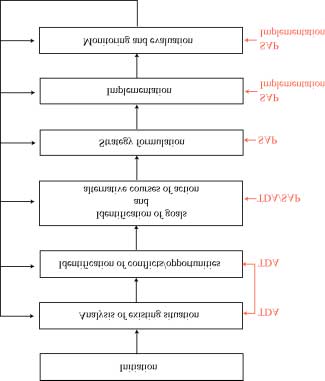
Planning is a cyclical process following a sequence of basic steps from analysis to synthesis and
action which for the purposes of these guidelines can be distinguished as follows (see Figure 2):
·
Initiation
This is the basic inception task, which involves organisation and mobilisation for planning.
·
Analysis of the existing situation
This step involves essentially a reconnaissance survey of basic characteristics in terms of
the structure and dynamics of natural and human ecosystems. Therefore, it deals with the
critical processes and factors, their extent and spatial distribution, etc.
·
Identification of conflict and opportunities
This step deals with the interaction between natural and human ecosystems today and in
the future. It includes the analysis of needs of and the pressures on the basic stakeholders;
these influence decision making in development and environmental management.
·
Identification of goals and alternative courses of action
This step involves an analysis of critical factors and processes, conflicts and opportunities
in order to identify basic management goals and objectives. These should be formulated
with a long-term perspective in the context of sustainable development principles.
Alternative courses of action can be then identified reflecting the different priorities which
may be placed on goals and objectives.
3
Volta River Basin
Preliminary Strategic Action Programme
·
Development of a strategy
A selection is made, in the context of public policy making, from among the alternative
strategies identified above in order to translate the goals and objectives into targets and
policy measures, with the aim of developing a guidance system for environmental
management. The institutional setting influences such decisions as it identifies stakeholder
responsibilities and legal/administrative procedures. This step involves commitment to
mobilise resources and priorities in the form of a programme of action.
·
Implementation
This phase involves the actual implementation of the programme of action and is strongly
linked to the next step.
·
Monitoring and evaluation
This provides for administrative procedures and mechanisms to review periodically
progress towards the achievement of goals and objectives, through assessment, of the state
of the environment and policy implementation.
Figure 2.
Planning Process of ICARM
4
Volta River Basin
Preliminary Strategic Action Programme
1.1
Global and Regional Significance of the Volta River Basin
The Volta River Basin is rich in natural resources and has significant potential for development,
but is held back, in part, by low human capacity that stems from high population growth rates,
low literacy levels, malnutrition, and the prevalence of water-borne diseases. The riparian states
are among the poorest countries in the world, and although there are disparities in GDP among
them, they do not indicate significant variation in levels of development. Only Ghana is ranked
among the states with Medium Human Development, whereas the remainder of the basin
countries are classified as having Low Human Development.
Table 1.
Human Development Statistics
Human Development
GNP/Capita ($)
Country
Index Ranking 2001
(1999)
Benin 147
380
Burkina Faso
159
240
Côte d' Ivoire
144
710
Ghana 119
390
Mali 153
190
Togo 128
320
Sources: UNDP Human Development Report 2001 (HDI), World Development Report 2000/2001 (GNP)
The land and water resources of the Volta Basin supply the basin states with much-needed food,
minerals, and energy. The Volta River Basin with its vast agricultural lands, pasturelands, and
forests, provides much of the food and timber products for the areas of the riparian states outside
the basin. Additionally, the waters of the Volta River and its tributaries provide the vast majority
of the electricity through hydropower dams that fuel economic development in much of the rest
of the basin states.
As the table below indicates, however, the region has extremely high population growth rates
that threaten future use of the basin's natural resources. The basin population is expected to
increase by as much as 80%, to 34,000,000 people, by the year 2025. Some regions are not
currently meeting water and land resource demand; this problem will only be exacerbated as
population pressure continues to grow. For comparison, the population growth rate of the more
developed countries is less than 1%.
Table 2.
Growth Rate Statistics
Growth
P/km2
Projected in
Rate (%)
Density
Country 2000
2025
Urban
Rural
2000 2000 %
%
Benin 476,775
820,000
2.27
43.4
36
64
Burkina Faso
8,874,148
15,997,351
2.38
41.53
22.6
77.4
Côte d'Ivoire
397,853
717,672
2.53
8 - 22
23
77
Ghana
6,674,376
11,696,054
2.5
26 - 104
16
84
5
Volta River Basin
Preliminary Strategic Action Programme
Growth
P/km2
Projected in
Rate (%)
Density
Country 2000
2025
Urban
Rural
2000 2000 %
%
Mali
625,000
1,260,000
2.78
45 - 75
12.2
87.8
Togo 1,594,446
3,385,266
2.80
66
30
70
Total 18,642,598
33,876,343
Average
2.54
48.5
23.3
76.7
The expanding population is already putting pressure on available natural resources. Currently,
farmers in many areas are no longer able to set aside land to lie fallow for a sufficient period of
time to allow the soil to regain valuable nutrients, thus quickening the pace of land degradation.
Populations in some areas are being forced to grow crops on marginal lands that quickly
experience erosion or degradation. Expanding animal husbandry also affects the land as forested
areas are cut to provide fodder for the cattle and uncontrolled bushfires are spread across borders.
This sometimes unsustainable use of the land reduces future availability of natural resources.
The region's water resources are also being used at an increasing rate at the same time that
sources are diminishing due to changes in the hydrological balance and detrimental land-use
patterns. Water resources are provided by rivers and groundwater. Most rivers flow only 3-4
months of the year, encouraging construction of unauthorized dams, often inappropriately
designed, to create more permanent surface water sources. Due to the combination of geology
and low rainfall, groundwater sources are not abundant, and are frequently deeper than rural
wells can be drilled without improved technology. Seasonal water scarcity is a regional problem.
In recent years, a shortage in the amount of water reaching the Akosombo Dam created a scarcity
of electricity that had far-reaching economic implications. As Burkina Faso and Ghana build
additional hydroelectric dams and further increase dependence on hydropower, adequate water
resources could potentially become a source of conflict in the region.
This extensive land and water resource use takes a toll on the biodiversity of the basin. Within
the basin there are a number of national parks and protected areas that serve as habitat for
globally significant species, including endangered and threatened species. Many of these areas
are being encroached upon, however, and poaching and habitat destruction threaten to wipe out
some species. The Volta River and some of its tributaries contain important fisheries resources.
Water quality degradation, overfishing, damming of the rivers, and aquatic weeds threaten these
limited resources.
Finally, the health of the Volta River, as it flows into the Gulf of Guinea, significantly affects the
rich coastal biodiversity. The Volta River carried sediments necessary to keep the river delta
intact, but this supply was halted when the Akosombo Dam was constructed nearly four decades
ago. As a result, significant coastal erosion has occurred and nesting sites for endangered sea
turtles have been destroyed. This also affects Ghana's most species-diverse mangrove forest,
which is located at the mouth of the river and serves as a nursery site for commercial marine
fishes and shrimps. The Volta River, including its delta, is a globally significant habitat for
migrating birds. Altered water and sediment discharges threaten the vitality of this habitat.
6
Volta River Basin
Preliminary Strategic Action Programme
Thus, protection of the Volta River Basin environment has not only global significance due to
the richness of the basin and coastal biodiversity, but it is also essential for the livelihood of the
basin countries which depend on these resources for future economic development and for
survival.
1.2
Basis for Preparation of the Strategic Action Programme
The draft preliminary TDA for the Volta River Basin is primarily based on national TDA reports
prepared in 2001-2002 by Benin, Burkina Faso, Côte d'Ivoire, Ghana, Mali, and Togo. During
the course of preparing these reports, National Coordinators from each of the six countries met
twice to prioritize the many issues and concerns relating to the Volta River Basin environment.
A Steering Committee meeting, during which the issues raised at the National Coordinators'
meetings were endorsed, followed each of these regional meetings. Following these meetings,
the Regional Coordinator drafted an initial version of the TDA, upon which the current draft
preliminary TDA draws heavily. Also consulted during the drafting of the draft preliminary
TDA were a number of reports prepared for the African Process implemented through the GEF
MSP project "Development and Protection of marine and coastal environment of the Sub-
Saharan Africa." The draft preliminary TDA provides an assessment of the regional and wider
significance of these issues; an analysis of the socio-economic causes of environmental
degradation; an evaluation of the sectoral implications of actions needed to mitigate them; and an
analysis of priorities from the national and regional perspectives.
The Draft Preliminary Strategic Action Programme (this document) is based on the preliminary
findings of the regional Draft Preliminary Transboundary Diagnostic Analysis.
The Preliminary TDA benefited from interaction with numerous groups and projects in the
region, including:
· West Africa Technical Committee of Global Water Partnership (WATAC/GWP)
· GLOWA Volta Project on Integrated Assessment of Feedback Mechanism Between Climate,
Land Use, and Hydrology
· Green Cross International/Burkina Faso
· World Bank
· Agence Francaise de Développement
· West and Central Africa Action Plan for Abidjan Convention (WACAF)
· Land-Ocean Interactions in the Coastal Zones (LOICZ Afribasins project)
· Center for Africa Wetlands (CAW)
Also, as stated in Section 1, this SAP development is fully consistent with UNEP's ICARM
approach.
7
Volta River Basin
Preliminary Strategic Action Programme
2.0 Causes of Degradation and Threats to the Aquatic Environment and Resources of the
Volta River Basin
2.1
Causes of Environmental Degradation
The draft preliminary TDA identified the following list of major perceived problems and issues.
It includes eight existing perceived problems/issues and two emerging problems/issues:
1. Land degradation
2. Water scarcity
3. Loss of biodiversity
4. Flooding
5. Water-borne diseases
6. Growth of aquatic weeds
7. Coastal erosion
8. Water quality degradation
9. Urbanization
10. Increase in Industrial and Mining Activities
The TDA identified land degradation as one of the priority issues in the Volta River Basin. The
problem of land degradation in the basin encompasses soil degradation, intense erosion, and
desertification. As discussed above, the basin's population is heavily dependent upon the land
resources of the region for subsistence agriculture and livestock breeding. The increasing
demographic pressures have resulted in the overuse and misuse of land resources.
The major transboundary patterns of land degradation can be illustrated as follows:
· Transhumance
· Bushfires
· Deforestation and devegetation
· Population pressure and migration across borders
Major environmental impacts of land degradation include:
· High concentration of suspended solids
· Siltation of waterways and reservoirs
· Increased stormwater runoff
· Reduced water infiltration into soil and aquifers
· Degradation of water quality from increased use and runoff of fertilizers
· Loss of habitats and biodiversity
· Desertification
· Reduction of soil productivity, reduced animal and crop production
8
Volta River Basin
Preliminary Strategic Action Programme
The major socio-economic impacts are:
· Reduction in water for irrigation and human needs
· Reduction in productivity of agricultural lands
· Reduction in productivity of pasture lands
· Decreased availability of agricultural and pasture lands
· Decreased forestry resources
· Loss of medicinal plants
· Increased competition over land resources
· Migration of populations to find fertile lands
· Decreased food security and ensuing effects on human health
· Reduction in hydroelectric power capabilities
· Increased poverty and disease
The root causes of land degradation include:
· Insufficient scientific capacity
· Low government priority on environment
· Abuse of power
· Poverty
· Insufficient knowledge/understanding
· Inadequate institutions
· Population pressure
· Inadequate legal/regulatory basis
· Inadequate technical infrastructure
· Insufficient demonstration projects
· Inadequate intersectoral cooperation
· Insufficient economic incentives
· Inadequate political will
· Inadequate water basin management
· Insufficient government power
Another critical area identified in the TDA is water scarcity. The water resources in the basin
do not currently meet the needs of the population. As the basin population may increase by as
much as 80% over the next 25 years, demand for water resources will also increase, resulting in
even greater scarcity. This scarcity is likely to be even further exacerbated by decreased
availability of water resources due to climatic and anthropogenic factors.
The major transboundary elements of the problem can be summarized as follows:
The drying up of streams in the upper sub-catchment of the basin can induce drying up or
reduction of flows in the downstream rivers in other countries. Streams upstream can dry up as a
result of human induced actions such as deforestation of the headwaters and the forest gallery
along the river channels. Rampant expansion in the number of dams and reservoirs is another
9
Volta River Basin
Preliminary Strategic Action Programme
example. Thus, altering land surfaces and stream flows in such a way that results in the drying
up of streams is a transboundary issue.
Changes of land cover and poor precipitation reduce recharge of groundwater aquifer systems.
In the basin, some of the scarce aquifers are shared among the riparian countries and human
activities in the recharge zone can be a transboundary problem. Also, over-exploitation of
groundwater resources through poor water resource development and planning can also create
transboundary causes to water scarcity. This factor is particularly pertinent since the aquifers are
limited in capacity, on average, throughout the basins.
Impoundments and reservoirs lose water through evaporation; the larger the surface area of the
reservoir, the greater the evaporation. Reservoir systems constructed with large surface areas
and shallow depths because of lack of suitable topography can potentially lose large amount of
water and create water deficit downstream (such as Volta Lake in Ghana).
The effects of water scarcity can also be of a transboundary nature. When there is inadequate
water for hydroelectric generation, electricity cannot be exported to those countries in need in the
basin, resulting in economic loss. Inadequate water supplies for people and livestock have
induced significant migration (transhumance) across boundaries in search of water resources.
Major environmental impacts of water scarcity include:
· Loss of biodiversity, including modification or destruction of habitats
· Loss of productivity of soils
· Reduction of fisheries and animal stocks
· Reduction in groundwater
Major socio-economic impacts are:
· Reduction in agricultural production
· Shortage of drinking water
· Increased cost of alternative water supplies
· Decline in drinking water quality
· Decrease in forestry resources
· Decrease in animal husbandry
· Reduction in hydroelectric generation
· Increased costs of electricity
· Migration/transhumance
· Increased poverty and disease
The root causes of water scarcity include:
· Inadequate technology
· Drought
· Low government priority on environment
10
Volta River Basin
Preliminary Strategic Action Programme
· Abuse of power
· Poverty
· Insufficient demonstration projects
· Inadequate legal/regulatory basis
· Insufficient economic incentives
· Inadequate intersectoral coordination
· Insufficient regional agreements
· Insufficient knowledge/understanding
· Inadequate institutions
Another critical area identified in the TDA is loss of biodiversity. The Volta River Basin has a
globally significant biodiversity and diverse habitats that are threatened by anthropogenic
sources. Perhaps the greatest threat comes from the clearing of land for farming and animal
husbandry, and from forestry practices. Some farmers use bushfires for land preparation, re-
growth of vegetation for cattle grazing and hunting, etc., at the expense of the environment. This
practice enhances the destruction of habitats, loss of biodiversity, as well as overall deterioration
of biotic resources.
The major transboundary patterns of loss of biodiversity can be illustrated as follows:
· Destruction of habitats through bushfires and deforestation occur across borders
· Some forest reserves and protected areas are located at country borders and are
vulnerable to poaching and other cross border activities
· Damming of rivers upstream affects the freshwater quality and resources downstream
· Damming of rivers upstream affects the floodplain downstream
· Damming of rivers alters the sediment balance
· Damage to transboundary ecosystems
Major environmental impacts of loss of biodiversity and destruction of habitats include:
· Loss of natural productivity
· Reduction of fish stocks and threat to other species
· Loss of globally significant biodiversity
· Degradation of forest ecosystems
· Degradation of river ecosystems
· Changes to the hydrological regimes
· Increased delta and coastal erosion
Major socio-economic impacts of loss of biodiversity include:
· Reduction in income from fisheries and hunting
· Changes in employment
· Loss of aesthetic value
· Loss of income from tourism industry
· Loss of cultural heritage
11
Volta River Basin
Preliminary Strategic Action Programme
· Loss of use of medicinal plants
The root causes of loss of biodiversity and destruction of habitats include:
· Inadequate national and regional legal/regulatory basis
· Poverty
· Inadequate technical infrastructure
· Inadequate political will
· Inadequate human capacity
· Inadequate institutions
· Insufficient scientific capacity
· Low government priority on environment
· Abuse of power
· Insufficient economic incentives
· Insufficient government power
Another perceived problem identified in the TDA is flooding. Extremely seasonably variable
rainfall rates and the creation of unauthorized dams and barrages without appropriate
management practices are normally blamed for the flooding. Land-use conversions can also
exacerbate the problem. Soils with significantly reduced vegetation cover that are exposed to the
atmosphere elements have little infiltration capacities to reduce storm water runoff. These floods
affect the environment of the basin, but also cause significant loss of human life and economic
loss.
The major transboundary patterns of flooding can be illustrated as follows:
Flooding has a transboundary cause in the basin as a result of uncontrolled dam releases from the
upper part of the basin, e.g., from Burkina Faso to Ghana on the White Volta, and also from
Burkina Faso to Mali on the Sorou River as the backwater effect from the management of the
Léry dam.
Flooding also causes transboundary migration of people escaping rising waters.
Major environmental impacts of flooding include:
· Inundation of lands
· Erosion
· Loss of habitat
· Degradation of water quality
Major socio-economic impacts are:
· Loss of human life
· Loss of infrastructure
· Water-borne diseases
12
Volta River Basin
Preliminary Strategic Action Programme
· Effects on human health
· Loss of agricultural productivity
· Migration
· Disruption of transportation infrastructure
· Increased poverty
The root causes of flooding include:
· Insufficient regional agreements on water
· Insufficient scientific capacity
· Low government priority on environment
· Abuse of power
· Poverty
· Insufficient economic incentives
· Inadequate technical infrastructure
· Insufficient knowledge/understanding
· Inadequate legal/regulatory basis
· Inadequate political will
· Inadequate institutions
· Insufficient government power
· Insufficient demonstration projects
· Insufficient knowledge/understanding
· Population pressure
The fifth major perceived problem is water-borne diseases. Water-borne diseases have arisen
in the basin largely as a result of the creation of dams and ponds, and of flooding. The natural
(pre-impoundment) flow rates of the streams and rivers have been altered (slowed) to suit the
breeding of the disease vectors at the banks of the rivers. Additionally, the proliferation of
aquatic weeds exacerbates the problem of water-borne diseases as the weeds serve as hosts for
disease-causing parasites.
The major transboundary patterns of water-borne diseases can be illustrated as follows:
Water-borne diseases can be transboundary because of the movement and spread of disease
vectors in the basin. Diseases have been eradicated in one part of the basin, only to be re-
infected from another area of the basin. Additionally, water-borne diseases have been
exacerbated by transboundary activities such as the damming of rivers, altering the timing,
strength (flooding), and duration of the water flows.
Major environmental impacts of water-borne diseases are:
· Possible damage to fish resources
· Possible decline in biodiversity
13
Volta River Basin
Preliminary Strategic Action Programme
The major socio-economic impacts are:
· Loss of human life
· Effects on human health
· Migration of populations to escape water-borne diseases
· Economic loss due to illness in workforce
· Increased poverty and disease
The root causes of water-borne diseases are:
· Insufficient regional agreements
· Inadequate legal/regulatory basis
· Insufficient scientific capacity
· Low government priority on environment
· Abuse of power
· Poverty
· Inadequate economic incentives
· Inadequate technical infrastructure
· Inadequate political will
· Insufficient demonstration projects
· Inadequate intersectoral cooperation
· Insufficient knowledge/understanding
· Poor alternative technology
· Inadequate training
· Inadequate technology
A sixth problem identified in the TDA is the growth of aquatic weeds. This has been of
particular concern on some of the tributaries, especially on the Oti River, and on a tributary of
the Black Volta. The weeds were probably inadvertently introduced into the basin as ornamental
plants or were transferred accidentally with fishing gear. The growth of the weeds has been
exacerbated by the contamination of the waterways with fertilizers and other pollutants.
The major transboundary patterns of the growth of aquatic weeds can be illustrated as follows:
The causes of aquatic weeds include introduction of alien weeds into the basin, and transfer of
watercrafts and fishing gear as a result of trans-migration. Additionally, the runoff of fertilizers
and nutrients from farmlands exacerbates the growth of the weeds. In the Oti Basin, aquatic
weeds are located in both Togo and Ghana and this could be a transboundary issue.
Major environmental impacts of the growth of aquatic weeds include:
· Reduction in biodiversity
· Degradation of water quality
· Reduction of fisheries
· Increase in water lost through evapotranspiration
14
Volta River Basin
Preliminary Strategic Action Programme
Major socio-economic impacts are:
· Reduction in transport along the waterways
· Reduction in power-generating capabilities of hydroelectric plants
· Exacerbation of water-borne diseases
· Increased poverty through loss of income to fishermen
The root causes of the growth of aquatic weeds are:
· Insufficient knowledge/understanding
· Inadequate legal/regulatory basis
· Insufficient government power
· Inadequate institutions
· Insufficient regional agreements
· Abuse of power
· Poverty
· Insufficient economic incentives
· Inadequate technological infrastructure
· Inadequate political will
A seventh problem identified in the TDA is coastal erosion. Some coastal countries observed
high coastal erosion as a probable result of creation of the Akosombo Dam with the attendant
deficit of sediments reaching the coast.
The major transboundary patterns of coastal erosion can be illustrated as follows:
· Upstream dams are affecting the downstream coastline
· Several countries use the electricity generated from the Akosombo Dam, the prime
contributor to coastal erosion
· Migratory species' habitat is being degraded
The major environmental impacts of coastal erosion are:
· Degradation of coastal habitats, including migratory bird habitats
· Destruction of sandy beaches used as nesting sites by endangered marine turtles
· Change in coastal waters
· Loss of productivity of waterways
· Reduction in biodiversity
· Degradation of water quality
Major socio-economic impacts include:
· Loss of fish landing sites
· Loss of aesthetic value and tourism
15
Volta River Basin
Preliminary Strategic Action Programme
· Loss of coastal resources
· Increased storm damage
· Loss or damage to human life or infrastructure
The root causes of coastal erosion are:
· Insufficient scientific capacity
· Low government priority on environment
· Abuse of power
· Insufficient demonstration projects
· Poverty
· Inadequate political will
The final problem identified in the TDA is water quality degradation. The major
transboundary patterns of water quality degradation can be illustrated as follows:
Surface water resources are shared throughout the basin, making the degradation of water quality
a strongly transboundary problem.
· Pollution is distributed throughout the waterways
· Land clearing in upstream countries have downstream effects
Major environmental impacts of water quality degradation include:
· Loss of biodiversity
· Loss of fisheries
· Harmful effects on coastal waters
· Occasional harmful algal blooms
Major socio-economic impacts are:
· Scarcity of potable drinking water
· Scarcity of non-polluted water for agriculture and animal husbandry
· Effects on human health
· Increase in water-borne diseases
· Loss of fisheries
The root causes of water quality degradation are:
· Insufficient regional agreements
· Inadequate legal/regulatory basis
· Insufficient knowledge/understanding
· Insufficient government power
· Inadequate institutions
· Abuse of power
16
Volta River Basin
Preliminary Strategic Action Programme
· Poverty
· Inadequate national legal/regulatory basis
· Inadequate technology
· Inadequate training
· Population pressure
· Insufficient demonstration projects
· Inadequate intersectoral coordination
· Insufficient economic incentives
· Inadequate political will
The Transboundary Diagnostic Analysis provides more detailed information on the root causes
and sources of the problems identified.
2.2
Emerging Problems for the Volta River Basin
Two emerging problems have been identified that may affect the environment of the Volta River
Basin in the future
2.2.1 Urbanization
Urbanization is occurring, albeit slowly, in the basin and it already has been noted as a problem
in Ghana. Problems associated with urbanization relate to increasing populations, including
overall national population growth and migration into urban areas. These changes will have
significant consequences for waste management and the threat of degradation and scarcity of
water supplies.
2.2.2
Increase in Industrial and Mining Activities
While industrial development has been slow in the Volta River Basin, it will continue to
increase, particularly as the population expands. This industrial growth can be expected to
produce potential new point sources of pollution that will have impacts on land and water
resources in the basin. Mining activities in the basin, although currently relatively small in scale,
could expand and pose an even greater threat to the environment than they currently do.
The rising population growth and increasing industrial development raise the demand for
hydroelectric power. The general tendency in the region will be to continue impounding river
basins for electricity generation. This threatens future availability of water resources, as well as
the coastline of Ghana.
17
Volta River Basin
Preliminary Strategic Action Programme
3.0 Establishment of Environmental Quality Objectives for the Volta River Basin
3.1 General
The national reports and the Draft Preliminary Transboundary Diagnostic Analysis identified the
major perceived problems of the Volta River Basin as being land degradation, water scarcity,
loss of biodiversity, flooding, water-borne diseases, growth of aquatic weeds, coastal erosion and
water quality degradation. Emerging problems were identified as urbanization and increasing
industrial activities and mining.
For a number of these issues and problems, quantitative indicators of loss or degradation are not
available. In other cases, the data and information are not uniform throughout the region. Thus,
further in-depth studies are required in order to establish definitive EQOs for protection and
management of the environment and its resources. Nevertheless, recognizing the urgency of the
issues and problems, the preliminary EQOs and targets have been established for the key issues
identified for priority action in the immediate future.
Underlying the process of degradation of the various resources described in the TDA is the lack
of an effective institutional framework at national and regional levels for collective management
of the environment and resources. This problem is addressed among the priority actions outlined
in this Draft Preliminary Strategic Action Programme.
This section (3) is organized first by providing the objectives of the SAP, then by introducing the
concept of Environmental Quality Objectives, and next listing those EQOs for the Volta River
Basin land and water focal area. This section ends with a list of the specific targets identified in
the 5-to-10 year time frame to move towards achievement of those EQOs.
Section 4 then takes the EQOs and targets, and lists the specific activities that are proposed to
achieve those targets in the 5-to-10 year time frame. The activities are not costed yet, but will be
costed as this Programme is updated and revised during the full GEF Project. Each activity is
classified according to category of intervention (policy, legal/regulatory, institutional
strengthening, capacity building, investments, scientific investigation, and data management).
An additional table (Table 6) depicts the activities/interventions according to category of
intervention, to show the broad-ranging activities within each category.
Section 5 outlines a cost-benefit analysis to support the actions/interventions of the SAP.
Lacking adequate information from the draft Framework TDA, the cost-benefit analysis cannot
be completed at this stage. It will be completed during the full GEF project as the list of
actions/interventions is refined, and as the methodology for evaluating resource valuations is
agreed within the region.
Section 6 then identifies the priority Actions and Interventions that are proposed in the
immediate term. These Actions and Interventions cover a broad range of needs, but are the
priority areas where stakeholder focus must reside in the near term.
18
Volta River Basin
Preliminary Strategic Action Programme
3.2
Objectives, Rationale, and Priorities for the SAP
The ultimate goal of the Strategic Action Programme is to halt or slow the current rate of
environmental degradation. It contains priority actions that need to be undertaken at both
national and regional levels by a variety of stakeholders. It is designed to assist participating
states in taking actions individually or jointly within their respective policies, priorities and
resources, which will lead to the prevention, reduction, control and/or elimination of the causes
of degradation of the freshwater and coastal environment. Achievement of the aims of the SAP
will contribute to the protection of human health; promote the conservation and sustainable use
of resources; and contribute to the maintenance of globally significant biological diversity.
The general objectives of the SAP are:
· Formulation of principles, approaches, measures, timetables and priorities for action;
Preparation of a priority list for intervention and investments;
· Detailed analysis of expected baseline and additional actions needed to resolve each
transboundary priority problem;
· Identification of the elements and preparation of guidelines for the formulation of
national action plans for the protection of the marine environment and rational use of
marine and coastal resources consistent with the regional SAP;
· Foster the involvement of regional and, where appropriate, national Non-Governmental
Organizations and the private sector in the implementation of the SAP; and
· Foster collaboration and co-operation between all regional entities having interests in the
environment of the Volta River Basin in an attempt to reduce or eliminate duplication of
effort and waste of scarce human and financial resources.
The countries of the Volta River Basin have the basic infrastructure necessary for the protection
of the environment and for the sustainable use of land and water resources, including competent
institutions with authority for protection of the environment, and adopted legislation and
regulations. However, the governments of the region have recognised that past actions at
national and regional levels have not been adequate to halt the rate of degradation and that a
more strategic approach is required. Consequently, regional environmental objectives and
targets to achieve these objectives have been defined. These objectives, EQOs, and targets
address the major areas of concern identified in the draft preliminary TDA, which are prioritised
below:
High Priority
· Land degradation
· Water scarcity
Medium Priority
· Loss of biodiversity
· Water quality degradation
Low Priority
· Water-borne diseases
· Flooding
· Growth of aquatic weeds
· Coastal erosion
19
Volta River Basin
Preliminary Strategic Action Programme
3.3
Environmental Quality Objectives, Targets, and Priority Actions
In order to categorize and prioritize interventions for each major perceived problem and issue,
the MPPIs were recast into overall Environmental Quality Objectives.
The environmental impacts, socio-economic impacts, and root causes of the various MPPIs
overlap to a great extent. Common are their causes: for instance, land-based activities affect
water quality and quantity, loss of biodiversity, flooding and growth of aquatic weeds (see Table
3). Therefore, recognizing these overlaps and the priorities that arose from the TDA process, the
EQOs were limited to three overarching objectives:
Table 3.
Root Causes and Major Perceived Problems and Issues
Root Causes
Perceived Problems
MPPI 1
MPPI 2
MPPI 3
MPPI 4
MPPI 5
MPPI 6
MPPI 7
MPPI 8
Water
Land
Loss of
Water-
Growth of
Water
Coastal
Quality
Degrad-
Biodiver-
Flooding
Borne
Aquatic
Scarcity
Erosion
Degrad-
ation
sity
Diseases
Weeds
ation
Insufficient
scientific
capacity
Low government
priority on
environment
Abuse of power
Poverty
Insufficient
knowledge /
understanding
Population
pressure
Inadequate legal
/ regulatory basis
Inadequate
technical
infrastructure
Insufficient
demonstration
projects
Inadequate
intersectoral
coordination
Insufficient
economic
incentives
Inadequate
political will
Inadequate water
basin
management
20
Volta River Basin
Preliminary Strategic Action Programme
Root Causes
Perceived Problems
MPPI 1
MPPI 2
MPPI 3
MPPI 4
MPPI 5
MPPI 6
MPPI 7
MPPI 8
Water
Land
Loss of
Water-
Growth of
Water
Coastal
Quality
Degrad-
Biodiver-
Flooding
Borne
Aquatic
Scarcity
Erosion
Degrad-
ation
sity
Diseases
Weeds
ation
Insufficient
regional
agreements
Drought
Inadequate
human capacity
Inadequate
institutions
Inadequate
technology
Insufficient
government
power
Inadequate
training
1. Balanced aquatic ecosystem
Addresses the following MPPIs:
· Loss of biodiversity
· Flooding
· Water-borne diseases
· Growth of aquatic weeds
· Coastal erosion
· Water quality degradation
2. Stabilized high-quality freshwater supplies
Addresses the following MPPIs:
· Water scarcity
· Water quality degradation
· Water-borne diseases
3. Sustainable land use
Addresses the following MPPIs:
· Land degradation
· Water scarcity
· Destruction of habitats, loss of biodiversity
· Flooding
· Aquatic weeds
· Water quality degradation
21
Volta River Basin
Preliminary Strategic Action Programme
Each of these EQOs had specific targets associated with them, with the environmental indicators
shown below. Environmental Indicators are a tool used to assure precise evaluation of
achievement or satisfaction of the target, demonstrating which metric will be used in the
evaluation. Environmental indicators may be of three types, according to GEF terminology:
Process Indicator, Stress Reduction Indicator, or Environmental Status Indicator. The timeframe
for the targets is a five-to-ten year period.
Balanced aquatic ecosystem
· Achieve adequate surface water quality by 2012 (Indicator: water quality monitoring shows
stable water quality by 2012)
· Restore natural surface water flow by 2012 (Indicator: regional water agreements in place
for all major rivers in the area by 2012)
· Achieve sustainable fisheries development by 2012 (Indicator: national report on fisheries
indicate stabilized fisheries resources by 2012)
· Arrest wetland loss by 2012 (Indicator: wetlands surveys show stability in amount of
wetlands by 2012)
· Begin implementation of riverine biodiversity conservation strategy by 2008 (Indicator:
biodiversity conservation strategy has been developed and national reports indicate that
implementation has begun by 2008)
Stabilized high-quality freshwater supplies
· Achieve adequate freshwater quantity by 2012 (Indicator: regional water agreements in
place for all major rivers in the area by 2012)
· Achieve adequate groundwater quality and quantity by 2012 (Indicator: groundwater
surveys show stable levels of contaminants of concern and stable water tables by 2012)
Sustainable land use
· Reduce rate of land degradation by 20% by 2012 (Indicator: aerial surveys combined with
ground-truthing indicates that the rate of land lost to erosion, desertification and deforestation
is reduced by 20% by 2012)
· Reduce coastal erosion rates by 25% by 2012 (Indicator: aerial surveys combined with
ground-truthing indicates that the human-induced component of the rate of coastal erosion is
reduced by 25% by 2012)
22
Volta River Basin
Preliminary Strategic Action Programme
4.0 Priority Actions and Interventions
Following the identification of environmental quality objectives and their associated targets
above, specific interventions/actions were identified to achieve first the targets, and ultimately,
the EQOs. These priority actions and interventions can be categorized within one or more of the
following major groupings:
· Policy actions
· Legislative/regulatory reform
· Institutional strengthening
· Capacity building
· Investment
· Scientific investigation
· Data management
For economy of space, each activity and intervention is listed under only a single EQO and
target. In fact, many activities and interventions may address multiple EQOs and targets. The
listing of activities and interventions according to category helps to clarify this multiplicity.
This SAP lists and prioritizes these different categories of actions and interventions. Table 3
summarizes the priority interventions within each EQO and target. These actions/interventions
will be reviewed and costed during the full GEF project. Each activity is characterized by the
root causes that it addresses. Each intervention is categorized by type of intervention.
Table 4 lists the priority actions/interventions according to category of intervention. For
instance, all policy actions are listed together; all legal/regulatory actions are listed together, and
so on. This table depicts the broad diversity of interventions within each category of intervention
across all major EQOs and targets. This table demonstrates that comparable multi-sectoral
approaches are being taken to address each of the EQOs and targets.
23
Volta River Basin
Preliminary Strategic Action Programme
Table 4.
Environmental Quality Objectives, Targets, and Interventions
Environmental
Type of
Quality
Targets Activities
Interventions
Root Cause
Intervention
Objectives
Balanced
Achieve adequate
Establish common methods for Develop guidelines for methods of water, sediment, Legislative/
Insufficient
Aquatic
surface water quality assessing water and sediment and biota monitoring and assessment (including Regulatory
scientific capacity
Ecosystem
by 2012
quality, including bioassays of sampling, analysis, risk assessment)
coastal biota
Implement a first periodic assessment (3-year Investment
interval) of the river quality and trends
Develop and establish national/regional land-based Data Management
activities data and information management system
as a tool for contaminant assessment and
management
Fill gaps in knowledge of Conduct regional assessment of priority land-based Scientific
Insufficient
priority pollutants
activities, sources of contaminants, and pollutant Investigation
scientific capacity
(contaminant levels) and major levels in water and sediments
sources of pollutants
(contaminant inputs)
Conduct routine targeted monitoring of riverine Investment
sediments and biota for purposes of identifying
major hot spots of pollution and land-based activities
Exchange environmental data Develop agreements and technology basis for the Data Management
Insufficient
and information
free and regular exchange of environmental data and
scientific capacity;
information within the region
Inadequate
technical
infrastructure
Reduce impacts of urban areas Construct or extend sewage collection systems in all Investment
on water quality
major cities in the basin and route discharges to
treatment plant
Upgrade/renovate existing treatment plants for Investment
mechanical and biological treatment
Expand solid waste collection in all major cities and Investment
improve disposal methods so waste does not run-off
or leach into waterways
Reduce impacts of industry Develop and enforce regulations on the disposal of Legislative/
Inadequate legal/
and mining on water quality
industrial and mining effluents
Regulatory
regulatory basis;
Inadequate
24
Volta River Basin
Preliminary Strategic Action Programme
Environmental
Type of
Quality
Targets Activities
Interventions
Root Cause
Intervention
Objectives
institutions;
Insufficient
demonstration
projects;
Inadequate of
technology
Strengthen the capacity of institutions to enforce Institutional
mining and industry regulations
Strengthening
Implement demonstration projects to bring best Investment
technology and practice to industrial discharges (e.g.,
pre-treatment, source control, process control)
Identify major pollutants affecting water quality, and Scientific
regulatory levels for those pollutants
Investigation
Halt the spread of aquatic Improve knowledge of distribution of aquatic weeds Scientific
Insufficient
weeds by 2010
using regional working groups
Investigation
knowledge/
understanding;
Inadequate legal/
regulatory basis;
Inadequate river
basin management
Develop national and regional aquatic weed Policy
management strategies/plans/frameworks combined
with monitoring and GIS capabilities
Establish and implement a control system for the Legislative/
import and export of exotic species into and from the Regulatory
Volta River Basin
Restore
natural
Improve water basin
Agree regionally on extraction of river water and Legislative/
Inadequate water
surface water flow by management
control of river flow regimes
Regulatory
basin management;
2012
Insufficient
regional
agreements;
Inadequate
intersectoral
coordination
Conduct baseline investigation to establish the Scientific
minimum threshold required for ecosystem function.
Investiation
25
Volta River Basin
Preliminary Strategic Action Programme
Environmental
Type of
Quality
Targets Activities
Interventions
Root Cause
Intervention
Objectives
Manage water release from hydro-electric dams in Legislative/
accordance with natural requirements
Regulatory
Manage water usage for agriculture and other uses in Legislative/
order to maintain more natural river water level and Regulatory
prevent detrimental impact on the ecosystem
Develop a regional commission with appropriate Policy
policy/legal basis to monitor regional water quantity
and quality
Implement regional EIA for water management Legislative/
projects, perhaps through the ESPOO Convention, to Regulatory
enhance broad stakeholder involvement in major
water projects
Develop regional basin water management plan of Policy
action
Strengthen the capacity of institutions to implement Institutional
regional basin water management plan of action.
Strengthening
Achieve
sustainable
Strengthen
legal
basis
Assure that legislation regulating fishing gear, Legislative/
Inadequate legal/
fisheries development
quotas, size limits, seasons and allowed fishing areas Regulatory
regulatory basis;
by 2012
are in place
Insufficient
scientific capacity;
Insufficient
regional
agreements;
Inadequate
institutions
Strengthen enforcement of quotas, size limits, Policy
seasons, etc., relying on community-based fishery
management activities
Help harmonize fishing regulations amongst Volta Policy
River Basin countries
Strengthen capacity of institutions to enforce Institutional
fisheries regulations
Strengthening
Establish "no take zones" either geographically or Legislative/
seasonally
Regulatory
26
Volta River Basin
Preliminary Strategic Action Programme
Environmental
Type of
Quality
Targets Activities
Interventions
Root Cause
Intervention
Objectives
Establish criteria for "healthy" fisheries situation
Scientific
Investigation
Develop site-specific or
Develop management plans, and implement and Legislative/
Inadequate legal/
species-specific management monitor them with local communities and user Regulatory
regulatory basis;
plans that promote sustainable groups
Insufficient
utilization and protect nursery
economic
or reproduction areas
incentives;
Inadequate
institutions
Strengthen capacity of local communities to Institutional
implement and monitor management plans
Strengthening
Provide
alternative
Develop and demonstrate mechanisms to reduce by- Policy Inadequate
technologies
catch
technology
Arrest
wetland
loss
Fill gaps in knowledge of Undertake inventory of selected wetlands sites in the Scientific
Insufficient
by 2012
priorities in protecting
basin to establish extent and condition of habitat and Investigation
scientific capacity;
wetlands
management challenges
Insufficient
knowledge/
understanding
Strengthen
regional
legal
basis
Review, harmonize, and strengthen relevant local, Legislative/
Inadequate legal/
for protection of wetlands
national, regional, and international legislation and Regulatory
regulatory basis;
conventions relevant to the conservation and
Insufficient
management of wetlands
regional
agreements
Develop
management
plans
Develop national wetlands management strategies/ Policy Inadequate
legal/
for selected wetlands sites of plans/ frameworks (including community
regulatory basis;
global and ecological
participation and empowerment)
Inadequate human
importance by 2007
capacity;
Inadequate
institutions
Strengthen the capacity of local conservation groups Institutional
to conserve wetlands
Strengthening
27
Volta River Basin
Preliminary Strategic Action Programme
Environmental
Type of
Quality
Targets Activities
Interventions
Root Cause
Intervention
Objectives
Begin Develop and implement
Prepare a regional biodiversity strategy document, Policy Insufficient
implementation of
regional biodiversity strategy
including a gap analysis, and obtain endorsement by
regional
riverine biodiversity
riparian states
agreements;
conservation strategy
Inadequate water
by 2008
basin management;
Insufficient
knowledge/
understanding
Implement biodiversity strategy, including species Scientific
specific action plans
Investigation/
Investment
Prevention of adverse human Evaluate sensitivity of areas and habitats in the Volta Scientific
Insufficient
activity on sensitive areas
River Basin and evaluate levels of human impacts on Investigation
knowledge/
them
understanding;
Inadequate legal/
regulatory basis
If necessary, develop legislation for the protection of Legislative/
areas not currently covered or included in protected Regulatory
zones
Develop and implement action plans for those Investment
sensitive areas where human impact is adverse
Reduce
impacts
of
agriculture,
Implement alternatives to agricultural expansion, Investment Insufficient
land grazing, and hunting on unchecked grazing, and poor hunting practices,
economic
loss of biodiversity
including bushfires and poaching, to conserve
incentives
biodiversity
Stabilized high- Achieve adequate
Rationing of water use through Review and strengthen existing regional river system Legislative/
Inadequate legal/
quality
freshwater quantity international agreements on agreements; develop new agreements
Regulatory
regulatory basis;
freshwater
by 2012
shared water basins
Insufficient
supplies
knowledge/
understanding;
Insufficient
economic
incentives;
Inadequate water
basin management
28
Volta River Basin
Preliminary Strategic Action Programme
Environmental
Type of
Quality
Targets Activities
Interventions
Root Cause
Intervention
Objectives
Harmonize environmental and economic policy Policy
regarding water use
Monitor supply and quality of water in major rivers
Investment
Prepare environmental impact assessments (EIAs) Investment
for major investments that may affect water quantity
or quality
Support freshwater resource tenure and valuation
Investment
Achieve
adequate
Fill gaps in knowledge
Develop common guidelines for periodic assessment Scientific
Insufficient
groundwater quality
of groundwater quality and quantity trends
Investigations
scientific capacity;
and quantity by 2012
Insufficient
knowledge/
understanding
Develop and implement a groundwater quality trend Investment
monitoring programme
Conduct the first periodic assessment of groundwater Investment
quality and its trends
Evaluate sustainable groundwater use rates, and Scientific
appropriate monitoring systems
Investigations
Improve efficiency and
Based on the sustainable groundwater use rates, Investment Inadequate
availability of high-quality improve water extraction and transport systems to
technical
well water
rural and urban areas
infrastructure;
Insufficient
economic
incentives;
Insufficient
demonstration
projects
Institute a water use fee structure for all water users
Investment
Reduce evaporative losses in Rationalize the use of small dams and barrages for Policy Inadequate
drainage basin
local communities
technical
infrastructure
Revegetate (reforest, replant) the drainage basin to Investment
increase natural evapotranspiration processes
29
Volta River Basin
Preliminary Strategic Action Programme
Environmental
Type of
Quality
Targets Activities
Interventions
Root Cause
Intervention
Objectives
Sustainable land Reduce rate of land Strengthen regional legal basis National review of policy, legal, and regulatory Legislative/
Inadequate legal/
use
degradation by 20% for preventing land
frameworks, and institutional structure for addressing Regulatory
regulatory basis;
by 2012
degradation
land-based activities (including international
Insufficient
conventions such as climate change)
regional
agreements; Low
government
priority on
environment
Draft Regional EIA process review in a regional Legislative/
workshop; adopt regional EIA
Regulatory
Develop realistic National Plans of Action for land- Capacity
based sources and activities
Building
Develop common regional guidelines containing Scientific
appropriate recommendations for decision makers Investigation
for management of land-based point and non-point
pollutant sources
Strengthen capacity of institutions to implement Institutional
National Plans of Action and EIA process review
Strengthening
Strengthen
monitoring
Develop a regional commission with appropriate Policy Insufficient
capacity for evaluating land policy/legal basis to monitor regional land
regional
degradation rates
degradation
agreements;
Inadequate
training;
Inadequate human
capacity;
Inadequate
institutions
Develop training and educational programs to train Capacity Building
regional personnel on monitoring and use of GIS as a
planning tool
Develop regional and national institutions to perform Investment
ongoing monitoring of land degradation, including
geographic areas, causes, and rates
30
Volta River Basin
Preliminary Strategic Action Programme
Environmental
Type of
Quality
Targets Activities
Interventions
Root Cause
Intervention
Objectives
Involve stakeholders, including NGOs and natural Capacity Building
resource users, by communicating the results of
monitoring and communicating alternative strategies
for resource use
Determine and satisfy training Conduct survey on training needs and conduct Capacity
Inadequate
needs in region for land-based training on land-based activities and sources (for Building
training;
activities and sources
high officials, mid-level government, community,
Inadequate human
resource users, experts, industry, etc.)
capacity
Improve
Stakeholder
Develop outreach and public awareness program Investment Insufficient
knowledge of causes of land regarding land degradation
knowledge/
degradation, and involve the
understanding
stakeholders in its solution
Create community-based agent network to educate Investment
and advise stakeholders on alternatives to traditional,
harmful activities causing land degradation
Develop educational programs Conduct survey on educational needs to support Capacity Building
Insufficient
at all levels on land-based reduction of land-based activities and sources and
knowledge/
activities and sources
implement the activities to address three top priority
understanding;
regional educational needs, in appropriate languages
Inadequate
training;
Inadequate
technology
Develop necessary training at different levels on Capacity Building
public awareness, applying Best and Cost Effective
Technology, Best Agricultural Practices, Integrated
Pest Management, increasing irrigation efficiency
and fertilizer use, etc.
Develop
Regional/
Integrate private sector into activities of this project, Policy Insufficient
Governmental/ Private Sector as appropriate, as sub-contractor, consultant, or co-
economic
partnerships on LB activities sponsor of specific activities
incentives
and sources
Strengthen legal basis and Develop and enforce land use codes for agriculture Legislative/
Inadequate legal/
institutional capacity to reduce and animal husbandry
Regulatory
regulatory basis;
impacts of agriculture and
Inadequate
animal husbandry
institutions
31
Volta River Basin
Preliminary Strategic Action Programme
Environmental
Type of
Quality
Targets Activities
Interventions
Root Cause
Intervention
Objectives
Strengthen institutional capacity to support rangeland Institutional
management; develop community rangelands
Capacity
Develop programs to reduce Riparian countries agree to a list of banned Legislative/
Insufficient
impacts of agriculture and agrochemicals and develop a program to destroy Regulatory
regional
animal husbandry
stored banned products
agreements;
Inadequate
training;
Inadequate legal/
regulatory basis;
Inadequate
technology;
Insufficient
scientific capacity
Riparian countries agree on limits to the application Legislative/
of agrochemicals and develop strategies to encourage Regulatory
the sustainable use of organic manure fertilizer
Riparian countries agree on regional controls on Policy
bushfires for agriculture, pasturage, and hunting, and
enforce the controls
Conduct training courses at farmer and industry level Capacity Building
to apply the most appropriate and new findings in
their practice by 2008
Strengthen and enforce regulations on the disposal of Legislative/
animal waste
Regulatory
Develop more efficient ways to use existing land, Investment
increasing yields through better land management,
crop rotation, or crop selection
Develop basin-wide corridors for seasonal migration Policy
of livestock through adjacent countries, based on
historical common use zones
Develop community-based agricultural/ animal Institutional
husbandry networks for transfer of technology and Strengthening
best practice
32
Volta River Basin
Preliminary Strategic Action Programme
Environmental
Type of
Quality
Targets Activities
Interventions
Root Cause
Intervention
Objectives
Establish regional and national capacities to monitor, Investment
examine causes, and map (using GIS) geographic
locations of agriculture and animal husbandry,
including protection objectives. Broadly disseminate
the results to rural inhabitants.
Establish and maintain a Establish a functioning regional protected area Institutional
Inadequate
network of well-managed working group for protection and management Strengthening
institutions;
protected areas in the Volta functions, financial arrangements, recommending
Insufficient
River Basin
new protected areas and addressing management of
regional
protected areas located along international borders
agreements;
Insufficient
knowledge/
understanding;
Inadequate legal/
regulatory basis;
Insufficient
economic
incentives;
Inadequate
training;
Insufficient
scientific capacity
Obtain government endorsement for the
Policy
recommended protected areas
Evaluate the priority targets for protection in each Scientific
protected area and how these fit into regional Investigation
priorities
Review and propose revisions for national legislation Legislative/
on protected areas to permit environmentally friendly Regulatory
uses of the protected areas
Allocate a zone within protected areas or adjacent to Legislative/
them for ecotourism activities
Regulatory
Provide training in national protected area Capacity Building
management and development of ecotourism
33
Volta River Basin
Preliminary Strategic Action Programme
Environmental
Type of
Quality
Targets Activities
Interventions
Root Cause
Intervention
Objectives
Reduce poaching in protected areas by ensuring that Legislative/
legislation regulating hunting equipment, quotas, Regulatory
seasons and allowed hunting areas are in place and
strengthening enforcement of these regulations
Increase stakeholder participation, including Capacity Building
community ownership, of protected areas
Establish regional and national capacities to monitor, Investment
examine causes, and map (using GIS) geographic
locations of protected areas, including protection
objectives. Broadly disseminate the results to rural
inhabitants.
Reduce rates of deforestation
Identify main contributors to deforestation, including Scientific
Insufficient
public and private sector, as well as legal and Investigation
demonstration
regulatory failures
projects
Insufficient
economic
incentives;
Insufficient
knowledge/
understanding;
Inadequate legal/
regulatory basis;
Inadequate human
capacity
Identify alternative sources for products historically Scientific
produced from forests, and link with appropriate Investigation
incentives and disincentives
Identify means to increase efficiency and reduce Investment
waste in use of forest products, through
demonstration projects
Establish legislation to reduce rates of deforestation Legislative/
based on economic incentives and disincentives
Regulatory
Establish reforestation programs and begin their Investment
implementation in affected areas, at village,
community, national, and regional levels
34
Volta River Basin
Preliminary Strategic Action Programme
Environmental
Type of
Quality
Targets Activities
Interventions
Root Cause
Intervention
Objectives
Establish regional and national capacities to monitor, Investment
examine causes, and map (using GIS) rates and
geographic locations of deforestation and
reforestation. Broadly disseminate the results to
rural inhabitants.
Reduce rates of loss of land to Increase awareness of local populations of the Capacity Building
Insufficient
desertification
desertification process, perhaps working through
knowledge/
existing mechanisms
understanding;
Inadequate legal/
regulatory basis;
Insufficient
scientific capacity;
Insufficient
demonstration
projects
Improve legal basis in each country for combating Legislative/
desertification, including: criteria to define land Regulatory
degradation; amended laws on forestry, water
resources and land; and, strengthened legal
mechanisms such as EIA and planning procedures
Develop a desertification monitoring system and Capacity Building
widely disseminate results
Demonstrate ways to reverse desertification
Investment
Reduce land degradation due Evaluate national legislation addressing mining and Scientific
Inadequate legal/
to mining
use of non-living resources
Investigation
regulatory basis;
Inadequate
intersectoral
coordination;
Insufficient
regional
agreements;
Insufficient
demonstration
projects
35
Volta River Basin
Preliminary Strategic Action Programme
Environmental
Type of
Quality
Targets Activities
Interventions
Root Cause
Intervention
Objectives
Create regional working group on land degradation Policy
due to mining, and recommend specific common
regional improvements to policy and legislation
Implement recommendations of regional working Legislative/
group in national laws and regulations
Regulatory
Perform demonstration projects of ways to avoid Investment
adverse environmental impacts of mining
Develop
culturally-adapted
Perform investigation of the policy, legal, and Scientific
Inadequate legal/
improvements to land tenure cultural basis for land tenure policies in the Volta Investigation
regulatory basis;
systems/property rights in the River Basin
Insufficient
region
economic
incentives
Develop more effective methods of land tenure to Policy
reduce tendency for migration to fresh lands, and to
encourage "investment" in lands (e.g., efficient
irrigation, improved crop methods)
Implement environmentally sustainable land tenure Investment
systems in the region, perhaps as a "special planning
zone"
Reduce
coastal
Fill gaps in knowledge
Conduct assessment of the effects of Akosombo Scientific
Insufficient
erosion rates by 25%
Dam on coastal erosion on the Gulf of Guinea coast
Investigation
knowledge/
by 2012
understanding
Develop coastal erosion
Promote environmental and community-based Capacity Building
Insufficient
management plan through a tourism
economic
participatory process
incentives;
inadequate human
capacity
Strengthen legal basis for Review, harmonize and strengthen relevant local and Legislative/
Inadequate legal/
protection of coastline
national policies and legislation regarding coastal Regulatory
regulatory basis;
zone and river basin management
Inadequate
intersectoral
coordination
36
Volta River Basin
Preliminary Strategic Action Programme
Table 5.
Priority Actions within Each Category of Intervention
Environmental Quality
Category
Interventions
Objectives
Policy
Actions
I. Balanced Aquatic Develop national and regional aquatic weed management
Ecosystem
strategies/plans/frameworks combined with monitoring and GIS
capabilities
Develop a regional commission with appropriate policy / legal basis
to monitor regional water quantity and quality
Develop regional basin water management plan of action
Strengthen enforcement of quotas, size limits, seasons, etc., relying on
community-based fishery management activities
Help harmonize fishing regulations amongst Volta River Basin
countries
Develop and demonstrate mechanisms to reduce by-catch
Develop national wetlands management strategies/ plans/ frameworks
(including community participation and empowerment)
Prepare a regional biodiversity strategy document, including a gap
analysis, and obtain endorsement by riparian states
Develop a regional commission with appropriate policy/legal basis to
monitor regional water quality and quantity
II. Stabilized high-quality Harmonize environmental and economic policy regarding water use
freshwater supplies
Rationalize the use of small dams and barrages for local communities
III. Sustainable land use
Develop a regional commission with appropriate policy/legal basis to
monitor regional land degradation
Integrate private sector into activities of this project, as appropriate, as
sub-contractor, consultant, or co-sponsor of specific activities
Riparian countries agree on regional ban on bushfires for agriculture,
pasturage, and hunting, and enforce the ban
Develop basin-wide corridors for seasonal migration of livestock
through adjacent countries, based on historical common use zones
Obtain government endorsement for the recommended protected areas
Create regional working group on land degradation due to mining,
and recommend specific common regional improvements to policy
and legislation
Develop more effective methods of land tenure to reduce tendency for
migration to fresh lands, and to encourage "investment" in lands (e.g.,
efficient irrigation, improved crop methods)
Legislative /
I. Balanced Aquatic Develop guidelines for methods of water, sediment, and biota
Regulatory Actions Ecosystem
monitoring and assessment (including sampling, analysis, risk
assessment)
Develop and enforce regulations on the disposal of industrial and
mining effluents
Establish and implement a control system for the import and export of
exotic species into and from the Volta River Basin
Agree regionally on extraction of river water and control of river flow
regimes
Manage water release from hydro-electric dams in accordance with
natural requirements
Manage water usage for agriculture and other uses in order to
maintain more natural river water level and prevent detrimental
impact on the ecosystem
37
Volta River Basin
Preliminary Strategic Action Programme
Environmental Quality
Category
Interventions
Objectives
Implement regional EIA for water management projects, perhaps
through the ESPOO Convention, to enhance broad stakeholder
involvement in major water projects
Assure that legislation regulating fishing gear, quotas, size limits,
seasons and allowed fishing areas are in place
Establish "no take zones" either geographically or seasonally
Develop management plans, and implement and monitor them with
local communities and user groups
Review, harmonize, and strengthen relevant local, national, regional,
and international legislation and conventions relevant to the
conservation and management of wetlands
If necessary, develop legislation for the protection of areas not
currently covered or included in protected zones
II. Stabilized high-quality Develop common regional guidelines for periodic assessment of river
freshwater supplies
water quality and groundwater quality
Review and strengthen existing regional river system agreements;
develop new agreements
III. Sustainable land use
National review of policy, legal, and regulatory frameworks, and
institutional structure for addressing land-based activities (including
international conventions such as climate change)
Draft Regional EIA process review in a regional workshop; adopt
regional EIA
Develop and enforce land use codes for agriculture and animal
husbandry
Riparian countries agree to a list of banned agrochemicals and
develop a program to destroy stored banned products
Riparian countries agree on limits to the application of agrochemicals
and develop strategies to encourage the use of organic manure
fertilizer
Strengthen and enforce regulations on the disposal of animal waste
Review and propose revisions for national legislation on protected
areas to permit environmentally friendly uses of the protected areas
Allocate a zone within protected areas or adjacent to them for
ecotourism activities
Establish legislation to reduce rates of deforestation based on
economic incentives and disincentives
Improve legal basis in each country for combating desertification,
including: criteria to define land degradation; amended laws on
forestry, water resources and land; and, strengthened legal
mechanisms such as EIA and planning procedures
Implement recommendations of regional working group in national
laws and regulations
Review, harmonize and strengthen relevant local and national policies
and legislation regarding coastal zone and river basin management
Reduce poaching in protected areas by ensuring that legislation
regulating hunting equipment, quotas, seasons and allowed hunting
areas are in place and strengthening enforcement of these regulations
Institutional
I. Balanced Aquatic Strengthen the capacity of institutions to enforce mining and industry
Strengthening
Ecosystem
regulations
Actions
Strengthen the capacity of institutions to implement regional basin
water management plan of action.
38
Volta River Basin
Preliminary Strategic Action Programme
Environmental Quality
Category
Interventions
Objectives
Strengthen capacity of institutions to enforce fisheries regulations
Strengthen capacity of local communities to implement and monitor
management plans
Strengthen the capacity of local conservation groups to conserve
wetlands
II. Stabilized high-quality None
freshwater supplies
III. Sustainable land use
Strengthen capacity of institutions to implement National Plans of
Action and EIA process review
Strengthen institutional capacity to support rangeland management;
develop community rangelands
Develop community-based agricultural/ animal husbandry networks
for transfer of technology and best practice
Establish a functioning regional protected area working group for
protection and management functions, financial arrangements,
recommending new protected areas and addressing management of
protected areas located along international borders
Capacity Building I. Balanced Aquatic None
Actions
Ecosystem
II. Stabilized high-quality None
freshwater supplies
III. Sustainable land use
Develop realistic National Plans of Action for land-based sources and
activities
Develop training and educational programs to train regional personnel
on monitoring and use of GIS as a planning tool
Involve stakeholders, including NGOs and natural resource users, by
communicating the results of monitoring and communicating
alternative strategies for resource use
Conduct survey on training needs and conduct training on land-based
activities and sources (for high officials, mid-level government,
community, resource users, experts, industry, etc.)
Conduct survey on educational needs to support reduction of land-
based activities and sources and implement the activities to address
three top priority regional educational needs, in appropriate languages
Develop necessary training at different levels on public awareness,
applying Best and Cost Effective Technology, Best Agricultural
Practices, Integrated Pest Management, increasing irrigation
efficiency and fertilizer use, etc.
Conduct training courses at farmer and industry level to apply the
most appropriate and new findings in their practice by 2008
Provide training in national protected area management and
development of ecotourism
Increase stakeholder participation, including community ownership,
of protected areas
Increase awareness of local populations of the desertification process,
perhaps working through existing mechanisms
Develop a desertification monitoring system and widely disseminate
results
Promote environmental and community-based tourism
Investment
Actions I. Balanced Aquatic Conduct routine targeted monitoring of riverine sediments and biota
Ecosystem
for purposes of identifying major hot spots of pollution and land-
based activities
39
Volta River Basin
Preliminary Strategic Action Programme
Environmental Quality
Category
Interventions
Objectives
Construct or extend sewage collection systems in all major cities in
the basin and route discharges to treatment plant
Upgrade/renovate existing treatment plants for mechanical and
biological treatment
Expand solid waste collection in all major cities and improve disposal
methods so waste does not run-off or leach into waterways
Implement demonstration projects to bring best technology and
practice to industrial discharges (e.g., pre-treatment, source control,
process control)
Implement biodiversity strategy, including species specific action
plans
Develop and implement action plans for those sensitive areas where
human impact is adverse
Implement alternatives to agricultural expansion, unchecked grazing,
and poor hunting practices, including bushfires and poaching, to
conserve biodiversity
II. Stabilized high-quality Implement a first periodic assessment (3-year interval) of the river
freshwater supplies
quality and trends
Monitor supply and quality of water in major rivers
Prepare environmental impact assessments (EIAs) for major
investments that may affect water quantity or quality
Support freshwater resource tenure and valuation
Develop and implement a groundwater quality trend monitoring
programme
Conduct the first periodic assessment of groundwater quality and its
trends
Based on the sustainable groundwater use rates, improve water
extraction and transport systems to rural and urban areas
Institute a water use fee structure for all water users
Revegetate (reforest, replant) the drainage basin to increase natural
evapotranspiration processes
III. Sustainable land use
Develop regional and national institutions to perform ongoing
monitoring of land degradation, including geographic areas, causes,
and rates
Develop outreach and public awareness program regarding land
degradation
Create community-based agent network to educate and advise
stakeholders on alternatives to traditional, harmful activities causing
land degradation
Develop more efficient ways to use existing land, increasing yields
through better land management, crop rotation, or crop selection
Establish regional and national capacities to monitor, examine causes,
and map (using GIS) geographic locations of agriculture and animal
husbandry, including protection objectives. Broadly disseminate the
results to rural inhabitants.
Establish regional and national capacities to monitor, examine causes,
and map (using GIS) geographic locations of protected areas,
including protection objectives. Broadly disseminate the results to
rural inhabitants.
Identify means to increase efficiency and reduce waste in use of forest
products, through demonstration projects
40
Volta River Basin
Preliminary Strategic Action Programme
Environmental Quality
Category
Interventions
Objectives
Establish reforestation programs and begin their implementation in
affected areas, at village, community, national, and regional levels
Establish regional and national capacities to monitor, examine causes,
and map (using GIS) rates and geographic locations of deforestation
and reforestation. Broadly disseminate the results to rural inhabitants.
Demonstrate ways to reverse desertification
Perform demonstration projects of ways to avoid adverse
environmental impacts of mining
Implement environmentally sustainable land tenure systems in the
region, perhaps as a "special planning zone"
Scientific
I. Stabilize surface water Conduct regional assessment of priority land-based activities, sources
Investigation
quality by 2012
of contaminants, and pollutant levels in water and sediments
Actions
Identify major pollutants affecting water quality, and regulatory levels
for those pollutants
Improve knowledge of distribution of aquatic weeds using regional
working groups
Establish criteria for "healthy" fisheries situation
Undertake inventory of selected wetlands sites in the basin to
establish extent and condition of habitat and management challenges
Implement biodiversity strategy, including species specific action
plans
Evaluate sensitivity of areas and habitats in the Volta River Basin and
evaluate levels of human impacts on them
II. Stabilized high-quality Develop common guidelines for periodic assessment of groundwater
freshwater supplies
quality and quantity trends
Evaluate sustainable groundwater use rates, and appropriate
monitoring systems
III. Sustainable land use
Develop common regional guidelines containing appropriate
recommendations for decision makers for management of land-based
point and non-point pollutant sources
Evaluate the priority targets for protection in each protected area and
how these fit into regional priorities
Identify main contributors to deforestation, including public and
private sector, as well as legal and regulatory failures
Identify alternative sources for products historically produced from
forests, and link with appropriate incentives and disincentives
Evaluate national legislation addressing mining and use of non-living
resources
Perform investigation of the policy, legal, and cultural basis for land
tenure policies in the Volta River Basin
Conduct assessment of the effects of Akosombo Dam on coastal
erosion on the Gulf of Guinea coast
Data Management I. Stabilize surface water Develop and establish national/regional land-based activities data and
Actions
quality by 2012
information management system as a tool for contaminant assessment
and management
Develop legislation and technology basis for the free and regular
exchange of environmental data and information within the region
II. Stabilized high-quality None
freshwater supplies
III. Sustainable land use
None
41
Volta River Basin
Preliminary Strategic Action Programme
5.0 Cost Benefit Analysis of Programme Actions
In this section the evaluation is focused on:
· The economic and ecological valuations of the resources;
· The costs of the actions to meet the targets as identified in Sections 3 and 4;
· The value saved by meeting the targets identified by specific actions of the project;
· The benefits obtained after the GEF project is complete.
The actual cost-benefit analysis is not performed as part of this preliminary SAP, for several
reasons:
a) Insufficient knowledge is available about the status of the specific resources in question,
so percent improvements as listed in the Targets cannot be quantified.
b) The interventions proposed by the SAP have not been costed out fully yet. This costing
exercise will take place as part of the full GEF project, and will contribute to the updated
SAP.
c) Lacking either the valuation of natural resources, or the cost with and without the
alternative, a cost-benefit analysis cannot be made.
However, the following section briefly describes how the cost-benefit analysis would take place.
5.1 Valuation
Considerations
The approach to the valuation of the resources of the Volta River Basin will estimate the value
of ecosystems in terms of ecological functions and economic values which follows that used in
Costanza et al. 1997 (The value of the world's ecosystem services and natural capital. Nature,
387, 253-260). Alternative valuation methods are time intensive and quite expensive, requiring
considerable work at the site. During the full GEF project, both Constanza's evaluation
methodology and more complete evaluation methodologies will be applied to the SAP
alternative.
5.2
Valuation of Resources
Using the methodology of Constanza et al., or an alternative valuation methodology developed
during the full GEF project, the following valuations will be performed:
5.2.1 Habitat
Values
5.2.2 Biodiversity
Values
5.2.3
Pollution
42
Volta River Basin
Preliminary Strategic Action Programme
5.3
Estimated Cost of Strategic Action Programme
As Table 3 indicates, the costs of the various interventions has not been established. These will
be established as part of the full GEF Project. Once these costs have been established, the cost-
benefit analysis can be completed.
43
Volta River Basin
Preliminary Strategic Action Programme
6.0 Priority Regional and National Actions to Address the Causes of Environmental
Degradation and Threats to the Environment of the Volta River Basin
In this section the priorities of the Strategic Action Plan are presented. These priorities must be
agreed by the stakeholders in order for the GEF/SAP interventions to be effective. The
prioritization exercise with stakeholders will take place during the full GEF project. At present,
only governmental "stakeholders" have agreed to these priorities.
6.1 Priorities
The following priorities have been established:
I. Policy Actions
a. Develop regional basin water management "plan of action"
b. Prepare a regional biodiversity strategy document, including a gap analysis, and obtain
endorsement by riparian states
c. Harmonize environmental and economic policy regarding water use
d. Develop a regional commission with appropriate policy/legal basis to monitor regional
land degradation
e. Riparian countries agree on regional control on bushfires for agriculture, pasturage, and
hunting, and enforce the control
f. Develop more effective methods of land tenure to reduce tendency for migration to fresh
lands, and to encourage "investment" in lands (e.g., efficient irrigation, improved crop
methods)
II. Legislative/Regulatory Actions
a. Develop guidelines for methods of water, sediment, and biota monitoring and
assessment (including sampling, analysis, risk assessment)
b. Agree regionally modalities for extraction of river water and control of river flow
regimes
c. Manage water release from hydro-electric dams in accordance with natural requirements
d. Implement regional EIA for water management projects, perhaps through the ESPOO
Convention, to enhance broad stakeholder involvement in major water projects
e. Review, harmonize, and strengthen relevant local, national, regional, and international
legislation and conventions relevant to the conservation and management of wetlands
f. Review and strengthen existing regional river system agreements; develop new
agreements
g. Draft Regional EIA process review in a regional workshop; adopt regional EIA
h. Develop and enforce land use codes for agriculture and animal husbandry
i. Establish legislation to reduce rates of deforestation based on economic incentives and
disincentives
j. Improve legal basis in each country for combating desertification, including: criteria to
define land degradation; amended laws on forestry, water resources and land; and,
strengthened legal mechanisms such as EIA and planning procedures
44
Volta River Basin
Preliminary Strategic Action Programme
III. Institutional Strengthening and Development Actions
a. Strengthen the capacity of local conservation groups to conserve wetlands
b. Establish a functioning regional protected area working group for protection and
management functions, financial arrangements, recommending new protected areas and
addressing management of protected areas located along international borders
c. Establishment of a basin commission to manage land and water resources of the Volta
Basin
d. Strengthening local and national institutions for the management of land and water
resources of the basin
IV. Capacity Building Actions
a. Develop training and educational programs to train regional personnel on monitoring
and use of GIS as a planning tool
b. Involve stakeholders, including NGOs and natural resource users, by communicating the
results of monitoring and communicating alternative strategies for resource use
c. Develop necessary training at different levels on public awareness, applying Best and
Cost Effective Technology, Best Agricultural Practices, Integrated Pest Management,
increasing irrigation efficiency and fertilizer use, etc.
d. Conduct training courses at farmer and industry level to apply the most appropriate and
new findings in their practice by 2008
e. Increase stakeholder participation, including community ownership, of protected areas
f. Increase awareness of local populations of the desertification process, perhaps working
through existing mechanisms
g. Develop a desertification monitoring system and widely disseminate results
V. Investment Actions
a. Conduct routine targeted monitoring of riverine sediments and biota for purposes of
identifying major hot spots of pollution and land-based activities
b. Implement biodiversity strategy, including species specific action plans
c. Implement alternatives to agricultural expansion, unchecked grazing, and poor hunting
practices, including bushfires and poaching, to conserve biodiversity
d. Implement a first periodic assessment (3-year interval) of the river quality and trends
e. Prepare environmental impact assessments (EIAs) for major investments that may affect
water quantity or quality
f. Support freshwater resource tenure and valuation
g. Conduct the first periodic assessment of groundwater quality and its trends
h. Institute a water use fee structure for all water users
i. Revegetate (reforest, replant) the drainage basin to increase natural evapotranspiration
processes
j. Develop regional and national institutions to perform ongoing monitoring of land
degradation, including geographic areas, causes, and rates
k. Create community-based agent network to educate and advise stakeholders on
45
Volta River Basin
Preliminary Strategic Action Programme
alternatives to traditional, harmful activities causing land degradation
l. Establish regional and national capacities to monitor, examine causes, and map (using
GIS) geographic locations of agriculture and animal husbandry, including protection
objectives. Broadly disseminate the results to rural inhabitants
m. Establish regional and national capacities to monitor, examine causes, and map (using
GIS) geographic locations of protected areas, including protection objectives. Broadly
disseminate the results to rural inhabitants
n. Establish reforestation programs and begin their implementation in affected areas, at
village, community, national, and regional levels
o. Establish regional and national capacities to monitor, examine causes, and map (using
GIS) rates and geographic locations of deforestation and reforestation. Broadly
disseminate the results to rural inhabitants.
p. Demonstrate ways to reverse desertification
VI. Scientific Investigation Actions
a. Conduct regional assessment of priority land-based activities, sources of contaminants,
and pollutant levels in water and sediments
b. Identify major pollutants affecting water quality, and regulatory levels for those
pollutants
c. Implement biodiversity strategy, including species specific action plans
d. Evaluate sensitivity of areas and habitats in the Volta River Basin and evaluate levels of
human impacts on them
e. Perform investigation of the policy, legal, and cultural basis for land tenure policies in
the Volta River Basin
VII. Data Management Actions
a. Develop and establish national/regional land-based activities data and information
management system as a tool for contaminant assessment and management
b. Develop legislation and technology basis for the free and regular exchange of
environmental data and information within the region
46
Volta River Basin
Preliminary Strategic Action Programme
Appendix A
List of Abbreviations
Appendix A - 1
Volta River Basin
Preliminary Strategic Action Programme
CAW
Center for Africa Wetlands
EIA
Environmental
Impact
Assessment
EQO
Environmental
Quality
Objective
GDP
Gross
Domestic
Product
GEF
Global
Environment
Facility
GIS
Geographic
Information
System
GWP/WATAC
Global Water Partnership/West African Technical Advisory Committee
ICARM
Integrated Coastal Area and River Basin Management
LBA
Land-Based
Activities
LOICZ
Land-Ocean Interactions in the Coastal Zones
MSP
Medium
Sized
Project
NEPAD
New Partnership for Africa's Development
NGO
Non-Governmental
Organization
SAP
Strategic
Action
Programme
TDA
Transboundary
Diagnostic
Analysis
UNEP
United Nations Environment Programme
WACAF
West and Central Africa Action Plan for Abidjan Convention
Appendix A - 2