Annex I
DETAILED LIST OF ACTIVITIES
Component Activity
Detailed Activities
1. Build capacity and create a 1.1. Establish the Project Management
Establish and empower the Project Steering Committee, including nomination/ installation
regional institutional
and coordination mechanism.
of the National Focal Points
framework for the effective
management of the Volta
Basin
Establish the Inter-ministerial Coordination Committee in each country
Develop a concept to achieve sustainability of the proposed Regional Coordination Unit, in
particular the development of a funding mechanism beyond project termination.
1.2. Determine and satisfy training
Conduct survey on training needs and educational programs in region for management of
needs in the region (for integrated land
the Volta Basin Environment
and water resources management)
Develop training courses for three priority training needs, in local languages
Conduct one training session in each of the countries on each of the three priority training
areas, using a train-the-trainers approach.
1.3. Identify, strengthen and involve
Prepare and implement a public participation and awareness plan for the project
stakeholders
Involve stakeholders, including NGOs and natural resource users, by communicating the
results of monitoring and alternative strategies for resource use through a regional
information centre, newsletters, web-based informational packages, etc.
Integrate private sector into activities of this project, as appropriate, as sub-contractor,
consultant, or co-sponsor of specific activities
1.4. Establish a river basin management
Prepare a draft framework document for the Volta Basin Commission/Authority
framework
Obtain national endorsements for the Commission/Authority and generate national
(baseline) budgets for the Commission/Authority
1.5 Develop databases and
Establish and develop and national/regional land-based activities data and information
environmental monitoring systems
management system (including GIS) as a tool for contaminant assessment and management
Component Activity
Detailed Activities
1
Component Activity
Detailed Activities
2. Develop regional policy,
2.1 Develop quantitative understanding
Fill gaps in knowledge of priority transboundary concerns, including geographically
legal and regulatory
of present ecological situation and
specific data and hotspots
frameworks for addressing
develop/agree on regional basis for
transboundary concerns in
actions (TDA)
the Volta Basin and its
downstream coastal areas
Complete regional assessment of priority land-based activities, sources of contaminants,
and pollutant levels in water and sediments
Finalize the TDA
2.2. Assist countries in developing
Prepare a regional biodiversity strategy document, including a gap analysis, and obtain
National Action Plans (NAP) that
endorsement by riparian states
address priority transboundary concerns
Prepare and approve six National Action Plans
2.3. Create management plans for
Develop regional basin water management plan of action to be coordinated by the proposed
addressing priority transboundary
Volta Basin Authority/Commission
concerns in identified hotspots and
finalize and endorse SAP
Identify hotspots using the African Process
Develop management plans for addressing priority transboundary concerns with a focus on
water scarcity and coastal erosion
Update and obtain country endorsements of the SAP
Identify concrete investments
2.4. Develop basin-wide agreements for Review and strengthen existing river system agreements existing within the region;
sharing water resources and for control
recommend changes where appropriate
of river flow regimes.
Agree regionally on appropriate mechanisms for the extraction of river water and control of
river flow regimes
2.5. Legal and institutional review of
Identify gaps in legal regimes and strengthen legal basis for protection of the coastline
and harmonization of national water
conservation and management and land
tenure laws
Identify gaps in legal regimes and strengthen legal basis for water conservation
Perform investigation of the policy, legal, and cultural basis for land tenure policies in the
Volta River Basin and recommend environmentally sustainable land tenure systems in the
region
2
Component Activity
Detailed Activities
Review, harmonize, and strengthen relevant local, national, regional, and international
legislation and conventions relevant to the conservation and management of wetlands,
through support of regional institutions such as the Centre for African Wetlands
2.6 Develop and ratify a
Develop and ratify convention/protocol for the rational management of the Volta basin by
convention/protocol for the rational
the proposed Volta Basin Commission/Authority
management of the Volta Basin by the
proposed Volta Basin
Commission/Authority
2.7 Enhance and develop legal basis and Review of policy, legal, and regulatory frameworks, and institutional structure for
policy framework to sustainably manage addressing land-based activities
the Volta Basin
3. Initiate national and
3.1 Develop guidelines for the
Draft Regional EIA process review
regional measures to combat
management of land and water based on
transboundary
an effective regional EIA
environmental degradation in
the Volta Basin
Adopt regional EIA
3.2. Develop and implement 3 replicable During a regional workshop, develop criteria and guidelines so as to identify priority
demonstration projects
demonstration projects (three) for addressing land and water degradation
Select three replicable demonstration projects addressing water conservation, sewage
treatment, and coastal erosion or wetlands protection. Hotspots and sensitive areas should
be identified through the African Process.
Integrate the private sector into activities of this project, as appropriate, as sub-contractor,
consultant, or co-sponsor of specific activities
Implement, monitor and report on demonstration projects
Prepare concepts for six national demonstration projects for a support of co-financing
partners.
3.3. Agree on performance indicators
Conduct a workshop to agree on performance indicators
for the Volta Basin management project
through a broad stakeholder process and
a process to monitor those indicators
Use the performance indicators to assess the effectiveness of the Project in achieving EQOs
3
Component Activity
Detailed Activities
3.4. Coordinate and collaborate with
Develop and establish a mechanism to cooperate with other IAs and EAs of the Sahel basin
other Sahel basin projects, with the
projects, the GCLME and complementary projects to enhance links, complementarities and
GCLME and with other complementary
vital cooperation with all relevant GEF projects in the region and jointly cooperate to
projects in the region.
strengthen participation in IWLEARN.
Cooperate with the other GEF IAs to organize one regional meeting to further coordination
and information exchange between and among the other GEF projects in the region
4
ANNEX II: LOGFRAME MATRIX
Intervention Logic
OBJECTIVELY VERIFIABLE INDICATORS
Sources of Verification
Assumptions and Risks
Long-term Objectives
Enhance the ability of the riparian countries to plan and
Project capacity to adequately develop and implement
the needed national and regional coordination and
manage the Volta catchment areas within their territories
communication frameworks
and aquatic resources and ecosystems on a sustainable
basis, by achieving sustainable capacity and regional
Political will of riparian countries to continue to give
institutional frameworks for effective management;
priority to sustainable development and wise
environmental management.
developing national and regional priorities; and effective
regulatory, legal and policy frameworks as a basis for
Changes in economic, political and social conditions that
action as well as initiating national and regional
may derail national commitments
measures to achieve sustainable ecosystem management.
Outcomes:
Extreme climatic events reducing or greatly increasing
·
·
·
the availability of water
Ensured sustainability of regional coordination
Sustainability of regional coordination mechanism
RCU documents
mechanism.
ensured beyond project termination by year 4.
·
·
·
Reduced water scarcity.
Regional water agreements in place by year 4 to
Policy and legislation documents and endorsed
achieve adequate freshwater and groundwater quantity documents; results of EIA process; results of monitoring
by 2012.
programmes.
·
·
·
Prevented land and water degradation.
Rate of land degradation is going to be reduced by
Policy and legislation documents; results of EIA
20% by 2012 and rate of coastal erosion is going to be
process; results of monitoring programmes.
reduced by 25% by 2012.
·
·
·
Conserved biological diversity.
Regional biodiversity strategy document prepared
Endorsed documents.
by year 3.
Outputs:
·
Regional coordination mechanism established and
·
·
concept for sustainability of RCU developed.
Regional Coordination Unit set-up by end of year
RCU and other project documents
1;
·
Steering Committee (SC) annual reports
·
RCU documents and technical reports.
·
·
Convention/protocol for the sustainable
Effective national and regional frameworks in
·
Working group reports.
management of the Volta River Basin developed and place by year 3.
·
Policy and legislation documents.
endorsed.
·
·
System of stakeholders participation, training,
Improved national and regional capacities for
education and monitoring programmes developed.
effective environmental management of land and water
degradation by year 4.
·
6 countries incorporated transboundary
·
environmental concerns into their own plans.
National plans to be revised annually.
5
Project purpose
Formulation of a Transboundary
· TDA available and accepted
· TDA published and broadly
Riparian countries failing to participate
Diagnostic Analysis (TDA) and assist
· Revised SAP available and
disseminated
fully and actively to ensure project
countries sharing the Volta basin to
endorsed at Ministerial levels.
· SAP endorsed by countries with
success.
develop a regionally agreed Strategic
· Agreed set of environmental
national and donor commitment to
Action Programme (SAP) for the
indicators (process, stress
funding SAP and Workplan
GEF funds not adequately
integrated management of the Volta
reduction, and environmental
elements
complemented by other donors and/or
River Basin addressing the
status) for monitoring
· RCU and technical documents
by country commitments
transboundary priorities with
· National Plans of Action for
policy/legal/institutional reforms and
countries
· National Action Plans, RCU and
The monitoring and evaluation program
investments
technical reports.
will provide technical information to
assess the impact of to fine-tune future
actions.
6
Component 1: Build capacity and create a regional institutional
Objectively Verifiable
Sources of Verification
Assumptions and
framework for the effective management of the Volta Basin
Indicators
Risks
OUTPUTS
· Sustainable framework for long-term management of the Volta Basin · Updated TDA
· TDA published and broadly
Riparian countries
developed including TDA updated
· Country based and regional
disseminated
failing to participate
workshops
· Executing Agency Records
fully and actively to
· RCU. SC. NFP and NIC
· National Focal Points and
ensure project success.
created and project staff
National Implementation
employed
Committee reports
GEF funds not
· Effective project
adequately
coordination and
complemented by other
information exchange at all
donors and by country
levels
commitments
Clear line of
responsibility will
ensure project
implementation
Willingness to commit
physical space and
other resources by host
nation for RCU
Willingness of national
governments to provide
space for NIC activities
· Convention/protocol for basin management developed
· Signed protocol for basin
· Policy and legislation
Political interference in
management
documents and endorsed
the approved project
documents
will hamper success
7
Component 1: Build capacity and create a regional institutional
Objectively Verifiable
Sources of Verification
Assumptions and
framework for the effective management of the Volta Basin
Indicators
Risks
· Enhanced capacity for sustainable environmental management
· Increased capacity for
· Country specific work plans
Countries see long term
including education, training, institutions and monitoring developed
national and regional level
benefit to land/water
participation
· National Focal Points and
degradation mitigation
· Increased capacity to create
National Implementation
efforts
national benefits through
Committee reports
enhanced transboundary
Countries and key
management strategies
· Course module documents,
stakeholders not
· Development of replicable
training materials and public
willing to participate
modules and other training
awareness campaign reports
fully in training and
materials relevant to the
awareness campaigns
training of key stakeholders
· Awareness campaigns
· Approved work plan and
Project capacity to
developed, organised and
training schedule for each
adequately develop and
conducted by the project
country
implement the needed
· Increased knowledge and
national and regional
awareness by local
· Trained stakeholders
coordination and
stakeholders of land and
communication
water degradation issues
Workshop reports from RCU frameworks
· Country-based and regional
workshops
· Stakeholders fully involved and regional networks and data exchange · Country-based and regional · Existence of local
Willingness of key
mechanisms developed
workshops
stakeholder groups
stakeholders to
· Increased participation and
· Existence of public
participate in project
involvement by local
awareness materials
activities
stakeholders of land and
water degradation issues
Project capacity to
· Increased awareness among
adequately support the
key stakeholders on the
needed national and
existing technologies and
regional coordination
skills to mitigate land &
and communication
water degradation.
frameworks
8
Component 2. Develop regional policy, legal and regulatory frameworks Objectively Verifiable
Sources of Verification
Assumptions and
for addressing transboundary concerns in the Volta Basin and its
Indicators
Risks
downstream coastal areas
OUTPUTS
· Ratified convention/protocol on the Volta basin
· Country based and regional · Workshop reports at RCU
Political will of riparian
workshops
· Signed document
countries to continue to
· Signed convention/protocol · RCU and project documents
give priority to
on the Volta Basin
sustainable
development and wise
environmental
management.
Participating countries
will appreciate the
advantages of
reviewing existing
policies and legislation
to address land water
degradation issues
· Management plans to restore and maintain the ecological integrity of
· Country based and regional · Management plans
Countries will have the
sensitive habitats such as wetlands and strategies for basin-wide
workshops
· PCU and other project
ability to implement
protected area network developed and finalized and endorsed SAP
· Management plans
documents
management plans and
with concrete investments identified to address priority transboundary
prepared
· SAP endorsed by countries
realise strategies
problems
· SAP endorsed by countries · National and donor
· Identified sources of
commitment to funding SAP
Adequate funding for
additional funding
and Workplan elements
plans and strategies
· Basin-wide agreement to develop an appropriate mechanism for the
· Country-based and regional · Workshop proceedings
Riparian countries
extraction of river water and control of river flow
workshops
willingness discuss
· Signed agreement on the a
· Signed document available at river water extraction
mechanism to control the
RCU and in countries
and control of fiver
flow of water and the
flows
extraction of river water in
Volta Basin
Extreme climatic events
reducing or greatly
increasing the
availability of water
9
Component 3: Initiate national and regional measures to combat
Objectively Verifiable
Sources of Verification
Assumptions and
transboundary environmental degradation in the Volta Basin
Indicators
Risks
OUTPUTS
· Three Demonstration projects successfully implemented
· Utilisation of improved
· Site visits and project
Demonstration projects
methods of land and water
documents at RCU, including sites selected through
management at
EA contractual materials
criteria that maximises
demonstration sites
clear understanding of
land water degradation
· Improved productivity and
· Site visits and project
problems
efficiency at demonstration
documents at RCU, including
sites
EA contractual materials
Willingness of key
stakeholders to
participate in
demonstration projects
· Regionally accepted performance indicators and process to monitor
· Guidelines on
· Guideline documents with
Participating countries
those indicators to assess progress towards EQOs in place
environmental standards
EQSs
and stakeholders will
defined
appreciate the benefits
· Existence of monitoring
· Monitoring programmes and
of EQSs and EQOs
plans based on EQSs
installed laboratory
· Improved availability of
equipment
Political will of
data at the national and
riparian countries to
basin level for
· Field data reports
continue to enforce
environmental management
EQOs
planning
· Database existing at RCU
· Increased capacity at the
and available elsewhere over
national and regional level
the www.
to conduct continuous
monitoring of land and
· Rehabilitation and mitigation
water degradation
documents
· Country based and regional
workshops
10
Component 3: Initiate national and regional measures to combat
Objectively Verifiable
Sources of Verification
Assumptions and
transboundary environmental degradation in the Volta Basin
Indicators
Risks
· Coordination mechanism between IAs and EAs of the Sahel basin
· Needs analysis done
· Needs analysis document
IAs will further
projects and other complementary projects functioning and
· Coordination strategy
· Strategic document
strengthen the Strategic
sustainable collaboration set up
developed
Partnership; willingness
· Involved parties held
· Inter-agency plan of
of EAs to collaborate;
regular and ad-hoc
complementarity
willingness of countries
dialogues
to strengthen targeted
· IWLEARN discussion foras · IWLEARN website
regional cooperation;
held
GEF effort continues to
· Relevant workshops
· Workshop proceedings
enhance multiple
conducted
benefits in the region.
11
ANNEX III: INSTITUTIONAL ARRANGEMENTS
Governance
National Focal Points
Project Steering
UNEP/DGEF*
Committee*
Coordination
Inter-Ministerial
UNOPS*
Co-ordination
Regional Coordination Unit*
(and assistance of UCC
Volta Basin
Waters*)
Authority/Commission
Other Projects
National Implementation
International Consultants /
Implementation
ANNEX IV:
Committee
Contractors
Stakeholders
National Experts/ NGOs /
Institutions
Coordination
Reporting
A line with no arrows indicate the relationship goes both directions
*Tri-Partite
Review
Process
12
ANNEX IV DETAILED BUDGET
2006
2007
2008
2009
2010
Total
US$
US$
US$
US$
US$
US$
Project Personnel
1101 Regional Project Coordinator 48 (w/m)
100,000 150,000
150,000
150,000 100,000 650,000
1102 Scientific and Information Officer 48 (w/m)
60,000 100,000
100,000
100,000 60,000 420,000
1199 Total
160,000 250,000
250,000
250,000 160,000 1,070,000
Consultants
1201 International Consultant - Component 1
6,000
6,000 10,000 -
22,000
1202 Loca Consultants - Component 1
60,000
21,200
26,000 12,000 119,200
1203 International Consultant - Component 2
-
2,500
32,000
33,000 -
67,500
1204 Local Consultants - Component 2
-
26,400
57,000
48,000 2,000 133,400
1205 International Consultant - Component 3
-
18,000
6,000 - -
24,000
1206 Local Consultants - Component 3
-
20,000
26,000
14,000 10,000 70,000
1299 Total
-
132,900
148,200
131,000 24,000 436,100
Administrative Support
1301 Admin. Ass. 48 (w/m)
6,000 12,000
12,000
12,000 6,000 48,000
1302 Secretary Salary 48(w/m)
4,200 8,400
8,400 8,400 4,200 33,600
1303 Project Execution Costs -UNOPS
24,096 101,967
117,470
104,093 48,477 396,102
1399 Total
34,296 122,367
137,870
124,493 58,677 477,702
13
Official Travel
1601 Act. 1.1.3 Travel by RCU
5,000 25,000
25,000
25,000 25,000 105,000
1602 Act. 1.1.3 Travel 2 UNOPS staff
4,000
4,000 4,000 4,000 16,000
1699 Total
5,000 29,000
29,000
29,000 29,000 121,000
Component Total
199,296 534,267
565,070
534,493 271,677 2,104,802
Sub-contract with International organisation including
2201 UCC-Water
10,000 50,000
60,000
60,000 25,000 205,000
Sub-contract with Cons.firm for Activity 1.1.3:
Update/expand TDA and Create SAP (Int..Cons., Local
2202 Cons.)
50,000
50,000
2203 MOUs with governments - NPCs
6,000 20,000
20,000
20,000 15,000 81,000
MOU with governments;Act.3.2: implement replicable
2204 Demonstration Projects 1
-
30,000
30,000
25,000 -
85,000
MOU with governments;Act.3.2: implement replicable
2204 Demonstration Projects 2
-
100,000
100,000
50,000 -
250,000
MOU with governments;Act.3.2: implement replicable
2205 Demonstration Project 3
-
75,000
75,000
50,000 -
200,000
2299 Total
16,000 325,000
285,000
205,000 40,000 871,000
Group Training
Act.1 Regional Training Workshops - Comonent 1. To
Build Capacity and create regional institutional
framework for effective management of the volta tiver
3201 basin
-
28,800
12,000
12,000 12,000 64,800
Act.1 National Training Workshops - Comonent 1. To
Build Capacity and create regional institutional
framework for effective management of the volta tiver
3202 basin
-
40,000
130,000
30,000 -
200,000
Act.1 Sub-regional Training Workshops - Comonent 1.
To Build Capacity and create regional institutional
framework for effective management of the volta tiver
3203 basin
40,000
20,000
60,000
3299 Total
-
68,800
62,000 12,000 324,800
14
182,000
Meetings/Conferences
3301 Act.1.1.1 Inception meeting
24,000
24,000
Act.1.1.1 Steering Committee Meetings (Accra, Mar
3301 2007 to 2010 each yr) travel & DSA for 14 participants
20,000
20,000
20,000 20,000 80,000
Act.1.1.2 Inter-Ministerial Coordination Committee
3302 (Each of the 6 countries, 3/yr for 4 yrs) Logistics
3,000 9,000
9,000 9,000 6,000 36,000
3304 Basin Initiatives Meeting (1)
100,000 100,000
Act.1 National Workshops - Component 1 to Build
Capacity and create regional institutional framework for
3305 effective management of the volta tiver basin
30,000 -
30,000
30,000 -
90,000
Act.1 Stakeholders Meetings - Component 1 to Build
Capacity and create regional institutional framework for
3306 effective management of the volta tiver basin
-
20,000
31,300
31,300 11,300 93,900
Act.1 Regional Workshops - Component 1to Build
Capacity and create regional institutional framework for
3307 effective management of the volta tiver basin
-
-
48,000
24,000 -
72,000
Act. 2 National Workshops - Component 2. To develop
regional policy, legal and regulatory frameworks for
addressing transboundary concerns in the Volta Basin
3308 and its downstream coastal areas
-
30,000
90,000
90,000 -
210,000
Act. 2 Stakeholders meeting - Component 2. To
develop regional policy, legal and regulatory
frameworks for addressing transboundary concerns in
3309 the Volta Basin and its downstream coastal areas
-
-
11,300
11,300
Act. 2 Regional meetings/workshops - Component 2. To
develop regional policy, legal and regulatory
frameworks for addressing transboundary concerns in
3310 the Volta Basin and its downstream coastal areas
-
-
- 72,000 48,000 120,000
Act. 3 Regional meetings/workshops - Component 3. To
initiate national and regional measures to combat
transboundary environmental degradation in the volta
3311 river basin
-
24,000
72,000
48,000 24,000 168,000
15
Act. 3 National meetings/workshops - Component 3. To
initiate national and regional measures to combat
transboundary environmental degradation in the volta
3312 river basin
-
30,000
60,000
90,000 30,000 210,000
Act. 3 Stakeholders Meeting - Component 3. To initiate
national and regional measures to combat
transboundary environmental degradation in the volta
3313 river basin
-
-
37,200
18,600 -
55,800
3399 Total
57,000 133,000
408,800
432,900 239,300 1,271,000
Component Total
57,000 201,800
590,800
494,900 251,300 1,595,800
Expendable equipment
(items under $1500)
4101 Act.1.1.3 Office Supplies
2,000 5,500
5,500 5,500 3,000 21,500
4102 Act.1.1.3 Computer Software
2,000 2,000
4,000
4199 Total
4,000 7,500
5,500 5,500 3,000 25,500
Non-expendable
equipment
4201 Act.1.1.3 Computer Hardware ( Inc. 1 Laptop)
6,000 6,000
12,000
4202 Act.1.1.3 Office Equipment
5,000 3,000
3,000
11,000
4203
4204 Act.1.1.3 Digital Video/Camera
1,856 -
1,856
Act.2.1.4 Monitoring Equipment to conduct a first
demonstration assessment (3-year interval) of river
4205 quantity and quality
72,000
72,000
Act.2.1.5 Monitoring Equipment to conduct the first
demonstration assessment of groundwater quantity and
4206 quality
72,000
72,000
4299 Total
12,856 153,000
3,000 - -
168,856
Premises
4301 Act.1.1.3 Office Maintenance
10,000
10,000
4399 Total
10,000 -
- - -
10,000
Component Total
26,856 160,500
8,500 5,500 3,000 204,356
Rental Operation and
16
maintenance of equipment
5101 Act.1.1.3 Office Equipment
1,000
1,000
5102 Act.1.1.3 Computer Equipment
2,000
2,000
5199 Total
-
-
3,000 - -
3,000
Reporting Cost (reports
and publications)
5201 Act. 1.1.3: Reports/Publications
1,500 7,000
7,000 7,000 2,000 24,500
5202 Act. 1.1.3. Translation (Meetings & documents)
3,728 5,000
5,000 5,000 5,000 23,728
5203 Act. 1.2 Materials for Training Needs(1.2)
30,000
40,000
50,000
120,000
Act.1.1.3: Public Participation & Awareness Program
5204 (UN Env. Days, Web Page, Misc PPA Act.)
20,000
15,000
15,000 15,000 65,000
5205 Act.1.4.2 Publication of Basin Management Framework
5,000 5,000
Act.1.5.3: Outputs of information management system
5206 (including GIS)
30,000
30,000
30,000
90,000
Act.1.6.3 Outputs of operation of working group for
protection and management functions, financial
arrangements, recommending new protected areas and
addressing management of protected areas located
5207 along international borders
4,000 7,500 7,500 19,000
Act. 2.1 Reporting on developing quantitative
understanding of present ecological situation and
develop/agree on regional basis for actions (TDA)
5208 including broad dissemination
15,000
15,000
Act.3.3.7 Publication of results of a desertification
5209 monitoring system
7,000 7,000
5299 Total
5,228 92,000
116,000
114,500 41,500 369,228
Sundry
5301 Act.1.1.3 Communication
3,500 11,000
11,000
11,000 5,500 42,000
5302 Act. 1.1.3 Auditing
5,000
5,000 50,000 5,000 65,000
5303 Act.1.1.3 Unspecified
1,500 3,500
3,500 3,500 3,194 15,194
5399 Total
5,000 19,500
19,500
64,500 13,694 122,194
17
Hospitality
Act. 1.1.3 Refreshments for participants at the end of
5401 Steering Committee Meetings and Regional Workshops 1,000 4,000
4,000 4,000 4,000 17,000
5499 Total
1,000 4,000
4,000 4,000 4,000 17,000
Monitoring and
Evaluation
5501 Evaluation costs
25,000
35,000 60,000
5499 Total
-
-
25,000
- 35,000 60,000
Component Total
11,228 115,500
167,500
183,000 94,194 571,422
Project Total
310,380 1,337,067
1,616,870 1,422,893 660,171 5,347,380
18
ANNEX V: TERMS OF REFERENCE FOR THE REGIONAL LEVEL
IMPLEMENTATION
REGIONAL LEVEL
· Steering Committee (SC)
· Regional Coordination Unit (RCU)
· TOR for the UNEP Collaborating Centre (UCC-Water) Regional Coordinator (RC)
· Scientific and Information Officer (SO)
· Administrative Assistant (AA)
· Bilingual Secretary (BS)
Terms of Reference Steering Committee
Background:
The Steering Committee (SC) will function as the principal policy guidance body of the Project. The
Committee will provide guidance to the Regional Coordination Unit on issues pertaining to the
regional administration of the project and to the National Inter-ministerial Implementation Committees
on issues pertaining to the national administration of the Volta river basin project.
The Steering Committee will be composed of high-level individuals who are the National Focal Points
(NFP) for this GEF Project, or their designees, representatives of key GEF Implementing Agencies
and significant project co-financiers/partners as well as invited technical experts. Regional or local
NGOs and the private sector will be invited to have observers sit at the Steering Committee Meetings.
At later stage the SC may approve adding of the representatives from NGOs and the private sector as
the members of the SC. The maximum membership of the SC will be 15.
The Regional Project Coordinator will serve as the Secretary to the Steering Committee.
A National Focal Point (on a rotational basis) will chair the Committee on election as chair by
members. The Steering Committee will meet annually to monitor past progress in project execution,
and to review and approve annual work plans and budgets. The Steering Committee may also appoint
a part-time Senior Technical Advisor to assist its work.
The Committee will set its own operational procedures and in addition to the draft TOR, SC will
prepare and approve its detailed Terms of Reference.
Tasks:
· Provide overall strategic policy and management direction to the Project;
· Facilitate Project coordination and ensure that Project activities meet global, regional and national
environmental concerns and priorities
· Annually review and approve the work plan and the budgets of the Project, and provide strategic direction
on the work plan;
· Annually review and assess the progress of the Project;
· Facilitate and promote regional and national inter-project coordination
· Provide guidance to the RCU and NIMIC in coordinating and managing the Project;
· Create mechanisms for interaction with the Private Sector (e.g., participation in Steering Committee, co-
funding of projects and activities, solicitation of investment ideas and investment funding); and
· Share and disseminate Project-funded and Project-generated results and experiences within the region and
among the GEF network, and seek additional funding to support the outputs and activities of the Project.
20
Terms of Reference - Regional Coordination Unit (RCU)
Background:
The Regional Coordination Unit (RCU) will provide a coordination and management structure for the
development and implementation of the project for the Volta River Basin accordance with the rules and
procedures of UNEP/DGEF and consistent with directions provided by the Steering Committee.
The RCU will be hosted by the Ghana Environmental Protection Agency in Accra, and will consist of a
Project Coordinator, a Scientific Officer and a bilingual Administrative Assistant/Secretary. The RCU
will be independent of the Environmental Protection Agency and other national bodies, but will work
closely with them to help develop capacity even further.
Tasks:
· Assistance in networking between National Focal Points, National Inter-Ministerial Implementation
Committees (NIMIC) in all six countries (Benin, Burkina Faso, Côte d'Ivoire, Ghana, Mali and
Togo) and Steering Committee;
· Organization of participation interventions and promotion of cooperation between national
institutions and experts on regionally coordinated activities including capacity-building,
environmental policy, management, etc as given in the project document.
· Establishment of and assistance in networking between specialized institutions in participating
countries and technical specialists from elsewhere;
· Organization of consultative meetings for introducing and implementing project activities;
· Collection and dissemination of information on policy, economic, scientific and technical issues
related to the project;
· Coordination of international, multi-lateral and bi-lateral environmental activities in the Volta
River Basin, where appropriate;
· Facilitate effective involvement of stakeholders in environmental and resource management, as
well as the decision-making process, to address the Volta River Transboundary environmental
issues and root causes.
· Conducting stakeholder outreach;
· Overseeing and assisting the National Inter-ministerial Implementation Committees (NIMIC);
· Preparation relevant TORs, work programmes and guidelines for project activities.
· Managing international consultants and contractors.
· Preparation of guidelines and selection criteria for demonstration projects.
· Assistance in implementing pilot demonstration projects for the environment;
· Preparation of progress reports (administrative and financial) in implementing pilot projects for the
environment;
· Direct coordination of "Stakeholders participation and Public Awareness ":
· Direct coordination of "Clearing house mechanism component"
· Direct coordination of database development and environmental monitoring system protocols;
· Development of a coordination mechanism with other basin projects in the region, with the
GCLME, and with other complementary projects in the region,
· Organization and hosting of at least one regional meeting in agreement and cooperation with the
other GEF IAs.
· Development of performance indicators for the Volta Basin management
· Assistance in an integration of the private sector into activities of this project, as appropriate, as
sub-contractor, consultant, or co-sponsor of specific activities
· Coordination of management plans preparation for addressing priority transboundary concerns in
identified hotspots, including hotspots identified through the African Process and the
Environmental Initiative of NEPAD
· Assistance to all six countries to develop NAP's that address issues of priority transboundary
concerns
· Assistance in and Coordination of TDA and SAP finalization
· Project management (financial, logistical and strategic)
21
Terms of Reference - THE UNEP COLLABORATING CENTRE
ON WATER AND ENVIRONMENT (UCC-WATER)
Background:
UNEP Collaborating Centre on Water will be contracted by UNOPS to facilitate a smooth and timely
implementation of the project by drawing upon the experience of the Centre related to project
preparation and implementation from similar projects in the region as well as gaining assess to the
network of specialists associated to the Centre.
The UNEP Collaborating Centre on Water and Environment will support and work through the
Regional Coordination Unit (RCU). The assistance of the Centre will address technical and scientific
(if requested) aspects of the project and support the Regional Coordination Unit (RCU) in activities
described in TOR. Further, the Collaborating Centre will provide short-term input on specific technical
subjects. The Collaborating Centre will report to the RCU and the SC.
Tasks:
The assistance of the Centre will address organisational as well as technical aspects of the project and
support the Regional Coordination Unit (RCU) in the following activities:
· Preparation of overall work plan including cost estimates and budgeting.
· Preparation of the revised Strategic Action Plan.
· Proposal for environmental indicators to be monitored.
· Preparation of Convention/Protocol for basin management.
· Preparation of National Action Plans.
· Facilitate the contact between RCU and the National Focal Points during preparation and
implementation of the project activities.
· Assistance in preparation of terms of reference, pre-qualification, and evaluation of offers for
specific tasks to be carried out by regional or international consultants (incl. demonstration
projects).
· Preparation and execution of stakeholder workshops.
· Identification of sources for financing.
· Propose updated and appropriate technologies/tools to be applied (e.g. monitoring, exchange and
presentation of data)
Further, the Collaborating Centre will provide short-term input on specific technical subjects,
including training and capacity building activities, when needed. These may include legislation,
implementation of IWRM, institutional aspects, environmental, socio-economical and health aspects.
Detailed work plans and intervention periods shall be agreed with the Regional Coordination Unit and
the Executing Agency.
The staff of the UNEP Collaborating Centre will, when working in Ghana, share office- and secretarial
facilities with the Regional Coordination Unit.
A total of 5 man months per year are foreseen to be provided by the UNEP Collaborating Centre.
Hereof is 80% planned to be spent in the project area while the remaining time will be allocated for
back up and long distance support by the Senior Technical Advisor to RCU between his interventions
in the project area.
A total input over the full project period (4 years) will thus be 20 man months.
22
STAFF TO BE ALLOCATED BY THE UNEP COLLABORATING CENTRE
The UNEP Collaborating Centre will provide:
· A Senior Technical Advisor corresponding to 3 man months per year.
· Short-term Specialists (biologists, legislation adviser, marine- and freshwater specialists,
economists, health experts, etc) as required corresponding to 2 man months per year.
The qualifications of the Senior Technical Advisor will include:
- More than 12 years of professional experience in water resource management including extensive
working experience gained in the region.
- Project management of multidisciplinary projects in developing countries.
- Experienced in working with ministries, governmental institutes, and UN agencies as well as with
the private sector.
- Experienced in preparation and implementation of IWRM concepts from the region including
stakeholder participation.
- Experienced in project design, project monitoring and administrative procedures.
- Fluent in French and English language
CV of short-term specialists as well as specific terms for the work to be carried out shall be approved
by the Executing UN Agency before the intervention of the short-term specialists.
DURATION OF ASSISTANCE FORM UNEP COLLABORATING CENTRE
The assistance of the UNEP Collaborating Centre will be provided throughout the project period (Oct.
2003 Oct. 2007).
23
Terms of Reference - Regional Project Coordinator (RPC)
General Description:
The Regional Project Coordinator will be responsible for the overall coordination, supervision,
management and monitoring of all aspects of the GEF Volta River Basin project, under the
policy/technical guidance of Steering Committee.
He/she shall liaise directly with the National Focal Points and National Project Coordinators and the
representatives of the GEF partners and other donors, in order to develop and coordinate the annual
and quarterly work plans and budgets for the project. The work plan will provide guidance on the day-
to-day implementation of the current project document and on the integration of the various donor
funded parallel initiatives.
He/she shall be responsible for all substantive, managerial and financial monitoring and reporting of
the Project. He/she will provide overall supervision for all staff in the Regional Coordination Unit as
well as guiding and supervising all external policy relations. He/she is responsible for the coordination
and monitoring of international inputs.
He/she will provide overall supervision for all GEF staff in the Regional Coordination Unit as well as
guiding and supervising all external policy relations.
He/she will also seek additional funding and partners, and integrate their inputs to project workplans
and budgets. Funding could be cost-shared or in parallel. He/she should closely liaise with other
complementary or parallel initiatives to ensure maximum synergy.
Specific Duties:
· Manage the Regional Coordination Unit: its staff, budget, and funds allocated.
· Ensure consistency between the various programme elements and related activities provided or
funded by other donor organizations;
· Prepare the annual and quarterly work plans and budgets of the Project on the basis of the Project
Document
· In close consultation with the National Project Coordinators, coordinate and monitor the activities
described in the work plans, and ensure timeliness and quality of outputs. Workplans will be
prepared, reviewed and forwarded to UNOPS and UNEP-GEF Task Manager.
· Coordinate and oversee the preparation of the substantive and operational reports from the
project, including the reports from NPCs
· Prepare Terms of Reference for all project activities, including consultants and contractors
· Supervise the work of consultants (long-term and short-term) to be based at the RCU;
· Organise, coordinate and participate in the completion of the TDA and in the formulation of the
final version of the SAP.
· Coordinate and oversee the full implementation of the pilot projects indicated in the project
documents;
· Liaise with the NFPs, NPCs, and GEF
· Liaise with other donors to ensure maximum synergy, avoid duplication with existing initiatives,
and also seek additional funding for the project
· Act as Secretary for the Regional Steering Committee;
· Directly coordinate "Stakeholders participation and Public Awareness ":
24
· Foster and establish links with other regional GEF IW projects including participation in IW-
LEARN;
· Provide technical assistance as required;
· Organise Monitoring and Evaluation visits.
Eligibility:
Candidates must be nationals or permanent residents of one of the riparian countries.
Skills and Experience Required:
· PhD degree in water resources management or environmental management or a directly
related field (e.g. hydrology, hydrobiology, etc.).
· At least ten years experience in the field and at least five years experience at a senior project
management level
· Proven knowledge of the sub-region and, in particular, the basin and its downstream coastal
areas
· Familiarity with the goals and procedures of international organizations, in particular those of
GEF partners
· Demonstrated diplomatic and negotiating skills and excellent interpersonal skills with
sensitivity to cultural and socio-political issues in the sub-region.
· Good knowledge of both English and French for good communication among all the riparian
countries and also for technical evaluation of reports in each of the languages
Duty Station:
Environmental Protection Agency, Accra, Ghana.
Duration of Contract: One year (renewable)
25
Terms of Reference - Scientific and Information Officer (SIO)
General Description:
The Scientific Officer will be responsible for information capture, exchange and networking between a
wide range of participants in the Volta River basin project including government officials, scientists,
non-governmental organizations and the public at large. He/she will work closely with institutional
focal points, specialized UN Agencies, international, and will cooperate with and encourage activities
of other donors. He/she shall work under the supervision of the Regional Coordination within the
Regional Coordination Unit (RCU) and under the guidance of The Senior Technical Advisor (if he/she
is appointed by the SC).
Specific Duties:
· Coordinate and supervise the scientific and research activities of the project;
· Liaise with donors, specialized UN Agencies, international NGOs and other organizations
involved in establishing and managing scientific research programmes in the Volta River
basin;
· Provide support in a development of guidelines for the management of land and water
based on an effective regional EIA
· Provide a support in a development of guidelines on a demonstration project preparation
and a selection
· Provide an assistance in a preparation of demonstration projects and their implementation
· In a consultation with the RC prepare and develop of performance indicators for the Volta
Basin management
· Coordinate "Clearing house mechanism component"
· Coordinate of database development and environmental monitoring system protocols;
· Generate and maintain a directory of all persons and institutions engaged in work related
to the implementation of the project;
· Supervise data exchange and the maintenance of the data communications network
between cooperating institutions;
· Edit a regular information bulletin on the project (issued in English and French and widely
distributed within the basin);
· Supervise the development of a library for the RCU;
· Supervise the development and maintenance of information management tools
(Information Systems, DBMS, GIS);
· Develop the content and update the information as needed for a web based Home page of
the project;
· Supervise the production of the relevant publications/information material; and
· Assist with the administration of other information-related technical issues where required
by the Regional Coordinator;
· Provide scientific assistance in ones area of competence as required;
· Act for the RC as required.
Eligibility:
Candidates must be nationals or permanent residents of one of the riparian countries.
Skills and Experience Required:
· Post-graduate degree degree in environmental science, information management with focus on
environmental management or a directly related field;
26
· At least six years experience in the field and at least three years experience in similar
international projects dealing with international scientific/environmental management projects
and information exchange;
· Experience with computer data bases, GIS, web design and information systems;
· Familiarity with the goals and procedures of international organizations, in particular those of
GEF partners;
· Experience in training other specialists would be an asset;
· Familiarity with the problems of the Volta River Basin would be advantageous;
· Demonstrated diplomatic and negotiating skills, and excellent interpersonal skills with
sensitivity to cultural and socio-political issues in the sub-region.
· Good knowledge of both English and French for good communication among all the riparian
countries and also for technical evaluation of reports in each of the languages
Duty Station:
Environmental Protection Agency, Accra, Ghana.
Duration of Contract: One year (renewable)
27
Terms of Reference - Administrative Assistant (AA)
General Description:
Under the supervision of the RC and close collaboration with the Secretary, the Administrative
Assistant will manage the day-to-day operations of the RCU, particularly with respect to finances,
technical services, procurement and personnel matters (in close cooperation with the counterpart staff
of UNOPS).
The post holder will be the principal line of liaison between the RCU and the UNOPS in all financial
and administrative matters.
The Administrative Assistant will perform two major tasks requiring a knowledge of computer data
base management:
(1) maintain the project accounts in association with the relevant Administrative Officer(s) of the EA
to; and
(2) to assist the Regional Coordinator and the Scientific Officer the maintenance of computer-based
statistics regarding the management of the project (particularly contracting), project activities and
use of the outputs.
Specific Duties:
Management Information
The Assistant will work closely with the Regional Coordinator, the Scientific Officer on the
development and maintenance of a statistical database on project management. This work will include
inter alia, records of all contracts (including Inter-Agency Agreements), participation in Volta River
basin events, information regarding the project expenditures within each budget category and for each
project thematic area.
Budget Management and Finances
He/She will monitor Programme expenditures with reference to the approved budget. He/she will
prepare budget proposals and also attend to all financial and budgetary aspects of the implementation
of the programme including the following specific duties:
· to monitor expenditures
· to prepare draft budget revisions and working budgets in consultation with the Regional
Coordinator;
· to assist the project staff to prepare budgets for meetings and activities and to review
incoming authorizations to ensure adequate recording against budget lines (and take
appropriate action to correct and/or revise requests and alert UNOPS); and
· to assist the Regional Coordinator to prepare special budget and financial statements (for
Steering Committee meetings, etc.) and to regularly brief the Project Coordinator on the
financial status of the project.
The Assistant will administer the petty cash and imprest account on behalf of the Regional Coordinator
and prepare relevant documents including monthly cash statements, requests for replenishment and
budget reviews and revisions. The Administrative Assistant shall also be responsible for paying DSAs,
etc., for participants in all project-financed workshops organized by, or on behalf of, the RCU. He/she
shall be responsible for preparing all relevant documents for administering the imprest account for
final approval by the Regional Coordinator, in conformity with the stipulations of the financial
regulations of UNOPS.
Procurement
The Assistant will undertake all duties relevant to local procurement. He/she will maintain records of
suppliers, obtain competitive bids for the consideration of the Regional Coordinator and complete the
relevant documentation including that pertinent to the tax status of the RCU. In close contact with the
28
UNOPS he/she will arrange for customs clearance of imported goods and for shipping documents in
the event of supply of locally purchased equipment to the regional institutional network. He/she will
maintain precise records of all goods purchased on behalf of the Project. The incumbent will also be
responsible for maintaining proper equipment inventories as well as for ensuring the proper labeling
and recording of equipment delivered to the field. Records will also be maintained of all materials
purchased by the other donors and used within the regional network.
Skills and Experience Required:
· higher educational diploma in a directly relevant field;
· proven experience in the management of computer or other office technology equipment
· proven experience in accounting, administration and budget management;
· management of computer data bases would be an asset;
· excellent organizing skills;
· fluency in English and French.
Duty Station:
Environmental Protection Agency, Accra, Ghana.
29
Terms of Reference - Bilingual Secretary (BS)
General Description:
The Secretary, working under the close supervision of Regional Coordinator and cooperating closely with
Administrative Assistant, will have responsibility for a variety of tasks essential to maintaining the efficient
operation of the RCU. These include communications tasks, administrative functions, assisting with travel
arrangements, and general secretarial duties. The post requires language abilities/fluency in French (primary
language) and English experience with PCs, good communication skills, and a capacity for clearly discerning
priorities under irregular work pressure. The incumbent will be required to keep regular working hours in order
to assure the proper manning of the RCU office.
Duties
Communication tasks
The incumbent will be responsible for the external communication of the RCU. This includes: (a)
managing telephone, fax and electronic mail communication and the RCU address book; (b) updating
the mailing; and (c) organizing outgoing official mail, particularly the mailing of all circulars,
invitations to meetings and meeting reports (d) translation of documentation and communications
between French and English.
Administrative Functions
The Secretary will assure the proper day-to-day functioning of the RCU by supervising the provision
of all necessary supplies and services including maintenance contracts, office supplies and
communications. He/she shall be responsible for the proper running and upkeep of the RCU hardware
including the computers, copiers, etc.
Staff travel
The Secretary will organize staff travel in close cooperation with the Administrative Officer and
following the current staff travel rules. He/she will assist the staff and consultants with the advance
planning of travel, investigating routes, connections and hotel arrangements. He/she will also assist
the project staff with the travel plans for external meetings. He/she shall organize, the hotel
arrangements and programme of activities for participants in meetings organized by the RCU.
General Secretarial Duties
The Secretary will be requested to assist with the maintenance of project files and the photocopying of specific
documents. He/she will also prepare and type texts for the project staff where there is an urgent need and where
the work plan permits.
Skills and Experience Required:
· higher educational diploma in a directly relevant field;
· proven experience in the office technology equipment
· proven experience in administration
· proven computer skills including database management
· excellent organizing skills
· fluency in English and French
Duty Station:
Environmental Protection Agency, Accra, Ghana.
30
ANNEX VI: TERMS OF REFERENCE FOR THE NATIONAL LEVEL
IMPLEMENTATION
NATIONAL LEVEL
· National Focal Point (NFP)
· National Inter-Ministerial Implementation Committee (NIC)
· National Project Coordinator (NPC)
Terms of Reference - National Focal Point (NFP)
Background:
The National Focal Point is the high level government official from each country who bears
responsibility for quality and timely implementation of the Volta River basin project in that country.
This position should be held by senior official at a decision-making level. The individual must carry
authority not only due to his/her high rank, but also because he/she represents the most relevant
organization in that country concerned with the ecosystem issues related to the project.
The National Focal Points will help assure intersectoral coordination with their country, as a step towards
sustainability. Through the establishment of inter-ministerial dialogue, it is anticipated that wide involvement of
many ministries and government departments as stakeholders will be assured. This will result in high-level
government acceptance of the outcomes of the preparatory activities and hence approval of the Strategic Action
Programme.
The National Focal Point from each country will be the chair of duly appointed representatives of a relevant
National
Inter-ministerial Implementation Committee of the project.
Tasks:
· Assures effective interministerial coordination;
· Assures the Government and Parliament (or equivalent) is continuously briefed on the Volta River
basin project, and is aware of the policy and legislative interventions that may be proposed by the
project;
· Assures national ownership of the TDA/SAP process, by the Government, by communicating to
the Volta river basin project the concerns and interests of the Government;
· Maintains regular oversight of the National Project Coordinator, remains current on the status of
the Volta River Basin project, and maintains regular communication with the Regional
Coordinator.
· Assists where necessary in solving of national and regional issues and constraints to project
success;
· Serves as Steering Committee Member;
· Facilitate communication with his/her counterpart in the other country, and assists in harmonizing
points of view of the region.
31
Terms of Reference - National Inter-Ministerial Implementation Committee (NIC)
Background:
The National Inter-Ministerial Implementation Committee will provide guidance and ensure
coordination of a wide range of national institutions and organizations directly responsible for the
implementation of the Project at the national level.
The Committee will be facilitated by the National Project Coordinator reporting to the National Focal
Point.
The Committee will oversee a network of national/regional educational, research, governmental and
non-governmental agencies and organizations, which will be responsible for administering and
implementing project activities according to a common workplan.
The Committee and network will work closely through the National Focal Points to assure that the
governments will endorse their work products, but the project will retain some independence in
naming individuals to the committees to assure broad representation of stakeholders.
Some countries already have strong interministerial coordination, and thus the Committee may already be
taken care of there. Some countries may need to set up ad hoc committees to carry out this coordination. In
this case, committees should be comprised of all Ministries having a major stake or interest in the Project,
including resource ministries, foreign ministries, economic/ finance ministries, environmental ministries,
transport ministries, industrial ministries, etc. As such, the Committee will have the above key Ministries and
a full time, small secretariat (national and donor-supported) headed by the National Project Coordinator
reporting to the National Focal Point.
Tasks: · Ensure an integrated and coordinated approach to facilitating the sectoral changes needed
for the long-term sustainable management of the Volta River basin;
· Identify appropriate national modalities for the implementation of various components of Project,
according to national capabilities, division of national responsibilities, and other national considerations;
· Coordinate country actions across ministries;
· Develop national positions on policy issues;
· Coordinate and assure timely delivery of national contributions to and national expert participation in the
Project;
(1) Assume responsibility for national contributions to Transboundary Diagnostic Analysis (TDA) and
Strategic Action Programme (SAP), and preparation of National Action Plans;
(2) Facilitate timely national and donor contributions to necessary `baseline' activities needed to
rehabilitate the Volta River Basin; and
(3) Assist the RCU in monitoring the tracking and timeliness of work on contracts issued by the RCU,
quality control of nationally-prepared materials for the Project, and intersectoral coordination progress.
· Liaise with NFP, RCU through the NPC
· Assist with the development of demonstration projects set.
32
Terms of Reference - National Project Coordinator (NPC)
General description:
The National Project Coordinator will serve as a Secretary to the National Inter-Ministerial
Implementation Committee, reporting to the National Focal Point.
The NPC will serve as the primary national contact with the RCU, and will be the lead national for
operational purposes.
The NPC will assure full participation of needed resources in each country, and control the timeliness
and quality of the products provided during the project. Therefore, this individual must have the broad
recognition as a high level expert in the Volta River basin, and cognizance of the various Ministries.
Specific Duties:
(1) In the National Inter-Ministerial Implementation Committee:
· As the secretary to the Committee, works with national governments and agencies to bring necessary
human and other resources to the Project;
· Assists the NFP by coordinating the Committee meetings, and keeping detailed notes of their outcomes;
· Supervises the Committee secretariat activities;
(2) At the national level:
· Ensures national sub-contracts and other project funded activities are undertaken in a timely
fashion and in accordance with the national quarterly work plans;
· Monitors the progress of national experts and helps assure timely completion of activities;
· Serves as lead national individual for coordinating inputs into the TDA and SAP;
· Promotes wide stakeholder participation in the project;
· Generally assures full coordination of national inputs; and
· Liaise continuously with and supports the RC on matters regarding the conduct of the project,
including early warning of potential deviations from quarterly workplans and implementation
difficulties.
33
ANNEX VII: TERMS OF REFERENCE FOR ACTIVITIES AND CONSULTANCY
Terms of Reference
Activity 1.2 Training & Educational Needs
Background:
The Project entitled "Addressing Transboundary Concerns in the Volta River Basin and its
Downstream Coastal Area" has three main objectives:
· Build capacity and create a regional institutional framework for the effective management
of the Volta Basin
· Develop regional policy, legal and regulatory frameworks for addressing transboundary
concerns in the Volta Basin and its downstream coastal areas
· Initiate national and regional measures to combat transboundary environmental
degradation of the Volta Basin.
The first objective of Building Capacity to address transboundary concerns requires the identification
of training needs in the riparian countries. A number of issues and problems were identified in the
preliminary TDA/SAP. To tackle the problems and reverse the negative environmental trend, the
knowledge base of the population in the sub-region will need to be assessed and appropriate training
needs provided.
Six local consultants (one from each of the riparian countries) will work closely with one
international consultant for this task.
Objective:
To identify the training needs required in the six riparian countries and the basin as a
whole in addressing the transboundary issues/problems.
Activities:
· Conduct survey of training needs in the riparian countries (Local Consultant)
· Participate in the regional workshop for survey of training needs (International Consultant,
Local Consultant)
· Develop training courses for three (3) priority training needs (Int.Cons., Loc. Cons)
Outputs:
· Identified and documented training needs of the region
· Training courses developed for three priority areas
· Educational courses at all levels developed for three priority areas
· Training materials in English and French developed
Budget:
Local Consultants (Fees, per diem)
$15,600
International Consultants (Fees, Air Ticket, Per diem)
$8,900
34
Terms of Reference
Activity 1.3 Identify, Strengthen and Involve Stakeholders in Addressing Transboundary
Concerns/Issues in the Volta River Basin
Background:
In addressing Transboundary concerns/issues in the Volta River Basin, the role of stakeholders
including NGOs is very crucial. However, the extent that they can pursue developmental goals with
sound environmental consideration will depend on their training and skills for sustainable exploitation
and utilisation of land and water resources.
The consultants will help identify the stakeholders and offer them training and relevant skills for
development of water and related resources in a sustainable manner. UCC will work with 6 local
experts.
Objective:
The specific goal is to identify and offer appropriate training to stakeholders and the general public for
the purposes of addressing concerns/issues in the Volta River Basin.
Activities:
· Develop a draft outline for the preparation and implementation of a public participation
and awareness plan (UCC)
· Participate in National Workshops for Public Participation and Awareness Assessment (2
Local Consultants)
· Identify Committee Members for PPA (2 Local Consultants)
· Offer training in 6 National Workshops for PPA (UCC, 2 Loc. Cons.)
· Provide training to strengthen capacity of local conservation groups to conserve wetlands
in 6 National Workshops (UCC, 2 Loc. Cons.)
· Provide training in Public/Private Partnership Development (UCC, 2 Loc. Cons.)
Outputs:
· Committees for public participation and awareness plan formed and members
trained as trainers
· Stakeholders including NGOs and natural resource users involved in PPA training
· The capacity of local conservation groups for wetlands is strengthened
· A developed Public/Private Partnership
Budget:
6
Local
Consultants
(Fees)
$51,760
(Per diem is paid separately during the National Training Workshops)
35
Terms of Reference
Activity 1.4 Establish a River Basin Management Framework
Background:
The Volta River Basin is one of the major basins in the West Africa sub-region which
has no river basin management framework to address transboundary issues/problems
and also for managing the basin in an integrated and sustainable manner.
The Strategic Action Programme (SAP) being developed for implementation will require such a body
for its sustainable implementation.
Objectives:
The objective of this task is to define the basin management framework through consultations with
governments and stakeholders at the national level and for its final endorsements.
Activities:
· Prepare a draft framework for the Volta River Basin Commission/Authority. The draft
will include the structure, functions and sources of funding to sustain the body (6 Local
Consultants, 1 International Consultant).
· Obtain national endorsements for the Commission/Authority and generate the national
budgets for the Commission/Authority. The draft will include the structure, functions and
sources of funding to sustain the body (6 Local Consultants, 1 International Consultant).
Outputs:
· A draft framework for the Volta River Basin Commission/Authority
· An endorsed framework for the Basin Commission/Authority established
· National budgets for the Commission/Authority generated.
Budget:
Local
Consultants
(Fees,
travel
expenses)
per
diem
$21,600
International Consultants
(Fees, travel expenses, per diem)
$15,000
36
Terms of Reference
Activity 1.5 Develop Common Guidelines for Monitoring Water Quality
Background:
Monitoring of water quality in the basin is very essential for assessment of pollution
Loads, the health of the environment, ecological integrity etc for addressing
transboundary issues/ indices being monitored and procedure used are not uniform
throughout the riparian countries and thus comparability and application for a holistic
basin management may be very difficult if not impossible. This task is meant to
streamline the methodologies, standards etc for easy networking.
Objective:
To develop common guidelines for monitoring water quality standard in the basin.
Activities:
· Assess the existing guidelines for monitoring water quality in the riparian countries
· Develop common guidelines for monitoring water quality.
Output:
· Established common guidelines for monitoring water quality
Budget
6
local
Consultants
(Fees)
$7,200
1
International
Consultant
(Travel,
Fees)
$8,900
37
Terms of Reference
Activity 1.6
Establish regional networks and information exchange mechanism
Background:
At the regional level, the mechanism of exchange of environmental data and information is non-
existent. This mechanism is very essential for the environmental management of the basin.
Management of protected areas along international bodies, among other things, suffer from lack of
exchange of information and data. There is the need also to establish Working Groups to harmonize
operations of transboundary protected areas.
Objectives:
To establish regional information and data exchange mechanism and also create Working Group for
effective management of transboundary protected areas.
Activities:
· Give technical support to the RCU in establishing a regional clearing house for the
exchange of environmental data and information
· Identify and establish Working Groups, (In Conjunction with RCU) for the protection and
management of protected areas located along international borders
Outputs:
· An established regional information and data exchange mechanism
· Created Working Groups for effective management of transboundary protected areas.
Budget:
Fees for the Regional Consultant
$1,200
38
Terms of Reference
Activity 2.1 Develop quantitative understanding of present ecological situation
and develop and agree on regional basis for action
Background:
The preliminary Transboundary Diagnostic Analysis (TDA) of the Volta River Basin brought together
some basic information, which depicted the ecological situation of the basin. Some hot spots of
degraded environment were roughly identified. Water quality and quantity of transboundary water
resources were not adequately described due to lack of accessible or existing information.
Pollution from land-based activities in the basin are not adequately assessed for coordinated efforts to
minimize its occurrences. Knowledge about wetlands and their protection from pollution and habitat
degradation needs to be strengthened for national and regional actions. The information to be
collected will be essential for
finalizing the TDA.
Objective:
To fill gaps in knowledge of the present ecological and physical conditions of the basin with the view
to formulating regional actions for addressing transboundary issues/problems.
Activities:
· Fill gaps in knowledge of priorities in protecting wetlands
· Conduct regional assessment of priority land-based activities, sources of contaminants,
and pollutant levels in water and sediments
· Review knowledge base of priority pollutant level and major sources of pollutants
· Conduct a first demonstration assessment (3-year interval) of groundwater quantity and
quality in all the riparian countries
· Conduct a first demonstration assessment (3-year interval) of river quantity and quality in
all the riparian countries.
· Determine the trend of the physical and the ecological conditions including rainfall of the
basin.
Outputs:
· Adequate knowledge of the basin wetlands
· Levels and sources of land based pollutants identified and assessed
· Assessment of groundwater resources in terms of quantity and quality carried out
knowledge of shared aquifers to be provided.
· Assessment of surface water resources in terms of quality and quality carried out.
Sediment characteristics of major tributary to be available. Transboundary flow
magnitude and quality estimated.
Budget:
6
Local
Consultants
$93,600
1
International
Consultant
$42,500
39
Terms of Reference
Activity 2.2 Assist Countries in Developing National Action Plans (NAP) for the
Volta River to Formulate National Priorities (SAP)
Background:
The development of national action plans (NAPs) is essential to the development of the strategic action
programme (SAP) for the basin. Some of the riparian Countries have developed their NAPs and others
have not due to financial and human resource constraints.
In order to facilitate this process, consultants with international and local experience are hired to give
the necessary support for the development of the NAPs.
Activities:
· Prepare a national biodiversity strategy document including a gap analysis and obtain
endorsement by riparian states.
· Prepare and get approval for six National Action Plans.
Outputs:
· A regional biodiversity strategy document
· Six National Action Plans, one for each of the riparian countries
Budget:
Six
Local
Consultants
$14,400
40
Terms of Reference
Activity 2.3 Develop management plans and strategies to restore and maintain ecological
integrity of the Volta River Basin
Background:
Basin Management Plans are essential for addressing transboundary issue/problems
on a sustainable basis. The work of any institutional frame-work will depend on these
formulated plans.
Presently, there are no such plans existing at the basin level and local and international consultants are
required to execute this activity.
Objective:
To develop management plans and strategies as part of the Strategic Action Programme for addressing
transboundary problems/issues.
Activities:
· Develop regional basin water management plan of action
· Develop national wetlands management strategies/plans/framework based on community
participation and empowerment.
· Develop coastal erosion management plan through a participatory process
· Develop legislation for the protection of areas not currently covered and included in
protected zones.
Outputs:
· Regional basin water management plan.
· National wetlands management plans
· Coastal erosion management plan
· Legislation for covering new protected areas.
Budget:
International
Consultant
$8,900
(Act.
i)
Local
Consultants
$18,000
(Act. ii, iii, iv)
41
Terms of Reference
Activity 2.4
Develop a basin-wide agreement for sharing water resources and for control of
river flow regimes
Background:
Water resource is finite and given the increase in population, the demand for water resources will
increase in providing adequate goods and services for the community. The observed changes in
climatic conditions and water scarcity also put further constraints on the water resources.
Water resources at the upper catchments of the basin have been extracted without much consideration
of the environmental and expectations of the riparian countries downstream. Presently, agreements for
water extraction upstream have been on bi-lateral basis and at the level of the development of the
water resources system requiring no abjection from the downstream riparian countries. Given the
current rising water demand, a basin-wide agreement for sharing water resources is expedient.
Objectives:
To develop a basin-wide agreement for sharing water resources and also for controlling river flow
regimes for socio-economic and sound environmental development of the basin.
Activities:
· Review the existing river system agreements
· Develop a basin-wide and far-reaching agreements on sharing of transboundary water
resources
· Agree regionally on the framework for extraction of river water and control of river flow
regimes.
Outputs:
· A review of river system agreements.
· A set of agreement on sharing of transboundary water resources
· Agreed framework for extraction of river water and control of river flow regimes
Budget:
Local
Consultants
$8,400
International
Consultants $15,000
42
Terms of Reference
Activity 2.5
Strengthen and harmonise existing laws and regulations
Background:
Most of the riparian countries have laws for protection of coastlines, prevention of land degradation,
reduction of impacts of agriculture and animal husbandry and regulation of waste disposal. These
laws have gaps and need to be strengthened.
Fishing legislation and regulations also exist and need to be harmonised to make them more effective
in tackling transboundary issues.
Legislation for conservation and management of land and water resources, including wetlands, also
need to be harmonised and strengthened to be able to deal with transboundary issues. This task is
meant to fulfil these needs.
Objectives:
To harmonise and strengthen existing laws and regulations for the protection of water and related
resources.
Outputs:
· Gaps in legal regimes for the protection of coastline, prevention of land degradation and
reduction of impacts from agriculture and animal husbandry identified and strengthened
· Gaps in laws for waste disposal identified and strengthened for enforcement
· Fishing legislation and regulations harmonised among the riparian countries.
· Local, national and international legislation and conventions relevant to the conservation
of land and water resources reviewed, harmonised and strengthened among the riparian
countries.
Budget:
Local
Consultant $18,000
International
Consultant
$14,000
43
Terms of Reference
Activity 2.6
Develop legal basis for the establishment of basin wide management framework
Background:
It is envisaged that a basin wide management framework for the Volta River Basin will be established
under Sub-Component 1.4 of the project.
A legal basis for its establishment and operation is very essential. UCC will provide the international
expertise for the legal basis of the framework and local experts will provide the necessary input and
support for its development.
Objective:
To develop a legal basis for the establishment of a Volta River Commission or Authority
Activities:
· Develop conventions and protocols for the rational management of the Volta River Basin
· Ratify the conventions and protocols for the rational management of the Volta River Basin
Budget:
Local
Consultants
$7,200
44
Terms of Reference
Activity 2.7
Enhance and develop legal basis and policy framework to sustainably manage the
land resources of the Volta Basin
Background:
The proper management of land resources of the basin is very critical in addressing the transboundary
concerns/problems of the basin and its coastal area. Pollution of water resource and degradation of its
quality and the aquatic ecosystem are most often related to the land-based activities.
Thus, the need to enhance and develop legal basis and policy framework for proper management of
land resources is equally important and fundamental to effective water resources management.
Objectives:
To develop laws, regulations and policy framework for sustainable management of land resources with
positive impacts on the water and fishing resources.
Activities:
· Evaluate national legislation addressing mining and use of non-living resources and make
appropriate recommendations
· Review and improve regulations on the disposal of industrial and mining effluents
· Improve legal basis in each country for combating desertification, land degradation,
deforestation and strengthen EIA and Planning procedures.
· Review policy, legal and regulatory frameworks, and institutional structures for addressing
land-based activities within the riparian countries
· Assess the policy, legal and cultural basis of land tenure in the basin and suggest
environmentally sustainable land tenure system in the basin.
Outputs:
· A review and improved regulations on the disposal of industrial and mining effluents
· Improved legal basis for combating desertification, land degradation and deforestation.
· A review of policy, legal and regulatory frameworks and institutional structures for
addressing land-based activities.
· A review of land tenure system and suggested environmentally sustainable land tenure
system in the basin.
Budget:
Local
Consultants
$18,000
International
Consultant
$5,000
45
Terms of Reference
Activity 3.1
Development of guidelines for the management of land and water resources and
Regional EIA
Background:
The riparian countries have their own guidelines for the management of land and water resources. In
order to harmonise these guidelines for coordination and integration, regional guidelines will be
important since the national EIAs do not take into consideration the transboundary impacts and effects.
Objectives:
To develop common regional guidelines and EIA for the management of land and water resources.
Activities:
· Develop common guidelines for periodic assessment of river water quality
· Establish guidelines for determining healthy fisheries
· Develop legislation and technology basis for the free and regular exchange of
environmental data and information within the region.
· Develop, review and adopt regional EIA
· Set limits on application of agrochemicals and develop strategies to encourage the use of
organic fertilizer
Output:
· Guidelines for period assessment of river water quality
· Guidelines for determining healthy fisheries
· Legislation and technology basis for exchange of environmental data and information
· Developed and adopted regional EIA.
· Agreed limits for application of agro-chemicals
Budget:
Local
Consultants
$36,000
International
Consultants $25,000
46
Terms of Reference
Activity 3.3
Develop a basin wide environmental quality management and monitoring
programme
Background:
Monitoring programme is essential for assessing the health of the environment and also for planning
strategies to redressing negative impacts.
Programmes of this nature had taken place in some of the riparian countries on an ad hoc basis and in
specific sectors with varying standards.
The current exercise is to develop a sustained approach with common standards for easy comparability
and assessment on a basin wide scale. This is also to give to the countries the required experience for
environmental management.
Objective:
To develop environmental quality and monitoring programme across the whole basin
Activities:
· Conduct a demonstration, baseline targeted monitoring of riverine sediments and biota for
purposes of identifying major hot spots of pollution and land based activities
· Identify major pollutants affecting water quality and regulatory levels for those pollutants
· Evaluate sustainable groundwater use rates and set appropriate monitoring system
· Evaluate sensitivity of aquatic habitats in the Volta River Basin identifying hot spots and
levels of human impacts on then
· Develop a desertification monitoring system with wide dissemination of results
Outputs:
· Identified hot spots of pollution and land-based activities
· Knowledge of major pollutants and their regulatory levels
· Knowledge of sustainable groundwater use rates for the various rock formations
· Knowledge of the sensitive aquatic habitats in the basin
· Information about progression of desertification in the basin
Budget:
6
Local
Consultant
$115,920
1
International
Consultant
$10,000
47
Terms of Reference
Activity 3.4
Develop programmes to reduce the impact of agriculture including animal
husbandry on environmental degradation
Background:
The preliminary TDA shows that agriculture is the major activity in the basin. However the practice in
most cases has had adverse effect on the environment. Deforestation or devegetation is rampant with
negative impacts on soil and water resources.
Animal husbandry and associated transhumance from drier vegetation to better watered region create
socio-economic problems, which need to be addressed.
The task is to put in programmes to reduce the impact of agriculture
Objectives:
To develop programmes and measures to reduce the negative effect of poor agricultural practices on
the environment
Activities:
· Identify main contributors to deforestation, including public and private sector, as well as
legal and regulatory failures and provide alternatives
· Identify alternative sources for products historically produced from forest and link with
appropriate incentives and disincentives
· Recommend basin-wide corridors for seasonal migration of livestock through adjacent
countries based on historical common use zones.
Outputs:
· Main contributors to deforestation including institutional weakness and other socio-
economic factors identified for redness in each country
· Alternate sources of products from forests as incentives identified .
· Defined basin-wide corridors for seasonal migration of livestock to adjacent countries
recommended.
Budget:
6
Local
Consultants
$21,600
48
Annex VIII
SELF-EVALUATION FACT SHEET FORMAT
(To be completed by UNEP Task Manager and approved by Executing Agency)
1.
Project Title:
2. Project
Number: (include number of latest revision)
3.
UNEP Programme of Work Component Number: (3 digits), or Relevant
UNEP Programme of Work (2002-2003) Subprogramme Number and
Specific Objective Number
Include a statement of how effective the project has been in attaining this component/objective
and its contribution to overall Subprogramme implementation.
4. Performance
Indicators:
UNEP Programme of Work: {State the relevant Performance Indicators (with the Quantity figure)
from the Programme of Work, and compare against actual results}
5. Scope:
6 Implementation:
7. Duration:
(a) Initial {(as indicated in the original project document). List day/month/year of start and end of
project. List project duration in terms of total months}.
(b) Actual {(as indicated in the latest project revision). List day/month/year of start and end of the
project. List project duration in terms of total months}.
(c)
Reasons for the variance {When there is a difference between the initial and actual duration, list
the consecutive project revisions (number and date of approval), and summarize justification for
each revision}.
(d) List day/month/year of start of current year Workplan.
(e)
List day/month/year end of current Workplan.
8. Cost:
(a)
Initial {(as indicated in the project document). List the total project cost (UNEP and "Others")
and give breakdown by funding source. Give actual figures and contribution in terms of
percentages}.
(b) Actual {(as indicated in the latest project revision). List the total project cost (UNEP and
"Others" and give breakdown by funding source. Give actual figures and contribution in terms of
percentages}.
(c)
Reasons for the variance {(When there is a difference between the initial and actual cost, list
the consecutive project revisions (number and date of approval) involved in amending the project
costs. List any other reasons for discrepancy}.
(d) Relate expenditure to achievement of outputs (e.g. 100% expenditure and 82% output
completion).
(e)
Relate expenditure to achievement of outputs to date against overall project Workplan.
9.
Project status at the time of evaluation:
10. Needs:
(a) Identified needs (as indicated in the original project document).
(b) Satisfied/realized needs (List needs fulfilled due to implementation of the project).
49
11. Results:
(a) Expected Results (as indicated in the original project document).
(b) Actual Results (indicate actual results achieved/attained from project
implementation) during current year.
(c) Actual results to date against overall project work plan.
(d)
Reasons for the variance (state the reasons for the difference between expected and actual
results).
(e) State corrective action(s) to be taken.
12. Outputs:
(a) Expected Outputs (as indicated in the original project document).
(b) Actual Outputs (List actual outputs resulting from project implementation emphasizing activities
undertaken during current year
(c) Reasons for the variance (state reasons for the difference between expected and actual outputs) during
current year.
(d) Actual outputs to date against overall project work plan.
(e) State corrective action(s) to be taken.
13.
What are UNEP's substantive inputs to the project?
(Do not repeat UNEP's financial contribution).
14.
What are the catalytic effects of the project on other agencies or governments?
(a) Intellectual:
(b) Financial
15.
On Gender - describe
(a) Project's contribution to the advancement of women with regard to their participation in
ecosystem related provisions of Agenda 21, Chapter 24.
(b) Sensitive activities carried out by the project, for example: level of participation in decision
making process in the planning and development and implementation of the project and women's
participation in capacity-building and awareness activities.
16. On
Sustainability
Describe sustainability of the project in terms of: enabling environment (e.g. national or regional
legislation and policies); institutional capacity (human resource and planning and management systems);
and financial sustainability (reliability of funding sources).
17.
Describe the problems encountered during project implementation:
Problems: Causes: Consequences:
(a) Substantial/Programmatic
(b) Institutional
(c) Financial
18.
Lessons learned from the achievement and/or weaknesses of the project:
19.
Further follow-up action required:
(a) Action Required:
(b) Responsible unit(s):
(c) Schedule:
50
20.
Evaluated by:
Noted by:
Name and position of Evaluator:
Cooperating Agency/Supporting Representative:
___________________________
___________________________
Date: ______________________
Date: ______________________
21. Approved
by:
Name of Programme Manager/Regional Director
___________________________________
Date:
______________________________
51
ANNEX IX: Format for UNEP Half-yearly Progress Report
As at 30 June and 31 December
(Please attach a current inventory of outputs/Services when submitting this report)
1. Background Information
1.1 Project Number:
1.2 Project Title:
1.3 Division/Unit:
1.4 Coordinating Agency or Supporting Organization (if relevant):
1.5 Reporting Period (the six months covered by this report):
1.6 Relevant UNEP Programme of Work (2002-2003) Subprogramme No:
1.7 Staffing Details of Cooperating Agency/ Supporting Organization (Applies to personnel /
experts/ consultants paid by the project budget):
Functional Title
Nationality
Object of Expenditure (1101,
1102, 1201, 1301 etc.)
Sub-Contracts (if relevant):
Name and Address of the Sub-Contractee
Object of expenditure (2101, 2201, 2301 etc.)
2. Project Status
2.1 Information on the delivery of outputs/services
Output/Service
Status
Description of work
Description of problems
(as listed in the
(Complete/
undertaken during the encountered; Issues that
approved project
Ongoing)
reporting period
need to be addressed;
document)
Decisions/Actions to be
taken
1.
2.
3.
2.2 If the project is not on track, provide reasons and details of remedial action to be taken:
52
3. Discussion acknowledgment (To be completed by UNEP)
Project Coordinator's General
First Supervising Officer's General
Comments/Observations
Comments
Name:
Name:
____________________________
____________________________
Date:
Date:
____________________________
____________________________
Signature:
Signature:
____________________________
____________________________
53
Annex X: Inventory of Outputs/Services
a) Meetings (UNEP-convened meetings only)
No Meeti
Title
Venue
Date
Convened
Organized by # of
List
Report issued
Language Dated
ng
s
by
Participants
attached
as doc no
Type
Yes/No
(note
4)
1.
2.
3.
List of Meeting Participants
No.
Name of the Participant
Nationality
b) Printed Materials
No Type
Title Author(s)/Editor(s)
Publisher
Symbol
Publication
Distribution List
(note
Date
Attached
5)
Yes/No
1.
2.
3.
c) Technical Information / Public Information
No Description
Date
1.
54
2.
3
d) Technical Cooperation
No Type
Purpose Venue
Duration
For Grants and Fellowships
(note
Beneficiaries Countries/Nationalities
Cost (in US$)
6)
1.
2.
e) Other Outputs/Services (e.g. Networking, Query-response, Participation in meetings etc.)
No Description
Date
1.
2.
3.
Note 1 Meeting types (Inter-governmental Meeting, Expert Group Meeting, Training Workshop/Seminar, Other)
Note 2 Material types (Report to Inter-governmental Meeting, Technical Publication, Technical Report, Other)
NOTE 3 TECHNICAL COOPERATION TYPE (GRANTS AND FELLOWSHIPS, ADVISOR SERVICES, STAFF MISSION, OTHERS)
55
ANNEX XI: TERMINAL REPORT FORMAT
TERMINAL REPORT
Implementing Organization ____________________________________________________________
Project No.:________________________________________________________________________________
Project Title:_________________________________________________________________________
____________________________________________________________________________________
1.
Project Needs and Results
Re-state the needs and results of the project.
2. Project
activities
Describe the activities actually undertaken under the project, giving reasons why some activities were not undertaken, if any.
3. Project
outputs
Compare the outputs generated with the ones listed in the project document.
List the actual outputs produced but not included in previous Progress Reports under the following headings
(Please tick appropriate box)
(a) MEETINGS (UNEP-convened meetings only)
Inter-governmental (IG) Mtg. Expert Group Mtg. Training Seminar/Workshop Others
Title:___________________________________________________________________________________________________________________________
_________________________________________
Venue and dates_______________________________________________________________________
Convened by _______________________________ Organized by ______________________________
Report issued as doc. No/Symbol____________ Languages _______________Dated________________
For Training Seminar/Workshop, please indicate: No. of participants ______ and attach annex giving names and nationalities of participants.
(b) PRINTED MATERIALS
Report to IG Mtg. Technical Publication Technical Report Others
Title:___________________________________________________________________________________________________________________________
_________________________________________
Author(s)/Editor(s) ____________________________________________________________________
Publisher ____________________________________________________________________________
Symbol(UN/UNEP/ISBN/ISSN)__________________________________________________________
Date of publication ____________________________________________________________________
(When technical reports/publications have been distributed, attach distribution list)
56
(c) TECHNICAL INFORMATION
PUBLIC INFORMATION
Description______________________________________________________________________________________________________________________
_______________________________________________________________________________________________________________________________
__________________________________________________________________________________
Dates _______________________________________________________________________________
(d) TECHNICAL COOPERATION
Grants and Fellowships
Advisory Services
Staff Missions
Others (describe)
Purpose_________________________________________________________________________________________________________________________
_______________________________________
Place and duration ____________________________________________________________________
For Grants/Fellowships, please indicate:
Beneficiaries
Countries/Nationalities
Cost(in US$)
___________________ ___________________
___________
___________________ ___________________
___________
___________________ ___________________
___________
___________________ ___________________
___________
(e) OTHER OUTPUTS/SERVICES
For example, Networking, Query-response, Participation in meetings etc.
_______________________________________________________________________________________________________________________________
_______________________________________________________________________________________________________________________________
__________________________________________________________________________________
4.
Use of outputs
State the use made of the outputs.
5.
Degree of achievement of the objectives/results
On the basis of facts obtained during the follow-up phase, describe how the project document outputs and their use were or were not instrumental in
realizing the objectives/results of the project.
57
6. Conclusions
Enumerate the lessons learned during the project execution. Concentrate on the management of the project, indicating the principal factors, which
determined success or failure in meeting the objectives set down in the project document.
7. Recommendations
Make recommendations to:
(a) Improve effect and impact of similar projects in the future;
(b) Indicate what further action might be needed to meet the project objectives/results.
8.
Non-expendable equipment (value over US$1,500)
Please attach to the terminal report a final inventory of all non-expendable equipment (if any) purchased under this project, indicating the following:
Date of purchase, description, serial number, quantity, cost, location and present condition, together with your proposal for the disposal of the
said equipment.
58
ANNEX XII
FORMAT OF QUARTERLY PROJECT EXPENDITURE ACCOUNTS FOR COOPERATING AGENCIES
Quarterly project statement of allocation (budget), expenditure and balance (Expressed in US$) covering the period................to. .............
Project No. .................................................
Agency Name ................................................................
Project title: .....................................................................................................................................................................
Project commencing: ................................(date)
Project ending: .....................................(date)
Object of expenditure by UNEP
Project budget allocation Total
Total
Cumulative
Unspent balance of budget
budget Code
for
expenditure
unliquidated
expenditure
for quarter
obligations*
for year
allocation for year. ................
year.................
.................
................
.................
m/m
Amount
m/m
m/m
Amount
(1)
(2)
(3)
(4)
(5)
(6)
(2)-(5)
1100 Project Personnel
1200 Consultants
1300 Administrative support
1400 Volunteers
1600 Travel
2100,2200,2300 Sub-contracts
3100 Fellowships
3200 Group Training
3300 Meetings/conferences
4100 Expendable equipment
4200 Non-expendable equipment
4300 Premises(rent)
5100 Operation and maintenance of
equipment
5200 Reporting cost
5300 Sundry
5400 Hospitality and entertainment
99 GRAND TOTAL
*See breakdown of unliquidated obligations, by object of expenditure attached as ANNEX 4B
Signed:_____________________
Duly authorized official
NB: The expenditure should be reported in line with the specific object of expenditures as per project budget
59
ANNEX XIII
FORMAT OF QUARTERLY FINANCIAL STATEMENTS REPORTING UNLIQUIDATED OBLIGATIONS
Project No. _______________________
Agency Name: ____________________________________________
Unliquidated obligations during___________________________
(period covered)
Expressed in US$
UNEP
1100 1200 1300 1400 1600 2100 2200 2300 3100 3200 3300 4100 4200 4300 5100 5200 5300 5400 Total
allocation
99
TOTAL
NB: The unliquidated obligations should be reported in line with the specific object of expenditures as per project budget
60
ANNEX XIV: FORMAT FOR CASH ADVANCE STATEMENT
Cash advance statement
Statement of cash advance as at ..............................................................................
And cash requirements for the quarter of ..................................................................
Name of cooperating agency/
Supporting organization
___________________________________________
Project No.
___________________________________________
Project title
___________________________________________
I.
Cash statement
1. Opening cash balance as at ......................... US$ __________________
2. Add: cash advances received:
Date
Amount
............................................... ............................................
............................................... ............................................
............................................... ............................................
............................................... ............................................
3. Total cash advanced to date
US$ __________________
4. Less: total cumulative expenditures incurred
US$ (_________________)
5. Closing cash balance as at ...........................
US$ __________________
II.
Cash requirements forecast
6. Estimated disbursements for quarter
ending .........................................................
US$ __________________
7. Less: closing cash balance (see item 5, above)
US$ (_________________)
8. Total cash requirements for the ...................
quarter .........................................................
US$ __________________
Prepared by______________________ Request approved by_______________________
Duly authorized official of cooperating agency / supporting organization
61
ANNEX XV: UNEP INVENTORY OF NON-EXPENDABLE EQUIPMENT PURCHASED AGAINST UNEP PROJECTS
UNIT VALUE US$ 1500 AND ABOVE AND ITEMS OF ATTRACTION
As at ______________________________
Project No._______________________
Project Title _________________________________________________________________
Executing Agency: ________________________________________________________
Internal/SO/CA (UNEP use only)________________________________________________
FPMO (UNEP) use only)___________________________
Description
Serial No.
Date of Purchase
Original Price
Present Condition
Location
Remarks/recommendation for
(US$)
disposal
The physical verification of the items was done by:
Name:_____________________________________
Signature:_________________________________
Title: _____________________________________
Date: ___________________________________
62
Annex XVI
Format for Report on Co-Financing
Title of Project:
Project Number:
Name of Executing Agency:
Project Duration:
From:
To:
Reporting Period
(to be done annually):
Source of Cofinance
Cash
In-kind
Contribution
s
Comments
Contributions
Budget original (at Budget Received to
Budget
Budget latest Received to date
time of approval
latest
date
original (at
revision
by GEF)
revision
time of
approval by
GEF)
Total
0
0
0
0
0
0
Name:
All amounts in US
dollars
Position:
Date:
63
Annex XVII
Endorsement letters from Governments
See attached files
64
Annex XVIII
UNEP Responses to GEF Council members comments
UNEP/DGEF Responses to the Comments on project
"Addressing transboundary concerns in the Volta River Basin and its downstream coastal
area"
from GEF Council Members: Sweden, USA, Germany
SWEDEN
COMMENT:
The Development goal of the project is to "address the transboundary major perceived
problems and issues of the Volta Basin leading to the degradation of the environment as a result
of human activities, by reducing those activities that lead to water scarcity and land and water
degradation". In annex A of the document however, another development goal is given: "To
enhance the ability of the countries to plan and manage the Volta catchment areas within their
territories and aquatic resources and ecosystems on a sustainable basis". This is of course a
complex and far-reaching goal. At the same time it indicates a defensive approach reminiscent of
rather old-fashioned ideas of environmental protection, which contrasts to approaches applied in
other joint river basin projects on the continent, where the key word is sustainable management
coupled with sustainable development. The issue should not be to protect the environment alone,
but to pursue the integration of environmental concerns with present and future development in
the basin.
RESPONSE:
The Project considers "an enhancement of the ability of the countries to plan and manage
the Volta catchment areas within their territories and aquatic resources and ecosystems on
a sustainable basis" as a complex and ultimate goal only being reached through a long-term
process.
To catalyze this process, the project will focus on some of the major environmental problems and
issues of the basin leading to the degradation of the environment by human activities. This will
be necessarily accompanied by actions, which will bring about the successful integration of
improved land and water resource management practices on an area-wide basis.
An integrated approach being applied to this project shall ensure an integration of environmental
concerns with a present and future development of the basin on a sustainable basis. This is a key
need and a primary condition. This is i.a. stated in the Project Summary - "The project
recognizes the complex and interlinked nature of Volta River basin and aims to develop a more
sectorally-coordinated management approach, based on IWRM, both at the national and the
regional level, with a strong emphasis on an expanded role for all stakeholders within a
participatory management framework, especially the private sector. The Project will
demonstrate in a replicable manner, integrated land and water management strategies."
The ProDoc was amended as follows:
Par. 35.:
The riparian countries of the Volta River basin need to carry out the activities that
will ultimately aim to an enhancement of countries' ability to plan and manage the Volta
65
catchment areas within their territories and aquatic resources and ecosystems on a sustainable
basis.
Par. 36.:
To satisfy this complex and long-term goal, the integration of environmental
concerns with present and future development of the basin is a key need for the project which
addresses the transboundary major perceived problems and issues of the Volta Basin leading to
the degradation of the environment as a result of human activities, by reducing those activities
that lead to water scarcity land and water degradation (LWD).
Par. 51.:
The broad development objectives of this project is to address the transboundary
major perceived problems and issues of the Volta Basin leading to the degradation of the
environment as a result of human activities, by reducing those activities that lead to water
scarcity land and water degradation (LWD), and to integrate environmental concerns with
present and future development of the basin.
Par. 54.:
The three principal components offer the greatest potential project benefits in terms
of the integration of the environmental protection with the present and future development of the
basin from both national and transboundary perspectives over the interval of the next four years.
Broad Development Goal
The broad development objectives of this project is to address the transboundary major perceived
problems and issues of the Volta Basin leading to the degradation of the environment as a result
of human activities, by reducing those activities that lead to water scarcity land and water
degradation (LWD), and to integrate environmental concerns with present and future
development of the basin.
Global Environmental Objectives
The global environmental objective of this project is to enhance the capacity of the
countries to plan and manage the Volta catchment areas within their territories and
aquatic resources and ecosystem in a sustainable basis.
COMMENT:
The following issues may need to be further clarified:
Under the heading country drivenness there is no information at all as to whether the
project is in fact driven by the countries themselves. The text just specifies that consultations
were made and how well the project fits with various programmes at country level. The extent of
consultations, adherence and co-ordination with national activities are matters very different from
actual ownership, which is in fact the most important factor for determining the sustainability of
the programme. Who are the actual initiators, owners and drivers of this project?
RESPONSE:
In 1998, recognizing the need to address priority transboundary concerns in the basin, Ghana and
its respective authorities proposed an initiative on integrated ecosystem management of the Volta
River basin, which resulted in the GEF PDF-A grant awarded in 1999. At the Accra Workshop,
which was held in 1999 as a part of the PDF-A grant activities, a working group comprising the
six riparian countries (Benin, Burkina Faso, Côte d'Ivoire, Ghana, Mali and Togo) focused on the
identification of the perceived water-related environmental problems. This regional inter-
ministerial meeting resulted in the Accra Declaration, which was a statement formally agreeing to
66
collaborate on the integrated management of the Volta basin and strongly recommended the
preparation of a project document seeking funds from GEF for this purpose.
Preparation of the present project brief, together with the preliminary TDA and SAP, was
facilitated through a Global Environment Project Development Facility Block-B (GEF PDF-B)
grant.
Country drivenness is further highlighted in following paragraph of ProDoc:
Par. 82.:
The project is owned by the six riparian countries. In each country, there is a lead
agency representing the government. Other relevant agencies in the countries give their support
to the project through inter-ministerial coordination meetings and actions.
COMMENT:
The document quotes vulnerability of the national economies to global events as the most
likely sustainability risk. Judging by experience from other similar projects however, the
likelihood of the existing institutional capacity of participating institutions and organisations
being too limited in relation to the objectives set for the project would constitute an even bigger
risk.
RESPONSE:
The project addresses capacity building as a part of its objectives for its long-term sustainability.
Text of ProDoc is amended as follows:
Par. 64.:
It is recognized that the key risk to the project sustainability is the capacity of
existing institutions and organizations. Thus, the project addresses capacity building as a part of
its objectives for its long-term sustainability.
COMMENT:
Related project
The project objectives and activities are similar to those of an IUCN project (proposed for
Sida-funding) with the objective of improving water governance in the Volta River Basin
through a consensus on key water management principles and institutionalized co-ordination
mechanisms. The project, which has a water management agenda rather than an environmental
approach, focuses on two of the Riparian countries; Ghana and Burkina Faso. It should be further
explored how the two projects could complement and support each other. It is our understanding
that contacts have been taken between IUCN and UNEP/GEF in Nairobi on this issue.
RESPONSE: IUCN is co-financing the GEF project with total allocation of 1,6 million over
three years through the "Improving Water Governance in the Volta River Basin" project
67
The Project has also a strong sub-component related to a coordination of on-going and/or
planned activities in the region.
USA
General comments to all projects submissions:
The U.S. reviewed all the May 2003 GEF work program projects keeping in mind the GEF-3
replenishment agreement that "all projects must include clear and monitorable indicators,
plans for monitoring and supervision, and identification of risks and other factors designed to
improve quality at entry and to maximize impact. There should be a transparent system for
monitoring of these indicators and outcomes and for informing the Council on an annual basis."
From reviewing the project summaries, the following projects fell short of expectations:
General recommendations/requirements for all projects submissions:
In the future, we would ask that the Secretariat not include in the work program any projects that
do not meet those standards, and work together with the implementing and executing agencies to
ensure that they understand their responsibilities. Failing that, the U.S. reserves the right to call
for a postponement of consideration until the following Council meeting any project that does not
meet the replenishment agreement standard on results measurement, beginning with the
November 2003 work program.
COMMENT:
VOLTA:
o
Volta River Basin Addressing Transboundary Concerns: First two outcome indicators
are output indicators, they will not measure whether the long-term objective would be met.
Outcome and output indicators are not quantified.
RESPONSE:
General:
To track the short and long-term impacts of this project, the project will develop process
indicators (e.g., policy, legal, institutional, etc. reforms), stress reduction indicators (e.g., reduced
pollutant loads, fishing pressure, etc.), and environmental status indicators (e.g., cleaner
waters/sediments, restored habitats, sustainably managed fisheries, etc.). The development of
these indicators is part of the SAP process.
The ProDoc revised as follows:
Par. 101.:
Working in concert with appropriate scientific and technical institutions and
government agencies in the region and in line with emerging GEF policies, the project will
develop a set of "environmental quality indicators" to track the short and long-term impacts of
this project. Key environmental indicators will include process indicators (e.g., policy, legal,
institutional, etc. reforms), stress reduction indicators (e.g., reduced pollutant loads, fishing
pressure, etc.), and environmental status indicators (e.g., cleaner waters/sediments, restored
habitats, sustainably managed fisheries, etc.). The development of these indicators is part of the
SAP process.
68
Specific:
Based on USA specific comments, outcome and output indicators for long-term objective
were amended in LogFrame Matrix as follows:
Long-term Objectives
Enhance the ability of the riparian countries to plan and manage the Volta catchment areas within
their territories and aquatic resources and ecosystems on a sustainable basis, by achieving
sustainable capacity and regional institutional frameworks for effective management; developing
national and regional priorities; and effective regulatory, legal and policy frameworks as a basis
for action as well as initiating national and regional measures to achieve sustainable ecosystem
management.
Outcomes:
· Ensured sustainability of regional coordination mechanism.
· Reduced water scarcity
· Prevented land and water degradation.
· Conserved biological diversity.
Objectively verifiable indicators:
· Sustainability of regional coordination mechanism ensured beyond project
termination by year 4.
· Regional water agreements in place by year 4 to achieve adequate freshwater and
groundwater quantity by 2012.
· Rate of land degradation is going to be reduced by 20% by 2012 and rate of coastal
erosion is going to be reduced by 25% by 2012.
· Regional biodiversity strategy document prepared by year 3.
Outputs:
· Regional coordination mechanism established and concept for sustainability of RCU
developed.
· Convention/protocol for the sustainable management of the Volta River Basin
developed and endorsed.
· System of stakeholders participation, training, education and monitoring
programmes developed.
· 6 countries incorporated transboundary environmental concerns into their own
plans.
Objectively verifiable indicators:
· Regional Coordination Unit set-up by end of year 1;
· Effective national and regional frameworks in place by year 3.
· Improved national and regional capacities for effective environmental management
of land and water degradation by year 4.
· National plans to be revised annually.
GERMANY
COMMENTS:
The proposal should be supported, but certain changes should be made.
69
· (Component 1) An increased effort to develop a concept to achieve sustainability of the
proposed Regional Coordination Unit for project management and coordination, in particular
the development of a funding mechanism beyond project termination.
· (Component 3) To increase the number of proposed three demonstration projects to six. The
latter will avoid possible conflicts concerning decision making between the six riparian
countries.
Recommendation: It is recommended to take the above comments into account during further
project planning and implementation.
RESPONSE to the comment on "component 1" :
To achieve a sustainability of mechanisms established during the project implementation is a
crucial condition to measure a long-term impact of the project. Several detailed activities focus
on this multiply condition.
The ProDoc is amended as follows:
Under par. 55 and 56, and further in relevant Annex II:
Establish the Project Management and Coordination mechanism through a Regional
Coordination Unit to be hosted within the Ghana Environmental Protection Agency in Accra, and
consisting of a Project Coordinator, a Scientific Officer and a bilingual Administrative
Assistant/Secretary, and develop a concept to achieve sustainability of the RCU beyond project
termination; ...
A focus on a development of concept to achieve sustainability of the project management and
coordination mechanism in particular the development of a funding mechanism beyond project
termination will significantly contribute to the stability of established overarching mechanisms
and frameworks.
RESPONSE to the comment on "component 3" :
Participating countries has fully understood (and agreed during the final meeting on the Project
Brief preparation) a transboundary nature of the Project. Therefore demonstration projects will be
seen and implemented as transboundary actions. Each project may involve one or more countries.
However, it is recognised there is a need to increase a project number in terms to develop further
initiated national and regional measures to address transboundary environmental concerns. Co-
financing partners will facilitate this process.
The ProDoc is amended as follows:
Under par. 57 and 58, and further in relevant Annex II:
Implement three transboundary demonstration projects in identified hotspots addressing the
following: water conservation, sewage treatment, coastal erosion and sediment bypassing, or
wetlands protection. Hotspots and sensitive areas identified through the African Process will be
considered for demonstration project sites. Integrate the private sector into activities of this
project, as appropriate, as sub-contractor, consultant, or co-sponsor of specific activities. In
addition, prepare concepts for six national demonstration project proposals.
The project proposes 3 replicable transboundary demonstration projects ... In addition to the
implementation of three replicable transboundary demonstration projects, concepts for six
national demonstration projects will be prepared for a support of co-financing partners.
70
ANNEX XIX: DEMOSTRATION PROJECTS
I DEMONSTRATION PROJECT # DP1
Demonstration Project # DP1
GEF/UNEP Volta River Basin Project
Theme # 2: Improved flow releases from dams
A. Project title: Joint management of a flow release warning system in the Sourou river valley (tributary of Black
Volta or Mouhoun) / Gestion conjointe d'un système d'annonce de lâchers d'eau dans la vallée du Sourou (Affluent
de la Volta Noire ou Mouhoun)
B. Participating
countries:
Country having submitted the project: Mali
Partner country: Burkina Faso
C. Executing
Body: UNOPS and UCC-Water
D. Cost of Project:
USD 278 400
GEF Funding (specific to demo project DP2): USD 85 000
Co-financing (from Mali & Burkina Faso): USD 192 400
Besides the above the demo projects will be implemented with the assistance from and linkage with the other
activities in the project, which is costed at US$48,450
Abbreviations and acronyms
AMVS
Autorité de Mise en Valeur de la vallée du Sourou
CEB
Communauté Electrique du Bénin
CID-Eau
Centre d'Information et de Documentation sur l'Eau (BKF)
DEIE
Direction des Etudes et de l'Information sur l'Eau (MLI)
DGIRH
Direction Générale de l'Inventaire des Ressources Hydrauliques (BKF)
DNH
Direction Nationale de l'Hydraulique (MLI)
DRAHRH
Direction Régionale de l'Agriculture, de l'Hydraulique et des Ressources Halieutiques (BKF)
DRHE
Direction Régionale de l'Hydraulique et de l'Energie (MLI)
ECOWAS
Economic Community of the West Africa States
EU European
Union
GCLME
Guinea Current Large Marine Ecosystem
GEF
Global Environment Facility
GIRE
French for IWRM (Gestion intégrée des resources en eau)
GIWA
Global International Waters Assessment
IWRM
Integrated Water Resources Management
MAHRH
Ministère de l'Agriculture, de l'Hydraulique et des Ressources Halieutiques (BKF)
NFP
National Focal Point
NPD
National Project Director
PAGIRE
Plan d'Action de Gestion Intégrée des ressources en Eau (BKF)
PAGTV-SG
Programme d'Appui a la Gestion des Terroirs Villageois du Sono Gondo (MLI)
PDF
Project Development Fund
SAP
Strategic Action Programme
SIDA
Swedish International Development Agency
SNIEau
Système National d'Information sur l'Eau (BKF)
TDA
Transboundary Diagnostic Analysis
UCC-Water
UNEP Collaborating Centre on Water and Environment
UCIEau
Unité de Collecte de l'Information sur l'Eau (BKF)
UNEP
United Nations Environment Programme
VRBP
UNEP/GEF Volta River Basin Project (overall project)
WARAP-IWRM West Africa Regional Action Plan of Integrated Water Resources Management
71
E. Linkage to problems and hot spots identified in the Project Brief
As a part of activities in the project preparation phase supported by a GEF PDF-B grant, national reports were
produced which provided information on the problems relating to the priority transboundary environmental concerns
in the Volta Basin. The information contained in the national reports and the outputs from meetings of regional
coordinators were put together and a Causal Chain Analysis, a preliminary TDA and a preliminary SAP were
prepared. The preliminary TDA identified the following list of major perceived problems and issues. The main
existing concerns identified in the basin are:
· Land degradation
· Water scarcity
· Loss of biodiversity
· Flooding
· Water-borne diseases
· Growth of aquatic weeds
· Coastal erosion
· Water quality degradation
In addition there are two emerging problems/issues:
· Urbanization
· Increase in industrial and mining activities
The relevance of the list of concerns given above was confirmed by further studies carried out in the framework of
the GEF/UNEP GIWA Project (Global International Waters Assessment) where the sub region 42 is the GCLME
(Guinea Current Large Marine Ecosystem) encompassing the marine part and its International tributaries, especially
the Volta River Basin.
To address these concerns, three principal components and their associated objectives were developed for the project
based on the areas of threats identified by the preliminary TDA and SAP:
Component 1: Build capacity and create a regional institutional framework for the effective management of the
Volta Basin. Part of this component is now covered by the EU project supporting the establishment
of a Volta River Basin Organisation. This project is financed by the EU Water Initiative and is
executed by the ECOWAS Water Resources Coordination Unit. The project budget (USD 1,25
million) is considered as a cofinancing of the full GEF/UNEP Volta River Basin Project.
Component 2: Develop regional policy, legal and regulatory frameworks for addressing transboundary concerns
in the Volta Basin and its downstream coastal areas.
Component 3: Initiate national and regional measures to combat transboundary environmental degradation in the
Volta Basin. The objective is to address the most critical transboundary concerns ("hot spots")
through the implementation of demonstration projects and the creation of partnerships with the
private sector and with other projects.
The Component 3, Activity 3.2 aims to "Develop and implement three replicable demonstration projects" under the
main themes identified in the Preliminary TDA (the numbering of the themes is neither a ranking of importance, nor
an order of priority):
1. Water efficiency and conservation
2. Improvement of flow releases from dams
3. Sanitation
4. Protection of ecosystems
5. Coastal
erosion
The present demonstration project comply with the theme # 2 above. Demonstration project 1 was proposed by Mali
and was elaborated jointly with Burkina Faso. It refers to the causal chain analysis of flooding, in which inadequate
water basin management is quoted as one of the causes to flooding (figure 1).
72
Figure 1. Flooding
Causal Chain Analysis
Source: Preliminary Transboundary Diagnostic Analysis. Final
Report, Dec. 2002. Annex B (Causal Chain Analysis). Figure B-12
(Flooding)
The insufficient exchange of information between riparian countries and more generally the absence of
management bodies dedicated to international issues are tw
i
o key ssues of inadequate water basin management.
This demonstration project aims to establish a co-operation between Mali and Burkina Faso around the Sourou River
Valley, which is currently impacted by water releases from the Lery dam. The project therefore comply well with the
method and findings of the preparatory phase (PDF B) as they are presented in the Project Brief and its annexes.
F. Linkage to National/Regional Priorities and Programmes
In 1998, Burkina Faso and Mali committed themselves to develop national IWRM Action Plans as recommended at
the international level. This strong political commitment was renewed in 2002 in Johannesburg and in 2003 in
Ouagadougou, with the following out
e
com s:
-
In Mali: the launching in 2001 of a diagnostic study of the water sector, validated in January 2002 by a
national workshop ; the establishment of an IWRM Unit under the DNH in Bamako; the launching of a study
aiming to define the IWRM Planning Process; various thematic studies in 2004. Moreover, it was decided that
a National IWRM Action Plan will be available by the end of 2006. This Plan is supported by Canada
(through GWP) and other donors.
-
In Burkina Faso: the IWRM Planning Process (IWRM Programme) was launched in April 1999. The new
Water Code (Loi d'orientation relative à la gestion de l'eau) was adopted in February 2001. The synthesis
document « Etat des lieux des ressources en eau du Burkina Faso et de leur cadre de gestion » was published
in May 2001. Finally, the National IWRM Action Plan (Plan d'Action pour la Gestion Intégrée des
Ressources en Eau, PAGIRE) was adopted in March 2003; the full process was supported by Danida and
other donors.
In 2000 Burkina Faso and Mali (with the other ECOWAS Countries plus Mauritania) adopted the West Africa
Regional Action Plan of IWRM. The Programme of this plan is entitled "Creation or revitalisation of collaboration
frameworks between riparian countries for the management of shared basins". It includes th
i
e creat on of new
international agreements and management bodies for the river basins where they have been established (e.g. Volta
Rive
r Basin and its international tributaries).
Demonstration project DP1 is in line with the implementation of th
l
e fol owing programmes or projects:
-
In Mali: the IWRM policy on knowledge, monitoring and evaluation of water resources;
-
In Burkina Faso: the "National Water Information System", SNIEau" which is one of the eight domains of
action of the PAGIRE:
-
At the regional level, the Programme of the WARAP-IWRM.
-
Moreover, the demonstration project DP1 will pave the way for the two other components of the VRBP:
Component 1 (Build capacity and create a regional institutional framework for the effective management of
the Volta Basin) and Component 2 (Develop regional policy, legal and regulatory frameworks for addressing
transboundary concerns in the Volta Basin and its downstream coastal area).
G. Selection process and approval of the demonstration projects
73
The project documents resulting from the preparatory phase of the project (PDF-B) have already been endorsed by
the GEF National Focal Points and the governments of the six riparian countries as well as by UNEP. The following
documents have been quoted:
- The Preliminary Transboundary Diagnostic Analysis (Preliminary TDA);
- The Preliminary Strategic Action Plan for Integrated Management of the Basin (Preliminary SAP);
- The UNEP/GEF Project Document (and its annexes) defining the full project.
The full project description was submitted to the GEF Council in May 2003 and approved with some reservations,
one of these reservations was the necessity to identify and precisely describe the three to four demonstration projects
foreseen in the project document. The elaboration of these demo projects was initially anticipated to take pla e
c
before implementation of the full project imposing a problem for the project start since it was seen as an important
part of th
. Therefore, t
e project
he GEF has mobilized additional funds through UNEP to identify and formulate the
three or four foreseen demonstration projects.
The selection and elaboration of the demonstration projects has been made through a transparent process started
early a
M rch 2005 by a call to the countries to propose project ideas. The countries were also asked to propose CVs
of National Consultants, qualified for the further development of the three to four demo
s, whi
project
ch would be
selected.
The process of development of the demonstration projects involved:
-
The Directors of the National Focal Points of the VRB Project;
-
The Regional Coordinator and the National Coordinators of the VRB Project;
-
The National Consultants proposed by the countries and appointed by UCC-Water;
-
The experts of UCC-Water acting through a mandate of UNEP;
-
The Programme Offic r
e in charge of international waters in the UNEP/GEF Division.
According to the indicati
ven by
ons gi
GEF/UNEP, the selection of the Demonstration Projects was guided by the
following criteria:
A. Global, regional, sub-regional and plurinational nature of projects
B. Specificity / originality
C. Participatory nature
D. Gender approach
E. Programmatic approach
F. Sustainable Development Perspective
G. Capacity Building
H. Maximum utilisation of regional expertise
I. High rate of replication
J. Sustainability of activities
K. Funding and Co-Financing
L. Promotion of sharing of experiences and learning
M. Performance criteria
N. Thematic balance (among the themes recommended in the Project Brief)
O. Geographical balance (between the six Volta River Basin Countries).
P. No overlapping with other past, ongoing or future projects.
The above 16 criteria have neither the same weight, nor the same restrictive strength. Some of them are indicative,
others are recommendations, while others again are more directive, in particular, the multi-national nature, the
o
c mpliance with the themes identified by the TDA, etc.
A tot l
a of 19 ideas for demonstration projects were proposed by the six Volta River Basin countries. The 19
proposals received were scored, using for each criteria a numerical ranking adapted from the GIWA scoring.
However, two criteria do not apply to each project considered individually, but must be seen as a general criteria to
be respected during the final selection:
The criteria of theme balance (N)
The criteria of geographical balance (O).
74
Four demonstration project ideas were selected by a common agreement between UNEP/GEF, UCC-Water and the
Regional Coordinator. The ideas selected were developed into demonstration project briefs by national consultants
assisted by UCC-Water.
The four demonstration projec bri
t
efs were presented and discussed at a regional validation workshop, held in Lomé,
Togo (22-23 February 2006). Three demonstration projects (including this one) were selected at the Workshop to be
forwarded to UNEP and GEF in order to complete the Project Brief and to close the preparatory phase leading to the
implementation of the full project.. These demonstration projects are re-numbered as follows:
Demonstration Project DP1:
Joint management of a flow release warning system in the Sourou river valley
(Mali Burkina Faso) (present project)
Demonstration Project DP2:
Installing and comparing technological models of waste water treatment in the
Cities of Kara (Togo) and Natitingou (Benin)
Demonstration Project DP3:
Restoring and protecting the river beds of the Black Volta and its tributaries
through participative campaigns of reforestation (Côte d'Ivoire Ghana)
The fourth project (associating Ghana and Togo) is entitled "Fresh groundwater storage and movement between SE
Ghana and SW Togo and agronomic practices to safeguard the shallow freshwater lenses from salinisation". This
project was considered as relevant by the Lomé Workshop and proposed for subsequent execution if the appropriate
f n
i ancing can be mobilised.
The present version of the demonstration project DP1 was finalised by UCC-Water, in collaboration with the
National Coordinators and the National Consultants. Moreover, recommendations from the Lomé Workshop are
t ken i
a
nto account in present project document.
H. Project rationale Objectives, outputs and activities
H.1.
Background
The Sourou catchment: presentation and hydro-agricultural development
The project area is the upper basin of the Black Volta (Mouhoun) and more precisely the Sourou catchment (shared
by Mali and Burkina Faso), which is a sub-basin of the Black Volta.
The upper basin of Mouhoun is located in the same sandstone formations as Comoe River but it flows towards the
North-East. At the level of the Sourou confluent, the Mouhoun basin (including its main tributaries :
Plandi, Kou, Voun Hou) has a surface of 20 978 km² and provides an average flow of 25 m3/s.
The Sourou river drains the old Gondo lake plain with a catchment area of 15 392 km² in Mali. The basin is in the
Sahel zone with low rainfall and limited water flow. The Sourou is a very special river being at the same time an
affluent and a defluent of Mouhoun. During the low water season in the Mouhoun the river is fed by the Sourou,
which acts then like a normal affluent. But during the high Mouhoun flow the opposite phenomenon is observed: the
Mouhoun flows into the Sourou River, which acts then like a defluent.
Since 1984, Burkina Faso have tried to mobilise the necessary water resources for the development of arable land in
the Sourou valley and the upper valley of Mouhoun. To achieve this aim, a work of diversion of the Mouhoun water
into the Sourou was carried out upstream of the Sourou-Mouhoun confluence (at the village of Lery) allowing the
stock of more than 250 million m of wat
3
er in the valley of the Sourou.
The realisation of the Lery dam allowed the development of irrigated parcels in the Sourou valley in Burkina Faso as
well as in Mali. The availability of water along the Sourou River led to a demographic increase in the area, which
induced the diversification and the development of activities mainly focused on agriculture, cattle growing, fishery
and forestry.
The increased human and animal pressures exerted on the environment in the area involved a strong hydro-
ecological disturbance, intensified by the many periods of drought observed during the last forty years. It should be
75
noted that the environment in the Malian part of the area is characterized by a continuous degradation of the natural
resources, thus involving a progressive and generalized deterioration of the living conditions of the local population.
After the construction of the diversion channel from Mouhoun to Sourou, flooding became more frequent in the area.
The local population are now facing the problem of the arable grounds being flooded and, consequently, the loss of
crops in the Sourou valley.
The gates of the Lery dam are operated by Burkina Faso, which can control the water level upstream of the
Mouhoun-Sourou junction and thus the water level in the Malian part of the Sourou basin. Moreover, this hydraulic
work makes it possible to control downstream released flows. It is thus a key regulation work in h
t e water
a
m nagement system of the area.
Good dam management is essential to avoiding unexpected floodings in the areas along the Sourou River. First of
all, this requires a better knowledge and monitoring of the water levels in the area and secondly, a better co-
operation between the authorities in charge of water in the two countries. This is the aim of present demonstration
project, whose principal objective is a sustainable hydro-ecological management of the Sourou catchment.
Present knowledge and monitoring situation of the water resources in the Sourou area
The density of h
t e hydrometric network in Mali part of the Volta basin is very low. Only three stations were installed
along the Sourou river by the PAGTV-SG. Unfortunately these stations were not followed regularly and there are no
flow measurements. Moreover, only a few localised measurements of the water level are available. Thus, no
quantitative evaluation of surface water in the basin is currently possible due to insufficient chronological
hydrological data. It should be noted that the few limited surface water measurements carried out within the
framework of specific projects were stopped due to the budget shortage of the body entrusted to manage the assets of
these projects.
oncerni
C
ng flood management, Mali has neither a monitoring, nor an early warning system for floods in the Sourou
area. It is thus proposed, within the framework of this demonstration project, to complete and support the efforts
l
a ready made by the Governments to rehabilitate the hydrometric stations and provide them with modern equipment
m king it possible to follow the water levels
a
in real time in order to realise reliable forecasts within a suitable time.
H.2.
Rationale for the demo project
The Authorities of Mali and Burkina Faso have to address three concerns in the Sourou catchment:
1. Equitable share of water resources;
2. Prevention of flood hazards; and
3. Prevention of pollution risks.
This demonstration project addresses only one of the concerns above (flooding) but the co-operation established
through the demonstration project will allow the other concerns to be addressed as well. The outcomes of, and
lessons learned from this demonstration project will be valuable and applicable in other areas of the Volta river
basin, as well as outside the basin.
Share the water resources in an equitable manner. The water of the reservoir created by the Lery dam and the
derivation channel will be soon insufficient to satisfy the increased demand of water along Mouhoun and Sourou (for
food production, water supply, industry, etc.). In view of a balanced use of the available water resource, it is
essential to organise a concerted management between the various stakeholders, both at the national level and the
bilateral level.
Prevent flooding hazards It should be noted that during the years of "good" rainfall (like in 1989), the risks of
flooding were high in the Sourou catchment. The lack of information and co-operation in the management of flows
(in particular the operation of the gates of Lery dam) was the cause of the flooding of vast surfaces of crops. To
prevent flooding, it is necessary to improve the current system by a better knowledge in real time of the water
levels. This has to be applied not only to the Mouhoun river but also to the Sourou river. It is also necessary to
improve the management of the gates of Lery dam.
Prevent risks of pollution. The Sourou catchment is an area of intense activities (agriculture, pastora ,l aquaculture
n
a d forestry). The water quality problems of the basin are mainly caused by:
76
-
Fertilisers and pesticides;
-
Livestock farming; and
-
Human activities (particularly the negative behaviours and practices of the local populations).
o
T assess the effect of pollution preventing regulations, it is necessary to set up a water quality monitoring network.
This will not be made under the present project but the operation and the decision process will be facilitated by the
cooperation bodies established as part of the demo project.
H.3.
Objectives, outputs and activities
The overall objective is to prevent/mitigate the risks of flooding in the Sourou catchment through a joint
management system operated by the two riparian countries, Mali and Burkina Faso. This general objective will be
reached through three immediate objectives:
1.
Immediate objective n° 1: To improve the monitoring and thereby the understanding of the surface water
resources in the Sourou area (including flows and flood forecasting);
2. Immediate objective n° 2: To establish a n
joi t management body to assess the hydrological data, design
the of early warning system and to improve the safe management of the Lery
dam gates;
3.
Immediate objective n° 3: To replicate the demo project methodology and outcomes and disseminate the
lessons learned.
The spec f
i ic activities financed by the demo project are expected to:
·
complement the current activities carried out by the two countries in the field of water resources monitoring
under the regional coordination of ECOWAS;
·
carry out the f
ollowing activities planned in the overall VRBP project:
-
under component 1: i.a. development of a database and environmental monitoring system
protocols, exchange of data and information, capacity building...
-
under component 2: i.a. elaboration of management plans for addressing priority transboundary
issues, development of basin wide agreements for sharing water resources and for control of river flow
regimes...
·
contribute to strengthening the capacity of the national and local water resources managers.
It is assumed that the general execution and management costs are covered by the core project. This includes field
missions for the Regional Coordinator and the two National Coordinators, an evaluation mission if deemed
necessary, the dissemination of results, etc.
Results and activities under the immediate objective n° 1: To improve the monitoring and thereby the
understanding of the surface water resources in the Sourou area (including flows and flood forecasting).
Expected result n° R1.1.
The national and local administrations are strengthened and involved in the
demo project
Activity n° A1.1.1. Development and signing of a convention of collaboration with DNH Mali,
involving the local administration.
Activity n° A1.1.2. Development and signing of a convention of collaboration with DGIRH
Burkina Faso, involving the local administration.
Expected result n° R1.2.
A strengthened and optimized hydrological monitoring network (the activities
under this result will be financed under component 1, Activity 1.5 of the overall
VRB Project)
Activity n° A1.2.1. Establishment of a new hydrometric station at Laharisso/Tourouba
Activity n° A1.2.2. Rehabilitation of the station of Kouri along the Mouhoun
77
Activity n° A1.2.3. Upgrading of the stations of Samendeni, Nwokuy upstream and Nwokuy
downstream with a system of data tele-transmission (GSM + readers of scales)
Expected result n° R1.3.
The system for data collection, transmission, storage, treatment and publication
is strengthened and made operational (the activities A1.3.1 and A1.3.2 will be
financed by the countries as part of their mandate of water resources monitoring
and evaluation, and under information exchange on water, e.g. the web site of
Burkina Faso: http://www.eauburkina.bf).
Activity n° A1.3.1. Training of civil servants in the two countries
Activity n° A1.3.2. Design and implementation of annual water resources monitoring programmes
Activity n° A1.3.3. Development of a mathematical hydraulic model for the Mouhoun and Sourou
rivers serving as a sub-model of the overall Volta River Basin model (this
activity is financed under component 1 of the overall VRB Project).
Results and activities under the immediate objective n° 2: To establish a joint manage e
m nt body to assess the
hydrological data, design the of early warning system and to improve the safe management of the Lery dam gates.
Expected result n° R2.1.
Documenta i
t on and evaluation of impacts from floods
Activity n° A2.1.1. Elaboration of a draft baseline description of the Mali part of the Sourou
catchment.
Activity n° A2.1.2. Elaboration of a draft baseline description of the Burkina Faso part of the
Sourou catchment.
Expected result n° R2.2. A framework convention for the joint management of the Sourou basin is
approved and implemented by the two countries.
Activity n° A2.2.1. Set up of a bilateral pilot Committee co-chaired by DNH and DGIRH to
formulate the agreement between the two countries (including the
institutionalisation of the bilateral Committee).
Activity n° A2.2.2. Approval of the agreement between the two countries by the Ministers in
charge of water.
Activity n° A2.2.3. Organisation of bilateral o
C mmittee meetings.
Activity n° A2.2.4. Implementation of decisions taken by the bilateral Committee, including the
following sub-activities:
- Sub-contract with local NGOs to inform the local popu at
l ions about the
early warning system for floods (operation and benefits);
- Training of the Lery dam operators in dam management;
Results and activities under the immediate objective n° 3: To replicate the demo project methodology and
outcomes and disseminate the lessons learned.
This immediate objective and the associ t
a ed results and activities are mentioned for the record only since these
activities will not be completed within the life of the demonstration project. The corresponding activities will be
carried out after the demo project and will be covered by the component n° 1 of the overall VRB Project or by other
projects inside or outside the Volta basin.
Expected result n° R3.1.
The ini i
t al design of the replication of the demo project completed.
78
Activity n° A3.1.1. Replication of the demo project at site n° 1 (e.g. Kompienga dam in the Volta
basin).
Activity n° A3.1.2. Replication of the demo project at site n° 2 (e.g. Nangbeto).
I. Project Management Structure and Accountability
The management structure of the present demonstration project is in compliance with the management of the overall
project, notwithstanding the necessary adjustments to the institutional arrangements as described in the project
document to comply with the process of establishing a basin organization for the Volta river basin and to comply
also with the responsibilities of the Executing agencies. The general organization chart of the demonstration projects
is shown in figure 2 below.
Figure 2. General organisational flow chart of the overall project and the demonstration projects
UNEP/GEF
N
ational Focal Points (NFP)
Steering Committee
Volta Basin Organisation
= National
Project
Executing agencies
Directors
(NPD)
Regional
Other projects
Coordination Unit
NFP
NFP
NFP
NFP
NFP
NFP
(NPD)
(NPD)
(NPD=
(NPD)
(NPD)
(NPD)
National
National
National
National
National
National
Committee
Committee
Committee
Committee
Committee
Committee
Mali
Burkina
Côte d'Ivoire
Ghana
Togo
Benin
Project DP1
Project DP3
Project DP2
Figure 3. Organisation chart of the DP2
79
Steering Committee
Executing agencies
e
y the
Regional Coordination
al
NFP
NFP
= NPD
= NPD
or
National
National
Committee
Committee
Mali
Burkina
Project DP2
Mali
Burkina
stakeholders
stakeholders
Pilot bilateral Committee
80
The project management structure of DP1 includes:
-
One Project Manager (part time) under the responsibility of the Mali Administration. To assure
homogeneity with the two other demo projects, the Project Manager will be placed under the authority of the
Regional Coordination when it comes to administration and finances. On other relevant aspects of the project
(scientific, technical social, etc.), the Project Manager will collaborate with the National Coordinators.
-
One Deputy Project Manager (part time) under the responsibility of the Burkina Faso Administration and
working under the same conditions.
-
The support staff will include an Accounting Secretary (part time) under the responsibility of the Mali
Administration and drivers (as requested) under the responsibility of the two water administrations,
respectively.
-
National consultant(s) for establishment of the baseline situation and staff for register hydrometric scales.
-
International consultant(s) for the development of a mathematical model covering the Mouhoun and Sourou
area.
-
Sub-contractors working under conventions of collaboration (water administrations, NGOs)
-
A bilateral Committee with stakeholders from Mali and Burkina Faso (mainly from national and local
institutions, the Sourou basin users, NGOs from the water and environment sectors). The secretariat of the
bilateral Committee will be established by the Project Manager. The lessons learned from the bilateral
Committee are expected to be applicable in other parts of the Volta River Basin, too.
In Mali, the project relevant institutions mainly include, but are not limited to:
-
The Ministry of Water and Mines via the DNH in Bamako and the DRHE in Mopti;
-
The Ministry of Environment via the "Department of Pollution and Nuisances";
-
The Ministry of Agriculture through its Regional Department in Mopti;
-
The Ministry of Livestock and Fisheries via its Regional Department in Mopti; and
-
The future "National Agency of the Volta River Basin".
In Burkina Faso, the project relevant institutions mainly include, but are not limited to:
-
The Ministry of Agriculture, Water and Fisheries (MAHRH) through the DGIRH at the national level and
the DRAHRH at the regional level. The relevant services of DGIRH for the demo project are the "Direction
des Etudes et d'Information sur l'Eau" and the "Système National Information sur l'Eau";
-
The Ministry of Environment and Health(MECV);
-
The Sourou Valley Development Authority (AMVS);
-
The future Management Committee of the Mouhoun River Basin;
-
The future Mouhou River Basin Agency; and
-
The Local Water Committee of Sourou.
J. Stakeholders and Beneficiaries
The relevant stakeholders of the DP1 project are identified as:
-
The institutions quoted here above;
-
The water users in the Sourou catchment: farmers, stock breeders, fishermen, NGOs and private operators
in the area having activities in relation to water resources on both sides of the border;
-
The riparian populations of the upper Mouhoun and Sourou valleys in Burkina Faso and in Mali.
The anticipated effects of the project are mainly a reduction of flood hazards, and the involvement of water users in
the decision making process for a better water resources management.
K. Long-term Sustainability Strategy
The long term strategy for sustainability is based on the following considerations:
81
·
The population of the Sourou area is expecting a long term solution to their flooding problems. Their
involvement in the bilateral Committee is a guarantee of sustainability of actors, working methods and
outcomes of the demo project.
·
The project will be supported by political commitment at all levels: country level, basin level, and regional
level. The IWRM planning process is ongoing at the national, basin as well as regional levels.
·
Compliance with the other components of the VRB overall project ensuring sustainability.
·
Cooperation between the two countries, through the establishment of a small bilateral Committee, which, in
the future, will become a sub-Committee of the overall basin management Committee.
·
The outcomes of the project are expected to be applicable in three important fields.
- Monitoring and assessment of the quantity and quality of water resources in the overall Volta River Basin
(a long term activity);
- Elaboration of the Volta River Basin Convention (including exchange of data between riparian countries),
which will pave the way for a long term joint management of the basin;
- Replication of the project outcomes in other parts of the Volta River Basin as well as in other areas.
L. Replicability
The possibility of applying the methods and outputs of the demo projects in other relevant cases is a very important
aspect. However, the replication of the demo projects is not part of the project itself but will take place after the
completion of the demo project and will be financed by other budgets.
As part of the demo project DP1 a bilateral Committee dealing with the specific problems of flooding and early
warning will be established. In the long term the bilateral Committee may be mandated to cover other aspects of
water resources management and can become a sub-body under the overall Volta basin organisation.
Two suitable cases for replication have already been identified: one in the Volta River Basin, the other one in
another international river basin of the sub-region:
-
Joint management of the Kompienga dam by Burkina Faso and Togo. In the present situation, the water
releases from Kompienga dam cause sudden flows which impact the Togo territory downstream;
-
Joint management of the Nangbeto dam by Togo and Bénin. The Nangbeto dam is situated on the Mono
river in Togo. The water releases have already resulted in impacts from flooding in the Bénin territory
downstream. The Nangbeto dam is operated by the "Communauté Electrique du Bénin" (CEB), which is an
international body established a long time ago by Togo and Bénin. But the mandate of CEB is limited to
hydropower production and should be mandated to cover water resources management.
Other sites for replication can easily be found within or without the Volta River Basin.
M. Monitoring and Evaluation Process
Monitoring and evaluation will be made in the form of reporting, visual inspection, and results from workshops and
seminars. The details are provided in the project matrix below.
82
M.1. Project monitoring
The day to day monitoring of the project will be made by the executing agencies of the overall VRB Project, through
the Regional Coordination and through the National Coordinators of Mali and Burkina Faso. The monitoring will be
based on periodic reports elaborated under the responsibility of the Project Manager in collaboration with other
people involved in the project (Deputy Manager, Regional Coordinator, national Coordinators, etc.):
-
Progress report (quarterly);
-
Financial report (idem);
-
Proceedings from meetings of the bilateral Committee;
-
Mission reports and field visit reports (upon necessity and opportunity).
To ensure a uniform reporting the Project Coordinating Unit will develop a standard format.
M.2. Project evaluation
The project evaluation will be discussed during the inception phase of the overall VRB Project. A structured
evaluation strategy is normally not necessary for a small scale demonstration project like this one. However, a
provision is made in the budget to ensure the evaluation of the project, if deemed necessary. The cost of the
evaluation will be charged on the Core budget.
N. Co-Funding
Co-funding is provided by the country counterparts.
Some ongoing actions under the IWRM Action Planning process in Burkina Faso (PAGIRE) and Mali (notably the
establishment of National water Information Systems) are significant contributions to the demo project and are
considered as such in the budget. However, they are not regarded as critical contributions and if they should fail to
be implemented during the implementation of the demo project, this will not be an obstacle to fulfil the objectives.
Part of the activities will be implemented within the framework of the overall VRB Project (Core project). They are
referenced as "Core project" in the budget annexed.
Tables and figures
-
Logical Matrix Framework
-
Detailed budget
-
Summary budget by component output
-
Work Plan
-
Map of the Sourou sub-basin
-
Map of the Mouhoun (Black Volta) river basin
83
Logical framework
Narrative description
Objectively Verifiable Indicators
Means of verification
Assumptions and risks
Overall
To prevent/mitigate the risks of flooding in the
Frequency of flooding reduced1
Operational management
It is assumed that the political
objective
Sourou catchment through a joint management Importance of damages understood and
system reports
commitment and co-financing is
system operated by the two riparian countries,
acknowledged
present
Mali and Burkina Faso
Immediate
To improve the monitoring and thereby the
Hydrometric stations are operational
Site inspections
objective n° 1 understanding of the surface water resources in the
Data collection and storage is made regularly
Reports of the data collection
Sourou area (including flows and flood forecasting)
and storage
Databases
Immediate
To establish a joint management body to assess the An international agreement is signed by the two
Agreement protocol
objective n° 2 hydrological data, design the of early warning
countries
Proceedings And Reports of
system and to improve the safe management of the
The management body is operational and its
the steering group meetings
Lery dam gates
decisions are applied
A hydraulic model established and personnel trained
Immediate
To replicate the demo project methodology and
At least two suitable cases identified
Reports
objective n° 3 outcomes and disseminate the lessons learned
Similar activities are designed on these sites, taking
Agreements to carry out the
into conisderation lessons learnt
replication
Proceedings
Results corresponding to immediate objective n° 1
R11
The national and local administrations are
Additional equipment
Conventions of collaboration
Appropriately skilled personnel
strengthened and involved in the demo project
Reports
available
Around 50 staff trained
R12
A strengthened and optimized hydrological
Hydrometric stations are installed, retrofitted or equipped Stations rehabilitated or
Appropriately skilled personnel
monitoring network
for tele-transmission of data
established
available
Reports
Data collected
R13
The system for data collection, transmission,
Personnel is trained
Reports
Appropriately skilled personnel
storage, treatment and publication is
Annual programmes are designed and implemented
Programmes
available
strengthened and made operational
A mathematical model is developed
Model outputs
Results corresponding to immediate objective n° 2
R21
Documentation and evaluation of impacts from Baseline appraisals made by national consultants Report
s
Skilled
consultants available
floods
R22
A framework convention for the joint
Convention signed
Convention
Commitment and agreement
management of the Sourou basin is approved
Bilateral Committee operational
Proceedings
between the two countries on
and implemented by the two countries.
Reports
modalities for flood
management
Results corresponding to immediate objective n° 3t
R31
Replication of the demo project at site n° 1 (e.g. Replication is designed on site 1
Reports of the deisgn
For record only. This objective of
Kompienga dam in the Volta basin).
replication will be fulfilled by the
R32
The demo project is replicated on site 2
Replication is designed on site 2
Reports of the design
overall project and/or other
1 The baseline and monitoring activities for this indicator should be established and agreed upon under the component 2.1, particularly at the initial stage of the demo project
implementation.
84
AOB
AOB AOB
AOB projects.
85
Activities
Activities corresponding to Result R.1.1: The national and local administrations are strengthened and involved in the demo project
A.1.1.1
Development and signing of a convention of collaboration with DNH Mali, involving the local administration.
A.1.1.2
Development and signing of a convention of collaboration with DGIRH Burkina Faso, involving the local administration.
Activities corresponding to Result R.1.2: A strengthened and optimized hydrological monitoring network
A.1.2.1
Establishment of a new hydrometric station at Laharisso/Tourouba
A.1.2.2
Rehabilitation of the station of Kouri along the Mouhoun
A.1.2.3
Upgrading of the stations of Samendeni, Nwokuy upstream and Nwokuy downstream with a system of data tele-transmission (GSM + readers of scales)
Activities corresponding to Result R.1.3: The system for data collection, transmission, storage, treatment and publication is strengthened and made operational
A.1.3.1
Training of civil servants in the two countries
A.1.3.2
Design and implementation of annual water resources monitoring programmes
Development of a mathematical hydraulic model for the Mouhoun and Sourou rivers serving as a sub-model of the overall Volta River Basin model (this activity is
A.1.3.3
financed under component 1 of the overall VRB Project).
Activities corresponding to Result R.2.1: Documentation and evaluation of impacts from floods
A.2.1.1
Elaboration of a draft baseline description of the Mali part of the Sourou catchment.
A.2.1.2
Elaboration of a draft baseline description of the Burkina Faso part of the Sourou catchment.
Activities corresponding to Result R.2.2: A framework convention for the joint management of the Sourou basin is approved and implemented by the two countries.
Set up of a bilateral pilot Committee co-chaired by DNH and DGIRH to formulate the agreement between the two countries (including the institutionalisation of the
A.2.2.1
bilateral Committee).
A.2.2.2
Approval of the agreement between the two countries by the Ministers in charge of water.
A.2.2.3
Organisation of bilateral Committee meetings.
Implementation of decisions taken by the bilateral Committee, including the following sub-activities:
A.2.2.4.aSub-contract with local NGOs to inform the local populations about the early warning system for floods (operation and benefits)
A.2.2.4
A.2.2.4.b Training of the Lery dam operators in dam management;
A.2.2.4.c AOB (upon request depending on additional co-financing mobilised during the demo project implementation)
Activities corresponding to Result R.3.1: The demo project is replicated
A.3.1.1
Replication is carried out in site 1 (e.g. Kompienga)
A.3.1.2
Replication of the demo project at site n° 2. (e.g. Nangbeto)
A.3.1.3
AOB
86
Detailed budget (USD 1,00 = CF 535)
mmary budget by component output
GEF Financing
Counterparts
Expected outcomes
Total
Specific DP1 Core project
In funds
In kind
R0
The demo project is operational
18 000,00
72 400,00
90 400,00
R11
The national and local
40 000,00
40 000,00
80 000,00
administrations are strengthened
and involved in the project
R12
The hydrological monitoring
15
450,00
15
450,00
network is strengthened and
optimized
R13
The system of data storage,
15 000,00
10 000,00
50 000,00
75 000,00
treatment and publication is
strengthened and operational
R21
The issues and damages of
6
000,00
6
000,00
floods are documented and
evaluated
R22
A framework convention for the
39 000,00
20 000,00
59 000,00
joint management of the Sourou
basin is approved and
implemented by the two
countries
R31
The demo project is replicated
_ For
record
To be defined with the
_
on site 1
Authorities of the countries
R32
The demo project is replicated
_ For
record
where are situated the sites _
on site 2
for replication
R3n
Etc. _
Etc.
Total
85 000,00
48 450,00
10 000,00
182 400,00
325 850,00
87
Work plan
1 1 1 1 1 1 1 1 1 1 2 2 2 2 2
ACTIVITIES
1 2 3 4 5 6 7 8 9 0 1 2 3 4 5 6 7 8 9 0 1 2 3 4
A.1.1.1
Convention of collaboration with DNH Mali
R11
A.1.1.2
Convention of collaboration with DGIRH Burkina Faso
A.1.2.1
New hydrometric station at Laharisso/Tourouba
A.1.2.2
Retrofit the station of Kouri along the Mouhoun
R12
A.1.2
Equip 3 stations at Samendeni and Nwokuy 1 and 2
.3
A.1.3
Train the civil servants of the two countries
.1
A.1.3
R1
Design/implement annual water monitoring programmes
3
.2
A.1.3
Develop a mathematical model of the Mouhoun and
.3
Sourou
A.2.1.1
Baseline appraisal of the Mali part of the Sourou area
R21
A.2.1.2
Baseline appraisal of the BKF part of the Sourou area
A.2.2.1
Set up a pilot bilateral Committee
A.2.2.2
Make approve the agreement between the two countries
A.2.2.3
Hold meetings of the bilateral Committee
A.2.2.4
Apply decisions of the bilateral Committee:
R22
A.2.2.4.
Inform the populations on the early warning system
a
A.2.2.4.
Train the operators of Lery dam gates
b
A.2.2.4.
Etc. (upon request)
c
A.3.1.1
Replication is carried out on site 1 (e.g. Kompienga)
Post demo-
A.3.1.2
Replication is carried out on site 2 (e.g. Nangbeto)
R31
project
A.3.1.n
Etc.
activities
88
89
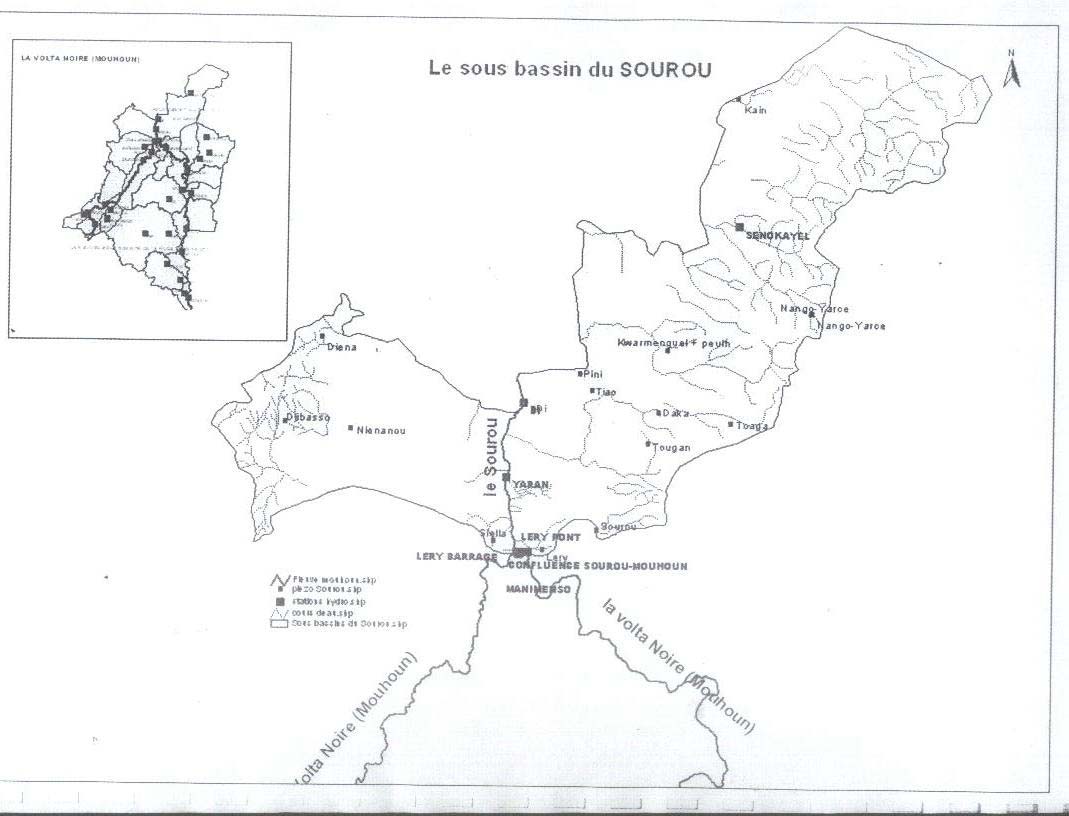
90
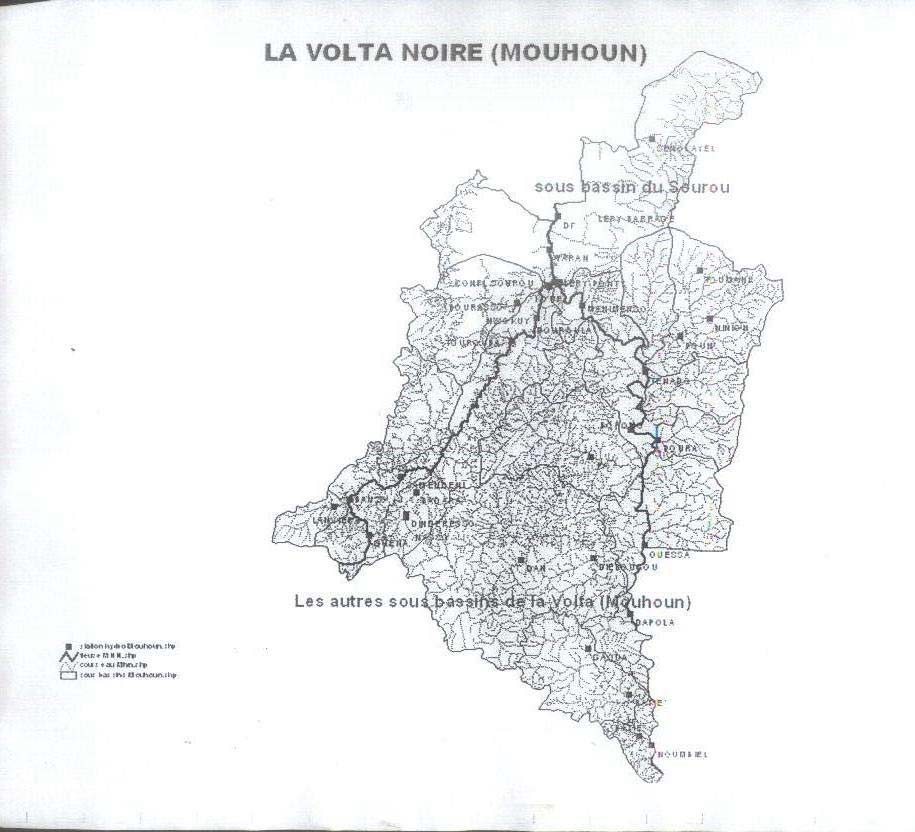
91
II DEMONSTRATION PROJECT # DP2
GEF/UNEP Volta River Basin Project
Addressing transboundary concerns in the Volta river basin and its downstream coastal area
Theme #1: Water efficiency and conservation
Theme 3: Sanitation
A. Project
title: Installing and comparing technological models of wastewater treatment in the towns of Kara
(Togo) and Natitingou (Benin) / Mise en place et comparaison de modèles de technologie pour la gestion des eaux
résiduaires dans les villes de Kara (Togo) et Natitingou (Bénin)
B. Participating
countries:
Country having submitted the project: Togo
Partner country: Benin
C. Executing
body: UNOPS and UCC-Water
D. Cost of Project:
USD 373 000
GEF Funding (specific to demonstration project DP2):
USD 250 000
Co-financing (from Benin and Togo):
USD 123 000
Besides the above, the other activities in the project would contibute to the implementation of the demo project,
which are costed at USD 18 000 (budgeted in main Project)
Abbreviations and acronyms
ABE
Agence Béninoise de l'Environnement
AP Approches
Participatives
BOAD
Banque Ouest Africaine pour le Développement
CDQ
Comité de Développement de Quartier
Citafric
"Cités d'Afrique" Agence de Développement Urbain et Municipal
CREPA
Centre Régional pour l'Eau Potable et l'Assainissement à faible coût
CVD
Comité Villageois de Développement
EIE
Etude d'Impact sur l'Environnement
EMO
Equipe de Mise en OEuvre du Projet
EU European
Union
GEF
Global Environment Facility
MDGs
Millennium Development Goals
NGOs
Non Governemental Organisations
PNAE
Plan National d'Action pour l'Environnement
PNHA
Politique Nationale d'Hygiène et d'Assainissement
PNS
Politique Nationale de Santé
PPO Planification
des
Projets par Objectifs
SIAAP
Syndicat Inter Départemental pour l'Assainissement de l'Agglomération Parisienne
SONEB Société
Nationale des Eaux du Bénin
TdE
Société Togolaise des Eaux
UCC-Water
UNEP Collaborating Centre on Water and Environment
UNEP
United Nations Environment Programme
VRBP
Volta River Basin Project
92
E. Linkage to problems and hot spots identified in the Project Brief
As part of the activities in the project preparation phase supported by a GEF PDF-B grant, national reports were
produced providing information on the problems relating to the priority transboundary environmental concerns in the
Volta Basin. The information contained in the national reports and the outputs of the meetings of regional
coordinators were put together and a Causal Chain Analysis, a preliminary TDA and a preliminary SAP were
prepared. The preliminary TDA identified the following list of major perceived problems and issues. The main
existing concerns identified in the basin are:
·
Land degradation
·
Water scarcity
·
Loss of biodiversity
·
Flooding
·
Water-borne diseases
·
Growth of aquatic weeds
·
Coastal erosion
·
Water quality degradation
In addition there are two emerging problems/issues:
·
Urbanization
·
Increase in Industrial and Mining Activities
The relevance of the list of concerns given above was confirmed by further studies carried out in the framework of
the GEF/UNEP GIWA Project (Global International Waters Assessment), where sub region 42 is the GCLME
(Guinea Current Large Marine Ecosystem) encompassing the marine part and its International tributaries, especially
the Volta River Basin.
To address these concerns, three principal components and their associated objectives were developed for the project
based on the areas of threats identified by the preliminary TDA and SAP:
Component 1:
Build capacity and create a regional institutional framework for the effective management of
the Volta Basin. This component is now handled by the EU project supporting the
establishment of a Volta River Basin Organisation. The project is being financed within the
frame of the EU Water Initiative and is executed by the ECOWAS Water Resources
Coordination Unit. Its budget (USD 1.25 million) is considered as a co-financing of the full
GEF/UNEP Volta River Basin Project.
Component 2:
Develop regional policy and legal and regulatory frameworks for addressing transboundary
concerns in the Volta Basin and its downstream coastal areas.
Component 3:
Initiate national and regional measures to combat transboundary environmental degradation in
the Volta Basin. The objective is to address the most critical transboundary concerns ("hot
spots") through the implementation of demonstration projects and the creation of partnerships
with the private sector and with other projects.
The Component 3, Activity 3.2 consists of "Developing and implementing three replicable demonstration projects"
under the main themes identified in the Preliminary TDA (the numbering of the themes is neither a ranking of
importance, nor an order of priority):
1. Water efficiency and conservation
2. Improve of flow releases from dams
3. Sanitation
4. Protection of ecosystems
5. Coastal
erosion
This demonstration project fits with the themes #1 and 3 here above. It was proposed by Togo and was elaborated
jointly with Benin. It refers to the causal chain analysis of water quality degradation featuring in the annexes to the
Project Brief. One of the causes of water degradation is the absence of sewage systems (figure 1). Water quality
degradation is one of the causes of water-born diseases, as shown by figure 2. It is also a source of nutrients which
inter alia facilitate the invasion of aquatic weeds.
93
Figure 1. Water quality degradation Causal Chain Analysis
Source: Preliminary Transboundary Diagnostic Analysis. Final Report, Dec. 2002. Annex B (Causal Chain Analysis). Figure B-16
Figure 2. Water borne diseases Causal Chain Analysis
Source: Preliminary Transboundary Diagnostic Analysis. Final Report, Dec. 2002. Annex B (Causal Chain Analysis). Figure B-13
F. Linkage to National Priorities and Programmes
.
F 1. General
As regards the environment, the national policies of Togo and Benin have the same general objectives: a rational
management of the environment to improve the living conditions of the populations, in the perspective of a
sustainable development. Togo and Benin are signatories of the main agreements on global environment.
In 1998, Togo and Benin committed themselves to develop national IWRM processes such as it is recommended at
the international level, while adapting it to their realities. This strong political commitment was renewed in 2002 in
Johannesburg and in 2003 in Ouagadougou.
In 2000 Togo and Benin (together with the other ECOWAS Countries plus Mauritania) adopted the West Africa
e
R gional Action Plan of IWRM. The Programme n° 5 of this plan is entitled "Cr a
e tion or revitalisation of
collaboration frameworks between riparian countries for the management of shared basins". It includes the creation
of new international agreements and management bodies for the river basins not yet organised (e.g. Volta River
a
B sin and its international tributaries).
The two countries subscribed to the Millennium Development Goals (MDGs), whose objective n° 9 is: (i) to halve
the proportion of people not having access to safe drinking water and (ii) to integrate sanitation into the strategies of
water resources management.
94
Togo and Benin are Member States of the Regional Center for Drinking Water and Sanitation at low cost (CREPA2),
whose principal concern is the development, capitalization, and sesitisation of technologies and operational
strategies of drinking water supply, basic hygiene, and sanitation. CREPA is recognized at the international level for
i s
t competences and its experience with demonstration projects in the field of water supply, hygiene, and basic
sanitation.
As regards the environmental protection, the two States are developing laws and policies: the Environment Code for
Togo and the Framework Law on Environ ent
m
for Benin, the Codes of Public Health, the Water Codes, and policy
documents like the National Environmental Action Plan (NEAP) for Togo, the National Health Policies, the National
Policies of Hygiene and Sanitation, the National Policy of Urban Mobility for Benin, etc.
Concerning the transfer of power to cities, the law on decentralisation is already operational in Benin. In Togo the
process of adoption of the law on decentralisation and local liberty is ongoing.
Many programs are engaged, incluidng the development of master plans of sanitation, the master plans of city
planning, urbanism, housing, decentralisation, etc., strategic action plans for cities (taking account of the
decentralization policy), etc. At the end of 2005, Togo created a "Ministry for the City" responsible for the urban
development in the country.
This whole process linking together environment, water and sanitation, living conditions, health and principle of
subsidiarity aims to: (i) mitigate the environmental degradation and alleviate its socio-economic costs; (ii) improve
the living conditions of populations and make them participate in the decision-making process within the frame of
the general objective of poverty reduction.
.
F 2. Sanitation
In Togo, funds from the West Africa Development Bank (BOAD) made it possible to undertake a technico-
economic study of the rehabilitation of roads, hydraulic works of storm water drainage, installation of latrines, as
well as an environmental study in seven medium size cities, including Kara. This study is coordinated by Citafric
(national agency for urban and municipal development). The final wastewater treatment component is not really
addressed by this study. Therefore, this demonstration project will only partly meet the expectations as regards the
final treatment of wastewater.
Within the framework of the decentralised co-operation, a discussion is ongoing between the Town councillors of
Kara and the Inter-departmental syndicate for sanitation of Paris and its suburbs (SIAAP) to initiate studies aiming at
working out a project of sewage system. In addition, attention is turned towards an increase in septic tank coverage
in th
e municipalities (which is no more than 25 %) allowing consequently the installation of a sewage network
leading, if possible, to a modern wastewater treatment plant. The present tendencies show the possibility o
f micro-
projects adapted specifically to some residential zones.
In Natitingou, some limited actions are ongoing in accordance with the master plans of urban planning (updated in
2004) and sanitation. In the same way, the development of the master plan of regional planning in the forthcoming
months will provide the city of Natitingou with a framework of reference, which can be used as "spinal column" to
solve its problems of sanitation. Nevertheless, nothing is yet engaged in the wastewater treatment.
G. Selection process and endorsement of the demonstration projects
The documents resulting from the preparatory phase of the overall project (PDF-B) are already endorsed by the GEF
National Focal Points and the governments of the six riparian countries as well as by UNEP. These are the following
documents:
-
i
The Prel minary Transboundary Diagnostic Analysis (Preliminary TDA);
- The Preliminary Strategic Action Plan for Integrated Manage e
m nt of the Basin (Preliminary SAP);
- The UNEP/GEF Project Document (and its annexes) defining the full project.
2The CREPA member countries are: Benin, Burundi, Burkina Faso, Chad, Côte d'Ivoire, Cameroon, Central African Republic,
Congo, Gabon, Guinea, Guinea Bissau, Mali, Mauritania, Niger, Rwanda, Senegal, Togo.
95
The full project has been submitted to the GEF Council in May 2003 and approved with some reservations, among
which the necessity to identify and precisely describe the three to four demonstration projects foreseen in the project
document. The elaboration of these demonstration projects was initiall
y anticipated to take place at the stage of
implementation of the full project, imposing a problem for the project start since it was seen as an important part of
the project which was not y t
e defined. Therefore, the GEF has mobilized additional funds through UNEP to identify
and formulate the three or four foreseen demonstration projects.
The selection and elaboration of the demons r
t ation projects was made through a transparent process started early
March 2005 by a call to h
t e countries to propose project ideas. The countries were also asked to propose CVs of
National Consultants, qualified for the further development of the three to four demonstration projects, which would
be selected.
The process of development of the demonstration projects involved:
-
The Directors of the National Focal Points of h
t e VRB Project;
-
The Regional Coordinator and the National Coordinators of the VR Project
B
;
-
The National Consultants proposed by the countries and appointed b UC
y
C-Water;
-
The experts of UCC-Water acting through a mandate of UNEP;
-
The Programme Officer in charge of International Wat rs i
e
n the UNEP/GEF Division.
According to the indications given by UNEP/GEF, the selection of the Demonstration Projects was guided by the
following criteria:
1. Global, regional, sub-regional, and plurinational nature of projects
2. Specificity / originality
3. Participatory nature
4. Gender approach
5. Programmatic approach
6. Sustainable Development Perspective
7. Capacity Building
8. Maximum utilisation of regional expertise
9. High rate of replication
10. Sustainability of activities
11. Funding and Co-Financing
12. Promotion of sharing of experiences and learning
13. Performance criteria
14. Thematic balance (among the themes recommended in the Project Brief)
15. Geographical balance (between the six Volta River Basin Countries).
16. No overlapping with other past, ongoing, or future projects
As one can see, the 16 crite a
ri above have neither all the same weight, nor the same restrictive strength. Some of
them are indicative, others are recommendations, others again are more directive, in particular, the plurinational
nature, the compliance with the themes identified by the T
DA, etc.
19 ideas of demonstration projects were proposed by the six countries of the Volta River Basin. The 19 proposals
received were scored, using, for each criteria, a numerical ranking adapted from the GIWA scoring. However, two
criteria do not apply to each project considered individually, but must be seen as general criteria that the final
selection, as a whole, has to respect:
The criteria of theme balance (N)
The criteria of geographical balance (O).
Four demonstration project ideas were selected by common agreement between UNEP/GEF, UCC-Water, and the
Regional Coordinator. The ideas selected were developed into demonstration Project Briefs by national consultants
assisted by UCC-Water.
The four demonstration project briefs were presented and discussed at a regional validation workshop, held in Lomé,
Togo (22-23 February 2006). Three demonstration projects were selected at the Lomé Workshop, to be forwarded to
N
U EP and E
G F in order to complete the Project Brief and to close the preparatory phase leading to the start of the
full project. They are re-numbered as follows:
Demonstration Project
DP1:
Joint management of a flow release warning system in the Sourou river valley
(Mali Burkina Faso)
96
Demonstration Project DP2:
Installing and comparing technological models of waste water treatment in the
towns of Kara, Togo and Natitingou, Benin (the present project)
Demonstration Project DP3:
Restoring and protecting the river beds of the Black Volta and its tributaries
through participative campaigns of reforestation (Côte d'Ivoire Ghana)
The fourth project (associating Ghana and Togo) is entitled "Fresh groundwater storage and movement between SE
Ghana and SW Togo and agronomic practices to safeguard the shallow freshwater lenses from salinisation". This
project was considered as relevant by the Lomé Workshop and proposed for subsequent execution, if the appropriate
finan in
c g can be mobilised.
The present version of the demonstration project DP2 (April 2006) was finalised by UCC-Water in collaboration
with the National Coordinators and h
t e National Consultants. It takes into account the recommendations of the Lomé
Workshop.
H. Project rationale Objectives, outputs and activities
H.1.
Background
The Kara town (~ 50 000 inhabitants) and the Natitingou town (~ 40 000 inhabitants) are located in North-East Togo
and in North-West Benin respectively, on both sides of the border betw
h
een t e two countries. In the region, the
annual rainfall ranges from 1000 to 1200 mm.
Sanit t
a ion issues are not specific to these towns. The VRB Project Brief stresses that they are generalised to all
medium size towns in the Volta River Ba i
s n. However, the two towns selected for this demonstration project
represent a typical case because the problems observed in the two towns show a high level of diversity and severity:
-
No collective sewage system;
-
Very few houses equipped with individual sewage systems (their design does not respect the basic rules and
presents risks of groundwater pollution);
-
No treatment of wastewater and other liquid effluents (from various sources: domestic, craft activities,
industries, agriculture, etc.);
-
Incomplete and poorly maintained storm water drainage system (moreover, the system - when it exists - is
used for the discharge of domestic wastewater or as solid wastes dumping sites); and
-
Direct discharge into the Volta river tributaries of substances resulting from the cleaning of latrines and
septic tanks.
The consequence of all these problems is the degradation of the environment, particularly the water quality, with
multiple negative effects:
-
Degradation of the life conditions of the population (hygiene, etc)
-
Proliferation of vectors causing water borne diseases like malaria, diarrhoea, cholera, bilharziasis, etc.;
-
Endemism of some diseases like cholera and typhoid fever (in 2003 Kara reported one third of the 103
severe cases registered in Togo); and
-
Urban erosion and transport of nutrients to rivers, facilitating the proliferation of invasive aquatic weeds.
Faced with the propagation of water borne diseases like typhoid fever, the Authorities of Kara planned to
i m
m ediately find a safe final destination for various wastes (solid and liquids) in order to avoid exposion of
inhabitants to medical hazards. For the moment, the municipal authorities could only identify one site, which has not
been installed with equipments for the discharge of wastewater resulting from emptying of septic tanks. On the other
hand, an enclosed dumping system was created for the domestic solid wastes.
In Natitingou, the Town councillors, and even the State technical administrations although conscious of the extent
of the difficulties related to the absence of systems for sewage and storm water drainage struggle to find adequate
solutions. Even if the technical solutions exist and are well known by the State technical administrations, the
mobilization of necessary financial resources remains to be an issue. Moreover, populations have difficulties in
understanding and accepting the concepts of basic sanitation (latrines, septic tanks, etc.). The situation does not
differ in Kara.
97
The financial restrictions do not make it possible in the immediate future to consider the realization of the water
drainage work. It is rather possible, according to municipal Authorities, to address, as soon as possible, the effluents,
which are currently discharged in an uncoordinated way at non suitable places. The sludge resulting from the
emptying of latrines and septic tanks is currently poured at the periphery of the cities and leaching of such
wastewater also leads to increased pollution of soils and water. As a result, there is an increased frequency of water
borne diseases due to consumption of contaminated food and/or water. These diseases can be extended to the zones
downstream of the sites of discharge.
Huge storms are frequent in the zones of Kara and Natitingou resulting in streaming, soil degradation by erosion, and
t a
r nsport of sediments and pollutants to the rivers crossing the two cities (Kara, Perma, Sinaissiré, Yapao). The
consequence is siltation in rivers and reservoirs and modification of their hydraulic regime with risks of flooding and
loss of capacity. It is a typical transboundary problem since the sediments from Natitingou are carried out towards
Togo.
Faced with these challenges and difficulties, the municipal authorities of Kara initiated and carried out a number of
joint actions with the population. Development Village Committees (CVD) and District Develo m
p ent Committees
(CDQ) were established in liaison with the Chiefs of districts and the Heads of the city technical services. Several
visits n
i the field and working sessions were also organised. It is within this r
f amework that the SIAAP is carrying
out work with the Town Councillors of Kara in order to improve the coverage of septic tanks and also to create or
reinforce the wastewater and storm water coll
i
ect ng system. Concerning storm water and latrines, the studies
undertaken by Citafric are ongoing, with the financing by the West African Bank of Development (BOAD) to
quantify works to be made in this direction.
In Kara, the Consultative Group, which may set up to manage the crisis of epidemic typhoid fever, identified some
sites for the discharge of effluents from the emptying of septic tanks. These sites are subject to discussion and
investigation in view of the construction of the treatment plant. Unfortunately, for financial reasons, no installation
has been made so far. The consequence is transfer of pollutants: cleaning of the septic tanks leads to contaminaiton
of soils and waters.
The choice of the sites of discharge already indicates the will of the local Authorities to start appropriate actions as
soon as possible in favour of the protection of the environment and population. The pre-selection of sites made in
Kara was guided by the following considerations:
-
Location at less t han 15 km from the City centre but away from residential areas;
-
Not to be located on the banks or at immediate proximity of th
vers drai
e ri
ning the City;
-
Make it possible to ext nd t
e
he plant at short, medium or long terms ;
-
Appropriate topography
ogy
and geol
; and
-
Climatic conditions.
In Natitingou, the network of storm water drainage is very limited (approximately 10 000 meters linear of gutters)
and there is a great lack of infrastructures for sanitation. This situation gives way to the pollution of the rivers
locat
h
ed near t e city (Perma, Sinaissiré and Yapao) along which a hydropower plant is installed. These problems
contribute to the deterioration of the living conditions of the populations of the city itself but also of the villages
downstream.
This project demonstrating the installation of a low cost technology of wastewater treatment is thus a priority
compared to the various problems referred to above. It aims at meeting a major need: to equip the towns of Kara and
Natitingou with an adequate treatment system for domestic wastewater and sludge resulting from the emptying of the
septic tanks and latrines.
Appropriate technology
Any complete wastewater treatment process includes the following steps:
-
Preliminary treatment;
-
Primary tre t
a ment;
-
Secondary treatment; and
-
Complementary or tertiary treatment.
98
The secondary treatment calls for appropriate technologies like biological filter, activated sludge, biological disks,
lagooning.
The systems using activated sludge or biological disks make it possible to deal with large quantity of effluents but
require a great technological control and induce high operating costs. Biological filter (bacterial bed) requires much
care to avoid repe t
a ed sealing of slag, even more for communities where technicians are not yet trained to this type
of installations.
It is therefore recommended to forecast a technology which will not give troubles to beneficiaries at the
i plem
m
entation stage.
Taking account of these considerations, the choice should be made based on the most appropriate technology, i.e.
lagooning. The discussion remains open on the type of lagooning: simple, microphytes, macrophytes. At the stage of
the demo project development, it is impossible to decide and the final selection will be made on the basis of bio-
chemical analyses of the effluents to treat. Whatever the type of lagooning, the effluents will be provided by
cesspool emptiers.
Whate e
v r the system it will also be necessary to involve the beneficiaries in the process. The participation of
stakeholders will fit with the promotion of income generating activities and will increase the use of emptying
services by the population. Nowadays, less than 20 % of the population uses emptying services by cesspools. The
objective is to increase this ratio.
H.2.
Objectives, expected results and activities
e
G neral objective
Restore the water quality and improve the living and health conditions of the populations of Kara (Togo) and
Natitingou (Benin) through the adoption of appropriate technology of wastewater treatment
Immediate objectives
1. Immediate objective n° 1: Develop integrated programmes associated with sanitation, reduction of water
borne diseases and poverty alleviation, in collaboration with the Town Councillors and with the
involvement of populations through the local NGOs;
2. Immediate objective n° 2: Equip the towns of Kara and Natitingou with appropriate systems of collecting
and treatment for wastewater and other effluents and develop their capacities in these matters;
3. Immediate objective n° 3: M
onitoring of the effects (on water environment and population) of a better
sanitation system.
Post project objective
4.
Post-project objective n° 4: Replication of the project in other towns having the same concerns.
It is assumed that the activities entering the general execution and implementation of the core projects are covered by
the core budget (component 1). This includes the missions to the field of the Regional Coordinator and the two
National Coordinators, the evaluation mission, if deemed necessary, and the dissemination of results, etc.
Results and activities under the immediate objective n° 1: Develop integrated programmes associated with
sanitation, reduction of water borne diseases and poverty alleviation, in collaboration with the Town Councillors and
with the involvement of populations through the local NGOs
Expected result n° R1.1.
The demonstration project management bodies are established and function
Activity n° A1.1.1. Negotiate, sign and i pl
m ement a convention of collaboration with the Cites of
of the Togo and Benin Governm
Kara and Natitingou, with the approval
ents
Activity n° A1.1.2. Negotiate, sign and implement a convention of collaboration with local NGOs
exerting respectively in the regions of Kara and Natitingou
99
Activity n° A1.1.3. Negotiate, sign and implement a convention of collaboration with national
water quality laboratories
Activity n° A1.1.4. Define, order and install the complementary equipment in the two Cities
Activity n° A1.1.5. Monitoring of the demonstration project by the Officials of the overall project
The conventions will stipulate the roles of the various operators in the demonstration project and the detailed
budgets. They will also stipulate: (i) the composition of the Bilateral Project Committee and (ii) the staff
involved in the demonstration project and the conditions of their interventions.
Expected result n° R1.2.
The practices and behaviours favourable to the protection of water quality and
the promotion of human health and are supported and promoted
Activity n° A1.2.1. Assessment of the situation in Kara and Natitingou at the beginning of the
demonstration project
Activity n° A1.2.2. Training and capacity building:
· Training of the Technical staff of the two Cities
· On site training of the operators of the sanitation plants
· Workshop on micro-treatment plants
Activity n° A1.2.3. Workshop on public participation
Activity n° A1.2.4. Sensitisation campaigns with the support of local NGOs
Results and activities under the immediate objective n° 2: Equip the cities of Kara and Natitingou with
p
a propriate systems of collect and treatment plants for wastewater and other effluents and develop their capacities in
these matters
Expected result n° R2.1.
The Cities of Kara and Natitingou are both equipped with pilot microphytes
lagoons for the sanitation of wastewater
Activity n° A2.1.1. Site
investigation
Activity n° A2.1.2. Construction of the two sanitation plants by the two Cities
Expected result n° R2.2.
At least 50% of wastewater (from dom
m
estic and com ercial sources) are
collected and treated in the sani a
t tion plants
Activity n° A2.2.1. Operation of the treatment plants (including the definition of the long term
operation procedures by the City Councillors)
Results and activities under the immediate objective n° 3: Monitoring of the effects (on water environment and
persons) of a better sanitation system
Expected result n° R3.1.
The demonstration project is monitored (will be followed up on the long term
by the two Cities during the post project phase)
Activity n° A3.1.1. Monitoring (this activity will be followed up on the long term by the two Cities
after the completion of the demonstration project)
Results and activities under the post-project objective n° 4:Replication of the demonstration project
(For record only) This objective will be fulfilled either by the overall projects (if it is possibl d
e uring the
i pl
m ementation phase) or in the frame of other projects after completion of the overall project.
Expected result n° R4.1.
The demonstration project is replicated on site 1
Expected result n° R4.2.
The demonstration project is replicated on site 2
I. Project Management Structure
According to the decentralization acts wastewater management is now under the domain of the local communities in
Togo as well as in Benin. Thus the Mayor's Office of Kara and that of Natitingou have the responsibility of all
wastewater disposal operations on their respective territories, and they must play a leading role in this demonstration
project.
100
The management structure of the demonstration projects is in conformity with the management structure of the
overall project, notwithstanding the necessary adjustments to the institutional arrangements as described in the
project document, to comply with the process of establishing a basin organization for the Volta river basin, and to
comply also with the responsibilities of the Executing agencies. The general organization chart of the demonstration
projects is shown by figure 2 below.
Figure 2. General organisational flow chart of the overall project and the demonstration projects
UNEP/GEF
N
ational Focal Points (NFP)
Steering Committee
Volta Basin Organisation
= National
P roject
Executing agencies
D irectors
(
NPD)
Regional
Other projects
Coordination Unit
NFP
NFP
NFP
NFP
NFP
NFP
(NPD)
(NPD)
(NPD=
(NPD)
(NPD)
(NPD)
National
National
National
National
National
National
Com i
m ttee
Committee
Committee
Committee
Committee
Committee
a
M li
Burkina
Côte d'Ivoire
Ghana
Togo
Benin
Project DP1
Project DP3
Project DP2
Taking into account that demonstration project DP2 is a small demonstration project, the project management
structure will include:
-
One Project Manager (part time) proposed and taken in charge by the City of Kara or by the Togo
Government (if the City of kara has not the requested human resources). For reasons of homogeneity with the
two other demonstration projects, th
the hierarchical
e Project Manager will be placed under
authority of the
Regional Coordination for all aspects dealing with administration and finances, and will work with the
National Coordinators for all substantial aspects of the project (scientific, technical social, etc.).
-
One Deputy Project Manager (part time) proposed and charged by the City of Natitingou or by the Benin
Government, in the same conditions as above.
-
The support staff will include an Accounting Secretary (part time, taken in charge by the City of Kara).
-
Nat onal
i
consultants for the baseline appraisal (in French « Etat des lieux ») and for site investigations.
-
Inte
i
rnat onal consultant(s) for the development of a mathematical model of the area of confluence of
Mouhoun and Sourou.
-
Sub-contractors working under conventions of collaboration (NGOs)
-
A Bilateral Pilot Committee composed of representatives of Togo and Benin stakeholders. Those are
mainly the national and local institutions, the populations of the two Cities, the local NGOs of water and
environm
sect
ent
ors. Its composition could be the following (it would be specified more precisely in the
inception report):
·
In Togo:
- the Mayor of Kara or his representative (Chairm n
a of the Committee);
101
- the National Coordinator of the Overall Project;
- a representative of the inhabitants of Kara;
* representatives of the decentralized organs of the concerned technical administrations:
-
the regional Environment Directorate (Direction Régionale de l'Environnement);
-
the regional Service of Hygiene and Sanitation (Service régional de l'Hy ène et
gi
de
l'Assainissemen;
-
the Regional Directorate for Urbanism and Habitation (Direction Régionale de l'Urbanisme et du
Logement);
-
the Regional Directorate of Mines, Water and Energy (Direction Régionale des Mines, Eaux et
Energie); and
-
the Regional Directorate of the Togolese Water Supply company (Direction Régionale de la
Société Togolaise des Eaux (TdE)).
·
In Benin:
- the Mayor of Natitingou or his representative (Vice Chairman of the Committee)
- the National Coordinator of the Overall Project;
- a representative of the inhabitants of Natitingou;
* representatives of the concerned technical administrations:
-
the Directorate of Urbanism and Sanitation (Direction de l'Urbanisme et de l'Assainissement);
-
the Environment Directorate (Direction de l'Environnement) or ABE ;
-
the Directorate of Hygiene and basic Sanitation (Direction de l'Hygiène et de l'Assainissement de
Base);
-
the Regional Service of Wate
ce R
r (Servi
égional de l'Hydraulique); and
-
SONEB.
The frequency of meetings of the Bilateral Pilot Committee will be specified in the inception report (in principle on a
quarterl
y basis). The secretariat of the bilat r
e al Committee will be assumed by the Project Manager. The lessons
learned i
w ll be discussed at the Bilateral Pilot Committee and will be disseminated tothe other parts of the Volta
River Basin.
Figure 3. Organisatio
o
n of the demonstrati n
project DP2
NFP = National Focal Point (the national
institution entrusted by the Government to
fulfil the national direction of the overall
project)
NPD = National Project Director
102
Steering Committee
Executing agencies
Regional Coordination
NFP
NFP
(NPD)
(NPD)
National
National
Committee
Committee
Togo
Benin
Project DP2
Togo
Benin
stakeholders
stakeholders
Bilateral Pilot Committee
J. Stakeholders and beneficiaries of the Project
The stakeholders and/or the beneficiaries of the project are the following:
·
the two municipalities, which are the principal beneficiaries of the project. They are to be supported by the
organs of the demonstration project and by other state-based structures engaged in the management of urban
salubrity, waste water and environment, and their capacity of intervention will therefore be reinforced with
the realization of the project;
·
the contractors, the NGOs and the consultants, which equally contribute to the implementation of the
project by their provision of services;
·
the populations of the project intervention zone, who eventually will experience an improvement of their
standard of living. They are thus the greatest beneficiaries of the project;
·
the technical administrations of the two countries, in charge of environment, water, sanitation, etc.
·
the populations of other towns within the Volta Basin where replication of the results is appropriate.
K. Sustainability of the project
h
T e development of the wastewater treatm n
e t system is first and foremost a project for the two communities, namely
the municipalities of Kara and Natitingou, as their authorities have noted. However, the lack of input has hindered
the implementation of the strategic plans that include the development of the wastewater treatment facility.
In order to secure the long term sustainability of the project a mechanism of sustainaing the acquired project results
shall be defined th
h
rough t e elaboration of a strategy during and after the project. It is essentially a question of
reinforcing the capabilities of the Town Councils and the local NGOs:
-
to manage the equipments and structures of wastewater treatment system developed during the project, then
in terms of improved intervention in matters related to wastewater management, especially in the zones not
covered by the project,
-
to make the population aware of the problems related to wastewater management and th i
e nfrastructures
implemented to this purpose in the two towns;
103
-
to evoke the interest of the population for the sludge collection and emptying of pits by the proposed
campaigns of awareness raising aiming at the development of responsibility of the population;
-
to increase the coverage of latrines and other sanitary works in the towns, by depending on the proper input
and contribution from the stakeholders and other partners,
-
to implement the sludge removal activities of the municipal services and/or the NGOs against a price that is
supportable for the population according to a contract defined by each town council.
.
L Replicability of the project
The resolution of the cross-border problems connected with transport of pollutants, solid wastes and vector-borne
diseases via the watercourses should be connected with action in all the communities of the basin.
Addressing the pollution problems in the streams and rivers (tributaries to the Oti) at the towns of Kara and
Natitingou, makes it possible to protect their respective environment and population from all the negative
consequences mentioned in the context section (§ H.1.). All the towns in the basin are confronted wi h
t the same
problems. In this respect, the methods and the results of the project are easily applicable firstly to all the parts of the
two towns of the project, and secondly to other towns in the basin.
This s
i so much more justified, since actually only around 20% of the population benefits
col
from
lection services,
name y
l around 1000 m3 (for Kara) and 800 m3 (for Natitingou) of raw untreated sludge being released here and there
in the environment.
e
B yond the Volta River Basin the waste treatment problems in the medium-sized African towns almost always
present similar problems: climatic conditions, public health problems, environmental problems, insufficiency of the
technical capacities. The financial resources of the community councils need to lead to the fulfillment of the
responsibility by the d
ecentralization acts (general tendency in West Africa and in the rest of the continent).
It is so
al
expected that th s
i demonstration project should be easily reproduced at other sites, of which the sanitation
problems are detrimental,
sol
not
ely for the health and the living conditions of the inhabitants, but equally for the
environmental conditiondownstream of the urbani
t
zed si es.
This r
p oject will certainl
y lead to exchanges of experiences and very positive transfers of technology for the member
states of the basin and, possibly for other countries.
M. Monitoring and Evaluation Process
Monitoring and evaluation will be in form of reporting, visual inspection, field sampling, workshops and seminar
results.
The details of indicators are provided in the project logical framework below.
M.1. Project monitoring
The day to day monitoring of the project will be made by the executing agencies of the overall VRB Project, through
the Regional Coordination, and through the National Coordinators of Mali and Burkina Faso. The monitoring will be
based on periodic reports elaborated under the responsibility of the Project Manager, in collaboration with other
people involved in the project (Deputy Manager, Regional Coordinator, National Coordinators, etc.):
-
Progress report (quarterly);
-
Financial report (idem);
-
Proceedings of the meetings of the bilateral Committee (same periodicity as the meetings); and
-
Mission reports and field visit reports (upon necessity and opportunity).
The Project Coordinating Unit will develop a standard reporting format.
M.2. Project evaluation
104
The need forevaluation of the demo project will be assessed during the inception phase of the overall VRB Project.
Budgetary provision for the evaluation is made in th
l
e overal budget.
N. Co-financing
The co-financing is constituted b :
y
-
the contributions of the two municipalities (premises, staff and acceptance of certain facilities) ;
-
the contributions of the two natio
adm
nal
inistrations consisting of allocati
echni
on of t
cal staff to the
decentrali
services;
zed
-
the contri
i
but ons of th
R
e C EPA in
of docum
form
entation, technical advice, etc.; and
-
the contributions of the local NGOs
e of their m
(in work tim
embers).
Tables and figures
-
Logical Fram
e;
ework Tabl
-
Det i
a led budget;
-
m
Sum ary budget by component output
s;
-
Wo
an;
rk pl
and
-
Location of the towns of Kara (north Togo) and Natitingou (north Benin) in the Volta River Basin.
105
Logical framework table
e
Narrativ description
Ob
le I
jectively Verifiab
ndicators
Means of verif c
i ation
Ass m
u ptions and risks
The quality of f
e fluent (N, P. BOD and pathogens,
Restore the water quality and improve the living and etc.) impro e
v d;
Overall
health conditions of the populations of Kara (Togo) 50% reduct oin ni untreated sludge (from 1,800 m3);
objective
and Natitingou (Benin) through the implementation Increase in coverage of sewage collection (from 20%
of appropriate technology of wastewater treatment
to at lea t
s 5 %
0 )3
Develop integrated programmes associating
Programmes
Conventions of collaboration
Com i
m tment of local & central
sanitation, reduction of water borne diseases and
Training sessions
Work plans, Quarterly reports, authorities Awareness and
Immediate
poverty alleviation, in collaboration with the Town Activities of NGOs
Minutes of meetings
ownership of populations
objective 1
Councillors and with the involvement of populations People trained
Reports of workshops
Experience and skills of local
through the local NGOs
People trained
NGOs
Equip the towns of Kara and Natitingou with
The two treatment plants exist and are functional
Plans Reports of meetings
Know-how in microphytes
Immediate
appropriate systems of collect and treatment plants
The wastewaters are collected and treated
during the construction
lagoons construction and
objective 2
for wastewater and other effluents and develop their
Operation reports
operation
capacities in these matters
Immediate
Monitoring of the effects (on water environment and Reports on water quality monitoring
Water quality analyses
Human resources
objective 3
persons) of a better sanitation system
Statistics on water borne diseases
Registers of Health Centres
Data accessibility
Replication of the project in other towns having the
Objective 4
(For record only)
a
The replication will be m de after the completion of the demonstration project
same concerns
Results corresponding to immediate objective n° 1
The demonstration project management bodies Project activities under implementation
eetings, Progress
Minutes of m
Local political commitment and
R11
are established and function
reports
involvement
The practices and behaviours favourable to the Awareness raised, collection procedures followed
Progress reports
Successful communication
R12
a
protection of w ter quality and the promotion of
strategy, public interest
upported and promoted
human health and are s
Results corre p
s onding to immediate objective n° 2
The Towns of Kara and Natitingou are both
Infrastructure in place and operated
Site inspections, operation
Appropriately skilled personnel
R21
equipped with pilot microphytes lagoons for the
and progress reports
available for establishment and
sanitation of wastewater
operation of the plants
At least 50% of wastewater (from domestic and
Amount of wastes collected and disposed in the treatment Operation statistics and
Appropriately skilled personnel
R22
commercial sources) are collected and treated in the plants
a m
d inistrative reports
available for operation of the
sanitation plants
plants
Results corresponding to objective n° 3
The demonstration project is monitored
Evaluations of implementation
Progress reports
Results correspo d
n ing to ob
°
jective n 4: (For record only)
a
The replication will be m de after the completion of the demonstration project
3 The baseline and i
cat
ndi
ors are preliminary
d be
and shoul
clearl est
y
ablished and agreed upon through the component 3.
106
Detailed Budget (USD 1.00 = 535 Francs CFA)
GEF
In Kind Contribution
TOTAL
Cash
In-kind
Source
10 STAFF
11.00
Project
Staff
11.01 Project Manager Kara (per diem)
12,000.00
6,000.00 Gvt / Mayor
18,000.00
Deputy Project Manager Natitingou (per
11.02
diem)
9 600.00
6,000.00 Gvt / Mayor
15 600.00
12.00
Consultants
12.01
Inventory
Kara
5,000.00
5,000.00 Gvt / Mayor
10,000.00
12.02
Inventory
Natitingou
5,000.00
5,000.00 Gvt / Mayor
10,000.00
13.00 Support Staff
13.01 Secretary accountant
8 400.00
4 200.00 Gvt / Mayor
12 600.00
16 OFFICIAL VOYAGES
16.01 Mission national coordinators
3 800.00
3 800.00
16.02 Planning, follow-up, supervision by l'EMO
5,000.00
5,000.00
16.03
Coordination
Meetings 6,000.00
6,000.00
16.04
Final
Evaluation
0.00
0.00
0.00
0.00
20 SUB-CONTRACTING
22.01 Support consciousness raising
3,000.00
1 600.00
NGOs
4 600.00
22.02 Geotechnical site study and EIA
7,000.00
5,000.00
Gvt
12,000.00
22.03 Construction of purification basins
40,000.00
8,000.00
12,000.00 Gvt / Mayors
60,000.00
22.04 Supervision Construction of basins 5,000.00 2,000.00 Mayors
7,000.00
22.05 Management, care, maintenance of basins
18,000.00
18,000.00
22.06 Awareness building Campaign NGOs
15,000.00
10,000.00
NGOs
25,000.00
22.07 Water Quality Control Labo Nat. Bénin
5 200.00
5,000.00
Gvt
10 200.00
22.08 Water Quality Control Labo Nat. Togo
5 200.00
5,000.00
Gvt
10 200.00
22.09 Kits rapid water quality control
6,000.00
6,000.00
22.10 Spots, medias, posters 2,000.00
4,000.00
Gvt
6,000.00
30 TRAINING
32.00
Group
training
32.01 Training technicians of 2 Mayor's offices 6,000.00
1
500.00
1,000.00 Mayors
8
500.00
32.02 On job training technicians/workers 8,000.00
4,000.00
4,000.00 Mayors
16,000.00
32.03 Training NGOs for awareness campaigns
6,000.00
3,000.00
5,000.00 NGOs/Mayor
14,000.00
33.00 Reunions, conferences, work shops
33.01 Workshop "Options of micro plants"
1 200.00
1 200.00
33.02 Workshop "Public participation "
4,000.00
4,000.00
33.03 Meetings between agents of the two towns
30,000.00
6,000.00
12,000.00 Gvt/Mayors
48,000.00
33.04
Inauguration
ceremonies
1,000.00
Mayors
1,000.00
40 EQUIPMENT AND PREMISES
41.00
Consumable
equipment
41.01
Office
Consumables
10,000.00
10,000.00
41.02 Operation and maintenance motorcycles 6,000.00
4,000.00 Mayors
10,000.00
42.00 Non consumable equipment
42.01 Office and information equipment
8,000.00
8,000.00
42.02 All terrain Motorcycles (2)
6,000.00
6,000.00
42.05 Water Pumps (+ spare parts.)
3,000.00
7,000.00 Gvt / Mayors
10,000.00
43.00
Premises
40.01 Project office
6,000.00
Mayors
6,000.00
50.01 Water, electricity, telephone, internet 600.00
8,000.00 Mayors
8
600.00
99 GRAND TOTAL
250,000.00
31,500.00
109,800.00
391,300.00
Summary budget by component outputs (in USD)
Note: The project operation costs (staff, equipment and operation) are distributed over the essential results on a pro rata basis of
their value.
´
RESULTS GEF
COUNTERPARTS
TOTAL
1.1. The demonstration project management bodies are
70 600
34 200
104 800
established and function
1.2. The practices and behaviours favourable to the
protection of water quality and the promotion of
26 000
23 600
49 600
human health and are supported and promoted
2.1. The Towns of Kara and Natitingou are both equipped
with pilot microphytes lagoons for the sanitation of
57 000
36 000
93 000
wastewater
2.2. At least 50% of wastewater (from domestic and
commercial sources) are collected and treated in
74 000
29 500
103 500
the sanitation plants
3.2. The impacts and the progress control of the
22 400
18 000
40 400
purification plants are implemented
TOTAL
250 000
141 300
391 300
Location of the cities of Kara (northern Togo) and Nati ngou (northern B
ti
énin) in the Volta bassin
Demonstration Project # DP3
UNEP/GEF Volta River Basin Project
Theme # 1: Water efficiency and consedervation
Theme # 4: Protection of ecosystems
A. Project title: Restoring and protecting the river beds of the Black Volta and its tributaries through participative
campaigns of reforestati
on / Restauration et protection des lits de la Volta Noire et de ses affluents par des
campagnes participatives de reforestation
B. Participating
countries:
Country having submitted the project: Côte d'Ivoire
Partner country: Ghana
C. Executing
Body: UNOPS and UCC-Water
D. Cost of Project
:
USD
377
000
GEF Funding (specific to demonstration project DP3):
USD 200 000
Co-financing (from Côte d'Ivoire and Ghana):
USD 177 000
Besides the above funding, the demo project is supported through the other activities of the overall VRB project,
which is costed at US$18,000.
Abbreviations and acronyms
CIV Côte
d'Ivoire
DR Direction
régionale
DREF
rect
Di
ion Régionale des Eaux et Forêts
DSRP
Document de stratégie de réduction de la pauvreté
ECOWAS
Economic Community of the West Africa States
EPA
Environmental Protection Agency (of Ghana)
EU European
Union
GCLME
Guinea Current Large Marine Ecosystem
GEF
Global Environment Facility
GHA Ghana
GIWA
G o
l bal International Waters Assessment
NEPAD New
Partnership
for Africa Development
F
N P
National Focal Point
NPD
National Project Director
PDF
Plan directeur forestier de Côte d'Ivoire
PDF-B
Project Development Fund, level B
PEF
Périmètre d'exploitation forestière
PSF
Projet sectoriel forestier de Côte d'Ivoire
RD Regional
Direction
SAP
Strategic Action Programme
SODEFOR Société pour le développement des exploitations forestières
TDA
Transboundary Diagnostic Analysis
UCC-Water UNEP Collaborating Centre on Water and Environment
UNDP
United Nations Development Progra m
m e
UNEP
United Nations Environment
m
Program e
VRBP
UNEP/GEF Volta River Basin Project (overall project or "core project")
E. Linkage to problems and hot spots identified in the Project Brief
As a part of activities in the project preparation phase supported by a GEF PDF-B grant, national reports were
produced which provided information on the problems relating to the priority transboundary environmental concerns
in the Volta Basin. The information contained in the national reports and the outputs from meetings of regional
coordinators were put together and a Causal Chain Analysis, a preliminary TDA and a preliminary SAP were
prepared. The preliminary TDA identified the following list of major perceived problems and issues. The main
existing concerns identified in the basin are:
· Land degradation
· Water scarcity
· Loss of biodiversity
· Flooding
· Water-borne diseases
· Growth of aquatic weeds
· Coastal erosion
· Water quality degradation
In addition there are two emerging problems/issues:
· Urbanization
· Increase in industrial and mining activities
The relevance of the list of concerns given above was confirmed by further studies carried out in the framework of
the GEF/UNEP GIWA Project (Global International Waters Assessment) where the sub region 42 is the GCLME
(Guinea Current Large Marine Ecosystem) encompassing the marine part and its International tributaries, especially
the Volta River Basin.
To address these concerns, three principal components and their associated objectives were developed for the project
based on the areas of threats identified by the preliminary TDA and SAP:
Component 1: Build capacity and create a regional institutional framework for the effective management of the
Volta Basin. Part of this component is now covered by the EU project supporting the
establishment of a Volta River Basin Organisation. This project is financed by the EU Water
Initiative and is executed by the ECOWAS Water Resources Coordination Unit. The project
budget (USD 1,25 million) is considered as a cofinancing of the full GEF/UNEP Volta River
Basin Project.
Component 2: Develop regional policy, legal and regulatory frameworks for addressing transboundary concerns
in the Volta Basin and its downstream coastal areas.
Component 3: Initiate national and regional measures to combat transboundary environmental degradation in the
Volta Basin. The objective is to address the most critical transboundary
spot
concerns ("hot
s")
through the implementation of demonstration projects and the creation of partnerships with the
private sector and with other projects.
The Component 3, Activity 3.2 aims to "Develop and implement three replicable demonstration projects" under the
main themes identified in the Preliminary TDA (the numbering of the themes is neither a ranking of importance, nor
an order of priority):
1. Water efficiency and conservation
2. Improvement of flow releases from dams
3. Sanitation
4. Protection of ecosystems
5. Coastal
erosion
The present demonstration project complies with themes # 1 and 4 here above. It was proposed by Côte d'Ivoire
and was elaborated jointly with Ghana. It refers to the causal chain analysis of land degradation, in which lumbering
and cutting woods are quoted as one of the root causes (figures 1 and 2).
The lack of information exchange between the riparian countries and more generally the absence of management
bodies dedicated to international issues are two key issues of inadequate water basi
a
n m nagement.
This demonstration project aims to establish a co-operation between Côte d'Ivoire and Ghana around the Black
Volta River which forms the border between the two countries. The Black Volta and its tributaries are currently
impacted by land degradation and its consequences on water resources: erosion, turbidity, sedimentation on the river
beds and in the reservoirs, etc. Therefore, the present demonstration project is in line with the method and findings
of the preparatory phase (PDF-B) as they are presented in the Project Brief and its annexes.
Figure 1. Land degradation - Causal Chain Analysis
Source: Preliminary Transboundary Diagnostic Analysis. Final Report, Dec.
Annex B (
2002.
Causal Chain Analysis). Figure B-1
Figure 2. Detail of la
o
nd degradati n - Causal Chain Analysis of Lumbering / Cutting Wood
Source: Preliminary Transboundary Diagnostic Analysis. Final Report, Dec. 2002. Annex B (Causal Chain Analysis). Figure B-4
The two maps (in annex) show the zones of soil and forest degradation in the Volta Basin4. The correspondence
between the two maps confirms that:
"Degradation of the forest cover Degradation of water resources"
It may be understood that the degraded zones seem only to be located in Côte d'Ivoire. However, experts from the
two countries have confirmed that the degradation takes place at both sides of the border.
4 Source: Project Brief, Annex III. Demonstration Projects, scope, selection criteria's and location
These hot spots correspond to those identified by the communities living in these parts of the basin, i.e the Upper
and Northern Region in Ghana and the North-Zanzan and the South-Zanzan in Côte d'Ivoire.
The problems as described in the Project Brief can be summarized as follows:
1. The degradation of forest and aquatic ecosystems by repeated slush and burn agriculture, bush fires, and
excessive use of pesticides contributes to the loss of biodiversity in the basin;
2. Provision of wood energy (fire wood and charcoal, first source of
domestic energy for growing urban and
rural populations) is another important cause of degradation. Moreover, wood becomes more and more rare
and the difficulties in fetching it is a constraint to the development of the village communities; and
3. The increasing coefficient of runoff results in less recharge of groundwater and a high erosion of soils results
in loss of fertility and sedimentation in water courses and reservoirs.
Within the framework of the demonstration project it is appropriate to choose the Bondoukou department in Côte
d'Ivoire as the target area. The Bouna department in the North is currently not accessible for effective project
2
monitoring. The basin area in this region covers approximately 4.000 km with a high concentration of population in
the zones that are watered for the most part by the tributaries of the Black Volta.
In Ghana it has been decided to choose the "Northern region" of the basin.
The table below shows the identified hot spot areas in Côte d'Ivoire and Ghana and the ecological considerations
related to each of them.
Problems with management of the natural resources in relation to the hot spots
Hot spots
Problems
Main causes
Côte d'Ivoire
Ghana
·
Degradation of the forest
Zanzan Region,
Northen region
·
Clearance of forests to bring
·
Increase of the run-off from rain
District of
Chache,
them under cultivation
Bondoukou
water
Nteresso,
·
Increase in the illegal forestry
·
eepage
Sorobango, Sangabilé,
Reduction of the s
Kalba,
for timber production purposes,
·
even in the forbidden zones
Silting-up of water courses
Yérékaya,
Saru
·
Poukoubé,
·
Pollution of the river and its
Loss of soil fertility
tributaries by pesticides
·
Bandoli,
Reduction of the yields of the
Brong Ahafo
·
Destruction of the plant cover
agricultural activities
Débango
Koas
by forest fires
·
Degradation of the water quality
Kogyi
·
Destruction of habitats along
·
Degradation of ecological habitats
Soko
the water courses of the basin
(in particular hippopotamus) and loss
Buko
·
Increased evaporation and
of biodiversity
drying-out of the soil
·
Reduction of surface water and
·
Poverty of the riparian
groundwater
populations
·
High demand for wood energy and
strenuous supply.
F. Linkage to National/Regional Priorities and Programmes
F.1. Côte d'Ivoire
The Ivory Coast forest, estimated to cover 16 million hectares in the fifties, covers only 3 million hectares
nowadays. This degradation, caused primarily by the agricultural development (in average 200.000 hectares being
cleared every year) and by an exploitation of the forest for mining purposes, seriously affects the wood field which
is still one of the mainstays of the Ivory Coast economy.
In view of this situation the State of Ivory Coast has taken a number of measures trying, on one hand, to reassure the
industries having invested in enterprises within the wood field to take into consideration the conservtion of the forest
ecosystems and, on the other hand, to implement a sustainable management of the heritage of residual forests in
general and the forest ecosystems in the side basins in particular.
That is why the Forest Guidelines (PDF) were adopted in 1988 covering the period of 1988-2015. This plan defines
an extensive programme for rehabilitation, development and sustainable management of the forest sector, which
resulted in the Sectoral Forest Project (PSF) in 1990. The PSF only applies to the classified forests, of which
management was handed over to the Company for Development of Forests (SODEFOR) in 1992.
Concurrently, in 2000 guidelines for integrated management of water resources has been elaborated with a
subst n
a tial part being associated with forest ecosystems within the framework of the management plans for the river
basins.
In 1994, the decree no. 94-368 of July 1st introduced the reform of forestry in rural areas resulting in:
- allocation of forestry areas (PEF) of at least 25.000 hectares;
- introduction of a contribution to local development for the benefit of the riparian population of the PEFs;
and
- introduction of the obligation for recipients of PEF to reforest.
This reform represented a real revolution in a field that had been governed since 1974 by temporary exploitation
permits of 2.500 hectares and a complete lack of consideration of the local population's interests. From 1997 to
2004 the reform resulted in an average reforesting of 6.000 to 7.000 hectares per year carried out by the PEF
concessionaires in collaboration with the land owners and the local populations (association of women and young
persons), i.e. 60.000 hectares since the advent of the reform, of which one third are in the classified forests and two
thirds in the rural area.
With a view to efficiently ensuring the protection of these reforestat on agai
i
nst the bush fires5 the Minister of water
and forests has established an independent department under the Minister's Cabinet. The priority of this independent
department called "National Committee for Protection of Forests and Fight against Bush Fires" is to pursue
increased awareness of the populations in general and of the rural population in parti ul
c ar concerning the various
impacts of fires. These campaigns are based on a network of local NGOs of whom the leaders are situated in the
regions of Moyen Comoé and Zanzan. This last region is a hot spot for the implementation of the demonstration
project.
Finally, in order to channel all these rehabilitation actions for the ecosystems of the forests in Côte d'Ivoire, a
national reforesting programme is currently being elaborated by the Ministry of Environment, Water and Forests.
One of the import nt
a aspects of the programme is the implementation of a common reforesting process across the
Côte d'Ivoire territory in accordance with the broad outline of the Strategy Document for Poverty Reduction
(DSRP).
F.2. Ghana
Since 2001 the government of Ghana has been implementing a national planting programme covering approximately
20.000 hectares per year. The purpose of this
i
project s to ensure that within a five- year period 10% of the land is
covered by forests. This wolud consequently m ke up for t
a
he lack of timbers in the wood industry, ensure the
protection of water, guarant
h
ee t e supply of food nd ensure t
a
he protection of the environment.
The statistics in 2003 regarding this project showed that plantation of around 35.000 hectares had been carried out in
the degraded pre-forest zones.
After the severe drought in 1982 the bush fires have become a recurrent phenomenon in Ghana. They affect all types
of ecos st
y ems in the country regardless of the intensity of the dry season. The bush fires are therefore considered to
be the most important factor responsible for the loss of fertility of h
t e soils and soil input to the water bodies as well
as for the destruction of the biological diversity.
In order to remedy this, the Ghana Forest Commission has initiated a monitoring project for bush fires in the
transition zones. This project aims to promote the participation of the communities in the sustainable management of
natural resources. It has among other things been used t t
o est the programme for poverty reduction implemented by
h
t e Ghanaian government during the period from 2003 to 2005.
5 Bush fires are recurrent both in savannahs, pre-forest and forest areas. Their degradation contributes to the
appearance of a very flammable grassy vegetation, generally composed by Chromolaena odorata on dry lands and
Panicum maximum in the depressions.
At the same occasion, the evaluation document for the environmental strategy of the programme for poverty
reduction in Ghana has been prepared in order to assess the environmental impact (risks and opportunities) of these
different projects and to identify reliable means of environmental management. This programme is also part of the
global initiatives such as the NEPAD, which is a product of a long term vision for eradication of poverty and for a
sustainable development in the African countries.
G. Development and endorsement of the demonstration projects
The project documents resulting from the preparatory phase of the project (PDF-B) have already been endorsed by
the GEF National Focal Points and the governments of the six riparian countries as well as by UNEP. The following
documents have been quot
ed:
- The Preliminary Transboundary Diagnostic Analysis (Preliminary TDA);
- The Preliminary Strategic Action Plan for Integrated Management of the Basin (Preliminary SAP);
- The UNEP/GEF Project Document (and its annexes) defining the full project.
The full project description was submitted to the GEF Council in May 2003 and approved with some reservations,
one of these reservations was the necessity to identify and precisely describe the three to four demonstration projects
foreseen in the project document. The elaboration of these demo projects was initially anticipated to take place
before implementation of the full project imposing a problem for the project start since it was seen as an important
part of the project. Therefore, the GEF has mobilized additional funds through UNEP to identify and formulate the
three or four foreseen demonstration projects.
The selection and elaboration of the demonstration projects has been made through a transparent process started
early March 2005 by a call to the countries to propose project ideas. The countries were also asked to propose CVs
of National Consultants, qualified for the further development of the three to four demo projects, which would be
selected.
The process of development of the demonstration projects involved:
-
The Directors of the National Focal Points of the V B
R Project;
-
The Regional oordi
C
nator and the National Coordinators of the VRB Project;
-
The National onsul
C
tants proposed by the countries and appointed by UCC-Water;
-
The experts of UCC-Water acting through a mandate of UNEP;
-
The Programme Officer in charge of international waters in the UNEP/GEF Division.
According to the indications given by GEF/UNEP, the selection of the Demonstration Projects was guided by the
following criteria:
Q. Global, regional, sub-regional and plurinational nature of projects
R. Specificity / originality
S. Participatory nature
T. Gender approach
U. Programmatic approach
V.
ai
Sust nable Development Perspective
W. Capacity Building
X. Maximum utilisation of regional expertise
Y. High rate of replication
Z. Sustainability of activities
AA. Funding and Co-Financing
BB. Promotion of sharing of experiences and learning
CC. Performance criteria
DD. Thematic balance (among the themes recommended in the Project Brief)
EE. Geographical balance (between the si
t
x Vol a River Basin Countries).
FF. No overlapping with other past, ongoi
u
ng or fut re projects.
The above 16 criteria have neither the same weight, nor the same restrictive strength. Some of them are indicative,
others are recommendations, while others again are more directive, in particular, the multi-national nature, the
o
c mpliance with the themes identified by the TDA, etc.
A total of 19 ideas for demonstration projects were proposed by the six Volta River Basin countries. The 19
proposals received were scored, using for each criteria a numerical ranking adapted from the GIWA scoring.
However, two criteria do not apply to each project considered individually, but must be seen as a general criteria to
be respected during the final sel
i
ect on:
The critera of theme balance (N)
The criteria of geographical balance (O).
Four demonstration project ideas were selected by a common agreement between UNEP/GEF, UCC-Water and the
Regional Coordinator. The ideas selected were developed into demonstration project briefs by national consultants
assisted by UCC-Water.
The four demonstration project briefs were presented and discussed at a regional validation workshop, held in Lomé,
Togo (22-23 February 2006). Three demonstration projects (including this one) were selected at the Workshop, to be
forwarded to UNEP and GEF in order to complete the Project Brief and to close the preparatory phase leading to the
implementati
h
on of t e full project.. These demonstration projects are re-numbered as follows:
Demonstration Project DP1:
Joint management of a flow release warning system in the Sourou river valley
(Mali Burkina Faso)
Demonstration Project DP2:
Installing and comparing technological models of wastewater treatment in the
Cities of Kara (Togo) and Natitingou (Benin)
Demonstration Project DP3:
Restoring and protecting the river beds of the Black Volta and its tributaries
through participative campaigns of reforestation (Côte d'Ivoire Ghana)
(present project)
The fourth project (associating Ghana and Togo) is entitled "Fresh groundwater storage and movement between SE
Ghana and SW Togo and agronomic practices to safeguard the shallow freshwater lenses from salinisation". This
project was considered as relevant by the Lomé Workshop and proposed for subsequent execution if the appropriate
financing can be mobilised.
The present version of the demonstration project DP3 was finalised by UCC-Water, in collaboration with the
National Coordinators and the National Consultants. Moreover, recommendations from the Lomé Workshop are
t ken i
a
nto account in present project document.
H. Project rationale Objectives, outputs and activities
H.1.
Background
The downstream part of the Black Volta basin (its upstream part in Burkina Faso being called the Mouhoun) is
shared by Ghana and Côte d'Ivoire. The part, which is shared by the two countries, covers an area of 45.200 km2, of
which 12.000 km2 belong to Côte d'Ivoire and 33.300 km2 to Ghana. The average annual rainfall is 1200 mm in
Ghana and 900 mm in Côte d'Ivoire.
In Côte d'Ivoire as well as in Ghana the major part of the basin area is used for agriculture. There are no protected
areas, nor any state-owned zones intended for forests. At the Ghanaian side of the basin, in the Lawla district, the
degradation of the forest-covered land is so severe that the soil is no longer suitable for agriculture. This is due to the
combined impact of pastoralism, itinerant agriculture on burned land and bush fires. In Ghana, the south-east part of
the basin is also characterised by a serious degradation accompanied by a strong erosion of the banks of the Black
Volta.
By analysing satellite images the Ghanaian aEPA has revealed that the north-west part of the basin, particularly near
the banks of the Black Volta in Côte d'Ivoire as well as in Ghana, suffers from an advanced degradation of the
forest-covered area, resulting in a major risk of vulnerability to desertification and climatic changes.
This degradation has led to the drying up of waters followed by a loss of biodiversity, a modification and destruction
of habitats, a loss of fertility of the soils, resulting in a reduced yield from the agricultural investments, a decrease or
even rarefaction of the fishery resources, and a reduction of the recharge of groundwater leading to the migration of
h
t e local populations towards more clement areas.
H.3.
Objectives, outputs and activities
The general objective is the sustainability of water resources in the Black Volta River basin through participative
campaigns of reforestation on both sides of the border between Côte d'Ivoire and Ghana.
The general objective will be reached through three immediate objectives:
1. Immediate objective n° 1: Capacity building of the stakeholders, particularly the riparian populations
2. Immediate objective n° 2: Restoration / protection of pilot plots of land through experimental and
demonstrative actions
3. Immediate objective n° 3: Replicate the demonstration project methodology and outcomes and disseminate
the lessons learned
The activities corresponding to objective n° 3 (and associated results) will not be carried out in the framework of the
de o
m nstration project. They will be carried out under other projects inside or outside the Volta basin (with the
support of the overall VRB Project under its component n° 1).
The objectives, outputs and activities are summarised in the logical framework presented hereafter.
I. Project Management Structure and Accountability
I.1. General
The management structure of the demonstration projects is in conformity with the management structure of the
overall project, notwithstanding the necessary adjustments to the institutional arrangements as described in the
project document, to comply with the (ongoing) process of establishing a basin organization for the Volta river
basin, and to comply also with the responsibilities of the Executing agencies. The general organization chart of the
three demonstration projects is shown by figure 3 below.
Figure 3. General organisational flow chart of the overall project and the demonstration projects
UNEP/GEF
National Focal Points (NFP)
Steering Committee
Volta Basin Organisation
= National
Project
Executing agencies
Directors
(NPD)
Regional
Other projects
Coordination Unit
NFP
NFP
NFP
NFP
NFP
NFP
(NPD)
(NPD)
(NPD=
(NPD)
(NPD)
(NPD)
National
National
National
National
National
National
Committee
Committee
Committee
Committee
Committee
Committee
Mali
Burkina
Côte d'Ivoire
Ghana
Togo
Benin
Project DP1
Project DP3
Project DP2
The specific organisational chart of the demonstration project DP3 is similar to those of DP1 and DP2. It is shown
by figure 4 below.
Figure 4. Organisation of the demonstration
project DP3
Steering Committee
NFP = National Focal Point (the national
institution entrusted by the Gov
Executing agencies ernment to fulfil
the national direction of the overall project)
NPD = Nat
R io
e n
gi al P
onalroj
C ect D
oordi ire
natcitor
on
NFP
NFP
(NPD)
(NPD)
National
National
Committee
Committee
Côte d'Ivoire
Ghana
Project DP3
Côte d'Ivoire
Ghana
stakeholders
stakeholders
Bila e
t ral Pilot Committee
I.2. Project Implementation Team
A project Implementation Team will be established. It will be constitut d
e as follows:
- A Project a
M nager appointed by the Côte d'Ivoire Administ i
rat on;
- An assisting Project Manager appointed by the Ghanaian Administration;
- A part-time bilingual secretary-accountant (placed next to the Project Manager), responsible for all
administrative and financial questions related to the regional coordination of the overall
;
project
- Two part-time drivers made available by the national administrations.
The Project Impl
ent
em
ation Team shall work under the hierarchic authorit
y of the executing agencies for the overall
project. The
Project Manager is responsible for his management to the R gi
e onal Project Coordinator, who aga n i
i s
responsible to the Executing Agencies (UNOPS and UCC-Wa e
t r).
The Black Vol a
t basin is situated far away from the two cap t
i als of the beneficiary countries. The Project Manager
from Côte d'Ivoire will be based at the Regional Department of Water and Forests of Zanzan in Bondoukou. The
assisting Project Manager will work at full-time from the Ghanai n
a side of the basin in close collaboration with the
Project Manager.
The Team Leader based in Bondoukou will be supported (and
a
supervised in technical m tters) by the Regional
Department of Water and Forests of Bondoukou regarding coordination with the other environmental sectors, the
local NGOs, and the riparian communities of the Black Volta basin. From the Ghanaian side the support will be
given through decentralised departments of the Environmental Protection Agency (EPA), representing the local
institutional support to the Ghanaian expert of the project.
The Project Manager and his assistant will work in close collaboration with all the state-controll d
e technical
structures for the project, namely : the faculties of natural science of their respective countries (division of botany),
the Ministry of Agriculture and the l nd
a
managing division of EPA for Ghana, and the Ministry of Agriculture and
the National Coordination of the plan for rural land for Côte d'Ivoire. From time to time and according to the
execution chronogram of the project, the Project Team will make use of services from consultants as well as NGOs
working as subcontractors.
I.3. Bilateral Pilot Co m
m ittee
This committee, consisting of partners from the public sector, the private sector and the associate sector (NGO)
working in the field of management of natural resources, is responsible for oversight and follow-up of the
demonstration project activities. The regional managers of wa e
t r and forests in Côte d'Ivoire n
a d of the environment
in Ghana (EPA) jointly chair this committee and supervise at the technical level the activities carried out within the
framework of the project.
J. Stakeholders and Beneficiaries
J.1. Stakeholders
The decentralised administrations of the ministries involved in the implementation of the different operations of the
project will be stakeholders as well as the decentralised authorities, the professional agricultural organisations and
the non-governmental organisations, selected in transparency and according to pre-established criteria. The
decentralised authorities should be leaders of the stakeholders in order to sensitise the project and ensure the well
fare of the population in a restored forest landscape.
J. 2. Beneficiaries
h
T e beneficiaries are the rural communities in Côte d'Ivoire and Ghana living in the areas of the different hot spots,
which have been selected for implementing the demonstration project.
The native populations (land-owners) as well as the non-indigenous populations should profit from the effects of the
project. The project is going to work with these communities, which should organise themselves in association with
women and young people executing specific tasks: the associations of women will be mostly involved in the
production of plant material while the men will be exclusively employed by preparing the land for reforesting, by
river dredging, by
works,
silvicultural
etc. Certain work will be done by mixed teams. The selection of direct
beneficiaries should be done according to the impartial criteria guaranteeing a complete participation of the
populations directly concerned about the project. From the Ghanaian side approximately 200 agricultural families
spread over the targeted "hot spots" with l
at east 30% having a woman as head of the family participate directly
in the implementation of the project. From Côte d'Ivoire the targeted beneficiaries have already been regrouped in
active organisations in the field:
- Local authorities, town councils;
- Associations of women;
- Associations of young people;
- Land-owners, farmers;
- Regional committees for the fight against bush fires;
- Professional agricultural organisations (OPA).
The table below describes the stakeholders, who have been identified during the project preparation, their activities
and the effect of these activities in the field.
Operators CIV / Activities Impacts
GHA
EPA / DR Eaux Environmental education
Restored forest
et Forêts -
programme
landscapes
DRCF
Training courses for authorities
Waters and other habitats
Project coordination
restored in order to
National and regional radio and
maintain the biodiversity
TV programmes
Reduction of bus
h fires
Riparian
Establishment of tree breeding
Poverty reduction
populations
Detection and fight against the
Environmental
bush fires
management capacity
Agro-forested activities and
building
dredging of river beds
Restoration of the
environment
RD MofA /
Course on agro-forest practices
Restoration of the soil
DRCF-DREF
Course on the impacts of fires on fertility, reduction of the
Bondoukou-
the soil in cultivated areas
erosion
CNRA-
Course on the concept of
Reduction of fires and
ANADER
agriculture without land-
their impact on the soil
burning/fires
RD Waters &
Supply of grains and plants
Forest landscapes of the
Forest GH / DR Assistance to the establishment
restored basin
EF CI-DRCF-
of breeding-grounds
Protection of soils, wild
SODEFOR
Assistance to the reforesting and faun habitats and water
the silviculture work
resources
ONG-OPA
Mobilisation and awareness
Forest landscapes of the
raising of the communities
restored basin
Course in protection of water
Communities with
against pesticides and communal awareness of
forests
environmental
programmes
District
Passing of a law n
o protection of
Restored forest
Assemblies
the basins
landscapes
(DAS) in GHA / Evaluations
The communities
Local
Consideration of environmental
appropriate the practices
Collectivities in projects in the action
of environmental
CIV
programmes of the local
protection
communities
GHA Bush fire
Establishment of committees
Reduction of bush fires
Office /
combating fires u
sing new
Success of the "no fire"
National
techniques
concept
Ivorian
Introduction of a national radio
Committee of
and TV programme for awareness
Forest
raising and fight against the bush
protection and fires
control of bush
fires
K. Long-term Sustainability Strategy
The natural resources targeted by the project (waters and forests) are vital for the riparian populations, who are
therefore motivated to watch over the sustainability of the project. They will have the capacity of doing so based on
adequate capacity building programme for each key stage of the demonstration project.
The applied technologies are adapted to the local context and therefore easy to pursue once the demonstration
project is terminated.
The forest species used for the reforesting (acacia, teak, gmelina and eucalyptus) have the advantage of being easily
regenerated by shoots or by buried sowing.
The reforestation does not mean a loss of soil for other cultures. On the contrary it allows the development of the
agro-forests. The populations can grow subsistence crops after the first cut of acacias since the regeneration of the
soils is ensured. Other agro-forest associations such as hedges, edible forest fruit trees or trees for other purposes
(shea, néré, faidherbia) with intercalary cultures ensure the sustainability of the project results.
The involved institutions will be strengthened and will be more capable of overseeing the sustainability of the
project.
Finally, different environmental micro-projects i.e. within the framework of the UNDP/GEF Small Grant projects
could be included in the annual working programmes of the decentralised communities (villages, general councils
for Côte d'Ivoire and the district assemblys for Ghana) and the governmental agencies in order to complete and
s r
t engthen the sustainability of the project.
L. Replicability
The silting-up of the water cours s
e and the progressing desertification are acute trans-national problems for the
whole Volta basin.
The project is easily transferable to the other zones or the other countries of the basin, or even to the other basins in
the region (North Comoé, Niger, etc.), since the applied technologies and materials are local and appropriate for a
certain bio-geographic context. The project is based on the local and traditional knowledge of the population as well
as on the national expertise in terms of prevention and combat against the desertification, of reforestation and wood
technology. The technologies proposed by the project are easily assimilated by the local populations.
h
T us, many sites suitable for replication can easily be identified in the Volta River Basin.
Furthermore, the demonstration project DP3 shows a way to establish a bilateral Committee dealing on the short
term with the specific problems of land degradation, especially deforestation. In the long term the bilateral
Committee might have its mandate enlarged to other aspects of water resources management, and it can become a
sub-body under the overall Volta basin organisation.
M. Monitoring and Evaluation Process
Monitoring and evaluation will be in form of reporting, visual inspection, workshops and seminar results.
The details of indicators are provided in the project logical framework below.
M.1. Project monitoring
The day to day monitoring of the project will be made by the executing agencies of the overall VRB Project,
through the Regional Coordination, and through the National Coordinators of Côte d'Ivoire and Ghana. The
monitoring will be based on periodic reports elaborated under the responsibility of the Project Manager, in
collaboration with other people involved in the project (Deputy Manager, Regional Coordinator, National
Coordinators, etc.).
The table below gives the list of the various reports to be produced by the demonstration project.
Reports Drafted
by
Periodicity
Addressees
National Coordinators, Regional
Quarterly work plan
Head of project
3 months
Coordinator, Bilateral Pilot
Committee.
Head of project (as
National Coordinators, Regional
Minutes and reports of
Secretary of Bilateral Pilot 3 months
Coordinator, Executing Agencies
meetings
Committee)
Ivorian and Ghanaian Authorities
National Coordinators, Regional
Quarterly activity report
Head of project
3 months
Coordinator, Executing Agencies
National Coordinators, Regional
Yearly activity report
Head of project
1 year
Coordinator, Executing Agencies
National Coordinators, Regional
Financial report
Head of project
1 year
Coordinator, Executing Agencies
When deemed
Technical reports
Project operators
All people concerned
necessary
National Coordinators, Regional
End of project report
Head of project
Coordinator, Executing Agencies
The Project Coordinating Unit will develop standard reporting formats for each of these reports.
M.2. Project evaluation
The need for evaluation will be assessed during the inception phase of the overall VRB Project. Nevertheless, a
provision is made in the budget for evaluaiton. In all cas
be
es, the cost of evaluation will
charged on the Core
budget.
N. Co-Funding
The co-funding is constituted by:
-
the st
ders of t
akehol
he two national administrations consisting of support of technical staff from the
decentralised departments ;
-
the wood manufacturers ; and
-
the contributions of the local NGOs (as working time of their members).
The majority
h
of t e co-funding from the countries comes from the reforestation. In fact, out of the 200 hectares of
planned reforestation, 100 hectares will be entirely financed by the wood manufacturers for the benefit of the local
populations in the project area, under the supervision of the project and in respect of the objectives of the project as
required by the forestry reform in Côte d'Ivoire.
GEF is only fi
ng 100 hect
nanci
ares equitably distributed between Ghana and Côte d'Ivoire.
Part of activities will be implemented in the framework of the ov
VRB
erall
Project (Core project). They are
referenced as "Core project" in the budget below.
Tables and figures
-
Logi
Fram
cal
ework Table
-
Detailed budget
-
Summ ry
a budget by component output
-
Work Plan
-
Map of Hi
and l
gh Forest
a
i
nd Degradat on in the Volta River Ba n
si
-
Map of th
t
e Vol a River Basi
ng wat
n showi
er shortage areas
Logical framework table
Narrative description
Objectively Verifiable Indicators
Means of verification
Assumptions and risks
Overall
Sustainability of water resources in the Black Volta Increased water retention in the forest areas6
The formula for assessing the
objective
River basin though participative campaigns of
Increased forested areas by 200 hectres
water retention and soil inoput
reforestation
Reduced soil input into the river system by 20%
will be developed at the initial
stage of the demo porject.
Immediate
Capacity building of the stakeholders, particularly
Institutions reinforced
Reports of capacity building
Participation of populations
objective n° 1 the riparian populations
Populations sensitised and trained
activities
Motivation of civil servants
List of equipments
Immediate
Restoration / protection of pilot plots of land
200 hectares of plots of lands reforested: 100 ha financed
Reports of the activity and filed Commitment of Forest
objective n° 2 through experimental and demonstrative actions
by Ivorian Forest Companies and 100 ha financed by GEF: survey
Companies Involvement of
approx. 50 ha in each Country.
riparian populations no civil
unrest on Ivorian side.
Immediate
Replication of the demonstration project
Other suitable sites identified
Reports of other projects
Other suitable hot spots are
objective n° 3
Similar activities are carried out on these sites
identified and means of
intervention are mobilised
Results corresponding to immediate objective n° 1
R11
The capacities of stakeholders involved in forest and Populations sensitized and trained
Reports
Participation of populations
water resources are reinforced
Additional equipment of local administrations
Delivery documents
Motivation of civil servants
Personnel trained
Results corresponding to immediate objective n° 2
R21
A basic development and preservation plan of the
Development plan
Reports
Availability of data and satellite
project area is elaborated
Maps
scenes
R22
A limited number of hot spots of river beds
Quantity of sediments removed
Reports
Awareness and participation of
addressed
Number of people assisting to works and trained on site
Field visits
population
R23
The forest landscapes of the pilot plots targeted by
Number of hectares restored / protected
Reports
Participation of forest industrials
the project are restored / protected
Number of groups of local populations involved in the
Field visits
Awareness and participation of
works
Satellite scenes
populations
R24
The surfaces burned by bush fires are reduced
Number of km of firewalls realized
Reports
Awareness and participation of
Number of hectares burned compared to previous years
Field visits
population
Satellite scenes
Results corresponding to immediate objective n° 3
R31
Demonstration project replicated on site 1
Replication is carried out on site 1
Reports
Fore record only. This objective
Etc.
Etc. Etc.
Etc.
will be fulfilled under other
projects.
6 More concrete indicators will be developed during the initial stage of the demo project implementation and baseline study will be carried out based on the definition of the more
concretely indicators.
VRBP Demonstration
3
project n°
Page DP3-18
Activities
acities of stakeholders involved in fore
Activities corresponding to Result R.1.1: The cap
st and water resources are reinforced
A.1.1.1
Equip the local administrations
A.1.1.2
Train the civil servants of the two countries
Train the local populations (in reforestation, defence and restoration of soils, protection of river banks, dredging of water beds, management of community forests, energy saving of fuel
A.1.1.2
woods, prevention/control of bush fires etc.)
Activities corresponding to Result R.2.1: A basic development and preservation plan of the project area is elaborated
A.2.1.1
Map land use in the project area
A.2.1.2 Collect
ethno-socio-economic data on local populations
A.2.1.3
Identify the hot spots which will be targeted by the demonstration project
A.2.1.4
Draft the basic development plan identifying the details of activities to be carried out in each hot spot targeted by the project
Activities corresponding to Result R.2.2: A limited number of hot spots of river beds (the most critical) are dredged
A.2.2.1
Identify and make aware/sensitise the local groups to be involved in river beds protection
A.2.2.2
Address the hot spots identified
Activities corresponding to Result R.2.3: The forest landscapes of the plot of yards targeted by the project are restored / protected
A.2.3.1
Draft and sign a convention with industrials exploiting wood in the project area
A.2.3.2
Identify and aware / sensitise the local groups to be involved in reforestation works
A.2.3.3
Install tree nurseries with the support of wood industrials and with the participation of local populations
A.2.3.4
Reforest 200 hectares usable for fuel wood, construction: 100 ha financed by wood industrials and 100 hectares financed by the project with local populations
A.2.3.5
Maintain and exploit the new parcels of forest
Activities corresponding to Result R.2.4: The surfaces burned by bush fires are reduced
A.2.4.1
Sensitise / involve the local committees of bush fire control
A.2.4.2
Make 50 km of firewalls around the plot of yards reforested and around gallery forests
A.2.4.3
Propose incentive measures to national administrations
Activities corresponding to Result R.3.1: The demonstration project is replicated
A.3.1.1
Replication is carried out on site 1
A.3.1.2
Replication is carried out on site 2
A.3.1... Etc.
VRBP Demonstration project n° 3
Page DP3-19
Detailed budget (USD 1,00 = XOF 535)
GEF
Counterparts
TOTAL
e
D mo proj. Cor
oj
e pr .
ds
Fun
In kind
S
c
our e
10 PROJECT PERSONNEL COMPONE T
N
11.00 Project personnel
1
1 .01 Project Mana
(
ger CIV)
12 000,00
6 000,00
v
G t
18 000,00
11.02 Deputy Mana
(G
ger
HA)
12 000,00
,
6 000 00
Gvt
18 000,00
12.00 Consultants
12.01 Situation a
ai
ppr sal CIV
4 50 00
0,
2 250,00
Gvt
6 750,00
12.02 Situation appraisal GHA
4 500,00
2 250,00
Gvt
6 750,00
12.03 Mapping, hydrological data
5 000,00
3 000,00
Gvts
8 000,00
12.04 Socio-economic & misc.
5 000,00
3 000,00
Gvts
8 000,00
13.00 Suppo t
r staff
13.01 Acc u
o nting Secretary (CIV)
4 200,00
2 100,00
Gvt
6 300,00
13 0
. 2 Driver (CIV)
2 100,00
1 050,00
Gvt
3 150,00
13.03 Driver (GHA)
2 100,00
1 050,00
Gvt
3 150,00
16 OFFICIAL TRAVELS
16.01 CIV Official o
s t GHA
5 400,00
5 400,00
16.02 GH O
A fficials to CIV
5 400,00
5 400,00
16.03 CI
V Nat. Coord. to the field
(1)
4 000 0
,0
4 000,00
16.04 GHA Nat. Coord. to the field
(1)
4 000 0
,0
4 000,00
16.05 Missions of
iv
dr ers
1 20 00
0,
1 200,00
16.06 Final evaluation
(1)
10 000 0
,0
10 000,00
20 SUB-CONTRACT
22.01 Mechanical showel (2 weeks)
10 000,00
5 0 0
0 ,00
Gvts
15 000,00
22.02 Production of young plants
9 000,00
9 0 0,
0 00
4 500,00 Ind./Pop.
22 500,00
22.03 Preparation of plot
s of yard
18 000,00
18 0 0,
0 00
9 000,00 Ind./Pop.
45 000,00
22.04 Mai ena
nt
nce of plantations
15 00 00
0,
15 000,00
,0
7 500 0 Ind./Pop.
37 500,00
22.05 Con e
v ntions with NGOs (CIV)
6 000 0
, 0
3 000,00
NGO
9 000,00
22.06 Conventions with NGOs (GHA)
6 000 00
,
3 000,00
NGO
9 000,00
22.07 Realisation of fire breaks
10 000 00
,
10 000,00
5 000,00 G t
v /Pop.
25 000,00
30 TRAINING COMPONENT
32.00 Group training
32.01 Capacity building
4 000 00
,
,0
2 000 0
Operat.
6 000,00
32.02 On site t a
r ining
8 000,00
4 000,00
Operat.
12 000,00
33.00 Meetings
33.01 Bilateral Pilot Committee
15 000,00
6 000,00
6 000,00
Gvts
27 000,00
33.02 Particip. to core project meet gs
in
(1)
For e
r cord
For record
33.03 Local workshops
8 000,00
4 500,00
SH
12 500,00
40 EQUIPMENT AND OFFIC S
E
41.00 Expandable equipment
41.01 Stationery & other
fi
of ce costs
6 000,00
,0
6 000 0
Gvts
12 000,00
41.02 Vehicles op at
er io mai
n/
ntenance
10 000,00
10 000,00
Gvts
20 000,00
42.00 Non expandabl
ip
e equ ment
42.01 Computers
10 000,00
10 000,00
42.02 Topographic equi
t & G
pmen
PS
1 600,00
1 600,00
43.00 Offices
43.01 Project f
o fices (CI &
V GHA)
10 800,00
Gvts
10 800,00
43.02 Phone, -
e
il
ma s,
e
pow r, wate et
r,
c.
12 000,00
Gvts
12 000,00
50 MISCELLANEOUS COM ONE
P
T
N
99 GRAND TOTAL
00 00
2
0,00
18 000,00
0,
63 00 00 114 000,00
395 000,00
Notes:
(1) Charged on Component 1, Activity 1.1 of the overall project "Establish the Project Management and Coordination Mechanism "
(2) Gvt stands for government; Ind. stands for wood industrials; Pop. Stands for local populations; SH stands for stakeholders
Summary budget by component output
GEF Financing
Counterparts
Expected outcomes
Total
Specific DP3
Core project
In funds
In kind
R0
The demonstration project DP3 is
54 400,00
18 000,00
55 000,00
127 400,00
operational
R11
The capacities of stakeholders
64 600,00
6 000,00
22 500,00
93 100,00
involved in forest and water
resources are reinforced
R21
A basic development plan of the
19 000,00
10 500,00
29 500,00
project area is elaborated
R22
A limited number of hot spots of
10 000,00
5 000,00
15 000,00
river beds (the most critical) are
dredged
R23
The forest landscapes of the plot of
42 000,00
42 000,00
21 000,00
105 000,00
yards targeted by the project are
restored / protected
R24
The surfaces burned by bush fires
10 000,00
10 000,00
5 000,00
25 000,00
are reduced
R31
The demonstration project is
_ For
record
To be defined with the
_
replicated on site 1
stakeholders of the areas where
R3n Etc.
_
d°
are situated the sites for
_
replication
Total
200 000,00
18 000,00
63 000,00
114 000,00
395 000,00
Work plan
1 1 1 1 1 1 1 1 1 1 2 2 2 2 2
ACTIVITIES
1 2 3 4 5 6 7 8 9 0 1 2 3 4 5 6 7 8 9 0 1 2 3 4
A.1.1.1
Equip the local administrations
R11
A.1.1.2
Train the civil servants of the two countries
A.1.1.3
Train the local populations
A.2.1.1
Map land use in the project area
A.2.1.2
Collect ethno-socio-economic data on local populations
R21
A.2.1
Identify the hot spots to be targeted by the demo project
.3
A.2.1.4
Draft the basic development plan
Identify and aware / sensitise the local groups to be involved in
A.2.2.1
river beds protection
R22
A.2.2.2
Address the hot spots identified
Draft and sign a convention with industrials exploiting wood in
A.2.3.1
the project area
Identify and aware / sensitise the local groups to be involved in
A.2.3.2
reforestation works
Install tree nurseries with the support of wood industrials and
A.2.3.3
R23
with the participation of local populations
Reforest 200 hectares (100 ha financed by wood industrials and
A.2.3.4
100 hectares financed by the project with the involvement of
local populations)
A.2.3.5
Maintain / exploit the new forest parcels
A.2.4.1
Sensitise / involve the local committees of bush fire control
Make 50 km of firewalls around the plot of yards reforested and
R24
A.2.4.2
around gallery forests
A.2.4.3
Propose incentive measures to national administrations
A.3.1.1
Replication is carried out on site 1
R31
A.3.1.2
Replication is carried out on site 2
Post demo-
project
A.3.1.n
Etc.
activities