PROPOSAL FOR PROJECT DEVELOPMENT (PDF)
GLOBAL ENVIRONMENTAL FACILITY
BLOCK B GRANT
Country: Kenya, Tanzania, Mozambique, Comoros, Madagascar, South Africa (and France)
GEF Focal Area: International Waters
Operational Program: OP8
Project Title: Southwest Indian Ocean Fisheries Project (SIOFP)
Total Project Cost: SIOFP cost expected to be approximately US$25 million
Financing Plan: GEF US$8-10 million
Multiple Bilateral Grants US$10-15 million
PDF Block B Funds
Requested: US$ 700,000 (operationally to be provided through 2
tranches of $350,000 each)
PDF Co-Financing: US$239,000 ICEIDA
US$1,000,000 JAPAN
US$134,000 NORAD/ICEIDA
US$370,000? To be identified
Requesting Agency: The World Bank
Executing Agencies: Kenya: Ministry of Agriculture & Rural Development
Madagascar: Ministry of Fisheries and Water Resources
Mozambique: Ministry of Fisheries
Tanzania: Ministry of Natural Resources and Tourism
South Africa: Oceanographic Research Institute,
Comoros
Project Duration: 4 Years
Block A Grant Awarded: Yes
A. Approach to the Southwest Indian Ocean LME Program
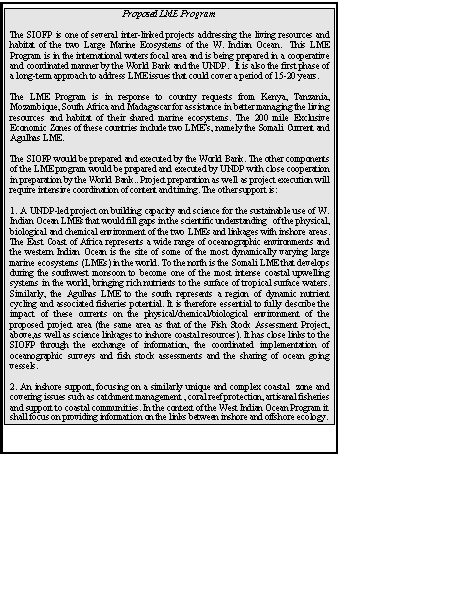
1. The SW Indian Ocean Fisheries Project (SIOFP) is one of several inter-linked projects being prepared by the World Bank and the UNDP in response to country requests for assistance in better managing the living resources and habitat of their shared marine ecosystems. Consistent with the GEF Operational Strategy, an ecosystems approach is being proposed to assist the countries in the assessment and management of the two large marine ecosystems(LMEs) that make up the West Indian Ocean, namely, the Agulhas Current LME and the Somali Current LME. The SIOFP is aimed at building the capacity of the countries and collecting the needed information on the LMEs so that the countries may make an informed decision to develop a management strategy for the offshore living resources of the two LMEs that extend to the 200 Exclusive Economic Zones (EEZ) of Mozambique, Madagascar, Comoros, Kenya, Tanzania, and South Africa. The complexity of the situation and the subsequent need to divide the work into logical pieces for implementation requires different operations, which together will form a LME program for the West Indian Ocean. The inter-linkages among these operations are described in Section E, below. This concept note request is solely to facilitate the preparation of the SIOFP.
B. Background and overview of the SIOFP
2. The ocean bordering the East coast of Africa is one of the last areas where fishing activities are largely unregulated. Even though the countries in the region have declared a 200 mile Exclusive Economic Zone (EEZ: Law of the Sea), they lack the institutional and financial capability to exercise their jurisdiction. While fisheries in a narrow coastal strip are harvested by the coastal states, the often valuable offshore fisheries are harvested mostly by distant-water fishing fleets from Europe and eastern Asia and landed outside the region. It is not in the interest of these fleet operators to report catches to the national authorities in the region. The result is that (1) there is inadequate information on the species composition and the quantity of fish taken in the area, (2) there is inadequate information on the threats to the ecosystem as a result of fishing pressure and (3) there is neither a regional vision nor a regional effort in terms of management institutions to protect biodiversity and the sustainable yield of the region’s fish stocks.
3. Lessons learned from the collapse of fish stocks in presumably well-managed areas such as the Northwestern Atlantic and the North Sea have shown that the success of a regional fisheries strategy depends closely on the collection and sharing of adequate fishery, environmental and ecosystem observations and on a strong institutional framework. Long term and relatively costly effort will be needed before Kenya, Tanzania, Mozambique, Madagascar, South Africa and France will be in a position to acquire adequate knowledge about the resources, develop a common resource management strategy and adopt the institutional framework to effectively manage the region’s offshore fishery and its interaction with artisanal fisheries.
4. The sustainability of the fisheries management strategy needs to be secured by a revenue generating and management scheme, developed by the SIOFP. This would enable the coastal nations in the region to use the revenues from fisheries in their offshore territories, either through licensing of foreign operators or through a home fleet, to monitor and enforce the regulations under the strategy through the institutions that are created, and to combine protection of the biodiversity with the sustainable exploitation of offshore fish stocks and their interaction with nearshore marine resources. It is expected that this process will take a period of 10 to 15 years to develop. The SIOFP is being formulated to address several issues simultaneously in order to generate significant results in this period.
5. The colonial and political past has divided the countries in the region into three cultural and language blocks. The predominantly English speaking countries are Kenya, Tanzania and South Africa. The language of Mozambique is Portuguese, while Madagascar and the Comoros are Francophone. Several smaller islands in the region are in fact still French territories. These differences underscore the importance of an International Waters project to bridge the cultural gaps and to harmonize the management policies concerning transboundary waters. Stimulating the exchange of relevant information between the countries, and strengthening the regional ties, will be an important element to achieve a regionally supported fisheries management vision and strategy that is consistent with the GEF approach to addressing LMEs..
6. To adequately address the issues above, the outcome of the project would be:
· stronger regional collaboration, a better management capacity and a strengthened institutional framework for the development/implementation of a common fisheries management strategy that is consistent with conservation of LMEs;
· filling in of essential scientific and management knowledge gaps necessary for the countries to commit to establishment of the management strategy;
· development of the joint vision on protection of biodiversity and fisheries management leading to a fisheries management strategy and the appropriate institutions.
7. Bilateral grant and (possibly) an IDA loan will promote sustainability of the project results and support the continuation of the project through the full 10-15 year period. In this period, progress of the SIOP will be measured by (1) the adoption of a common vision on biodiversity protection and fisheries management within the two LMEs by the participating countries, (2) increased cooperation and information exchange between the participating countries on fisheries management issues, (3) improved overview of available data, (4) improved links to other relevant activities and initiatives, (5) adoption of a common fisheries management strategy and institutional framework by the participating countries, (6) increased revenues from fisheries to the participating countries and (7) a reduction of threats to the ecosystem by fisheries in the region.
8. The project draws on lessons learned in other areas of the world (e.g. the Northwestern Atlantic and the North Sea) and is in fact, an effort to build on past lessons learned form similar offshore, GEF-funded, LME projects such as the Benguela Current Project in Western Africa. The approach and the lessons learned during SIOFP should be replicable in other, smaller or larger scale, areas in the world.
C. Global significance
System description
9. The east coast of Africa represents a wide range of oceanographic environments and the western Indian Ocean is the site of some of the most dynamically varying large marine ecosystems (LMEs) in the world. Its waters are largely oligotrophic ,and a number of ocean currents predominate in the region-- notably the South Equatorial Current, the East Madagascar Current, the Mozambique Current and the East African Coastal Current. To the north is the Somali LME that develops during the southwest monsoon to become one of the most intense coastal upwelling systems in the world, bringing rich nutrients to the surface of tropical surface waters. Similarly, the Agulhas LME to the south represents a region of dynamic nutrient cycling and associated fisheries potential. Significantly, the Agulhas and Mozambique Currents link these two major LMEs of the western Indian Ocean which influence the region’s ecosystems, biodiversity and fishery resources.
10. The Somali and the Agulhas LMEs are unique and are of great regional, and possibly global, importance. Yet there is generally little information about the LMEs and the systems linking them, nor is there adequate and specific information about the species composition, distribution, behavior and migration of non-commercial and commercial fish stocks. At their the present level of economic development, the countries are unable to understand the potential of the marine ecosystems concerned, nor to monitor the human pressure on these systems.
Threats11. While there is at present no evidence to suggest that the offshore ecosystems are under stress, or that species are at risk of collapse, this may well be due to the absence of adequate environmental and ecosystem observations, including the lack of adequate reports on fishing, effort, landings and by-catch. Inshore fish resources are harvested mostly by coastal states and reported landings by regional countries in the area have stagnated somewhat since the 1990s. The potentially valuable oceanic fisheries are harvested predominantly by distant-water fishing fleets from Europe and eastern Asia and reported catches by distant-water fishing nations have increased through the early 1990s, with Spain and France together accounting for over 50% of these catches (FAO 1997).. The proportion of unreported catches is largely unknown. As fish stocks elsewhere in the world are diminishing, more fleet operators are certain to turn their attention to the commercial fish stocks along the east African coast until these stocks have been exhausted and catches are no longer economically viable. This may be well below the threshold of a biological sustainable population of commercial fish species. Simultaneously, by-catches may already have put non-exploited fish species into commercial extinction, with possible damage to biodiversity and ecosystem of the West Indian Ocean
12. The economic growth of east African coastal states may lead to the development of new, locally operated offshore fleets, competing with existing fleets or with fleets from other coastal nations in the region. National interests may thus prevent governments from implementing adequate regulating measures in order to protect their own interests. Examples from other regions of the world have shown that these developments, if unregulated, inevitably lead to a short period of overexploitation and unsustainable high yields, followed by a rapid decline of the fish stocks and damage to the ecosystem. . These two LMEs are then strategically important for local community livelihoods, for biodiversity, and for their economic potential if they are indeed two of the few remaining LMEs not already overfished. Without a management strategy leading to development of institutions, these threatened LMEs will surely become depleted in the near future.
Opportunities and benefits
13. Close to 1/3 of the world’s population resides in countries edging on the Indian Ocean. Most of these nations place great reliance on the sea for food security, employment and socio-economic stability. Yet the Indian Ocean produces a mere 10% of the world’s fish tonnage harvested. While lower productivity of the Indian Ocean contributes to such modest landings, the generally poorly developed status of Indian Ocean fisheries belies its real potential. Recent data suggest an escalation in effort and landings, especially by distant fishing nations. In order to avoid a boom and bust scenario with consequent impact on biodiversity, sustainable fisheries development and global fisheries management, it is urgently necessary to develop and implement a cohesive management strategy for the region. As the West Indian Ocean is least understood, has several major large marine ecosystems and is edged by numerous nations, this region was selected for primary focus.
14. Fishing, and its associated economic activities, is often extremely important to coastal communities and local economies. In some of the southwestern Indian Ocean countries, fish often represent the primary source of animal protein available to the local populations. Also, in a region faced with chronic scarcities of foreign exchange, exports of fishery products or income from licensing of fisheries may represent a vital sources of exchangeable earnings. Fish landings, processing and supporting operations associated with the fisheries industry would provide an important stimulus in the economic development of harbors and the coastal zone. The income generated by each country from fisheries in the region could be applied to the implementation of a regional strategy that links the protection of biodiversity to the sustainable exploitation of the marine resources. The recurrent costs of management institutions can then be supported by the users of th ecosystem.
15. While offshore, fish stocks may be part of an ecosystem at a regional scale, they may also regularly traverse national boundaries. A fisheries management strategy can only be successful if it is developed at a regional scale and implemented with the support of all coastal and stakeholder nations to prevent national interests predominating. It should be based upon adequate knowledge about the region’s ecosystem and updated with regional reports of fishing efforts, catches and by-catches. The WIOP will assist the countries to acquire adequate knowledge and to set up the institutional framework to develop and implement a strategy for the sustainable exploitation of the marine resources.
D. Country-Driven, National level support
16. The process leading up to the development of the SIOFP is an good indication of the country drivenness of the project. The importance of a regional approach to the development of a win-win scenario was first recognized by the government of Mozambique. This led to the organization of a regional conference, supported by a GEF Block A grant through the World Bank. The conference was held in December 2000 in Maputo, Mozambique with representatives from the governments of Kenya, Tanzania, Mozambique, South Africa and Madagascar as well as representatives from the FAO, ICEIDA, IUCN, NORAD, SADC, UNEP and the World Bank. During this conference, government representatives from Kenya, Tanzania, Mozambique and Madagascar expressed their intention to participate in the project. The delegation from South Africa indicated that, while not specifically authorized to confirm participation, they would undertake the promotion of this project with the Director General concerned and felt that a positive approach was probable.
17. During the meeting it was noted that France would be an important and relevant party but that unfortunately no French representative had initially been invited. In the follow-up of the conference the willingness of France to participate will have to be investigated, as well as the willingness of Somalia, Comoros, Seychelles and Mauritius to be associated with the project. The parties confirmed their commitment to the development of a win-win scenario and invited the World Bank to develop the project further and coordinate the application for funds.
18. The parties further agreed that: a regional approach was preferable to a country-by-country based project and that:
· the area for which this strategy would be developed was defined as a region along the coast of south eastern Africa ranging from South Africa (around 50 d S) up to the northern limits of Kenya and from the 150 meter depth contour up to the 200 mile economic exclusion zone, extending to eastern Madagascar.
· France should take part in the project by virtue of a number of small French islands in the region;
· Somalia, Seychelles, Reunion and Mauritius should be associated with the project as observers;
· there should be strong links with the UNEP-initiated Agulhas Current Assessment as well as the SADC East Coast Large Marine Ecosystem study.
· the project should support the FAO initiative at the establishment of a regional fisheries commission;
· a regional project secretariat should be based in Maputo, Mozambique and co-ordinate the activities, exchanges and meetings between the participating countries.
E. Project description
19. The objectives of the SIOFP are to:
· develop and implement a sustainable offshore fisheries management strategy for two LMEs of the Southwest Indian Ocean;
· acquire sound and adequate scientific and management knowledge to serve as a basis for the strategy ;
· build the institutional framework and strengthen the institutional capacity necessary for successful and sustainable implementation of the strategy in the region.
20.  The core project area of the SIOFP would be the Mozambique Channel, and the 150m depth contour inshore to the edge of the 200-mile EEZ of South Africa, Tanzania and Kenya- but not the waters off the east coast of Madagascar. The area is part of two LMEs, the Somali current in the north and the Agulhas current in the south. Ancillary assessment work consistent with the approach to LMEs would include Somalian waters (especially identified upwelling areas) and transboundry waters where the EEZ of the Project countries abut against the EEZ of Mauritius and the Seychelles (these countries may be “associate” members of the Project and may participate in the scientific program as observers depending on project preparation. They would also have access to all data/information derived from the Project in exchange for allowing Project vessels access to their waters).
21. The SIOFP consists of five major components:
a) collection of data describing the various fish species (and particularly those under environmental or human-related threat) in the 200 mile EEZ of the Project countries
b) a fish pressure survey to estimate the commercial fishing pressure within the study area, from which countries the pressure comes, the capture methods used, and the location of the pressure on a seasonal basis,
c) establishing a project management structure, with associated links between Government managers of the offshore resource along the East and Southeastern coast of Africa that would build capacity, provide a forum to exchange essential information, and foster collaboration toward decision making that would facilitate creation of a Southwest Indian Ocean Fisheries Commission, should such be warranted based on the outcome of the proposed project; this would also undertake the coordination or linkage function with the other two projects;
d) formulation of intermediate management guidelines, protected areas and seasons to reduce threats to endangered fish species and to control exploitation of fish stocks to environmentally sustainable levels and to ensure linkages with artisanal fishers’ needs and those of coastal biodiversity.
e) the adoption by the end-of-project of a fisheries management strategy including appropriate institutions at a national and regional level for implementation of this ecosystem approach to LMEs and their fishery resources
22. SIOFP would lease between 3-4 vessels, including crew, operation and maintenance cost, insurance, etc. (i.e. a wet lease… the only thing the Government would need to do in regard to the vessels after they are leased is to set a ship schedule and supply the scientists to work on board). Stationary equipment needed (recording sonar for bottom mapping, GPS, mobile weather station, hydrographic wench) would be included in the technical specifications of the wet-lease procurement to collect basic oceanographic data while fishing to link catch to environmental conditions.
23. It is anticipated that fishing and oceanographic data collection will continue for a consecutive period of 30 months (two full climatic seasons and a 6-month period at the beginning of the Projects to “shakedown” and ensure everything is working according to plan. The final activity of the SIOFP is to development preliminary management measures to protect threatened fish species and to lay the policy groundwork for environmentally sustainable management of the offshore fish stocks while considering the linkage to artisanal needs and coastal biodiversity. This final activity is expected to require 6-12 months. This makes the SIOFP 4 years long.
Bilateral support
24. Informal discussions have already been held with ICEIDA and NORAD. It is expected that support from ICEIDA might come in the form of database, fisheries statistical evaluation and presentation software. NORAD and ICEIDA might also assist with other technical aspects of preparation. There appears to be some hope of obtaining use of the large NORAD fishing vessel (M/S Fredrick Nansen). Other sources of assistance would be Japan, the EU, Spain, DFID, etc. A dialogue will be held with EU consistent with their revision of the EU Common Fisheries Policy.
25. The SIOFP would require separate Grant Agreements between the GEF and each participating country. Most of the funds in each of the “National-Level” Projects would support the cost of the “Regional-Level” wet-lease of vessels, 50-60% of the total project cost would be in this single item (perhaps US$10 million). There is also another “Regional-Level” activity that will need to be financed from the National Projects. This would be the “wet-lease” of airplanes/pilots/ground staff to undertake the fishing pressure survey (my estimate is that this will cost around US$2-3 million). The remainder of Project costs will go to “National-Level” activities including;
· Hardship allowances for local scientist for the ship time;
· Equipment such as computers for data analysis, vehicles to move scientists from home base to wherever the ship may be (that might not be the home port), office equipment, fax machines, email/website, etc;
· Purchase of satellite images and other remote sensing data;
· Operation and maintenance of National-level Project Management Groups;
· Cost of meetings
· Oceanographic equipment to be launched off project vessels
· Stakeholder involvement and information activities;
· Training (mainly MSc/PhD degree courses).
26. During the initial years of the project these routine assessment and monitoring practices will have to be developed and implemented. This can only be achieved if the commitment to biodiversity protection and sustainable fisheries management, already existing in the region, is further strengthened and maintained through the free exchange of information and at regular meetings. The management information on fishing effort, catches and by-catches generated by the project and its participating member countries must be adequate and correct. Routine procedures will be developed and institutions or agencies will be set up or strengthened to implement these routine procedures.
27. The proposed two-year preparation project in this PDF-B sets up a regional structure for communication and implementation and prepares a two-year assessment of the region’s ecosystems including commercial and non-commercial fish stocks , the existing fisheries pressure on those stocks, and linkages to artisanal fisheries.
28. The joint preparation and implementation of the assessments by the participating countries requires regular exchanges of information and meetings as well as stakeholder involvement. The countries agreed that a regional project preparation unit coordinates this from Maputo, with Mozambique providing accommodation and logistic support. The project coordination unit may eventually function as the secretariat of a West Indian Ocean Fisheries Commission. Although the countries participating in the project have different cultural backgrounds and working languages, this project will strengthen regional cohesion and stimulate exchange of information. It will provide English, French and Portuguese language courses for three to six representatives from agencies participating in the assessments.
SUSTAINABILITY
29.
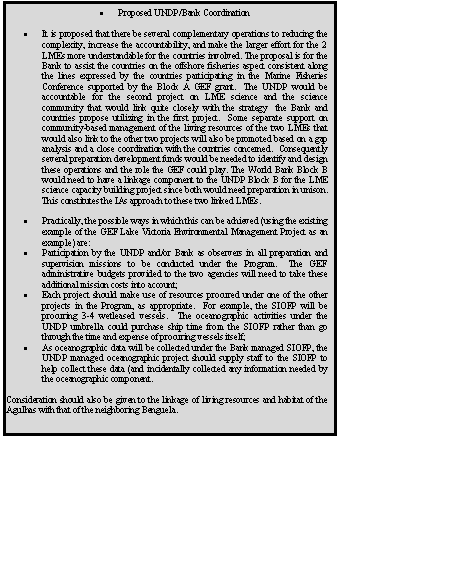 |
The LME approach links scientific evaluation of the physical and chemical environment to the biological community. The LME Program represents a long-term approach to identifying and defining the natural resource and pressures (natural and anthropogenic) and possible avenues for sustainable conservation of biodiversity and resource use. The first phase of the LME Program (the 4 to 5 year initial phase to include the SIOFP and the operations implemented through the UNDP) will be designed to establish these links to the satisfaction of the scientific community and the political managers of the offshore resource. The objective of the SIOFP component of the LME Program is therefore to identify a “win-win” strategy that preserves species diversity and biodiversity values of the offshore fishery while simultaneously developing the environmentally and socially sustainable exploitation of commercially exploitable fish stocks. Successful achievement of this objective will trigger a second phase of the LME, which would target environmentally sustainable use (and “use” in this context includes “non-use” or conservation) which would probably be supported through an Adaptive Program Loan from IDA.
30. The knowledge obtained from this first phase of a long-term commitment to natural resource management of the marine resource by the participating countries will establish that environmental protection, pollution control, sound land use and controlled exploitation of natural resources is the only economically sound approach. In addition, the management strategy should include the commitment to create the necessary institutions for management such a s a commission for real-time management of living resources of the LMEs. The institutions and the potential for income from fees on the fisheries should ensure sustainability.
REPLICABILITY
31. The preparation and implementation of the several components of the West Indian Ocean LME Program to be undertaken through coordinated activities of UNDP and the World Bank should also be seen as a pilot for a new, and more integrated, approach by GEF Implementing Agencies. By combining several projects under a single programmatic umbrella, it should be possible to bring the unique skills and experience of two or more GEF Implementing Agencies to bear on a common problem without the unnecessarily high transactions costs currently experienced in joint, complex projects This would benefit both the efficiency (a single institution would not have the skills or manpower to undertake such a complicated preparation and supervision) and impact of GEF interventions, while also providing better and more focused support to our client countries.
STAKEHOLDER INVOLVEMENT
32. The LME Program over the long-term (15-20 years, of which the proposed 4-year SIOFP and UNDP-assisted components are but the first phase) has two levels of stakeholder involvement. First, the scientific and political managers of the resource must be strengthened through training, knowledge of the natural resource system, development of institutional tools (organization, laws, treaties and regulations), and procurement of the tools (equipment and facilities) to sustainably manage, and where necessary, conserve important coastal and marine resources.
33. Second, the coastal population, particularly those involved in artisanal fisheries and other subsistance use of coastal and near-shore resources, will need to benefit from sustainable use of the offshore resources within the 200 mile Exclusive Economic Zones of the countries bordering the West Indian Ocean. Again, the objective is to establish a “win-win” scenario of reducing pressure on over-exploited coastal and near-shore resource (forests, mangrove, wetlands, animal and plant species, etc.), reducing non-point source pollution tied to poor and unsustainable use of land in the coastal areas, while addressing the economic development imperative of reducing poverty.
Incremental reasoning and Incremental costs
34. The concept of incremental finance from GEF grant is that the GEF supports activities that are incremental to those things that the Government traditionally is able to support through local finance- and particularly environmentally oriented activities. Use of GEF funds in the SIOFP will play a catalytic role in expanding government management into areas of environmental conservation and biodiversity protection of the offshore marine waters which they currently can not address. More importantly, GEF-support in the initial phase of the LME Program (of which the SIOFP is but one part) will leverage continued support of conservation and environmentally sustainable development principles by governments over the long-term through the larger and more ambitious second phase of the LME Program, supported by an Adaptive Program Loan from IDA. This relation between science and the transition to sustainable development is seen as occurring even without continued GEF involvement in phase 2 of the LME Program (although some relatively minor support may be needed depending on the situation).
35. The SIOFP links improved revenue growth to the Government and creation of new job opportunities for people living in the coastal zone, with reduced impact on the sensitive ecology of the coastal near-shore zones, preservation of biodiversity in the coastal and offshore areas, and sustainability of artisanal fisheries. The Project will be designed to ensure that an appropriate part of the improved revenue growth will be retained by the managers of the resource to ensure financial sustainability of Project recommendations even after the Project comes to an end. Likewise, the SIOFP will assist in the development of a national and regional framework for legal, administrative/enforcement management of the coastal and offshore resource that is environmentally and socially sustainable.
Regional Sustainability of the SIOFP
36. If the economic development of SE African region would allow the countries to develop a strategy to sustainable fish management, it would most likely be on the basis of individual countries. These strategies would not take into account transboundary issues and might lead to countries competing for fish stocks migrating along the costs. This inevitably leads to sub-optimal management schemes, overfishing and loss of biodiversity. SOIFP explicitly aims to overcome this national approach. This will be accomplished by establishing the framework of a Western Indian Ocean Fisheries Commission with the authority and resources to address transboundry issues, including:
· Regional cooperation in enforcement of fishing regulations and permits;
· Establishing license and catch quotas;
· Addressing coastal and catchment issues that directly and indirectly affect offshore fish stocks;
· Establishment of a regional scientific program to monitor fish stocks and impacts of ecological and anthropologic impacts on them.
ACTIVITIES/OBJECTIVES OF PROJECT PREPARATION
37. In addition to the core actions needed to prepare the SIOFP financially and physically, there are additional actions/objectives that are unique to the SIOFP will need to be carried out under the PDF-B if Project implementation is to be both successful and timely. These are described below.
38. Regional harmonization in the development of the Program of Activities to be undertaken through the SIOFP: The SIOFP is a Project that will be undertaken within the 200 mile EEZ of 6 countries (Kenya, Tanzania, Mozambique, South Africa, Madagascar and France). Activities will need to be implemented according to biological need, which can only be achieved if legal agreements/memoranda of understanding/treaties are in place to allow Project vessels and nationals from all Project countries to work freely across national boundaries defining the Project study area. Also, regional issues relating to implementation of the Project and the taking of any actions that appear needed, based on Project output, will need a regional focus. Finally, for this Project to be implemented on a sound and efficient basis, a central body will need to be established and operated to ensure smooth cash flow to implementing agencies and financial accountability to the Bank/GEF/implementing country governments. The proposal is to establish a Regional Project Implementation Organization (RPIO) in Maputo, Mozambique. The staff of this Organization would consist of at least a regional manager, a Project accountant, and accounts clerk, a procurement/contracts monitoring specialist, an administrative secretary, an office clerk and a chief scientific officer. The RPIO, at least during the project preparation period would:
· Coordinate preparation of yearly workplans for the entire study area (6 countries);
· Disburse quarterly imprests to country preparation units (5 of them, one each for Kenya, Tanzania, Mozambique, South Africa and Madagascar… France to cover its own Project costs) based on Quarterly Work Plans submitted by each country implementing agency;
· The RPIO would therefore be responsible for operating the “Special Account” for preparation funds, including receiving and reconciling accountabilities and making replenishment requests to the Bank (as IA for the GEF), and commissioning a yearly Audit of the Project Special Acccount;
· Oversee preparation, award, negotiation and implementation of contracts for regionally procured goods, works and services (mainly wetlease of large research vessels). Procurement of wetleased vessels, other services, goods and works to be undertaken (to the point of contract signing) during preparation;
· Organizing and paying for the regular preparation meetings to be held to coordinate and review progress of Project Preparation being made by the various country preparation units;
· Liaise and coordinate SIOFP Preparation activities with the UNDP oceanographic study forming part of the Large Marine Ecosystem PROGRAM for the Southwest Indian Ocean.
39. In addition, country to country (and regional, through SADC) arrangements will need to be made to ensure that Project activities are facilitated through the diplomatic cooperation identified as appropriate. This could be through treaty, legal agreement or memoranda of understanding between all countries participating in the Project. These legal agreements will need to be signed and in place before Project Implementation begins. These agreements will need to take into account that the scientific crew on research vessels will be drawn from a common pool of scientists from country implementing fisheries and fisheries Research organizations. These scientists and the crew of the research vessels, and the VESSELS THEMSELVES will need re-entry rights to all countries participating in the Project for the life of the Project. Research vessels and their operating costs (consumables, including fuel) will need to be exempt from government duty or agreements be in place to assign these local taxes to government contribution to the Project. Also, inter-governmental agreements should also cover free access to information obtained through the Project by all participating governments.
40. Desk study of existing and proposed ‘project’ and ‘regional cooperation’ initiatives: The PDF-A funded workshop on the fisheries of the Southwest Indian Ocean identified a number of other multilateral/bilaterally funded initiatives (both scientific and administrative) operating in the proposed study area of the SIOFP. As one of the global objectives of the SIOFP is to foster regional cooperation and management of the offshore fishery, it will be essential to understand how management of the Project can co-exist/augment/benefit from these other initiatives. This study will be undertaken by a team consisting of fisheries scientists and administrators from government organizations responsible for preparing the Project. The team will need to procure consultant services from individuals/firms familiar with the structure and operation of regional fisheries management organizations. It is likely that region and overseas travel will be needed to visit organizations involved in establishing, managing or funding regional activities in the Project study area.
41. Desk study of existing information on fish stocks in the proposed project study area: Most countries to participate in the SIOFP know very little about current exploitation of the fishery in their 200 mile EEZ. This makes a technical review of existing information important from two perspectives. First, there is the need to quantify and identify species/areas that are being targeted to better define the potential problem. The second reason is to facilitate design of the offshore fishery sampling program (the Western Indian Ocean is a big place and even with 3-5 vessels, it would be very difficult to try to undertake a completely “random” sampling program). There is also a linkage here between fisheries data and oceanographic information that might be useful to the preparation and implementation of the UNDP-assisted component of the LME Program, since some oceanographic data might have been collected by fisheries research vessels from offshore fishing countries.
42. A team of scientist from the implementing agencies of countries participating the Project will form a team to collect existing data on catch in the 200 mile EEZ of the Project countries. The team will be assisted by consultant individuals/firms to facilitate its work. Data collection will occur in two phases. The first phase will be a desktop survey of fisheries data existing in the Project countries themselves. The second phase will be much more ambitious, involving international visits to fishing nations likely to have government research vessels and/or private companies with commercial fishing vessels in the Project study area. The team would seek the assistance of its various embassies in target countries (European Union countries such as spain, Italy, Nordic countries, China, Taiwan, Japan, etc.) to make contact and seek the assistance of the target country governments in approaching commercial owners/operators of fishing vessels to provide information regarding their activities in the Project study area. The consultant assistance would be from firms/individuals with commercial fisheries experience and knowledge of international fishing fleet ownership.
43. This study is expected to provide critical input into the preparation of the Project and would therefore start as soon as possible. It is also expected to be costly, requiring separate finance from a willing bilateral.
44. Funding of an exchange program of scientific staff between relevant fisheries organizations in the participating countries: There will be 3 languages (English, French, Portuguese) used by scientists and administrators in the Project. As the proposed SIOFP is but the first phase in a long term approach to environmentally and socially sustainable management of deep-water fisheries within the 200 mile EEZ of the Project countries, it is essential that a multilingual capability be developed. Without this capability, implementation of a regional management of the offshore fishery will be greatly more complicated and difficult. It is also expected that scientist-teams on research vessels will be international, with skills being the benchmark for team composition, not necessarily where the vessels are expected to be working. The SIOFP preparation period will be used to develop a core, multilingual, group of scientists. This will be accomplished in the following way:
· At least two scientists from each Fisheries Research Institute (or equivalent) will be trained in a second language. This will be accomplished in two phases. Using Kenya as an example, one scientist would receive a 6 month intensive course in French while a second would receive 6 months intensive training in Portuguese. Following this training, the staff with rudimentary Portuguese training would be exchanged with a member of the analogous fisheries research institute in Maputo that had received English training, while the French-trained staff would be exchanged with a person from the fisheries research institute in Madagas that had been trained in English. The second phase of language training would be through the residential staff exchange programs. In effect, this would be both a job exchange program so that staff from the various fisheries institutes would learn from their colleagues in sister institutes while simultaneously learning the host language. These exchange programs would last for one year, with living allowances and cost of language training being paid from Preparation funds. Staff salaries would continue to be paid by their home institutes;
· The Project is expected to support training, including university advanced degrees. The incentive to staff to participate in this language development program during Preparation will be provided by preferred placement in these university degree programs. Staff that had been exchanged would be given preference in placement into the university degree programs- with the proviso that the training be in a country speaking the second language of the staff. Using the Kenyan example, a Kenyan exchanged for a year with a staff from Mozambique would have preference for MSc or PhD training in a university in either Portugal or Brazil. Likewise, the Mozambican exchanged into the Kenyan fisheries research institue would have preference in project support for advance degree training, but in an English-speaking country.
45. Funding for a consultancy to prepare a database, linked to a fisheries statistics, data manipulation and presentation module to transform raw catch-related data from the various cruises into a form readily usable by managers and scientists: During Project implementation, yearly cruises for each research vessel will be programmed and scheduled in advance. However, sufficient uncertaintanty exists that these cruise schedules will need to be viewed as tentative and subject to change as information becomes available. This requires that data obtained from each cruise be analyzed as soon as possible and results circulated to each country participating in the Project as soon as possible. It is essential that sampling data be downloaded into a regional database and evaluated/manipulated into a form that is easily understandable. Since procurement of vessels will be undertaken and essentially completed by the time the Project agreements is signed, this database and associated statistical program will also be needed before the Project becomes Effective. The process would then become:
· Data collected by scientists on each cruise would input catch data on laptops as soon as possible after the collection episode;
· Upon arrival in port, the scientists would “dump” their raw data into a regional database (to be established in a mutually agreeable country location via modem);
· Associated fisheries statistics program will render raw data into a usable form (catch curves, catch/unit effort, fecundity, environmental parameters, etc);
· Raw data and statistical interpretation made available on a Regional Project Website (password protected until data verified and cleared for general release) so that it is available to all Project participants.
46. Every six months, the RPIO will call a scientific review committee made up of members of the Fisheries Department and Fisheries Research Institutes to review the data collected since the last 6-monthly meeting to see if any changes are needed in ship schedules.
47. Funding of a consultancy to prepare a ‘wet-lease’ tender of three to four large fishing vessels and the tender for air survey services to undertake the fishing pressure assessment: The Project study area is huge and little is know about the fishery resources that are present. More than one vessel will be needed both because the area is so large and because more than one sampling method (fishing gear) will need to be applied- at least for the initial period of the Project. Since the value of the fishery resource is unknown, it would not be financially efficient to purchase a large number of expensive vessels that would be even more costly to operate and maintain, especially as a real need has yet to be demonstrated.
48. Since it is unlikely that bilateral donors have fisheries research vessels that could be “donated” to the Project (except NORAD, which has one such vessel that appears available to the Project), the only option is to lease the vessels. Since offshore fishing is a very skilled and quite dangerous business, it is unlikely that suitable crew for research vessels will be available in government departments participating in the Project. Therefore, vessels will not only need to be leased, but “wetleased” with all crew, equipment, and consumables.
49. Since the vessels will be working across national boundaries, procurement of the vessels should also be done on a regional basis (i.e. each country contributing a share of the cost of the vessels). Wetleasing and regional procurement are very unusual, and only a limited amount of experience with either (alone) is available. To do both as a single “package” would require very special skills. Wetleasing of large fisheries research vessels is unusal but not unknown in developed countries. It is therefore anticipated that a consultant will need to be procured during Project preparation to prepare technical specifications for the vessels, commercial bidding documents to cover the various contingencies the vessels will need to work under, and help the Project countries set up a Regional Tender Board.
50. The following table summarizes the various components of Project Preparation and the likely source of finance.
|
Activity during project preparation |
Funding source |
|
1. Regional harmonization in the development of the Program of Activities to be undertaken through the SIOFP. Establishment and funding of operation of a Project Preparation Unit in the relevant fisheries ministry in each participating country. Establishment and operation of a Regional Project Preparation Unit in Maputo, Mozambique. Funding of harmonization meetings between participating countries to discuss project activities and to identify stakeholders for involvement. This would also entail development of the coordination component of the full project to ensure close linkages to the other 2 projects. Funding of regional workshops of relevant line ministries responsible for fisheries and international relations and development or implementation of International Treaties to discuss and draft an agreement between the participating countries. The agreement should facilitate regional implementation of the SIOFP and can take the form of an MOU or Treaty. It should cover issues such as customs, immigration, information sharing, etc . |
PDF-B |
|
2. Desk study of existing and proposed ‘project’ and ‘regional cooperation’ initiatives. The objective is to link the SIOFP to other projects, particularly those that relate to physical/chemical assessment of waters included in the SIOFP study area and regional initiatives aimed at joint management of natural resources in the Southwest Indian Ocean. Funding for a consultant is needed. |
Bilateral |
|
3. Desk study of existing information on fish stocks in the proposed project study area. This would include data from the files of the participating and associated countries in the SIOFP and from private and government groups of distant fishing nations that operate in the Southwest Indian Ocean. The study will require funding of a consultant and a team of scientists from countries participating in the project. It will also require development of a linkage component to the other two projects in this array of activities. |
Bilateral & Countries |
|
4. Funding of an exchange program of scientific staff between relevant fisheries organizations in the participating countries. The objective would be to place English-speaking scientists (given intensive language training before leaving on his/her assignment) from participating countries in the fisheries departments of French and Portuguese-speaking participating countries and vice versa. Assignments would be expected to last one year and result in staff able to undertake postgraduate degrees in countries speaking the language of the country to which the scientist had been seconded. |
PDF-B & Countries |
|
5. Funding for a consultancy to prepare a database, linked to a fisheries statistics, data manipulation and presentation module to transform raw catch-related data from the various cruises into a form readily usable by managers and scientists forming the regional scientific review panel for the Project. This software will be needed almost immediately after the SIOFP begins. |
Bilateral |
|
6. Funding of a consultancy to prepare a ‘wet-lease’ tender of three to four large fishing vessels and the tender for air survey services to undertake the fishing pressure assessment. This would need to include provision of training for national staff from participating countries in procurement, so that they would be able to assess the consultant’s work and evaluate the responses to the tenders on a regional basis so that a common contractor could be procured for all participating countries. |
Bilateral/GEF & Countries |
F. PDF-B output
38.51. The output of the PDFB activities are:
- strengthened regional ties through the formulation of a joint vision on biodiversity protection and fisheries management amongst the regional participants, further enhanced through the stimulation of foreign language capability amongst participants of the project;
- set-up of the project structure, with the regional project preparation unit as a hub between national project preparation units and coordination component with the other projects;
· an overview of all existing relevant activities and planned initiatives in the region and strengthened ties between the SIOFP and those activities and initiatives.
· inventory of available environmental and ecological information, including fish stocks and fishing activities; preparation of the procurement strategy for survey vessels, aircraft and other equipment project brief completed.
52. A workplan outlining the above activities by tim, over a 24 month preparation period follows in Table One.
G. Eligibility
39.53. OP 8 makes provision for the long-term, programmatic approach to addressing technically challenging projects in international waters. The SIOFP is the first Project in a program requiring long-term commitment from the countries involved and the various donors supporting these countries. This was discussed in the regional fisheries management conference (supported by a PDF-A grant) held in Mozambique to discuss regional cooperation for implementation of an LME assessment in the West and Southwest Indian Ocean. Specifically, OP 8 states in Paragraph 8.10: “International water project normally require a long-term commitment on the part of governments, implementing agencies, donors, and the GEF to leverage the intended sectoral changes – to address the root causes – of complex environmental problems in this focal area”. The 5 countries attending the conference upheld the need for taking a regional approach to assessing fish stocks within an LME approach. The conference also:
· Agreed that national and regional policies would need to be created/changed to properly manage regional fisheries and related environmental issues in the West and Southwest Indian Ocean;
· Agreed that the SIOFP would be implemented at the national level, but coordinated at the regional level. To this end, the conference agreed that a regional coordinating body within the SIOFP would be needed and that body would be situated in Maputo, Mozambique;
· Agreed that the countries would harmonize requests to donors supporting coastal, marine and regional cooperation to support implementation of the SIOFP.
40.54. The proposed SIOFP is eligible under provisions of the GEF/OP8 that relate specifically to LME’s. Of particular relevance are:
Paragraph 8.21 of OP8 states- “…Technological advances are being introduced that use information technology and computer simulation to help make critical management decisions for marine resources and tools such as the Code of Conduct for Responsible Fishing consistent with the Law of the Sea Convention…”. The SIOFP and its sister project addressing oceanographic characterization of the LME’s forming the study area will make use of computer simulations and remote sensing data to explain the systematics of fish species studied (in fact, some of this simulation has already been done). Likewise, the SIOFP concentrates on the Law of the Sea Convention as the framework in which environmentally sustainable development and sound conservation practices to manage the fishery can be implemented.
41.55. Paragraph 8.21 of OP8 continues by stating –
“Some projects may address issues (e.g. destructive fishing techniques) that are common to many countries in which changes in sectoral policies or activities are needed to maintain the environmental sustainability of marine and coastal resources.”. The SIOFP aims to identify the biodiversity conservation and resource use issues, prioritize these issues, develop capacity to address these issues, and set the stage for regional management of fish stocks in the 200 mile Exclusive Economic Zone of the countries bordering the West and Southwest Indian Ocean. It is very unlikely that any single country would have the ability to identify, much less manage, the fish stocks within its waters, given the mobility of the stocks and the lack of manpower and facilities to study and protect the fishery.
Timetable and budget
|
Activity |
units |
unit price |
# of units |
subtotal |
cat. total |
Source of funds |
|
staff exchange prog (9 people for 2 year prog.-lang. Train.) |
||||||
| a. Airfares |
r/t airfare |
$800 |
36 |
$28,800 |
||
|
b. Stipend (living allowance- incl food, accomm, misc) |
per month |
$800 |
216 |
$172,800 |
||
|
c. Language Training |
lump sum |
$500 |
9 |
$4,500 |
||
|
Activity subtotal |
$206,100 |
GEF | ||||
|
Survey of existing information (existing initiatives/policy) |
||||||
|
a. Survey of existing and proposed initiatives (team of |
||||||
|
3 scientists/administrators/1consultant |
||||||
| 1. Airfares |
r/t airfare |
$2,500 |
9 |
$22,500 |
||
|
2. Per Diems (including internal travel) |
daily |
$180 |
162 |
$29,160 |
||
|
3. Report Preparation/photocopy |
monthly |
$100 |
12 |
$1,200 |
||
|
4. Communication |
monthly |
$100 |
12 |
$1,200 |
||
|
5. Consultant prof. Fees |
monthly |
$16,000 |
4 |
$64,000 |
||
|
6. Consultant airfares |
r/t airfare |
$2,500 |
2 |
$5,000 |
||
|
7. Consultant perdiem |
daily |
$180 |
60 |
$10,800 |
||
| subtotal |
$133,860 |
ICEIDA/NORAD | ||||
|
b. Survey of foreign commercial/gov. catch data for |
||||||
|
West Indian Ocean (one consultant and 3 local |
||||||
| scientists) |
||||||
| 1. Airfares |
r/t airfare |
$2,500 |
16 |
$40,000 |
||
|
2. Per Diems (including internal travel) |
daily |
$180 |
320 |
$57,600 |
||
|
3. Report Preparation/photocopy |
monthly |
$100 |
12 |
$1,200 |
||
|
4. Communication |
monthly |
$200 |
12 |
$2,400 |
||
|
5. Consultant prof. Fees |
monthly |
$16,000 |
6 |
$96,000 |
||
|
6. Consultant airfares |
r/t airfare |
$2,500 |
3 |
$7,500 |
||
|
7. Consultant perdiem |
daily |
$180 |
80 |
$14,400 |
||
| subtotal |
$219,100 |
JAPAN | ||||
|
Activity subtotal |
$352,960 |
|||||
|
Project Preparation/management costs (final proj. design) |
||||||
|
a. International Coordination Meetings (4 people per |
||||||
|
country by 5 countries plus 2 observing countries) |
||||||
| 1. Airfares |
r/t airfare |
$800 |
280 |
$224,000 |
||
| 2. Perdiems |
daily |
$120 |
3360 |
$168,000 |
4 ppl, 7 cntry, 5 day, 10 meet |
|
|
3. Report preparation/photocopy |
monthly |
$200 |
24 |
$4,800 |
||
|
4. Overheads for Regional Office-Maputo |
monthly |
$1,500 |
24 |
$36,000 |
||
|
5. Staff Salaries for Regional Mgr., Proj. Finance |
monthly lump |
$6,100 |
24 |
$146,400 |
||
|
Officer, Office Secretary, Driver |
$0 |
|||||
|
6. Off. Equip. (2 comp/printer, fax, photcopy, phone) |
lump |
$6,000 |
1 |
$6,000 |
||
|
7. Vehicle for Regional Mgr. (4x4 station wagon) |
lump |
$28,000 |
1 |
$28,000 |
||
|
8. Operation of vehicle |
monthly |
$130 |
24 |
$3,120 |
||
|
9. Communiction |
monthly |
$750 |
24 |
$18,000 |
||
|
10. Country costs of preparation (5 countries 2 agencies) |
lump monthly |
$15,000 |
24 |
$360,000 |
||
|
Activity subtotal |
$1,649,420 |
GEF, JAPAN,_ | ||||
|
Preparation of Regional Wet Lease Tender for Vessels |
||||||
| a. Consultant |
||||||
|
1. Consultant prof. Fees (team of 3) |
monthly |
$48,000 |
6 |
$288,000 |
||
|
2. Consultant airfares |
inter. Airfare |
$2,500 |
6 |
$15,000 |
||
|
3. Consultant perdiem |
daily |
$180 |
360 |
$64,800 |
||
|
4. Misc. costs (local travel, office, photocopy, commun. |
monthly |
$800 |
12 |
$9,600 |
||
|
b. Local costs |
||||||
|
1. Operation of Regional Tender Board (2 people from |
||||||
|
each country * 5 countries* 4 days/meeting* 3 meets) |
||||||
| * Airfares |
r/t airfare |
$800 |
30 |
$24,000 |
||
| * Per diems |
daily |
$100 |
120 |
$12,000 |
||
|
* Communication |
lump sum |
$3,000 |
||||
|
$416,400 |
To be identified | |||||
|
Creation of Fisheries Statistics Database/Data Manip. |
||||||
|
a. Consultant professional fees |
lump |
$160,000 |
||||
|
b. Consultant airfares |
lump |
$35,000 |
||||
|
c. Consultant perdeim |
lump |
$16,200 |
||||
|
d. Computer costs + website (time and program prep.) |
lump |
$15,000 |
||||
|
e. Non-consultant costs |
||||||
|
1. Internet connections for all countries (5 plus 2 obser) |
lump monthly |
$350 |
24 |
|||
|
2, One computer/printer for each country (5 only) |
lump |
$12,500 |
||||
|
Activity subtotal |
$238,700 |
ICEIDA | ||||
|
TOTAL PREPARATION COSTS |
$2,447,180 |