

________________________________________________
Caribbean Large Marine Ecosystem (CLME) Project
FINAL REPORT OF THE
PROJECT CONCEPT/TDA SYNTHESIS WORKSHOP
KNUTSFORD COURT HOTEL, KINGSTON, JAMAICA
FEBRUARY 28 MARCH 3, 2007
CONTENTS
Attendees......................................................................................................................................... 1
1. Purpose........................................................................................................................................ 2
2. The CLME Project Concept........................................................................................................ 2
3. Discussion on Sub-regional Preliminary TDA Reports.............................................................. 3
Central-South America Sub-Region ....................................................................................... 3
Guianas-Brazil Sub-Region .................................................................................................... 3
Insular Caribbean Sub-Region................................................................................................ 4
4. Discussion on Major Areas of Concern within the LME ........................................................... 5
Overfishing ............................................................................................................................. 5
Pollution.................................................................................................................................. 6
Habitat Degradation................................................................................................................ 7
5. Regional Governance Thematic Reports .................................................................................... 8
6. Identification of TDA/SAP Interventions Plenary Discussion and Recommendations.............. 9
7. Review of Project Concept ......................................................................................................... 9
8. Demonstration Projects............................................................................................................... 9
9. Co-financing Commitments...................................................................................................... 10
10. Regional Governance and LME-wide Monitoring and Reporting ......................................... 11
11. Preliminary Stakeholder Assessment...................................................................................... 11
12. Populating the Draft Project Component cross-linkages ........................................................ 12
13. Comments and Closing Remarks............................................................................................ 12
Appendix 1: List of Project Concept/TDA Synthesis Workshop Attendees ................................ 13
Appendix 2: Agenda for the CLME Project Concept/TDA Synthesis Workshop........................ 15
Appendix 3. List of Workshop Documents .................................................................................. 20
Appendix 4: Approved Project Concept Report ........................................................................... 21
Appendix 5. Potential Partnership Diagrams................................................................................ 30
ii
CARIBBEAN LARGE MARINE ECOSYSTEM (CLME) PROJECT
PROJECT CONCEPT/TDA SYNTHESIS WORKSHOP
Knutsford Court Hotel, Kingston, Jamaica
February 28-March 3, 2007
Attendees1
Dr. Jorge Angulo, Consultant
Dr. Patrick McConney, UWI (Cavehill)
Dr. Robin Austin, Guyana
Dr. Franklin McDonald, UNEP-
CAR/RCU
Mr. James Azueta, Belize
Mr. Sheldon McDonald, ACS
Ms. Yolanda Babb-Echteld, Suriname
Ms. Iris Monnereau, Centre for Maritime
Dr. Jim Berkson, USA
Research, Netherlands
Dr. Leo Brewster, Barbados
Ms. Anginette Murray, Jamaica
Ms Felicity Burrows, Bahamas
Dr. Scott Parsons, Consultant
Ms. Paula Caballero, UNDP-GEF
Ms. Alba Nidia Perez, Guatemala
Mr. Bisessar Chakalall, FAO-WECAFC
Mr. Norlan Norris, Dominica
Dr. Marcia Creary, UWI (Mona)
Mr. Terrence Phillips, CARICOM-CRFM
Ms. Simone Dieffenthaller, The Cropper
Ms. Sophie Punnett, St. Vincent and the
Foundation
Grenadines
Dr. Lucia Fanning, CLME Project
Ms. Donna Roach, MARGOV, UWI
Mr. Paul Fanning, FAO-LAPE Project
(Cavehill)
Mr. Carlos Garcia, Honduras
Ms. Natalie Rodríguez-Dowdell,
Consultant
Mr. Rufus George, St. Lucia
Ms. Claudia Santizo, Guatemala
Dr. Diego Gil, Colombia
Ms. Heidi Savelli, UNEP-CAR/RCU
Dr. Sherry Heileman, Consulant
Ms. Bertha Simmons, CLME Project
Mr. Richard Huber, OAS
Mr. Vincent Sweeney, GEF-IWCAM
Mr. G. Andre Kong, Jamaica
Project
Mr. Phil Kramer, TNZ
Mr. Derrick Theophille, Dominica
Ms. Tricia Lowell, Antigua and Barbuda
Dr. Cesar Toro, IOC (UNESCO)
Mr. Exil Lucienna, Haiti
IOCARIBE
Ms. Nina Lysenko, Dominican Republic
Mr. Tim Turner, TDA/SAP Trainer
Dr. Robin Mahon, UWI and CLME
Mr. Stephen Willoughby, Barbados
Project
Ms. Natalie Zenny, TNC
Mr. Sergio Martinez, SICA OSPESCA
1 See Appendix 1 for detailed contact listing.
1. Purpose
The main purpose of the CLME Project Concept/TDA Synthesis Technical Workshop
was to develop the technical components of the draft Full-Sized Project (FSP)
document for review and endorsement by the CLME Steering Committee and other
project partners and the subsequent submission to the GEF.
Objectives: Participants worked over the four-day period to accomplish the following
objectives:
ˇ Identification and agreement on the filling of gaps and the interventions necessary
for inclusion in the draft FSP as drawn from the preliminary Transboundary
Diagnostic Assessment (TDA) reports for the Caribbean Large Marine Ecosystem;
ˇ Refinement of demonstration projects to be included in the draft FSP proposal;
ˇ Refinement of activities to be undertaken under the Regional Governance/ LMEWide
Monitoring and Reporting components of the FSP proposal; and,
ˇ Agreement on the components of the FSP proposal and identification of linkages
and cross-references between the proposed project components.
ˇ Identification of key potential partners and a strategy for securing partnership
involvement and co-financing commitments for the implementation of the FSP.
The annotated agenda and time-table for the meeting is presented in Appendix 2 while
a listing of all of the documents distributed for discussion at the workshop is presented
in Appendix 3.
2. The CLME Project Concept
The current thinking behind the development of the FSP proposal was presented by the
GEF Specialist Consultant. In addition to highlighting the development of TDA and
agreement of a Strategic Action Programme (SAP) as key features of the proposal, the
need to establish a culture of networking and cooperation, establish a monitoring and
evaluation framework and creating successes that serve as examples through the
demonstration projects were described.
Each of the project components as outlined in the draft document was described and
participants were reminded of the following key points:
Role of the Steering Committee is to meet once or twice a year, evaluate reports
and budgets and make decisions in regards to Project implementation
Final TDA will inform elaboration of demonstration projects and include detailed
causal chain analyses, public involvement and communications strategy,
institutional mapping and legislative review as well as a socio-economic
evaluation
SAP is an agreed document between member countries and given the large
number of countries involved, it may be appropriate to elaborate subregional
SAPs and immerse those in a full SAP
Creation of a multi-scale governance structure based on existing institutions to
be carried out in parallel with SAP development
Final design of the Project to be undertaken after completion of the TDA
2
Demonstration projects: (1) flyingfish; (2) shrimp and groundfish; (3) lobster; and,
(4) reef fisheries and biodiversity
Interim results from the demonstration projects will inform the SAP development
Participants raised a number of questions surrounding the draft project concept
including the logistics of implementing the project, the methodology to be used differing
from the established 5-module LME approach, engagement of sectors other than
fisheries, expected co-financing commitments from countries and partners and the level
of work expected from the CLME national representatives. Following a discussion, it
was determined that the draft Project Concept would be revised and presented to
workshop participants for their review and approval.
3. Discussion on Sub-regional Preliminary TDA Reports
Lead consultants for the three preliminary thematic reports for the Central/South
American, Insular Caribbean and Guianas-Brazil sub-regions led break-out sessions
aimed at improving the accuracy of the draft reports. Lead consultants then reported to
plenary on the findings. A summary of the key points identified for each of the sub-
regions are presented below.
Central-South America Sub-Region
Sergio Martinez presented the conclusions reached by the breakout group in relation to
the provisional TDA for the Central-South America Sub-Region:
A more detailed guide to solicit information from the member countries must be
designed
Information about the small scale fishing is under estimated
Need to go deeper in the evaluation of the institutions
Evaluate the convenience between industrial vs. small scale fisheries; find better
options
Evaluate the pro and cons of open access in artisanal fishery
Fisheries issues should be linked with environmental issues
Explore the joint actions between fisheries and environmental ministries
There is a great weakness with the information in the sub-region; statistics are
not complete and they must be improved
Countries can require a standardized data base to make comparisons; there are
many gaps that must be filled.
Guianas-Brazil Sub-Region
Terrence Phillips presented the gaps of information identified by the breakout session
group and other relevant points in relation to the provisional TDA for the Guianas-Brazil
Sub-Region as follows:
Necessary to discuss sea turtles and mammals in the report
Pay attention to invasive species
Determine the extent of cruise ship activities in the area
Include demographic data
More information of other agencies besides fisheries (e.g., environment)
Countries will revisit the template and update the information
By-catch issue is changing, not as excessive as in the past
3
Importance of mangrove ecosystems in fisheries and competition for land space
(e.g., aquaculture). Include any regulations covering mangrove removal.
The extent of IUU fishing is unknown, but information is critical for fisheries.
Insular Caribbean Sub-Region
Sherry Heileman presented the conclusions of the Thematic Report on the Insular
Caribbean:
In general, the report captures the main issues about the main transboundary
concerns related to marine living resources in the insular Caribbean
Overexploitation of Fisheries the level of fisheries exploitation varies among
countries, therefore not easy to identify overexploitation as a major issue at
subregional or regional level. Level of exploitation varies also with species within
countries (e.g., Nassau grouper and snapper)
Public awareness regarding the importance of marine ecosystems should be
further discussed in the report
It was emphasized the IUU is a major cause of overexploitation
As regards habitat degradation, it is a major concern in the subregion, although
the level of concern can vary among countries depending on the importance of
coastal habitats
Marine Pollution, it was emphasized that increasing hydrocarbon exploration is a
rising issue. Should be included in the report and present cases of where it is
occurring in the Caribbean
Diseases also have transboundary impacts. Should be emphasized that more
research is needed
Emerging issues include aquaculture shrimp farming, invasive species, and
hydrocarbon exploration. The report will be revised to include this
Rather than looking into interventions, this could be based on biogeographic
areas / use of MPAs in reef fish pilot
Need for GEF projects to be linked in the region (CLME and IWCAM)
Measures in place to ensure that those linkages are made
Overlap of management of LMR goals exists throughout the Caribbean
General points: not possible to fully discuss the template need input from other
experts and agencies. In many Caribbean countries there is no mechanism for
communication and collaboration among sectors on a national and regional scale
regarding transboundary issues and related governance frameworks
Not possible to rank the concerns in order of priority priority varies among
countries
Not enough time to read report, therefore more time requested to provide
comments
Concerns regarding response to CLME survey identify key contact person to
obtain feedback regarding the CLME template other than country focal points
Suggestion that participants at this meeting complete the template as far as
possible during this week. Distribute electronically
4
After discussion of the reports and receiving input from participants, it was agreed that
in general the reports capture the main transboundary issues concerning marine livings
resources in the Wider Caribbean not withstanding the perception that more input from
focal points (representatives of countries involved in the Project) is necessary to add
some information. In addition, it was highlighted in some cases that not many
participants within the breakout groups had read the reports previously and asked for
added time to analyze them.
In regards to the template sent to the participating countries to provide information, it
was seen as insufficient. Therefore it was suggested to design a more elaborate guide
for countries to provide the information and send this guide to other experts and
agencies. The participants suggested a range of topics on which information should
also be gathered, such as: demographic data; sea turtles and mammals; importance of
mangrove ecosystems for fisheries and competition for land space with other uses (i.e.
aquaculture), including existing laws and regulations within the countries for mangrove
protection; public awareness regarding the importance of marine ecosystems;
hydrocarbon exploration in the region as a rising issue providing specific examples;
invasive species; and, effectiveness of MPAs for fisheries management.
Elements common to the three reports relate to the fact that many of the problems are
linked to the capacity of the institutions within the countries for managing marine living
resources. Thus, the need to carry out an institutional evaluation and add information
within the reports on existing laws, regulations and institutions was highlighted. It was
recognized that there are many actors at the national, regional and subregional levels
that are trying to deal with the problems. Lack of coordination among them however,
remains a pervasive problem. In addition, existing contradictions among sectors such as
environment and fisheries, and the fact that the region has other users (i.e.
transportation and oil development), which could affect the Project, requires them to be
involved at some point. Thus, the importance of establishing National Interministerial
Committees, where most actors dealing with decisions on the coastal zone are present,
was stressed.
Lead consultants were asked to revise the draft sub-regional reports based on the
inputs received at the workshop.
4. Discussion on Major Areas of Concern within the LME
This discussion began with three breakout groups that dealt with the three major areas
of concern (1) overfishing; (2) habitat degradation; and, (3) pollution present in the
region and how these were treated in the reports. Thus, the breakout groups and
plenary discussions tried to look at the underlying causes; define if anything significant
was missing from the reports and if the issues were similar for the three subregions. A
summary of the key points identified for each of the sub-regions are presented below.
Overfishing
Scott Parsons presented the main findings surrounding overfishing as follows:
5
In the Caribbean overfishing is a common and wide spread problem
Many coastal species are depleted
Fishers are moving further out
Use of species formerly perceived as non commercial is now common
Variable situation (e.g., conch may be overexploited in Jamaica but abundant in
Cuba)
Line between artisanal/industrial fisheries becoming blurred
Ecological impacts of overfishing include: reduced stock abundance; habitat
destruction; shifts in community structures; changes in biology; reproductive
cycles affected; species threatened or extinct; changes in trophic structure;
threats to biodiversity; depletion in shallow waters; reduction of food sources for
other animals
Social impacts of overfishing include: displacement of fishermen; loss of income;
loss of traditional ways of life; food security and well being problems; young
people leaving the fishery (social status, lack of fish); adverse impacts on coastal
rural communities (migration); shifts in community structures
Legal impacts of overfishing include: disputes between States; boundary
delimitation issues; implications for governance
Immediate causes are well known, agreed to directly discuss underlying causes
Underlying causes of overfishing include: food security; lack of employment,
alternatives and skills; economic models which have been imposed; fishermen
resistant to change; readjustment of fishermen to new circumstances; market
forces; consumers not educated or aware of the problems; unsuccessful public
programmes; subsidies and other perverse incentives; insufficient enforcement;
lack of ownership
Need to look into alternative management regimes (co-management)
Need for greater stakeholder involvement (trust, participatory methods, ensure
representation)
Pollution
Vincent Sweeney presented the main findings pertaining to pollution in the three
subregions. There was a consensus that the three reports captured the essence in
relation to the issue. Points raised included:
Data; correlation of data collected and long term impacts
One pollution incident or series of incidents
Need to standardize indicators
Capacity building required
Need to put protocols into place
Another challenge notes related to mainland countries include agricultural
practices and sewage
Discussion of land-based sources took the group into a discussion of the LBS
Protocol of the Cartagena Convention.A question that arose was why has the
Protocol not been signed by all? Issues raised include: capacity to implement
measures; technology required; legal obligations (if the Protocol is signed by a
country it becomes legally binding, even if the States are ready, the industry may
not have the means or desire to abide)
6
Research is needed to understand if pollution from one source in one country is
transboundary (impact on other countries)
Impacts of land-based sources of pollution, in particular sewage, affect habitats
which in turn affects populations
Limited discussion on air borne pollution. One issue that was raised is whether
pollution coming from the Sahara Desert
A question that needs to be answered: are airborne pesticides having an impact
on the marine environment?
It might be interesting to undertake a pilot project on pollution (for example in
Guyana) within the CLME Project
There is little information on the impact of mining and farming using
agrochemicals on marine organisms
Habitat Degradation
Claudia Santizo presented the main findings pertaining to habitat degradation in the
three subregions.
A more detailed analysis in the reports on habitat degradation is necessary,
focusing on mangroves, coral reefs, seagrass and beaches
Need to include natural disasters as an impact
Linkages with climate change needed
Overall, the main conclusions reached for the three major areas of concern were that
the reports captured the issues, however some recommendations for improvement were
provided. It was suggested to look into other experiences (i.e. South-East Pacific area,
Chile, Colombia, Ecuador and Peru). It was suggested to examine other series of
activities in the region which have impacts for the environment. In addition, the need to
take an integrated approach was highlighted. With regards to habitat degradation it was
noted that natural disasters and linkages to climate change must be included and a
more detailed analysis in the reports on habitat degradation would be useful, including
the impacts on beaches. Regarding the issue of overfishing, it was noted that no
mention of trawling was made in the reports and it was suggested to contact the
International Seabed Authority to get information on the effects of trawling in the region.
A point raised by the overfishing group regards lack of "ownership"2 over the resources;
how free access will remain a hindrance for effective management; and, the need to
allocate rights over fishing resources to the different groups involved (even though it is
debatable and difficult to set priorities on allocation). Thus, it would be important to look
at examples used elsewhere (e.g., property rights in Chile, rights and tradable permits,
mangrove stewardship to coastal communities) and analyze them as management
options for the region. An in-depth discussion went into "lack of political will" to address
the issues. On that note, it was concluded that "lack of political will" involves several
factors including: (1) information and knowledge not being conveyed to politicians in an
adequate manner for them to take the necessary decisions to address the issues; (2)
2 As discussed by the group, the term "ownership" over fishing resources is related more to stewardship and rights
over the resources by the communities and other groups; not necessarily private property rights.
7
lack of environmental valuation which results in undervaluing the importance of the
ecosystems and services provided by them; (3) pressure from resource users and
resistance of these groups to carry the burden of conservation; and, (4) a society which
is not pressing politicians enough to take a stand. Therefore, knowledge which is
provided to key people and public awareness are necessary elements to address the
issues in the region.
An additional point emphasized co-management arrangements as necessary to bring all
stakeholders on board. Thus participatory methods; trust between government and
resource users; and, adequate representation of resource users groups (e.g., fishers'
organizations) must be addressed. Regarding data and information, the need to
standardize indicators and protocols were stressed. In addition, more research is
needed (specifically for the issue of pollution) to understand if pollution from one source
in one country is transboundary and the impact it has on other countries. It was
suggested that it might be interesting to undertake a pilot project on pollution (e.g., in
Guyana) within the Project.
5. Regional Governance Thematic Reports
The session on Regional Governance presented and discussed the following reports:
ˇ Governance of Transboundary Fisheries Resources in the Wider
Caribbean3; and
ˇ Living Marine Resource Governance for the Wider Caribbean with
particular emphasis on Non-Extractable Resources/Biodiversity and LME
Level Monitoring and Reporting4.
It was highlighted that although the establishment of a transboundary governance
structure for fisheries management (e.g., Regional Fishery Management Organizations
(RFMOs) and Coordinated Networks) in the region might not address the underlying
causes of over-fishing, it would have some merit as efforts at conservation being made
by one country could not be abused by another country in the region. It was noted that
the underlying causes of over-fishing require changes made by countries involved on a
long term basis and the establishment of a RFMO could serve as incentive for national
governments to address those underlying causes.
When discussing existing frameworks (e.g. UN Fish Stocks Agreement) and why they
have not fully worked, a conclusion reached was that a balance between top-down and
bottom-up approaches for setting up the frameworks or institutional arrangements is
necessary. In regards to non-extractable resources/biodiversity governance, it was
highlighted that there are already some efforts in place in the region (e.g. SPAW
Protocol, MBRS) and that it is necessary to:
(1) have clear linkages among them;
(2) build on what is already there; and,
(3) have a reliable monitoring and evaluation system.
3 Prepared by Scott Parsons
4 Prepared by Lucia Fanning, Robin Mahon, Patrick McConney and Natalie Rodríguez-Dowdell
8
Regarding the governance framework proposed for the CLME Project, which suggests
complete functional policy cycles, it was noted that the Full Size Project will involve a
series of activities to assess and enhance regional policy cycles. In addition, the
demonstration projects (a component of the full size Project) will look into the different
propositions of the governance framework to serve as examples. It was also noted that
the governance framework proposed is flexible and that the linkages to be established
to complete or enhance a policy cycle will vary according to the situation.
6. Identification of TDA/SAP Interventions Plenary Discussion and
Recommendations
The TDA/SAP interventions session highlighted the need to elaborate a vision for the
Project. It was suggested that the vision needs to be simple in order for people to relate
to it. In addition, the SAP's objective needs to be linked to clear goals in terms of the
issues and resources. As the SAP is viewed as the political document to be endorsed
by governments, it is necessary to prioritize interventions within the SAP and relate
them to ecological quality objectives for each issue (i.e. overfishing, habitat degradation
and pollution). Ideas regarding a possible vision for the Project were discussed,
however the session did not conclude with a specific proposal. The proposed
interventions suggested by the consultants in their reports were noted, although once
more, no specific conclusions regarding these interventions were reached.
7. Review of Project Concept
The revised Project Concept document was presented by Paula Caballero with input
from the participants. A very thorough analysis was made in plenary session of the
revised paper. After the analysis and discussion, several changes were proposed and
adopted by consensus of all participants. An approved Project Concept document is
attached in Appendix 3.
8. Demonstration Projects
An in-depth discussion was made both in breakout groups and in plenary session of the
demonstration projects:
(1) Flyingfish Pilot Project;
(2) Shrimp and Groundfish Pilot Project;
(3) Spiny Lobster Pilot Project; and,
(4) Reef Fisheries and Biodiversity Pilot Project.
It was noted that the proposed projects had a general weakness in terms of the
activities presented which were not clear; that it was necessary to think of specific sites
and where interventions would be best targeted; try to better define what the
demonstration projects were actually demonstrating; and to present innovative
initiatives. Also a general comment for all projects was the need to set aside some
money for research within the project, as this would facilitate getting other stakeholders
(e.g., Universities, researchers, local representatives) involved and in turn increase in
kind and cash contributions for their development.
9
In addition, it was noted that the pilot projects should cover the following areas:
(1) concentrate on interventions at the national and local levels (e.g., enhance policy
cycles and linkages at those levels), because the Full Size Project has an
additional component that addresses governance at the regional and subregional
levels;
(2) emphasize ecosystem-based management; and
(3) pay attention to important stakeholders that might not have been considered
previously (e.g., tourism sector in the Reef Fisheries and Biodiversity Pilot
Project, private sector).
In regards to the Spiny Lobster Pilot Project it was suggested that Colombia should be
added to this pilot as a potential participant given its interest in the lobster fishery. It was
also noted that the activities proposed were clear and that it would be good for the other
demonstration projects to look into it.
Regarding the Reef Fisheries and Biodiversity Pilot Project, it was suggested not to go
into many demonstration sites (given the time frame and budget for the projects) and
evaluate the establishment of a network of marine reserves for management.
The session concluded with identification of steps to be followed for the pilot projects
such as:
ˇ the PCU will incorporate comments on improving the pilots within 10 days; and,
ˇ the consultant, Tim Turner, will take these comments and produce a first draft of
the projects to be sent to the countries for their comments by the end of March.
9. Co-financing Commitments
A presentation was made to the participants on the theme of co-financing. It highlighted
that GEF has strict guidelines, the need for a baseline (as new projects without
institutional support are not perceived as sustainable by GEF) and required co-financing
for the Project from participating countries. It was noted that co-financing can include
cash and inkind contributions. It was stated that inkind contributions include everything
which is on going in the countries and in turn may enhance the Project and its activities
(e.g., management of MPA if the project is geared to strengthen a MPA; staff member
from government that will follow up on the Project and his/her actual remuneration can
be counted as in kind contributions). Thus, each country needs to identify what is
already going on in their countries which could contribute to the Project, cost it and
present it as inkind contributions. It was highlighted that co-financing requires letters of
support by participating countries. Representatives of the countries were asked to
provide the required information of co-financing by mid or end of April, in order to have a
finalized Project document (including the information on co-financing) for the Steering
Committee Meeting to be held on the first week of June. On that note, representatives
of the countries were asked to note this meeting within their Agendas to participate.
The representative from the Association of Caribbean States made a brief presentation
and highlighted that the CLME Project is very important and it would be useful for it to
10
be presented at the ACS forum and also to consider a Memorandum of Understanding
between the Project and the ACS.
10. Regional Governance and LME-wide Monitoring and Reporting
A presentation covering the main points identified in the document entitled "Component
3 Implementing the governance framework" was made by Robin Mahon. It was noted
that it would be important to have a strategy for stakeholder engagement throughout the
life cycle of the Project. The need to engage different stakeholders, have active
participation from them and clarify to them the sustainability of the outcomes after
Project completion was emphasized.
11. Preliminary Stakeholder Assessment
The participants identified a gap when discussing the Preliminary Stakeholder
Assessment,5 there were comments related to the absence of several stakeholders who
were not identified as such and it was suggested to consider their inclusion (including
the executing agencies of the Project, fishermen and fishers' organizations). In
accounting for this gap, it was highlighted that the assessment was preliminary and
mainly considered regional, sub-regional and international stakeholders (i.e. institutions
to participate in the Project); the list was not exhaustive; and, that a more detailed
Stakeholder Assessment was presently being developed (including the linkages among
stakeholders and institutional mapping in each country and at the regional and sub-
regional levels). In addition, it was noted that there is the needto determine those who
really must be considered as stakeholders (e.g., a main agency or a subsidiary body of
the agency working regionally), otherwise the Project would run the risk of ending with a
very large list of stakeholders that would be very difficult to accomodate.
Upon a definition of stakeholder, it was noted that the list presented included mainly
those who would affect the Project (e.g., international Non Governmental Organizations
and donors) and not those who would be affected by the Project (e.g., fishermen). Thus,
the need to develop a thorough analysis of key stakeholders who would both affect and
be affected by the Project was emphasized. It was further emphasized that the Project
will be affected by the latter group's views and how they perceive the project. Thus,
there is a need to find a mechanism to ensure that those affected by the Project are
given the opportunity to discuss what is being proposed and have direct input into the
Project. The transboundary nature of the Project was emphasized and the need to
include other sectors such as tourism and oil development as stakeholders was noted.
The research and academic community were also considered important stakeholders,
given that the Project is based on effective networking. It was further noted that there is
a tendency to underestimate the influence people have and the need to look at how
opinion is crafted and changes are made in the region. An interesting point was raised
regarded the plans to go forward with stakeholders. Thus, it was asked what plans and
mechanisms were being considered to engage stakeholders, primarily those to be
5 Prepared by Jorge Angulo
11
affected by the Project. Although it was noted that one possible approach would be to
invite fishers' organizations from each country it was also noted that the existence of a
fishers' organization does not necessarily mean it works or can provide full and
adequate representation from fishermen. Finally, the importance of engaging
intersectoral committees at the national level which have broader representation (i.e.
not only governmental) was highlighted.
12. Populating the Draft Project Component cross-linkages
The session entitled Populating the Draft Project Component Partnership Diagrams
produced a list of key partners for each pilot project and the governance component
(Appendix 4). Thus, key partners were identified for each stage of the policy cycle (i.e.
data and information; analysis and advice; decision making; implementation; and,
review and evaluation) and level (i.e. local; national; subregional/regional; and,
international). It was noted that each group addressed the exercise in a different
manner and that it might be useful to clarify some components of the policy cycle to
identify the key partners (e.g., review and evaluation of management decisions and/or
review and evaluation of data including input from universities). Finally, it was
suggested for the pilot projects to look into the Marine Stewardship Council as a
potential partner, not as driver of the projects but to add value to the pilot projects for
addressing and transforming markets (i.e. demand and supply which affect fishing
practices).
13. Comments and Closing Remarks
To finalize the workshop, a brief summary of agreements to complete the Project
document was presented. The summary includes responsibilities of consultants, the
PCU and country representatives as well as deadlines for each. The objective is to
finalize the Full Size Project document, present it in the Steering Committee Meeting for
its endorsement and submit to GEF according to its deadlines.
The importance of member countries to continue collaborating with the CLME Project
was stressed. A concern emerged relating to the fact that the national representative to
be in charge on following up the CLME Project and implementing the necessary actions
related to it, is generally a person who is already overworked. Thus, it was suggested to
look for incentives for focal points and their continued participation. On that note, it was
clarified that participation of national representatives can be counted as part of the in
kind contributions of the countries to the Project.
It was agreed that the objectives of the workshop were concluded positively through
participation by all present.
12
Appendix 1: List of Project Concept/TDA Synthesis Workshop
Attendees
#
Countries
Names
Email
1
Antigua and Barbuda
Tricia Lovell
fisheries@antigua.gov.ag
2 Bahamas
Felicity
Burrows
fburrows@tnc.org
3
Barbados Stephen
Willoughby
fishbarbados.cfo@caribsurf.com
4
Leo Brewster
director@coastal.gov.bb
5 Belize
James
Azueta
jamesazueta_bz@yahoo.com
species@btl.net
6 Colombia
Diego
Gil
diego.gil@invemar.org.co
7
Jamaica Anginette
Murray
anginettem@yahoo.com
8
Andre Kong (Sat)
dof_jamaica@yahoo.com
9
Dominica Derrick
Theophille
fisheriesdivision@cwdom.dm
10
Norlan Norris
nojnorris@cwdom.dm
11
Dominican Republic
Nina Lysenko
ninalysenko@gmail.com
12
Guatemala
Claudia Eugenia Santizo
cscima@itelgua.com
13
Alba Nydia Perez
sam@marn.gob.gt
14 Guyana
Robin
Austin
robinastn@yahoo.com
15 Haiti
Exil
Lucienna
exillucienna@yahoo.fr
16 Honduras
Carlos
Garcia
carlosga2004@yahoo.es
17
St. Lucia
Rufus George
rufusgeorge1@hotmail.com
18
St. Vincent & the
Sophie Punnett
fishdiv@caribsurf.com
Grenadines
sophiepunnett@yahoo.com
19 Suriname
Yolanda
Babb-Echteld visserydienst@sr.net
yolbabb@yahoo.com
CONSULTANTS
20
Jorge Angulo (Cuba)
jorge@cim.uh.cu
21
Sherry Heileman
sh_heileman@yahoo.com
(Trinidad)
22
Sergio Martinez
smartinez@oirsa.org
(Nicaragua)
23
Scott Parsons (Canada)
scottparsons@rogers.com
24
Terrence Phillips
terrencephillips@vincysurf.com
(Guyana)
natsrd@hotmail.com
25
Natalie Rodriguez
(Mexico)
trturner@btinternet.com
26
Tim Turner
27
CLME PMU
Lucia Fanning
clmeproject@gmail.com
28
Robin Mahon
rmahon@caribsurf.com
29
Bertha Simmons
brthsimmons@yahoo.com
30
UWI Patrick
McConney
pmcconney@caribsurf.com
31
Marcia Creary
marcia.creary@uwimona.edu.jm
13
32 UWI-MARGOV
Donna
Roach
dlproach@gmail.com
33 Centre
for
Maritime Iris Monereau
i.monnereau@marecentre.nl
Research
34 The
Cropper
Simone Dieffenthaller
sdieffen@thecropperfoundation.
Foundation
org
35 IWCAM
Vincent
Sweeney
vincent.sweeney@unep.org
36
IOC (UNESCO)
Cesar Toro
xesar.toro@gmail.com
37
UNDP GEF
Paula Caballero
paula.caballero@undp.org
38
UNEP CAR/RCU,
Heidi Savelli
hss.uneprcuja@cwjamaica.com
Jamaica
franklin.mcdonald@unep.org
39
Franklin McDonald
40 FAO/LAPE
Barbados Paul
Fanning
paul.fanning@fao.org
41 ACS
Sheldon
McDonald
smcdonald@acs-acc.org
42
OAS
Richard Huber
rhuber@oas.org
43 NOAA
Jim
Berkson
jim.berkson@noaa.gov
44
TNC Phil
Kramer
pkramer@tnc.org
45
Natalie Zenny
nzenny@tnc.org
14
Appendix 2: Agenda for the CLME Project Concept/TDA Synthesis
Workshop
GEF/UNDP/IOC (UNESCO) - IOCARIBE
Sustainable Management of the Shared Living Marine Resources of the
Caribbean Large Marine Ecosystem (CLME) and Adjacent Regions
Project Concept/TDA Synthesis Technical Workshop
28 February March 3, 2007
Knutsford Court Hotel, New Kingston
Jamaica
Wednesday 28 February 2007
8:00 9:00 Registration
9:00 9:30 Welcome
(Plenary)
9:30 9:50 Overview of Workshop Objectives
(Plenary)
9:50 10:30 The CLME Project Concept
(Plenary)
10:30 -11:00 Coffee Break
11:00 12:30 Sub-regional Preliminary TDA Reports Break-Out Sessions (3)
12:30 1:30 LUNCH
1:30 3:30 Report of Sub-regional Groupings (3) to Plenary Discussion and
Recommendations
3:30 4:00 Coffee Break and Adjourn
Thursday 1 March 2007
8:30 10:30 CLME-wide Issues Break-out Groups (3)
10:30 -11:00 Coffee Break
11:00 12:30 Report of Issues Break-Out Groups (3) to Plenary Discussion and
Recommendations
12:30 1:30 LUNCH
1:30- 3:15 Identification of TDA/SAP Interventions Plenary Discussion and
Recommendations
3:15 3:45 Coffee Break
3:45 4:45 Regional Governance Thematic Reports Plenary Discussion and
Recommendations
4:45 5:15 Review of Project Concept
Friday 2 March 2007
8:30 10:30 Demonstration Projects Break-Out Sessions (4)
10:30 -11:00 Coffee Break
11:00 12:30 Report of Demonstration Projects Groups to Plenary (4)
Discussion and Recommendations
12:30 1:30 LUNCH
15
1:30 3:15 Regional Governance and LME-wide Monitoring and Reporting
Discussion and Recommendations
3:13 3:45 Coffee Break
3:45 4:15 Preliminary Stakeholder Assessment Plenary Discussion and
Recommendations
4:15 - 5:15 Co-financing Commitments
Saturday 3 March 2007
9:00 10:30 Overview of Draft FSP Proposal/Component cross-linkages
Discussion and Recommendations
10:30 -11:00 Coffee Break
11:00 12:00 Populating the Draft Project Components Partnership Diagrams
12:00 - 12:30 Next Steps and Adjournment
12:30 1:30 Lunch
A Registration Desk will be set up for participants between 8:00 9:00 on Wednesday
February 28, 2007.
Annotation:
1. Welcome and Workshop Objectives
Participants will be welcomed, a Chair selected and the agenda approved.
The main purpose of the CLME Project Concept/TDA Synthesis Technical Workshop is
to develop the technical components of the draft Full-Sized Project (FSP) document for
review by the CLME Steering Committee and other project partners and the subsequent
submission to the GEF.
Objectives: Participants will work over the four-day period to accomplish the
following objectives:
ˇ Identification and agreement on the filling of gaps and the interventions necessary
for inclusion in the draft FSP as drawn from the preliminary Transboundary
Diagnostic Assessment (TDA) reports for the Caribbean Large Marine Ecosystem;
ˇ Refinement of demonstration projects to be included in the draft FSP proposal;
ˇ Refinement of activities to be undertaken under the Regional Governance/ LMEWide
Monitoring and Reporting components of the FSP proposal; and,
ˇ Agreement on the components of the FSP proposal and identification of linkages
and cross-references between the proposed project components.
ˇ Identification of key potential partners and a strategy for securing partnership
involvement and co-financing commitments for the implementation of the FSP.
2. The CLME Project Concept
The current thinking behind the development of the FSP proposal will be presented.
This will include an overview of the proposed components of the FSP, proposed budget
and timelines.
3. Sub-regional Preliminary TDA Reports Break-Out Sessions
To begin the process of identifying appropriate interventions based on the overall
findings of the preliminary TDA, participants will be divided into sub-regional groupings,
where the findings as described in the preliminary sub-regional TDA reports will be
discussed and reviewed. The groupings will consist of members from the Guianas-
16
Brazil sub-region, the Insular Caribbean sub-region and the Central/South America
subregion.
Sub-regional participants will be contributing their knowledge and technical
expertise to review the preliminary reports.
Expectation: To reach agreement on the accuracy and completeness of the draft
reports.
4. Report of Sub-regional Groupings to Plenary
Each sub-regional grouping will present the outcome of the review of the preliminary
TDA document for discussion by all participants.
Expectation: To expand the review from a pan-Caribbean perspective of the
accuracy and completeness of the draft reports.
5. CLME-wide Issues Break-out Groups
In this break-out session, workshop participants from throughout the Caribbean will be
divided into groups based on the key issues, causal chain analysis and
recommendations identified in the preliminary TDA reports. Pan-Caribbean participants
in each grouping will be contributing their knowledge and technical expertise to
specifically discuss each issue under review.
Expectation: To agree on the identified issues, causes and recommendations
provided in the reports.
6. Report of Issues Break-Out Groups to Plenary
Each pan-Caribbean grouping will present the outcome of the review of the priority
issues, causes and recommendations to all participants.
Expectation: To agree on the contents of a draft integrated preliminary TDA report
for the Caribbean LME based on the information presented in the sub-regional draft
reports and the subsequent review and discussion.
7. Identification of TDA-Based Interventions (Plenary)
Following the discussion of the previous sessions leading to the development of the
integrated draft preliminary TDA report for the CLME, participants will specifically
discuss gaps as revealed in the preliminary TDA (including technical data and
information and institutional gaps) and set priorities for addressing these.
Expectation: To reach agreement on and to recommend interventions for inclusion in
the FSP proposal.
8. Regional Governance Thematic Reports (Plenary)
Participants will review and discuss the findings presented in two workshop reports on
regional governance, namely the thematic reports on Fisheries Governance and Non-
Extractable Resource Governance.
Expectation: To reach agreement on the regional governance approach for the
CLME project.
9. Review of Project Concept
A summary review of the project concept based on discussions up to this period will be
17
presented.
10. Demonstration Projects Break-Out Sessions
In this break-out session, workshop participants from throughout the Caribbean will be
divided into groups based on their interest in each of the 4 proposed transboundary
demonstration projects: Flyingfish; Shrimp and Groundfish; Lobster; and Reef
Ecosystem/ Biodiversity. The discussion will centre around key aspects of the pilot
including its objectives, key activities, outcomes, partners, funding and co-financing.
Expectation: To develop draft demonstration projects at a level of detail suitable for
inclusion in the draft FSP
11. Report of Demonstration Projects Groups to Plenary
Each demonstration project group will provide the details of the project to Plenary for
discussion.
Expectation: To reach agreement on the approach and activities for the
demonstration projects for inclusion in the draft FSP.
12. Regional Governance and LME-wide Monitoring and Reporting
This component of the draft FSP will be presented and discussed in Plenary, including
recommendations for enhancing the effectiveness of regional governance of
transboundary living marine resources within the Caribbean context.
Expectation: To obtain agreement on the details of this component of the draft FSP.
13. Preliminary Stakeholder Assessment
Having discussed preliminary integrated TDA/SAP, the demonstration projects and the
regional governance and monitoring and reporting components of the draft FSP,
participants will be presented with a draft preliminary assessment of the key
stakeholders within the Wider Caribbean and the potential for involvement with the
CLME Project, based on existing mandates, roles, responsibilities and activities.
Discussion will then centre around enhancing the level of information available on key
stakeholders at all levels (local, national, sub-regional and LME-wide).
Expectation: To contribute to the filling of gaps in the institutional map of actors
within the Wider Caribbean.
14. Securing Co-Financing Commitments
This session will focus on identifying means to secure partnership commitment and
cofinancing
and identification of a plan of action to obtain those.
Expectation: To identify a plan of action to obtain the needed financial commitment
(inkind
and/or cash) from CLME member countries and other partners, as well as a range
of stakeholders and potential donors for inclusion in the draft FSP.
15. Overview of Draft FSP Proposal/Component cross-linkages
Participants will review the draft FSP proposal based on the discussions and decisions
of the previous 3 days of work. Discussion will then centre around the identification of
18
cross linkages among the various project components
Expectation: Agreement on draft FSP component details and cross linkages among
the components.
16. Populating the Draft Project Components Partnership Diagrams
This session will use the knowledge obtained during the course of the workshop on the
components of the FSP and key stakeholders to discuss a strategy for identifying and
engaging specific potential partners in the various components of the CLME FSP. Effort
will be directed towards populating each of the components partnership diagrams with
key partners at the local, national, sub-regional and LME-wide levels and developing a
process for soliciting these partners.
Expectation: To identify project component implementation partners and a course of
action to obtain their commitment.
17. Next Steps and Adjournment
Reiteration of next steps as discussed during the workshop.
Closing message, expression of thanks, etc.
19
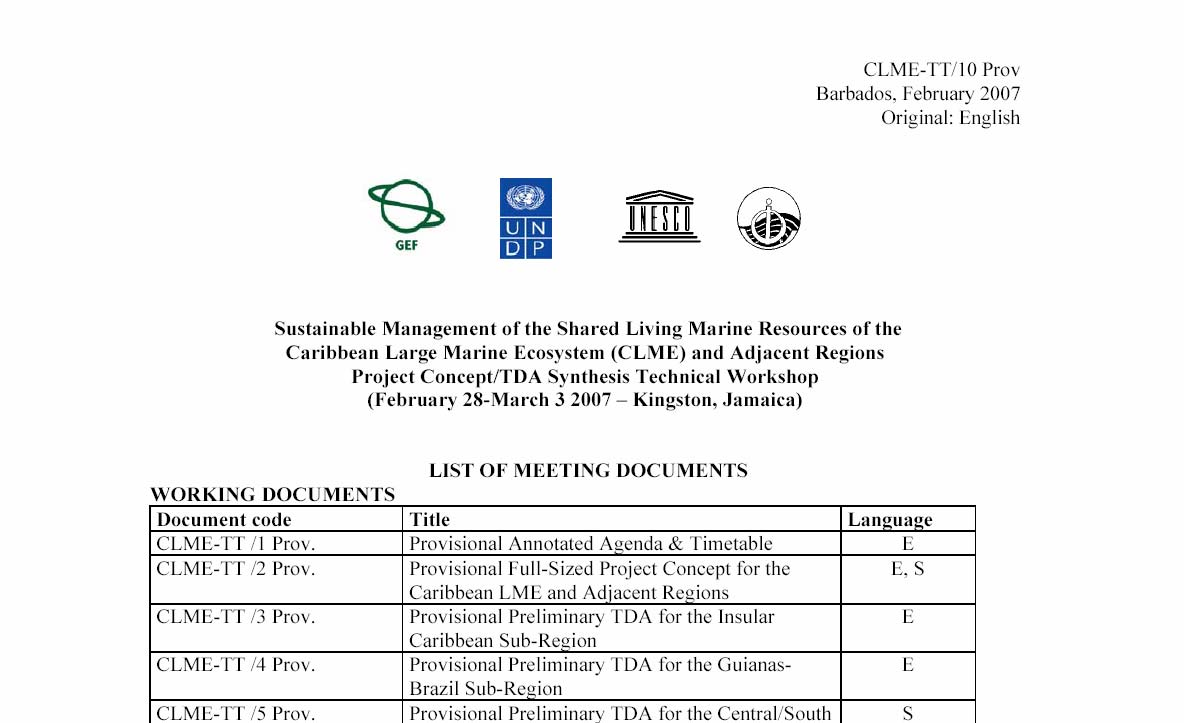
Appendix 3. List of Workshop Documents
20
Appendix 4: Approved Project Concept Report
1. Purpose of Outline Paper
The purpose of this outline document is to develop a shared vision of the Full Sized Project
which is a key objective of the PDF-B project. Reviewing the Concept Paper the key features of
the Full Sized Project are:
Through the mechanism of the Transboundary Diagnostic Analysis, to characterize and
analyze the rood and underlying causes of transboundary issues relating to the
management of marine resources in the CLME and develop and agree on a Strategic
Action Programme to address those causes (component 2, TDA).
Compilation and sharing of existing sources of information required for good governance
of marine resources, and identification and filling of knowledge gaps (component 2,
TDA) through appropriate technical programmes.
Establishing a culture of networking and cooperation among the countries for
management of marine resources, focusing on strengthening existing institutions and
structures (component 3, SAP development).
Establishment of a monitoring and evaluation framework for the ecosystem status of the
CLME in line with the ecosystem management approach and SAP implementation
(component 3, SAP development)
Create successes that serve as examples of how countries can collaborate to manage
transboundary marine resources through "Strengthening by doing" (component 4,
Demonstration projects).
A flexible framework is needed to accommodate the diverse requirements of living marine
resources (LMR) governance in the Wider Caribbean and to facilitate the inclusion of all
stakeholders. In designing the project concept, a variety of complementary approaches to
development of a management framework for LMR were adopted. The framework
accommodates these approaches which have their particular strengths and weaknesses.
The Large Marine Ecosystem approach uses five key modules (productivity, fish and fisheries,
pollution and ecosystem health, socio-economic and governance) as the basis of an ecosystem
based management approach and has a very strong and robust scientific basis. It is directly
supportive of the TDA, providing productivity, fish and fisheries, pollution and ecosystem health
information for the development and application of monitoring and assessment of indicators.
The TDA/SAP approach is aimed at reaching an agreement through a regional Strategic Action
Programme on measures needed to remove barriers to effective governance of transboundary
shared resources and as a framework for coordinated interventions. The TDA/SAP approach
assumes that there are centralized policy making structures already in place and that the SAP can
be streamlined into the national and sectoral planning frameworks.
The multi-scaled LME governance approach proposed by the CLME Technical Task Team
views governance at the local and national levels and their linkages into regional and
international management and policy processes as especially important in the CLME. The LME
project emphasizes governance but recognizes that science is an important and integral
component of the management and policy process. The project takes the approach that
generation of scientific information should be demand-driven and determined by management
and assessment needs for informed decision and policy making. There has already been a
considerable investment in scientific monitoring, assessment, and research in the Wider
Caribbean and it is important for the project to make best use of available information.
The TDA SAP process supporting the pilot projects provides the means of identifying, to the
extent financial resources allows, information on which to base management decisions. A portion
of the funding provided by the GEF will be earmarked for urgent and immediate monitoring and
assessment needs as identified by the relevant stakeholders, including policy makers and
scientists.
The project framework will actively seek partners to provide the required technical and scientific
inputs to augment the support provided by the GEF for introducing an ecosystem-based approach
for the CLME project. A number of potential partners have already been approached and have
indicated an interest in contributing their expertise and funding. Key partners who have already
agreed to participate in the project under this kind of arrangement include Census for Marine
Life, Nature Conservancy, University of Miami, University of West Indies, Organization for
American States (OAS) and FAO.
The purpose of this outline paper is to present a balanced project vision for the planning and
implementation of the CLME project.
2. Overall Context
In agreeing on a project vision, there are a number of features of the Caribbean Large Marine
Ecosystem and the management of its living resources which need to be recognized, including:
The large number of culturally, politically and socio-economically diverse countries (26)
and dependent territories involved and their wide range of living resource management
capacities.
The mosaic of Economic Exclusive Zone, many still to be formally delimited, which
covers the entire region with the exception of two small areas of high seas, and
consequently a high incident of transboundary resource issues.
The wide range of types of fishery in the CLME with different management demands and
models.
The absence of any major fishery stocks from which revenues can be derived to support
and all-inclusive RFMO.
A high dependence, particularly for SIDS, on marine resources and the resulting
overexploitation of coastal and off-shore living resources.
A fragmentation and wide diversity of national, sub-regional and regional marine
resource governance institutions.
In designing this project, these specific CLME features were taken into account, and it is for this
reason that this project stresses the importance of the LME governance framework.
3. Project components
The following project proposals have been developed in consultation with UNDP-GEF,
IOCARIBE and the PDF-B project team. These ideas have also been discussed at a preliminary
stage with the Technical Team tasked with the production of the TDA, which includes
representatives from WECAFC-FAO, OSPESCA, CRFM and selected countries, at the project
kick-off meeting in October 2006. This finalized document is the result of consensus reached by
the member countries and other project partners at the CLME Project Concept/TDA Synthesis
Workshop held in Kingston, Jamaica on February 28 March 3, 2007.
3.1 Component 1: Project Management
22
The project will be guided by the Steering Committee comprising of representatives of the
participating states, the GEF implementing and executing agencies, other key bilateral and
international donors (FAO, NOAA, EU, etc.) and stakeholders. The Steering Committee will
review and approve all technical documents, review budgets and financial reports and provide
general implementation guidance to PCU. It will meet once a year and all its decisions will be
made on the basis of consensus. In addition to the Steering Committee, at the Sub-Regional
level, advisory bodies will be formed, comprising representatives of the countries and the
implementing and executing agencies, to review all sub-regional activities, including
demonstration projects.
The project will be administered from a small Project Coordination Unit, the location of which
has yet to be decided. In choosing the PCU location, communications and logistics as well as the
facilities offered by the host country will be important criteria. The PCU will be staffed by a
Chief Technical Advisor, ideally a marine resource expert, a scientific officer and two technical
assistants sourced regionally. The number of support staff will be limited in order to keep
administration costs to a minimum. For it to operate effectively, the PCU will have to be able to
exercise a considerable degree of financial independence, particularly with respect to local
contracting. The PCU will be supported by international and regional consultants selected from
agreed rosters.
Implementation of the project will be dispersed as widely as possible around the participating
region, with the PCU acting as the coordinating body. The PCU will assume primary
responsibility for implementation of component 2 (TDA) and coordination of component 3 (SAP
Development). In addition, the CLME information system and project web-site will be hosted by
the PCU.
The project will include a fourth component that has demonstration projects. Implementation of
the four demonstration projects will be undertaken through Inter-Agency Agreements (IAA) or
sub-contracts with named project partners. The PCU will provide oversight for each of the
project components. Each demonstration project will be managed through a Project
Implementation Unit, which will report technically to the PCU, but will be financially
independent.
3.2 Component 2: Analysis of Transboundary Living Marine Resources Issues and
Identification of Needed Actions
Early on in implementation of the PDF-B project, it became apparent that development of a
detailed TDA at the regional level would not be possible given the available PDF-B resources
and timeframe and that TDA finalization would have to be deferred to the Full Size Project. In
addition, it was concluded, due to the CLME's size, complex mosaic of EEZs and diverse
ecosystems, that development of a series of sub-regional TDAs would be more appropriate than
a single analysis. Three sub-regions were selected for TDA development: Insular Caribbean,
Central/South America and Guianas/Brazil.
The final TDA (incorporating Sub-Regional components) will be based on existing information
and will characterize, scope and identify the underlying/root causes of transboundary issues
relating to management of living marine resources from an ecosystem perspective. Following
GEF best practice, the TDA process will lead to the identification of the priority interventions for
inclusion in the SAP needed to address underlying/root causes, including filling of knowledge
gaps, legal, policy, and institutional reforms, investments, economic instruments, awareness
raising and stakeholder involvement. The TDA will be formulated by the Technical Task Team
23
(TTT) selected during the PDF-B project phase. An initial TDA will be completed in the PDF-B
project and the final TDA in the Full Sized Project. The initial TDA will be used to help design
of the Full Sized Project.
The final TDA will be the first activity to be undertaken in the Full Sized Project and will
include detailed Causal Chain Analyses (CCA), Stakeholder Analysis and Public Involvement
and Communication Strategy, institutional mapping and legislative review and a socio-economic
evaluation. The TDA will inform the development of the SAP, including development of a multi-
level management and governance framework (component 3) and inform the final design of the
demonstration projects (component 4). The TDA through the CCA will identify possible
interventions to be included in the Strategic Action Programme, some of which may be
implemented within the demonstration projects. To assist prioritization during SAP development,
the TDA will incorporate a socio-economic evaluation and pre-feasibility studies of key
interventions.
The project design recognizes that there has already been a considerable amount of science
monitoring, assessment, and research relevant to the goods and services provided by the
resources of the Wider Caribbean. Much of the pertinent information is centralized in a few areas
or is in forms that makes it difficult to access. Therefore, in parallel to the TDA, the project will
assist in the design and development of a CLME information management system that will build
on existing initiatives. The project needs to ensure that this system will be sustainable over the
long term. One of the purposes of the information system will be to collate and facilitate the
accessibility and dissemination of this widely scattered information, as well as to analyse the
information and data produced for monitoring and evaluation of the ecosystem status of the
CLME and implementation of the SAP. The design of the system will take account of other
regional and sub-regional objectives to be discussed and agreed by the participating countries.
The Full Sized Project will establish a Stakeholder Advisory Group (STAG) to review the key
project documents. It would comprise a team of up to 12 involved and aware stakeholders from
the region who have an active interest in living marine resource management issues. The
stakeholders will be carefully selected as part of the Stakeholder Analysis. They will be
representatives of stakeholder groups which are not normally given a formal voice in the
TDA/SAP development process, yet whose insights and perceptions of the project development
may be especially illuminating given their immediate involvement with living marine resource
management issues. The role of the Stakeholder Advisory Group will specifically be to provide
feedback to the TDA/SAP process and design and monitoring of the demonstration projects.
3.3 Component 3: SAP Development and Identification of Reforms and Investments for
Management of Shared Living Marine Resources
A SAP is a negotiated policy document which establishes clear priorities for action to resolve the
priority transboundary living marine resource management problems. It identifies policy, legal
and institutional reforms and investments needed to address the priority transboundary waters
problems. The preparation of a SAP is a cooperative process among key stakeholders in the
countries of the region.
The PDF-B project document required the production of a preliminary SAP endorsed by 26
countries and 18 dependent territories; however, in practice, it is not feasible or perhaps even
appropriate at this early project stage. It was therefore decided to delay SAP development until
after finalization of the TDA as part of the Full Sized Project. The SAP development process will
24
be informed by the TDA and the interim results of the demonstration projects. Following the
principle of subsidiarity and GEF TDA/SAP best practice, the sub-regional TDAs will naturally
lead to the development of Sub-Regional SAPs, nested and linked within a framework of a
Regional SAP. The question would then arise what governance framework would be needed to
implement such a multi-layered SAP?
The SAP component will assist the countries to create a management and governance structure
for the Caribbean LME, utilizing the strengths inherent in existing institutions and structures
(e.g. through a tripartite mechanism comprising FAO/WECAFC, IOC/CARIBE and
UNEP/Caribbean Environment Programme) before creation of new ones. The first step will be to
map out the present institutional framework within the different fisheries and within the context
of other ecosystem considerations including productivity, pollution and ecosystem health, and
socioeconomics. This work will be undertaken as part of the TDA. There will also be a review of
relevant international fisheries agreements and other agreements and institutions affecting the
health and sustainability of the goods and services of the CLME.
The institutional strengthening activities will include:
Strengthening of existing decision-making institutions by the creation of a regional and
sub-regional framework capable of delivering EBM of the living marine resources; and,
where appropriate, promoting competence for management within existing bodies,
including creating strong linkages with other economic sectors and stakeholder groups.
Strengthening the linkages between the advisory and decision-making bodies including
the operationalization of arrangements for implementation of the Precautionary Principle
and Code of Conduct for Responsible Fisheries.
Encouraging the Caribbean states to ratify and implement relevant international
agreements (UNCLOS, UN Fish stocks Agreement, FAO Compliance Agreement, etc)
and to support the development of national enabling legislation.
Developing and promoting regional agreements and capacity to enable the Caribbean
states to participate in international Fisheries Management Organizations, in particular
the International Commission for the Conservation of Atlantic Tunas.
The final step, the development and agreement on the LME management and governance
framework will be carried out in parallel with the development of the SAP and should be seen as
an integral part of the SAP process. The strengthened management framework would be
responsible for implementation of the SAP and monitoring and evaluation of the CLME
ecosystem status and trends through an agreed set of indicators and information system (see
below).
The SAP component will promote the agreements needed to link the demonstration projects to
the regional and sub-regional and ecosystem-wide management and governance framework that
will serve as an essential foundation for ecosystem-wide assessment and management of the
LMR of the CLME.
The SAP will incorporate a monitoring and evaluation framework based on a suite of GEF IW
indicators (process, stress reduction and ecosystem status) and will include reporting and
updating procedures for recording SAP implementation. It will be important to establish the
baselines against which the indicators are to be measured, which will be one of the most difficult
tasks in the SAP development. The indicators must be measurable and, directly or indirectly,
assess progress.
25
A review of existing monitoring programmes will be undertaken in order to identify a suite of
ecosystem status indicators (ESI) which can adequately describe the status and track trends of the
CLME environment whilst still being cost effective and technically feasible. The suite of ESI, in
the form of an integrated Regional Ecosystem Monitoring Programme (REMP), will track the
status and long-term trends in CLME fisheries, biodiversity habitat degradation and pollution.
The development of the REMP should be seen as a long-term goal and should be phased to
match the institutional capacity and the levels of funding available in the region. The REMP
should be capable of producing consistent, comparable results and support the decision making
process at the national, sub-regional and regional levels. The preliminary programme will
inevitably be modest, focusing on priority transboundary pollutants and key ecosystems and
fisheries under threat. The design of the REMP programme will be underwritten by the analysis
done under the TDA and the results from the demonstration projects (component 3) and an
integral part of the design will be a regional awareness and capacity building programme,
targeting participating monitoring and advisory bodies. The REMP design will also be closely
linked to that of the CLME information system to be developed under component 2.
3.4 Component 4: Targeted Projects Aimed at Strengthening the Policy Cycle and Early
Strategic Action Programme Implementation
In designing the SAP implementation demonstration projects the guiding principle of
"strengthening by doing" is to be followed. Four separate fisheries specific projects are to be
developed, focusing on SAP development at different levels. The demonstration fisheries will be:
Flyingfish;
Shrimp and Groundfish;
Lobster; and
Reef fisheries and biodiversity
The demonstration projects will target application of best available information, including latest
credible science-based assessments, to the management and policy processes at the appropriate
level or levels. Data and information, analysis and advice, decision making, implementation and
review and evaluation will be analyzed for strengthens and weaknesses through the TDA process
(component 2) and the demonstration project design. The draft project proposals will be
discussed and finalized with the countries and STAG early in the first year of the Full Sized
Project. It is important that the demonstration projects target potential SAP interventions
particularly with regard to the Precautionary Approach and Code of Conduct for Responsible
Fisheries, and that the interim results feed into the SAP and LME Governance framework
development process.
The demonstration project design will take note of the following four propositions:
1. Any interruption at any stage of the policy cycle will result in dysfunctional governance of the
target resources or ecosystems
2. Vertical linkages between functional policy cycles are necessary for effective LME
governance
3. Horizontal linkages between functional policy cycles are often necessary for effective LME
governance
4. Linkages between functional policy cycles specific to the "analysis and advice" and "decision-
making" stages of the cycle are essential for effective LME governance
The four demonstration projects will highlight different aspects of the policy cycle at different
governance levels.
26
The operation of these policy cycles will identify institutional and information gaps that need to
be filled and the necessary monitoring and assessment will be funded by the GEP project to the
extent that the budget allows, and complemented, as appropriate, by support from technical
partners.
3.4.1 Flyingfish
Based on an emerging fishery, this demonstration project will focus on: strengthening of linkages
between "analysis and advice" and "decision making" policy bodies; improve coordinated
implementation at the Sub-Regional level; and increase stakeholder involvement at local,
national and Sub-Regional levels. A potential promoter for this project is the CRFM whilst key
partners include the WECAFC ad hoc Flyingfish Working Group and the OECS. This is seen as
a guide demonstration project, a yardstick from which the implementation success of other more
involved projects can be measured.
3.4.2 Shrimp and Groundfish
This project will target the increasing complex and sophisticated shrimp and Groundfish fishery
of the Guianas-Brazil shelf. The weakness and strengths of the policy cycles have been well
studied by the FAO-WECAFC fishery working group and key areas for interventions have been
recommended. This demonstration project will be a model for what is achievable in terms of
ecosystem-based management of a sub-regional, mixed fishery.
3.4.3 Lobster
The lobster fishery is significant in that it is ecosystem wide and transboundary as a result of
planktonic dispersal, whilst local and national in terms of its management and governance. The
challenge will be to create an implementable policy cycles at the local level with the necessary
vertical linkages to the higher sub-regional and regional levels. The local governance structure
needs to be able to deliver data and information to the higher levels and implement regional
management rules, whilst still maintaining some degree of self regulation. The demonstration
project needs to find the correct balance between top-down and bottom-down approaches to
achieving sustainable resource management. Involvement of local stakeholders and increase
public awareness will be crucial in building an effective policy cycle and governance structure.
OSPESCA is a potential promoter of the demonstration project. The project would in the first
instance have a limited geographical scope however linkages to other areas within the Wider
Caribbean where the lobster fishery is of significant importance will be developed.
3.4.4 Reef fisheries and Biodiversity
The reef fisheries and biodiversity demonstration project will articulate a policy cycle for a
subset of reef systems. These are highly complex and provide a wide range of goods and services
at the local and global scale. The demonstration project will develop an assessment,
management, and governance framework to ensure the ecological integrity of the reef and its
ability to withstand environmental shocks and stresses such as climate change. The
demonstration project will be implemented at a limited number of carefully selected sites,
identified on the basis of their ability to provide comparative lessons on effective reef fisheries
and reef biodiversity governance over the period of the project. The sites may be transboundary
and or associated with existing Marine Protected Areas. Of particular interest to the project will
be the adjoining secondary reef areas where regulation is less stringent and fishing pressure is
heavier. Again, the importance of involving the local stakeholders in the decision-making
process will be crucial in creating an effective governance structure.
27
A key objective of this component will be to engage as many of the countries in the
implementation of the demonstration projects and in doing so encourage participation and
engagement in the SAP process.
The demonstration projects will be designed to be replicable, and within the life of the project
the lessons learnt will be transferred to comparable fisheries in the Caribbean and potentially
wider afield. As part of the demonstration project design, a programme of activities will be
developed to disseminate the lessons learnt.
4. Programme
A draft project programme is presented in a separate Excel spreadsheet file entitled CLME
Timeline that accompanies this document.
The overall programme length is 4 years, beginning Q1 2008 and ending Q4 2011. The features
to note are:
Rapid establishment of the PCU, finalization of the TDA and commencement of the
demonstration projects within the first nine months. As much preparatory work as
possible needs to be done at the PDF-B stage to ensure a quick project start-up.
Work on design of the LME management and governance framework and institutional
strengthening will begin during the TDA and will continue until finalization of the SAP.
Inter-governmental negotiations have their own rhythm and cannot be dictated by a strict
project timetable and therefore the maximum time needs to be made available.
SAP development will begin after TDA finalization and delivery of interim results from
the demonstration projects. The SAP development will culminate with a donors'
conference and information dissemination programme.
The demonstration projects will have an 8 month design phase and 3 year execution
phase, which will give sufficient time to assess the results, including the effectiveness of
any new governance arrangements.
5. Budget
The GEF project budget excluding co-funding and the PDF-B funding is $7.08 million: a draft
project budget given in Table 1. The final budget division will be made once the detailed
activities are agreed.
Additional co-funding will be actively pursued during the PDF-B stage for the SAP development
implementation component.
28
Table 1. Draft Project Budget
$million
Component 1
Project management and Coordination
1.18
Subtotal
1.18
Component 2
Finalization of TDA
0.55
Design and development of CLME information system
0.25
Subtotal
0.80
Component 3
SAP development
0.50
Design of Monitoring and Evaluation Framework
0.20
Institutional capacity building
0.40
Development of CLME governance framework
0.30
Donors Conference and information dissemination
0.20
Subtotal
1.60
Component 4
Design and implementation of demonstration projects
3.50
Subtotal
3.50
TOTAL 7.08
29
Appendix 5. Potential Partnership Diagrams
5a. Flyingfish Partners (attached as a separate file)
5b. Lobster Partners (attached as a separate file)
5c. Reef fisheries/Biodiversity Partners (attached as a separate file)
5d. Shrimp and Groundfish Partners (attached as a separate file)
5e. Component 3 Implementing the Governance Framework Partners (attached as a
separate file)
30