
CERMES
Technical Report No 8
Determination of the Socio-economic Importance of
the Lobster Fishery of the British Virgin Islands
GREGOR
Y FRANKLIN
Centre for Resource Management and Environmental Studies (CERMES)
University of the West Indies, Faculty of Pure and Applied Sciences,
Cave Hill Campus, Barbados
2007
ABSTRACT
Determination of the socio-economic importance of the
lobster fishery of the British Virgin Islands
GREGORY FRANKLIN
The British Virgin Islands is heavily dependent on tourism and the Caribbean spiny lobster
(Panulirus argus) is one of the delicacies which the visitors enjoy. The British Virgin Islands
1998 Fisheries Management Plan identified signs of overfishing in the lobster fishery throughout
the territory with acute overfishing in certain areas. Measures were implemented in the 2003
Fisheries Management Regulations aimed at conserving this species. Among these measures, the
closed season for lobster, from March through June, was the one expected by the stakeholders to
cause hardship. This closed season was expected to have negative socio-economic impacts on
fishers and restaurants. These stakeholders therefore asked for a socio-economic survey to be
made. This survey was arranged by the Conservation and Fisheries Department of the Ministry
of Labour and Natural Resources which has responsibility for the fishing industry.
The objectives of the survey were to determine the economics of the lobster fishery in respect of
expenditure and revenue and describe its social importance to the stakeholders. It was also to
update and expand a previous economic survey to specifically include lobster. The survey was
also to establish or strengthen linkages among stakeholders for research on the lobster fishery
through the use of participatory research methods and to recommend a system of socio-economic
monitoring for the lobster fishery. The primary methods for conducting the survey were
questionnaires, focus group meetings and key informant interviews.
Results show that most of the lobster fishers have made a significant investment in the fishery
and are highly dependent on it for personal income. There is interdependency between fishers
and restaurants, and a few family enterprises exist where boat and restaurant are owned by same
person. The newly imposed closed season for lobster can cause a loss of income to the
stakeholders because of its timing which starts at the peak in tourist arrivals to the territory and
continues almost to the end of the tourist season. Some recommendations are made for
strengthening the participation of stakeholders in further research on the lobster fisher and for
establishing a system for regular socio-economic monitoring.
Keywords: British Virgin Islands, Socio-economic survey, Caribbean spiny lobster
i
ACKNOWLEDGEMENTS
I am especially grateful to those who made this project possible and the many people who
assisted and encouraged me in completing it. I thank the Government of the British Virgin
Islands, in particular, the Conservation and Fisheries Department of the Ministry of Labour and
Natural Resources, for hosting me and facilitating the research.
Conducting the survey was critical to this project and this task could not have been accomplished
without the help of Ms. Abbi Christopher, Mr Samuel Davies, Mr Arlington Pickering, Mr Ken
Pemberton, Mrs. Jasmine Hodge-Bannis; to them my thanks are extended. I also wish to express
gratitude to the presidents of the Virgin Gorda Fishermen's Cooperative and of the Jost Van
Dyke Fisherfolk Association and the participants in the survey.
Much appreciation is expressed to my supervisor, Dr Patrick McConney, Snr. Lecturer
CERMES, and my external supervisor, Mrs Christine Chan-A-Shing, the Fisheries Officer
(BVI), for their invaluable advice and assistance with this task.
Special thanks to my CERMES colleagues: Danny for his assistance with aspects of the project
during our sojourn in The BVI; and to Bertha, Katherine, and Amanda.
ii
CONTENTS
ABSTRACT...........................................................................................................................I
ACKNOWLEDGEMENTS......................................................................................................II
1
INTRODUCTION..............................................................................................................................................1
1.1
GEOGRAPHIC LOCATION..............................................................................................................................1
1.2
FISHING AREA .............................................................................................................................................2
1.3
FISHERIES IN THE BVI .................................................................................................................................2
1.4
SOCIO-ECONOMIC IMPACT OF LOBSTER FISHERIES MANAGEMENT...............................................................3
1.5
HOST ORGANISATION ..................................................................................................................................3
1.6
RESEARCH OBJECTIVES ...............................................................................................................................3
1.7
ORGANISATION OF REPORT..........................................................................................................................4
2
METHODOLOGY.............................................................................................................................................4
2.1
SOCIO-ECONOMIC SURVEYS ........................................................................................................................4
2.1.1
Fishers questionnaire ............................................................................................................................4
2.1.2
Restaurant questionnaire.......................................................................................................................5
2.1.3
Key informants.......................................................................................................................................5
2.1.4
Focus groups .........................................................................................................................................5
2.2
DATA ANALYSIS AND INTERPRETATION.......................................................................................................6
2.3
LIMITATIONS ...............................................................................................................................................6
2.4
SECONDARY DATA ......................................................................................................................................6
3
RESULTS ...........................................................................................................................................................7
3.1
LOBSTER FISHERY OVERVIEW......................................................................................................................7
3.2
FISHERS SURVEY .........................................................................................................................................9
3.2.1
Demographics........................................................................................................................................9
3.2.2
Livelihoods...........................................................................................................................................11
3.2.3
Vessels .................................................................................................................................................13
3.2.4
Ownership, kinship and sharing ..........................................................................................................14
3.2.5
Local knowledge of lobster biology .....................................................................................................16
3.2.6
Catch and effort ...................................................................................................................................17
3.2.7
Revenue................................................................................................................................................21
3.2.8
Maintenance and operating costs ........................................................................................................22
3.2.9
Marketing arrangements......................................................................................................................25
3.2.10
Attitudes and perceptions regarding the resource and management ..............................................25
3.2.11
Lobster closed seasons and other regulations ................................................................................26
3.3
RESTAURANT SURVEY...............................................................................................................................28
3.3.1
Closed restaurants ...............................................................................................................................28
3.3.2
Patrons.................................................................................................................................................29
3.3.3
Tourist arrivals ....................................................................................................................................30
3.3.4
Restaurant size.....................................................................................................................................31
3.4
FIRST FOCUS GROUP MEETING ...................................................................................................................31
3.4.1
General recommendations for the lobster fishery................................................................................31
3.4.2
Entry into fishing and alternative income............................................................................................31
3.4.3
Threats to the lobster fishery ...............................................................................................................32
3.4.4
Opinions on fisheries regulations ........................................................................................................32
3.4.5
Relationship with the fisheries authority .............................................................................................32
3.4.6
Where fish is sold.................................................................................................................................33
3.5
SECOND FOCUS GROUP MEETING ...............................................................................................................33
3.5.1
Number of fishers.................................................................................................................................33
3.5.2
Where fish is sold.................................................................................................................................33
3.5.3
Gear, threats and abundance...............................................................................................................33
3.5.4
Registration and relationship with the fisheries authority...................................................................34
3.5.5
Opinions on fisheries management......................................................................................................34
4
DISCUSSION ...................................................................................................................................................35
4.1
SOCIO-ECONOMIC IMPORTANCE OF THE LOBSTER FISHERY .......................................................................35
4.1.1
Fishers .................................................................................................................................................35
iii
4.1.2
Restaurants ..........................................................................................................................................37
4.1.3
Others ..................................................................................................................................................38
4.2
LINKAGES AMONG STAKEHOLDERS FOR PARTICIPATORY RESEARCH.........................................................39
4.3
SOCIO-ECONOMIC MONITORING FOR THE LOBSTER FISHERY......................................................................40
5
REFERENCES.................................................................................................................................................42
6
APPENDICES ..................................................................................................................................................44
APPENDIX 1: FISHER'S QUESTIONNAIRES .................................................................................................................44
APPENDIX 2: ATTITUDES AND PERCEPTIONS REGARDING RESOURCES AND MANAGEMENT....................................51
APPENDIX 3: RESTAURANT QUESTIONNAIRE ...........................................................................................................54
APPENDIX 4: FIRST FOCUS GROUP MEETING ............................................................................................................56
APPENDIX 5: SECOND FOCUS GROUP MEETING ........................................................................................................57
APPENDIX 6: COST OF SAFETY EQUIPMENT..............................................................................................................58
APPENDIX 7: QUESTIONNAIRE ON BACKGROUND INFORMATION FROM FISHING COMPLEX .....................................59
Citation: Franklin, G. 2007. Determination of the socio-economic importance of the lobster
fishery of the British Virgin Islands. CERMES Technical Report No. 7. 59pp.
iv
1 INTRODUCTION
The purpose of this paper is to determine the socio-economic importance of the lobster fishery of
the British Virgin Islands. This socio-economic study was executed as a research project during
an internship hosted by the Conservation and Fisheries Department (CFD) of the Ministry of
Natural Resources and Labour of the Government of the British Virgin Islands.
The department seeks to manage the natural resources of the British Virgin Islands in a
sustainable manner. It was formed specifically to address the growing environmental stresses
that the British Virgin Islands are experiencing.
This socio-economic survey aims to provide knowledge about the importance of the lobster
fishery to individuals and groups of stakeholders. It will assist the CFD in gauging the impacts of
new fisheries regulations on these stakeholders and in implementing adequate management for
the fishery, especially by involving stakeholders in decision-making to help determine whether
the lobster closed season will have negative socio-economic impacts.
1.1 Geographic location
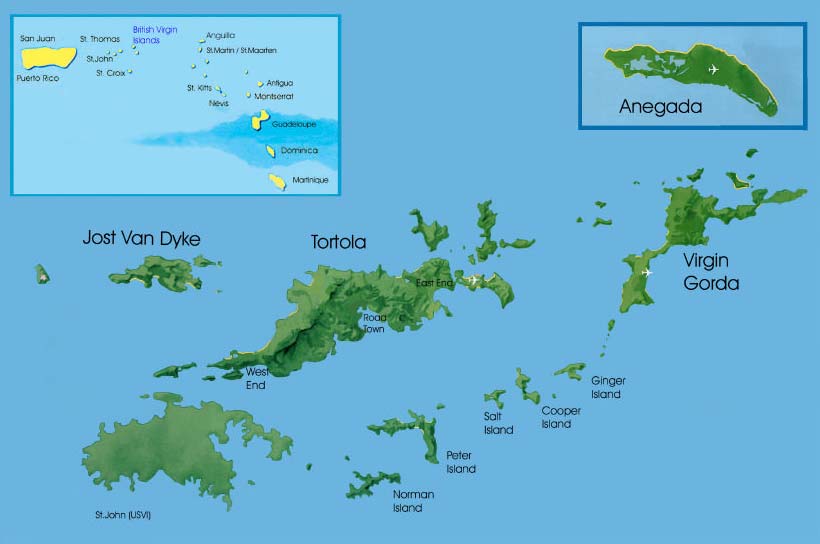
The British Virgin Islands (BVI) is an archipelago comprising thirty six islands, islets and cays
situated in the Eastern Caribbean at longitude 64°30'W and latitude 18° 30'N (Figure 1.1).
Figure 1.1 Map of British Virgin Islands
Sixteen of these islands are inhabited. The main islands include Tortola which is linked by a
bridge to nearby Beef Island, Anegada, Virgin Gorda and Jost Van Dyke. The islands together
constitute a total area of 153 km2 (59 square miles) with a territorial sea of 1,489 km2 (575
square miles) The British Virgin Islands are located on the same geological shelf as Puerto Rico
and the US Virgin Islands, with the exception of St. Croix. (The Development Planning Unit,
Government of BVI, 2005).
1
1.2 Fishing area
The total shelf area is approximately 10,393 km2 (3,026 square nautical miles) of which about
3,130 km2 belong to the BVI. About 90% of the shelf floor lies in water shallower than 60m.
(200 ft) and it is dotted with coral reefs and rocks with a total slope length of 176 km.
BVI has an Exclusive Economic Zone of 84,050 km2. The area beyond the shallow shelf
belonging to the BVI is approximately 74,813 km2. Several banks rise above the general shelf
floor but the most notable ones associated with fishing are the Barracuda Banks or Sea Mount to
the south east of Virgin Gorda, the Barracouta Banks or North Drop to the north of Jost Van
Dyke (Government of BVI, 2005).
1.3 Fisheries in the BVI
Fishing is an important source of income for some of the people of the BVI as it is for most of its
Caribbean neighbours. However, earnings from fishing contribute a relatively small percentage
to the Gross Domestic Product (GDP) when compared with other sectors such as tourism. For
example, in 1991 earnings from tourism (the hotel and restaurant sector) accounted for 10.98%
of the GDP whereas contributions from fishing towards GDP were merely 1.44%. The trend over
the next 5 years was a reduced contribution from fishing and an increase from tourism so that in
1996, the contribution from tourism was 19.66% and that from fishing was 0.73 % (Table 1.1.)
Table 1.1: Contribution from fishing and tourism to GDP, 1991 to 1996
Economic
sector
1991 1992 1993 1994 1995 1996
Fishing
1.44 1.63 1.7 0.73 0.92 0.73
Hotels
&
Restaurants
10.98 11.8 11.39 16.95 17.78 19.66
Source: Development Planning Unit
The three major fisheries contributing to the GDP are the nearshore commercial artisanal
fisheries, the offshore pelagic longline fishery and the recreational fisheries. Fishing licence fees
contribute to the government revenue.
The artisanal fisheries typically employ small boats, less than 25 ft (7.5 m) in length, and
traditional fishing methods such as fish pots, hand line, gill net, seine net, and diving. Most of the
artisanal fishing is carried out on the shelf surrounding the islands. Target fish species are
demersal reef fish, such as snapper and grouper, inshore pelagics, like the carangids and
barracuda, and offshore pelagics, such as tuna, dolphinfish and wahoo. These fisheries also
include invertebrates such as conch, whelk and lobster. The offshore longline pelagic fishery is
limited in size and few boats now operate. The recreational fisheries are classified into the big-
game sport fishery and the pleasure fishery. The big-game sport fishery involves professional
angling aimed at marlin and sailfish with boats of 25 to 50 ft in length (7.5 to 15 m). The
pleasure fishery involves amateur angling, targeting tarpon and bonefish, where vessel sizes
range from 17 to 40 ft in length (5 to 12 m).
The fish resources of the BVI have been divided into five categories: shallow water reef fish,
deep slope and bank fish (e.g. snappers and groupers), coastal pelagic fish e.g. (bonito, blue
runner, yellowtail and mackerel), large pelagic fish (e.g. tunas, swordfish, dolphin, wahoo and
bill fishes) and benthic invertebrates (e.g. crustaceans and molluscs such as lobster, conch and
whelk) (Government of BVI, 1997).
Due to concerns of the CFD over the sustainability of some fisheries, the Virgin Islands Fisheries
Regulations, 2003, include precautionary management measures to protect a number of species.
2
Among these measures are closed seasons. For the Caribbean spiny lobster (Panulirus argus),
the annual closed season extends from March 1st to June 30th. In addition to the closed season,
there are minimum size limits, restrictions on catching berried lobsters, and restrictions on
spearing, hooking and impaling lobsters. The regulations also stipulate that fish traps or pots
must have a biodegradable panel.
According to data collected on the seasonality of fishing gear by the CFD, fish traps are used all
year but the department estimated an average of 40 weeks of use due to weather conditions and
repair time. Other methods such as the use of hand lines, fishing rods and diving also have a
season of an estimated 40 weeks. Horizontal longlines are used for a period of about 22 weeks,
from October to May. Although seine nets can be used all year, there are 2 seasons, from
November to March for jacks, (Selar crumenopthalmus) and from March August for bonito
(Sarda sarda), hardnose (Blue runner/ Caranx crysos) and yellowtail snapper (Ocyurus
chrysurus).
1.4 Socio-economic impact of lobster fisheries management
Enforcement of the closed season for lobster has been resisted by some stakeholders who
reportedly fear loss of income because a major income generating commodity will become
unavailable during the height of tourist season. There are accusations that some of the major
stakeholders were excluded from consultations on establishing a closed season. Stakeholders also
stated that a comprehensive socio-economic survey of the fishery was not done, and this should
be an integral part of the decision-making with regard to the closed season (BVI Conservation
and Fisheries Department, 1995).
Stakeholders mentioned that the information base for the closed season needs to be strengthened.
The requirement for strengthening the biological information base for the lobster closed season is
being addressed by a lobster monitoring programme conducted by the CFD in collaboration with
the fishers. It involves the sampling of catches by fisheries officers on the fishing boats,
sampling of landings at the BVI Fishing Complex, as well as nearshore observation of lobster in
selected habitats.
1.5 Host organisation
The Conservation and Fisheries Department is responsible for all aspects of natural resources
management in the BVI and is divided into five functional units; the Fisheries Unit, the
Environmental Unit, the Environmental Education Unit, the Geographic Information Systems
Unit and the Administration Unit. The goal of the fisheries unit is to ensure that stocks are
maintained at, or are restored to, levels that can maximise sustainable yield given an appropriate
environmentally sound and economically justified effort.
Part of the mandate of the department is to work closely with fishermen to manage the fisheries
resources, to monitor the natural environment and wildlife, to map the natural resources of the
territory, to provide information on the environment to the public and to develop policies and
legislation for managing the natural environment (Virgin Islands Government Gateway, 2006).
1.6 Research objectives
The specific objectives of the project are to:
· Determine the economics of the lobster fishery in respect of expenditure and revenue
· Describe the social importance of the fishery to several categories of stakeholders
3
· Update and expand a previous economic survey to specifically include lobster.
· Establish or strengthen linkages among stakeholders for research on the lobster fishery
through the use of participatory research methods
· Recommend a system of socio-economic monitoring for the lobster fishery
1.7 Organisation of report
The remainder of this paper is arranged as follows: Chapter 2 describes the research methods,
Chapter 3 sets out the results of the fishers and restaurant surveys, Chapter 4 discusses results
and Chapter 5 is the conclusion and recommendations. Questionnaires used are included in the
appendices.
2 METHODOLOGY
The research took the form of a survey of groups of stakeholders, based mainly on two sets of
questionnaires and two focus group meetings. Key informants were also interviewed to get a
background of the fishery and some of the issues involved. Fieldwork was conducted from
August to October 2005 on the four main inhabited islands; Anegada, Tortola, Jost Van dyke and
Virgin Gorda. The investigator was based on Tortola and worked with the staff of the CFD. He
was assisted by another student from the Centre for Resource Management and Environmental
Studies (CERMES), who was also doing research in the BVI. Primary and secondary data were
collected.
2.1 Socio-economic surveys
The socio-economic surveys were directed at stakeholders identified as having an interest in the
lobster fishery. These included fishers and boat owners, the management of restaurants and
hotels, the Ministry of Tourism, the Conservation and Fisheries Department, and the BVI Fishing
Complex. For the purpose of this research, it was decided to select two groups who were directly
impacted by the closed season regulation. One group comprised fishers and boat owners and the
other group was the management of restaurants. Questionnaires were prepared for each to gauge
their dependence on the lobster fishery (Appendices 1, 2 and 3). Other information was collected
from secondary sources and key informants and aimed at establishing background information
on the fishery and on the island in general. In both surveys convenience samples were selected
based on the accessibility of respondents so results may not be representative of the fishery.
2.1.1 Fishers questionnaire
The fishers questionnaire of Pomeroy (1999) along with the SocMon Caribbean guidelines
(Bunce and Pomeroy, 2003) were used to prepare the fishers questionnaire in the present study.
Information was collected on the type of fishing, the income and expenditure in the fishing
operation main sources of income in the fishers' households and the number of dependants of
fishers. The overall goal was to determine the dependence of the fisher and his household on
fishing in general and on lobster fishing in particular. It also provided a sense of his investment
and perhaps indebtedness in the fishery.
The boat owners and fishers to be interviewed were selected from a list of known lobster fishers
provided from the records of the CFD. The list was supplemented with names provided by the
fisheries officers from their personal knowledge, and names were added from records of lobster
landings obtained from the BVI Fishing Complex. The final list contained 55 names and was
believed by the officers to be fairly complete.
4
The fishers were contacted either directly by the fisheries officers to arrange interviews for
administration of the questionnaire or the opportunity was taken to interview them while they
were at meetings scheduled for extension work by the officers. In addition, a few were contacted
on an ad hoc basis when they visited the CFD office. Twenty-seven questionnaires were
administered to fishers on the islands of Tortola, Virgin Gorda, Jost Van Dyke and Anegada. The
interviews were conducted either at the fishers' homes, the CFD main office or at a government
office on Virgin Gorda that was used by the CFD for meetings.
2.1.2 Restaurant questionnaire
The restaurant questionnaire (Appendix 3) was designed to be self-administered. It targeted
operators of independent restaurants and hotels on the same four islands as the fishers
questionnaire. Information was collected on the size of the restaurant, the number of staff
employed, the number of patrons and the amount of lobster sold.
The list of restaurants was mainly compiled from a listing obtained from the publication "BVI
restaurant and food guide", which lists most of the restaurants in the BVI, gives their menus and
quotes the price range for meals. Names additional of restaurants were provided by members of a
fisherfolk organisation.
Thirty restaurants were identified based on them advertising lobster on their menus. These were
selected for an initial list of restaurant stakeholders. A further 12 restaurants were added to the
list from the knowledge of key informants, bringing the total to 42. Questionnaires were sent to a
number of these restaurants but responses to the questionnaires were slow and it was therefore
decided to interview the restaurant managers in person. Of the 42 restaurants identified, 19
establishments were contacted, but because many were temporally closed for refurbishment or
for other reasons, only 11 questionnaires were completed.
2.1.3 Key informants
Formal and informal key informant interviews provided the opportunity to obtain additional in-
depth information on the fishery. They permitted respondents to clarify statements or to further
elaborate on brief comments. Formal interviews were used with the fishers and restaurant
management as well as the manager of the BVI Fishing Complex. The informal interviews were
used with staff from the CFD and the president of the fisherfolk association. Informal interviews
were also used with some of the knowledgeable and experienced fishers for more information on
fishing gear and techniques.
2.1.4 Focus groups
The focus group is a means to evaluate or acquire knowledge of a specific theme. It is basically
an interview of a small number of people (6-10) together and it allows for the gathering of a
great deal of information during one session. The group discussion is led by a facilitator who
draws out and gathers data from people knowledgeable in the field. Questions are posed to start
discussion on the topic. Prior to the session, ground rules for participation are agreed upon with
the participants.
Focus group sessions were held on two islands. Invitations to the first session were made via
announcement on the radios and invitations posted in strategic areas on Tortola. The second was
arranged by the president of the Virgin Gorda Fishermen's Cooperative. The focus group guides
are listed in Appendix 4 and 5 respectively.
5
The first session was held at the CFD located on Tortola. The meeting attendance was low as
only 2 fishers and 2 CFD staff members attended, one of the latter, however, being a part-time
fisherman. The following topics were discussed at the meeting:
· Background on fishers and fishing in BVI
· Threats
· Fish sales
· Laws, regulations, enforcement
· Registration
· Management - who should manage the fisheries
The second, better attended, focus group meeting was conducted on Virgin Gorda with about
eight fishers from that island, members of the Virgin Gorda Fishermen's Cooperative. The
purpose of this focus group meeting was to gain insight into the attitudes and perceptions of the
fishers towards the resource and towards management issues related to specific parts of the
fishers survey.
2.2 Data analysis and interpretation
Questionnaire responses were coded and entered into data tables. Data were analysed using SPSS
for Windows (SPSS Inc.). Graphs and charts were generated in order to facilitate visualization
and interpretation of the collected data.
The SocMon Caribbean methodology calls for validation meetings to be held with socio-
economic assessment participants in order to help confirm and interpret findings through group
discussion and feedback from the data collected. There was insufficient time to hold these
meetings while in the BVI, but it would be useful for the participants to be made aware of the
results set out in this paper. SocMon also calls for identifying key learning and recommendations
for adaptive management. These are included in the conclusions and recommendations.
2.3 Limitations
The methodology sought to avoid or overcome many of the limitations of social surveys. These
are listed below and were taken into account in the generation and interpretation of results.
· Fishers seemed reluctant to take part in the survey due to concern about possible taxation
on their income from fishing, so income estimates may require further validation.
· The refusal of some fishers to be interviewed for unknown reasons may have biased the
sample of respondents.
· Only fishers who were known to the officers and who were comfortable being
interviewed took part, may have introduced bias.
· Fishing is not full time employment for many fishers, and part-time fishers are elusive.
· Not all fishers are registered with the CFD, so unknown full-time fishers may exist.
· Many restaurants were closed at the time the survey was being conducted.
· The small number of people at the first focus group may have reduced the quality or
diversity of data collected during that meeting, but this is not likely.
2.4 Secondary data
Secondary data sources consisted mainly of the records and reports of the CFD, ranging from
fisheries statistics to registration records to the reports of previous studies and consultations. The
information from these sources is included in the results and discussion.
6
3 RESULTS
This section presents the results from the fishers and restaurants questionnaires and from the
focus group meetings. The fishers' questionnaire examines the basics of the lobster fishery;
information on the boats and boat owners; local knowledge of lobster biology; gear used and
fishing effort. Income, operating costs, marketing and boat maintenance are also examined. The
fishers' attitudes and perceptions with respect to the resource and its management are examined
as well. Results from the restaurant survey indicate the status of the business and seasonality of
operation. The focus group meetings produced information that directs attention to the threats to
the species and the industry, and to legislative and regulation issues. These meetings also
produced some recommendations for the lobster fishery.
3.1 Lobster fishery overview
The lobster fishery is one of the commercial artisanal fisheries of the BVI. Most of the fishers
use traps while some dive, both free diving and SCUBA. The traps or "pots", as they are
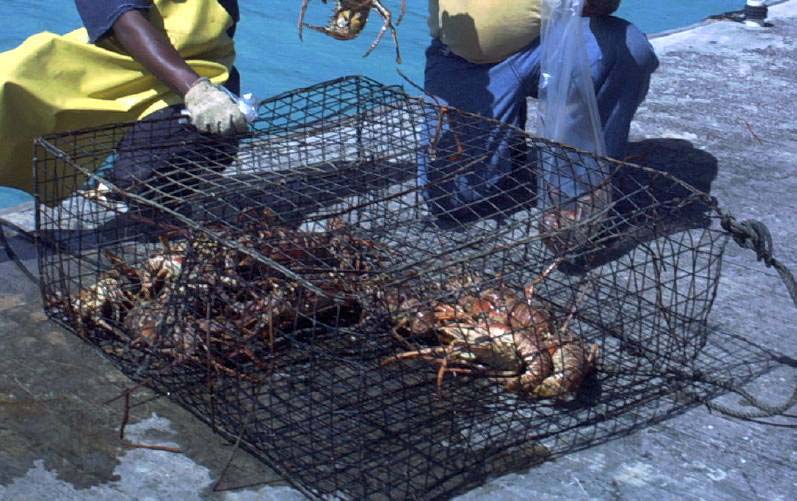
commonly called, are rectangular and generally made of wire mesh. There are 2 types of mesh
used, a square, welded, plastic coated 2 inch mesh (Figure 3.1) and a galvanised, hexagonal,
twisted, "chicken-wire" mesh of about the same mesh size (Figure 3.2). The frame is usually
made of welded ½ inch diameter "construction" steel rod commonly used in the building
industry. A zinc anode, similar to those used to protect boat propellers from corrosion, is
attached to reduce corrosion. Fishers tie the pots in strings or "slings" of 4 to 8 pots with buoys at
both ends of each string. The use of strings, even though discouraged by the fisheries regulations,
makes it easier to locate and haul the pots.
Figure 3.1: Lobster pot made of square wire mesh
7
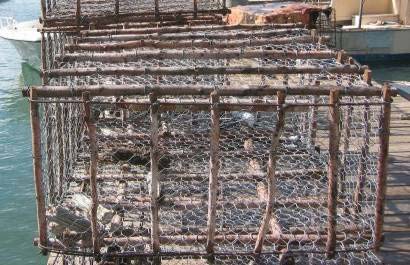
Figure 3.2: Lobster pot made of galvanised "chicken wire" mesh and wood frame
The pots can be used for either fish or lobster but according to fishers, some species of fish, such
as triggerfish, attack lobster and fishers say the lobster therefore avoid pots containing such fish.
Fishers therefore target either fish or lobster in a number of ways, which include location, depth,
bait and pot design. The fisher may set the pots in an area known for either lobster or fish and
use bait such as cow skin, to attract lobster. The funnel of the trap for fish is longer and it turns
down towards the centre of the trap, while the funnel of the lobster trap tends to be shorter and
looks inward. In some cases the funnel of the lobster pot may be wide and shallow, to discourage
entry of the deep bodied triggerfish and to give clearance to the lobster's antennae. Some fishers
say that the type of wire and its condition also influence whether triggerfish or lobster enter the
pot.
Lobster caught in the BVI is used mainly in the tourist industry; most is sold to hotels and
restaurants that cater to visitors. There is limited consumption of lobster by the general
population. However, there is a reported increase in consumption during the August Festival.
Fishers also take home small amounts of their catch. Little is exported officially but fishers have
commented that foreign fishers and yachters may be harvesting the resource illegally.
There is a yachting community consisting of visitors from the USVI, Puerto Rico, the USA and
other places who sail either their own vessels, or rented or chartered boats. Their consumption of
lobster is unknown. They are known to buy from the BVI Fishing Complex. The manager of the
complex reported that sometimes a tender from a yacht comes to the complex for lobster but
such sales are recorded as individual sales, with no indication as to who bought them. It has been
suggested that these visitors also purchase lobster directly from fishers and some fishers suspect
that the visitors also fish lobster on their own. A large part of the yachting community comprises
Puerto Rican nationals, and some restaurants report that such visitors come to the BVI in the
summer and on US public holidays and buy large quantities of lobster.
8
3.2 Fishers survey
3.2.1 Demographics
The 27 respondents were male, but that is not to say that they are no female fishers on the
islands. One was present while her husband was being interviewed and she indicated that she
fished occasionally. The president of the Jost Van Dyke Fisherfolk Association is also female.
Fishers and staff of the CFD, however, say that there are only a few female fishers in the
territory. At least one on Virgin Gorda fishes for lobster.
Most of the respondents (66%) are BV Islanders or "belongers". The BVI is a British Overseas
Territory and cannot confer the right of citizenship. The government therefore confers the status
of "belonger" to certain individuals and this carries much of the rights and privileges associated
with nationality in an independent country. Of the others, 15% stated they were not "belongers"
but were of other Caribbean nationalities such as Vincentian, St Lucian and US citizens.
Nineteen percent said they were residents, but they did not volunteer further information on
nationality (Figure 3.3). So a third of the respondents were "non-belongers".
n=27
Non-belonger
33%
Belonger 67%
Figure 3.3: Nationality of respondent
Of those surveyed 63% said they had a fisher's licence, 22% did not have and 19% did not say
(Figure 3.4). The proportion of fishers with licences is slightly higher for "non-belongers" (67%
licensed) than for "belongers" (61% licensed) but the number of responses is small and the large
percentage of non-response needs to be taken into account.
9
70%
n=27
60%
50%
)
%
t
s
( 40%
en
d
n
o 30%
esp
R 20%
10%
0%
Licensed
Not licensed
Didn't say
Figure 3.4: Possession of fisher's licence
The fishers interviewed ranged in age from 33 to 78 years. However, most respondents were 50
to 64 years, with few older fishers (Figure 3.5).
16.0
n=26
14.0
) 12.0
s
(% 10.0
nt
de
8.0
on
6.0
e
s
p
4.0
R
2.0
0.0
30 to
35 to
40 to
45 to
50 to
55 to
60 to
65 to
70 t0
75 to
34
39
44
49
54
59
64
69
74
79
age range
Figure 3.5: Age of fishers
The years spent fishing varied from 5 to 60, and the period spent fishing specifically for lobster
ranged from 5 to 40 years (Figure 3.6). One respondent reported fishing for 60 years. The age at
which respondents started fishing ranged from 9 to 63 years old with a mean of 25.6. The age at
which fishers started to target lobster ranged from 10 to 63 years old but with a higher mean of
29.9. Fishing generally (for species other than lobster) has shown what may be a decline in the
past 14 years, perhaps indicating an increasing concentration on lobster.
10
25
General fishing - n=26
Lobster fishing - n=24
) 20
(%
15
nts
de
on 10
e
s
p
R
5
0
5 to 9 10 to 15 to 20 to 25 to 30 to 35 to 40 to 45 to 50 to 55 to
14
19
24
29
34
39
44
49
54
60
Years fishing
Figure 3.6: Number of years fishing
3.2.2 Livelihoods
Most of the respondents, 89% (24 respondents) said they were the main providers in their
households. Figure 3.7 shows respondents' sources of income besides fishing. The largest group
(34.6%) were those who depended on fishing alone, 30.8% had unspecified occupations and
construction accounted for 19% of the alternative occupations listed. The remaining respondents
were involved equally in farming, hotel, office, and professional work.
40.0
35.0
)
n=26
30.0
(%
25.0
nts
de 20.0
15.0
e
s
pon 10.0
R
5.0
0.0
e
on
urc
ers
ng
mi
office
ional
rism
all oth
far
nstructi
/tou
co
profess
hotel
no other so
Sources of income other than fishing
Figure 3.7: Sources of income other than fishing
The majority of respondents, 61.5%, reported making from 76% to 100% of their individual
income from fishing. Of those remaining, 15.3% made between 51% and 75 % of their income
11
from that activity. For 11.5%, fishing contributed 25% or less, and also 26 to 50% of income
(Figure 3.8).
70.0
61.5
60.0
n=26
50.0
%
s
40.0
dent
30.0
spon
e
R 20.0
15.4
11.5
11.5
10.0
0.0
1 to 25
26 to 50
51 to 75
76 to 100
Percent income from fishing
Figure 3.8: Proportion of income from fishing
Over 70% of the respondents targeted both lobster and fish, while 24 % targeted lobster alone
and 4% targeted fish alone (Figure 3.9).
fish
4%
lobster
24%
both
72%
Target species
Figure 3.9: Target species of respondents
Sixty-two percent (13 of 21) of the respondents who stated their period for fishing lobster said
they fished lobster throughout the year. The others had varying fishing seasons that ranged from
6 to 10 months. One fished from March to June (the current closed season), one in October, five
in November and one in December. They also ended their seasons at different times, two in
12
April, one in May, one in July and two in August. The proportion of fishers operating in each
month peaked in March and was lowest in September (Figure 3.10).
25
n=21
20
)
%
s ( 15
LEGAL CLOSED SEASON
dent
10
spon
Re
5
0
Jan
Feb
Mar
Apr
May
Jun
Jul
Aug
Sep
Oct
Nov
Dec
Figure 3.10: Lobster fishing periods
3.2.3 Vessels
As noted in the 1992 BVI Fisheries management Plan, the majority of vessels are manufactured
in the USA (CFD. 1998.). They are commercially built vessels with brand names such as
"Boston Whaler", "Lindsey" and "Beechcraft". Most are made of fibreglass (91%) but a small
proportion is made of either aluminium or a combination of wood and fibreglass. Boat lengths
range from 17 to 48 ft. (5.18 to 14.63 m). Boats less than 25 ft (7.62 m) generally had outboard
engines, while boats over 26 ft (7.92 m) used inboard engines. Engine horsepower ranged from
40 to 370, with one 48ft boat having two 370 hp diesel engines. Slightly more vessels were in the
range from 100-199 hp (29%) than in the flanking categories (Figure 3.11).
13
35
30
)
n=24
% 25
t
s
(
20
e
n
15
e
s
pond
10
R
5
0
0 to 100
100 to
200 to
300 to
400 to
500 to
600 to
700 and
199
299
399
499
599
699
over
Total HP
Figure 3.11: Range of boat engine horsepower
Figure 3.12 shows the total value of boat and engine of respondents, with the largest proportion
(38.5%) being less than US$25,000 in investment and declining as the value increased.
45.0
38.5
40.0
n=13
) 35.0
%
30.8
(
s 30.0
nt 25.0
de 20.0
15.4
on 15.0
s
p
e
7.7
7.7
10.0
R
5.0
0.0
< $25,000
$25,000 -
$50,000 -
$75,000 -
> $100,000
$49,000
$74,000
$99,000
Value of boat and engine
Figure 3.12: Total value of boat and engine
3.2.4 Ownership, kinship and sharing
Most of the respondents (73%) captained their own boat. Two respondents (7.7%) were boat
owners but did not captain the vessel; one of these did not fish but employed a fisherman instead.
The other did not give full information. Two respondents (7.7%) were captains of boats owned
by others, and 2 of the respondents were crew only (Figure 3.13).
14
80.0
70.0
)
n=26
60.0
%
t
s
( 50.0
n
de 40.0
on 30.0
e
s
p
20.0
R
10.0
0.0
owner/captain
owner
crew only
captain only
Part owner
Status of respondent
Figure 3.13: Status of respondent on boat
Twenty-one respondents fished on only one boat, while 5 fished on more than one vessel, 4 of
these 5 were boat owners. Twenty-five out of twenty-seven respondents gave the number of crew
they fished with. There was a total of 33 crewmen among the respondents; 20 full-time and 13
part-time crewmen. Seven respondents fished with one full-time crewman each, and 6 others
with 1 part-time crewman each. Those with 2 crewmen each were: 4 with 2 full-time crewmen; 3
with 2 part-time crewmen; and one with 1 part-time and 1 full-time crewman. The largest vessel,
48ft (4.63m) in length, had 3 full-time crewmen and one part-time crewman along with the
owner/captain. Four respondents fished alone.
If the 55 fishers named by the fisheries officers were boat owners, and their operations followed
the pattern of the survey, then 93% of these (51) carry crew. The 27 primary fishers who were
surveyed had a total of 33 crewmen; which suggests 67 crewmen added to the total of 55 fishers.
This gives an estimated total of 122 people fishing lobster. There were 20 full time to 13 part
time fishers, using the same ratio suggests that there may be 41 full time and 26 part time crew (
Figure 3.14).
With respect to family relationship, 10 of the
crewmen (30%) are related to the captains. Five
Part tim e crew
fishers each carried 1 son as crewman, 2 of these
22%
sons were full-time and 3 part-time. The other
relatives include 1 brother and 1 nephew as full
Prim ary
fisher/boat owner
time crewmen. In 3 cases the fishers mentioned
45%
that relatives were among the crew but did not
specify the nature of the relationship. Twenty-one
crew members were not related to the fisher and 2
Full tim e crew
respondents did not say if relatives were among
33%
their crew.
15
Figure 3.14: Estimated numbers of crew to primary fisher
Fourteen fishers/boats (58%) used a sharing system of some sort while 10 (42%) did not. Of the
four respondents (16%) who fished alone, only 1 expressed a sharing system in which half of the
proceeds went to the owner/captain and half to the boat. For the others, the actual sharing
systems varied, 5 boats (20%) paid a fixed salary to crewmen, while 2 boats (8%) paid a salary
based on the catch. The others share money in varying proportions to the owner, captain, crew,
boat and gear, with the owner's shares in the range of 20% to 50%, boat shares from 20 to 60%
and crew shares from 20 to 40%. Two boats allocated shares to gear.
3.2.5 Local knowledge of lobster biology
The reproductive process of the lobster allows some observed phenomena to be used to indicate
the spawning season. The male Caribbean Spiny Lobster (Panulirus argus) attaches a
spermatophore to the female. This appears as a dark patch on the sternum of the female called a
"tar spot". A detailed description is extracted below.
Among the spiny lobsters, females can mate only immediately after they have
shed their old shell (moulted) while their new exoskeleton is still soft. In mating,
the male lobster transfers a spermatophore (sperm packet) to the female;
depending upon the species, he may slip the spermatophore into her genital pore,
in which case the eggs are fertilized before they are laid, or may attach a
spermatophore to the outside of her shell, in which case the female scratches the
spermatophore open to release sperm just as her eggs emerge. Regardless of the
system of sperm delivery, female lobsters store sperm (inside or outside their
bodies) until conditions are right for "spawning", or fertilization. The female then
retains the fertilized eggs on her abdomen for weeks or months until they hatch
Females bearing fertilized eggs are called "berried lobsters" or said to be "in
berry" (Bliss 1982, cited in Seafood Watch).
Regarding the biology of the species, 80% of respondents indicated that there is a specific time
when lobsters are berried, 12% stated they did not know and 8% said there was no specific time.
The months named for berried lobsters ranged from March to September with most identifying
the period between May and August as the season.
Forty-four percent of the fishers answering this question indicated that they did not notice a
specific time when lobsters had tar spots, 40% said there was a specific time and the remainder
said there was none. The months that fishers noticed seeing the tar spot varied from February to
December, with most in the period from June to September.
Fifty-six percent said they did not know if there was a specific time when lobsters moult, (shed
their shell) while 28% said there was no specific time. Only 16% indicated there was a specific
time when lobsters moult. From these few, the time given for moulting ranged from January to
August, with most saying from May to August. Some of the respondents stated that they
encounter only small numbers of moulting or "soft" lobsters. These findings are displayed in
Figure 3.15.
16
16.0
14.0
Berried n= 20
)
% 12.0
Tar spot n=10
s
( 10.0
Moult n=4
nt
de 8.0
on 6.0
e
s
p
4.0
R 2.0
0.0
Jan
Feb Mar
Apr May Jun
Jul
Aug Sep
Oct
Nov Dec
Figure 3.15: Times at which differences related to mating are observed
The majority of respondents (45%) indicated that there was a specific time when there were
more male than females lobsters. Forty-one percent indicated that they did not know, while fewer
than 14% stated there was no specific time at which differences in relative abundance of either
sex were observed. For those noting a difference, the predominant months when more males than
females were observed, were from January to September with two peaks, one in April to May
and the other July to September. More females were observed in the months March to April, in
June and the period August to September (Figure 3.16).
6.0
More male n=11
5.0
More female n=11
)
% 4.0
s
(
nt
de 3.0
on
2.0
e
s
p
R
1.0
0.0
Jan
Feb
Mar
Apr
May
Jun
Jul
Aug
Sep
Oct
Nov
Dec
Figure 3.16: Times at which differences in relative abundance of either sex are observed
3.2.6 Catch and effort
Most of the respondents owned their fishing gear (87.5%) while only 12.5 % did not. Forty-six
percent of respondents said they dived while doing any kind of fishing, fifty-four percent did not
dive, and only 8% of all respondents used SCUBA. Information gathered from the focus group
meeting on Virgin Gorda is that divers operate in teams of about 3, one of whom uses SCUBA
while the others do not.
17
Total trip length varied from 2 to 15 hours (Figure 3.17). The largest group of respondents (33%)
were at sea from 4 to 6 hours per trip. The next largest group (28%) were at sea for 7-9 hrs.
Nineteen percent spent less than 3 hours per trip, while at the other end of the scale, a total of
19% made trips between 10 and 15 hours in length. The actual time spent fishing varied from 1
to 8 hours with 58% spending between 4 and 6 hours. About a quarter, (26%) spent 3 hours or
less actually fishing, while 16% fished for 7 to 9 hours.
The majority of respondents (52%) made one trip per week, while 22% made 2 trips and fewer
than 9% made 3 trips in 2 weeks (Figure 3.18). The remaining minority (4%) made as many as 4
trips weekly. Considering, however that some fishers rotated hauling between different groups of
pots, the actual frequency of hauling for over half the respondents was generally once per week,
with about 22% hauling twice per week or more, and another 22% hauling less than once per
week. One individual reported hauling pots about once per month, this is probably in the slow
season when the demand for lobster is low. Fishers reported either hauling less frequently or
leaving the trap doors open in the slow season.
35.0
30.0
)
n=21
25.0
%
(
nts 20.0
nde
o 15.0
e
s
p
10.0
R
5.0
0.0
1 to 3
4 to 6
7 to 9
10 to 12
13 to 15
Trip lengths (hr)
Figure 3.17: Length of fishing trips at sea
18
60.0
50.0
n=23
)
% 40.0
(
nts
de 30.0
on
e
s
p
20.0
R
10.0
0.0
1
>1 to 2
3
4
Number of trips per week
Figure 3.18: Number of trips per week
The total number of traps operated from each boat ranged from 2 to 450 with a maximum of 200
being hauled per trip. The biggest proportion (36%) indicated that they hauled 26 to 50 pots per
trip (Figure 3.19).
40.0
n=22
35.0
) 30.0
%
t
s
( 25.0
n
de 20.0
15.0
e
s
pon
R 10.0
5.0
0.0
1 to 25
26 to 50
51 to 75 76 to 100
101 to
126 to
151 to
176 to
125
150
175
200
Number of Traps
Figure 3.19: Number of traps hauled
Catches of fish from pots ranged from 20 to 300 pounds (9 to 136 kg) per trip with 30% being in
the range 26 to 50 pounds (12 to 23 kg) (Figure 3.20).
19
35.0
30.0
)
n=20
% 25.0
(
t
s
n 20.0
de 15.0
on
p
e
s 10.0
R
5.0
0.0
1 to 25
26 to 50 51 to 75 76 to 100
101 to
126 to
226 to
276 to
125
150
250
300
Average weight of potfish per trip
Figure 3.20: Average weight of potfish per trip
Lobster catches per trip (Figure 3.21) were reported to mostly be in the range of 51 to 100
pounds (23 to 45 kg) with another peak at 176 to 200 pounds (80 to 90 kg).
25.0
n=24
20.0
s
%
15.0
nt
10.0
e
s
ponde
R
5.0
0.0
1 to
26
51
76
101 126 151 176 201 226 251 276 301 326 351 376
25
to
to
to
to
to
to
to
to
to
to
to
to
to
to
to
50
75
100 125 150 175 200 225 250 275 300 325 350 375 400
Average weight of lobster per trip (lbs)
Figure 3.21: Average weight of lobster per trip
Catch per trap ranged from less than half a pound of lobster (0.5 kg) to over 11 pounds (5 kg) per
trap with a mean of 3.7 pounds (1.7 kg) (Figure 3.22).
20
35
n =23
30
25
%
nts 20
de
on 15
r
e
s
p
10
5
0
<1
1
2
3
4
5
6
7
8
9
10
11
12
13
14
15
Lobster catch per trap (lbs)
Figure 3.22: Catch per trap for lobster
3.2.7 Revenue
Average annual revenue has been calculated for each respondent, based on the estimated
individual catches of lobster and fish along with stated selling prices and trips per week. The
length of fishing season for pots was 40 weeks as estimated by the CFD. This number was used
for those fishing all year. For those fishing part of the year their stated fishing period (if less than
40 weeks) was used. The calculation used was: Average catch per trip x number of trips per week
x average selling price x estimated number of weeks fishing per year, for fish or lobster. The
estimated annual gross revenue for each respondent is shown in Table 3.1 (currency is US$). The
estimated annual total income for mixed fishing operations ranged from $5,400 to $339,700 with
a mean of about $90,400. Thirty percent of the operations had estimated gross earnings below
$30,000, and another thirty percent had gross earnings between $40,000 and $59,000.
Table 3.1: Estimated annual gross revenue from individual fishing enterprises
Annual income
Annual income
Annual income
Total estimated
from fish
from lobster
from other species
annual income
$ 2,500
$ 2,800
$ 5,400
$ 5,600
$ 5,600
$ 5,000
$ 10,000
$ 15,000
$ 6,400
$ 18,000
$ 24,400
$ 4,800
$ 19,600
$ 24,400
$ 5,500
$ 16,800
$12,100
$ 34,400
$ 12,000
$ 25,000
$ 37,100
$ 40,000
$ 40,000
$ 16,000
$ 28,000
$ 44,000
$ 30,400
$ 17,200
$ 47,600
$ 37,700
$ 10,500
$ 48,200
$ 16,000
$ 36,400
$ 52,400
$ 6,000
$ 48,000
$ 54,000
$ 25,000
$ 14,400
$15,400
$ 54,800
21
Annual income
Annual income
Annual income
Total estimated
from fish
from lobster
from other species
annual income
$ 44,000
$ 42,000
$ 86,000
$ 5,000
$ 100,200
$ 105,200
$ 49,500
$ 61,200
$ 110,700
$ 12,600
$ 112,000
$ 124,600
$ 98,200
$ 72,000
$ 170,200
$ 187,900
$ 187,900
$ 82,500
$ 117,000
$ 199,500
$ 43,100
$ 225,500
$ 268,600
$114,200
$ 225,500
$ 339,700
Total from all
$616,400
$1,435,600
$27,500
$2,079,700
respondents
Mean
$ 90,400
Few respondents targeted other species commercially besides fish and lobster. These additional
species were conch and whelk, which were caught commercially only for special orders on
occasions such as the August Festival. The August Festival commemorates the emancipation
proclamation and is celebrated on the first Monday in August. It is the main cultural festival of
the BVI. Many BV Islanders, living abroad, return home to join in the celebration. These visitors
seek the traditional foods which are not normally available overseas, including conch and whelk,
but although lobster is not considered by many to be a traditional delicacy, it is reported that
there is an increase in lobster consumption during the festival.
3.2.8 Maintenance and operating costs
Fuel cost per trip ranged from under $50 to over $200 with most being $51 to $100 per trip
(Figure 3.23).
45
40
) 35
% 30
s
(
nt 25
de 20
on 15
e
s
p
R 10
5
0
0-50
51-100
101-150
151-200
>201
Cost of fuel (US $)
Figure 3.23: Operating fuel cost
Ice is not a major cost for lobster fishers since they keep lobsters alive for sale and need ice only
when catching fish. The most ice carried per trip cost $50 but some fishers carry a single bag of
ice which costs $3 (Figure 3.24). The mode was $11 to $20 per trip.
22
50
45
40
)
% 35
t
s ( 30
e
n
d 25
n
o 20
15
Resp 10
5
0
0-10
11-20
21-30
31-40
>41
cost of ice (US $)
Figure 3.24: Cost of ice per trip
Bait also varied in cost, half of the respondents spent about $40 to $60 in bait while the other half
spent less (Figure 3.25).
60
50
)
% 40
s
(
dent 30
spon 20
Re
10
0
01-20
21-40
41-60
Cost of bait (US $)
Figure 3.25: Cost of bait
Food was not a major expense on most trips since they did not fish overnight. About half of the
respondents spent $10 or less per trip, while one respondent spent as much as $55 for a trip with
2 full time crewmen for an average of eight and a half hours at sea per trip. (Figure 3.26)
23
60
50
)
% 40
t
s
(
en
d 30
n
o
sp 20
Re
10
0
0-10
11-20
21-30
>31
Cost of food (US $)
Figure 3.26: Operating cost of food
The majority of respondents (62%) indicated that boats were repaired or maintained annually and
13% did this twice a year. Equal proportions of respondents (31.8%) reported annual
maintenance costs between $100 and $500, and between $1000 to $1500 (Figure 3.27). The
range between $500 and $1000 accounted for 13.6% of respondents. The remaining respondents
had relatively high annual maintenance costs, nine percent spending in the range of $2,500 to
$3000. Only 25% of respondents had insurance on their boats, 71% did not, while the other 4%
did not know if the owner had insured the boat. The annual cost of insurance ranges between
$500 and $3700.
35
n=22
30
) 25
%
s
(
nt 20
15
e
s
ponde
R 10
5
0
100 to
501 to
1001 to 1501 to 2001 to 2501 to 3001 to 3501 to 4001 to
500
1000
1500
2000
2500
3000
3500
4000
4500
Annual maintenance cost
Figure 3.27: Annual maintenance cost of boat.
24
3.2.9 Marketing arrangements
Fisheries regulations stipulate that unless information to the contrary is gazetted, 60% of catches
from local registered fishing vessels and 80% from foreign vessels shall be landed at the BVI
Fishing Complex or at a landing site agreed in writing with the Complex. However, most of the
lobster (between 90 to 100%) was sold directly to restaurants. Respondents stated that a higher
price and close proximity to restaurants were the main reasons.
Prices ranged from $5.00 to $7.00 per pound with a mean of $6.26. An interview with the
manager of the BVI Fishing Complex revealed that there is limited consumption of lobster by the
general population and he suggested that the price is too high for most householders. The BVI
Fishing Complex buys lobster at $6.00 per pound and sells at $7.00. During the tourism off
season, due to reduced demand from the restaurants, the fishers may drop the price to the
complex to $5.00 per pound. The manager of the complex pointed out that the complex has no
holding tanks and the lobsters are kept in traps over the side of the dock. Postharvest losses are
higher than normal during this extended holding period.
The respondents sold their fish either to the BVI Fishing Complex or directly to customers. The
reasons given for selling to outlets outside of the Complex include custom, convenience and
proximity to the chosen outlets. Some fishers found it easier to sell the fish whole to the
Complex rather than having to clean it for sale to the public even though the price paid by the
Complex may be lower. Some fishers said that they sell to the Complex because doing so allows
them to maintain a relationship with the Complex, whereby they can buy fuel and supplies at
reduced prices and on credit.
3.2.10 Attitudes and perceptions regarding the resource and management
This was a part of the original questionnaire but due to the length, this section was dropped and
only those respondents who were willing to answer the additional questions were asked directly
about the attitudes and perceptions towards the resource and management. The questions were
also asked as part of the focus group session with the Virgin Gorda Fishers Cooperative.
Everyone claimed to be aware of the regulations regarding lobster fishing and rated the
compliance of others with the regulations as generally moderate to acceptable. They rated
enforcement as moderate to minimal.
Concerning the abundance of fish and lobster, most felt that the amount of fish and lobster had
decreased over the past 5 years, from 2000 to 2005. However, with regard to a 10 year span,
from 1995 to 2005, 40% believed there was a decrease in abundance and 30% thought there was
no change. No respondents thought that there had been an increase in abundance over the last 10
years.
Regarding the number of fishers, three of seven respondents said there was an increase in the
number of fishers in the past 5 years, while three others thought there was a decrease and one
thought there was no change in numbers. With regard to any perceived increase in numbers of
fishers over the span of the last 10 years, two respondents said the numbers had not changed, one
said there was an increase in numbers and one said there was a decrease. The other respondent
said he did not know.
Eight of eleven respondents reported an increase in demand for lobster over the past 5 years,
with two stating there was no change. One said he did not know. Five out of 10 who responded,
25
stated that the price for lobster had increased over the past five years, four claimed there was no
change and one said prices had decreased.
3.2.11 Lobster closed seasons and other regulations
Eight of eleven respondents were in favour of a lobster closed season, while the remaining three
were not. Two out of nine said they had been affected by the BVI closed season, and five said
they had not yet been affected but expected they would be. They cited loss of income to both
fishers and restaurants as the negative impact. The preferred period for the closed season was
June or July to October and the frequency of responses given for the months preferred is shown
in Figure 3.28.
120.0
100.0
)
%
80.0
t
s
(
e
n
60.0
e
s
pond
40.0
R
20.0
0.0
Jan
Feb
Mar
Apr
May
Jun
Jul
Aug
Sep
Oct
Nov
Dec
Months
Figure 3.28: Respondents preference for closed season
Declared closed seasons for other Caribbean countries are presented in Table 3.2. The majority
of the closed seasons within the Caribbean range between March and July, within which the
closed season for the BVI falls (March to June). Those countries closer to the BVI, have closed
seasons which start later than the BVI. Jamaica, the Dominican Republic, Florida, Bermuda and
the Bahamas all start their season in April. However, Cuba has 2 closed seasons at different
locations on the island, one which starts at the beginning of March and closes at the end of May
and the other which starts in the middle of March and ends in the middle of June. The US Virgin
Islands do not have a closed season for lobster.
26
Table 3.2: Lobster closed seasons in various Caribbean countries
Jan Feb Mar Apr May
Jun Jul Aug
Sept Oct Nov
Dec
Bahamas
Belize
Bermuda
Brazil
Colombia
Cuba
Cuba
Dominican Republic
Honduras
Jamaica
Mexico
Nicaragua
St.Lucia
USA Florida
Venezuela
BVI
Turks and Caicos
Puerto Rico
Grenada
Cayman Islands
Dominica
St Vincent and Grenadines
Source: Adapted from Dilrosun (2000).
All of those who were asked about the new BVI fishery regulations agreed with the restrictions
on size, with at least one commenting that the minimum size was still too small. They also
agreed on the restrictions on the use of spear guns, specifically for lobster, which are normally
sold live. The reasons being that restaurants prefer live lobster and some fishers stated that
lobsters decrease in weight after dying. These respondents also agreed on restrictions on taking
berried lobsters. While six were in favour of the ban on taking moulting lobster, three were
against it and two gave no response. Some suggested that dropping moulting lobster overboard
would be a waste since predators would eat them. Some respondents reported leaving the soft-
shelled lobster in the pots as they dropped them back.
Almost all of these respondents thought that fishers and government should make decisions
together on management issues. Only one thought that management should be by fishers only.
Some stated they did not like government handing down decisions that affected their lives
without consultation. When asked if they had been aware of consultations on the new
regulations, eight said they had, and two said they had not. Even though they claimed to favour
fishers' involvement in management, only two of the eleven were members of a fisherfolk
organisation.
27
3.3 Restaurant survey
3.3.1 Closed restaurants
Of the 42 restaurants identified for the survey, 19 (45.2%) were listed as being closed at some
time during the off season in the publication, The BVI Restaurant and Food Guide, and nine
(21.4%) were listed as being open all season. Only 12 responded to the questionnaire and the
management of others did not return the questionnaire or arrange to be interviewed. The
restaurant closures extended from August to October (Figure 3.29), so in this period lobster
would not be served.
40.0
35.0
)
% 30.0
(
25.0
osed
cl 20.0
r
t
ed 15.0
o
p
e 10.0
R
5.0
0.0
Jan
Feb
Mar
Apr
May
Jun
Jul
Aug
Sep
Oct
Nov
Dec
Figure 3.29: Closure of restaurants
The results are therefore biased in the sense that responses came from restaurants that were open
in the slow (off-peak) season and there were no responses from those that were closed.
Approximately 36% of the restaurants surveyed were in operation between 16 and 30 years,
while another 36% were open between 31 and 50 years (Figure 3.30).
40
36.36
36.36
35
30
)
%
(
s
25
20
18.18
pondent
15
s
e
R
9.09
10
5
0
<15
16-30
31-45
45-60
years open
Figure 3.30: Number of years for which various restaurants were in operation
28
3.3.2 Patrons
Numbers of restaurant patrons or guests varied dramatically between peak and off-peak seasons.
The reported numbers of guests per week ranged from 75 to 2500 in the peak season depending
on the size of the restaurant, while the comparable numbers reported for the off-peak season
were between 10 and 1000. For the peak season, 30% of respondents indicated that they had less
than 100 guests per week at the restaurant, 30% had between 101 and 200 and 30% had over
1000 guests per week (Figure 3.31). The patrons in the off-peak season were between 0.5% and
65.5% of numbers in the peak season, with a mean of 37%.
35
30
)
% 25
s
(
n=12
20
15
pondent
s
e 10
R
5
0
<100
101-
201-
301-
401-
501-
601-
701-
801-
901-
>
200
300
400
500
600
700
800
900
1000
1000
N um ber of G uests in peak m onths
Figure 3.31: Number of guests per week in peak season
For the off-peak months, 50% of the restaurant management reported less than 100 guests per
week while ranges between 700 and 800, 800 and 900, 900 and 1000 were reported by 10%
each. (Figure 3.32).
60
50
)
%
n=12
40
s (
nt
30
nde
o 20
e
s
p
R 10
0
<100
101-
201-
301-
401-
501-
601-
701-
801-
901-
>
200
300
400
500
600
700
800
900
1000
1000
Number of Guests in off-peak season
Figure 3.32: Number of guests per week in off-peak season
Half of the respondents indicated that their restaurants are closed at some time during the tourist
off season which falls between July and October. Reported lobster purchases (Figure 3.33) and
29
the restaurants reported peak seasons indicate their main business season extends from
November into June.
With regard to purchasing lobster, all restaurants surveyed bought most of their lobster directly
from the BVI fishermen but some also bought from the BVI Fishing Complex occasionally. The
reported cost of lobster ranged from $6.00 to $8.00 per pound. The total monthly restaurants
purchases of lobster for those surveyed are shown in Figure 3.35. Seven respondents (58.3%)
claimed prices remained constant throughout the year and five (41.7%) claimed the price varied.
While this could have given valuable information for determining seasonality the monthly prices
were not given.
500
450
400
350
l
bs) 300
(
ht 250
e
i
g 200
W 150
100
50
0
Jan
Feb
Mar
Apr
May
Jun
Jul
Aug
Sep
Oct
Nov
Dec
Figure 3.33: Average monthly lobster purchases
3.3.3 Tourist arrivals
Records of tourist arrivals to the BVI from 1996 to 2002 indicate an annual peak in March and a
low in September. Figure 3.34 shows average tourist arrivals by month for that period. To the
extent that lobster is mainly for tourist consumption the number of visitors may serve as a rough
proxy for patterns in market demand.
40,000
35,000
30,000
s
val 25,000
e arri 20,000
15,000
Averag 10,000
5,000
0
Jan
Feb
Mar
Apr
May
Jun
Jul
Aug
Sep
Oct
Nov
Dec
Figure 3.34 Average tourist arrivals by month 1996 to 2002
30
3.3.4 Restaurant size
The sizes of restaurants varied. While some had as few as 2 employees, one had 30 and another
37. The total numbers for all restaurants surveyed were: 31 male full time employees, 53 full
time female, 3 part time male and no seasonal employees. The averages for the restaurants were:
4 male full time and 6 to 7 (6.6) full time female employees.
Of the 12 restaurants surveyed, 6 (50%) have reported remaining the same size over the past five
years, while five of them have expanded and one has upgraded facilities. Those that have grown
appear to be the larger ones in terms of numbers of guests and employees.
Some restaurants reported they had either grown or improved over the past 5 years. Comparing
changes in size with number of guests and number of employees used as indicators of restaurant
size, it appears as if the larger restaurants have grown, while the smaller ones have remained the
same in that period.
3.4 First focus group meeting
The two focus group meetings allowed fishers to describe some of the major issues affecting the
fishery, including threats and legislative issues. The question guides in Appendices 4 and 5 were
deviated from in some responses where participants had additional information to share. The
main points are set out below. Some relate to the survey questions while others cover new areas.
3.4.1 General recommendations for the lobster fishery
Fisheries stakeholders provided a number of recommendations to assist the lobster fishery. The
fishers suggested that there is a need for alternative fisheries in terms of different species, gear,
techniques and areas since compliance with the closed season would depend on alternatives to
the lobster fishery being available. They said that young fishers need to be trained in fishing and
in different techniques and be encouraged to expand and develop the industry. The group
believed that most fishers recognise the need for change and for introducing measures to protect
the resource for the future although it was noted that some are unwilling to change their methods
or target species.
Against a background where fishers believe that the government is not serious in its support of
the fishers, it was suggested that the fishermen could keep records that would be shared with the
CFD so that the government could better appreciate the economic importance of local fish
production.
3.4.2 Entry into fishing and alternative income
It was said that fishing is a tradition in the BVI; many people are involved, some of them do it
for recreation and enjoyment. Many were introduced to fishing by their parents and grandparents
who took them out at a young age and taught them to make their own small "bay-traps" which
were set in shallow water by the children who walked to them and brought in their own fish. The
traditional methods are trap, net and handline. Recent changes have introduced issues such as the
loss of pots due to theft and to increased boat traffic cutting away the marker buoys.
Having more than one trade, being multi-occupational, is a way of life in the territory and some
of the group believed that there are no true full-time fishers. Fishers are typically involved in
"general occupations", with construction and trading being named as examples. One fisher said
that "Fishing is mainly for survival and is not a money-making thing."
31
3.4.3 Threats to the lobster fishery
The group was concerned by the continuing loss of habitat, such as mangroves being cleared,
due to development. They said that education on the environment is lacking. They believe that
fishing is considered to be only a small part of the GNP and therefore is not a priority with the
government. The industry therefore is underdeveloped.
Other concerns are that the BVI Fishing Complex imports and exports fish, and thus competes in
the local market; the export of fish to St. Thomas in the nearby USVI increases the pressure on
the resource. They say that the laws do not protect the fishermen from foreign competition in
relation to the importation of fish. Also with regard to the BVI Fishing Complex, most fishers
use it as a last resort for various reasons. They feel that the complex should pay market price for
their catch; there is only one such complex in the territory and it is inconvenient to get there to
sell the catch.
It was said that there were "hot spots" for fishing that no longer exist. Previously there was
almost certainty as to what type and size fish could be caught at these places within a short time.
3.4.4 Opinions on fisheries regulations
The fishers were not in favour of the timing of the closed season for lobster, and this is their
main concern. Some have suggested storing lobster for use during the closed season as a way to
avoid loss of earnings. To increase the supply in the future, some have suggested the farming of
lobster by community or family groups.
Some believed that spear fishing and SCUBA should not be outlawed. They say that SCUBA
fishing is the sole livelihood of 10 to 15 people and that spear fishing for finfish is more selective
in that the fisher can choose what fish to shoot. The use of spear guns is not seen as an issue in
the lobster fishery because restaurants buy live lobster and speared lobster would be difficult to
sell. The group believed that the regulation should increase the sustainability of the resource, but
some fishers are not compliant and have not changed; a trait that is seen as part of their culture.
With regard to enforcement, the fishers said the main issue is a lack of protection from foreign
fishers and from illegal activities on the sea in remote or isolated areas since the area is known
for drug traffic, smuggling and for illegal entry into other countries.
Concerning boat registration and safety gear, the group believed that generally there is an
attitude of stubbornness or independence in the fishers. They do not want to be told what to do,
and therefore many have not registered their boats. They are also reluctant to carry safety gear
since they say they are not going far. For communication they claim that VHF radio is limited in
range 18 to 20 miles, so they prefer to use cellular phones.
3.4.5 Relationship with the fisheries authority
With respect to the fishers' view of government, the group revealed that the fishers are
suspicious and wary of government, thinking that government is not serious in their support for
the fishers. They cite issues such as:
· The price of fish, which they think is too low.
· Importation of fish should be regulated and not allowed to compete in the local market
· The fishermen have been pushed out from mooring sites and are not considered by
government.
32
· Little consultation was done with the "local man" on the changes to the fisheries
regulations. The government should not "just pass the law".
· The conch and lobster open and closed seasons could reflect existing fishing patterns, but
instead the legal closed season is at the height of the tourist season.
3.4.6 Where fish is sold
Some of the full-time fishers and most part-time fishers prefer to sell all of their fish to the
Complex because of the convenience and time saving of making a single sale in bulk versus
making single sales on the street. In addition, householders prefer fish already cleaned which is
an additional demand on the fisher. The ex-vessel price at the Complex, however, is considered
too low and some blame this on external competition. Because of the rate of exchange, between
the US dollar and the EC dollar, the Complex can buy fish cheaply in other islands of the
Caribbean. The fishers believe the price paid by the complex should be market driven. There is a
lack of storage for lobster at the Complex which causes the lobster sales price to be low at times.
3.5 Second focus group meeting
The second focus group meeting, at the Virgin Gorda Fishermen's Cooperative, was aimed at
answering questions related to the the attitudes and perceptions of the fishers towards the
resource and towards management issues. During the meeting, questions that were originally part
of the fishers survey were posed to the group and responses noted.
3.5.1 Number of fishers
An attempt was made to estimate the number of lobster fishers in the BVI. Table 3.3 shows the
estimates by area. It was stated that some divers operate in groups of about 3 where one of them
uses SCUBA. The total here is 40 divers and 26 pot fishers, but the list was not thought to be
complete.
Table 3.3: Estimated number of fishers in the territory
Area Pot
fishers
Divers
Anegada 20
Virgin Gorda
6
2 groups
Tortola - East End
5
Tortola - Road Town
5
1 group
Tortola West End
4
3 groups
Jost Van Dyke
6
Cooper Island
2
Total 26
40
3.5.2 Where fish is sold
Fish is sold to various outlets. Many fishers in the group go to the Complex in Tortola. This
maintains a relationship with the complex so they can buy supplies and fuel. Locally they sell to
supermarkets and the general public. Lobster is sold mainly to restaurants because of demand,
better price and quick payment. The price for lobster at the Complex is fixed but prices vary on
the open market. The Complex does not pay immediately and cheques have to be processed. The
fishers have various levels of dependence on the lobster fishery for income.
3.5.3 Gear, threats and abundance
Most of the fishers use all types of gear besides pots such as set-lines for snapper and grouper,
handline, seine and gill nets, trolling and diving. The main threats seen are from pollution such
33
as sewage from charter boats, oil slicks and suntan oil on the water as well as a lack of patrol by
the CFD. The presence of sharks is also seen as a threat. They believe the abundance of lobster
has not changed over the last 5 years, and that lobsters move in a cycle so that they are in
different areas at different times. Potential problems for the resource include trawlers from St
Martin operating in BVI waters, coral bleaching and traps being poached.
3.5.4 Registration and relationship with the fisheries authority
All of the boats belonging to members of the Co-op are registered as well as some not in the Co-
op. According to the records of the co-operative, there are a total of 41 boats listed for Virgin
Gorda; 36 have coastal craft licence and 27 have a fishing licence. The Officers and the fishers
on Virgin Gorda are building a relationship, but some fishers feel that the CFD is not as tough on
Tortola fishermen as on those from Virgin Gorda.
3.5.5 Opinions on fisheries management
The fishers on Virgin Gorda need facilities for handling their catch, they say a landing site with
facilities would allow the Co-op to buy all the lobster and sell to the restaurants so they can keep
check on compliance with regulations. They have to use the yacht harbour and costs are
increasing.
With respect to closed areas, they said that some fishers still set traps in protected areas, and they
suggested that those areas should be closed only temporarily, for spawning, etc. The group
believes that fishermen should comply with the regulation on not taking berried lobster and some
suggested a nursery for holding berried lobster until the eggs are released since others may take
them from pots and strip them if they are left in the pots when they are re-set. The statement
suggests that stripping or scrubbing of berried lobster is practiced but the matter was not pursued.
With respect to the closed season, most thought it is at the wrong time and that August to
October is a better time. They said that lobsters have eggs throughout the year. Some members of
the group thought that fishing is not intensive enough to warrant closure of the lobster fishery. In
the closed season some fishers do not have other ways of earning income, and cannot get by on a
paycheck alone, so will need the additional income from the lobster fishery. Islanders are an
industrious people, and find work where they can. Most have other occupations and are fishing
"half and half". Some can depend on other jobs and on other fishing such as set line and bottom
long line. Net fishing, for example can bring in a lot of money but is seasonal. Some members of
the group agreed on the need for a closed season and said most fishers expect some impact on
their livelihood from it. They were not optimistic about the effectiveness of the other regulations.
The group was not in favour of some of the regulations restricting fishing gear. They agreed on
the prohibition of spear guns for taking lobster, but thought that spear guns were more selective
for fish and should be regulated rather than banned. They suggested licensing their use and
emphasised that they must be handled carefully around other people and inshore. The group
suggested that responsible fishers should have exemptions from that regulation through the CFD,
on recommendation from the Co-operative and be allowed to use spear guns. The group also
suggested that SCUBA divers can fish responsibly, stating that when lobster are released from
traps they may not get back to safety but are safer when released by a diver. They do not expect
that the regulation prohibiting taking moulting lobster will have much effect, and say that
undersized lobster are left in the pots as they are re-set and remain trapped.
34
When asked about their opinions on enforcement of regulations the respondents said that it
seemed the laws are only enforced on Virgin Gorda fishers. They claimed that many boats in the
territory are not marked. They stated there is need for surveillance since the hauling of other
people's traps is a big problem. In their view, the use of the biodegradable panel would require
surveillance. The use of a panel or funnel made of finer gauge wire that degrades was suggested
but some fishers would be reluctant to use a softer material because it may allow sharks to
damage the pot.
As with the fishers on Tortola, they got into fishing through introduction by their parents. They
started by soaking traps (traps with wooden sticks were weighted and put to soak in shallow
water to make them less buoyant). On the question of who should manage fishing with respect to
determining rules on who can fish and when, they said the Co-operative should be developed to
the point where it can take over part of management. They suggested a system in which the
established fishers have a say in who is allowed to enter the fishery.
4 DISCUSSION
Guided by the research objectives, this final chapter interprets the preceding results and provides
some conclusions and recommendations based on the findings. The research objectives were to:
· Determine the economics of the lobster fishery in respect of expenditure and revenue
· Describe the social importance of the fishery to several categories of stakeholders
· Update and expand a previous economic survey to specifically include lobster
· Establish or strengthen linkages among stakeholders for research on the lobster fishery
through the use of participatory research methods
· Recommend a system of socio-economic monitoring for the lobster fishery.
Because of the very close functional relationship between the social and economic aspects of the
lobster fishery it is appropriate to combine the first three objectives as `socio-economic' to
discuss them and their interplay. Discussed next are observations on stakeholder involvement in
participatory research and recommendations for socio-economic monitoring of the fishery.
4.1 Socio-economic importance of the lobster fishery
This research updated and expanded a previous economic survey (Pomeroy, 1999) to specifically
include lobster and provide current data on costs and earnings. It employed socio-economic
methods of investigation (Bunce et al., 2000; Bunce and Pomeroy, 2003) to provide social data.
The results are discussed in relation to fishers and restaurateurs (the main groups studied), and
then other stakeholders including the fisheries authority and visitors.
4.1.1 Fishers
The lobster fishery is of great social and economic importance to the fishers. It is the main source
of income for a large proportion of them. Most fishers have made a significant investment in the
industry through ownership of their boats and gear. They sell primarily to the restaurant sector of
the tourism and hospitality industry, a major engine of the small economy, which depends on
them for their source of lobster. The following paragraphs provide details.
There were no respondents under the age of 30 involved in fishing lobster. A reason may be that
young people do not own fishing vessels. Fishers say that younger men are now involved in
construction and other jobs "on the land" and are not involved in fishing. Unless people switch to
lobster fishing after accumulating capital from other work it is possible that future demographics
35
will show an aging set of lobster fishers and effort may decline through attrition. A counter to
this trend may be influxes of "non-belongers" who maintain or increase the fisher population.
The majority of fishers began targeting lobster some 40 to 45 years ago. That would have been in
the early 1960s at about the time when tourism was being developed in the BVI. Lobster fishing
would have become a lucrative industry and fishers began to target lobster more so than fish. If
tourism remains the market force behind lobster harvest, more so than consumption by the local
population or for export, then catch and effort may vary with the fortunes of the tourism industry.
A large proportion of the respondents had no other source of income and therefore depended on
fishing as their sole livelihood. Most respondents targeted both fish and lobster. According to the
results, 61.5% of respondents reported making over 75% of their personal income from fishing
while 15.4 % made between one half to three quarters of their income that way. Because the
results further indicate that about 30% of respondents were related to the primary fisher, a loss of
income from fishing would involve more than one family member and reduce the likelihood that
one can assist the other financially at that time. This further emphasizes that fishing is an
important part of the tradition and culture of the BVI upon which entire households and families
depend for major or supplementary income. Future analyses should be done at the household
level in addition to considering the fishing enterprise itself.
A boat owner, not in the survey, and not fishing commercially, gave the impression that owning
a boat in the BVI allows increased physical mobility both in the BVI and the neighbouring
USVI. There may be social and economic benefits to owning or operating any boat. Since few of
the vessels are highly specialised in design or outfitting, there is a risk that some of this
`malleable' fleet may be directed to lobster fishing unless the licensing of fishers and boats is
more vigorously enforced and the authorities are able to implement restricted licensing or limited
entry along with output or technical controls on harvest.
Calculations based on the percentage of part-time and full-time crew of primary fishers gave an
estimated total of about 115 lobster fishers with 91 being involved full-time either as primary
fisher/boat owner or full-time crew, and 24 assisting on a part-time basis. However, there
appears to be many undocumented fishers, including "non-belongers" and part-timers who may
enter and exit the fishery without being monitored.
Even allowing for errors in estimation, there is a substantial number of people who can be
affected by a closed season or other regulations, bearing in mind that, coupled with the tourism
slow season, it would in effect be a further reduction in the time that money can be made from
the fishery. Most of the fishers interviewed were also primary earners in their households which
meant their families would also be adversely affected, as previously stated.
Most fishers interviewed owned their fishing gear and the main lobster gear used is the fish pot
(lobster traps). Only two respondents interviewed use diving to harvest lobster, while some use
diving as their secondary means for catching lobster. This is in agreement with literature which
states that fish pots and diving are the main methods for fishing for lobster (Development
Planning Unit, 1997). For long term monitoring, large variations in trip length and the numbers
of traps hauled per trip would limit the usefulness of a `trip' for estimating effort. Catch per trap
may be useful if information on trap sizes and designs is obtained and standardised in catch per
unit effort statistics. No adequate time series of lobster catch or effort statistics is currently
available.
36
Based on prices from one of the marine suppliers on Tortola, the required boat safety equipment
costs on average US$1,700. Equipment is also bought from nearby St. Thomas in the USVI and
may cost less. The annual maintenance costs given include some major repairs undertaken
recently and therefore cannot be taken as recurring every year. Over 38% of respondents have
boats valued under $25,000, and another 31% were valued between $25,000 and $49,000. This
can be considered a substantial capital investment in fishing.
Lobster is generally sold directly to restaurants by the fishers rather than to the BVI Fishing
Complex, because the complex buys at a price many fishers consider to be too low. However
during the slow season, lobster purchases by restaurants decrease and some fishers either stop
fishing or sell to the Complex, sometimes at a further reduced price. The BVI Fishing Complex
is therefore more of an income safety net for fishers than a prime buyer in the marketplace. It is
also an easy option for fishers who want the least involvement in marketing their catch. Fisheries
authorities need to consider the several socio-economic functions of the Complex in the fishery.
Most of the respondents were aware of the months when lobsters are berried (carrying eggs).
However, the majority were unsure about the timing of other biological phenomena such as
tarspots, moulting or a difference in proportion of male to female animals. This could be because
this information is not used by the fisher for harvest and therefore of no real interest, or that there
is no discernable seasonality for some of these phenomena. Comparison of the times at which
various biological differences are noted suggest that spawning occurs between June and
September although it may start as early as April. A study of the reproductive cycle, showing the
sequence and times spent at each phase would be needed to determine if the results are
conflicting or can lead to some conclusion as to the actual spawning season of the lobster in the
BVI waters. Furthermore, because of the long planktonic phase, it is necessary also to consider
the spawning seasons determined for lobster in neighbouring areas and recruitment from these
areas. This is important especially for establishing the appropriate time for the closed season.
Lobsters are typically protected during their spawning season to give them a chance to reproduce
and maintain the stock, but socio-economic arguments can also influence the timing of closure.
Respondents believed that the abundance of fish and lobster has declined and indicated that the
number of fishers may have remained the same over the past five years, although some
respondents said that many fishers have gone to work "on the land" mostly in construction. Most
also believe that there is an increase in demand for lobster which is supported by information
from other sources. This combination suggests that the lobster stock may be decreasing. Loss of
habitat for juvenile lobster is also a problem which needs to be addressed since that, coupled
with increased fishing pressure fuelled by the increasing demand of the tourist industry could
seriously stress the resource. Unfortunately, adequate long term records of catches are not
available to provide support for changes in stock levels. It has been stated that the BV Islanders
tend to keep certain information secret and this has apparently hampered data collection.
Most respondents agreed that there should be a closed season for the lobster fishery. They said
that it should fall within the period from June or July to October. However, according to the
Caribbean Fishery Management Council (2004) the greatest spawning of lobsters in the area
occurs from February to August.
4.1.2 Restaurants
For restaurants, lobsters are one of the main delicacies on their menus. Some of the local/smaller
restaurants on Jost Van Dyke have a lobster feast during the August festival. This provides extra
37
business at a time of the year when business is slow. Restaurants depend on local lobster and the
fishers who harvest them, as explained below.
This survey has also contributed to understanding the socio-economic importance of the lobster
fishery to the restaurants. Caribbean spiny lobster is among the delicacies marketed to tourists at
many restaurants in the islands, and appears to be a major drawing card in many cases. Some
restaurants have special lobster promotions both for tourists and for returning BV Islanders. On
the outer islands such as Jost Van Dyke and Anegada where lobster dinner is one of the main
attractions, the effect of the closed season would be felt by the restaurant owner and employees
as well as their dependents, especially in some cases where the restaurant and boat are both
family owned and operated. Without suitable alternatives for maintaining the operations of both
boat and restaurant, the unavailability of lobster could have a serious effect on those families.
Lobster purchases by the restaurants indicate that the highest demand for lobster runs from
November into June (purchases drop below half of the peak by July). This is a longer season than
indicated by the Manager of the Fisheries Complex who gave November to the end of March as
the peak demand and early to mid August through September as the slow season. Data on tourist
arrivals for the period 1996 to 2002 correspond with the pattern of data collected from the
restaurants survey and indicate that the peak for tourist arrivals is during March while the slow
months are from August to October.
The visits of Puerto Rican yachters on US public holidays also overlap these seasons, with major
holidays falling at some of the stated peak times for tourism. Easter falls between March and
April, and Thanksgiving is in November. Further evidence for seasonality could have been
obtained from prices paid to the fishers for lobster but even though some restaurant managers
said the price they paid for lobster changes through the year, they gave no prices to support this.
The majority, however, said the price paid was constant. Since the peak for tourist's arrivals
overlaps with the lobster closed season, from March to June, this could put the restaurant owners
at a disadvantage in terms of lobster purchases.
Although not dealt with in the survey, the presence of the ciguatera in some reef fish species
could affect the availability of species and areas available for alternate fishing and inclusion on
the menu. Some finfish fisheries target species that carry the toxin and therefore this limits
alternatives to the lobster fishery.
One restaurant owner on Jost Van Dyke said that changes in customs procedures had stopped
lunchtime visitors from St. Thomas in the USVI from coming over by boat. They used to do a
popover for lobster lunch. That implies such may not be readily available in St. Thomas and that
is probably due to price since there are claims that BVI fishers sell lobster to St. Thomas. If the
closed season is to be maintained, then alternatives would have to be found for the restaurants.
This would depend on what species are available that may offer some unique attraction
especially to those tourists coming from the neighbouring US islands
4.1.3 Others
Generally the local citizens do not eat a lot of lobster. However the fishermen report taking home
some for personal consumption. Returning nationals are also known for consuming lobster
during the August festival. The closure of the fishery will have minimal impact upon local food
consumption patterns, but a potentially large impact on visitor consumption of lobster (and local
income from it) depending on the timing of closure.
38
The Fisheries Act and regulations were meant to address concerns of over-exploitation in the trap
and possibly lobster fisheries by instituting the closed season and other restrictions on harvesting
lobster. The requirement for biodegradable escape panels is also aimed to this end, and
conversations with fishers indicate that they too are concerned about ghost fishing of abandoned
pots. Some fishers interviewed say that others abandon pots for months and go to work "on
land", they are reluctant to bring the pots ashore because they are difficult to transport and they
rust when removed from the water. One fisher with experience in the USVI stated that fishers in
the USVI wire the escape panels shut after the fisheries department inspection. Indicating that
education, enforcement and adequate surveillance will be a necessity.
The results of this research strongly suggest that the fisherfolk and fishery authority were correct
in their concern over the potentially negative socio-economic impacts of the lobster closed
season. It appears that the fisheries authority has limited capacity to manage the lobster fishery
given its geographic dispersion and the number of undocumented persons who harvest lobster. In
the next section I discuss how linkages among stakeholders play a part in participatory research.
4.2 Linkages among stakeholders for participatory research
During the survey, two associations showed a great deal of interest in the research. The president
of the Virgin Gorda Fishermen's Co-operative arranged the focus group meeting on that island
and both he and the president of the Jost van Dyke fisherfolk association were helpful in
providing background information on the fishery and stakeholders. They both assisted in getting
the fisherfolk to participate in the survey despite the general reluctance the fishers had expressed.
The fishers' reluctance to share information needs to be addressed in order for the type of data
needed for proper understanding and assessment of the resource and the users to be obtained. To
do this, the reason for this reluctance must be addressed. The fishers themselves asked if the
information sharing would lead to taxation, and the focus group revealed that people like to keep
their business private. The CFD management needs therefore to determine if taxation is really
likely and then how best to allay their fear if it is not. They also need to assure the fishers that
any sensitive information shared will be kept confidential and will not be shared with other
government departments or revealed to other people if indeed they are certain of such privacy.
There is a high level of trust displayed between individual officers and members of the fishing
community. This needs to be strengthened and extended to the entire department so that fishers
can be assured that the department is working in their immediate interest (development) as well
as in the interest of the resource and future generations (conservation). This should encourage the
sharing of the fishers catch and effort data with the CFD so that the lobster resource can be
properly assessed. In turn, information on the status of the resource can be passed on to the
fishers as feedback, and allow both fishers and the CFD to make informed decisions with which
the fishers are willing to comply and the authority is willing to enforce.
Other values of the relationship between the CFD and the fishers would be passing on
information related to enforcement, where the fishers can feel secure in informing the CFD of
problems related to the resource. Because of the decentralisation of the region a greater level of
participation is needed from the fishers in terms of passing on real-time enforcement-related
information to the authorities. Ultimately, a system of community wardens who may participate
in both research and enforcement aspects of management could be experimented with.
39
Participation by stakeholders is critical to the sustainable use of a resource. This can allow for a
move towards collaborative co-management in which both resource users and government
agencies such as the CFD can work together on management issues by sharing decision-making
responsibility and the authority for taking action. However, a starting point could be consultative
co-management. Such an approach is already being called for by the fishers since they have
expressed the view that government should have presented the issues to the stakeholders and
consulted with them before instituting the regulations. Most of the fishers surveyed believe that
both fishers and government should manage the fishery.
As non-government organizations, fisherfolk associations are essential to produce the type of
teamwork necessary for co-management, but the associations need to be developed to the point
where they have strong internal cohesion and their outlook is more towards management of a
resource than towards exploitation (McConney et al., 2003). The associations need to build
membership so that they are certain to express the views or interests of most of the fishers or
stakeholders they represent and also to be sure that important information is passed to enough of
the fishers. The CFD is assisting in the development of the fisherfolk associations which are
relatively new.
Another benefit for the fishers in joining fisherfolk organisations is that they would become
accustomed to speaking and to being heard and build confidence to get over any real or
perceived attitude that government does not listen. The issues of adequate representation and
decentralisation have to be addressed if participatory research and management is to be promoted
in the BVI.
The CFD is already involved in educational outreach programmes which are essential to educate
the public, especially the fishers, on the importance of working together to protect the resource
and their livelihood. Such programmes should raise awareness of environmental issues including
fisheries, and further strengthen beneficial linkages.
4.3 Socio-economic monitoring for the lobster fishery
The socio-economic information required for long term monitoring would be used to determine
the status of the resource and how any management measures are affecting the stakeholders. If it
is determined that the present closed season is the best for conservation of the lobster, then the
effects on the stakeholders need to be constantly monitored while mitigating measures are being
tried. This is the essence of adaptive management, the intended outcome of socio-economic
monitoring and use of the resulting information for improving decision-making.
A fuller picture of the fishers' household would be necessary for such a process. The number of
members in the household and some idea of the extent of their dependence on the fishery or to
what extent they can assist in household finances would be needed. This part of the survey
should be extended to the crew as well since they may have different economic status.
Continued monitoring of the economics of the fishery would also be necessary when the closed
season is fully implemented to see what effect it is having. This should be done to provide
figures both within and outside the closed season within a year or two after it has come
completely into effect.
The survey of the restaurants would have to be repeated at a time when the management of more
restaurants is available to participate. Data should be collected for an entire year to capture the
consequences of and reasons for changes in lobster supply and demand. If lobster is being
40
exported, this should also be investigated especially if the catch goes directly to another
jurisdiction and is not recorded in any current or proposed BVI statistical system. Collecting
price data by mapping the entire marketing chain for all marketing channels is very important. It
will facilitate an assessment of the value of the fishery that may improve GDP estimations and
hence the relative importance of the lobster fishery in policy and management.
For continued and upgraded socio-economic monitoring of the lobster fishery, the CFD needs to
know the fishers involved and to have them willing to participate in surveys. As it is, it appears
as though the CFD officers know the captains and boat owners fairly well but the crew may not
be as well known. If the CFD deals only with the boat owner or captain, then it would be
necessary to ensure that records of numbers of crew are also developed.
The fishers need to be educated in the value of record keeping by means of the fishers log books
as suggested by the Chief Conservation and Fisheries Officer. Although the immediate effect
would appear to be to the benefit of the CFD, it would show the full importance of the lobster
fishery to government but would also allow proper management which depends on a quality time
series of data to show trends in catch and effort and therefore benefit fishers in the long term.
Regarding methodology, the SocMon Caribbean method adapted for this research is suitable.
The variables to be monitored (Bunce and Pomeroy, 2003) should be selected by a multi-
stakeholder group with a clear sense of the purpose of monitoring, access to data and the
decision-making process using the collected information. Non-survey methods of data
visualisation can be used to plot changes in the fisheries (Bunce et al., 2000). This will assist in
avoiding the respondent fatigue typical of areas frequently surveyed. Selecting a group for a long
term study to which they are committed from the outset may also be advisable. Beyond these
measures, the fisheries data collection system needs to be improved, perhaps as a harmonised
process under the Caribbean Regional Fisheries Mechanism (CRFM). The BVI may also wish to
keep in touch with the work of the spiny lobster working group established under WECAFC.
41
5 REFERENCES
Bliss, Dorothy. 1982. Shrimps, Lobsters and Crabs. New Century Publishers, Piscataway, New
Jersey. 242 pp. (cited in: Seafood Watch, Seafood Report: Spiny Lobsters, Vol. IV,
Caribbean Spiny Lobster, Panulirus argus, Alice Cascorbi, Fishery Research Analyst,
Monterey Bay Aquarium, Final, covering the Caribbean spiny lobster fisheries of the
United States, Brazil, Bahamas, 15 April 2004).
British Virgin Islands Conservation and Fisheries Department (1995). Unpublished
communication with CERMES.
Bunce L., R. S. Pomeroy 2003 Socioeconomic monitoring guidelines for coastal managers in the
Caribbean: Soc Mon Caribbean. World Commission on Protected Areas and Australian
Institute of Marine Sciences 88pp.
Bunce, L., P. Townsley, R. Pomeroy and R. Pollnac. 2000. Socioeconomic Manual for Coral
Reef Management. Australian Institute of Marine Sciences, Townsville, Australia.
Caribbean Development Bank The Caribbean Development Bank Annual Report (2004),
Caribbean Development Bank, Government of the British Virgin Islands.
Caribbean Development Bank The Caribbean Development Bank Country Poverty Assessment,
Final Report, Volume 1 of 2: Main Report.
CFD. 1998. Fisheries Management Plan, British Virgin Islands. Conservation and Fisheries
Department, Ministry of Natural Resources and Labour, British Virgin Islands. 65 p.
Chan A Shing, C. 2005. Fisheries of the British Virgin Islands: A Summary. CRFM news Issue
No4, December 2005 -The Biannual Newsletter of the Caribbean Regional Fisheries
Mechanism.
Dilrosun, F. 2000 Monitoring the Saba Bank Fishery, Department of Public Health and
Environmental Hygiene Environmental Division Santa Rosaweg 122 Curaçao
Netherlands Antilles.
McConney, P., R. Pomeroy and R. Mahon. 2003. Guidelines for coastal resource co-
management in the Caribbean: Communicating the concepts and conditions that favour
success. Report of the Caribbean Coastal Co-management Guidelines Project. Caribbean
Conservation Association, Barbados
Pomeroy, R.S. 1999. Caribbean Marine Protected Areas Project: The Role of Marine Protected
Areas in Fisheries Management and Biodiversity Conservation in Coral Reef Ecosystems
- Economic Analysis of the British Virgin Islands Commercial Fishing Industry.
ICLARM, Manila, Philippines. 37 pp.
Pomeroy, R.S. Economic Analysis of the BVI Commercial Fishing Industry. (1999) ICLARM
SPSS for Windows, Rel. 11.0.1. 2001. Chicago: SPSS Inc.
The Development Planning Unit, Government of the British Virgin Islands. 1997. Fisheries
Development in the BVI: Emerging Issues.
http://www.dpu.gov.vg/Plans/NIDS/Fisheries/Fisheries.PDF (accessed 22 March 2006).
The Development Planning Unit, Government of the British Virgin Islands .2005. National
Integrated Development Plan.
42
http://dpu.gov.vg/Plans/NIDS/NIDSMainreport.htm#2.2%20Geography (accessed 22
March 2006).
Gateway to the Virgin Islands Government. 2006.
http://www.hostbvi.net/template.php?main=yg§ion=directories&sub=departments&f
ourth=conservation_and_fisheries (accessed 26 July 2006)
43
6 APPENDICES
Appendix 1: Fisher's questionnaires
Section A
1. Respondent age_______.
2. Sex of respondent (observed)
Male_______, Female______.
3. In which area do you live? ___________________________________.
4. Are you a belonger? Y__, N____, N/R____
5. If not, what is your citizenship?_______________________________.
6. How long have you been fishing?_______________.
7. How long have you been fishing lobster?_______________.
8. What is your mooring site ____________________________________.
9. What landing sites do you normally use?
____________________________________.
____________________________________.
____________________________________.
____________________________________.
10. Boat
a) type_____________________________________________ length_____ feet
b) engine type: Outboard, Inboard, O/I ______ HP_____
11. What is the current value of the boat and engine? ______________, N/R____.
12. Are you the
Boat owner Y___, N___ Captain? Y___, N___ Crew? Y___, N___ , N/R____.
13. a) Do you normally fish on other boats Y_____, N____
If yes.
b) How many other boats do you fish on____
44
For boat owner/captain.
14. How many Crew members do you have:
Full time.______, Part time. ________.
Are any of them related to you?
1.Full time____, Part time___, Relationship________________,
2.Full time____, Part time___, Relationship________________,
3.Full time____, Part time___, Relationship________________,
4.Full time____, Part time___, Relationship________________,
15. a) Is there a sharing system for the catch or money? Y___, N___ D/K_____
b) How is the catch or money shared?
Owner _______%, Captain _______%, Crew, _______%, Boat _______%,
Engine _______%, Gear_______%, Other_______%, D/K_____
__________________________________________________________________
__________________________________________________________________
16. How much of your income do you make from fishing?
__________% OR 3/4 ___ 1/2____, 1/4 ____. _____________
17. With the exception of fishing, what are your other sources of personal income in order of
importance/value?
1 being most important
Farming _________,
Other_____ _____
Business_________,
__________ _____
Office work______,
__________ _____
Construction ______,
__________ _____
Investment________,
__________ _____
45
Household Income
18. Are you the main provider for the household? Y___, N___, NR___
19. Who are the members of your household?
H1 H2
H3
H4
H5
H6
Household Age Gender Education level Primary
Secondary
Members
completed if
occupation
occupation
(by role)
over 16 in age
1
2
3
4
5
6
7
8
Wife,Son, etc
Fishing season.
20. What species do you set out to catch?
Lobster____, Fish____, Both____, Any other (name)_______,
21. How do you fish in terms of species and gear throughout the year?
Target species
J F M A M J J A S O N D
1.
Fishing gear(s)
Area(s)
2.
Fishing gear(s)
Area(s)
3.
Fishing gear(s)
Area(s)
4.
Fishing gear(s)
Area(s)
(use the map, write the grid numbers in the table)
46
22. Is there a specific time in the year when lobsters are berried / have eggs
Y___, N___, D/K____.
When is that______________________________________
23. Is there a specific time in the year when lobsters have tar spots
Y___, N___, D/K____.
When _______________________________________
24. Is there a specific time in the year when lobsters moult Y___, N___., D/K____
(shell light in colour and soft)
When _______________________________________
25. Is there a specific time in the year when there are more male than female or more female
than male lobsters Y___, N___. D/K____.
More Male.
J F M A M J J A S O N D
More Female
J F M A M J J A S O N D
(females have an extra claw on last leg- closest to tail - and may have eggs or tar spot, ,)
__________________________________________________________________
__________________________________________________________________
__________________________________________________________________
__________________________________________________________________
__________________________________________________________________
__________________________________________________________________
__________________________________________________________________
__________________________________________________________________
47
Section B
26. Do you own fishing gear?
27. How much gear do you use or own
Fish pots:
Number______, Value______. Lifespan______, ________
Lobster pots:
Number______, Value______. Lifespan______, ________
Hook and line
Number______, Value______. Lifespan______, ________
Trolling rods
Number______, Value______. Lifespan______, ________
Vertical long lines Number______. Value______. Lifespan______, ________
Horizontal long lines Number______. Value______. Lifespan______, ________
Gill net
Number______. Value______. Lifespan______, ________
Beach seine
Number______. Value______. Lifespan______, ________
Other ____________,Number______. Value______. Lifespan______, ________
28. Do you dive while fishing? Y___, N___, N/R
29. Do you use SCUBA while fishing? Y___, N___, N/R
During an average week this season:
30. Number of trips made____________,
31. Number of crew____________,
32. Average total length of trip (time spent out from shore)________hours,
33. Average time spent using gear ________hours,
(using fishing gear: hauling pots or setting and hauling nets or lines, or time spent diving)
34. Fishing effort:
Number of traps hauled _________.
Number of dives _______
48
35. Average total catch per trip _________(lbs)
Fish
Species______________ Weight___________ Price per pound $ ____
Species______________ Weight___________ Price per pound $ ____
Species______________ Weight___________ Price per pound $ ____
Lobster Weight___________ Price per pound $ _______
Other (Conch, Whelk, any other?)
Species___________ Weight___________ Price per pound_________
Species___________ Weight___________ Price per pound_________
36. In general, what percentage/proportion of the catch is sold
Fish________% Lobster_____% Other ______%
37. Who do you sell the catch to
Fish Lobster
Other
BVI Fishing Complex
General public
Hotel / Restaurant
Fish Buyer
Other
38. What is your reason for choosing this market outlet
Price____.Nearness_____.Have always done it this way_____Other___________.
39. Average total value per trip $_________
40. Average operating cost per trip (quantities can be substituted)
Gas
$________,
Oil
$________,
Engine oil
$________,
Ice
$________,
Bait
$________,
Food
$________,
Other (name)
________, $________,
41. On average, how many traps do you lose in a year outside of hurricane damage? ______.
49
INVESTMENT IN ELECTRONIC EQUIPMENT
42. If you own or use any of the following, what is it's age and value
Equipment Age
Cost
Fish finder
GPS
Depth Sounder
Other navigation equipment
VHF Radio
LICENCES
Do you have the following licences?
FISHING LICENCE Y___, N___, N/R
COASTAL CRAFT LICENCE Y___, N___, N/R
SAFETY EQUIPMENT
43. If you have the following safety gear on board, what is the age and value?
Equipment Number
Age
Value
Life jackets
Life rings
Flares
Fire extinguisher
Sound signalling device
Anchor
Bilge pump
Other safety equipment
MAINTENANCE
44. How often does the boat need repairs
_____________________________________
45. What is the estimated cost of repair or maintenance each year $_______________
_________________________________________________________________________
46. Is the boat or gear insured? Y___, N___, N/R
47. What is the annual cost of insurance for the boat?
$_____________
48. What is the annual cost of insurance for the gear?
$_____________
49. Do you have a loan on the boat.or gear? Y___, N___, N/R
50. What is the amount of the loan?
50
Appendix 2: Attitudes and Perceptions Regarding Resources and Management
Attitudes and Perceptions Regarding Resources and Management
1. Are you aware of the rules and regulations related to lobster fishing
Y___, N___, N/R___.
2. On a scale of 1 to 5 (1=no compliance, 5=full compliance), to what extent do people comply
with fisheries rules and regulations for lobster?
_____ DK___, NR___
3. On a scale of 1 to 5 (1=no enforcement, 5=full enforcement), to what extent are the rules and
regulations for lobster enforced? _____
4. Have you noticed a change in abundance of fish or lobster
a). between 2000 and 2005 Y___, N___. Increase____, Decrease____
b). between 1995 and 2000 Y___, N___ Increase_____, Decrease____
5. Have you noticed a change in the number of fishers
a). between 2000 and 2005 Y___, N___. Increase____, Decrease____
b). between 1995 and 2000 Y___, N___ Increase_____, Decrease____
6. Has the demand for lobster changed in the last 5 years? (quantity required)
No change ________, Increasing _____, Decreasing_____.
7. Has the price paid for lobster changed in the last 5 years?
No change ________, Increasing _____, Decreasing_____
8.
______________________________________________________________________
______________________________________________________________________
______________________________________________________________________
______________________________________________________________________
51
9. Do you agree or disagree with having a lobster closed- season.
Agree_____, Disagree_____, DK_____ NR
(closed season is March through June)
If they agree with a closed season,
10. In your opinion, in which months should lobsters not be harvested?
J F M A M J J A S O N D
11. Do you agree or disagree with the minimum size restrictions.
Agree_____, Disagree_____, DK______ NR
(minimum length 3.5 inches; minimum tail weight of 12 ounces [Fisheries Regulations
21.3.b])
12. Do you agree or disagree with the restrictions on gear that can be used.
Agree_____, Disagree_____,DK______ NR ______.
(No person may spear, hook or otherwise impale a lobster. [Fisheries Regulations 21.2.b]
No person may use spear-gun or SCUBA diving equipment for fishing. [Fisheries Act 50.1] -
)
13. Do you agree or disagree with the restrictions on taking lobsters with eggs.
Agree_____, Disagree_____, DK______ NR ______.
14. Do you agree or disagree with the restrictions on taking lobsters that are moulting.
Agree_____, Disagree_____, DK______ NR ______.
(No person shall harm... have in his possession, sell or purchase a lobster that is undersized,
carrying eggs or moulting. [Fisheries Regulations 21.1])
15. Should the government, the fishermen or both make decisions on managing the fisheries
Government only______, Fishers only ______ Both,______.
______________________________________________________________________
______________________________________________________________________
______________________________________________________________________
52
16. Have you been affected by the fisheries regulations on lobster (for example closed season
minimum size, fishing method, prohibition from taking berried lobster)
Y _______, N_______. DK______ NR ______.
17. If not, do you think you will be affected by these regulations?
Y _______, N_______. NR ______.
(if yes to either of the 2 questions above)
18. In what way have you been affected or do you think you will be affected by these
regulations?
______________________________________________________________________
______________________________________________________________________
______________________________________________________________________
19. Were you aware of any consultation meetings before the regulations were established?
Yes_____, No______ .
20. What do you think are the major threats to the lobster fishery?
1.__________________________________________________,
2.__________________________________________________,
3.__________________________________________________,
4.__________________________________________________,
5.__________________________________________________,
21. Are you a member of a fisherfolk or similar organisation? Y___, N___ .
22. If so, which one? ____________________________________________.
______________________________________________________________________
______________________________________________________________________
______________________________________________________________________
______________________________________________________________________
______________________________________________________________________
53
Appendix 3: Restaurant questionnaire
RESTAURANT QUESTIONNAIRE
Date day__________/ month___________ / year __________
Restaurant name ____________________________________________
Respondent's name __________________________________________
What year was the restaurant opened? __________.
How many people are employed?
Male
Female
Or give total number
Full time
Part time
Seasonal
Has the restaurant changed in size over the past 5 years?
Grown bigger, [____] Grown smaller, [____] Remained the same, [____]
Is there an "off season" when the restaurant is closed? Yes [___] No [___]
When is that? __________________________________________.
What are the peak months for business?
Jan Feb Mar Apr May Jun Jul Aug Sept Oct Nov Dec
54
If available, what is the average number of guests per week during the "peak"
months?_______________
What is the average number of guests per week during the other "off-peak"
months?_______________
What amount of lobster do you buy monthly?
Jan_______________
Jul_______________
Feb_______________
Aug______________
Mar_______________
Sept______________
Apr_______________
Oct_______________
May_______________
Nov______________
Jun________________
Dec______________
Where do you buy the lobster and in what proportions?
BVI fishermen ____________________________
Supplier ______________________________
Import ______________________________
Other (name)________________ ________
Does the cost of lobster you buy change during the year? Yes [___] No [___]
What is the purchase price of lobster per pound?
Jan $____________
Jul $____________
Feb $____________
Aug $____________
Mar $____________
Sept $____________
Apr $____________
Oct $____________
May $____________
Nov $____________
Jun $____________
Dec $____________
55
Appendix 4: First Focus group meeting
How did individuals get into fishing?
What other skills or sources of income do fishers have?
What is the opinion on the various lobster regulations?
Returning lobster with eggs
Returning moulting lobster
The limitation on the size of lobster that can be caught.
The existence of the closed season
The use of the biodegradable panel
The limitation on gear that can be used.
No SCUBA allowed
No spearing, hooking or impaling of lobsters
What are the potential effects of the rules:
on the fishers and their families
on the restaurants
on the lobster resource
What is the view on the enforcement of regulations
What is the nature of the relationship with the Conservation and Fisheries Department and with
the fisheries officers?
56
Appendix 5: Second Focus group meeting
What is the estimated number of boats and/or fishers?
Where is the catch sold?
What is the reason for that?
What are the different types of fishing and how many people are involved?
What are the major threats to the lobster fishery?
Have you noticed a change in the abundance of fish over the last 5 years?
Have you noticed a change in the abundance of lobster over the last 5 years?
How is the price of lobster determined?
What is the nature of the relationship with the Conservation and Fisheries Department and with
the fisheries officers?
How many boats are registered and what is the reason they are not all registered?
What is the position with safety gear?
Is seaworthiness a concern?
To what extent do fishers depend on the lobster for income?
What is the opinion on the various lobster regulations?
· Returning lobster with eggs
· Returning moulting lobster
· The limitation on the size of lobster that can be caught.
· The existence of the closed season
· The use of the biodegradable panel
The limitation on gear that can be used.
· No SCUBA allowed
· No spearing, hooking or impaling of lobsters
Opinions on enforcement of regulations
Opinions on what should be the closed season based on their knowledge and why
What other sources of income exist especially in the closed season?
What happens in the tourist "off season" re income?
Who should manage fishing with respect to determining rules determining who can fish and
when ?
What are the potential effects of the rules:
· on the fishers and their families
· on the restaurants
· on the lobster
How did individuals get into fishing?
What other skills or sources of income do you have?
57
Appendix 6: Cost of safety equipment
ITEM SPECIFICATION
QUANTITY UNIT
COMMENTS
PRICE
Personal Flotation devices
one for each person on
3 + number of crew
board:
type I
$99.00
type II
$24.95
Life buoys (Throw ring)
For vessels over 16 ft
1 $69.95
most vessels use 24" ring
(4.88m) -
Most carry 24"
Visual distress signal
Kit with both day and night 1
$104.95
(flares)
flares
Fire extinguisher
Type II
$37.95
$21.95
$27.95
Sound signalling device
$16
00
horn
$19.00
Navigation lights
Bow
$$99.95
Stern
$25.15
V.H.F.
Radio
$149.00
$295.00
Anchor
#8 anchor: Vessels 16 to
1
$34.95
24 ft
#18 anchor: Vessels 31 to
1
$49.95
34 ft
Grappling
hook
(locally
1
made, similar to a creeper
hook)
Anchor rope
¾" dia
80 to 150ft
$1.15/ft
(25 to 50m)
bilge pump
1
$120
hand held or electrical
Compass
1
$130
Docking lines
¾" dia
60 100ft
$1.15/ft
(20 to 30m)
Waterproof flashlight
1
$20
Fenders
3
$60
$90
First aid kit
1
$30
Based on prices above, from one of the marine suppliers on Tortola, required safety equipment
costs an average of $1,700.00. Equipment is also bought from St.Thomas and may therefore cost
significantly less although the amount has not been checked.
58
Appendix 7: Questionnaire on background information from Fishing Complex
Fishers
How many fishers sell lobster to the fishing complex
What is the yearly trend
What price
Buyers
Who buys
General public
Restaurants/hotels
What price
Restaurants and hotels
Do restaurants and hotels buy lobster from the complex
How much
When
What are their other sources
Imports
Is lobster imported
How much
When
By whom
From where
What price
Exports
Is lobster exported
How much
When
By whom
Where
What price
Local consumption
What is the consumption of lobster by BVI local population (general public)
Do they buy a significant amount of lobster
Is it seasonal
Visiting nationals living overseas
Do visiting nationals buy a lot of lobster?
Is there an increase in lobster sales or demand during the festival
Yachting community
Does the yachting community buy lobster
How much
When
Who do they buy it from
Puerto Rican yachting community
Do the Puerto Ricans buy a lot of lobster
Where from
When?
59