







Connections 25 November 2003
An electronic bulletin about interdisciplinary research, teaching and outreach at the
Centre for Resource Management and Environmental Studies (CERMES)
CERMES Connections continues
Simmons, B. -- Community-based Management of
Coastal Resources in Pearl Lagoon, Nicaragua
September to November has been a busy period at
CERMES. In this issue we fill you in on the many new
Soeftestad, L.T. -- Coastal and Marine Resources in
and exciting initiatives of staff and students. Travel
the Caribbean:: Local Co-management and
with us to distant lands and explore research outputs.
Regional Knowledge Management
Pomeroy, R. et al. -- Comparative Analysis of Co-
management Arrangements in the Caribbean
CERMES at Global Conference of
Oceans Coasts and Islands
McConney, P. et al. -- Caribbean Coastal Resources
Management -- Part 2: Guidelines for Success
The aim of this mid-November conference in Paris
Joseph, K. -- Socio-economic Analysis of Gender in
was to get coastal and ocean issues more visible on
the Fishery Resource Management in the
the SIDS+10 agenda in Mauritius 2004. Dr. Robin
Municipality of Pearl Lagoon/RAAS, Nicaragua
Mahon took part as a panel member in the session
Murray, P.A. et al. -- Cultural Preferences as Drivers
on "Small Island Developing States: the issues in
of Fishing Effort in the Eastern Caribbean
Mauritius 2004".
Solares-Leal, I. and C. Alvarez-Gil -- Socioeconomic
Processes in Punta Allen, A Coastal Community
He presented a paper on
Located in a Marine Protected Area
"Managing the managers:
Caesar, E.D. and H.A. Oxenford -- Testing a
improving the structure
Collapsible Trap Design in the Artisanal Trap
and operation of fisheries
Fishery of Tobago, Eastern Caribbean
departments in SIDS",
that was co-authored by
Karen Joseph and Bertha Simmons, presenters from
Dr. Patrick McConney.
partner organisations in Nicaragua, were sponsored
as part of their capacity building under the Coastal
The meeting was well
Resources Co-management Project (CORECOMP).
attended by the major
conservation NGOs,
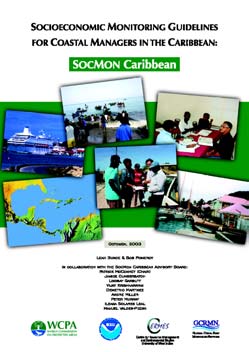
SocMon Caribbean Guidelines
whose agendas were
prominent. However, few
Caribbean developing countries participated.
Another CERMES
event at the 56th GCFI
was the launching of
56th Annual Meeting of the Gulf
the "Socioeconomic
and Caribbean Fisheries Institute
Monitoring Guidelines
The Gulf and Caribbean Fisheries Institute (GCFI)
for Coastal Managers in
held its meeting early in November in Tortola, British
the Caribbean".
Virgin Islands. The Acting Director of CERMES, Dr.
Hazel Oxenford, and the outreach coordinator, Dr.
This publication, soon
Patrick McConney, who are both on the Board of the
also to be available as
GCFI, participated in the meeting. Dr. McConney
a PDF on the CERME
S
chaired the opening session on "Management and
web site, is an output of
Socio-economics of Marine Fisheries". CERMES was
an initiative designed to
a sponsor of this session, and some of the papers
help coastal managers
presented included:
better understand the
Hoggarth, D.D. -- Lessons from a Shaky Start for the
communities whose activities affect, and are affected
Oistins Fisheries Co-Management Pilot Project
by, coastal management decisions. This will facilitate
(OFCoMP) in Barbados
the incorporation of community concerns into coastal
Pomeroy, R. and T. Goetze -- Co-managed Marine
management decision-making around the region. We
Protected Areas: A Case Study of Friends of
are integrating SocMon into the teaching programme
Nature, Belize
and short courses in support of various projects.




Sustainable Grenadines
Three local NGOs: Windward Sailing Club, Carriacou
Arrangements between The Lighthouse Foundation
Historical Society and Carriacou Environmental
and the University of the West Indies for Phase 2 of
Committee, collaborated in the effort. On 2 November
the project "Sustainable Integrated Development and
the memorial monument was unveiled and blessed in
Biodiversity Conservation in the Grenadine Islands"
a ceremony attended by residents of Windward,
have been concluded. The project will start in
many of whom had lost a friend or family member in
December with the first meeting of the Steering
the incident. This is an important socio-cultural link to
Committee.
the marine environment for the people of Windward.
The project Goal is: "The integrated sustainable
"Comparing catch rates among
development of the Grenadine Islands area for the
conventional and alternative fish
social and economic well being of the people who live
there". Its purposes are to develop a functioning
trap designs, and their implications
participatory co-management framework for
for fishers"
integrated sustainable development in the
This project by MSc student Kim Baldwin illustrates
Grenadines, and to demonstrate participatory
applied fisheries research done in CERMES. Fish
sustainable development in small island systems that
traps (also called "pots") are used to harvest reef fish
can be adapted and applied elsewhere.
... hence the common fish market term: "pot fish".
The study tested fish trap designs by comparing total
Phase 1 of the project included stakeholder
and juvenile catch rates, the value of the catch, plus
mobilisation and the development of "A participatory
average size and species of fish captured. Small
strategic plan for sustainable development in the
mesh traps (conventional traps), large mesh traps
Grenadines". Phase 2 will implement the plan in
and experimental design traps were compared. The
collaboration with partners: Caribbean Conservation
study concluded that the less efficient fishing gear did
Association, Carriacou Environmental Committee,
not meet the management goal of conservation with
Projects Promotion Ltd., Governments of Grenada
minimum impact on fishers. Further consideration
and St. Vincent and the Grenadines, and NGOs
must be given to the short-term economic hardship to
throughout the Grenadines. Interested in learning
fishers resulting from increasing fish trap mesh size
more, or getting involved? Contact Robin Mahon
given the amount of time required for the reef fishery
(rmahon@uwichill.edu.bb).
in Barbados to grow-into a larger mesh size and to
recover the economic value of the catch to fishers.
Memorial in Windward, Carriacou
One mini-project done in Sustainable Grenadines,
CERMES goes to school
Phase 1 (described above), erected a monument in
CERMES technical assistants Renata Goodridge and
commemoration the sad day for the people of the
Lyndon Robertson have been helping with secondary
community of Windward. In 1945, a mine was found
school class projects. Students from Harrison College
in the foreshore of Windward Bay, Carriacou, and
and Queen's College are working on water quality
towed ashore by fishermen. Not knowing what it was
projects, in the Graeme Hall watershed. Technicians
they started to strip it to see what was inside. It
have been helping them by supplying historical data
exploded, killing everyone in the vicinity.
for nitrates, phosphates and ammonia, and will be
helping them to collect samples in the field. This
fieldwork enhances science education in schools.
Update on CORECOMP activities in
Barbados, Belize and Nicaragua
Since the September bulletin the Coastal Resources
Co-management Project (CORECOMP) has put on
three workshops on co-management and fisheries
management in Nicaragua (Pearl Lagoon, Bluefields
and Managua). Workshops in Punta Gorda, Belize,
were held on writing project proposals and on socio-
economic monitoring for coastal management (part of
SocMon Caribbean). Barbados activities included the
2004-2006 Fisheries Management Plan, sea egg
fishery, Holetown beach park, and (soon) stakeholder
analysis for co-managing Graeme Hall Swamp.
CERMES Phone (246)-417-4316; Fax (246)-424-4204; cermes@uwichill.edu.bb; www.cermes.cavehill.uwi.edu
Mailing address: CERMES, University of the West Indies, Cave Hill Campus, Barbados