Connections 15 July2004
An electronic bulletin about interdisciplinary research, teaching and outreach at the
Centre for Resource Management and Environmental Studies (CERMES)
Faculty of Pure and Applied Sciences, University of the West Indies Cave Hill Campus
The folks here have been quite busy during the past
reviewed the impacts and benefits of a variety of
couple of months. This is a colourful big bumper Crop-
coastal and marine development activities, and met with
Over issue of the CERMES Connections. Read on and
people from several NGOs who are active in promoting
enjoy. Remember that you can use your connection to
sustainable development.
CERMES to send us your news and feedback on the
articles. If you misplace your copy of this bulletin, go to
the CERMES web site and download another copy. All
of our contact information is at the bottom of the page.
Sustainable livelihoods for the
Grenadines water taxi operators
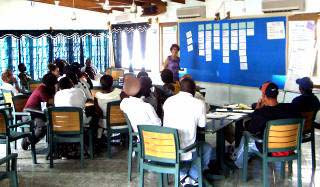
On June 26-27 the `Sustainable Grenadines' joint
initiative of CERMES and Counterpart Caribbean
launched the Grenadines Water Taxi Project with a
transboundary planning workshop in Carriacou.
Environment careers showcase
As part of this year's Environment Month celebrations,
the Ministry of Housing, Lands and the Environment in
Barbados organised its very first Environment Careers
Showcase on 29 June for all secondary schools, the
Barbados Community College and the Samuel
Jackman Prescod Polytechnic. CERMES was there,
represented by Maria Pena and Renata Goodridge.
The response to our display of posters, environmental
Members are from two water taxi associations: (a) the
fact cards and PowerPoint presentations was good. It
Carriacou and Petite Martinique Water Taxi Association
was pleasing to learn that the majority of schools there
and (b) Southern Grenadines Water Taxi Association,
had either already formed environmental clubs or were
which includes Union island, Mayreau and Canouan.
in the process of starting them. Students were being
They worked together develop their mission and vision.
recruited from the first forms and upwards to ensure
Then they developed four project concepts based on
continuity of the clubs during their school life. We hope
the vision. The projects are for (1) organisational
that CERMES can increase its effort in educating young
strengthening for associations, (2) boat safety and
people about natural resources and our environment.
certification, (3) customer service, (4) environmentally
Based on the enthusiasm of the school children about a
friendly operations. The project partners are now in the
career in an environmental field it is safe to say that in
process of securing funds allocated for implementation.
the not too distant future our environment may have
Students tour Grenadine Islands
many bright new guardians and keen professionals.
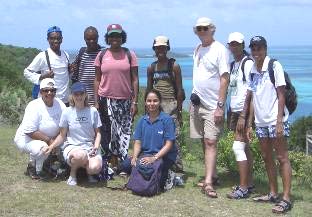
Still in the Grenadines, the CERMES field trip for the
Coral reef restoration workshop
biodiversity course in the MSc programme visited the
From 14 to 17June the UWI's Discovery Bay Marine
islands for a week to explore the relationships between
Laboratory (DBML) in Jamaica, in association with
sustainable livelihoods, biodiversity and civil society
Counterpart International and Counterpart Caribbean,
initiatives. They visited Bequia, Union Island, Mayreau,
conducted a coral reef restoration training workshop.
the Tobago Cays and Carriacou. The graduate students
The purpose of the workshop was to build a network of
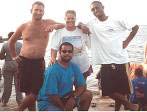
coral restoration practitioners trained and involved in
okay to destroy coral reefs because they can be easily
hands on, low technology reef restoration activities and
replanted this is certainly not true!!
monitoring these activities. Although the workshop was
originally intended for participants working on Jamaica's
The participants of this workshop are hoping to get back
reefs, Renata Goodridge from CERMES and David Gill
to DBML in December to see how their experiments
of the Barbados Marine Trust were able to attend
have fared over the last six months. They wish to take
through funding provided by Counterpart Caribbean.
the next step in advancing and sharing their collective
knowledge on coral reef restoration.
The browning of CERMES!
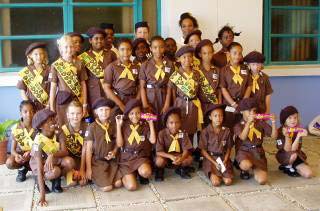
CERMES recently hosted the very keen 26th and 32nd
St. Gabriel's Brownie packs. They worked on 5-6 June
for their conservation badge. The theme for the camp
was 'Save Our Reefs'. Good luck to these youngsters.
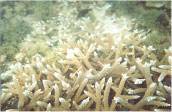
The workshop focused on how to replant corals,
specifically the staghorn corals Acropora cervicornis
and A. tenufolia, in order to restore damaged reefs and
to help increase fish populations associated with these
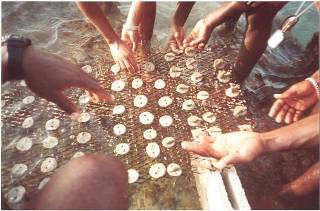
corals. A fair bit of the workshop was spent in the sea,
collecting coral pieces for experiments that were set up
on wire A-frames and also on two-inch diameter cement
"cookies". Once these coral fragments have grown, they
can then be "pruned" to create additional fragments for
"farming", or they can be cemented onto a reef devoid
of live corals as part of a restoration initiative.
Caribbean Environment Forum
CERMES was well represented at the recent Caribbean
Environment Forum in Trinidad (May 31- June 3). The
Caribbean Environmental Health Institute (CEHI) was
the prime organiser of this event. Neetha Selliah and
Dr. Hazel Oxenford gave a presentation on the
CERMES MSc programme in the parallel session on
Climate Change. A CERMES student, Kofi Dalrymple
gave an excellent presentation on his research into the
"Vulnerability of Vreed-en-hoop and Good Hope,
Guyana to accelerated sea level rise". The conference
was well attended by environmental scientists and
There were several critical points that our enthusiastic
professionals from around the region. It served as a
trainer, Dr. Austin Bowden-Kerby, ingrained into those
reunion for many CERMES past students now working
at the workshop. These points included:
in professional positions around the Caribbean. Many of
1. Planting corals is not a quick-fix solution to coral reef
the affiliate staff who teach in the MSc programme were
decline because it does not address the root causes of
also there.
coral reel degradation.
2. Coral planting is only effective as a management tool
Connecting with Buccoo Reef Trust
when combined with other conservation strategies (e.g.
no-take marine reserves, use of mooring buoys, etc.).
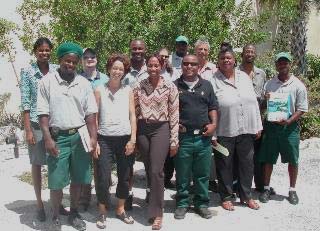
CERMES has recently been renewing, strengthening
3. Coral planting is only effective in some areas, and
and diversifying its connections with the Buccoo Reef
only under certain conditions in these areas.
Trust in Tobago. The Trust has a number of exciting
4. If what killed the corals at a particular site continues
programmes and projects that include land and marine
to be a problem, then it is useless to replant corals as
area use mapping and planning, remote sensing, use of
they will die just like the corals before them.
geographic information systems (GIS), aquaculture,
5. We must not give anyone the impression that it is
CERMES Phone (246)-417-4316; Fax (246)-424-4204; cermes@uwichill.edu.bb; www.cavehill.uwi.edu/cermes
Mailing address: CERMES, University of the West Indies, Cave Hill Campus, St. Michael, Barbados
marine protected area research and development and
Caribbean Conservation Association (CCA) were also
an innovative outreach initiative for young people.
distributed. The DECR received a CD containing copies
of the co-management guidelines and slide show, along
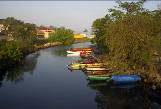
In a recent visit to the
with the six case studies of coastal co-management in
headquarters of the Trust
the Caribbean. For more information All of these
Dr. Patrick McConney
products can be downloaded from the CERMES web
discussed opportunities
site (http://www.cavehill.uwi.edu/cermes).
for collaboration. He also
visited Speyside, the
study site for a SocMon
Caribbean assessment
done as a MSc research
project by UWI graduate
student Kelly Mannette. We hope that Kelly will present
her socioeconomic research at the 57th annual meeting
of the Gulf and Caribbean Fisheries Institute that takes
place from 8-12 November in St. Petersburg, Florida.
Two CERMES MSc students, Velda Ferguson and
Anne-Marie Ford, are soon to start their internships with
the Buccoo Reef Trust. One internship is about making
short environmental documentaries to raise awareness
on issues and initiatives connected with the marine
environment of Tobago. The other internship is about
surveying tourism enterprises to assess their level of
The participants learnt the answers to the questions:
environmental awareness as suppliers of goods and
· What is SocMon Caribbean?
services to the tourism sector. CERMES looks forward
· Why should I do socio-economic monitoring?
to future close collaboration with the Buccoo Reef Trust. · What socio-economic data do I collect?
· How to collect and analyze data?
Large Marine Ecosystem (LME)
· How to generate, present and use information?
project update for fisheries officers
Dr. Robin Mahon updated fisheries officers on the
Especially informative and useful was the case study of
Caribbean Large Marine Ecosystem Project on 30 June
Chalk Sound National Park that was generated by the
in St. Vincent. It was at the First Annual Meeting of the
participants themselves as the training progressed.
Caribbean Regional Fisheries Mechanism (CRFM). The
CRFM is a body of CARICOM set up to facilitate the
Workshops with the Negril Coral
management of fisheries on a sub-regional scale, and
Reef Preservation Society (NCRPS)
eventually perhaps on a regional scale as countries that
Members of the board of directors of the Negril Coral
are not Member States of CARICOM also participate.
Reef Preservation Society (NCRPS) were kept busy on
22 June in workshops on enhancing NGO board
SocMon training workshop held in
effectiveness and on coastal resource co-management.
the Turks and Caicos Islands
The workshops were funded by the European Union
CERMES conducted a short training workshop on
(EU) via the Foundation of the Peoples of the South
Socioeconomic monitoring guidelines for coastal
Pacific International (FSPI) and Counterpart Caribbean,
managers in the Caribbean (SocMon Caribbean) in the
with on-site delivery by CERMES.
Turks and Caicos Islands from 7-9 June. It was done at
the request of the Department of Environment and
These international
Coastal Resources (DECR).
linkages are aimed at
strengthening the
Participants were informed of the other outreach and
capacity of the NCRPS
training opportunities offered by CERMES. Printed
to co-manage the Negril
copies of SocMon Caribbean guidelines were
Marine Park (NMP)
distributed along with CDs containing the Caribbean
along with its many
guidelines, Southeast Asia guidelines and the GCRMN
stakeholders. These
Socioeconomic Manual for Coral Reef Management.
workshops were the first in a series of project activities
Hard copies of the co-management guidelines from the
that are due to continue to May 2005 in the Negril area.
CERMES Phone (246)-417-4316; Fax (246)-424-4204; cermes@uwichill.edu.bb; www.cavehill.uwi.edu/cermes
Mailing address: CERMES, University of the West Indies, Cave Hill Campus, St. Michael, Barbados