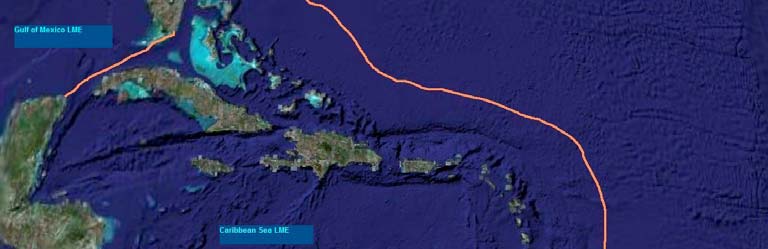
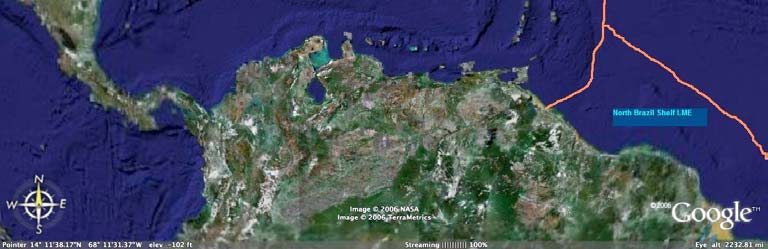
Caribbean Sea
Large Marine Ecosystem
SUSTAINABLE MANAGEMENT OF THE SHARED MARINE RESOURCES OF
THE CARIBBEAN LARGE MARINE ECOSYSTEM AND ADJACENT REGIONS
(THE CLME PROJECT)
The Caribbean Sea LME is a semi-enclosed tropical sea bounded by North America (South Florida), Central and South
America and the Lesser Antilles chain of Islands. The Caribbean Sea and adjacent regions include a wide variety of
tropical ecosystems, associated natural resources and biodiversity. The area encompasses a large proportion of the
world's coral reef resources, including the second longest barrier reef, the Meso-American Barrier Reef System. The
region includes 26 countries and 19 dependent territories of the USA, UK, France and the Netherlands. The countries
range from the largest (e.g. Brazil and the USA) to the smallest (e.g. Barbados, St. Kitts and Nevis) in the world, and
from the most developed to the least developed. Throughout the region, there is a high dependence on marine re-
sources for livelihoods, particularly from fishing and tourism. Thus the sustainability of its living resources is of consid-
erable importance to an appreciable proportion of the region's countries. Improved management of these resources
through better participation of Caribbean countries in the management process will have benefits that reach far be-
yond the region.
An opportunity is provided by the CLME project for Caribbean states to fully address the World Summit on Sustainable
Development (WSSD) goals regarding fisheries, particularly those pertaining to restoration of stocks to levels that can
produce maximum sustainable yield by 2015 and introducing an ecosystem-based approach to the assessment and
management of marine resources by 2010. The project thus enables the region to participate more fully in moving
towards WSSD objectives.
The CLME project aims to strengthen regional cooperation to reverse degradation of shared living marine resources.
The lessons learned regarding cooperation in management of transboundary resources by the numerous and diverse
countries of the Caribbean will be of value to those addressing similar management issues in other parts of the world,
particularly those where small island developing states (SIDS) are common.
THE CARIBBEAN LARGE MARINE ECOSYSTEM (CLME) PROJECT IN A NUTSHELL
The CLME project builds on and complements existing projects and initiatives that emphasize technical and institu-
tional aspects of sustainable living marine resource (LMR) use by focusing on governance, knowledge, and institu-
tional issues in a transboundary marine context. The regional scope of the CLME project will serve as a platform for
governments and other stakeholders to collectively pursue the goals of economic and environmental sustainability.
With the CLME project, there is the opportunity for implementation of management reforms that will permit sustain-
able development and management of the shared LMRs of the Caribbean Large Marine Ecosystem and adjacent re-
gions. Since most LMRs are shared in some way, these reforms can be expected to lead to improved food security and
enhanced livelihoods in coastal communities that rely on fisheries and tourism.
KEY EXPECTATIONS
The increased knowledge of transboundary LMRs and increased institutional capacity to use that knowledge at na-
tional, regional and international levels will halt and should even reverse the declining trend of resource depletion and
degradation in the Wider Caribbean. Management and decision-making mechanisms that have been established or
enhanced through strengthening of the key institutions will be functioning to ensure that resources are assessed,
management recommendations are provided, measures are put in place and that compliance to these is monitored.
In concert with the above changes, heightened public awareness and improved coordination with linked programmes
will ensure the sustainability of the GEF intervention. Successful implementation of the CLME Project will be depend-
ent upon effective interaction of the national, regional and international agencies with responsibility for living marine
resource governance in the Wider Caribbean.
OVERALL
Sustainable management of the shared living marine resources of the Caribbean
LME and adjacent areas through an integrated management approach that will
GOAL
meet WSSD targets for sustainable fisheries
· To identify, analyze and agree upon major issues, root causes and actions required to
achieve sustainable management of the shared living marine resources in the Caribbean
Sea LME;
SPECIFIC
· To improve the shared knowledge base for sustainable use and management of trans-
OBJECTIVES
boundary living marine resources
· To implement legal, policy and institutional reforms to achieve sustainable transboundary
living marine resource management
· To develop an institutional and procedural approach to LME level monitoring, evaluation
and reporting
PROJECT COMPONENTS
LMR MANAGEMENT ISSUES IN THE CLME
1. Analysis of transboundary LMR issues through a trans-
· Migratory resources (mainly large pelagics,
boundary diagnostic analysis (TDA) and needed actions as
but also some coastal pelagics)
identified in a regionally developed strategic action plan
(SAP), following an ecosystemic and adaptive management
· Resources with transboundary distribution as
approach;
adults (various demersal fishes)
2. Filling knowledge gaps needed for effective trans-
· Resources with transboundary larval dispersal
boundary LMR ecosystem management;
(lobster, conch, reef organisms)
3. Implementation of governance reforms (institutional,
· Dispersal of pathogens, pollutants and inva-
legal, and policy) for LMR ecosystem management.
sive species
4. Develop an institutional and procedural approach to
LME level monitoring, evaluation and reporting.
· Resources with transboundary trophic link-
ages




FOCUSING ON GOVERNANCE
The CLME project responds to the need cited by key decision-makers for attention to the management of shared
marine resources in the Caribbean LME and adjacent regions and the call to provide mechanisms facilitating in-
formed decision-making. Typically, the LME approach includes five modules that focus on different aspects of the
ecosystem: (1) productivity, (2) fish and fisheries, (3) pollution and ecosystem health, (4) socio-economics, and (5)
governance. This framework has proven useful in the LME context as it provides particular groups of nations sharing
an LME to tailor the effort expended on each module to reflect their needs, based on available information and ca-
pacity. The CLME project will seize on the flexibility of the approach by focusing on addressing the weaknesses in-
herent in the governance of LMRs within the region.
The most pressing rationale for
a focus on governance at the
regional scale lies in the many
transboundary oceanographic
and ecological linkages within
the Wider Caribbean. With
many marine resources being
shared, it can be expected that
there will be emphasis on transboundary or shared living marine
resources which require cooperation for governance. This must
include both exploited and non-exploited resources and their criti-
cal habitats. Another reason is that a regional approach will facilitate the use of limited capacity within the region.
THE CLME APPROACH
In the CLME project, governance is recognized to be much broader than management, and has many dimensions,
including the interactions among all stakeholders that influence resource use outcomes as well as the principles
that guide these interactions and the institutional arrangements within which they take place. These factors clearly
influence how successfully the region can manage its various LMR issues. Using a range of key exploited and non-
extractable transboundary resources, the project will customize the modular assessment framework illustrated
above to advance knowledge on the suitability of differing governance mechanisms to sustainably manage each of
these resources within the region. The differing approaches will likely range from those including a small number of
sub-regional sectoral actors to a more inclusive region-wide network governance approach. Potential resource cate-
gories to test this adaptive, "learning-by-doing" approach could include: the large pelagics, shrimp, flyingfish, lob-
ster, conch, coral reefs, sea birds and marine invasives. As illustrated in the diagram below, the geographic ranges
of the pilots present the opportunity to explore both regional and sub-regional governance mechanisms, supported
by sound science-based information obtained from the customized modular assessments.
Legend
Large Pelagics, Coral Reefs, Sea Birds,
Marine Invasives
Shrimp
Lobster & Conch
Flying fish




PARTICIPAT
A ING COUNTRIES
CURRENT PARTNERS
Antigua and Barbuda
Global Environmental Facility
Bahamas
Barbados
Belize
United Nations Development Programme
Brazil
Colombia
Costa Rica
Intergovernmental Oceanographic
Cuba
Commission
(UNESCO)/IOCARIBE
Dominica
Dominican Republic
Grenada
United Nations Environmental Programme
Guatemala
Guyana
Haiti
US Department of Commerce
National Oceanic and Atmospheric
Honduras
Administration
Jamaica
Mexico
Organización Latinoamericana de
Nicaragua
Desarrollo
Pesquero
Panama
St. Kitts and Nevis
Organización del Sector Pesquero y
St. Lucia
Acuícola del Istmo Centroamericano
St. Vincent and the Grenadines
Suriname
Caribbean Regional Fishing Mechanism
Trinidad and Tobago
Venezuela
IOCARIBE/Global Ocean Observing System
WECAFC: Western Central Atlantic
Fishery
Commission
For further information, contact:
CLME Project Coordinating Office
Centre for Resource Management and Environmental Studies
The University of the West Indies
Cave Hill Campus, Barbados
Tel: + (246)417-4565
Fax: + (246) 424-4204
Email: clmeproject@gmail.com