Connections 30 August2006
An electronic bulletin about interdisciplinary research, teaching and outreach at the
Centre for Resource Management and Environmental Studies (CERMES)
Faculty of Pure and Applied Sciences, University of the West Indies Cave Hill Campus
The end of summer is quickly approaching and tales of
The meeting discussed and approved the workplan for
well-deserved and equally well-spent summer holidays
the PDF-B phase of the project. Discussion covered
fill the corridors of CERMES. Our 2005/2006 students
approaches to national level intersectoral consultation,
have been hard at work since June conducting field
the role of civil society and the operation of the Steering
research with faculty or interning with organisations.
Committee itself. The next steps over the upcoming 12
Preparations for the new cohort of MSc students have
months are to establish task teams to carry out the
been completed and we eagerly await their arrival next
transboundary diagnostic analysis (TDA) for the region,
week. CERMES outreach and participation in local,
training for the team members, and the TDA itself. This
regional and international arenas continues. We invite
will lead to a synthesis of issues regarding
you to share in our news.
transboundary living marine resources in the Wider
Caribbean and recommendations for how these should
Caribbean Large Marine Ecosystem
be addressed in the Full Project.
(CLME) Project holds first steering
For further information, contact Dr. Lucia Fanning,
committee meeting in Panama
Project Manager at the CLME Project Unit,
clme@uwichill.edu.bb.
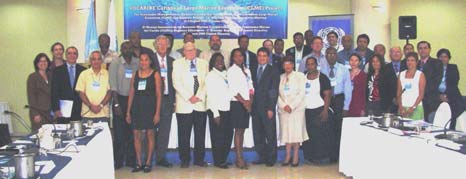
The First Regional Steering Committee Meeting for the
CLME Project (PDF-B Phase) was held in Panama City
Organising fisherfolk in Barbados
on August 2-3, 2006. The meeting was organized by
CERMES outreach to the fishing industry in Barbados
the CLME Project Unit, located at CERMES, UWI, Cave
recently included assisting the Barbados National Union
Hill Campus, with assistance from IOCARIBE and
of Fisherfolk Organisations (BARNUFO) to amend its
UNDP. The meeting was attended by representatives
constitution and consider other initiatives to ensure its
from 22 countries around the region as well as regional
sustainability and improve its performance through
fisheries organizations (CRFM, OSPESCA,
greater access to human resources. The amendments
OLDEPESCA),.UN agencies (FAO, IOCARIBE, UNDP,
broaden BARNUFO's membership base and board of
The GEF), UWI (CERMES) and TNC were also there. It
directors. BARNUFO has moved from relying only on
was chaired by Dr. Antonio Diaz-de-Leon, the
primary fisherfolk organisations (full members) to
representative from Mexico.
include individuals in the fishing industry (associate
members), people who are not engaged in fishing
(affiliate members) and sponsors (sponsoring
members). Directors for projects and membership have
been added to the board. With these changes
BARNUFO hopes to attract and retain more members
who can offer critical skills in areas that are vital for the
development of fisherfolk organisations and the industry
in general.
CLME steering committee
Forum and workshop presentations
The CLME project aims to strengthen regional
and consultative participation
cooperation to reverse degradation of the shared living
marine resources within the Caribbean Large Marine
Kim Baldwin, CERMES PhD candidate, represented
Ecosystem and adjacent regions. Its focus is on the
CERMES at the 3rd Caribbean Environmental Forum
identification and agreement of major transboundary
and Exhibition in Antigua in June and gave the following
living marine resource management issues and their
presentation: `Mass Coral Bleaching in Barbados: A
root causes; actions needed to address these
quantitative analysis and preliminary estimate of
constraints, including filling knowledge gaps and the
coral mortality' by H.A. Oxenford, L. Nurse, R. Roach,
implementation of governance reforms for living marine
A. Brathwaite, R. Goodridge, F. Hinds, K. Baldwin and
resource management and ecosystem-wide monitoring,
C. Finney.
reporting and evaluation.





Dr. Hazel Oxenford attended the Caribbean Marine
GUYSUCO (Guyana), Sanitation Service Authority
Reserves Research and Monitoring Workshop
(Barbados), Environmental Protection Department
in St John, US Virgin Islands from 11-13 July as an
(Barbados), ICC World Cup Cricket West Indies 2007
invited participant and gave a presentation entitled:
(Barbados), Bermuda Biological Station for Research,
`Research and monitoring in Caribbean marine
Environmental Management Authority (EMA) (Trinidad),
protected areas: Lessons learned' by H.A. Oxenford
Caribbean Health Institute (CEHI) (St. Lucia) and UNDP
and P. McConney.
(Barbados). The internships include examining the
impact of droughts and rainfall variability (specifically
Robin Mahon participated in a FishGovNet workshop on
the effect of El Nino Southern Oscillation) on sugar
`Interactive governance and governability: The
cane production, analysing waste collection routes in
development of concepts and methodology', 17-19
Barbados, formulating emission testing guidelines for
July, 2006, University of Amsterdam, where he
Barbados and assessing vulnerability of the Nariva
presented the CERMES policy perspective entitled
Swamp in Trinidad to climate change.
`Governing fisheries as complex adaptive systems'.
Robin Mahon and Patrick McConney participated in an
All there is to know about sponges
ad hoc Consultation on the Sandy/Island Oyster Bed
Renata Goodridge, CERMES Marine Technician,
(SIOB)MPA with stakeholders at the Melville Street
participated in a Sponge Taxonomy Field Course
Fisheries Complex in Grenada on August 9th, 2006 to
hosted by the Smithsonian Tropical Research Institute
review the progress with SIOB MPA to date and discuss
(STRI) at the
the range of options for the way ahead.
Bocas Research
Seamoss farming project
Station, Panama
from 1728 July.
The proposal to conduct a pilot seamoss farming
The UWI ATS Staff
project submitted by the Sustainable Grenadines
Training Funds
Project to The White Water to Blue Water (WW2BW)
enabled Renata to
group has been approved.
attend the course.
This project will be done with the Young Help Striders
4-H Club in Ashton, Union Island. Allan Smith of
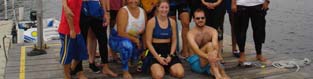
Spongy group at the Bocas Research Station
CANARI, St. Lucia, a well known seamoss farming
expert, will be providing the expertise needed. We plan
The intensive two week course was divided into three
to be starting next month.
sections:
Hats off to the team who worked on this successful
1. Taxonomic training
proposal: Katie Blackman (CERMES), Alexcia Cooke
2. Biological and ecological work
(SusGren), Kim Baldwin (CERMES) and Martin
3. Personal
Barriteau (SusGren). Many thanks also to the WW2BW
projects and
group and the National Marine Sanctuary Foundation
presentations.
who are providing the funding for this project which is
Almost every day
scheduled to commence in September.
was divided into
Student research and internships
field and lab work,
emphasising the
Since June, CERMES students have been hard at work
importance of both
on their research and internship projects. Currently, 12
when working with
are pursuing research projects while 11 are involved in
sponges. Renata is
internships. The research projects are varied and
now ready for your
Suberites auriantaca
include a feasibility project on rearing tilapia using
sponge questions!
green water, research related to the conch fishery in
Congratulations corner
Barbados, greening hotels in the Grenadines,
assessing sustainable livelihoods in the Grenadines, a
Congratulations to Dale Benskin who was recently
review of legislation relevant to environment and
appointed to the position of IT Technician. Since his
sustainable development in the Grenadines, evaluating
arrival he has assisted with managing the CERMES
marine protected area (MPA) management
website, providing network support to staff and
effectiveness at the Negril Marine Park and research
students, ensuring that relevant software is available to
related to the Barbados pelagic longline fishery.
staff and students, helping students with computer
issues as well as troubleshooting and solving many of
Our interning students are working locally and
our computer and equipment issues. Welcome to the
regionally with eight host organisations - Caribbean
team Dale!
Community Climate Change Centre (Belize),
CERMES Phone (246)-417-4316; Fax (246)-424-4204; cermes@uwichill.edu.bb; www.cavehill.uwi.edu/cermes
Mailing address: CERMES, University of the West Indies, Cave Hill Campus, St. Michael, Barbados