
UNITED NATIONS DEVELOPMENT PROGRAMME
GLOBAL ENVIRONMENT FACILITY (GEF)
PROJECT DOCUMENT: PART ONE UNOPS COMPONENTS
Partnership Interventions for the Implementation of the Strategic Action
Programme for Lake Tanganyika.
Governments of Burundi, DRC, Tanzania and Zambia
Project Summary
This is a regional project with four participating countries: Burundi, Democratic Republic of the Congo
(DRC), Tanzania and Zambia. The GEF UNDP intervention is one part of a multi-partner programme, with
significant co-finance from African Development Bank, Nordic Development Fund, IUCN and Governments.
This project follows an earlier GEF project which designed the participatory Strategic Action Programme
(SAP) for Lake Tanganyika and facilitated the development of the Lake Tanganyika Convention, which
provides for regional oversight and management of the Lake and its resources. This project pilots the
implementation of the SAP in the four countries and supports the development of the Lake Tanganyika
Authority and Secretariat, which is to be based in Bujumbura, Burundi.
SAP Priorities for GEF funding in DRC, Zambia and Tanzania included catchment management to reduce
siltation which is adversely affecting lake processes, productivity and biodiversity. Priorities in Burundi, and
in one site in Tanzania, included reducing waste water effluents which cause significant pollution in the lake.
Co-Finance supports reduced sustainable fisheries, inputs to wastewater treatment and lake monitoring.
The project is being implemented through two major approaches: NEX execution in Tanzania and Zambia,
with a long history of project execution, including areas around the Lake; and Agency Execution via UNOPS
for Burundi, DRC and Regional Components. UNOPS provides regional contractual support to ICRAF for
catchment management and IUCN for enhanced monitoring programmes. This Project Document describes
the Overall Project Process, then the Regional, DRC and Burundi support via UNOPS, then the NEX process
in Tanzania and Zambia.
This Prodoc has a final Annex addressing the issues raised by GEF Council Members.
CONTENTS
Page
ACRONYMS AND ABBREVIATIONS
3
PART ONE THE OVERALL PROJECT
5
SECTION 1: THE NARRATIVE
5
Part 1: The Project Situation Analysis
Part 2: The Project Strategy including Objectives and Outcomes
Part 3: Management Arrangements
Part 4: Overview of Finances and M & E Framework, Work-plan
SECTION 2: THE OVERALL STRATEGIC RESULTS FRAMEWORK
Annex 1.1
The Regional Log-Frame
26
Annex 1.2
The Results Framework
28
SECTION 3:OTHER MATTERS / ANNEXES
Annex 2 Response to GEF Council Comments
30
Annex 3 TOR for Staff and Institutions
33
Annex 4 Climate Change Considerations
40
Annex 5 Monitoring Processes
46
PART TWO SPECIFIC COMPONENTS
48
UNOPS EXECUTION COMPONENTS
48
1) Regional Activity
49
2) DRC Component
58
3) Burundi Component
72
SIGNATURE PAGE
88
NEX EXECUTION COMPONENTS SEPARATE FILE
4) Tanzania Component
5) Zambia Component
List of Acronyms (Across all National and Regional Programmes)
ACDC
Area Conservation Development Committee (Zambia)
ADF
African Development Fund
ADMADE
Administrative Management Design (Zambia Wildlife)
AfDB/ADB
African Development Bank
ASEGE
Association for Environment Management (DRC)
ASSP
Agricultural Sector Support Programme (Zambia)
BRARUDI
Burundi Breweries (Co-Finance)
CADIC
Action for Integrated Sustainable Community Development DRC
CBD
Convention on Biological Diversity
CBNRM
Community Based Natural Resource Management
CBO
Community-Based Organisation
CCC
Catchments Conservation Committee (Zambia)
CEPAC
Community of Protestant Churches in Central Africa
CLUSA
Cooperative League of the United States of America
COMESA
Common Market for Eastern and Southern Africa
COTEBU
Burundi Textile Company (Co-Finance)
CRH
Centre for Hydro-biology Research (Uvira) DRC
CRSN
Centre for Natural Sciences Research (DRC)
DanIDA
Danish International Development Agency
DCC
District Coordination Committee (Tanzania)
DDCC
District Development Coordinating Committee
DED
Deputy Executive Director
DRC
Democratic Republic of Congo
DSA
Daily Subsistence Allowance
EA
Executing Agency
EAC
East African Community
ECZ
Environmental Council of Zambia
ED
Executive Director
EU
European Union
FAO
Food and Agriculture Organization of the United Nations
FFMP
(Lake Tanganyika) Fisheries Framework Management Plan
FinnIDA
Finnish International Development Agency
GEF
Global Environmental Facility
GTZ
German Technical Assistance
IA
Implementing Agency (of GEF)
ICCN
Congolese Institute for Conservation of Nature (DRC)
ICRAF
International Centre for Agro-Forestry
ICT
Information Communication Technologies
IDEAL
International Decade for East African Lakes
IFAD
International Fund for Agricultural Development
IGA
Income Generating Activities
ILTMA
Interim Lake Tanganyika Management Authority
INECN
National Institution for the Conservation of Natural Resources (Burundi)
INERA
Institute for National Agronomy Research (DRC)
IUCN
International Union for the Conservation of Nature
IW OP
International Waters Operational Program
JFM
Joint Forest Management
JGI
Jane Goodall Institute (An NGO in Tanzania)
KFW
A German Funding Organisation
KMC
Kigoma Municipal Council
KPI
Key Performance Indicator
KUWASA
Kigoma Urban Water and Sanitation Authority
LFA
Logical Framework Analysis
LGRP
Local Government Reform Programme
Ver. 02 April 2008
3
LTA
Lake Tanganyika Authority
LTBP
Lake Tanganyika Biodiversity Project
LT-FBDP
Lake Tanganyika Fisheries and Biodiversity Development Project
LTMC
Lake Tanganyika Management Committee
LTMPP
Lake Tanganyika Management Planning Project
LTMS
Lake Tanganyika Management Secretariat
LTRIMP
Lake Tanganyika Regional Integrated Management Programme
LVEMP
Lake Victoria Environmental Management Project
MACO
Ministry of Agriculture and Cooperatives (Zambia)
M&E
Monitoring and Evaluation
MEWD
Ministry of Energy and Water Development (Zambia)
MIS
Management Information System
MP
Member of Parliament
MTENR
Ministry of Tourism Environment and Natural Resources (Za)
NBP
National Biodiversity Programme (DRC)
NBSAP
National Biodiversity Strategy and Action Plan
NDF
Nordic Development Fund
NGO
Non -Government Organization
NIAs
National Implementing Agencies
NOPTA
New Orientation of Fishing in Lake T (DRC an NGO)
NSC
National Steering Committee
PC
Project Coordinator
PCU
Project Coordination Unit
PDF-B
Project Development Facility (Block B Grant)
PFM
Participatory Forest Management
PIR
Project Implementation Review
PIU
Project Implementation Unit
PMU
(National) Project Management Unit
PNAE
National Programme for Environmental Action (DRC)
PPER
Project Performance Evaluation Report
PRA
Participatory Rural Appraisal
PRSP
Poverty Reduction Strategy Paper
REGIDESO
Bujumbura Water and Electricity Organisation (Burundi)
SAP
Strategic Action Programme
SCM
Steering Committee Meeting
SETEMU
Municipal Technical Services in Bujumbura (Burundi)
SGP
Small Grants Project
SIYB
Start and Improve Your Business (Zambian Programme)
STAP
Scientific and Technical Advisory Panel (of the GEF)
TA
Technical Advisor
TACARE
Tanzania Catchment Restoration (NGO)
TAFIRI
Tanzania Fisheries Research Institute
TANAPA
Tanzania National Parks Authority
TATEDO
Tanzania Traditional Energy Development Organisation (NGO)
TBDA
Trans-Boundary Diagnostic Analysis
TDA
Lake Tanganyika Trans-boundary Diagnostic Analysis
TNDP
Transitional National Development Plan (Zambia)
TPR
Tri-Partite Review
UNCCD
United Nations Convention to Combat Desertification
UNDP
United Nations Development Programme
UNOPS
United Nations Office for Project Services
URT
United Republic of Tanzania
VCDC
Village Conservation Development Committee (Zambia)
VPO
Vice-President's Office (Tanzania)
WRAP
Water Resources Action Programme (Zambia)
ZAWA
Zambia Wildlife Authority
Ver. 02 April 2008
4
SECTION 1 ELABORATION OF THE NARRATIVE:
Part 1: Project Context and Situation Analysis
The Objectives, Outcomes, Outputs and Activities of this Integrated Multi-Donor Programme have been
driven by the conclusions of the Lake Tanganyika Trans-boundary Diagnostic Analysis (TDA) and the
Lake Tanganyika Strategic Action Program (SAP), both from July 2000; and the developing Lake
Tanganyika Convention (signed in 2003). These inputs are developed by the four riparian countries
through stakeholders consultations during the first GEF sponsored project1. This new Programme includes
interventions to address the SAP (GEF) as well as the Lake Tanganyika Framework Fisheries
Management Plan (FFMP) developed by FAO/FINNIDA/AGFUND via the Lake Tanganyika Research
Project (LTR).
The TDA identified the major trans-boundary threats confronting the four countries in their efforts to
manage the Lake and its Basin as: unsustainable fisheries, increasing pollution, excessive sedimentation
and habitat destruction. The implications of these threats were the global loss of biodiversity, the loss of
shared fisheries resources and the decline of water quality. The crosscutting barriers to addressing these
threats are the lack of resources (including skills, infrastructure, institutions and funds), the lack of
institutional coordination, poor enforcement of existing regulations, and few appropriate regulations for
the management of the Lake.
The SAP and the FFMP outlined interventions to mitigate and/or eliminate these problems with an
emphasis on the following areas: institutional coordination for the sustainable management of the Lake,
reduction of the impact of fishing, control of pollution, control of sedimentation and the conservation of
key habitats. With GEF financial support from an extended PDF B process, countries prioritized and
developed detailed interventions to address these major trans-boundary issues confronting their attempt to
manage the resources of Lake Tanganyika and its basin. The three GEF interventions comprise:
· Pollution control into the Lake through wastewater management in the cities of Bujumbura
(Burundi) and Kigoma (Tanzania).
· Sedimentation control into the Lake through catchment management interventions in the areas of
Uvira (DRC), Kigoma (Tanzania) and Mpulungu (Zambia).
· Institutional support to policy process, convention implementation and monitoring programmes.
Countries worked with a donor partnership programme to develop further funding for SAP activity, via
non-GEF financing; including African Development Bank/FAO/EU/NDF inputs to fisheries infrastructure
and Nordic Development Fund for waste water, and IUCN for M and E process. These interventions help
the countries to manage their wastewaters and catchment, hence reducing pollution and sedimentation into
the Lake and protecting the habitats, which will result in improved water quality and global environment
benefit; as well as assuring institutional sustainability.
GEF support enabled the countries to plan for regional interventions to address crosscutting institutional
problems to allow multi-country coordination of lake management. This resulted in the negotiation of the
Convention for the sustainable management of Lake Tanganyika and the signing of the Convention on
June 12, 2003. GEF support also allowed the design and development of an Interim Lake Tanganyika
Management Authority; which will coordinate and monitor management of the Lake while waiting for the
Convention to be ratified and for the permanent body, the Lake Tanganyika Authority, to be established.
1 This was the Regional UNDP-GEF Lake Tanganyika Biodiversity Project from 1995 - 2000
Ver. 02 April 2008
5
GEF support has allowed the development of an integrated ecosystem approach to the sustainable
management of the Lake through an Integrated Management Program for the sustainable development of
Lake Tanganyika and its basin. This has been agreed upon and will be implemented by a partnership
between UNDP/GEF, the African Development Bank, FAO, IUCN, and the Nordic Development Fund. It
is anticipated that FINNIDA, and the EU via COMESA may join this partnership. The partnership works
with the riparian countries to assist them in providing additional resources for the development and
implementation of the Program. The programme goals are to address major trans-boundary and socio-
economic problems.
Part 2: Project Strategy
Within this partnership, UNDP/GEF will co-finance capacity building for regional management of the
Lake and for the prioritized pollution (from urban waste-water hotspots) and sediment control
interventions from key watersheds. ADB/FAO/NDF/ FINNIDA will co-finance the fisheries interventions.
The NDF co-finances part of wastewater pollution control activities; IUCN co-finances Lake monitoring.
Lake Tanganyika is of great global, regional and local importance as was well documented before and
during the first GEF Project (LTBP). In brief, Lake Tanganyika:
· Contains 17% of the world's free freshwater resources;
· Is Africa's second largest inland fishery (after Lake Victoria);
· Has extreme biodiversity value with over 2000 species of aquatic plants and animals.
The implementation of this program will not be achievable without the active cooperation of all the
riparian countries, their international donor supporters and all affected interests. Successful
implementation of such a program will depend on well-coordinated interventions involving the full range
of affected stakeholders, including the participating countries at regional, national, central and local levels,
their development partners, the NGOs, the private sector and local communities. Such a level of
international and regional cooperation will entail substantial efforts and transaction costs, but these efforts
and the costs are essential to the success of the Program. The central element of this regional coordination
is the Lake Tanganyika Management Authority (ILTMA).
· The implementation of such a large Program is clearly a high transaction cost indispensable to the
adoption of a regional approach to address environmental issues around international waters. This
falls directly within the remit of the GEF and thus is fully consistent with the GEF programme
guidance in IW OP9. GEF financing is therefore critical to Program success. GEF finance has
played a catalytic role in helping the countries to secure and enhance the strong partnership that
has brought together the four countries, UNDP/GEF-UNOPS, AfDB-FAO, IUCN, Nordic
Development Fund, in a coalition for the protection and sustainable development of Lake
Tanganyika and its natural resources. This partnership can be summarized within the following
matrix linking the programme to the Priorities of the Strategic Action Programme (SAP).
Table 1: Components of the Lake Tanganyika Integrated Management Programme
GEF SPONSORED COMPONENTS
CO-FINANCE COMPONENTS
Establishment of the
Supporting Wastewater
Pilot Fisheries Co-
Community
Lake Tanganyika
Treatment Plants in
Management; Infrastructure to
infrastructure and the
Authority
Bujumbura and Kigoma
Add Value Fish Products;
Establishment of Local
Fisheries Monitoring / Systems
Development Funds
(ADB, FAO and NDF)
(ADB & NDF)
Ver. 02 April 2008
6
Demonstration Sites for
Establishment of Lake
Sustainable Catchment
Monitoring- Management
Management (DRC, Tz
System (with IUCN).
Construction of Wastewater
Capacity Building of
and Zambia)
Treatment Plant in Kigoma
Local and National
(NDF)
Stakeholders
(ADB, FAO and NDF)
International Waters: OP9 and Strategic Priority IW1
Interventions here are the standard OP9 issues arising from the TDA and the SAP for Lake Tanganyika.
Countries prioritised the pollution issues both the issues arising from inadequate waste-water treatment,
and issues arising from sediment inflows. Both issues impact on overall lake productivity and on the lake
biodiversity values. The rationale for GEF intervention over and above the national baseline inputs is due
to the scale of the great global biodiversity and quantum of freshwater significance of the lake.
Note that the past TDA and SAP did not discuss issues of adaptation to climate change. These CC
concerns are relatively recent, still somewhat controversial, and are less discrete to be able to document
and to develop mitigation measures. As this is a relatively new subject, at continental level, let alone for
this sensitive Great Lakes Region of Central Africa, it is discussed in some detail within Annex 10 to the
GEF Proposal, and this is attached to this Pro-Doc.
The Lake Tanganyika Region
The four riparian countries, whilst all sharing the resources for Lake Tanganyika and all expressing
commitment to the sustainable management of these resources, do show considerable differences. Two
countries are Anglophone and two are Francophone, with differences in law, policy, cultural process etc.
However the positive experiences of cooperation from the first SAP project as well as recent PDF B
process augur well for similar linkages and cooperation in this project.
Two countries are emerging from decade long conflict (Burundi and DRC). The levels of insecurity have
now decreased to the point where interventions are not only possible but also desirable2. But there has
been little recent baseline to build on, and co-finance in the field of environment is limited (many donors
are prioritizing reconstruction and development).
Programme Objectives
Long-Term Development Objective or Goal
The long-term objective of this Regional Integrated Management Programme is the improvement of the
living conditions of the riparian populations through the implementation of the SAP, the FFMP and the
Convention, together with the on-going and future efforts of riparian countries, so as to bring about an
integrated sustainable management and protection of the Lake Tanganyika
Immediate Objectives
2 For example, the WB has commenced a major rural land management development project in Burundi, other GEF
projects are underway in both Burundi and in DRC.
Ver. 02 April 2008
7
There are two Immediate Objectives within the Integrated Regional Management Programme. These form
the two main components that are: the "Environmental Activities" of GEF finance, and the more
"Developmental Activities" of the co-finance partners.
Immediate Objective 1. To implement prioritised activities of the Strategic Action Programme so as
to achieve sustainable management of the environment and resources of Lake Tanganyika. GEF
There are four parts of this IO each leading to a distinct OUTCOME (linked to SAP priorities).
1. Establishment of the Lake Tanganyika Management Authority (LTMA);
a. Establishment of the Lake Tanganyika Management Secretariat (ILTMS);
b. Establishment of Inter-Ministerial Management Committees;
c. Promotion of ratification of the Convention; and subsequent protocols.
2. Reduction of water pollution by creating wastewater plants in Bujumbura and Kigoma.
3. Reducing sedimentation flows into the Lake by the establishment of demonstration sites for
sustainable catchment management interventions in Uvira in DRC, Kigoma Rural District in
Tanzania, and Mpulungu District in Zambia;
4. Establishment of a Lake Monitoring and Management System (with IUCN).
Immediate Objective 2. This leads to outcomes funded through other Partners Components (ADB,
NDF, FAO, EU / COMESA). This is not detailed here.
OBJECTIVES, OUTCOMES AND ACTIVITIES OF THE GEF COMPONENTS
Immediate Objective 1 To implement the prioritised activities of the Strategic Action
Programme so as to achieve sustainable management of the environmental resources of Lake
Tanganyika. (GEF)
Outcomes
Country / Site
Outcome 1: Regional and national institutions have internalized the
Regional Activity
implementation of the SAP and FFMP and provide institutional support for the
cooperative management of Lake Tanganyika under the ratified Convention.
Outcome 2. The quality of the water of Lake Tanganyika is improved at two
Tanzania and
identified pollution hotspots through wastewater treatment.
Burundi
Outcome 3: Sediment discharge reduced from demonstration catchment
Tanzania,
management sites; providing significant livelihood benefits to local people, and
Burundi, Zambia,
seeking long-term adaptation measures to changing climatic regimes.
DRC
Outcome 4: Regional monitoring and management systems contribute to the
Regional Activity
long-term sustainable management of Lake Tanganyika.
OUTCOME 1: Regional and national institutions have internalized the implementation of the SAP
(and FFMP) and provide institutional support for the cooperative management of Lake Tanganyika
under the ratified Convention.
Output 1: The Lake Tanganyika Secretariat is established: staff, equipment, monitoring and management
capacity are in place and functioning under oversight of Lake Tanganyika Authority.
Output 2: Protocols to Lake Tanganyika Convention are adopted; with environmental policies,
regulations and development frameworks in place; providing interventions to a revised SAP. Revised SAP
contains understanding of climate change phenomena in the Lake basin; and activities to mitigate impact
and adapt to impacts. Funding at national and regional levels are leveraged, Information resource and
mechanisms of its dissemination to stakeholders are in place. The Convention is ratified and domesticated.
Ver. 02 April 2008
8
Output 3: The GEF Project components are implemented in a cost-efficient and effective manner.
Rationale
The TDA identified one of the major trans-boundary constraints to cooperative management of the Lake
as being the lack of institutional coordination. The SAP described the roles and responsibilities of such an
institutional coordination. To provide an adequate response to this crosscutting issue, countries defined the
Interim Lake Tanganyika Management Authority (ILTMA) and described its roles and responsibilities
consistent with the SAP. Countries outlined their need to have the interim management authority in place
as soon as possible. The establishment of the ILTMA would be instrumental in securing the requisite
amount of transactional and cross-institutional collaboration necessary to the success of the Program
implementation and the establishment of the permanent authority. The ILTMA has been designed as a
transitional management body that will be replaced by the Lake Tanganyika Authority (LTA) when the
Convention is fully ratified.
The Secretariat is the HQ of the Authority, and this will host the Regional Component of the GEF
Intervention. The Regional Component has the responsibility for coordinating and reporting in the
progress of the national interventions, and integrating these interventions into a single reporting structure.
Output 3 under this outcome provides the management support to the project.
Climate change issues are of long-term concern within the Lake Basin (see Annex 9 to this Brief), The
SAP needs updating to address these issues, which need internalising in the workings of the Lake
Secretariat and Convention Protocols.
OUTCOME 2: The quality of the water of Lake Tanganyika is improved at two identified pollution
hotspots, through wastewater treatment.
Output 2.1: The Wastewater Treatment Plant Network in Bujumbura City is connected to major effluent
sources (industrial and domestic) to reduce raw discharge to the lake. The Plant operates efficiently and
sustainably in the reduction of pollution.
Output 2.2: Management capacity for Kigoma Wastewater Treatment Plant is built within Kigoma
Authorities (compliance, by-laws, monitoring).
Output 2.3: The Nordic Development Fund (NDF) will construct a Wastewater treatment plant in Kigoma
Township through NDF funding
Rationale
Increasing pollution has been identified in the TDA as a major cause for loss of biodiversity and decline in
water quality. Industrial and domestic waste water pollution in major cities on the lake's shore like
Bujumbura which has the biggest population on the Lake's shores and the concentration of chemical
industries has been identified as main sources of pollution into the Lake. The township of Kigoma has
been identified as another high source of domestic waste pollution due to its increasing population.
OUTCOME 3: Sediment discharge reduced from demonstration catchment management sites; with
the provision of significant livelihood benefits to local people.
Output 3.1: Demonstration sites for sustainable catchment management through best land use/agricultural
practices, reforestation, fuel efficient technologies and alternative income generation activities are
established in Uvira region (DRC); catchment management with an awareness of climate adaptation
processes. Capacity building, training programs are developed and conducted; Awareness raising
Ver. 02 April 2008
9
programs on alien invasive species are conducted and control mechanisms for water hyacinth in the Rusizi
Delta are established; Awareness-raising and environmental education campaigns on catchment lake
interaction are conducted
Output 3.2: Demonstration sites for sustainable catchment management through best land use/agricultural
practices, reforestation, fuel efficient technologies and alternative income generation activities are
established in Kigoma region (Tanzania); ); catchment management linked to climate adaptation
processes. Capacity building, training programs are developed and conducted; Awareness raising
programs on alien invasive species are conducted. Awareness-raising and environmental education
campaigns are conducted
Output 3.3: Demonstration sites for sustainable catchment management through best land use/agricultural
practices, reforestation, fuel efficient technologies and alternative income generation activities are
established in Mpulungu District (Zambia); ); catchment management linked to climate adaptation
processes. Capacity building, training programs are developed and conducted; Awareness raising
programs on alien invasive species are conducted. Awareness-raising and environmental education
campaigns are conducted.
Output 3.4: (AfDB Co-Finance) This provides further funding for catchment management in all four
countries, with a focus on woodlot planting in degraded areas.
Rationale
In DRC, Tanzania and Zambia, sedimentation has been identified as the major threat to the Lake's
biodiversity due to deforestation and inappropriate land use practices. The projects prepared are going to
address catchment management in Bujumbura and Kigoma and Uvira, through pilot projects in sites
selected as being the most severely deteriorated and capable of making an impact. Interventions
incorporate lessons from global best practice; using cross-sectoral interventions at localized levels, with
civil society support to ensure participatory process with sufficient incentive for changing land-use
practices. Interventions are within forest, agriculture and land sectors. Interventions are also designed to
increase the level of woody vegetation cover sop as to increase the level of carbon sequestered, to reduce
albedo changes and reduce the levels of dust entering the atmosphere, as part of the demonstration to
reduce the impacts of CC processes.
The use of ICRAF as a regional support contract provides training and best practice demonstration through
local agriculture research and training centres.3 ICRAF provides expertise to link catchment management
to sediment loads, using both high resolution imagery and participatory monitoring methodologies.
Studies through ICRAF will relate catchment health to sediment loads and to climate change phenomena.
OUTCOME 4 Regional monitoring and management system contribute to the sustainable
management of Lake Tanganyika. (Co-financing from IUCN and AfDB/FAO)
Output 4.1: A regionally harmonized and integrated monitoring program for Lake Tanganyika's fisheries,
water quality and catchment is established.
Output 4.2: National inter-sectoral management committees established in the four countries and
responding to monitoring data at both national and regional levels with supporting decision support tools.
Output 4.3: Regional technical committees for fisheries, water quality and catchment are established and
various indicators/targets (based on GEF 2000 process, stress reduction and environmental status
framework) are agreed in the four countries and annexed as protocols to the Lake Tanganyika Convention.
3 ICRAF provide technical support to similar initiatives in the Lake Victoria Basin. This project draws on those experiences.
Ver. 02 April 2008
10
M & E processes will address CC phenomena within the basin area. Information is disseminated within
the Great Lakes Region (ILEC) and globally through IW-Learn.
Rationale
Poor enforcement of existing regulations and lack of appropriate regulations and lack of harmonization
have been identified in the TDA as one of the main problems for a sustainable management of the Lake.
The Lake Monitoring and Management component has been designed to be consistent with the SAP and
the FFMP to: provide tools and training in monitoring to national institutions; provide managers with
relevant data and decision-support tools, and harmonize indicators and targets among the riparian nations.
The aim here is to leave behind a fully functional lake monitoring system, based within mandated national
institutions, working towards regionally agreed standards
b) PERFORMANCE INDICATORS, ASSUMPTIONS and RISKS
The following indictors are proposed to be used to track the progress towards the measurable
environmental global benefits that the proposed Program aims to achieve. Key process indicators for
measuring progress towards implementation of the SAP for the conservation and sustainable use of the
natural resources of Lake Tanganyika and its basin are:
·
Regional Institution is established to implement the SAP and FFMP, and fully operational by
2008;
·
Protocols to Convention established to improve environmental (fisheries) policy and regulatory
frameworks. Environmental regional plans developed and approved by countries by 2010;
·
Awareness and environmental education on the lake environment completed by 2010;
·
Regional monitoring systems with functional environmental database established by 2010;
·
Information Systems and web site in place and operational by 2008; and
·
Improvement in water quality monitoring data by 2011.
·
The Lake Management System functioning under the LTMA is supported by quality scientific
data from monitoring and evaluation processes.
Key Stress Reduction Indicators are:
·
The quantity of sediment discharged from demonstration catchment sites is reduced by 50% from
baseline levels established in TDA and the first rainy season data before intervention, covering at
least 25,000ha of critical catchment by year 4;
·
Catchment management treatment practices are adopted in at least three other sites by 2010;
· Wastewater plant efficiently and sustainably operationalized in Bujumbura by 2010; allowing
additional quantities of wastewater collected and treated before discharge into the Lake by 2011;
· Waste water plant constructed in Kigoma by 2010 (co-finance); allowing waste-water collection
and treatment in Kigoma-Ujiji by 2010, with sustainable management systems in place;
· Demonstration pilot sites for sustainable catchment management established in Uvira, Kigoma
and Mpulungu districts by 2010, covering at least 25,000 ha of critical catchment;
Environmental Status Indicators will be developed within the project, and with all country institutional
partners. These will form the core content of the Lake Monitoring / Standards Protocols. One example of
Environmental Status Indicator can be "the water quality of the Lake adjacent to Kigoma and Bujumbura
shows significant and continuing improvement in pollution parameters from the TDA baseline data,
targeting 50% reduction by year x." For this parameter, priority pollutants in water and sediments that
will be used as parameters should be agreed by partners at the early stage of the project implementation.
Ver. 02 April 2008
11
RISKS
The risks to Programme implementation and successful completion are largely based on the repetition of
insecurity in the region during the programme's implementation period. Another critical risk is the
inability for countries to contribute to the functioning of the Lake Tanganyika Authority. Mitigation to
these risks lies is the firm and growing commitment to lasting peace processes going on in the region, by
all stakeholder countries; and their support from a consortium of donors, the United Nations and the
African Union. Countries had to commit to sustainable financing for the authority during their declarations
and include studies to explore ways of self-financing (levies on fisheries for example, etc.)
Risk
Rating
Abatement Measure
RISKS IN INSTITUTIONAL PROCESS (Overall Process Risk is L-M - low - moderate)
1 Resurgence of insecurity in
M
Successful peace processes ongoing in the region, involving all countries
the region.
and a donor consortium, the United Nations and the Africa Union
suggest that the risk is declining, and insecurity will at worst be localized
and temporary. The project, through the Convention involves the
political process, and is in itself seen as a further instrument for
cooperation and peace in the Region.
2 Reduced political
L
There is strong political commitment to cooperation by the four
willingness to continue and
Governments at present (ref: their declarations). The strength of donor
strengthen cooperation in the
support suggests that there will be considerable pressure to maintain
Region.
cooperation in all fields both political and technical.
3 No commitment to ratify
L
Strong political commitment by the four Governments (reference their
the Convention by countries
declarations over the Convention). The convention links to broader
of the Region.
peace and cooperation processes.
4 Reduced commitments to
M
Governments have committed to the basic costs of the Authority i.e.
create and contribute
staff salaries in the second year after parliamentary approval etc. Further
financially to the Authority.
commitment is expected. However demonstration of financial benefits
from improved lake resource utilization (levies on fisheries, licensing,
study for self-financing schemes, development funds, etc) will assist in
leveraging further contributions.
RISKS IN MOVING FROM OUTPUT TO OUTCOME (Risk rated as L = low)
5 Wastewater schemes are
L
The project has built in considerable investment to compliance, EIA
not utilized adequately to
process, by-laws and awareness to ensure proper utilization. The water /
reduce pollution Outcome 3.
sewage authorities are assisted to collect fees to ensure sustainability.
6 Sedimentation catchment
L
The project has built in considerable training and participatory expertise
management processes not
(based on successful examples pioneered by ICRAF elsewhere in eastern
adopted by villagers, and not
Africa, as well as locally eg TACARE in Tanzania). Funds are allocated
replicated. (Outcome 4).
for dissemination and lessons learned.
7. Regional Institutional
L
This links back to Risks 1-4 above, with concerns about regional
Support is not internalized
cooperation being compromised with security problems and with
and so project activities are
countries reduced willingness to contribute to regional institutions.
not enhanced.
Part 3: Management arrangements
NOTE: These management arrangements appear, at first sight, to be complex. They are however
designed to implement project activities across four - five years and within four very different
countries with different capacities for implementation. This set of GEF interventions further links
with co-finance, which is distinct and separate technically (e.g. fisheries via AfDB and FAO) or
intimately integrated such as the Waste Water support in Tanzania from Nordic Development
Foundation.
Ver. 02 April 2008
12
This is an IW project which is implementing the components of an earlier SAP. Implementation,
especially for catchment management, is a national matter, involving for example forest and
agriculture departments at local and national levels in each country. Yes, this can be done to
regional specifications and with regional shared training etc, but implementation remains a national
process. Two countries, Tanzania and Zambia, with many years of decentralized project
management experience specifically requested NOT to use UNOPS execution but to use NEX
execution processes. This was specifically approved in UNDP GEF and is an integral part of these
implementation arrangements.
However, this remains ONE GEF project with both country components and a regional integration
component. Tanzania and Zambia, whilst they have separate NEX implementation mechanisms, do
report to and through a Regional Coordinating body in the Lake Tanganyika HQ.
General Implementation Processes
The oversight of the Programme activities will be the responsibility of the LTMC. The LTMC is
comprised of country representatives at Permanent Secretary level, from both environmental and resource
sectors (eg fisheries). The LTMC will serve as a steering committee of the Programme and will convene
annually to review the Programme objectives, outputs and new and emerging issues. The
Implementing/Executing Agencies will participate in the meetings of the LTMC.
The overall coordination role of the Programme will be the responsibility of the Lake Tanganyika
Management Secretariat. The LTMS will comprise an Executive Director, a Senior Environmental
Officer, a Senior Fisheries Officer, a Senior Finance/Accountant Officer, a Senior M&E Officer and an
ICT Officer. The requisite administrative and secretariat support will be provided. These staff are provided
by participating countries, although GEF provides funding to countries to meet these obligations for the
first year of operation,4 and AfDB can support similar allowance packages.
Technical assistance will be provided through the donor interventions. GEF provides a PROJECT
COORDINATOR for four years (combining both technical expertise in the field of regional water-body
institutional building, as well as coordination and reporting roles across all five GEF national and regional
components) GEF provides an Environmental Advisor for two years, plus short-term consultant inputs
(SAP, water-hyacinth control, policies, monitoring process).
The LTMS will also undertake the implementation of specific program activities: support the ratification
of the new protocols to the Convention, establish the Lake Tanganyika Authority, support establishment of
protocols to Convention and their enforcement, update the SAP etc.).
At country level, projects will be coordinated by a PCU under the direct responsibility of the relevant
ministry/institution/local government of the participating country. Project partners at national level
(Governments and UNDP) will designate the implementing institution (Government agencies at central
and decentralised levels, or NGOs) of the projects. The PCU will be comprised of a Project Coordinator,
the requisite administrative support, plus technical expertise as needed.
Inter-Ministerial Committees will be established to support the implementation of the Program at national
and regional level and to ensure continued and increased level of political support to the co-operative
management of the Lake and to the necessary support to the LTA, once in place.
4 By which time posts will have been approved through national processes.
Ver. 02 April 2008
13
Implementation Modalities for the GEF Components
This GEF Brief sets out broad implementation process, focusing on delivery for cost-effective impact, and
nationally driven processes which lead to local capacities and so sustainability. The GEF components will
be implemented by UNDP. There will be a mixture of both NATIONAL Execution arrangements in
countries with strong UNDP-Government capacities, and UNOPS Execution arrangements where
capacities are weaker (countries emerging from long periods of conflict DRC and Burundi). The
Regional component will be executed by UNOPS with sub-contracts to institutional expertise in the region
for specific tasks (eg: catchment management training and support). This arrangement necessitates the
formation of three UNDP Project Documents for one GEF project: one for UNOPS executed components,
another for nationally executed component by the Government of Tanzania, and the other for nationally
executed component by the Government of Zambia.
For the components executed by UNOPS (Regional, Burundi and DRC components), Principle Project
Representative of UNDP will be UNDP/GEF Executive Coordinator. Both technical oversight and
administrative support from UNDP to the project will be provided by the UNDP/GEF Regional
Coordination Unit for the Eastern and Southern African Region, based in Pretoria, South Africa. Project
Coordination Unit will be established in Bujumbura, Burundi. PCU will be hosted by the Government of
Burundi at the same premises as the Secretariat of the Lake Tanganyika Authority to support its
institutional capacity building in the most effective and efficient manner. Project Coordination Unit,
headed by the Chief Technical Advisor is responsible to coordinate activities under the Regional
component as well as to coordinate the four national Project Management Units, one in each riparian
country, to ensure the overall coordination for the one GEF project, comprising of the three UNDP
projects. It is, for example, the PROJECT COORDINATOR's responsibility to compile necessary
information and data on the implementation progress from the four national PMUs and the (Regional)
PCU in order to deliver one Project Implementation Report to monitor the implementation progress of the
three UNDP projects to UNDP/GEF Regional Coordination Unit for further inputs by UNOPS and UNDP
for the annual submission of PIR.
STAKEHOLDER INVOLVEMENT AND "LPAC"5 PROCESSES
The major stakeholders to the joint regional program include the Governments at all levels:
· Central Governments (Environment/Natural Resources, Fisheries, Finance, Land, Water etc.),
· Local Governments; MPs, and local communities,
· Public agencies, NGOs and CBOs
· Program Partners from the donor community and private sector.
· Universities and research institutions.
Stakeholder participation was a key and successful ingredient for the achievement of the TDA, the SAP,
the FFMP, the Convention and the development of the present project proposals during the execution of
the PDF-B phase activities. The joint integrated regional program will build on and add to the level of
stakeholder involvement in the implementation of the SAP, the Convention and the Fisheries Framework
Management Plan as well as in further development of SAP/FFMP and Convention interventions. At
national level, communities were consulted through discussions at sub-district level for both catchment
management and fisheries (co-finance) components.
5 LPAC is the UNDP process of Local (i.e. Country level ) Project Appraisal Committee, which confirms to UNDP
at Country Level that NEX execution / Implementation arrangements are agreed to by partners
Ver. 02 April 2008
14
At Regional Level Countries and Partners came together at Regional Steering Committees, these
committees approved progress and made decisions on project content etc. The last Steering Committee, in
Lusaka, Zambia approved the overall content of the project components, and the pattern of execution (i.e.
NEX in Tanzania and Zambia, and UNOPS Agency Execution for DRC and Burundi and the Regional
Component).
In terms of NEX process, UNDP Country Offices in Tanzania and Zambia hosted LPAC discussions to
agree detailed implementation processes in those countries. Recommendations / Conclusions of these
LPAC meetings are contained in Country Pro-Docs that follow.
MONITORING AND EVALUATION
a) Monitoring Processes for the Lake and Lake Resources.
Outcome 4 of the GEF and IUCN Co-Finance Intervention is to ensure that a detailed and management
responsive monitoring programme is put in place for Lake Tanganyika. This will be nationally
implemented by national institutions, but to an agreed regional framework. The sharing of information and
developing a regional database for the Lake and its resources is essential to such a process. There are four
parts to this process (see Annex 11):
1. Data collection on agreed priority criteria within three sectors (fisheries, water quality, land cover)
by mandated and strengthened institutions around the lake.
2. Monitoring institution specialists meet with sector specialists from national level in a national
Lake Management Technical Committee, to agree the importance of trends from monitoring data
sets, and what management responses should be.
3. National committee representatives meet regionally to agree coordinated regional responses.
4. These data sets help create lake water quality standards to be attached as protocols to the Lake
Tanganyika Convention. Standards will link to the GEF IW M&E indicator best practice of 2002.
b) M and E Processes for the Project.
Project monitoring is a continuous process of collecting and analyzing information to measure the
progress of a project toward expected results. Monitoring provides managers and participants with feed-
back that can determine whether a project is progressing as planned. Evaluation is a periodic assessment of
project performance and impact. Evaluation documents what lessons are being learned from experience.
The Programme (ILTMA) activities and outputs will be regularly reviewed and evaluated annually by the
ILTMC. The Programme performance will be subject to the various evaluation and review mechanisms of
the UNDP, including the Project Performance and Evaluation Review (PPER), the Tri-Partite Review
(TPR), and an external Evaluation and Final Report prior to termination of the Project. The Programme
will also be subject of the annual Project Implementation Review (PIR) of the GEF. In addition, the
Programme will be subject of the ADB and other IAs evaluation and review mechanisms.
As a result of the emphasis placed on results-based management, the ILTMA will develop a detailed
Monitoring and Evaluation work plan at the inception of its activities. The M&E overall plan will begin
with the development of the critical indicators. The M&E work plan will allow an assessment of ILTMA
performance by showing the schedule of the activities, their cost and the expected outputs and
achievements according to the established benchmarks and milestones. The work plan will be the main
tool for monitoring and evaluating the progress of the ILTMA. See Annex 2b on Results Matrix
The principles of ensuring cost effective and sustainable implementation modalities, whilst adding
incremental value to poorly performing baseline interventions to ensure that both global and national
benefits are achieved, are of importance here. Detailed implementation modalities will be described in
Ver. 02 April 2008
15
subsequent Operational Project Documentation, and will be dependent on practical realities in the field, as
presented in the detailed Inception Report, due within 4 months of start-up. Annex 11 gives more details.
c) Audit Clause
UNOPS will provide the Resident Representative with certified periodic financial statements, and with an
annual audit of the financial statements relating to the status of GEF funds according to the established
procedures set out in the Programming and Finance manuals. The Audit will be conducted by a
commercial auditor engaged by UNOPS.
CONSULTATION, COORDINATION AND COLLABORATION BETWEEN IAs & EAs
Donor Partners have established a working Programme Partnership Committee (GEF- UNDP, FAO,
AfDB, IUCN, NDF, EU-COMESA) which meets regularly to improve coordination and linkage. The
Programme will link with the WB Lake Victoria Environmental Management Project6 and the Lake
Victoria Fisheries Organization, and to the developing Nile Basin Initiative, to share experiences.
In Burundi, the Program will link to the World Bank/GEF PRASAB "Programme de Rehabilitation et
d'Appui au Secteur Agricole au Burundi" Project (USD 40 million WB & GEF funding). The PRASAB
objective is the reduction of rural poverty by improving food security and increasing rural income of
small-scale agricultural products producers. The project has environmental components in its
implementation and covers part of the Lake's catchment.
In DRC, the Program will link to the World Bank funded Emergency Economic and Social Reunification
Support Project (USD 214 million WB funded). The project aims to assist the Government in the process
of economic and social reunification. It helps mitigating the ongoing social and humanitarian crisis, hence
contributing to the country stabilization. Project's specific objectives are to restore or introduce sound
economic governance system, complement actions to address urgent needs of suffering population,
activate implementing mechanisms to overcome capacity constraints and deliver results with efficiency
and transparency in reunified provinces.
In Tanzania, the programme links closely with co-financed activity through UNDP "Assistance to the
Implementation of the Regulatory Framework for Environmental Conservation", is starting in Kigoma
Region. Four components are relevant: Inventory of by-laws, Capacity assessment/support for
enforcement institutions, Awareness raising of environmental legislation, awareness of sustainable
development programmes. The Program will link to the ongoing WB Forestry Conservation Management
Programme (USD 31 million), the Agriculture Sector Development Programme, the DANIDA supported
SIMMORS projects on the upper Malagarasi in the Lake Catchment and the UNDP Small Grant Program.
UNDP is the GEF IA and UNOPS supports regional interventions of the GEF components. FAO will
serve as the Executing Agency for ADB EA for fisheries co-management interventions, but also
implements directly certain fisheries related activities.
Part 4. FINANCIAL MODALITIES AND COST EFFECTIVENESS
The financing of the long-term programme involves a large number of institutions at country, bilateral and
multilateral levels. The participating countries will contribute in kind to finance the on ground activities,
6 One immediate example is in the use of ICRAF to provide integrated watershed management training and support.
Ver. 02 April 2008
16
totaling some 2.09 million USD, over the project lifespan. GEF financing is expected in the amount of
13.5 million USD essentially for coordination of lake management and convention processes activities at
regional level; and pollution and sedimentation control activities within the catchment at national level.
The ADB, the Nordic Development Fund (NDF) and FAO will support Programme activities through
ADB /NDF national projects fisheries related interventions for a total amount of $ 44.76 million US.
IUCN co-finance will support the Lake's monitoring programme for an estimated amount of 1 million
USD, and FINNIDA are expected to co-finance the fisheries statistics along with the ADB/FAO/NDF
intervention for 2 million USD (FINNIDA co-finance not confirmed). UNDP Tanzania invests in
environmental capacity building in Kigoma Tanzania. The European Union is interested in supporting the
rehabilitation of social infrastructure, resettlement of returning refugees and conflict resolutions with
potential additional co-financing of 15 million USD. ADB co-financing is conditional to the creation of
the ILTMA and the early establishment of the LTA. The table below gives the details of co-financing
sources.
OVERALL PROGRAMME FINANCIAL PLAN (Million US$)
Project Components
GEF
ADB NDF
IU
Gov
Total
Components 1-4 are GEF Related
CN
1 Establish LTA, Program Coordinate
2.614
4.41
0.59
7.614
2 Wastewater Bujumbura & Kigoma
2.567
6.44 4.42
0.30
13.727
3 Sustainable Catchment Management
8.036
1.0
0.90
9.936
4 LT Monitoring Management System
0.283
0.5
1.0
0.30
2.083
5 Awareness, Environment Education.
1.0
1.00
6 Fish Co-Management Infrastructure
11.0 3.44
14.44
7 Improving Community Infrastructure
7.0
7.00
8 Stakeholder Capacity Building
5.59
5.59
OVERALL TOTAL
13.5 36.94 7.86
1.0
2.09
61.39
GEF OUTCOME FINANCING PLAN (1,000 USD)
Outcome
Regional
Bur
DRC
Tanzania Zambia
TOTAL
1 Regional Institutions
2,614
2,614
2 Waste-Water Interventions
298
1,969
300
2,567
3 Catchment Management
996
2,400
2,200
2,440
8,036
4 Lake Monitoring Processes
283
283
TOTAL
4,191
1,969
2,400
2,500
2,440
13.500
Co-Financing Sources/Types US $
Co-finance
Classification
Type
Amount $
Status
ADB **
Multilateral
Concessional Loan / Grant.
36,940,000 Confirmed
NDF
Bilateral
Concessional loan
7,860,000 6 million ? Confirmed
IUCN
I NGO
Grant
1,000,000 Confirmed
Government
Government
In-kind inputs
2,089,500 Agreed
Total Co-finance
47,889,500
** This input will increase with an additional grant to Burundi.
Ver. 02 April 2008
17
SUMMARY OF GOVERNMENT COFINANCING PLAN US$ (in kind)
Main Outcomes
Burundi
DRC
Tanzania Zambia
TOTAL
1 Regional/National Institutions Project Mgmt
200,000
0
137,500
250,000
587,500
2 Waste-Water Interventions
200,000
0
100,000
0
300,000
3 Catchment Management
0
0
600,000
300,000
900,000
4 Lake Monitoring Processes
100,000
0
100,000
102,000
302,000
TOTAL
500,000
0
937,500
652,000
2,089,500
Inputs are Oversight Staff Time in M & E , Provision of Staff Expertise to Project Management both regionally and
nationally, Office support. Details in Country Annexes
GEF
National Project Outcomes and Outputs, Regional Outcome
Funding
TANZANIA
US $
Outcome 1 : `Sedimentation into Lake Tanganyika from pilot villages is reduced through integrated
catchment management, thereby improving lake habitats'
2,200,000
1: Awareness of key stakeholders raised and their catchment management capacity strengthened
300,000
2: Sustainable land use practices and soil conservation measures adopted in pilot villages
555,000
3: Heavily degraded areas rehabilitated
280,000
4: Environmentally compatible livelihood strategies are introduced and adopted in pilot villages
350,000
5: Deforestation in pilot areas reduced through adoption of bio-energy saving technologies
315,500
6: Baseline and subsequent sediment flows into Lake Tanganyika from pilot areas monitored
150,000
7: Project component efficiently and effectively managed, monitored and evaluated
249,500
Outcome 2: `Wastewater management at Kigoma Ujiji Township strengthened, reducing point
300,000
pollution levels of Lake Tanganyika waters and so improving biodiversity habitats'
1: Institutional capacity for wastewater management system strengthened
135,000
2: Wastewater management strategy/plan for Kigoma Ujiji township established
30,000
3: Updated wastewater system design for Kigoma - Ujiji township developed that satisfies Lake
110,000
biodiversity conservation requirements
4: Wastewater flows and quality into Lake Tanganyika known
25,000
5: Project component efficiently and effectively managed, monitored, evaluated
See 1.7
Sub-Total
2,500,000
ZAMBIA
Outcome: `Stakeholders in the Lake catchment manage and sustainably use agricultural and forest
resources to reduce sedimentation and conserve biodiversity'
1: Sustainable natural resource use practices established
1,232,000
2: Sustainable alternative income generating activities developed
534,000
3: Awareness of stakeholders of importance of sustainable natural resource management raised
213,000
4: Capacity of local governance structures for sustainable natural resource management enhanced
257,000
5: Project efficiently and effectively managed to achieve outputs and immediate objective, with
204,000
monitoring and evaluation process to show impact.
Sub-Total
2,440,000
DEMOCRATIC REPUBLIC OF CONGO
Outcome 1: `Government and community natural resource management institutions strengthened'
350,000
Ver. 02 April 2008
18
1: Government and community natural resource institutions reviewed and strengthened for achieving
250,000
integrated catchment basin management
2: The hydrology of priority high sediment load rivers investigated and river sediment reduction
management plans developed and implemented
100,000
Outcome 2: `The natural resource base in and around Uvira sustainably managed through
improved land-use practices'
2,050,000
3: Appropriate agro-forestry practices and soil management needs assessed with stakeholders in
500,000
priority areas and piloted
4: The capacity of government and communities to establish and manage catchment management
350,000
processes with appropriate forestry and agro-forestry species is strengthened
5: Old managed forest areas rehabilitated and new community and private woodlots appropriately
300,000
established and sustainably managed regenerating appropriate forest cover
6: Appropriate energy-saving technologies assessed with stakeholders, advocated, piloted and
250,000
widely adopted by targeted resource user groups
7: Awareness of communities on soil erosion, deforestation, agro-forestry management issues raised
450,000
8: Project lessons and developments disseminated and replicated in priority outlying areas
200,000
Sub-Total
2,400,000
BURUNDI
Outcome: `Wastewater management in Bujumbura strengthened through infrastructure completion,
standards implementation, and community awareness raising'
1: Tertiary wastewater collection network constructed and completed
827,000
2: The water treatment lagoon station commissioned and pre-treatment facilities operational
Co-finance
(1,193,000 $ Co-Finance)
3: Discharge standards established, approved and issued
600,000
4: Awareness of urban communities about the biodiversity and public health impacts of pollution
360,000
raised and monitoring inputs developed
5: Implementation study is updated and the project component is efficiently managed.
182,000
Sub-Total
1,969,000
REGIONAL COMPONENT
Outcome 1: `Regional and national institutions internalize the implementation of the SAP'
2,614,000
1: Lake Tanganyika Secretariat established, functioning
773,000
2: Environment Protocols to the Convention adopted
1,130,000
3: Project components implemented in a cost efficient/effective manner, with M and E.
711,000
Outcome 2: The quality of the water of Lake Tanganyika is improved at two identified pollution
298,000
hotspots through wastewater treatment
Outcome 3: Sediment discharge reduced from demonstration catchment management sites;
providing significant livelihood benefits to local people, and seeking long-term adaptation measures
996,000
to changing climatic regimes
Outcome 4: Regional monitoring and management systems contribute to the long-term sustainable
management of Lake Tanganyika
283,000
Sub-Total
4,191,000
TOTAL
13,500,000
Ver. 02 April 2008
19
REGIONAL COMPONENT
TOTAL ANNUAL WORK PLAN AND BUDGET
Award ID: 00049718
Award Title: PIMS 1941 - IW FSP- Lake Tanganyika Regional component (UNOPS Execution)
Project ID: 00060857
Project Title: Partnership Interventions for the Implementation of the Strategic Action Programme (SAP) for Lake Tanganyika
Implementing Partner/Executing Agency: UNOPS
Budge
Activities /
Responsib
Fund
Budget
Donor
Budget Description
Year 1
Year 2
Year 3
Year 4
Total
t
Outcomes
le Party
Code
Code
Notes
71100
Internationally recruited PMU staff (PC&TA)
209,000
209,000
145,000
140,000
703,000
1
Outcome 1
Internationally recruited Secretariat Staff
UNOPS
62000 GEF
71200
Regional and
(ED&Dir.Envt)
180,000
0
0
0
180,000
2
national
71400
Locally recruited PMU staff
35,000
35,000
35,000
35,000
140,000
3
institutions
71200
internalize the
Internationally recruited consultants
30,000
36,000
36,000
30,000
132,000
4
implementatio
71200
Regionally recruited consultants
24,000
24,000
21,000
21,000
90,000
5
n of the SAP
71300
Locally recruited consultants
18,000
18,000
0
0
36,000
6
71600
Travel
12,000
12,000
13,000
13,000
50,000
7
Learning/Awareness raising/consultation
72100
workshops
100,000
100,000
100,000
88,000
388,000
8
72400
Comm & Audio Visual Equip
5,000
0
0
0
5,000
9
72800
IT Equipment
5,000
0
0
0
5,000
10
71600
Support to LTS - organizing a Conf of Ministers
40,000
0
0
0
40,000
72100
Support to LTS - Translators
30,000
30,000
30,000
30,000
120,000
73400
Support to LTS - Translation equip rental
15,000
15,000
15,000
15,000
60,000
73100
Support to LTS - Utilities
10,000
10,000
10,000
10,000
40,000
11
72200
Equipment and Furniture
27,000
0
0
0
27,000
12
73400
Rental & Maint - Other Equip
17,000
17,000
17,000
17,000
68,000
13
Ver. 02 April 2008
20
74200
AV & Printing Production Costs
10,000
10,000
15,000
15,000
50,000
14
74500
Miscellaneous Expenses
1,000
1,000
1,000
1,000
4,000
SUB-TOTAL OUTCOME 1
2,138,000
71100
Internationally recruited PMU staff (PC, TA)
49,000
49,000
17,000
17,000
132,000
15
Internationally recruited Secretariat Staff
71200
Outcome 2:
(Dir.Envt)
10,000
0
0
0
10,000
16
REG
UNOPS
62000
GEF
71400
Locally recruited PMU staff
35,000
35,000
35,000
35,000
140,000
17
Water Quality
71600
Travel
4,000
4,000
4,000
4,000
16,000
18
SUB-TOTAL OUTCOME 2
298,000
71100
Internationally recruited PMU staff (PC, TA)
73,000
73,000
17,000
17,000
180,000
19
Internationally recruited Secretariat Staff
71200
(Dir.Envt)
Outcome 3:
10,000
0
0
0
10,000
20
REG
71400
Locally recruited PMU staff
35,000
35,000
35,000
35,000
140,000
21
UNOPS
62000
GEF
ediment
72100
ICRAF Contract
100,000
200,000
200,000
150,000
650,000
22
Discharge
71600
Travel
4,000
4,000
4,000
4,000
16,000
23
SUB-TOTAL OUTCOME 3
996,000
71100
Internationally recruited PMU staff (PC, TA)
16,500
16,500
8,500
8,500
50,000
24
Internationally recruited Secretariat Staff
Outcome 4:
71200
(Dir.Envt)
5,000
0
0
0
5,000
25
REG
UNOPS
62000
GEF
Monitoring
71400
Locally recruited PMU staff
7,000
7,000
7,000
7,000
28,000
26
Systems
72100
IUCN Contract
50,000
50,000
50,000
50,000
200,000
27
SUB-TOTAL OUTCOME 4
283,000
Outcome 5:
UNOPS
62000
GEF
71100
Internationally recruited PMU staff (PC, TA)
34,000
34,000
34,000
34,000
136,000
28
REG
71400
Locally recruited PMU staff
28,000
28,000
28,000
28,000
112,000
29
Project
management
72200
Equipment and Furniture
18,000
0
0
0
18,000
30
73400
Rental & Maint - Other Equip
10,000
10,000
10,000
10,000
40,000
31
73200
Premises Alteration
8,000
0
0
0
8,000
32
73100
Rental & Maint - Premises
15,000
15,000
15,000
15,000
60,000
33
72800
IT Equipment
10,000
0
0
0
10,000
34
Ver. 02 April 2008
21
71200
Internationally recruited consultants
0
30,000
0
30,000
60,000
35
74100
Professional Services
7,000
7,000
7,000
7,000
28,000
36
74500
Miscellaneous Expenses
1,000
1,000
1,000
1,000
4,000
SUB-TOTAL Project Management
476,000
Outcome 1.
UNOPS
62000
GEF
71400 Locally recruited PMU staff
80,000
80,000
80,000
80,000
320,000
1
BUR: BUR
71200 Internationally recruited consultants
12,000
24,000
24,000
0
60,000
2
Wastewater
71300 Locally recruited consultants
18,000
30,000
30,000
18,000
96,000
3
72100 Consulting companies
170,000
180,000
50,000
0
400,000
4
71600 Travel
5,000
5,000
5,000
5,000
20,000
5
Learning/Awareness raising/consultation
72100 workshops
40,000
50,000
50,000
44,000
184,000
6
72300 Material and Goods
80,000
220,000
0
0
300,000
7
72200 Equipment and Furniture
27,000
90,000
150,000
0
267,000
8
73400 Rental & Maint - Other Equip
0
0
20,000
20,000
40,000
9
73400 Rental & Maint - Other Equip
17,000
17,000
17,000
17,000
68,000
10
72400 Comm & Audio Visual Equip
5,000
0
0
0
5,000
11
72800 IT Equipment
3,000
0
0
0
3,000
12
74200 AV & Printing Production Costs
5,000
5,000
5,000
5,000
20,000
13
74500 Miscellaneous Expenses
1,000
1,000
1,000
1,000
4,000
SUB-TOTAL OUTCOME 1
1,787,000
Project
UNOPS
62000
GEF
71400 Locally recruited PMU staff
20,000
20,000
20,000
20,000
80,000
14
Management
72200 Equipment and Furniture
6,000
0
0
0
6,000
15
BUR
73200 Premises Alteration
7,000
0
0
0
7,000
16
73100 Rental & Maint - Premises
20,000
20,000
20,000
20,000
80,000
17
72800 IT Equipment
5,000
0
0
0
5,000
18
74500 Miscellaneous Expenses
1,000
1,000
1,000
1,000
4,000
SUB-TOTAL Project Management
182,000
Outcome 1.
UNOPS
62000
GEF
72100 Contractual Services - Companies
500,000
510,000
510,000
500,000
2,020,000
1
DRC: DRC
71200 Internationally recruited consultants
0
12,000
12,000
12,000
36,000
2
Ver. 02 April 2008
22
Sediment
72200 Equipment and Furniture
26,000
0
0
0
26,000
3
72300 Material and Goods
50,000
75,000
75,000
50,000
250,000
4
73400 Rental & Maint - Other Equip
17,000
17,000
17,000
17,000
68,000
5
SUB-TOTAL OUTCOME 1
2,400,000
8,560,000 2,412,500
2,472,500
1,997,500 1,677,500
8,560,000
Budget Notes: regional component
1 PC:85,000/yr - 63%; TA: 64,000/yr - 40% for the first 2 years
2 ED:110,000/yr - 100% for the 1st year; Director(Env): 70,000 - 70% for the 1st year
3 Regional Project Coordination Unit (PCU) inputs: 35,000/yr (20%)
4 11 month inputs of international consultants: (1 month input = 12,000USD, inclusive of DSA and travel costs, See details of required inputs in Activity
Note)
5 7.5 month inputs of regional consultants (1 month input = 12,000USD, including travel costs, See details of required inputs in Activity Note)
6 6 month inputs of national consultants (1 month input = 6,000USD, See details of required inputs in Activity Note)
7 PCU staff travel to achieve Outcome 1 (See Activity Note for PCU travel)
8 18 workshops, including 3 training visits (See description of each workshop in Activity Note)
9 TV, VCR/DVD, ppt projector for awareness raising for Regional component
10 Laptop and other accessories for PC
11 Utilities for LTA Secretariat. Rental is covered by the Govt
12 Project car for Regional PCU
13 20,000/yr for Car maintenance (Petrol, insurance, radio subscription, check-up, etc.) & 20,000/yr for simultaneous translation equipment rental
14 production of documents for dissemination, including LTA newsletter
15 PC:17,000/yr (7.4%), TA:32,000 (20%) for yr 1&2
16 Dir (Env): 10,000/1st year (10%)
17 PCU inputs: 35,000/yr (25%)
18 PCU staff travel to achieve Outcome 2 (See Activity Notes for PCU travel)
19 PC:17,000/yr (7.4%); TA:56,000/yr (35%) for yr 1&2
20 Dir (Env):10,000 (10%) for the 1st year
21 Regional PCU inputs: 35,000/yr (25%)
22 Contract with ICRAF (See details in the Annex 1 of the Activity Notes)
23 PCU staff travel to support Outcome 3 (See Activity Notes for PCU travel)
24 PC: 8,500/yr (3.7%); TA:8,000/yr(5%) for the first 2 years
25 Dir (Env):5,000/yr (5%) for the 1st year
26 Regional PCU inputs: 7,000/yr (5%)
27 Contract with IUCN (See details in Annex 2 of Activity Note)
Ver. 02 April 2008
23
28 PC:34,000/yr (14.8%)
29 Regional PCU inputs (20%)
30 For office furnishing (6,000) and a messenger car (14,000) for RPMU
31 Car maintenance (Petrol, insurance, radio subscription, check-up, etc.) for a messenger car
32 Necessary renovation of the office space
33 For security, etc. (Rent will be covered by Govt)
34 2 desktop & 1laptop & printer for Regional PCU
35 MTE and TE for UNOPS-executed component (Regional, DRC and Burundi)
36 Annual audits for UNOPS-executed component (Regional, DRC and Burundi)
Budget Note:Burundi component
1 PMU inputs (80%) to achieve Outcome 1
5 month inputs of internationally/regionally recruited consultants (1 month input = 12,000USD, inclusive of DSA and travel costs) (See activity
2 notes)
3 16 month inputs of nationally recruited consultants (1 month input = 6,000USD). Whenever possible and appropriate, local consultants are hired to
assist carrying out tasks assigned to international/regional consultants to build and retain capacities in the country. (See Activity Notes)
4 for the construction of the tertiary wastewater treatment systems
5 PMU staff travel to achieve Outcome 2
6 16 workshops (see activity notes)
7 materials for wastewater facility construction
8 Project Car for Burundi component (27,000), 2 machineries (45,000 each) for sewerage pipeline maintenance, laboratory equipments (100,000) and equipments for
Pollution Training Center (50,000)
9 Maintenance of the pumping stations
10 Car maintenance (Petrol, insurance, radio subscription, check-up, etc.)
11 Acquisition of TV, VCR/DVD, ppt projector for awareness raising and sensitization campaigns
12 Laptop for Project Manager for Burundi component
13 production of documents for dissemination
14 PMU inputs (20%) to develop Management Information System and to ensure the effective project management
15 For office furnishing
16 For the necessary renovation of the office to meet UN Security standards
17 For security, etc. (Rental is covered by the Govt)
18 2 desktops for PMU staff
Ver. 02 April 2008
24
Budget Notes: DRC Component
1 For a lump sum contract(s) to be internationally tendered through competitive process to carry out activities planned for the catchment
management of the Uriva basin in DRC (Activity Note attached)
2 1 month inputs/yr of international consultant to provide tech backstopping to the contracted consortium/a for yr 2,3, and 4
3 Project Car for DRC component
4 Tree seeds/seedlings
5 Car maintenance (Petrol, insurance, radio subscription, check-up, etc.)
Ver. 02 April 2008
25
SECTION 2: THE OVERALL STRATEGIC RESULTS FRAMEWORK
ANNEX 1.1: Programme and GEF Project Logical Framework (Details at country output level are in Country Component
Annexes)
Intervention Logic
Objectively Verifiable Indicators
Sources of Verification
Assumptions and Risks
Development Objective at
PROGRAMME level
The long-term objective of this An overall improvement in Poverty
National PRSP process
Continued country commitment to a
Regional Integrated
Indicators including those related to the disaggregated to riparian regions and
regional approach.
Management Programme is the Millennium Development Goals (1 and districts.
improvement of the living
7).
Management measures are taken and
conditions of the riparian
Project led new resource and
monitored.
The revised SAP and FFMP are in use
livelihood indicators, integrated into
populations through the
to guide development.
riparian institutions.
Security is maintained in the region
implementation of the
Strategic Action Programme,
The Convention is ratified and under
the Fisheries Framework, the
implementation by partner countries.
Convention and the relevant
sections of national PRSP
processes.
Immediate Objective 1. GEF The Interim LTMA and national
Meeting reports;
institutions are established and
Country support for the establishment of
To implement the prioritised
operational by 2006; The LTA is
Instruments of ratification of
the LTA, Country commitment to ratify
activities of the strategic action established and operational by 2008.
Convention, with environmental
the Convention and establish the LTA
programme so as to achieve
protocols;
and commit resources for sustainability;
Policy and regulatory frameworks for
sustainable management of the sustainable fisheries and environment
National policies/plans documents;
Countries strong support and
environment and resources of
for Lake Tanganyika are improved at
involvement in the work of the Program;
Lake Tanganyika.
national level by 2007 and harmonized
Revised SAP document;
Countries exchange information
at regional level by 2008
Resurgence of insecurity on the Lake
Reports and data from the
may impact on implementation.
The Lake Tanganyika Strategic Action
Programme M and E processes
Mitigating this concern is the countries'
Program reviewed and updated by 2007
commitment to find a lasting solution
through peace processes in the region.
Pollution at hotspots reduced
Countries to commit joint patrolling
Sediment rates at demonstration sites
units on the Lake;
reduce significantly. Sediment control
Countries willing to commit necessary
Ver. 02 April 2008
26
interventions begin to be replicated.
resources for LTA sustainability.
GEF COMPONENTS
ILTMA established;
Minutes of First Conference of
Countries keep and concretize their
Inter-ministerial Committees
Parties; Meeting reports;
commitment to ratify the Convention;
Outcome 1 Regional and national established by 2006
Instruments of ratification in LTMS;
institutions established and
Convention ratified by 2006;
National environmental policy
The LTMS is able to lead the process of
implementing the
Protocols to Convention established
document; Master plans reports;
creation of the Lake Authority;
SAP and provide the institutional
Policies harmonized and regional
Documented increased level of
support for the cooperative
master plans established by 2008;
LTMS participation in Lake activity;
Commitment to implementation of the
management of Lake Tanganyika Additional resources leveraged for
Published progress reports on extent
SAP interventions;
activities and sustainability by 2008;
of SAP implementation;
Information Resource developed and
Increased commitment for regional
The countries will increase their
maintained by 2008
level participation in the SAP.
participation in the ILTMA activities;
Lake Tanganyika Strategic Action
Revised SAP document;
Program is updated by 2007
Outcome 2 The quality of the
Wastewater treatment plants are
Project Steering Committee Reports
water of Lake Tanganyika is
operationalised in Bujumbura and
Capacity of central and local
improved at identified pollution
constructed in Kigoma by 2008;
governments to ensure a timely and
hotspots
Improvement in water quality at
satisfactory implementation/execution of
identified hotspots by 2010
the projects
Outcome 3 Demonstration sites
Demonstration pilot sites for
Work plans APR-PIR processes
around the Lake show how
sustainable catchment management
Published progress reports on
Capacity of central and local
sediment discharge can be
established in Uvira, Kigoma and
projects implementation;
governments to ensure a timely and
reduced whilst providing
Mpulungu districts by 2008;
Reports and records of meetings;
satisfactory implementation/execution of
significant livelihood benefits to
Awareness and environmental
Increased capacity to create national
the projects
local people
education conducted by 2008;
benefits through enhanced national
Improvement in water quality at
projects management
identified hotspots by 2010
Outcome 4 Regional monitoring
Monitoring unit is equipped by 2006;
APR PIR processes
The LTMS will assist countries in
decision-making support system
Internal and external network for
Documentation of the decision-
recruiting Monitoring Committees;
to foster the Lake's management
communication within the Program is
making management support system; The LTMS will assist countries in
established
established by 2006;
assessing national monitoring processes;
Standardization of parameters and
Documented reports on interactivity
The LTMS will have the required
targets for monitoring by 2007;
between work-plan and ILTMA
technical expertise to develop
A web site developed by 2007;
activities;
monitoring capacity and to establish a
Two reports are prepared each year to
Documented reports on increased
decision-making management support
support decision-making at regional
country commitment and local
system
level by 2007
benefits
Ver. 02 April 2008
27
Annex 1.2: Results Measurement Template: Lake Tanganyika Project
Objectives
Key Performance Indicators
Target (Year 4)
Sampling
Notes
Frequency
Project Objective
The Lake Tanganyika Strategic Action
Extra environmental activities are undertaken by
Final
SAP is now 4 years old and
(Purpose) To
Program reviewed and updated by 2007
countries in Region from new SAP eg
Evaluation
requires revision with
implement the
Hyacinth control
year 4
approval.
Pollution at hotspots reduced. See Outcome
Waste water treatment plants are fully operational.
Final
Pollution is built into
prioritised activities of 2
Authorities are self-financing, and enforcing
evaluation
sustained lake Monitoring
the Strategic Action
compliance
year 4
Programme
Programme so as to
Sediment rates at demonstration sites reduce Detail under Outcome 3. 30% decrease in silt load
BL and year 4, Sediment is built into
achieve sustainable
significantly. See Outcome 3.
expected in project lifetime. Increase to 50% by
plus post-facto sustained lake monitoring
management of the
year 10.
M/E
programme
environment and
Sediment control interventions begin to be
The catchment management regimes pioneered
Final
resources of Lake
replicated within the Region.
within three countries at demonstration sites are
Evaluation
Tanganyika.
replicated within additional sites in each country
year 4
and emulated in Burundi by project closure.
Outcome 1: Regional
Convention is ratified, with environmental
Ratification within year 2 of project. Protocols by
Annual PIR
and national institutions
protocols setting standards for water quality
end year 3, with standards accepted by year 4
and Final
established and
and other environmental parameters
Evaluation
implementing the
Revised SAP in place with additional
Fully revised SAP in year 3, with uptake of new
Final
Hyacinth was not an issue in
SAP and provide the
environmental issues (eg hyacinth control,
issues from SAP by project end.
Evaluation
2000, however known
institutional support for
and links to adaptation for climate change).
year 4
hyacinth populations are
the cooperative
seen within 25 m of lake
management of Lake
National and Regional Technical Task
All committees meet with strong technical output
Annual reports
Tanganyika
Forces/ Committees in place and functional
linked to Lake environmental matters and which
and evaluation.
are implemented.
Outcome 2: The quality Waste-water treatment plants are fully
Infrastructure is complete.
PIR and
of the water of Lake
operational in the two target sites
Authorities are in place enforcing compliance.
evaluations
Tanganyika is improved
Stakeholders are connected to facility
at identified pollution
Effluent from wastewater treatment is at
50% improvement in selected parameters of health Baseline and
Assumption of course that
hotspots
least 50% better quality across key
and environmental concern
year 4
treatment plants are in
parameters than non-treated waste
place.
Ver. 02 April 2008
28
Objectives
Key Performance Indicators
Target (Year 4)
Sampling
Notes
Frequency
Water quality in lake at sampling sites off- This is built into the Lake Monitoring Programme
Regular monitoring
shore show increased quality in terms of and links to associated biodiversity indices.
programme for the lake is
environmental and health parameters
Increased quality by 30% for key criteria
institutionalized
Outcome 3:
Demonstration pilot sites for sustainable
All target sites with functional catchment
Baseline and
ICRAF provides monitoring
Demonstration sites
catchment management established in
programmes, with village assessments showing
final year (plus methodologies using both
around the Lake show
Uvira, Kigoma, & Mpulungu by 2007; A
improved land-use, with increased woody cover
post facto)
low-tech participatory
how sediment discharge
total of 25,000 ha of critical risk catchment
and increased livelihood options
approaches and high-tech
can be reduced whilst
is placed under improved management.
satellite monitoring.
providing significant
Improvement in water quality at identified
Water quality measurement off shore from target
Baseline and
Plus training within
livelihood benefits to
hotspots by 2009. Turbidity, sediment load
catchment sites shows significant change by year
in year 4.
monitoring programmes
local people
parameters improve by 30%.
4.
Target rivers have reduced silt load in year
Measurements of sediment plume (satellite) and
Baseline and
4 compared to baseline in year 1 and TDA
water sampling in river show 30% improvement
in year 4
by year 4
Participatory Monitoring Programmes
Soil loss estimates, woody cover data, % of
Baseline and
See note on ICRAF methods
(ICRAF) show significamt improvement by
improved energy stoves all show improvement by
in year 4 and
above
year 4 on several indicators,including
30% by project end.
post-facto
Threat Reduction Analysis.
Outcome 4: Regional
Monitoring unit is equipped by 2006;
All stakeholder monitoring units are networked
PIR and
monitoring decision-
and functional, collecting information to agreed
evaluations
making support system
regional specifications by year 4
to foster the Lake's
Standardization of parameters and targets
Links to Convention Protocols on standards, but
PIR and
management established
for monitoring by 2007;
here the management monitoring teams are in
evaluations
place and functional.
Two reports prepared each year to support
Reports in year 3 and 4, reports continue post
PIR and Post
decision-making at regional level by 2007.
project showing sustainability
Facto
Ver. 02 April 2008
29
SECTION 3: OTHER MATTERS / ANNEXES
Annex 2: Responses to Comments by Council Members for Lake Tanganyika
No
Comment
Response
Council Member from Germany
G1
The program should link with the German
Contact is made with the Zambia water project in the
regional bilateral projects such as "the reform
finalisation of implementation plans. In Tanzania there is
of the water sector in Zambia" and with the
increasing linkage to the KfW Water Project in Kigoma
local representatives of the German Dev Co.
G2
The SAP is 4 years old and requires revision The review of the SAP is a specific activity in the
in case of approval
regional workplan of the project. The SAP will be
updated during project implementation. There are
emerging issues in and around the lake (eg IAS, Climate
Change Adaptation etc) which should be included.
G3
Clarification of Co-financing is needed.
The Partnership Programme continues to include all
(FINNIDA, EU-COMESA, UNDP- Tz ?)
parties, although FINNIDA and EU are yet to make a
firm commitment. This may await the actual creation of
the Lake Tanganyika Authority. Our core co-finance (Af
Dev Bank) continues to be on course and we anticipate
JOINT start-up before November this year, which will
allow the LTA to start formally in early 2007 Detailed
linkages to UNDP Tz finance in Kigoma will be
discussed in the implementation phase (and captured as
leveraged co-finance n forthcoming PIRs).
G4
Elaborate on plans for active community This will be built up in the inception phase of project
participation (wider public, private sector, implementation especially in DRC and Burundi where
extension service, etc.)
there was less consultation during preparation.
G5
Long term sustainability of the programme,
We believe all parties are concerned including
ability of the countries to implement the
Governments. The recent Great Lakes Peace Process
programme outputs on a sustainable basis,
specified the importance of regional programmes and
development of local capacity are matters of
activities which will further bind countries into greater
concern.
sharing and dialogue of regional resources.
G6
Elaborate on risk management associated with As above. The project emphasises the link to ongoing
political instabilities in the region
peace processes and stability. Burundi has come through
the political processes with renewed stability and
increased donor support. DRC is en route to the same
end-point.
Council Member from Switzerland
S1
Introductory note concerning format:
The final Project Document has an improved format.
S2
After Project ends the "sustainability" of Please see the response to G 6 above. We agree that this
the Regional Authority and Secretariat This is is a key issue. The lessons from Lake Victoria are
inherently a crucial aspect. Yet in the present valuable here, and there will be interchange of lessons.
project document, this aspect is not The bottom line is demonstrating the importance of the
particularly evident at least there is no Regional Process for the shared lake resources to the
concrete answer yet as to how the Project national governments. It will be a learning process for all
intends to make the Regional Authority and concerned.
Secretariat sustainable. The solution may not
be readily at hand!
S3
Catchment processes: Both the STAP We respond here to two sets of lessons. Firstly be
30
REVIEW and RESPONSE rightly address nationally driven but plan from the bottom-up i.e. from
this issue including "lessons learned from past household farm units through village plans to Districts.
failures". It is to be hoped that these lessons Secondly to plan to the best innovative regional-level
have been learnt, and that the Project develops technical framework. We use ICRAF for best practice and
some novel approaches in this respect.
guidance in this regard, building on the experience of
ICRAF from Lake Victoria.
S4
Integration of National Components into a
This links back to G 6 and S 1 comments above on
Regional Format Undoubtedly strong national "matching regional sustainable process with national
components materially contribute to
benefit and ownership".
successful regional programs. On the other
hand, the Project wants a strong regional (and The project invests in strong institutional planning advice
sustainable!) Authority. The efficacy of a
in this regard. Emerging lessons from Lake Victoria do
regional institution on the other hand
show some positive results in this regard.
originates from its capacity to monitor the
regional benefits and implications of projects
We anticipate that riparian countries will finance lake
and interventions, to have a voice with the
activity BOTH through national investment and
national institutions and to be founded on a
investment into a regional programme.
sound institutional and financial basis. Sole
financing by the riparian governments (after
the Project ends) for instance could lead to a
situation where this latter objective cannot be
fulfilled. This reviewer is not convinced that
all the answers to this can be found.
S5
Anthropogenic factors and climate change: The question of emphasis is important. Climate change
In the project documents, climatic change was featured prominently in the Regional Components,
factors are given a somewhat predominant but the human local impacts predominate in the
importance, at the expense of important local NATIONAL texts where Climate Change issues are not
human-induced factors. On the other hand, mentioned.
reference to climate change should under no However recent discussion in GEFSEC allowed us to
circumstances serve as an excuse to postpone drop the predominance of CC Adaptation activity, and
urgent measures addressing present problems. the whole project is now funded by IW funds with NO
CC funding. We still CC-A as one extra environmental
issue to integrate into the revised SAP (see G2 above),
and Annex 10 addresses this in the ProDoc.
We note that the country driven national components
respond to urgent on ground local issues and problems.
S6
Importance of Capacity Building for the This was stressed as much s possible in the whole Brief.
Authority
All members of the Donor Partnership are aware of the
need to build real capacity in the Authority, with power to
make decisions on the Lake. The Convention emphasises
real empowerment of regional and national institutions
and institutional strengthening to allow that.
S7
Numerical modeling: Project design and The donor partnership builds on the past FAO- FINNIDA
strategies, intervention measures, alleviation research and modelling programmes around fisheries and
strategies and monitoring all depend on lake waters in Lake Tanganyika, and the growing level of
reliable and standardized data. One set of modelling activity on sediment impacts on lake resources.
tools for this is numerical modeling of on- The Monitoring Component from both GEF and Fisheries
going processes, both historically and with perspectives will look at such models. The LT project
various altered parameters. Such tools do not will also learn from ongoing modelling inputs within
seem to be evident in sufficient detail from Lake Victoria and the Nile Basin (both with GEF support)
31
the project document, at least not at first sight.
The reviewer hopes that this aspect will be
afforded due attention
S8
Immediate Objectives 1 and 2: With The donors continue to invest in partnership processes;
Objective No. 1 being GEF-financed, and with an MOU being developed (this will now be finalized
Objective No. 2 coming from other Partner within the Authority itself). The creation of the Authority
Components, there is a danger that strategies allows for greater NATIONAL and country driven
will not be implemented in a coherent manner REGIONAL input into such coordination processes (see
well proven by past experience. The S10 below).
challenge is to achieve optimum donor
coordination at donor level, consistently
monitored through the LTMA.
S9
National Branches of the Lake Authority. In We agree with this comment, but note that this will be an
projects of a comparably complex nature, issue for the Authority itself to debate. The project itself
experience has shown that the regional follows this model of regional leadership but with
"Authority and Secretariat" may work and act functional units at national levels. We note that the Lake
more efficiently if they have branches in all Victoria model is moving to some level of increased
the riparian countries affected.
decentralisation around a strong regional HQ.
S10
Project Components: The Project under
Issue S8 above is relevant here. The project emphasises
review is complex and multi-disciplinary.
continuous M and E process (screening) with adaptive
Depending on one's point of view and/or
management. The strengthened PIR process of both
background, one or other project component
UNDP and GEF allows us to track this issue. The
or aspect may receive more or less attention.
inception report could well add this to the Risk Matrix of
Admittedly these project-components are
the project.
interrelated. But periodic screening of all
project activities and decisions with respect to
main four aspects could surely help to balance
priority thinking.
32
REGIONAL ANNEXES
ANNEX 3: TERMS OF REFERENCE INSTITUTIONS7 AND KEY STAFF
1) THE LAKE TANGANYIKA MANAGEMENT COMMITTEE
Background:
The Interim (and full) LTMA will have a Steering Committee (LTMC) comprised of 3 Representatives
from each of the participating countries, one member from each of the programme partner agencies
(UNDP-GEF, UNOPS, AfDB, IUCN, FAO, NDF and others) and such other members as may be
deemed necessary by the LTMC.
The ED will serve on the LTMC in an ex-officio capacity. The LTMC will assume oversight
responsibility for the Full Program and shall meet once a year during Program implementation at the call
of the Chair, who shall be selected by the LTMC. More specifically the LTMC shall:
Duties
· Provide overall strategic policy and management direction to the ILTMA.
· Encourage and follow up Convention ratification and implementation.
· Support to the LTMS for activities consistent with ILTMA objectives.
· Review the progress of the ILTMA and its components.
· Review and approve the work plan and budgets of the LTMS and oversee progress on its
activities, and provide strategic direction on the work plan.
· Approve preparation by the ILTMA for the creation of the Lake Tanganyika Authority.
· Agree on rules of procedure for itself, the Secretariat and any subsidiary bodies;
· Approve the appointment of the Executive Director;
· Approve the recruitment and appointment of other senior staff considered to be necessary to the
functioning of the Secretariat.
· Continue to seek additional funding to support the activities and outputs of the ILTMA.
2) THE LAKE TANGANYIKA MANAGEMENT SECRETARIAT
Location: Bujumbura
Background: The LTMS will provide a coordination and management structure for the implementation
of the SAP, the FFMP and the Convention (and further development of the SAP) based on the overall
policy direction provided by the LTMC, and with support of programme partners. The LTS is comprised
of the ED, Technical Advisors, Environmental Officer, Administrative/Finance Officer, the M&E staff,
the ICT staff and the requisite secretariat and administrative support services/staff.
Duties:
· Coordinate the Lake management interventions implemented by national institutions within the
framework of the SAP and the FFMP;
· Support the participating countries to ratify the Convention, and assist in implementation;
· Coordinate interventions on the Lake through joint management, with the Cooperating Programme
Partners interventions;
· Prepare the establishment of the Lake Tanganyika Authority;
7 Note that these institutions follow the format in the signed Convention. These institutions are designed to be
permanent regional institutions and not GEF project artefacts.
33
· Prepare draft procedures for the consideration of the First Conference of Parties and carry out any
additional activities necessary to facilitate the implementation of the Convention;
· Establish protocols to Convention to harmonize regional regulations and policies, to adopt regional
master plans and to open the Convention to other Basin State;
· Organization of ILTMA related consultative meetings for introducing and implementing program
activities (including arrangements for such necessities as simultaneous translation and the production
of documents in English and French);
· Act as the lead group to coordinate and leverage funding at national and regional levels in support of
the SAP and the FFMP negotiating finance for regional projects and assisting national agencies in
negotiating finance for national projects;
· Prepare progress and annual reports for the LTMC on the implementation of the SAP and the FFMP
and the progress on the Convention and any additional new activities within the basin that may affect
the management of the Lake;
· Arrange and support meetings for the LTMC;
· Prepare annual budgets for the functioning of the ILTMA;
· Maintain an Information Resource: Collection and dissemination of information on policy,
economic, scientific and technical issues related to the implementation of the SAP, the FFMP and
the Convention;
3) THE EXECUTIVE DIRECTOR FOR ILTMA
General Responsibilities
The Executive Director is seen as a senior management appointment, with responsibilities to start a new
regional program for the management and sustainable use of Lake Tanganyika and its resources. The
Executive Director will be responsible through the Lake Tanganyika Management Secretariat (LTMS) to
the Interim Lake Tanganyika Management Committee. A principal task of the Executive Director will be
to ensure the evolution of the full Lake Tanganyika Management Committee from the initial interim
committee.
The Executive Director will lead and build capacity of the LTMS, a new institution. The Executive
Director will be the principal liaison Officer for the Program Collaborating Partners: the four riparian
Governments (Burundi, DRC, Tanzania and Zambia), the African Development Bank, Food and
Agriculture Organization, European Union, Global Environment Facility / United Nations Development
Program, Nordic Development Fund and others. The Executive Director will coordinate and facilitate the
work programs established by the partners, implemented through technical department heads.
Specific Duties and Responsibilities
The Executive Director will have the following tasks and functions:
1. Serve as the head of the LTMS, which provides overall support for the implementation of the
Lake Tanganyika Strategic Action Program (SAP) and Fisheries Framework Management Plan
(FFMP) and the establishment of the Lake Tanganyika Authority.
2. Manage the LTS, its staff, core (non-GEF) budget and assets and lead the LTMS in carrying out
the tasks assigned to it by the LTMC.
3. Facilitate the ratification of the Convention; and ensure that the Convention is disseminated to
all Contracting States and obtain and update information relevant to its implementation;
34
4. Ensure that protocols to Convention are established to harmonize policies and regulations, to
establish regional frameworks, to allow other Basin State to become party to the Convention;
facilitate the exchange of information under the Convention and its domestication.
5. Prepare the overall development and management Plan for the LTS, including inception plan
and report, staffing plans, financial, procurement and personnel rules and regulations and overall
work plans, that incorporate guidance from donor partners.
6. Financing: develop funding agreements; coordinate and leverage funding at national, regional
and international levels in support of the SAP FFMP negotiating finance for regional projects
and assisting national agencies in negotiating finance for national projects.
7. Collaboration and Reporting. Arrange and support meetings of the Conference of the Parties
and of the LTMC and serve as Secretary to the LTMC meetings and facilitate the effective
operation of the Committee
QUALIFICATIONS, WORK EXPERIENCE AND OTHER SKILLS
The Executive Director should be a citizen from the Lake Tanganyika region (Burundi, DRC, Tanzania
and Zambia) and should have the following qualifications:
· A higher university degree in subjects related to the work of the Program;
· Experience in the fields related to the assignment. At least ten years in managerial position in
government or international positions;
· Demonstrated diplomatic and negotiation skills;
· Familiarity and knowledge of the region;
· Familiarity with the goals and procedures of international organizations.
· Previous work experience in regional or lake/river basin programs an advantage;
· Demonstrable skills in information technologies.
· English and French fluency.
4) THE SENIOR ENVIRONMENTAL OFFICER FOR ILTMA
General Responsibilities
The Senior Environmental Officer is a key member of the senior management team working under the
Executive Director in the LTMS, with responsibilities to provide advice and direction on all
environmental issues regarding the Lake and surrounding Catchment. The SEO will be responsible
through the Executive Director to the Lake Tanganyika Management Secretariat (LTMS) to the Interim
Lake Tanganyika Management Committee. A principal task of the SEO will be to liaise with and support
the environmental support programmes to the Lake Tanganyika partnership, in particular the GEF and
IUCN projects, and to assist in their coordination and integration into full Lake Tanganyika activity
programmes.
Specific Duties and Responsibilities
The Senior Environmental Officer will have the following tasks and functions:
1. Serve as the head of the Environment Unit within LTMS, which provides overall support for the
implementation of the environmental components of Lake Tanganyika Strategic Action Program
35
(SAP), and to ensure linkages of environmental issues into the Fisheries Framework Management
Plan (FFMP) and other parts of the Lake Tanganyika Programme.
2. On behalf of the Executive Director to manage the environment components of LTMS, its staff, core
(non-GEF) budget and assets, and lead the LTMS Environment Team in carrying out the tasks
assigned to it by the LTMC.
3. Facilitate the implementation of the Environmental components of the LT Convention.
4. Ensure that environmental protocols to Convention are established to harmonize policies and
regulations, to establish regional frameworks on environmental matters, and to facilitate the
exchange of environmental information under the Convention and its domestication.
5. Assist the ED in the preparation of the overall development and management plan for the LTS, with
regard to environmental matters.
6. Ensure collaboration and reporting on environmental issues for LT. Act as Counterpart to the
environmental part of the GEF Project components, in particular liaison with the GEF appointed TA
on Environment. Arrange and support meetings of Environment Task Forces around the lake.
7. In close collaboration with the Monitoring Officer, ensure that environmental issues are effectively
integrated into the lake-wide Regional Monitoring Programme.
8. Maintain contact with and facilitate the work-planning and implementation of national
environmental activities for LT.
9. Provide leadership within the LTMS and partners on new and emerging environmental issues, such
as Invasive weeds, climate change implications and lake conservation and tourism.
10. Assist the ED in other environmental matters as may be needed for the successful management of
the Secretariat and its functions
QUALIFICATIONS, WORK EXPERIENCE AND OTHER SKILLS
The Senior Environment Officer (note title may change) should be a citizen from the Lake Tanganyika
region (Burundi, DRC, Tanzania and Zambia) and should have the following qualifications:
· A higher university degree in environmental subjects related to the work of the Program;
· Experience in the environmental fields related to the assignment, such as catchment and lake
resource management, pollution control, resource monitoring etc; with at least seven years in a
managerial position in these fields in government or international positions;
· Demonstrated team-work and planning skills;
· Familiarity and knowledge of the region;
· Familiarity with the goals and procedures of international organizations.
· Previous work experience in regional or lake/river basin programs an advantage;
· Demonstrable skills in information technologies.
· English and French fluency.
5) UNDP-GEF PROJECT COORDINATOR: LEGAL/INSTITUTIONAL ISSUES AND
COORDINATION
General Responsibilities
The Project Coordinator (PC) will be recruited by UNOPS and has two distinct sets of duties:
· Firstly, to provide the coordination between the regional and national components of this GEF
project and to ensure prompt and unified reporting processes.
· Secondly, he / she will be the ED advisor on matters related to Convention's processes,
institutional setup, as well as regulations and policies harmonization, and cooperation between
the ILTMS and Member States and similar regional organizations.
36
Specific Duties
The PC will have the following specific duties:
· Provide coordination and lead facilitation between the country components and regional
component of the GEF Program,
· Lead role in reporting on the regional progress to UNDP/GEF/UNOPS.
· Oversight and management of the GEF funds through UNOPS and NEX process.
· Advising the ED in leading the LTMS in the environmental programmes, including:
· Follow up the progress of the ratification of the Convention and if required initiate necessary
actions to assist countries in the ratification process;
· Organization of ILTMA related consultative meetings for introducing and implementing the
Convention, and protocols to the convention;
· Coordinate the leverage of funding at national and regional levels in support of the
implementation of the Convention;
· Prepare progress and annual reports for the LTMC on the progress of implementation of the
Convention
QUALIFICATIONS, WORK EXPERIENCE AND OTHER SKILLS
· A higher university degree in subjects related to the work of the Program;
· Senior management experience in the fields related to the assignment. At least ten years
experience in fields related to the work program in government or international positions;
· Demonstrated diplomatic and negotiation skills;
· Familiarity and knowledge of the region;
· Familiarity with the goals and procedures of international organizations, particularly those of
UNDP, UNOPS and GEF.
· Previous work experience in regional or lake/river basin programs an advantage;
· Demonstrable skills in information technologies.
Duration: Four years fixed-term.
Date required: Late 2006
Duty station: Bujumbura with travel in the ILTMA region (Burundi, Democratic Republic of Congo,
United Republic of Tanzania and Zambia) and internationally as deemed necessary.
Language: Fluency in English and French.
6) Technical Advisor: ENVIRONMENT
General Responsibilities
The TA Environment will work through the LTMS in close liaison with the National Agencies and the
Inter-ministerial Committees to ensure effective implementation of the GEF environmental components
of the Program. The TA Environment will provide the senior technical expertise and leadership for the
Program stakeholders in Land and Water protection components of the Lake Tanganyika Integrated
Management Program. The TA will play a key role in ensuring effective Lake basin-wide
communication and collaboration among national components of the Program, NGOs, consultants, and
stakeholder groups to achieve the Program's objectives. The TA will report to the PC, the Executive
Director and to UNOPS/UNDP/GEF.
Specific Duties
37
· Assist the Executive Director in providing the leadership and technical guidance to achieve the
targets, outputs, and performance indicators of the GEF component for environmental protection
and conservation of the Lake Tanganyika biodiversity;
· Supervise the start-up and initial implementation of the GEF components of the Programme,
including establishing monitoring and evaluation processes
· Advisory role in the formulation of the regional environmental policies and regulations as well
as the formulation of Lake basin-wide frameworks for environmental protection and sustainable
development;
· Provide technical guidance and mentoring of staff to ensure the effective implementation of GEF
environmental component activities at the national level and that capacity building is well
integrated into project activities;
· Prepare component related terms of reference and provide technical oversight for the work of
international and regional / national consultants, ensuring the quality, timeliness and
appropriateness of work;
· Prepare timely, accurate and quality progress, technical, financial and other required reports on
GEF component activities.
· Maintain quality assurance and facilitate effective component monitoring and evaluation;
QUALIFICATIONS, WORK EXPERIENCE AND OTHER SKILLS
· Advanced University degree in natural resources management or water resources, biodiversity,
ecology, biology, forestry; environmental economics or other professional area directly related
to the work of the Program;
· At least seven years of experience in the fields related to the assignment;
· Familiarity and knowledge of the region would be an asset;
· Familiarity with the goals and procedures of international organizations;
· Ability to travel extensively in the region;
· Demonstrable skills in information technologies.
Duration: Two years fixed-term
Date required: Late 2006
Duty station: Bujumbura with travel in the ILTMB region (Burundi, Democratic Republic of Congo,
United Republic of Tanzania and Zambia) and internationally as deemed necessary.
Language: Fluency in English and French.
7) PROJECT COORDINATION UNITS
Location: One National Project Implementation Office in each of the participating countries.
Background: In each participating country, SAP interventions will be carried out by National
Implementing Agencies headed by a Project Coordinator under the responsibility of the participating
country and the supervision of the ILTMS. Office costs of the National Agencies will be met from
national contributions. GEF and other donor funds will cover national sub-projects components activities
and the salaries of the Project Coordinator and the Staff. The participating country will designate a
National Leading Institution to ensure the execution of the national sub-project components according to
the work program and in accordance with GEF/AfDB requirements.
Responsibilities:
The National Implementing Agencies shall be responsible for the overall and day-to-day implementation
at national level of the GEF and AfDB interventions. The NIAs will coordinate the work of the various
38
project components in close consultation with the country designated lead official. NIAs will directly
assist in project execution through the provision of services, advice and support in the areas of public
consultation and assistance with regard to donor activities relevant to the project.
8) Inter-Ministerial Committees
Background
Through the formulation of the SAP and the signing of the Convention, countries have affirmed their
responsibility to ensure a sustainable development to the Lake Tanganyika. Consequently, countries
should ensure a considerable national level involvement in the ILTMB activities and a requisite level of
national organization to provide the necessary country based support to the ILTMB activities and
thereafter the Lake Authority.
The ILTMB will provide funds to support the work of the Inter-Ministerial Committees. The costs will
cover the facilitation of meetings and proceedings. It is expected that these committees will meet at least
once a month or more as justified.
.
Responsibilities
The Inter-Ministerial Committees should be responsible for the provision of all requisite support at
national level to the activities of the ILTMB, the promotion of public and multi-sectoral involvement in
the ILTMB activities, and the provision of technical advise to the ILTMC on managerial and technical
aspects of the various sectors related to the SAP priorities (Fisheries, Socio-Economy,
Biodiversity/Conservation, Water Quality and Pollution Control) and the Convention. The Inter-
Ministerial Committees should be also responsible for providing support to the ratification of the
Convention and for ensuring political support to the ILTMB and the process leading to the creation of
the Lake Authority.
Composition
It is the responsibility of each participating country to recruit relevant and competent personnel to these
committees to ensure a timely support to the Project implementation. The selection criteria of these
members should be based on expertise, experience in the related sector and implications for the Lake.
They should be composed of Inter-Ministerial representatives and other relevant Technical Institutions
or State Organs. Private sector and NGOs involved in the Lake Tanganyika as well as local communities
shall be represented in these committees.
39
Annex 4 (= Annex 10 of Project Brief): Climate Change around Lake Tanganyika
A) Introduction
Eastern Africa has a well documented and long history of climate change, across the Pleistocene /
Holocene periods. The Pleistocene ice ages of northern regions were accompanied by dry cold periods in
the tropics, with intervening wet warm periods. The last cold period (peaking less than 19000 years BP)
led to the almost total drying of Lake Victoria. Sediment cores with pollen analysis have documented
changing climates over the last few thousand years (Hamilton). More recent historical records
documented rapidly changing lake levels in a lesser Rift Valley Lake (Rukwa) over the past 200 years
(Rodgers). El-Nino phenomena led to higher lake levels (exacerbated by huge sediment loads in more
shallow lakes (Rukwa and Manyara) in this past 5 years). The Great Lakes Region is clearly an area of
rapidly changing climatic processes.
Global warming has now become an acknowledged fact within the African context, and the Great Lakes
Region of East Central Africa is no exception. Studies suggest higher temperatures and greater aridity
(longer dry seasons with more evapo-transpiration rather than significant absolute reductions in
precipitation), together with more extreme climatic events are still to come8. Climate change in the Lake
Tanganyika Basin has been consistent with global patterns. Temperatures began measurable increases in
the 1970s and long term records suggest that this increase has been of the order of 0.5 to 0.7oC (Figure
1a). During the 1970s precipitation patterns in the basin also began to change as both total rainfall and
rainfall intensity increased through the end of the century. Along with increased temperatures, long term
records show that wind velocities have decreased by 30% since the 1970s (Figure 1b). The combined
effects of decreased wind speed and higher temperatures have led to higher stability of the lake and
reduced the mixing depth, which has led to decreased productivity of the lake.
Expectations of future warming vary from model to model, but all of the General Circulation Models
(GCMs) predict accelerated warming in the region. Predictions for the 21st century range from 1.3 to
5.4oC for the region. The Tyndall Centre analyzed the impact of climate change on the countries
surrounding Lake Tanganyika and determined that each 1oC rise in temperature would result in US$200
per capita decline in GDP by 2100 (Mitchell and Hulme, 2000). For reference, the per capita GDP of
Tanzania is currently US$ 700, 50% of which is generated from agriculture. Thus we expect that there
will be a disproportionate negative effect of climate change on the rural poor.
8
Figure 1. Historical meteorological records for the north (open circles) and south (filled circles)
Discussion papers from Dr J Lovett at University of York, UK; with reference to studies from climate group at University of Bonn, Germany.
of Lake Tanganyika. a, Air temperatures. Monthly
Whilst these centred on Tanzania forest scenarios t
averages are shown in grey and are
he results are applicable to the Lake Tanganyika area.
superimposed by annual means; regression (broken) lines are based on the full dataset. b, Wind
speed. Monthly averages are shown in grey and are superimposed by windy season (May to
September) means (Source: O'Reilly et al., 2003).
40
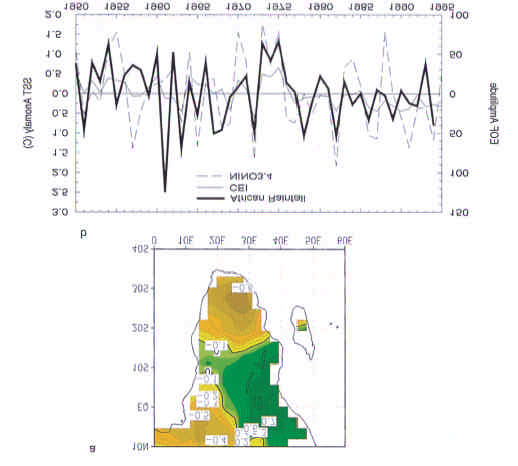
Rainfall patterns East Africa are largely governed by the sea surface temperature (SST) in the Indian
Ocean (Figure 2). The trend in the African Great Lakes region has been one of higher rainfall associated
with the warming trend in the Indian Ocean (Goddard and Graham, 1999), while the trend in southern
and western Africa show declining precipitation. This shift is associated with a southward shift in the
Inter-Tropical Convergence Zones by 3 to 5o, which partially explains the decrease in the correlation
from the mid 1970s. Along with the trend of increased rainfall in the Great Lakes region, is a trend of
increasing intensity of rainfall rather than a lengthening of the growing season. Within the Lake
Tanganyika Basin, this trend is apparent, but is stronger in the southern part of the Lake Basin. Figure 3
presents the only two long-term rainfall records within the basin and shows a stronger trend of both
increased rainfall and increased rainfall intensity at Mbale in Northern Zambia that at Kigoma in the
central part of the Lake. However, there is a significant but small trend of both increased rainfall and
increased intensity at Kigoma.
Figure 2. (a) Observed rainfall anomalies for NovemberDecemberJanuary 19501995, plotted
as correlations between the rainfall anomalies and the temporal empirical orthogonal function
(EOF) function. Green shows the areas where rainfall amount has increased as the sea surface
temperature (SST) in the Indian Ocean has increased over the time period, orange indicates
regions in Africa where rainfall has declined as SST has increased. (b) Time series for amplitude
of EOF (shown in Plate 1a) (thick solid line), amplitude on right axis. Also plotted are time
series of SST indices for the Pacific Ocean, NINO3.4 (58S58N; 1708W1108W) (dashed line),
and the Indian Ocean, CEI (central equatorial Indian index) (158S0; 508E808E) (thin solid
line). (Source: Goddard and Graham, 1999)
41
The combined effect of increased rainfall intensity and population growth, with the associated increased
levels of deforestation and expansion of agriculture leads to increased erosion and increased
sedimentation in the lakes. These changes have implications for the livelihoods of people living in this
1 8 0 0
K i g o m a
M b a l a
1 6 0 0
1 4 0 0
1 2 0 0
1 0 0 0
Total Rainfall
8 0 0
6 0 0
4 0 0
1 9 0 0
1 9 2 0
1 9 4 0
1 9 6 0
1 9 8 0
2 0 0 0
Y e a r
4 0 0 0
K i g o m a
M b a l a
3 5 0 0
3 0 0 0
2 5 0 0
2 0 0 0
1 5 0 0
Fournier Index of rainfall agressivity
1 0 0 0
1 9 0 0
1 9 2 0
1 9 4 0
1 9 6 0
1 9 8 0
2 0 0 0
Y e a r
Figure 3. Historical rainfall records and rainfall
intensity index at two meteorological stations in the
L. Tanganyika Basin.
area and for future development planning. Evidence presented in a recent Nature paper (O'Reilly et al.,
2003) suggest that over the past 80 years, climate change has contributed to declines in the pelagic
fishery, which has implications for the livelihoods of those in the basin who depend on this resource for
their economic livelihood and for the growing population that depends on this fishery as a protein
source.
Agriculture is the human enterprise that is most dependent on climate and as would be expected most
analyses show that some of the most significant negative impacts of climate change in Africa involve
loss of agriculture productivity (Mendelsohn, 2000). The main driver of these changes is the
intensification of the El Nino Southern Oscillation (ENSO) and changes in the North Atlantic Oscillation
(NAO), which leads to increased inter-annual rainfall variability. As expected, subsistence farmers are
likely to be disproportionately affected. A recent paper in the Proceedings of the National Academies of
Science suggests that the impact of changes in the ENSO and NAO will lead to a small decline in
production of most cereal crops, an increase in production of root crops and a significant decrease in the
productivity of pastures (Stige et al., 2006). However, the analysis showed that there are thresholds and
non-linearities in the relationships and that once thresholds are crossed in the indices of these oscillations
that there is generally a stronger downward trend for all production in the Great Lakes region.
42
B) Implications of Warming of Lake Waters in Lake Tanganyika:
Two recent studies (Verburg et al 2003 and O'Reilly et al 2003) have used historical (meteorological)
and paleolimnological (carbon isotope signatures and modeling of thermocline density gradient) data to
document warming trends in Lake Tanganyika. In the journal Science (July 2003), Verberg et al report
that the surface waters of Lake Tanganyika have warmed 0.9 degrees Celsius since 1913 and more
importantly, this has contributed to density differences between layers which inhibit mixing and thus the
recycling of nutrients upwards. In the journal Nature August 2003, O'Reilly et al report that surface
waters have warmed on average 0.1 degree Celsius per decade for the last three decades and that wind
velocities have decreased about 30%, the combined effect of these factors being to increase stability of
the lake's stratification and reduce mixing depth.
The scientific community does not dispute these trends in climate and water parameters. Some
researchers, however, are concerned with the inferences drawn from these data. Verburg et al attribute a
decrease in productivity offshore from Kigoma in the northern basin to the warming trend. O'Reilly et
al infer a potential 20% reduction in primary productivity from carbon isotope signatures in cores which
they maintain would be concordant with a 30% drop in fish yields due to lake warming. Most fisheries
resource managers on the lake have attributed fish declines to increases in fishing pressure and other
direct anthropogenic activities (e.g. industrial pollution in Bujumbura Bay). Indeed, neither the Verburg
or O'Reilly papers thoroughly analyzes the vast fisheries literature assembled from 1992-2000 by the
FAO/FINNIDA Lake Tanganyika Research Project. Other reasons put forwards for reduced catches (by
the same group of researchers) have been reduced stocks due to increased sediment loads in lake waters
and so greater turbidity and habitat substrate change. We note that climate change has the ability to
increase the intensity of dry seasons, with more bare ground and so increased sedimentation into the lake
can be expected in the future.
A consortium of ten scientists from the Lake Region and several European Research Institutes (Sarvala
et al 2004) has prepared a response to these papers that was presented at the International Limnological
Society Meetings in August 2004. They argue that the evidence for decreased productivity is ambiguous,
as several studies note that decreased primary production has also been attributed to increased sediment
input in the lake (Donoghue et al 2003 a and b). They report that total lake-wide fish catches had
increased up until 1995 and that the regional declines in the industrial fishery are outweighed by
increased artisanal catches. They conclude that declining fisheries stocks are a result of fishery
intensification.
The position is still unclear and needs further attention in the context of adaptive management by
all four nations we note that the 2000 STAP report on Great Lakes calls for greater scientific
documentation based on harder monitoring data. The project will invest in collaborative research and
shared experiences. IW-Learn will form a core of the dissemination process as well as improved linkages
to academia and scientific process and fora such as IDEAL.
C) Implications on Catchment Management and Sedimentation Rates
The lake catchments are badly denuded, satellite imagery shows the scale of loss of woody cover and
satellite imagery shows the size of sediment plumes from the many micro-and macro- (Malagarasi and
Ruzizi) catchments around the lake. Deforestation is a result of converting forest and woodland for
agriculture (on very steep slopes), and a result of increasing pressure on wood resources for domestic
and small-scale enterprise energy. Cultivation itself is relatively in-efficient, with little adaptation to
farming steep slopes on easily erodible soils. Kigoma District (and by inference other lake areas) have
shown considerable population growth (in-migration and normal reproductive growth). Increasing rates
43
of HIV-Aids have tempered this growth but removed productive and innovative members of the work-
force, forcing greater reliance on poor fisheries, annual cropping and fuelwood collection. The solutions
here have to be holistic, integrated and based on participatory approaches. They require greater emphasis
on improved agriculture, maintaining and increasing woody vegetation cover and improving livelihoods
through diversified incomes.
The ecological implications of this can be stated in general terms: greater aridity suggests a reduced
woody vegetation cover, acting synergistically with present patterns of conversion of wooded habitats,
dry-season fires, and so greater levels of bare soil and so both water based erosion (and so
sedimentation), and wind based erosion and so greater dust levels. This latter consequence increases
localized temperature increases, and reduced woody covers lowers carbon sequestration levels. Fire
incidence will be increased. In turn generalized impacts on people can be visualized, cultivation will be
more based on annual crops, with greater risk of crop losses, populations will move to more permanent
water sources (lake shores), and livelihoods will be more fragile with greater incidence of poverty. This
will increase pressure on natural resources (forest and fisheries) and so intensify this cycle of
degradation. The Precautionary Principle suggests that action is taken to reduce the scale of impact of
these potential changes, and that populations adapt to these changing circumstances. Impacts can be
foretold for both fisheries themselves (due to postulated lake temperature changes) and for the lake
watersheds as catchments continue to degrade.
D) The Project Response
The Executive Summary to this document mentioned the probable importance of three CC issues:
Over-fishing is an issue to be addressed by co-finance for fisheries inputs from AfDB-FAO-EU-NDF
partners (it was the FAO FINNIDA fisheries project in the 1990s that produced the detailed scientific
information now being debated) address this in several ways:
· The fisheries components will increase the intensity of monitoring fish stock and catch data.
· Fisheries communities will be supported to change fishing practices and reduce pressure by value-
adding processing to fish catches.
· The EU and AfDB components of the partnership programme develop alternative income sources
for marginalized fisher-folk. This provides mechanisms to mitigate against and adapt to vulnerability
from changes in fish catch.
· The Monitoring Processes will address the issue of climate change and fisheries data.
· The Programme will build linkages to ongoing and potential lake scientific studies.
The lake monitoring and management processes are of great importance. The GEF component, working
with IUCN co-finance, will put the climate change model on the monitoring agenda and seek additional
finance from within the partnership to further adapt riparian communities and support mechanisms to
potential patterns of change.
Catchment Management to Reduce Sediment Inputs forms the bulk of GEF funding (some 7.2 million $
out of 13.5). Predictions of changing climates in central and eastern Africa suggest increased intensities
of climatic phenomena (more extreme rainfall events and more severe drought periods etc). In the
absence of catchment interventions it is probable that erosion, soil loss and so lake sedimentation would
be increased. Catchment interventions therefore have two related benefits to the question of adaptation
and vulnerability. Firstly interventions will reduce silt loads and so allow fish stocks to recover
somewhat. Secondly, improved catchments, through social processes of increasing productivity of land,
will allow greater support to livelihoods and so reduce vulnerability to climate changes. Such catchment
interventions (eg reduced deforestation, less exposed soils) will also increase carbon sequestration
through improved carbon sinks and less soil oxidization.
44
This overall partner intervention includes elements within both national and regional process that address
directly the issues of adaptation and to climate change. Co-finance addresses fisheries. GEF funding has
two main components. Firstly at regional level, the GEF intervention includes developing environmental
protocols and standards, within the umbrella of the Convention, that include indicators related to CC
issues and mitigation measures to reduce vulnerability of communities and resources. Secondly the
emphasis on catchment management with components on maintaining woody cover directly works to
sequester carbon and maintain local catchments in ways that reduce climate change deleterious impacts.
The project seeks funding from the GEF Focal Areas on IW into three areas which are cognizant of
climate change issues and need to adapt:
· Regional Process updating SAP, adding protocols and standards to the Lake Tanganyika
Convention that specifically target adaptation to Climate Change issues and responses.
· Monitoring and Management Responses increasing our understanding of how climate change
issues will affect lake sustainability.
· Catchment management, with an emphasis on maintaining vegetation cover and improving soil
conservation measures. The project will invest in demonstrating the linkages between catchment
health and sediment discharge, using the innovative and participatory M&E techniques of ICRAF
(again with linkages to sharing experiences between lake projects here from Lake Victoria work).
References
Goddard, L and Graham, NE. 1999. Importance of the Indian Ocean for simulating rainfall
anomalies over eastern and southern Africa. Journal of Geophysical Research - Atmospheres
104: 19099-19116.
Hamilton, Alan. An Environmental History of Eastern Africa. Academic Press.
Mendelsohn, R. 2000. Climate Change Impacts on African Agriculture. World Bank, Washington.
Mitchell, TD and Hulme, M. 2000. A Country By Country Analysis of Past and Future
Warming Rates. Tyndall Centre Working Paper No. 1. Norwich, UK, 6pp.
O'Rielly, CM, Alin, SR, Pilsnoir, DP, Cohen, AS, and McKee, BA. 2003. Climate change
decreases aquatic ecosystem productivity in Lake Tanganyika, Africa. Nature, 424:766-768.
Rodgers, W A 1981 Ecological changes in Lake Rukwa, SW Tanzania. African J. Ecology.
Sarvala, J et al 2004 in press. Fish catches from Lake Tanganyika mainly reflect changes in the fishery not
climate change. (International Limnological Symposium).
Stige, LC, Stave, J, Chan, KS, Cianelli, L, Pettorelli, N, Glantz, M, Herren, HR and
Stenseth, NC. 2006. The effect of climate variation on agropastoral production in Africa.
Proceedings of the National Academy of Sciences. 103:3049-3053.
Verburg, P et al 2003. Ecological Consequences of a Century of Warming in Lake Tanganyika. Science. 301 pp
505 507.
45
Annex 5 Monitoring Programme for Lake Tanganyika
Background
Lake Tanganyika has had a century of scientific research; leading to much limnological and biodiversity
documentation and applied fisheries data. Information has been collected from all parts of the lake;
through investigations out of all four riparian countries. Much of this information was collated via the
GEF funded TBDA and SAP process, and the FAO-FINNIDA Fisheries Research Project.
All four countries have national research organisations and regulatory organisations with a mandate to
collect information on the Lake and its natural resources. These include specialised fisheries,
hydrobiology, water, agricultural and land use and health agencies.
Unfortunately; capacities in these organisations have not been high and data collection has been ad-hoc
and limited in scope and coverage. Data collection has been to national formats and criteria, with little
regional collaboration. Past monitoring and much of the scientific data collection has not fed into the
planning and implementation processes of the regulatory and management agencies responsible for the
resources of the Lake.
The Monitoring Program
All parties have agreed the need for an integrated monitoring program for Lake Tanganyika. Integration
is both cross-sectoral (fish water, land use) and cross all four countries. All parties have agreed that this
monitoring program be linked to the management of the lake and lake resources and should follow
regionally agreed formats and protocols, and fall under the oversight of the developing Lake Tanganyika
Authority and Secretariat.
The Tanganyika monitoring program is thus a negotiation process amongst the four countries. The
project will facilitate an assessment of all relevant existing monitoring that is done on/near the lake by
various national institutions, including: catchment land use, fisheries, water quality and some socio-
economic parameters. The countries will come together to negotiate a regionally harmonised monitoring
program. Resource Specialists facilitate the development and field-testing and revision of the regionally
harmonized program, and countries will work at the national level through national institutions. And
such institutions and come together regionally several times during this process to, for example,
negotiate indicators and targets and provide feedback on the new program after field-testing.
Monitoring Parameters
Sustainability; working within (enhanced) national capacities will be the key to a successful program.
Networking and partnerships will link national agencies to other global monitoring programs and data
sets; including remote sensed information.
Key Issues will be:
Water Quality
Temperatures, Oxygen, Phosphates, Nitrates, Solids, Turbidity.
Fisheries
Basic catch and effort statistics with socio-economic parameters.
Land Use
Vegetative cover, erosion, river based silt loads; agricultural crop cover.
Specific Studies
Water and health; point pollution, etc
These parameters, with details of spatial and temporary coverage, will be confirmed during the inception
46
process. These parameters are considered necessary to address the key issues surrounding the lake and the
new dimensions of climate change.
GEF Project Monitoring
This is addressed in Annex 2A; The Results Measurement Template, this is based on the "ME Indicators
and Guidelines for IW Projects".
Monitoring protocols via annual reviews and reporting will be detailed in the operational project document.
47
PART 2: INTERVENTIONS THROUGH UNOPS EXECUTION
UNOPS finances three parts of this project. The first part is the REGIONAL COMPONENT,
providing the regional coordination and interaction for the whole project. This includes the PROJECT
COORDINATOR, support to the developing Lake Tanganyika Authority (LTA), M and E and reporting
processes and regional contracts.
The second part is the DRC CONGO COMPONENT, supported via contractual agreements with a
consortium of experts selected through competitive international tender process.
The third part is the BURUNDI COMPONENT, for waste water treatment etc, in Bujumbura.
The three parts are described below, copied from the approved GEF Project Proposal
PART 1 : REGIONAL COMPONENT:
Establishing an Institutional Framework for the Implementation of the Lake
Tanganyika SAP and the Co-operative Management of Lake Tanganyika Basin
SUMMARY
The Regional Component of this Lake Tanganyika Project has several parts:
Firstly, the regional component addresses the SAP priority of ratification and implementation of the Lake
Tanganyika Convention and associated environmental protocols.
Secondly, the regional component supports the regional interaction and regional institutional activity behind
the Convention the Lake Tanganyika Management Committee and the creation of a permanent Secretariat
for the Management of the Lake. Updating the SAP and adding new and emerging issues such as water
hyacinth awareness and control are components here.
Thirdly, the regional component develops the Monitoring Programme for the Lake, linking national
processes and institutions at regional level, and developing linkages to management decision making bodies
for the Lake. The GEF-IW M & E Indicators Framework (Nov 2002) provides the basis.
Fourthly, the Regional Component provides the forum and base for the Partnership Programme for the Lake
between Governments and Development Partners.
Lastly, the Regional Programme provides the framework for coordination and management of the national
GEF interventions into a single and cohesive whole. Regional staff have the mandate to provide such
coordination and unified reporting.
The Regional Project Coordination Unit is to be based at Bujumbura, together with the Lake Tanganyika
Authority Secretariat. GEF funding supports regional activity over a four year period.
48
DETAIL OF THE REGIONAL COMPONENT
1. PROJECT SUMMARY
The Executive Summary of this Project Brief described the components of the overall Lake Tanganyika
Management Programme, delimiting the interventions from GEF and from co-finance. This description
is copied here, as a start-point for the Regional Activity of the GEF intervention the subject of this
specific section.
Long-Term Development Objective or Goal
The long-term objective of this Regional Integrated Management Programme is the improvement of the
living conditions of the riparian populations through the implementation of the SAP, the FFMP and the
Convention, together with the on-going and future efforts of riparian countries, so as to bring about an
integrated sustainable management and protection of the Lake Tanganyika
Immediate Objectives
There are two Immediate Objectives of the Integrated Regional Management Programme. These form
the two main components that are: the "Environmental Activities" of GEF finance, and the more
"Developmental Activities" of the co-finance partners.
Immediate Objective 1. To implement the prioritised activities of the Strategic Action Programme
so as to achieve sustainable management of the environment and resources of Lake Tanganyika.
(GEF).
There are four parts of this Objective, each leading to a distinct OUTCOME (linked to SAP priorities).
5. Establishment of the Lake Tanganyika Management Authority (LTMA);
a. Establishment of the Lake Tanganyika Management Secretariat (ILTMS);
b. Establishment of Inter-Ministerial Management Committees;
c. Promotion of ratification of the Convention; and subsequent protocols.
6. Reduction of water pollution by creating wastewater plants in Bujumbura and Kigoma.
7. Reducing sedimentation flows into the Lake by the establishment of demonstration sites for
sustainable catchment management interventions in Uvira in DRC, Kigoma Rural District in
Tanzania, and Mpulungu District in Zambia;
8. Establishment of a Lake Monitoring and Management System (with IUCN).
Immediate Objective 2. This leads to outcomes funded through other Partners Components
(ADB, NDF, FAO, EU/COMESA).
9. Establishment of mechanisms for pilot fisheries co-management, infrastructure and marketing to
add value fish products, monitoring systems for a responsible fisheries and lake trtanspoort /
navigation and peace processes (AfDB, FAO, NDF, EU/Comesa).
10. Improvement of community infrastructure through local development funds (AfDB).
11. Construction of wastewater treatment plant in Kigoma township (through NDF funding).
12. Capacity building of local and national stakeholders to provide them with skills to better manage
the fisheries and the environment. (AfDB).
49
OBJECTIVES, OUTCOMES AND ACTIVITIES OF THE GEF COMPONENTS
Immediate Objective 1 To implement the prioritised activities of the Strategic Action Programme so
as to achieve sustainable management of the environmental resources of Lake Tanganyika. (GEF)
Outcomes
Country / Site
Outcome 1: Regional and national institutions internalize the implementation of the Regional Activity
SAP and FFMP and provide institutional support for the cooperative management of
Lake Tanganyika under the ratified Convention.
Outcome 2. The quality of the water of Lake Tanganyika improved at two
Tanzania and
identified pollution hotspots through wastewater treatment. See Outcome 2.7 NDF Burundi
Outcome 3: Sediment discharge reduced from demonstration catchment
Tanzania, Burundi,
management sites; with providing significant livelihood benefits to local people.
Zambia
Outcome 4: Regional monitoring - management system for the Lake.
Regional Activity
Outcomes 1 & 4 are the specific scope of this Regional component, being executed by UNOPS.
Outcomes 2 & 3 are implemented nationally, although UNOPS implements Burundi, DRC.
The Regional Component has responsibility for unified monitoring, evaluation and reporting.
PROGRAMME OUTCOMES AND OUTPUTS (GEF REGIONAL INTERVENTION)
OUTCOME 1: Regional and national institutions are implementing the SAP and providing coordinated
institutional support for the management of Lake Tanganyika.
Output 1.1: The Lake Tanganyika Secretariat is established with staff, equipment, M&E processes are
in place.
Output 1.2: Protocols to Convention are adopted; Environmental policies and development frameworks
are in place; SAP is revised; Additional funding at national and regional levels for lake management are
leveraged. Information mechanisms for stakeholders are in place. The Convention is ratified and
domesticated, and First Conference of Parties is organized.
OUTCOME 4 Regional monitoring and management system contribute to the sustainable
management of Lake Tanganyika. (With -Co-financing from IUCN and AfDB/FAO)
Output 4.1: A regionally harmonized and integrated monitoring program for Lake Tanganyika's
fisheries, water quality and catchment is established.
Output 4.2: National inter-sectoral management committees established in four countries are responding
to monitoring data at both national and regional levels with supporting decision support tools.
Output 4.3: Regional technical committees for fisheries, water quality and catchment are established
and various indicators and targets are agreed upon among the four countries and annexed as protocols to
the Lake Tanganyika Convention.
50
PROGRAM KEY PERFORMANCE INDICATORS
Outcome 1:
· Regional and National Institutions established to implement SAP are operational by 2008;
· Protocols to Convention established to improve environmental policy and frameworks;
· Environmental regional master plans developed and approved by countries by 2009
Outcome 4:
· Regional Monitoring Systems established by 2009;
· Environmental and fisheries regional data-base established by 2009;
· Awareness Systems and web site in place and operational by 2008;
· Improvement in water quality monitoring data by 2010
MONITORING AND EVALUATION
The project activities and outputs will be regularly reviewed and evaluated annually by the LTMC and
will be subject to the various evaluation and review mechanisms of the UNDP, including the Project
Performance and Evaluation Review (PPER), the Tri-Partite Review (TPR), and an external Evaluation
and Final Report prior to termination of the Project. The LTMA will also participate in the annual
Project Implementation Review (PIR) of the GEF.
As a result of the emphasis placed on results-based management, the ILTMA will develop a detailed
Monitoring and Evaluation work plan at the inception of its activities. The M&E overall plan will begin
with the development of the critical indicators. The project will update the M&E work plan, which will
allow an assessment of the ILTMA performance by showing the schedule of the activities, their cost and
the expected outputs and achievements according to the established benchmarks and milestones. The
work plan will be the main tool for monitoring and evaluating the progress of the ILTMA.
FINANCING THE INTERIM LAKE TANGANYIKA MANAGEMENT AUTHORITY
The overall cost of establishment including infrastructure, and running the ILTMA for a period of four
years is over 8 million US $. This is made up as follows:
· The fisheries components in HQ (staffing, oversight, policy etc) are over $2.5 million. (AfDB)
· The monitoring components are $1 million (IUCN)
· The national components are $1,248,000
· The GEF component is estimated at $3.728 million, including regional project management.
National Contributions: Total for 48 months: US$ 1,248,000 (in kind and personnel)
Secretariat (ILTMS) Office and Project HQ (Bujumbura) will be provided by the host country based
on US$ 5,000 per month, includes rent, water, electricity, parking plots and maintenance costs. Total
host country office contribution for 48 months: US$240,000.
Project Coordination Units Offices in country Project Offices and their maintenance, water and
electricity, will be provided by the beneficiary countries, based on equivalent US$ 2,000 a month per
country. Sub-total for 40 months (allows start-up time), 4 countries: US$320,000.
Inter-Ministerial Committees / Monitoring Committees / National Staff will be assigned by
participating countries. These are equivalent costs of provision of facilities, staff time and other
resources based on equivalent $ 4,000 per country per month. Total for 40 months is: US$704,000.
51
Financing Details: GEF Component at Regional Level (annual budget line detail in annex)
Item
Duration
Total
International Staff
-
Chief Technical Advisor
48mm
680,000
Technical Advisor (Environment)
24 mm
320,000
Regional Staff for Lake Tanganyika Secretariat (support
-
for 12 mm only)
Executive Director
12mm
110,000
Director, Environment
12mm
100,000
PCU Staff (6 posts including translator, locally recruited)
48 mm
560,000
Support to Lake Tanganyika Secretariat
260,000
Consultants International
11 mm
132,000
Consultants Regional
7.5 mm
90,000
Consultants Local
6 mm
36,000
Contract ICRAF (Catchment Management & Training)
Full
650,000
Contract IUCN (Monitoring Committees)
Full
200,000
Evaluation Missions (MTR, TR)
Two
60,000
Learning and information exchanges
18
388,000
workshops
including 3
training
visits
Communications (equipments, production costs)
55,000
Equipment (Vehicles, Office, Security etc)
197,000
Duty Travel
82,000
Operating costs, Audits, Sundry
271,000
OVERALL TOTAL
4,191,000
IMPLEMENTATION ARRANGEMENTS
General Implementation Processes
The oversight of the Programme activities will be the responsibility of the LTMC. The LTMC is
comprised of country representatives at Permanent Secretary level, from both environmental and
resource sectors (eg fisheries). The LTMC will serve as a steering committee of the Programme and will
convene annually to review the Programme objectives, outputs and new and emerging issues. The
Implementing/Executing Agencies will participate in the meetings of the LTMC.
The overall coordination role of the Programme will be the responsibility of the Lake Tanganyika
Management Secretariat. The LTMS will comprise an Executive Director, a Senior Environmental
Officer, a Senior Fisheries Officer, a Senior Finance/Accountant Officer, a Senior M&E Officer and an
ICT Officer. The requisite administrative and secretariat support will be provided. These staff are
provided by participating countries, although GEF provides funding to countries to meet some of these
obligations for the first year of operation Executive Director & Senior Environmental Officer TOR are
in annexes),9 and AfDB can support similar allowance packages
9 After one year, it is expected that such posts will have been approved through national budget processes.
52
Technical assistance will be provided through the donor interventions. GEF provides a PROJECT
COORDINATOR for four years (combining both technical expertise in the field of regional water-body
institutional building, as well as coordination and reporting roles across all five GEF national and
regional components) GEF provides an Environmental Advisor for two years, plus short-term consultant
inputs (SAP, water-hyacinth control, policies, monitoring process).
The LTMS will also undertake the implementation of specific program activities: support the ratification
of the Convention, establish the Lake Tanganyika Authority, support establishment of protocols to
Convention and their enforcement, update the SAP etc.
At country level, projects will be coordinated by a PCU under the direct responsibility of the relevant
ministry/institution/local government of the participating country. Project partners at national level
(Governments and UNDP) will designate the implementing institution (Government agencies at central
and decentralised levels, or NGOs) of the projects. The PCU will be comprised of a Project Coordinator,
the requisite administrative support, plus technical expertise as needed.
Inter-Ministerial Committees will be established to support the implementation of the Program at
national and regional level and to ensure continued and increased level of political support to the co-
operative management of the Lake and to the necessary support to the LTA, once in place.
Implementation Modalities for the GEF Components
This GEF Brief sets out broad implementation process, focusing on delivery for cost-effective impact,
and nationally driven processes which lead to local capacities and so sustainability. There will be a
mixture of both NATIONAL Execution arrangements in countries with strong UNDP-Government
capacities, and UNOPS Execution arrangements where capacities are weaker (countries emerging from
long periods of conflict DRC and Burundi). The Regional component will be executed by UNOPS
with sub-contracts to institutional expertise in the region for specific tasks (eg: catchment management
training and support, Monitoring).
The principles of ensuring cost effective and sustainable implementation modalities, whilst adding
incremental value to poorly performing baseline interventions to ensure that both global and national
benefits are achieved, are of importance here. Detailed implementation modalities will be described in
subsequent Operational Project Documentation, and will be dependent on practical realities in the
field, as presented in the detailed Inception Report, due within 4 months of start-up.
6. INSTITUTIONAL COORDINATION AND SUPPORT
The ILTMA will be coordinated and supported by the following management bodies adapted to the
convention's structure:
a) The Lake Tanganyika Management Committee - LTMC
b) The Lake Tanganyika Management Secretariat LTMS;
c) The Inter-Ministerial Committees (Socio-economic Committees, Natural Resources and Biological
Diversity Committees and Water Quality and Pollution Control Committees).
THE LAKE TANGANYIKA MANAGEMENT COMMITTEE
The LTMC is the supreme organ of the ILTMA (and LTA in future) and shall consist of the Permanent
Secretaries of the relevant Ministries or a senior representative of those Ministries.
53
The LTMC shall hold its first meeting not later than four months after the signature of the Project
Document, and staff being in place, and will discuss and approve the Project Inception Report. The host
country shall convene the first meeting and the other participating countries shall convene the
subsequent meetings in the following alphabetic order. The LTMC shall select a Chairperson at its first
meeting, who shall serve for a one-year term. The Chairmanship of the LTMC shall rotate every year
among the members of the LTMC in accordance with the alphabetical order of the participating
countries.
The LTMC shall meet once annually at such time as it shall determine. The Executive Director shall
inform the participating countries of the date and place of each session and shall act as the Secretary for
the LTMC. The LTMC shall adopt its own rules of procedures. No session of the LTMC shall take place
unless the representatives of all the four participating countries are present. The decisions of the LTMC
shall be taken by consensus. The functions of the LTMC shall be as set out in the accompanying annexes
to this regional component. In brief they are to provide overall strategic policy and management
direction to the LTMA; and direct the activities of the LT Secretariat. In addition the LTMC will seek
additional partnership funding
THE LAKE TANGANYIKA MANAGEMENT SECRETARIAT
The LTMS shall be a full time body, headed by an Executive Director, approved by the LTMC.
The LTMS will coordinate Lake management interventions implemented by National Agencies within
the framework of the SAP; and coordinate interventions on the Lake through joint management,
particularly with the (ADB) Lake Tanganyika Fisheries and Biodiversity Development Project (LT-
FBDP). The LTMS will invite the participating countries to ratify the Convention and prepare the
proceedings for the establishment of the Lake Tanganyika Authority and carry out any additional
activities necessary to facilitate the implementation of the Convention. Details are in annexes below.
The Office
The LTMS headquarters will be established in Bujumbura, Burundi. The LTMS shall have a permanent
office provided by the Host Country. The Host Country shall cover the rent and maintenance of the
Office. The Host Country shall exempt the LTMS and its international and regional staff from customs
duties and any other taxes, immigration restrictions and alien registration and national service
obligations and shall facilitate by all suitable means the mission of the LTMS and its staff.
Regional Staff
At regional level, the LTS will have a full time senior staff comprising of an Executive Director and a
Senior Environmental Officer (GEF funding 12 months), a Senior Fisheries Officer (AfDB funding), a
Senior M&E Officer (IUCN funding), and a Senior Administrative/ Finance Officer (AfDB funding).
These staff-members will have a significant role in supporting the implementation of the SAP and FFMP
interventions and the SAP further development, the ratification of the Convention and the establishment
of the Lake Tanganyika Authority, the preparation of protocols to Convention to harmonize policies and
regulations, to establish regional development plans, to include other Basin State; plus the initiation of
the negotiation of co-financing from the countries and with donors and the public and private sectors in
both the Francophone and Anglophone countries.
GEF will provide technical assistance in the form of a PROJECT COORDINATOR for four years and a
TA (Environment) for two years, plus requisite support staff. Shorter term technical consultancy inputs
are funded (10 mm International input and 12 mm Regional input) in the fields of policy process, SAP
update, water hyacinth control, convention protocols etc).
54
The LTMS will require additional secretarial and administrative support, as well as a full-time translator.
There will be two separate accounting and reporting units (one for the UNDP reporting requirements and
the other for the ADB reporting requirements). The Executive Director will be responsible for recruiting
additional secretarial, technical and administrative support staff and for defining their terms of reference,
including the level at which they will have to be able to operate in both French and English. However,
their appointment shall be subject to the approval of the LTMC.
Staff from the LTMS will make fields visits in the participating countries in support of field projects and
work with staff responsible for implementing the projects at national level, and of monitoring task forces
units. The LTS and the IAs will be responsible for ensuring that projects are implemented in different
countries within the framework of the SAP and the FFMP.
National Project Coordination Units
The implementation of the projects at national level will be carried out by National Project Coordination
Units (PCU) under the coordination of Project Coordinators (4 for the GEF supported interventions and
4 for the ADB fisheries supported interventions) appointed jointly by the LTS, the UNDP or the ADB
and the participating country. The Project Coordinators (PCs) will work under the direct responsibility of
the participating countries' relevant Ministry. The participating countries will provide office and the
required technical and administrative supporting staff to the PCs. Direct costs, including office
provision, water and electricity and office maintenance will be covered by the participating countries as
national contribution. The PCUs report to LTMS, to the beneficiary Governments and to UNDP-GEF.
The GEF interventions will have PCU inputs at Bujumbura (Burundi), Uvira10 (DRC), Kigoma
(Tanzania) and at Mpulungu (Zambia).
INTER-MINISTERIAL TECHNICAL COMMITTEES / MONITORING COMMITTEES
(Reference the Lake Monitoring Programme Component Outcome 4).
The composition and the duties of these committees shall be adapted to the Technical Committees
provided in the Convention. Essentially, it is expected that these committees will be formed to support at
national level the activities of the ILTMA and to advise the Management Committee on managerial and
technical aspects of the various sectors related to the SAP/FFMP priorities: Fisheries, Socio-Economy,
Biodiversity/ Conservation, Water Quality and Pollution Control. These Committees should be
composed of Inter-Ministerial representatives and other relevant Technical Institutions or State Organs
concerned by the Lake and its Basin's issues. Private sector and NGOs involved in the Lake Tanganyika
as well as local communities shall be represented in these committees. The selection criteria of these
members should be based on expertise, experience in the related sector and implications for the Lake.
The exact design will be agreed during the Inception Report Process.
10 We note the possibility of the AFDB fisheries component being based at Kalemie, south down the lake in DRC.
It does not make for efficient management for the GEF Uvira component to be managed elsewhere from Uvira.
55
ANNEX B1: PROGRAMME LOGICAL FRAMEWORK FOR REGIONAL COMPONENT
Intervention Logic
Objectively Verifiable Indicators
Sources of Verification
Assumptions and Risks
OUTCOME 1 Regional and
ILTMA established;
Minutes and reports of the First
Countries keep and concretize their
national institutions
Conference of Parties & Meetings.
commitment to ratify the
established and implementing
Inter-ministerial Committees
Convention;
the SAP and provide the
established by 2007
Instruments of ratification are
institutional support for the
Convention ratified by 2007;
deposited with the LTMS;
The LTMS is able to lead the
cooperative management of
process of creation of the Lake
Lake Tanganyika
Protocols to Convention established National environmental policy
Authority;
Policies harmonized and regional
document; Master plans reports;
master plans established by 2010;
Commitment to implementation of
Documented increased level of
the SAP interventions;
Additional resources leveraged for
LTMS participation in activities;
continuing activities and
The countries will increase their
sustainability by 2010;
Published progress reports on extent participation in the ILTMA
of SAP implementation;
activities;
Information Resource developed
and maintained by 2010
Written reports of meetings
Increased country commitment for
Lake Tanganyika Strategic Action
regional input to SAP
Program is updated by 2009
implementation; Revised SAP
document;
OUTCOME 4 Regional
Monitoring and communication unit APR PIR
The LTMS will assist countries in
monitoring decision-making
is equipped by 2008;
Documentation of the decision-
recruiting Monitoring Committees;
support system to foster the
Internal and external network for
making management support
The LTMS will assist countries in
Lake's management
communication within the Program
system;
assessing national monitoring
established
is established by 2008;
processes;
Standardization of methods,
Documented reports on interactivity The LTMS will have the required
parameters and targets in
between work-plan and ILTMA
technical expertise to develop
environment monitoring by 2009;
activities;
monitoring capacity and to
A web site developed by 2009;
establish a decision-making
Two reports are prepared each year
Documented reports on increased
management support system
to support decision-making at
country commitment and local
regional level by 2009
benefits
56
Component Budget for Regional Activities
Item
Duration
Year 1
Year 2
Year 3
Year 4
Total
International Staff
-
Chief Technical Advisor
48mm
170,000
170,000
170,000
170,000
680,000
Technical Advisor (Environment)
24 mm
160,000
160,000
0
0
320,000
Regional Staff for Lake Tanganyika Secretariat (support for 12
-
mm only)
Executive Director
12mm
110,000
0
0
0
110,000
Director, Environment
12mm
100,000
0
0
0
100,000
PCU Staff (6 posts including translator, locally recruited)
48 mm
140,000
140,000
140,000
140,000
560,000
Support to Lake Tanganyika Secretariat
95,000
55,000
55,000
55,000
260,000
Consultants International
11 mm
30,000
36,000
36,000
30,000
132,000
Consultants Regional
7.5 mm
24,000
24,000
21,000
21,000
90,000
Consultants Local
6 mm
18,000
18,000
0
0
36,000
Contract ICRAF (Catchment Management & Training)
Full
100,000
200,000
200,000
150,000
650,000
Contract IUCN (Monitoring Committees)
Full
50,000
50,000
50,000
50,000
200,000
Evaluation Missions (MTR, TR)
Two
0
30,000
0
30,000
60,000
Learning and information exchanges
18
100,000
100,000
100,000
88,000
388,000
workshops
including
3 training
visits
Communications (equipments, production costs)
15,000
10,000
15,000
15,000
55,000
Equipment (Vehicles, Office, Security etc)
96,500
33,500
33,500
33,500
197,000
Duty Travel
20,000
20,000
21,000
21,000
82,000
Operating costs, Audits, Sundry
69,000
69,000
69,000
64,000
271,000
OVERALL TOTAL
1,297,000
1,115,500
910,000
867,500
4,191,000
57
THE DRC CONGO COMPONENT
IMPLEMENTED VIA UNOPS WITH SUBCONTRACTED CONSORTIA OF EXPERTS
SELECTED THROUGH AN COMPETITIVE INTERNATIONAL TENDER PROCESS
Summary
The DRC component is totally within the Uvira watershed, seeking to control the extreme levels of
land degradation that impact this regionally important town on the lake shore. Uvira town has great
historical importance in this region as housing an old and prestigious research and documentation
facility. The steep hillsides which rise from the lakeshore have been greatly degraded by high densities
of people concentrating in the urban centre during conflict periods. Degraded "bare" hillsides suffer
major erosion and so sediment inflows to the lake.
The project component is to build capacity for community based NRM on the hillsides and use this
capacity to rehabilitate once natural areas and so reduce sediment flow. This is a combined local
decentralised government and civil society responsibility.
A Consortium/a of experts will be selected through a competitive international tender process to carry
out project activities in the Uvira basin. A proven history of experiences in catchment management
preferably in the region, physical presence in or near the Uvira basin, inclusion of local expertise in a
consortium for both capacity building and transfer purposes are among criteria for the selection of a
consortium. Detailed TORs for a consortium will be finalized by the Regional Project Coordination
Unit, lead by the Regional Project Coordinator, in consultation with the Lake Tanganyika Authority
and Government of DRC.
Project Background / Context
Several million people live in the Lake Tanganyika basin. Socio-economic development has been
much disrupted due to a legacy of prolonged and tragic ethnic conflict in the Democratic Republic of
Congo (DRC). The main socio-economic constraint to ecosystem integrity and human well being in
the Tanganyika basin, continued conflict not withstanding, is poverty. The main causes of poverty in
the basin include:
· Limited choice of livelihood options and over-dependence on: agriculture and fishing
· Inadequate access to land and capital, and limited access to credit by the poor
· Shortage of skills for productive enterprise
· Diminished levels of security, law and order over the wider north-eastern DRC
· Destruction of natural resources, degradation and reduced productivity of the resource base
· Lack of participation by the poor in the design of development programmes
Baseline Situation: Threats, Root Causes and Activity
Threats
The biodiversity of Lake Tanganyika faces major threats. With regard to the DRC area of the Lake,
over-fishing and environmentally damaging fishing methodologies, high rates of sedimentation into
the Lake and its inflowing rivers, and growing pollution concerns from Uvira and other lakeside
settlements and industry have been documented in detail in the Trans Boundary Diagnostic Analysis
(TBDA). Over-fishing and pollution threats to the lake are addressed in other components of the
overall programme.
58
Uvira and its environs are a rural lakeside and urban zone with a growing human population. In 1996,
Uvira's population was estimated at 469,789 inhabitants with an average density of 149 inhabitants
per km2. In the past year, this population has doubled. The hillsides around the Uvira are very steep,
and with increasing human population densities, they have become heavily deforested with very high
rates of soil erosion and gulley formation.
These gulleys have led to major flash-flood river channels which carve their way through Uvira
township disrupting communications, housing and electricity and water infrastructure.
Photographic and other analyses indicate that the sedimentation rate has increased substantially in
recent years. Preliminary results show that biodiversity levels are lower in the sedimentation-affected
sites on rocky strata for all faunal groups. In addition, trophic analyses suggest that some fish types
(non-selective algae browsers) are likely to have been eliminated due to water turbidity and silting,
and both effects are accompanied with habitat/niche reduction.
With the disappearance of forests, rural women spend 4-7 hours a day collecting firewood, often far
from their homes. In the DRC fuelwood is the most affordable and available energy source for rural
communities, as other sources of energy, particularly electricity and natural gas, are unaffordable and
frequently unavailable for the majority of the population. In urban centres, firewood and charcoal
consumption is constantly increasing. High dependence on charcoal leads to higher rates of
deforestation as the local technologies used to convert wood biomass to carbon are very inefficient.
Root causes
The threats over fishing, environmentally damaging fishing methodologies, high rates of
sedimentation into the Lake and its inflowing rivers, and growing pollution concerns impacting on
Lake Tanganyika are the product of a complex and inter-acting range of issues. In the DRC, these
issues have been particularly over-ridden by protracted human conflict, insecurity and a break-down in
normal government. The ongoing civil war has had major adverse impacts on people, their livelihoods
and the ability to sustainably manage their natural resources. The protracted lack of physical security
combined with widespread poverty in the communities living around the lake has heavily framed
people's fishery and land (forest and soil) resource use rationales. Thus people have sought to
maximise short-term benefits to the detriment of the natural resource-base as a survival strategy.
On-going Baseline Activities
There have been a number of on-going baseline interventions in Uvira and the wider area, including
the Rusizi floodplain, relevant to this project proposal. An NGO - CADIC (Action for Integrated
Sustainable Development in Communities) has piloted a fuel stove initiative in Uvira. CEPAC
(Community of Protestant Churches in Central Africa) has worked with communities to vegetate the
adjacent Rusizi floodplain. However, on-going baseline activities have been constrained by long-term
insecurity in the north-eastern DRC, and thus there is a heightened need to provide support to national
institutions and communities in developing successful demonstrative interventions to reduce
deforestation and its impact on the Lake.
Conclusion
The Uvira region has, in many places, become heavily deforested, and compounded by its steep
topography, subject to high rates of soil erosion and sedimentation into Lake Tanganyika. To date,
although some interventions have been targeted at reducing soil erosion rates through afforestation
activities and lowering the pressure from a growing urban and peri-urban human population through
the provision of fuel stoves, these interventions have been insufficient. Therefore, unless an alternative
course of action is embarked upon, deforestation will continue, and the steep slopes of the lake shores
will continuously be subject to accelerated erosion, hence threatening the survival of the biodiversity
in Lake Tanganyika, particularly along the littoral zone.
59
Alternative Course of Action
The Alternative Course of Action is to develop interventions to fill the gaps from the baseline
scenario, so as to seek sustainable global and national benefits from rational use and management of
the Lake Tanganyika resources. The DRC national planning team, in relation to the environmental
threat analysis, prioritised sedimentation control as the priority project objective in order to conserve
the littoral biodiversity of Lake Tanganyika.
Working together with local communities and other local institutions, the intervention will aim to
expedite measures to control deforestation of sensitive areas within the immediate lake catchment of
Uvira, promote woodlots and agroforestry as part of an afforestation initiative, facilitate the
availability and up-take of improved stoves, and work with stakeholders to develop improved
techniques to make charcoal. The main project demonstration components will be the promotion of
community and private woodlots, and the introduction of improved bio-fuel technologies and
alternative energy development.
The expected impacts of GEF support
The DRC is committed to fulfilling its international and regional commitments to biodiversity
conservation and the sustainable management of the DRC part of the Lake Tanganyika basin. GEF co-
financing would enable DRC to make significant and sustainable improvements to the current baseline
of high rates of deforestation and sedimentation into the Lake. The key impact resulting from GEF
support of the project will be:
Tangible, growing and sustained reductions in sedimentation rates at project demonstration
sites that lead to improving habitats and biodiversity levels due to:
§ Increased capacity of local communities through collective and private action to produce,
establish and incorporate into their farming systems appropriate agro-forestry combinations as
a key part of afforesting degraded riverine and other areas.
§ Farmers within Uvira and its surrounding areas adopt sustainable and restorative forestry and
woodlot practices, a process which is replicable throughout the DRC portion of the Lake
Tanganyika basin.
§ Heightened awareness of the general public and, in particular, key resource user groups, about
the impacts and implications of high rates of deforestation and soil erosion on both the
lacustrine and terrestrial environments.
§ Increasing efficiency of bio-fuel (forest-based) energy production both in terms of producing
processed bio-fuels (charcoal production) and also in their use by people through increasing
the availability, popularity and uptake of appropriate technologies (e.g. fuel efficient stoves)
§ Within the national framework, and as appropriate, building on parallel experiences, the
development of multi-sectoral institutions, linkages and relationships between community,
regional and national levels that successfully support participatory forms of natural resource
management. The lessons learnt and precedents set will enable other similar initiatives in the
Lake Tanganyika basin to be started with potential for replication on a wider national scale.
Objective and Outcomes
The Project's Immediate Objective is embedded within the Strategic Action Plan (SAP):
`The protection and conservation of the biological diversity and the sustainable use of the
natural resources of Lake Tanganyika'
The project's Outcome in DRC is as follows:
60
`Stakeholders in the Lake's catchment manage and sustainably utilize agricultural and
forest resources to reduce sedimentation and conserve biodiversity'
Outputs
To attain the immediate objective and hence contribute to the fulfillment of the development objective,
the stakeholders of this project have selected eight tangible, specific outputs:
Sub-Outcome 1: Government and community natural resource management institutions
strengthened with capacity to improve catchment status and reduce sediment load.
Output 1: Government and community natural resource institutions reviewed and strengthened for
achieving integrated catchment basin management
Output 2: The hydrology of priority high sediment load rivers investigated and river sediment
reduction management plans developed and implemented with stakeholders
Sub-Outcome 2: The natural resource base in and around Uvira sustainably managed through
improved land-use practices with reduced soil loss and sediment loads
Output 3: Appropriate agroforestry practices and soil management needs assessed with stakeholders
in priority areas and popularly piloted in local farming systems
Output 4: The capacity of government and communities to establish and successfully manage tree
nurseries sustainably producing appropriate forestry and agroforestry species strengthened
Output 5: Old managed forest areas rehabilitated and new community and private woodlots
appropriately established and sustainably managed regenerating appropriate forest cover
Output 6: Appropriate energy-saving technologies assessed with stakeholders, advocated, piloted and
widely adopted by targeted resource user groups
Output 7: Awareness of communities raised about soil erosion, deforestation and agroforestry
management issues in relation to local livelihoods and the conservation of the Lake
Output 8: Project lessons and developments disseminated and replicated in priority outlying areas
Output 9: Project efficiently and effectively managed, monitored and evaluated
Output 1: Government and community natural resource institutions strengthened for achieving
integrated catchment basin management.
In order to achieve long-term and sustainable project interventions, government and community
natural resource management capacity needs to be strengthened. For government this may entail
ensuring that environmental service and community extension agents are appropriately trained,
enabled and resourced. For communities, especially within the context of recent and prolonged
insecurity in the DRC, their organisation and resource management institutions are likely to need
reviewing and substantial strengthening and support. Additionally, in order for government extension
services to be fully effective and for communities to popularly participate in integrated catchment
management, linkage institutions between governments (e.g. The Department of the Environment),
communities and NGOs need to be in place. In similar circumstances elsewhere, these linkage
institutions have proven to be indispensable for achieving sufficient levels of communication,
coordination and understanding between government, local communities and NGOs.
Sub-outputs/ Activities
1.1 Government environmental services and natural resource community extension
capabilities reviewed and project training needs assessed, planned and provided
1.2 Community natural resource management institutions reviewed with community
members and appropriately strengthened through the provision of training, governance and
technical support
1.3 Government community natural resource management NGO liaison and co-ordination
institutions developed and strengthened
61
Output 2: The hydrology of priority high sediment-load rivers investigated and river sediment
reduction management plans developed and implemented with stakeholders
The rationale for developing simple sediment reduction management plans for specific rivers is to
ensure that the interventions made within each river system are well coordinated and as appropriate as
possible, given the circumstances, for achieving a reduction in sediment load. It is very important that
the hydrological regimes of key rivers are better understood despite their highly complex nature. For
example, it is known that attempts at river-bank stabilisation lower in a river-catchment may be
entirely ineffective interventions on their own, when well formulated interventions elsewhere in the
system may more effectively return a river to a previous equivalent hydrological regime.
Sub-outputs/Activities
2.1 Priority high sediment-load rivers identified and their hydrological regimes investigated
and monitored in an on-going programme
2.2 Simple river sediment reduction management plans for each river developed on the
basis of the current knowledge available and from initial hydrological investigations
2.3 River sediment reduction management plans implemented with appropriate stakeholders
Output 3: Appropriate agroforestry practices and soil management needs assessed
with stakeholders in priority areas and popularly piloted in local farming systems
Agroforestry and soil management systems can be developed as an effective intervention to combat
deforestation, restore degraded areas, control soil erosion and improve the sustainability and quality of
local livelihoods. Before promoting agroforestry practices and soil management systems, previous
traditional agroforestry soil management systems will be investigated as appropriate so as to develop a
basis for promoting new improved agroforestry systems with the support of institutions such as
ICRAF. Demonstration agroforestry and soil management plots will be established in local farming
systems at priority sites in partnership with farmers, as a precursor to their wider adoption by farmers.
Sub-outputs/Activities
3.1 Traditional and potential agroforestry systems in the Uvira region including
indigenous and exotic agro-forestry tree and crop combinations reviewed and documented
with communities
3.2 Traditional and potential soil management systems in the Uvira region reviewed and
documented with communities
3.3 Improved traditional and newly selected agroforestry and soil management
combinations piloted in local demonstration farming systems with participant farmers
3.4 An agroforestry and soil management skill and support training programme developed
and implemented with partner government institutions, farmers and NGOs.
3.5 Agroforestry seedling requirements coordinated with government, community and
private tree nurseries
Output 4: The capacity of government and communities to establish and successfully
manage tree nurseries sustainably producing appropriate forestry and agroforestry species
strengthened
Tree nurseries will be established to provide indigenous and exotic forestry, woodlot and agroforestry
tree seedlings. Initially the project will rely on central tree nurseries for seedling production, but as
communities and NGOs are empowered, smaller localised nurseries will be begun on a wider scale.
The project will ensure close coordination between forestry and agro-forestry outputs and the ability of
nurseries to supply appropriate seedlings. The sustainability of tree nurseries will be reviewed during
the project so as ensure that they become appropriately independent and financially sustainable.
Sub-outputs / Activities
4.1 Central tree nurseries established and successfully managed to supply in sufficient
quantity and quality appropriate species of seedling for government and community
afforestation and agroforestry initiatives
4.2 Government, community and NGO agents trained in tree nursery husbandry and
management including strategies to achieve financial sustainability
62
4.3 Secondary tree nurseries in out-lying coastal villages initiated and sustainably managed
through working with village institutions and individuals as appropriate
4.4 - Extension programme developed to ensure sufficient supply, appropriate utilisation and
optimal survival of transplanted seedlings
Output 5: Old managed forest areas rehabilitated and new community and private
woodlots established and sustainably managed regenerating appropriate forest cover
In coordination with the river sediment reduction management plans, priority old managed forest areas
will be rehabilitated and their management improved. In addition, community and private woodlots
will be promoted and established within appropriate tenure systems. The development of public,
community and private woodlots will not only help stabilise degraded areas, but also begin to provide
sustainable wood products for local communities. Key to the success of woodlot expansion will be
providing appropriate support and technical expertise to communities and private woodlot owners so
as to ensure that they are sustainably managed, harvested and replanted in the years to come.
Sub-outputs/ Activities
5.1 In coordination with the river sediment reduction management plans, high-erosion sites
identified, mapped and prioritised for intervention with communities
5.2 Tenure status of erosion sites investigated and appropriate community woodlot management
plans developed
5.3 Community and private woodlots of appropriate species established and managed by
communities and private individuals using seedlings supplied from government and community
nurseries
5.4 - Old existing woodlots rehabilitated through replanting, restoring degraded areas and
improving their management
5.5 In coordination with the river sediment reduction management plans, priority public river
margins in Uvira town reforested and protected
Output 6: Appropriate energy-saving technologies assessed with stakeholders,
advocated, piloted and widely adopted by targeted resource user groups
As part of an integrated strategy to reduce forestation, rehabilitate degraded areas and control soil
erosion, alternative fuel-efficient technologies will be demonstrated, piloted and then widely
disseminated. The fuel-efficient technologies will focus on charcoal processing and domestic energy
use for cooking, as these are the largest sinks for deforestation. As has been the experience in similar
initiatives elsewhere to promote fuel-efficient technologies, selecting the right technology which is
socio-economically and culturally appropriate, is key. In addition, facilitating the widespread up-take
of fuel-efficient technologies is often more complex than might be expected. In this regard,
demonstration of the fuel-efficient technologies to women groups or associations, as well as seeking
their opinions, preferences and advice will be crucial since failure to engender their full and
enthusiastic support will lead to the failure of this output.
Sub-outputs/ activities
6.1 Current wood fuel attitudes, uses/practices and energy saving needs of targeted
resource user groups established
6.2 Staff from government institutions and NGOs trained in the construction and
demonstration of selected fuel-efficient technologies
6.3 - A training extension centre and demonstration facility for alternative fuel-efficient
technologies targeting women groups and associations established
6.4 A selection of alternative fuel-efficient technologies assessed and piloted by target
resource user groups (e.g. domestic firewood users and charcoal makers) at local
demonstration sites
6.5 Adoption of appropriate and popular fuel-efficient technologies scaled-up to supply
households and resource-user groups through out the Uvira and Rusizi areas
6.6. A basket fund for initial funding of fuel-efficient technologies established
63
Output 7: Awareness of communities raised about soil erosion, deforestation and agroforestry
management issues in relation to local livelihoods and the conservation of Lake Tanganyika
Local community awareness raising about the impacts of agricultural practices and unsustainable
forest use on the environment can help to facilitate their acceptance of new or modified resource
management practices and to more readily join together in collective action efforts. Community
members will be given the opportunity to participate in seminars facilitated by ICRAF, as a means to
achieve awareness raising, in turn usefully complementing and supporting the preceding outputs.
Sub-outputs/ Activities
7.1. Community workshops held with organised groups (women, youth, fishermen and farmers)
including field visits and multi-media presentations on the socio-ecological impacts of deforestation
and soil erosion on livelihoods and on the biodiversity of Lake Tanganyika
7.2. Radio debates
held regularly on deforestation and its consequences on the Lake's environment involving the
participation of communities and key resource users.
Output 8: Project lessons and developments disseminated for replication in priority areas
The lessons learnt from developing and implementing the project both in terms of government and
community institutional strengthening as well as innovations in sustainable land-use will be
disseminated and replicated in priority areas outwith the immediate Uvira area. The benefits from
doing so are likely to be significant, depending on the success of the project's progress, and substantial
potential exists for successful replication, after the mid-term review has been carried out.
Sub-outputs/ Activities
8.1. Key project lessons distilled and new priority project areas identified with stakeholders
8.2 Project developments disseminated and replicated as appropriate in new project areas
Output 9: Project efficiently and effectively managed, monitored and evaluated
The project will need to develop an effective and efficient Management Information System (MIS)
that will be a key administrative tool for the project's implementation. The MIS will require the timely
acquisition, analysis and dissemination of relevant information to the project's staff and stakeholders.
It will therefore be important that the Project Implementation Unit (PIU), in collaboration with key
stakeholders, agrees and develops an effective and appropriate MIS. The MIS will comprise a
Planning and a Monitoring & Evaluation component. The project's log frame with its in-built targets
will provide benchmarks against which actual performance will be monitored and evaluated. The
findings of the M&E process will in turn be fed back and used to review and possibly modify the
original log frame.
Sub-outputs / Activities
9.1 Project staff recruited
9.2 Management Information System (MIS) developed and implemented
9.3 Sire specific baseline survey conducted
9.4 - Preparation and implementation of Annual Work plans and Budgets (AWPB) carried out
9.5- Mid-term review and end of project evaluation planned and conducted
Project sites
The project site is located in the Uvira Catchments to the west of Uvira City, South Kivu Province, in
Uvira Region. This is to the south of the Rusizi floodplain. Detailed selection of intervention
demonstration sites will be chosen during the initial stages of the implementation of the project on the
basis of identifying high priority soil erosion and deforestation sites, and approved within the
Inception Report. The process of selecting project sites will also be contingent on community
participation and their acceptance of the project's planned interventions.
Assumptions and risks potentially impacting on the sustainability of project outputs
64
Whilst security in the DRC area of the Great Lakes remains of concern, the specific Uvira site has
been relatively peaceful. The Hydro-Biology Research Centre in Uvira has continued working
throughout the years of conflict, and has helped prepare this component. However, the largest risk to
the satisfactory implementation of the project must still be the level of insecurity prevailing in the
eastern DRC as a whole, especially along the southern Congolese coast of Lake Tanganyika.
Insecurity risks may adversely impact on the functioning of the project. Insecurity creates an
environment in which communities are less able to participate in the implementation of the project,
and in which the functioning of national (including government) institutions is greatly reduced.
The reduced level of capacity in both Government and Civil Society means that the project has to
invest in awareness, education/sensitisation and general institutional support and confidence. The low
functioning of political systems leads to reduced levels of political support. And finally, the lack of
alternative income / energy options over the last decade, apart from overuse of the catchment, means
that the project will have to invest in considerable demonstration to achieve buy-in. The prevailing
socio-economic situation does limit both individual and community options
Against these problems is the fact that people have a great desire for change, there is no recent history
of donor dependence, and the civil society process is growing. There is potential for sustainability.
Stakeholder involvement in project proposal development
During project development of the project proposal consultations were initiated at all levels with a
range of partners and other institutions directly or indirectly linked with project activities. In the first
instance, two national planning teams were trained and grouped within the overall National Planning
Team. The National Planning Team is comprised of delegates and technicians from several relevant
ministries (Ministry of Land Affairs, Environment, Conservation of the Nature and Tourism; Ministry
of Planning and National Reconstruction; Ministry of Foreign Affairs and International Cooperation;
and the Ministry of National Education, including the University of Kinshasa; Ministry of Agriculture,
Fishing and Livestock; Ministry of Information; President's Office) through the Official Gazetteer, as
well as a NGO from Kinshasa.
A second team was formed in the eastern Democratic Republic of Congo. The team is comprised of
technicians based in South Kivu Province from different public and private institutions, including the
Higher Rural Development Institute (ISDR), Higher teacher-Training Institute of Bukavu (ISP), the
Congolese Institute for Conservation of Nature (ICCN), the National Agronomy Research Institute
(INERA), the Natural Sciences Research Centre (CRSN), and the Hydrobiology Research Centre
(CRH). Institutions from the private sector include the following Uvira NGOs: NOPTA (New
Orientation of Fishing in Lake Tanganyika), CADIC (Action for sustainable development integrated in
communities), CEPAC (Community of Protestant Churches in Central Africa), ASEGE (Association
for Environmental management studies) and BECA (Supervisory Office conservation of the nature
and Improvement of Nutrition in Kivu). In addition, during project development, the riparian
communities of Lake Tanganyika as well as the traditional, local and administrative authorities were
consulted several times, and their opinions were taken into account in developing the project proposal.
In both cases, the radio and press were used as tools for sensitisation, extension and dissemination of
new alternative techniques towards all project stakeholders.
Monitoring and evaluation system
The prevailing system in DRC Kivu Uvira will be assessed at project start-up, and M & E systems
integrated into the implementation arrangements. The Project Management Unit to be based in the
Uvira basin will have important roles in such M & E.
65
Most of the project activity indicators are expressed in terms of percentage or quantity, i.e. the
percentage of old public woodlots rehabilitated, percentage of hills reforested and established in
community plantations, as well as the percentage of river banks reforested. The activity on agro-
forestry techniques and anti-erosion techniques will be measured from the percentage of farmers
adopting the techniques. Similarly, the percentage of people participating in popular workshops held
in order to raise awareness of the prejudicial effects of erosion and the value of lake protection will be
a measurable indicator of project activity.
Project cost
The development objective `Protection and conservation of the biodiversity and the sustainable use of
the natural resources of Lake Tanganyika' will be realised through a number of related project
components within the four areas as identified in the SAP -fisheries, sediment reduction, pollution
control, forest/woodland conservation and lake monitoring. Different partners will contribute to the
overall development objective as described in the Executive Summary to this Brief. In the DRC,
UNDP/GEF support will focus on catchment management.
DEMOCRATIC REPUBLIC OF CONGO : Output Financing
Outcome 1: `Government and community natural resource management institutions
strengthened'
350,000
Output 1: Government and community natural resource institutions reviewed and
250,000
strengthened for achieving integrated catchment basin management
Output 2: The hydrology of priority high sediment load rivers investigated and
100,000
river sediment reduction management plans developed and implemented
Outcome 2: `The natural resource base in and around Uvira are sustainably managed
2,050,000
through improved land-use practices'
Output 3: Appropriate agroforestry practices and soil management needs assessed
500,000
with stakeholders in priority areas and piloted
Output 4: The capacity of government and communities to establish and
successfully manage catchment projects with appropriate forestry and
300,000
agroforestry species is strengthened
Output 5: Old managed forest areas rehabilitated and new community and private
woodlots appropriately established and sustainably managed regenerating
250,000
appropriate forest cover
Output 6: Appropriate energy-saving technologies assessed with stakeholders,
150,000
advocated, piloted and widely adopted by targeted resource user groups
Output 7: Awareness of communities about soil erosion, deforestation and
350,000
agroforestry management issues raised
Output 8: Project lessons and developments disseminated and replicated in priority
100,000
outlying areas
Output 9: Project efficiently and effectively managed, monitored and evaluated
400,000
Sub-Total
2,400,000
· Co-financing Government of DRC's contribution, in kind
ITEM
DESCRIPTION
ESTIMATE (US $)
Human resources: ministry, provincial
1. Services
and local government
450,000
2. Office / Miscellaneous
Office rentals and utility services
200,000
TOTAL
650,000
.
66
Project linkages with national/regional/global sector programs
At the level of the DR Congo, the project is well integrated with the Environmental Action National
Programme (PNAE) the priorities of which include: erosion control, protection of degraded lakes and
zones, as well as promotion of public woodlots through the National Forestry Service.
Secondly, the National Biodiversity Programme (NBP) sets out a strategy for conserving the
biodiversity of the DRC, in the country generally as well as in national parks and natural reserves. In
addition also provides for the protection and conservation of aquatic biological diversity and aquatic
environments such as Lake Tanganyika.
Projects that help reduce poverty through developing sustainable community natural resource
management and sustainable environment-based livelihoods also constitute a high priority for the
DRC. In the DRC, there are a number of projects with which strong links will be developed during the
proposed project.
The Albertine Rift Conservation Project is funded by the MacArthur Foundation and implemented by
the Chicago Natural Museum (USA) in collaboration with the Uvira Hydro-biological Research centre
(CRH-Uvira), the Natural Science Research Centre (CRSN-Lwiro/Bukavu) and the Congolese
Institute for Conservation of the Nature (ICCN-Bukavu). The project is mainly focussing on the
conservation of aquatic ecosystems (including East-African Great Lakes, e.g. Tanganyika ecosystem)
and terrestrial catchment areas of the Lake in Uganda, Rwanda, Burundi, Tanzania, Zambia, DRC.
In the same sector, WWF-East Africa is developing a regional conservation programme in the
Albertine Rift (including Lake Tanganyika). The programme has nine objectives, including the
conservation of forests, lakes and rivers, sustainable utilisation of natural resources, environmental
education, and capacity building and legislation development.
At the national level, some additional interventions in connection with the project have been on-going
in the Lake Tanganyika catchment. These include reforestation programmes initiated and executed by
the National Reforestation Service but whose activities stopped because of the war in DR Congo.
Another on-going programme is the reforestation of the Rusizi floodplain by local NGOs: NOPTA
(New Orientation of Fishing in Lake Tanganyika), CADIC (Action Centre for Integrated and
Community Development) and CEPAC (Community of Protestant Churches in Central Africa). This is
working in the Rusizi floodplain.
3.13
Implementation Arrangements.
The project is to be implemented through UNOPS, with UNOPS subcontracting a consortium/a of
experts to work in collaboration with DRC government and the Uvira Region / Uvira Municipality
Agencies, to seek partnership processes in implementation.
UNDP / UNOPS and Government of DRC will draw up a National Steering Committee to provide
oversight and guidance to the project process. This Steering Committee will be integrated with the
overall Programme oversight mechanisms described in Annex 3 to this Brief.
Full details of the implementation process will be finalised during the Inception Report Process in
the first four months of project start-up after key staff are on board. However the basic principles
include:
· Full stakeholder participation in project implementation, this goes across civil society and
private sector and government at local and regional levels;
· An emphasis on partnerships across the many sectors will be encouraged;
· Capacity building for sustainable project processes will be integrated;
· Cost-effective and efficient implementation mechanisms will be used;
· Seeking a sustainable exit strategy for GEF intervention involvement; and
67
· Project activities will be geared towards impact generation with a view to learning lessons
and replication of project successes elsewhere in DRC and the Region.
68
Project Logical Framework Matrix DRC COMPONENT
Narrative Summary
Indicators
Means of verification
Assumptions
Development objective:
30 % improvement in sedimentation rates
Project & Post project
The policy environment
in target catchments
evaluation reports
supporting community
The protection and conservation of the
Significant improvement s in biodiversity
Annual reports of line
involvement in NRM
biological diversity and the sustainable use of
(land and water) indices within and
Ministries (Tourism,
continues to be favourable.
the natural resources of Lake Tanganyika
offshore selected catchments (as measured
Environment and
The M and E process (see
by project supported Lake Management
Natural Resources,
regional Proposal) is
processes using TBDA / SAP baseline.
Agriculture and
implemented.
Cooperatives, Energy
and Water resources)
Overall outcome
At least 60% of old woodlots rehabilitated. Project annual and
Internal security problems
60% of hills rehabilitated.
evaluation reports
might affect good running of
Stakeholders in the Lake's catchment manage
At least 50 % of farmers use at least 2 agro- Community minutes and
the project
and sustainably utilize agricultural and forest
forestry techniques.
records implementing
The weather conditions
resources to reduce sedimentation and conserve At least 30 % of farmers use 1 anti-erosion
CBNRM
remain favourable
biodiversity
technique.
Impact assessment
Inflation rates remain
studies
manageable
At least 20 % of households use charcoal
ovens and improved stoves
Outcome 1: Government and community natural resource management institutions strengthened
Output 1: Government and community natural Institutional agreements in place.
Signed agreements
Agreements are possible, and
resource institutions reviewed and
No of staff in place and functioning
Government Rosters,
communities can be
strengthened for achieving integrated
No of community institutions
and field verification
mobilized.
catchment basin management
Field Verification
69
Output 2: Hydrology of priority high sediment
Hydrological parameters, linked to LT M
From LT M and E
M and E processes are
load rivers investigated and river sediment
and E process
process
agreed.
reduction management plans developed and
Sedimentation Plans in place
Project Reports
implemented
Outcome 2: The natural resource base in and around Uvira sustainably managed through improved land-use practices
Output 3: Appropriate agroforestry practices
50 % of farmers have adopted agro-
Farmers' survey
Farmers have enough land
and soil management needs assessed with
forestry technique
Project annual and
to devote a portion to
stakeholders and popularly piloted in local
30 % of fields have shrub/ grassy hedges
evaluation reports
agroforestry
farming systems
30 % of farmers have adopted at least 1
Agroforestry benefits are
anti-erosion technique
tangible enough so that
1,000,000 agroforestry plants distributed
farmers accept and use the
technology
Output 4: Capacity of government and
Funding increases for catchment activity
Institutional Records
Technicians will make use
communities to manage successful catchment
Increased staff allocation for catchment
their training on the
project activities sustainably; with appropriate
management
project and not seek
agro-forestry species is strengthened
employment elsewhere
Agro-forestry will not be
too heavy an investment in
time and financial
resources
Output 5: Old managed forest areas
100 ha of old woodlots rehabilitated, or
Site surveys at the
(A) viable local
rehabilitated and new community and private
80% of old woodlots are rehabilitated
beginning and at the end
organisation(s) is/are put
woodlots established and sustainably managed 400 ha of plantations are established
of project to estimate
in place to supervise and
regenerating appropriate forest cover
At least 60 % of plantations have
deforested forested
protect the forested and
established a functional community
surfaces establish
woodlot areas
management system
comparison
70
At least 50% of sensitive sites on Uvira
Field survey to measure The local reforesting is
rivers are reforested on 20 m wide and
planted areas at the end
sufficient to respond to
sediment dams are constructed in at least
of project
firewood demand
50% of the sites pending the
Survey of community
development of river sediment reduction
woodlots to assess
The local community is
management plans
management system
willing to take part
Output 6: Appropriate energy-saving
At least 20% of households use improved
Household surveys
The cost of ovens might
technologies assessed with stakeholders,
stoves in Uvira City;
be prohibitive
advocated, piloted and widely adopted by
At least 50% of households use improved
The positive effect from
targeted resource user groups
stoves in Uvira rural zones;
utilisation of ovens and
At least 10% household groups use
stoves on wood
charcoal ovens in Uvira City ;
consumption might be
At least 50% of household groups use
counter-acted by locally
charcoal ovens in Uvira rural zones.
increasing demographic
pressure.
Output 7: Awareness of communities raised
At least 30% of local community Workshop reports
about soil erosion, deforestation and agro-
participated in popular workshops
forestry management issues in relation to local At least 30 % of primary and secondary
livelihoods and the conservation of Lake
school students participated in workshops
Tanganyika
At least 75 % of ILDs and NGOs and local
administration workers participate in
popular workshops
Output 8: Project lessons and developments
PIR, MTR, TPR Processes
Minutes, Reports, Field
disseminated and replicated in priority outlying
Visits
areas
PIR, MTE, and TE
reports
71
Output 9: Project efficiently and effectively
Appropriate Project staff in place within
Project progress reports Consortium/a selection is
managed, monitored and evaluated
the first four month of the project start-up
Project MIS records
completed in a timely
Key information requirements and
Copies of AWPB
fashion.
reporting formats developed for the project Baseline Survey Reports
Appropriate number of project plans and
Project MIS records
reports available in a timely manner at
Project progress reports
different management levels
Project MIS records
Appropriate Project baseline and
Mid- term Review
benchmark outputs developed for
Report
monitoring project results.
Impact Assessment
PIR, MTR, TPR Processes
Report
72
BURUNDI COMPONENT
SUMMARY
The Government of Burundi prioritised the SAP into two immediate priorities: addressing the
problem of over-fishing (AfDB co-finance) and the problem of severe lake pollution near
Bujumbura as a result of untreated waste-water flows (GEF financing).
Bujumbura as befits a capital city has a wastewater sewage system, which was being updated
and increased by both local and donor investment in the early 1900s. However insecurity led to
the pull-out of donor financing before project completion although most civil works were
completed.
GEF financing joins forces here with Government and Private Sector financing to both complete
and extend this system and to provide increased capacity for the Bujumbura civil authorities to
implement and monitor a modern system.
The past GEF SAP / TDA processes showed the severity of pollution inflows from Bujumbura
which impact the whole of the northern lake. Pollution is more than a heath hazard but is
instrumental in reducing fisheries productivity and biodiversity, through changing water
parameters and so habitats.
Pollution control has two dimensions. These are: the impact on global environmental values
including biodiversity; which forms the rationale for GEF financing; and impact on health, was
has been the driving factor in leveraging funding from both government and the Private Sector
industries which are sources of pollution..
THIS COMPONENT IS EXECUTED VIA UNOPS
TABLE OF CONTENTS
1
Project Background / Context 74
2
Baseline situation: Threats, Root Causes and Activity 74
3
Alternative Course of Action 78
Annex 1: Project Output and Activity Matrix
Error!
Bookmark not defined.
Annex 2: Project Logical Framework Matrix
84
73
Project Background / Context
Environmental Context
Lake Tanganyika contains the greatest biodiversity of any lake on the globe, with some 2,000
species of fish, invertebrates and plants that have been recorded in the lake basin, of which 500
are endemic. For more information about the richness of Lake Tanganyika in terms of
biodiversity and other values, refer to the Strategic Action Plan document.
Socio-economic, Institutional and Policy Context
Burundi has always maintained a strong interest in the Environmental Status of Lake Tanganyika,
which is not surprising as the Capital City Bujumbura is dependent on the Lake for water
supplies - for domestic, industrial use (and for transport, Burundi is a land-locked country) and
for much input to the livelihoods of its population fish are a major food source. The Lake
provides a security route. Despite the civil unrest of the past decade which saw the planned
secretariat for Lake Tanganyika moving from Burundi to Tanzania, Burundi has constantly
played its part in past GEF project and recent PDF B project processes. Burundi was able to host
the past FINNIDA FAO fisheries project, and has constantly lobbied for the new GEF project to
be based in Burundi.
Whilst the Ministry for Land Management, Environment and Tourism has the lead role in this
GEF project, but the implementation processes are strongly cross-sectoral with other Ministries
involved. The Ministry of Energy and Minerals (Water interests), Ministry of Transport, Ministry
of Health, Ministry of Agriculture (fisheries issues) and Ministry of Industries and Trade all have
strong interests. The parastatal institutions (SETEMU, IENCN) dealing with water and sewage in
Bujumbura are immediate stakeholders, as is the private sector who provide co-finance.
Civil unrest has reduced capacities of organisations (both government and civil society/private
sector), but organisations do continue to function and industries continue to produce. New
investment has been curtailed as donor funding ended and government reduced funding sources
had other immediate priorities outside the environmental sector.
Baseline situation: Threats, Root Causes and Activity
Threats
The biodiversity of Lake Tanganyika faces major threats. With regard to the Burundi part of the
Lake, over-fishing and environmentally damaging fishing methodologies, high rates of
sedimentation into the Lake and its inflowing rivers, and growing pollution concerns were
documented in detail in the Trans Boundary Diagnostic Analysis (TBDA).
Pollution
Burundi has the smallest catchment of Lake Tanganyika, but it has a potentially significant
pollution impact on the Lake's ecosystem since Bujumbura, the country's capital city, is situated
on the lake shore and is a substantial source of domestic and industrial pollutant discharge into
the lake. The city is the largest town on Lake Tanganyika, with approximately 600,000
inhabitants. Bujumbura city is growing rapidly with a current population growth rate of 7.8%.
Present urban sanitary services are unable to handle and process the growing urban population's
sewage in a proficient and ecologically appropriate manner.
Present wastewater discharge processing capacity in Bujumbura varies according to the level of
infrastructure in the city's different precincts. The city's most developed and more affluent areas
74
(approximately 25% of the urban population) use septic tanks and cesspools to dispose of their
sewage. The lower income areas (approximately 35% of the urban population) are not currently
supplied with running water, and therefore depend on latrines and open sewers and gutters for
domestic effluent. The remaining areas, representing about 40% of the population, as well as
almost all local industrial premises, either are connected or are easily connectable to the sewage
network. However, much of the industrial waste water system is not yet connected to the city's
main treatment plant since effluent pre-treatment conditions have not yet been fully met by most
factories, which in turn form the largest point-sources pollution threat. Most industrial premises
are beginning to install pre-treatment systems for their effluent discharge and it is expected that
by the end of 2004, most will have commissioned their pre-treatment works.
Samples of lake water have been taken from different points in Lake Tanganyika around
Bujumbura and are shown in Table 2. In addition the textile outflow was high in lead and chrome.
Table 2: Analyses from Lake Tanganyika Waters (2 samples) and textile industry outflow
Parameter
Units
Lake Site1
Lake Site 2
Textile
pH
-
8.6
8.9
12
Dissolved oxygen
mg/l
7.05
6.65
2.12
Chemical oxygen demand (COD)
mg/l
55
84
30.6
Chlorinate
mg/l
19
22
3560
Total dissolved solids
mg/l
516
426
-
While the analyses in general, and in Table 2) are not of immediate critical concern, some
parameters do exceed safety standards and it is considered necessary appropriate to ensure that
appropriate pollution prevention measures have been taken instead of waiting until the Lake is
heavily polluted. Were the Lake to become heavily polluted, then in addition to pollution
abatement infrastructure development, the de-pollution of the lake would be expensive and the
expected damage to the Lake's globally important habitats and biodiversity might well be
irreversible.
Root causes
The threats over fishing, environmentally damaging fishing methodologies, high rates of
sedimentation into the Lake and its inflowing rivers, and particularly growing pollution concerns
impacting on Lake Tanganyika are the product of a complex and inter-acting range of issues.
Whilst the four are generic to the region; the third bullet, on insecurity, is more specific to
Burundi:
§ Weak local natural resource management and tenure institutions natural resource
management has long been the prerogative of central and district government without
appropriate, popular and effective participation of local communities and resource-users.
With a legacy of chronic under-resourcing in the natural resource sector, the capacity of
government institutions and the effectiveness of their programmes have remained weak,
leading to de facto open resource use situations. De facto open resource use situations have
also occurred as resource use and tenure rights have remained contested and local
communities continue to perceive resource management and law enforcement responsibilities
as lying heavily with the state.
§ Poor governance and accountability reflective of a complex set of development and
societal issues, poor governance and accountability have led to ineffective natural resource
75
management, unsustainable resource use practices and have frequently compromised law
enforcement.
§ Insecurity this has been a particular issue in Burundi where government funding priorities
and implementation priorities have moved away from the environment in order to deal with
governance issues and restoring order. International peace processes have greatly restored the
security situation and it is hoped that this fundamental root-cause is now over!
§ Insufficient local and national institutional liaison catchment natural resource
management is ideally a multi-sectoral undertaking involving water, agriculture, fisheries,
forest, wildlife, land (tenure) and mining sectors. Each usually has its own district department
and these departments may fall under entirely different ministries at national level. Creating
and maintaining sufficient liaison and linkages between all these institutions is not easy and
often receives inadequate attention. To date, insufficient coordination between all these
sectors has led to disjointed and sometimes contradictory policies and programmes, resulting
in poor catchment management. And underlying these institutional root-causes are the twin
problems of:
§ A growing human population - in the Lake Tanganyika basin has led to increasing
pressure on the resource base. While growing human populations may not necessarily
lead to deleterious outcomes for the integrity of ecosystems and biodiversity, a range of
complex factors, including those presented below, have resulted in insufficient incentives
for, and the inability of, people to successfully manage their relationship with the
environment in an ecologically sustainable way.
§ Poverty - is widespread in communities living around the lake, and heavily frames
people's fishery and land (forest and soil) resource use rationales which often maximise
short-term benefits to the detriment of the natural resource-base. People farming the steep
slopes of the lake's shores are amongst the poorest in local society and therefore are
unable, for a variety of reasons, to invest sufficiently in sustainable farming and resource
use practices. Underlying reasons include seasonal farm labour shortages, insufficient
access to affordable credit, insecure land tenure, and a lack of knowledge about
sustainable farming practices in a contemporary context.
On-going Activities Baseline Activities
Urban pollution abatement
Major infrastructural pollution control and management work was carried out in 1994 funded by
KFW, AfDB and the Government of Burundi on the basis of earlier design work carried out by
German GKW Consult in 1990. While virtually the entire primary and secondary collection
networks were constructed, the tertiary network was not undertaken due an embargo on Burundi,
escalating insecurity and project costs and the halt of bilateral cooperation with many European
counties. Thus, in 1996, infrastructure construction was halted although the work was only 90%
complete.
Subsequent to the embargo, the Government of Burundi decided to fund the construction of the
outstanding works required for the commissioning of the primary and secondary wastewater
discharging system. The works included connecting old networks to the new system, mounting
electro-mechanical equipment, and the provisioning of maintenance equipment for the system and
treatment stations. Although the primary and secondary systems were commissioned in July
2000, the quantity of wastewater that reaches the treatment station is insignificant, as the overall
sewage system remains incomplete. This is due to the fact that the tertiary networks for the
Buyenzi area and partly for the Bwiza and Nyakabiga areas could not be completed due to a lack
of funds.
76
Thus the construction of the tertiary system needs finalising for the city's main sewage system to
function properly. Since the cessation of the previous donor-supported project, local institutions
and the Government in Bujumbura has been unable to complete the tertiary network as both the
Municipal Technical Services (SETEMU) and the National Institute for Environment and
Conservation of the Nature (INECN), lack the requisite financial, infrastructural and human
resources. Thus untreated water particularly industrial effluent continues to be discharged into
Lake Tanganyika.
When the facilities are eventually fully commissioned, 38% of domestic wastewater and the
totality of industrial effluent will be treated, hence allowing for a reduction of pollutants of
21,000 Kg BOD a day. This would allow for a 95% treatment ratio according to the project
implementation study carried out in 1990. In this regard, some industrial facilities have already
commissioned their pre-treatment plants such as the Burundi Textile Complex (COTEBU) unit
while others have begun construction for example, the Burundi Brewery Company
(BRARUDI).
Water quality monitoring has been undertaken by INECN, through the pollution special group,
and chemical and physical-chemical analyses have been conducted. The group is active in
promoting greater awareness about water pollution issues among industrial stakeholders and
urban communities.
The present sanitation system comprises of the following works and equipment:
Previous works for wastewater discharge in the city of Bujumbura consisted of an old network
measuring about 30,000 meters covering the town areas of Ngagara and Mutanga-Sud. The new
works made in 1999-2000 fully cover the town areas of Bwiza, Nyakabiga, the city centre, the
Asian district, the industrial area and part of the Buyenzi area.
· A 36 km primary network of concrete pipes with 600-1200 mm diameter;
· A 34 km secondary network with 250-500 mm diameter;
· A 75 km and household network of PVC pipes with 110-200 mm diameter.
The first two networks are already installed and are functional, while the tertiary network lacks 20
km to be finalised. 15 separators with the role of separating wastewater from rain-water, are
installed. 4 pumping stations although installed cannot operate on a continuous basis due to a lack
of sufficient energy since they presently each operate on 225 KVA generators. A lagoon
treatment station consisting of 6 basins, including 2 anaerobes, 2 optional anaerobes and maturing
anaerobes covers a 40 hectare area. see map at end of Annex
The treatment station has a daily capacity of 40,000 cubic meters, but only receives 5,000 cubic
meters a day. The primary network has a capacity of 60,000 cubic meters a day.
Conclusion
The biodiversity of Lake Tanganyika is threatened by three proximal threats of pollution,
sedimentation and localised over-fishing. Pollution from Bujumbura constitutes a growing threat
to both the biodiversity values of Lake Tanganyika and to urban public health. A substantial
investment in pollution control has already been made through the construction of primary and
secondary sewage control infrastructure in Bujumbura, but which due to extenuating
circumstances, and despite the efforts of the Burundian Government, remains incomplete. While
the incomplete and only partially functioning sewage system has resulted in the continued
77
emission of untreated effluents into Lake Tanganyika, the threat of pollution remains
surmountable if an alternative course of action, as proposed herein, is adopted and implemented.
Alternative Course of Action
Introduction
The Alternative Course of Action is to develop interventions to fill the gaps left from the baseline
scenario, so as to seek sustainable global and national benefits from rational use and management
of the Lake Tanganyika resources. The environmental threat analysis identifies needs in improved
pollution control. Thus the GEF intervention in Burundi addresses pollution control through
infrastructure completion and institutional capacity building.
The present project is jointly designed by the Municipal Technical Services (SETEMU) for the
exploitation of the lagoon and the National Institute for Environment and Conservation of the
Nature (INECN) for awareness-raising and discharge control.
The expected impacts of GEF support
Burundi is committed to fulfilling its international and regional commitments to biodiversity
conservation and the sustainable management of the Burundian part of the Lake Tanganyika
basin. GEF co-financing would enable Burundi and Bujumbura City to complete the construction
of its pollution control infrastructure and to further develop the institutional capacity required to
maintain and further develop pollution control in the future. The key impact from GEF support
will be:
Point sources of urban pollution and their negative impact on the aquatic ecosystem
controlled and reduced through:
§ Completing the construction of the tertiary sewage management infrastructure,
commissioning the works as well as setting and maintaining pollution control standards:
§ Increasing the awareness of urban communities and industrial stakeholders about water
pollution control and management
§ Capacity building for SETEMU and INECN;
§ Carrying out a feasibility study of the areas that are not yet served by the sewage network
Objectives
The Project's objectives are embedded within the Strategic Action Programme (SAP) as:
`The protection and conservation of the biological diversity and the sustainable use of
the natural resources of Lake Tanganyika'
The outcome from the project is: `The wastewater management system in Bujumbura finalised,
thereby reducing point source pollution levels of Lake Tanganyika waters and so improving
biodiversity habitats'
Outputs wastewater management component
To attain the outcome and hence contribute to the fulfillment of the development objective, the
stakeholders of this project have selected five tangible, specific outputs:
78
Table 1:
Project outputs
Output 1: Tertiary wastewater collection network constructed and completed
Output 2: The water treatment lagoon station commissioned and pre-treatment facilities
operational
Output 3: Discharge standards established, approved and issued
Output 4: Awareness of urban communities about the biodiversity and public health
impacts of pollution raised and monitoring inputs developed
Output 5: Project implementation study updated and project effectively managed,
monitored and evaluated
Output 1: Tertiary wastewater collection network constructed and commissioned
The tertiary sewage system will be finally completed enabling the entire Bujumbura sewage
system to function properly. Works to achieve the secondary and tertiary network for the town
area of Buyenzi (the most populated in Bujumbura) are a priority. Wastewater collection in this
low-lying area of Bujumbura with shallow ground water is crucial in order to prevent pollution of
Lake Waters.
Sub-outputs
1.1 The tendering procedure for selecting the construction contractor established
1.2 The construction contractor selected
1.3 Sewage infrastructure constructed
Output 2: The water treatment lagoon station commissioned and pre-treatment facilities
operational
Industrial pollution will begin to be treated as a result of the construction of pre-treatment
facilities at all major industrial facilities under the `polluter pays' principle. The water treatment
lagoon station will also be commission once the pre-treatment facilities have come on-line.
Sub-outputs
2.1 All pumping stations, public toilets, and water and electricity separators connected
2.2 Pre-treatment facilities at all major industrial facilities completed.
2.3 The water treatment lagoon commissioned
Output 3: Discharge standards established, approved and issued
In order to ensure that the investment made in pollution control and management infrastructure is
functioning appropriately, a system of discharge standards for the sewage system will be
developed and implemented. This will enable any extraordinary discharge levels to be identified
and appropriate remedial steps to be developed.
Sub-outputs
3.1 Discharge monitoring laboratory established, equipped and commissioned
3.2 Laboratory staff and management trained
3.3 Discharge standards developed with stakeholders, validated and implemented
Output 4: Awareness of urban communities about the biodiversity and public health
impacts of pollution raised and monitoring inputs developed
INECN has already created a special pollution group to promote greater awareness among urban
communities and industrial stakeholders about pollution issues. The team requires training in the
field of communication, management of a chemical and bacteriological analysis, sampling and
result interpretation methods.
Sub-outputs
79
4.1 Strategy for raising urban community awareness developed
4.2 Strategy implemented
4.3 Water quality control programme developed
4.4 Water quality control programme implemented
Output 5: Project implementation study updated and project effectively managed,
monitored and evaluated
The project implementation initially developed in 1990 for the expansion of the sewage system in
Bujumbura needs to be up-dated in line with the current situation and future sanitation needs of
the city. The project will also need to develop an effective and efficient Management Information
System (MIS) that will be a key administrative tool for the project's implementation. The MIS
will require the timely acquisition, analysis and dissemination of relevant information to the
project's staff and stakeholders. It will therefore be important that the Project Implementation
Unit (PIU), in collaboration with key stakeholders, agrees and develops an effective and
appropriate MIS.
Sub-outputs
5.1 Project implementation study updated
5.2 Project staff recruited
5.3 Management Information System (MIS) developed and implemented
5.4 Preparation and implementation of Annual Work plans and Budgets (AWPB) carried out
5.5 Mid-term review and end of project evaluation planned and conducted
Project Site
Some areas in the city of Bujumbura, especially those in the south of the city, do not have
wastewater collection networks. Therefore, it will be necessary to carry out feasibility studies for
these areas and develop further proposals for leveraging funding in the future for achieving
appropriate pollution control measures and infrastructure development.
Global Environmental Benefits
The conservation of Lake Tanganyika and its basin will lead to substantial global environmental
benefits. With more than 2,000 species of plants and animals, Lake Tanganyika is among the
richest freshwater ecosystems in the world. Together with the other African great lakes of Malawi
and Victoria, Lake Tanganyika is famous for its endemic and highly diversified flocks of cichlid
species. However, what distinguishes Lake Tanganyika from the other great lakes is its
comparatively far greater biodiversity that includes flocks of non-cichlid fish as well as
invertebrate organisms such as gastropods, bivalves, ostracodes, decapods, copepods, leeches and
sponges. The level of biodiversity that has thus far been recorded for Lake Tanganyika is of
particular significance. Much of the Tanganyikan coast has not been adequately explored and
consequently invertebrate species numbers are probably currently significantly underestimated.
Pollution abatement in Bujumbura is necessary to preserve Lake Tanganyika's local and wider
aquatic and littoral biodiversity, complementing the outcomes of the DRC, Tanzanian and
Zambian components, and thereby supporting the wider global environmental benefits of the
multi-component regional and trans-boundary project.
,
Financial sustainability The Government has introduced a sanitation tax that will cover the cost
of operating the sewage collection and management system. In this regard an agreement has been
developed between the official water and electricity-company (REGIDESO) and SETEMU. Thus
water users will pay for their sewage on the basis of the amount of clean water they use. The levy
will come into operation as individual households and industrial facilities are connected to the
80
new network. While the implementation of the sanitation tax is being finalised, the government is
providing an annual grant of USD 100,000 for the exploitation of sanitation facilities.
In addition, individual households will have to pay the costs of connection to the feeder tertiary
networks. Since many poorer households may be unable to afford paying the entire cost of
connection at once, a facility for paying in installments will be created. The installation costs of
industrial effluent pre-treatment units are to be financially borne by the concerned industrial
enterprises and the estimated costs are detailed within this proposal.
Existing legislation will be enforced with environmental by-laws specifying how the polluter-
pays principle is to be implemented. A high pollution tax will be instituted, which will provide an
appropriate disincentive as required for stakeholders not properly managing their sewage
discharges.
Assumptions and risks potentially impacting on the sustainability of project outputs
Risks follow from the discussion in the Executive Summary in which resurgence of insecurity
remains the biggest risk. However the strength of the donor and regional peace support process
offers strong mitigation to this potential threat.
Proper revenue management and re-investment in pollution management infrastructure, by
SETUMU is a potential risk, but the capacity before the breakdown in security and the
importance of lake waters to the city augurs well for the future. This project is catalysing linkages
from the private sector and public / civil society in partnership with SETUMU, which provides
considerable mitigation to any perceived weakness of SETUMU. The GEF project has a role to
build financial sustainability.
Compliance and completion of industrial pre-treatment works by the private sector is again a
potential risk. Mitigation comes from the enormous incentive of the importance of clean water a
public health issue and an impact on fisheries and so livelihoods. The law and the social
commitment provide strong incentive for compliance.
Stakeholder Involvement
Stakeholder involvement in project proposal development
In developing the project, the two key institutions - SETEMU and INECN - have endeavoured to
engender the participation of appropriate stakeholders, including the Bujumbura city official
services, the local administration, NGOs, women groups in Bujumbura town, industrialists,
economic operators, the health sector, and the University of Burundi in order to jointly identify
the activities that will be carried out during the project. In addition, the national consultation
process involved the National Cross-Sectoral Working Groups (including pollution control group
and a biodiversity group) created by the Minister of Land, Environment and Tourism.
Monitoring and Evaluation
The National Steering Committee (NSC) will oversee both project components. Using Key
Performance Indicators (KPIs) (to be completed within the Inception Report) its role will be to
review annual progress in the achievement of the project's outputs and objectives and to provide
the National Project Coordinator (NPC), as head of the National Project Management Unit
(PMU), with feedback for project implementation improvement.
SETEMU and INECN with the PMU will submit quarterly reports on the progress of activities to
the Government and Lake Management Authority and UNDP-GEF. The reports that must be
81
transmitted to the Global Environmental Fund and the Government of Burundi will have to
integrate both expert reports and field activity reports. A mid-review evaluation is planned to
review the project framework logical analysis and implementation process and adapt it according
to needs.
Financing
Baseline wastewater management expenditure
The Government of Burundi had obtained significant donor finance for the Water Pollution
Control Infrastructure, from AfDB (13.25 million $) and from KFW (17 million $). Most of this
funding was spent but not all as the civil unrest halted construction prematurely and the project
ended, with some infrastructure unconnected. Of this total of over 30 million $, some 3.2 million
representing the last year of input is considered recent enough to call baseline input.
Project cost estimates
The GEF Alternative is to build on this recent baseline, and complete the infrastructure, linking
particularly to the industrial effluent sources by working with the Private Sector as co-financing
partners. The GEF Alternative also builds capacity to oversee and monitor the waste-water
treatment process within the mandated institutions Government and Bujumbura Municipality.
There are five parts to this intervention. These are:
Component/Output
Source
Cost $
1 Tertiary Waste-Water Network Completed
GEF
700,000
2 Waste-Water Treatment Lagoon Operational
Private Sector
1,193,400
3 Discharge Standards
GEF
788,000
4 Awareness
GEF
631,000
5 Project Management
GEF
316,000
Plus : Government input in kind (across outputs 1-5)
GoB / Council
885,000
Table 2:
Project Cost Estimates
Outcome: `Wastewater management in Bujumbura strengthened through infrastructure
completion, standards implementation, and community awareness raising'
1: Tertiary wastewater collection network constructed and completed
827,000
2: The water treatment lagoon station commissioned and pre-treatment facilities
Co-finance
operational (1,193,000 $ Co-Finance)
3: Discharge standards established, approved and issued
600,000
4: Awareness of urban communities about the biodiversity and public health impacts of
360,000
pollution raised and monitoring inputs developed
5: Implementation study is updated and the project component is efficiently managed.
182,000
Total (USD)
1,969,000
The Government of Burundi (Dept Envir) will contribute USD 385,000 through supporting the
cost of national project staff, providing training facilities and under-writing miscellaneous project
expenses. The Council of Bujumbura and the Water / Sewage Authority will contribute staff time
(costed as 10,000$ pm over 48 months) at senior and field staff levels, totalling 500,000$. See
details in Table 3.
82
Table 3:
Co-financing - Government of Burundi and Bujumbura Council
Contribution
Item
Government
Council / SETEMU
Total cost
Personnel
225,000
480,000
705,000
Training
22,000
22,000
Equipment
100,000
100,000
Miscellaneous
38,000
20,000
58,000
Grand Total
385,000
500,000
885,000
Institutional Coordination and Support
Project linkages with national/regional/global sector programs
A number of projects were recently developed on Lake Tanganyika. These include the regional
management and fisheries project of FAO/FINNIDA dealing with the biological basis of marine
production; the role of ecotones in Lake Tanganyika by DANIDA/UNESCO in Burundi
installations of waste water treatment facilities in Bujumbura by KFW (Germany)/SETEMU in
Burundi; Creation and management of a research centre in ichthyology and hydrobiology, AECD
(Belgium), CEPGL-IRAZ, in Burundi, Rwanda and the DRC.
In regard to national institutional linkages, it is worth noting that in Burundi, the ministry
specifically responsible for the environment, through the National Institute for Environment and
Conservation of Nature ((INECN), has created a special pollution group. The project also will
have linkages with the University of Burundi which has carried out research into lake pollution.
Coordination and Collaboration
A National Project Management Unit (PMU) will be based in SETUMU, and will comprise the
National Project Coordinator, and support staff. The PMU will work closely with INECN and
private public stakeholders and other ministries which are directly involved in the waters of the
lake. The PMU will include the GEF supported expert and consultant inputs. The PMU will
execute the project under contractual processes from UNOPS, and with the oversight of a cross-
sectoral Steering Committee.
83
Project Logical Framework Matrix BURUNDI
Narrative Summary
Indicators
Means of verification
Assumptions
Development objective:
% increase in household income arising
Post project evaluation
The policy environment
from non-fishing sources for households
reports
supporting community
The protection and conservation of the
engaging in enterprises.
Annual reports of line
involvement in NRM continues
biological diversity and the sustainable use of % improvements in biodiversity (land and
Ministries (Environment
to be favourable
the natural resources of Lake Tanganyika
water) indices.
and Natural Resources,
Conflict in the Lake Tanganyika
Water. Agriculture,
Basin does not interfere with the
Energy)
project's implementation
Outcome:
38% of domestic wastewater and the full Management system
The government of Burundi
The wastewater management system in
industrial discharges in Bujumbura are
report
fully supports the project and the
Bujumbura finalised, thereby reducing point
treated before being discharged in the lake. Statistics from hospitals
on-going peace process goes
source pollution levels of Lake Tanganyika
The frequency of diarrhea diseases has
and health centres.
forward.
waters and so improving biodiversity habitats
reduced up to more than 50%.
SETEMU analysis reports. Demographic growth has been
The pollutant charge is reduced up to
taken into account
21,000 kg of BOD per day or the treatment
output is 95%.
Narrative Summary
Indicators
Means of verification
Assumptions
Output 1:Tertiary wastewater collection
20 km of tertiary network are
SETEMU internal The 1994 feasibility study took
network constructed and
constructed
monitoring quarterly
into account the demographic
commissioned
40% of the urban population are
reports
growth.
connected to the collecting network
SETEMU survey
Sub-outputs / Activities
Terms of reference are published in
Applications available
1.1 The tendering procedure for selecting
newspapers
the construction contractor established
84
Narrative Summary
Indicators
Means of verification
Assumptions
1.2 The construction contractor selected
Selecting committee is created
Committee report is
available
1.3 The sewage infrastructure constructed
After 2 years, 3,400 pipes and 1,000
Activity progress reports
manholes are installed.
Output 2: The water treatment lagoon
The operating station receives 40,000 Activity progress reports
Electricity is permanently
station commissioned and pre-
m3 of waste water a day
supplied in the town
treatment facilities operational
100% of the most pollutant industries
All industries use their pre-
in Bujumbura pre-treat their
treatment systems and do not
wastewater before rejecting them in the
try to reduce their operating
treatment station
costs
2.1 All pumping stations, public toilets, and At the end of the 1st year, 4 pumping
Activity progress reports
water and electricity separators
stations, 6 public toilets and 15 separators
connected
are connected.
Sub-outputs / Activities
After 3 years, 92 industrial enterprise
INECN and SETEMU
Some enterprises take too long to
units or similar establishments are
surveys and reports
put in place their pre-treatment
2.2 Pre-treatment facilities at all major
equipped with waste water pre-treatment
facilities
industrial facilities completed.
systems, including garages, photo labs, oil
mill, soap factories, slaughterhouse,
brewery, textile enterprise, hospital and
battery.
2.3 The water treatment lagoon
Monitoring plan developed and
Monitoring reports and
commissioned
implemented after one year
analysis of discharge
samples per industry
85
Narrative Summary
Indicators
Means of verification
Assumptions
Output 3: Discharge standards established, The decree on discharge standards is
Available at INECN and The government encourages
approved and issued
published
stakeholders aware of
the creation of by-laws on the
standards
national environmental code
Sub-outputs / Activities
The 2 labs (SETEMU and INECN) are
Reports on equipment and
3.1 Discharge monitoring laboratory
equipped and SETEMU&INECN have
laboratory acquisition
established, equipped and
adequate vehicles, computers and AV
commissioned
materials
3.2 Laboratory staff and management
After the 1st year, 11 SETEMU staff and 4 Training reports
The external training may be late
trained
INECN staff are trained
3.3 Discharge standards developed with
Validated standards available
Expertise reports
The system of standards is
stakeholders, validated and
National standards of discharge in the
Validation reports from
dynamic and will be regularly
implemented
lagoon and natural environment available
different partners
updated
At least one visit to each industry and at
Official decree to issue
least one workshop for each category of
the standards
industry
Visit and workshop
reports
Output 4: Awareness of urban communities INECN produces 18 bi-monthly reports Reports available at Good collaboration exists
about the biodiversity and public
on water quality monitoring
INECN
between SETEMU and
health impacts of pollution raised
50% of the communities are sensitised
INECN.
and monitoring inputs developed
100% of industrialists are sensitized.
Workshop reports and
surveys
86
Narrative Summary
Indicators
Means of verification
Assumptions
Sub-output / Activities
A plan is prepared by the end of the 1st
Plan available at INECN
4.1 Strategy for raising urban community
year
awareness developed
4.2 Strategy implemented
Sensitisation and education materials Sensitisation materials
produced
available to INECN
Radio and TV programmes
18 workshops will be held after the 1st
year, i.e. one workshop for each of the 6
identified groups
4.3 Water quality control programme
Programme available at the end of the 1st
Programme document
developed
year
available to INECN
4.4 Water quality control programme
Sampling and analysis are carried out
Control reports
implemented
every 2 months
Output 5:
Project implementation
MIS maintained
MIS records and reports All partners meet their
study updated and project
Project implementation study updated
Project reports
commitments to the project
effectively managed, monitored
Timely disbursement of funds
and evaluated
from the donor for project
implementation activities
Sub-outputs / Activities:
Terms of conditions published in papers
Applications available
5.1 Project implementation study updated
Feasibility study available by the end of
Study available to
the 1st year
SETEMU
5.2 Recruitment of Project staff
Appropriate Project staff in place by
Project progress reports
Project year
87
Narrative Summary
Indicators
Means of verification
Assumptions
5.3 Management Information System (MIS) Key information requirements and
Project MIS records
developed and implemented
reporting formats developed for the
Copies of Reporting
project
formats
Appropriate number of project plans and
Copies of AWPB
reports available in a timely manner at
different management levels
5.4 Preparation and implementation of
AWPB available on-time
Project progress reports
Annual Work plans and Budgets
Committee meetings held on schedule
Project MIS records
(AWPB) carried out
Annual and quarterly reports prepared in
time
Equipment procured and ready in store for
use
Consulting and other services secured and
completed as scheduled
Audit reports
5.5 Mid-term review and end of project
Number of useful lessons learnt,
Mid- term Review Report
evaluation planned and conducted
disseminated and corrective measures
Impact Assessment
taken
Report
Number of milestones achieved at mid
term project
Number of milestones achieved by year 5
of project
88
SIGNATURE PAGE
Participating Country: DRC, Tanzania, Zambia,
Burundi
UNDAF Outcome(s)/Indicator(s):
_____________________________________
(Link to UNDAF outcome., If no UNDAF, leave blank)
Expected Outcome(s)/Indicator (s):
Outcome 1: Regional and national institutions have internalized the implementation of the SAP
and FFMP and provide institutional support for the cooperative management of Lake Tanganyika
under the ratified Convention.
Outcome 2: The quality of the water of Lake Tanganyika is improved at two identified pollution
hotspots through wastewater treatment.
Outcome 3: Sediment discharge reduced from demonstration catchment management sites;
providing significant livelihood benefits to local people, and seeking long-term adaptation
measures to changing climatic regimes.
Outcome 4: Regional monitoring and management systems contribute to the long-term
sustainable management of Lake Tanganyika.
Expected Output(s)/Indicator(s):
1: The Lake Tanganyika Secretariat is established: 2: Protocols to Lake Tanganyika Convention
are adopted; 3: The GEF Project components are implemented in a cost-efficient and effective
manner.4: The Wastewater Treatment Plant Network in Bujumbura City is connected to major
effluent sources (industrial and domestic) to reduce raw discharge to the lake. 5: Management
capacity for Kigoma Wastewater Treatment Plant is built within Kigoma Authorities
(compliance, by-laws, monitoring). 6: The Nordic Development Fund (NDF) will construct a
Wastewater treatment plant in Kigoma Township through NDF funding.7: Demonstration sites
for sustainable catchment management established in Uvira region (DRC); Kigoma region
(Tanzania); ); and Mpulungu District (Zambia); ); 8: (AfDB Co-Finance) This provides further
funding for catchment management in all four countries, with a focus on woodlot planting in
degraded areas. 9: A regionally harmonized and integrated monitoring program for Lake
Tanganyika's fisheries, water quality and catchment is established. 10: National inter-sectoral
management committees established in the four countries and responding to monitoring data at
both national and regional levels with supporting decision support tools.11: Regional technical
committees for fisheries, water quality and catchment are established and various
indicators/targets are agreed in the four countries and annexed as protocols to the Lake
Tanganyika Convention.
Implementing partner:
UNOPS
(designated institution/Executing agency)
Other Partners:
IUCN & ICRAF
Programme Period: 2008-2012
Total budget:
40,060,000 US$
Programme Component: _________
Project Title: Partnership Interventions for the Implementation
Allocated resources:
40,060,000 US$
of the Strategic Action Programme (SAP) for Lake Tanganyika
·
GEF
8,560,000 US$
Project ID: PIMS 1941
·
Other:
Atlas proposal ID: 00049718, Project No. 60857
o ADB 30,000,000 US$
Project Duration: 4 years
89
o IUCN 1,000,000 US$
Management Arrangement: Agency Execution
·
In kind contributions 500,000 US$
(Governments)
On Behalf of
Signature
Date
Name/Title
Government of Burundi
Minister of Foreign Affairs
Government of DRC
Mr. Antipas MBUSA NYAMUISI
Minister of Foreign affairs and
International cooperation
Government of Tanzania
Permanent Secretary Ministry of Finance
Government of Zambia
Permanent Secretary Ministry of Finance
and Planning
UNOPS
Mr. Vitaly Vanshelboim
Deputy Executive Director
UNDP
Mr. Yannick Glemarec
Executive Coordinator
UNDP/GEF
90