ANNEXURE 8a-e : GEF STANDARD ANNEXES
8a
Letters of Endorsement
8b
Letters of Co-Finance
8c
STAP Review
8d
Response to STAP Review and GEF Secretariat Reviews
8e
Project Site Map
8a)
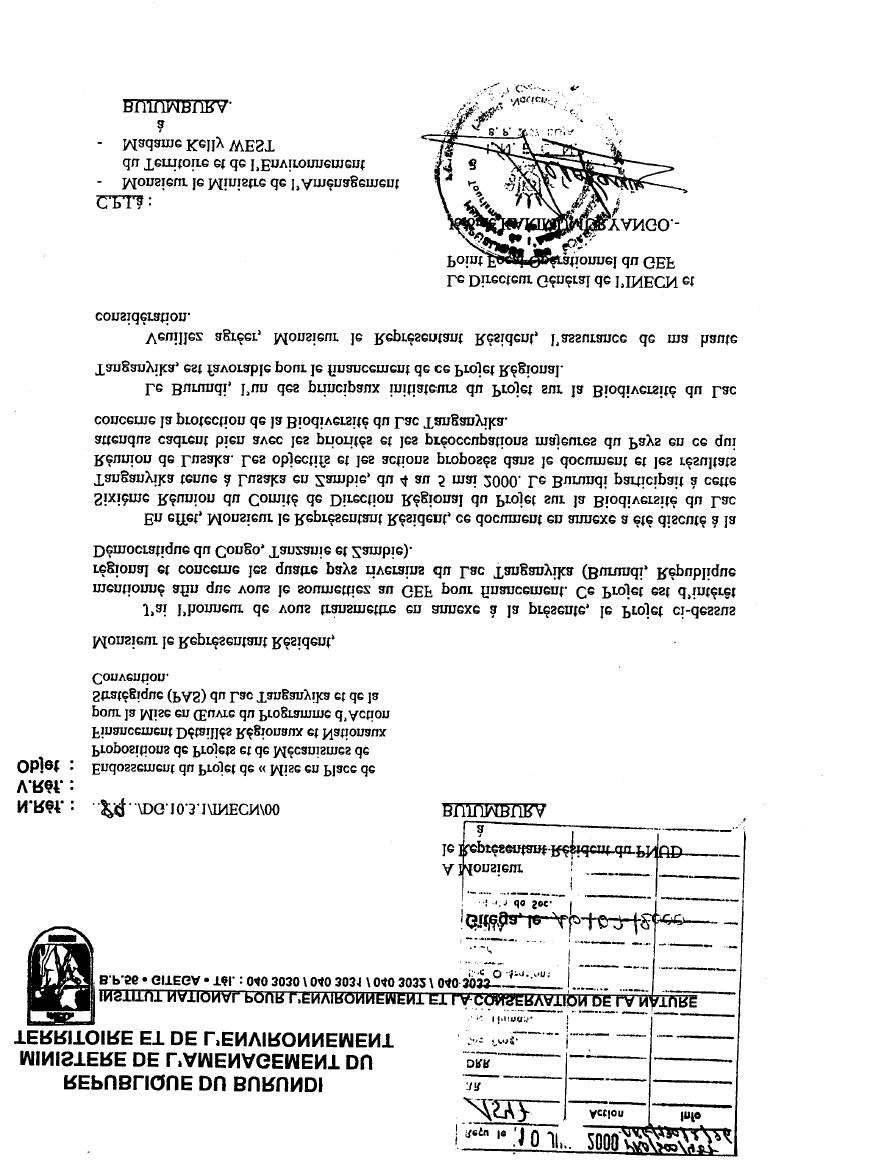
LETTERS OF ENDORSEMENT BY GEF Operational Focal Points
In 2000 2001 at the time of the approval of the GEF PDF B leading to this GEF Full Size
Project Brief, GEFSEC accepted Statements of Approval of the combined PDF Project
Document / PDF Concept. These signatures of GEF Operational Focal Points are attached here
within this Annexure.


8b)
LETTERS OF CONFIRMATION OF COFINANCE
Eight Letters of Confirmation are attached:
· From IUCN for 1.0 million $
· From Nordic Development Fund for potential 4.5 million $
· African Development Bank for 30 million $
· Private Sector Contribution to Waste Water in Burundi (0.89 mill $)
· Government of Tanzania for
· Government of Burundi for
· Government of DRC for
· Government of Zambia
From
NORDIC DEVELOPMENT FUND<Magnus.Magnusson@ndf.fi>
Date Friday, August 20, 2004 5:10 pm
To <benoitb@unopsmail.org>
Cc <tdamhaug@c2i.net>, <Arnthor.Thordarson@ndf.fi>
Subject RE: RE: RE: Lake Tanganyika Project: Kigoma WasterWaterTreatment
Component: Special NDF Appraisal Mission
Dear Benoit,
Torbjörn Damhaug has informed me that he would be available for conducting the special NDF
appraisal mission to Kigoma (via Dar es Salaam) during the
first week (ten days) of September. I have asked Torbjörn to hereafter take direct contact
with you and Katrin Lervik (who knows Torbjörn -both are Norwegian) with regard to detailed
planning, timing etc. of the mission.
I am confident that the mission will be successful and provide us with sufficient information to
move ahead with project preparation activities.
If all works as planned, I will submit the NDF-
financed components to NDF's Board of Directors
for approval at the Board meeting
on 9 December (or a per-capsulum decision earlier if needed). Please note that my colleague
Arnthor Thordarson will be in charge of project implementation activites after the credit
agreement has been signed by the Government of Tanzania.
All the best and let's stay in touch.
Magnus Magnusson
Regional Manager
Nordic Development Fund
P.O. Box 185
FIN-00171 Helsinki
Finland
From
<Magnus.Magnusson@ndf.fi>
Date Tuesday, July 13, 2004 4:09 pm
To <a.bella@afdb.org>
Cc <s.tounkara@afdb.org>, <a.diaw@afdb.org>, <j.rigoulot@afdb.org>,
<y.vyas@afdb.org>, <alan.rodgers@cybernet.co.tz>, <KAW@IUCNEARO.ORG>,
<benoitb@unopsmail.org>, <Eric.Reynolds@fao.org>, <jens.skov-
christensen@cec.eu.int>, <hannu.molsa@fishinnovationcentre.fi>,
<alan.rodgers@undp.org>, <andrew.hudson@undp.org>, <TJG.Loberg@ndf.fi>
Subject RE: Partners meeting - 16 - 17 and 19 July 2004, Tunis - Multinationa l :
Regional Integrated Program for Lake Tanganyika Support Project/Partn ers
meeting
Dear Ms. Bella,
Thank you for the invitation to the partners meeting in Tunis. Unfortunately NDF will not be able
to participate at the meeting due to other commitments. However, it might be possible for NDF to
participate via telephone during parts of the meeting preferably on Monday next week (please call
+358 40 549 08 88). As you know, NDF's sector expert Tumi Tomason has finalised his mission to
Tanzania and Zambia and has subsequently submitted his report to NDF (see attached). The report
is currently being processed by NDF and no decision has yet been taken on which interventions to
propose to the respective governments and NDF's lead agency (AfDB).
However, at this stage the interventions in Tanzania as proposed by the consultant seem most
suitable for NDF financing. These are (see page 24 ff in the attached report):
Capacity of local and national stakeholders strengthened:
Fisheries and environment local services are endowed with office facilities, computers and
communication means (boats and engines) by 2007
The skills of senior staff and technicians from fisheries departments and research institutes
are up-graded in fisheries monitoring, stock assessment, control and surveillance by 2008
Fisheries resources sustainably managed and value added to fish products increased:
Sustainable fisheries statistical systems, including data bases are developed in each country
Landing sites in pilot villages are endowed with basic infrastructure and facilities by 2007
The lake's water quality maintained and environment conserved:
Wastewater treatment plant constructed in Kigoma by 2008
The interventions proposed, especially the wastewater treatment plant, seem to require
additional appraisal and NDF will contract a water expert for this purpose.
(from 5 12 September)
We regret that NDF will not be able to be in Tunis for the partners meeting and hope that the
discussions will be successful for all parties involved. I look forward to our future cooperantion
in this project.
Best regards,
Magnus
------------------
Magnus Magnusson Regional Manager
Nordic Development Fund
P.O. Box 185 FIN-00171 Hels inki Finland
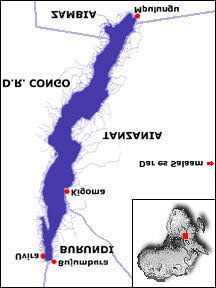
ANNEX 8 e : MAP OF LAKE TANGANYIKA REGION SHOWING MAIN TOWNS
Annex 9 Lake Tanganyika Integrated Regional Development Programme
Description of Programme (From AfDB ProDoc June 2004)
Generalities. The LTIRDP was designed to implement the policies of the framework fisheries
management plan (FFMP) and SAP II. It translates the determination of the partners involved (ADF.
GEF, FAO, IUCN, NDF, EU, FINNIDA) to accompany the Governments in their efforts to lay the
foundations of a sustainable management of the Lake and the resources of its basin. In addition to the
policies of the FFMP and SAP II, the programme is also based on the general principles of the code of
conduct for responsible fishing adopted by FAO in 1995, which on the whole seeks to maintain the
quality, diversity and availability of fish resources in sufficient quantities for the present and future
generations of the countries concerned. More globally, the programme falls within the policies of the
Poverty Reduction Strategy Papers (PRSP) and the interim PRSP prepared by the States, which aim at a
lasting and sustainable economic growth for poverty reduction. It incorporates the Bank's food
security, poverty reduction, environmental protection and regional integration vision.
Objectives and expected results: The overall objective of the programme is to contribute to poverty
reduction in the Lake basin. More specifically, it aims to improve food security and the welfare of the
populations of the basin through good management of Lake Tanganyika. The programme has five
components: A) Capacity building; (B) Fisheries development; (C) Rehabilitation of infrastructure and
post conflict operations; (D) Environmental protection and biodiversity; and (E) Programme
management. The results expected from the programme are: (i) the establishment of viable national and
regional institutions for cooperation and integration; (ii) sustainable management of fish resources and
their enhancement; (iii) sustainable improvement of water quality; (iv) promotion of sustainable
development initiatives in the basin; (v) strengthening of local, national and regional institutional
capacities; (v) development of joint management measures of the Lake at the regional level; and (vi)
establishment of an integrated regional monitoring, information and communication system.
Detailed description of the components
Component A: Capacity building. The component seeks to beef up the capacities of national and
regional institutions with a view to a sustainable and integrated management of Lake Tanganyika and its
natural resources. In particular, it will enable (i) the support to the establishment of the Secretariat of the
Lake Tanganyika Authority (LTA); (ii) support to the improvement and harmonisation process of
fishery and environmental policies and regulations; (iii) support for the drawing up of the economic and
social master plan of the lake basin; (iv) support for the administration of fisheries and fish research
stations in the areas of fisheries planning and back-up research; (v) development of a permanent
regional monitoring and communication system; and (vi) the implementation of training for the
executives of the national institutions and NGOs involved in the programme. This component also
seeks to strengthen the local communities in the areas of socio-professional organisation, natural
resources management and environmental protection.
Component B: Fisheries development. The aim of this component is to ensure a sustainable exploitation
of the fish resources and an environmental preservation of the Lake. In particular, it will: (i) introduce
the participatory management of fish resources by developing the joint fisheries management
mechanism and the protection of the reproduction areas; (ii) establish a sustainable fishery statistics
system with the constitution of computerised data bases; (iii) put in place a lake surveillance device
with the effective participation of the fishing communities; and (iv) install basic infrastructure and
equipment to enhance the products.
Component C: Rehabilitation of infrastructure and local development initiatives. The component seeks
to improve the welfare of the communities through rehabilitation/reconstruction of the basic socio-
economic infrastructure and the financing of the local development initiatives of the communities. The
programme will in particular finance (i) through the local development funds, the construction of
community infrastructure (class rooms, community health centres, latrines, drinking water points, rural
markets, community lake transport, jetties, etc); (ii) reintegration micro-projects and diversification of
activities in favour of the vulnerable populations; and (iii) rehabilitation of rural roads to open up the
production areas and facilitate the free movement of persons and goods.
Component D: Environmental management and conservation of biodiversity. The component aims to
finance a series of activities contributing to the protection of the environment and biodiversity of the
Lake. They are in particular: (i) the construction of a wastewater treatment plant in Kigoma and
Mpulungu and the commissioning of that of Bujumbura; (ii) the protection of 150,000 ha of catch
basins; (iii) the harmonisation of environmental monitoring in the basin; (iv) environmental and health
education (against HIV/AIDS, diarrhoea and malaria).
Component E: Programme management. The programme will initially be implemented by the interim
Secretariat of the Lake Tanganyika Authority and, after ratification of the Convention, by the
Secretariat. For purposes of efficiency, availability of infrastructure and accessibility, the Authority will
be based in Bujumbura. The national implementation units will be established in the lakeside towns of
the Lake in Bujumbura, Kigoma, Mpulungu and Kaliémie. A multi-sectoral steering committee will
also be set up in each country. The national programme implementation units will play the role of
coordinating and monitoring the activities. The technical implementation of field activities will be
provided by the technical services of the States, notably the departments of environment, infrastructure,
health, etc, NGOs and specialised local agencies.
Institutional provisions. The Convention on the sustainable management of Lake Tanganyika
(ASMLT): Its duties will be to implement policies and decisions taken by the States, give scientific and
technical opinions, prepare and propose programmes of action for approval by the States, negotiate with
the donors, monitor the parameters of the Lake and approve the annual work programmes. It will
comprise the representatives of the Ministries in charge finance, fishery, environment, water and the
Executive Director of the Authority, and may, if necessary, be extended to other structures. The LTMC
meets at least two times a year and the Executive Director of LTA will run its Secretariat. In each
country, an inter-ministerial steering committee (NISC) will be set up. It will comprise a representative
of the Ministries in charge of Finance, Fisheries, Environment, Water, Decentralised administrations
and a representative of the private sector, two representatives of the civil society. The duties of the
NISC are to consider and approve the programmes of activity and annual budgets, consider and adopt
the status reports see to the application of the recommendations of the various supervision missions.
Periodic project status reports, audit and follow-up reports will be addressed to them. An operational
manual will be prepared to define the role of each of the partners and the work environment.
Programme cost and financing plan. The programme cost is about USD 81.42 million. In keeping with
the financing plan hereunder, the programme will be jointly financed by African Development Bank
(36.43%), the World Environmental Fund (16.58%), the World Union for the Conservation of Nature
(3.44%), the European Union (18.42), the Nordic Development Fund (14.74%), the Finnish
Development Agency (46%), the World Organisation for Food and Agriculture (1.23%), the
Governments and beneficiaries (5.50%) and the private sector (1.2%).
Table 1: Programme financing plan in million USD Approximate Values (From AfDB June 2004)
Private
ADF
GEF
IUCN
EU
NDF
FIN
FAO
GVT
BENEF
sector
TOTAL
Components
1. Strengthening of institutional capacities
1.1 Support to Lake Authority
0.70
3.50
0.40
4.60
1.2 Improvement and update of the policy frameworks
0.35
0.15
0.50
1.3 Technical supervision and training
5.09
1.80
0.20
7.09
1.4 Support to the installation of a monitoring system
0.50
1.00
1.50
2. Fisheries development
2.1 Sustainable fisheries management support
10.32
1.75
1.00
0.25
13.32
2.2 Studies and back-up research
0.44
1.00
1.44
3. Rehabilitation of infrastructure
0.00
3.1Community projects
2.15
5.00
3.05
1.24
11.44
3.2 Economic infrastructure
4.37
10.00
14.37
3.3 Education and health prevention
0.23
0.23
4. Management of the environment and biodiversity
0.00
4.1 Development of the catch basins
1.93
8.00
1.80
11.73
4.2 Waste water treatment
2.00
5.41
0.98
8.39
4.3 Environmental education
0.17
0.17
5. Programme management
3.41
3.24
6.65
Total cost
29.66
13.50
2.80
15.00
12.00
2.00
1.00
3.24
1.24
0.98
81.42
Table 2: Programme cost estimate by source of finance and countries/beneficiaries in million USD
ADF
GEF
IUCN
EU
NDF
FINNIDA
FA0
GVT
BENEF
PRIVATE
TOTAL
%
BURUNDI
0.00
2.50
0.00
5.00
0.00
0.00
0.00
0.47
0.00
0.98
8.95
11.0
DRC
10.07
2.50
0.00
5.00
0.00
0.00
0.00
1.05
0.46
0.00
19.08
23.5
TANZANIA
7.40
2.50
0.00
2.50
7.80
0.00
0.00
0.88
0.32
0.00
21.40
26.3
ZAMBIA
4.84
2.50
0.00
2.50
4.20
0.00
0.00
0.84
0.46
0.00
15.34
18.8
Lake Authority
7.35
3.50
2.80
2.00
1.00
0.00
0.00
0.00
16.65
20.4
Total cost
29.66
13.50
2.80
15.00
12.00
2.00
1.00
3.24
1.24
0.98
81.42
100