|
1
|
- Catalin Simota
- Research Institute for Soil Science and Agrochemistry
- Bucharest - Romania
|
|
2
|
- Use of existing databases linked with a simulation model for the evaluation of nitrate leaching
/ runoff from agriculture sources and designation of Nitrate Vulnerable
Zones
|
|
3
|
- Overlapping three layers of information:
- Layer 1 : Soil transmission properties for nitrates below root front
depth (leaching) and by surface runoff;
- Layer 2 : Groundwater;
- Layer 3 : Nitrogen balance at NUTS4 level (imports from local farmyard +
livestock manure; export by crop yields).
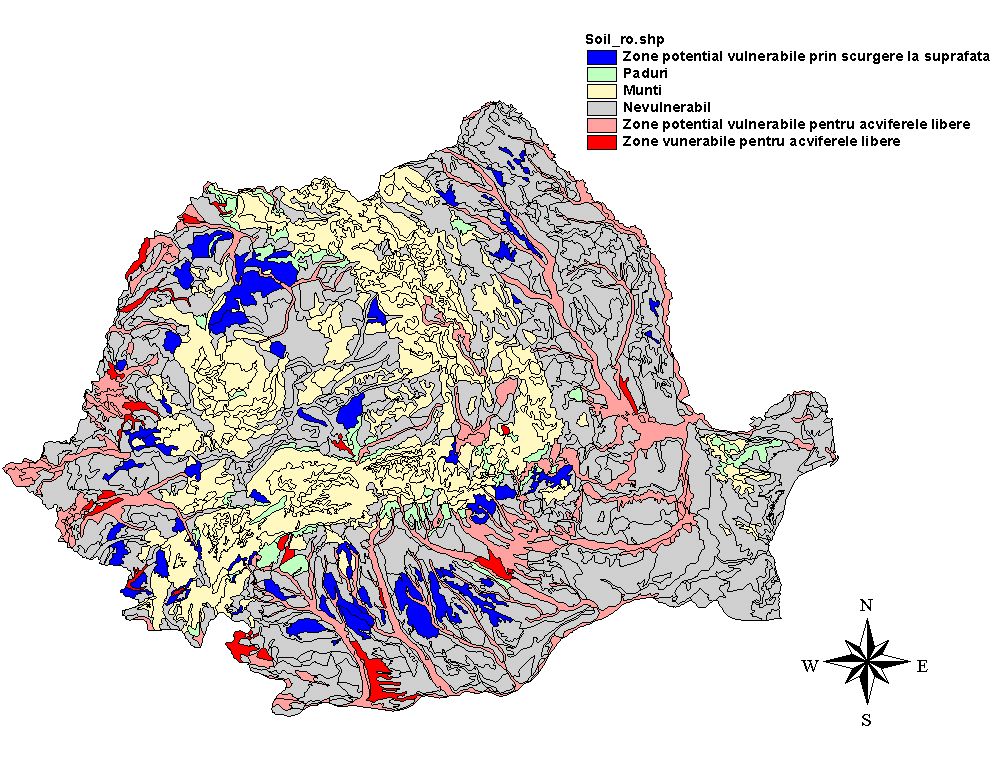
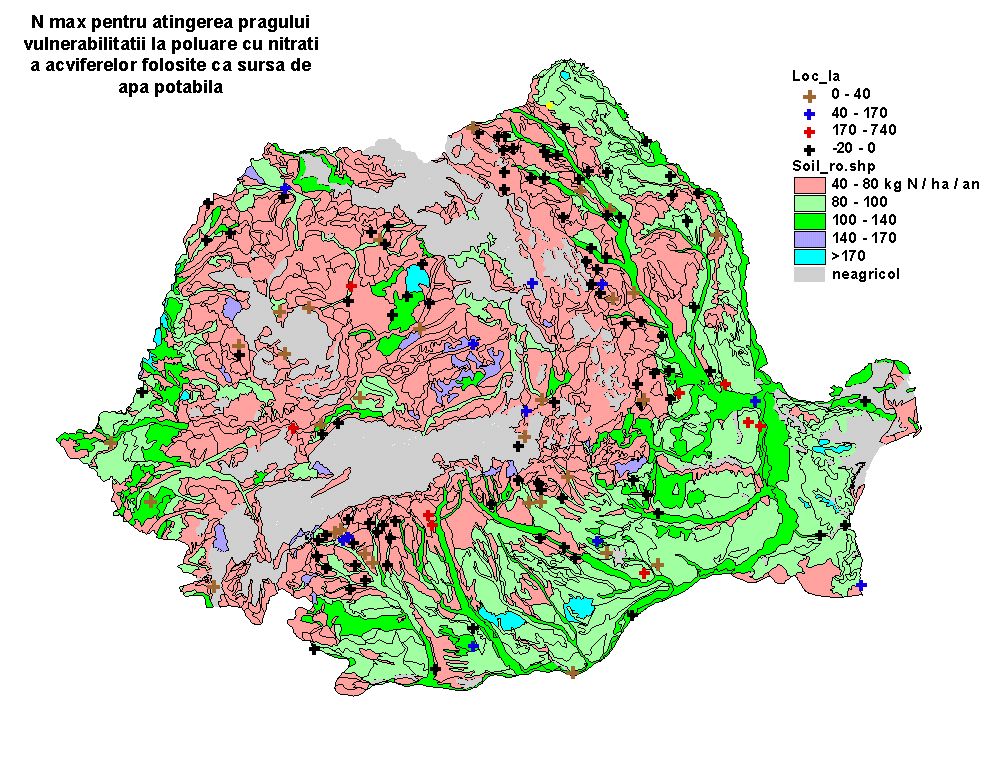
|
|
4
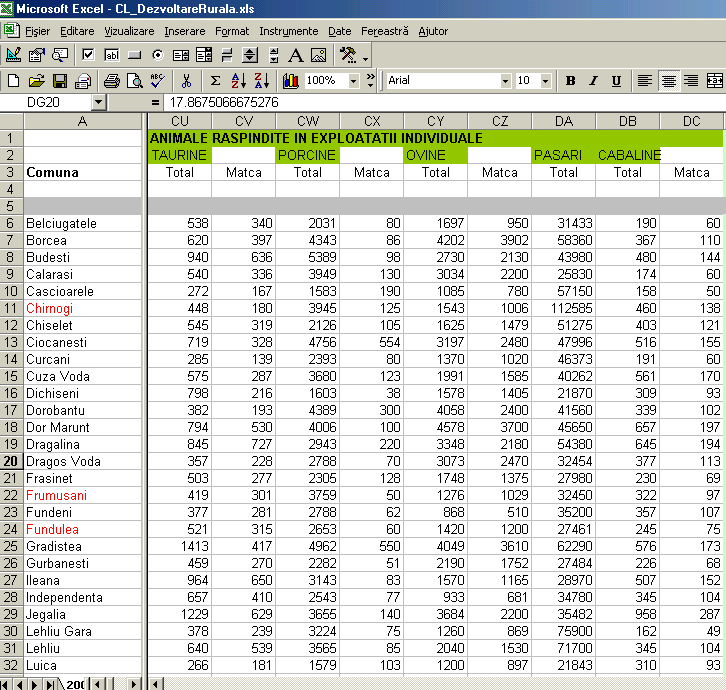
|
- Layer 1 : Soil transmission properties for nitrates below root front
depth (leaching) and by surface runoff
|
|
5
|
- “Potential” vulnerability
indexes for the water bodies pollution with nitrates distinct for groundwater / aquifers (by leaching
below the root front depth) and surface waters (by runoff) were
calculated using the pedotransfer functions derived from the soil
attributes provided by Soil Database of Europe 1:1,000,000.
|
|
6
|
- To each soil attributes or
derived pedotransfer functions is linked a “weight” (0-1 0: no impact,
1: maximum impact) related to the potential impact of the given soil
property to leaching or runoff process. The potential vulnerability
index is calculated by adding the weights for all the soil attributes
contributing to leaching / runoff.
|
|
7
|
- The vulnerability index for
pollution by leaching - Calculated only for slopes less than 8%
(Dominant slope class: “Level”)
- The vulnerability index for
pollution by runoff - Calculated
only for slopes greater than 8% (Dominant slope class: “Sloping”,
“Moderately steep”, “Steep”)
|
|
8
|
- The soil attributes and the
corresponding weights used for calculating the vulnerability index for
pollution by leaching (groundwater / aquifers) are:
- Dominant limitation to agricultural use. If the codes for this attribute
are: “Drained”, “Quasi permanently flooded” or “Phreatic phase” then the
weight is ”1”.
- Secondary limitation to agricultural use. If the codes for this
attribute are: “Drained”, “Quasi permanently flooded” or “Phreatic
phase” then the weight is ”0.5”.
|
|
9
|
- The soil attributes and the
corresponding weights used for calculating the vulnerability index for
pollution by leaching (groundwater / aquifers) are:
- Wet front hydraulic conductivity (derived pedotransfer function). For
values greater than 10 mm h-1 the corresponding weight is “1”, for
values in the range 4 – 10 mm h-1 the weight is “0.5”.
- Maximum available water (derived pedo-transfer function). For values
less than 10 cm the weight is “1”.
|
|
10
|
- The soil attributes and the
corresponding weights used for calculating the vulnerability index for
pollution by leaching (groundwater / aquifers) are:
- Dominant parent material. For “Sandy materials” the weight is 1, for
“Organic materials” the weight is “0.8”, for “Sandy loam” , “Sandy
loess” “River alluvium”, “Lacustrofluvial alluvium”, “Estuarine/Marine
alluvium” the weight is “0.75”, for “Glaciofluvial deposits”, “Till”, “Glaciofluvial
drift” and “Alluvial or glaciofluvial clay” the weight is “0.5”.
|
|
11
|
- The soil attributes and the
corresponding weights used for calculating the vulnerability index for
pollution by leaching (groundwater / aquifers) are:
- Dominant surface textural class and Dominant sub-surface textural class.
If the codes for surface and sub-surface textural class are “Coarse”
than the corresponding weight is “1”.
- Soil type. For “Gleysol”, “Fluvisol”, “Histosol” or “Arenosol” the
weight is “1”
|
|
12
|
- The soil attributes and the
corresponding weights used for calculating the vulnerability index for
pollution by runoff (surface waters) are:
- Dominant limitation to agricultural use. If the codes for this attribute
are: “Eroded phase, erosion”, “Lithic (coherent and hard rock within 50
cm)” or “Petrocalcic (cemented or indurated calcic horizon within 100
cm)” then the weight is ”1”.
- Secondary limitation to agricultural use. If the codes for this
attribute are: “Eroded phase, erosion”, “Lithic (coherent and hard rock
within 50 cm)” or “Petrocalcic (cemented or indurated calcic horizon
within 100 cm)” then the weight is
“0.5”
|
|
13
|
- The soil attributes and the
corresponding weights used for calculating the vulnerability index for
pollution by runoff (surface waters) are:
- Wet front hydraulic conductivity (derived pedotransfer function). For
values less than 4 mm h-1 the corresponding weight is “1”
- Maximum available water (derived pedotransfer function). For values less
than 10 cm and wet front hydraulic conductivity less than 5 mm h-1 the
weight is “1”
|
|
14
|
- The soil attributes and the
corresponding weights used for calculating the vulnerability index for
pollution by runoff (surface waters) are:
- Dominant parent material. For “Detrital formations”, “Crystalline rocks
and migmatites” and “Volcanic rocks” the weight is 1.
- Dominant surface textural class and Dominant sub-surface textural class.
If the codes for surface and sub-surface textural class are “Fine” or
“Very Fine” than the
corresponding weight is “1”.
|
|
15
|
- The soil attributes and the
corresponding weights used for calculating the vulnerability index for
pollution by runoff (surface waters) are:
- Soil type. For “Lithosol”, “Andosol”, “Glacier”, “Rock Outcrop” the
weight is “1”.
- Presence of an impermeable layer within the soil profile. If the
impermeable layer is within 0-40 cm than the corresponding weight is
“1”.
|
|
16
|
- For each polygon defining a Soil Mapping Unit (SMU) the sum of
weights corresponding to vulnerability by leaching and by runoff are
calculated for each soil type. Than, the vulnerability is evaluated
considering the maximum sum of weights (corresponding to one of the soil
types in the polygon).
|
|
17
|
- The sum of weights is
translated into vulnerability classes:
- Very low : [0.0 – 0.5]
- Low : (0.5 – 1.5]
- Moderate : (1.5 – 2.5]
- High : (2.5 – 3.5]
- Very high : >3.5
|
|
18
|
|
|
19
|
- INDEX FOR NITROGEN POLLUTION
RISK GROUNDWATER / AQUIFER using:
- - Travel time to aquifer
- - Aquifer position
- - Aquifer vulnerability
|
|
20
|
- Travel Time:
- Long ‑ means a travel time of more than 15 years.
- Medium ‑ means a travel time of 5 to 15 years.
- Short ‑ means a travel time of less than 5 years.
|
|
21
|
- Aquifer Position:
- Shallow/Karst ‑ means that the aquifer is a shallow water table type with a depth of less
than 100 feet to the water table
or that the local geology consists of
a shallow karst (sink hole and solution tube) structure extending
to the ground surface or bottom of the root zone.
- Intermediate ‑ means that the aquifer is a water table type (not
confined), and the depth to the water table Is at least 100 feet but
less than 1000 feet.
- Deep or Confined ‑ means
that the aquifer is very deep (1000 feet or more to water table) or that
an aquiclude or aquitard is positioned between the aquifer and the
ground surface such that the auifer is effectively Isolated from local
percolation from the ground surface.
|
|
22
|
- Aquifer Vulnerability:
- Class I and IIa ‑ Domestic water supply. An irreplaceable source of drinking
water to substantial population or as ecologically vital.
- Class IIb ‑ Potential source of drinking water.
- Class III ‑ Unlikely to be used as drinking water.
|
|
23
|
- (A) Potential vulnerable zones
by runoff (surface water bodies) : 5650 km2, i.e. 2.37% of country
area, and 3.82% of agricultural area
- (B) Potential vulnerable zones
by leaching (groundwater / aquifers) – moderate risk: 13759 km2, i.e.
5.77% of country area, and 9.30% of agricultural area
- (C) Potential vulnerable zones
by leaching (groundwater / aquifers) high risk: 1200 km2, i.e. 0.50% of
country area, and 0.81% of agricultural area
|
|
24
|
|
|
25
|
- Layer 3 : Nitrogen balance at
NUTS4 level (imports from local farmyard + livestock manure; export by
crop yields).
|
|
26
|
- Evaluation of nitrogen balance
at NUTS4 unit level (“Comuna”) considering uniform spreading of manure
on the arable land (input) of the territorial unit and the export with
crop yield
|
|
27
|
|
|
28
|
- Maximum & Actual Capacity of Livestock
- Manure & Waste waters management
- Source of data: National Administration “Romanian Waters”
|
|
29
|
- Excretion/transformation
coefficients – animal dependent
|
|
30
|
|
|
31
|
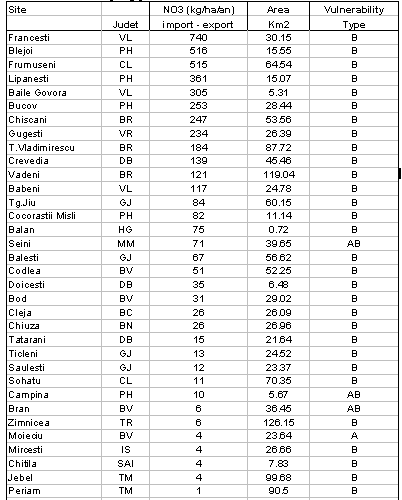
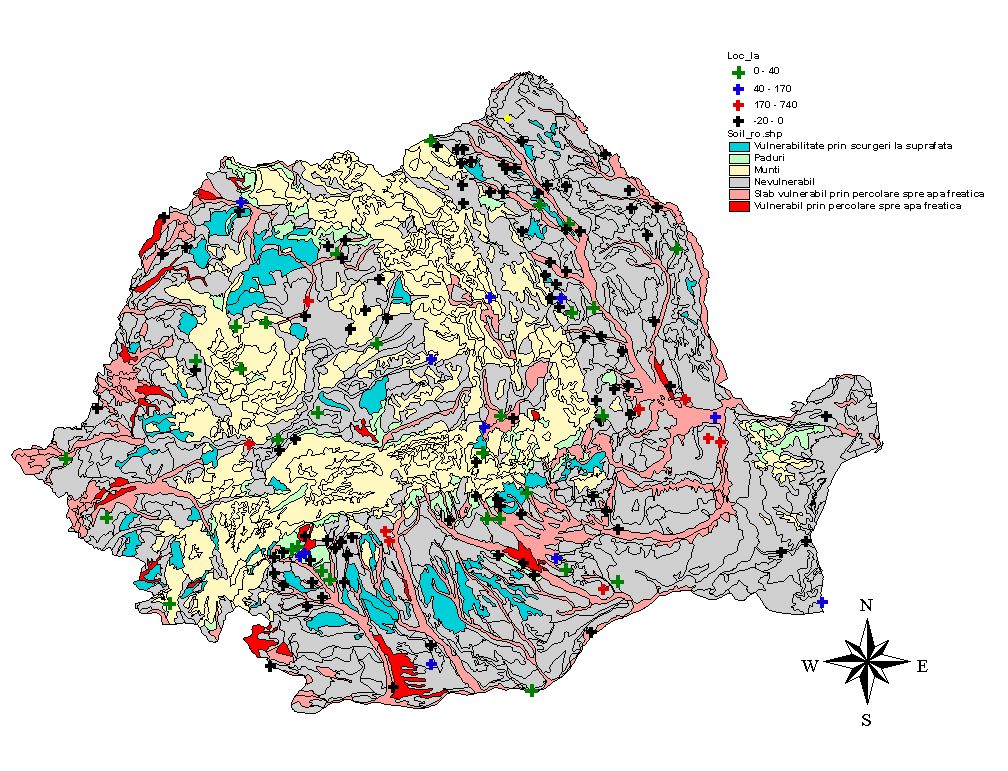
- Overlapping Potential Nitrate
Vulnerable Zones with NUTS4-units having a positive import – export
value for Nitrogen
|
|
32
|
- (A) Vulnerable zones by runoff
(surface water bodies) : 474.685 Km2 (potential : 5650
km2)
- (B) Potential vulnerable zones
by leaching (groundwater / aquifers) – moderate risk: 2511.115 Km2 (Potential
:13759 km2)
- (C) Vulnerable zones by
leaching (groundwater / aquifers) high risk: 158.94 km2
(Potential : 1200 km2)
|
|
33
|
|
|
34
|
|
|
35
|
- More precise delimitation of
the NUTS4 based Nitrate Vulnerable Zones according with the
corresponding watersheds.
|

 Notes
Notes