|
1
|
- Jitendra Srivastava and Tijen Arin
- Environmentally and Socially Sustainable Development, Europe and Central
Asia
- World Bank
|
|
2
|
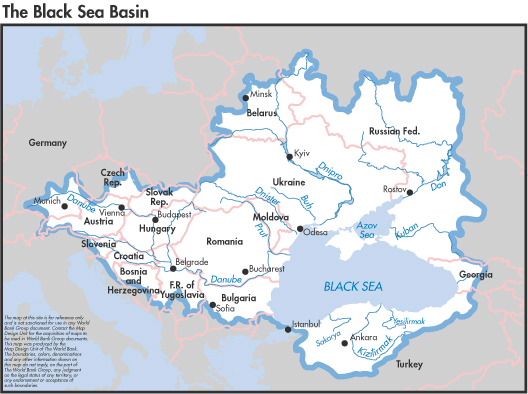
- The GEF Strategic Partnership addresses the recovery of the ecological
balance of the Danube river and the Black sea. The Partnership was
established in 2001 to support the broader long term Strategy by the
Danube and Black Sea Commissions, the concerned riparian countries, in
collaboration with GEF, the UNDP and the World Bank to address the issue
of nutrient pollution in the water bodies.
- The projects supported under the Partnership also assist the riparian
countries towards compliance with EU Nitrate Directive
|
|
3
|
- Three types of projects (or combination there of) are eligible for
financing under the Partnership:
- Restoration or creation of wetlands that act as nutrient filters
- Reform and improvement of agriculture and animal management practices
with impact on nutrient use and/or non-point discharge through run-off
- Municipal Wastewater treatment for reduction of nutrient discharge
- If the opportunity exists to leverage nutrient reduction in a large
industrial or agro-industrial facility, that intervention will also be
eligible!
|
|
4
|
- The Strategic Partnership consists of
- World Bank Investment Fund for Nutrient Reduction (USD 70 million)
- UNDP Danube Regional Project and UNDEP/UNEP Black Sea Regional
Project (USD 25 million)
- Partnership closely cooperates with EU efforts on environment and the
Nitrate Directive in particular
- 10 WB Investment Fund projects under implementation / implementation.
- Municipal WWT projects in Bosnia and Herzegovina,Croatia, Hungary,
Moldova, Russia and Ukraine.
- Agricultural Pollution Control projects in Georgia, Moldova, Romania,
Russia, Serbia and Turkey.
- Wetland restoration project in Bulgaria (with APC component)
|
|
5
|
- The EU Community Policy on the environment (article 174,1302) strives to
contribute to the following:
- Preserving, protecting and improving the quality of environment
- Protecting human health
- Prudent and rational utilization of natural resources
- Promoting measures at international level to deal with regional or
world wide environmental problems
|
|
6
|
- The Council’s Directive 91/676/EEC of December 12, 1991 relates
specifically towards protection of waters against pollution caused by
nitrates from agricultural sources.
- The Directive explicitly states that “The main cause of pollution from
diffuse sources affecting the community’s waters is nitrates from
agricultural sources both farming and animal wastes”.
|
|
7
|
- The directive further emphasizes member states to identify certain
zones, draining into waters vulnerable to pollution from nitrogen
compounds.
- The Member States shall prepare action programs in respect of designated
vulnerable zones
|
|
8
|
- The Member States should establish a code of good agricultural practices
to be implemented by farmers
- Where required Member States should set up a program, including the
provision of training and information for farmers and agro processors,
promoting the application of the code(s) of good agricultural practices
|
|
9
|
- The overall development objective of the Partnership Agricultural
Pollution Control Projects are:
- Increase significantly the use of environment-friendly agricultural
practices in the project area and thereby reduce nutrient discharge
from agricultural sources, and
- Assist national programs in developing needed human resources with the
skills and modernizing the facilities for expanding these efforts
throughout the country
|
|
10
|
- In support of these objectives, the projects are designed to:
- Promote the adoption of environment-friendly agricultural practices
- Promote wetlands restoration
- Strengthen national capacity for developing appropriate policies and
regulation and its enforcement
- Promote public awareness and Government support
- Monitor the soil and water quality for Nutrient pollution
|
|
11
|
- Moldova – Agricultural Pollution Control Project
- Good progress is made in a number of areas towards the projects
development objective of significantly increasing the use of
environmentally–friendly agricultural practices by farmers and
agro-industry to reduce nutrient discharge into water bodies. It has
also initiated harmonization of its legislative framework with EU
Nitrate Directive and in developing a code of good agricultural practices
and organic farming. It is linked with a US $40 mln IDA-funded Rural
Investment and Services Project
|
|
12
|
- Romania – Agricultural Pollution Control Project. During the two years
since the project became effective, it has supported:
- Construction of 9 village level manure platforms and 1350 household
level manure storage facilities
- Provision of equipment for the manure platforms
- Promotion of several environment-friendly agricultural practices on
farmers’ fields
- Capacity building of local agencies
- Aforestation of degraded lands
- Development and dissemination of code of good agricultural practices
- TA for harmonizing Romanian legislation with the Nitrate Directive
- Public awareness campaigns
|
|
13
|
- Bulgaria – Wetlands Restoration and Pollution Reduction Project
- The project has prepared the engineering design for the restoration of
Kalimok marshes and Belene islands and has identified other sites for
restoration
- Significant progress has been made in protected area planning, training
and capacity building
- Small grant program for biodiversity conservation is operational and
Farmer Transition Support Fund is established
- The project has supported a number of well-targeted and planned
training activities and institutional capacity building
|
|
14
|
- Turkey – Anatolia Watershed Rehabilitation Project
- The project’s overall development objective is to support sustainable
natural resource management practice in Anatolia and Turkey’s Black sea
region.
- The objective of the GEF supported component is to introduce farming
practices which will reduce the discharge of nutrients into surface and
ground water in watersheds draining into the Black sea in four
provinces.
- More specifically this component will help introduce improved manure
and nutrient management practices and organic farming
- Will improve the capacity for soil and water monitoring for nutrient
discharge and help farmers to comply with national-international food
safety and environmental requirements
|
|
15
|
- Serbia - Danube River Enterprise Pollution Reduction Project
- The project will focus on introducing environmentally friendly
practices in nutrient management in medium and large size cattle and
pig farms, and proper animal waste management in slaughterhouses. The project area will be Vojvodina
and Central Serbia where intensive livestock production and
slaughtering is common.
- The project will also assist the harmonization of Serbian regulations
with the EU Nitrate Directive, in particular through the drafting of a
Code for Good Agricultural Practices.
- The capacity of the Agricultural Extension Services will be enhanced to
provide proper guidance to enterprises to manage manure and
slaughterhouse animal waste properly. The project will also help
improve capacity for water quality monitoring.
- The project is expected to
become effective in June 2005 and last four years.
|
|
16
|
- Russia – Krasnodar Agricultural Nutrient Reduction Project
- The overall objective of this project in preparation is to increase the
use of environment-friendly practices by farmers and agro-industry in
the Krasnodar krai in order to reduce nutrient (N and P) pollution from
agricultural sources to the Black sea
- The project will have four components to be implemented over a period of
five years:
- Promotion of good agricultural practices.
- Restoration of abandoned rice fields and monitoring soil and water
quality
- Strengthening of the legislative, regulatory and institutional capacity
if the Krai government
- Public awareness – the project would be implemented in three regions of
the Krai that are “hot spots” of nutrient pollution to Black sea
|
|
17
|
- Jitendra Srivastava and Tijen Arin
- Environmentally and Socially Sustainable Development, Europe and Central
Asia
- World Bank
|

 Notes
Notes