|
1
|
- TURKEY
ANATOLIA WATERSHED REHABILITATION PROJECT
- Sedat Kadioglu
- Ministry of Environment
- Abdulmecit Yesil
- Ministry of Agriculture and Rural Affairs
|
|
2
|
- PROJECT TITLE : Anatolia Watershed Rehabilitation Project
- PROJECT BENEFICIARIES :
- Ministry of Environment , Ministry of
Forestry, Ministry of Agriculture and Rural Affairs and General
Directrate of Rural Services
- PROJECT DURATION : 7 Years
- ( starting in 2003)
|
|
3
|
- THE PROJECT BUDGET
- The total cost of the project is around 50.000.000 US Dollars. 6.000.000 US Dollars of this amount
is provided by the GEF and the major portion is provided by the World
Bank. The fund to be used for the rehabilitation works is a loan and the fund to be used for the pollution
reduction works is a donation.
|
|
4
|
- PROJECT AREA
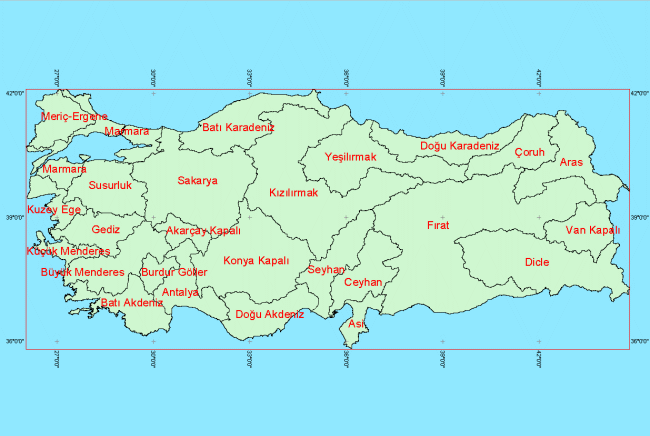
- The project will be carried out at totally 5 basins and 13
provinces. ( Seyhan,
Ceyhan, Göksu, Kızılırmak, and Yeşilırmak).
Only rehabilitation works will be performed at Seyhan, Ceyhan and Göksu
Basins while both rehabilitation and the GEF related pollution decrease
works will be performed at Kızılırmak and
Yeşilırmak Basins.
- 4 provinces have been selected for the GEF. The provinces of
Amasya , Çorum and Tokat are at Yeşilırmak Basin and Samsun is
at Kızılırmak Basin.
|
|
5
|
|
|
6
|
|
|
7
|
- The total area of the 13 provinces is about 19 million ha (24% of the
country total). It is estimated that in these provinces, 70 MCs will cover an area of about 650,000 ha out of which 250,000
ha will be the physical implementation area. Erosion (both sheet and gully) in forest, range and
agricultural land, land degradation and soil and water pollution are
important problems in the project area
|
|
8
|
|
|
9
|
The majority of the
large livestock owners are not using the wastes as manure, but they are
giving it free, in case of demand.
Therefore, these wastes are mostly dumped in open areas, streams, and
fields without any treatment.
About half of the respondents have
feverish diseases which is followed by goiter and diarrhea. On the other hand, waste water from
agro-processing plants, i.e. sugar factory, paper mills, are discharged into
streams without any treatment. Some factories have some primitive treatment
facilities but either these are not operated, or if operated are not
efficiently done so.
|
|
10
|
|
|
11
|
- The Black Sea Transboundary Diagnostic Analysis identified nutrient
pollution as the most serious problem that has lead to the ecological
breakdown experienced in the Black Sea over the past few decades. The
GEF Strategic Partnership was established in 2001 in order to encourage
public and private sector investments in nutrient reduction, notably
industrial and urban wastewater treatment, agricultural nutrient
pollution control and wetland restoration in the Black Sea and Danube
Basin.
|
|
12
|
- The overall objective of the project is to reduce the discharges of
nutrients (nitrogen and phosphorus),
and other agricultural pollution into the Yeşilırmak
and Kızılırmak Rivers.
The project will be implemented in the micro catchments that
are in the provinces of Amasya
, Çorum, Tokat and Samsun
|
|
13
|
- The project will fully integrate environmental concerns into
agricultural practices to make them more sustainable, including the
storage, management and application of manure and ensure ecologically
sustainable use of natural resources to reduce the discharge of the
nutrient load into the Turkish ground and surface waters as well as into
the Black Sea.
- The project will also promote appropriate policies and policy reforms in
order to create an enabling
environment for realizing the project objectives. It will develop capacity of private
small holders and commercial
farmers to use
environment- friendly agricultural
practices and resource management.
|
|
14
|
- In order to meet food production for increasing population requirements,
increasing agricultural export, and to meet raw materials requirements
for industry, agricultural production should be increased. But while
aiming to increase agricultural production, natural sources such as soil
and water which are main inputs of agriculture, should be protected.
|
|
15
|
|
|
16
|
|
|
17
|
- Solid and liquid wastes coming from beef, dairy and poultry production
enterprises are polluting the ground and surface waters, and these
circumstances are threatening human and environmental health and also
causing pollution in the Black Sea.
- This project’s objective is also the reduction of pollution by using
chemical fertilizers based on soil testing
|
|
18
|
|
|
19
|
|
|
20
|
- Nutrient reduction:
- The Project will
reduce, over the
long-term, the discharge of
nutrients (nitrogen and phosphorus) and other agricultural
pollutants into the surface and ground waters of Turkey and
the Black Sea
through integrated land
and water management and promote ecologically sustainable use of
natural resources.
|
|
21
|
- This component is being prepared under the umbrella of the Black Sea/Danube Strategic Partnership-Nutrient Reduction Investment Fund
under which riparian
countries would be eligible for Global Environment Facility (GEF)
funding for projects that would control or mitigate nutrient inflow to
the Black Sea. The Project
activities are directly linked to "Strategic Action Plan for the
Protection and Rehabilitation of the Black Sea" (BSSAP), formulated
with the assistance of the GEF.
|
|
22
|
- Within the framework of the project,
the following steps will be taken :
- strengthening national policy
and local regulatory capacity to
meet European Union
(EU) standards for agricultural nutrient pollution control,
- increasing the use
of environmentally friendly agricultural practices and thereby reducing nutrient discharge particularly from
agricultural sources to
the Black Sea,
- c) capacity building and promoting a broad public awareness program and
replication strategy.
|
|
23
|
|
|
24
|
|
|
25
|
- The project will initially fund pilot actions to test the options for
improving the storage and handling of livestock waste. Following a review of the different
livestock husbandry practices in the project provinces, three types of
enterprises were selected for the pilot activities: i) commercial beef
and dairy farms in peri-urban areas that are frequently discharging
solid and liquid wastes directly into the water body; ii) small livestock farms in the MC
areas; and iii) poultry units
(each with about 45,000 birds) in the Corum area where there is a high
concentration of poultry production.
|
|
26
|
- In the case of the peri-urban cattle farmers and the small livestock
farms in the MCs, the project will provide funds for construction of
on-farm and central storage as well as equipment for waste collection
and application to agricultural land.
The arrangements for the organization and management of the
investment and implementation phases, as well as the participation of
the local administrations and beneficiaries, still have to be worked out
in the course of further project preparation. With regard to the poultry units, primarily
technical assistance will be provided for enforcing compliance with
existing legislation and to develop a more efficient system for handling
the collection and utilization of poultry manure.
|
|
27
|
- MARA’s and MOE’s staff, visited the sites selected for manure management
pilot activities at: (a) Turhal - beef feed-lots on the Dazya Stream
that drains into the Yesilirmak, Tokat Province; (b) Suluova - beef feed
lots on the Tersakan Stream, draining into the Yesilirmak, Amasya
Province; and (c) Bafra - small farmer milk and beef production in
Ilyasu MC on the Ilyasu Stream draining into the Kizilirmak, Samsun
Province (d) Chicken units lots on the Derinçay Stream draining into the
Yeşilırmak , Çorum Province.
|
|
28
|
|
|
29
|
|
|
30
|
|
|
31
|
- Although some efforts have been made to introduce soil analysis for
better fertilizer application, the impact is limited. The “annual
provincial extension programs” include nutrient management but due to
problems regarding resource allocation, the effectiveness of these
efforts are questionable. Therefore,
inorganic fertilizer application is another source of non-point
pollution in Kizilirmak and Yesilirmak watersheds. A baseline survey conducted in early
2002 in these watersheds indicated that only 15% of the farmers follows
the advice given by the extension staff, traditional practices and
“learning from the neighbor” is still dominant.
|
|
32
|
|
|
33
|
- The project will provide for the incremental equipment, staff training
and operating costs for monitoring the impact of environment-friendly
practices on the discharge of nutrients (N & P) into the water
body. Measurements of BOD and
suspended solids will also be made.
MARA will be responsible
for monitoring at the level of the MC, while MOE will be responsible for monitoring water
quality upstream and downstream in the main river. The central MOE laboratory in Ankara
will be used to calibrate samples
taken by MARA.
|
|
34
|
|
|
35
|
- Ministry of Environment (MOE) and Ministry of Agriculture and Rural
Services (MARA) prepared their initial review of the status of
environmental legislation covering, the Nitrate Directive legislation
and certification standards for organic farming. The GEF funding could support work on application of
the Nitrates Directive, the development of a Code of Good Agricultural
Practices and measures required to promote the development of Organic
Farming. With regard to
Integrated Pest Management, this would be covered by the World Bank
funding.
|
|
36
|
|
|
37
|
- The program related to Public
Awareness has been prepared by the authorities of MOE , MARA and the
World Bank. Public awareness, capacity building and replication
strategy activities will be conducted in all provinces covered by the
project. Public awareness
program will be applied at the
local, national and international levels.
|
|
38
|
- (a) Villages will be visited in selected
micro-catchments to find out about the level of public awareness,
the interest and need for better knowledge of environmental matters and
the issues it deals with.
- (b) Appropriate structures and instruments will be designed for
the campaign ( Radio, TV, Publications)
and the cost for each instrument will be determined.
- (c) The scope and specific objectives for each step will be
defined in the campaign.
- (d) Proposals will be presented to local communities to test their receptivity to the
approach and the instrument proposed .
|
|
39
|
|
|
40
|
- (a) The experiences gained at the
local level will be reflected on the national level.
- (b) A broad nationwide
public information campaign will be undertaken to disseminate the
benefits of proposed project
activities.
- (c) Efforts will be concentrated on institutions and groups that
may influence the replication of the project in other areas.
- (d) A national media campaign will be launched to introduce the
project to the people better .
- (e) The problems caused by
pollution and waste disposal will be explained .
|
|
41
|
- The project will provide for the organization of regional workshops,
field trips, training, publication in international agriculture and
environment journals and other activities to promote replication of
project activities in other Black Sea riparian countries. The pilot
activity will aim to serve as a model to be replicated in these
countries which will help contribute to significant reductions in the
nutrient loads entering the Black Sea.
|
|
42
|
-
At the central level, there are three units i) Project Management
Group (PMG), ii) Central Coordination Unit (CCU), and iii) Project
Management Units (PMUs). At the field level (provincial) there are two
units i) Local Project Management Teams (LPMT) ii) Micro Catchment
Implemantation Teams (MCIT)
|

 Notes
Notes